Cambridge IGCSE History 0470 — 2021 Oct/Nov Paper 4 · Variant 2
0470/42/O/N/21 · 40 marks · ≈45 min
The question paper and its mark scheme, free to read here and free to download. This is Cambridge’s own paper, exactly as it was sat.
Question paper4 pages

Mark scheme11 pages
Answers below. Sit the paper first if you are practising.

Paper as text
Question paper, page 1
Cambridge IGCSE™ 0470/42 October/November 2021 1 hour HISTORY Paper 4 Alternative to Coursework You must answer on the enclosed answer booklet. You will need: Answer booklet (enclosed) INSTRUCTIONS • Answer one question from your chosen Depth Study. • Follow the instructions on the front cover of the answer booklet. If you need additional answer paper, ask the invigilator for a continuation booklet. INFORMATION • The total mark for this paper is 40. • The number of marks for each question or part question is shown in brackets [ ]. This document has 4 pages. Any blank pages are indicated. [Turn over 11_0470_42_2021_1.8 © UCLES 2021 *4372305116*
Question paper, page 2
Answer one question from your chosen Depth Study. DEPTH STUDY A: THE FIRST WORLD WAR, 1914–18 How important was artillery as a reason for the high casualties on the Western Front? Explain your answer. [40] 1 How significant was the Kiel Mutiny as a reason for the outbreak of revolution in Germany in 1918? Explain your answer. [40] 2 DEPTH STUDY B: GERMANY, 1918–45 How important was Hitler to the electoral success of the Nazis by 1932? Explain your answer. [40] 3 How significant was rearmament in the Nazis’ rule over Germany, 1933–39? Explain your answer. [40] 4 DEPTH STUDY C: RUSSIA, 1905–41 How important were social and economic problems in Russia in the collapse of Tsarist rule by March 1917? Explain your answer. [40] 5 How significant was collectivisation in Stalin’s rule over the Soviet Union after 1928? Explain your answer. [40] 6 DEPTH STUDY D: THE UNITED STATES, 1919–41 How important were new methods of production in causing the economic boom in the 1920s? Explain your answer. [40] 7 How significant was Roosevelt’s election campaign as a reason for his victory in the presidential election of 1932? Explain your answer. [40] 8 DEPTH STUDY E: CHINA, c.1930–c.1990 How important were military tactics in determining the outcome of the Civil War in China? Explain your answer. [40] 9 How significant for China’s economic development were changes in agriculture in the 1950s? Explain your answer. [40] 10 11_0470_42_2021_1.8 © UCLES 2021 2
Question paper, page 3
DEPTH STUDY F: SOUTH AFRICA, c.1940–c.1994 How important to the development of apartheid was government repression after 1948? Explain your answer. [40] 11 How significant was President de Klerk in the transition to majority rule? Explain your answer. [40] 12 DEPTH STUDY G: ISRAELIS AND PALESTINIANS SINCE 1945 How important were the superior resources of the Jewish armed forces as a reason for Israel’s victory in the 1948–49 war? Explain your answer. [40] 13 How significant was Begin in the development of relations between Israel and its neighbours by 1996? Explain your answer. [40] 14 11_0470_42_2021_1.8 © UCLES 2021 3
Question paper, page 4
BLANK PAGE Permission to reproduce items where third-party owned material protected by copyright is included has been sought and cleared where possible. Every reasonable effort has been made by the publisher (UCLES) to trace copyright holders, but if any items requiring clearance have unwittingly been included, the publisher will be pleased to make amends at the earliest possible opportunity. To avoid the issue of disclosure of answer-related information to candidates, all copyright acknowledgements are reproduced online in the Cambridge Assessment International Education Copyright Acknowledgements Booklet. This is produced for each series of examinations and is freely available to download at www.cambridgeinternational.org after the live examination series. Cambridge Assessment International Education is part of the Cambridge Assessment Group. Cambridge Assessment is the brand name of the University of Cambridge Local Examinations Syndicate (UCLES), which itself is a department of the University of Cambridge. 11_0470_42_2021_1.8 © UCLES 2021 4
Mark scheme, page 1
This document consists of 11 printed pages. © UCLES 2021 [Turn over Cambridge IGCSE™ HISTORY 0470/42 Paper 4 Alternative to Coursework October/November 2021 MARK SCHEME Maximum Mark: 40 Published This mark scheme is published as an aid to teachers and candidates, to indicate the requirements of the examination. It shows the basis on which Examiners were instructed to award marks. It does not indicate the details of the discussions that took place at an Examiners’ meeting before marking began, which would have considered the acceptability of alternative answers. Mark schemes should be read in conjunction with the question paper and the Principal Examiner Report for Teachers. Cambridge International will not enter into discussions about these mark schemes. Cambridge International is publishing the mark schemes for the October/November 2021 series for most Cambridge IGCSE™, Cambridge International A and AS Level components and some Cambridge O Level components.
Mark scheme, page 2
0470/42 Cambridge IGCSE – Mark Scheme PUBLISHED October/November 2021 © UCLES 2021 Page 2 of 11 Generic Marking Principles These general marking principles must be applied by all examiners when marking candidate answers. They should be applied alongside the specific content of the mark scheme or generic level descriptors for a question. Each question paper and mark scheme will also comply with these marking principles. GENERIC MARKING PRINCIPLE 1: Marks must be awarded in line with: • the specific content of the mark scheme or the generic level descriptors for the question • the specific skills defined in the mark scheme or in the generic level descriptors for the question • the standard of response required by a candidate as exemplified by the standardisation scripts. GENERIC MARKING PRINCIPLE 2: Marks awarded are always whole marks (not half marks, or other fractions). GENERIC MARKING PRINCIPLE 3: Marks must be awarded positively: • marks are awarded for correct/valid answers, as defined in the mark scheme. However, credit is given for valid answers which go beyond the scope of the syllabus and mark scheme, referring to your Team Leader as appropriate • marks are awarded when candidates clearly demonstrate what they know and can do • marks are not deducted for errors • marks are not deducted for omissions • answers should only be judged on the quality of spelling, punctuation and grammar when these features are specifically assessed by the question as indicated by the mark scheme. The meaning, however, should be unambiguous. GENERIC MARKING PRINCIPLE 4: Rules must be applied consistently, e.g. in situations where candidates have not followed instructions or in the application of generic level descriptors. GENERIC MARKING PRINCIPLE 5: Marks should be awarded using the full range of marks defined in the mark scheme for the question (however; the use of the full mark range may be limited according to the quality of the candidate responses seen). GENERIC MARKING PRINCIPLE 6: Marks awarded are based solely on the requirements as defined in the mark scheme. Marks should not be awarded with grade thresholds or grade descriptors in mind.
Mark scheme, page 3
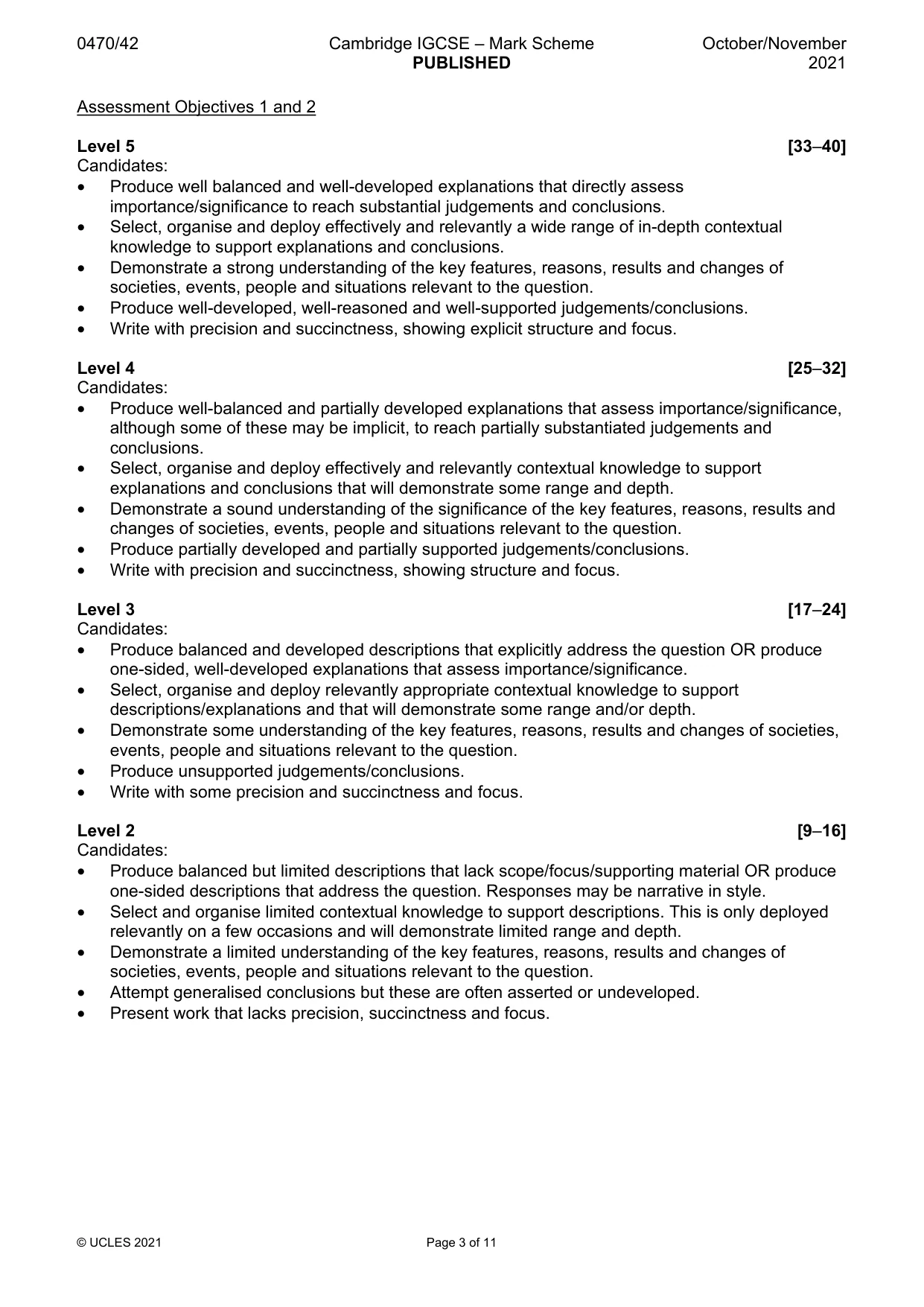
0470/42 Cambridge IGCSE – Mark Scheme PUBLISHED October/November 2021 © UCLES 2021 Page 3 of 11 Assessment Objectives 1 and 2 Level 5 [33–40] Candidates: • Produce well balanced and well-developed explanations that directly assess importance/significance to reach substantial judgements and conclusions. • Select, organise and deploy effectively and relevantly a wide range of in-depth contextual knowledge to support explanations and conclusions. • Demonstrate a strong understanding of the key features, reasons, results and changes of societies, events, people and situations relevant to the question. • Produce well-developed, well-reasoned and well-supported judgements/conclusions. • Write with precision and succinctness, showing explicit structure and focus. Level 4 [25–32] Candidates: • Produce well-balanced and partially developed explanations that assess importance/significance, although some of these may be implicit, to reach partially substantiated judgements and conclusions. • Select, organise and deploy effectively and relevantly contextual knowledge to support explanations and conclusions that will demonstrate some range and depth. • Demonstrate a sound understanding of the significance of the key features, reasons, results and changes of societies, events, people and situations relevant to the question. • Produce partially developed and partially supported judgements/conclusions. • Write with precision and succinctness, showing structure and focus. Level 3 [17–24] Candidates: • Produce balanced and developed descriptions that explicitly address the question OR produce one-sided, well-developed explanations that assess importance/significance. • Select, organise and deploy relevantly appropriate contextual knowledge to support descriptions/explanations and that will demonstrate some range and/or depth. • Demonstrate some understanding of the key features, reasons, results and changes of societies, events, people and situations relevant to the question. • Produce unsupported judgements/conclusions. • Write with some precision and succinctness and focus. Level 2 [9–16] Candidates: • Produce balanced but limited descriptions that lack scope/focus/supporting material OR produce one-sided descriptions that address the question. Responses may be narrative in style. • Select and organise limited contextual knowledge to support descriptions. This is only deployed relevantly on a few occasions and will demonstrate limited range and depth. • Demonstrate a limited understanding of the key features, reasons, results and changes of societies, events, people and situations relevant to the question. • Attempt generalised conclusions but these are often asserted or undeveloped. • Present work that lacks precision, succinctness and focus.
Mark scheme, page 4
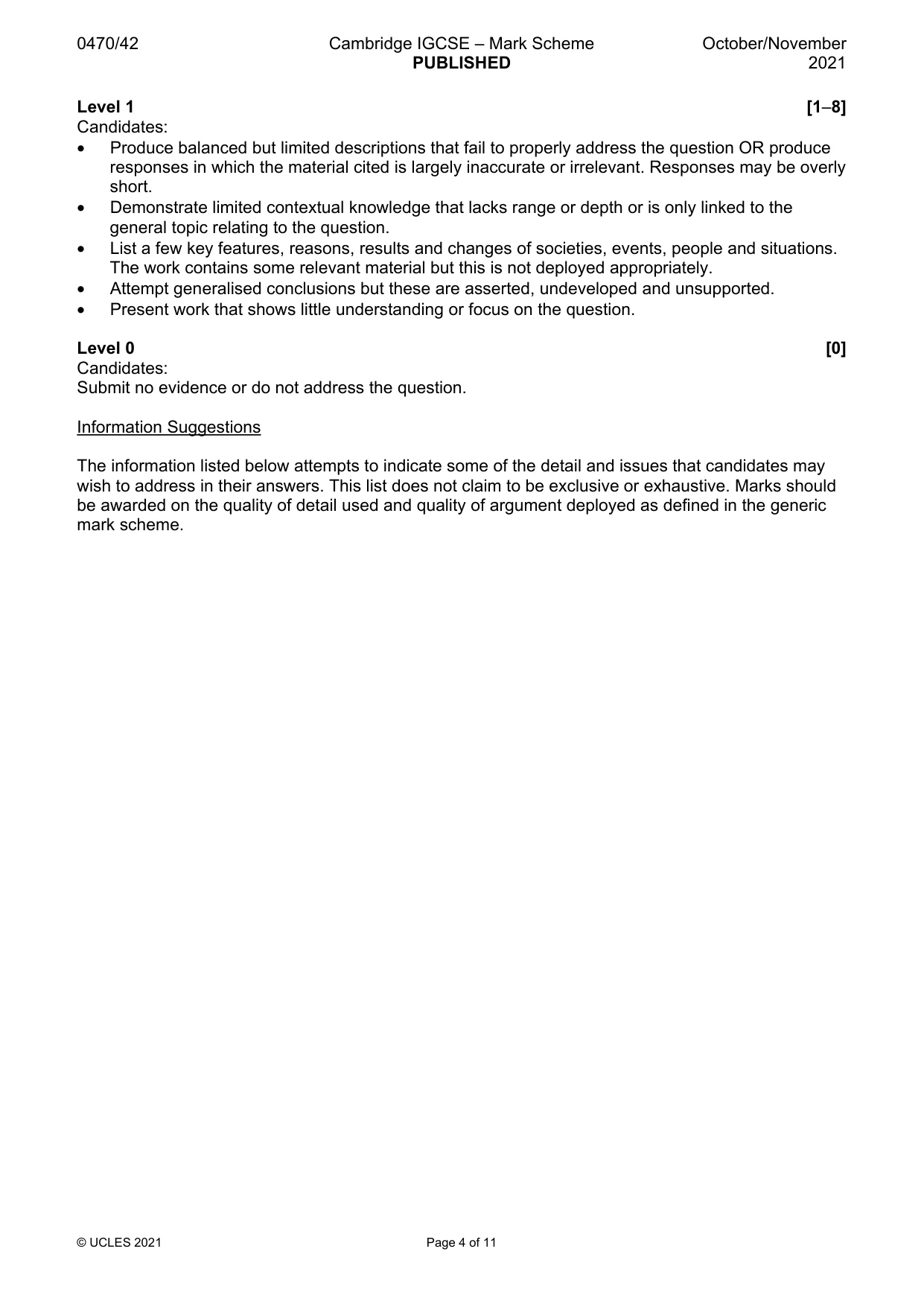
0470/42 Cambridge IGCSE – Mark Scheme PUBLISHED October/November 2021 © UCLES 2021 Page 4 of 11 Level 1 [1–8] Candidates: • Produce balanced but limited descriptions that fail to properly address the question OR produce responses in which the material cited is largely inaccurate or irrelevant. Responses may be overly short. • Demonstrate limited contextual knowledge that lacks range or depth or is only linked to the general topic relating to the question. • List a few key features, reasons, results and changes of societies, events, people and situations. The work contains some relevant material but this is not deployed appropriately. • Attempt generalised conclusions but these are asserted, undeveloped and unsupported. • Present work that shows little understanding or focus on the question. Level 0 [0] Candidates: Submit no evidence or do not address the question. Information Suggestions The information listed below attempts to indicate some of the detail and issues that candidates may wish to address in their answers. This list does not claim to be exclusive or exhaustive. Marks should be awarded on the quality of detail used and quality of argument deployed as defined in the generic mark scheme.
Mark scheme, page 5
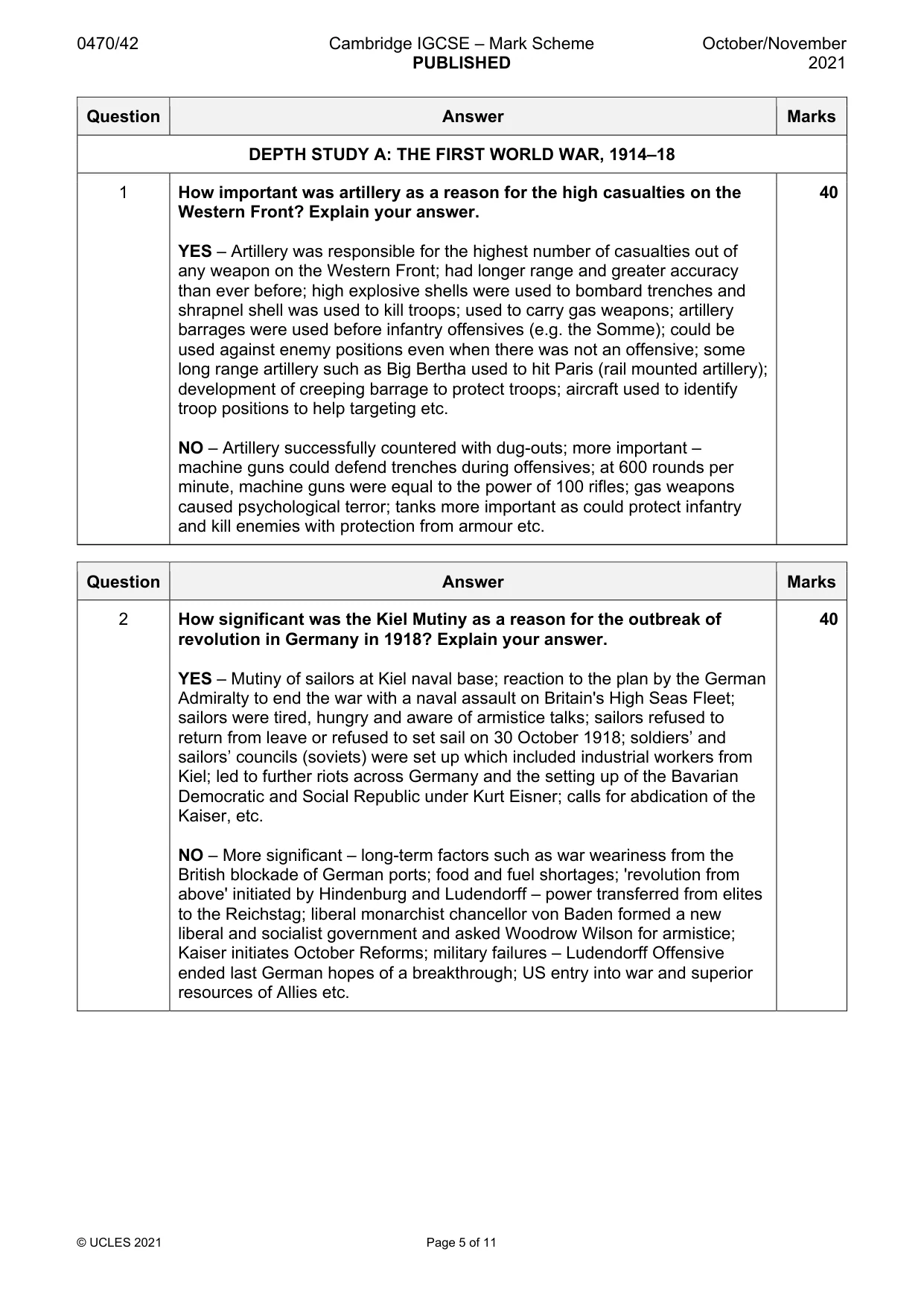
0470/42 Cambridge IGCSE – Mark Scheme PUBLISHED October/November 2021 © UCLES 2021 Page 5 of 11 Question Answer Marks DEPTH STUDY A: THE FIRST WORLD WAR, 1914–18 1 How important was artillery as a reason for the high casualties on the Western Front? Explain your answer. YES – Artillery was responsible for the highest number of casualties out of any weapon on the Western Front; had longer range and greater accuracy than ever before; high explosive shells were used to bombard trenches and shrapnel shell was used to kill troops; used to carry gas weapons; artillery barrages were used before infantry offensives (e.g. the Somme); could be used against enemy positions even when there was not an offensive; some long range artillery such as Big Bertha used to hit Paris (rail mounted artillery); development of creeping barrage to protect troops; aircraft used to identify troop positions to help targeting etc. NO – Artillery successfully countered with dug-outs; more important – machine guns could defend trenches during offensives; at 600 rounds per minute, machine guns were equal to the power of 100 rifles; gas weapons caused psychological terror; tanks more important as could protect infantry and kill enemies with protection from armour etc. 40 Question Answer Marks 2 How significant was the Kiel Mutiny as a reason for the outbreak of revolution in Germany in 1918? Explain your answer. YES – Mutiny of sailors at Kiel naval base; reaction to the plan by the German Admiralty to end the war with a naval assault on Britain's High Seas Fleet; sailors were tired, hungry and aware of armistice talks; sailors refused to return from leave or refused to set sail on 30 October 1918; soldiers’ and sailors’ councils (soviets) were set up which included industrial workers from Kiel; led to further riots across Germany and the setting up of the Bavarian Democratic and Social Republic under Kurt Eisner; calls for abdication of the Kaiser, etc. NO – More significant – long-term factors such as war weariness from the British blockade of German ports; food and fuel shortages; 'revolution from above' initiated by Hindenburg and Ludendorff – power transferred from elites to the Reichstag; liberal monarchist chancellor von Baden formed a new liberal and socialist government and asked Woodrow Wilson for armistice; Kaiser initiates October Reforms; military failures – Ludendorff Offensive ended last German hopes of a breakthrough; US entry into war and superior resources of Allies etc. 40
Mark scheme, page 6
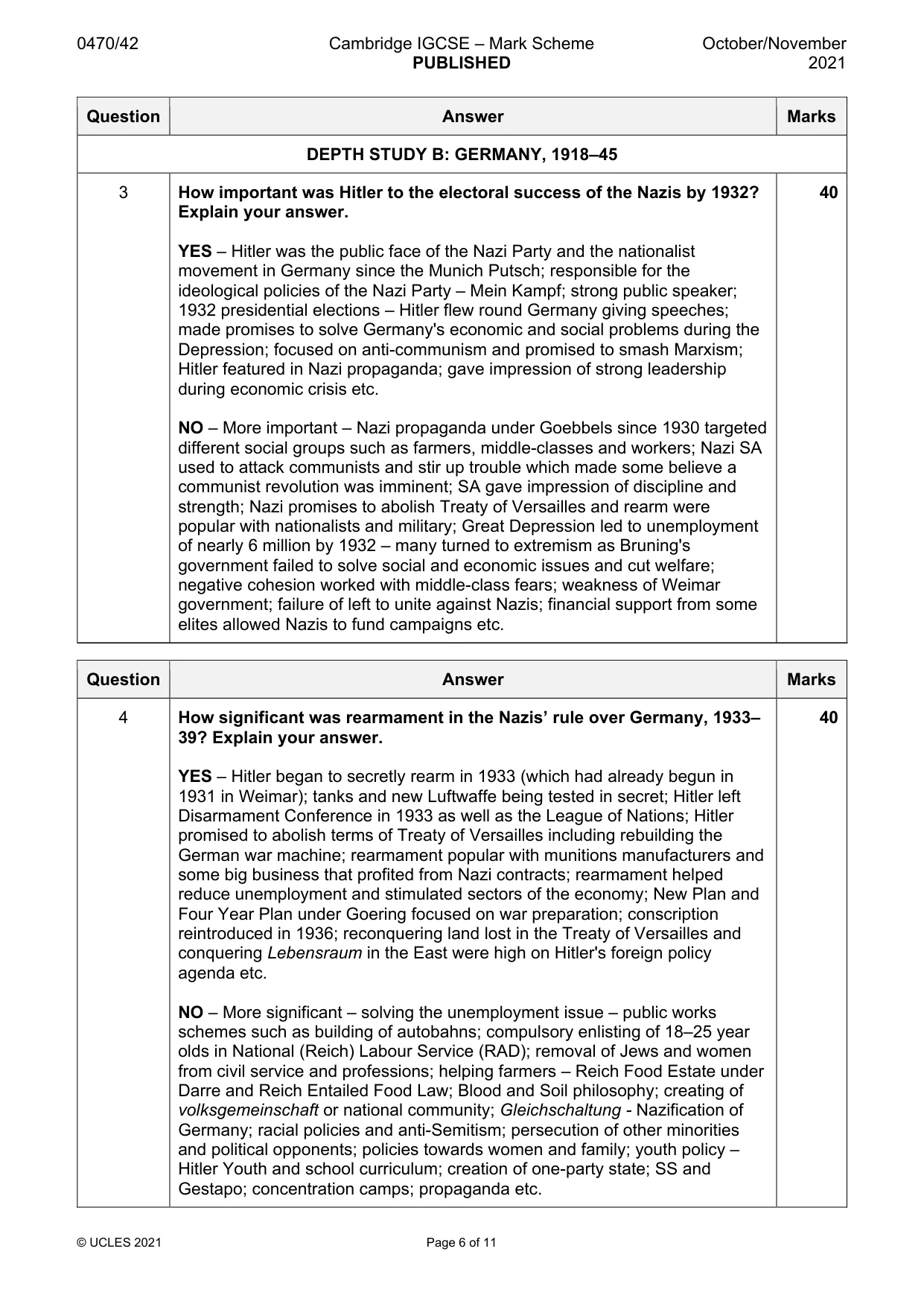
0470/42 Cambridge IGCSE – Mark Scheme PUBLISHED October/November 2021 © UCLES 2021 Page 6 of 11 Question Answer Marks DEPTH STUDY B: GERMANY, 1918–45 3 How important was Hitler to the electoral success of the Nazis by 1932? Explain your answer. YES – Hitler was the public face of the Nazi Party and the nationalist movement in Germany since the Munich Putsch; responsible for the ideological policies of the Nazi Party – Mein Kampf; strong public speaker; 1932 presidential elections – Hitler flew round Germany giving speeches; made promises to solve Germany's economic and social problems during the Depression; focused on anti-communism and promised to smash Marxism; Hitler featured in Nazi propaganda; gave impression of strong leadership during economic crisis etc. NO – More important – Nazi propaganda under Goebbels since 1930 targeted different social groups such as farmers, middle-classes and workers; Nazi SA used to attack communists and stir up trouble which made some believe a communist revolution was imminent; SA gave impression of discipline and strength; Nazi promises to abolish Treaty of Versailles and rearm were popular with nationalists and military; Great Depression led to unemployment of nearly 6 million by 1932 – many turned to extremism as Bruning's government failed to solve social and economic issues and cut welfare; negative cohesion worked with middle-class fears; weakness of Weimar government; failure of left to unite against Nazis; financial support from some elites allowed Nazis to fund campaigns etc. 40 Question Answer Marks 4 How significant was rearmament in the Nazis’ rule over Germany, 1933– 39? Explain your answer. YES – Hitler began to secretly rearm in 1933 (which had already begun in 1931 in Weimar); tanks and new Luftwaffe being tested in secret; Hitler left Disarmament Conference in 1933 as well as the League of Nations; Hitler promised to abolish terms of Treaty of Versailles including rebuilding the German war machine; rearmament popular with munitions manufacturers and some big business that profited from Nazi contracts; rearmament helped reduce unemployment and stimulated sectors of the economy; New Plan and Four Year Plan under Goering focused on war preparation; conscription reintroduced in 1936; reconquering land lost in the Treaty of Versailles and conquering Lebensraum in the East were high on Hitler's foreign policy agenda etc. NO – More significant – solving the unemployment issue – public works schemes such as building of autobahns; compulsory enlisting of 18–25 year olds in National (Reich) Labour Service (RAD); removal of Jews and women from civil service and professions; helping farmers – Reich Food Estate under Darre and Reich Entailed Food Law; Blood and Soil philosophy; creating of volksgemeinschaft or national community; Gleichschaltung - Nazification of Germany; racial policies and anti-Semitism; persecution of other minorities and political opponents; policies towards women and family; youth policy – Hitler Youth and school curriculum; creation of one-party state; SS and Gestapo; concentration camps; propaganda etc. 40
Mark scheme, page 7
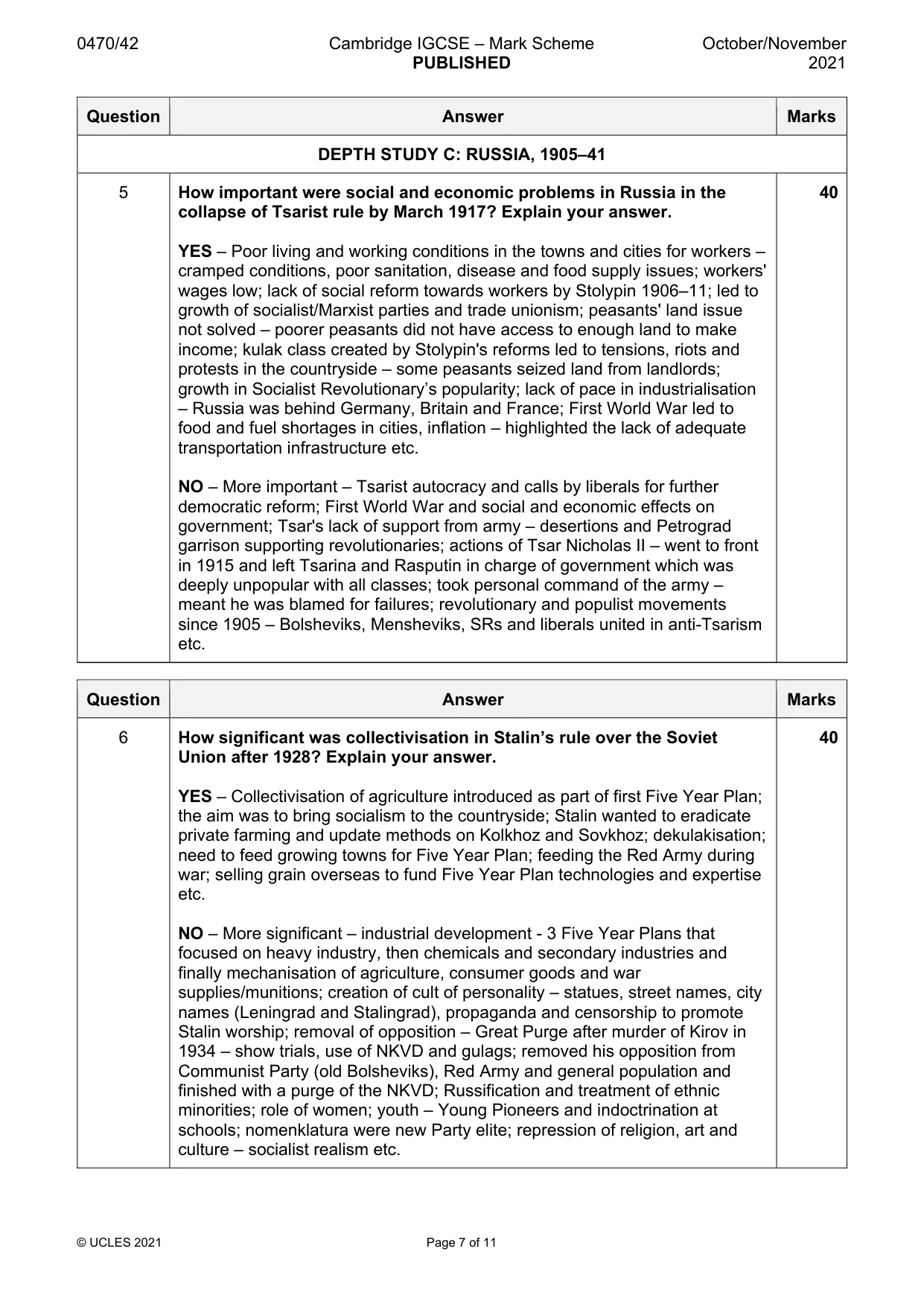
0470/42 Cambridge IGCSE – Mark Scheme PUBLISHED October/November 2021 © UCLES 2021 Page 7 of 11 Question Answer Marks DEPTH STUDY C: RUSSIA, 1905–41 5 How important were social and economic problems in Russia in the collapse of Tsarist rule by March 1917? Explain your answer. YES – Poor living and working conditions in the towns and cities for workers – cramped conditions, poor sanitation, disease and food supply issues; workers' wages low; lack of social reform towards workers by Stolypin 1906–11; led to growth of socialist/Marxist parties and trade unionism; peasants' land issue not solved – poorer peasants did not have access to enough land to make income; kulak class created by Stolypin's reforms led to tensions, riots and protests in the countryside – some peasants seized land from landlords; growth in Socialist Revolutionary’s popularity; lack of pace in industrialisation – Russia was behind Germany, Britain and France; First World War led to food and fuel shortages in cities, inflation – highlighted the lack of adequate transportation infrastructure etc. NO – More important – Tsarist autocracy and calls by liberals for further democratic reform; First World War and social and economic effects on government; Tsar's lack of support from army – desertions and Petrograd garrison supporting revolutionaries; actions of Tsar Nicholas II – went to front in 1915 and left Tsarina and Rasputin in charge of government which was deeply unpopular with all classes; took personal command of the army – meant he was blamed for failures; revolutionary and populist movements since 1905 – Bolsheviks, Mensheviks, SRs and liberals united in anti-Tsarism etc. 40 Question Answer Marks 6 How significant was collectivisation in Stalin’s rule over the Soviet Union after 1928? Explain your answer. YES – Collectivisation of agriculture introduced as part of first Five Year Plan; the aim was to bring socialism to the countryside; Stalin wanted to eradicate private farming and update methods on Kolkhoz and Sovkhoz; dekulakisation; need to feed growing towns for Five Year Plan; feeding the Red Army during war; selling grain overseas to fund Five Year Plan technologies and expertise etc. NO – More significant – industrial development - 3 Five Year Plans that focused on heavy industry, then chemicals and secondary industries and finally mechanisation of agriculture, consumer goods and war supplies/munitions; creation of cult of personality – statues, street names, city names (Leningrad and Stalingrad), propaganda and censorship to promote Stalin worship; removal of opposition – Great Purge after murder of Kirov in 1934 – show trials, use of NKVD and gulags; removed his opposition from Communist Party (old Bolsheviks), Red Army and general population and finished with a purge of the NKVD; Russification and treatment of ethnic minorities; role of women; youth – Young Pioneers and indoctrination at schools; nomenklatura were new Party elite; repression of religion, art and culture – socialist realism etc. 40
Mark scheme, page 8
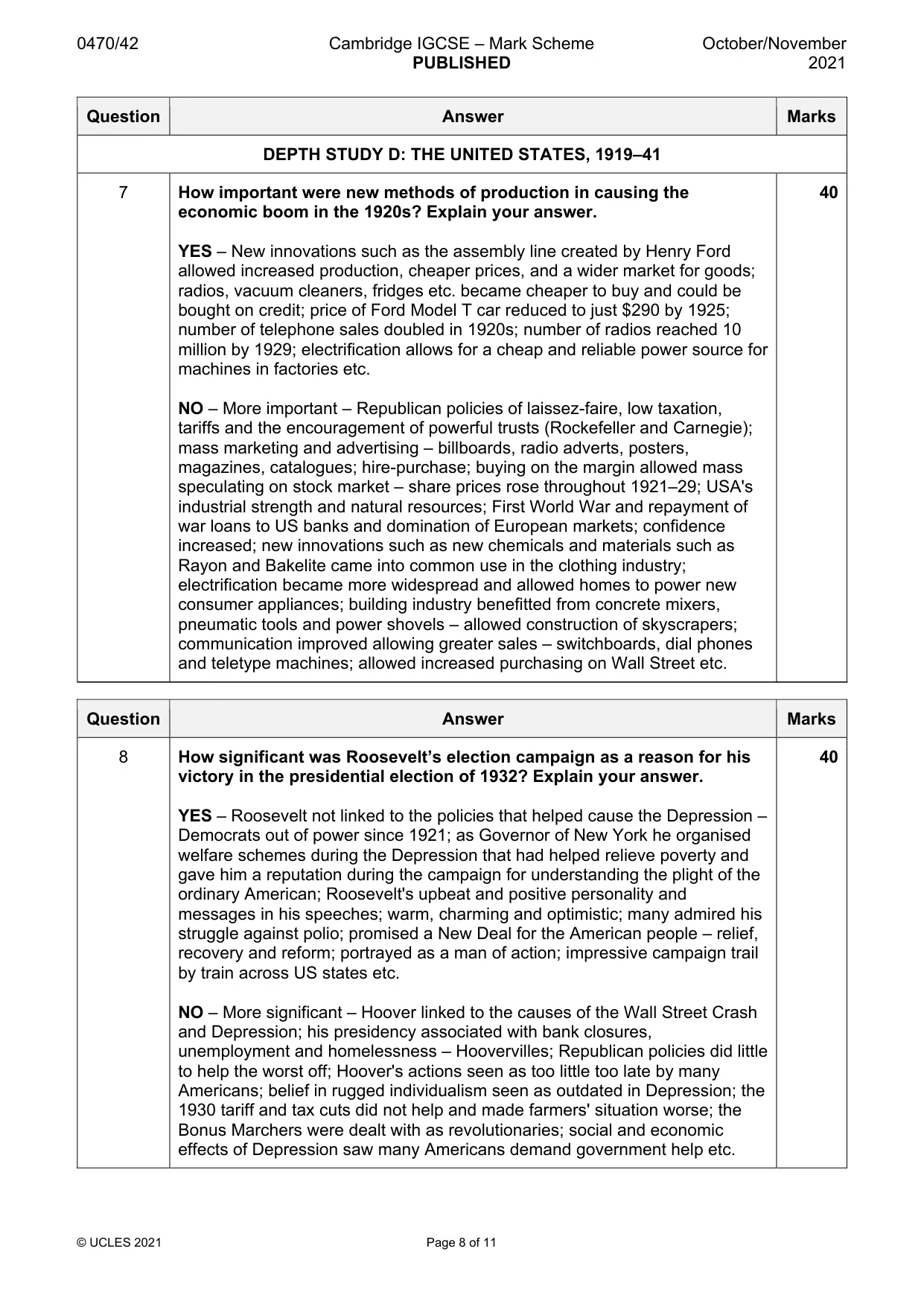
0470/42 Cambridge IGCSE – Mark Scheme PUBLISHED October/November 2021 © UCLES 2021 Page 8 of 11 Question Answer Marks DEPTH STUDY D: THE UNITED STATES, 1919–41 7 How important were new methods of production in causing the economic boom in the 1920s? Explain your answer. YES – New innovations such as the assembly line created by Henry Ford allowed increased production, cheaper prices, and a wider market for goods; radios, vacuum cleaners, fridges etc. became cheaper to buy and could be bought on credit; price of Ford Model T car reduced to just $290 by 1925; number of telephone sales doubled in 1920s; number of radios reached 10 million by 1929; electrification allows for a cheap and reliable power source for machines in factories etc. NO – More important – Republican policies of laissez-faire, low taxation, tariffs and the encouragement of powerful trusts (Rockefeller and Carnegie); mass marketing and advertising – billboards, radio adverts, posters, magazines, catalogues; hire-purchase; buying on the margin allowed mass speculating on stock market – share prices rose throughout 1921–29; USA's industrial strength and natural resources; First World War and repayment of war loans to US banks and domination of European markets; confidence increased; new innovations such as new chemicals and materials such as Rayon and Bakelite came into common use in the clothing industry; electrification became more widespread and allowed homes to power new consumer appliances; building industry benefitted from concrete mixers, pneumatic tools and power shovels – allowed construction of skyscrapers; communication improved allowing greater sales – switchboards, dial phones and teletype machines; allowed increased purchasing on Wall Street etc. 40 Question Answer Marks 8 How significant was Roosevelt’s election campaign as a reason for his victory in the presidential election of 1932? Explain your answer. YES – Roosevelt not linked to the policies that helped cause the Depression – Democrats out of power since 1921; as Governor of New York he organised welfare schemes during the Depression that had helped relieve poverty and gave him a reputation during the campaign for understanding the plight of the ordinary American; Roosevelt's upbeat and positive personality and messages in his speeches; warm, charming and optimistic; many admired his struggle against polio; promised a New Deal for the American people – relief, recovery and reform; portrayed as a man of action; impressive campaign trail by train across US states etc. NO – More significant – Hoover linked to the causes of the Wall Street Crash and Depression; his presidency associated with bank closures, unemployment and homelessness – Hoovervilles; Republican policies did little to help the worst off; Hoover's actions seen as too little too late by many Americans; belief in rugged individualism seen as outdated in Depression; the 1930 tariff and tax cuts did not help and made farmers' situation worse; the Bonus Marchers were dealt with as revolutionaries; social and economic effects of Depression saw many Americans demand government help etc. 40
Mark scheme, page 9
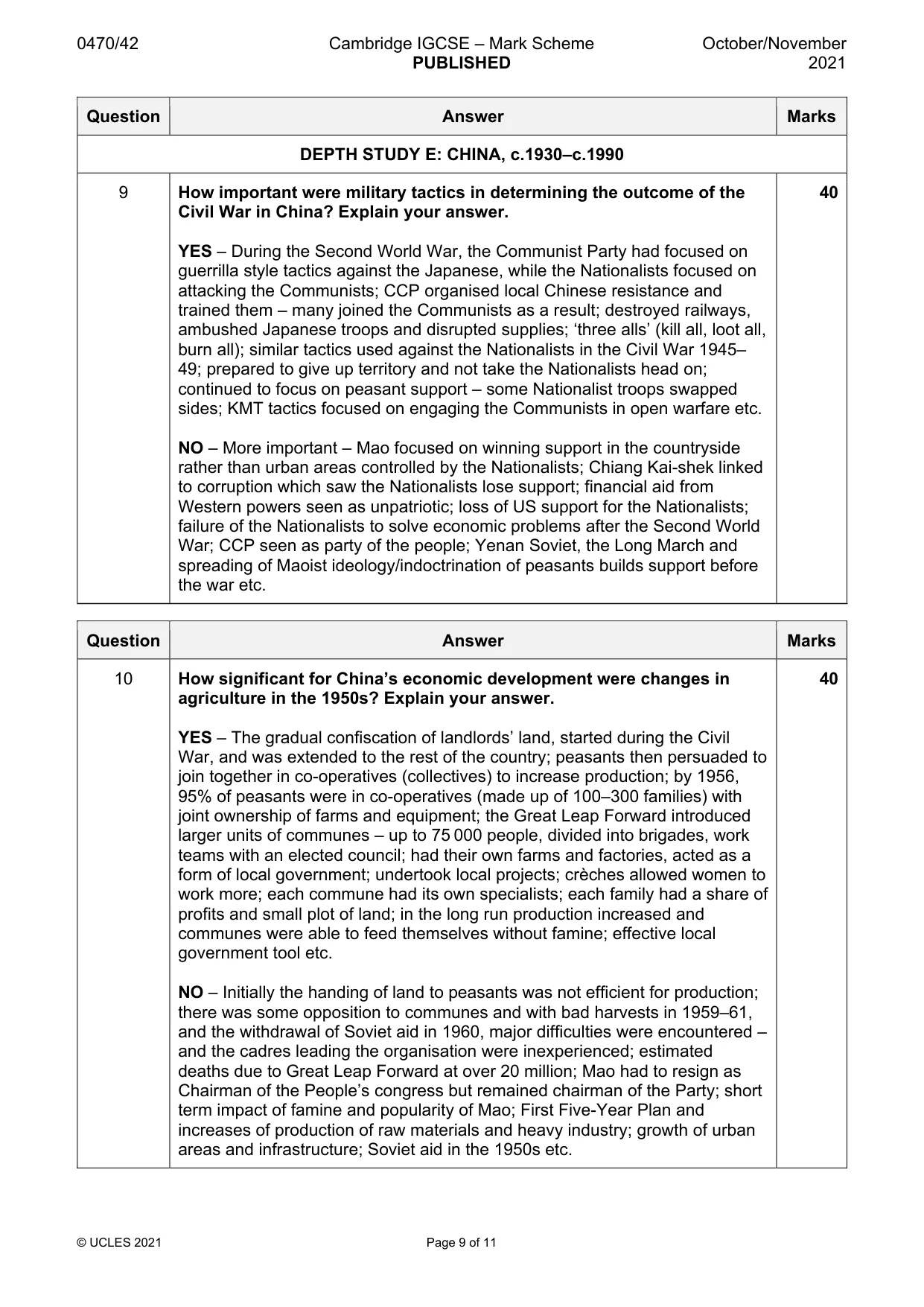
0470/42 Cambridge IGCSE – Mark Scheme PUBLISHED October/November 2021 © UCLES 2021 Page 9 of 11 Question Answer Marks DEPTH STUDY E: CHINA, c.1930–c.1990 9 How important were military tactics in determining the outcome of the Civil War in China? Explain your answer. YES – During the Second World War, the Communist Party had focused on guerrilla style tactics against the Japanese, while the Nationalists focused on attacking the Communists; CCP organised local Chinese resistance and trained them – many joined the Communists as a result; destroyed railways, ambushed Japanese troops and disrupted supplies; ‘three alls’ (kill all, loot all, burn all); similar tactics used against the Nationalists in the Civil War 1945– 49; prepared to give up territory and not take the Nationalists head on; continued to focus on peasant support – some Nationalist troops swapped sides; KMT tactics focused on engaging the Communists in open warfare etc. NO – More important – Mao focused on winning support in the countryside rather than urban areas controlled by the Nationalists; Chiang Kai-shek linked to corruption which saw the Nationalists lose support; financial aid from Western powers seen as unpatriotic; loss of US support for the Nationalists; failure of the Nationalists to solve economic problems after the Second World War; CCP seen as party of the people; Yenan Soviet, the Long March and spreading of Maoist ideology/indoctrination of peasants builds support before the war etc. 40 Question Answer Marks 10 How significant for China’s economic development were changes in agriculture in the 1950s? Explain your answer. YES – The gradual confiscation of landlords’ land, started during the Civil War, and was extended to the rest of the country; peasants then persuaded to join together in co-operatives (collectives) to increase production; by 1956, 95% of peasants were in co-operatives (made up of 100–300 families) with joint ownership of farms and equipment; the Great Leap Forward introduced larger units of communes – up to 75 000 people, divided into brigades, work teams with an elected council; had their own farms and factories, acted as a form of local government; undertook local projects; crèches allowed women to work more; each commune had its own specialists; each family had a share of profits and small plot of land; in the long run production increased and communes were able to feed themselves without famine; effective local government tool etc. NO – Initially the handing of land to peasants was not efficient for production; there was some opposition to communes and with bad harvests in 1959–61, and the withdrawal of Soviet aid in 1960, major difficulties were encountered – and the cadres leading the organisation were inexperienced; estimated deaths due to Great Leap Forward at over 20 million; Mao had to resign as Chairman of the People’s congress but remained chairman of the Party; short term impact of famine and popularity of Mao; First Five-Year Plan and increases of production of raw materials and heavy industry; growth of urban areas and infrastructure; Soviet aid in the 1950s etc. 40
Mark scheme, page 10
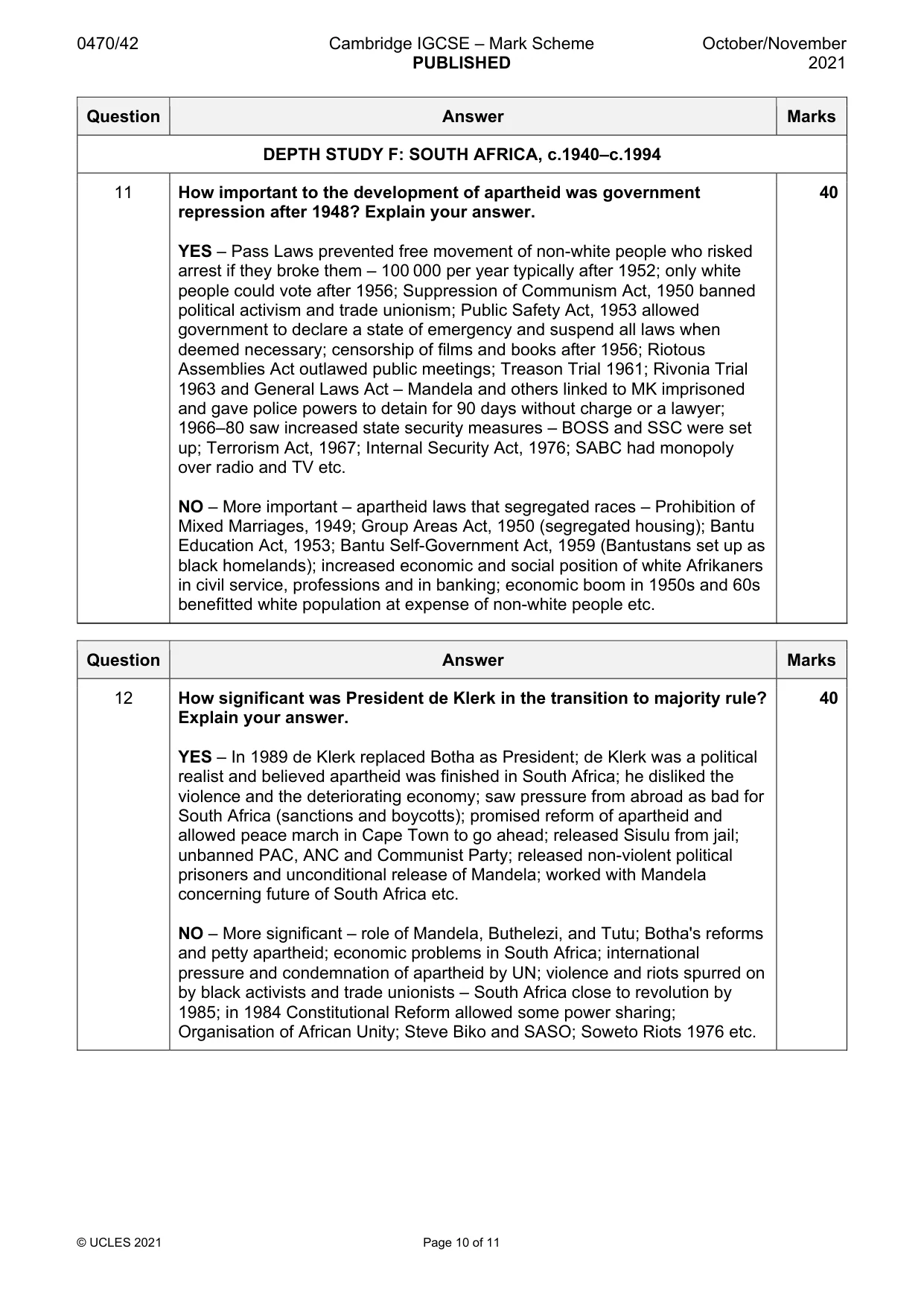
0470/42 Cambridge IGCSE – Mark Scheme PUBLISHED October/November 2021 © UCLES 2021 Page 10 of 11 Question Answer Marks DEPTH STUDY F: SOUTH AFRICA, c.1940–c.1994 11 How important to the development of apartheid was government repression after 1948? Explain your answer. YES – Pass Laws prevented free movement of non-white people who risked arrest if they broke them – 100 000 per year typically after 1952; only white people could vote after 1956; Suppression of Communism Act, 1950 banned political activism and trade unionism; Public Safety Act, 1953 allowed government to declare a state of emergency and suspend all laws when deemed necessary; censorship of films and books after 1956; Riotous Assemblies Act outlawed public meetings; Treason Trial 1961; Rivonia Trial 1963 and General Laws Act – Mandela and others linked to MK imprisoned and gave police powers to detain for 90 days without charge or a lawyer; 1966–80 saw increased state security measures – BOSS and SSC were set up; Terrorism Act, 1967; Internal Security Act, 1976; SABC had monopoly over radio and TV etc. NO – More important – apartheid laws that segregated races – Prohibition of Mixed Marriages, 1949; Group Areas Act, 1950 (segregated housing); Bantu Education Act, 1953; Bantu Self-Government Act, 1959 (Bantustans set up as black homelands); increased economic and social position of white Afrikaners in civil service, professions and in banking; economic boom in 1950s and 60s benefitted white population at expense of non-white people etc. 40 Question Answer Marks 12 How significant was President de Klerk in the transition to majority rule? Explain your answer. YES – In 1989 de Klerk replaced Botha as President; de Klerk was a political realist and believed apartheid was finished in South Africa; he disliked the violence and the deteriorating economy; saw pressure from abroad as bad for South Africa (sanctions and boycotts); promised reform of apartheid and allowed peace march in Cape Town to go ahead; released Sisulu from jail; unbanned PAC, ANC and Communist Party; released non-violent political prisoners and unconditional release of Mandela; worked with Mandela concerning future of South Africa etc. NO – More significant – role of Mandela, Buthelezi, and Tutu; Botha's reforms and petty apartheid; economic problems in South Africa; international pressure and condemnation of apartheid by UN; violence and riots spurred on by black activists and trade unionists – South Africa close to revolution by 1985; in 1984 Constitutional Reform allowed some power sharing; Organisation of African Unity; Steve Biko and SASO; Soweto Riots 1976 etc. 40
Mark scheme, page 11
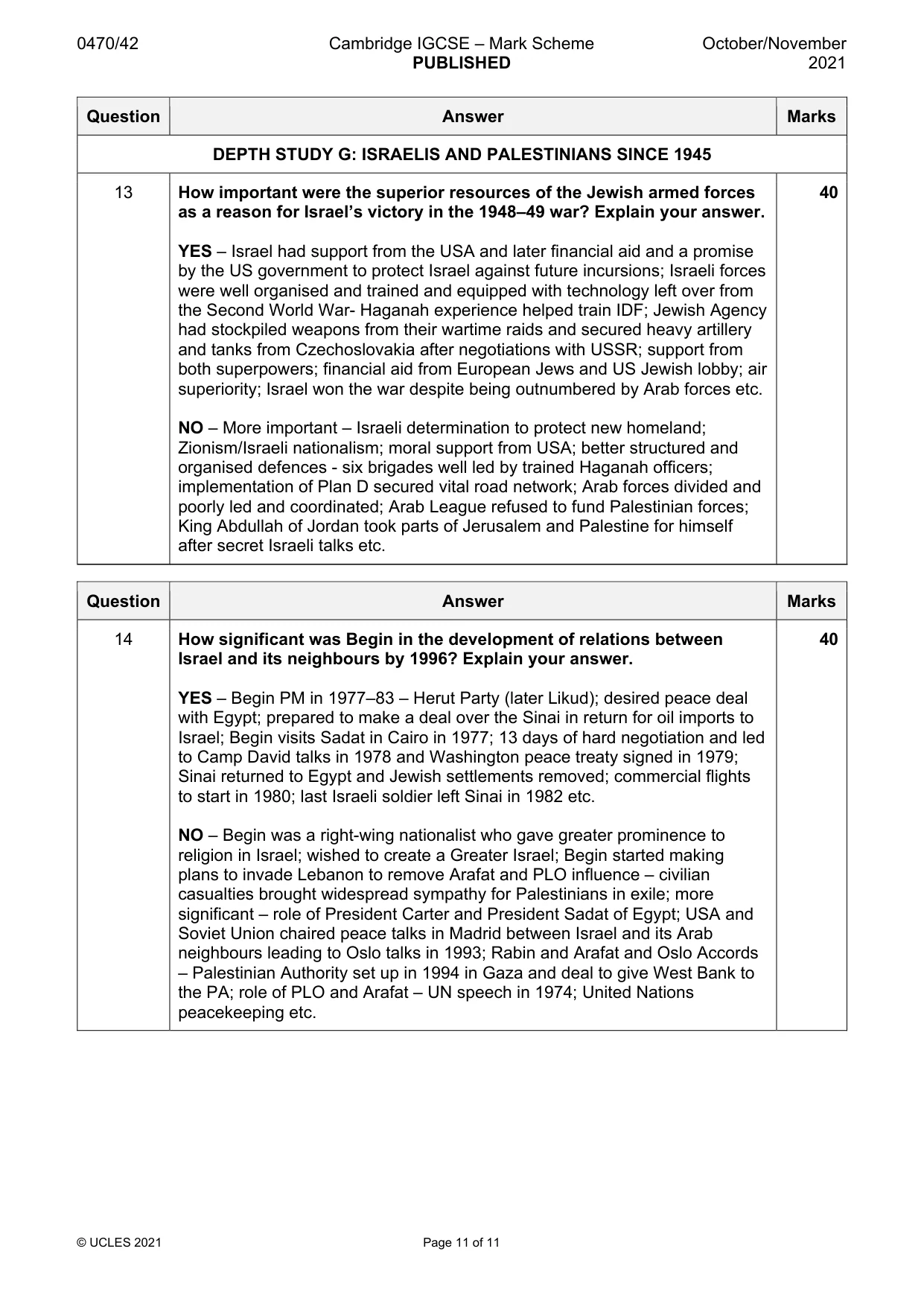
0470/42 Cambridge IGCSE – Mark Scheme PUBLISHED October/November 2021 © UCLES 2021 Page 11 of 11 Question Answer Marks DEPTH STUDY G: ISRAELIS AND PALESTINIANS SINCE 1945 13 How important were the superior resources of the Jewish armed forces as a reason for Israel’s victory in the 1948–49 war? Explain your answer. YES – Israel had support from the USA and later financial aid and a promise by the US government to protect Israel against future incursions; Israeli forces were well organised and trained and equipped with technology left over from the Second World War- Haganah experience helped train IDF; Jewish Agency had stockpiled weapons from their wartime raids and secured heavy artillery and tanks from Czechoslovakia after negotiations with USSR; support from both superpowers; financial aid from European Jews and US Jewish lobby; air superiority; Israel won the war despite being outnumbered by Arab forces etc. NO – More important – Israeli determination to protect new homeland; Zionism/Israeli nationalism; moral support from USA; better structured and organised defences - six brigades well led by trained Haganah officers; implementation of Plan D secured vital road network; Arab forces divided and poorly led and coordinated; Arab League refused to fund Palestinian forces; King Abdullah of Jordan took parts of Jerusalem and Palestine for himself after secret Israeli talks etc. 40 Question Answer Marks 14 How significant was Begin in the development of relations between Israel and its neighbours by 1996? Explain your answer. YES – Begin PM in 1977–83 – Herut Party (later Likud); desired peace deal with Egypt; prepared to make a deal over the Sinai in return for oil imports to Israel; Begin visits Sadat in Cairo in 1977; 13 days of hard negotiation and led to Camp David talks in 1978 and Washington peace treaty signed in 1979; Sinai returned to Egypt and Jewish settlements removed; commercial flights to start in 1980; last Israeli soldier left Sinai in 1982 etc. NO – Begin was a right-wing nationalist who gave greater prominence to religion in Israel; wished to create a Greater Israel; Begin started making plans to invade Lebanon to remove Arafat and PLO influence – civilian casualties brought widespread sympathy for Palestinians in exile; more significant – role of President Carter and President Sadat of Egypt; USA and Soviet Union chaired peace talks in Madrid between Israel and its Arab neighbours leading to Oslo talks in 1993; Rabin and Arafat and Oslo Accords – Palestinian Authority set up in 1994 in Gaza and deal to give West Bank to the PA; role of PLO and Arafat – UN speech in 1974; United Nations peacekeeping etc. 40
What you needed in this session
Cambridge’s own grade thresholds for 2021 Oct/Nov, Paper 4 · Variant 2. A higher threshold means an easier paper — the bar moves with how the cohort did.