Cambridge IGCSE History 0470 — 2021 Oct/Nov Paper 2 · Variant 3
0470/23/O/N/21 · 50 marks · ≈56 min
The question paper and its mark scheme, free to read here and free to download. This is Cambridge’s own paper, exactly as it was sat.
Question paper12 pages

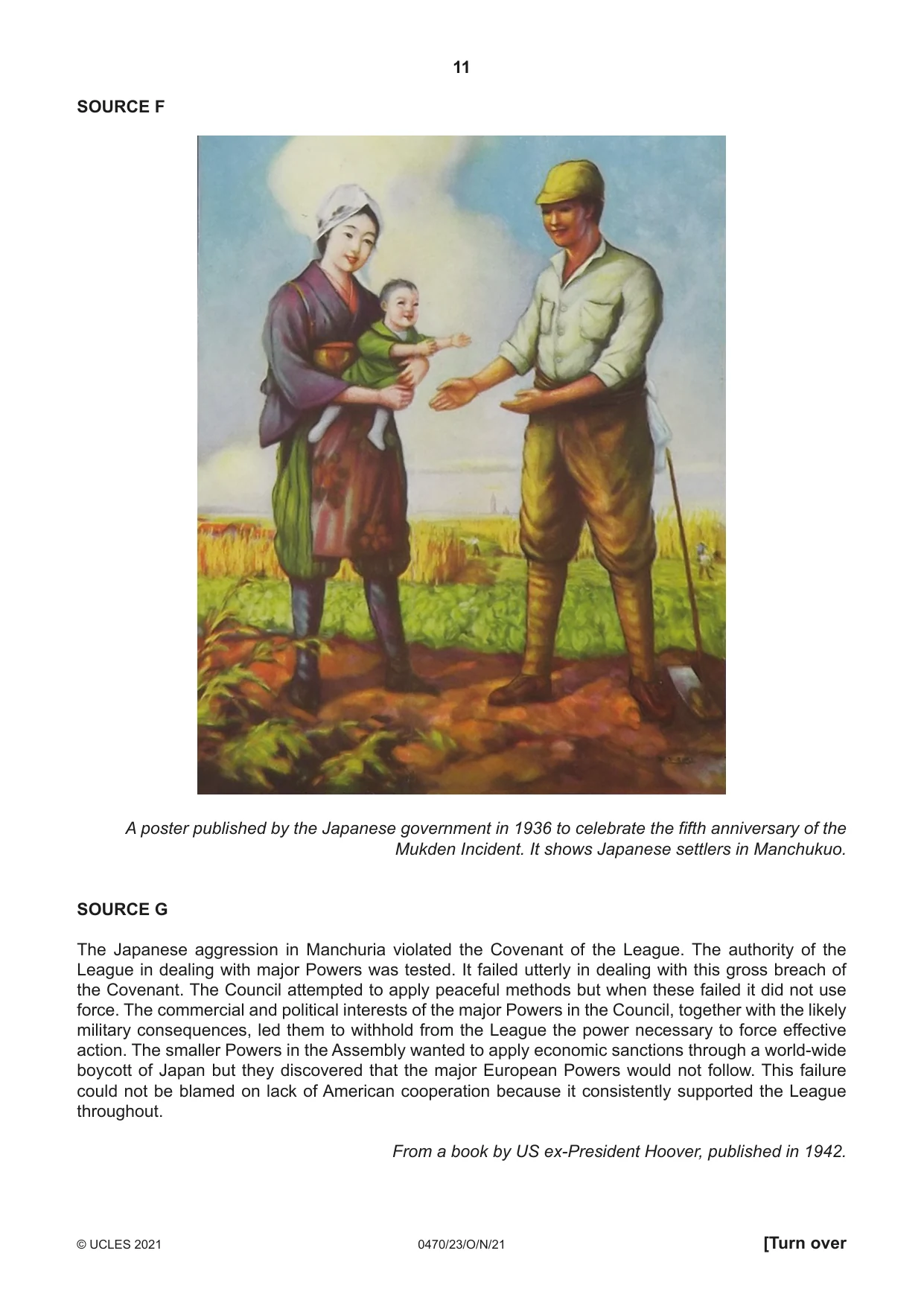
Mark scheme15 pages
Answers below. Sit the paper first if you are practising.
Paper as text
Question paper, page 1
This document has 12 pages. Any blank pages are indicated. Cambridge IGCSE™ DC (MS/CT) 201390/2 © UCLES 2021 [Turn over HISTORY 0470/23 Paper 2 October/November 2021 2 hours You must answer on the enclosed answer booklet. You will need: Answer booklet (enclosed) INSTRUCTIONS ● Answer all the questions on one option only. Option A: Nineteenth century topic Option B: Twentieth century topic ● Follow the instructions on the front cover of the answer booklet. If you need additional answer paper, ask the invigilator for a continuation booklet. INFORMATION ● The total mark for this paper is 50. ● The number of marks for each question or part question is shown in brackets [ ]. * 8 6 9 2 6 9 2 1 4 8 *
Question paper, page 2
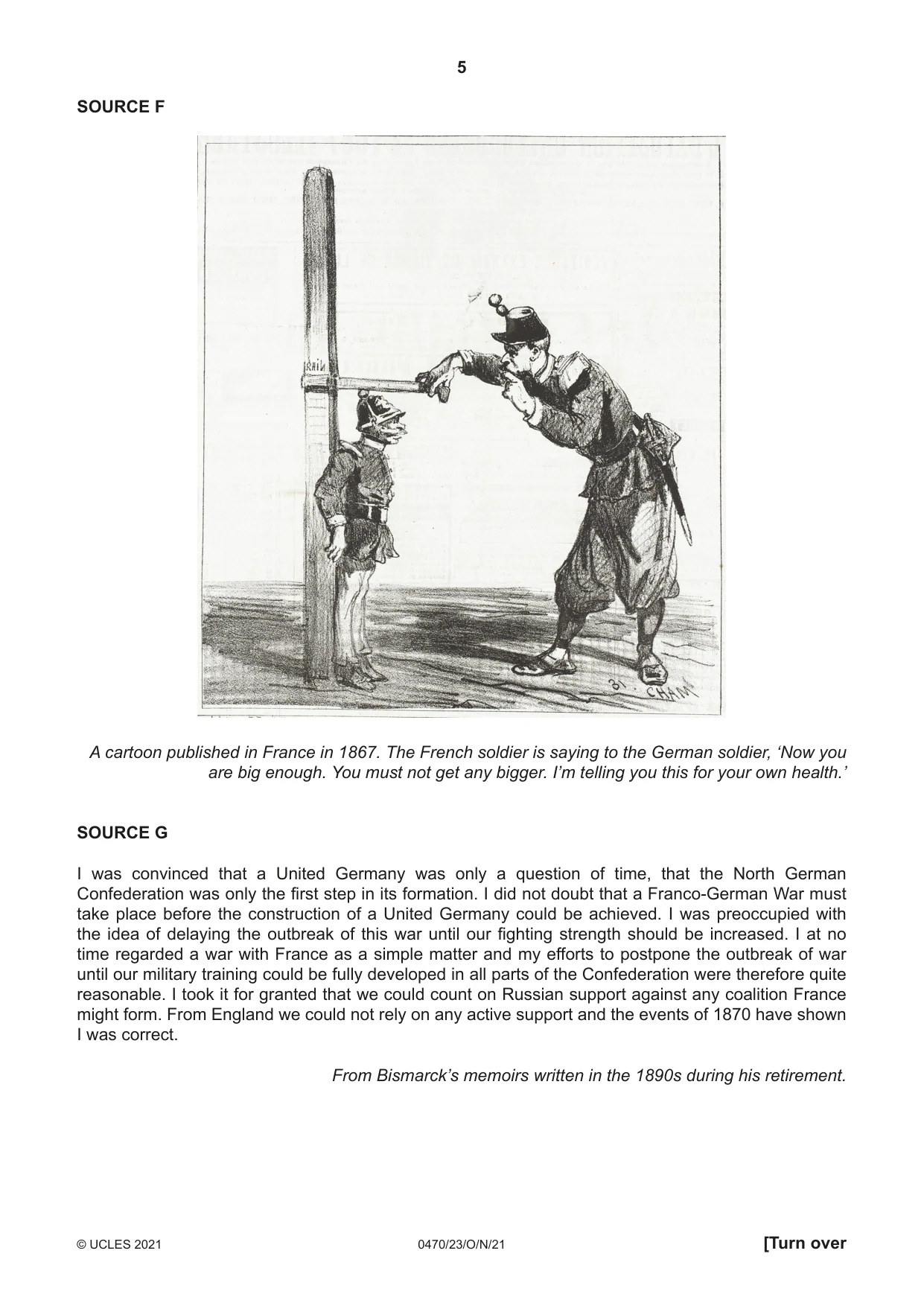
2 0470/23/O/N/21 © UCLES 2021 Option A: Nineteenth century topic WAS BISMARCK OR NAPOLEON III MORE TO BLAME FOR THE WAR IN 1870? Study the Background Information and the sources carefully, and then answer all the questions. Background Information On 19 July 1870 France declared war on Prussia. Both Bismarck and Napoleon III had reasons to go to war. A war with France could persuade the southern German states to support the North German Confederation in defending German honour. This could be the final step towards a unified Germany. Meanwhile, Napoleon was unpopular in France and was under pressure to revive France’s glorious past. According to Bismarck’s memoirs, written in the 1890s during his retirement, he had long planned German unification and he brought about the war with France to help this process. Was France or Prussia more to blame for the war? SOURCE A Bismarck had no clear aim after the victories of 1866. He was content to leave the south German states in their independent existence. There was no danger of a threat from Austria and so the German problem had been settled. France and Prussia had no reason for conflict. Bismarck wrote in 1866, ‘I have always regarded an alliance with France as the natural expression of the shared interests of our two countries.’ Napoleon III thought exactly the same. Bismarck rightly thought that Napoleon was a man of peace but he failed to understand that Napoleon did not control the French and that he was constantly urged by the French to go to war and restore France’s prestige. There is not a scrap of evidence that Bismarck worked deliberately for a war with France. On the contrary, he made repeated gestures of friendship towards Napoleon. He certainly did not foresee the crisis that blew up in July 1870 over the Spanish throne. The edited ‘Ems telegram’ was not the cause of war. France was already preparing for war. Once the war became inevitable Bismarck wanted to present himself as the creator of Germany, not as a man mastered by events. Therefore, against all his previous statements, the war with France had to appear long-planned by the master statesman. In truth, the French had blundered into a war which was not unwelcome to them; and Bismarck, though taken by surprise, turned their blunder to his advantage. From a book published in 1955.
Question paper, page 3
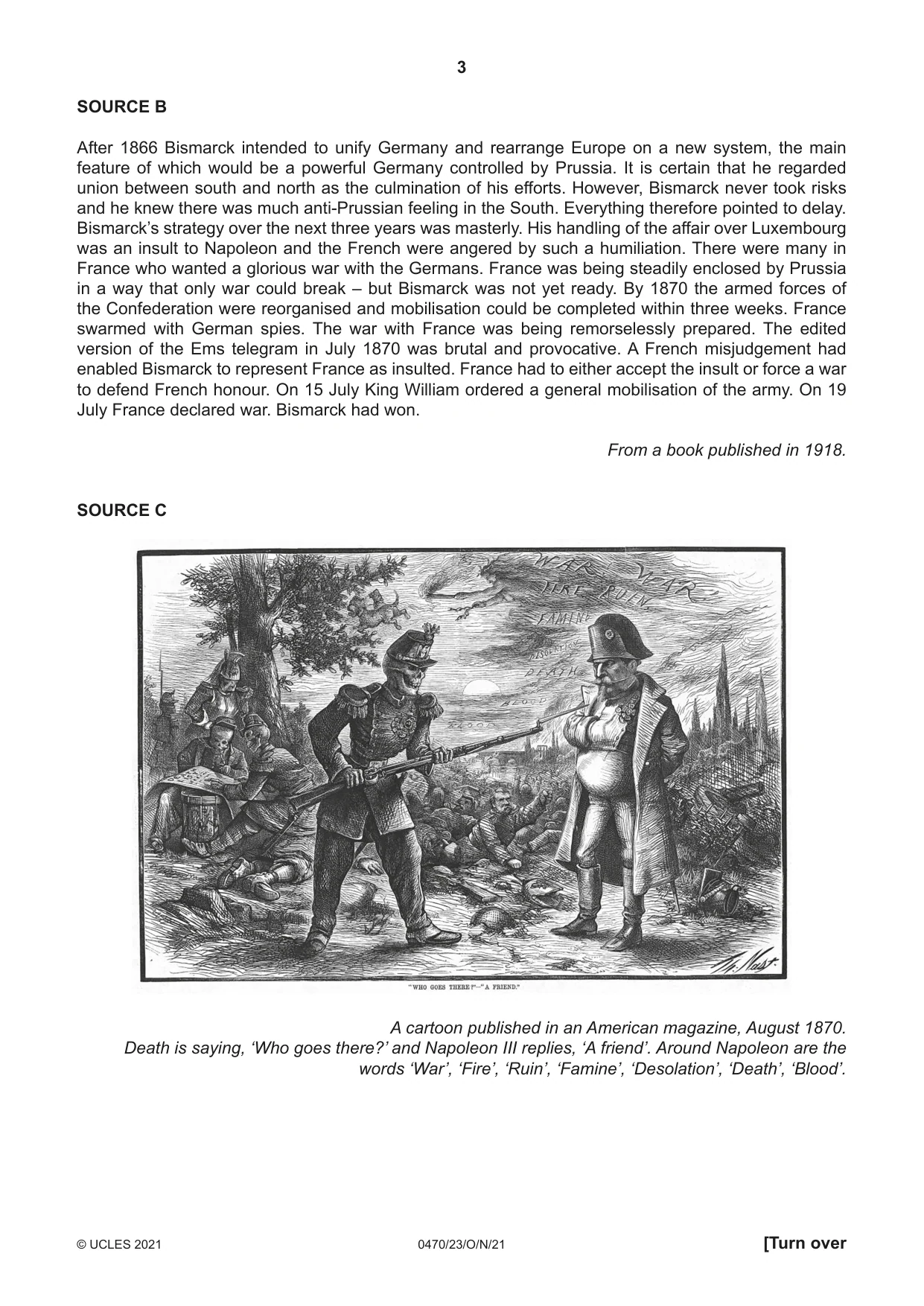
3 0470/23/O/N/21 © UCLES 2021 [Turn over SOURCE B After 1866 Bismarck intended to unify Germany and rearrange Europe on a new system, the main feature of which would be a powerful Germany controlled by Prussia. It is certain that he regarded union between south and north as the culmination of his efforts. However, Bismarck never took risks and he knew there was much anti-Prussian feeling in the South. Everything therefore pointed to delay. Bismarck’s strategy over the next three years was masterly. His handling of the affair over Luxembourg was an insult to Napoleon and the French were angered by such a humiliation. There were many in France who wanted a glorious war with the Germans. France was being steadily enclosed by Prussia in a way that only war could break – but Bismarck was not yet ready. By 1870 the armed forces of the Confederation were reorganised and mobilisation could be completed within three weeks. France swarmed with German spies. The war with France was being remorselessly prepared. The edited version of the Ems telegram in July 1870 was brutal and provocative. A French misjudgement had enabled Bismarck to represent France as insulted. France had to either accept the insult or force a war to defend French honour. On 15 July King William ordered a general mobilisation of the army. On 19 July France declared war. Bismarck had won. From a book published in 1918. SOURCE C A cartoon published in an American magazine, August 1870. Death is saying, ‘Who goes there?’ and Napoleon III replies, ‘A friend’. Around Napoleon are the words ‘War’, ‘Fire’, ‘Ruin’, ‘Famine’, ‘Desolation’, ‘Death’, ‘Blood’.
Question paper, page 4
4 0470/23/O/N/21 © UCLES 2021 SOURCE D I shall never consent to a war that is avoidable, much less seek it. But this war with France will surely come. It will be forced upon us by the French Emperor. His security depends on his personal prestige. He has lost much of this because he has permitted Prussia to become so great without obtaining some ‘compensation’. It was well known that he wanted compensation but was manoeuvred out of it by me. Such a loss of prestige is dangerous to his position as emperor. He will, as soon as his army is in good fighting condition, make an effort to recover that prestige by using some excuse to pick a quarrel with us. Bismarck speaking to an American politician in 1867. This conversation was remembered by the politician in his memoirs, published in 1908. SOURCE E The first cause of the War of 1870 is to be found in the year 1866 when Napoleon allowed Prussia to become a great power and a threat to us. Napoleon became the tool of Prussia in the hope of a reward. He should have supported others, like Russia, who were trying to stop the conquests of Prussia. He certainly should not have encouraged Prussia but that is what he did and he demanded a reward for that encouragement. Prussia showed no gratitude to Napoleon and broke the promise it had made in the Treaty of Prague to slow its expansion. It also made treaties of alliance, thus contributing to the military unity of Germany which was the only form of unity dangerous to us. I devoted my efforts in international matters to friendly cooperation between France and Germany and would have achieved it if I had had more influence. But there was one man who wanted war – Bismarck, who made truth an instrument of falsehood and who thought that anything that contributed to his success was legitimate. From Emile Ollivier’s book ‘The Franco-Prussian War and Its Hidden Causes’, 1912. Ollivier was Prime Minister of Napoleon’s government, 1869–70. He was forced to resign because of the defeat by Prussia.
Question paper, page 5
5 0470/23/O/N/21 © UCLES 2021 [Turn over SOURCE F A cartoon published in France in 1867. The French soldier is saying to the German soldier, ‘Now you are big enough. You must not get any bigger. I’m telling you this for your own health.’ SOURCE G I was convinced that a United Germany was only a question of time, that the North German Confederation was only the first step in its formation. I did not doubt that a Franco-German War must take place before the construction of a United Germany could be achieved. I was preoccupied with the idea of delaying the outbreak of this war until our fighting strength should be increased. I at no time regarded a war with France as a simple matter and my efforts to postpone the outbreak of war until our military training could be fully developed in all parts of the Confederation were therefore quite reasonable. I took it for granted that we could count on Russian support against any coalition France might form. From England we could not rely on any active support and the events of 1870 have shown I was correct. From Bismarck’s memoirs written in the 1890s during his retirement.
Question paper, page 6
6 0470/23/O/N/21 © UCLES 2021 Now answer all the following questions. You may use any of the sources to help you answer the questions, in addition to those sources which you are told to use. In answering the questions you should use your knowledge of the topic to help you interpret and evaluate the sources. 1 Study Sources A and B. How far do these two sources agree? Explain your answer using details of the sources. [7] 2 Study Source C. What is the cartoonist’s message? Explain your answer using details of the source and your knowledge. [8] 3 Study Sources D and E. How far does Source D make Source E surprising? Explain your answer using details of the sources and your knowledge. [8] 4 Study Source F. Why was this source published in France in 1867? Explain your answer using details of the source and your knowledge. [8] 5 Study Source G. How useful is this source as evidence about the Franco-Prussian War of 1870? Explain your answer using details of the source and your knowledge. [7] 6 Study all the sources. How far do these sources provide convincing evidence that France was to blame for the war with Prussia in 1870? Use the sources to explain your answer. [12]
Question paper, page 7
7 0470/23/O/N/21 © UCLES 2021 [Turn over BLANK PAGE
Question paper, page 8
8 0470/23/O/N/21 © UCLES 2021 Option B: Twentieth century topic WAS THE LEAGUE JUSTIFIED IN DOING LITTLE ABOUT THE JAPANESE INVASION OF MANCHURIA? Study the Background Information and the sources carefully, and then answer all the questions. Background Information The issue of the Japanese invasion of Manchuria was not a straightforward one for the League. Eastern parts of Manchuria were already under the control of Japan and the Japanese army had the right to guard a zone around the South Manchurian Railway. It was in this zone that a bomb exploded on 18 September 1931. However, the explosion was probably staged by the Japanese army to provoke a crisis from which they could benefit. The Japanese army quickly ventured beyond the zone to ‘guarantee order’ and eventually conquered all of Manchuria. As a member of the League, the Chinese immediately appealed to the League. In 1932 Japan set up a puppet state called Manchukuo. Japanese settlers, many of them farmers, flocked there. The Japanese transformed the economy and it even became a holiday destination for Japanese tourists. In Japanese eyes this further justified their taking over the area. Did the League have good reasons for doing little about the Japanese invasion of Manchuria? SOURCE A The outbreak of hostilities in Manchuria caused much confusion at Geneva. Little reliable information was available given the slowness of communications. As there was a general reluctance to act, much emphasis was placed on China’s lack of control in Manchuria, on Japan’s treaty right to station troops there and on the argument that events in Manchuria did not constitute the invasion of one sovereign state by another. Armed with hindsight, history has condemned Japan for the conquest. At the time, however, there was substantial sympathy for Japan as the representative of the civilised west in the barbarous east. The Chinese economy was indeed chaotic and the political situation turbulent, so much so that some doubted whether China constituted a sovereign state. What could the League do? It could not condemn or expel Japan, as Japan would veto such attempts. Even the act of sending a commission of inquiry might inflame Japanese nationalism. World opinion was divided and, anyway, Japan was indifferent to it. Realists recognised that only military force could stop Japan, but who could supply it? For most countries the League’s idea of collective security rested on the assumption that somebody else would supply the security. The only League members with the remotest prospect of action were Britain and France, but in reality neither could act. After years of shrinking armies and naval disarmament, neither had the military power to embark on such a course of action. In America the prevailing mood was overwhelmingly isolationist and hostile to the League. In the circumstances it is not surprising that nothing was done. From a history book published in 1976.
Question paper, page 9
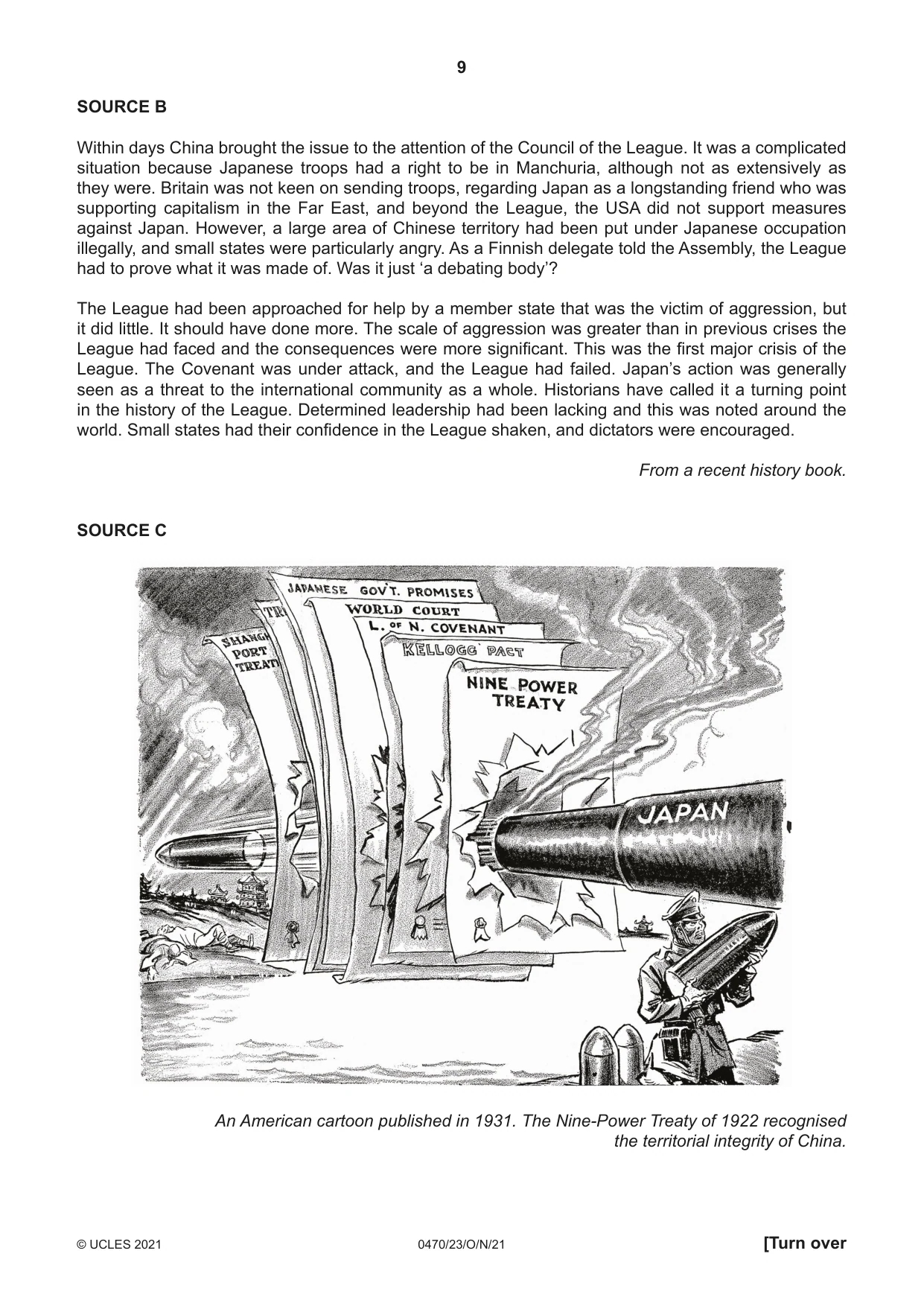
9 0470/23/O/N/21 © UCLES 2021 [Turn over SOURCE B Within days China brought the issue to the attention of the Council of the League. It was a complicated situation because Japanese troops had a right to be in Manchuria, although not as extensively as they were. Britain was not keen on sending troops, regarding Japan as a longstanding friend who was supporting capitalism in the Far East, and beyond the League, the USA did not support measures against Japan. However, a large area of Chinese territory had been put under Japanese occupation illegally, and small states were particularly angry. As a Finnish delegate told the Assembly, the League had to prove what it was made of. Was it just ‘a debating body’? The League had been approached for help by a member state that was the victim of aggression, but it did little. It should have done more. The scale of aggression was greater than in previous crises the League had faced and the consequences were more significant. This was the first major crisis of the League. The Covenant was under attack, and the League had failed. Japan’s action was generally seen as a threat to the international community as a whole. Historians have called it a turning point in the history of the League. Determined leadership had been lacking and this was noted around the world. Small states had their confidence in the League shaken, and dictators were encouraged. From a recent history book. SOURCE C An American cartoon published in 1931. The Nine-Power Treaty of 1922 recognised the territorial integrity of China.
Question paper, page 10
10 0470/23/O/N/21 © UCLES 2021 SOURCE D Japan has created a flourishing oasis in a desert of Chinese misrule. The Japanese army, after its initial well-prepared invasion, has become a well-equipped police force in a disordered part of China where the Chinese Government has little authority. From The Times newspaper, published in Britain, 21 September 1931. SOURCE E The fundamental issue at stake is really of vital importance to future international relations. Are threats and force going to rule relations between sovereign states, or arbitration and judicial settlement? That is the fundamental question. The answer will be of immense importance to the future stability of the world. That consideration must be regarded as more important than the merits of the dispute itself. From The Times newspaper, published in Britain, 16 October 1931.
Question paper, page 11
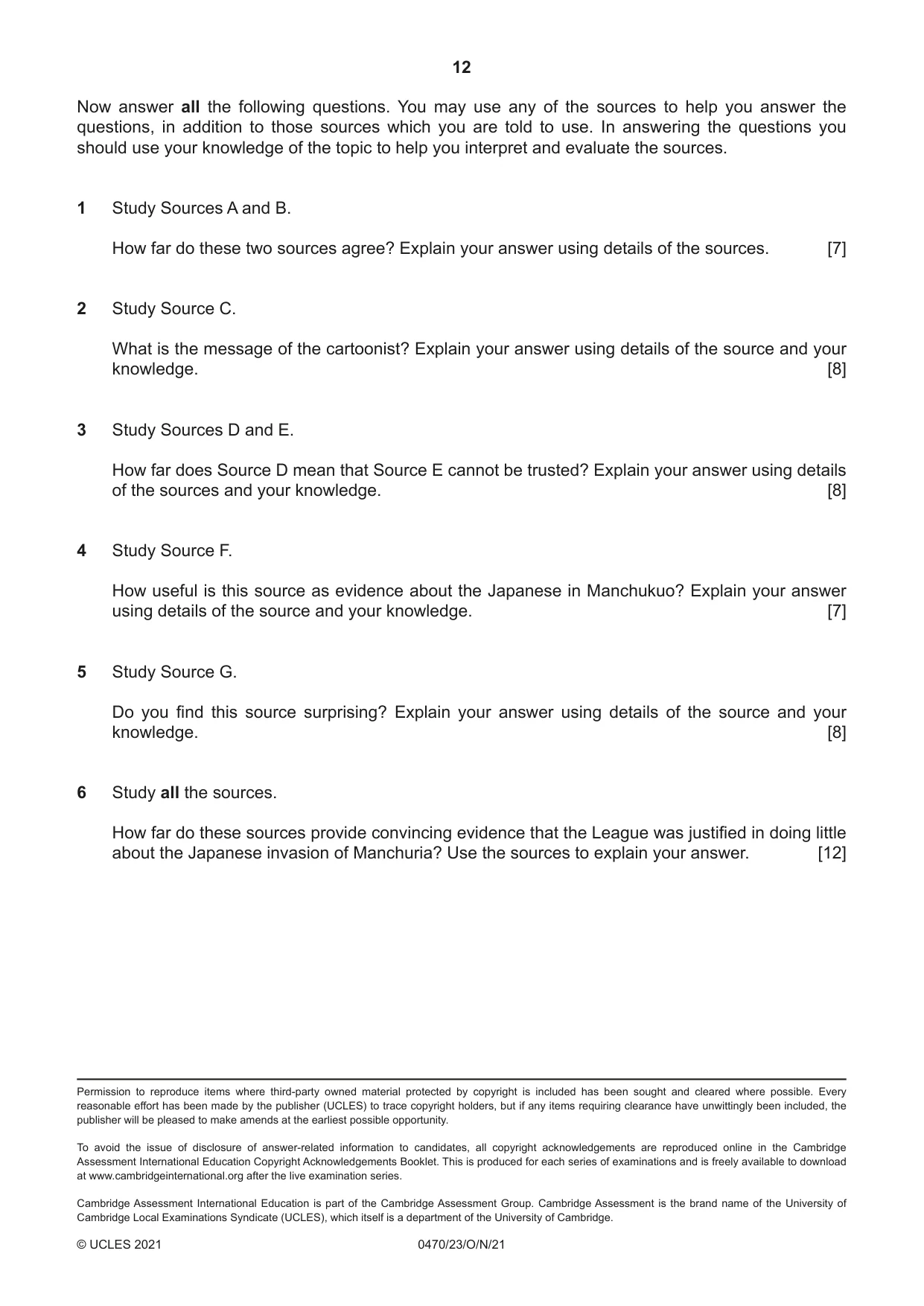
11 0470/23/O/N/21 © UCLES 2021 [Turn over SOURCE F A poster published by the Japanese government in 1936 to celebrate the fifth anniversary of the Mukden Incident. It shows Japanese settlers in Manchukuo. SOURCE G The Japanese aggression in Manchuria violated the Covenant of the League. The authority of the League in dealing with major Powers was tested. It failed utterly in dealing with this gross breach of the Covenant. The Council attempted to apply peaceful methods but when these failed it did not use force. The commercial and political interests of the major Powers in the Council, together with the likely military consequences, led them to withhold from the League the power necessary to force effective action. The smaller Powers in the Assembly wanted to apply economic sanctions through a world-wide boycott of Japan but they discovered that the major European Powers would not follow. This failure could not be blamed on lack of American cooperation because it consistently supported the League throughout. From a book by US ex-President Hoover, published in 1942.
Question paper, page 12
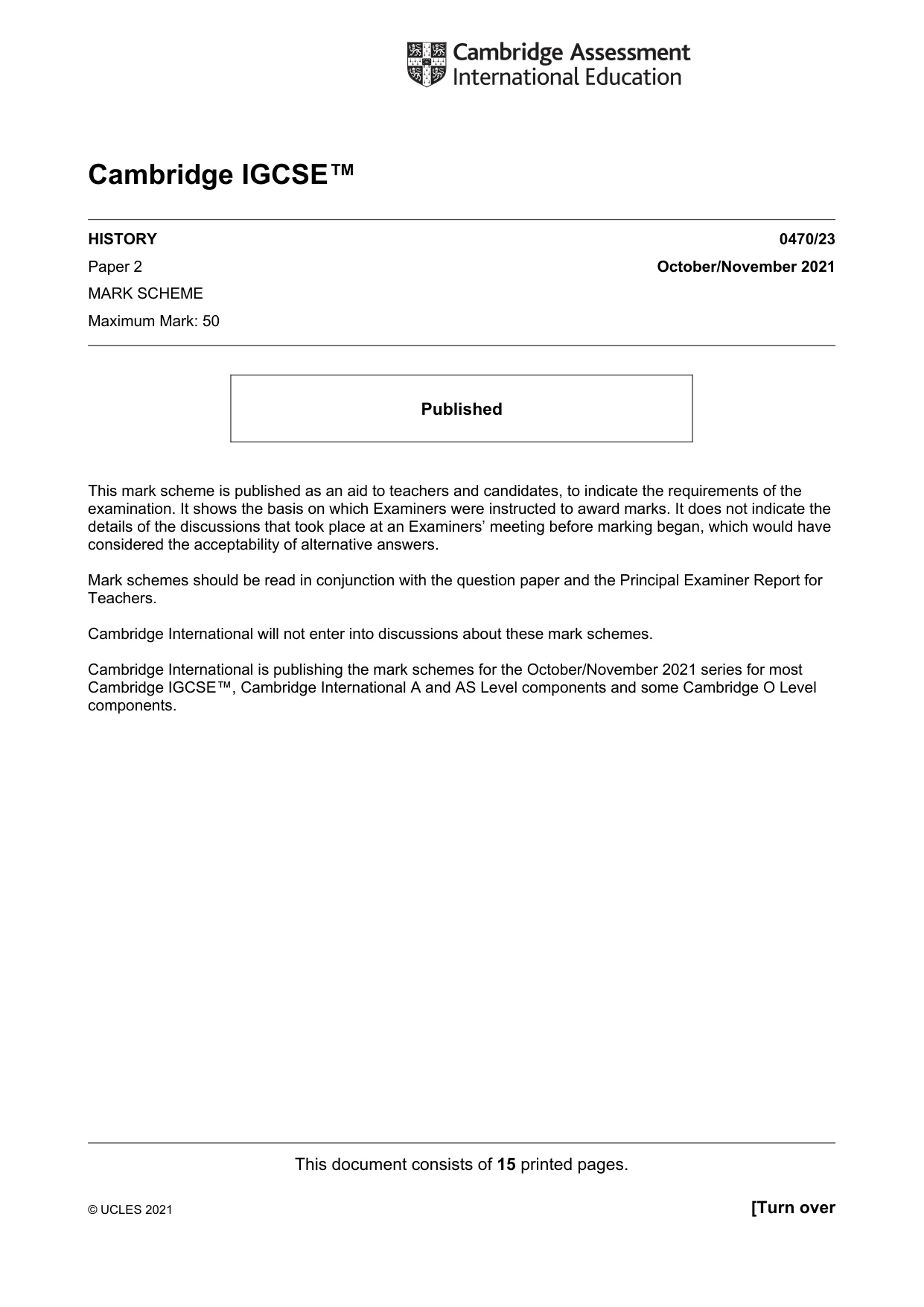
12 0470/23/O/N/21 © UCLES 2021 Permission to reproduce items where third-party owned material protected by copyright is included has been sought and cleared where possible. Every reasonable effort has been made by the publisher (UCLES) to trace copyright holders, but if any items requiring clearance have unwittingly been included, the publisher will be pleased to make amends at the earliest possible opportunity. To avoid the issue of disclosure of answer-related information to candidates, all copyright acknowledgements are reproduced online in the Cambridge Assessment International Education Copyright Acknowledgements Booklet. This is produced for each series of examinations and is freely available to download at www.cambridgeinternational.org after the live examination series. Cambridge Assessment International Education is part of the Cambridge Assessment Group. Cambridge Assessment is the brand name of the University of Cambridge Local Examinations Syndicate (UCLES), which itself is a department of the University of Cambridge. Now answer all the following questions. You may use any of the sources to help you answer the questions, in addition to those sources which you are told to use. In answering the questions you should use your knowledge of the topic to help you interpret and evaluate the sources. 1 Study Sources A and B. How far do these two sources agree? Explain your answer using details of the sources. [7] 2 Study Source C. What is the message of the cartoonist? Explain your answer using details of the source and your knowledge. [8] 3 Study Sources D and E. How far does Source D mean that Source E cannot be trusted? Explain your answer using details of the sources and your knowledge. [8] 4 Study Source F. How useful is this source as evidence about the Japanese in Manchukuo? Explain your answer using details of the source and your knowledge. [7] 5 Study Source G. Do you find this source surprising? Explain your answer using details of the source and your knowledge. [8] 6 Study all the sources. How far do these sources provide convincing evidence that the League was justified in doing little about the Japanese invasion of Manchuria? Use the sources to explain your answer. [12]
Mark scheme, page 1
This document consists of 15 printed pages. © UCLES 2021 [Turn over Cambridge IGCSE™ HISTORY 0470/23 Paper 2 October/November 2021 MARK SCHEME Maximum Mark: 50 Published This mark scheme is published as an aid to teachers and candidates, to indicate the requirements of the examination. It shows the basis on which Examiners were instructed to award marks. It does not indicate the details of the discussions that took place at an Examiners’ meeting before marking began, which would have considered the acceptability of alternative answers. Mark schemes should be read in conjunction with the question paper and the Principal Examiner Report for Teachers. Cambridge International will not enter into discussions about these mark schemes. Cambridge International is publishing the mark schemes for the October/November 2021 series for most Cambridge IGCSE™, Cambridge International A and AS Level components and some Cambridge O Level components.
Mark scheme, page 2
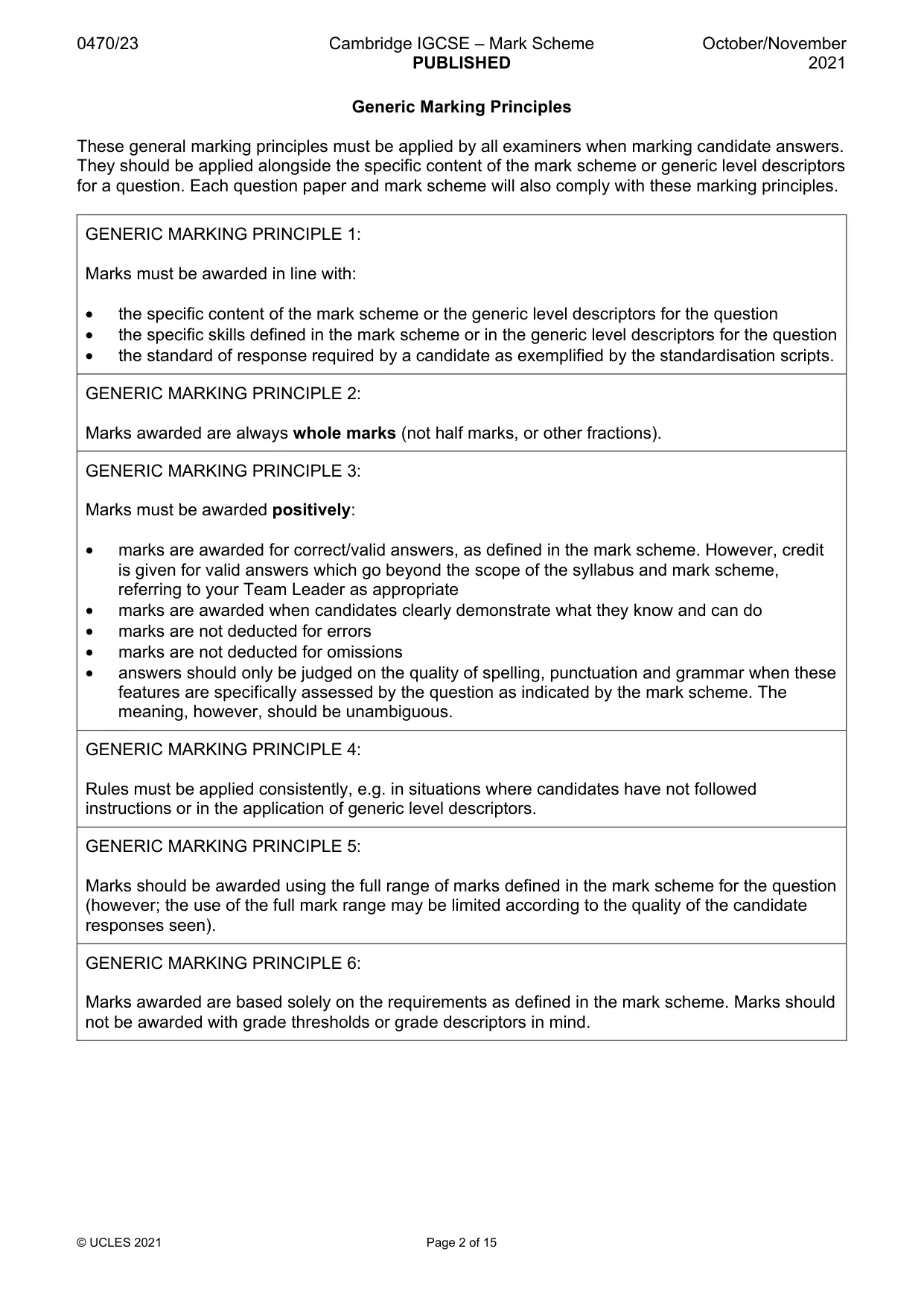
0470/23 Cambridge IGCSE – Mark Scheme PUBLISHED October/November 2021 © UCLES 2021 Page 2 of 15 Generic Marking Principles These general marking principles must be applied by all examiners when marking candidate answers. They should be applied alongside the specific content of the mark scheme or generic level descriptors for a question. Each question paper and mark scheme will also comply with these marking principles. GENERIC MARKING PRINCIPLE 1: Marks must be awarded in line with: • the specific content of the mark scheme or the generic level descriptors for the question • the specific skills defined in the mark scheme or in the generic level descriptors for the question • the standard of response required by a candidate as exemplified by the standardisation scripts. GENERIC MARKING PRINCIPLE 2: Marks awarded are always whole marks (not half marks, or other fractions). GENERIC MARKING PRINCIPLE 3: Marks must be awarded positively: • marks are awarded for correct/valid answers, as defined in the mark scheme. However, credit is given for valid answers which go beyond the scope of the syllabus and mark scheme, referring to your Team Leader as appropriate • marks are awarded when candidates clearly demonstrate what they know and can do • marks are not deducted for errors • marks are not deducted for omissions • answers should only be judged on the quality of spelling, punctuation and grammar when these features are specifically assessed by the question as indicated by the mark scheme. The meaning, however, should be unambiguous. GENERIC MARKING PRINCIPLE 4: Rules must be applied consistently, e.g. in situations where candidates have not followed instructions or in the application of generic level descriptors. GENERIC MARKING PRINCIPLE 5: Marks should be awarded using the full range of marks defined in the mark scheme for the question (however; the use of the full mark range may be limited according to the quality of the candidate responses seen). GENERIC MARKING PRINCIPLE 6: Marks awarded are based solely on the requirements as defined in the mark scheme. Marks should not be awarded with grade thresholds or grade descriptors in mind.
Mark scheme, page 3
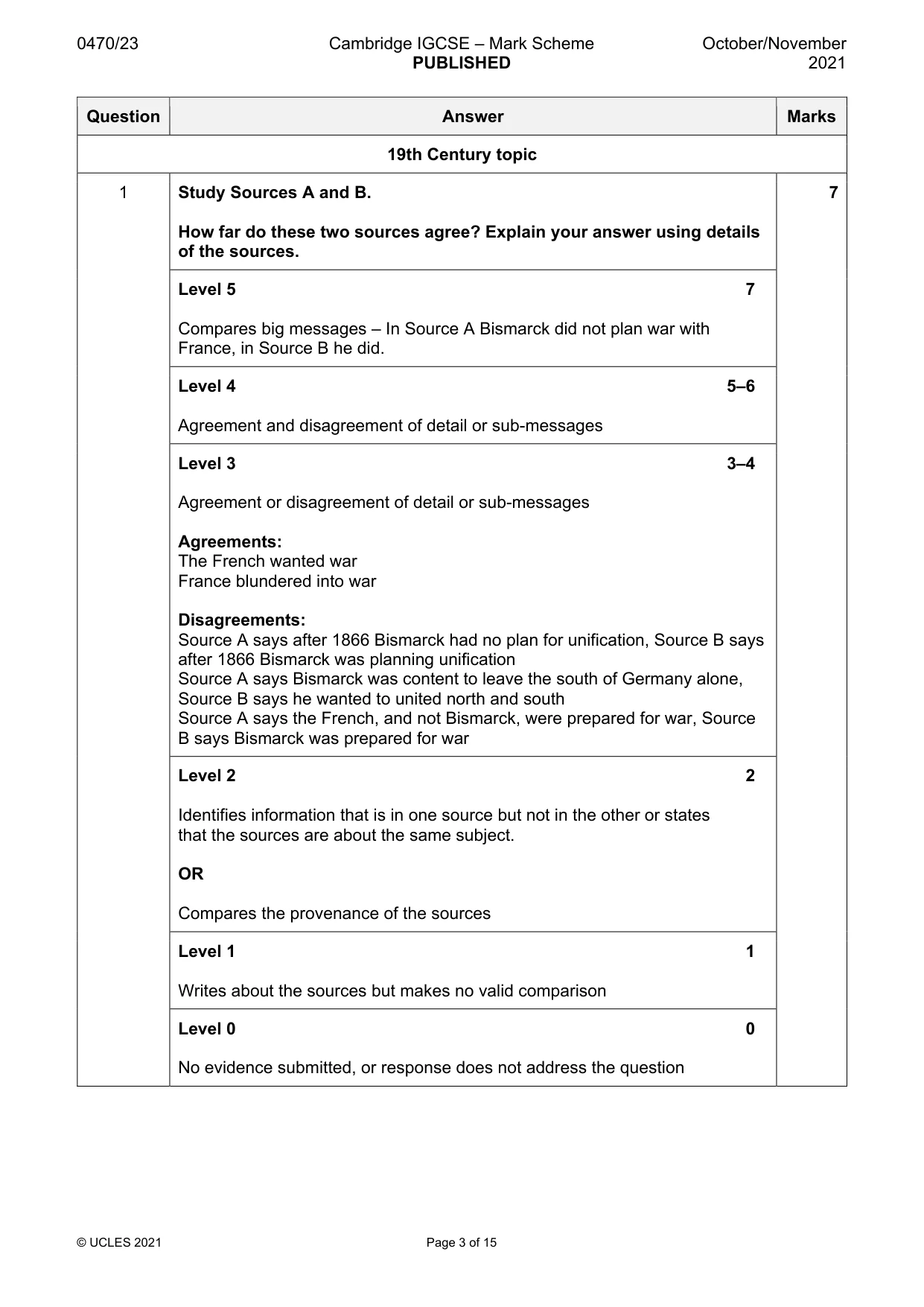
0470/23 Cambridge IGCSE – Mark Scheme PUBLISHED October/November 2021 © UCLES 2021 Page 3 of 15 Question Answer Marks 19th Century topic 1 Study Sources A and B. How far do these two sources agree? Explain your answer using details of the sources. 7 Level 5 7 Compares big messages – In Source A Bismarck did not plan war with France, in Source B he did. Level 4 5–6 Agreement and disagreement of detail or sub-messages Level 3 3–4 Agreement or disagreement of detail or sub-messages Agreements: The French wanted war France blundered into war Disagreements: Source A says after 1866 Bismarck had no plan for unification, Source B says after 1866 Bismarck was planning unification Source A says Bismarck was content to leave the south of Germany alone, Source B says he wanted to united north and south Source A says the French, and not Bismarck, were prepared for war, Source B says Bismarck was prepared for war Level 2 2 Identifies information that is in one source but not in the other or states that the sources are about the same subject. OR Compares the provenance of the sources Level 1 1 Writes about the sources but makes no valid comparison Level 0 0 No evidence submitted, or response does not address the question
Mark scheme, page 4
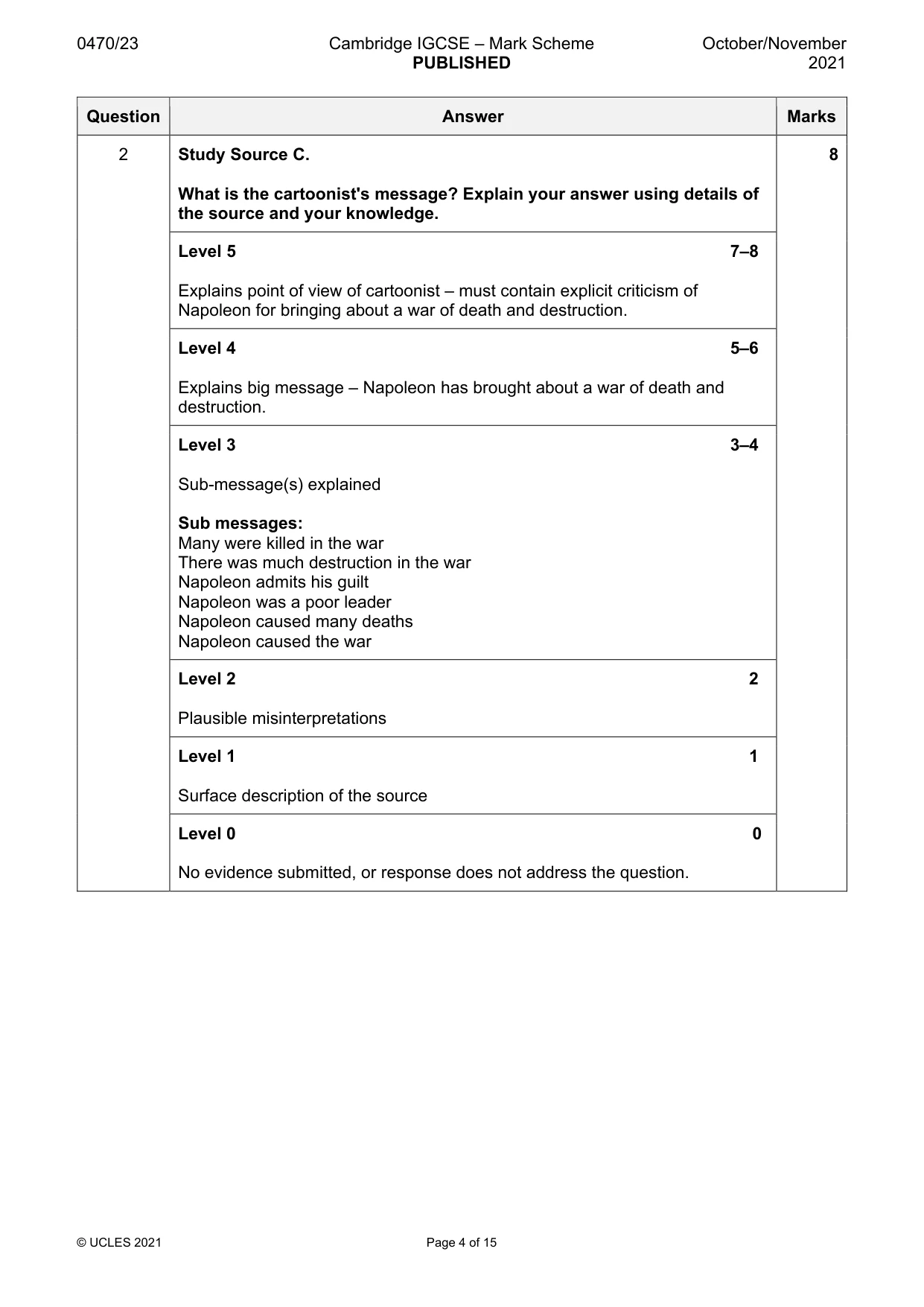
0470/23 Cambridge IGCSE – Mark Scheme PUBLISHED October/November 2021 © UCLES 2021 Page 4 of 15 Question Answer Marks 2 Study Source C. What is the cartoonist's message? Explain your answer using details of the source and your knowledge. 8 Level 5 7–8 Explains point of view of cartoonist – must contain explicit criticism of Napoleon for bringing about a war of death and destruction. Level 4 5–6 Explains big message – Napoleon has brought about a war of death and destruction. Level 3 3–4 Sub-message(s) explained Sub messages: Many were killed in the war There was much destruction in the war Napoleon admits his guilt Napoleon was a poor leader Napoleon caused many deaths Napoleon caused the war Level 2 2 Plausible misinterpretations Level 1 1 Surface description of the source Level 0 0 No evidence submitted, or response does not address the question.
Mark scheme, page 5
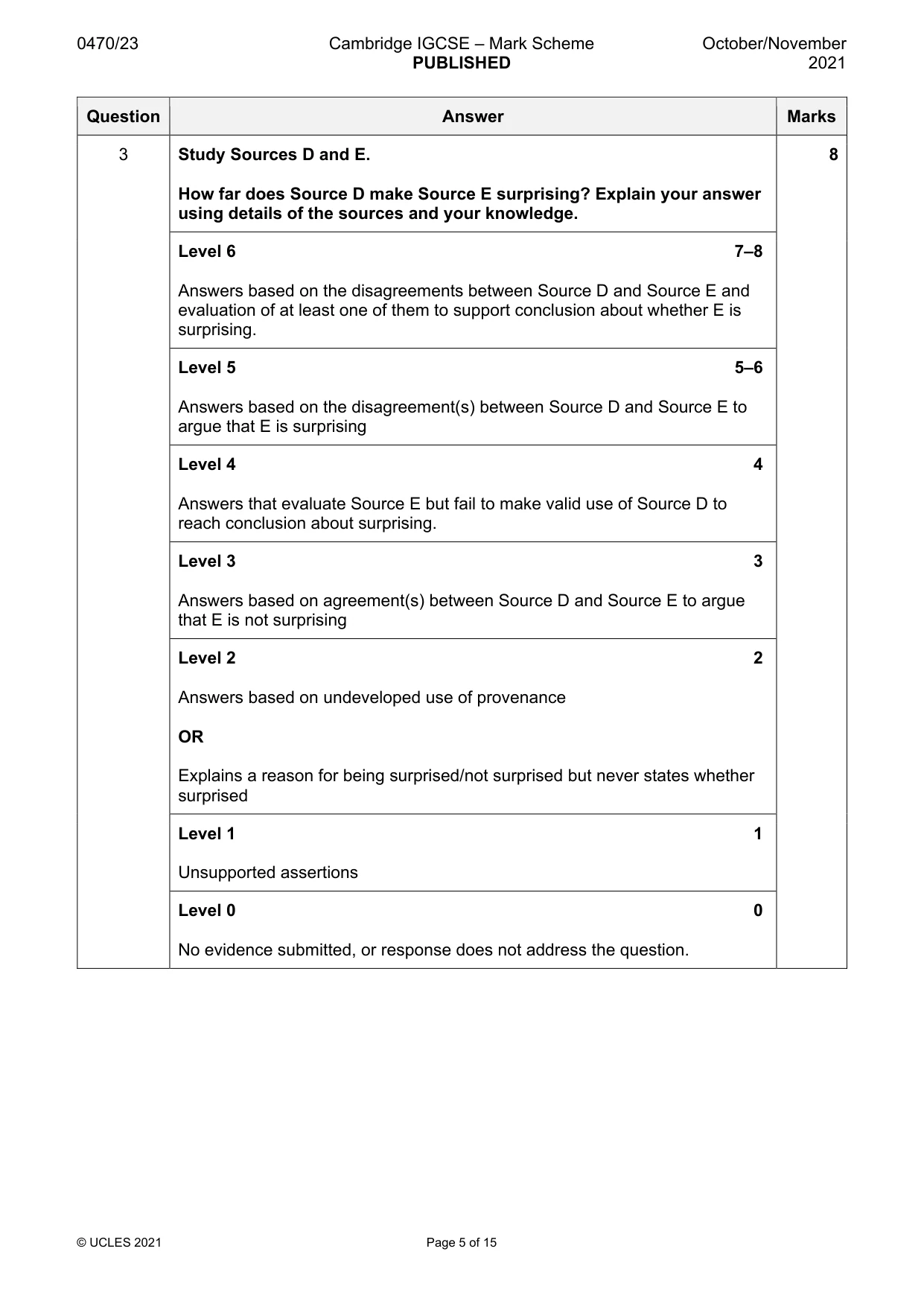
0470/23 Cambridge IGCSE – Mark Scheme PUBLISHED October/November 2021 © UCLES 2021 Page 5 of 15 Question Answer Marks 3 Study Sources D and E. How far does Source D make Source E surprising? Explain your answer using details of the sources and your knowledge. 8 Level 6 7–8 Answers based on the disagreements between Source D and Source E and evaluation of at least one of them to support conclusion about whether E is surprising. Level 5 5–6 Answers based on the disagreement(s) between Source D and Source E to argue that E is surprising Level 4 4 Answers that evaluate Source E but fail to make valid use of Source D to reach conclusion about surprising. Level 3 3 Answers based on agreement(s) between Source D and Source E to argue that E is not surprising Level 2 2 Answers based on undeveloped use of provenance OR Explains a reason for being surprised/not surprised but never states whether surprised Level 1 1 Unsupported assertions Level 0 0 No evidence submitted, or response does not address the question.
Mark scheme, page 6
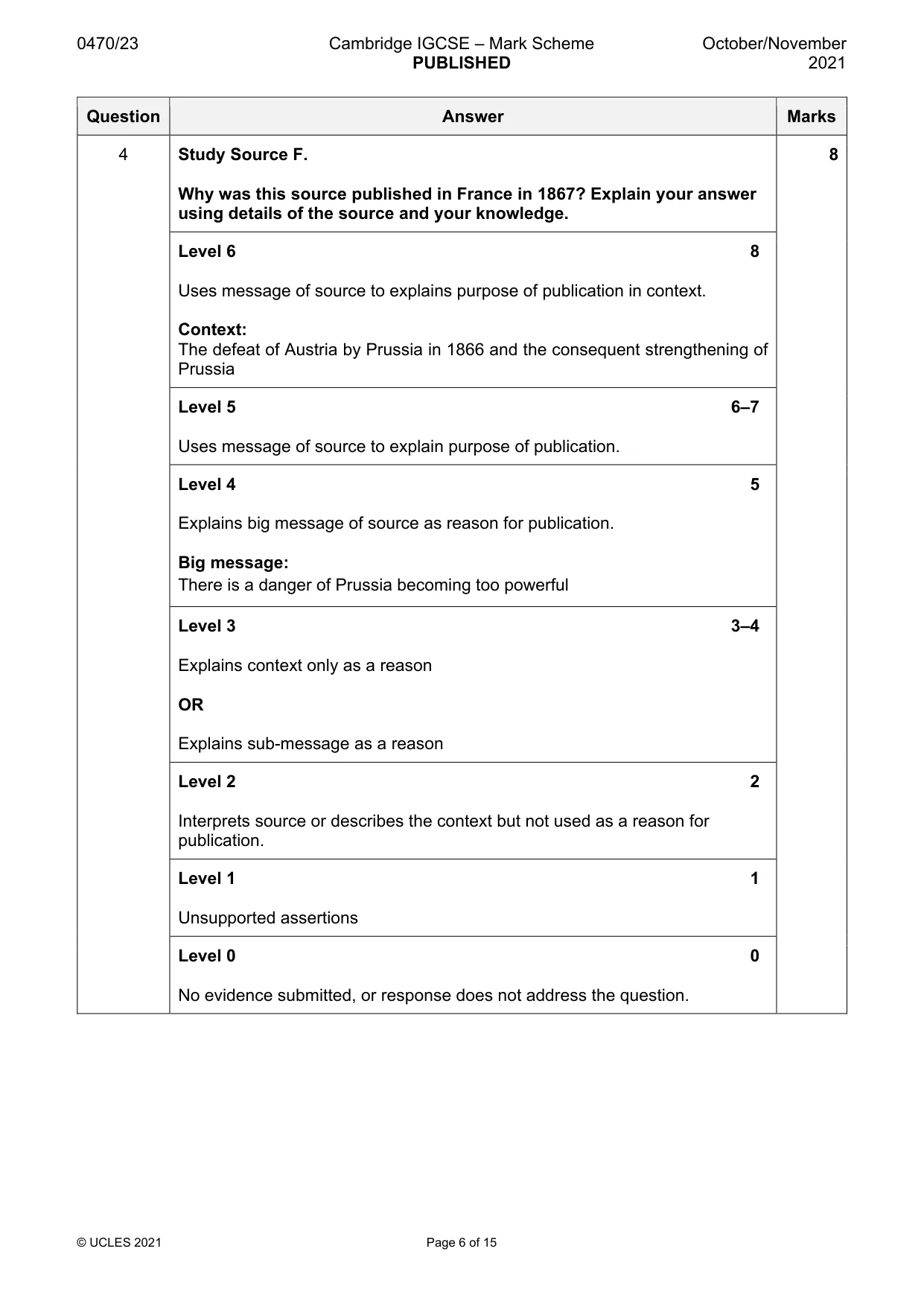
0470/23 Cambridge IGCSE – Mark Scheme PUBLISHED October/November 2021 © UCLES 2021 Page 6 of 15 Question Answer Marks 4 Study Source F. Why was this source published in France in 1867? Explain your answer using details of the source and your knowledge. 8 Level 6 8 Uses message of source to explains purpose of publication in context. Context: The defeat of Austria by Prussia in 1866 and the consequent strengthening of Prussia Level 5 6–7 Uses message of source to explain purpose of publication. Level 4 5 Explains big message of source as reason for publication. Big message: There is a danger of Prussia becoming too powerful Level 3 3–4 Explains context only as a reason OR Explains sub-message as a reason Level 2 2 Interprets source or describes the context but not used as a reason for publication. Level 1 1 Unsupported assertions Level 0 0 No evidence submitted, or response does not address the question.
Mark scheme, page 7
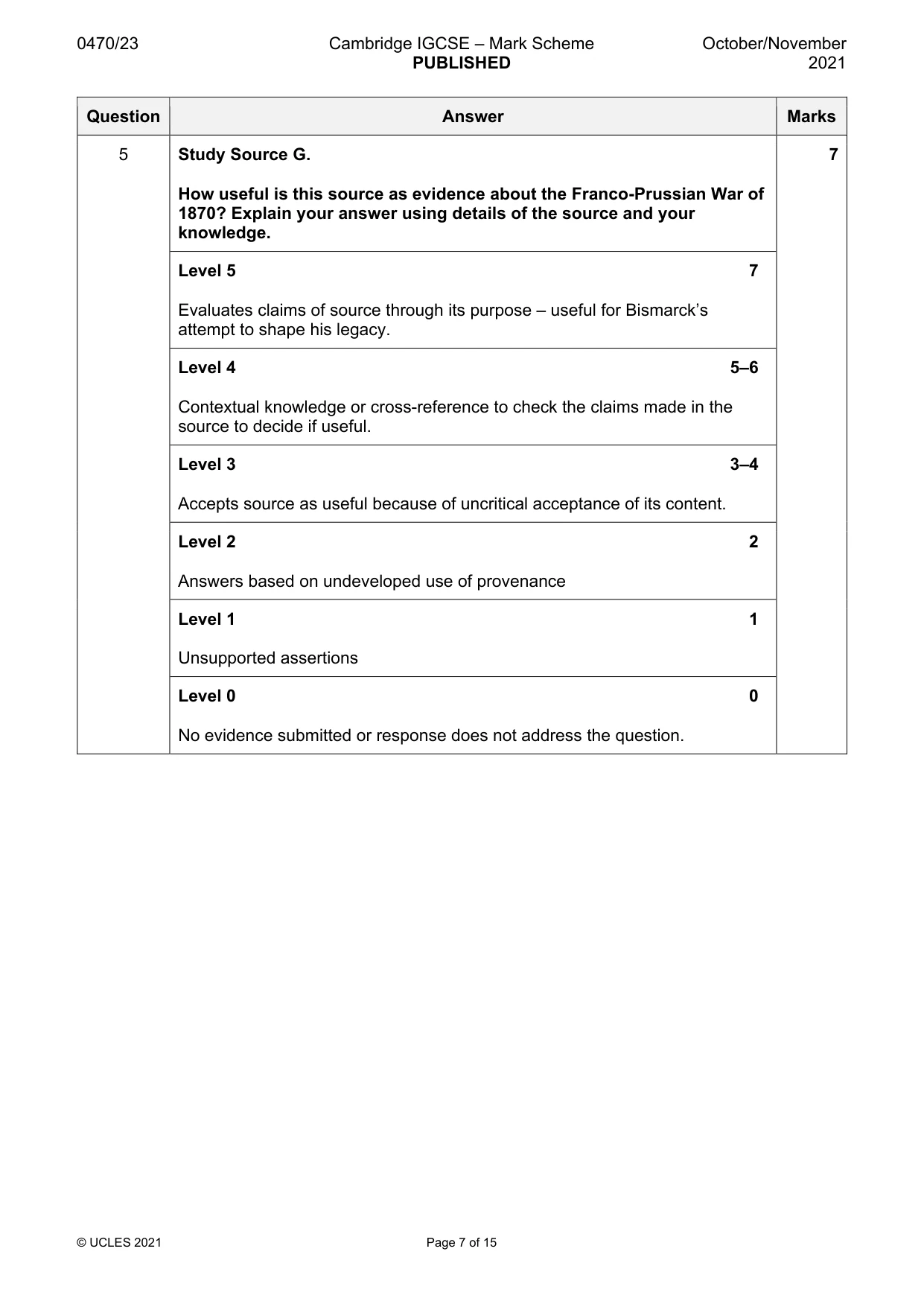
0470/23 Cambridge IGCSE – Mark Scheme PUBLISHED October/November 2021 © UCLES 2021 Page 7 of 15 Question Answer Marks 5 Study Source G. How useful is this source as evidence about the Franco-Prussian War of 1870? Explain your answer using details of the source and your knowledge. 7 Level 5 7 Evaluates claims of source through its purpose – useful for Bismarck’s attempt to shape his legacy. Level 4 5–6 Contextual knowledge or cross-reference to check the claims made in the source to decide if useful. Level 3 3–4 Accepts source as useful because of uncritical acceptance of its content. Level 2 2 Answers based on undeveloped use of provenance Level 1 1 Unsupported assertions Level 0 0 No evidence submitted or response does not address the question.
Mark scheme, page 8
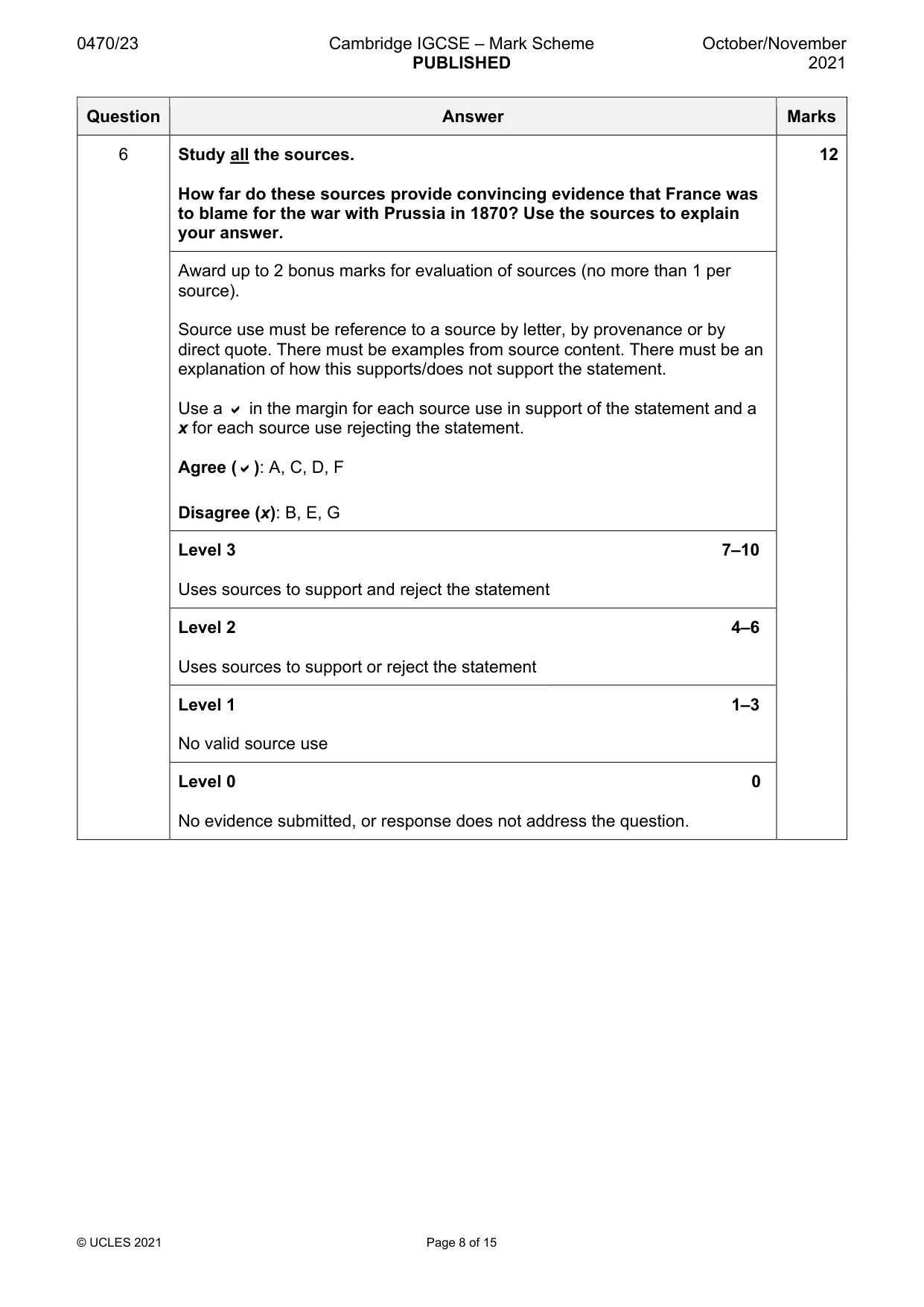
0470/23 Cambridge IGCSE – Mark Scheme PUBLISHED October/November 2021 © UCLES 2021 Page 8 of 15 Question Answer Marks 6 Study all the sources. How far do these sources provide convincing evidence that France was to blame for the war with Prussia in 1870? Use the sources to explain your answer. 12 Award up to 2 bonus marks for evaluation of sources (no more than 1 per source). Source use must be reference to a source by letter, by provenance or by direct quote. There must be examples from source content. There must be an explanation of how this supports/does not support the statement. Use a in the margin for each source use in support of the statement and a x for each source use rejecting the statement. Agree (): A, C, D, F Disagree (x): B, E, G Level 3 7–10 Uses sources to support and reject the statement Level 2 4–6 Uses sources to support or reject the statement Level 1 1–3 No valid source use Level 0 0 No evidence submitted, or response does not address the question.
Mark scheme, page 9
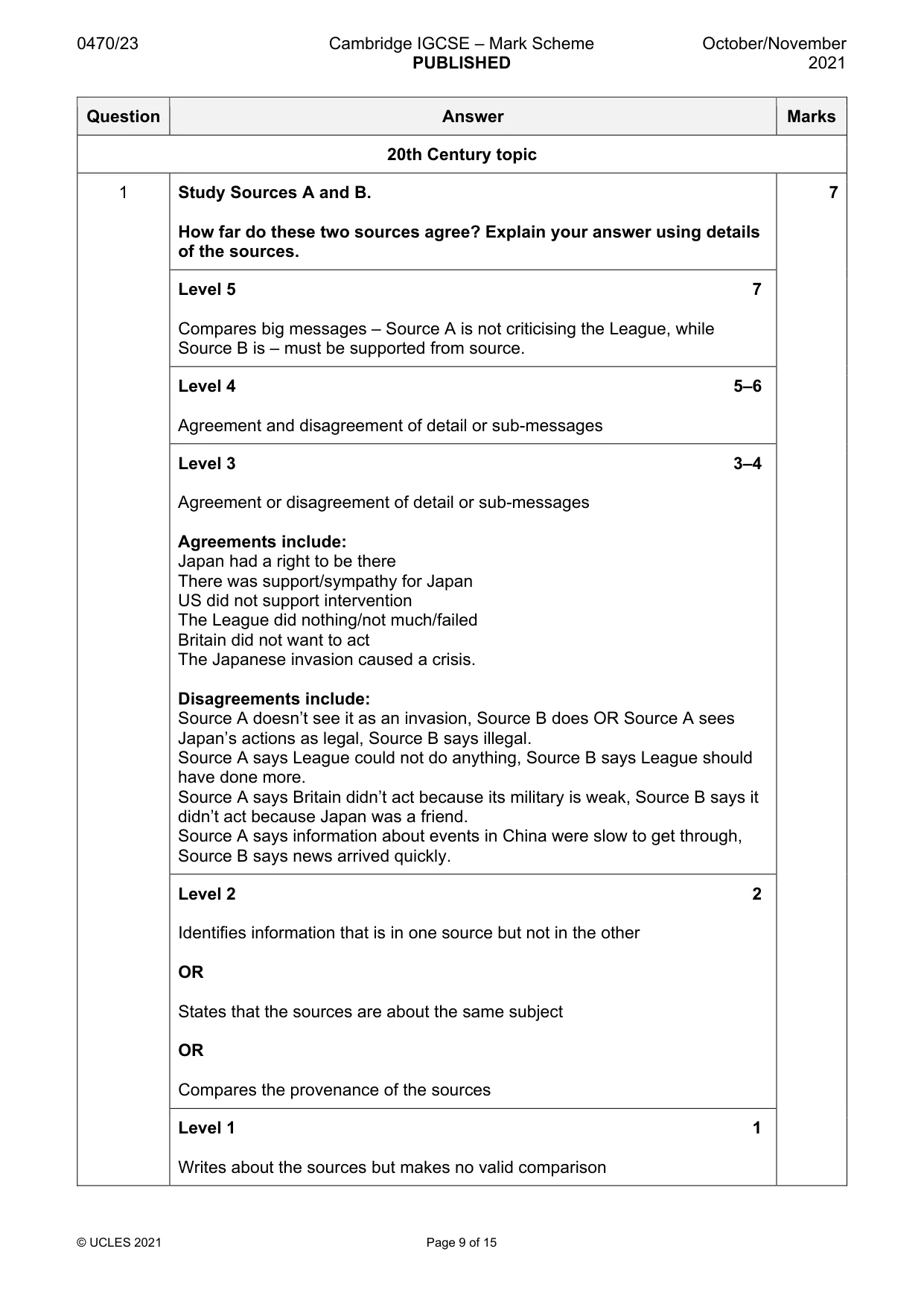
0470/23 Cambridge IGCSE – Mark Scheme PUBLISHED October/November 2021 © UCLES 2021 Page 9 of 15 Question Answer Marks 20th Century topic 1 Study Sources A and B. How far do these two sources agree? Explain your answer using details of the sources. 7 Level 5 7 Compares big messages – Source A is not criticising the League, while Source B is – must be supported from source. Level 4 5–6 Agreement and disagreement of detail or sub-messages Level 3 3–4 Agreement or disagreement of detail or sub-messages Agreements include: Japan had a right to be there There was support/sympathy for Japan US did not support intervention The League did nothing/not much/failed Britain did not want to act The Japanese invasion caused a crisis. Disagreements include: Source A doesn’t see it as an invasion, Source B does OR Source A sees Japan’s actions as legal, Source B says illegal. Source A says League could not do anything, Source B says League should have done more. Source A says Britain didn’t act because its military is weak, Source B says it didn’t act because Japan was a friend. Source A says information about events in China were slow to get through, Source B says news arrived quickly. Level 2 2 Identifies information that is in one source but not in the other OR States that the sources are about the same subject OR Compares the provenance of the sources Level 1 1 Writes about the sources but makes no valid comparison
Mark scheme, page 10
0470/23 Cambridge IGCSE – Mark Scheme PUBLISHED October/November 2021 © UCLES 2021 Page 10 of 15 Question Answer Marks 1 Level 0 0 No evidence submitted, or response does not address the question.
Mark scheme, page 11
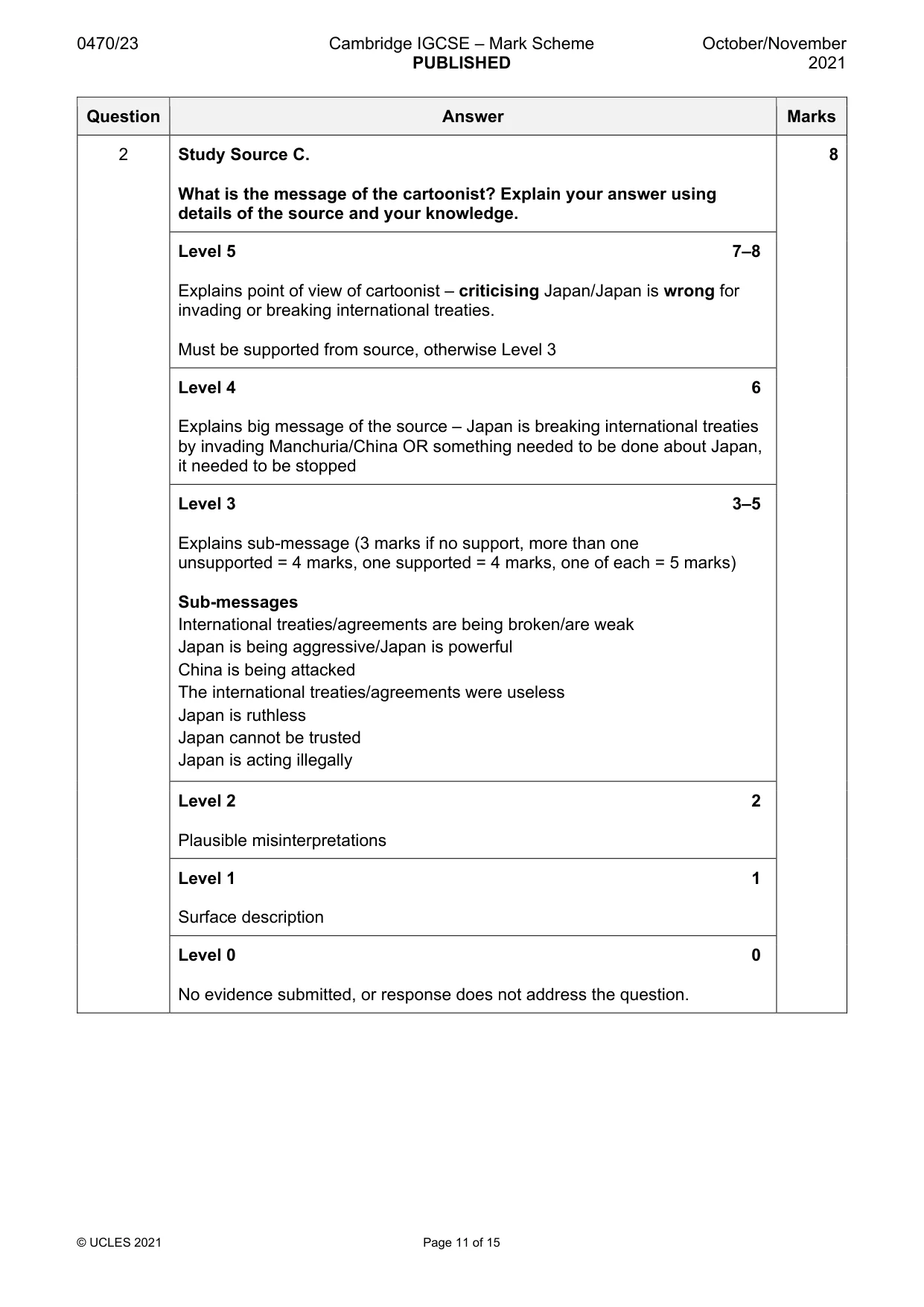
0470/23 Cambridge IGCSE – Mark Scheme PUBLISHED October/November 2021 © UCLES 2021 Page 11 of 15 Question Answer Marks 2 Study Source C. What is the message of the cartoonist? Explain your answer using details of the source and your knowledge. 8 Level 5 7–8 Explains point of view of cartoonist – criticising Japan/Japan is wrong for invading or breaking international treaties. Must be supported from source, otherwise Level 3 Level 4 6 Explains big message of the source – Japan is breaking international treaties by invading Manchuria/China OR something needed to be done about Japan, it needed to be stopped Level 3 3–5 Explains sub-message (3 marks if no support, more than one unsupported = 4 marks, one supported = 4 marks, one of each = 5 marks) Sub-messages International treaties/agreements are being broken/are weak Japan is being aggressive/Japan is powerful China is being attacked The international treaties/agreements were useless Japan is ruthless Japan cannot be trusted Japan is acting illegally Level 2 2 Plausible misinterpretations Level 1 1 Surface description Level 0 0 No evidence submitted, or response does not address the question.
Mark scheme, page 12
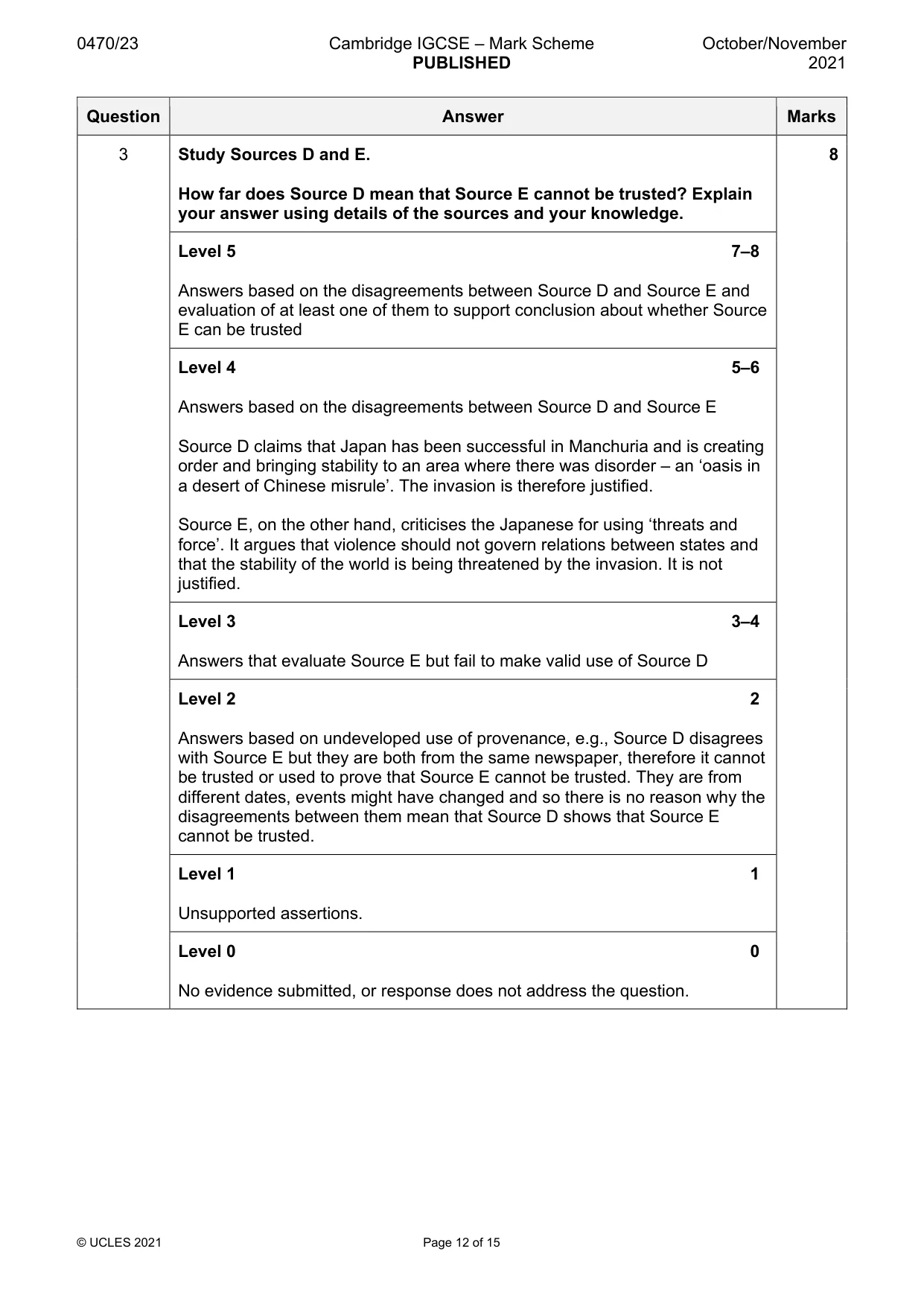
0470/23 Cambridge IGCSE – Mark Scheme PUBLISHED October/November 2021 © UCLES 2021 Page 12 of 15 Question Answer Marks 3 Study Sources D and E. How far does Source D mean that Source E cannot be trusted? Explain your answer using details of the sources and your knowledge. 8 Level 5 7–8 Answers based on the disagreements between Source D and Source E and evaluation of at least one of them to support conclusion about whether Source E can be trusted Level 4 5–6 Answers based on the disagreements between Source D and Source E Source D claims that Japan has been successful in Manchuria and is creating order and bringing stability to an area where there was disorder – an ‘oasis in a desert of Chinese misrule’. The invasion is therefore justified. Source E, on the other hand, criticises the Japanese for using ‘threats and force’. It argues that violence should not govern relations between states and that the stability of the world is being threatened by the invasion. It is not justified. Level 3 3–4 Answers that evaluate Source E but fail to make valid use of Source D Level 2 2 Answers based on undeveloped use of provenance, e.g., Source D disagrees with Source E but they are both from the same newspaper, therefore it cannot be trusted or used to prove that Source E cannot be trusted. They are from different dates, events might have changed and so there is no reason why the disagreements between them mean that Source D shows that Source E cannot be trusted. Level 1 1 Unsupported assertions. Level 0 0 No evidence submitted, or response does not address the question.
Mark scheme, page 13
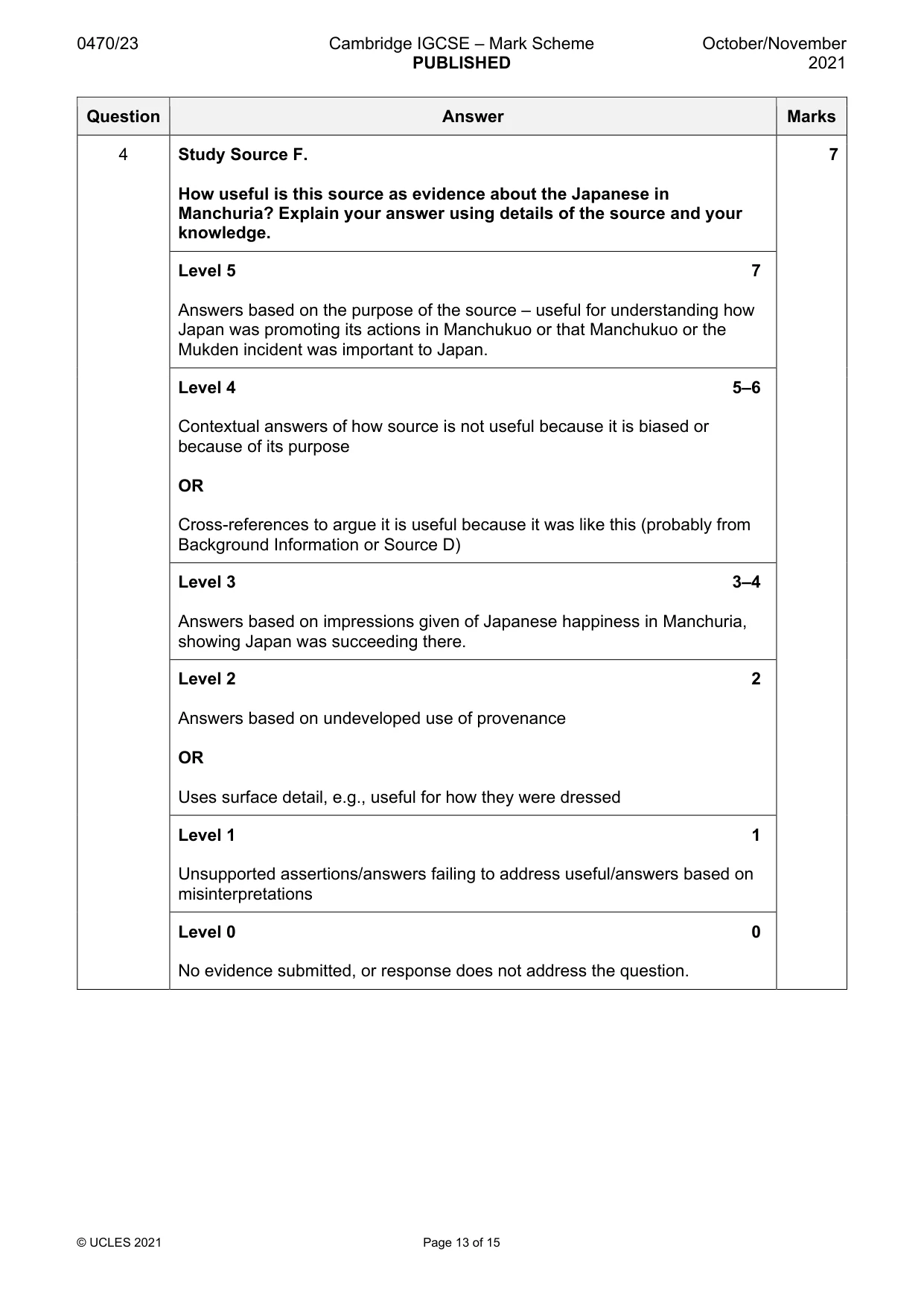
0470/23 Cambridge IGCSE – Mark Scheme PUBLISHED October/November 2021 © UCLES 2021 Page 13 of 15 Question Answer Marks 4 Study Source F. How useful is this source as evidence about the Japanese in Manchuria? Explain your answer using details of the source and your knowledge. 7 Level 5 7 Answers based on the purpose of the source – useful for understanding how Japan was promoting its actions in Manchukuo or that Manchukuo or the Mukden incident was important to Japan. Level 4 5–6 Contextual answers of how source is not useful because it is biased or because of its purpose OR Cross-references to argue it is useful because it was like this (probably from Background Information or Source D) Level 3 3–4 Answers based on impressions given of Japanese happiness in Manchuria, showing Japan was succeeding there. Level 2 2 Answers based on undeveloped use of provenance OR Uses surface detail, e.g., useful for how they were dressed Level 1 1 Unsupported assertions/answers failing to address useful/answers based on misinterpretations Level 0 0 No evidence submitted, or response does not address the question.
Mark scheme, page 14
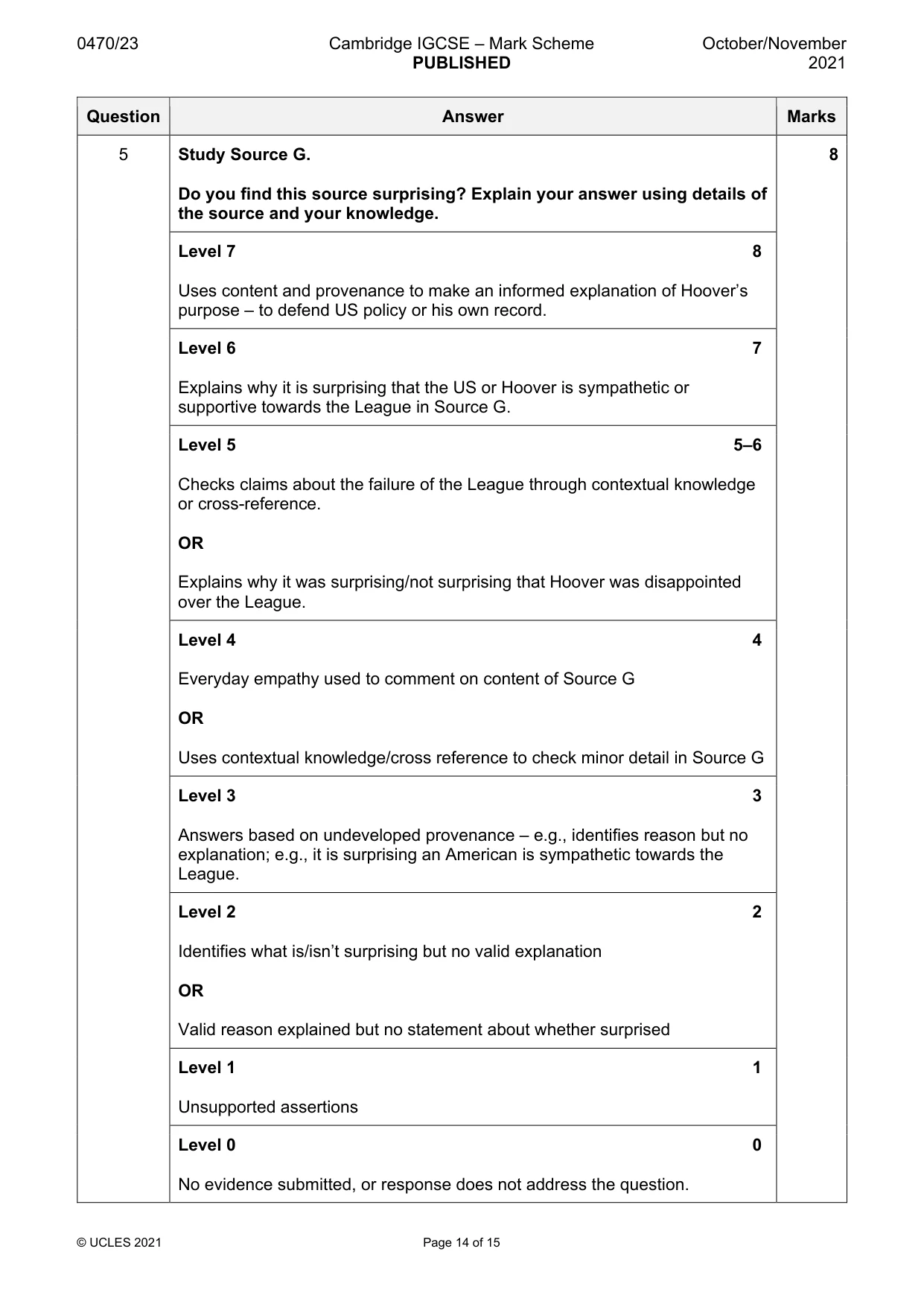
0470/23 Cambridge IGCSE – Mark Scheme PUBLISHED October/November 2021 © UCLES 2021 Page 14 of 15 Question Answer Marks 5 Study Source G. Do you find this source surprising? Explain your answer using details of the source and your knowledge. 8 Level 7 8 Uses content and provenance to make an informed explanation of Hoover’s purpose – to defend US policy or his own record. Level 6 7 Explains why it is surprising that the US or Hoover is sympathetic or supportive towards the League in Source G. Level 5 5–6 Checks claims about the failure of the League through contextual knowledge or cross-reference. OR Explains why it was surprising/not surprising that Hoover was disappointed over the League. Level 4 4 Everyday empathy used to comment on content of Source G OR Uses contextual knowledge/cross reference to check minor detail in Source G Level 3 3 Answers based on undeveloped provenance – e.g., identifies reason but no explanation; e.g., it is surprising an American is sympathetic towards the League. Level 2 2 Identifies what is/isn’t surprising but no valid explanation OR Valid reason explained but no statement about whether surprised Level 1 1 Unsupported assertions Level 0 0 No evidence submitted, or response does not address the question.
Mark scheme, page 15
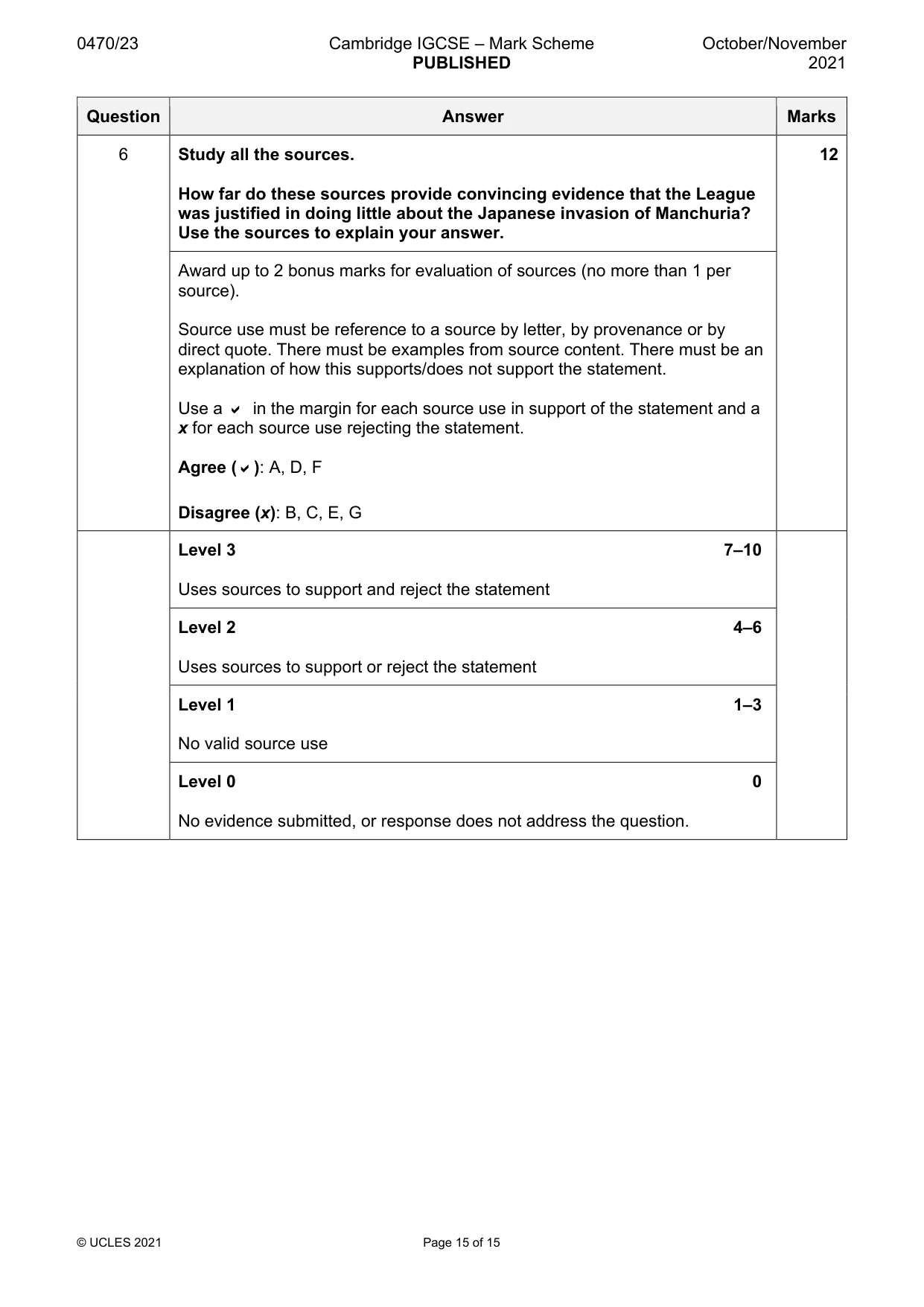
0470/23 Cambridge IGCSE – Mark Scheme PUBLISHED October/November 2021 © UCLES 2021 Page 15 of 15 Question Answer Marks 6 Study all the sources. How far do these sources provide convincing evidence that the League was justified in doing little about the Japanese invasion of Manchuria? Use the sources to explain your answer. 12 Award up to 2 bonus marks for evaluation of sources (no more than 1 per source). Source use must be reference to a source by letter, by provenance or by direct quote. There must be examples from source content. There must be an explanation of how this supports/does not support the statement. Use a in the margin for each source use in support of the statement and a x for each source use rejecting the statement. Agree (): A, D, F Disagree (x): B, C, E, G Level 3 7–10 Uses sources to support and reject the statement Level 2 4–6 Uses sources to support or reject the statement Level 1 1–3 No valid source use Level 0 0 No evidence submitted, or response does not address the question.
What you needed in this session
Cambridge’s own grade thresholds for 2021 Oct/Nov, Paper 2 · Variant 3. A higher threshold means an easier paper — the bar moves with how the cohort did.