Cambridge IGCSE History 0470 — 2021 Oct/Nov Paper 2 · Variant 1
0470/21/O/N/21 · 50 marks · ≈56 min
The question paper and its mark scheme, free to read here and free to download. This is Cambridge’s own paper, exactly as it was sat.
Question paper12 pages

Mark scheme16 pages
Answers below. Sit the paper first if you are practising.
Paper as text
Question paper, page 1
This document has 12 pages. Any blank pages are indicated. Cambridge IGCSE™ DC (MS/CT) 201391/3 © UCLES 2021 [Turn over HISTORY 0470/21 Paper 2 October/November 2021 2 hours You must answer on the enclosed answer booklet. You will need: Answer booklet (enclosed) INSTRUCTIONS ● Answer all the questions on one option only. Option A: Nineteenth century topic Option B: Twentieth century topic ● Follow the instructions on the front cover of the answer booklet. If you need additional answer paper, ask the invigilator for a continuation booklet. INFORMATION ● The total mark for this paper is 50. ● The number of marks for each question or part question is shown in brackets [ ]. * 9 4 2 3 1 3 6 0 2 0 *
Question paper, page 2
2 0470/21/O/N/21 © UCLES 2021 Option A: Nineteenth century topic HOW IMPORTANT WAS KING WILLIAM I OF PRUSSIA? Study the Background Information and the sources carefully, and then answer all the questions. Background Information In 1849 the future William I had written, ‘It is clear from our whole history that Prussia is destined to be at the head of Germany, but the question is – when and how?’ William became King of Prussia in 1861, and in 1871 he fulfilled his prophecy by becoming Emperor of a united Germany. How far was this due to Bismarck, his Minister-President, and how far did William have any importance in this period? The usual story told by historians is that Bismarck decided policy and William simply agreed. His contemporaries describe him as polite, gentlemanly and considerate but having little influence over policy. Was it as simple as that? Did William have much significance? SOURCE A Bismarck gained and held power by the brilliance of his personality, but he always depended on the goodwill of his King. If William I had decided to dismiss Bismarck after the ‘blood and iron’ speech, which most educated people in Germany condemned, Bismarck would have disappeared from history. During his years in power Bismarck forced the King again and again by temper tantrums and threats to do things William disliked. Bismarck’s career rested on his personal relations with the King. The desperate struggle to control an emotional old man who actually held power wore Bismarck’s nerves to shreds and his rages arose from this powerlessness. The King would not always give in to Bismarck’s demands. He felt, as a decent man, real loyalty to his ministers and could not allow them to be brutally discarded by Bismarck. The King’s kindness for others enraged Bismarck. If the King wrote or spoke sharply to him, Bismarck collapsed into bed and was sometimes ill for weeks. William could not have shown Bismarck more love and attention, yet Bismarck had the nerve to complain of the horrible conduct of his King. From a history book published in 2011. SOURCE B It was not an easy task to persuade the King to stay away from Frankfurt. I thought I had persuaded my master, but he did not find it easy to resist. He thought over and over again, ‘Thirty reigning princes!’ Besides, he loved and honoured the King of Saxony who had invited him. Not until midnight did I succeed in obtaining the King’s refusal to the invitation. When I left my master, both he and I were ill and exhausted by the nervous tension of the situation. On the return journey to Berlin, the King passed so near to Frankfurt that his decision not to take part became known to everyone. The majority of the princes felt uncomfortable when they thought of Austria’s scheme of reform, which, if Prussia stayed away, left them standing alone with Austria in a position where they got no protection from the rivalry of the two Great Powers. From Bismarck’s memoirs written in his retirement in the 1890s. In 1863 Austria had called a conference of German Princes in Frankfurt, with the aim of reforming the German Confederation in a way that would increase Austria’s power in Germany.
Question paper, page 3
3 0470/21/O/N/21 © UCLES 2021 [Turn over SOURCE C I declared it to be my belief that peace must be concluded on the Austrian terms but remained alone in my opinion; the King supported the military majority. My nerves could not stand the strain and I got up, walked into my bedchamber and was overcome with tears. I set out the next day to explain to the King and said we had to avoid wounding Austria too severely to avoid leaving any desire for revenge. To this the King raised no objection but said the actual peace terms were inadequate and that Austria could not be allowed to escape unpunished. Under the impression that my opinion was rejected, I left the room. I then met the Crown Prince who said to me, ‘If you are persuaded that peace must now be concluded, I am ready to defend your opinion with my father.’ He returned after half an hour with the words, ‘My father has consented.’ The main memory I have is of the violent agitation into which I had been obliged to put my master in order to obtain what I considered essential to the interests of the country. Bismarck’s account of meetings with King William, his chief ministers and senior generals in July 1866 about whether to make peace with Austria. William wanted to march on Vienna. SOURCE D Bismarck gave hints that the war must decisively achieve the rounding off of Prussian territory. That caused the Crown Prince to ask the question whether there was an intention to annex territory. The King answered angrily that there is no question of war yet and still less of deposing German princes. He wants peace. Bismarck was by far the clearest and sharpest. I became convinced that he had brought about the whole situation in order to encourage the King to be more warlike. As we came out the Crown Prince said, ‘The King will not; Bismarck will.’ An account by a senior army officer, who served under the Crown Prince, of the Grand War Council in May 1866. The King, Bismarck, senior politicians and army officers were present.
Question paper, page 4
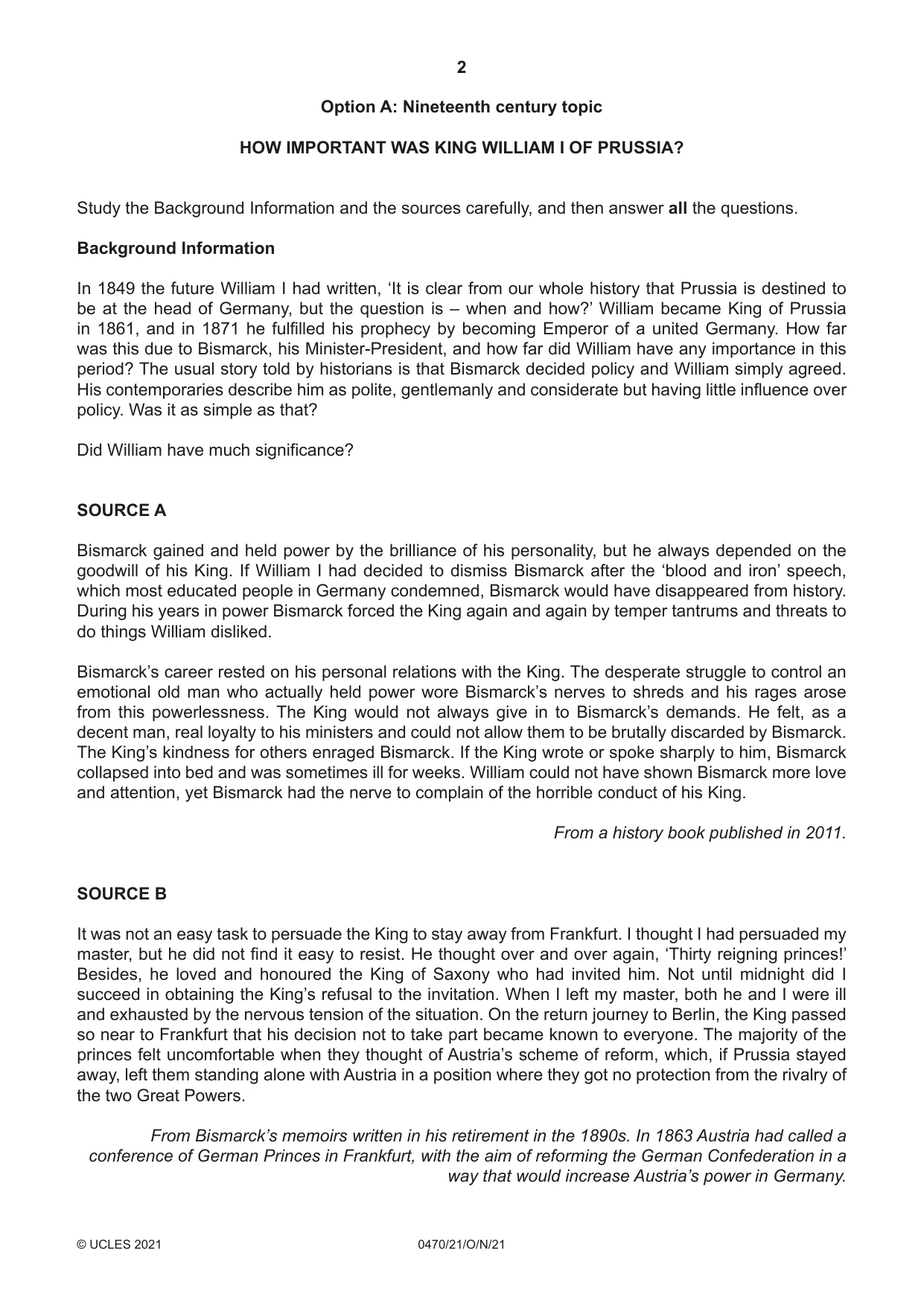
4 0470/21/O/N/21 © UCLES 2021 SOURCE E A French cartoon published in early 1867. It is entitled ‘The Giant German Ogre’. It shows William and some small figures which represent the princes of North Germany.
Question paper, page 5
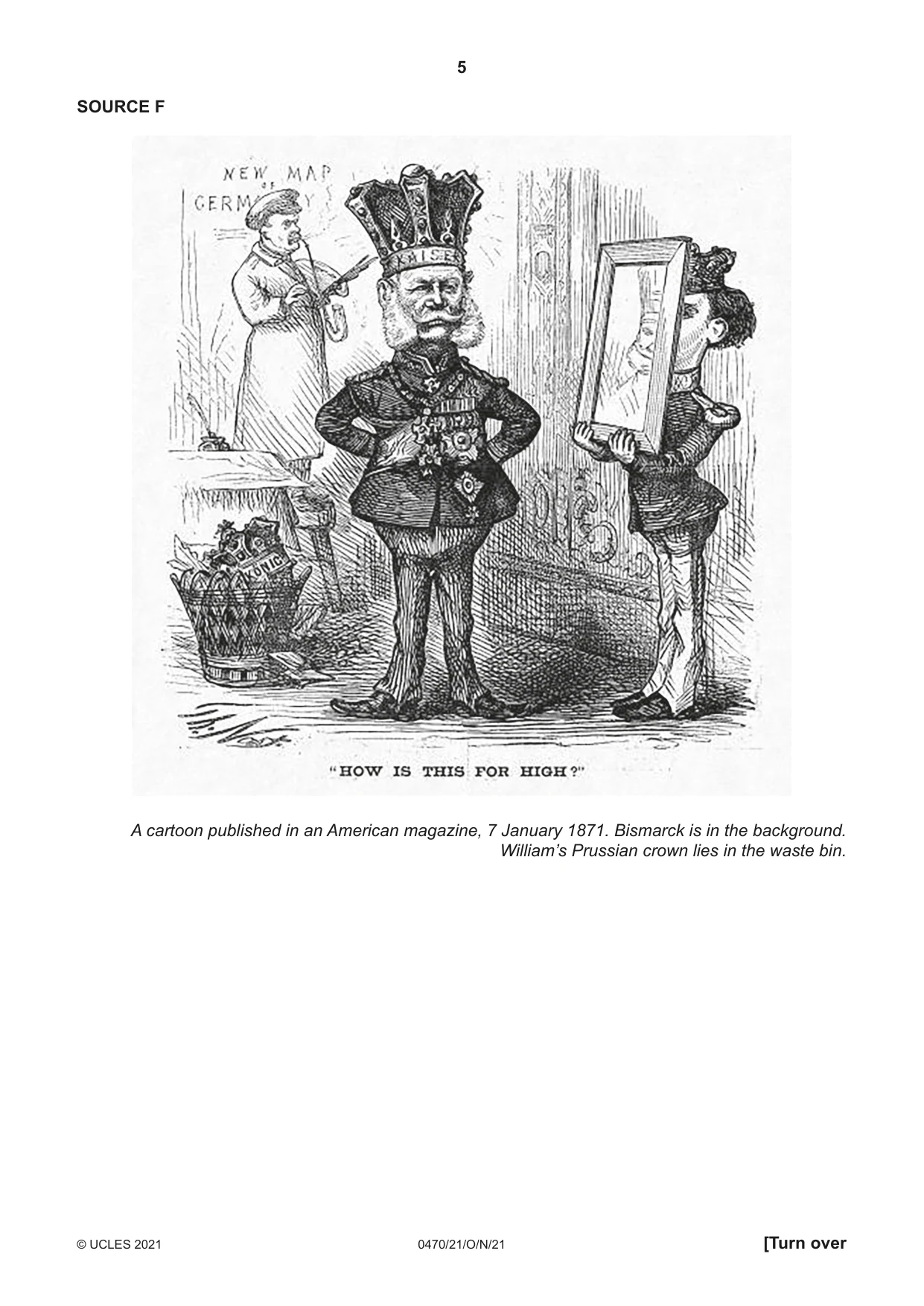
5 0470/21/O/N/21 © UCLES 2021 [Turn over SOURCE F A cartoon published in an American magazine, 7 January 1871. Bismarck is in the background. William’s Prussian crown lies in the waste bin.
Question paper, page 6
6 0470/21/O/N/21 © UCLES 2021 Now answer all the following questions. You may use any of the sources to help you answer the questions, in addition to those sources which you are told to use. In answering the questions you should use your knowledge of the topic to help you interpret and evaluate the sources. 1 Study Source A. What impressions does Source A give of the relationship between William and Bismarck? Explain your answer using details of the source. [7] 2 Study Sources B and C. Does Source B make Source C surprising? Explain your answer using details of the sources and your knowledge. [8] 3 Study Source D. How useful is this source as evidence about the Prussian decision to go to war with Austria? Explain your answer using details of the source and your knowledge. [7] 4 Study Source E. Why was this cartoon published in France at that time? Explain your answer using details of the source and your knowledge. [8] 5 Study Source F. What is the message of the cartoonist? Explain your answer using details of the source and your knowledge. [8] 6 Study all the sources. How far do these sources provide convincing evidence that Bismarck dominated William? Use the sources to explain your answer. [12]
Question paper, page 7
7 0470/21/O/N/21 © UCLES 2021 [Turn over BLANK PAGE
Question paper, page 8
8 0470/21/O/N/21 © UCLES 2021 Option B: Twentieth century topic HOW IMPORTANT WAS THE USA’S DECISION NOT TO JOIN THE LEAGUE OF NATIONS? Study the Background Information and the sources carefully, and then answer all the questions. Background Information In November 1919 the US Senate voted to reject the Treaty of Versailles and this was confirmed by another vote in March 1920. An important part of the Treaty was the creation of the League of Nations. The USA’s rejection of the Treaty meant that it would not be joining the League of Nations. When the League of Nations was established in 1919 many people had high hopes of it but by the late 1930s it was clear that it was a failure. Many reasons have been suggested to explain this including the lack of an army, the self-interest of powers such as Britain and France, and slow decision-making. However, some historians have argued that the failure of the USA to join the League was a fatal blow. How far was the refusal of the USA to join the League responsible for its failure? SOURCE A On 19 November 1919, the US Senate rejected the Treaty of Versailles, thus destroying any chance of American membership of the League. Britain faced the alarming prospect of League membership without the economic power and naval strength of the United States. These events cast a long shadow over the future of the League, especially with the increasingly bitter arguments between Britain and France. As early as the 1920s the Corfu Crisis had clearly demonstrated that while the threat of sanctions might be effective against small powers, it was unlikely to work effectively against Great Powers. Furthermore, unless the Great Powers, and especially Britain and France, were willing to work closely together to resolve disputes and to take joint economic and, if necessary, military action, the League could not exercise its authority in an effective way. However, in the late 1920s, public opinion across Europe thought that the League was becoming strong enough to prevent future conflicts. Both Britain and France publicly accepted the importance of their League obligations. But in private, ministers and their officials were uncomfortably aware of the limitations of the League, and of how little it could actually achieve in terms of economic or military action against a major power, particularly in the absence of clear French-British agreement about how it should operate. The onset of the Depression only served to further weaken the League’s capacity for effective action. From a history book published in 1984.
Question paper, page 9
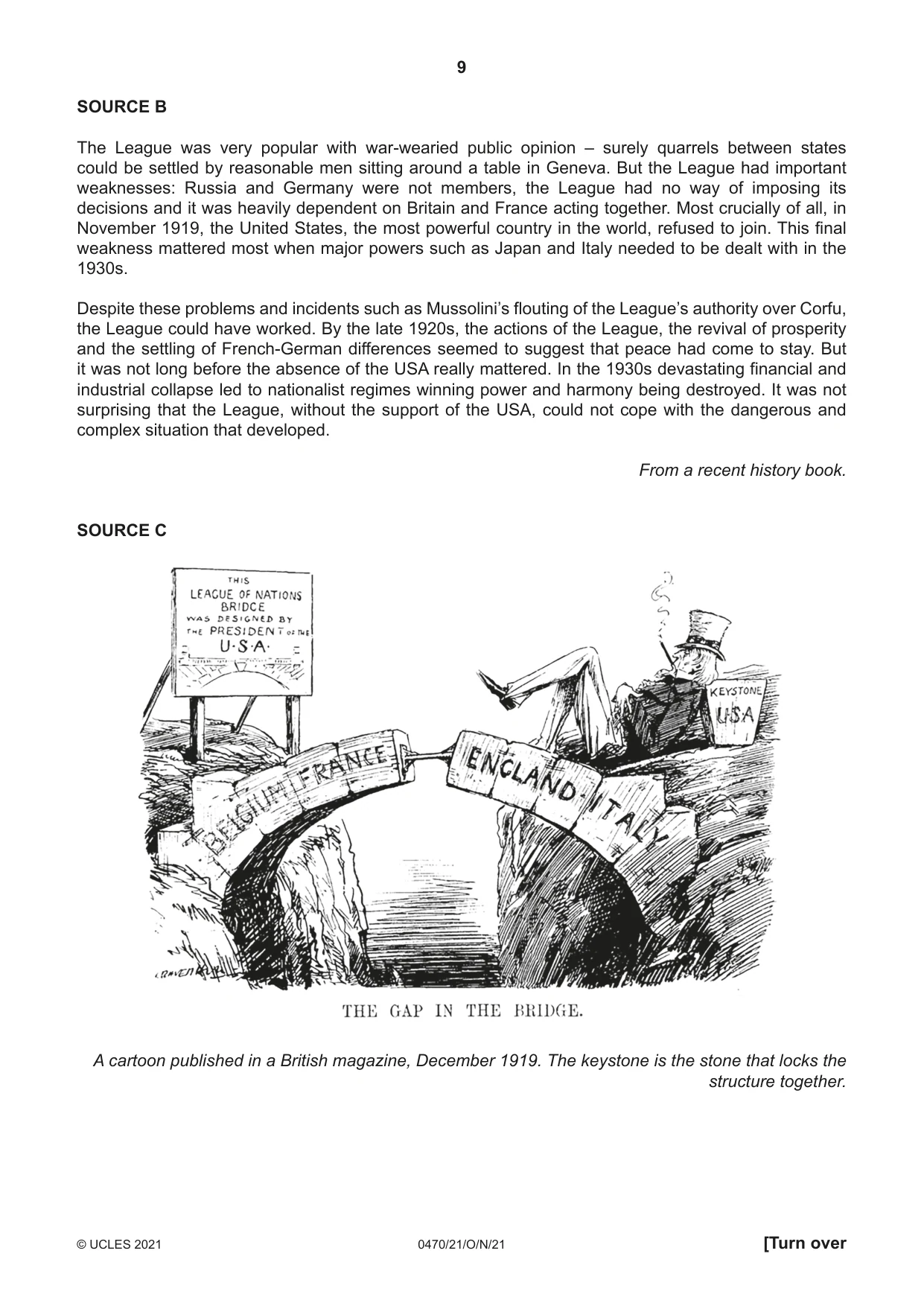
9 0470/21/O/N/21 © UCLES 2021 [Turn over SOURCE B The League was very popular with war-wearied public opinion – surely quarrels between states could be settled by reasonable men sitting around a table in Geneva. But the League had important weaknesses: Russia and Germany were not members, the League had no way of imposing its decisions and it was heavily dependent on Britain and France acting together. Most crucially of all, in November 1919, the United States, the most powerful country in the world, refused to join. This final weakness mattered most when major powers such as Japan and Italy needed to be dealt with in the 1930s. Despite these problems and incidents such as Mussolini’s flouting of the League’s authority over Corfu, the League could have worked. By the late 1920s, the actions of the League, the revival of prosperity and the settling of French-German differences seemed to suggest that peace had come to stay. But it was not long before the absence of the USA really mattered. In the 1930s devastating financial and industrial collapse led to nationalist regimes winning power and harmony being destroyed. It was not surprising that the League, without the support of the USA, could not cope with the dangerous and complex situation that developed. From a recent history book. SOURCE C A cartoon published in a British magazine, December 1919. The keystone is the stone that locks the structure together.
Question paper, page 10
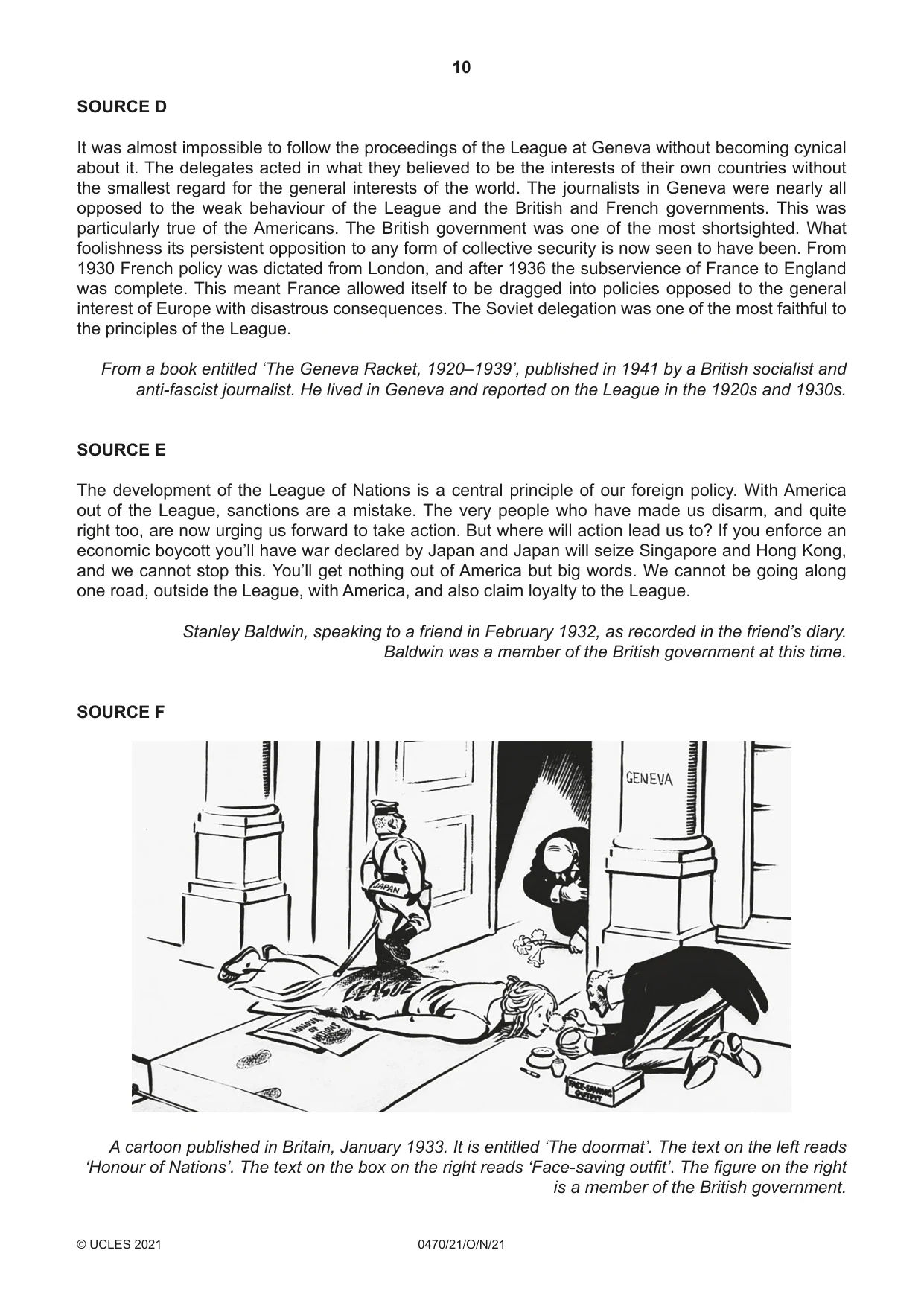
10 0470/21/O/N/21 © UCLES 2021 SOURCE D It was almost impossible to follow the proceedings of the League at Geneva without becoming cynical about it. The delegates acted in what they believed to be the interests of their own countries without the smallest regard for the general interests of the world. The journalists in Geneva were nearly all opposed to the weak behaviour of the League and the British and French governments. This was particularly true of the Americans. The British government was one of the most shortsighted. What foolishness its persistent opposition to any form of collective security is now seen to have been. From 1930 French policy was dictated from London, and after 1936 the subservience of France to England was complete. This meant France allowed itself to be dragged into policies opposed to the general interest of Europe with disastrous consequences. The Soviet delegation was one of the most faithful to the principles of the League. From a book entitled ‘The Geneva Racket, 1920–1939’, published in 1941 by a British socialist and anti-fascist journalist. He lived in Geneva and reported on the League in the 1920s and 1930s. SOURCE E The development of the League of Nations is a central principle of our foreign policy. With America out of the League, sanctions are a mistake. The very people who have made us disarm, and quite right too, are now urging us forward to take action. But where will action lead us to? If you enforce an economic boycott you’ll have war declared by Japan and Japan will seize Singapore and Hong Kong, and we cannot stop this. You’ll get nothing out of America but big words. We cannot be going along one road, outside the League, with America, and also claim loyalty to the League. Stanley Baldwin, speaking to a friend in February 1932, as recorded in the friend’s diary. Baldwin was a member of the British government at this time. SOURCE F A cartoon published in Britain, January 1933. It is entitled ‘The doormat’. The text on the left reads ‘Honour of Nations’. The text on the box on the right reads ‘Face-saving outfit’. The figure on the right is a member of the British government.
Question paper, page 11
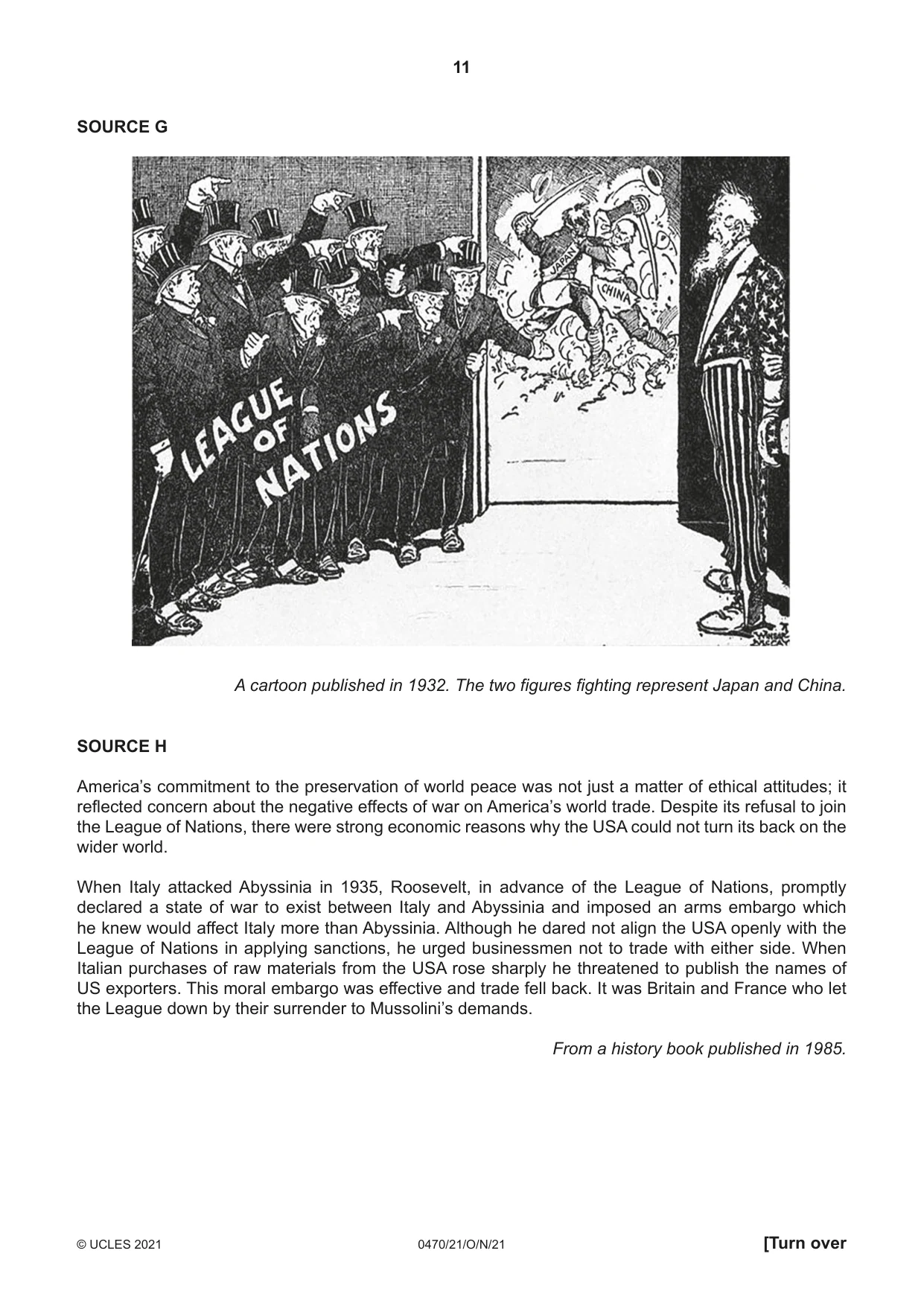
11 0470/21/O/N/21 © UCLES 2021 [Turn over SOURCE G A cartoon published in 1932. The two figures fighting represent Japan and China. SOURCE H America’s commitment to the preservation of world peace was not just a matter of ethical attitudes; it reflected concern about the negative effects of war on America’s world trade. Despite its refusal to join the League of Nations, there were strong economic reasons why the USA could not turn its back on the wider world. When Italy attacked Abyssinia in 1935, Roosevelt, in advance of the League of Nations, promptly declared a state of war to exist between Italy and Abyssinia and imposed an arms embargo which he knew would affect Italy more than Abyssinia. Although he dared not align the USA openly with the League of Nations in applying sanctions, he urged businessmen not to trade with either side. When Italian purchases of raw materials from the USA rose sharply he threatened to publish the names of US exporters. This moral embargo was effective and trade fell back. It was Britain and France who let the League down by their surrender to Mussolini’s demands. From a history book published in 1985.
Question paper, page 12
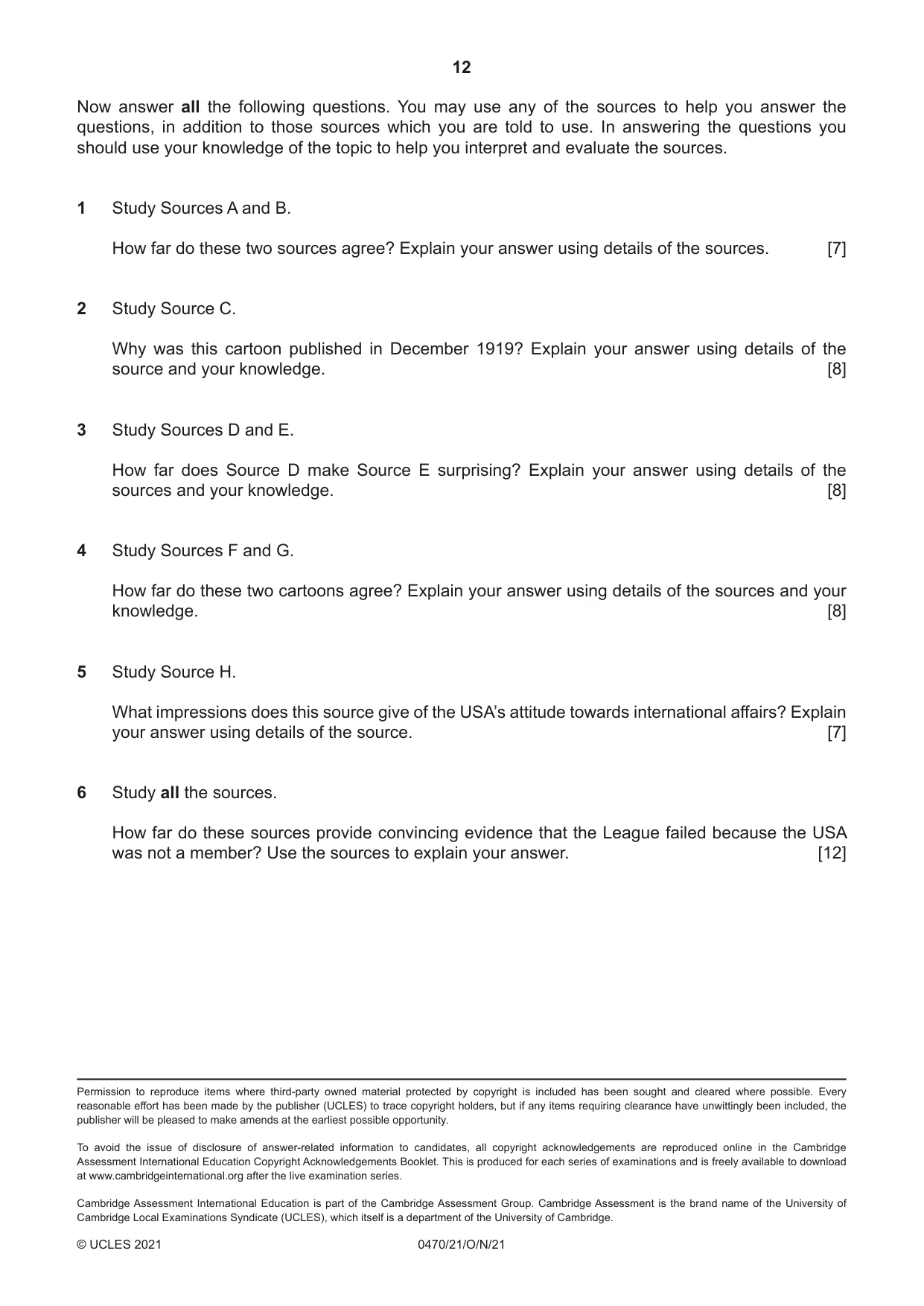
12 0470/21/O/N/21 © UCLES 2021 Permission to reproduce items where third-party owned material protected by copyright is included has been sought and cleared where possible. Every reasonable effort has been made by the publisher (UCLES) to trace copyright holders, but if any items requiring clearance have unwittingly been included, the publisher will be pleased to make amends at the earliest possible opportunity. To avoid the issue of disclosure of answer-related information to candidates, all copyright acknowledgements are reproduced online in the Cambridge Assessment International Education Copyright Acknowledgements Booklet. This is produced for each series of examinations and is freely available to download at www.cambridgeinternational.org after the live examination series. Cambridge Assessment International Education is part of the Cambridge Assessment Group. Cambridge Assessment is the brand name of the University of Cambridge Local Examinations Syndicate (UCLES), which itself is a department of the University of Cambridge. Now answer all the following questions. You may use any of the sources to help you answer the questions, in addition to those sources which you are told to use. In answering the questions you should use your knowledge of the topic to help you interpret and evaluate the sources. 1 Study Sources A and B. How far do these two sources agree? Explain your answer using details of the sources. [7] 2 Study Source C. Why was this cartoon published in December 1919? Explain your answer using details of the source and your knowledge. [8] 3 Study Sources D and E. How far does Source D make Source E surprising? Explain your answer using details of the sources and your knowledge. [8] 4 Study Sources F and G. How far do these two cartoons agree? Explain your answer using details of the sources and your knowledge. [8] 5 Study Source H. What impressions does this source give of the USA’s attitude towards international affairs? Explain your answer using details of the source. [7] 6 Study all the sources. How far do these sources provide convincing evidence that the League failed because the USA was not a member? Use the sources to explain your answer. [12]
Mark scheme, page 1
This document consists of 16 printed pages. © UCLES 2021 [Turn over Cambridge IGCSE™ HISTORY 0470/21 Paper 2 October/November 2021 MARK SCHEME Maximum Mark: 50 Published This mark scheme is published as an aid to teachers and candidates, to indicate the requirements of the examination. It shows the basis on which Examiners were instructed to award marks. It does not indicate the details of the discussions that took place at an Examiners’ meeting before marking began, which would have considered the acceptability of alternative answers. Mark schemes should be read in conjunction with the question paper and the Principal Examiner Report for Teachers. Cambridge International will not enter into discussions about these mark schemes. Cambridge International is publishing the mark schemes for the October/November 2021 series for most Cambridge IGCSE™, Cambridge International A and AS Level components and some Cambridge O Level components.
Mark scheme, page 2
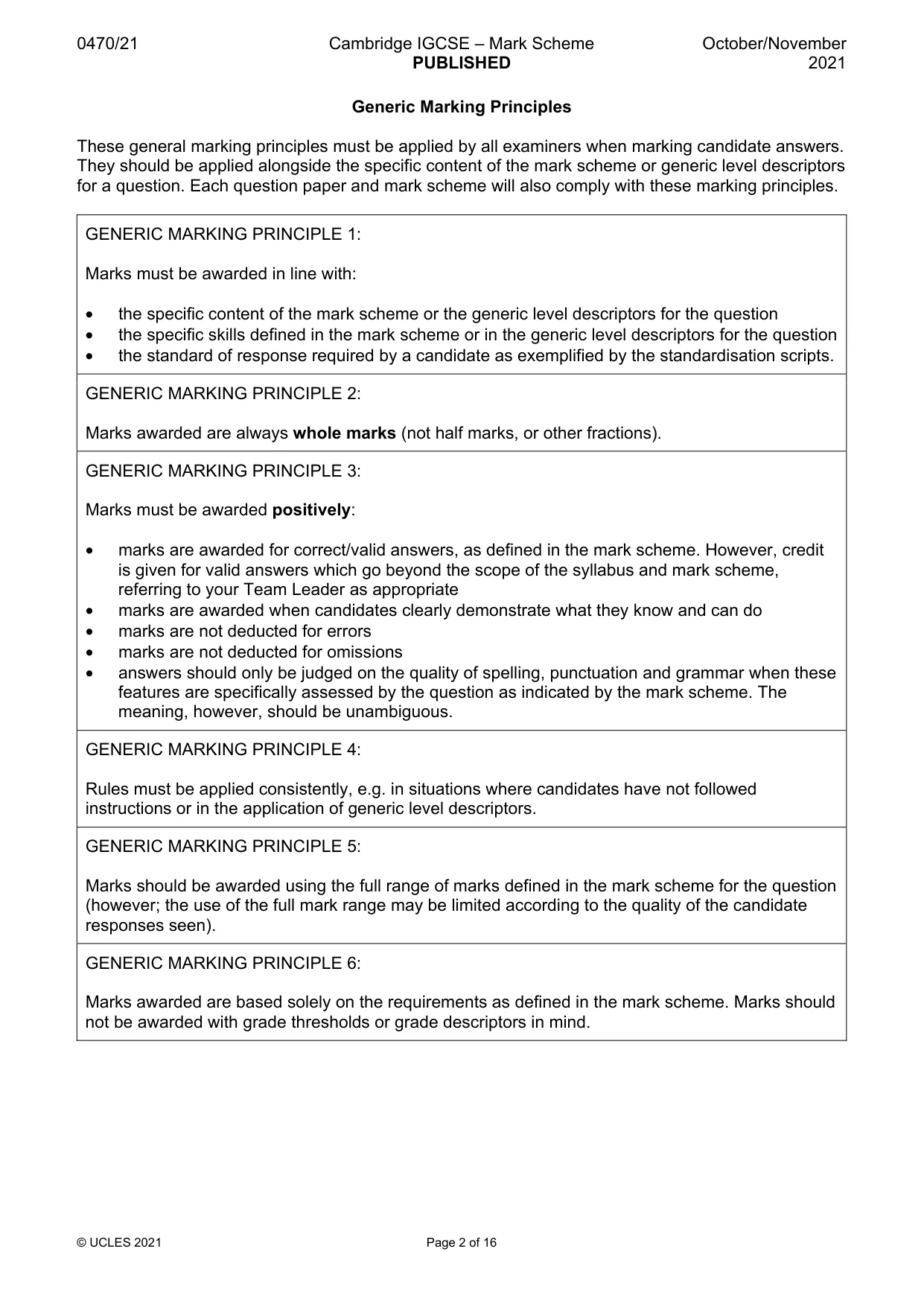
0470/21 Cambridge IGCSE – Mark Scheme PUBLISHED October/November 2021 © UCLES 2021 Page 2 of 16 Generic Marking Principles These general marking principles must be applied by all examiners when marking candidate answers. They should be applied alongside the specific content of the mark scheme or generic level descriptors for a question. Each question paper and mark scheme will also comply with these marking principles. GENERIC MARKING PRINCIPLE 1: Marks must be awarded in line with: • the specific content of the mark scheme or the generic level descriptors for the question • the specific skills defined in the mark scheme or in the generic level descriptors for the question • the standard of response required by a candidate as exemplified by the standardisation scripts. GENERIC MARKING PRINCIPLE 2: Marks awarded are always whole marks (not half marks, or other fractions). GENERIC MARKING PRINCIPLE 3: Marks must be awarded positively: • marks are awarded for correct/valid answers, as defined in the mark scheme. However, credit is given for valid answers which go beyond the scope of the syllabus and mark scheme, referring to your Team Leader as appropriate • marks are awarded when candidates clearly demonstrate what they know and can do • marks are not deducted for errors • marks are not deducted for omissions • answers should only be judged on the quality of spelling, punctuation and grammar when these features are specifically assessed by the question as indicated by the mark scheme. The meaning, however, should be unambiguous. GENERIC MARKING PRINCIPLE 4: Rules must be applied consistently, e.g. in situations where candidates have not followed instructions or in the application of generic level descriptors. GENERIC MARKING PRINCIPLE 5: Marks should be awarded using the full range of marks defined in the mark scheme for the question (however; the use of the full mark range may be limited according to the quality of the candidate responses seen). GENERIC MARKING PRINCIPLE 6: Marks awarded are based solely on the requirements as defined in the mark scheme. Marks should not be awarded with grade thresholds or grade descriptors in mind.
Mark scheme, page 3
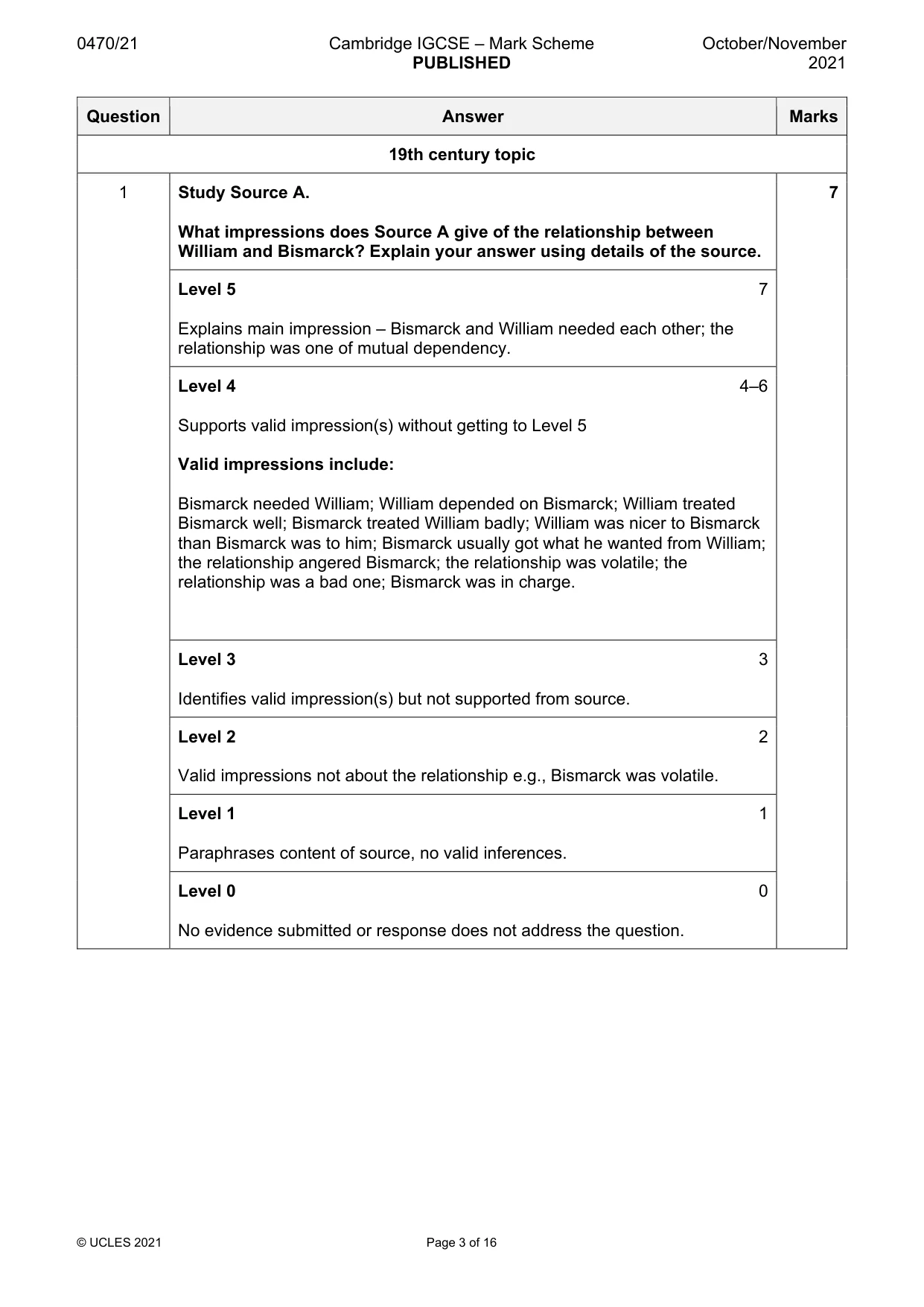
0470/21 Cambridge IGCSE – Mark Scheme PUBLISHED October/November 2021 © UCLES 2021 Page 3 of 16 Question Answer Marks 19th century topic 1 Study Source A. What impressions does Source A give of the relationship between William and Bismarck? Explain your answer using details of the source. 7 Level 5 7 Explains main impression – Bismarck and William needed each other; the relationship was one of mutual dependency. Level 4 4–6 Supports valid impression(s) without getting to Level 5 Valid impressions include: Bismarck needed William; William depended on Bismarck; William treated Bismarck well; Bismarck treated William badly; William was nicer to Bismarck than Bismarck was to him; Bismarck usually got what he wanted from William; the relationship angered Bismarck; the relationship was volatile; the relationship was a bad one; Bismarck was in charge. Level 3 3 Identifies valid impression(s) but not supported from source. Level 2 2 Valid impressions not about the relationship e.g., Bismarck was volatile. Level 1 1 Paraphrases content of source, no valid inferences. Level 0 0 No evidence submitted or response does not address the question.
Mark scheme, page 4
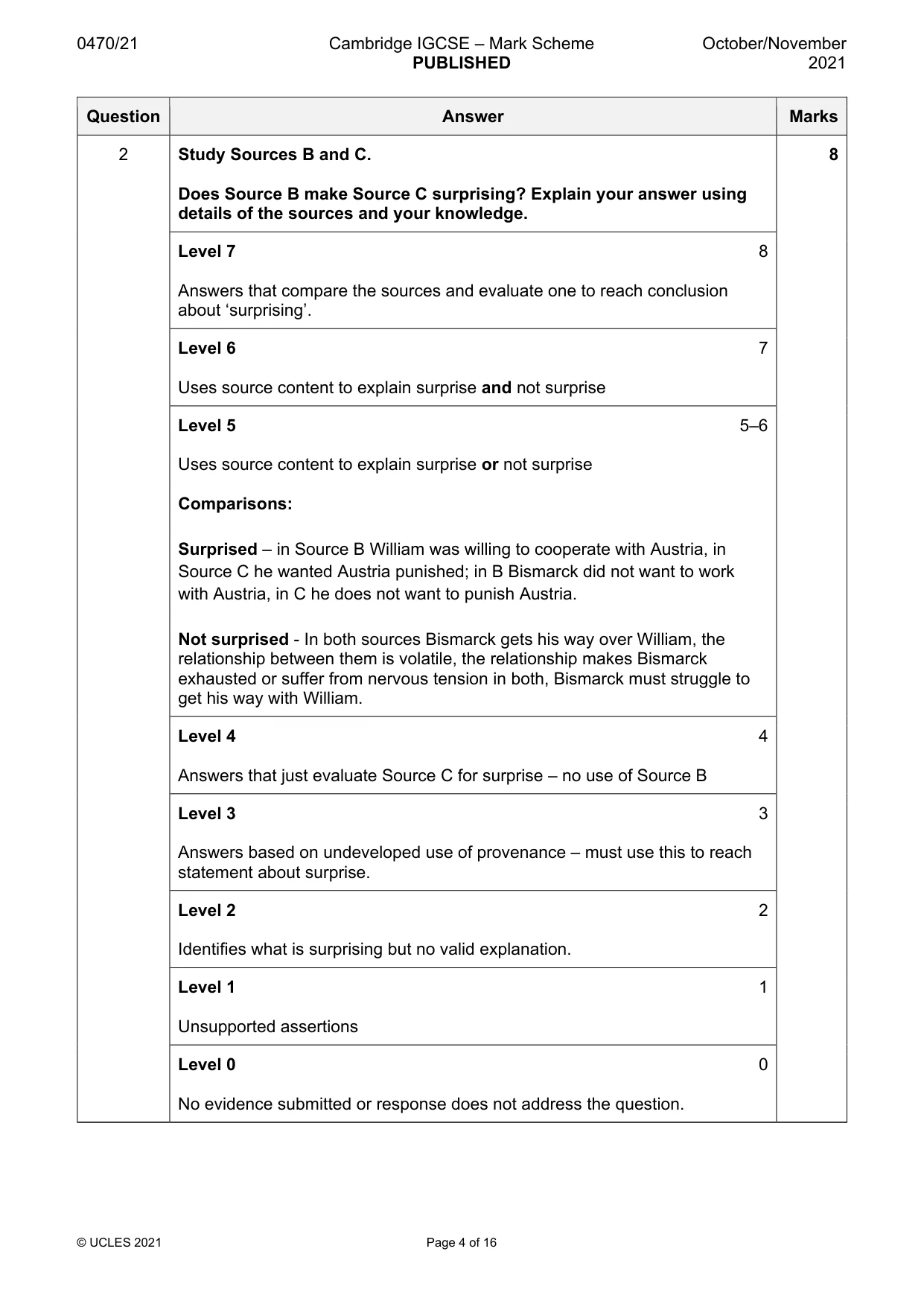
0470/21 Cambridge IGCSE – Mark Scheme PUBLISHED October/November 2021 © UCLES 2021 Page 4 of 16 Question Answer Marks 2 Study Sources B and C. Does Source B make Source C surprising? Explain your answer using details of the sources and your knowledge. 8 Level 7 8 Answers that compare the sources and evaluate one to reach conclusion about ‘surprising’. Level 6 7 Uses source content to explain surprise and not surprise Level 5 5–6 Uses source content to explain surprise or not surprise Comparisons: Surprised – in Source B William was willing to cooperate with Austria, in Source C he wanted Austria punished; in B Bismarck did not want to work with Austria, in C he does not want to punish Austria. Not surprised - In both sources Bismarck gets his way over William, the relationship between them is volatile, the relationship makes Bismarck exhausted or suffer from nervous tension in both, Bismarck must struggle to get his way with William. Level 4 4 Answers that just evaluate Source C for surprise – no use of Source B Level 3 3 Answers based on undeveloped use of provenance – must use this to reach statement about surprise. Level 2 2 Identifies what is surprising but no valid explanation. Level 1 1 Unsupported assertions Level 0 0 No evidence submitted or response does not address the question.
Mark scheme, page 5
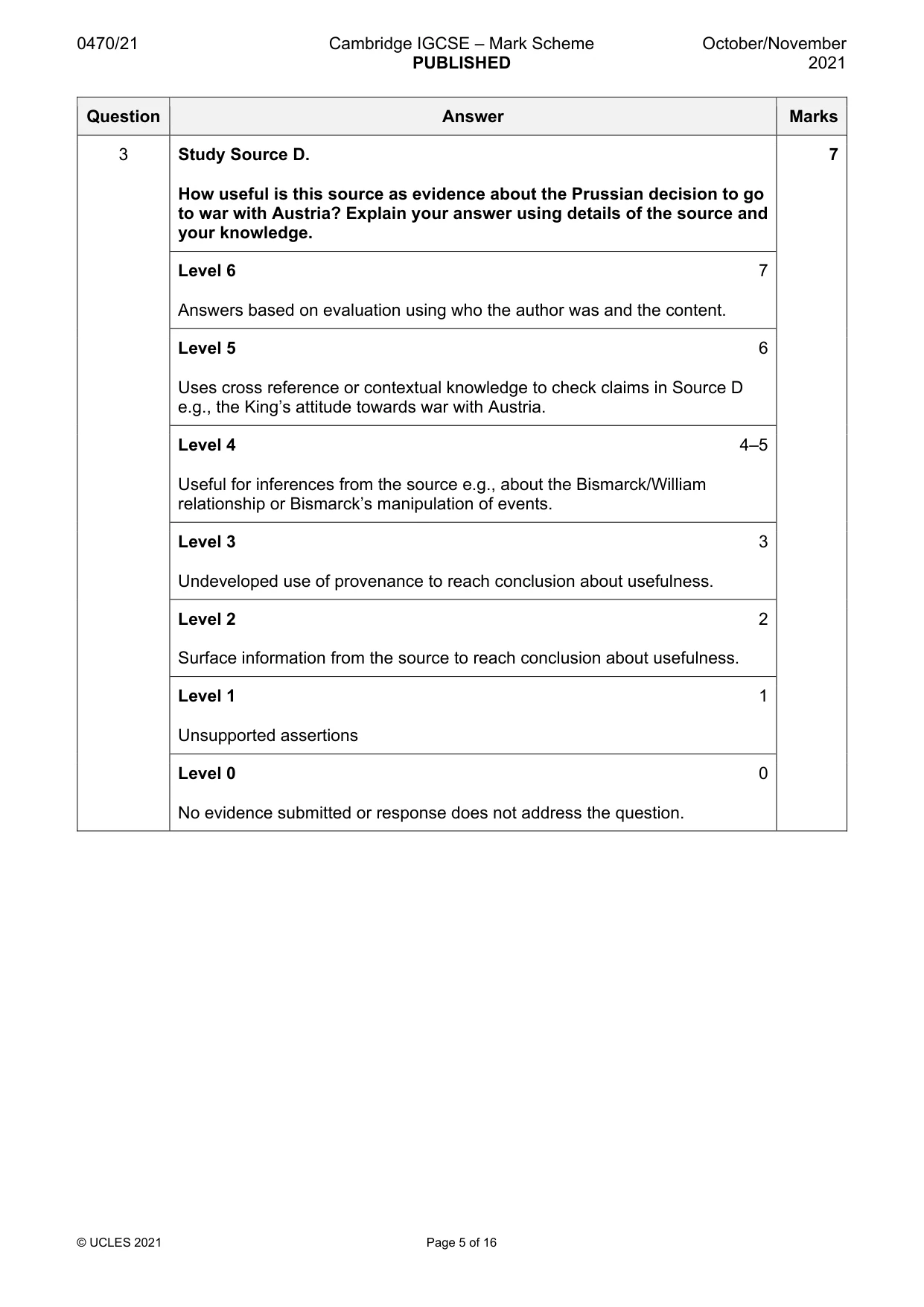
0470/21 Cambridge IGCSE – Mark Scheme PUBLISHED October/November 2021 © UCLES 2021 Page 5 of 16 Question Answer Marks 3 Study Source D. How useful is this source as evidence about the Prussian decision to go to war with Austria? Explain your answer using details of the source and your knowledge. 7 Level 6 7 Answers based on evaluation using who the author was and the content. Level 5 6 Uses cross reference or contextual knowledge to check claims in Source D e.g., the King’s attitude towards war with Austria. Level 4 4–5 Useful for inferences from the source e.g., about the Bismarck/William relationship or Bismarck’s manipulation of events. Level 3 3 Undeveloped use of provenance to reach conclusion about usefulness. Level 2 2 Surface information from the source to reach conclusion about usefulness. Level 1 1 Unsupported assertions Level 0 0 No evidence submitted or response does not address the question.
Mark scheme, page 6
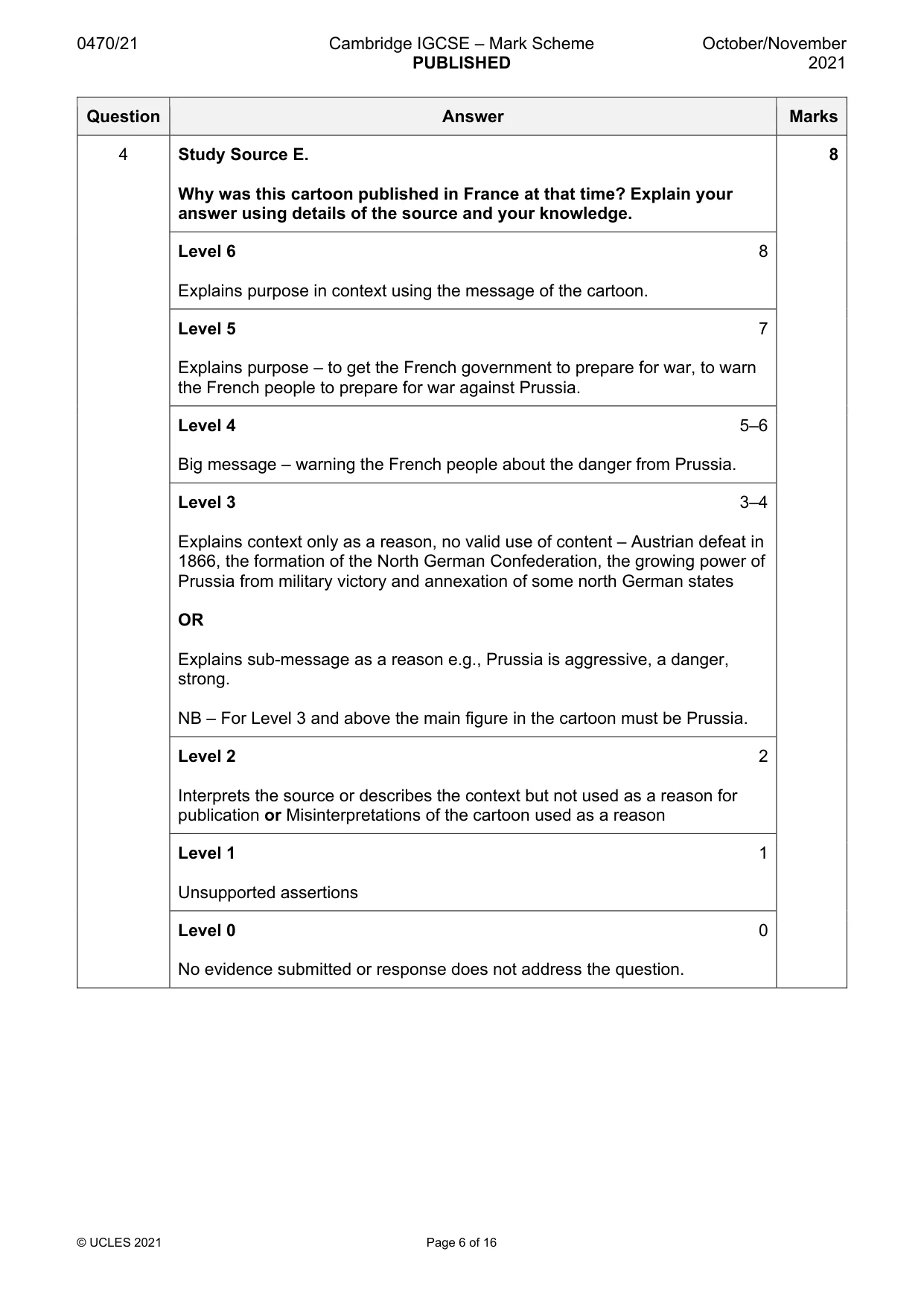
0470/21 Cambridge IGCSE – Mark Scheme PUBLISHED October/November 2021 © UCLES 2021 Page 6 of 16 Question Answer Marks 4 Study Source E. Why was this cartoon published in France at that time? Explain your answer using details of the source and your knowledge. 8 Level 6 8 Explains purpose in context using the message of the cartoon. Level 5 7 Explains purpose – to get the French government to prepare for war, to warn the French people to prepare for war against Prussia. Level 4 5–6 Big message – warning the French people about the danger from Prussia. Level 3 3–4 Explains context only as a reason, no valid use of content – Austrian defeat in 1866, the formation of the North German Confederation, the growing power of Prussia from military victory and annexation of some north German states OR Explains sub-message as a reason e.g., Prussia is aggressive, a danger, strong. NB – For Level 3 and above the main figure in the cartoon must be Prussia. Level 2 2 Interprets the source or describes the context but not used as a reason for publication or Misinterpretations of the cartoon used as a reason Level 1 1 Unsupported assertions Level 0 0 No evidence submitted or response does not address the question.
Mark scheme, page 7
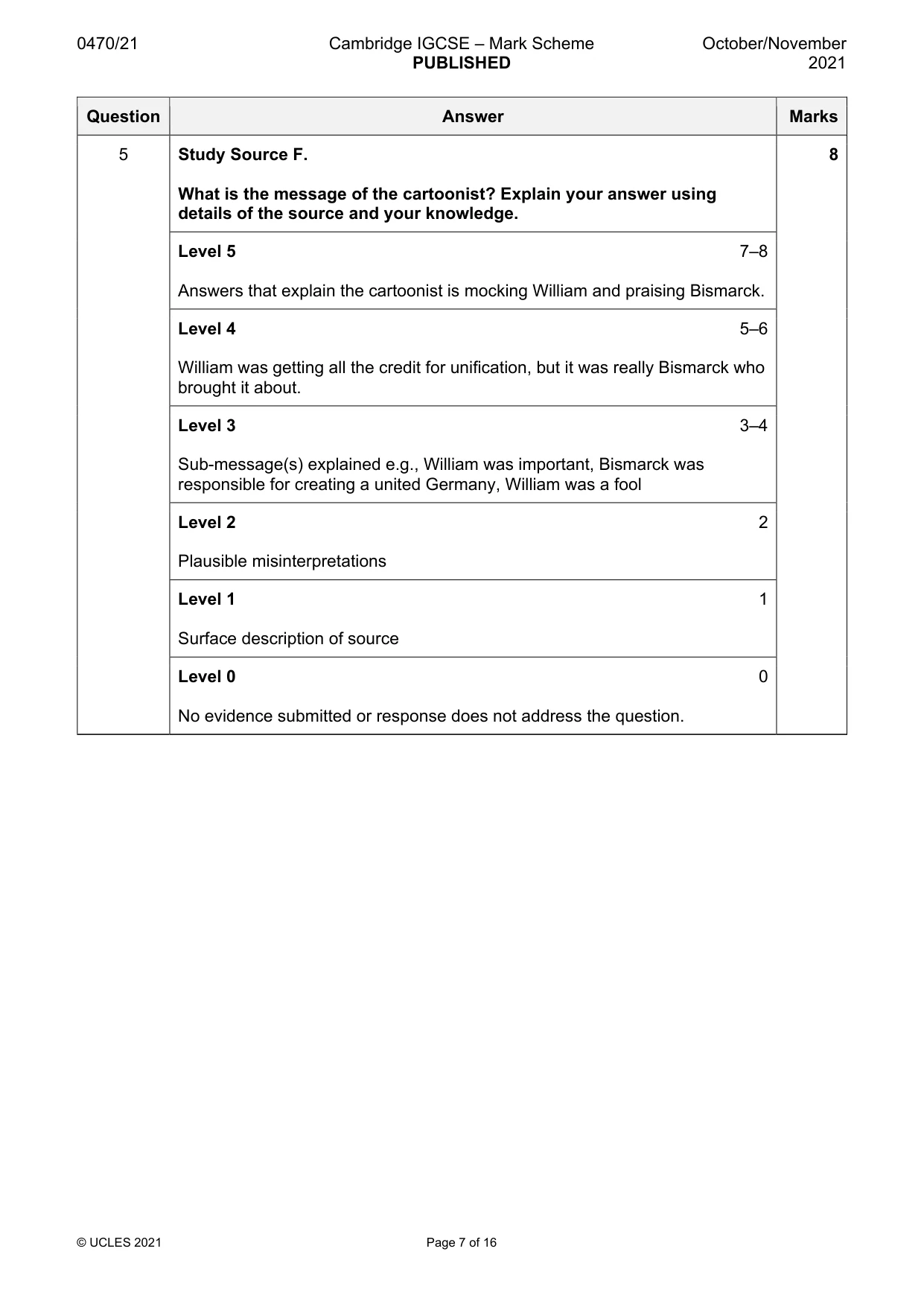
0470/21 Cambridge IGCSE – Mark Scheme PUBLISHED October/November 2021 © UCLES 2021 Page 7 of 16 Question Answer Marks 5 Study Source F. What is the message of the cartoonist? Explain your answer using details of the source and your knowledge. 8 Level 5 7–8 Answers that explain the cartoonist is mocking William and praising Bismarck. Level 4 5–6 William was getting all the credit for unification, but it was really Bismarck who brought it about. Level 3 3–4 Sub-message(s) explained e.g., William was important, Bismarck was responsible for creating a united Germany, William was a fool Level 2 2 Plausible misinterpretations Level 1 1 Surface description of source Level 0 0 No evidence submitted or response does not address the question.
Mark scheme, page 8
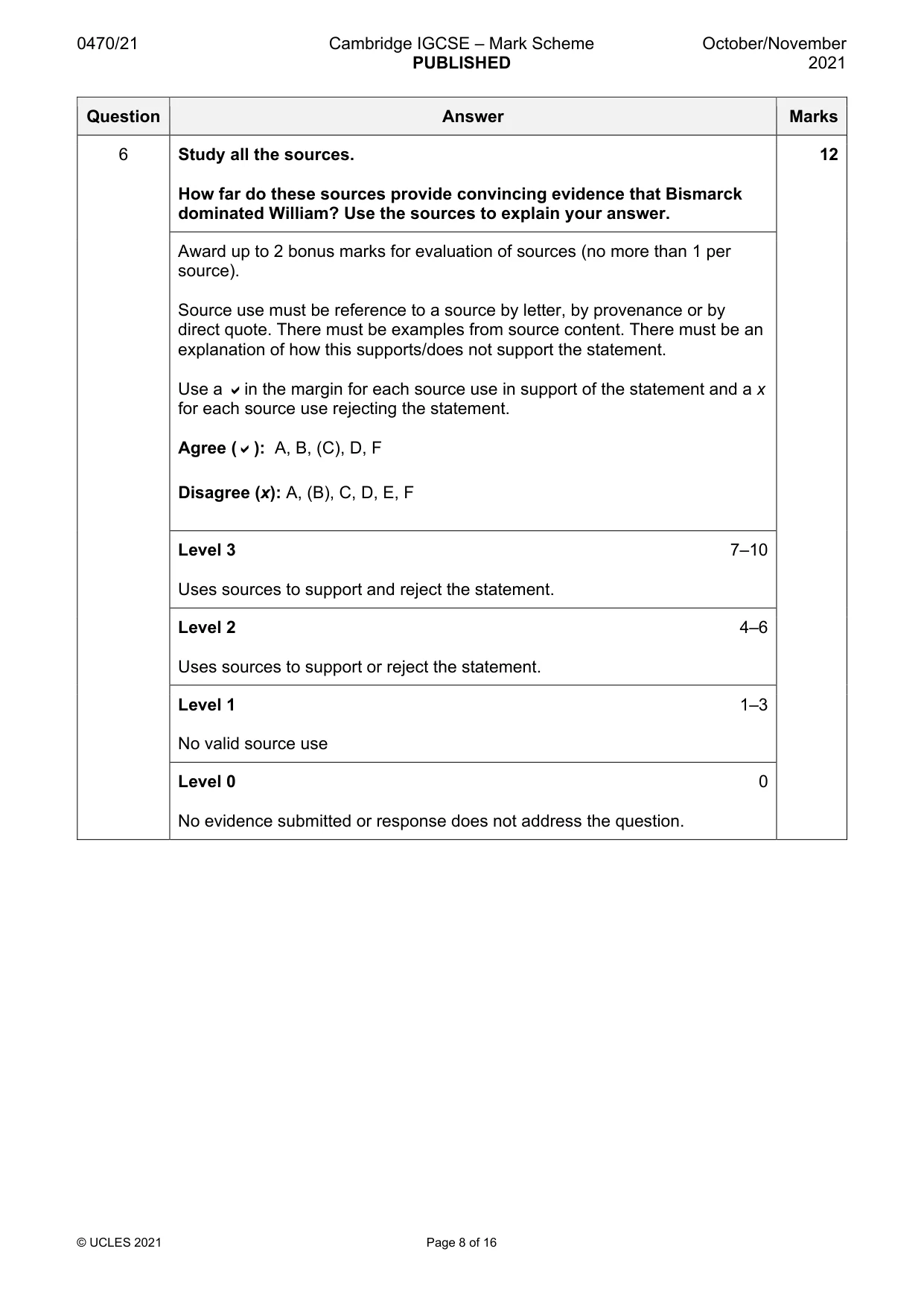
0470/21 Cambridge IGCSE – Mark Scheme PUBLISHED October/November 2021 © UCLES 2021 Page 8 of 16 Question Answer Marks 6 Study all the sources. How far do these sources provide convincing evidence that Bismarck dominated William? Use the sources to explain your answer. 12 Award up to 2 bonus marks for evaluation of sources (no more than 1 per source). Source use must be reference to a source by letter, by provenance or by direct quote. There must be examples from source content. There must be an explanation of how this supports/does not support the statement. Use a in the margin for each source use in support of the statement and a x for each source use rejecting the statement. Agree (): A, B, (C), D, F Disagree (x): A, (B), C, D, E, F Level 3 7–10 Uses sources to support and reject the statement. Level 2 4–6 Uses sources to support or reject the statement. Level 1 1–3 No valid source use Level 0 0 No evidence submitted or response does not address the question.
Mark scheme, page 9
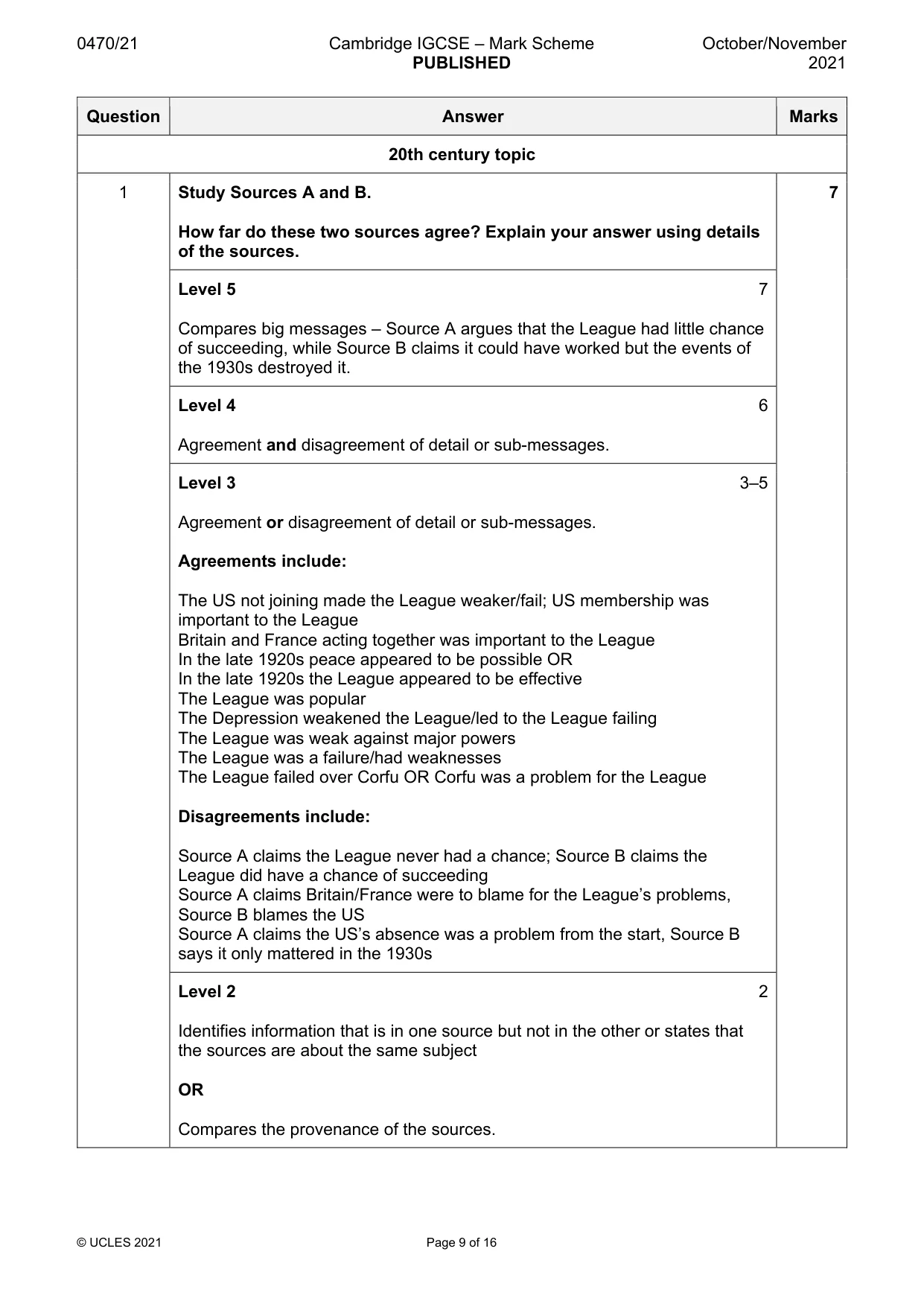
0470/21 Cambridge IGCSE – Mark Scheme PUBLISHED October/November 2021 © UCLES 2021 Page 9 of 16 Question Answer Marks 20th century topic 1 Study Sources A and B. How far do these two sources agree? Explain your answer using details of the sources. 7 Level 5 7 Compares big messages – Source A argues that the League had little chance of succeeding, while Source B claims it could have worked but the events of the 1930s destroyed it. Level 4 6 Agreement and disagreement of detail or sub-messages. Level 3 3–5 Agreement or disagreement of detail or sub-messages. Agreements include: The US not joining made the League weaker/fail; US membership was important to the League Britain and France acting together was important to the League In the late 1920s peace appeared to be possible OR In the late 1920s the League appeared to be effective The League was popular The Depression weakened the League/led to the League failing The League was weak against major powers The League was a failure/had weaknesses The League failed over Corfu OR Corfu was a problem for the League Disagreements include: Source A claims the League never had a chance; Source B claims the League did have a chance of succeeding Source A claims Britain/France were to blame for the League’s problems, Source B blames the US Source A claims the US’s absence was a problem from the start, Source B says it only mattered in the 1930s Level 2 2 Identifies information that is in one source but not in the other or states that the sources are about the same subject OR Compares the provenance of the sources.
Mark scheme, page 10
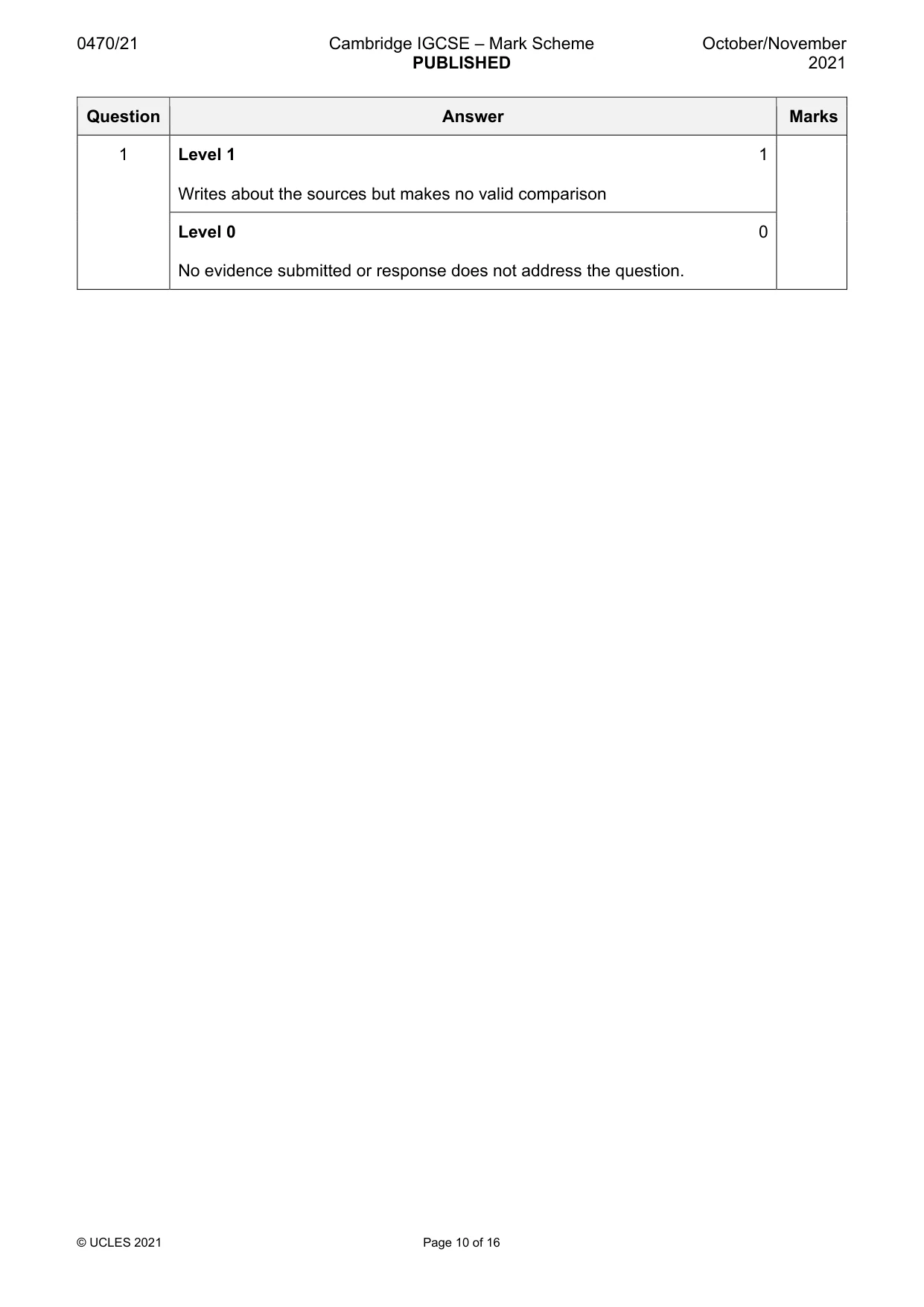
0470/21 Cambridge IGCSE – Mark Scheme PUBLISHED October/November 2021 © UCLES 2021 Page 10 of 16 Question Answer Marks 1 Level 1 1 Writes about the sources but makes no valid comparison Level 0 0 No evidence submitted or response does not address the question.
Mark scheme, page 11
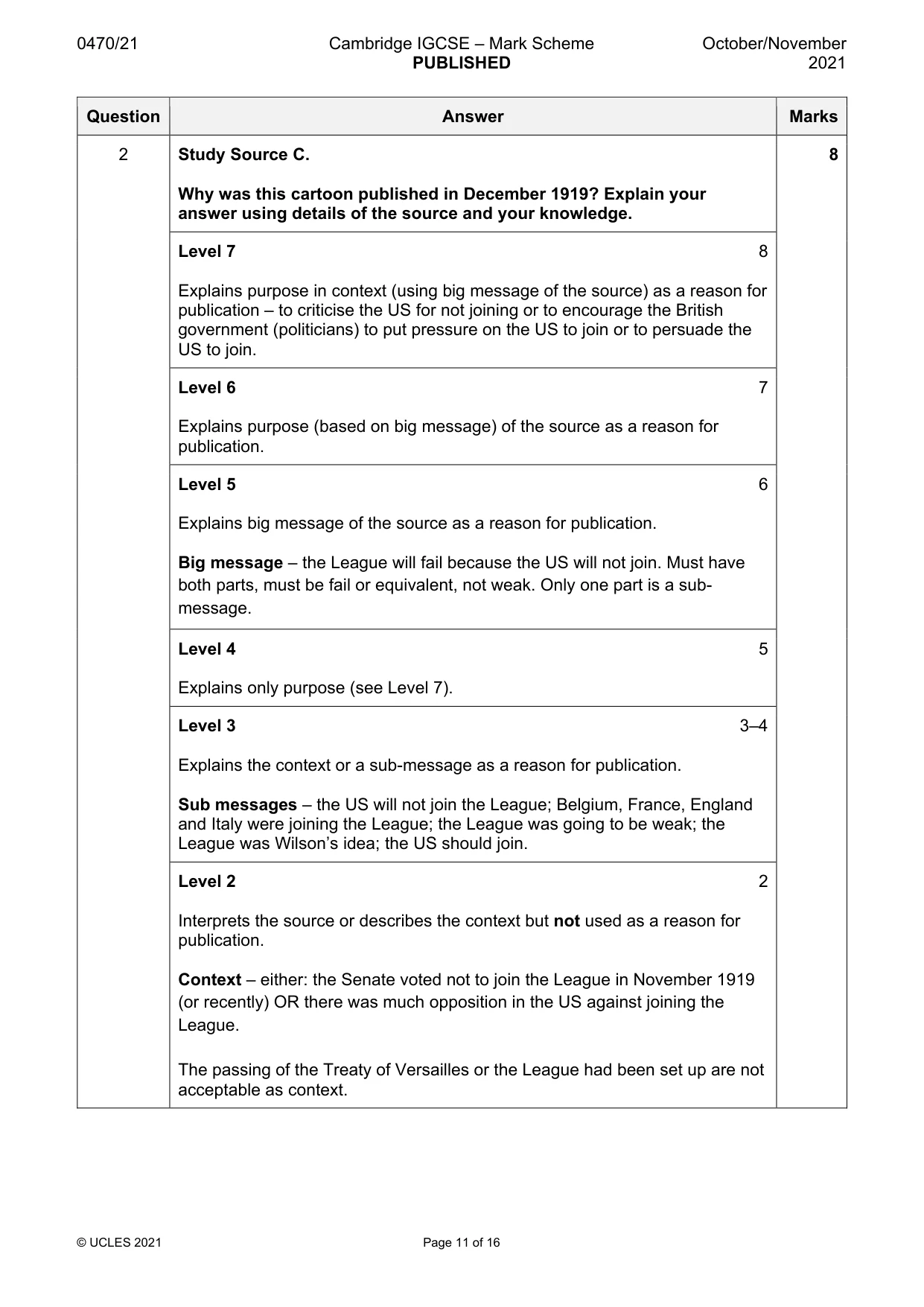
0470/21 Cambridge IGCSE – Mark Scheme PUBLISHED October/November 2021 © UCLES 2021 Page 11 of 16 Question Answer Marks 2 Study Source C. Why was this cartoon published in December 1919? Explain your answer using details of the source and your knowledge. 8 Level 7 8 Explains purpose in context (using big message of the source) as a reason for publication – to criticise the US for not joining or to encourage the British government (politicians) to put pressure on the US to join or to persuade the US to join. Level 6 7 Explains purpose (based on big message) of the source as a reason for publication. Level 5 6 Explains big message of the source as a reason for publication. Big message – the League will fail because the US will not join. Must have both parts, must be fail or equivalent, not weak. Only one part is a sub- message. Level 4 5 Explains only purpose (see Level 7). Level 3 3–4 Explains the context or a sub-message as a reason for publication. Sub messages – the US will not join the League; Belgium, France, England and Italy were joining the League; the League was going to be weak; the League was Wilson’s idea; the US should join. Level 2 2 Interprets the source or describes the context but not used as a reason for publication. Context – either: the Senate voted not to join the League in November 1919 (or recently) OR there was much opposition in the US against joining the League. The passing of the Treaty of Versailles or the League had been set up are not acceptable as context.
Mark scheme, page 12
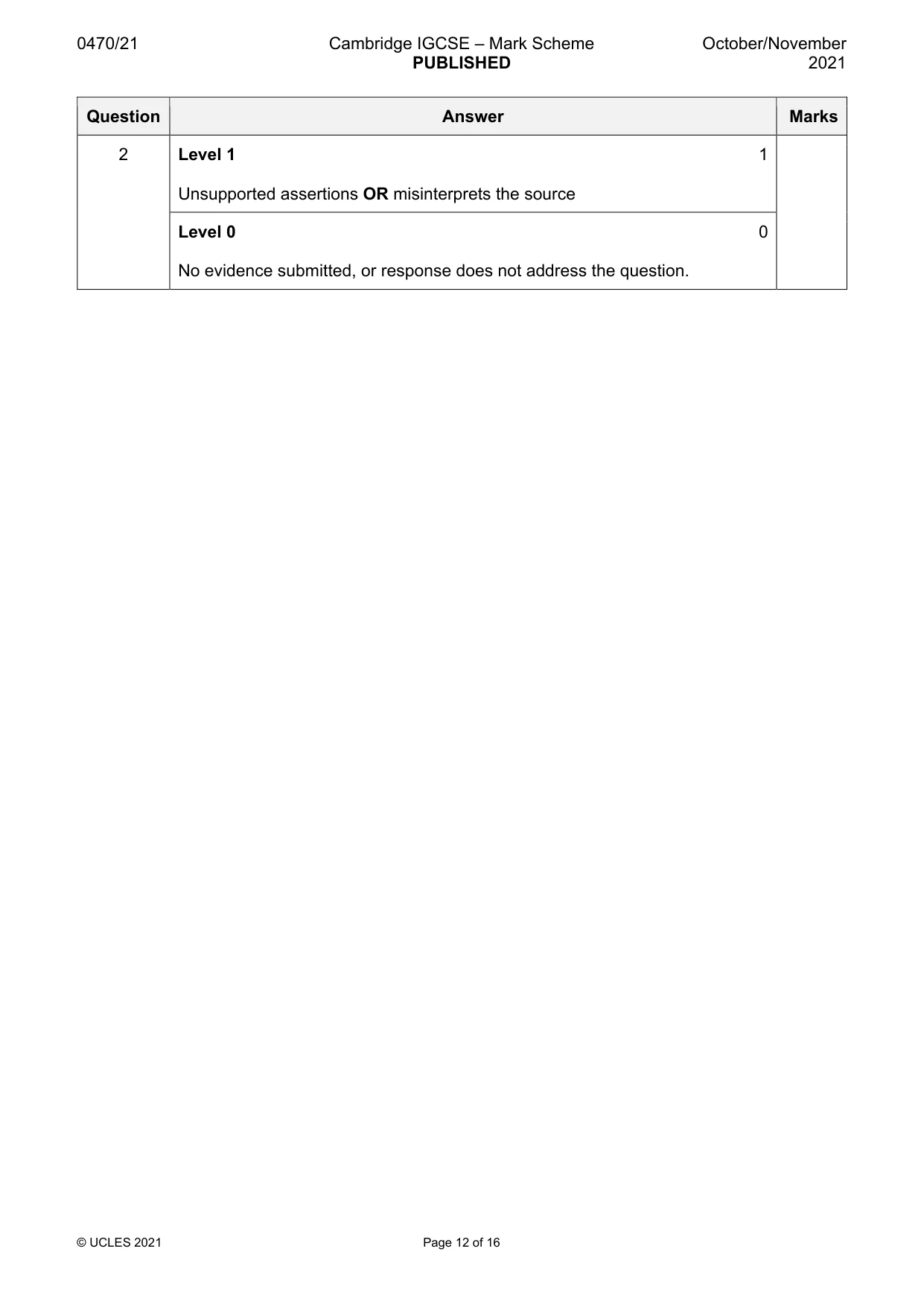
0470/21 Cambridge IGCSE – Mark Scheme PUBLISHED October/November 2021 © UCLES 2021 Page 12 of 16 Question Answer Marks 2 Level 1 1 Unsupported assertions OR misinterprets the source Level 0 0 No evidence submitted, or response does not address the question.
Mark scheme, page 13
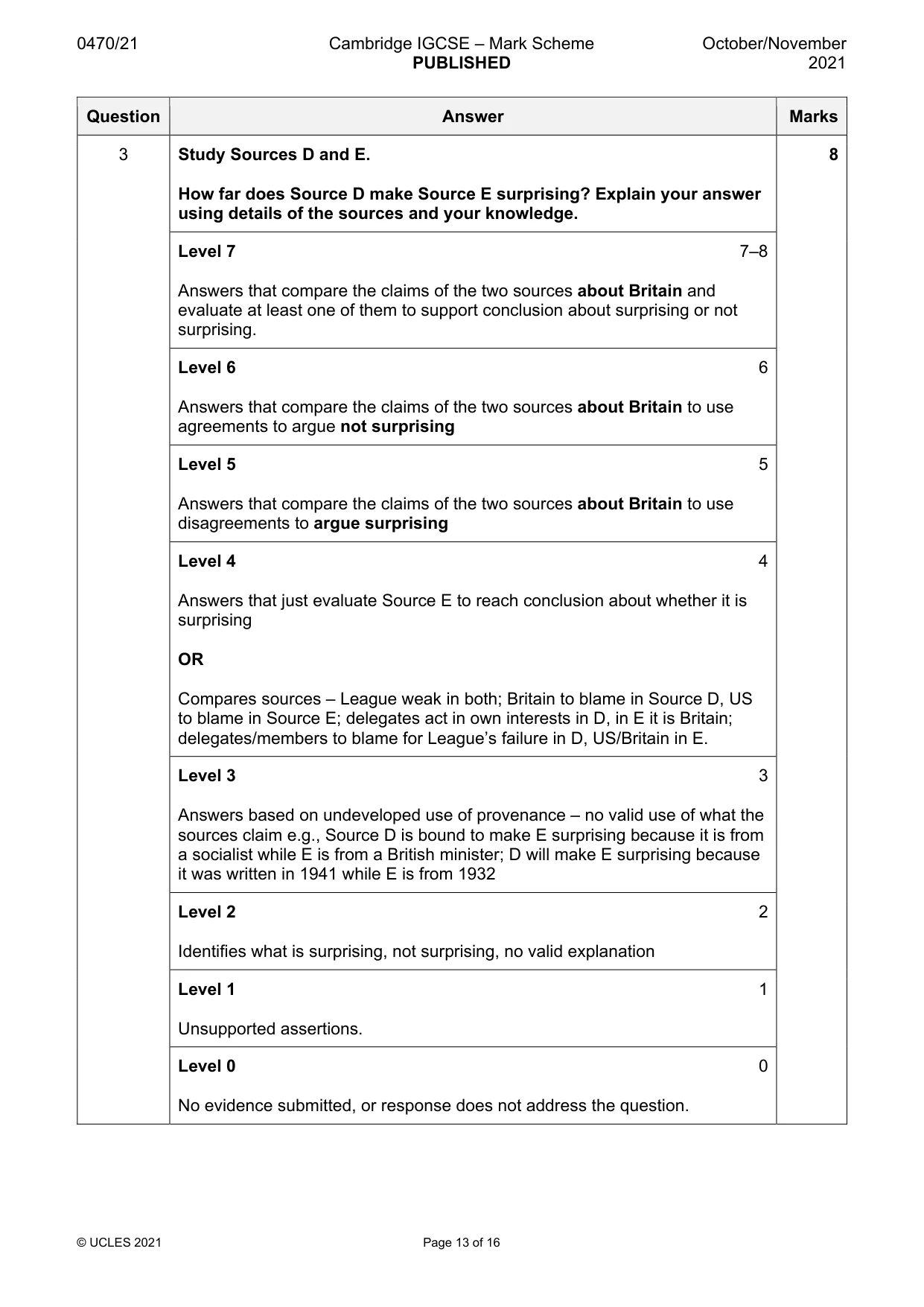
0470/21 Cambridge IGCSE – Mark Scheme PUBLISHED October/November 2021 © UCLES 2021 Page 13 of 16 Question Answer Marks 3 Study Sources D and E. How far does Source D make Source E surprising? Explain your answer using details of the sources and your knowledge. 8 Level 7 7–8 Answers that compare the claims of the two sources about Britain and evaluate at least one of them to support conclusion about surprising or not surprising. Level 6 6 Answers that compare the claims of the two sources about Britain to use agreements to argue not surprising Level 5 5 Answers that compare the claims of the two sources about Britain to use disagreements to argue surprising Level 4 4 Answers that just evaluate Source E to reach conclusion about whether it is surprising OR Compares sources – League weak in both; Britain to blame in Source D, US to blame in Source E; delegates act in own interests in D, in E it is Britain; delegates/members to blame for League’s failure in D, US/Britain in E. Level 3 3 Answers based on undeveloped use of provenance – no valid use of what the sources claim e.g., Source D is bound to make E surprising because it is from a socialist while E is from a British minister; D will make E surprising because it was written in 1941 while E is from 1932 Level 2 2 Identifies what is surprising, not surprising, no valid explanation Level 1 1 Unsupported assertions. Level 0 0 No evidence submitted, or response does not address the question.
Mark scheme, page 14
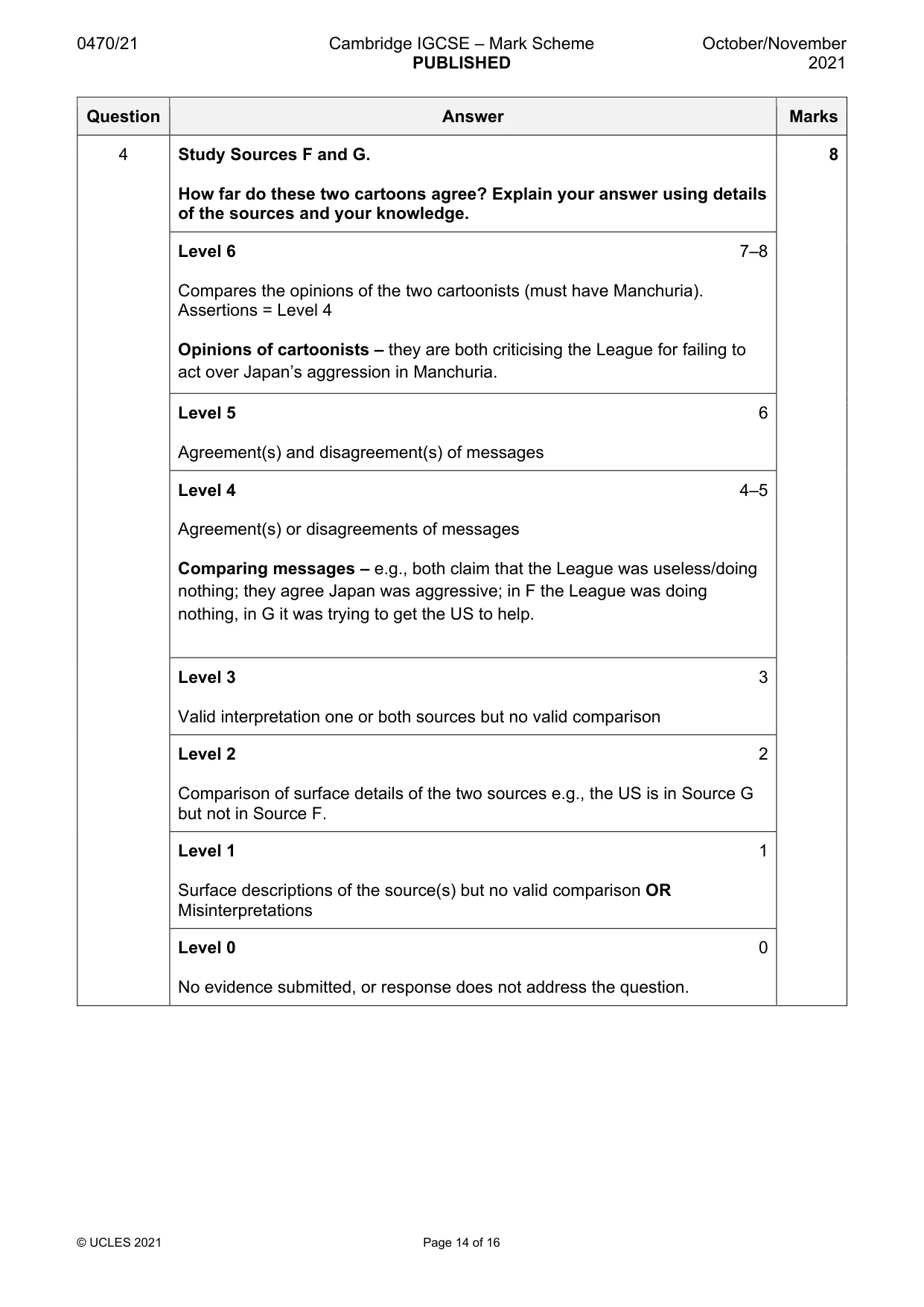
0470/21 Cambridge IGCSE – Mark Scheme PUBLISHED October/November 2021 © UCLES 2021 Page 14 of 16 Question Answer Marks 4 Study Sources F and G. How far do these two cartoons agree? Explain your answer using details of the sources and your knowledge. 8 Level 6 7–8 Compares the opinions of the two cartoonists (must have Manchuria). Assertions = Level 4 Opinions of cartoonists – they are both criticising the League for failing to act over Japan’s aggression in Manchuria. Level 5 6 Agreement(s) and disagreement(s) of messages Level 4 4–5 Agreement(s) or disagreements of messages Comparing messages – e.g., both claim that the League was useless/doing nothing; they agree Japan was aggressive; in F the League was doing nothing, in G it was trying to get the US to help. Level 3 3 Valid interpretation one or both sources but no valid comparison Level 2 2 Comparison of surface details of the two sources e.g., the US is in Source G but not in Source F. Level 1 1 Surface descriptions of the source(s) but no valid comparison OR Misinterpretations Level 0 0 No evidence submitted, or response does not address the question.
Mark scheme, page 15
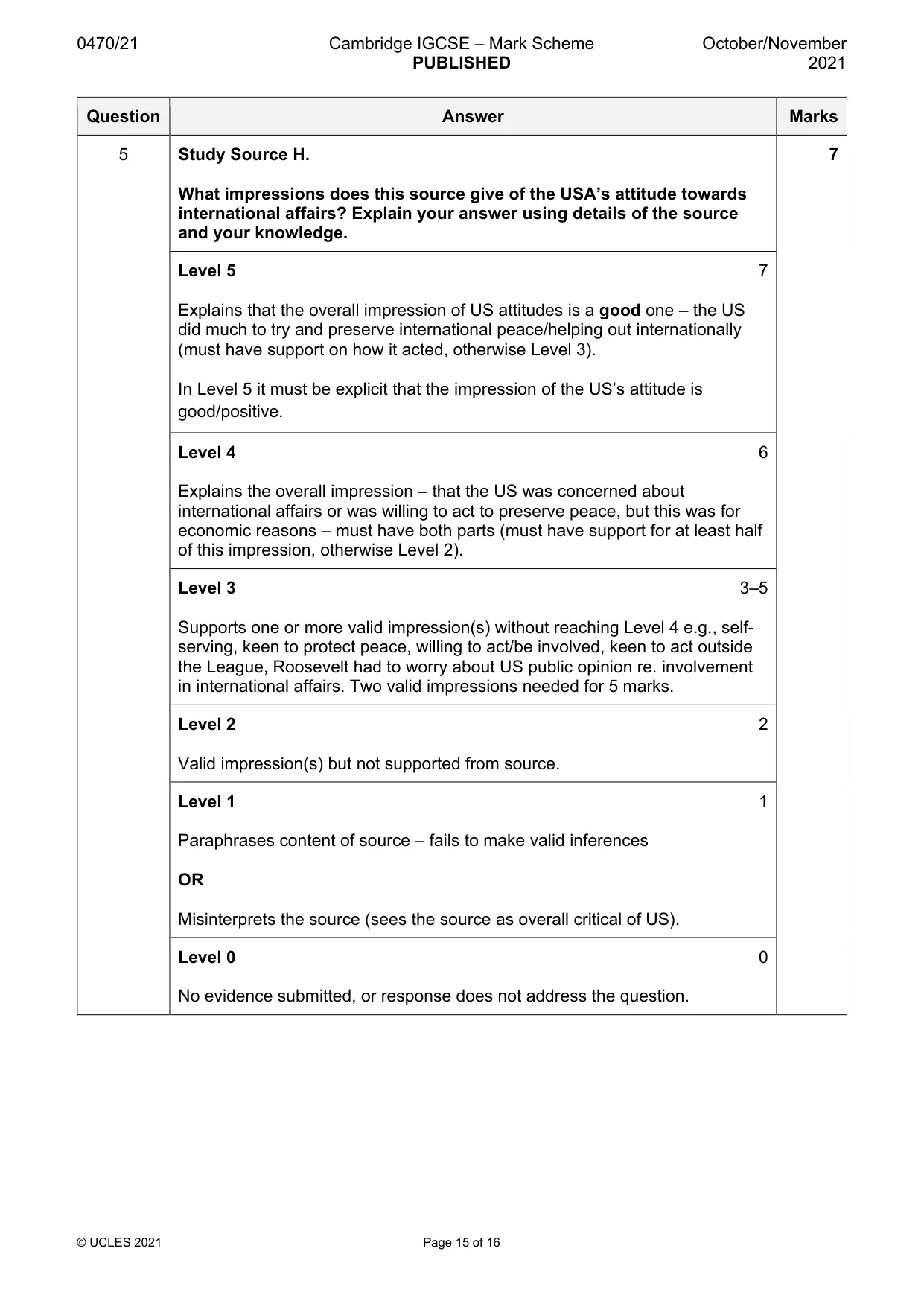
0470/21 Cambridge IGCSE – Mark Scheme PUBLISHED October/November 2021 © UCLES 2021 Page 15 of 16 Question Answer Marks 5 Study Source H. What impressions does this source give of the USA’s attitude towards international affairs? Explain your answer using details of the source and your knowledge. 7 Level 5 7 Explains that the overall impression of US attitudes is a good one – the US did much to try and preserve international peace/helping out internationally (must have support on how it acted, otherwise Level 3). In Level 5 it must be explicit that the impression of the US’s attitude is good/positive. Level 4 6 Explains the overall impression – that the US was concerned about international affairs or was willing to act to preserve peace, but this was for economic reasons – must have both parts (must have support for at least half of this impression, otherwise Level 2). Level 3 3–5 Supports one or more valid impression(s) without reaching Level 4 e.g., self- serving, keen to protect peace, willing to act/be involved, keen to act outside the League, Roosevelt had to worry about US public opinion re. involvement in international affairs. Two valid impressions needed for 5 marks. Level 2 2 Valid impression(s) but not supported from source. Level 1 1 Paraphrases content of source – fails to make valid inferences OR Misinterprets the source (sees the source as overall critical of US). Level 0 0 No evidence submitted, or response does not address the question.
Mark scheme, page 16
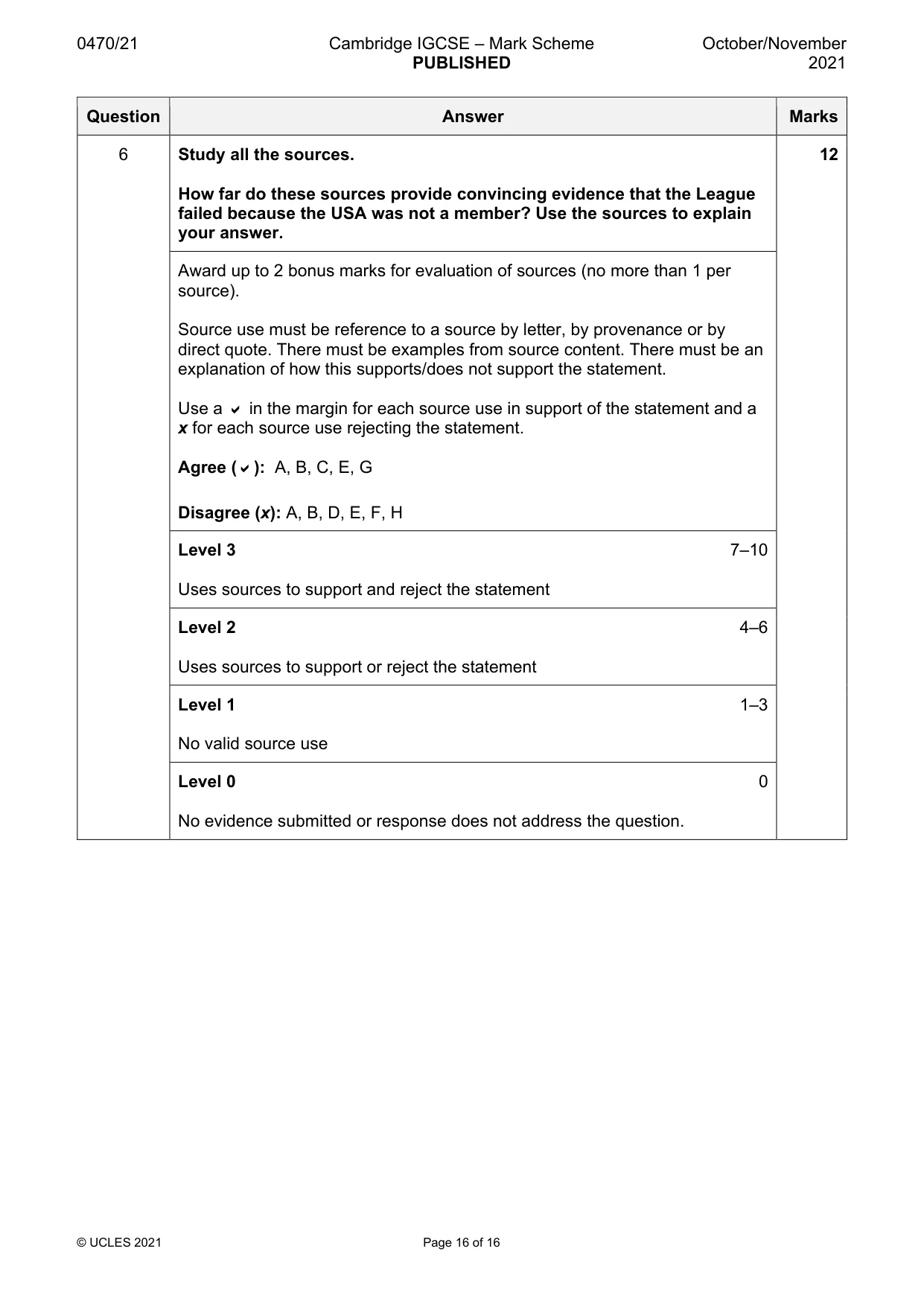
0470/21 Cambridge IGCSE – Mark Scheme PUBLISHED October/November 2021 © UCLES 2021 Page 16 of 16 Question Answer Marks 6 Study all the sources. How far do these sources provide convincing evidence that the League failed because the USA was not a member? Use the sources to explain your answer. 12 Award up to 2 bonus marks for evaluation of sources (no more than 1 per source). Source use must be reference to a source by letter, by provenance or by direct quote. There must be examples from source content. There must be an explanation of how this supports/does not support the statement. Use a in the margin for each source use in support of the statement and a x for each source use rejecting the statement. Agree (): A, B, C, E, G Disagree (x): A, B, D, E, F, H Level 3 7–10 Uses sources to support and reject the statement Level 2 4–6 Uses sources to support or reject the statement Level 1 1–3 No valid source use Level 0 0 No evidence submitted or response does not address the question.
What you needed in this session
Cambridge’s own grade thresholds for 2021 Oct/Nov, Paper 2 · Variant 1. A higher threshold means an easier paper — the bar moves with how the cohort did.