Cambridge IGCSE History 0470 — 2021 Oct/Nov Paper 2 · Variant 2
0470/22/O/N/21 · 50 marks · ≈56 min
The question paper and its mark scheme, free to read here and free to download. This is Cambridge’s own paper, exactly as it was sat.
Question paper12 pages
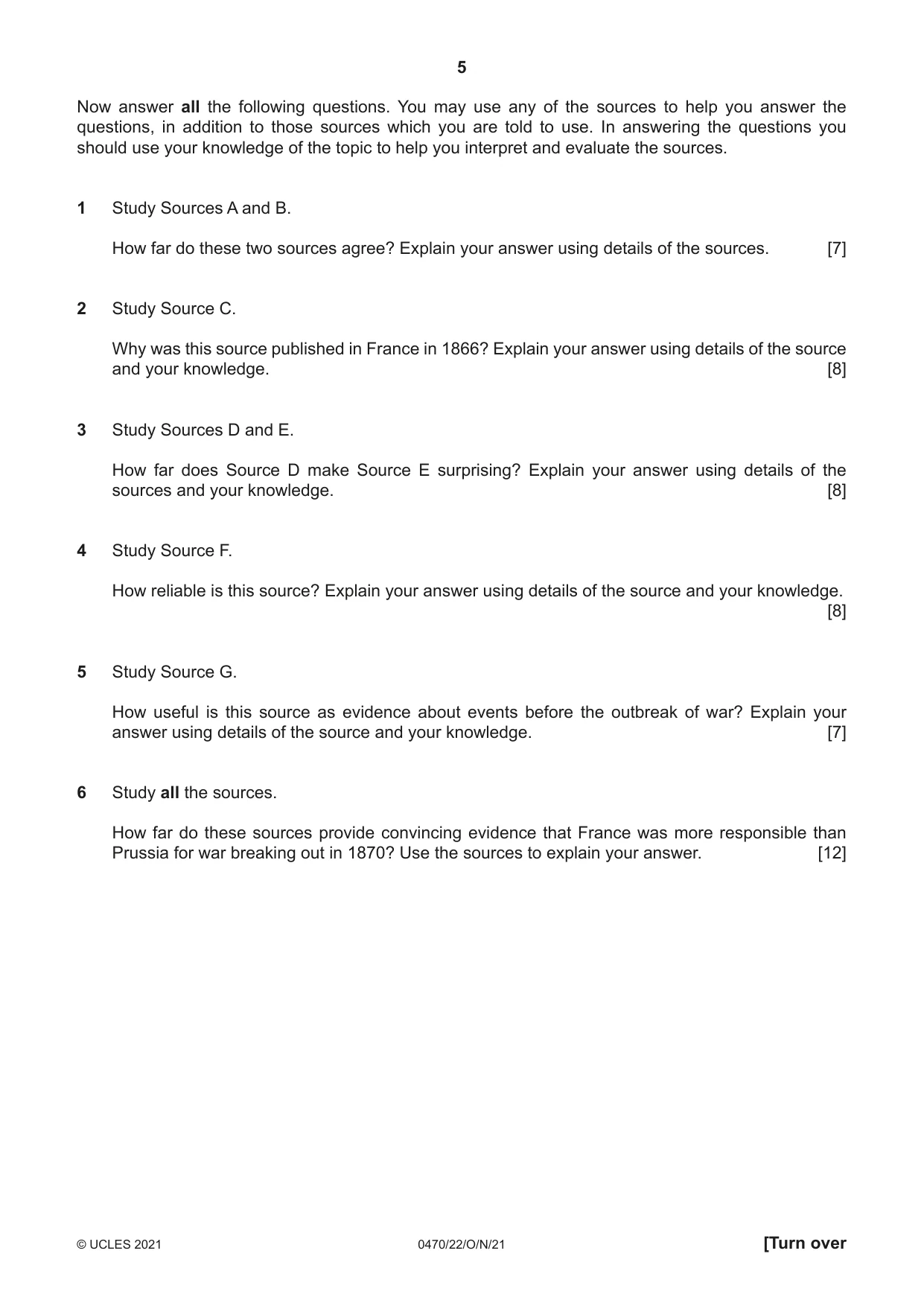
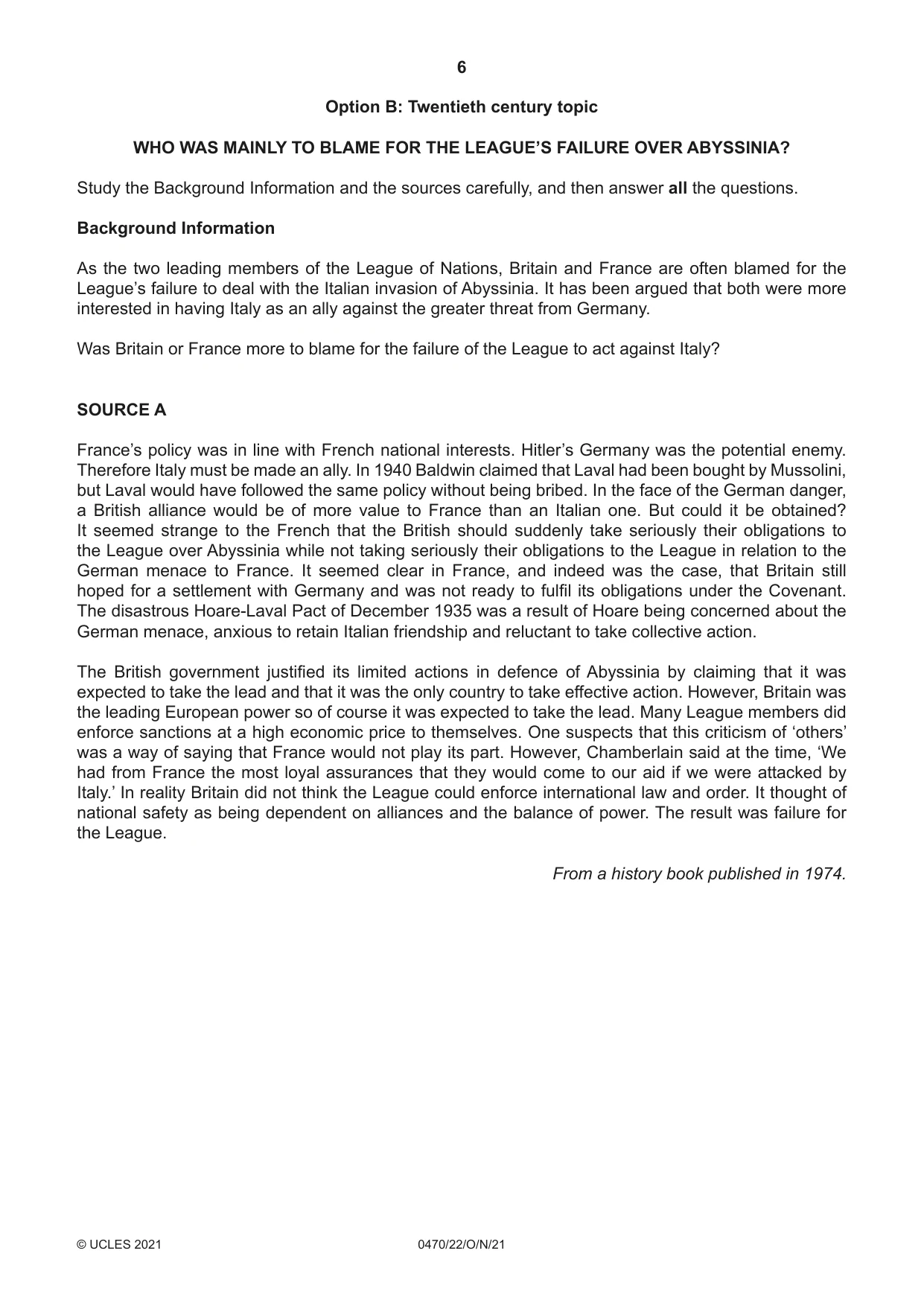

Mark scheme16 pages
Answers below. Sit the paper first if you are practising.
Paper as text
Question paper, page 1
This document has 12 pages. Any blank pages are indicated. DC (JP/SG) 201639/4 © UCLES 2021 [Turn over * 5 8 2 7 4 8 6 6 0 9 * Cambridge IGCSE™ HISTORY 0470/22 Paper 2 October/November 2021 2 hours You must answer on the enclosed answer booklet. You will need: Answer booklet (enclosed) INSTRUCTIONS ● Answer all the questions on one option only. Option A: Nineteenth century topic Option B: Twentieth century topic ● Follow the instructions on the front cover of the answer booklet. If you need additional answer paper, ask the invigilator for a continuation booklet. INFORMATION ● The total mark for this paper is 50. ● The number of marks for each question or part question is shown in brackets [ ].
Question paper, page 2
2 0470/22/O/N/21 © UCLES 2021 Option A: Nineteenth century topic WAS FRANCE OR PRUSSIA MORE TO BLAME FOR THE OUTBREAK OF WAR IN 1870? Study the Background Information and the sources carefully, and then answer all the questions. Background Information Some historians have for some time argued that Bismarck believed a war against France was a vital step in bringing about the unification of Germany. They claim that he required it to be a defensive war and that he needed some time to bring this about. Bismarck’s memoirs, written in the 1890s during his retirement, suggest that he had long planned German unification and that he brought about the war with France to help this process. However, there are also good reasons for suggesting that Napoleon III was responsible for the war. He was under a great deal of pressure in France to put Prussia in its place and to achieve a glorious victory for his country. Who was more to blame for the war, Bismarck or Napoleon? SOURCE A The founding of the North German Confederation appeared to be the last great achievement of the policy of ‘blood and iron’. After 1866 admiration for the achievements of Prussia began to cool. The loudest criticism of Bismarck was in the south of Germany. Many there regarded the outcome of the Prussian victory over Austria as a threat to their political independence. Only some unexpected crisis threatening Germany could revive the feeling of nationalism which had been declining. The incompetence of the French made possible what Prussia could not achieve. The dispute over the throne of Spain led to an armed conflict which most Germans considered a just war in defence of the fatherland. Although Bismarck deliberately invited hostilities, the French were mainly at fault. The government of Napoleon III, discredited by a series of failures, was desperate for some brilliant diplomatic or military success. The result was that a disagreement developed into a crisis for which there seemed no peaceful solution. While each side sought war for reasons of its own, Berlin manoeuvred France into the position of the aggressor but French blundering revived the feeling of nationalism in Germany. Even people in south Germany thought that William I had been provoked by French arrogance. German honour was at stake. The military victory over France allowed Bismarck to complete the political unification of Germany that had proved to be impossible by diplomatic methods. From a book published in 1973.
Question paper, page 3
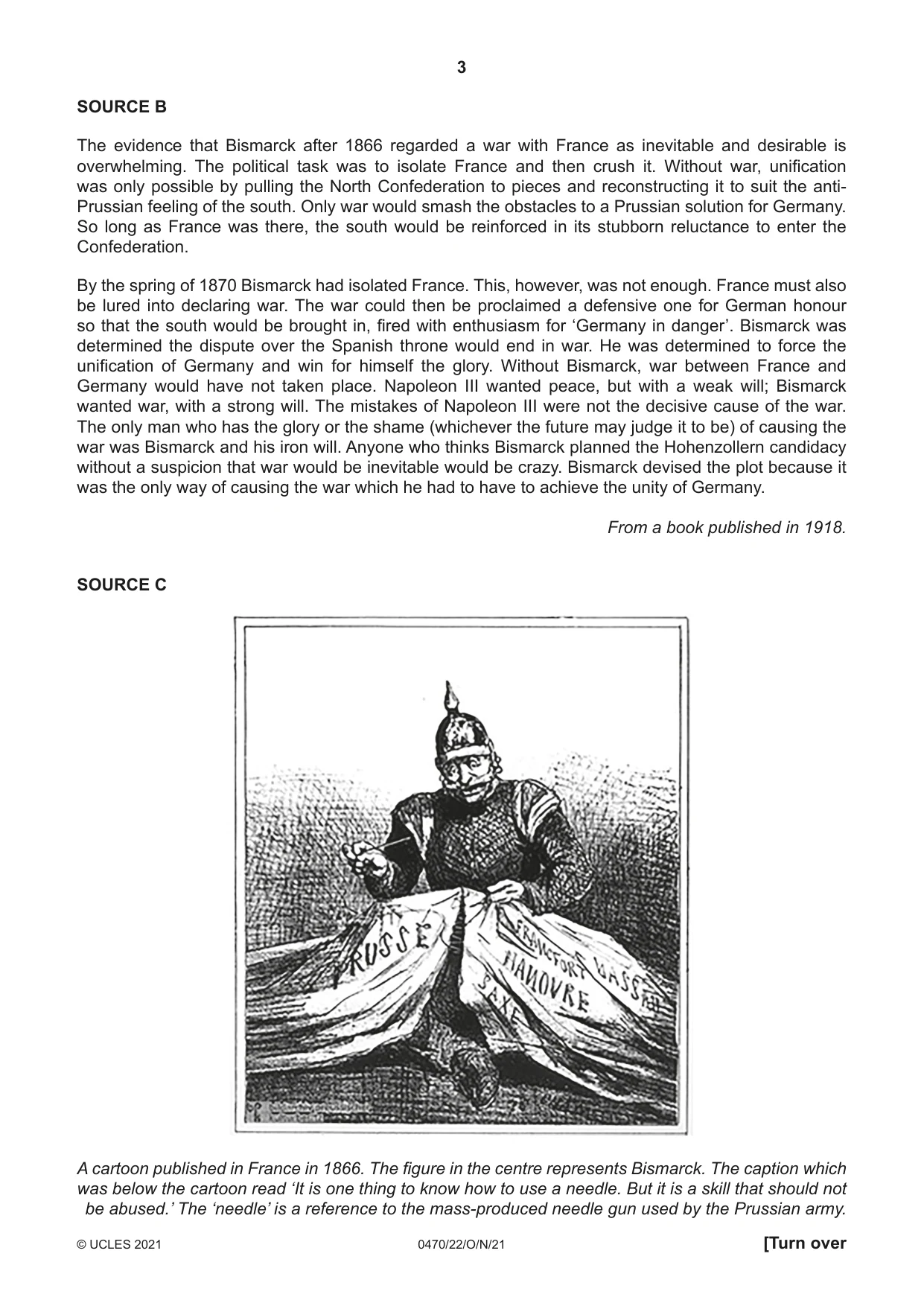
3 0470/22/O/N/21 © UCLES 2021 [Turn over SOURCE B The evidence that Bismarck after 1866 regarded a war with France as inevitable and desirable is overwhelming. The political task was to isolate France and then crush it. Without war, unification was only possible by pulling the North Confederation to pieces and reconstructing it to suit the anti- Prussian feeling of the south. Only war would smash the obstacles to a Prussian solution for Germany. So long as France was there, the south would be reinforced in its stubborn reluctance to enter the Confederation. By the spring of 1870 Bismarck had isolated France. This, however, was not enough. France must also be lured into declaring war. The war could then be proclaimed a defensive one for German honour so that the south would be brought in, fired with enthusiasm for ‘Germany in danger’. Bismarck was determined the dispute over the Spanish throne would end in war. He was determined to force the unification of Germany and win for himself the glory. Without Bismarck, war between France and Germany would have not taken place. Napoleon III wanted peace, but with a weak will; Bismarck wanted war, with a strong will. The mistakes of Napoleon III were not the decisive cause of the war. The only man who has the glory or the shame (whichever the future may judge it to be) of causing the war was Bismarck and his iron will. Anyone who thinks Bismarck planned the Hohenzollern candidacy without a suspicion that war would be inevitable would be crazy. Bismarck devised the plot because it was the only way of causing the war which he had to have to achieve the unity of Germany. From a book published in 1918. SOURCE C A cartoon published in France in 1866. The figure in the centre represents Bismarck. The caption which was below the cartoon read ‘It is one thing to know how to use a needle. But it is a skill that should not be abused.’ The ‘needle’ is a reference to the mass-produced needle gun used by the Prussian army.
Question paper, page 4
4 0470/22/O/N/21 © UCLES 2021 SOURCE D Germany is made! But this Germany in process of formation, of unification upon our frontier – is it a threat to us? Do we have the right to interfere in this formation of a great people upon our frontier? Should, or can, France prevent Germany from being united? To this question, we reply without hesitation, ‘No’. France should not. France must not be false to its democratic and liberal ideals. From a pamphlet published in Paris in 1867. Napoleon III was responsible for the pamphlet being published. SOURCE E The unification of Germany under Prussia is still in progress. The Zollverein parliament is a step further to the absorption of southern Germany. Where is this to end? What limit is to be placed on the Germany of the future – or, rather, to Prussia? The entry of the southern states is inevitable. Can France – can Europe – look quietly on and watch this process without some guarantee as to the limits of what Germany shall be? You British withdraw yourselves from Europe, but this is a great misfortune for Europe. It may be said that Germany is not an aggressive Power, but who can say? It may some day reclaim Alsace and Lorraine. If southern Germany is to follow, Germany will have an additional eight million people. I say, let it be so. But what concessions will Germany be prepared to make in return for this enlargement? Let the limits of Germany be fixed. If in a war with Prussia we should be victorious, we can make peace by compensating ourselves. We shall not use our blood and wealth for nothing. An account by the British Ambassador in Berlin of what Prince Napoleon told him in a conversation in 1868. Prince Napoleon was a close advisor of his cousin, Napoleon III. SOURCE F I was convinced that a United Germany was only a question of time, that the North German Confederation was only the first step in its formation. I did not doubt that a Franco-German War must take place before the construction of a United Germany could be achieved. I was preoccupied with the idea of delaying the outbreak of this war until our fighting strength should be increased. I at no time regarded a war with France as a simple matter and my efforts to postpone the outbreak of war until our military training could be fully developed in all parts of the Confederation were therefore quite reasonable. I took it for granted that we could count on Russian support against any coalition France might form. From England we could not rely on any active support and the events of 1870 have shown I was correct. From Bismarck’s memoirs, written in the 1890s during his retirement. SOURCE G After dinner as we sat around smoking cigars, Field Marshal Roon arrived. Later Count Moltke arrived. Bismarck welcomed them warmly and said, ‘The last time we three sat together was on 13 July 1870. What a stroke of luck it was that the French went so far! How hard it would have been to find another equally favourable opportunity! We never altered the telegram, but shortened it in such a way as to show the French arrogance. We had surrendered everything with respect to the Hohenzollern candidacy and had the French not insisted that we promise never to do so again we might have given up even more. I asked you both, “Are we ready?” You both said, “We are ready”.’ An account of a meeting in 1877 between Bismarck, Roon and Moltke by Lucius von Ballhausen who was present. Ballhausen was a member of the Reichstag, and a close friend of Bismarck’s. In 1870 Roon had been Minister of War and Moltke had been head of the army.
Question paper, page 5
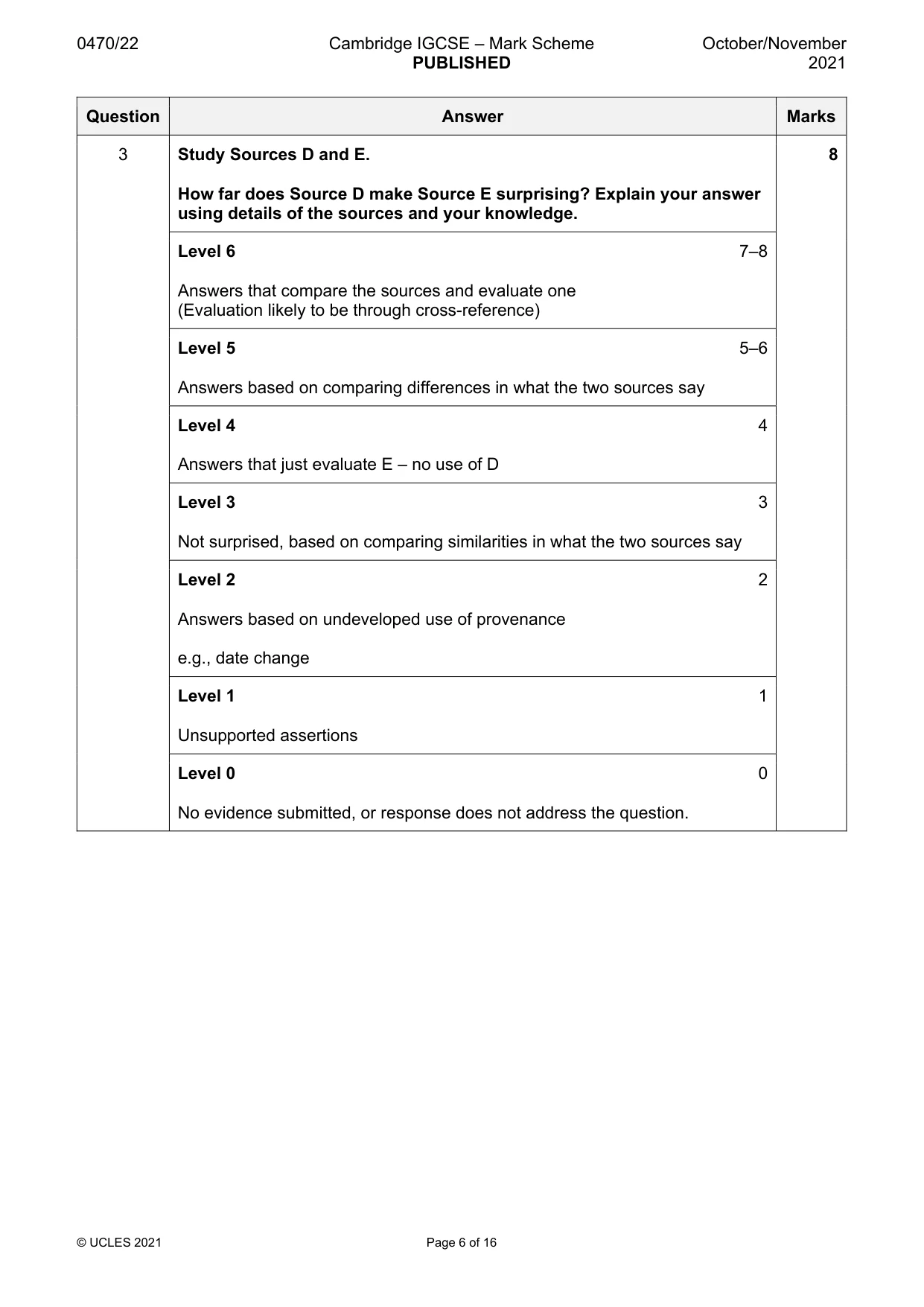
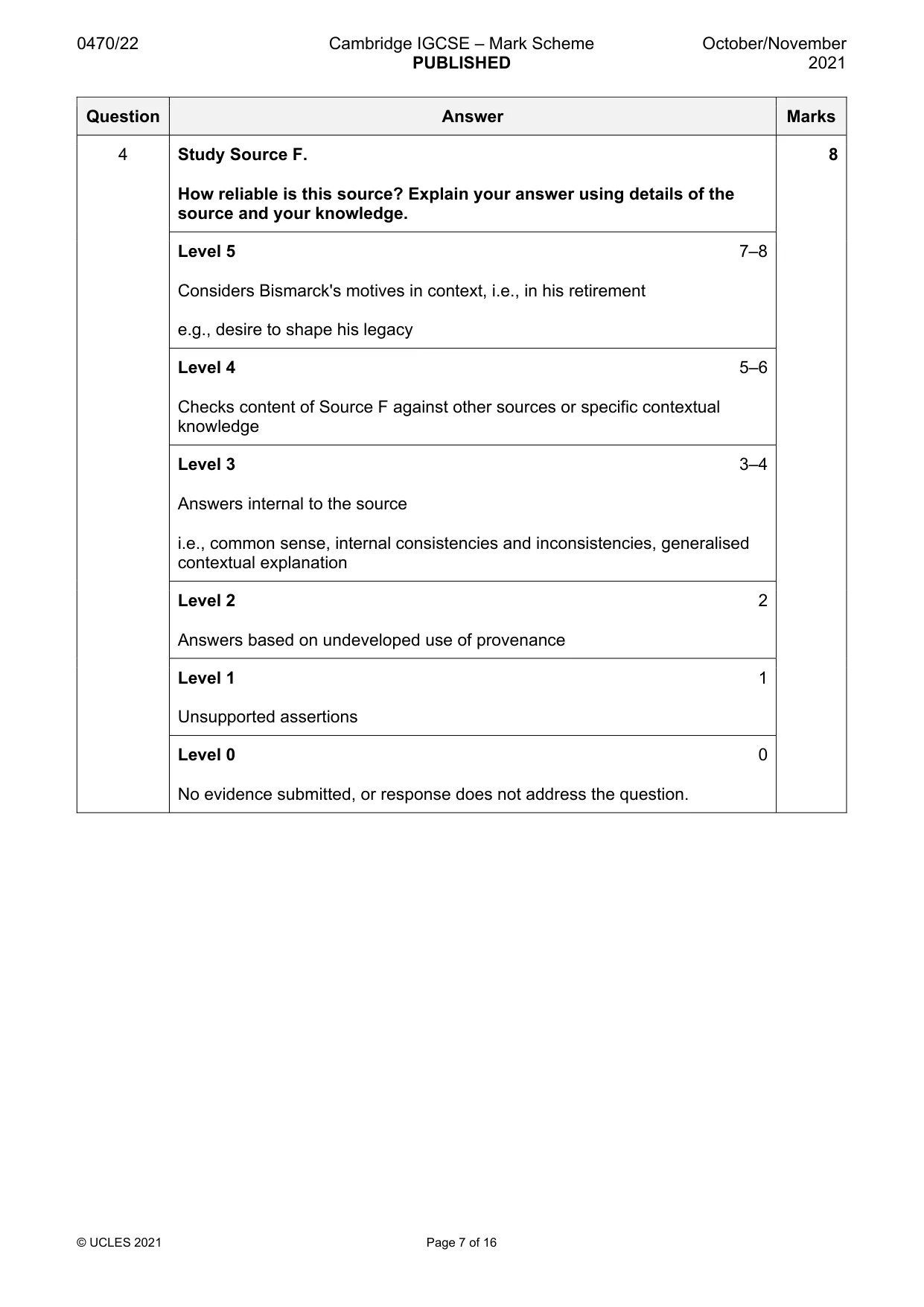
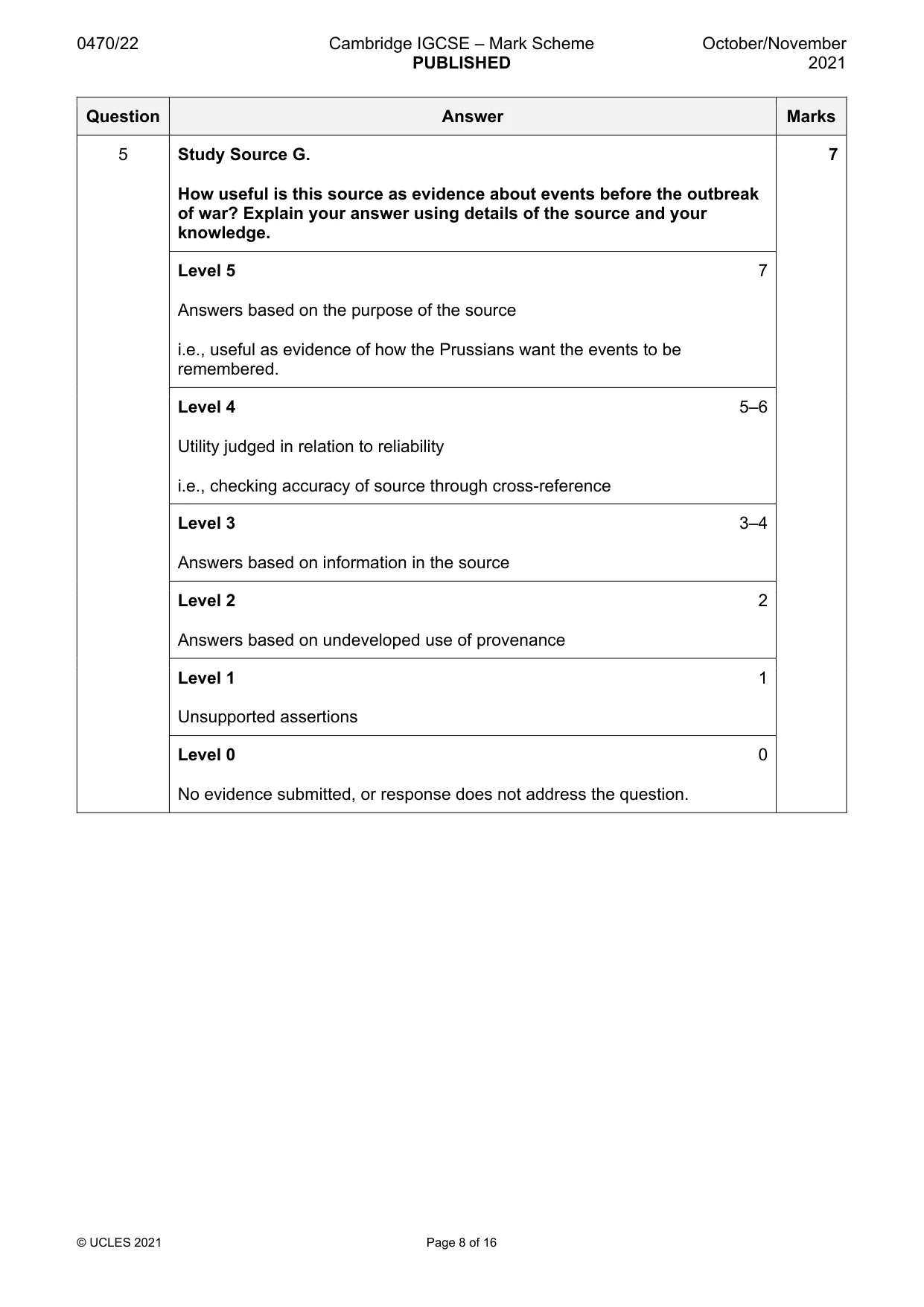
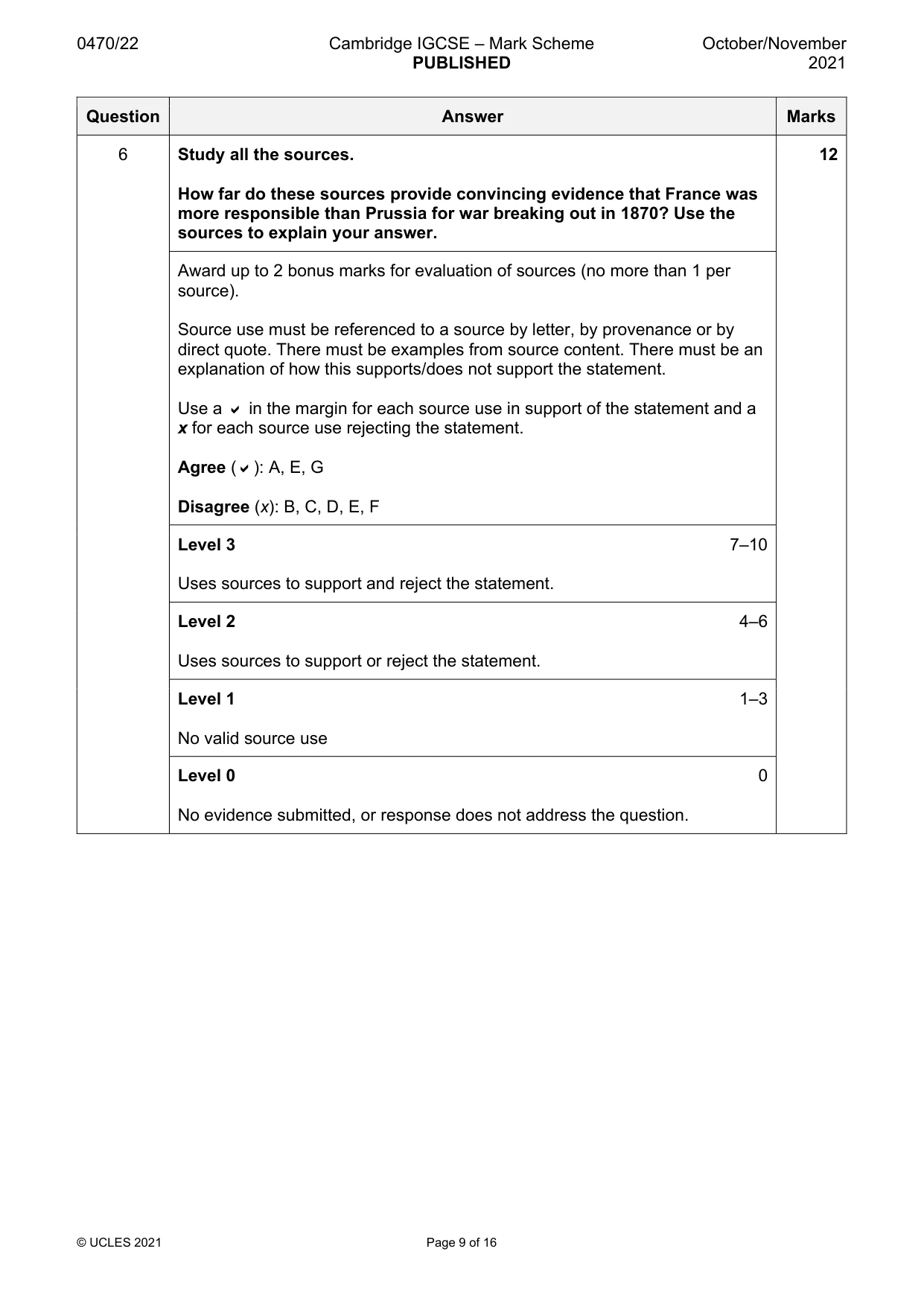
5 0470/22/O/N/21 © UCLES 2021 [Turn over Now answer all the following questions. You may use any of the sources to help you answer the questions, in addition to those sources which you are told to use. In answering the questions you should use your knowledge of the topic to help you interpret and evaluate the sources. 1 Study Sources A and B. How far do these two sources agree? Explain your answer using details of the sources. [7] 2 Study Source C. Why was this source published in France in 1866? Explain your answer using details of the source and your knowledge. [8] 3 Study Sources D and E. How far does Source D make Source E surprising? Explain your answer using details of the sources and your knowledge. [8] 4 Study Source F. How reliable is this source? Explain your answer using details of the source and your knowledge. [8] 5 Study Source G. How useful is this source as evidence about events before the outbreak of war? Explain your answer using details of the source and your knowledge. [7] 6 Study all the sources. How far do these sources provide convincing evidence that France was more responsible than Prussia for war breaking out in 1870? Use the sources to explain your answer. [12]
Question paper, page 6
6 0470/22/O/N/21 © UCLES 2021 Option B: Twentieth century topic WHO WAS MAINLY TO BLAME FOR THE LEAGUE’S FAILURE OVER ABYSSINIA? Study the Background Information and the sources carefully, and then answer all the questions. Background Information As the two leading members of the League of Nations, Britain and France are often blamed for the League’s failure to deal with the Italian invasion of Abyssinia. It has been argued that both were more interested in having Italy as an ally against the greater threat from Germany. Was Britain or France more to blame for the failure of the League to act against Italy? SOURCE A France’s policy was in line with French national interests. Hitler’s Germany was the potential enemy. Therefore Italy must be made an ally. In 1940 Baldwin claimed that Laval had been bought by Mussolini, but Laval would have followed the same policy without being bribed. In the face of the German danger, a British alliance would be of more value to France than an Italian one. But could it be obtained? It seemed strange to the French that the British should suddenly take seriously their obligations to the League over Abyssinia while not taking seriously their obligations to the League in relation to the German menace to France. It seemed clear in France, and indeed was the case, that Britain still hoped for a settlement with Germany and was not ready to fulfil its obligations under the Covenant. The disastrous Hoare-Laval Pact of December 1935 was a result of Hoare being concerned about the German menace, anxious to retain Italian friendship and reluctant to take collective action. The British government justified its limited actions in defence of Abyssinia by claiming that it was expected to take the lead and that it was the only country to take effective action. However, Britain was the leading European power so of course it was expected to take the lead. Many League members did enforce sanctions at a high economic price to themselves. One suspects that this criticism of ‘others’ was a way of saying that France would not play its part. However, Chamberlain said at the time, ‘We had from France the most loyal assurances that they would come to our aid if we were attacked by Italy.’ In reality Britain did not think the League could enforce international law and order. It thought of national safety as being dependent on alliances and the balance of power. The result was failure for the League. From a history book published in 1974.
Question paper, page 7
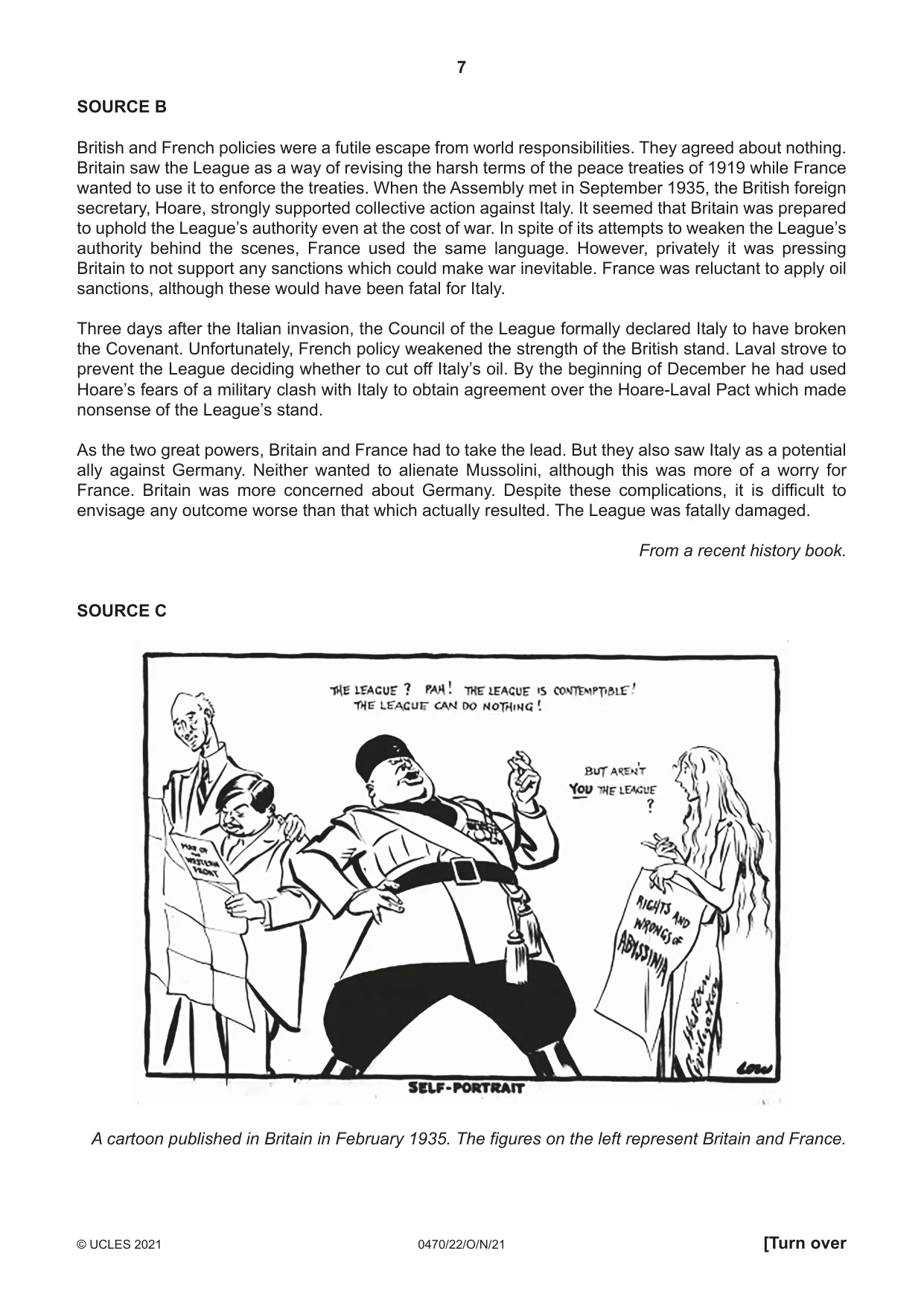
7 0470/22/O/N/21 © UCLES 2021 [Turn over SOURCE B British and French policies were a futile escape from world responsibilities. They agreed about nothing. Britain saw the League as a way of revising the harsh terms of the peace treaties of 1919 while France wanted to use it to enforce the treaties. When the Assembly met in September 1935, the British foreign secretary, Hoare, strongly supported collective action against Italy. It seemed that Britain was prepared to uphold the League’s authority even at the cost of war. In spite of its attempts to weaken the League’s authority behind the scenes, France used the same language. However, privately it was pressing Britain to not support any sanctions which could make war inevitable. France was reluctant to apply oil sanctions, although these would have been fatal for Italy. Three days after the Italian invasion, the Council of the League formally declared Italy to have broken the Covenant. Unfortunately, French policy weakened the strength of the British stand. Laval strove to prevent the League deciding whether to cut off Italy’s oil. By the beginning of December he had used Hoare’s fears of a military clash with Italy to obtain agreement over the Hoare-Laval Pact which made nonsense of the League’s stand. As the two great powers, Britain and France had to take the lead. But they also saw Italy as a potential ally against Germany. Neither wanted to alienate Mussolini, although this was more of a worry for France. Britain was more concerned about Germany. Despite these complications, it is difficult to envisage any outcome worse than that which actually resulted. The League was fatally damaged. From a recent history book. SOURCE C A cartoon published in Britain in February 1935. The figures on the left represent Britain and France.
Question paper, page 8
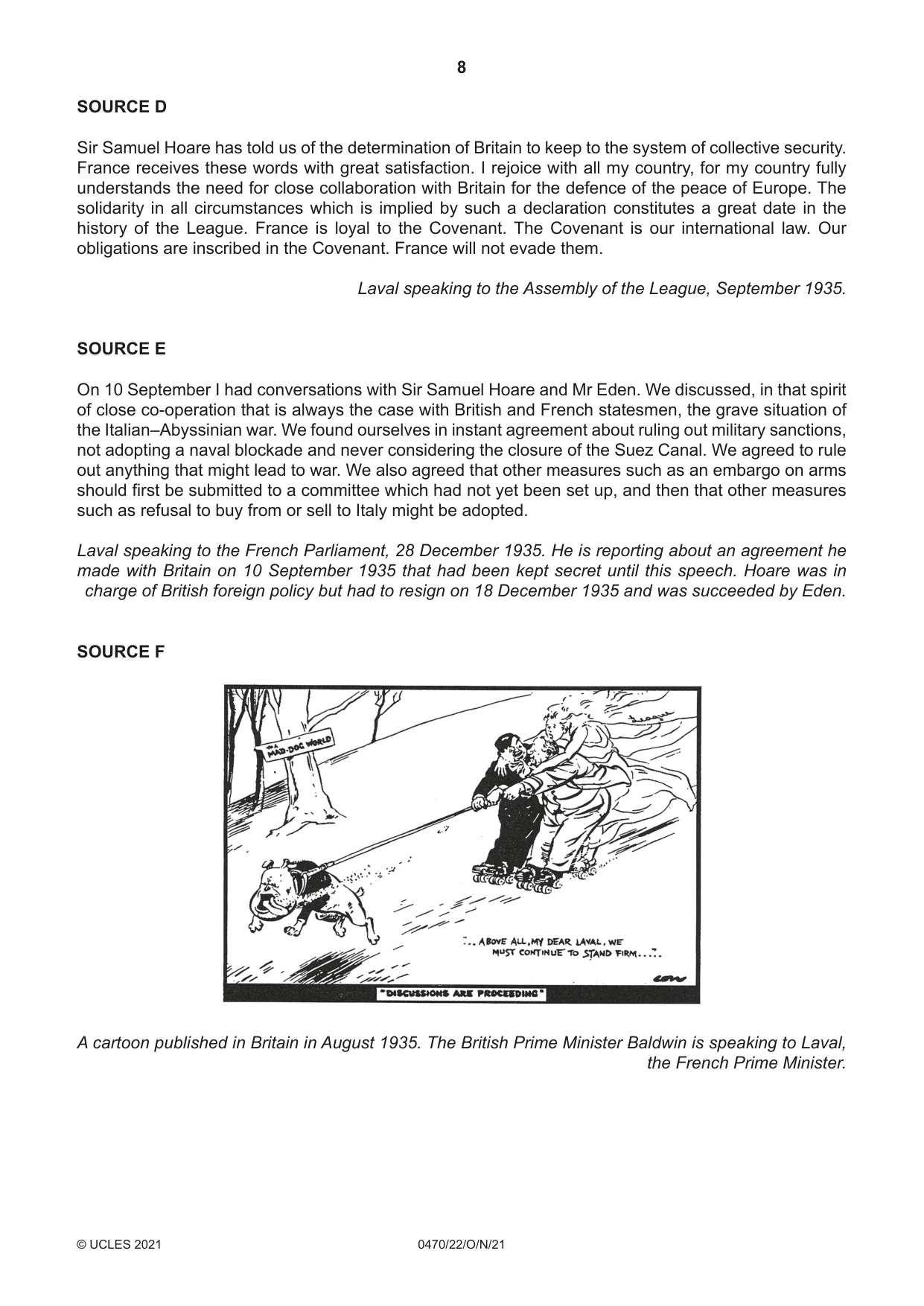
8 0470/22/O/N/21 © UCLES 2021 SOURCE D Sir Samuel Hoare has told us of the determination of Britain to keep to the system of collective security. France receives these words with great satisfaction. I rejoice with all my country, for my country fully understands the need for close collaboration with Britain for the defence of the peace of Europe. The solidarity in all circumstances which is implied by such a declaration constitutes a great date in the history of the League. France is loyal to the Covenant. The Covenant is our international law. Our obligations are inscribed in the Covenant. France will not evade them. Laval speaking to the Assembly of the League, September 1935. SOURCE E On 10 September I had conversations with Sir Samuel Hoare and Mr Eden. We discussed, in that spirit of close co-operation that is always the case with British and French statesmen, the grave situation of the Italian–Abyssinian war. We found ourselves in instant agreement about ruling out military sanctions, not adopting a naval blockade and never considering the closure of the Suez Canal. We agreed to rule out anything that might lead to war. We also agreed that other measures such as an embargo on arms should first be submitted to a committee which had not yet been set up, and then that other measures such as refusal to buy from or sell to Italy might be adopted. Laval speaking to the French Parliament, 28 December 1935. He is reporting about an agreement he made with Britain on 10 September 1935 that had been kept secret until this speech. Hoare was in charge of British foreign policy but had to resign on 18 December 1935 and was succeeded by Eden. SOURCE F A cartoon published in Britain in August 1935. The British Prime Minister Baldwin is speaking to Laval, the French Prime Minister.
Question paper, page 9
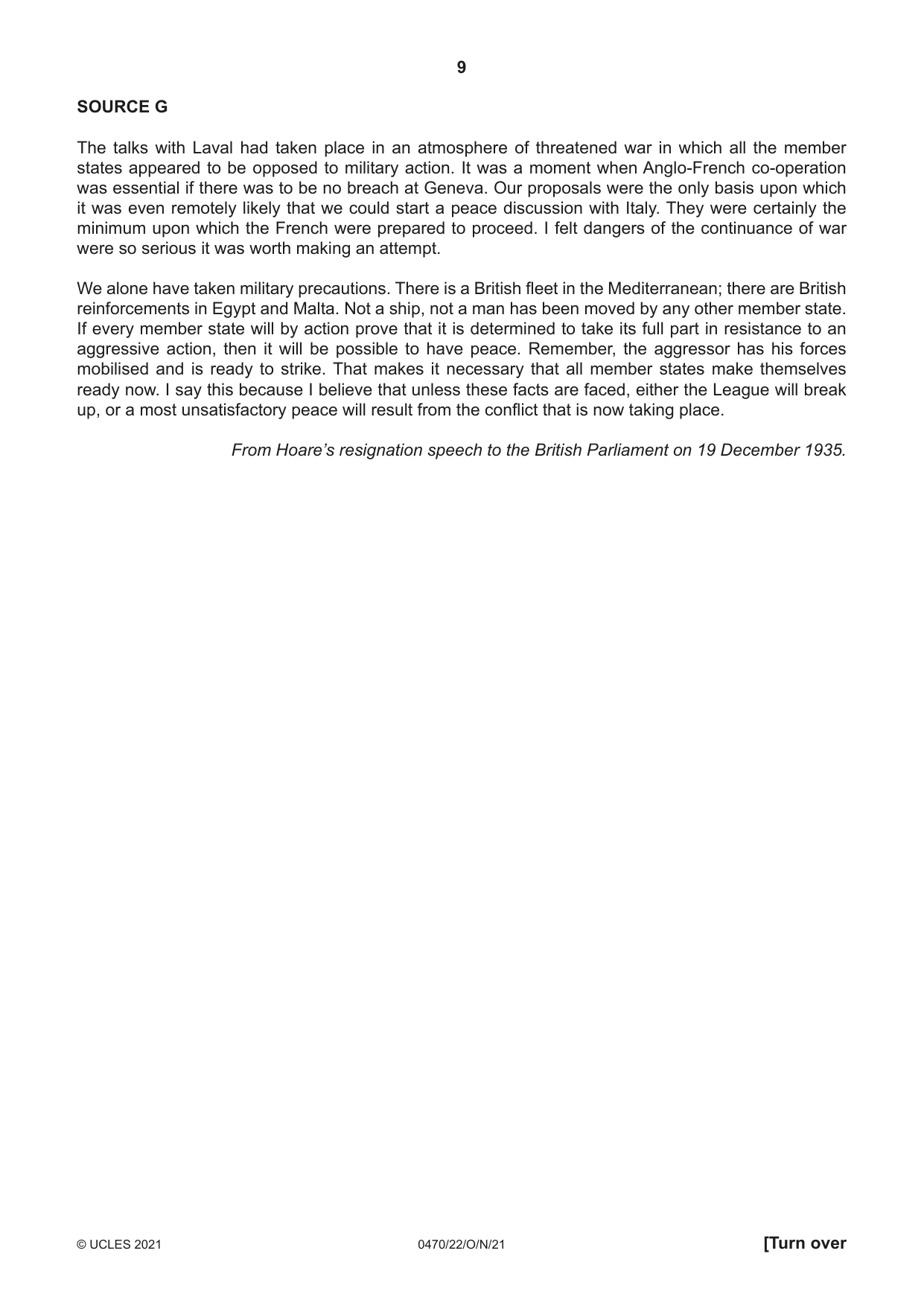
9 0470/22/O/N/21 © UCLES 2021 [Turn over SOURCE G The talks with Laval had taken place in an atmosphere of threatened war in which all the member states appeared to be opposed to military action. It was a moment when Anglo-French co-operation was essential if there was to be no breach at Geneva. Our proposals were the only basis upon which it was even remotely likely that we could start a peace discussion with Italy. They were certainly the minimum upon which the French were prepared to proceed. I felt dangers of the continuance of war were so serious it was worth making an attempt. We alone have taken military precautions. There is a British fleet in the Mediterranean; there are British reinforcements in Egypt and Malta. Not a ship, not a man has been moved by any other member state. If every member state will by action prove that it is determined to take its full part in resistance to an aggressive action, then it will be possible to have peace. Remember, the aggressor has his forces mobilised and is ready to strike. That makes it necessary that all member states make themselves ready now. I say this because I believe that unless these facts are faced, either the League will break up, or a most unsatisfactory peace will result from the conflict that is now taking place. From Hoare’s resignation speech to the British Parliament on 19 December 1935.
Question paper, page 10
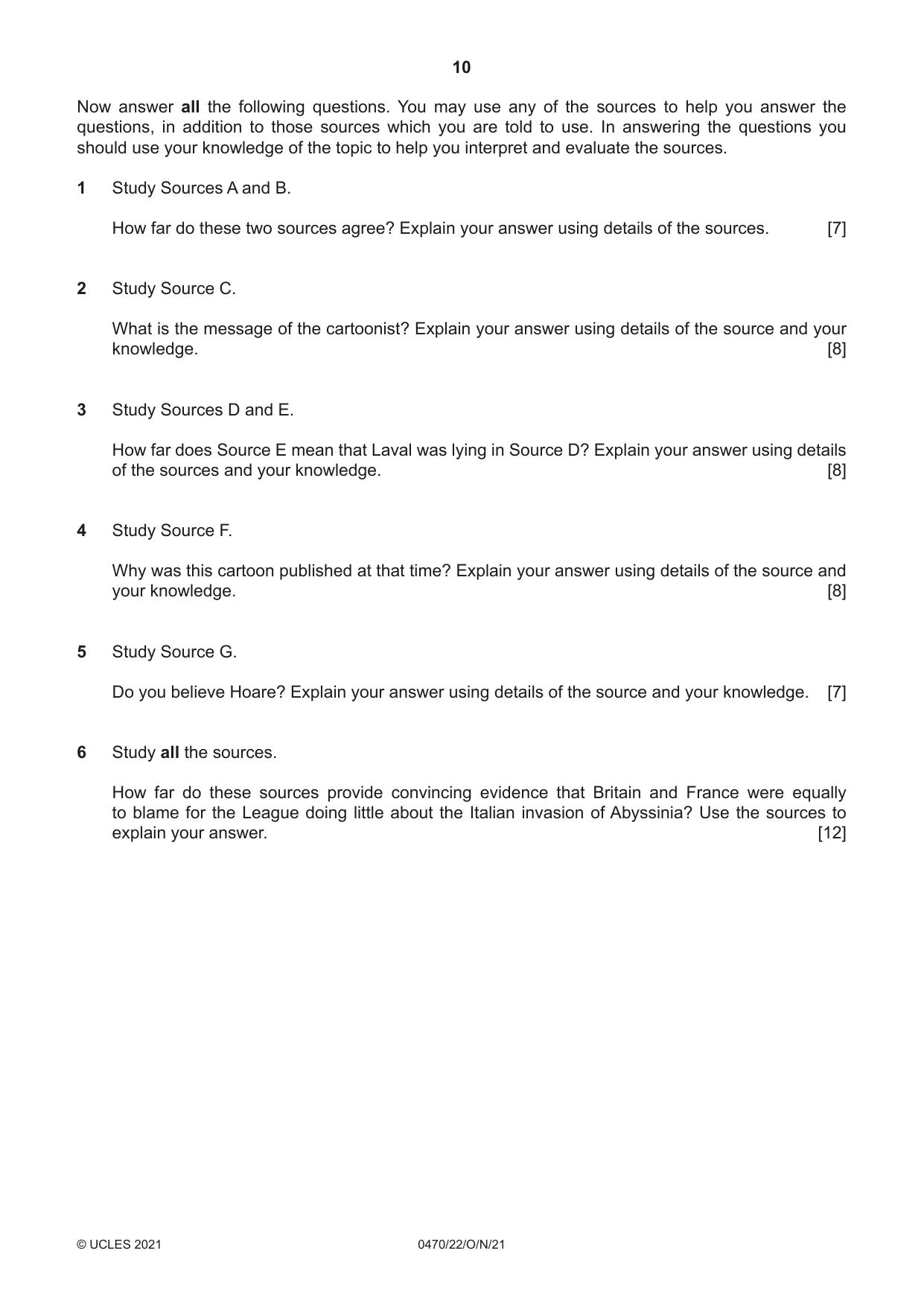
10 0470/22/O/N/21 © UCLES 2021 Now answer all the following questions. You may use any of the sources to help you answer the questions, in addition to those sources which you are told to use. In answering the questions you should use your knowledge of the topic to help you interpret and evaluate the sources. 1 Study Sources A and B. How far do these two sources agree? Explain your answer using details of the sources. [7] 2 Study Source C. What is the message of the cartoonist? Explain your answer using details of the source and your knowledge. [8] 3 Study Sources D and E. How far does Source E mean that Laval was lying in Source D? Explain your answer using details of the sources and your knowledge. [8] 4 Study Source F. Why was this cartoon published at that time? Explain your answer using details of the source and your knowledge. [8] 5 Study Source G. Do you believe Hoare? Explain your answer using details of the source and your knowledge. [7] 6 Study all the sources. How far do these sources provide convincing evidence that Britain and France were equally to blame for the League doing little about the Italian invasion of Abyssinia? Use the sources to explain your answer. [12]
Question paper, page 11
11 0470/22/O/N/21 © UCLES 2021 BLANK PAGE
Question paper, page 12
12 0470/22/O/N/21 © UCLES 2021 Permission to reproduce items where third-party owned material protected by copyright is included has been sought and cleared where possible. Every reasonable effort has been made by the publisher (UCLES) to trace copyright holders, but if any items requiring clearance have unwittingly been included, the publisher will be pleased to make amends at the earliest possible opportunity. To avoid the issue of disclosure of answer-related information to candidates, all copyright acknowledgements are reproduced online in the Cambridge Assessment International Education Copyright Acknowledgements Booklet. This is produced for each series of examinations and is freely available to download at www.cambridgeinternational.org after the live examination series. Cambridge Assessment International Education is part of the Cambridge Assessment Group. Cambridge Assessment is the brand name of the University of Cambridge Local Examinations Syndicate (UCLES), which itself is a department of the University of Cambridge. BLANK PAGE
Mark scheme, page 1
This document consists of 16 printed pages. © UCLES 2021 [Turn over Cambridge IGCSE™ HISTORY 0470/22 Paper 2 October/November 2021 MARK SCHEME Maximum Mark: 50 Published This mark scheme is published as an aid to teachers and candidates, to indicate the requirements of the examination. It shows the basis on which Examiners were instructed to award marks. It does not indicate the details of the discussions that took place at an Examiners’ meeting before marking began, which would have considered the acceptability of alternative answers. Mark schemes should be read in conjunction with the question paper and the Principal Examiner Report for Teachers. Cambridge International will not enter into discussions about these mark schemes. Cambridge International is publishing the mark schemes for the October/November 2021 series for most Cambridge IGCSE™, Cambridge International A and AS Level components and some Cambridge O Level components.
Mark scheme, page 2
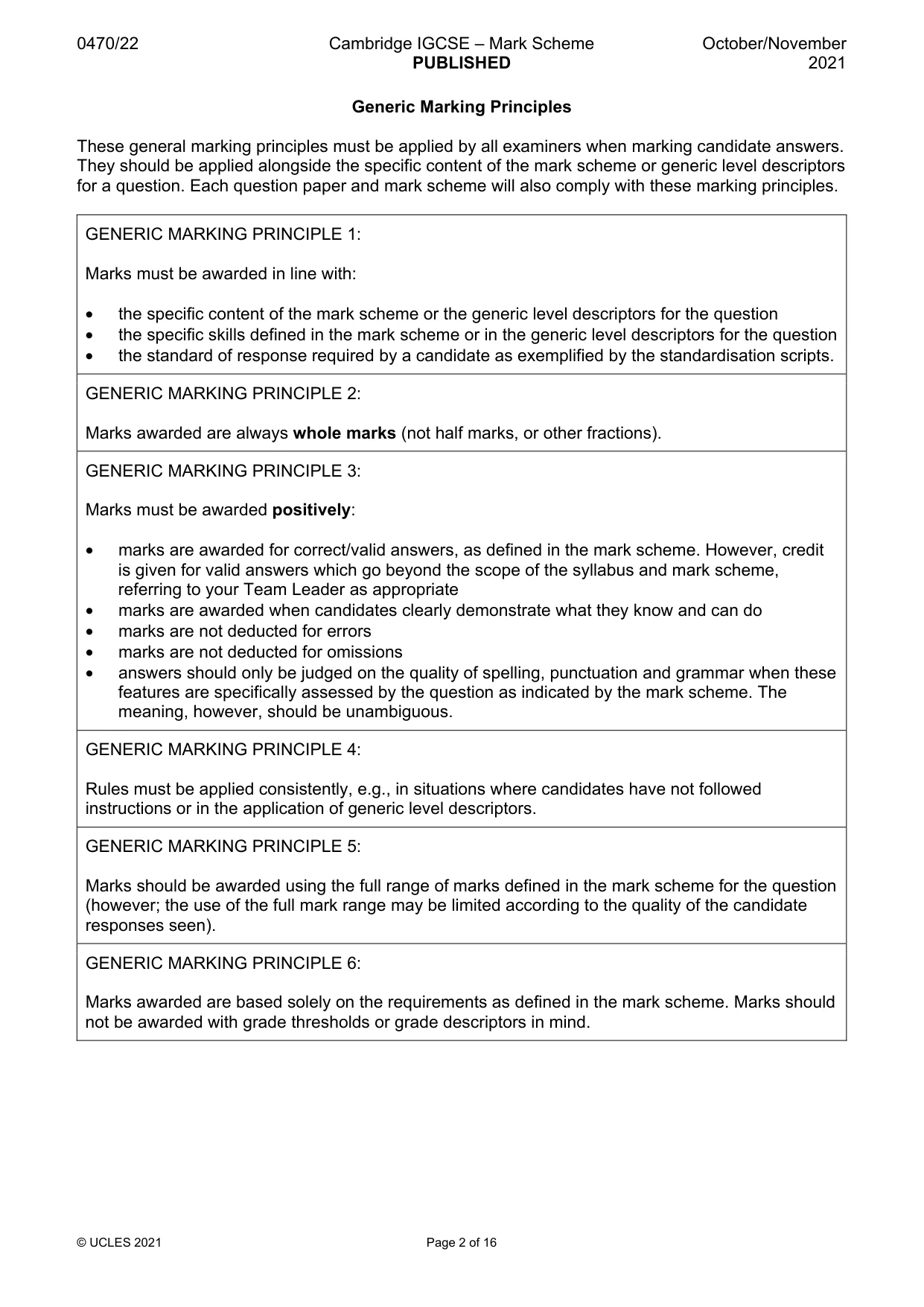
0470/22 Cambridge IGCSE – Mark Scheme PUBLISHED October/November 2021 © UCLES 2021 Page 2 of 16 Generic Marking Principles These general marking principles must be applied by all examiners when marking candidate answers. They should be applied alongside the specific content of the mark scheme or generic level descriptors for a question. Each question paper and mark scheme will also comply with these marking principles. GENERIC MARKING PRINCIPLE 1: Marks must be awarded in line with: • the specific content of the mark scheme or the generic level descriptors for the question • the specific skills defined in the mark scheme or in the generic level descriptors for the question • the standard of response required by a candidate as exemplified by the standardisation scripts. GENERIC MARKING PRINCIPLE 2: Marks awarded are always whole marks (not half marks, or other fractions). GENERIC MARKING PRINCIPLE 3: Marks must be awarded positively: • marks are awarded for correct/valid answers, as defined in the mark scheme. However, credit is given for valid answers which go beyond the scope of the syllabus and mark scheme, referring to your Team Leader as appropriate • marks are awarded when candidates clearly demonstrate what they know and can do • marks are not deducted for errors • marks are not deducted for omissions • answers should only be judged on the quality of spelling, punctuation and grammar when these features are specifically assessed by the question as indicated by the mark scheme. The meaning, however, should be unambiguous. GENERIC MARKING PRINCIPLE 4: Rules must be applied consistently, e.g., in situations where candidates have not followed instructions or in the application of generic level descriptors. GENERIC MARKING PRINCIPLE 5: Marks should be awarded using the full range of marks defined in the mark scheme for the question (however; the use of the full mark range may be limited according to the quality of the candidate responses seen). GENERIC MARKING PRINCIPLE 6: Marks awarded are based solely on the requirements as defined in the mark scheme. Marks should not be awarded with grade thresholds or grade descriptors in mind.
Mark scheme, page 3
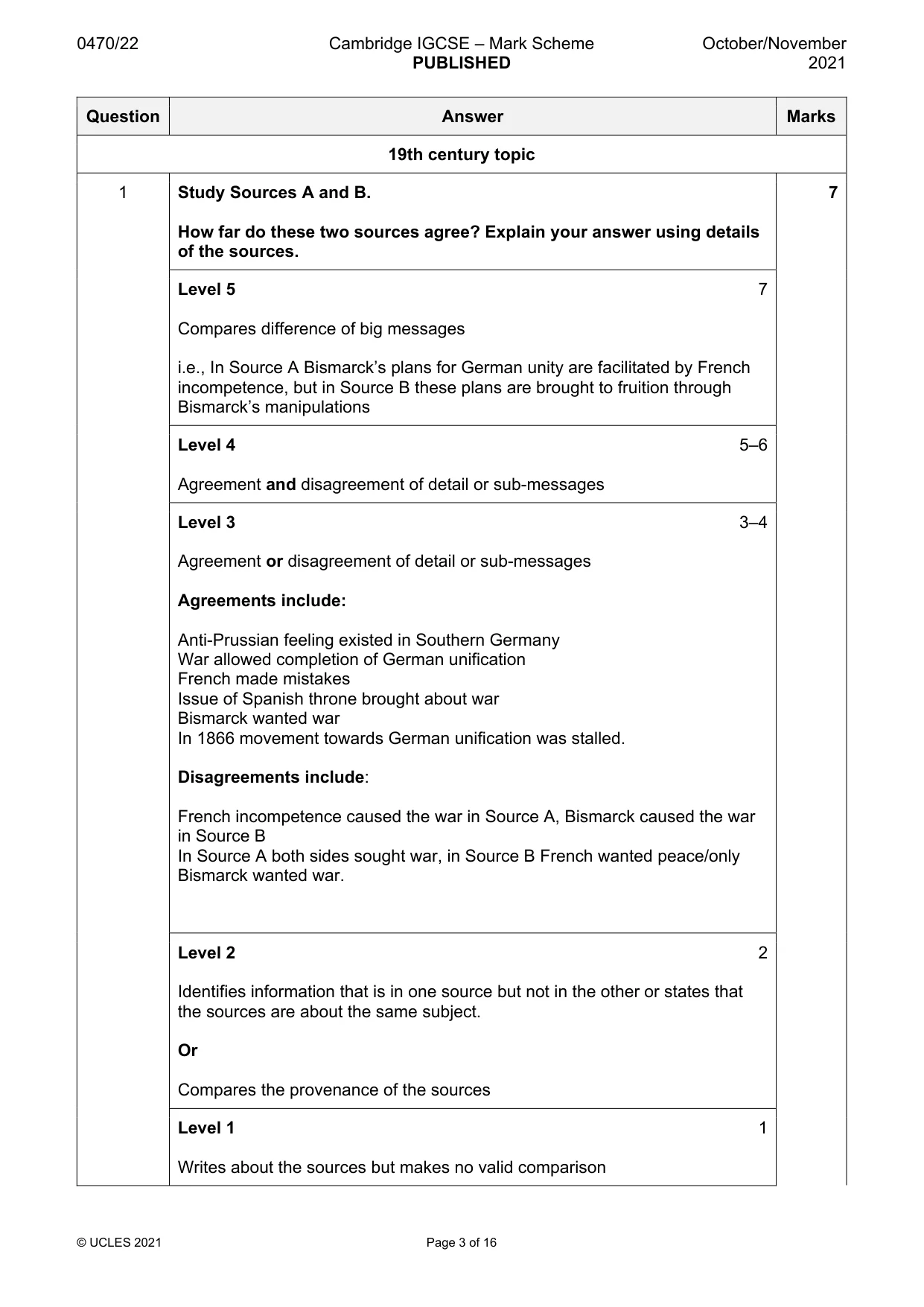
0470/22 Cambridge IGCSE – Mark Scheme PUBLISHED October/November 2021 © UCLES 2021 Page 3 of 16 Question Answer Marks 19th century topic 1 Study Sources A and B. How far do these two sources agree? Explain your answer using details of the sources. 7 Level 5 7 Compares difference of big messages i.e., In Source A Bismarck’s plans for German unity are facilitated by French incompetence, but in Source B these plans are brought to fruition through Bismarck’s manipulations Level 4 5–6 Agreement and disagreement of detail or sub-messages Level 3 3–4 Agreement or disagreement of detail or sub-messages Agreements include: Anti-Prussian feeling existed in Southern Germany War allowed completion of German unification French made mistakes Issue of Spanish throne brought about war Bismarck wanted war In 1866 movement towards German unification was stalled. Disagreements include: French incompetence caused the war in Source A, Bismarck caused the war in Source B In Source A both sides sought war, in Source B French wanted peace/only Bismarck wanted war. Level 2 2 Identifies information that is in one source but not in the other or states that the sources are about the same subject. Or Compares the provenance of the sources Level 1 1 Writes about the sources but makes no valid comparison
Mark scheme, page 4
0470/22 Cambridge IGCSE – Mark Scheme PUBLISHED October/November 2021 © UCLES 2021 Page 4 of 16 Question Answer Marks 1 Level 0 0 No evidence submitted, or response does not address the question.
Mark scheme, page 5
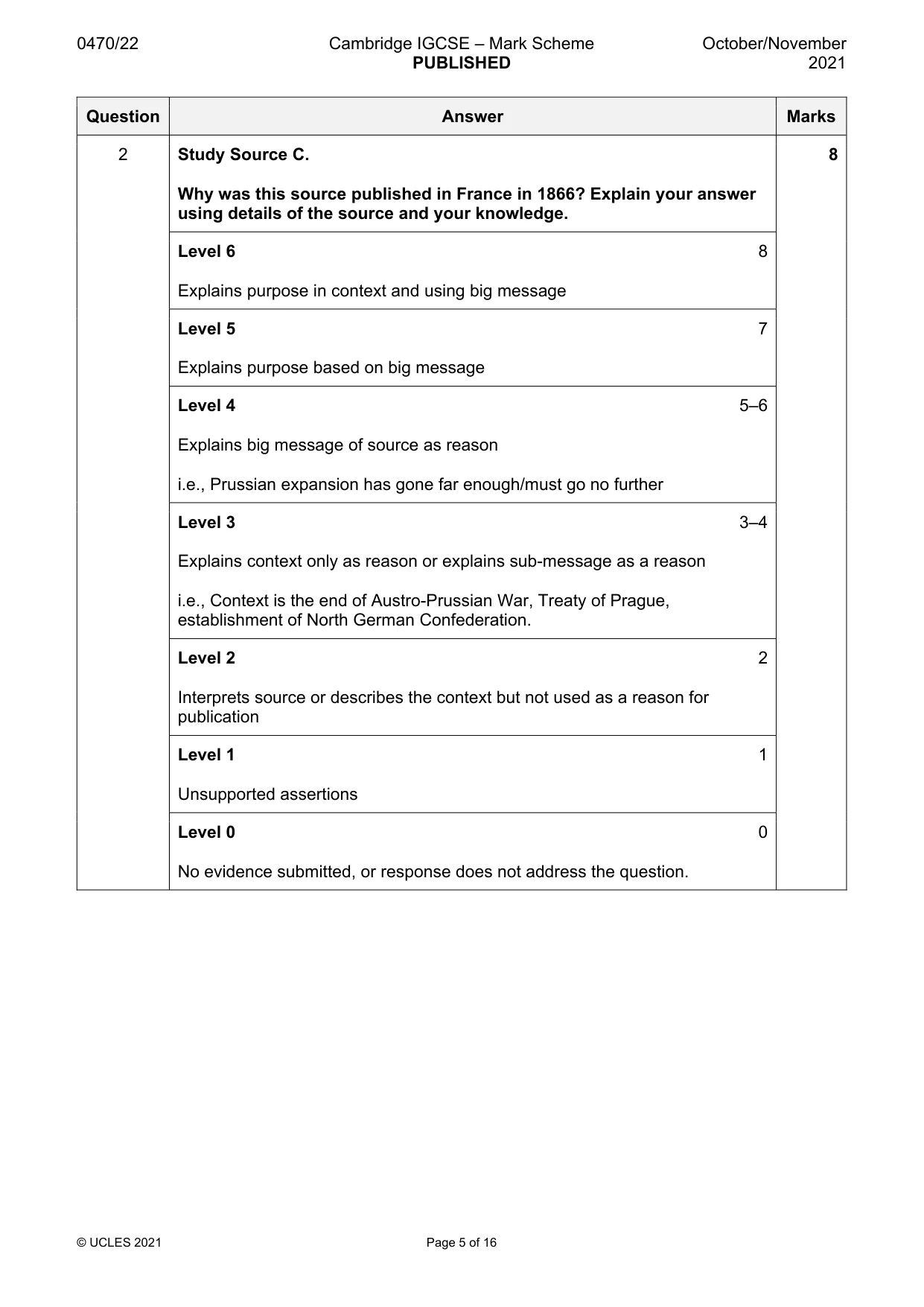
0470/22 Cambridge IGCSE – Mark Scheme PUBLISHED October/November 2021 © UCLES 2021 Page 5 of 16 Question Answer Marks 2 Study Source C. Why was this source published in France in 1866? Explain your answer using details of the source and your knowledge. 8 Level 6 8 Explains purpose in context and using big message Level 5 7 Explains purpose based on big message Level 4 5–6 Explains big message of source as reason i.e., Prussian expansion has gone far enough/must go no further Level 3 3–4 Explains context only as reason or explains sub-message as a reason i.e., Context is the end of Austro-Prussian War, Treaty of Prague, establishment of North German Confederation. Level 2 2 Interprets source or describes the context but not used as a reason for publication Level 1 1 Unsupported assertions Level 0 0 No evidence submitted, or response does not address the question.
Mark scheme, page 6
0470/22 Cambridge IGCSE – Mark Scheme PUBLISHED October/November 2021 © UCLES 2021 Page 6 of 16 Question Answer Marks 3 Study Sources D and E. How far does Source D make Source E surprising? Explain your answer using details of the sources and your knowledge. 8 Level 6 7–8 Answers that compare the sources and evaluate one (Evaluation likely to be through cross-reference) Level 5 5–6 Answers based on comparing differences in what the two sources say Level 4 4 Answers that just evaluate E – no use of D Level 3 3 Not surprised, based on comparing similarities in what the two sources say Level 2 2 Answers based on undeveloped use of provenance e.g., date change Level 1 1 Unsupported assertions Level 0 0 No evidence submitted, or response does not address the question.
Mark scheme, page 7
0470/22 Cambridge IGCSE – Mark Scheme PUBLISHED October/November 2021 © UCLES 2021 Page 7 of 16 Question Answer Marks 4 Study Source F. How reliable is this source? Explain your answer using details of the source and your knowledge. 8 Level 5 7–8 Considers Bismarck's motives in context, i.e., in his retirement e.g., desire to shape his legacy Level 4 5–6 Checks content of Source F against other sources or specific contextual knowledge Level 3 3–4 Answers internal to the source i.e., common sense, internal consistencies and inconsistencies, generalised contextual explanation Level 2 2 Answers based on undeveloped use of provenance Level 1 1 Unsupported assertions Level 0 0 No evidence submitted, or response does not address the question.
Mark scheme, page 8
0470/22 Cambridge IGCSE – Mark Scheme PUBLISHED October/November 2021 © UCLES 2021 Page 8 of 16 Question Answer Marks 5 Study Source G. How useful is this source as evidence about events before the outbreak of war? Explain your answer using details of the source and your knowledge. 7 Level 5 7 Answers based on the purpose of the source i.e., useful as evidence of how the Prussians want the events to be remembered. Level 4 5–6 Utility judged in relation to reliability i.e., checking accuracy of source through cross-reference Level 3 3–4 Answers based on information in the source Level 2 2 Answers based on undeveloped use of provenance Level 1 1 Unsupported assertions Level 0 0 No evidence submitted, or response does not address the question.
Mark scheme, page 9
0470/22 Cambridge IGCSE – Mark Scheme PUBLISHED October/November 2021 © UCLES 2021 Page 9 of 16 Question Answer Marks 6 Study all the sources. How far do these sources provide convincing evidence that France was more responsible than Prussia for war breaking out in 1870? Use the sources to explain your answer. 12 Award up to 2 bonus marks for evaluation of sources (no more than 1 per source). Source use must be referenced to a source by letter, by provenance or by direct quote. There must be examples from source content. There must be an explanation of how this supports/does not support the statement. Use a in the margin for each source use in support of the statement and a x for each source use rejecting the statement. Agree (): A, E, G Disagree (x): B, C, D, E, F Level 3 7–10 Uses sources to support and reject the statement. Level 2 4–6 Uses sources to support or reject the statement. Level 1 1–3 No valid source use Level 0 0 No evidence submitted, or response does not address the question.
Mark scheme, page 10
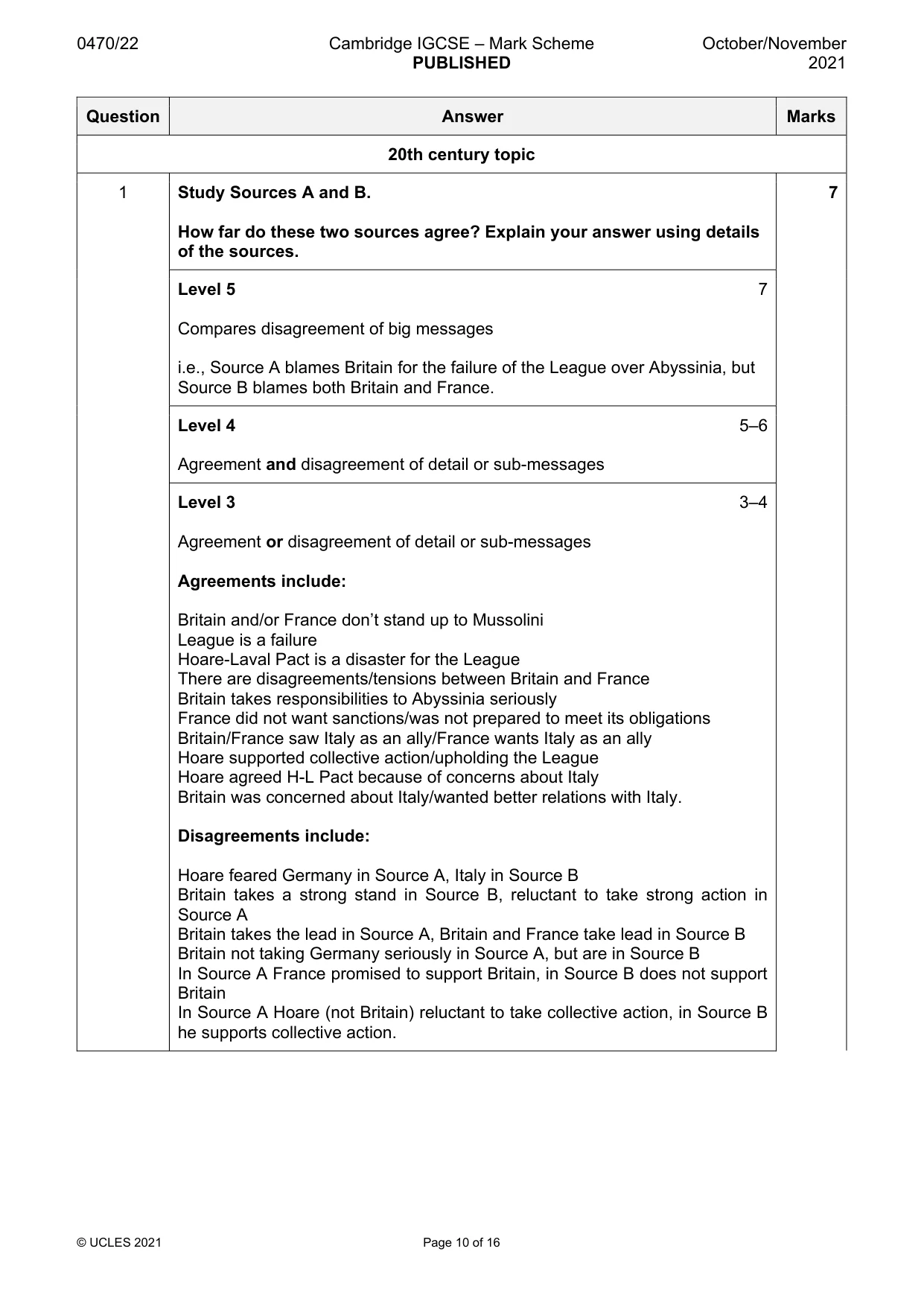
0470/22 Cambridge IGCSE – Mark Scheme PUBLISHED October/November 2021 © UCLES 2021 Page 10 of 16 Question Answer Marks 20th century topic 1 Study Sources A and B. How far do these two sources agree? Explain your answer using details of the sources. 7 Level 5 7 Compares disagreement of big messages i.e., Source A blames Britain for the failure of the League over Abyssinia, but Source B blames both Britain and France. Level 4 5–6 Agreement and disagreement of detail or sub-messages Level 3 3–4 Agreement or disagreement of detail or sub-messages Agreements include: Britain and/or France don’t stand up to Mussolini League is a failure Hoare-Laval Pact is a disaster for the League There are disagreements/tensions between Britain and France Britain takes responsibilities to Abyssinia seriously France did not want sanctions/was not prepared to meet its obligations Britain/France saw Italy as an ally/France wants Italy as an ally Hoare supported collective action/upholding the League Hoare agreed H-L Pact because of concerns about Italy Britain was concerned about Italy/wanted better relations with Italy. Disagreements include: Hoare feared Germany in Source A, Italy in Source B Britain takes a strong stand in Source B, reluctant to take strong action in Source A Britain takes the lead in Source A, Britain and France take lead in Source B Britain not taking Germany seriously in Source A, but are in Source B In Source A France promised to support Britain, in Source B does not support Britain In Source A Hoare (not Britain) reluctant to take collective action, in Source B he supports collective action.
Mark scheme, page 11
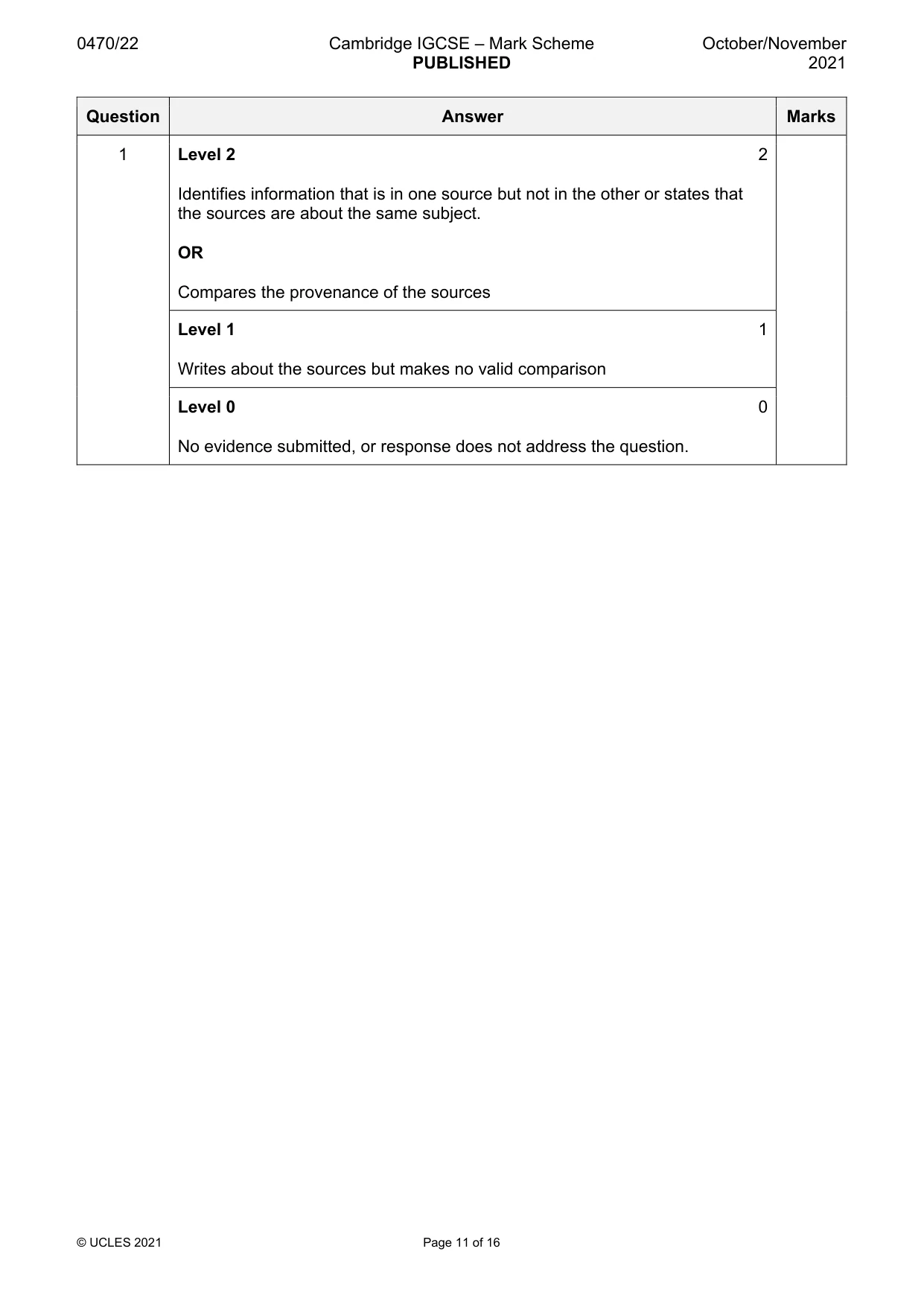
0470/22 Cambridge IGCSE – Mark Scheme PUBLISHED October/November 2021 © UCLES 2021 Page 11 of 16 Question Answer Marks 1 Level 2 2 Identifies information that is in one source but not in the other or states that the sources are about the same subject. OR Compares the provenance of the sources Level 1 1 Writes about the sources but makes no valid comparison Level 0 0 No evidence submitted, or response does not address the question.
Mark scheme, page 12
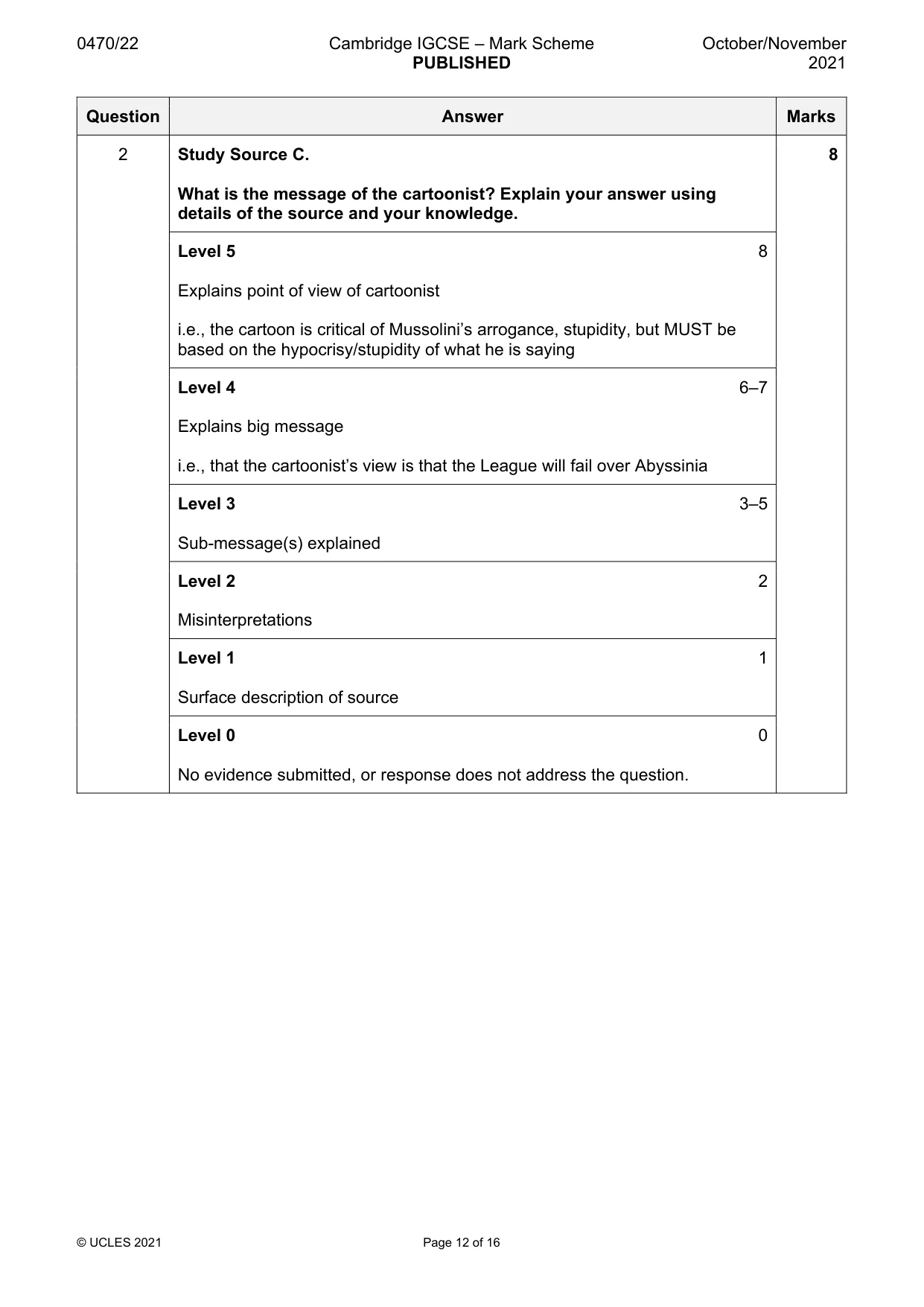
0470/22 Cambridge IGCSE – Mark Scheme PUBLISHED October/November 2021 © UCLES 2021 Page 12 of 16 Question Answer Marks 2 Study Source C. What is the message of the cartoonist? Explain your answer using details of the source and your knowledge. 8 Level 5 8 Explains point of view of cartoonist i.e., the cartoon is critical of Mussolini’s arrogance, stupidity, but MUST be based on the hypocrisy/stupidity of what he is saying Level 4 6–7 Explains big message i.e., that the cartoonist’s view is that the League will fail over Abyssinia Level 3 3–5 Sub-message(s) explained Level 2 2 Misinterpretations Level 1 1 Surface description of source Level 0 0 No evidence submitted, or response does not address the question.
Mark scheme, page 13
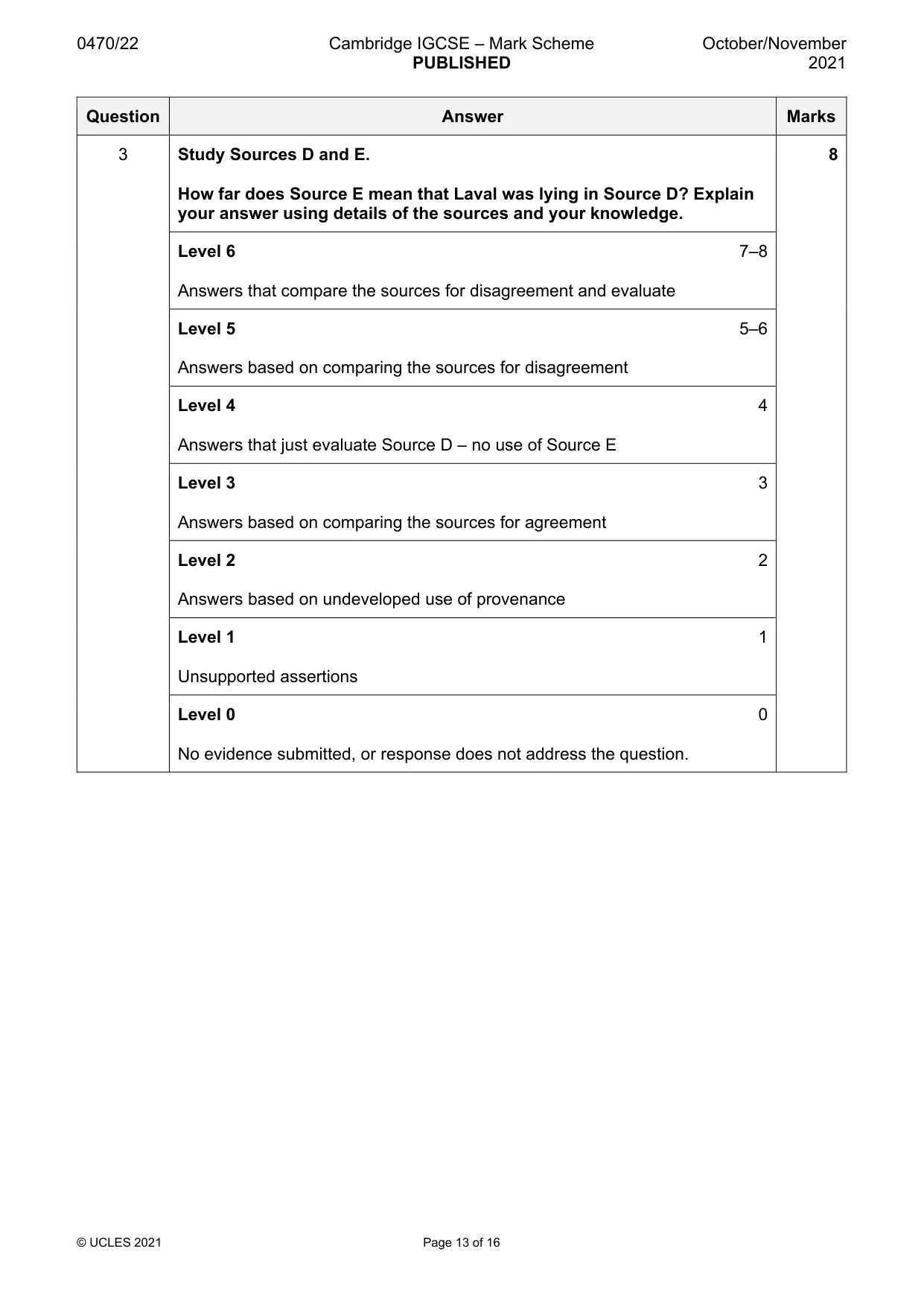
0470/22 Cambridge IGCSE – Mark Scheme PUBLISHED October/November 2021 © UCLES 2021 Page 13 of 16 Question Answer Marks 3 Study Sources D and E. How far does Source E mean that Laval was lying in Source D? Explain your answer using details of the sources and your knowledge. 8 Level 6 7–8 Answers that compare the sources for disagreement and evaluate Level 5 5–6 Answers based on comparing the sources for disagreement Level 4 4 Answers that just evaluate Source D – no use of Source E Level 3 3 Answers based on comparing the sources for agreement Level 2 2 Answers based on undeveloped use of provenance Level 1 1 Unsupported assertions Level 0 0 No evidence submitted, or response does not address the question.
Mark scheme, page 14
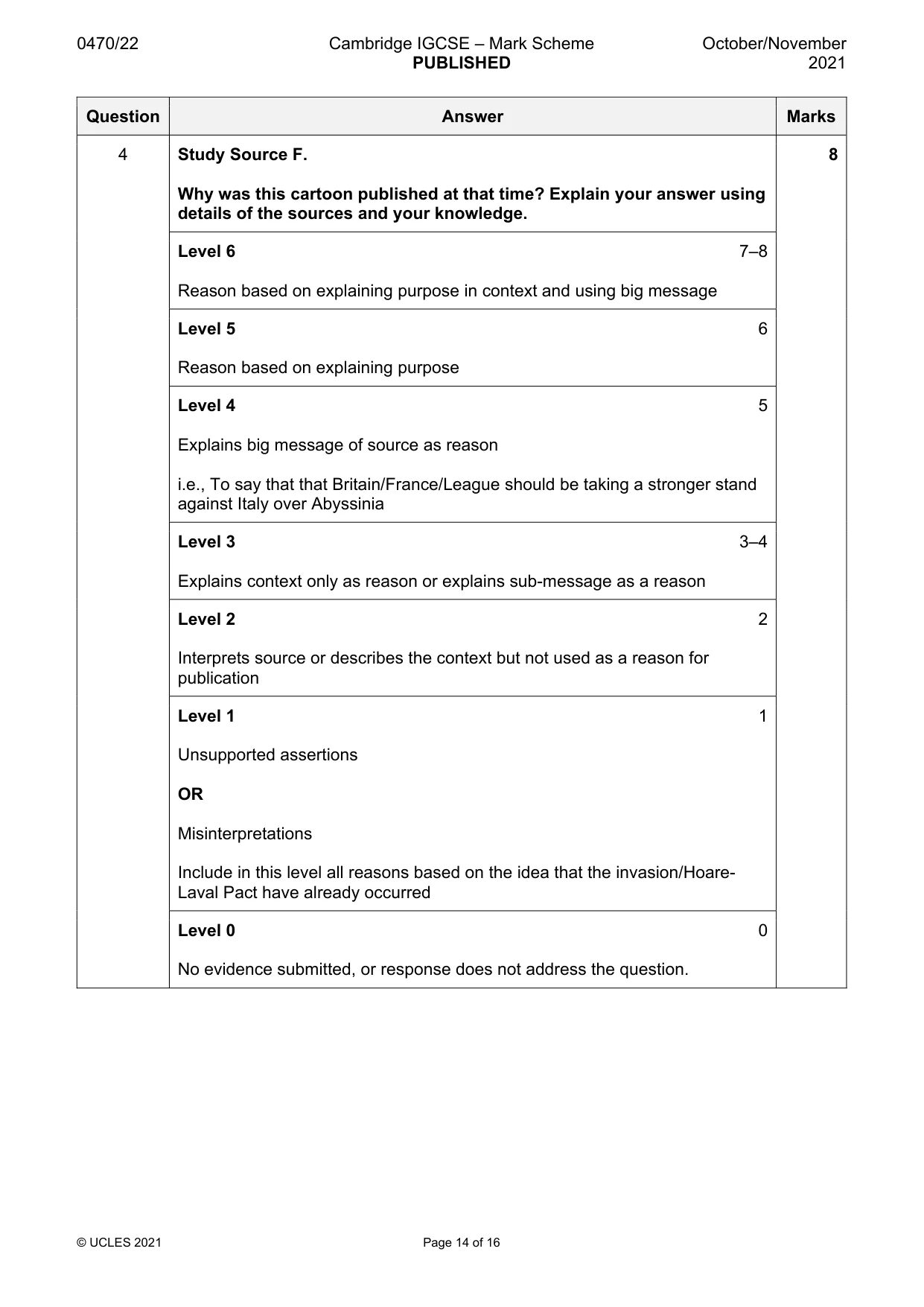
0470/22 Cambridge IGCSE – Mark Scheme PUBLISHED October/November 2021 © UCLES 2021 Page 14 of 16 Question Answer Marks 4 Study Source F. Why was this cartoon published at that time? Explain your answer using details of the sources and your knowledge. 8 Level 6 7–8 Reason based on explaining purpose in context and using big message Level 5 6 Reason based on explaining purpose Level 4 5 Explains big message of source as reason i.e., To say that that Britain/France/League should be taking a stronger stand against Italy over Abyssinia Level 3 3–4 Explains context only as reason or explains sub-message as a reason Level 2 2 Interprets source or describes the context but not used as a reason for publication Level 1 1 Unsupported assertions OR Misinterpretations Include in this level all reasons based on the idea that the invasion/Hoare- Laval Pact have already occurred Level 0 0 No evidence submitted, or response does not address the question.
Mark scheme, page 15
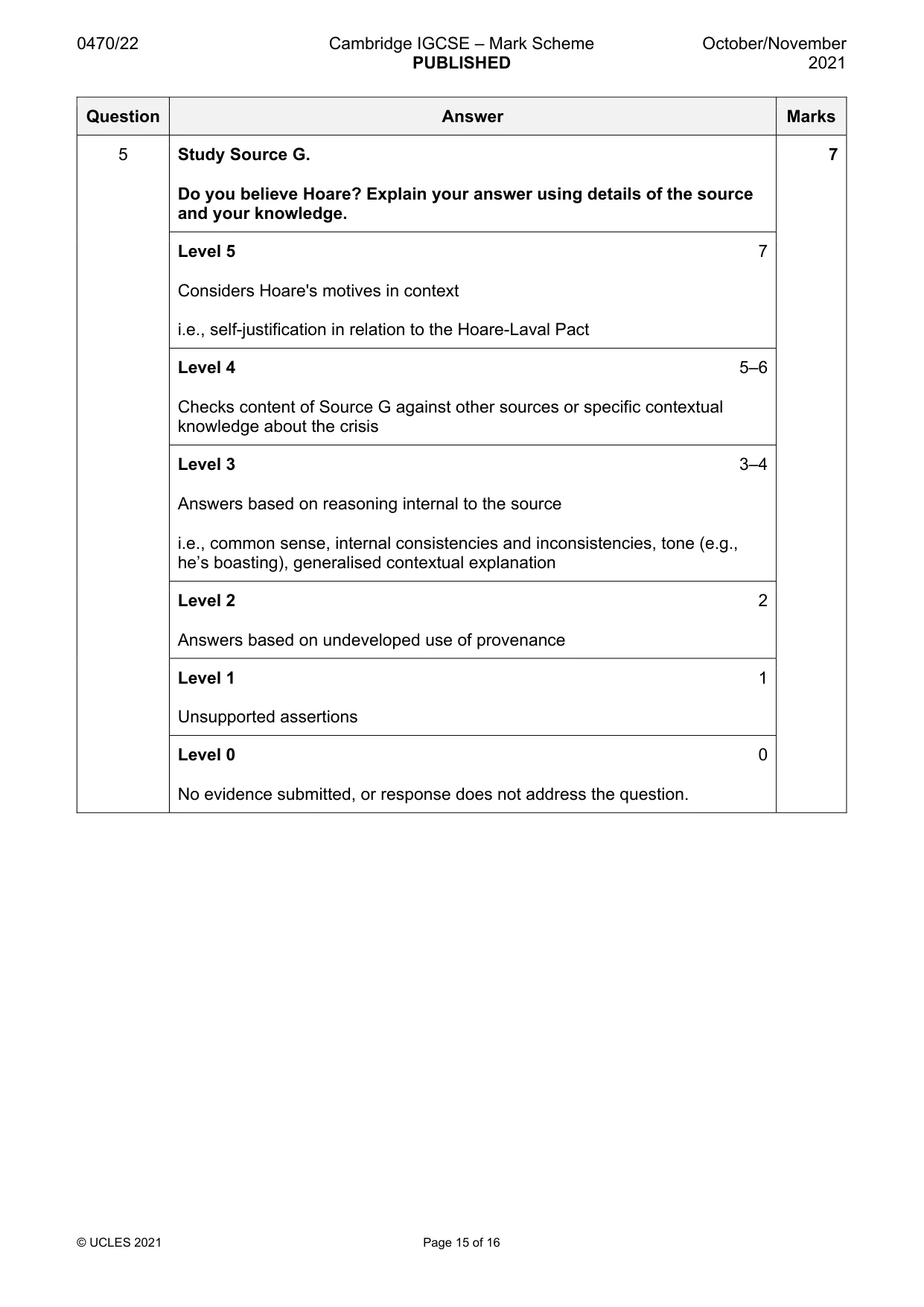
0470/22 Cambridge IGCSE – Mark Scheme PUBLISHED October/November 2021 © UCLES 2021 Page 15 of 16 Question Answer Marks 5 Study Source G. Do you believe Hoare? Explain your answer using details of the source and your knowledge. 7 Level 5 7 Considers Hoare's motives in context i.e., self-justification in relation to the Hoare-Laval Pact Level 4 5–6 Checks content of Source G against other sources or specific contextual knowledge about the crisis Level 3 3–4 Answers based on reasoning internal to the source i.e., common sense, internal consistencies and inconsistencies, tone (e.g., he’s boasting), generalised contextual explanation Level 2 2 Answers based on undeveloped use of provenance Level 1 1 Unsupported assertions Level 0 0 No evidence submitted, or response does not address the question.
Mark scheme, page 16
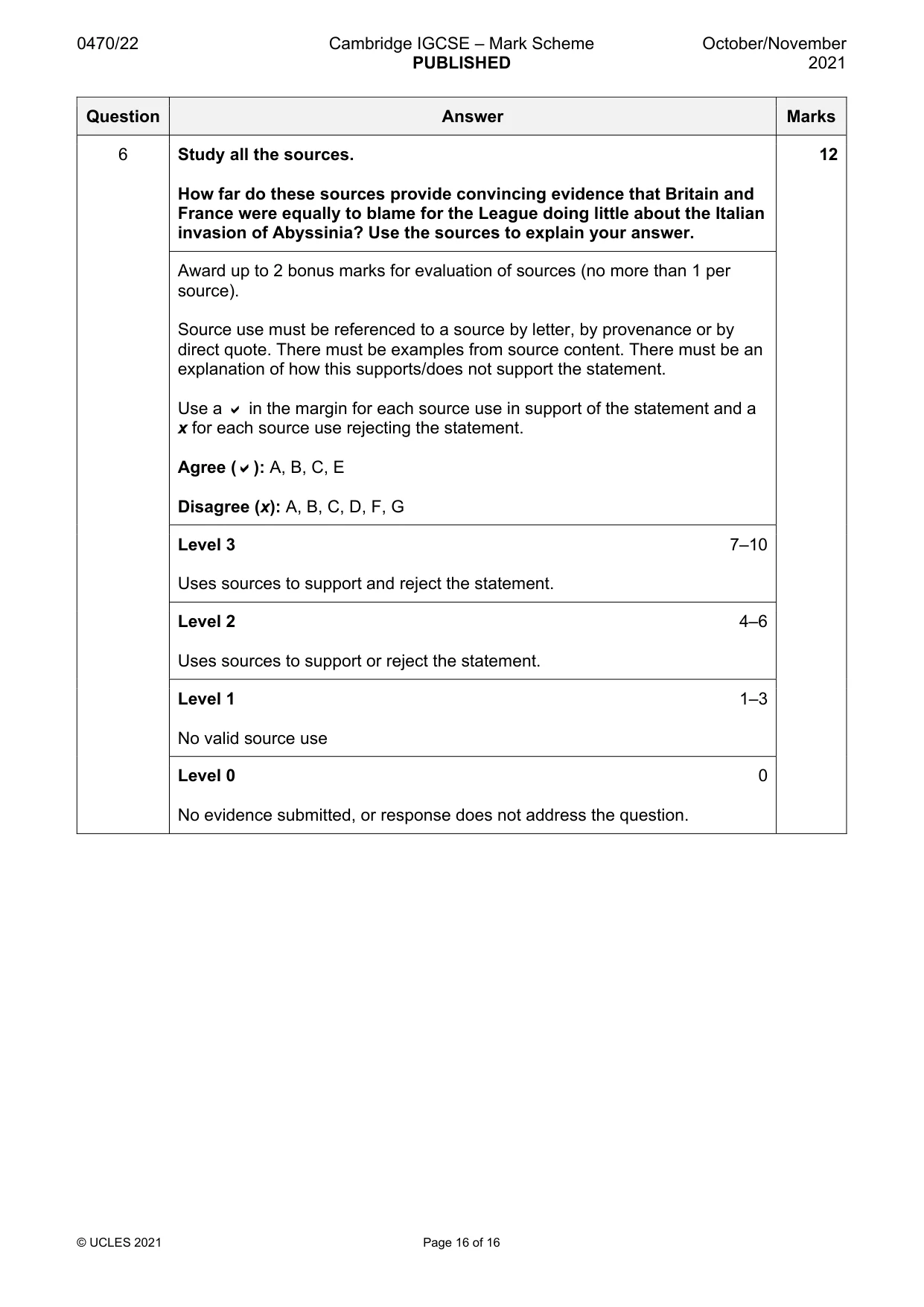
0470/22 Cambridge IGCSE – Mark Scheme PUBLISHED October/November 2021 © UCLES 2021 Page 16 of 16 Question Answer Marks 6 Study all the sources. How far do these sources provide convincing evidence that Britain and France were equally to blame for the League doing little about the Italian invasion of Abyssinia? Use the sources to explain your answer. 12 Award up to 2 bonus marks for evaluation of sources (no more than 1 per source). Source use must be referenced to a source by letter, by provenance or by direct quote. There must be examples from source content. There must be an explanation of how this supports/does not support the statement. Use a in the margin for each source use in support of the statement and a x for each source use rejecting the statement. Agree (): A, B, C, E Disagree (x): A, B, C, D, F, G Level 3 7–10 Uses sources to support and reject the statement. Level 2 4–6 Uses sources to support or reject the statement. Level 1 1–3 No valid source use Level 0 0 No evidence submitted, or response does not address the question.
What you needed in this session
Cambridge’s own grade thresholds for 2021 Oct/Nov, Paper 2 · Variant 2. A higher threshold means an easier paper — the bar moves with how the cohort did.