Cambridge IGCSE History 0470 — 2021 Oct/Nov Paper 1 · Variant 1
0470/11/O/N/21 · 60 marks · ≈68 min
The question paper and its mark scheme, free to read here and free to download. This is Cambridge’s own paper, exactly as it was sat.
Question paper12 pages

Mark scheme77 pages
Answers below. Sit the paper first if you are practising.
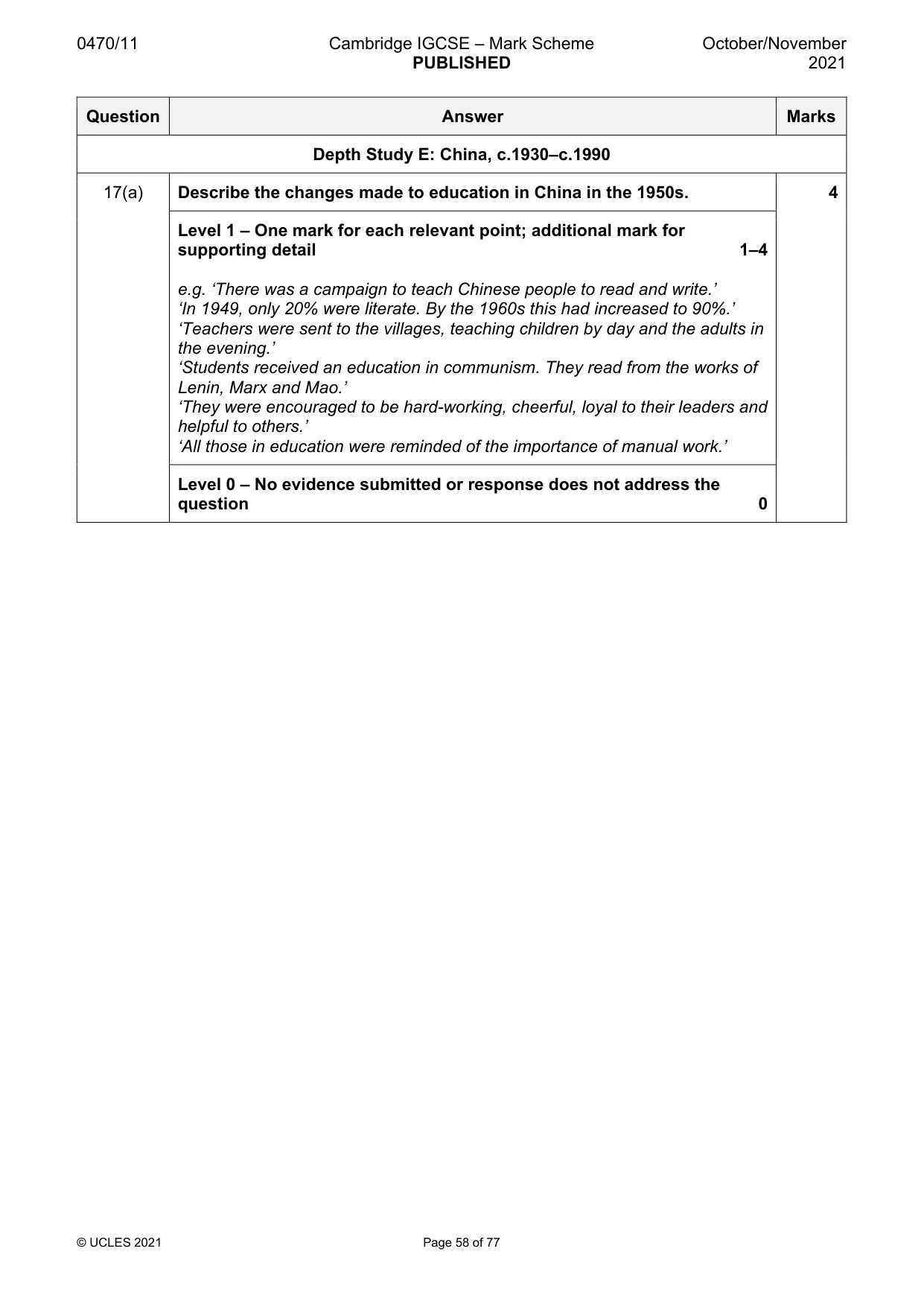
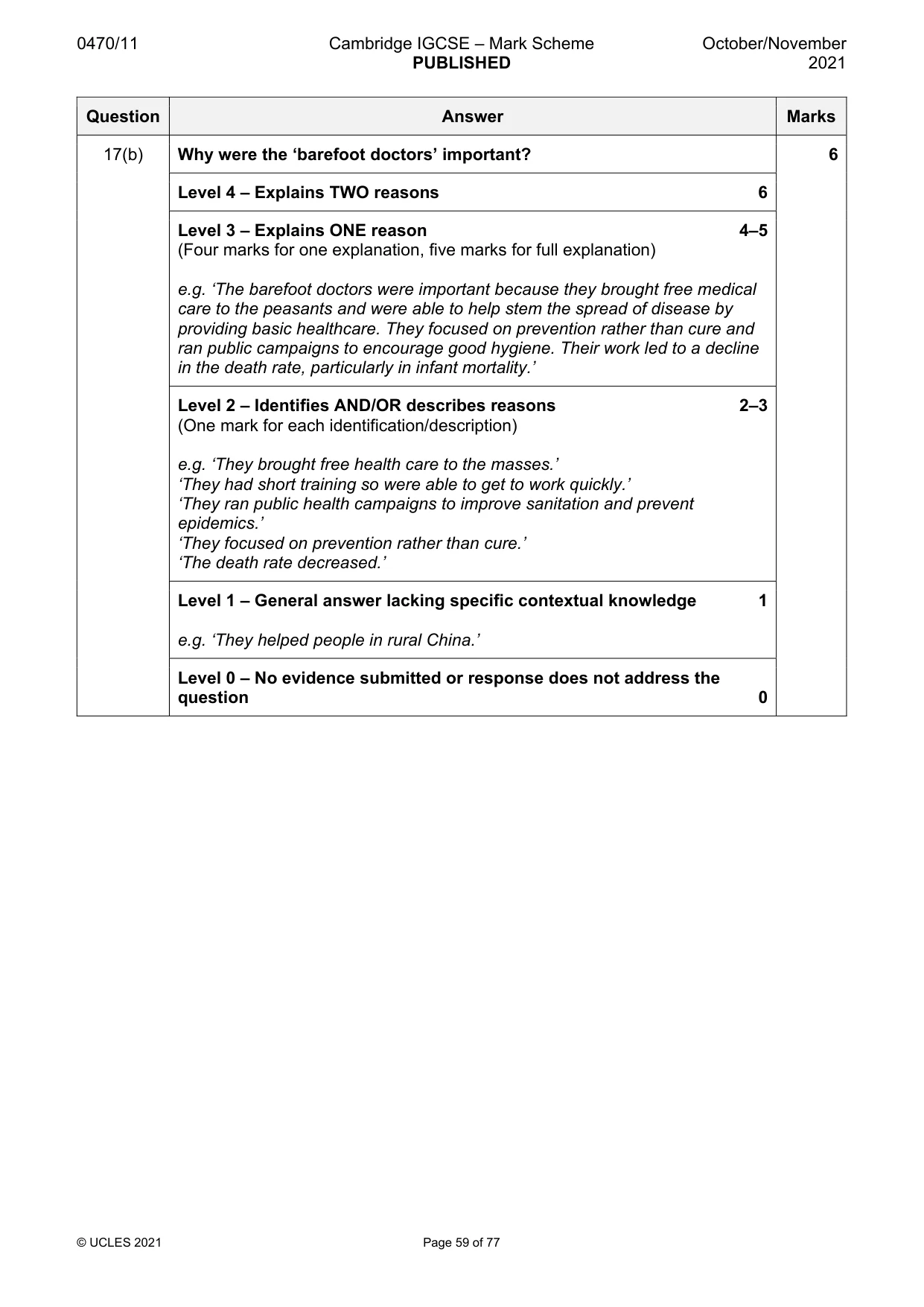
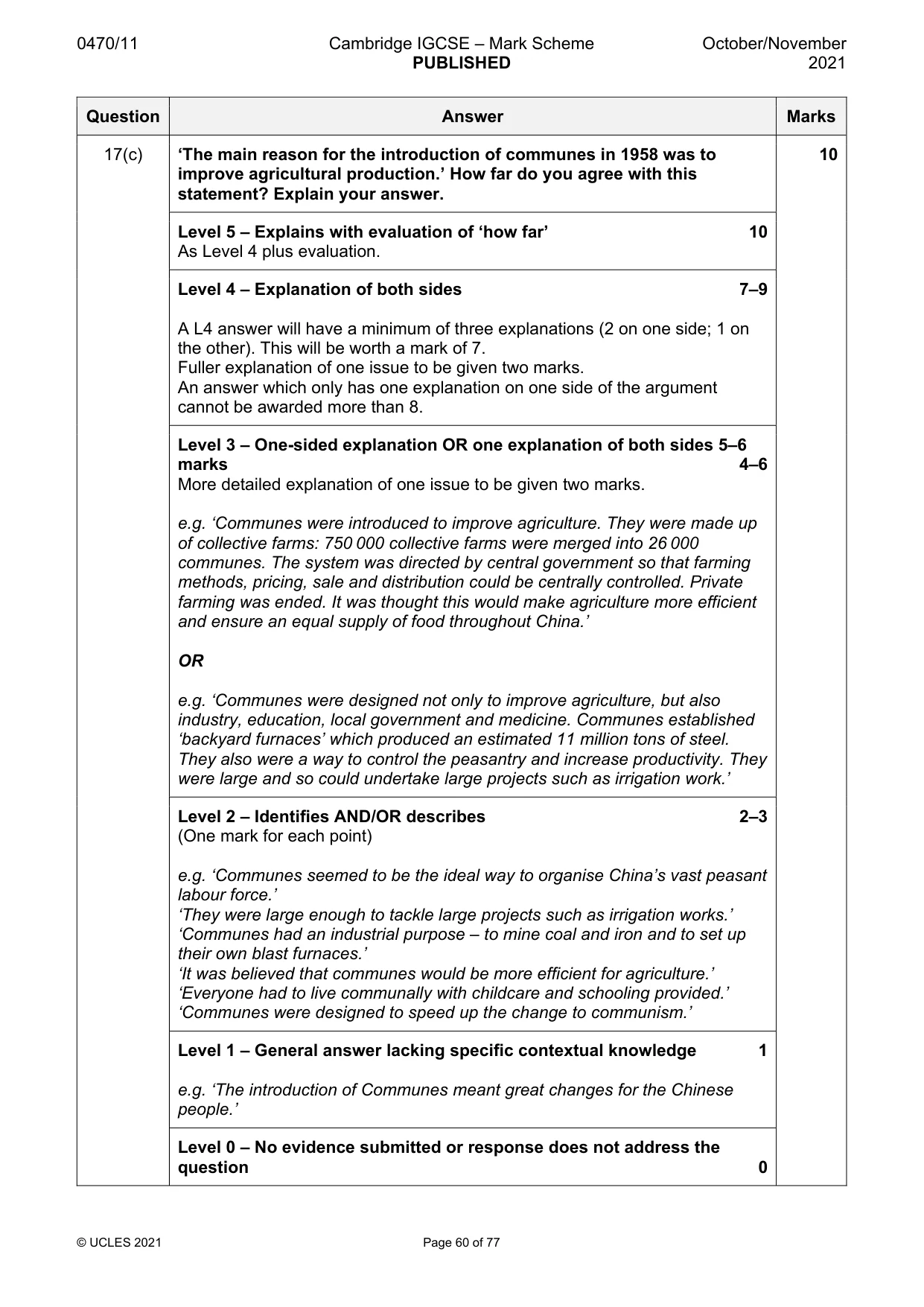
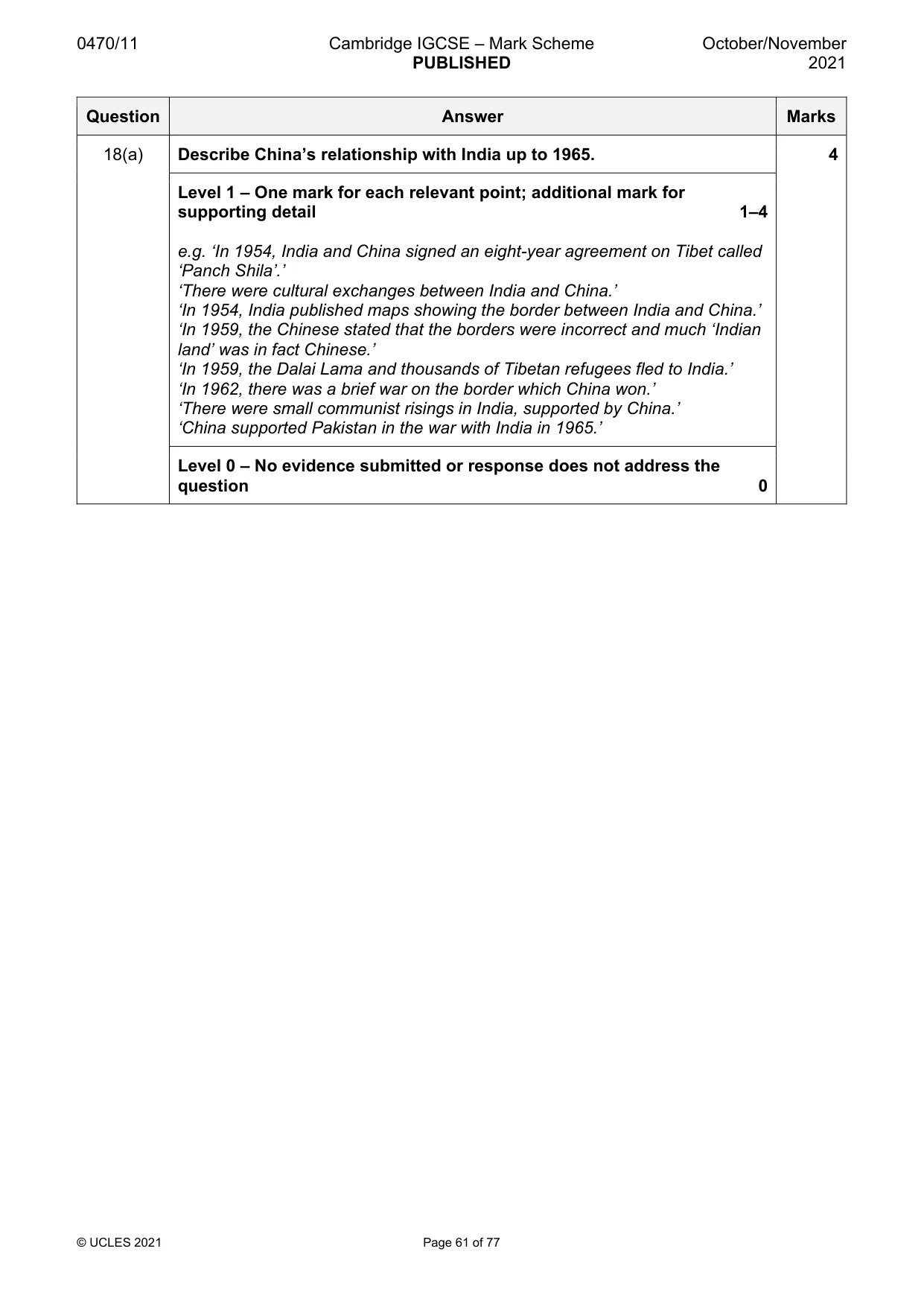
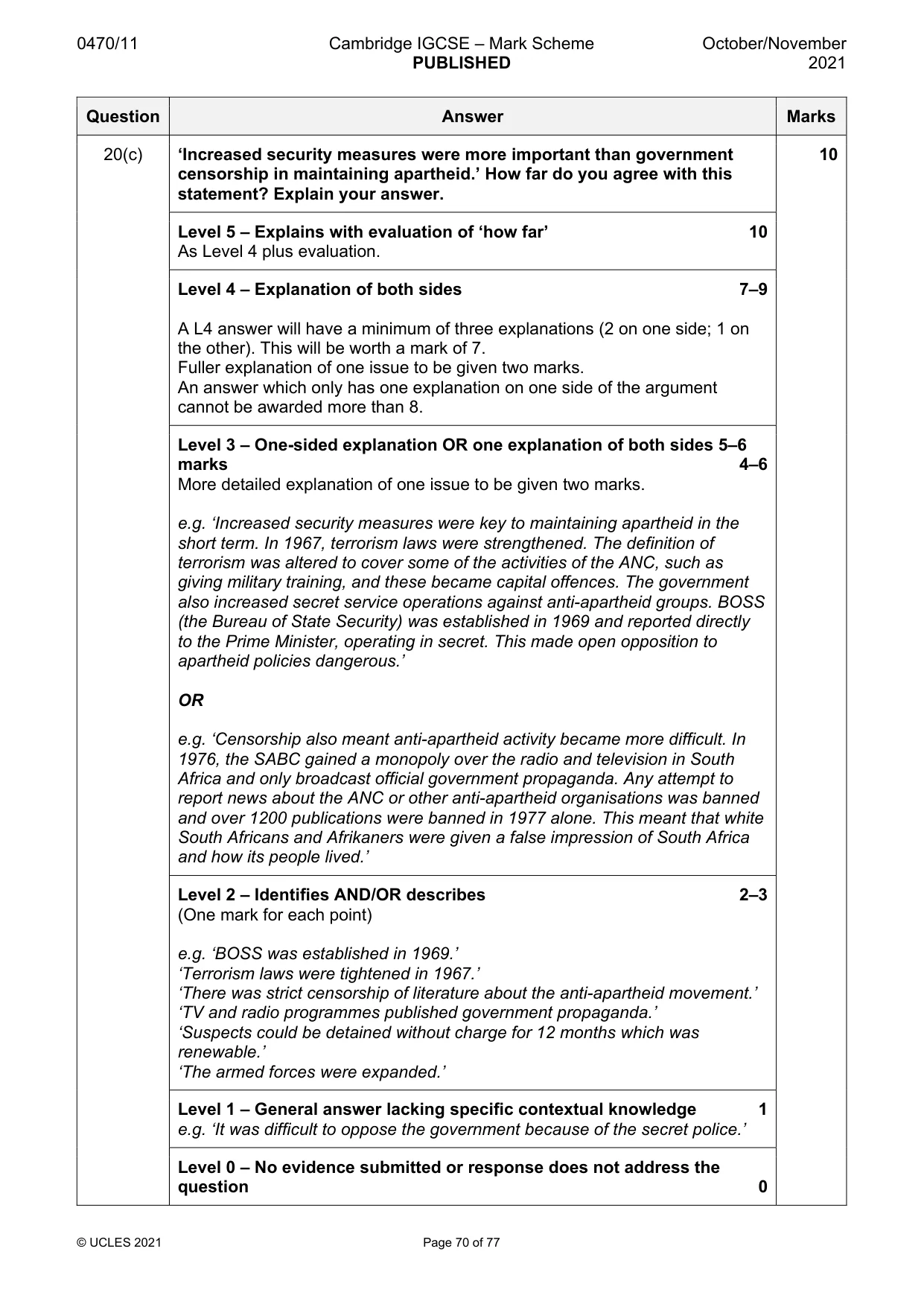
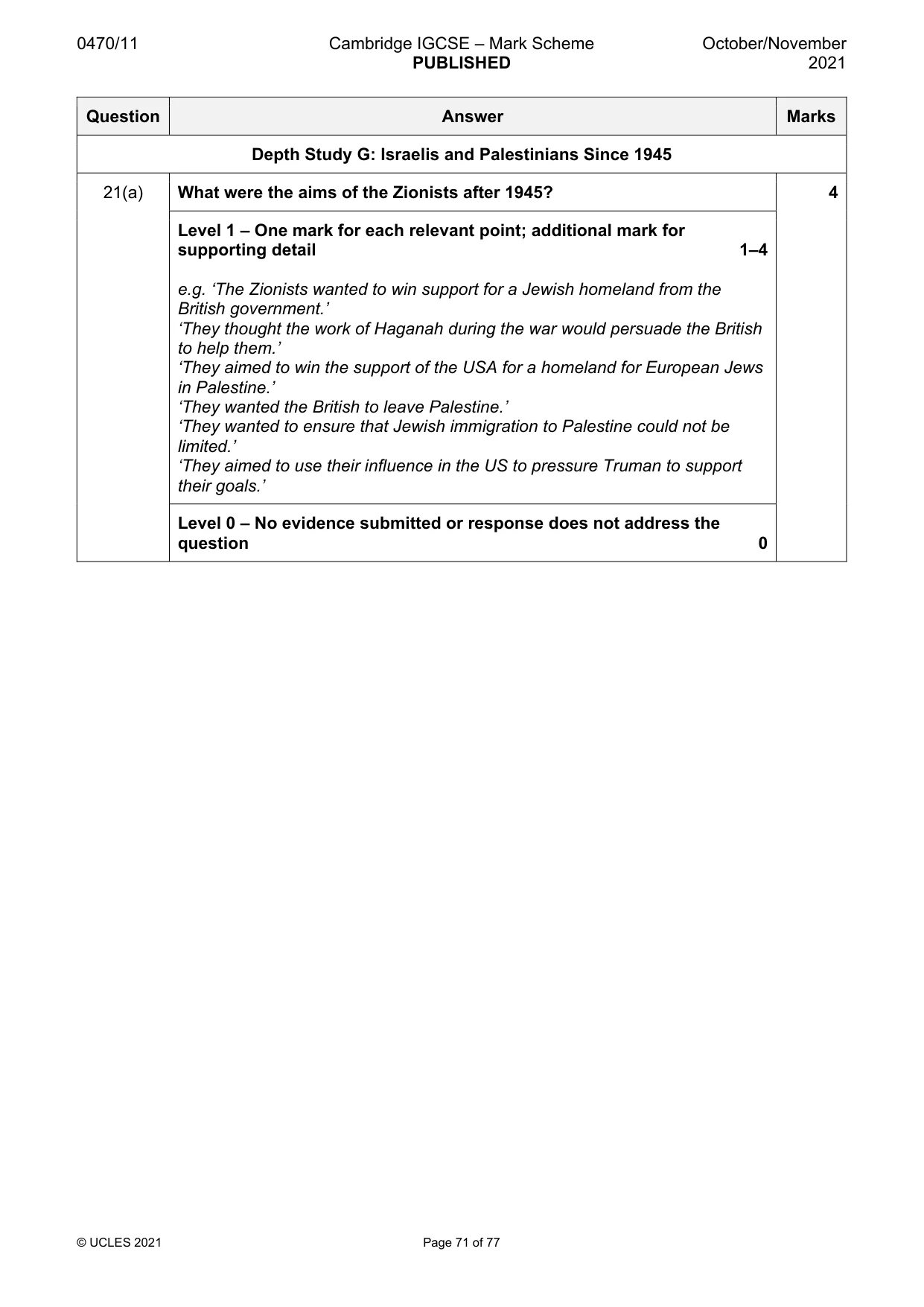
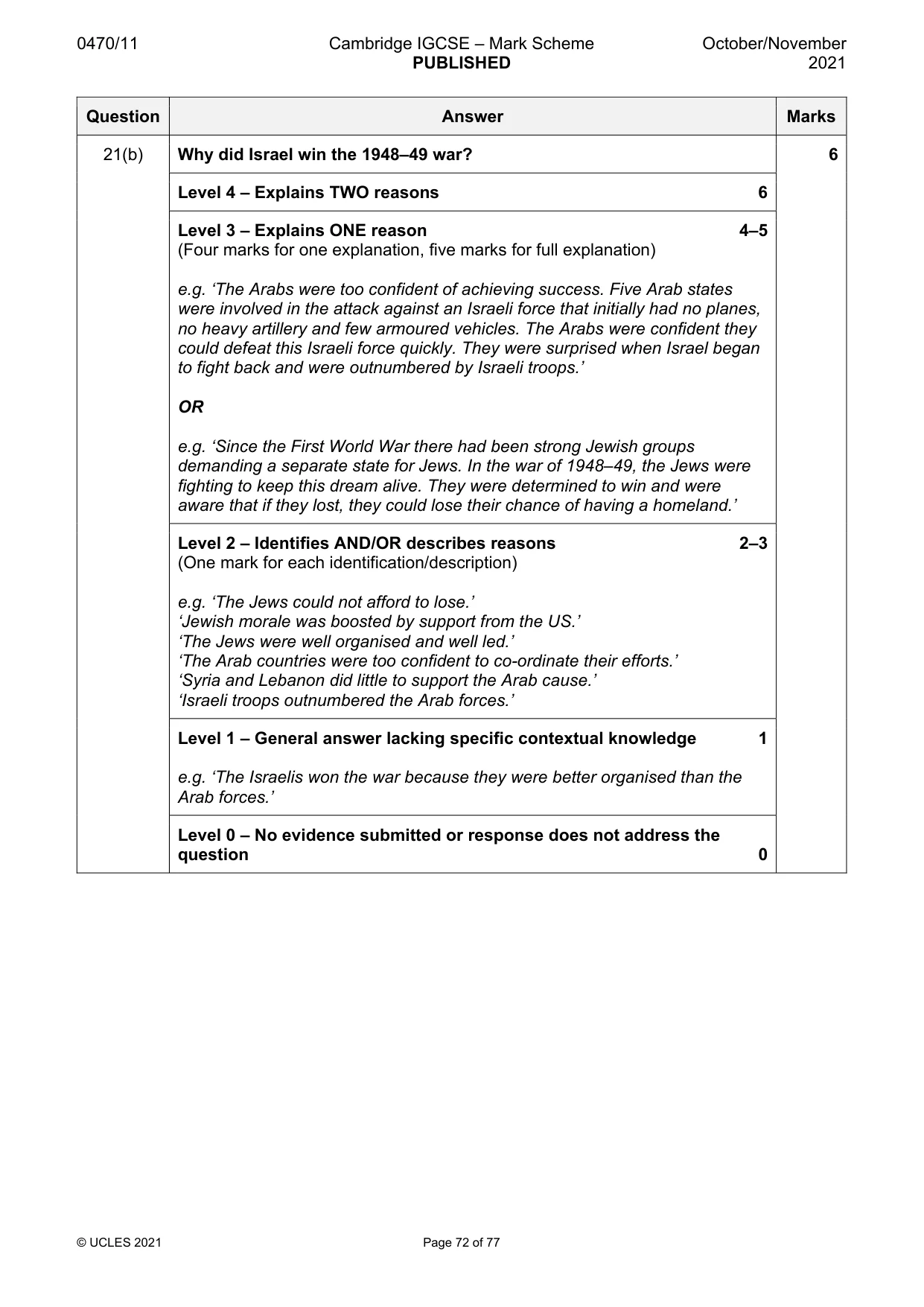
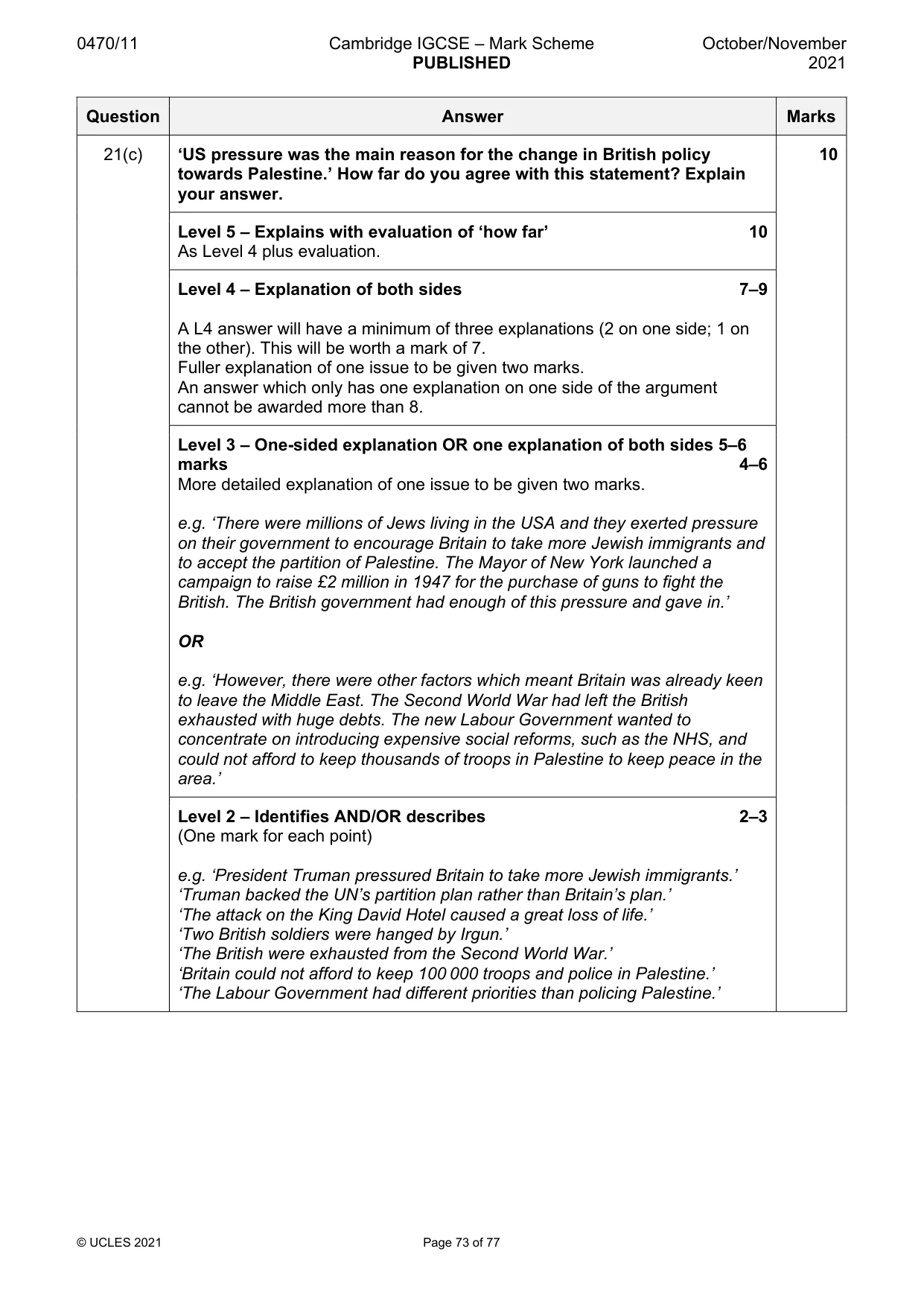
Paper as text
Question paper, page 1
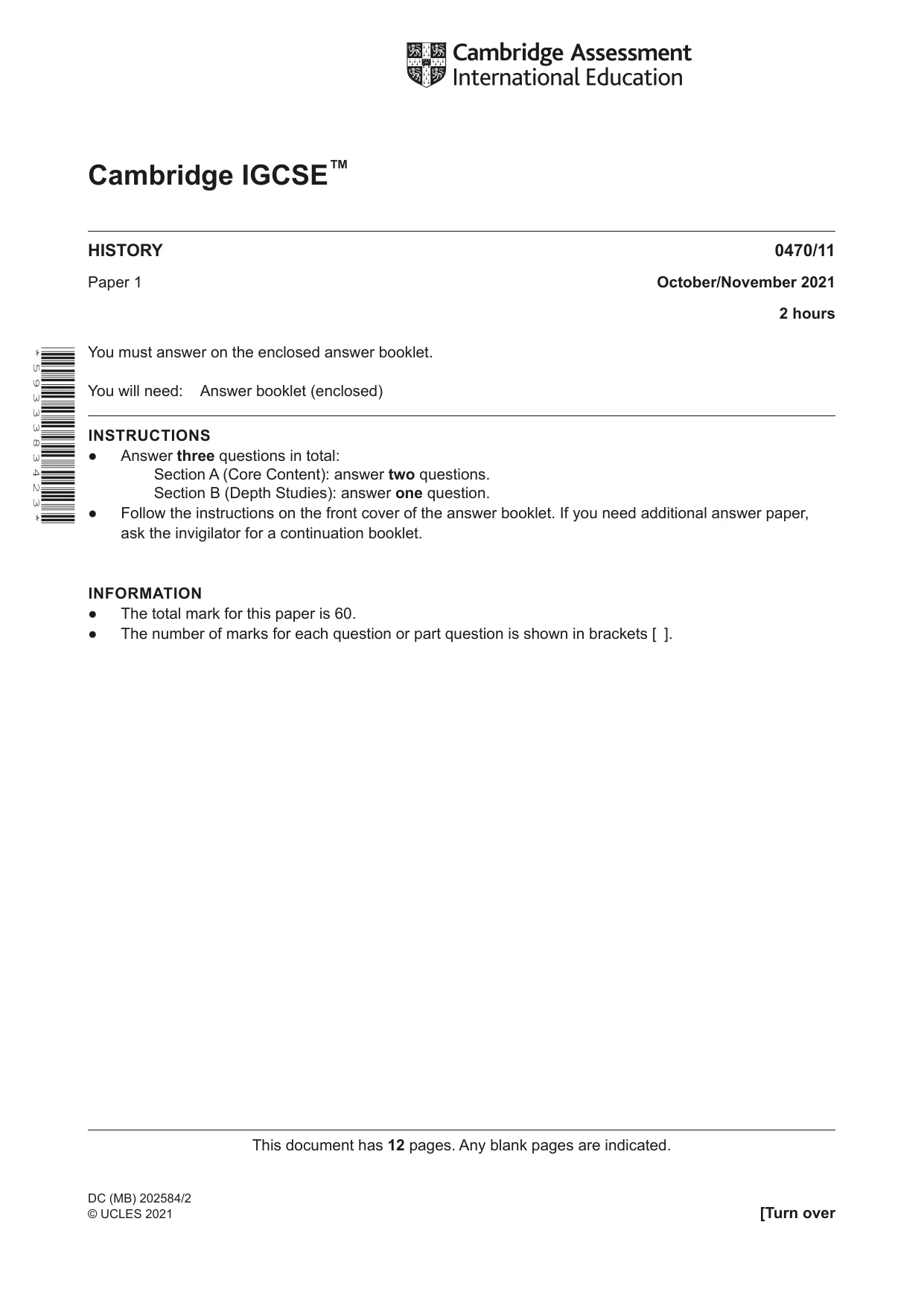
This document has 12 pages. Any blank pages are indicated. Cambridge IGCSE™ * 5 9 3 3 3 8 3 4 2 3 * DC (MB) 202584/2 © UCLES 2021 [Turn over HISTORY 0470/11 Paper 1 October/November 2021 2 hours You must answer on the enclosed answer booklet. You will need: Answer booklet (enclosed) INSTRUCTIONS ● Answer three questions in total: Section A (Core Content): answer two questions. Section B (Depth Studies): answer one question. ● Follow the instructions on the front cover of the answer booklet. If you need additional answer paper, ask the invigilator for a continuation booklet. INFORMATION ● The total mark for this paper is 60. ● The number of marks for each question or part question is shown in brackets [ ].
Question paper, page 2
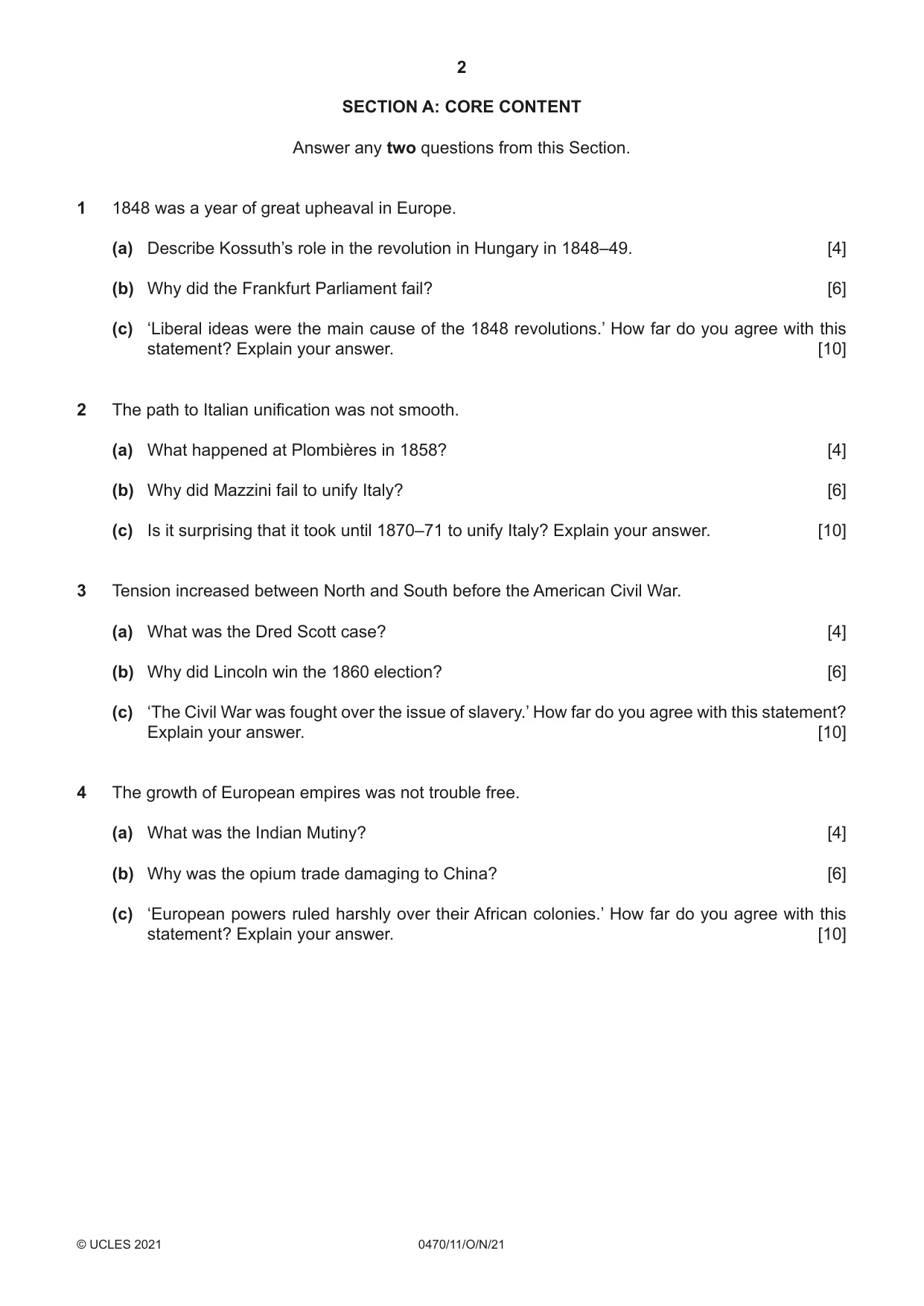
2 0470/11/O/N/21 © UCLES 2021 SECTION A: CORE CONTENT Answer any two questions from this Section. 1 1848 was a year of great upheaval in Europe. (a) Describe Kossuth’s role in the revolution in Hungary in 1848–49. [4] (b) Why did the Frankfurt Parliament fail? [6] (c) ‘Liberal ideas were the main cause of the 1848 revolutions.’ How far do you agree with this statement? Explain your answer. [10] 2 The path to Italian unification was not smooth. (a) What happened at Plombières in 1858? [4] (b) Why did Mazzini fail to unify Italy? [6] (c) Is it surprising that it took until 1870–71 to unify Italy? Explain your answer. [10] 3 Tension increased between North and South before the American Civil War. (a) What was the Dred Scott case? [4] (b) Why did Lincoln win the 1860 election? [6] (c) ‘The Civil War was fought over the issue of slavery.’ How far do you agree with this statement? Explain your answer. [10] 4 The growth of European empires was not trouble free. (a) What was the Indian Mutiny? [4] (b) Why was the opium trade damaging to China? [6] (c) ‘European powers ruled harshly over their African colonies.’ How far do you agree with this statement? Explain your answer. [10]
Question paper, page 3
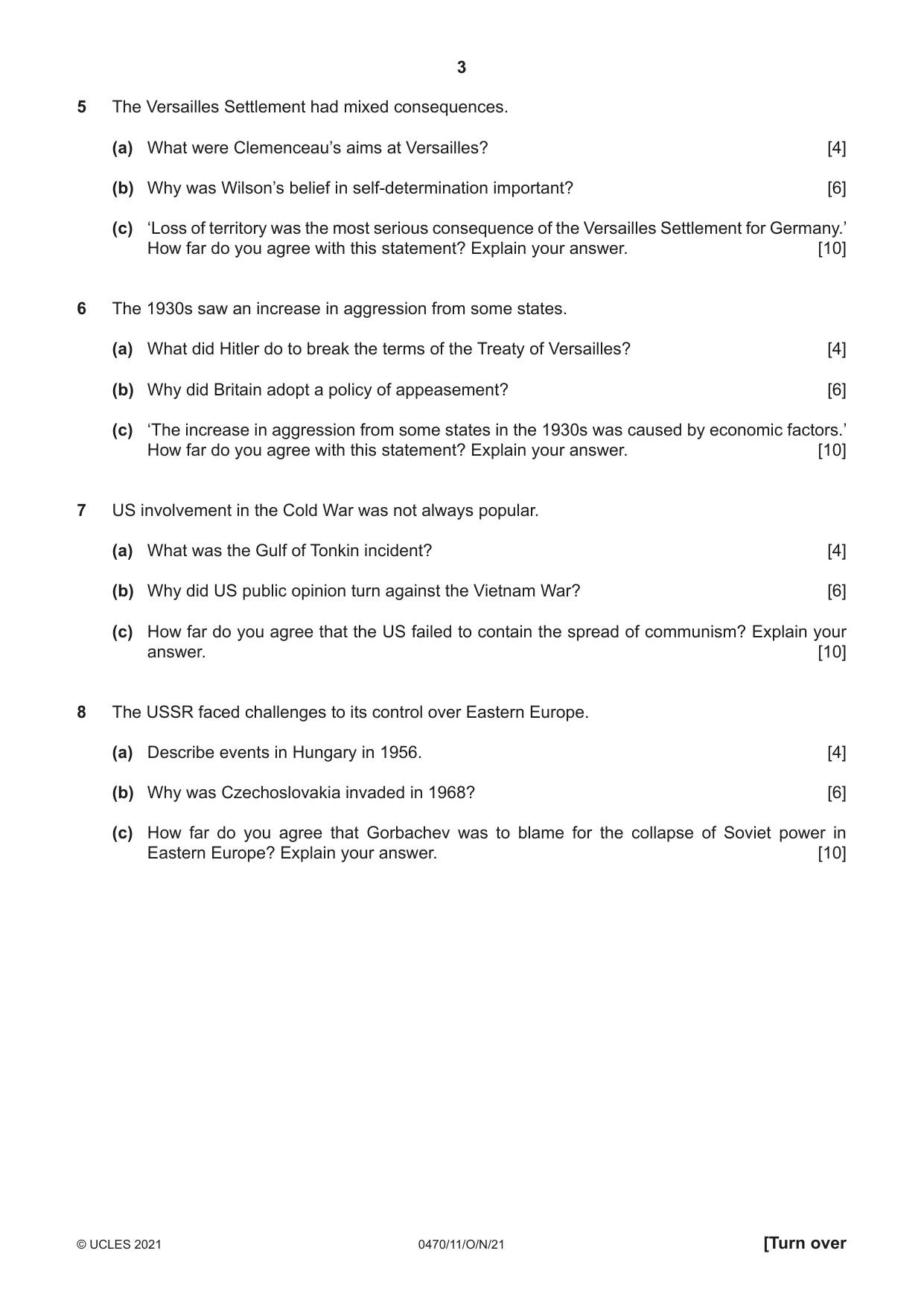
3 0470/11/O/N/21 © UCLES 2021 [Turn over 5 The Versailles Settlement had mixed consequences. (a) What were Clemenceau’s aims at Versailles? [4] (b) Why was Wilson’s belief in self-determination important? [6] (c) ‘Loss of territory was the most serious consequence of the Versailles Settlement for Germany.’ How far do you agree with this statement? Explain your answer. [10] 6 The 1930s saw an increase in aggression from some states. (a) What did Hitler do to break the terms of the Treaty of Versailles? [4] (b) Why did Britain adopt a policy of appeasement? [6] (c) ‘The increase in aggression from some states in the 1930s was caused by economic factors.’ How far do you agree with this statement? Explain your answer. [10] 7 US involvement in the Cold War was not always popular. (a) What was the Gulf of Tonkin incident? [4] (b) Why did US public opinion turn against the Vietnam War? [6] (c) How far do you agree that the US failed to contain the spread of communism? Explain your answer. [10] 8 The USSR faced challenges to its control over Eastern Europe. (a) Describe events in Hungary in 1956. [4] (b) Why was Czechoslovakia invaded in 1968? [6] (c) How far do you agree that Gorbachev was to blame for the collapse of Soviet power in Eastern Europe? Explain your answer. [10]
Question paper, page 4
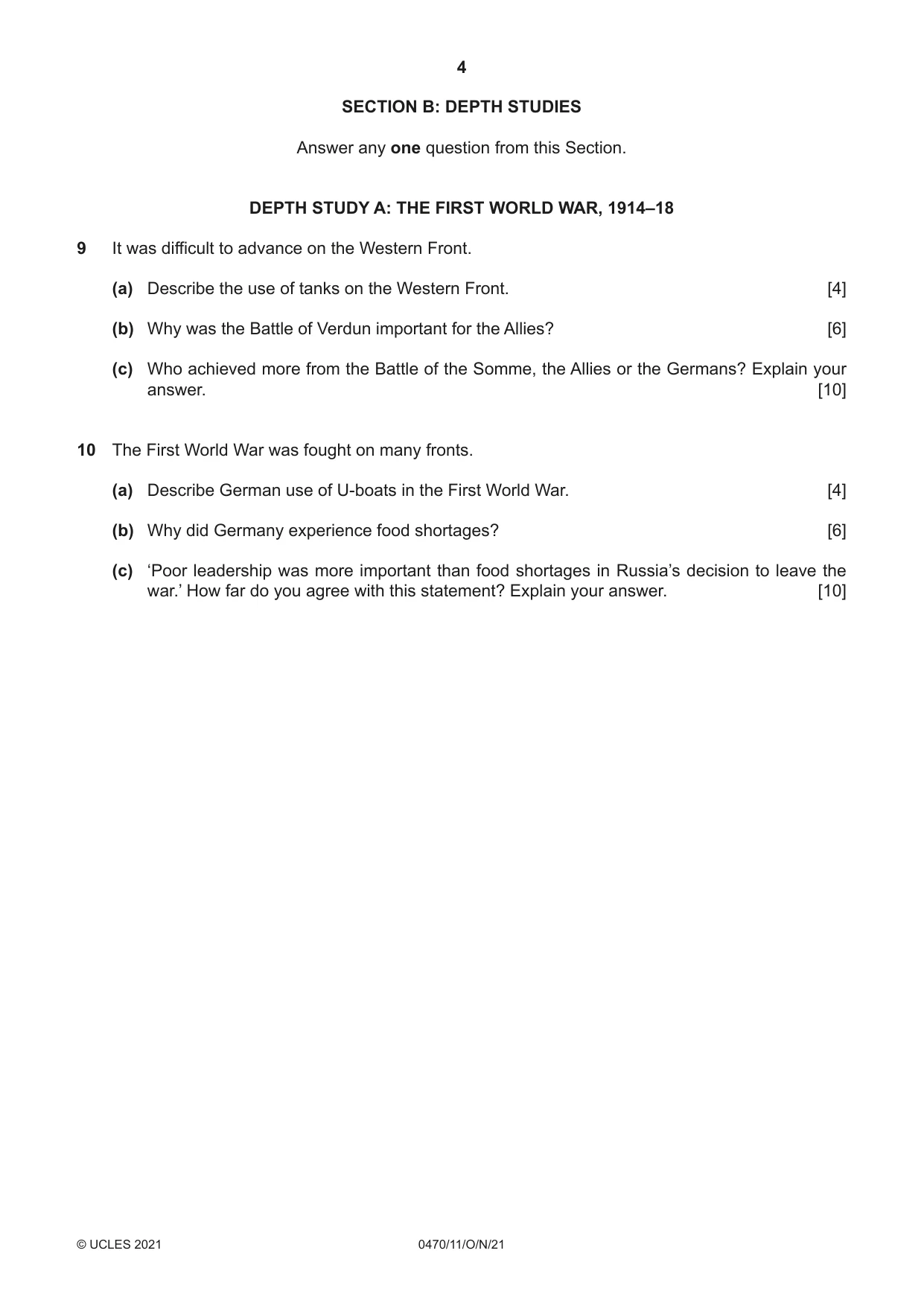
4 0470/11/O/N/21 © UCLES 2021 SECTION B: DEPTH STUDIES Answer any one question from this Section. DEPTH STUDY A: THE FIRST WORLD WAR, 1914–18 9 It was difficult to advance on the Western Front. (a) Describe the use of tanks on the Western Front. [4] (b) Why was the Battle of Verdun important for the Allies? [6] (c) Who achieved more from the Battle of the Somme, the Allies or the Germans? Explain your answer. [10] 10 The First World War was fought on many fronts. (a) Describe German use of U-boats in the First World War. [4] (b) Why did Germany experience food shortages? [6] (c) ‘Poor leadership was more important than food shortages in Russia’s decision to leave the war.’ How far do you agree with this statement? Explain your answer. [10]
Question paper, page 5
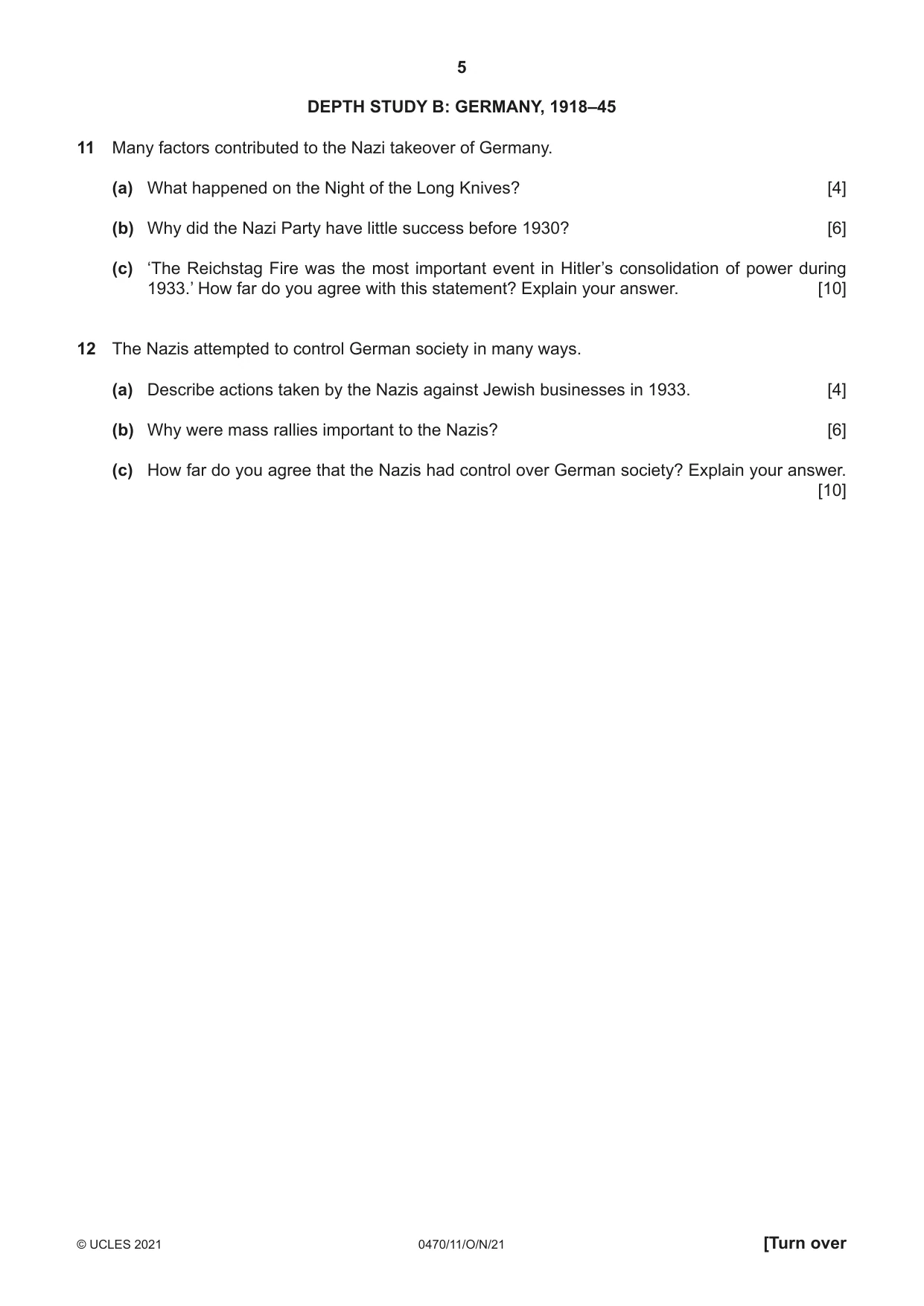
5 0470/11/O/N/21 © UCLES 2021 [Turn over DEPTH STUDY B: GERMANY, 1918–45 11 Many factors contributed to the Nazi takeover of Germany. (a) What happened on the Night of the Long Knives? [4] (b) Why did the Nazi Party have little success before 1930? [6] (c) ‘The Reichstag Fire was the most important event in Hitler’s consolidation of power during 1933.’ How far do you agree with this statement? Explain your answer. [10] 12 The Nazis attempted to control German society in many ways. (a) Describe actions taken by the Nazis against Jewish businesses in 1933. [4] (b) Why were mass rallies important to the Nazis? [6] (c) How far do you agree that the Nazis had control over German society? Explain your answer. [10]
Question paper, page 6
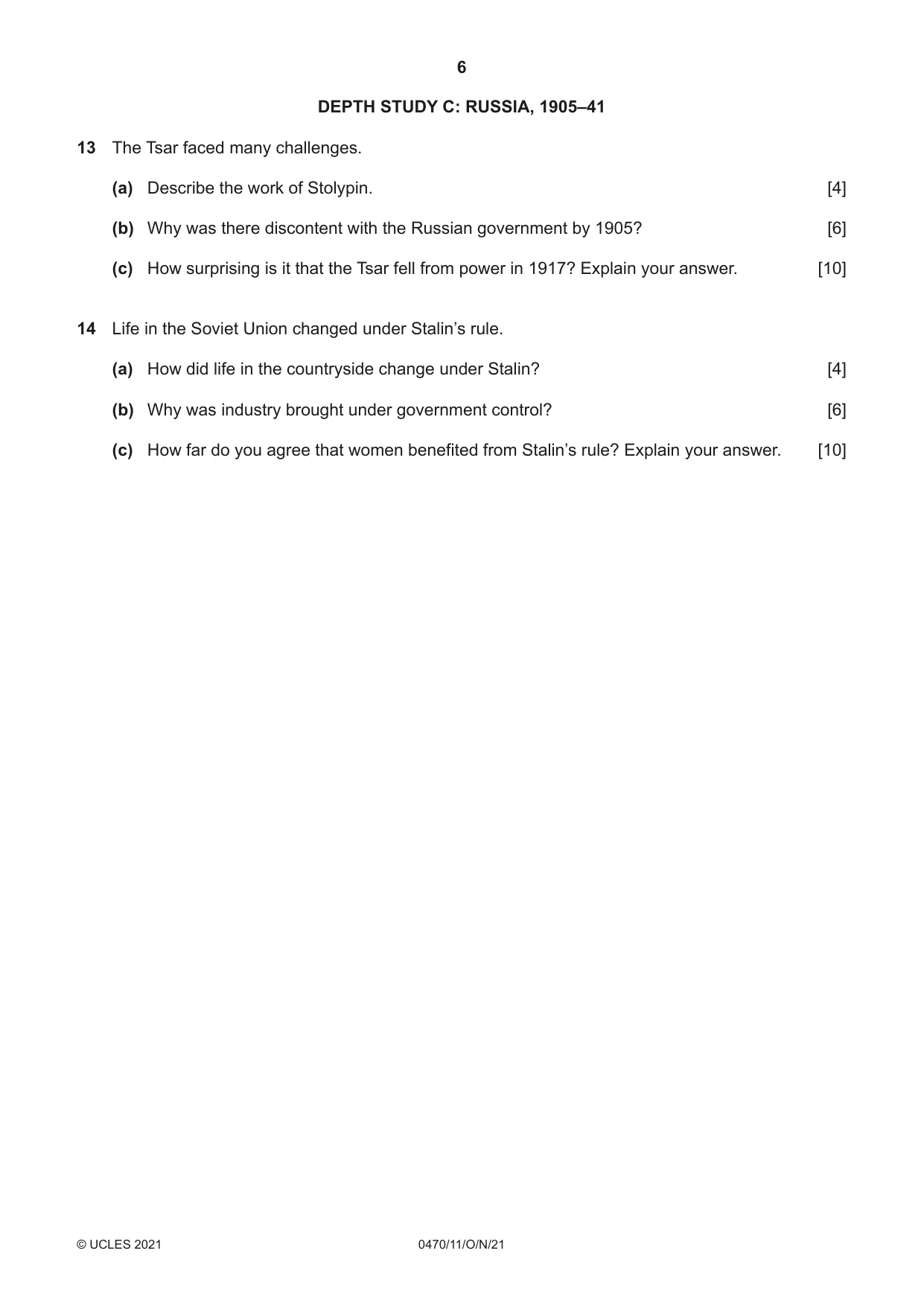
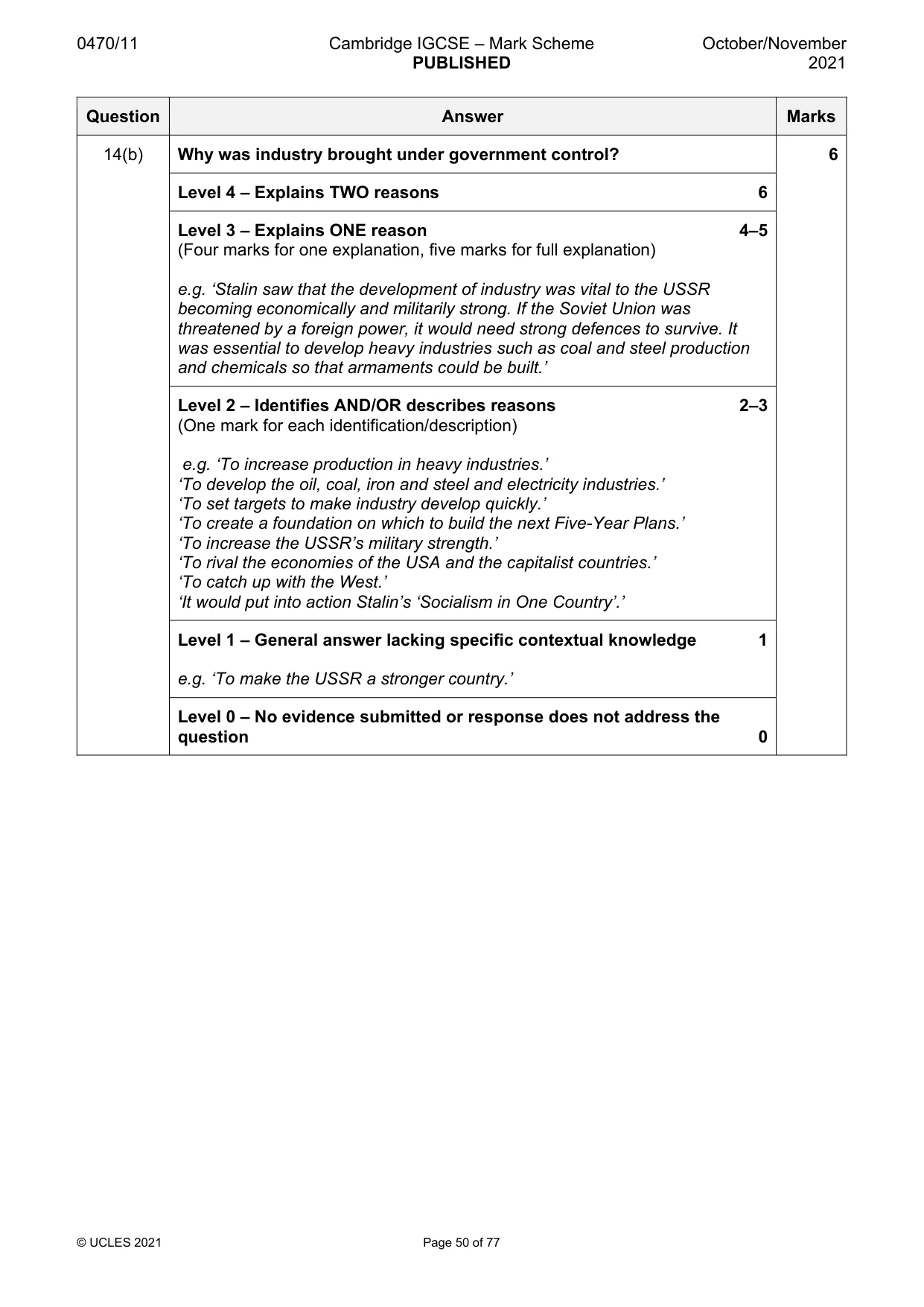
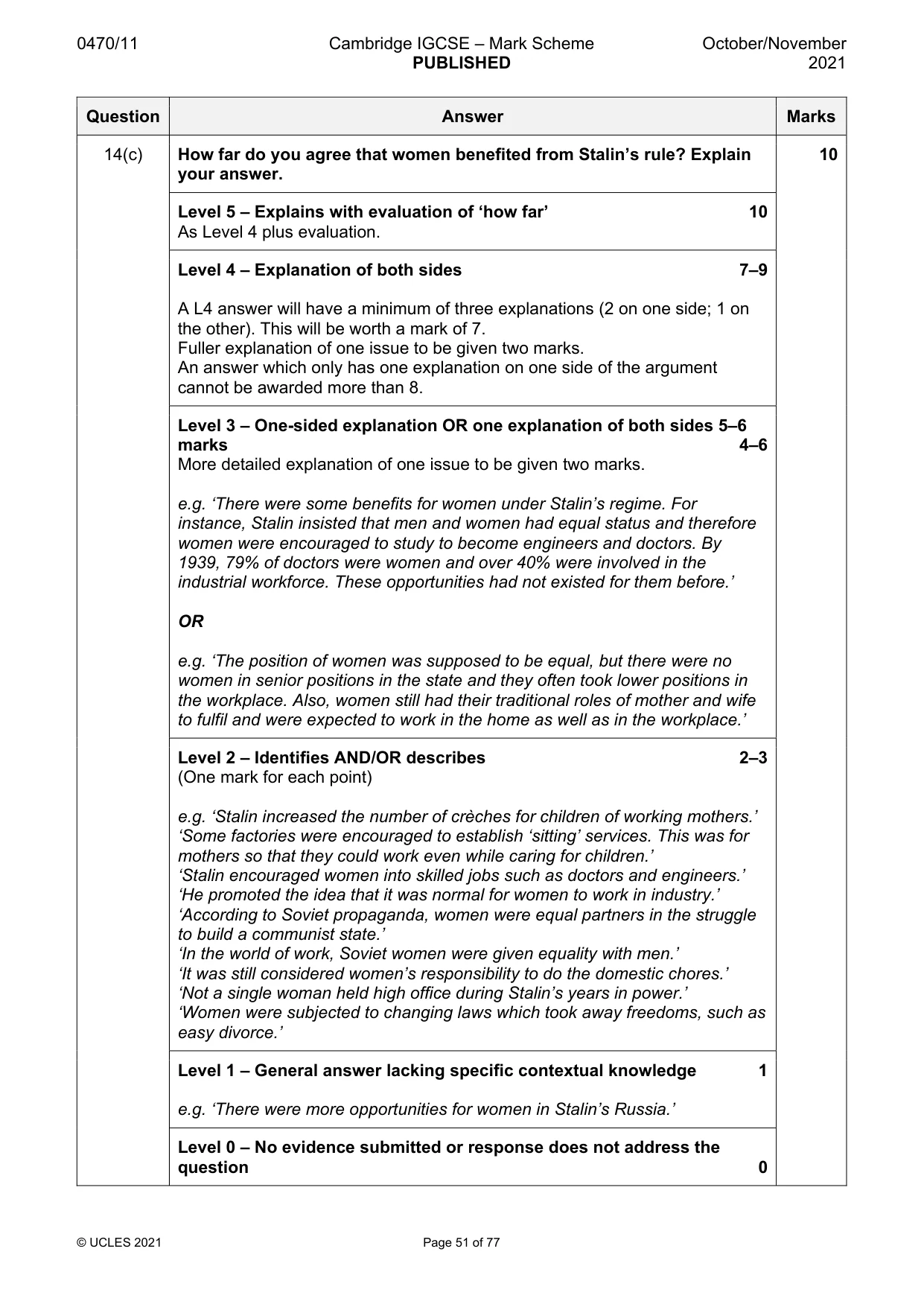
6 0470/11/O/N/21 © UCLES 2021 DEPTH STUDY C: RUSSIA, 1905–41 13 The Tsar faced many challenges. (a) Describe the work of Stolypin. [4] (b) Why was there discontent with the Russian government by 1905? [6] (c) How surprising is it that the Tsar fell from power in 1917? Explain your answer. [10] 14 Life in the Soviet Union changed under Stalin’s rule. (a) How did life in the countryside change under Stalin? [4] (b) Why was industry brought under government control? [6] (c) How far do you agree that women benefited from Stalin’s rule? Explain your answer. [10]
Question paper, page 7
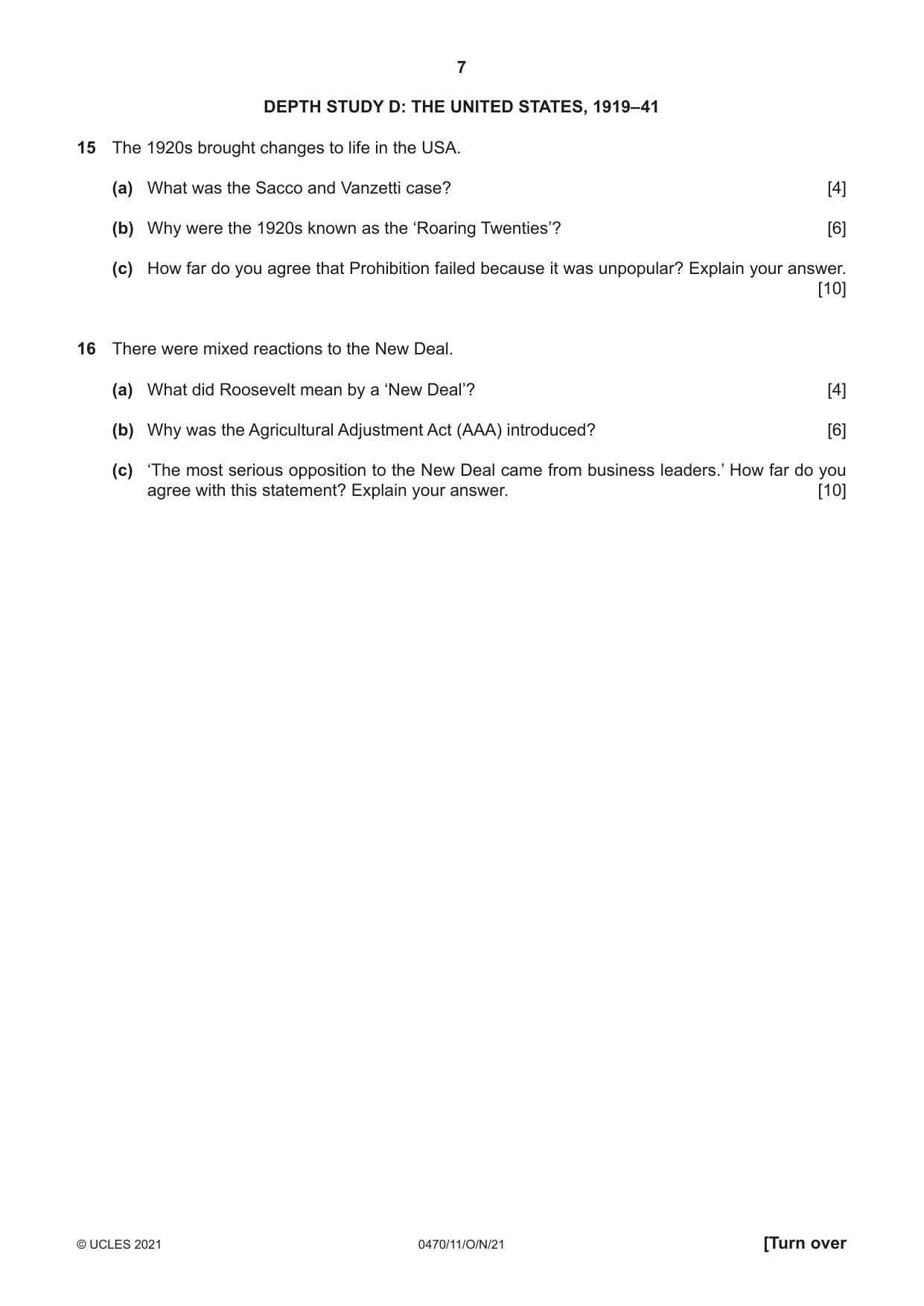
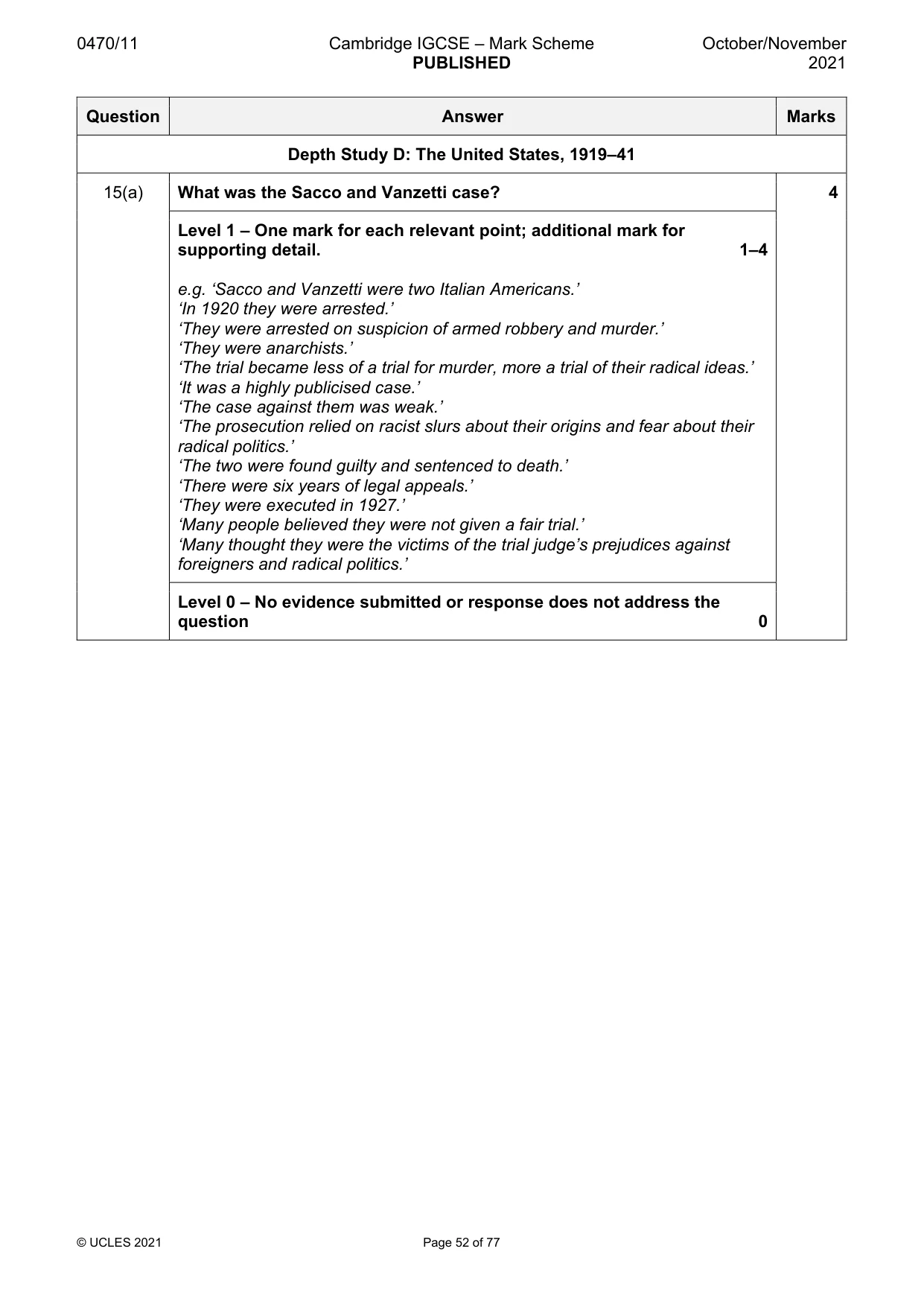
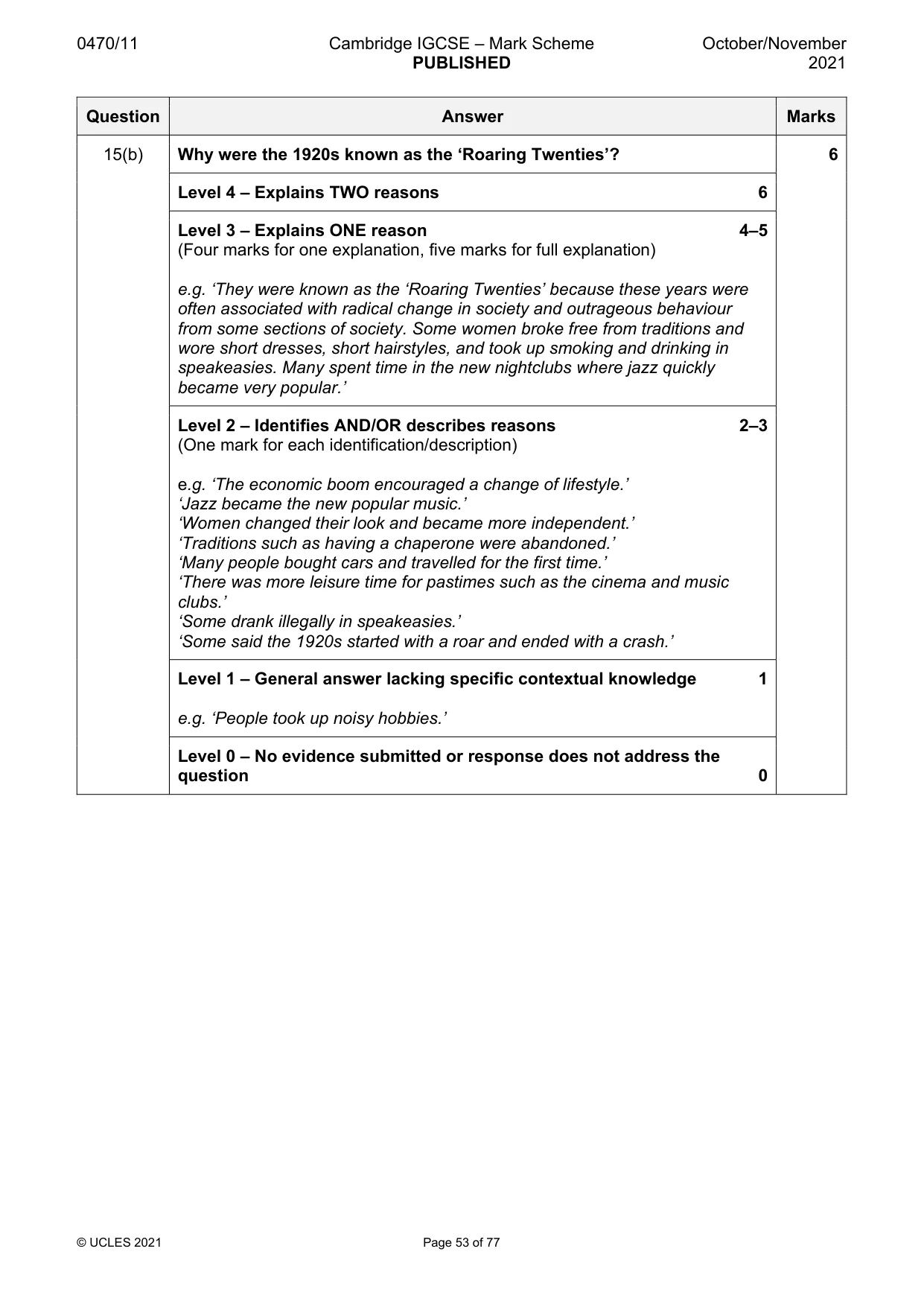
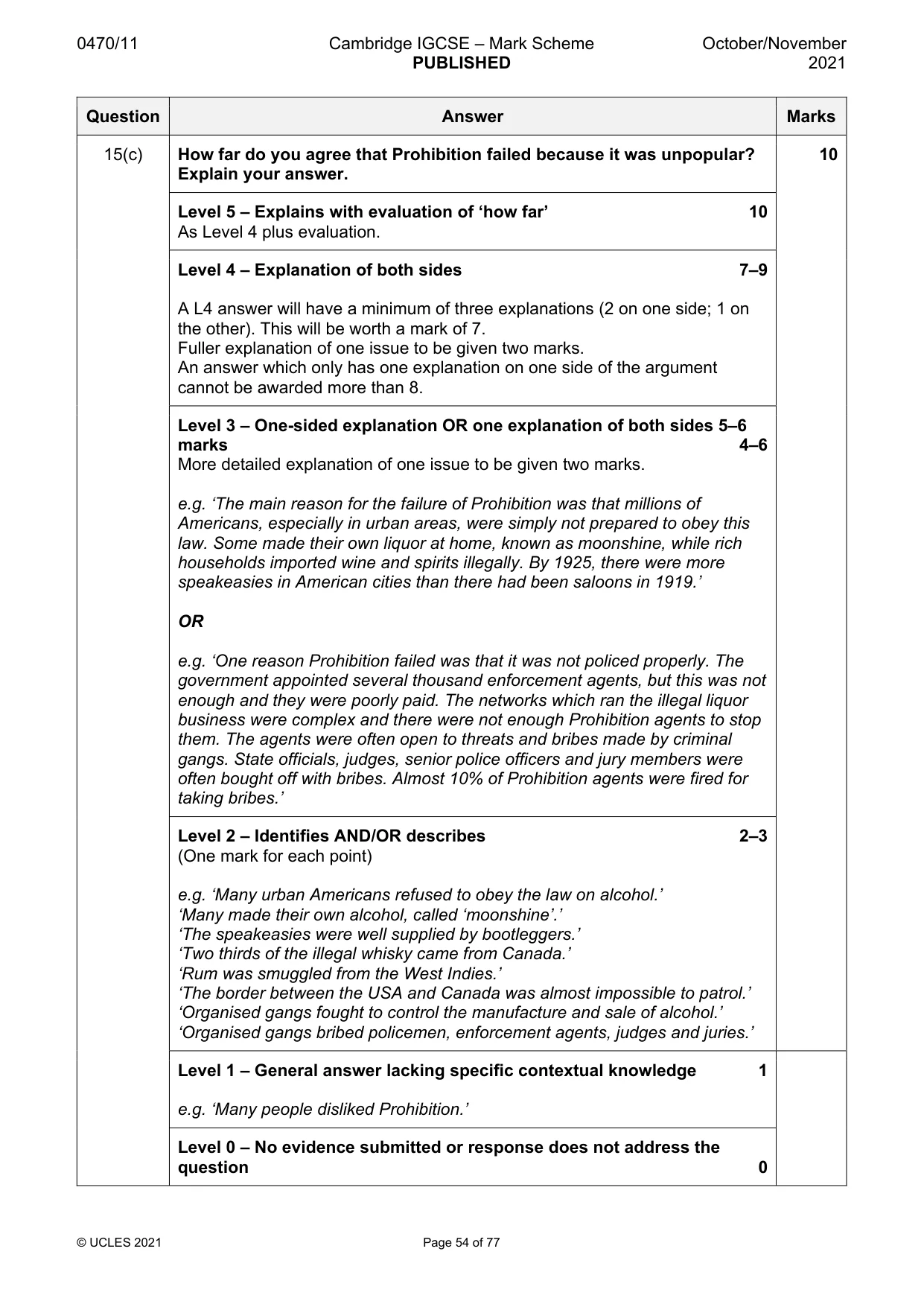
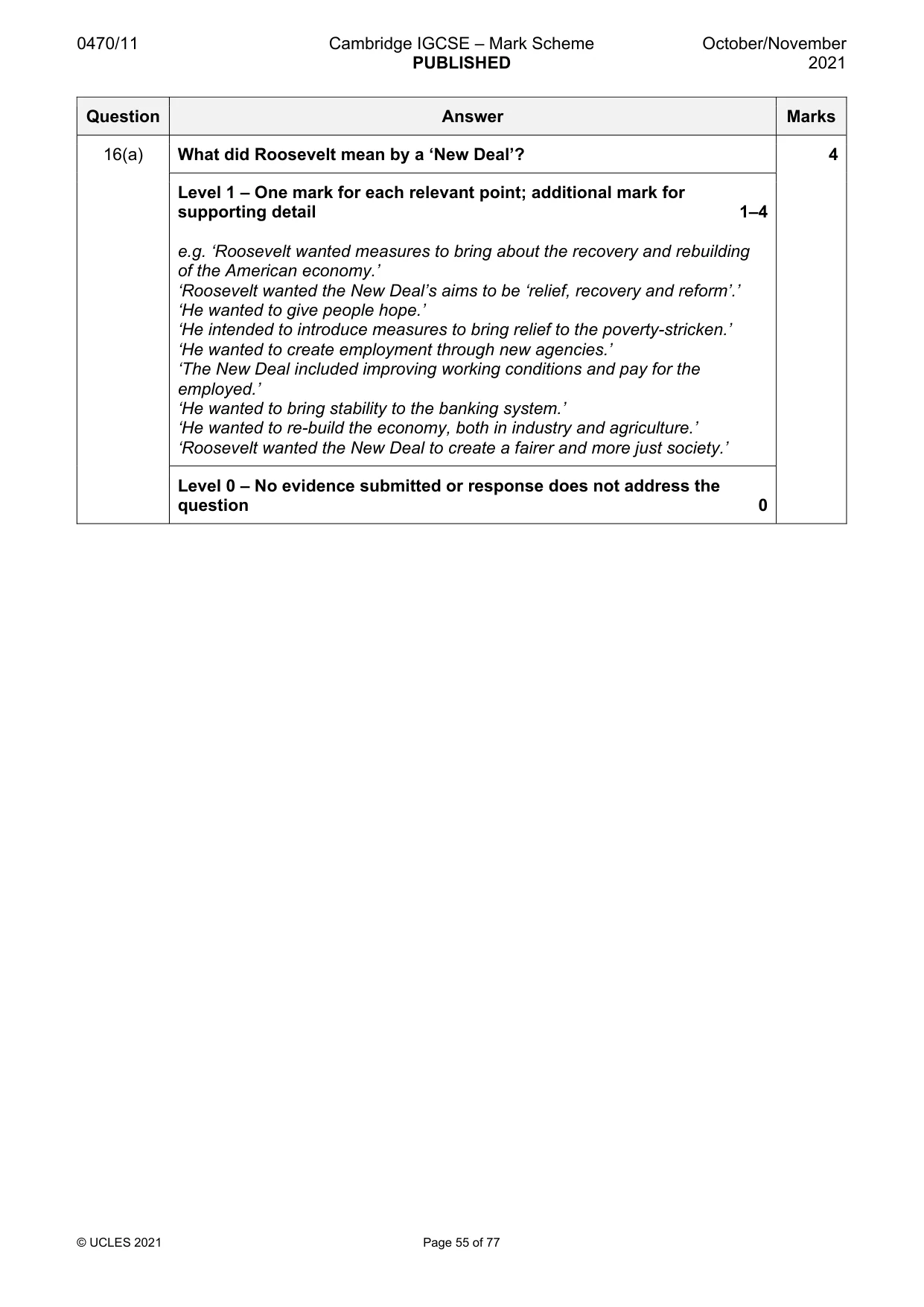
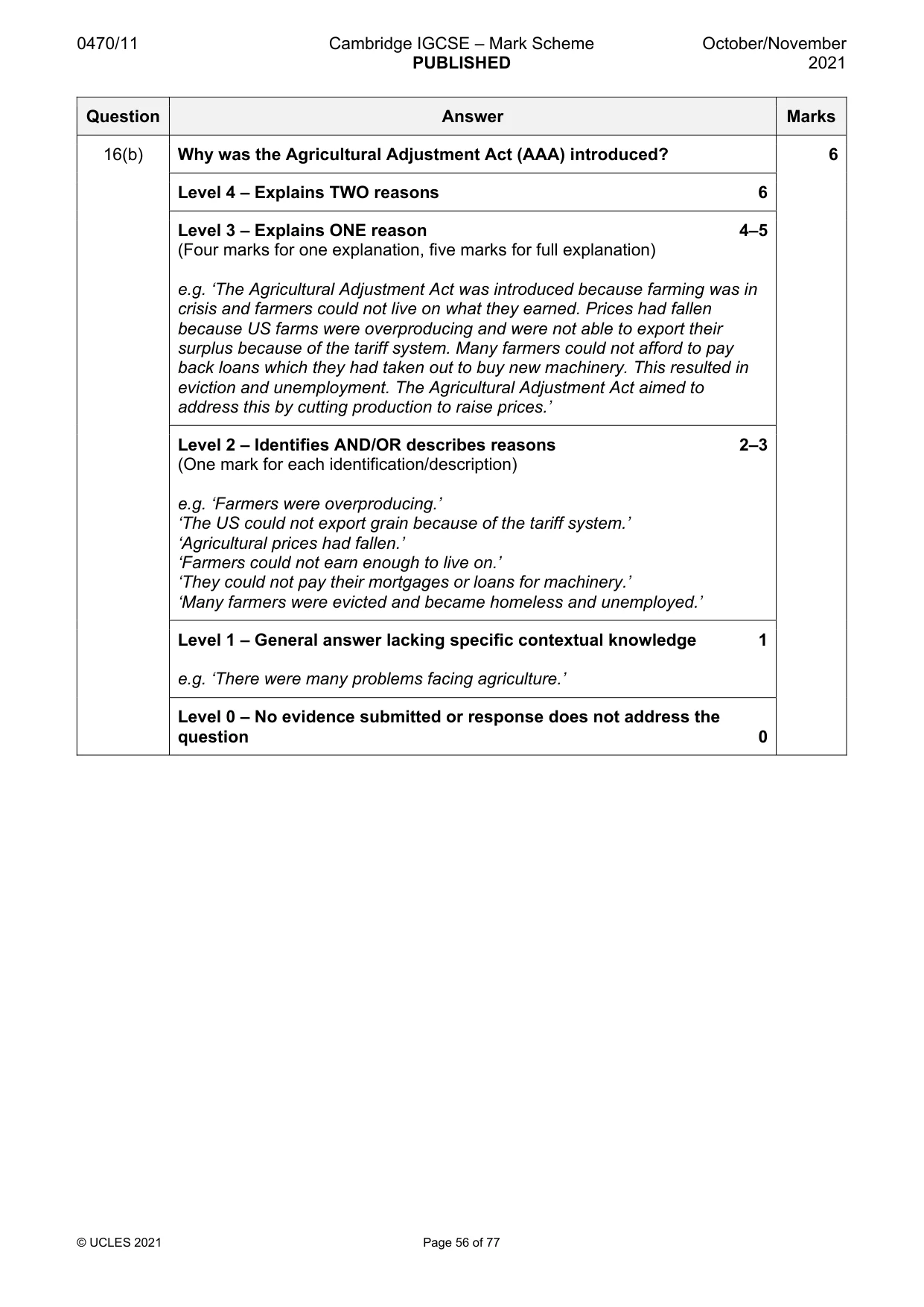
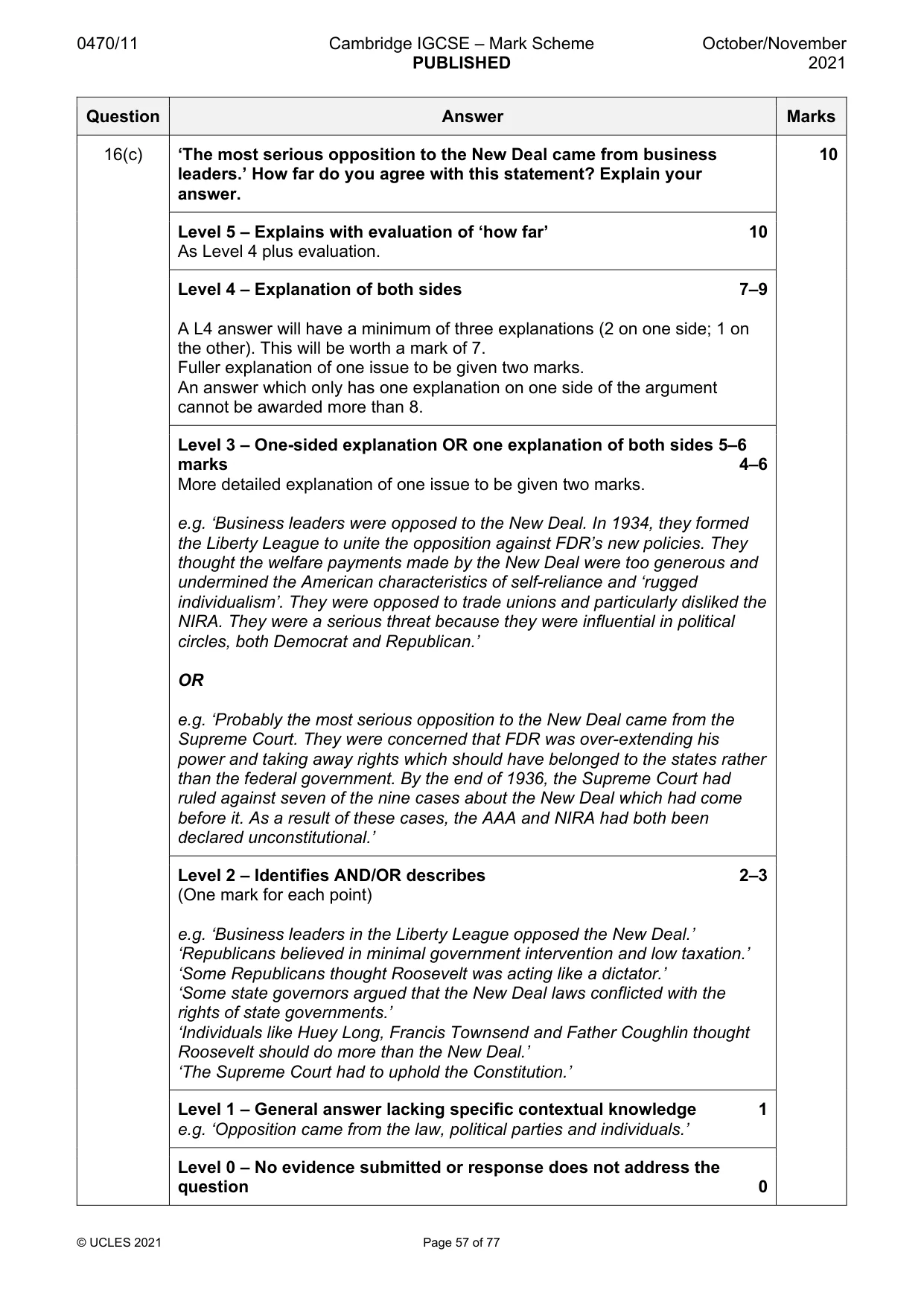
7 0470/11/O/N/21 © UCLES 2021 [Turn over DEPTH STUDY D: THE UNITED STATES, 1919–41 15 The 1920s brought changes to life in the USA. (a) What was the Sacco and Vanzetti case? [4] (b) Why were the 1920s known as the ‘Roaring Twenties’? [6] (c) How far do you agree that Prohibition failed because it was unpopular? Explain your answer. [10] 16 There were mixed reactions to the New Deal. (a) What did Roosevelt mean by a ‘New Deal’? [4] (b) Why was the Agricultural Adjustment Act (AAA) introduced? [6] (c) ‘The most serious opposition to the New Deal came from business leaders.’ How far do you agree with this statement? Explain your answer. [10]
Question paper, page 8
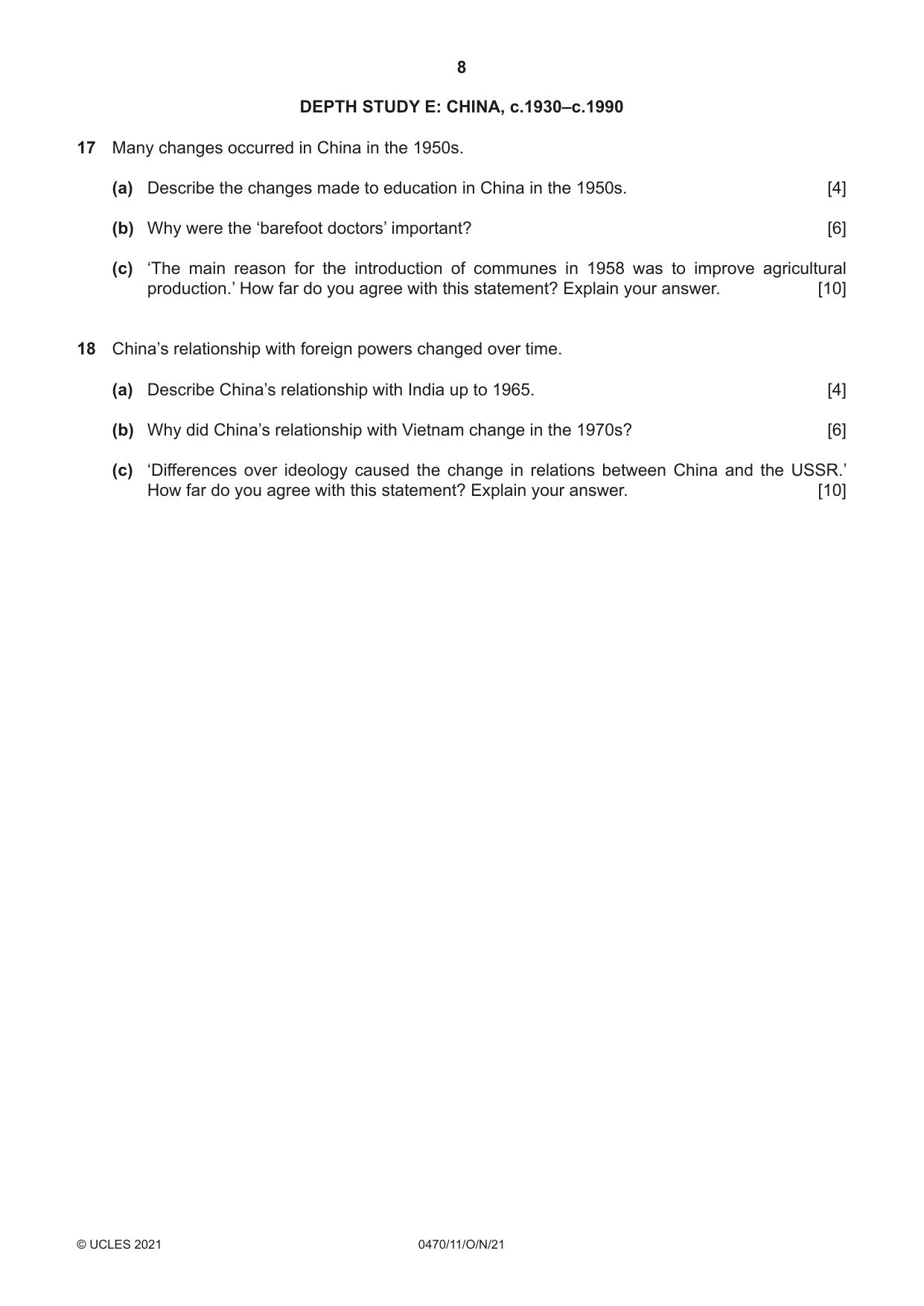
8 0470/11/O/N/21 © UCLES 2021 DEPTH STUDY E: CHINA, c.1930–c.1990 17 Many changes occurred in China in the 1950s. (a) Describe the changes made to education in China in the 1950s. [4] (b) Why were the ‘barefoot doctors’ important? [6] (c) ‘The main reason for the introduction of communes in 1958 was to improve agricultural production.’ How far do you agree with this statement? Explain your answer. [10] 18 China’s relationship with foreign powers changed over time. (a) Describe China’s relationship with India up to 1965. [4] (b) Why did China’s relationship with Vietnam change in the 1970s? [6] (c) ‘Differences over ideology caused the change in relations between China and the USSR.’ How far do you agree with this statement? Explain your answer. [10]
Question paper, page 9
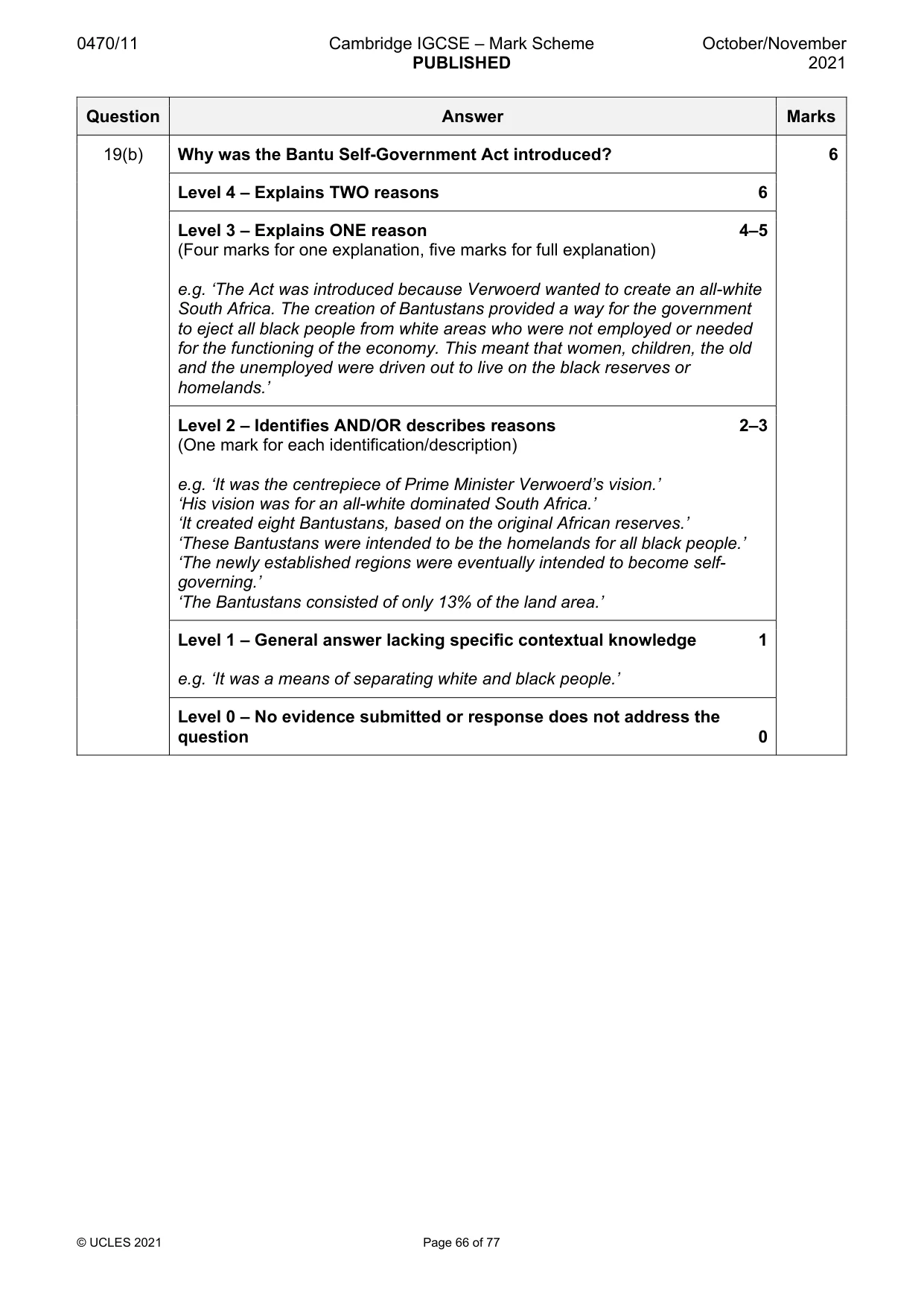
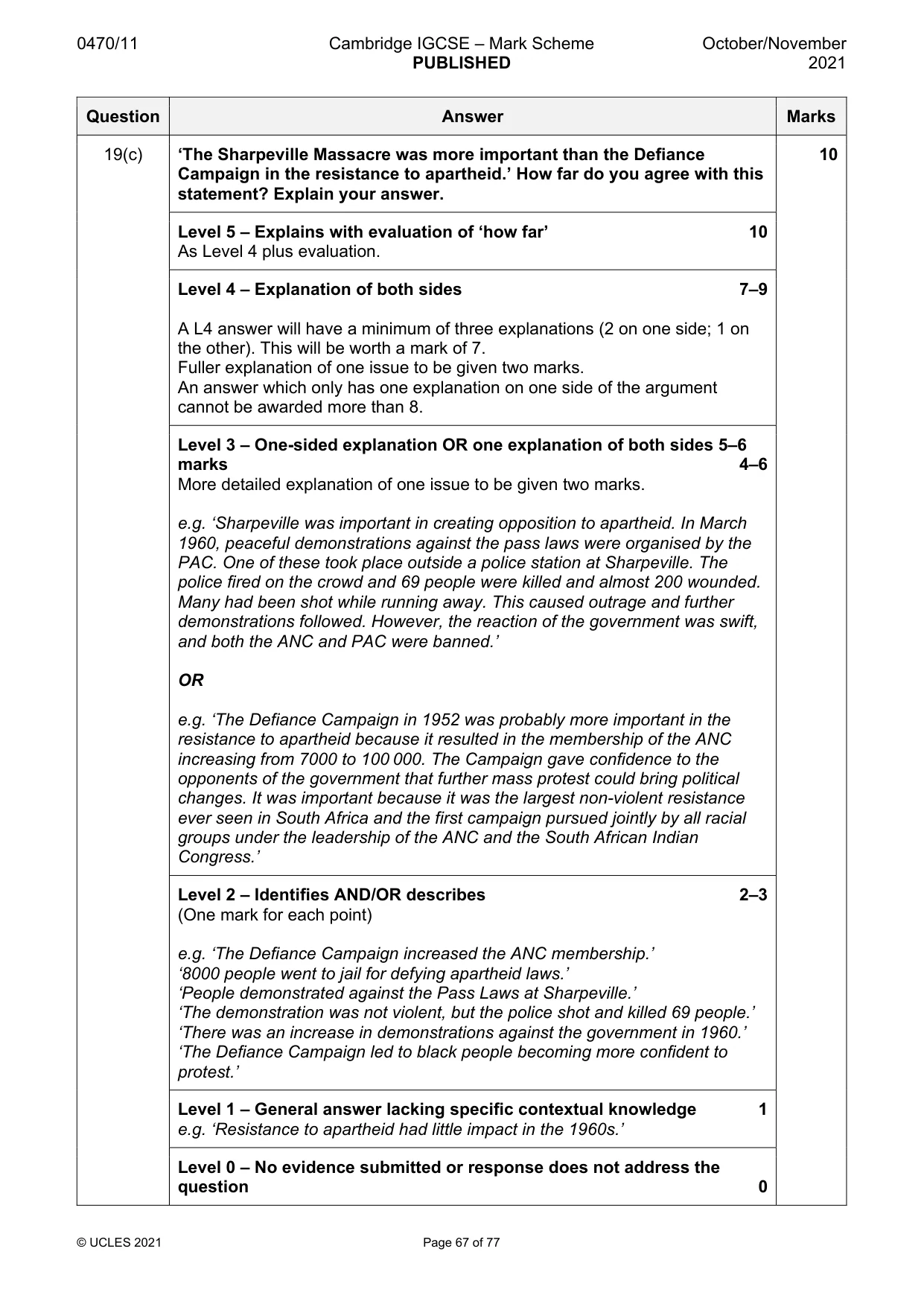
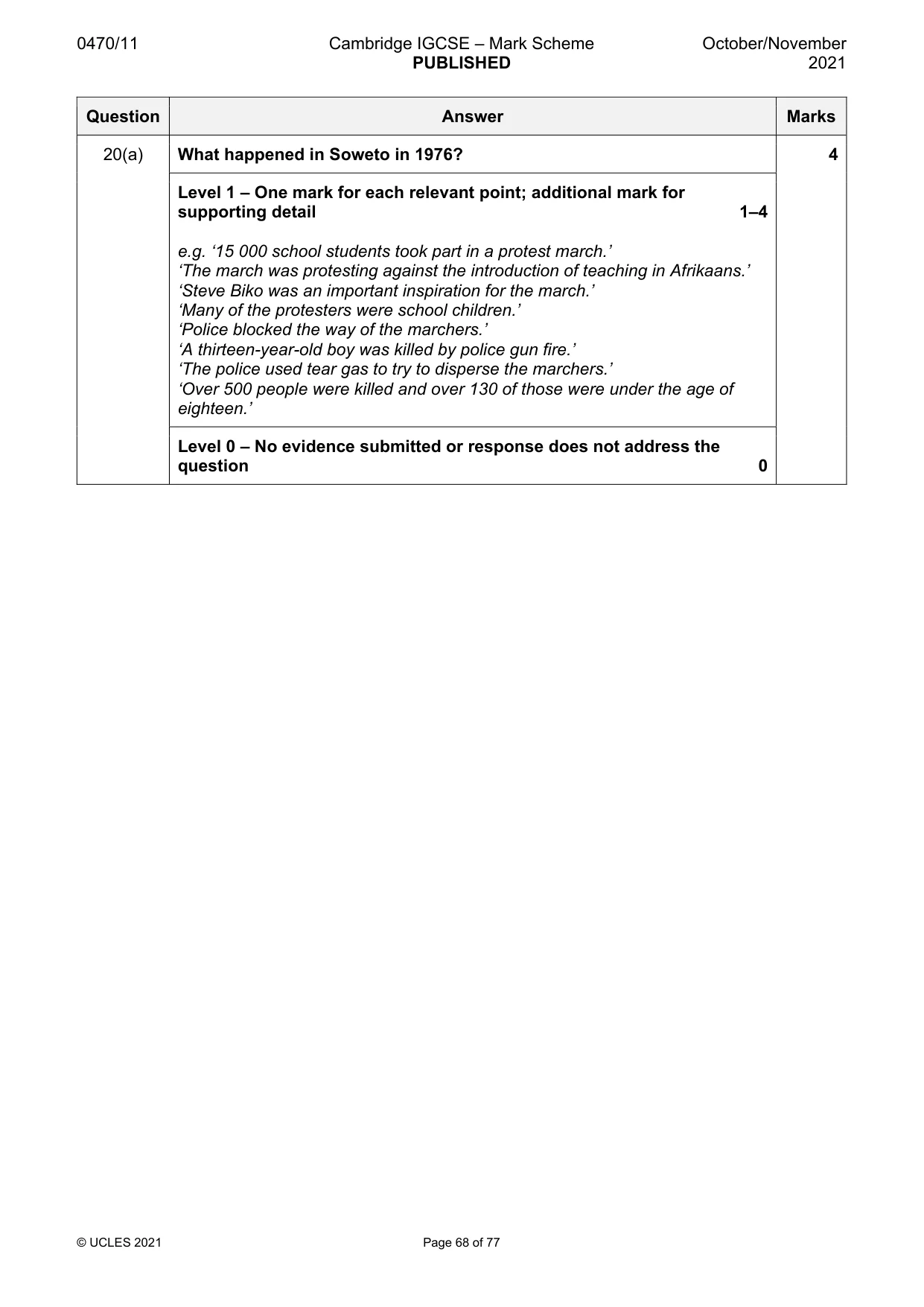
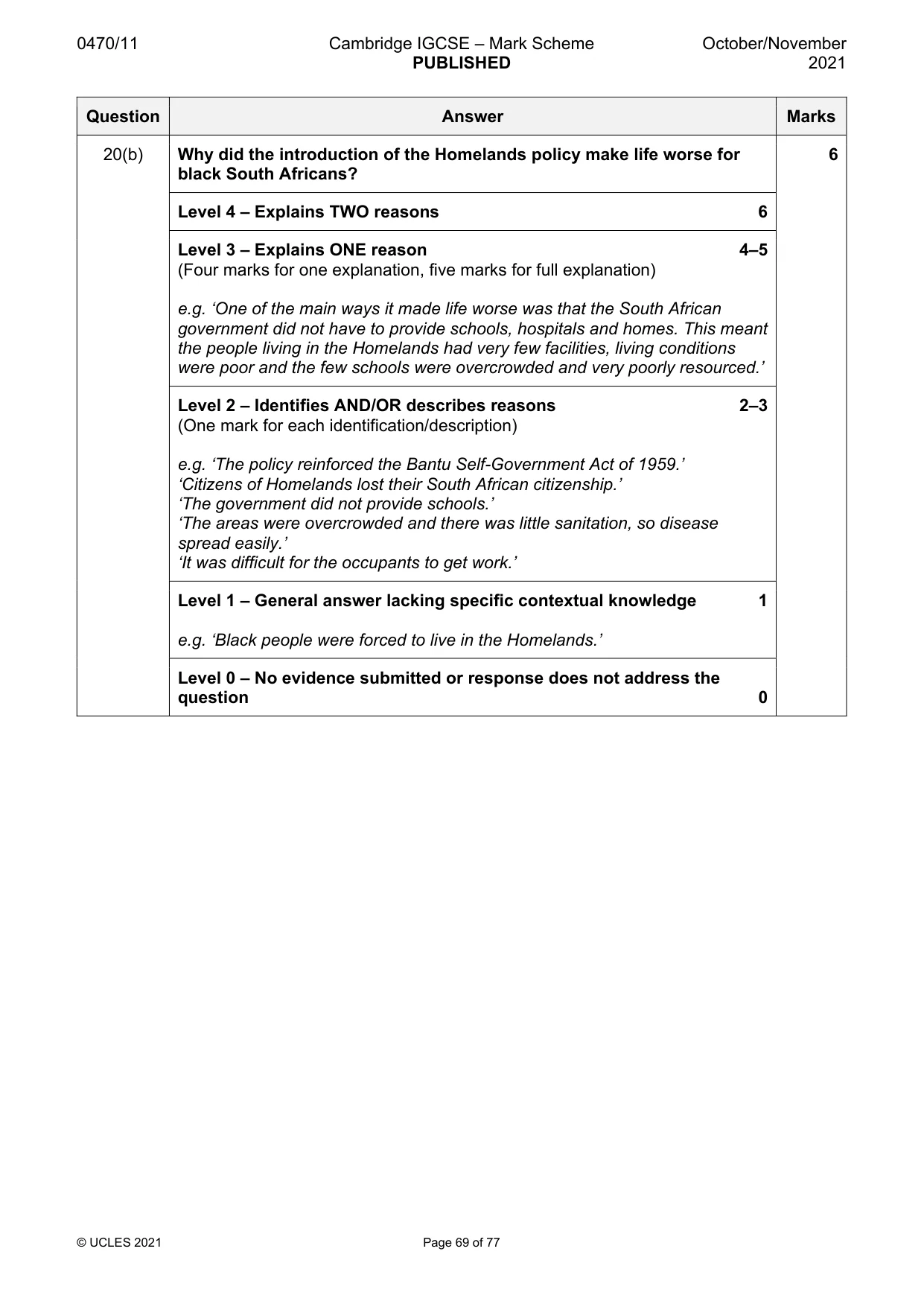
9 0470/11/O/N/21 © UCLES 2021 [Turn over DEPTH STUDY F: SOUTH AFRICA, c.1940–c.1994 19 Apartheid was established during the 1950s and 1960s. (a) What was the Group Areas Act of 1950? [4] (b) Why was the Bantu Self-Government Act introduced? [6] (c) ‘The Sharpeville Massacre was more important than the Defiance Campaign in the resistance to apartheid.’ How far do you agree with this statement? Explain your answer. [10] 20 The South African government introduced radical measures to maintain apartheid. (a) What happened in Soweto in 1976? [4] (b) Why did the introduction of the Homelands policy make life worse for black South Africans? [6] (c) ‘Increased security measures were more important than government censorship in maintaining apartheid.’ How far do you agree with this statement? Explain your answer. [10]
Question paper, page 10
10 0470/11/O/N/21 © UCLES 2021 DEPTH STUDY G: ISRAELIS AND PALESTINIANS SINCE 1945 21 After 1945 there was a struggle over the future of Palestine. (a) What were the aims of the Zionists after 1945? [4] (b) Why did Israel win the 1948–49 war? [6] (c) ‘US pressure was the main reason for the change in British policy towards Palestine.’ How far do you agree with this statement? Explain your answer. [10] 22 Bringing peace to the Middle East has proved challenging. (a) Describe the differences in views between Labor and Likud towards the peace process. [4] (b) Why did the Palestinian conflict become more intense after 1988? [6] (c) How successful has the UN been in its efforts to deal with the Palestinian issue? Explain your answer. [10]
Question paper, page 11
11 0470/11/O/N/21 © UCLES 2021 BLANK PAGE
Question paper, page 12
12 0470/11/O/N/21 © UCLES 2021 Permission to reproduce items where third-party owned material protected by copyright is included has been sought and cleared where possible. Every reasonable effort has been made by the publisher (UCLES) to trace copyright holders, but if any items requiring clearance have unwittingly been included, the publisher will be pleased to make amends at the earliest possible opportunity. To avoid the issue of disclosure of answer-related information to candidates, all copyright acknowledgements are reproduced online in the Cambridge Assessment International Education Copyright Acknowledgements Booklet. This is produced for each series of examinations and is freely available to download at www.cambridgeinternational.org after the live examination series. Cambridge Assessment International Education is part of the Cambridge Assessment Group. Cambridge Assessment is the brand name of the University of Cambridge Local Examinations Syndicate (UCLES), which itself is a department of the University of Cambridge. BLANK PAGE
Mark scheme, page 1
This document consists of 77 printed pages. © UCLES 2021 [Turn over Cambridge IGCSE™ HISTORY 0470/11 Paper 1 October/November 2021 MARK SCHEME Maximum Mark: 60 Published This mark scheme is published as an aid to teachers and candidates, to indicate the requirements of the examination. It shows the basis on which Examiners were instructed to award marks. It does not indicate the details of the discussions that took place at an Examiners’ meeting before marking began, which would have considered the acceptability of alternative answers. Mark schemes should be read in conjunction with the question paper and the Principal Examiner Report for Teachers. Cambridge International will not enter into discussions about these mark schemes. Cambridge International is publishing the mark schemes for the October/November 2021 series for most Cambridge IGCSE™, Cambridge International A and AS Level components and some Cambridge O Level components.
Mark scheme, page 2
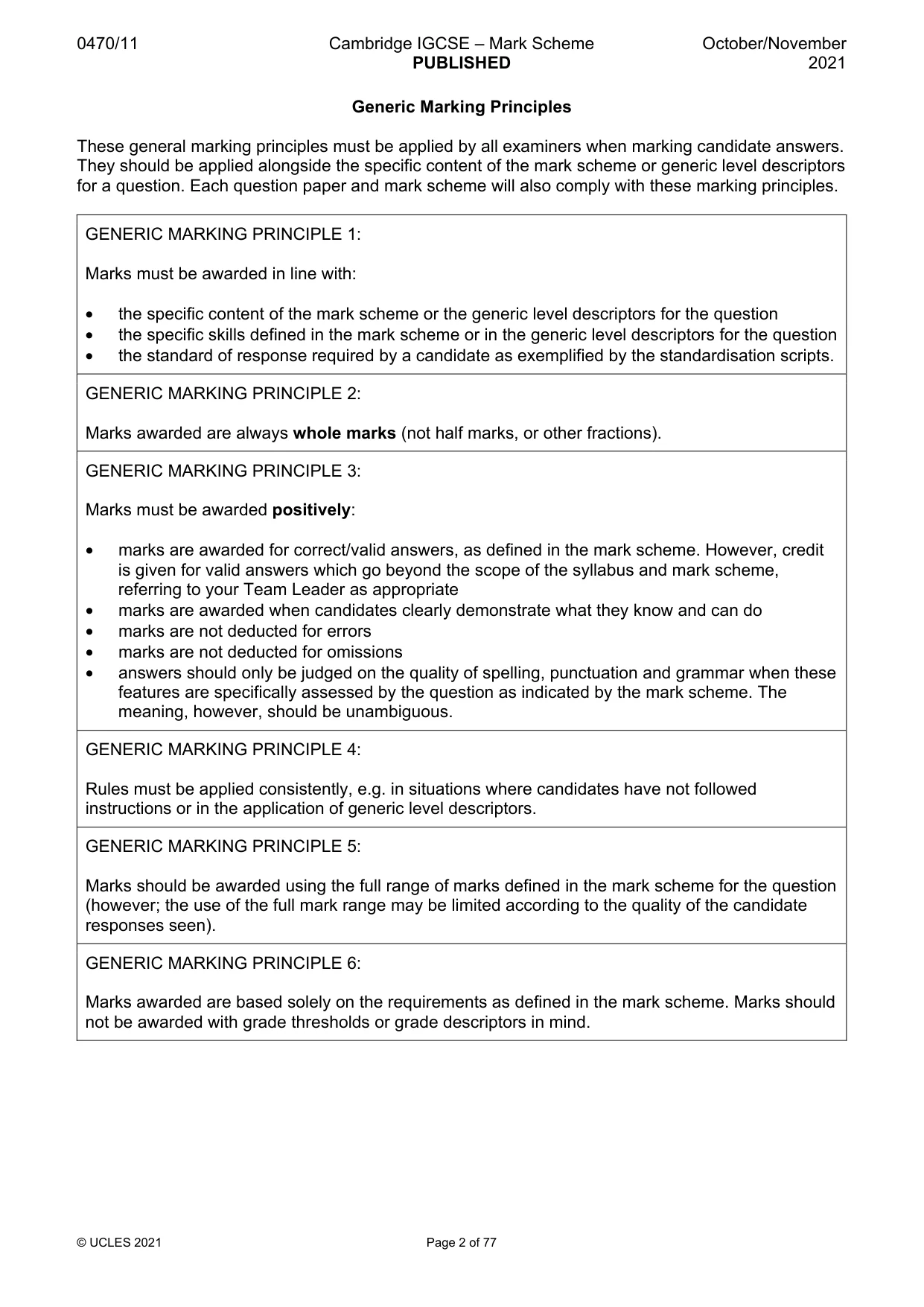
0470/11 Cambridge IGCSE – Mark Scheme PUBLISHED October/November 2021 © UCLES 2021 Page 2 of 77 Generic Marking Principles These general marking principles must be applied by all examiners when marking candidate answers. They should be applied alongside the specific content of the mark scheme or generic level descriptors for a question. Each question paper and mark scheme will also comply with these marking principles. GENERIC MARKING PRINCIPLE 1: Marks must be awarded in line with: • the specific content of the mark scheme or the generic level descriptors for the question • the specific skills defined in the mark scheme or in the generic level descriptors for the question • the standard of response required by a candidate as exemplified by the standardisation scripts. GENERIC MARKING PRINCIPLE 2: Marks awarded are always whole marks (not half marks, or other fractions). GENERIC MARKING PRINCIPLE 3: Marks must be awarded positively: • marks are awarded for correct/valid answers, as defined in the mark scheme. However, credit is given for valid answers which go beyond the scope of the syllabus and mark scheme, referring to your Team Leader as appropriate • marks are awarded when candidates clearly demonstrate what they know and can do • marks are not deducted for errors • marks are not deducted for omissions • answers should only be judged on the quality of spelling, punctuation and grammar when these features are specifically assessed by the question as indicated by the mark scheme. The meaning, however, should be unambiguous. GENERIC MARKING PRINCIPLE 4: Rules must be applied consistently, e.g. in situations where candidates have not followed instructions or in the application of generic level descriptors. GENERIC MARKING PRINCIPLE 5: Marks should be awarded using the full range of marks defined in the mark scheme for the question (however; the use of the full mark range may be limited according to the quality of the candidate responses seen). GENERIC MARKING PRINCIPLE 6: Marks awarded are based solely on the requirements as defined in the mark scheme. Marks should not be awarded with grade thresholds or grade descriptors in mind.
Mark scheme, page 3
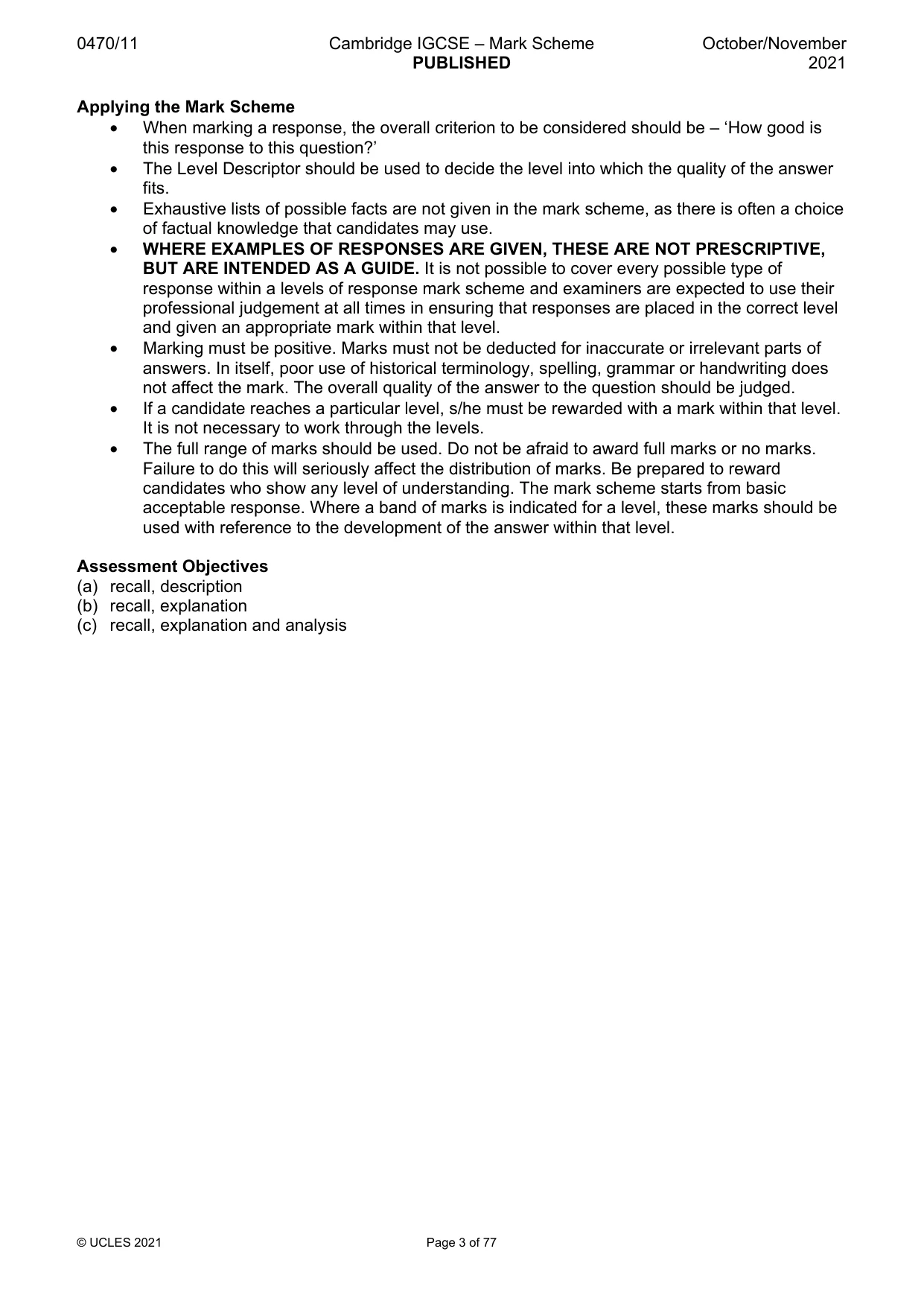
0470/11 Cambridge IGCSE – Mark Scheme PUBLISHED October/November 2021 © UCLES 2021 Page 3 of 77 Applying the Mark Scheme • When marking a response, the overall criterion to be considered should be – ‘How good is this response to this question?’ • The Level Descriptor should be used to decide the level into which the quality of the answer fits. • Exhaustive lists of possible facts are not given in the mark scheme, as there is often a choice of factual knowledge that candidates may use. • WHERE EXAMPLES OF RESPONSES ARE GIVEN, THESE ARE NOT PRESCRIPTIVE, BUT ARE INTENDED AS A GUIDE. It is not possible to cover every possible type of response within a levels of response mark scheme and examiners are expected to use their professional judgement at all times in ensuring that responses are placed in the correct level and given an appropriate mark within that level. • Marking must be positive. Marks must not be deducted for inaccurate or irrelevant parts of answers. In itself, poor use of historical terminology, spelling, grammar or handwriting does not affect the mark. The overall quality of the answer to the question should be judged. • If a candidate reaches a particular level, s/he must be rewarded with a mark within that level. It is not necessary to work through the levels. • The full range of marks should be used. Do not be afraid to award full marks or no marks. Failure to do this will seriously affect the distribution of marks. Be prepared to reward candidates who show any level of understanding. The mark scheme starts from basic acceptable response. Where a band of marks is indicated for a level, these marks should be used with reference to the development of the answer within that level. Assessment Objectives (a) recall, description (b) recall, explanation (c) recall, explanation and analysis
Mark scheme, page 4
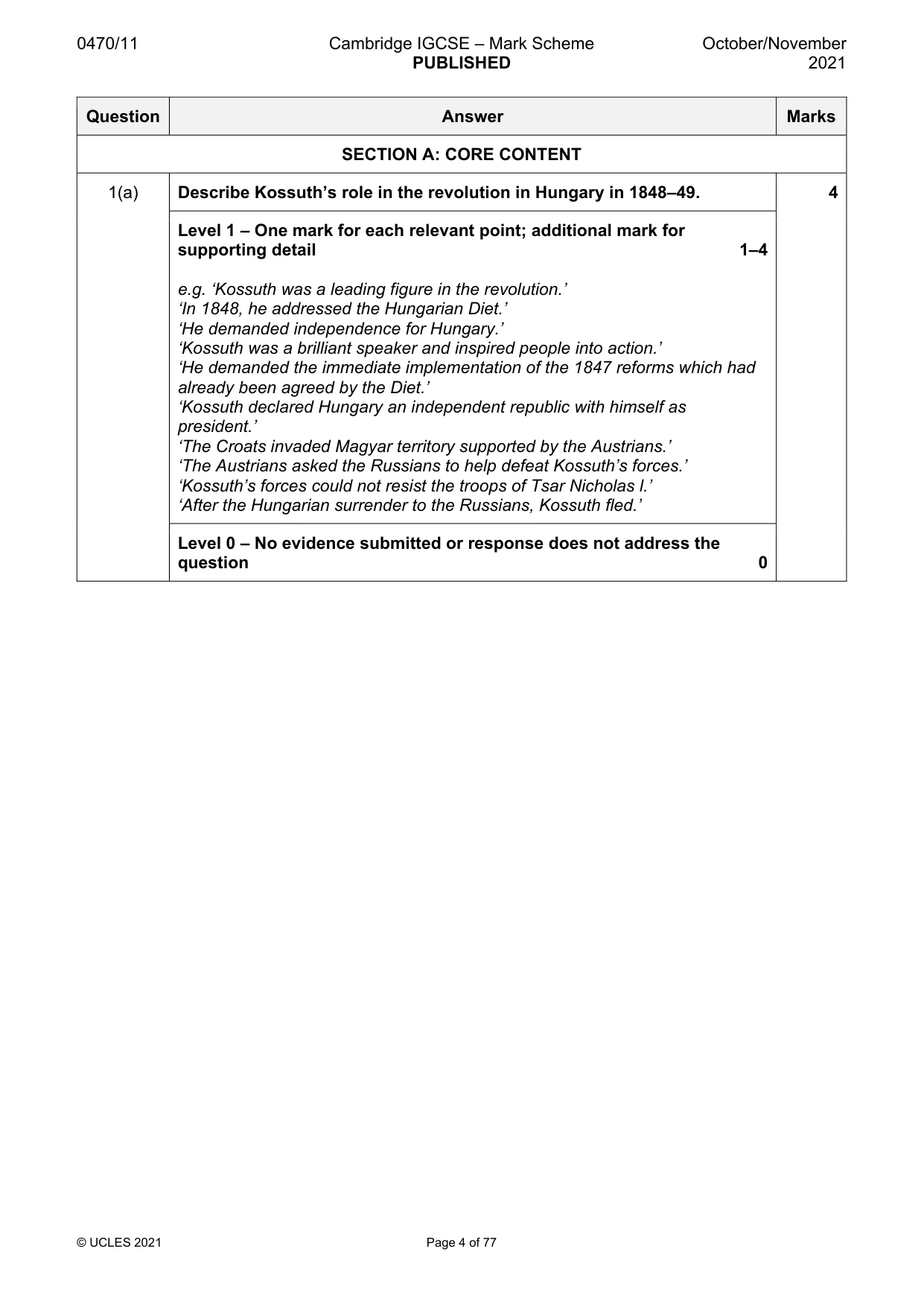
0470/11 Cambridge IGCSE – Mark Scheme PUBLISHED October/November 2021 © UCLES 2021 Page 4 of 77 Question Answer Marks SECTION A: CORE CONTENT 1(a) Describe Kossuth’s role in the revolution in Hungary in 1848–49. 4 Level 1 – One mark for each relevant point; additional mark for supporting detail 1–4 e.g. ‘Kossuth was a leading figure in the revolution.’ ‘In 1848, he addressed the Hungarian Diet.’ ‘He demanded independence for Hungary.’ ‘Kossuth was a brilliant speaker and inspired people into action.’ ‘He demanded the immediate implementation of the 1847 reforms which had already been agreed by the Diet.’ ‘Kossuth declared Hungary an independent republic with himself as president.’ ‘The Croats invaded Magyar territory supported by the Austrians.’ ‘The Austrians asked the Russians to help defeat Kossuth’s forces.’ ‘Kossuth’s forces could not resist the troops of Tsar Nicholas l.’ ‘After the Hungarian surrender to the Russians, Kossuth fled.’ Level 0 – No evidence submitted or response does not address the question 0
Mark scheme, page 5
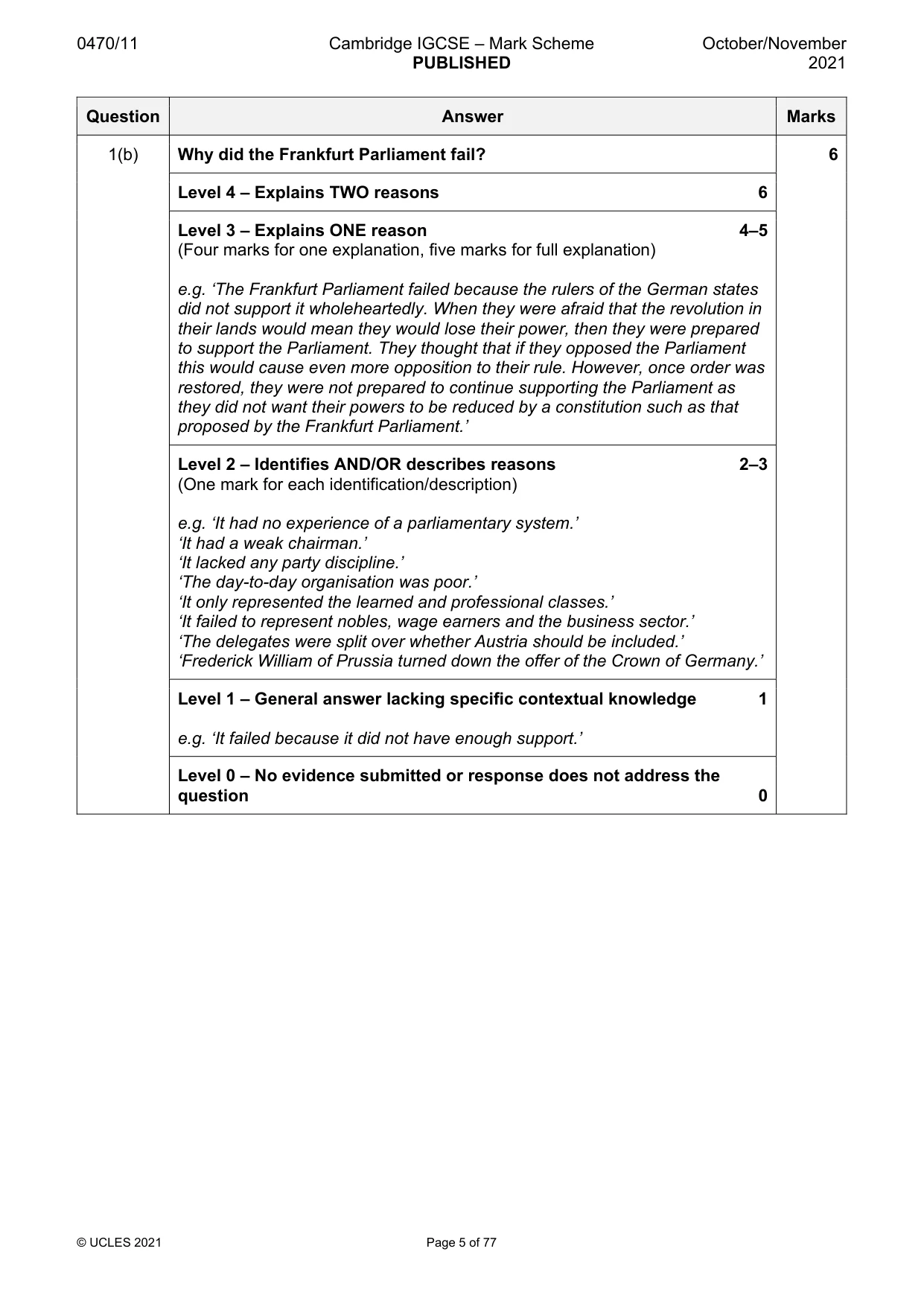
0470/11 Cambridge IGCSE – Mark Scheme PUBLISHED October/November 2021 © UCLES 2021 Page 5 of 77 Question Answer Marks 1(b) Why did the Frankfurt Parliament fail? 6 Level 4 – Explains TWO reasons 6 Level 3 – Explains ONE reason 4–5 (Four marks for one explanation, five marks for full explanation) e.g. ‘The Frankfurt Parliament failed because the rulers of the German states did not support it wholeheartedly. When they were afraid that the revolution in their lands would mean they would lose their power, then they were prepared to support the Parliament. They thought that if they opposed the Parliament this would cause even more opposition to their rule. However, once order was restored, they were not prepared to continue supporting the Parliament as they did not want their powers to be reduced by a constitution such as that proposed by the Frankfurt Parliament.’ Level 2 – Identifies AND/OR describes reasons 2–3 (One mark for each identification/description) e.g. ‘It had no experience of a parliamentary system.’ ‘It had a weak chairman.’ ‘It lacked any party discipline.’ ‘The day-to-day organisation was poor.’ ‘It only represented the learned and professional classes.’ ‘It failed to represent nobles, wage earners and the business sector.’ ‘The delegates were split over whether Austria should be included.’ ‘Frederick William of Prussia turned down the offer of the Crown of Germany.’ Level 1 – General answer lacking specific contextual knowledge 1 e.g. ‘It failed because it did not have enough support.’ Level 0 – No evidence submitted or response does not address the question 0
Mark scheme, page 6
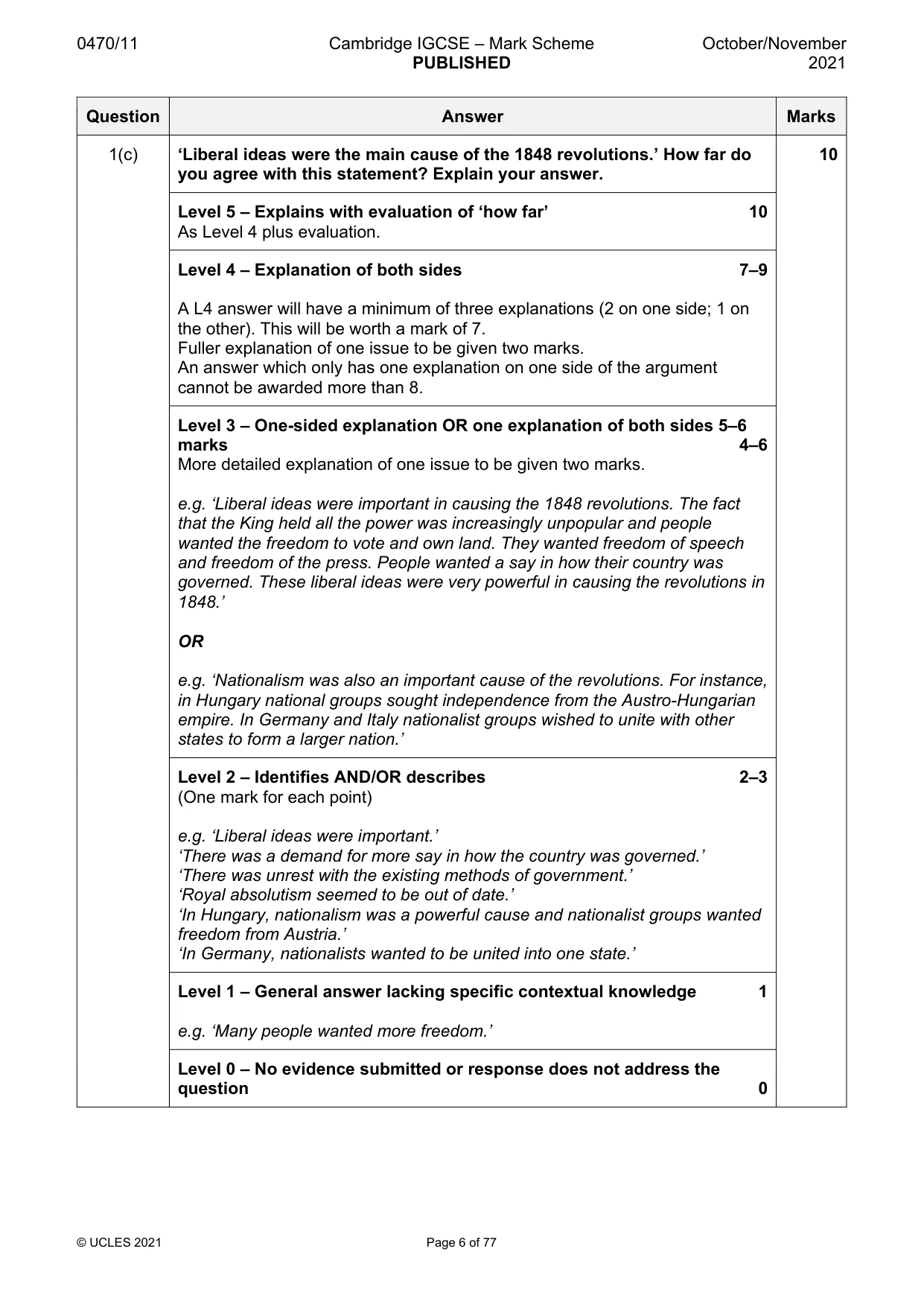
0470/11 Cambridge IGCSE – Mark Scheme PUBLISHED October/November 2021 © UCLES 2021 Page 6 of 77 Question Answer Marks 1(c) ‘Liberal ideas were the main cause of the 1848 revolutions.’ How far do you agree with this statement? Explain your answer. 10 Level 5 – Explains with evaluation of ‘how far’ 10 As Level 4 plus evaluation. Level 4 – Explanation of both sides 7–9 A L4 answer will have a minimum of three explanations (2 on one side; 1 on the other). This will be worth a mark of 7. Fuller explanation of one issue to be given two marks. An answer which only has one explanation on one side of the argument cannot be awarded more than 8. Level 3 – One-sided explanation OR one explanation of both sides 5–6 marks 4–6 More detailed explanation of one issue to be given two marks. e.g. ‘Liberal ideas were important in causing the 1848 revolutions. The fact that the King held all the power was increasingly unpopular and people wanted the freedom to vote and own land. They wanted freedom of speech and freedom of the press. People wanted a say in how their country was governed. These liberal ideas were very powerful in causing the revolutions in 1848.’ OR e.g. ‘Nationalism was also an important cause of the revolutions. For instance, in Hungary national groups sought independence from the Austro-Hungarian empire. In Germany and Italy nationalist groups wished to unite with other states to form a larger nation.’ Level 2 – Identifies AND/OR describes 2–3 (One mark for each point) e.g. ‘Liberal ideas were important.’ ‘There was a demand for more say in how the country was governed.’ ‘There was unrest with the existing methods of government.’ ‘Royal absolutism seemed to be out of date.’ ‘In Hungary, nationalism was a powerful cause and nationalist groups wanted freedom from Austria.’ ‘In Germany, nationalists wanted to be united into one state.’ Level 1 – General answer lacking specific contextual knowledge 1 e.g. ‘Many people wanted more freedom.’ Level 0 – No evidence submitted or response does not address the question 0
Mark scheme, page 7
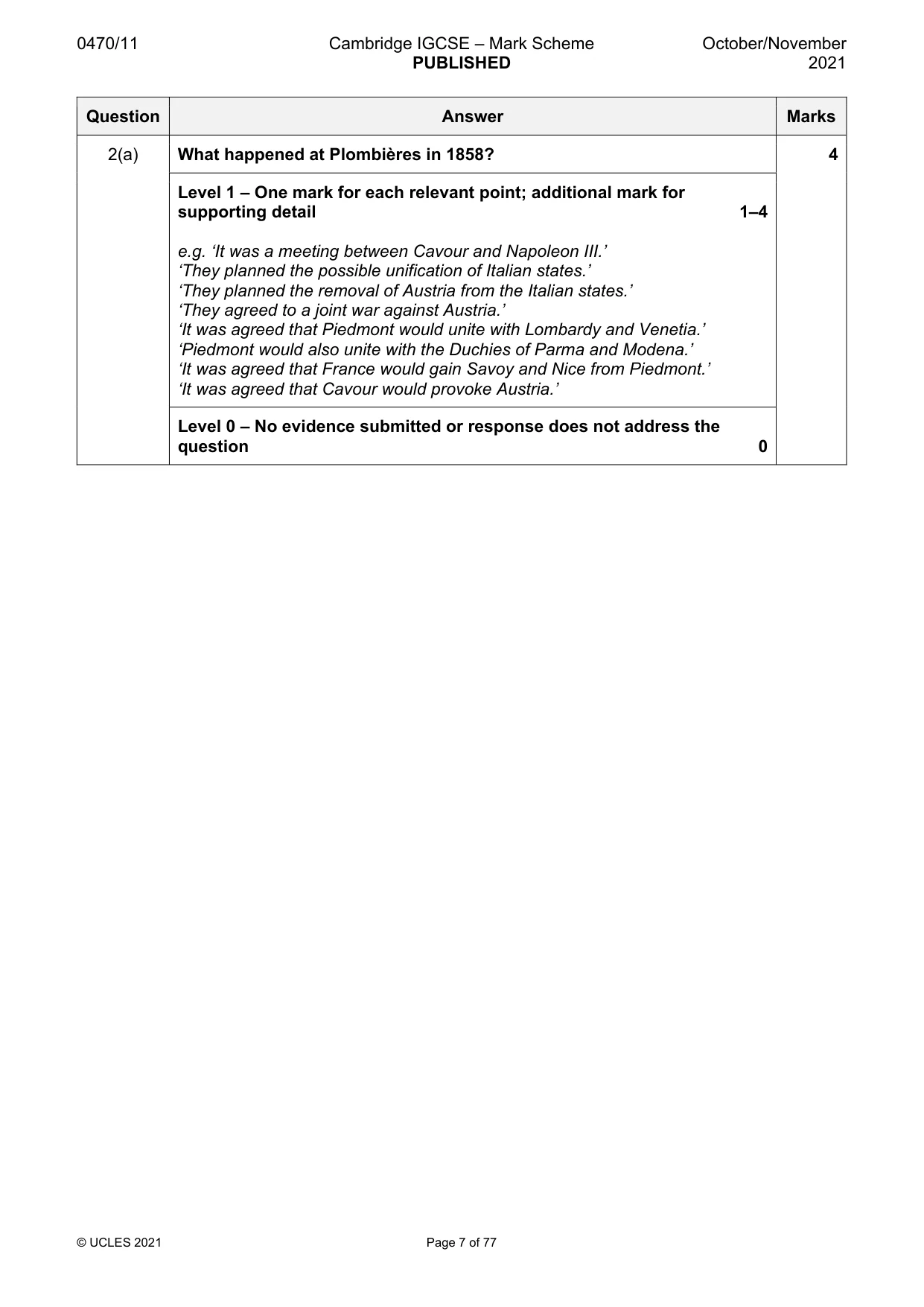
0470/11 Cambridge IGCSE – Mark Scheme PUBLISHED October/November 2021 © UCLES 2021 Page 7 of 77 Question Answer Marks 2(a) What happened at Plombières in 1858? 4 Level 1 – One mark for each relevant point; additional mark for supporting detail 1–4 e.g. ‘It was a meeting between Cavour and Napoleon III.’ ‘They planned the possible unification of Italian states.’ ‘They planned the removal of Austria from the Italian states.’ ‘They agreed to a joint war against Austria.’ ‘It was agreed that Piedmont would unite with Lombardy and Venetia.’ ‘Piedmont would also unite with the Duchies of Parma and Modena.’ ‘It was agreed that France would gain Savoy and Nice from Piedmont.’ ‘It was agreed that Cavour would provoke Austria.’ Level 0 – No evidence submitted or response does not address the question 0
Mark scheme, page 8
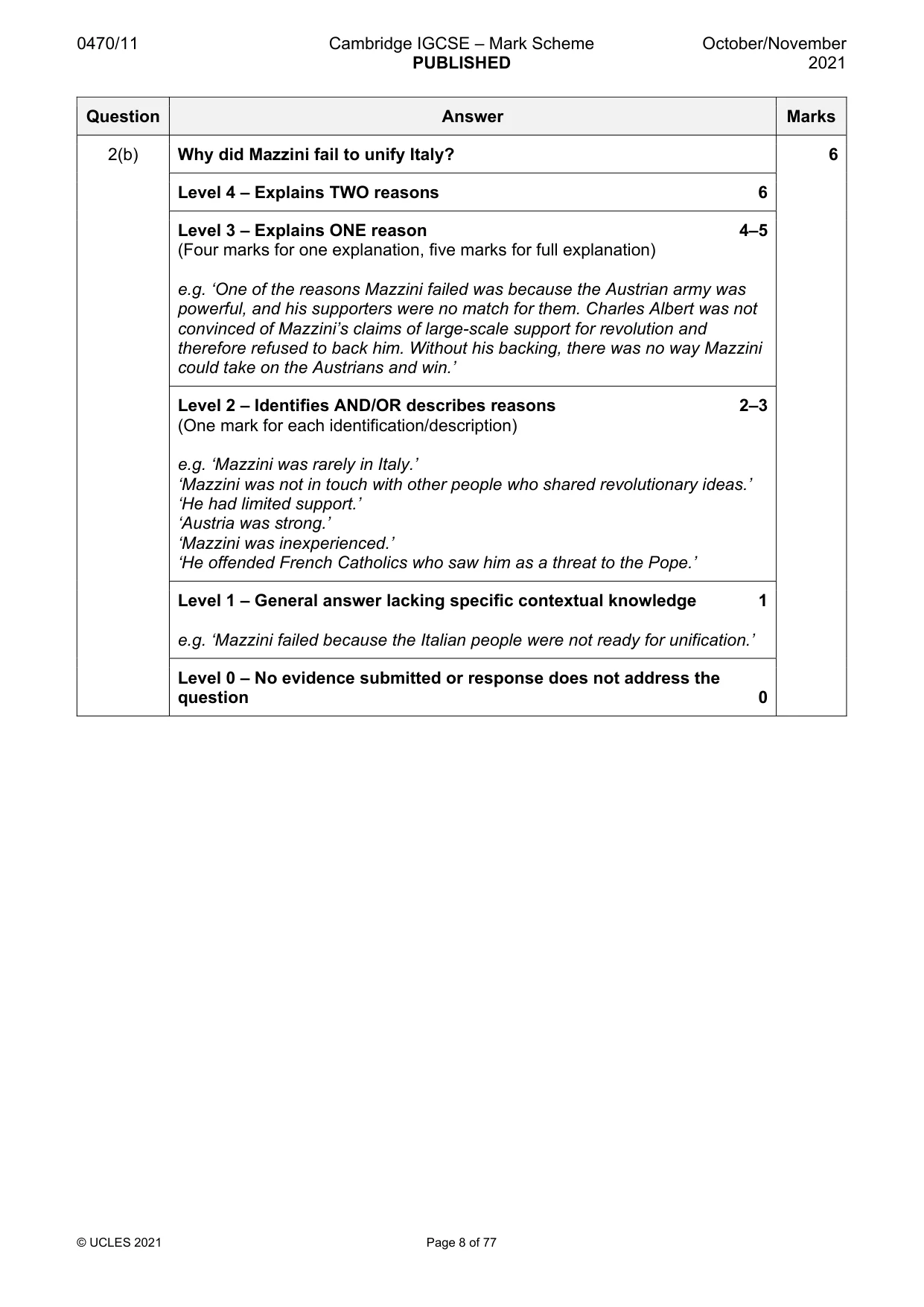
0470/11 Cambridge IGCSE – Mark Scheme PUBLISHED October/November 2021 © UCLES 2021 Page 8 of 77 Question Answer Marks 2(b) Why did Mazzini fail to unify Italy? 6 Level 4 – Explains TWO reasons 6 Level 3 – Explains ONE reason 4–5 (Four marks for one explanation, five marks for full explanation) e.g. ‘One of the reasons Mazzini failed was because the Austrian army was powerful, and his supporters were no match for them. Charles Albert was not convinced of Mazzini’s claims of large-scale support for revolution and therefore refused to back him. Without his backing, there was no way Mazzini could take on the Austrians and win.’ Level 2 – Identifies AND/OR describes reasons 2–3 (One mark for each identification/description) e.g. ‘Mazzini was rarely in Italy.’ ‘Mazzini was not in touch with other people who shared revolutionary ideas.’ ‘He had limited support.’ ‘Austria was strong.’ ‘Mazzini was inexperienced.’ ‘He offended French Catholics who saw him as a threat to the Pope.’ Level 1 – General answer lacking specific contextual knowledge 1 e.g. ‘Mazzini failed because the Italian people were not ready for unification.’ Level 0 – No evidence submitted or response does not address the question 0
Mark scheme, page 9
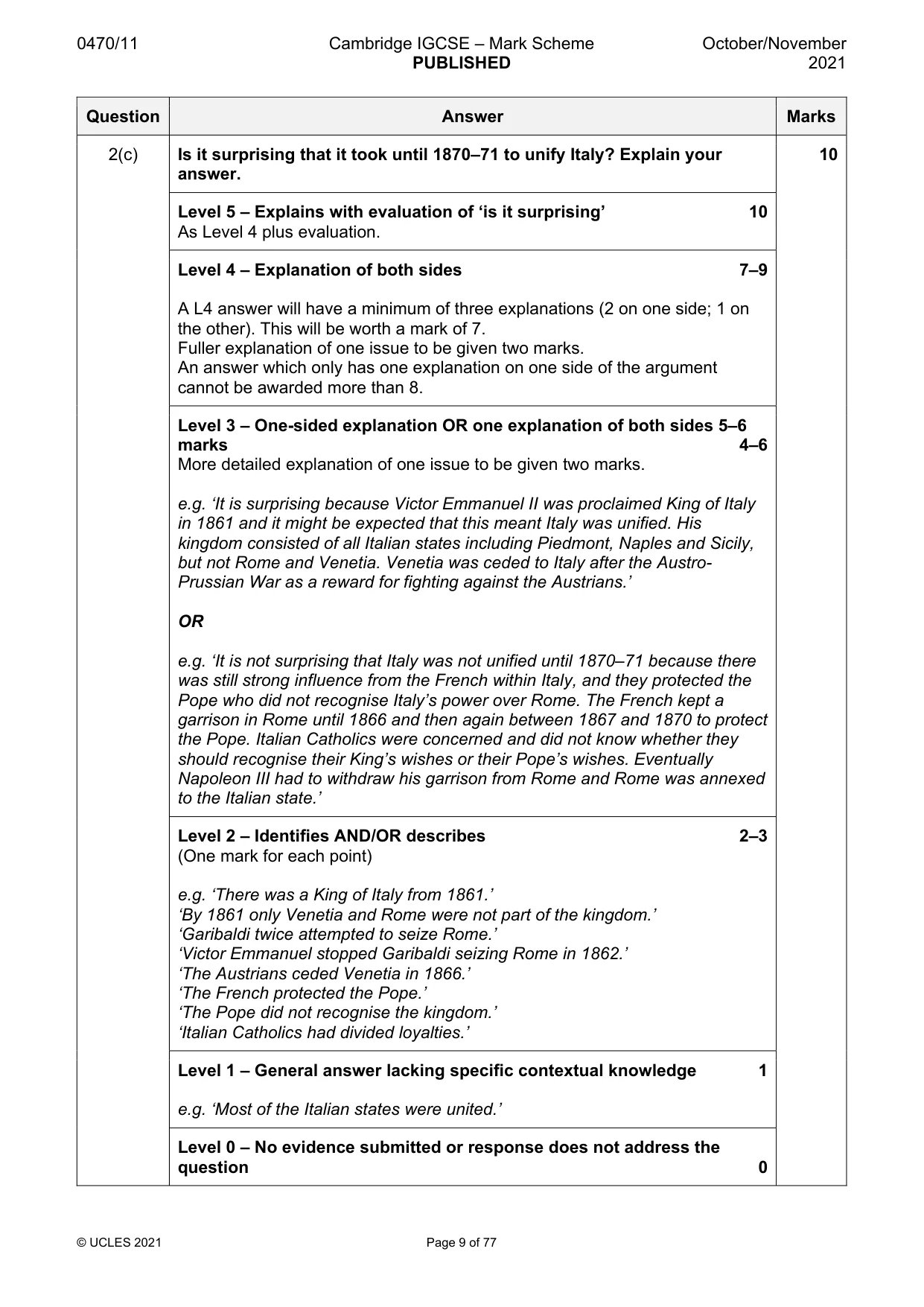
0470/11 Cambridge IGCSE – Mark Scheme PUBLISHED October/November 2021 © UCLES 2021 Page 9 of 77 Question Answer Marks 2(c) Is it surprising that it took until 1870–71 to unify Italy? Explain your answer. 10 Level 5 – Explains with evaluation of ‘is it surprising’ 10 As Level 4 plus evaluation. Level 4 – Explanation of both sides 7–9 A L4 answer will have a minimum of three explanations (2 on one side; 1 on the other). This will be worth a mark of 7. Fuller explanation of one issue to be given two marks. An answer which only has one explanation on one side of the argument cannot be awarded more than 8. Level 3 – One-sided explanation OR one explanation of both sides 5–6 marks 4–6 More detailed explanation of one issue to be given two marks. e.g. ‘It is surprising because Victor Emmanuel II was proclaimed King of Italy in 1861 and it might be expected that this meant Italy was unified. His kingdom consisted of all Italian states including Piedmont, Naples and Sicily, but not Rome and Venetia. Venetia was ceded to Italy after the Austro- Prussian War as a reward for fighting against the Austrians.’ OR e.g. ‘It is not surprising that Italy was not unified until 1870–71 because there was still strong influence from the French within Italy, and they protected the Pope who did not recognise Italy’s power over Rome. The French kept a garrison in Rome until 1866 and then again between 1867 and 1870 to protect the Pope. Italian Catholics were concerned and did not know whether they should recognise their King’s wishes or their Pope’s wishes. Eventually Napoleon III had to withdraw his garrison from Rome and Rome was annexed to the Italian state.’ Level 2 – Identifies AND/OR describes 2–3 (One mark for each point) e.g. ‘There was a King of Italy from 1861.’ ‘By 1861 only Venetia and Rome were not part of the kingdom.’ ‘Garibaldi twice attempted to seize Rome.’ ‘Victor Emmanuel stopped Garibaldi seizing Rome in 1862.’ ‘The Austrians ceded Venetia in 1866.’ ‘The French protected the Pope.’ ‘The Pope did not recognise the kingdom.’ ‘Italian Catholics had divided loyalties.’ Level 1 – General answer lacking specific contextual knowledge 1 e.g. ‘Most of the Italian states were united.’ Level 0 – No evidence submitted or response does not address the question 0
Mark scheme, page 10
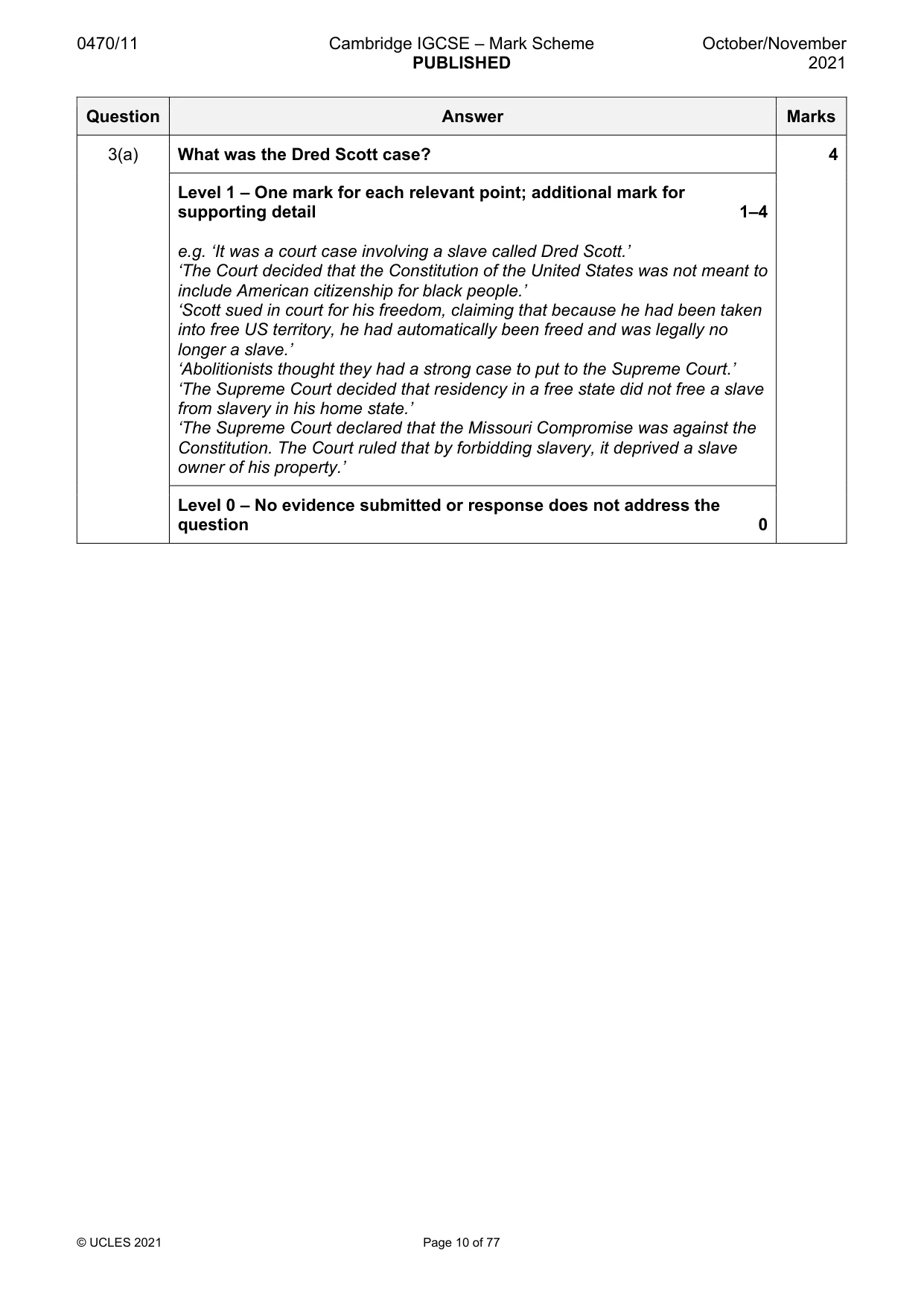
0470/11 Cambridge IGCSE – Mark Scheme PUBLISHED October/November 2021 © UCLES 2021 Page 10 of 77 Question Answer Marks 3(a) What was the Dred Scott case? 4 Level 1 – One mark for each relevant point; additional mark for supporting detail 1–4 e.g. ‘It was a court case involving a slave called Dred Scott.’ ‘The Court decided that the Constitution of the United States was not meant to include American citizenship for black people.’ ‘Scott sued in court for his freedom, claiming that because he had been taken into free US territory, he had automatically been freed and was legally no longer a slave.’ ‘Abolitionists thought they had a strong case to put to the Supreme Court.’ ‘The Supreme Court decided that residency in a free state did not free a slave from slavery in his home state.’ ‘The Supreme Court declared that the Missouri Compromise was against the Constitution. The Court ruled that by forbidding slavery, it deprived a slave owner of his property.’ Level 0 – No evidence submitted or response does not address the question 0
Mark scheme, page 11
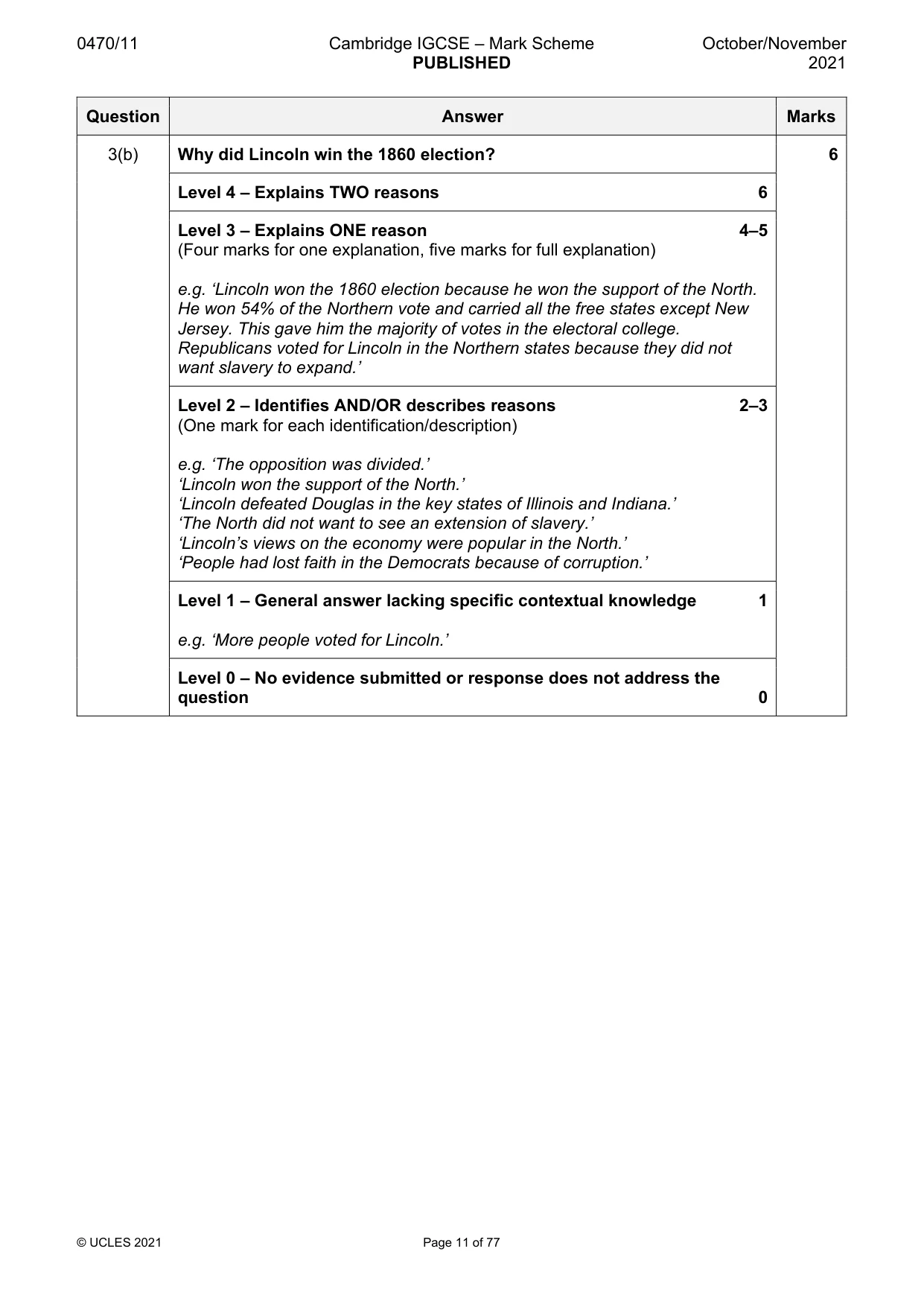
0470/11 Cambridge IGCSE – Mark Scheme PUBLISHED October/November 2021 © UCLES 2021 Page 11 of 77 Question Answer Marks 3(b) Why did Lincoln win the 1860 election? 6 Level 4 – Explains TWO reasons 6 Level 3 – Explains ONE reason 4–5 (Four marks for one explanation, five marks for full explanation) e.g. ‘Lincoln won the 1860 election because he won the support of the North. He won 54% of the Northern vote and carried all the free states except New Jersey. This gave him the majority of votes in the electoral college. Republicans voted for Lincoln in the Northern states because they did not want slavery to expand.’ Level 2 – Identifies AND/OR describes reasons 2–3 (One mark for each identification/description) e.g. ‘The opposition was divided.’ ‘Lincoln won the support of the North.’ ‘Lincoln defeated Douglas in the key states of Illinois and Indiana.’ ‘The North did not want to see an extension of slavery.’ ‘Lincoln’s views on the economy were popular in the North.’ ‘People had lost faith in the Democrats because of corruption.’ Level 1 – General answer lacking specific contextual knowledge 1 e.g. ‘More people voted for Lincoln.’ Level 0 – No evidence submitted or response does not address the question 0
Mark scheme, page 12
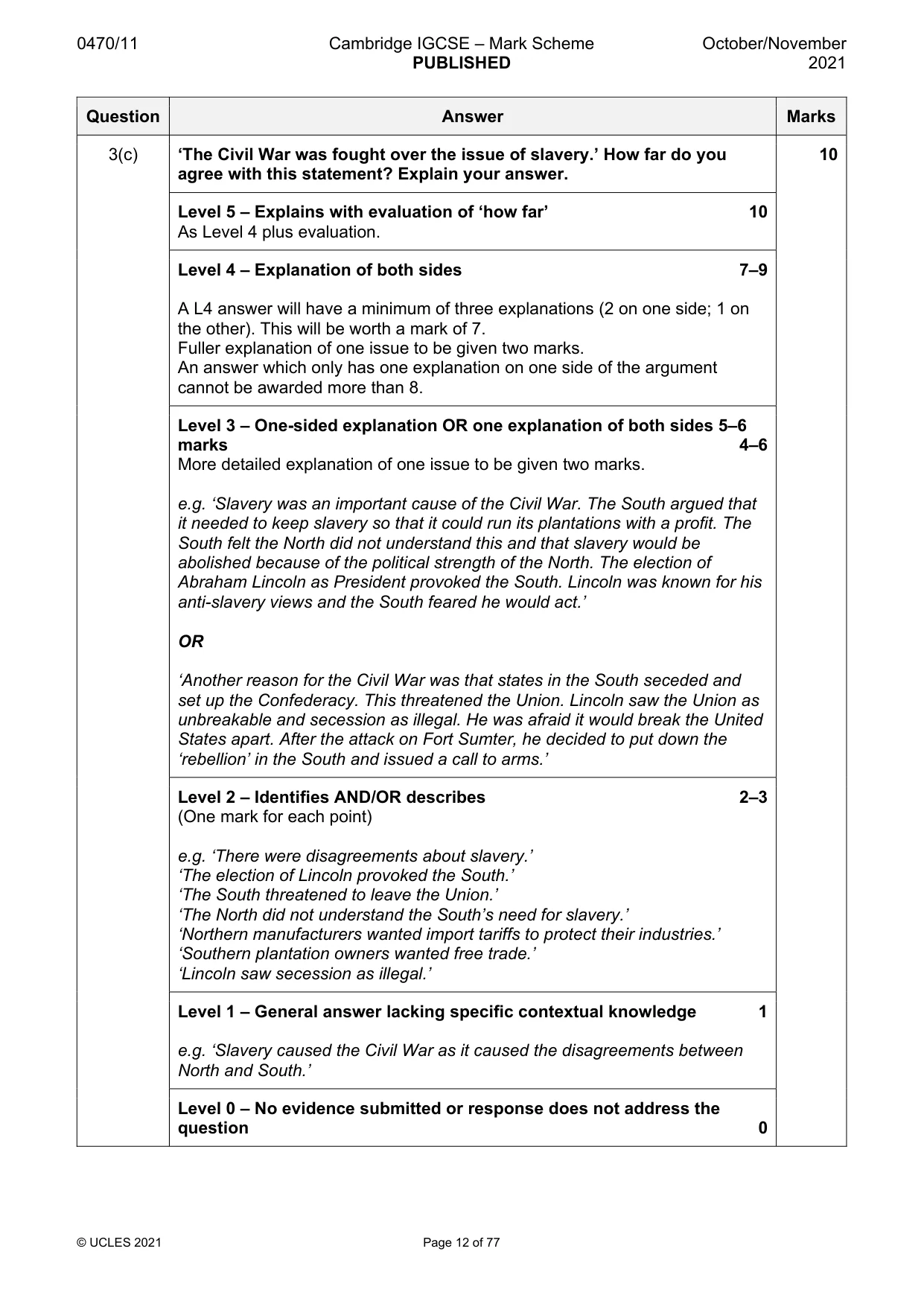
0470/11 Cambridge IGCSE – Mark Scheme PUBLISHED October/November 2021 © UCLES 2021 Page 12 of 77 Question Answer Marks 3(c) ‘The Civil War was fought over the issue of slavery.’ How far do you agree with this statement? Explain your answer. 10 Level 5 – Explains with evaluation of ‘how far’ 10 As Level 4 plus evaluation. Level 4 – Explanation of both sides 7–9 A L4 answer will have a minimum of three explanations (2 on one side; 1 on the other). This will be worth a mark of 7. Fuller explanation of one issue to be given two marks. An answer which only has one explanation on one side of the argument cannot be awarded more than 8. Level 3 – One-sided explanation OR one explanation of both sides 5–6 marks 4–6 More detailed explanation of one issue to be given two marks. e.g. ‘Slavery was an important cause of the Civil War. The South argued that it needed to keep slavery so that it could run its plantations with a profit. The South felt the North did not understand this and that slavery would be abolished because of the political strength of the North. The election of Abraham Lincoln as President provoked the South. Lincoln was known for his anti-slavery views and the South feared he would act.’ OR ‘Another reason for the Civil War was that states in the South seceded and set up the Confederacy. This threatened the Union. Lincoln saw the Union as unbreakable and secession as illegal. He was afraid it would break the United States apart. After the attack on Fort Sumter, he decided to put down the ‘rebellion’ in the South and issued a call to arms.’ Level 2 – Identifies AND/OR describes 2–3 (One mark for each point) e.g. ‘There were disagreements about slavery.’ ‘The election of Lincoln provoked the South.’ ‘The South threatened to leave the Union.’ ‘The North did not understand the South’s need for slavery.’ ‘Northern manufacturers wanted import tariffs to protect their industries.’ ‘Southern plantation owners wanted free trade.’ ‘Lincoln saw secession as illegal.’ Level 1 – General answer lacking specific contextual knowledge 1 e.g. ‘Slavery caused the Civil War as it caused the disagreements between North and South.’ Level 0 – No evidence submitted or response does not address the question 0
Mark scheme, page 13
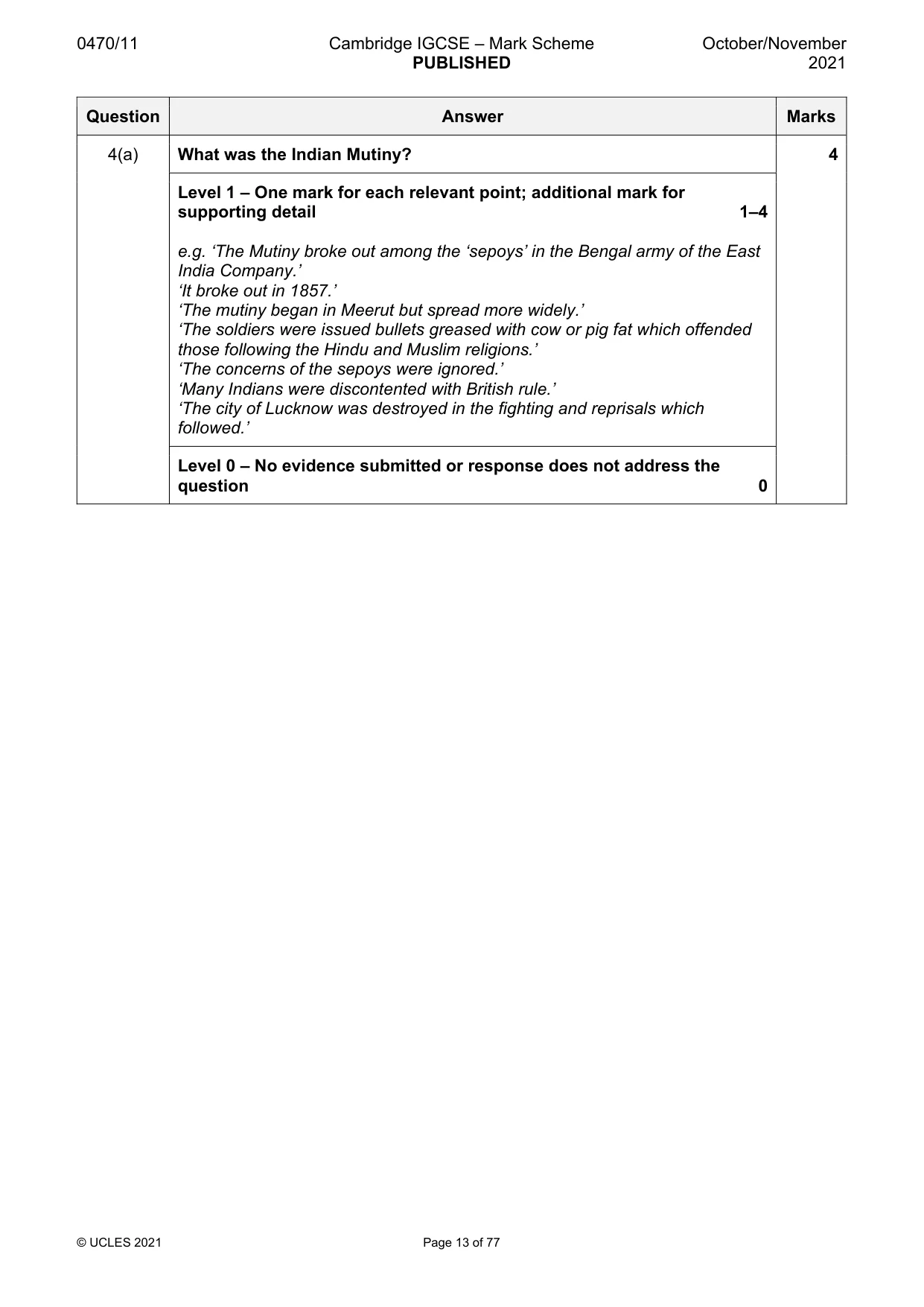
0470/11 Cambridge IGCSE – Mark Scheme PUBLISHED October/November 2021 © UCLES 2021 Page 13 of 77 Question Answer Marks 4(a) What was the Indian Mutiny? 4 Level 1 – One mark for each relevant point; additional mark for supporting detail 1–4 e.g. ‘The Mutiny broke out among the ‘sepoys’ in the Bengal army of the East India Company.’ ‘It broke out in 1857.’ ‘The mutiny began in Meerut but spread more widely.’ ‘The soldiers were issued bullets greased with cow or pig fat which offended those following the Hindu and Muslim religions.’ ‘The concerns of the sepoys were ignored.’ ‘Many Indians were discontented with British rule.’ ‘The city of Lucknow was destroyed in the fighting and reprisals which followed.’ Level 0 – No evidence submitted or response does not address the question 0
Mark scheme, page 14
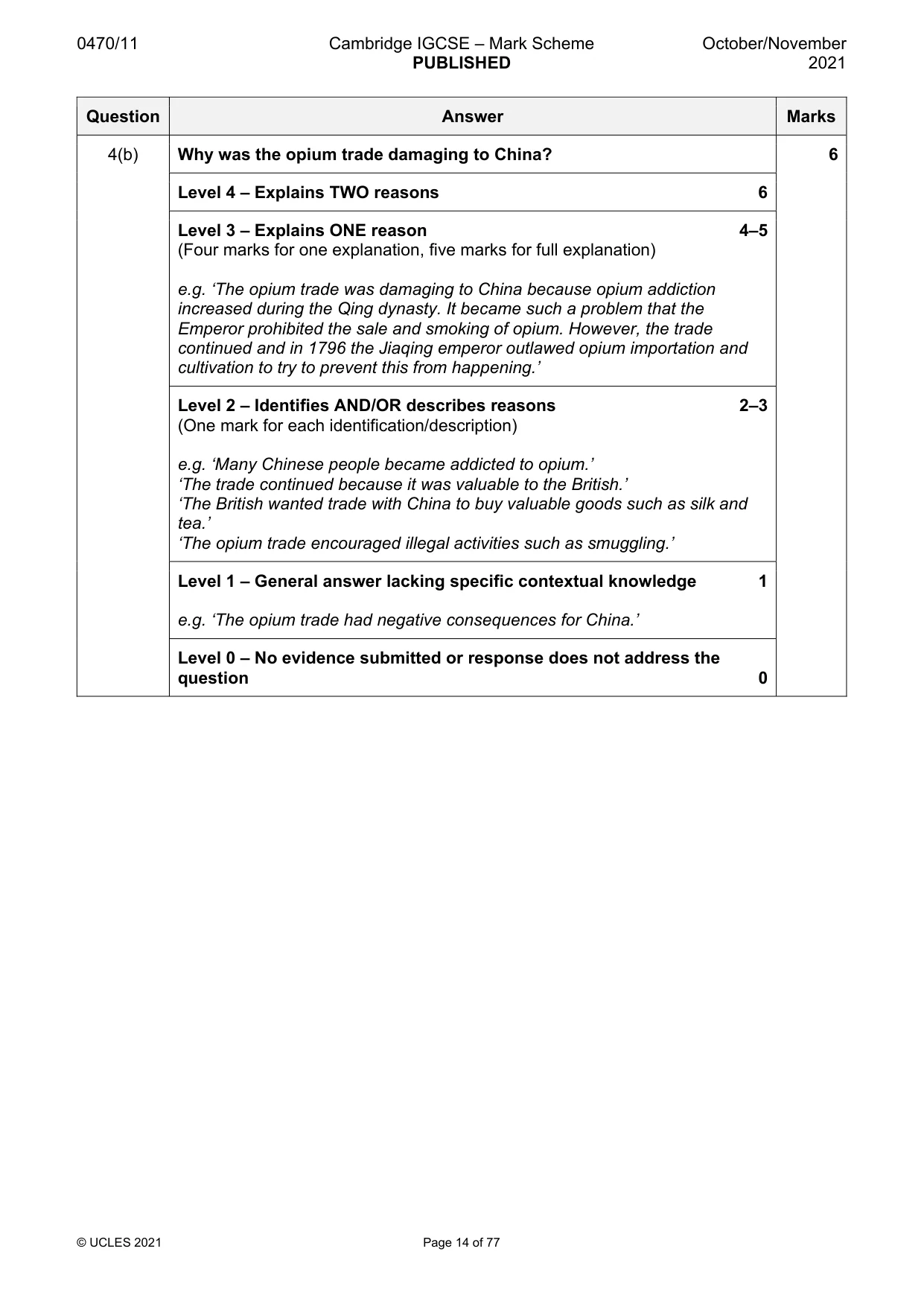
0470/11 Cambridge IGCSE – Mark Scheme PUBLISHED October/November 2021 © UCLES 2021 Page 14 of 77 Question Answer Marks 4(b) Why was the opium trade damaging to China? 6 Level 4 – Explains TWO reasons 6 Level 3 – Explains ONE reason 4–5 (Four marks for one explanation, five marks for full explanation) e.g. ‘The opium trade was damaging to China because opium addiction increased during the Qing dynasty. It became such a problem that the Emperor prohibited the sale and smoking of opium. However, the trade continued and in 1796 the Jiaqing emperor outlawed opium importation and cultivation to try to prevent this from happening.’ Level 2 – Identifies AND/OR describes reasons 2–3 (One mark for each identification/description) e.g. ‘Many Chinese people became addicted to opium.’ ‘The trade continued because it was valuable to the British.’ ‘The British wanted trade with China to buy valuable goods such as silk and tea.’ ‘The opium trade encouraged illegal activities such as smuggling.’ Level 1 – General answer lacking specific contextual knowledge 1 e.g. ‘The opium trade had negative consequences for China.’ Level 0 – No evidence submitted or response does not address the question 0
Mark scheme, page 15
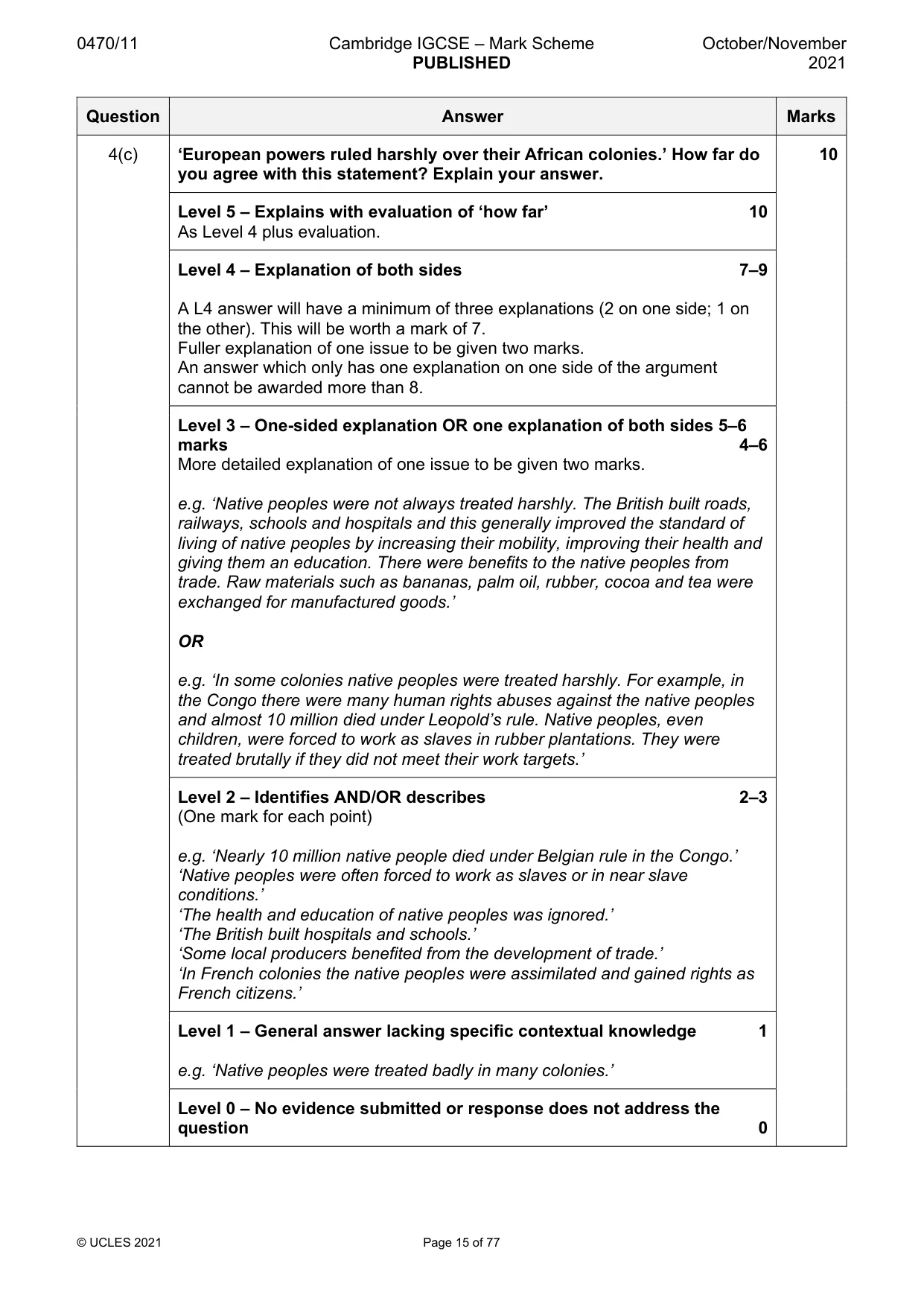
0470/11 Cambridge IGCSE – Mark Scheme PUBLISHED October/November 2021 © UCLES 2021 Page 15 of 77 Question Answer Marks 4(c) ‘European powers ruled harshly over their African colonies.’ How far do you agree with this statement? Explain your answer. 10 Level 5 – Explains with evaluation of ‘how far’ 10 As Level 4 plus evaluation. Level 4 – Explanation of both sides 7–9 A L4 answer will have a minimum of three explanations (2 on one side; 1 on the other). This will be worth a mark of 7. Fuller explanation of one issue to be given two marks. An answer which only has one explanation on one side of the argument cannot be awarded more than 8. Level 3 – One-sided explanation OR one explanation of both sides 5–6 marks 4–6 More detailed explanation of one issue to be given two marks. e.g. ‘Native peoples were not always treated harshly. The British built roads, railways, schools and hospitals and this generally improved the standard of living of native peoples by increasing their mobility, improving their health and giving them an education. There were benefits to the native peoples from trade. Raw materials such as bananas, palm oil, rubber, cocoa and tea were exchanged for manufactured goods.’ OR e.g. ‘In some colonies native peoples were treated harshly. For example, in the Congo there were many human rights abuses against the native peoples and almost 10 million died under Leopold’s rule. Native peoples, even children, were forced to work as slaves in rubber plantations. They were treated brutally if they did not meet their work targets.’ Level 2 – Identifies AND/OR describes 2–3 (One mark for each point) e.g. ‘Nearly 10 million native people died under Belgian rule in the Congo.’ ‘Native peoples were often forced to work as slaves or in near slave conditions.’ ‘The health and education of native peoples was ignored.’ ‘The British built hospitals and schools.’ ‘Some local producers benefited from the development of trade.’ ‘In French colonies the native peoples were assimilated and gained rights as French citizens.’ Level 1 – General answer lacking specific contextual knowledge 1 e.g. ‘Native peoples were treated badly in many colonies.’ Level 0 – No evidence submitted or response does not address the question 0
Mark scheme, page 16
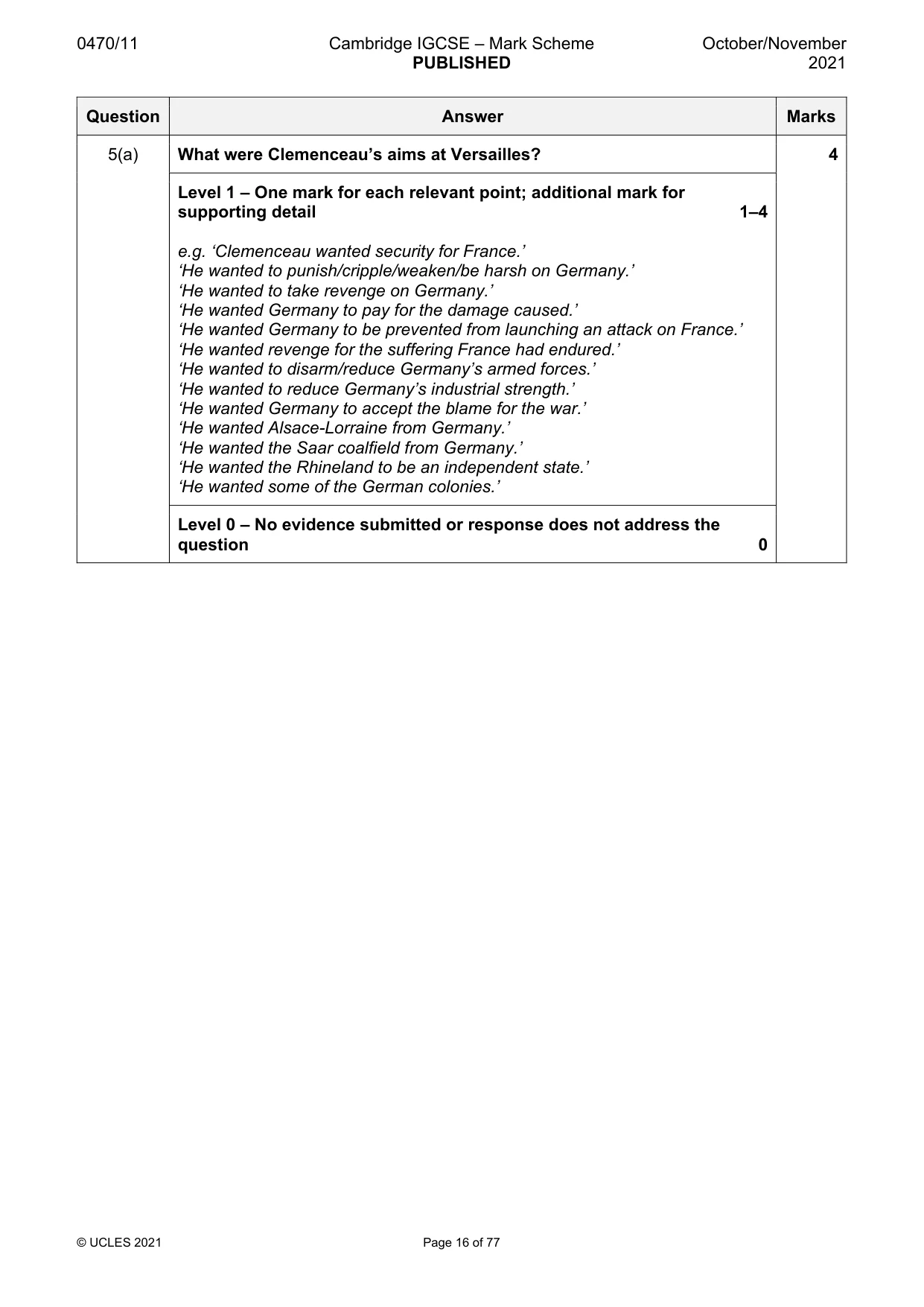
0470/11 Cambridge IGCSE – Mark Scheme PUBLISHED October/November 2021 © UCLES 2021 Page 16 of 77 Question Answer Marks 5(a) What were Clemenceau’s aims at Versailles? 4 Level 1 – One mark for each relevant point; additional mark for supporting detail 1–4 e.g. ‘Clemenceau wanted security for France.’ ‘He wanted to punish/cripple/weaken/be harsh on Germany.’ ‘He wanted to take revenge on Germany.’ ‘He wanted Germany to pay for the damage caused.’ ‘He wanted Germany to be prevented from launching an attack on France.’ ‘He wanted revenge for the suffering France had endured.’ ‘He wanted to disarm/reduce Germany’s armed forces.’ ‘He wanted to reduce Germany’s industrial strength.’ ‘He wanted Germany to accept the blame for the war.’ ‘He wanted Alsace-Lorraine from Germany.’ ‘He wanted the Saar coalfield from Germany.’ ‘He wanted the Rhineland to be an independent state.’ ‘He wanted some of the German colonies.’ Level 0 – No evidence submitted or response does not address the question 0
Mark scheme, page 17
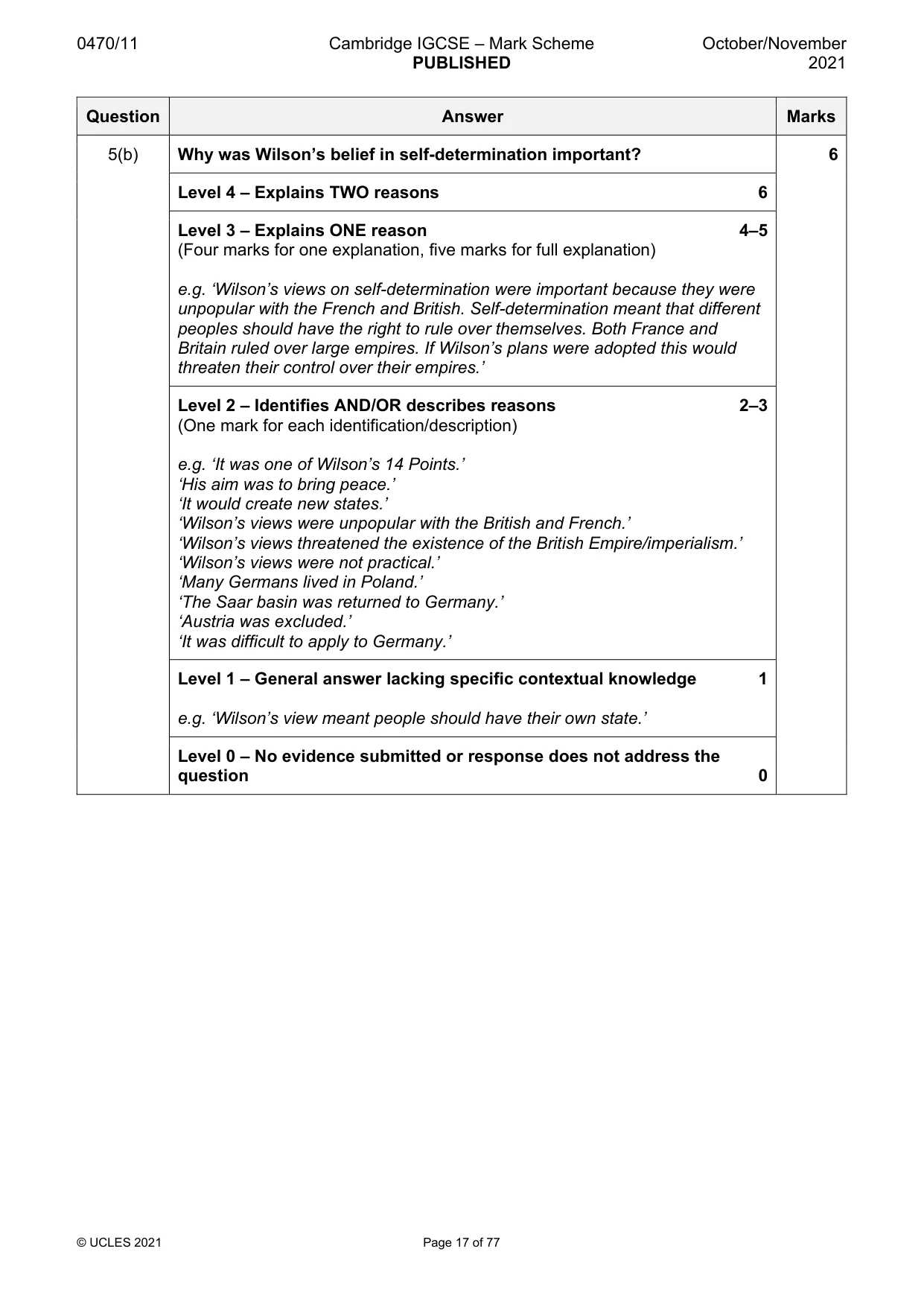
0470/11 Cambridge IGCSE – Mark Scheme PUBLISHED October/November 2021 © UCLES 2021 Page 17 of 77 Question Answer Marks 5(b) Why was Wilson’s belief in self-determination important? 6 Level 4 – Explains TWO reasons 6 Level 3 – Explains ONE reason 4–5 (Four marks for one explanation, five marks for full explanation) e.g. ‘Wilson’s views on self-determination were important because they were unpopular with the French and British. Self-determination meant that different peoples should have the right to rule over themselves. Both France and Britain ruled over large empires. If Wilson’s plans were adopted this would threaten their control over their empires.’ Level 2 – Identifies AND/OR describes reasons 2–3 (One mark for each identification/description) e.g. ‘It was one of Wilson’s 14 Points.’ ‘His aim was to bring peace.’ ‘It would create new states.’ ‘Wilson’s views were unpopular with the British and French.’ ‘Wilson’s views threatened the existence of the British Empire/imperialism.’ ‘Wilson’s views were not practical.’ ‘Many Germans lived in Poland.’ ‘The Saar basin was returned to Germany.’ ‘Austria was excluded.’ ‘It was difficult to apply to Germany.’ Level 1 – General answer lacking specific contextual knowledge 1 e.g. ‘Wilson’s view meant people should have their own state.’ Level 0 – No evidence submitted or response does not address the question 0
Mark scheme, page 18
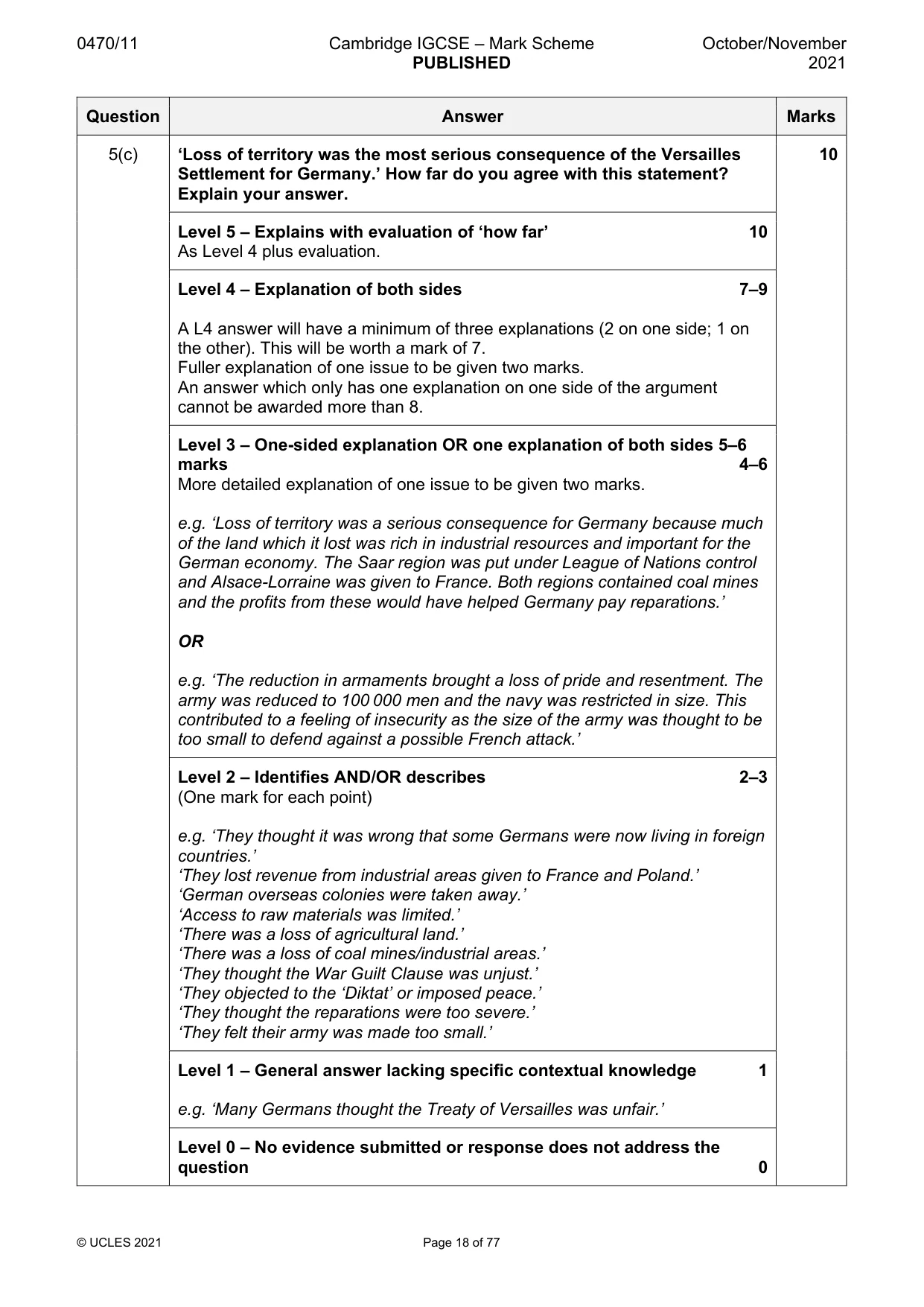
0470/11 Cambridge IGCSE – Mark Scheme PUBLISHED October/November 2021 © UCLES 2021 Page 18 of 77 Question Answer Marks 5(c) ‘Loss of territory was the most serious consequence of the Versailles Settlement for Germany.’ How far do you agree with this statement? Explain your answer. 10 Level 5 – Explains with evaluation of ‘how far’ 10 As Level 4 plus evaluation. Level 4 – Explanation of both sides 7–9 A L4 answer will have a minimum of three explanations (2 on one side; 1 on the other). This will be worth a mark of 7. Fuller explanation of one issue to be given two marks. An answer which only has one explanation on one side of the argument cannot be awarded more than 8. Level 3 – One-sided explanation OR one explanation of both sides 5–6 marks 4–6 More detailed explanation of one issue to be given two marks. e.g. ‘Loss of territory was a serious consequence for Germany because much of the land which it lost was rich in industrial resources and important for the German economy. The Saar region was put under League of Nations control and Alsace-Lorraine was given to France. Both regions contained coal mines and the profits from these would have helped Germany pay reparations.’ OR e.g. ‘The reduction in armaments brought a loss of pride and resentment. The army was reduced to 100 000 men and the navy was restricted in size. This contributed to a feeling of insecurity as the size of the army was thought to be too small to defend against a possible French attack.’ Level 2 – Identifies AND/OR describes 2–3 (One mark for each point) e.g. ‘They thought it was wrong that some Germans were now living in foreign countries.’ ‘They lost revenue from industrial areas given to France and Poland.’ ‘German overseas colonies were taken away.’ ‘Access to raw materials was limited.’ ‘There was a loss of agricultural land.’ ‘There was a loss of coal mines/industrial areas.’ ‘They thought the War Guilt Clause was unjust.’ ‘They objected to the ‘Diktat’ or imposed peace.’ ‘They thought the reparations were too severe.’ ‘They felt their army was made too small.’ Level 1 – General answer lacking specific contextual knowledge 1 e.g. ‘Many Germans thought the Treaty of Versailles was unfair.’ Level 0 – No evidence submitted or response does not address the question 0
Mark scheme, page 19
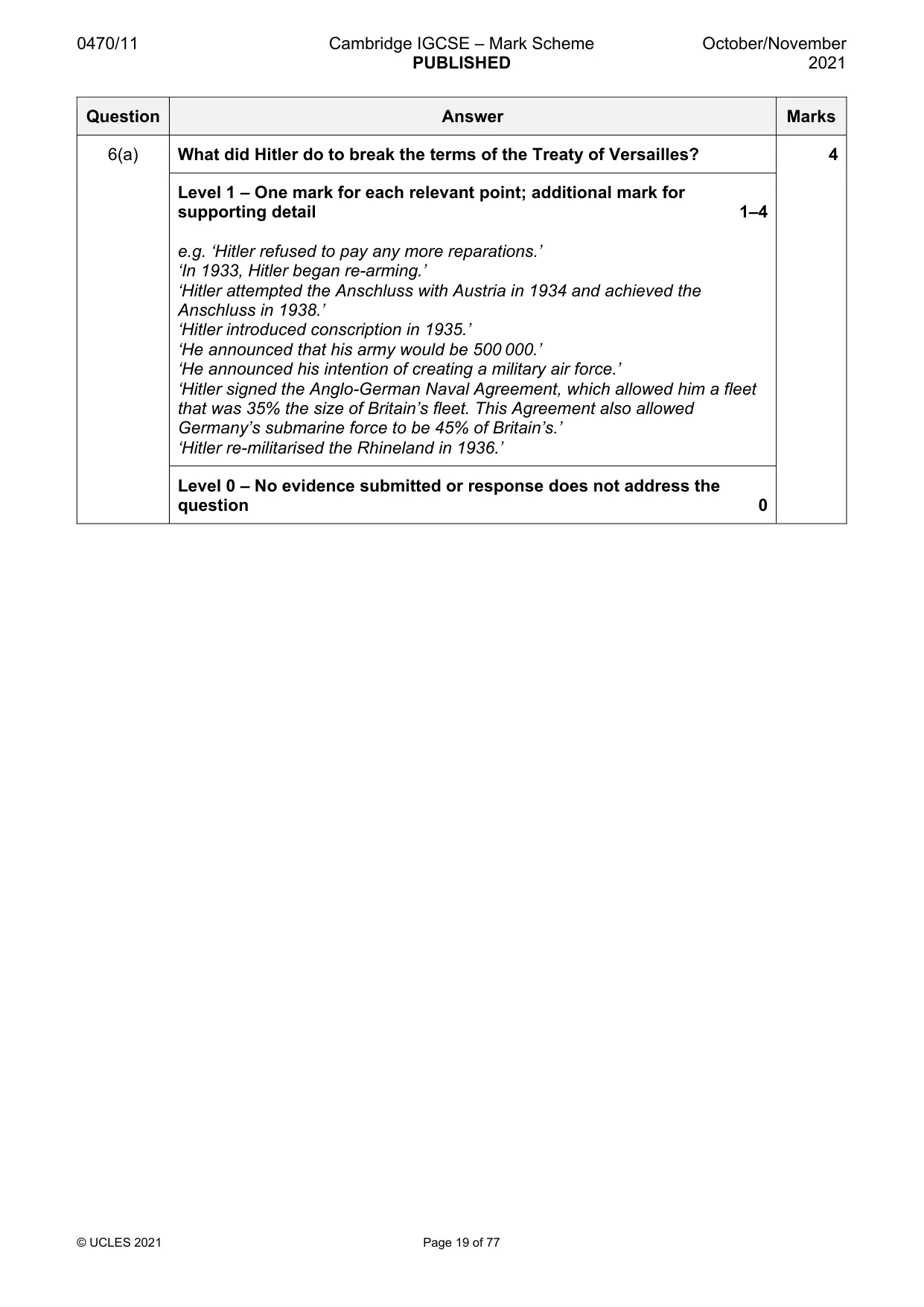
0470/11 Cambridge IGCSE – Mark Scheme PUBLISHED October/November 2021 © UCLES 2021 Page 19 of 77 Question Answer Marks 6(a) What did Hitler do to break the terms of the Treaty of Versailles? 4 Level 1 – One mark for each relevant point; additional mark for supporting detail 1–4 e.g. ‘Hitler refused to pay any more reparations.’ ‘In 1933, Hitler began re-arming.’ ‘Hitler attempted the Anschluss with Austria in 1934 and achieved the Anschluss in 1938.’ ‘Hitler introduced conscription in 1935.’ ‘He announced that his army would be 500 000.’ ‘He announced his intention of creating a military air force.’ ‘Hitler signed the Anglo-German Naval Agreement, which allowed him a fleet that was 35% the size of Britain’s fleet. This Agreement also allowed Germany’s submarine force to be 45% of Britain’s.’ ‘Hitler re-militarised the Rhineland in 1936.’ Level 0 – No evidence submitted or response does not address the question 0
Mark scheme, page 20
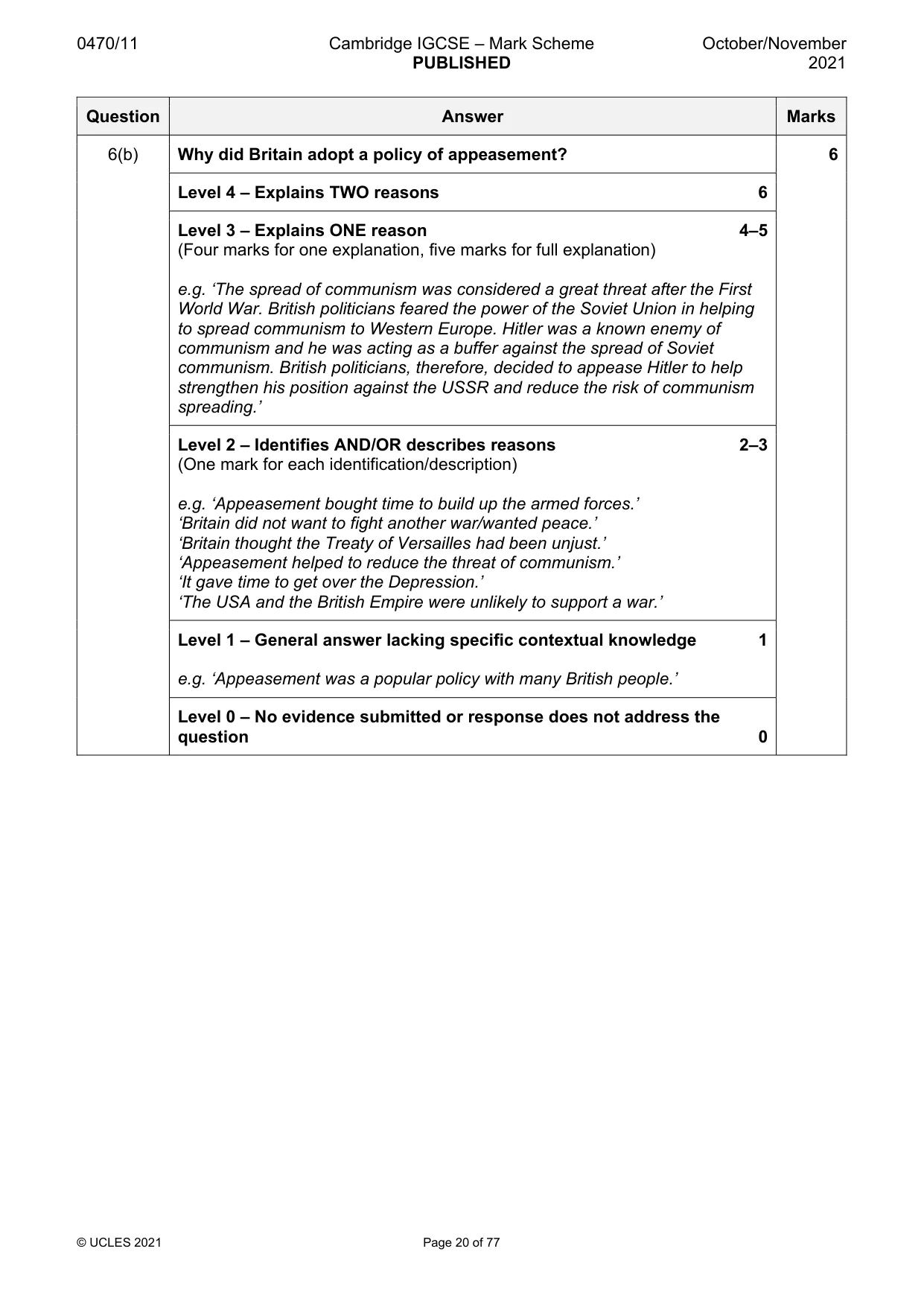
0470/11 Cambridge IGCSE – Mark Scheme PUBLISHED October/November 2021 © UCLES 2021 Page 20 of 77 Question Answer Marks 6(b) Why did Britain adopt a policy of appeasement? 6 Level 4 – Explains TWO reasons 6 Level 3 – Explains ONE reason 4–5 (Four marks for one explanation, five marks for full explanation) e.g. ‘The spread of communism was considered a great threat after the First World War. British politicians feared the power of the Soviet Union in helping to spread communism to Western Europe. Hitler was a known enemy of communism and he was acting as a buffer against the spread of Soviet communism. British politicians, therefore, decided to appease Hitler to help strengthen his position against the USSR and reduce the risk of communism spreading.’ Level 2 – Identifies AND/OR describes reasons 2–3 (One mark for each identification/description) e.g. ‘Appeasement bought time to build up the armed forces.’ ‘Britain did not want to fight another war/wanted peace.’ ‘Britain thought the Treaty of Versailles had been unjust.’ ‘Appeasement helped to reduce the threat of communism.’ ‘It gave time to get over the Depression.’ ‘The USA and the British Empire were unlikely to support a war.’ Level 1 – General answer lacking specific contextual knowledge 1 e.g. ‘Appeasement was a popular policy with many British people.’ Level 0 – No evidence submitted or response does not address the question 0
Mark scheme, page 21
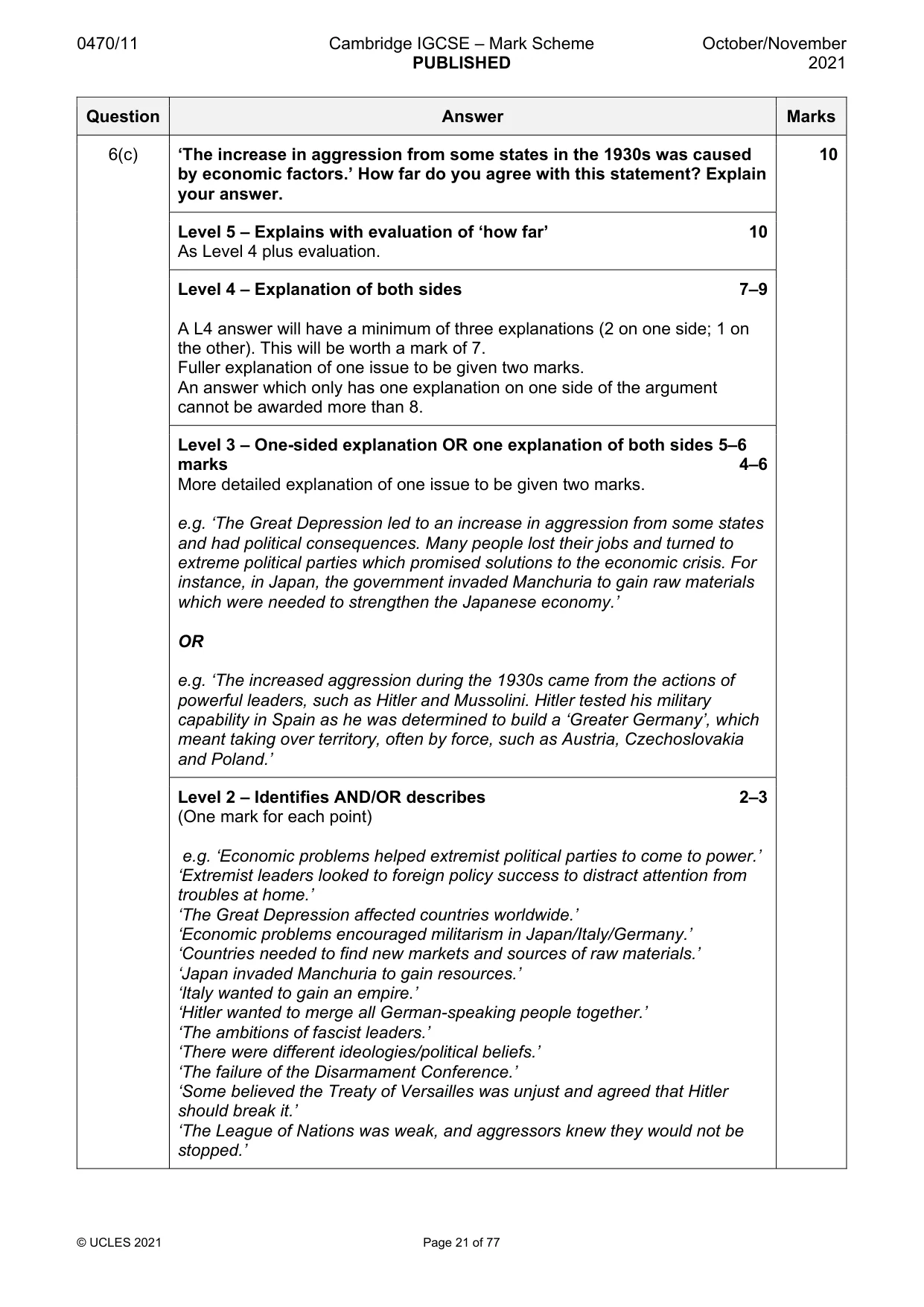
0470/11 Cambridge IGCSE – Mark Scheme PUBLISHED October/November 2021 © UCLES 2021 Page 21 of 77 Question Answer Marks 6(c) ‘The increase in aggression from some states in the 1930s was caused by economic factors.’ How far do you agree with this statement? Explain your answer. 10 Level 5 – Explains with evaluation of ‘how far’ 10 As Level 4 plus evaluation. Level 4 – Explanation of both sides 7–9 A L4 answer will have a minimum of three explanations (2 on one side; 1 on the other). This will be worth a mark of 7. Fuller explanation of one issue to be given two marks. An answer which only has one explanation on one side of the argument cannot be awarded more than 8. Level 3 – One-sided explanation OR one explanation of both sides 5–6 marks 4–6 More detailed explanation of one issue to be given two marks. e.g. ‘The Great Depression led to an increase in aggression from some states and had political consequences. Many people lost their jobs and turned to extreme political parties which promised solutions to the economic crisis. For instance, in Japan, the government invaded Manchuria to gain raw materials which were needed to strengthen the Japanese economy.’ OR e.g. ‘The increased aggression during the 1930s came from the actions of powerful leaders, such as Hitler and Mussolini. Hitler tested his military capability in Spain as he was determined to build a ‘Greater Germany’, which meant taking over territory, often by force, such as Austria, Czechoslovakia and Poland.’ Level 2 – Identifies AND/OR describes 2–3 (One mark for each point) e.g. ‘Economic problems helped extremist political parties to come to power.’ ‘Extremist leaders looked to foreign policy success to distract attention from troubles at home.’ ‘The Great Depression affected countries worldwide.’ ‘Economic problems encouraged militarism in Japan/Italy/Germany.’ ‘Countries needed to find new markets and sources of raw materials.’ ‘Japan invaded Manchuria to gain resources.’ ‘Italy wanted to gain an empire.’ ‘Hitler wanted to merge all German-speaking people together.’ ‘The ambitions of fascist leaders.’ ‘There were different ideologies/political beliefs.’ ‘The failure of the Disarmament Conference.’ ‘Some believed the Treaty of Versailles was unjust and agreed that Hitler should break it.’ ‘The League of Nations was weak, and aggressors knew they would not be stopped.’
Mark scheme, page 22
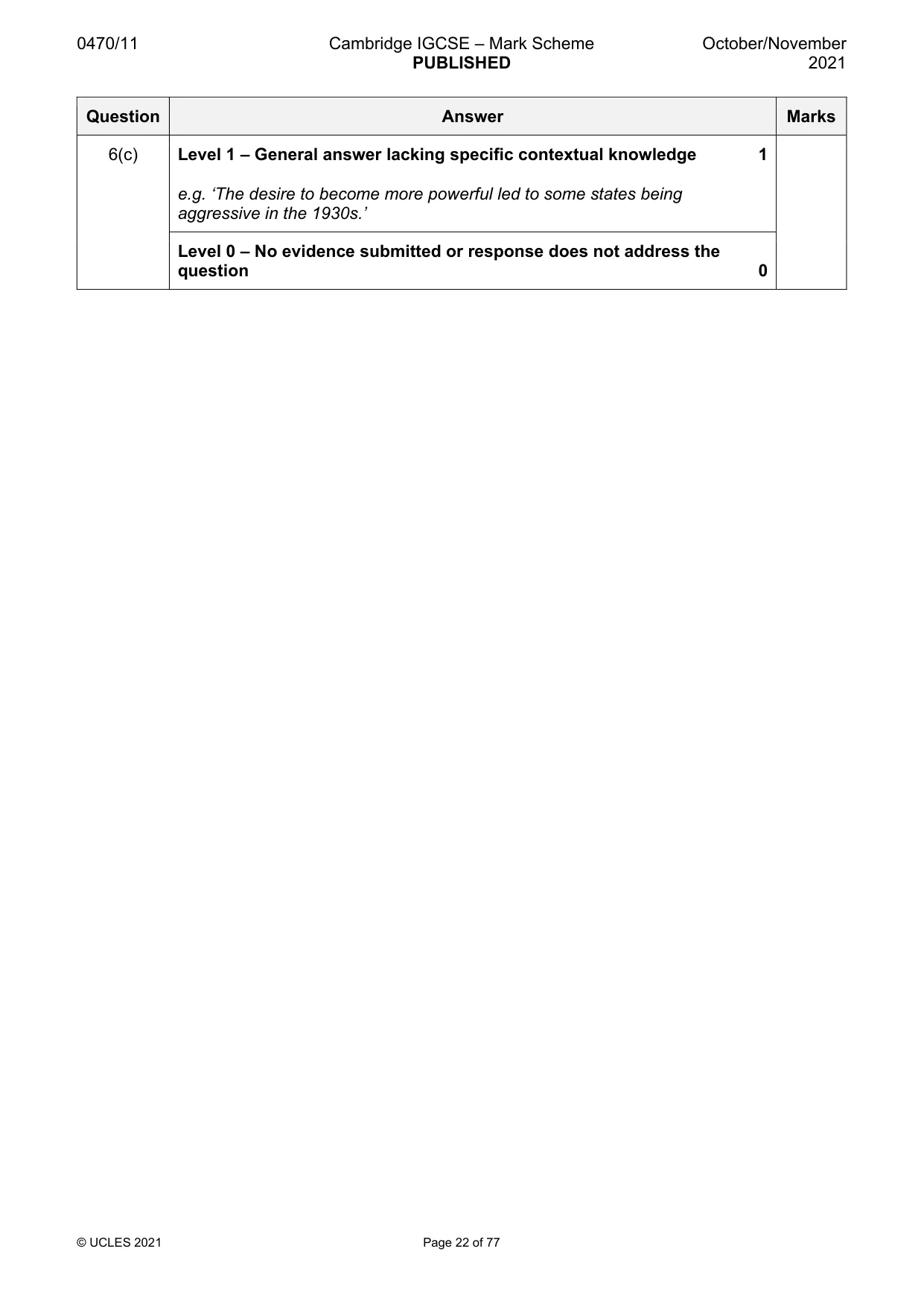
0470/11 Cambridge IGCSE – Mark Scheme PUBLISHED October/November 2021 © UCLES 2021 Page 22 of 77 Question Answer Marks 6(c) Level 1 – General answer lacking specific contextual knowledge 1 e.g. ‘The desire to become more powerful led to some states being aggressive in the 1930s.’ Level 0 – No evidence submitted or response does not address the question 0
Mark scheme, page 23
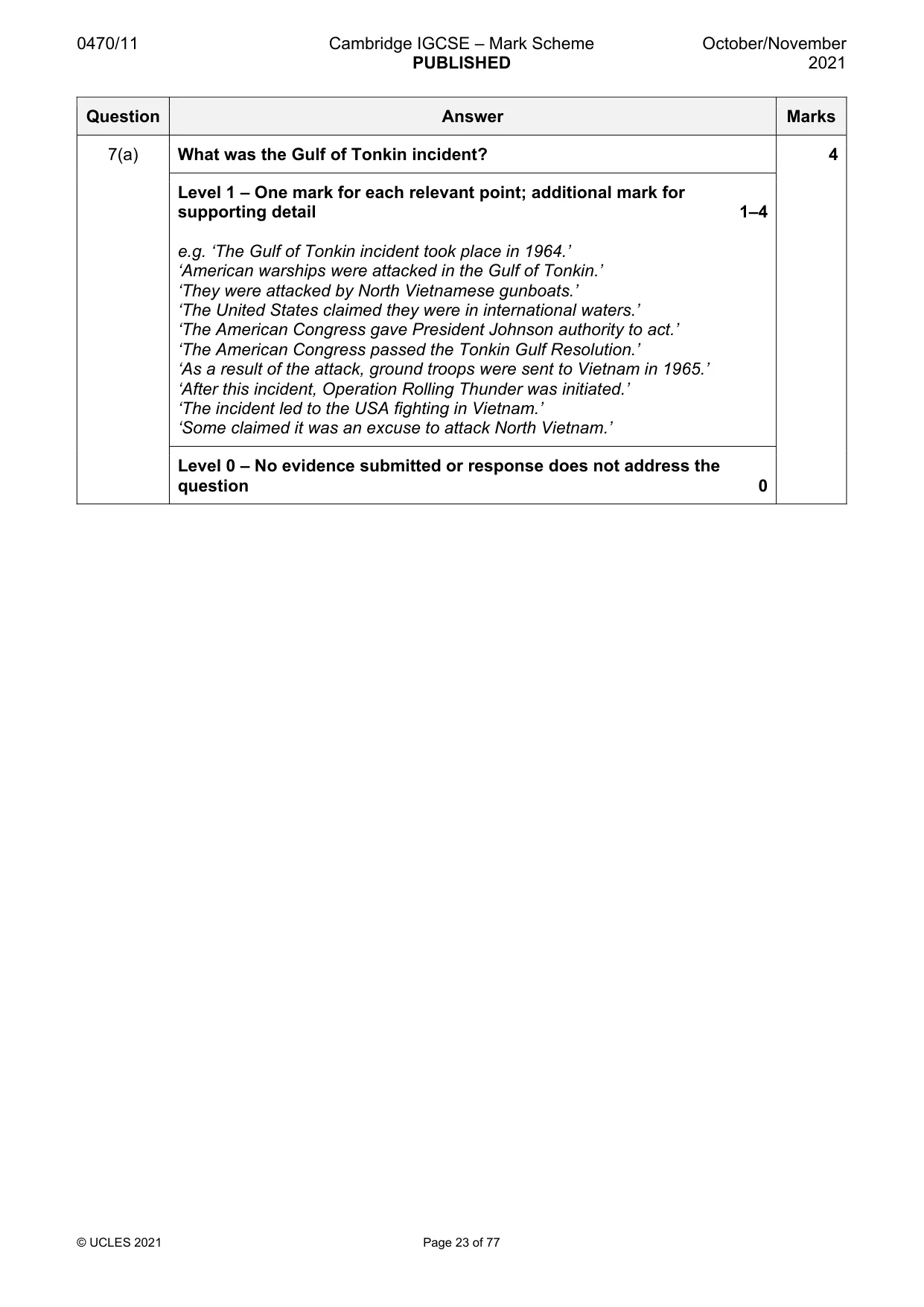
0470/11 Cambridge IGCSE – Mark Scheme PUBLISHED October/November 2021 © UCLES 2021 Page 23 of 77 Question Answer Marks 7(a) What was the Gulf of Tonkin incident? 4 Level 1 – One mark for each relevant point; additional mark for supporting detail 1–4 e.g. ‘The Gulf of Tonkin incident took place in 1964.’ ‘American warships were attacked in the Gulf of Tonkin.’ ‘They were attacked by North Vietnamese gunboats.’ ‘The United States claimed they were in international waters.’ ‘The American Congress gave President Johnson authority to act.’ ‘The American Congress passed the Tonkin Gulf Resolution.’ ‘As a result of the attack, ground troops were sent to Vietnam in 1965.’ ‘After this incident, Operation Rolling Thunder was initiated.’ ‘The incident led to the USA fighting in Vietnam.’ ‘Some claimed it was an excuse to attack North Vietnam.’ Level 0 – No evidence submitted or response does not address the question 0
Mark scheme, page 24
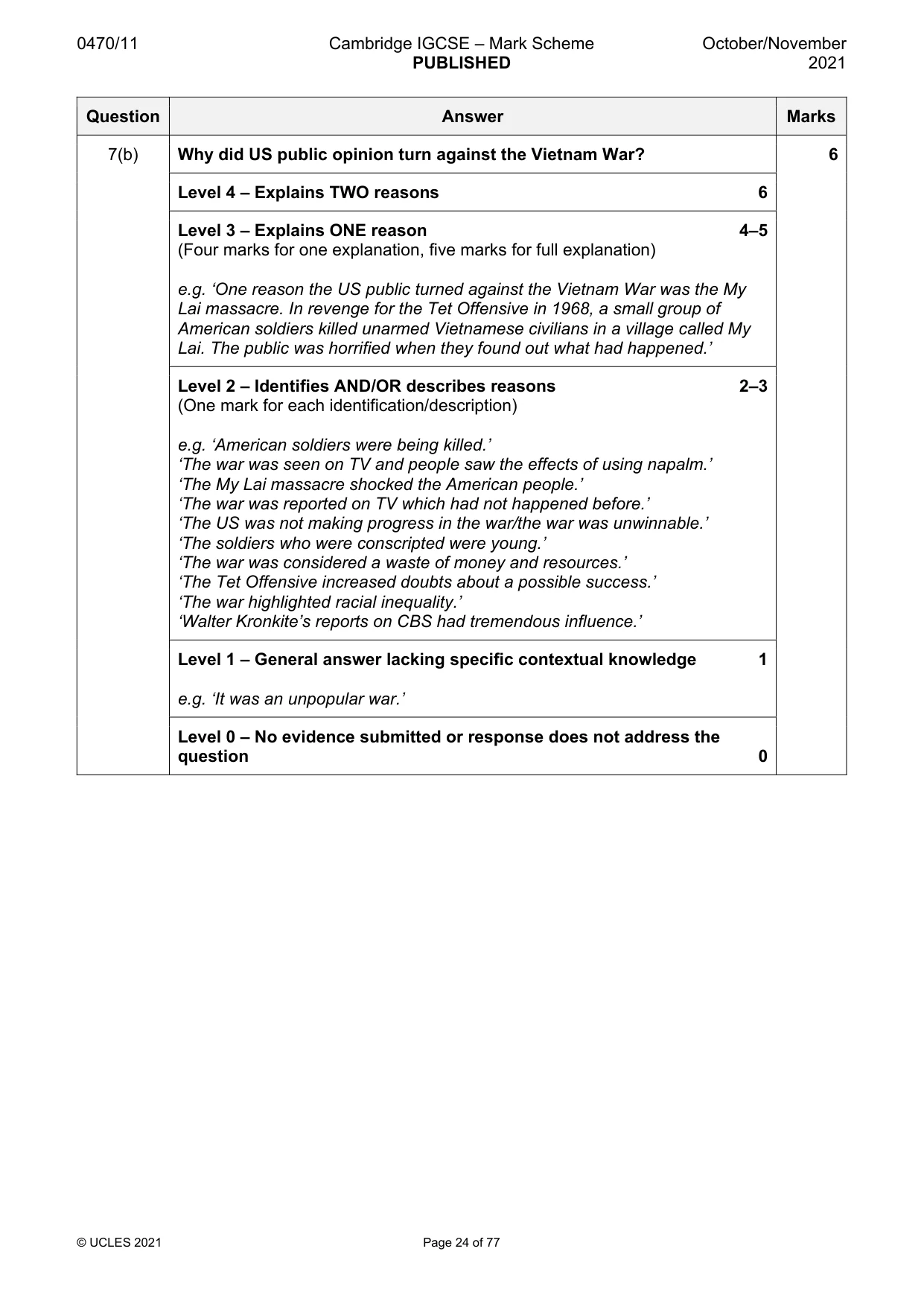
0470/11 Cambridge IGCSE – Mark Scheme PUBLISHED October/November 2021 © UCLES 2021 Page 24 of 77 Question Answer Marks 7(b) Why did US public opinion turn against the Vietnam War? 6 Level 4 – Explains TWO reasons 6 Level 3 – Explains ONE reason 4–5 (Four marks for one explanation, five marks for full explanation) e.g. ‘One reason the US public turned against the Vietnam War was the My Lai massacre. In revenge for the Tet Offensive in 1968, a small group of American soldiers killed unarmed Vietnamese civilians in a village called My Lai. The public was horrified when they found out what had happened.’ Level 2 – Identifies AND/OR describes reasons 2–3 (One mark for each identification/description) e.g. ‘American soldiers were being killed.’ ‘The war was seen on TV and people saw the effects of using napalm.’ ‘The My Lai massacre shocked the American people.’ ‘The war was reported on TV which had not happened before.’ ‘The US was not making progress in the war/the war was unwinnable.’ ‘The soldiers who were conscripted were young.’ ‘The war was considered a waste of money and resources.’ ‘The Tet Offensive increased doubts about a possible success.’ ‘The war highlighted racial inequality.’ ‘Walter Kronkite’s reports on CBS had tremendous influence.’ Level 1 – General answer lacking specific contextual knowledge 1 e.g. ‘It was an unpopular war.’ Level 0 – No evidence submitted or response does not address the question 0
Mark scheme, page 25
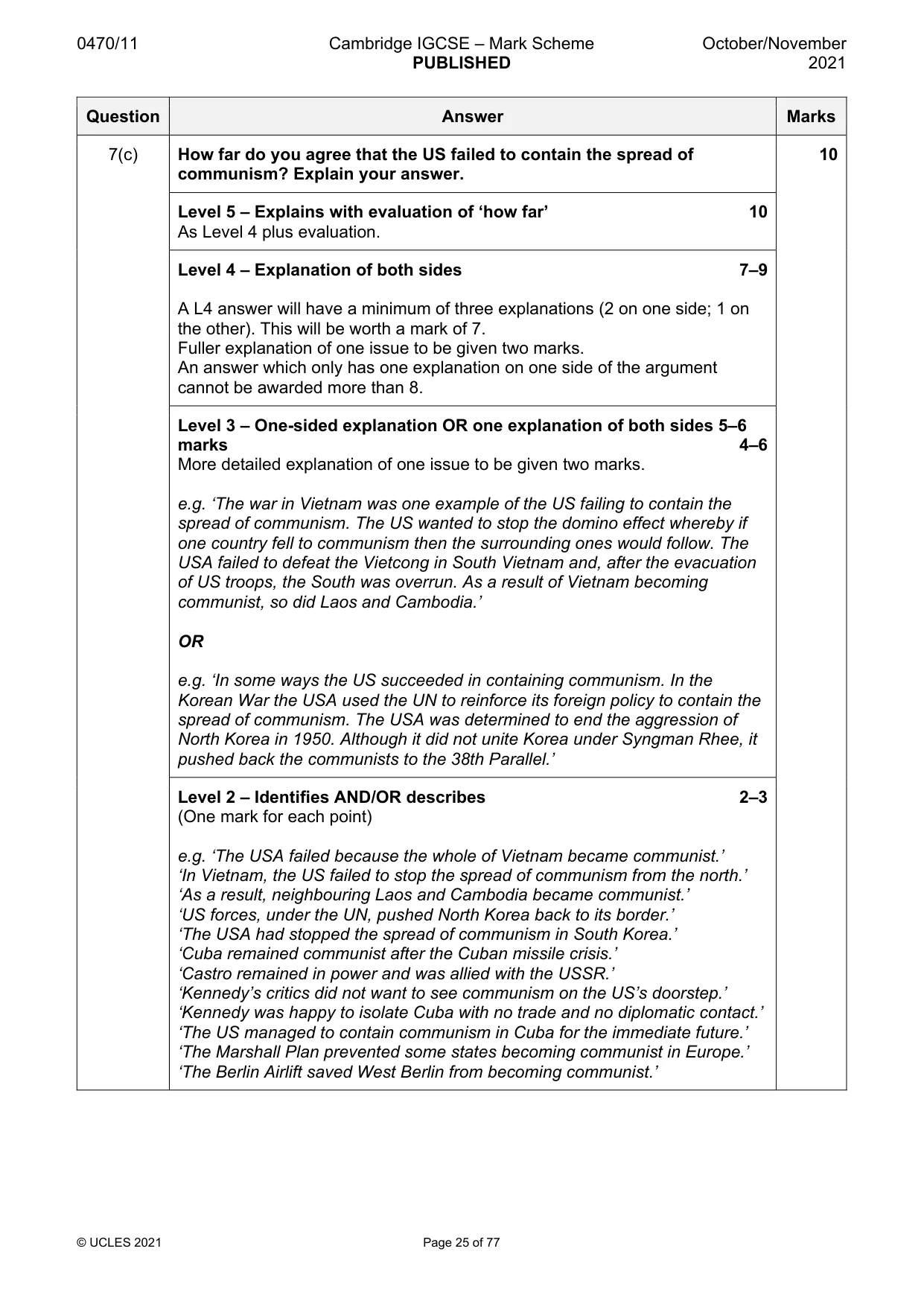
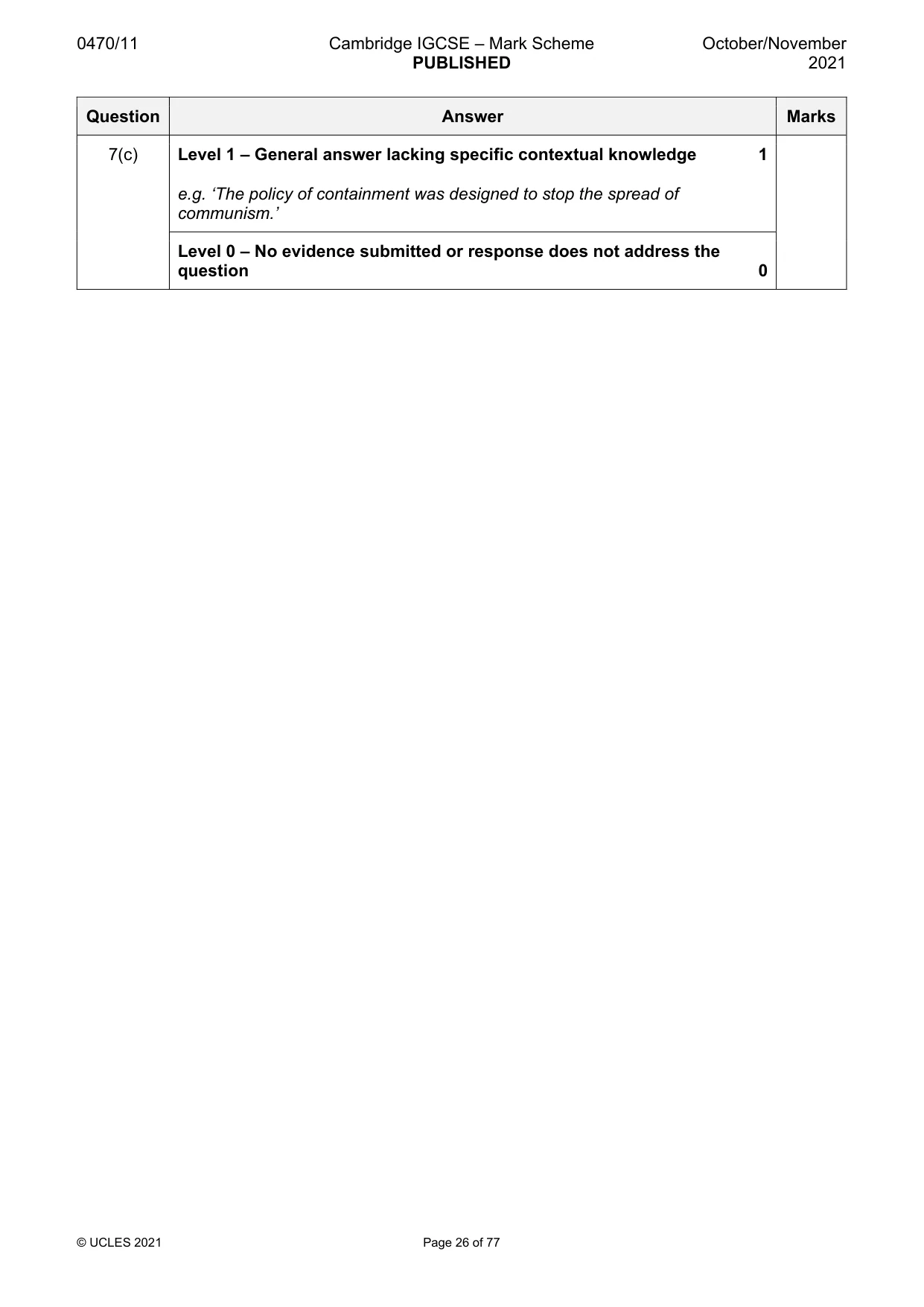
0470/11 Cambridge IGCSE – Mark Scheme PUBLISHED October/November 2021 © UCLES 2021 Page 25 of 77 Question Answer Marks 7(c) How far do you agree that the US failed to contain the spread of communism? Explain your answer. 10 Level 5 – Explains with evaluation of ‘how far’ 10 As Level 4 plus evaluation. Level 4 – Explanation of both sides 7–9 A L4 answer will have a minimum of three explanations (2 on one side; 1 on the other). This will be worth a mark of 7. Fuller explanation of one issue to be given two marks. An answer which only has one explanation on one side of the argument cannot be awarded more than 8. Level 3 – One-sided explanation OR one explanation of both sides 5–6 marks 4–6 More detailed explanation of one issue to be given two marks. e.g. ‘The war in Vietnam was one example of the US failing to contain the spread of communism. The US wanted to stop the domino effect whereby if one country fell to communism then the surrounding ones would follow. The USA failed to defeat the Vietcong in South Vietnam and, after the evacuation of US troops, the South was overrun. As a result of Vietnam becoming communist, so did Laos and Cambodia.’ OR e.g. ‘In some ways the US succeeded in containing communism. In the Korean War the USA used the UN to reinforce its foreign policy to contain the spread of communism. The USA was determined to end the aggression of North Korea in 1950. Although it did not unite Korea under Syngman Rhee, it pushed back the communists to the 38th Parallel.’ Level 2 – Identifies AND/OR describes 2–3 (One mark for each point) e.g. ‘The USA failed because the whole of Vietnam became communist.’ ‘In Vietnam, the US failed to stop the spread of communism from the north.’ ‘As a result, neighbouring Laos and Cambodia became communist.’ ‘US forces, under the UN, pushed North Korea back to its border.’ ‘The USA had stopped the spread of communism in South Korea.’ ‘Cuba remained communist after the Cuban missile crisis.’ ‘Castro remained in power and was allied with the USSR.’ ‘Kennedy’s critics did not want to see communism on the US’s doorstep.’ ‘Kennedy was happy to isolate Cuba with no trade and no diplomatic contact.’ ‘The US managed to contain communism in Cuba for the immediate future.’ ‘The Marshall Plan prevented some states becoming communist in Europe.’ ‘The Berlin Airlift saved West Berlin from becoming communist.’
Mark scheme, page 26
0470/11 Cambridge IGCSE – Mark Scheme PUBLISHED October/November 2021 © UCLES 2021 Page 26 of 77 Question Answer Marks 7(c) Level 1 – General answer lacking specific contextual knowledge 1 e.g. ‘The policy of containment was designed to stop the spread of communism.’ Level 0 – No evidence submitted or response does not address the question 0
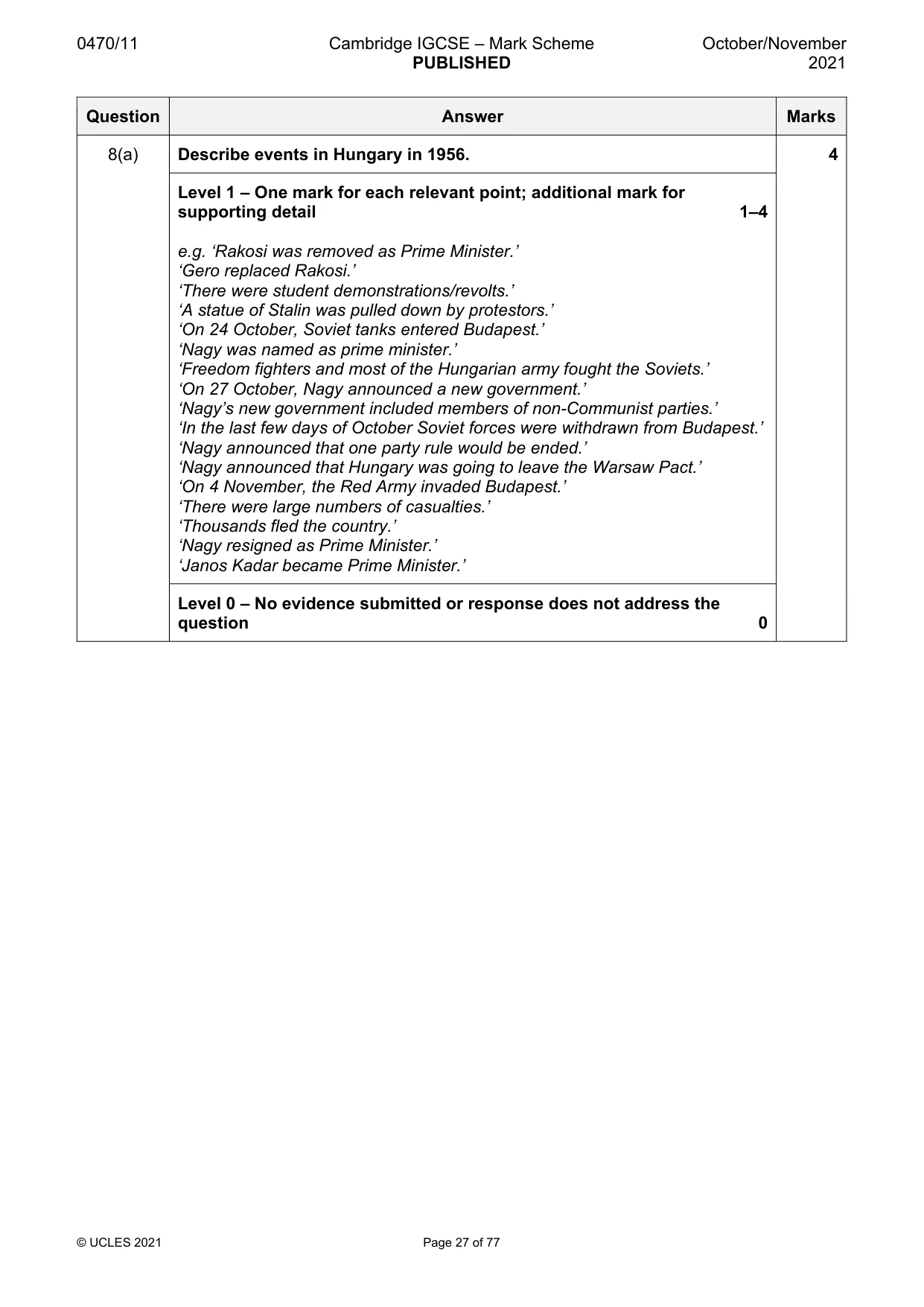
Mark scheme, page 27
0470/11 Cambridge IGCSE – Mark Scheme PUBLISHED October/November 2021 © UCLES 2021 Page 27 of 77 Question Answer Marks 8(a) Describe events in Hungary in 1956. 4 Level 1 – One mark for each relevant point; additional mark for supporting detail 1–4 e.g. ‘Rakosi was removed as Prime Minister.’ ‘Gero replaced Rakosi.’ ‘There were student demonstrations/revolts.’ ‘A statue of Stalin was pulled down by protestors.’ ‘On 24 October, Soviet tanks entered Budapest.’ ‘Nagy was named as prime minister.’ ‘Freedom fighters and most of the Hungarian army fought the Soviets.’ ‘On 27 October, Nagy announced a new government.’ ‘Nagy’s new government included members of non-Communist parties.’ ‘In the last few days of October Soviet forces were withdrawn from Budapest.’ ‘Nagy announced that one party rule would be ended.’ ‘Nagy announced that Hungary was going to leave the Warsaw Pact.’ ‘On 4 November, the Red Army invaded Budapest.’ ‘There were large numbers of casualties.’ ‘Thousands fled the country.’ ‘Nagy resigned as Prime Minister.’ ‘Janos Kadar became Prime Minister.’ Level 0 – No evidence submitted or response does not address the question 0
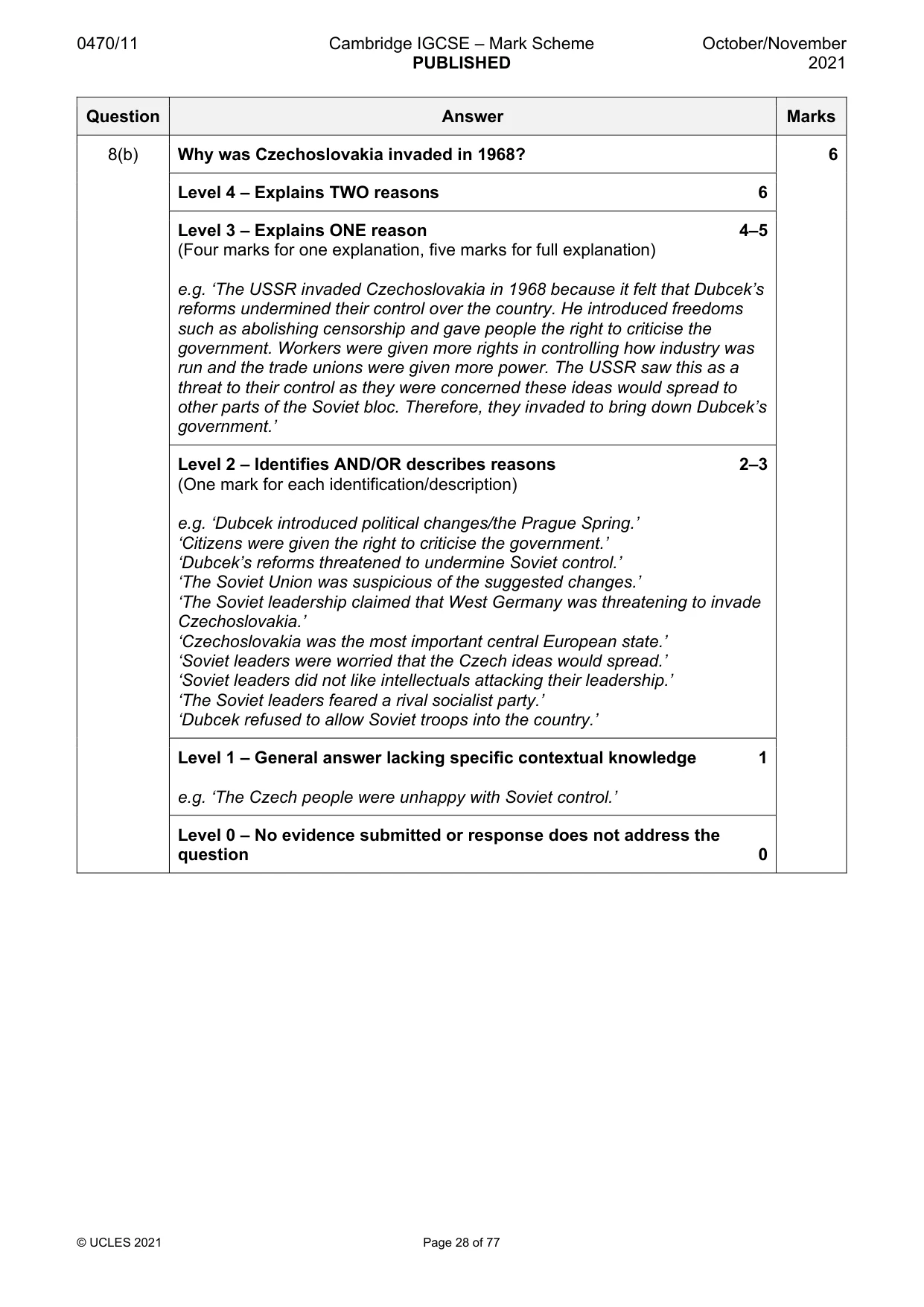
Mark scheme, page 28
0470/11 Cambridge IGCSE – Mark Scheme PUBLISHED October/November 2021 © UCLES 2021 Page 28 of 77 Question Answer Marks 8(b) Why was Czechoslovakia invaded in 1968? 6 Level 4 – Explains TWO reasons 6 Level 3 – Explains ONE reason 4–5 (Four marks for one explanation, five marks for full explanation) e.g. ‘The USSR invaded Czechoslovakia in 1968 because it felt that Dubcek’s reforms undermined their control over the country. He introduced freedoms such as abolishing censorship and gave people the right to criticise the government. Workers were given more rights in controlling how industry was run and the trade unions were given more power. The USSR saw this as a threat to their control as they were concerned these ideas would spread to other parts of the Soviet bloc. Therefore, they invaded to bring down Dubcek’s government.’ Level 2 – Identifies AND/OR describes reasons 2–3 (One mark for each identification/description) e.g. ‘Dubcek introduced political changes/the Prague Spring.’ ‘Citizens were given the right to criticise the government.’ ‘Dubcek’s reforms threatened to undermine Soviet control.’ ‘The Soviet Union was suspicious of the suggested changes.’ ‘The Soviet leadership claimed that West Germany was threatening to invade Czechoslovakia.’ ‘Czechoslovakia was the most important central European state.’ ‘Soviet leaders were worried that the Czech ideas would spread.’ ‘Soviet leaders did not like intellectuals attacking their leadership.’ ‘The Soviet leaders feared a rival socialist party.’ ‘Dubcek refused to allow Soviet troops into the country.’ Level 1 – General answer lacking specific contextual knowledge 1 e.g. ‘The Czech people were unhappy with Soviet control.’ Level 0 – No evidence submitted or response does not address the question 0
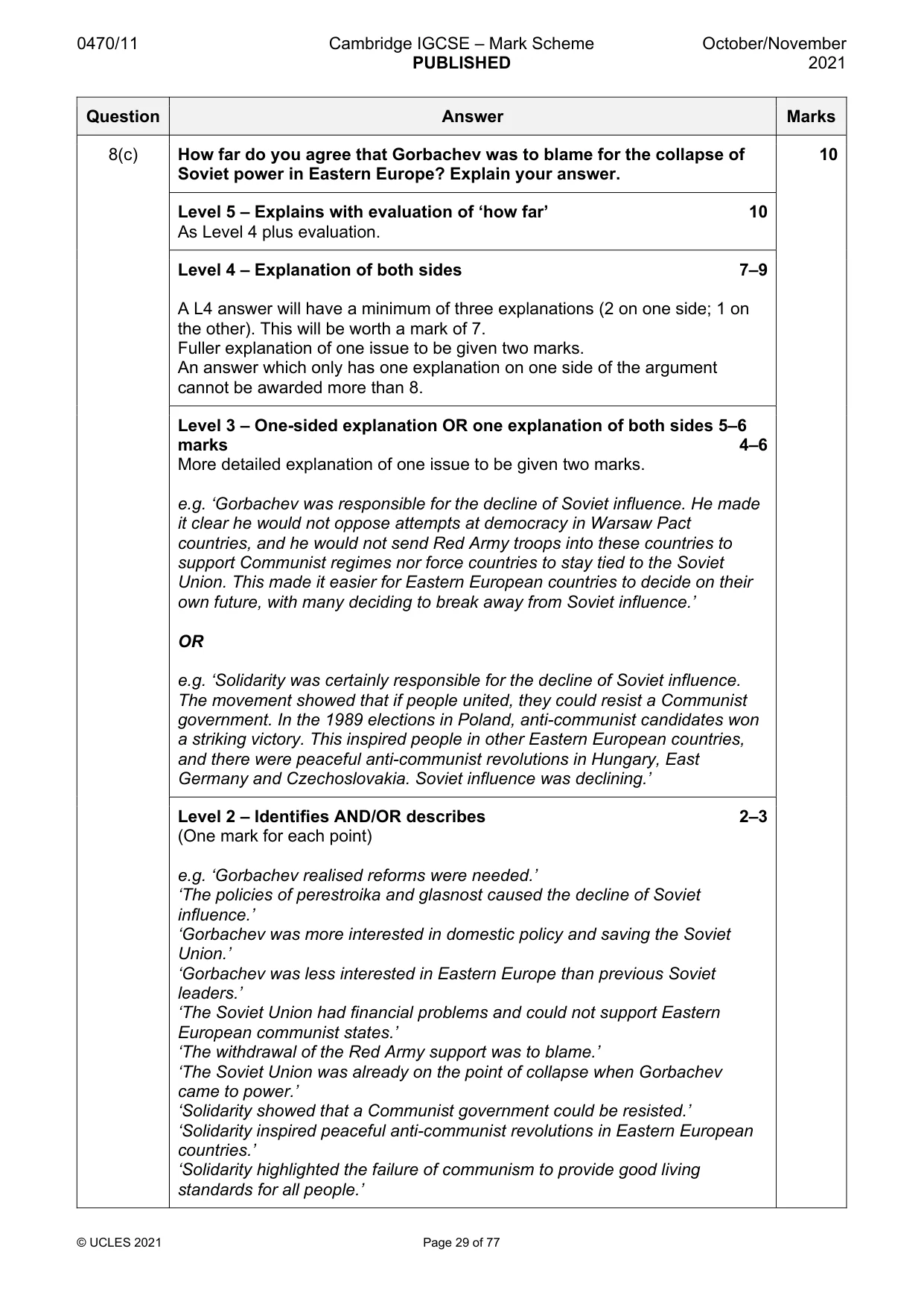
Mark scheme, page 29
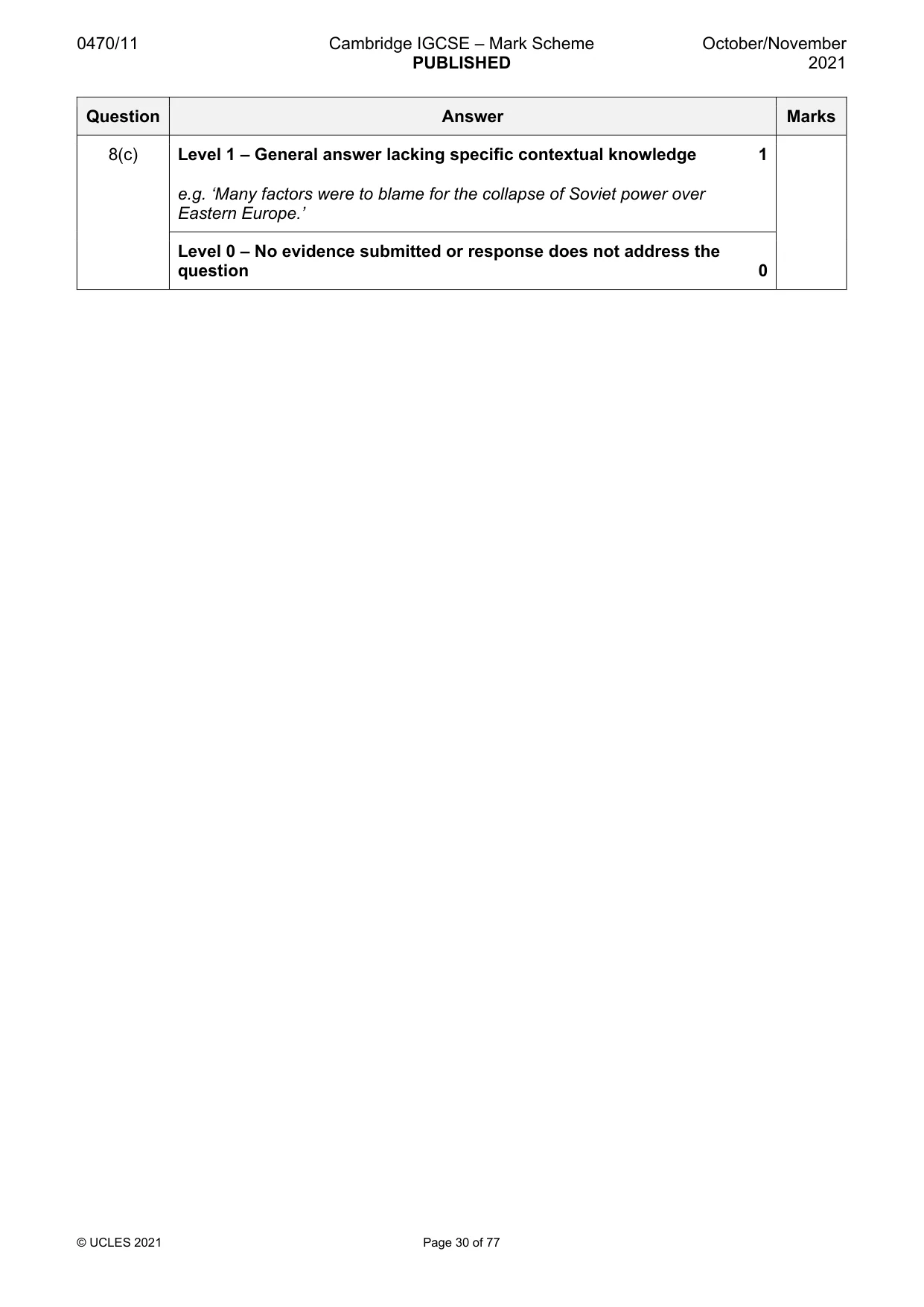
0470/11 Cambridge IGCSE – Mark Scheme PUBLISHED October/November 2021 © UCLES 2021 Page 29 of 77 Question Answer Marks 8(c) How far do you agree that Gorbachev was to blame for the collapse of Soviet power in Eastern Europe? Explain your answer. 10 Level 5 – Explains with evaluation of ‘how far’ 10 As Level 4 plus evaluation. Level 4 – Explanation of both sides 7–9 A L4 answer will have a minimum of three explanations (2 on one side; 1 on the other). This will be worth a mark of 7. Fuller explanation of one issue to be given two marks. An answer which only has one explanation on one side of the argument cannot be awarded more than 8. Level 3 – One-sided explanation OR one explanation of both sides 5–6 marks 4–6 More detailed explanation of one issue to be given two marks. e.g. ‘Gorbachev was responsible for the decline of Soviet influence. He made it clear he would not oppose attempts at democracy in Warsaw Pact countries, and he would not send Red Army troops into these countries to support Communist regimes nor force countries to stay tied to the Soviet Union. This made it easier for Eastern European countries to decide on their own future, with many deciding to break away from Soviet influence.’ OR e.g. ‘Solidarity was certainly responsible for the decline of Soviet influence. The movement showed that if people united, they could resist a Communist government. In the 1989 elections in Poland, anti-communist candidates won a striking victory. This inspired people in other Eastern European countries, and there were peaceful anti-communist revolutions in Hungary, East Germany and Czechoslovakia. Soviet influence was declining.’ Level 2 – Identifies AND/OR describes 2–3 (One mark for each point) e.g. ‘Gorbachev realised reforms were needed.’ ‘The policies of perestroika and glasnost caused the decline of Soviet influence.’ ‘Gorbachev was more interested in domestic policy and saving the Soviet Union.’ ‘Gorbachev was less interested in Eastern Europe than previous Soviet leaders.’ ‘The Soviet Union had financial problems and could not support Eastern European communist states.’ ‘The withdrawal of the Red Army support was to blame.’ ‘The Soviet Union was already on the point of collapse when Gorbachev came to power.’ ‘Solidarity showed that a Communist government could be resisted.’ ‘Solidarity inspired peaceful anti-communist revolutions in Eastern European countries.’ ‘Solidarity highlighted the failure of communism to provide good living standards for all people.’
Mark scheme, page 30
0470/11 Cambridge IGCSE – Mark Scheme PUBLISHED October/November 2021 © UCLES 2021 Page 30 of 77 Question Answer Marks 8(c) Level 1 – General answer lacking specific contextual knowledge 1 e.g. ‘Many factors were to blame for the collapse of Soviet power over Eastern Europe.’ Level 0 – No evidence submitted or response does not address the question 0
Mark scheme, page 31
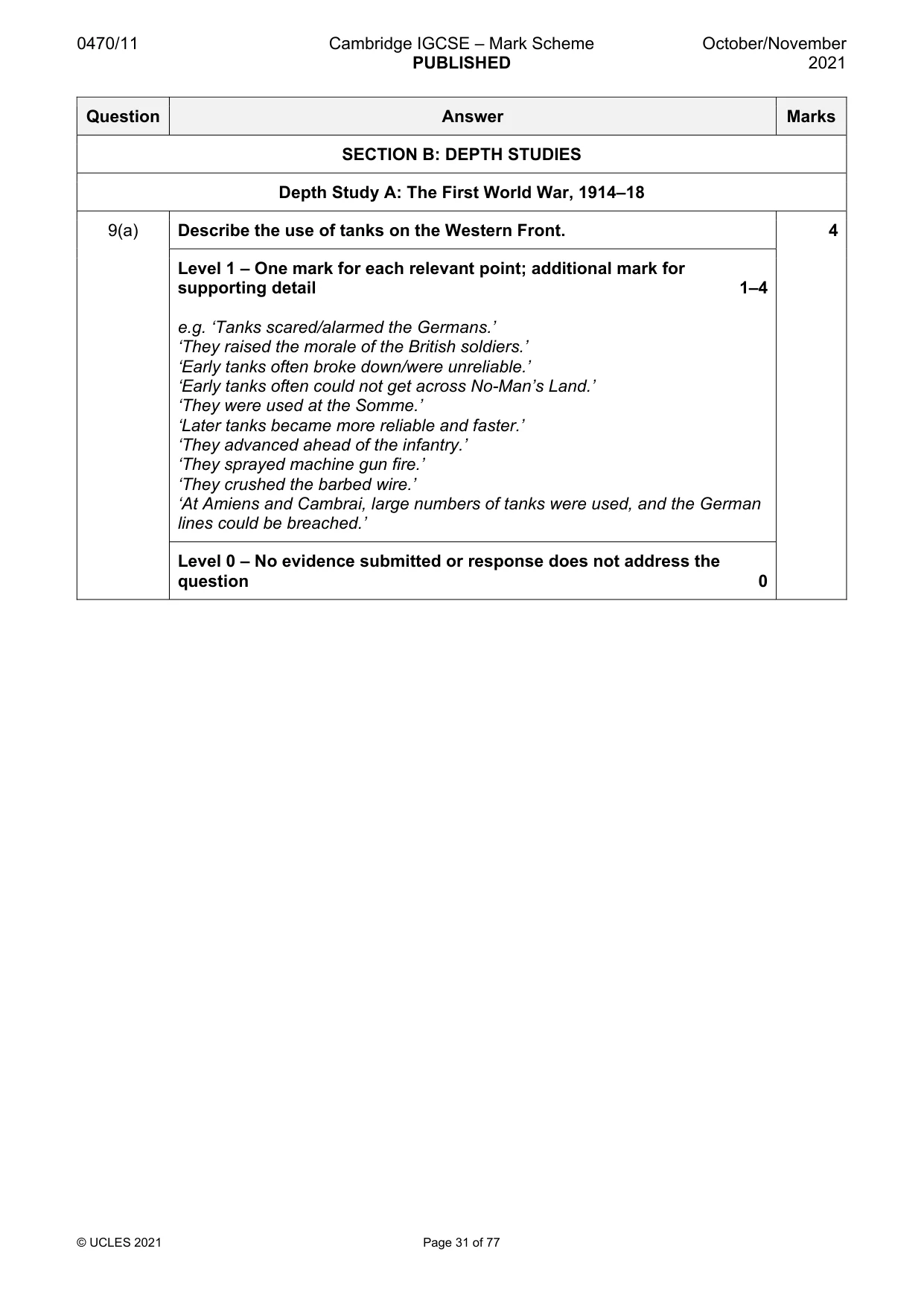
0470/11 Cambridge IGCSE – Mark Scheme PUBLISHED October/November 2021 © UCLES 2021 Page 31 of 77 Question Answer Marks SECTION B: DEPTH STUDIES Depth Study A: The First World War, 1914–18 9(a) Describe the use of tanks on the Western Front. 4 Level 1 – One mark for each relevant point; additional mark for supporting detail 1–4 e.g. ‘Tanks scared/alarmed the Germans.’ ‘They raised the morale of the British soldiers.’ ‘Early tanks often broke down/were unreliable.’ ‘Early tanks often could not get across No-Man’s Land.’ ‘They were used at the Somme.’ ‘Later tanks became more reliable and faster.’ ‘They advanced ahead of the infantry.’ ‘They sprayed machine gun fire.’ ‘They crushed the barbed wire.’ ‘At Amiens and Cambrai, large numbers of tanks were used, and the German lines could be breached.’ Level 0 – No evidence submitted or response does not address the question 0
Mark scheme, page 32
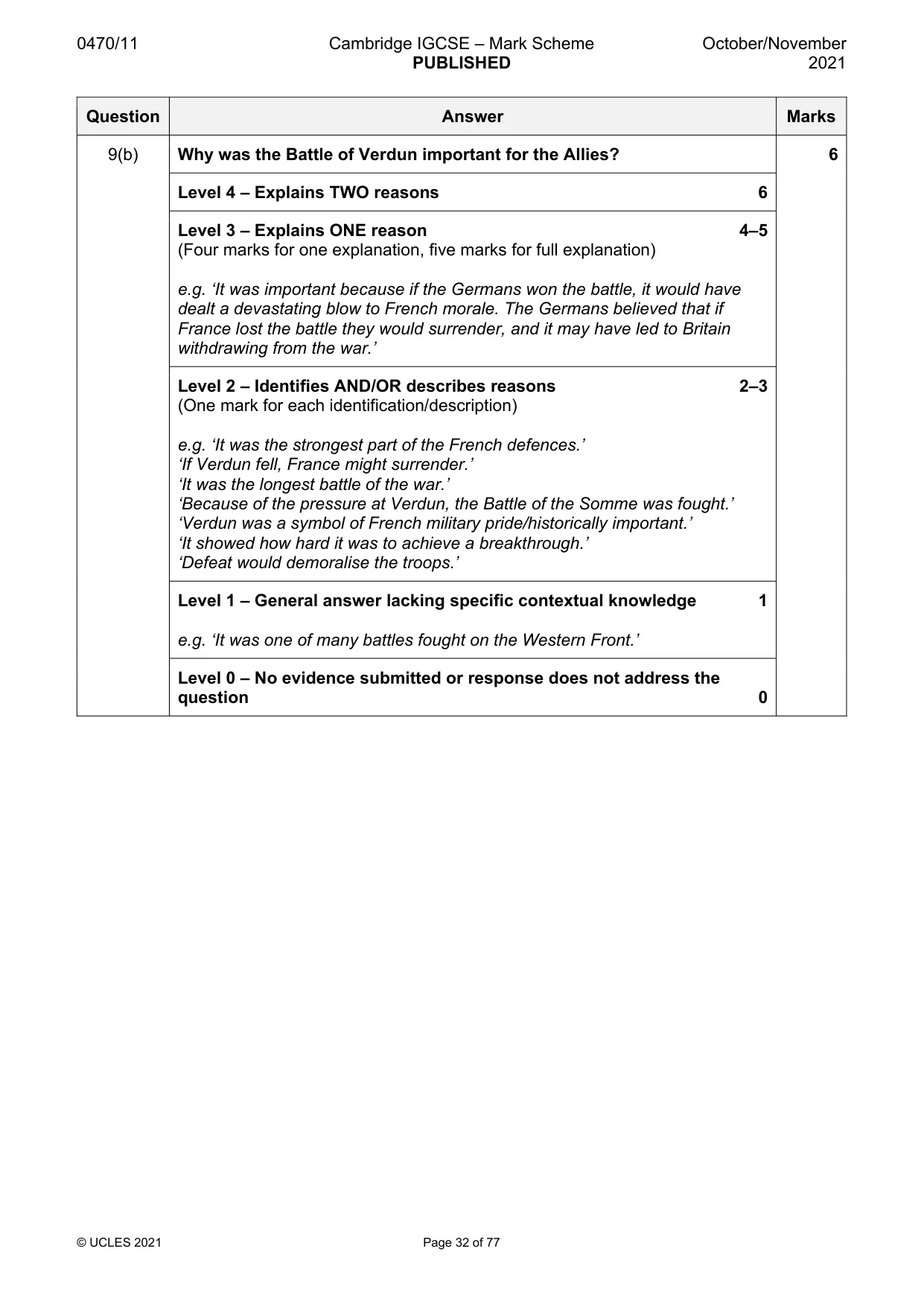
0470/11 Cambridge IGCSE – Mark Scheme PUBLISHED October/November 2021 © UCLES 2021 Page 32 of 77 Question Answer Marks 9(b) Why was the Battle of Verdun important for the Allies? 6 Level 4 – Explains TWO reasons 6 Level 3 – Explains ONE reason 4–5 (Four marks for one explanation, five marks for full explanation) e.g. ‘It was important because if the Germans won the battle, it would have dealt a devastating blow to French morale. The Germans believed that if France lost the battle they would surrender, and it may have led to Britain withdrawing from the war.’ Level 2 – Identifies AND/OR describes reasons 2–3 (One mark for each identification/description) e.g. ‘It was the strongest part of the French defences.’ ‘If Verdun fell, France might surrender.’ ‘It was the longest battle of the war.’ ‘Because of the pressure at Verdun, the Battle of the Somme was fought.’ ‘Verdun was a symbol of French military pride/historically important.’ ‘It showed how hard it was to achieve a breakthrough.’ ‘Defeat would demoralise the troops.’ Level 1 – General answer lacking specific contextual knowledge 1 e.g. ‘It was one of many battles fought on the Western Front.’ Level 0 – No evidence submitted or response does not address the question 0
Mark scheme, page 33
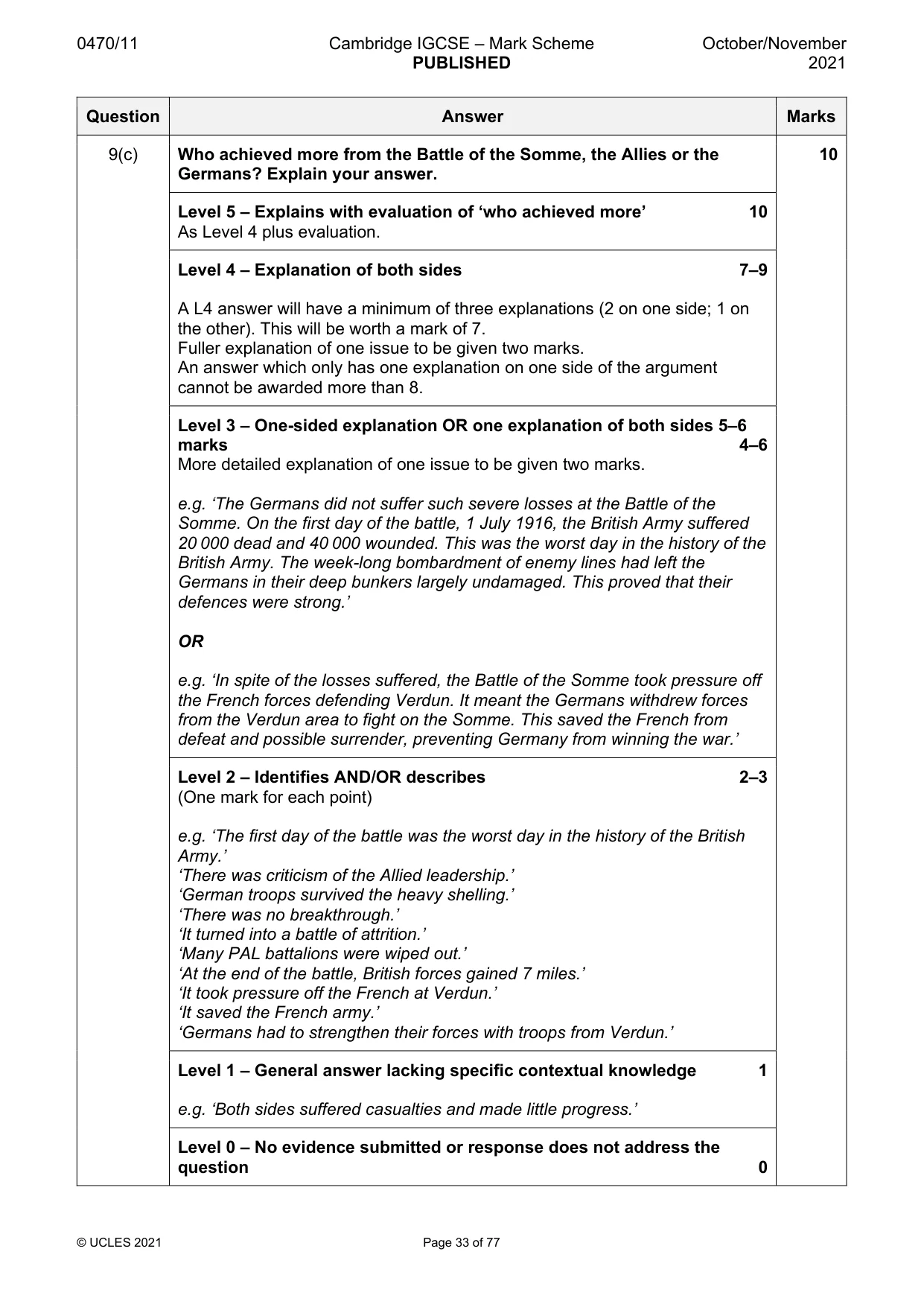
0470/11 Cambridge IGCSE – Mark Scheme PUBLISHED October/November 2021 © UCLES 2021 Page 33 of 77 Question Answer Marks 9(c) Who achieved more from the Battle of the Somme, the Allies or the Germans? Explain your answer. 10 Level 5 – Explains with evaluation of ‘who achieved more’ 10 As Level 4 plus evaluation. Level 4 – Explanation of both sides 7–9 A L4 answer will have a minimum of three explanations (2 on one side; 1 on the other). This will be worth a mark of 7. Fuller explanation of one issue to be given two marks. An answer which only has one explanation on one side of the argument cannot be awarded more than 8. Level 3 – One-sided explanation OR one explanation of both sides 5–6 marks 4–6 More detailed explanation of one issue to be given two marks. e.g. ‘The Germans did not suffer such severe losses at the Battle of the Somme. On the first day of the battle, 1 July 1916, the British Army suffered 20 000 dead and 40 000 wounded. This was the worst day in the history of the British Army. The week-long bombardment of enemy lines had left the Germans in their deep bunkers largely undamaged. This proved that their defences were strong.’ OR e.g. ‘In spite of the losses suffered, the Battle of the Somme took pressure off the French forces defending Verdun. It meant the Germans withdrew forces from the Verdun area to fight on the Somme. This saved the French from defeat and possible surrender, preventing Germany from winning the war.’ Level 2 – Identifies AND/OR describes 2–3 (One mark for each point) e.g. ‘The first day of the battle was the worst day in the history of the British Army.’ ‘There was criticism of the Allied leadership.’ ‘German troops survived the heavy shelling.’ ‘There was no breakthrough.’ ‘It turned into a battle of attrition.’ ‘Many PAL battalions were wiped out.’ ‘At the end of the battle, British forces gained 7 miles.’ ‘It took pressure off the French at Verdun.’ ‘It saved the French army.’ ‘Germans had to strengthen their forces with troops from Verdun.’ Level 1 – General answer lacking specific contextual knowledge 1 e.g. ‘Both sides suffered casualties and made little progress.’ Level 0 – No evidence submitted or response does not address the question 0
Mark scheme, page 34
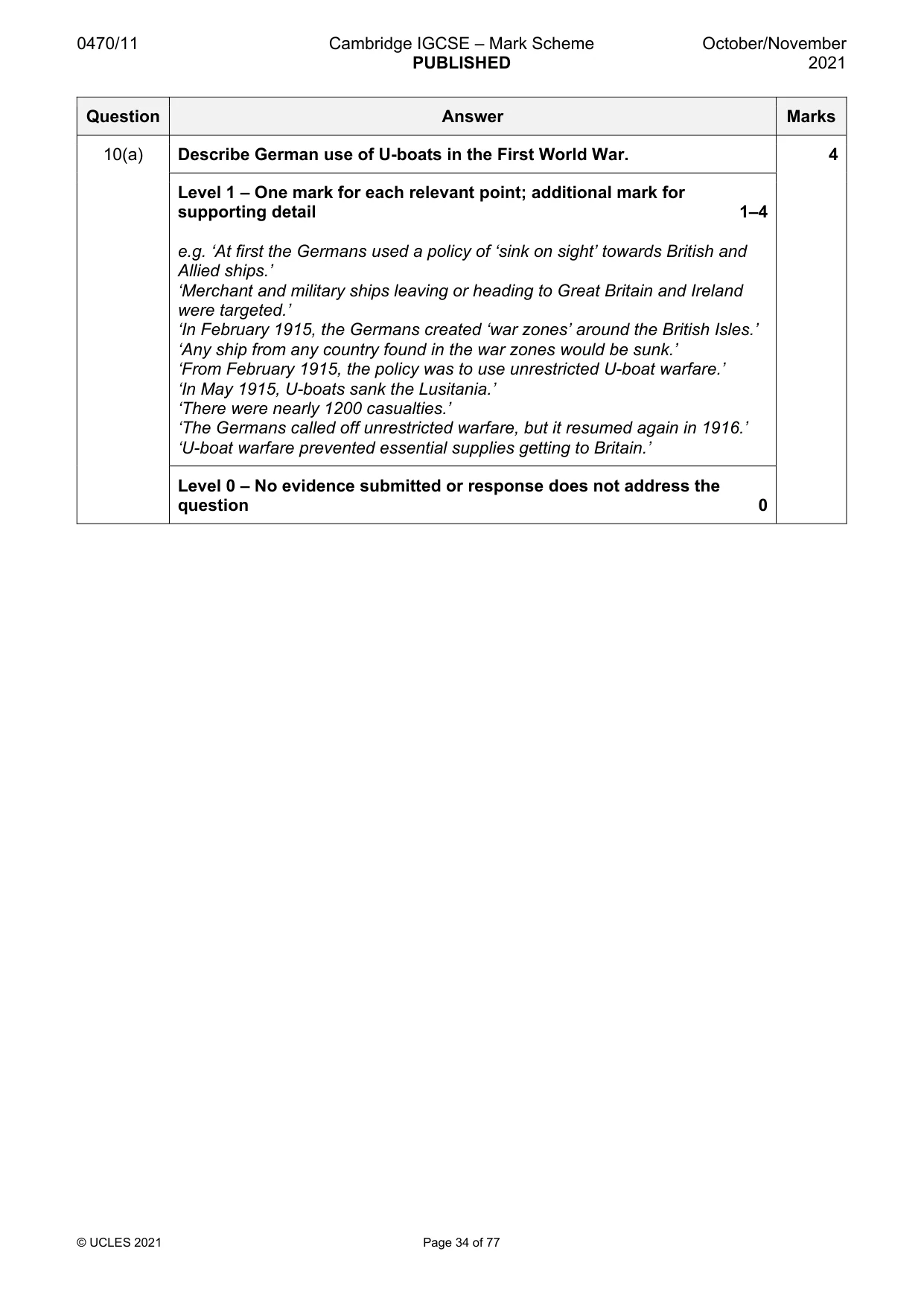
0470/11 Cambridge IGCSE – Mark Scheme PUBLISHED October/November 2021 © UCLES 2021 Page 34 of 77 Question Answer Marks 10(a) Describe German use of U-boats in the First World War. 4 Level 1 – One mark for each relevant point; additional mark for supporting detail 1–4 e.g. ‘At first the Germans used a policy of ‘sink on sight’ towards British and Allied ships.’ ‘Merchant and military ships leaving or heading to Great Britain and Ireland were targeted.’ ‘In February 1915, the Germans created ‘war zones’ around the British Isles.’ ‘Any ship from any country found in the war zones would be sunk.’ ‘From February 1915, the policy was to use unrestricted U-boat warfare.’ ‘In May 1915, U-boats sank the Lusitania.’ ‘There were nearly 1200 casualties.’ ‘The Germans called off unrestricted warfare, but it resumed again in 1916.’ ‘U-boat warfare prevented essential supplies getting to Britain.’ Level 0 – No evidence submitted or response does not address the question 0
Mark scheme, page 35
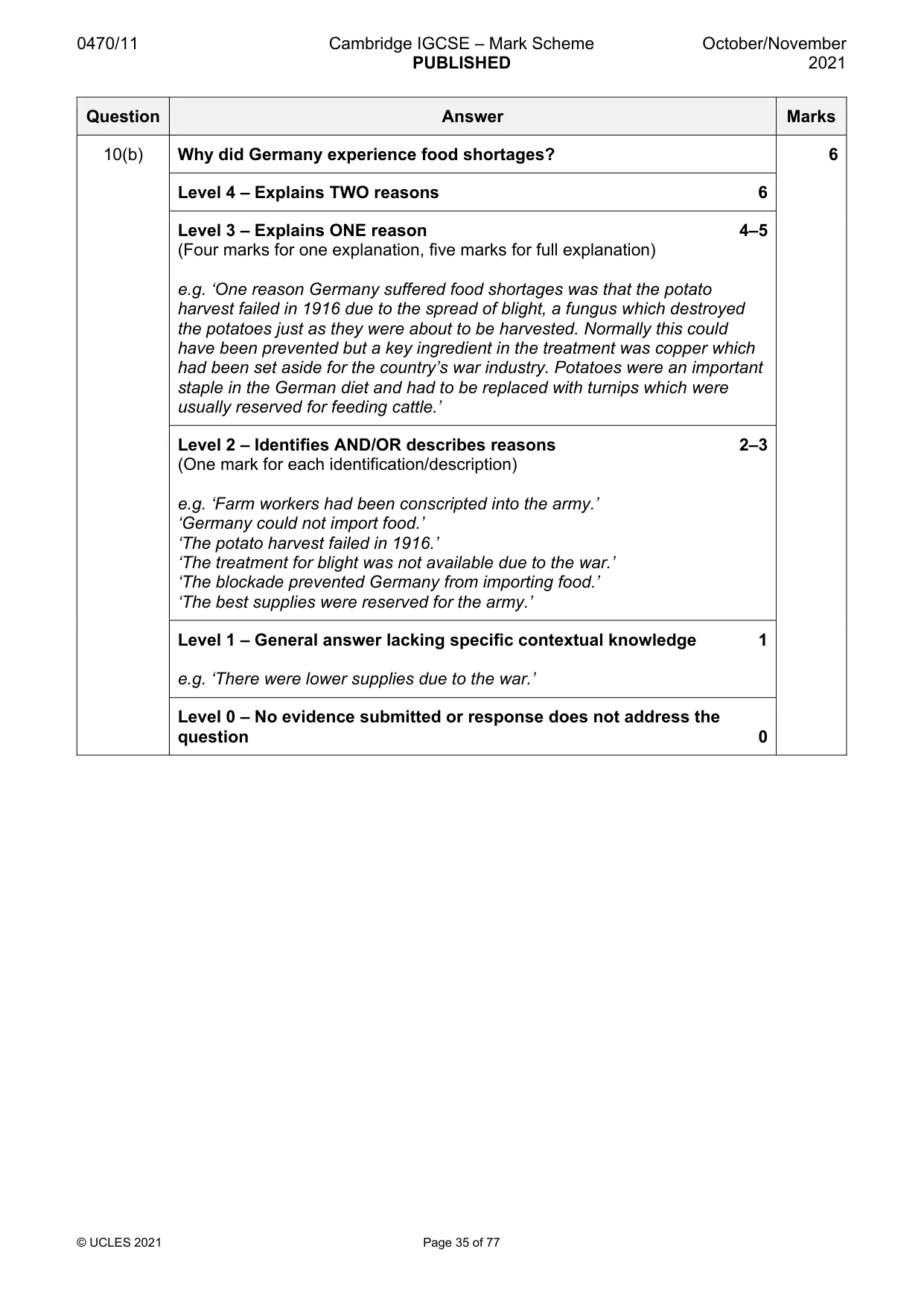
0470/11 Cambridge IGCSE – Mark Scheme PUBLISHED October/November 2021 © UCLES 2021 Page 35 of 77 Question Answer Marks 10(b) Why did Germany experience food shortages? 6 Level 4 – Explains TWO reasons 6 Level 3 – Explains ONE reason 4–5 (Four marks for one explanation, five marks for full explanation) e.g. ‘One reason Germany suffered food shortages was that the potato harvest failed in 1916 due to the spread of blight, a fungus which destroyed the potatoes just as they were about to be harvested. Normally this could have been prevented but a key ingredient in the treatment was copper which had been set aside for the country’s war industry. Potatoes were an important staple in the German diet and had to be replaced with turnips which were usually reserved for feeding cattle.’ Level 2 – Identifies AND/OR describes reasons 2–3 (One mark for each identification/description) e.g. ‘Farm workers had been conscripted into the army.’ ‘Germany could not import food.’ ‘The potato harvest failed in 1916.’ ‘The treatment for blight was not available due to the war.’ ‘The blockade prevented Germany from importing food.’ ‘The best supplies were reserved for the army.’ Level 1 – General answer lacking specific contextual knowledge 1 e.g. ‘There were lower supplies due to the war.’ Level 0 – No evidence submitted or response does not address the question 0
Mark scheme, page 36
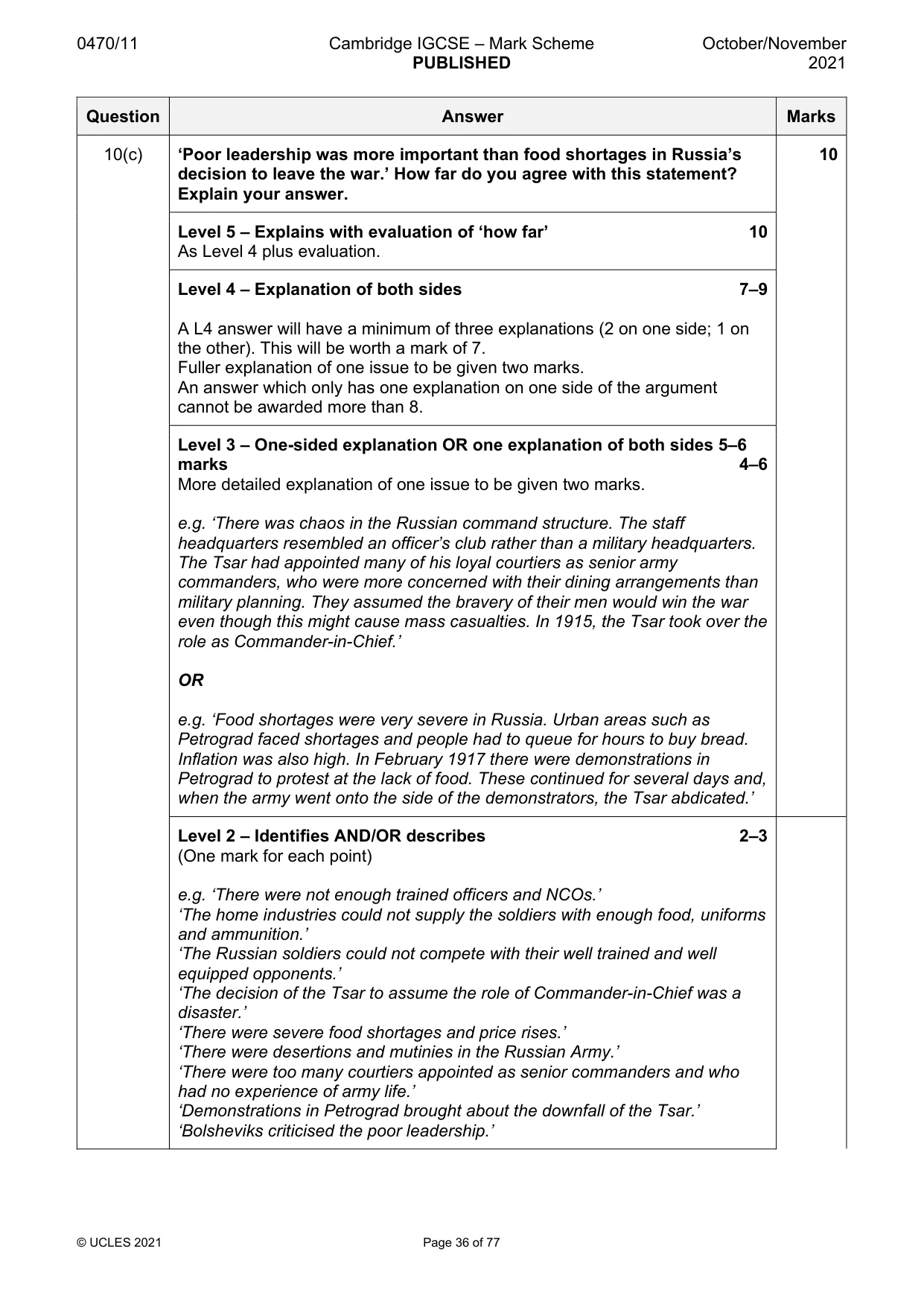
0470/11 Cambridge IGCSE – Mark Scheme PUBLISHED October/November 2021 © UCLES 2021 Page 36 of 77 Question Answer Marks 10(c) ‘Poor leadership was more important than food shortages in Russia’s decision to leave the war.’ How far do you agree with this statement? Explain your answer. 10 Level 5 – Explains with evaluation of ‘how far’ 10 As Level 4 plus evaluation. Level 4 – Explanation of both sides 7–9 A L4 answer will have a minimum of three explanations (2 on one side; 1 on the other). This will be worth a mark of 7. Fuller explanation of one issue to be given two marks. An answer which only has one explanation on one side of the argument cannot be awarded more than 8. Level 3 – One-sided explanation OR one explanation of both sides 5–6 marks 4–6 More detailed explanation of one issue to be given two marks. e.g. ‘There was chaos in the Russian command structure. The staff headquarters resembled an officer’s club rather than a military headquarters. The Tsar had appointed many of his loyal courtiers as senior army commanders, who were more concerned with their dining arrangements than military planning. They assumed the bravery of their men would win the war even though this might cause mass casualties. In 1915, the Tsar took over the role as Commander-in-Chief.’ OR e.g. ‘Food shortages were very severe in Russia. Urban areas such as Petrograd faced shortages and people had to queue for hours to buy bread. Inflation was also high. In February 1917 there were demonstrations in Petrograd to protest at the lack of food. These continued for several days and, when the army went onto the side of the demonstrators, the Tsar abdicated.’ Level 2 – Identifies AND/OR describes 2–3 (One mark for each point) e.g. ‘There were not enough trained officers and NCOs.’ ‘The home industries could not supply the soldiers with enough food, uniforms and ammunition.’ ‘The Russian soldiers could not compete with their well trained and well equipped opponents.’ ‘The decision of the Tsar to assume the role of Commander-in-Chief was a disaster.’ ‘There were severe food shortages and price rises.’ ‘There were desertions and mutinies in the Russian Army.’ ‘There were too many courtiers appointed as senior commanders and who had no experience of army life.’ ‘Demonstrations in Petrograd brought about the downfall of the Tsar.’ ‘Bolsheviks criticised the poor leadership.’
Mark scheme, page 37
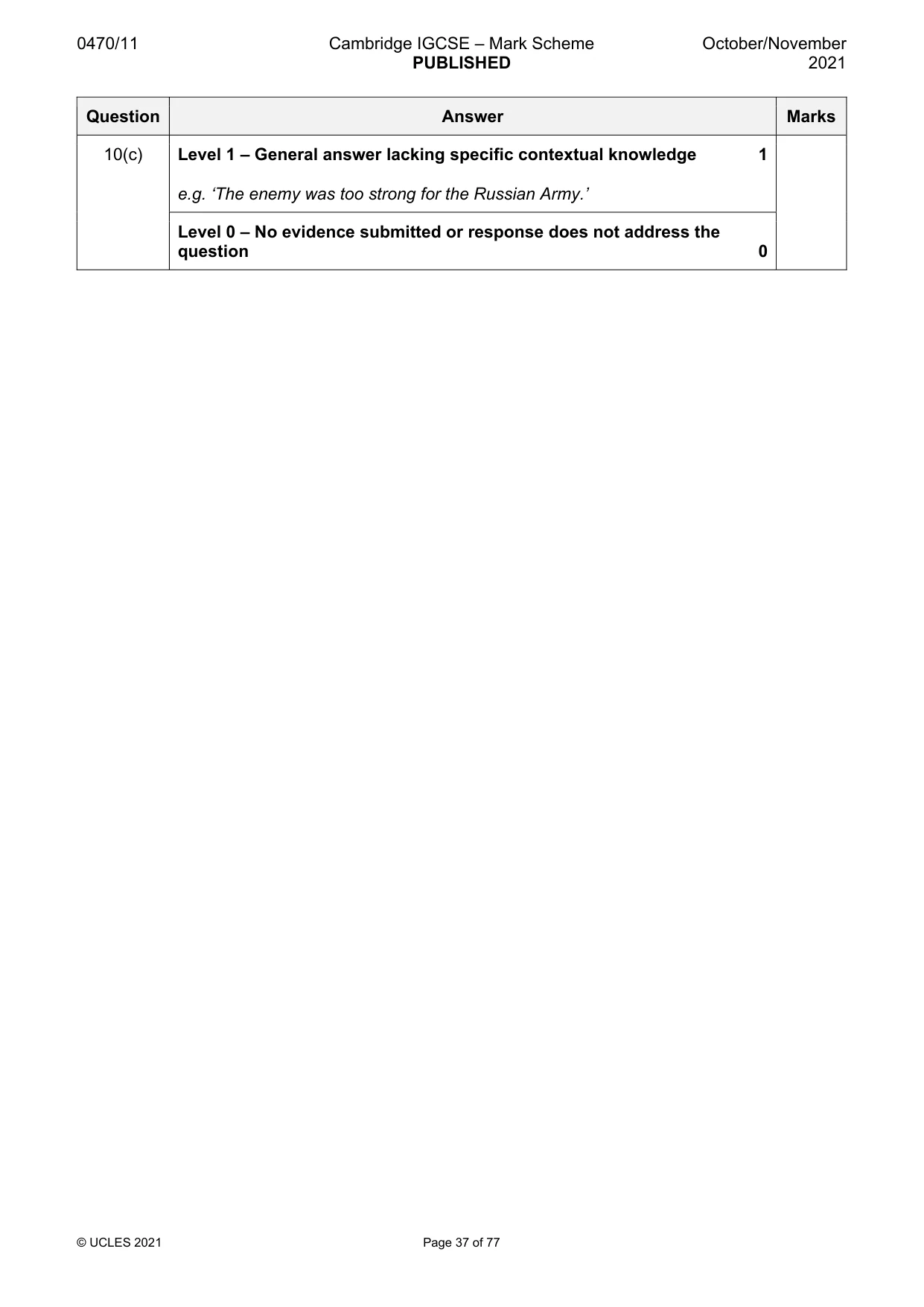
0470/11 Cambridge IGCSE – Mark Scheme PUBLISHED October/November 2021 © UCLES 2021 Page 37 of 77 Question Answer Marks 10(c) Level 1 – General answer lacking specific contextual knowledge 1 e.g. ‘The enemy was too strong for the Russian Army.’ Level 0 – No evidence submitted or response does not address the question 0
Mark scheme, page 38
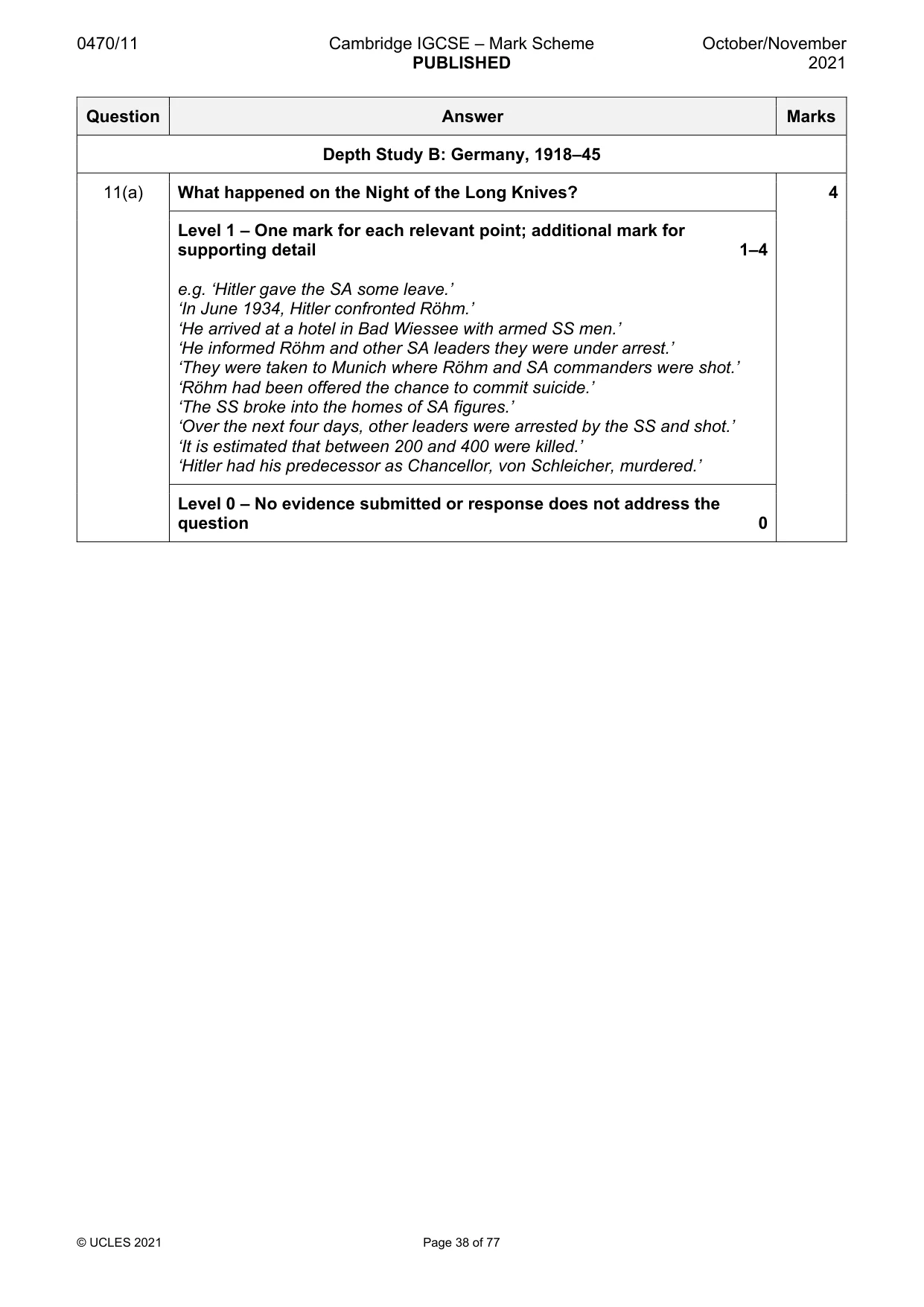
0470/11 Cambridge IGCSE – Mark Scheme PUBLISHED October/November 2021 © UCLES 2021 Page 38 of 77 Question Answer Marks Depth Study B: Germany, 1918–45 11(a) What happened on the Night of the Long Knives? 4 Level 1 – One mark for each relevant point; additional mark for supporting detail 1–4 e.g. ‘Hitler gave the SA some leave.’ ‘In June 1934, Hitler confronted Röhm.’ ‘He arrived at a hotel in Bad Wiessee with armed SS men.’ ‘He informed Röhm and other SA leaders they were under arrest.’ ‘They were taken to Munich where Röhm and SA commanders were shot.’ ‘Röhm had been offered the chance to commit suicide.’ ‘The SS broke into the homes of SA figures.’ ‘Over the next four days, other leaders were arrested by the SS and shot.’ ‘It is estimated that between 200 and 400 were killed.’ ‘Hitler had his predecessor as Chancellor, von Schleicher, murdered.’ Level 0 – No evidence submitted or response does not address the question 0
Mark scheme, page 39
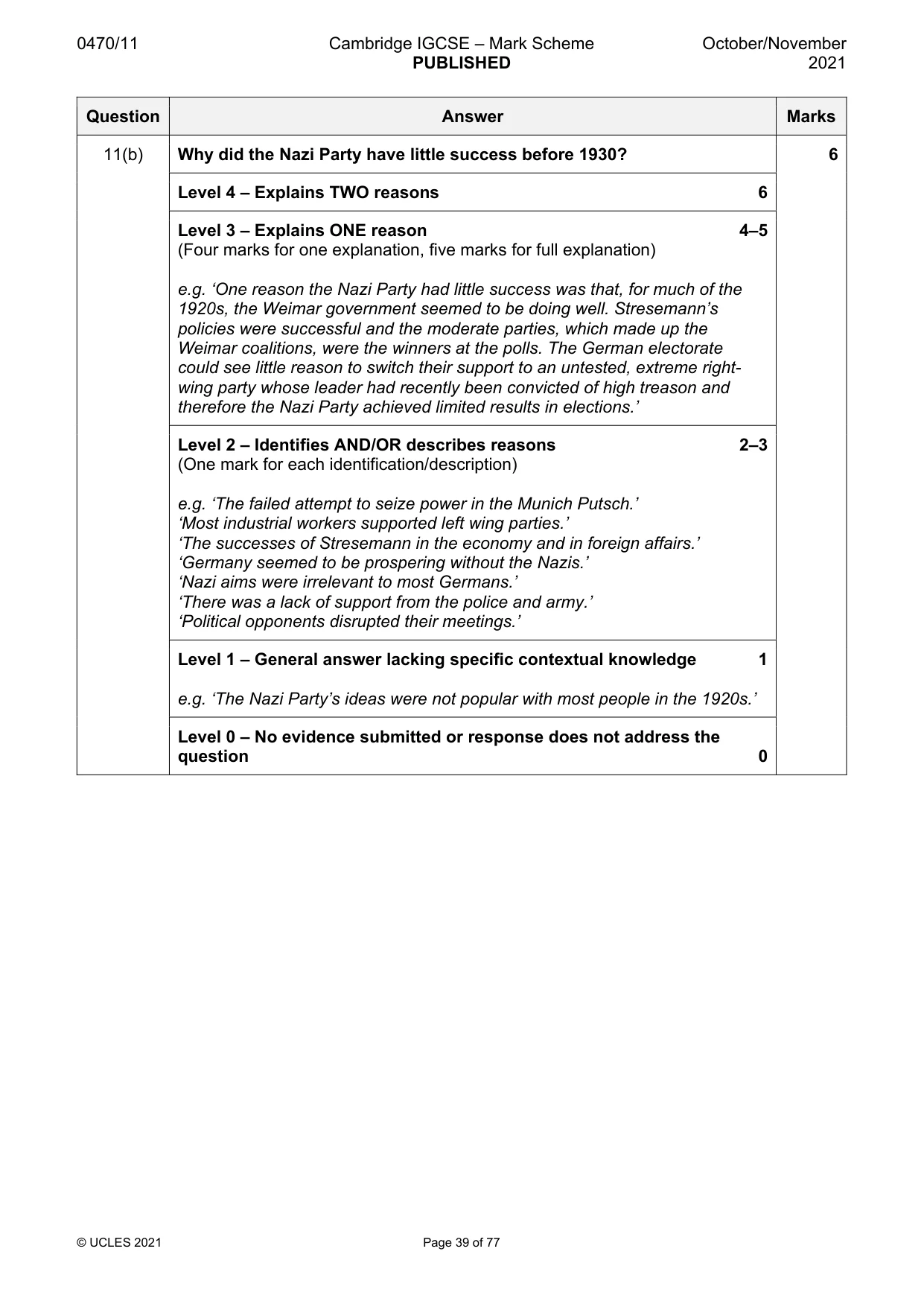
0470/11 Cambridge IGCSE – Mark Scheme PUBLISHED October/November 2021 © UCLES 2021 Page 39 of 77 Question Answer Marks 11(b) Why did the Nazi Party have little success before 1930? 6 Level 4 – Explains TWO reasons 6 Level 3 – Explains ONE reason 4–5 (Four marks for one explanation, five marks for full explanation) e.g. ‘One reason the Nazi Party had little success was that, for much of the 1920s, the Weimar government seemed to be doing well. Stresemann’s policies were successful and the moderate parties, which made up the Weimar coalitions, were the winners at the polls. The German electorate could see little reason to switch their support to an untested, extreme right- wing party whose leader had recently been convicted of high treason and therefore the Nazi Party achieved limited results in elections.’ Level 2 – Identifies AND/OR describes reasons 2–3 (One mark for each identification/description) e.g. ‘The failed attempt to seize power in the Munich Putsch.’ ‘Most industrial workers supported left wing parties.’ ‘The successes of Stresemann in the economy and in foreign affairs.’ ‘Germany seemed to be prospering without the Nazis.’ ‘Nazi aims were irrelevant to most Germans.’ ‘There was a lack of support from the police and army.’ ‘Political opponents disrupted their meetings.’ Level 1 – General answer lacking specific contextual knowledge 1 e.g. ‘The Nazi Party’s ideas were not popular with most people in the 1920s.’ Level 0 – No evidence submitted or response does not address the question 0
Mark scheme, page 40
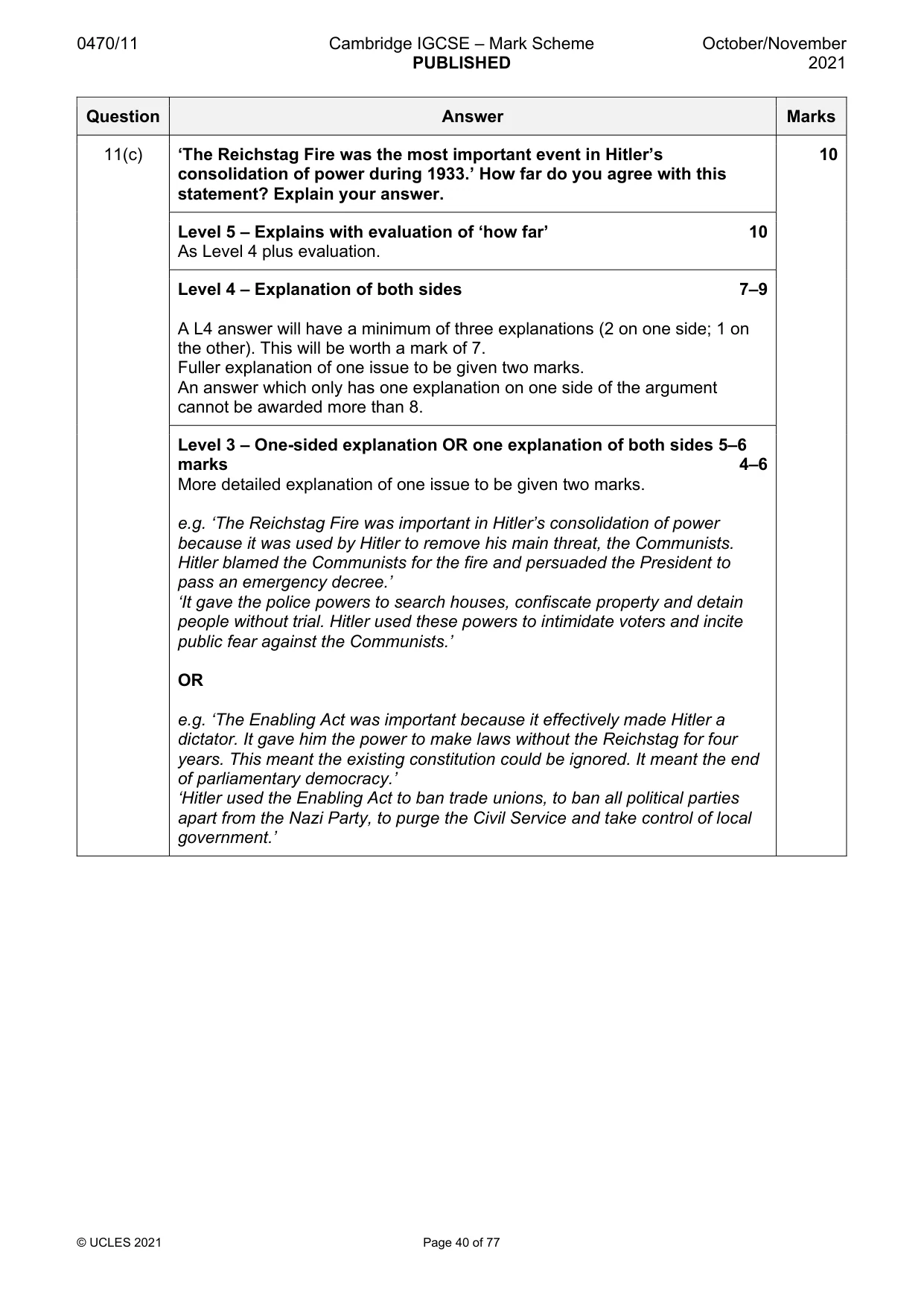
0470/11 Cambridge IGCSE – Mark Scheme PUBLISHED October/November 2021 © UCLES 2021 Page 40 of 77 Question Answer Marks 11(c) ‘The Reichstag Fire was the most important event in Hitler’s consolidation of power during 1933.’ How far do you agree with this statement? Explain your answer. 10 Level 5 – Explains with evaluation of ‘how far’ 10 As Level 4 plus evaluation. Level 4 – Explanation of both sides 7–9 A L4 answer will have a minimum of three explanations (2 on one side; 1 on the other). This will be worth a mark of 7. Fuller explanation of one issue to be given two marks. An answer which only has one explanation on one side of the argument cannot be awarded more than 8. Level 3 – One-sided explanation OR one explanation of both sides 5–6 marks 4–6 More detailed explanation of one issue to be given two marks. e.g. ‘The Reichstag Fire was important in Hitler’s consolidation of power because it was used by Hitler to remove his main threat, the Communists. Hitler blamed the Communists for the fire and persuaded the President to pass an emergency decree.’ ‘It gave the police powers to search houses, confiscate property and detain people without trial. Hitler used these powers to intimidate voters and incite public fear against the Communists.’ OR e.g. ‘The Enabling Act was important because it effectively made Hitler a dictator. It gave him the power to make laws without the Reichstag for four years. This meant the existing constitution could be ignored. It meant the end of parliamentary democracy.’ ‘Hitler used the Enabling Act to ban trade unions, to ban all political parties apart from the Nazi Party, to purge the Civil Service and take control of local government.’
Mark scheme, page 41
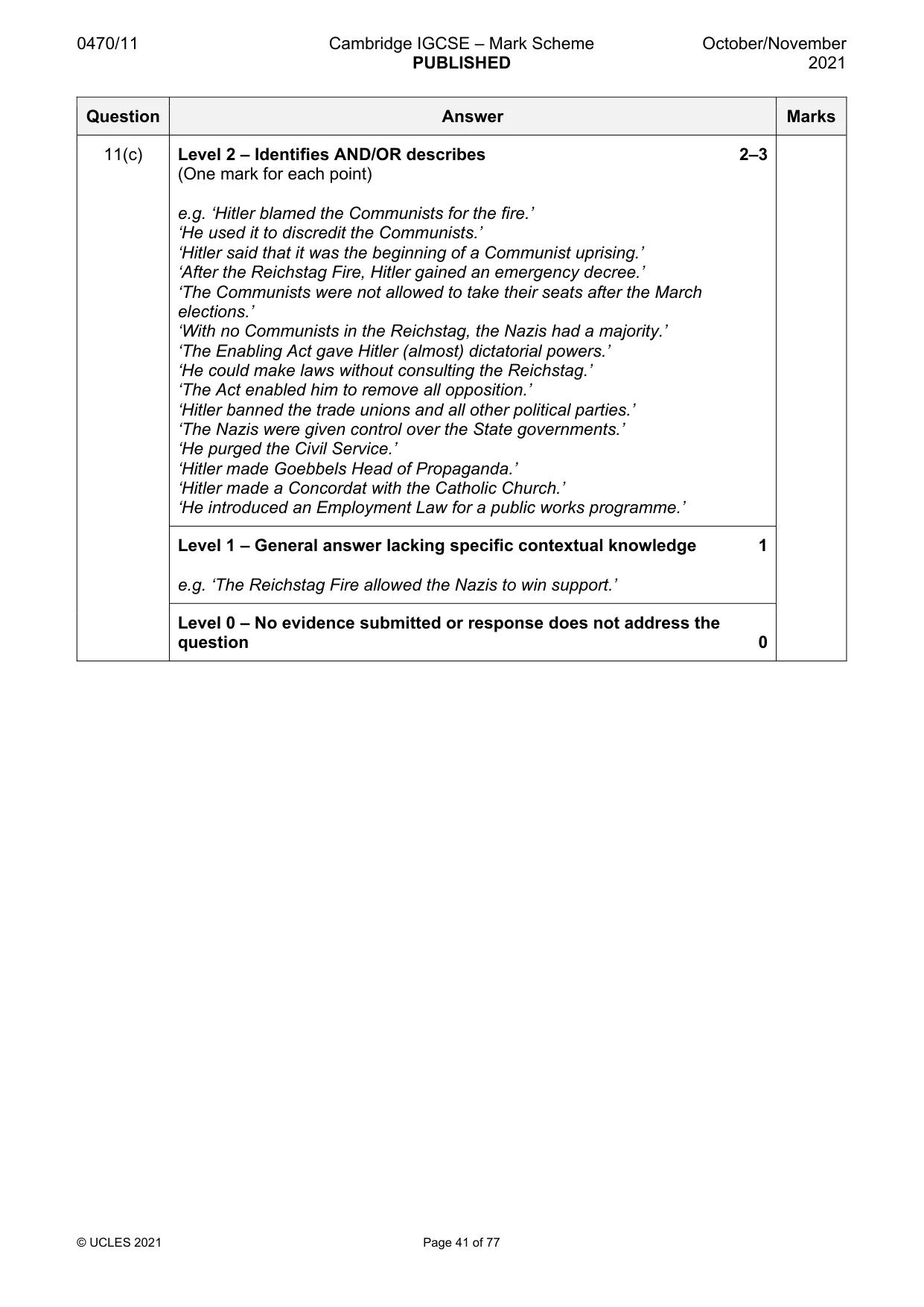
0470/11 Cambridge IGCSE – Mark Scheme PUBLISHED October/November 2021 © UCLES 2021 Page 41 of 77 Question Answer Marks 11(c) Level 2 – Identifies AND/OR describes 2–3 (One mark for each point) e.g. ‘Hitler blamed the Communists for the fire.’ ‘He used it to discredit the Communists.’ ‘Hitler said that it was the beginning of a Communist uprising.’ ‘After the Reichstag Fire, Hitler gained an emergency decree.’ ‘The Communists were not allowed to take their seats after the March elections.’ ‘With no Communists in the Reichstag, the Nazis had a majority.’ ‘The Enabling Act gave Hitler (almost) dictatorial powers.’ ‘He could make laws without consulting the Reichstag.’ ‘The Act enabled him to remove all opposition.’ ‘Hitler banned the trade unions and all other political parties.’ ‘The Nazis were given control over the State governments.’ ‘He purged the Civil Service.’ ‘Hitler made Goebbels Head of Propaganda.’ ‘Hitler made a Concordat with the Catholic Church.’ ‘He introduced an Employment Law for a public works programme.’ Level 1 – General answer lacking specific contextual knowledge 1 e.g. ‘The Reichstag Fire allowed the Nazis to win support.’ Level 0 – No evidence submitted or response does not address the question 0
Mark scheme, page 42
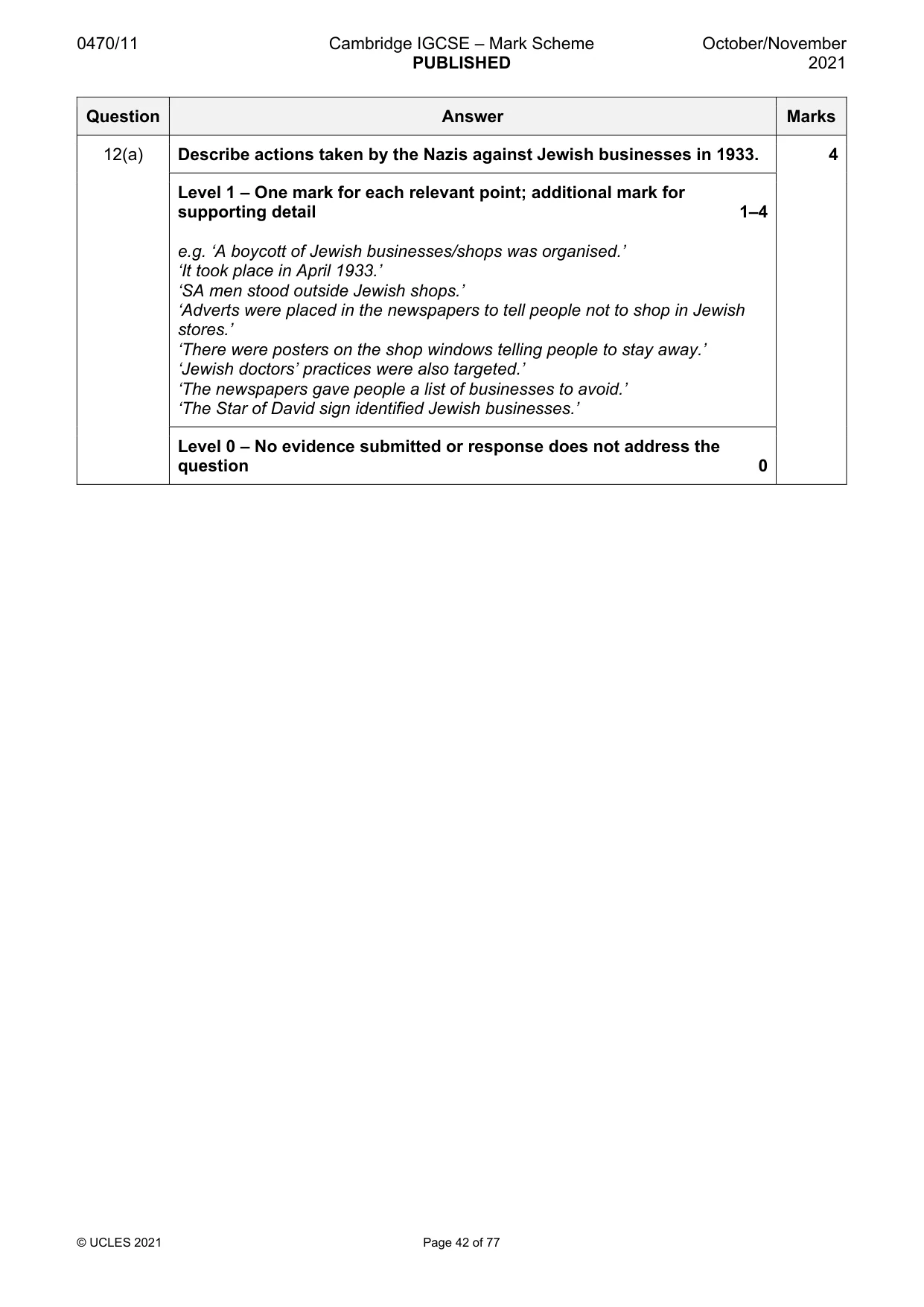
0470/11 Cambridge IGCSE – Mark Scheme PUBLISHED October/November 2021 © UCLES 2021 Page 42 of 77 Question Answer Marks 12(a) Describe actions taken by the Nazis against Jewish businesses in 1933. 4 Level 1 – One mark for each relevant point; additional mark for supporting detail 1–4 e.g. ‘A boycott of Jewish businesses/shops was organised.’ ‘It took place in April 1933.’ ‘SA men stood outside Jewish shops.’ ‘Adverts were placed in the newspapers to tell people not to shop in Jewish stores.’ ‘There were posters on the shop windows telling people to stay away.’ ‘Jewish doctors’ practices were also targeted.’ ‘The newspapers gave people a list of businesses to avoid.’ ‘The Star of David sign identified Jewish businesses.’ Level 0 – No evidence submitted or response does not address the question 0
Mark scheme, page 43
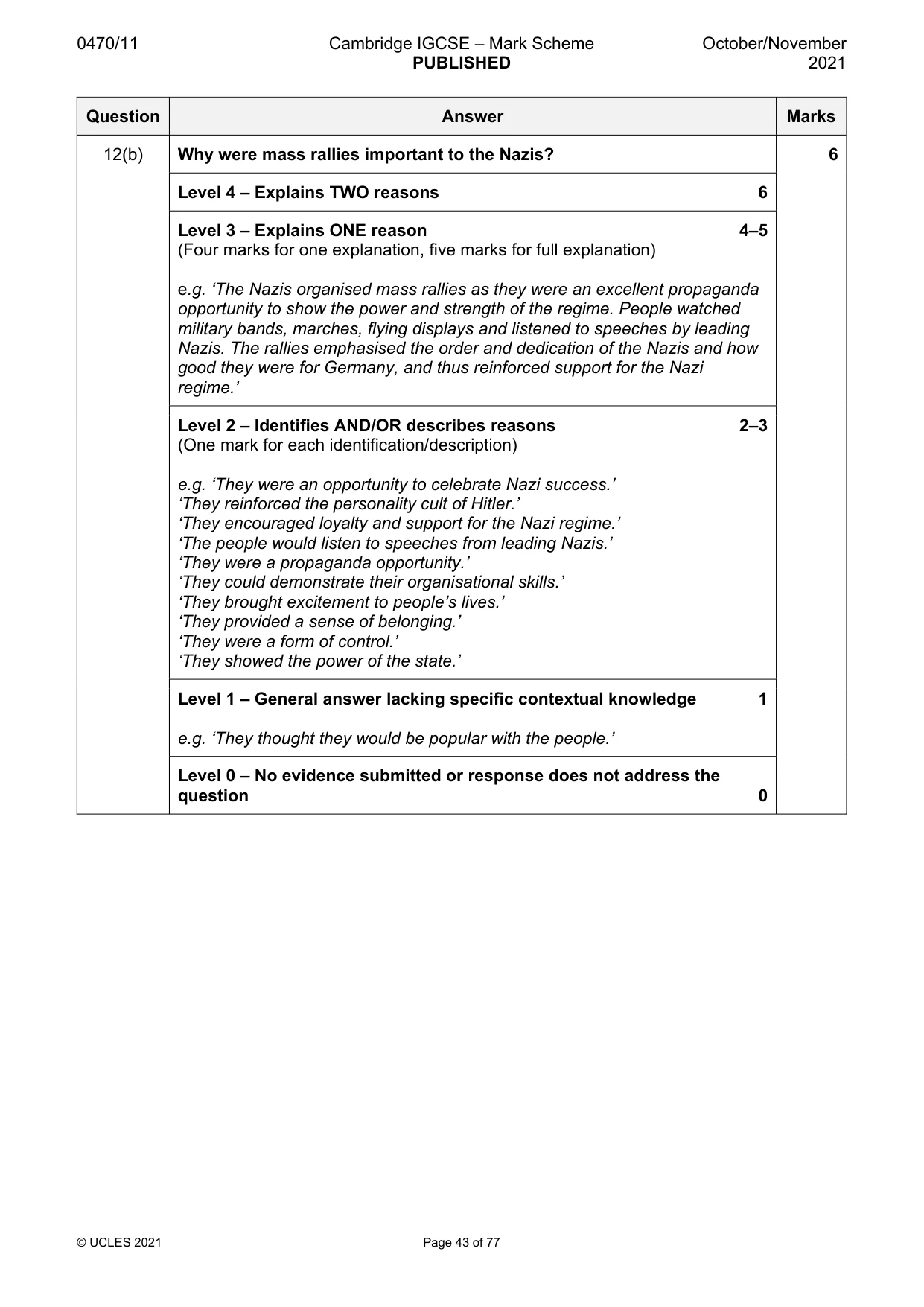
0470/11 Cambridge IGCSE – Mark Scheme PUBLISHED October/November 2021 © UCLES 2021 Page 43 of 77 Question Answer Marks 12(b) Why were mass rallies important to the Nazis? 6 Level 4 – Explains TWO reasons 6 Level 3 – Explains ONE reason 4–5 (Four marks for one explanation, five marks for full explanation) e.g. ‘The Nazis organised mass rallies as they were an excellent propaganda opportunity to show the power and strength of the regime. People watched military bands, marches, flying displays and listened to speeches by leading Nazis. The rallies emphasised the order and dedication of the Nazis and how good they were for Germany, and thus reinforced support for the Nazi regime.’ Level 2 – Identifies AND/OR describes reasons 2–3 (One mark for each identification/description) e.g. ‘They were an opportunity to celebrate Nazi success.’ ‘They reinforced the personality cult of Hitler.’ ‘They encouraged loyalty and support for the Nazi regime.’ ‘The people would listen to speeches from leading Nazis.’ ‘They were a propaganda opportunity.’ ‘They could demonstrate their organisational skills.’ ‘They brought excitement to people’s lives.’ ‘They provided a sense of belonging.’ ‘They were a form of control.’ ‘They showed the power of the state.’ Level 1 – General answer lacking specific contextual knowledge 1 e.g. ‘They thought they would be popular with the people.’ Level 0 – No evidence submitted or response does not address the question 0
Mark scheme, page 44
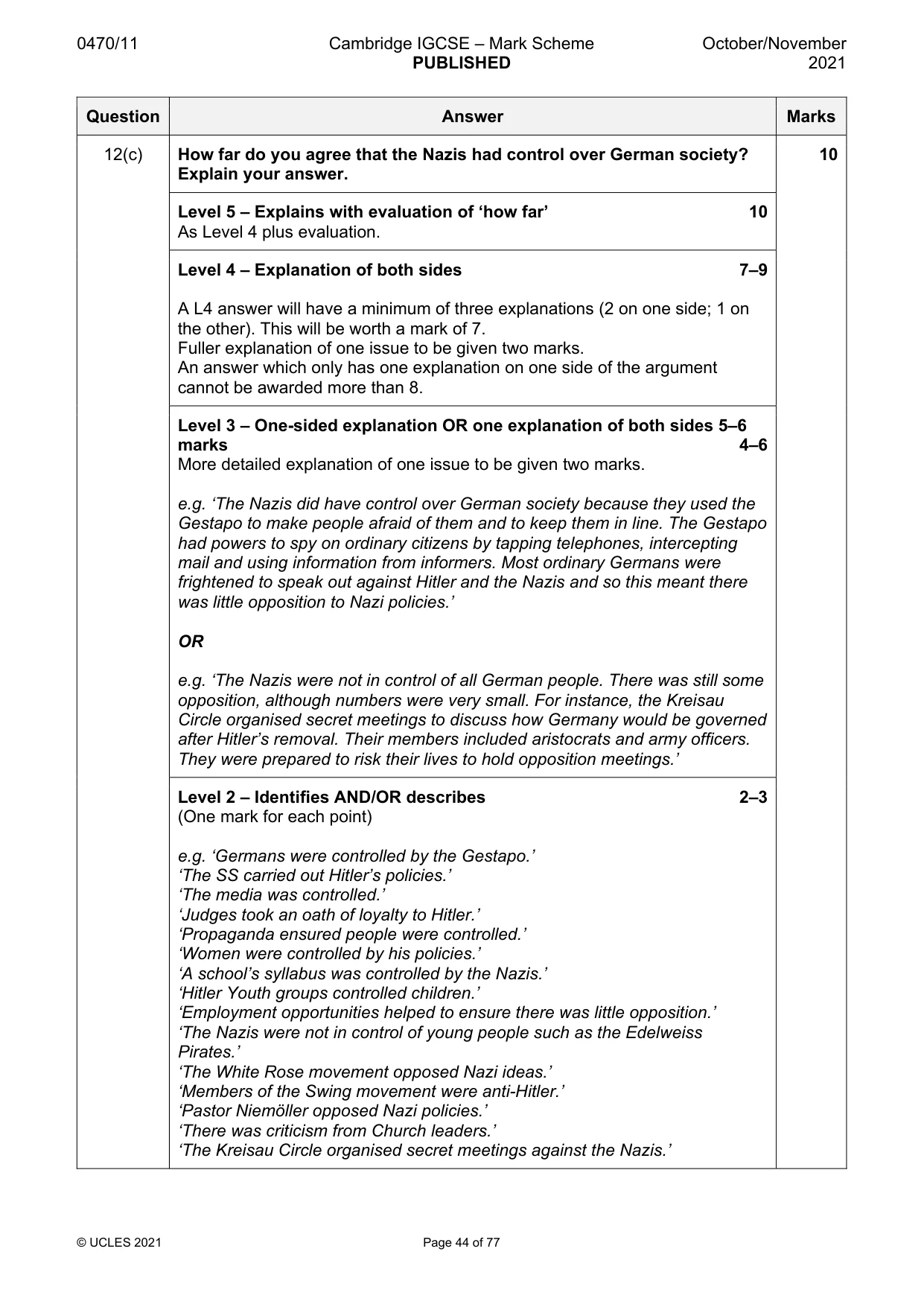
0470/11 Cambridge IGCSE – Mark Scheme PUBLISHED October/November 2021 © UCLES 2021 Page 44 of 77 Question Answer Marks 12(c) How far do you agree that the Nazis had control over German society? Explain your answer. 10 Level 5 – Explains with evaluation of ‘how far’ 10 As Level 4 plus evaluation. Level 4 – Explanation of both sides 7–9 A L4 answer will have a minimum of three explanations (2 on one side; 1 on the other). This will be worth a mark of 7. Fuller explanation of one issue to be given two marks. An answer which only has one explanation on one side of the argument cannot be awarded more than 8. Level 3 – One-sided explanation OR one explanation of both sides 5–6 marks 4–6 More detailed explanation of one issue to be given two marks. e.g. ‘The Nazis did have control over German society because they used the Gestapo to make people afraid of them and to keep them in line. The Gestapo had powers to spy on ordinary citizens by tapping telephones, intercepting mail and using information from informers. Most ordinary Germans were frightened to speak out against Hitler and the Nazis and so this meant there was little opposition to Nazi policies.’ OR e.g. ‘The Nazis were not in control of all German people. There was still some opposition, although numbers were very small. For instance, the Kreisau Circle organised secret meetings to discuss how Germany would be governed after Hitler’s removal. Their members included aristocrats and army officers. They were prepared to risk their lives to hold opposition meetings.’ Level 2 – Identifies AND/OR describes 2–3 (One mark for each point) e.g. ‘Germans were controlled by the Gestapo.’ ‘The SS carried out Hitler’s policies.’ ‘The media was controlled.’ ‘Judges took an oath of loyalty to Hitler.’ ‘Propaganda ensured people were controlled.’ ‘Women were controlled by his policies.’ ‘A school’s syllabus was controlled by the Nazis.’ ‘Hitler Youth groups controlled children.’ ‘Employment opportunities helped to ensure there was little opposition.’ ‘The Nazis were not in control of young people such as the Edelweiss Pirates.’ ‘The White Rose movement opposed Nazi ideas.’ ‘Members of the Swing movement were anti-Hitler.’ ‘Pastor Niemöller opposed Nazi policies.’ ‘There was criticism from Church leaders.’ ‘The Kreisau Circle organised secret meetings against the Nazis.’
Mark scheme, page 45
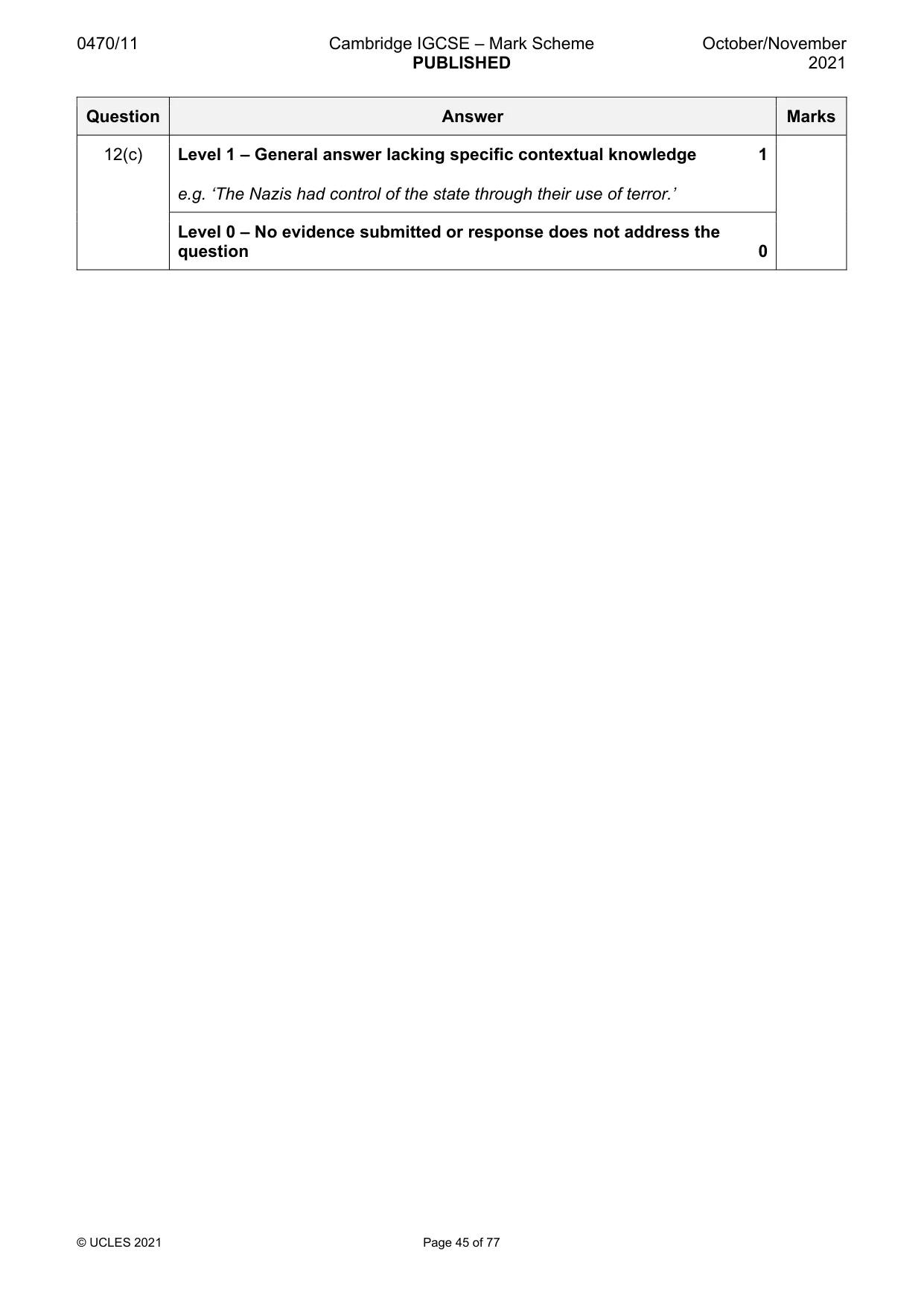
0470/11 Cambridge IGCSE – Mark Scheme PUBLISHED October/November 2021 © UCLES 2021 Page 45 of 77 Question Answer Marks 12(c) Level 1 – General answer lacking specific contextual knowledge 1 e.g. ‘The Nazis had control of the state through their use of terror.’ Level 0 – No evidence submitted or response does not address the question 0
Mark scheme, page 46
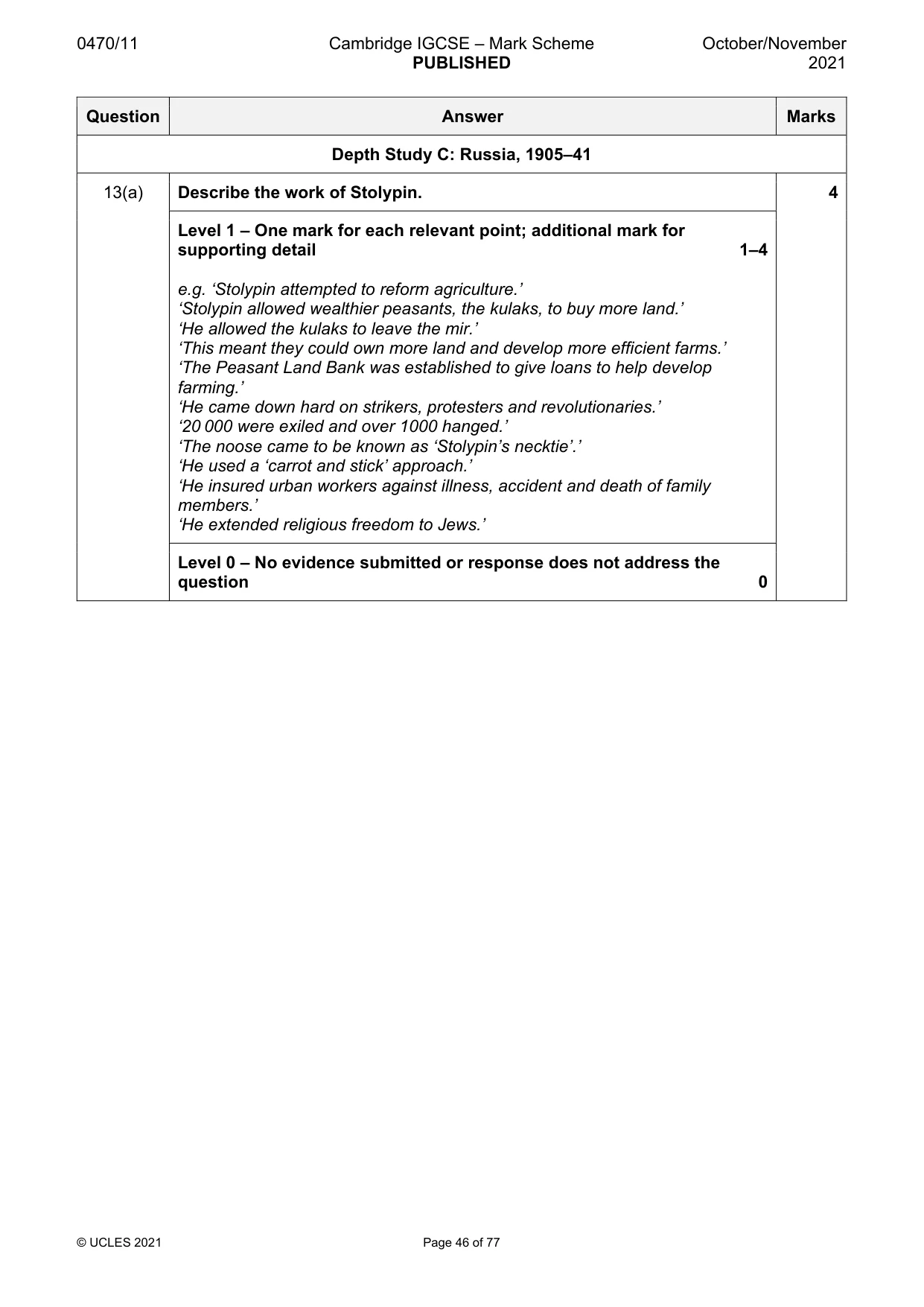
0470/11 Cambridge IGCSE – Mark Scheme PUBLISHED October/November 2021 © UCLES 2021 Page 46 of 77 Question Answer Marks Depth Study C: Russia, 1905–41 13(a) Describe the work of Stolypin. 4 Level 1 – One mark for each relevant point; additional mark for supporting detail 1–4 e.g. ‘Stolypin attempted to reform agriculture.’ ‘Stolypin allowed wealthier peasants, the kulaks, to buy more land.’ ‘He allowed the kulaks to leave the mir.’ ‘This meant they could own more land and develop more efficient farms.’ ‘The Peasant Land Bank was established to give loans to help develop farming.’ ‘He came down hard on strikers, protesters and revolutionaries.’ ‘20 000 were exiled and over 1000 hanged.’ ‘The noose came to be known as ‘Stolypin’s necktie’.’ ‘He used a ‘carrot and stick’ approach.’ ‘He insured urban workers against illness, accident and death of family members.’ ‘He extended religious freedom to Jews.’ Level 0 – No evidence submitted or response does not address the question 0
Mark scheme, page 47
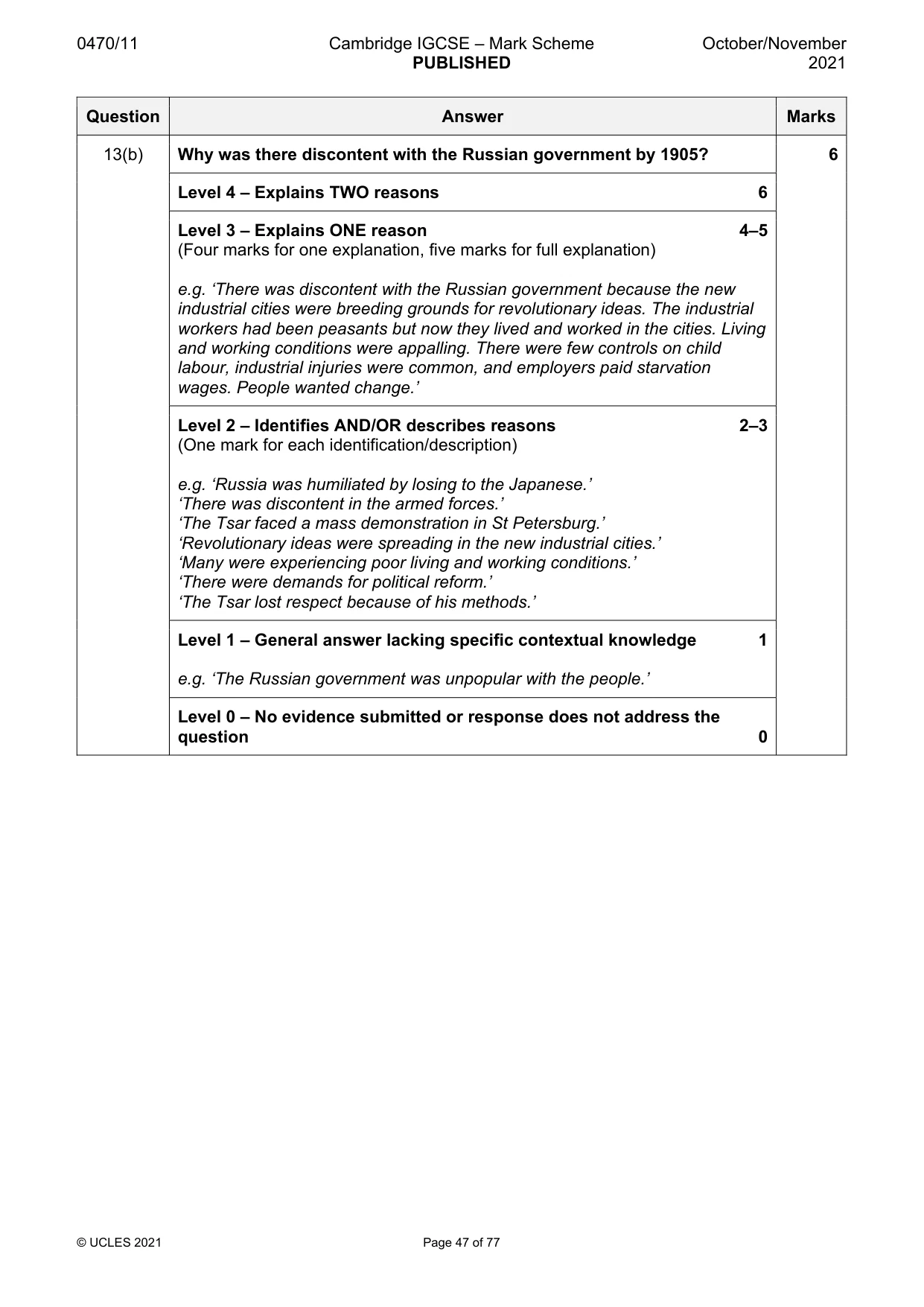
0470/11 Cambridge IGCSE – Mark Scheme PUBLISHED October/November 2021 © UCLES 2021 Page 47 of 77 Question Answer Marks 13(b) Why was there discontent with the Russian government by 1905? 6 Level 4 – Explains TWO reasons 6 Level 3 – Explains ONE reason 4–5 (Four marks for one explanation, five marks for full explanation) e.g. ‘There was discontent with the Russian government because the new industrial cities were breeding grounds for revolutionary ideas. The industrial workers had been peasants but now they lived and worked in the cities. Living and working conditions were appalling. There were few controls on child labour, industrial injuries were common, and employers paid starvation wages. People wanted change.’ Level 2 – Identifies AND/OR describes reasons 2–3 (One mark for each identification/description) e.g. ‘Russia was humiliated by losing to the Japanese.’ ‘There was discontent in the armed forces.’ ‘The Tsar faced a mass demonstration in St Petersburg.’ ‘Revolutionary ideas were spreading in the new industrial cities.’ ‘Many were experiencing poor living and working conditions.’ ‘There were demands for political reform.’ ‘The Tsar lost respect because of his methods.’ Level 1 – General answer lacking specific contextual knowledge 1 e.g. ‘The Russian government was unpopular with the people.’ Level 0 – No evidence submitted or response does not address the question 0
Mark scheme, page 48
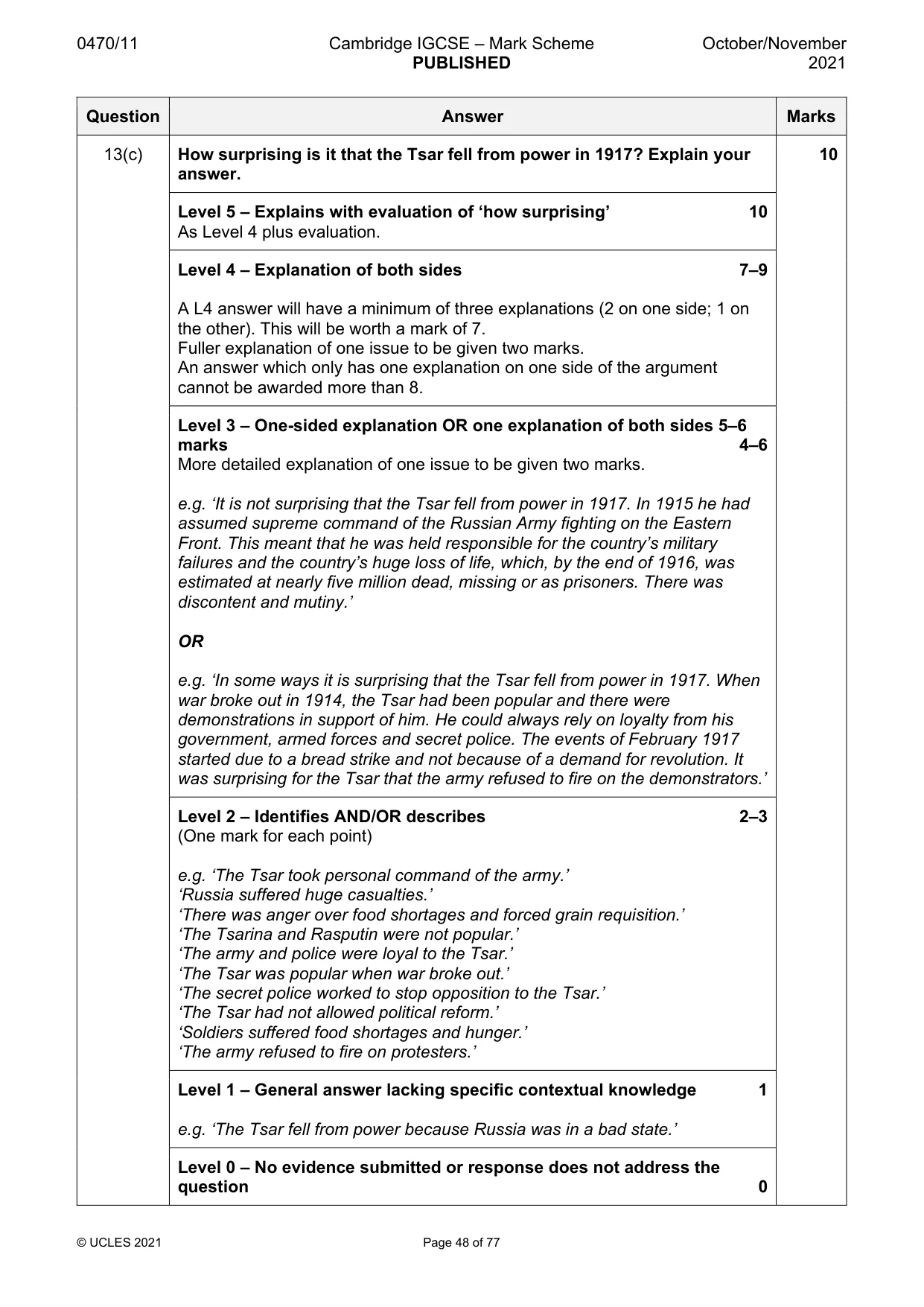
0470/11 Cambridge IGCSE – Mark Scheme PUBLISHED October/November 2021 © UCLES 2021 Page 48 of 77 Question Answer Marks 13(c) How surprising is it that the Tsar fell from power in 1917? Explain your answer. 10 Level 5 – Explains with evaluation of ‘how surprising’ 10 As Level 4 plus evaluation. Level 4 – Explanation of both sides 7–9 A L4 answer will have a minimum of three explanations (2 on one side; 1 on the other). This will be worth a mark of 7. Fuller explanation of one issue to be given two marks. An answer which only has one explanation on one side of the argument cannot be awarded more than 8. Level 3 – One-sided explanation OR one explanation of both sides 5–6 marks 4–6 More detailed explanation of one issue to be given two marks. e.g. ‘It is not surprising that the Tsar fell from power in 1917. In 1915 he had assumed supreme command of the Russian Army fighting on the Eastern Front. This meant that he was held responsible for the country’s military failures and the country’s huge loss of life, which, by the end of 1916, was estimated at nearly five million dead, missing or as prisoners. There was discontent and mutiny.’ OR e.g. ‘In some ways it is surprising that the Tsar fell from power in 1917. When war broke out in 1914, the Tsar had been popular and there were demonstrations in support of him. He could always rely on loyalty from his government, armed forces and secret police. The events of February 1917 started due to a bread strike and not because of a demand for revolution. It was surprising for the Tsar that the army refused to fire on the demonstrators.’ Level 2 – Identifies AND/OR describes 2–3 (One mark for each point) e.g. ‘The Tsar took personal command of the army.’ ‘Russia suffered huge casualties.’ ‘There was anger over food shortages and forced grain requisition.’ ‘The Tsarina and Rasputin were not popular.’ ‘The army and police were loyal to the Tsar.’ ‘The Tsar was popular when war broke out.’ ‘The secret police worked to stop opposition to the Tsar.’ ‘The Tsar had not allowed political reform.’ ‘Soldiers suffered food shortages and hunger.’ ‘The army refused to fire on protesters.’ Level 1 – General answer lacking specific contextual knowledge 1 e.g. ‘The Tsar fell from power because Russia was in a bad state.’ Level 0 – No evidence submitted or response does not address the question 0
Mark scheme, page 49
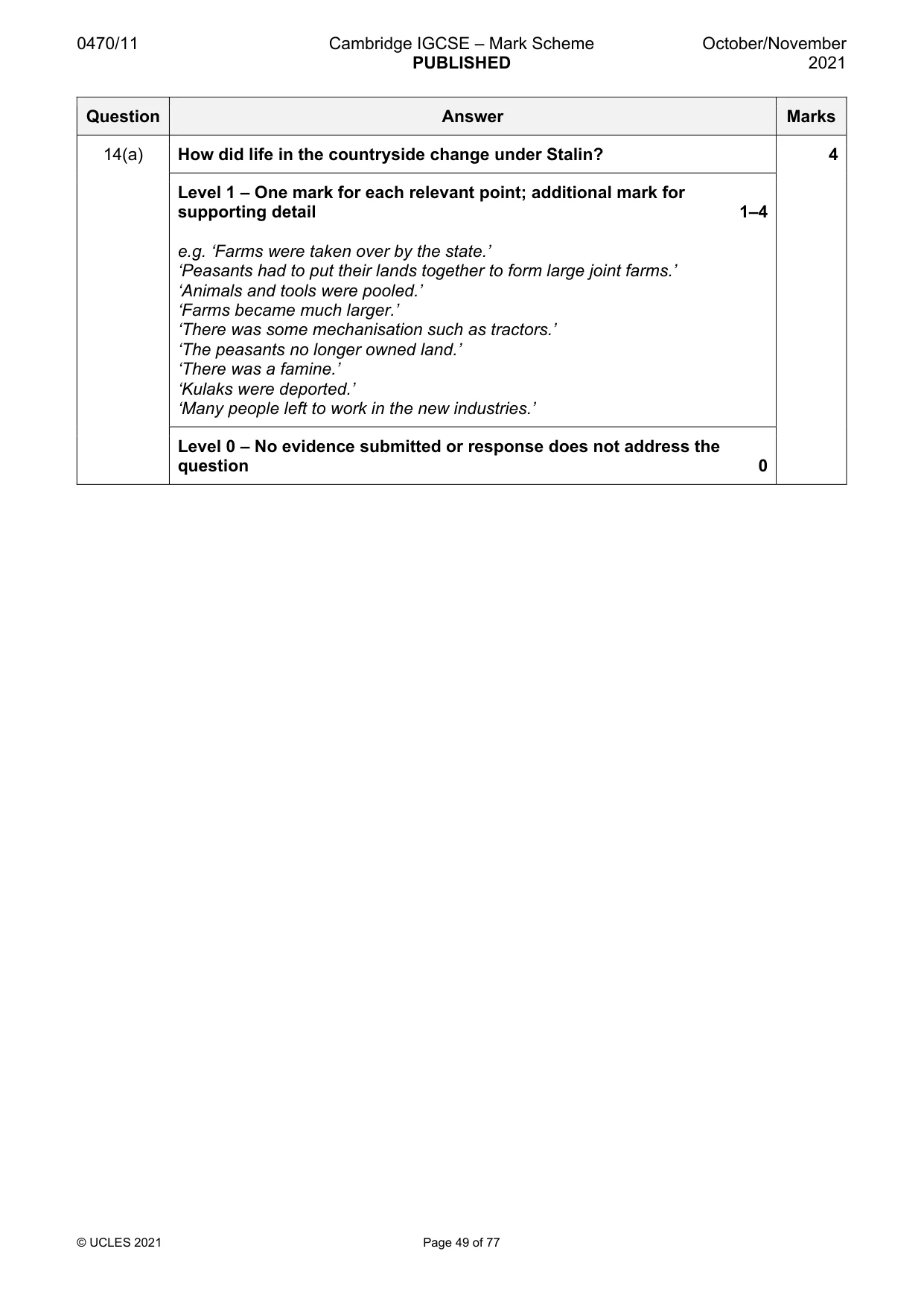
0470/11 Cambridge IGCSE – Mark Scheme PUBLISHED October/November 2021 © UCLES 2021 Page 49 of 77 Question Answer Marks 14(a) How did life in the countryside change under Stalin? 4 Level 1 – One mark for each relevant point; additional mark for supporting detail 1–4 e.g. ‘Farms were taken over by the state.’ ‘Peasants had to put their lands together to form large joint farms.’ ‘Animals and tools were pooled.’ ‘Farms became much larger.’ ‘There was some mechanisation such as tractors.’ ‘The peasants no longer owned land.’ ‘There was a famine.’ ‘Kulaks were deported.’ ‘Many people left to work in the new industries.’ Level 0 – No evidence submitted or response does not address the question 0
Mark scheme, page 50
0470/11 Cambridge IGCSE – Mark Scheme PUBLISHED October/November 2021 © UCLES 2021 Page 50 of 77 Question Answer Marks 14(b) Why was industry brought under government control? 6 Level 4 – Explains TWO reasons 6 Level 3 – Explains ONE reason 4–5 (Four marks for one explanation, five marks for full explanation) e.g. ‘Stalin saw that the development of industry was vital to the USSR becoming economically and militarily strong. If the Soviet Union was threatened by a foreign power, it would need strong defences to survive. It was essential to develop heavy industries such as coal and steel production and chemicals so that armaments could be built.’ Level 2 – Identifies AND/OR describes reasons 2–3 (One mark for each identification/description) e.g. ‘To increase production in heavy industries.’ ‘To develop the oil, coal, iron and steel and electricity industries.’ ‘To set targets to make industry develop quickly.’ ‘To create a foundation on which to build the next Five-Year Plans.’ ‘To increase the USSR’s military strength.’ ‘To rival the economies of the USA and the capitalist countries.’ ‘To catch up with the West.’ ‘It would put into action Stalin’s ‘Socialism in One Country’.’ Level 1 – General answer lacking specific contextual knowledge 1 e.g. ‘To make the USSR a stronger country.’ Level 0 – No evidence submitted or response does not address the question 0
Mark scheme, page 51
0470/11 Cambridge IGCSE – Mark Scheme PUBLISHED October/November 2021 © UCLES 2021 Page 51 of 77 Question Answer Marks 14(c) How far do you agree that women benefited from Stalin’s rule? Explain your answer. 10 Level 5 – Explains with evaluation of ‘how far’ 10 As Level 4 plus evaluation. Level 4 – Explanation of both sides 7–9 A L4 answer will have a minimum of three explanations (2 on one side; 1 on the other). This will be worth a mark of 7. Fuller explanation of one issue to be given two marks. An answer which only has one explanation on one side of the argument cannot be awarded more than 8. Level 3 – One-sided explanation OR one explanation of both sides 5–6 marks 4–6 More detailed explanation of one issue to be given two marks. e.g. ‘There were some benefits for women under Stalin’s regime. For instance, Stalin insisted that men and women had equal status and therefore women were encouraged to study to become engineers and doctors. By 1939, 79% of doctors were women and over 40% were involved in the industrial workforce. These opportunities had not existed for them before.’ OR e.g. ‘The position of women was supposed to be equal, but there were no women in senior positions in the state and they often took lower positions in the workplace. Also, women still had their traditional roles of mother and wife to fulfil and were expected to work in the home as well as in the workplace.’ Level 2 – Identifies AND/OR describes 2–3 (One mark for each point) e.g. ‘Stalin increased the number of crèches for children of working mothers.’ ‘Some factories were encouraged to establish ‘sitting’ services. This was for mothers so that they could work even while caring for children.’ ‘Stalin encouraged women into skilled jobs such as doctors and engineers.’ ‘He promoted the idea that it was normal for women to work in industry.’ ‘According to Soviet propaganda, women were equal partners in the struggle to build a communist state.’ ‘In the world of work, Soviet women were given equality with men.’ ‘It was still considered women’s responsibility to do the domestic chores.’ ‘Not a single woman held high office during Stalin’s years in power.’ ‘Women were subjected to changing laws which took away freedoms, such as easy divorce.’ Level 1 – General answer lacking specific contextual knowledge 1 e.g. ‘There were more opportunities for women in Stalin’s Russia.’ Level 0 – No evidence submitted or response does not address the question 0
Mark scheme, page 52
0470/11 Cambridge IGCSE – Mark Scheme PUBLISHED October/November 2021 © UCLES 2021 Page 52 of 77 Question Answer Marks Depth Study D: The United States, 1919–41 15(a) What was the Sacco and Vanzetti case? 4 Level 1 – One mark for each relevant point; additional mark for supporting detail. 1–4 e.g. ‘Sacco and Vanzetti were two Italian Americans.’ ‘In 1920 they were arrested.’ ‘They were arrested on suspicion of armed robbery and murder.’ ‘They were anarchists.’ ‘The trial became less of a trial for murder, more a trial of their radical ideas.’ ‘It was a highly publicised case.’ ‘The case against them was weak.’ ‘The prosecution relied on racist slurs about their origins and fear about their radical politics.’ ‘The two were found guilty and sentenced to death.’ ‘There were six years of legal appeals.’ ‘They were executed in 1927.’ ‘Many people believed they were not given a fair trial.’ ‘Many thought they were the victims of the trial judge’s prejudices against foreigners and radical politics.’ Level 0 – No evidence submitted or response does not address the question 0
Mark scheme, page 53
0470/11 Cambridge IGCSE – Mark Scheme PUBLISHED October/November 2021 © UCLES 2021 Page 53 of 77 Question Answer Marks 15(b) Why were the 1920s known as the ‘Roaring Twenties’? 6 Level 4 – Explains TWO reasons 6 Level 3 – Explains ONE reason 4–5 (Four marks for one explanation, five marks for full explanation) e.g. ‘They were known as the ‘Roaring Twenties’ because these years were often associated with radical change in society and outrageous behaviour from some sections of society. Some women broke free from traditions and wore short dresses, short hairstyles, and took up smoking and drinking in speakeasies. Many spent time in the new nightclubs where jazz quickly became very popular.’ Level 2 – Identifies AND/OR describes reasons 2–3 (One mark for each identification/description) e.g. ‘The economic boom encouraged a change of lifestyle.’ ‘Jazz became the new popular music.’ ‘Women changed their look and became more independent.’ ‘Traditions such as having a chaperone were abandoned.’ ‘Many people bought cars and travelled for the first time.’ ‘There was more leisure time for pastimes such as the cinema and music clubs.’ ‘Some drank illegally in speakeasies.’ ‘Some said the 1920s started with a roar and ended with a crash.’ Level 1 – General answer lacking specific contextual knowledge 1 e.g. ‘People took up noisy hobbies.’ Level 0 – No evidence submitted or response does not address the question 0
Mark scheme, page 54
0470/11 Cambridge IGCSE – Mark Scheme PUBLISHED October/November 2021 © UCLES 2021 Page 54 of 77 Question Answer Marks 15(c) How far do you agree that Prohibition failed because it was unpopular? Explain your answer. 10 Level 5 – Explains with evaluation of ‘how far’ 10 As Level 4 plus evaluation. Level 4 – Explanation of both sides 7–9 A L4 answer will have a minimum of three explanations (2 on one side; 1 on the other). This will be worth a mark of 7. Fuller explanation of one issue to be given two marks. An answer which only has one explanation on one side of the argument cannot be awarded more than 8. Level 3 – One-sided explanation OR one explanation of both sides 5–6 marks 4–6 More detailed explanation of one issue to be given two marks. e.g. ‘The main reason for the failure of Prohibition was that millions of Americans, especially in urban areas, were simply not prepared to obey this law. Some made their own liquor at home, known as moonshine, while rich households imported wine and spirits illegally. By 1925, there were more speakeasies in American cities than there had been saloons in 1919.’ OR e.g. ‘One reason Prohibition failed was that it was not policed properly. The government appointed several thousand enforcement agents, but this was not enough and they were poorly paid. The networks which ran the illegal liquor business were complex and there were not enough Prohibition agents to stop them. The agents were often open to threats and bribes made by criminal gangs. State officials, judges, senior police officers and jury members were often bought off with bribes. Almost 10% of Prohibition agents were fired for taking bribes.’ Level 2 – Identifies AND/OR describes 2–3 (One mark for each point) e.g. ‘Many urban Americans refused to obey the law on alcohol.’ ‘Many made their own alcohol, called ‘moonshine’.’ ‘The speakeasies were well supplied by bootleggers.’ ‘Two thirds of the illegal whisky came from Canada.’ ‘Rum was smuggled from the West Indies.’ ‘The border between the USA and Canada was almost impossible to patrol.’ ‘Organised gangs fought to control the manufacture and sale of alcohol.’ ‘Organised gangs bribed policemen, enforcement agents, judges and juries.’ Level 1 – General answer lacking specific contextual knowledge 1 e.g. ‘Many people disliked Prohibition.’ Level 0 – No evidence submitted or response does not address the question 0
Mark scheme, page 55
0470/11 Cambridge IGCSE – Mark Scheme PUBLISHED October/November 2021 © UCLES 2021 Page 55 of 77 Question Answer Marks 16(a) What did Roosevelt mean by a ‘New Deal’? 4 Level 1 – One mark for each relevant point; additional mark for supporting detail 1–4 e.g. ‘Roosevelt wanted measures to bring about the recovery and rebuilding of the American economy.’ ‘Roosevelt wanted the New Deal’s aims to be ‘relief, recovery and reform’.’ ‘He wanted to give people hope.’ ‘He intended to introduce measures to bring relief to the poverty-stricken.’ ‘He wanted to create employment through new agencies.’ ‘The New Deal included improving working conditions and pay for the employed.’ ‘He wanted to bring stability to the banking system.’ ‘He wanted to re-build the economy, both in industry and agriculture.’ ‘Roosevelt wanted the New Deal to create a fairer and more just society.’ Level 0 – No evidence submitted or response does not address the question 0
Mark scheme, page 56
0470/11 Cambridge IGCSE – Mark Scheme PUBLISHED October/November 2021 © UCLES 2021 Page 56 of 77 Question Answer Marks 16(b) Why was the Agricultural Adjustment Act (AAA) introduced? 6 Level 4 – Explains TWO reasons 6 Level 3 – Explains ONE reason 4–5 (Four marks for one explanation, five marks for full explanation) e.g. ‘The Agricultural Adjustment Act was introduced because farming was in crisis and farmers could not live on what they earned. Prices had fallen because US farms were overproducing and were not able to export their surplus because of the tariff system. Many farmers could not afford to pay back loans which they had taken out to buy new machinery. This resulted in eviction and unemployment. The Agricultural Adjustment Act aimed to address this by cutting production to raise prices.’ Level 2 – Identifies AND/OR describes reasons 2–3 (One mark for each identification/description) e.g. ‘Farmers were overproducing.’ ‘The US could not export grain because of the tariff system.’ ‘Agricultural prices had fallen.’ ‘Farmers could not earn enough to live on.’ ‘They could not pay their mortgages or loans for machinery.’ ‘Many farmers were evicted and became homeless and unemployed.’ Level 1 – General answer lacking specific contextual knowledge 1 e.g. ‘There were many problems facing agriculture.’ Level 0 – No evidence submitted or response does not address the question 0
Mark scheme, page 57
0470/11 Cambridge IGCSE – Mark Scheme PUBLISHED October/November 2021 © UCLES 2021 Page 57 of 77 Question Answer Marks 16(c) ‘The most serious opposition to the New Deal came from business leaders.’ How far do you agree with this statement? Explain your answer. 10 Level 5 – Explains with evaluation of ‘how far’ 10 As Level 4 plus evaluation. Level 4 – Explanation of both sides 7–9 A L4 answer will have a minimum of three explanations (2 on one side; 1 on the other). This will be worth a mark of 7. Fuller explanation of one issue to be given two marks. An answer which only has one explanation on one side of the argument cannot be awarded more than 8. Level 3 – One-sided explanation OR one explanation of both sides 5–6 marks 4–6 More detailed explanation of one issue to be given two marks. e.g. ‘Business leaders were opposed to the New Deal. In 1934, they formed the Liberty League to unite the opposition against FDR’s new policies. They thought the welfare payments made by the New Deal were too generous and undermined the American characteristics of self-reliance and ‘rugged individualism’. They were opposed to trade unions and particularly disliked the NIRA. They were a serious threat because they were influential in political circles, both Democrat and Republican.’ OR e.g. ‘Probably the most serious opposition to the New Deal came from the Supreme Court. They were concerned that FDR was over-extending his power and taking away rights which should have belonged to the states rather than the federal government. By the end of 1936, the Supreme Court had ruled against seven of the nine cases about the New Deal which had come before it. As a result of these cases, the AAA and NIRA had both been declared unconstitutional.’ Level 2 – Identifies AND/OR describes 2–3 (One mark for each point) e.g. ‘Business leaders in the Liberty League opposed the New Deal.’ ‘Republicans believed in minimal government intervention and low taxation.’ ‘Some Republicans thought Roosevelt was acting like a dictator.’ ‘Some state governors argued that the New Deal laws conflicted with the rights of state governments.’ ‘Individuals like Huey Long, Francis Townsend and Father Coughlin thought Roosevelt should do more than the New Deal.’ ‘The Supreme Court had to uphold the Constitution.’ Level 1 – General answer lacking specific contextual knowledge 1 e.g. ‘Opposition came from the law, political parties and individuals.’ Level 0 – No evidence submitted or response does not address the question 0
Mark scheme, page 58
0470/11 Cambridge IGCSE – Mark Scheme PUBLISHED October/November 2021 © UCLES 2021 Page 58 of 77 Question Answer Marks Depth Study E: China, c.1930–c.1990 17(a) Describe the changes made to education in China in the 1950s. 4 Level 1 – One mark for each relevant point; additional mark for supporting detail 1–4 e.g. ‘There was a campaign to teach Chinese people to read and write.’ ‘In 1949, only 20% were literate. By the 1960s this had increased to 90%.’ ‘Teachers were sent to the villages, teaching children by day and the adults in the evening.’ ‘Students received an education in communism. They read from the works of Lenin, Marx and Mao.’ ‘They were encouraged to be hard-working, cheerful, loyal to their leaders and helpful to others.’ ‘All those in education were reminded of the importance of manual work.’ Level 0 – No evidence submitted or response does not address the question 0
Mark scheme, page 59
0470/11 Cambridge IGCSE – Mark Scheme PUBLISHED October/November 2021 © UCLES 2021 Page 59 of 77 Question Answer Marks 17(b) Why were the ‘barefoot doctors’ important? 6 Level 4 – Explains TWO reasons 6 Level 3 – Explains ONE reason 4–5 (Four marks for one explanation, five marks for full explanation) e.g. ‘The barefoot doctors were important because they brought free medical care to the peasants and were able to help stem the spread of disease by providing basic healthcare. They focused on prevention rather than cure and ran public campaigns to encourage good hygiene. Their work led to a decline in the death rate, particularly in infant mortality.’ Level 2 – Identifies AND/OR describes reasons 2–3 (One mark for each identification/description) e.g. ‘They brought free health care to the masses.’ ‘They had short training so were able to get to work quickly.’ ‘They ran public health campaigns to improve sanitation and prevent epidemics.’ ‘They focused on prevention rather than cure.’ ‘The death rate decreased.’ Level 1 – General answer lacking specific contextual knowledge 1 e.g. ‘They helped people in rural China.’ Level 0 – No evidence submitted or response does not address the question 0
Mark scheme, page 60
0470/11 Cambridge IGCSE – Mark Scheme PUBLISHED October/November 2021 © UCLES 2021 Page 60 of 77 Question Answer Marks 17(c) ‘The main reason for the introduction of communes in 1958 was to improve agricultural production.’ How far do you agree with this statement? Explain your answer. 10 Level 5 – Explains with evaluation of ‘how far’ 10 As Level 4 plus evaluation. Level 4 – Explanation of both sides 7–9 A L4 answer will have a minimum of three explanations (2 on one side; 1 on the other). This will be worth a mark of 7. Fuller explanation of one issue to be given two marks. An answer which only has one explanation on one side of the argument cannot be awarded more than 8. Level 3 – One-sided explanation OR one explanation of both sides 5–6 marks 4–6 More detailed explanation of one issue to be given two marks. e.g. ‘Communes were introduced to improve agriculture. They were made up of collective farms: 750 000 collective farms were merged into 26 000 communes. The system was directed by central government so that farming methods, pricing, sale and distribution could be centrally controlled. Private farming was ended. It was thought this would make agriculture more efficient and ensure an equal supply of food throughout China.’ OR e.g. ‘Communes were designed not only to improve agriculture, but also industry, education, local government and medicine. Communes established ‘backyard furnaces’ which produced an estimated 11 million tons of steel. They also were a way to control the peasantry and increase productivity. They were large and so could undertake large projects such as irrigation work.’ Level 2 – Identifies AND/OR describes 2–3 (One mark for each point) e.g. ‘Communes seemed to be the ideal way to organise China’s vast peasant labour force.’ ‘They were large enough to tackle large projects such as irrigation works.’ ‘Communes had an industrial purpose – to mine coal and iron and to set up their own blast furnaces.’ ‘It was believed that communes would be more efficient for agriculture.’ ‘Everyone had to live communally with childcare and schooling provided.’ ‘Communes were designed to speed up the change to communism.’ Level 1 – General answer lacking specific contextual knowledge 1 e.g. ‘The introduction of Communes meant great changes for the Chinese people.’ Level 0 – No evidence submitted or response does not address the question 0
Mark scheme, page 61
0470/11 Cambridge IGCSE – Mark Scheme PUBLISHED October/November 2021 © UCLES 2021 Page 61 of 77 Question Answer Marks 18(a) Describe China’s relationship with India up to 1965. 4 Level 1 – One mark for each relevant point; additional mark for supporting detail 1–4 e.g. ‘In 1954, India and China signed an eight-year agreement on Tibet called ‘Panch Shila’.’ ‘There were cultural exchanges between India and China.’ ‘In 1954, India published maps showing the border between India and China.’ ‘In 1959, the Chinese stated that the borders were incorrect and much ‘Indian land’ was in fact Chinese.’ ‘In 1959, the Dalai Lama and thousands of Tibetan refugees fled to India.’ ‘In 1962, there was a brief war on the border which China won.’ ‘There were small communist risings in India, supported by China.’ ‘China supported Pakistan in the war with India in 1965.’ Level 0 – No evidence submitted or response does not address the question 0
Mark scheme, page 62
0470/11 Cambridge IGCSE – Mark Scheme PUBLISHED October/November 2021 © UCLES 2021 Page 62 of 77 Question Answer Marks 18(b) Why did China’s relationship with Vietnam change in the 1970s? 6 Level 4 – Explains TWO reasons 6 Level 3 – Explains ONE reason 4–5 (Four marks for one explanation, five marks for full explanation) e.g. ‘Relations between China and Vietnam became tense because Vietnam invaded Cambodia in 1976. This was seen as a threat by China which was afraid that Vietnam would become a threat on its southern border at a time when it felt threatened also by the USSR in the North. To make matters worse, Vietnam signed a treaty of friendship with the USSR. This was all at a time when Sino-Soviet relations were deteriorating.’ Level 2 – Identifies AND/OR describes reasons 2–3 (One mark for each identification/description) e.g. ‘During the Vietnam War, China provided arms, military training and supplies to the North.’ ‘This support was dependent on the North Vietnamese refusing all Soviet aid.’ ‘There was tension because the Vietnamese Communist Party wanted to develop their own approach.’ ‘China wanted Vietnam to follow a similar path to China.’ ‘Tensions arose when Vietnam invaded Cambodia in 1976.’ ‘The relationship deteriorated when Vietnam signed a treaty of friendship with the USSR.’ ‘In 1979, fighting broke out when China attacked North Vietnam.’ ‘Peace talks were held at the end of 1979, but these broke down.’ Level 1 – General answer lacking specific contextual knowledge 1 e.g. ‘China had supported Vietnam but relations broke down in the 1970s.’ Level 0 – No evidence submitted or response does not address the question 0
Mark scheme, page 63
0470/11 Cambridge IGCSE – Mark Scheme PUBLISHED October/November 2021 © UCLES 2021 Page 63 of 77 Question Answer Marks 18(c) ‘Differences over ideology caused the change in relations between China and the USSR.’ How far do you agree with this statement? Explain your answer. 10 Level 5 – Explains with evaluation of ‘how far’ 10 As Level 4 plus evaluation. Level 4 – Explanation of both sides 7–9 A L4 answer will have a minimum of three explanations (2 on one side; 1 on the other). This will be worth a mark of 7. Fuller explanation of one issue to be given two marks. An answer which only has one explanation on one side of the argument cannot be awarded more than 8. Level 3 – One-sided explanation OR one explanation of both sides 5–6 marks 4–6 More detailed explanation of one issue to be given two marks. e.g. ‘Differences in ideology were an important cause of the change in relations between China and the USSR. The USSR saw itself as the leading communist nation of the world and thought that China should follow the same path towards communism. However, Mao had other ideas and announced that other communist movements should follow the model of peasant revolution like China. China began to challenge the USSR’s leadership of the communist world.’ OR e.g. ‘There were also differences in foreign policy between the two nations. Khrushchev wanted peaceful coexistence between capitalist and communist nations. Mao saw this as weak and had wanted to form a communist bloc which was against the West. The USSR attempted to form better relations with the USA and supported India in border disputes with China.’ Level 2 – Identifies AND/OR describes 2–3 (One mark for each point) e.g. ‘In February 1956, Khrushchev denounced Stalin and Mao was angry about this.’ ‘The terms of the 1950 Treaty of Friendship meant China was exploited economically.’ ‘Mao and Khrushchev clashed.’ ‘In July 1959, Khrushchev criticised the Great Leap Forward.’ ‘There were armed clashes between Soviet and Chinese troops along the Amur River.’ ‘In 1960, the Soviet government withdrew all Russian technicians from China.’ ‘Mao disagreed with Khrushchev as he thought ‘peaceful coexistence’ was a weak policy.’
Mark scheme, page 64
0470/11 Cambridge IGCSE – Mark Scheme PUBLISHED October/November 2021 © UCLES 2021 Page 64 of 77 Question Answer Marks 18(c) Level 1 – General answer lacking specific contextual knowledge 1 e.g. ‘Sino-Soviet relations changed because there was competition between the two leaders.’ Level 0 – No evidence submitted or response does not address the question 0
Mark scheme, page 65
0470/11 Cambridge IGCSE – Mark Scheme PUBLISHED October/November 2021 © UCLES 2021 Page 65 of 77 Question Answer Marks Depth Study F: South Africa, c.1940–c.1994 19(a) What was the Group Areas Act of 1950? 4 Level 1 – One mark for each relevant point; additional mark for supporting detail 1–4 e.g. ‘White people, black people and others were to live in separate racial areas.’ ‘The whole of South Africa was to be divided into racial areas.’ ‘The impact of the law was to exclude black people from living in the most developed areas.’ ‘It caused many black people to have to commute large distances to work.’ ‘The law led to many black people being forcibly removed for living in the ‘wrong’ areas.’ ‘The white minority owned most of the country.’ ‘Black people had to carry pass books to enter ‘white’ parts of the country.’ Level 0 – No evidence submitted or response does not address the question 0
Mark scheme, page 66
0470/11 Cambridge IGCSE – Mark Scheme PUBLISHED October/November 2021 © UCLES 2021 Page 66 of 77 Question Answer Marks 19(b) Why was the Bantu Self-Government Act introduced? 6 Level 4 – Explains TWO reasons 6 Level 3 – Explains ONE reason 4–5 (Four marks for one explanation, five marks for full explanation) e.g. ‘The Act was introduced because Verwoerd wanted to create an all-white South Africa. The creation of Bantustans provided a way for the government to eject all black people from white areas who were not employed or needed for the functioning of the economy. This meant that women, children, the old and the unemployed were driven out to live on the black reserves or homelands.’ Level 2 – Identifies AND/OR describes reasons 2–3 (One mark for each identification/description) e.g. ‘It was the centrepiece of Prime Minister Verwoerd’s vision.’ ‘His vision was for an all-white dominated South Africa.’ ‘It created eight Bantustans, based on the original African reserves.’ ‘These Bantustans were intended to be the homelands for all black people.’ ‘The newly established regions were eventually intended to become self- governing.’ ‘The Bantustans consisted of only 13% of the land area.’ Level 1 – General answer lacking specific contextual knowledge 1 e.g. ‘It was a means of separating white and black people.’ Level 0 – No evidence submitted or response does not address the question 0
Mark scheme, page 67
0470/11 Cambridge IGCSE – Mark Scheme PUBLISHED October/November 2021 © UCLES 2021 Page 67 of 77 Question Answer Marks 19(c) ‘The Sharpeville Massacre was more important than the Defiance Campaign in the resistance to apartheid.’ How far do you agree with this statement? Explain your answer. 10 Level 5 – Explains with evaluation of ‘how far’ 10 As Level 4 plus evaluation. Level 4 – Explanation of both sides 7–9 A L4 answer will have a minimum of three explanations (2 on one side; 1 on the other). This will be worth a mark of 7. Fuller explanation of one issue to be given two marks. An answer which only has one explanation on one side of the argument cannot be awarded more than 8. Level 3 – One-sided explanation OR one explanation of both sides 5–6 marks 4–6 More detailed explanation of one issue to be given two marks. e.g. ‘Sharpeville was important in creating opposition to apartheid. In March 1960, peaceful demonstrations against the pass laws were organised by the PAC. One of these took place outside a police station at Sharpeville. The police fired on the crowd and 69 people were killed and almost 200 wounded. Many had been shot while running away. This caused outrage and further demonstrations followed. However, the reaction of the government was swift, and both the ANC and PAC were banned.’ OR e.g. ‘The Defiance Campaign in 1952 was probably more important in the resistance to apartheid because it resulted in the membership of the ANC increasing from 7000 to 100 000. The Campaign gave confidence to the opponents of the government that further mass protest could bring political changes. It was important because it was the largest non-violent resistance ever seen in South Africa and the first campaign pursued jointly by all racial groups under the leadership of the ANC and the South African Indian Congress.’ Level 2 – Identifies AND/OR describes 2–3 (One mark for each point) e.g. ‘The Defiance Campaign increased the ANC membership.’ ‘8000 people went to jail for defying apartheid laws.’ ‘People demonstrated against the Pass Laws at Sharpeville.’ ‘The demonstration was not violent, but the police shot and killed 69 people.’ ‘There was an increase in demonstrations against the government in 1960.’ ‘The Defiance Campaign led to black people becoming more confident to protest.’ Level 1 – General answer lacking specific contextual knowledge 1 e.g. ‘Resistance to apartheid had little impact in the 1960s.’ Level 0 – No evidence submitted or response does not address the question 0
Mark scheme, page 68
0470/11 Cambridge IGCSE – Mark Scheme PUBLISHED October/November 2021 © UCLES 2021 Page 68 of 77 Question Answer Marks 20(a) What happened in Soweto in 1976? 4 Level 1 – One mark for each relevant point; additional mark for supporting detail 1–4 e.g. ‘15 000 school students took part in a protest march.’ ‘The march was protesting against the introduction of teaching in Afrikaans.’ ‘Steve Biko was an important inspiration for the march.’ ‘Many of the protesters were school children.’ ‘Police blocked the way of the marchers.’ ‘A thirteen-year-old boy was killed by police gun fire.’ ‘The police used tear gas to try to disperse the marchers.’ ‘Over 500 people were killed and over 130 of those were under the age of eighteen.’ Level 0 – No evidence submitted or response does not address the question 0
Mark scheme, page 69
0470/11 Cambridge IGCSE – Mark Scheme PUBLISHED October/November 2021 © UCLES 2021 Page 69 of 77 Question Answer Marks 20(b) Why did the introduction of the Homelands policy make life worse for black South Africans? 6 Level 4 – Explains TWO reasons 6 Level 3 – Explains ONE reason 4–5 (Four marks for one explanation, five marks for full explanation) e.g. ‘One of the main ways it made life worse was that the South African government did not have to provide schools, hospitals and homes. This meant the people living in the Homelands had very few facilities, living conditions were poor and the few schools were overcrowded and very poorly resourced.’ Level 2 – Identifies AND/OR describes reasons 2–3 (One mark for each identification/description) e.g. ‘The policy reinforced the Bantu Self-Government Act of 1959.’ ‘Citizens of Homelands lost their South African citizenship.’ ‘The government did not provide schools.’ ‘The areas were overcrowded and there was little sanitation, so disease spread easily.’ ‘It was difficult for the occupants to get work.’ Level 1 – General answer lacking specific contextual knowledge 1 e.g. ‘Black people were forced to live in the Homelands.’ Level 0 – No evidence submitted or response does not address the question 0
Mark scheme, page 70
0470/11 Cambridge IGCSE – Mark Scheme PUBLISHED October/November 2021 © UCLES 2021 Page 70 of 77 Question Answer Marks 20(c) ‘Increased security measures were more important than government censorship in maintaining apartheid.’ How far do you agree with this statement? Explain your answer. 10 Level 5 – Explains with evaluation of ‘how far’ 10 As Level 4 plus evaluation. Level 4 – Explanation of both sides 7–9 A L4 answer will have a minimum of three explanations (2 on one side; 1 on the other). This will be worth a mark of 7. Fuller explanation of one issue to be given two marks. An answer which only has one explanation on one side of the argument cannot be awarded more than 8. Level 3 – One-sided explanation OR one explanation of both sides 5–6 marks 4–6 More detailed explanation of one issue to be given two marks. e.g. ‘Increased security measures were key to maintaining apartheid in the short term. In 1967, terrorism laws were strengthened. The definition of terrorism was altered to cover some of the activities of the ANC, such as giving military training, and these became capital offences. The government also increased secret service operations against anti-apartheid groups. BOSS (the Bureau of State Security) was established in 1969 and reported directly to the Prime Minister, operating in secret. This made open opposition to apartheid policies dangerous.’ OR e.g. ‘Censorship also meant anti-apartheid activity became more difficult. In 1976, the SABC gained a monopoly over the radio and television in South Africa and only broadcast official government propaganda. Any attempt to report news about the ANC or other anti-apartheid organisations was banned and over 1200 publications were banned in 1977 alone. This meant that white South Africans and Afrikaners were given a false impression of South Africa and how its people lived.’ Level 2 – Identifies AND/OR describes 2–3 (One mark for each point) e.g. ‘BOSS was established in 1969.’ ‘Terrorism laws were tightened in 1967.’ ‘There was strict censorship of literature about the anti-apartheid movement.’ ‘TV and radio programmes published government propaganda.’ ‘Suspects could be detained without charge for 12 months which was renewable.’ ‘The armed forces were expanded.’ Level 1 – General answer lacking specific contextual knowledge 1 e.g. ‘It was difficult to oppose the government because of the secret police.’ Level 0 – No evidence submitted or response does not address the question 0
Mark scheme, page 71
0470/11 Cambridge IGCSE – Mark Scheme PUBLISHED October/November 2021 © UCLES 2021 Page 71 of 77 Question Answer Marks Depth Study G: Israelis and Palestinians Since 1945 21(a) What were the aims of the Zionists after 1945? 4 Level 1 – One mark for each relevant point; additional mark for supporting detail 1–4 e.g. ‘The Zionists wanted to win support for a Jewish homeland from the British government.’ ‘They thought the work of Haganah during the war would persuade the British to help them.’ ‘They aimed to win the support of the USA for a homeland for European Jews in Palestine.’ ‘They wanted the British to leave Palestine.’ ‘They wanted to ensure that Jewish immigration to Palestine could not be limited.’ ‘They aimed to use their influence in the US to pressure Truman to support their goals.’ Level 0 – No evidence submitted or response does not address the question 0
Mark scheme, page 72
0470/11 Cambridge IGCSE – Mark Scheme PUBLISHED October/November 2021 © UCLES 2021 Page 72 of 77 Question Answer Marks 21(b) Why did Israel win the 1948–49 war? 6 Level 4 – Explains TWO reasons 6 Level 3 – Explains ONE reason 4–5 (Four marks for one explanation, five marks for full explanation) e.g. ‘The Arabs were too confident of achieving success. Five Arab states were involved in the attack against an Israeli force that initially had no planes, no heavy artillery and few armoured vehicles. The Arabs were confident they could defeat this Israeli force quickly. They were surprised when Israel began to fight back and were outnumbered by Israeli troops.’ OR e.g. ‘Since the First World War there had been strong Jewish groups demanding a separate state for Jews. In the war of 1948–49, the Jews were fighting to keep this dream alive. They were determined to win and were aware that if they lost, they could lose their chance of having a homeland.’ Level 2 – Identifies AND/OR describes reasons 2–3 (One mark for each identification/description) e.g. ‘The Jews could not afford to lose.’ ‘Jewish morale was boosted by support from the US.’ ‘The Jews were well organised and well led.’ ‘The Arab countries were too confident to co-ordinate their efforts.’ ‘Syria and Lebanon did little to support the Arab cause.’ ‘Israeli troops outnumbered the Arab forces.’ Level 1 – General answer lacking specific contextual knowledge 1 e.g. ‘The Israelis won the war because they were better organised than the Arab forces.’ Level 0 – No evidence submitted or response does not address the question 0
Mark scheme, page 73
0470/11 Cambridge IGCSE – Mark Scheme PUBLISHED October/November 2021 © UCLES 2021 Page 73 of 77 Question Answer Marks 21(c) ‘US pressure was the main reason for the change in British policy towards Palestine.’ How far do you agree with this statement? Explain your answer. 10 Level 5 – Explains with evaluation of ‘how far’ 10 As Level 4 plus evaluation. Level 4 – Explanation of both sides 7–9 A L4 answer will have a minimum of three explanations (2 on one side; 1 on the other). This will be worth a mark of 7. Fuller explanation of one issue to be given two marks. An answer which only has one explanation on one side of the argument cannot be awarded more than 8. Level 3 – One-sided explanation OR one explanation of both sides 5–6 marks 4–6 More detailed explanation of one issue to be given two marks. e.g. ‘There were millions of Jews living in the USA and they exerted pressure on their government to encourage Britain to take more Jewish immigrants and to accept the partition of Palestine. The Mayor of New York launched a campaign to raise £2 million in 1947 for the purchase of guns to fight the British. The British government had enough of this pressure and gave in.’ OR e.g. ‘However, there were other factors which meant Britain was already keen to leave the Middle East. The Second World War had left the British exhausted with huge debts. The new Labour Government wanted to concentrate on introducing expensive social reforms, such as the NHS, and could not afford to keep thousands of troops in Palestine to keep peace in the area.’ Level 2 – Identifies AND/OR describes 2–3 (One mark for each point) e.g. ‘President Truman pressured Britain to take more Jewish immigrants.’ ‘Truman backed the UN’s partition plan rather than Britain’s plan.’ ‘The attack on the King David Hotel caused a great loss of life.’ ‘Two British soldiers were hanged by Irgun.’ ‘The British were exhausted from the Second World War.’ ‘Britain could not afford to keep 100 000 troops and police in Palestine.’ ‘The Labour Government had different priorities than policing Palestine.’
Mark scheme, page 74
0470/11 Cambridge IGCSE – Mark Scheme PUBLISHED October/November 2021 © UCLES 2021 Page 74 of 77 Question Answer Marks 21(c) Level 1 – General answer lacking specific contextual knowledge 1 e.g. ‘By the end of the Second World War the British were too exhausted to fight over Palestine.’ Level 0 – No evidence submitted or response does not address the question 0
Mark scheme, page 75
0470/11 Cambridge IGCSE – Mark Scheme PUBLISHED October/November 2021 © UCLES 2021 Page 75 of 77 Question Answer Marks 22(a) Describe the differences in views between Labor and Likud towards the peace process. 4 Level 1 – One mark for each relevant point; additional mark for supporting detail 1–4 e.g. ‘Likud have pursued the goal of creating a ‘Greater Israel’.’ ‘Likud deny the claims of Jordan or the Palestinians to the West Bank.’ ‘Labor believed that Israel’s security would be preserved with a resolution of the Arab-Israeli conflict.’ ‘Labor negotiated with Jordan over the West Bank in 1947 and 1967.’ ‘Likud will not recognise the Palestinians’ rights to an independent state.’ ‘Likud believe in expanding the settlements in the Occupied Territories.’ ‘Labor recognised the PLO and its leader Yasser Arafat.’ Level 0 – No evidence submitted or response does not address the question 0
Mark scheme, page 76
0470/11 Cambridge IGCSE – Mark Scheme PUBLISHED October/November 2021 © UCLES 2021 Page 76 of 77 Question Answer Marks 22(b) Why did the Palestinian conflict become more intense after 1988? 6 Level 4 – Explains TWO reasons 6 Level 3 – Explains ONE reason 4–5 (Four marks for one explanation, five marks for full explanation) e.g. ‘The Palestinian conflict became more intense after 1988 because the Intifada had started at the beginning of December 1987. Palestinians began general strikes, riots and civil disobedience campaigns across the West Bank and Gaza Strip. This uprising of youths in Gaza and the West Bank provoked a furious backlash from Israel. This provoked further resentment, and more violence, in the occupied territories.’ Level 2 – Identifies AND/OR describes reasons 2–3 (One mark for each identification/description) e.g. ‘The Intifada started in December 1987.’ ‘The Intifada lasted for three years.’ ‘Palestine was declared independent in 1988.’ ‘Hamas, Fatah and Hezbollah all have different aims.’ ‘Israeli reprisals were severe.’ ‘Sheikh Ahmed Yassin created Hamas from the Gaza wing of the Egyptian Muslim Brotherhood.’ ‘There had been uprisings across the Arab world and these inspired the Palestinians.’ Level 1 – General answer lacking specific contextual knowledge 1 e.g. ‘Some groups decided that peaceful means were not working.’ Level 0 – No evidence submitted or response does not address the question 0
Mark scheme, page 77
0470/11 Cambridge IGCSE – Mark Scheme PUBLISHED October/November 2021 © UCLES 2021 Page 77 of 77 Question Answer Marks 22(c) How successful has the UN been in its efforts to deal with the Palestinian issue? Explain your answer. 10 Level 5 – Explains with evaluation of ‘how successful’ 10 As Level 4 plus evaluation. Level 4 – Explanation of both sides 7–9 A L4 answer will have a minimum of three explanations (2 on one side; 1 on the other). This will be worth a mark of 7. Fuller explanation of one issue to be given two marks. An answer which only has one explanation on one side of the argument cannot be awarded more than 8. Level 3 – One-sided explanation OR one explanation of both sides 5–6 marks 4–6 More detailed explanation of one issue to be given two marks. e.g. ‘In some ways the UN has not been successful as the UN has been divided over which approach to take. The UN General Assembly has passed many resolutions which address the ‘Palestinian problem’ or the refugee crisis, but the Security Council has been unable to bring lasting peace to the area. Many of the peacekeeping missions, such as in Suez in 1967, ended in failure. Many Lebanese and Palestinian civilians died in the war which followed Israel’s invasion of Lebanon in 1982.’ OR e.g. ‘In some ways the UN has been successful in its efforts. The UN has provided humanitarian relief in the region. UNWRA has provided relief for the refugees from the 1948 war and established camps to house, provide education and offer healthcare to displaced Palestinians.’ Level 2 – Identifies AND/OR describes 2–3 (One mark for each point) e.g. ‘The UN has been accused of having an anti-Israeli bias.’ ‘The UN General Assembly and the UN Security Council each have a different focus.’ ‘The UNEF withdrew from Egypt in 1967.’ ‘UNWRA has looked after the refugees.’ ‘The role of the UN decreased as American intervention in the Middle East increased.’ ‘In 1978, the UNIFL oversaw the withdrawal of Israel from Lebanon.’ Level 1 – General answer lacking specific contextual knowledge 1 e.g. ‘The UN has tried and failed to address the issue of Palestine.’ Level 0 – No evidence submitted or response does not address the question 0
What you needed in this session
Cambridge’s own grade thresholds for 2021 Oct/Nov, Paper 1 · Variant 1. A higher threshold means an easier paper — the bar moves with how the cohort did.