Cambridge IGCSE History 0470 — 2021 Oct/Nov Paper 1 · Variant 3
0470/13/O/N/21 · 60 marks · ≈68 min
The question paper and its mark scheme, free to read here and free to download. This is Cambridge’s own paper, exactly as it was sat.
Question paper12 pages
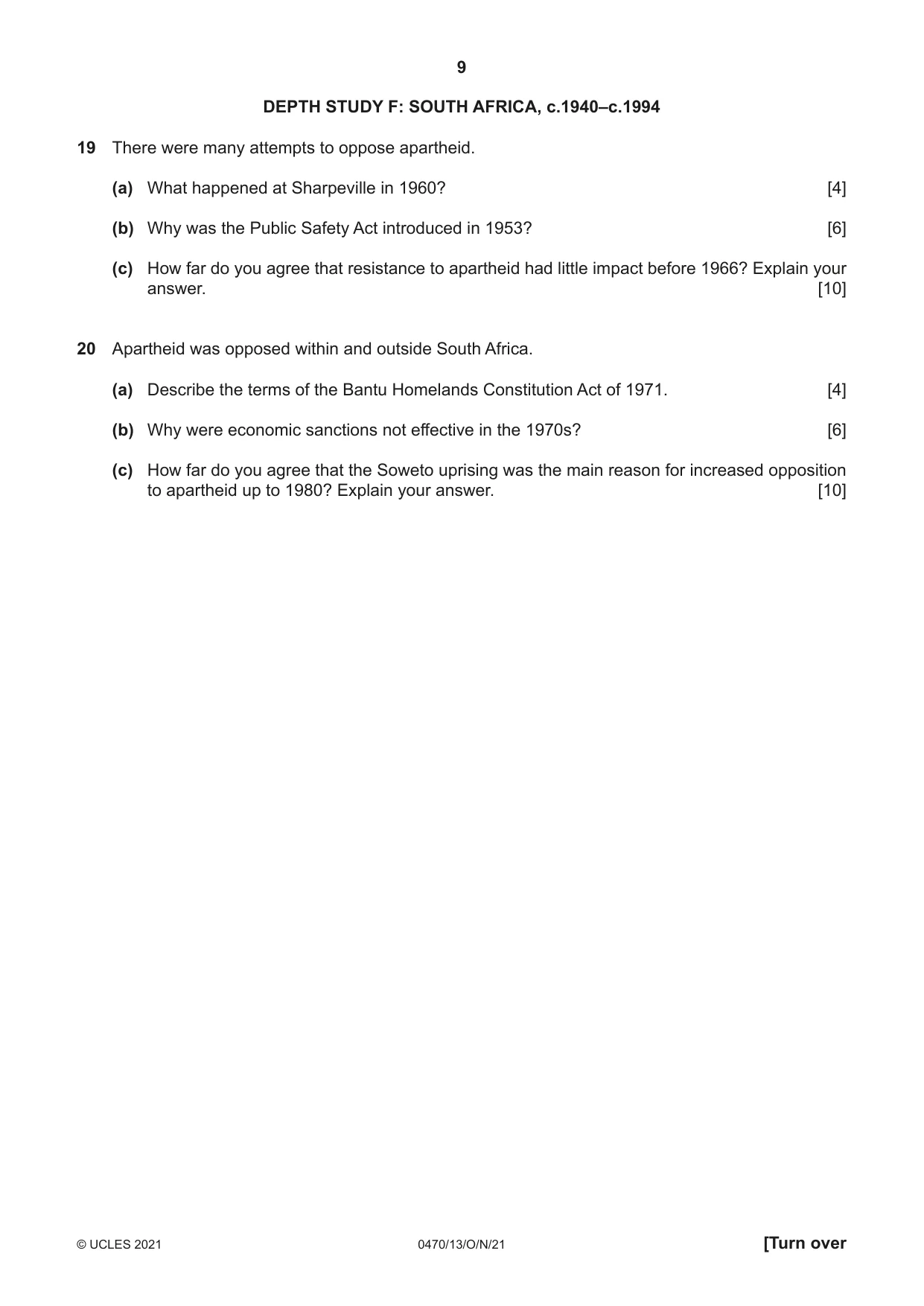
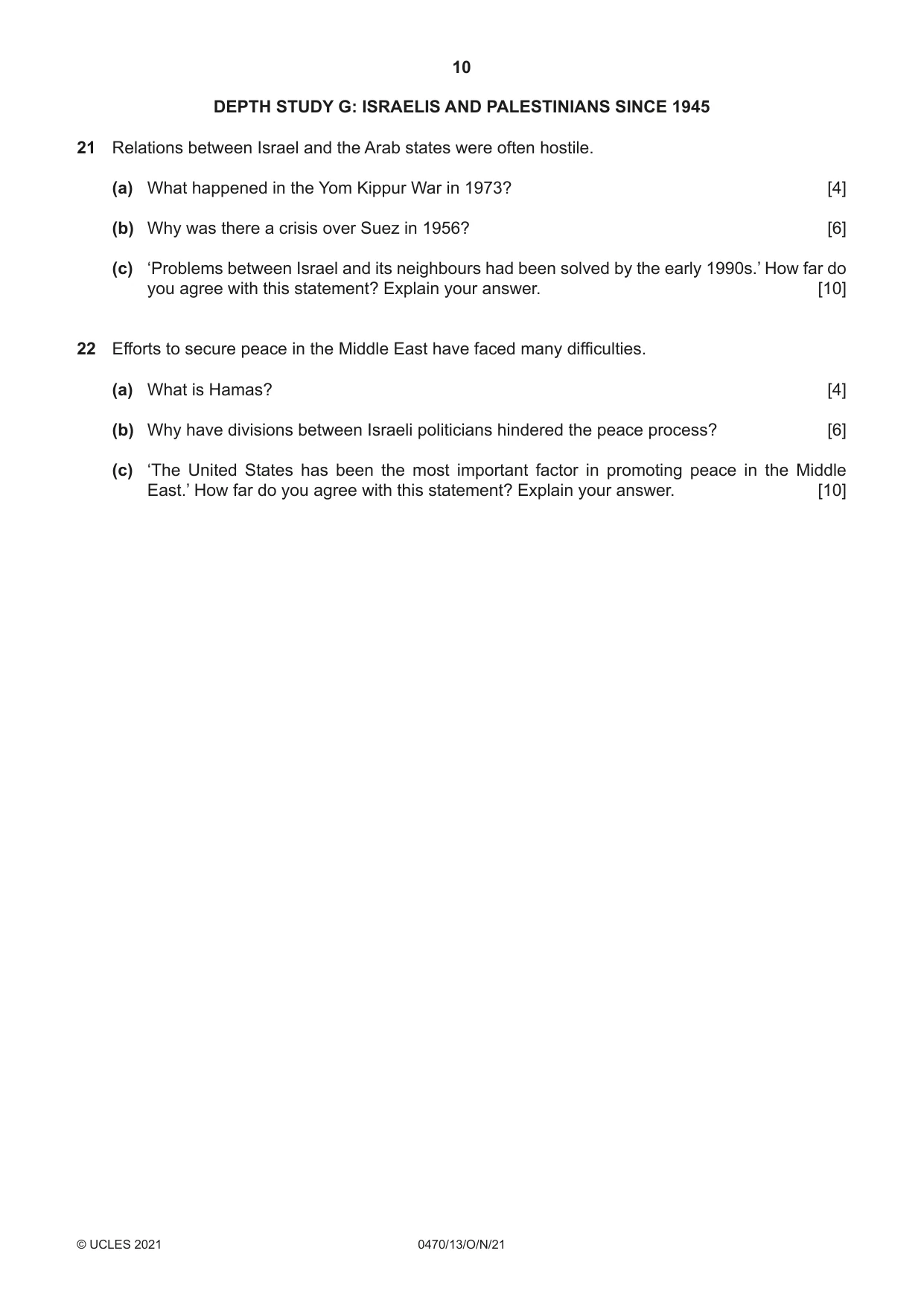

Mark scheme90 pages
Answers below. Sit the paper first if you are practising.
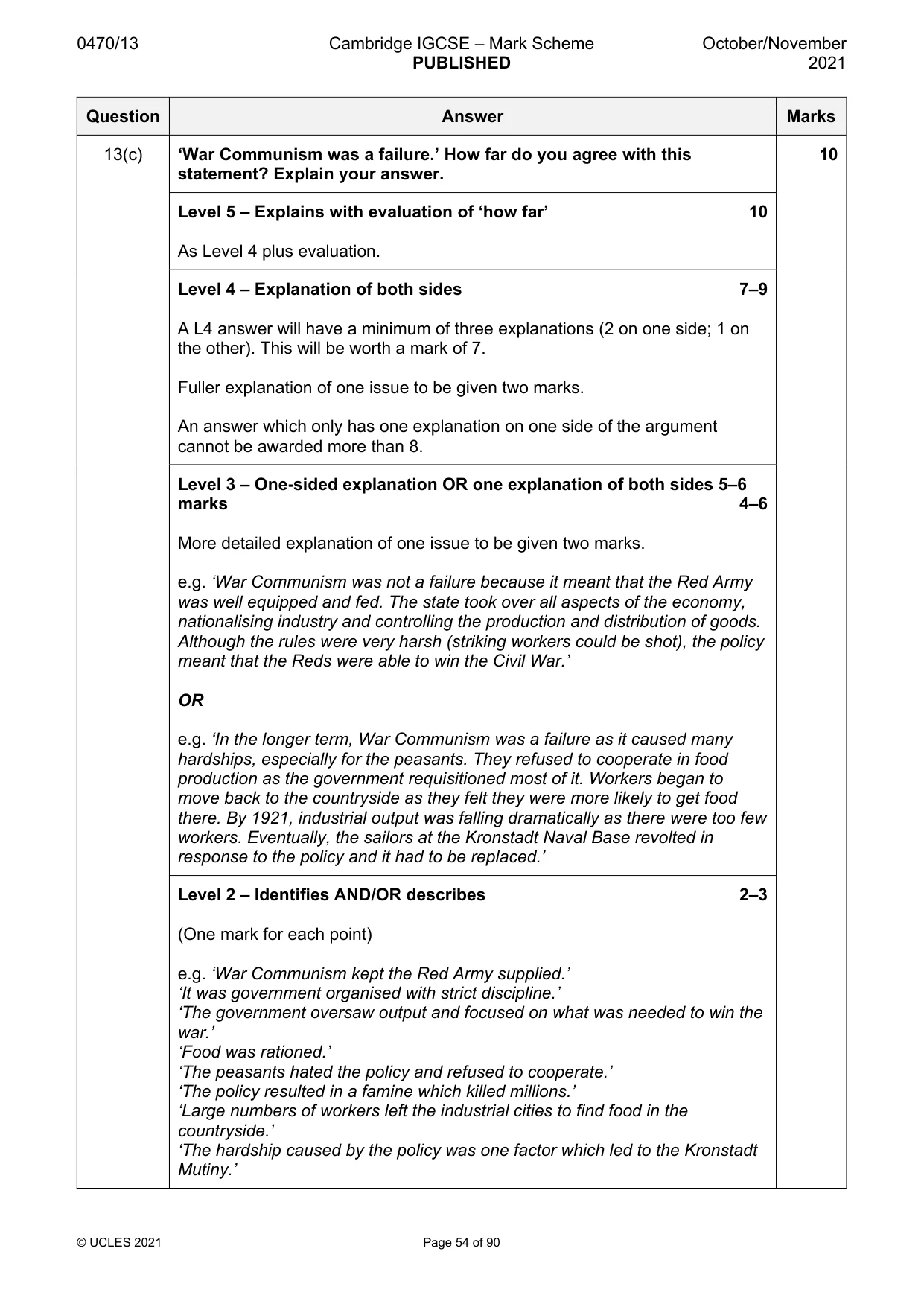
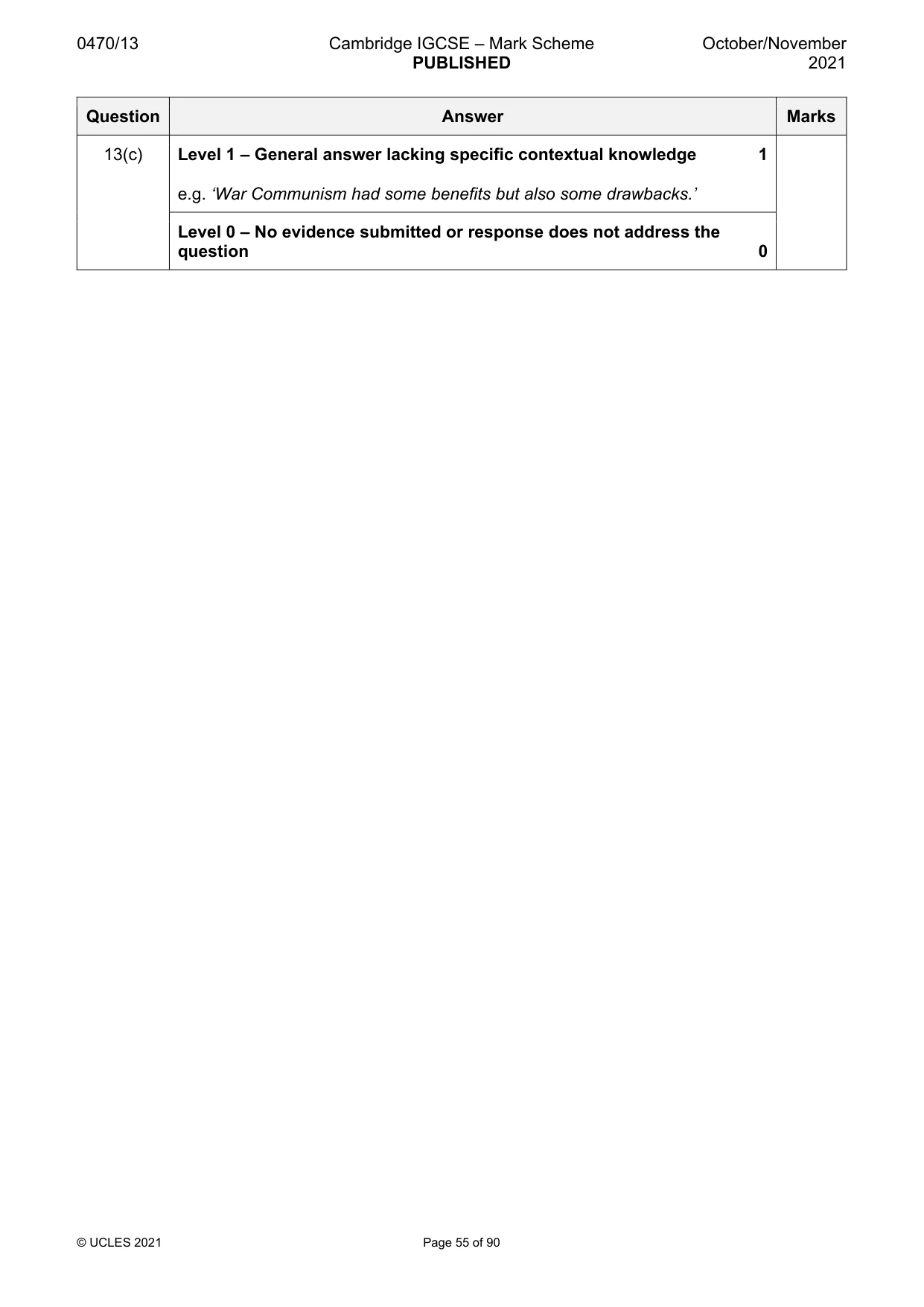
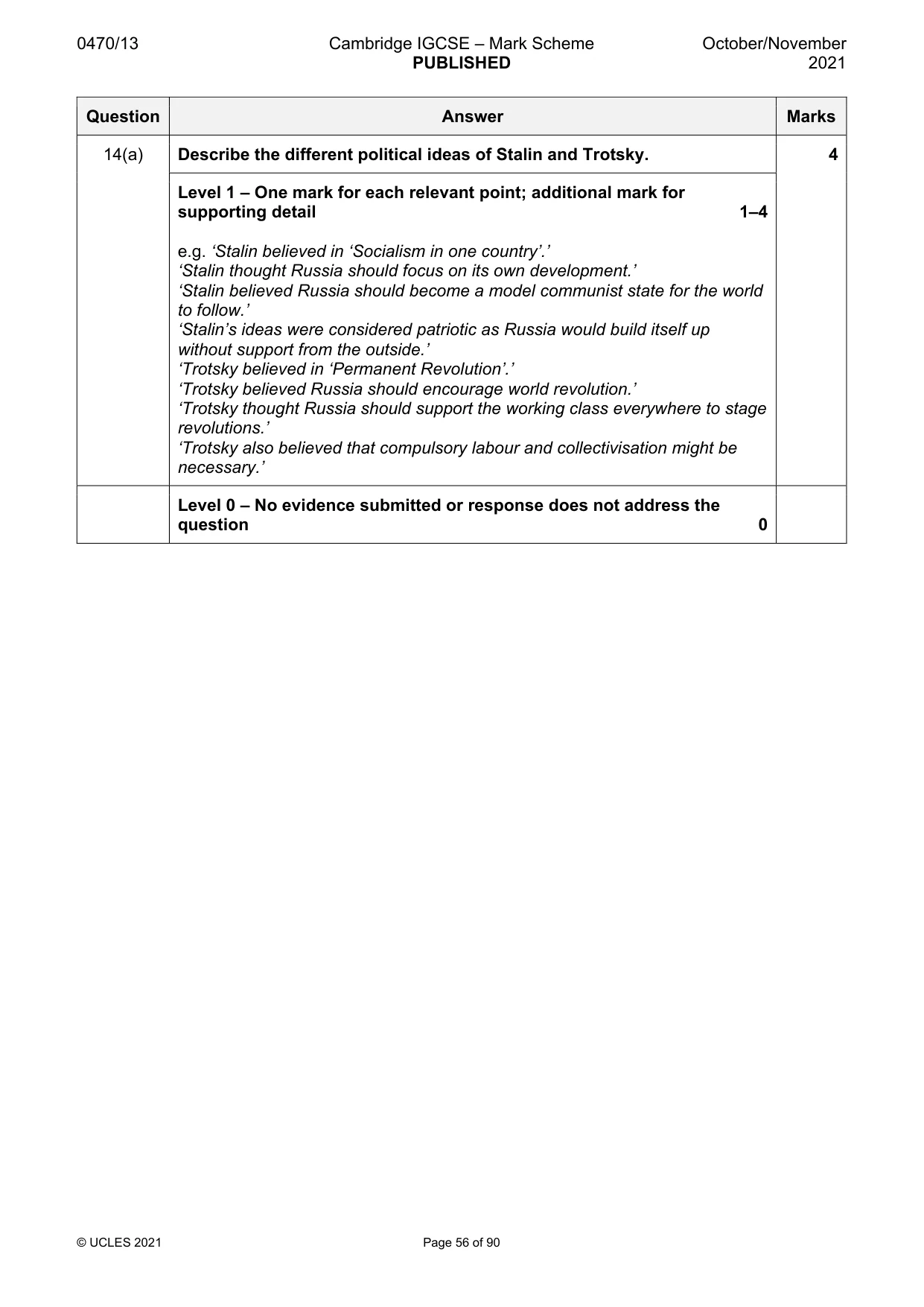
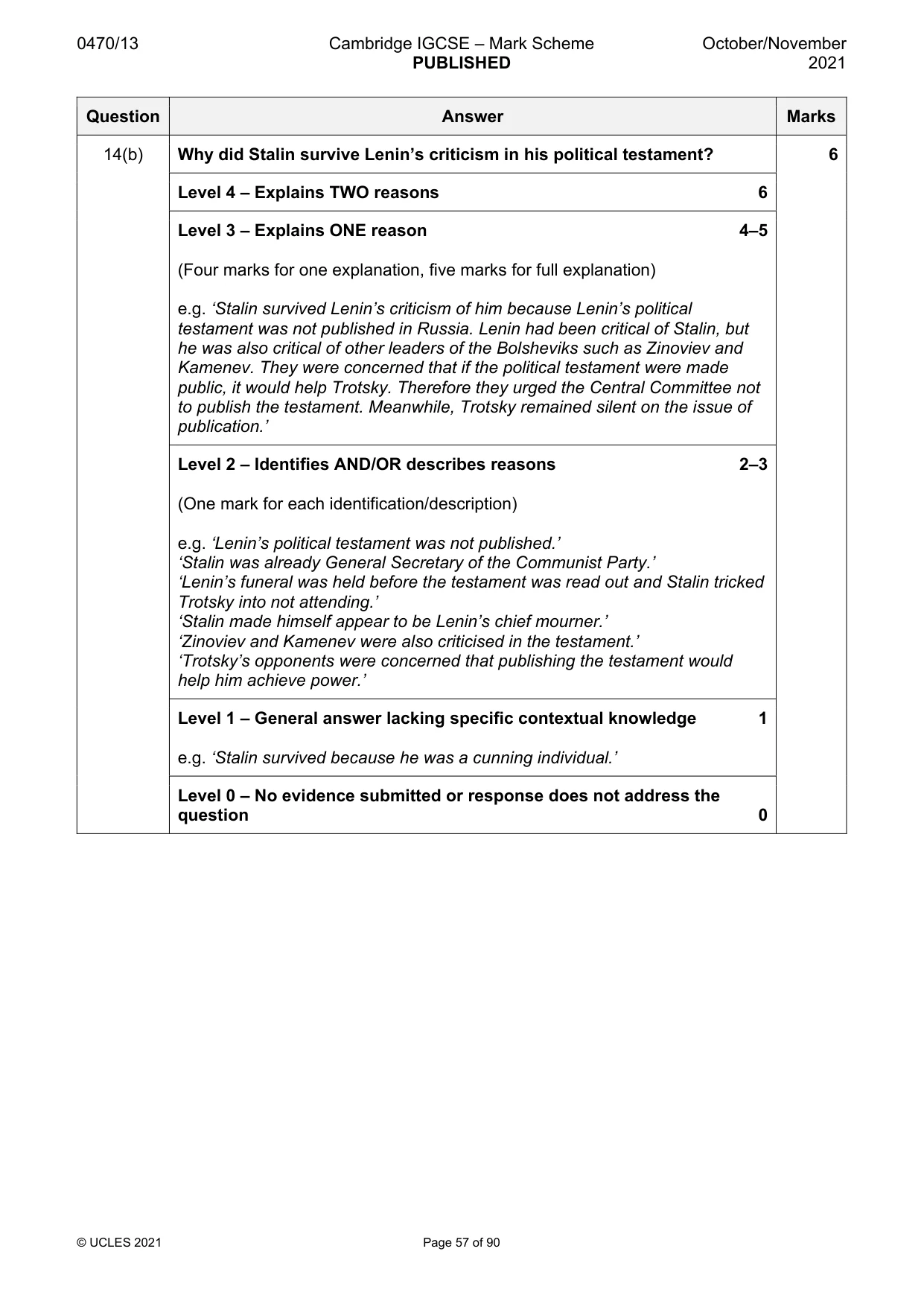
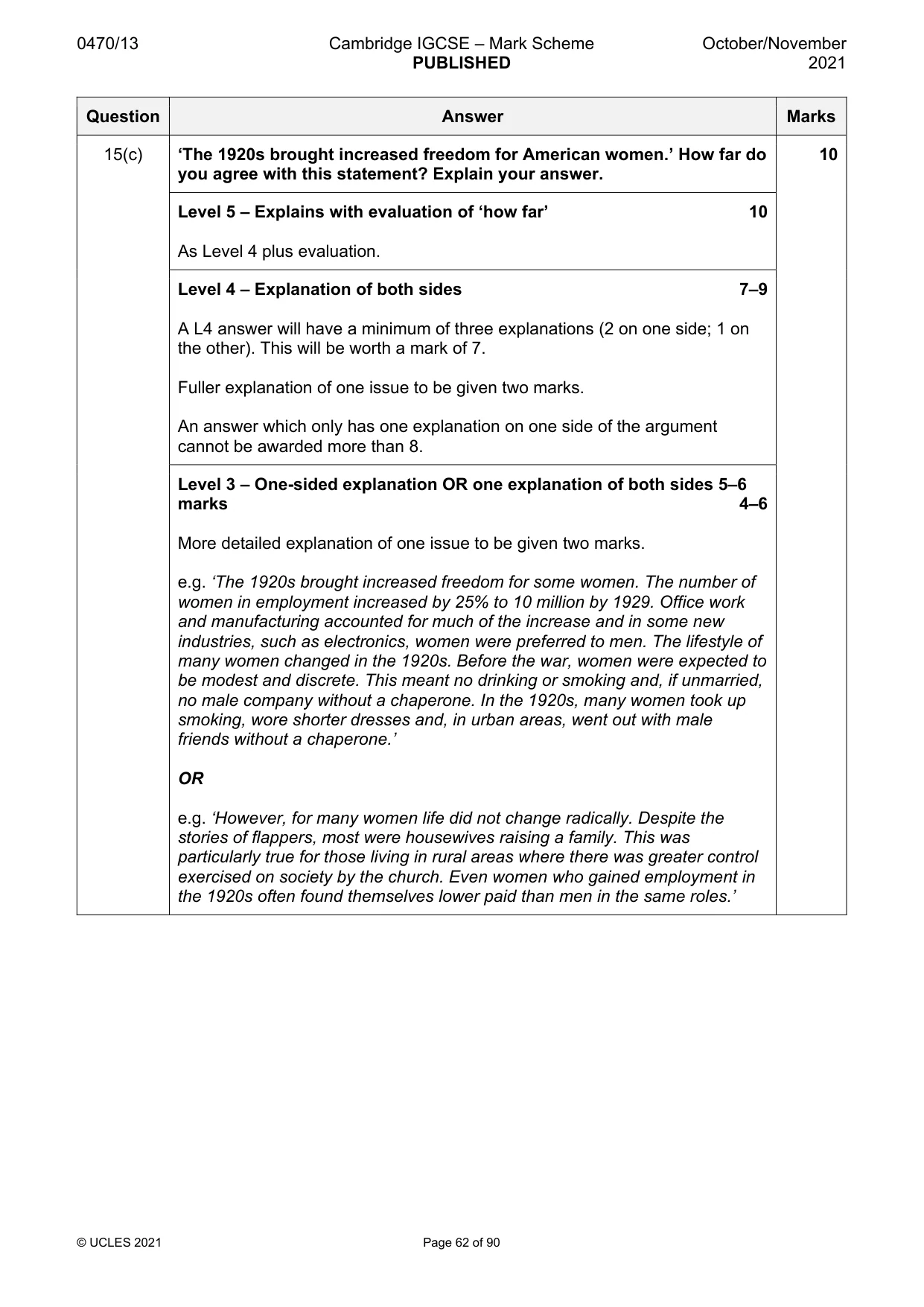
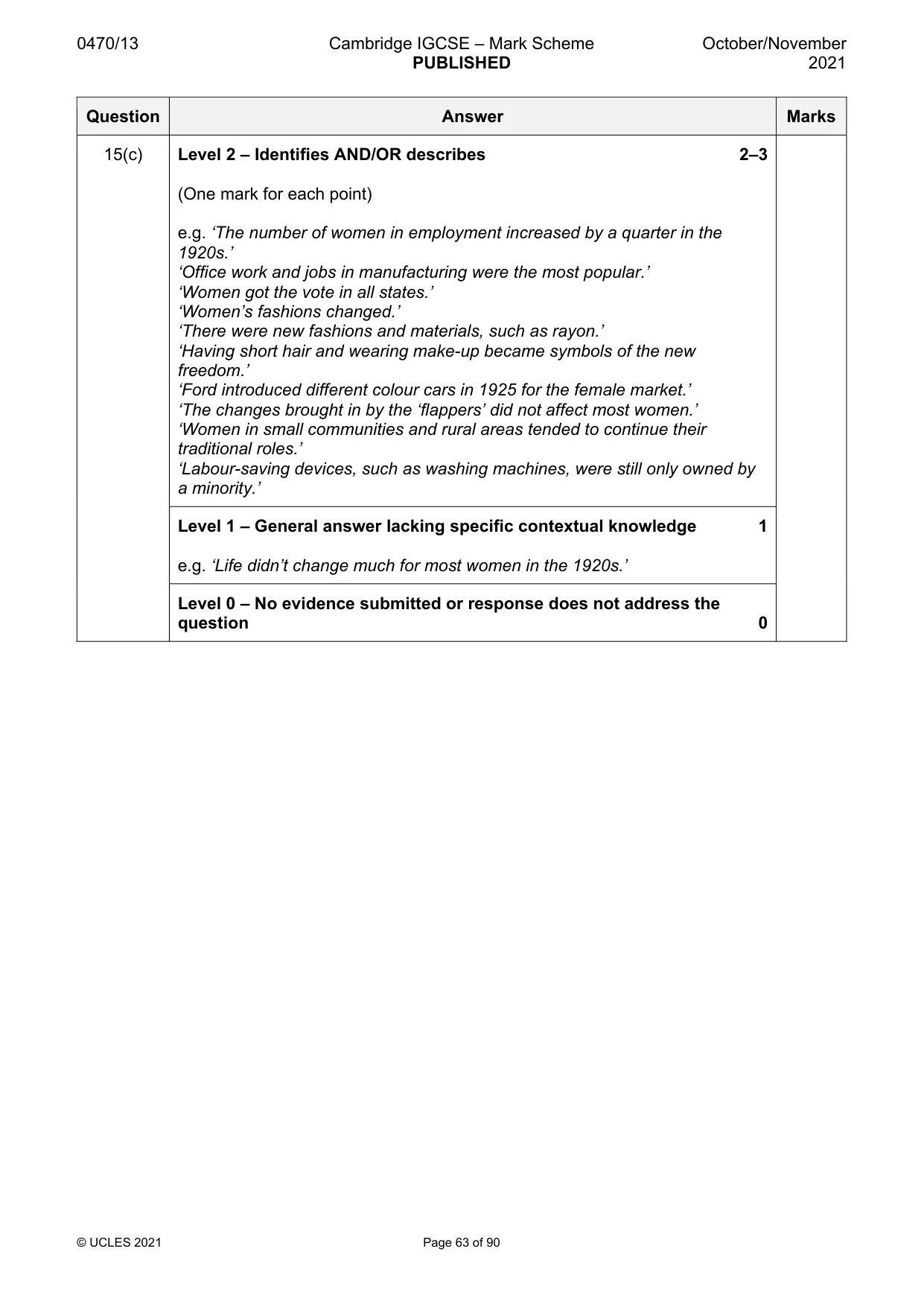
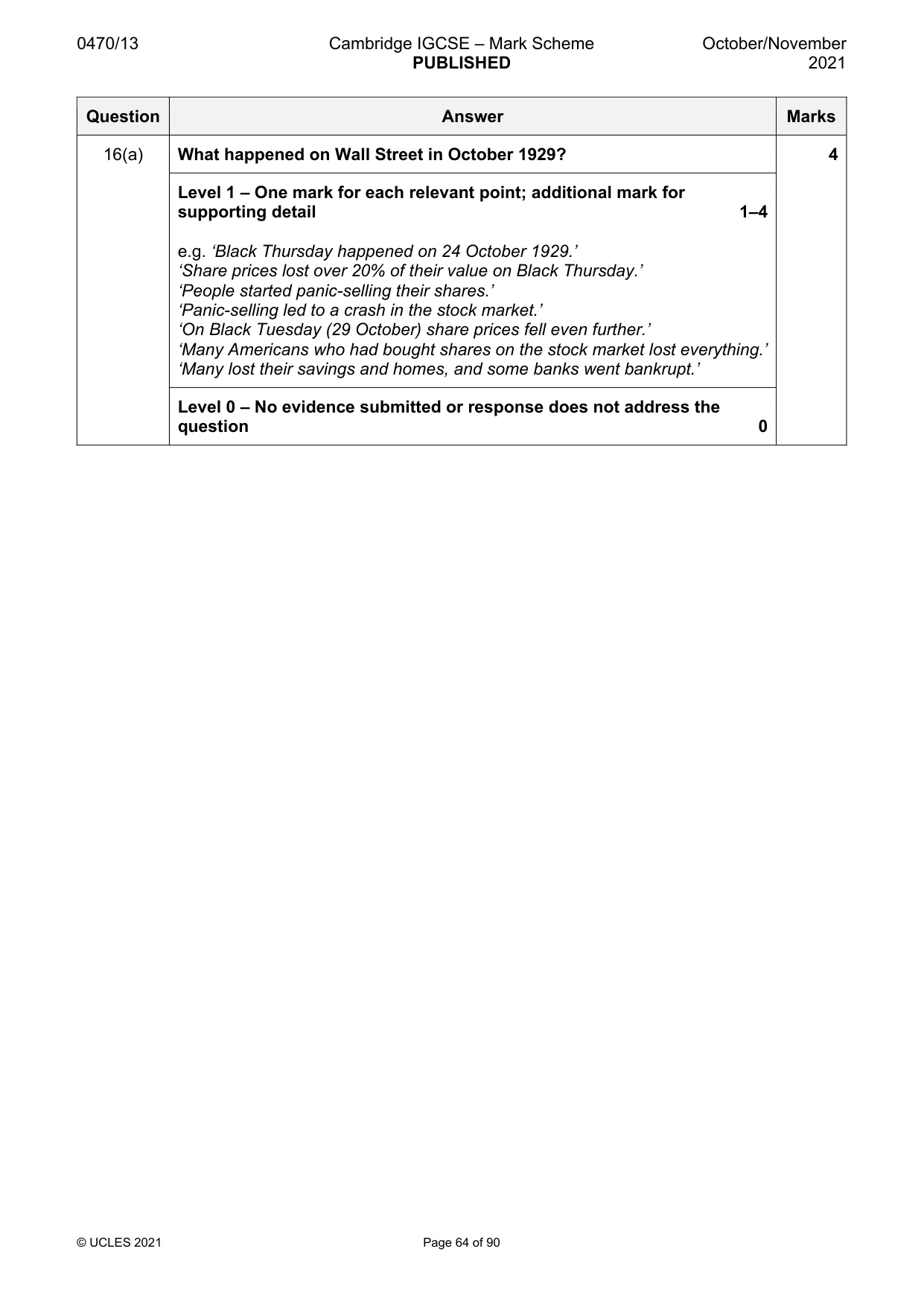
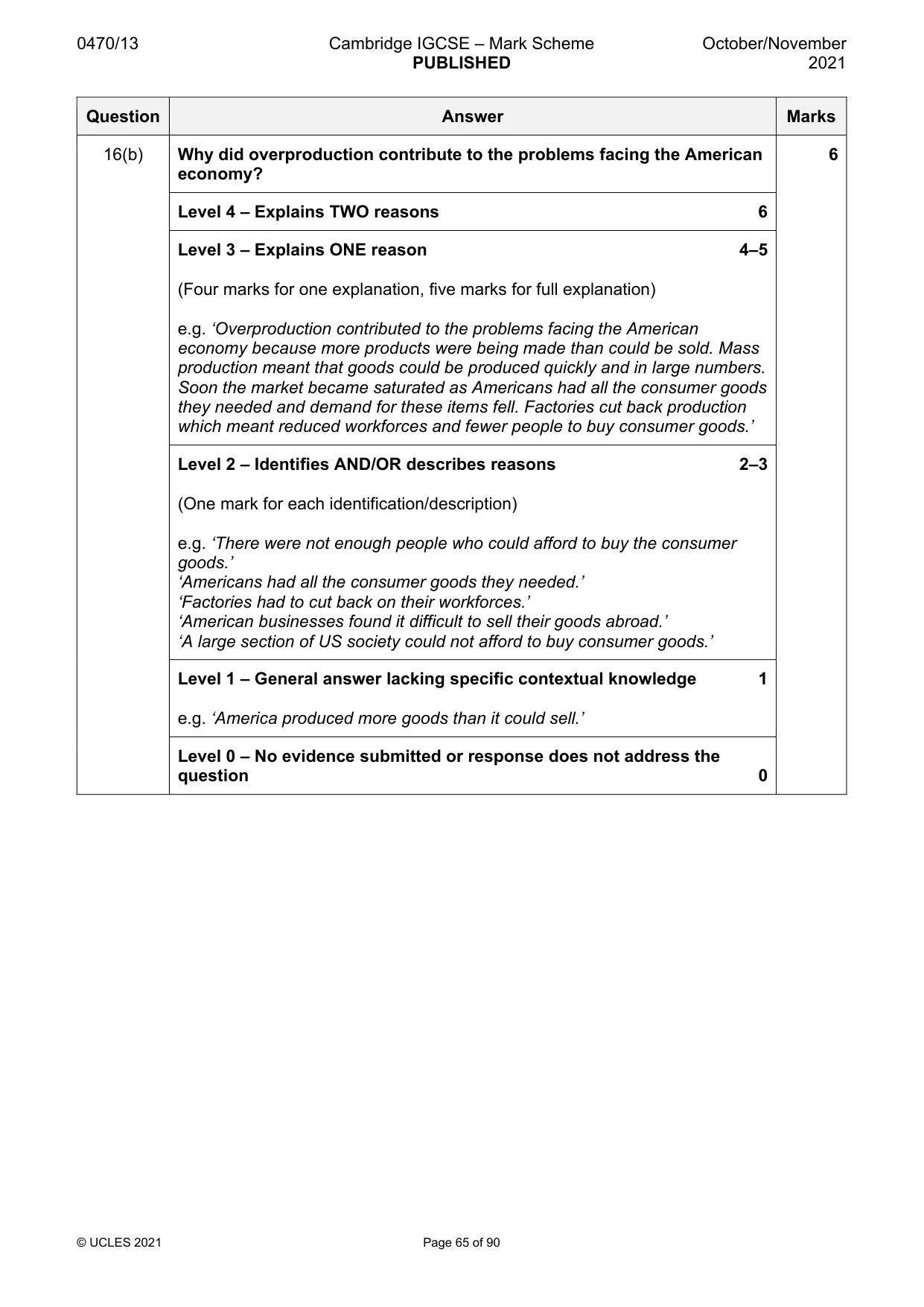
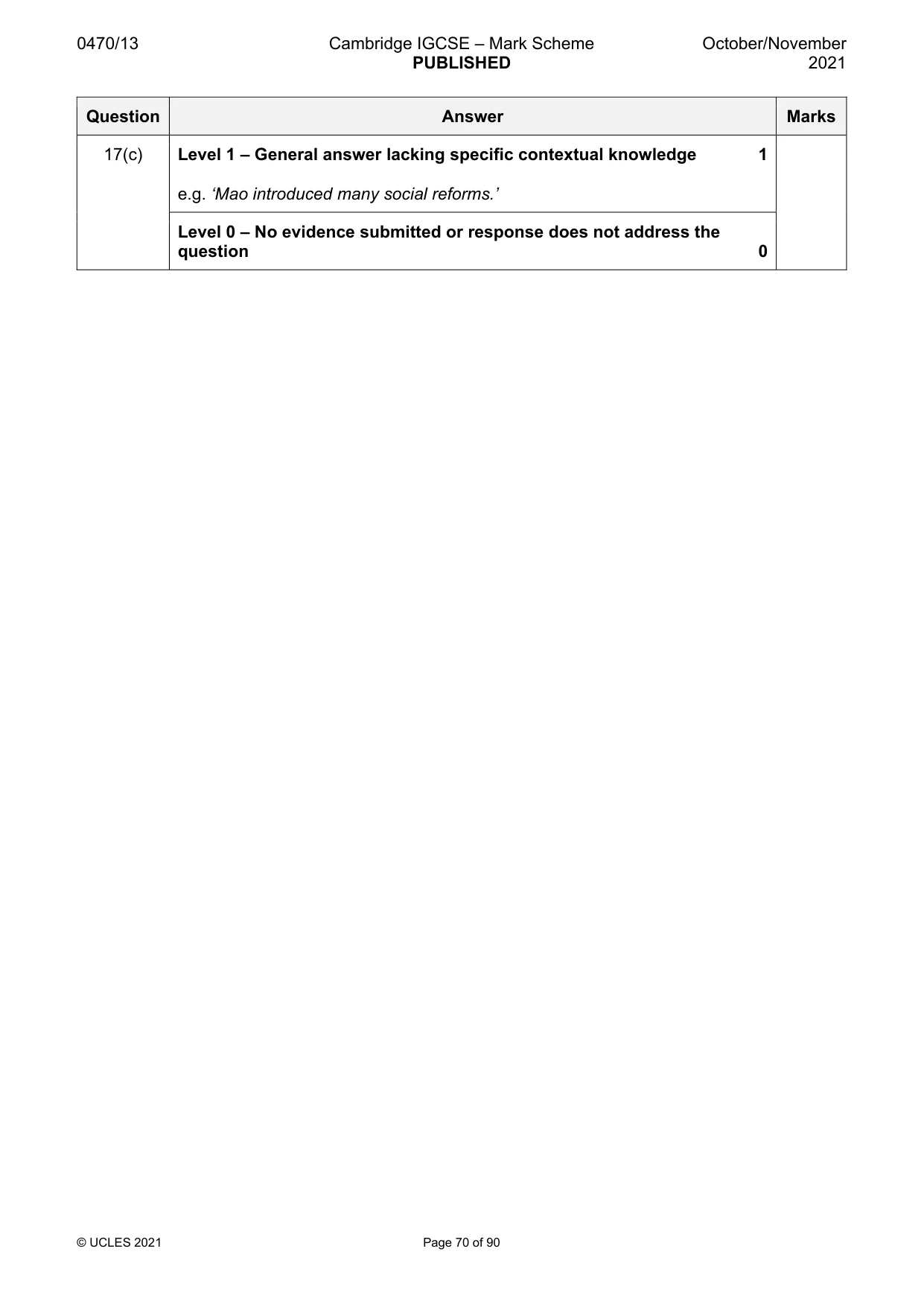
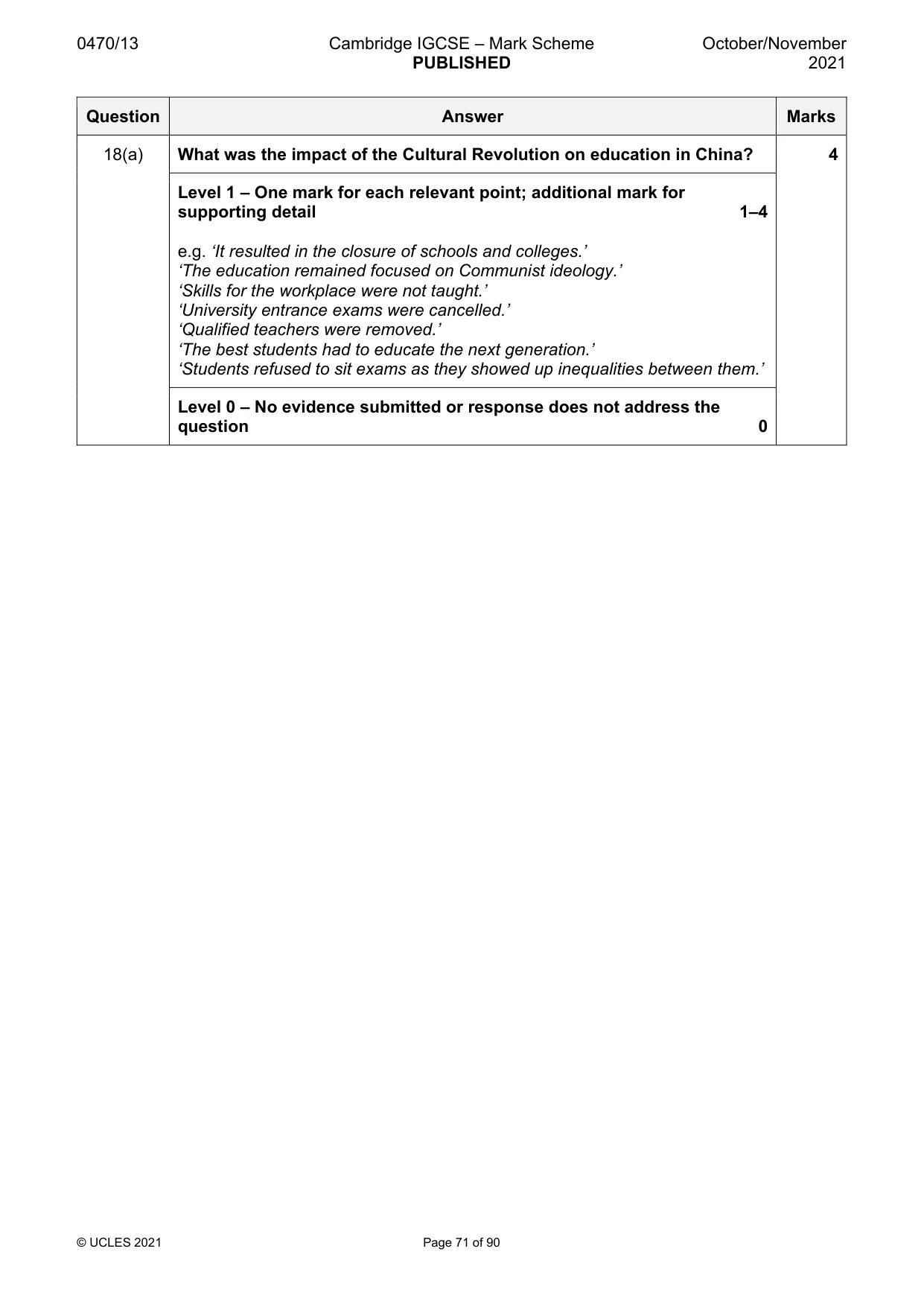
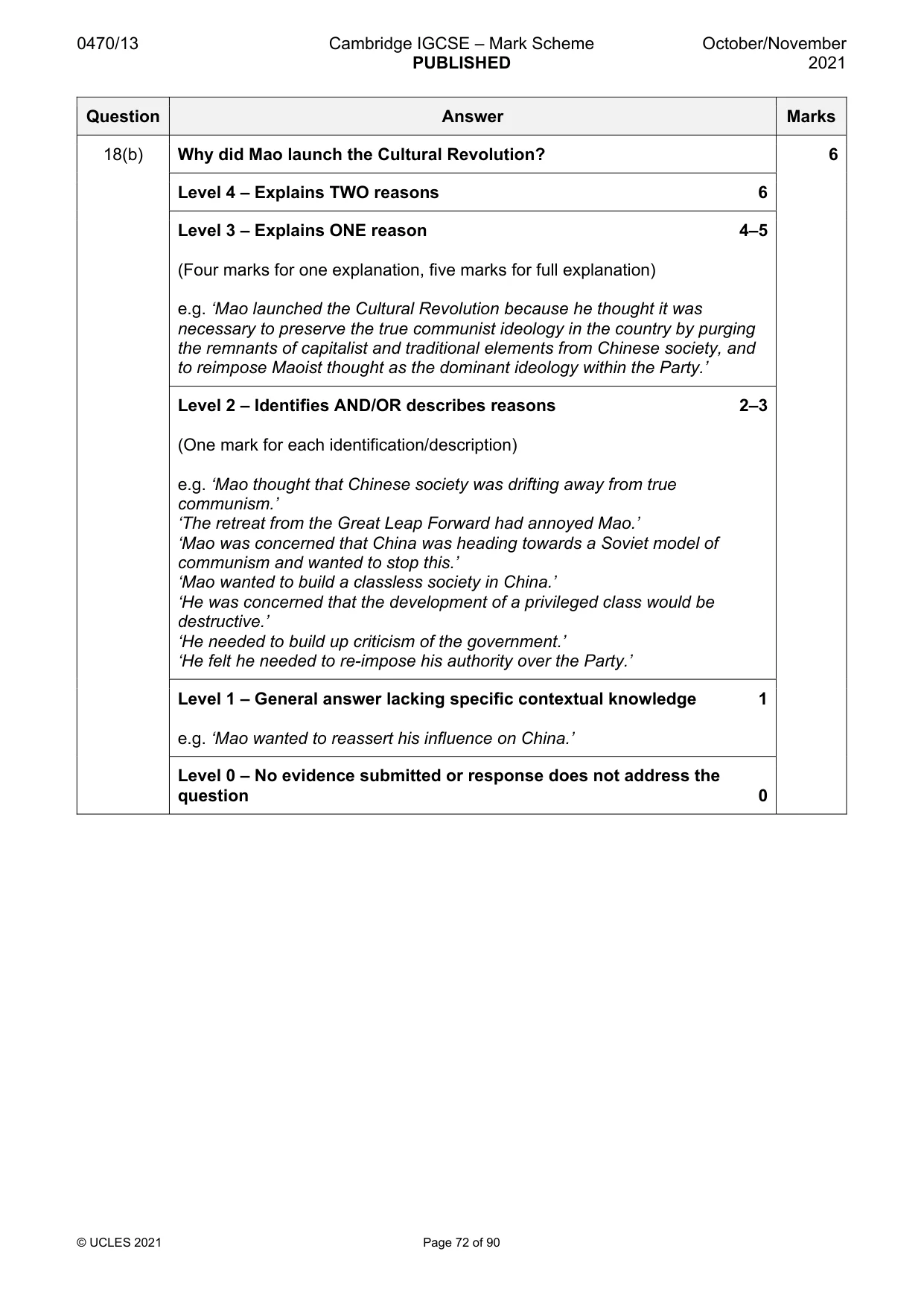
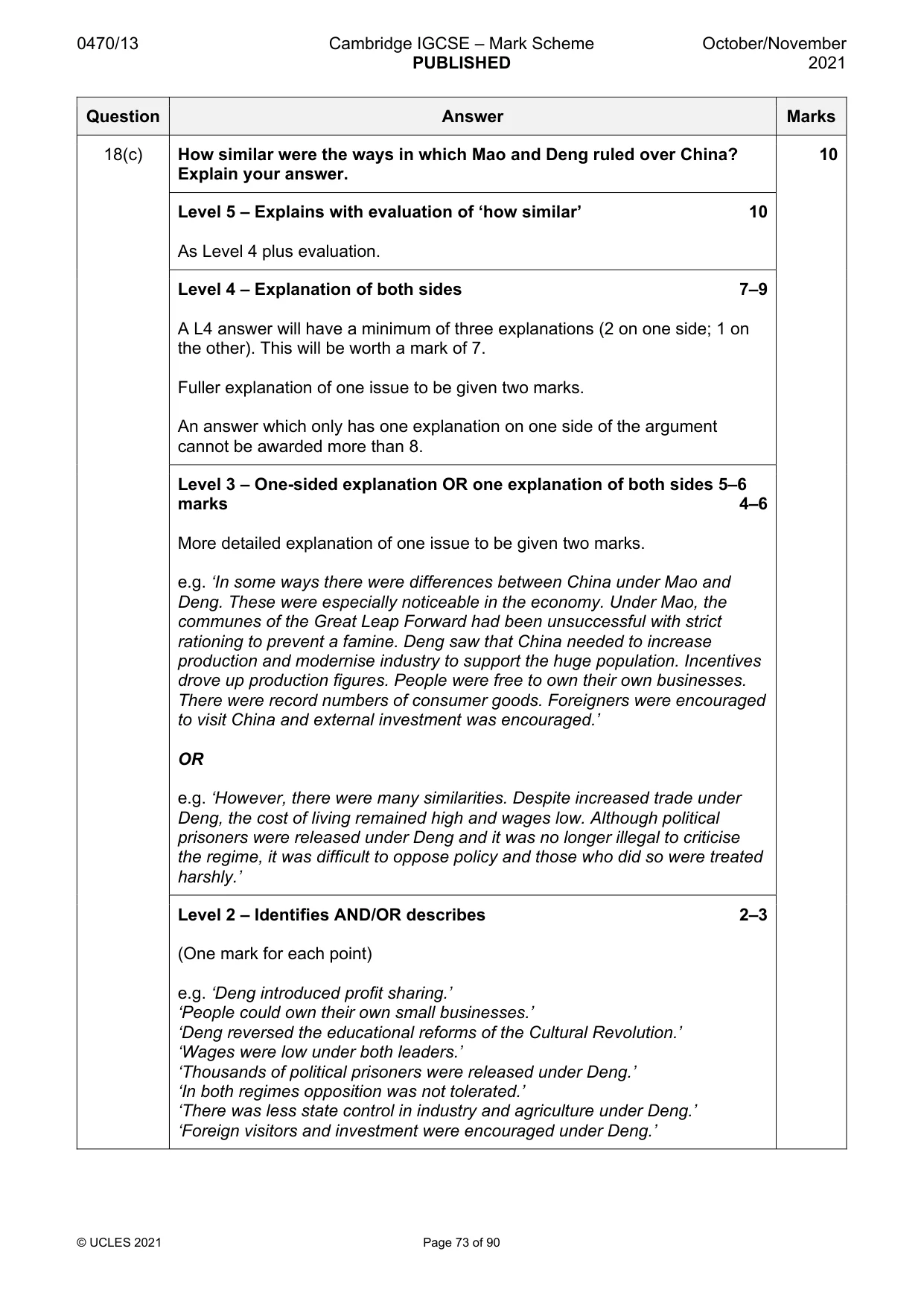
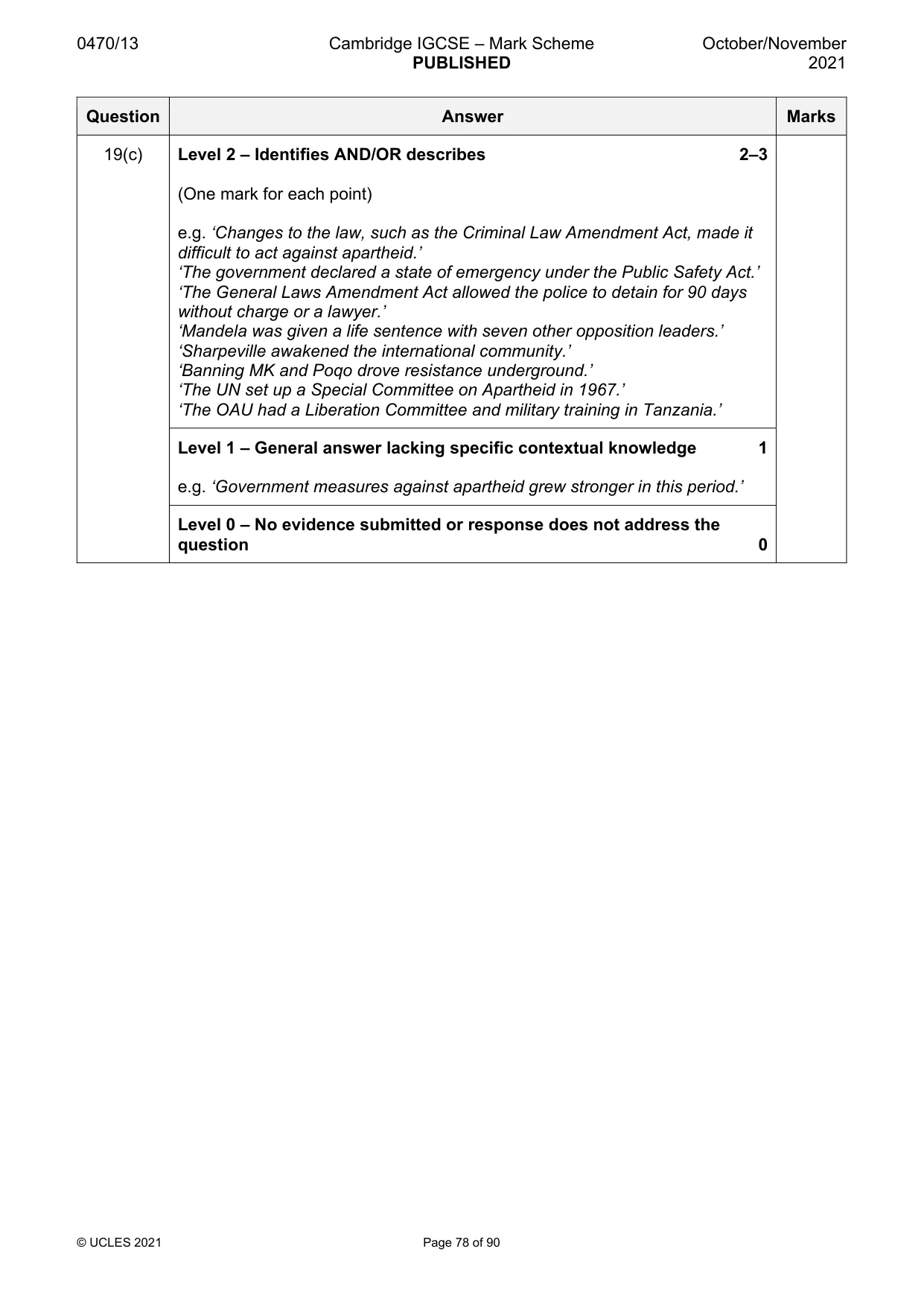
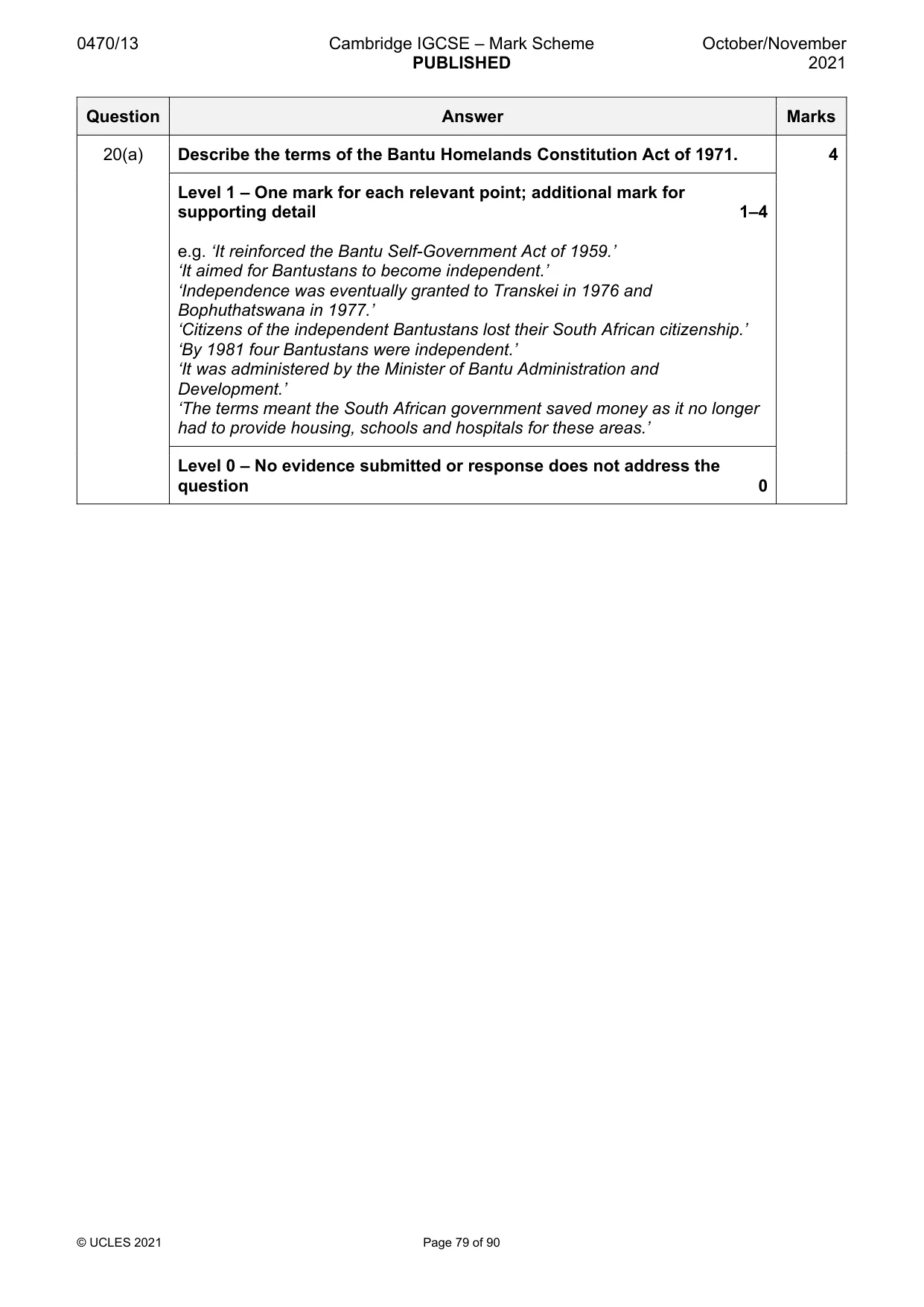
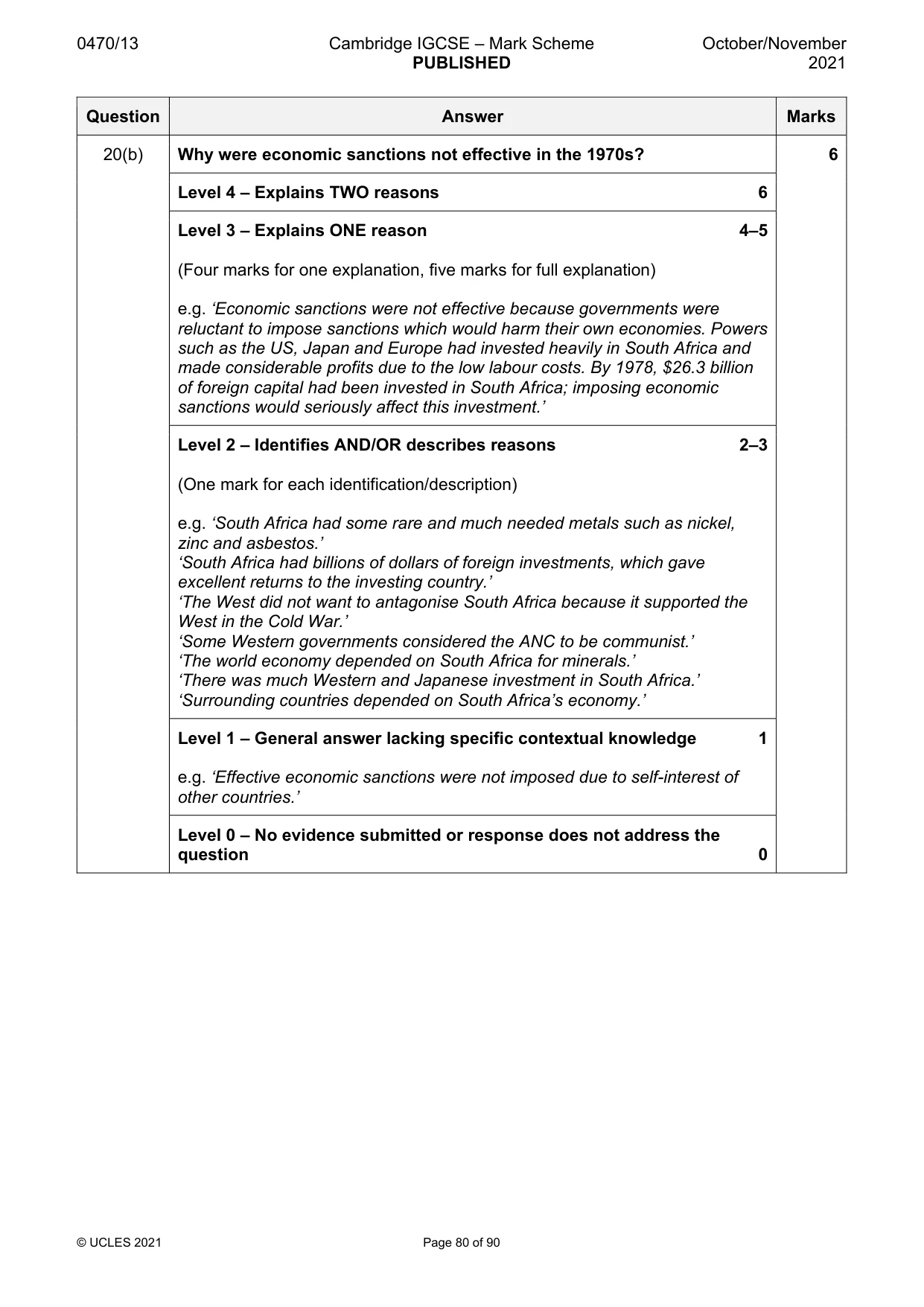
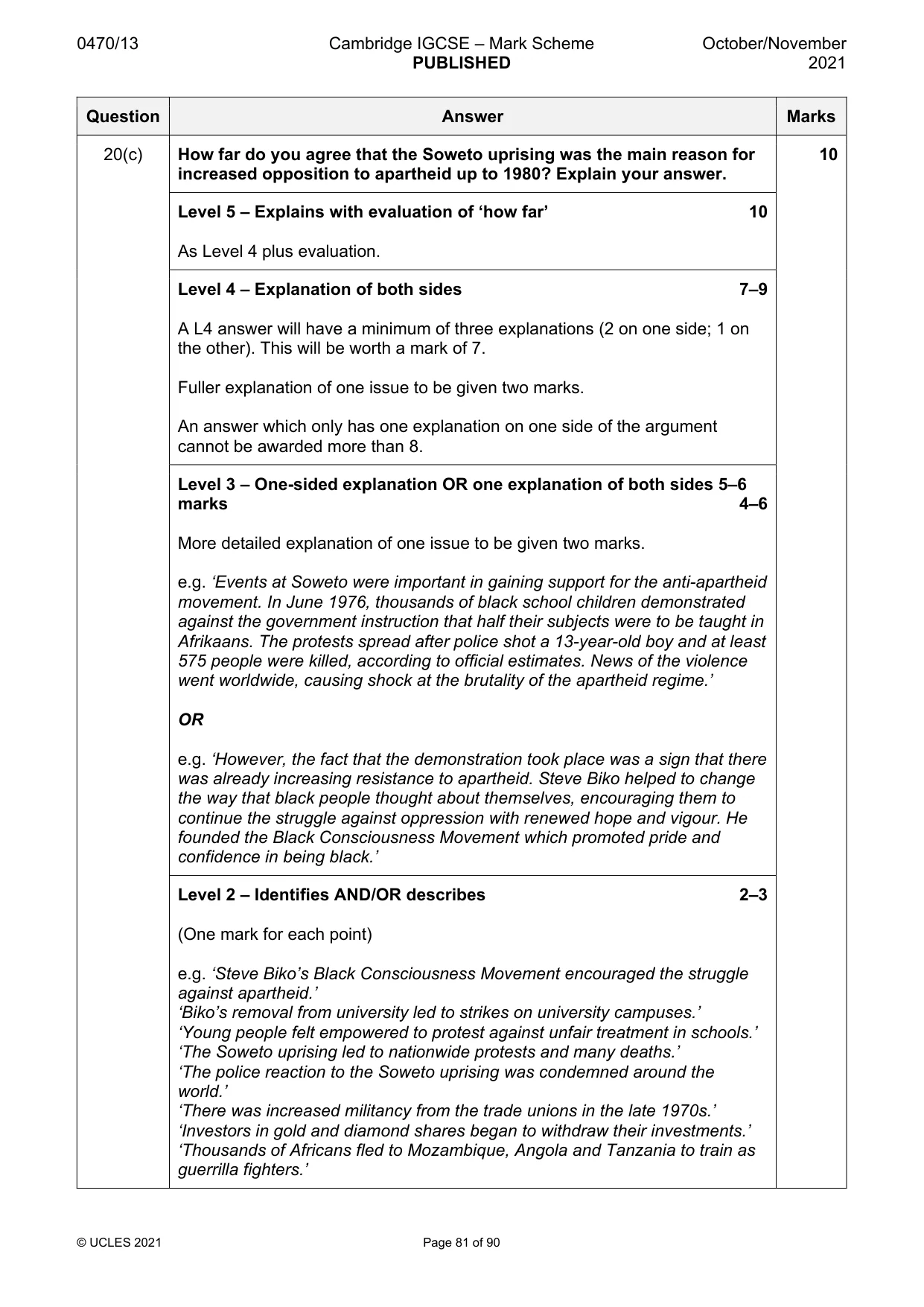
Paper as text
Question paper, page 1
This document has 12 pages. Any blank pages are indicated. Cambridge IGCSE™ * 4 6 1 4 9 4 9 2 7 6 * HISTORY 0470/13 Paper 1 October/November 2021 2 hours You must answer on the enclosed answer booklet. You will need: Answer booklet (enclosed) INSTRUCTIONS ● Answer three questions in total: Section A (Core Content): answer two questions. Section B (Depth Studies): answer one question. ● Follow the instructions on the front cover of the answer booklet. If you need additional answer paper, ask the invigilator for a continuation booklet. INFORMATION ● The total mark for this paper is 60. ● The number of marks for each question or part question is shown in brackets [ ]. DC (CJ) 202582/3 © UCLES 2021 [Turn over
Question paper, page 2
2 0470/13/O/N/21 © UCLES 2021 SECTION A: CORE CONTENT Answer any two questions from this Section. 1 Revolutions broke out in many European states in 1848. (a) What were the demands of the revolutionaries in Prussia in 1848? [4] (b) Why did the 1848 revolutions bring little change to Germany? [6] (c) ‘Nationalism was more important than economic grievances in the outbreak of the 1848 revolutions.’ How far do you agree with this statement? Explain your answer. [10] 2 Tensions ran high in the United States before the Civil War. (a) What was the ‘underground railroad’? [4] (b) Why was the Missouri Compromise important? [6] (c) ‘Economic factors were more important than military leadership in the North’s victory in the Civil War.’ How far do you agree with this statement? Explain your answer. [10] 3 The spread of imperialism had mixed causes and results. (a) What happened at Lucknow in 1857? [4] (b) Why did European powers ‘scramble for Africa’? [6] (c) ‘European rule had a negative impact on Africans.’ How far do you agree with this statement? Explain your answer. [10] 4 Relationships between European powers were important in the build-up to the First World War. (a) What was the Entente Cordiale? [4] (b) Why was there tension in the Balkans? [6] (c) ‘Austria was more responsible than Germany for the outbreak of the First World War.’ How far do you agree with this statement? Explain your answer. [10]
Question paper, page 3
3 0470/13/O/N/21 © UCLES 2021 [Turn over 5 Agreeing a peace settlement at the end of the First World War was challenging. (a) Describe how Bulgaria was treated in the peace settlement. [4] (b) Why did negotiations at Versailles present difficulties for Lloyd George? [6] (c) Which was punished more harshly, Germany or Turkey? Explain your answer. [10] 6 Hitler’s actions increased international tensions in the 1930s. (a) Describe Hitler’s takeover of Austria in 1938. [4] (b) Why did Hitler remilitarise the Rhineland in 1936? [6] (c) ‘Appeasement was a sensible policy.’ How far do you agree with this statement? Explain your answer. [10] 7 Hostility between the USA and USSR increased after the end of the Second World War. (a) What was agreed at the Yalta Conference? [4] (b) Why did the USSR oppose Marshall Aid? [6] (c) ‘Disagreements over the future of Germany were the main cause of the Cold War.’ How far do you agree with this statement? Explain your answer. [10] 8 Saddam Hussein controlled Iraq in many ways. (a) Describe the July Revolution of 1958 in Iraq. [4] (b) Why was it important to Saddam Hussein to establish a personality cult? [6] (c) ‘Terror was more important than economic development in maintaining Saddam Hussein’s rule in Iraq.’ How far do you agree with this statement? Explain your answer. [10]
Question paper, page 4
4 0470/13/O/N/21 © UCLES 2021 SECTION B: DEPTH STUDIES Answer any one question from this Section. DEPTH STUDY A: THE FIRST WORLD WAR, 1914–18 9 The First World War lasted longer than many expected. (a) What was the British Expeditionary Force? [4] (b) Why were the Germans confident the Schlieffen Plan would succeed? [6] (c) ‘The development of trench warfare was the main reason the war was not over by Christmas 1914.’ How far do you agree with this statement? Explain your answer. [10] 10 Germany faced difficulties in 1918. (a) What was the Zimmermann telegram? [4] (b) Why did the Ludendorff Offensive fail? [6] (c) ‘Fear of invasion, rather than widespread discontent, caused Germany to agree to the Armistice.’ How far do you agree with this statement? Explain your answer. [10]
Question paper, page 5
5 0470/13/O/N/21 © UCLES 2021 [Turn over DEPTH STUDY B: GERMANY, 1918–45 11 Germany faced difficulties in the years following the war. (a) What was the Ruhr crisis of 1923? [4] (b) Why did the Spartacist uprising fail? [6] (c) How far was the period 1924 to 1929 a ‘golden age’ for Germany? Explain your answer. [10] 12 The Nazis controlled life in Germany in many ways. (a) Describe Goebbels’ role in Nazi Germany. [4] (b) Why did the Nazis organise a boycott of Jewish businesses in April 1933? [6] (c) ‘Economic policies were more important than the Gestapo in limiting opposition to the Nazis.’ How far do you agree with this statement? Explain your answer. [10]
Question paper, page 6
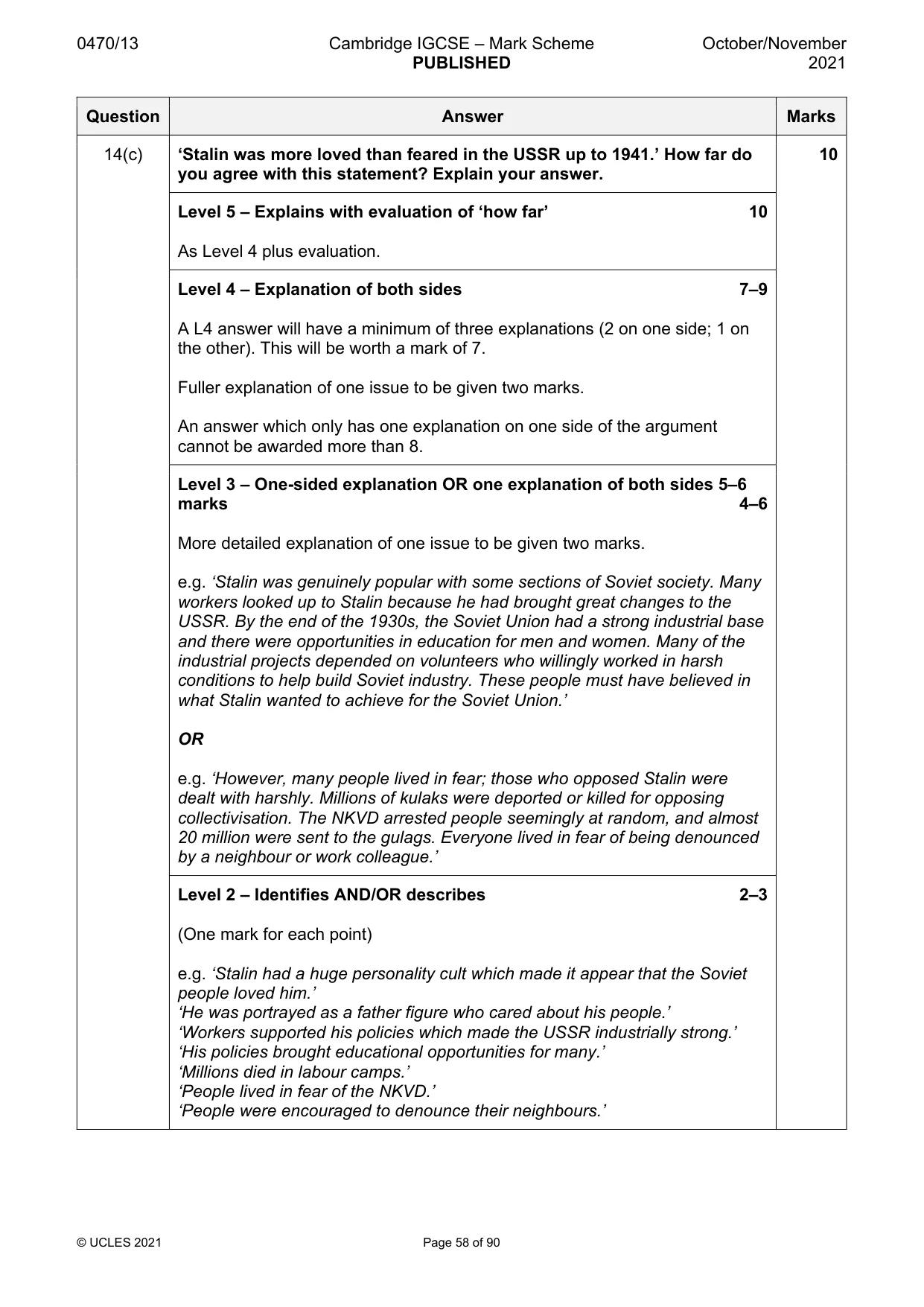
6 0470/13/O/N/21 © UCLES 2021 DEPTH STUDY C: RUSSIA, 1905–41 13 The Bolsheviks faced challenges after the Revolution. (a) Describe Lenin’s actions on his return to Russia in April 1917. [4] (b) Why was Trotsky important to the outcome of the Civil War? [6] (c) ‘War Communism was a failure.’ How far do you agree with this statement? Explain your answer. [10] 14 Stalin was determined to achieve and maintain power. (a) Describe the different political ideas of Stalin and Trotsky. [4] (b) Why did Stalin survive Lenin’s criticism in his political testament? [6] (c) ‘Stalin was more loved than feared in the USSR up to 1941.’ How far do you agree with this statement? Explain your answer. [10]
Question paper, page 7
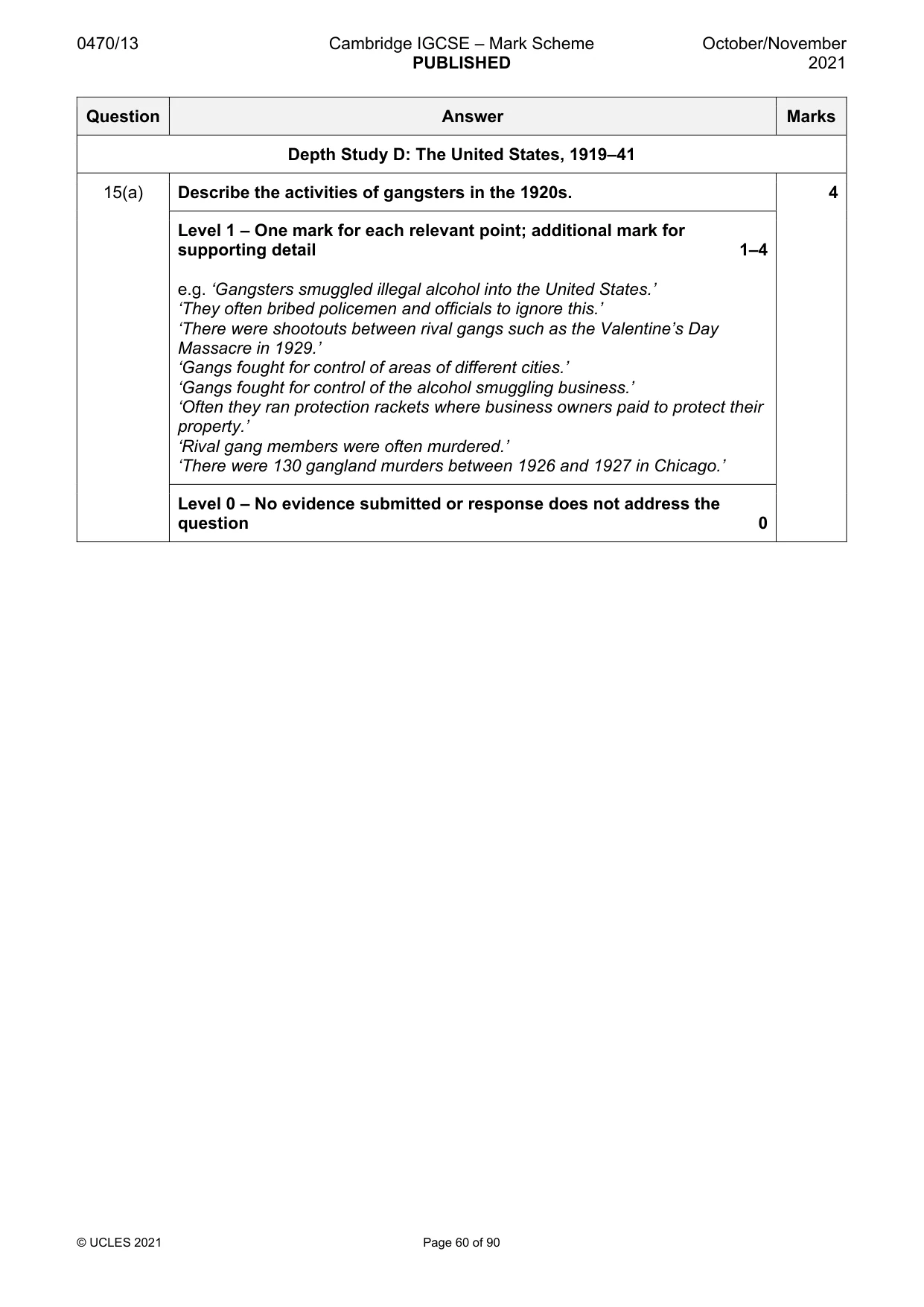
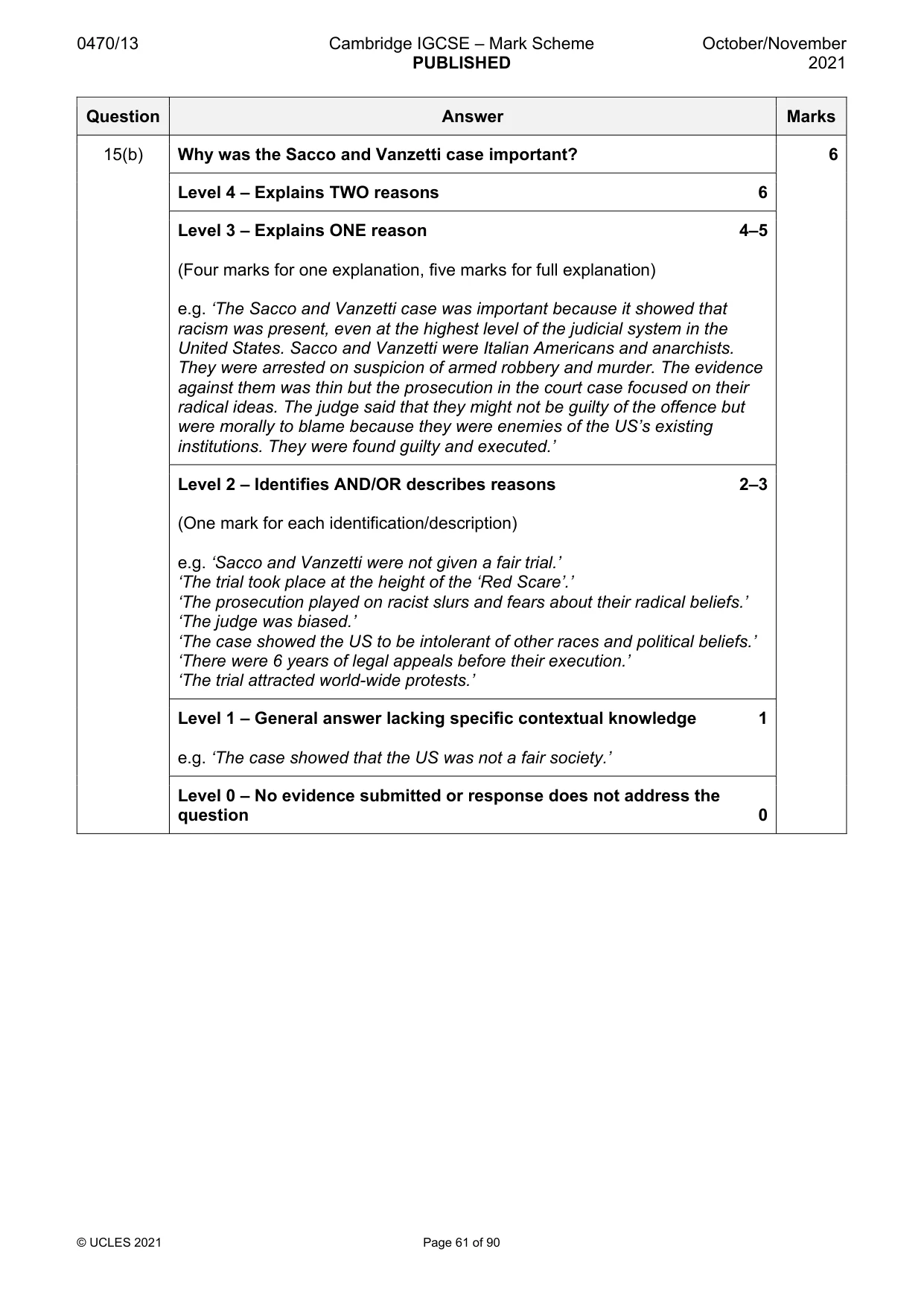
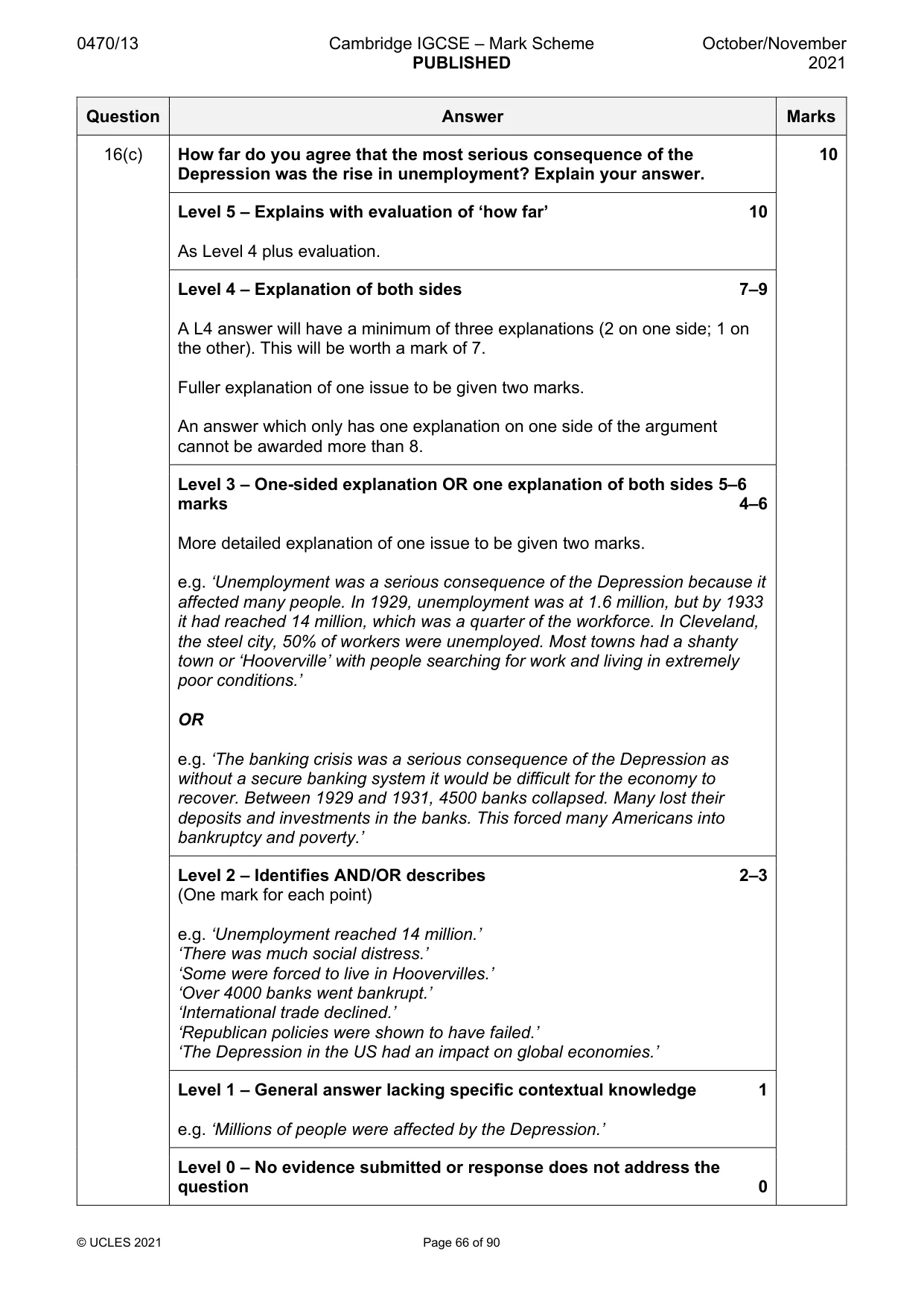
7 0470/13/O/N/21 © UCLES 2021 [Turn over DEPTH STUDY D: THE UNITED STATES, 1919–41 15 American society changed in the 1920s. (a) Describe the activities of gangsters in the 1920s. [4] (b) Why was the Sacco and Vanzetti case important? [6] (c) ‘The 1920s brought increased freedom for American women.’ How far do you agree with this statement? Explain your answer. [10] 16 The American economy was in difficulty by 1929. (a) What happened on Wall Street in October 1929? [4] (b) Why did overproduction contribute to the problems facing the American economy? [6] (c) How far do you agree that the most serious consequence of the Depression was the rise in unemployment? Explain your answer. [10]
Question paper, page 8
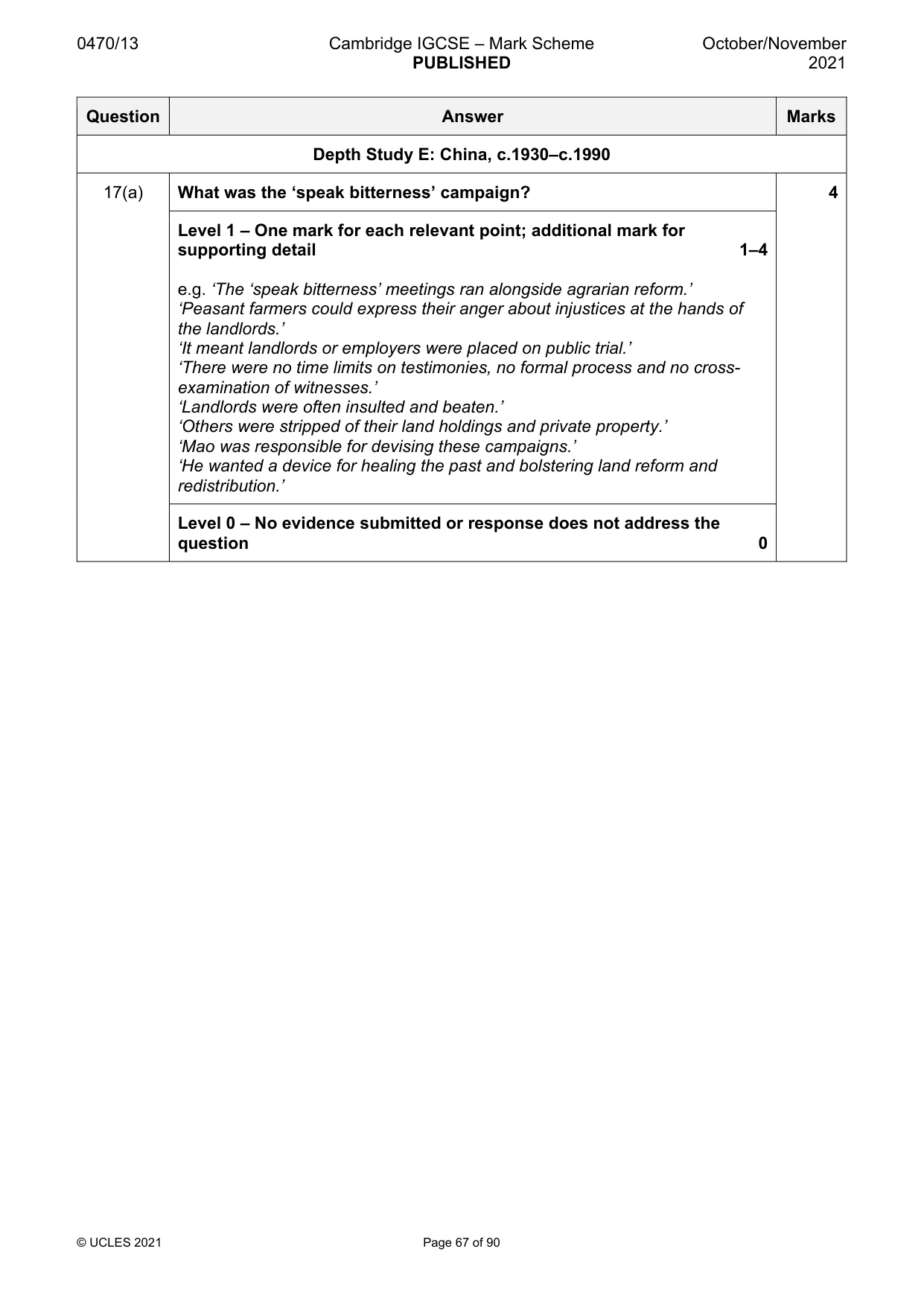
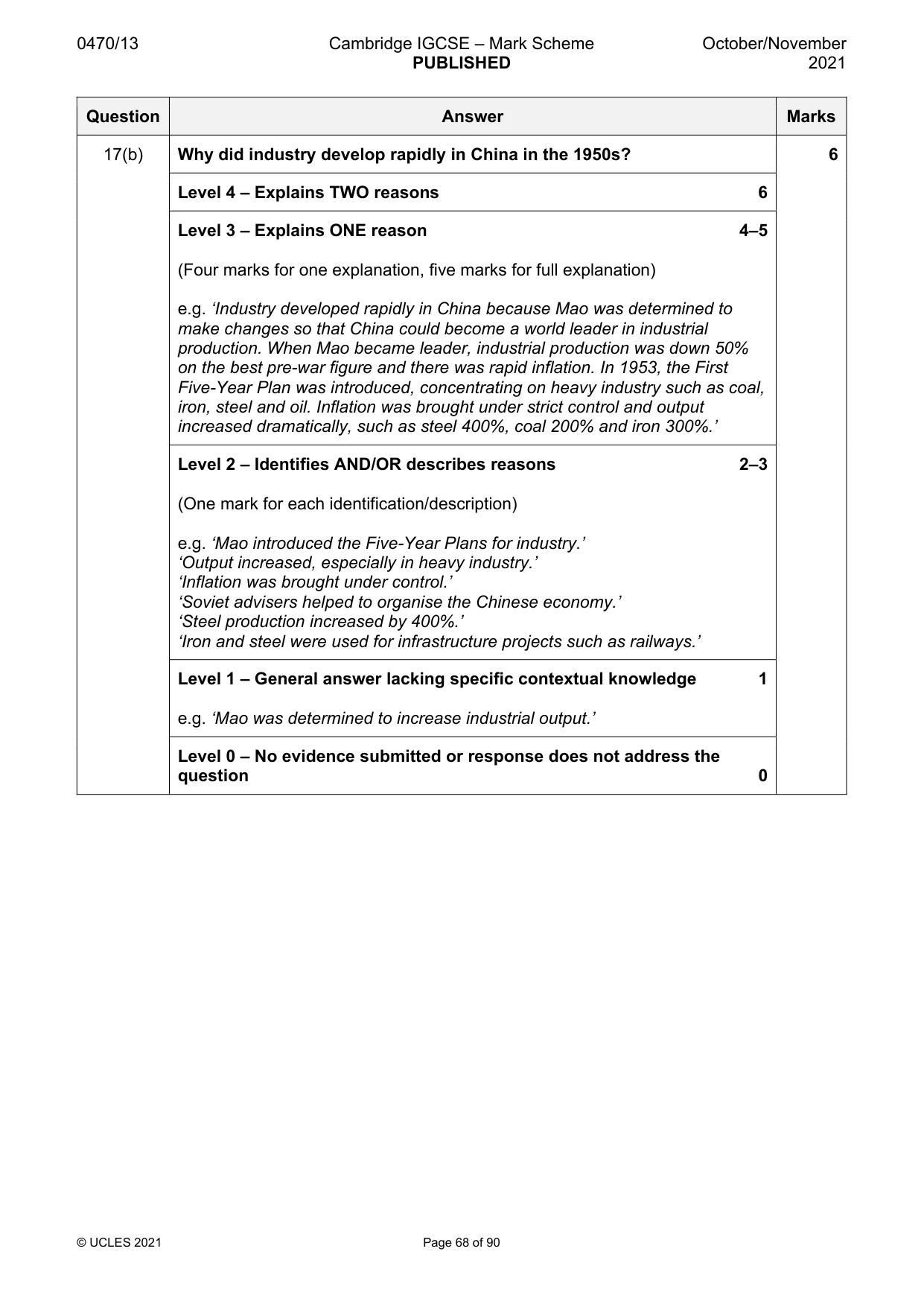
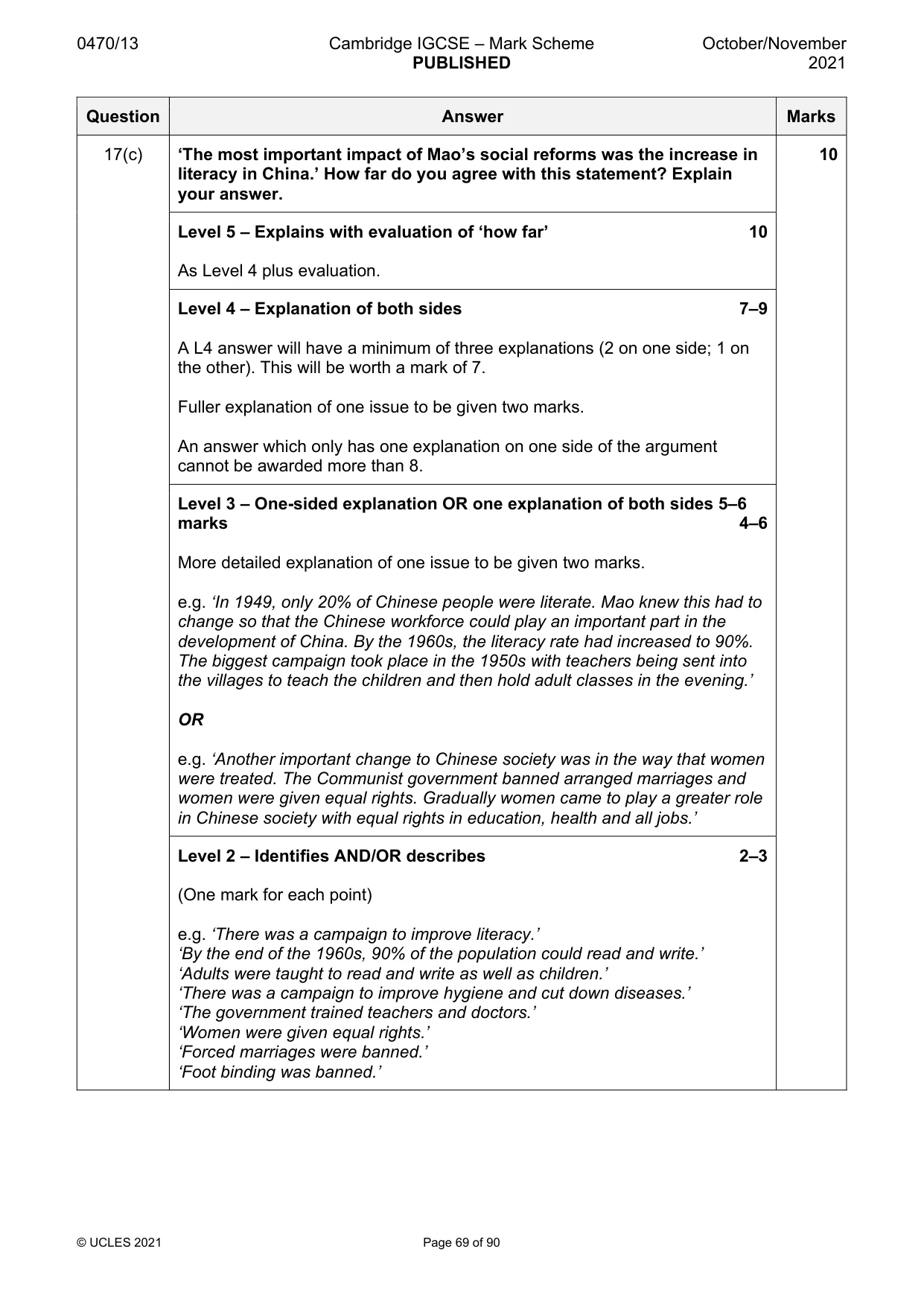
8 0470/13/O/N/21 © UCLES 2021 DEPTH STUDY E: CHINA, c.1930–c.1990 17 China changed a great deal in the 1950s. (a) What was the ‘speak bitterness’ campaign? [4] (b) Why did industry develop rapidly in China in the 1950s? [6] (c) ‘The most important impact of Mao’s social reforms was the increase in literacy in China.’ How far do you agree with this statement? Explain your answer. [10] 18 Mao’s rule brought continuous change to China. (a) What was the impact of the Cultural Revolution on education in China? [4] (b) Why did Mao launch the Cultural Revolution? [6] (c) How similar were the ways in which Mao and Deng ruled over China? Explain your answer. [10]
Question paper, page 9
9 0470/13/O/N/21 © UCLES 2021 [Turn over DEPTH STUDY F: SOUTH AFRICA, c.1940–c.1994 19 There were many attempts to oppose apartheid. (a) What happened at Sharpeville in 1960? [4] (b) Why was the Public Safety Act introduced in 1953? [6] (c) How far do you agree that resistance to apartheid had little impact before 1966? Explain your answer. [10] 20 Apartheid was opposed within and outside South Africa. (a) Describe the terms of the Bantu Homelands Constitution Act of 1971. [4] (b) Why were economic sanctions not effective in the 1970s? [6] (c) How far do you agree that the Soweto uprising was the main reason for increased opposition to apartheid up to 1980? Explain your answer. [10]
Question paper, page 10
10 0470/13/O/N/21 © UCLES 2021 DEPTH STUDY G: ISRAELIS AND PALESTINIANS SINCE 1945 21 Relations between Israel and the Arab states were often hostile. (a) What happened in the Yom Kippur War in 1973? [4] (b) Why was there a crisis over Suez in 1956? [6] (c) ‘Problems between Israel and its neighbours had been solved by the early 1990s.’ How far do you agree with this statement? Explain your answer. [10] 22 Efforts to secure peace in the Middle East have faced many difficulties. (a) What is Hamas? [4] (b) Why have divisions between Israeli politicians hindered the peace process? [6] (c) ‘The United States has been the most important factor in promoting peace in the Middle East.’ How far do you agree with this statement? Explain your answer. [10]
Question paper, page 11
11 0470/13/O/N/21 © UCLES 2021 BLANK PAGE
Question paper, page 12
12 0470/13/O/N/21 © UCLES 2021 Permission to reproduce items where third-party owned material protected by copyright is included has been sought and cleared where possible. Every reasonable effort has been made by the publisher (UCLES) to trace copyright holders, but if any items requiring clearance have unwittingly been included, the publisher will be pleased to make amends at the earliest possible opportunity. To avoid the issue of disclosure of answer-related information to candidates, all copyright acknowledgements are reproduced online in the Cambridge Assessment International Education Copyright Acknowledgements Booklet. This is produced for each series of examinations and is freely available to download at www.cambridgeinternational.org after the live examination series. Cambridge Assessment International Education is part of the Cambridge Assessment Group. Cambridge Assessment is the brand name of the University of Cambridge Local Examinations Syndicate (UCLES), which itself is a department of the University of Cambridge. BLANK PAGE
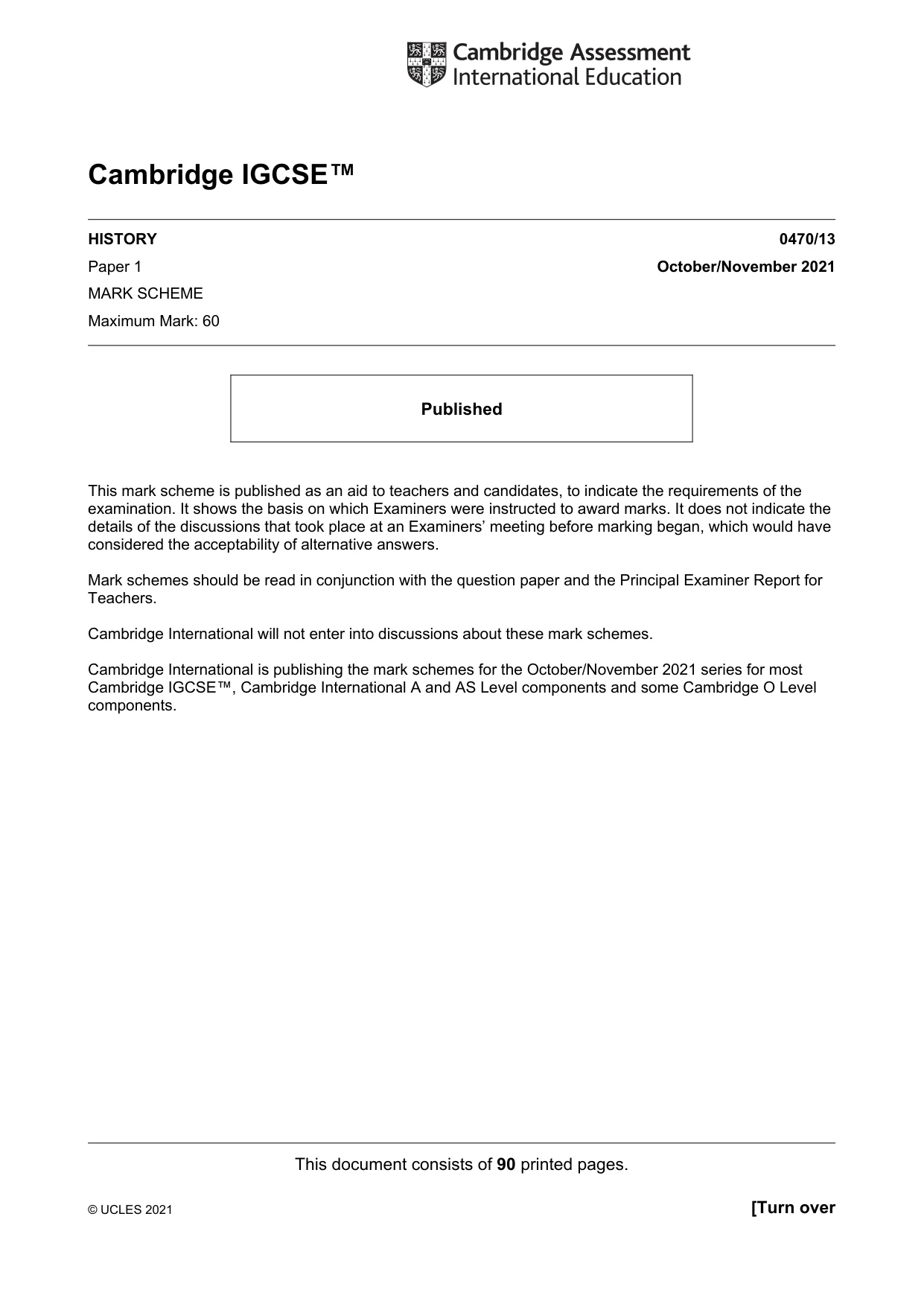
Mark scheme, page 1
This document consists of 90 printed pages. © UCLES 2021 [Turn over Cambridge IGCSE™ HISTORY 0470/13 Paper 1 October/November 2021 MARK SCHEME Maximum Mark: 60 Published This mark scheme is published as an aid to teachers and candidates, to indicate the requirements of the examination. It shows the basis on which Examiners were instructed to award marks. It does not indicate the details of the discussions that took place at an Examiners’ meeting before marking began, which would have considered the acceptability of alternative answers. Mark schemes should be read in conjunction with the question paper and the Principal Examiner Report for Teachers. Cambridge International will not enter into discussions about these mark schemes. Cambridge International is publishing the mark schemes for the October/November 2021 series for most Cambridge IGCSE™, Cambridge International A and AS Level components and some Cambridge O Level components.
Mark scheme, page 2
0470/13 Cambridge IGCSE – Mark Scheme PUBLISHED October/November 2021 © UCLES 2021 Page 2 of 90 Generic Marking Principles These general marking principles must be applied by all examiners when marking candidate answers. They should be applied alongside the specific content of the mark scheme or generic level descriptors for a question. Each question paper and mark scheme will also comply with these marking principles. GENERIC MARKING PRINCIPLE 1: Marks must be awarded in line with: • the specific content of the mark scheme or the generic level descriptors for the question • the specific skills defined in the mark scheme or in the generic level descriptors for the question • the standard of response required by a candidate as exemplified by the standardisation scripts. GENERIC MARKING PRINCIPLE 2: Marks awarded are always whole marks (not half marks, or other fractions). GENERIC MARKING PRINCIPLE 3: Marks must be awarded positively: • marks are awarded for correct/valid answers, as defined in the mark scheme. However, credit is given for valid answers which go beyond the scope of the syllabus and mark scheme, referring to your Team Leader as appropriate • marks are awarded when candidates clearly demonstrate what they know and can do • marks are not deducted for errors • marks are not deducted for omissions • answers should only be judged on the quality of spelling, punctuation and grammar when these features are specifically assessed by the question as indicated by the mark scheme. The meaning, however, should be unambiguous. GENERIC MARKING PRINCIPLE 4: Rules must be applied consistently, e.g. in situations where candidates have not followed instructions or in the application of generic level descriptors. GENERIC MARKING PRINCIPLE 5: Marks should be awarded using the full range of marks defined in the mark scheme for the question (however; the use of the full mark range may be limited according to the quality of the candidate responses seen). GENERIC MARKING PRINCIPLE 6: Marks awarded are based solely on the requirements as defined in the mark scheme. Marks should not be awarded with grade thresholds or grade descriptors in mind.
Mark scheme, page 3
0470/13 Cambridge IGCSE – Mark Scheme PUBLISHED October/November 2021 © UCLES 2021 Page 3 of 90 Applying the Mark Scheme • When marking a response the overall criterion to be considered should be – ‘How good is this response to this question?’ • The level descriptor should be used to decide the level into which the quality of the answer fits. • Exhaustive lists of possible facts are not given in the mark scheme, as there is often a choice of factual knowledge that candidates may use. • WHERE EXAMPLES OF RESPONSES ARE GIVEN, THESE ARE NOT PRESCRIPTIVE, • BUT ARE INTENDED AS A GUIDE. It is not possible to cover every possible type of response within a levels of response mark scheme and examiners are expected to use their professional judgement at all times in ensuring that responses are placed in the correct level and given an appropriate mark within that level. • Marking must be positive. Marks must not be deducted for inaccurate or irrelevant parts of answers. In itself, poor use of historical terminology, spelling, grammar or handwriting does not affect the mark. The overall quality of the answer to the question should be judged. • If a candidate reaches a particular level they must be rewarded with a mark within that level. It is not necessary to work through the levels. • The full range of marks should be used. Do not be afraid to award full marks or no marks. Failure to do this will seriously affect the distribution of marks. Be prepared to reward candidates who show any level of understanding. The mark scheme starts from basic acceptable response. Where a band of marks is indicated for a level, these marks should be used with reference to the development of the answer within that level. Assessment objectives (a) recall, description (b) recall, explanation (c) recall, explanation and analysis
Mark scheme, page 4
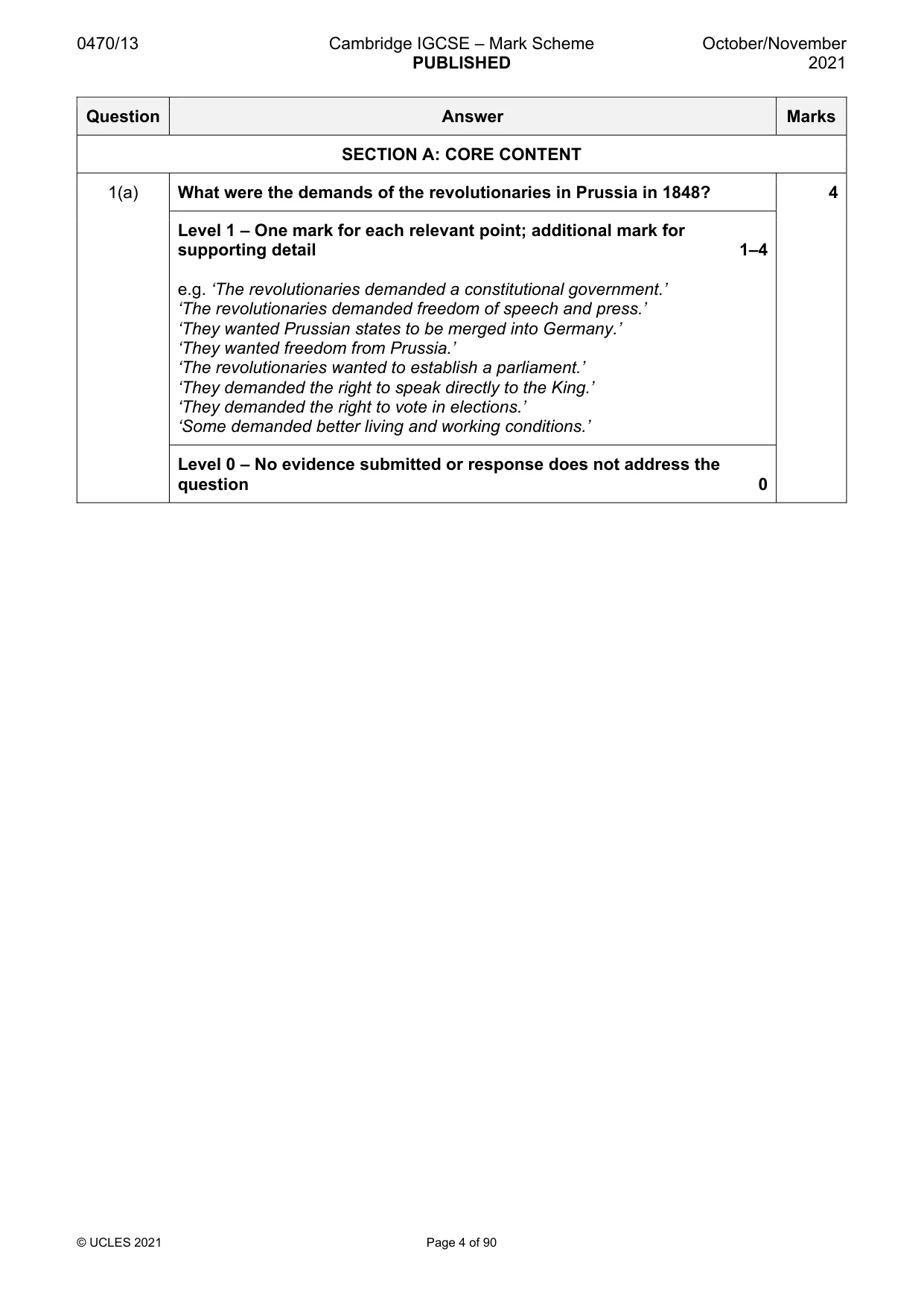
0470/13 Cambridge IGCSE – Mark Scheme PUBLISHED October/November 2021 © UCLES 2021 Page 4 of 90 Question Answer Marks SECTION A: CORE CONTENT 1(a) What were the demands of the revolutionaries in Prussia in 1848? 4 Level 1 – One mark for each relevant point; additional mark for supporting detail 1–4 e.g. ‘The revolutionaries demanded a constitutional government.’ ‘The revolutionaries demanded freedom of speech and press.’ ‘They wanted Prussian states to be merged into Germany.’ ‘They wanted freedom from Prussia.’ ‘The revolutionaries wanted to establish a parliament.’ ‘They demanded the right to speak directly to the King.’ ‘They demanded the right to vote in elections.’ ‘Some demanded better living and working conditions.’ Level 0 – No evidence submitted or response does not address the question 0
Mark scheme, page 5
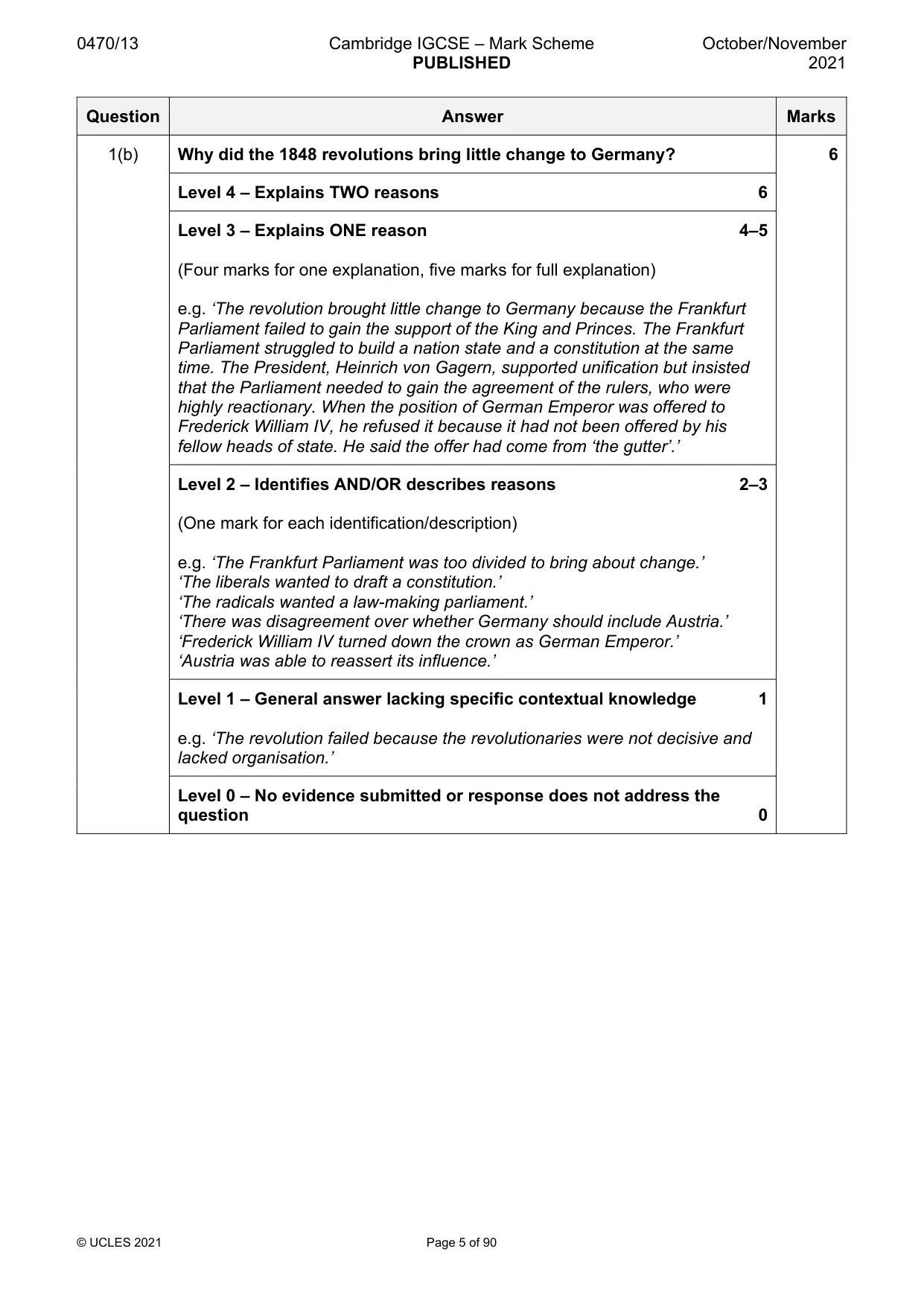
0470/13 Cambridge IGCSE – Mark Scheme PUBLISHED October/November 2021 © UCLES 2021 Page 5 of 90 Question Answer Marks 1(b) Why did the 1848 revolutions bring little change to Germany? 6 Level 4 – Explains TWO reasons 6 Level 3 – Explains ONE reason 4–5 (Four marks for one explanation, five marks for full explanation) e.g. ‘The revolution brought little change to Germany because the Frankfurt Parliament failed to gain the support of the King and Princes. The Frankfurt Parliament struggled to build a nation state and a constitution at the same time. The President, Heinrich von Gagern, supported unification but insisted that the Parliament needed to gain the agreement of the rulers, who were highly reactionary. When the position of German Emperor was offered to Frederick William IV, he refused it because it had not been offered by his fellow heads of state. He said the offer had come from ‘the gutter’.’ Level 2 – Identifies AND/OR describes reasons 2–3 (One mark for each identification/description) e.g. ‘The Frankfurt Parliament was too divided to bring about change.’ ‘The liberals wanted to draft a constitution.’ ‘The radicals wanted a law-making parliament.’ ‘There was disagreement over whether Germany should include Austria.’ ‘Frederick William IV turned down the crown as German Emperor.’ ‘Austria was able to reassert its influence.’ Level 1 – General answer lacking specific contextual knowledge 1 e.g. ‘The revolution failed because the revolutionaries were not decisive and lacked organisation.’ Level 0 – No evidence submitted or response does not address the question 0
Mark scheme, page 6
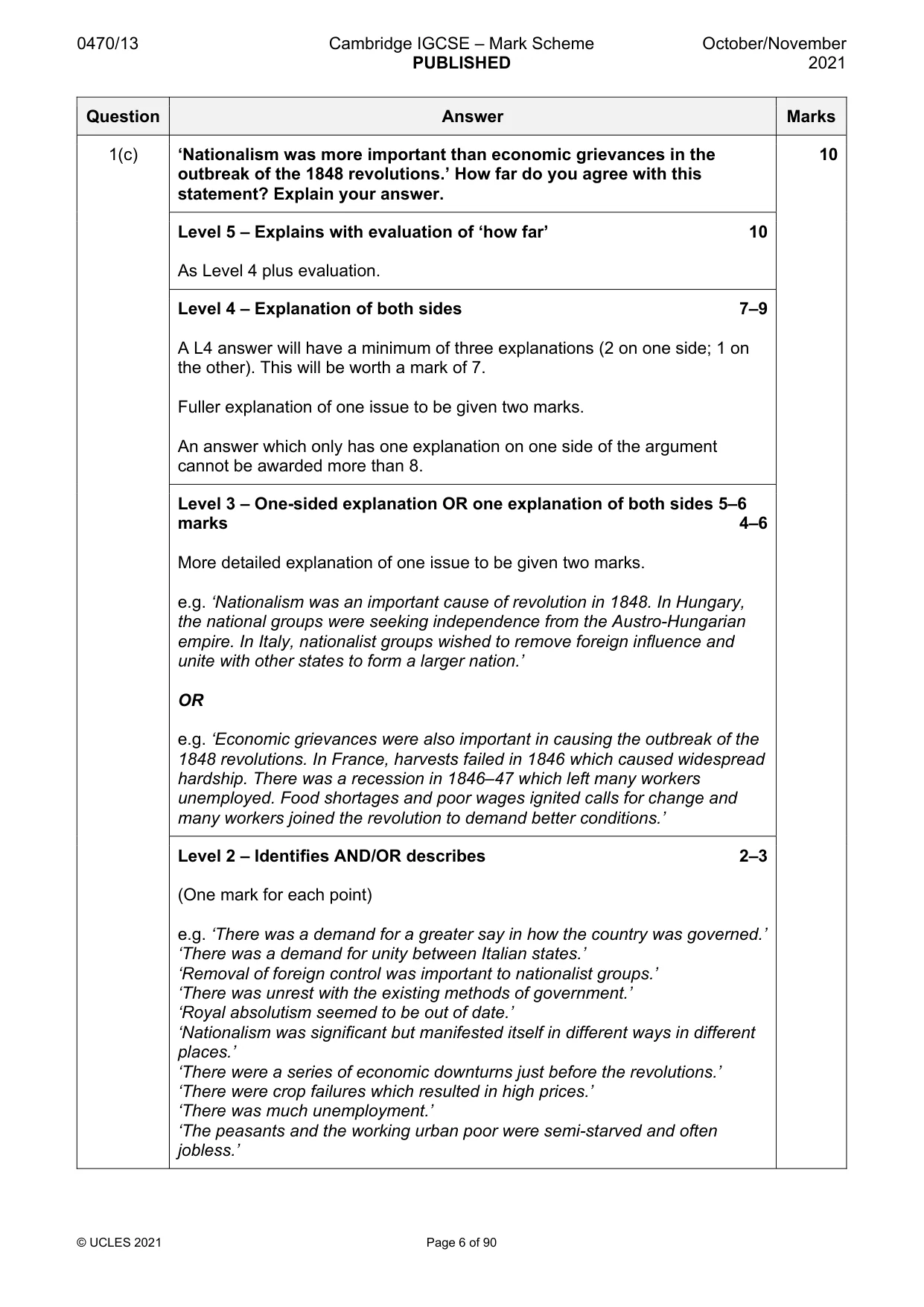
0470/13 Cambridge IGCSE – Mark Scheme PUBLISHED October/November 2021 © UCLES 2021 Page 6 of 90 Question Answer Marks 1(c) ‘Nationalism was more important than economic grievances in the outbreak of the 1848 revolutions.’ How far do you agree with this statement? Explain your answer. 10 Level 5 – Explains with evaluation of ‘how far’ 10 As Level 4 plus evaluation. Level 4 – Explanation of both sides 7–9 A L4 answer will have a minimum of three explanations (2 on one side; 1 on the other). This will be worth a mark of 7. Fuller explanation of one issue to be given two marks. An answer which only has one explanation on one side of the argument cannot be awarded more than 8. Level 3 – One-sided explanation OR one explanation of both sides 5–6 marks 4–6 More detailed explanation of one issue to be given two marks. e.g. ‘Nationalism was an important cause of revolution in 1848. In Hungary, the national groups were seeking independence from the Austro-Hungarian empire. In Italy, nationalist groups wished to remove foreign influence and unite with other states to form a larger nation.’ OR e.g. ‘Economic grievances were also important in causing the outbreak of the 1848 revolutions. In France, harvests failed in 1846 which caused widespread hardship. There was a recession in 1846–47 which left many workers unemployed. Food shortages and poor wages ignited calls for change and many workers joined the revolution to demand better conditions.’ Level 2 – Identifies AND/OR describes 2–3 (One mark for each point) e.g. ‘There was a demand for a greater say in how the country was governed.’ ‘There was a demand for unity between Italian states.’ ‘Removal of foreign control was important to nationalist groups.’ ‘There was unrest with the existing methods of government.’ ‘Royal absolutism seemed to be out of date.’ ‘Nationalism was significant but manifested itself in different ways in different places.’ ‘There were a series of economic downturns just before the revolutions.’ ‘There were crop failures which resulted in high prices.’ ‘There was much unemployment.’ ‘The peasants and the working urban poor were semi-starved and often jobless.’
Mark scheme, page 7
0470/13 Cambridge IGCSE – Mark Scheme PUBLISHED October/November 2021 © UCLES 2021 Page 7 of 90 Question Answer Marks 1(c) Level 1 – General answer lacking specific contextual knowledge 1 e.g. ‘Many people wanted more freedom.’ Level 0 – No evidence submitted or response does not address the question 0
Mark scheme, page 8
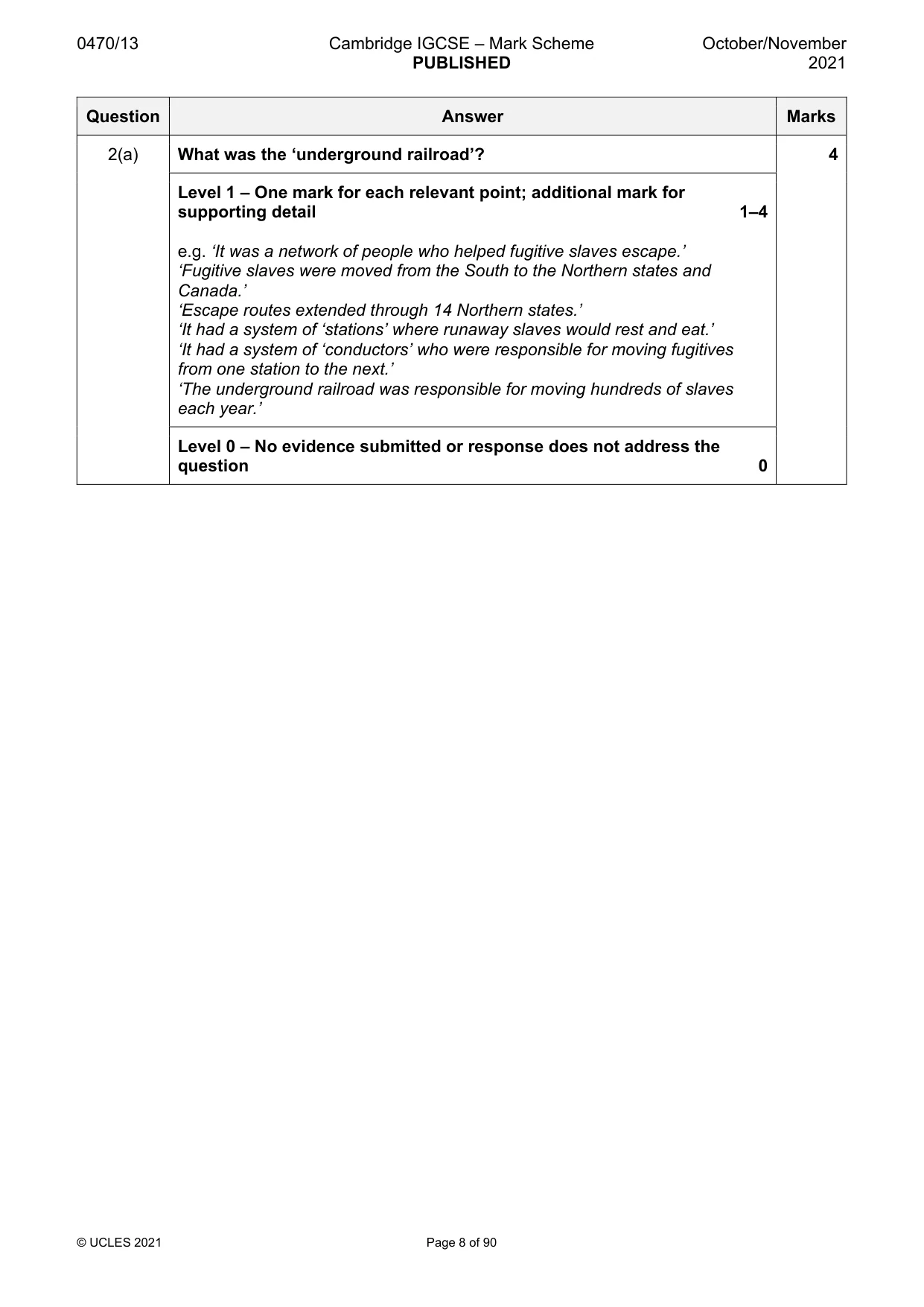
0470/13 Cambridge IGCSE – Mark Scheme PUBLISHED October/November 2021 © UCLES 2021 Page 8 of 90 Question Answer Marks 2(a) What was the ‘underground railroad’? 4 Level 1 – One mark for each relevant point; additional mark for supporting detail 1–4 e.g. ‘It was a network of people who helped fugitive slaves escape.’ ‘Fugitive slaves were moved from the South to the Northern states and Canada.’ ‘Escape routes extended through 14 Northern states.’ ‘It had a system of ‘stations’ where runaway slaves would rest and eat.’ ‘It had a system of ‘conductors’ who were responsible for moving fugitives from one station to the next.’ ‘The underground railroad was responsible for moving hundreds of slaves each year.’ Level 0 – No evidence submitted or response does not address the question 0
Mark scheme, page 9
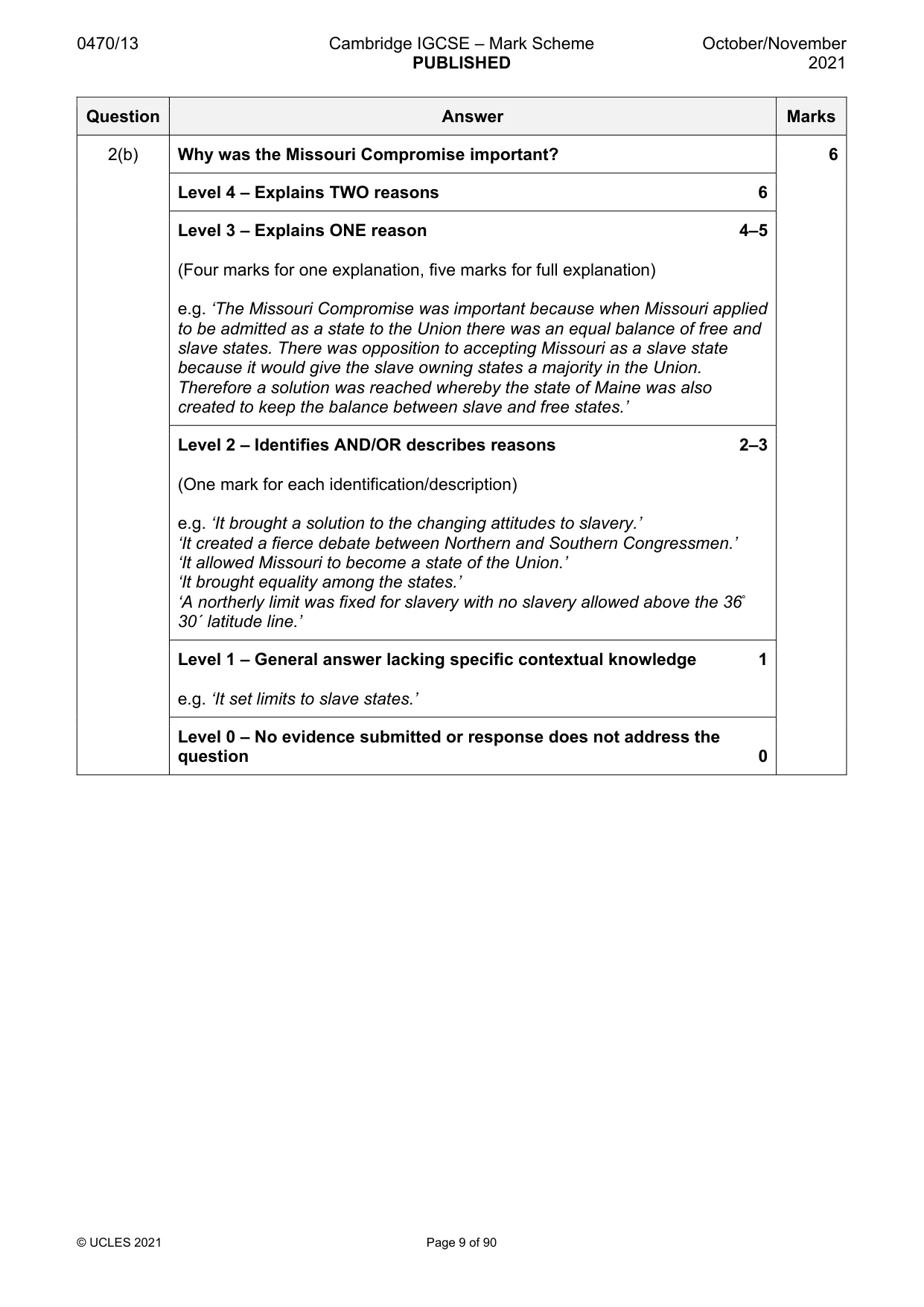
0470/13 Cambridge IGCSE – Mark Scheme PUBLISHED October/November 2021 © UCLES 2021 Page 9 of 90 Question Answer Marks 2(b) Why was the Missouri Compromise important? 6 Level 4 – Explains TWO reasons 6 Level 3 – Explains ONE reason 4–5 (Four marks for one explanation, five marks for full explanation) e.g. ‘The Missouri Compromise was important because when Missouri applied to be admitted as a state to the Union there was an equal balance of free and slave states. There was opposition to accepting Missouri as a slave state because it would give the slave owning states a majority in the Union. Therefore a solution was reached whereby the state of Maine was also created to keep the balance between slave and free states.’ Level 2 – Identifies AND/OR describes reasons 2–3 (One mark for each identification/description) e.g. ‘It brought a solution to the changing attitudes to slavery.’ ‘It created a fierce debate between Northern and Southern Congressmen.’ ‘It allowed Missouri to become a state of the Union.’ ‘It brought equality among the states.’ ‘A northerly limit was fixed for slavery with no slavery allowed above the 36̊ 30ˊ latitude line.’ Level 1 – General answer lacking specific contextual knowledge 1 e.g. ‘It set limits to slave states.’ Level 0 – No evidence submitted or response does not address the question 0
Mark scheme, page 10
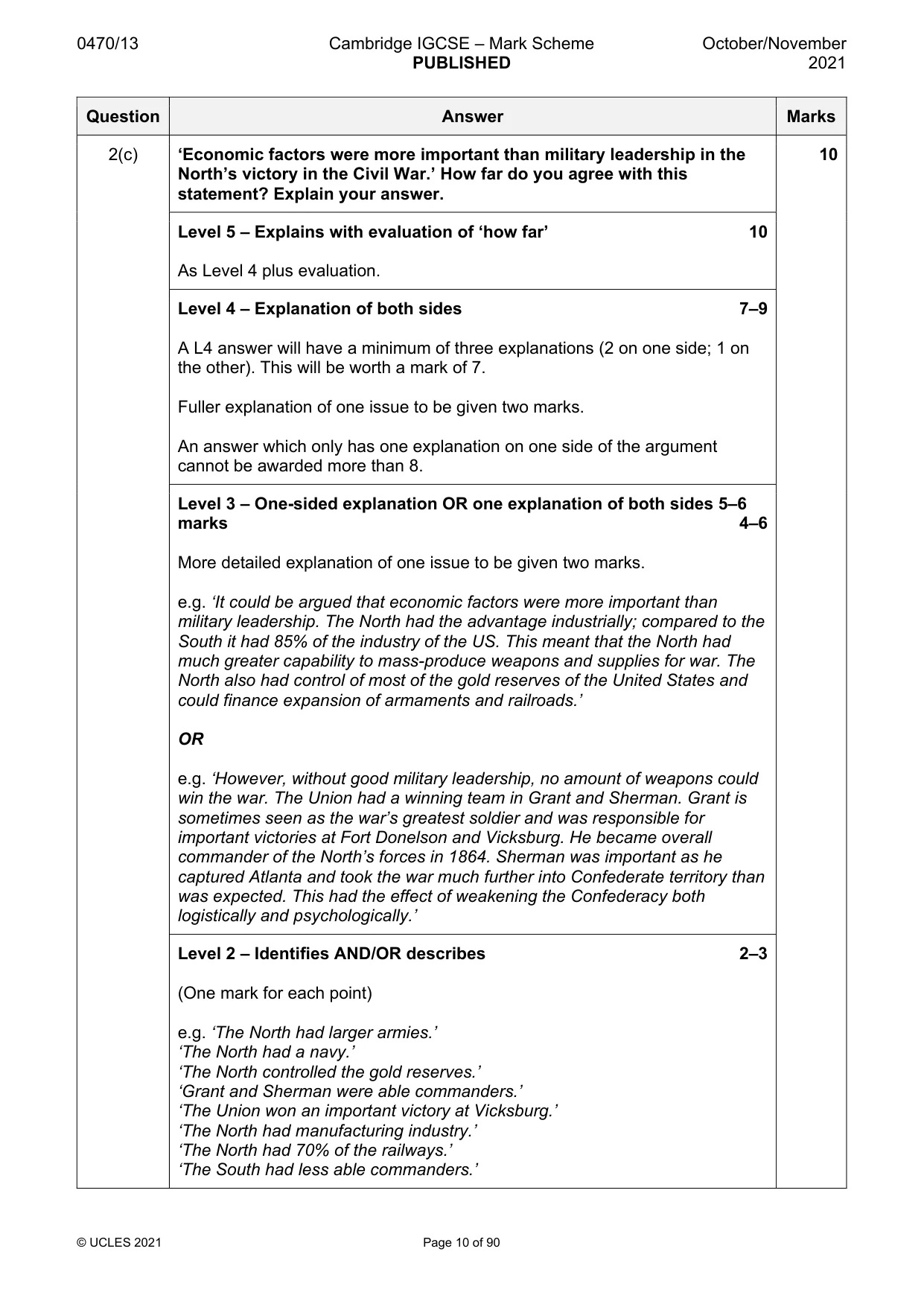
0470/13 Cambridge IGCSE – Mark Scheme PUBLISHED October/November 2021 © UCLES 2021 Page 10 of 90 Question Answer Marks 2(c) ‘Economic factors were more important than military leadership in the North’s victory in the Civil War.’ How far do you agree with this statement? Explain your answer. 10 Level 5 – Explains with evaluation of ‘how far’ 10 As Level 4 plus evaluation. Level 4 – Explanation of both sides 7–9 A L4 answer will have a minimum of three explanations (2 on one side; 1 on the other). This will be worth a mark of 7. Fuller explanation of one issue to be given two marks. An answer which only has one explanation on one side of the argument cannot be awarded more than 8. Level 3 – One-sided explanation OR one explanation of both sides 5–6 marks 4–6 More detailed explanation of one issue to be given two marks. e.g. ‘It could be argued that economic factors were more important than military leadership. The North had the advantage industrially; compared to the South it had 85% of the industry of the US. This meant that the North had much greater capability to mass-produce weapons and supplies for war. The North also had control of most of the gold reserves of the United States and could finance expansion of armaments and railroads.’ OR e.g. ‘However, without good military leadership, no amount of weapons could win the war. The Union had a winning team in Grant and Sherman. Grant is sometimes seen as the war’s greatest soldier and was responsible for important victories at Fort Donelson and Vicksburg. He became overall commander of the North’s forces in 1864. Sherman was important as he captured Atlanta and took the war much further into Confederate territory than was expected. This had the effect of weakening the Confederacy both logistically and psychologically.’ Level 2 – Identifies AND/OR describes 2–3 (One mark for each point) e.g. ‘The North had larger armies.’ ‘The North had a navy.’ ‘The North controlled the gold reserves.’ ‘Grant and Sherman were able commanders.’ ‘The Union won an important victory at Vicksburg.’ ‘The North had manufacturing industry.’ ‘The North had 70% of the railways.’ ‘The South had less able commanders.’
Mark scheme, page 11
0470/13 Cambridge IGCSE – Mark Scheme PUBLISHED October/November 2021 © UCLES 2021 Page 11 of 90 Question Answer Marks 2(c) Level 1 – General answer lacking specific contextual knowledge 1 e.g. ‘Northern forces were better equipped and well led.’ Level 0 – No evidence submitted or response does not address the question 0
Mark scheme, page 12
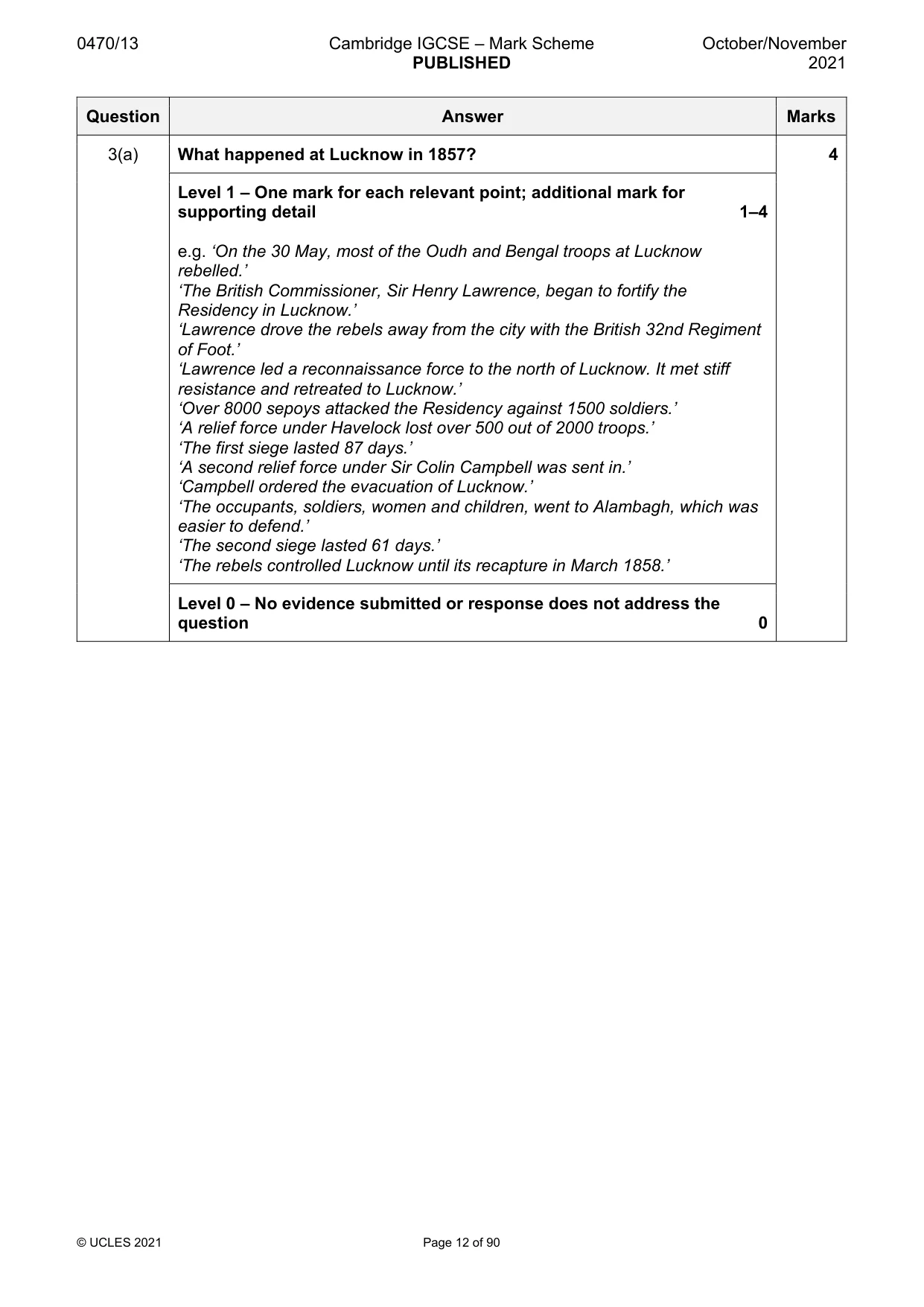
0470/13 Cambridge IGCSE – Mark Scheme PUBLISHED October/November 2021 © UCLES 2021 Page 12 of 90 Question Answer Marks 3(a) What happened at Lucknow in 1857? 4 Level 1 – One mark for each relevant point; additional mark for supporting detail 1–4 e.g. ‘On the 30 May, most of the Oudh and Bengal troops at Lucknow rebelled.’ ‘The British Commissioner, Sir Henry Lawrence, began to fortify the Residency in Lucknow.’ ‘Lawrence drove the rebels away from the city with the British 32nd Regiment of Foot.’ ‘Lawrence led a reconnaissance force to the north of Lucknow. It met stiff resistance and retreated to Lucknow.’ ‘Over 8000 sepoys attacked the Residency against 1500 soldiers.’ ‘A relief force under Havelock lost over 500 out of 2000 troops.’ ‘The first siege lasted 87 days.’ ‘A second relief force under Sir Colin Campbell was sent in.’ ‘Campbell ordered the evacuation of Lucknow.’ ‘The occupants, soldiers, women and children, went to Alambagh, which was easier to defend.’ ‘The second siege lasted 61 days.’ ‘The rebels controlled Lucknow until its recapture in March 1858.’ Level 0 – No evidence submitted or response does not address the question 0
Mark scheme, page 13
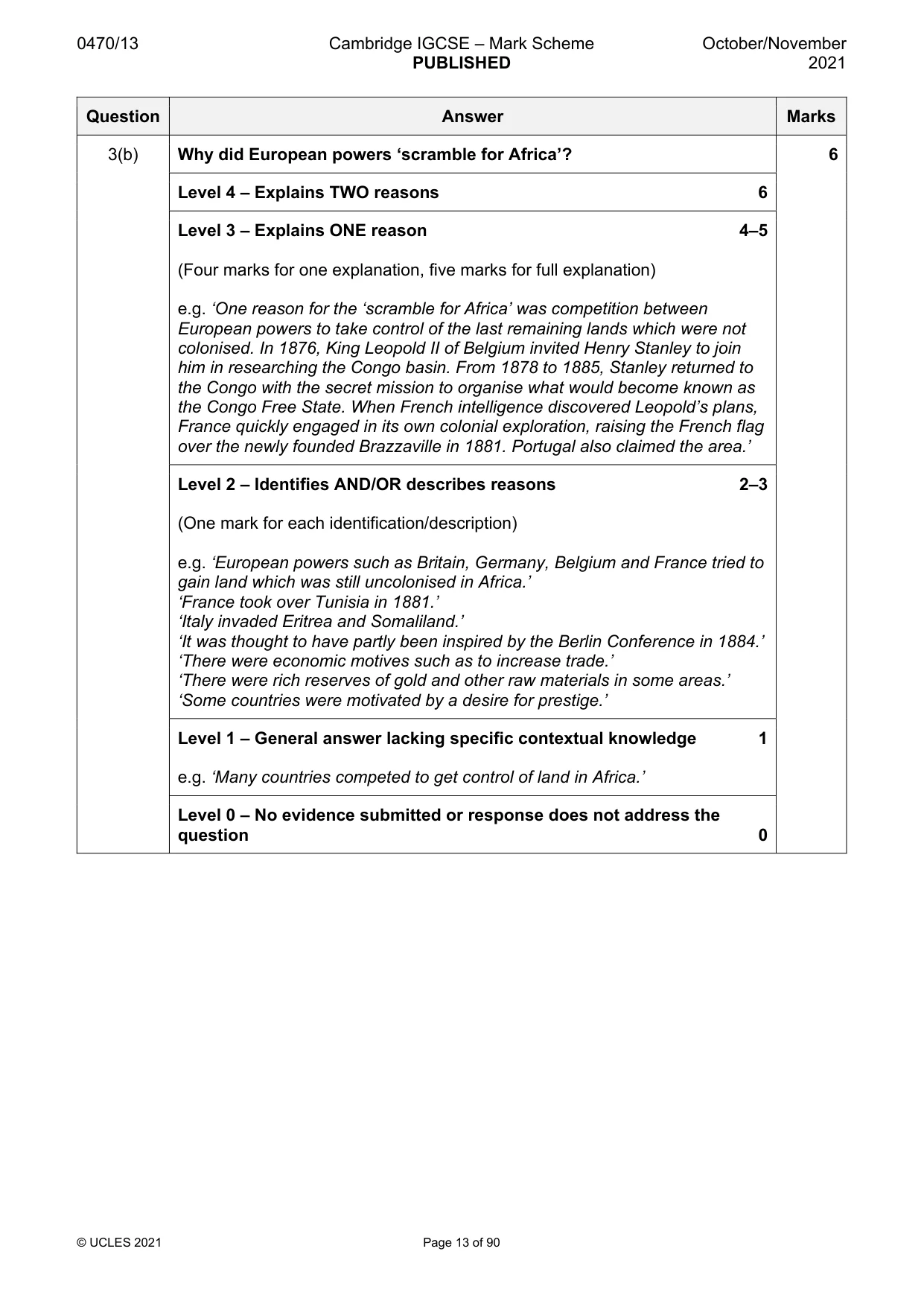
0470/13 Cambridge IGCSE – Mark Scheme PUBLISHED October/November 2021 © UCLES 2021 Page 13 of 90 Question Answer Marks 3(b) Why did European powers ‘scramble for Africa’? 6 Level 4 – Explains TWO reasons 6 Level 3 – Explains ONE reason 4–5 (Four marks for one explanation, five marks for full explanation) e.g. ‘One reason for the ‘scramble for Africa’ was competition between European powers to take control of the last remaining lands which were not colonised. In 1876, King Leopold II of Belgium invited Henry Stanley to join him in researching the Congo basin. From 1878 to 1885, Stanley returned to the Congo with the secret mission to organise what would become known as the Congo Free State. When French intelligence discovered Leopold’s plans, France quickly engaged in its own colonial exploration, raising the French flag over the newly founded Brazzaville in 1881. Portugal also claimed the area.’ Level 2 – Identifies AND/OR describes reasons 2–3 (One mark for each identification/description) e.g. ‘European powers such as Britain, Germany, Belgium and France tried to gain land which was still uncolonised in Africa.’ ‘France took over Tunisia in 1881.’ ‘Italy invaded Eritrea and Somaliland.’ ‘It was thought to have partly been inspired by the Berlin Conference in 1884.’ ‘There were economic motives such as to increase trade.’ ‘There were rich reserves of gold and other raw materials in some areas.’ ‘Some countries were motivated by a desire for prestige.’ Level 1 – General answer lacking specific contextual knowledge 1 e.g. ‘Many countries competed to get control of land in Africa.’ Level 0 – No evidence submitted or response does not address the question 0
Mark scheme, page 14
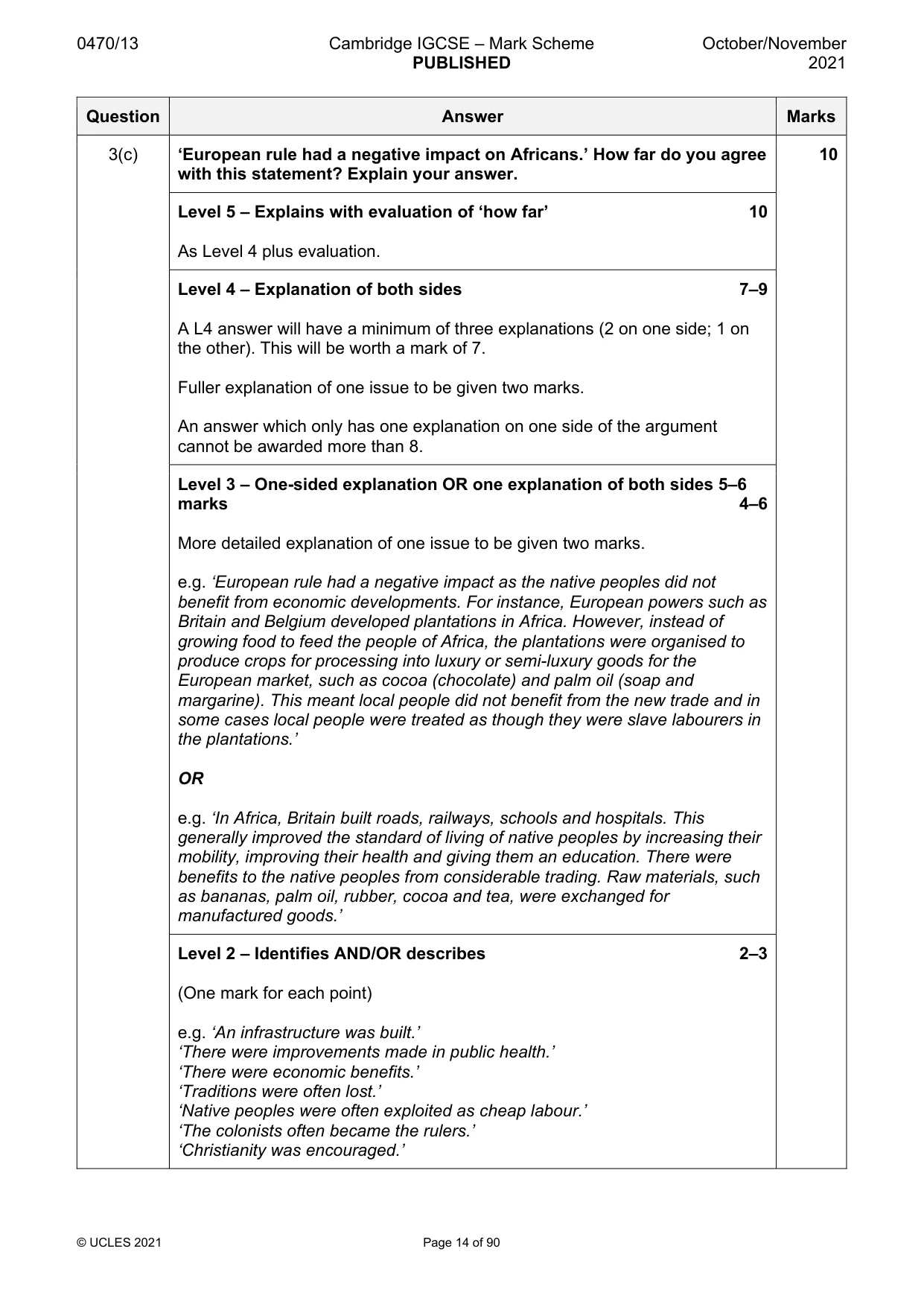
0470/13 Cambridge IGCSE – Mark Scheme PUBLISHED October/November 2021 © UCLES 2021 Page 14 of 90 Question Answer Marks 3(c) ‘European rule had a negative impact on Africans.’ How far do you agree with this statement? Explain your answer. 10 Level 5 – Explains with evaluation of ‘how far’ 10 As Level 4 plus evaluation. Level 4 – Explanation of both sides 7–9 A L4 answer will have a minimum of three explanations (2 on one side; 1 on the other). This will be worth a mark of 7. Fuller explanation of one issue to be given two marks. An answer which only has one explanation on one side of the argument cannot be awarded more than 8. Level 3 – One-sided explanation OR one explanation of both sides 5–6 marks 4–6 More detailed explanation of one issue to be given two marks. e.g. ‘European rule had a negative impact as the native peoples did not benefit from economic developments. For instance, European powers such as Britain and Belgium developed plantations in Africa. However, instead of growing food to feed the people of Africa, the plantations were organised to produce crops for processing into luxury or semi-luxury goods for the European market, such as cocoa (chocolate) and palm oil (soap and margarine). This meant local people did not benefit from the new trade and in some cases local people were treated as though they were slave labourers in the plantations.’ OR e.g. ‘In Africa, Britain built roads, railways, schools and hospitals. This generally improved the standard of living of native peoples by increasing their mobility, improving their health and giving them an education. There were benefits to the native peoples from considerable trading. Raw materials, such as bananas, palm oil, rubber, cocoa and tea, were exchanged for manufactured goods.’ Level 2 – Identifies AND/OR describes 2–3 (One mark for each point) e.g. ‘An infrastructure was built.’ ‘There were improvements made in public health.’ ‘There were economic benefits.’ ‘Traditions were often lost.’ ‘Native peoples were often exploited as cheap labour.’ ‘The colonists often became the rulers.’ ‘Christianity was encouraged.’
Mark scheme, page 15
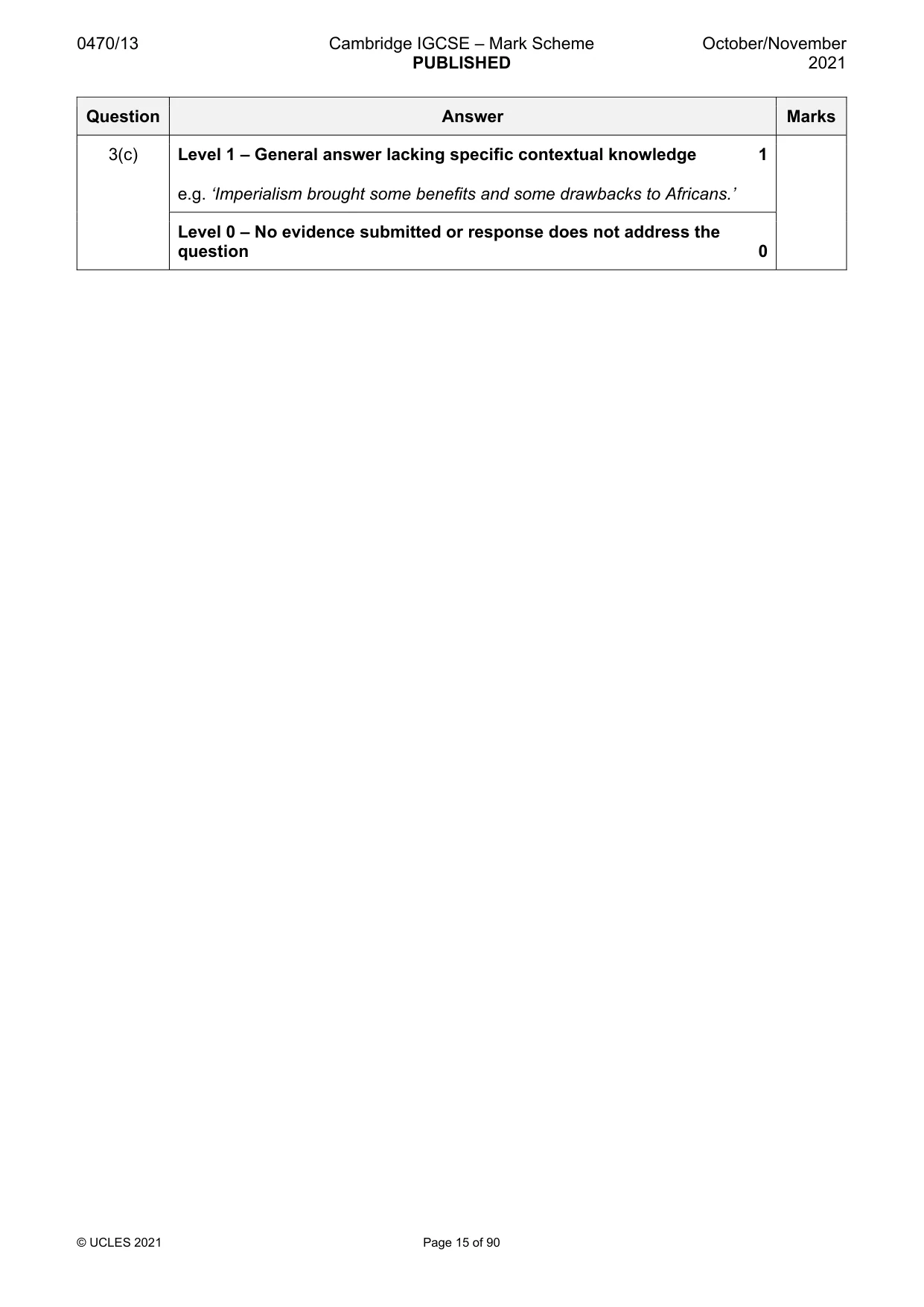
0470/13 Cambridge IGCSE – Mark Scheme PUBLISHED October/November 2021 © UCLES 2021 Page 15 of 90 Question Answer Marks 3(c) Level 1 – General answer lacking specific contextual knowledge 1 e.g. ‘Imperialism brought some benefits and some drawbacks to Africans.’ Level 0 – No evidence submitted or response does not address the question 0
Mark scheme, page 16
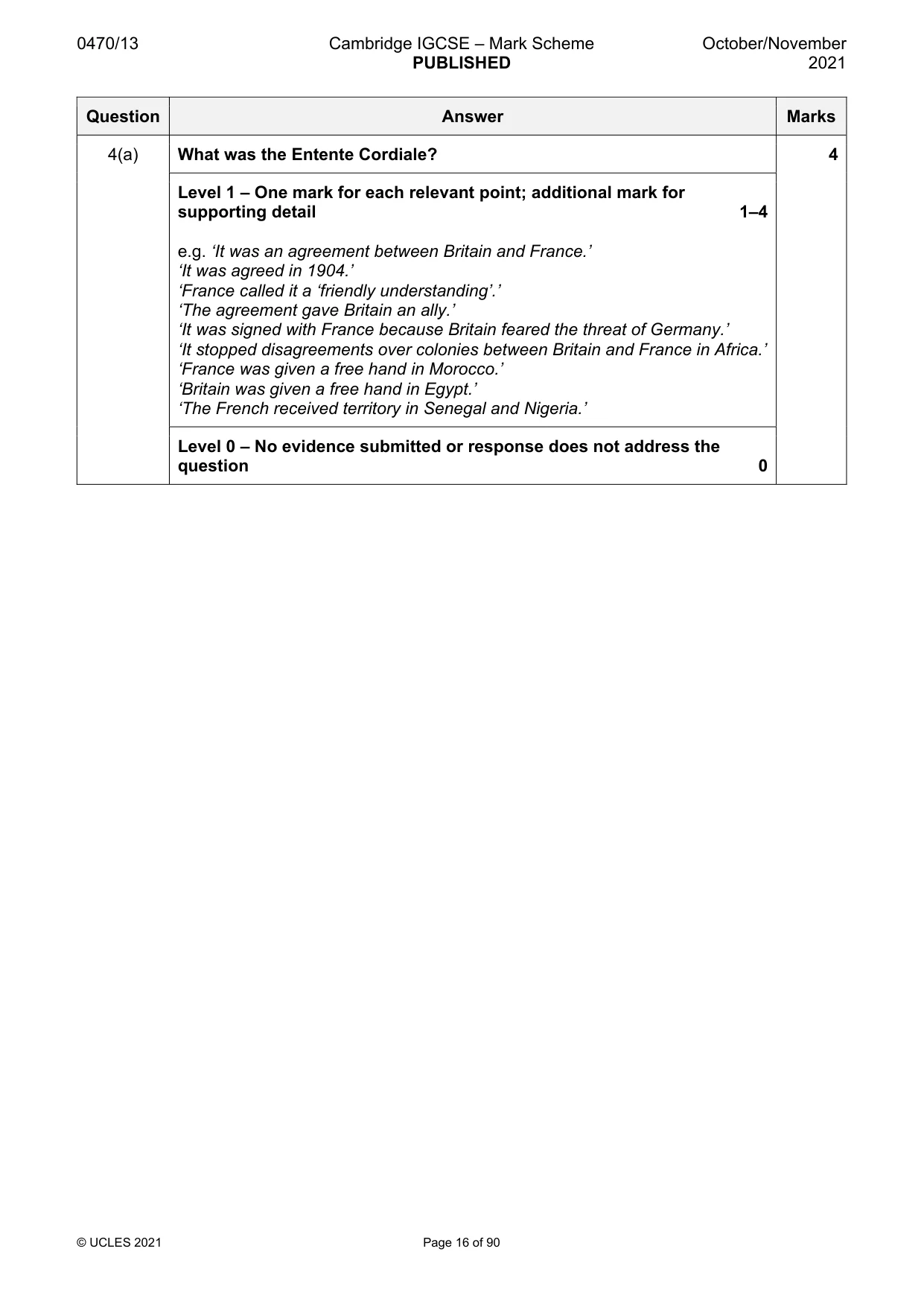
0470/13 Cambridge IGCSE – Mark Scheme PUBLISHED October/November 2021 © UCLES 2021 Page 16 of 90 Question Answer Marks 4(a) What was the Entente Cordiale? 4 Level 1 – One mark for each relevant point; additional mark for supporting detail 1–4 e.g. ‘It was an agreement between Britain and France.’ ‘It was agreed in 1904.’ ‘France called it a ‘friendly understanding’.’ ‘The agreement gave Britain an ally.’ ‘It was signed with France because Britain feared the threat of Germany.’ ‘It stopped disagreements over colonies between Britain and France in Africa.’ ‘France was given a free hand in Morocco.’ ‘Britain was given a free hand in Egypt.’ ‘The French received territory in Senegal and Nigeria.’ Level 0 – No evidence submitted or response does not address the question 0
Mark scheme, page 17
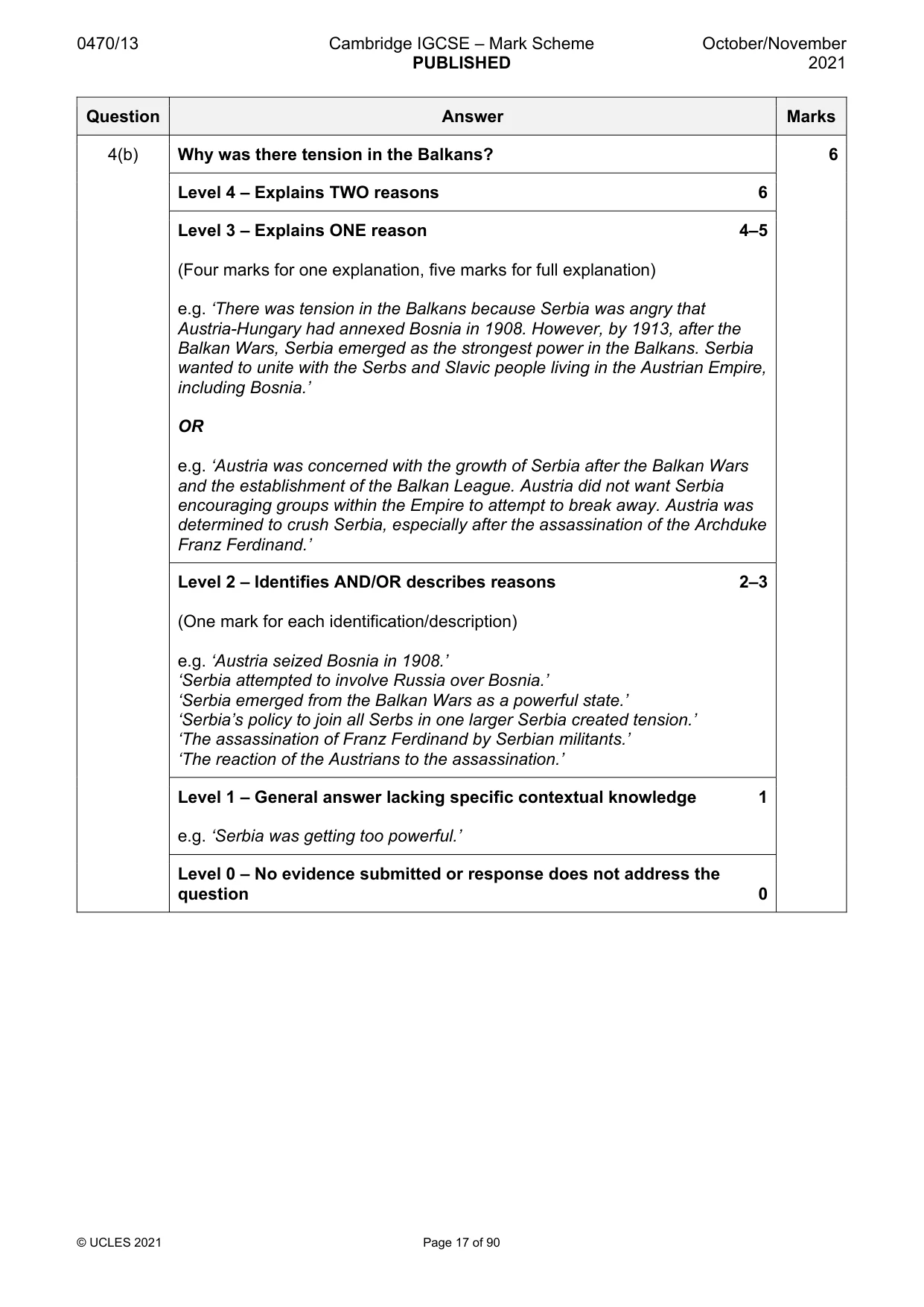
0470/13 Cambridge IGCSE – Mark Scheme PUBLISHED October/November 2021 © UCLES 2021 Page 17 of 90 Question Answer Marks 4(b) Why was there tension in the Balkans? 6 Level 4 – Explains TWO reasons 6 Level 3 – Explains ONE reason 4–5 (Four marks for one explanation, five marks for full explanation) e.g. ‘There was tension in the Balkans because Serbia was angry that Austria-Hungary had annexed Bosnia in 1908. However, by 1913, after the Balkan Wars, Serbia emerged as the strongest power in the Balkans. Serbia wanted to unite with the Serbs and Slavic people living in the Austrian Empire, including Bosnia.’ OR e.g. ‘Austria was concerned with the growth of Serbia after the Balkan Wars and the establishment of the Balkan League. Austria did not want Serbia encouraging groups within the Empire to attempt to break away. Austria was determined to crush Serbia, especially after the assassination of the Archduke Franz Ferdinand.’ Level 2 – Identifies AND/OR describes reasons 2–3 (One mark for each identification/description) e.g. ‘Austria seized Bosnia in 1908.’ ‘Serbia attempted to involve Russia over Bosnia.’ ‘Serbia emerged from the Balkan Wars as a powerful state.’ ‘Serbia’s policy to join all Serbs in one larger Serbia created tension.’ ‘The assassination of Franz Ferdinand by Serbian militants.’ ‘The reaction of the Austrians to the assassination.’ Level 1 – General answer lacking specific contextual knowledge 1 e.g. ‘Serbia was getting too powerful.’ Level 0 – No evidence submitted or response does not address the question 0
Mark scheme, page 18
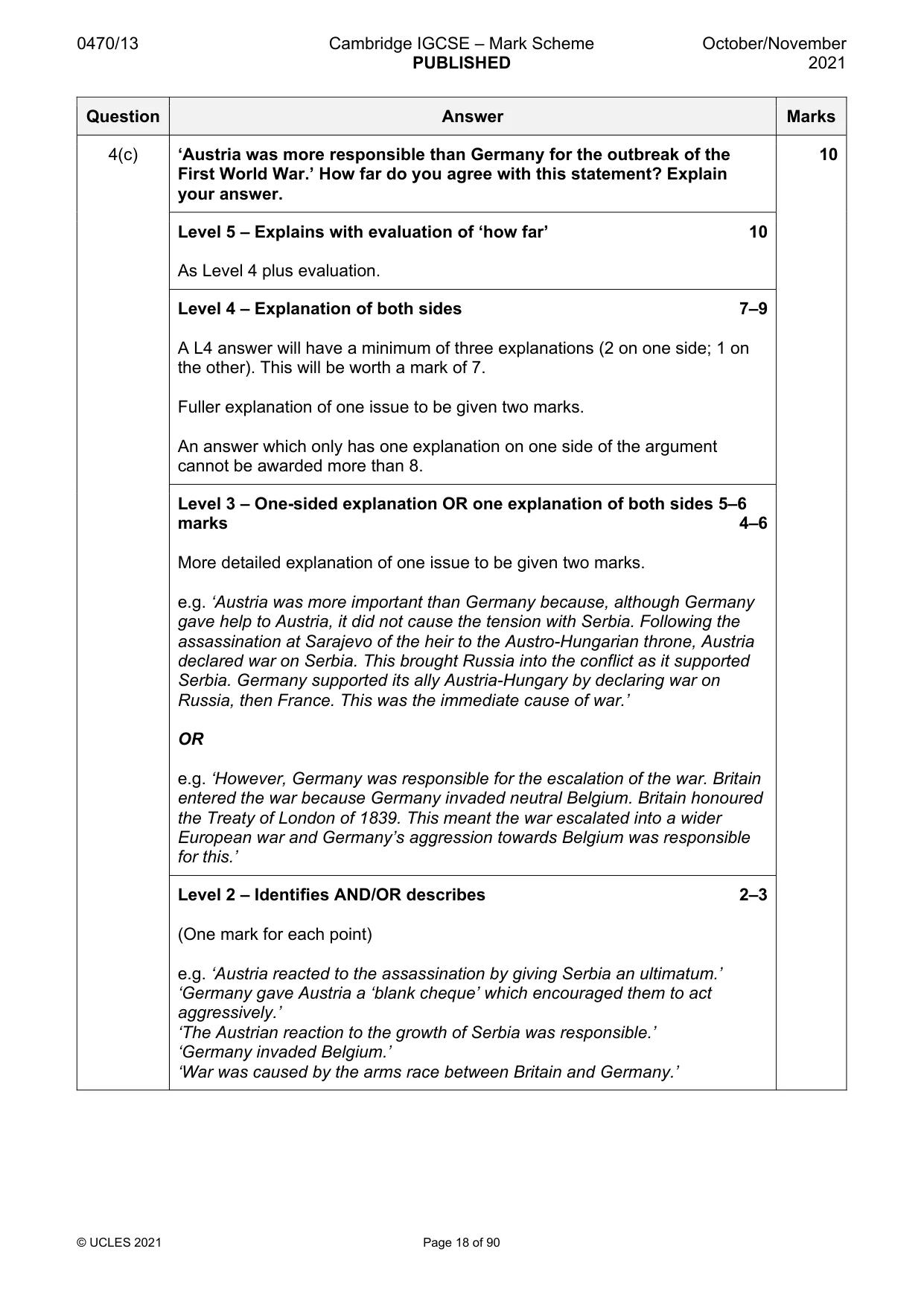
0470/13 Cambridge IGCSE – Mark Scheme PUBLISHED October/November 2021 © UCLES 2021 Page 18 of 90 Question Answer Marks 4(c) ‘Austria was more responsible than Germany for the outbreak of the First World War.’ How far do you agree with this statement? Explain your answer. 10 Level 5 – Explains with evaluation of ‘how far’ 10 As Level 4 plus evaluation. Level 4 – Explanation of both sides 7–9 A L4 answer will have a minimum of three explanations (2 on one side; 1 on the other). This will be worth a mark of 7. Fuller explanation of one issue to be given two marks. An answer which only has one explanation on one side of the argument cannot be awarded more than 8. Level 3 – One-sided explanation OR one explanation of both sides 5–6 marks 4–6 More detailed explanation of one issue to be given two marks. e.g. ‘Austria was more important than Germany because, although Germany gave help to Austria, it did not cause the tension with Serbia. Following the assassination at Sarajevo of the heir to the Austro-Hungarian throne, Austria declared war on Serbia. This brought Russia into the conflict as it supported Serbia. Germany supported its ally Austria-Hungary by declaring war on Russia, then France. This was the immediate cause of war.’ OR e.g. ‘However, Germany was responsible for the escalation of the war. Britain entered the war because Germany invaded neutral Belgium. Britain honoured the Treaty of London of 1839. This meant the war escalated into a wider European war and Germany’s aggression towards Belgium was responsible for this.’ Level 2 – Identifies AND/OR describes 2–3 (One mark for each point) e.g. ‘Austria reacted to the assassination by giving Serbia an ultimatum.’ ‘Germany gave Austria a ‘blank cheque’ which encouraged them to act aggressively.’ ‘The Austrian reaction to the growth of Serbia was responsible.’ ‘Germany invaded Belgium.’ ‘War was caused by the arms race between Britain and Germany.’
Mark scheme, page 19
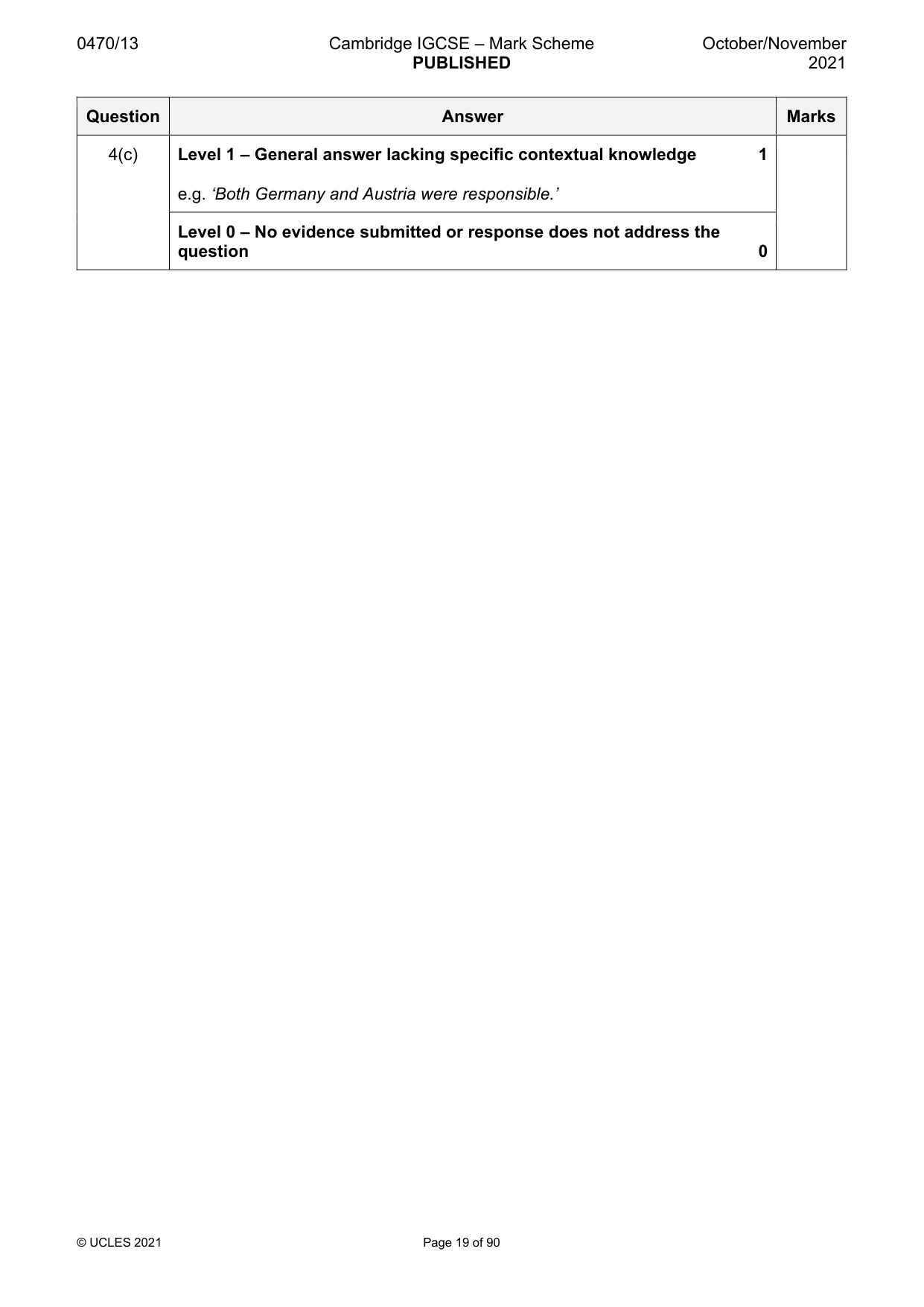
0470/13 Cambridge IGCSE – Mark Scheme PUBLISHED October/November 2021 © UCLES 2021 Page 19 of 90 Question Answer Marks 4(c) Level 1 – General answer lacking specific contextual knowledge 1 e.g. ‘Both Germany and Austria were responsible.’ Level 0 – No evidence submitted or response does not address the question 0
Mark scheme, page 20
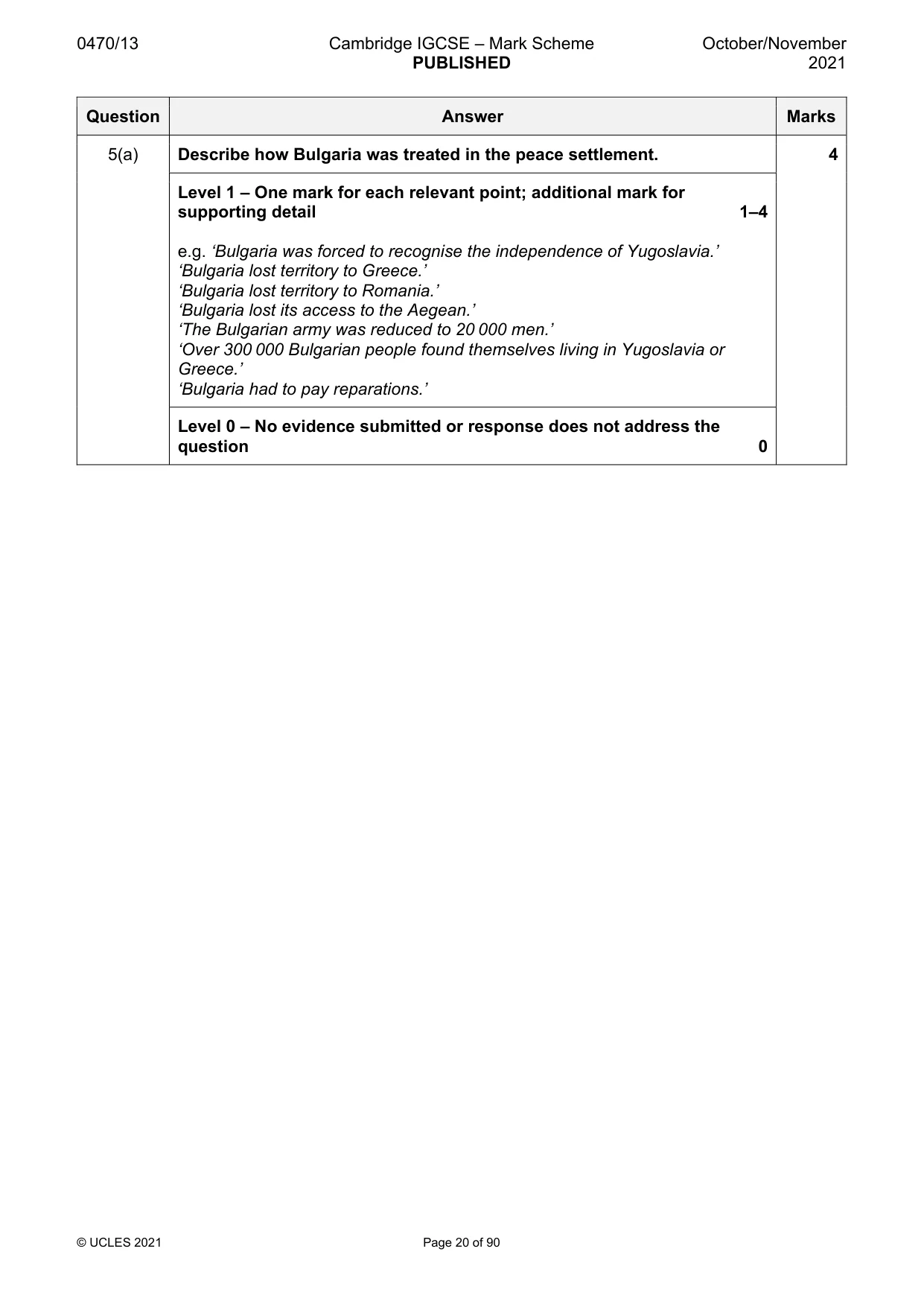
0470/13 Cambridge IGCSE – Mark Scheme PUBLISHED October/November 2021 © UCLES 2021 Page 20 of 90 Question Answer Marks 5(a) Describe how Bulgaria was treated in the peace settlement. 4 Level 1 – One mark for each relevant point; additional mark for supporting detail 1–4 e.g. ‘Bulgaria was forced to recognise the independence of Yugoslavia.’ ‘Bulgaria lost territory to Greece.’ ‘Bulgaria lost territory to Romania.’ ‘Bulgaria lost its access to the Aegean.’ ‘The Bulgarian army was reduced to 20 000 men.’ ‘Over 300 000 Bulgarian people found themselves living in Yugoslavia or Greece.’ ‘Bulgaria had to pay reparations.’ Level 0 – No evidence submitted or response does not address the question 0
Mark scheme, page 21
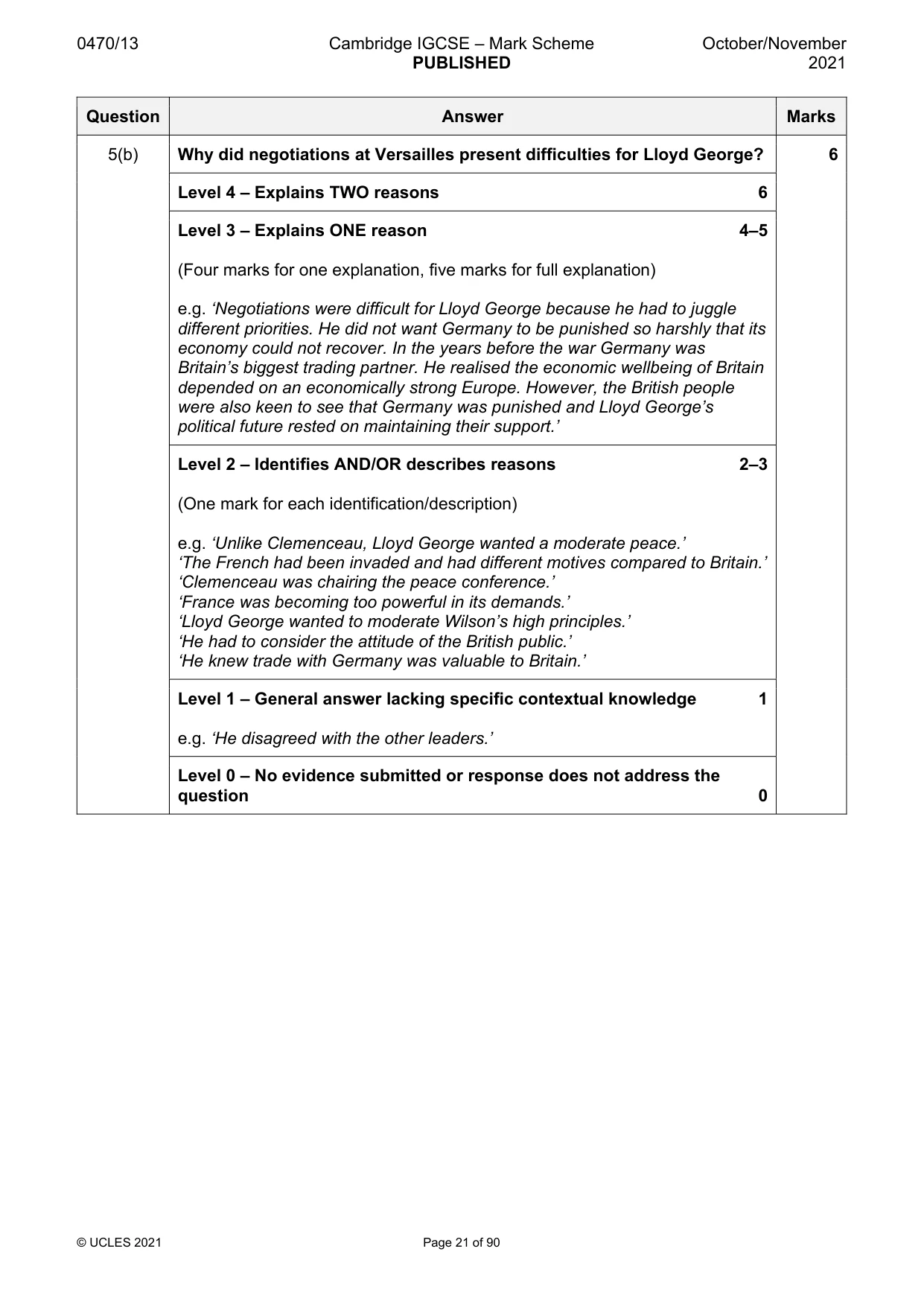
0470/13 Cambridge IGCSE – Mark Scheme PUBLISHED October/November 2021 © UCLES 2021 Page 21 of 90 Question Answer Marks 5(b) Why did negotiations at Versailles present difficulties for Lloyd George? 6 Level 4 – Explains TWO reasons 6 Level 3 – Explains ONE reason 4–5 (Four marks for one explanation, five marks for full explanation) e.g. ‘Negotiations were difficult for Lloyd George because he had to juggle different priorities. He did not want Germany to be punished so harshly that its economy could not recover. In the years before the war Germany was Britain’s biggest trading partner. He realised the economic wellbeing of Britain depended on an economically strong Europe. However, the British people were also keen to see that Germany was punished and Lloyd George’s political future rested on maintaining their support.’ Level 2 – Identifies AND/OR describes reasons 2–3 (One mark for each identification/description) e.g. ‘Unlike Clemenceau, Lloyd George wanted a moderate peace.’ ‘The French had been invaded and had different motives compared to Britain.’ ‘Clemenceau was chairing the peace conference.’ ‘France was becoming too powerful in its demands.’ ‘Lloyd George wanted to moderate Wilson’s high principles.’ ‘He had to consider the attitude of the British public.’ ‘He knew trade with Germany was valuable to Britain.’ Level 1 – General answer lacking specific contextual knowledge 1 e.g. ‘He disagreed with the other leaders.’ Level 0 – No evidence submitted or response does not address the question 0
Mark scheme, page 22
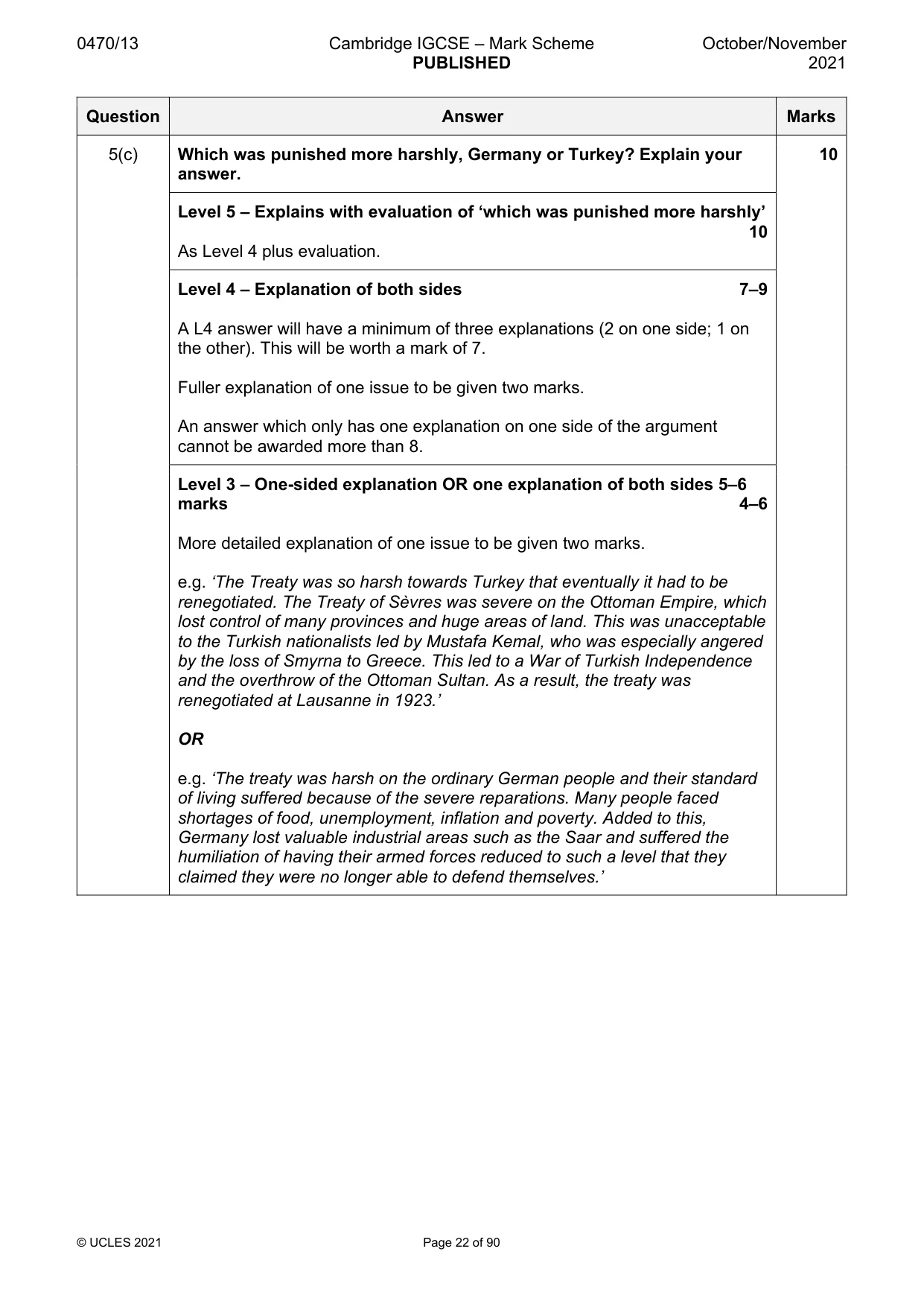
0470/13 Cambridge IGCSE – Mark Scheme PUBLISHED October/November 2021 © UCLES 2021 Page 22 of 90 Question Answer Marks 5(c) Which was punished more harshly, Germany or Turkey? Explain your answer. 10 Level 5 – Explains with evaluation of ‘which was punished more harshly’ 10 As Level 4 plus evaluation. Level 4 – Explanation of both sides 7–9 A L4 answer will have a minimum of three explanations (2 on one side; 1 on the other). This will be worth a mark of 7. Fuller explanation of one issue to be given two marks. An answer which only has one explanation on one side of the argument cannot be awarded more than 8. Level 3 – One-sided explanation OR one explanation of both sides 5–6 marks 4–6 More detailed explanation of one issue to be given two marks. e.g. ‘The Treaty was so harsh towards Turkey that eventually it had to be renegotiated. The Treaty of Sèvres was severe on the Ottoman Empire, which lost control of many provinces and huge areas of land. This was unacceptable to the Turkish nationalists led by Mustafa Kemal, who was especially angered by the loss of Smyrna to Greece. This led to a War of Turkish Independence and the overthrow of the Ottoman Sultan. As a result, the treaty was renegotiated at Lausanne in 1923.’ OR e.g. ‘The treaty was harsh on the ordinary German people and their standard of living suffered because of the severe reparations. Many people faced shortages of food, unemployment, inflation and poverty. Added to this, Germany lost valuable industrial areas such as the Saar and suffered the humiliation of having their armed forces reduced to such a level that they claimed they were no longer able to defend themselves.’
Mark scheme, page 23
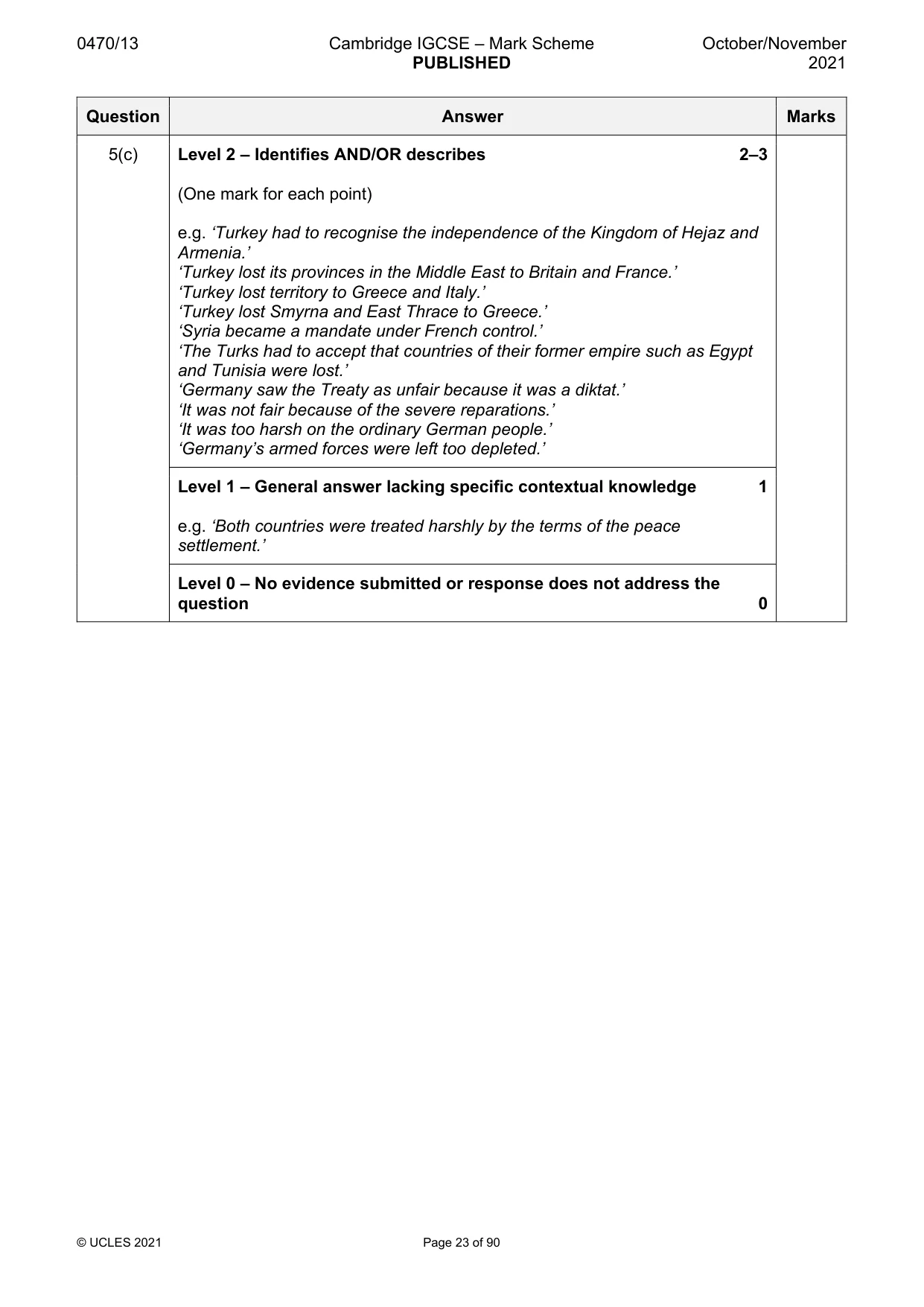
0470/13 Cambridge IGCSE – Mark Scheme PUBLISHED October/November 2021 © UCLES 2021 Page 23 of 90 Question Answer Marks 5(c) Level 2 – Identifies AND/OR describes 2–3 (One mark for each point) e.g. ‘Turkey had to recognise the independence of the Kingdom of Hejaz and Armenia.’ ‘Turkey lost its provinces in the Middle East to Britain and France.’ ‘Turkey lost territory to Greece and Italy.’ ‘Turkey lost Smyrna and East Thrace to Greece.’ ‘Syria became a mandate under French control.’ ‘The Turks had to accept that countries of their former empire such as Egypt and Tunisia were lost.’ ‘Germany saw the Treaty as unfair because it was a diktat.’ ‘It was not fair because of the severe reparations.’ ‘It was too harsh on the ordinary German people.’ ‘Germany’s armed forces were left too depleted.’ Level 1 – General answer lacking specific contextual knowledge 1 e.g. ‘Both countries were treated harshly by the terms of the peace settlement.’ Level 0 – No evidence submitted or response does not address the question 0
Mark scheme, page 24
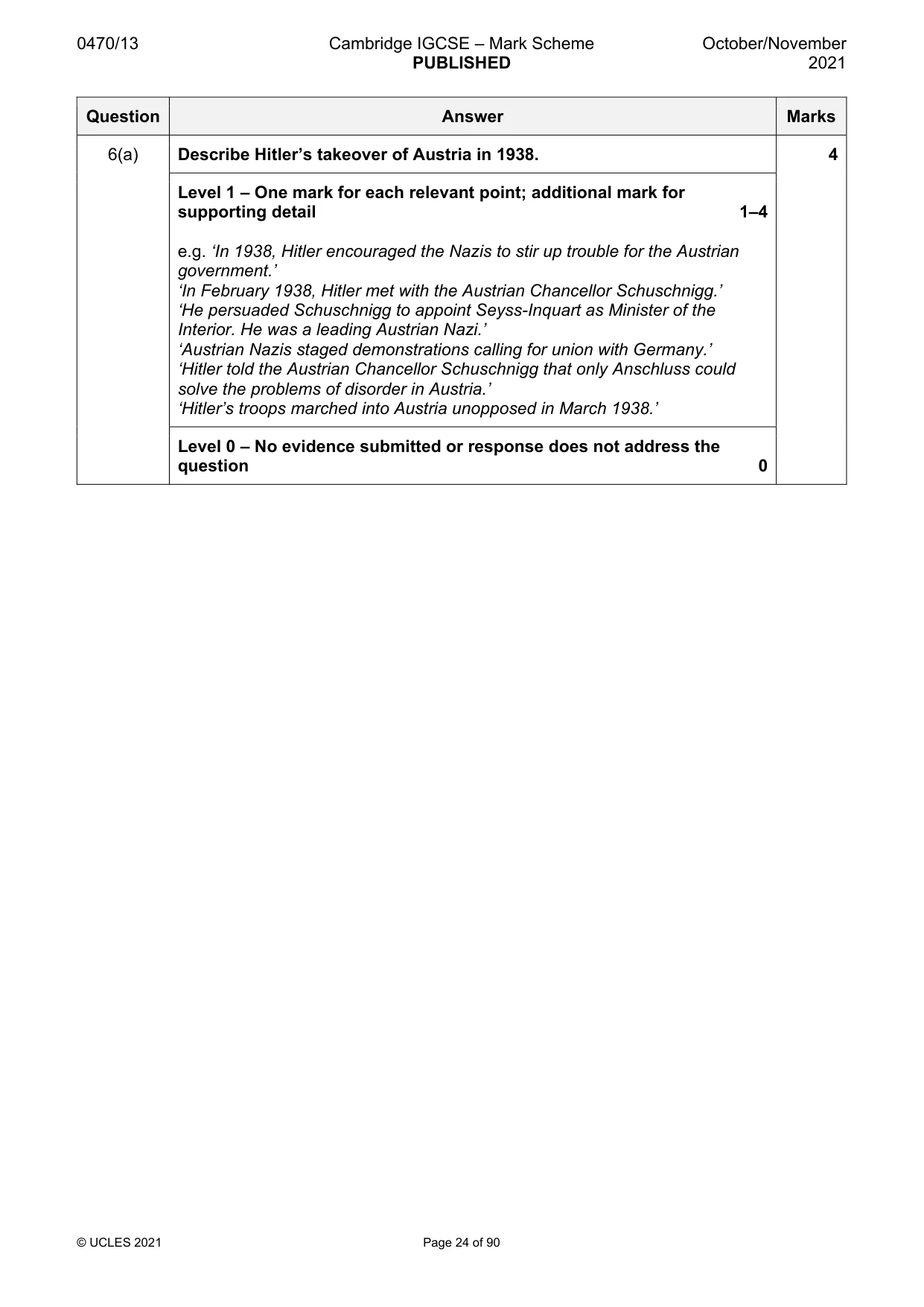
0470/13 Cambridge IGCSE – Mark Scheme PUBLISHED October/November 2021 © UCLES 2021 Page 24 of 90 Question Answer Marks 6(a) Describe Hitler’s takeover of Austria in 1938. 4 Level 1 – One mark for each relevant point; additional mark for supporting detail 1–4 e.g. ‘In 1938, Hitler encouraged the Nazis to stir up trouble for the Austrian government.’ ‘In February 1938, Hitler met with the Austrian Chancellor Schuschnigg.’ ‘He persuaded Schuschnigg to appoint Seyss-Inquart as Minister of the Interior. He was a leading Austrian Nazi.’ ‘Austrian Nazis staged demonstrations calling for union with Germany.’ ‘Hitler told the Austrian Chancellor Schuschnigg that only Anschluss could solve the problems of disorder in Austria.’ ‘Hitler’s troops marched into Austria unopposed in March 1938.’ Level 0 – No evidence submitted or response does not address the question 0
Mark scheme, page 25
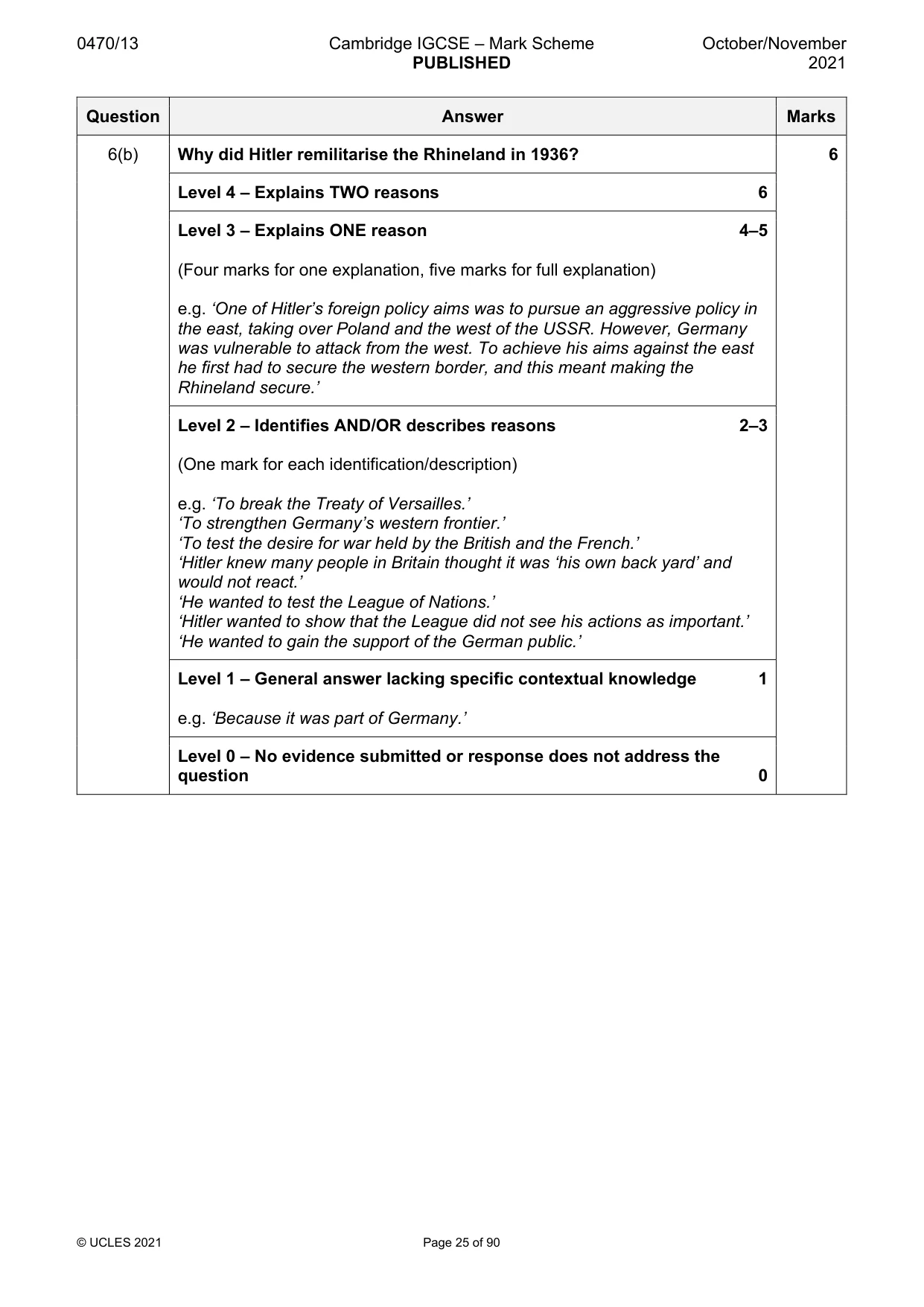
0470/13 Cambridge IGCSE – Mark Scheme PUBLISHED October/November 2021 © UCLES 2021 Page 25 of 90 Question Answer Marks 6(b) Why did Hitler remilitarise the Rhineland in 1936? 6 Level 4 – Explains TWO reasons 6 Level 3 – Explains ONE reason 4–5 (Four marks for one explanation, five marks for full explanation) e.g. ‘One of Hitler’s foreign policy aims was to pursue an aggressive policy in the east, taking over Poland and the west of the USSR. However, Germany was vulnerable to attack from the west. To achieve his aims against the east he first had to secure the western border, and this meant making the Rhineland secure.’ Level 2 – Identifies AND/OR describes reasons 2–3 (One mark for each identification/description) e.g. ‘To break the Treaty of Versailles.’ ‘To strengthen Germany’s western frontier.’ ‘To test the desire for war held by the British and the French.’ ‘Hitler knew many people in Britain thought it was ‘his own back yard’ and would not react.’ ‘He wanted to test the League of Nations.’ ‘Hitler wanted to show that the League did not see his actions as important.’ ‘He wanted to gain the support of the German public.’ Level 1 – General answer lacking specific contextual knowledge 1 e.g. ‘Because it was part of Germany.’ Level 0 – No evidence submitted or response does not address the question 0
Mark scheme, page 26
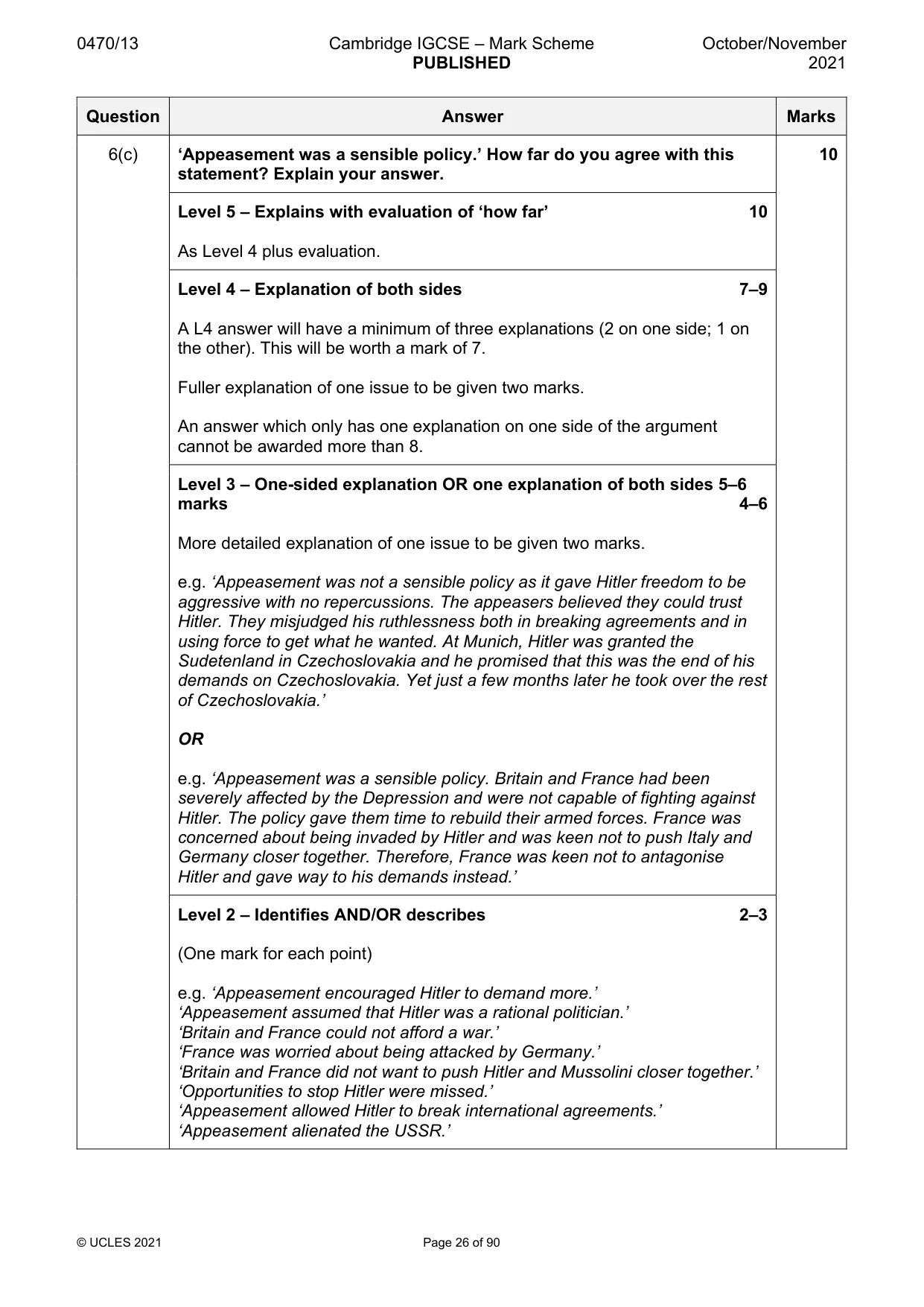
0470/13 Cambridge IGCSE – Mark Scheme PUBLISHED October/November 2021 © UCLES 2021 Page 26 of 90 Question Answer Marks 6(c) ‘Appeasement was a sensible policy.’ How far do you agree with this statement? Explain your answer. 10 Level 5 – Explains with evaluation of ‘how far’ 10 As Level 4 plus evaluation. Level 4 – Explanation of both sides 7–9 A L4 answer will have a minimum of three explanations (2 on one side; 1 on the other). This will be worth a mark of 7. Fuller explanation of one issue to be given two marks. An answer which only has one explanation on one side of the argument cannot be awarded more than 8. Level 3 – One-sided explanation OR one explanation of both sides 5–6 marks 4–6 More detailed explanation of one issue to be given two marks. e.g. ‘Appeasement was not a sensible policy as it gave Hitler freedom to be aggressive with no repercussions. The appeasers believed they could trust Hitler. They misjudged his ruthlessness both in breaking agreements and in using force to get what he wanted. At Munich, Hitler was granted the Sudetenland in Czechoslovakia and he promised that this was the end of his demands on Czechoslovakia. Yet just a few months later he took over the rest of Czechoslovakia.’ OR e.g. ‘Appeasement was a sensible policy. Britain and France had been severely affected by the Depression and were not capable of fighting against Hitler. The policy gave them time to rebuild their armed forces. France was concerned about being invaded by Hitler and was keen not to push Italy and Germany closer together. Therefore, France was keen not to antagonise Hitler and gave way to his demands instead.’ Level 2 – Identifies AND/OR describes 2–3 (One mark for each point) e.g. ‘Appeasement encouraged Hitler to demand more.’ ‘Appeasement assumed that Hitler was a rational politician.’ ‘Britain and France could not afford a war.’ ‘France was worried about being attacked by Germany.’ ‘Britain and France did not want to push Hitler and Mussolini closer together.’ ‘Opportunities to stop Hitler were missed.’ ‘Appeasement allowed Hitler to break international agreements.’ ‘Appeasement alienated the USSR.’
Mark scheme, page 27
0470/13 Cambridge IGCSE – Mark Scheme PUBLISHED October/November 2021 © UCLES 2021 Page 27 of 90 Question Answer Marks 6(c) Level 1 – General answer lacking specific contextual knowledge 1 e.g. ‘Appeasement was just giving in to Hitler.’ Level 0 – No evidence submitted or response does not address the question 0
Mark scheme, page 28
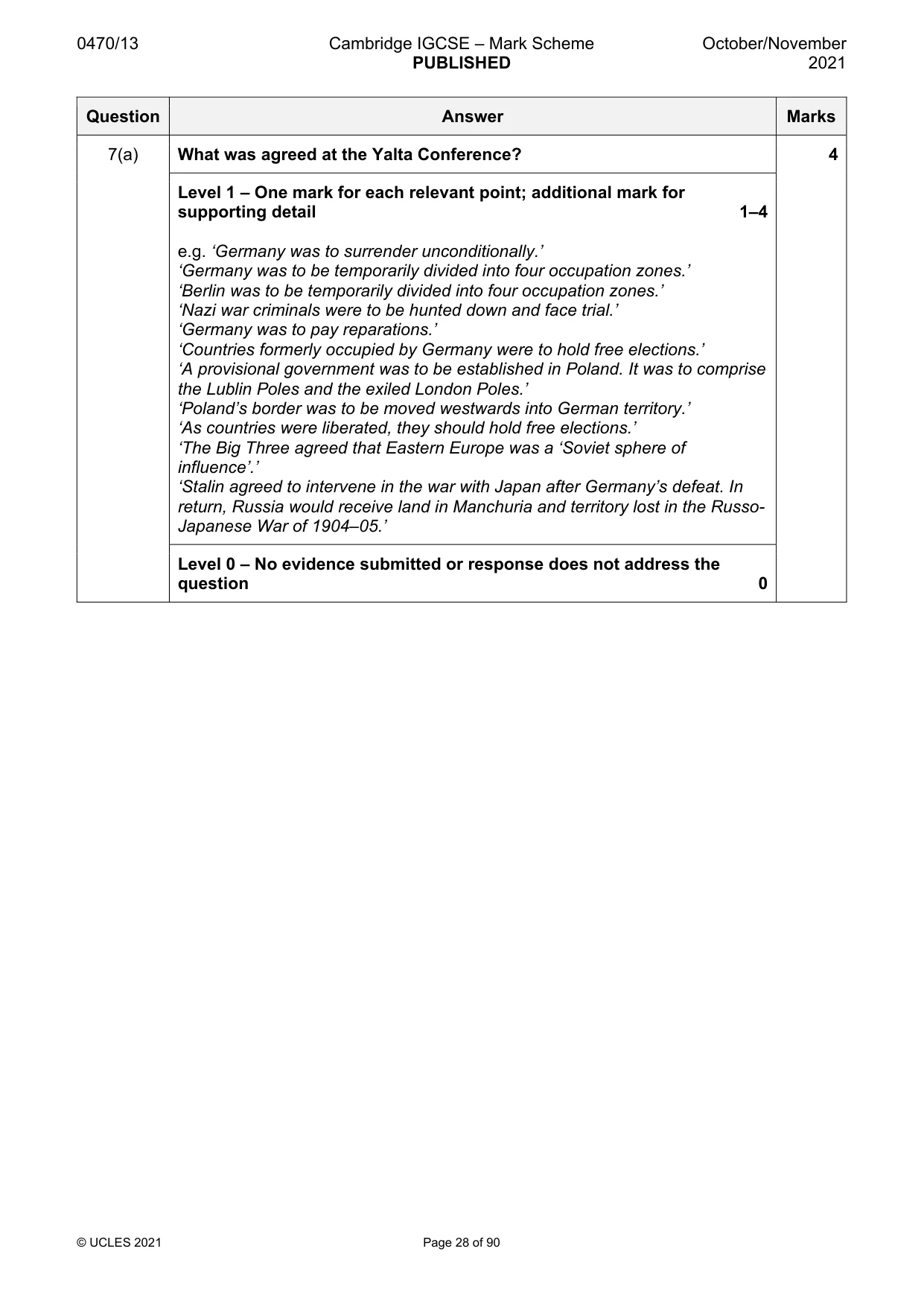
0470/13 Cambridge IGCSE – Mark Scheme PUBLISHED October/November 2021 © UCLES 2021 Page 28 of 90 Question Answer Marks 7(a) What was agreed at the Yalta Conference? 4 Level 1 – One mark for each relevant point; additional mark for supporting detail 1–4 e.g. ‘Germany was to surrender unconditionally.’ ‘Germany was to be temporarily divided into four occupation zones.’ ‘Berlin was to be temporarily divided into four occupation zones.’ ‘Nazi war criminals were to be hunted down and face trial.’ ‘Germany was to pay reparations.’ ‘Countries formerly occupied by Germany were to hold free elections.’ ‘A provisional government was to be established in Poland. It was to comprise the Lublin Poles and the exiled London Poles.’ ‘Poland’s border was to be moved westwards into German territory.’ ‘As countries were liberated, they should hold free elections.’ ‘The Big Three agreed that Eastern Europe was a ‘Soviet sphere of influence’.’ ‘Stalin agreed to intervene in the war with Japan after Germany’s defeat. In return, Russia would receive land in Manchuria and territory lost in the Russo- Japanese War of 1904–05.’ Level 0 – No evidence submitted or response does not address the question 0
Mark scheme, page 29
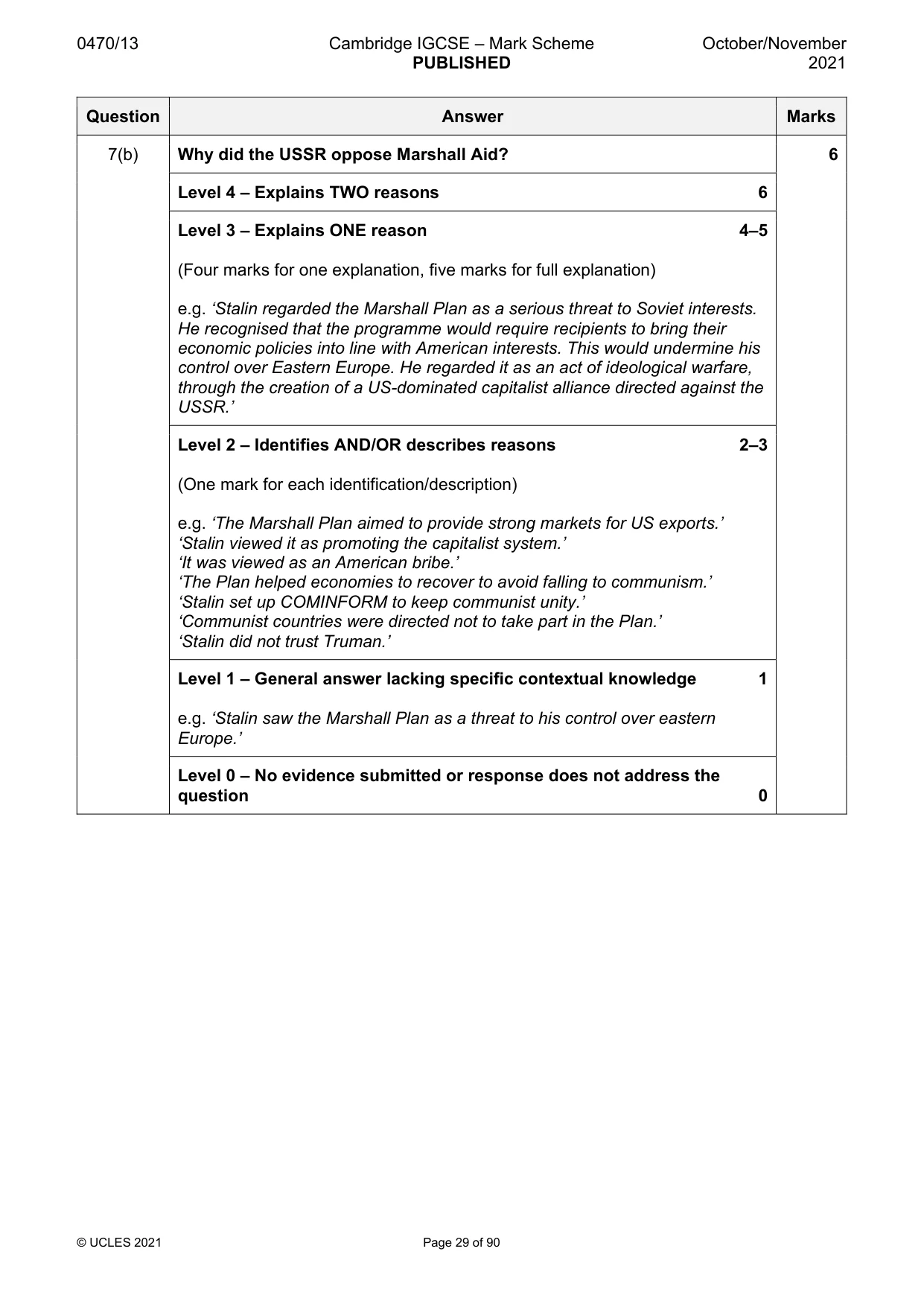
0470/13 Cambridge IGCSE – Mark Scheme PUBLISHED October/November 2021 © UCLES 2021 Page 29 of 90 Question Answer Marks 7(b) Why did the USSR oppose Marshall Aid? 6 Level 4 – Explains TWO reasons 6 Level 3 – Explains ONE reason 4–5 (Four marks for one explanation, five marks for full explanation) e.g. ‘Stalin regarded the Marshall Plan as a serious threat to Soviet interests. He recognised that the programme would require recipients to bring their economic policies into line with American interests. This would undermine his control over Eastern Europe. He regarded it as an act of ideological warfare, through the creation of a US-dominated capitalist alliance directed against the USSR.’ Level 2 – Identifies AND/OR describes reasons 2–3 (One mark for each identification/description) e.g. ‘The Marshall Plan aimed to provide strong markets for US exports.’ ‘Stalin viewed it as promoting the capitalist system.’ ‘It was viewed as an American bribe.’ ‘The Plan helped economies to recover to avoid falling to communism.’ ‘Stalin set up COMINFORM to keep communist unity.’ ‘Communist countries were directed not to take part in the Plan.’ ‘Stalin did not trust Truman.’ Level 1 – General answer lacking specific contextual knowledge 1 e.g. ‘Stalin saw the Marshall Plan as a threat to his control over eastern Europe.’ Level 0 – No evidence submitted or response does not address the question 0
Mark scheme, page 30
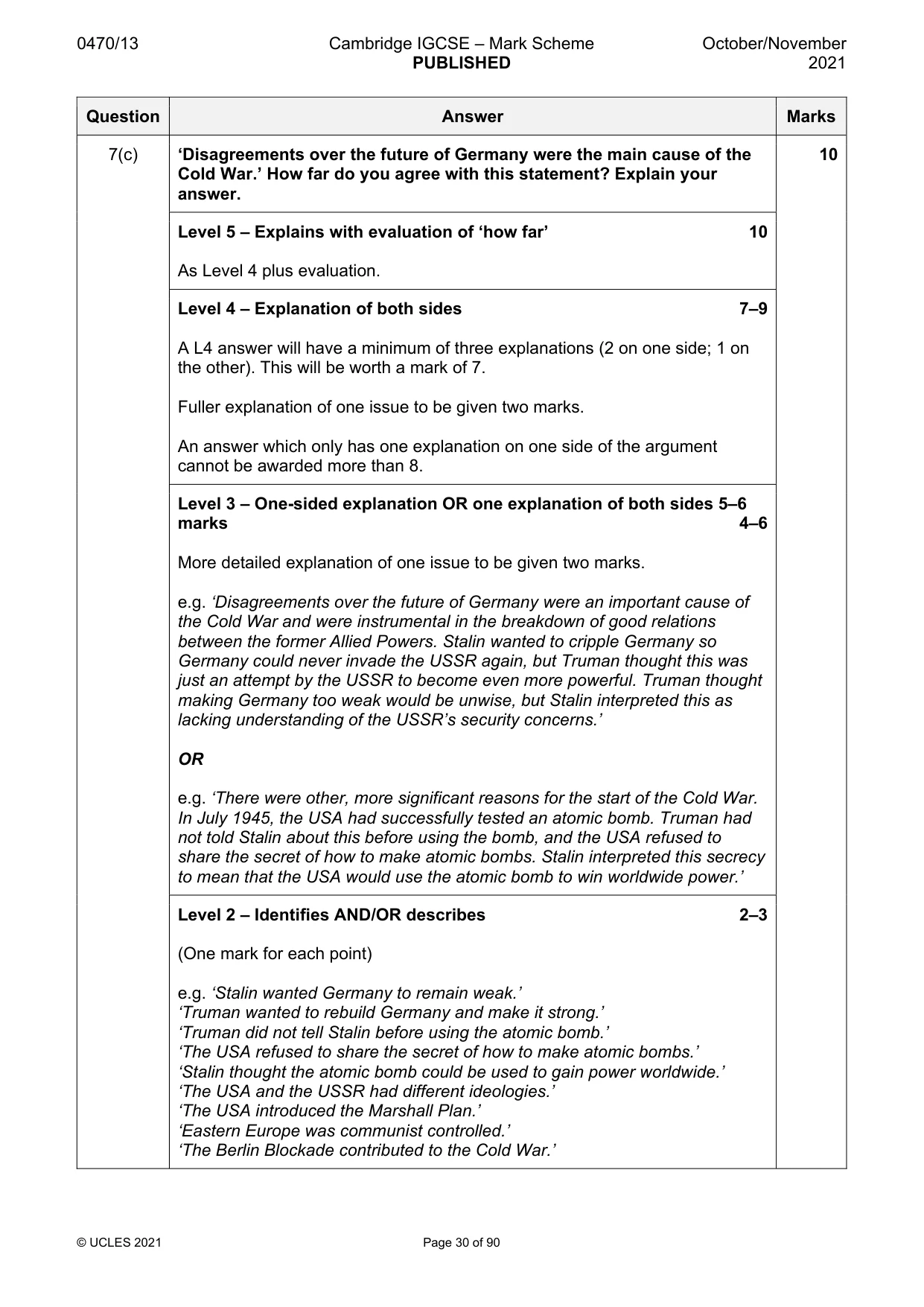
0470/13 Cambridge IGCSE – Mark Scheme PUBLISHED October/November 2021 © UCLES 2021 Page 30 of 90 Question Answer Marks 7(c) ‘Disagreements over the future of Germany were the main cause of the Cold War.’ How far do you agree with this statement? Explain your answer. 10 Level 5 – Explains with evaluation of ‘how far’ 10 As Level 4 plus evaluation. Level 4 – Explanation of both sides 7–9 A L4 answer will have a minimum of three explanations (2 on one side; 1 on the other). This will be worth a mark of 7. Fuller explanation of one issue to be given two marks. An answer which only has one explanation on one side of the argument cannot be awarded more than 8. Level 3 – One-sided explanation OR one explanation of both sides 5–6 marks 4–6 More detailed explanation of one issue to be given two marks. e.g. ‘Disagreements over the future of Germany were an important cause of the Cold War and were instrumental in the breakdown of good relations between the former Allied Powers. Stalin wanted to cripple Germany so Germany could never invade the USSR again, but Truman thought this was just an attempt by the USSR to become even more powerful. Truman thought making Germany too weak would be unwise, but Stalin interpreted this as lacking understanding of the USSR’s security concerns.’ OR e.g. ‘There were other, more significant reasons for the start of the Cold War. In July 1945, the USA had successfully tested an atomic bomb. Truman had not told Stalin about this before using the bomb, and the USA refused to share the secret of how to make atomic bombs. Stalin interpreted this secrecy to mean that the USA would use the atomic bomb to win worldwide power.’ Level 2 – Identifies AND/OR describes 2–3 (One mark for each point) e.g. ‘Stalin wanted Germany to remain weak.’ ‘Truman wanted to rebuild Germany and make it strong.’ ‘Truman did not tell Stalin before using the atomic bomb.’ ‘The USA refused to share the secret of how to make atomic bombs.’ ‘Stalin thought the atomic bomb could be used to gain power worldwide.’ ‘The USA and the USSR had different ideologies.’ ‘The USA introduced the Marshall Plan.’ ‘Eastern Europe was communist controlled.’ ‘The Berlin Blockade contributed to the Cold War.’
Mark scheme, page 31
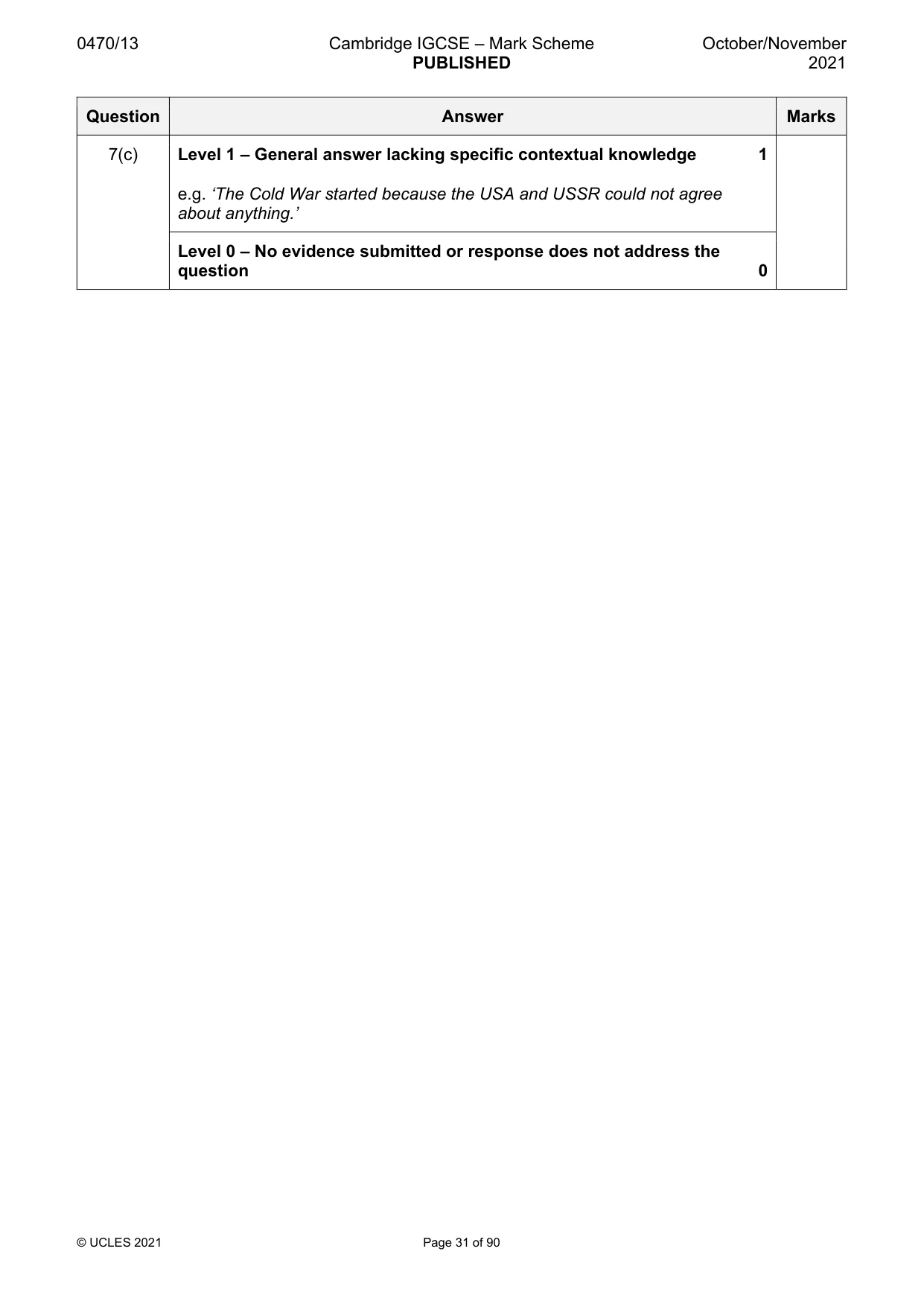
0470/13 Cambridge IGCSE – Mark Scheme PUBLISHED October/November 2021 © UCLES 2021 Page 31 of 90 Question Answer Marks 7(c) Level 1 – General answer lacking specific contextual knowledge 1 e.g. ‘The Cold War started because the USA and USSR could not agree about anything.’ Level 0 – No evidence submitted or response does not address the question 0
Mark scheme, page 32
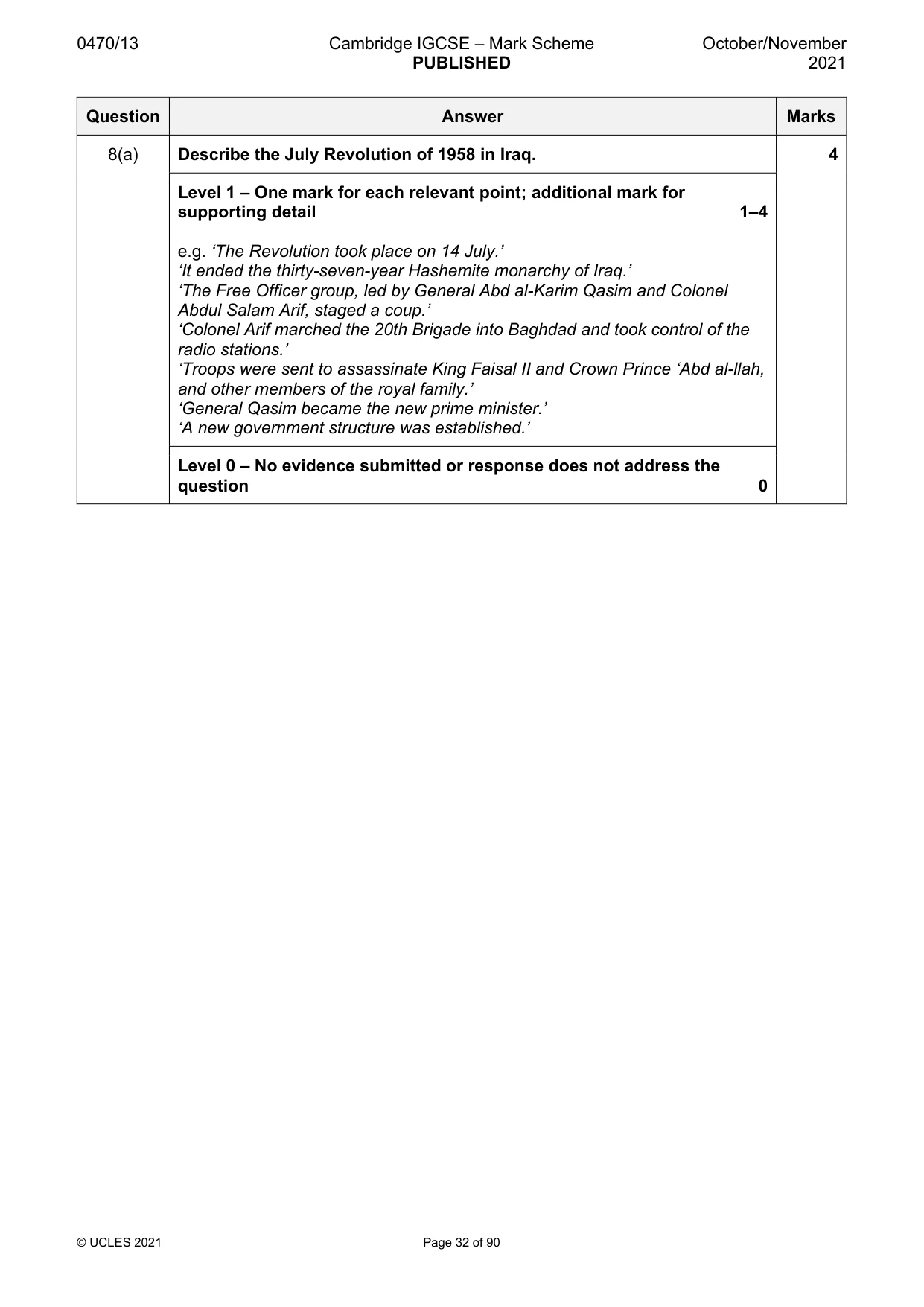
0470/13 Cambridge IGCSE – Mark Scheme PUBLISHED October/November 2021 © UCLES 2021 Page 32 of 90 Question Answer Marks 8(a) Describe the July Revolution of 1958 in Iraq. 4 Level 1 – One mark for each relevant point; additional mark for supporting detail 1–4 e.g. ‘The Revolution took place on 14 July.’ ‘It ended the thirty-seven-year Hashemite monarchy of Iraq.’ ‘The Free Officer group, led by General Abd al-Karim Qasim and Colonel Abdul Salam Arif, staged a coup.’ ‘Colonel Arif marched the 20th Brigade into Baghdad and took control of the radio stations.’ ‘Troops were sent to assassinate King Faisal II and Crown Prince ‘Abd al-llah, and other members of the royal family.’ ‘General Qasim became the new prime minister.’ ‘A new government structure was established.’ Level 0 – No evidence submitted or response does not address the question 0
Mark scheme, page 33
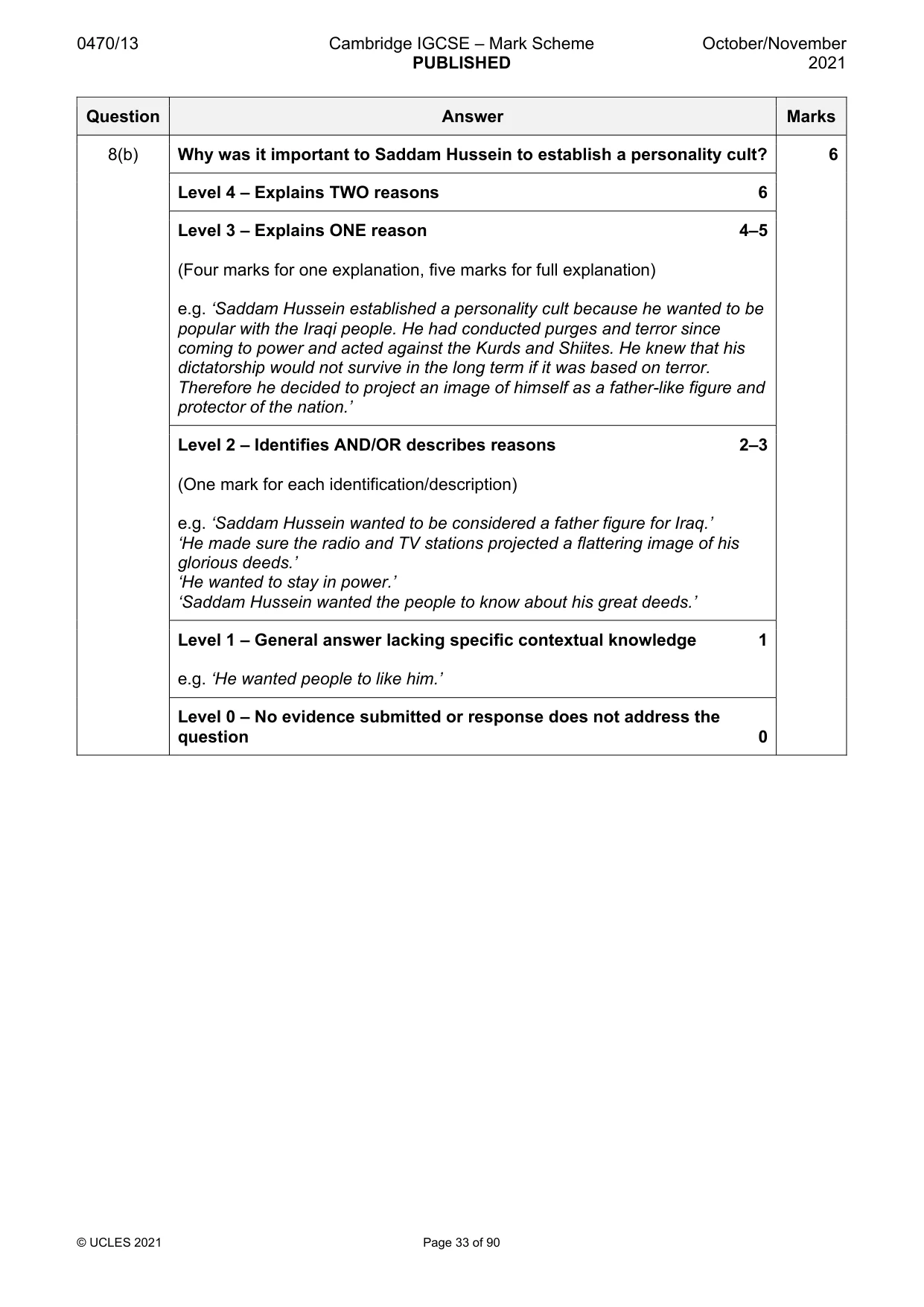
0470/13 Cambridge IGCSE – Mark Scheme PUBLISHED October/November 2021 © UCLES 2021 Page 33 of 90 Question Answer Marks 8(b) Why was it important to Saddam Hussein to establish a personality cult? 6 Level 4 – Explains TWO reasons 6 Level 3 – Explains ONE reason 4–5 (Four marks for one explanation, five marks for full explanation) e.g. ‘Saddam Hussein established a personality cult because he wanted to be popular with the Iraqi people. He had conducted purges and terror since coming to power and acted against the Kurds and Shiites. He knew that his dictatorship would not survive in the long term if it was based on terror. Therefore he decided to project an image of himself as a father-like figure and protector of the nation.’ Level 2 – Identifies AND/OR describes reasons 2–3 (One mark for each identification/description) e.g. ‘Saddam Hussein wanted to be considered a father figure for Iraq.’ ‘He made sure the radio and TV stations projected a flattering image of his glorious deeds.’ ‘He wanted to stay in power.’ ‘Saddam Hussein wanted the people to know about his great deeds.’ Level 1 – General answer lacking specific contextual knowledge 1 e.g. ‘He wanted people to like him.’ Level 0 – No evidence submitted or response does not address the question 0
Mark scheme, page 34
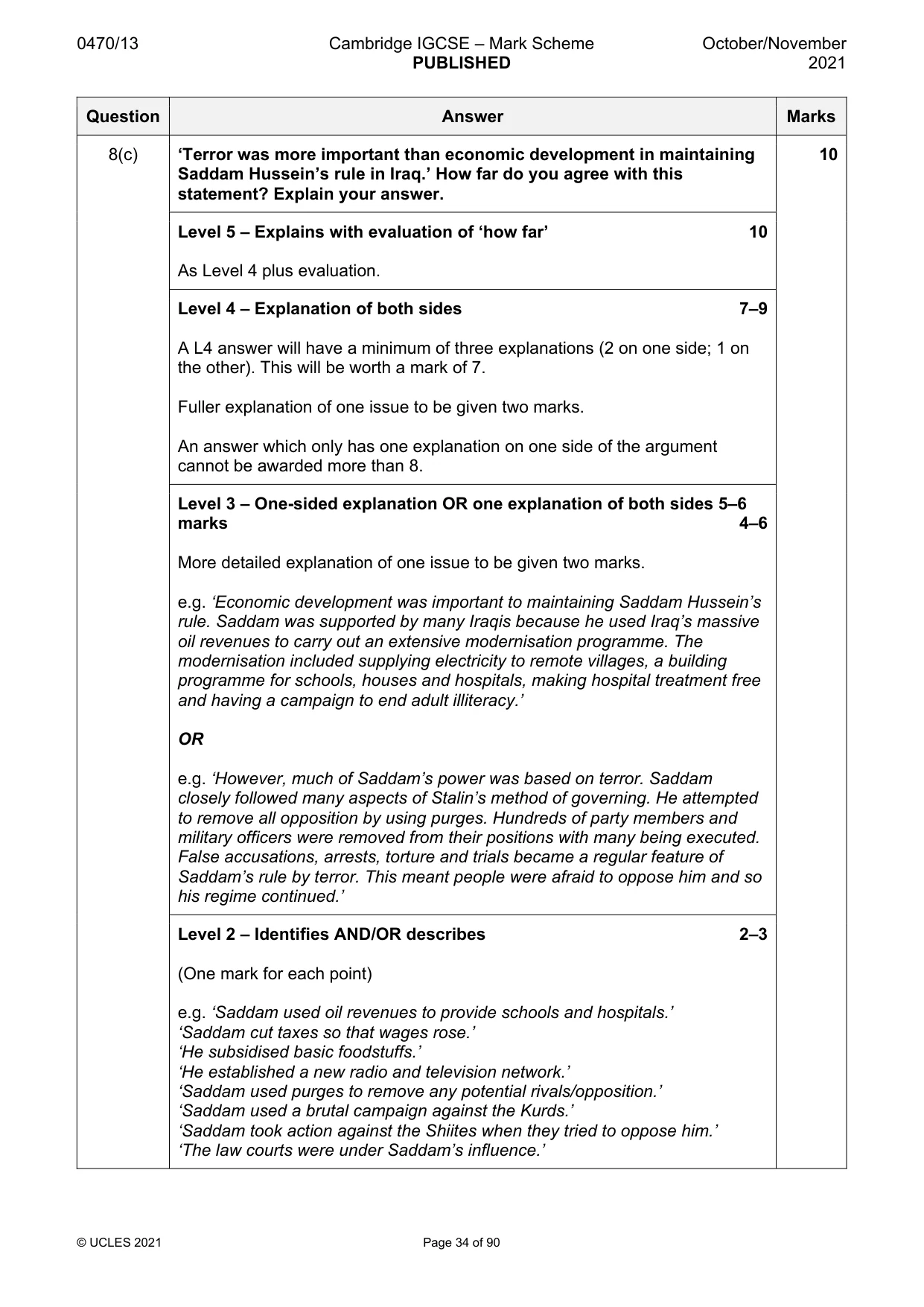
0470/13 Cambridge IGCSE – Mark Scheme PUBLISHED October/November 2021 © UCLES 2021 Page 34 of 90 Question Answer Marks 8(c) ‘Terror was more important than economic development in maintaining Saddam Hussein’s rule in Iraq.’ How far do you agree with this statement? Explain your answer. 10 Level 5 – Explains with evaluation of ‘how far’ 10 As Level 4 plus evaluation. Level 4 – Explanation of both sides 7–9 A L4 answer will have a minimum of three explanations (2 on one side; 1 on the other). This will be worth a mark of 7. Fuller explanation of one issue to be given two marks. An answer which only has one explanation on one side of the argument cannot be awarded more than 8. Level 3 – One-sided explanation OR one explanation of both sides 5–6 marks 4–6 More detailed explanation of one issue to be given two marks. e.g. ‘Economic development was important to maintaining Saddam Hussein’s rule. Saddam was supported by many Iraqis because he used Iraq’s massive oil revenues to carry out an extensive modernisation programme. The modernisation included supplying electricity to remote villages, a building programme for schools, houses and hospitals, making hospital treatment free and having a campaign to end adult illiteracy.’ OR e.g. ‘However, much of Saddam’s power was based on terror. Saddam closely followed many aspects of Stalin’s method of governing. He attempted to remove all opposition by using purges. Hundreds of party members and military officers were removed from their positions with many being executed. False accusations, arrests, torture and trials became a regular feature of Saddam’s rule by terror. This meant people were afraid to oppose him and so his regime continued.’ Level 2 – Identifies AND/OR describes 2–3 (One mark for each point) e.g. ‘Saddam used oil revenues to provide schools and hospitals.’ ‘Saddam cut taxes so that wages rose.’ ‘He subsidised basic foodstuffs.’ ‘He established a new radio and television network.’ ‘Saddam used purges to remove any potential rivals/opposition.’ ‘Saddam used a brutal campaign against the Kurds.’ ‘Saddam took action against the Shiites when they tried to oppose him.’ ‘The law courts were under Saddam’s influence.’
Mark scheme, page 35
0470/13 Cambridge IGCSE – Mark Scheme PUBLISHED October/November 2021 © UCLES 2021 Page 35 of 90 Question Answer Marks 8(c) Level 1 – General answer lacking specific contextual knowledge 1 e.g. ‘Saddam Hussein used terror and promises of a better life to maintain control.’ Level 0 – No evidence submitted or response does not address the question 0
Mark scheme, page 36
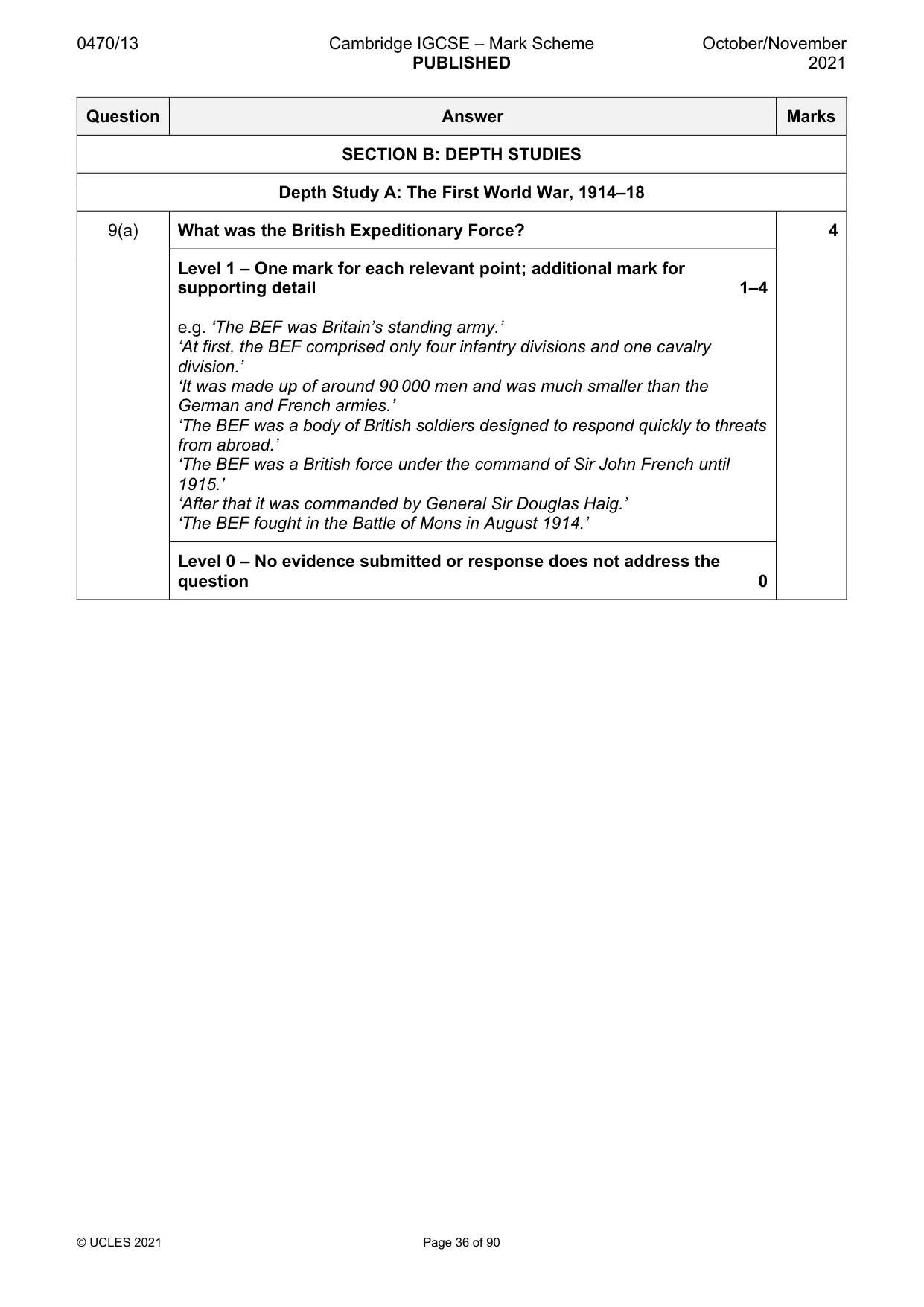
0470/13 Cambridge IGCSE – Mark Scheme PUBLISHED October/November 2021 © UCLES 2021 Page 36 of 90 Question Answer Marks SECTION B: DEPTH STUDIES Depth Study A: The First World War, 1914–18 9(a) What was the British Expeditionary Force? 4 Level 1 – One mark for each relevant point; additional mark for supporting detail 1–4 e.g. ‘The BEF was Britain’s standing army.’ ‘At first, the BEF comprised only four infantry divisions and one cavalry division.’ ‘It was made up of around 90 000 men and was much smaller than the German and French armies.’ ‘The BEF was a body of British soldiers designed to respond quickly to threats from abroad.’ ‘The BEF was a British force under the command of Sir John French until 1915.’ ‘After that it was commanded by General Sir Douglas Haig.’ ‘The BEF fought in the Battle of Mons in August 1914.’ Level 0 – No evidence submitted or response does not address the question 0
Mark scheme, page 37
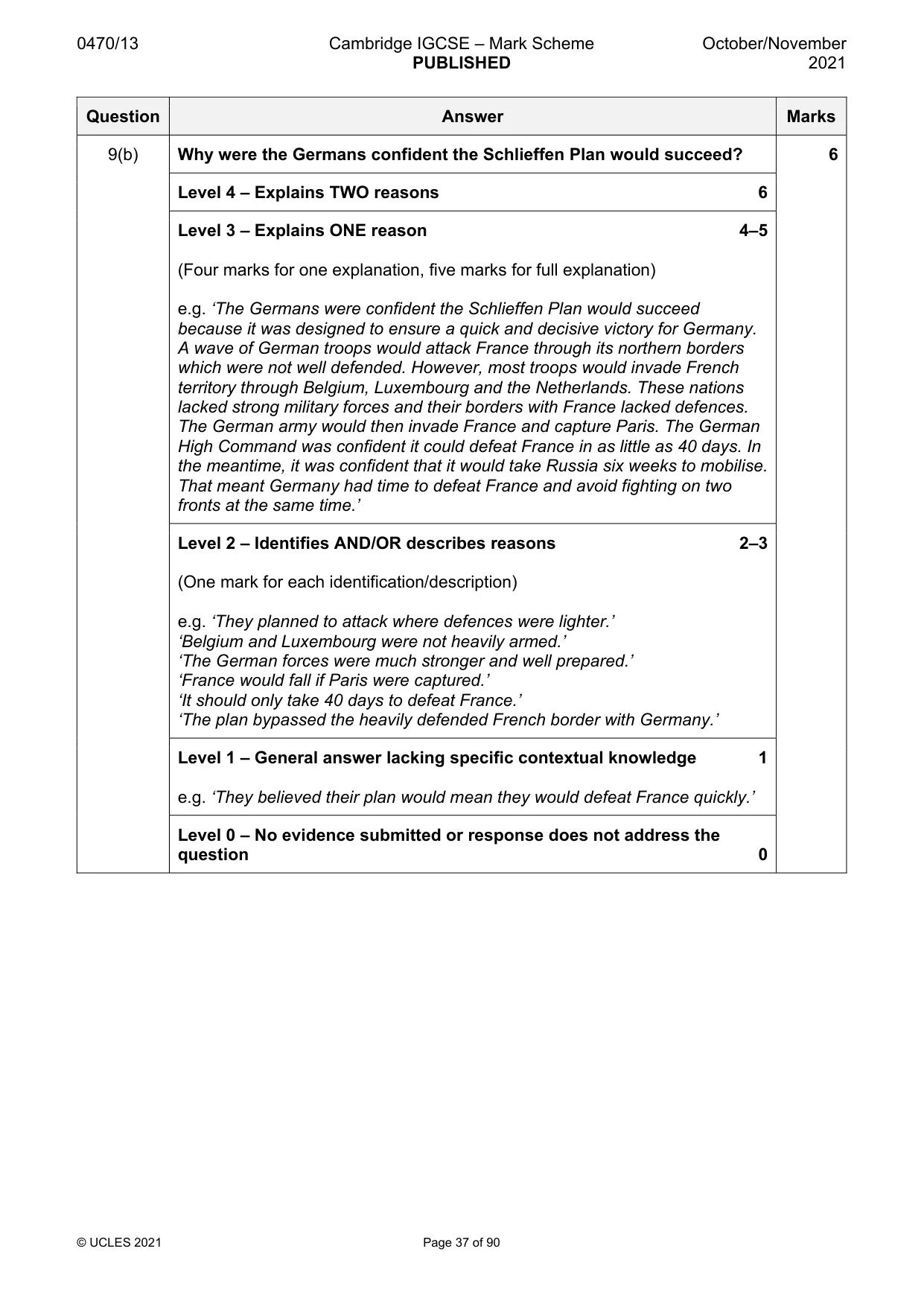
0470/13 Cambridge IGCSE – Mark Scheme PUBLISHED October/November 2021 © UCLES 2021 Page 37 of 90 Question Answer Marks 9(b) Why were the Germans confident the Schlieffen Plan would succeed? 6 Level 4 – Explains TWO reasons 6 Level 3 – Explains ONE reason 4–5 (Four marks for one explanation, five marks for full explanation) e.g. ‘The Germans were confident the Schlieffen Plan would succeed because it was designed to ensure a quick and decisive victory for Germany. A wave of German troops would attack France through its northern borders which were not well defended. However, most troops would invade French territory through Belgium, Luxembourg and the Netherlands. These nations lacked strong military forces and their borders with France lacked defences. The German army would then invade France and capture Paris. The German High Command was confident it could defeat France in as little as 40 days. In the meantime, it was confident that it would take Russia six weeks to mobilise. That meant Germany had time to defeat France and avoid fighting on two fronts at the same time.’ Level 2 – Identifies AND/OR describes reasons 2–3 (One mark for each identification/description) e.g. ‘They planned to attack where defences were lighter.’ ‘Belgium and Luxembourg were not heavily armed.’ ‘The German forces were much stronger and well prepared.’ ‘France would fall if Paris were captured.’ ‘It should only take 40 days to defeat France.’ ‘The plan bypassed the heavily defended French border with Germany.’ Level 1 – General answer lacking specific contextual knowledge 1 e.g. ‘They believed their plan would mean they would defeat France quickly.’ Level 0 – No evidence submitted or response does not address the question 0
Mark scheme, page 38
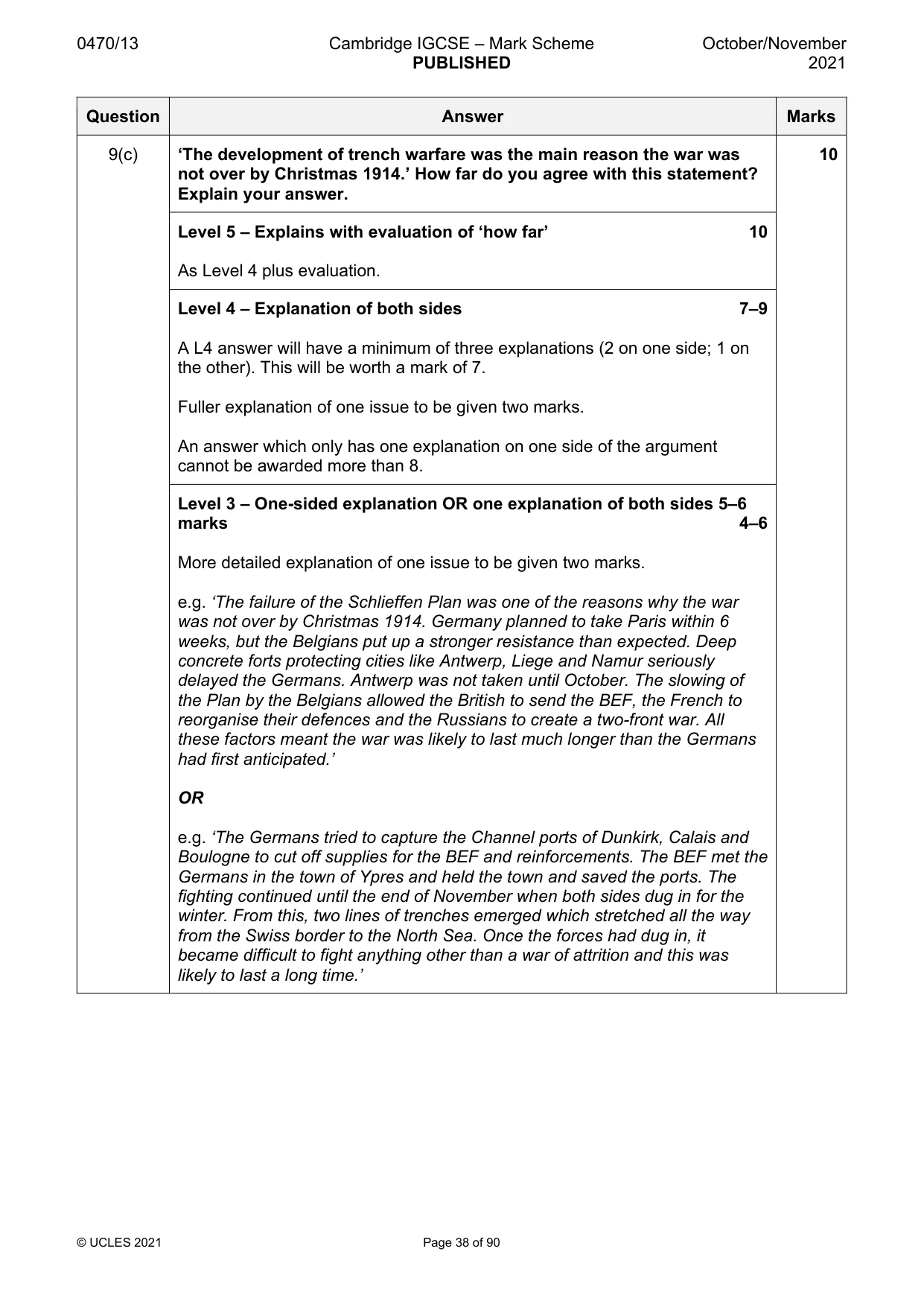
0470/13 Cambridge IGCSE – Mark Scheme PUBLISHED October/November 2021 © UCLES 2021 Page 38 of 90 Question Answer Marks 9(c) ‘The development of trench warfare was the main reason the war was not over by Christmas 1914.’ How far do you agree with this statement? Explain your answer. 10 Level 5 – Explains with evaluation of ‘how far’ 10 As Level 4 plus evaluation. Level 4 – Explanation of both sides 7–9 A L4 answer will have a minimum of three explanations (2 on one side; 1 on the other). This will be worth a mark of 7. Fuller explanation of one issue to be given two marks. An answer which only has one explanation on one side of the argument cannot be awarded more than 8. Level 3 – One-sided explanation OR one explanation of both sides 5–6 marks 4–6 More detailed explanation of one issue to be given two marks. e.g. ‘The failure of the Schlieffen Plan was one of the reasons why the war was not over by Christmas 1914. Germany planned to take Paris within 6 weeks, but the Belgians put up a stronger resistance than expected. Deep concrete forts protecting cities like Antwerp, Liege and Namur seriously delayed the Germans. Antwerp was not taken until October. The slowing of the Plan by the Belgians allowed the British to send the BEF, the French to reorganise their defences and the Russians to create a two-front war. All these factors meant the war was likely to last much longer than the Germans had first anticipated.’ OR e.g. ‘The Germans tried to capture the Channel ports of Dunkirk, Calais and Boulogne to cut off supplies for the BEF and reinforcements. The BEF met the Germans in the town of Ypres and held the town and saved the ports. The fighting continued until the end of November when both sides dug in for the winter. From this, two lines of trenches emerged which stretched all the way from the Swiss border to the North Sea. Once the forces had dug in, it became difficult to fight anything other than a war of attrition and this was likely to last a long time.’
Mark scheme, page 39
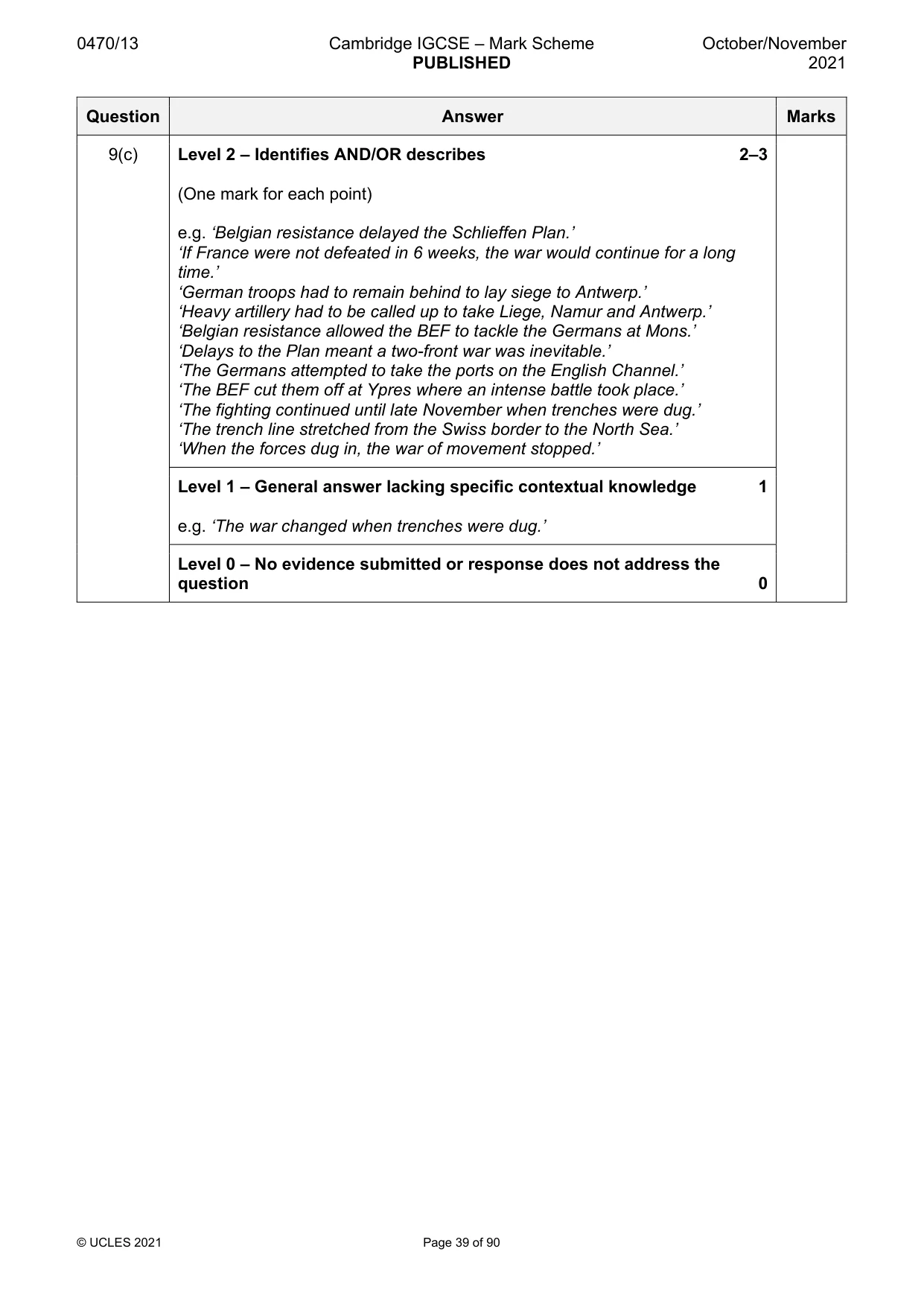
0470/13 Cambridge IGCSE – Mark Scheme PUBLISHED October/November 2021 © UCLES 2021 Page 39 of 90 Question Answer Marks 9(c) Level 2 – Identifies AND/OR describes 2–3 (One mark for each point) e.g. ‘Belgian resistance delayed the Schlieffen Plan.’ ‘If France were not defeated in 6 weeks, the war would continue for a long time.’ ‘German troops had to remain behind to lay siege to Antwerp.’ ‘Heavy artillery had to be called up to take Liege, Namur and Antwerp.’ ‘Belgian resistance allowed the BEF to tackle the Germans at Mons.’ ‘Delays to the Plan meant a two-front war was inevitable.’ ‘The Germans attempted to take the ports on the English Channel.’ ‘The BEF cut them off at Ypres where an intense battle took place.’ ‘The fighting continued until late November when trenches were dug.’ ‘The trench line stretched from the Swiss border to the North Sea.’ ‘When the forces dug in, the war of movement stopped.’ Level 1 – General answer lacking specific contextual knowledge 1 e.g. ‘The war changed when trenches were dug.’ Level 0 – No evidence submitted or response does not address the question 0
Mark scheme, page 40
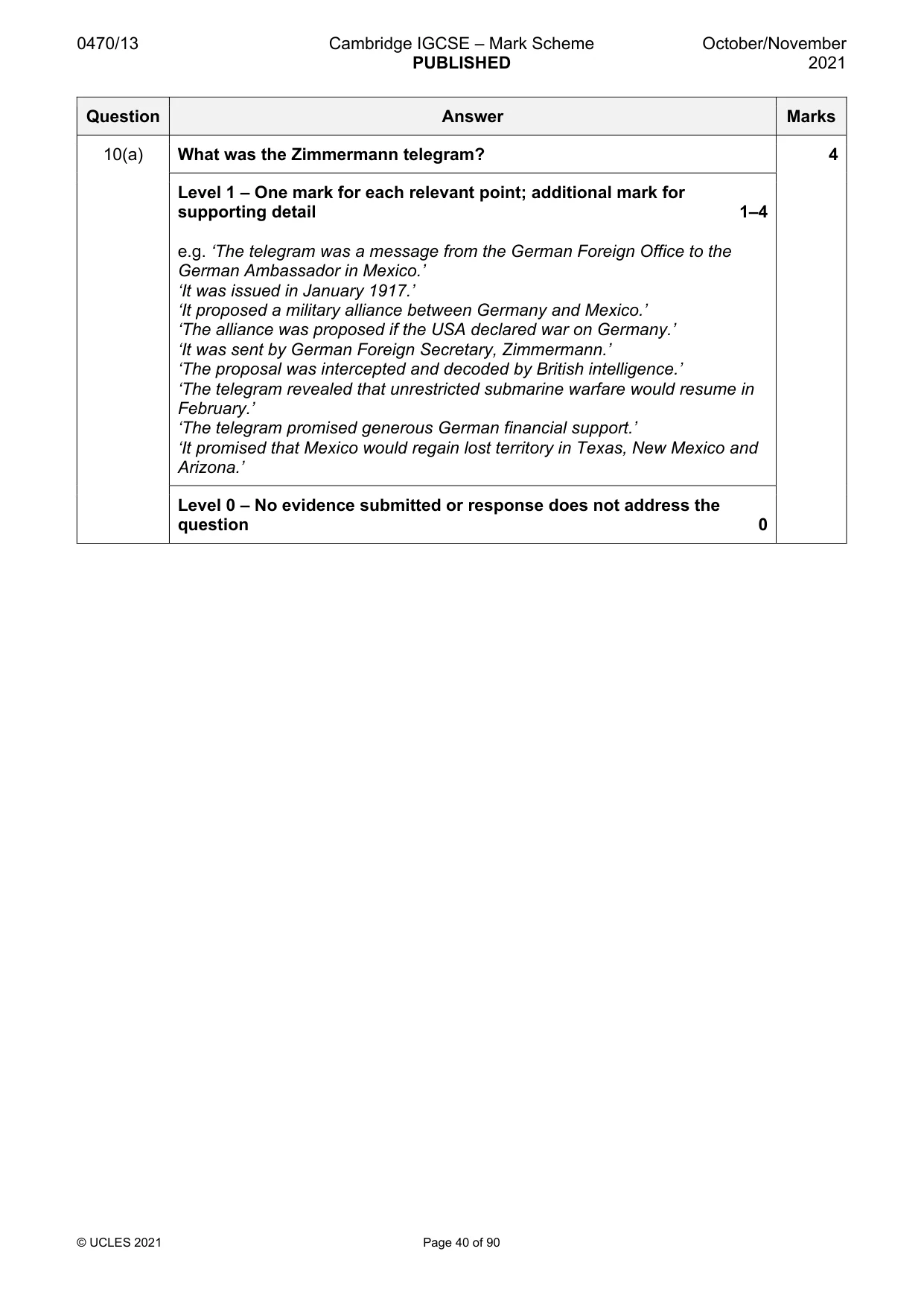
0470/13 Cambridge IGCSE – Mark Scheme PUBLISHED October/November 2021 © UCLES 2021 Page 40 of 90 Question Answer Marks 10(a) What was the Zimmermann telegram? 4 Level 1 – One mark for each relevant point; additional mark for supporting detail 1–4 e.g. ‘The telegram was a message from the German Foreign Office to the German Ambassador in Mexico.’ ‘It was issued in January 1917.’ ‘It proposed a military alliance between Germany and Mexico.’ ‘The alliance was proposed if the USA declared war on Germany.’ ‘It was sent by German Foreign Secretary, Zimmermann.’ ‘The proposal was intercepted and decoded by British intelligence.’ ‘The telegram revealed that unrestricted submarine warfare would resume in February.’ ‘The telegram promised generous German financial support.’ ‘It promised that Mexico would regain lost territory in Texas, New Mexico and Arizona.’ Level 0 – No evidence submitted or response does not address the question 0
Mark scheme, page 41
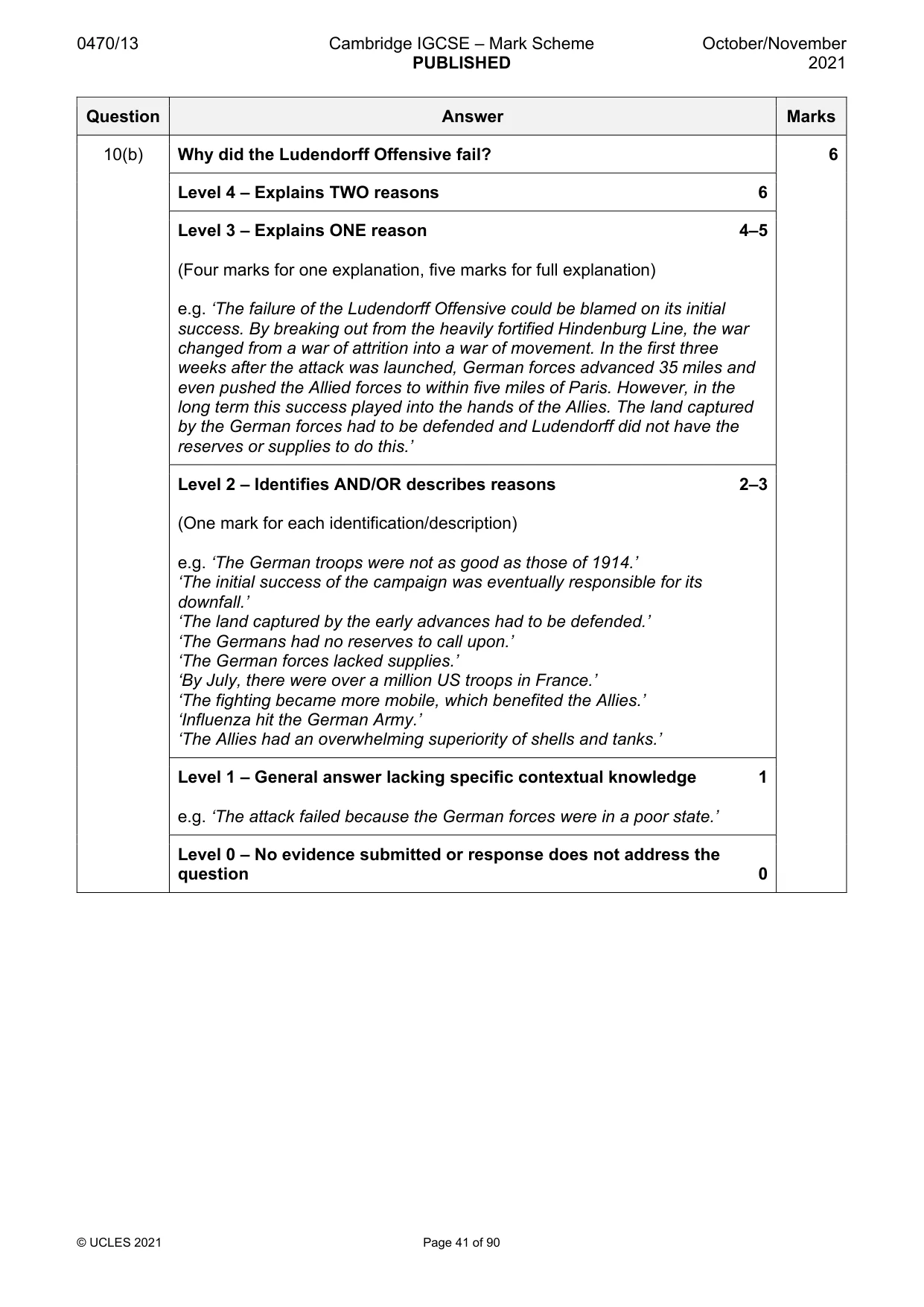
0470/13 Cambridge IGCSE – Mark Scheme PUBLISHED October/November 2021 © UCLES 2021 Page 41 of 90 Question Answer Marks 10(b) Why did the Ludendorff Offensive fail? 6 Level 4 – Explains TWO reasons 6 Level 3 – Explains ONE reason 4–5 (Four marks for one explanation, five marks for full explanation) e.g. ‘The failure of the Ludendorff Offensive could be blamed on its initial success. By breaking out from the heavily fortified Hindenburg Line, the war changed from a war of attrition into a war of movement. In the first three weeks after the attack was launched, German forces advanced 35 miles and even pushed the Allied forces to within five miles of Paris. However, in the long term this success played into the hands of the Allies. The land captured by the German forces had to be defended and Ludendorff did not have the reserves or supplies to do this.’ Level 2 – Identifies AND/OR describes reasons 2–3 (One mark for each identification/description) e.g. ‘The German troops were not as good as those of 1914.’ ‘The initial success of the campaign was eventually responsible for its downfall.’ ‘The land captured by the early advances had to be defended.’ ‘The Germans had no reserves to call upon.’ ‘The German forces lacked supplies.’ ‘By July, there were over a million US troops in France.’ ‘The fighting became more mobile, which benefited the Allies.’ ‘Influenza hit the German Army.’ ‘The Allies had an overwhelming superiority of shells and tanks.’ Level 1 – General answer lacking specific contextual knowledge 1 e.g. ‘The attack failed because the German forces were in a poor state.’ Level 0 – No evidence submitted or response does not address the question 0
Mark scheme, page 42
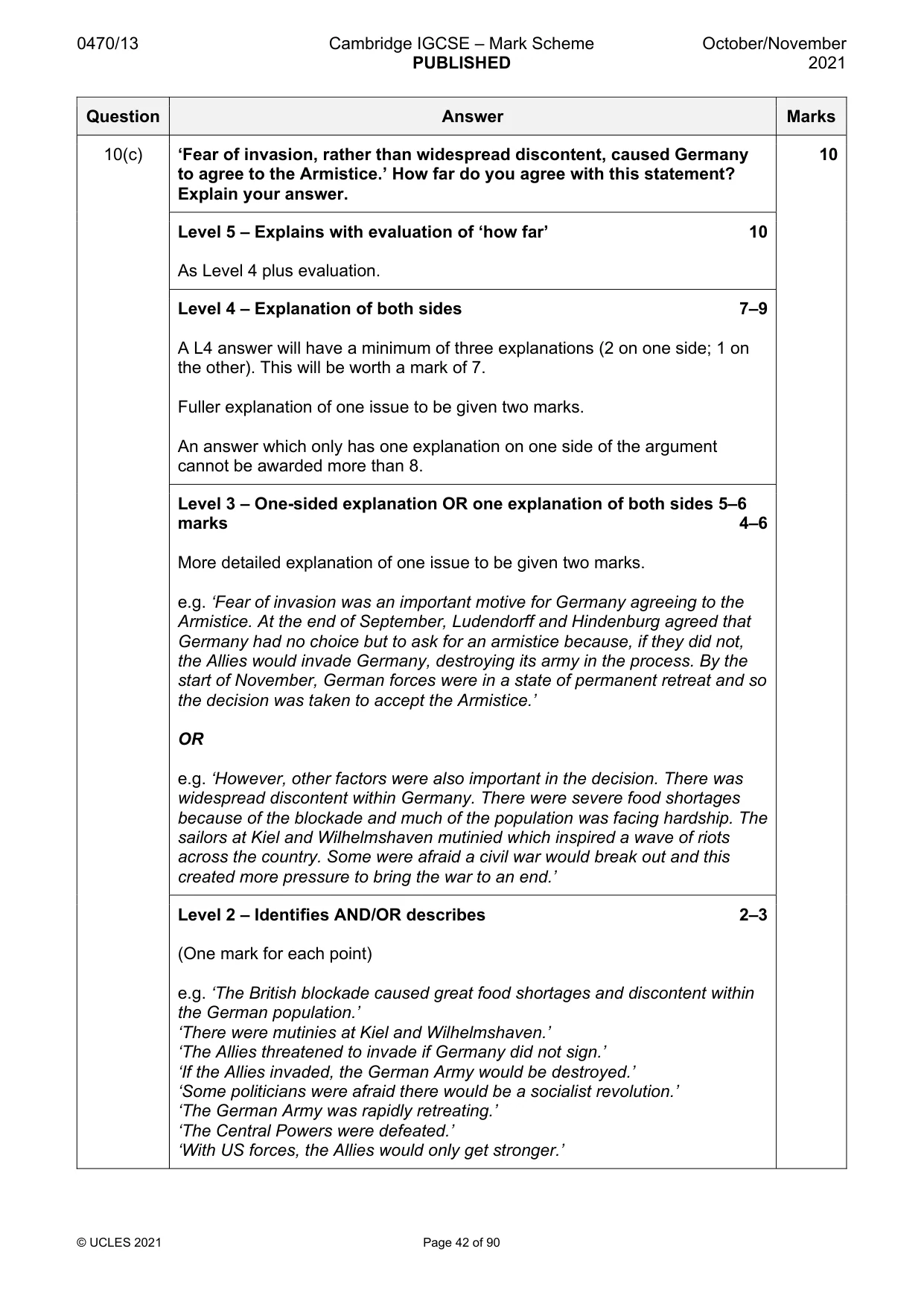
0470/13 Cambridge IGCSE – Mark Scheme PUBLISHED October/November 2021 © UCLES 2021 Page 42 of 90 Question Answer Marks 10(c) ‘Fear of invasion, rather than widespread discontent, caused Germany to agree to the Armistice.’ How far do you agree with this statement? Explain your answer. 10 Level 5 – Explains with evaluation of ‘how far’ 10 As Level 4 plus evaluation. Level 4 – Explanation of both sides 7–9 A L4 answer will have a minimum of three explanations (2 on one side; 1 on the other). This will be worth a mark of 7. Fuller explanation of one issue to be given two marks. An answer which only has one explanation on one side of the argument cannot be awarded more than 8. Level 3 – One-sided explanation OR one explanation of both sides 5–6 marks 4–6 More detailed explanation of one issue to be given two marks. e.g. ‘Fear of invasion was an important motive for Germany agreeing to the Armistice. At the end of September, Ludendorff and Hindenburg agreed that Germany had no choice but to ask for an armistice because, if they did not, the Allies would invade Germany, destroying its army in the process. By the start of November, German forces were in a state of permanent retreat and so the decision was taken to accept the Armistice.’ OR e.g. ‘However, other factors were also important in the decision. There was widespread discontent within Germany. There were severe food shortages because of the blockade and much of the population was facing hardship. The sailors at Kiel and Wilhelmshaven mutinied which inspired a wave of riots across the country. Some were afraid a civil war would break out and this created more pressure to bring the war to an end.’ Level 2 – Identifies AND/OR describes 2–3 (One mark for each point) e.g. ‘The British blockade caused great food shortages and discontent within the German population.’ ‘There were mutinies at Kiel and Wilhelmshaven.’ ‘The Allies threatened to invade if Germany did not sign.’ ‘If the Allies invaded, the German Army would be destroyed.’ ‘Some politicians were afraid there would be a socialist revolution.’ ‘The German Army was rapidly retreating.’ ‘The Central Powers were defeated.’ ‘With US forces, the Allies would only get stronger.’
Mark scheme, page 43
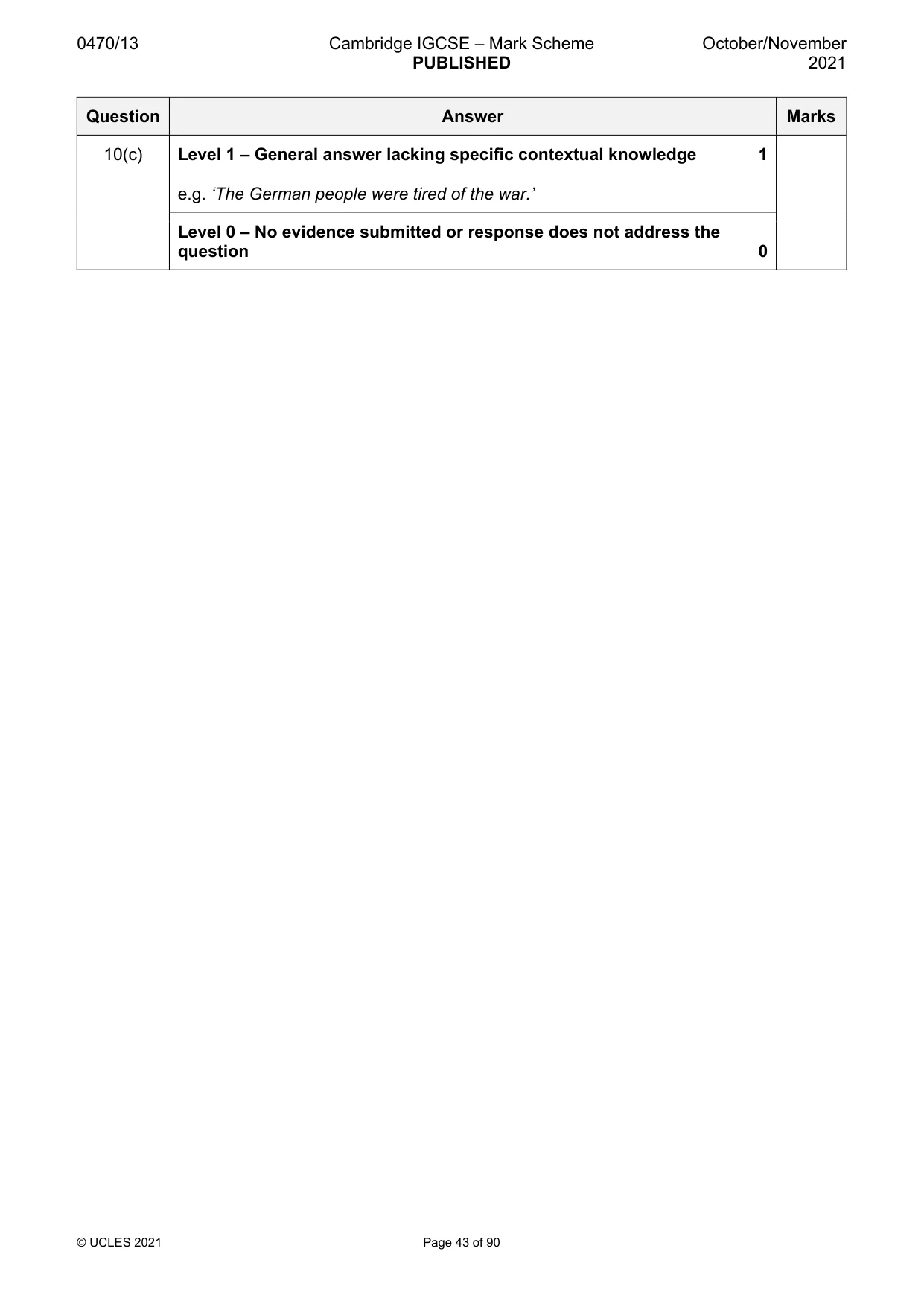
0470/13 Cambridge IGCSE – Mark Scheme PUBLISHED October/November 2021 © UCLES 2021 Page 43 of 90 Question Answer Marks 10(c) Level 1 – General answer lacking specific contextual knowledge 1 e.g. ‘The German people were tired of the war.’ Level 0 – No evidence submitted or response does not address the question 0
Mark scheme, page 44
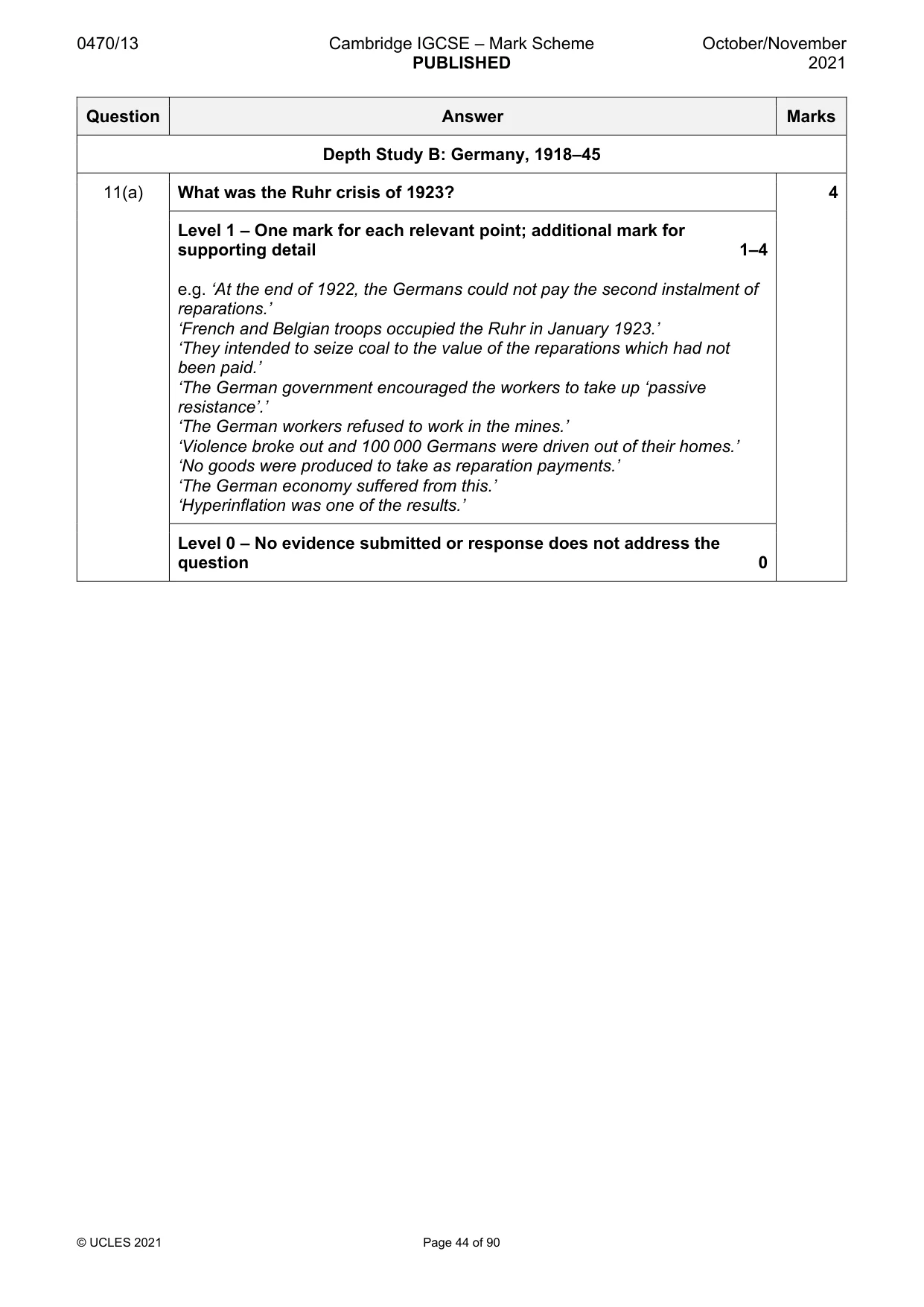
0470/13 Cambridge IGCSE – Mark Scheme PUBLISHED October/November 2021 © UCLES 2021 Page 44 of 90 Question Answer Marks Depth Study B: Germany, 1918–45 11(a) What was the Ruhr crisis of 1923? 4 Level 1 – One mark for each relevant point; additional mark for supporting detail 1–4 e.g. ‘At the end of 1922, the Germans could not pay the second instalment of reparations.’ ‘French and Belgian troops occupied the Ruhr in January 1923.’ ‘They intended to seize coal to the value of the reparations which had not been paid.’ ‘The German government encouraged the workers to take up ‘passive resistance’.’ ‘The German workers refused to work in the mines.’ ‘Violence broke out and 100 000 Germans were driven out of their homes.’ ‘No goods were produced to take as reparation payments.’ ‘The German economy suffered from this.’ ‘Hyperinflation was one of the results.’ Level 0 – No evidence submitted or response does not address the question 0
Mark scheme, page 45
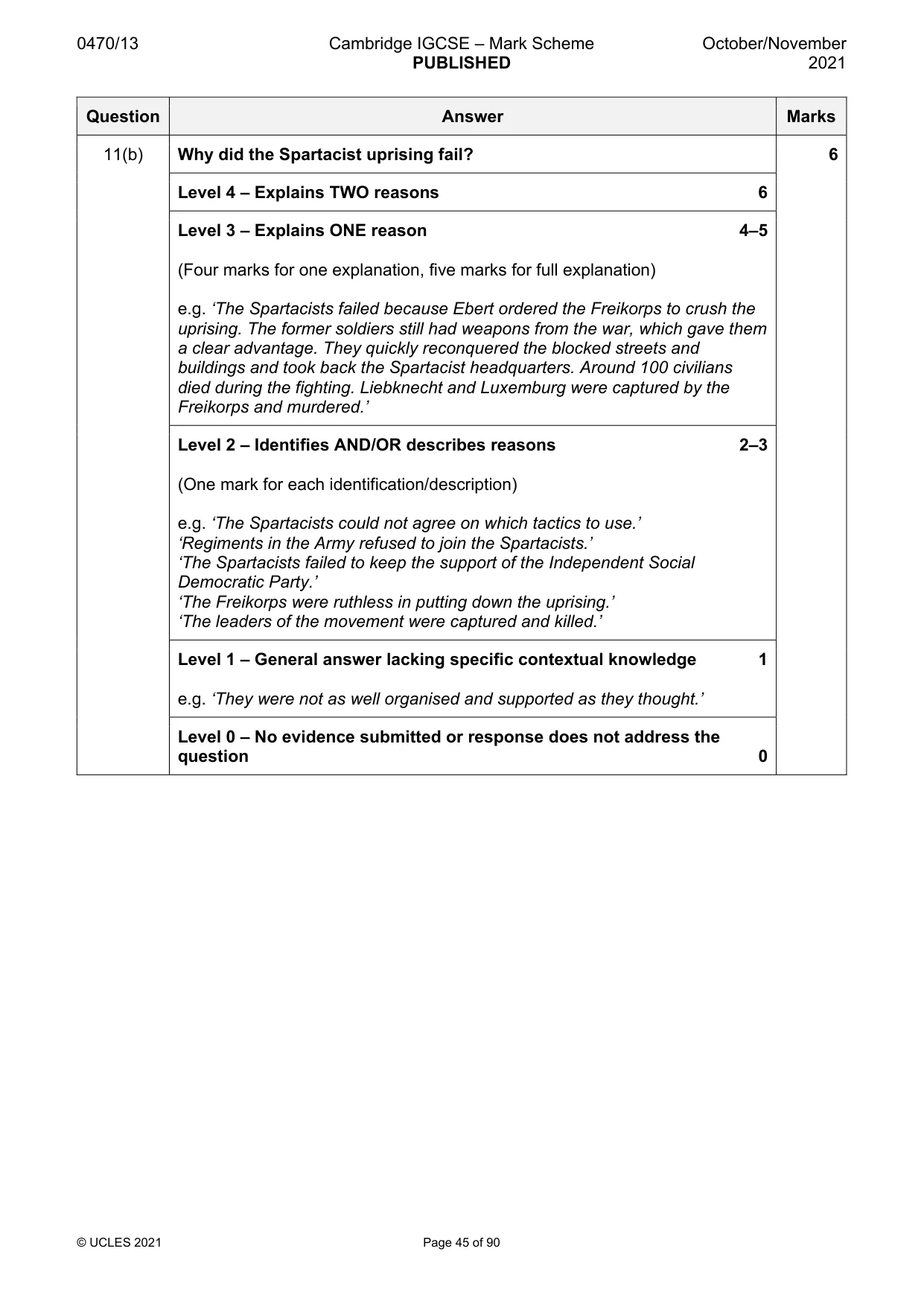
0470/13 Cambridge IGCSE – Mark Scheme PUBLISHED October/November 2021 © UCLES 2021 Page 45 of 90 Question Answer Marks 11(b) Why did the Spartacist uprising fail? 6 Level 4 – Explains TWO reasons 6 Level 3 – Explains ONE reason 4–5 (Four marks for one explanation, five marks for full explanation) e.g. ‘The Spartacists failed because Ebert ordered the Freikorps to crush the uprising. The former soldiers still had weapons from the war, which gave them a clear advantage. They quickly reconquered the blocked streets and buildings and took back the Spartacist headquarters. Around 100 civilians died during the fighting. Liebknecht and Luxemburg were captured by the Freikorps and murdered.’ Level 2 – Identifies AND/OR describes reasons 2–3 (One mark for each identification/description) e.g. ‘The Spartacists could not agree on which tactics to use.’ ‘Regiments in the Army refused to join the Spartacists.’ ‘The Spartacists failed to keep the support of the Independent Social Democratic Party.’ ‘The Freikorps were ruthless in putting down the uprising.’ ‘The leaders of the movement were captured and killed.’ Level 1 – General answer lacking specific contextual knowledge 1 e.g. ‘They were not as well organised and supported as they thought.’ Level 0 – No evidence submitted or response does not address the question 0
Mark scheme, page 46
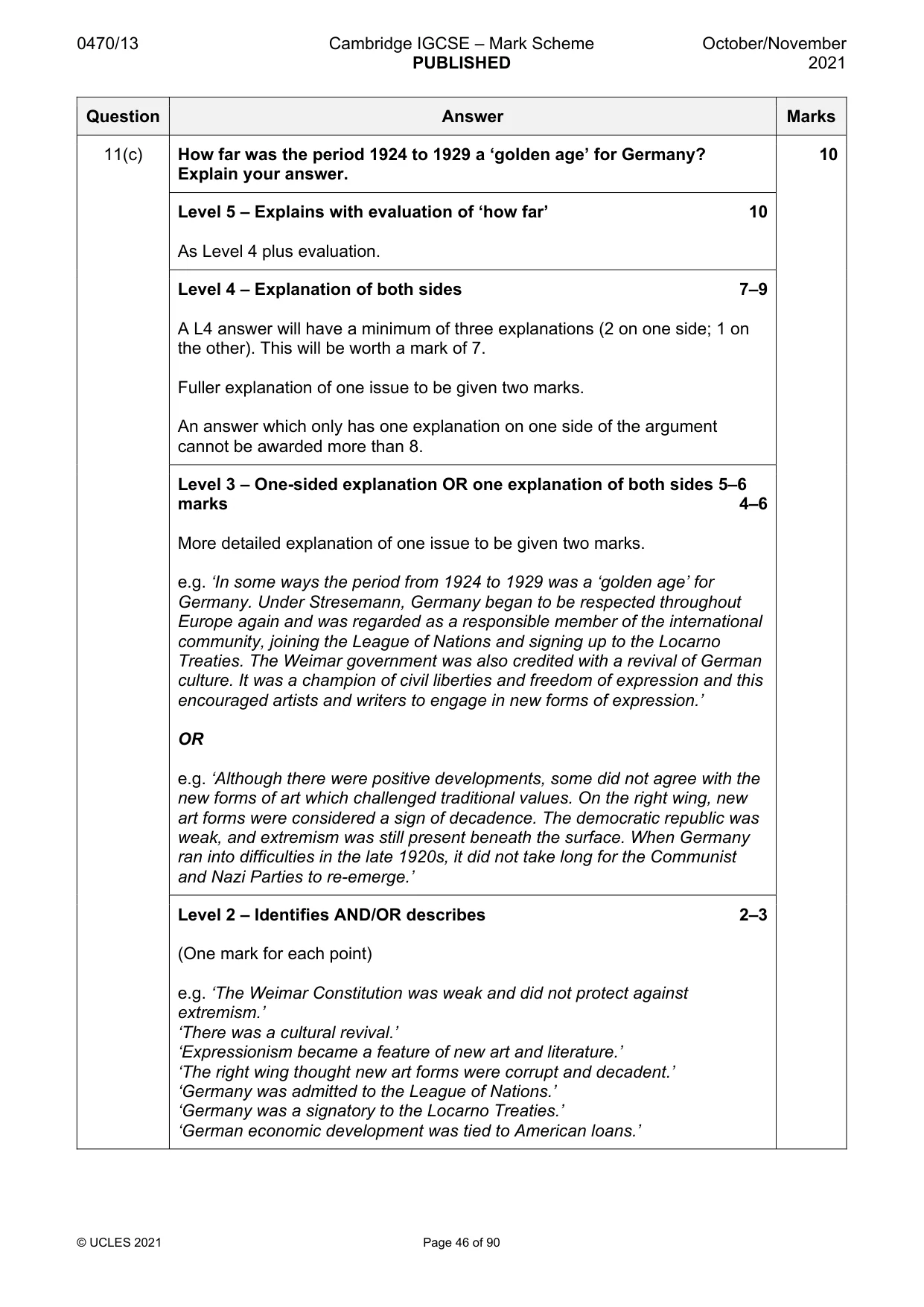
0470/13 Cambridge IGCSE – Mark Scheme PUBLISHED October/November 2021 © UCLES 2021 Page 46 of 90 Question Answer Marks 11(c) How far was the period 1924 to 1929 a ‘golden age’ for Germany? Explain your answer. 10 Level 5 – Explains with evaluation of ‘how far’ 10 As Level 4 plus evaluation. Level 4 – Explanation of both sides 7–9 A L4 answer will have a minimum of three explanations (2 on one side; 1 on the other). This will be worth a mark of 7. Fuller explanation of one issue to be given two marks. An answer which only has one explanation on one side of the argument cannot be awarded more than 8. Level 3 – One-sided explanation OR one explanation of both sides 5–6 marks 4–6 More detailed explanation of one issue to be given two marks. e.g. ‘In some ways the period from 1924 to 1929 was a ‘golden age’ for Germany. Under Stresemann, Germany began to be respected throughout Europe again and was regarded as a responsible member of the international community, joining the League of Nations and signing up to the Locarno Treaties. The Weimar government was also credited with a revival of German culture. It was a champion of civil liberties and freedom of expression and this encouraged artists and writers to engage in new forms of expression.’ OR e.g. ‘Although there were positive developments, some did not agree with the new forms of art which challenged traditional values. On the right wing, new art forms were considered a sign of decadence. The democratic republic was weak, and extremism was still present beneath the surface. When Germany ran into difficulties in the late 1920s, it did not take long for the Communist and Nazi Parties to re-emerge.’ Level 2 – Identifies AND/OR describes 2–3 (One mark for each point) e.g. ‘The Weimar Constitution was weak and did not protect against extremism.’ ‘There was a cultural revival.’ ‘Expressionism became a feature of new art and literature.’ ‘The right wing thought new art forms were corrupt and decadent.’ ‘Germany was admitted to the League of Nations.’ ‘Germany was a signatory to the Locarno Treaties.’ ‘German economic development was tied to American loans.’
Mark scheme, page 47
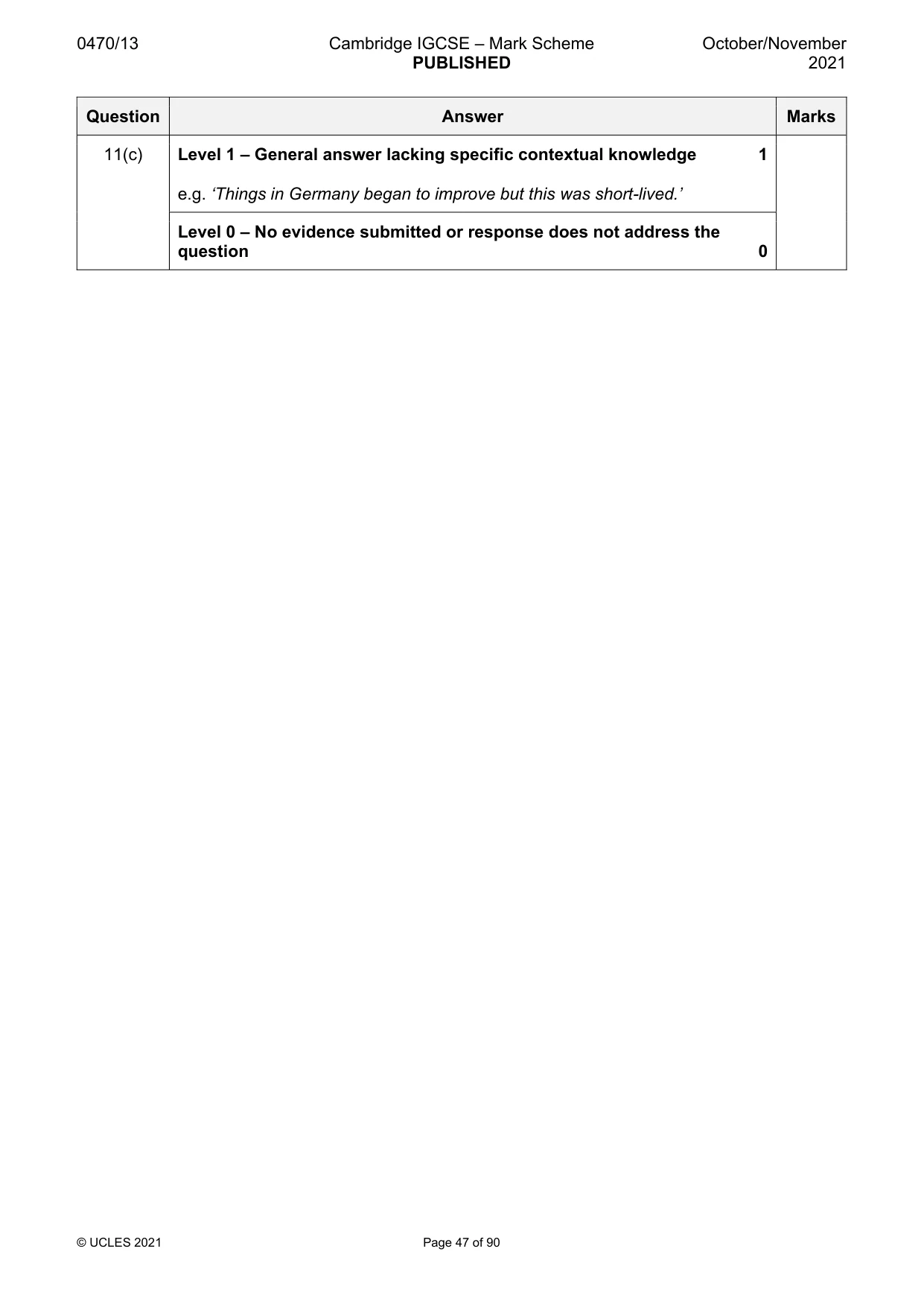
0470/13 Cambridge IGCSE – Mark Scheme PUBLISHED October/November 2021 © UCLES 2021 Page 47 of 90 Question Answer Marks 11(c) Level 1 – General answer lacking specific contextual knowledge 1 e.g. ‘Things in Germany began to improve but this was short-lived.’ Level 0 – No evidence submitted or response does not address the question 0
Mark scheme, page 48
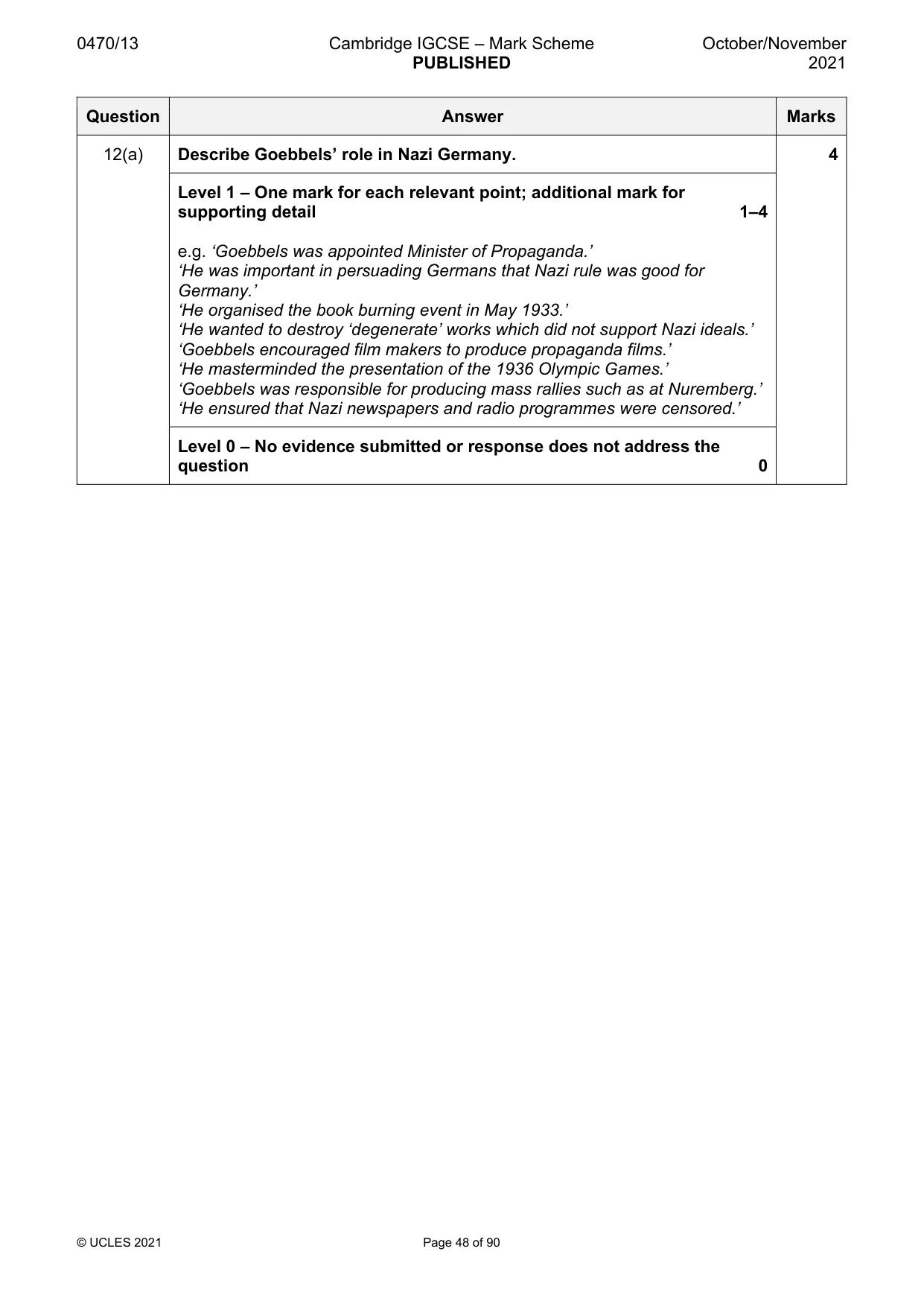
0470/13 Cambridge IGCSE – Mark Scheme PUBLISHED October/November 2021 © UCLES 2021 Page 48 of 90 Question Answer Marks 12(a) Describe Goebbels’ role in Nazi Germany. 4 Level 1 – One mark for each relevant point; additional mark for supporting detail 1–4 e.g. ‘Goebbels was appointed Minister of Propaganda.’ ‘He was important in persuading Germans that Nazi rule was good for Germany.’ ‘He organised the book burning event in May 1933.’ ‘He wanted to destroy ‘degenerate’ works which did not support Nazi ideals.’ ‘Goebbels encouraged film makers to produce propaganda films.’ ‘He masterminded the presentation of the 1936 Olympic Games.’ ‘Goebbels was responsible for producing mass rallies such as at Nuremberg.’ ‘He ensured that Nazi newspapers and radio programmes were censored.’ Level 0 – No evidence submitted or response does not address the question 0
Mark scheme, page 49
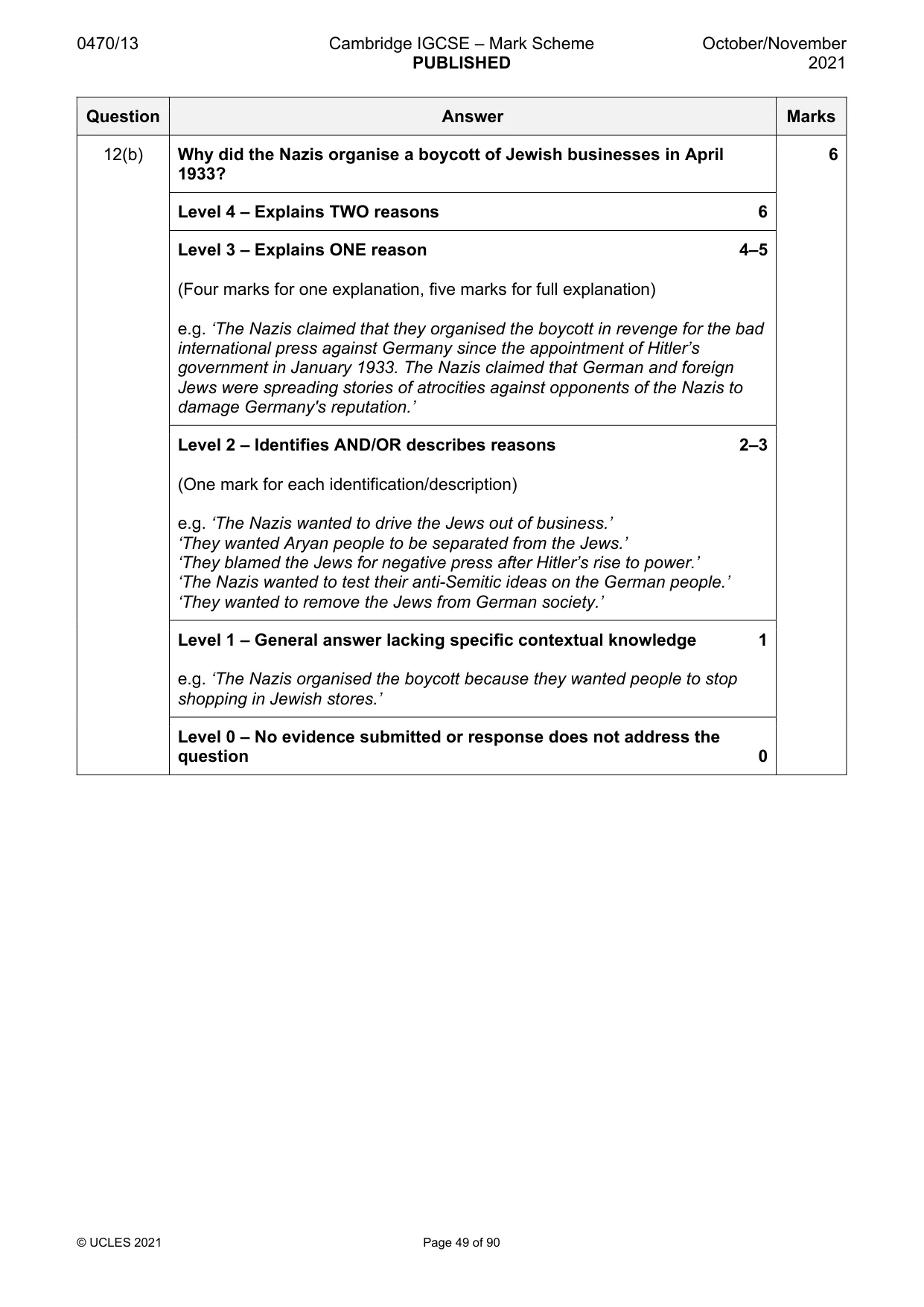
0470/13 Cambridge IGCSE – Mark Scheme PUBLISHED October/November 2021 © UCLES 2021 Page 49 of 90 Question Answer Marks 12(b) Why did the Nazis organise a boycott of Jewish businesses in April 1933? 6 Level 4 – Explains TWO reasons 6 Level 3 – Explains ONE reason 4–5 (Four marks for one explanation, five marks for full explanation) e.g. ‘The Nazis claimed that they organised the boycott in revenge for the bad international press against Germany since the appointment of Hitler’s government in January 1933. The Nazis claimed that German and foreign Jews were spreading stories of atrocities against opponents of the Nazis to damage Germany's reputation.’ Level 2 – Identifies AND/OR describes reasons 2–3 (One mark for each identification/description) e.g. ‘The Nazis wanted to drive the Jews out of business.’ ‘They wanted Aryan people to be separated from the Jews.’ ‘They blamed the Jews for negative press after Hitler’s rise to power.’ ‘The Nazis wanted to test their anti-Semitic ideas on the German people.’ ‘They wanted to remove the Jews from German society.’ Level 1 – General answer lacking specific contextual knowledge 1 e.g. ‘The Nazis organised the boycott because they wanted people to stop shopping in Jewish stores.’ Level 0 – No evidence submitted or response does not address the question 0
Mark scheme, page 50
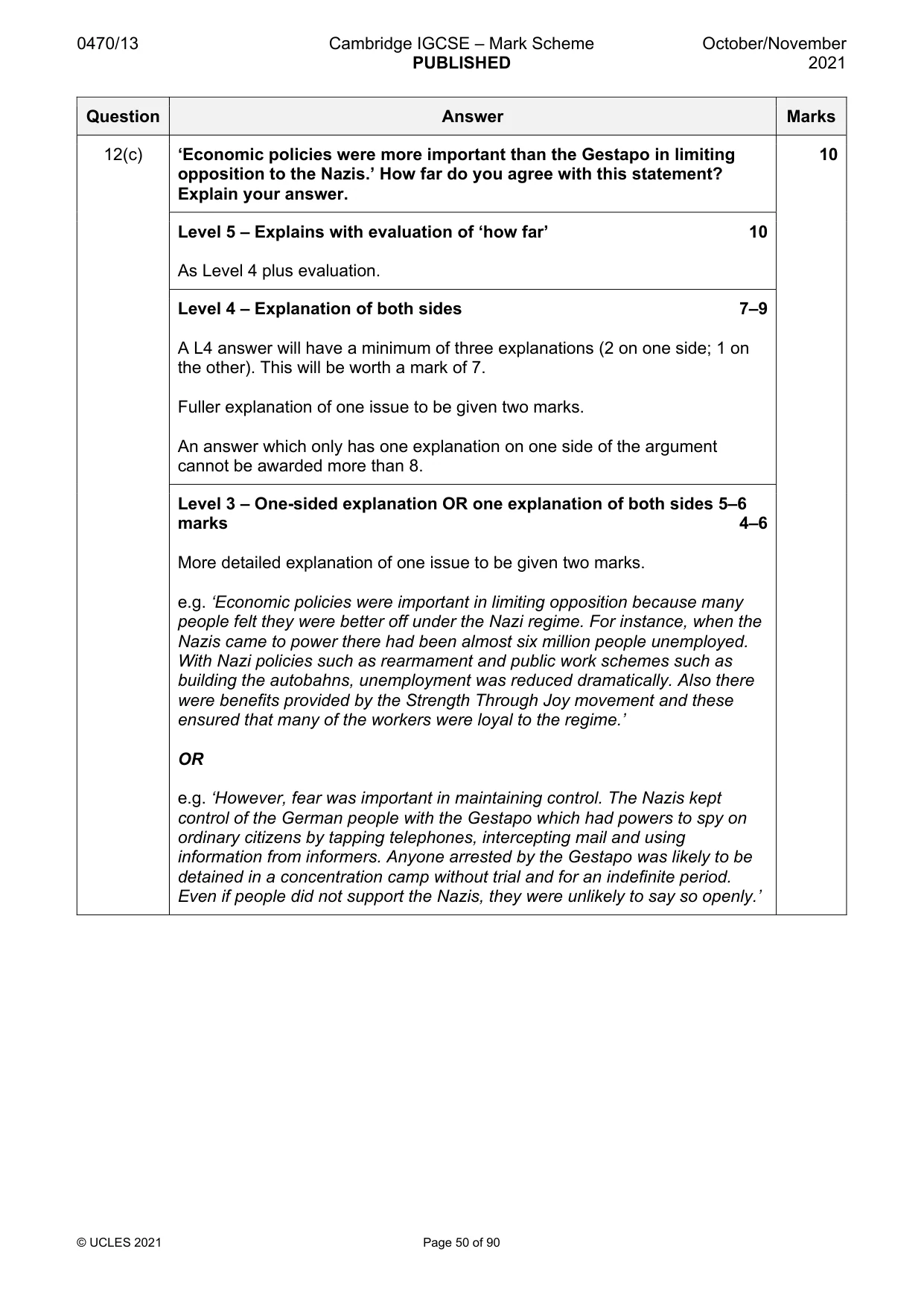
0470/13 Cambridge IGCSE – Mark Scheme PUBLISHED October/November 2021 © UCLES 2021 Page 50 of 90 Question Answer Marks 12(c) ‘Economic policies were more important than the Gestapo in limiting opposition to the Nazis.’ How far do you agree with this statement? Explain your answer. 10 Level 5 – Explains with evaluation of ‘how far’ 10 As Level 4 plus evaluation. Level 4 – Explanation of both sides 7–9 A L4 answer will have a minimum of three explanations (2 on one side; 1 on the other). This will be worth a mark of 7. Fuller explanation of one issue to be given two marks. An answer which only has one explanation on one side of the argument cannot be awarded more than 8. Level 3 – One-sided explanation OR one explanation of both sides 5–6 marks 4–6 More detailed explanation of one issue to be given two marks. e.g. ‘Economic policies were important in limiting opposition because many people felt they were better off under the Nazi regime. For instance, when the Nazis came to power there had been almost six million people unemployed. With Nazi policies such as rearmament and public work schemes such as building the autobahns, unemployment was reduced dramatically. Also there were benefits provided by the Strength Through Joy movement and these ensured that many of the workers were loyal to the regime.’ OR e.g. ‘However, fear was important in maintaining control. The Nazis kept control of the German people with the Gestapo which had powers to spy on ordinary citizens by tapping telephones, intercepting mail and using information from informers. Anyone arrested by the Gestapo was likely to be detained in a concentration camp without trial and for an indefinite period. Even if people did not support the Nazis, they were unlikely to say so openly.’
Mark scheme, page 51
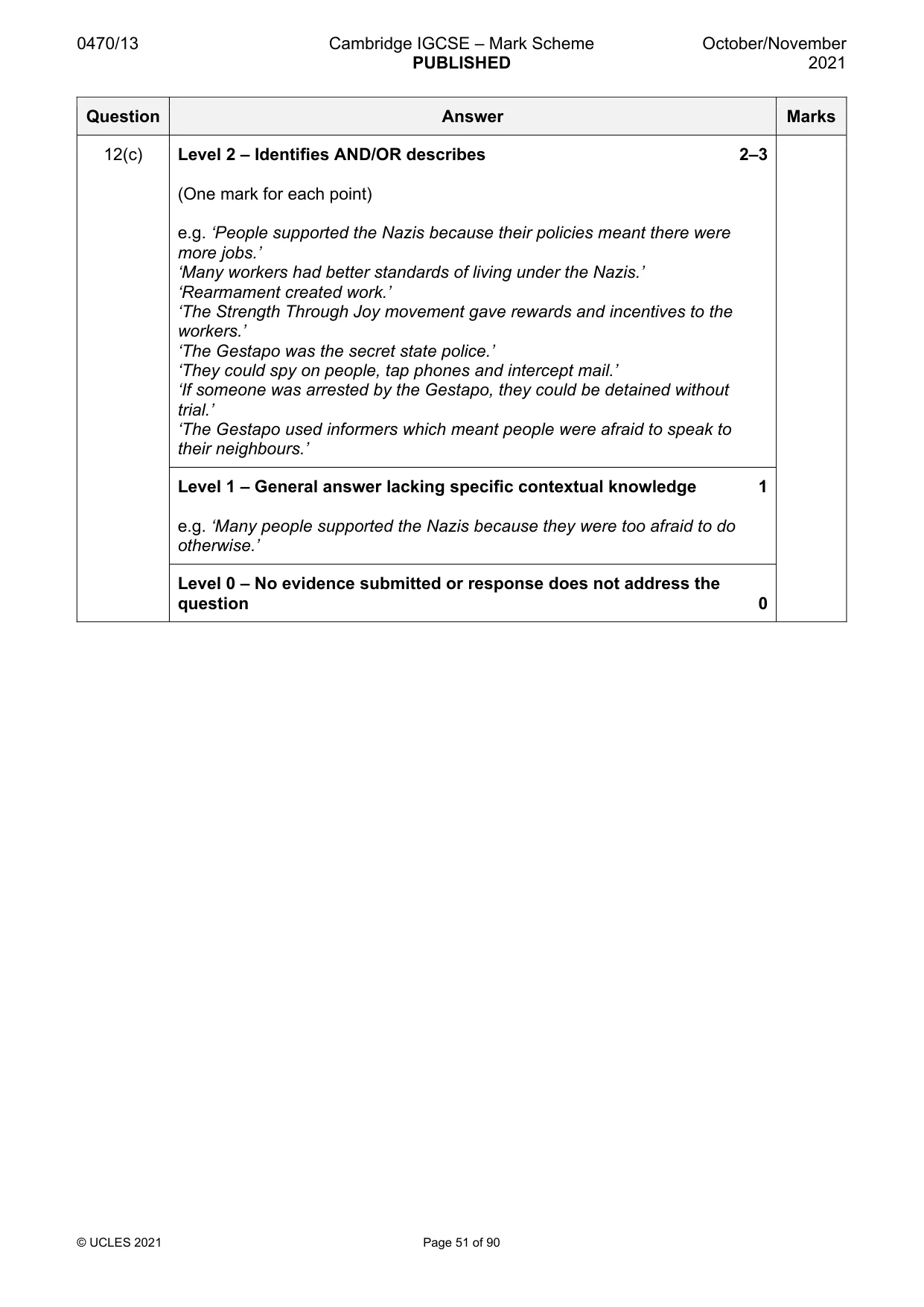
0470/13 Cambridge IGCSE – Mark Scheme PUBLISHED October/November 2021 © UCLES 2021 Page 51 of 90 Question Answer Marks 12(c) Level 2 – Identifies AND/OR describes 2–3 (One mark for each point) e.g. ‘People supported the Nazis because their policies meant there were more jobs.’ ‘Many workers had better standards of living under the Nazis.’ ‘Rearmament created work.’ ‘The Strength Through Joy movement gave rewards and incentives to the workers.’ ‘The Gestapo was the secret state police.’ ‘They could spy on people, tap phones and intercept mail.’ ‘If someone was arrested by the Gestapo, they could be detained without trial.’ ‘The Gestapo used informers which meant people were afraid to speak to their neighbours.’ Level 1 – General answer lacking specific contextual knowledge 1 e.g. ‘Many people supported the Nazis because they were too afraid to do otherwise.’ Level 0 – No evidence submitted or response does not address the question 0
Mark scheme, page 52
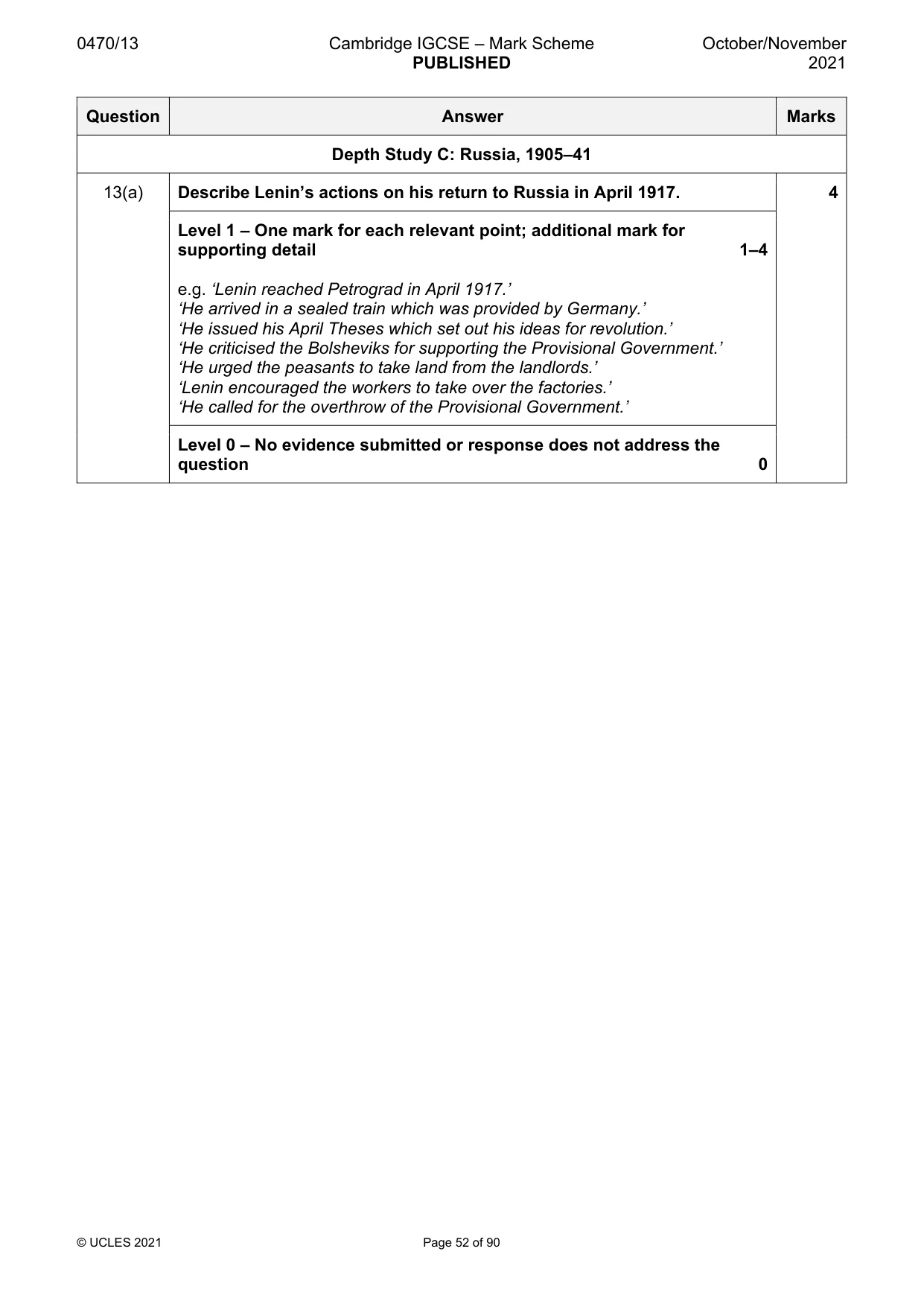
0470/13 Cambridge IGCSE – Mark Scheme PUBLISHED October/November 2021 © UCLES 2021 Page 52 of 90 Question Answer Marks Depth Study C: Russia, 1905–41 13(a) Describe Lenin’s actions on his return to Russia in April 1917. 4 Level 1 – One mark for each relevant point; additional mark for supporting detail 1–4 e.g. ‘Lenin reached Petrograd in April 1917.’ ‘He arrived in a sealed train which was provided by Germany.’ ‘He issued his April Theses which set out his ideas for revolution.’ ‘He criticised the Bolsheviks for supporting the Provisional Government.’ ‘He urged the peasants to take land from the landlords.’ ‘Lenin encouraged the workers to take over the factories.’ ‘He called for the overthrow of the Provisional Government.’ Level 0 – No evidence submitted or response does not address the question 0
Mark scheme, page 53
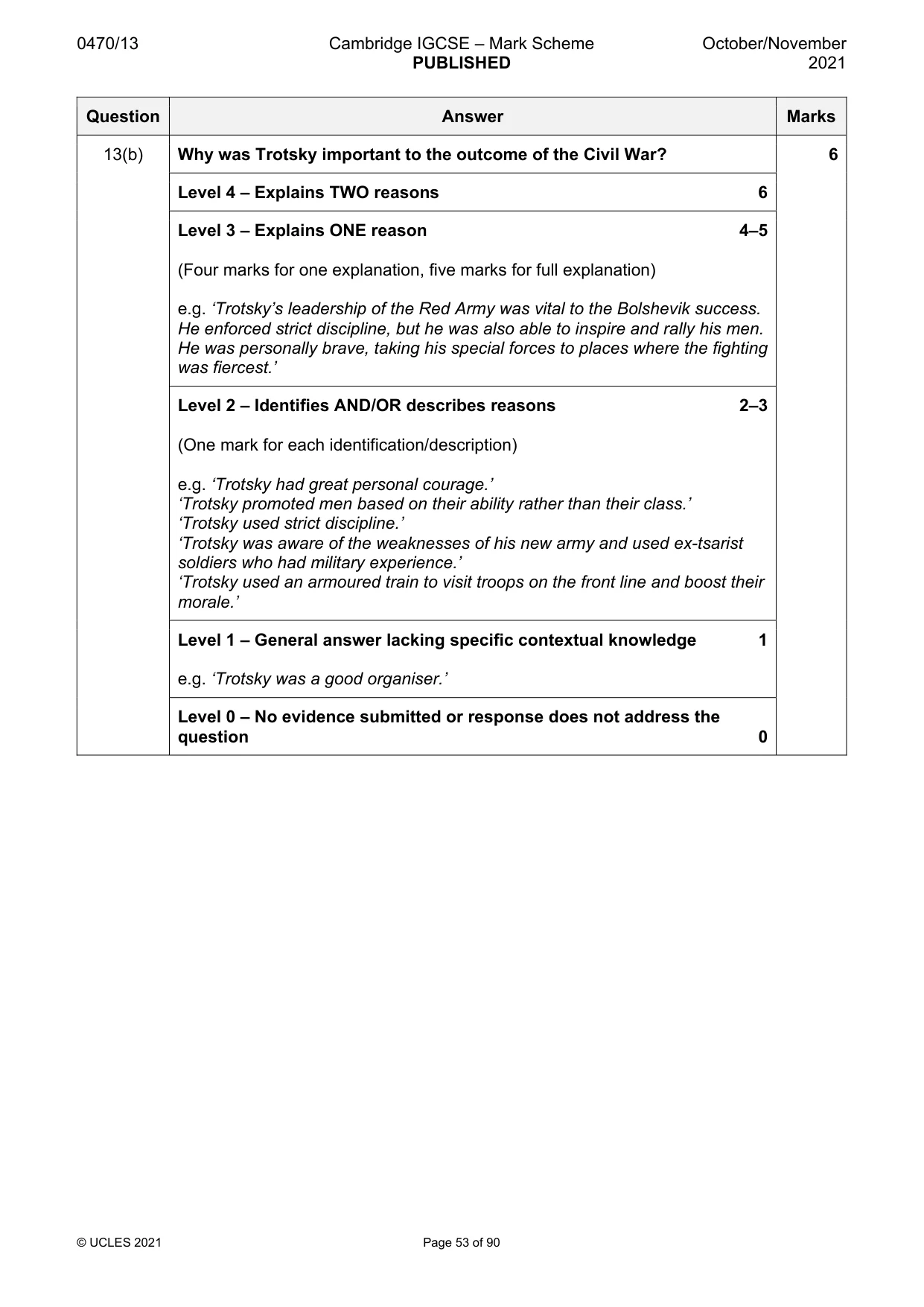
0470/13 Cambridge IGCSE – Mark Scheme PUBLISHED October/November 2021 © UCLES 2021 Page 53 of 90 Question Answer Marks 13(b) Why was Trotsky important to the outcome of the Civil War? 6 Level 4 – Explains TWO reasons 6 Level 3 – Explains ONE reason 4–5 (Four marks for one explanation, five marks for full explanation) e.g. ‘Trotsky’s leadership of the Red Army was vital to the Bolshevik success. He enforced strict discipline, but he was also able to inspire and rally his men. He was personally brave, taking his special forces to places where the fighting was fiercest.’ Level 2 – Identifies AND/OR describes reasons 2–3 (One mark for each identification/description) e.g. ‘Trotsky had great personal courage.’ ‘Trotsky promoted men based on their ability rather than their class.’ ‘Trotsky used strict discipline.’ ‘Trotsky was aware of the weaknesses of his new army and used ex-tsarist soldiers who had military experience.’ ‘Trotsky used an armoured train to visit troops on the front line and boost their morale.’ Level 1 – General answer lacking specific contextual knowledge 1 e.g. ‘Trotsky was a good organiser.’ Level 0 – No evidence submitted or response does not address the question 0
Mark scheme, page 54
0470/13 Cambridge IGCSE – Mark Scheme PUBLISHED October/November 2021 © UCLES 2021 Page 54 of 90 Question Answer Marks 13(c) ‘War Communism was a failure.’ How far do you agree with this statement? Explain your answer. 10 Level 5 – Explains with evaluation of ‘how far’ 10 As Level 4 plus evaluation. Level 4 – Explanation of both sides 7–9 A L4 answer will have a minimum of three explanations (2 on one side; 1 on the other). This will be worth a mark of 7. Fuller explanation of one issue to be given two marks. An answer which only has one explanation on one side of the argument cannot be awarded more than 8. Level 3 – One-sided explanation OR one explanation of both sides 5–6 marks 4–6 More detailed explanation of one issue to be given two marks. e.g. ‘War Communism was not a failure because it meant that the Red Army was well equipped and fed. The state took over all aspects of the economy, nationalising industry and controlling the production and distribution of goods. Although the rules were very harsh (striking workers could be shot), the policy meant that the Reds were able to win the Civil War.’ OR e.g. ‘In the longer term, War Communism was a failure as it caused many hardships, especially for the peasants. They refused to cooperate in food production as the government requisitioned most of it. Workers began to move back to the countryside as they felt they were more likely to get food there. By 1921, industrial output was falling dramatically as there were too few workers. Eventually, the sailors at the Kronstadt Naval Base revolted in response to the policy and it had to be replaced.’ Level 2 – Identifies AND/OR describes 2–3 (One mark for each point) e.g. ‘War Communism kept the Red Army supplied.’ ‘It was government organised with strict discipline.’ ‘The government oversaw output and focused on what was needed to win the war.’ ‘Food was rationed.’ ‘The peasants hated the policy and refused to cooperate.’ ‘The policy resulted in a famine which killed millions.’ ‘Large numbers of workers left the industrial cities to find food in the countryside.’ ‘The hardship caused by the policy was one factor which led to the Kronstadt Mutiny.’
Mark scheme, page 55
0470/13 Cambridge IGCSE – Mark Scheme PUBLISHED October/November 2021 © UCLES 2021 Page 55 of 90 Question Answer Marks 13(c) Level 1 – General answer lacking specific contextual knowledge 1 e.g. ‘War Communism had some benefits but also some drawbacks.’ Level 0 – No evidence submitted or response does not address the question 0
Mark scheme, page 56
0470/13 Cambridge IGCSE – Mark Scheme PUBLISHED October/November 2021 © UCLES 2021 Page 56 of 90 Question Answer Marks 14(a) Describe the different political ideas of Stalin and Trotsky. 4 Level 1 – One mark for each relevant point; additional mark for supporting detail 1–4 e.g. ‘Stalin believed in ‘Socialism in one country’.’ ‘Stalin thought Russia should focus on its own development.’ ‘Stalin believed Russia should become a model communist state for the world to follow.’ ‘Stalin’s ideas were considered patriotic as Russia would build itself up without support from the outside.’ ‘Trotsky believed in ‘Permanent Revolution’.’ ‘Trotsky believed Russia should encourage world revolution.’ ‘Trotsky thought Russia should support the working class everywhere to stage revolutions.’ ‘Trotsky also believed that compulsory labour and collectivisation might be necessary.’ Level 0 – No evidence submitted or response does not address the question 0
Mark scheme, page 57
0470/13 Cambridge IGCSE – Mark Scheme PUBLISHED October/November 2021 © UCLES 2021 Page 57 of 90 Question Answer Marks 14(b) Why did Stalin survive Lenin’s criticism in his political testament? 6 Level 4 – Explains TWO reasons 6 Level 3 – Explains ONE reason 4–5 (Four marks for one explanation, five marks for full explanation) e.g. ‘Stalin survived Lenin’s criticism of him because Lenin’s political testament was not published in Russia. Lenin had been critical of Stalin, but he was also critical of other leaders of the Bolsheviks such as Zinoviev and Kamenev. They were concerned that if the political testament were made public, it would help Trotsky. Therefore they urged the Central Committee not to publish the testament. Meanwhile, Trotsky remained silent on the issue of publication.’ Level 2 – Identifies AND/OR describes reasons 2–3 (One mark for each identification/description) e.g. ‘Lenin’s political testament was not published.’ ‘Stalin was already General Secretary of the Communist Party.’ ‘Lenin’s funeral was held before the testament was read out and Stalin tricked Trotsky into not attending.’ ‘Stalin made himself appear to be Lenin’s chief mourner.’ ‘Zinoviev and Kamenev were also criticised in the testament.’ ‘Trotsky’s opponents were concerned that publishing the testament would help him achieve power.’ Level 1 – General answer lacking specific contextual knowledge 1 e.g. ‘Stalin survived because he was a cunning individual.’ Level 0 – No evidence submitted or response does not address the question 0
Mark scheme, page 58
0470/13 Cambridge IGCSE – Mark Scheme PUBLISHED October/November 2021 © UCLES 2021 Page 58 of 90 Question Answer Marks 14(c) ‘Stalin was more loved than feared in the USSR up to 1941.’ How far do you agree with this statement? Explain your answer. 10 Level 5 – Explains with evaluation of ‘how far’ 10 As Level 4 plus evaluation. Level 4 – Explanation of both sides 7–9 A L4 answer will have a minimum of three explanations (2 on one side; 1 on the other). This will be worth a mark of 7. Fuller explanation of one issue to be given two marks. An answer which only has one explanation on one side of the argument cannot be awarded more than 8. Level 3 – One-sided explanation OR one explanation of both sides 5–6 marks 4–6 More detailed explanation of one issue to be given two marks. e.g. ‘Stalin was genuinely popular with some sections of Soviet society. Many workers looked up to Stalin because he had brought great changes to the USSR. By the end of the 1930s, the Soviet Union had a strong industrial base and there were opportunities in education for men and women. Many of the industrial projects depended on volunteers who willingly worked in harsh conditions to help build Soviet industry. These people must have believed in what Stalin wanted to achieve for the Soviet Union.’ OR e.g. ‘However, many people lived in fear; those who opposed Stalin were dealt with harshly. Millions of kulaks were deported or killed for opposing collectivisation. The NKVD arrested people seemingly at random, and almost 20 million were sent to the gulags. Everyone lived in fear of being denounced by a neighbour or work colleague.’ Level 2 – Identifies AND/OR describes 2–3 (One mark for each point) e.g. ‘Stalin had a huge personality cult which made it appear that the Soviet people loved him.’ ‘He was portrayed as a father figure who cared about his people.’ ‘Workers supported his policies which made the USSR industrially strong.’ ‘His policies brought educational opportunities for many.’ ‘Millions died in labour camps.’ ‘People lived in fear of the NKVD.’ ‘People were encouraged to denounce their neighbours.’
Mark scheme, page 59
0470/13 Cambridge IGCSE – Mark Scheme PUBLISHED October/November 2021 © UCLES 2021 Page 59 of 90 Question Answer Marks 14(c) Level 1 – General answer lacking specific contextual knowledge 1 e.g. ‘Stalin controlled all aspects of life in the USSR.’ Level 0 – No evidence submitted or response does not address the question 0
Mark scheme, page 60
0470/13 Cambridge IGCSE – Mark Scheme PUBLISHED October/November 2021 © UCLES 2021 Page 60 of 90 Question Answer Marks Depth Study D: The United States, 1919–41 15(a) Describe the activities of gangsters in the 1920s. 4 Level 1 – One mark for each relevant point; additional mark for supporting detail 1–4 e.g. ‘Gangsters smuggled illegal alcohol into the United States.’ ‘They often bribed policemen and officials to ignore this.’ ‘There were shootouts between rival gangs such as the Valentine’s Day Massacre in 1929.’ ‘Gangs fought for control of areas of different cities.’ ‘Gangs fought for control of the alcohol smuggling business.’ ‘Often they ran protection rackets where business owners paid to protect their property.’ ‘Rival gang members were often murdered.’ ‘There were 130 gangland murders between 1926 and 1927 in Chicago.’ Level 0 – No evidence submitted or response does not address the question 0
Mark scheme, page 61
0470/13 Cambridge IGCSE – Mark Scheme PUBLISHED October/November 2021 © UCLES 2021 Page 61 of 90 Question Answer Marks 15(b) Why was the Sacco and Vanzetti case important? 6 Level 4 – Explains TWO reasons 6 Level 3 – Explains ONE reason 4–5 (Four marks for one explanation, five marks for full explanation) e.g. ‘The Sacco and Vanzetti case was important because it showed that racism was present, even at the highest level of the judicial system in the United States. Sacco and Vanzetti were Italian Americans and anarchists. They were arrested on suspicion of armed robbery and murder. The evidence against them was thin but the prosecution in the court case focused on their radical ideas. The judge said that they might not be guilty of the offence but were morally to blame because they were enemies of the US’s existing institutions. They were found guilty and executed.’ Level 2 – Identifies AND/OR describes reasons 2–3 (One mark for each identification/description) e.g. ‘Sacco and Vanzetti were not given a fair trial.’ ‘The trial took place at the height of the ‘Red Scare’.’ ‘The prosecution played on racist slurs and fears about their radical beliefs.’ ‘The judge was biased.’ ‘The case showed the US to be intolerant of other races and political beliefs.’ ‘There were 6 years of legal appeals before their execution.’ ‘The trial attracted world-wide protests.’ Level 1 – General answer lacking specific contextual knowledge 1 e.g. ‘The case showed that the US was not a fair society.’ Level 0 – No evidence submitted or response does not address the question 0
Mark scheme, page 62
0470/13 Cambridge IGCSE – Mark Scheme PUBLISHED October/November 2021 © UCLES 2021 Page 62 of 90 Question Answer Marks 15(c) ‘The 1920s brought increased freedom for American women.’ How far do you agree with this statement? Explain your answer. 10 Level 5 – Explains with evaluation of ‘how far’ 10 As Level 4 plus evaluation. Level 4 – Explanation of both sides 7–9 A L4 answer will have a minimum of three explanations (2 on one side; 1 on the other). This will be worth a mark of 7. Fuller explanation of one issue to be given two marks. An answer which only has one explanation on one side of the argument cannot be awarded more than 8. Level 3 – One-sided explanation OR one explanation of both sides 5–6 marks 4–6 More detailed explanation of one issue to be given two marks. e.g. ‘The 1920s brought increased freedom for some women. The number of women in employment increased by 25% to 10 million by 1929. Office work and manufacturing accounted for much of the increase and in some new industries, such as electronics, women were preferred to men. The lifestyle of many women changed in the 1920s. Before the war, women were expected to be modest and discrete. This meant no drinking or smoking and, if unmarried, no male company without a chaperone. In the 1920s, many women took up smoking, wore shorter dresses and, in urban areas, went out with male friends without a chaperone.’ OR e.g. ‘However, for many women life did not change radically. Despite the stories of flappers, most were housewives raising a family. This was particularly true for those living in rural areas where there was greater control exercised on society by the church. Even women who gained employment in the 1920s often found themselves lower paid than men in the same roles.’
Mark scheme, page 63
0470/13 Cambridge IGCSE – Mark Scheme PUBLISHED October/November 2021 © UCLES 2021 Page 63 of 90 Question Answer Marks 15(c) Level 2 – Identifies AND/OR describes 2–3 (One mark for each point) e.g. ‘The number of women in employment increased by a quarter in the 1920s.’ ‘Office work and jobs in manufacturing were the most popular.’ ‘Women got the vote in all states.’ ‘Women’s fashions changed.’ ‘There were new fashions and materials, such as rayon.’ ‘Having short hair and wearing make-up became symbols of the new freedom.’ ‘Ford introduced different colour cars in 1925 for the female market.’ ‘The changes brought in by the ‘flappers’ did not affect most women.’ ‘Women in small communities and rural areas tended to continue their traditional roles.’ ‘Labour-saving devices, such as washing machines, were still only owned by a minority.’ Level 1 – General answer lacking specific contextual knowledge 1 e.g. ‘Life didn’t change much for most women in the 1920s.’ Level 0 – No evidence submitted or response does not address the question 0
Mark scheme, page 64
0470/13 Cambridge IGCSE – Mark Scheme PUBLISHED October/November 2021 © UCLES 2021 Page 64 of 90 Question Answer Marks 16(a) What happened on Wall Street in October 1929? 4 Level 1 – One mark for each relevant point; additional mark for supporting detail 1–4 e.g. ‘Black Thursday happened on 24 October 1929.’ ‘Share prices lost over 20% of their value on Black Thursday.’ ‘People started panic-selling their shares.’ ‘Panic-selling led to a crash in the stock market.’ ‘On Black Tuesday (29 October) share prices fell even further.’ ‘Many Americans who had bought shares on the stock market lost everything.’ ‘Many lost their savings and homes, and some banks went bankrupt.’ Level 0 – No evidence submitted or response does not address the question 0
Mark scheme, page 65
0470/13 Cambridge IGCSE – Mark Scheme PUBLISHED October/November 2021 © UCLES 2021 Page 65 of 90 Question Answer Marks 16(b) Why did overproduction contribute to the problems facing the American economy? 6 Level 4 – Explains TWO reasons 6 Level 3 – Explains ONE reason 4–5 (Four marks for one explanation, five marks for full explanation) e.g. ‘Overproduction contributed to the problems facing the American economy because more products were being made than could be sold. Mass production meant that goods could be produced quickly and in large numbers. Soon the market became saturated as Americans had all the consumer goods they needed and demand for these items fell. Factories cut back production which meant reduced workforces and fewer people to buy consumer goods.’ Level 2 – Identifies AND/OR describes reasons 2–3 (One mark for each identification/description) e.g. ‘There were not enough people who could afford to buy the consumer goods.’ ‘Americans had all the consumer goods they needed.’ ‘Factories had to cut back on their workforces.’ ‘American businesses found it difficult to sell their goods abroad.’ ‘A large section of US society could not afford to buy consumer goods.’ Level 1 – General answer lacking specific contextual knowledge 1 e.g. ‘America produced more goods than it could sell.’ Level 0 – No evidence submitted or response does not address the question 0
Mark scheme, page 66
0470/13 Cambridge IGCSE – Mark Scheme PUBLISHED October/November 2021 © UCLES 2021 Page 66 of 90 Question Answer Marks 16(c) How far do you agree that the most serious consequence of the Depression was the rise in unemployment? Explain your answer. 10 Level 5 – Explains with evaluation of ‘how far’ 10 As Level 4 plus evaluation. Level 4 – Explanation of both sides 7–9 A L4 answer will have a minimum of three explanations (2 on one side; 1 on the other). This will be worth a mark of 7. Fuller explanation of one issue to be given two marks. An answer which only has one explanation on one side of the argument cannot be awarded more than 8. Level 3 – One-sided explanation OR one explanation of both sides 5–6 marks 4–6 More detailed explanation of one issue to be given two marks. e.g. ‘Unemployment was a serious consequence of the Depression because it affected many people. In 1929, unemployment was at 1.6 million, but by 1933 it had reached 14 million, which was a quarter of the workforce. In Cleveland, the steel city, 50% of workers were unemployed. Most towns had a shanty town or ‘Hooverville’ with people searching for work and living in extremely poor conditions.’ OR e.g. ‘The banking crisis was a serious consequence of the Depression as without a secure banking system it would be difficult for the economy to recover. Between 1929 and 1931, 4500 banks collapsed. Many lost their deposits and investments in the banks. This forced many Americans into bankruptcy and poverty.’ Level 2 – Identifies AND/OR describes 2–3 (One mark for each point) e.g. ‘Unemployment reached 14 million.’ ‘There was much social distress.’ ‘Some were forced to live in Hoovervilles.’ ‘Over 4000 banks went bankrupt.’ ‘International trade declined.’ ‘Republican policies were shown to have failed.’ ‘The Depression in the US had an impact on global economies.’ Level 1 – General answer lacking specific contextual knowledge 1 e.g. ‘Millions of people were affected by the Depression.’ Level 0 – No evidence submitted or response does not address the question 0
Mark scheme, page 67
0470/13 Cambridge IGCSE – Mark Scheme PUBLISHED October/November 2021 © UCLES 2021 Page 67 of 90 Question Answer Marks Depth Study E: China, c.1930–c.1990 17(a) What was the ‘speak bitterness’ campaign? 4 Level 1 – One mark for each relevant point; additional mark for supporting detail 1–4 e.g. ‘The ‘speak bitterness’ meetings ran alongside agrarian reform.’ ‘Peasant farmers could express their anger about injustices at the hands of the landlords.’ ‘It meant landlords or employers were placed on public trial.’ ‘There were no time limits on testimonies, no formal process and no cross- examination of witnesses.’ ‘Landlords were often insulted and beaten.’ ‘Others were stripped of their land holdings and private property.’ ‘Mao was responsible for devising these campaigns.’ ‘He wanted a device for healing the past and bolstering land reform and redistribution.’ Level 0 – No evidence submitted or response does not address the question 0
Mark scheme, page 68
0470/13 Cambridge IGCSE – Mark Scheme PUBLISHED October/November 2021 © UCLES 2021 Page 68 of 90 Question Answer Marks 17(b) Why did industry develop rapidly in China in the 1950s? 6 Level 4 – Explains TWO reasons 6 Level 3 – Explains ONE reason 4–5 (Four marks for one explanation, five marks for full explanation) e.g. ‘Industry developed rapidly in China because Mao was determined to make changes so that China could become a world leader in industrial production. When Mao became leader, industrial production was down 50% on the best pre-war figure and there was rapid inflation. In 1953, the First Five-Year Plan was introduced, concentrating on heavy industry such as coal, iron, steel and oil. Inflation was brought under strict control and output increased dramatically, such as steel 400%, coal 200% and iron 300%.’ Level 2 – Identifies AND/OR describes reasons 2–3 (One mark for each identification/description) e.g. ‘Mao introduced the Five-Year Plans for industry.’ ‘Output increased, especially in heavy industry.’ ‘Inflation was brought under control.’ ‘Soviet advisers helped to organise the Chinese economy.’ ‘Steel production increased by 400%.’ ‘Iron and steel were used for infrastructure projects such as railways.’ Level 1 – General answer lacking specific contextual knowledge 1 e.g. ‘Mao was determined to increase industrial output.’ Level 0 – No evidence submitted or response does not address the question 0
Mark scheme, page 69
0470/13 Cambridge IGCSE – Mark Scheme PUBLISHED October/November 2021 © UCLES 2021 Page 69 of 90 Question Answer Marks 17(c) ‘The most important impact of Mao’s social reforms was the increase in literacy in China.’ How far do you agree with this statement? Explain your answer. 10 Level 5 – Explains with evaluation of ‘how far’ 10 As Level 4 plus evaluation. Level 4 – Explanation of both sides 7–9 A L4 answer will have a minimum of three explanations (2 on one side; 1 on the other). This will be worth a mark of 7. Fuller explanation of one issue to be given two marks. An answer which only has one explanation on one side of the argument cannot be awarded more than 8. Level 3 – One-sided explanation OR one explanation of both sides 5–6 marks 4–6 More detailed explanation of one issue to be given two marks. e.g. ‘In 1949, only 20% of Chinese people were literate. Mao knew this had to change so that the Chinese workforce could play an important part in the development of China. By the 1960s, the literacy rate had increased to 90%. The biggest campaign took place in the 1950s with teachers being sent into the villages to teach the children and then hold adult classes in the evening.’ OR e.g. ‘Another important change to Chinese society was in the way that women were treated. The Communist government banned arranged marriages and women were given equal rights. Gradually women came to play a greater role in Chinese society with equal rights in education, health and all jobs.’ Level 2 – Identifies AND/OR describes 2–3 (One mark for each point) e.g. ‘There was a campaign to improve literacy.’ ‘By the end of the 1960s, 90% of the population could read and write.’ ‘Adults were taught to read and write as well as children.’ ‘There was a campaign to improve hygiene and cut down diseases.’ ‘The government trained teachers and doctors.’ ‘Women were given equal rights.’ ‘Forced marriages were banned.’ ‘Foot binding was banned.’
Mark scheme, page 70
0470/13 Cambridge IGCSE – Mark Scheme PUBLISHED October/November 2021 © UCLES 2021 Page 70 of 90 Question Answer Marks 17(c) Level 1 – General answer lacking specific contextual knowledge 1 e.g. ‘Mao introduced many social reforms.’ Level 0 – No evidence submitted or response does not address the question 0
Mark scheme, page 71
0470/13 Cambridge IGCSE – Mark Scheme PUBLISHED October/November 2021 © UCLES 2021 Page 71 of 90 Question Answer Marks 18(a) What was the impact of the Cultural Revolution on education in China? 4 Level 1 – One mark for each relevant point; additional mark for supporting detail 1–4 e.g. ‘It resulted in the closure of schools and colleges.’ ‘The education remained focused on Communist ideology.’ ‘Skills for the workplace were not taught.’ ‘University entrance exams were cancelled.’ ‘Qualified teachers were removed.’ ‘The best students had to educate the next generation.’ ‘Students refused to sit exams as they showed up inequalities between them.’ Level 0 – No evidence submitted or response does not address the question 0
Mark scheme, page 72
0470/13 Cambridge IGCSE – Mark Scheme PUBLISHED October/November 2021 © UCLES 2021 Page 72 of 90 Question Answer Marks 18(b) Why did Mao launch the Cultural Revolution? 6 Level 4 – Explains TWO reasons 6 Level 3 – Explains ONE reason 4–5 (Four marks for one explanation, five marks for full explanation) e.g. ‘Mao launched the Cultural Revolution because he thought it was necessary to preserve the true communist ideology in the country by purging the remnants of capitalist and traditional elements from Chinese society, and to reimpose Maoist thought as the dominant ideology within the Party.’ Level 2 – Identifies AND/OR describes reasons 2–3 (One mark for each identification/description) e.g. ‘Mao thought that Chinese society was drifting away from true communism.’ ‘The retreat from the Great Leap Forward had annoyed Mao.’ ‘Mao was concerned that China was heading towards a Soviet model of communism and wanted to stop this.’ ‘Mao wanted to build a classless society in China.’ ‘He was concerned that the development of a privileged class would be destructive.’ ‘He needed to build up criticism of the government.’ ‘He felt he needed to re-impose his authority over the Party.’ Level 1 – General answer lacking specific contextual knowledge 1 e.g. ‘Mao wanted to reassert his influence on China.’ Level 0 – No evidence submitted or response does not address the question 0
Mark scheme, page 73
0470/13 Cambridge IGCSE – Mark Scheme PUBLISHED October/November 2021 © UCLES 2021 Page 73 of 90 Question Answer Marks 18(c) How similar were the ways in which Mao and Deng ruled over China? Explain your answer. 10 Level 5 – Explains with evaluation of ‘how similar’ 10 As Level 4 plus evaluation. Level 4 – Explanation of both sides 7–9 A L4 answer will have a minimum of three explanations (2 on one side; 1 on the other). This will be worth a mark of 7. Fuller explanation of one issue to be given two marks. An answer which only has one explanation on one side of the argument cannot be awarded more than 8. Level 3 – One-sided explanation OR one explanation of both sides 5–6 marks 4–6 More detailed explanation of one issue to be given two marks. e.g. ‘In some ways there were differences between China under Mao and Deng. These were especially noticeable in the economy. Under Mao, the communes of the Great Leap Forward had been unsuccessful with strict rationing to prevent a famine. Deng saw that China needed to increase production and modernise industry to support the huge population. Incentives drove up production figures. People were free to own their own businesses. There were record numbers of consumer goods. Foreigners were encouraged to visit China and external investment was encouraged.’ OR e.g. ‘However, there were many similarities. Despite increased trade under Deng, the cost of living remained high and wages low. Although political prisoners were released under Deng and it was no longer illegal to criticise the regime, it was difficult to oppose policy and those who did so were treated harshly.’ Level 2 – Identifies AND/OR describes 2–3 (One mark for each point) e.g. ‘Deng introduced profit sharing.’ ‘People could own their own small businesses.’ ‘Deng reversed the educational reforms of the Cultural Revolution.’ ‘Wages were low under both leaders.’ ‘Thousands of political prisoners were released under Deng.’ ‘In both regimes opposition was not tolerated.’ ‘There was less state control in industry and agriculture under Deng.’ ‘Foreign visitors and investment were encouraged under Deng.’
Mark scheme, page 74
0470/13 Cambridge IGCSE – Mark Scheme PUBLISHED October/November 2021 © UCLES 2021 Page 74 of 90 Question Answer Marks 18(c) Level 1 – General answer lacking specific contextual knowledge 1 e.g. ‘Some aspects of the economy changed but other aspects of life stayed the same.’ Level 0 – No evidence submitted or response does not address the question 0
Mark scheme, page 75
0470/13 Cambridge IGCSE – Mark Scheme PUBLISHED October/November 2021 © UCLES 2021 Page 75 of 90 Question Answer Marks Depth Study F: South Africa, c.1940–c.1994 19(a) What happened at Sharpeville in 1960? 4 Level 1 – One mark for each relevant point; additional mark for supporting detail 1–4 e.g. ‘There was a massacre on 21 March 1960.’ ‘Robert Sobukwe, a PAC leader, organised a non-violent protest against the pass laws.’ ‘To avoid trouble, he informed the local police commissioner about the plan for a protest.’ ‘7000 protesters gathered in front of the Sharpeville police station.’ ‘Nearly 300 police officers arrived to put an end to the peaceful protest.’ ‘As they dispersed the crowd, a police officer was knocked down.’ ‘Police witnesses claimed that stones were thrown, and in a panicked reaction, officers opened fire into the crowd.’ ‘Others claimed the police should have fired a warning shot above the crowd but did not do this.’ ‘As the protesters fled, 69 were killed.’ ‘186 were wounded, with most shot in the back as they were trying to escape.’ Level 0 – No evidence submitted or response does not address the question 0
Mark scheme, page 76
0470/13 Cambridge IGCSE – Mark Scheme PUBLISHED October/November 2021 © UCLES 2021 Page 76 of 90 Question Answer Marks 19(b) Why was the Public Safety Act introduced in 1953? 6 Level 4 – Explains TWO reasons 6 Level 3 – Explains ONE reason 4–5 (Four marks for one explanation, five marks for full explanation) e.g. ‘The Public Safety Act was passed in response to the Defiance Campaign of 1952–1953. Campaigners from the ANC defied apartheid laws by ignoring curfews, Pass Laws, entered ‘whites only’ waiting rooms and stood in white only lines at post offices. Over 8000 people were arrested under the Suppression of Communism Act, but the government felt this was not strong enough and the Public Safety Act was introduced so they could declare a state of emergency which would give them the ability to suspend all laws.’ Level 2 – Identifies AND/OR describes reasons 2–3 (One mark for each identification/description) e.g. ‘The Defiance Campaign had attracted international attention over apartheid.’ ‘The ANC grew from 7000 to 100 000 members by the end of 1953.’ ‘The Suppression of Communism Act was not considered sufficient deterrent.’ ‘Fines were imposed on those arrested, but these were not paid.’ ‘The government wanted more power to act against the ANC.’ Level 1 – General answer lacking specific contextual knowledge 1 e.g. ‘The government wanted to stamp out resistance to apartheid.’ Level 0 – No evidence submitted or response does not address the question 0
Mark scheme, page 77
0470/13 Cambridge IGCSE – Mark Scheme PUBLISHED October/November 2021 © UCLES 2021 Page 77 of 90 Question Answer Marks 19(c) How far do you agree that resistance to apartheid had little impact before 1966? Explain your answer. 10 Level 5 – Explains with evaluation of ‘how far’ 10 As Level 4 plus evaluation. Level 4 – Explanation of both sides 7–9 A L4 answer will have a minimum of three explanations (2 on one side; 1 on the other). This will be worth a mark of 7. Fuller explanation of one issue to be given two marks. An answer which only has one explanation on one side of the argument cannot be awarded more than 8. Level 3 – One-sided explanation OR one explanation of both sides 5–6 marks 4–6 More detailed explanation of one issue to be given two marks. e.g. ‘In some ways resistance to apartheid had a limited impact before 1966 because the government introduced strong measures against it. The Criminal Law Amendment Act made it an offence to accompany anyone found guilty of offences. This meant friends and family of ANC members were under suspicion which made defiance against apartheid almost impossible. Under the state of emergency, the ANC and PAC were banned in 1960. Militant wings were formed but their bases were discovered at Rivonia. Seventeen MK leaders, including Mandela, were put on trial and found guilty. The leadership of the ANC were put in prison.’ OR e.g. ‘However, resistance against apartheid was not entirely powerless. There was mounting criticism of apartheid within Africa. In the mid-60s, Lesotho, Botswana and Swaziland gained their independence and offered a refuge for ANC and PAC members, while Tanzania, under the OAU Liberation Committee, held a military training school for freedom fighters. In this way the anti-apartheid movement managed to continue and gain strength, albeit outside of South Africa.’
Mark scheme, page 78
0470/13 Cambridge IGCSE – Mark Scheme PUBLISHED October/November 2021 © UCLES 2021 Page 78 of 90 Question Answer Marks 19(c) Level 2 – Identifies AND/OR describes 2–3 (One mark for each point) e.g. ‘Changes to the law, such as the Criminal Law Amendment Act, made it difficult to act against apartheid.’ ‘The government declared a state of emergency under the Public Safety Act.’ ‘The General Laws Amendment Act allowed the police to detain for 90 days without charge or a lawyer.’ ‘Mandela was given a life sentence with seven other opposition leaders.’ ‘Sharpeville awakened the international community.’ ‘Banning MK and Poqo drove resistance underground.’ ‘The UN set up a Special Committee on Apartheid in 1967.’ ‘The OAU had a Liberation Committee and military training in Tanzania.’ Level 1 – General answer lacking specific contextual knowledge 1 e.g. ‘Government measures against apartheid grew stronger in this period.’ Level 0 – No evidence submitted or response does not address the question 0
Mark scheme, page 79
0470/13 Cambridge IGCSE – Mark Scheme PUBLISHED October/November 2021 © UCLES 2021 Page 79 of 90 Question Answer Marks 20(a) Describe the terms of the Bantu Homelands Constitution Act of 1971. 4 Level 1 – One mark for each relevant point; additional mark for supporting detail 1–4 e.g. ‘It reinforced the Bantu Self-Government Act of 1959.’ ‘It aimed for Bantustans to become independent.’ ‘Independence was eventually granted to Transkei in 1976 and Bophuthatswana in 1977.’ ‘Citizens of the independent Bantustans lost their South African citizenship.’ ‘By 1981 four Bantustans were independent.’ ‘It was administered by the Minister of Bantu Administration and Development.’ ‘The terms meant the South African government saved money as it no longer had to provide housing, schools and hospitals for these areas.’ Level 0 – No evidence submitted or response does not address the question 0
Mark scheme, page 80
0470/13 Cambridge IGCSE – Mark Scheme PUBLISHED October/November 2021 © UCLES 2021 Page 80 of 90 Question Answer Marks 20(b) Why were economic sanctions not effective in the 1970s? 6 Level 4 – Explains TWO reasons 6 Level 3 – Explains ONE reason 4–5 (Four marks for one explanation, five marks for full explanation) e.g. ‘Economic sanctions were not effective because governments were reluctant to impose sanctions which would harm their own economies. Powers such as the US, Japan and Europe had invested heavily in South Africa and made considerable profits due to the low labour costs. By 1978, $26.3 billion of foreign capital had been invested in South Africa; imposing economic sanctions would seriously affect this investment.’ Level 2 – Identifies AND/OR describes reasons 2–3 (One mark for each identification/description) e.g. ‘South Africa had some rare and much needed metals such as nickel, zinc and asbestos.’ ‘South Africa had billions of dollars of foreign investments, which gave excellent returns to the investing country.’ ‘The West did not want to antagonise South Africa because it supported the West in the Cold War.’ ‘Some Western governments considered the ANC to be communist.’ ‘The world economy depended on South Africa for minerals.’ ‘There was much Western and Japanese investment in South Africa.’ ‘Surrounding countries depended on South Africa’s economy.’ Level 1 – General answer lacking specific contextual knowledge 1 e.g. ‘Effective economic sanctions were not imposed due to self-interest of other countries.’ Level 0 – No evidence submitted or response does not address the question 0
Mark scheme, page 81
0470/13 Cambridge IGCSE – Mark Scheme PUBLISHED October/November 2021 © UCLES 2021 Page 81 of 90 Question Answer Marks 20(c) How far do you agree that the Soweto uprising was the main reason for increased opposition to apartheid up to 1980? Explain your answer. 10 Level 5 – Explains with evaluation of ‘how far’ 10 As Level 4 plus evaluation. Level 4 – Explanation of both sides 7–9 A L4 answer will have a minimum of three explanations (2 on one side; 1 on the other). This will be worth a mark of 7. Fuller explanation of one issue to be given two marks. An answer which only has one explanation on one side of the argument cannot be awarded more than 8. Level 3 – One-sided explanation OR one explanation of both sides 5–6 marks 4–6 More detailed explanation of one issue to be given two marks. e.g. ‘Events at Soweto were important in gaining support for the anti-apartheid movement. In June 1976, thousands of black school children demonstrated against the government instruction that half their subjects were to be taught in Afrikaans. The protests spread after police shot a 13-year-old boy and at least 575 people were killed, according to official estimates. News of the violence went worldwide, causing shock at the brutality of the apartheid regime.’ OR e.g. ‘However, the fact that the demonstration took place was a sign that there was already increasing resistance to apartheid. Steve Biko helped to change the way that black people thought about themselves, encouraging them to continue the struggle against oppression with renewed hope and vigour. He founded the Black Consciousness Movement which promoted pride and confidence in being black.’ Level 2 – Identifies AND/OR describes 2–3 (One mark for each point) e.g. ‘Steve Biko’s Black Consciousness Movement encouraged the struggle against apartheid.’ ‘Biko’s removal from university led to strikes on university campuses.’ ‘Young people felt empowered to protest against unfair treatment in schools.’ ‘The Soweto uprising led to nationwide protests and many deaths.’ ‘The police reaction to the Soweto uprising was condemned around the world.’ ‘There was increased militancy from the trade unions in the late 1970s.’ ‘Investors in gold and diamond shares began to withdraw their investments.’ ‘Thousands of Africans fled to Mozambique, Angola and Tanzania to train as guerrilla fighters.’
Mark scheme, page 82
0470/13 Cambridge IGCSE – Mark Scheme PUBLISHED October/November 2021 © UCLES 2021 Page 82 of 90 Question Answer Marks 20(c) Level 1 – General answer lacking specific contextual knowledge 1 e.g. ‘Young people played a vital role in the challenge to apartheid.’ Level 0 – No evidence submitted or response does not address the question 0
Mark scheme, page 83
0470/13 Cambridge IGCSE – Mark Scheme PUBLISHED October/November 2021 © UCLES 2021 Page 83 of 90 Question Answer Marks Depth Study G: Israelis and Palestinians Since 1945 21(a) What happened in the Yom Kippur War in 1973? 4 Level 1 – One mark for each relevant point; additional mark for supporting detail 1–4 e.g. ‘The war started on 6 October 1973.’ ‘Egyptian and Syrian forces launched a joint attack against Israeli positions.’ ‘The attack was timed to coincide with Yom Kippur, a Jewish holiday.’ ‘Many Israeli soldiers were on leave.’ ‘Egyptian forces attacked in the Sinai region.’ ‘Syrian forces attacked in the Golan Heights.’ ‘It took Israeli forces three days to respond.’ ‘Within two days they had recaptured the Golan Heights.’ ‘A ceasefire was agreed on 24 October.’ Level 0 – No evidence submitted or response does not address the question 0
Mark scheme, page 84
0470/13 Cambridge IGCSE – Mark Scheme PUBLISHED October/November 2021 © UCLES 2021 Page 84 of 90 Question Answer Marks 21(b) Why was there a crisis over Suez in 1956? 6 Level 4 – Explains TWO reasons 6 Level 3 – Explains ONE reason 4–5 (Four marks for one explanation, five marks for full explanation) e.g. ‘When President Nasser came to power in 1954, he was determined to remove foreign powers from Egypt and improve its economy. This meant removing the French and British who owned the Suez Canal and using the profits to support the Egyptian economy. In July 1956, he announced he was taking over the canal.’ Level 2 – Identifies AND/OR describes reasons 2–3 (One mark for each identification/description) e.g. ‘Nasser wanted to remove foreign powers from Egypt.’ ‘Nasser wanted to use the profits from the canal to build the Aswan Dam.’ ‘Britain and France made a secret agreement with Israel to stop this.’ ‘Israel wanted to remove Egyptian troops from the Sinai.’ ‘Israel believed Palestinian raids on the Gaza Strip had Egyptian support.’ Level 1 – General answer lacking specific contextual knowledge 1 e.g. ‘The Suez region was under foreign control.’ Level 0 – No evidence submitted or response does not address the question 0
Mark scheme, page 85
0470/13 Cambridge IGCSE – Mark Scheme PUBLISHED October/November 2021 © UCLES 2021 Page 85 of 90 Question Answer Marks 21(c) ‘Problems between Israel and its neighbours had been solved by the early 1990s.’ How far do you agree with this statement? Explain your answer. 10 Level 5 – Explains with evaluation of ‘how far’ 10 As Level 4 plus evaluation. Level 4 – Explanation of both sides 7–9 A L4 answer will have a minimum of three explanations (2 on one side; 1 on the other). This will be worth a mark of 7. Fuller explanation of one issue to be given two marks. An answer which only has one explanation on one side of the argument cannot be awarded more than 8. Level 3 – One-sided explanation OR one explanation of both sides 5–6 marks 4–6 More detailed explanation of one issue to be given two marks. e.g. ‘To some extent it appeared that the problems between Israel and its neighbours were being solved by the 1990s. An outline for peace was agreed between Israel and Egypt at Camp David in 1978. In March 1979, the leaders of the two countries signed the Egypt-Israel peace treaty in Washington, agreeing to recognise that each country had the right to live in peace within their recognised boundaries.’ OR e.g. ‘However, there were problems with other neighbours. Disputes between Israel and Palestine were not easily solved. The expansion of Jewish settlements in the occupied territories was problematic. The Palestinians saw more settlements being built on land they considered to be theirs. By 1987 there were over 80 000 Israelis living in and around Jerusalem and 20 000 in parts of the West Bank and in Gaza. This was an ongoing cause of tension between the Israelis and the Palestinians.’ Level 2 – Identifies AND/OR describes 2–3 (One mark for each point) e.g. ‘In 1978, the Camp David Accords brought peace between Egypt and Israel.’ ‘The Egypt-Israel peace treaty was signed in 1979.’ ‘In 1991, Israel negotiated with Palestine at the Madrid Peace Conference.’ ‘Relations improved between Syria and Israel after the PLO was expelled.’ ‘Israel continued to expand settlements in the occupied territories.’ ‘Israel continually refused to recognise a Palestinian state.’
Mark scheme, page 86
0470/13 Cambridge IGCSE – Mark Scheme PUBLISHED October/November 2021 © UCLES 2021 Page 86 of 90 Question Answer Marks 21(c) Level 1 – General answer lacking specific contextual knowledge 1 e.g. ‘There was resolution of conflict with some neighbours but not others.’ Level 0 – No evidence submitted or response does not address the question 0
Mark scheme, page 87
0470/13 Cambridge IGCSE – Mark Scheme PUBLISHED October/November 2021 © UCLES 2021 Page 87 of 90 Question Answer Marks 22(a) What is Hamas? 4 Level 1 – One mark for each relevant point; additional mark for supporting detail 1–4 e.g. ‘Hamas is a Palestinian organisation.’ ‘It has a social service aspect and a military aspect.’ ‘It controls the Gaza strip.’ ‘It opposed the Oslo Accords.’ ‘Hamas refuses to recognise the state of Israel.’ ‘Hamas is opposed to the building of Jewish settlements in the occupied territories.’ Level 0 – No evidence submitted or response does not address the question 0
Mark scheme, page 88
0470/13 Cambridge IGCSE – Mark Scheme PUBLISHED October/November 2021 © UCLES 2021 Page 88 of 90 Question Answer Marks 22(b) Why have divisions between Israeli politicians hindered the peace process? 6 Level 4 – Explains TWO reasons 6 Level 3 – Explains ONE reason 4–5 (Four marks for one explanation, five marks for full explanation) e.g. ‘Divisions between Israeli politicians have hindered the peace process because they cannot agree over recognition of Palestine. In the 1992 negotiations, the Palestinians argued that talks should lead to the creation of an independent Palestinian state. There were problems because Likud led the Israeli delegation and argued that the Palestinians were a people with no national rights and no claim to independence. On the other hand, Labor were prepared to recognise the PLO and accept the existence of Palestine.’ Level 2 – Identifies AND/OR describes reasons 2–3 (One mark for each identification/description) e.g. ‘Likud have pursued the goal of creating a ‘Greater Israel’.’ ‘Likud deny the claims of Jordan or the Palestinians to the West Bank.’ ‘Labor believed that Israel’s security would be preserved with a resolution of the Arab-Israeli conflict.’ ‘Labor negotiated with Jordan over the West Bank in 1947 and 1967.’ ‘Likud will not recognise Palestinians’ rights to an independent state.’ ‘Likud believe in expanding the settlements in the Occupied Territories.’ ‘Labor recognised the PLO and its leader Yasser Arafat.’ Level 1 – General answer lacking specific contextual knowledge 1 e.g. ‘Israeli politicians have different attitudes towards Palestine.’ Level 0 – No evidence submitted or response does not address the question 0
Mark scheme, page 89
0470/13 Cambridge IGCSE – Mark Scheme PUBLISHED October/November 2021 © UCLES 2021 Page 89 of 90 Question Answer Marks 22(c) ‘The United States has been the most important factor in promoting peace in the Middle East.’ How far do you agree with this statement? Explain your answer. 10 Level 5 – Explains with evaluation of ‘how far’ 10 As Level 4 plus evaluation. Level 4 – Explanation of both sides 7–9 A L4 answer will have a minimum of three explanations (2 on one side; 1 on the other). This will be worth a mark of 7. Fuller explanation of one issue to be given two marks. An answer which only has one explanation on one side of the argument cannot be awarded more than 8. Level 3 – One-sided explanation OR one explanation of both sides 5–6 marks 4–6 More detailed explanation of one issue to be given two marks. e.g. ‘The USA has been important in trying to promote peace in the Middle East. In the 1970s, the Camp David agreement brought peace between Egypt and Israel, and the US was instrumental in forcing Israel to abandon its invasion of Lebanon in 1978. The US was also important in bringing Israel face to face with Syria, Jordan and Lebanon at the Madrid talks in 1991. Although these talks achieved little in themselves, they were important for the beginning of the process which led to the Oslo Accords.’ OR e.g. ‘The UN has also been important in trying to bring peace to the Middle East. The UN intervened in the Suez Crisis and the Israel-Lebanon conflict by deploying peacekeeping forces. After the 1967 war, the UN introduced Resolution 242 which was the basis of all subsequent efforts to keep the peace. However, since the end of the Cold War the UN has been less effective and US statesmen such as Kissinger and Clinton have acted independently, bypassing the role of the UN.’
Mark scheme, page 90
0470/13 Cambridge IGCSE – Mark Scheme PUBLISHED October/November 2021 © UCLES 2021 Page 90 of 90 Question Answer Marks 22(c) Level 2 – Identifies AND/OR describes 2–3 (One mark for each point) e.g. ‘The US was responsible for the Camp David agreement.’ ‘The Madrid talks in 1991 were partly chaired by the US.’ ‘American presidents such as Carter and Clinton have been important in moves towards peace.’ ‘Israel ignored the UN’s declaration of Israel’s occupation of eastern Jerusalem to be illegal.’ ‘The UN deployed peacekeeping forces in Suez and Lebanon.’ ‘The UN adopted Resolution 242.’ ‘Israel has not followed Resolution 242 and left the Occupied Territories.’ ‘The end of the Cold War meant the end of Soviet sponsorship of the Arab states.’ ‘The US’s involvement in the Middle East has lessened the UN’s influence.’ Level 1 – General answer lacking specific contextual knowledge 1 e.g. ‘The US has been the most powerful outside influence in the Middle East.’ Level 0 – No evidence submitted or response does not address the question 0
What you needed in this session
Cambridge’s own grade thresholds for 2021 Oct/Nov, Paper 1 · Variant 3. A higher threshold means an easier paper — the bar moves with how the cohort did.