Cambridge IGCSE History 0470 — 2021 Oct/Nov Paper 1 · Variant 2
0470/12/O/N/21 · 60 marks · ≈68 min
The question paper and its mark scheme, free to read here and free to download. This is Cambridge’s own paper, exactly as it was sat.
Question paper12 pages

Mark scheme86 pages
Answers below. Sit the paper first if you are practising.
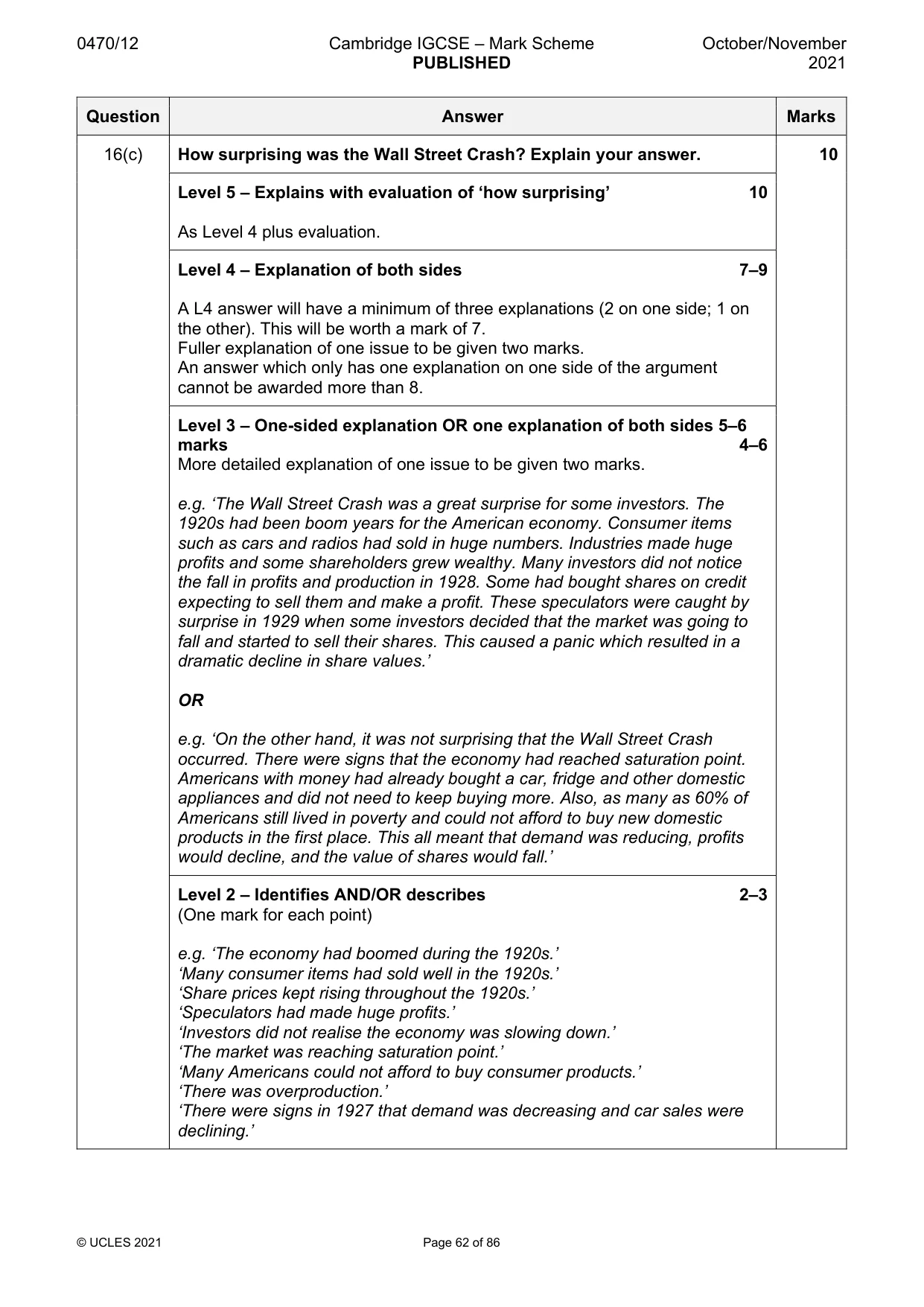
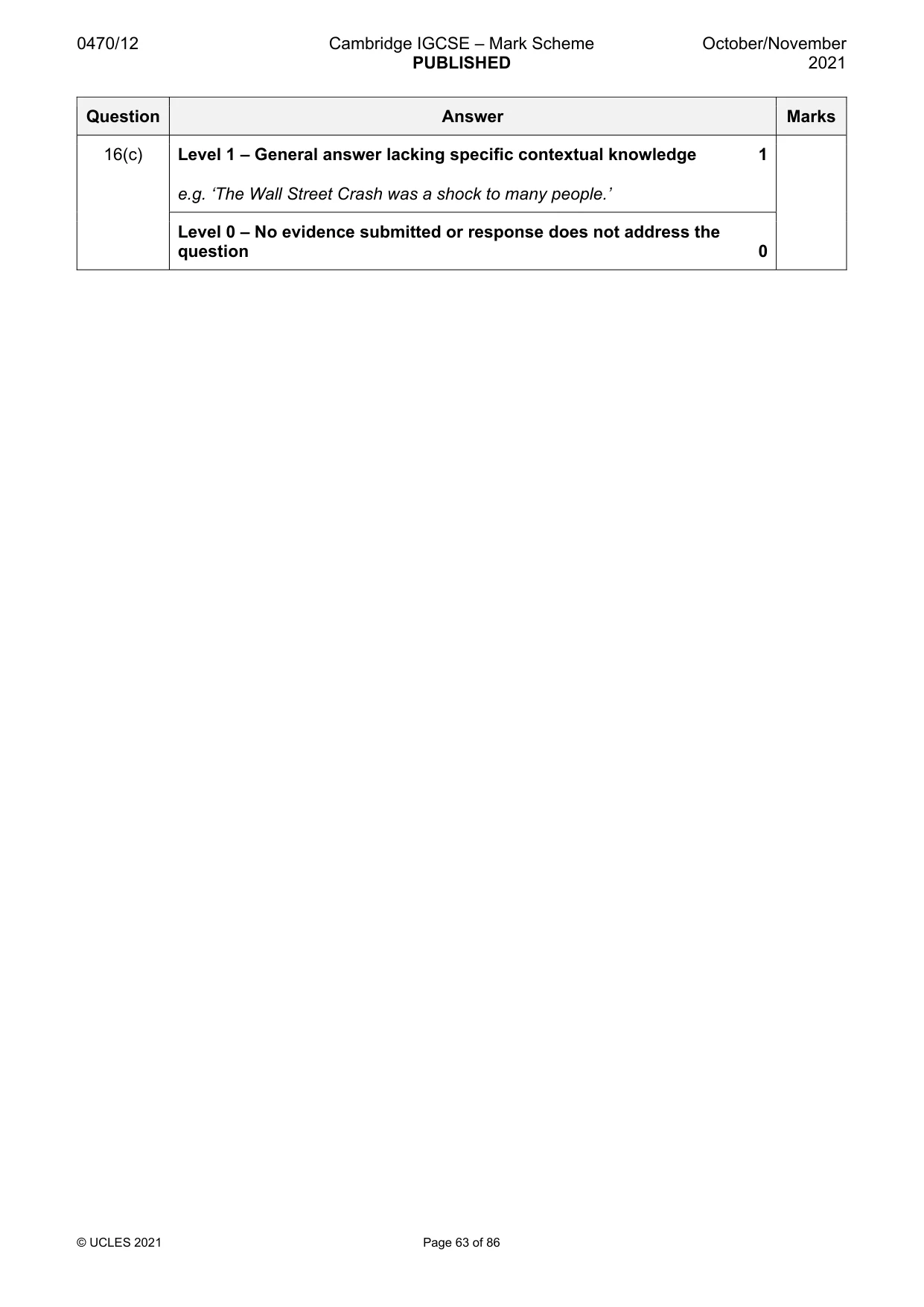
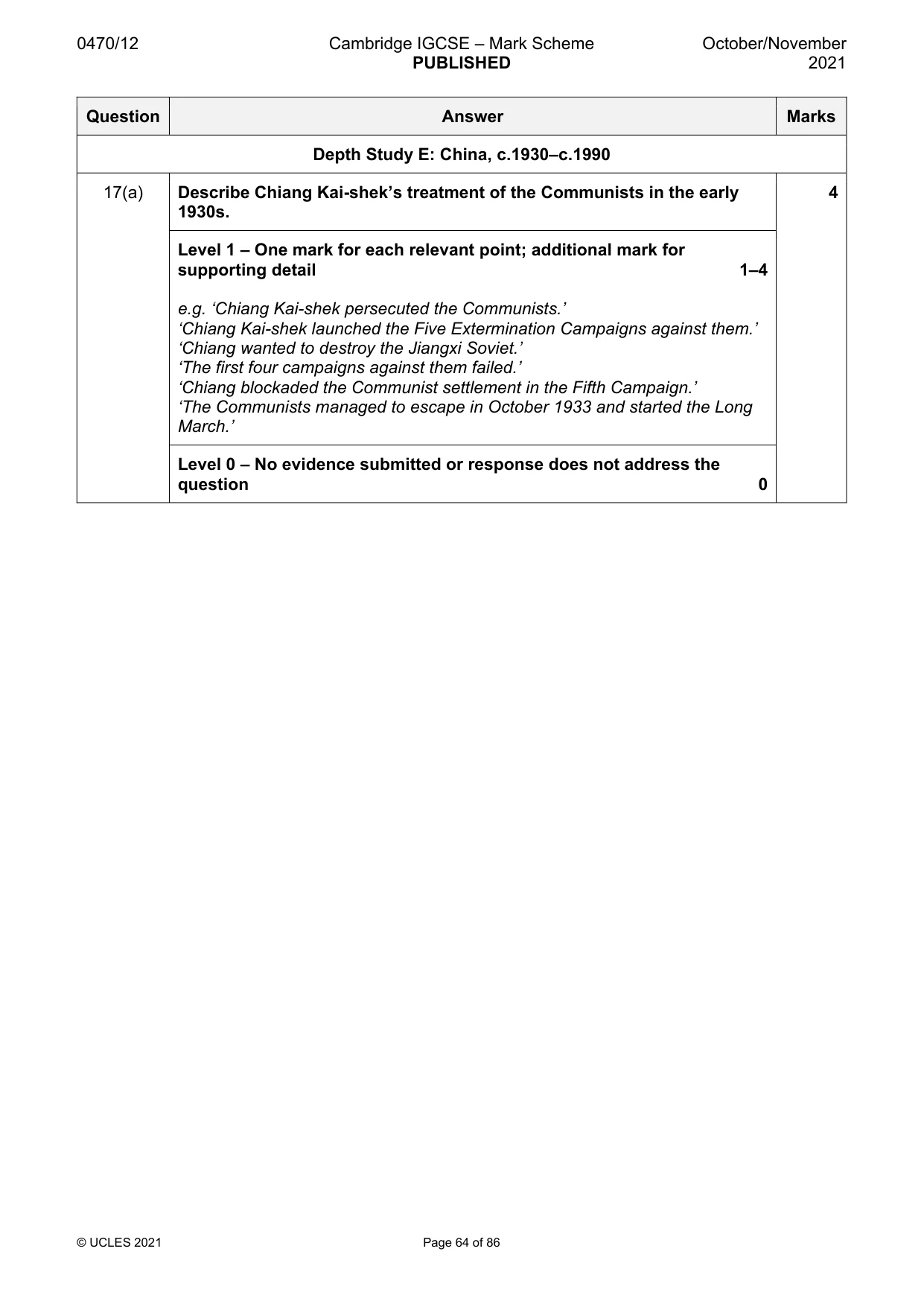
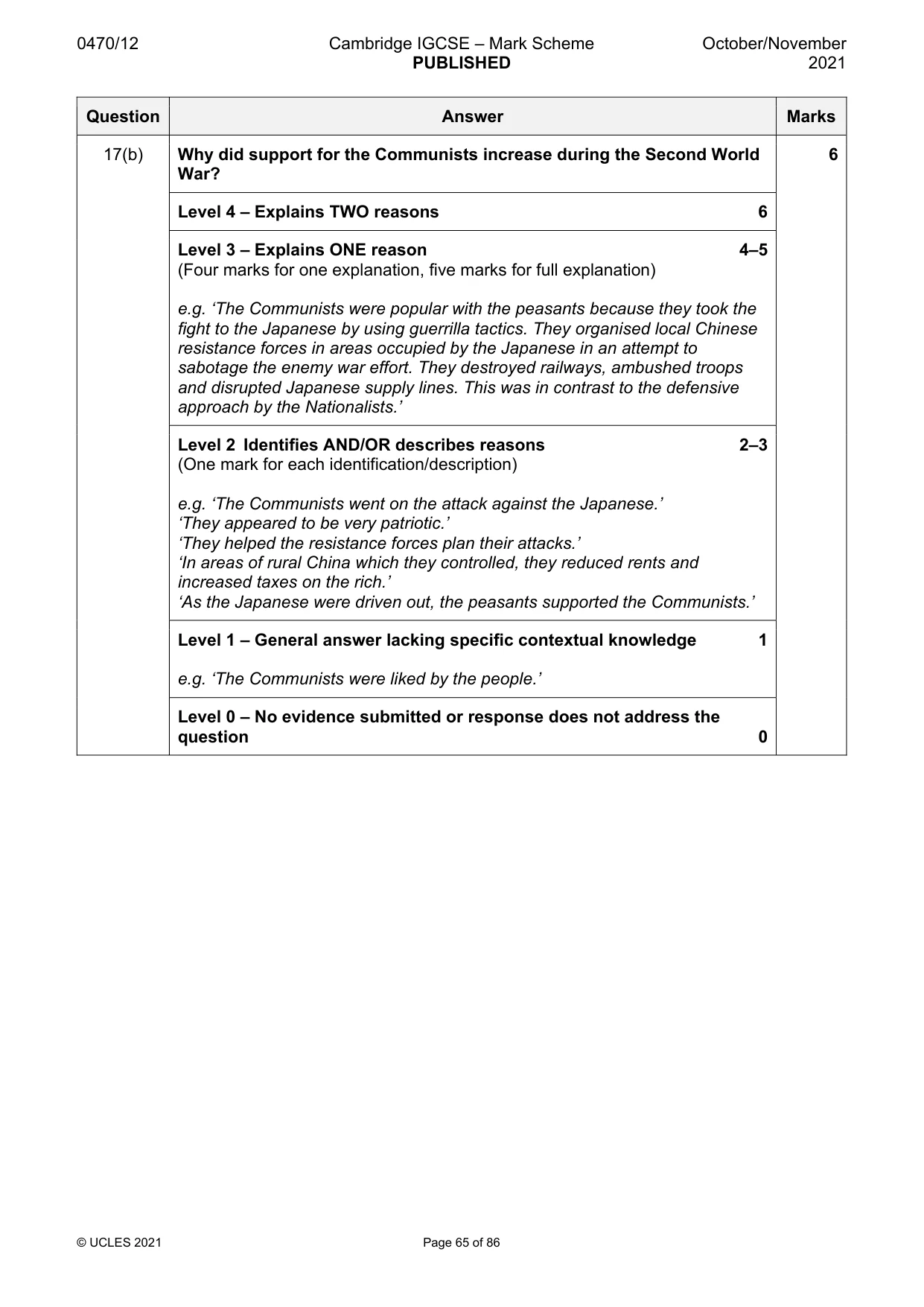
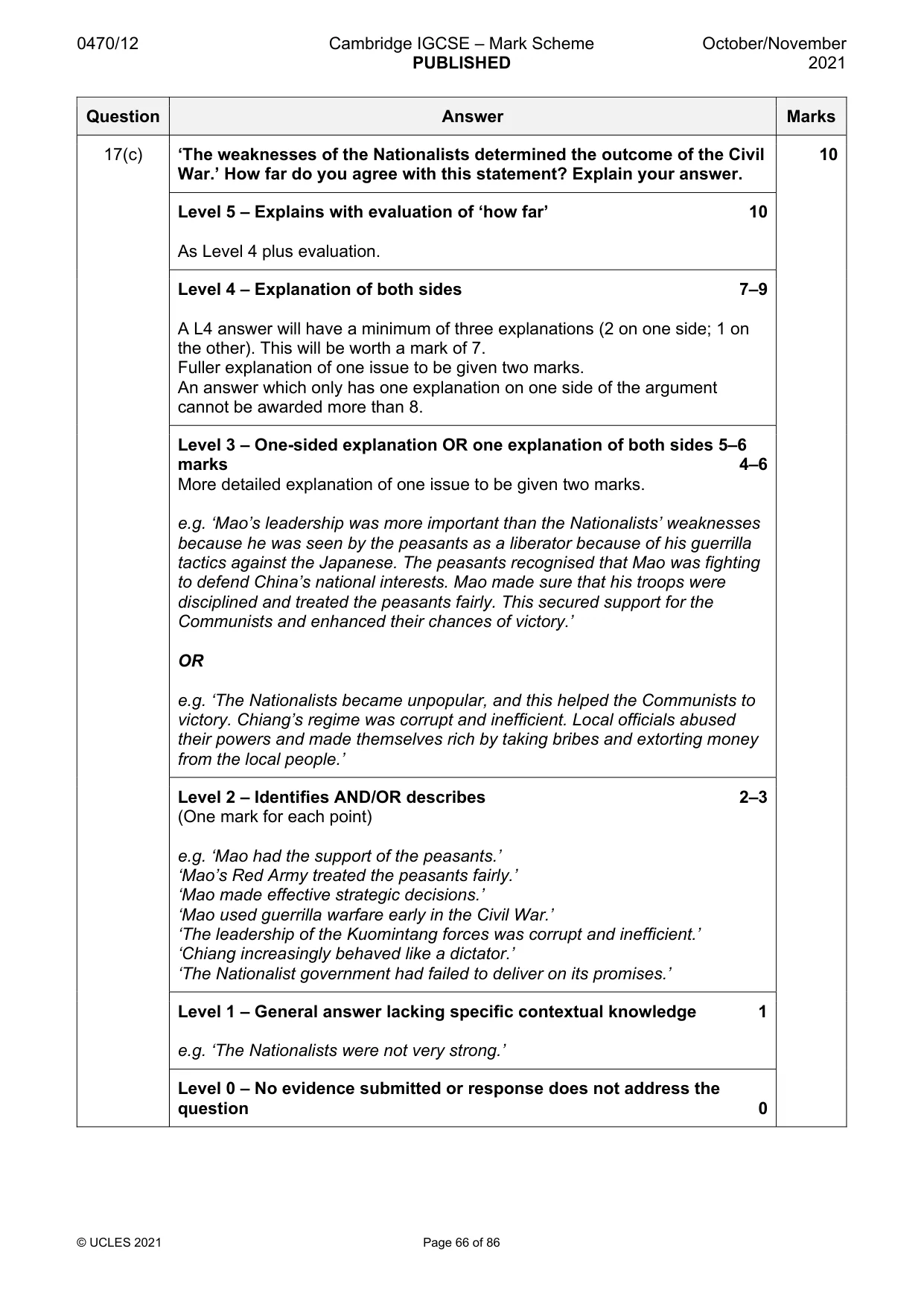
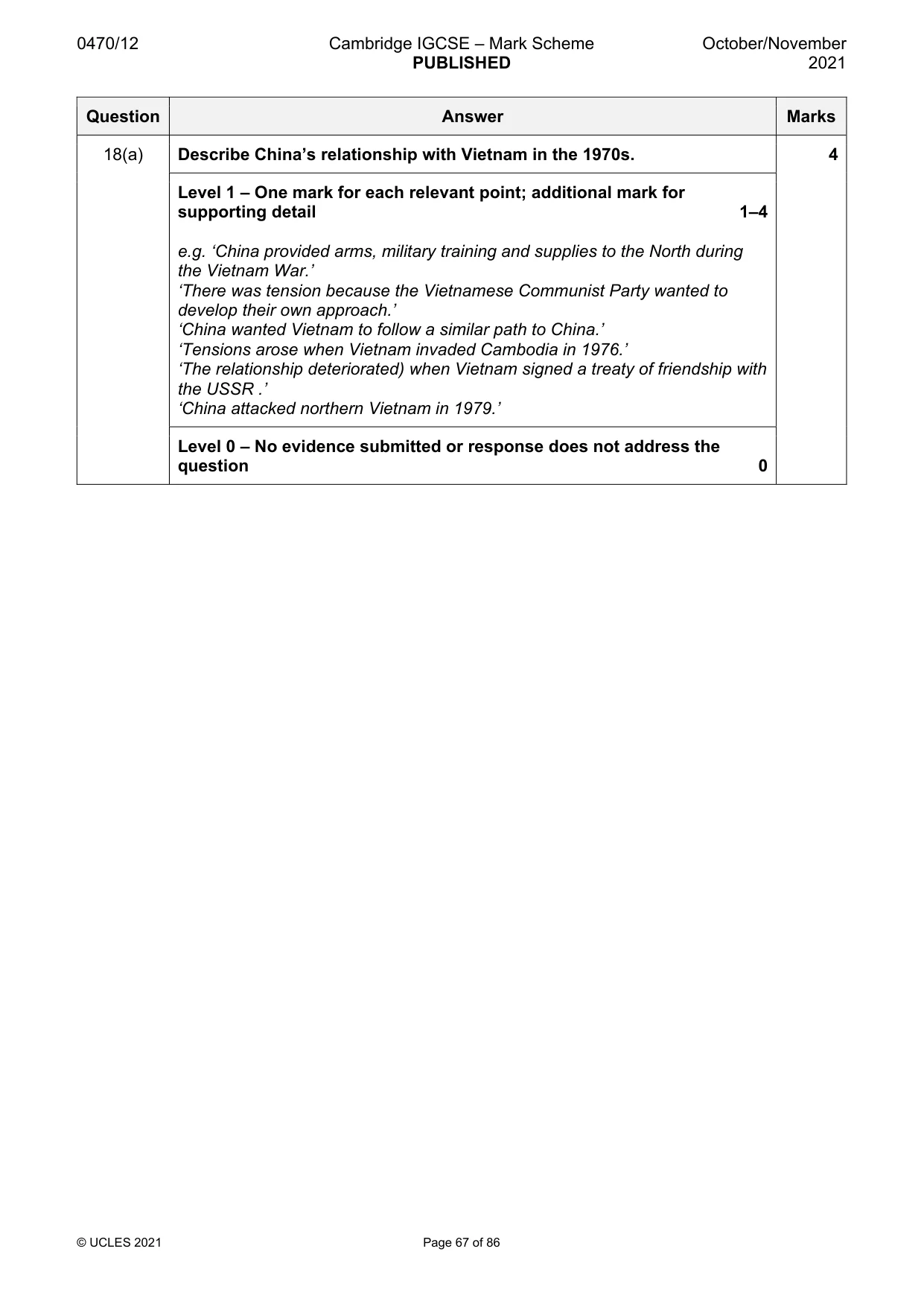
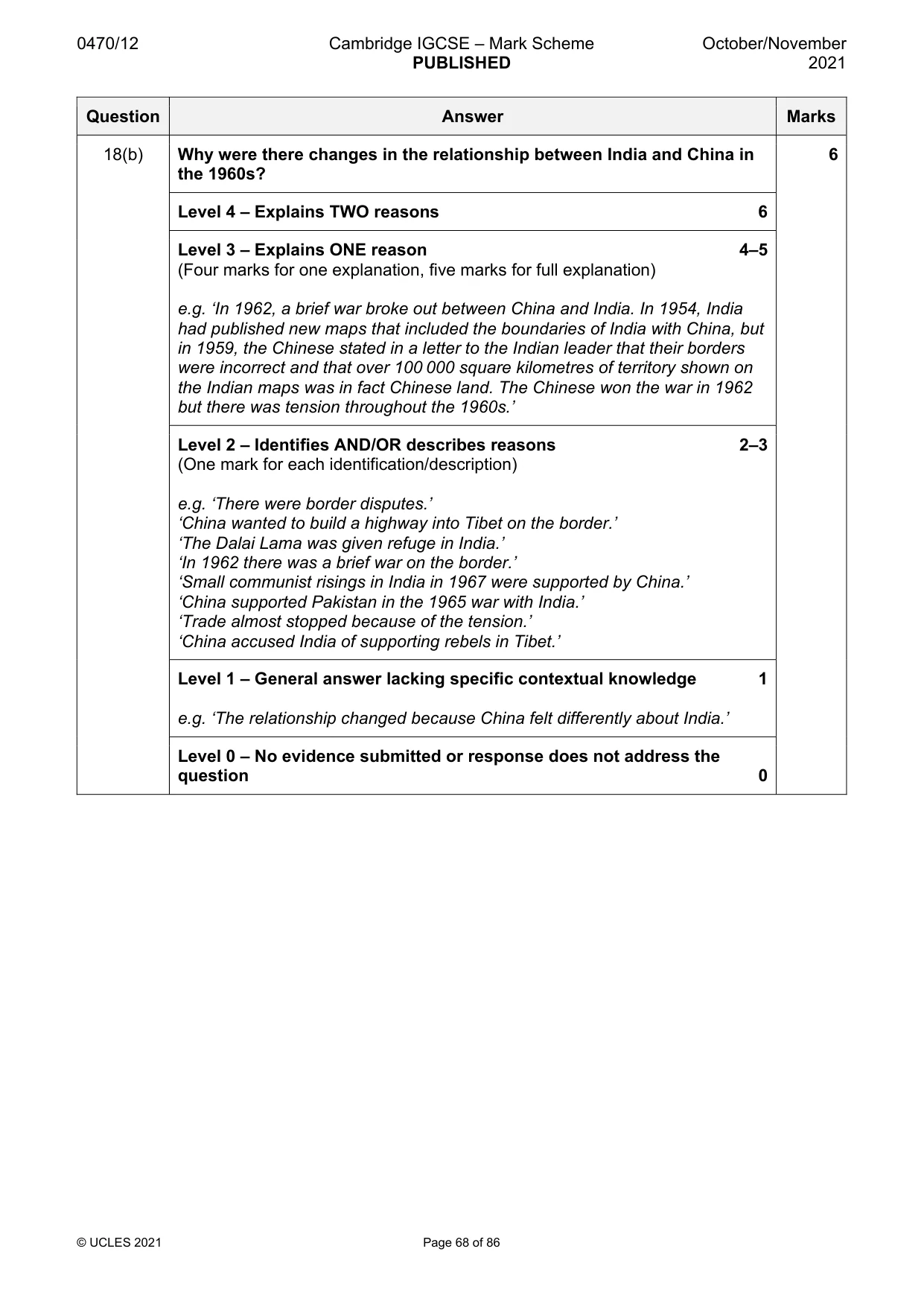
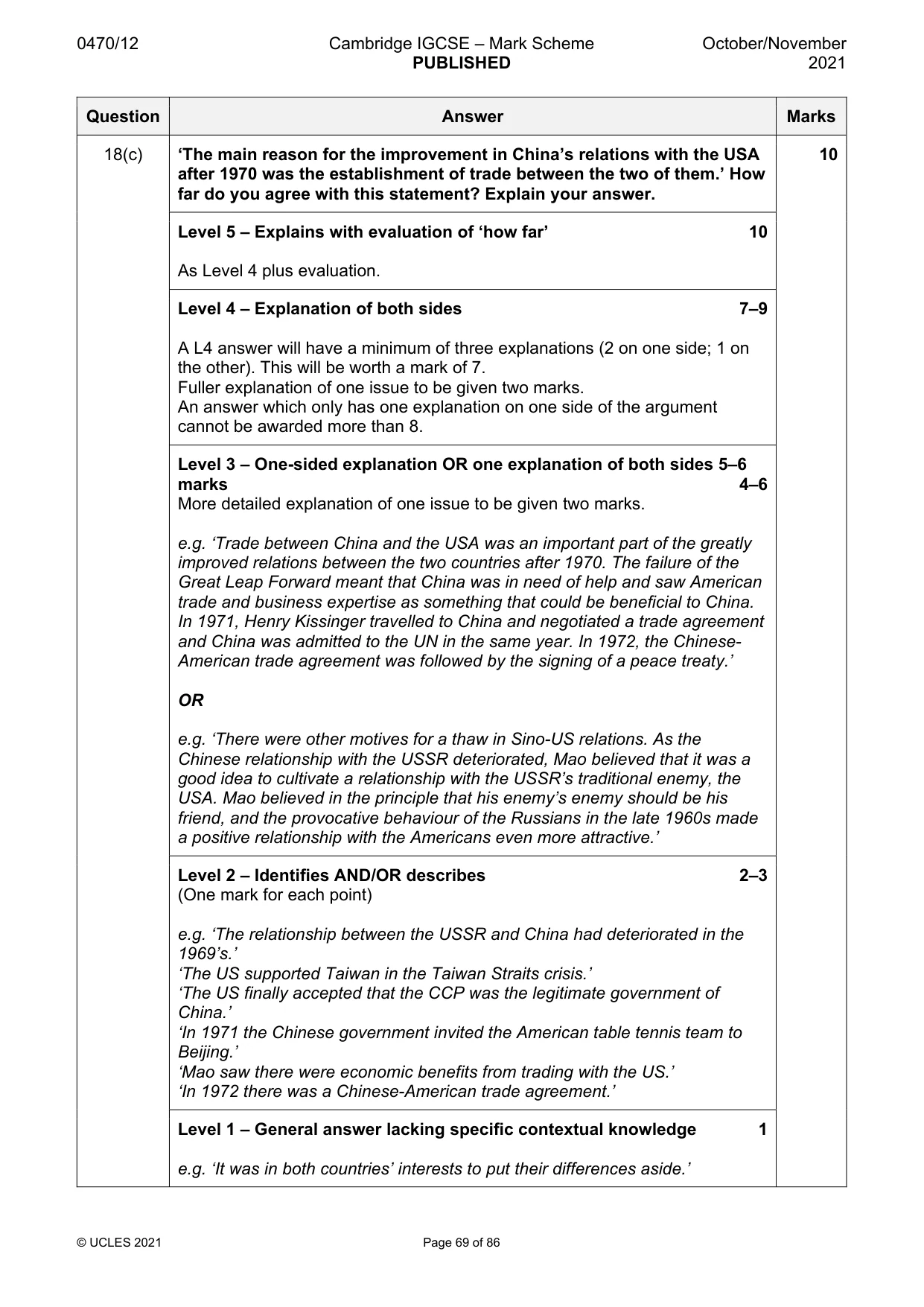
Paper as text
Question paper, page 1
This document has 12 pages. Any blank pages are indicated. Cambridge IGCSE™ DC (DH) 202583/5 © UCLES 2021 [Turn over * 4 9 7 9 2 3 0 2 9 3 * HISTORY 0470/12 Paper 1 October/November 2021 2 hours You must answer on the enclosed answer booklet. You will need: Answer booklet (enclosed) INSTRUCTIONS ● Answer three questions in total: Section A (Core Content): answer two questions. Section B (Depth Studies): answer one question. ● Follow the instructions on the front cover of the answer booklet. If you need additional answer paper, ask the invigilator for a continuation booklet. INFORMATION ● The total mark for this paper is 60. ● The number of marks for each question or part question is shown in brackets [ ].
Question paper, page 2
2 0470/12/O/N/21 © UCLES 2021 SECTION A: CORE CONTENT Answer any two questions from this Section. 1 Individuals were important in the outcomes of the 1848 revolutions. (a) Describe Frederick William IV’s response to the 1848 revolution in Prussia. [4] (b) Why did Pope Pius IX turn against the 1848 revolutions in Italy? [6] (c) How far did the 1848 revolution in France fail? Explain your answer. [10] 2 The Civil War brought changes to the United States. (a) What were ‘scalawags’ and ‘carpetbaggers’? [4] (b) Why were Johnson’s plans for Reconstruction opposed by Congress? [6] (c) How far do you agree that the position of black Americans improved as a result of Reconstruction? Explain your answer. [10] 3 Imperialism had mixed results for the colonised peoples. (a) Describe the impact of Faidherbe’s rule over Senegal. [4] (b) Why did Leopold II’s control over the Congo cause hatred among the local population? [6] (c) ‘The changes to British rule resulting from the Indian Mutiny were beneficial to Indians.’ How far do you agree with this statement? Explain your answer. [10] 4 Relationships between European powers were important in the build-up to the First World War. (a) What was the Triple Alliance? [4] (b) Why did the Balkan Wars (1912–13) lead to tension between Russia and Austria? [6] (c) ‘Colonial rivalry was a greater cause of tension between Germany and Britain than the naval race.’ How far do you agree with this statement? Explain your answer. [10]
Question paper, page 3
3 0470/12/O/N/21 © UCLES 2021 [Turn over 5 Agreeing a peace settlement at the end of the First World War was challenging. (a) Describe how Austria was treated in the peace settlement. [4] (b) Why was Danzig important in the negotiations for a peace settlement? [6] (c) Who had the harder task in achieving their aims for the peace settlement, Lloyd George or Wilson? Explain your answer. [10] 6 Hitler’s foreign policy involved Germany in the affairs of many countries. (a) What was the Anglo-German Naval Agreement of 1935? [4] (b) Why did Hitler want to achieve Anschluss? [6] (c) ‘German involvement in the Spanish Civil War was more important for Hitler than the takeover of Czechoslovakia.’ How far do you agree with this statement? Explain your answer. [10] 7 The USA and USSR had different aims in Europe after 1945. (a) Describe the Berlin Blockade. [4] (b) Why did Stalin want control over the government of Poland? [6] (c) ‘Marshall Aid did more to strengthen the Americans than benefit the Europeans.’ How far do you agree with this statement? Explain your answer. [10] 8 Tension between Iran and Iraq led to war in 1980. (a) Describe Western involvement in the Iran–Iraq War. [4] (b) Why was the Shatt al-Arab waterway a cause of tension between Iran and Iraq? [6] (c) ‘Damage to the economies of Iran and Iraq was the most important consequence of the Iran–Iraq War.’ How far do you agree with this statement? Explain your answer. [10]
Question paper, page 4
4 0470/12/O/N/21 © UCLES 2021 SECTION B: DEPTH STUDIES Answer any one question from this Section. DEPTH STUDY A: THE FIRST WORLD WAR, 1914–18 9 There was great loss of life on the Western Front. (a) Describe the use of machine guns in trench warfare. [4] (b) Why were tanks ineffective on the Western Front before 1918? [6] (c) How far do you agree that Haig deserved his reputation as ‘Butcher of the Somme’? Explain your answer. [10] 10 The war had many impacts on civilians. (a) Describe the methods used by the British government to recruit soldiers. [4] (b) Why did Britain introduce food rationing? [6] (c) ‘Food shortages were a more important factor than military failings in Russia’s decision to leave the war.’ How far do you agree with this statement? Explain your answer. [10]
Question paper, page 5
5 0470/12/O/N/21 © UCLES 2021 [Turn over DEPTH STUDY B: GERMANY, 1918–45 11 Germany faced challenges in the years following the First World War. (a) Describe the Spartacist uprising. [4] (b) Why was there a crisis in the Ruhr in 1923? [6] (c) How far did Stresemann restore Germany’s strength between 1924 and 1929? Explain your answer. [10] 12 The Nazis controlled many aspects of life in Germany. (a) Describe how the Nazis used the radio. [4] (b) Why was the Gestapo feared by Germans? [6] (c) How far did Hitler’s policies towards the Jews between 1933 and 1938 have popular support? Explain your answer. [10]
Question paper, page 6
6 0470/12/O/N/21 © UCLES 2021 DEPTH STUDY C: RUSSIA, 1905–41 13 1917 brought great changes to Russia. (a) Describe the activities of the Petrograd Soviet in 1917. [4] (b) Why was there a mutiny at Kronstadt in 1921? [6] (c) ‘White weakness rather than Bolshevik strength determined the outcome of the Civil War.’ How far do you agree with this statement? Explain your answer. [10] 14 Stalin was determined to consolidate and maintain power. (a) What was Stalin’s ‘cult of personality’? [4] (b) Why was Trotsky a leading candidate to succeed Lenin? [6] (c) How far do you agree that Stalin carried out the Purges to remove Trotsky’s supporters? Explain your answer. [10]
Question paper, page 7
7 0470/12/O/N/21 © UCLES 2021 [Turn over DEPTH STUDY D: THE UNITED STATES, 1919–41 15 The 1920s saw a boom in the US economy. (a) Describe how mass production worked. [4] (b) Why was the development of advertising important to the boom? [6] (c) ‘Americans benefited from the boom.’ How far do you agree with this statement? Explain your answer. [10] 16 The Wall Street Crash had a great impact on the USA. (a) What was a Hooverville? [4] (b) Why did many people face unemployment after the Wall Street Crash? [6] (c) How surprising was the Wall Street Crash? Explain your answer. [10]
Question paper, page 8
8 0470/12/O/N/21 © UCLES 2021 DEPTH STUDY E: CHINA, c.1930–c.1990 17 The Nationalists failed to secure their hold over China. (a) Describe Chiang Kai-shek’s treatment of the Communists in the early 1930s. [4] (b) Why did support for the Communists increase during the Second World War? [6] (c) ‘The weaknesses of the Nationalists determined the outcome of the Civil War.’ How far do you agree with this statement? Explain your answer. [10] 18 China’s relationships with other powers changed over time. (a) Describe China’s relationship with Vietnam in the 1970s. [4] (b) Why were there changes in the relationship between India and China in the 1960s? [6] (c) ‘The main reason for the improvement in China’s relations with the USA after 1970 was the establishment of trade between the two of them.’ How far do you agree with this statement? Explain your answer. [10]
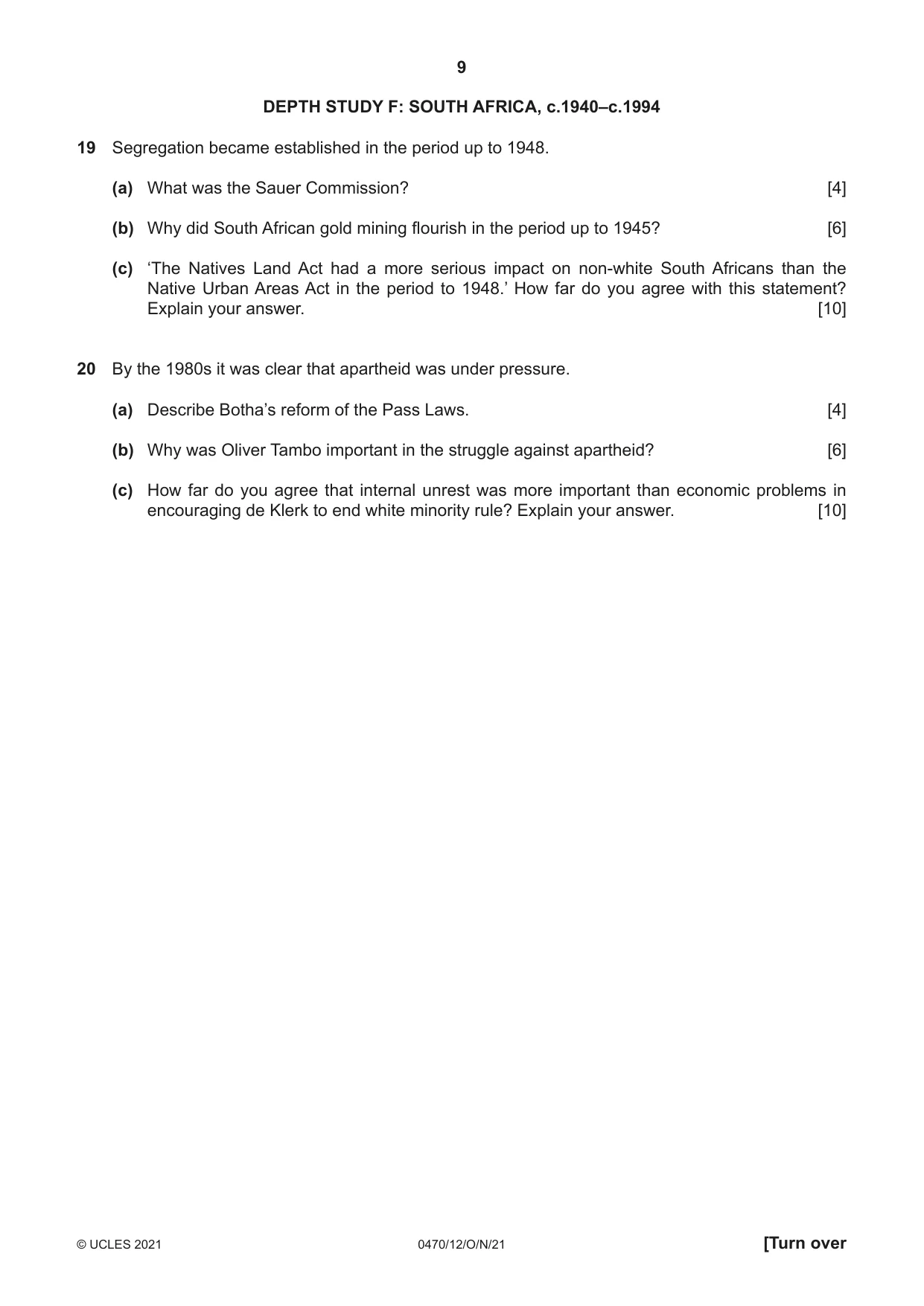
Question paper, page 9
9 0470/12/O/N/21 © UCLES 2021 [Turn over DEPTH STUDY F: SOUTH AFRICA, c.1940–c.1994 19 Segregation became established in the period up to 1948. (a) What was the Sauer Commission? [4] (b) Why did South African gold mining flourish in the period up to 1945? [6] (c) ‘The Natives Land Act had a more serious impact on non-white South Africans than the Native Urban Areas Act in the period to 1948.’ How far do you agree with this statement? Explain your answer. [10] 20 By the 1980s it was clear that apartheid was under pressure. (a) Describe Botha’s reform of the Pass Laws. [4] (b) Why was Oliver Tambo important in the struggle against apartheid? [6] (c) How far do you agree that internal unrest was more important than economic problems in encouraging de Klerk to end white minority rule? Explain your answer. [10]
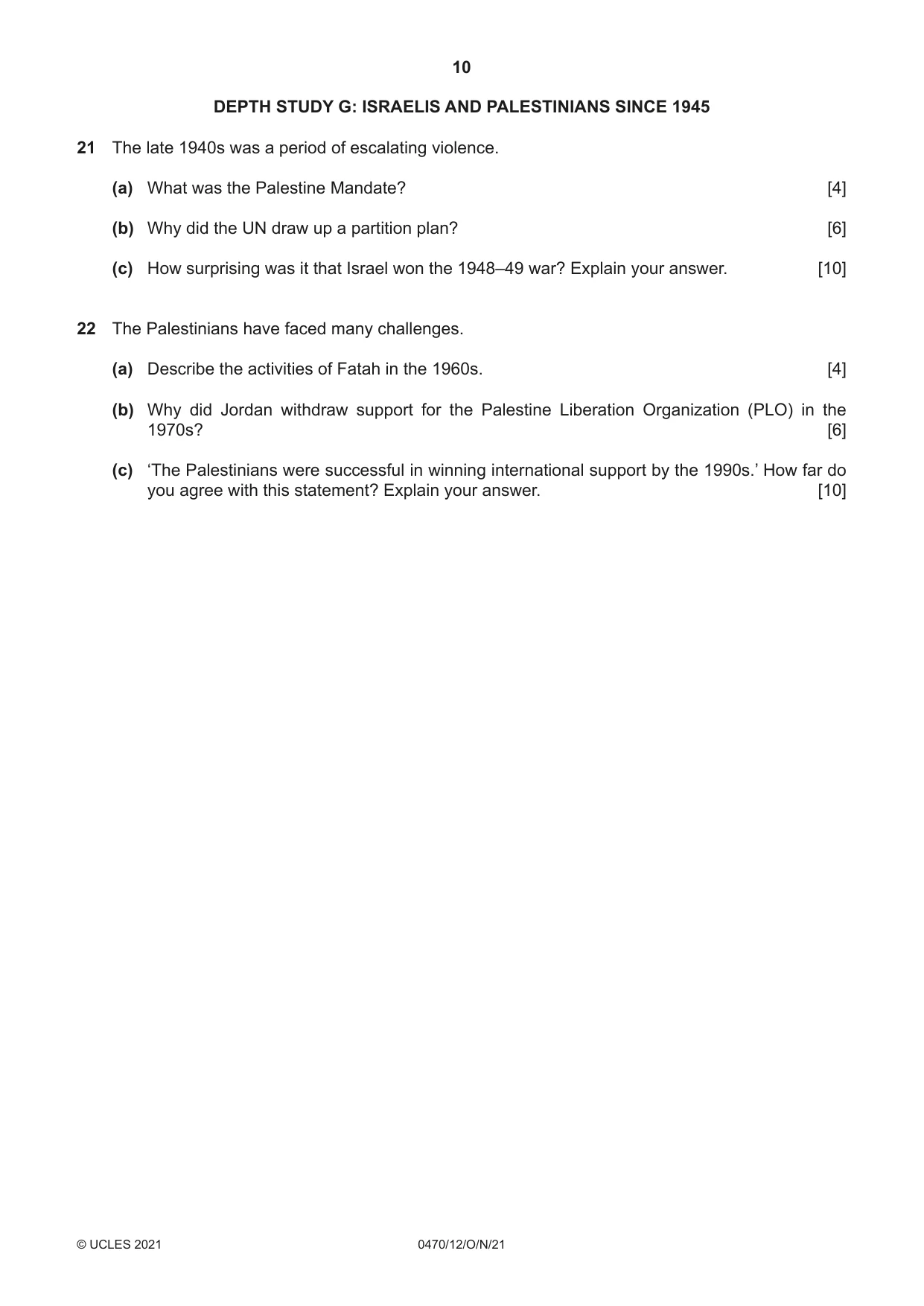
Question paper, page 10
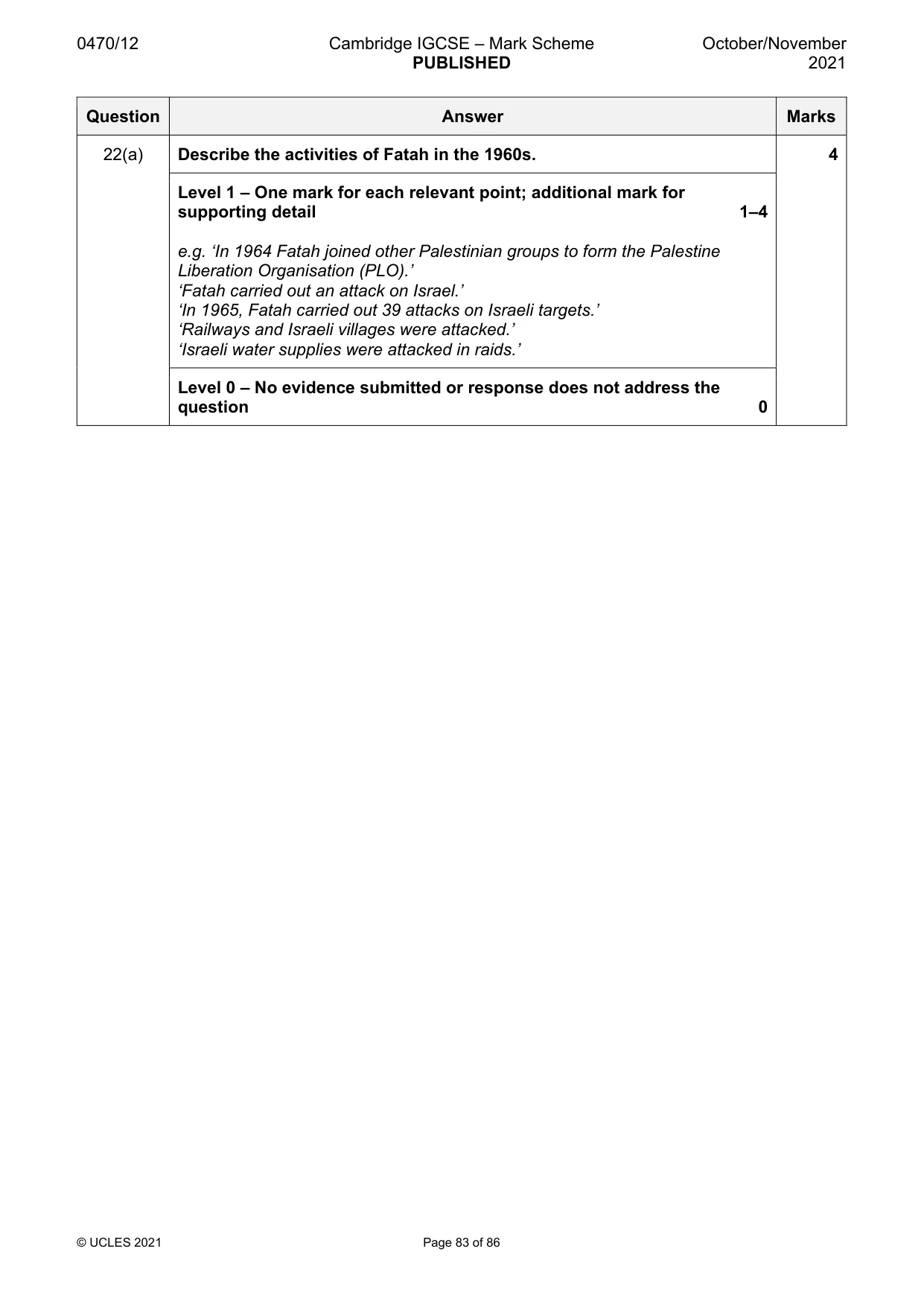
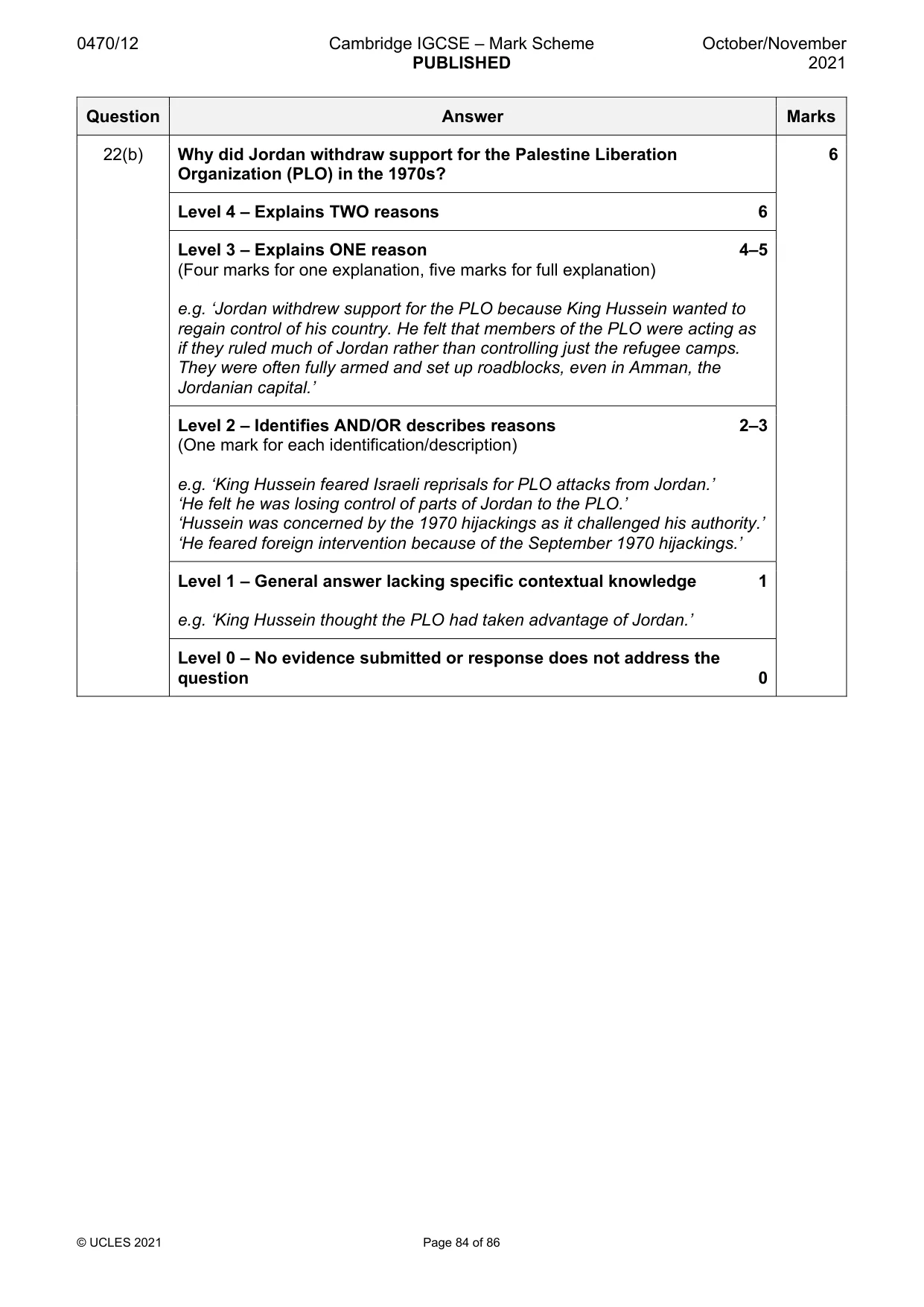
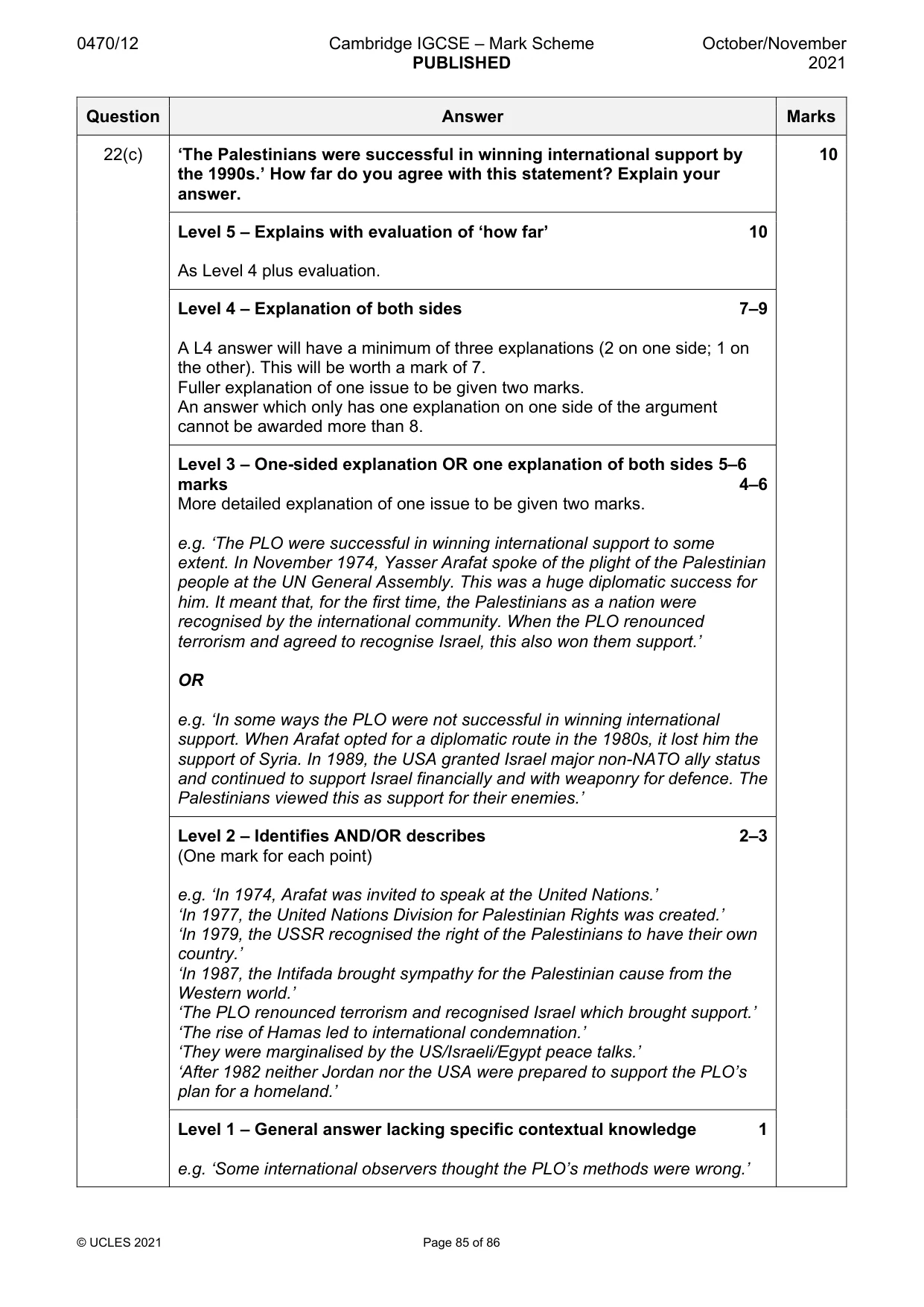
10 0470/12/O/N/21 © UCLES 2021 DEPTH STUDY G: ISRAELIS AND PALESTINIANS SINCE 1945 21 The late 1940s was a period of escalating violence. (a) What was the Palestine Mandate? [4] (b) Why did the UN draw up a partition plan? [6] (c) How surprising was it that Israel won the 1948–49 war? Explain your answer. [10] 22 The Palestinians have faced many challenges. (a) Describe the activities of Fatah in the 1960s. [4] (b) Why did Jordan withdraw support for the Palestine Liberation Organization (PLO) in the 1970s? [6] (c) ‘The Palestinians were successful in winning international support by the 1990s.’ How far do you agree with this statement? Explain your answer. [10]
Question paper, page 11
11 0470/12/O/N/21 © UCLES 2021 BLANK PAGE
Question paper, page 12
12 0470/12/O/N/21 © UCLES 2021 Permission to reproduce items where third-party owned material protected by copyright is included has been sought and cleared where possible. Every reasonable effort has been made by the publisher (UCLES) to trace copyright holders, but if any items requiring clearance have unwittingly been included, the publisher will be pleased to make amends at the earliest possible opportunity. To avoid the issue of disclosure of answer-related information to candidates, all copyright acknowledgements are reproduced online in the Cambridge Assessment International Education Copyright Acknowledgements Booklet. This is produced for each series of examinations and is freely available to download at www.cambridgeinternational.org after the live examination series. Cambridge Assessment International Education is part of the Cambridge Assessment Group. Cambridge Assessment is the brand name of the University of Cambridge Local Examinations Syndicate (UCLES), which itself is a department of the University of Cambridge. BLANK PAGE
Mark scheme, page 1
This document consists of 86 printed pages. © UCLES 2021 [Turn over Cambridge IGCSE™ HISTORY 0470/12 Paper 1 October/November 2021 MARK SCHEME Maximum Mark: 60 Published This mark scheme is published as an aid to teachers and candidates, to indicate the requirements of the examination. It shows the basis on which Examiners were instructed to award marks. It does not indicate the details of the discussions that took place at an Examiners’ meeting before marking began, which would have considered the acceptability of alternative answers. Mark schemes should be read in conjunction with the question paper and the Principal Examiner Report for Teachers. Cambridge International will not enter into discussions about these mark schemes. Cambridge International is publishing the mark schemes for the October/November 2021 series for most Cambridge IGCSE™, Cambridge International A and AS Level components and some Cambridge O Level components.
Mark scheme, page 2
0470/12 Cambridge IGCSE – Mark Scheme PUBLISHED October/November 2021 © UCLES 2021 Page 2 of 86 Generic Marking Principles These general marking principles must be applied by all examiners when marking candidate answers. They should be applied alongside the specific content of the mark scheme or generic level descriptors for a question. Each question paper and mark scheme will also comply with these marking principles. GENERIC MARKING PRINCIPLE 1: Marks must be awarded in line with: • the specific content of the mark scheme or the generic level descriptors for the question • the specific skills defined in the mark scheme or in the generic level descriptors for the question • the standard of response required by a candidate as exemplified by the standardisation scripts. GENERIC MARKING PRINCIPLE 2: Marks awarded are always whole marks (not half marks, or other fractions). GENERIC MARKING PRINCIPLE 3: Marks must be awarded positively: • marks are awarded for correct/valid answers, as defined in the mark scheme. However, credit is given for valid answers which go beyond the scope of the syllabus and mark scheme, referring to your Team Leader as appropriate • marks are awarded when candidates clearly demonstrate what they know and can do • marks are not deducted for errors • marks are not deducted for omissions • answers should only be judged on the quality of spelling, punctuation and grammar when these features are specifically assessed by the question as indicated by the mark scheme. The meaning, however, should be unambiguous. GENERIC MARKING PRINCIPLE 4: Rules must be applied consistently, e.g. in situations where candidates have not followed instructions or in the application of generic level descriptors. GENERIC MARKING PRINCIPLE 5: Marks should be awarded using the full range of marks defined in the mark scheme for the question (however; the use of the full mark range may be limited according to the quality of the candidate responses seen). GENERIC MARKING PRINCIPLE 6: Marks awarded are based solely on the requirements as defined in the mark scheme. Marks should not be awarded with grade thresholds or grade descriptors in mind.
Mark scheme, page 3
0470/12 Cambridge IGCSE – Mark Scheme PUBLISHED October/November 2021 © UCLES 2021 Page 3 of 86 Applying the Mark Scheme • When marking a response the overall criterion to be considered should be – ‘How good is this response to this question?’ • The level descriptor should be used to decide the level into which the quality of the answer fits. • Exhaustive lists of possible facts are not given in the mark scheme, as there is often a choice of factual knowledge that candidates may use. • WHERE EXAMPLES OF RESPONSES ARE GIVEN, THESE ARE NOT PRESCRIPTIVE, • BUT ARE INTENDED AS A GUIDE. It is not possible to cover every possible type of response within a levels of response mark scheme and examiners are expected to use their professional judgement at all times in ensuring that responses are placed in the correct level and given an appropriate mark within that level. • Marking must be positive. Marks must not be deducted for inaccurate or irrelevant parts of answers. In itself, poor use of historical terminology, spelling, grammar or handwriting does not affect the mark. The overall quality of the answer to the question should be judged. • If a candidate reaches a particular level they must be rewarded with a mark within that level. It is not necessary to work through the levels. • The full range of marks should be used. Do not be afraid to award full marks or no marks. Failure to do this will seriously affect the distribution of marks. Be prepared to reward candidates who show any level of understanding. The mark scheme starts from basic acceptable response. Where a band of marks is indicated for a level, these marks should be used with reference to the development of the answer within that level. Assessment objectives (a) recall, description (b) recall, explanation (c) recall, explanation and analysis
Mark scheme, page 4
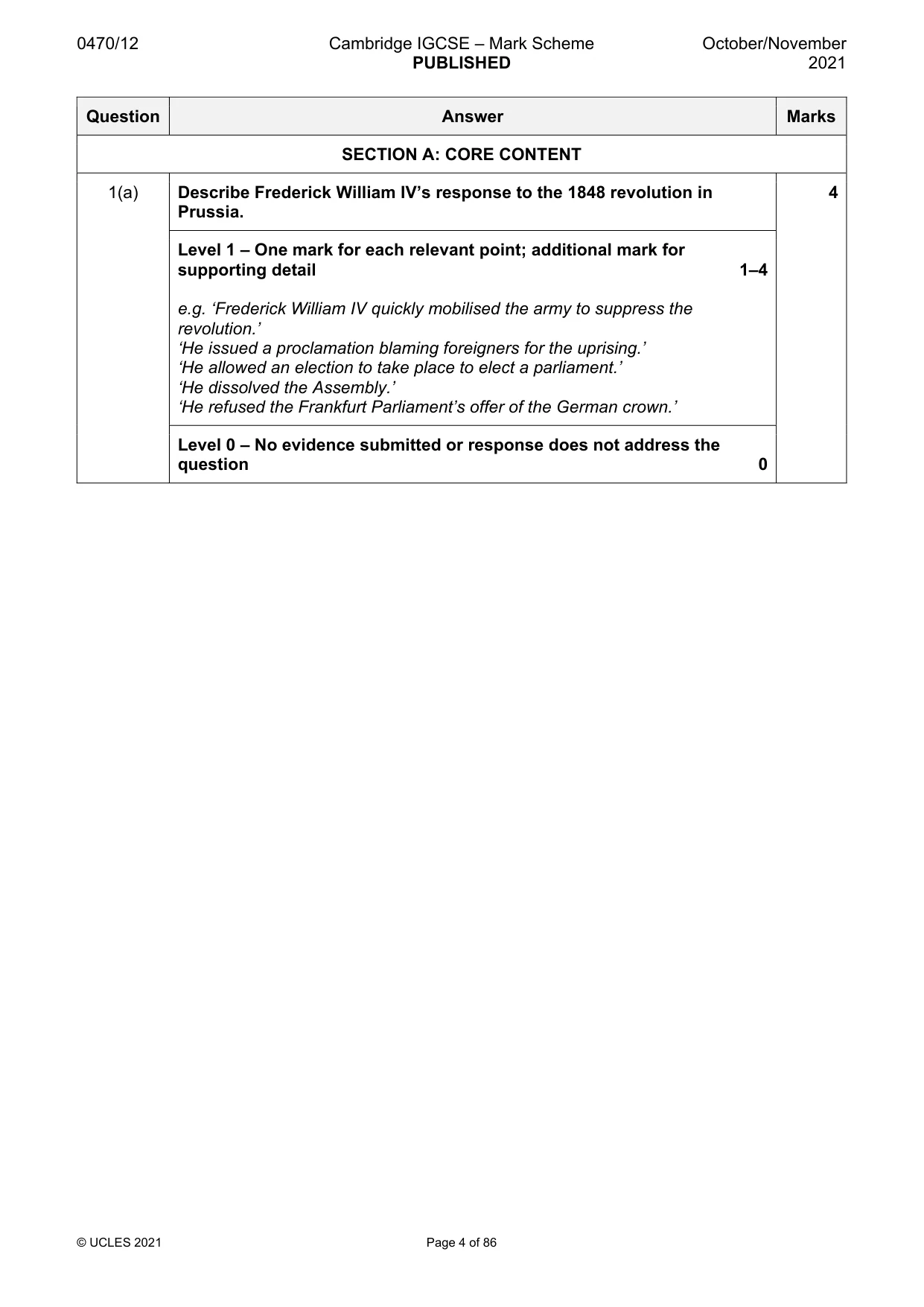
0470/12 Cambridge IGCSE – Mark Scheme PUBLISHED October/November 2021 © UCLES 2021 Page 4 of 86 Question Answer Marks SECTION A: CORE CONTENT 1(a) Describe Frederick William IV’s response to the 1848 revolution in Prussia. 4 Level 1 – One mark for each relevant point; additional mark for supporting detail 1–4 e.g. ‘Frederick William IV quickly mobilised the army to suppress the revolution.’ ‘He issued a proclamation blaming foreigners for the uprising.’ ‘He allowed an election to take place to elect a parliament.’ ‘He dissolved the Assembly.’ ‘He refused the Frankfurt Parliament’s offer of the German crown.’ Level 0 – No evidence submitted or response does not address the question 0
Mark scheme, page 5
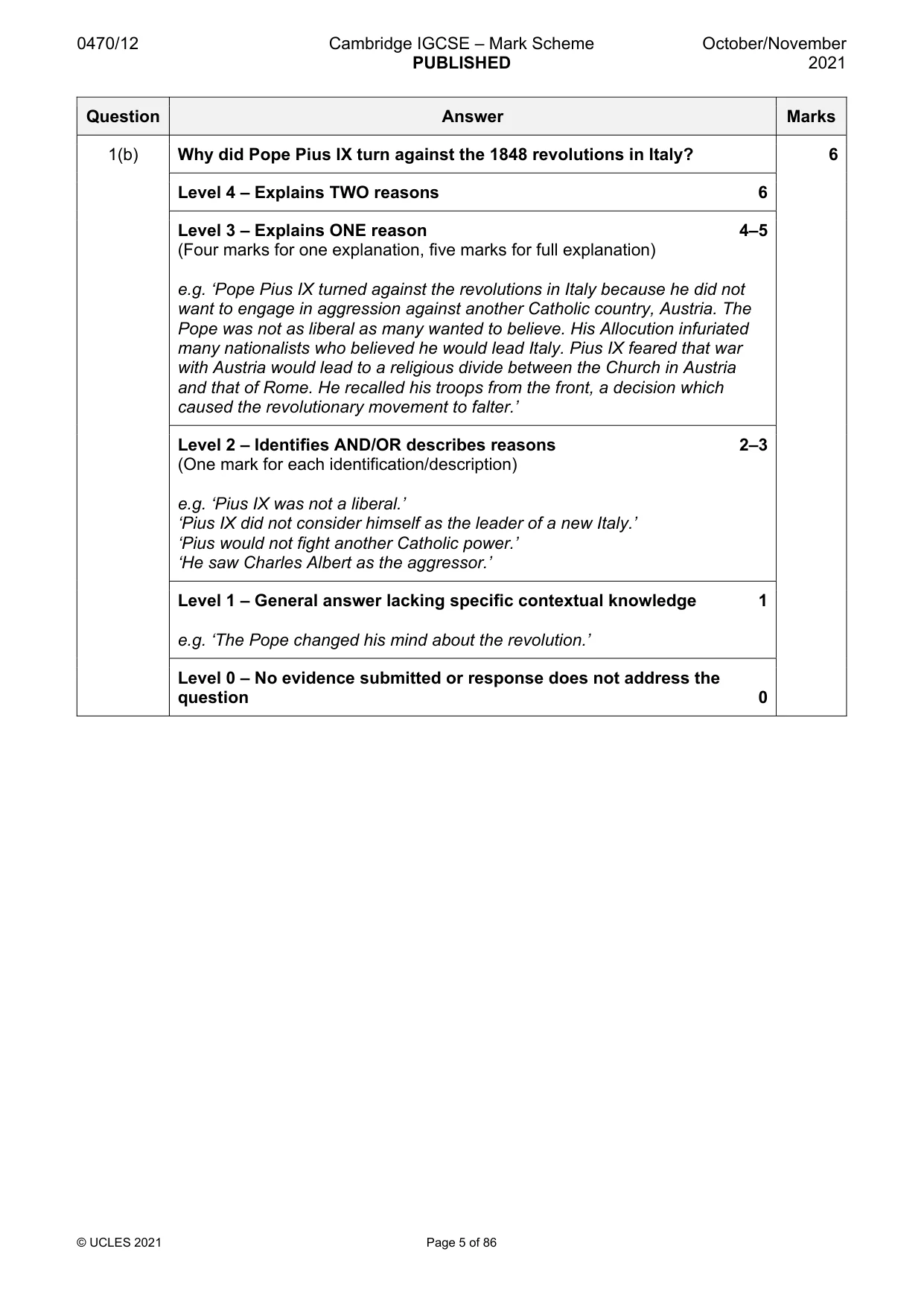
0470/12 Cambridge IGCSE – Mark Scheme PUBLISHED October/November 2021 © UCLES 2021 Page 5 of 86 Question Answer Marks 1(b) Why did Pope Pius IX turn against the 1848 revolutions in Italy? 6 Level 4 – Explains TWO reasons 6 Level 3 – Explains ONE reason 4–5 (Four marks for one explanation, five marks for full explanation) e.g. ‘Pope Pius IX turned against the revolutions in Italy because he did not want to engage in aggression against another Catholic country, Austria. The Pope was not as liberal as many wanted to believe. His Allocution infuriated many nationalists who believed he would lead Italy. Pius IX feared that war with Austria would lead to a religious divide between the Church in Austria and that of Rome. He recalled his troops from the front, a decision which caused the revolutionary movement to falter.’ Level 2 – Identifies AND/OR describes reasons 2–3 (One mark for each identification/description) e.g. ‘Pius IX was not a liberal.’ ‘Pius IX did not consider himself as the leader of a new Italy.’ ‘Pius would not fight another Catholic power.’ ‘He saw Charles Albert as the aggressor.’ Level 1 – General answer lacking specific contextual knowledge 1 e.g. ‘The Pope changed his mind about the revolution.’ Level 0 – No evidence submitted or response does not address the question 0
Mark scheme, page 6
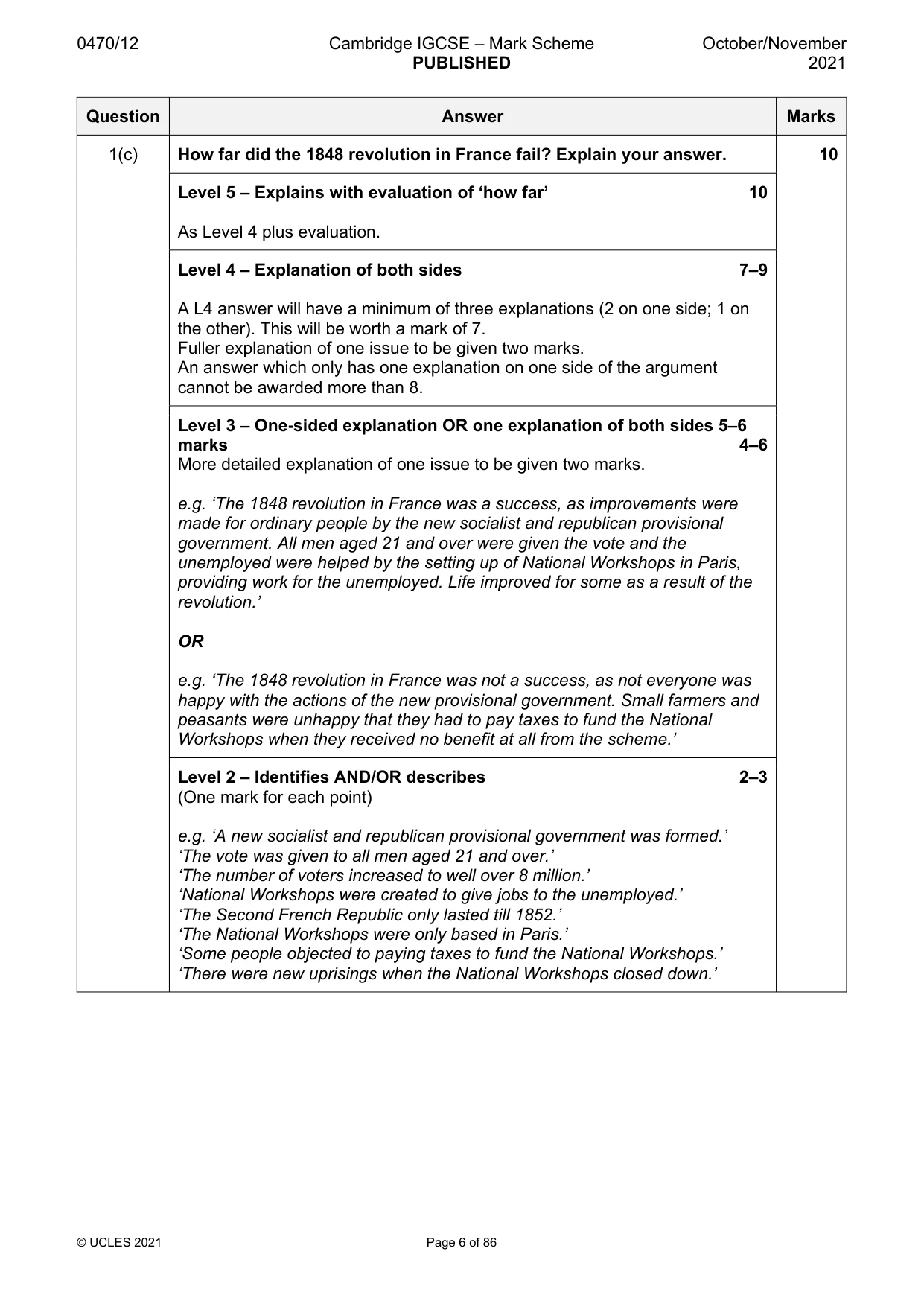
0470/12 Cambridge IGCSE – Mark Scheme PUBLISHED October/November 2021 © UCLES 2021 Page 6 of 86 Question Answer Marks 1(c) How far did the 1848 revolution in France fail? Explain your answer. 10 Level 5 – Explains with evaluation of ‘how far’ 10 As Level 4 plus evaluation. Level 4 – Explanation of both sides 7–9 A L4 answer will have a minimum of three explanations (2 on one side; 1 on the other). This will be worth a mark of 7. Fuller explanation of one issue to be given two marks. An answer which only has one explanation on one side of the argument cannot be awarded more than 8. Level 3 – One-sided explanation OR one explanation of both sides 5–6 marks 4–6 More detailed explanation of one issue to be given two marks. e.g. ‘The 1848 revolution in France was a success, as improvements were made for ordinary people by the new socialist and republican provisional government. All men aged 21 and over were given the vote and the unemployed were helped by the setting up of National Workshops in Paris, providing work for the unemployed. Life improved for some as a result of the revolution.’ OR e.g. ‘The 1848 revolution in France was not a success, as not everyone was happy with the actions of the new provisional government. Small farmers and peasants were unhappy that they had to pay taxes to fund the National Workshops when they received no benefit at all from the scheme.’ Level 2 – Identifies AND/OR describes 2–3 (One mark for each point) e.g. ‘A new socialist and republican provisional government was formed.’ ‘The vote was given to all men aged 21 and over.’ ‘The number of voters increased to well over 8 million.’ ‘National Workshops were created to give jobs to the unemployed.’ ‘The Second French Republic only lasted till 1852.’ ‘The National Workshops were only based in Paris.’ ‘Some people objected to paying taxes to fund the National Workshops.’ ‘There were new uprisings when the National Workshops closed down.’
Mark scheme, page 7
0470/12 Cambridge IGCSE – Mark Scheme PUBLISHED October/November 2021 © UCLES 2021 Page 7 of 86 Question Answer Marks 1(c) Level 1 – General answer lacking specific contextual knowledge 1 e.g. ‘It was a failure in the long term.’ Level 0 – No evidence submitted or response does not address the question 0
Mark scheme, page 8
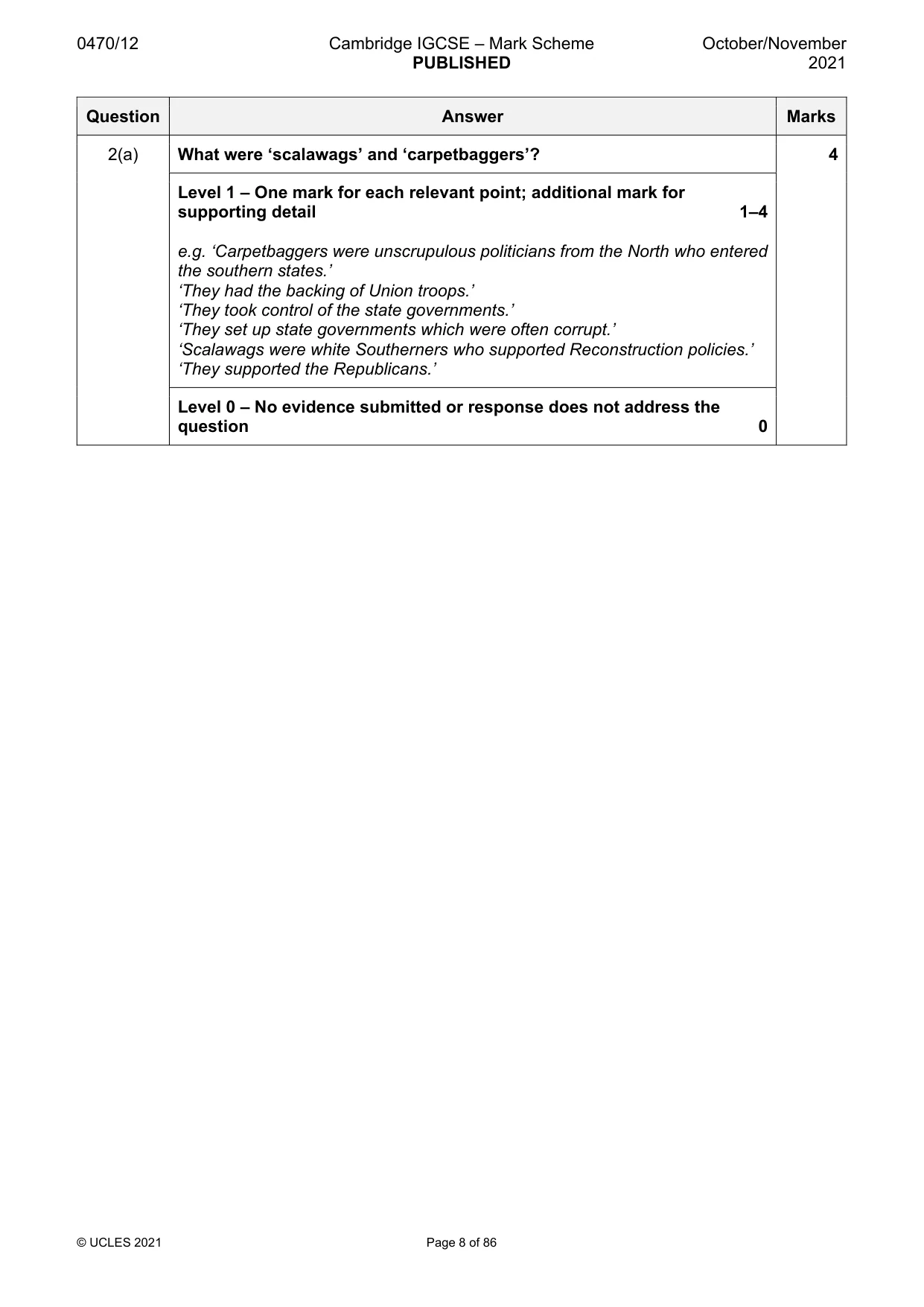
0470/12 Cambridge IGCSE – Mark Scheme PUBLISHED October/November 2021 © UCLES 2021 Page 8 of 86 Question Answer Marks 2(a) What were ‘scalawags’ and ‘carpetbaggers’? 4 Level 1 – One mark for each relevant point; additional mark for supporting detail 1–4 e.g. ‘Carpetbaggers were unscrupulous politicians from the North who entered the southern states.’ ‘They had the backing of Union troops.’ ‘They took control of the state governments.’ ‘They set up state governments which were often corrupt.’ ‘Scalawags were white Southerners who supported Reconstruction policies.’ ‘They supported the Republicans.’ Level 0 – No evidence submitted or response does not address the question 0
Mark scheme, page 9
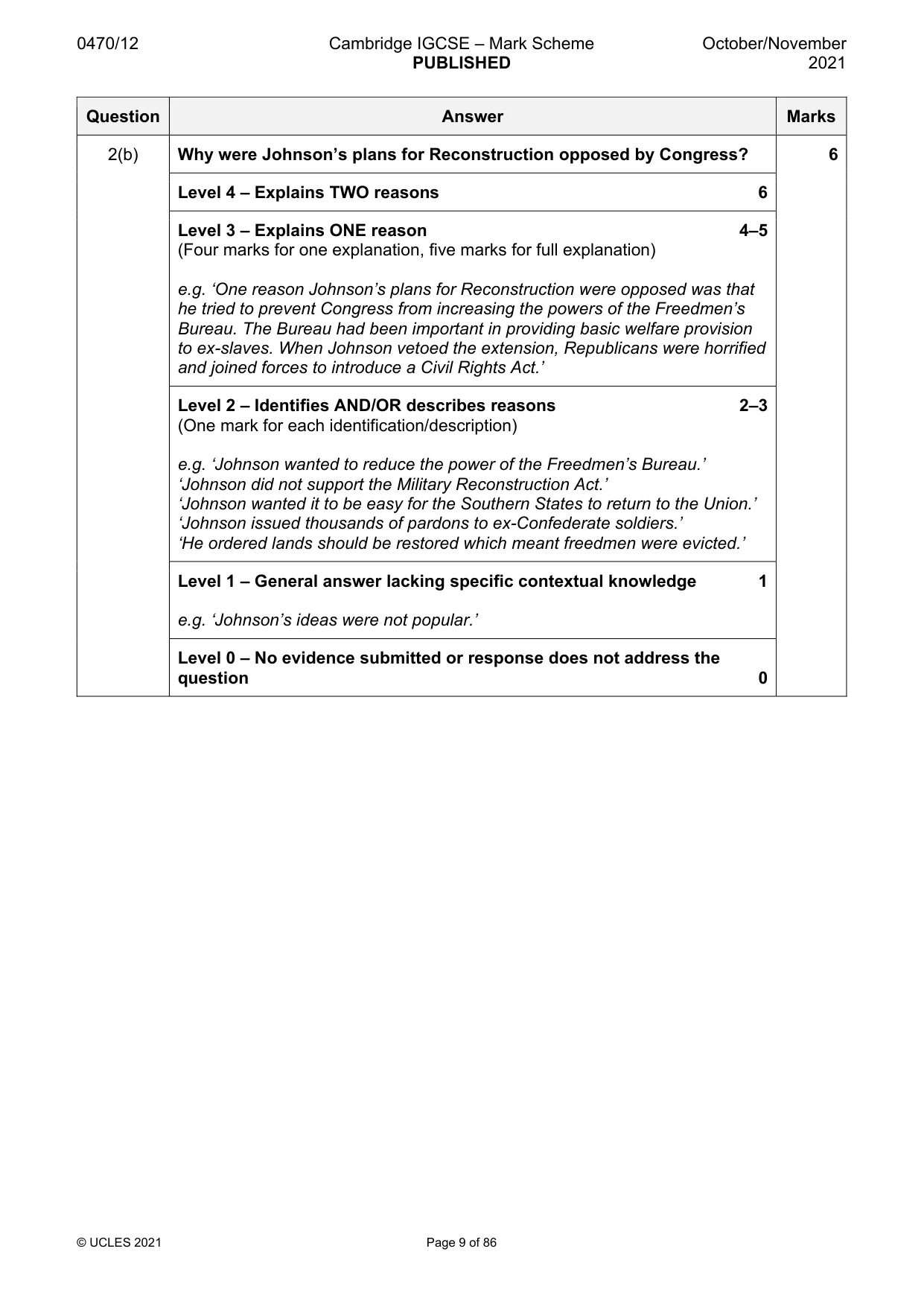
0470/12 Cambridge IGCSE – Mark Scheme PUBLISHED October/November 2021 © UCLES 2021 Page 9 of 86 Question Answer Marks 2(b) Why were Johnson’s plans for Reconstruction opposed by Congress? 6 Level 4 – Explains TWO reasons 6 Level 3 – Explains ONE reason 4–5 (Four marks for one explanation, five marks for full explanation) e.g. ‘One reason Johnson’s plans for Reconstruction were opposed was that he tried to prevent Congress from increasing the powers of the Freedmen’s Bureau. The Bureau had been important in providing basic welfare provision to ex-slaves. When Johnson vetoed the extension, Republicans were horrified and joined forces to introduce a Civil Rights Act.’ Level 2 – Identifies AND/OR describes reasons 2–3 (One mark for each identification/description) e.g. ‘Johnson wanted to reduce the power of the Freedmen’s Bureau.’ ‘Johnson did not support the Military Reconstruction Act.’ ‘Johnson wanted it to be easy for the Southern States to return to the Union.’ ‘Johnson issued thousands of pardons to ex-Confederate soldiers.’ ‘He ordered lands should be restored which meant freedmen were evicted.’ Level 1 – General answer lacking specific contextual knowledge 1 e.g. ‘Johnson’s ideas were not popular.’ Level 0 – No evidence submitted or response does not address the question 0
Mark scheme, page 10
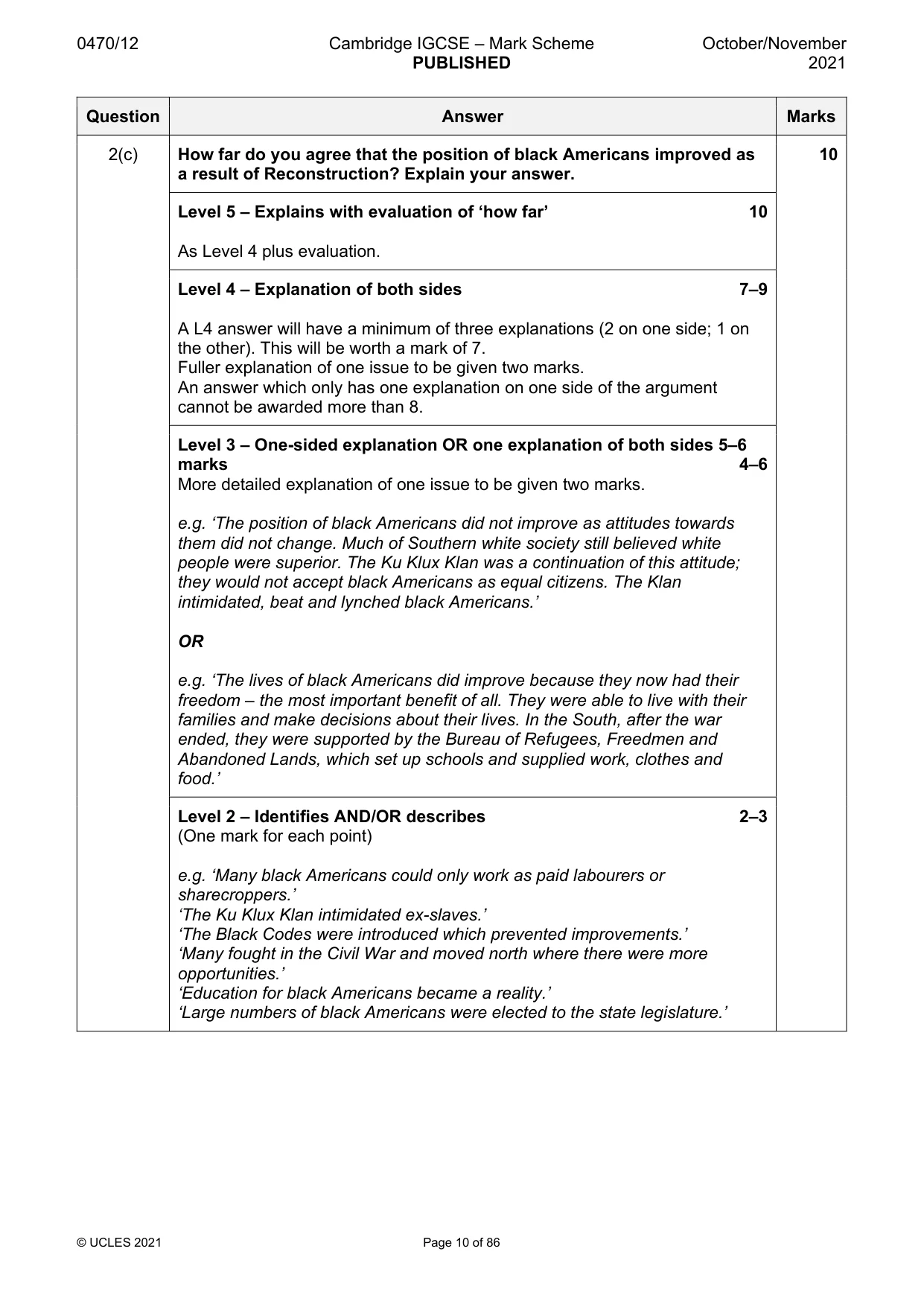
0470/12 Cambridge IGCSE – Mark Scheme PUBLISHED October/November 2021 © UCLES 2021 Page 10 of 86 Question Answer Marks 2(c) How far do you agree that the position of black Americans improved as a result of Reconstruction? Explain your answer. 10 Level 5 – Explains with evaluation of ‘how far’ 10 As Level 4 plus evaluation. Level 4 – Explanation of both sides 7–9 A L4 answer will have a minimum of three explanations (2 on one side; 1 on the other). This will be worth a mark of 7. Fuller explanation of one issue to be given two marks. An answer which only has one explanation on one side of the argument cannot be awarded more than 8. Level 3 – One-sided explanation OR one explanation of both sides 5–6 marks 4–6 More detailed explanation of one issue to be given two marks. e.g. ‘The position of black Americans did not improve as attitudes towards them did not change. Much of Southern white society still believed white people were superior. The Ku Klux Klan was a continuation of this attitude; they would not accept black Americans as equal citizens. The Klan intimidated, beat and lynched black Americans.’ OR e.g. ‘The lives of black Americans did improve because they now had their freedom – the most important benefit of all. They were able to live with their families and make decisions about their lives. In the South, after the war ended, they were supported by the Bureau of Refugees, Freedmen and Abandoned Lands, which set up schools and supplied work, clothes and food.’ Level 2 – Identifies AND/OR describes 2–3 (One mark for each point) e.g. ‘Many black Americans could only work as paid labourers or sharecroppers.’ ‘The Ku Klux Klan intimidated ex-slaves.’ ‘The Black Codes were introduced which prevented improvements.’ ‘Many fought in the Civil War and moved north where there were more opportunities.’ ‘Education for black Americans became a reality.’ ‘Large numbers of black Americans were elected to the state legislature.’
Mark scheme, page 11
0470/12 Cambridge IGCSE – Mark Scheme PUBLISHED October/November 2021 © UCLES 2021 Page 11 of 86 Question Answer Marks 2(c) Level 1 – General answer lacking specific contextual knowledge 1 e.g. ‘Not much changed.’ Level 0 – No evidence submitted or response does not address the question 0
Mark scheme, page 12
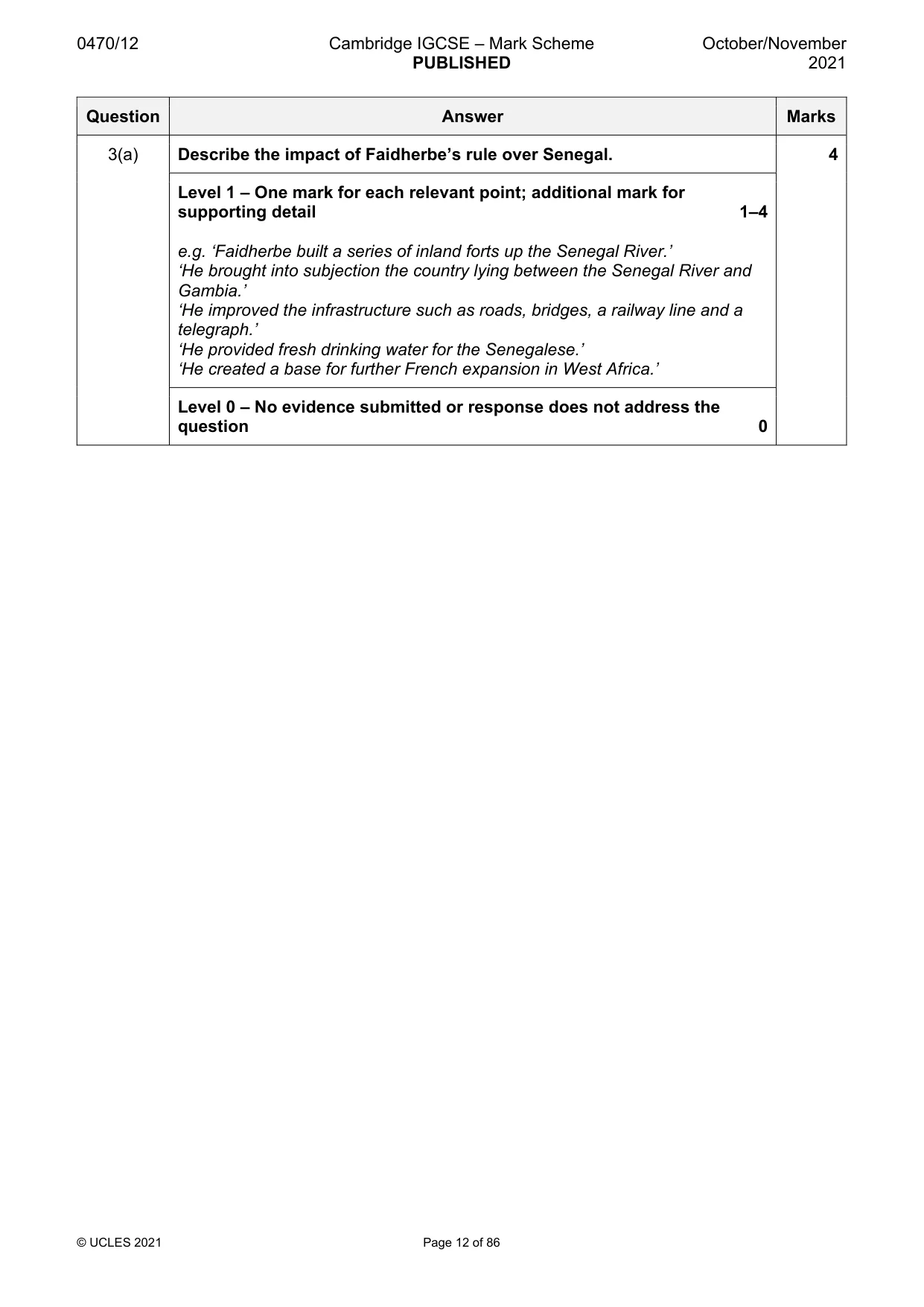
0470/12 Cambridge IGCSE – Mark Scheme PUBLISHED October/November 2021 © UCLES 2021 Page 12 of 86 Question Answer Marks 3(a) Describe the impact of Faidherbe’s rule over Senegal. 4 Level 1 – One mark for each relevant point; additional mark for supporting detail 1–4 e.g. ‘Faidherbe built a series of inland forts up the Senegal River.’ ‘He brought into subjection the country lying between the Senegal River and Gambia.’ ‘He improved the infrastructure such as roads, bridges, a railway line and a telegraph.’ ‘He provided fresh drinking water for the Senegalese.’ ‘He created a base for further French expansion in West Africa.’ Level 0 – No evidence submitted or response does not address the question 0
Mark scheme, page 13
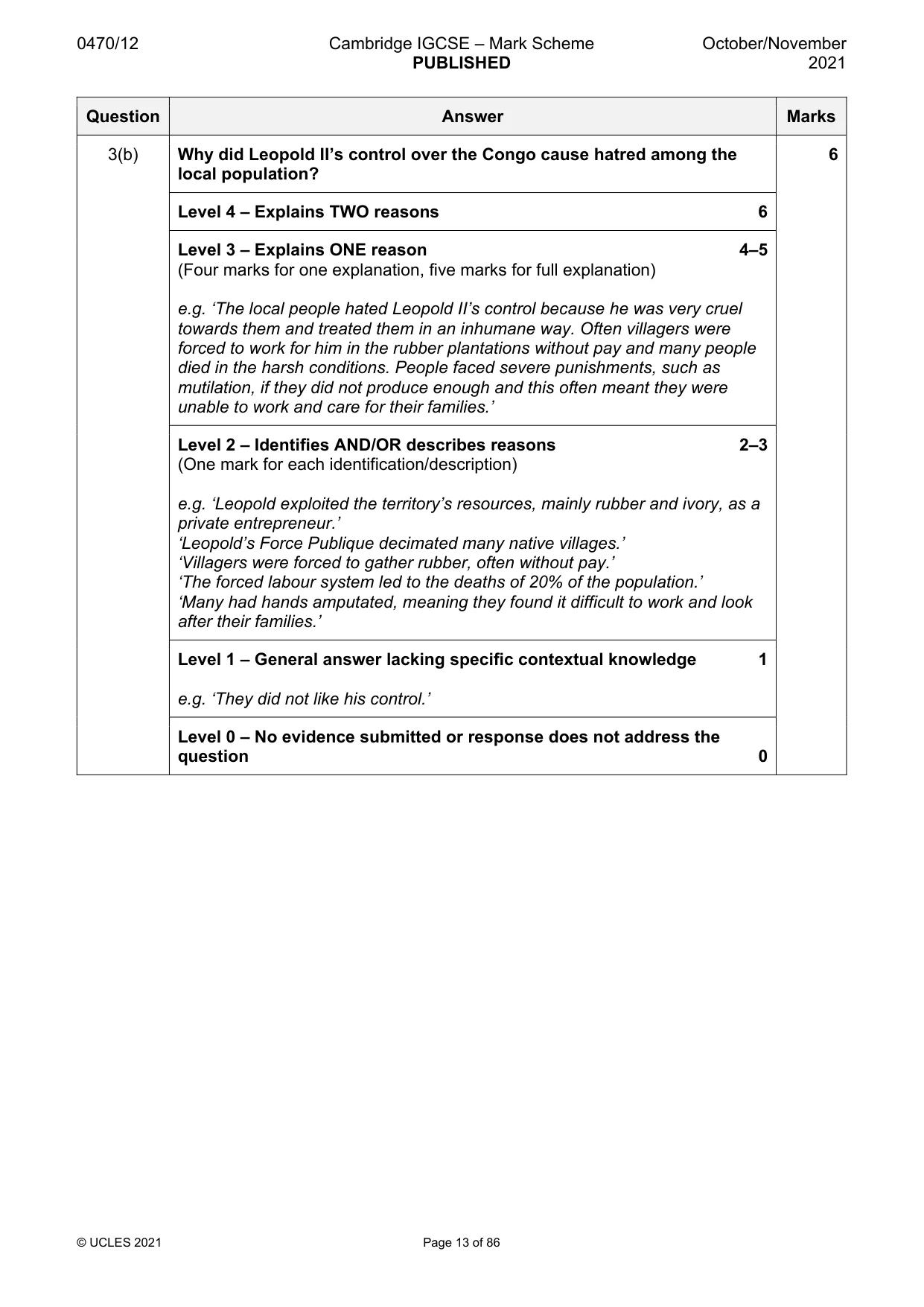
0470/12 Cambridge IGCSE – Mark Scheme PUBLISHED October/November 2021 © UCLES 2021 Page 13 of 86 Question Answer Marks 3(b) Why did Leopold II’s control over the Congo cause hatred among the local population? 6 Level 4 – Explains TWO reasons 6 Level 3 – Explains ONE reason 4–5 (Four marks for one explanation, five marks for full explanation) e.g. ‘The local people hated Leopold II’s control because he was very cruel towards them and treated them in an inhumane way. Often villagers were forced to work for him in the rubber plantations without pay and many people died in the harsh conditions. People faced severe punishments, such as mutilation, if they did not produce enough and this often meant they were unable to work and care for their families.’ Level 2 – Identifies AND/OR describes reasons 2–3 (One mark for each identification/description) e.g. ‘Leopold exploited the territory’s resources, mainly rubber and ivory, as a private entrepreneur.’ ‘Leopold’s Force Publique decimated many native villages.’ ‘Villagers were forced to gather rubber, often without pay.’ ‘The forced labour system led to the deaths of 20% of the population.’ ‘Many had hands amputated, meaning they found it difficult to work and look after their families.’ Level 1 – General answer lacking specific contextual knowledge 1 e.g. ‘They did not like his control.’ Level 0 – No evidence submitted or response does not address the question 0
Mark scheme, page 14
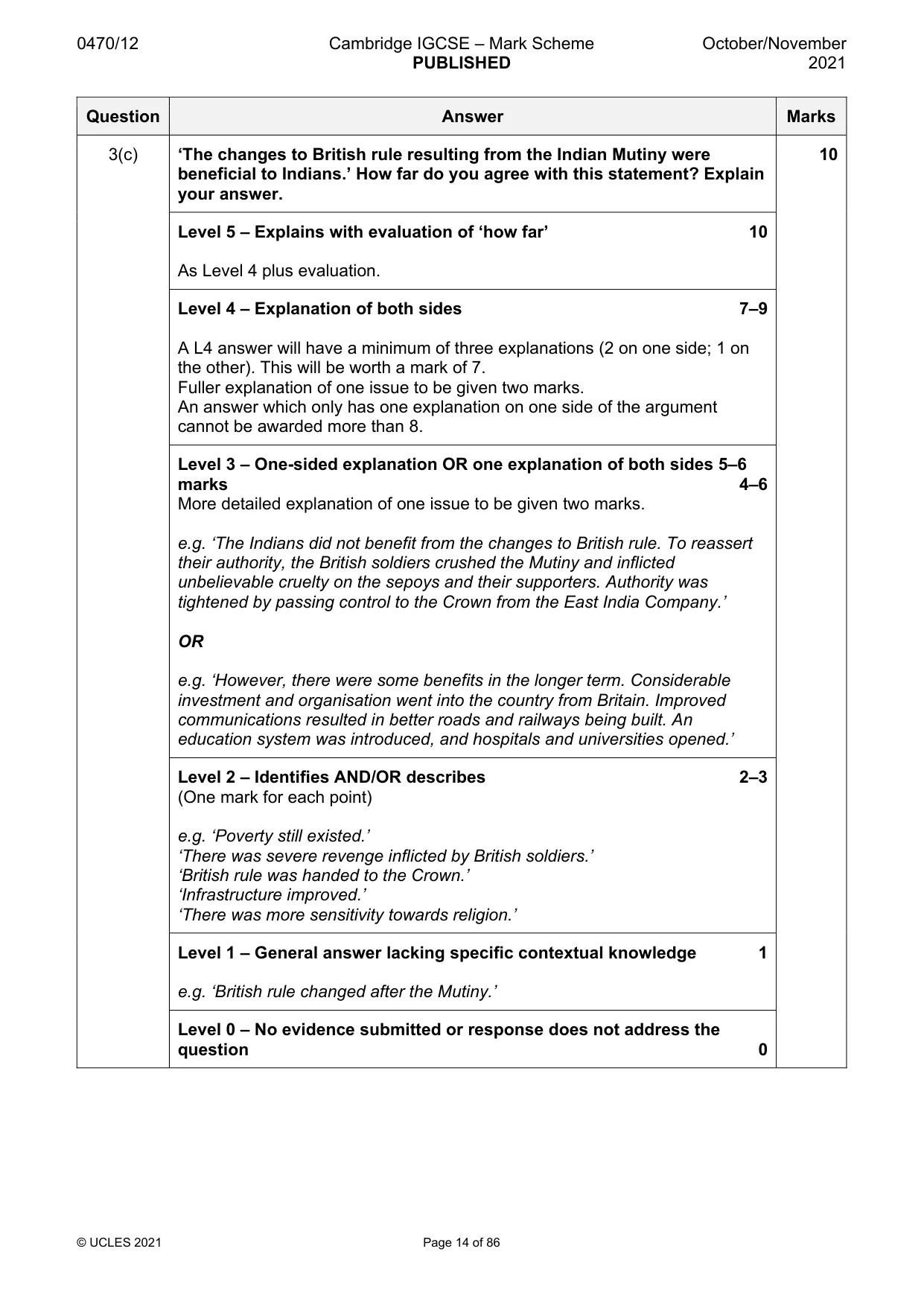
0470/12 Cambridge IGCSE – Mark Scheme PUBLISHED October/November 2021 © UCLES 2021 Page 14 of 86 Question Answer Marks 3(c) ‘The changes to British rule resulting from the Indian Mutiny were beneficial to Indians.’ How far do you agree with this statement? Explain your answer. 10 Level 5 – Explains with evaluation of ‘how far’ 10 As Level 4 plus evaluation. Level 4 – Explanation of both sides 7–9 A L4 answer will have a minimum of three explanations (2 on one side; 1 on the other). This will be worth a mark of 7. Fuller explanation of one issue to be given two marks. An answer which only has one explanation on one side of the argument cannot be awarded more than 8. Level 3 – One-sided explanation OR one explanation of both sides 5–6 marks 4–6 More detailed explanation of one issue to be given two marks. e.g. ‘The Indians did not benefit from the changes to British rule. To reassert their authority, the British soldiers crushed the Mutiny and inflicted unbelievable cruelty on the sepoys and their supporters. Authority was tightened by passing control to the Crown from the East India Company.’ OR e.g. ‘However, there were some benefits in the longer term. Considerable investment and organisation went into the country from Britain. Improved communications resulted in better roads and railways being built. An education system was introduced, and hospitals and universities opened.’ Level 2 – Identifies AND/OR describes 2–3 (One mark for each point) e.g. ‘Poverty still existed.’ ‘There was severe revenge inflicted by British soldiers.’ ‘British rule was handed to the Crown.’ ‘Infrastructure improved.’ ‘There was more sensitivity towards religion.’ Level 1 – General answer lacking specific contextual knowledge 1 e.g. ‘British rule changed after the Mutiny.’ Level 0 – No evidence submitted or response does not address the question 0
Mark scheme, page 15
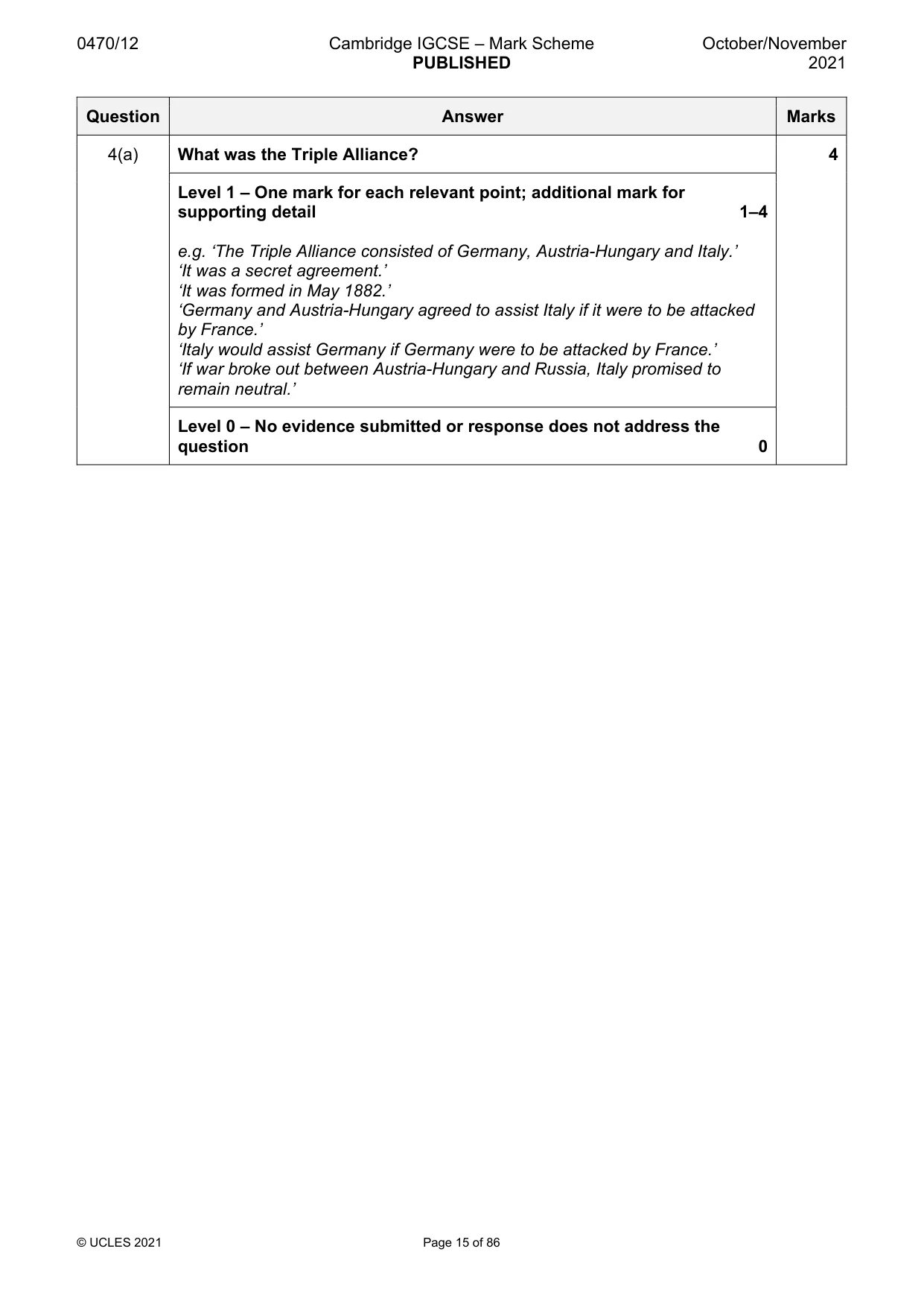
0470/12 Cambridge IGCSE – Mark Scheme PUBLISHED October/November 2021 © UCLES 2021 Page 15 of 86 Question Answer Marks 4(a) What was the Triple Alliance? 4 Level 1 – One mark for each relevant point; additional mark for supporting detail 1–4 e.g. ‘The Triple Alliance consisted of Germany, Austria-Hungary and Italy.’ ‘It was a secret agreement.’ ‘It was formed in May 1882.’ ‘Germany and Austria-Hungary agreed to assist Italy if it were to be attacked by France.’ ‘Italy would assist Germany if Germany were to be attacked by France.’ ‘If war broke out between Austria-Hungary and Russia, Italy promised to remain neutral.’ Level 0 – No evidence submitted or response does not address the question 0
Mark scheme, page 16
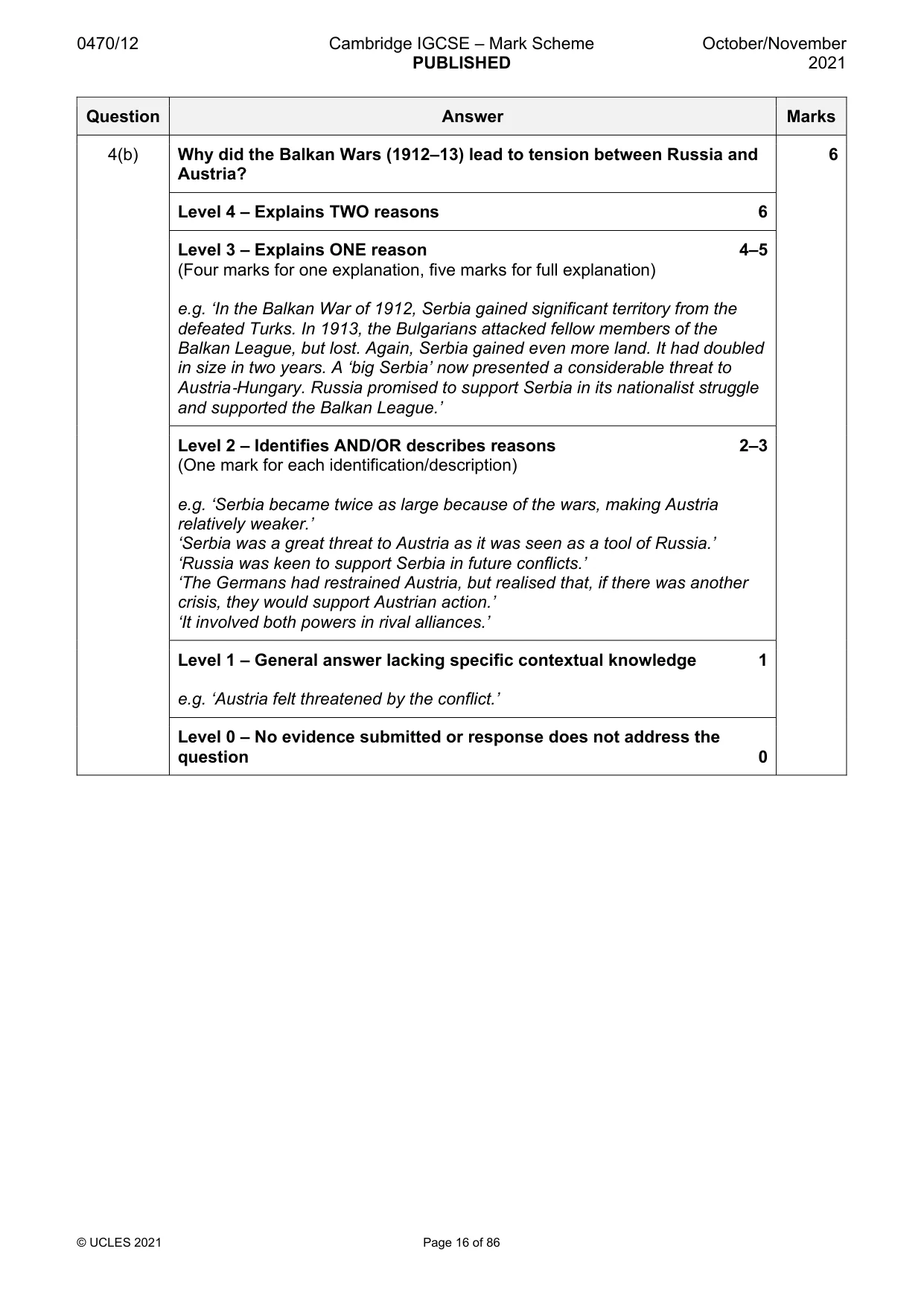
0470/12 Cambridge IGCSE – Mark Scheme PUBLISHED October/November 2021 © UCLES 2021 Page 16 of 86 Question Answer Marks 4(b) Why did the Balkan Wars (1912–13) lead to tension between Russia and Austria? 6 Level 4 – Explains TWO reasons 6 Level 3 – Explains ONE reason 4–5 (Four marks for one explanation, five marks for full explanation) e.g. ‘In the Balkan War of 1912, Serbia gained significant territory from the defeated Turks. In 1913, the Bulgarians attacked fellow members of the Balkan League, but lost. Again, Serbia gained even more land. It had doubled in size in two years. A ‘big Serbia’ now presented a considerable threat to Austria‐Hungary. Russia promised to support Serbia in its nationalist struggle and supported the Balkan League.’ Level 2 – Identifies AND/OR describes reasons 2–3 (One mark for each identification/description) e.g. ‘Serbia became twice as large because of the wars, making Austria relatively weaker.’ ‘Serbia was a great threat to Austria as it was seen as a tool of Russia.’ ‘Russia was keen to support Serbia in future conflicts.’ ‘The Germans had restrained Austria, but realised that, if there was another crisis, they would support Austrian action.’ ‘It involved both powers in rival alliances.’ Level 1 – General answer lacking specific contextual knowledge 1 e.g. ‘Austria felt threatened by the conflict.’ Level 0 – No evidence submitted or response does not address the question 0
Mark scheme, page 17
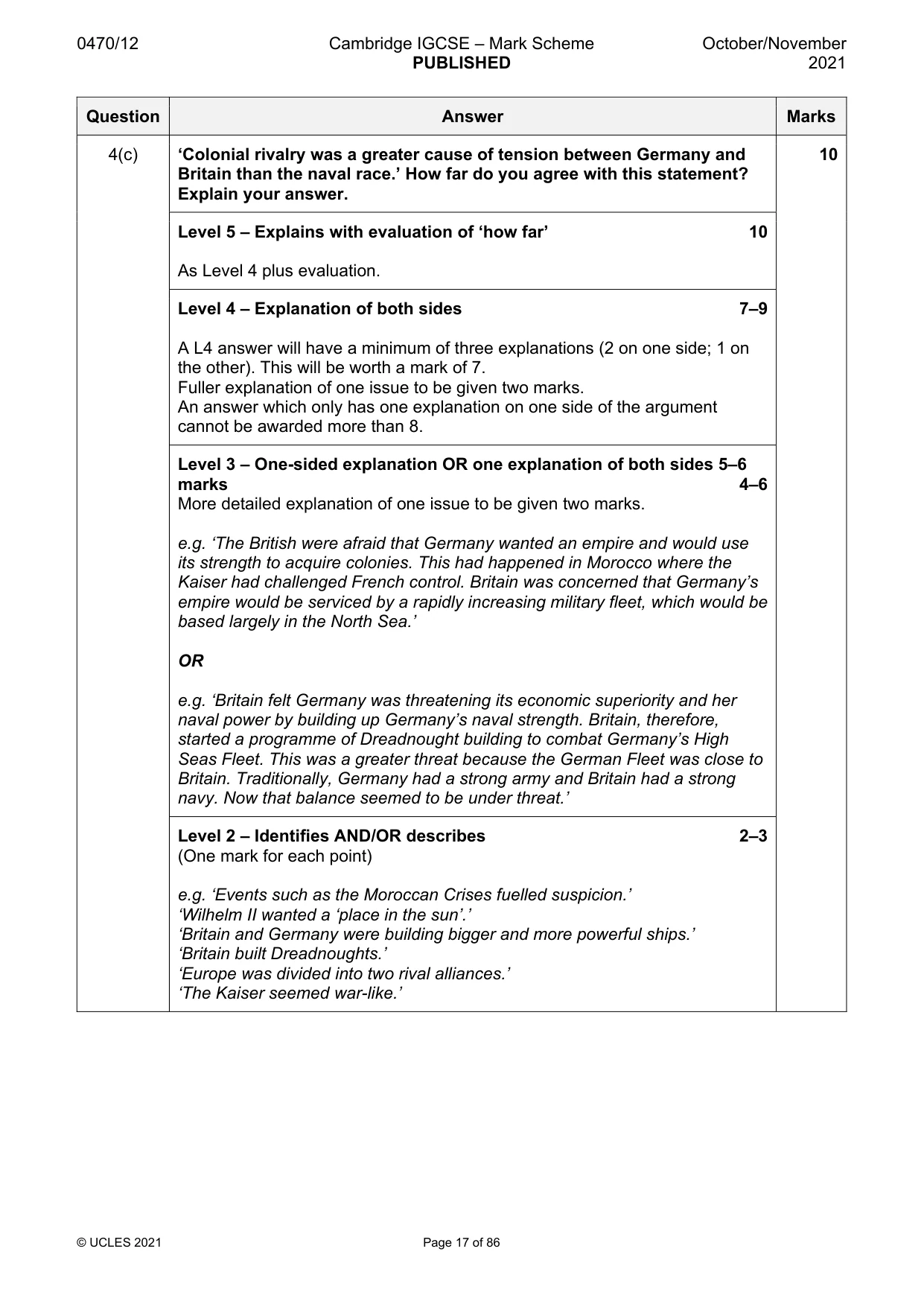
0470/12 Cambridge IGCSE – Mark Scheme PUBLISHED October/November 2021 © UCLES 2021 Page 17 of 86 Question Answer Marks 4(c) ‘Colonial rivalry was a greater cause of tension between Germany and Britain than the naval race.’ How far do you agree with this statement? Explain your answer. 10 Level 5 – Explains with evaluation of ‘how far’ 10 As Level 4 plus evaluation. Level 4 – Explanation of both sides 7–9 A L4 answer will have a minimum of three explanations (2 on one side; 1 on the other). This will be worth a mark of 7. Fuller explanation of one issue to be given two marks. An answer which only has one explanation on one side of the argument cannot be awarded more than 8. Level 3 – One-sided explanation OR one explanation of both sides 5–6 marks 4–6 More detailed explanation of one issue to be given two marks. e.g. ‘The British were afraid that Germany wanted an empire and would use its strength to acquire colonies. This had happened in Morocco where the Kaiser had challenged French control. Britain was concerned that Germany’s empire would be serviced by a rapidly increasing military fleet, which would be based largely in the North Sea.’ OR e.g. ‘Britain felt Germany was threatening its economic superiority and her naval power by building up Germany’s naval strength. Britain, therefore, started a programme of Dreadnought building to combat Germany’s High Seas Fleet. This was a greater threat because the German Fleet was close to Britain. Traditionally, Germany had a strong army and Britain had a strong navy. Now that balance seemed to be under threat.’ Level 2 – Identifies AND/OR describes 2–3 (One mark for each point) e.g. ‘Events such as the Moroccan Crises fuelled suspicion.’ ‘Wilhelm II wanted a ‘place in the sun’.’ ‘Britain and Germany were building bigger and more powerful ships.’ ‘Britain built Dreadnoughts.’ ‘Europe was divided into two rival alliances.’ ‘The Kaiser seemed war-like.’
Mark scheme, page 18
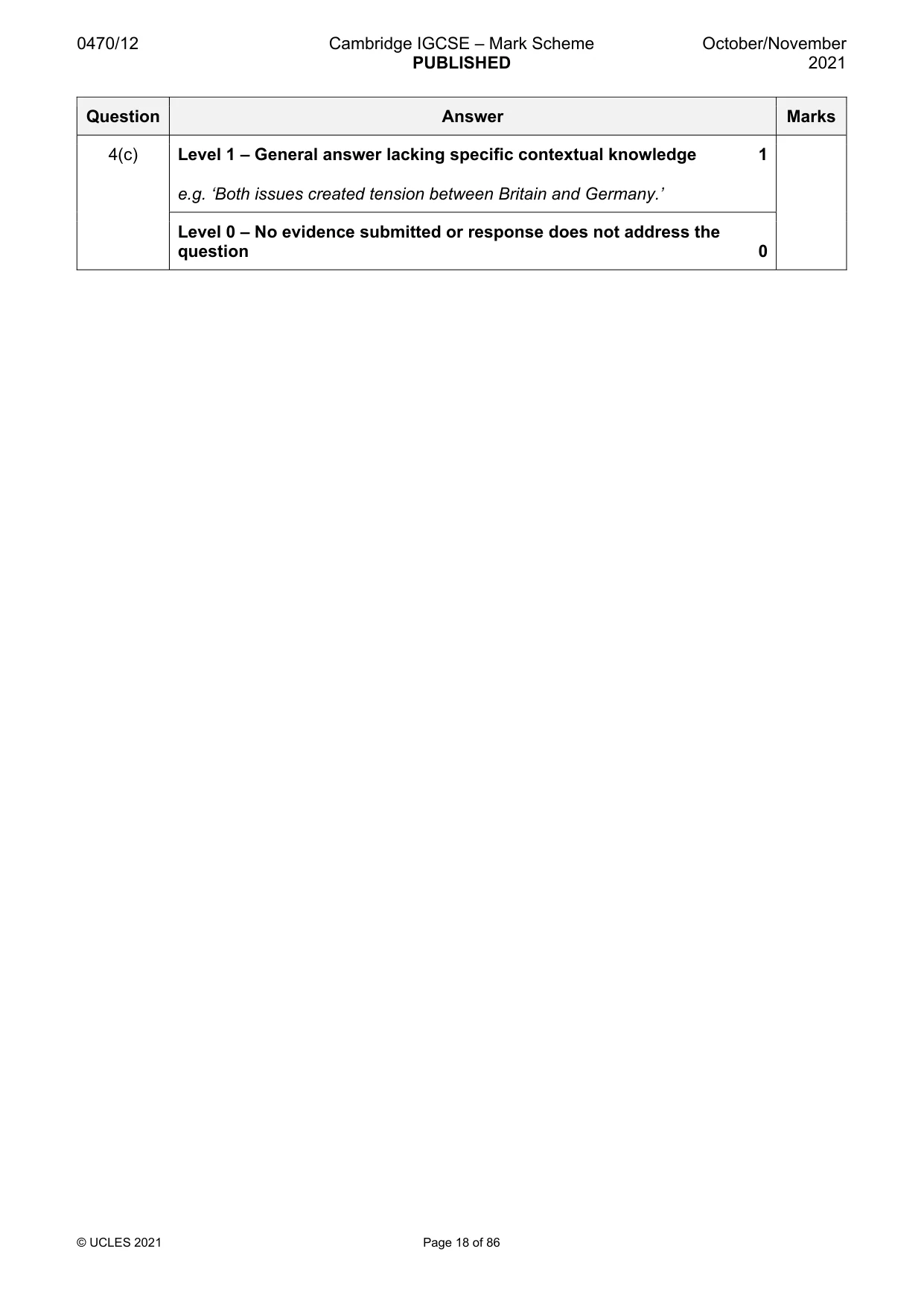
0470/12 Cambridge IGCSE – Mark Scheme PUBLISHED October/November 2021 © UCLES 2021 Page 18 of 86 Question Answer Marks 4(c) Level 1 – General answer lacking specific contextual knowledge 1 e.g. ‘Both issues created tension between Britain and Germany.’ Level 0 – No evidence submitted or response does not address the question 0
Mark scheme, page 19
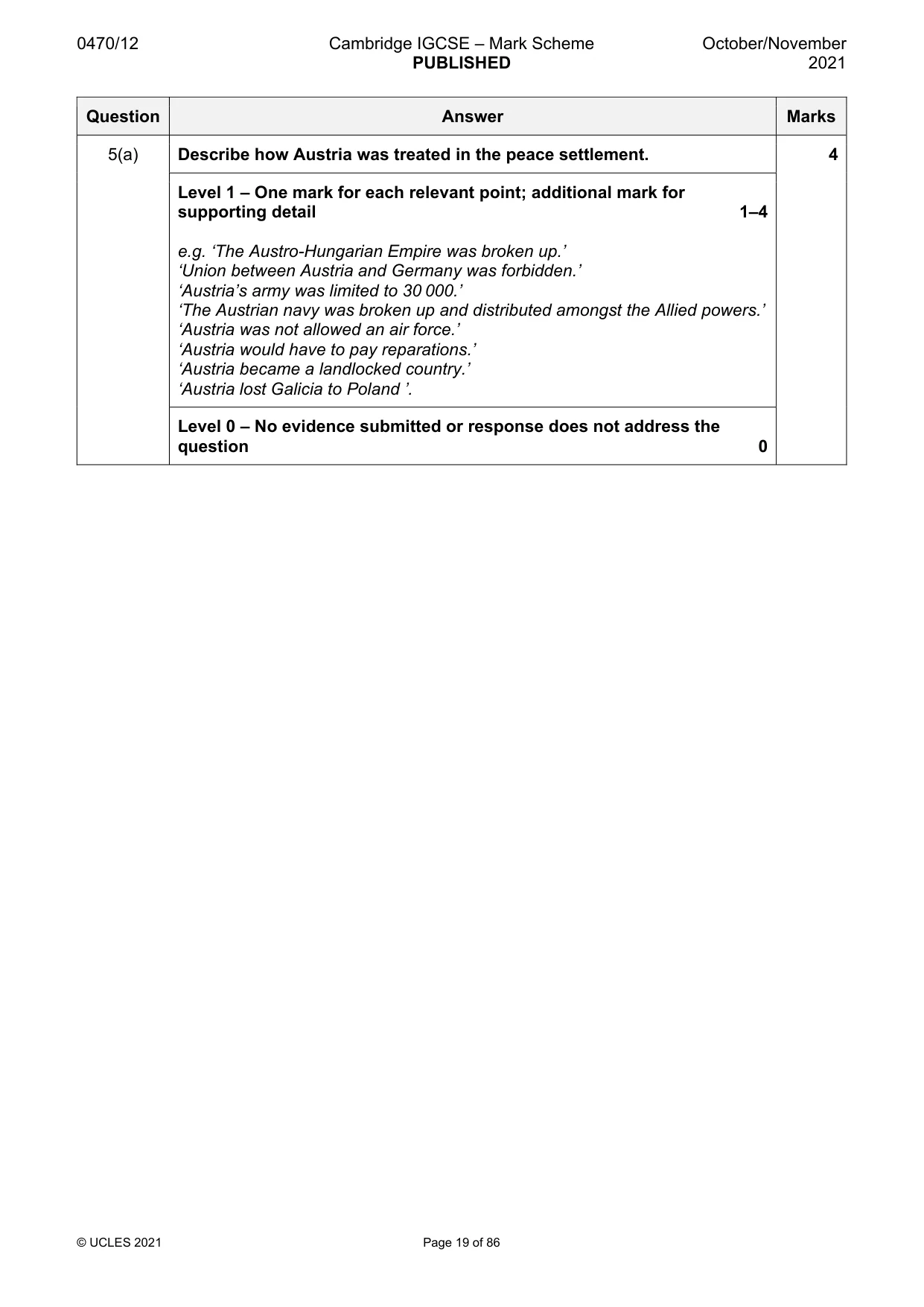
0470/12 Cambridge IGCSE – Mark Scheme PUBLISHED October/November 2021 © UCLES 2021 Page 19 of 86 Question Answer Marks 5(a) Describe how Austria was treated in the peace settlement. 4 Level 1 – One mark for each relevant point; additional mark for supporting detail 1–4 e.g. ‘The Austro-Hungarian Empire was broken up.’ ‘Union between Austria and Germany was forbidden.’ ‘Austria’s army was limited to 30 000.’ ‘The Austrian navy was broken up and distributed amongst the Allied powers.’ ‘Austria was not allowed an air force.’ ‘Austria would have to pay reparations.’ ‘Austria became a landlocked country.’ ‘Austria lost Galicia to Poland ’. Level 0 – No evidence submitted or response does not address the question 0
Mark scheme, page 20
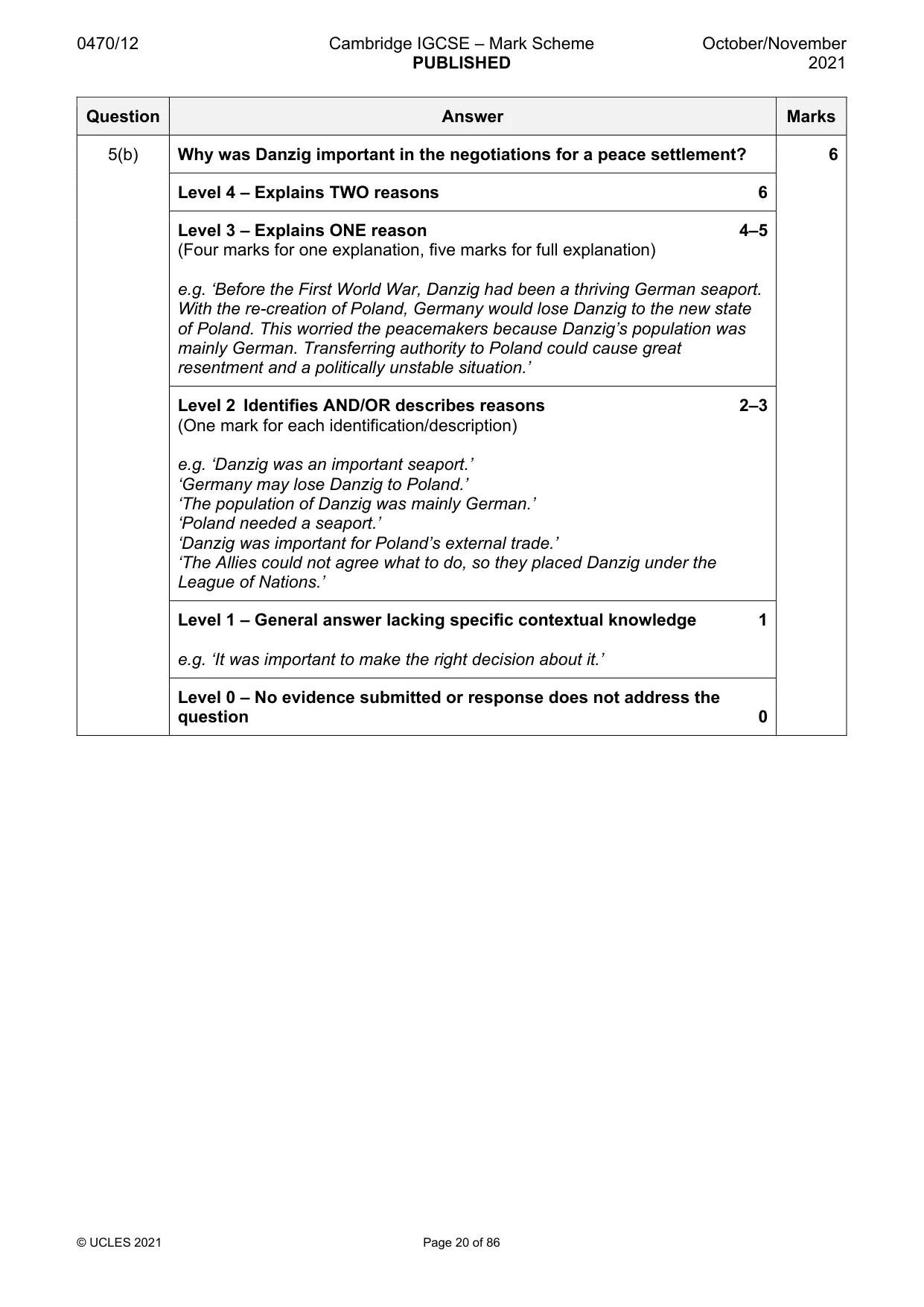
0470/12 Cambridge IGCSE – Mark Scheme PUBLISHED October/November 2021 © UCLES 2021 Page 20 of 86 Question Answer Marks 5(b) Why was Danzig important in the negotiations for a peace settlement? 6 Level 4 – Explains TWO reasons 6 Level 3 – Explains ONE reason 4–5 (Four marks for one explanation, five marks for full explanation) e.g. ‘Before the First World War, Danzig had been a thriving German seaport. With the re-creation of Poland, Germany would lose Danzig to the new state of Poland. This worried the peacemakers because Danzig’s population was mainly German. Transferring authority to Poland could cause great resentment and a politically unstable situation.’ Level 2 Identifies AND/OR describes reasons 2–3 (One mark for each identification/description) e.g. ‘Danzig was an important seaport.’ ‘Germany may lose Danzig to Poland.’ ‘The population of Danzig was mainly German.’ ‘Poland needed a seaport.’ ‘Danzig was important for Poland’s external trade.’ ‘The Allies could not agree what to do, so they placed Danzig under the League of Nations.’ Level 1 – General answer lacking specific contextual knowledge 1 e.g. ‘It was important to make the right decision about it.’ Level 0 – No evidence submitted or response does not address the question 0
Mark scheme, page 21
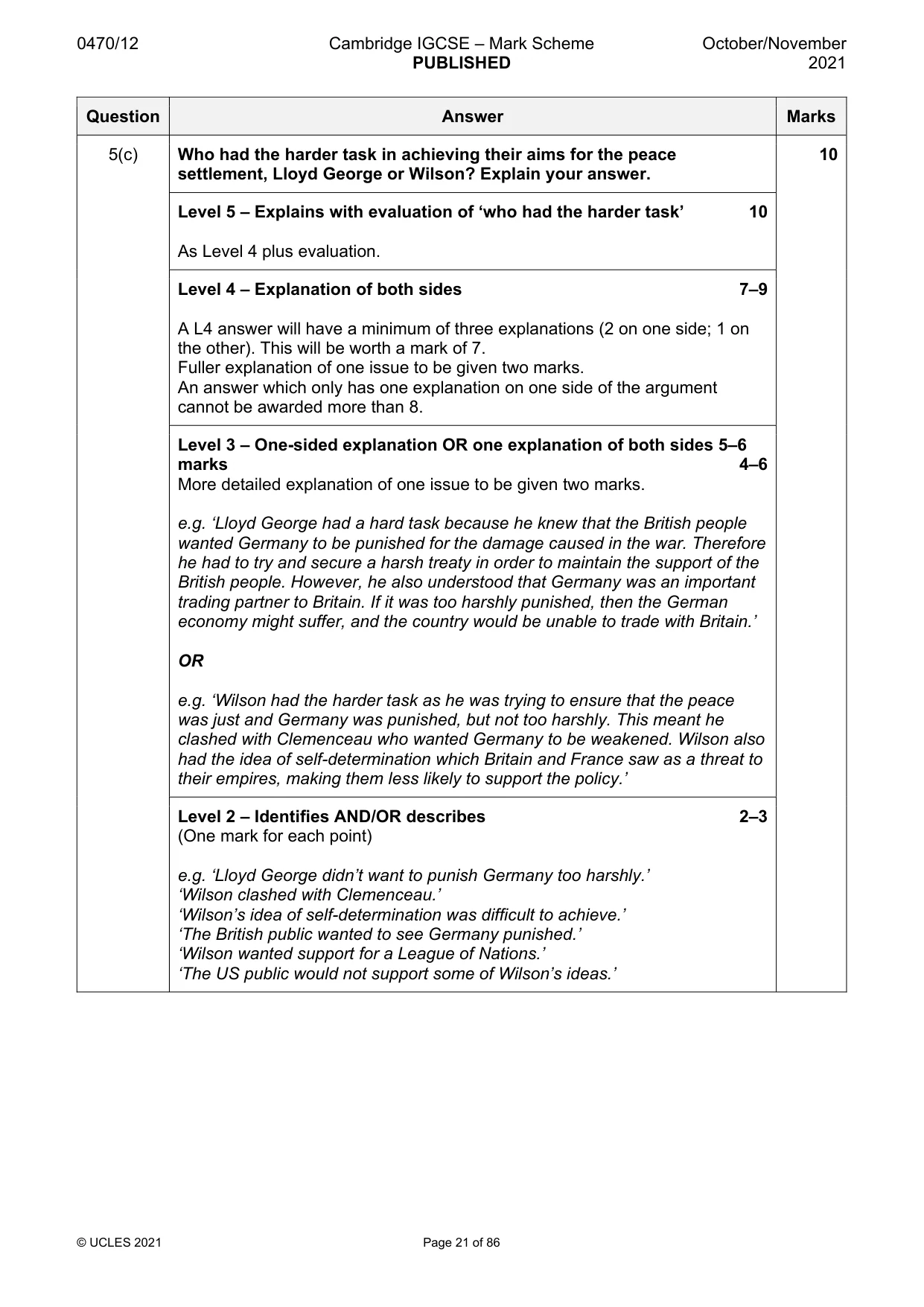
0470/12 Cambridge IGCSE – Mark Scheme PUBLISHED October/November 2021 © UCLES 2021 Page 21 of 86 Question Answer Marks 5(c) Who had the harder task in achieving their aims for the peace settlement, Lloyd George or Wilson? Explain your answer. 10 Level 5 – Explains with evaluation of ‘who had the harder task’ 10 As Level 4 plus evaluation. Level 4 – Explanation of both sides 7–9 A L4 answer will have a minimum of three explanations (2 on one side; 1 on the other). This will be worth a mark of 7. Fuller explanation of one issue to be given two marks. An answer which only has one explanation on one side of the argument cannot be awarded more than 8. Level 3 – One-sided explanation OR one explanation of both sides 5–6 marks 4–6 More detailed explanation of one issue to be given two marks. e.g. ‘Lloyd George had a hard task because he knew that the British people wanted Germany to be punished for the damage caused in the war. Therefore he had to try and secure a harsh treaty in order to maintain the support of the British people. However, he also understood that Germany was an important trading partner to Britain. If it was too harshly punished, then the German economy might suffer, and the country would be unable to trade with Britain.’ OR e.g. ‘Wilson had the harder task as he was trying to ensure that the peace was just and Germany was punished, but not too harshly. This meant he clashed with Clemenceau who wanted Germany to be weakened. Wilson also had the idea of self-determination which Britain and France saw as a threat to their empires, making them less likely to support the policy.’ Level 2 – Identifies AND/OR describes 2–3 (One mark for each point) e.g. ‘Lloyd George didn’t want to punish Germany too harshly.’ ‘Wilson clashed with Clemenceau.’ ‘Wilson’s idea of self-determination was difficult to achieve.’ ‘The British public wanted to see Germany punished.’ ‘Wilson wanted support for a League of Nations.’ ‘The US public would not support some of Wilson’s ideas.’
Mark scheme, page 22
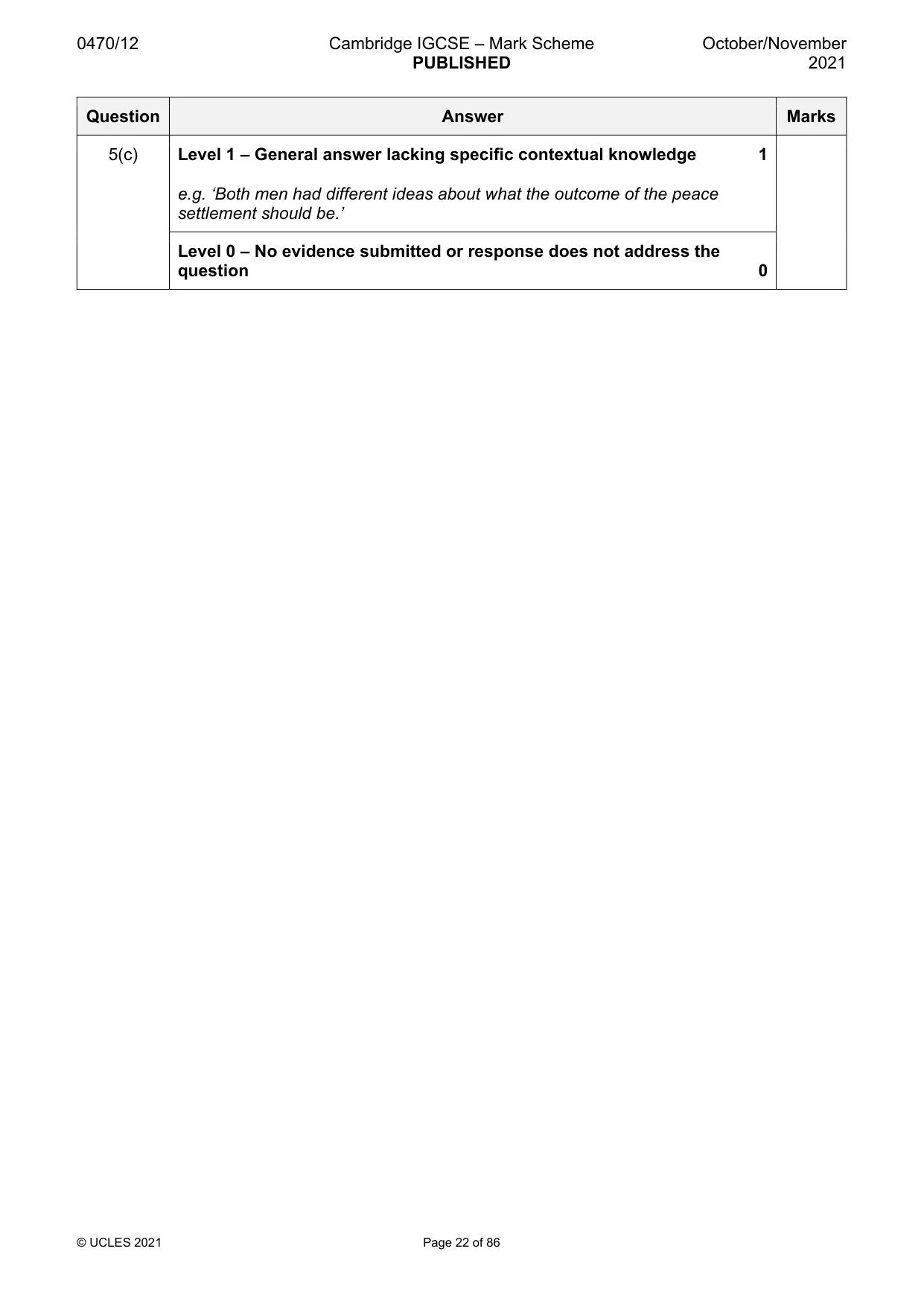
0470/12 Cambridge IGCSE – Mark Scheme PUBLISHED October/November 2021 © UCLES 2021 Page 22 of 86 Question Answer Marks 5(c) Level 1 – General answer lacking specific contextual knowledge 1 e.g. ‘Both men had different ideas about what the outcome of the peace settlement should be.’ Level 0 – No evidence submitted or response does not address the question 0
Mark scheme, page 23
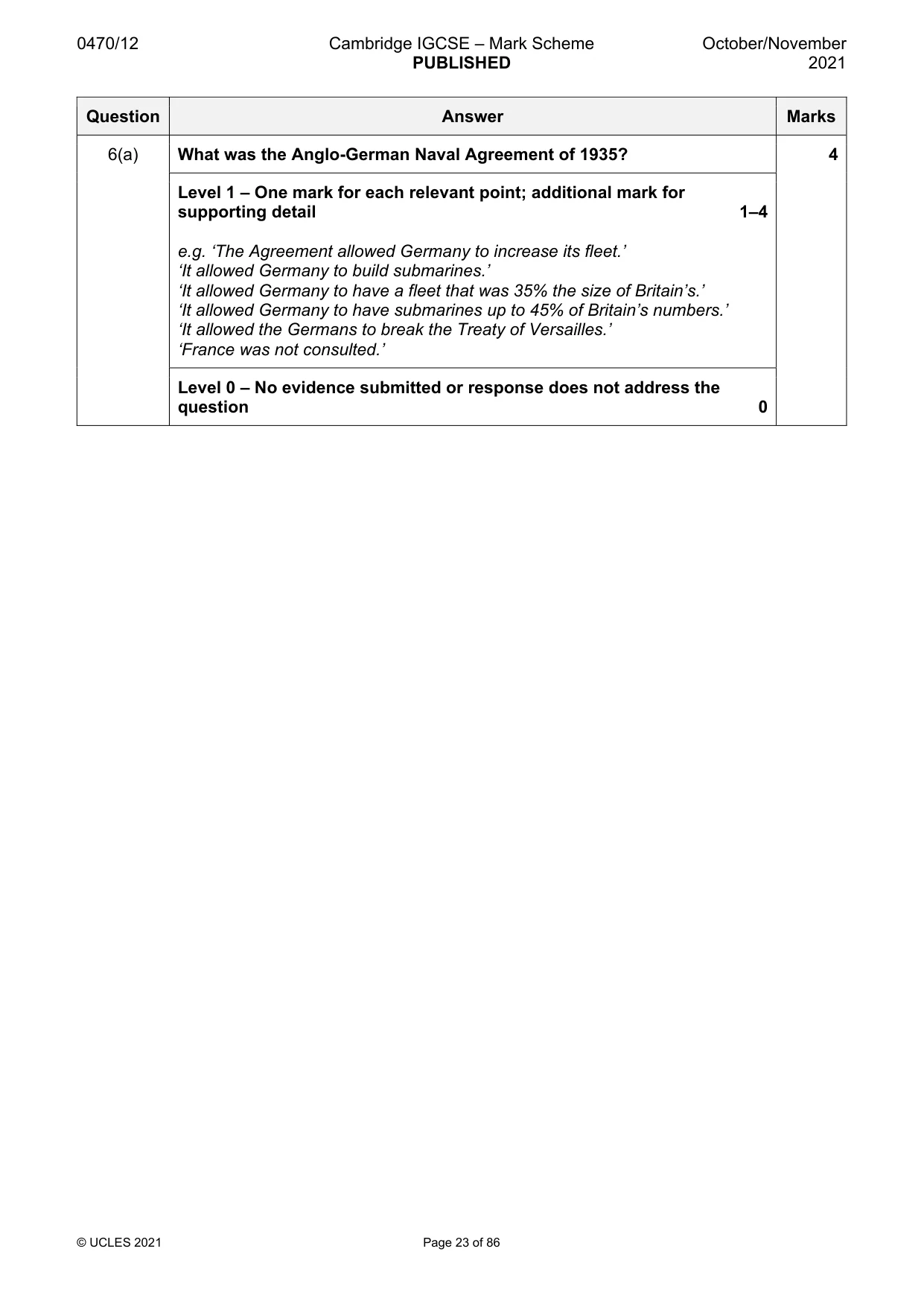
0470/12 Cambridge IGCSE – Mark Scheme PUBLISHED October/November 2021 © UCLES 2021 Page 23 of 86 Question Answer Marks 6(a) What was the Anglo-German Naval Agreement of 1935? 4 Level 1 – One mark for each relevant point; additional mark for supporting detail 1–4 e.g. ‘The Agreement allowed Germany to increase its fleet.’ ‘It allowed Germany to build submarines.’ ‘It allowed Germany to have a fleet that was 35% the size of Britain’s.’ ‘It allowed Germany to have submarines up to 45% of Britain’s numbers.’ ‘It allowed the Germans to break the Treaty of Versailles.’ ‘France was not consulted.’ Level 0 – No evidence submitted or response does not address the question 0
Mark scheme, page 24
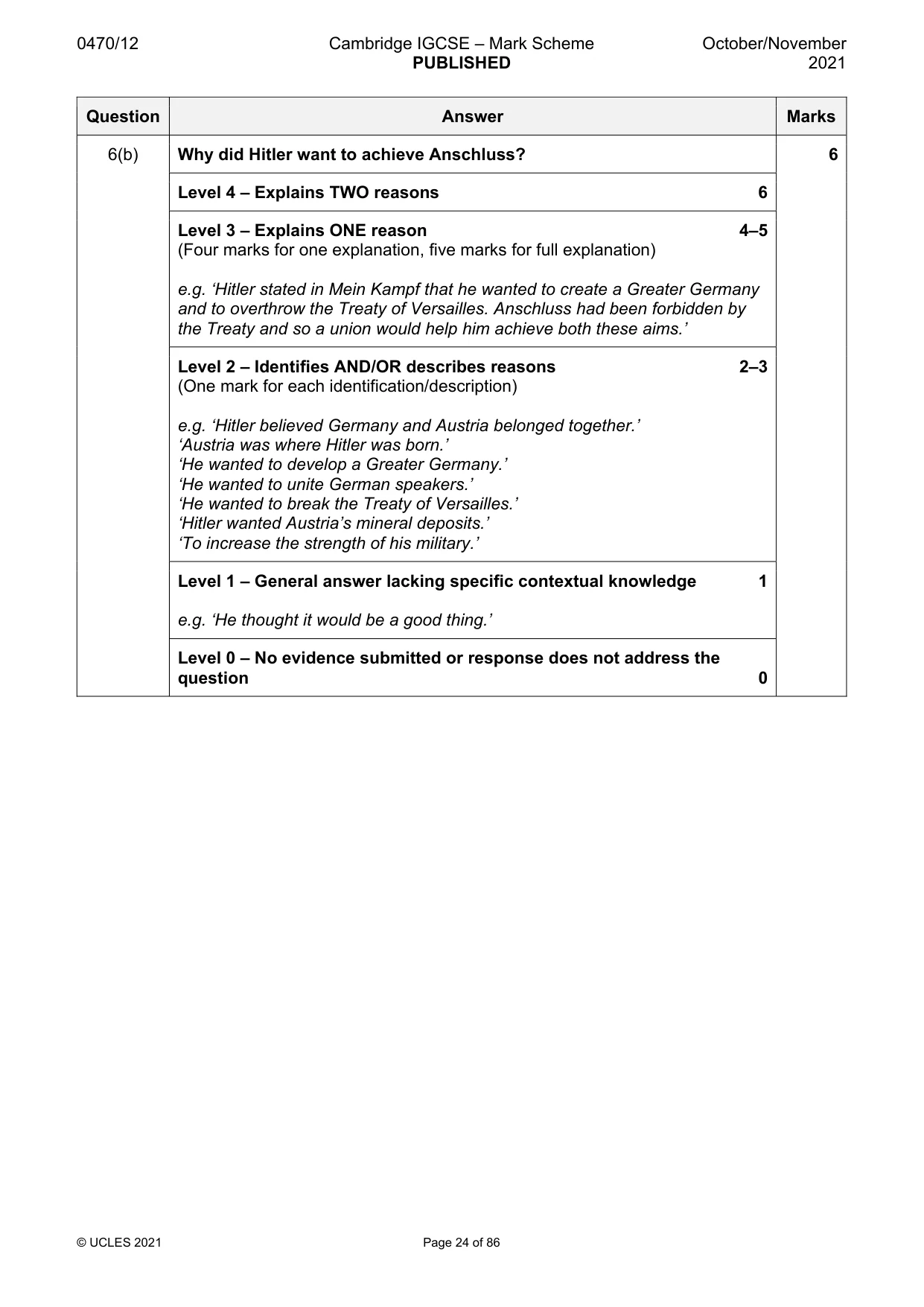
0470/12 Cambridge IGCSE – Mark Scheme PUBLISHED October/November 2021 © UCLES 2021 Page 24 of 86 Question Answer Marks 6(b) Why did Hitler want to achieve Anschluss? 6 Level 4 – Explains TWO reasons 6 Level 3 – Explains ONE reason 4–5 (Four marks for one explanation, five marks for full explanation) e.g. ‘Hitler stated in Mein Kampf that he wanted to create a Greater Germany and to overthrow the Treaty of Versailles. Anschluss had been forbidden by the Treaty and so a union would help him achieve both these aims.’ Level 2 – Identifies AND/OR describes reasons 2–3 (One mark for each identification/description) e.g. ‘Hitler believed Germany and Austria belonged together.’ ‘Austria was where Hitler was born.’ ‘He wanted to develop a Greater Germany.’ ‘He wanted to unite German speakers.’ ‘He wanted to break the Treaty of Versailles.’ ‘Hitler wanted Austria’s mineral deposits.’ ‘To increase the strength of his military.’ Level 1 – General answer lacking specific contextual knowledge 1 e.g. ‘He thought it would be a good thing.’ Level 0 – No evidence submitted or response does not address the question 0
Mark scheme, page 25
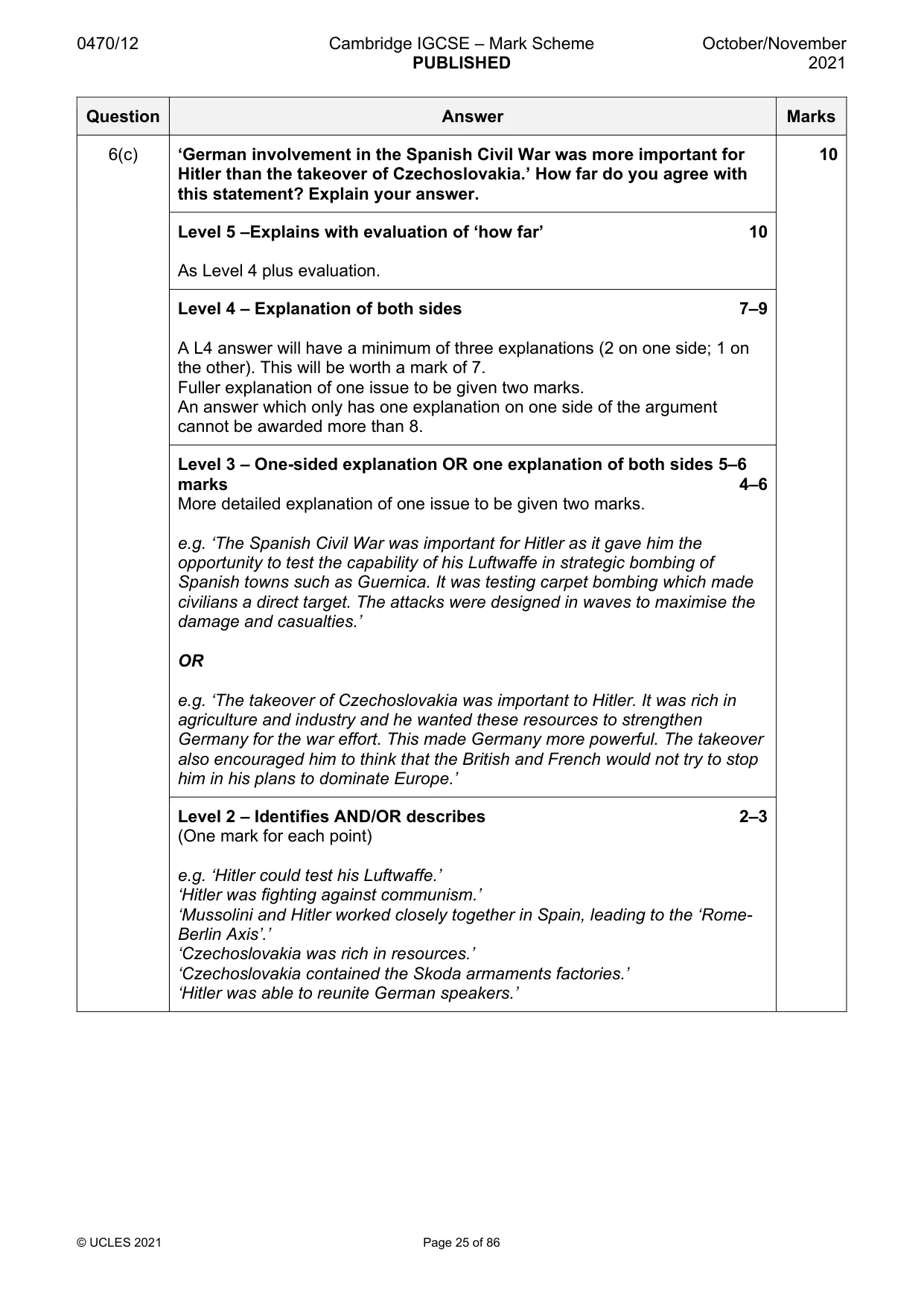
0470/12 Cambridge IGCSE – Mark Scheme PUBLISHED October/November 2021 © UCLES 2021 Page 25 of 86 Question Answer Marks 6(c) ‘German involvement in the Spanish Civil War was more important for Hitler than the takeover of Czechoslovakia.’ How far do you agree with this statement? Explain your answer. 10 Level 5 –Explains with evaluation of ‘how far’ 10 As Level 4 plus evaluation. Level 4 – Explanation of both sides 7–9 A L4 answer will have a minimum of three explanations (2 on one side; 1 on the other). This will be worth a mark of 7. Fuller explanation of one issue to be given two marks. An answer which only has one explanation on one side of the argument cannot be awarded more than 8. Level 3 – One-sided explanation OR one explanation of both sides 5–6 marks 4–6 More detailed explanation of one issue to be given two marks. e.g. ‘The Spanish Civil War was important for Hitler as it gave him the opportunity to test the capability of his Luftwaffe in strategic bombing of Spanish towns such as Guernica. It was testing carpet bombing which made civilians a direct target. The attacks were designed in waves to maximise the damage and casualties.’ OR e.g. ‘The takeover of Czechoslovakia was important to Hitler. It was rich in agriculture and industry and he wanted these resources to strengthen Germany for the war effort. This made Germany more powerful. The takeover also encouraged him to think that the British and French would not try to stop him in his plans to dominate Europe.’ Level 2 – Identifies AND/OR describes 2–3 (One mark for each point) e.g. ‘Hitler could test his Luftwaffe.’ ‘Hitler was fighting against communism.’ ‘Mussolini and Hitler worked closely together in Spain, leading to the ‘Rome- Berlin Axis’.’ ‘Czechoslovakia was rich in resources.’ ‘Czechoslovakia contained the Skoda armaments factories.’ ‘Hitler was able to reunite German speakers.’
Mark scheme, page 26
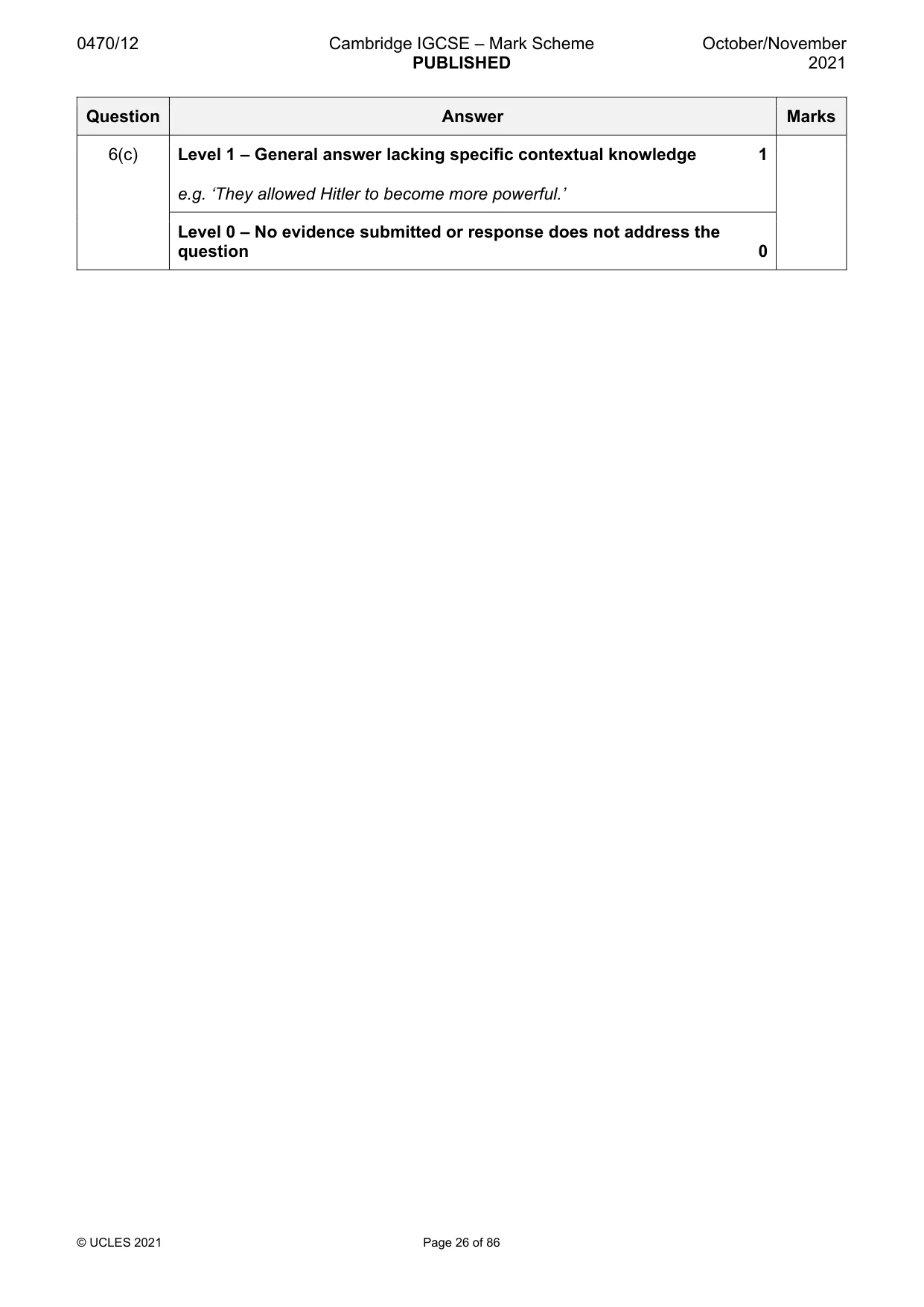
0470/12 Cambridge IGCSE – Mark Scheme PUBLISHED October/November 2021 © UCLES 2021 Page 26 of 86 Question Answer Marks 6(c) Level 1 – General answer lacking specific contextual knowledge 1 e.g. ‘They allowed Hitler to become more powerful.’ Level 0 – No evidence submitted or response does not address the question 0
Mark scheme, page 27
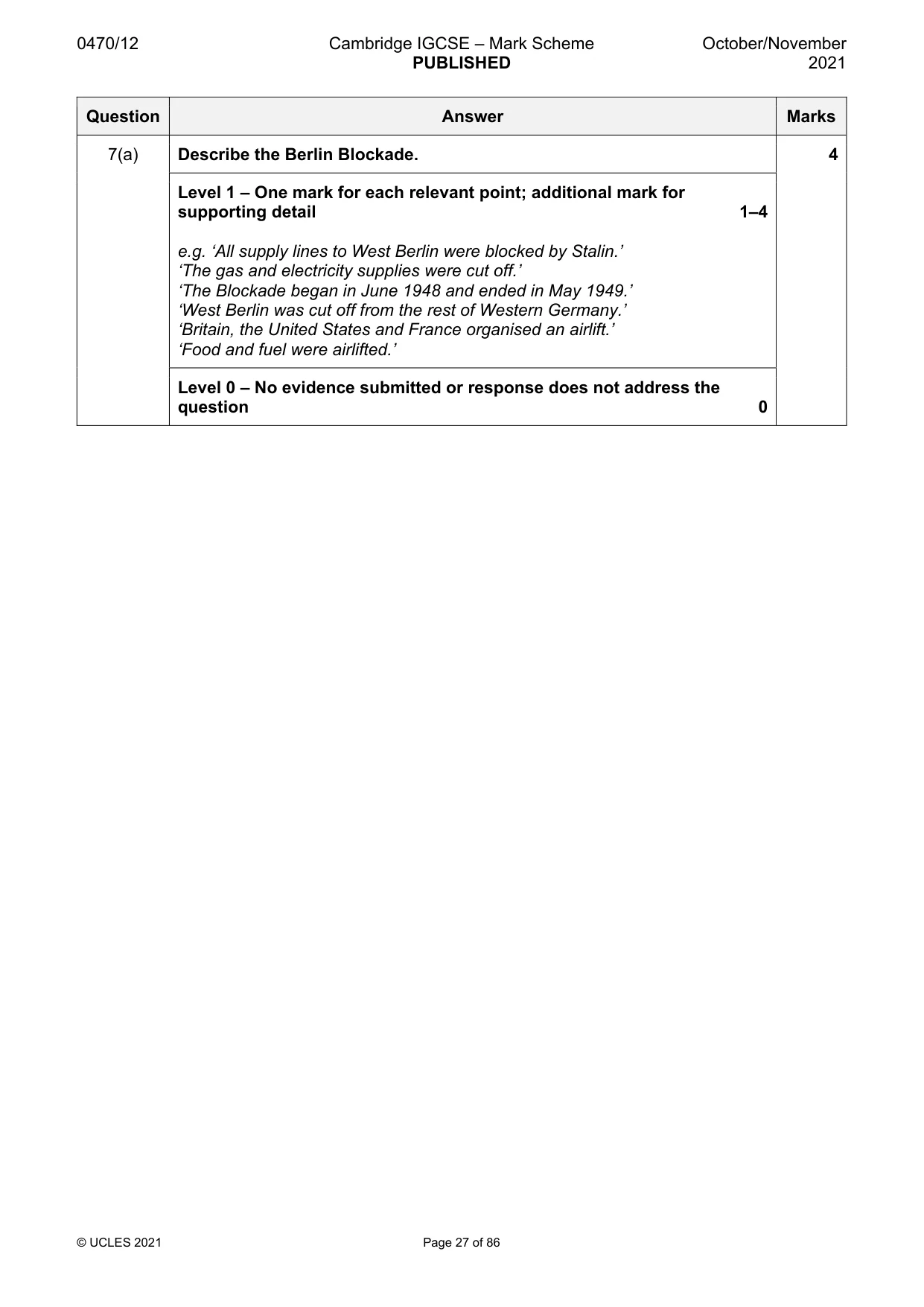
0470/12 Cambridge IGCSE – Mark Scheme PUBLISHED October/November 2021 © UCLES 2021 Page 27 of 86 Question Answer Marks 7(a) Describe the Berlin Blockade. 4 Level 1 – One mark for each relevant point; additional mark for supporting detail 1–4 e.g. ‘All supply lines to West Berlin were blocked by Stalin.’ ‘The gas and electricity supplies were cut off.’ ‘The Blockade began in June 1948 and ended in May 1949.’ ‘West Berlin was cut off from the rest of Western Germany.’ ‘Britain, the United States and France organised an airlift.’ ‘Food and fuel were airlifted.’ Level 0 – No evidence submitted or response does not address the question 0
Mark scheme, page 28
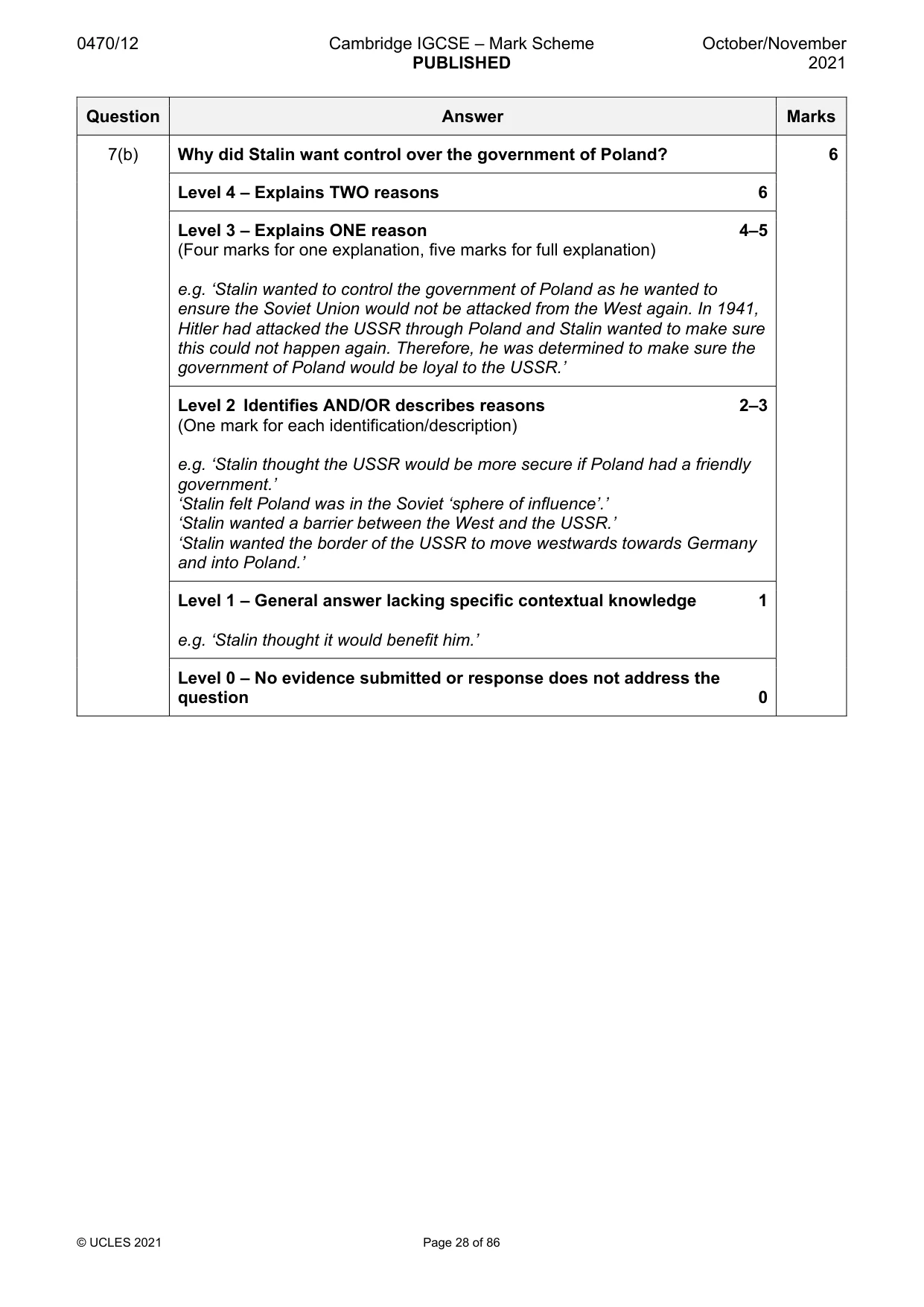
0470/12 Cambridge IGCSE – Mark Scheme PUBLISHED October/November 2021 © UCLES 2021 Page 28 of 86 Question Answer Marks 7(b) Why did Stalin want control over the government of Poland? 6 Level 4 – Explains TWO reasons 6 Level 3 – Explains ONE reason 4–5 (Four marks for one explanation, five marks for full explanation) e.g. ‘Stalin wanted to control the government of Poland as he wanted to ensure the Soviet Union would not be attacked from the West again. In 1941, Hitler had attacked the USSR through Poland and Stalin wanted to make sure this could not happen again. Therefore, he was determined to make sure the government of Poland would be loyal to the USSR.’ Level 2 Identifies AND/OR describes reasons 2–3 (One mark for each identification/description) e.g. ‘Stalin thought the USSR would be more secure if Poland had a friendly government.’ ‘Stalin felt Poland was in the Soviet ‘sphere of influence’.’ ‘Stalin wanted a barrier between the West and the USSR.’ ‘Stalin wanted the border of the USSR to move westwards towards Germany and into Poland.’ Level 1 – General answer lacking specific contextual knowledge 1 e.g. ‘Stalin thought it would benefit him.’ Level 0 – No evidence submitted or response does not address the question 0
Mark scheme, page 29
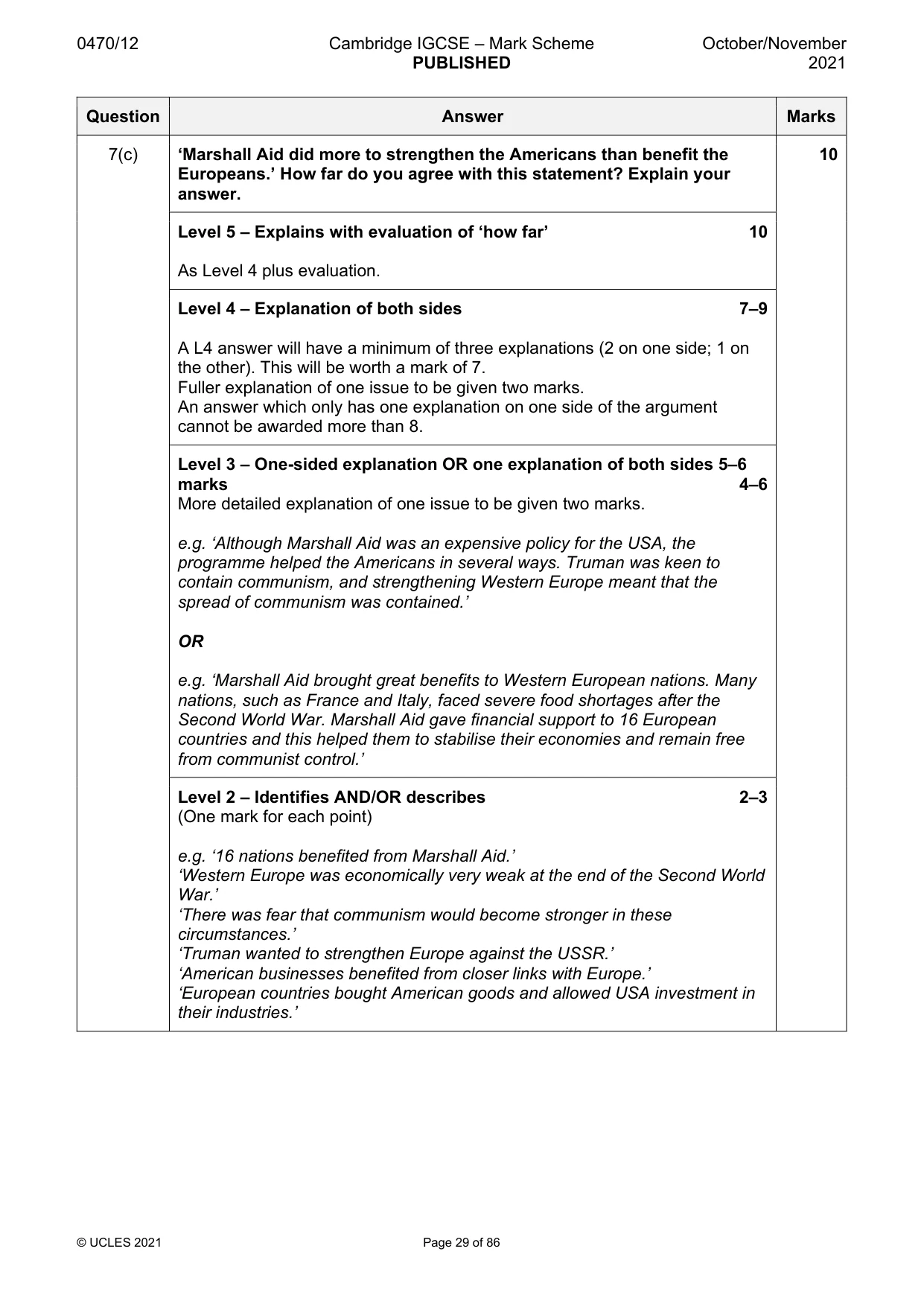
0470/12 Cambridge IGCSE – Mark Scheme PUBLISHED October/November 2021 © UCLES 2021 Page 29 of 86 Question Answer Marks 7(c) ‘Marshall Aid did more to strengthen the Americans than benefit the Europeans.’ How far do you agree with this statement? Explain your answer. 10 Level 5 – Explains with evaluation of ‘how far’ 10 As Level 4 plus evaluation. Level 4 – Explanation of both sides 7–9 A L4 answer will have a minimum of three explanations (2 on one side; 1 on the other). This will be worth a mark of 7. Fuller explanation of one issue to be given two marks. An answer which only has one explanation on one side of the argument cannot be awarded more than 8. Level 3 – One-sided explanation OR one explanation of both sides 5–6 marks 4–6 More detailed explanation of one issue to be given two marks. e.g. ‘Although Marshall Aid was an expensive policy for the USA, the programme helped the Americans in several ways. Truman was keen to contain communism, and strengthening Western Europe meant that the spread of communism was contained.’ OR e.g. ‘Marshall Aid brought great benefits to Western European nations. Many nations, such as France and Italy, faced severe food shortages after the Second World War. Marshall Aid gave financial support to 16 European countries and this helped them to stabilise their economies and remain free from communist control.’ Level 2 – Identifies AND/OR describes 2–3 (One mark for each point) e.g. ‘16 nations benefited from Marshall Aid.’ ‘Western Europe was economically very weak at the end of the Second World War.’ ‘There was fear that communism would become stronger in these circumstances.’ ‘Truman wanted to strengthen Europe against the USSR.’ ‘American businesses benefited from closer links with Europe.’ ‘European countries bought American goods and allowed USA investment in their industries.’
Mark scheme, page 30
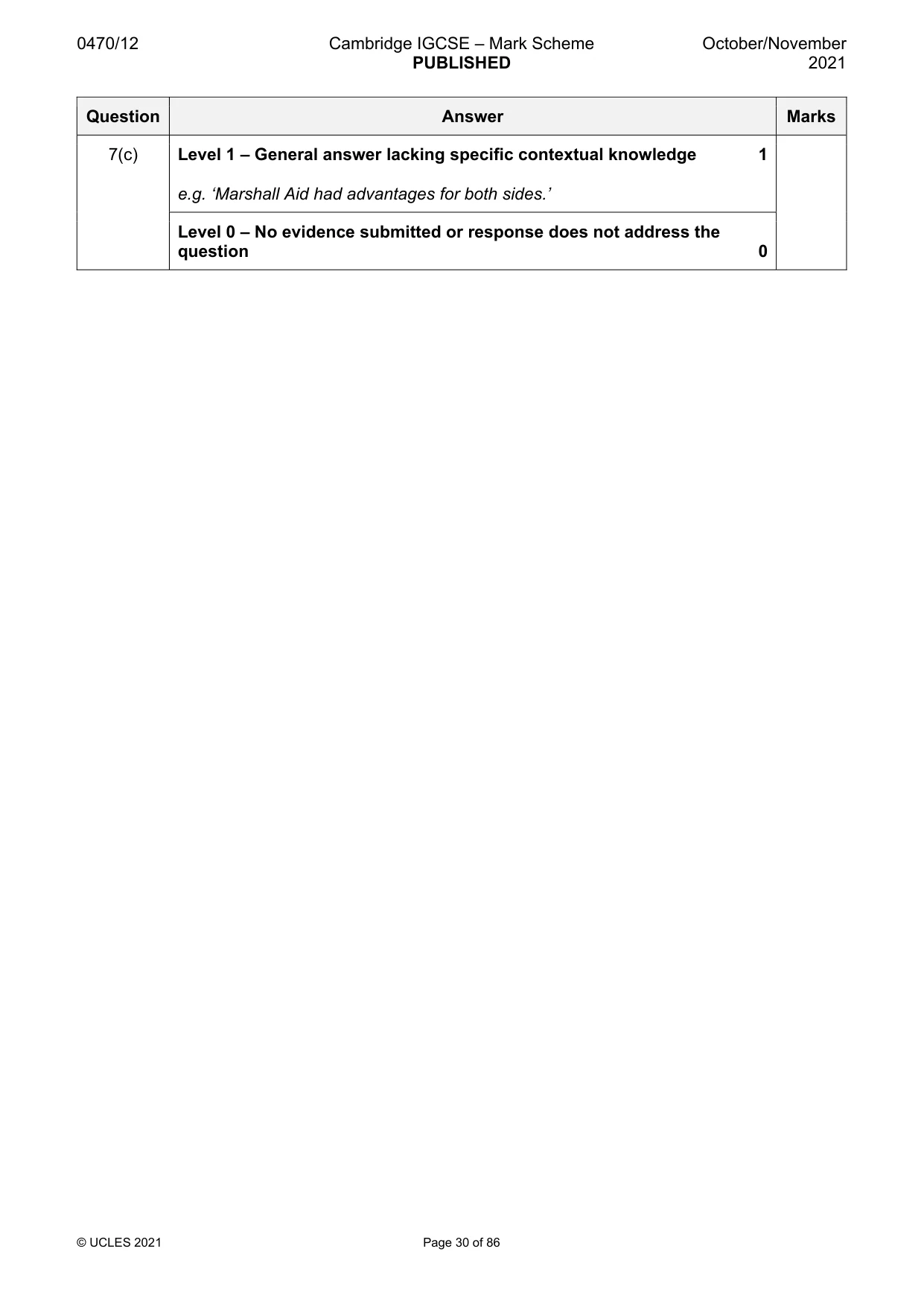
0470/12 Cambridge IGCSE – Mark Scheme PUBLISHED October/November 2021 © UCLES 2021 Page 30 of 86 Question Answer Marks 7(c) Level 1 – General answer lacking specific contextual knowledge 1 e.g. ‘Marshall Aid had advantages for both sides.’ Level 0 – No evidence submitted or response does not address the question 0
Mark scheme, page 31
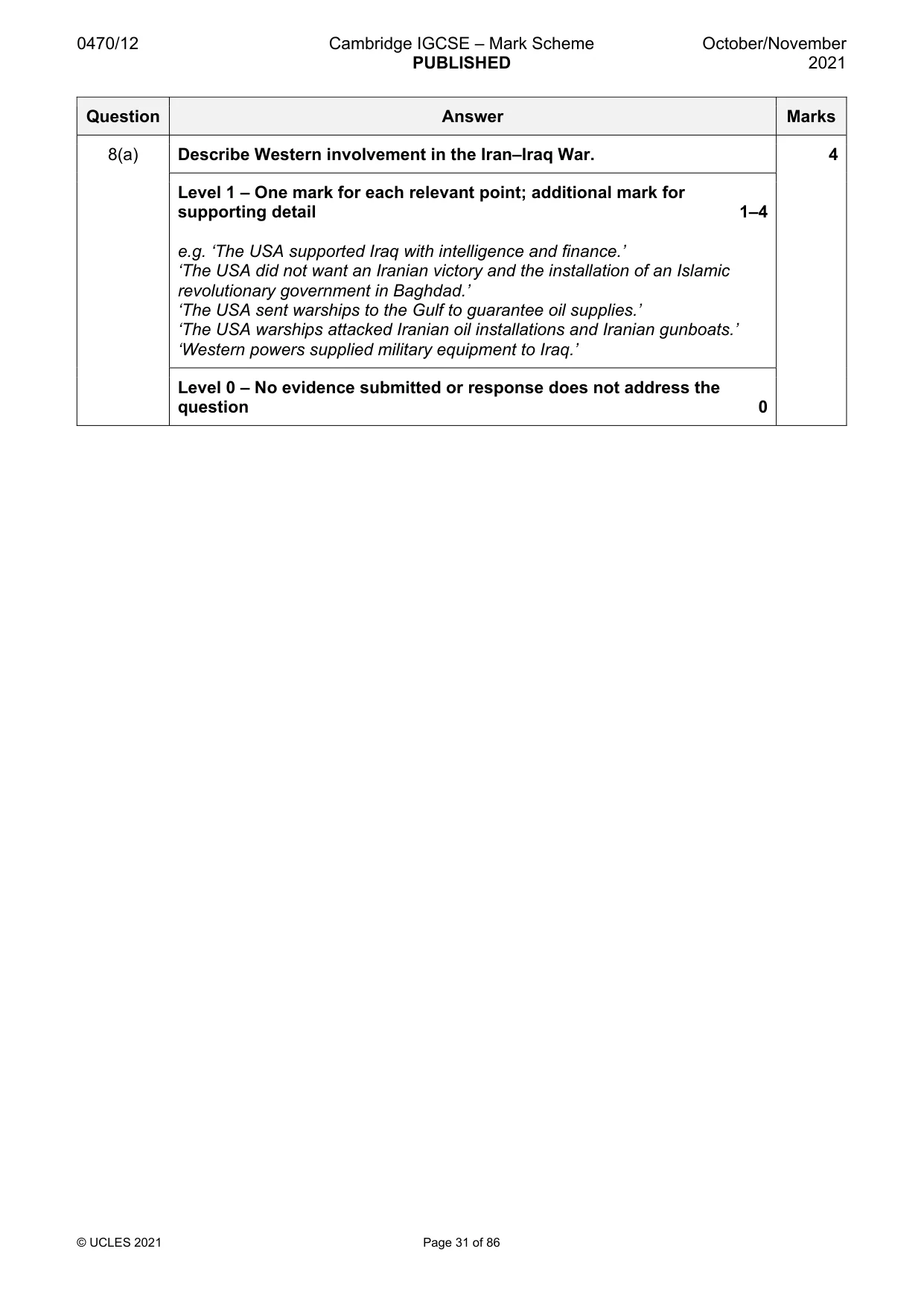
0470/12 Cambridge IGCSE – Mark Scheme PUBLISHED October/November 2021 © UCLES 2021 Page 31 of 86 Question Answer Marks 8(a) Describe Western involvement in the Iran–Iraq War. 4 Level 1 – One mark for each relevant point; additional mark for supporting detail 1–4 e.g. ‘The USA supported Iraq with intelligence and finance.’ ‘The USA did not want an Iranian victory and the installation of an Islamic revolutionary government in Baghdad.’ ‘The USA sent warships to the Gulf to guarantee oil supplies.’ ‘The USA warships attacked Iranian oil installations and Iranian gunboats.’ ‘Western powers supplied military equipment to Iraq.’ Level 0 – No evidence submitted or response does not address the question 0
Mark scheme, page 32
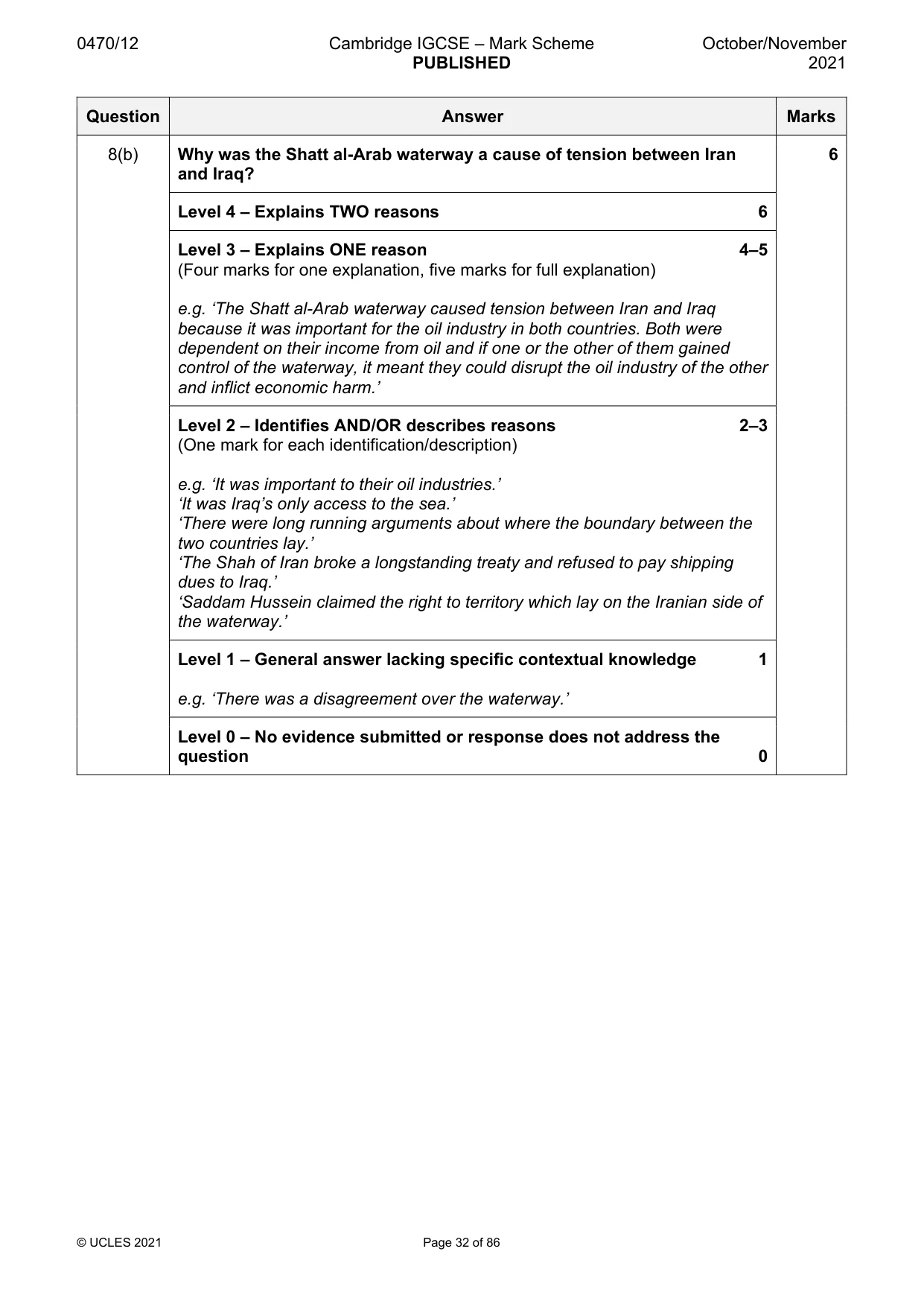
0470/12 Cambridge IGCSE – Mark Scheme PUBLISHED October/November 2021 © UCLES 2021 Page 32 of 86 Question Answer Marks 8(b) Why was the Shatt al-Arab waterway a cause of tension between Iran and Iraq? 6 Level 4 – Explains TWO reasons 6 Level 3 – Explains ONE reason 4–5 (Four marks for one explanation, five marks for full explanation) e.g. ‘The Shatt al-Arab waterway caused tension between Iran and Iraq because it was important for the oil industry in both countries. Both were dependent on their income from oil and if one or the other of them gained control of the waterway, it meant they could disrupt the oil industry of the other and inflict economic harm.’ Level 2 – Identifies AND/OR describes reasons 2–3 (One mark for each identification/description) e.g. ‘It was important to their oil industries.’ ‘It was Iraq’s only access to the sea.’ ‘There were long running arguments about where the boundary between the two countries lay.’ ‘The Shah of Iran broke a longstanding treaty and refused to pay shipping dues to Iraq.’ ‘Saddam Hussein claimed the right to territory which lay on the Iranian side of the waterway.’ Level 1 – General answer lacking specific contextual knowledge 1 e.g. ‘There was a disagreement over the waterway.’ Level 0 – No evidence submitted or response does not address the question 0
Mark scheme, page 33
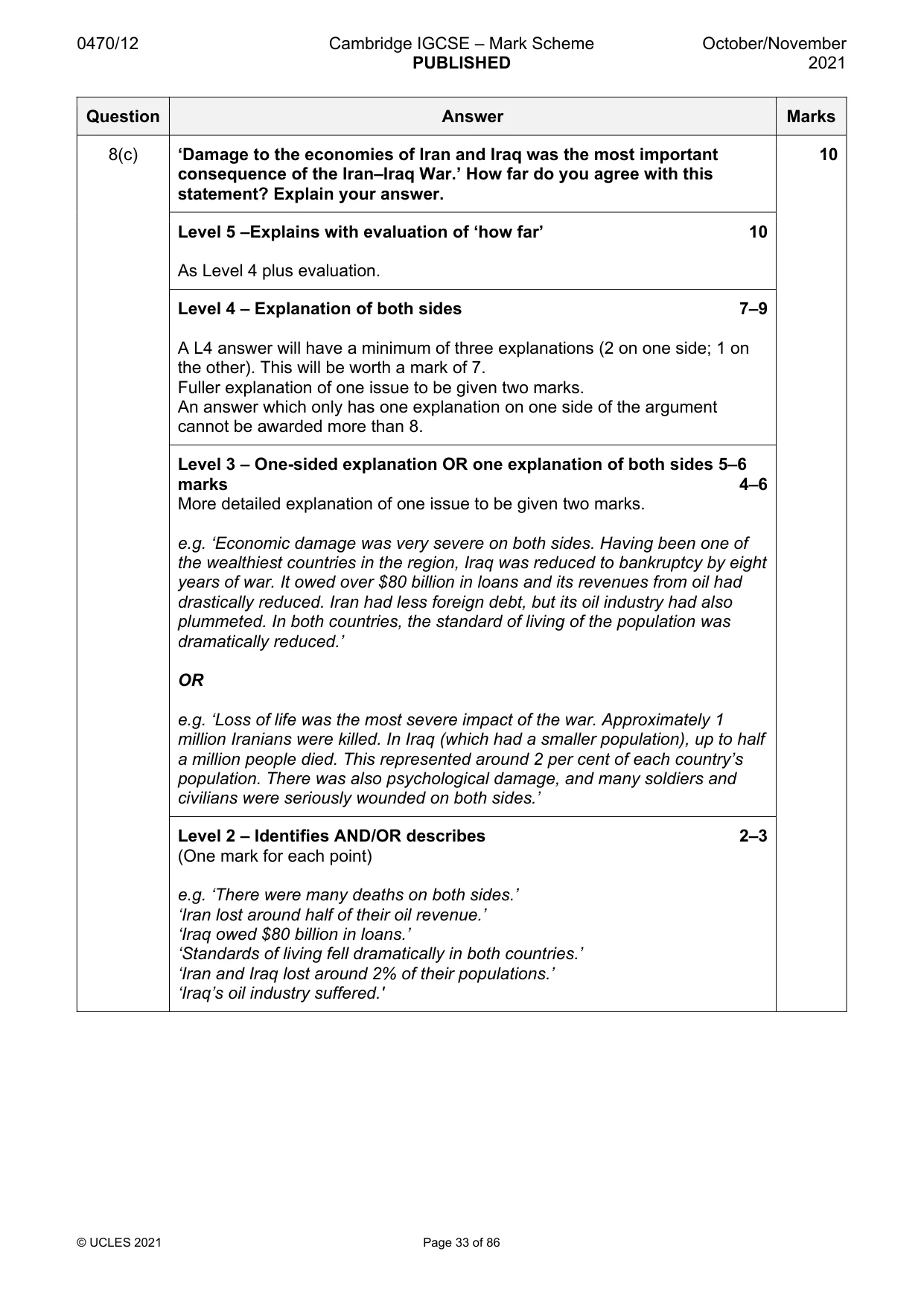
0470/12 Cambridge IGCSE – Mark Scheme PUBLISHED October/November 2021 © UCLES 2021 Page 33 of 86 Question Answer Marks 8(c) ‘Damage to the economies of Iran and Iraq was the most important consequence of the Iran–Iraq War.’ How far do you agree with this statement? Explain your answer. 10 Level 5 –Explains with evaluation of ‘how far’ 10 As Level 4 plus evaluation. Level 4 – Explanation of both sides 7–9 A L4 answer will have a minimum of three explanations (2 on one side; 1 on the other). This will be worth a mark of 7. Fuller explanation of one issue to be given two marks. An answer which only has one explanation on one side of the argument cannot be awarded more than 8. Level 3 – One-sided explanation OR one explanation of both sides 5–6 marks 4–6 More detailed explanation of one issue to be given two marks. e.g. ‘Economic damage was very severe on both sides. Having been one of the wealthiest countries in the region, Iraq was reduced to bankruptcy by eight years of war. It owed over $80 billion in loans and its revenues from oil had drastically reduced. Iran had less foreign debt, but its oil industry had also plummeted. In both countries, the standard of living of the population was dramatically reduced.’ OR e.g. ‘Loss of life was the most severe impact of the war. Approximately 1 million Iranians were killed. In Iraq (which had a smaller population), up to half a million people died. This represented around 2 per cent of each country’s population. There was also psychological damage, and many soldiers and civilians were seriously wounded on both sides.’ Level 2 – Identifies AND/OR describes 2–3 (One mark for each point) e.g. ‘There were many deaths on both sides.’ ‘Iran lost around half of their oil revenue.’ ‘Iraq owed $80 billion in loans.’ ‘Standards of living fell dramatically in both countries.’ ‘Iran and Iraq lost around 2% of their populations.’ ‘Iraq’s oil industry suffered.'
Mark scheme, page 34
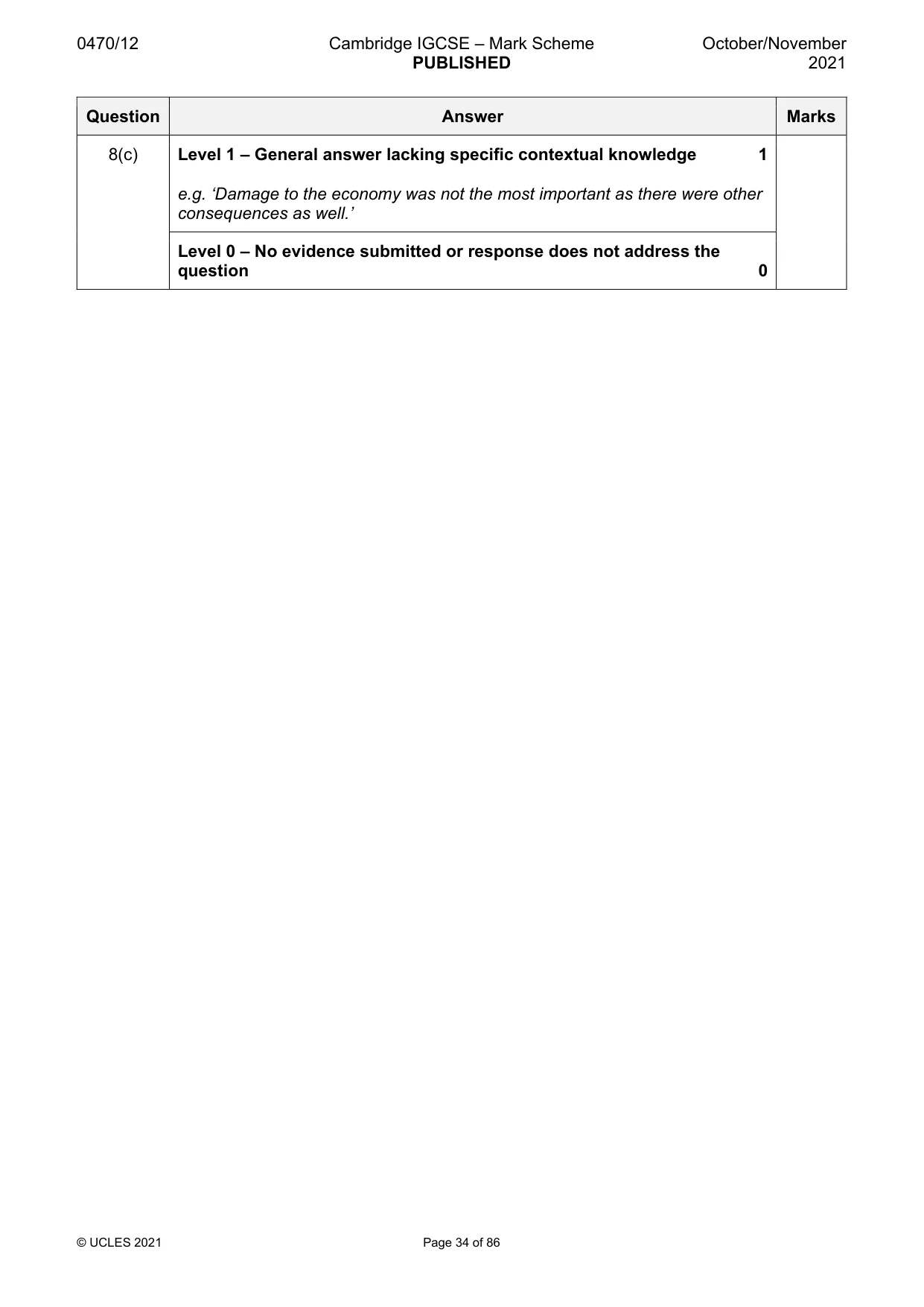
0470/12 Cambridge IGCSE – Mark Scheme PUBLISHED October/November 2021 © UCLES 2021 Page 34 of 86 Question Answer Marks 8(c) Level 1 – General answer lacking specific contextual knowledge 1 e.g. ‘Damage to the economy was not the most important as there were other consequences as well.’ Level 0 – No evidence submitted or response does not address the question 0
Mark scheme, page 35
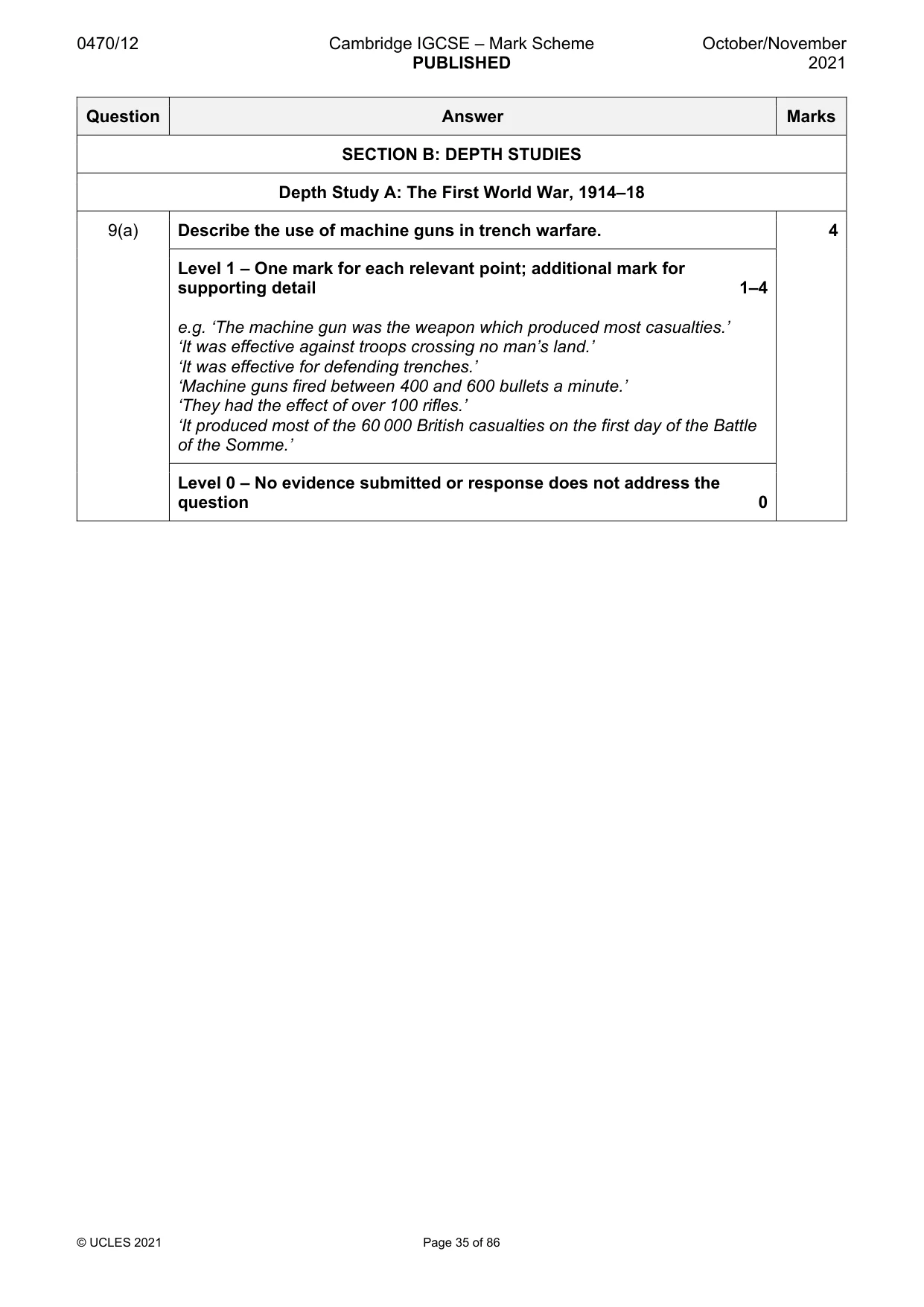
0470/12 Cambridge IGCSE – Mark Scheme PUBLISHED October/November 2021 © UCLES 2021 Page 35 of 86 Question Answer Marks SECTION B: DEPTH STUDIES Depth Study A: The First World War, 1914–18 9(a) Describe the use of machine guns in trench warfare. 4 Level 1 – One mark for each relevant point; additional mark for supporting detail 1–4 e.g. ‘The machine gun was the weapon which produced most casualties.’ ‘It was effective against troops crossing no man’s land.’ ‘It was effective for defending trenches.’ ‘Machine guns fired between 400 and 600 bullets a minute.’ ‘They had the effect of over 100 rifles.’ ‘It produced most of the 60 000 British casualties on the first day of the Battle of the Somme.’ Level 0 – No evidence submitted or response does not address the question 0
Mark scheme, page 36
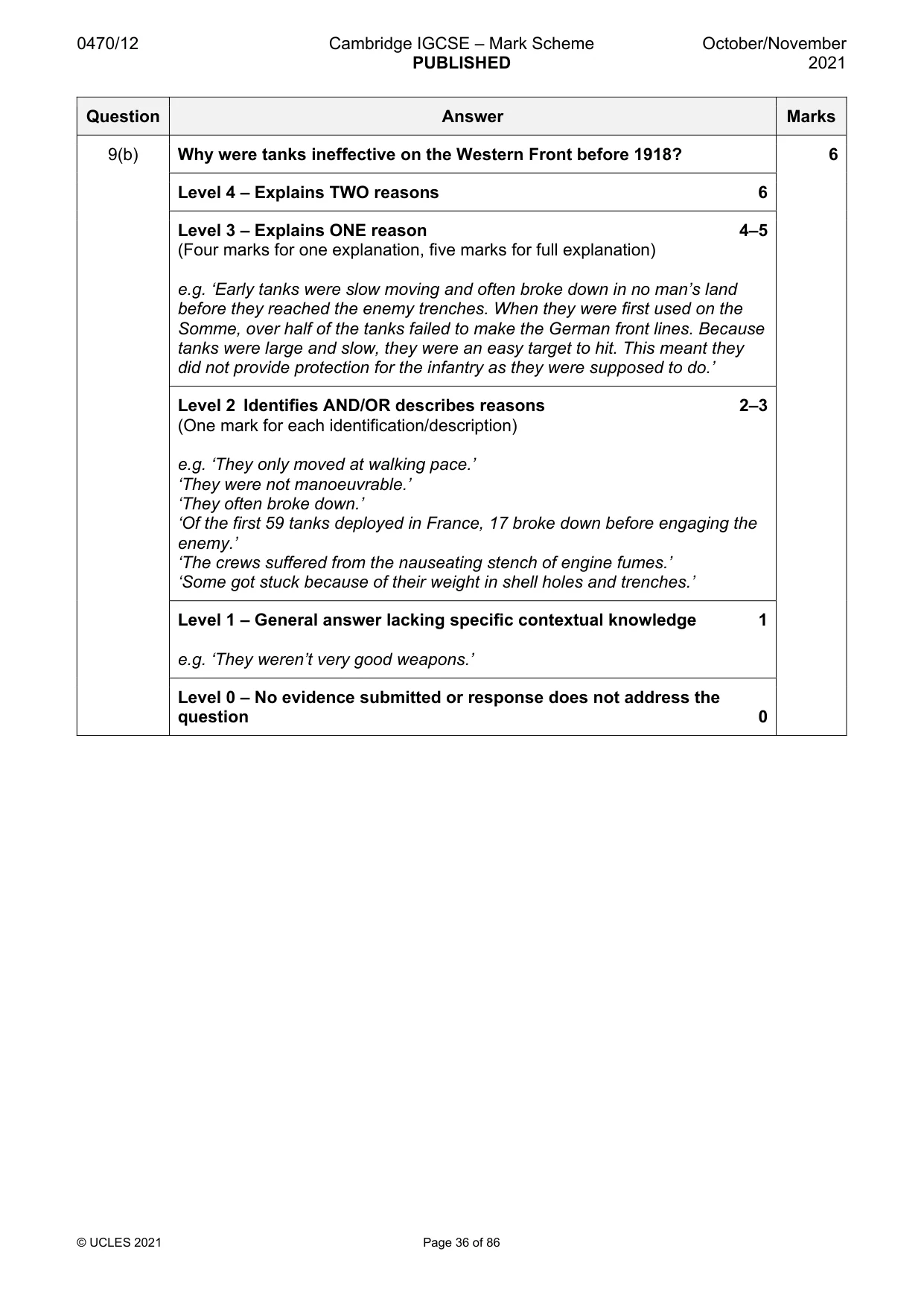
0470/12 Cambridge IGCSE – Mark Scheme PUBLISHED October/November 2021 © UCLES 2021 Page 36 of 86 Question Answer Marks 9(b) Why were tanks ineffective on the Western Front before 1918? 6 Level 4 – Explains TWO reasons 6 Level 3 – Explains ONE reason 4–5 (Four marks for one explanation, five marks for full explanation) e.g. ‘Early tanks were slow moving and often broke down in no man’s land before they reached the enemy trenches. When they were first used on the Somme, over half of the tanks failed to make the German front lines. Because tanks were large and slow, they were an easy target to hit. This meant they did not provide protection for the infantry as they were supposed to do.’ Level 2 Identifies AND/OR describes reasons 2–3 (One mark for each identification/description) e.g. ‘They only moved at walking pace.’ ‘They were not manoeuvrable.’ ‘They often broke down.’ ‘Of the first 59 tanks deployed in France, 17 broke down before engaging the enemy.’ ‘The crews suffered from the nauseating stench of engine fumes.’ ‘Some got stuck because of their weight in shell holes and trenches.’ Level 1 – General answer lacking specific contextual knowledge 1 e.g. ‘They weren’t very good weapons.’ Level 0 – No evidence submitted or response does not address the question 0
Mark scheme, page 37
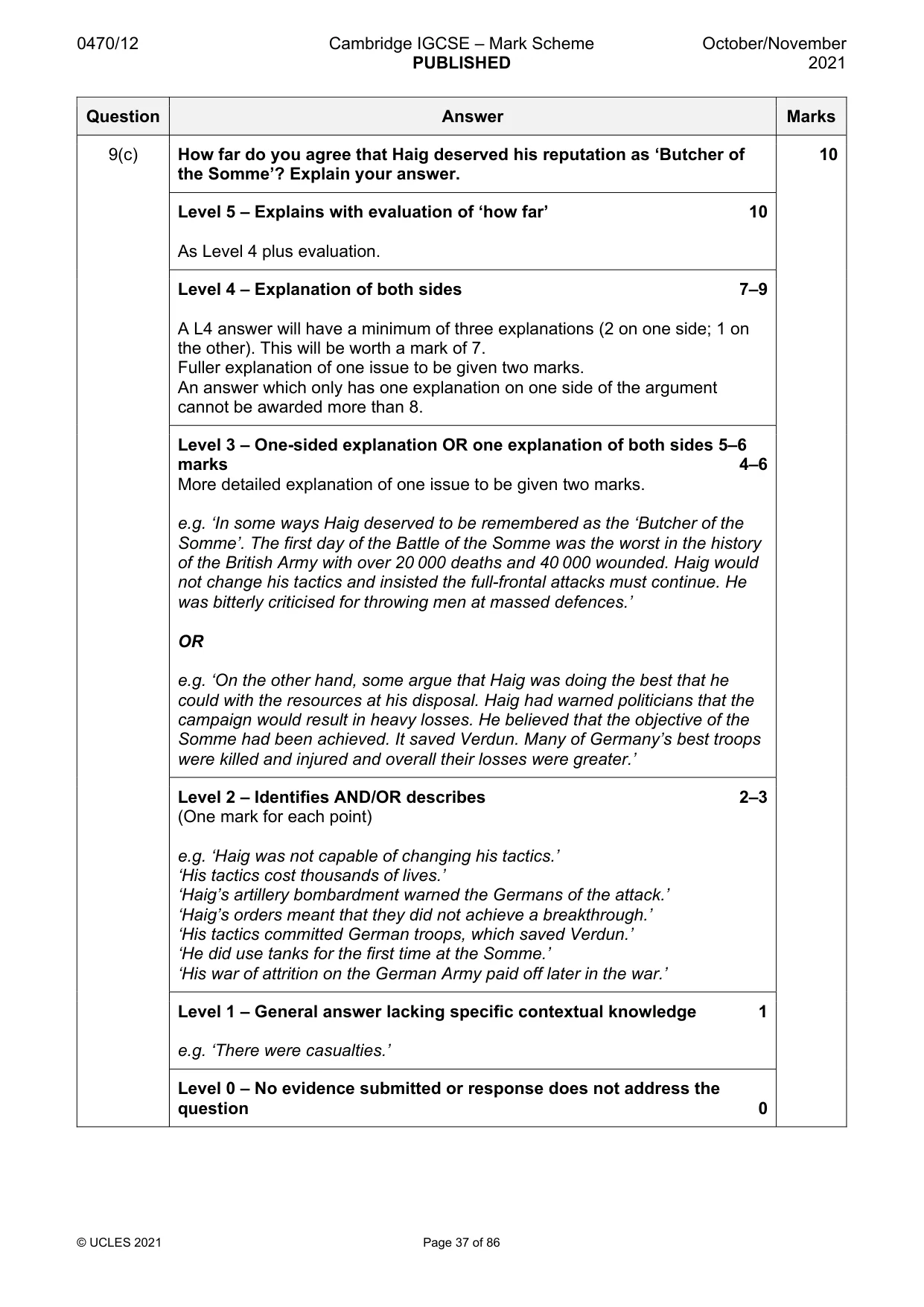
0470/12 Cambridge IGCSE – Mark Scheme PUBLISHED October/November 2021 © UCLES 2021 Page 37 of 86 Question Answer Marks 9(c) How far do you agree that Haig deserved his reputation as ‘Butcher of the Somme’? Explain your answer. 10 Level 5 – Explains with evaluation of ‘how far’ 10 As Level 4 plus evaluation. Level 4 – Explanation of both sides 7–9 A L4 answer will have a minimum of three explanations (2 on one side; 1 on the other). This will be worth a mark of 7. Fuller explanation of one issue to be given two marks. An answer which only has one explanation on one side of the argument cannot be awarded more than 8. Level 3 – One-sided explanation OR one explanation of both sides 5–6 marks 4–6 More detailed explanation of one issue to be given two marks. e.g. ‘In some ways Haig deserved to be remembered as the ‘Butcher of the Somme’. The first day of the Battle of the Somme was the worst in the history of the British Army with over 20 000 deaths and 40 000 wounded. Haig would not change his tactics and insisted the full-frontal attacks must continue. He was bitterly criticised for throwing men at massed defences.’ OR e.g. ‘On the other hand, some argue that Haig was doing the best that he could with the resources at his disposal. Haig had warned politicians that the campaign would result in heavy losses. He believed that the objective of the Somme had been achieved. It saved Verdun. Many of Germany’s best troops were killed and injured and overall their losses were greater.’ Level 2 – Identifies AND/OR describes 2–3 (One mark for each point) e.g. ‘Haig was not capable of changing his tactics.’ ‘His tactics cost thousands of lives.’ ‘Haig’s artillery bombardment warned the Germans of the attack.’ ‘Haig’s orders meant that they did not achieve a breakthrough.’ ‘His tactics committed German troops, which saved Verdun.’ ‘He did use tanks for the first time at the Somme.’ ‘His war of attrition on the German Army paid off later in the war.’ Level 1 – General answer lacking specific contextual knowledge 1 e.g. ‘There were casualties.’ Level 0 – No evidence submitted or response does not address the question 0
Mark scheme, page 38
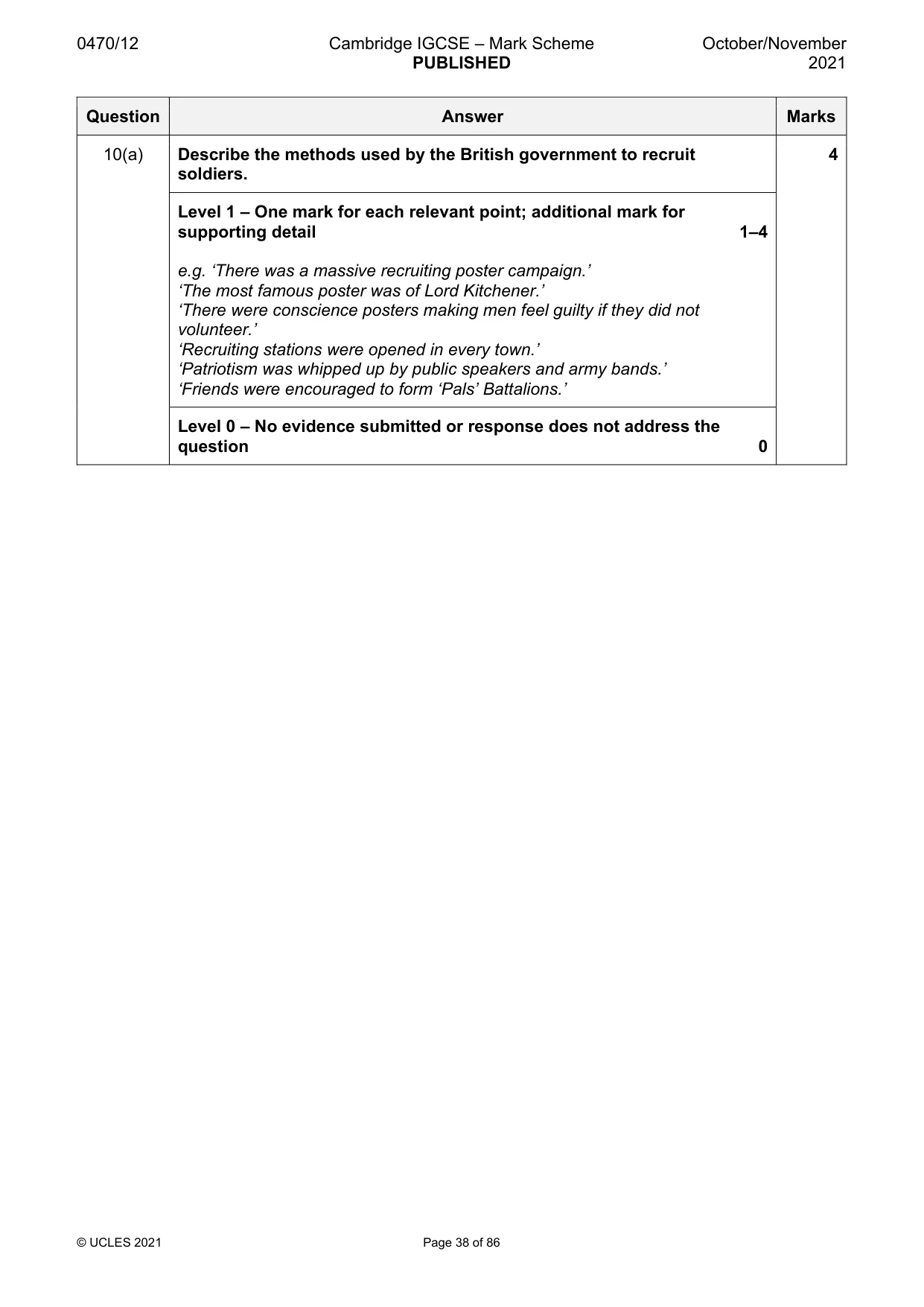
0470/12 Cambridge IGCSE – Mark Scheme PUBLISHED October/November 2021 © UCLES 2021 Page 38 of 86 Question Answer Marks 10(a) Describe the methods used by the British government to recruit soldiers. 4 Level 1 – One mark for each relevant point; additional mark for supporting detail 1–4 e.g. ‘There was a massive recruiting poster campaign.’ ‘The most famous poster was of Lord Kitchener.’ ‘There were conscience posters making men feel guilty if they did not volunteer.’ ‘Recruiting stations were opened in every town.’ ‘Patriotism was whipped up by public speakers and army bands.’ ‘Friends were encouraged to form ‘Pals’ Battalions.’ Level 0 – No evidence submitted or response does not address the question 0
Mark scheme, page 39
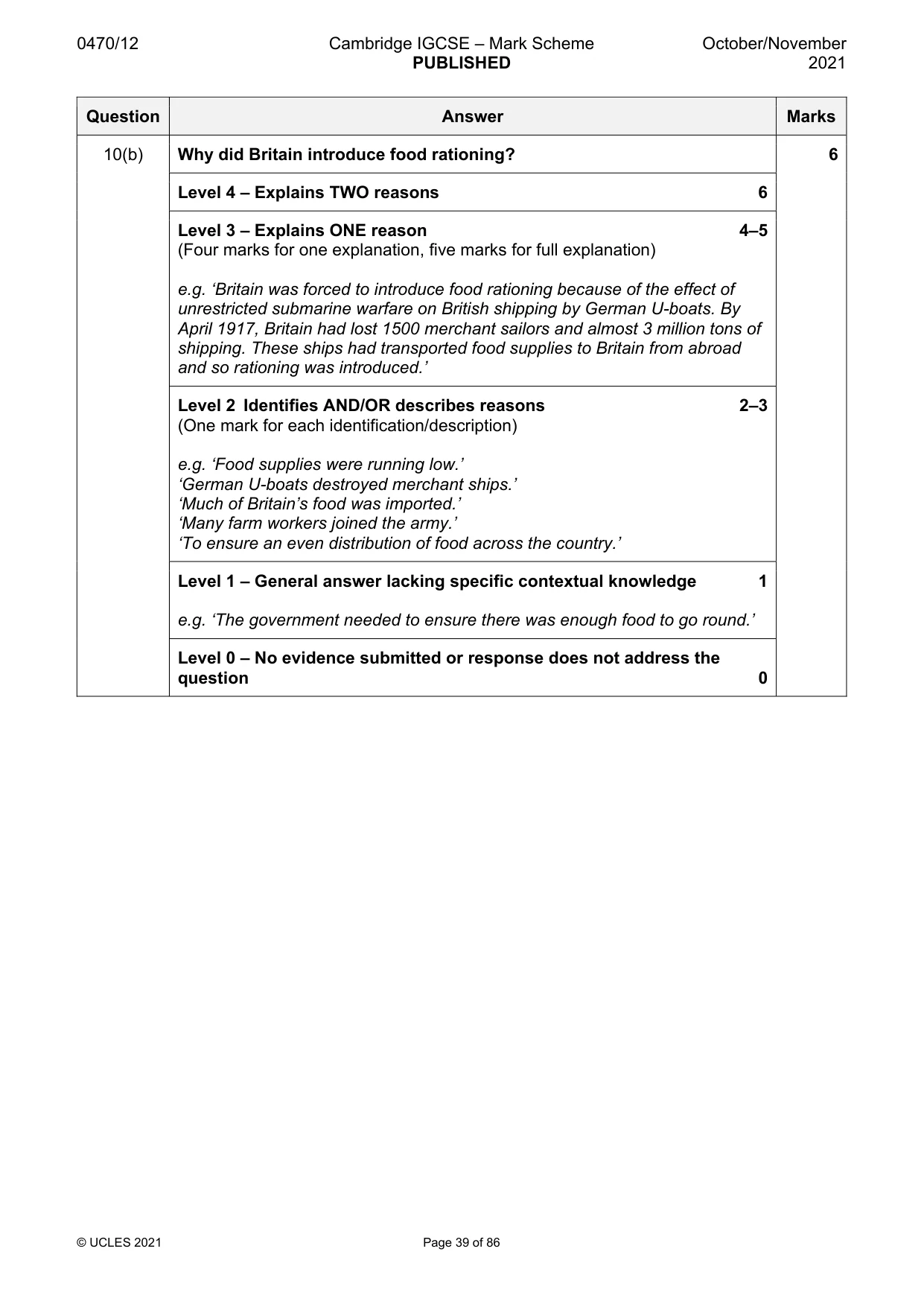
0470/12 Cambridge IGCSE – Mark Scheme PUBLISHED October/November 2021 © UCLES 2021 Page 39 of 86 Question Answer Marks 10(b) Why did Britain introduce food rationing? 6 Level 4 – Explains TWO reasons 6 Level 3 – Explains ONE reason 4–5 (Four marks for one explanation, five marks for full explanation) e.g. ‘Britain was forced to introduce food rationing because of the effect of unrestricted submarine warfare on British shipping by German U-boats. By April 1917, Britain had lost 1500 merchant sailors and almost 3 million tons of shipping. These ships had transported food supplies to Britain from abroad and so rationing was introduced.’ Level 2 Identifies AND/OR describes reasons 2–3 (One mark for each identification/description) e.g. ‘Food supplies were running low.’ ‘German U-boats destroyed merchant ships.’ ‘Much of Britain’s food was imported.’ ‘Many farm workers joined the army.’ ‘To ensure an even distribution of food across the country.’ Level 1 – General answer lacking specific contextual knowledge 1 e.g. ‘The government needed to ensure there was enough food to go round.’ Level 0 – No evidence submitted or response does not address the question 0
Mark scheme, page 40
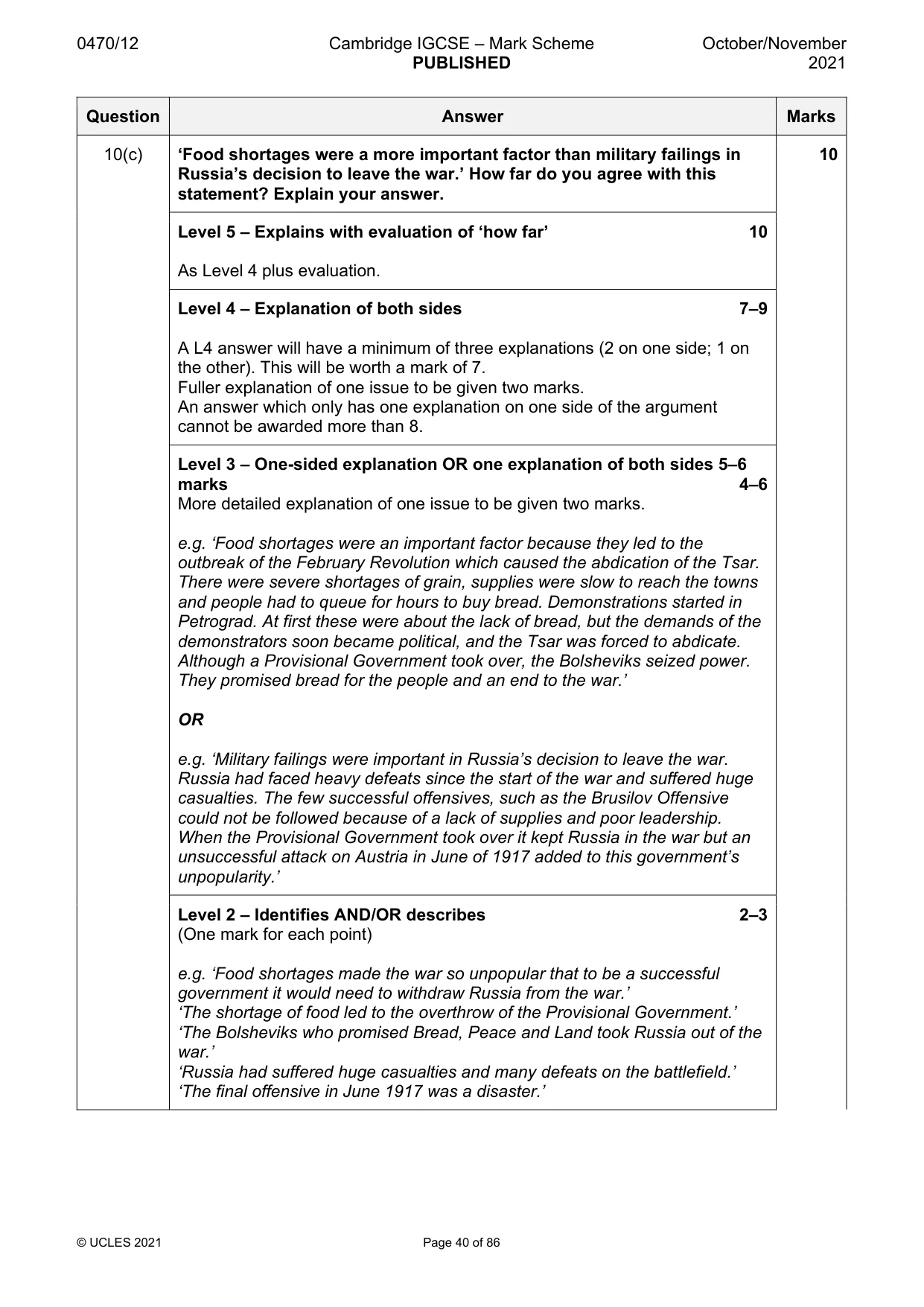
0470/12 Cambridge IGCSE – Mark Scheme PUBLISHED October/November 2021 © UCLES 2021 Page 40 of 86 Question Answer Marks 10(c) ‘Food shortages were a more important factor than military failings in Russia’s decision to leave the war.’ How far do you agree with this statement? Explain your answer. 10 Level 5 – Explains with evaluation of ‘how far’ 10 As Level 4 plus evaluation. Level 4 – Explanation of both sides 7–9 A L4 answer will have a minimum of three explanations (2 on one side; 1 on the other). This will be worth a mark of 7. Fuller explanation of one issue to be given two marks. An answer which only has one explanation on one side of the argument cannot be awarded more than 8. Level 3 – One-sided explanation OR one explanation of both sides 5–6 marks 4–6 More detailed explanation of one issue to be given two marks. e.g. ‘Food shortages were an important factor because they led to the outbreak of the February Revolution which caused the abdication of the Tsar. There were severe shortages of grain, supplies were slow to reach the towns and people had to queue for hours to buy bread. Demonstrations started in Petrograd. At first these were about the lack of bread, but the demands of the demonstrators soon became political, and the Tsar was forced to abdicate. Although a Provisional Government took over, the Bolsheviks seized power. They promised bread for the people and an end to the war.’ OR e.g. ‘Military failings were important in Russia’s decision to leave the war. Russia had faced heavy defeats since the start of the war and suffered huge casualties. The few successful offensives, such as the Brusilov Offensive could not be followed because of a lack of supplies and poor leadership. When the Provisional Government took over it kept Russia in the war but an unsuccessful attack on Austria in June of 1917 added to this government’s unpopularity.’ Level 2 – Identifies AND/OR describes 2–3 (One mark for each point) e.g. ‘Food shortages made the war so unpopular that to be a successful government it would need to withdraw Russia from the war.’ ‘The shortage of food led to the overthrow of the Provisional Government.’ ‘The Bolsheviks who promised Bread, Peace and Land took Russia out of the war.’ ‘Russia had suffered huge casualties and many defeats on the battlefield.’ ‘The final offensive in June 1917 was a disaster.’
Mark scheme, page 41
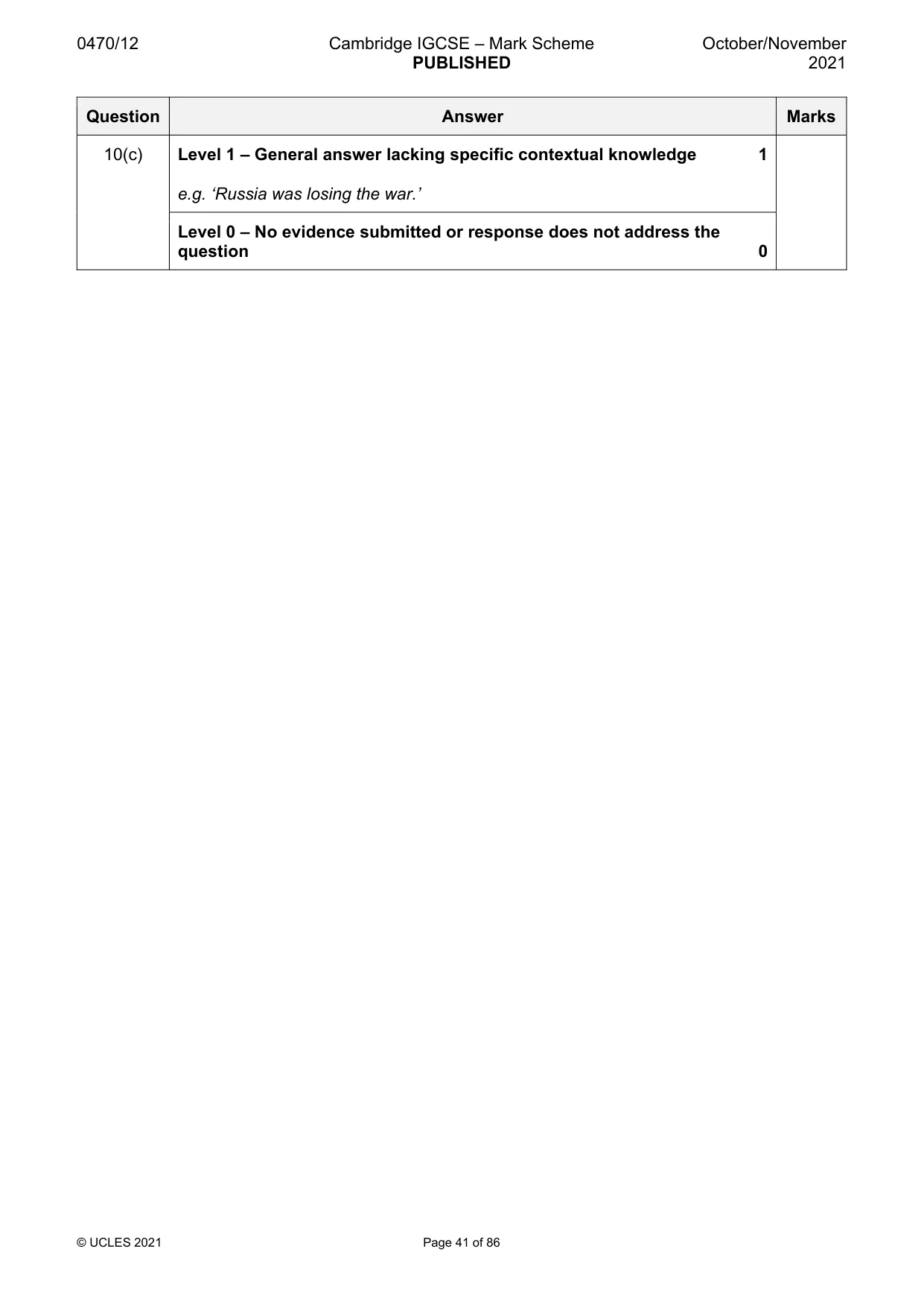
0470/12 Cambridge IGCSE – Mark Scheme PUBLISHED October/November 2021 © UCLES 2021 Page 41 of 86 Question Answer Marks 10(c) Level 1 – General answer lacking specific contextual knowledge 1 e.g. ‘Russia was losing the war.’ Level 0 – No evidence submitted or response does not address the question 0
Mark scheme, page 42
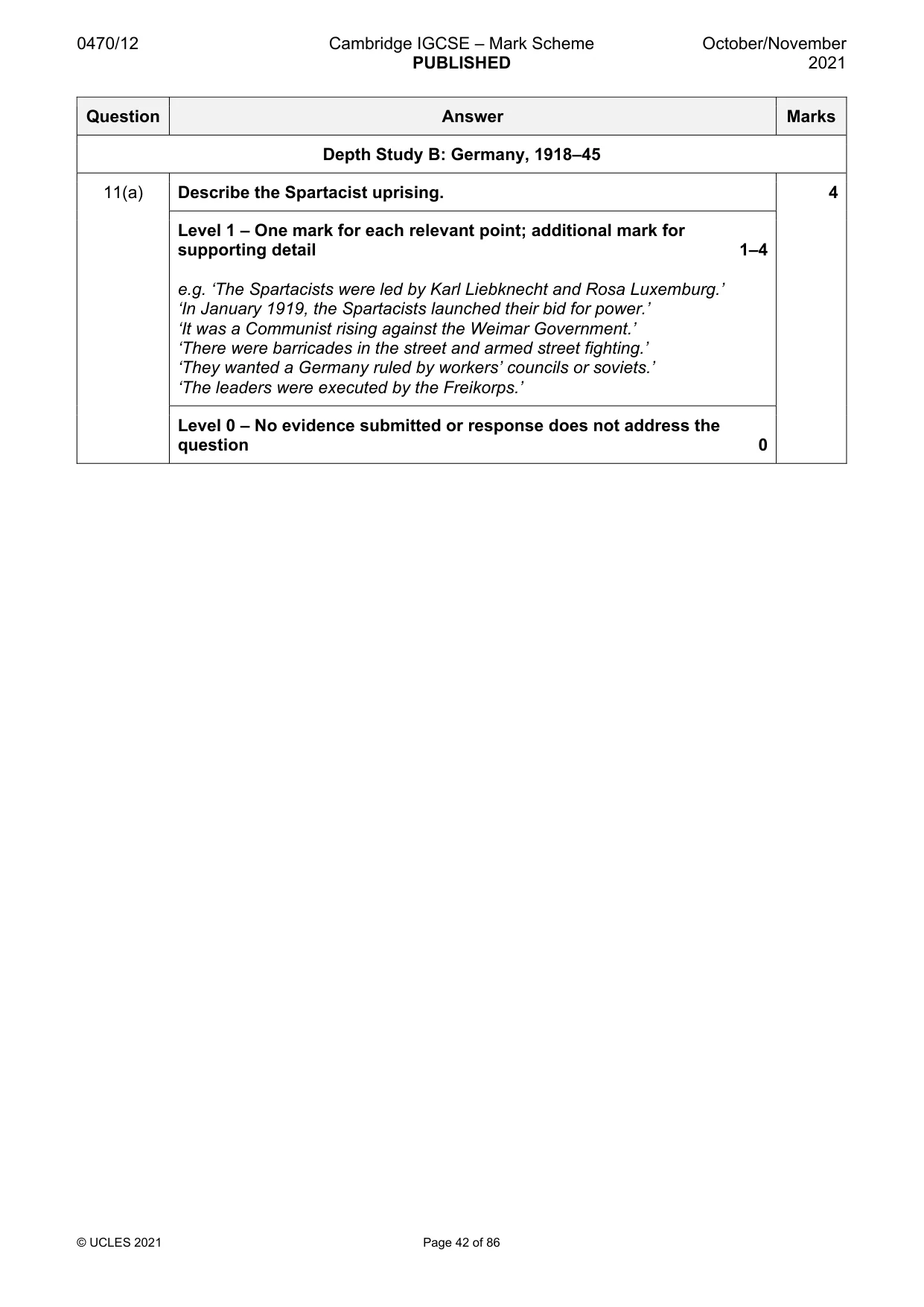
0470/12 Cambridge IGCSE – Mark Scheme PUBLISHED October/November 2021 © UCLES 2021 Page 42 of 86 Question Answer Marks Depth Study B: Germany, 1918–45 11(a) Describe the Spartacist uprising. 4 Level 1 – One mark for each relevant point; additional mark for supporting detail 1–4 e.g. ‘The Spartacists were led by Karl Liebknecht and Rosa Luxemburg.’ ‘In January 1919, the Spartacists launched their bid for power.’ ‘It was a Communist rising against the Weimar Government.’ ‘There were barricades in the street and armed street fighting.’ ‘They wanted a Germany ruled by workers’ councils or soviets.’ ‘The leaders were executed by the Freikorps.’ Level 0 – No evidence submitted or response does not address the question 0
Mark scheme, page 43
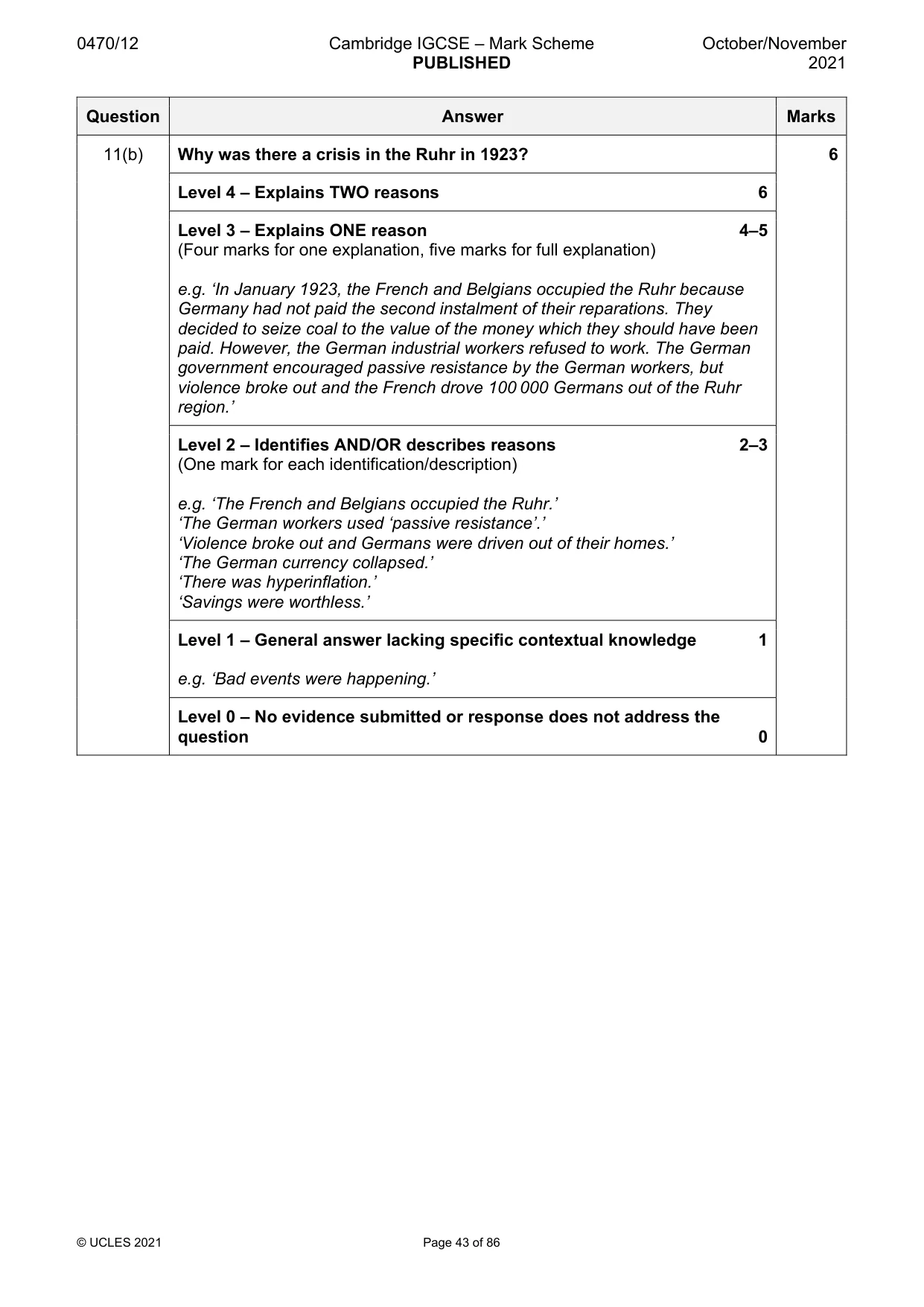
0470/12 Cambridge IGCSE – Mark Scheme PUBLISHED October/November 2021 © UCLES 2021 Page 43 of 86 Question Answer Marks 11(b) Why was there a crisis in the Ruhr in 1923? 6 Level 4 – Explains TWO reasons 6 Level 3 – Explains ONE reason 4–5 (Four marks for one explanation, five marks for full explanation) e.g. ‘In January 1923, the French and Belgians occupied the Ruhr because Germany had not paid the second instalment of their reparations. They decided to seize coal to the value of the money which they should have been paid. However, the German industrial workers refused to work. The German government encouraged passive resistance by the German workers, but violence broke out and the French drove 100 000 Germans out of the Ruhr region.’ Level 2 – Identifies AND/OR describes reasons 2–3 (One mark for each identification/description) e.g. ‘The French and Belgians occupied the Ruhr.’ ‘The German workers used ‘passive resistance’.’ ‘Violence broke out and Germans were driven out of their homes.’ ‘The German currency collapsed.’ ‘There was hyperinflation.’ ‘Savings were worthless.’ Level 1 – General answer lacking specific contextual knowledge 1 e.g. ‘Bad events were happening.’ Level 0 – No evidence submitted or response does not address the question 0
Mark scheme, page 44
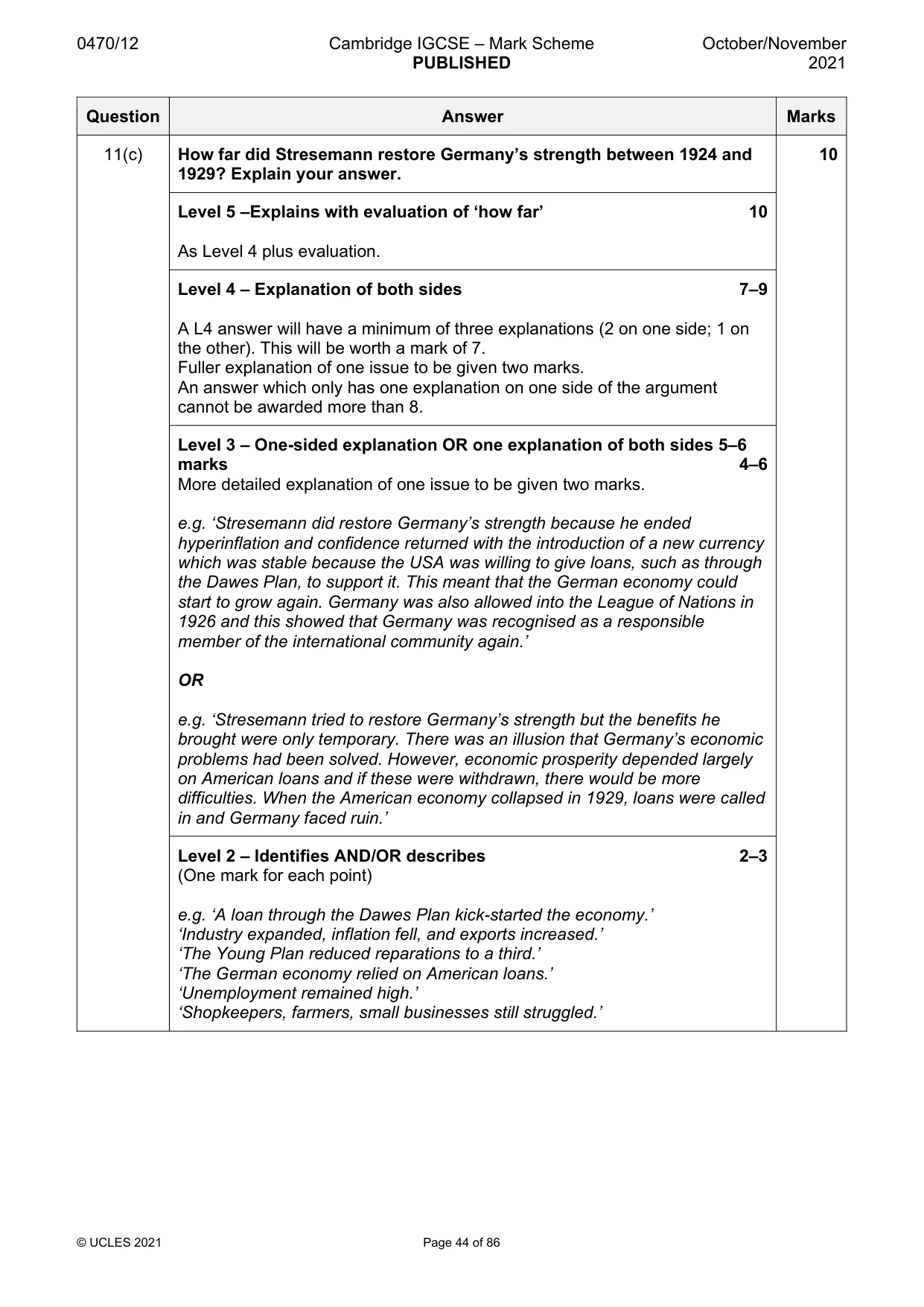
0470/12 Cambridge IGCSE – Mark Scheme PUBLISHED October/November 2021 © UCLES 2021 Page 44 of 86 Question Answer Marks 11(c) How far did Stresemann restore Germany’s strength between 1924 and 1929? Explain your answer. 10 Level 5 –Explains with evaluation of ‘how far’ 10 As Level 4 plus evaluation. Level 4 – Explanation of both sides 7–9 A L4 answer will have a minimum of three explanations (2 on one side; 1 on the other). This will be worth a mark of 7. Fuller explanation of one issue to be given two marks. An answer which only has one explanation on one side of the argument cannot be awarded more than 8. Level 3 – One-sided explanation OR one explanation of both sides 5–6 marks 4–6 More detailed explanation of one issue to be given two marks. e.g. ‘Stresemann did restore Germany’s strength because he ended hyperinflation and confidence returned with the introduction of a new currency which was stable because the USA was willing to give loans, such as through the Dawes Plan, to support it. This meant that the German economy could start to grow again. Germany was also allowed into the League of Nations in 1926 and this showed that Germany was recognised as a responsible member of the international community again.’ OR e.g. ‘Stresemann tried to restore Germany’s strength but the benefits he brought were only temporary. There was an illusion that Germany’s economic problems had been solved. However, economic prosperity depended largely on American loans and if these were withdrawn, there would be more difficulties. When the American economy collapsed in 1929, loans were called in and Germany faced ruin.’ Level 2 – Identifies AND/OR describes 2–3 (One mark for each point) e.g. ‘A loan through the Dawes Plan kick-started the economy.’ ‘Industry expanded, inflation fell, and exports increased.’ ‘The Young Plan reduced reparations to a third.’ ‘The German economy relied on American loans.’ ‘Unemployment remained high.’ ‘Shopkeepers, farmers, small businesses still struggled.’
Mark scheme, page 45
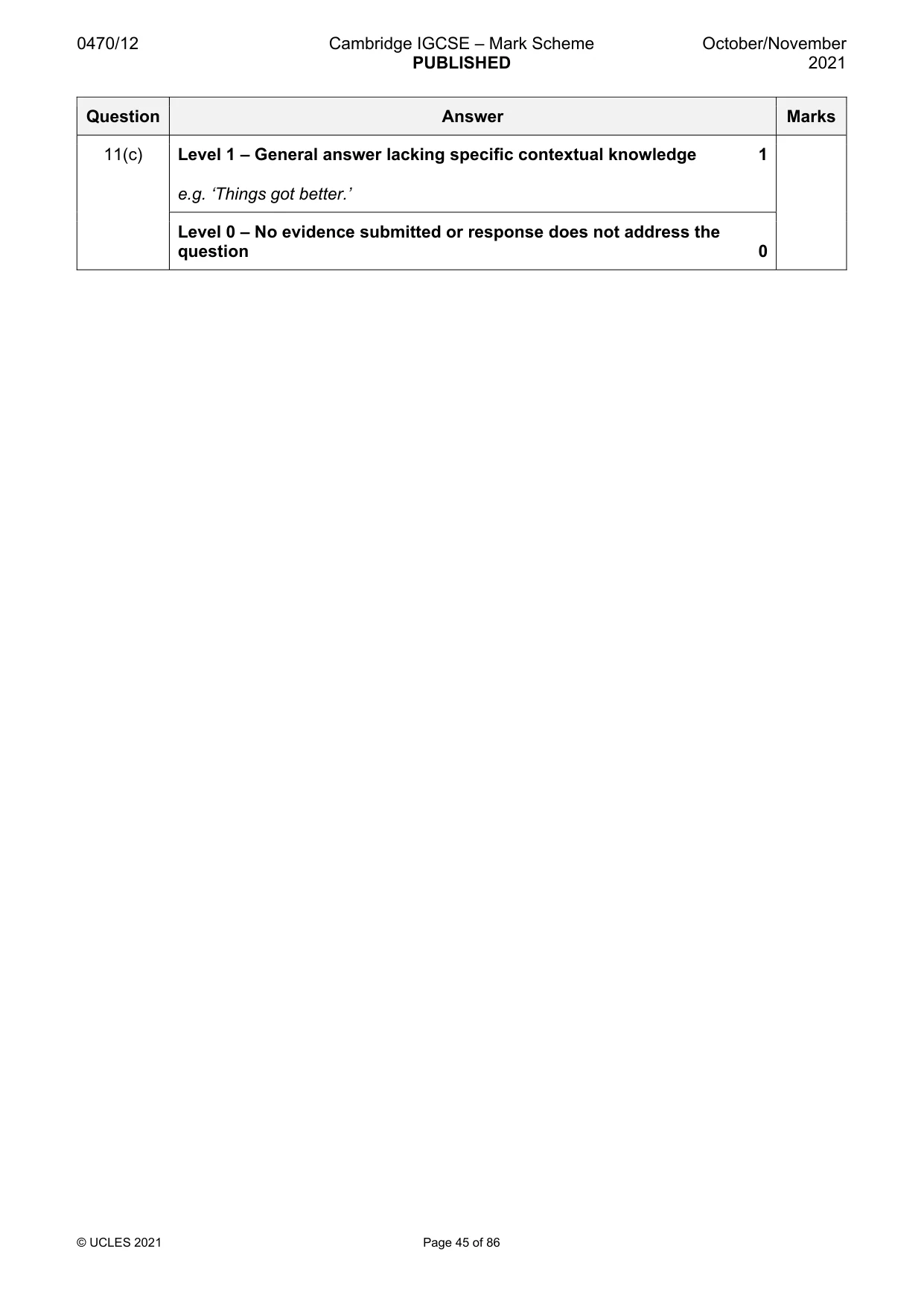
0470/12 Cambridge IGCSE – Mark Scheme PUBLISHED October/November 2021 © UCLES 2021 Page 45 of 86 Question Answer Marks 11(c) Level 1 – General answer lacking specific contextual knowledge 1 e.g. ‘Things got better.’ Level 0 – No evidence submitted or response does not address the question 0
Mark scheme, page 46
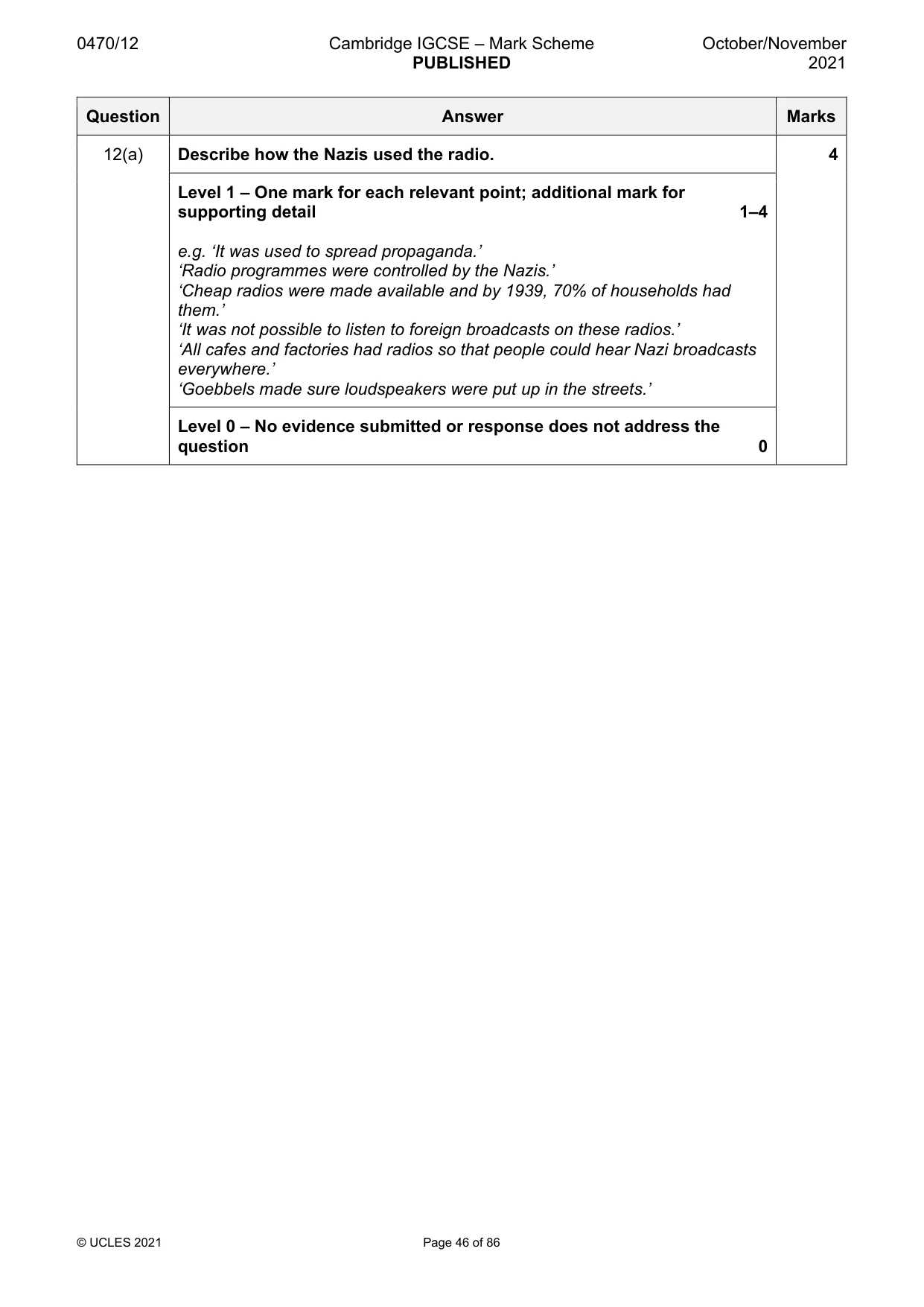
0470/12 Cambridge IGCSE – Mark Scheme PUBLISHED October/November 2021 © UCLES 2021 Page 46 of 86 Question Answer Marks 12(a) Describe how the Nazis used the radio. 4 Level 1 – One mark for each relevant point; additional mark for supporting detail 1–4 e.g. ‘It was used to spread propaganda.’ ‘Radio programmes were controlled by the Nazis.’ ‘Cheap radios were made available and by 1939, 70% of households had them.’ ‘It was not possible to listen to foreign broadcasts on these radios.’ ‘All cafes and factories had radios so that people could hear Nazi broadcasts everywhere.’ ‘Goebbels made sure loudspeakers were put up in the streets.’ Level 0 – No evidence submitted or response does not address the question 0
Mark scheme, page 47
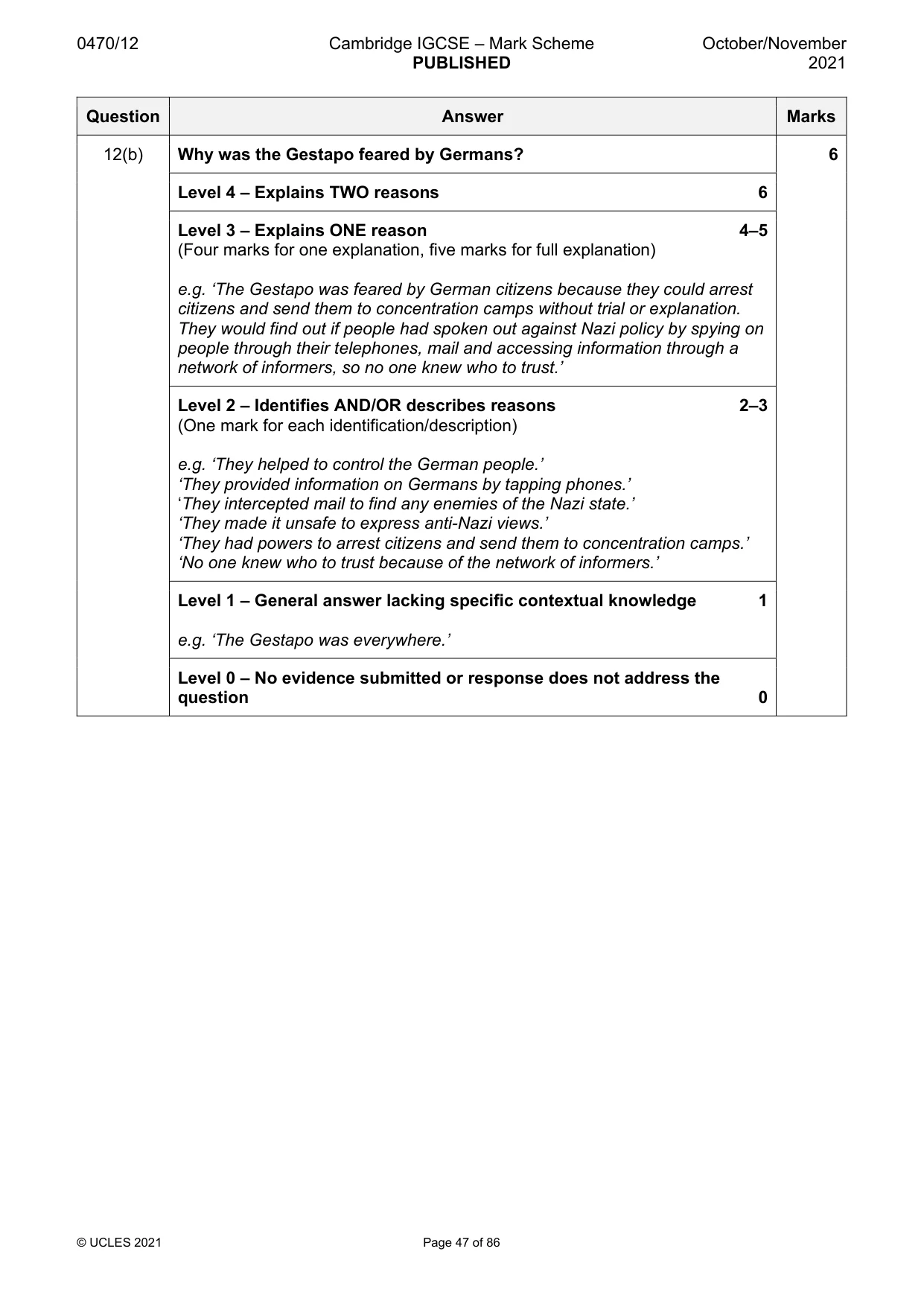
0470/12 Cambridge IGCSE – Mark Scheme PUBLISHED October/November 2021 © UCLES 2021 Page 47 of 86 Question Answer Marks 12(b) Why was the Gestapo feared by Germans? 6 Level 4 – Explains TWO reasons 6 Level 3 – Explains ONE reason 4–5 (Four marks for one explanation, five marks for full explanation) e.g. ‘The Gestapo was feared by German citizens because they could arrest citizens and send them to concentration camps without trial or explanation. They would find out if people had spoken out against Nazi policy by spying on people through their telephones, mail and accessing information through a network of informers, so no one knew who to trust.’ Level 2 – Identifies AND/OR describes reasons 2–3 (One mark for each identification/description) e.g. ‘They helped to control the German people.’ ‘They provided information on Germans by tapping phones.’ ‘They intercepted mail to find any enemies of the Nazi state.’ ‘They made it unsafe to express anti-Nazi views.’ ‘They had powers to arrest citizens and send them to concentration camps.’ ‘No one knew who to trust because of the network of informers.’ Level 1 – General answer lacking specific contextual knowledge 1 e.g. ‘The Gestapo was everywhere.’ Level 0 – No evidence submitted or response does not address the question 0
Mark scheme, page 48
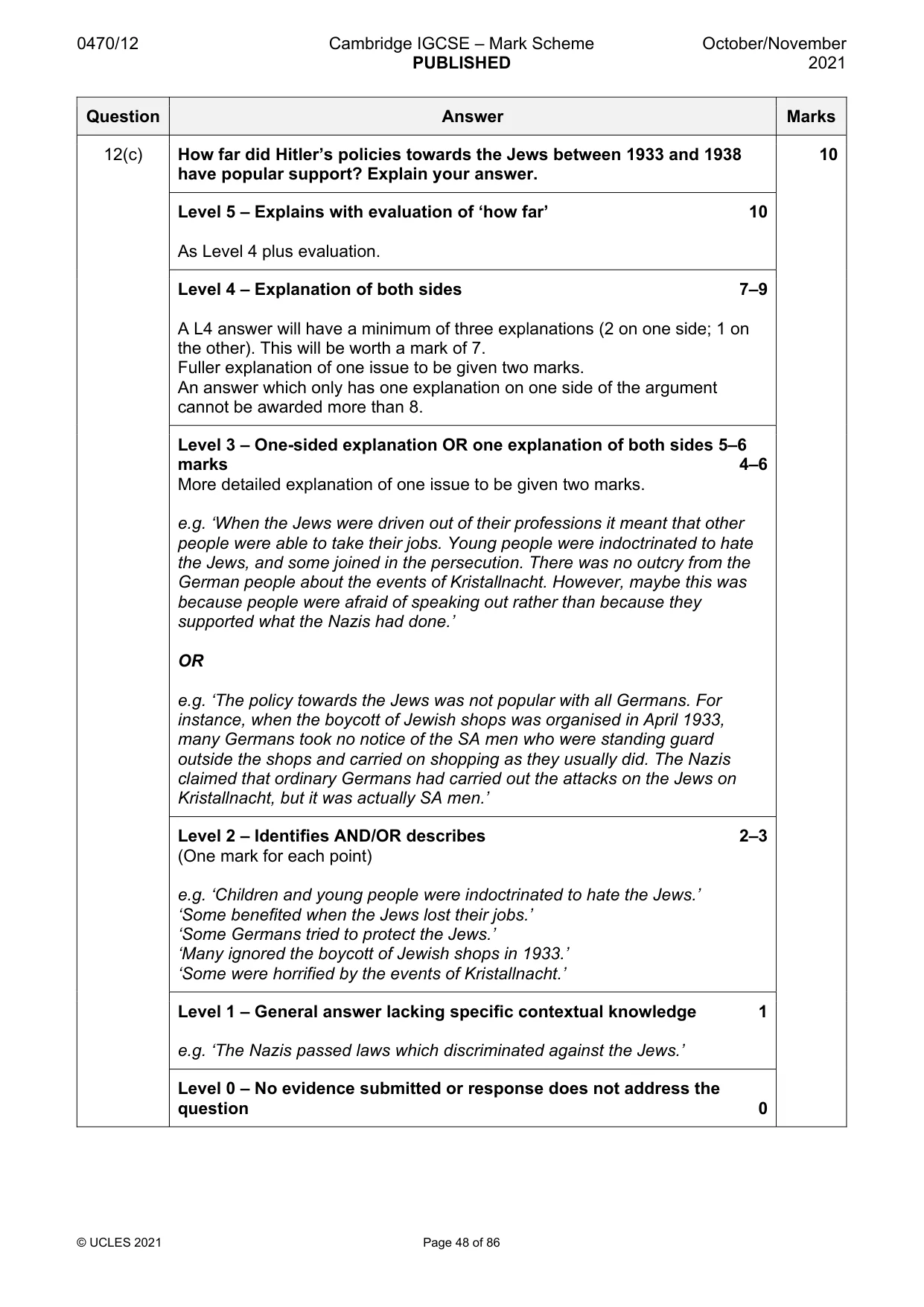
0470/12 Cambridge IGCSE – Mark Scheme PUBLISHED October/November 2021 © UCLES 2021 Page 48 of 86 Question Answer Marks 12(c) How far did Hitler’s policies towards the Jews between 1933 and 1938 have popular support? Explain your answer. 10 Level 5 – Explains with evaluation of ‘how far’ 10 As Level 4 plus evaluation. Level 4 – Explanation of both sides 7–9 A L4 answer will have a minimum of three explanations (2 on one side; 1 on the other). This will be worth a mark of 7. Fuller explanation of one issue to be given two marks. An answer which only has one explanation on one side of the argument cannot be awarded more than 8. Level 3 – One-sided explanation OR one explanation of both sides 5–6 marks 4–6 More detailed explanation of one issue to be given two marks. e.g. ‘When the Jews were driven out of their professions it meant that other people were able to take their jobs. Young people were indoctrinated to hate the Jews, and some joined in the persecution. There was no outcry from the German people about the events of Kristallnacht. However, maybe this was because people were afraid of speaking out rather than because they supported what the Nazis had done.’ OR e.g. ‘The policy towards the Jews was not popular with all Germans. For instance, when the boycott of Jewish shops was organised in April 1933, many Germans took no notice of the SA men who were standing guard outside the shops and carried on shopping as they usually did. The Nazis claimed that ordinary Germans had carried out the attacks on the Jews on Kristallnacht, but it was actually SA men.’ Level 2 – Identifies AND/OR describes 2–3 (One mark for each point) e.g. ‘Children and young people were indoctrinated to hate the Jews.’ ‘Some benefited when the Jews lost their jobs.’ ‘Some Germans tried to protect the Jews.’ ‘Many ignored the boycott of Jewish shops in 1933.’ ‘Some were horrified by the events of Kristallnacht.’ Level 1 – General answer lacking specific contextual knowledge 1 e.g. ‘The Nazis passed laws which discriminated against the Jews.’ Level 0 – No evidence submitted or response does not address the question 0
Mark scheme, page 49
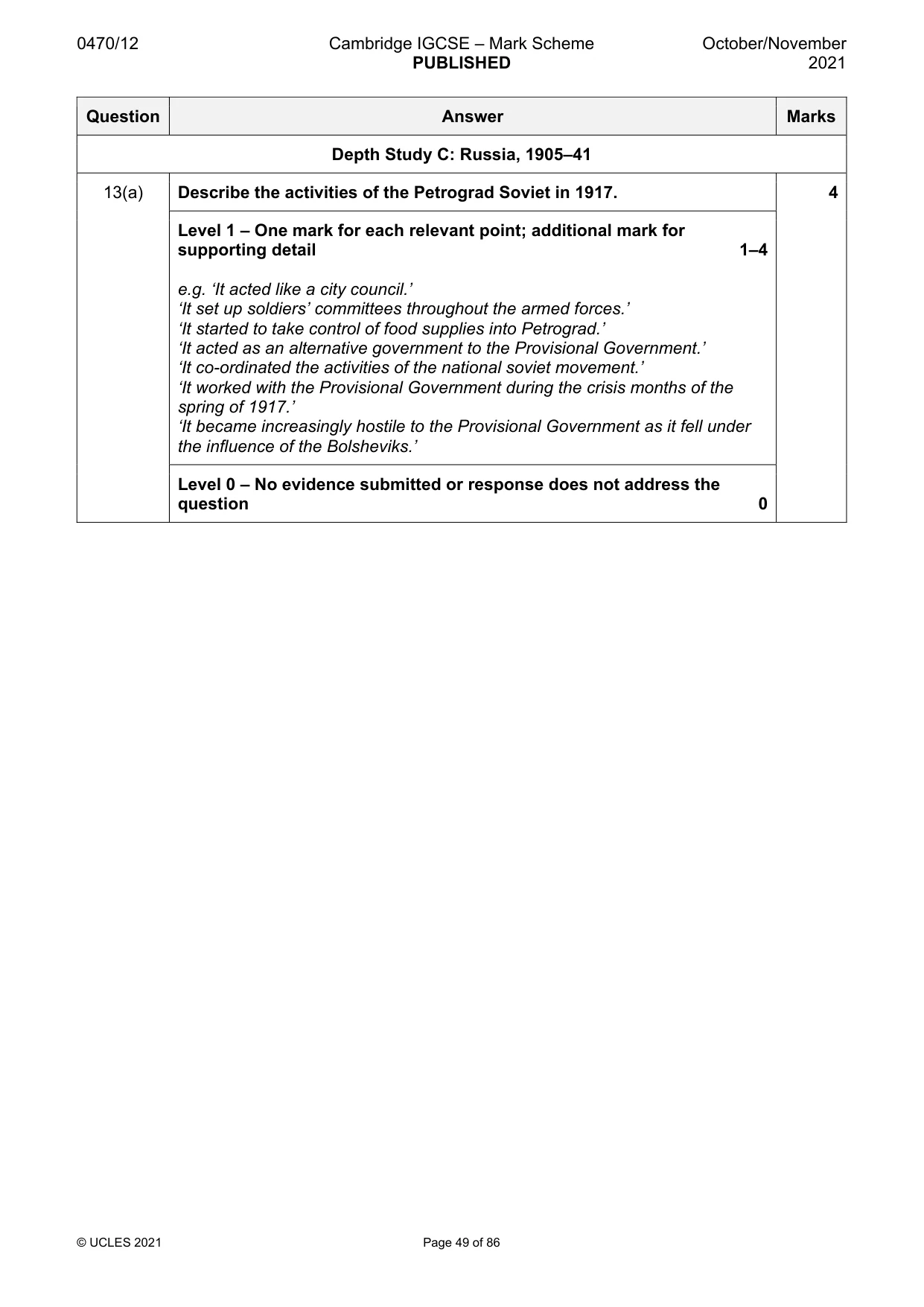
0470/12 Cambridge IGCSE – Mark Scheme PUBLISHED October/November 2021 © UCLES 2021 Page 49 of 86 Question Answer Marks Depth Study C: Russia, 1905–41 13(a) Describe the activities of the Petrograd Soviet in 1917. 4 Level 1 – One mark for each relevant point; additional mark for supporting detail 1–4 e.g. ‘It acted like a city council.’ ‘It set up soldiers’ committees throughout the armed forces.’ ‘It started to take control of food supplies into Petrograd.’ ‘It acted as an alternative government to the Provisional Government.’ ‘It co-ordinated the activities of the national soviet movement.’ ‘It worked with the Provisional Government during the crisis months of the spring of 1917.’ ‘It became increasingly hostile to the Provisional Government as it fell under the influence of the Bolsheviks.’ Level 0 – No evidence submitted or response does not address the question 0
Mark scheme, page 50
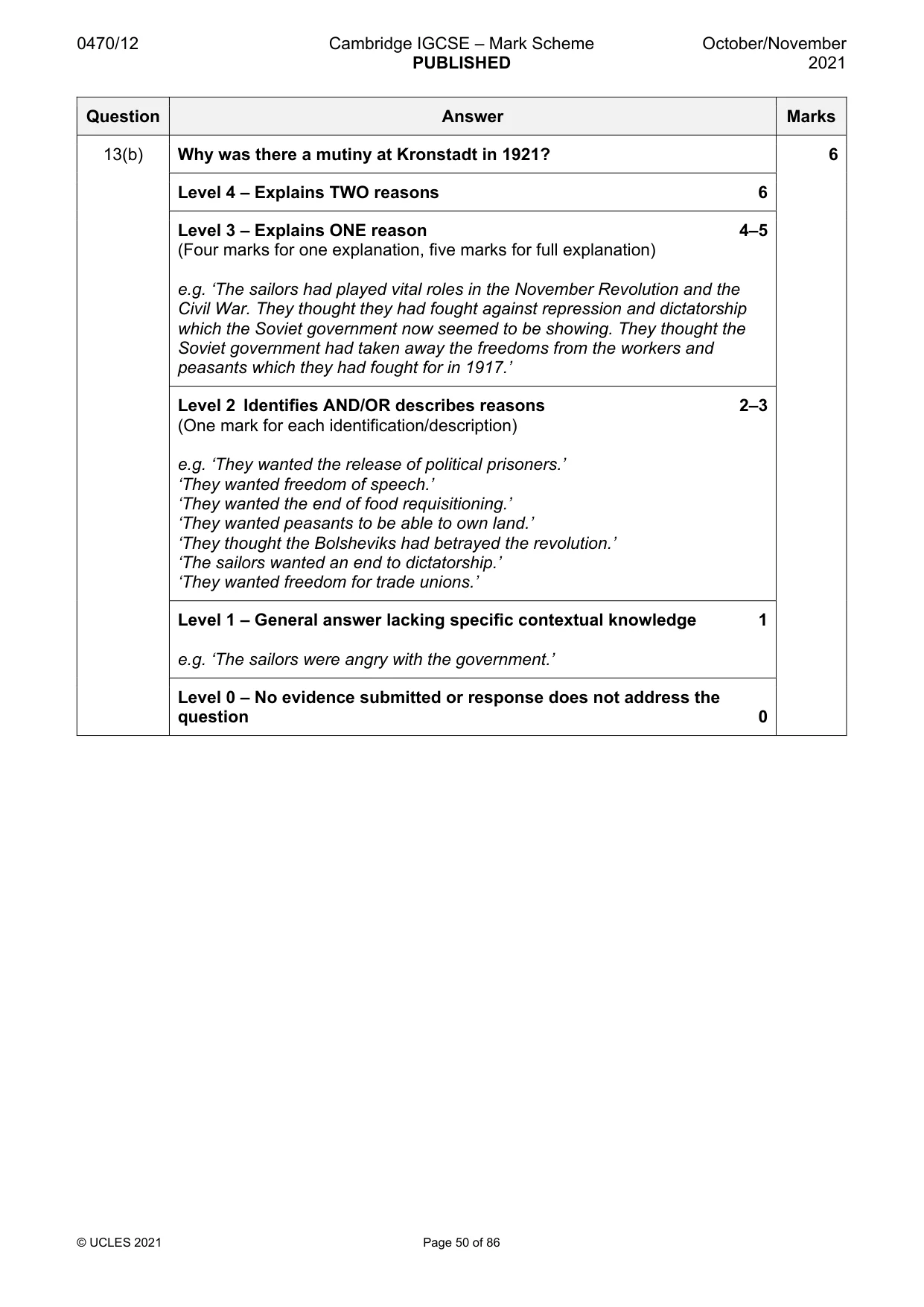
0470/12 Cambridge IGCSE – Mark Scheme PUBLISHED October/November 2021 © UCLES 2021 Page 50 of 86 Question Answer Marks 13(b) Why was there a mutiny at Kronstadt in 1921? 6 Level 4 – Explains TWO reasons 6 Level 3 – Explains ONE reason 4–5 (Four marks for one explanation, five marks for full explanation) e.g. ‘The sailors had played vital roles in the November Revolution and the Civil War. They thought they had fought against repression and dictatorship which the Soviet government now seemed to be showing. They thought the Soviet government had taken away the freedoms from the workers and peasants which they had fought for in 1917.’ Level 2 Identifies AND/OR describes reasons 2–3 (One mark for each identification/description) e.g. ‘They wanted the release of political prisoners.’ ‘They wanted freedom of speech.’ ‘They wanted the end of food requisitioning.’ ‘They wanted peasants to be able to own land.’ ‘They thought the Bolsheviks had betrayed the revolution.’ ‘The sailors wanted an end to dictatorship.’ ‘They wanted freedom for trade unions.’ Level 1 – General answer lacking specific contextual knowledge 1 e.g. ‘The sailors were angry with the government.’ Level 0 – No evidence submitted or response does not address the question 0
Mark scheme, page 51
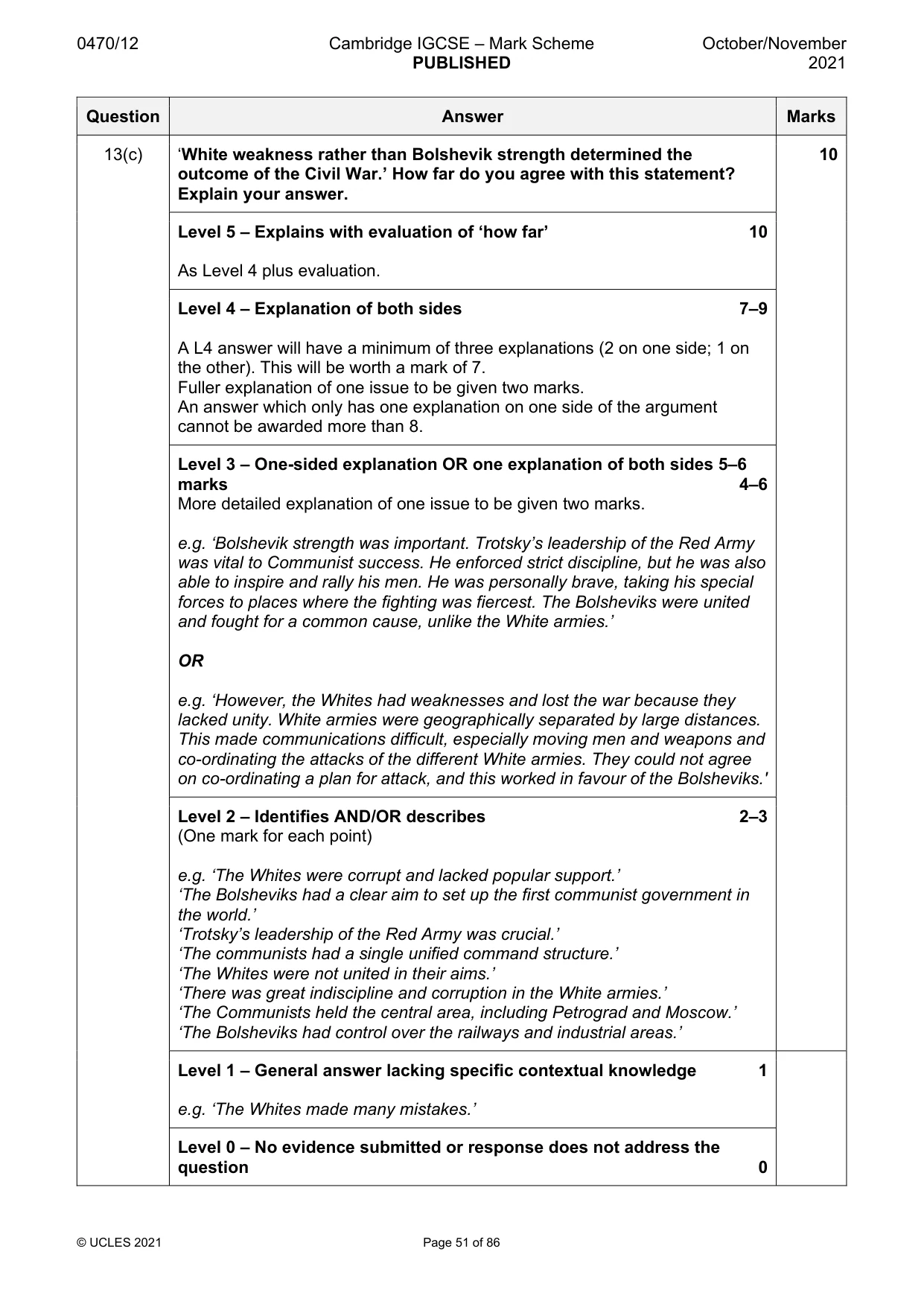
0470/12 Cambridge IGCSE – Mark Scheme PUBLISHED October/November 2021 © UCLES 2021 Page 51 of 86 Question Answer Marks 13(c) ‘White weakness rather than Bolshevik strength determined the outcome of the Civil War.’ How far do you agree with this statement? Explain your answer. 10 Level 5 – Explains with evaluation of ‘how far’ 10 As Level 4 plus evaluation. Level 4 – Explanation of both sides 7–9 A L4 answer will have a minimum of three explanations (2 on one side; 1 on the other). This will be worth a mark of 7. Fuller explanation of one issue to be given two marks. An answer which only has one explanation on one side of the argument cannot be awarded more than 8. Level 3 – One-sided explanation OR one explanation of both sides 5–6 marks 4–6 More detailed explanation of one issue to be given two marks. e.g. ‘Bolshevik strength was important. Trotsky’s leadership of the Red Army was vital to Communist success. He enforced strict discipline, but he was also able to inspire and rally his men. He was personally brave, taking his special forces to places where the fighting was fiercest. The Bolsheviks were united and fought for a common cause, unlike the White armies.’ OR e.g. ‘However, the Whites had weaknesses and lost the war because they lacked unity. White armies were geographically separated by large distances. This made communications difficult, especially moving men and weapons and co-ordinating the attacks of the different White armies. They could not agree on co-ordinating a plan for attack, and this worked in favour of the Bolsheviks.' Level 2 – Identifies AND/OR describes 2–3 (One mark for each point) e.g. ‘The Whites were corrupt and lacked popular support.’ ‘The Bolsheviks had a clear aim to set up the first communist government in the world.’ ‘Trotsky’s leadership of the Red Army was crucial.’ ‘The communists had a single unified command structure.’ ‘The Whites were not united in their aims.’ ‘There was great indiscipline and corruption in the White armies.’ ‘The Communists held the central area, including Petrograd and Moscow.’ ‘The Bolsheviks had control over the railways and industrial areas.’ Level 1 – General answer lacking specific contextual knowledge 1 e.g. ‘The Whites made many mistakes.’ Level 0 – No evidence submitted or response does not address the question 0
Mark scheme, page 52
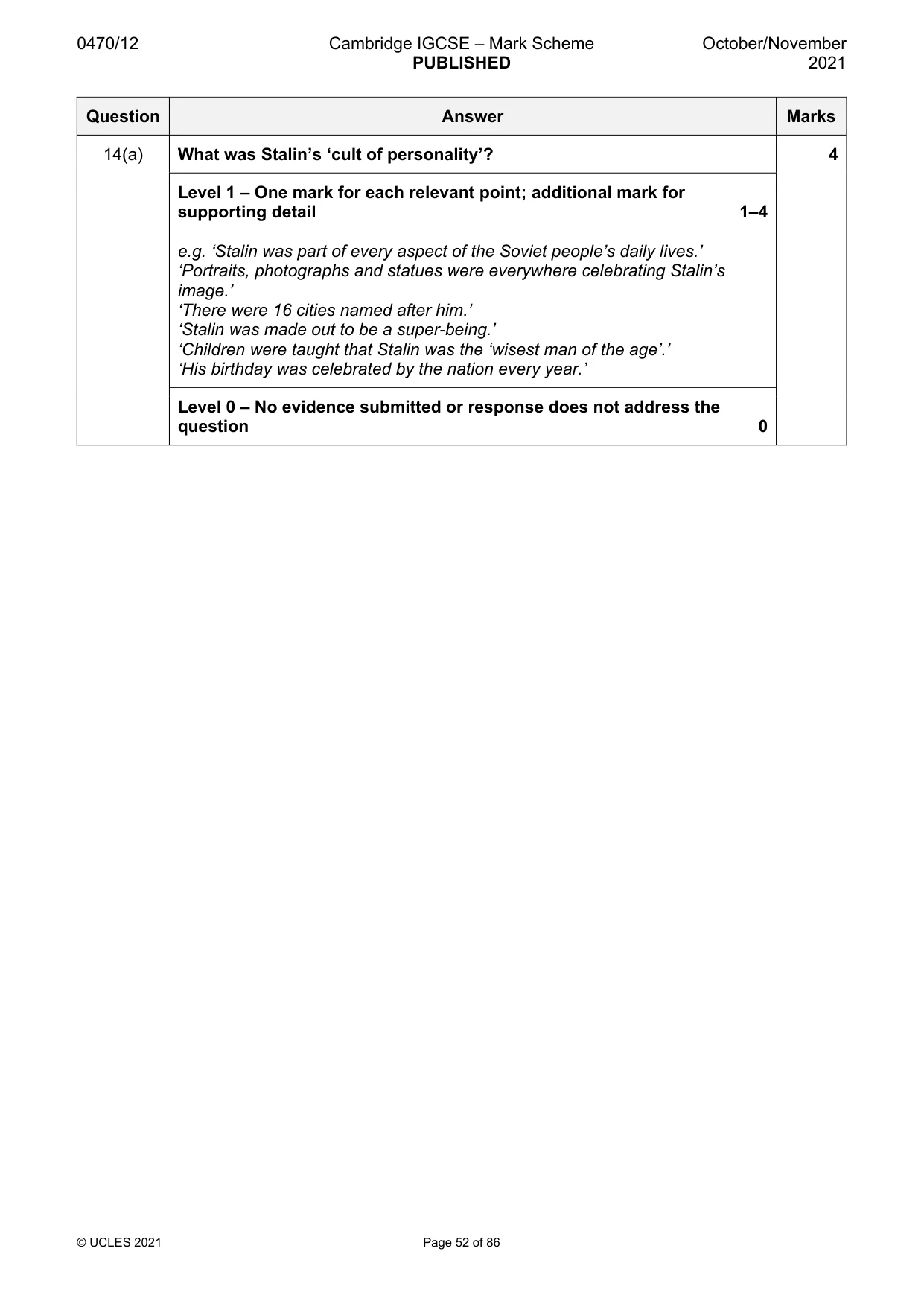
0470/12 Cambridge IGCSE – Mark Scheme PUBLISHED October/November 2021 © UCLES 2021 Page 52 of 86 Question Answer Marks 14(a) What was Stalin’s ‘cult of personality’? 4 Level 1 – One mark for each relevant point; additional mark for supporting detail 1–4 e.g. ‘Stalin was part of every aspect of the Soviet people’s daily lives.’ ‘Portraits, photographs and statues were everywhere celebrating Stalin’s image.’ ‘There were 16 cities named after him.’ ‘Stalin was made out to be a super-being.’ ‘Children were taught that Stalin was the ‘wisest man of the age’.’ ‘His birthday was celebrated by the nation every year.’ Level 0 – No evidence submitted or response does not address the question 0
Mark scheme, page 53
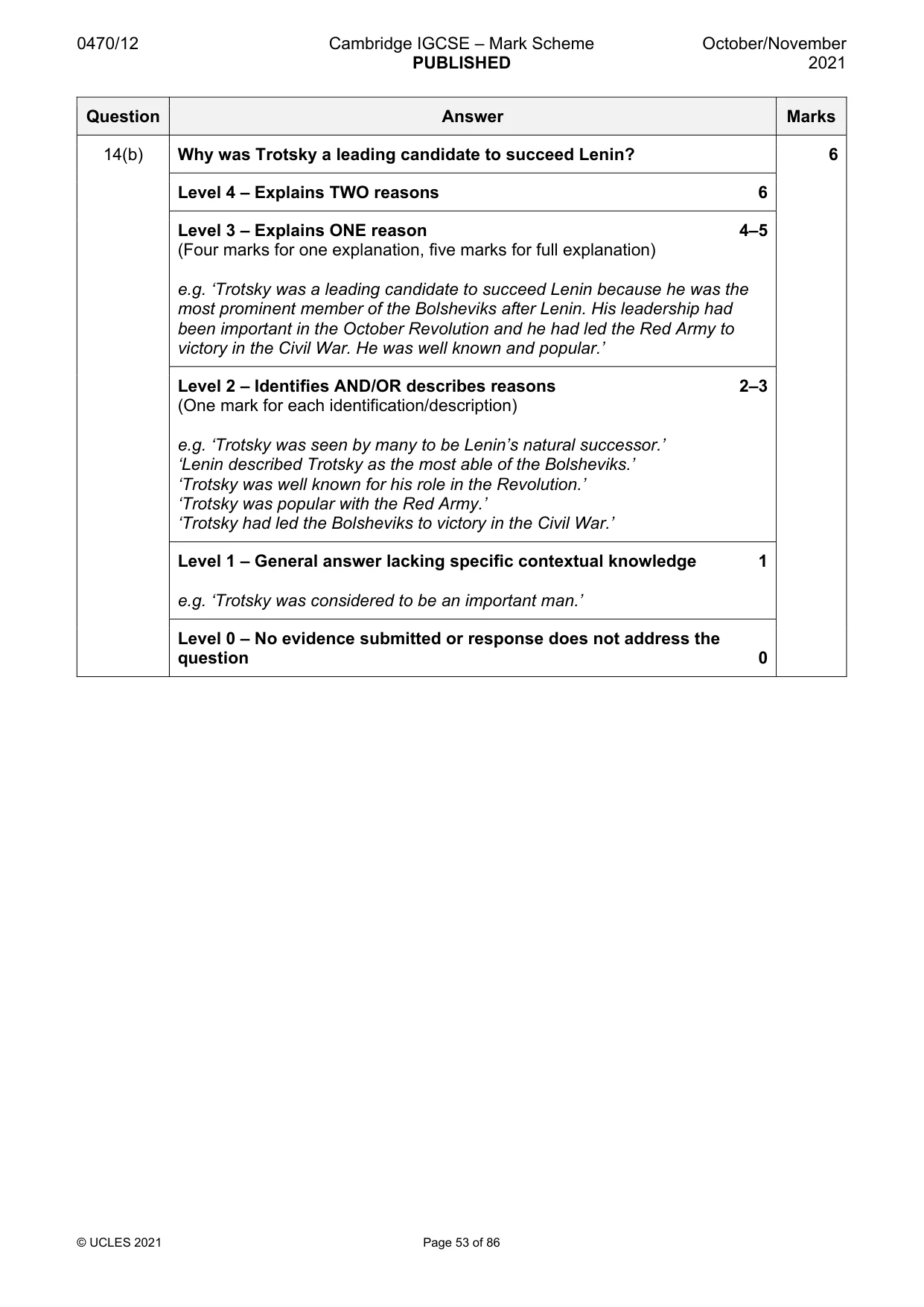
0470/12 Cambridge IGCSE – Mark Scheme PUBLISHED October/November 2021 © UCLES 2021 Page 53 of 86 Question Answer Marks 14(b) Why was Trotsky a leading candidate to succeed Lenin? 6 Level 4 – Explains TWO reasons 6 Level 3 – Explains ONE reason 4–5 (Four marks for one explanation, five marks for full explanation) e.g. ‘Trotsky was a leading candidate to succeed Lenin because he was the most prominent member of the Bolsheviks after Lenin. His leadership had been important in the October Revolution and he had led the Red Army to victory in the Civil War. He was well known and popular.’ Level 2 – Identifies AND/OR describes reasons 2–3 (One mark for each identification/description) e.g. ‘Trotsky was seen by many to be Lenin’s natural successor.’ ‘Lenin described Trotsky as the most able of the Bolsheviks.’ ‘Trotsky was well known for his role in the Revolution.’ ‘Trotsky was popular with the Red Army.’ ‘Trotsky had led the Bolsheviks to victory in the Civil War.’ Level 1 – General answer lacking specific contextual knowledge 1 e.g. ‘Trotsky was considered to be an important man.’ Level 0 – No evidence submitted or response does not address the question 0
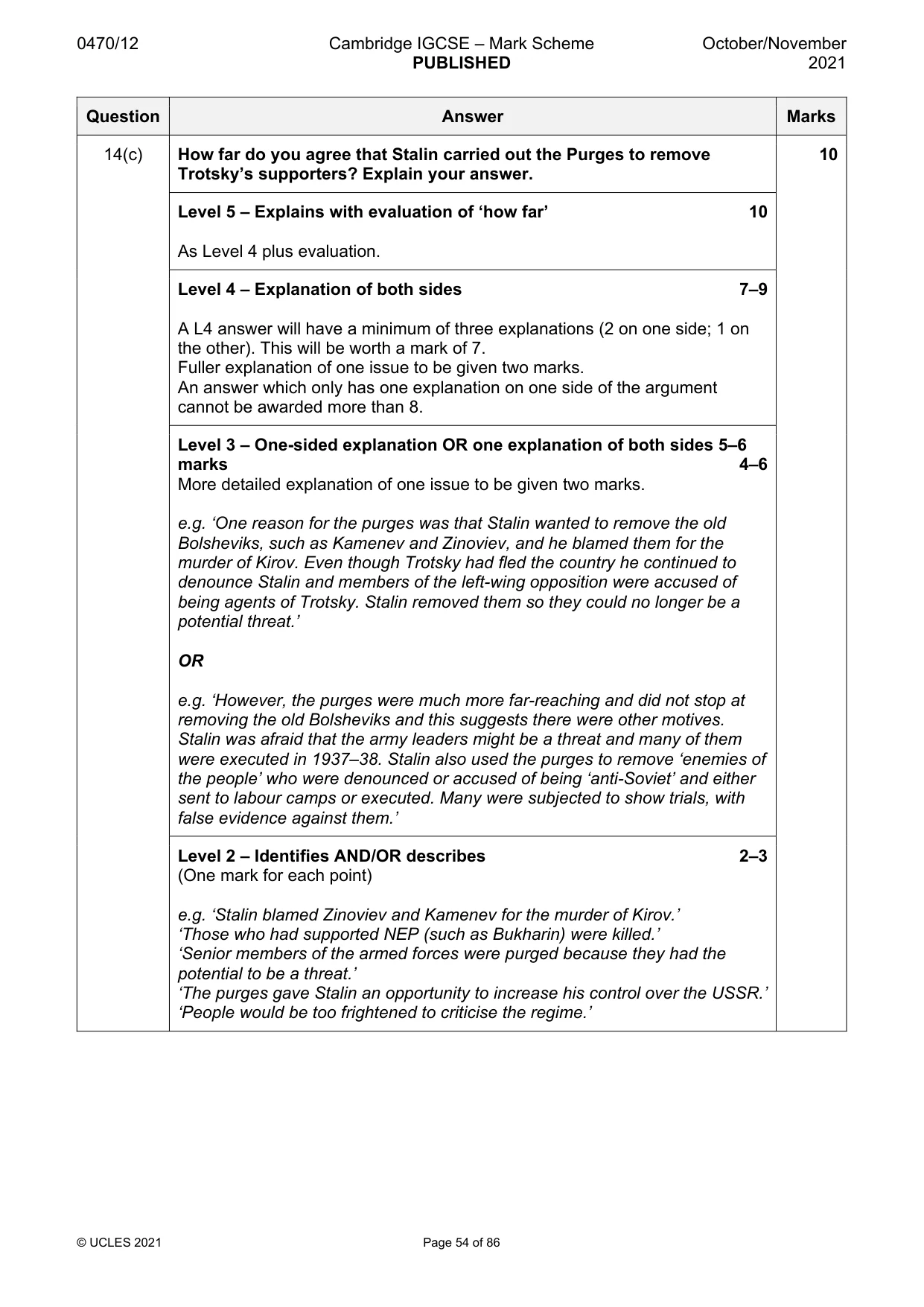
Mark scheme, page 54
0470/12 Cambridge IGCSE – Mark Scheme PUBLISHED October/November 2021 © UCLES 2021 Page 54 of 86 Question Answer Marks 14(c) How far do you agree that Stalin carried out the Purges to remove Trotsky’s supporters? Explain your answer. 10 Level 5 – Explains with evaluation of ‘how far’ 10 As Level 4 plus evaluation. Level 4 – Explanation of both sides 7–9 A L4 answer will have a minimum of three explanations (2 on one side; 1 on the other). This will be worth a mark of 7. Fuller explanation of one issue to be given two marks. An answer which only has one explanation on one side of the argument cannot be awarded more than 8. Level 3 – One-sided explanation OR one explanation of both sides 5–6 marks 4–6 More detailed explanation of one issue to be given two marks. e.g. ‘One reason for the purges was that Stalin wanted to remove the old Bolsheviks, such as Kamenev and Zinoviev, and he blamed them for the murder of Kirov. Even though Trotsky had fled the country he continued to denounce Stalin and members of the left-wing opposition were accused of being agents of Trotsky. Stalin removed them so they could no longer be a potential threat.’ OR e.g. ‘However, the purges were much more far-reaching and did not stop at removing the old Bolsheviks and this suggests there were other motives. Stalin was afraid that the army leaders might be a threat and many of them were executed in 1937–38. Stalin also used the purges to remove ‘enemies of the people’ who were denounced or accused of being ‘anti-Soviet’ and either sent to labour camps or executed. Many were subjected to show trials, with false evidence against them.’ Level 2 – Identifies AND/OR describes 2–3 (One mark for each point) e.g. ‘Stalin blamed Zinoviev and Kamenev for the murder of Kirov.’ ‘Those who had supported NEP (such as Bukharin) were killed.’ ‘Senior members of the armed forces were purged because they had the potential to be a threat.’ ‘The purges gave Stalin an opportunity to increase his control over the USSR.’ ‘People would be too frightened to criticise the regime.’
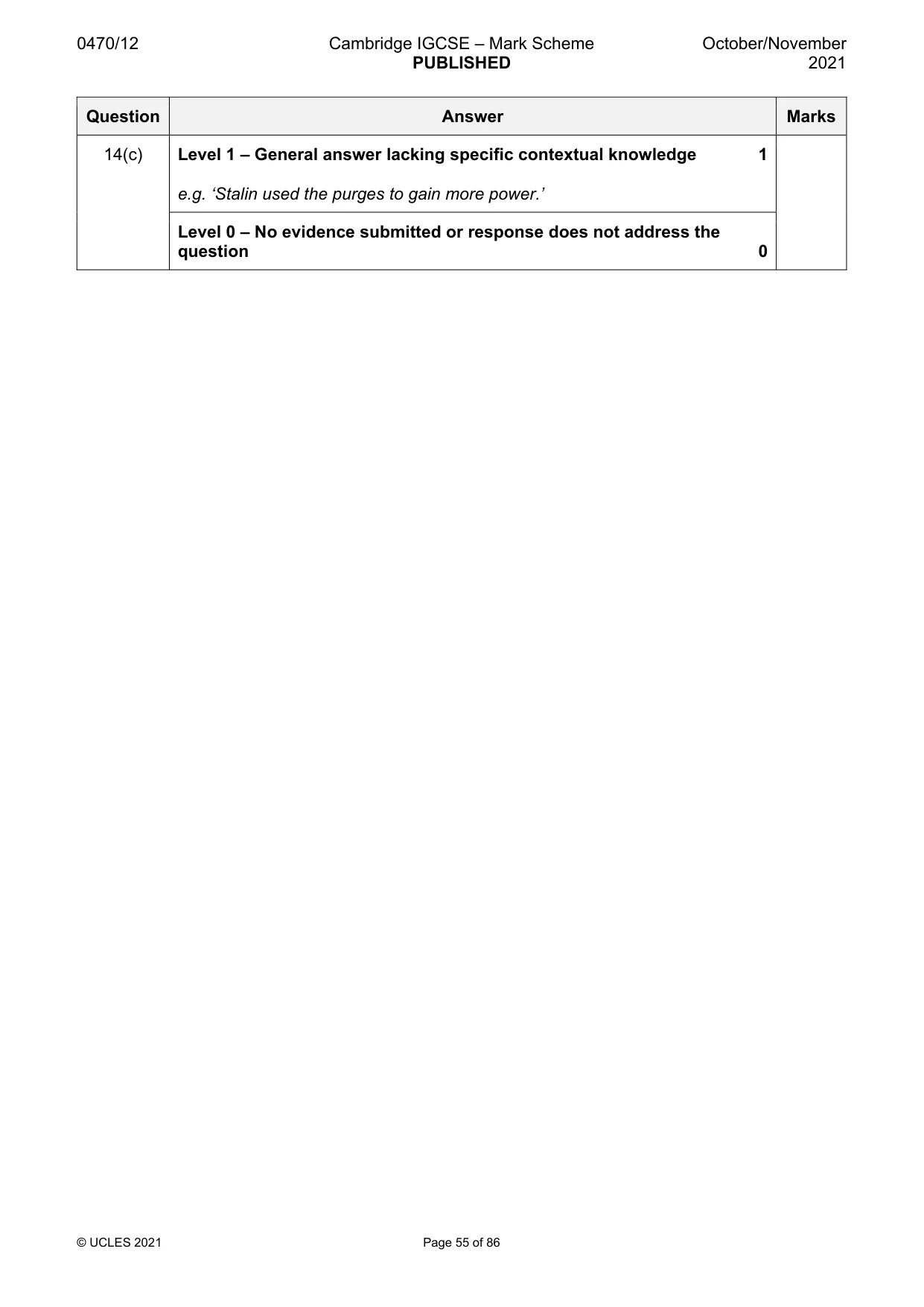
Mark scheme, page 55
0470/12 Cambridge IGCSE – Mark Scheme PUBLISHED October/November 2021 © UCLES 2021 Page 55 of 86 Question Answer Marks 14(c) Level 1 – General answer lacking specific contextual knowledge 1 e.g. ‘Stalin used the purges to gain more power.’ Level 0 – No evidence submitted or response does not address the question 0
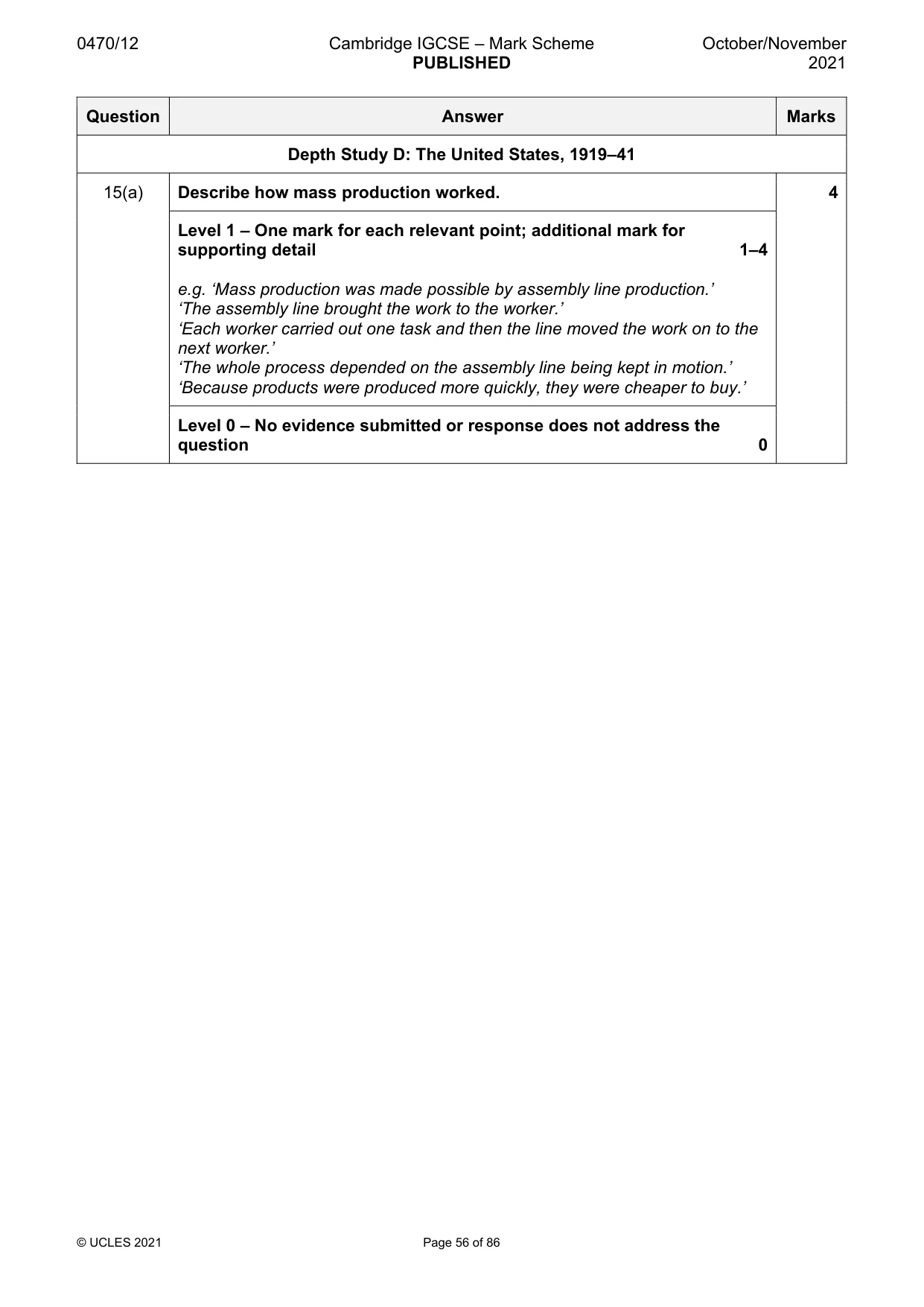
Mark scheme, page 56
0470/12 Cambridge IGCSE – Mark Scheme PUBLISHED October/November 2021 © UCLES 2021 Page 56 of 86 Question Answer Marks Depth Study D: The United States, 1919–41 15(a) Describe how mass production worked. 4 Level 1 – One mark for each relevant point; additional mark for supporting detail 1–4 e.g. ‘Mass production was made possible by assembly line production.’ ‘The assembly line brought the work to the worker.’ ‘Each worker carried out one task and then the line moved the work on to the next worker.’ ‘The whole process depended on the assembly line being kept in motion.’ ‘Because products were produced more quickly, they were cheaper to buy.’ Level 0 – No evidence submitted or response does not address the question 0
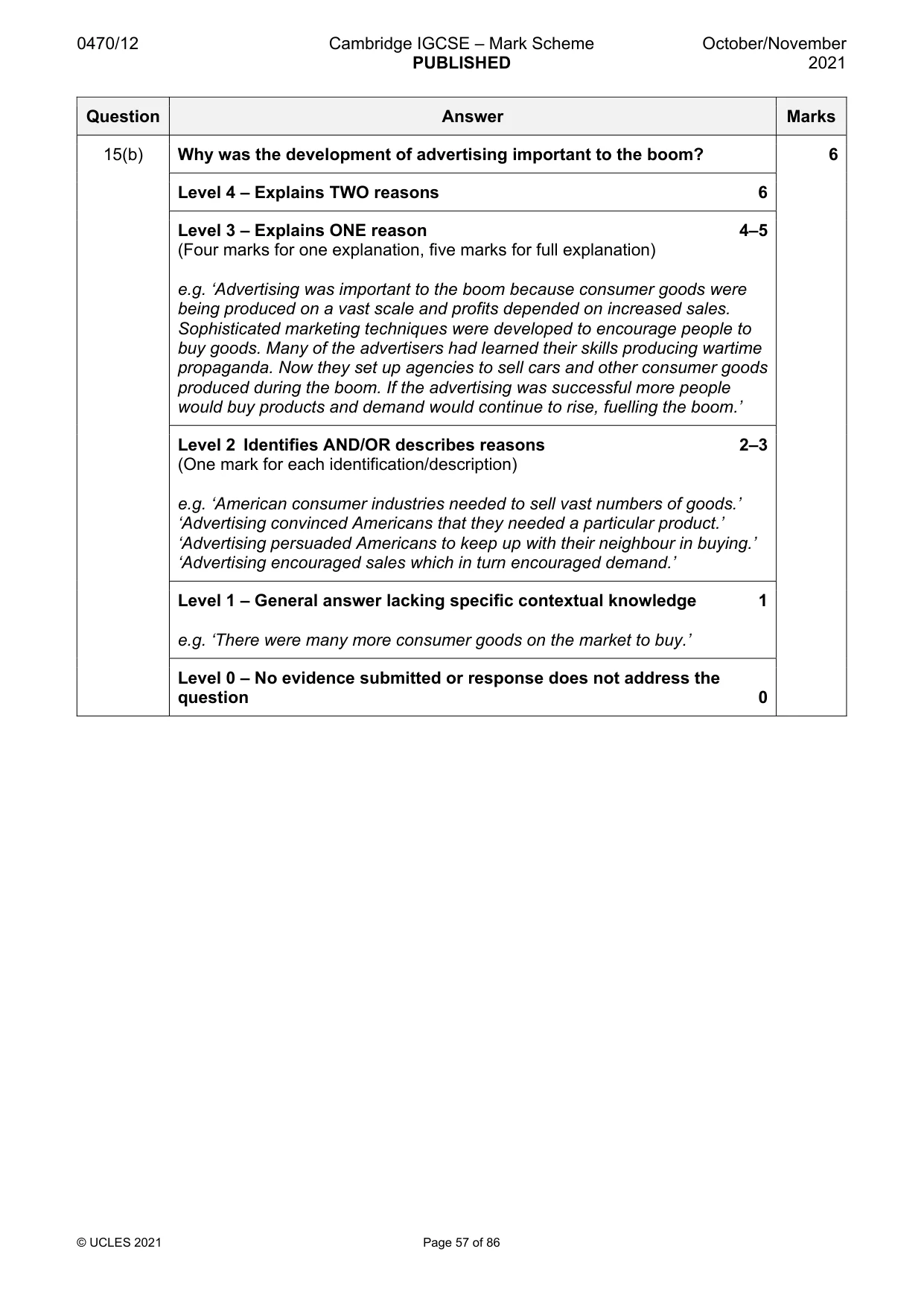
Mark scheme, page 57
0470/12 Cambridge IGCSE – Mark Scheme PUBLISHED October/November 2021 © UCLES 2021 Page 57 of 86 Question Answer Marks 15(b) Why was the development of advertising important to the boom? 6 Level 4 – Explains TWO reasons 6 Level 3 – Explains ONE reason 4–5 (Four marks for one explanation, five marks for full explanation) e.g. ‘Advertising was important to the boom because consumer goods were being produced on a vast scale and profits depended on increased sales. Sophisticated marketing techniques were developed to encourage people to buy goods. Many of the advertisers had learned their skills producing wartime propaganda. Now they set up agencies to sell cars and other consumer goods produced during the boom. If the advertising was successful more people would buy products and demand would continue to rise, fuelling the boom.’ Level 2 Identifies AND/OR describes reasons 2–3 (One mark for each identification/description) e.g. ‘American consumer industries needed to sell vast numbers of goods.’ ‘Advertising convinced Americans that they needed a particular product.’ ‘Advertising persuaded Americans to keep up with their neighbour in buying.’ ‘Advertising encouraged sales which in turn encouraged demand.’ Level 1 – General answer lacking specific contextual knowledge 1 e.g. ‘There were many more consumer goods on the market to buy.’ Level 0 – No evidence submitted or response does not address the question 0
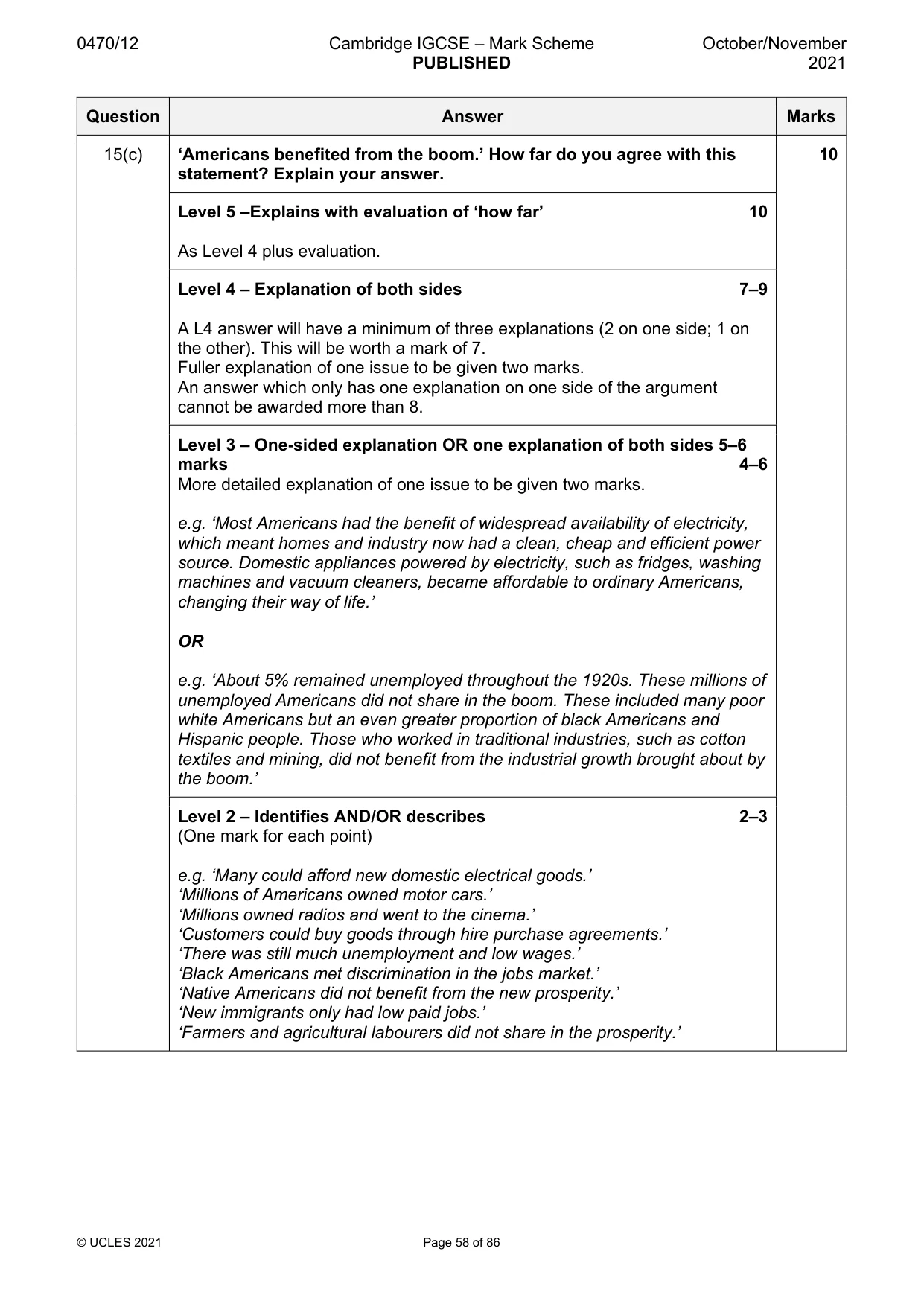
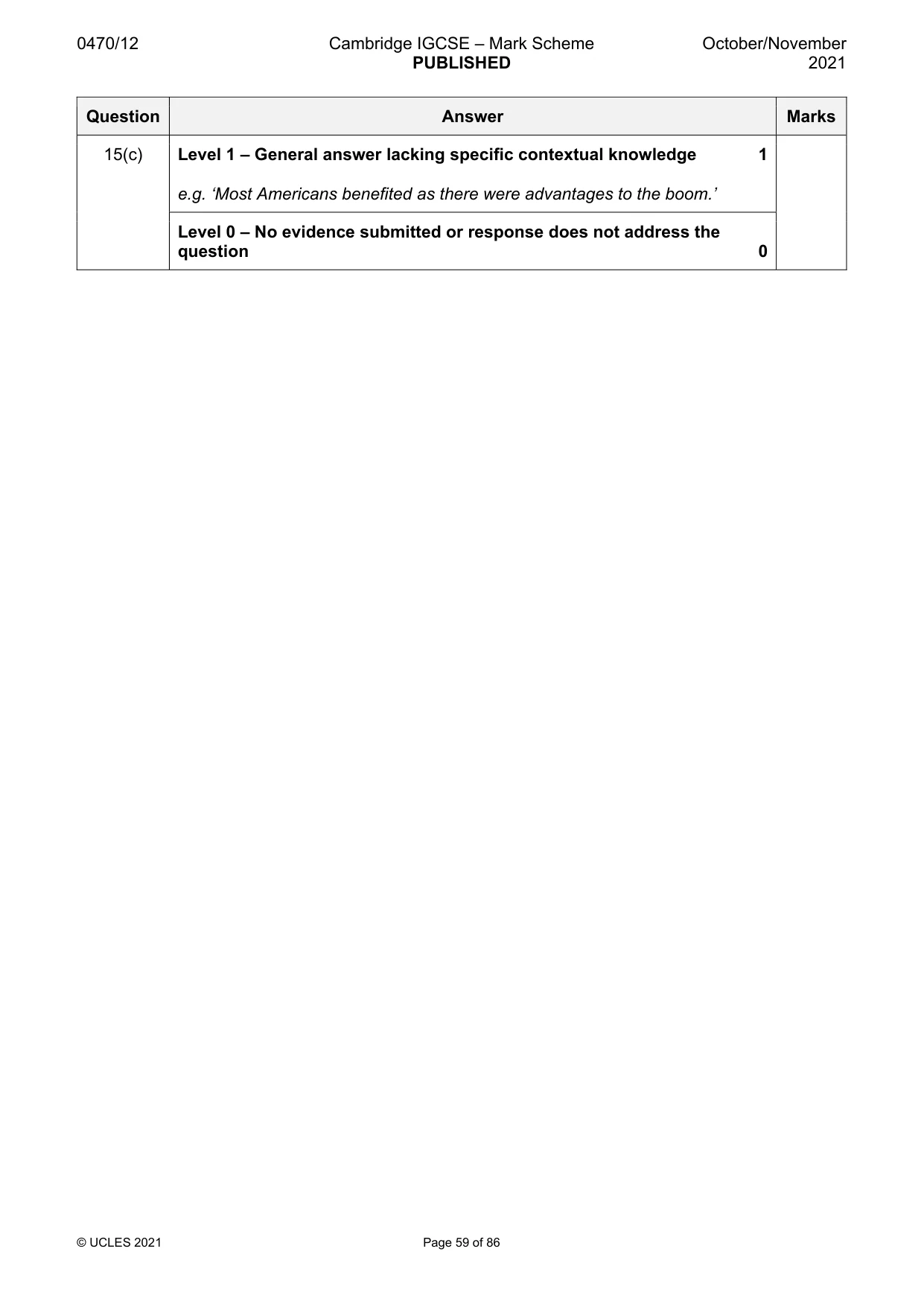
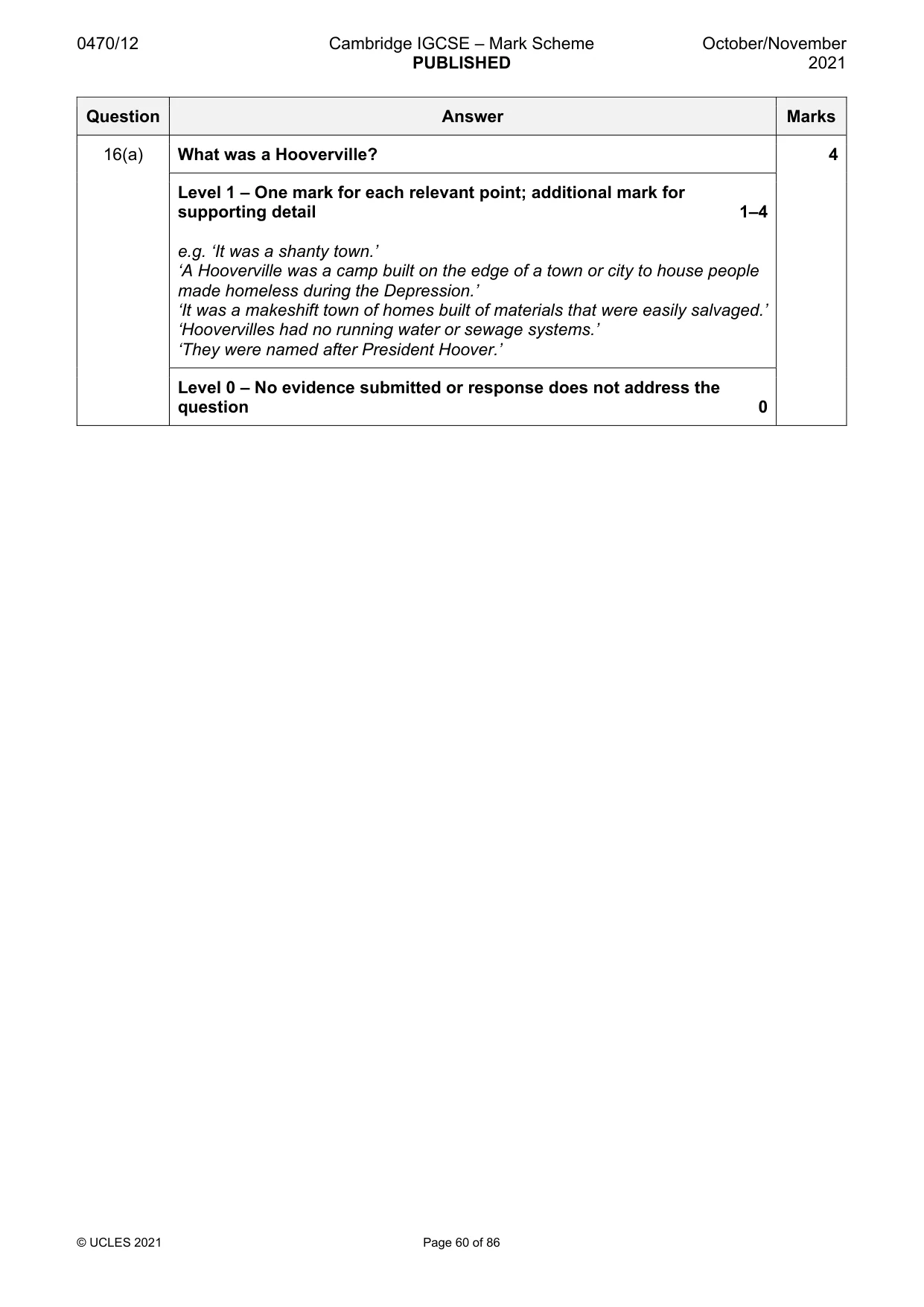
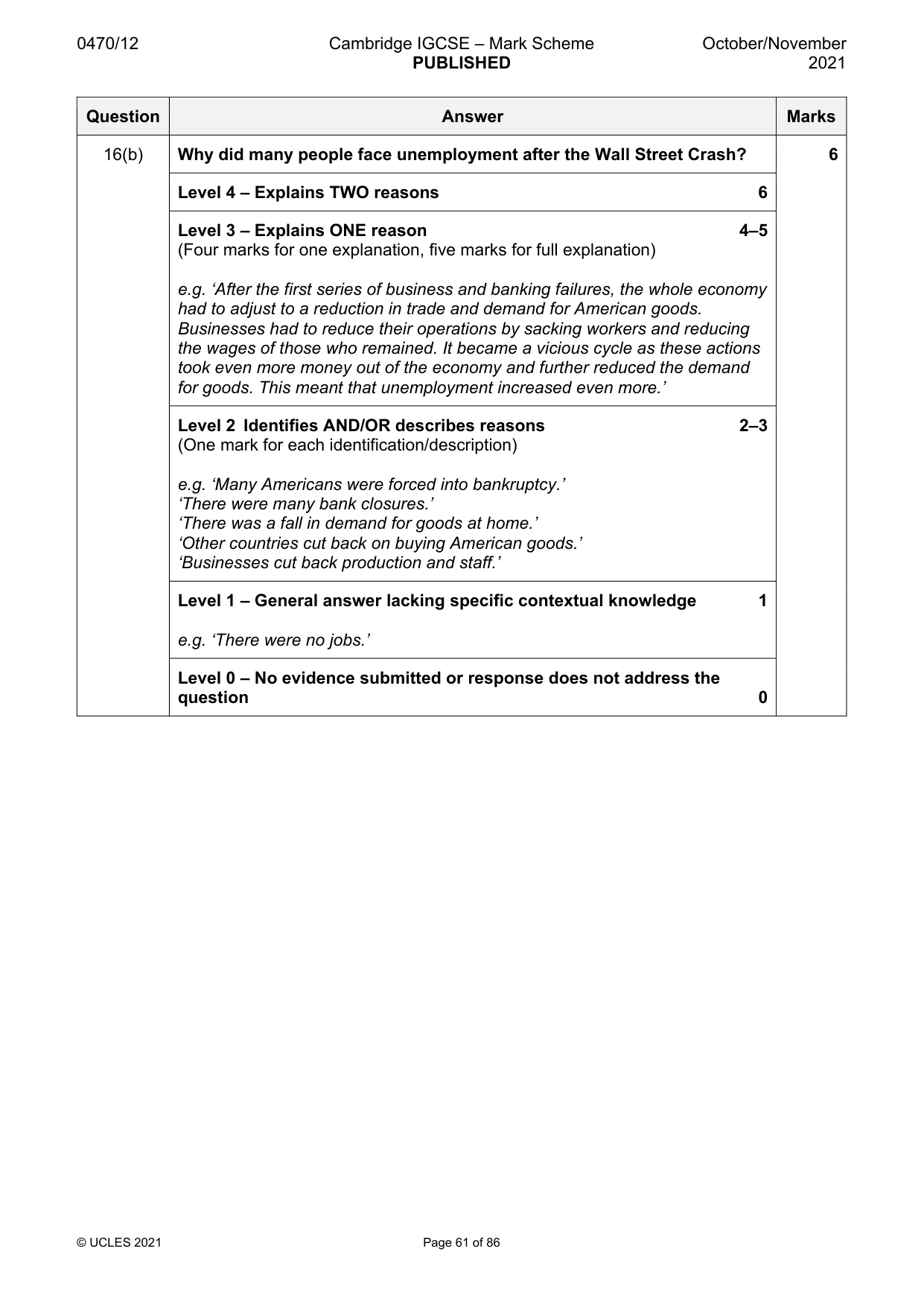
Mark scheme, page 58
0470/12 Cambridge IGCSE – Mark Scheme PUBLISHED October/November 2021 © UCLES 2021 Page 58 of 86 Question Answer Marks 15(c) ‘Americans benefited from the boom.’ How far do you agree with this statement? Explain your answer. 10 Level 5 –Explains with evaluation of ‘how far’ 10 As Level 4 plus evaluation. Level 4 – Explanation of both sides 7–9 A L4 answer will have a minimum of three explanations (2 on one side; 1 on the other). This will be worth a mark of 7. Fuller explanation of one issue to be given two marks. An answer which only has one explanation on one side of the argument cannot be awarded more than 8. Level 3 – One-sided explanation OR one explanation of both sides 5–6 marks 4–6 More detailed explanation of one issue to be given two marks. e.g. ‘Most Americans had the benefit of widespread availability of electricity, which meant homes and industry now had a clean, cheap and efficient power source. Domestic appliances powered by electricity, such as fridges, washing machines and vacuum cleaners, became affordable to ordinary Americans, changing their way of life.’ OR e.g. ‘About 5% remained unemployed throughout the 1920s. These millions of unemployed Americans did not share in the boom. These included many poor white Americans but an even greater proportion of black Americans and Hispanic people. Those who worked in traditional industries, such as cotton textiles and mining, did not benefit from the industrial growth brought about by the boom.’ Level 2 – Identifies AND/OR describes 2–3 (One mark for each point) e.g. ‘Many could afford new domestic electrical goods.’ ‘Millions of Americans owned motor cars.’ ‘Millions owned radios and went to the cinema.’ ‘Customers could buy goods through hire purchase agreements.’ ‘There was still much unemployment and low wages.’ ‘Black Americans met discrimination in the jobs market.’ ‘Native Americans did not benefit from the new prosperity.’ ‘New immigrants only had low paid jobs.’ ‘Farmers and agricultural labourers did not share in the prosperity.’
Mark scheme, page 59
0470/12 Cambridge IGCSE – Mark Scheme PUBLISHED October/November 2021 © UCLES 2021 Page 59 of 86 Question Answer Marks 15(c) Level 1 – General answer lacking specific contextual knowledge 1 e.g. ‘Most Americans benefited as there were advantages to the boom.’ Level 0 – No evidence submitted or response does not address the question 0
Mark scheme, page 60
0470/12 Cambridge IGCSE – Mark Scheme PUBLISHED October/November 2021 © UCLES 2021 Page 60 of 86 Question Answer Marks 16(a) What was a Hooverville? 4 Level 1 – One mark for each relevant point; additional mark for supporting detail 1–4 e.g. ‘It was a shanty town.’ ‘A Hooverville was a camp built on the edge of a town or city to house people made homeless during the Depression.’ ‘It was a makeshift town of homes built of materials that were easily salvaged.’ ‘Hoovervilles had no running water or sewage systems.’ ‘They were named after President Hoover.’ Level 0 – No evidence submitted or response does not address the question 0
Mark scheme, page 61
0470/12 Cambridge IGCSE – Mark Scheme PUBLISHED October/November 2021 © UCLES 2021 Page 61 of 86 Question Answer Marks 16(b) Why did many people face unemployment after the Wall Street Crash? 6 Level 4 – Explains TWO reasons 6 Level 3 – Explains ONE reason 4–5 (Four marks for one explanation, five marks for full explanation) e.g. ‘After the first series of business and banking failures, the whole economy had to adjust to a reduction in trade and demand for American goods. Businesses had to reduce their operations by sacking workers and reducing the wages of those who remained. It became a vicious cycle as these actions took even more money out of the economy and further reduced the demand for goods. This meant that unemployment increased even more.’ Level 2 Identifies AND/OR describes reasons 2–3 (One mark for each identification/description) e.g. ‘Many Americans were forced into bankruptcy.’ ‘There were many bank closures.’ ‘There was a fall in demand for goods at home.’ ‘Other countries cut back on buying American goods.’ ‘Businesses cut back production and staff.’ Level 1 – General answer lacking specific contextual knowledge 1 e.g. ‘There were no jobs.’ Level 0 – No evidence submitted or response does not address the question 0
Mark scheme, page 62
0470/12 Cambridge IGCSE – Mark Scheme PUBLISHED October/November 2021 © UCLES 2021 Page 62 of 86 Question Answer Marks 16(c) How surprising was the Wall Street Crash? Explain your answer. 10 Level 5 – Explains with evaluation of ‘how surprising’ 10 As Level 4 plus evaluation. Level 4 – Explanation of both sides 7–9 A L4 answer will have a minimum of three explanations (2 on one side; 1 on the other). This will be worth a mark of 7. Fuller explanation of one issue to be given two marks. An answer which only has one explanation on one side of the argument cannot be awarded more than 8. Level 3 – One-sided explanation OR one explanation of both sides 5–6 marks 4–6 More detailed explanation of one issue to be given two marks. e.g. ‘The Wall Street Crash was a great surprise for some investors. The 1920s had been boom years for the American economy. Consumer items such as cars and radios had sold in huge numbers. Industries made huge profits and some shareholders grew wealthy. Many investors did not notice the fall in profits and production in 1928. Some had bought shares on credit expecting to sell them and make a profit. These speculators were caught by surprise in 1929 when some investors decided that the market was going to fall and started to sell their shares. This caused a panic which resulted in a dramatic decline in share values.’ OR e.g. ‘On the other hand, it was not surprising that the Wall Street Crash occurred. There were signs that the economy had reached saturation point. Americans with money had already bought a car, fridge and other domestic appliances and did not need to keep buying more. Also, as many as 60% of Americans still lived in poverty and could not afford to buy new domestic products in the first place. This all meant that demand was reducing, profits would decline, and the value of shares would fall.’ Level 2 – Identifies AND/OR describes 2–3 (One mark for each point) e.g. ‘The economy had boomed during the 1920s.’ ‘Many consumer items had sold well in the 1920s.’ ‘Share prices kept rising throughout the 1920s.’ ‘Speculators had made huge profits.’ ‘Investors did not realise the economy was slowing down.’ ‘The market was reaching saturation point.’ ‘Many Americans could not afford to buy consumer products.’ ‘There was overproduction.’ ‘There were signs in 1927 that demand was decreasing and car sales were declining.’
Mark scheme, page 63
0470/12 Cambridge IGCSE – Mark Scheme PUBLISHED October/November 2021 © UCLES 2021 Page 63 of 86 Question Answer Marks 16(c) Level 1 – General answer lacking specific contextual knowledge 1 e.g. ‘The Wall Street Crash was a shock to many people.’ Level 0 – No evidence submitted or response does not address the question 0
Mark scheme, page 64
0470/12 Cambridge IGCSE – Mark Scheme PUBLISHED October/November 2021 © UCLES 2021 Page 64 of 86 Question Answer Marks Depth Study E: China, c.1930–c.1990 17(a) Describe Chiang Kai-shek’s treatment of the Communists in the early 1930s. 4 Level 1 – One mark for each relevant point; additional mark for supporting detail 1–4 e.g. ‘Chiang Kai-shek persecuted the Communists.’ ‘Chiang Kai-shek launched the Five Extermination Campaigns against them.’ ‘Chiang wanted to destroy the Jiangxi Soviet.’ ‘The first four campaigns against them failed.’ ‘Chiang blockaded the Communist settlement in the Fifth Campaign.’ ‘The Communists managed to escape in October 1933 and started the Long March.’ Level 0 – No evidence submitted or response does not address the question 0
Mark scheme, page 65
0470/12 Cambridge IGCSE – Mark Scheme PUBLISHED October/November 2021 © UCLES 2021 Page 65 of 86 Question Answer Marks 17(b) Why did support for the Communists increase during the Second World War? 6 Level 4 – Explains TWO reasons 6 Level 3 – Explains ONE reason 4–5 (Four marks for one explanation, five marks for full explanation) e.g. ‘The Communists were popular with the peasants because they took the fight to the Japanese by using guerrilla tactics. They organised local Chinese resistance forces in areas occupied by the Japanese in an attempt to sabotage the enemy war effort. They destroyed railways, ambushed troops and disrupted Japanese supply lines. This was in contrast to the defensive approach by the Nationalists.’ Level 2 Identifies AND/OR describes reasons 2–3 (One mark for each identification/description) e.g. ‘The Communists went on the attack against the Japanese.’ ‘They appeared to be very patriotic.’ ‘They helped the resistance forces plan their attacks.’ ‘In areas of rural China which they controlled, they reduced rents and increased taxes on the rich.’ ‘As the Japanese were driven out, the peasants supported the Communists.’ Level 1 – General answer lacking specific contextual knowledge 1 e.g. ‘The Communists were liked by the people.’ Level 0 – No evidence submitted or response does not address the question 0
Mark scheme, page 66
0470/12 Cambridge IGCSE – Mark Scheme PUBLISHED October/November 2021 © UCLES 2021 Page 66 of 86 Question Answer Marks 17(c) ‘The weaknesses of the Nationalists determined the outcome of the Civil War.’ How far do you agree with this statement? Explain your answer. 10 Level 5 – Explains with evaluation of ‘how far’ 10 As Level 4 plus evaluation. Level 4 – Explanation of both sides 7–9 A L4 answer will have a minimum of three explanations (2 on one side; 1 on the other). This will be worth a mark of 7. Fuller explanation of one issue to be given two marks. An answer which only has one explanation on one side of the argument cannot be awarded more than 8. Level 3 – One-sided explanation OR one explanation of both sides 5–6 marks 4–6 More detailed explanation of one issue to be given two marks. e.g. ‘Mao’s leadership was more important than the Nationalists’ weaknesses because he was seen by the peasants as a liberator because of his guerrilla tactics against the Japanese. The peasants recognised that Mao was fighting to defend China’s national interests. Mao made sure that his troops were disciplined and treated the peasants fairly. This secured support for the Communists and enhanced their chances of victory.’ OR e.g. ‘The Nationalists became unpopular, and this helped the Communists to victory. Chiang’s regime was corrupt and inefficient. Local officials abused their powers and made themselves rich by taking bribes and extorting money from the local people.’ Level 2 – Identifies AND/OR describes 2–3 (One mark for each point) e.g. ‘Mao had the support of the peasants.’ ‘Mao’s Red Army treated the peasants fairly.’ ‘Mao made effective strategic decisions.’ ‘Mao used guerrilla warfare early in the Civil War.’ ‘The leadership of the Kuomintang forces was corrupt and inefficient.’ ‘Chiang increasingly behaved like a dictator.’ ‘The Nationalist government had failed to deliver on its promises.’ Level 1 – General answer lacking specific contextual knowledge 1 e.g. ‘The Nationalists were not very strong.’ Level 0 – No evidence submitted or response does not address the question 0
Mark scheme, page 67
0470/12 Cambridge IGCSE – Mark Scheme PUBLISHED October/November 2021 © UCLES 2021 Page 67 of 86 Question Answer Marks 18(a) Describe China’s relationship with Vietnam in the 1970s. 4 Level 1 – One mark for each relevant point; additional mark for supporting detail 1–4 e.g. ‘China provided arms, military training and supplies to the North during the Vietnam War.’ ‘There was tension because the Vietnamese Communist Party wanted to develop their own approach.’ ‘China wanted Vietnam to follow a similar path to China.’ ‘Tensions arose when Vietnam invaded Cambodia in 1976.’ ‘The relationship deteriorated) when Vietnam signed a treaty of friendship with the USSR .’ ‘China attacked northern Vietnam in 1979.’ Level 0 – No evidence submitted or response does not address the question 0
Mark scheme, page 68
0470/12 Cambridge IGCSE – Mark Scheme PUBLISHED October/November 2021 © UCLES 2021 Page 68 of 86 Question Answer Marks 18(b) Why were there changes in the relationship between India and China in the 1960s? 6 Level 4 – Explains TWO reasons 6 Level 3 – Explains ONE reason 4–5 (Four marks for one explanation, five marks for full explanation) e.g. ‘In 1962, a brief war broke out between China and India. In 1954, India had published new maps that included the boundaries of India with China, but in 1959, the Chinese stated in a letter to the Indian leader that their borders were incorrect and that over 100 000 square kilometres of territory shown on the Indian maps was in fact Chinese land. The Chinese won the war in 1962 but there was tension throughout the 1960s.’ Level 2 – Identifies AND/OR describes reasons 2–3 (One mark for each identification/description) e.g. ‘There were border disputes.’ ‘China wanted to build a highway into Tibet on the border.’ ‘The Dalai Lama was given refuge in India.’ ‘In 1962 there was a brief war on the border.’ ‘Small communist risings in India in 1967 were supported by China.’ ‘China supported Pakistan in the 1965 war with India.’ ‘Trade almost stopped because of the tension.’ ‘China accused India of supporting rebels in Tibet.’ Level 1 – General answer lacking specific contextual knowledge 1 e.g. ‘The relationship changed because China felt differently about India.’ Level 0 – No evidence submitted or response does not address the question 0
Mark scheme, page 69
0470/12 Cambridge IGCSE – Mark Scheme PUBLISHED October/November 2021 © UCLES 2021 Page 69 of 86 Question Answer Marks 18(c) ‘The main reason for the improvement in China’s relations with the USA after 1970 was the establishment of trade between the two of them.’ How far do you agree with this statement? Explain your answer. 10 Level 5 – Explains with evaluation of ‘how far’ 10 As Level 4 plus evaluation. Level 4 – Explanation of both sides 7–9 A L4 answer will have a minimum of three explanations (2 on one side; 1 on the other). This will be worth a mark of 7. Fuller explanation of one issue to be given two marks. An answer which only has one explanation on one side of the argument cannot be awarded more than 8. Level 3 – One-sided explanation OR one explanation of both sides 5–6 marks 4–6 More detailed explanation of one issue to be given two marks. e.g. ‘Trade between China and the USA was an important part of the greatly improved relations between the two countries after 1970. The failure of the Great Leap Forward meant that China was in need of help and saw American trade and business expertise as something that could be beneficial to China. In 1971, Henry Kissinger travelled to China and negotiated a trade agreement and China was admitted to the UN in the same year. In 1972, the Chinese- American trade agreement was followed by the signing of a peace treaty.’ OR e.g. ‘There were other motives for a thaw in Sino-US relations. As the Chinese relationship with the USSR deteriorated, Mao believed that it was a good idea to cultivate a relationship with the USSR’s traditional enemy, the USA. Mao believed in the principle that his enemy’s enemy should be his friend, and the provocative behaviour of the Russians in the late 1960s made a positive relationship with the Americans even more attractive.’ Level 2 – Identifies AND/OR describes 2–3 (One mark for each point) e.g. ‘The relationship between the USSR and China had deteriorated in the 1969’s.’ ‘The US supported Taiwan in the Taiwan Straits crisis.’ ‘The US finally accepted that the CCP was the legitimate government of China.’ ‘In 1971 the Chinese government invited the American table tennis team to Beijing.’ ‘Mao saw there were economic benefits from trading with the US.’ ‘In 1972 there was a Chinese-American trade agreement.’ Level 1 – General answer lacking specific contextual knowledge 1 e.g. ‘It was in both countries’ interests to put their differences aside.’
Mark scheme, page 70
0470/12 Cambridge IGCSE – Mark Scheme PUBLISHED October/November 2021 © UCLES 2021 Page 70 of 86 Question Answer Marks 18(c) Level 0 – No evidence submitted or response does not address the question 0
Mark scheme, page 71
0470/12 Cambridge IGCSE – Mark Scheme PUBLISHED October/November 2021 © UCLES 2021 Page 71 of 86 Question Answer Marks Depth Study F: South Africa, c.1940–c.1994 19(a) What was the Sauer Commission? 4 Level 1 – One mark for each relevant point; additional mark for supporting detail 1–4 e.g. ‘It was a government commission set up in 1947.’ ‘It was set up to evaluate the system of segregation.’ ‘It advocated an extension of segregation.’ ‘It advocated apartheid in all areas of social and economic activity.’ ‘It was popular with Afrikaners.’ ‘It became an important part of National Party policy.’ ‘This helped the National Party to win the 1948 election.’ Level 0 – No evidence submitted or response does not address the question 0
Mark scheme, page 72
0470/12 Cambridge IGCSE – Mark Scheme PUBLISHED October/November 2021 © UCLES 2021 Page 72 of 86 Question Answer Marks 19(b) Why did South African gold mining flourish in the period up to 1945? 6 Level 4 – Explains TWO reasons 6 Level 3 – Explains ONE reason 4–5 (Four marks for one explanation, five marks for full explanation) e.g. ‘Gold mining flourished because the government gave the mine owners their support. They passed laws which meant the black farmers living in mining regions such as the Transvaal had to pay a tax. As most did not use money they had to find supplementary income to pay the tax. This meant they often went to work in the mines. This ensured a supply of labour for the mines.’ Level 2 – Identifies AND/OR describes reasons 2–3 (One mark for each identification/description) e.g. ‘Mining was given government support.’ ‘Mine owners employed black South Africans as cheap labour.’ ‘A pass system was introduced so the miners could not leave the compounds where they lived.’ ‘The contracts for the miners were long – up to nine months.’ ‘The Second World War meant there was a global demand for gold.’ Level 1 – General answer lacking specific contextual knowledge 1 e.g. ‘There was a high demand for gold.’ Level 0 – No evidence submitted or response does not address the question 0
Mark scheme, page 73
0470/12 Cambridge IGCSE – Mark Scheme PUBLISHED October/November 2021 © UCLES 2021 Page 73 of 86 Question Answer Marks 19(c) ‘The Natives Land Act had a more serious impact on non-white South Africans than the Native Urban Areas Act in the period to 1948.’ How far do you agree with this statement? Explain your answer. 10 Level 5 – Explains with evaluation of ‘how far’ 10 As Level 4 plus evaluation. Level 4 – Explanation of both sides 7–9 A L4 answer will have a minimum of three explanations (2 on one side; 1 on the other). This will be worth a mark of 7. Fuller explanation of one issue to be given two marks. An answer which only has one explanation on one side of the argument cannot be awarded more than 8. Level 3 – One-sided explanation OR one explanation of both sides 5–6 marks 4–6 More detailed explanation of one issue to be given two marks. e.g. ‘The Natives Land Act had a more serious impact because it prevented black people from owning or renting land and they were forced to live in reservations which were overcrowded. Sharecropping was banned. In the short term, this was significant because many black sharecroppers were evicted, causing them harsh suffering. In the long term, the Act simply turned black people into labourers for white farmers. It was no longer possible to earn a living from farming.’ OR e.g. ‘The Native Urban Areas Act meant that housing became segregated. Black South Africans were only allowed to live in black townships, away from white people. Their houses were often constructed of mud bricks and corrugated iron. There were no metalled roads, and the water supplies and sanitation were poor. This meant disease spread easily.’ Level 2 – Identifies AND/OR describes 2–3 (One mark for each point) e.g. ‘The Natives Land Act prevented black people from owning land.’ ‘The 1913 Natives Land Act prevented black people from practising sharecropping.’ ‘The Act forced black people to seek work on white-owned farms.’ ‘The 1913 Act led to the eviction of black sharecroppers.’ ‘The Native Urban Areas Act meant black people had to live in extremely poor housing.’ ‘Clean water and sanitation were in short supply.’ ‘Disease spread easily.’ Level 1 – General answer lacking specific contextual knowledge 1 e.g. ‘Both of these laws made living and working conditions much worse for black South Africans.’
Mark scheme, page 74
0470/12 Cambridge IGCSE – Mark Scheme PUBLISHED October/November 2021 © UCLES 2021 Page 74 of 86 Question Answer Marks 19(c) Level 0 – No evidence submitted or response does not address the question 0
Mark scheme, page 75
0470/12 Cambridge IGCSE – Mark Scheme PUBLISHED October/November 2021 © UCLES 2021 Page 75 of 86 Question Answer Marks 20(a) Describe Botha’s reform of the Pass Laws. 4 Level 1 – One mark for each relevant point; additional mark for supporting detail 1–4 e.g. ‘Laws that restricted the movements of black people were removed in 1986.’ ‘Some prisoners who had broken pass laws were released.’ ‘Black workers would be free to move from one city to another to seek work in white areas.’ ‘Black people were not allowed to live in white areas.’ ‘Passes were to be replaced with an identity document which would be required for all South Africans, regardless of colour.’ Level 0 – No evidence submitted or response does not address the question 0
Mark scheme, page 76
0470/12 Cambridge IGCSE – Mark Scheme PUBLISHED October/November 2021 © UCLES 2021 Page 76 of 86 Question Answer Marks 20(b) Why was Oliver Tambo important in the struggle against apartheid? 6 Level 4 – Explains TWO reasons 6 Level 3 – Explains ONE reason 4–5 (Four marks for one explanation, five marks for full explanation) e.g. ‘Oliver Tambo was important in the struggle against apartheid because he was influential in raising international awareness of the injustices of apartheid and increasing opposition against it. After the Sharpeville Massacre he was sent by the ANC to establish ANC offices in foreign countries. By 1990, there were 27 of these in European and African States. He also spoke to the United Nations and other international organisations to raise awareness of the plight of those living under apartheid.’ Level 2 – Identifies AND/OR describes reasons 2–3 (One mark for each identification/description) e.g. ‘He was an ANC leader and later became its president.’ ‘He helped to transform the organisation into a radical national freedom movement.’ ‘He established ANC offices in foreign capitals.’ ‘He mobilised international opinion against apartheid.’ ‘He addressed the United Nations.’ ‘He raised the prestige and status of the ANC to that of an alternative government.’ ‘He encouraged people in townships to make them ungovernable.’ Level 1 – General answer lacking specific contextual knowledge 1 e.g. ‘He encouraged people to oppose apartheid.’ Level 0 – No evidence submitted or response does not address the question 0
Mark scheme, page 77
0470/12 Cambridge IGCSE – Mark Scheme PUBLISHED October/November 2021 © UCLES 2021 Page 77 of 86 Question Answer Marks 20(c) How far do you agree that internal unrest was more important than economic problems in encouraging de Klerk to end white minority rule? Explain your answer. 10 Level 5 – Explains with evaluation of ‘how far’ 10 As Level 4 plus evaluation. Level 4 – Explanation of both sides 7–9 A L4 answer will have a minimum of three explanations (2 on one side; 1 on the other). This will be worth a mark of 7. Fuller explanation of one issue to be given two marks. An answer which only has one explanation on one side of the argument cannot be awarded more than 8. Level 3 – One-sided explanation OR one explanation of both sides 5–6 marks 4–6 More detailed explanation of one issue to be given two marks. e.g. ‘Internal unrest was at extremely high levels by the end of the 1980s and played an important role in de Klerk’s decision to end white minority rule. South Africa was almost in a state of civil war and the government could no longer control the black townships. The ANC launched attacks on government buildings and there was widespread violence, often in response to the actions of government security services.’ OR e.g. ‘Economic problems were an important motive for ending white minority rule. The South African economy was in recession and living standards were declining. By the 1980s, the declining power of the USSR meant that South Africa was no longer valuable to the West in the fight against communism. This encouraged some countries to cut trading links with South Africa, making the economy worse. The US Congress passed the Comprehensive Anti- Apartheid Act in 1986, and many large multinational companies withdrew from South Africa. This reduced investment and employment opportunities. By the late 1980s, the South African economy was struggling with the effects of the internal and external boycotts and was facing economic ruin.’ Level 2 – Identifies AND/OR describes 2–3 (One mark for each point) e.g. ‘Internal unrest reached record levels by the end of the 1980s.’ ‘Police brutality sparked unrest.’ ‘The ANC carried out a bombing campaign.’ ‘The townships were uncontrollable.’ ‘Foreign powers were no longer prepared to trade with South Africa.’ ‘There was an external boycott and foreign companies withdrew.’ ‘South Africa faced economic ruin.’
Mark scheme, page 78
0470/12 Cambridge IGCSE – Mark Scheme PUBLISHED October/November 2021 © UCLES 2021 Page 78 of 86 Question Answer Marks 20(c) Level 1 – General answer lacking specific contextual knowledge 1 e.g. ‘Increased violence and economic problems both had an impact on de Klerk’s decision.’ Level 0 – No evidence submitted or response does not address the question 0
Mark scheme, page 79
0470/12 Cambridge IGCSE – Mark Scheme PUBLISHED October/November 2021 © UCLES 2021 Page 79 of 86 Question Answer Marks Depth Study G: Israelis and Palestinians Since 1945 21(a) What was the Palestine Mandate? 4 Level 1 – One mark for each relevant point; additional mark for supporting detail 1–4 e.g. ‘At the end of the First World War, control of Palestine passed to Britain.’ ‘It was held under a League of Nations mandate.’ ‘Britain was to be in control until Palestine could be granted self-government.’ ‘It lasted from 1923–1948.’ ‘The Mandate sought to limit Jewish immigration into Palestine.’ Level 0 – No evidence submitted or response does not address the question 0
Mark scheme, page 80
0470/12 Cambridge IGCSE – Mark Scheme PUBLISHED October/November 2021 © UCLES 2021 Page 80 of 86 Question Answer Marks 21(b) Why did the UN draw up a partition plan? 6 Level 4 – Explains TWO reasons 6 Level 3 – Explains ONE reason 4–5 (Four marks for one explanation, five marks for full explanation) e.g. ‘The United Nations drew up a partition plan to try and find a solution to the issue of the future of Palestine. The United Nations Special Committee on Palestine (UNSCOP) was established to investigate the situation and make recommendations for the future of Palestine. UNSCOP reported that the solution should be to divide the land between the Jews and the Arabs. They felt this system would be fair to both sides.’ Level 2 – Identifies AND/OR describes reasons 2–3 (One mark for each identification/description) e.g. ‘The London Conference could not find a solution acceptable to Jews and Arabs.’ ‘The British government sought advice from the United Nations.’ ‘The British wanted to leave Palestine.’ ‘The USA and USSR favoured partition.’ ‘The UN Special Committee on Palestine made recommendations.’ ‘The UN General Assembly voted to accept its recommendations.’ ‘The UN thought it would force the Jews and Arabs to co-operate.’ Level 1 – General answer lacking specific contextual knowledge 1 e.g. ‘The UN could not decide what to do.’ Level 0 – No evidence submitted or response does not address the question 0
Mark scheme, page 81
0470/12 Cambridge IGCSE – Mark Scheme PUBLISHED October/November 2021 © UCLES 2021 Page 81 of 86 Question Answer Marks 21(c) How surprising was it that Israel won the 1948–49 war? Explain your answer. 10 Level 5 – Explains with evaluation of ‘how surprising’ 10 As Level 4 plus evaluation. Level 4 – Explanation of both sides 7–9 A L4 answer will have a minimum of three explanations (2 on one side; 1 on the other). This will be worth a mark of 7. Fuller explanation of one issue to be given two marks. An answer which only has one explanation on one side of the argument cannot be awarded more than 8. Level 3 – One-sided explanation OR one explanation of both sides 5–6 marks 4–6 More detailed explanation of one issue to be given two marks. e.g. ‘It is not surprising that Israel won this war as they had long been determined to establish a homeland. Since the First World War there had been strong Jewish groups demanding a separate state for Jews. In the war of 1948–49, Israel was fighting to keep this dream alive. This gave them the determination they needed to win.’ OR e.g. ‘It is not surprising that Israel won the war because the Arabs were not united. There was limited support from Syria and Lebanon, and the King of Jordan tried to negotiate secretly with Israel to take over parts of Palestine himself. This meant there was mistrust between the Arab forces which undermined their determination to win.’ OR e.g. ‘It can be seen as surprising that Israel won the war because the Arabs appeared to be in a strong position at times, with, in May 1948, a coalition of six Arab states involved in an invasion of Israel from different directions. A third of Israel’s territory was occupied before the June 1948 ceasefire and the Arabs made some territorial gains. Level 2 – Identifies AND/OR describes 2–3 (One mark for each point) e.g. ‘The Arab countries were too confident to co-ordinate their efforts.’ ‘Arab forces were outnumbered.’ ‘Syria and Lebanon provided limited support to the Arabs.’ ‘Israel could not afford to lose because it was fighting for its survival.’ ‘Israeli morale was boosted by support from the US.’ ‘Israel was well organised and well led.’ Level 1 – General answer lacking specific contextual knowledge 1 e.g. ‘Israeli forces were stronger than the other forces.’
Mark scheme, page 82
0470/12 Cambridge IGCSE – Mark Scheme PUBLISHED October/November 2021 © UCLES 2021 Page 82 of 86 Question Answer Marks Level 0 – No evidence submitted or response does not address the question 0
Mark scheme, page 83
0470/12 Cambridge IGCSE – Mark Scheme PUBLISHED October/November 2021 © UCLES 2021 Page 83 of 86 Question Answer Marks 22(a) Describe the activities of Fatah in the 1960s. 4 Level 1 – One mark for each relevant point; additional mark for supporting detail 1–4 e.g. ‘In 1964 Fatah joined other Palestinian groups to form the Palestine Liberation Organisation (PLO).’ ‘Fatah carried out an attack on Israel.’ ‘In 1965, Fatah carried out 39 attacks on Israeli targets.’ ‘Railways and Israeli villages were attacked.’ ‘Israeli water supplies were attacked in raids.’ Level 0 – No evidence submitted or response does not address the question 0
Mark scheme, page 84
0470/12 Cambridge IGCSE – Mark Scheme PUBLISHED October/November 2021 © UCLES 2021 Page 84 of 86 Question Answer Marks 22(b) Why did Jordan withdraw support for the Palestine Liberation Organization (PLO) in the 1970s? 6 Level 4 – Explains TWO reasons 6 Level 3 – Explains ONE reason 4–5 (Four marks for one explanation, five marks for full explanation) e.g. ‘Jordan withdrew support for the PLO because King Hussein wanted to regain control of his country. He felt that members of the PLO were acting as if they ruled much of Jordan rather than controlling just the refugee camps. They were often fully armed and set up roadblocks, even in Amman, the Jordanian capital.’ Level 2 – Identifies AND/OR describes reasons 2–3 (One mark for each identification/description) e.g. ‘King Hussein feared Israeli reprisals for PLO attacks from Jordan.’ ‘He felt he was losing control of parts of Jordan to the PLO.’ ‘Hussein was concerned by the 1970 hijackings as it challenged his authority.’ ‘He feared foreign intervention because of the September 1970 hijackings.’ Level 1 – General answer lacking specific contextual knowledge 1 e.g. ‘King Hussein thought the PLO had taken advantage of Jordan.’ Level 0 – No evidence submitted or response does not address the question 0
Mark scheme, page 85
0470/12 Cambridge IGCSE – Mark Scheme PUBLISHED October/November 2021 © UCLES 2021 Page 85 of 86 Question Answer Marks 22(c) ‘The Palestinians were successful in winning international support by the 1990s.’ How far do you agree with this statement? Explain your answer. 10 Level 5 – Explains with evaluation of ‘how far’ 10 As Level 4 plus evaluation. Level 4 – Explanation of both sides 7–9 A L4 answer will have a minimum of three explanations (2 on one side; 1 on the other). This will be worth a mark of 7. Fuller explanation of one issue to be given two marks. An answer which only has one explanation on one side of the argument cannot be awarded more than 8. Level 3 – One-sided explanation OR one explanation of both sides 5–6 marks 4–6 More detailed explanation of one issue to be given two marks. e.g. ‘The PLO were successful in winning international support to some extent. In November 1974, Yasser Arafat spoke of the plight of the Palestinian people at the UN General Assembly. This was a huge diplomatic success for him. It meant that, for the first time, the Palestinians as a nation were recognised by the international community. When the PLO renounced terrorism and agreed to recognise Israel, this also won them support.’ OR e.g. ‘In some ways the PLO were not successful in winning international support. When Arafat opted for a diplomatic route in the 1980s, it lost him the support of Syria. In 1989, the USA granted Israel major non-NATO ally status and continued to support Israel financially and with weaponry for defence. The Palestinians viewed this as support for their enemies.’ Level 2 – Identifies AND/OR describes 2–3 (One mark for each point) e.g. ‘In 1974, Arafat was invited to speak at the United Nations.’ ‘In 1977, the United Nations Division for Palestinian Rights was created.’ ‘In 1979, the USSR recognised the right of the Palestinians to have their own country.’ ‘In 1987, the Intifada brought sympathy for the Palestinian cause from the Western world.’ ‘The PLO renounced terrorism and recognised Israel which brought support.’ ‘The rise of Hamas led to international condemnation.’ ‘They were marginalised by the US/Israeli/Egypt peace talks.’ ‘After 1982 neither Jordan nor the USA were prepared to support the PLO’s plan for a homeland.’ Level 1 – General answer lacking specific contextual knowledge 1 e.g. ‘Some international observers thought the PLO’s methods were wrong.’
Mark scheme, page 86
0470/12 Cambridge IGCSE – Mark Scheme PUBLISHED October/November 2021 © UCLES 2021 Page 86 of 86 Question Answer Marks 22(c) Level 0 – No evidence submitted or response does not address the question 0
What you needed in this session
Cambridge’s own grade thresholds for 2021 Oct/Nov, Paper 1 · Variant 2. A higher threshold means an easier paper — the bar moves with how the cohort did.