Cambridge IGCSE History 0470 — 2021 May/June Paper 2 · Variant 3
0470/23/M/J/21 · 50 marks · ≈56 min
The question paper and its mark scheme, free to read here and free to download. This is Cambridge’s own paper, exactly as it was sat.
Question paper12 pages

Mark scheme14 pages
Answers below. Sit the paper first if you are practising.
Paper as text
Question paper, page 1
This document has 12 pages. Any blank pages are indicated. Cambridge IGCSE™ DC (MB/CGW) 200214/3 © UCLES 2021 [Turn over * 3 3 8 3 7 4 2 8 2 4 * HISTORY 0470/23 Paper 2 May/June 2021 2 hours You must answer on the enclosed answer booklet. You will need: Answer booklet (enclosed) INSTRUCTIONS ● Answer all the questions on one option only. Option A: Nineteenth century topic Option B: Twentieth century topic ● Follow the instructions on the front cover of the answer booklet. If you need additional answer paper, ask the invigilator for a continuation booklet. INFORMATION ● The total mark for this paper is 50. ● The number of marks for each question or part question is shown in brackets [ ].
Question paper, page 2
2 0470/23/M/J/21 © UCLES 2021 Option A: Nineteenth century topic HOW FAR DID AUSTRIA AND FRANCE HINDER THE PROCESS OF ITALIAN UNIFICATION? Study the Background Information and the sources carefully, and then answer all the questions. Background Information Many factors had an impact on the process of Italian unification. Many of these were internal to Italy and included the well-known exploits of men like Mazzini and Garibaldi who helped drive the Risorgimento. The diplomacy and politics of Cavour were also important. However, some historians have emphasised the important impact of the policies and actions of other European countries such as Austria and France. How far did the actions of Austria and France hinder Italian unification? SOURCE A In my opinion this wealthy land can only be punished most severely by the removal of those means which have led it to such disobedience. For what is exile to the rich when they can take their money with them and continue to cause trouble? To humble the disloyal rich and protect the loyal citizen should be the principle on which from now on the government of Lombardy-Venice should be based. The aim of my letter is to beg Your Excellency to not give the ringleaders any mercy and to let justice run its course completely. A letter from Field Marshal Radetzky to the Foreign Minister of the Austrian Empire, 1849. Radetzky was in charge of the Austrian army in northern Italy. SOURCE B Napoleon III said ‘he would like to do something for Italy’. By the 1850s he was alleged to have long been in sympathy with the Italian cause, but had actually done little to help. In fact quite the opposite, because in 1849 he had sent the French army to crush the Roman Republic which they did, remaining afterwards to garrison the city and protect the Pope. At the secret meeting with Cavour at Plombières in July 1858 Napoleon’s aim seems to have been not to unite Italy but to keep it divided into a federation of comparatively powerless separate states. As the war of 1859 began Napoleon proclaimed that his aims were not conquest but ‘to restore Italy to the Italians’. But after two bloody battles, he returned to France. Austria surrendered Lombardy to Piedmont but kept Venetia. Victor Emmanuel II and Cavour felt Napoleon had betrayed them by going home before he had done what he had promised, which was to free Italy. Napoleon made some amends in 1866 when he came into possession of Venetia and handed it over to the Kingdom of Italy. Italians were also angry that he refused to withdraw the occupying French troops from Rome until forced to do so by France’s war with Prussia in 1870. From a history book published in 2001.
Question paper, page 3
3 0470/23/M/J/21 © UCLES 2021 [Turn over SOURCE C In 1858 neither Napoleon III nor Cavour wanted or expected Italian unification. The achievement of an Italian kingdom was something which, though it happened partly because of Napoleon III and Cavour, happened to a considerable degree in spite of both of them. It is certain that Napoleon’s phrase about ‘doing something for Italy’ was not intended to involve anything more than the expulsion of the Austrians from the northern part of Italy, and that it did not at all involve Italy’s unification. It is incorrect to think of Napoleon as venturing into Italy because he was blinded by a romantic attachment to the cause of Italian nationalism. He took the action he did because he thought it would help to extend French influence in Italy. At Plombières he planned to expel Austrian influence from the north and centre of Italy and to create a Kingdom of Italy large enough to be a useful French client state. The Two Sicilies could perhaps be persuaded to become another French client state. The Pope would be persuaded to accept the whole process by being made President of an Italian Federation to which the new Italian states would belong. However, to minimise the help Napoleon gave to Italy is to ignore the facts. The work of Cavour in the north and the centre up to April 1860 depended completely on Napoleon. From a history book published in 1956. SOURCE D The aim of statesmen must be to avoid, as much as possible, all the causes of dispute that still exist in Europe. The country which is the greatest threat to European peace is Italy, because its political structure does not please anybody. To alter its structure either a revolution or a war is needed. These are extreme solutions and who would be powerful enough to impose his will on so many divided countries and to unite so many states and give them a common purpose? Nonetheless I believe that one might try something that might satisfy nearly everybody. An Italian Confederation might be set up with the Pope as its figurehead, without any change to territorial boundaries. Austria, by reason of its Lombard territories, would be a member. Some notes written by Napoleon III for himself and his foreign minister, 1856. SOURCE E As soon as I entered the Emperor’s study he began by saying that he had decided to support Piedmont with all his power in a war against Austria. He agreed that it was necessary to drive the Austrians out of Italy. But how was Italy to be organised after that? After a long discussion we agreed the following principles. There would be a kingdom of Upper Italy under the House of Savoy. The rest of the Papal States, together with Tuscany, would form a kingdom of Central Italy. The Neapolitan frontier would be left unchanged. These Italian states would form a confederation, the presidency of which would be given to the Pope. This arrangement seems to me fully acceptable. Your Majesty would be sovereign of the richest and most powerful half of Italy, and so would dominate the whole of Italy. From a report by Cavour to Victor Emmanuel about his meeting at Plombières with Napoleon III, July 1858.
Question paper, page 4
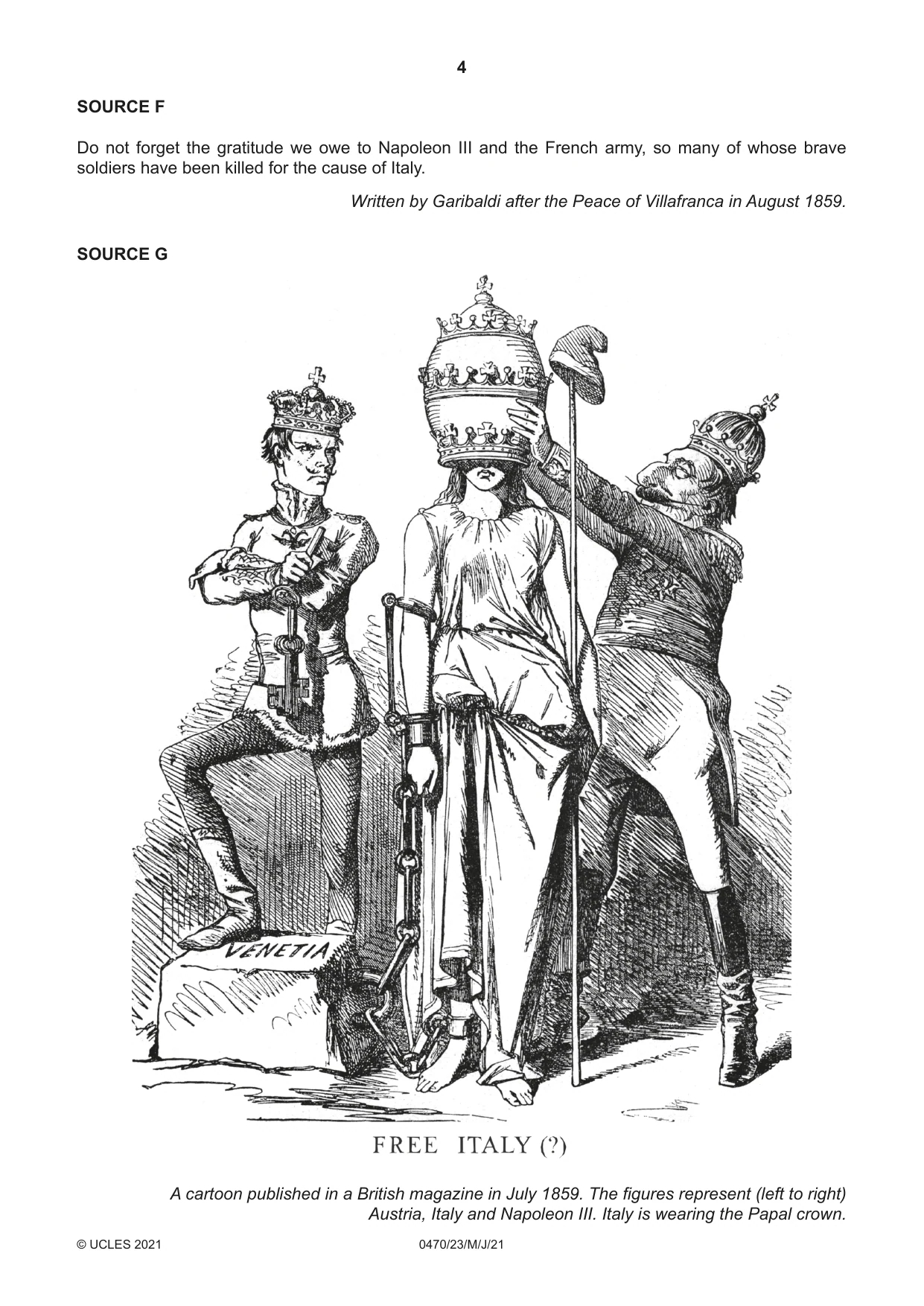
4 0470/23/M/J/21 © UCLES 2021 SOURCE F Do not forget the gratitude we owe to Napoleon III and the French army, so many of whose brave soldiers have been killed for the cause of Italy. Written by Garibaldi after the Peace of Villafranca in August 1859. SOURCE G A cartoon published in a British magazine in July 1859. The figures represent (left to right) Austria, Italy and Napoleon III. Italy is wearing the Papal crown.
Question paper, page 5
5 0470/23/M/J/21 © UCLES 2021 [Turn over Now answer all the following questions. You may use any of the sources to help you answer the questions, in addition to those sources which you are told to use. In answering the questions you should use your knowledge of the topic to help you interpret and evaluate the sources. 1 Study Source A. Why did Radetzky send this letter in 1849? Explain your answer using details of the source and your knowledge. [7] 2 Study Sources B and C. How far do these two sources agree? Explain your answer using details of the sources. [7] 3 Study Sources D and E. Why do these two accounts of Napoleon’s plans for Italy differ? Explain your answer using details of the sources and your knowledge. [8] 4 Study Source F. Are you surprised by this source? Explain your answer using details of the source and your knowledge. [8] 5 Study Source G. What is the cartoonist’s message? Explain your answer using details of the source and your knowledge. [8] 6 Study all the sources. How far do these sources provide convincing evidence that Austria and France hindered the process of Italian unification? Use the sources to explain your answer. [12]
Question paper, page 6
6 0470/23/M/J/21 © UCLES 2021 Option B: Twentieth century topic DID FRANCE GET WHAT IT WANTED AT THE PARIS PEACE CONFERENCE? Study the Background Information and the sources carefully, and then answer all the questions. Background Information During the First World War France suffered great damage to its industry, land and people. Understandably, at the Paris Peace Conference, the French wanted to punish Germany for the damage it had inflicted on France, and to weaken Germany to ensure that it could not threaten France again. France tried to achieve these aims by demanding the following: disarming Germany, imposing a high level of reparations, the Rhineland to become an independent state and Alsace-Lorraine and the Saar Basin to be transferred to France. How far did France succeed in getting Germany harshly punished? SOURCE A It was a popular idea that Clemenceau was personally responsible for the damage the Treaty did to the ideals of Wilson. It was believed that he had influenced the French press and Parliament to support his extreme demands. This is wrong. In Paris during 1919 it would have been difficult to find another French politician as moderate, and open to negotiation and compromise, as Clemenceau. What was not understood at first was the degree to which the dominant French political forces combined to press their fears and hatreds upon him. By January 1920, Clemenceau was out of power. The main reason why Clemenceau was thought to have betrayed France was by his alleged softness at the time of the Treaty negotiations. Clemenceau devoted the last nine years of his life to defending himself against these charges. He wrote a rambling book, which is nothing more than an attempt to prove that he had done all that he could to bring about a peace favourable to France. It was not well received. He had dreamt of being elected as president of France after the war. But after the events of the peace conference his election was unthinkable. From a history book published in 1969.
Question paper, page 7
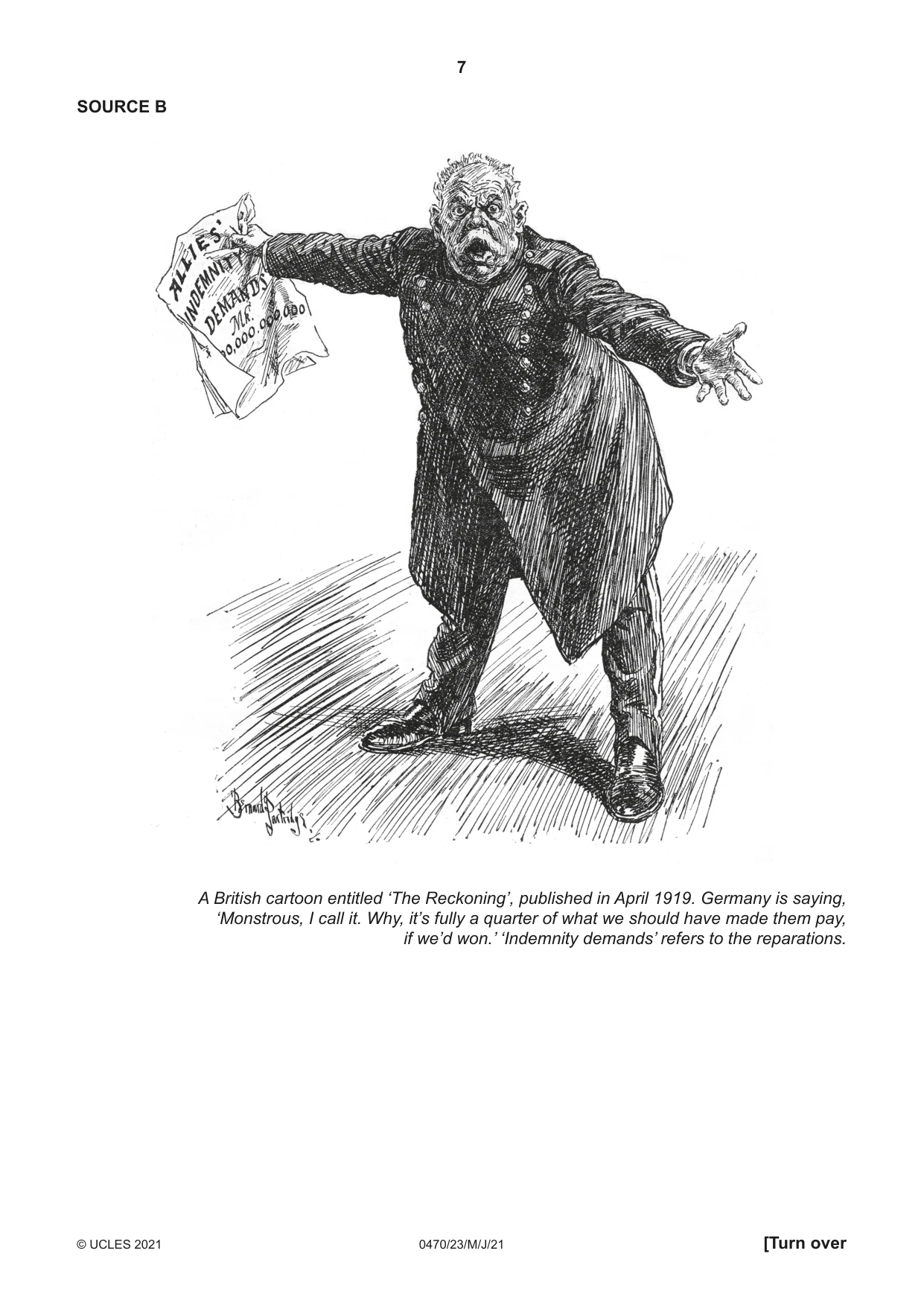
7 0470/23/M/J/21 © UCLES 2021 [Turn over SOURCE B A British cartoon entitled ‘The Reckoning’, published in April 1919. Germany is saying, ‘Monstrous, I call it. Why, it’s fully a quarter of what we should have made them pay, if we’d won.’ ‘Indemnity demands’ refers to the reparations.
Question paper, page 8
8 0470/23/M/J/21 © UCLES 2021 SOURCE C We came to Versailles hoping for the peace of justice which had been promised. We were shocked when we read the demands, the victorious violence of our enemies. The more deeply we penetrate into the spirit of this Treaty, the more convinced we become of the impossibility of carrying it out. The demands of this Treaty are more than the German people can bear. Germany must declare itself ready to bear all the war expenses of its enemies, which would exceed many times over the total amount of German assets. Meanwhile its enemies also demand reparations for damage suffered by their civil population. The reconstruction of our economic life is made impossible. We must renounce the realisation of all our aims in the spheres of politics, economics and ideas. The German people are excluded from the League of Nations, to which is entrusted all work of common interest to the world. Thus must a whole people sign its own death sentence. Count von Brockdorff-Rantzau’s response when shown the proposed terms of the Treaty of Versailles, May 1919. He was the leader of the German delegation at the Paris Peace Conference. SOURCE D The Allied Powers have given the most careful consideration to the observations of the German Delegation. The protest of the German Delegation shows that they fail to understand the position in which Germany stands today. They seem to think that Germany has only to make sacrifices in order to attain peace, as if this were simply the end of some mere struggle for territory and power. In the view of the Allied Powers this war was the greatest crime against humanity ever committed. Justice, therefore, is the only possible basis for the settlement of this terrible war. That is why the Allied Powers have insisted that Germany must undertake to make reparation. Reparation for wrongs inflicted is the essence of justice. That, too, is why Germany must submit to special punishments. The Allies therefore believe that the peace is fundamentally a peace of justice. The German Delegation appears to have seriously misinterpreted the economic and financial conditions. There is no intention on the part of the Allies to strangle Germany or to prevent it from taking its proper place in international trade and commerce. Provided that Germany keeps to the terms of the treaty and abandons its aggressive traditions, it shall have fair treatment in the purchase of raw materials and the sale of goods. Clemenceau’s letter replying to the objections of the German Delegation, May 1919. Clemenceau was replying on behalf of all the peacemakers.
Question paper, page 9
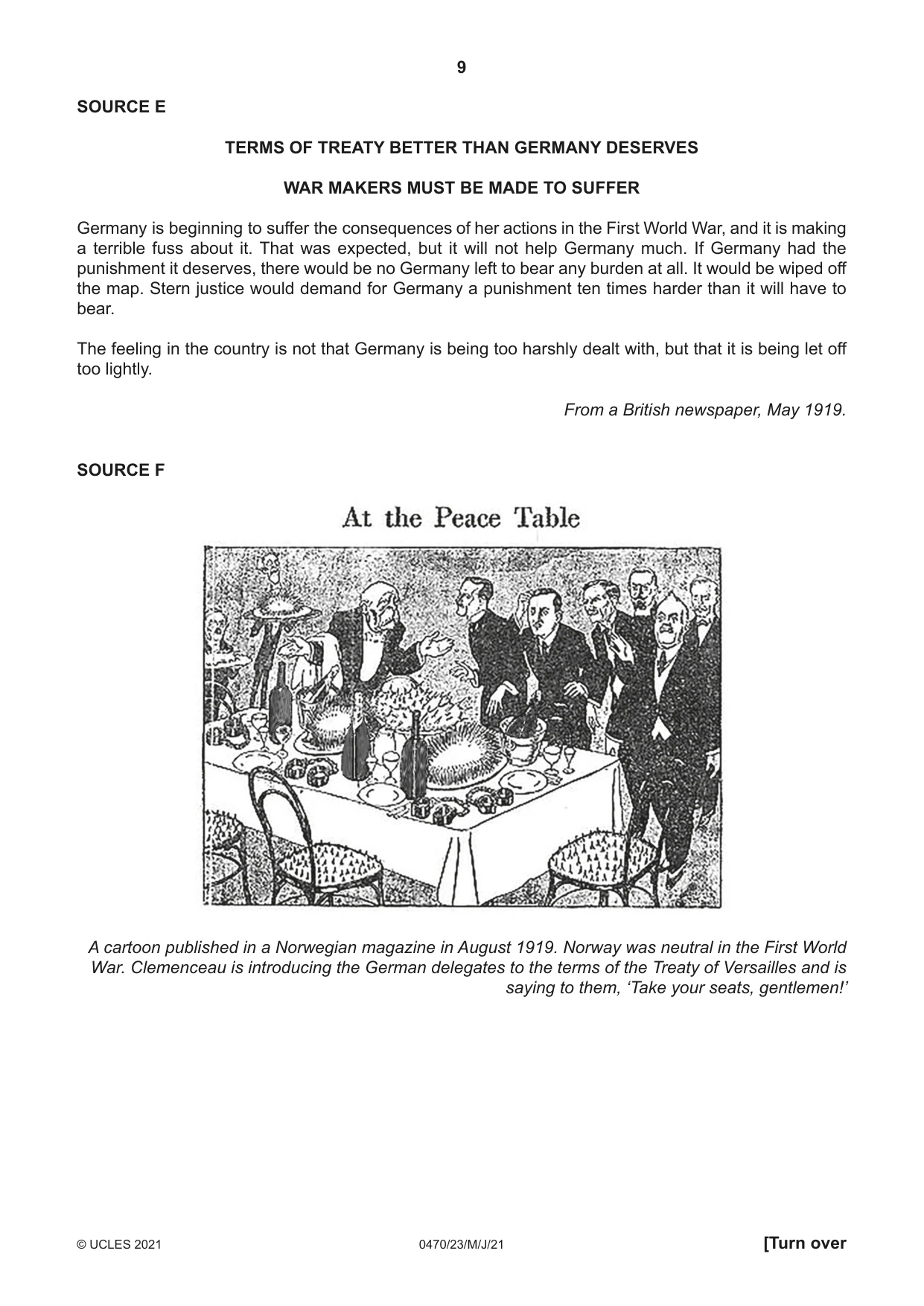
9 0470/23/M/J/21 © UCLES 2021 [Turn over SOURCE E TERMS OF TREATY BETTER THAN GERMANY DESERVES WAR MAKERS MUST BE MADE TO SUFFER Germany is beginning to suffer the consequences of her actions in the First World War, and it is making a terrible fuss about it. That was expected, but it will not help Germany much. If Germany had the punishment it deserves, there would be no Germany left to bear any burden at all. It would be wiped off the map. Stern justice would demand for Germany a punishment ten times harder than it will have to bear. The feeling in the country is not that Germany is being too harshly dealt with, but that it is being let off too lightly. From a British newspaper, May 1919. SOURCE F A cartoon published in a Norwegian magazine in August 1919. Norway was neutral in the First World War. Clemenceau is introducing the German delegates to the terms of the Treaty of Versailles and is saying to them, ‘Take your seats, gentlemen!’
Question paper, page 10
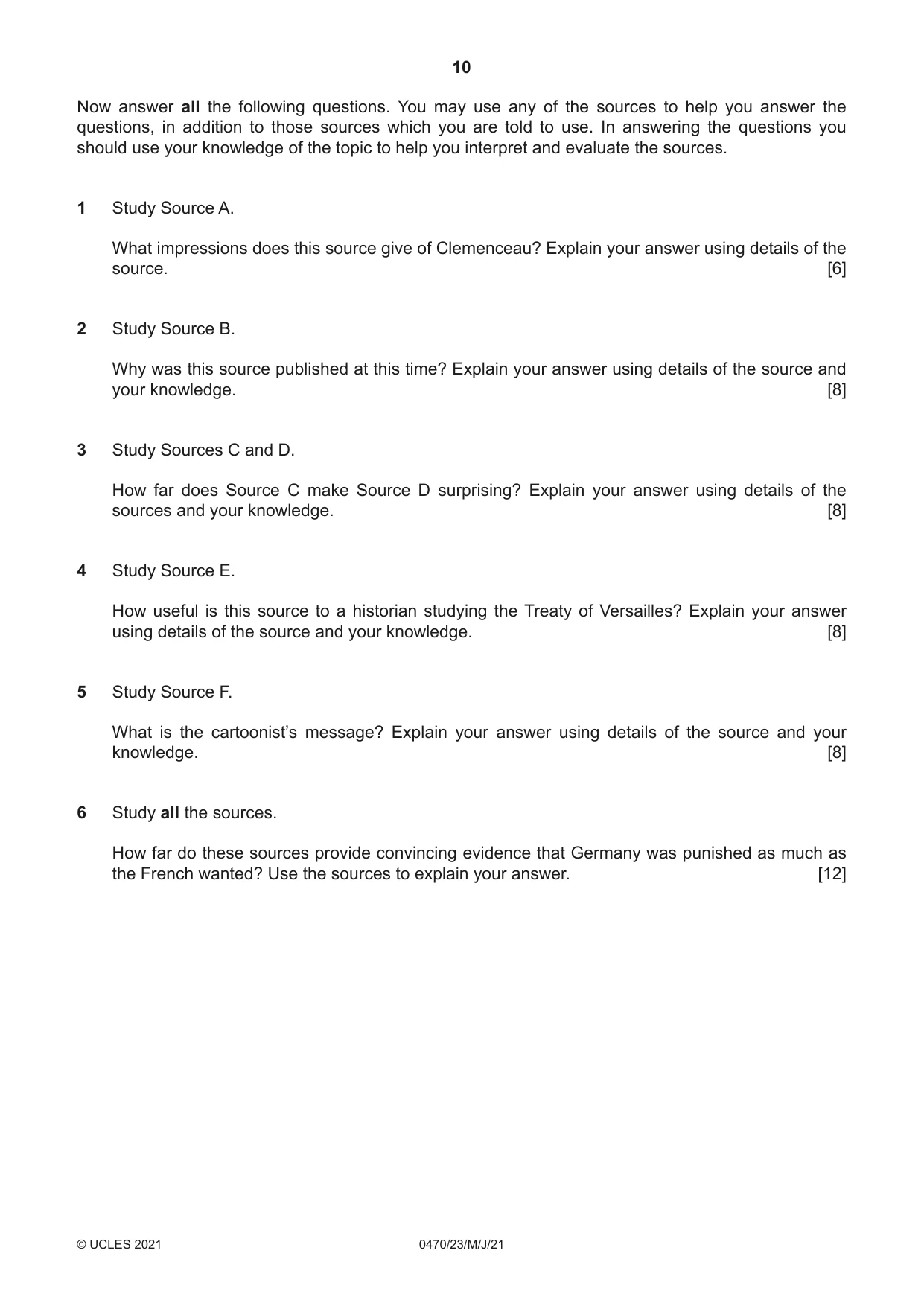
10 0470/23/M/J/21 © UCLES 2021 Now answer all the following questions. You may use any of the sources to help you answer the questions, in addition to those sources which you are told to use. In answering the questions you should use your knowledge of the topic to help you interpret and evaluate the sources. 1 Study Source A. What impressions does this source give of Clemenceau? Explain your answer using details of the source. [6] 2 Study Source B. Why was this source published at this time? Explain your answer using details of the source and your knowledge. [8] 3 Study Sources C and D. How far does Source C make Source D surprising? Explain your answer using details of the sources and your knowledge. [8] 4 Study Source E. How useful is this source to a historian studying the Treaty of Versailles? Explain your answer using details of the source and your knowledge. [8] 5 Study Source F. What is the cartoonist’s message? Explain your answer using details of the source and your knowledge. [8] 6 Study all the sources. How far do these sources provide convincing evidence that Germany was punished as much as the French wanted? Use the sources to explain your answer. [12]
Question paper, page 11
11 0470/23/M/J/21 © UCLES 2021 BLANK PAGE
Question paper, page 12
12 0470/23/M/J/21 © UCLES 2021 Permission to reproduce items where third-party owned material protected by copyright is included has been sought and cleared where possible. Every reasonable effort has been made by the publisher (UCLES) to trace copyright holders, but if any items requiring clearance have unwittingly been included, the publisher will be pleased to make amends at the earliest possible opportunity. To avoid the issue of disclosure of answer-related information to candidates, all copyright acknowledgements are reproduced online in the Cambridge Assessment International Education Copyright Acknowledgements Booklet. This is produced for each series of examinations and is freely available to download at www.cambridgeinternational.org after the live examination series. Cambridge Assessment International Education is part of the Cambridge Assessment Group. Cambridge Assessment is the brand name of the University of Cambridge Local Examinations Syndicate (UCLES), which itself is a department of the University of Cambridge. BLANK PAGE
Mark scheme, page 1
This document consists of 14 printed pages. © UCLES 2021 [Turn over Cambridge IGCSE™ HISTORY 0470/23 Paper 2 May/June 2021 MARK SCHEME Maximum Mark: 50 Published This mark scheme is published as an aid to teachers and candidates, to indicate the requirements of the examination. It shows the basis on which Examiners were instructed to award marks. It does not indicate the details of the discussions that took place at an Examiners’ meeting before marking began, which would have considered the acceptability of alternative answers. Mark schemes should be read in conjunction with the question paper and the Principal Examiner Report for Teachers. Cambridge International will not enter into discussions about these mark schemes. Cambridge International is publishing the mark schemes for the May/June 2021 series for most Cambridge IGCSE™, Cambridge International A and AS Level components and some Cambridge O Level components.
Mark scheme, page 2
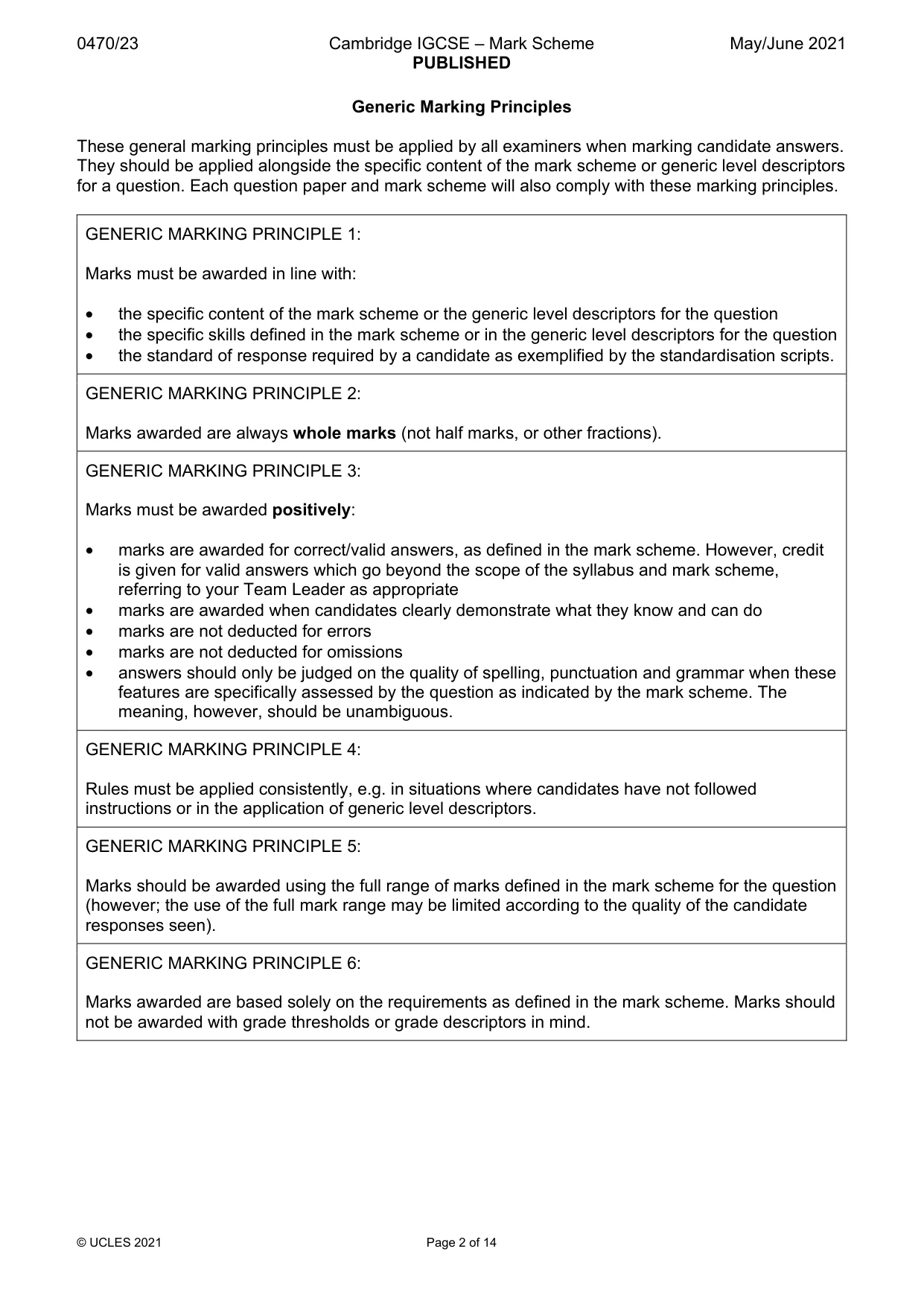
0470/23 Cambridge IGCSE – Mark Scheme PUBLISHED May/June 2021 © UCLES 2021 Page 2 of 14 Generic Marking Principles These general marking principles must be applied by all examiners when marking candidate answers. They should be applied alongside the specific content of the mark scheme or generic level descriptors for a question. Each question paper and mark scheme will also comply with these marking principles. GENERIC MARKING PRINCIPLE 1: Marks must be awarded in line with: • the specific content of the mark scheme or the generic level descriptors for the question • the specific skills defined in the mark scheme or in the generic level descriptors for the question • the standard of response required by a candidate as exemplified by the standardisation scripts. GENERIC MARKING PRINCIPLE 2: Marks awarded are always whole marks (not half marks, or other fractions). GENERIC MARKING PRINCIPLE 3: Marks must be awarded positively: • marks are awarded for correct/valid answers, as defined in the mark scheme. However, credit is given for valid answers which go beyond the scope of the syllabus and mark scheme, referring to your Team Leader as appropriate • marks are awarded when candidates clearly demonstrate what they know and can do • marks are not deducted for errors • marks are not deducted for omissions • answers should only be judged on the quality of spelling, punctuation and grammar when these features are specifically assessed by the question as indicated by the mark scheme. The meaning, however, should be unambiguous. GENERIC MARKING PRINCIPLE 4: Rules must be applied consistently, e.g. in situations where candidates have not followed instructions or in the application of generic level descriptors. GENERIC MARKING PRINCIPLE 5: Marks should be awarded using the full range of marks defined in the mark scheme for the question (however; the use of the full mark range may be limited according to the quality of the candidate responses seen). GENERIC MARKING PRINCIPLE 6: Marks awarded are based solely on the requirements as defined in the mark scheme. Marks should not be awarded with grade thresholds or grade descriptors in mind.
Mark scheme, page 3
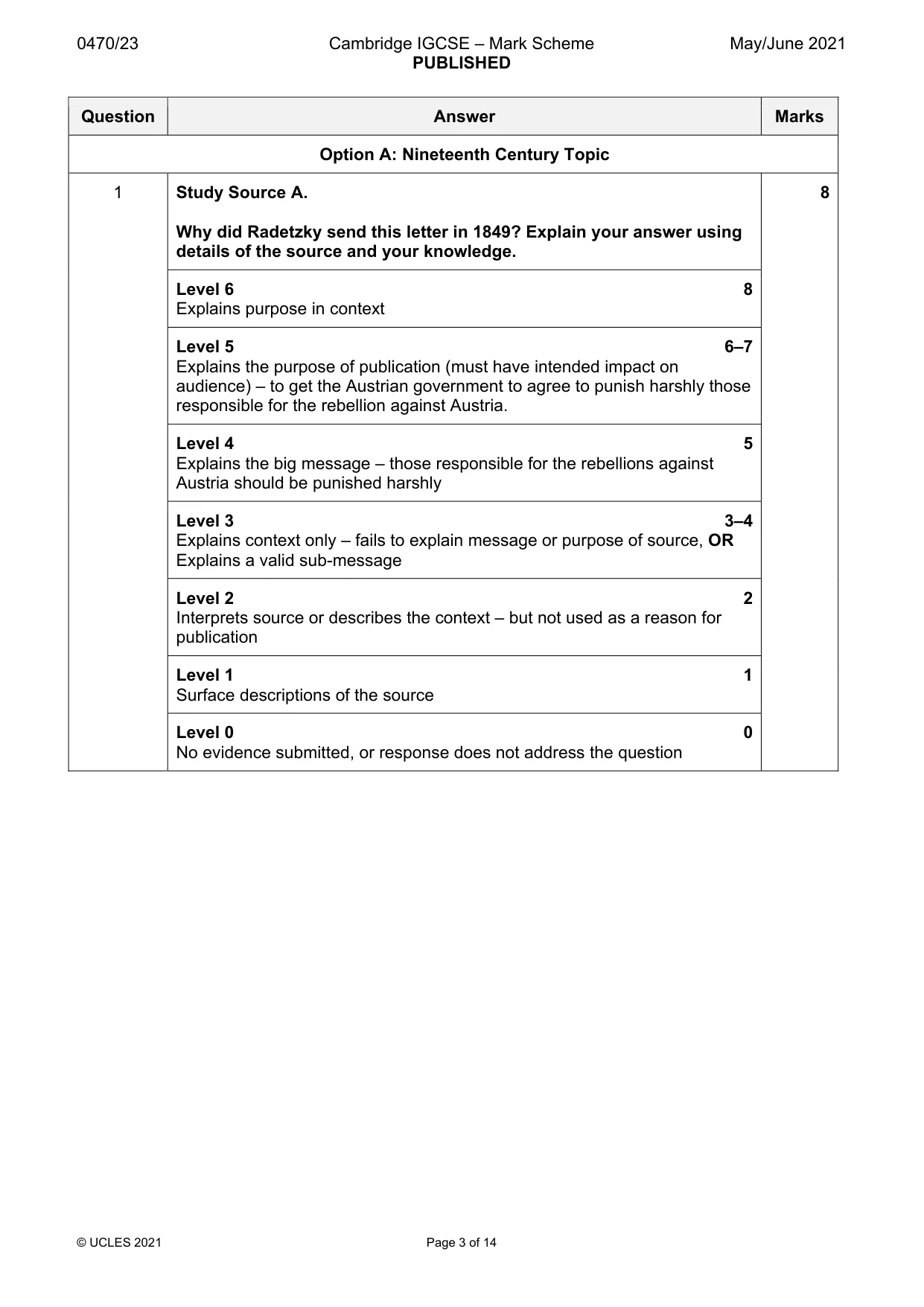
0470/23 Cambridge IGCSE – Mark Scheme PUBLISHED May/June 2021 © UCLES 2021 Page 3 of 14 Question Answer Marks Option A: Nineteenth Century Topic 1 Study Source A. Why did Radetzky send this letter in 1849? Explain your answer using details of the source and your knowledge. 8 Level 6 8 Explains purpose in context Level 5 6–7 Explains the purpose of publication (must have intended impact on audience) – to get the Austrian government to agree to punish harshly those responsible for the rebellion against Austria. Level 4 5 Explains the big message – those responsible for the rebellions against Austria should be punished harshly Level 3 3–4 Explains context only – fails to explain message or purpose of source, OR Explains a valid sub-message Level 2 2 Interprets source or describes the context – but not used as a reason for publication Level 1 1 Surface descriptions of the source Level 0 0 No evidence submitted, or response does not address the question
Mark scheme, page 4
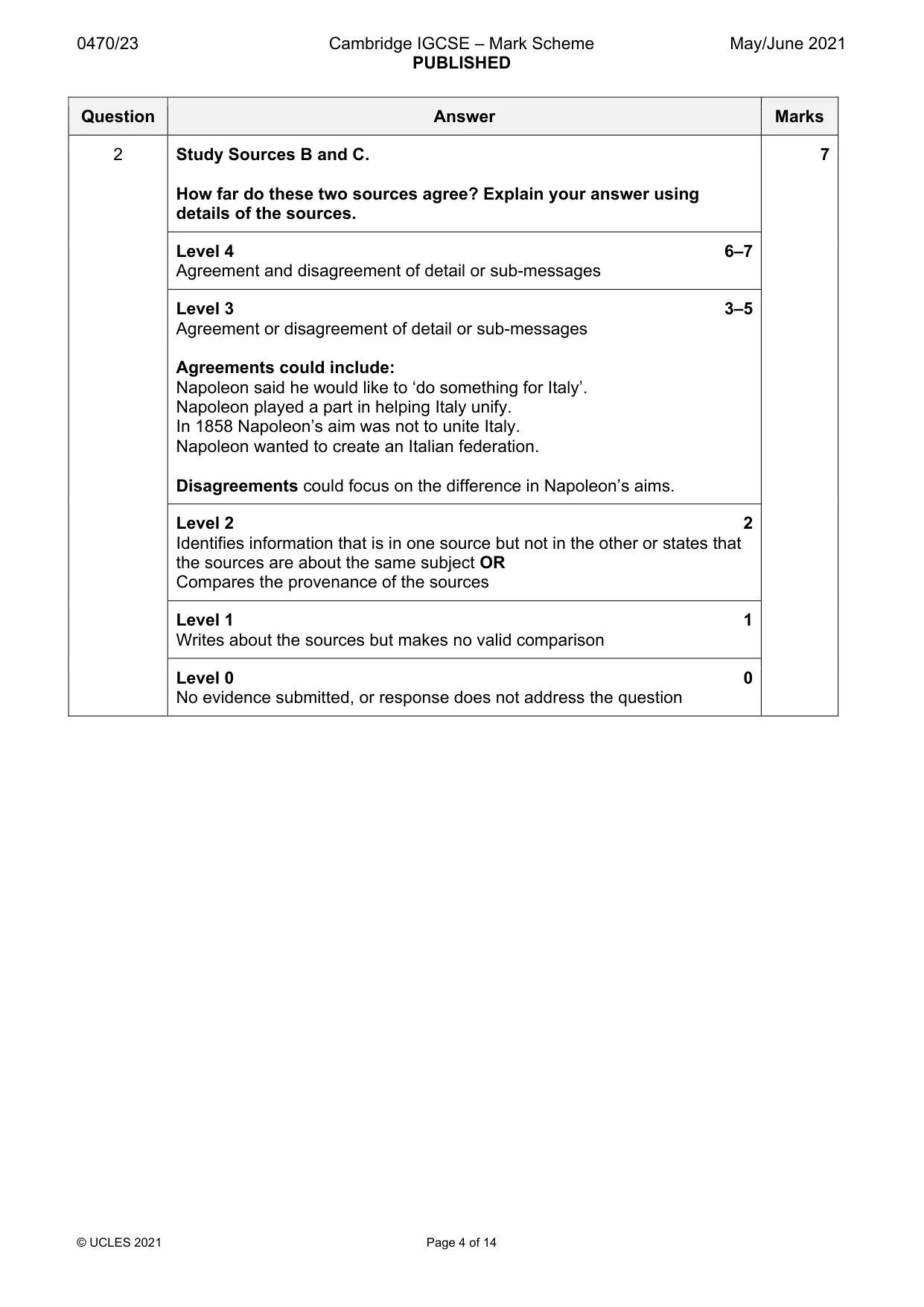
0470/23 Cambridge IGCSE – Mark Scheme PUBLISHED May/June 2021 © UCLES 2021 Page 4 of 14 Question Answer Marks 2 Study Sources B and C. How far do these two sources agree? Explain your answer using details of the sources. 7 Level 4 6–7 Agreement and disagreement of detail or sub-messages Level 3 3–5 Agreement or disagreement of detail or sub-messages Agreements could include: Napoleon said he would like to ‘do something for Italy’. Napoleon played a part in helping Italy unify. In 1858 Napoleon’s aim was not to unite Italy. Napoleon wanted to create an Italian federation. Disagreements could focus on the difference in Napoleon’s aims. Level 2 2 Identifies information that is in one source but not in the other or states that the sources are about the same subject OR Compares the provenance of the sources Level 1 1 Writes about the sources but makes no valid comparison Level 0 0 No evidence submitted, or response does not address the question
Mark scheme, page 5
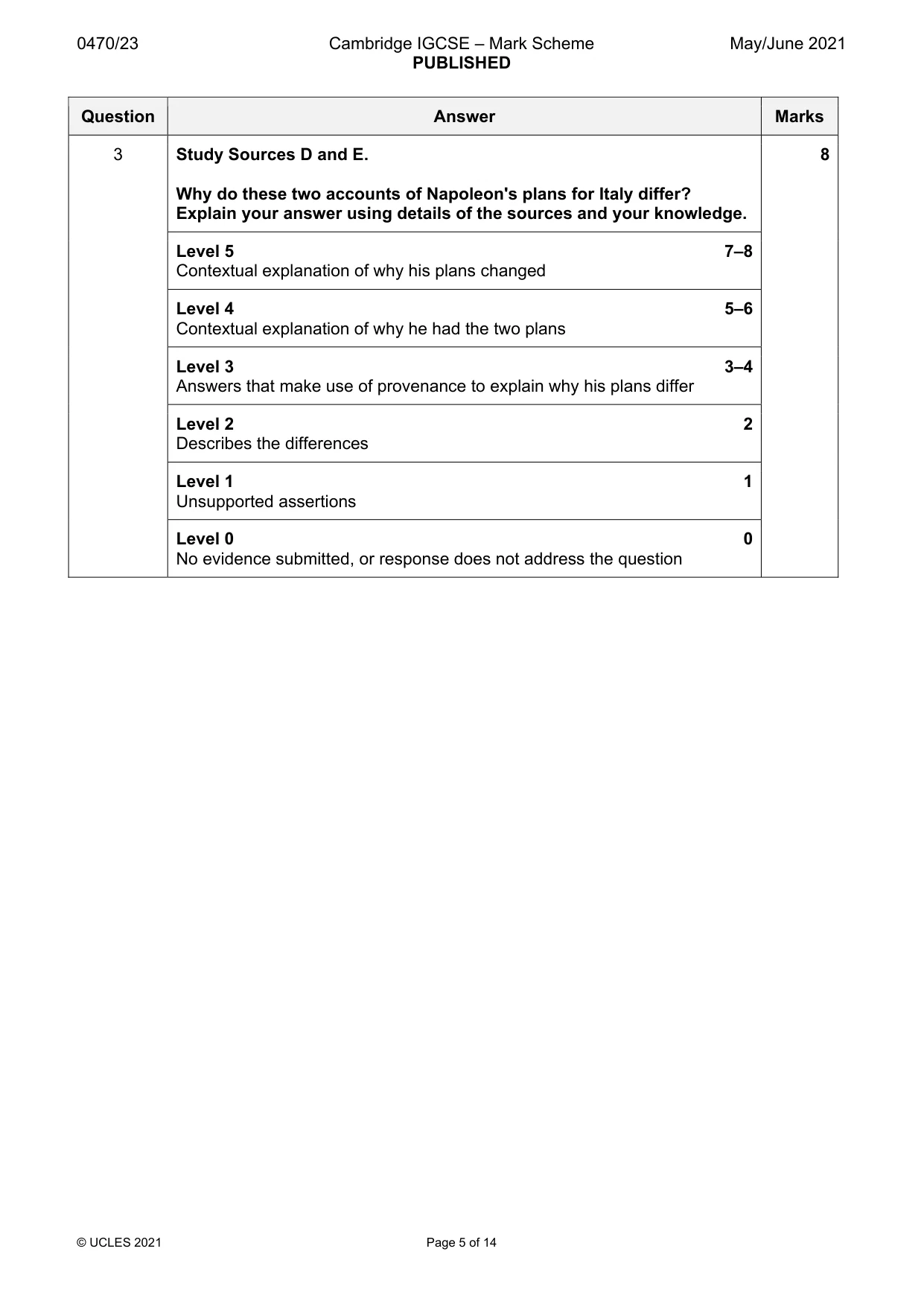
0470/23 Cambridge IGCSE – Mark Scheme PUBLISHED May/June 2021 © UCLES 2021 Page 5 of 14 Question Answer Marks 3 Study Sources D and E. Why do these two accounts of Napoleon's plans for Italy differ? Explain your answer using details of the sources and your knowledge. 8 Level 5 7–8 Contextual explanation of why his plans changed Level 4 5–6 Contextual explanation of why he had the two plans Level 3 3–4 Answers that make use of provenance to explain why his plans differ Level 2 2 Describes the differences Level 1 1 Unsupported assertions Level 0 0 No evidence submitted, or response does not address the question
Mark scheme, page 6
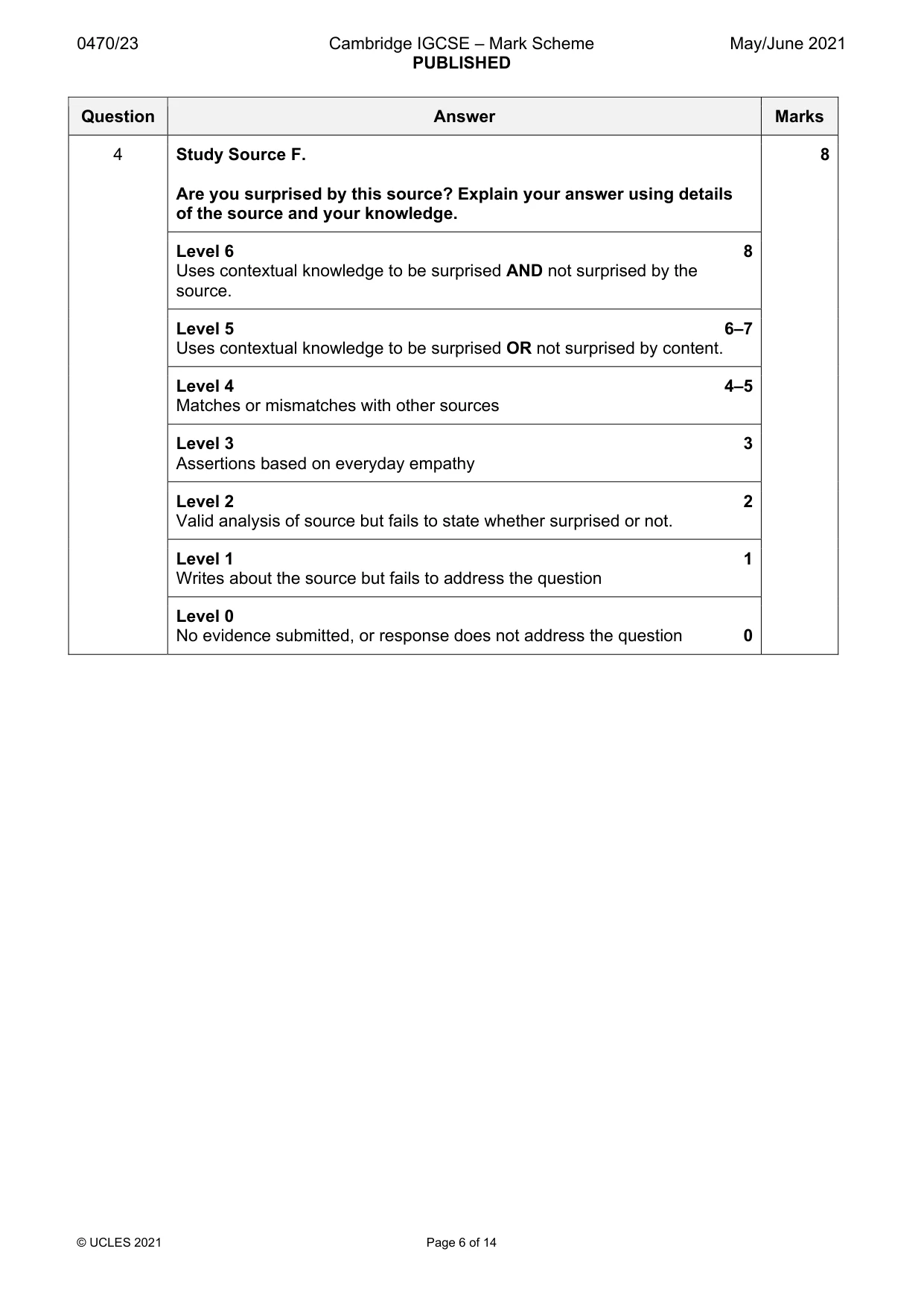
0470/23 Cambridge IGCSE – Mark Scheme PUBLISHED May/June 2021 © UCLES 2021 Page 6 of 14 Question Answer Marks 4 Study Source F. Are you surprised by this source? Explain your answer using details of the source and your knowledge. 8 Level 6 8 Uses contextual knowledge to be surprised AND not surprised by the source. Level 5 6–7 Uses contextual knowledge to be surprised OR not surprised by content. Level 4 4–5 Matches or mismatches with other sources Level 3 3 Assertions based on everyday empathy Level 2 2 Valid analysis of source but fails to state whether surprised or not. Level 1 1 Writes about the source but fails to address the question Level 0 No evidence submitted, or response does not address the question 0
Mark scheme, page 7
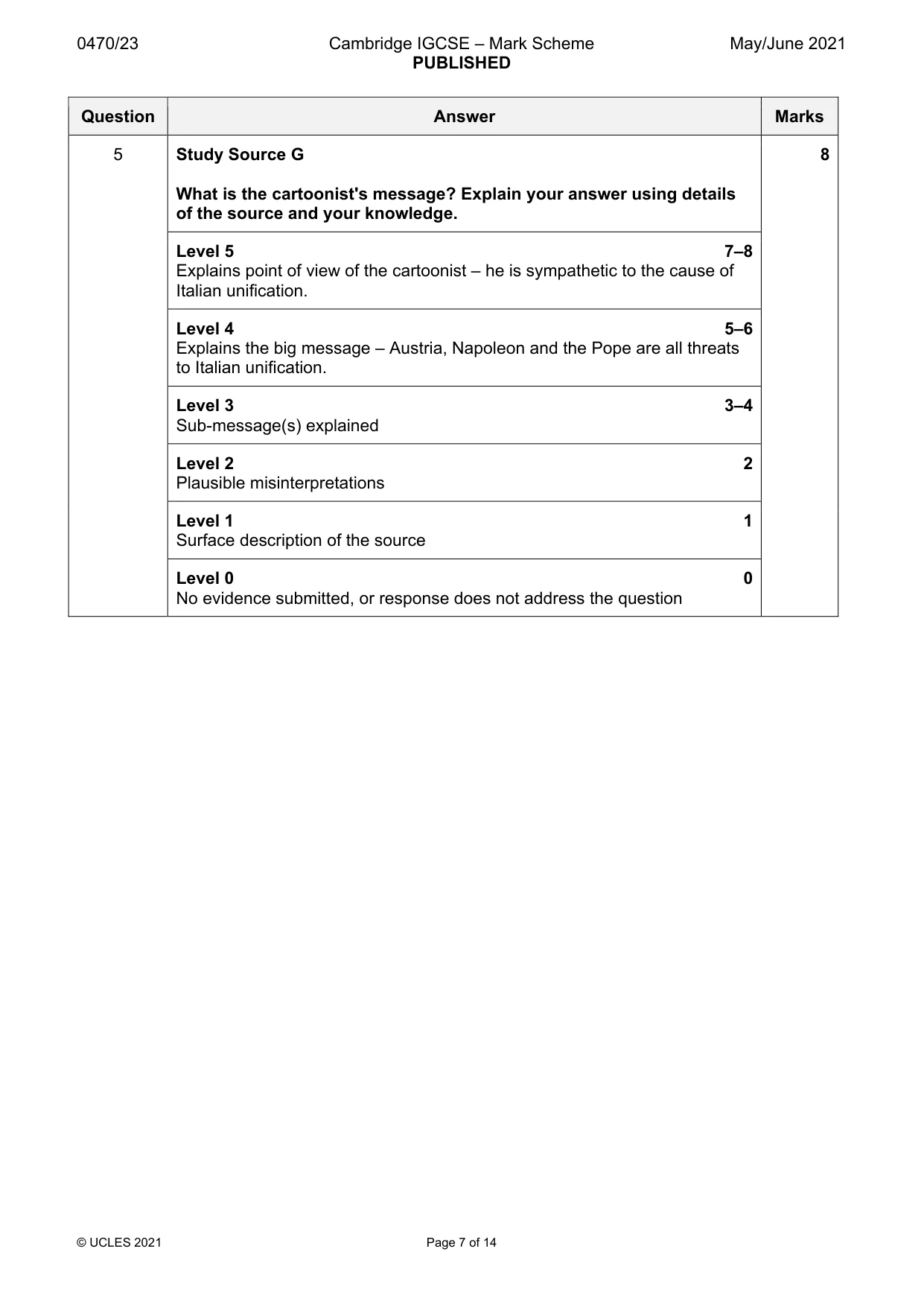
0470/23 Cambridge IGCSE – Mark Scheme PUBLISHED May/June 2021 © UCLES 2021 Page 7 of 14 Question Answer Marks 5 Study Source G What is the cartoonist's message? Explain your answer using details of the source and your knowledge. 8 Level 5 7–8 Explains point of view of the cartoonist – he is sympathetic to the cause of Italian unification. Level 4 5–6 Explains the big message – Austria, Napoleon and the Pope are all threats to Italian unification. Level 3 3–4 Sub-message(s) explained Level 2 2 Plausible misinterpretations Level 1 1 Surface description of the source Level 0 0 No evidence submitted, or response does not address the question
Mark scheme, page 8
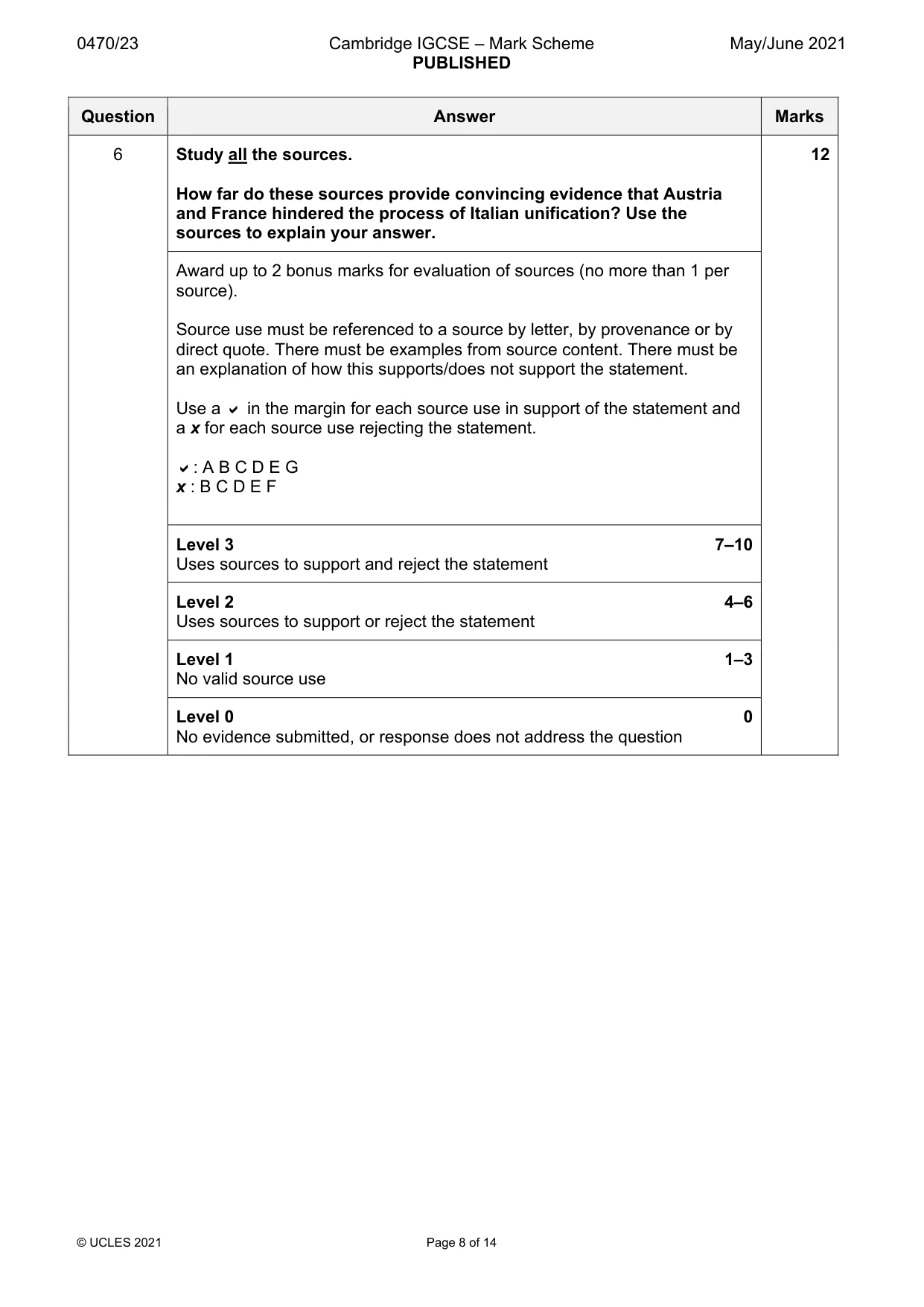
0470/23 Cambridge IGCSE – Mark Scheme PUBLISHED May/June 2021 © UCLES 2021 Page 8 of 14 Question Answer Marks 6 Study all the sources. How far do these sources provide convincing evidence that Austria and France hindered the process of Italian unification? Use the sources to explain your answer. 12 Award up to 2 bonus marks for evaluation of sources (no more than 1 per source). Source use must be referenced to a source by letter, by provenance or by direct quote. There must be examples from source content. There must be an explanation of how this supports/does not support the statement. Use a in the margin for each source use in support of the statement and a x for each source use rejecting the statement. : A B C D E G x : B C D E F Level 3 7–10 Uses sources to support and reject the statement Level 2 4–6 Uses sources to support or reject the statement Level 1 1–3 No valid source use Level 0 0 No evidence submitted, or response does not address the question
Mark scheme, page 9
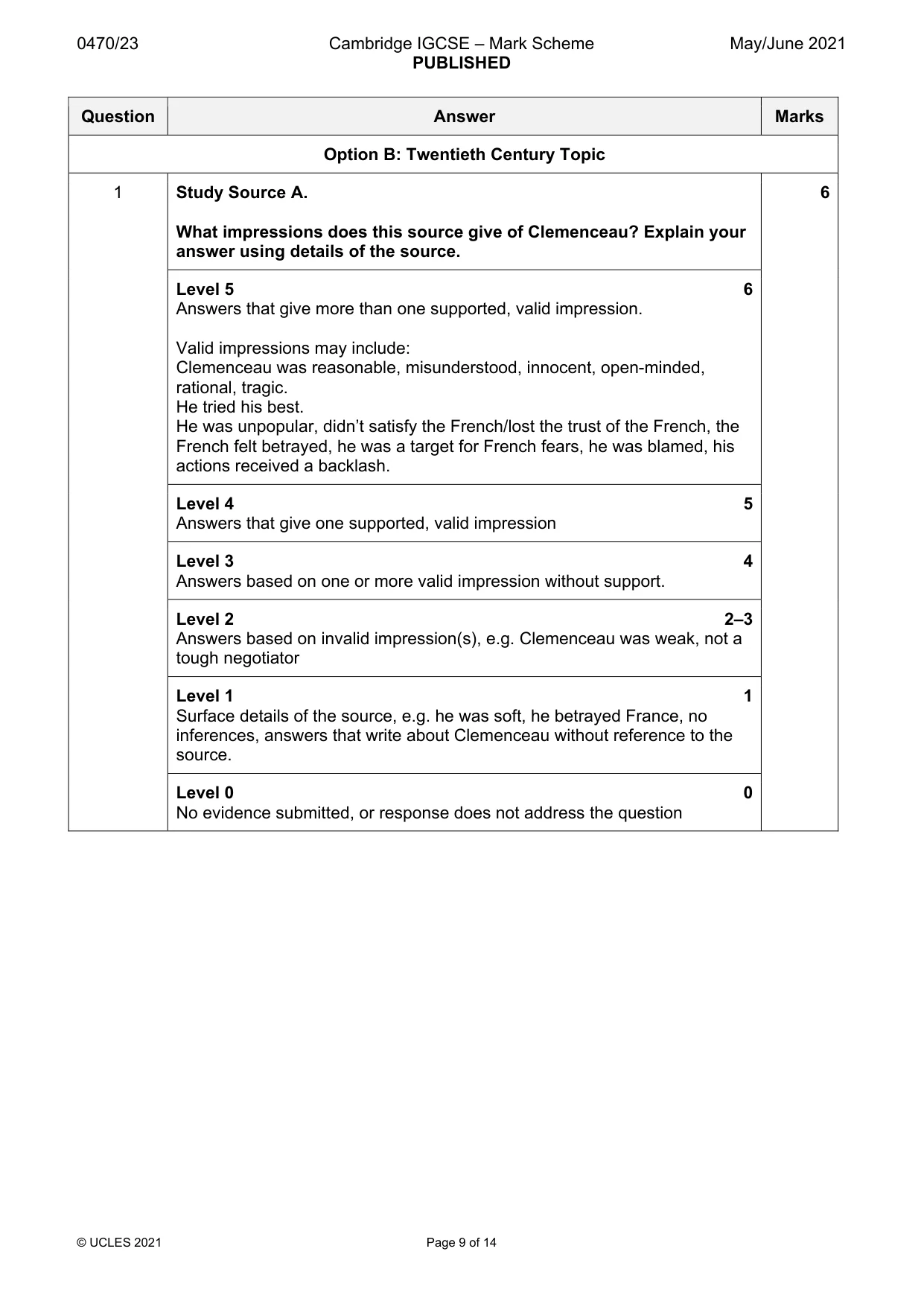
0470/23 Cambridge IGCSE – Mark Scheme PUBLISHED May/June 2021 © UCLES 2021 Page 9 of 14 Question Answer Marks Option B: Twentieth Century Topic 1 Study Source A. What impressions does this source give of Clemenceau? Explain your answer using details of the source. 6 Level 5 6 Answers that give more than one supported, valid impression. Valid impressions may include: Clemenceau was reasonable, misunderstood, innocent, open-minded, rational, tragic. He tried his best. He was unpopular, didn’t satisfy the French/lost the trust of the French, the French felt betrayed, he was a target for French fears, he was blamed, his actions received a backlash. Level 4 5 Answers that give one supported, valid impression Level 3 4 Answers based on one or more valid impression without support. Level 2 2–3 Answers based on invalid impression(s), e.g. Clemenceau was weak, not a tough negotiator Level 1 1 Surface details of the source, e.g. he was soft, he betrayed France, no inferences, answers that write about Clemenceau without reference to the source. Level 0 0 No evidence submitted, or response does not address the question
Mark scheme, page 10
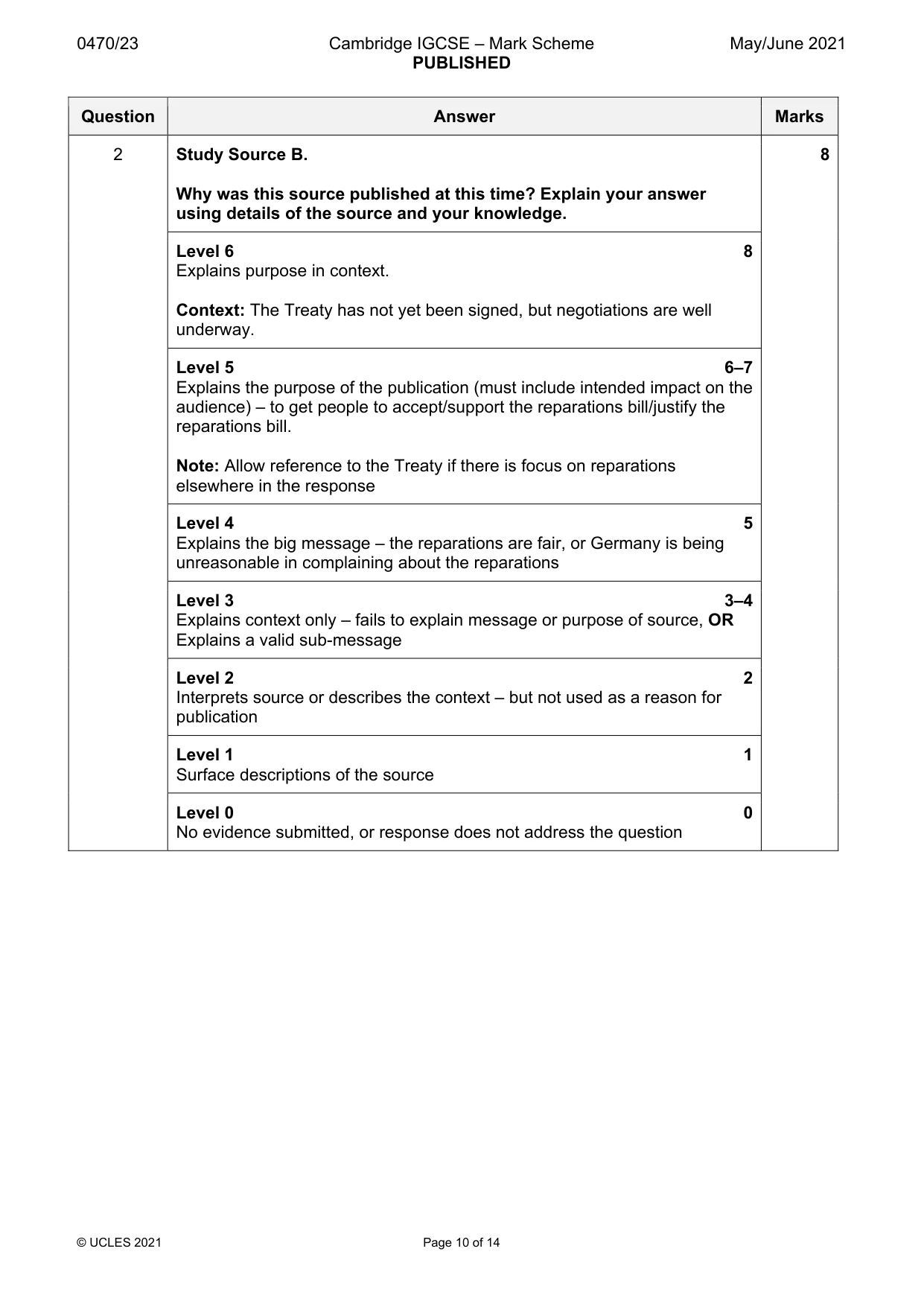
0470/23 Cambridge IGCSE – Mark Scheme PUBLISHED May/June 2021 © UCLES 2021 Page 10 of 14 Question Answer Marks 2 Study Source B. Why was this source published at this time? Explain your answer using details of the source and your knowledge. 8 Level 6 8 Explains purpose in context. Context: The Treaty has not yet been signed, but negotiations are well underway. Level 5 6–7 Explains the purpose of the publication (must include intended impact on the audience) – to get people to accept/support the reparations bill/justify the reparations bill. Note: Allow reference to the Treaty if there is focus on reparations elsewhere in the response Level 4 5 Explains the big message – the reparations are fair, or Germany is being unreasonable in complaining about the reparations Level 3 3–4 Explains context only – fails to explain message or purpose of source, OR Explains a valid sub-message Level 2 2 Interprets source or describes the context – but not used as a reason for publication Level 1 1 Surface descriptions of the source Level 0 0 No evidence submitted, or response does not address the question
Mark scheme, page 11
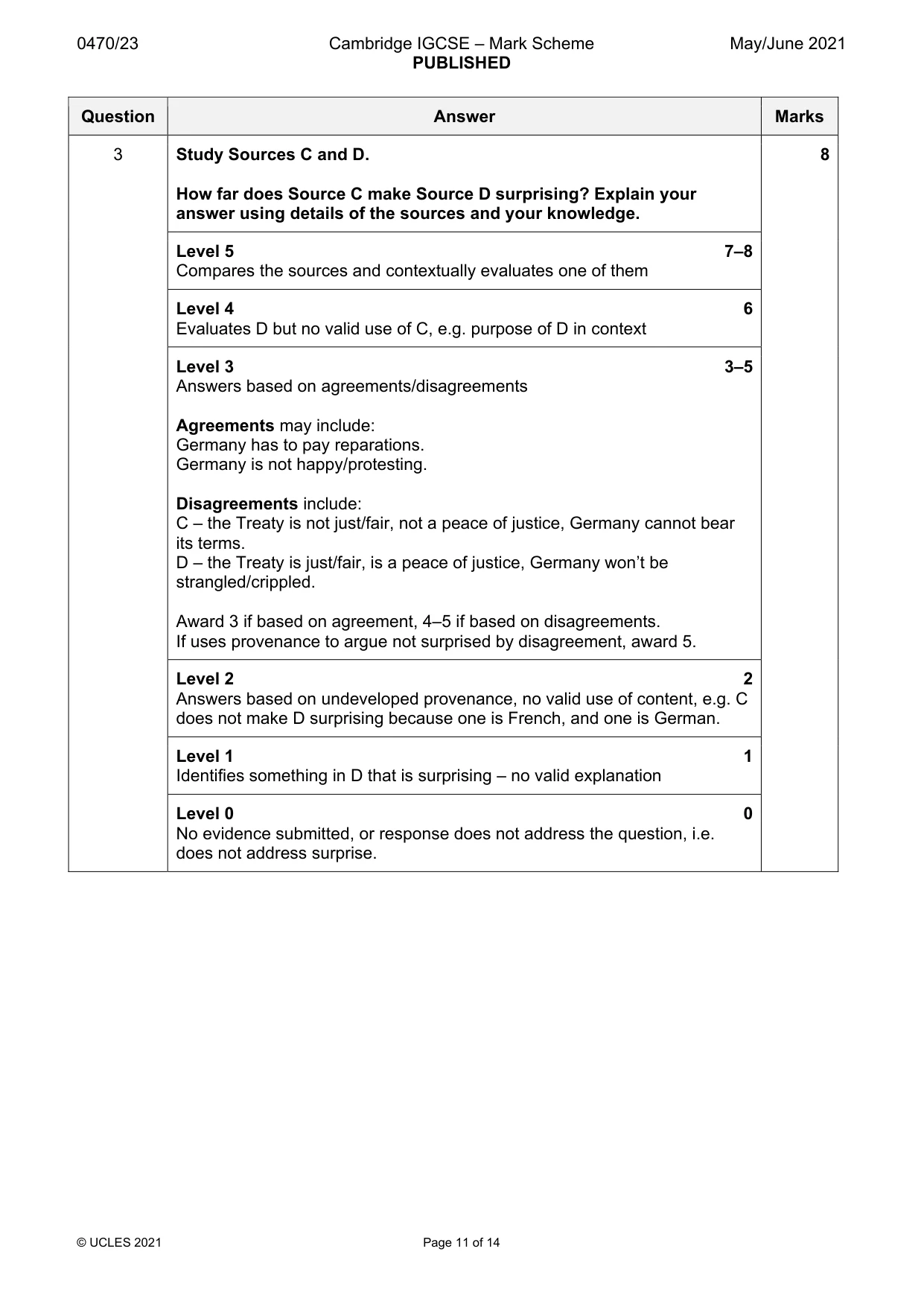
0470/23 Cambridge IGCSE – Mark Scheme PUBLISHED May/June 2021 © UCLES 2021 Page 11 of 14 Question Answer Marks 3 Study Sources C and D. How far does Source C make Source D surprising? Explain your answer using details of the sources and your knowledge. 8 Level 5 7–8 Compares the sources and contextually evaluates one of them Level 4 6 Evaluates D but no valid use of C, e.g. purpose of D in context Level 3 3–5 Answers based on agreements/disagreements Agreements may include: Germany has to pay reparations. Germany is not happy/protesting. Disagreements include: C – the Treaty is not just/fair, not a peace of justice, Germany cannot bear its terms. D – the Treaty is just/fair, is a peace of justice, Germany won’t be strangled/crippled. Award 3 if based on agreement, 4–5 if based on disagreements. If uses provenance to argue not surprised by disagreement, award 5. Level 2 2 Answers based on undeveloped provenance, no valid use of content, e.g. C does not make D surprising because one is French, and one is German. Level 1 1 Identifies something in D that is surprising – no valid explanation Level 0 0 No evidence submitted, or response does not address the question, i.e. does not address surprise.
Mark scheme, page 12
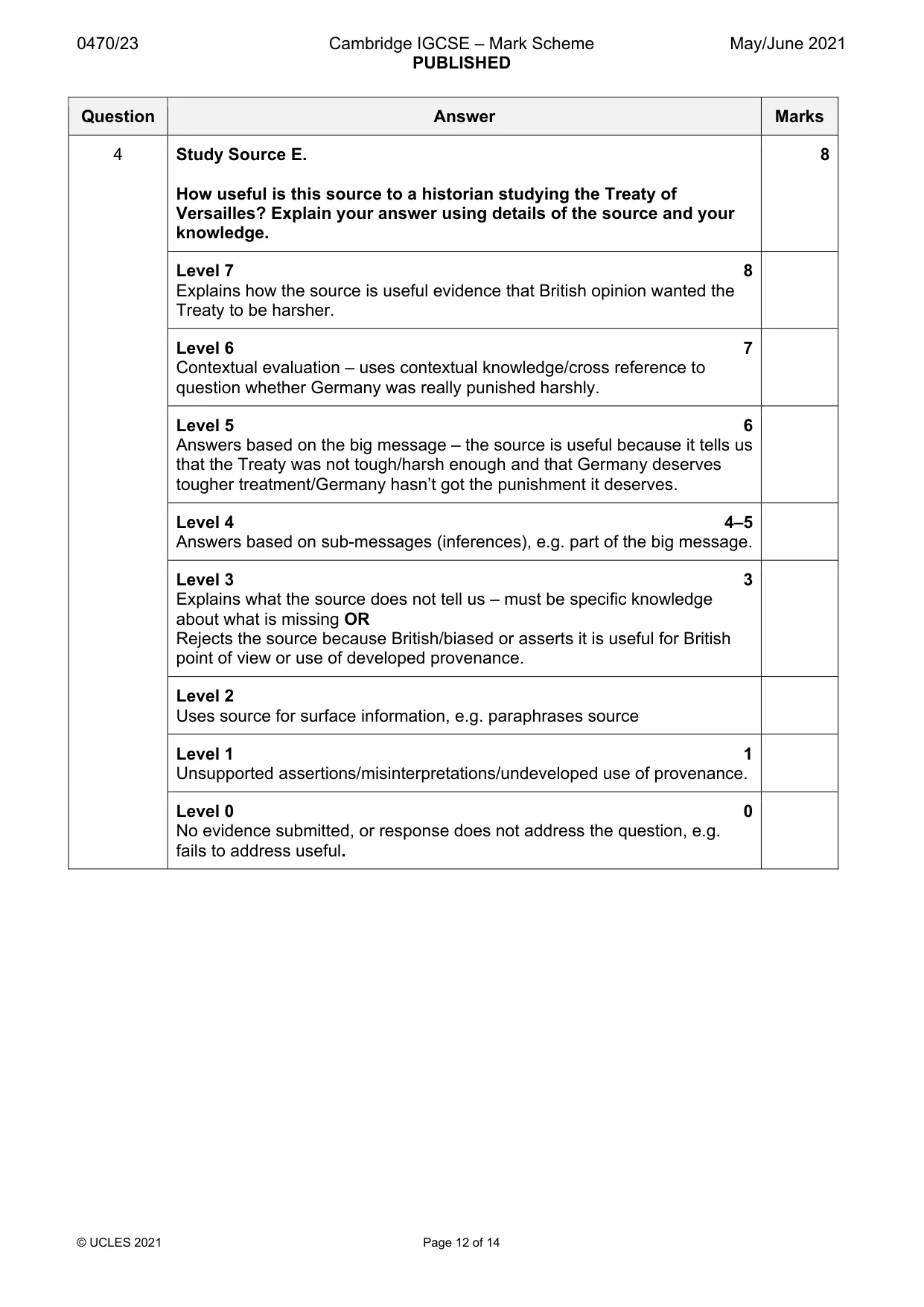
0470/23 Cambridge IGCSE – Mark Scheme PUBLISHED May/June 2021 © UCLES 2021 Page 12 of 14 Question Answer Marks 4 Study Source E. How useful is this source to a historian studying the Treaty of Versailles? Explain your answer using details of the source and your knowledge. 8 Level 7 8 Explains how the source is useful evidence that British opinion wanted the Treaty to be harsher. Level 6 7 Contextual evaluation – uses contextual knowledge/cross reference to question whether Germany was really punished harshly. Level 5 6 Answers based on the big message – the source is useful because it tells us that the Treaty was not tough/harsh enough and that Germany deserves tougher treatment/Germany hasn’t got the punishment it deserves. Level 4 4–5 Answers based on sub-messages (inferences), e.g. part of the big message. Level 3 3 Explains what the source does not tell us – must be specific knowledge about what is missing OR Rejects the source because British/biased or asserts it is useful for British point of view or use of developed provenance. Level 2 Uses source for surface information, e.g. paraphrases source Level 1 1 Unsupported assertions/misinterpretations/undeveloped use of provenance. Level 0 0 No evidence submitted, or response does not address the question, e.g. fails to address useful.
Mark scheme, page 13
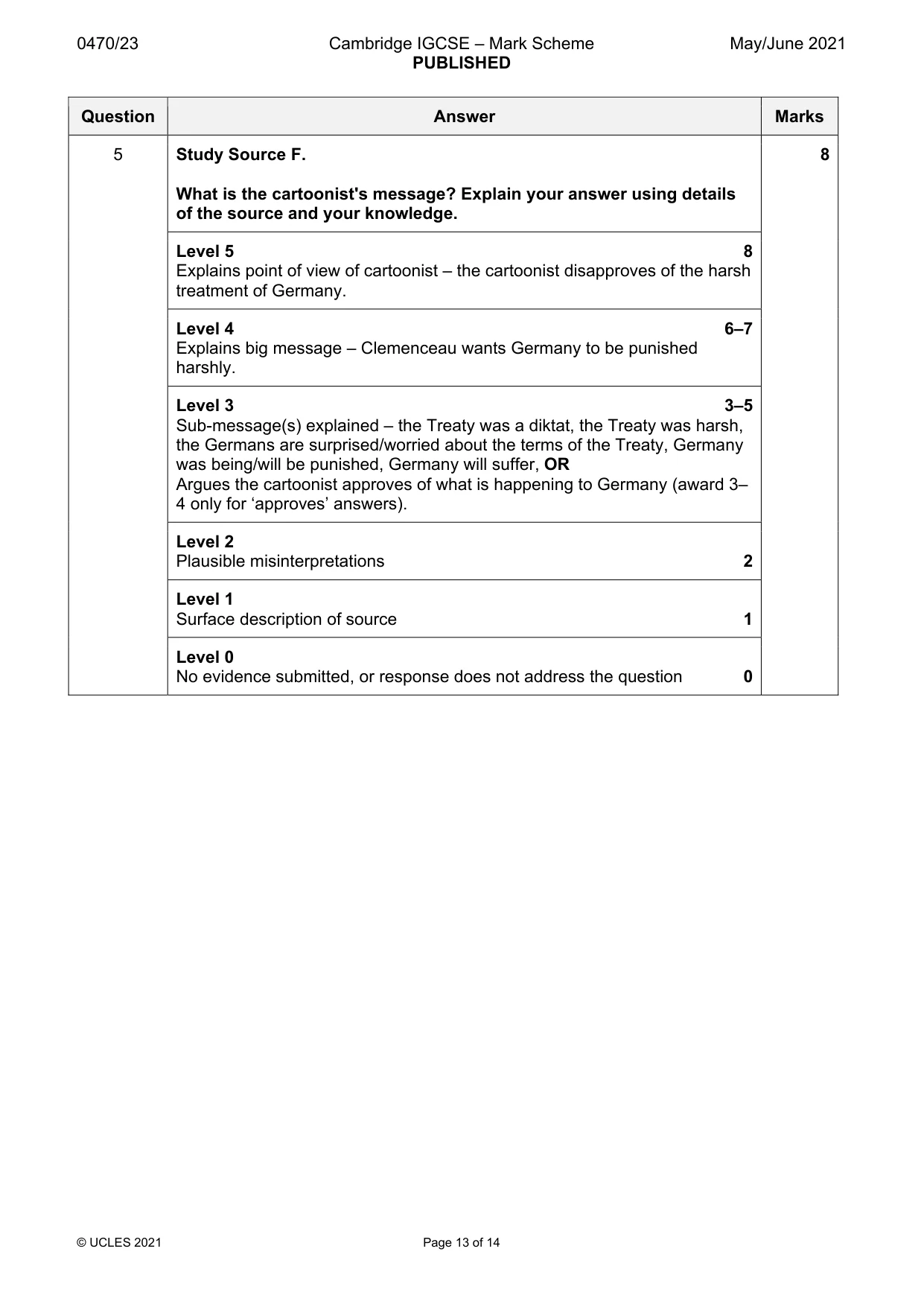
0470/23 Cambridge IGCSE – Mark Scheme PUBLISHED May/June 2021 © UCLES 2021 Page 13 of 14 Question Answer Marks 5 Study Source F. What is the cartoonist's message? Explain your answer using details of the source and your knowledge. 8 Level 5 8 Explains point of view of cartoonist – the cartoonist disapproves of the harsh treatment of Germany. Level 4 6–7 Explains big message – Clemenceau wants Germany to be punished harshly. Level 3 3–5 Sub-message(s) explained – the Treaty was a diktat, the Treaty was harsh, the Germans are surprised/worried about the terms of the Treaty, Germany was being/will be punished, Germany will suffer, OR Argues the cartoonist approves of what is happening to Germany (award 3– 4 only for ‘approves’ answers). Level 2 Plausible misinterpretations 2 Level 1 Surface description of source 1 Level 0 No evidence submitted, or response does not address the question 0
Mark scheme, page 14
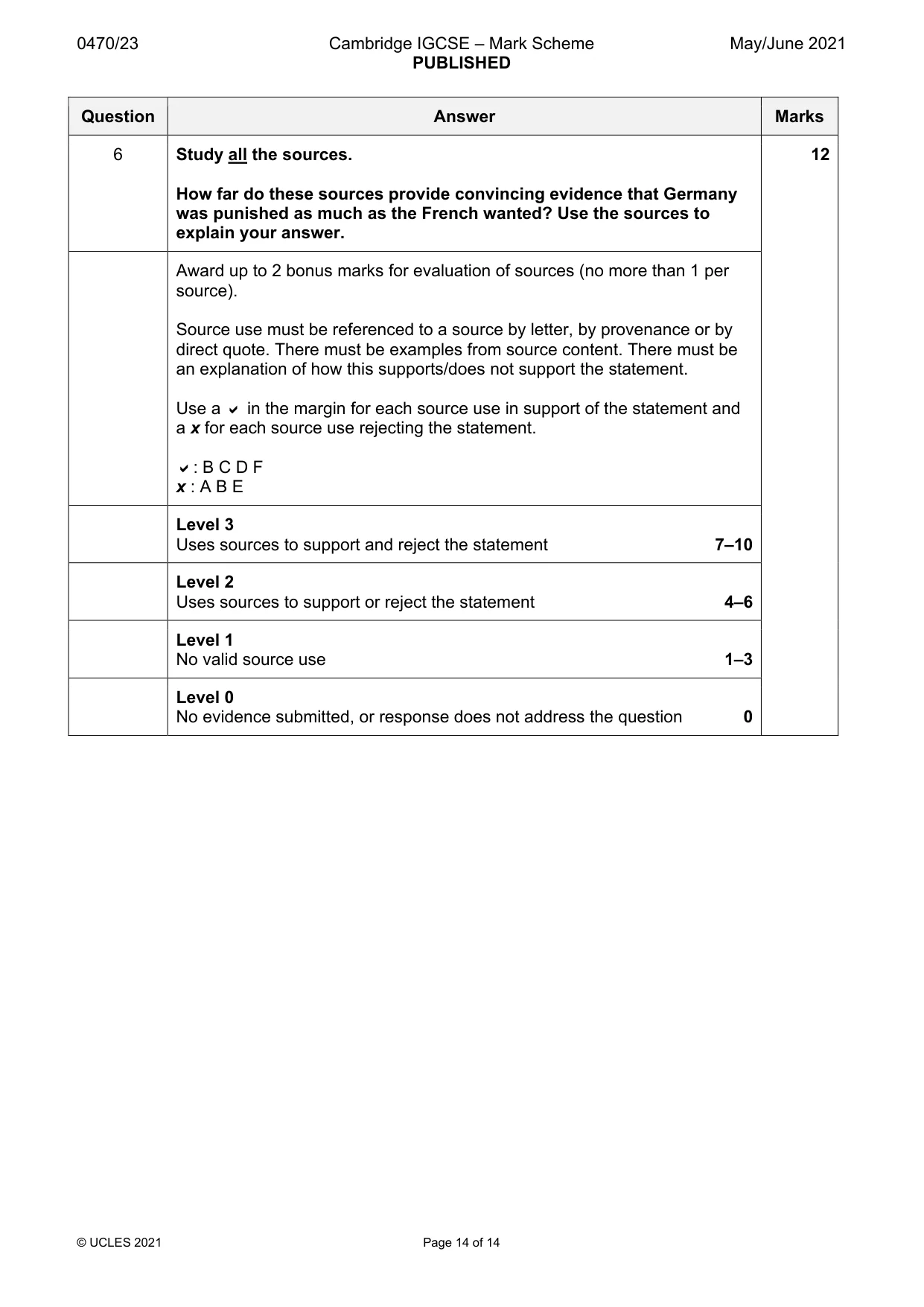
0470/23 Cambridge IGCSE – Mark Scheme PUBLISHED May/June 2021 © UCLES 2021 Page 14 of 14 Question Answer Marks 6 Study all the sources. How far do these sources provide convincing evidence that Germany was punished as much as the French wanted? Use the sources to explain your answer. 12 Award up to 2 bonus marks for evaluation of sources (no more than 1 per source). Source use must be referenced to a source by letter, by provenance or by direct quote. There must be examples from source content. There must be an explanation of how this supports/does not support the statement. Use a in the margin for each source use in support of the statement and a x for each source use rejecting the statement. : B C D F x : A B E Level 3 Uses sources to support and reject the statement 7–10 Level 2 Uses sources to support or reject the statement 4–6 Level 1 No valid source use 1–3 Level 0 No evidence submitted, or response does not address the question 0
What you needed in this session
Cambridge’s own grade thresholds for 2021 May/June, Paper 2 · Variant 3. A higher threshold means an easier paper — the bar moves with how the cohort did.