Cambridge IGCSE History 0470 — 2021 May/June Paper 2 · Variant 1
0470/21/M/J/21 · 50 marks · ≈56 min
The question paper and its mark scheme, free to read here and free to download. This is Cambridge’s own paper, exactly as it was sat.
Question paper16 pages

Mark scheme14 pages
Answers below. Sit the paper first if you are practising.
Paper as text
Question paper, page 1
This document has 16 pages. Any blank pages are indicated. Cambridge IGCSE™ DC (PQ/CT) 200449/3 © UCLES 2021 [Turn over HISTORY 0470/21 Paper 2 May/June 2021 2 hours You must answer on the enclosed answer booklet. You will need: Answer booklet (enclosed) INSTRUCTIONS ● Answer all the questions on one option only. Option A: Nineteenth century topic Option B: Twentieth century topic ● Follow the instructions on the front cover of the answer booklet. If you need additional answer paper, ask the invigilator for a continuation booklet. INFORMATION ● The total mark for this paper is 50. ● The number of marks for each question or part question is shown in brackets [ ]. * 1 6 0 4 9 5 3 4 0 3 *
Question paper, page 2
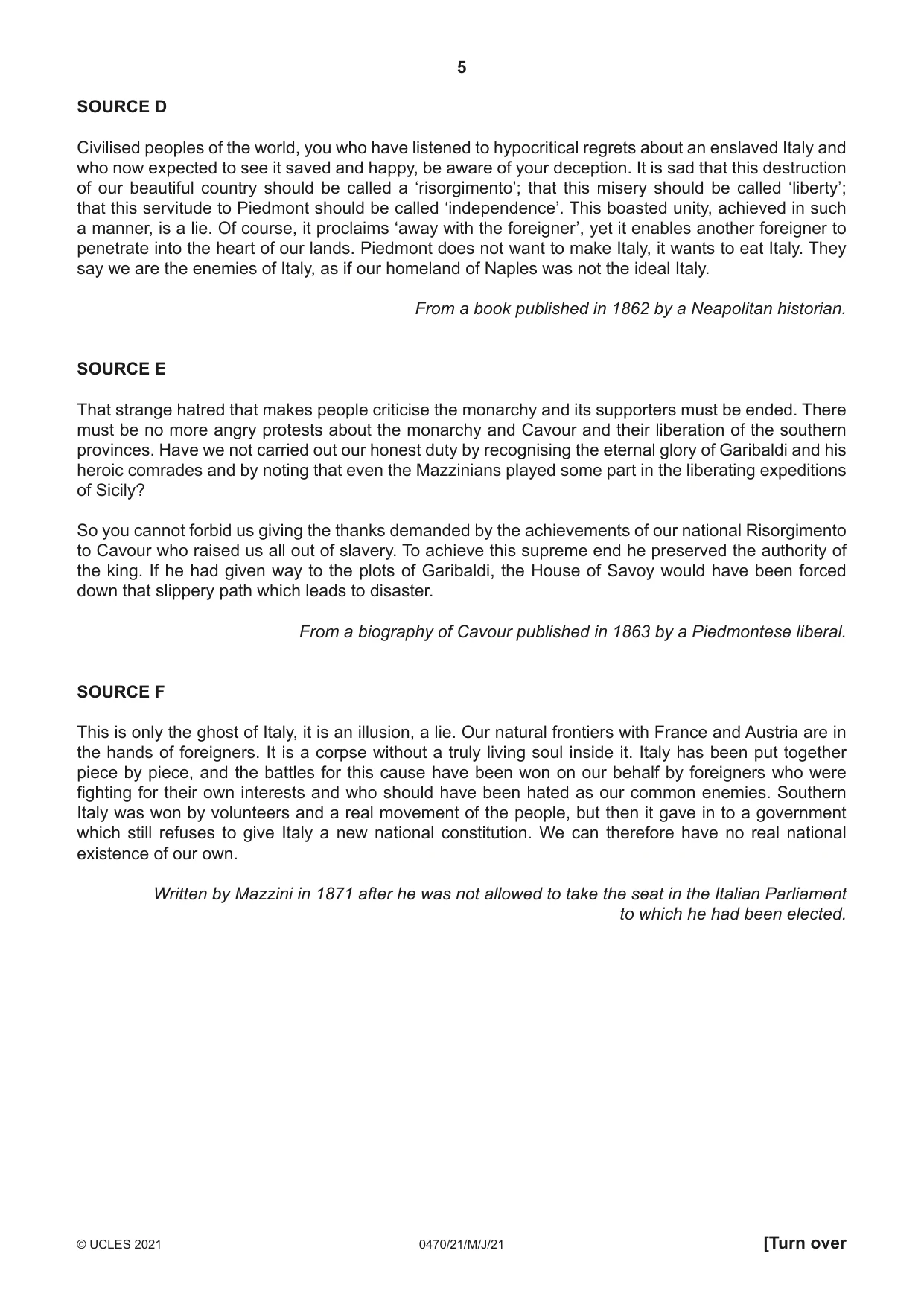
2 0470/21/M/J/21 © UCLES 2021 Option A: Nineteenth century topic WAS ITALIAN UNIFICATION A TRIUMPH? Study the Background Information and the sources carefully, and then answer all the questions. Background Information The Kingdom of Italy came into existence in March 1861, although most historians take the view that unification was not complete until Venetia and Rome were added to the new kingdom. This was achieved in 1866 and in 1870 respectively. However, opinion about the new Italy was sharply divided. Most middle-class liberals thought the new kingdom was a great achievement, while radicals such as those who had supported Garibaldi and Mazzini were not so happy. They had hoped for a republic, not a monarchy. They were also unhappy that the Piedmont constitution and legal system were simply imposed on the rest of Italy. There were also enormous differences between Piedmont and southern Italy. Rural discontent and the activities of bandits soon led to a breakdown in law and order in the South. Many in the North regarded Neapolitans as barbarians and the Piedmontese army brutally suppressed the disorder. Was Italian unification really a triumph? SOURCE A The creation of the Kingdom of Italy was a disappointment in many ways. The failure immediately to include Venetia and Rome within the new state seemed a sign of national weakness. Venetia was won from the Austrians in 1866 only after a humiliating defeat by the Austrians had served to emphasise Italy’s lack of independence and military power. Other Italian regions remained part of the Austrian Empire until after the First World War. Rome was a powerful symbol of Italian unity and strength, and its absence from Italy was felt very strongly. Rome only became part of the Italian Kingdom in 1870, when defeat in the Franco-Prussian war obliged Napoleon III to withdraw from Rome. Pope Pius IX henceforth withdrew as a self-proclaimed ‘prisoner’ into the Vatican, and threatened Catholics with excommunication if they participated in Italian politics. Italy experienced other difficulties. The explosion of rural banditry in the South, and urban riots in Turin and Milan, created public-order crises throughout the 1860s. During the war against Austria in 1866, anti-government rebels occupied Palermo, while in the 1870s central and southern Italy became strongholds of anarchist activity. These problems should be seen against the background of a financial crisis and slow economic growth. Political life in Italy was also a cause of dissatisfaction. The unified state failed to embody a national unity, to establish political consensus or to join the wealthy, urban North to an impoverished, rural South. Mazzinians and radicals argued that Italy’s ‘resurrection’ had been betrayed. From a history book published in 2009.
Question paper, page 3
3 0470/21/M/J/21 © UCLES 2021 [Turn over SOURCE B Although many people were unhappy about the outcome, the forging of national unity had been a great achievement. The Risorgimento had been a series of civil wars as much as of national wars against Austria but before long the result was to alter everyone’s lives in a positive way. The skill and ambitions of a few brave men, and a sudden wave of enthusiasm which equated unity with everything that was noble and profitable, combined to turn Mazzini’s dream into practical politics. Mazzini himself was utterly disillusioned and forced out into the bitterness of exile. The South, with its lack of industry, suffered most from early economic difficulties. Sometimes mutual incomprehension between North and South was total. Cavour’s representative in Naples claimed there were less than a hundred believers in Italian unity out of seven million inhabitants. There was general agreement that the main political problem to be solved was the absence from the new Italy of Venice and Rome. Venice became part of Italy in 1866 as a result of the Third Italian War of Independence and a plebiscite that showed 99.99 per cent of Venetians wanted annexation by Italy. Without Rome, Italy was not complete, and in 1870 the defeat of France by Prussia allowed the Italian army to march into the Holy City. What Metternich had called a ‘geographical expression’ had come to life. With the acquisition of Rome, the Risorgimento seemed to be complete. From a history book published in 1971.
Question paper, page 4
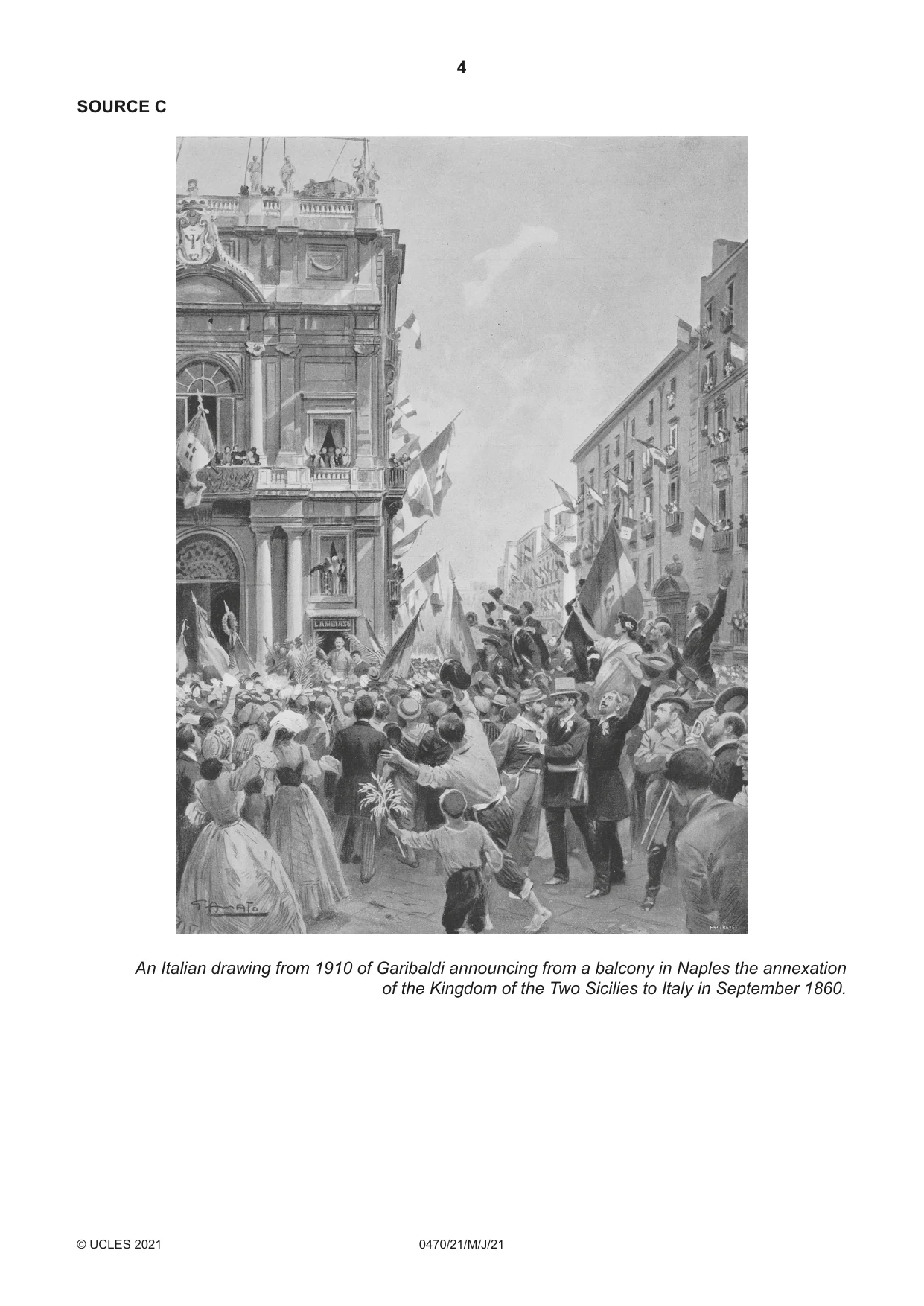
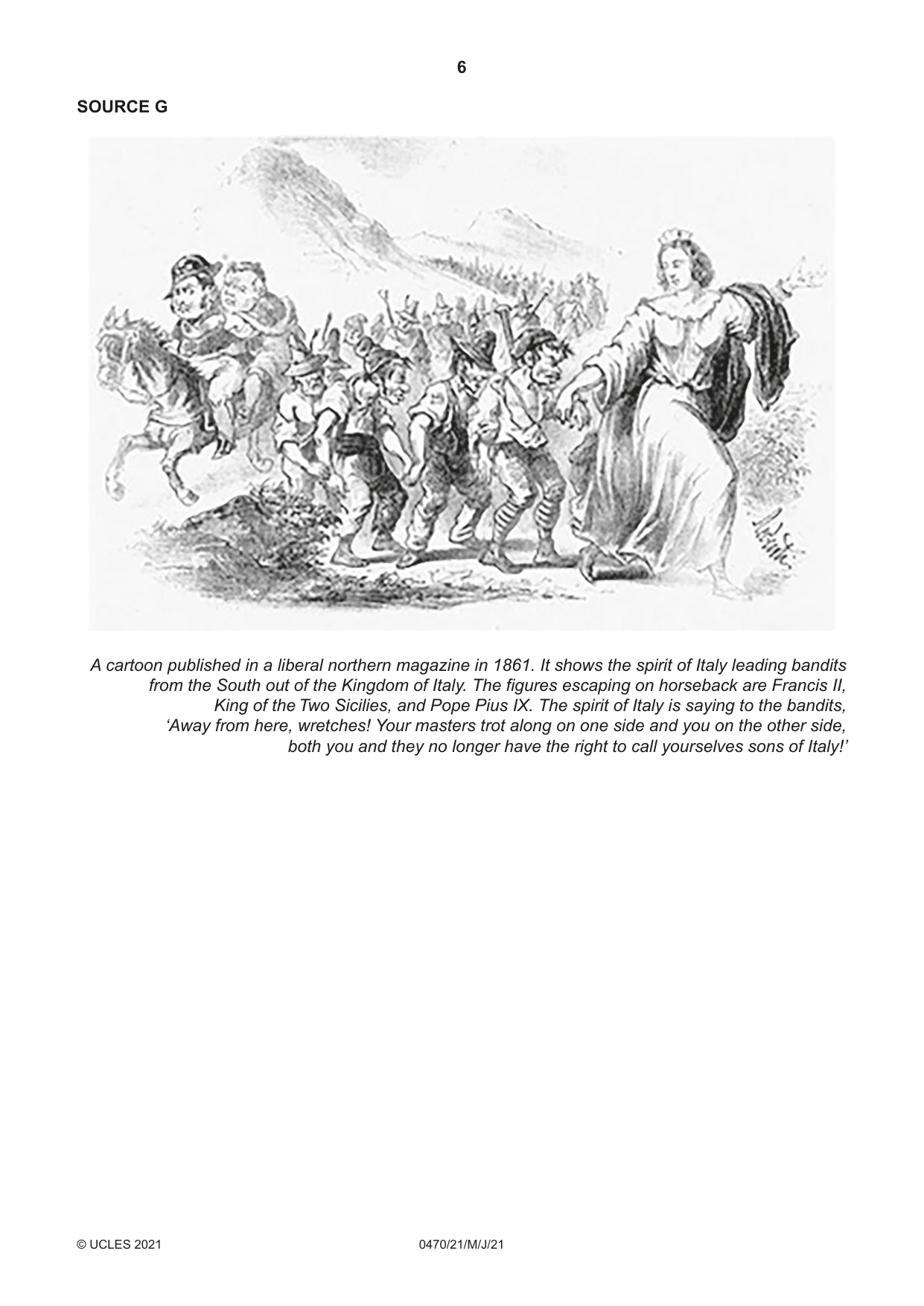
4 0470/21/M/J/21 © UCLES 2021 SOURCE C An Italian drawing from 1910 of Garibaldi announcing from a balcony in Naples the annexation of the Kingdom of the Two Sicilies to Italy in September 1860.
Question paper, page 5
5 0470/21/M/J/21 © UCLES 2021 [Turn over SOURCE D Civilised peoples of the world, you who have listened to hypocritical regrets about an enslaved Italy and who now expected to see it saved and happy, be aware of your deception. It is sad that this destruction of our beautiful country should be called a ‘risorgimento’; that this misery should be called ‘liberty’; that this servitude to Piedmont should be called ‘independence’. This boasted unity, achieved in such a manner, is a lie. Of course, it proclaims ‘away with the foreigner’, yet it enables another foreigner to penetrate into the heart of our lands. Piedmont does not want to make Italy, it wants to eat Italy. They say we are the enemies of Italy, as if our homeland of Naples was not the ideal Italy. From a book published in 1862 by a Neapolitan historian. SOURCE E That strange hatred that makes people criticise the monarchy and its supporters must be ended. There must be no more angry protests about the monarchy and Cavour and their liberation of the southern provinces. Have we not carried out our honest duty by recognising the eternal glory of Garibaldi and his heroic comrades and by noting that even the Mazzinians played some part in the liberating expeditions of Sicily? So you cannot forbid us giving the thanks demanded by the achievements of our national Risorgimento to Cavour who raised us all out of slavery. To achieve this supreme end he preserved the authority of the king. If he had given way to the plots of Garibaldi, the House of Savoy would have been forced down that slippery path which leads to disaster. From a biography of Cavour published in 1863 by a Piedmontese liberal. SOURCE F This is only the ghost of Italy, it is an illusion, a lie. Our natural frontiers with France and Austria are in the hands of foreigners. It is a corpse without a truly living soul inside it. Italy has been put together piece by piece, and the battles for this cause have been won on our behalf by foreigners who were fighting for their own interests and who should have been hated as our common enemies. Southern Italy was won by volunteers and a real movement of the people, but then it gave in to a government which still refuses to give Italy a new national constitution. We can therefore have no real national existence of our own. Written by Mazzini in 1871 after he was not allowed to take the seat in the Italian Parliament to which he had been elected.
Question paper, page 6
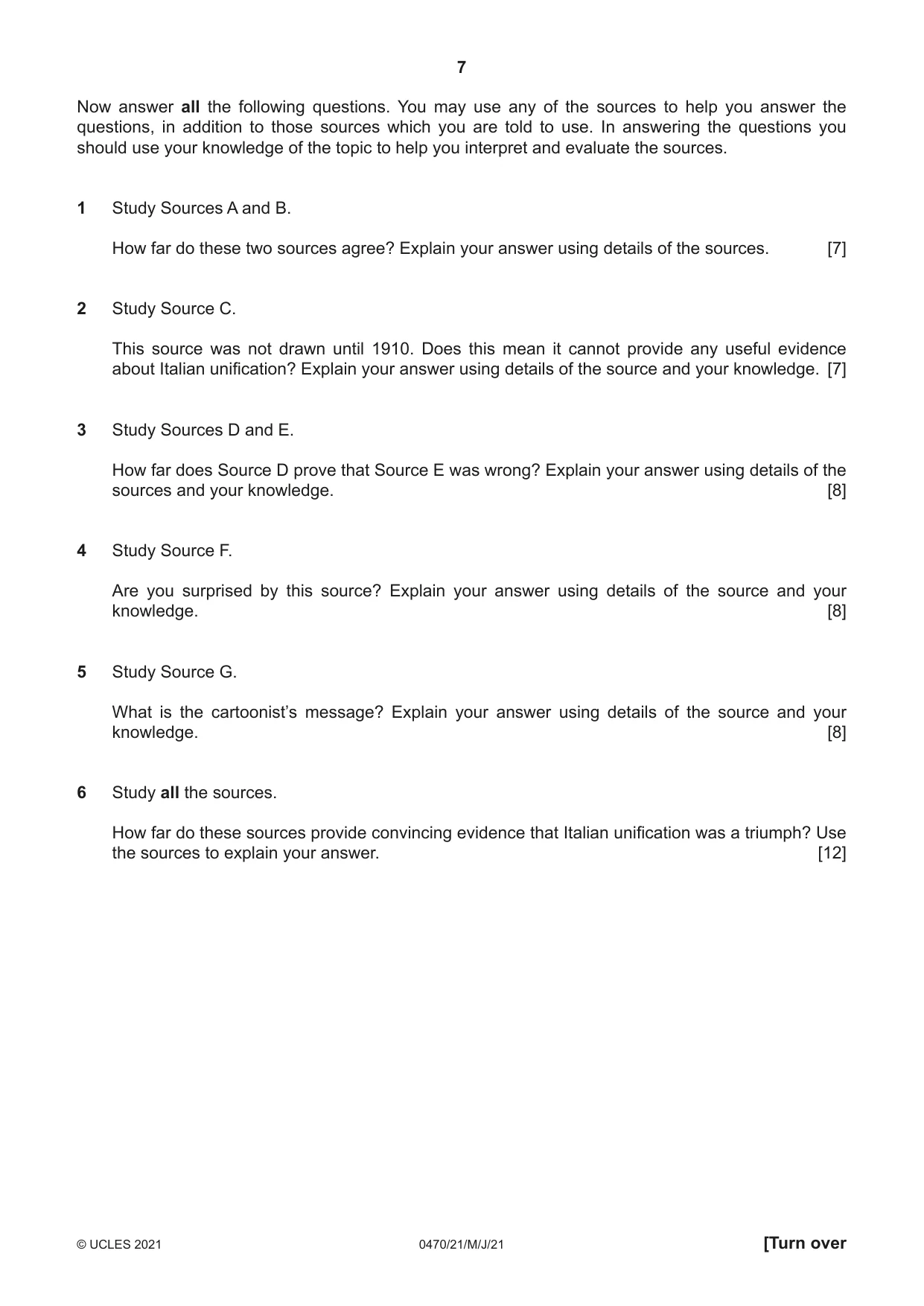
6 0470/21/M/J/21 © UCLES 2021 SOURCE G A cartoon published in a liberal northern magazine in 1861. It shows the spirit of Italy leading bandits from the South out of the Kingdom of Italy. The figures escaping on horseback are Francis II, King of the Two Sicilies, and Pope Pius IX. The spirit of Italy is saying to the bandits, ‘Away from here, wretches! Your masters trot along on one side and you on the other side, both you and they no longer have the right to call yourselves sons of Italy!’
Question paper, page 7
7 0470/21/M/J/21 © UCLES 2021 [Turn over Now answer all the following questions. You may use any of the sources to help you answer the questions, in addition to those sources which you are told to use. In answering the questions you should use your knowledge of the topic to help you interpret and evaluate the sources. 1 Study Sources A and B. How far do these two sources agree? Explain your answer using details of the sources. [7] 2 Study Source C. This source was not drawn until 1910. Does this mean it cannot provide any useful evidence about Italian unification? Explain your answer using details of the source and your knowledge. [7] 3 Study Sources D and E. How far does Source D prove that Source E was wrong? Explain your answer using details of the sources and your knowledge. [8] 4 Study Source F. Are you surprised by this source? Explain your answer using details of the source and your knowledge. [8] 5 Study Source G. What is the cartoonist’s message? Explain your answer using details of the source and your knowledge. [8] 6 Study all the sources. How far do these sources provide convincing evidence that Italian unification was a triumph? Use the sources to explain your answer. [12]
Question paper, page 8
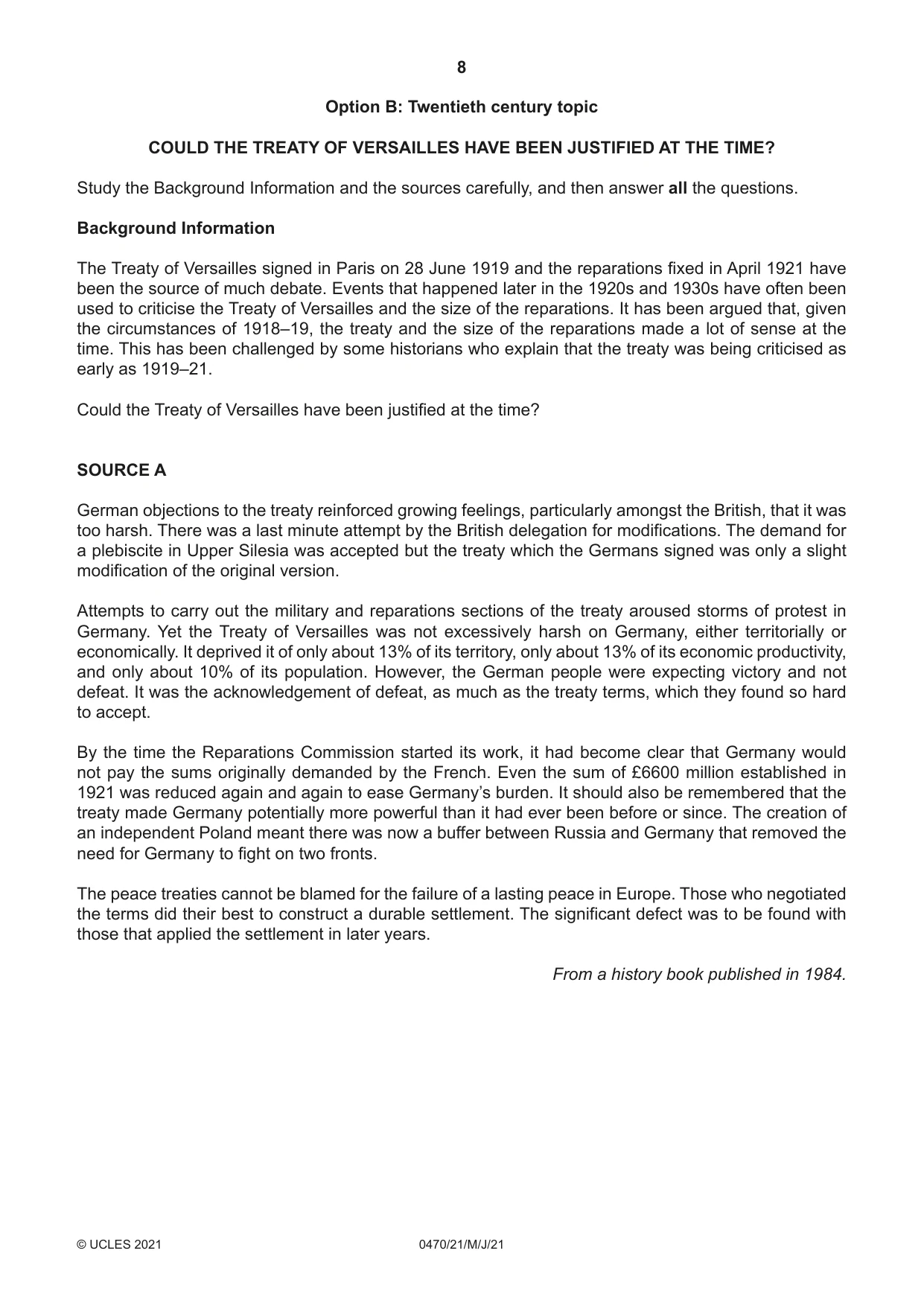
8 0470/21/M/J/21 © UCLES 2021 Option B: Twentieth century topic COULD THE TREATY OF VERSAILLES HAVE BEEN JUSTIFIED AT THE TIME? Study the Background Information and the sources carefully, and then answer all the questions. Background Information The Treaty of Versailles signed in Paris on 28 June 1919 and the reparations fixed in April 1921 have been the source of much debate. Events that happened later in the 1920s and 1930s have often been used to criticise the Treaty of Versailles and the size of the reparations. It has been argued that, given the circumstances of 1918–19, the treaty and the size of the reparations made a lot of sense at the time. This has been challenged by some historians who explain that the treaty was being criticised as early as 1919–21. Could the Treaty of Versailles have been justified at the time? SOURCE A German objections to the treaty reinforced growing feelings, particularly amongst the British, that it was too harsh. There was a last minute attempt by the British delegation for modifications. The demand for a plebiscite in Upper Silesia was accepted but the treaty which the Germans signed was only a slight modification of the original version. Attempts to carry out the military and reparations sections of the treaty aroused storms of protest in Germany. Yet the Treaty of Versailles was not excessively harsh on Germany, either territorially or economically. It deprived it of only about 13% of its territory, only about 13% of its economic productivity, and only about 10% of its population. However, the German people were expecting victory and not defeat. It was the acknowledgement of defeat, as much as the treaty terms, which they found so hard to accept. By the time the Reparations Commission started its work, it had become clear that Germany would not pay the sums originally demanded by the French. Even the sum of £6600 million established in 1921 was reduced again and again to ease Germany’s burden. It should also be remembered that the treaty made Germany potentially more powerful than it had ever been before or since. The creation of an independent Poland meant there was now a buffer between Russia and Germany that removed the need for Germany to fight on two fronts. The peace treaties cannot be blamed for the failure of a lasting peace in Europe. Those who negotiated the terms did their best to construct a durable settlement. The significant defect was to be found with those that applied the settlement in later years. From a history book published in 1984.
Question paper, page 9
9 0470/21/M/J/21 © UCLES 2021 [Turn over SOURCE B It can be argued that everything that went wrong in the 1920s and 1930s was due to the actions of the statesmen of those decades and not the fault of the Treaty of Versailles. However, the peacemakers had solved few of the problems that faced them, especially the problem of the German question which would trouble Europe for years afterwards. The treaty would provide plenty of ammunition for Germans like Hitler. Many aspects of the treaty were simply vindictive. The treaty contrasted strongly with the Fourteen Points. There was the contrast between the idea of open diplomacy and the refusal to negotiate, the contrast between self-determination and the ban on Anschluss and the contrast between the call for disarmament and the refusal of the allies to disarm while German armed forces were crippled. When the draft peace terms were presented to the Germans on 7 May 1919, they demanded a number of concessions but the only one that was granted was to allow a plebiscite in Upper Silesia. The new German republic faced tremendous difficulties as a result of the Treaty of Versailles. Germany lost land to France, Belgium, Denmark and Poland - a serious blow to German pride and its economy. The cutting off of East Prussia was a further punishment, while reparations proved to be an enormous burden creating economic and political difficulties. By 1923, a serious lack of money led to Germany stopping paying reparations and printing extra money which led to hyperinflation with Germany close to collapse. However, the deepest flaw of Versailles was that it was too harsh for much of British opinion. This raised the likelihood that it would have to be revised at some time in the future. From a recent history book.
Question paper, page 10
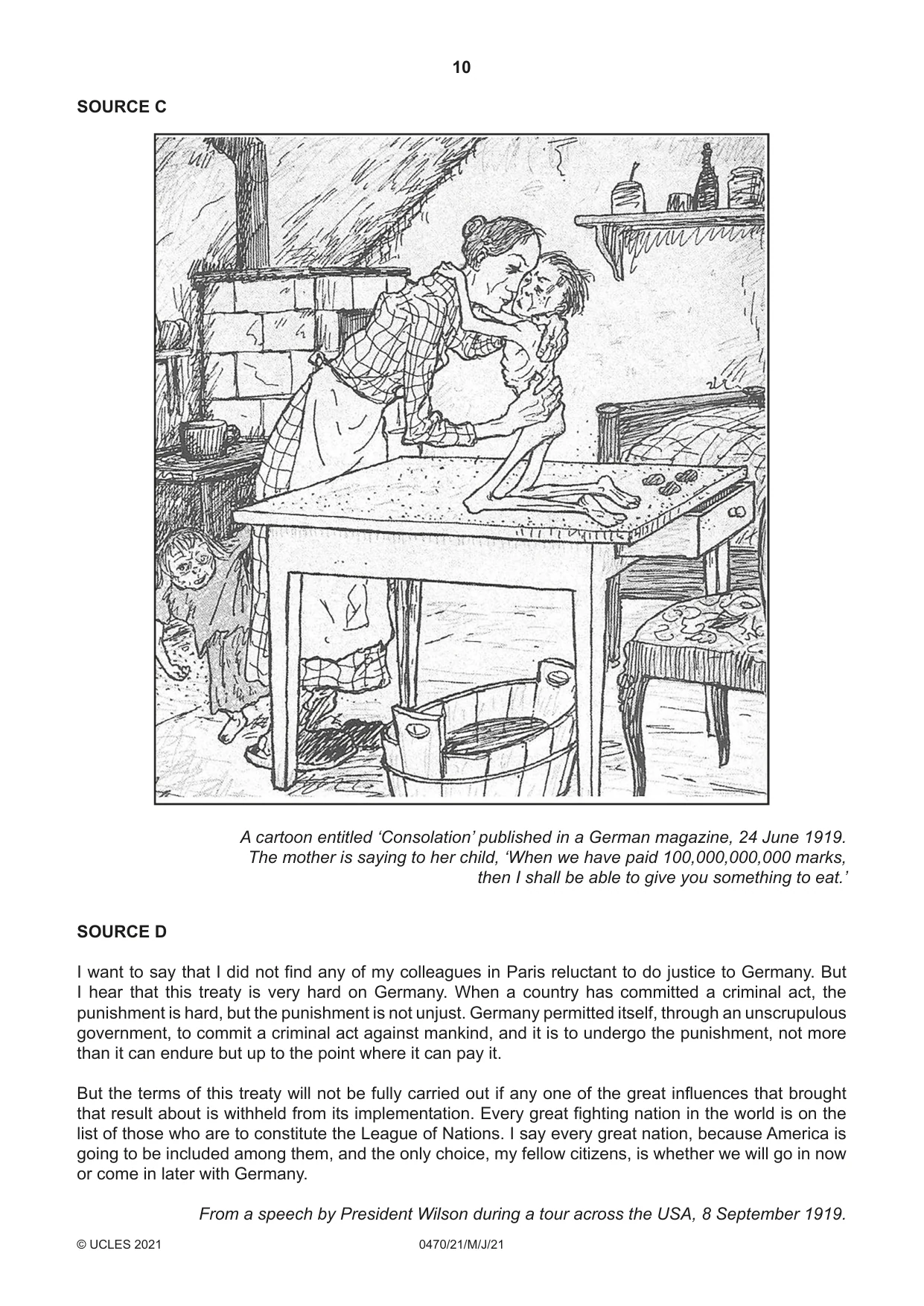
10 0470/21/M/J/21 © UCLES 2021 SOURCE C A cartoon entitled ‘Consolation’ published in a German magazine, 24 June 1919. The mother is saying to her child, ‘When we have paid 100,000,000,000 marks, then I shall be able to give you something to eat.’ SOURCE D I want to say that I did not find any of my colleagues in Paris reluctant to do justice to Germany. But I hear that this treaty is very hard on Germany. When a country has committed a criminal act, the punishment is hard, but the punishment is not unjust. Germany permitted itself, through an unscrupulous government, to commit a criminal act against mankind, and it is to undergo the punishment, not more than it can endure but up to the point where it can pay it. But the terms of this treaty will not be fully carried out if any one of the great influences that brought that result about is withheld from its implementation. Every great fighting nation in the world is on the list of those who are to constitute the League of Nations. I say every great nation, because America is going to be included among them, and the only choice, my fellow citizens, is whether we will go in now or come in later with Germany. From a speech by President Wilson during a tour across the USA, 8 September 1919.
Question paper, page 11
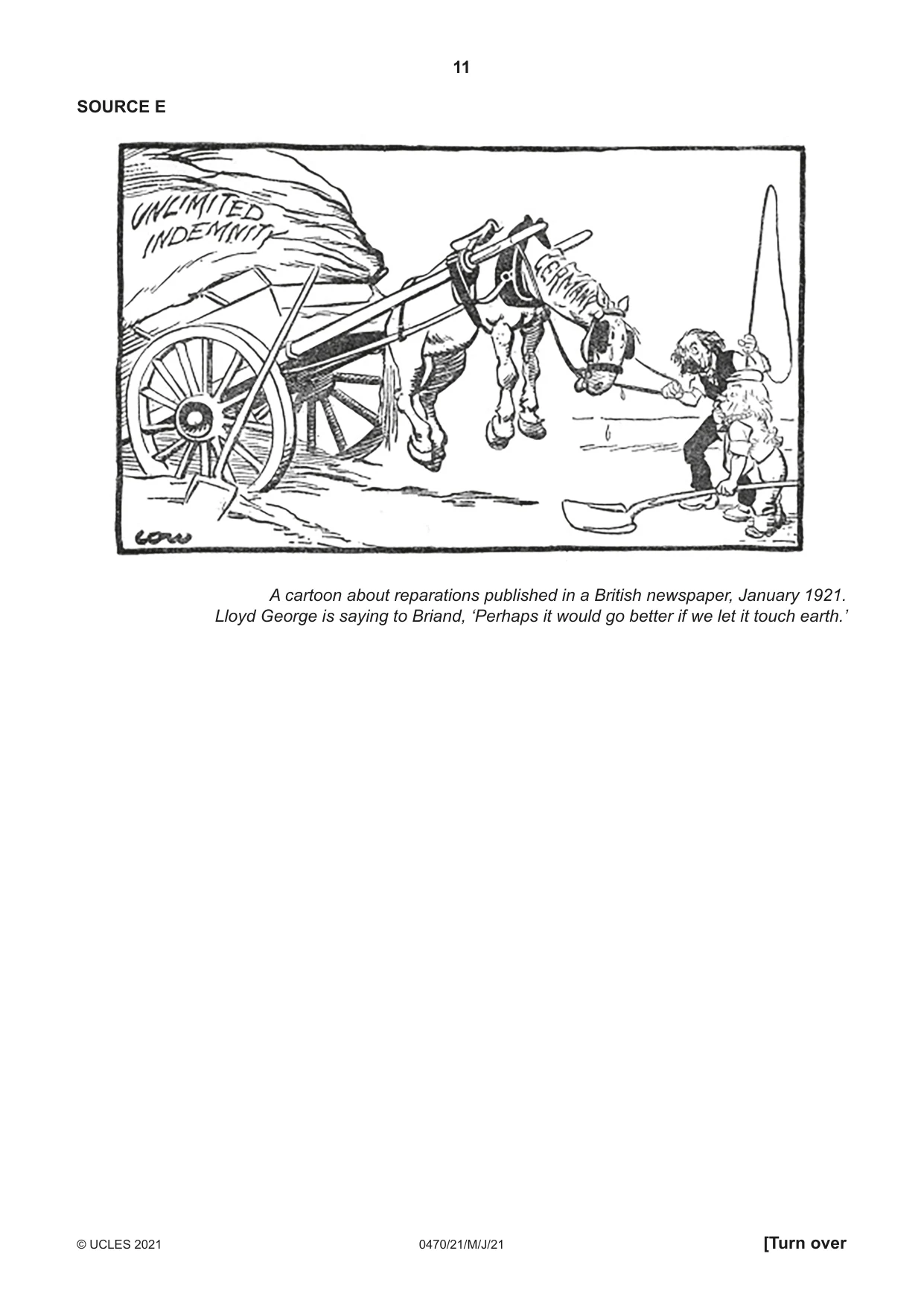
11 0470/21/M/J/21 © UCLES 2021 [Turn over SOURCE E A cartoon about reparations published in a British newspaper, January 1921. Lloyd George is saying to Briand, ‘Perhaps it would go better if we let it touch earth.’
Question paper, page 12
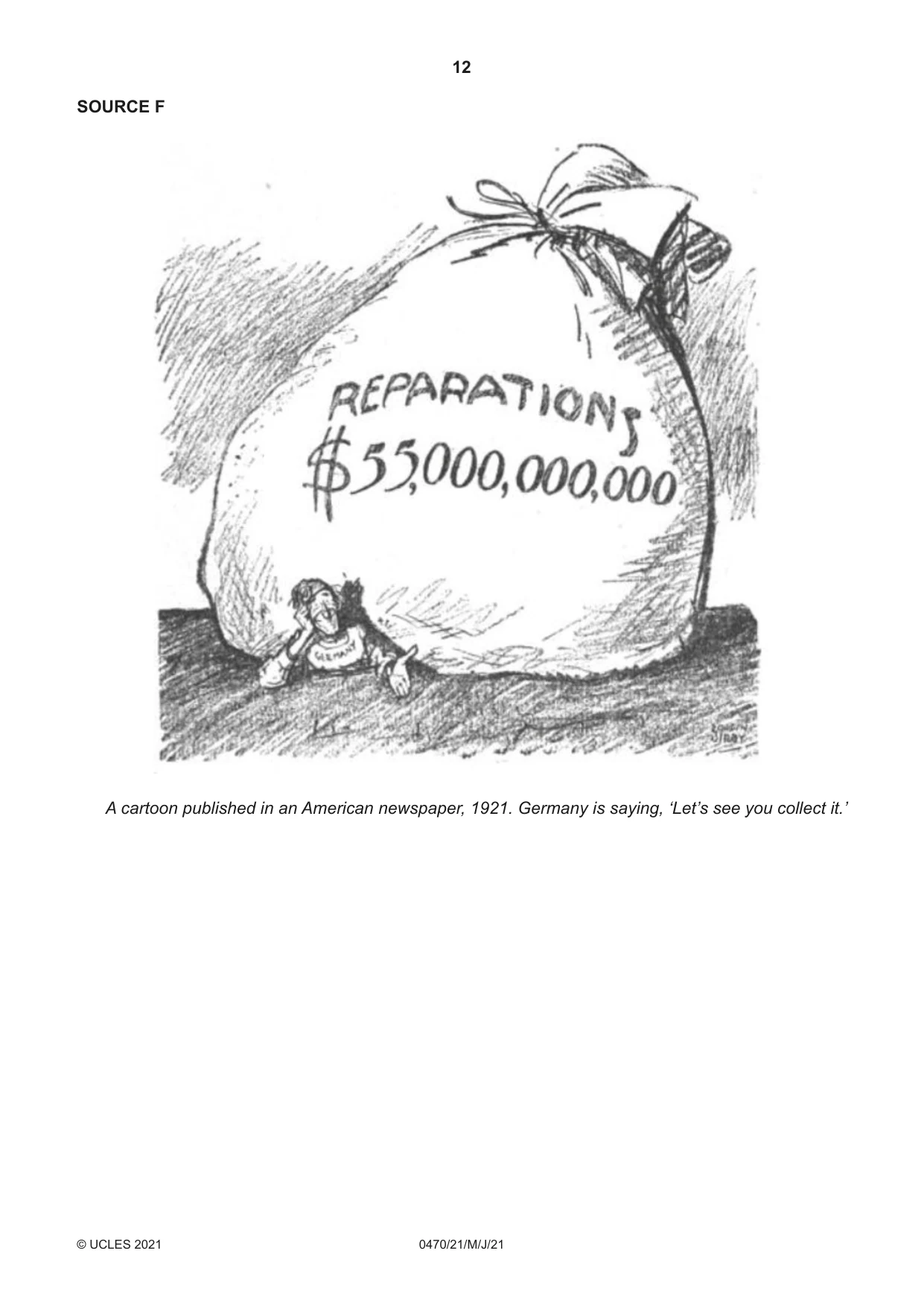
12 0470/21/M/J/21 © UCLES 2021 SOURCE F A cartoon published in an American newspaper, 1921. Germany is saying, ‘Let’s see you collect it.’
Question paper, page 13
13 0470/21/M/J/21 © UCLES 2021 [Turn over SOURCE G I think Clemenceau’s view of things would be more uncompromising than it was in 1919. He would say that Germany had behaved exactly as he had anticipated; that it had pretended to be crippled in 1919 in order to deceive the Allies. As for the contents of the Treaty of Versailles, he would blame himself for giving in to Wilson and myself on the question of the Rhineland. But he would also be very critical of the feebleness, amounting to treachery, displayed by his successors over German re-armament and the annexation of Austria. He would say that they had dishonoured his promises over disarmament and had therefore given Germany a moral justification for breaking the Treaty. Had the terms of the peace treaties been faithfully and honestly fulfilled, the dark military and economic menace hanging over us now would have been avoided. The League of Nations would have been an effective instrument for restraining national greed. Huge armaments would have been gradually reduced. Where there has been failure it has been due to two causes. The first is the way in which the victorious nations have broken promises they gave when the Treaties were signed. For example, they have failed to come to the aid of weak countries threatened by aggression. Second, the refusal of the United States to join the League of Nations, or take any responsibility for maintaining the Treaty, seriously crippled the influence and authority of the League. Lloyd George writing in his book ‘The Truth About the Peace Treaties’, which was published in 1938. Lloyd George was writing about what Clemenceau would have thought of the Treaty of Versailles if he had still been alive.
Question paper, page 14
14 0470/21/M/J/21 © UCLES 2021 Now answer all the following questions. You may use any of the sources to help you answer the questions, in addition to those sources which you are told to use. In answering the questions you should use your knowledge of the topic to help you interpret and evaluate the sources. 1 Study Sources A and B. How far do these two sources agree? Explain your answer using details of the sources. [7] 2 Study Source C. How useful is this source as evidence about the Treaty of Versailles? Explain your answer using details of the source and your knowledge. [8] 3 Study Source D. Are you surprised by this source? Explain your answer using details of the source and your knowledge. [7] 4 Study Sources E and F. How far would these two cartoonists have agreed? Explain your answer using details of the sources and your knowledge. [8] 5 Study Source G. Why did Lloyd George write this book at this time? Explain your answer using details of the source and your knowledge. [8] 6 Study all the sources. How far do these sources provide convincing evidence that the Treaty of Versailles could have been justified in the period from 1919 to 1921? Use the sources to explain your answer. [12]
Question paper, page 15
15 0470/21/M/J/21 © UCLES 2021 BLANK PAGE
Question paper, page 16
16 0470/21/M/J/21 © UCLES 2021 Permission to reproduce items where third-party owned material protected by copyright is included has been sought and cleared where possible. Every reasonable effort has been made by the publisher (UCLES) to trace copyright holders, but if any items requiring clearance have unwittingly been included, the publisher will be pleased to make amends at the earliest possible opportunity. To avoid the issue of disclosure of answer-related information to candidates, all copyright acknowledgements are reproduced online in the Cambridge Assessment International Education Copyright Acknowledgements Booklet. This is produced for each series of examinations and is freely available to download at www.cambridgeinternational.org after the live examination series. Cambridge Assessment International Education is part of the Cambridge Assessment Group. Cambridge Assessment is the brand name of the University of Cambridge Local Examinations Syndicate (UCLES), which itself is a department of the University of Cambridge. BLANK PAGE
Mark scheme, page 1
This document consists of 14 printed pages. © UCLES 2021 [Turn over Cambridge IGCSE™ HISTORY 0470/21 Paper 2 May/June 2021 MARK SCHEME Maximum Mark: 50 Published This mark scheme is published as an aid to teachers and candidates, to indicate the requirements of the examination. It shows the basis on which Examiners were instructed to award marks. It does not indicate the details of the discussions that took place at an Examiners’ meeting before marking began, which would have considered the acceptability of alternative answers. Mark schemes should be read in conjunction with the question paper and the Principal Examiner Report for Teachers. Cambridge International will not enter into discussions about these mark schemes. Cambridge International is publishing the mark schemes for the May/June 2021 series for most Cambridge IGCSE™, Cambridge International A and AS Level components and some Cambridge O Level components.
Mark scheme, page 2
0470/21 Cambridge IGCSE – Mark Scheme PUBLISHED May/June 2021 © UCLES 2021 Page 2 of 14 Generic Marking Principles These general marking principles must be applied by all examiners when marking candidate answers. They should be applied alongside the specific content of the mark scheme or generic level descriptors for a question. Each question paper and mark scheme will also comply with these marking principles. GENERIC MARKING PRINCIPLE 1: Marks must be awarded in line with: • the specific content of the mark scheme or the generic level descriptors for the question • the specific skills defined in the mark scheme or in the generic level descriptors for the question • the standard of response required by a candidate as exemplified by the standardisation scripts. GENERIC MARKING PRINCIPLE 2: Marks awarded are always whole marks (not half marks, or other fractions). GENERIC MARKING PRINCIPLE 3: Marks must be awarded positively: • marks are awarded for correct/valid answers, as defined in the mark scheme. However, credit is given for valid answers which go beyond the scope of the syllabus and mark scheme, referring to your Team Leader as appropriate • marks are awarded when candidates clearly demonstrate what they know and can do • marks are not deducted for errors • marks are not deducted for omissions • answers should only be judged on the quality of spelling, punctuation and grammar when these features are specifically assessed by the question as indicated by the mark scheme. The meaning, however, should be unambiguous. GENERIC MARKING PRINCIPLE 4: Rules must be applied consistently, e.g. in situations where candidates have not followed instructions or in the application of generic level descriptors. GENERIC MARKING PRINCIPLE 5: Marks should be awarded using the full range of marks defined in the mark scheme for the question (however; the use of the full mark range may be limited according to the quality of the candidate responses seen). GENERIC MARKING PRINCIPLE 6: Marks awarded are based solely on the requirements as defined in the mark scheme. Marks should not be awarded with grade thresholds or grade descriptors in mind.
Mark scheme, page 3
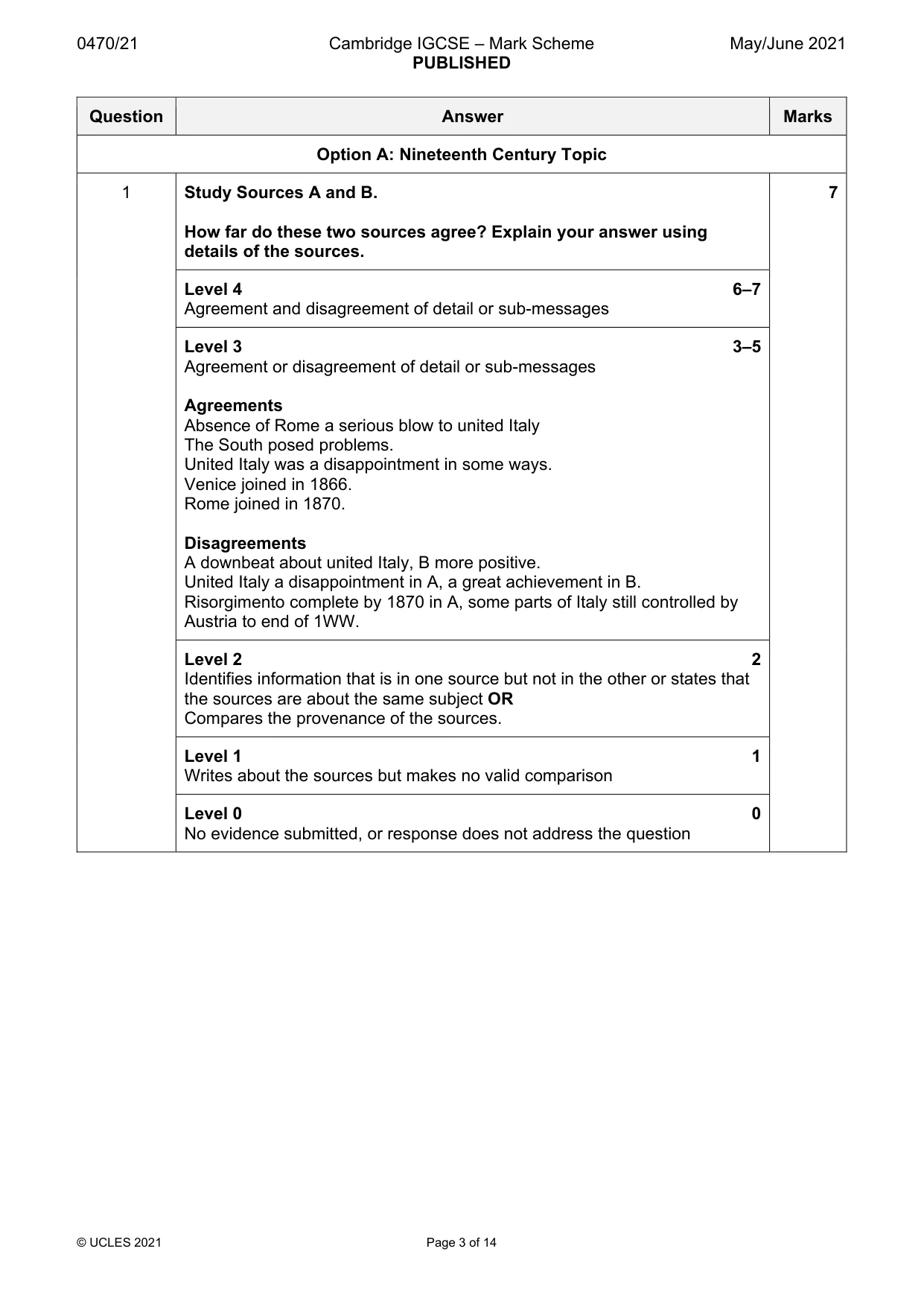
0470/21 Cambridge IGCSE – Mark Scheme PUBLISHED May/June 2021 © UCLES 2021 Page 3 of 14 Question Answer Marks Option A: Nineteenth Century Topic 1 Study Sources A and B. How far do these two sources agree? Explain your answer using details of the sources. 7 Level 4 6–7 Agreement and disagreement of detail or sub-messages Level 3 3–5 Agreement or disagreement of detail or sub-messages Agreements Absence of Rome a serious blow to united Italy The South posed problems. United Italy was a disappointment in some ways. Venice joined in 1866. Rome joined in 1870. Disagreements A downbeat about united Italy, B more positive. United Italy a disappointment in A, a great achievement in B. Risorgimento complete by 1870 in A, some parts of Italy still controlled by Austria to end of 1WW. Level 2 2 Identifies information that is in one source but not in the other or states that the sources are about the same subject OR Compares the provenance of the sources. Level 1 1 Writes about the sources but makes no valid comparison Level 0 0 No evidence submitted, or response does not address the question
Mark scheme, page 4
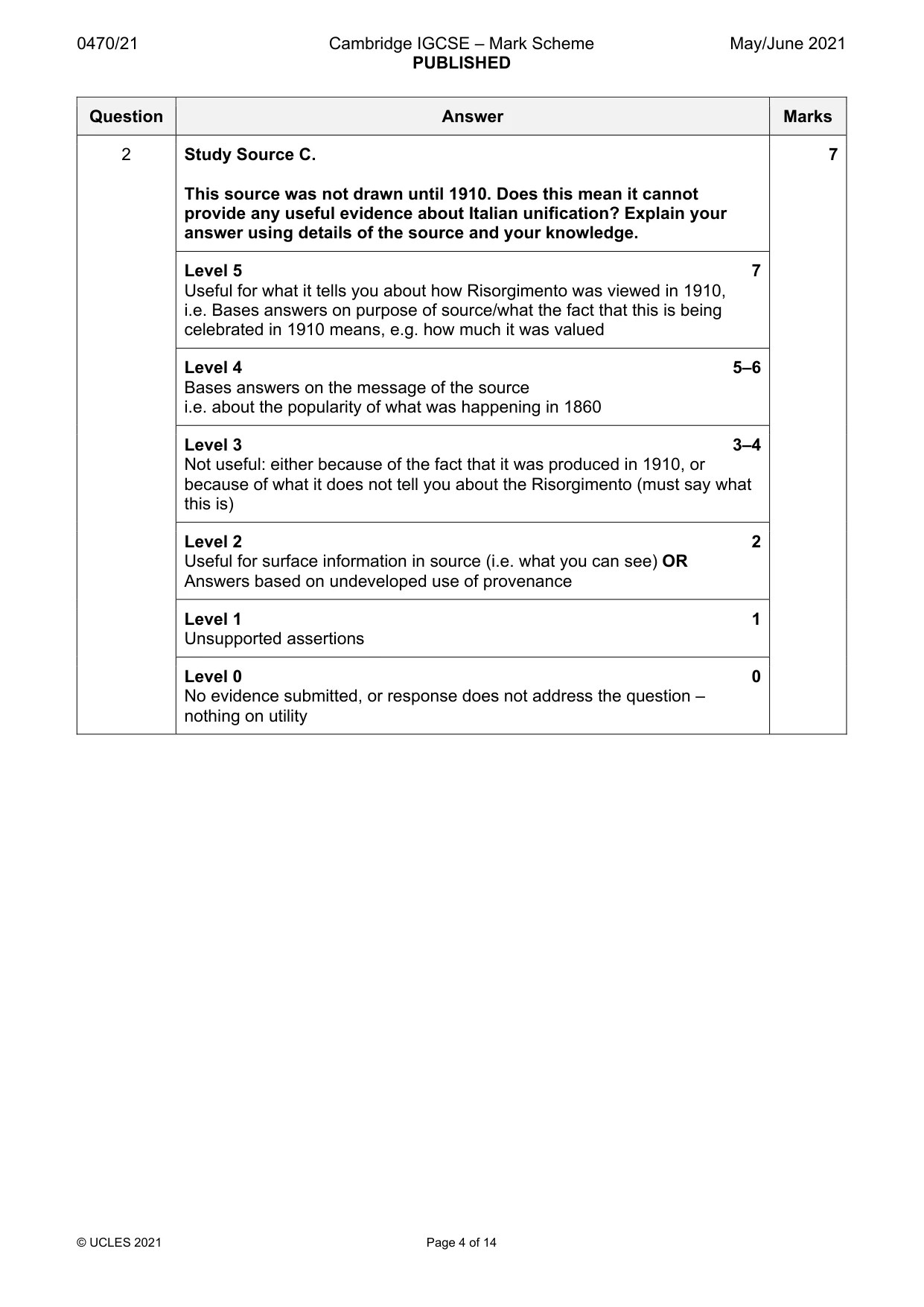
0470/21 Cambridge IGCSE – Mark Scheme PUBLISHED May/June 2021 © UCLES 2021 Page 4 of 14 Question Answer Marks 2 Study Source C. This source was not drawn until 1910. Does this mean it cannot provide any useful evidence about Italian unification? Explain your answer using details of the source and your knowledge. 7 Level 5 7 Useful for what it tells you about how Risorgimento was viewed in 1910, i.e. Bases answers on purpose of source/what the fact that this is being celebrated in 1910 means, e.g. how much it was valued Level 4 5–6 Bases answers on the message of the source i.e. about the popularity of what was happening in 1860 Level 3 3–4 Not useful: either because of the fact that it was produced in 1910, or because of what it does not tell you about the Risorgimento (must say what this is) Level 2 2 Useful for surface information in source (i.e. what you can see) OR Answers based on undeveloped use of provenance Level 1 1 Unsupported assertions Level 0 0 No evidence submitted, or response does not address the question – nothing on utility
Mark scheme, page 5
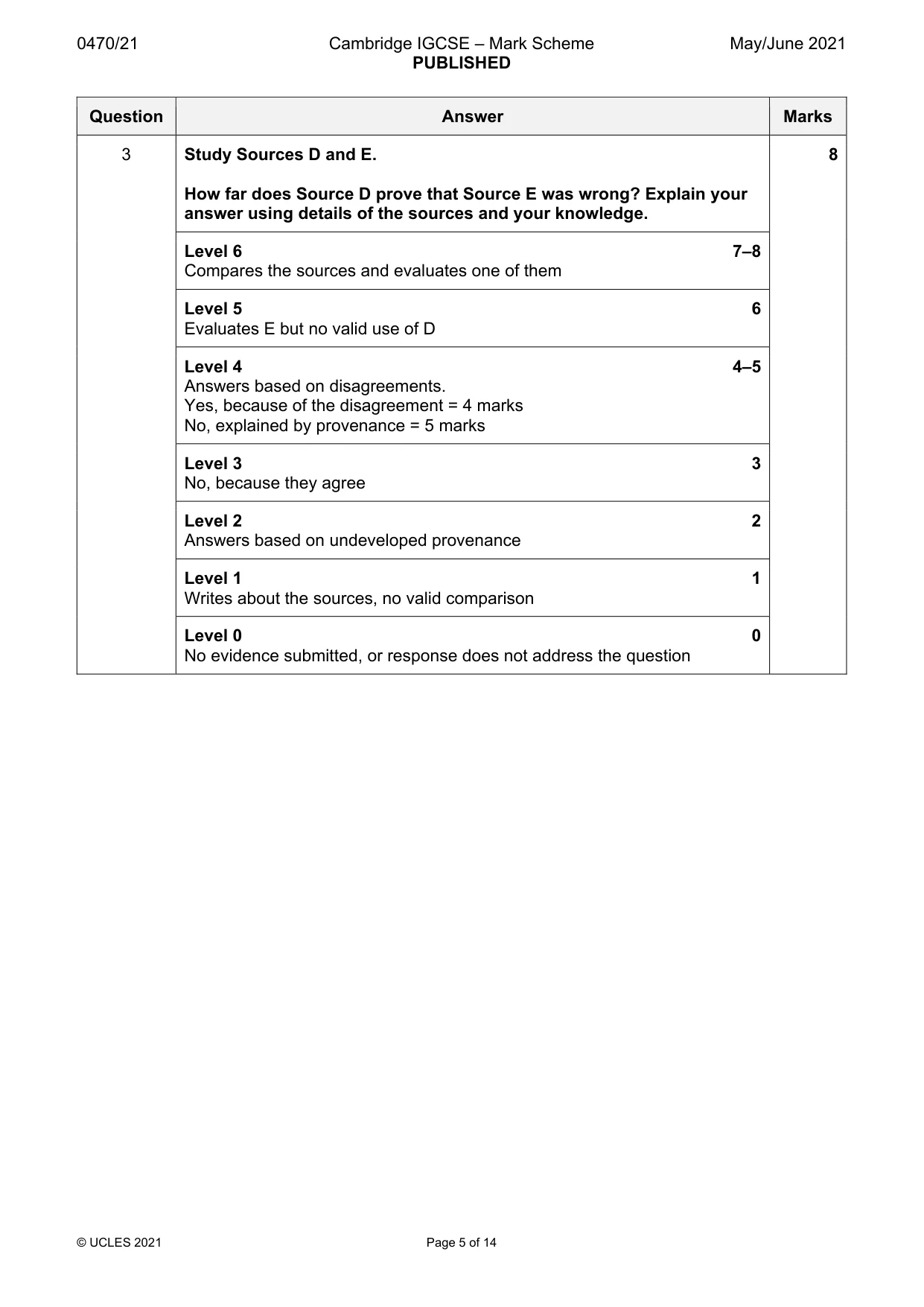
0470/21 Cambridge IGCSE – Mark Scheme PUBLISHED May/June 2021 © UCLES 2021 Page 5 of 14 Question Answer Marks 3 Study Sources D and E. How far does Source D prove that Source E was wrong? Explain your answer using details of the sources and your knowledge. 8 Level 6 7–8 Compares the sources and evaluates one of them Level 5 6 Evaluates E but no valid use of D Level 4 4–5 Answers based on disagreements. Yes, because of the disagreement = 4 marks No, explained by provenance = 5 marks Level 3 3 No, because they agree Level 2 2 Answers based on undeveloped provenance Level 1 1 Writes about the sources, no valid comparison Level 0 0 No evidence submitted, or response does not address the question
Mark scheme, page 6
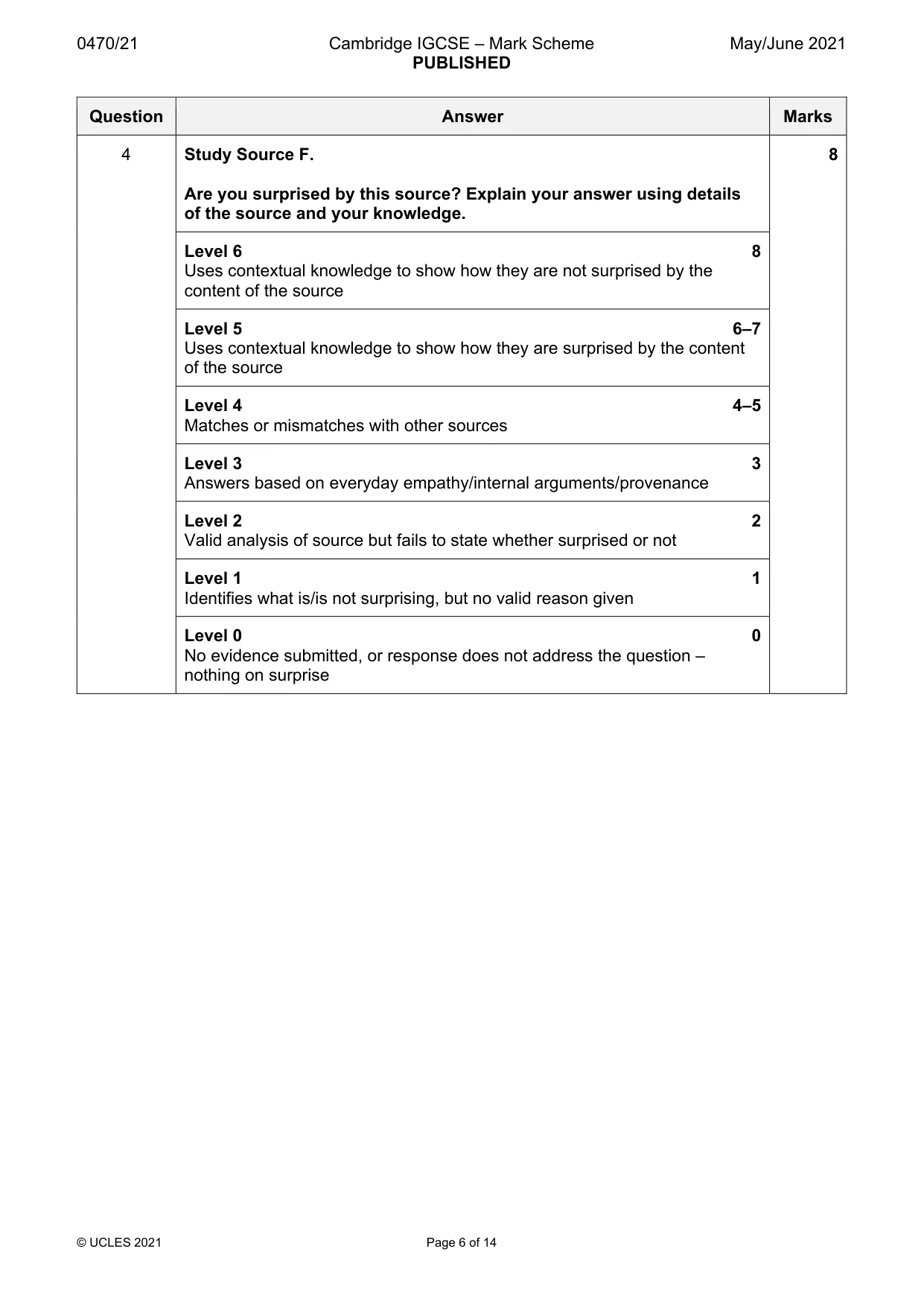
0470/21 Cambridge IGCSE – Mark Scheme PUBLISHED May/June 2021 © UCLES 2021 Page 6 of 14 Question Answer Marks 4 Study Source F. Are you surprised by this source? Explain your answer using details of the source and your knowledge. 8 Level 6 8 Uses contextual knowledge to show how they are not surprised by the content of the source Level 5 6–7 Uses contextual knowledge to show how they are surprised by the content of the source Level 4 4–5 Matches or mismatches with other sources Level 3 3 Answers based on everyday empathy/internal arguments/provenance Level 2 2 Valid analysis of source but fails to state whether surprised or not Level 1 1 Identifies what is/is not surprising, but no valid reason given Level 0 0 No evidence submitted, or response does not address the question – nothing on surprise
Mark scheme, page 7
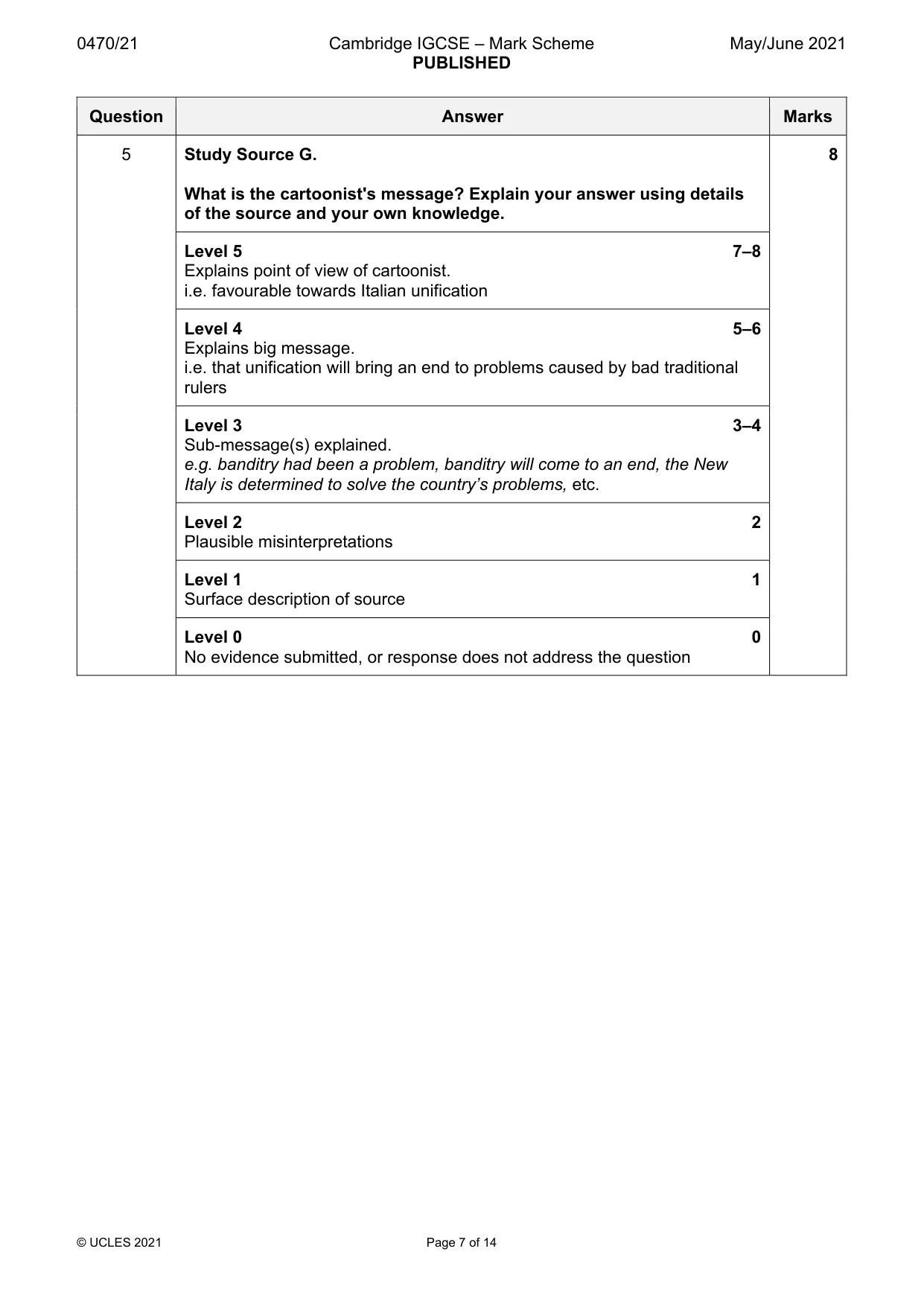
0470/21 Cambridge IGCSE – Mark Scheme PUBLISHED May/June 2021 © UCLES 2021 Page 7 of 14 Question Answer Marks 5 Study Source G. What is the cartoonist's message? Explain your answer using details of the source and your own knowledge. 8 Level 5 7–8 Explains point of view of cartoonist. i.e. favourable towards Italian unification Level 4 5–6 Explains big message. i.e. that unification will bring an end to problems caused by bad traditional rulers Level 3 3–4 Sub-message(s) explained. e.g. banditry had been a problem, banditry will come to an end, the New Italy is determined to solve the country’s problems, etc. Level 2 2 Plausible misinterpretations Level 1 1 Surface description of source Level 0 0 No evidence submitted, or response does not address the question
Mark scheme, page 8
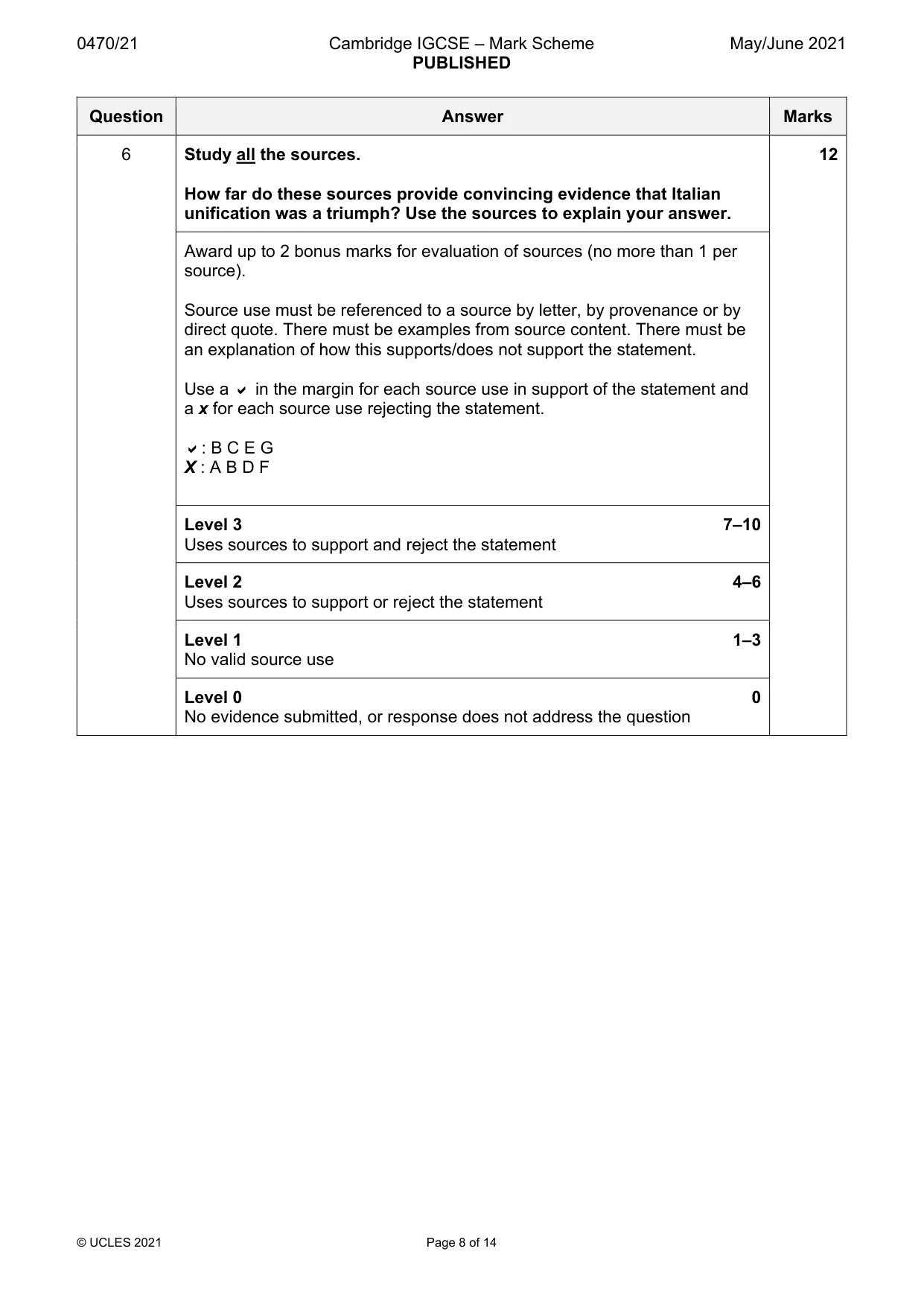
0470/21 Cambridge IGCSE – Mark Scheme PUBLISHED May/June 2021 © UCLES 2021 Page 8 of 14 Question Answer Marks 6 Study all the sources. How far do these sources provide convincing evidence that Italian unification was a triumph? Use the sources to explain your answer. 12 Award up to 2 bonus marks for evaluation of sources (no more than 1 per source). Source use must be referenced to a source by letter, by provenance or by direct quote. There must be examples from source content. There must be an explanation of how this supports/does not support the statement. Use a in the margin for each source use in support of the statement and a x for each source use rejecting the statement. : B C E G X : A B D F Level 3 7–10 Uses sources to support and reject the statement Level 2 4–6 Uses sources to support or reject the statement Level 1 1–3 No valid source use Level 0 0 No evidence submitted, or response does not address the question
Mark scheme, page 9
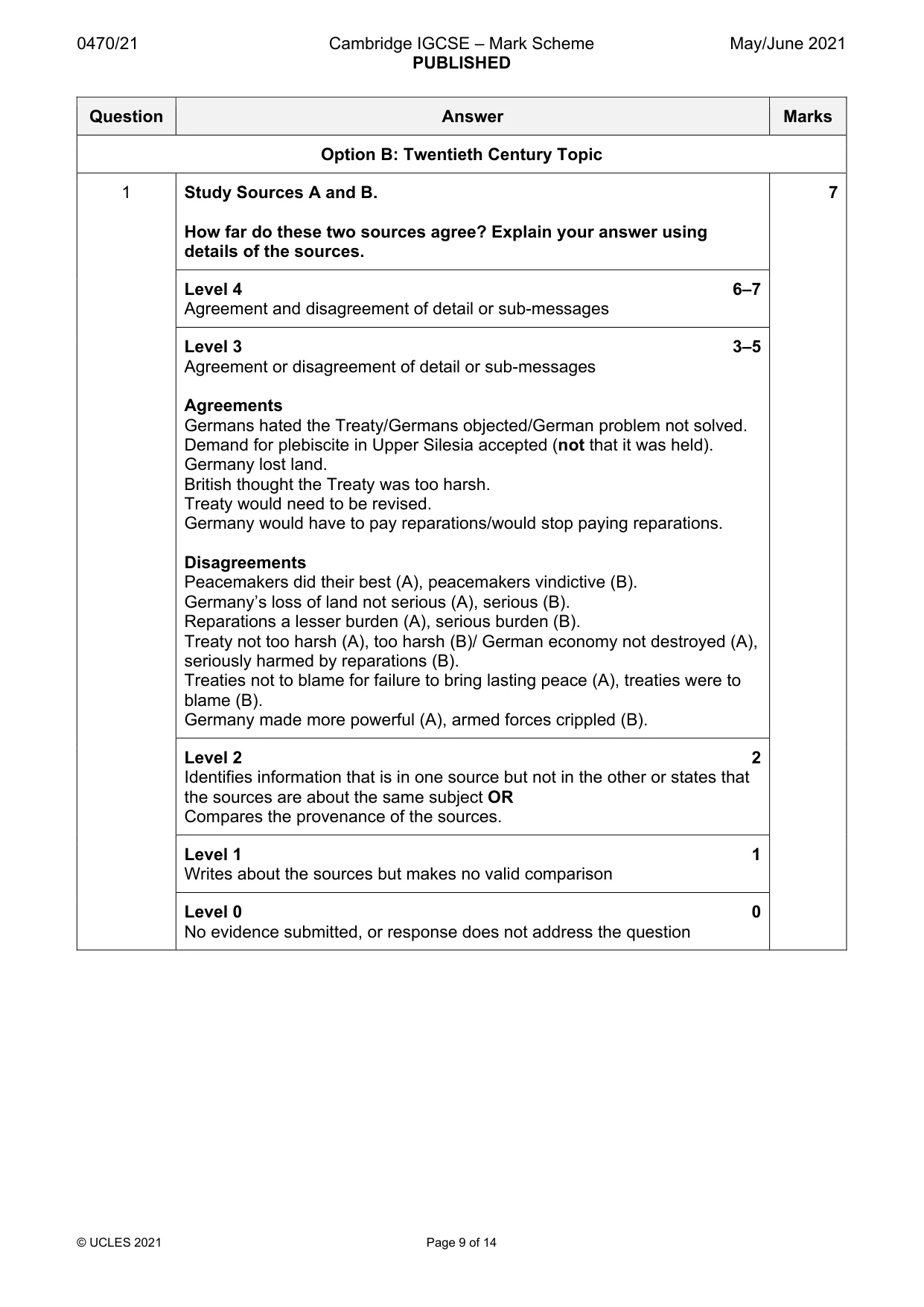
0470/21 Cambridge IGCSE – Mark Scheme PUBLISHED May/June 2021 © UCLES 2021 Page 9 of 14 Question Answer Marks Option B: Twentieth Century Topic 1 Study Sources A and B. How far do these two sources agree? Explain your answer using details of the sources. 7 Level 4 6–7 Agreement and disagreement of detail or sub-messages Level 3 3–5 Agreement or disagreement of detail or sub-messages Agreements Germans hated the Treaty/Germans objected/German problem not solved. Demand for plebiscite in Upper Silesia accepted (not that it was held). Germany lost land. British thought the Treaty was too harsh. Treaty would need to be revised. Germany would have to pay reparations/would stop paying reparations. Disagreements Peacemakers did their best (A), peacemakers vindictive (B). Germany’s loss of land not serious (A), serious (B). Reparations a lesser burden (A), serious burden (B). Treaty not too harsh (A), too harsh (B)/ German economy not destroyed (A), seriously harmed by reparations (B). Treaties not to blame for failure to bring lasting peace (A), treaties were to blame (B). Germany made more powerful (A), armed forces crippled (B). Level 2 2 Identifies information that is in one source but not in the other or states that the sources are about the same subject OR Compares the provenance of the sources. Level 1 1 Writes about the sources but makes no valid comparison Level 0 0 No evidence submitted, or response does not address the question
Mark scheme, page 10
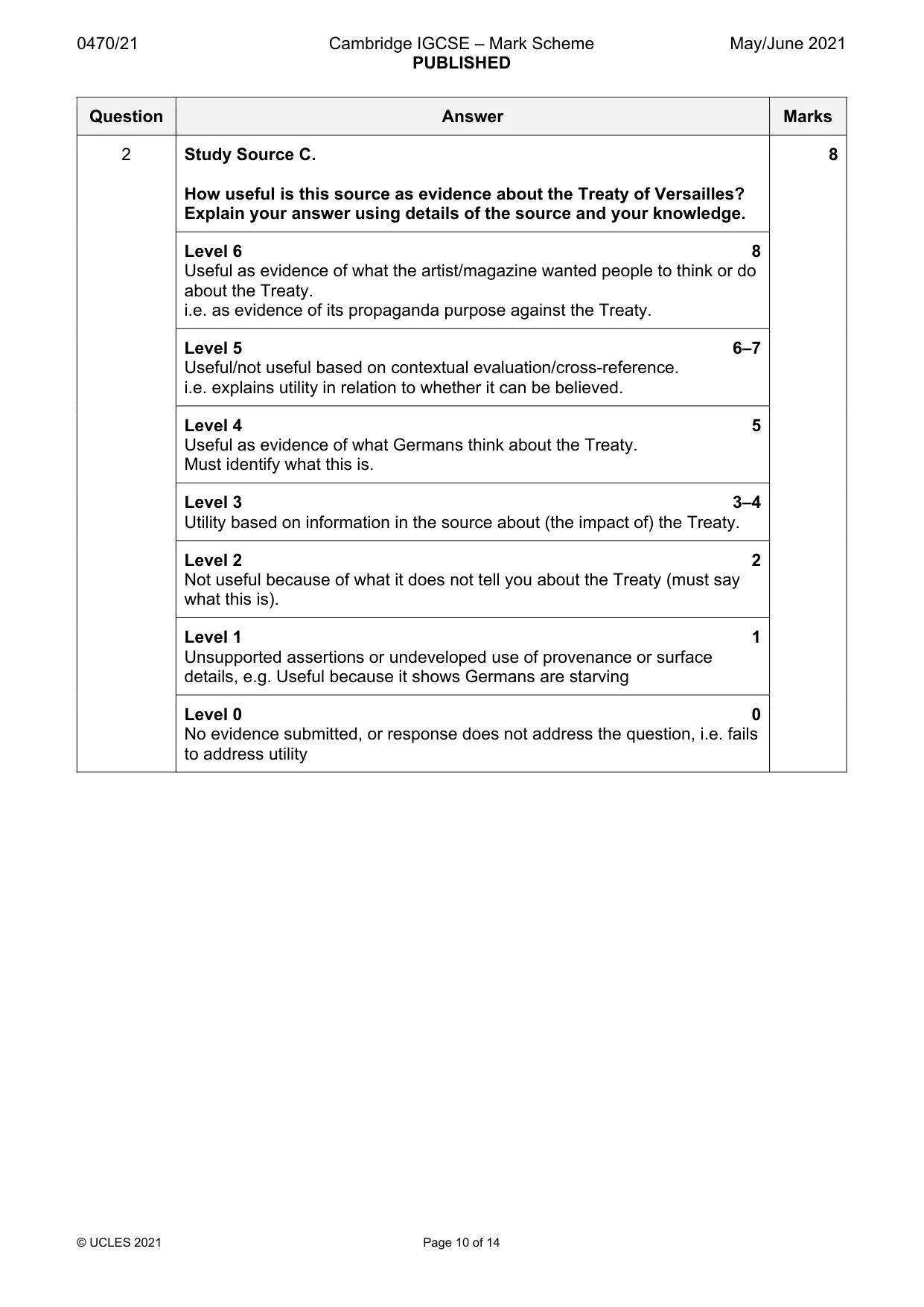
0470/21 Cambridge IGCSE – Mark Scheme PUBLISHED May/June 2021 © UCLES 2021 Page 10 of 14 Question Answer Marks 2 Study Source C. How useful is this source as evidence about the Treaty of Versailles? Explain your answer using details of the source and your knowledge. 8 Level 6 8 Useful as evidence of what the artist/magazine wanted people to think or do about the Treaty. i.e. as evidence of its propaganda purpose against the Treaty. Level 5 6–7 Useful/not useful based on contextual evaluation/cross-reference. i.e. explains utility in relation to whether it can be believed. Level 4 5 Useful as evidence of what Germans think about the Treaty. Must identify what this is. Level 3 3–4 Utility based on information in the source about (the impact of) the Treaty. Level 2 2 Not useful because of what it does not tell you about the Treaty (must say what this is). Level 1 1 Unsupported assertions or undeveloped use of provenance or surface details, e.g. Useful because it shows Germans are starving Level 0 0 No evidence submitted, or response does not address the question, i.e. fails to address utility
Mark scheme, page 11
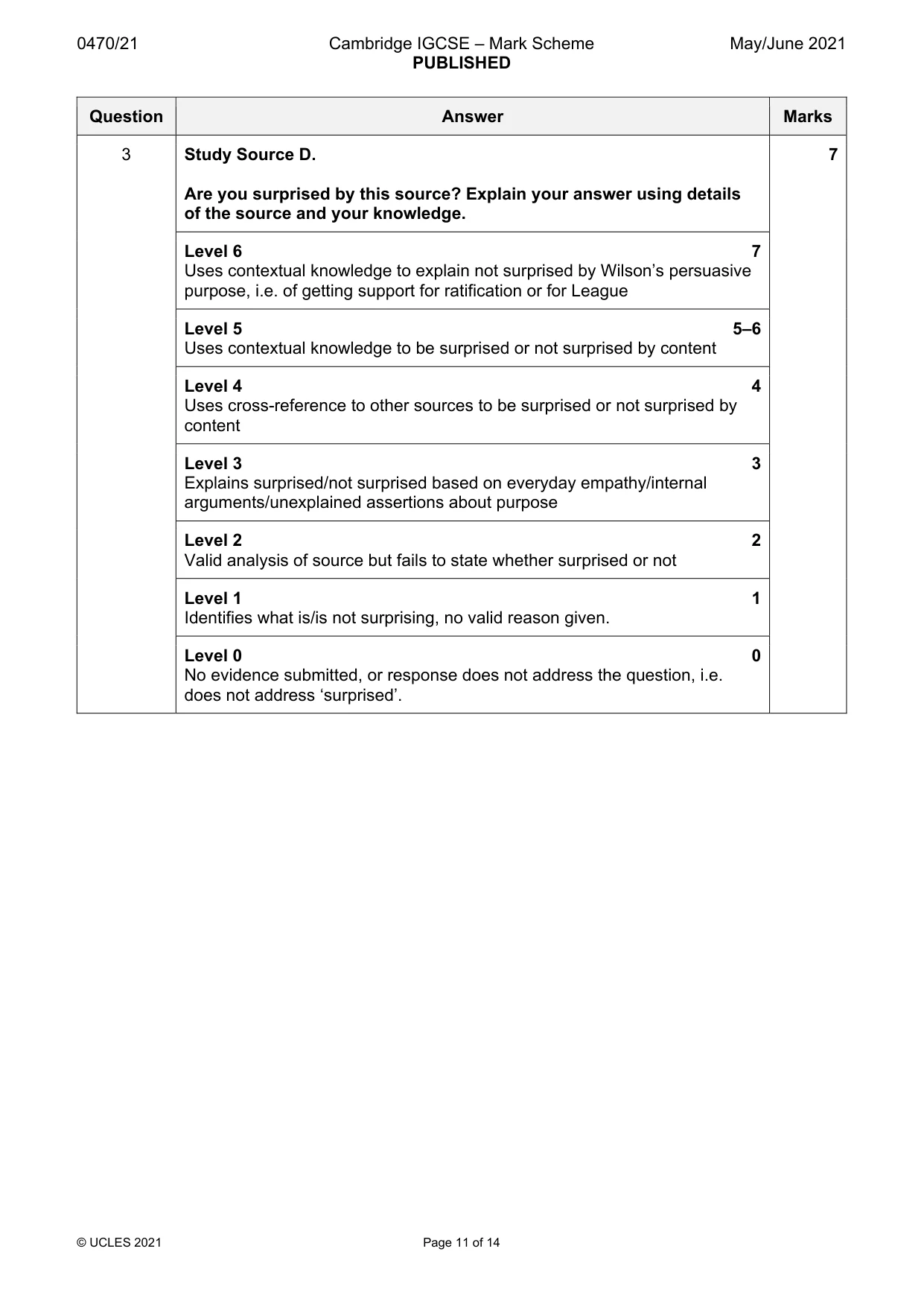
0470/21 Cambridge IGCSE – Mark Scheme PUBLISHED May/June 2021 © UCLES 2021 Page 11 of 14 Question Answer Marks 3 Study Source D. Are you surprised by this source? Explain your answer using details of the source and your knowledge. 7 Level 6 7 Uses contextual knowledge to explain not surprised by Wilson’s persuasive purpose, i.e. of getting support for ratification or for League Level 5 5–6 Uses contextual knowledge to be surprised or not surprised by content Level 4 4 Uses cross-reference to other sources to be surprised or not surprised by content Level 3 3 Explains surprised/not surprised based on everyday empathy/internal arguments/unexplained assertions about purpose Level 2 2 Valid analysis of source but fails to state whether surprised or not Level 1 1 Identifies what is/is not surprising, no valid reason given. Level 0 0 No evidence submitted, or response does not address the question, i.e. does not address ‘surprised’.
Mark scheme, page 12
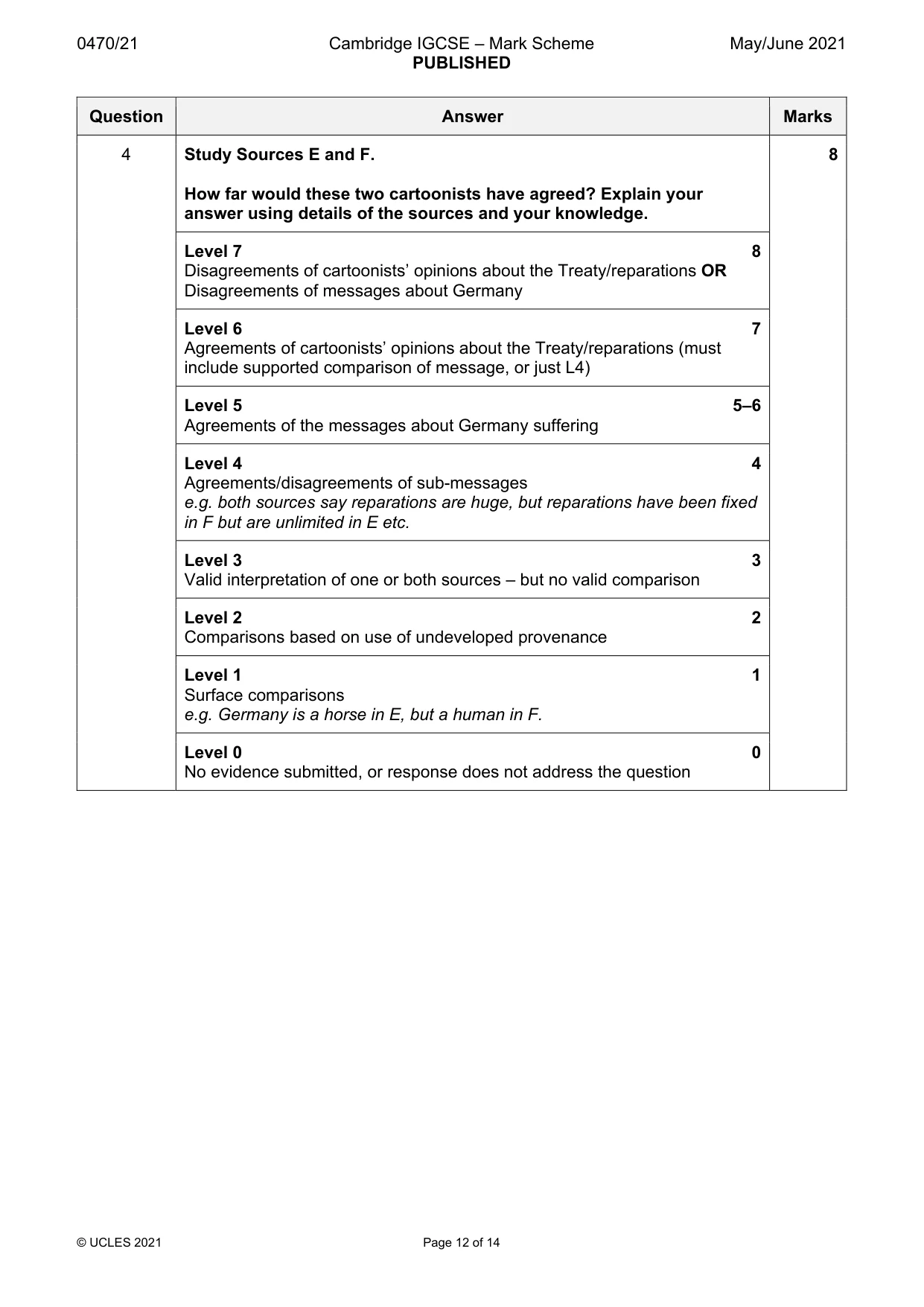
0470/21 Cambridge IGCSE – Mark Scheme PUBLISHED May/June 2021 © UCLES 2021 Page 12 of 14 Question Answer Marks 4 Study Sources E and F. How far would these two cartoonists have agreed? Explain your answer using details of the sources and your knowledge. 8 Level 7 8 Disagreements of cartoonists’ opinions about the Treaty/reparations OR Disagreements of messages about Germany Level 6 7 Agreements of cartoonists’ opinions about the Treaty/reparations (must include supported comparison of message, or just L4) Level 5 5–6 Agreements of the messages about Germany suffering Level 4 4 Agreements/disagreements of sub-messages e.g. both sources say reparations are huge, but reparations have been fixed in F but are unlimited in E etc. Level 3 3 Valid interpretation of one or both sources – but no valid comparison Level 2 2 Comparisons based on use of undeveloped provenance Level 1 1 Surface comparisons e.g. Germany is a horse in E, but a human in F. Level 0 0 No evidence submitted, or response does not address the question
Mark scheme, page 13
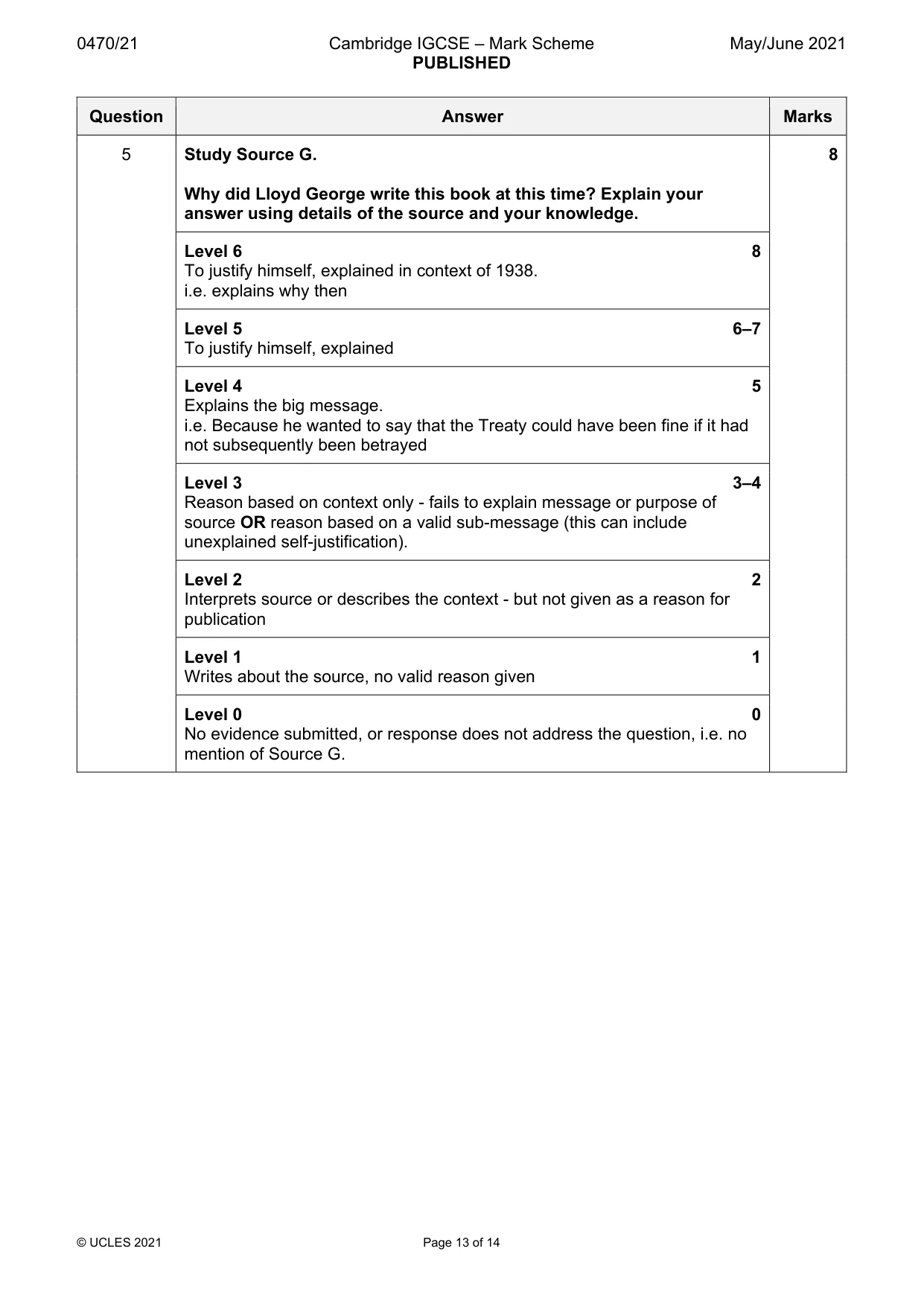
0470/21 Cambridge IGCSE – Mark Scheme PUBLISHED May/June 2021 © UCLES 2021 Page 13 of 14 Question Answer Marks 5 Study Source G. Why did Lloyd George write this book at this time? Explain your answer using details of the source and your knowledge. 8 Level 6 8 To justify himself, explained in context of 1938. i.e. explains why then Level 5 6–7 To justify himself, explained Level 4 5 Explains the big message. i.e. Because he wanted to say that the Treaty could have been fine if it had not subsequently been betrayed Level 3 3–4 Reason based on context only - fails to explain message or purpose of source OR reason based on a valid sub-message (this can include unexplained self-justification). Level 2 2 Interprets source or describes the context - but not given as a reason for publication Level 1 1 Writes about the source, no valid reason given Level 0 0 No evidence submitted, or response does not address the question, i.e. no mention of Source G.
Mark scheme, page 14
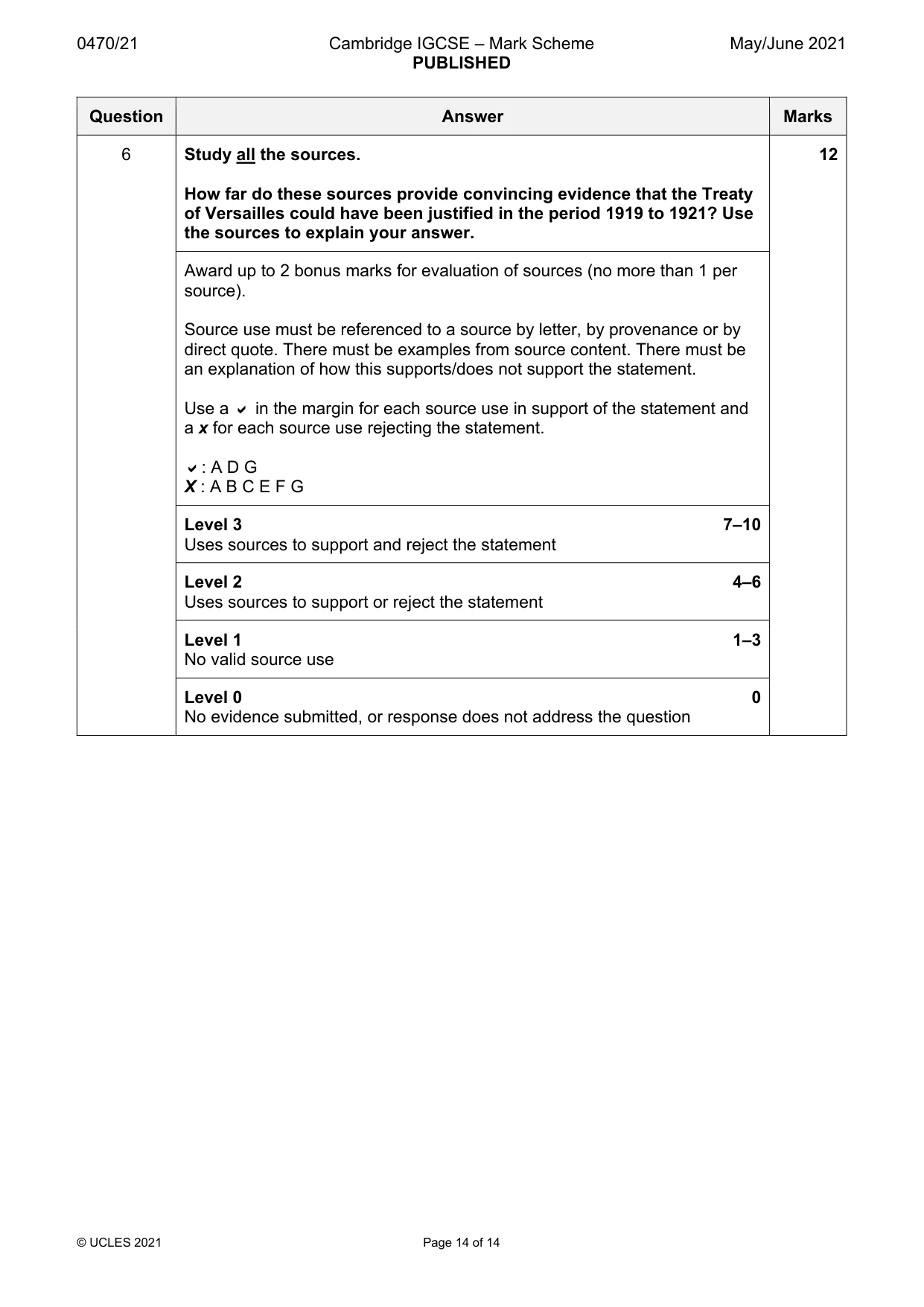
0470/21 Cambridge IGCSE – Mark Scheme PUBLISHED May/June 2021 © UCLES 2021 Page 14 of 14 Question Answer Marks 6 Study all the sources. How far do these sources provide convincing evidence that the Treaty of Versailles could have been justified in the period 1919 to 1921? Use the sources to explain your answer. 12 Award up to 2 bonus marks for evaluation of sources (no more than 1 per source). Source use must be referenced to a source by letter, by provenance or by direct quote. There must be examples from source content. There must be an explanation of how this supports/does not support the statement. Use a in the margin for each source use in support of the statement and a x for each source use rejecting the statement. : A D G X : A B C E F G Level 3 7–10 Uses sources to support and reject the statement Level 2 4–6 Uses sources to support or reject the statement Level 1 1–3 No valid source use Level 0 0 No evidence submitted, or response does not address the question
What you needed in this session
Cambridge’s own grade thresholds for 2021 May/June, Paper 2 · Variant 1. A higher threshold means an easier paper — the bar moves with how the cohort did.