Cambridge IGCSE History 0470 — 2021 May/June Paper 2 · Variant 2
0470/22/M/J/21 · 50 marks · ≈56 min
The question paper and its mark scheme, free to read here and free to download. This is Cambridge’s own paper, exactly as it was sat.
Question paper12 pages
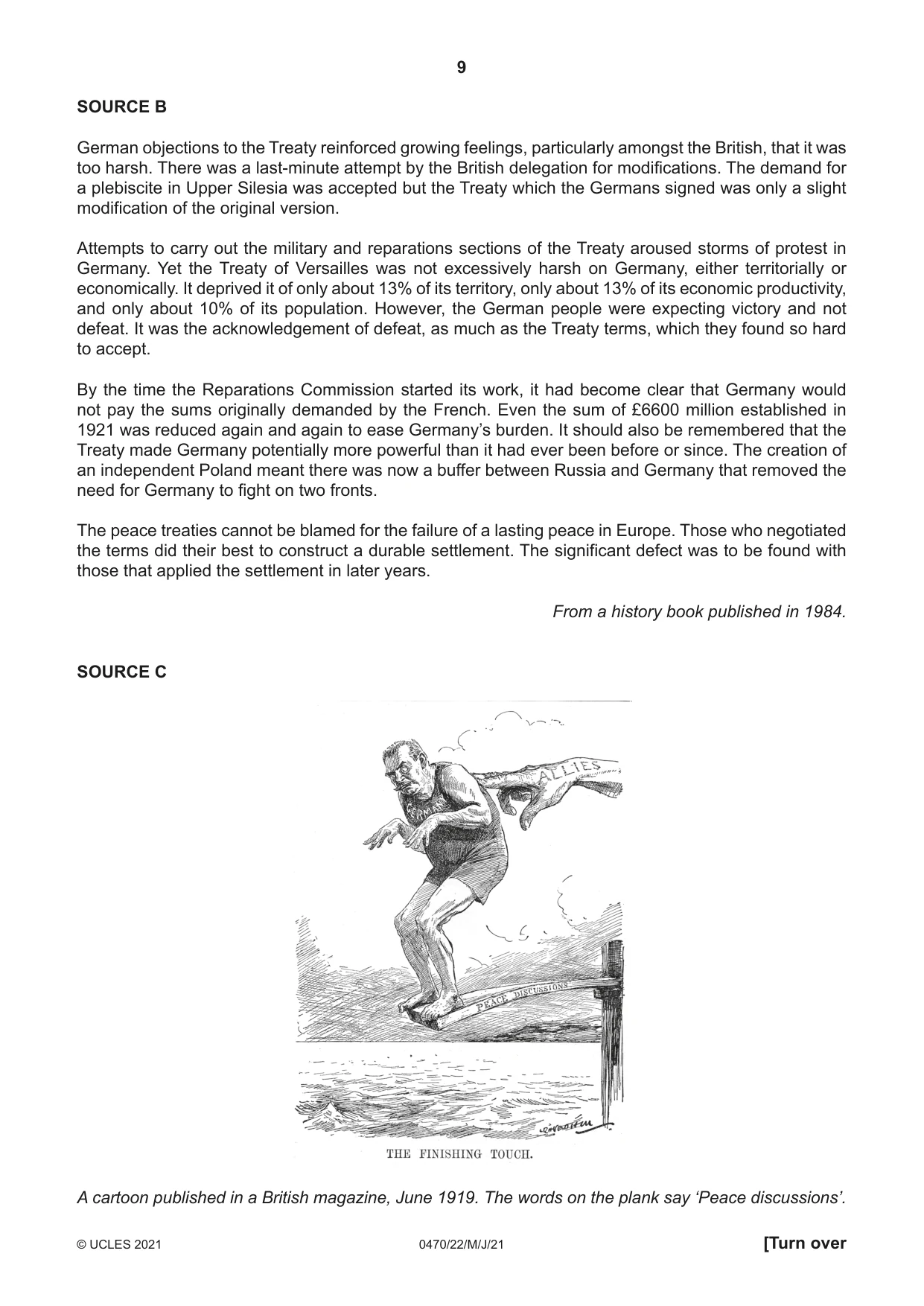
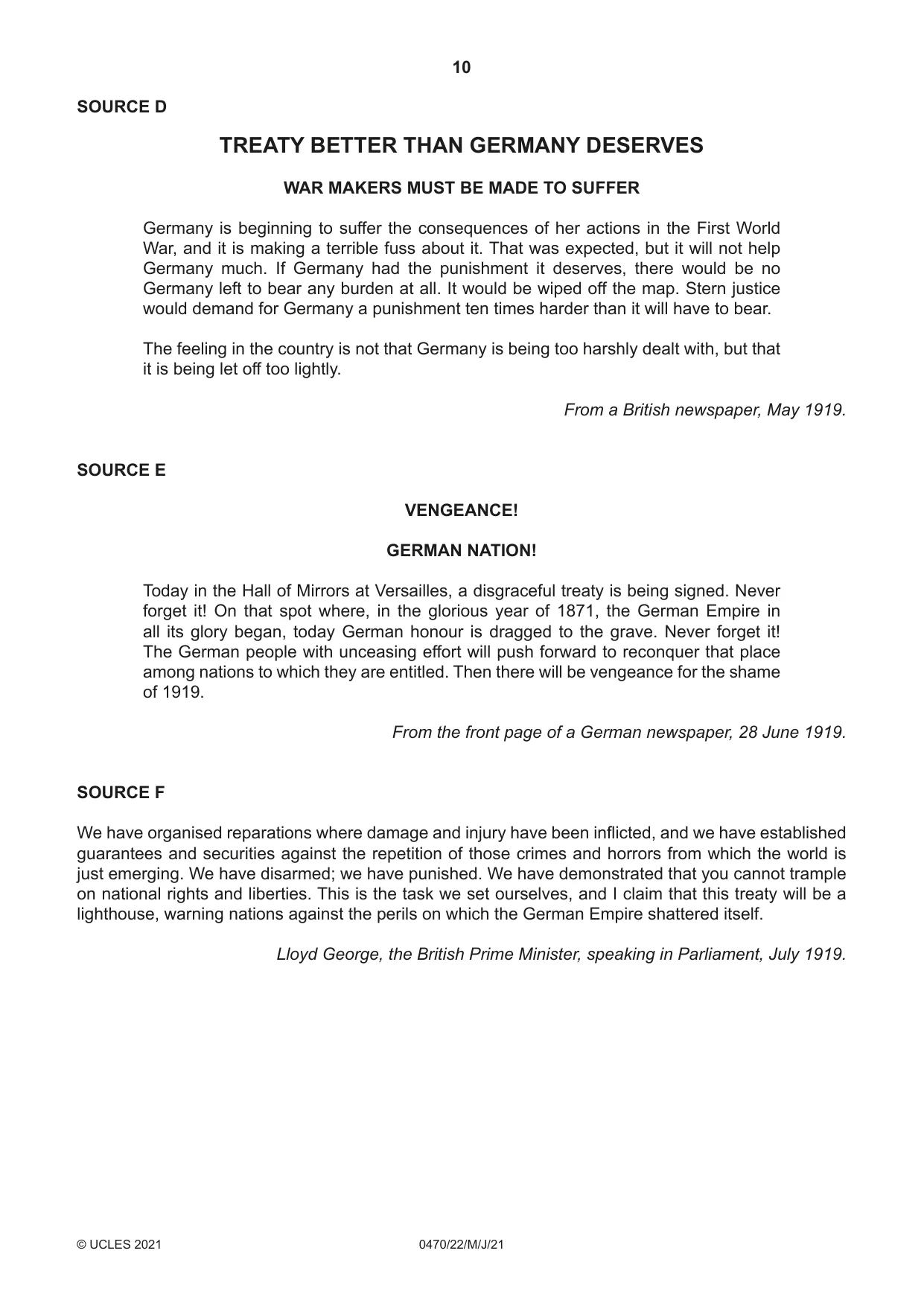
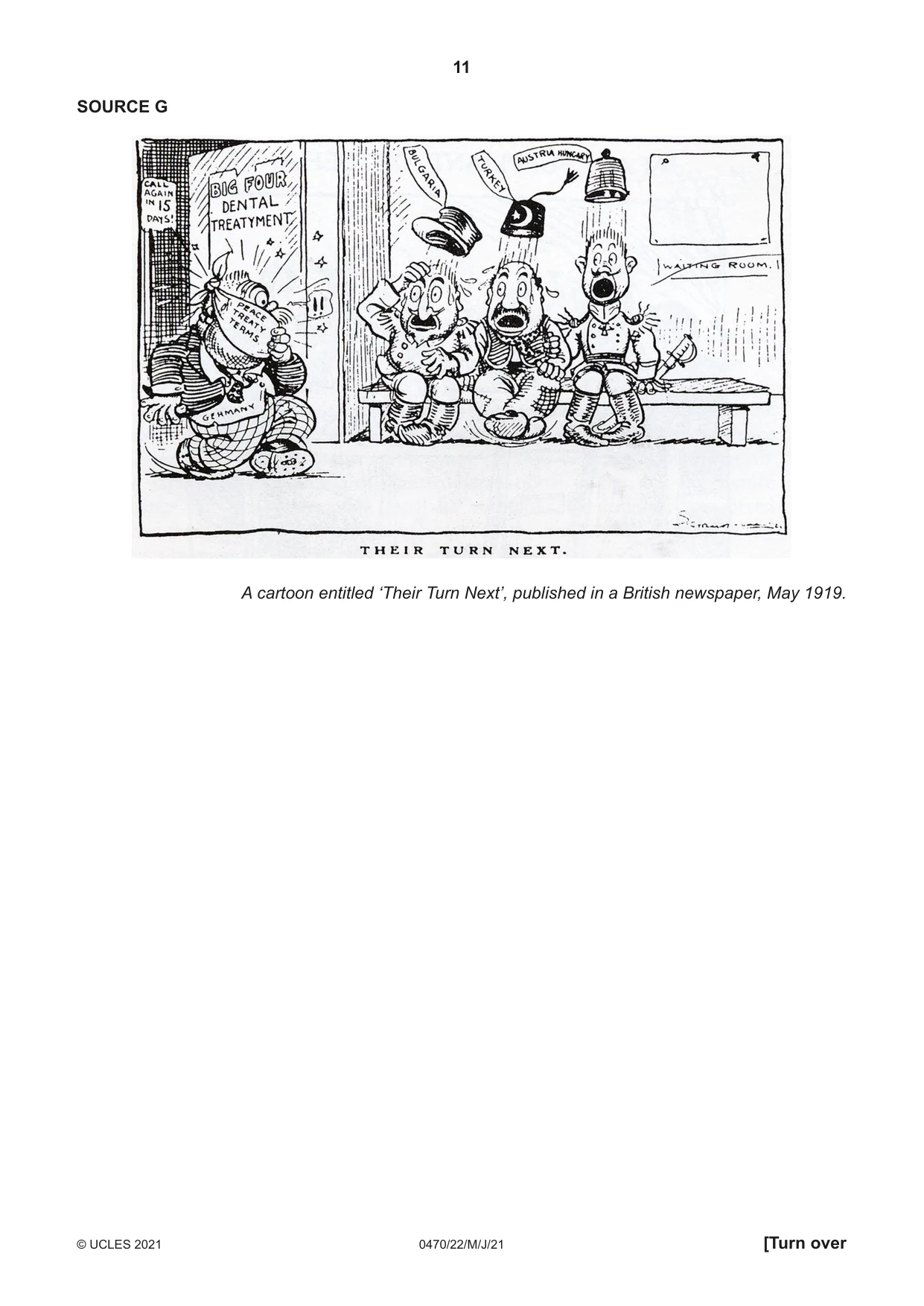
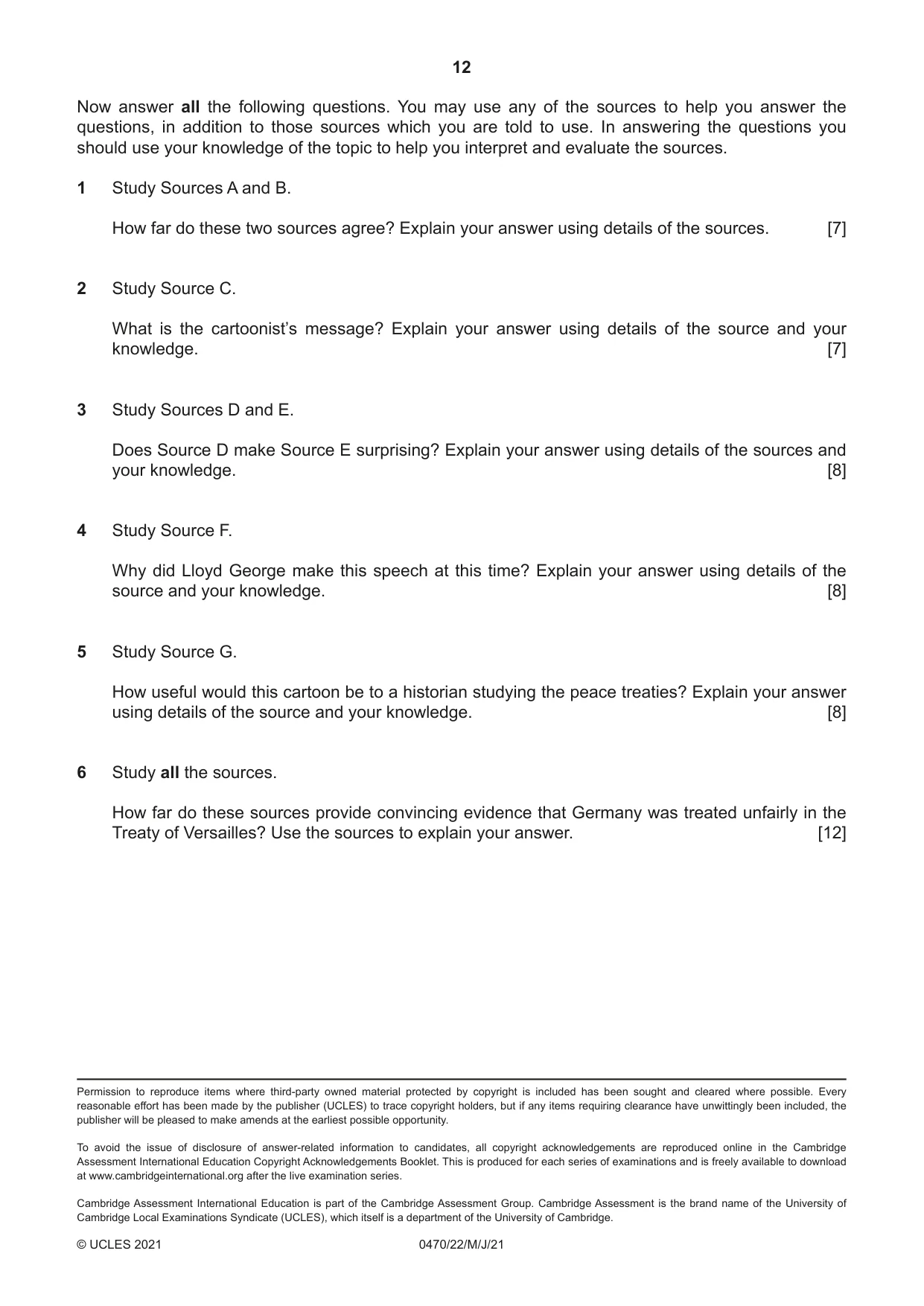
Mark scheme14 pages
Answers below. Sit the paper first if you are practising.
Paper as text
Question paper, page 1
Cambridge IGCSE™ This document has 12 pages. * 6 8 0 7 7 9 1 3 4 4 * DC (LEG/CGW) 200215/3 © UCLES 2021 [Turn over HISTORY 0470/22 Paper 2 May/June 2021 2 hours You must answer on the enclosed answer booklet. You will need: Answer booklet (enclosed) INSTRUCTIONS ● Answer all the questions on one option only. Option A: Nineteenth century topic Option B: Twentieth century topic ● Follow the instructions on the front cover of the answer booklet. If you need additional answer paper, ask the invigilator for a continuation booklet. INFORMATION ● The total mark for this paper is 50. ● The number of marks for each question or part question is shown in brackets [ ].
Question paper, page 2
2 0470/22/M/J/21 © UCLES 2021 Option A: Nineteenth century topic WAS AUSTRIA THE MOST IMPORTANT OBSTACLE TO ITALIAN UNIFICATION? Study the Background Information and the sources carefully, and then answer all the questions. Background Information There were many obstacles to Italian unification. Austria, which directly governed parts of Italy, and had influence over the rest, was ready to fight to retain its position in the country. However, there were other important obstacles. Few people in Italy felt ‘Italian’. Their loyalties were more local. Italians in the North and South had little in common and actually felt contempt for each other. There were many differences even among the small number who wanted unification. For example, some were republicans, while others wanted a constitutional monarchy. Some wanted complete unification while others would have been happy with a federation. The Papacy was another obstacle. And then there were foreign powers, such as France under Napoleon III, which were always ready to meddle in Italian affairs, not always to the advantage of the cause of unification. So, how important was Austria as an obstacle to Italian unification? SOURCE A Foreign rule, perhaps because it was remote and relatively free from involvement in local rivalries, found a positive welcome among many people in Italy. The main obstruction in the way of the patriotic movement was not foreign government but the slowness of the great bulk of Italians to accept or even understand the idea of Italy. The individual regions of the peninsula kept their own distinct character and no one region could aim for a leading position without the others reacting against it. Also, the Papal States stretched from one side of the peninsula to the other, an apparent obstacle to any political union of north and south Italy. Because local forces were so weak, foreign help was needed to bring Italians together. Only when one or more European powers developed a serious interest in creating a strong Italy would a political risorgimento become possible in practice. However, the settlement of 1815 left Austria so much in command all over Italy that none of the local rulers had any influence over it. Most of them felt that without Austrian support they might well lose their thrones. Only when France was stronger would the nationalists of Italy have a possible ally against Austria. From a history book published in 1968.
Question paper, page 3
3 0470/22/M/J/21 © UCLES 2021 [Turn over SOURCE B Mazzini was one of the first major figures to take up the idea of national unity but his ideas only made progress with a small group of well-educated revolutionaries. For a time Pope Pius IX appeared as a possible leader of a federation of Italian states but the Papacy presented Italian patriots with a huge problem. Because of its universal character it could appeal for foreign support against any threat. The Papacy blocked the development of any national concept and encouraged Italian principalities in their rivalries and enmities. Regional traditions and loyalties were an enormous obstacle to common action. Only 2.5% of people in Italy actually spoke Italian. The vast majority were peasants who were largely illiterate and had no understanding of political ideas. Local loyalties were more important to most Italians than ideas of national unity. It was true to say there were no Italians; only Neapolitans, Piedmontese, Tuscans and the rest. However, Austria remained as the most important barrier to unification. It was in Austria’s interest to keep control of much of Italy and to keep it as a group of separate states, as it provided a large proportion of its taxes. Austrian troops put down rebellions in Italy in 1821, 1831–2 and 1848–9. There was no coordination between the revolts but they did all show dislike of Austrian rule. The role of foreign powers in a future unification was constantly discussed by revolutionaries and nationalists. However, for many there was a major problem in substituting one foreign master for another by appealing for French aid to help get rid of the hated Austrians. From a recent history book. SOURCE C We, out of love for our common race and supported by public opinion, hasten to associate ourselves with the admiration Italy feels for you. Peoples of Lombardy and Venetia, our forces, which were concentrating on your frontier when you liberated your glorious Milan from the Austrians, are now coming to offer you the help which a brother expects from a brother. In order to show more openly our feelings of Italian brotherhood, we have ordered our troops as they move into Lombardy and Venice to carry the Cross of Savoy imposed on the tricolour flag of Italy. A proclamation issued by Charles Albert to the people of Lombardy and Venice, March 1848.
Question paper, page 4
4 0470/22/M/J/21 © UCLES 2021 SOURCE D Charles Albert had not been impatiently waiting to attack Austria. His army was entirely unprepared. It had no plans, and most of its strength was posted on the French frontier as a defence against the menace of republicanism. Four days were wasted at Turin deciding whether or not to fight. Then, with greatly superior forces, a slow advance took place which did nothing to trouble Radetzky. Garibaldi’s offer of help was turned down by Charles Albert on the grounds that to accept support from mere volunteers would be dishonourable to the army. The situation was made worse by political differences. Instead of trying to get support from the popular elements who had chiefly manned the barricades in Milan, Charles Albert preferred the small aristocratic element of Lombardy. Instead of concentrating on the war he held a plebiscite to achieve a political union of Lombardy and Venice with Piedmont. This aroused suspicions of Piedmontese expansion in Naples, Tuscany and Rome where many wanted a new union of Italy. Republicans and nationalists broke away from what looked like a royalist anti-revolutionary war. From a book by Gabrio Casati published in 1885. During the uprising in Milan, Casati was one of the aristocrats who took control to prevent the Republicans gaining power. He was ready to accept truce proposals from Radetzky while at the same time asking Charles Albert to intervene to expel the Austrians from Lombardy and to stop the radicals proclaiming a republican democracy. SOURCE E I do not respect the Italians. I knew that they would promise money to you and me, but would not give any; that they would promise to act but would do nothing. Can’t you see that they are prepared to be defeated one by one? Can’t you see that if they were real men they would have acted en masse, at least in the Papal States, when Muratori was at the gates of Bologna with his armed band? I have no respect for my compatriots. A letter from Giuseppe Mazzini to Nicola Fabrizi, November 1848. Fabrizi was a member of the Young Italy movement and was involved in expeditions with both Garibaldi and Mazzini.
Question paper, page 5
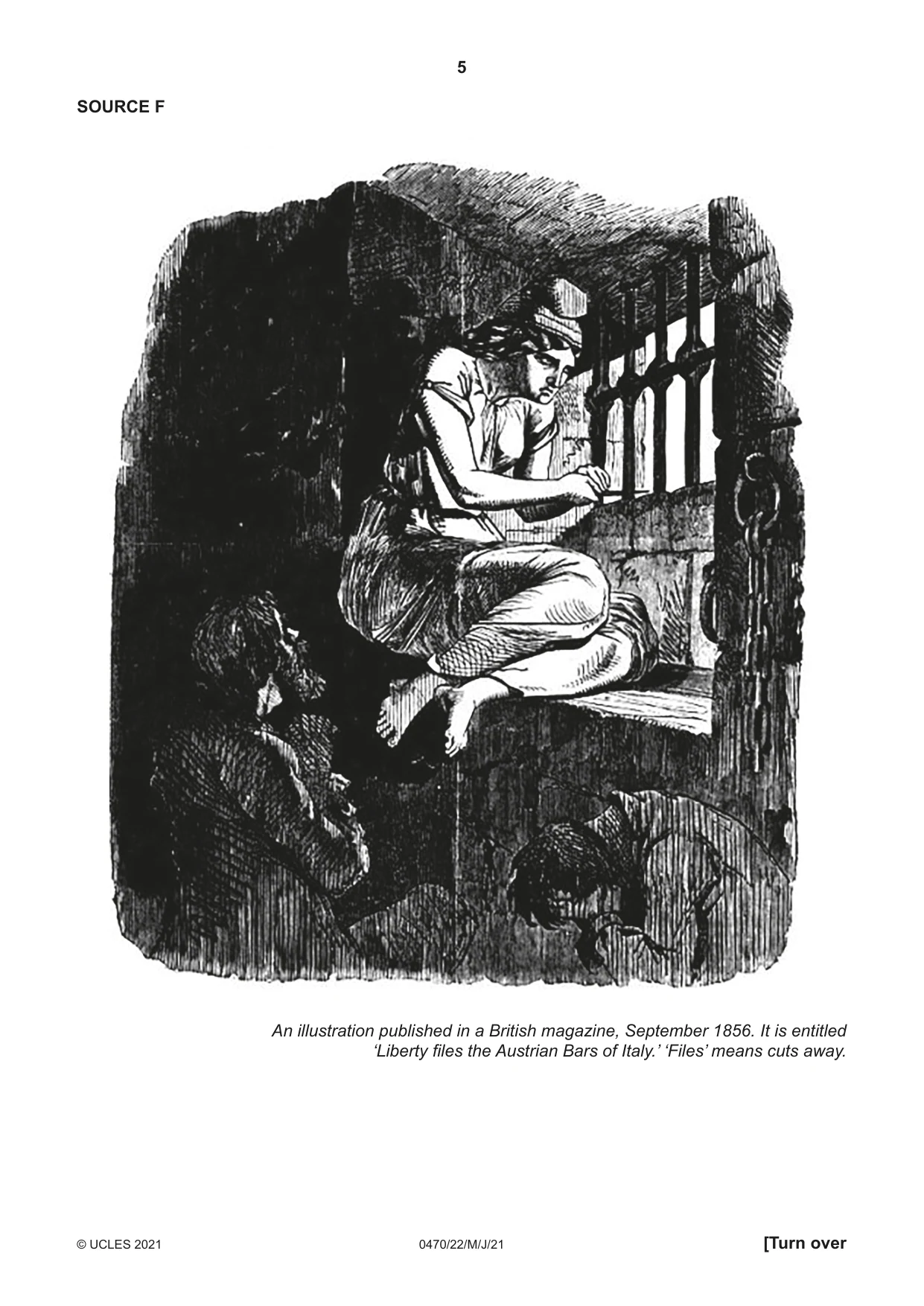
5 0470/22/M/J/21 © UCLES 2021 [Turn over SOURCE F An illustration published in a British magazine, September 1856. It is entitled ‘Liberty files the Austrian Bars of Italy.’ ‘Files’ means cuts away.
Question paper, page 6
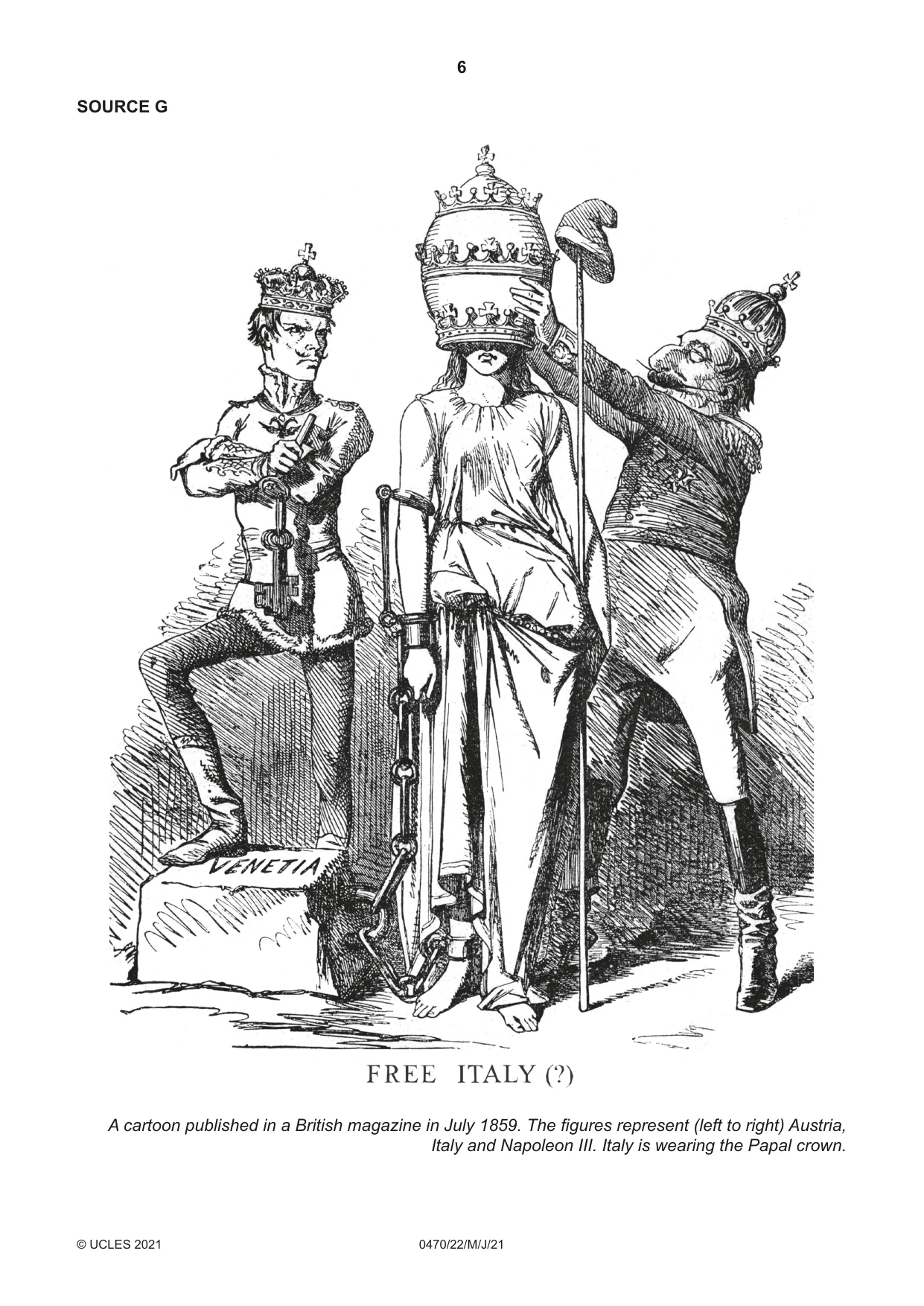
6 0470/22/M/J/21 © UCLES 2021 SOURCE G A cartoon published in a British magazine in July 1859. The figures represent (left to right) Austria, Italy and Napoleon III. Italy is wearing the Papal crown.
Question paper, page 7
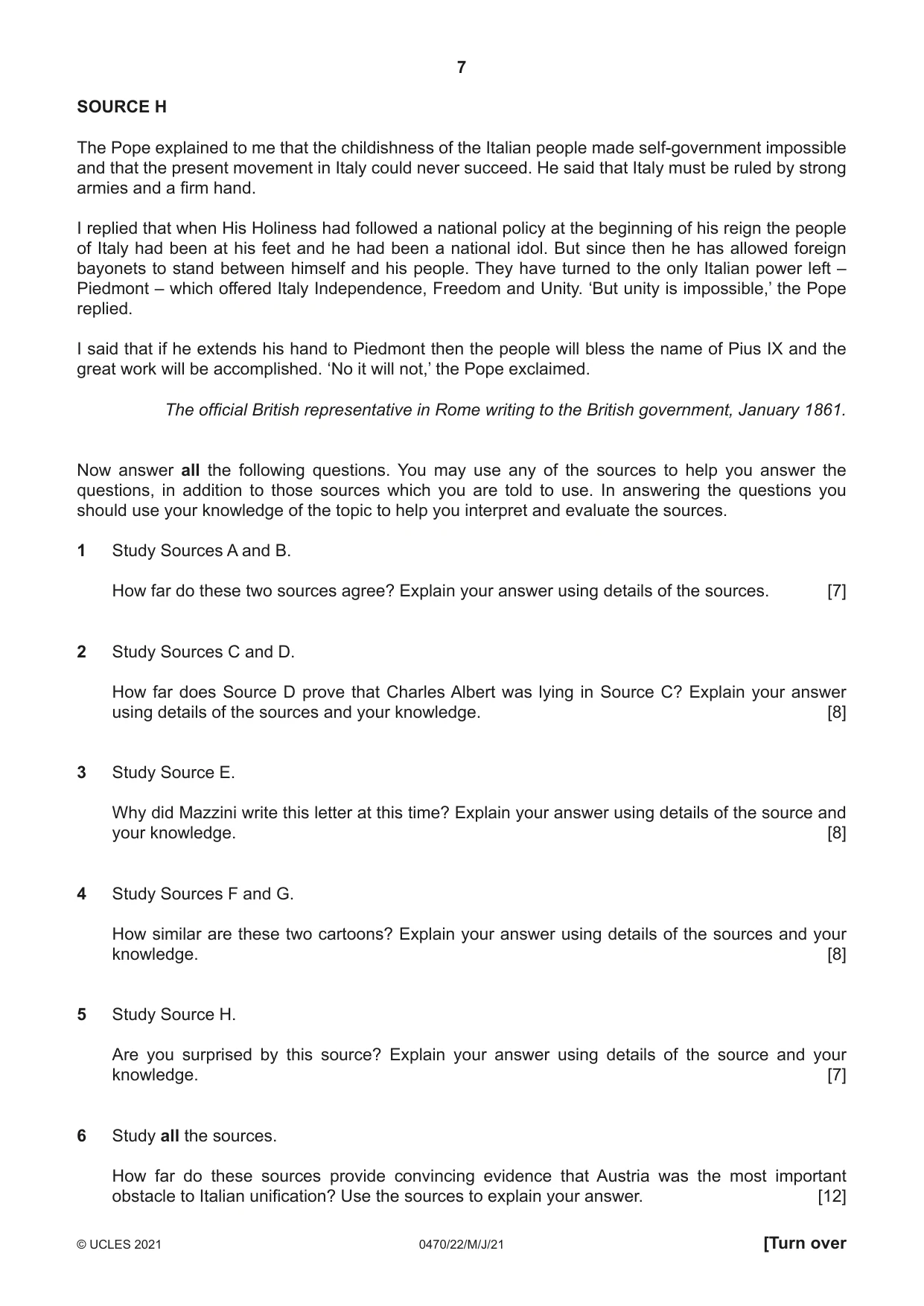
7 0470/22/M/J/21 © UCLES 2021 [Turn over SOURCE H The Pope explained to me that the childishness of the Italian people made self-government impossible and that the present movement in Italy could never succeed. He said that Italy must be ruled by strong armies and a firm hand. I replied that when His Holiness had followed a national policy at the beginning of his reign the people of Italy had been at his feet and he had been a national idol. But since then he has allowed foreign bayonets to stand between himself and his people. They have turned to the only Italian power left – Piedmont – which offered Italy Independence, Freedom and Unity. ‘But unity is impossible,’ the Pope replied. I said that if he extends his hand to Piedmont then the people will bless the name of Pius IX and the great work will be accomplished. ‘No it will not,’ the Pope exclaimed. The official British representative in Rome writing to the British government, January 1861. Now answer all the following questions. You may use any of the sources to help you answer the questions, in addition to those sources which you are told to use. In answering the questions you should use your knowledge of the topic to help you interpret and evaluate the sources. 1 Study Sources A and B. How far do these two sources agree? Explain your answer using details of the sources. [7] 2 Study Sources C and D. How far does Source D prove that Charles Albert was lying in Source C? Explain your answer using details of the sources and your knowledge. [8] 3 Study Source E. Why did Mazzini write this letter at this time? Explain your answer using details of the source and your knowledge. [8] 4 Study Sources F and G. How similar are these two cartoons? Explain your answer using details of the sources and your knowledge. [8] 5 Study Source H. Are you surprised by this source? Explain your answer using details of the source and your knowledge. [7] 6 Study all the sources. How far do these sources provide convincing evidence that Austria was the most important obstacle to Italian unification? Use the sources to explain your answer. [12]
Question paper, page 8
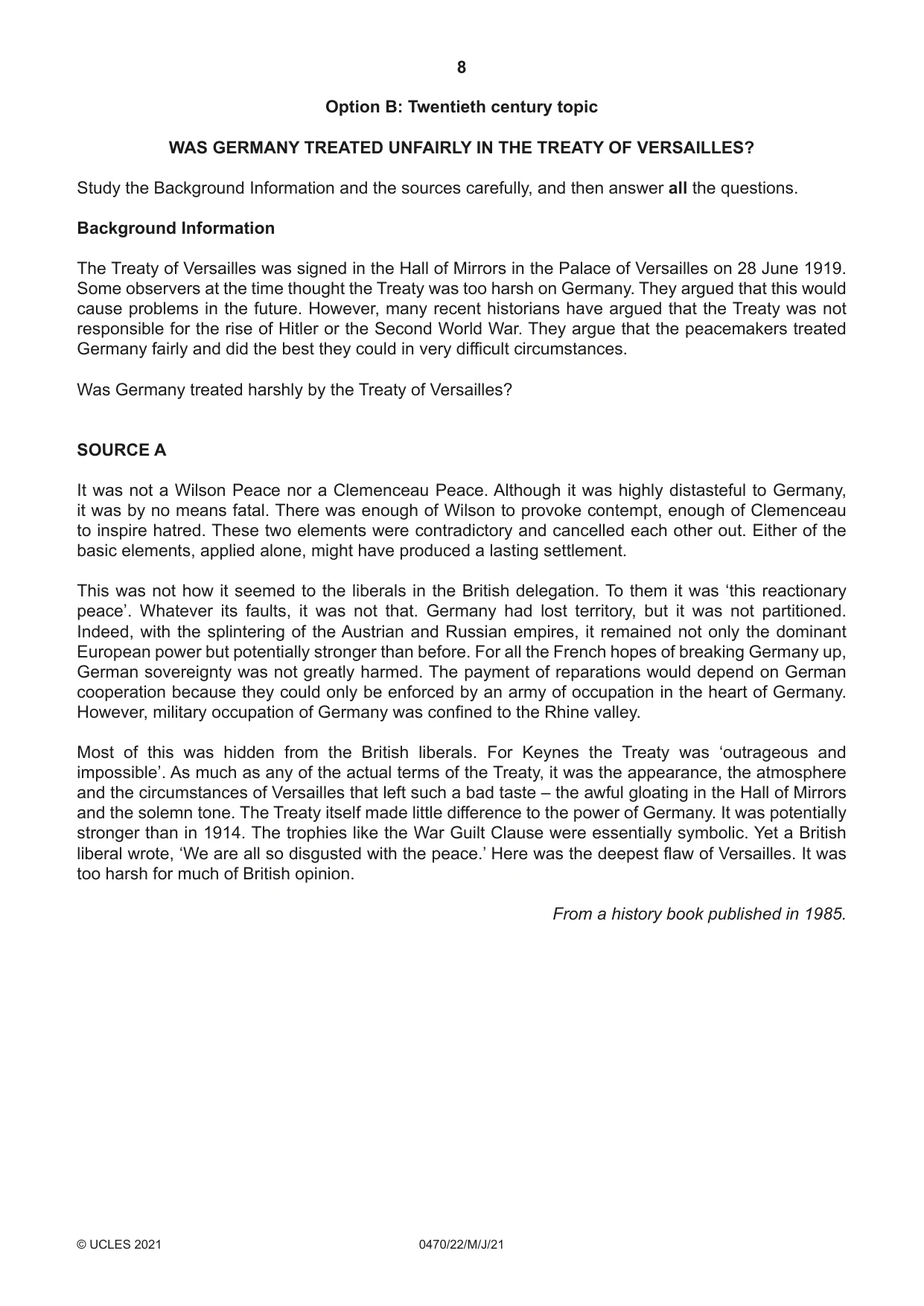
8 0470/22/M/J/21 © UCLES 2021 Option B: Twentieth century topic WAS GERMANY TREATED UNFAIRLY IN THE TREATY OF VERSAILLES? Study the Background Information and the sources carefully, and then answer all the questions. Background Information The Treaty of Versailles was signed in the Hall of Mirrors in the Palace of Versailles on 28 June 1919. Some observers at the time thought the Treaty was too harsh on Germany. They argued that this would cause problems in the future. However, many recent historians have argued that the Treaty was not responsible for the rise of Hitler or the Second World War. They argue that the peacemakers treated Germany fairly and did the best they could in very difficult circumstances. Was Germany treated harshly by the Treaty of Versailles? SOURCE A It was not a Wilson Peace nor a Clemenceau Peace. Although it was highly distasteful to Germany, it was by no means fatal. There was enough of Wilson to provoke contempt, enough of Clemenceau to inspire hatred. These two elements were contradictory and cancelled each other out. Either of the basic elements, applied alone, might have produced a lasting settlement. This was not how it seemed to the liberals in the British delegation. To them it was ‘this reactionary peace’. Whatever its faults, it was not that. Germany had lost territory, but it was not partitioned. Indeed, with the splintering of the Austrian and Russian empires, it remained not only the dominant European power but potentially stronger than before. For all the French hopes of breaking Germany up, German sovereignty was not greatly harmed. The payment of reparations would depend on German cooperation because they could only be enforced by an army of occupation in the heart of Germany. However, military occupation of Germany was confined to the Rhine valley. Most of this was hidden from the British liberals. For Keynes the Treaty was ‘outrageous and impossible’. As much as any of the actual terms of the Treaty, it was the appearance, the atmosphere and the circumstances of Versailles that left such a bad taste – the awful gloating in the Hall of Mirrors and the solemn tone. The Treaty itself made little difference to the power of Germany. It was potentially stronger than in 1914. The trophies like the War Guilt Clause were essentially symbolic. Yet a British liberal wrote, ‘We are all so disgusted with the peace.’ Here was the deepest flaw of Versailles. It was too harsh for much of British opinion. From a history book published in 1985.
Question paper, page 9
9 0470/22/M/J/21 © UCLES 2021 [Turn over SOURCE B German objections to the Treaty reinforced growing feelings, particularly amongst the British, that it was too harsh. There was a last-minute attempt by the British delegation for modifications. The demand for a plebiscite in Upper Silesia was accepted but the Treaty which the Germans signed was only a slight modification of the original version. Attempts to carry out the military and reparations sections of the Treaty aroused storms of protest in Germany. Yet the Treaty of Versailles was not excessively harsh on Germany, either territorially or economically. It deprived it of only about 13% of its territory, only about 13% of its economic productivity, and only about 10% of its population. However, the German people were expecting victory and not defeat. It was the acknowledgement of defeat, as much as the Treaty terms, which they found so hard to accept. By the time the Reparations Commission started its work, it had become clear that Germany would not pay the sums originally demanded by the French. Even the sum of £6600 million established in 1921 was reduced again and again to ease Germany’s burden. It should also be remembered that the Treaty made Germany potentially more powerful than it had ever been before or since. The creation of an independent Poland meant there was now a buffer between Russia and Germany that removed the need for Germany to fight on two fronts. The peace treaties cannot be blamed for the failure of a lasting peace in Europe. Those who negotiated the terms did their best to construct a durable settlement. The significant defect was to be found with those that applied the settlement in later years. From a history book published in 1984. SOURCE C A cartoon published in a British magazine, June 1919. The words on the plank say ‘Peace discussions’.
Question paper, page 10
10 0470/22/M/J/21 © UCLES 2021 SOURCE D TREATY BETTER THAN GERMANY DESERVES WAR MAKERS MUST BE MADE TO SUFFER Germany is beginning to suffer the consequences of her actions in the First World War, and it is making a terrible fuss about it. That was expected, but it will not help Germany much. If Germany had the punishment it deserves, there would be no Germany left to bear any burden at all. It would be wiped off the map. Stern justice would demand for Germany a punishment ten times harder than it will have to bear. The feeling in the country is not that Germany is being too harshly dealt with, but that it is being let off too lightly. From a British newspaper, May 1919. SOURCE E VENGEANCE! GERMAN NATION! Today in the Hall of Mirrors at Versailles, a disgraceful treaty is being signed. Never forget it! On that spot where, in the glorious year of 1871, the German Empire in all its glory began, today German honour is dragged to the grave. Never forget it! The German people with unceasing effort will push forward to reconquer that place among nations to which they are entitled. Then there will be vengeance for the shame of 1919. From the front page of a German newspaper, 28 June 1919. SOURCE F We have organised reparations where damage and injury have been inflicted, and we have established guarantees and securities against the repetition of those crimes and horrors from which the world is just emerging. We have disarmed; we have punished. We have demonstrated that you cannot trample on national rights and liberties. This is the task we set ourselves, and I claim that this treaty will be a lighthouse, warning nations against the perils on which the German Empire shattered itself. Lloyd George, the British Prime Minister, speaking in Parliament, July 1919.
Question paper, page 11
11 0470/22/M/J/21 © UCLES 2021 [Turn over SOURCE G A cartoon entitled ‘Their Turn Next’, published in a British newspaper, May 1919.
Question paper, page 12
12 0470/22/M/J/21 © UCLES 2021 Permission to reproduce items where third-party owned material protected by copyright is included has been sought and cleared where possible. Every reasonable effort has been made by the publisher (UCLES) to trace copyright holders, but if any items requiring clearance have unwittingly been included, the publisher will be pleased to make amends at the earliest possible opportunity. To avoid the issue of disclosure of answer-related information to candidates, all copyright acknowledgements are reproduced online in the Cambridge Assessment International Education Copyright Acknowledgements Booklet. This is produced for each series of examinations and is freely available to download at www.cambridgeinternational.org after the live examination series. Cambridge Assessment International Education is part of the Cambridge Assessment Group. Cambridge Assessment is the brand name of the University of Cambridge Local Examinations Syndicate (UCLES), which itself is a department of the University of Cambridge. Now answer all the following questions. You may use any of the sources to help you answer the questions, in addition to those sources which you are told to use. In answering the questions you should use your knowledge of the topic to help you interpret and evaluate the sources. 1 Study Sources A and B. How far do these two sources agree? Explain your answer using details of the sources. [7] 2 Study Source C. What is the cartoonist’s message? Explain your answer using details of the source and your knowledge. [7] 3 Study Sources D and E. Does Source D make Source E surprising? Explain your answer using details of the sources and your knowledge. [8] 4 Study Source F. Why did Lloyd George make this speech at this time? Explain your answer using details of the source and your knowledge. [8] 5 Study Source G. How useful would this cartoon be to a historian studying the peace treaties? Explain your answer using details of the source and your knowledge. [8] 6 Study all the sources. How far do these sources provide convincing evidence that Germany was treated unfairly in the Treaty of Versailles? Use the sources to explain your answer. [12]
Mark scheme, page 1
This document consists of 14 printed pages. © UCLES 2021 [Turn over Cambridge IGCSE™ HISTORY 0470/22 Paper 2 May/June 2021 MARK SCHEME Maximum Mark: 50 Published This mark scheme is published as an aid to teachers and candidates, to indicate the requirements of the examination. It shows the basis on which Examiners were instructed to award marks. It does not indicate the details of the discussions that took place at an Examiners’ meeting before marking began, which would have considered the acceptability of alternative answers. Mark schemes should be read in conjunction with the question paper and the Principal Examiner Report for Teachers. Cambridge International will not enter into discussions about these mark schemes. Cambridge International is publishing the mark schemes for the May/June 2021 series for most Cambridge IGCSE™, Cambridge International A and AS Level components and some Cambridge O Level components.
Mark scheme, page 2
0470/22 Cambridge IGCSE – Mark Scheme PUBLISHED May/June 2021 © UCLES 2021 Page 2 of 14 Generic Marking Principles These general marking principles must be applied by all examiners when marking candidate answers. They should be applied alongside the specific content of the mark scheme or generic level descriptors for a question. Each question paper and mark scheme will also comply with these marking principles. GENERIC MARKING PRINCIPLE 1: Marks must be awarded in line with: • the specific content of the mark scheme or the generic level descriptors for the question • the specific skills defined in the mark scheme or in the generic level descriptors for the question • the standard of response required by a candidate as exemplified by the standardisation scripts. GENERIC MARKING PRINCIPLE 2: Marks awarded are always whole marks (not half marks, or other fractions). GENERIC MARKING PRINCIPLE 3: Marks must be awarded positively: • marks are awarded for correct/valid answers, as defined in the mark scheme. However, credit is given for valid answers which go beyond the scope of the syllabus and mark scheme, referring to your Team Leader as appropriate • marks are awarded when candidates clearly demonstrate what they know and can do • marks are not deducted for errors • marks are not deducted for omissions • answers should only be judged on the quality of spelling, punctuation and grammar when these features are specifically assessed by the question as indicated by the mark scheme. The meaning, however, should be unambiguous. GENERIC MARKING PRINCIPLE 4: Rules must be applied consistently, e.g. in situations where candidates have not followed instructions or in the application of generic level descriptors. GENERIC MARKING PRINCIPLE 5: Marks should be awarded using the full range of marks defined in the mark scheme for the question (however; the use of the full mark range may be limited according to the quality of the candidate responses seen). GENERIC MARKING PRINCIPLE 6: Marks awarded are based solely on the requirements as defined in the mark scheme. Marks should not be awarded with grade thresholds or grade descriptors in mind.
Mark scheme, page 3
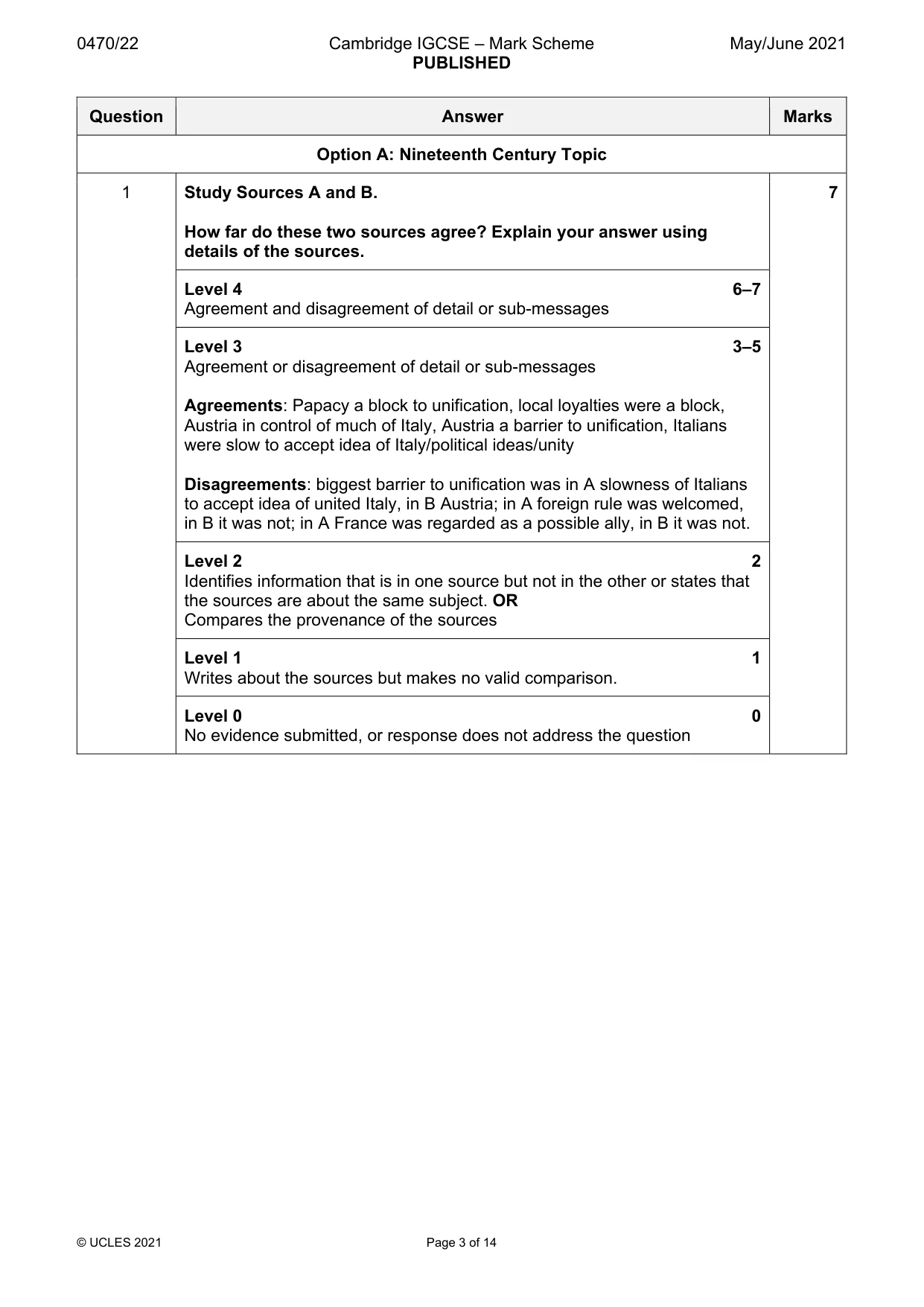
0470/22 Cambridge IGCSE – Mark Scheme PUBLISHED May/June 2021 © UCLES 2021 Page 3 of 14 Question Answer Marks Option A: Nineteenth Century Topic 1 Study Sources A and B. How far do these two sources agree? Explain your answer using details of the sources. 7 Level 4 6–7 Agreement and disagreement of detail or sub-messages Level 3 3–5 Agreement or disagreement of detail or sub-messages Agreements: Papacy a block to unification, local loyalties were a block, Austria in control of much of Italy, Austria a barrier to unification, Italians were slow to accept idea of Italy/political ideas/unity Disagreements: biggest barrier to unification was in A slowness of Italians to accept idea of united Italy, in B Austria; in A foreign rule was welcomed, in B it was not; in A France was regarded as a possible ally, in B it was not. Level 2 2 Identifies information that is in one source but not in the other or states that the sources are about the same subject. OR Compares the provenance of the sources Level 1 1 Writes about the sources but makes no valid comparison. Level 0 0 No evidence submitted, or response does not address the question
Mark scheme, page 4
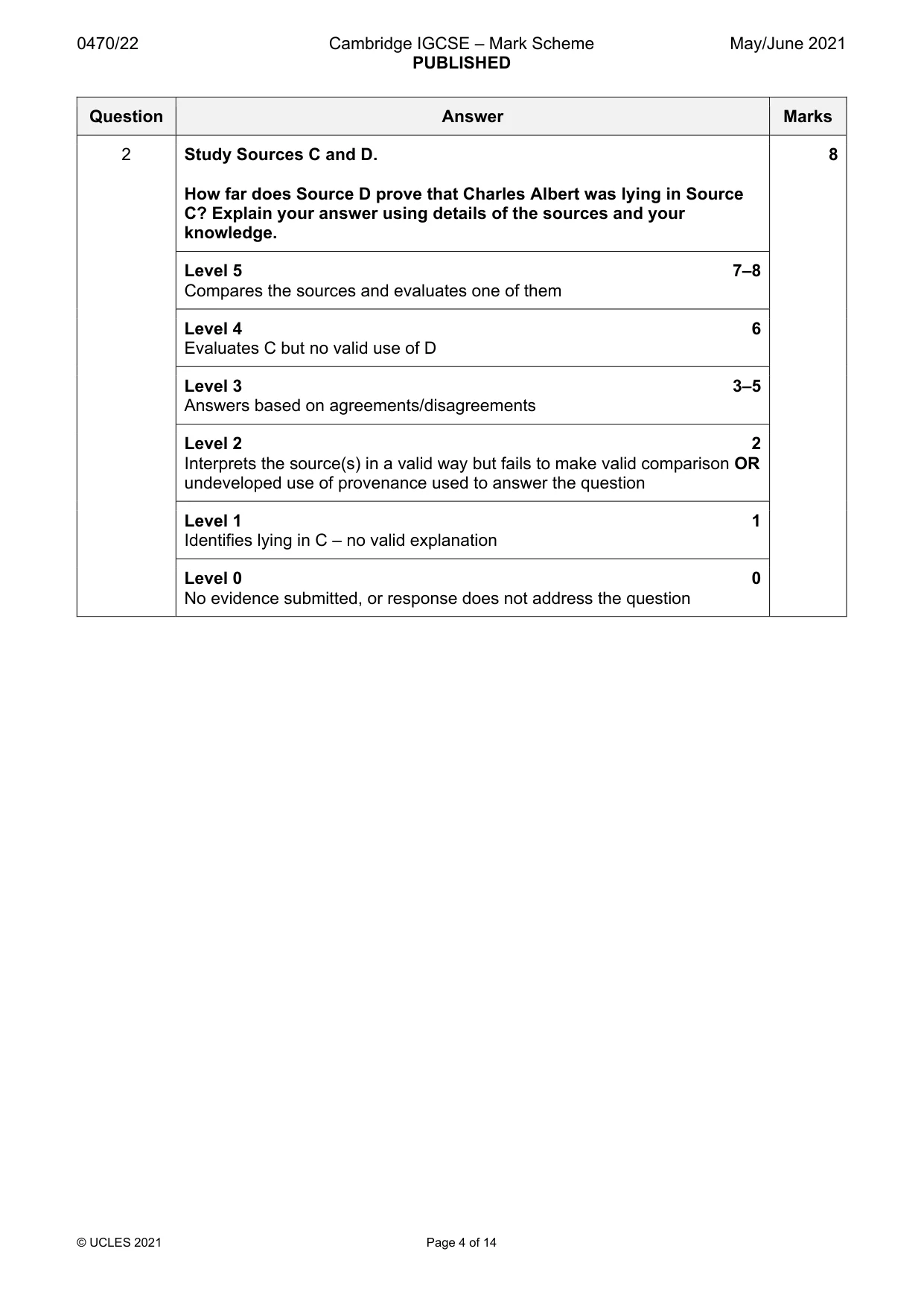
0470/22 Cambridge IGCSE – Mark Scheme PUBLISHED May/June 2021 © UCLES 2021 Page 4 of 14 Question Answer Marks 2 Study Sources C and D. How far does Source D prove that Charles Albert was lying in Source C? Explain your answer using details of the sources and your knowledge. 8 Level 5 7–8 Compares the sources and evaluates one of them Level 4 6 Evaluates C but no valid use of D Level 3 3–5 Answers based on agreements/disagreements Level 2 2 Interprets the source(s) in a valid way but fails to make valid comparison OR undeveloped use of provenance used to answer the question Level 1 1 Identifies lying in C – no valid explanation Level 0 0 No evidence submitted, or response does not address the question
Mark scheme, page 5
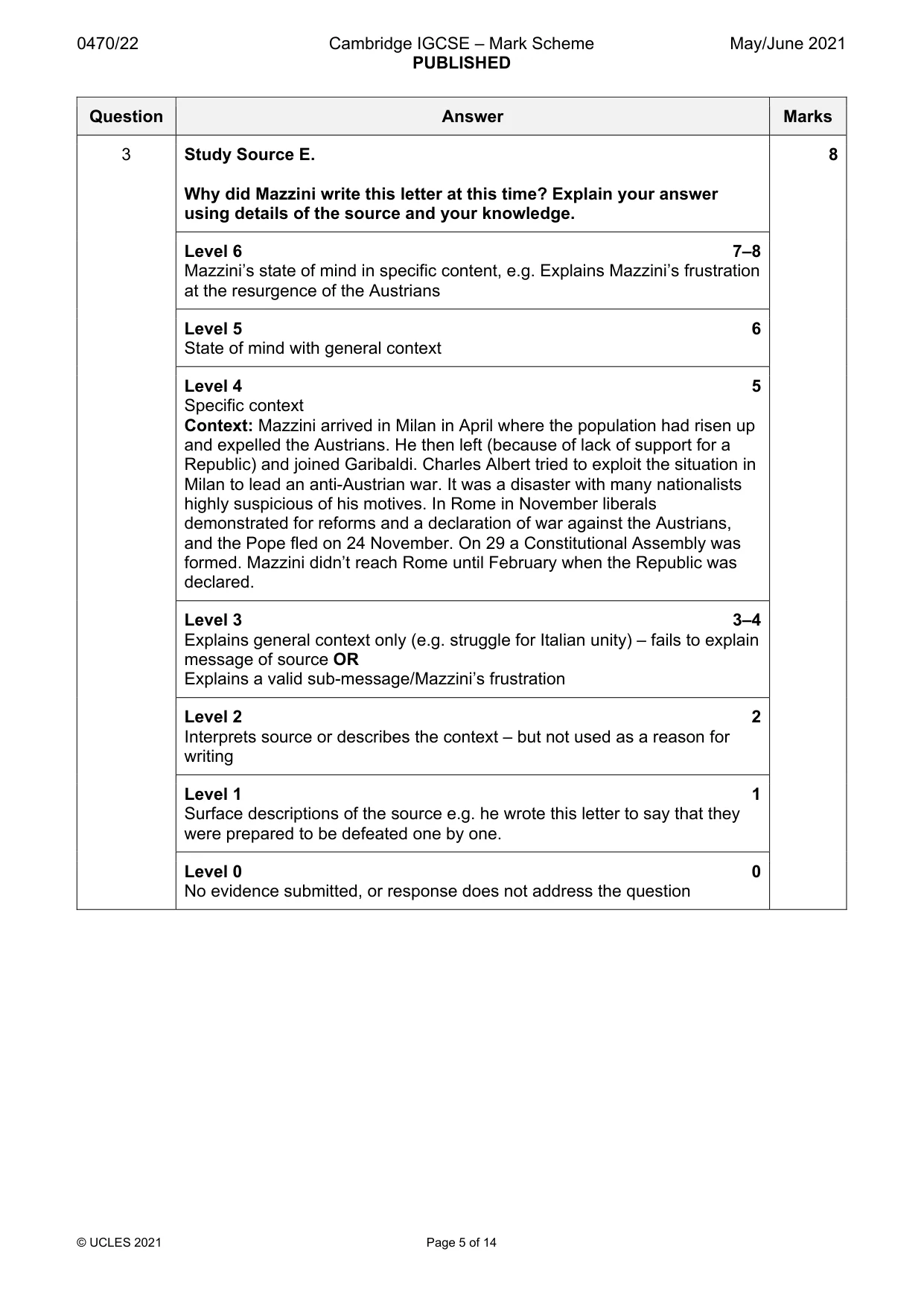
0470/22 Cambridge IGCSE – Mark Scheme PUBLISHED May/June 2021 © UCLES 2021 Page 5 of 14 Question Answer Marks 3 Study Source E. Why did Mazzini write this letter at this time? Explain your answer using details of the source and your knowledge. 8 Level 6 7–8 Mazzini’s state of mind in specific content, e.g. Explains Mazzini’s frustration at the resurgence of the Austrians Level 5 6 State of mind with general context Level 4 5 Specific context Context: Mazzini arrived in Milan in April where the population had risen up and expelled the Austrians. He then left (because of lack of support for a Republic) and joined Garibaldi. Charles Albert tried to exploit the situation in Milan to lead an anti-Austrian war. It was a disaster with many nationalists highly suspicious of his motives. In Rome in November liberals demonstrated for reforms and a declaration of war against the Austrians, and the Pope fled on 24 November. On 29 a Constitutional Assembly was formed. Mazzini didn’t reach Rome until February when the Republic was declared. Level 3 3–4 Explains general context only (e.g. struggle for Italian unity) – fails to explain message of source OR Explains a valid sub-message/Mazzini’s frustration Level 2 2 Interprets source or describes the context – but not used as a reason for writing Level 1 1 Surface descriptions of the source e.g. he wrote this letter to say that they were prepared to be defeated one by one. Level 0 0 No evidence submitted, or response does not address the question
Mark scheme, page 6
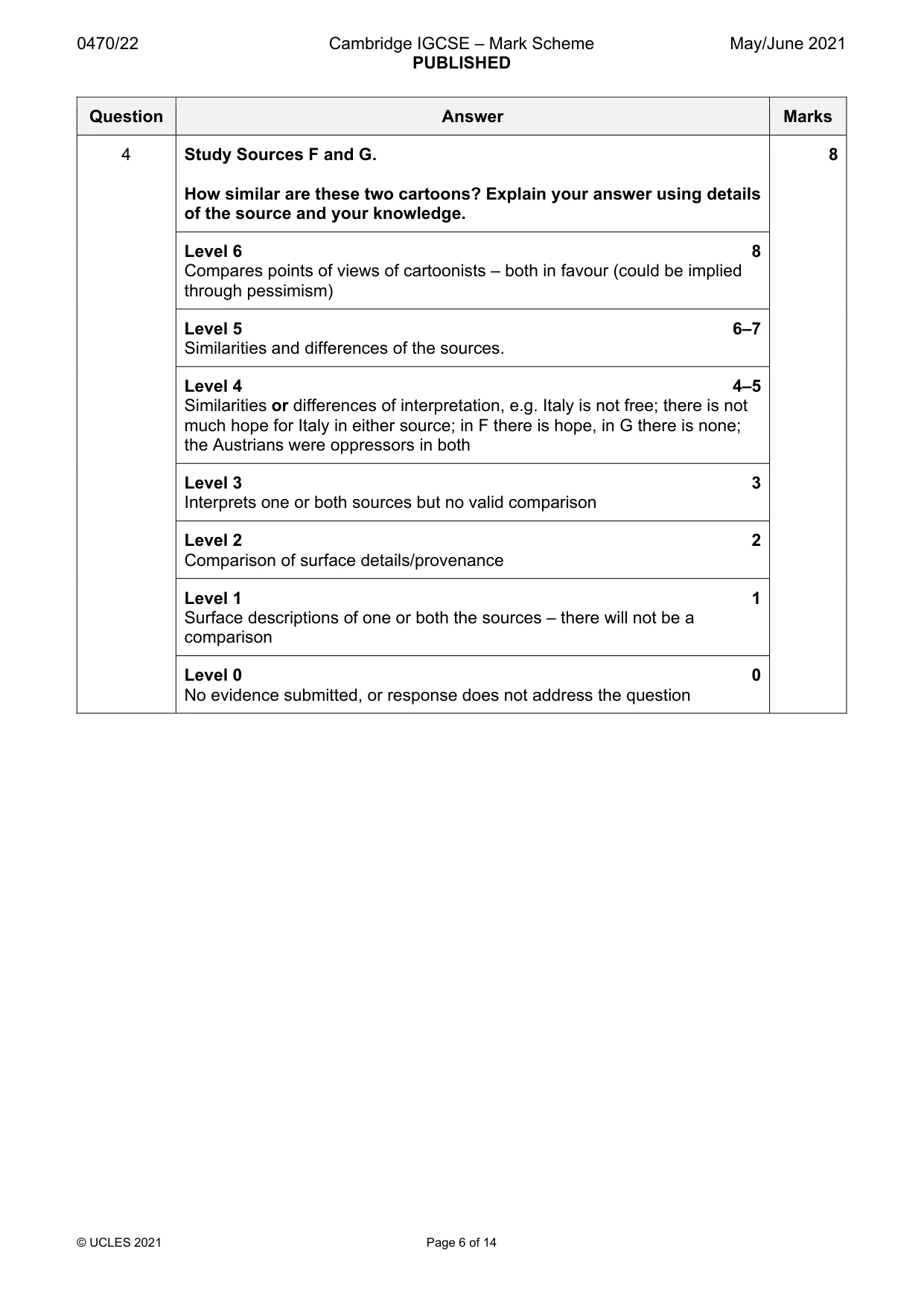
0470/22 Cambridge IGCSE – Mark Scheme PUBLISHED May/June 2021 © UCLES 2021 Page 6 of 14 Question Answer Marks 4 Study Sources F and G. How similar are these two cartoons? Explain your answer using details of the source and your knowledge. 8 Level 6 8 Compares points of views of cartoonists – both in favour (could be implied through pessimism) Level 5 6–7 Similarities and differences of the sources. Level 4 4–5 Similarities or differences of interpretation, e.g. Italy is not free; there is not much hope for Italy in either source; in F there is hope, in G there is none; the Austrians were oppressors in both Level 3 3 Interprets one or both sources but no valid comparison Level 2 2 Comparison of surface details/provenance Level 1 1 Surface descriptions of one or both the sources – there will not be a comparison Level 0 0 No evidence submitted, or response does not address the question
Mark scheme, page 7
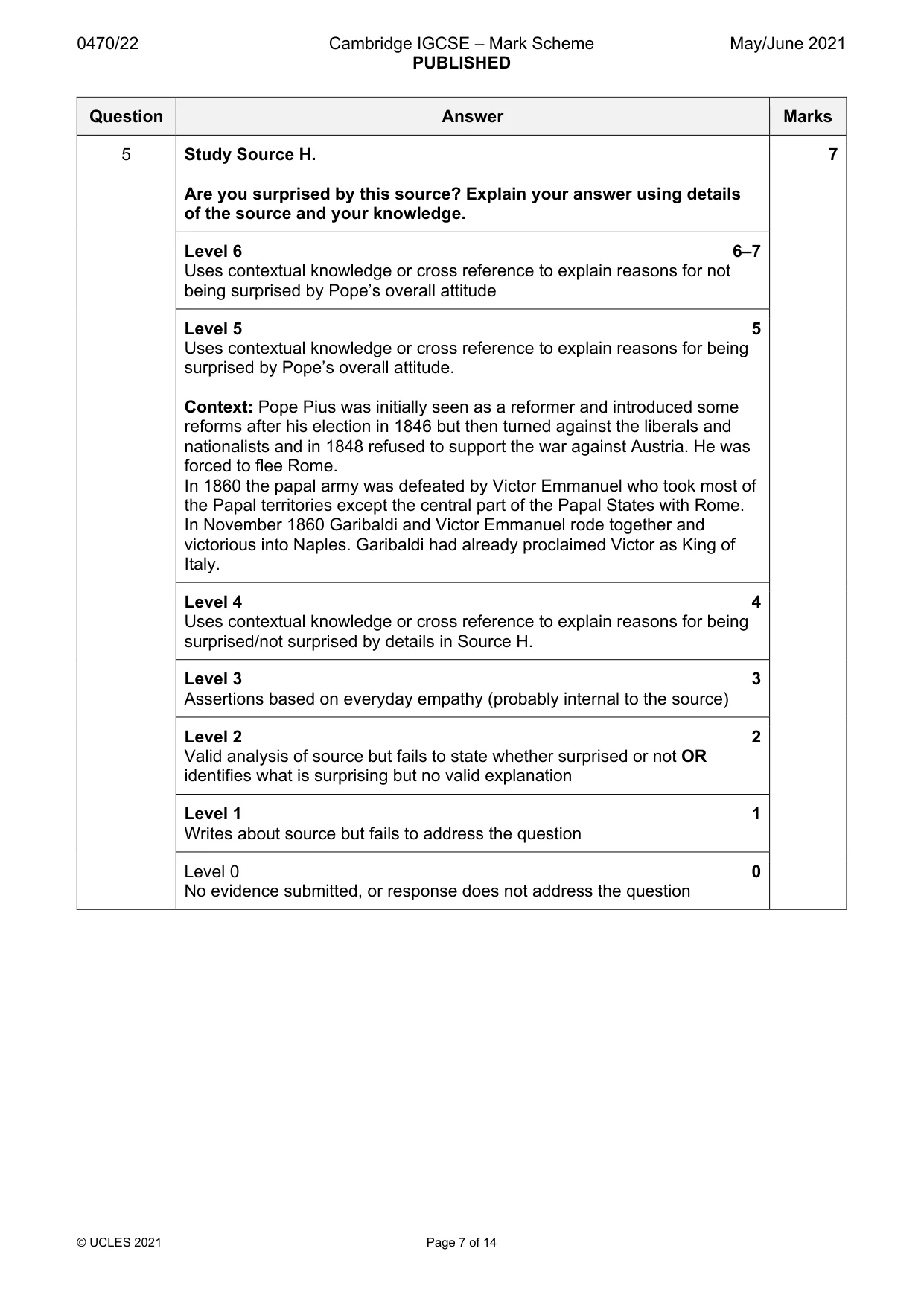
0470/22 Cambridge IGCSE – Mark Scheme PUBLISHED May/June 2021 © UCLES 2021 Page 7 of 14 Question Answer Marks 5 Study Source H. Are you surprised by this source? Explain your answer using details of the source and your knowledge. 7 Level 6 6–7 Uses contextual knowledge or cross reference to explain reasons for not being surprised by Pope’s overall attitude Level 5 5 Uses contextual knowledge or cross reference to explain reasons for being surprised by Pope’s overall attitude. Context: Pope Pius was initially seen as a reformer and introduced some reforms after his election in 1846 but then turned against the liberals and nationalists and in 1848 refused to support the war against Austria. He was forced to flee Rome. In 1860 the papal army was defeated by Victor Emmanuel who took most of the Papal territories except the central part of the Papal States with Rome. In November 1860 Garibaldi and Victor Emmanuel rode together and victorious into Naples. Garibaldi had already proclaimed Victor as King of Italy. Level 4 4 Uses contextual knowledge or cross reference to explain reasons for being surprised/not surprised by details in Source H. Level 3 3 Assertions based on everyday empathy (probably internal to the source) Level 2 2 Valid analysis of source but fails to state whether surprised or not OR identifies what is surprising but no valid explanation Level 1 1 Writes about source but fails to address the question Level 0 0 No evidence submitted, or response does not address the question
Mark scheme, page 8
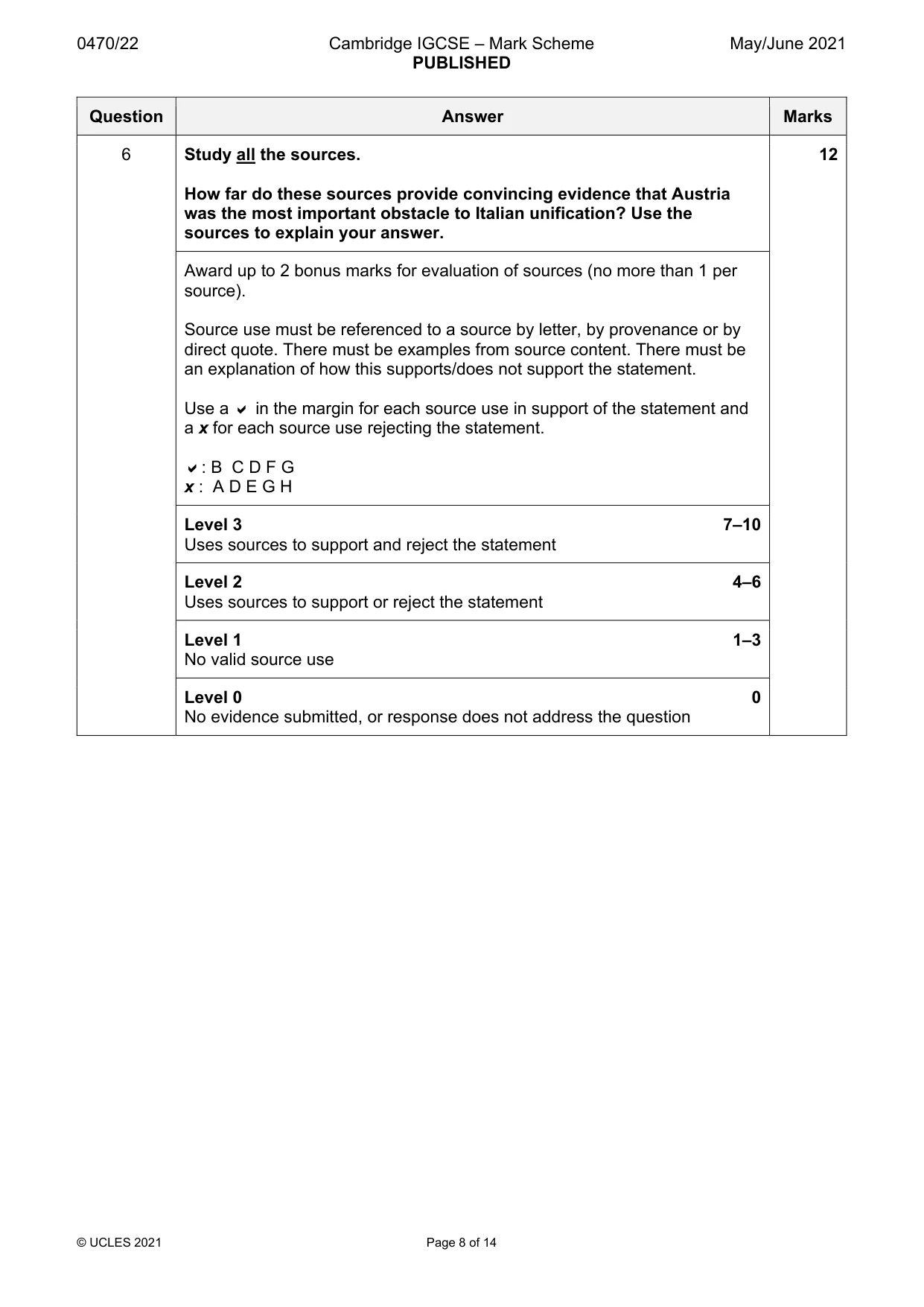
0470/22 Cambridge IGCSE – Mark Scheme PUBLISHED May/June 2021 © UCLES 2021 Page 8 of 14 Question Answer Marks 6 Study all the sources. How far do these sources provide convincing evidence that Austria was the most important obstacle to Italian unification? Use the sources to explain your answer. 12 Award up to 2 bonus marks for evaluation of sources (no more than 1 per source). Source use must be referenced to a source by letter, by provenance or by direct quote. There must be examples from source content. There must be an explanation of how this supports/does not support the statement. Use a in the margin for each source use in support of the statement and a x for each source use rejecting the statement. : B C D F G x : A D E G H Level 3 7–10 Uses sources to support and reject the statement Level 2 4–6 Uses sources to support or reject the statement Level 1 1–3 No valid source use Level 0 0 No evidence submitted, or response does not address the question
Mark scheme, page 9
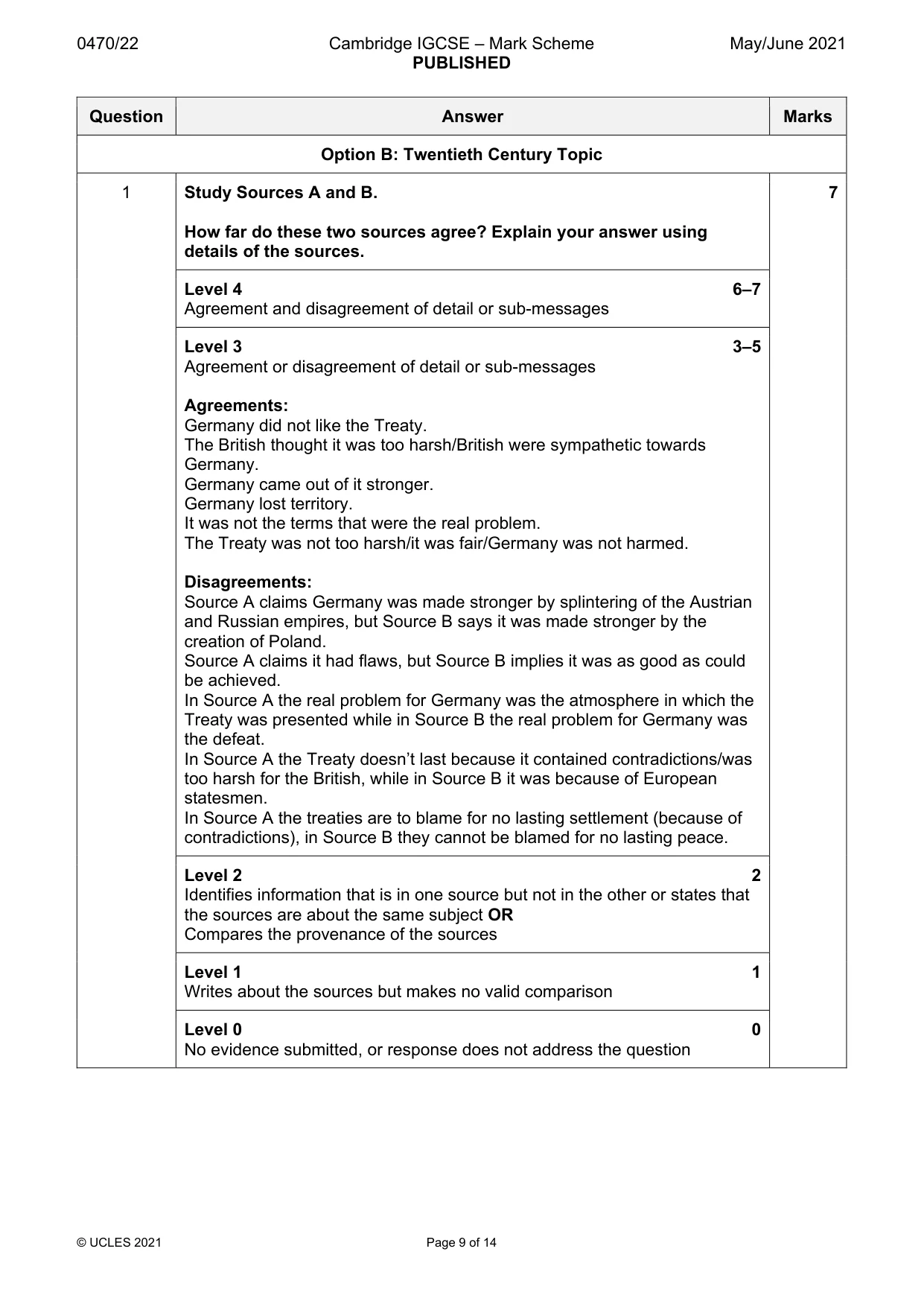
0470/22 Cambridge IGCSE – Mark Scheme PUBLISHED May/June 2021 © UCLES 2021 Page 9 of 14 Question Answer Marks Option B: Twentieth Century Topic 1 Study Sources A and B. How far do these two sources agree? Explain your answer using details of the sources. 7 Level 4 6–7 Agreement and disagreement of detail or sub-messages Level 3 3–5 Agreement or disagreement of detail or sub-messages Agreements: Germany did not like the Treaty. The British thought it was too harsh/British were sympathetic towards Germany. Germany came out of it stronger. Germany lost territory. It was not the terms that were the real problem. The Treaty was not too harsh/it was fair/Germany was not harmed. Disagreements: Source A claims Germany was made stronger by splintering of the Austrian and Russian empires, but Source B says it was made stronger by the creation of Poland. Source A claims it had flaws, but Source B implies it was as good as could be achieved. In Source A the real problem for Germany was the atmosphere in which the Treaty was presented while in Source B the real problem for Germany was the defeat. In Source A the Treaty doesn’t last because it contained contradictions/was too harsh for the British, while in Source B it was because of European statesmen. In Source A the treaties are to blame for no lasting settlement (because of contradictions), in Source B they cannot be blamed for no lasting peace. Level 2 2 Identifies information that is in one source but not in the other or states that the sources are about the same subject OR Compares the provenance of the sources Level 1 1 Writes about the sources but makes no valid comparison Level 0 0 No evidence submitted, or response does not address the question
Mark scheme, page 10
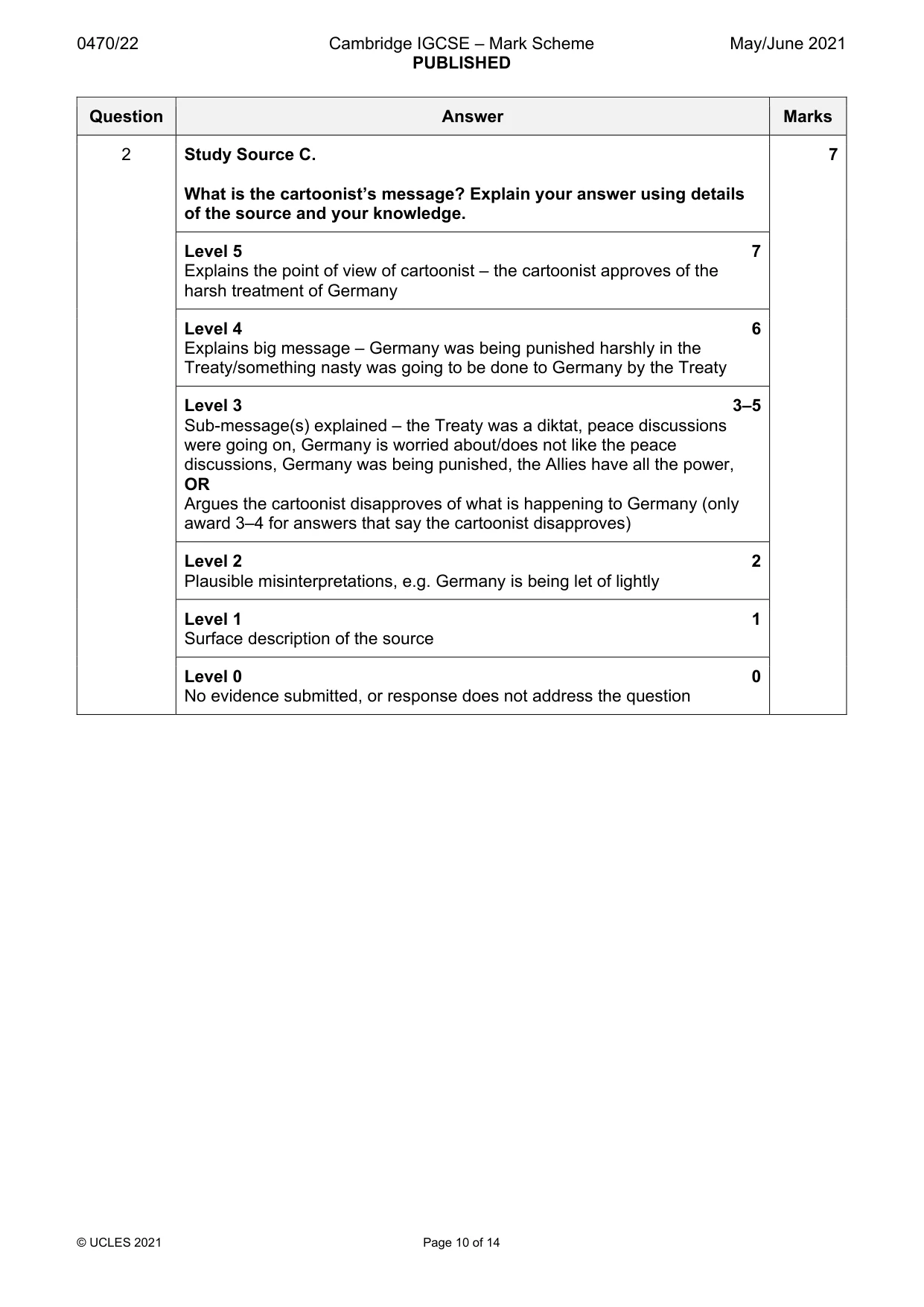
0470/22 Cambridge IGCSE – Mark Scheme PUBLISHED May/June 2021 © UCLES 2021 Page 10 of 14 Question Answer Marks 2 Study Source C. What is the cartoonist’s message? Explain your answer using details of the source and your knowledge. 7 Level 5 7 Explains the point of view of cartoonist – the cartoonist approves of the harsh treatment of Germany Level 4 6 Explains big message – Germany was being punished harshly in the Treaty/something nasty was going to be done to Germany by the Treaty Level 3 3–5 Sub-message(s) explained – the Treaty was a diktat, peace discussions were going on, Germany is worried about/does not like the peace discussions, Germany was being punished, the Allies have all the power, OR Argues the cartoonist disapproves of what is happening to Germany (only award 3–4 for answers that say the cartoonist disapproves) Level 2 2 Plausible misinterpretations, e.g. Germany is being let of lightly Level 1 1 Surface description of the source Level 0 0 No evidence submitted, or response does not address the question
Mark scheme, page 11
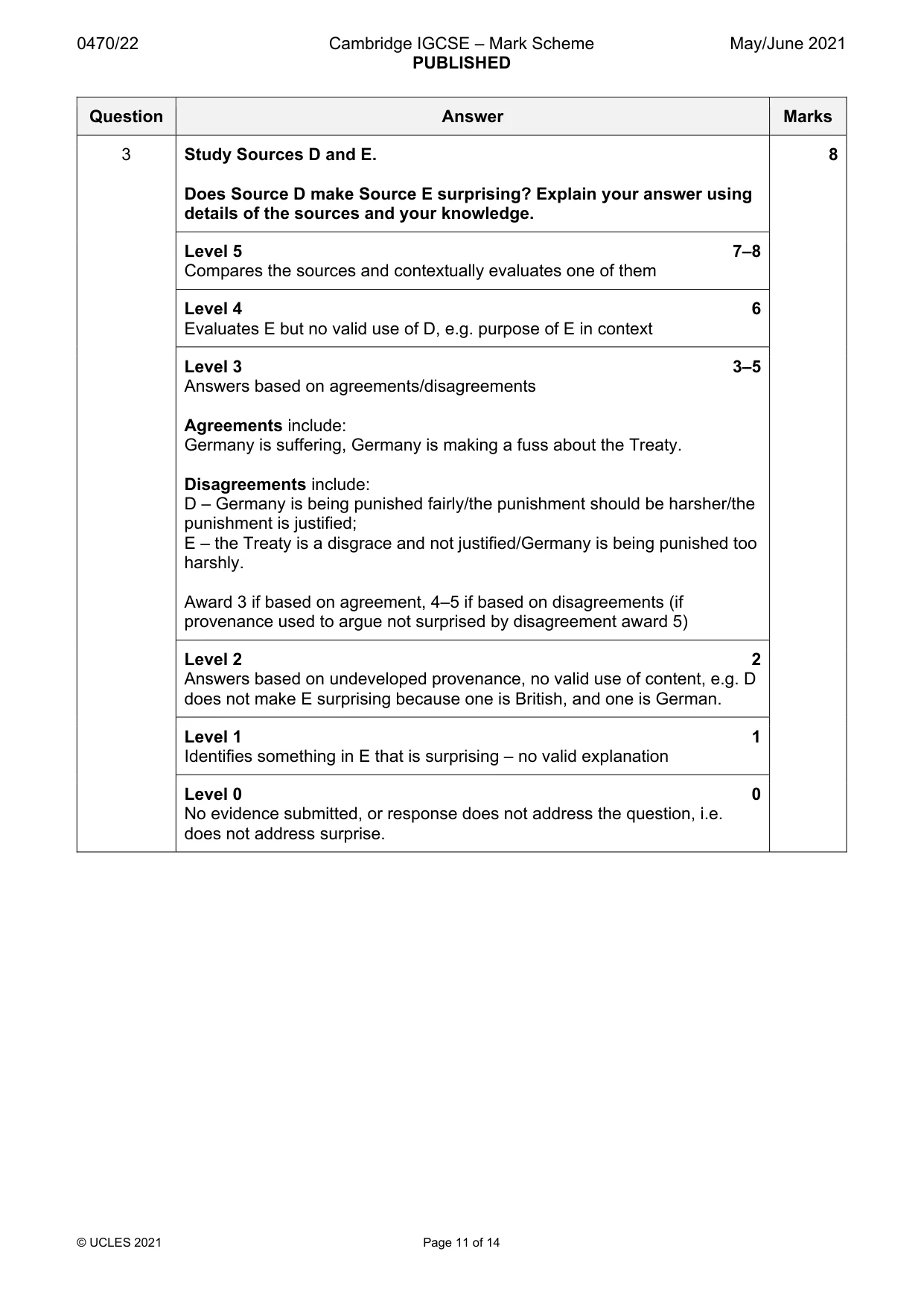
0470/22 Cambridge IGCSE – Mark Scheme PUBLISHED May/June 2021 © UCLES 2021 Page 11 of 14 Question Answer Marks 3 Study Sources D and E. Does Source D make Source E surprising? Explain your answer using details of the sources and your knowledge. 8 Level 5 7–8 Compares the sources and contextually evaluates one of them Level 4 6 Evaluates E but no valid use of D, e.g. purpose of E in context Level 3 3–5 Answers based on agreements/disagreements Agreements include: Germany is suffering, Germany is making a fuss about the Treaty. Disagreements include: D – Germany is being punished fairly/the punishment should be harsher/the punishment is justified; E – the Treaty is a disgrace and not justified/Germany is being punished too harshly. Award 3 if based on agreement, 4–5 if based on disagreements (if provenance used to argue not surprised by disagreement award 5) Level 2 2 Answers based on undeveloped provenance, no valid use of content, e.g. D does not make E surprising because one is British, and one is German. Level 1 1 Identifies something in E that is surprising – no valid explanation Level 0 0 No evidence submitted, or response does not address the question, i.e. does not address surprise.
Mark scheme, page 12
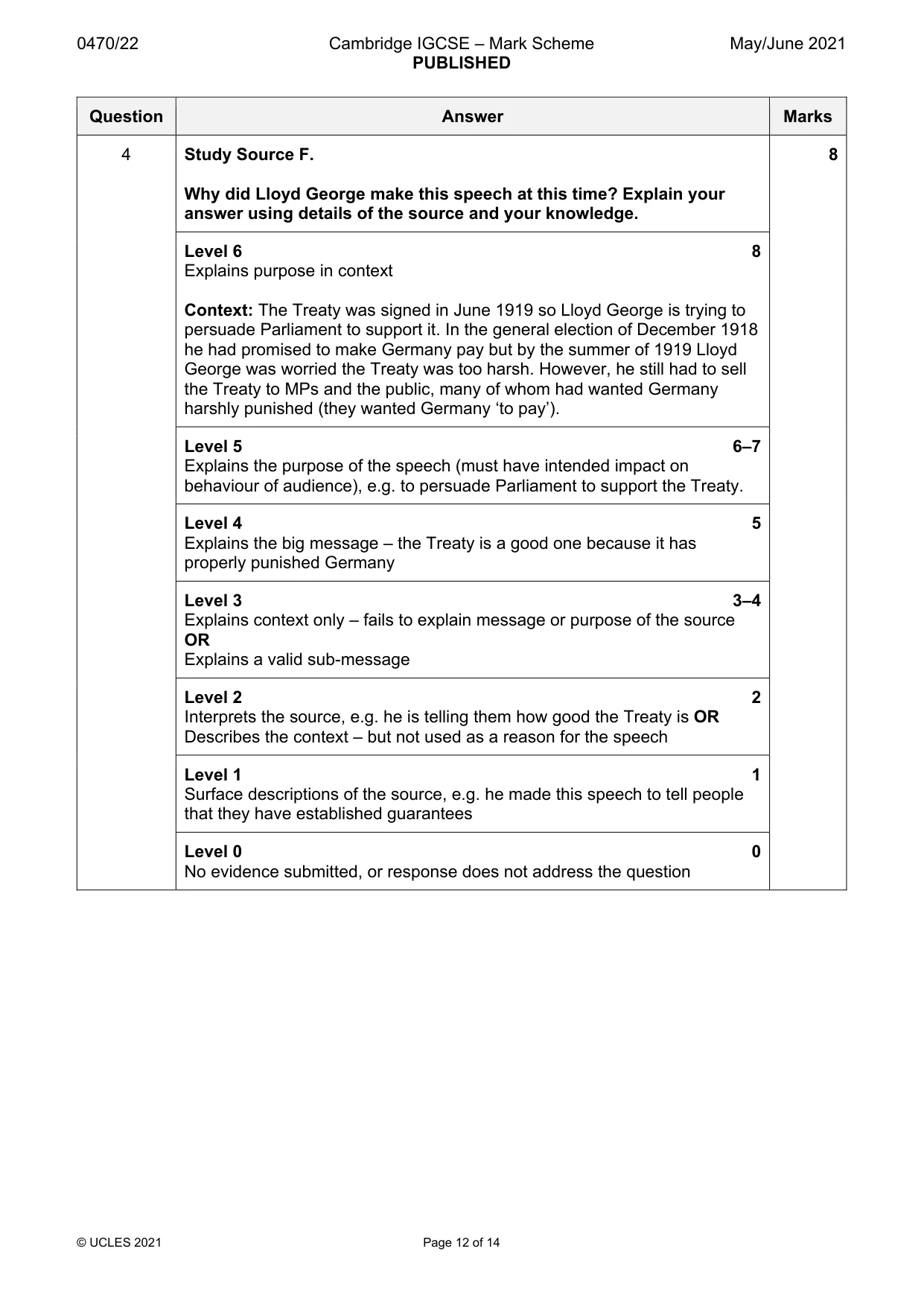
0470/22 Cambridge IGCSE – Mark Scheme PUBLISHED May/June 2021 © UCLES 2021 Page 12 of 14 Question Answer Marks 4 Study Source F. Why did Lloyd George make this speech at this time? Explain your answer using details of the source and your knowledge. 8 Level 6 8 Explains purpose in context Context: The Treaty was signed in June 1919 so Lloyd George is trying to persuade Parliament to support it. In the general election of December 1918 he had promised to make Germany pay but by the summer of 1919 Lloyd George was worried the Treaty was too harsh. However, he still had to sell the Treaty to MPs and the public, many of whom had wanted Germany harshly punished (they wanted Germany ‘to pay’). Level 5 6–7 Explains the purpose of the speech (must have intended impact on behaviour of audience), e.g. to persuade Parliament to support the Treaty. Level 4 5 Explains the big message – the Treaty is a good one because it has properly punished Germany Level 3 3–4 Explains context only – fails to explain message or purpose of the source OR Explains a valid sub-message Level 2 2 Interprets the source, e.g. he is telling them how good the Treaty is OR Describes the context – but not used as a reason for the speech Level 1 1 Surface descriptions of the source, e.g. he made this speech to tell people that they have established guarantees Level 0 0 No evidence submitted, or response does not address the question
Mark scheme, page 13
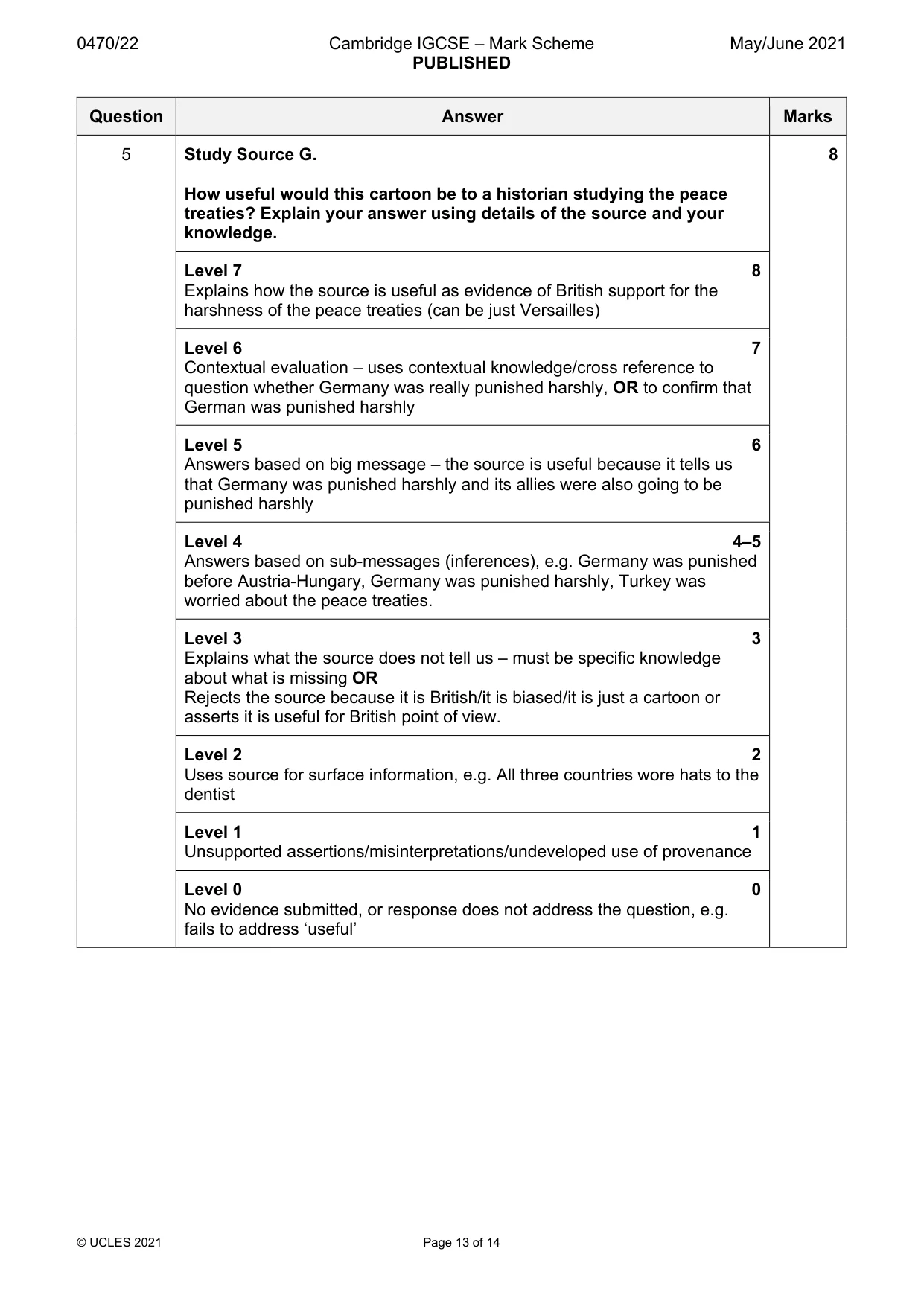
0470/22 Cambridge IGCSE – Mark Scheme PUBLISHED May/June 2021 © UCLES 2021 Page 13 of 14 Question Answer Marks 5 Study Source G. How useful would this cartoon be to a historian studying the peace treaties? Explain your answer using details of the source and your knowledge. 8 Level 7 8 Explains how the source is useful as evidence of British support for the harshness of the peace treaties (can be just Versailles) Level 6 7 Contextual evaluation – uses contextual knowledge/cross reference to question whether Germany was really punished harshly, OR to confirm that German was punished harshly Level 5 6 Answers based on big message – the source is useful because it tells us that Germany was punished harshly and its allies were also going to be punished harshly Level 4 4–5 Answers based on sub-messages (inferences), e.g. Germany was punished before Austria-Hungary, Germany was punished harshly, Turkey was worried about the peace treaties. Level 3 3 Explains what the source does not tell us – must be specific knowledge about what is missing OR Rejects the source because it is British/it is biased/it is just a cartoon or asserts it is useful for British point of view. Level 2 2 Uses source for surface information, e.g. All three countries wore hats to the dentist Level 1 1 Unsupported assertions/misinterpretations/undeveloped use of provenance Level 0 0 No evidence submitted, or response does not address the question, e.g. fails to address ‘useful’
Mark scheme, page 14
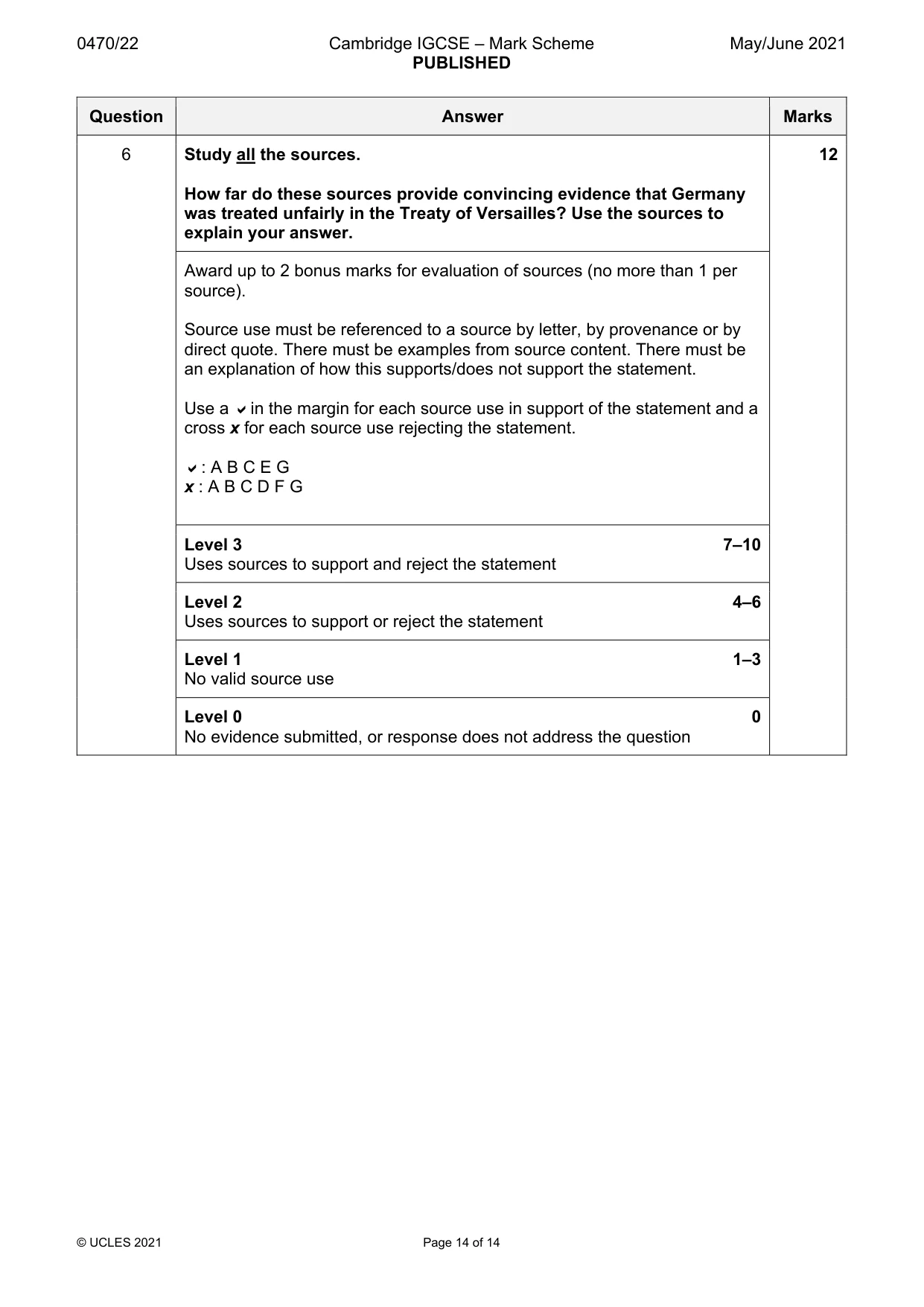
0470/22 Cambridge IGCSE – Mark Scheme PUBLISHED May/June 2021 © UCLES 2021 Page 14 of 14 Question Answer Marks 6 Study all the sources. How far do these sources provide convincing evidence that Germany was treated unfairly in the Treaty of Versailles? Use the sources to explain your answer. 12 Award up to 2 bonus marks for evaluation of sources (no more than 1 per source). Source use must be referenced to a source by letter, by provenance or by direct quote. There must be examples from source content. There must be an explanation of how this supports/does not support the statement. Use a in the margin for each source use in support of the statement and a cross x for each source use rejecting the statement. : A B C E G x : A B C D F G Level 3 7–10 Uses sources to support and reject the statement Level 2 4–6 Uses sources to support or reject the statement Level 1 1–3 No valid source use Level 0 0 No evidence submitted, or response does not address the question
What you needed in this session
Cambridge’s own grade thresholds for 2021 May/June, Paper 2 · Variant 2. A higher threshold means an easier paper — the bar moves with how the cohort did.