Cambridge IGCSE History 0470 — 2020 May/June Paper 2 · Variant 3
0470/23/M/J/20
The question paper and its mark scheme, free to read here and free to download. This is Cambridge’s own paper, exactly as it was sat.
Question paper12 pages
Mark scheme15 pages
Answers below. Sit the paper first if you are practising.
Paper as text
Question paper, page 1
Cambridge IGCSE™ HISTORY 0470/23 Paper 2 May/June 2020 2 hours You must answer on the enclosed answer booklet. You will need: Answer booklet (enclosed) INSTRUCTIONS ● Answer all the questions on one option only. Option A: Nineteenth century topic Option B: Twentieth century topic ● Follow the instructions on the front cover of the answer booklet. If you need additional answer paper, ask the invigilator for a continuation booklet. INFORMATION ● The total mark for this paper is 50. ● The number of marks for each question or part question is shown in brackets [ ]. * 7 0 1 0 5 8 4 7 0 1 * This document has 12 pages. Blank pages are indicated. DC (CJ/CB) 184716/3 © UCLES 2020 [Turn over
Question paper, page 2
2 0470/23/M/J/20 © UCLES 2020 Option A: Nineteenth century topic WHO WAS RESPONSIBLE FOR THE CRISIS OVER SERBIA DEVELOPING INTO A EUROPEAN WAR? Study the Background Information and the sources carefully, and then answer all the questions. Background Information On 28 June 1914 Franz Ferdinand, heir to the Austro-Hungarian throne, was assassinated by Serb terrorists. On 23 July Austria sent an ultimatum to Serbia knowing that it could not agree to all the demands. On 28 July Austria declared war on Serbia. By this time both Russia (supporting Serbia) and Germany (supporting Austria) were deeply involved in the crisis. Both have been blamed for using the situation to their own advantage and for turning the crisis into a European war. Who was more to blame for turning the crisis into a European war, Germany or Russia? SOURCE A The famous exchange of ‘Willy-Nicky’ telegrams between the Kaiser and the Tsar between 29 July and 1 August was part of a manoeuvre by Germany to brand Russia as the aggressor to smooth the way for German general mobilisation. Whereas Berlin and Vienna had initially hoped for a local success over Serbia before the powers could react, Sazonov’s own strategy was more ambitious: it envisioned a European war, in which he must line up the most favourable coalition possible. From a history book published in 2011. Sazonov was the minister in charge of Russia’s foreign policy. Content removed due to copyright restrictions.
Question paper, page 3
3 0470/23/M/J/20 © UCLES 2020 [Turn over SOURCE B After Sarajevo, Germany planned a great war, and because of the mood in France and Russia, there was little hope of preventing a catastrophe after the Austrian ultimatum was sent to Serbia. By 24 July Russia was beginning to implement some significant military measures and was being strongly encouraged to do this by the French ambassador to Russia. At the same time Russia was reassuring Britain that no mobilisation was planned. By 26 July the situation was already very dangerous. If Bethmann Hollweg had possessed any political judgement, he would have waited to test the reactions of Europe to the Austrian ultimatum. Instead he plunged into the desperate course of encouraging Austria to make a premature declaration of war on Serbia. At the same time the French drove Russia along the fatal path to mobilisation. By 27 July Bethmann had realised the inevitability of war with France and Russia and was gambling on British neutrality. The main purpose of his diplomacy at this stage was to saddle Russia with the responsibility for aggression to affect British opinion to stay neutral. With the Austrian declaration of war on 28 July, the crisis entered its final phase and the potential application of the Schlieffen Plan dominated the situation. This plan, with its violations of neutrality, had been part of German thinking since 1904. Its existence accelerated the whole tempo of events. From a recent history book. Bethmann Hollweg was the German Chancellor, head of the German government. SOURCE C I wanted to keep peace. The Tsar saw me just as a technician who must build the instrument of war, and the Tsar was the one who would decide on the time for using it. I am totally convinced that the decision on war was made during President Poincaré’s visit of 24–28 July. He and Sazonov and Nikolaevich had made a conspiracy to make war. During and after Poincaré’s visit, I was deliberately cut off from the Tsar until 2 August, by which time the war machine had already been set into action. I had no way of keeping an eye on what occurred. From the memoirs of Vladimir Sukhomlinov published in 1924. Sukhomlinov was the member of the Russian government responsible for the armed forces. Poincaré was President of France. Nikolaevich was put in charge of the Russian armed forces in July 1914.
Question paper, page 4
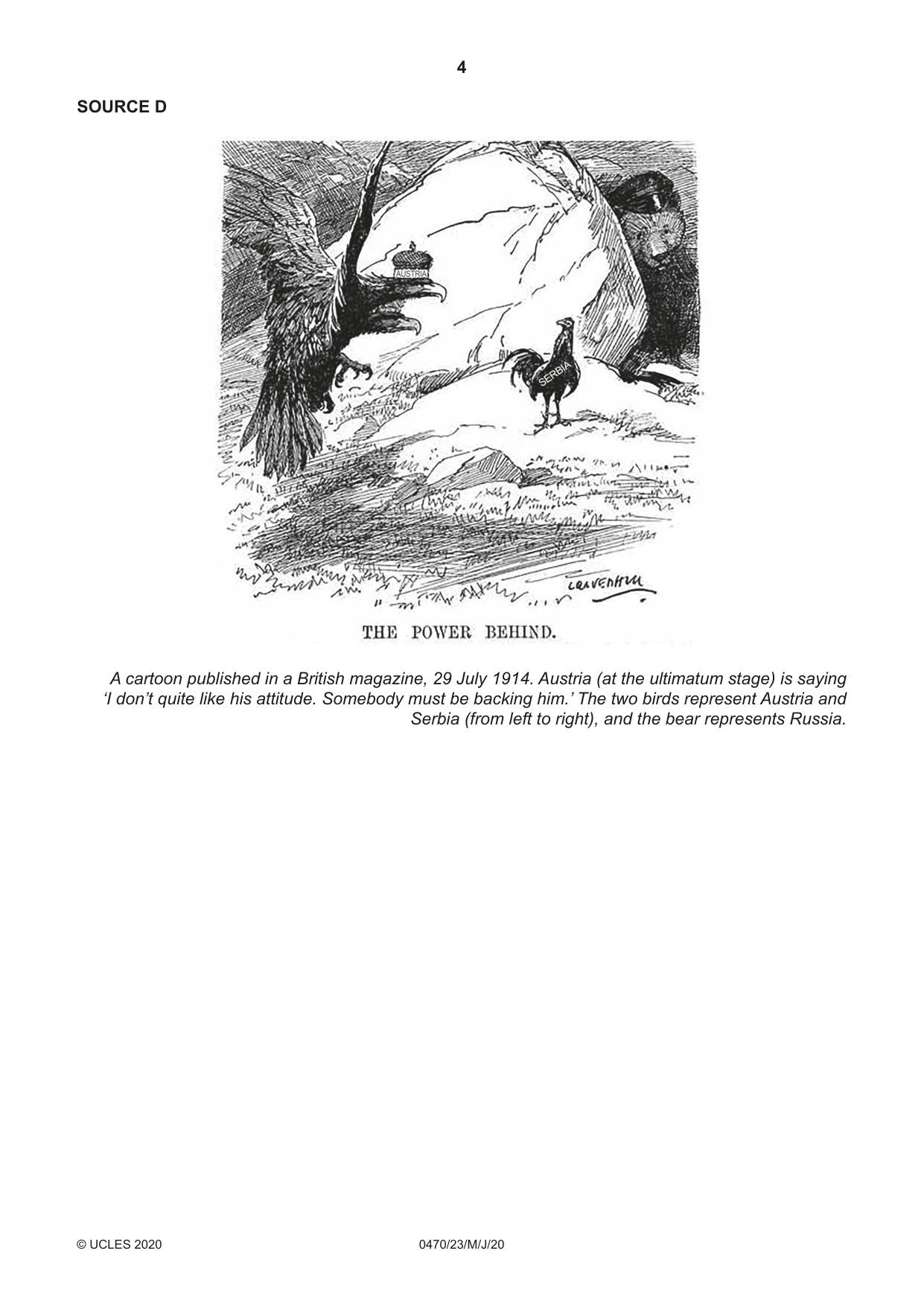
4 0470/23/M/J/20 © UCLES 2020 SOURCE D A cartoon published in a British magazine, 29 July 1914. Austria (at the ultimatum stage) is saying ‘I don’t quite like his attitude. Somebody must be backing him.’ The two birds represent Austria and Serbia (from left to right), and the bear represents Russia.
Question paper, page 5
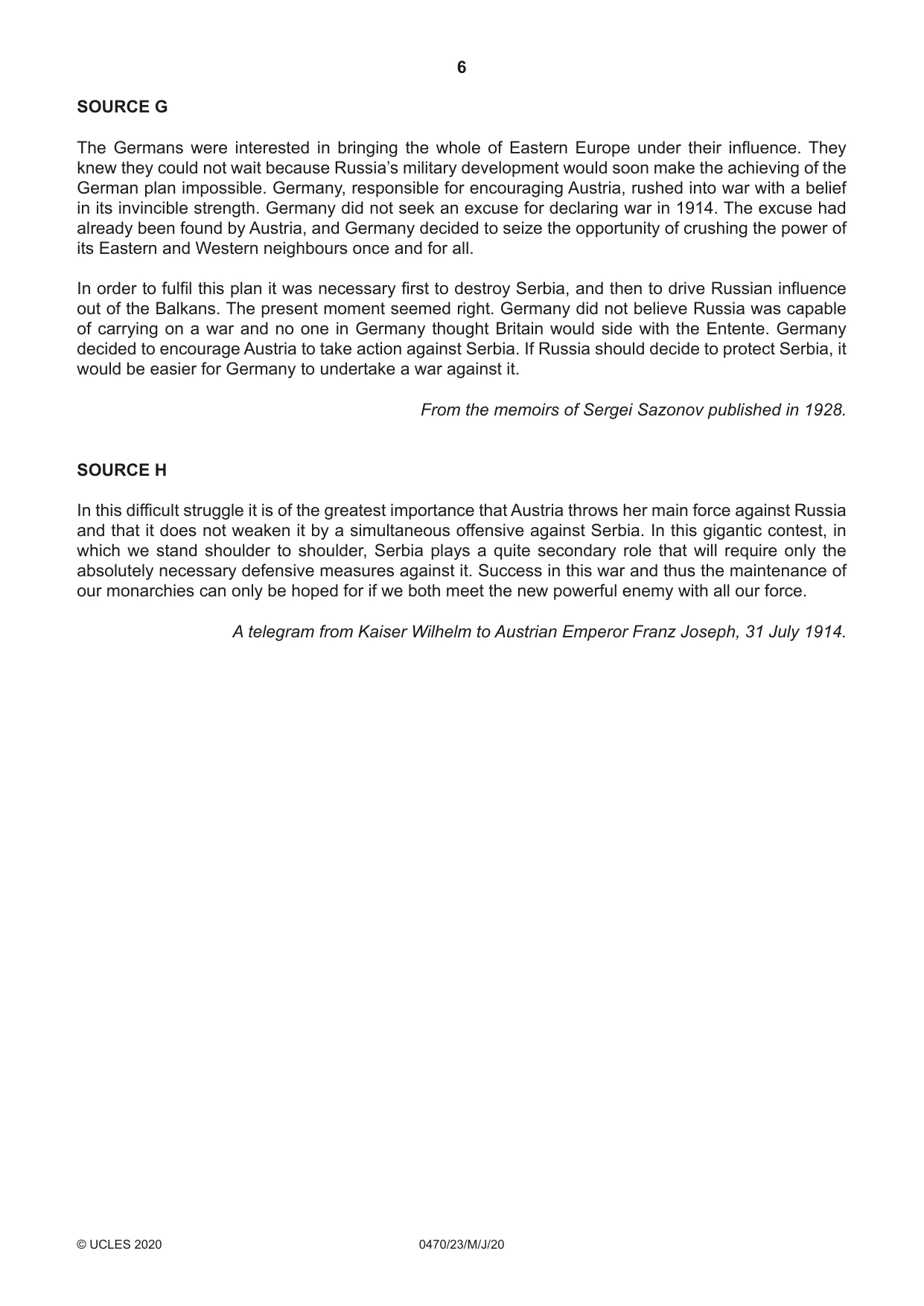
5 0470/23/M/J/20 © UCLES 2020 [Turn over SOURCE E An American cartoon published on 3 August 1914. SOURCE F The Austrian-Serbian affair is a purely private quarrel, which would in no way threaten the peace of Europe, if Russia had not interfered with it. Austria has declared it does not intend any territorial acquisitions at Serbia’s expense. It has only mobilised a portion of its armed forces – just enough to punish Serbia. Russia announces it intends to mobilise when Austria advances as it cannot permit the destruction of Serbia, though Austria has explained it intends nothing of the sort. If Germany is not to be false to its word, it must mobilise. Russia will be able to say: I am being attacked by Germany. It will then assure itself of the support of France and the French-Russian alliance will become active, and the mutual butchery of the civilised nations of Europe will begin. It cannot be denied that the affair has been cunningly contrived by Russia. Germany did not want to bring about this war but it would be setting itself against all the feelings of the nation if it did not assist its ally. From a memorandum from Helmuth von Moltke to Bethmann Hollweg, 29 July 1914. Moltke was in charge of the German armed forces.
Question paper, page 6
6 0470/23/M/J/20 © UCLES 2020 SOURCE G The Germans were interested in bringing the whole of Eastern Europe under their influence. They knew they could not wait because Russia’s military development would soon make the achieving of the German plan impossible. Germany, responsible for encouraging Austria, rushed into war with a belief in its invincible strength. Germany did not seek an excuse for declaring war in 1914. The excuse had already been found by Austria, and Germany decided to seize the opportunity of crushing the power of its Eastern and Western neighbours once and for all. In order to fulfil this plan it was necessary first to destroy Serbia, and then to drive Russian influence out of the Balkans. The present moment seemed right. Germany did not believe Russia was capable of carrying on a war and no one in Germany thought Britain would side with the Entente. Germany decided to encourage Austria to take action against Serbia. If Russia should decide to protect Serbia, it would be easier for Germany to undertake a war against it. From the memoirs of Sergei Sazonov published in 1928. SOURCE H In this difficult struggle it is of the greatest importance that Austria throws her main force against Russia and that it does not weaken it by a simultaneous offensive against Serbia. In this gigantic contest, in which we stand shoulder to shoulder, Serbia plays a quite secondary role that will require only the absolutely necessary defensive measures against it. Success in this war and thus the maintenance of our monarchies can only be hoped for if we both meet the new powerful enemy with all our force. A telegram from Kaiser Wilhelm to Austrian Emperor Franz Joseph, 31 July 1914.
Question paper, page 7
7 0470/23/M/J/20 © UCLES 2020 [Turn over Now answer all the following questions. You may use any of the sources to help you answer the questions, in addition to those sources which you are told to use. In answering the questions you should use your knowledge of the topic to help you interpret and evaluate the sources. 1 Study Sources A and B. How far do these two sources agree? Explain your answer using details of the sources. [7] 2 Study Source C. Do you trust Source C? Explain your answer using details of the source and your knowledge. [8] 3 Study Sources D and E. How similar are these two cartoons? Explain your answer using details of the sources and your knowledge. [8] 4 Study Sources F and G. How far does Source F prove that Sazonov is lying in Source G? Explain your answer using details of the sources and your knowledge. [8] 5 Study Source H. How useful is this source to a historian studying the events in Europe at the end of July 1914? Explain your answer using details of the source and your knowledge. [7] 6 Study all the sources. How far do these sources provide convincing evidence that Germany was responsible for turning the crisis over Serbia into a European war? Use the sources to explain your answer. [12]
Question paper, page 8
8 0470/23/M/J/20 © UCLES 2020 Option B: Twentieth century topic WERE SOVIET SUSPICIONS ABOUT THE MARSHALL PLAN JUSTIFIED? Study the Background Information and the sources carefully, and then answer all the questions. Background Information After the end of the Second World War Soviet influence was extended in Eastern Europe and the Balkans. Suspecting a deep-laid Soviet plot to take over countries in these areas and then to make a move on the rest of Europe, the USA developed policies to defend against communism. A particular worry was that if Europe did not recover economically, it would turn to communism. To help economic recovery, the USA announced the Marshall Plan in June 1947. This involved giving money to participating countries to help them rebuild. This money was offered to Western and Eastern Europe. The Soviet Union regarded the Marshall Plan with great suspicion and prevented Eastern European countries from taking American aid. The USSR saw the Marshall Plan as economic imperialism and as an attempt by the USA to gain control over Europe. Were the Soviets right to be suspicious? SOURCE A In the spring of 1947 the Americans were aware of the need to avoid any conduct that would put the responsibility for starting the Cold War on them. There was every reason for the Americans to tempt the Russians to participate in a programme of reconstruction for all Europe. The Marshall Plan posed no problem for the Europeans, though it could have done, had it been a challenge to Moscow. The crucial question was whether the Russians would come in or stay out. The door was being held open for them. If they and their satellites stayed out then Europe would be split and the Cold War would be under way. However, Moscow feared being encircled by capitalistic-imperialistic nations. This would force Moscow to tighten its grip on Eastern Europe. Moscow now made a miscalculation. Thinking the West was about to fall into chaos, it underestimated the West’s basic strength. Stalin responded with ruthless aggressiveness and acted like a barbarian chief who uses his boots on the bodies of his opponents. Nothing in the Marshall Plan could have been interpreted as threatening to Moscow. The West Europeans were simply seeking their own salvation but their decision to do so identified them as members of the camp opposed to Moscow, and therefore as proper objects of its hostility. From a history book published in 1967.
Question paper, page 9
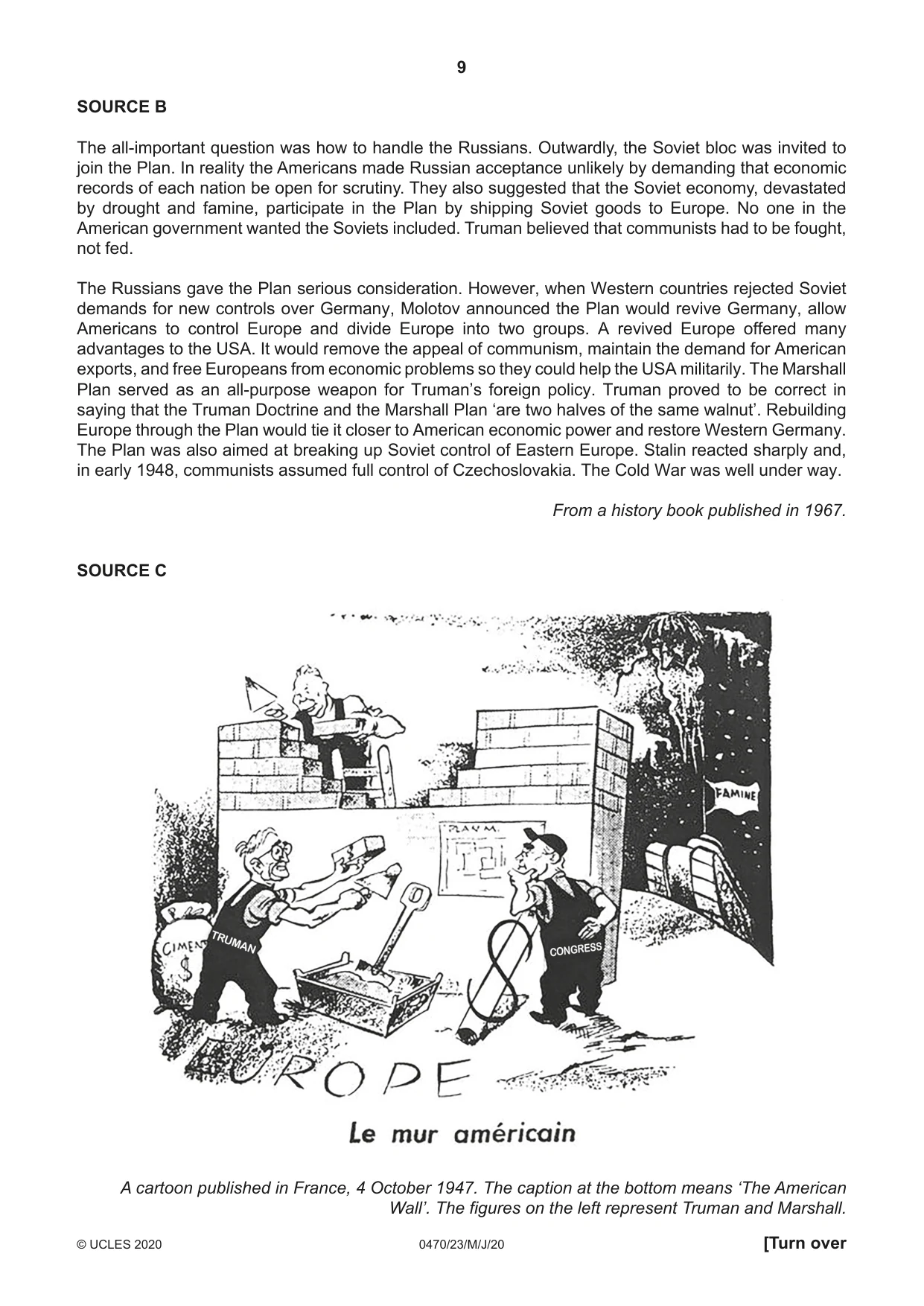
9 0470/23/M/J/20 © UCLES 2020 [Turn over SOURCE B The all-important question was how to handle the Russians. Outwardly, the Soviet bloc was invited to join the Plan. In reality the Americans made Russian acceptance unlikely by demanding that economic records of each nation be open for scrutiny. They also suggested that the Soviet economy, devastated by drought and famine, participate in the Plan by shipping Soviet goods to Europe. No one in the American government wanted the Soviets included. Truman believed that communists had to be fought, not fed. The Russians gave the Plan serious consideration. However, when Western countries rejected Soviet demands for new controls over Germany, Molotov announced the Plan would revive Germany, allow Americans to control Europe and divide Europe into two groups. A revived Europe offered many advantages to the USA. It would remove the appeal of communism, maintain the demand for American exports, and free Europeans from economic problems so they could help the USA militarily. The Marshall Plan served as an all-purpose weapon for Truman’s foreign policy. Truman proved to be correct in saying that the Truman Doctrine and the Marshall Plan ‘are two halves of the same walnut’. Rebuilding Europe through the Plan would tie it closer to American economic power and restore Western Germany. The Plan was also aimed at breaking up Soviet control of Eastern Europe. Stalin reacted sharply and, in early 1948, communists assumed full control of Czechoslovakia. The Cold War was well under way. From a history book published in 1967. SOURCE C A cartoon published in France, 4 October 1947. The caption at the bottom means ‘The American Wall’. The figures on the left represent Truman and Marshall.
Question paper, page 10
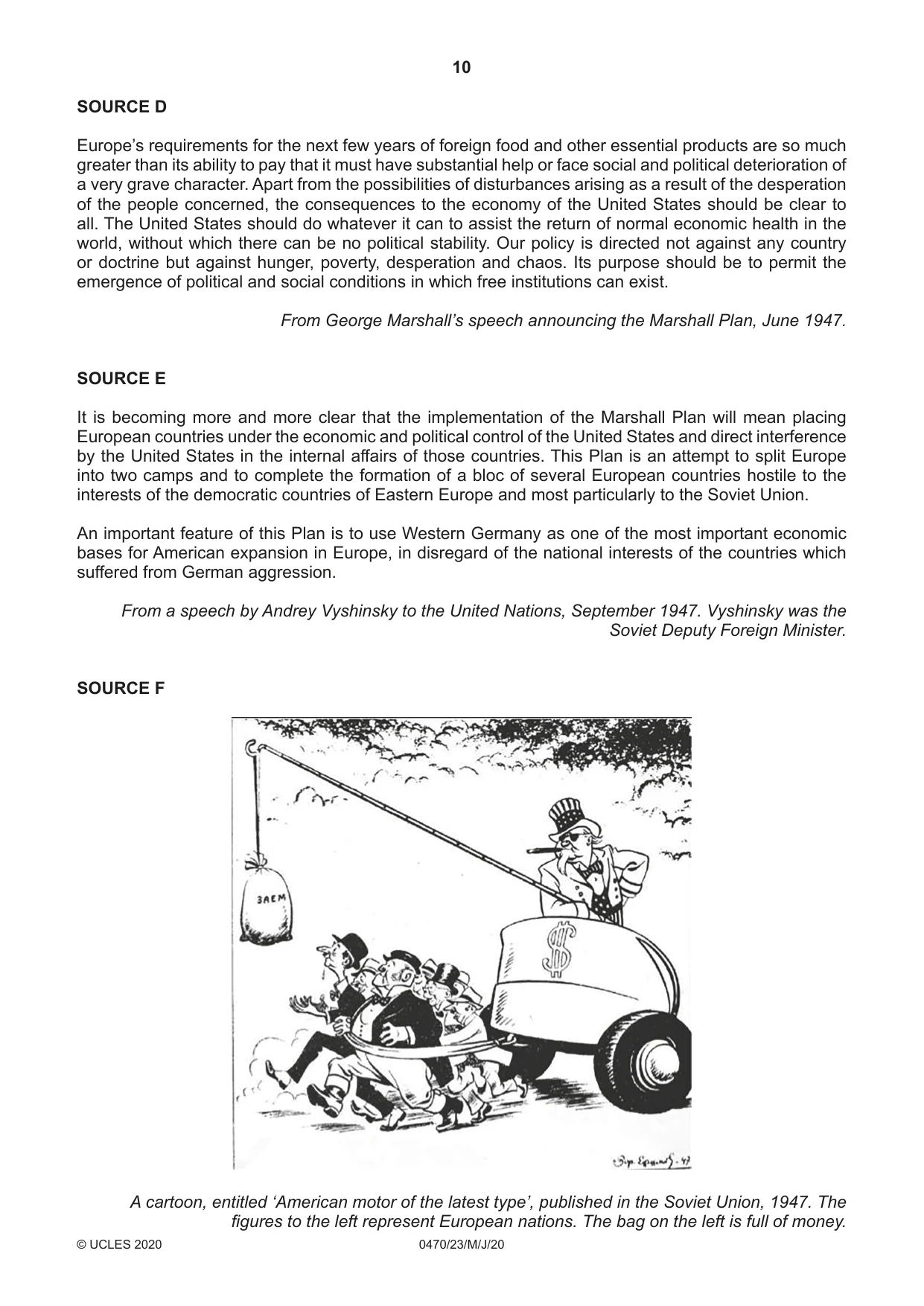
10 0470/23/M/J/20 © UCLES 2020 SOURCE D Europe’s requirements for the next few years of foreign food and other essential products are so much greater than its ability to pay that it must have substantial help or face social and political deterioration of a very grave character. Apart from the possibilities of disturbances arising as a result of the desperation of the people concerned, the consequences to the economy of the United States should be clear to all. The United States should do whatever it can to assist the return of normal economic health in the world, without which there can be no political stability. Our policy is directed not against any country or doctrine but against hunger, poverty, desperation and chaos. Its purpose should be to permit the emergence of political and social conditions in which free institutions can exist. From George Marshall’s speech announcing the Marshall Plan, June 1947. SOURCE E It is becoming more and more clear that the implementation of the Marshall Plan will mean placing European countries under the economic and political control of the United States and direct interference by the United States in the internal affairs of those countries. This Plan is an attempt to split Europe into two camps and to complete the formation of a bloc of several European countries hostile to the interests of the democratic countries of Eastern Europe and most particularly to the Soviet Union. An important feature of this Plan is to use Western Germany as one of the most important economic bases for American expansion in Europe, in disregard of the national interests of the countries which suffered from German aggression. From a speech by Andrey Vyshinsky to the United Nations, September 1947. Vyshinsky was the Soviet Deputy Foreign Minister. SOURCE F A cartoon, entitled ‘American motor of the latest type’, published in the Soviet Union, 1947. The figures to the left represent European nations. The bag on the left is full of money.
Question paper, page 11
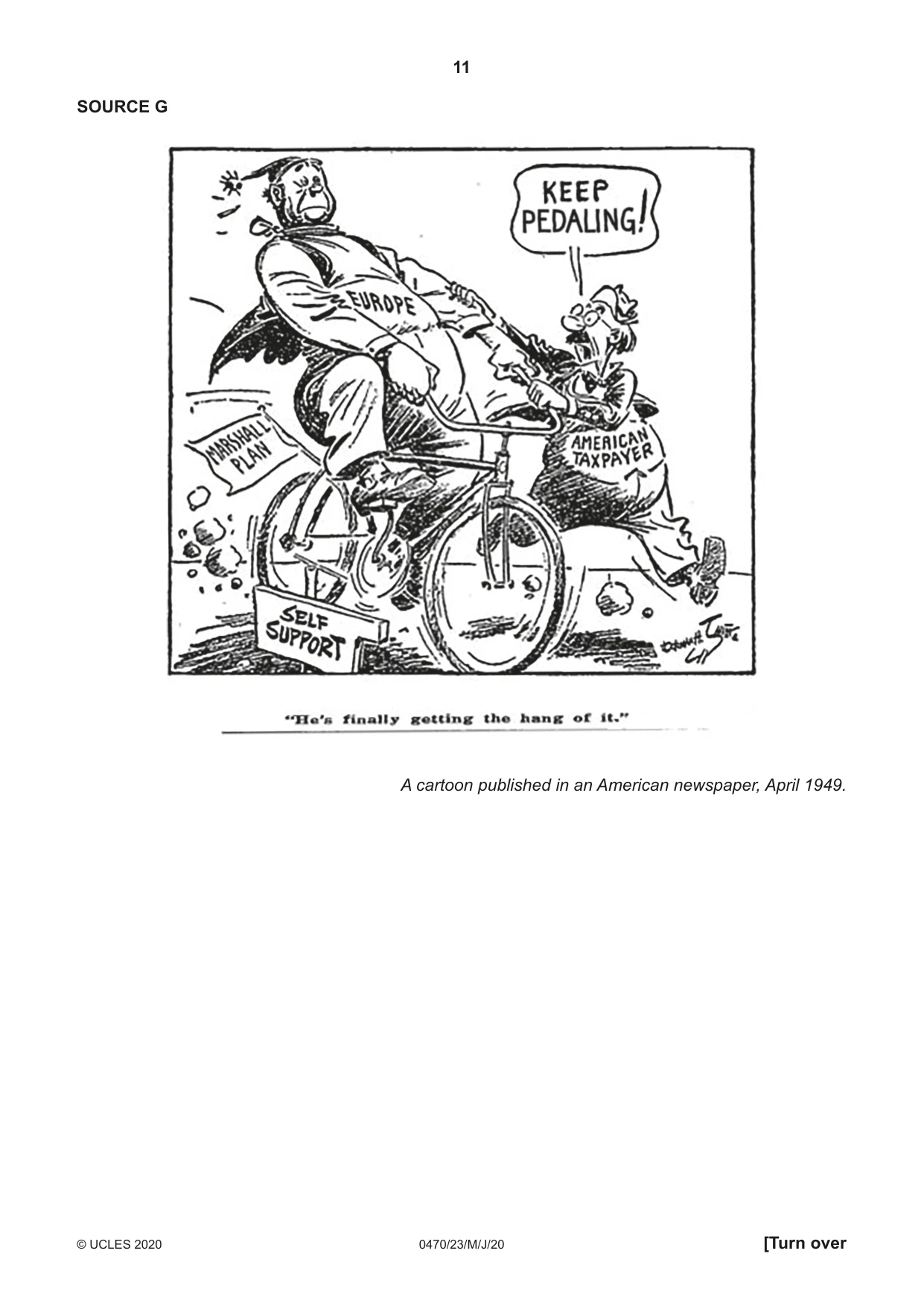
11 0470/23/M/J/20 © UCLES 2020 [Turn over SOURCE G A cartoon published in an American newspaper, April 1949.
Question paper, page 12
12 0470/23/M/J/20 © UCLES 2020 Permission to reproduce items where third-party owned material protected by copyright is included has been sought and cleared where possible. Every reasonable effort has been made by the publisher (UCLES) to trace copyright holders, but if any items requiring clearance have unwittingly been included, the publisher will be pleased to make amends at the earliest possible opportunity. To avoid the issue of disclosure of answer-related information to candidates, all copyright acknowledgements are reproduced online in the Cambridge Assessment International Education Copyright Acknowledgements Booklet. This is produced for each series of examinations and is freely available to download at www.cambridgeinternational.org after the live examination series. Cambridge Assessment International Education is part of the Cambridge Assessment Group. Cambridge Assessment is the brand name of the University of Cambridge Local Examinations Syndicate (UCLES), which itself is a department of the University of Cambridge. Now answer all the following questions. You may use any of the sources to help you answer the questions, in addition to those sources which you are told to use. In answering the questions you should use your knowledge of the topic to help you interpret and evaluate the sources. 1 Study Sources A and B. How far do these two sources agree? Explain your answer using details of the sources. [7] 2 Study Source C. Why was this cartoon published in France in October 1947? Explain your answer using details of the source and your knowledge. [8] 3 Study Sources D and E. How far does Source D make Source E surprising? Explain your answer using details of the sources and your knowledge. [8] 4 Study Source F. How useful is this cartoon as evidence about the Marshall Plan? Explain your answer using details of the source and your knowledge. [8] 5 Study Source G. What is the cartoonist’s message? Explain your answer using details of the source and your knowledge. [7] 6 Study all the sources. How far do these sources provide convincing evidence that the Soviet Union was justified in being suspicious about the Marshall Plan? Use the sources to explain your answer. [12]
Mark scheme, page 1
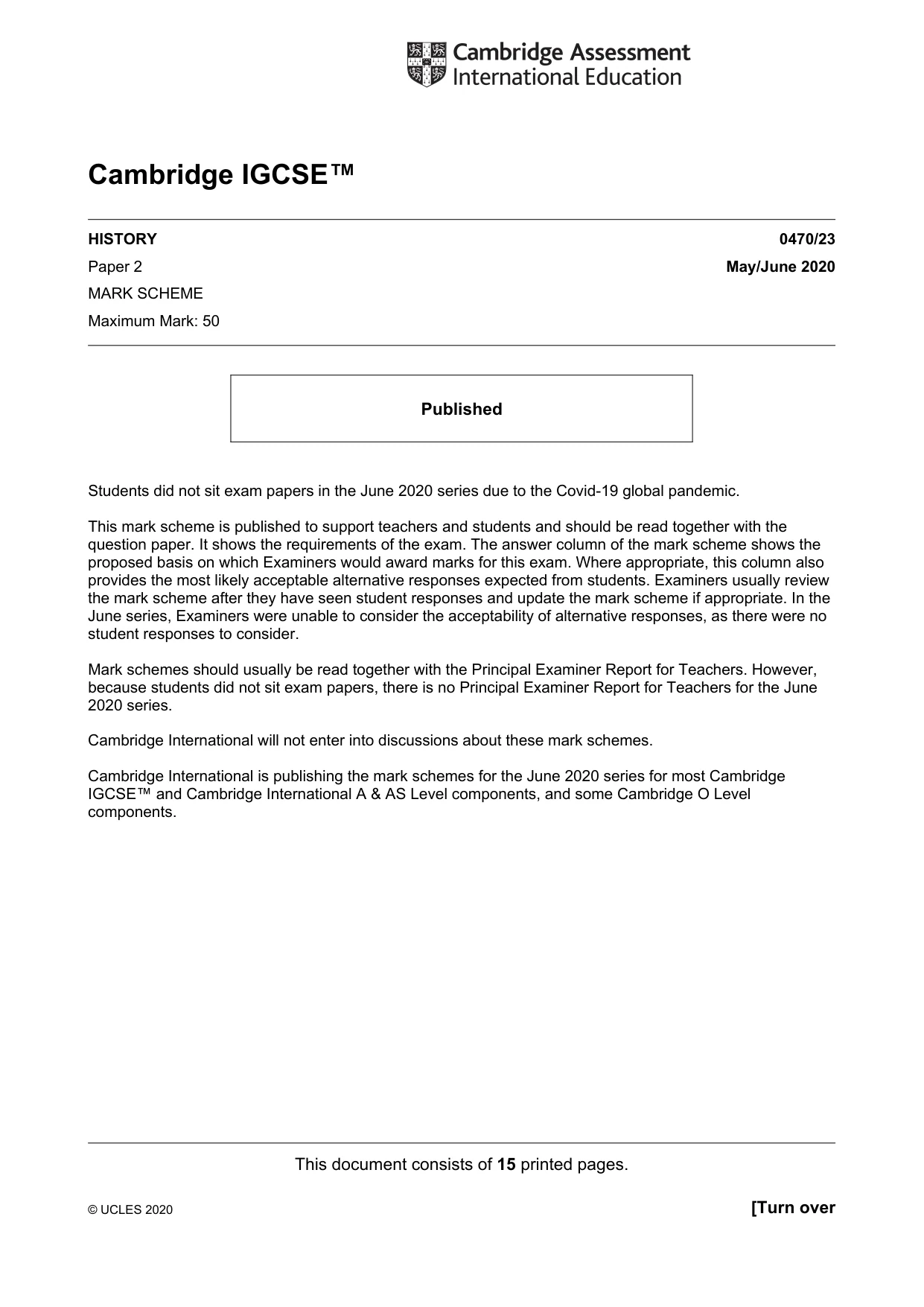
This document consists of 15 printed pages. © UCLES 2020 [Turn over Cambridge IGCSE™ HISTORY 0470/23 Paper 2 May/June 2020 MARK SCHEME Maximum Mark: 50 Published Students did not sit exam papers in the June 2020 series due to the Covid-19 global pandemic. This mark scheme is published to support teachers and students and should be read together with the question paper. It shows the requirements of the exam. The answer column of the mark scheme shows the proposed basis on which Examiners would award marks for this exam. Where appropriate, this column also provides the most likely acceptable alternative responses expected from students. Examiners usually review the mark scheme after they have seen student responses and update the mark scheme if appropriate. In the June series, Examiners were unable to consider the acceptability of alternative responses, as there were no student responses to consider. Mark schemes should usually be read together with the Principal Examiner Report for Teachers. However, because students did not sit exam papers, there is no Principal Examiner Report for Teachers for the June 2020 series. Cambridge International will not enter into discussions about these mark schemes. Cambridge International is publishing the mark schemes for the June 2020 series for most Cambridge IGCSE™ and Cambridge International A & AS Level components, and some Cambridge O Level components.
Mark scheme, page 2
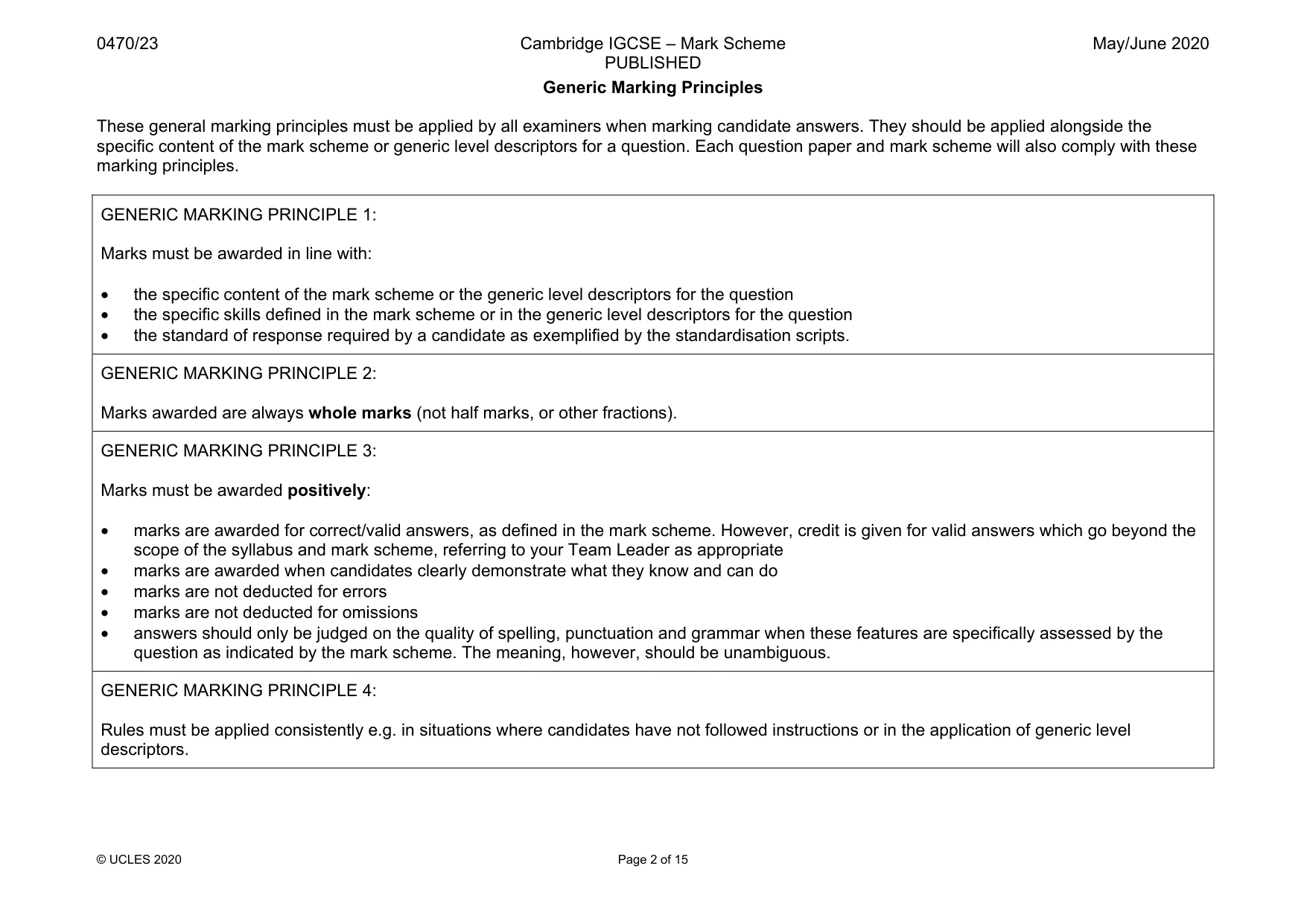
0470/23 Cambridge IGCSE – Mark Scheme PUBLISHED May/June 2020 © UCLES 2020 Page 2 of 15 Generic Marking Principles These general marking principles must be applied by all examiners when marking candidate answers. They should be applied alongside the specific content of the mark scheme or generic level descriptors for a question. Each question paper and mark scheme will also comply with these marking principles. GENERIC MARKING PRINCIPLE 1: Marks must be awarded in line with: • the specific content of the mark scheme or the generic level descriptors for the question • the specific skills defined in the mark scheme or in the generic level descriptors for the question • the standard of response required by a candidate as exemplified by the standardisation scripts. GENERIC MARKING PRINCIPLE 2: Marks awarded are always whole marks (not half marks, or other fractions). GENERIC MARKING PRINCIPLE 3: Marks must be awarded positively: • marks are awarded for correct/valid answers, as defined in the mark scheme. However, credit is given for valid answers which go beyond the scope of the syllabus and mark scheme, referring to your Team Leader as appropriate • marks are awarded when candidates clearly demonstrate what they know and can do • marks are not deducted for errors • marks are not deducted for omissions • answers should only be judged on the quality of spelling, punctuation and grammar when these features are specifically assessed by the question as indicated by the mark scheme. The meaning, however, should be unambiguous. GENERIC MARKING PRINCIPLE 4: Rules must be applied consistently e.g. in situations where candidates have not followed instructions or in the application of generic level descriptors.
Mark scheme, page 3
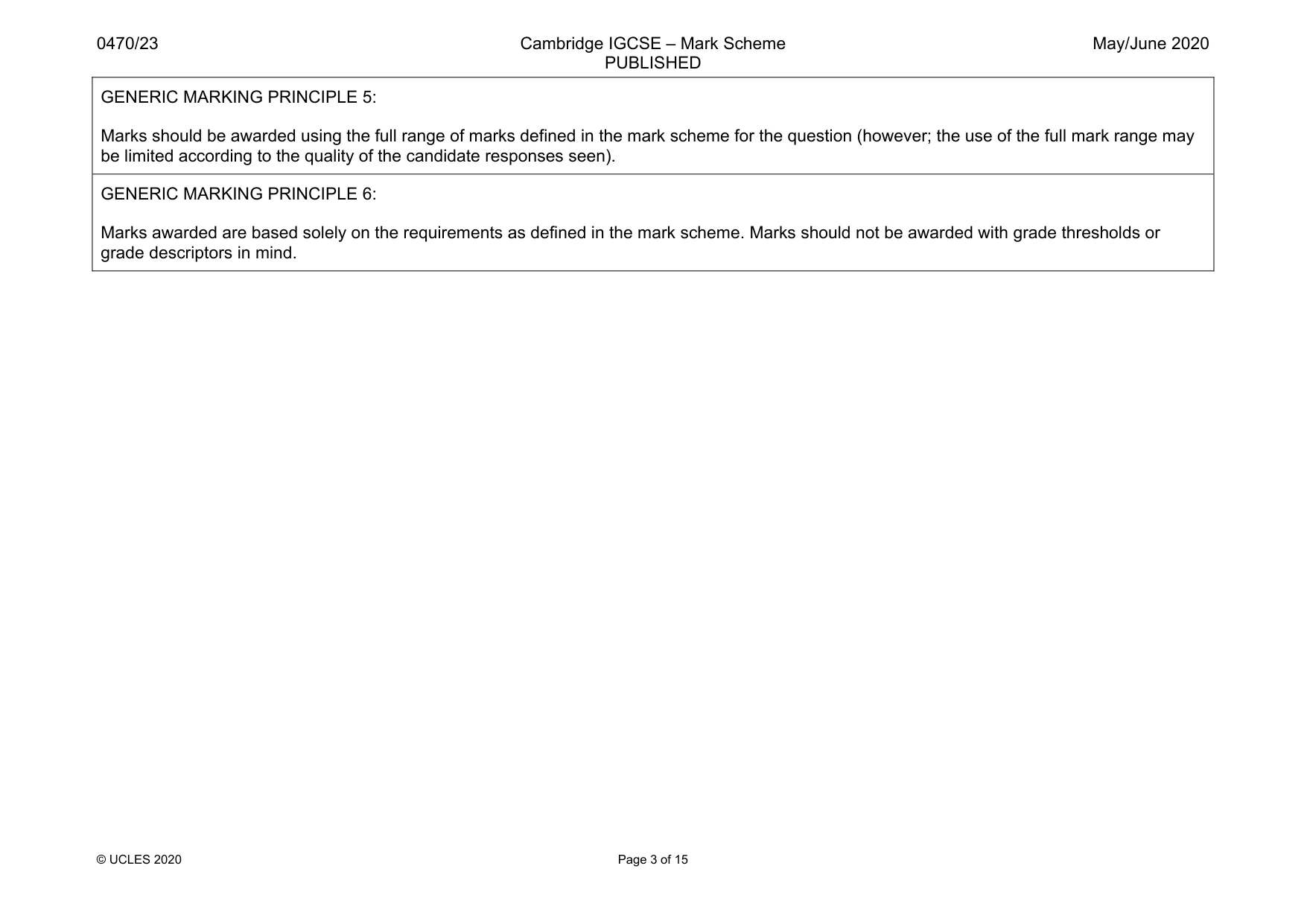
0470/23 Cambridge IGCSE – Mark Scheme PUBLISHED May/June 2020 © UCLES 2020 Page 3 of 15 GENERIC MARKING PRINCIPLE 5: Marks should be awarded using the full range of marks defined in the mark scheme for the question (however; the use of the full mark range may be limited according to the quality of the candidate responses seen). GENERIC MARKING PRINCIPLE 6: Marks awarded are based solely on the requirements as defined in the mark scheme. Marks should not be awarded with grade thresholds or grade descriptors in mind.
Mark scheme, page 4
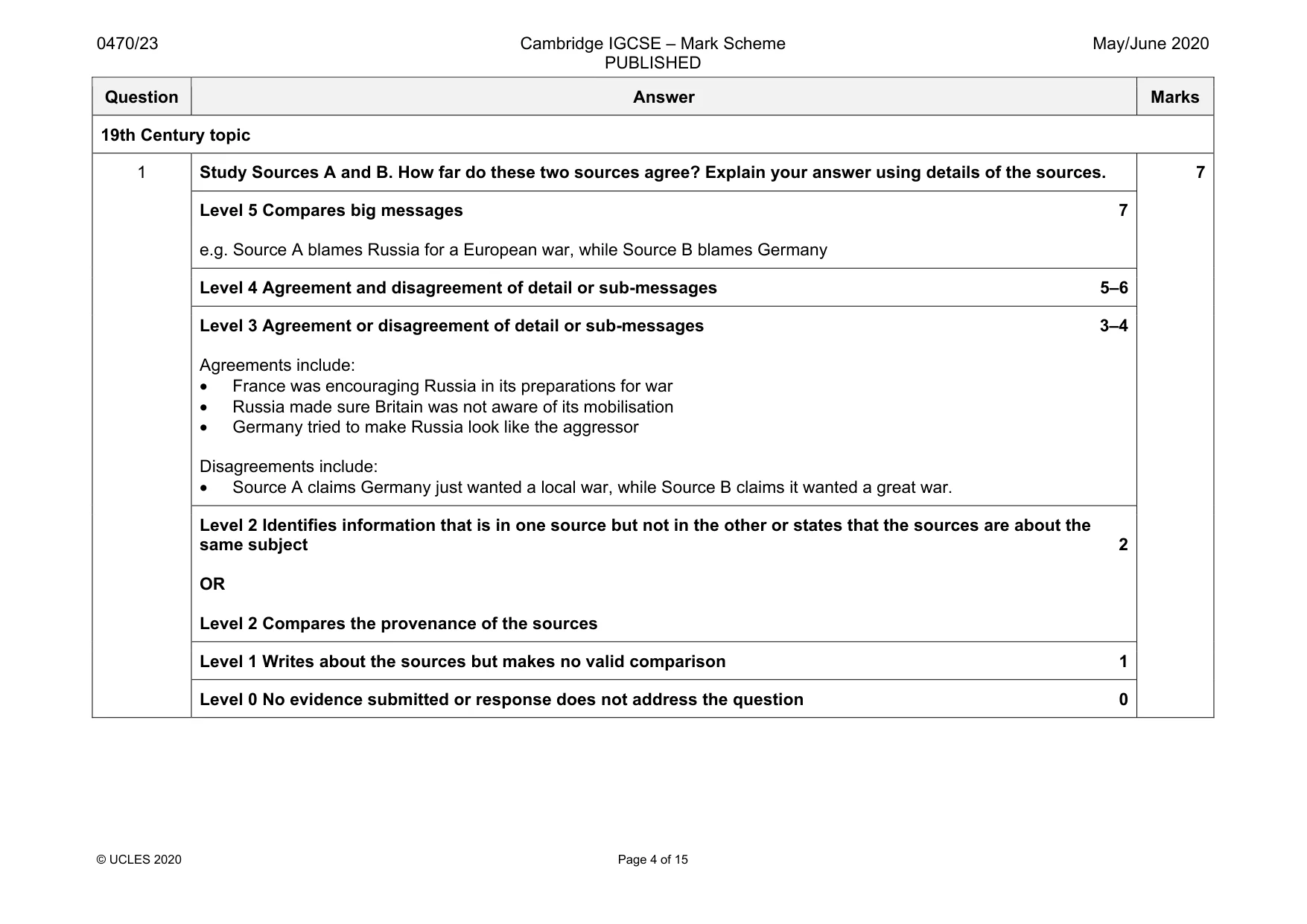
0470/23 Cambridge IGCSE – Mark Scheme PUBLISHED May/June 2020 © UCLES 2020 Page 4 of 15 Question Answer Marks 19th Century topic 1 Study Sources A and B. How far do these two sources agree? Explain your answer using details of the sources. 7 Level 5 Compares big messages 7 e.g. Source A blames Russia for a European war, while Source B blames Germany Level 4 Agreement and disagreement of detail or sub-messages 5–6 Level 3 Agreement or disagreement of detail or sub-messages 3–4 Agreements include: • France was encouraging Russia in its preparations for war • Russia made sure Britain was not aware of its mobilisation • Germany tried to make Russia look like the aggressor Disagreements include: • Source A claims Germany just wanted a local war, while Source B claims it wanted a great war. Level 2 Identifies information that is in one source but not in the other or states that the sources are about the same subject 2 OR Level 2 Compares the provenance of the sources Level 1 Writes about the sources but makes no valid comparison 1 Level 0 No evidence submitted or response does not address the question 0
Mark scheme, page 5
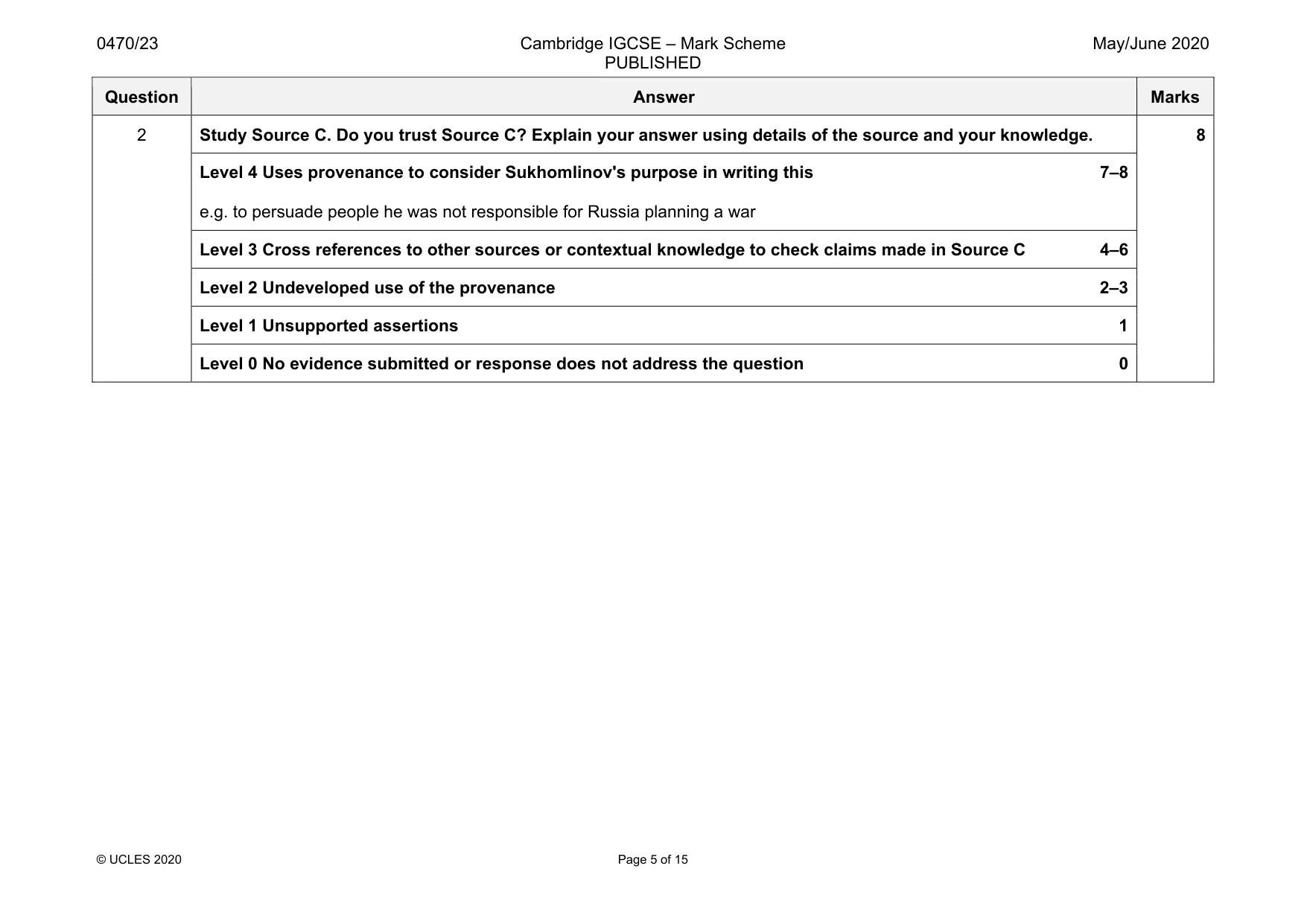
0470/23 Cambridge IGCSE – Mark Scheme PUBLISHED May/June 2020 © UCLES 2020 Page 5 of 15 Question Answer Marks 2 Study Source C. Do you trust Source C? Explain your answer using details of the source and your knowledge. 8 Level 4 Uses provenance to consider Sukhomlinov's purpose in writing this 7–8 e.g. to persuade people he was not responsible for Russia planning a war Level 3 Cross references to other sources or contextual knowledge to check claims made in Source C 4–6 Level 2 Undeveloped use of the provenance 2–3 Level 1 Unsupported assertions 1 Level 0 No evidence submitted or response does not address the question 0
Mark scheme, page 6
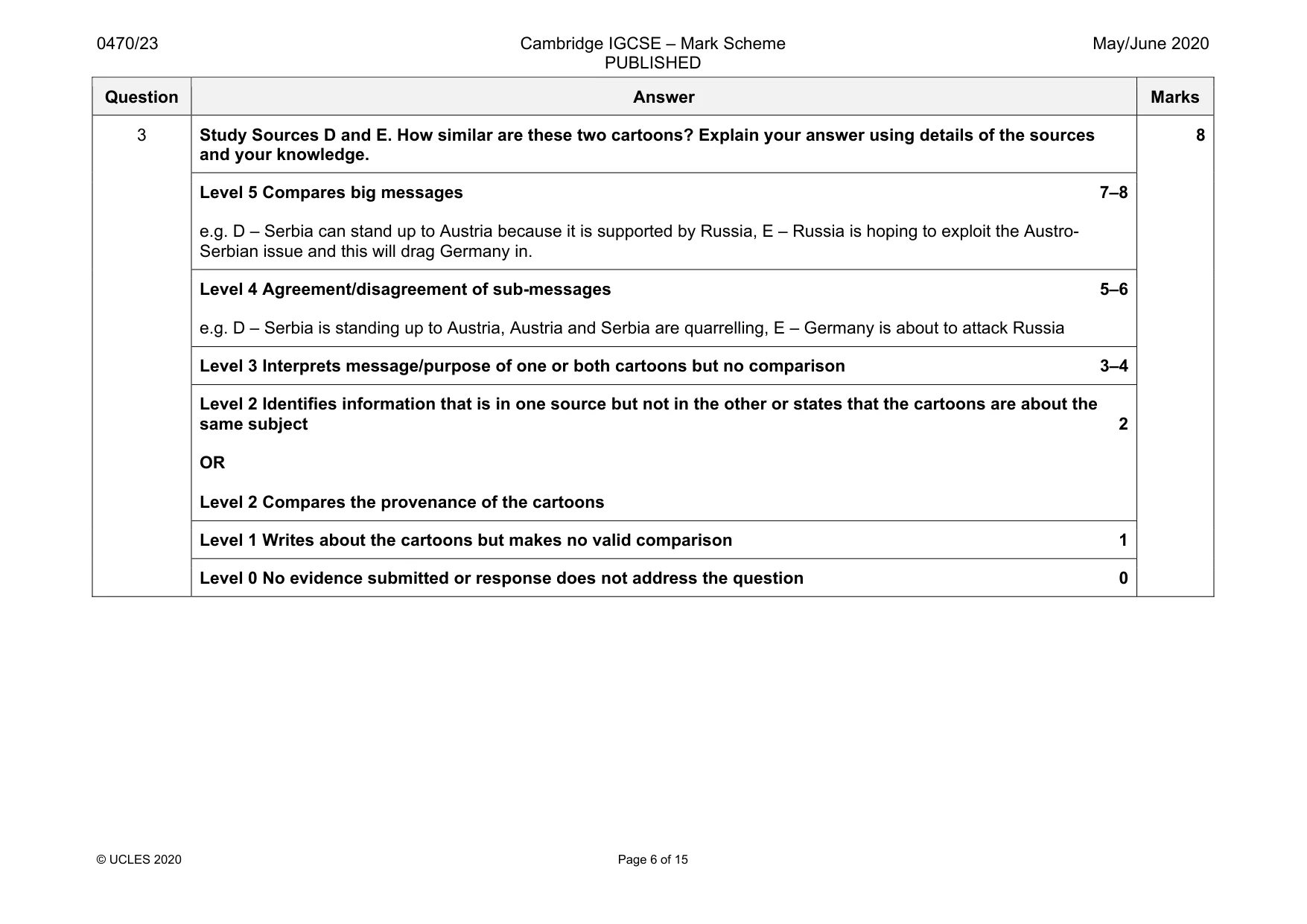
0470/23 Cambridge IGCSE – Mark Scheme PUBLISHED May/June 2020 © UCLES 2020 Page 6 of 15 Question Answer Marks 3 Study Sources D and E. How similar are these two cartoons? Explain your answer using details of the sources and your knowledge. 8 Level 5 Compares big messages 7–8 e.g. D – Serbia can stand up to Austria because it is supported by Russia, E – Russia is hoping to exploit the Austro- Serbian issue and this will drag Germany in. Level 4 Agreement/disagreement of sub-messages 5–6 e.g. D – Serbia is standing up to Austria, Austria and Serbia are quarrelling, E – Germany is about to attack Russia Level 3 Interprets message/purpose of one or both cartoons but no comparison 3–4 Level 2 Identifies information that is in one source but not in the other or states that the cartoons are about the same subject 2 OR Level 2 Compares the provenance of the cartoons Level 1 Writes about the cartoons but makes no valid comparison 1 Level 0 No evidence submitted or response does not address the question 0
Mark scheme, page 7
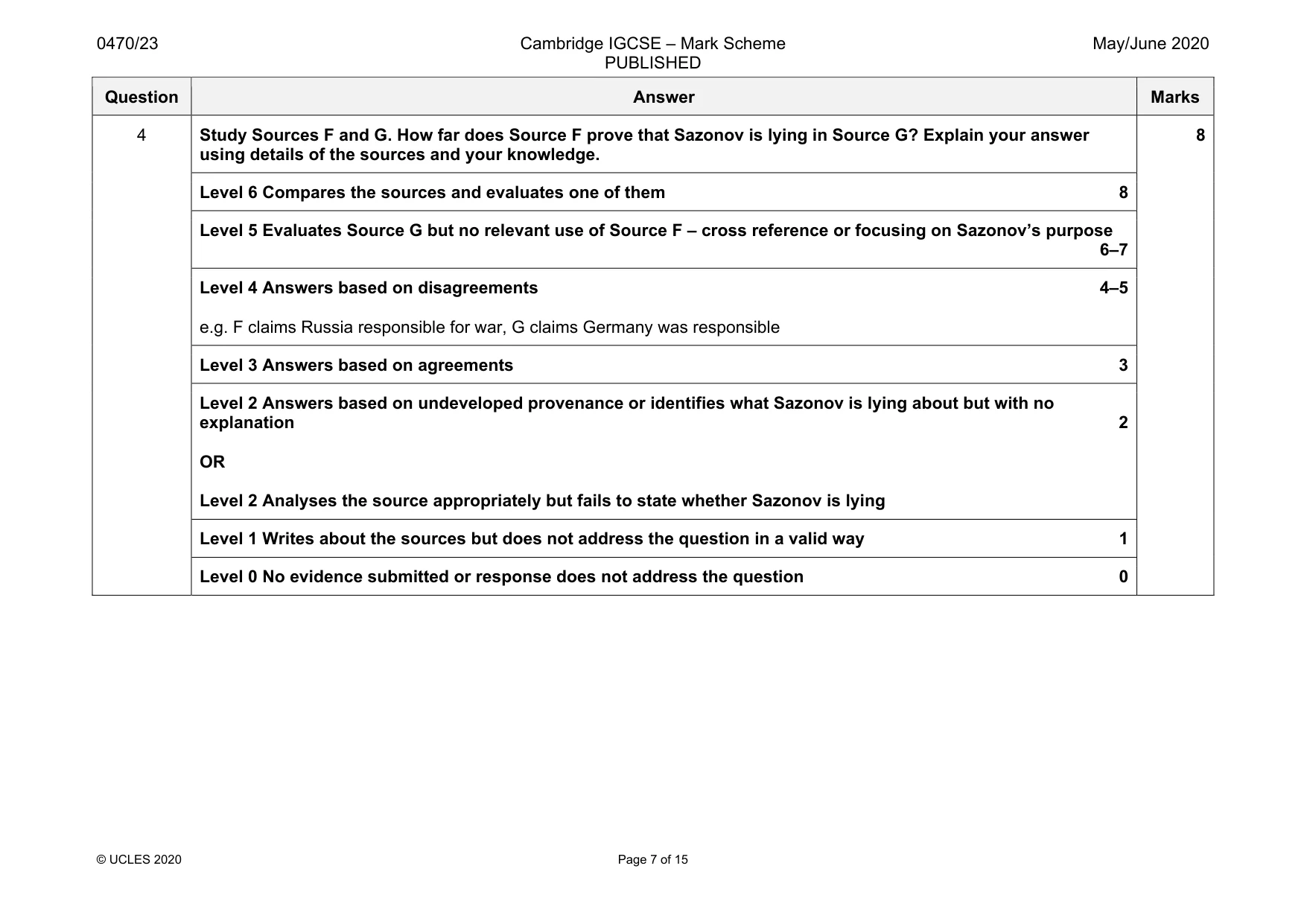
0470/23 Cambridge IGCSE – Mark Scheme PUBLISHED May/June 2020 © UCLES 2020 Page 7 of 15 Question Answer Marks 4 Study Sources F and G. How far does Source F prove that Sazonov is lying in Source G? Explain your answer using details of the sources and your knowledge. 8 Level 6 Compares the sources and evaluates one of them 8 Level 5 Evaluates Source G but no relevant use of Source F – cross reference or focusing on Sazonov’s purpose 6–7 Level 4 Answers based on disagreements 4–5 e.g. F claims Russia responsible for war, G claims Germany was responsible Level 3 Answers based on agreements 3 Level 2 Answers based on undeveloped provenance or identifies what Sazonov is lying about but with no explanation 2 OR Level 2 Analyses the source appropriately but fails to state whether Sazonov is lying Level 1 Writes about the sources but does not address the question in a valid way 1 Level 0 No evidence submitted or response does not address the question 0
Mark scheme, page 8
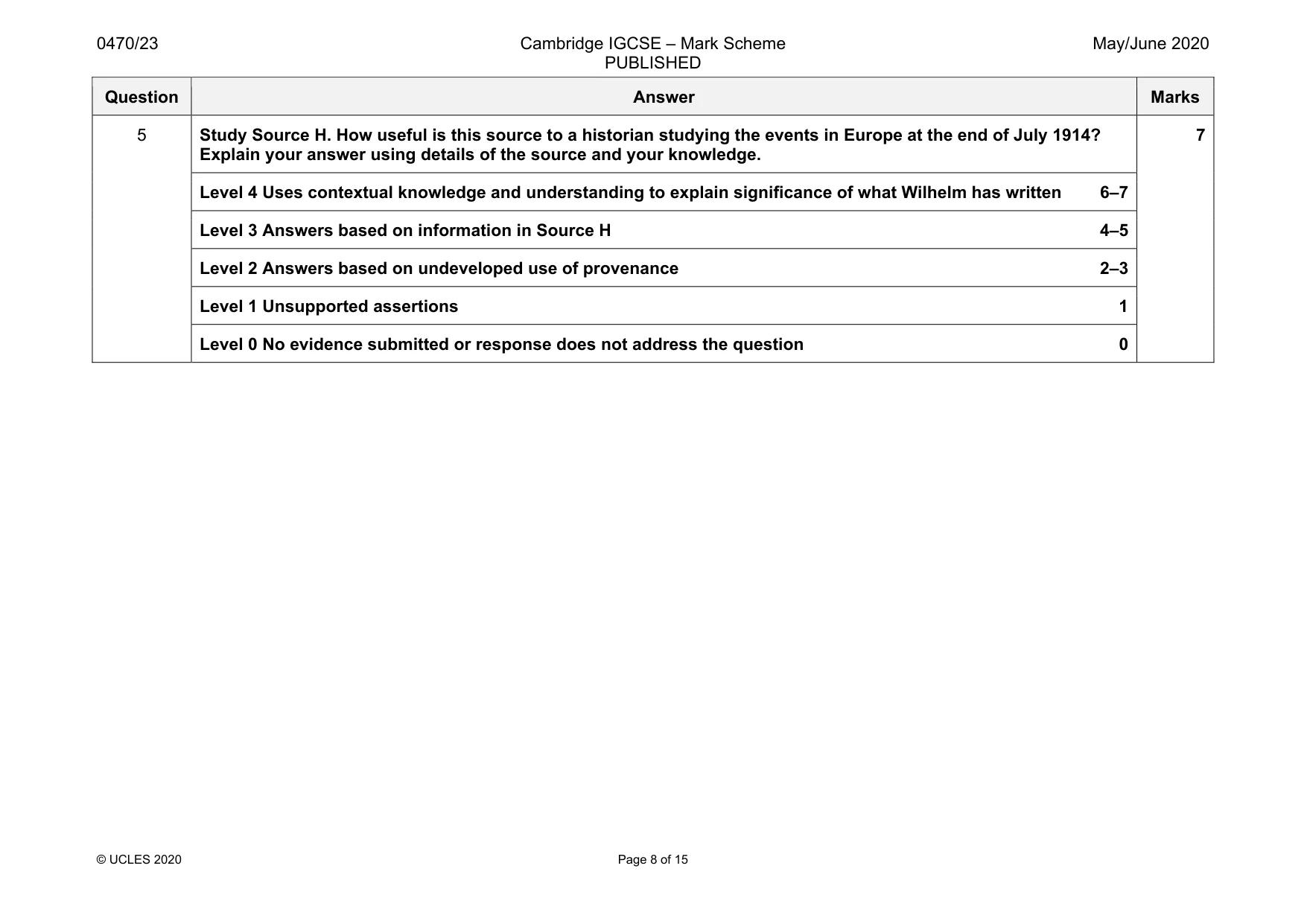
0470/23 Cambridge IGCSE – Mark Scheme PUBLISHED May/June 2020 © UCLES 2020 Page 8 of 15 Question Answer Marks 5 Study Source H. How useful is this source to a historian studying the events in Europe at the end of July 1914? Explain your answer using details of the source and your knowledge. 7 Level 4 Uses contextual knowledge and understanding to explain significance of what Wilhelm has written 6–7 Level 3 Answers based on information in Source H 4–5 Level 2 Answers based on undeveloped use of provenance 2–3 Level 1 Unsupported assertions 1 Level 0 No evidence submitted or response does not address the question 0
Mark scheme, page 9
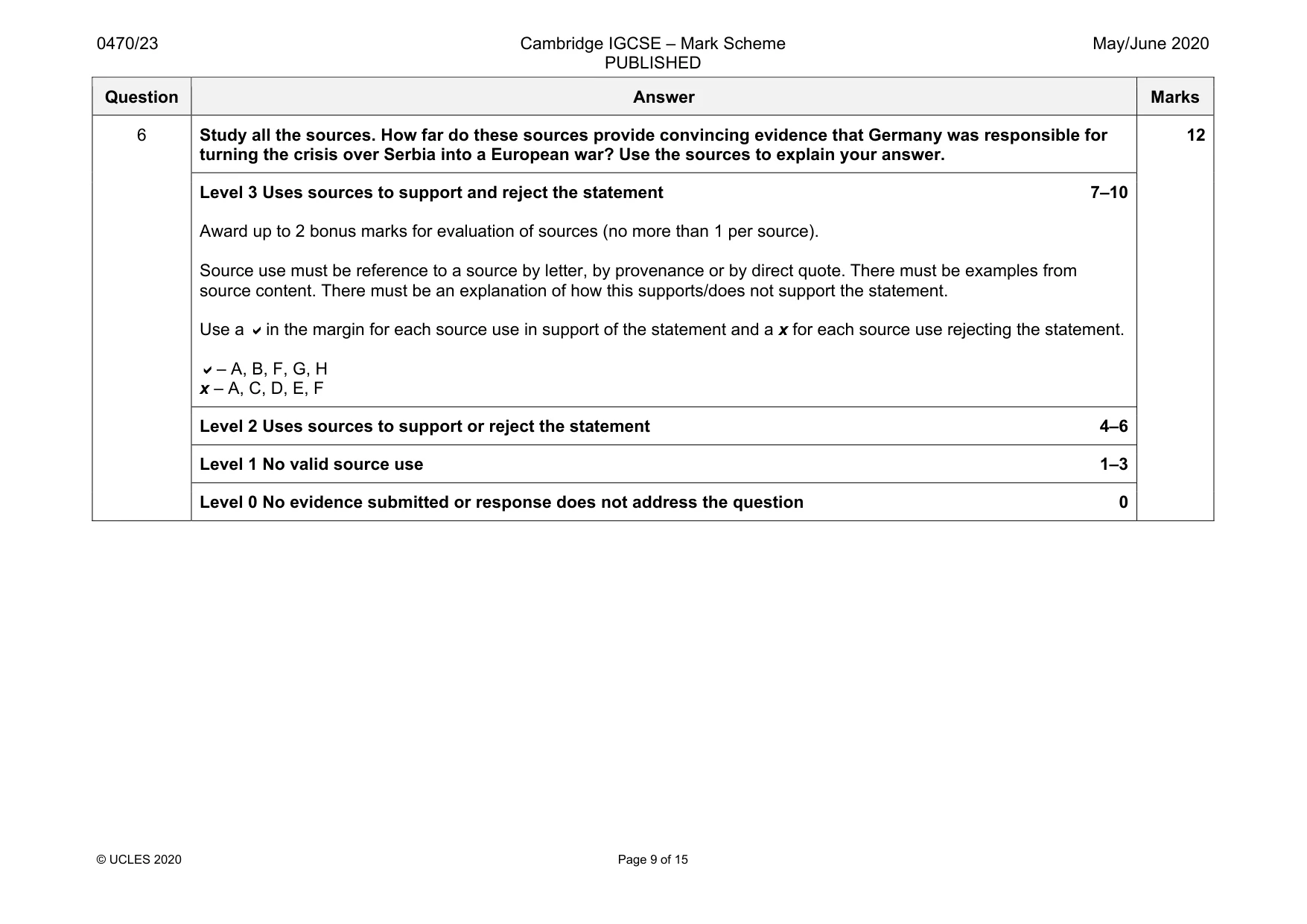
0470/23 Cambridge IGCSE – Mark Scheme PUBLISHED May/June 2020 © UCLES 2020 Page 9 of 15 Question Answer Marks 6 Study all the sources. How far do these sources provide convincing evidence that Germany was responsible for turning the crisis over Serbia into a European war? Use the sources to explain your answer. 12 Level 3 Uses sources to support and reject the statement 7–10 Award up to 2 bonus marks for evaluation of sources (no more than 1 per source). Source use must be reference to a source by letter, by provenance or by direct quote. There must be examples from source content. There must be an explanation of how this supports/does not support the statement. Use a in the margin for each source use in support of the statement and a x for each source use rejecting the statement. – A, B, F, G, H x – A, C, D, E, F Level 2 Uses sources to support or reject the statement 4–6 Level 1 No valid source use 1–3 Level 0 No evidence submitted or response does not address the question 0
Mark scheme, page 10
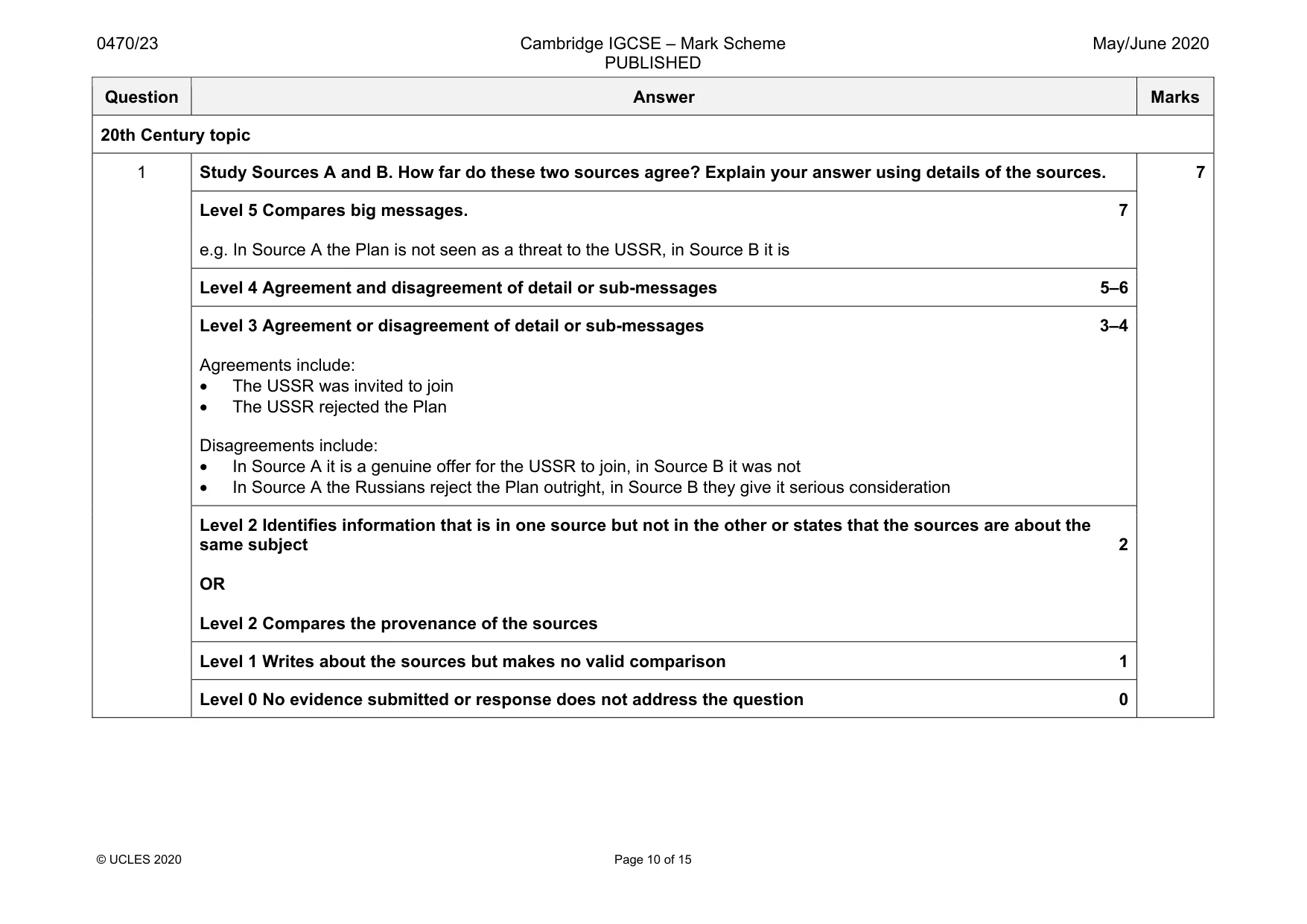
0470/23 Cambridge IGCSE – Mark Scheme PUBLISHED May/June 2020 © UCLES 2020 Page 10 of 15 Question Answer Marks 20th Century topic 1 Study Sources A and B. How far do these two sources agree? Explain your answer using details of the sources. 7 Level 5 Compares big messages. 7 e.g. In Source A the Plan is not seen as a threat to the USSR, in Source B it is Level 4 Agreement and disagreement of detail or sub-messages 5–6 Level 3 Agreement or disagreement of detail or sub-messages 3–4 Agreements include: • The USSR was invited to join • The USSR rejected the Plan Disagreements include: • In Source A it is a genuine offer for the USSR to join, in Source B it was not • In Source A the Russians reject the Plan outright, in Source B they give it serious consideration Level 2 Identifies information that is in one source but not in the other or states that the sources are about the same subject 2 OR Level 2 Compares the provenance of the sources Level 1 Writes about the sources but makes no valid comparison 1 Level 0 No evidence submitted or response does not address the question 0
Mark scheme, page 11
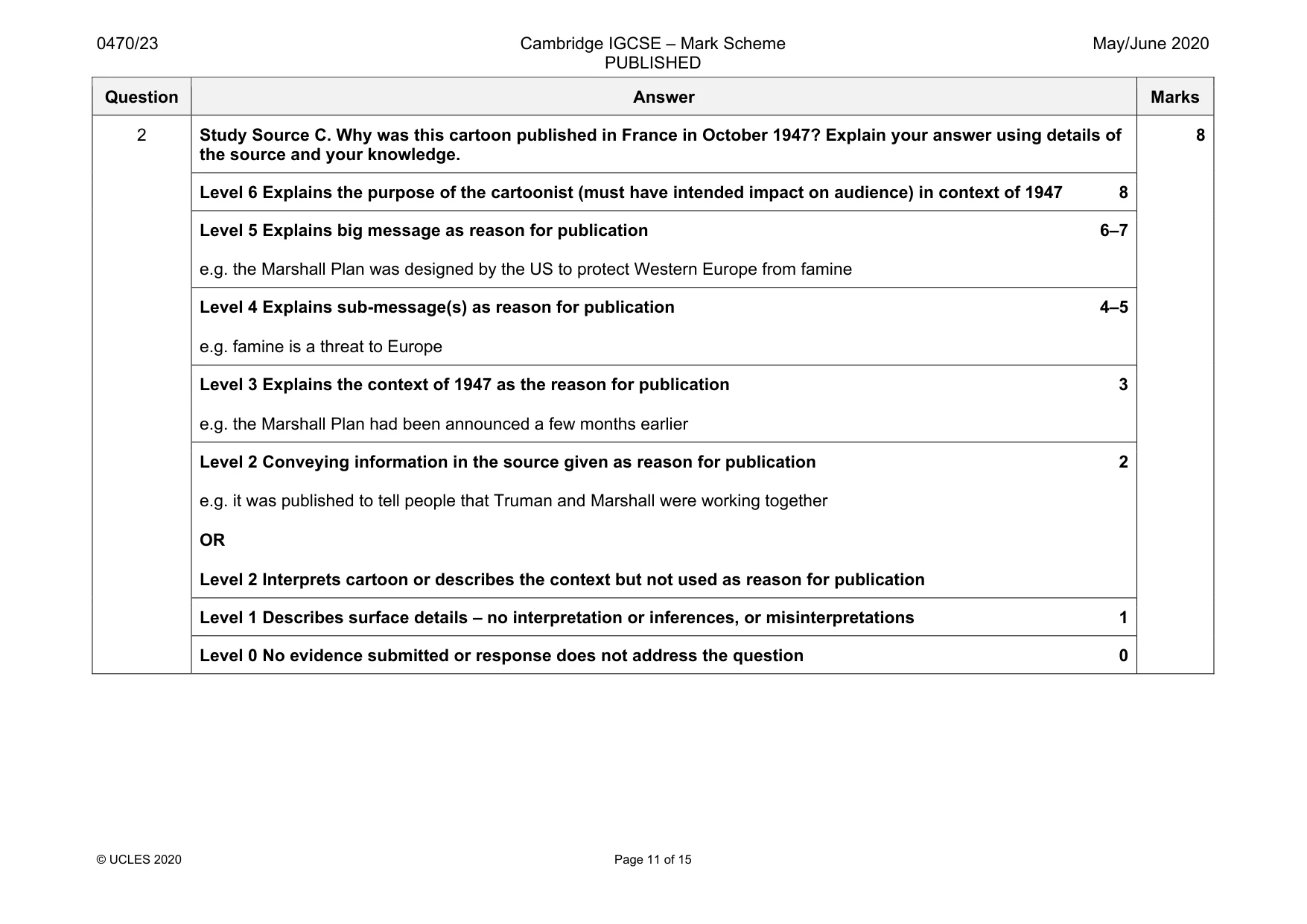
0470/23 Cambridge IGCSE – Mark Scheme PUBLISHED May/June 2020 © UCLES 2020 Page 11 of 15 Question Answer Marks 2 Study Source C. Why was this cartoon published in France in October 1947? Explain your answer using details of the source and your knowledge. 8 Level 6 Explains the purpose of the cartoonist (must have intended impact on audience) in context of 1947 8 Level 5 Explains big message as reason for publication 6–7 e.g. the Marshall Plan was designed by the US to protect Western Europe from famine Level 4 Explains sub-message(s) as reason for publication 4–5 e.g. famine is a threat to Europe Level 3 Explains the context of 1947 as the reason for publication 3 e.g. the Marshall Plan had been announced a few months earlier Level 2 Conveying information in the source given as reason for publication 2 e.g. it was published to tell people that Truman and Marshall were working together OR Level 2 Interprets cartoon or describes the context but not used as reason for publication Level 1 Describes surface details – no interpretation or inferences, or misinterpretations 1 Level 0 No evidence submitted or response does not address the question 0
Mark scheme, page 12
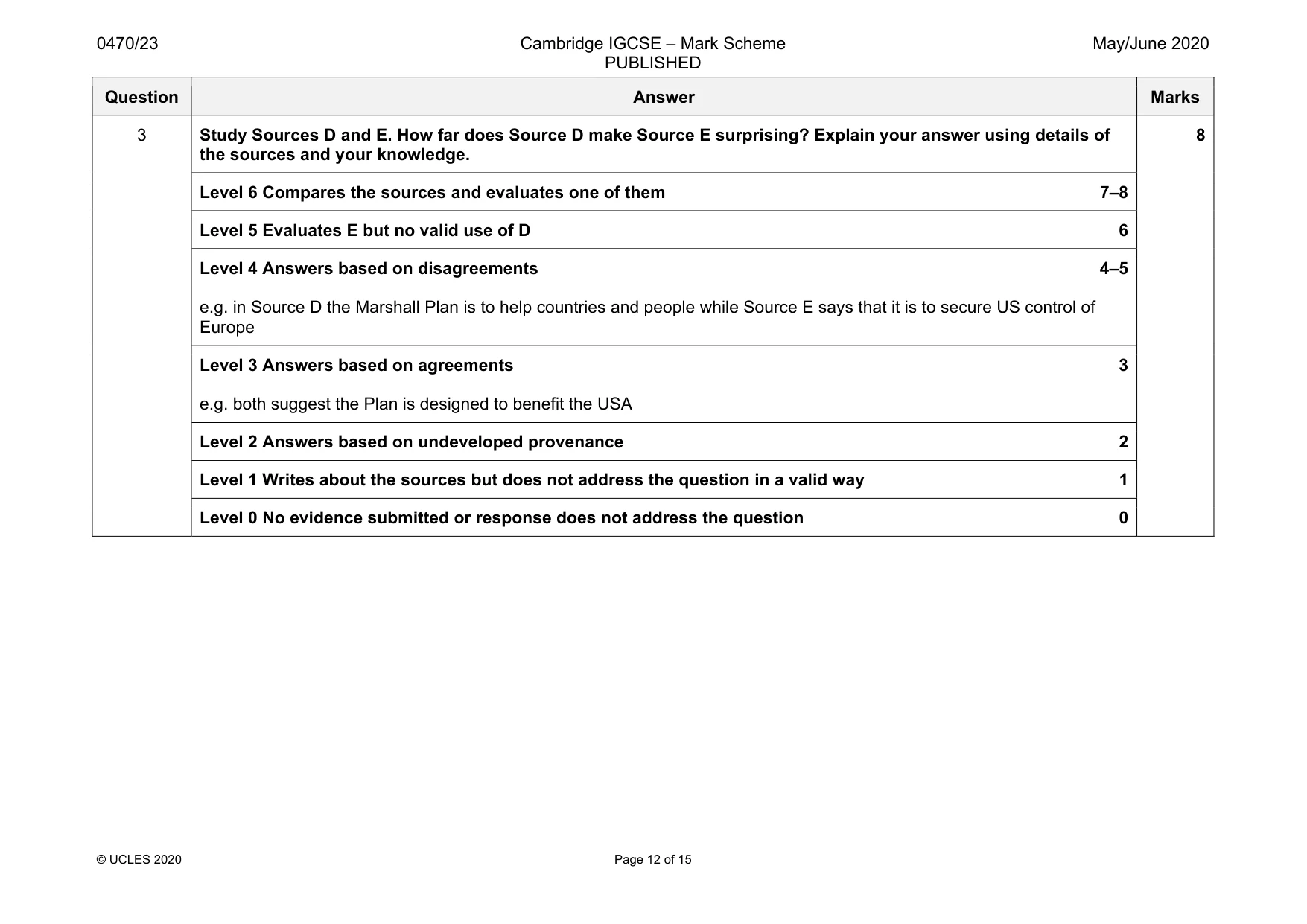
0470/23 Cambridge IGCSE – Mark Scheme PUBLISHED May/June 2020 © UCLES 2020 Page 12 of 15 Question Answer Marks 3 Study Sources D and E. How far does Source D make Source E surprising? Explain your answer using details of the sources and your knowledge. 8 Level 6 Compares the sources and evaluates one of them 7–8 Level 5 Evaluates E but no valid use of D 6 Level 4 Answers based on disagreements 4–5 e.g. in Source D the Marshall Plan is to help countries and people while Source E says that it is to secure US control of Europe Level 3 Answers based on agreements 3 e.g. both suggest the Plan is designed to benefit the USA Level 2 Answers based on undeveloped provenance 2 Level 1 Writes about the sources but does not address the question in a valid way 1 Level 0 No evidence submitted or response does not address the question 0
Mark scheme, page 13
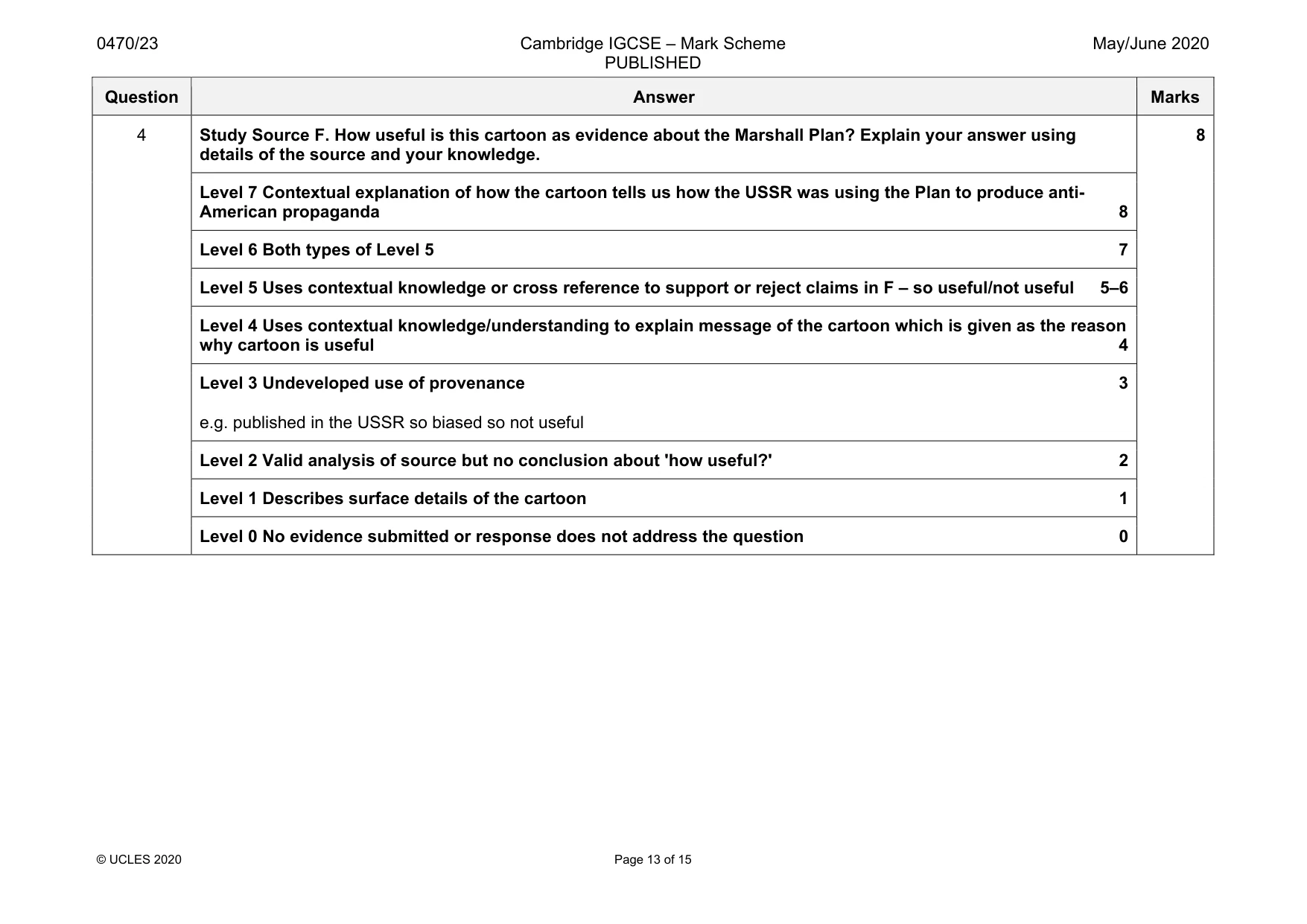
0470/23 Cambridge IGCSE – Mark Scheme PUBLISHED May/June 2020 © UCLES 2020 Page 13 of 15 Question Answer Marks 4 Study Source F. How useful is this cartoon as evidence about the Marshall Plan? Explain your answer using details of the source and your knowledge. 8 Level 7 Contextual explanation of how the cartoon tells us how the USSR was using the Plan to produce anti- American propaganda 8 Level 6 Both types of Level 5 7 Level 5 Uses contextual knowledge or cross reference to support or reject claims in F – so useful/not useful 5–6 Level 4 Uses contextual knowledge/understanding to explain message of the cartoon which is given as the reason why cartoon is useful 4 Level 3 Undeveloped use of provenance 3 e.g. published in the USSR so biased so not useful Level 2 Valid analysis of source but no conclusion about 'how useful?' 2 Level 1 Describes surface details of the cartoon 1 Level 0 No evidence submitted or response does not address the question 0
Mark scheme, page 14
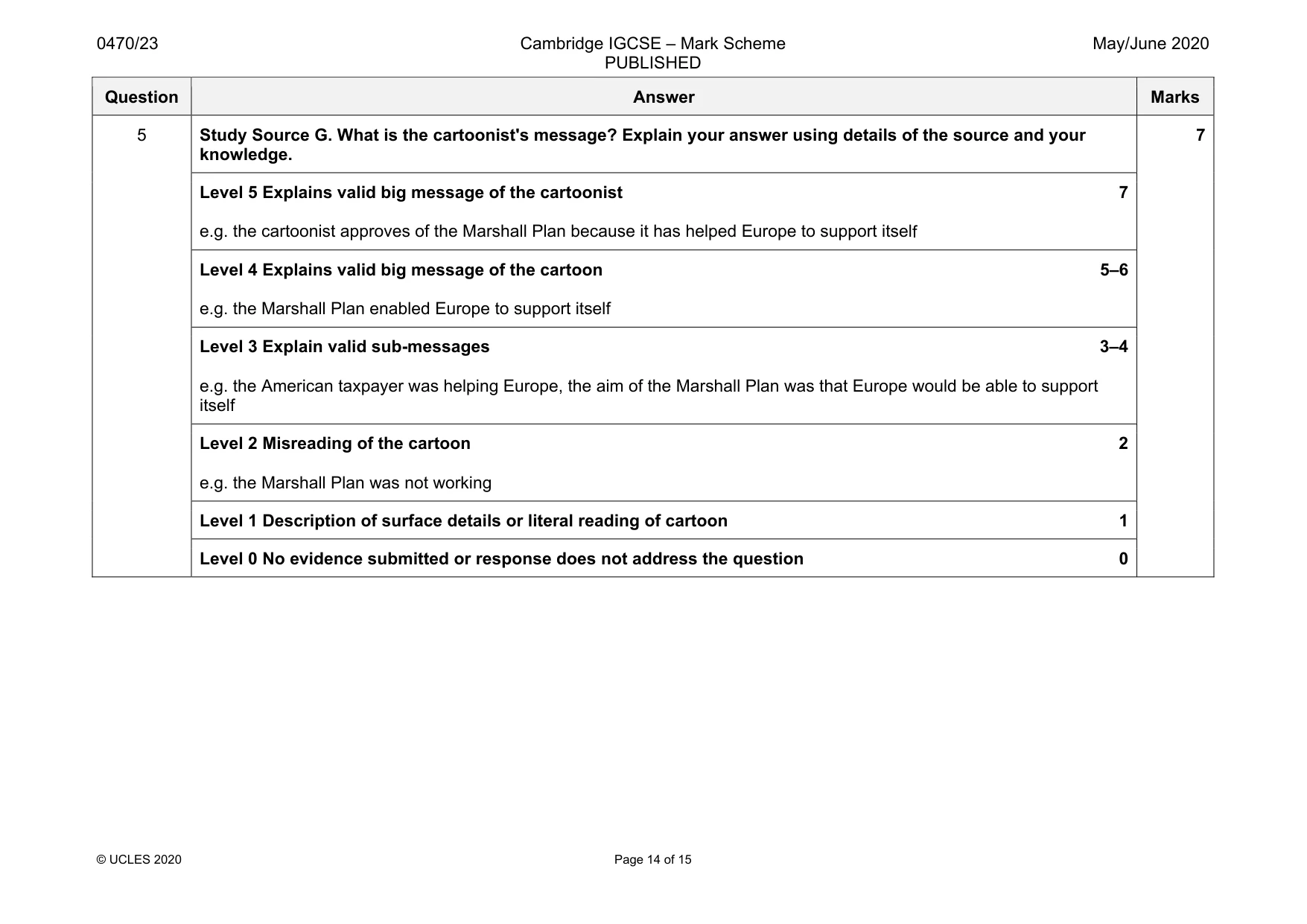
0470/23 Cambridge IGCSE – Mark Scheme PUBLISHED May/June 2020 © UCLES 2020 Page 14 of 15 Question Answer Marks 5 Study Source G. What is the cartoonist's message? Explain your answer using details of the source and your knowledge. 7 Level 5 Explains valid big message of the cartoonist 7 e.g. the cartoonist approves of the Marshall Plan because it has helped Europe to support itself Level 4 Explains valid big message of the cartoon 5–6 e.g. the Marshall Plan enabled Europe to support itself Level 3 Explain valid sub-messages 3–4 e.g. the American taxpayer was helping Europe, the aim of the Marshall Plan was that Europe would be able to support itself Level 2 Misreading of the cartoon 2 e.g. the Marshall Plan was not working Level 1 Description of surface details or literal reading of cartoon 1 Level 0 No evidence submitted or response does not address the question 0
Mark scheme, page 15
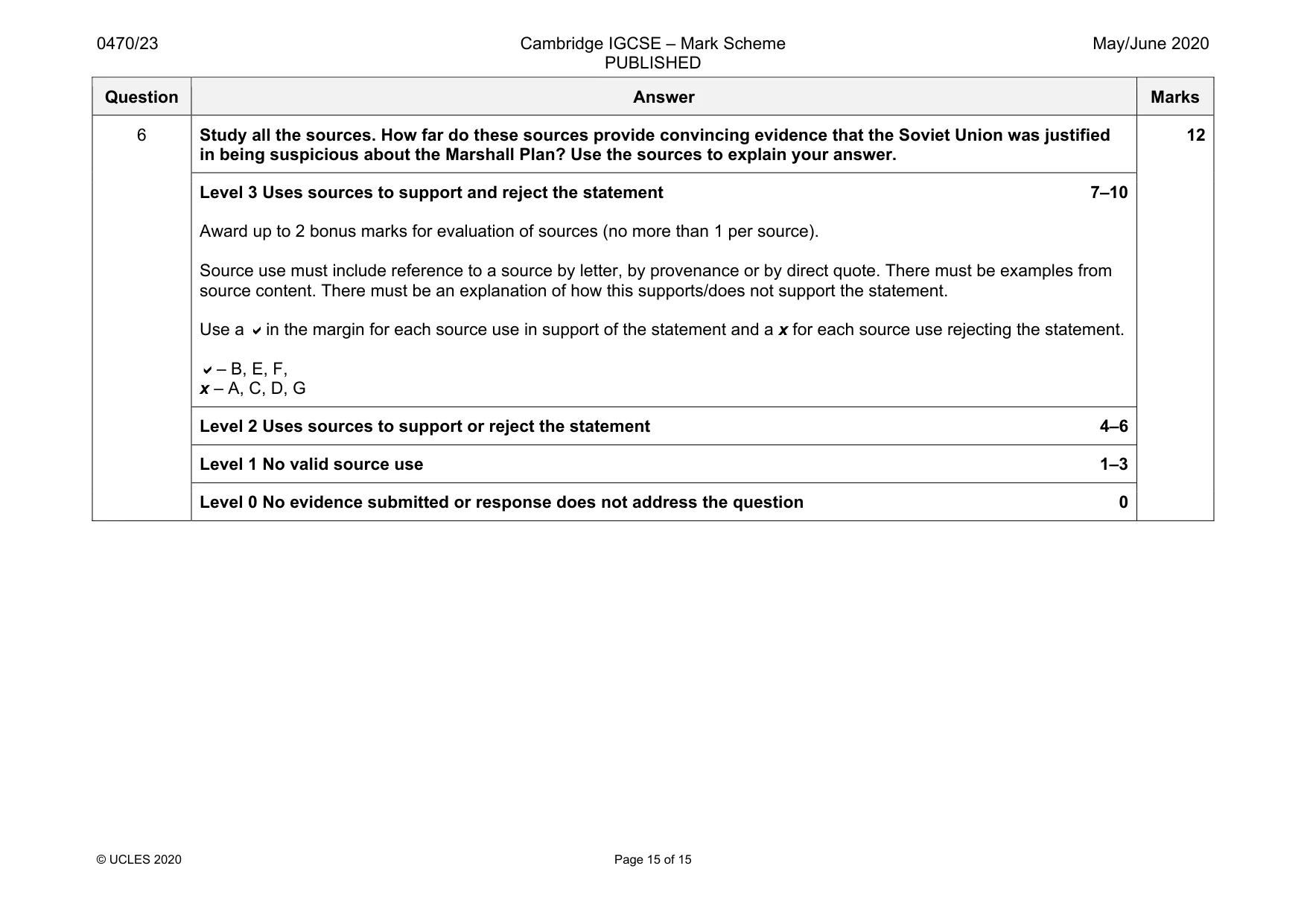
0470/23 Cambridge IGCSE – Mark Scheme PUBLISHED May/June 2020 © UCLES 2020 Page 15 of 15 Question Answer Marks 6 Study all the sources. How far do these sources provide convincing evidence that the Soviet Union was justified in being suspicious about the Marshall Plan? Use the sources to explain your answer. 12 Level 3 Uses sources to support and reject the statement 7–10 Award up to 2 bonus marks for evaluation of sources (no more than 1 per source). Source use must include reference to a source by letter, by provenance or by direct quote. There must be examples from source content. There must be an explanation of how this supports/does not support the statement. Use a in the margin for each source use in support of the statement and a x for each source use rejecting the statement. – B, E, F, x – A, C, D, G Level 2 Uses sources to support or reject the statement 4–6 Level 1 No valid source use 1–3 Level 0 No evidence submitted or response does not address the question 0