Cambridge IGCSE History 0470 — 2020 May/June Paper 2 · Variant 1
0470/21/M/J/20
The question paper and its mark scheme, free to read here and free to download. This is Cambridge’s own paper, exactly as it was sat.
Question paper16 pages
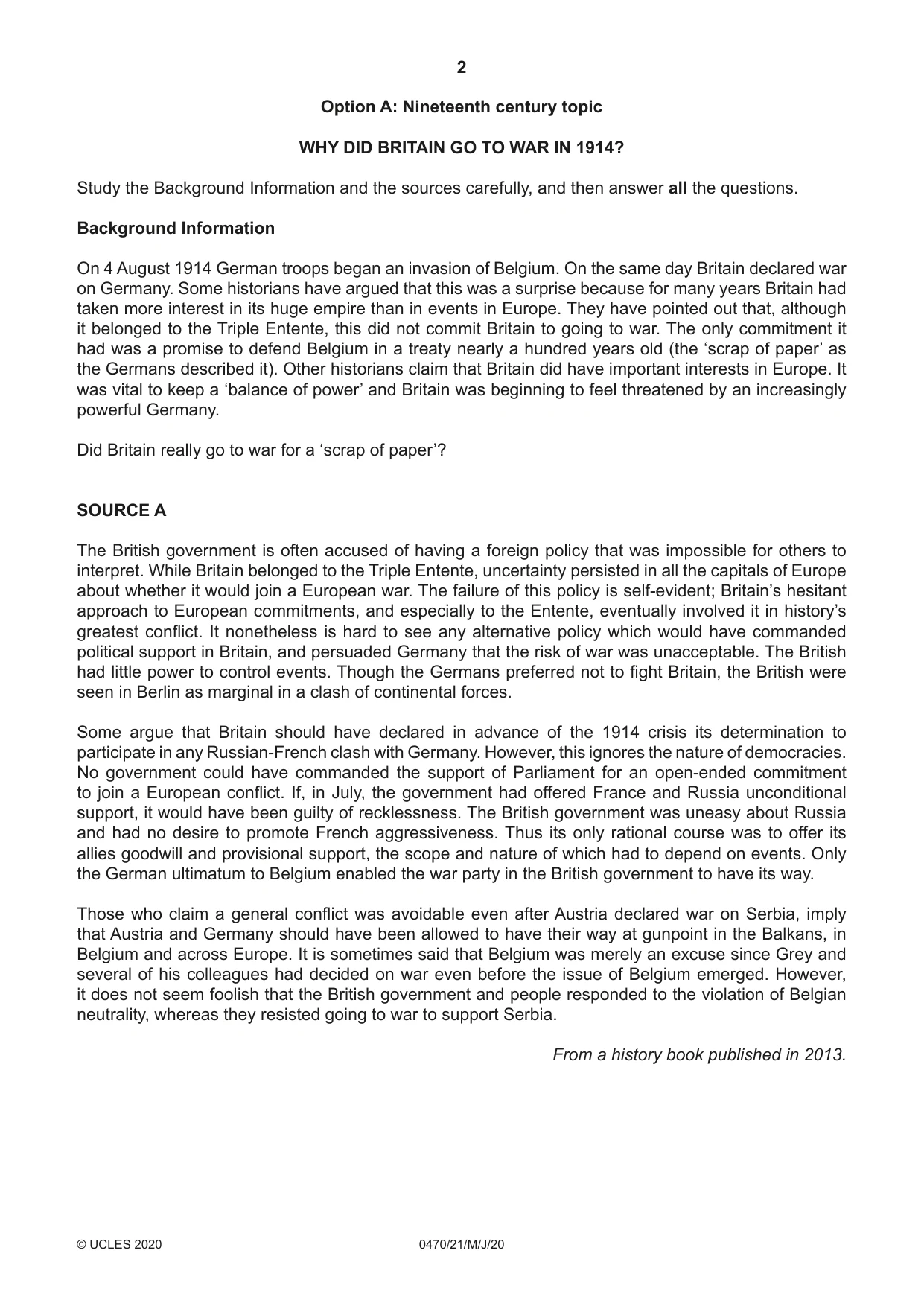
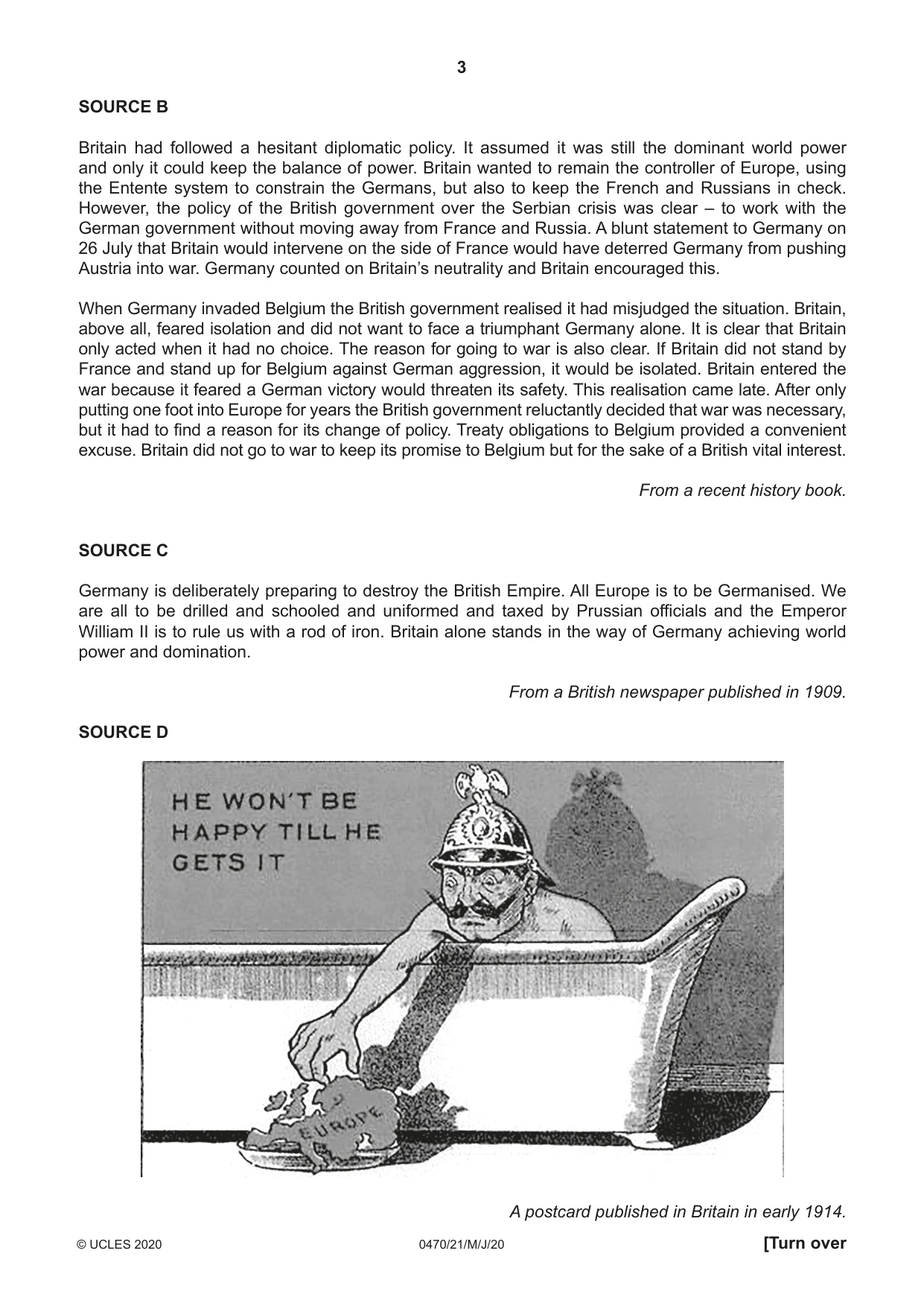
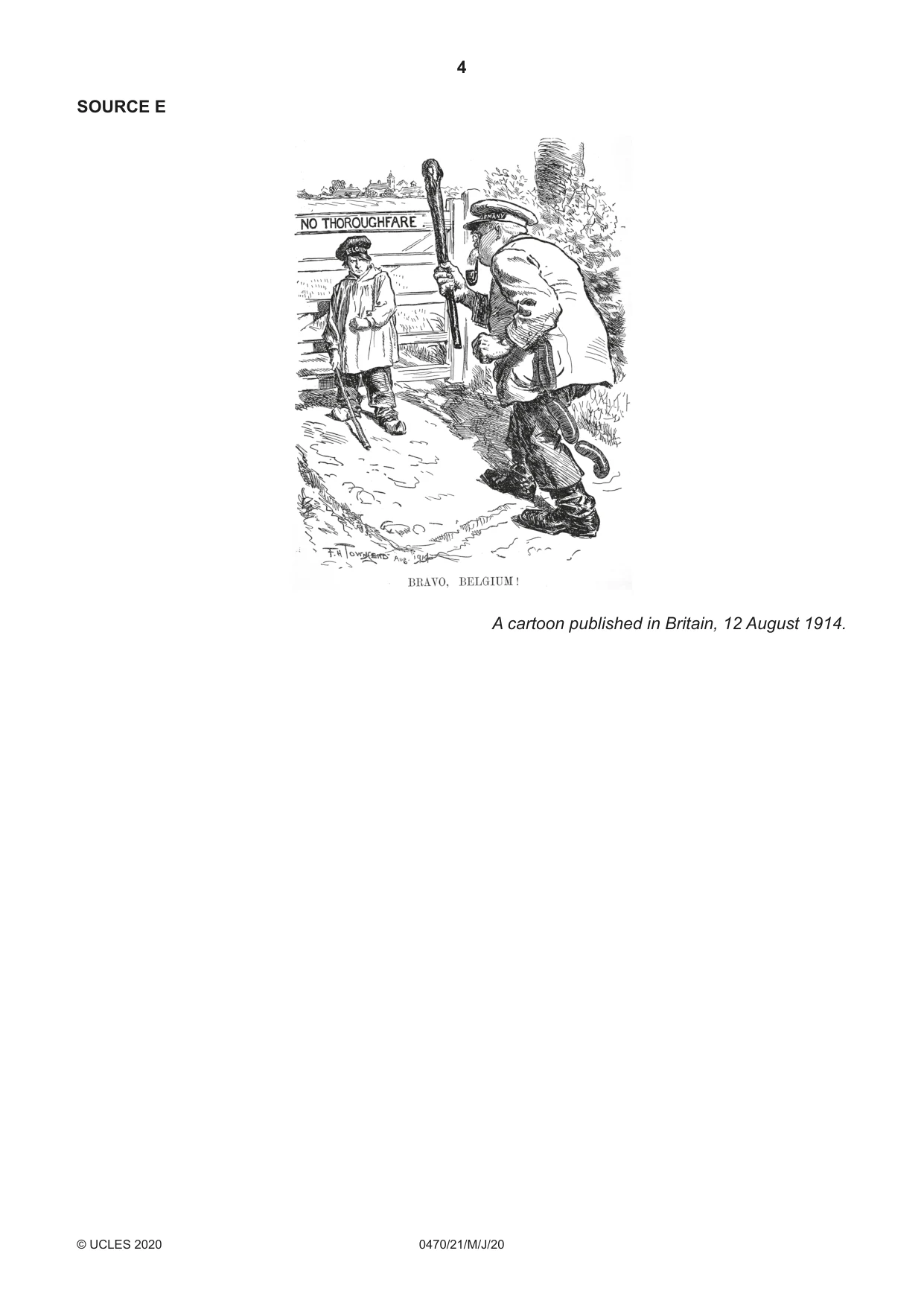


Mark scheme15 pages
Answers below. Sit the paper first if you are practising.
Paper as text
Question paper, page 1
Cambridge IGCSE™ HISTORY 0470/21 Paper 2 May/June 2020 2 hours You must answer on the enclosed answer booklet. You will need: Answer booklet (enclosed) INSTRUCTIONS ● Answer all the questions on one option only. Option A: Nineteenth century topic Option B: Twentieth century topic ● Follow the instructions on the front cover of the answer booklet. If you need additional answer paper, ask the invigilator for a continuation booklet. INFORMATION ● The total mark for this paper is 50. ● The number of marks for each question or part question is shown in brackets [ ]. * 6 3 6 3 9 9 6 5 8 4 * This document has 16 pages. Blank pages are indicated. DC (CJ/CB) 184718/3 © UCLES 2020 [Turn over
Question paper, page 2
2 0470/21/M/J/20 © UCLES 2020 Option A: Nineteenth century topic WHY DID BRITAIN GO TO WAR IN 1914? Study the Background Information and the sources carefully, and then answer all the questions. Background Information On 4 August 1914 German troops began an invasion of Belgium. On the same day Britain declared war on Germany. Some historians have argued that this was a surprise because for many years Britain had taken more interest in its huge empire than in events in Europe. They have pointed out that, although it belonged to the Triple Entente, this did not commit Britain to going to war. The only commitment it had was a promise to defend Belgium in a treaty nearly a hundred years old (the ‘scrap of paper’ as the Germans described it). Other historians claim that Britain did have important interests in Europe. It was vital to keep a ‘balance of power’ and Britain was beginning to feel threatened by an increasingly powerful Germany. Did Britain really go to war for a ‘scrap of paper’? SOURCE A The British government is often accused of having a foreign policy that was impossible for others to interpret. While Britain belonged to the Triple Entente, uncertainty persisted in all the capitals of Europe about whether it would join a European war. The failure of this policy is self-evident; Britain’s hesitant approach to European commitments, and especially to the Entente, eventually involved it in history’s greatest conflict. It nonetheless is hard to see any alternative policy which would have commanded political support in Britain, and persuaded Germany that the risk of war was unacceptable. The British had little power to control events. Though the Germans preferred not to fight Britain, the British were seen in Berlin as marginal in a clash of continental forces. Some argue that Britain should have declared in advance of the 1914 crisis its determination to participate in any Russian-French clash with Germany. However, this ignores the nature of democracies. No government could have commanded the support of Parliament for an open-ended commitment to join a European conflict. If, in July, the government had offered France and Russia unconditional support, it would have been guilty of recklessness. The British government was uneasy about Russia and had no desire to promote French aggressiveness. Thus its only rational course was to offer its allies goodwill and provisional support, the scope and nature of which had to depend on events. Only the German ultimatum to Belgium enabled the war party in the British government to have its way. Those who claim a general conflict was avoidable even after Austria declared war on Serbia, imply that Austria and Germany should have been allowed to have their way at gunpoint in the Balkans, in Belgium and across Europe. It is sometimes said that Belgium was merely an excuse since Grey and several of his colleagues had decided on war even before the issue of Belgium emerged. However, it does not seem foolish that the British government and people responded to the violation of Belgian neutrality, whereas they resisted going to war to support Serbia. From a history book published in 2013.
Question paper, page 3
3 0470/21/M/J/20 © UCLES 2020 [Turn over SOURCE B Britain had followed a hesitant diplomatic policy. It assumed it was still the dominant world power and only it could keep the balance of power. Britain wanted to remain the controller of Europe, using the Entente system to constrain the Germans, but also to keep the French and Russians in check. However, the policy of the British government over the Serbian crisis was clear – to work with the German government without moving away from France and Russia. A blunt statement to Germany on 26 July that Britain would intervene on the side of France would have deterred Germany from pushing Austria into war. Germany counted on Britain’s neutrality and Britain encouraged this. When Germany invaded Belgium the British government realised it had misjudged the situation. Britain, above all, feared isolation and did not want to face a triumphant Germany alone. It is clear that Britain only acted when it had no choice. The reason for going to war is also clear. If Britain did not stand by France and stand up for Belgium against German aggression, it would be isolated. Britain entered the war because it feared a German victory would threaten its safety. This realisation came late. After only putting one foot into Europe for years the British government reluctantly decided that war was necessary, but it had to find a reason for its change of policy. Treaty obligations to Belgium provided a convenient excuse. Britain did not go to war to keep its promise to Belgium but for the sake of a British vital interest. From a recent history book. SOURCE C Germany is deliberately preparing to destroy the British Empire. All Europe is to be Germanised. We are all to be drilled and schooled and uniformed and taxed by Prussian officials and the Emperor William II is to rule us with a rod of iron. Britain alone stands in the way of Germany achieving world power and domination. From a British newspaper published in 1909. SOURCE D A postcard published in Britain in early 1914.
Question paper, page 4
4 0470/21/M/J/20 © UCLES 2020 SOURCE E A cartoon published in Britain, 12 August 1914.
Question paper, page 5
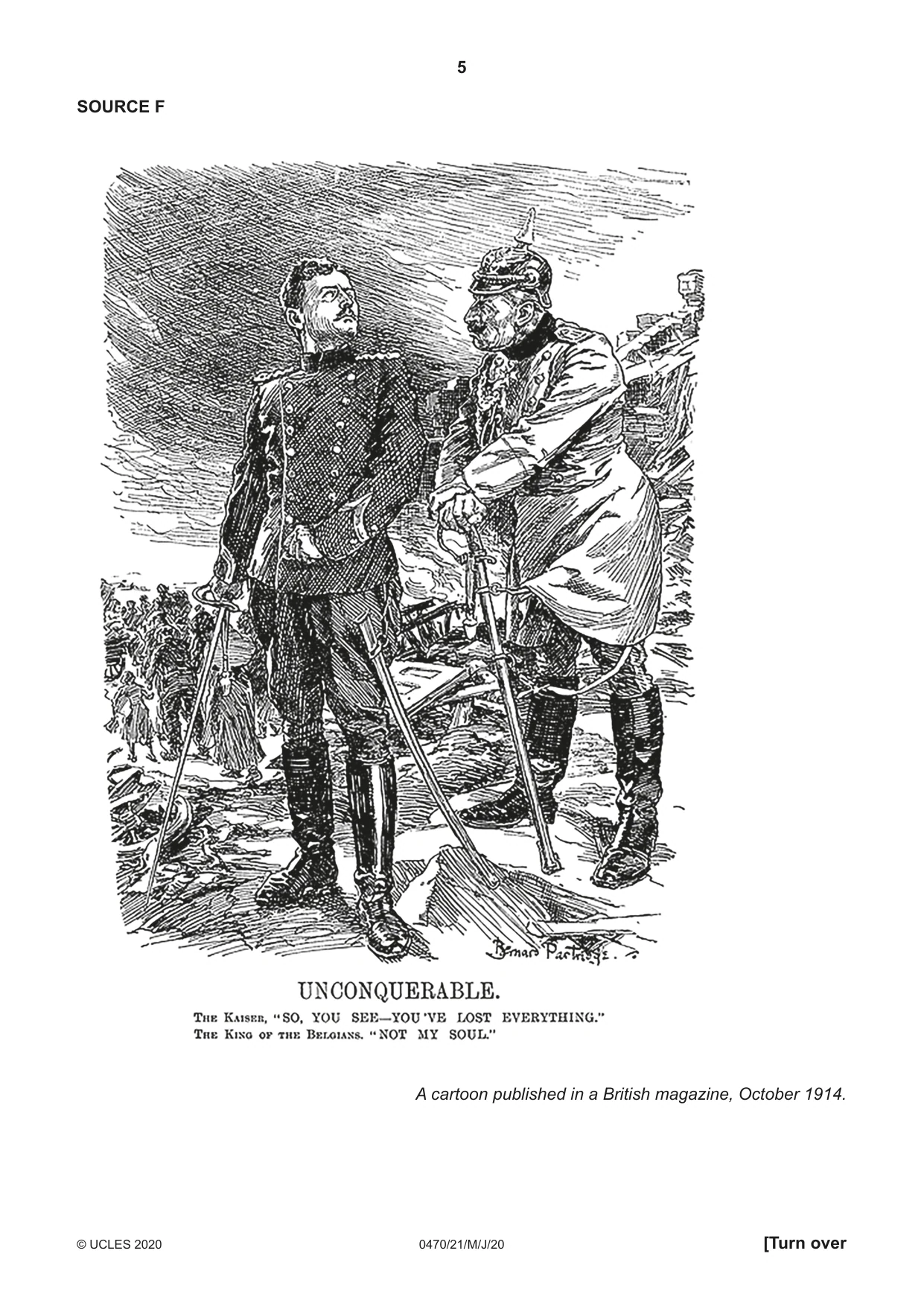
5 0470/21/M/J/20 © UCLES 2020 [Turn over SOURCE F A cartoon published in a British magazine, October 1914.
Question paper, page 6
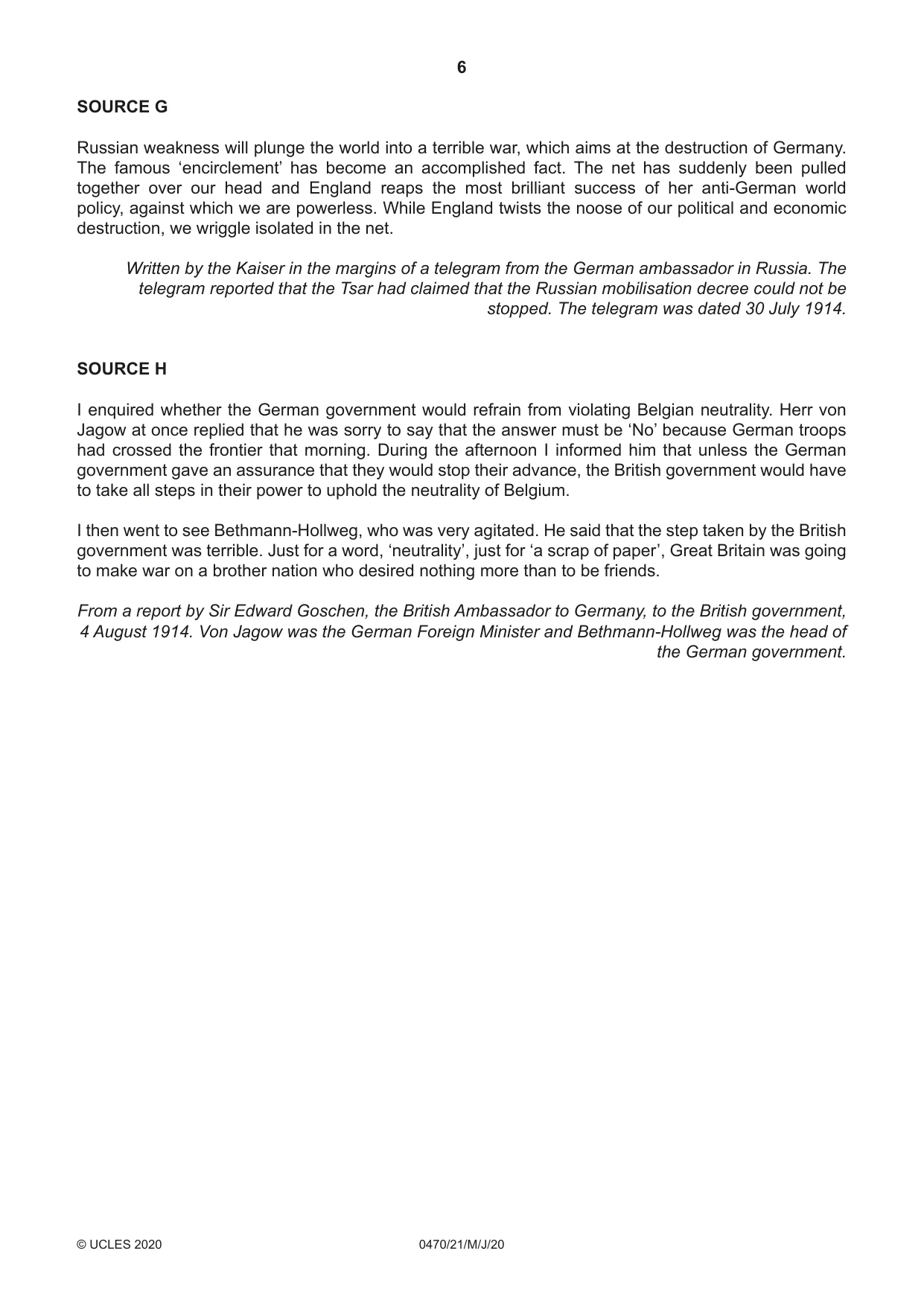
6 0470/21/M/J/20 © UCLES 2020 SOURCE G Russian weakness will plunge the world into a terrible war, which aims at the destruction of Germany. The famous ‘encirclement’ has become an accomplished fact. The net has suddenly been pulled together over our head and England reaps the most brilliant success of her anti-German world policy, against which we are powerless. While England twists the noose of our political and economic destruction, we wriggle isolated in the net. Written by the Kaiser in the margins of a telegram from the German ambassador in Russia. The telegram reported that the Tsar had claimed that the Russian mobilisation decree could not be stopped. The telegram was dated 30 July 1914. SOURCE H I enquired whether the German government would refrain from violating Belgian neutrality. Herr von Jagow at once replied that he was sorry to say that the answer must be ‘No’ because German troops had crossed the frontier that morning. During the afternoon I informed him that unless the German government gave an assurance that they would stop their advance, the British government would have to take all steps in their power to uphold the neutrality of Belgium. I then went to see Bethmann-Hollweg, who was very agitated. He said that the step taken by the British government was terrible. Just for a word, ‘neutrality’, just for ‘a scrap of paper’, Great Britain was going to make war on a brother nation who desired nothing more than to be friends. From a report by Sir Edward Goschen, the British Ambassador to Germany, to the British government, 4 August 1914. Von Jagow was the German Foreign Minister and Bethmann-Hollweg was the head of the German government.
Question paper, page 7
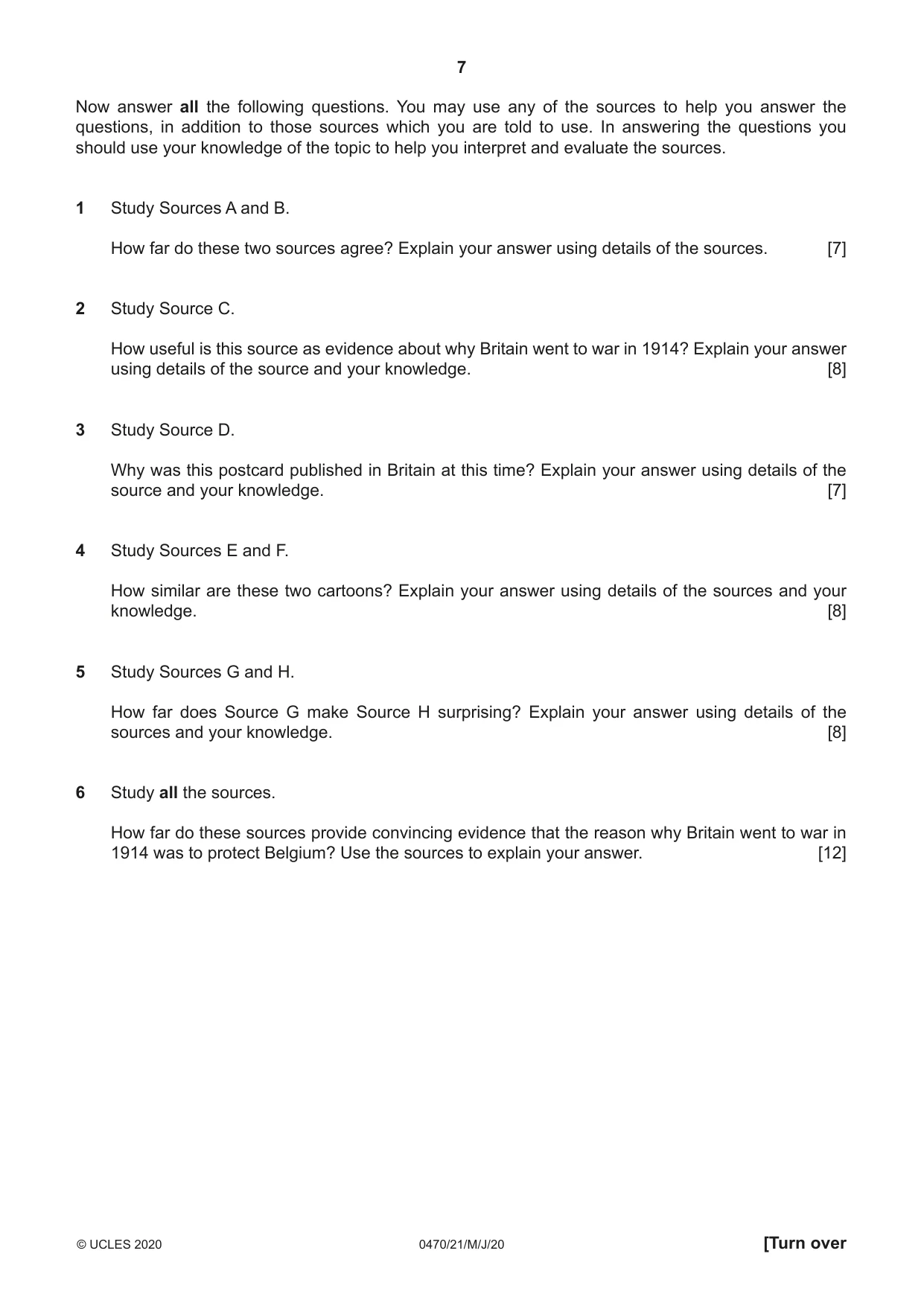
7 0470/21/M/J/20 © UCLES 2020 [Turn over Now answer all the following questions. You may use any of the sources to help you answer the questions, in addition to those sources which you are told to use. In answering the questions you should use your knowledge of the topic to help you interpret and evaluate the sources. 1 Study Sources A and B. How far do these two sources agree? Explain your answer using details of the sources. [7] 2 Study Source C. How useful is this source as evidence about why Britain went to war in 1914? Explain your answer using details of the source and your knowledge. [8] 3 Study Source D. Why was this postcard published in Britain at this time? Explain your answer using details of the source and your knowledge. [7] 4 Study Sources E and F. How similar are these two cartoons? Explain your answer using details of the sources and your knowledge. [8] 5 Study Sources G and H. How far does Source G make Source H surprising? Explain your answer using details of the sources and your knowledge. [8] 6 Study all the sources. How far do these sources provide convincing evidence that the reason why Britain went to war in 1914 was to protect Belgium? Use the sources to explain your answer. [12]
Question paper, page 8
8 0470/21/M/J/20 © UCLES 2020 Option B: Twentieth century topic DID STALIN TAKE CONTROL OF EASTERN EUROPE AS A RESPONSE TO THE ACTIONS OF THE WEST? Study the Background Information and the sources carefully, and then answer all the questions. Background Information At the Yalta Conference in February 1945 Stalin agreed to free elections in Eastern European countries. However, by the time of the communist coup in Czechoslovakia in February 1948, the Soviet Union controlled all of Eastern Europe apart from Yugoslavia and Greece. Stalin was helped by the fact that Soviet armies were already in most of Eastern Europe and the local resistance to Nazi occupation had often been led by communist groups. This enabled the communists to intimidate their opponents and to influence election results. Did Stalin plan for the USSR to control Eastern Europe from the beginning or did this policy gradually develop as a reaction to the threats and policies of the West? SOURCE A More aware than anyone else of their own weaknesses in the event of a conflict with the United States, the Russians pursued a conservative and cautious line. They showed neither more nor less respect for democracy in Eastern Europe than the Americans and British showed in Italy, Greece or Belgium. Neither the Americans, British, nor Russians were willing to allow democracy to run its course anywhere in Europe at the cost of damaging their vital strategic and economic interests. We now know that the Russians lost control of the revolutionary forces in Yugoslavia and Greece, and that they had no intention of Sovietising Eastern Europe in 1945 if they could find alternatives. In Eastern Europe American leaders saw evidence of what they interpreted to be the dangers of Soviet expansion. It was imperative for the United States that it prevent any Great Power from dominating Eastern Europe or any other region of the world. The United States considered all political blocs that it did not control as directly undermining its objective for achieving world capitalism. For this reason America set itself against an Eastern European reality which it could not fully shape. From a history book published in 1969.
Question paper, page 9
9 0470/21/M/J/20 © UCLES 2020 [Turn over SOURCE B Even before the Nazi invasion of the USSR in 1941, Soviet authorities began to prepare the ground for imposing their own system on Eastern Europe. This view is controversial. In the standard account the region’s post-war history is usually divided into phases. The onset of Stalinism in Eastern Europe is sometimes blamed on Western Cold War Warriors, whose aggressive language allegedly ‘forced’ Stalin to tighten his grip on the region. It was argued that the Cold War was caused not by communist expansion but by the American drive for open international markets. More recently, it has been argued that the division of Germany was caused not by the Soviet pursuit of totalitarian policies in Eastern Germany but by the Western powers’ failure to take advantage of Stalin’s peaceful overtures. Any close examination of what was happening across the region between 1944 and 1947 reveals the deep flaws of these arguments. The Soviet Union imported key elements of the Soviet system into every nation occupied by the Red Army, from the very beginning. First, the Soviets immediately created a secret police. Secondly, Soviet authorities placed trusted communists in charge of the most powerful form of mass media: the radio. Thirdly, everywhere the Red Army went, Soviet and local communists harassed, persecuted and eventually banned independent political parties. The harsher policies imposed upon the Eastern bloc in 1947 and 1948 were not merely a reaction to the Cold War. From a history book published in 2013. SOURCE C The area that came to symbolise the onset of the Cold War was East-Central Europe. While Churchill’s Iron Curtain provided a straightforward explanation of Soviet policies, they were in fact driven by a complex set of motives. Ideology, security, and historical memory all played a role. It would also be wrong to assume that the Soviet leadership was not affected by Western rhetoric and policy. Soviet control in Eastern Europe did not take place overnight. Much depended on local conditions. In Albania the local Communists established their rule in 1944–45 as patriots who had fought against the Germans. In Poland, the Communists’ takeover was prompted by much greater Soviet involvement. The Soviets recognised the Polish Workers’ Party as the provisional government in late 1944, although representatives of other parties were included. In the next two years, helped by Soviet support, the Communists gradually marginalised other political parties. In Hungary, Stalin held back and it was only in 1947 that the Communists moved to establish complete control. For quite some time Czechoslovakia appeared likely to remain a liberal democracy but in 1947, under Soviet pressure, the Czech government rejected the Marshall Plan, making the Czech Communists unpopular. In response, while the Red Army amassed troops on the Czech borders, the Communist Party staged a coup d’état. This was the last addition to the Soviet bloc. From a recent history book.
Question paper, page 10
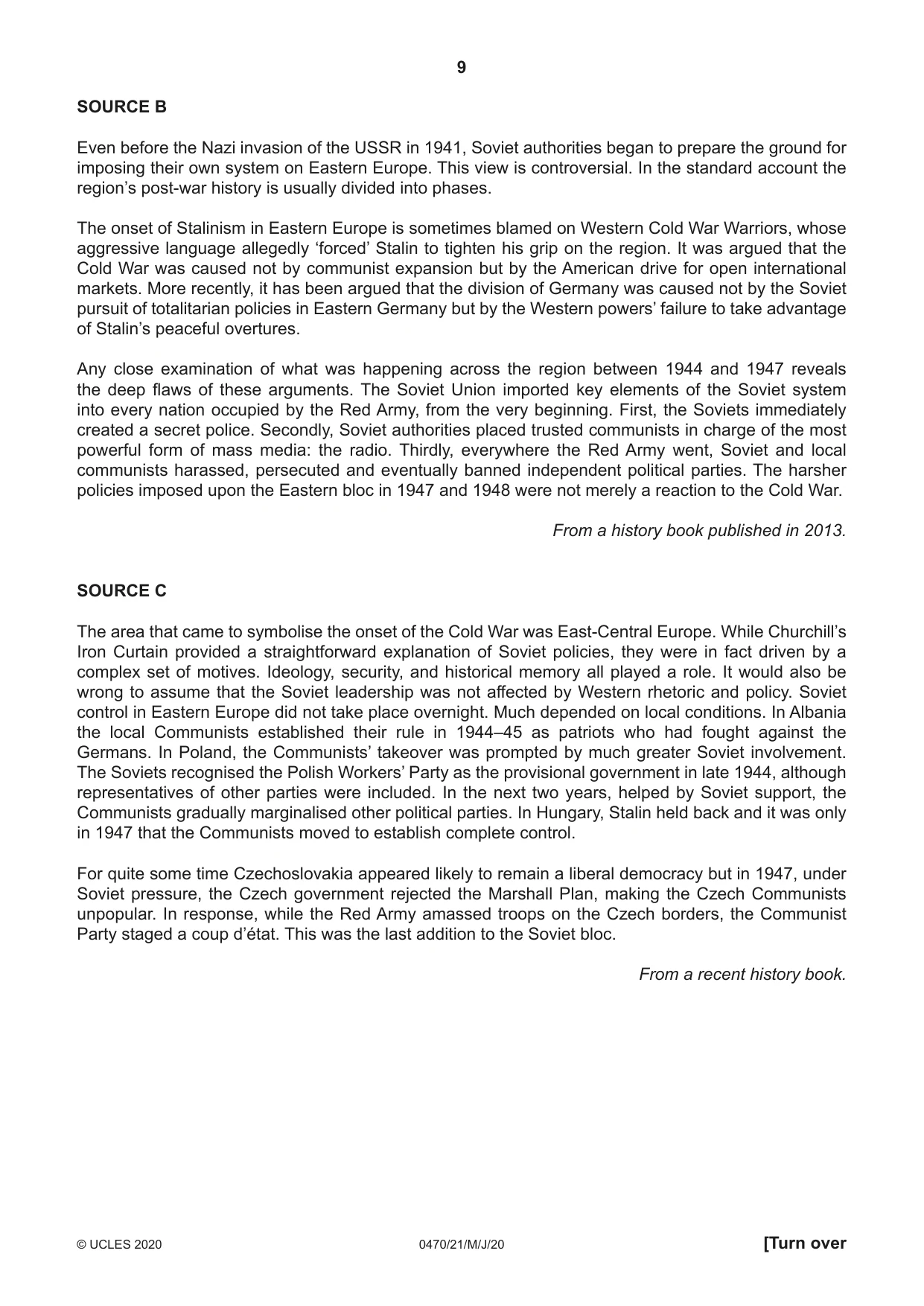
10 0470/21/M/J/20 © UCLES 2020 SOURCE D A cartoon published in a British magazine, 17 March 1948.
Question paper, page 11
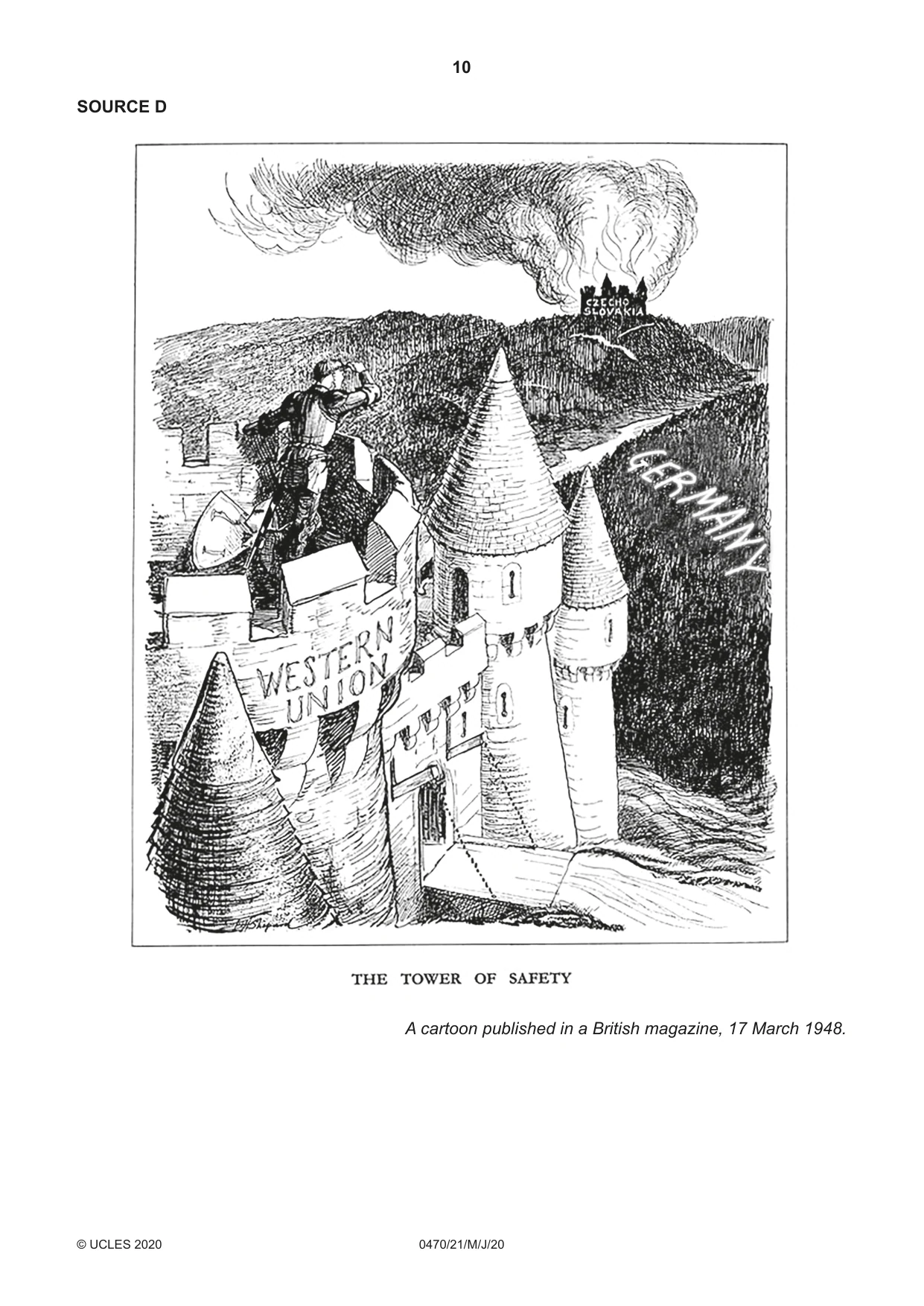
11 0470/21/M/J/20 © UCLES 2020 [Turn over SOURCE E A cartoon published in the Soviet Union in 1947. It shows American aid during the Greek civil war. SOURCE F There is most certainly a long-term element in what the Russians are doing in the Balkans. Security is the most important factor. Nothing will deflect the USSR from strengthening its security system in this region as a first line of defence. It would be unthinkable that Czechoslovakia and Yugoslavia should look to the West for their security rather than to Mother Russia. The self-confidence of the Soviet Union, combined with a love of power for its own sake, might cause this policy to assume dangerous forms. So far as the Balkans are concerned, we can take heart from the correct attitude which the Soviet Government has adopted towards Greece. We must at all times make allowances for the Bolshevik mentality, which, if it has repudiated the idea of world revolution, is still infested with suspicion of the bourgeois world. On the other hand, as a realist, Stalin has no wish to overreach the limits within which he can exercise autocratic power. He also has a wish to raise the reputation of the USSR in the eyes of the world. It follows that where the Allies have just cause for complaint, a restraining influence can be brought to bear by appeals to Stalin. A report by a British official in Moscow to the British government, 12 March 1945.
Question paper, page 12
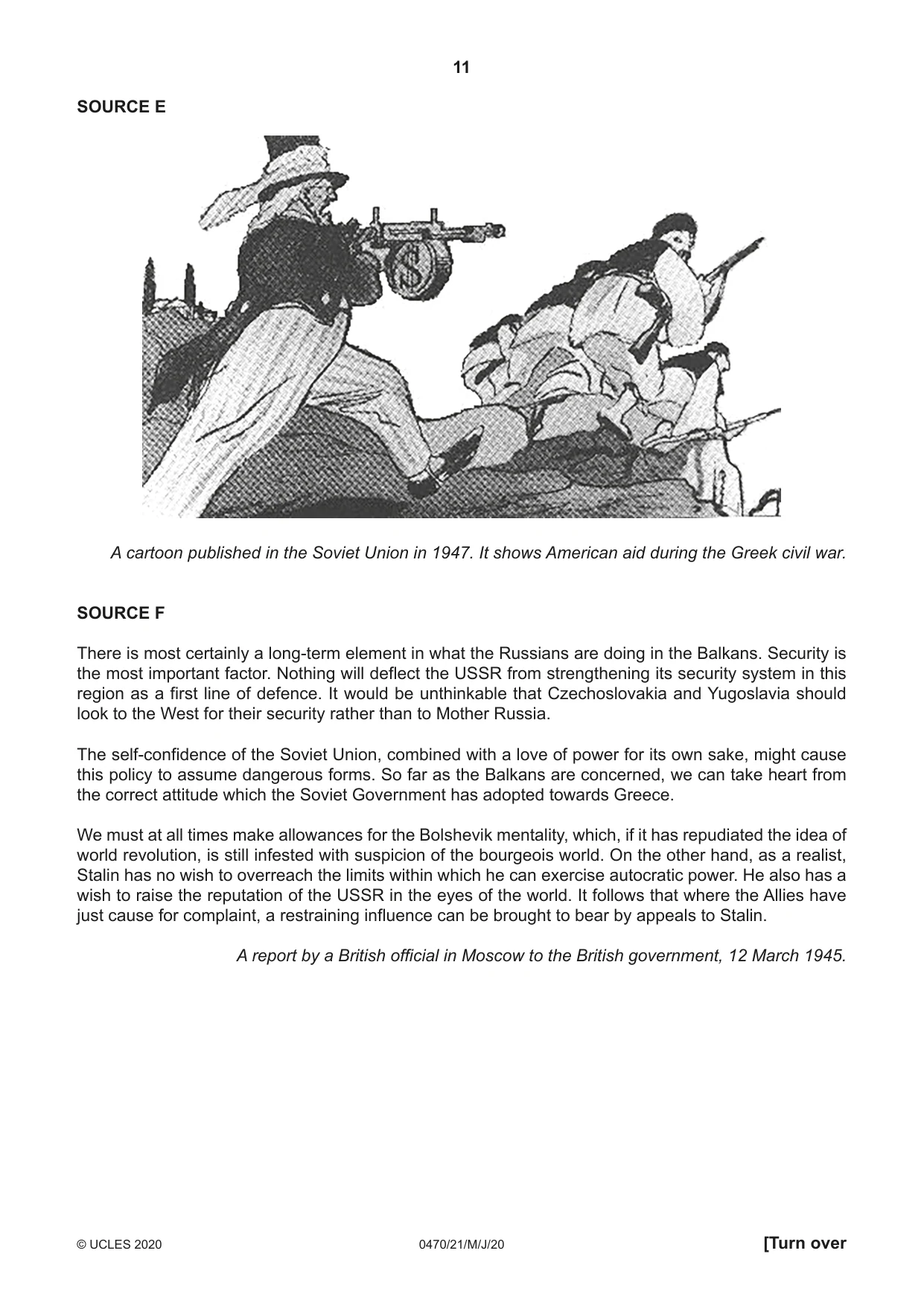
12 0470/21/M/J/20 © UCLES 2020 SOURCE G Mr Churchill now stands as a firebrand of war. And he is not alone. He has friends not only in Britain but also in the United States. He reminds me of Hitler. Hitler began to set war loose by announcing his racial theory, declaring that only German speakers represent a full valuable nation. Mr Churchill begins to set war loose by maintaining that only nations speaking the English language are fully valuable nations and should rule over the remaining nations of the world. As a result of the German invasion, the Soviet Union has lost about 7 million people. The Soviet Union cannot forget the sacrifices. What can be surprising in the fact that the Soviet Union, to protect its security, tries to ensure that the countries in Eastern Europe have governments loyal to the Soviet Union? How can one describe these peaceful aspirations as ‘expansionist tendencies’? From an interview Stalin gave to Pravda, 16 March 1946. Pravda was the official newspaper of the Soviet Communist Party. SOURCE H A cartoon published in a British newspaper, 2 March 1948. From the top-left the switches read ‘France, Italy, Czecho, Romania, Hungary, Poland, Yugo, Greece’; (bottom row) ‘Etc, Persia [Iran], Turkey, Finland, Bulgaria, Albania, Etc, Etc’. The places underlined have their switches down. The picture on the desk says ‘Marshall’ at the top.
Question paper, page 13
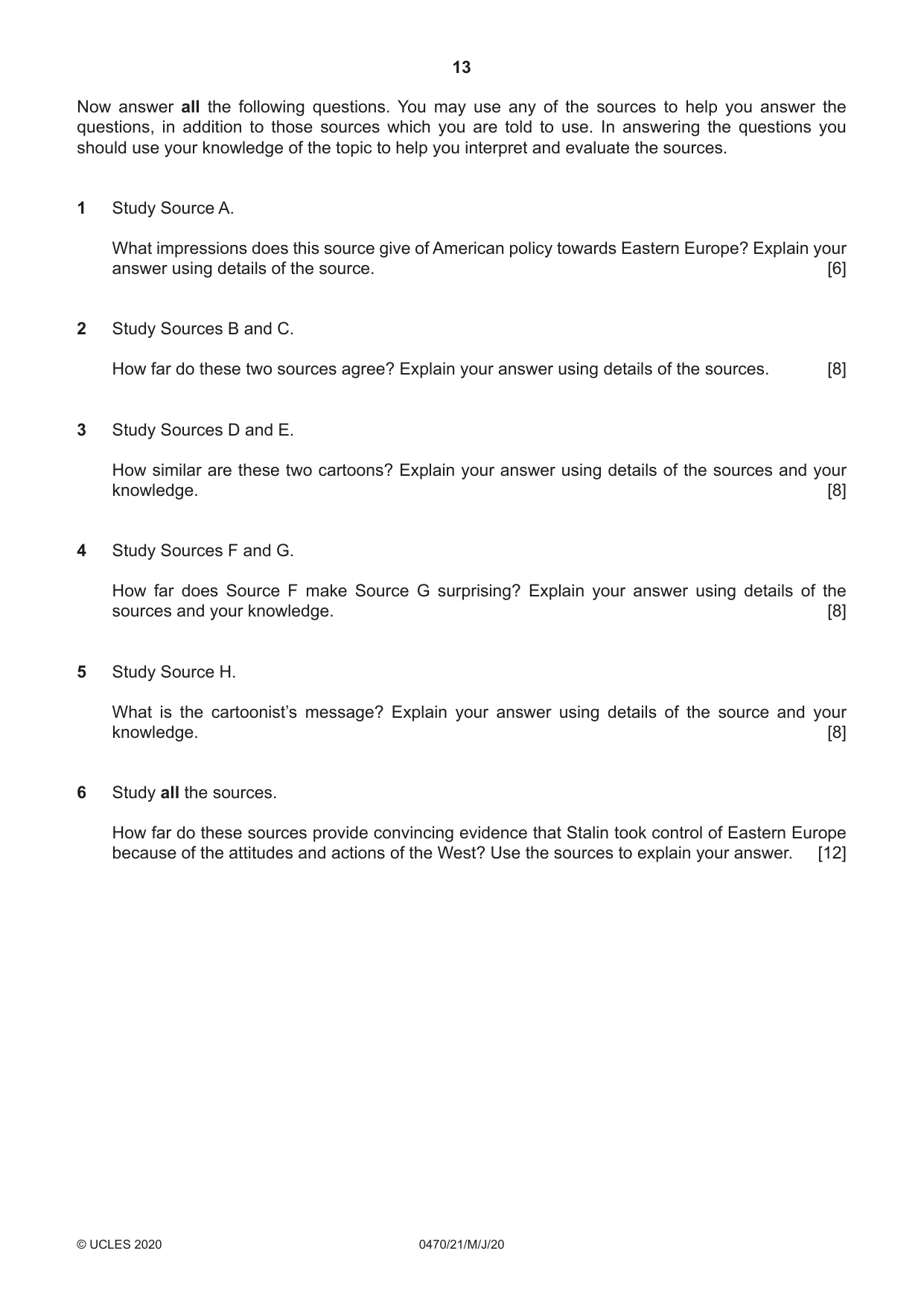
13 0470/21/M/J/20 © UCLES 2020 Now answer all the following questions. You may use any of the sources to help you answer the questions, in addition to those sources which you are told to use. In answering the questions you should use your knowledge of the topic to help you interpret and evaluate the sources. 1 Study Source A. What impressions does this source give of American policy towards Eastern Europe? Explain your answer using details of the source. [6] 2 Study Sources B and C. How far do these two sources agree? Explain your answer using details of the sources. [8] 3 Study Sources D and E. How similar are these two cartoons? Explain your answer using details of the sources and your knowledge. [8] 4 Study Sources F and G. How far does Source F make Source G surprising? Explain your answer using details of the sources and your knowledge. [8] 5 Study Source H. What is the cartoonist’s message? Explain your answer using details of the source and your knowledge. [8] 6 Study all the sources. How far do these sources provide convincing evidence that Stalin took control of Eastern Europe because of the attitudes and actions of the West? Use the sources to explain your answer. [12]
Question paper, page 14
14 0470/21/M/J/20 © UCLES 2020 BLANK PAGE
Question paper, page 15
15 0470/21/M/J/20 © UCLES 2020 BLANK PAGE
Question paper, page 16
16 0470/21/M/J/20 © UCLES 2020 Permission to reproduce items where third-party owned material protected by copyright is included has been sought and cleared where possible. Every reasonable effort has been made by the publisher (UCLES) to trace copyright holders, but if any items requiring clearance have unwittingly been included, the publisher will be pleased to make amends at the earliest possible opportunity. To avoid the issue of disclosure of answer-related information to candidates, all copyright acknowledgements are reproduced online in the Cambridge Assessment International Education Copyright Acknowledgements Booklet. This is produced for each series of examinations and is freely available to download at www.cambridgeinternational.org after the live examination series. Cambridge Assessment International Education is part of the Cambridge Assessment Group. Cambridge Assessment is the brand name of the University of Cambridge Local Examinations Syndicate (UCLES), which itself is a department of the University of Cambridge. BLANK PAGE
Mark scheme, page 1
This document consists of 15 printed pages. © UCLES 2020 [Turn over Cambridge IGCSE™ HISTORY 0470/21 Paper 2 May/June 2020 MARK SCHEME Maximum Mark: 50 Published Students did not sit exam papers in the June 2020 series due to the Covid-19 global pandemic. This mark scheme is published to support teachers and students and should be read together with the question paper. It shows the requirements of the exam. The answer column of the mark scheme shows the proposed basis on which Examiners would award marks for this exam. Where appropriate, this column also provides the most likely acceptable alternative responses expected from students. Examiners usually review the mark scheme after they have seen student responses and update the mark scheme if appropriate. In the June series, Examiners were unable to consider the acceptability of alternative responses, as there were no student responses to consider. Mark schemes should usually be read together with the Principal Examiner Report for Teachers. However, because students did not sit exam papers, there is no Principal Examiner Report for Teachers for the June 2020 series. Cambridge International will not enter into discussions about these mark schemes. Cambridge International is publishing the mark schemes for the June 2020 series for most Cambridge IGCSE™ and Cambridge International A & AS Level components, and some Cambridge O Level components.
Mark scheme, page 2
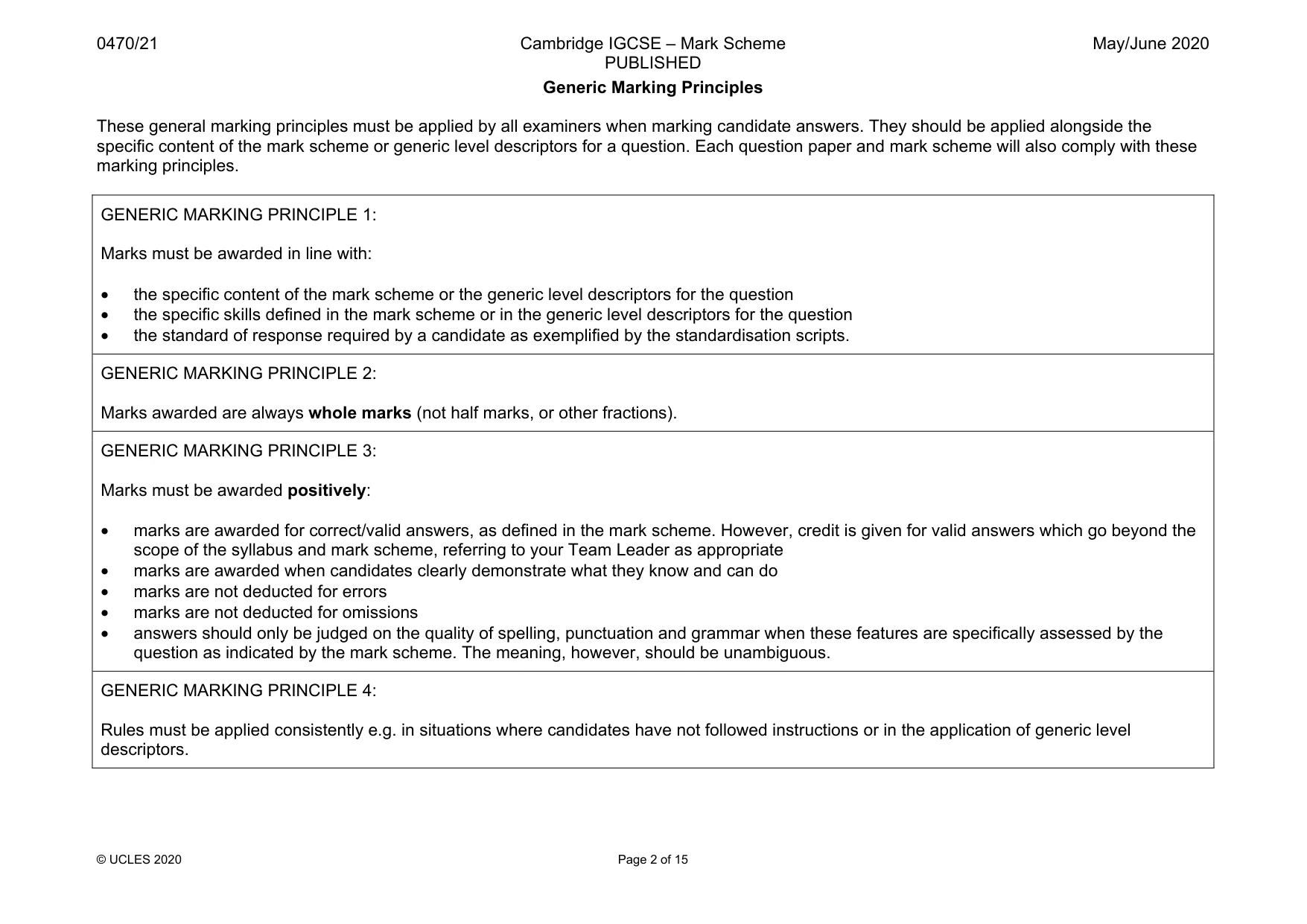
0470/21 Cambridge IGCSE – Mark Scheme PUBLISHED May/June 2020 © UCLES 2020 Page 2 of 15 Generic Marking Principles These general marking principles must be applied by all examiners when marking candidate answers. They should be applied alongside the specific content of the mark scheme or generic level descriptors for a question. Each question paper and mark scheme will also comply with these marking principles. GENERIC MARKING PRINCIPLE 1: Marks must be awarded in line with: • the specific content of the mark scheme or the generic level descriptors for the question • the specific skills defined in the mark scheme or in the generic level descriptors for the question • the standard of response required by a candidate as exemplified by the standardisation scripts. GENERIC MARKING PRINCIPLE 2: Marks awarded are always whole marks (not half marks, or other fractions). GENERIC MARKING PRINCIPLE 3: Marks must be awarded positively: • marks are awarded for correct/valid answers, as defined in the mark scheme. However, credit is given for valid answers which go beyond the scope of the syllabus and mark scheme, referring to your Team Leader as appropriate • marks are awarded when candidates clearly demonstrate what they know and can do • marks are not deducted for errors • marks are not deducted for omissions • answers should only be judged on the quality of spelling, punctuation and grammar when these features are specifically assessed by the question as indicated by the mark scheme. The meaning, however, should be unambiguous. GENERIC MARKING PRINCIPLE 4: Rules must be applied consistently e.g. in situations where candidates have not followed instructions or in the application of generic level descriptors.
Mark scheme, page 3
0470/21 Cambridge IGCSE – Mark Scheme PUBLISHED May/June 2020 © UCLES 2020 Page 3 of 15 GENERIC MARKING PRINCIPLE 5: Marks should be awarded using the full range of marks defined in the mark scheme for the question (however; the use of the full mark range may be limited according to the quality of the candidate responses seen). GENERIC MARKING PRINCIPLE 6: Marks awarded are based solely on the requirements as defined in the mark scheme. Marks should not be awarded with grade thresholds or grade descriptors in mind.
Mark scheme, page 4
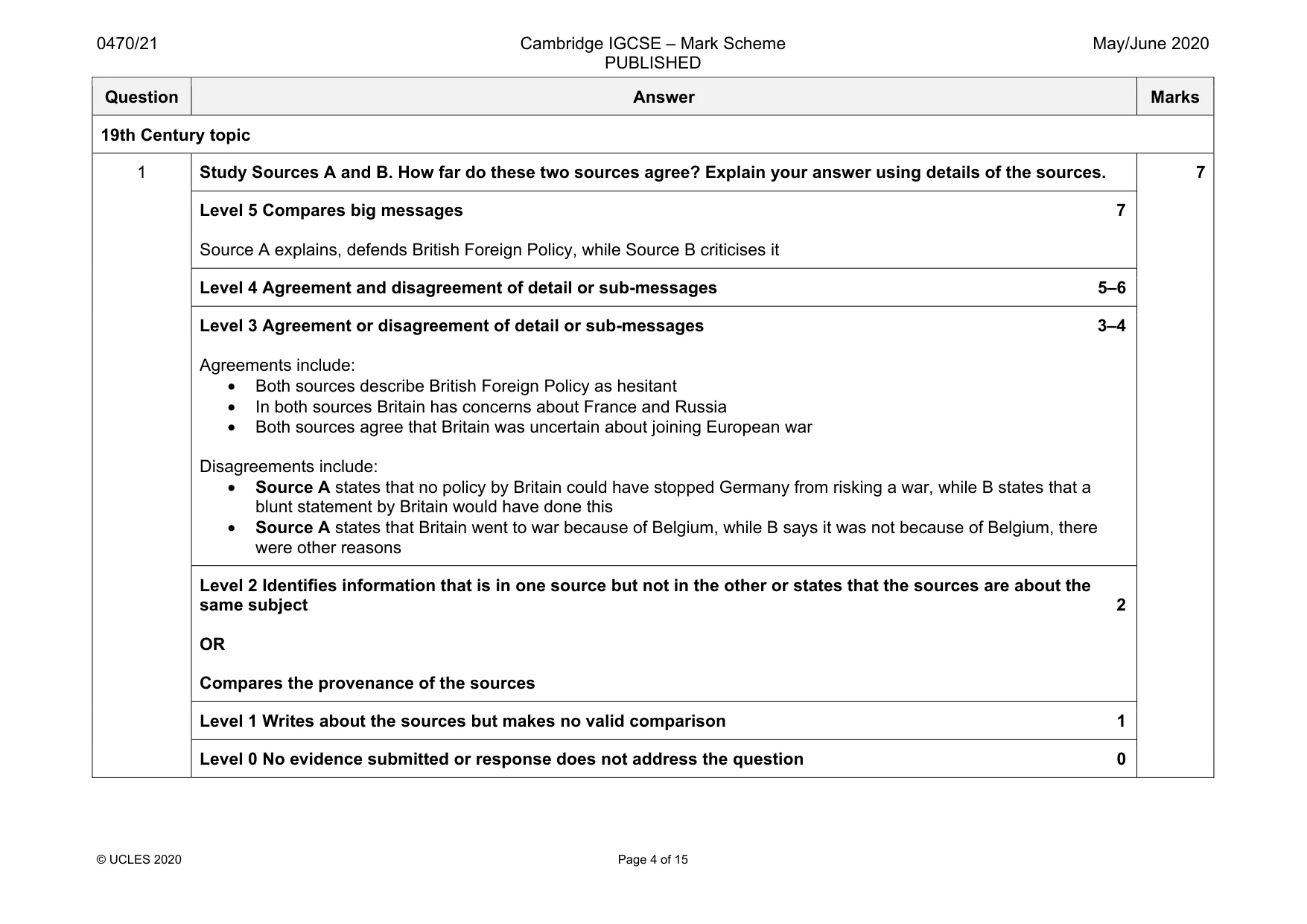
0470/21 Cambridge IGCSE – Mark Scheme PUBLISHED May/June 2020 © UCLES 2020 Page 4 of 15 Question Answer Marks 19th Century topic 1 Study Sources A and B. How far do these two sources agree? Explain your answer using details of the sources. 7 Level 5 Compares big messages 7 Source A explains, defends British Foreign Policy, while Source B criticises it Level 4 Agreement and disagreement of detail or sub-messages 5–6 Level 3 Agreement or disagreement of detail or sub-messages 3–4 Agreements include: • Both sources describe British Foreign Policy as hesitant • In both sources Britain has concerns about France and Russia • Both sources agree that Britain was uncertain about joining European war Disagreements include: • Source A states that no policy by Britain could have stopped Germany from risking a war, while B states that a blunt statement by Britain would have done this • Source A states that Britain went to war because of Belgium, while B says it was not because of Belgium, there were other reasons Level 2 Identifies information that is in one source but not in the other or states that the sources are about the same subject 2 OR Compares the provenance of the sources Level 1 Writes about the sources but makes no valid comparison 1 Level 0 No evidence submitted or response does not address the question 0
Mark scheme, page 5
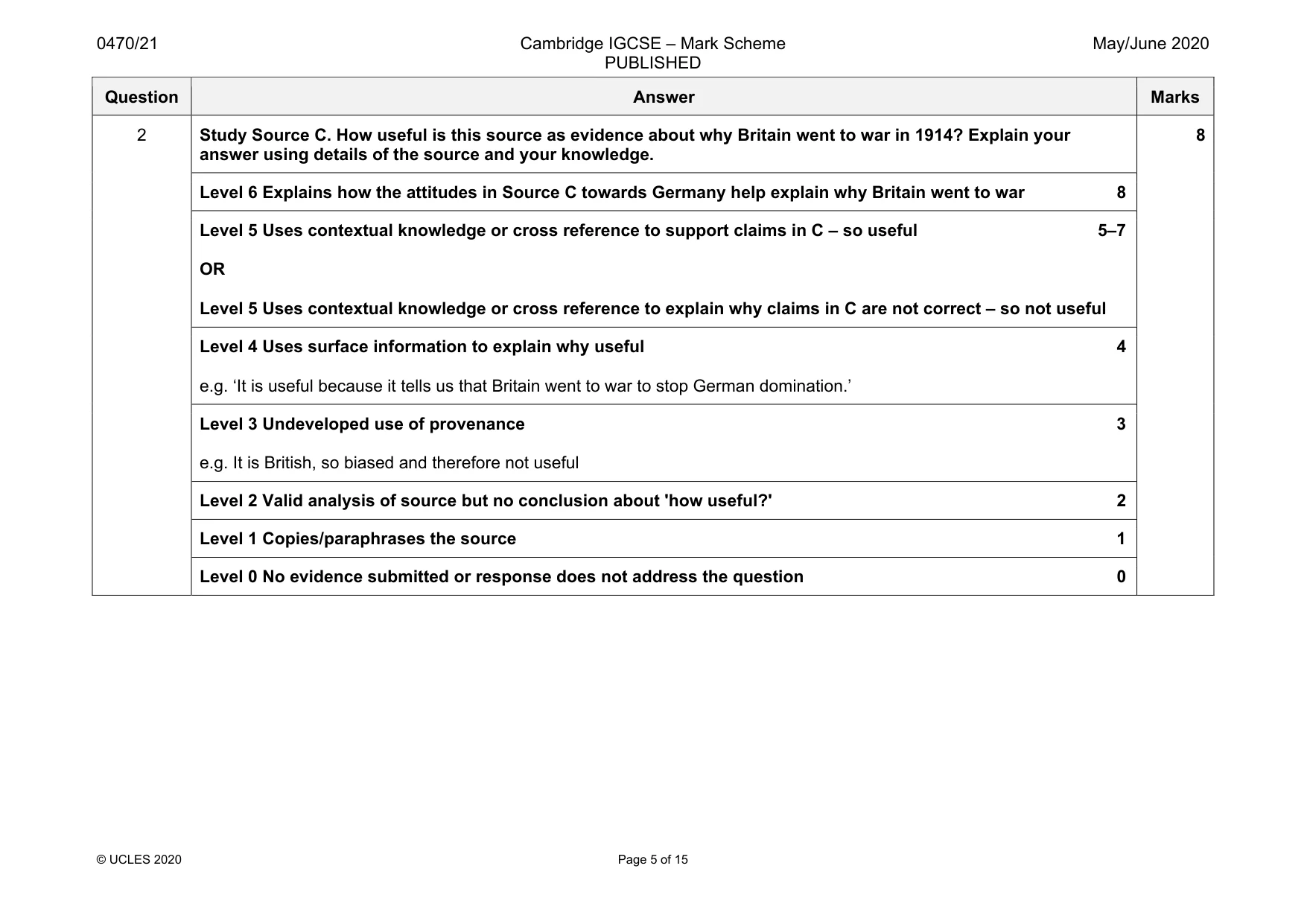
0470/21 Cambridge IGCSE – Mark Scheme PUBLISHED May/June 2020 © UCLES 2020 Page 5 of 15 Question Answer Marks 2 Study Source C. How useful is this source as evidence about why Britain went to war in 1914? Explain your answer using details of the source and your knowledge. 8 Level 6 Explains how the attitudes in Source C towards Germany help explain why Britain went to war 8 Level 5 Uses contextual knowledge or cross reference to support claims in C – so useful 5–7 OR Level 5 Uses contextual knowledge or cross reference to explain why claims in C are not correct – so not useful Level 4 Uses surface information to explain why useful 4 e.g. ‘It is useful because it tells us that Britain went to war to stop German domination.’ Level 3 Undeveloped use of provenance 3 e.g. It is British, so biased and therefore not useful Level 2 Valid analysis of source but no conclusion about 'how useful?' 2 Level 1 Copies/paraphrases the source 1 Level 0 No evidence submitted or response does not address the question 0
Mark scheme, page 6
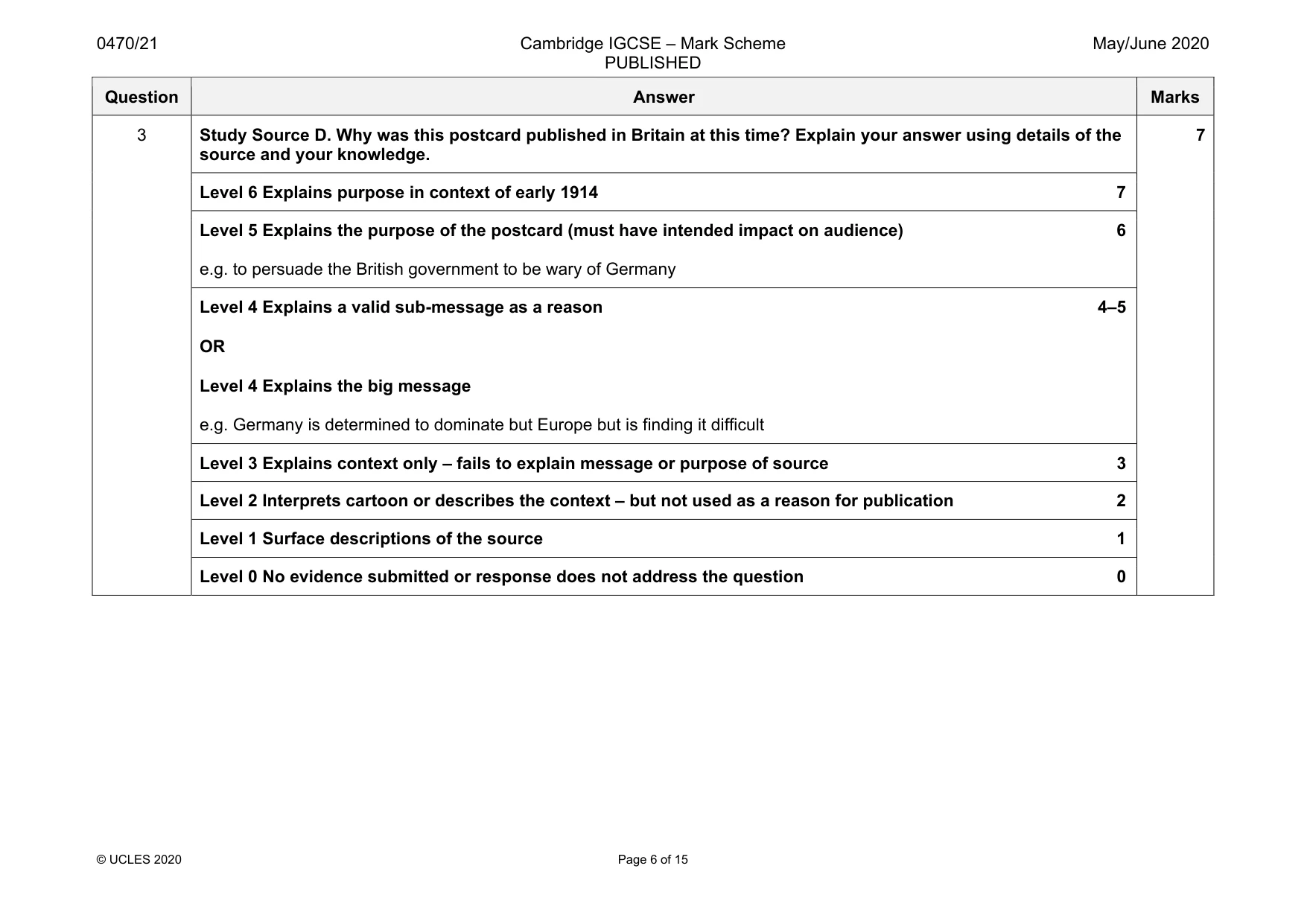
0470/21 Cambridge IGCSE – Mark Scheme PUBLISHED May/June 2020 © UCLES 2020 Page 6 of 15 Question Answer Marks 3 Study Source D. Why was this postcard published in Britain at this time? Explain your answer using details of the source and your knowledge. 7 Level 6 Explains purpose in context of early 1914 7 Level 5 Explains the purpose of the postcard (must have intended impact on audience) 6 e.g. to persuade the British government to be wary of Germany Level 4 Explains a valid sub-message as a reason 4–5 OR Level 4 Explains the big message e.g. Germany is determined to dominate but Europe but is finding it difficult Level 3 Explains context only – fails to explain message or purpose of source 3 Level 2 Interprets cartoon or describes the context – but not used as a reason for publication 2 Level 1 Surface descriptions of the source 1 Level 0 No evidence submitted or response does not address the question 0
Mark scheme, page 7
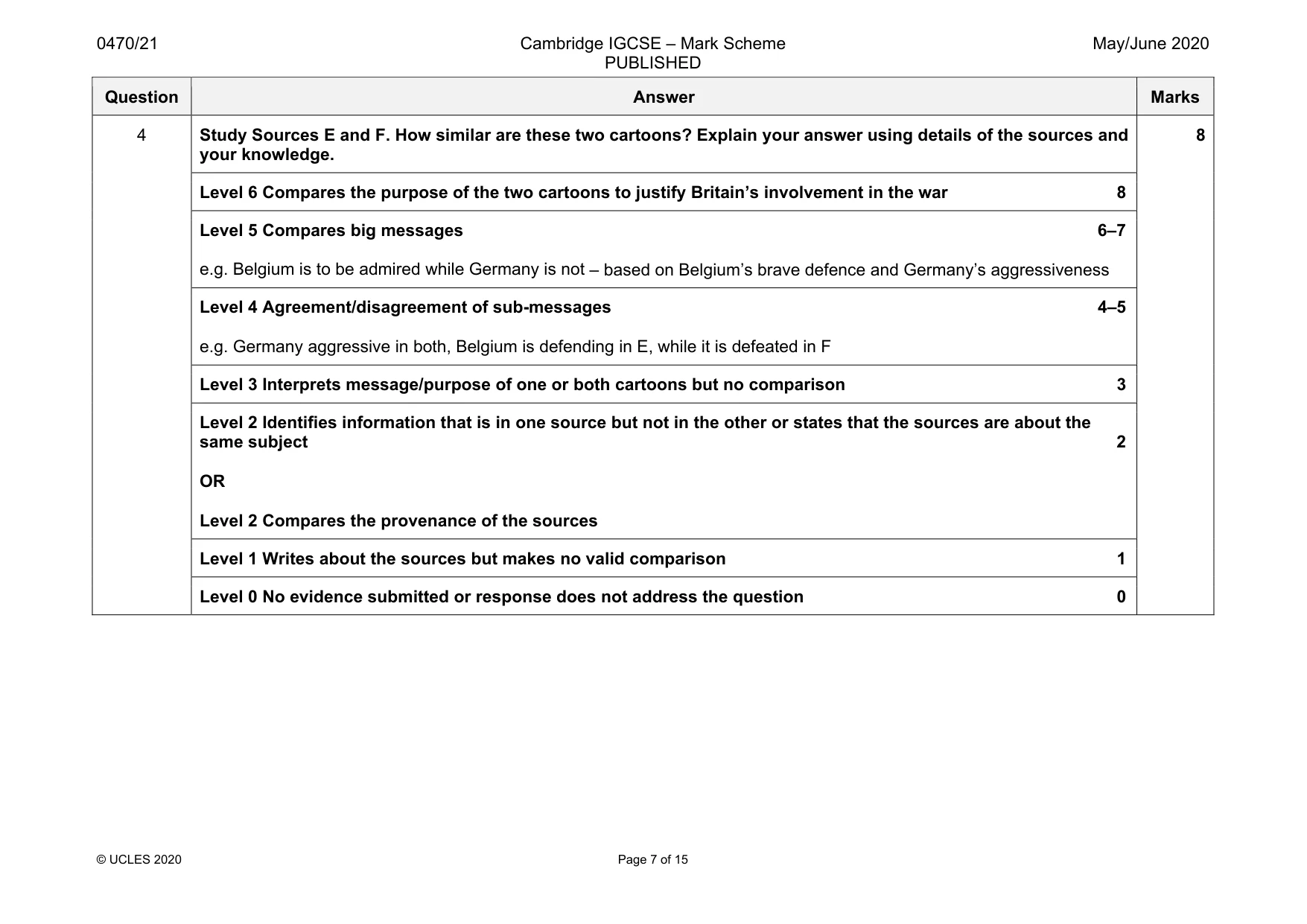
0470/21 Cambridge IGCSE – Mark Scheme PUBLISHED May/June 2020 © UCLES 2020 Page 7 of 15 Question Answer Marks 4 Study Sources E and F. How similar are these two cartoons? Explain your answer using details of the sources and your knowledge. 8 Level 6 Compares the purpose of the two cartoons to justify Britain’s involvement in the war 8 Level 5 Compares big messages 6–7 e.g. Belgium is to be admired while Germany is not – based on Belgium’s brave defence and Germany’s aggressiveness Level 4 Agreement/disagreement of sub-messages 4–5 e.g. Germany aggressive in both, Belgium is defending in E, while it is defeated in F Level 3 Interprets message/purpose of one or both cartoons but no comparison 3 Level 2 Identifies information that is in one source but not in the other or states that the sources are about the same subject 2 OR Level 2 Compares the provenance of the sources Level 1 Writes about the sources but makes no valid comparison 1 Level 0 No evidence submitted or response does not address the question 0
Mark scheme, page 8
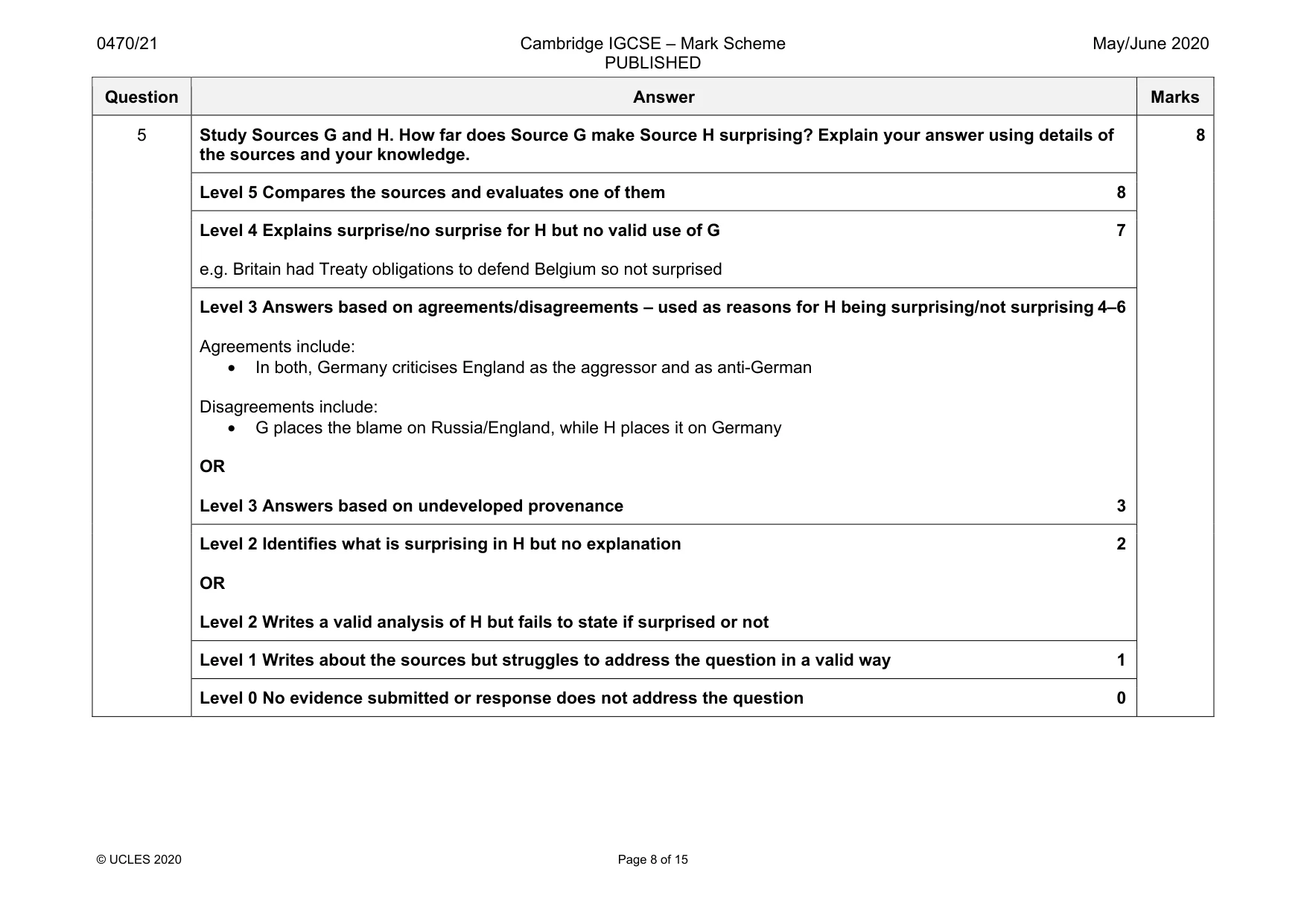
0470/21 Cambridge IGCSE – Mark Scheme PUBLISHED May/June 2020 © UCLES 2020 Page 8 of 15 Question Answer Marks 5 Study Sources G and H. How far does Source G make Source H surprising? Explain your answer using details of the sources and your knowledge. 8 Level 5 Compares the sources and evaluates one of them 8 Level 4 Explains surprise/no surprise for H but no valid use of G 7 e.g. Britain had Treaty obligations to defend Belgium so not surprised Level 3 Answers based on agreements/disagreements – used as reasons for H being surprising/not surprising 4–6 Agreements include: • In both, Germany criticises England as the aggressor and as anti-German Disagreements include: • G places the blame on Russia/England, while H places it on Germany OR Level 3 Answers based on undeveloped provenance 3 Level 2 Identifies what is surprising in H but no explanation 2 OR Level 2 Writes a valid analysis of H but fails to state if surprised or not Level 1 Writes about the sources but struggles to address the question in a valid way 1 Level 0 No evidence submitted or response does not address the question 0
Mark scheme, page 9
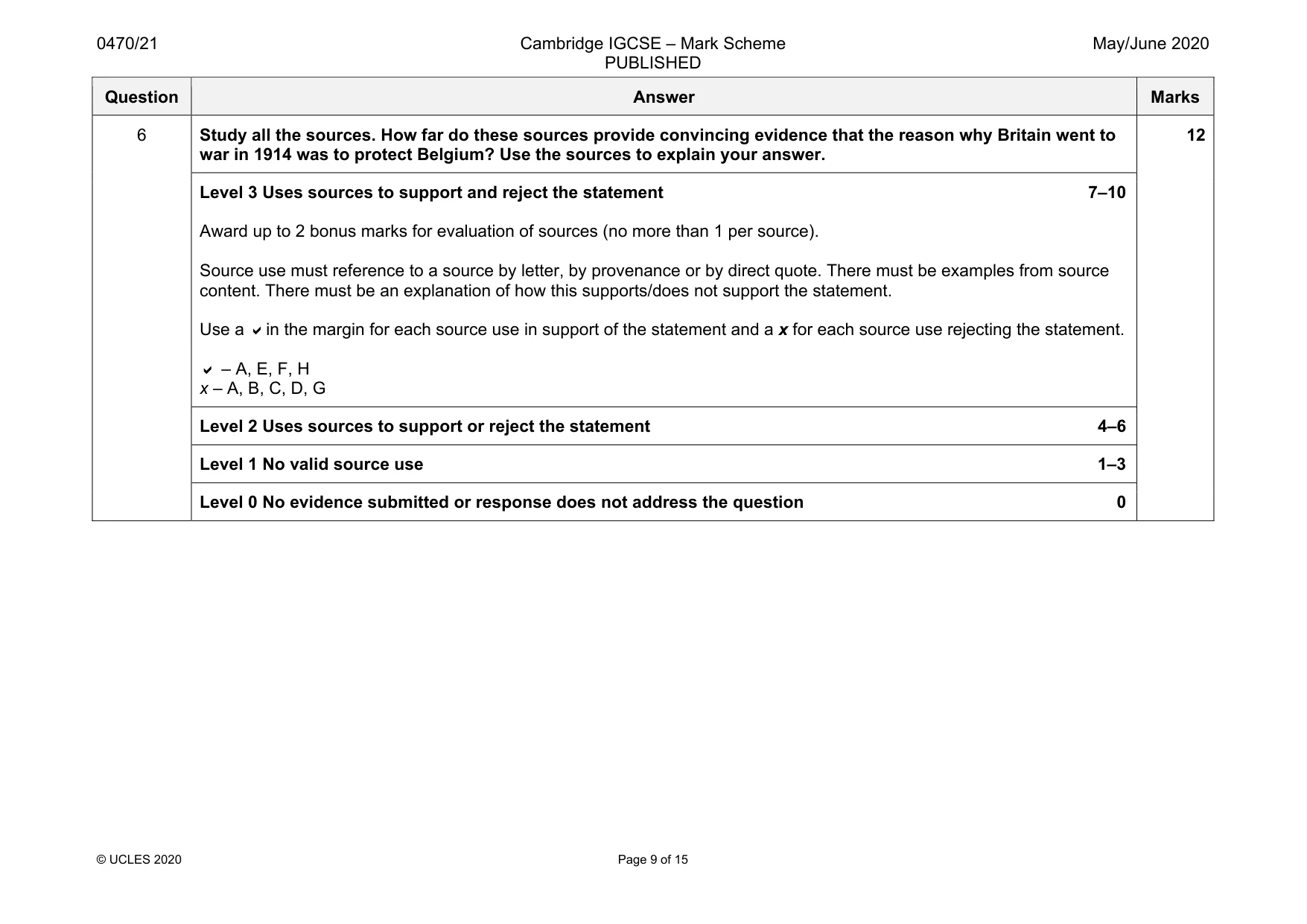
0470/21 Cambridge IGCSE – Mark Scheme PUBLISHED May/June 2020 © UCLES 2020 Page 9 of 15 Question Answer Marks 6 Study all the sources. How far do these sources provide convincing evidence that the reason why Britain went to war in 1914 was to protect Belgium? Use the sources to explain your answer. 12 Level 3 Uses sources to support and reject the statement 7–10 Award up to 2 bonus marks for evaluation of sources (no more than 1 per source). Source use must reference to a source by letter, by provenance or by direct quote. There must be examples from source content. There must be an explanation of how this supports/does not support the statement. Use a in the margin for each source use in support of the statement and a x for each source use rejecting the statement. – A, E, F, H x – A, B, C, D, G Level 2 Uses sources to support or reject the statement 4–6 Level 1 No valid source use 1–3 Level 0 No evidence submitted or response does not address the question 0
Mark scheme, page 10
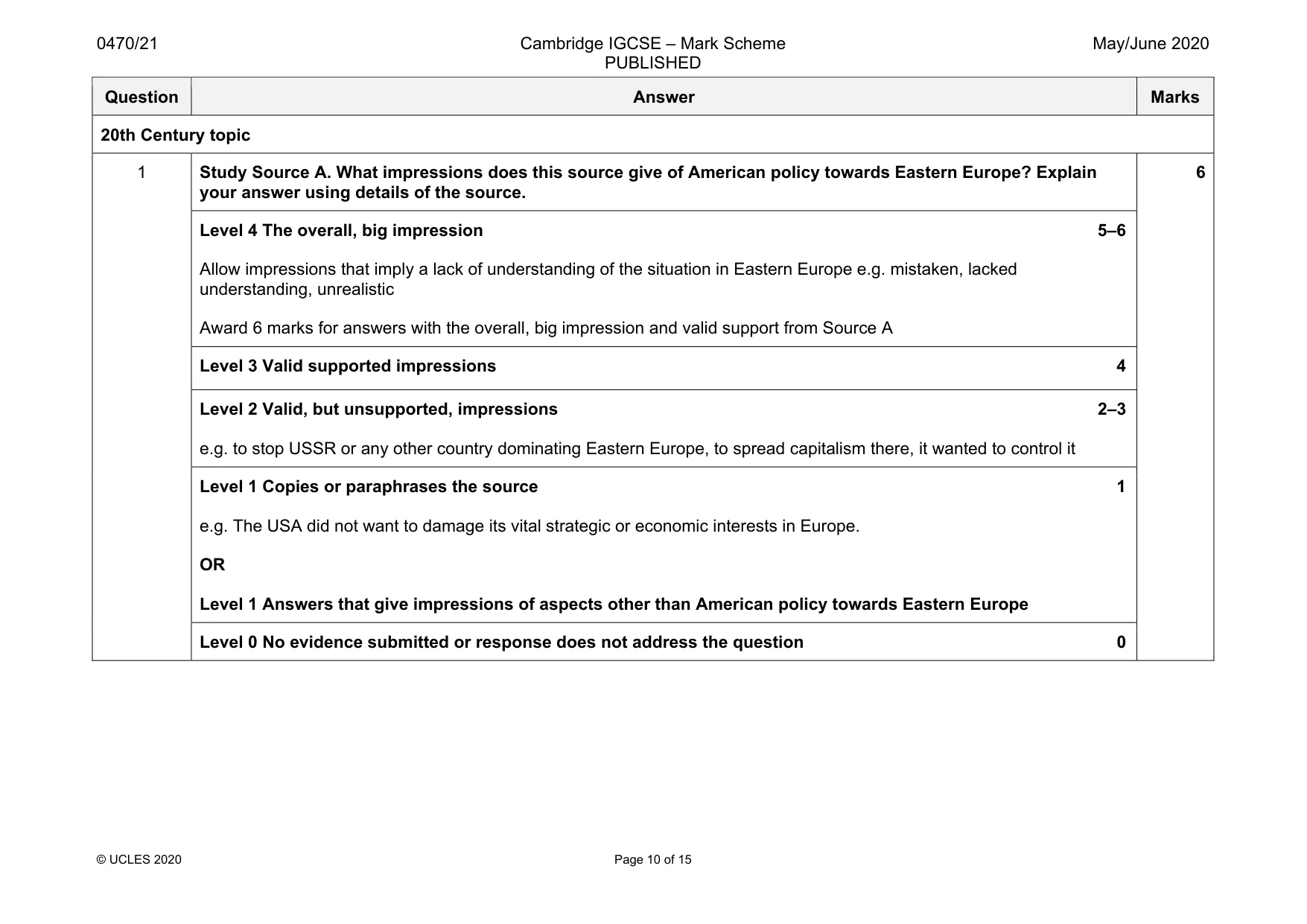
0470/21 Cambridge IGCSE – Mark Scheme PUBLISHED May/June 2020 © UCLES 2020 Page 10 of 15 Question Answer Marks 20th Century topic 1 Study Source A. What impressions does this source give of American policy towards Eastern Europe? Explain your answer using details of the source. 6 Level 4 The overall, big impression 5–6 Allow impressions that imply a lack of understanding of the situation in Eastern Europe e.g. mistaken, lacked understanding, unrealistic Award 6 marks for answers with the overall, big impression and valid support from Source A Level 3 Valid supported impressions 4 Level 2 Valid, but unsupported, impressions 2–3 e.g. to stop USSR or any other country dominating Eastern Europe, to spread capitalism there, it wanted to control it Level 1 Copies or paraphrases the source 1 e.g. The USA did not want to damage its vital strategic or economic interests in Europe. OR Level 1 Answers that give impressions of aspects other than American policy towards Eastern Europe Level 0 No evidence submitted or response does not address the question 0
Mark scheme, page 11
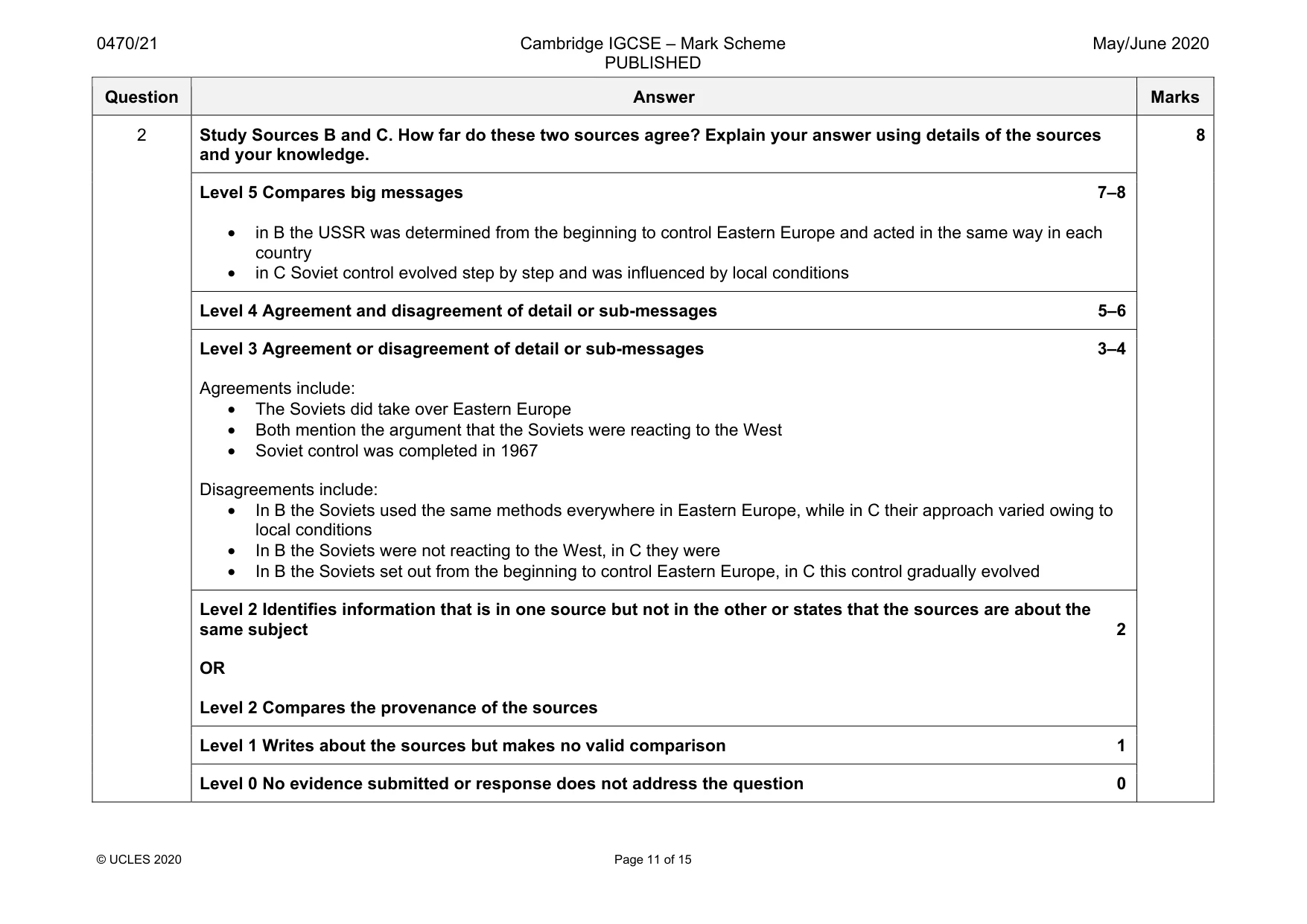
0470/21 Cambridge IGCSE – Mark Scheme PUBLISHED May/June 2020 © UCLES 2020 Page 11 of 15 Question Answer Marks 2 Study Sources B and C. How far do these two sources agree? Explain your answer using details of the sources and your knowledge. 8 Level 5 Compares big messages 7–8 • in B the USSR was determined from the beginning to control Eastern Europe and acted in the same way in each country • in C Soviet control evolved step by step and was influenced by local conditions Level 4 Agreement and disagreement of detail or sub-messages 5–6 Level 3 Agreement or disagreement of detail or sub-messages 3–4 Agreements include: • The Soviets did take over Eastern Europe • Both mention the argument that the Soviets were reacting to the West • Soviet control was completed in 1967 Disagreements include: • In B the Soviets used the same methods everywhere in Eastern Europe, while in C their approach varied owing to local conditions • In B the Soviets were not reacting to the West, in C they were • In B the Soviets set out from the beginning to control Eastern Europe, in C this control gradually evolved Level 2 Identifies information that is in one source but not in the other or states that the sources are about the same subject 2 OR Level 2 Compares the provenance of the sources Level 1 Writes about the sources but makes no valid comparison 1 Level 0 No evidence submitted or response does not address the question 0
Mark scheme, page 12
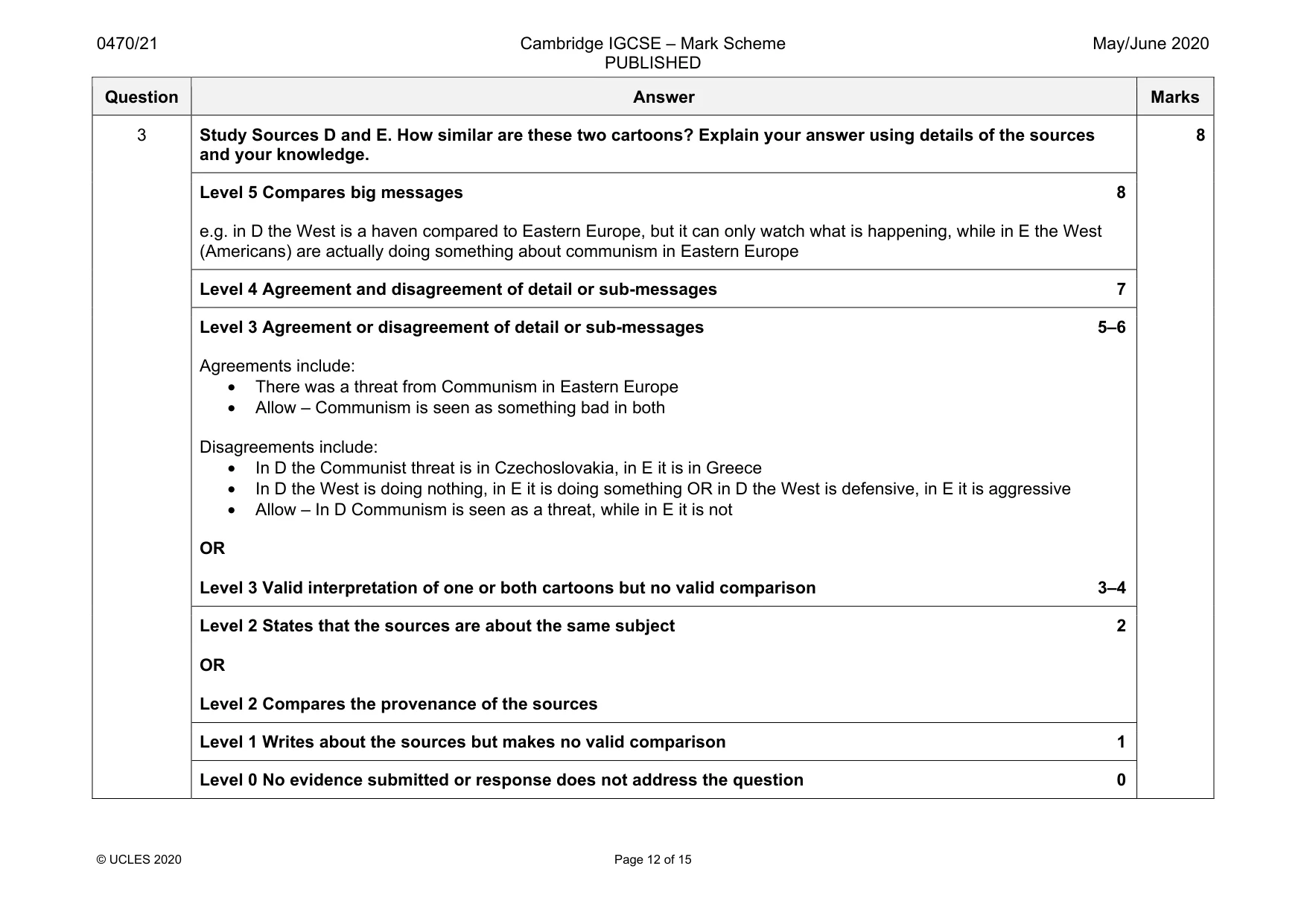
0470/21 Cambridge IGCSE – Mark Scheme PUBLISHED May/June 2020 © UCLES 2020 Page 12 of 15 Question Answer Marks 3 Study Sources D and E. How similar are these two cartoons? Explain your answer using details of the sources and your knowledge. 8 Level 5 Compares big messages 8 e.g. in D the West is a haven compared to Eastern Europe, but it can only watch what is happening, while in E the West (Americans) are actually doing something about communism in Eastern Europe Level 4 Agreement and disagreement of detail or sub-messages 7 Level 3 Agreement or disagreement of detail or sub-messages 5–6 Agreements include: • There was a threat from Communism in Eastern Europe • Allow – Communism is seen as something bad in both Disagreements include: • In D the Communist threat is in Czechoslovakia, in E it is in Greece • In D the West is doing nothing, in E it is doing something OR in D the West is defensive, in E it is aggressive • Allow – In D Communism is seen as a threat, while in E it is not OR Level 3 Valid interpretation of one or both cartoons but no valid comparison 3–4 Level 2 States that the sources are about the same subject 2 OR Level 2 Compares the provenance of the sources Level 1 Writes about the sources but makes no valid comparison 1 Level 0 No evidence submitted or response does not address the question 0
Mark scheme, page 13
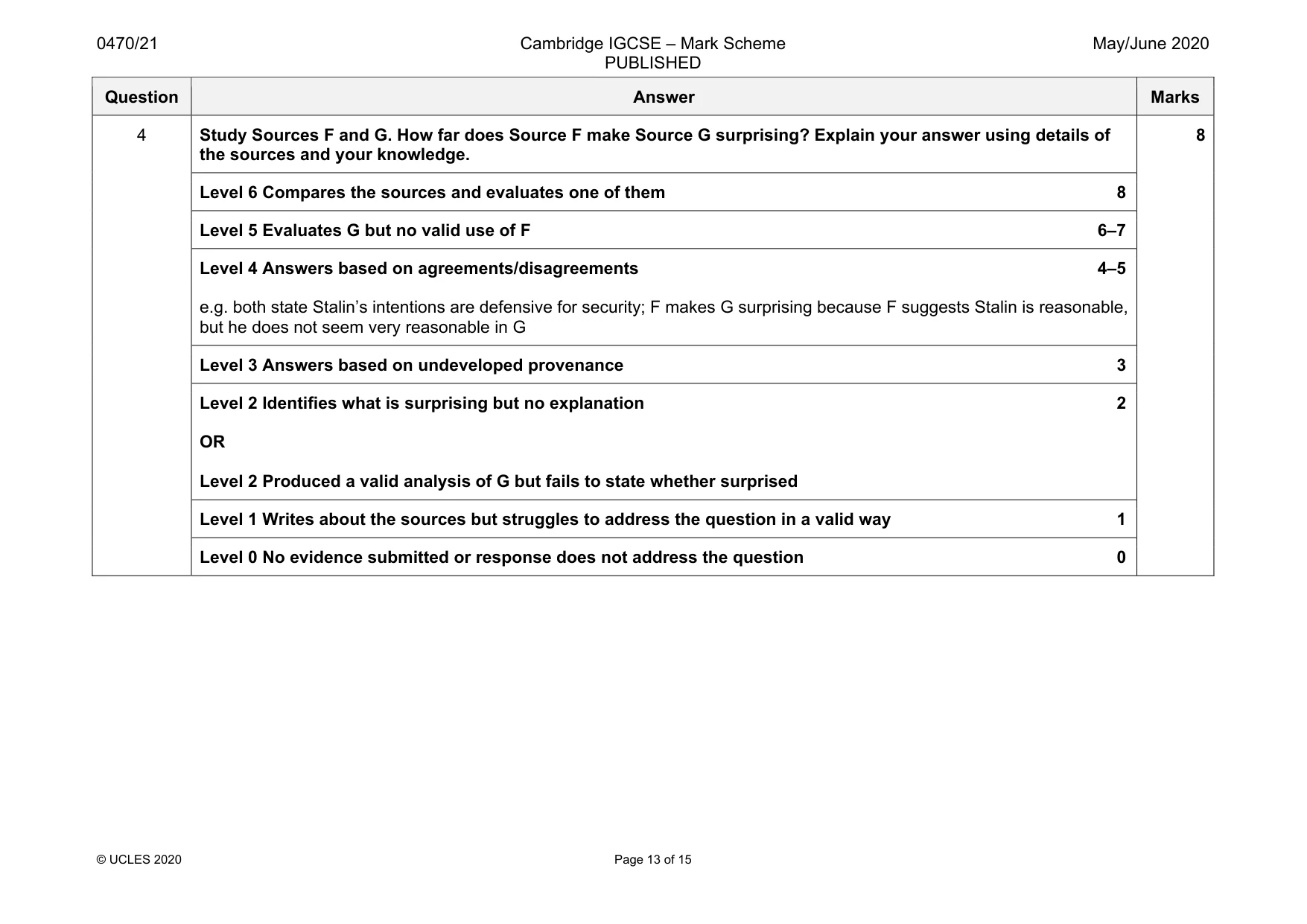
0470/21 Cambridge IGCSE – Mark Scheme PUBLISHED May/June 2020 © UCLES 2020 Page 13 of 15 Question Answer Marks 4 Study Sources F and G. How far does Source F make Source G surprising? Explain your answer using details of the sources and your knowledge. 8 Level 6 Compares the sources and evaluates one of them 8 Level 5 Evaluates G but no valid use of F 6–7 Level 4 Answers based on agreements/disagreements 4–5 e.g. both state Stalin’s intentions are defensive for security; F makes G surprising because F suggests Stalin is reasonable, but he does not seem very reasonable in G Level 3 Answers based on undeveloped provenance 3 Level 2 Identifies what is surprising but no explanation 2 OR Level 2 Produced a valid analysis of G but fails to state whether surprised Level 1 Writes about the sources but struggles to address the question in a valid way 1 Level 0 No evidence submitted or response does not address the question 0
Mark scheme, page 14
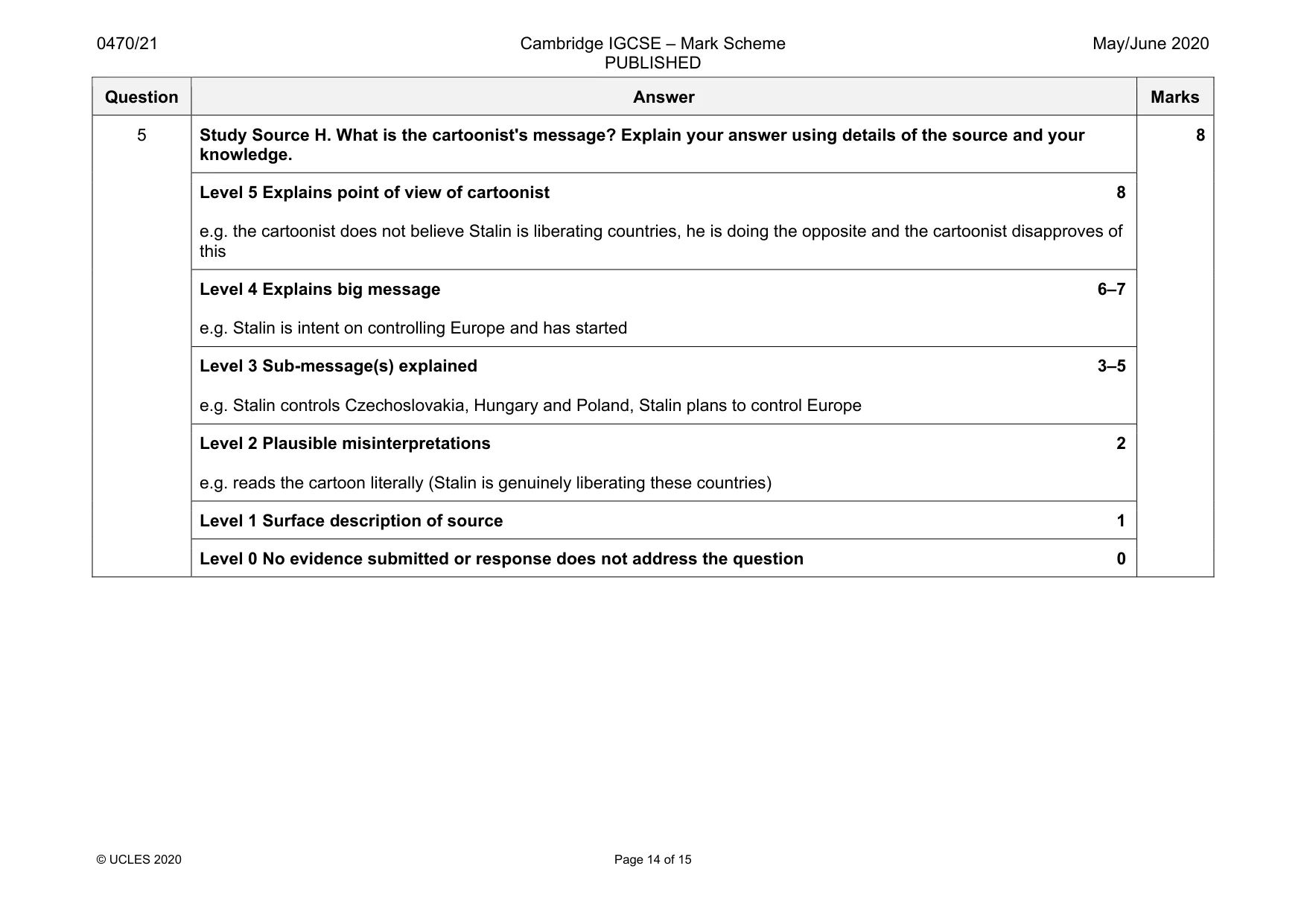
0470/21 Cambridge IGCSE – Mark Scheme PUBLISHED May/June 2020 © UCLES 2020 Page 14 of 15 Question Answer Marks 5 Study Source H. What is the cartoonist's message? Explain your answer using details of the source and your knowledge. 8 Level 5 Explains point of view of cartoonist 8 e.g. the cartoonist does not believe Stalin is liberating countries, he is doing the opposite and the cartoonist disapproves of this Level 4 Explains big message 6–7 e.g. Stalin is intent on controlling Europe and has started Level 3 Sub-message(s) explained 3–5 e.g. Stalin controls Czechoslovakia, Hungary and Poland, Stalin plans to control Europe Level 2 Plausible misinterpretations 2 e.g. reads the cartoon literally (Stalin is genuinely liberating these countries) Level 1 Surface description of source 1 Level 0 No evidence submitted or response does not address the question 0
Mark scheme, page 15
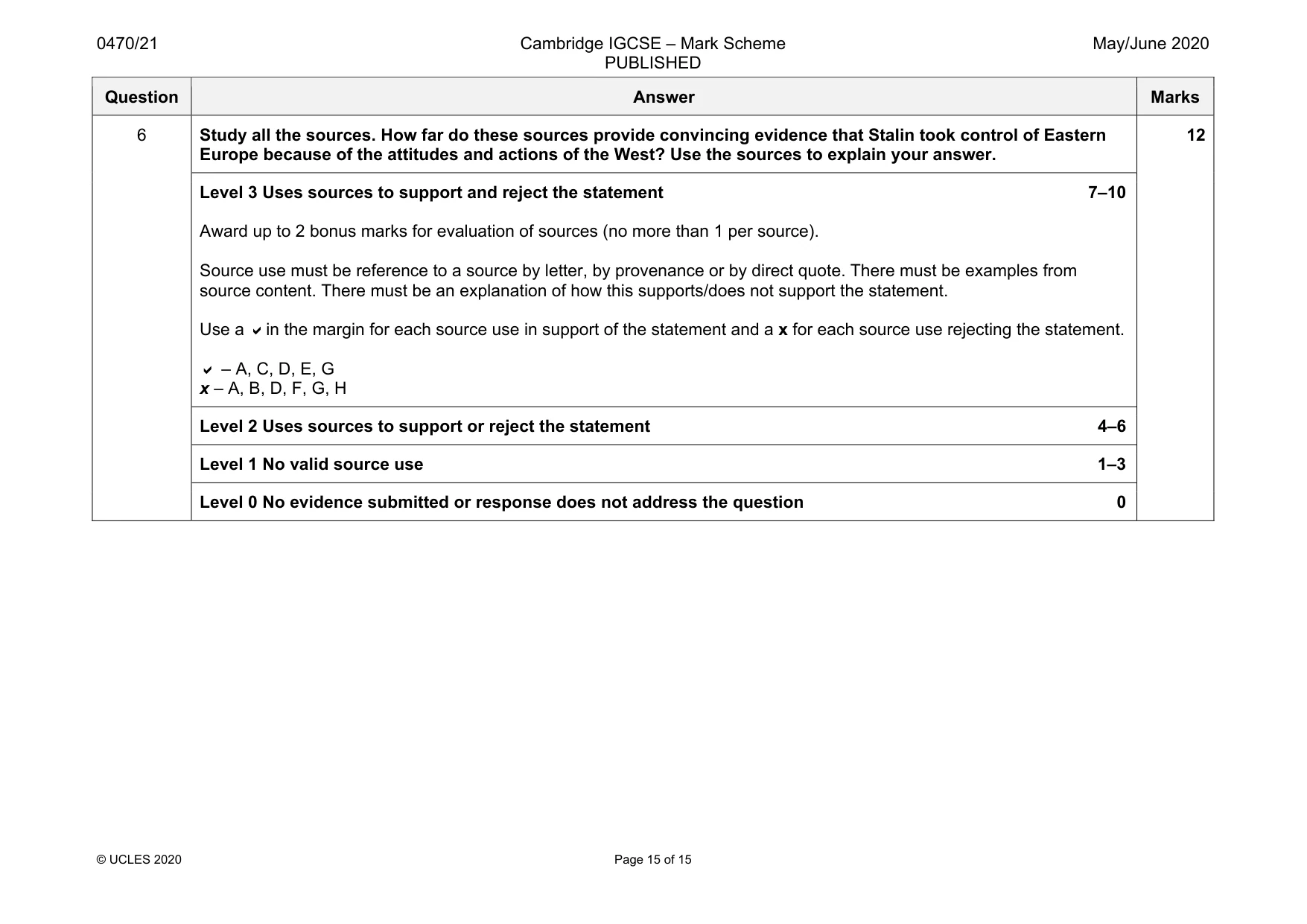
0470/21 Cambridge IGCSE – Mark Scheme PUBLISHED May/June 2020 © UCLES 2020 Page 15 of 15 Question Answer Marks 6 Study all the sources. How far do these sources provide convincing evidence that Stalin took control of Eastern Europe because of the attitudes and actions of the West? Use the sources to explain your answer. 12 Level 3 Uses sources to support and reject the statement 7–10 Award up to 2 bonus marks for evaluation of sources (no more than 1 per source). Source use must be reference to a source by letter, by provenance or by direct quote. There must be examples from source content. There must be an explanation of how this supports/does not support the statement. Use a in the margin for each source use in support of the statement and a x for each source use rejecting the statement. – A, C, D, E, G x – A, B, D, F, G, H Level 2 Uses sources to support or reject the statement 4–6 Level 1 No valid source use 1–3 Level 0 No evidence submitted or response does not address the question 0