Cambridge IGCSE History 0470 — 2020 May/June Paper 2 · Variant 2
0470/22/M/J/20
The question paper and its mark scheme, free to read here and free to download. This is Cambridge’s own paper, exactly as it was sat.
Question paper12 pages
Mark scheme15 pages
Answers below. Sit the paper first if you are practising.
Paper as text
Question paper, page 1
Cambridge IGCSE™ This document has 12 pages. Blank pages are indicated. HISTORY 0470/22 Paper 2 May/June 2020 2 hours You must answer on the enclosed answer booklet. You will need: Answer booklet (enclosed) INSTRUCTIONS ● Answer all the questions on one option only. Option A: Nineteenth century topic Option B: Twentieth century topic ● Follow the instructions on the front cover of the answer booklet. If you need additional answer paper, ask the invigilator for a continuation booklet. INFORMATION ● The total mark for this paper is 50. ● The number of marks for each question or part question is shown in brackets [ ]. * 1 7 0 9 7 6 0 7 0 8 * DC (CJ/CB) 184717/3 © UCLES 2020 [Turn over
Question paper, page 2
2 0470/22/M/J/20 © UCLES 2020 Option A: Nineteenth century topic HOW FAR WERE THE AUSTRIANS RESPONSIBLE FOR THE EUROPE-WIDE CONFLICT IN 1914? Study the Background Information and the sources carefully, and then answer all the questions. Background Information Following the assassination of Archduke Ferdinand of Austria at the end of June 1914, Austria sent Serbia a list of demands knowing that it could not agree to all of them. On 28 July Austria declared war on Serbia. Some historians have claimed that Austria was determined to fight Serbia and went to war recklessly. They knew that it risked a wider war breaking out because Russia was likely to support Serbia. Austria had also requested the support of Germany, thus extending the range of a possible European war. The dangers were clear to everyone. On the other hand, it can be argued that Austria wanted only a local war and certainly had no intention of causing, or being involved in, a wider and larger conflict. Germany, the argument continues, was manipulating Austria for its own purposes, and was responsible for turning a local war into a Europe-wide conflict. How far was Austria responsible for the outbreak of a Europe-wide conflict? SOURCE A Austria declared war on Serbia to avenge the Sarajevo murders and to put an end to the perceived greater Serbian threat. They were convinced that diplomatic and military intimidation had not worked. Three times since 1912, Vienna had come to the brink of war; this time, assured of strong German support, the Austrian leadership took the plunge. Germany had its own reasons for supporting prompt action by Vienna. It was dependent upon the Habsburgs to make the Schlieffen Plan work, while Austria was dependent on the Germans for protection against Russia. This interdependence linked the two countries together. In plunging into war, the Austrian government ensured that it lost its own independence. The Austrian government risked a general war to fight a local war. Battered during the Balkan Wars by Serbian expansion, Russian activism and now by the loss of Franz Ferdinand, the Habsburg leaders desperately desired to shape their future, rather than let events destroy them. The fear of domestic disintegration made war an acceptable policy option. The Habsburg decision, backed by the Germans, gave the July crisis a momentum that made peace an early casualty. Desperation, blind faith, hope, ambition and exhaustion overcame prudence, experience and caution. The Habsburg monarchy opted for a drastic military solution. The Sarajevo assassinations stimulated it to defend control of its Balkan provinces. This required war with Serbia. That war did not remain local, becoming almost instantly a general war. The results were devastating. From a history book published in 1991.
Question paper, page 3
3 0470/22/M/J/20 © UCLES 2020 [Turn over SOURCE B Vienna claimed that it was going to war against Serbia to seek justice for the Sarajevo killings. However, the Austrians were really fighting to prevent their empire from disintegrating. They thought that Serbia would threaten to take over the leadership of the southern Slavs within the Habsburg Empire. So they were fighting for their empire’s existence. However, it is likely that they would not have fought Serbia without Germany’s blank cheque. Austria planned the war believing that Germany would keep Russia out of the war. Instead, Germany was deliberately pulling Russia into war. Germany declared war on Russia on 1 August. It had told Austria to send most of its army to the Russian front and leave only a small force to defend against possible Serbian attack. Austria continued the operations against Serbia but was defeated. Its private war with Serbia over, it then had to join the wider conflict. In other words, Austria had to join Germany’s war. From Germany’s point of view, the only purpose of the Serbian conflict was that it bound Austria to remain faithful to Germany in Germany’s war against Russia and France. Austria did not want to fight Russia and refused to declare war until 6 August when it was pressured into it. From a recent history book. SOURCE C The Austrian ultimatum to Serbia on 23 July brought Europe to the edge of disaster, creating a situation which could have no outcome but a European war. There is no other example in history of a voluntary action undertaken with such carelessness. Relying on the support of a powerful ally, the Austrian government plunged into this attempt to improve its precarious internal situation and restore its prestige abroad. It did not consider the consequences or even the number of its potential enemies. Germany might have stopped the insane decision with one word. Instead, it openly encouraged Austria’s policy. This was more than enough to frustrate all the efforts of Russia and the other powers of the Triple Entente to avoid war. From the memoirs of Sergei Sazonov, published in 1928. Sazonov was the Russian Minister for Foreign Affairs. SOURCE D More and more hatred has been heaped upon me and my country with an increasingly unconcealed desire to use violence to tear apart our Austro-Hungarian territories. Criminal forces have reached over the border to lead the young astray and incite them to acts of sheer foolishness and high treason. These secret conspiracies, implemented and driven by Serbia, have formed a clearly visible trail of blood established by a number of assassination attempts. These unbearable forces must be stopped and an end must be put to Serbia’s incessant provocation. My government has in vain made one last attempt to achieve this goal by peaceful means and to issue fair warning to Serbia in order to persuade it to change its course. Serbia has rejected the moderate and fair demands of my government. So I must proceed by force of arms to make the pledges essential in ensuring the internal peace and the lasting external peace of my country. From a declaration to his people by Emperor Franz Joseph of Austria-Hungary, 28 July 1914.
Question paper, page 4
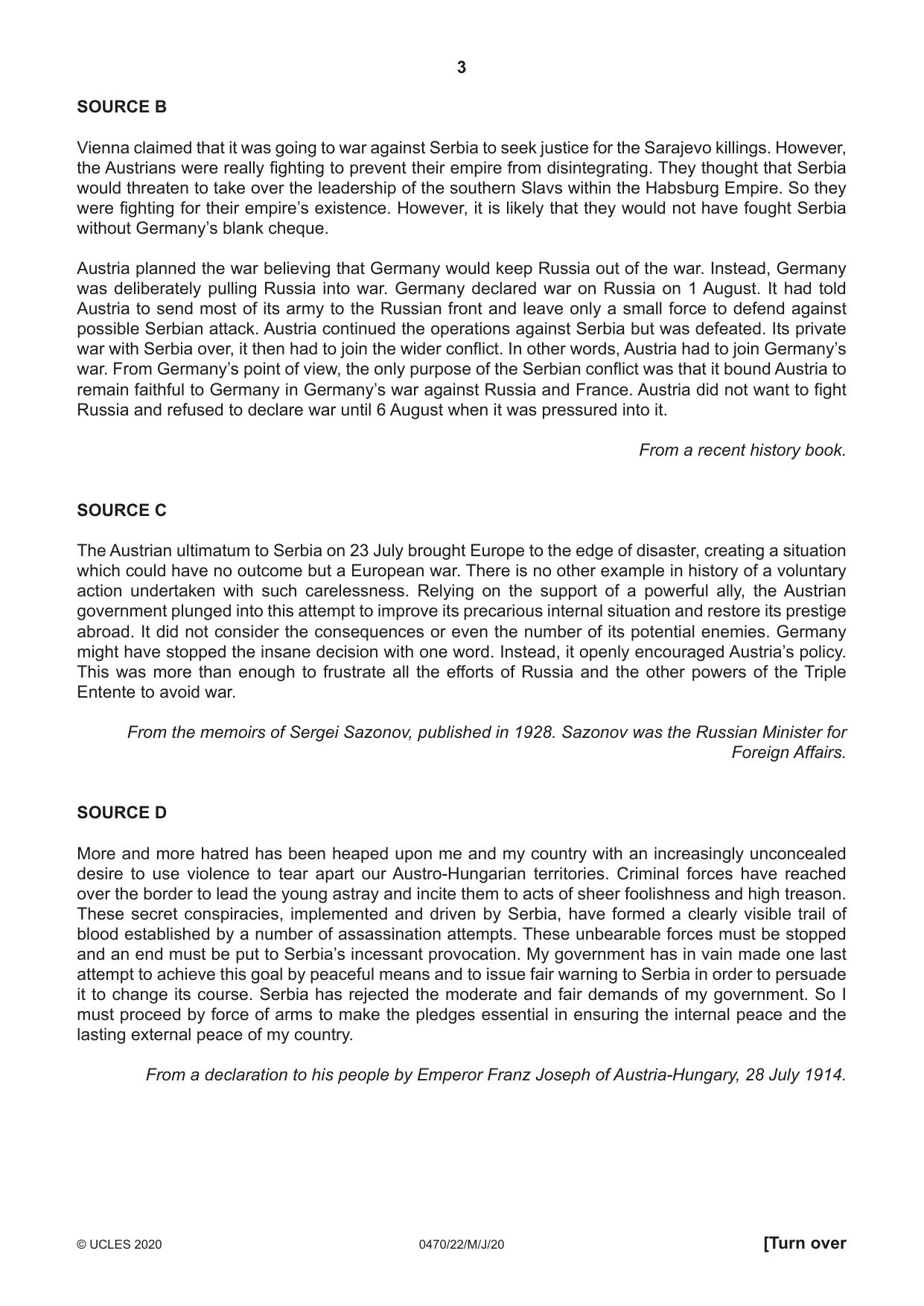
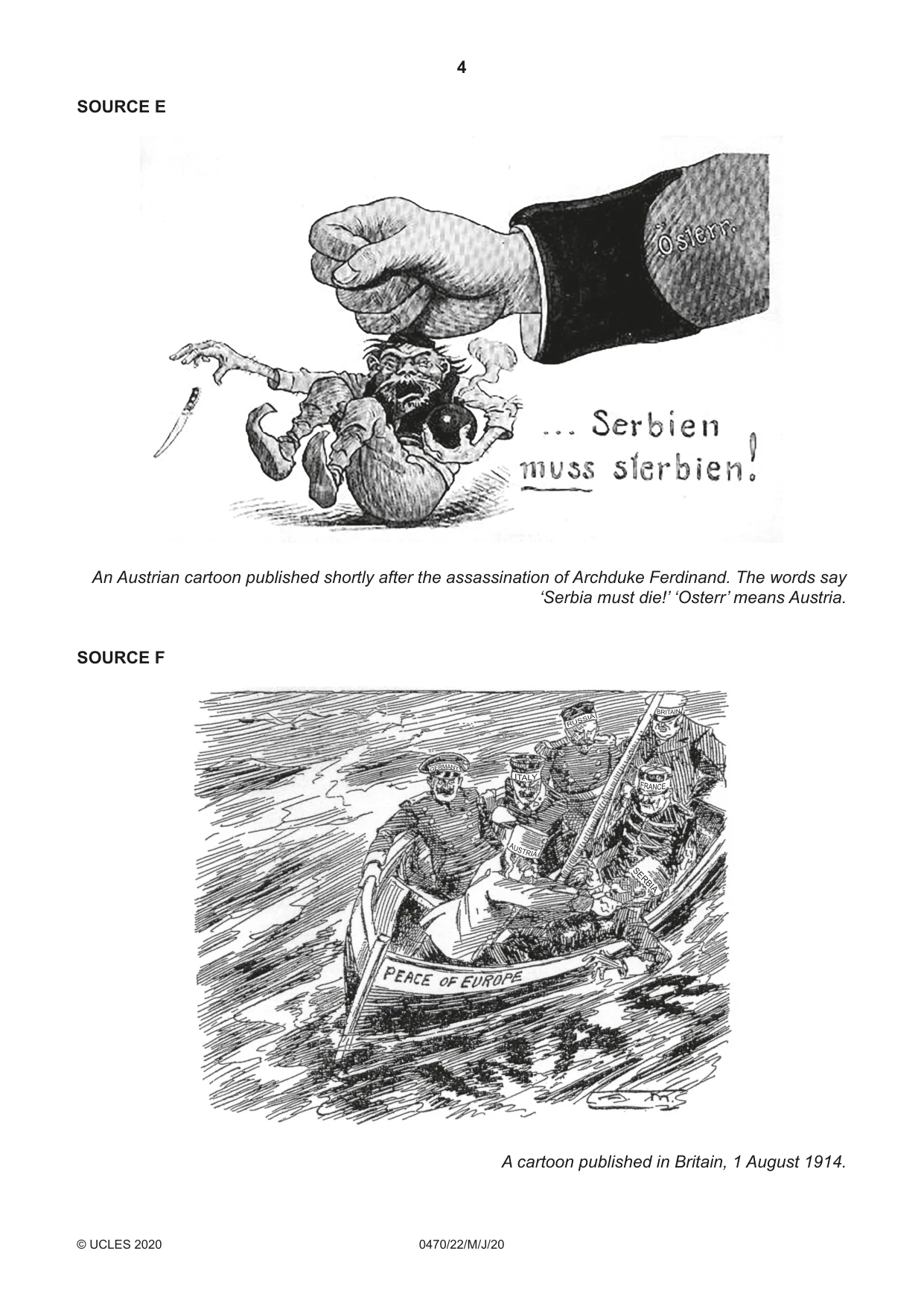
4 0470/22/M/J/20 © UCLES 2020 SOURCE E An Austrian cartoon published shortly after the assassination of Archduke Ferdinand. The words say ‘Serbia must die!’ ‘Osterr’ means Austria. SOURCE F RUSSIA A cartoon published in Britain, 1 August 1914.
Question paper, page 5
5 0470/22/M/J/20 © UCLES 2020 [Turn over SOURCE G If it ever came to war between Austria and Russia, Austria could rest assured of Germany’s loyalty and support. Russia is far from being prepared for war at present, and will think twice before taking up arms. If the Austrians were really convinced of the necessity of military action against Serbia, he would regret their letting the present favourable moment pass. A report by the Austrian ambassador to Germany of what Kaiser Wilhelm said to him at their meeting on 6 July 1914. SOURCE H Travelled out with the Chancellor yesterday. In the evening, on the veranda, a long discussion. I was shocked, because I did not know the situation to be so bad. Russia’s power is growing fast. Austria is becoming weaker. The situation is unstoppable. The Chancellor speaks of difficult decisions. Our old dilemma with every Austrian action in the Balkans. They say that we are always urging them to take action but then we just abandon them. Then they go to the western powers, and we lose our last mediocre ally. This time it is worse than 1912. A campaign against the Serbs can lead to world war. The Chancellor expects a war, and it will result in an upheaval of everything. The future belongs to Russia, it grows and grows, and it weighs heavier and heavier on us. From the diary of Kurt Riezler, 7 July 1914. Riezler was the chief advisor of the German Chancellor, Bethmann Hollweg.
Question paper, page 6
6 0470/22/M/J/20 © UCLES 2020 Now answer all the following questions. You may use any of the sources to help you answer the questions, in addition to those sources which you are told to use. In answering the questions you should use your knowledge of the topic to help you interpret and evaluate the sources. 1 Study Sources A and B. How far do these sources agree? Explain your answer using details of the sources. [7] 2 Study Source C. How useful is this source as evidence of developments in Europe at the end of July 1914? Explain your answer using details of the source and your knowledge. [7] 3 Study Source D. Why did Emperor Franz Joseph make this declaration at that time? Explain your answer using details of the source and your knowledge. [8] 4 Study Sources E and F. How similar are these two cartoons? Explain your answer using details of the sources and your knowledge. [8] 5 Study Sources G and H. How far does Source G make Source H surprising? Explain your answer using details of the sources and your knowledge. [8] 6 Study all the sources. How far do these sources provide convincing evidence that Austria was to blame for the outbreak of Europe-wide hostilities in August 1914? Use the sources to explain your answer. [12]
Question paper, page 7
7 0470/22/M/J/20 © UCLES 2020 [Turn over BLANK PAGE
Question paper, page 8
8 0470/22/M/J/20 © UCLES 2020 Option B: Twentieth century topic HOW FAR WAS THE TENSION BETWEEN THE USA AND THE USSR AFTER THE SECOND WORLD WAR CAUSED BY IDEOLOGICAL DIFFERENCES? Study the Background Information and the sources carefully, and then answer all the questions. Background Information Clearly, there were fundamental ideological differences between the USA and the USSR. The USA was a liberal democracy and capitalist. The USSR was communist. Both countries believed that the opposing beliefs and ideas threatened their very existence. However, it can be argued that the tension between the USA and the USSR was simply about power – each wanted more influence, power and territory and wanted to be the dominant force in the world. How far was the tension between the USA and the USSR about ideology? SOURCE A Starting in the 1970s, the study of the Cold War began to move beyond the simple application of blame and responsibility. Scholars started to view the conflict as a result of a complex interaction between all the parties involved. Historians explained it as a process in which the imbalance of military and economic power, and numerous other factors, contributed to the East–West tension. In the 1990s there was a shift in the emphasis of the study of the Cold War: if scholars had previously relied heavily on massive amounts of American evidence, they now rushed to use the newly-available former Soviet materials. These revealed the general point that ideology and perceptions mattered inside the Soviet bloc. While ideology had been viewed by many as simply a convenient mask of ‘real interests’, it was, in fact, a ‘fundamental interest’. This made the Cold War a unique confrontation: ideas, values, and belief systems were at the heart of the struggle. This is not to say that political, economic, or military assessments of the Cold War are irrelevant. Quite the contrary. Without taking into account the interests of the Soviet Union in Eastern Europe or the real economic power of the United States and its nuclear weapons, it is impossible to understand the Cold War. At the same time, if one ignores the existence of a deep-seated ideological conflict, one can hardly understand why, for example, the Soviet determination to protect its political interests in Eastern Europe would have mattered as much as it did to the United States. From a history book published in 2003.
Question paper, page 9
9 0470/22/M/J/20 © UCLES 2020 [Turn over SOURCE B The prime cause of the conflict opening up between the Russians and the Americans was the ideology of the Soviet leaders, and their inability to make permanent arrangements with the leaders of capitalist states. This was stated by Litvinov in June 1946. When asked what would happen if the West were to concede to Russia all its aims in foreign policy, he replied, ‘It would lead to the West being faced, in a more or less short time, with the next series of demands.’ The second cause was the Soviet desire for security against another German invasion, which could be obtained only by lack of independence of its neighbours. This security would prevent Poland being used as ‘a corridor’ for another German attack; it ensured that the same country could be used as a Russian corridor to the West. Did the policies of the United States play any part? It seems unlikely that these policies did any more than confirm Stalin in his suspicions. When American statesmen realised that the Russians could not accept their vision of an open world, they moved towards supposing that the Russians were bent on immediate world conquest. Stalin’s probing could easily seem like the first steps of a revolutionary drive to the military conquest of the world; and it might have become that, had it not been resisted. From a history book published in Britain in 1986. SOURCE C A cartoon published in the Soviet Union in 1947. A member of the American public is asking General Eisenhower why there was so much American military activity in the area. Eisenhower replies, ‘Can’t you see the enormous concentration of enemy forces right here?’
Question paper, page 10
10 0470/22/M/J/20 © UCLES 2020 SOURCE D The USSR sees itself living in a threatening ‘capitalist encirclement’ with which there can be no peaceful coexistence. From this it has concluded that everything must be done to advance the relative strength of the USSR. Its effort, and those of Russia’s friends abroad, must be directed at deepening the differences between capitalistic powers. Marxism justifies the USSR’s fear of the outside world and the dictatorship with which it rules. This is why Soviet purposes are nearly always expressed in Marxist terms and is why no one should underestimate the importance of Marxist ideas in Soviet affairs. It believes that there can be no agreement with the USA if Soviet power is to be secure. Measured against the Western world, the Soviets are still by far the weaker force. Their success will depend on the degree of firmness the Western world can muster. We must put forward to other nations a positive picture of the sort of world we would like to see. A telegram from George Kennan to the American government, 22 February 1946. This is often known as ‘the Long Telegram’. Kennan was an official in the US embassy in Moscow. SOURCE E The foreign policy of the United States, which reflects the imperialist tendencies of American capitalism, is characterised by a striving for world domination. The real meaning of the many statements by President Truman is that the United States has the right to lead the world. All the forces of American diplomacy, the Army, Navy and Air Force, industry and science, are being used to support this policy. Broad plans for expansion have been developed to be implemented through a system of military bases, an arms race and the creation of newer and newer types of weapons. A telegram from Nikolai Novikov to the Soviet government, 27 September 1946. Novikov was Soviet Ambassador to the USA. SOURCE F Europe’s requirements for the next three or four years of foreign food and other essential products – mainly from America – are so much greater than its ability to pay that it must have additional help, or face economic, social and political deterioration. The United States should do whatever it can to assist in the return of normal economic health in the world, without which there can be no political stability and no assured peace. Our policy is not directed against any country or doctrine but against hunger, poverty, desperation and chaos. Its purpose should be the revival of a working economy in the world so as to allow the emergence of political and social conditions in which free institutions can exist. From a speech by George Marshall, June 1947. Marshall was a leading member of the US government.
Question paper, page 11
11 0470/22/M/J/20 © UCLES 2020 SOURCE G A cartoon published in the Soviet Union in 1949. The word on the ladder is ‘NATO’. [Turn over
Question paper, page 12
12 0470/22/M/J/20 © UCLES 2020 Permission to reproduce items where third-party owned material protected by copyright is included has been sought and cleared where possible. Every reasonable effort has been made by the publisher (UCLES) to trace copyright holders, but if any items requiring clearance have unwittingly been included, the publisher will be pleased to make amends at the earliest possible opportunity. To avoid the issue of disclosure of answer-related information to candidates, all copyright acknowledgements are reproduced online in the Cambridge Assessment International Education Copyright Acknowledgements Booklet. This is produced for each series of examinations and is freely available to download at www.cambridgeinternational.org after the live examination series. Cambridge Assessment International Education is part of the Cambridge Assessment Group. Cambridge Assessment is the brand name of the University of Cambridge Local Examinations Syndicate (UCLES), which itself is a department of the University of Cambridge. Now answer all the following questions. You may use any of the sources to help you answer the questions, in addition to those sources which you are told to use. In answering the questions you should use your knowledge of the topic to help you interpret and evaluate the sources. 1 Study Sources A and B. How far do these two sources agree? Explain your answer using details of the sources. [7] 2 Study Source C. Why was this cartoon published in the Soviet Union at this time? Explain your answer using details of the source and your knowledge. [8] 3 Study Source D. How useful is this source as evidence about the causes of the Cold War? Explain your answer using details of the source and your knowledge. [7] 4 Study Sources E and F. How far does Source E make Source F surprising? Explain your answer using details of the sources and your knowledge. [8] 5 Study Source G. What is the cartoonist’s message? Explain your answer using details of the source and your knowledge. [8] 6 Study all the sources. How far do these sources provide convincing evidence that the tension between the USA and the USSR was caused by ideological differences? Use the sources to explain your answer. [12]
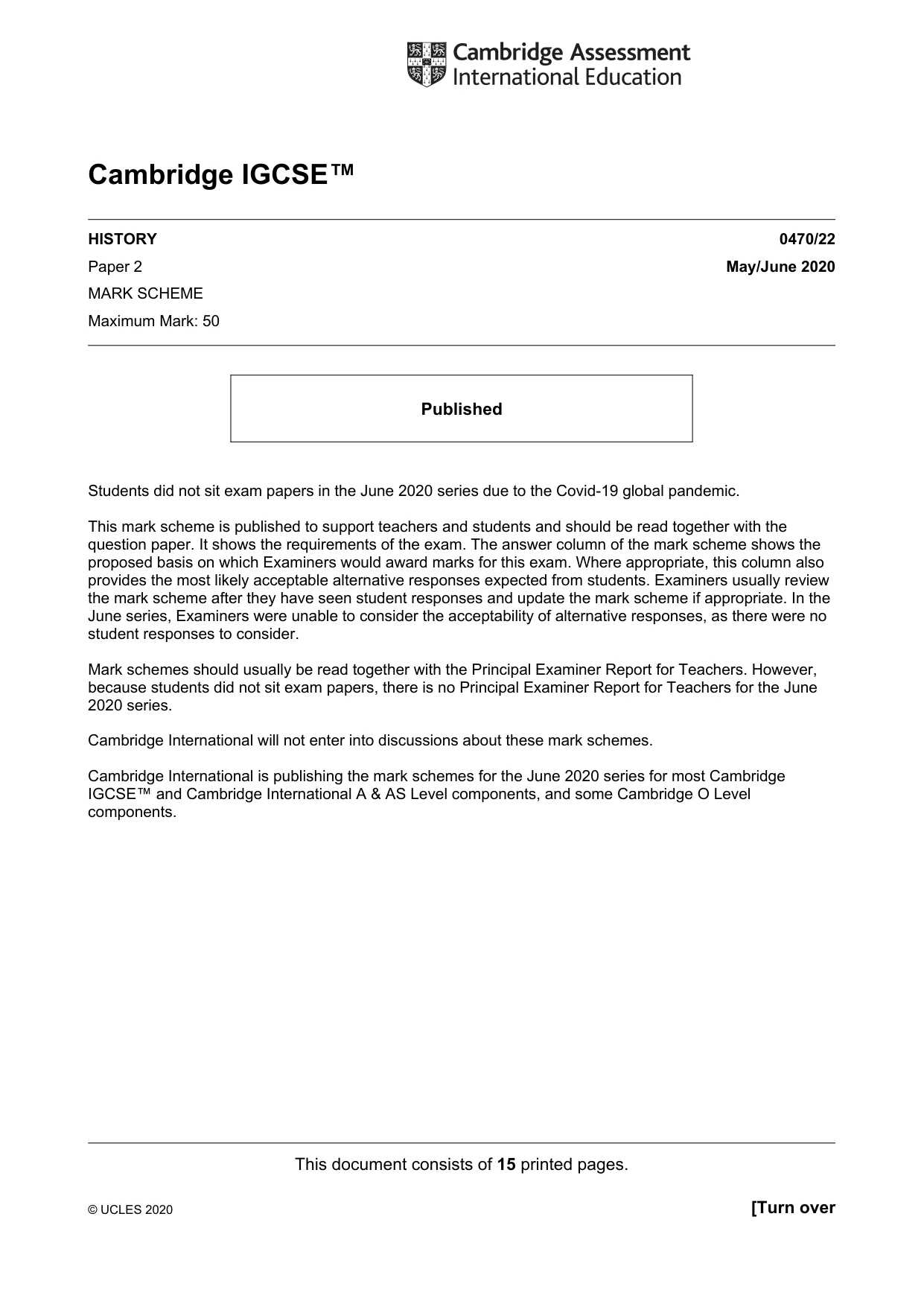
Mark scheme, page 1
This document consists of 15 printed pages. © UCLES 2020 [Turn over Cambridge IGCSE™ HISTORY 0470/22 Paper 2 May/June 2020 MARK SCHEME Maximum Mark: 50 Published Students did not sit exam papers in the June 2020 series due to the Covid-19 global pandemic. This mark scheme is published to support teachers and students and should be read together with the question paper. It shows the requirements of the exam. The answer column of the mark scheme shows the proposed basis on which Examiners would award marks for this exam. Where appropriate, this column also provides the most likely acceptable alternative responses expected from students. Examiners usually review the mark scheme after they have seen student responses and update the mark scheme if appropriate. In the June series, Examiners were unable to consider the acceptability of alternative responses, as there were no student responses to consider. Mark schemes should usually be read together with the Principal Examiner Report for Teachers. However, because students did not sit exam papers, there is no Principal Examiner Report for Teachers for the June 2020 series. Cambridge International will not enter into discussions about these mark schemes. Cambridge International is publishing the mark schemes for the June 2020 series for most Cambridge IGCSE™ and Cambridge International A & AS Level components, and some Cambridge O Level components.
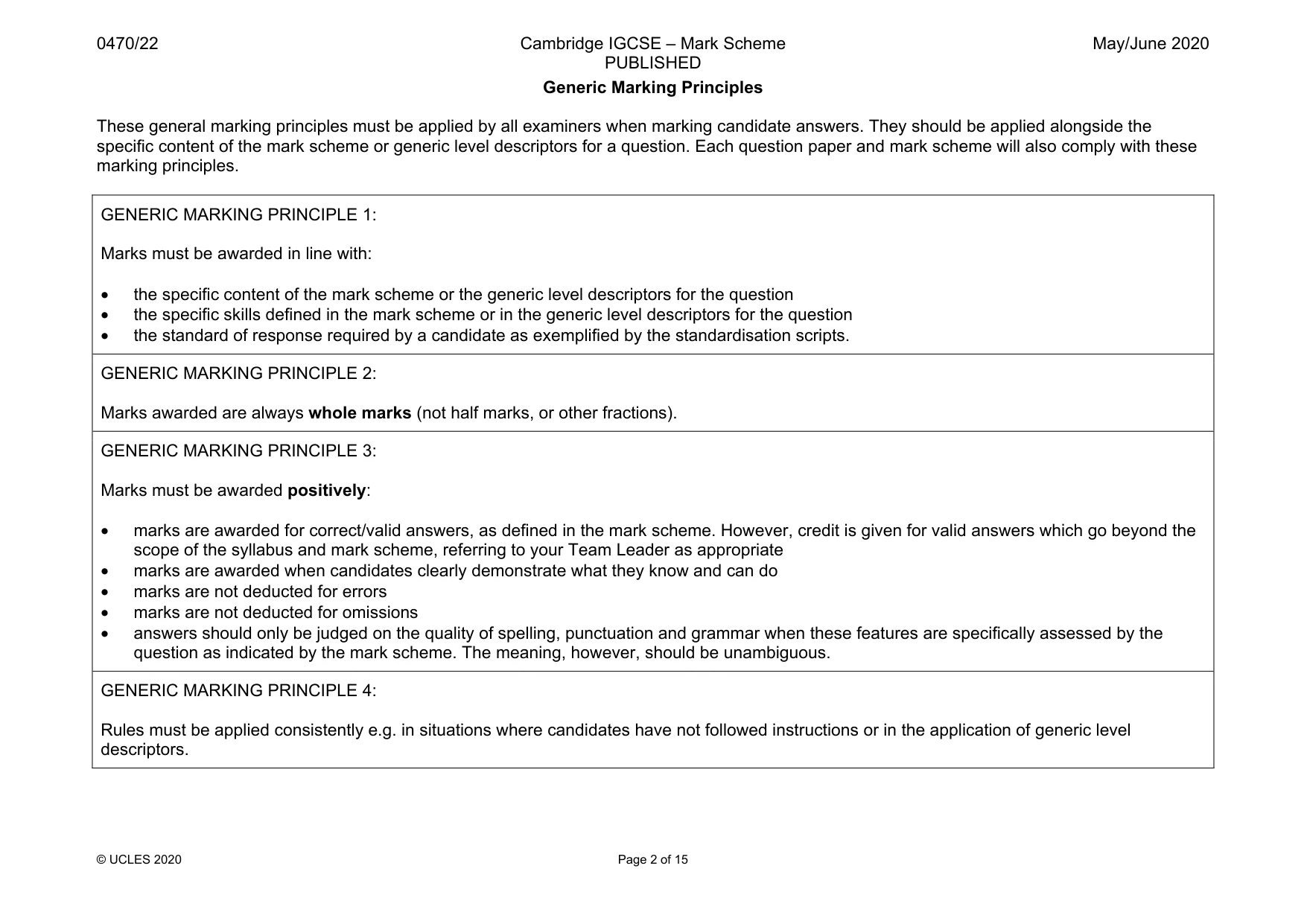
Mark scheme, page 2
0470/22 Cambridge IGCSE – Mark Scheme PUBLISHED May/June 2020 © UCLES 2020 Page 2 of 15 Generic Marking Principles These general marking principles must be applied by all examiners when marking candidate answers. They should be applied alongside the specific content of the mark scheme or generic level descriptors for a question. Each question paper and mark scheme will also comply with these marking principles. GENERIC MARKING PRINCIPLE 1: Marks must be awarded in line with: • the specific content of the mark scheme or the generic level descriptors for the question • the specific skills defined in the mark scheme or in the generic level descriptors for the question • the standard of response required by a candidate as exemplified by the standardisation scripts. GENERIC MARKING PRINCIPLE 2: Marks awarded are always whole marks (not half marks, or other fractions). GENERIC MARKING PRINCIPLE 3: Marks must be awarded positively: • marks are awarded for correct/valid answers, as defined in the mark scheme. However, credit is given for valid answers which go beyond the scope of the syllabus and mark scheme, referring to your Team Leader as appropriate • marks are awarded when candidates clearly demonstrate what they know and can do • marks are not deducted for errors • marks are not deducted for omissions • answers should only be judged on the quality of spelling, punctuation and grammar when these features are specifically assessed by the question as indicated by the mark scheme. The meaning, however, should be unambiguous. GENERIC MARKING PRINCIPLE 4: Rules must be applied consistently e.g. in situations where candidates have not followed instructions or in the application of generic level descriptors.
Mark scheme, page 3
0470/22 Cambridge IGCSE – Mark Scheme PUBLISHED May/June 2020 © UCLES 2020 Page 3 of 15 GENERIC MARKING PRINCIPLE 5: Marks should be awarded using the full range of marks defined in the mark scheme for the question (however; the use of the full mark range may be limited according to the quality of the candidate responses seen). GENERIC MARKING PRINCIPLE 6: Marks awarded are based solely on the requirements as defined in the mark scheme. Marks should not be awarded with grade thresholds or grade descriptors in mind.
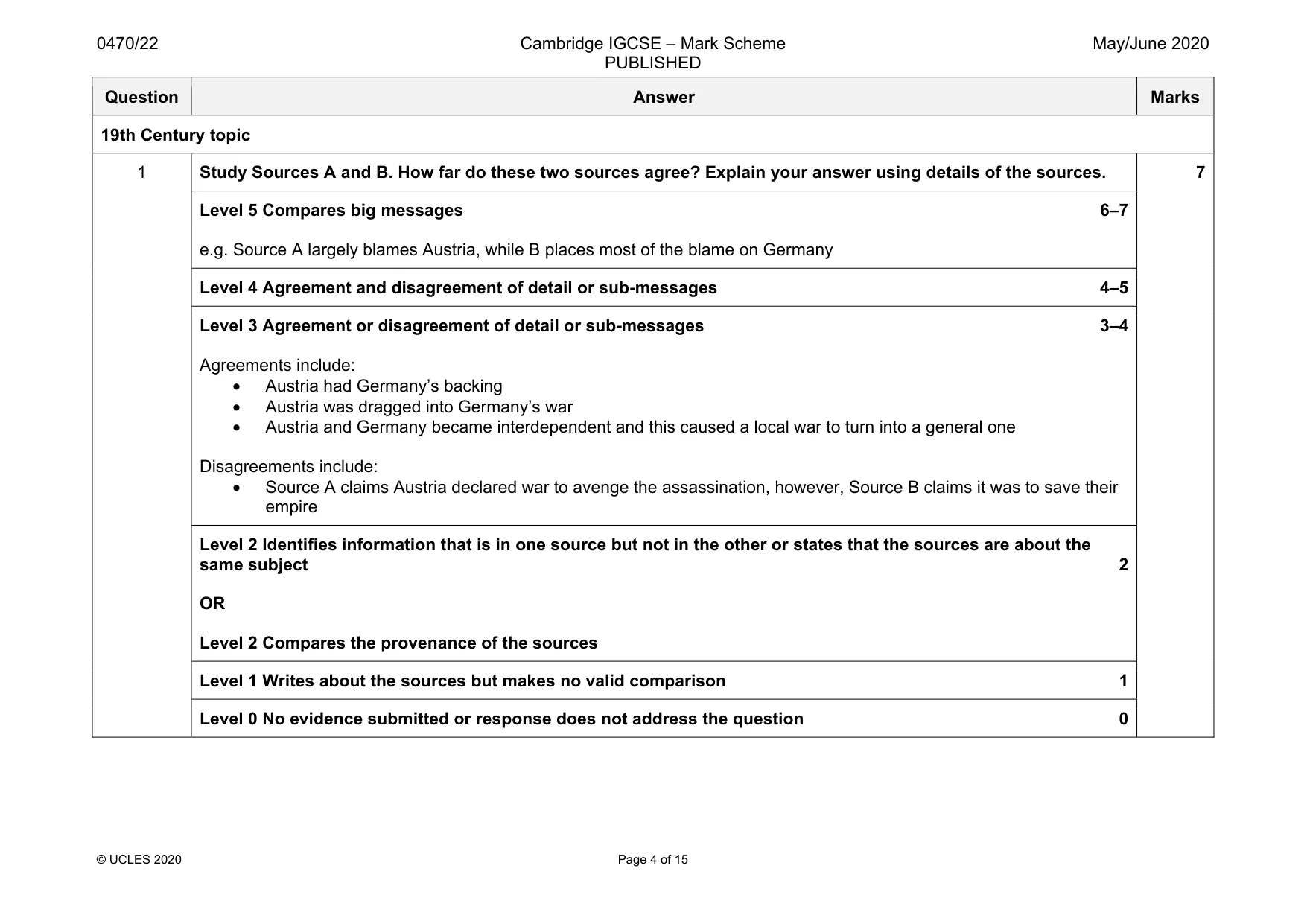
Mark scheme, page 4
0470/22 Cambridge IGCSE – Mark Scheme PUBLISHED May/June 2020 © UCLES 2020 Page 4 of 15 Question Answer Marks 19th Century topic 1 Study Sources A and B. How far do these two sources agree? Explain your answer using details of the sources. 7 Level 5 Compares big messages 6–7 e.g. Source A largely blames Austria, while B places most of the blame on Germany Level 4 Agreement and disagreement of detail or sub-messages 4–5 Level 3 Agreement or disagreement of detail or sub-messages 3–4 Agreements include: • Austria had Germany’s backing • Austria was dragged into Germany’s war • Austria and Germany became interdependent and this caused a local war to turn into a general one Disagreements include: • Source A claims Austria declared war to avenge the assassination, however, Source B claims it was to save their empire Level 2 Identifies information that is in one source but not in the other or states that the sources are about the same subject 2 OR Level 2 Compares the provenance of the sources Level 1 Writes about the sources but makes no valid comparison 1 Level 0 No evidence submitted or response does not address the question 0
Mark scheme, page 5
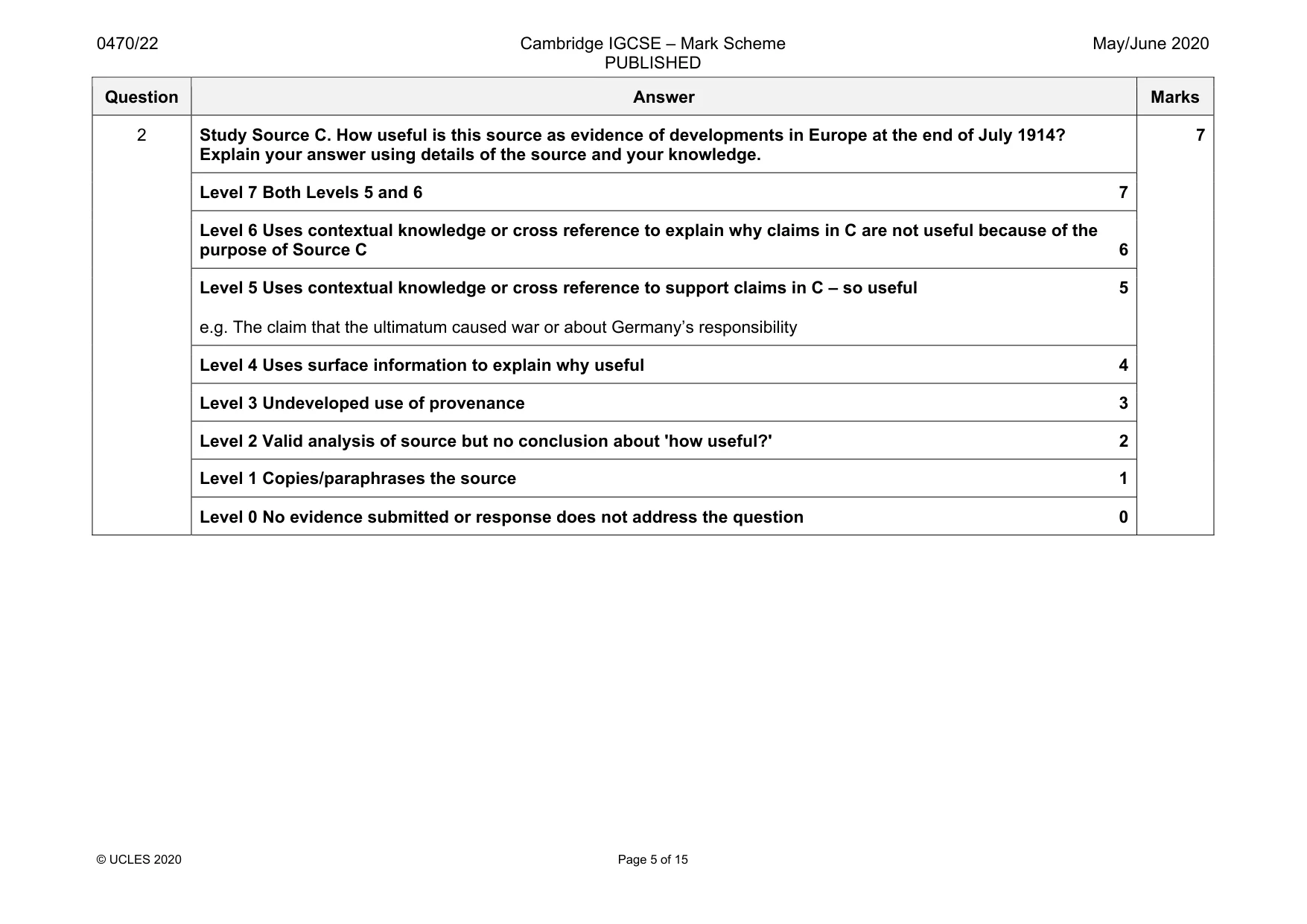
0470/22 Cambridge IGCSE – Mark Scheme PUBLISHED May/June 2020 © UCLES 2020 Page 5 of 15 Question Answer Marks 2 Study Source C. How useful is this source as evidence of developments in Europe at the end of July 1914? Explain your answer using details of the source and your knowledge. 7 Level 7 Both Levels 5 and 6 7 Level 6 Uses contextual knowledge or cross reference to explain why claims in C are not useful because of the purpose of Source C 6 Level 5 Uses contextual knowledge or cross reference to support claims in C – so useful 5 e.g. The claim that the ultimatum caused war or about Germany’s responsibility Level 4 Uses surface information to explain why useful 4 Level 3 Undeveloped use of provenance 3 Level 2 Valid analysis of source but no conclusion about 'how useful?' 2 Level 1 Copies/paraphrases the source 1 Level 0 No evidence submitted or response does not address the question 0
Mark scheme, page 6
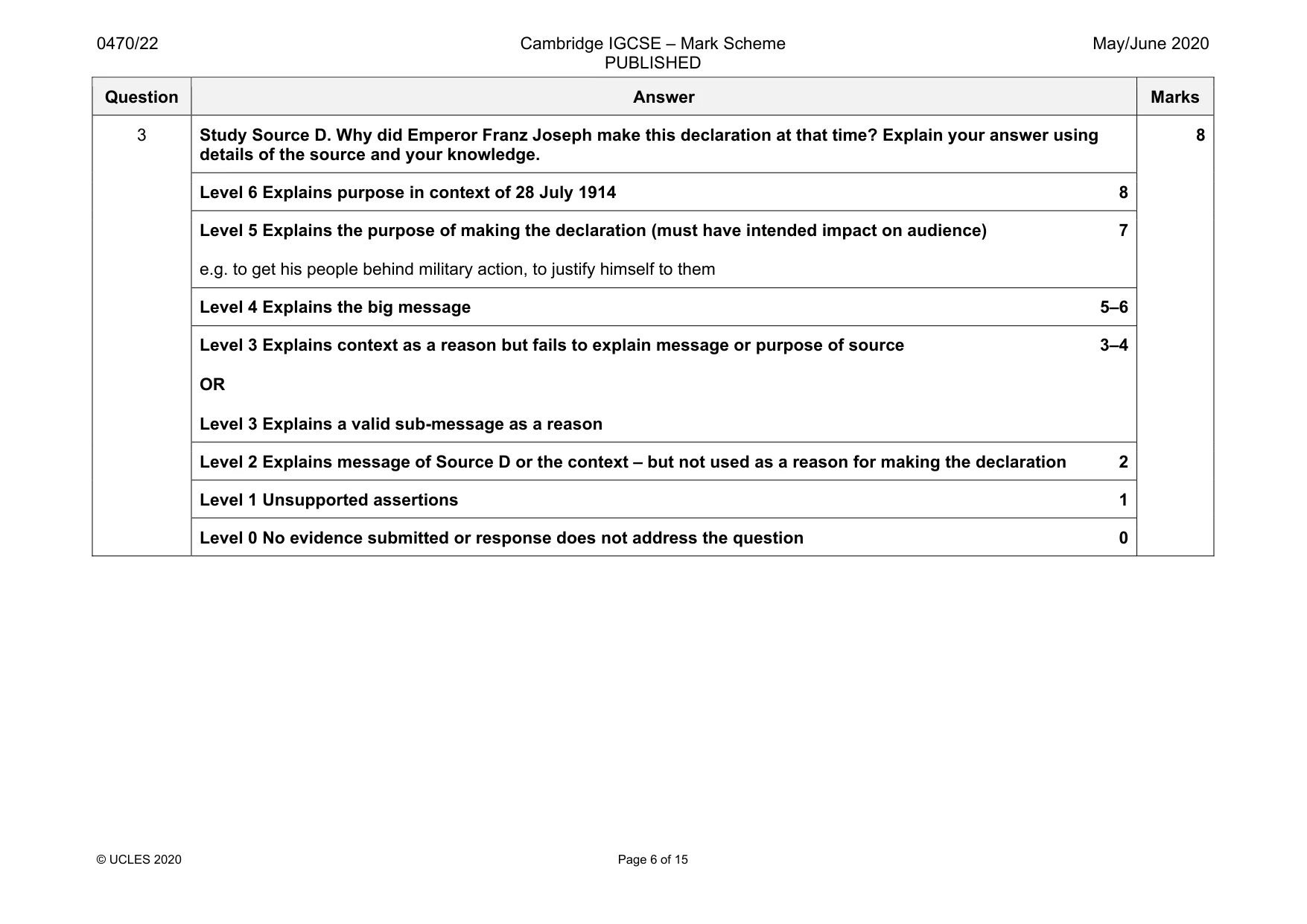
0470/22 Cambridge IGCSE – Mark Scheme PUBLISHED May/June 2020 © UCLES 2020 Page 6 of 15 Question Answer Marks 3 Study Source D. Why did Emperor Franz Joseph make this declaration at that time? Explain your answer using details of the source and your knowledge. 8 Level 6 Explains purpose in context of 28 July 1914 8 Level 5 Explains the purpose of making the declaration (must have intended impact on audience) 7 e.g. to get his people behind military action, to justify himself to them Level 4 Explains the big message 5–6 Level 3 Explains context as a reason but fails to explain message or purpose of source 3–4 OR Level 3 Explains a valid sub-message as a reason Level 2 Explains message of Source D or the context – but not used as a reason for making the declaration 2 Level 1 Unsupported assertions 1 Level 0 No evidence submitted or response does not address the question 0
Mark scheme, page 7
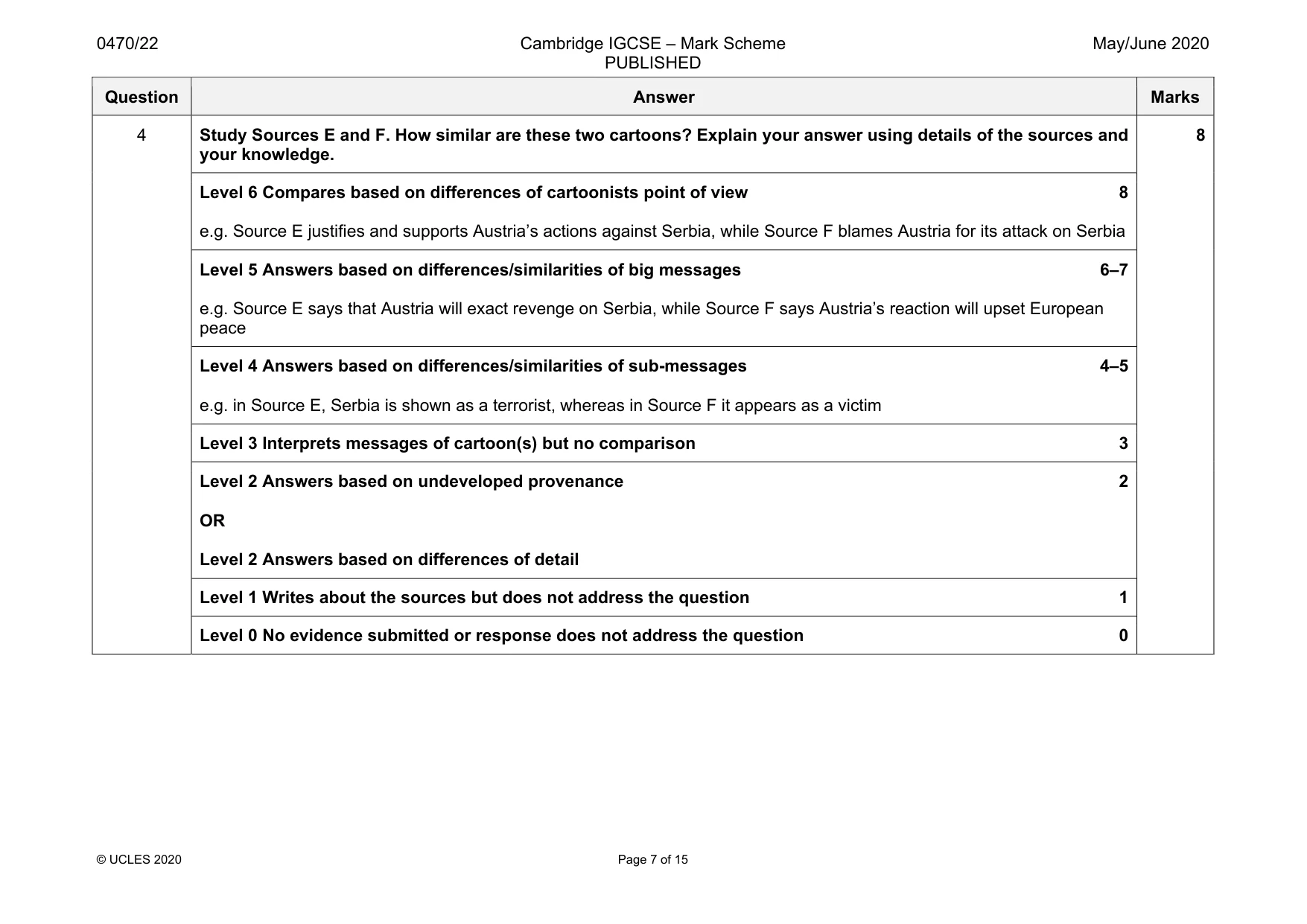
0470/22 Cambridge IGCSE – Mark Scheme PUBLISHED May/June 2020 © UCLES 2020 Page 7 of 15 Question Answer Marks 4 Study Sources E and F. How similar are these two cartoons? Explain your answer using details of the sources and your knowledge. 8 Level 6 Compares based on differences of cartoonists point of view 8 e.g. Source E justifies and supports Austria’s actions against Serbia, while Source F blames Austria for its attack on Serbia Level 5 Answers based on differences/similarities of big messages 6–7 e.g. Source E says that Austria will exact revenge on Serbia, while Source F says Austria’s reaction will upset European peace Level 4 Answers based on differences/similarities of sub-messages 4–5 e.g. in Source E, Serbia is shown as a terrorist, whereas in Source F it appears as a victim Level 3 Interprets messages of cartoon(s) but no comparison 3 Level 2 Answers based on undeveloped provenance 2 OR Level 2 Answers based on differences of detail Level 1 Writes about the sources but does not address the question 1 Level 0 No evidence submitted or response does not address the question 0
Mark scheme, page 8
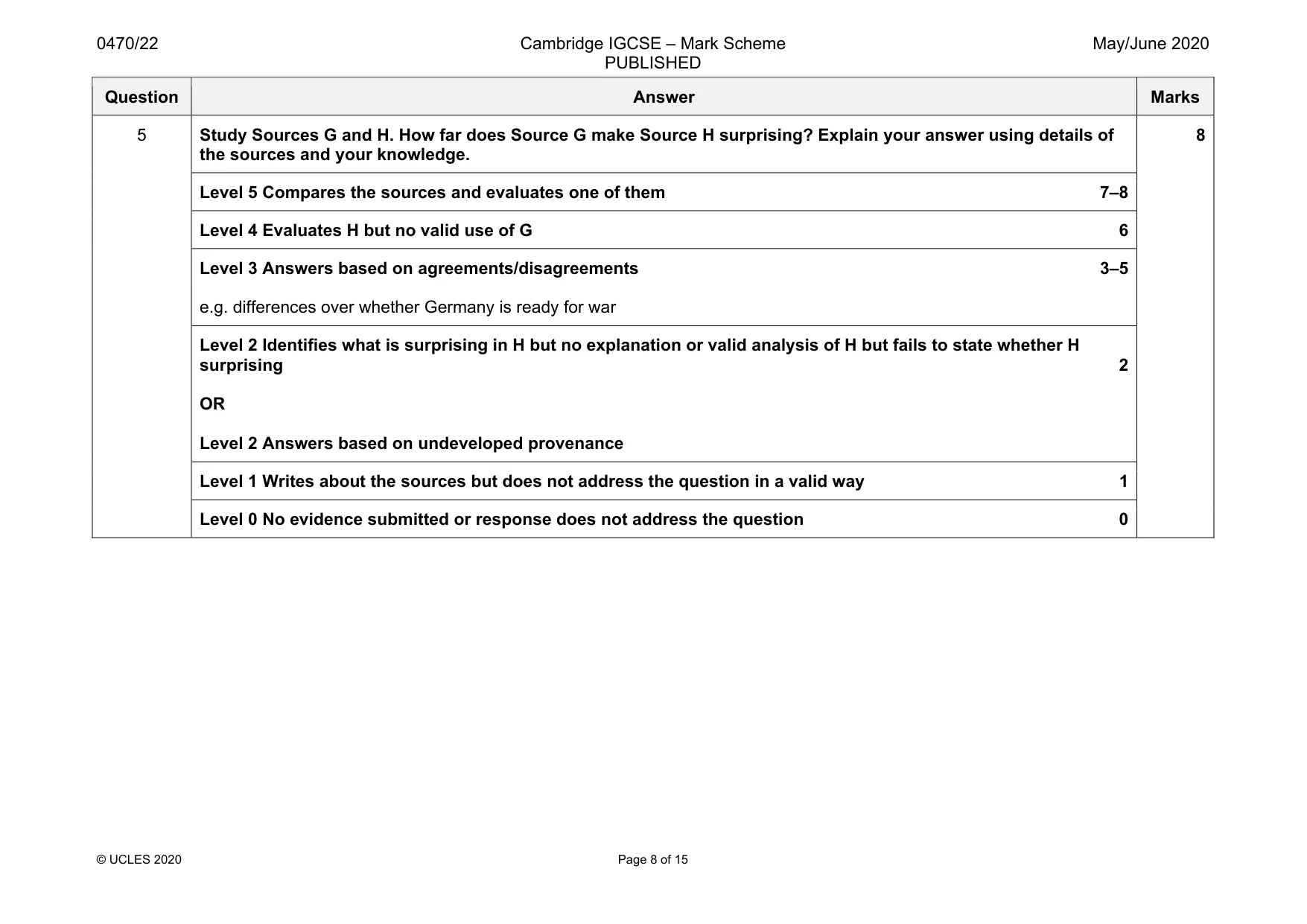
0470/22 Cambridge IGCSE – Mark Scheme PUBLISHED May/June 2020 © UCLES 2020 Page 8 of 15 Question Answer Marks 5 Study Sources G and H. How far does Source G make Source H surprising? Explain your answer using details of the sources and your knowledge. 8 Level 5 Compares the sources and evaluates one of them 7–8 Level 4 Evaluates H but no valid use of G 6 Level 3 Answers based on agreements/disagreements 3–5 e.g. differences over whether Germany is ready for war Level 2 Identifies what is surprising in H but no explanation or valid analysis of H but fails to state whether H surprising 2 OR Level 2 Answers based on undeveloped provenance Level 1 Writes about the sources but does not address the question in a valid way 1 Level 0 No evidence submitted or response does not address the question 0
Mark scheme, page 9
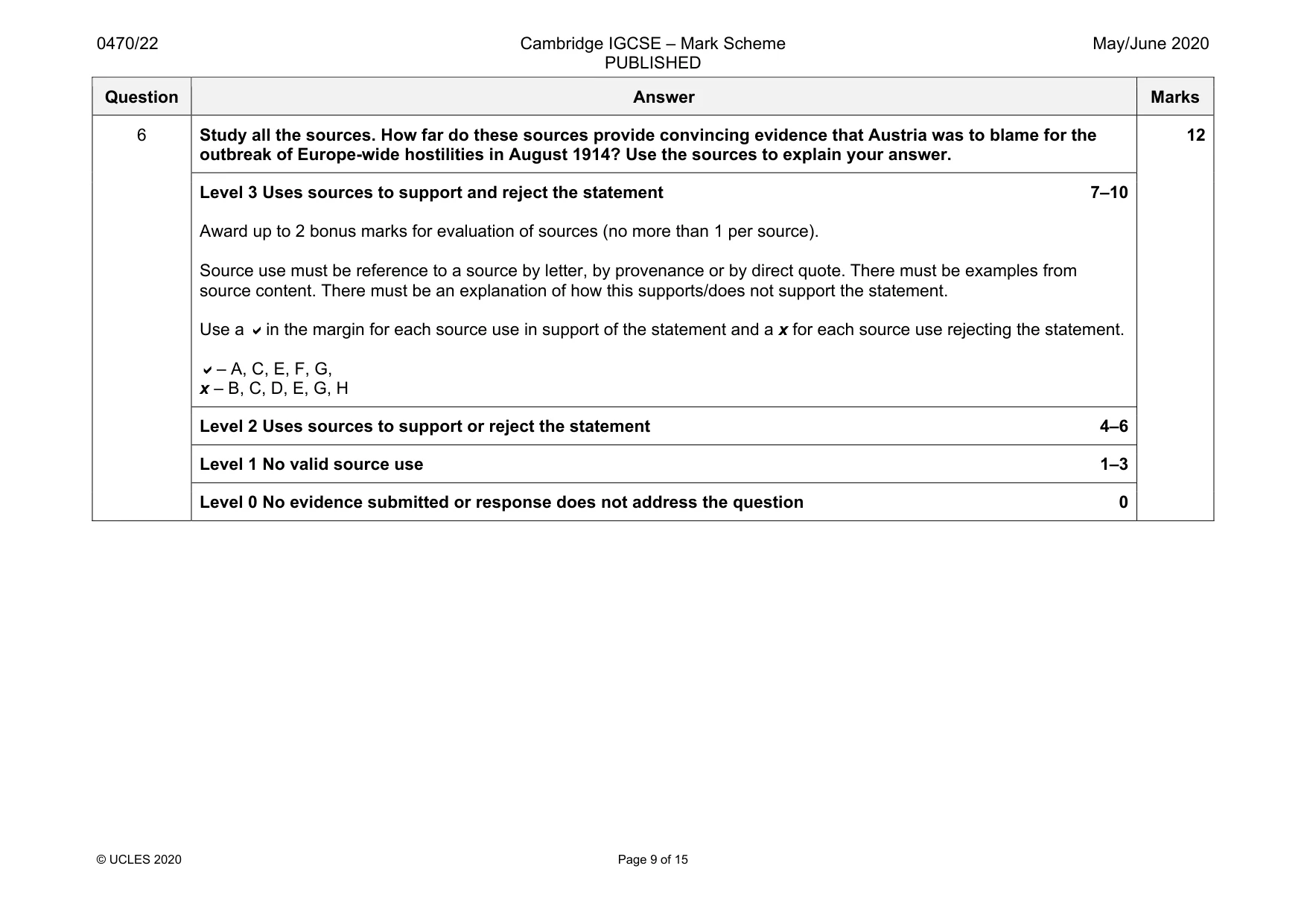
0470/22 Cambridge IGCSE – Mark Scheme PUBLISHED May/June 2020 © UCLES 2020 Page 9 of 15 Question Answer Marks 6 Study all the sources. How far do these sources provide convincing evidence that Austria was to blame for the outbreak of Europe-wide hostilities in August 1914? Use the sources to explain your answer. 12 Level 3 Uses sources to support and reject the statement 7–10 Award up to 2 bonus marks for evaluation of sources (no more than 1 per source). Source use must be reference to a source by letter, by provenance or by direct quote. There must be examples from source content. There must be an explanation of how this supports/does not support the statement. Use a in the margin for each source use in support of the statement and a x for each source use rejecting the statement. – A, C, E, F, G, x – B, C, D, E, G, H Level 2 Uses sources to support or reject the statement 4–6 Level 1 No valid source use 1–3 Level 0 No evidence submitted or response does not address the question 0
Mark scheme, page 10
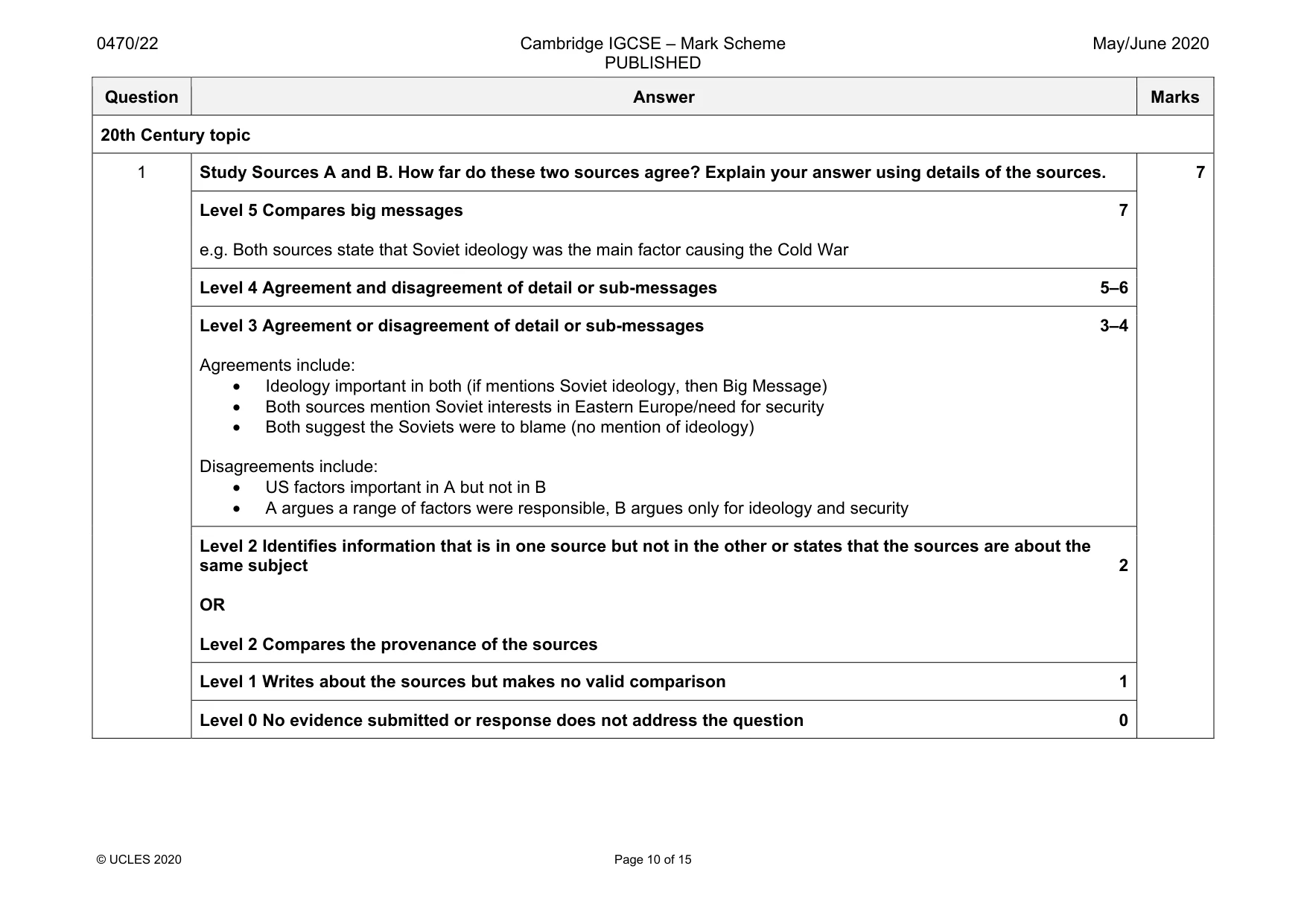
0470/22 Cambridge IGCSE – Mark Scheme PUBLISHED May/June 2020 © UCLES 2020 Page 10 of 15 Question Answer Marks 20th Century topic 1 Study Sources A and B. How far do these two sources agree? Explain your answer using details of the sources. 7 Level 5 Compares big messages 7 e.g. Both sources state that Soviet ideology was the main factor causing the Cold War Level 4 Agreement and disagreement of detail or sub-messages 5–6 Level 3 Agreement or disagreement of detail or sub-messages 3–4 Agreements include: • Ideology important in both (if mentions Soviet ideology, then Big Message) • Both sources mention Soviet interests in Eastern Europe/need for security • Both suggest the Soviets were to blame (no mention of ideology) Disagreements include: • US factors important in A but not in B • A argues a range of factors were responsible, B argues only for ideology and security Level 2 Identifies information that is in one source but not in the other or states that the sources are about the same subject 2 OR Level 2 Compares the provenance of the sources Level 1 Writes about the sources but makes no valid comparison 1 Level 0 No evidence submitted or response does not address the question 0
Mark scheme, page 11
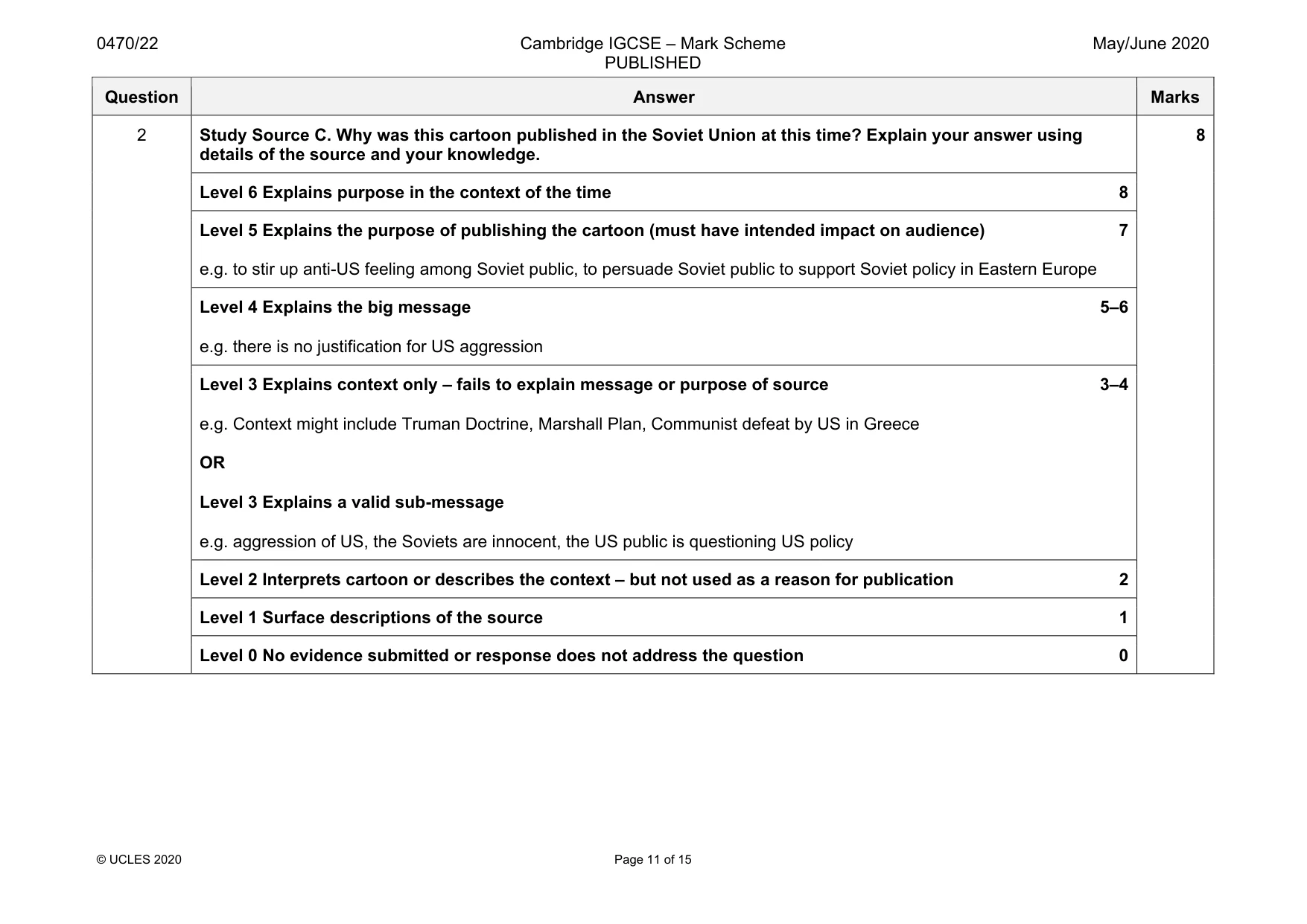
0470/22 Cambridge IGCSE – Mark Scheme PUBLISHED May/June 2020 © UCLES 2020 Page 11 of 15 Question Answer Marks 2 Study Source C. Why was this cartoon published in the Soviet Union at this time? Explain your answer using details of the source and your knowledge. 8 Level 6 Explains purpose in the context of the time 8 Level 5 Explains the purpose of publishing the cartoon (must have intended impact on audience) 7 e.g. to stir up anti-US feeling among Soviet public, to persuade Soviet public to support Soviet policy in Eastern Europe Level 4 Explains the big message 5–6 e.g. there is no justification for US aggression Level 3 Explains context only – fails to explain message or purpose of source 3–4 e.g. Context might include Truman Doctrine, Marshall Plan, Communist defeat by US in Greece OR Level 3 Explains a valid sub-message e.g. aggression of US, the Soviets are innocent, the US public is questioning US policy Level 2 Interprets cartoon or describes the context – but not used as a reason for publication 2 Level 1 Surface descriptions of the source 1 Level 0 No evidence submitted or response does not address the question 0
Mark scheme, page 12
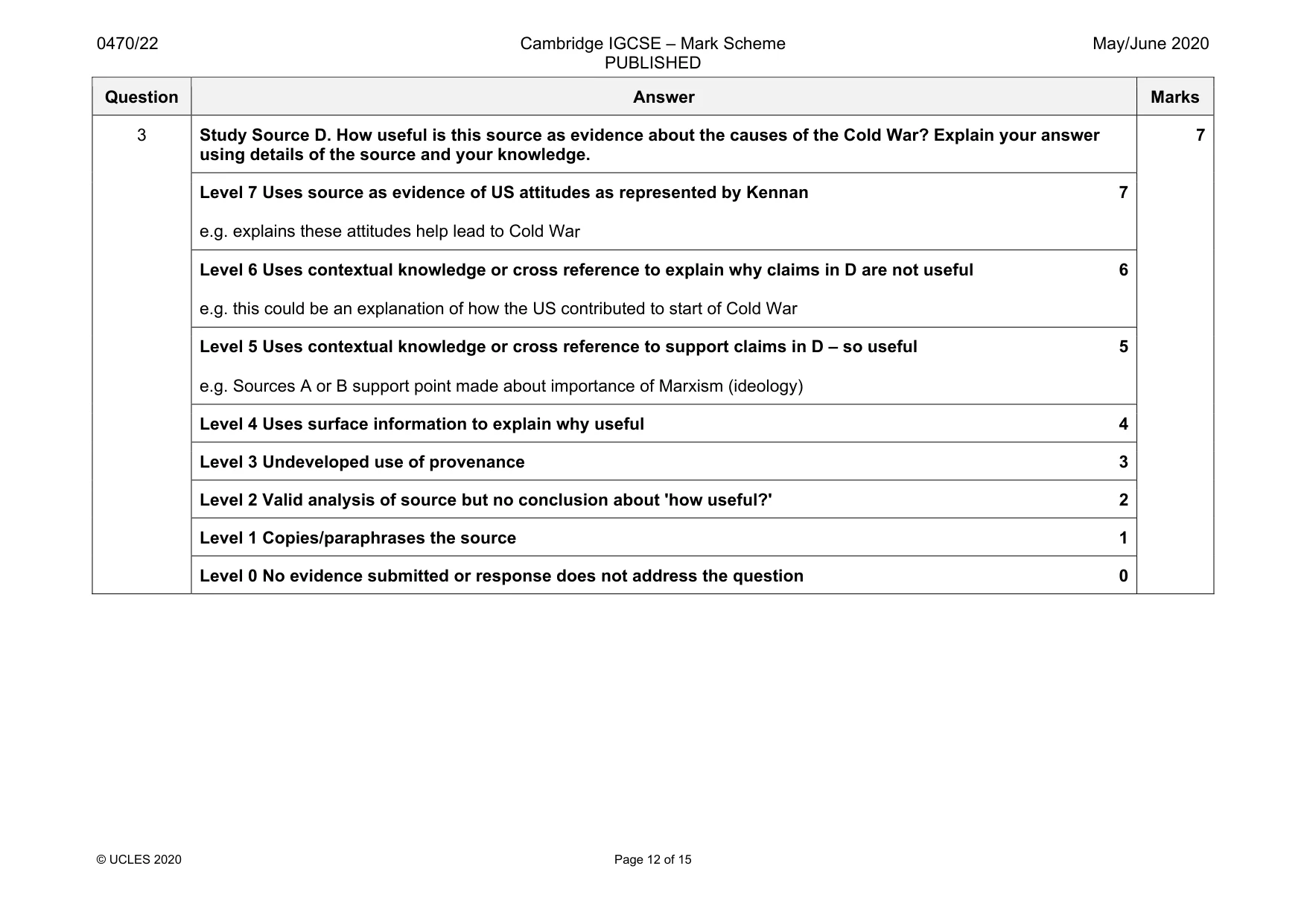
0470/22 Cambridge IGCSE – Mark Scheme PUBLISHED May/June 2020 © UCLES 2020 Page 12 of 15 Question Answer Marks 3 Study Source D. How useful is this source as evidence about the causes of the Cold War? Explain your answer using details of the source and your knowledge. 7 Level 7 Uses source as evidence of US attitudes as represented by Kennan 7 e.g. explains these attitudes help lead to Cold War Level 6 Uses contextual knowledge or cross reference to explain why claims in D are not useful 6 e.g. this could be an explanation of how the US contributed to start of Cold War Level 5 Uses contextual knowledge or cross reference to support claims in D – so useful 5 e.g. Sources A or B support point made about importance of Marxism (ideology) Level 4 Uses surface information to explain why useful 4 Level 3 Undeveloped use of provenance 3 Level 2 Valid analysis of source but no conclusion about 'how useful?' 2 Level 1 Copies/paraphrases the source 1 Level 0 No evidence submitted or response does not address the question 0
Mark scheme, page 13
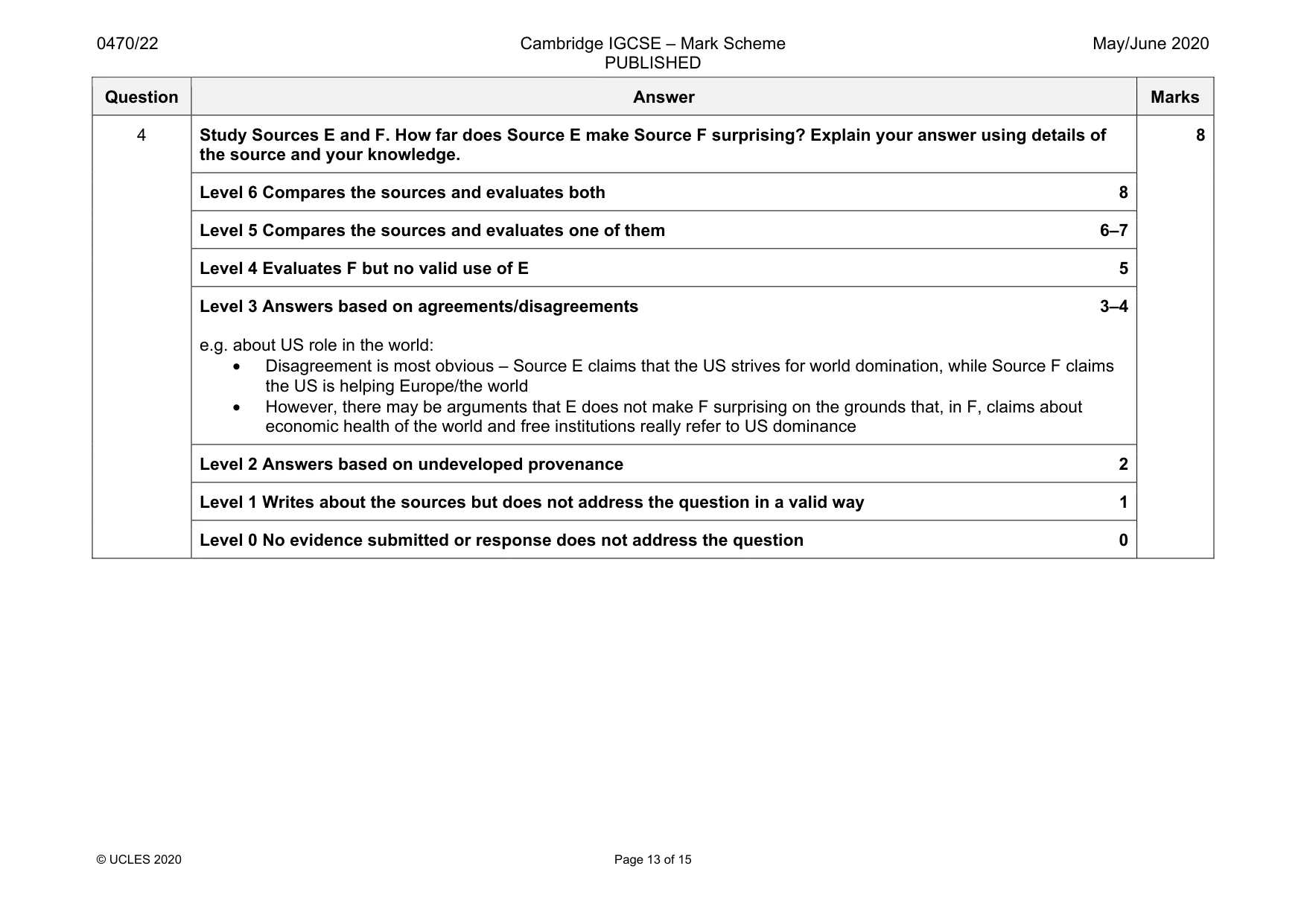
0470/22 Cambridge IGCSE – Mark Scheme PUBLISHED May/June 2020 © UCLES 2020 Page 13 of 15 Question Answer Marks 4 Study Sources E and F. How far does Source E make Source F surprising? Explain your answer using details of the source and your knowledge. 8 Level 6 Compares the sources and evaluates both 8 Level 5 Compares the sources and evaluates one of them 6–7 Level 4 Evaluates F but no valid use of E 5 Level 3 Answers based on agreements/disagreements 3–4 e.g. about US role in the world: • Disagreement is most obvious – Source E claims that the US strives for world domination, while Source F claims the US is helping Europe/the world • However, there may be arguments that E does not make F surprising on the grounds that, in F, claims about economic health of the world and free institutions really refer to US dominance Level 2 Answers based on undeveloped provenance 2 Level 1 Writes about the sources but does not address the question in a valid way 1 Level 0 No evidence submitted or response does not address the question 0
Mark scheme, page 14
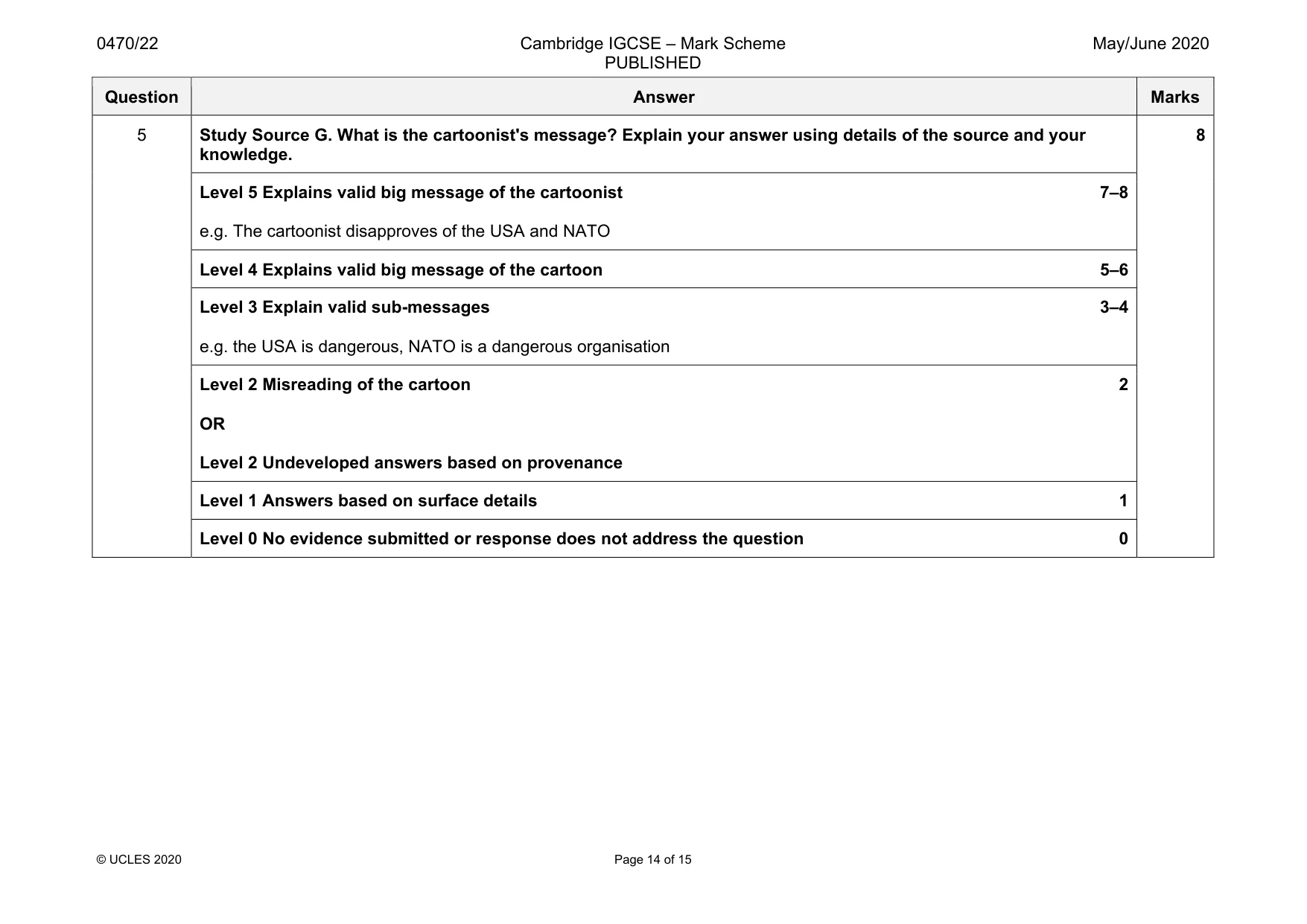
0470/22 Cambridge IGCSE – Mark Scheme PUBLISHED May/June 2020 © UCLES 2020 Page 14 of 15 Question Answer Marks 5 Study Source G. What is the cartoonist's message? Explain your answer using details of the source and your knowledge. 8 Level 5 Explains valid big message of the cartoonist 7–8 e.g. The cartoonist disapproves of the USA and NATO Level 4 Explains valid big message of the cartoon 5–6 Level 3 Explain valid sub-messages 3–4 e.g. the USA is dangerous, NATO is a dangerous organisation Level 2 Misreading of the cartoon 2 OR Level 2 Undeveloped answers based on provenance Level 1 Answers based on surface details 1 Level 0 No evidence submitted or response does not address the question 0
Mark scheme, page 15
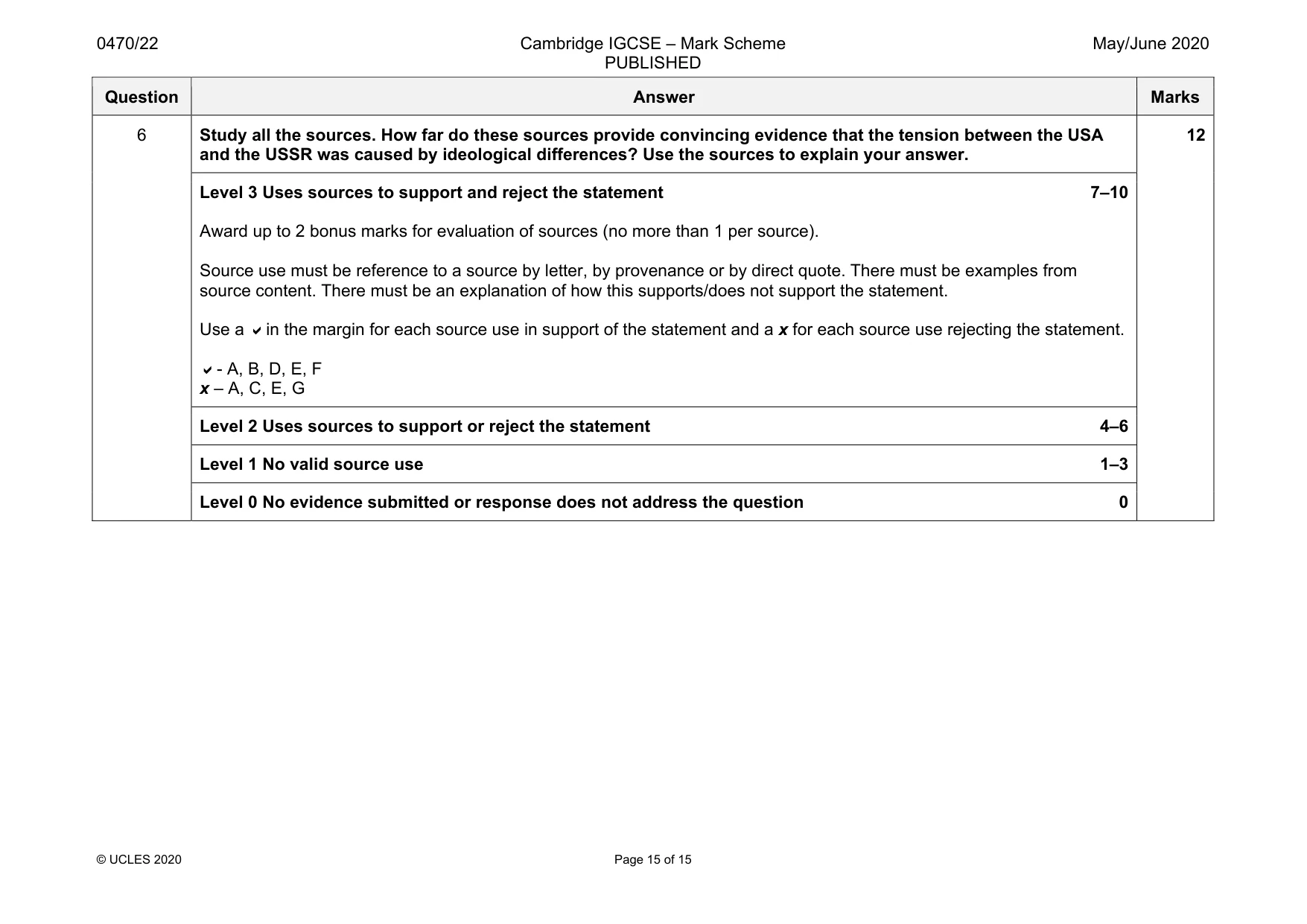
0470/22 Cambridge IGCSE – Mark Scheme PUBLISHED May/June 2020 © UCLES 2020 Page 15 of 15 Question Answer Marks 6 Study all the sources. How far do these sources provide convincing evidence that the tension between the USA and the USSR was caused by ideological differences? Use the sources to explain your answer. 12 Level 3 Uses sources to support and reject the statement 7–10 Award up to 2 bonus marks for evaluation of sources (no more than 1 per source). Source use must be reference to a source by letter, by provenance or by direct quote. There must be examples from source content. There must be an explanation of how this supports/does not support the statement. Use a in the margin for each source use in support of the statement and a x for each source use rejecting the statement. - A, B, D, E, F x – A, C, E, G Level 2 Uses sources to support or reject the statement 4–6 Level 1 No valid source use 1–3 Level 0 No evidence submitted or response does not address the question 0