Cambridge IGCSE History 0470 — 2019 May/June Paper 2 · Variant 3
0470/23/M/J/19 · 50 marks · ≈56 min
The question paper and its mark scheme, free to read here and free to download. This is Cambridge’s own paper, exactly as it was sat.
Question paper12 pages
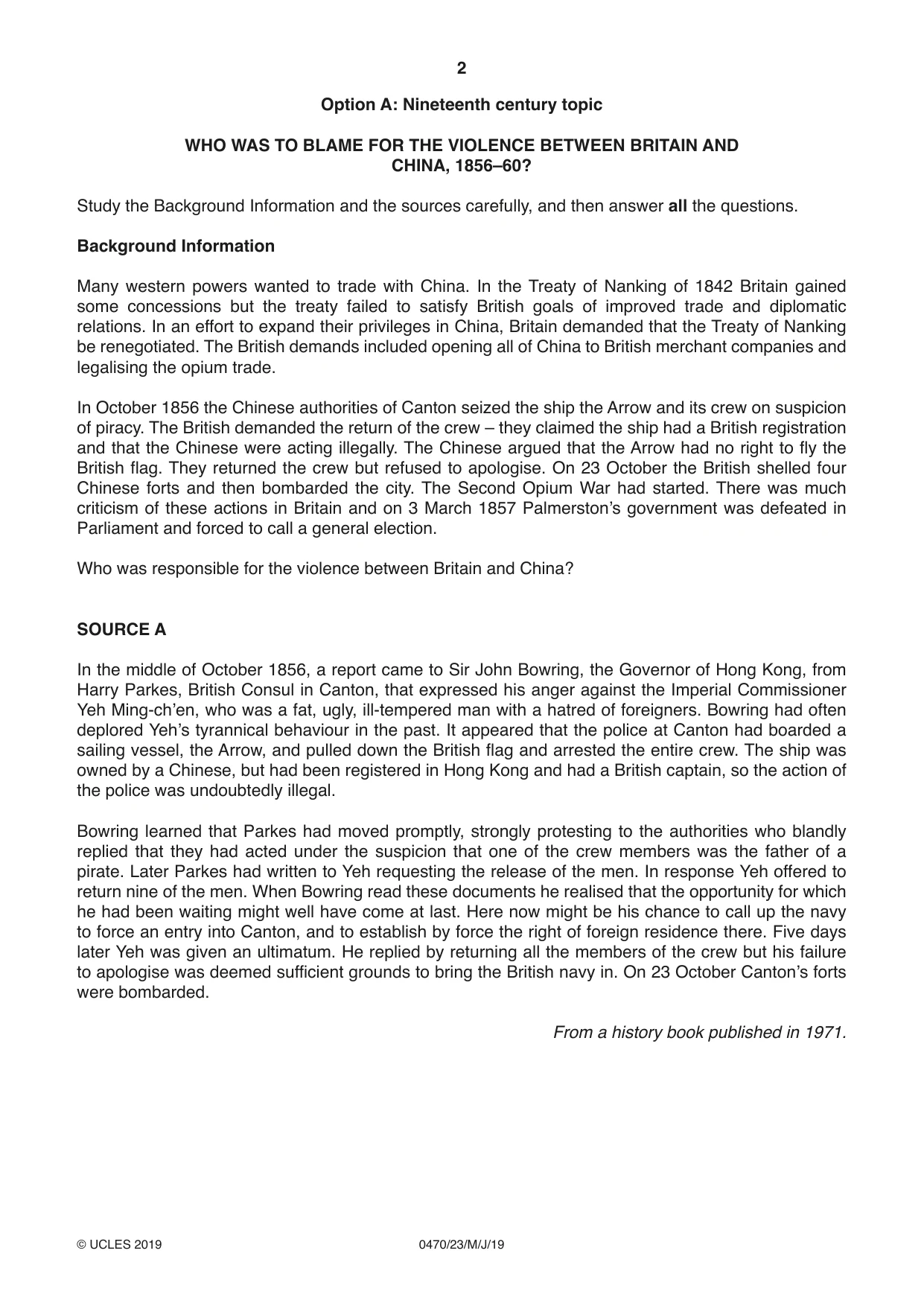
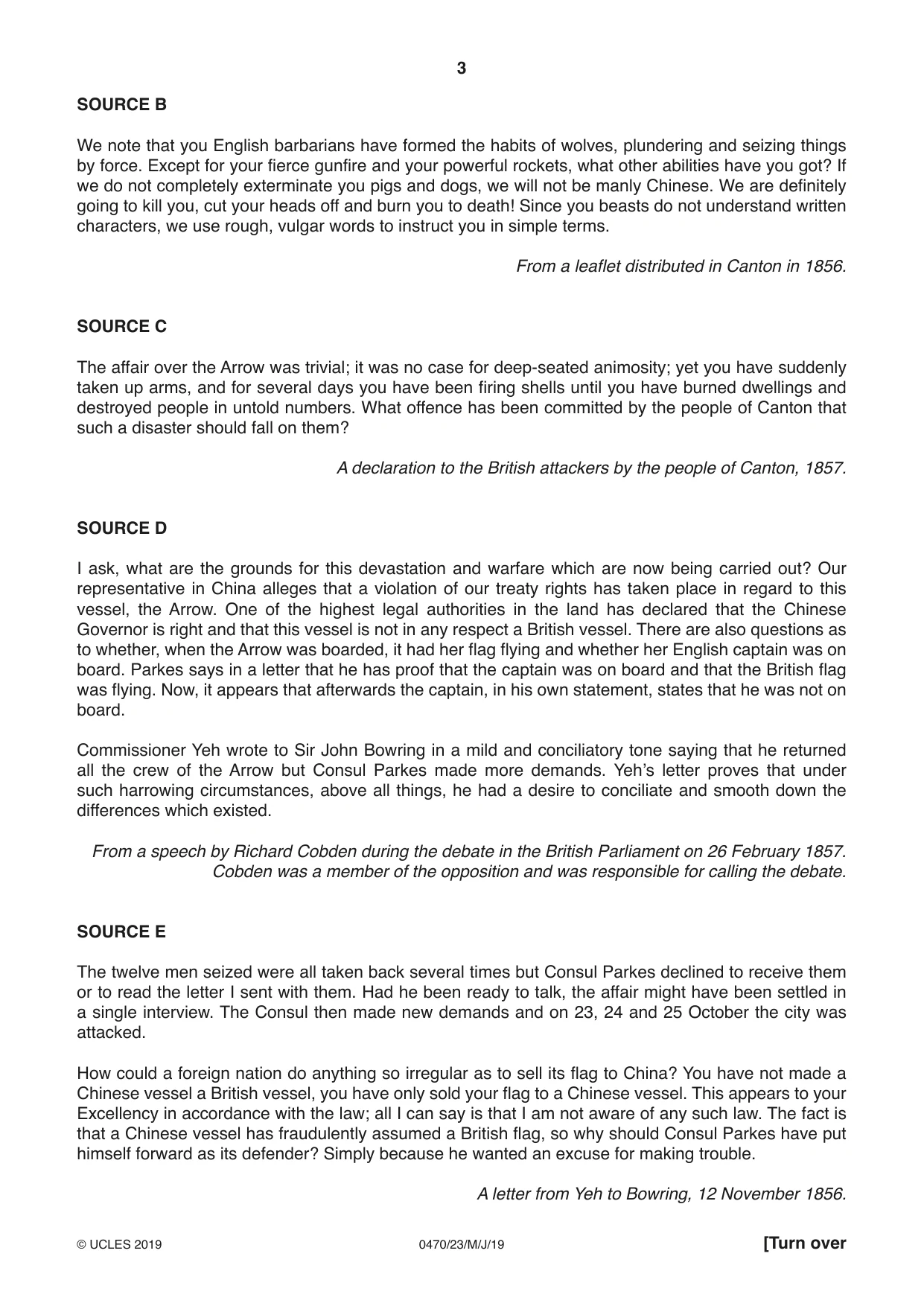
Mark scheme15 pages
Answers below. Sit the paper first if you are practising.
Paper as text
Question paper, page 1
This document consists of 11 printed pages, 1 blank page and 1 Insert. DC (JP/TP) 167271/4 © UCLES 2019 [Turn over Cambridge Assessment International Education Cambridge International General Certificate of Secondary Education * 1 6 4 8 3 1 2 4 5 2 * HISTORY 0470/23 Paper 2 May/June 2019 2 hours No Additional Materials are required. READ THESE INSTRUCTIONS FIRST An answer booklet is provided inside this question paper. You should follow the instructions on the front cover of the answer booklet. If you need additional answer paper ask the invigilator for a continuation booklet. This paper has two options. Choose one option, and then answer all of the questions on that topic. Option A: Nineteenth century topic [p2–p5] Option B: Twentieth century topic [p6–p11] The number of marks is given in brackets [ ] at the end of each question or part question. This syllabus is regulated for use in England, Wales and Northern Ireland as a Cambridge International Level 1/Level 2 Certificate.
Question paper, page 2
2 0470/23/M/J/19 © UCLES 2019 Option A: Nineteenth century topic WHO WAS TO BLAME FOR THE VIOLENCE BETWEEN BRITAIN AND CHINA, 1856–60? Study the Background Information and the sources carefully, and then answer all the questions. Background Information Many western powers wanted to trade with China. In the Treaty of Nanking of 1842 Britain gained some concessions but the treaty failed to satisfy British goals of improved trade and diplomatic relations. In an effort to expand their privileges in China, Britain demanded that the Treaty of Nanking be renegotiated. The British demands included opening all of China to British merchant companies and legalising the opium trade. In October 1856 the Chinese authorities of Canton seized the ship the Arrow and its crew on suspicion of piracy. The British demanded the return of the crew – they claimed the ship had a British registration and that the Chinese were acting illegally. The Chinese argued that the Arrow had no right to fly the British flag. They returned the crew but refused to apologise. On 23 October the British shelled four Chinese forts and then bombarded the city. The Second Opium War had started. There was much criticism of these actions in Britain and on 3 March 1857 Palmerston’s government was defeated in Parliament and forced to call a general election. Who was responsible for the violence between Britain and China? SOURCE A In the middle of October 1856, a report came to Sir John Bowring, the Governor of Hong Kong, from Harry Parkes, British Consul in Canton, that expressed his anger against the Imperial Commissioner Yeh Ming-ch’en, who was a fat, ugly, ill-tempered man with a hatred of foreigners. Bowring had often deplored Yeh’s tyrannical behaviour in the past. It appeared that the police at Canton had boarded a sailing vessel, the Arrow, and pulled down the British flag and arrested the entire crew. The ship was owned by a Chinese, but had been registered in Hong Kong and had a British captain, so the action of the police was undoubtedly illegal. Bowring learned that Parkes had moved promptly, strongly protesting to the authorities who blandly replied that they had acted under the suspicion that one of the crew members was the father of a pirate. Later Parkes had written to Yeh requesting the release of the men. In response Yeh offered to return nine of the men. When Bowring read these documents he realised that the opportunity for which he had been waiting might well have come at last. Here now might be his chance to call up the navy to force an entry into Canton, and to establish by force the right of foreign residence there. Five days later Yeh was given an ultimatum. He replied by returning all the members of the crew but his failure to apologise was deemed sufficient grounds to bring the British navy in. On 23 October Canton’s forts were bombarded. From a history book published in 1971.
Question paper, page 3
3 0470/23/M/J/19 © UCLES 2019 [Turn over SOURCE B We note that you English barbarians have formed the habits of wolves, plundering and seizing things by force. Except for your fierce gunfire and your powerful rockets, what other abilities have you got? If we do not completely exterminate you pigs and dogs, we will not be manly Chinese. We are definitely going to kill you, cut your heads off and burn you to death! Since you beasts do not understand written characters, we use rough, vulgar words to instruct you in simple terms. From a leaflet distributed in Canton in 1856. SOURCE C The affair over the Arrow was trivial; it was no case for deep-seated animosity; yet you have suddenly taken up arms, and for several days you have been firing shells until you have burned dwellings and destroyed people in untold numbers. What offence has been committed by the people of Canton that such a disaster should fall on them? A declaration to the British attackers by the people of Canton, 1857. SOURCE D I ask, what are the grounds for this devastation and warfare which are now being carried out? Our representative in China alleges that a violation of our treaty rights has taken place in regard to this vessel, the Arrow. One of the highest legal authorities in the land has declared that the Chinese Governor is right and that this vessel is not in any respect a British vessel. There are also questions as to whether, when the Arrow was boarded, it had her flag flying and whether her English captain was on board. Parkes says in a letter that he has proof that the captain was on board and that the British flag was flying. Now, it appears that afterwards the captain, in his own statement, states that he was not on board. Commissioner Yeh wrote to Sir John Bowring in a mild and conciliatory tone saying that he returned all the crew of the Arrow but Consul Parkes made more demands. Yeh’s letter proves that under such harrowing circumstances, above all things, he had a desire to conciliate and smooth down the differences which existed. From a speech by Richard Cobden during the debate in the British Parliament on 26 February 1857. Cobden was a member of the opposition and was responsible for calling the debate. SOURCE E The twelve men seized were all taken back several times but Consul Parkes declined to receive them or to read the letter I sent with them. Had he been ready to talk, the affair might have been settled in a single interview. The Consul then made new demands and on 23, 24 and 25 October the city was attacked. How could a foreign nation do anything so irregular as to sell its flag to China? You have not made a Chinese vessel a British vessel, you have only sold your flag to a Chinese vessel. This appears to your Excellency in accordance with the law; all I can say is that I am not aware of any such law. The fact is that a Chinese vessel has fraudulently assumed a British flag, so why should Consul Parkes have put himself forward as its defender? Simply because he wanted an excuse for making trouble. A letter from Yeh to Bowring, 12 November 1856.
Question paper, page 4
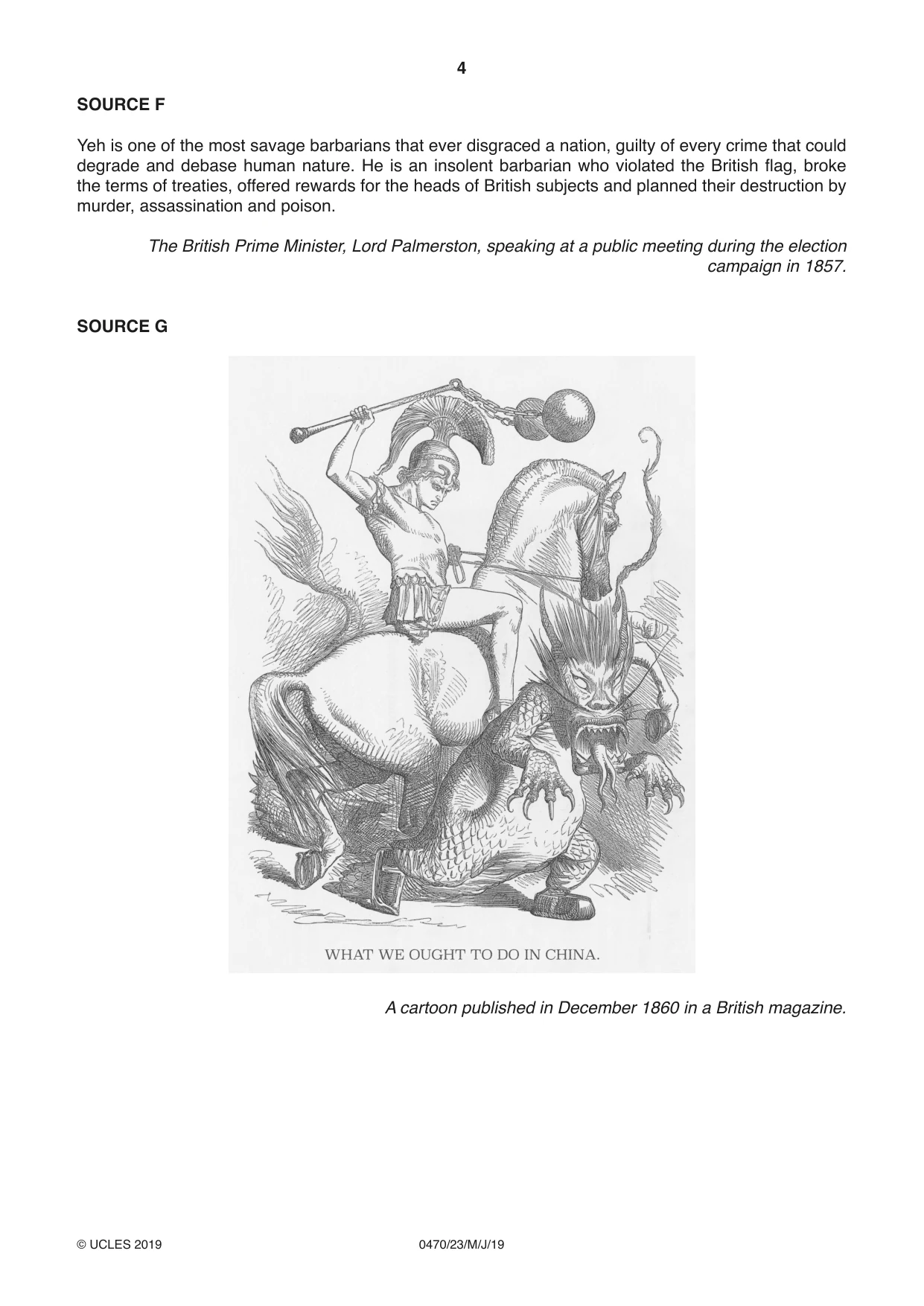
4 0470/23/M/J/19 © UCLES 2019 SOURCE F Yeh is one of the most savage barbarians that ever disgraced a nation, guilty of every crime that could degrade and debase human nature. He is an insolent barbarian who violated the British flag, broke the terms of treaties, offered rewards for the heads of British subjects and planned their destruction by murder, assassination and poison. The British Prime Minister, Lord Palmerston, speaking at a public meeting during the election campaign in 1857. SOURCE G A cartoon published in December 1860 in a British magazine.
Question paper, page 5
5 0470/23/M/J/19 © UCLES 2019 [Turn over Now answer all the following questions. You may use any of the sources to help you answer the questions, in addition to those sources which you are told to use. In answering the questions you should use your knowledge of the topic to help you interpret and evaluate the sources. 1 Study Source A. What impressions does this source give of the British and the Chinese? Explain your answer using details of the source. [8] 2 Study Sources B and C. Does Source B mean that the people of Canton are lying in Source C? Explain your answer using details of the sources and your knowledge. [8] 3 Study Source D. Are you surprised by this source? Explain your answer using details of the source and your knowledge. [8] 4 Study Sources E and F. Does Source E prove that Palmerston was lying in Source F? Explain your answer using details of the sources and your knowledge. [7] 5 Study Source G. Why was this source published in Britain in 1860? Explain your answer using details of the source and your knowledge. [7] 6 Study all the sources. How far do these sources provide convincing evidence that China was to blame for the violence between China and Britain? Use the sources to explain your answer. [12]
Question paper, page 6
6 0470/23/M/J/19 © UCLES 2019 Option B: Twentieth century topic WHO WAS TO BLAME FOR THE KOREAN WAR? Study the Background Information and the sources carefully, and then answer all the questions. Background Information The Korean War started on 25 June 1950 and lasted until 1953. Who was to blame for this war is a complicated question. Both South and North Korea were blamed for making the initial attack across the border. However, the Soviet Union and China have been blamed for arming, encouraging and supporting the North. Some have blamed the United States for turning a local affair into an international crisis, while others have blamed it for leaving South Korea weak and giving North Korea and the Soviet Union the impression that it would not defend the South. Another point of view is that all the major powers were to blame for using Korea to settle their own disputes. Who was to blame for the Korean War? SOURCE A Covering the period from 15 December 1949 to 4 September 1950. The invasion of the territory of South Korea by the armed forces of the North Korean authorities, which began on 25 June 1950, was an act of aggression initiated without warning and without provocation, in execution of a carefully prepared plan. This plan of aggression, it is now clear, was an essential part of the policy of the North Korean authorities, the object of which was to secure control over the whole of Korea. This would be achieved by overthrowing South Korea, either by undermining it from within or, should that prove ineffective, by resorting to direct aggression. As the methods used for undermining it from within proved unsuccessful, the North Korean authorities launched an invasion of the South. The origin of the conflict is to be found in the artificial division of Korea and in the failure, in 1945, of the occupying Powers to reach agreement on the method to be used for giving independence to Korea. This failure was not due to anything inherent in the attitude of the people of Korea themselves, but was a reflection of those wider and more fundamental differences of outlook and policy which have become so marked a feature of the international scene. From the report of the United Nations’ Commission on Korea, 1950.
Question paper, page 7
7 0470/23/M/J/19 © UCLES 2019 [Turn over SOURCE B On Sunday 25 June, Communist forces attacked South Korea. This attack has made it clear that the international Communist movement is willing to use armed invasion to conquer free nations. We have made it clear that lawless aggression will be met with force. The free nations have learned the fateful lesson of the 1930s that aggression must be met firmly. Appeasement leads only to further aggression and war. The principal effort to help the United Nations restore peace has been made by the United States. We have sent land, sea, and air forces to assist in these operations because we know that our own national security and the peace of the world are at stake. Under the United Nations a unified command has been established under General Douglas MacArthur. Only a few countries have failed to support the efforts of the United Nations to stop the fighting. The most important of these is the Soviet Union. We requested the Soviet Government, two days after the fighting started, to use its influence with the North Koreans to have them withdraw. The Soviet Government refused. The Soviet Government says it wants peace, but its attitude towards this act of aggression is in direct contradiction to its statements. We know that it will take a hard, tough fight to drive the Communists back. The invaders have been provided with enough equipment and supplies for a long campaign. They overwhelmed the lightly armed defence forces of South Korea in the first few days. From a radio broadcast to the American people by President Truman, 19 July 1950. SOURCE C The biggest fact about the Korean War is that it could have been avoided. We are fighting this war because the US government failed to stop and turn back Communist ambition before it savagely attacked us. It failed to read the totalitarian mind. I know something of this totalitarian mind. Through World War II, I carried a heavy burden of decision in the struggle against the tyranny threatening us. That war taught us not to appease dictators. The record of failure dates back to 1947 when it was reported to President Truman that the withdrawal of American forces from Korea would result in the occupation of South Korea by Soviet troops or Korean troops trained by the Soviets. This warning was ignored by the US government. By June 1949 the decision to completely withdraw American troops had been made. Then in January 1950, the government announced the ‘defence perimeter’, advising our enemies that no nations outside this perimeter were guaranteed protection against military attack. These nations included Korea. The first task of a new government will be to review every course of action open to us to bring the war to an end. Dwight D. Eisenhower speaking in October 1952 during the presidential election campaign of that year. Eisenhower was a candidate in the election.
Question paper, page 8
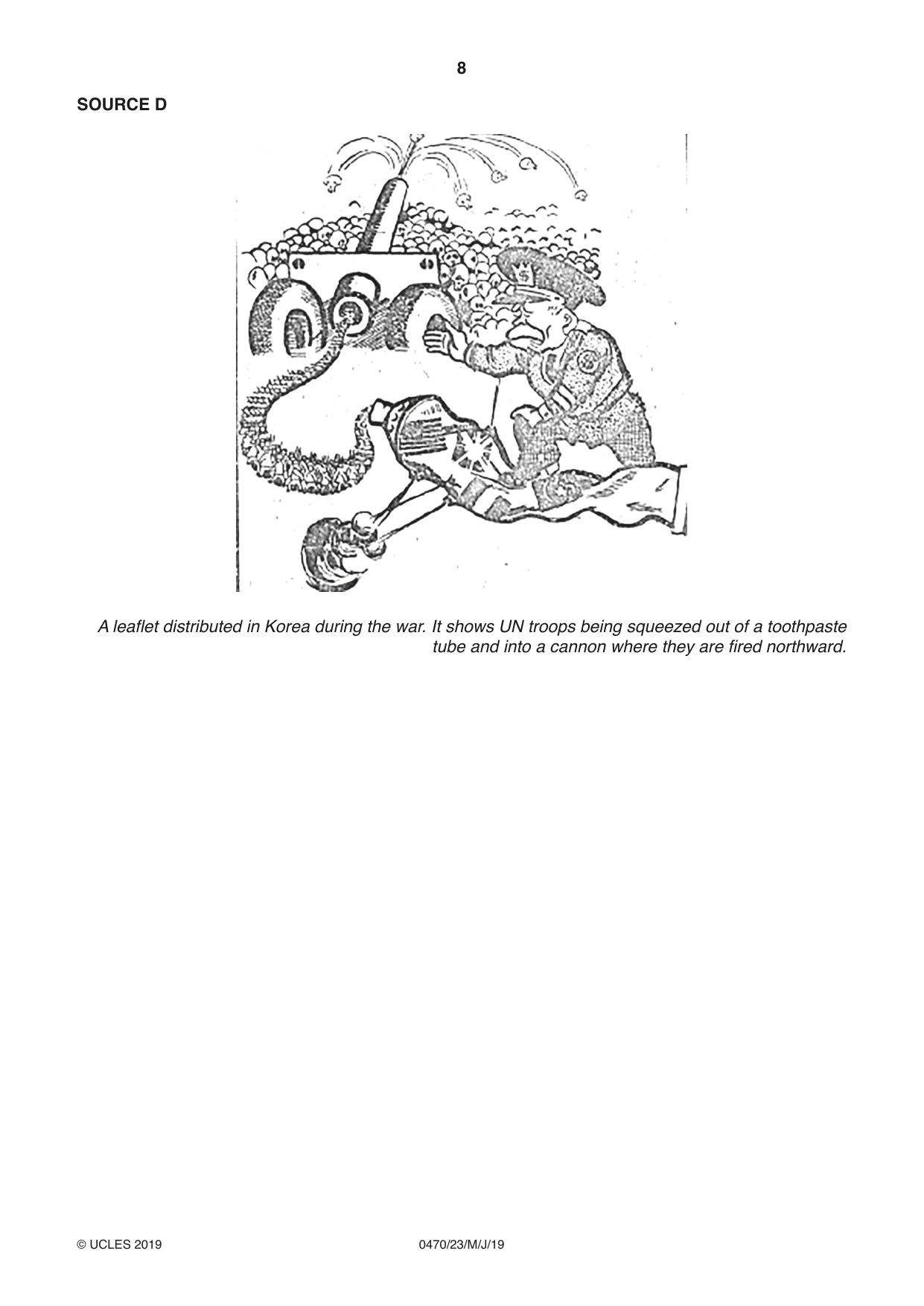
8 0470/23/M/J/19 © UCLES 2019 SOURCE D A leaflet distributed in Korea during the war. It shows UN troops being squeezed out of a toothpaste tube and into a cannon where they are fired northward.
Question paper, page 9
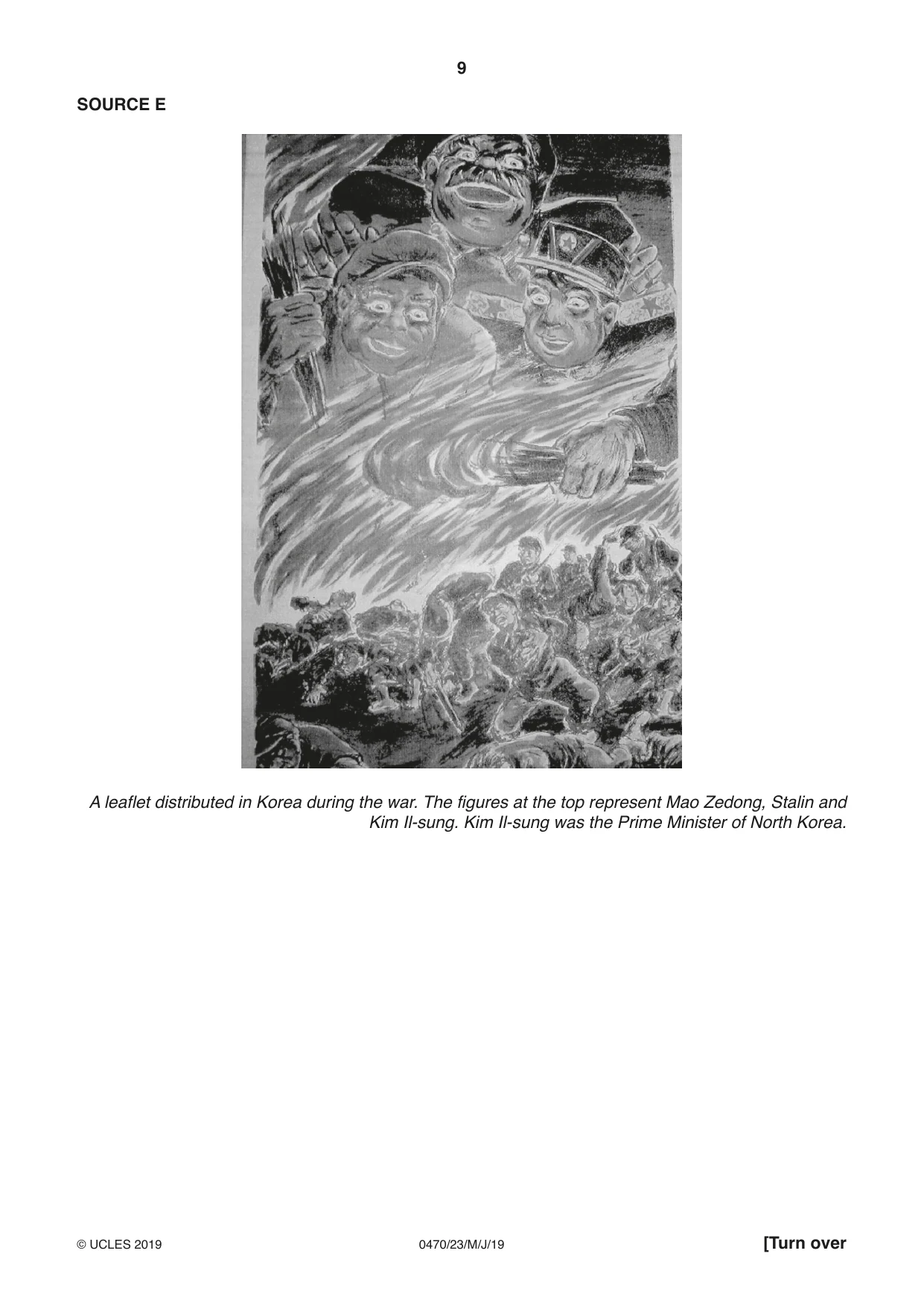
9 0470/23/M/J/19 © UCLES 2019 [Turn over SOURCE E A leaflet distributed in Korea during the war. The figures at the top represent Mao Zedong, Stalin and Kim Il-sung. Kim Il-sung was the Prime Minister of North Korea.
Question paper, page 10
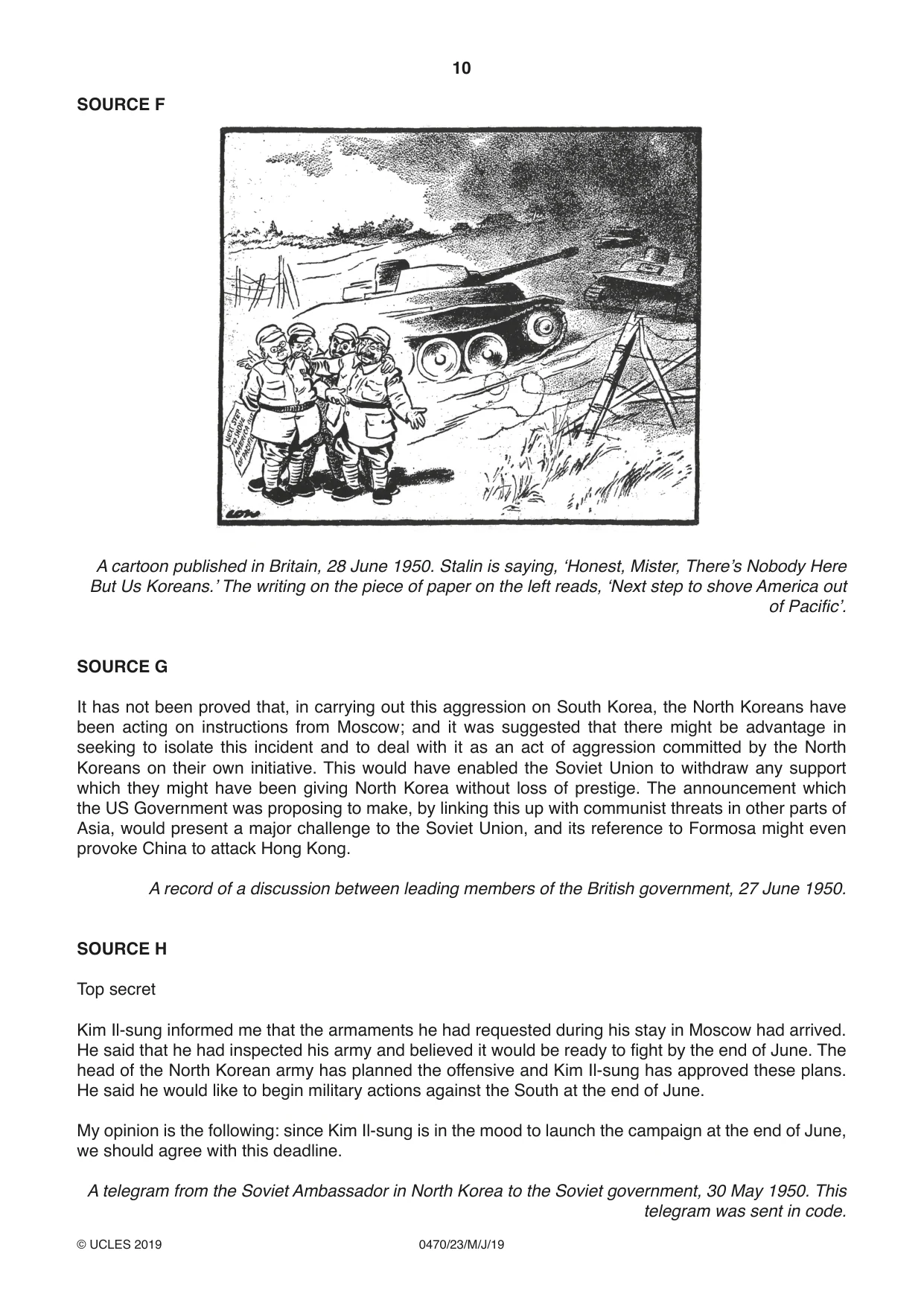
10 0470/23/M/J/19 © UCLES 2019 SOURCE F A cartoon published in Britain, 28 June 1950. Stalin is saying, ‘Honest, Mister, There’s Nobody Here But Us Koreans.’ The writing on the piece of paper on the left reads, ‘Next step to shove America out of Pacific’. SOURCE G It has not been proved that, in carrying out this aggression on South Korea, the North Koreans have been acting on instructions from Moscow; and it was suggested that there might be advantage in seeking to isolate this incident and to deal with it as an act of aggression committed by the North Koreans on their own initiative. This would have enabled the Soviet Union to withdraw any support which they might have been giving North Korea without loss of prestige. The announcement which the US Government was proposing to make, by linking this up with communist threats in other parts of Asia, would present a major challenge to the Soviet Union, and its reference to Formosa might even provoke China to attack Hong Kong. A record of a discussion between leading members of the British government, 27 June 1950. SOURCE H Top secret Kim Il-sung informed me that the armaments he had requested during his stay in Moscow had arrived. He said that he had inspected his army and believed it would be ready to fight by the end of June. The head of the North Korean army has planned the offensive and Kim Il-sung has approved these plans. He said he would like to begin military actions against the South at the end of June. My opinion is the following: since Kim Il-sung is in the mood to launch the campaign at the end of June, we should agree with this deadline. A telegram from the Soviet Ambassador in North Korea to the Soviet government, 30 May 1950. This telegram was sent in code.
Question paper, page 11
11 0470/23/M/J/19 © UCLES 2019 Now answer all the following questions. You may use any of the sources to help you answer the questions, in addition to those sources which you are told to use. In answering the questions you should use your knowledge of the topic to help you interpret and evaluate the sources. 1 Study Source A. Why did the United Nations publish this report in 1950? Explain your answer using details of the source and your knowledge. [7] 2 Study Sources B and C. Does Source C make Source B surprising? Explain your answer using details of the sources and your knowledge. [8] 3 Study Sources D and E. How similar are these two sources? Explain your answer using details of the sources and your knowledge. [8] 4 Study Sources F and G. How far does Source G support the cartoonist in Source F? Explain your answer using details of the sources and your knowledge. [8] 5 Study Source H. How useful is this source to a historian studying the Korean War? Explain your answer using details of the source and your knowledge. [7] 6 Study all the sources. How far do these sources provide convincing evidence that the Soviet Union was to blame for the Korean War? Use the sources to explain your answer. [12]
Question paper, page 12
12 0470/23/M/J/19 © UCLES 2019 BLANK PAGE Permission to reproduce items where third-party owned material protected by copyright is included has been sought and cleared where possible. Every reasonable effort has been made by the publisher (UCLES) to trace copyright holders, but if any items requiring clearance have unwittingly been included, the publisher will be pleased to make amends at the earliest possible opportunity. To avoid the issue of disclosure of answer-related information to candidates, all copyright acknowledgements are reproduced online in the Cambridge Assessment International Education Copyright Acknowledgements Booklet. This is produced for each series of examinations and is freely available to download at www.cambridgeinternational.org after the live examination series. Cambridge Assessment International Education is part of the Cambridge Assessment Group. Cambridge Assessment is the brand name of the University of Cambridge Local Examinations Syndicate (UCLES), which itself is a department of the University of Cambridge.
Mark scheme, page 1
This syllabus is regulated for use in England, Wales and Northern Ireland as a Cambridge International Level 1/Level 2 Certificate. This document consists of 15 printed pages. © UCLES 2019 [Turn over Cambridge Assessment International Education Cambridge International General Certificate of Secondary Education HISTORY 0470/23 Paper 2 May/June 2019 MARK SCHEME Maximum Mark: 50 Published This mark scheme is published as an aid to teachers and candidates, to indicate the requirements of the examination. It shows the basis on which Examiners were instructed to award marks. It does not indicate the details of the discussions that took place at an Examiners’ meeting before marking began, which would have considered the acceptability of alternative answers. Mark schemes should be read in conjunction with the question paper and the Principal Examiner Report for Teachers. Cambridge International will not enter into discussions about these mark schemes. Cambridge International is publishing the mark schemes for the May/June 2019 series for most Cambridge IGCSE™, Cambridge International A and AS Level and Cambridge Pre-U components, and some Cambridge O Level components.
Mark scheme, page 2
0470/23 Cambridge IGCSE – Mark Scheme PUBLISHED May/June 2019 © UCLES 2019 Page 2 of 15 Generic Marking Principles These general marking principles must be applied by all examiners when marking candidate answers. They should be applied alongside the specific content of the mark scheme or generic level descriptors for a question. Each question paper and mark scheme will also comply with these marking principles. GENERIC MARKING PRINCIPLE 1: Marks must be awarded in line with: • the specific content of the mark scheme or the generic level descriptors for the question • the specific skills defined in the mark scheme or in the generic level descriptors for the question • the standard of response required by a candidate as exemplified by the standardisation scripts. GENERIC MARKING PRINCIPLE 2: Marks awarded are always whole marks (not half marks, or other fractions). GENERIC MARKING PRINCIPLE 3: Marks must be awarded positively: • marks are awarded for correct/valid answers, as defined in the mark scheme. However, credit is given for valid answers which go beyond the scope of the syllabus and mark scheme, referring to your Team Leader as appropriate • marks are awarded when candidates clearly demonstrate what they know and can do • marks are not deducted for errors • marks are not deducted for omissions • answers should only be judged on the quality of spelling, punctuation and grammar when these features are specifically assessed by the question as indicated by the mark scheme. The meaning, however, should be unambiguous. GENERIC MARKING PRINCIPLE 4: Rules must be applied consistently e.g. in situations where candidates have not followed instructions or in the application of generic level descriptors.
Mark scheme, page 3
0470/23 Cambridge IGCSE – Mark Scheme PUBLISHED May/June 2019 © UCLES 2019 Page 3 of 15 GENERIC MARKING PRINCIPLE 5: Marks should be awarded using the full range of marks defined in the mark scheme for the question (however; the use of the full mark range may be limited according to the quality of the candidate responses seen). GENERIC MARKING PRINCIPLE 6: Marks awarded are based solely on the requirements as defined in the mark scheme. Marks should not be awarded with grade thresholds or grade descriptors in mind.
Mark scheme, page 4
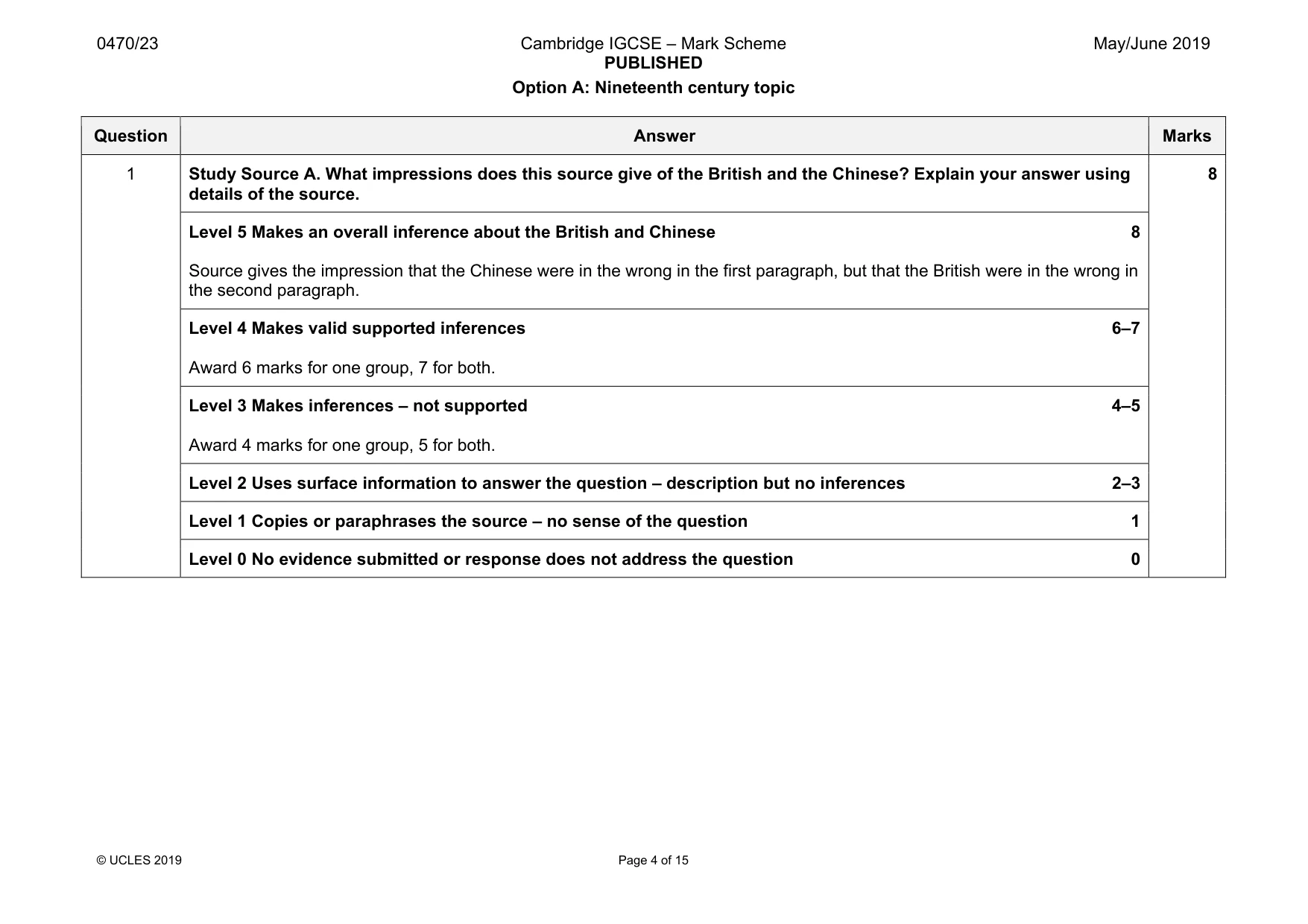
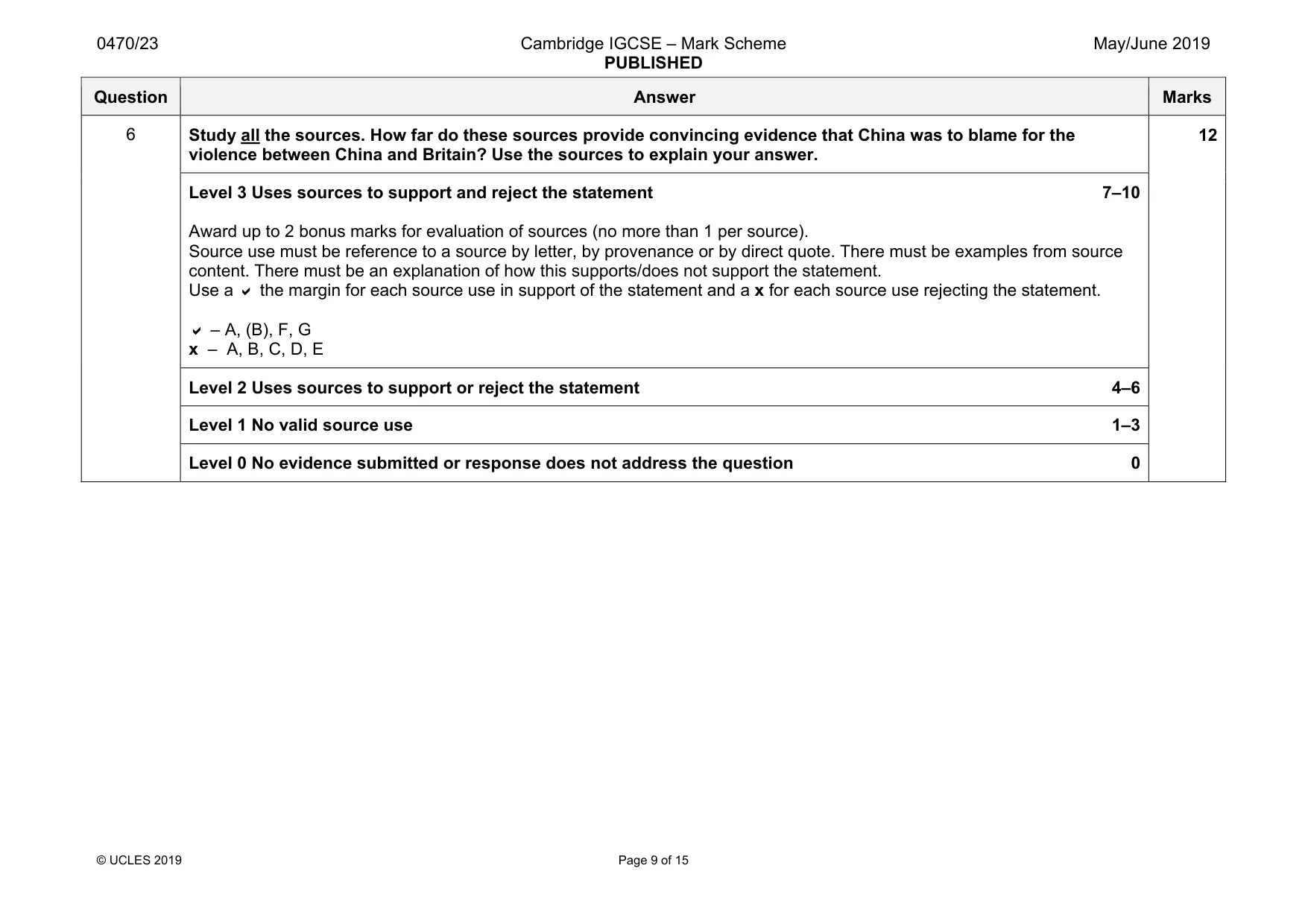
0470/23 Cambridge IGCSE – Mark Scheme PUBLISHED May/June 2019 © UCLES 2019 Page 4 of 15 Option A: Nineteenth century topic Question Answer Marks 1 Study Source A. What impressions does this source give of the British and the Chinese? Explain your answer using details of the source. 8 Level 5 Makes an overall inference about the British and Chinese 8 Source gives the impression that the Chinese were in the wrong in the first paragraph, but that the British were in the wrong in the second paragraph. Level 4 Makes valid supported inferences 6–7 Award 6 marks for one group, 7 for both. Level 3 Makes inferences – not supported 4–5 Award 4 marks for one group, 5 for both. Level 2 Uses surface information to answer the question – description but no inferences 2–3 Level 1 Copies or paraphrases the source – no sense of the question 1 Level 0 No evidence submitted or response does not address the question 0
Mark scheme, page 5
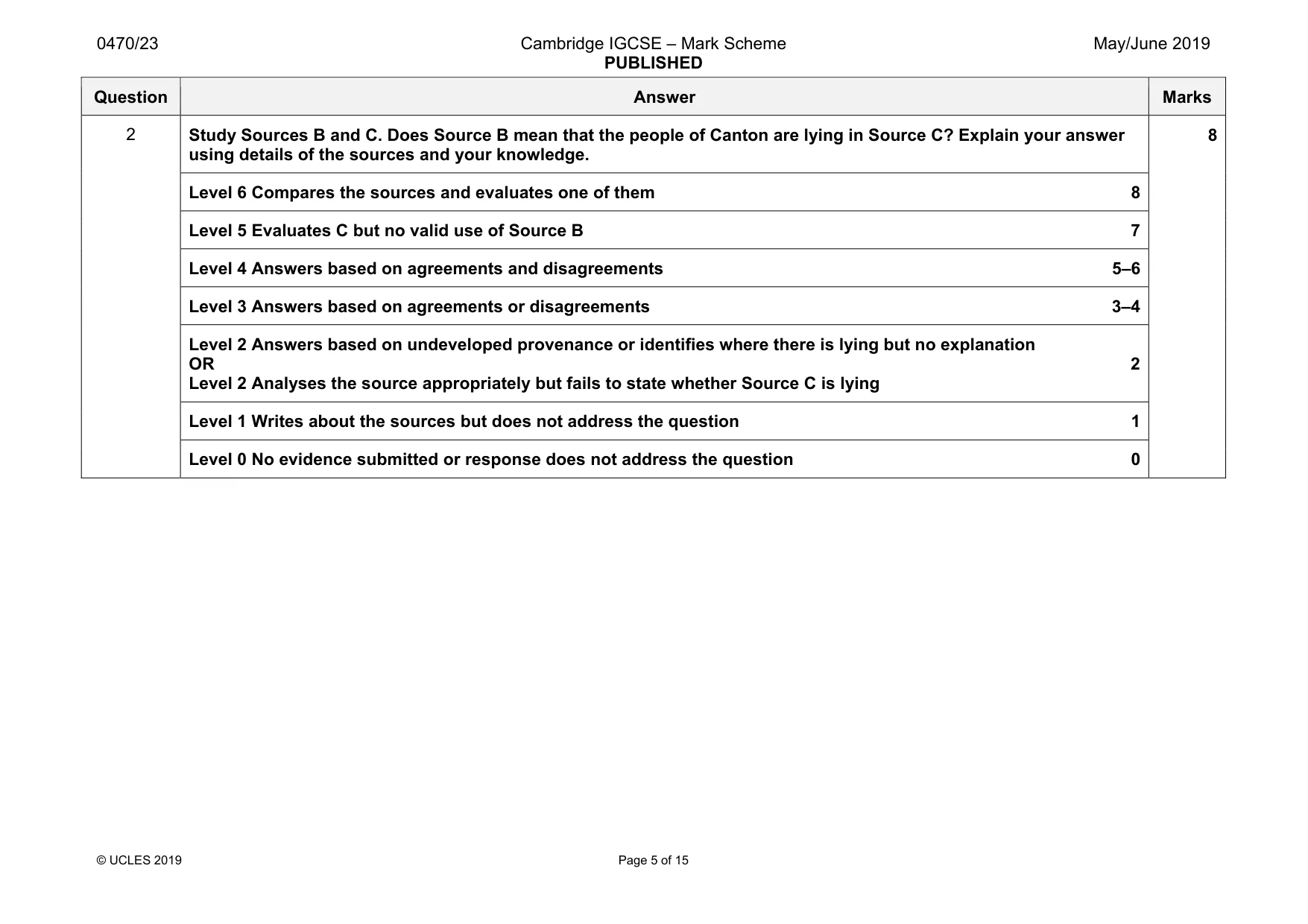
0470/23 Cambridge IGCSE – Mark Scheme PUBLISHED May/June 2019 © UCLES 2019 Page 5 of 15 Question Answer Marks 2 Study Sources B and C. Does Source B mean that the people of Canton are lying in Source C? Explain your answer using details of the sources and your knowledge. 8 Level 6 Compares the sources and evaluates one of them 8 Level 5 Evaluates C but no valid use of Source B 7 Level 4 Answers based on agreements and disagreements 5–6 Level 3 Answers based on agreements or disagreements 3–4 Level 2 Answers based on undeveloped provenance or identifies where there is lying but no explanation OR 2 Level 2 Analyses the source appropriately but fails to state whether Source C is lying Level 1 Writes about the sources but does not address the question 1 Level 0 No evidence submitted or response does not address the question 0
Mark scheme, page 6
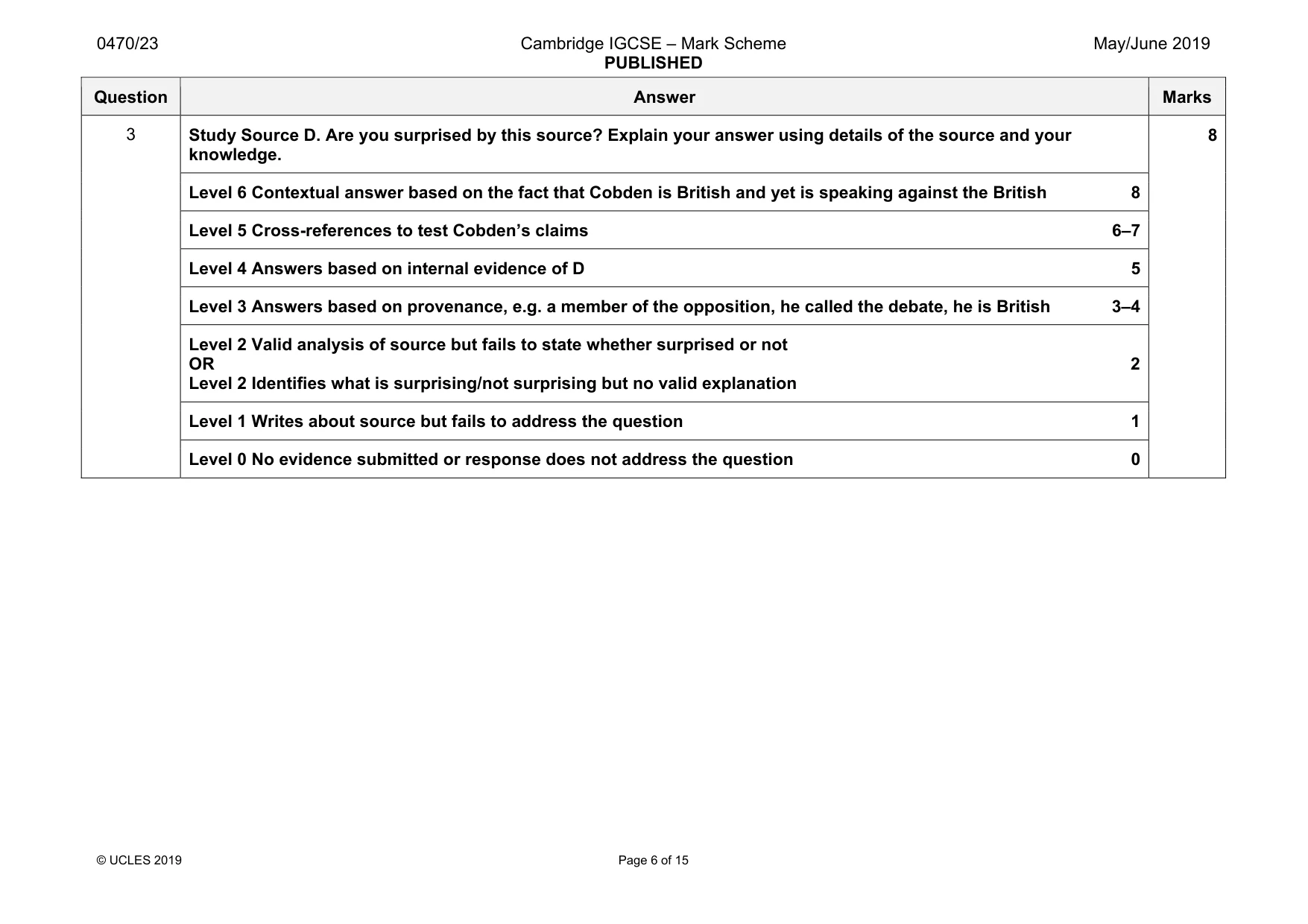
0470/23 Cambridge IGCSE – Mark Scheme PUBLISHED May/June 2019 © UCLES 2019 Page 6 of 15 Question Answer Marks 3 Study Source D. Are you surprised by this source? Explain your answer using details of the source and your knowledge. 8 Level 6 Contextual answer based on the fact that Cobden is British and yet is speaking against the British 8 Level 5 Cross-references to test Cobden’s claims 6–7 Level 4 Answers based on internal evidence of D 5 Level 3 Answers based on provenance, e.g. a member of the opposition, he called the debate, he is British 3–4 Level 2 Valid analysis of source but fails to state whether surprised or not OR 2 Level 2 Identifies what is surprising/not surprising but no valid explanation Level 1 Writes about source but fails to address the question 1 Level 0 No evidence submitted or response does not address the question 0
Mark scheme, page 7
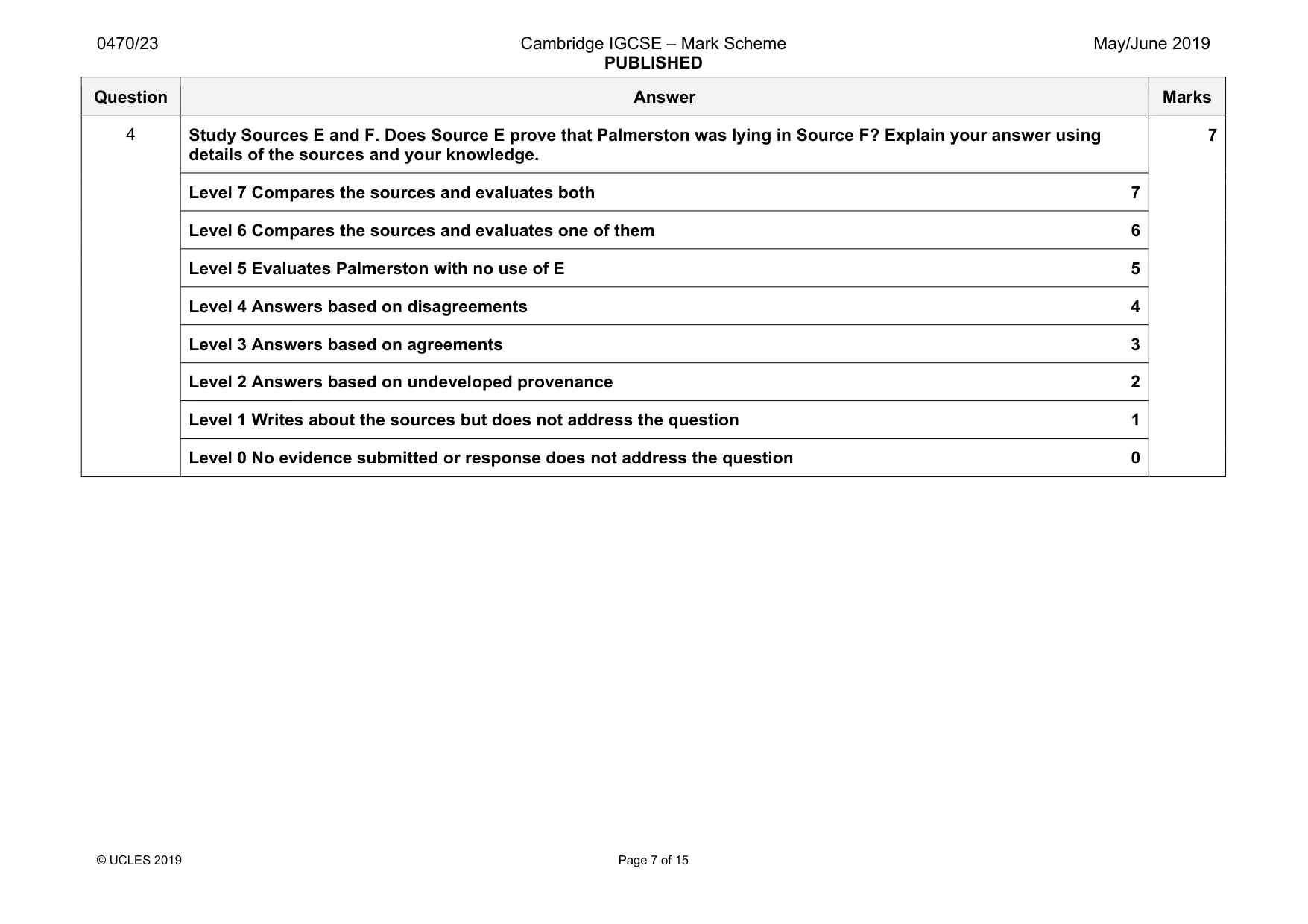
0470/23 Cambridge IGCSE – Mark Scheme PUBLISHED May/June 2019 © UCLES 2019 Page 7 of 15 Question Answer Marks 4 Study Sources E and F. Does Source E prove that Palmerston was lying in Source F? Explain your answer using details of the sources and your knowledge. 7 Level 7 Compares the sources and evaluates both 7 Level 6 Compares the sources and evaluates one of them 6 Level 5 Evaluates Palmerston with no use of E 5 Level 4 Answers based on disagreements 4 Level 3 Answers based on agreements 3 Level 2 Answers based on undeveloped provenance 2 Level 1 Writes about the sources but does not address the question 1 Level 0 No evidence submitted or response does not address the question 0
Mark scheme, page 8
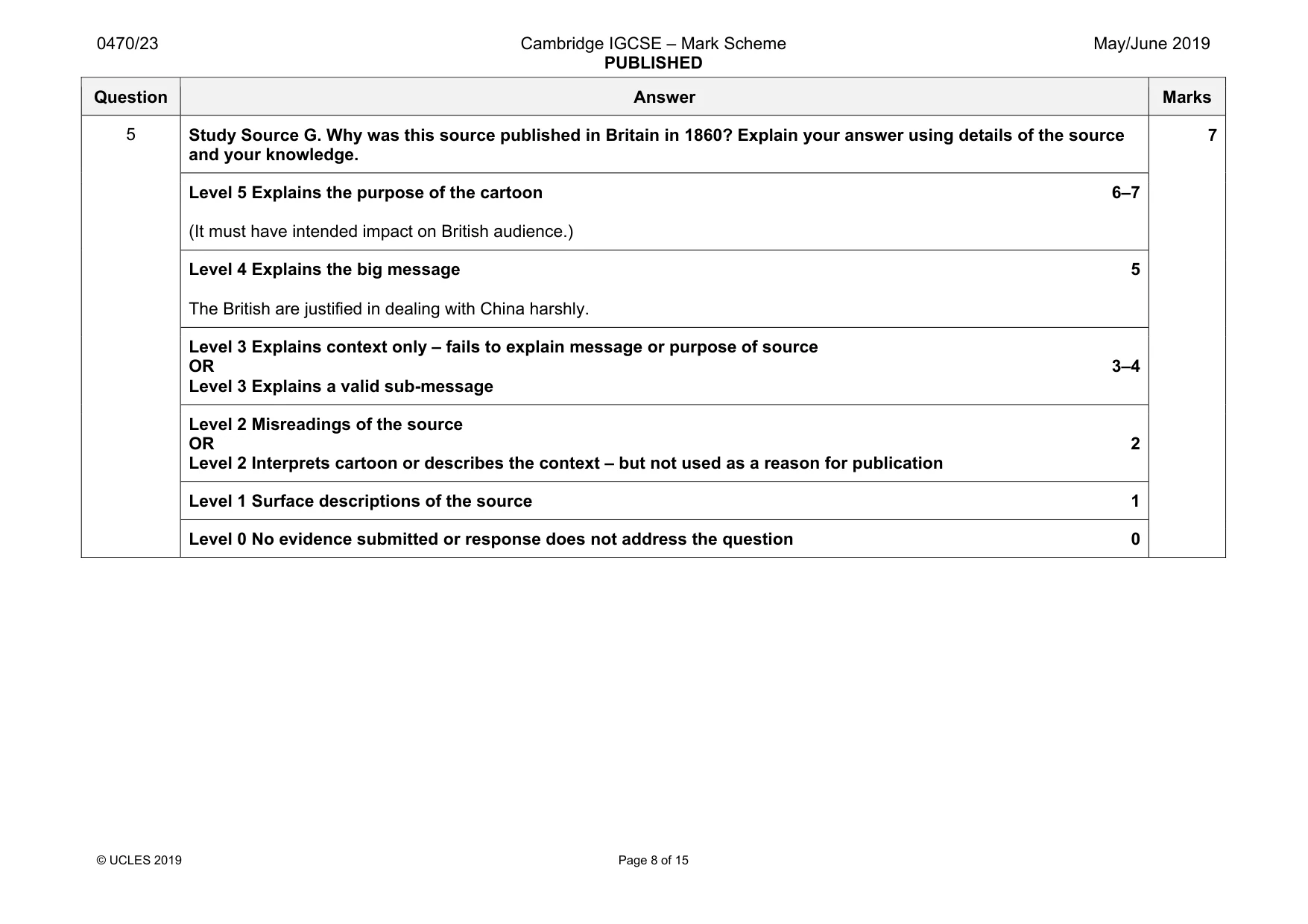
0470/23 Cambridge IGCSE – Mark Scheme PUBLISHED May/June 2019 © UCLES 2019 Page 8 of 15 Question Answer Marks 5 Study Source G. Why was this source published in Britain in 1860? Explain your answer using details of the source and your knowledge. 7 Level 5 Explains the purpose of the cartoon 6–7 (It must have intended impact on British audience.) Level 4 Explains the big message 5 The British are justified in dealing with China harshly. Level 3 Explains context only – fails to explain message or purpose of source OR 3–4 Level 3 Explains a valid sub-message Level 2 Misreadings of the source OR 2 Level 2 Interprets cartoon or describes the context – but not used as a reason for publication Level 1 Surface descriptions of the source 1 Level 0 No evidence submitted or response does not address the question 0
Mark scheme, page 9
0470/23 Cambridge IGCSE – Mark Scheme PUBLISHED May/June 2019 © UCLES 2019 Page 9 of 15 Question Answer Marks 6 Study all the sources. How far do these sources provide convincing evidence that China was to blame for the violence between China and Britain? Use the sources to explain your answer. 12 Level 3 Uses sources to support and reject the statement 7–10 Award up to 2 bonus marks for evaluation of sources (no more than 1 per source). Source use must be reference to a source by letter, by provenance or by direct quote. There must be examples from source content. There must be an explanation of how this supports/does not support the statement. Use a D the margin for each source use in support of the statement and a x for each source use rejecting the statement. D – A, (B), F, G x – A, B, C, D, E Level 2 Uses sources to support or reject the statement 4–6 Level 1 No valid source use 1–3 Level 0 No evidence submitted or response does not address the question 0
Mark scheme, page 10
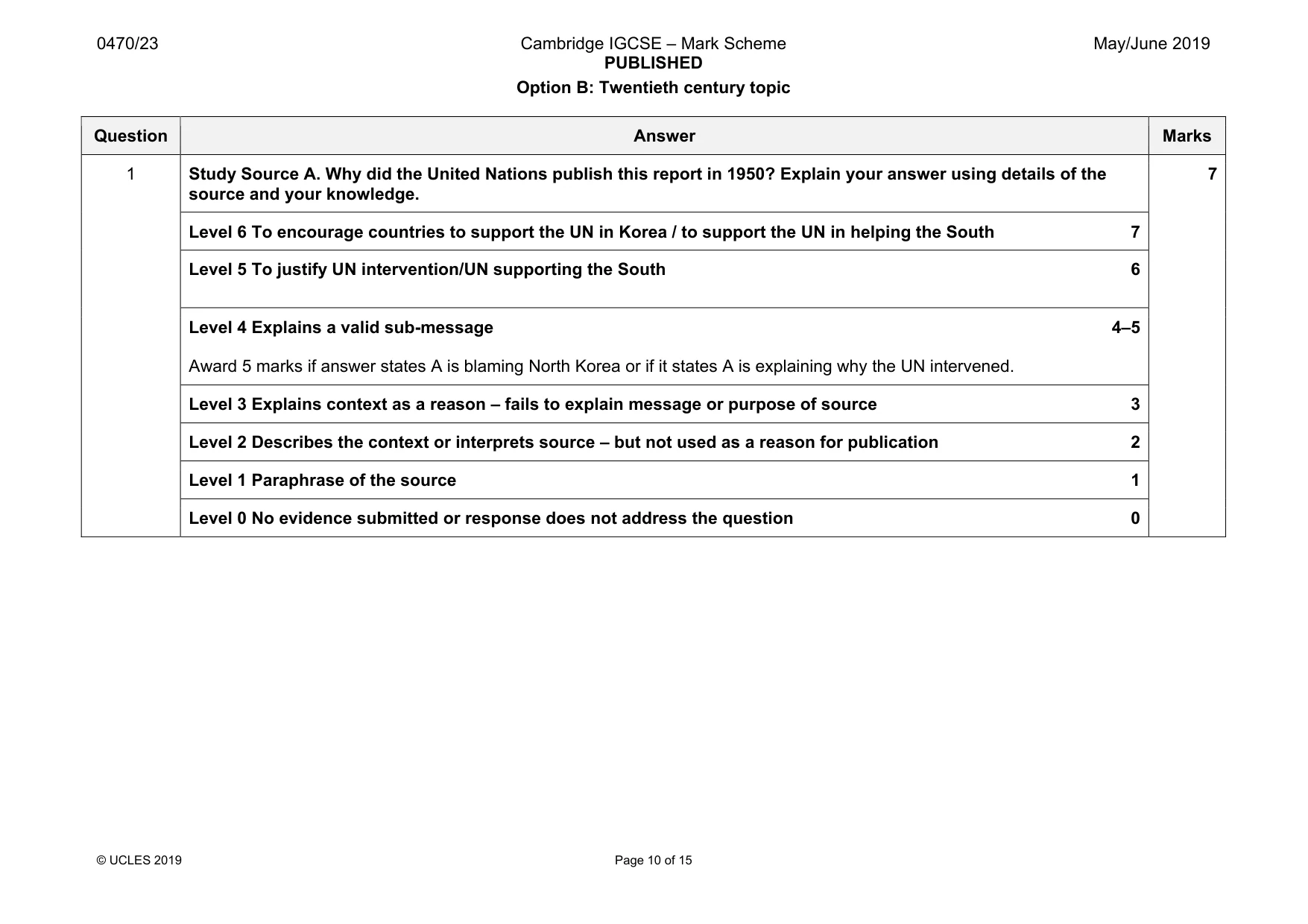
0470/23 Cambridge IGCSE – Mark Scheme PUBLISHED May/June 2019 © UCLES 2019 Page 10 of 15 Option B: Twentieth century topic Question Answer Marks 1 Study Source A. Why did the United Nations publish this report in 1950? Explain your answer using details of the source and your knowledge. 7 Level 6 To encourage countries to support the UN in Korea / to support the UN in helping the South 7 Level 5 To justify UN intervention/UN supporting the South 6 Level 4 Explains a valid sub-message 4–5 Award 5 marks if answer states A is blaming North Korea or if it states A is explaining why the UN intervened. Level 3 Explains context as a reason – fails to explain message or purpose of source 3 Level 2 Describes the context or interprets source – but not used as a reason for publication 2 Level 1 Paraphrase of the source 1 Level 0 No evidence submitted or response does not address the question 0
Mark scheme, page 11
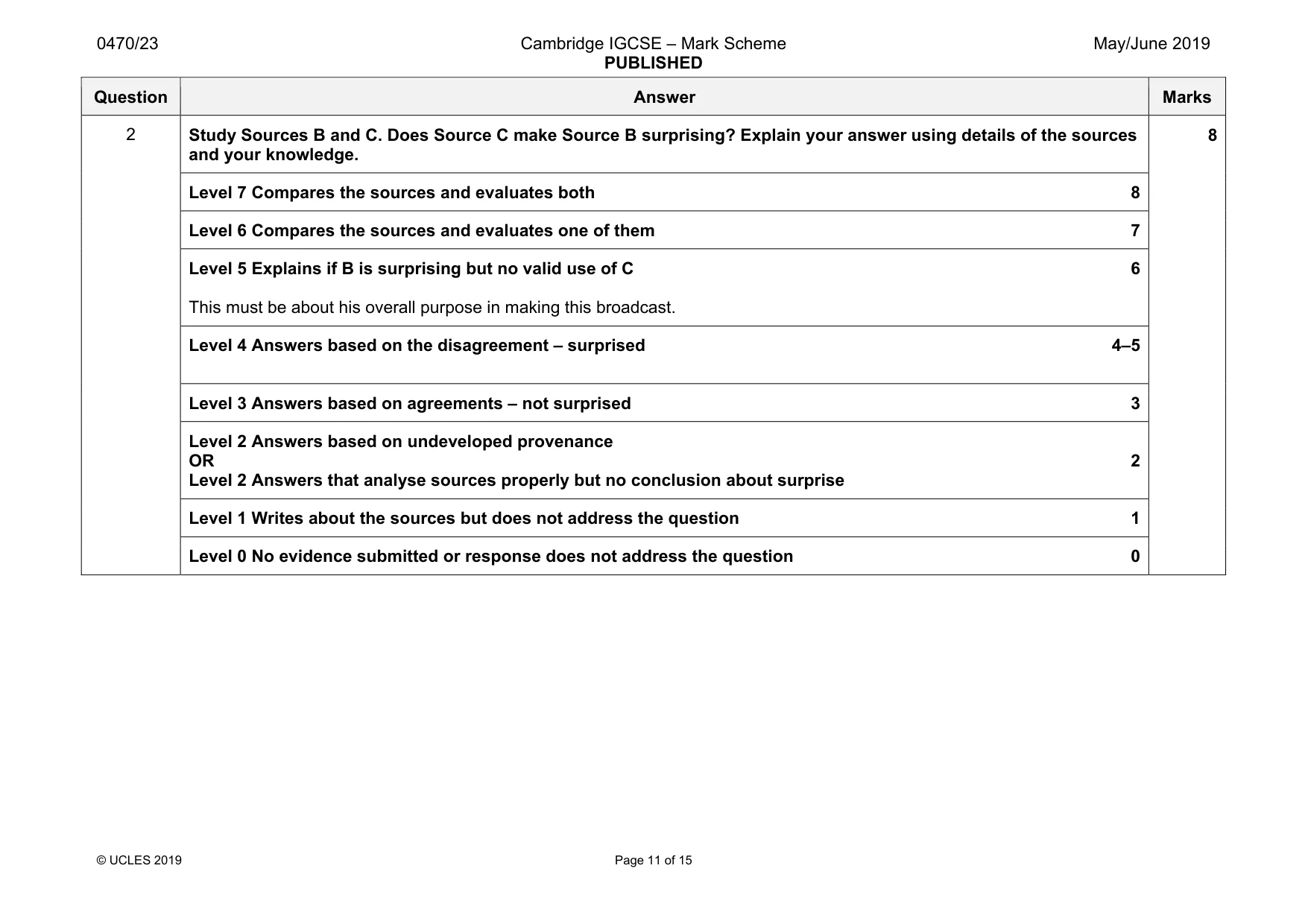
0470/23 Cambridge IGCSE – Mark Scheme PUBLISHED May/June 2019 © UCLES 2019 Page 11 of 15 Question Answer Marks 2 Study Sources B and C. Does Source C make Source B surprising? Explain your answer using details of the sources and your knowledge. 8 Level 7 Compares the sources and evaluates both 8 Level 6 Compares the sources and evaluates one of them 7 Level 5 Explains if B is surprising but no valid use of C 6 This must be about his overall purpose in making this broadcast. Level 4 Answers based on the disagreement – surprised 4–5 Level 3 Answers based on agreements – not surprised 3 Level 2 Answers based on undeveloped provenance OR 2 Level 2 Answers that analyse sources properly but no conclusion about surprise Level 1 Writes about the sources but does not address the question 1 Level 0 No evidence submitted or response does not address the question 0
Mark scheme, page 12
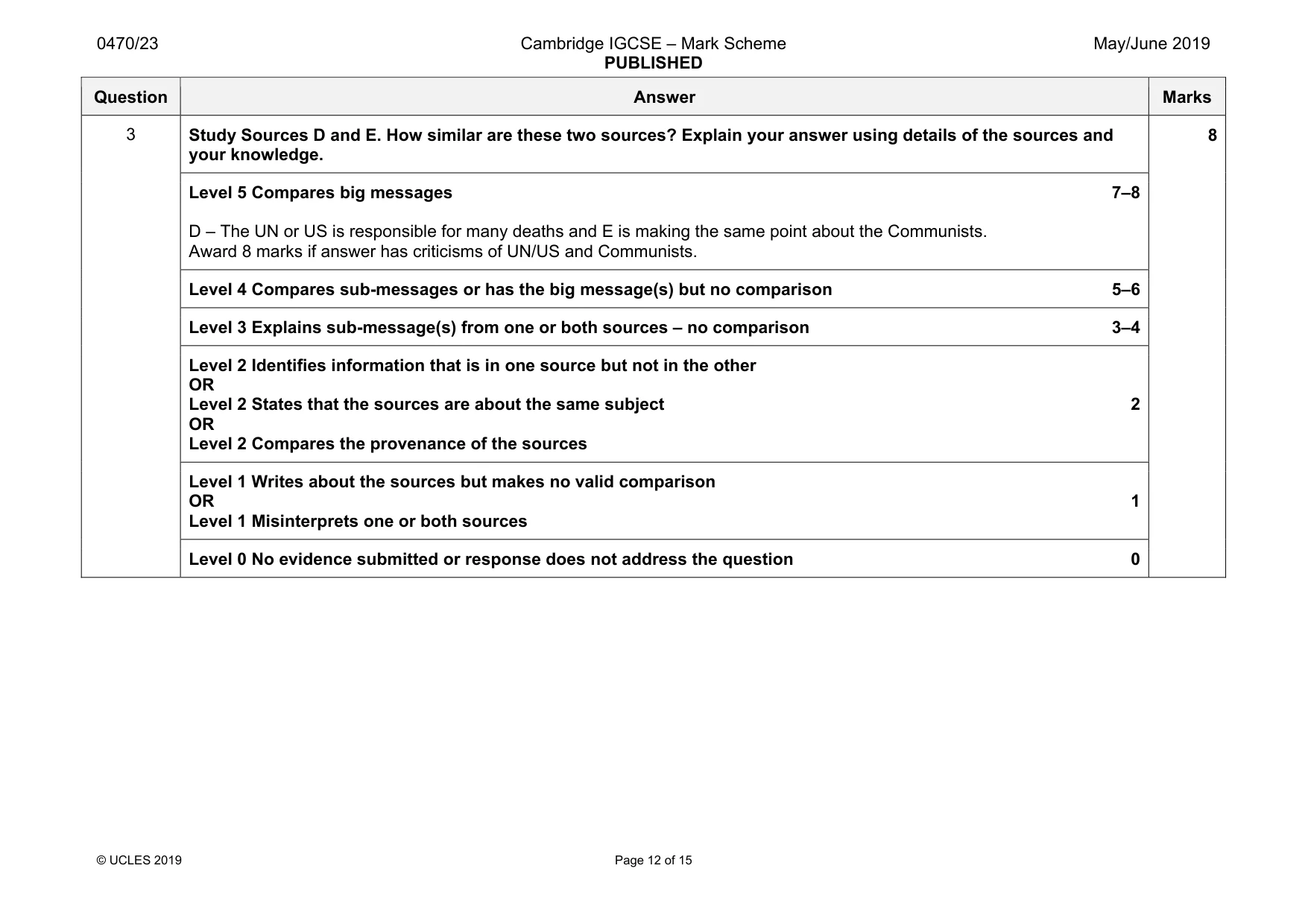
0470/23 Cambridge IGCSE – Mark Scheme PUBLISHED May/June 2019 © UCLES 2019 Page 12 of 15 Question Answer Marks 3 Study Sources D and E. How similar are these two sources? Explain your answer using details of the sources and your knowledge. 8 Level 5 Compares big messages 7–8 D – The UN or US is responsible for many deaths and E is making the same point about the Communists. Award 8 marks if answer has criticisms of UN/US and Communists. Level 4 Compares sub-messages or has the big message(s) but no comparison 5–6 Level 3 Explains sub-message(s) from one or both sources – no comparison 3–4 Level 2 Identifies information that is in one source but not in the other OR Level 2 States that the sources are about the same subject 2 OR Level 2 Compares the provenance of the sources Level 1 Writes about the sources but makes no valid comparison OR 1 Level 1 Misinterprets one or both sources Level 0 No evidence submitted or response does not address the question 0
Mark scheme, page 13
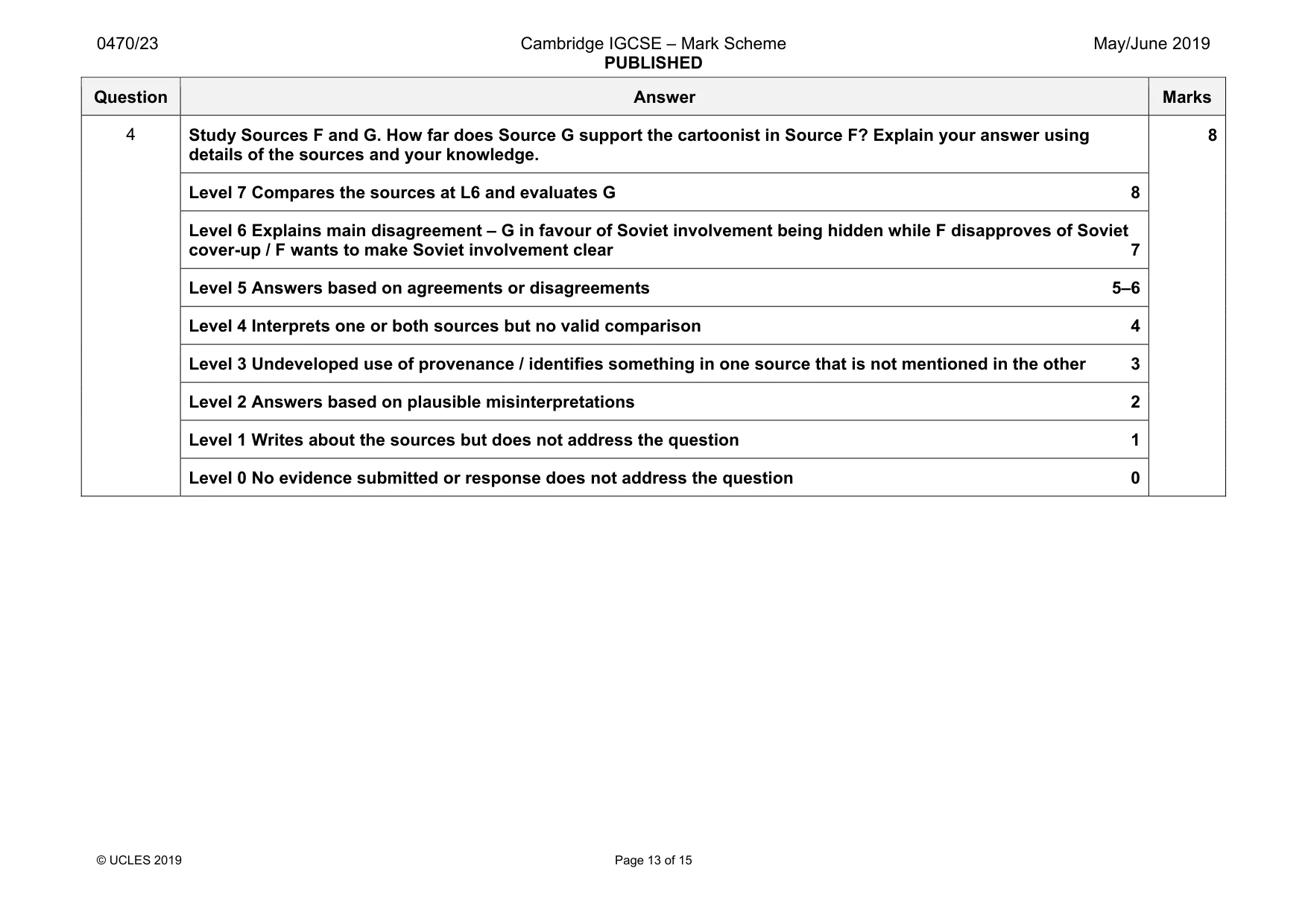
0470/23 Cambridge IGCSE – Mark Scheme PUBLISHED May/June 2019 © UCLES 2019 Page 13 of 15 Question Answer Marks 4 Study Sources F and G. How far does Source G support the cartoonist in Source F? Explain your answer using details of the sources and your knowledge. 8 Level 7 Compares the sources at L6 and evaluates G 8 Level 6 Explains main disagreement – G in favour of Soviet involvement being hidden while F disapproves of Soviet cover-up / F wants to make Soviet involvement clear 7 Level 5 Answers based on agreements or disagreements 5–6 Level 4 Interprets one or both sources but no valid comparison 4 Level 3 Undeveloped use of provenance / identifies something in one source that is not mentioned in the other 3 Level 2 Answers based on plausible misinterpretations 2 Level 1 Writes about the sources but does not address the question 1 Level 0 No evidence submitted or response does not address the question 0
Mark scheme, page 14
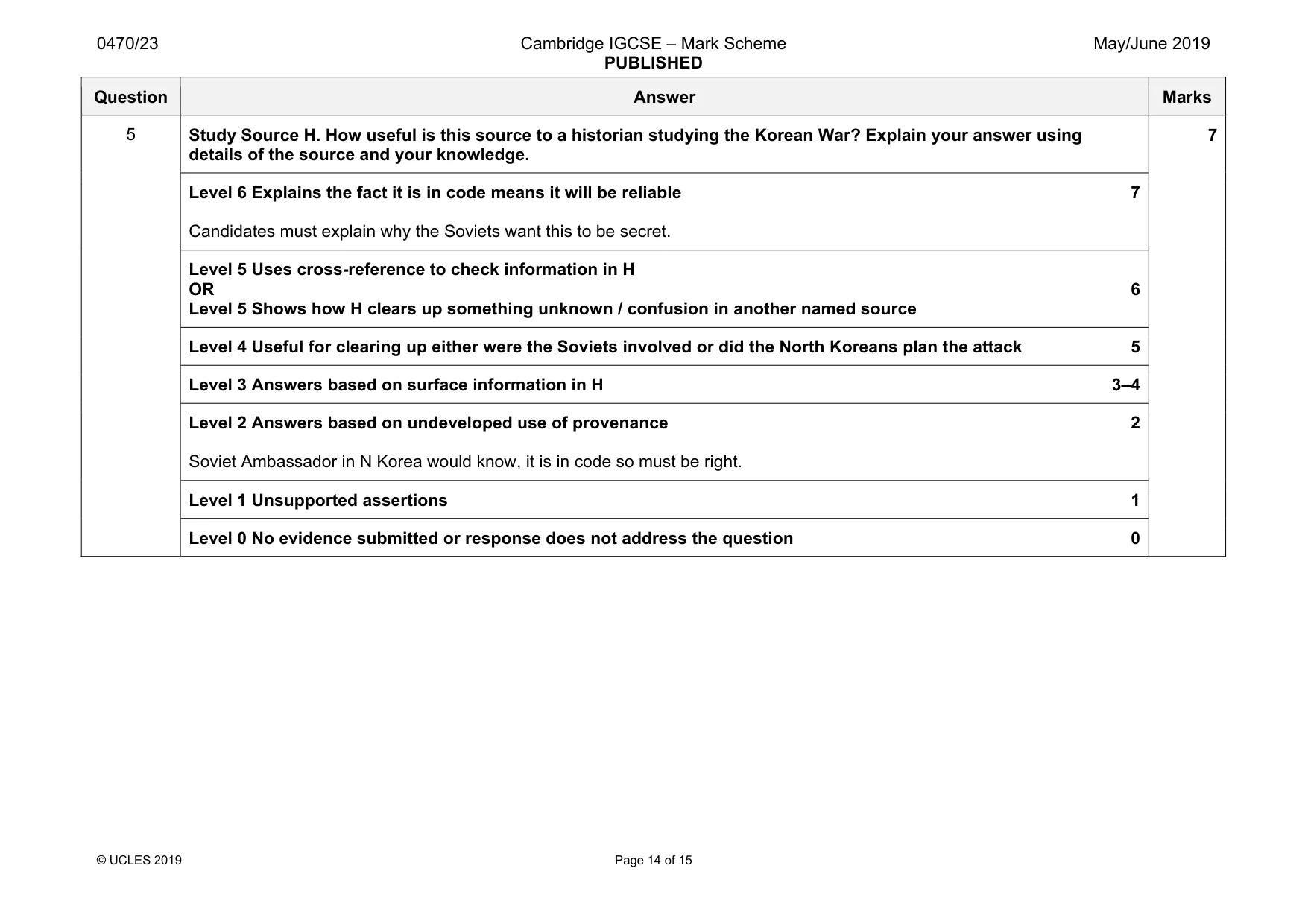
0470/23 Cambridge IGCSE – Mark Scheme PUBLISHED May/June 2019 © UCLES 2019 Page 14 of 15 Question Answer Marks 5 Study Source H. How useful is this source to a historian studying the Korean War? Explain your answer using details of the source and your knowledge. 7 Level 6 Explains the fact it is in code means it will be reliable 7 Candidates must explain why the Soviets want this to be secret. Level 5 Uses cross-reference to check information in H OR 6 Level 5 Shows how H clears up something unknown / confusion in another named source Level 4 Useful for clearing up either were the Soviets involved or did the North Koreans plan the attack 5 Level 3 Answers based on surface information in H 3–4 Level 2 Answers based on undeveloped use of provenance 2 Soviet Ambassador in N Korea would know, it is in code so must be right. Level 1 Unsupported assertions 1 Level 0 No evidence submitted or response does not address the question 0
Mark scheme, page 15
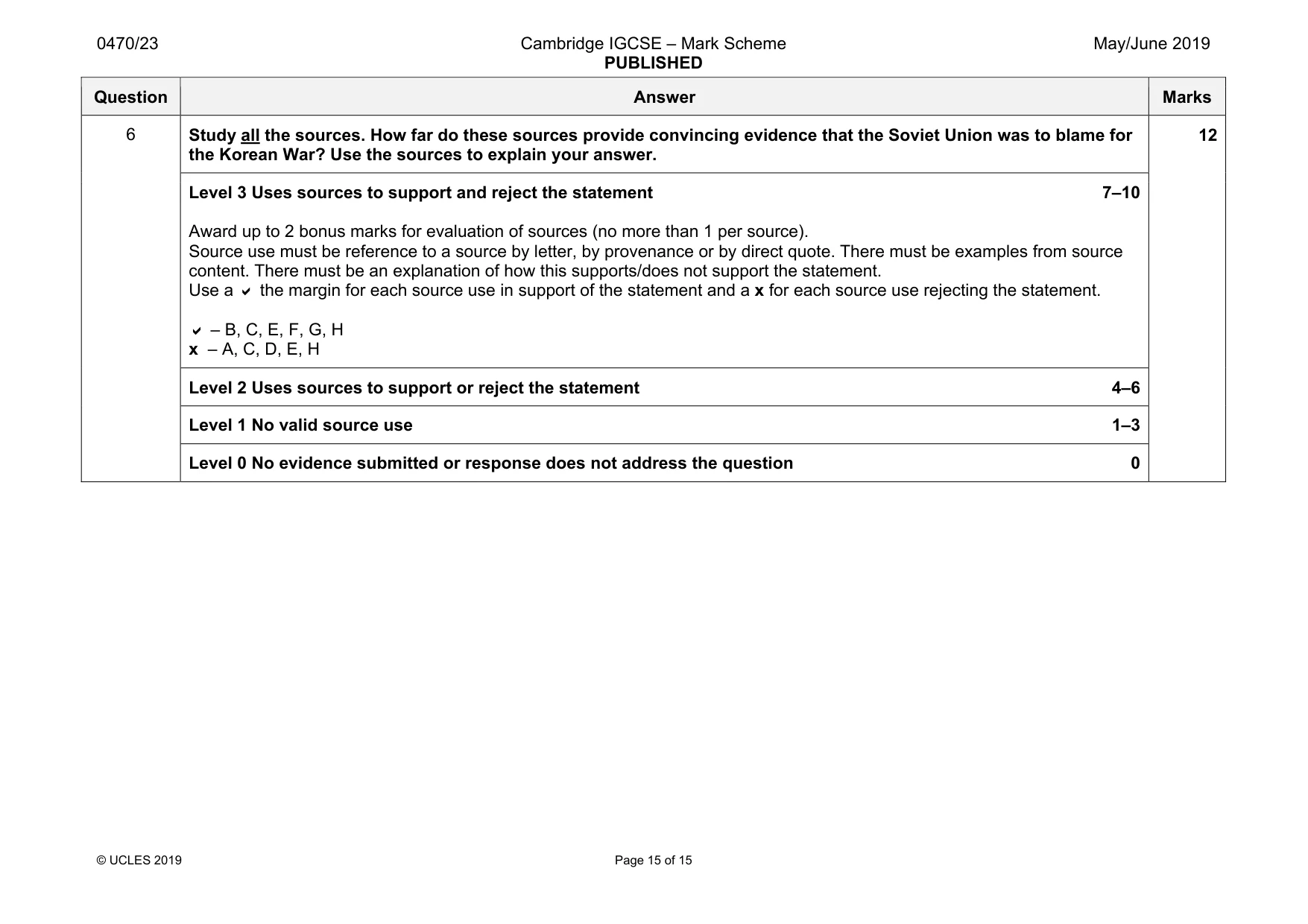
0470/23 Cambridge IGCSE – Mark Scheme PUBLISHED May/June 2019 © UCLES 2019 Page 15 of 15 Question Answer Marks 6 Study all the sources. How far do these sources provide convincing evidence that the Soviet Union was to blame for the Korean War? Use the sources to explain your answer. 12 Level 3 Uses sources to support and reject the statement 7–10 Award up to 2 bonus marks for evaluation of sources (no more than 1 per source). Source use must be reference to a source by letter, by provenance or by direct quote. There must be examples from source content. There must be an explanation of how this supports/does not support the statement. Use a D the margin for each source use in support of the statement and a x for each source use rejecting the statement. D – B, C, E, F, G, H x – A, C, D, E, H Level 2 Uses sources to support or reject the statement 4–6 Level 1 No valid source use 1–3 Level 0 No evidence submitted or response does not address the question 0
What you needed in this session
Cambridge’s own grade thresholds for 2019 May/June, Paper 2 · Variant 3. A higher threshold means an easier paper — the bar moves with how the cohort did.