Cambridge IGCSE History 0470 — 2019 May/June Paper 2 · Variant 1
0470/21/M/J/19 · 50 marks · ≈56 min
The question paper and its mark scheme, free to read here and free to download. This is Cambridge’s own paper, exactly as it was sat.
Question paper12 pages

Mark scheme15 pages
Answers below. Sit the paper first if you are practising.
Paper as text
Question paper, page 1
This document consists of 11 printed pages, 1 blank page and 1 Insert. DC (JP/TP) 167394/2 © UCLES 2019 [Turn over Cambridge Assessment International Education Cambridge International General Certificate of Secondary Education * 0 8 0 2 0 8 9 4 5 9 * HISTORY 0470/21 Paper 2 May/June 2019 2 hours No Additional Materials are required. READ THESE INSTRUCTIONS FIRST An answer booklet is provided inside this question paper. You should follow the instructions on the front cover of the answer booklet. If you need additional answer paper ask the invigilator for a continuation booklet. This paper has two options. Choose one option, and answer all of the questions on that topic. Option A: Nineteenth century topic [p2–p6] Option B: Twentieth century topic [p8–p12] The number of marks is given in brackets [ ] at the end of each question or part question. This syllabus is regulated for use in England, Wales and Northern Ireland as a Cambridge International Level 1/Level 2 Certificate.
Question paper, page 2
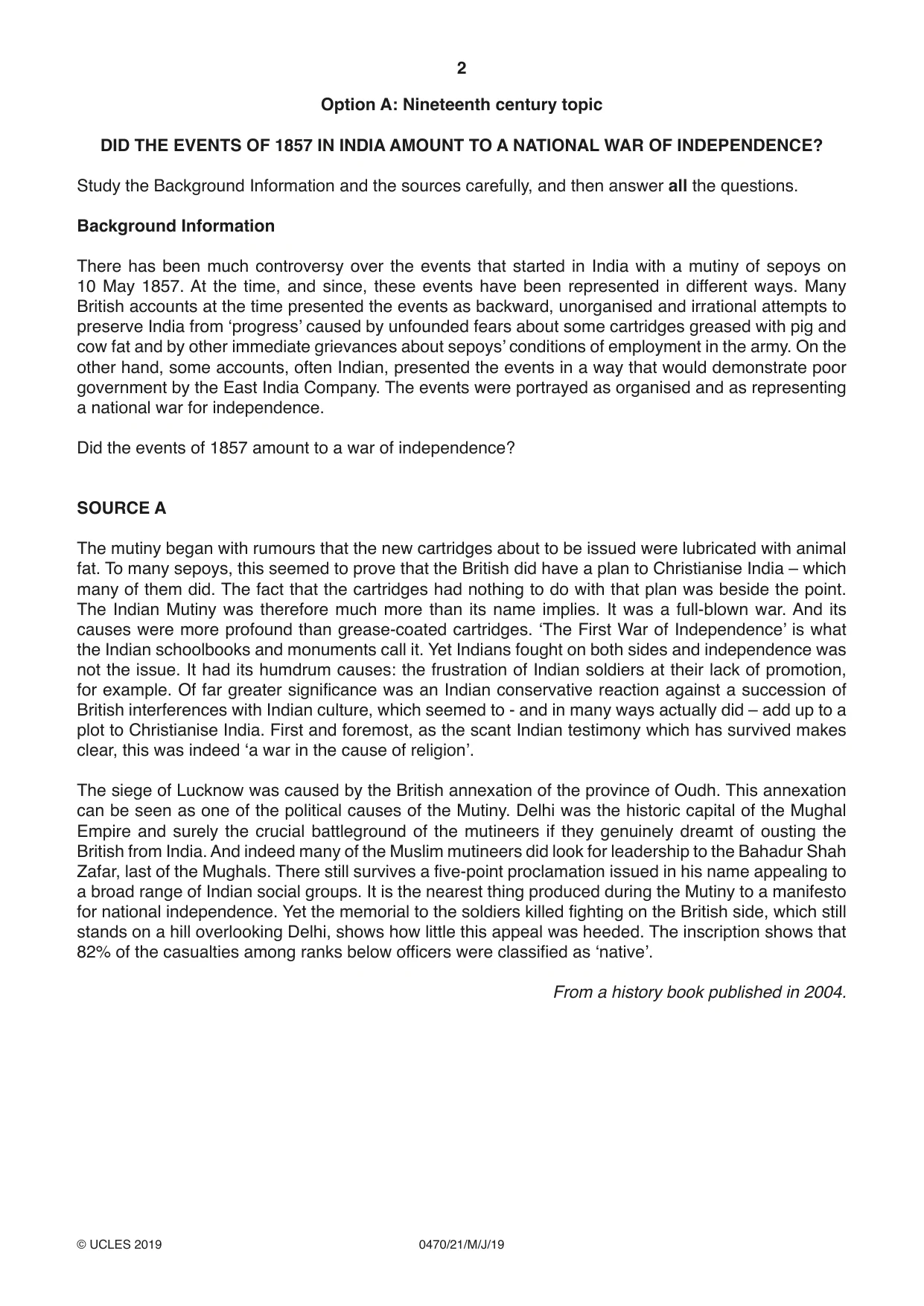
2 0470/21/M/J/19 © UCLES 2019 Option A: Nineteenth century topic DID THE EVENTS OF 1857 IN INDIA AMOUNT TO A NATIONAL WAR OF INDEPENDENCE? Study the Background Information and the sources carefully, and then answer all the questions. Background Information There has been much controversy over the events that started in India with a mutiny of sepoys on 10 May 1857. At the time, and since, these events have been represented in different ways. Many British accounts at the time presented the events as backward, unorganised and irrational attempts to preserve India from ‘progress’ caused by unfounded fears about some cartridges greased with pig and cow fat and by other immediate grievances about sepoys’ conditions of employment in the army. On the other hand, some accounts, often Indian, presented the events in a way that would demonstrate poor government by the East India Company. The events were portrayed as organised and as representing a national war for independence. Did the events of 1857 amount to a war of independence? SOURCE A The mutiny began with rumours that the new cartridges about to be issued were lubricated with animal fat. To many sepoys, this seemed to prove that the British did have a plan to Christianise India – which many of them did. The fact that the cartridges had nothing to do with that plan was beside the point. The Indian Mutiny was therefore much more than its name implies. It was a full-blown war. And its causes were more profound than grease-coated cartridges. ‘The First War of Independence’ is what the Indian schoolbooks and monuments call it. Yet Indians fought on both sides and independence was not the issue. It had its humdrum causes: the frustration of Indian soldiers at their lack of promotion, for example. Of far greater significance was an Indian conservative reaction against a succession of British interferences with Indian culture, which seemed to - and in many ways actually did – add up to a plot to Christianise India. First and foremost, as the scant Indian testimony which has survived makes clear, this was indeed ‘a war in the cause of religion’. The siege of Lucknow was caused by the British annexation of the province of Oudh. This annexation can be seen as one of the political causes of the Mutiny. Delhi was the historic capital of the Mughal Empire and surely the crucial battleground of the mutineers if they genuinely dreamt of ousting the British from India. And indeed many of the Muslim mutineers did look for leadership to the Bahadur Shah Zafar, last of the Mughals. There still survives a five-point proclamation issued in his name appealing to a broad range of Indian social groups. It is the nearest thing produced during the Mutiny to a manifesto for national independence. Yet the memorial to the soldiers killed fighting on the British side, which still stands on a hill overlooking Delhi, shows how little this appeal was heeded. The inscription shows that 82% of the casualties among ranks below officers were classified as ‘native’. From a history book published in 2004.
Question paper, page 3
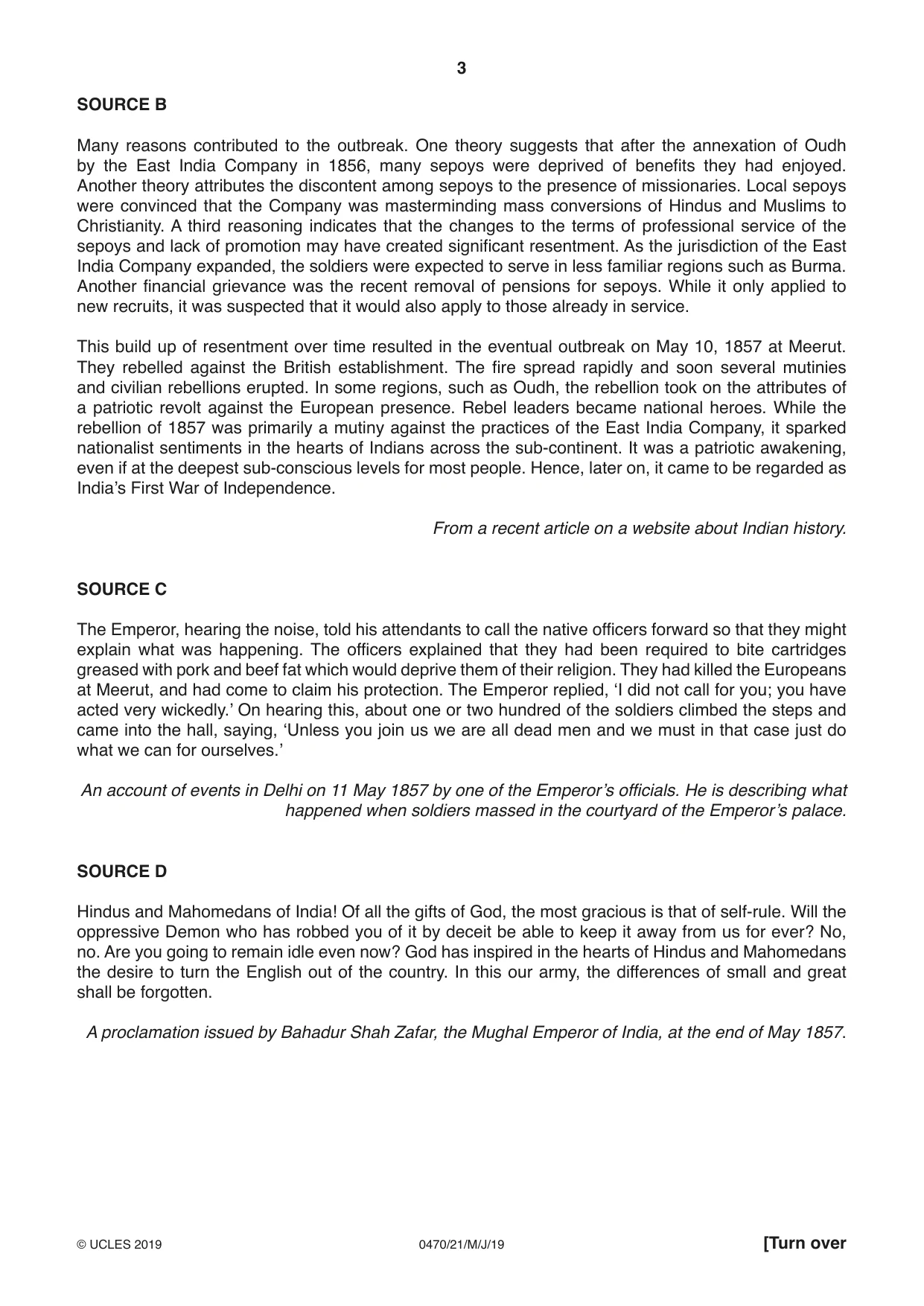
3 0470/21/M/J/19 © UCLES 2019 [Turn over SOURCE B Many reasons contributed to the outbreak. One theory suggests that after the annexation of Oudh by the East India Company in 1856, many sepoys were deprived of benefits they had enjoyed. Another theory attributes the discontent among sepoys to the presence of missionaries. Local sepoys were convinced that the Company was masterminding mass conversions of Hindus and Muslims to Christianity. A third reasoning indicates that the changes to the terms of professional service of the sepoys and lack of promotion may have created significant resentment. As the jurisdiction of the East India Company expanded, the soldiers were expected to serve in less familiar regions such as Burma. Another financial grievance was the recent removal of pensions for sepoys. While it only applied to new recruits, it was suspected that it would also apply to those already in service. This build up of resentment over time resulted in the eventual outbreak on May 10, 1857 at Meerut. They rebelled against the British establishment. The fire spread rapidly and soon several mutinies and civilian rebellions erupted. In some regions, such as Oudh, the rebellion took on the attributes of a patriotic revolt against the European presence. Rebel leaders became national heroes. While the rebellion of 1857 was primarily a mutiny against the practices of the East India Company, it sparked nationalist sentiments in the hearts of Indians across the sub-continent. It was a patriotic awakening, even if at the deepest sub-conscious levels for most people. Hence, later on, it came to be regarded as India’s First War of Independence. From a recent article on a website about Indian history. SOURCE C The Emperor, hearing the noise, told his attendants to call the native officers forward so that they might explain what was happening. The officers explained that they had been required to bite cartridges greased with pork and beef fat which would deprive them of their religion. They had killed the Europeans at Meerut, and had come to claim his protection. The Emperor replied, ‘I did not call for you; you have acted very wickedly.’ On hearing this, about one or two hundred of the soldiers climbed the steps and came into the hall, saying, ‘Unless you join us we are all dead men and we must in that case just do what we can for ourselves.’ An account of events in Delhi on 11 May 1857 by one of the Emperor’s officials. He is describing what happened when soldiers massed in the courtyard of the Emperor’s palace. SOURCE D Hindus and Mahomedans of India! Of all the gifts of God, the most gracious is that of self-rule. Will the oppressive Demon who has robbed you of it by deceit be able to keep it away from us for ever? No, no. Are you going to remain idle even now? God has inspired in the hearts of Hindus and Mahomedans the desire to turn the English out of the country. In this our army, the differences of small and great shall be forgotten. A proclamation issued by Bahadur Shah Zafar, the Mughal Emperor of India, at the end of May 1857.
Question paper, page 4
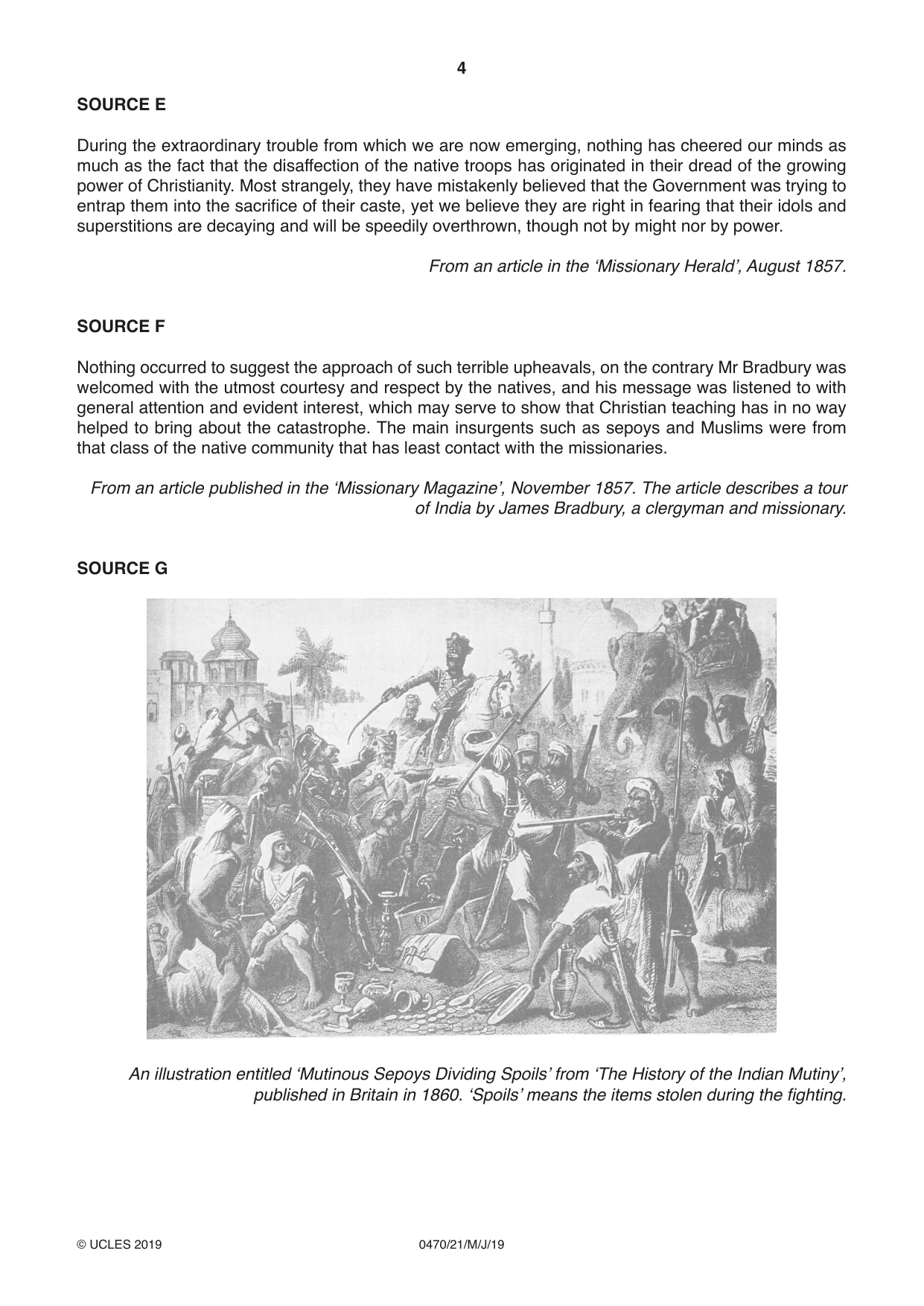
4 0470/21/M/J/19 © UCLES 2019 SOURCE E During the extraordinary trouble from which we are now emerging, nothing has cheered our minds as much as the fact that the disaffection of the native troops has originated in their dread of the growing power of Christianity. Most strangely, they have mistakenly believed that the Government was trying to entrap them into the sacrifice of their caste, yet we believe they are right in fearing that their idols and superstitions are decaying and will be speedily overthrown, though not by might nor by power. From an article in the ‘Missionary Herald’, August 1857. SOURCE F Nothing occurred to suggest the approach of such terrible upheavals, on the contrary Mr Bradbury was welcomed with the utmost courtesy and respect by the natives, and his message was listened to with general attention and evident interest, which may serve to show that Christian teaching has in no way helped to bring about the catastrophe. The main insurgents such as sepoys and Muslims were from that class of the native community that has least contact with the missionaries. From an article published in the ‘Missionary Magazine’, November 1857. The article describes a tour of India by James Bradbury, a clergyman and missionary. SOURCE G An illustration entitled ‘Mutinous Sepoys Dividing Spoils’ from ‘The History of the Indian Mutiny’, published in Britain in 1860. ‘Spoils’ means the items stolen during the fighting.
Question paper, page 5
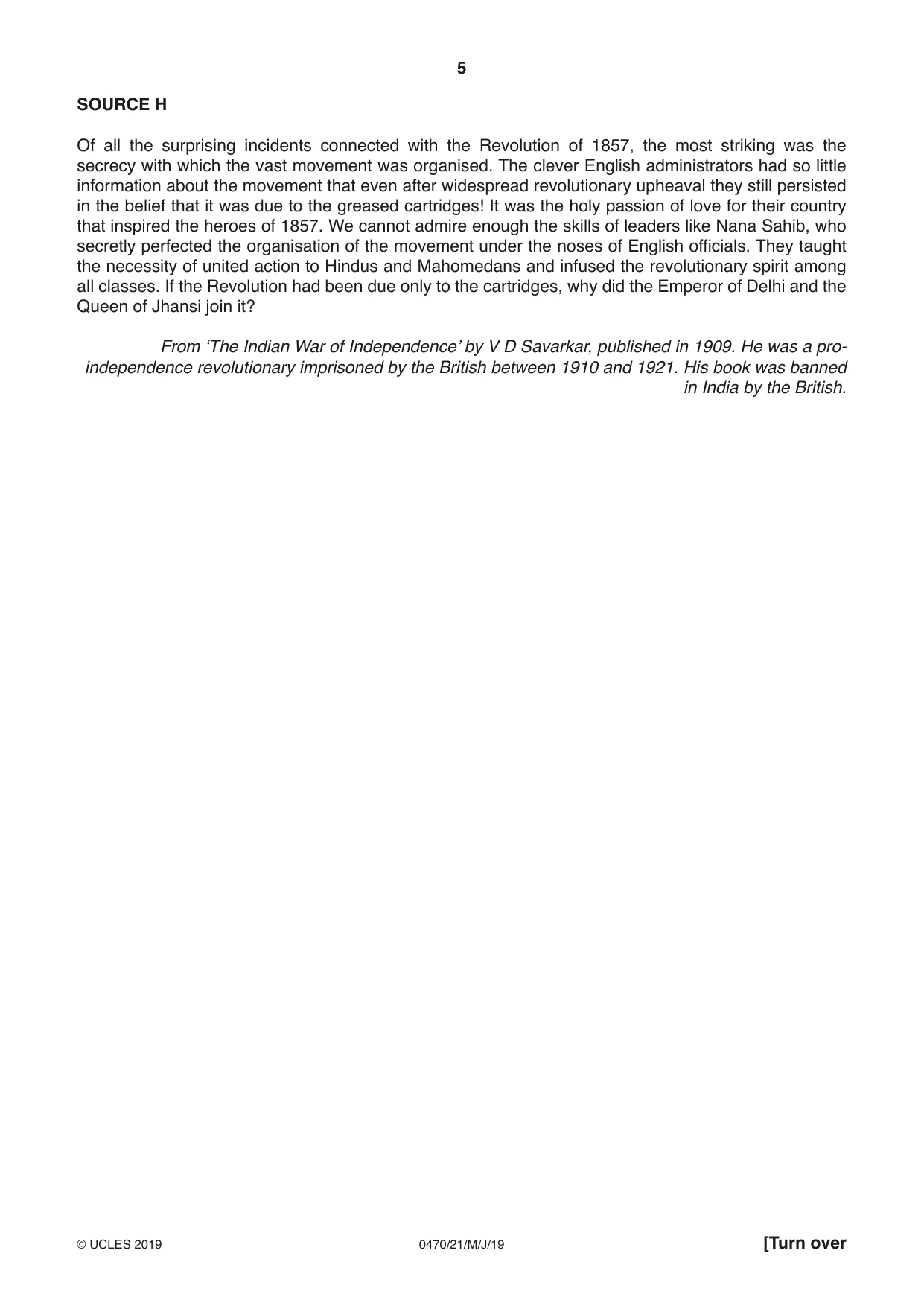
5 0470/21/M/J/19 © UCLES 2019 [Turn over SOURCE H Of all the surprising incidents connected with the Revolution of 1857, the most striking was the secrecy with which the vast movement was organised. The clever English administrators had so little information about the movement that even after widespread revolutionary upheaval they still persisted in the belief that it was due to the greased cartridges! It was the holy passion of love for their country that inspired the heroes of 1857. We cannot admire enough the skills of leaders like Nana Sahib, who secretly perfected the organisation of the movement under the noses of English officials. They taught the necessity of united action to Hindus and Mahomedans and infused the revolutionary spirit among all classes. If the Revolution had been due only to the cartridges, why did the Emperor of Delhi and the Queen of Jhansi join it? From ‘The Indian War of Independence’ by V D Savarkar, published in 1909. He was a pro- independence revolutionary imprisoned by the British between 1910 and 1921. His book was banned in India by the British.
Question paper, page 6
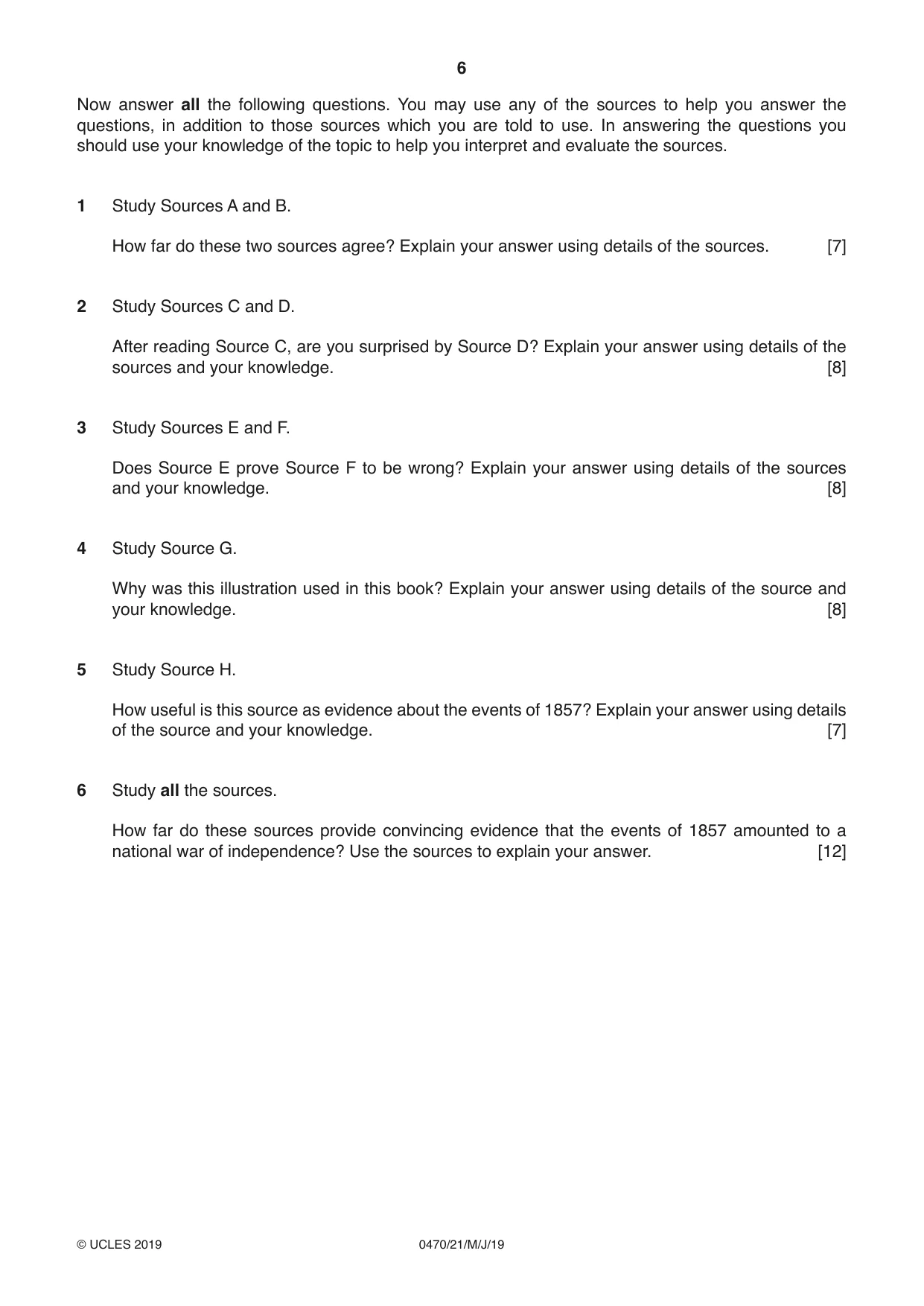
6 0470/21/M/J/19 © UCLES 2019 Now answer all the following questions. You may use any of the sources to help you answer the questions, in addition to those sources which you are told to use. In answering the questions you should use your knowledge of the topic to help you interpret and evaluate the sources. 1 Study Sources A and B. How far do these two sources agree? Explain your answer using details of the sources. [7] 2 Study Sources C and D. After reading Source C, are you surprised by Source D? Explain your answer using details of the sources and your knowledge. [8] 3 Study Sources E and F. Does Source E prove Source F to be wrong? Explain your answer using details of the sources and your knowledge. [8] 4 Study Source G. Why was this illustration used in this book? Explain your answer using details of the source and your knowledge. [8] 5 Study Source H. How useful is this source as evidence about the events of 1857? Explain your answer using details of the source and your knowledge. [7] 6 Study all the sources. How far do these sources provide convincing evidence that the events of 1857 amounted to a national war of independence? Use the sources to explain your answer. [12]
Question paper, page 7
7 0470/21/M/J/19 © UCLES 2019 [Turn over BLANK PAGE
Question paper, page 8
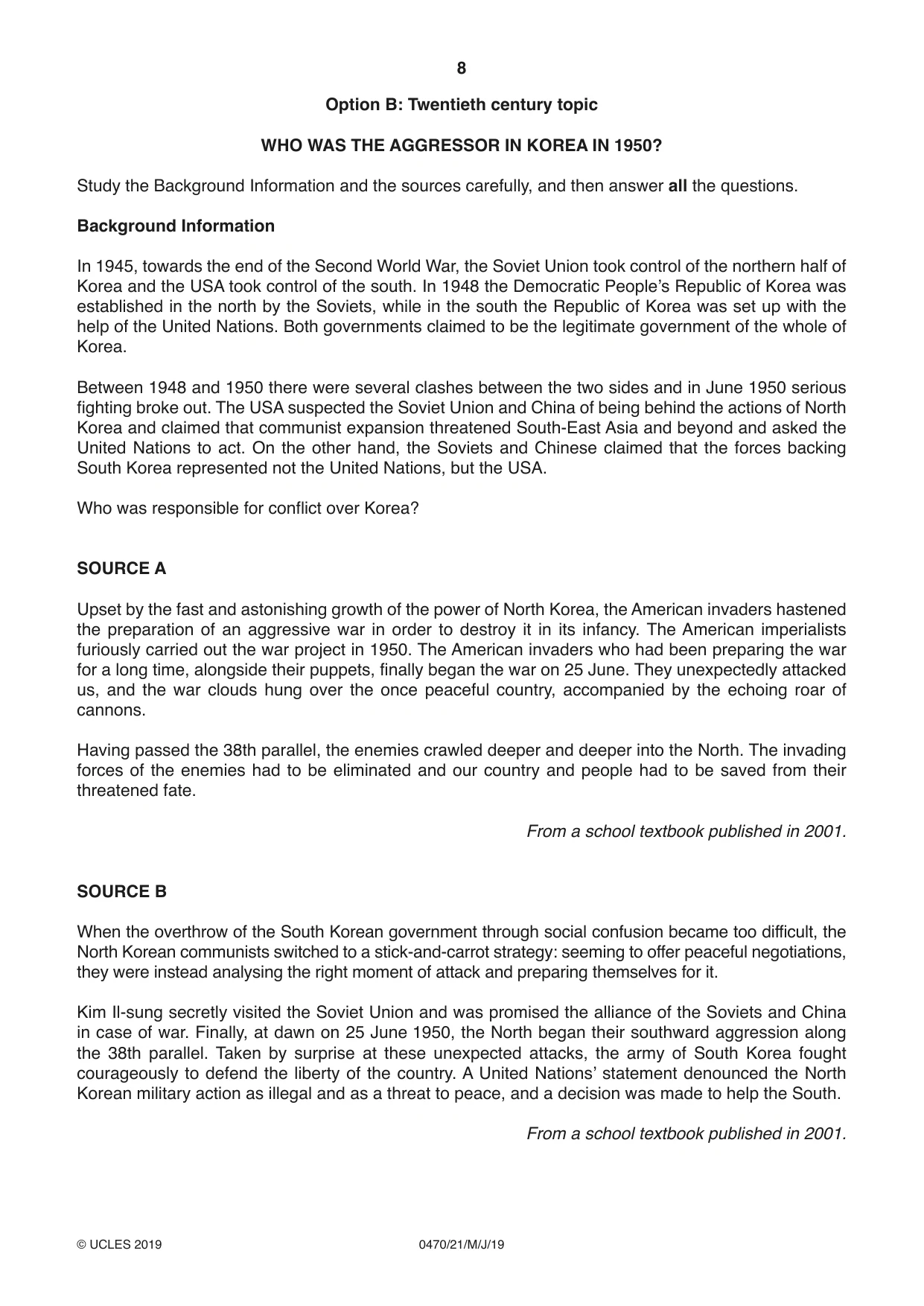
8 0470/21/M/J/19 © UCLES 2019 Option B: Twentieth century topic WHO WAS THE AGGRESSOR IN KOREA IN 1950? Study the Background Information and the sources carefully, and then answer all the questions. Background Information In 1945, towards the end of the Second World War, the Soviet Union took control of the northern half of Korea and the USA took control of the south. In 1948 the Democratic People’s Republic of Korea was established in the north by the Soviets, while in the south the Republic of Korea was set up with the help of the United Nations. Both governments claimed to be the legitimate government of the whole of Korea. Between 1948 and 1950 there were several clashes between the two sides and in June 1950 serious fighting broke out. The USA suspected the Soviet Union and China of being behind the actions of North Korea and claimed that communist expansion threatened South-East Asia and beyond and asked the United Nations to act. On the other hand, the Soviets and Chinese claimed that the forces backing South Korea represented not the United Nations, but the USA. Who was responsible for conflict over Korea? SOURCE A Upset by the fast and astonishing growth of the power of North Korea, the American invaders hastened the preparation of an aggressive war in order to destroy it in its infancy. The American imperialists furiously carried out the war project in 1950. The American invaders who had been preparing the war for a long time, alongside their puppets, finally began the war on 25 June. They unexpectedly attacked us, and the war clouds hung over the once peaceful country, accompanied by the echoing roar of cannons. Having passed the 38th parallel, the enemies crawled deeper and deeper into the North. The invading forces of the enemies had to be eliminated and our country and people had to be saved from their threatened fate. From a school textbook published in 2001. SOURCE B When the overthrow of the South Korean government through social confusion became too difficult, the North Korean communists switched to a stick-and-carrot strategy: seeming to offer peaceful negotiations, they were instead analysing the right moment of attack and preparing themselves for it. Kim Il-sung secretly visited the Soviet Union and was promised the alliance of the Soviets and China in case of war. Finally, at dawn on 25 June 1950, the North began their southward aggression along the 38th parallel. Taken by surprise at these unexpected attacks, the army of South Korea fought courageously to defend the liberty of the country. A United Nations’ statement denounced the North Korean military action as illegal and as a threat to peace, and a decision was made to help the South. From a school textbook published in 2001.
Question paper, page 9
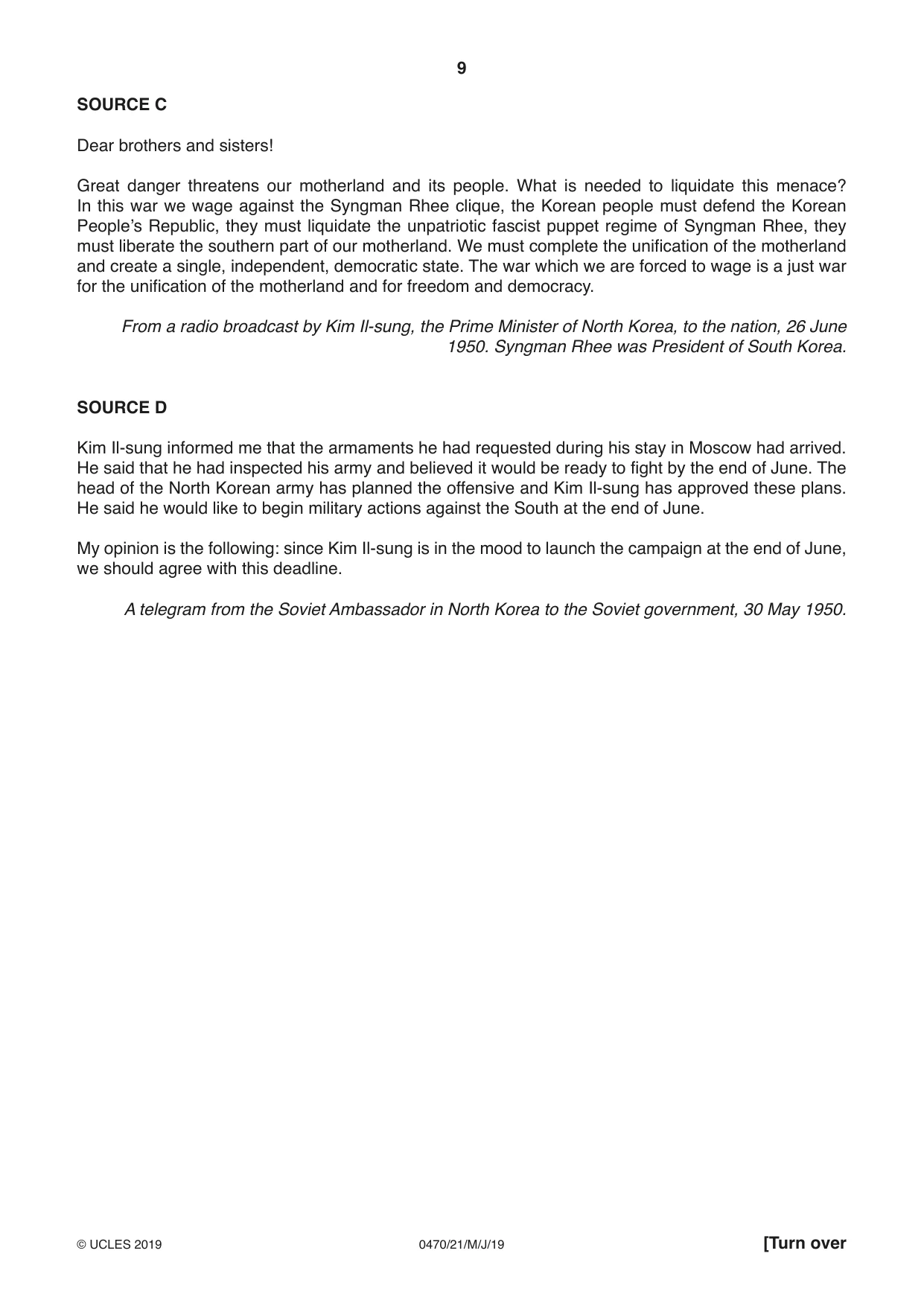
9 0470/21/M/J/19 © UCLES 2019 [Turn over SOURCE C Dear brothers and sisters! Great danger threatens our motherland and its people. What is needed to liquidate this menace? In this war we wage against the Syngman Rhee clique, the Korean people must defend the Korean People’s Republic, they must liquidate the unpatriotic fascist puppet regime of Syngman Rhee, they must liberate the southern part of our motherland. We must complete the unification of the motherland and create a single, independent, democratic state. The war which we are forced to wage is a just war for the unification of the motherland and for freedom and democracy. From a radio broadcast by Kim Il-sung, the Prime Minister of North Korea, to the nation, 26 June 1950. Syngman Rhee was President of South Korea. SOURCE D Kim Il-sung informed me that the armaments he had requested during his stay in Moscow had arrived. He said that he had inspected his army and believed it would be ready to fight by the end of June. The head of the North Korean army has planned the offensive and Kim Il-sung has approved these plans. He said he would like to begin military actions against the South at the end of June. My opinion is the following: since Kim Il-sung is in the mood to launch the campaign at the end of June, we should agree with this deadline. A telegram from the Soviet Ambassador in North Korea to the Soviet government, 30 May 1950.
Question paper, page 10
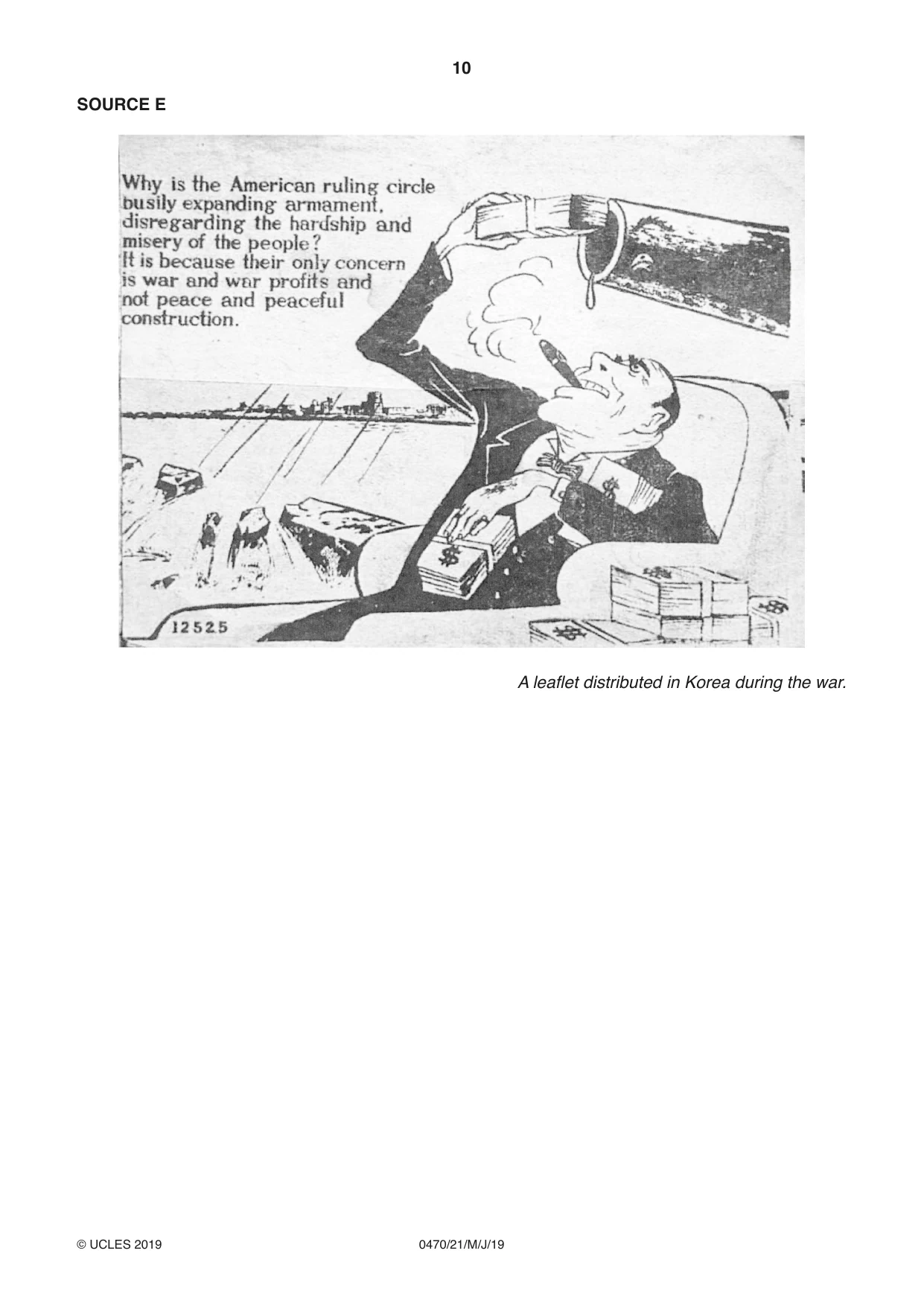
10 0470/21/M/J/19 © UCLES 2019 SOURCE E A leaflet distributed in Korea during the war.
Question paper, page 11
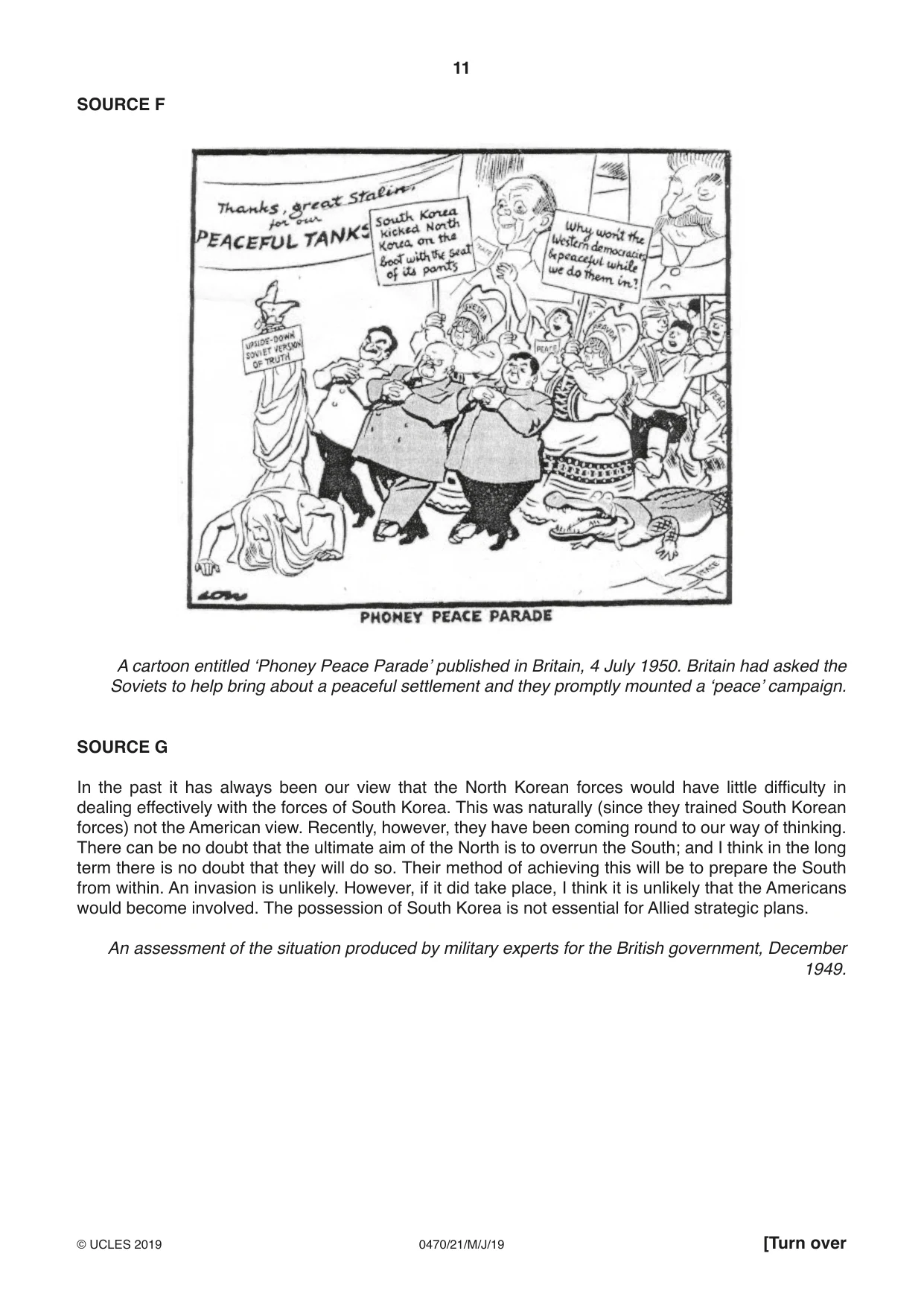
11 0470/21/M/J/19 © UCLES 2019 [Turn over SOURCE F A cartoon entitled ‘Phoney Peace Parade’ published in Britain, 4 July 1950. Britain had asked the Soviets to help bring about a peaceful settlement and they promptly mounted a ‘peace’ campaign. SOURCE G In the past it has always been our view that the North Korean forces would have little difficulty in dealing effectively with the forces of South Korea. This was naturally (since they trained South Korean forces) not the American view. Recently, however, they have been coming round to our way of thinking. There can be no doubt that the ultimate aim of the North is to overrun the South; and I think in the long term there is no doubt that they will do so. Their method of achieving this will be to prepare the South from within. An invasion is unlikely. However, if it did take place, I think it is unlikely that the Americans would become involved. The possession of South Korea is not essential for Allied strategic plans. An assessment of the situation produced by military experts for the British government, December 1949.
Question paper, page 12
12 0470/21/M/J/19 © UCLES 2019 Now answer all the following questions. You may use any of the sources to help you answer the questions, in addition to those sources which you are told to use. In answering the questions you should use your knowledge of the topic to help you interpret and evaluate the sources. 1 Study Sources A and B. Which one of these textbooks was used in schools in South Korea and which one was used in North Korean schools? Explain your answer using details of the sources. [7] 2 Study Sources C and D. Does Source C prove that the Soviet Ambassador (Source D) was wrong? Explain your answer using details of the sources and your knowledge. [8] 3 Study Source E. Why was Source E distributed in Korea? Explain your answer using details of the source and your knowledge. [8] 4 Study Source F. What is the message of the cartoonist? Explain your answer using details of the source and your knowledge. [8] 5 Study Source G. Are you surprised by this source? Explain your answer using details of the source and your knowledge. [7] 6 Study all the sources. How far do these sources provide convincing evidence that South Korea and the USA were to blame for the Korean War? Use the sources to explain your answer. [12] Permission to reproduce items where third-party owned material protected by copyright is included has been sought and cleared where possible. Every reasonable effort has been made by the publisher (UCLES) to trace copyright holders, but if any items requiring clearance have unwittingly been included, the publisher will be pleased to make amends at the earliest possible opportunity. To avoid the issue of disclosure of answer-related information to candidates, all copyright acknowledgements are reproduced online in the Cambridge Assessment International Education Copyright Acknowledgements Booklet. This is produced for each series of examinations and is freely available to download at www.cambridgeinternational.org after the live examination series. Cambridge Assessment International Education is part of the Cambridge Assessment Group. Cambridge Assessment is the brand name of the University of Cambridge Local Examinations Syndicate (UCLES), which itself is a department of the University of Cambridge.
Mark scheme, page 1
This syllabus is regulated for use in England, Wales and Northern Ireland as a Cambridge International Level 1/Level 2 Certificate. This document consists of 15 printed pages. © UCLES 2019 [Turn over Cambridge Assessment International Education Cambridge International General Certificate of Secondary Education HISTORY 0470/21 Paper 2 May/June 2019 MARK SCHEME Maximum Mark: 50 Published This mark scheme is published as an aid to teachers and candidates, to indicate the requirements of the examination. It shows the basis on which Examiners were instructed to award marks. It does not indicate the details of the discussions that took place at an Examiners’ meeting before marking began, which would have considered the acceptability of alternative answers. Mark schemes should be read in conjunction with the question paper and the Principal Examiner Report for Teachers. Cambridge International will not enter into discussions about these mark schemes. Cambridge International is publishing the mark schemes for the May/June 2019 series for most Cambridge IGCSE™, Cambridge International A and AS Level and Cambridge Pre-U components, and some Cambridge O Level components.
Mark scheme, page 2
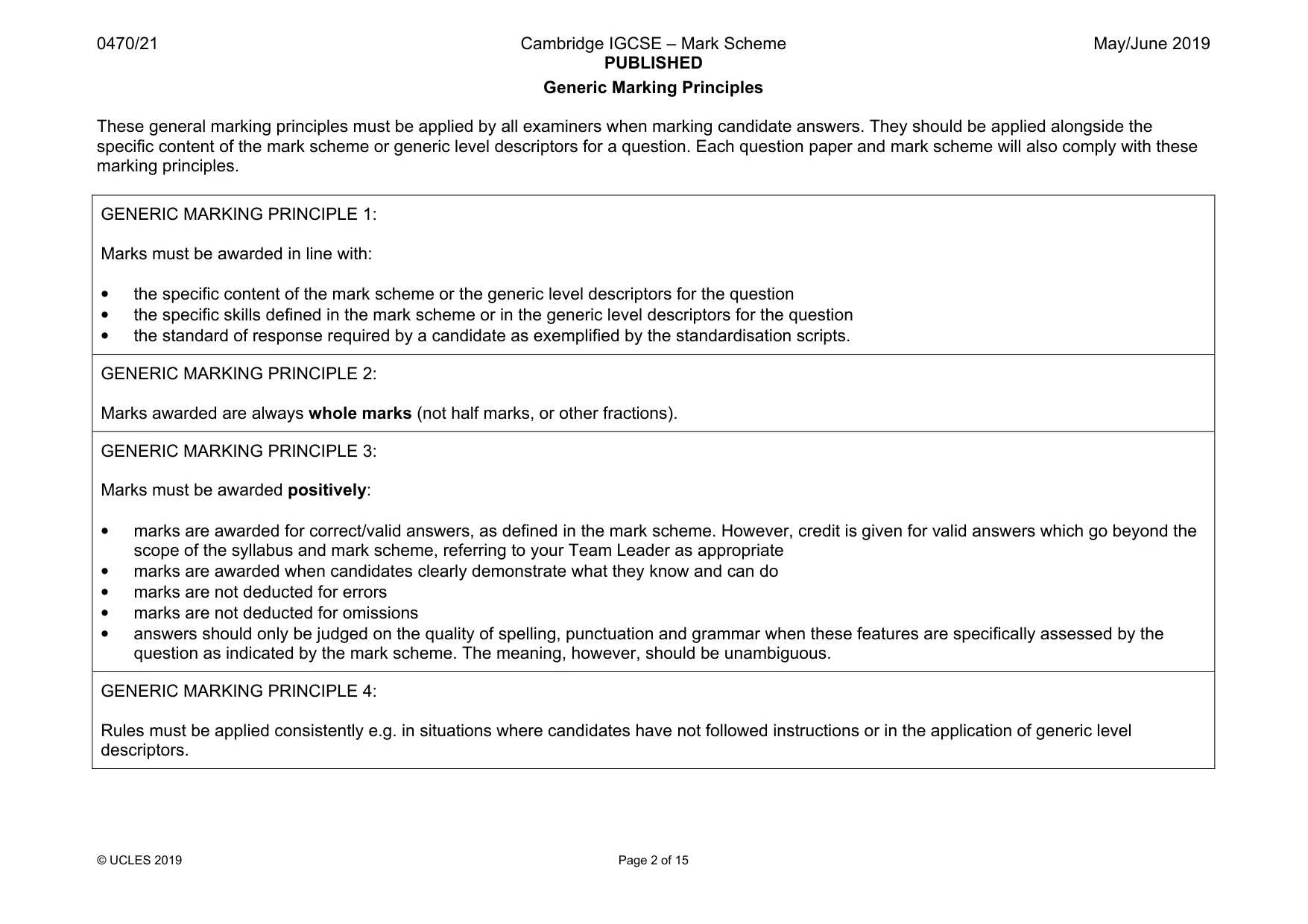
0470/21 Cambridge IGCSE – Mark Scheme PUBLISHED May/June 2019 © UCLES 2019 Page 2 of 15 Generic Marking Principles These general marking principles must be applied by all examiners when marking candidate answers. They should be applied alongside the specific content of the mark scheme or generic level descriptors for a question. Each question paper and mark scheme will also comply with these marking principles. GENERIC MARKING PRINCIPLE 1: Marks must be awarded in line with: • the specific content of the mark scheme or the generic level descriptors for the question • the specific skills defined in the mark scheme or in the generic level descriptors for the question • the standard of response required by a candidate as exemplified by the standardisation scripts. GENERIC MARKING PRINCIPLE 2: Marks awarded are always whole marks (not half marks, or other fractions). GENERIC MARKING PRINCIPLE 3: Marks must be awarded positively: • marks are awarded for correct/valid answers, as defined in the mark scheme. However, credit is given for valid answers which go beyond the scope of the syllabus and mark scheme, referring to your Team Leader as appropriate • marks are awarded when candidates clearly demonstrate what they know and can do • marks are not deducted for errors • marks are not deducted for omissions • answers should only be judged on the quality of spelling, punctuation and grammar when these features are specifically assessed by the question as indicated by the mark scheme. The meaning, however, should be unambiguous. GENERIC MARKING PRINCIPLE 4: Rules must be applied consistently e.g. in situations where candidates have not followed instructions or in the application of generic level descriptors.
Mark scheme, page 3
0470/21 Cambridge IGCSE – Mark Scheme PUBLISHED May/June 2019 © UCLES 2019 Page 3 of 15 GENERIC MARKING PRINCIPLE 5: Marks should be awarded using the full range of marks defined in the mark scheme for the question (however; the use of the full mark range may be limited according to the quality of the candidate responses seen). GENERIC MARKING PRINCIPLE 6: Marks awarded are based solely on the requirements as defined in the mark scheme. Marks should not be awarded with grade thresholds or grade descriptors in mind.
Mark scheme, page 4
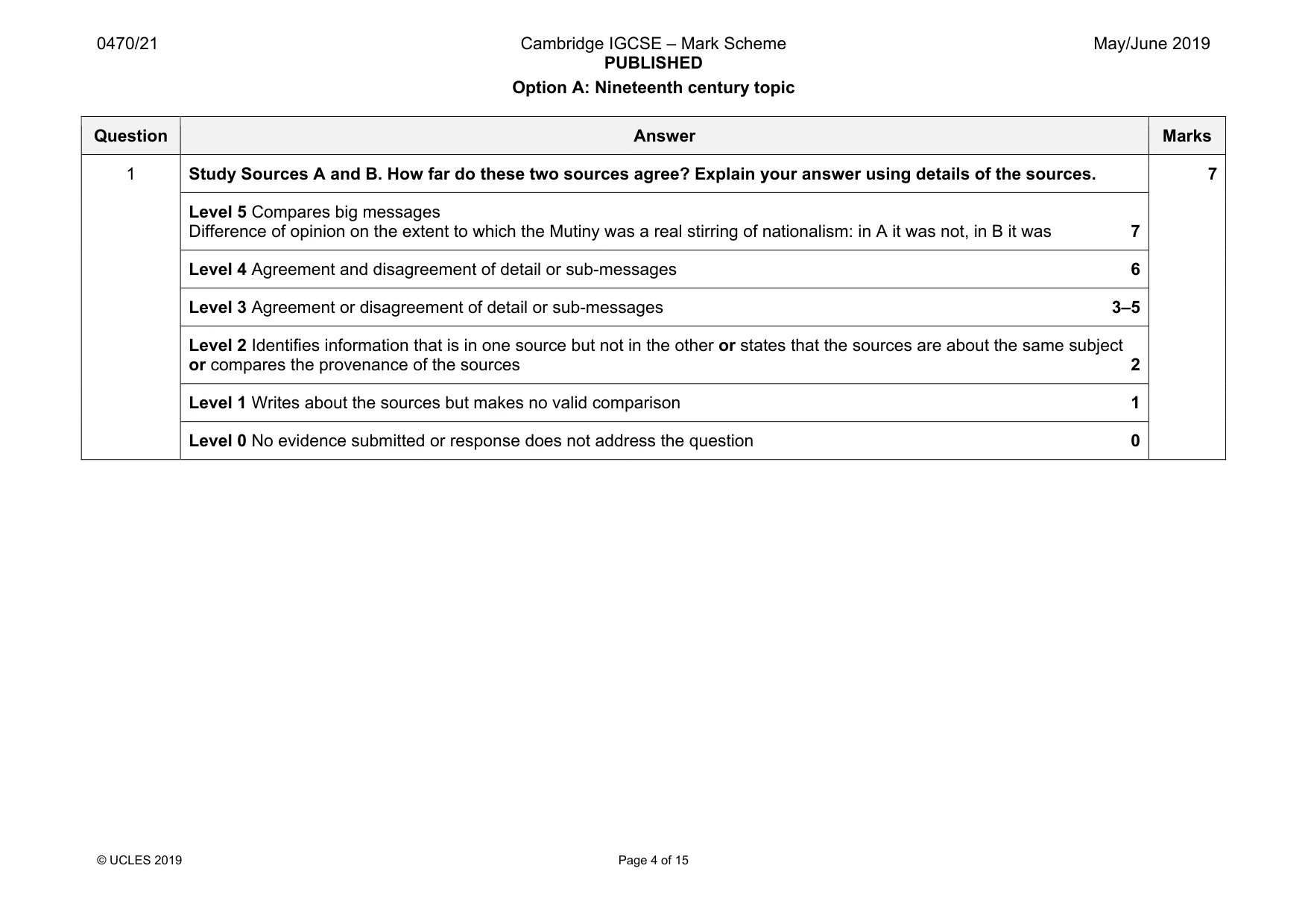
0470/21 Cambridge IGCSE – Mark Scheme PUBLISHED May/June 2019 © UCLES 2019 Page 4 of 15 Option A: Nineteenth century topic Question Answer Marks 1 Study Sources A and B. How far do these two sources agree? Explain your answer using details of the sources. 7 Level 5 Compares big messages Difference of opinion on the extent to which the Mutiny was a real stirring of nationalism: in A it was not, in B it was 7 Level 4 Agreement and disagreement of detail or sub-messages 6 Level 3 Agreement or disagreement of detail or sub-messages 3–5 Level 2 Identifies information that is in one source but not in the other or states that the sources are about the same subject or compares the provenance of the sources 2 Level 1 Writes about the sources but makes no valid comparison 1 Level 0 No evidence submitted or response does not address the question 0
Mark scheme, page 5
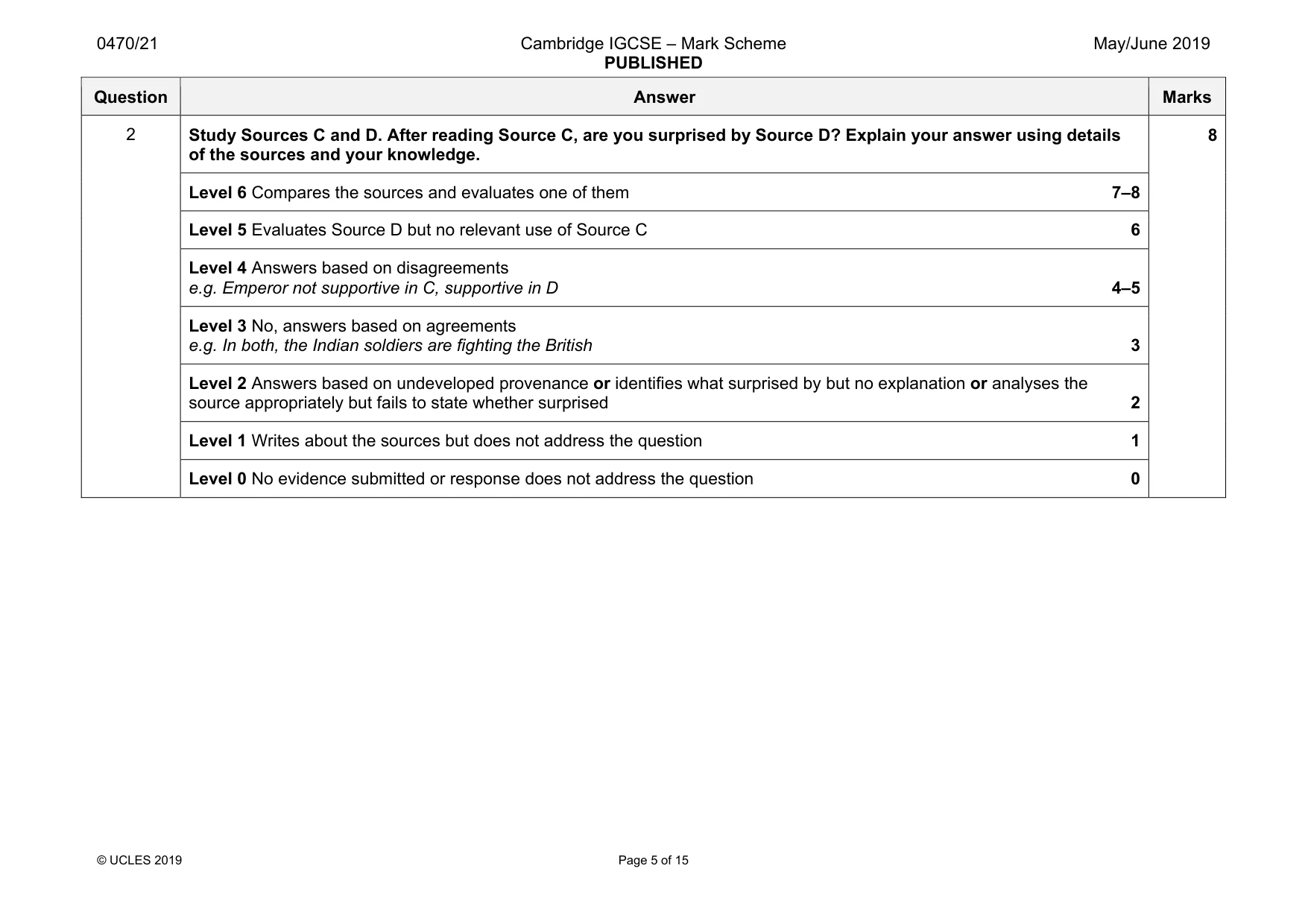
0470/21 Cambridge IGCSE – Mark Scheme PUBLISHED May/June 2019 © UCLES 2019 Page 5 of 15 Question Answer Marks 2 Study Sources C and D. After reading Source C, are you surprised by Source D? Explain your answer using details of the sources and your knowledge. 8 Level 6 Compares the sources and evaluates one of them 7–8 Level 5 Evaluates Source D but no relevant use of Source C 6 Level 4 Answers based on disagreements e.g. Emperor not supportive in C, supportive in D 4–5 Level 3 No, answers based on agreements e.g. In both, the Indian soldiers are fighting the British 3 Level 2 Answers based on undeveloped provenance or identifies what surprised by but no explanation or analyses the source appropriately but fails to state whether surprised 2 Level 1 Writes about the sources but does not address the question 1 Level 0 No evidence submitted or response does not address the question 0
Mark scheme, page 6
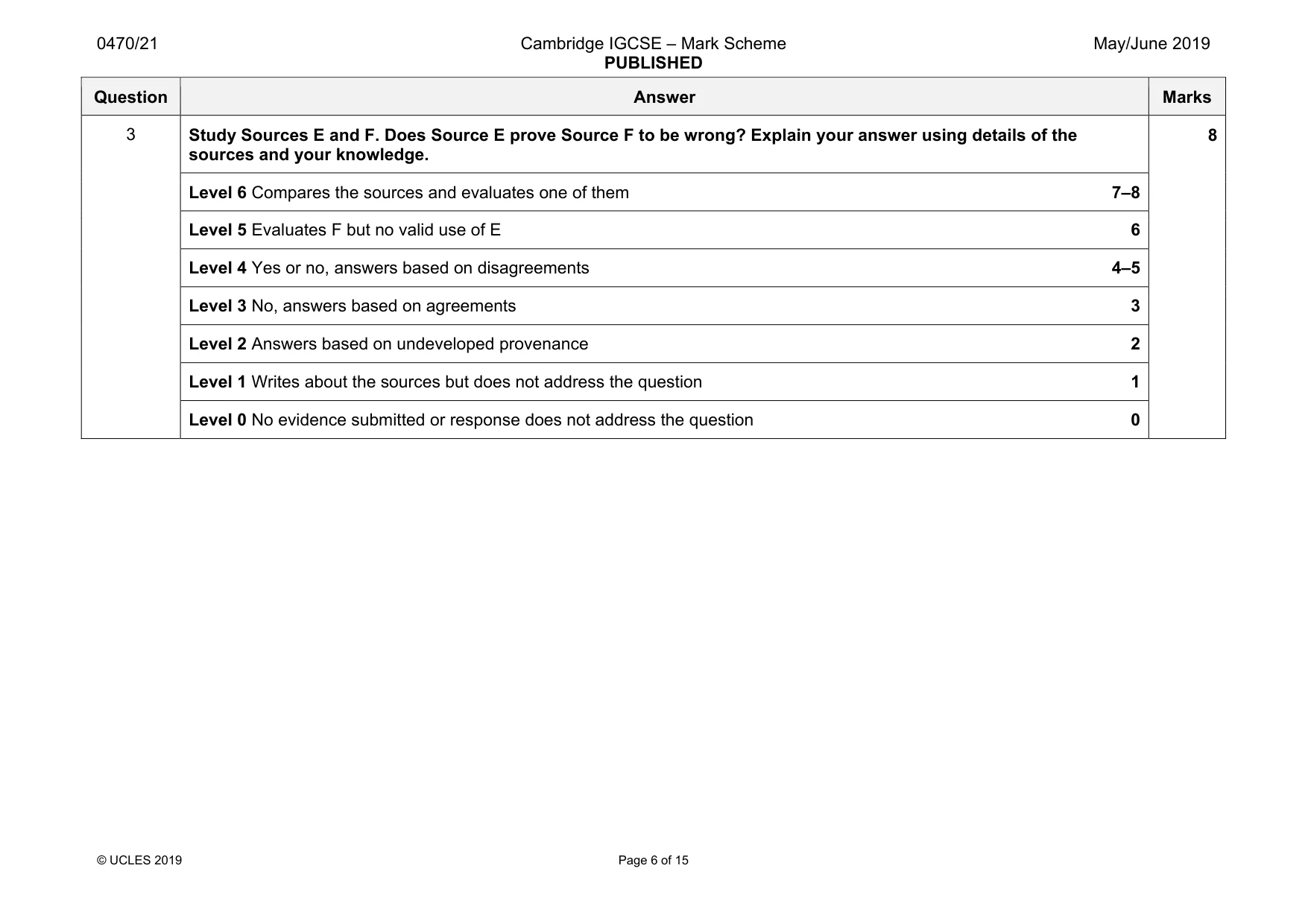
0470/21 Cambridge IGCSE – Mark Scheme PUBLISHED May/June 2019 © UCLES 2019 Page 6 of 15 Question Answer Marks 3 Study Sources E and F. Does Source E prove Source F to be wrong? Explain your answer using details of the sources and your knowledge. 8 Level 6 Compares the sources and evaluates one of them 7–8 Level 5 Evaluates F but no valid use of E 6 Level 4 Yes or no, answers based on disagreements 4–5 Level 3 No, answers based on agreements 3 Level 2 Answers based on undeveloped provenance 2 Level 1 Writes about the sources but does not address the question 1 Level 0 No evidence submitted or response does not address the question 0
Mark scheme, page 7
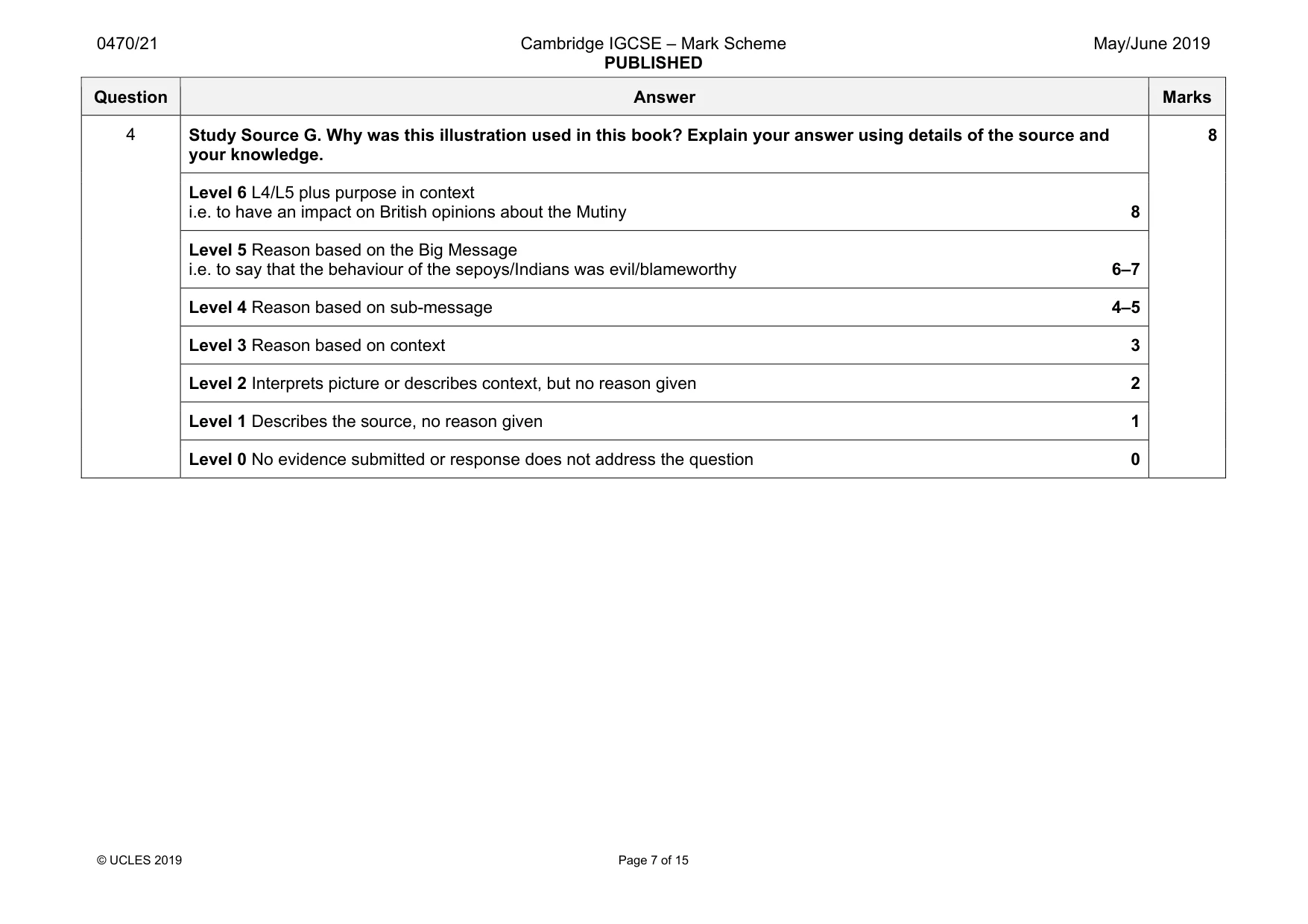
0470/21 Cambridge IGCSE – Mark Scheme PUBLISHED May/June 2019 © UCLES 2019 Page 7 of 15 Question Answer Marks 4 Study Source G. Why was this illustration used in this book? Explain your answer using details of the source and your knowledge. 8 Level 6 L4/L5 plus purpose in context i.e. to have an impact on British opinions about the Mutiny 8 Level 5 Reason based on the Big Message i.e. to say that the behaviour of the sepoys/Indians was evil/blameworthy 6–7 Level 4 Reason based on sub-message 4–5 Level 3 Reason based on context 3 Level 2 Interprets picture or describes context, but no reason given 2 Level 1 Describes the source, no reason given 1 Level 0 No evidence submitted or response does not address the question 0
Mark scheme, page 8
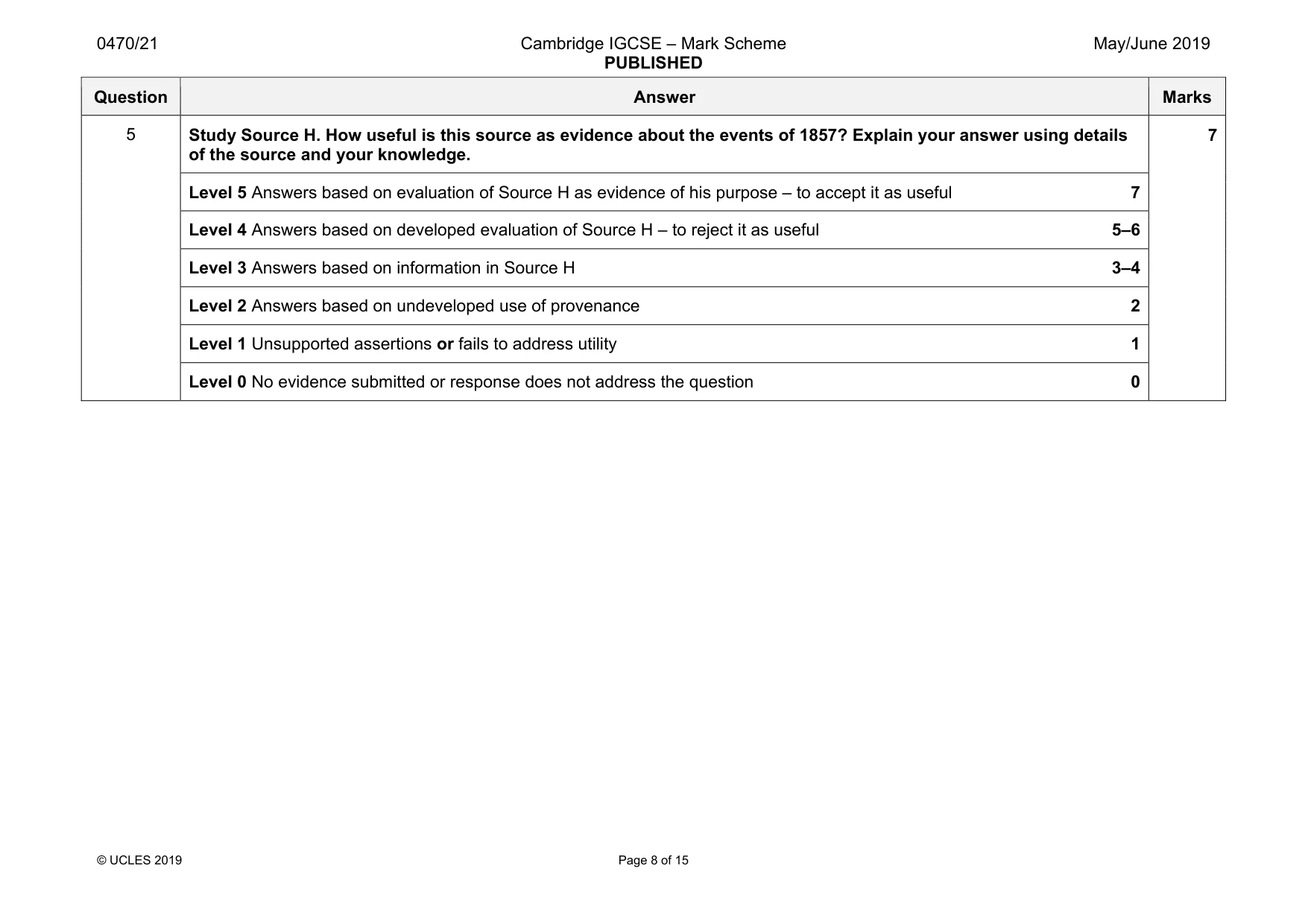
0470/21 Cambridge IGCSE – Mark Scheme PUBLISHED May/June 2019 © UCLES 2019 Page 8 of 15 Question Answer Marks 5 Study Source H. How useful is this source as evidence about the events of 1857? Explain your answer using details of the source and your knowledge. 7 Level 5 Answers based on evaluation of Source H as evidence of his purpose – to accept it as useful 7 Level 4 Answers based on developed evaluation of Source H – to reject it as useful 5–6 Level 3 Answers based on information in Source H 3–4 Level 2 Answers based on undeveloped use of provenance 2 Level 1 Unsupported assertions or fails to address utility 1 Level 0 No evidence submitted or response does not address the question 0
Mark scheme, page 9
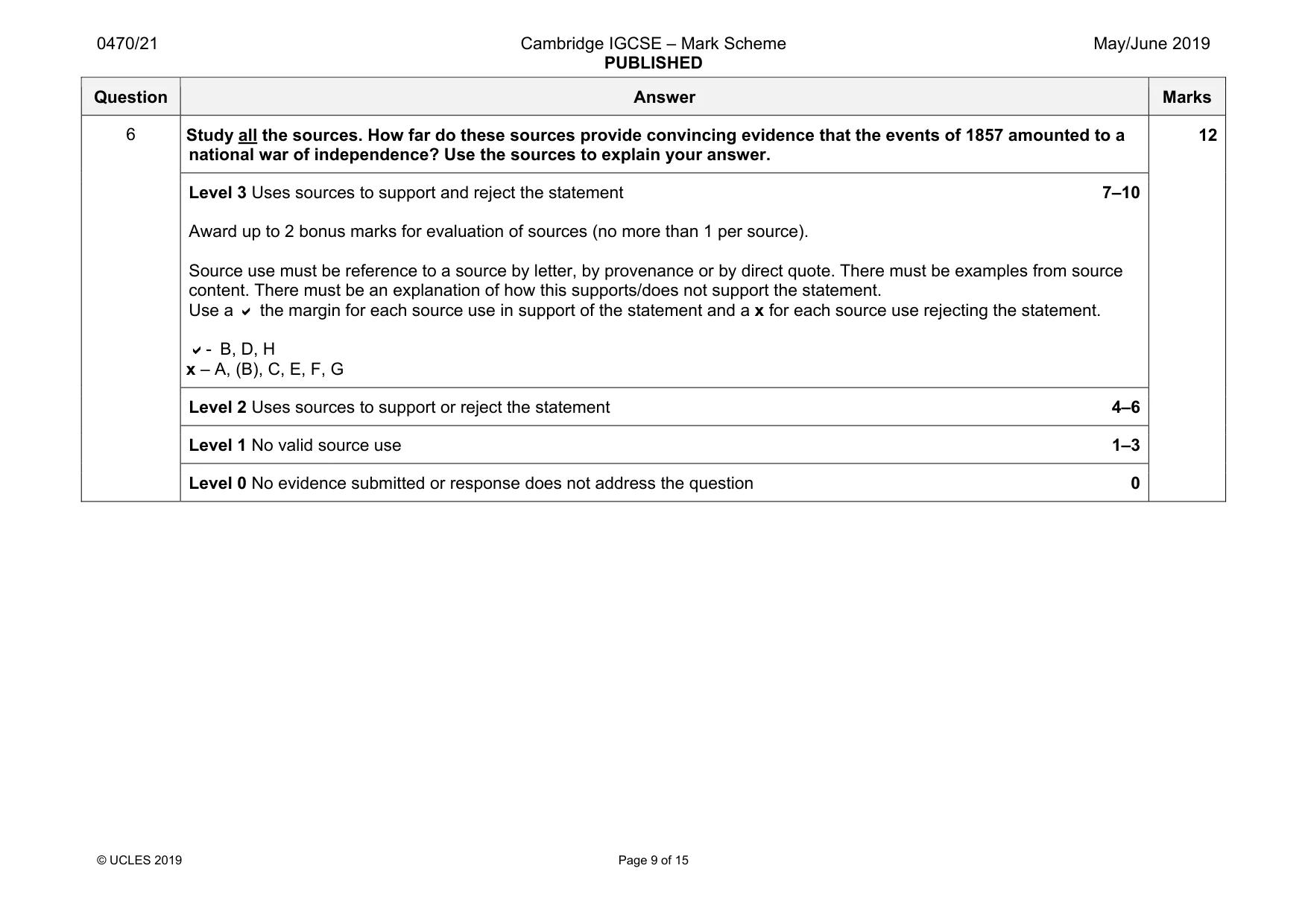
0470/21 Cambridge IGCSE – Mark Scheme PUBLISHED May/June 2019 © UCLES 2019 Page 9 of 15 Question Answer Marks 6 Study all the sources. How far do these sources provide convincing evidence that the events of 1857 amounted to a national war of independence? Use the sources to explain your answer. 12 Level 3 Uses sources to support and reject the statement 7–10 Award up to 2 bonus marks for evaluation of sources (no more than 1 per source). Source use must be reference to a source by letter, by provenance or by direct quote. There must be examples from source content. There must be an explanation of how this supports/does not support the statement. Use a D the margin for each source use in support of the statement and a x for each source use rejecting the statement. D- B, D, H x – A, (B), C, E, F, G Level 2 Uses sources to support or reject the statement 4–6 Level 1 No valid source use 1–3 Level 0 No evidence submitted or response does not address the question 0
Mark scheme, page 10
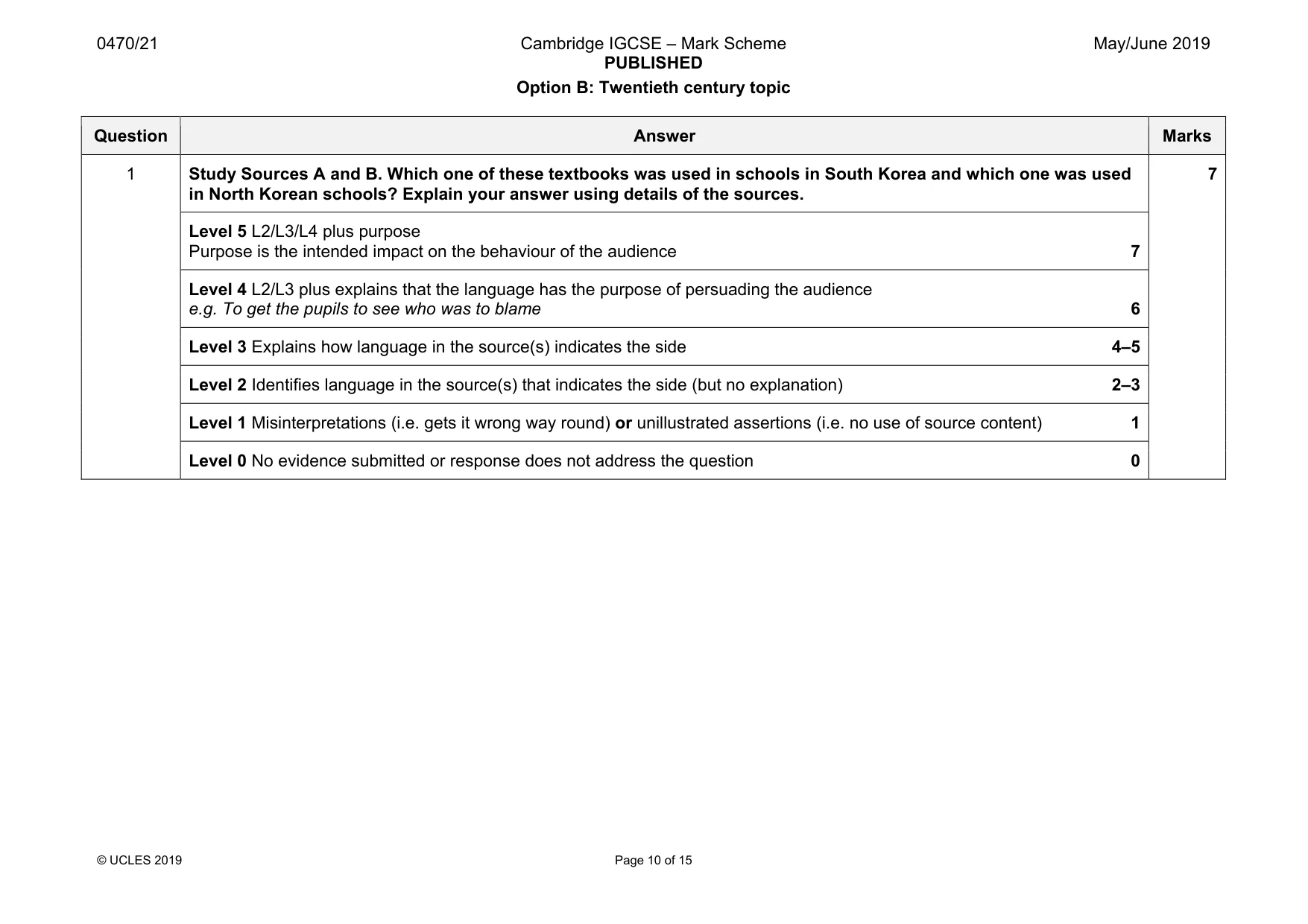
0470/21 Cambridge IGCSE – Mark Scheme PUBLISHED May/June 2019 © UCLES 2019 Page 10 of 15 Option B: Twentieth century topic Question Answer Marks 1 Study Sources A and B. Which one of these textbooks was used in schools in South Korea and which one was used in North Korean schools? Explain your answer using details of the sources. 7 Level 5 L2/L3/L4 plus purpose Purpose is the intended impact on the behaviour of the audience 7 Level 4 L2/L3 plus explains that the language has the purpose of persuading the audience e.g. To get the pupils to see who was to blame 6 Level 3 Explains how language in the source(s) indicates the side 4–5 Level 2 Identifies language in the source(s) that indicates the side (but no explanation) 2–3 Level 1 Misinterpretations (i.e. gets it wrong way round) or unillustrated assertions (i.e. no use of source content) 1 Level 0 No evidence submitted or response does not address the question 0
Mark scheme, page 11
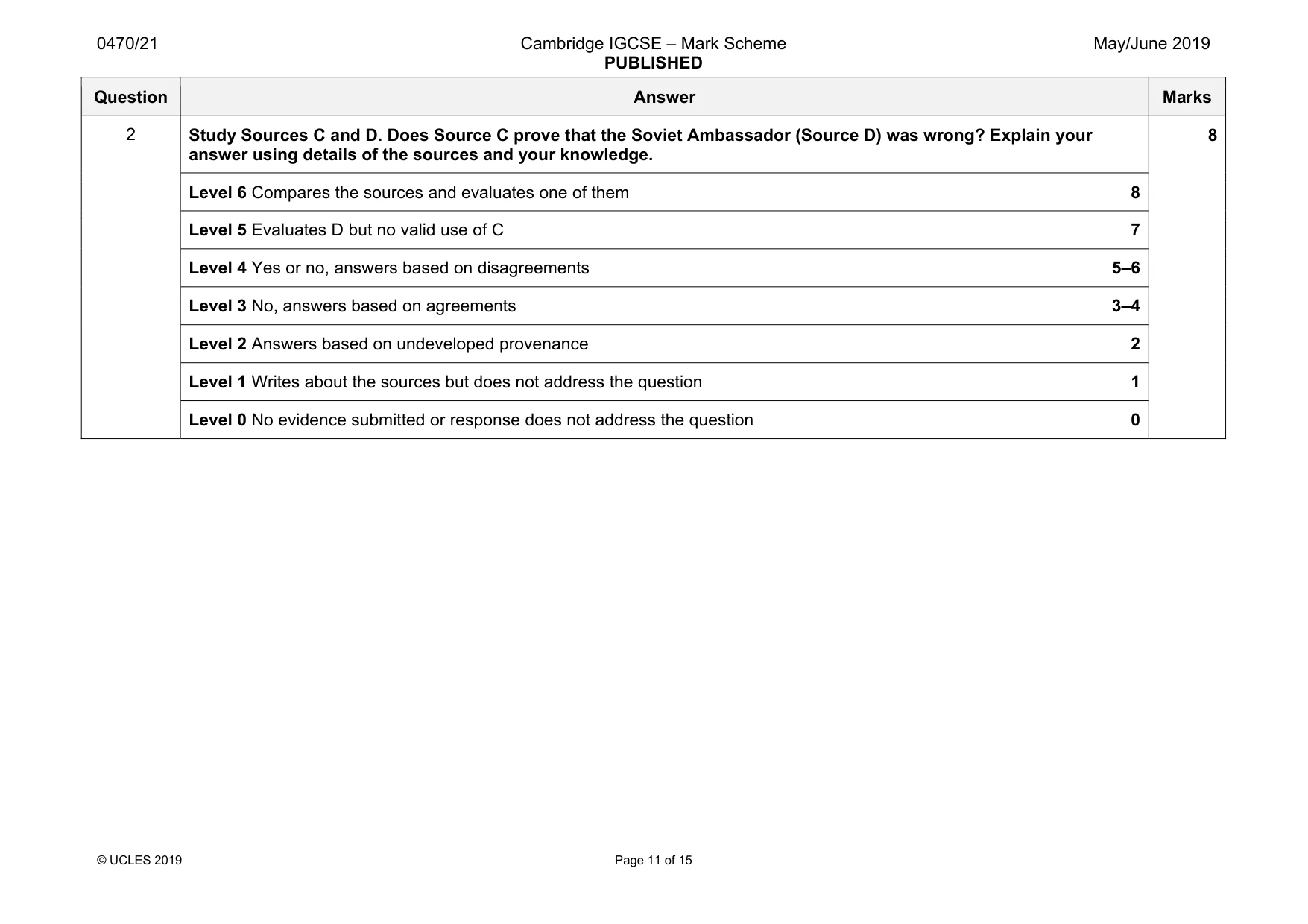
0470/21 Cambridge IGCSE – Mark Scheme PUBLISHED May/June 2019 © UCLES 2019 Page 11 of 15 Question Answer Marks 2 Study Sources C and D. Does Source C prove that the Soviet Ambassador (Source D) was wrong? Explain your answer using details of the sources and your knowledge. 8 Level 6 Compares the sources and evaluates one of them 8 Level 5 Evaluates D but no valid use of C 7 Level 4 Yes or no, answers based on disagreements 5–6 Level 3 No, answers based on agreements 3–4 Level 2 Answers based on undeveloped provenance 2 Level 1 Writes about the sources but does not address the question 1 Level 0 No evidence submitted or response does not address the question 0
Mark scheme, page 12
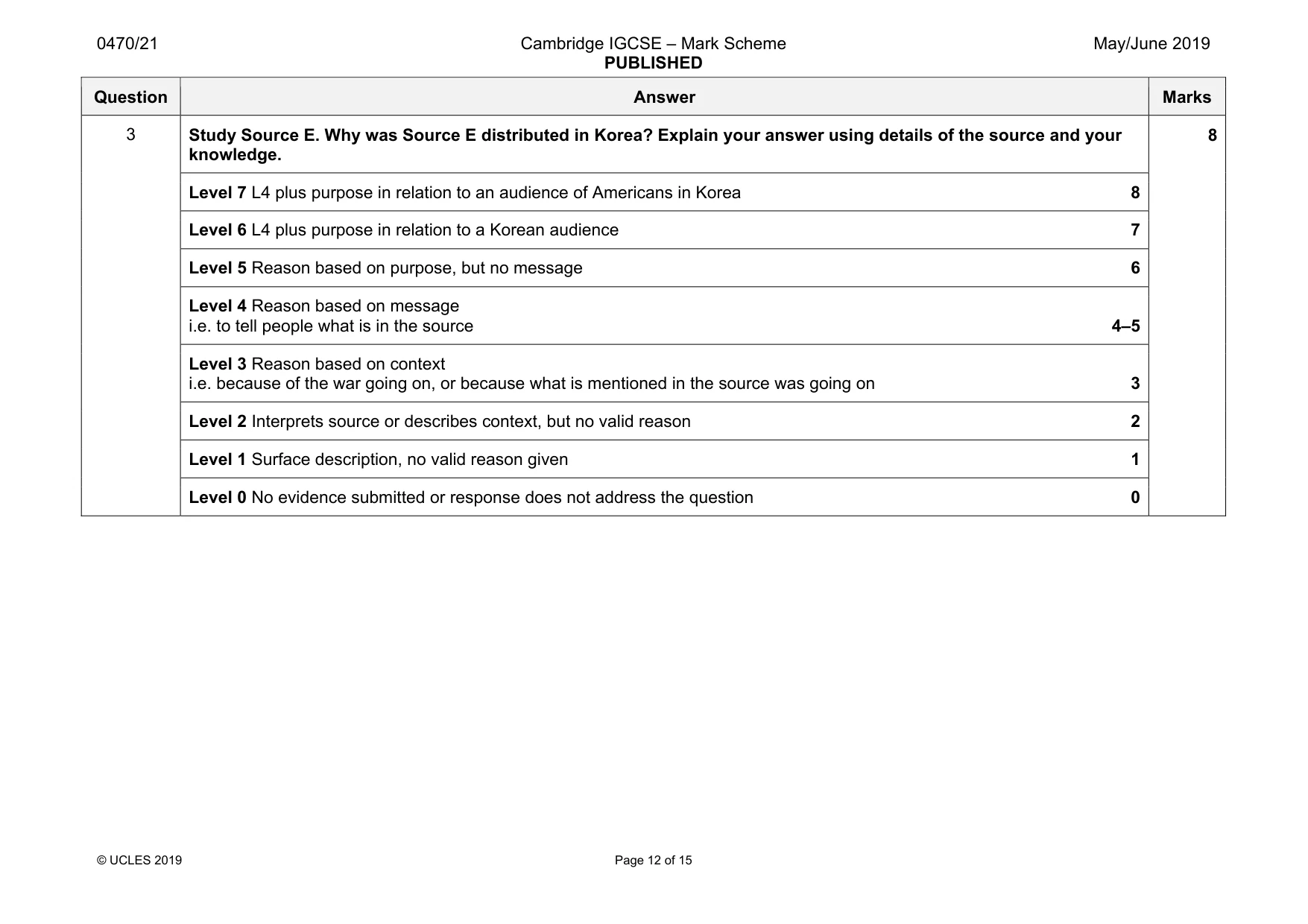
0470/21 Cambridge IGCSE – Mark Scheme PUBLISHED May/June 2019 © UCLES 2019 Page 12 of 15 Question Answer Marks 3 Study Source E. Why was Source E distributed in Korea? Explain your answer using details of the source and your knowledge. 8 Level 7 L4 plus purpose in relation to an audience of Americans in Korea 8 Level 6 L4 plus purpose in relation to a Korean audience 7 Level 5 Reason based on purpose, but no message 6 Level 4 Reason based on message i.e. to tell people what is in the source 4–5 Level 3 Reason based on context i.e. because of the war going on, or because what is mentioned in the source was going on 3 Level 2 Interprets source or describes context, but no valid reason 2 Level 1 Surface description, no valid reason given 1 Level 0 No evidence submitted or response does not address the question 0
Mark scheme, page 13
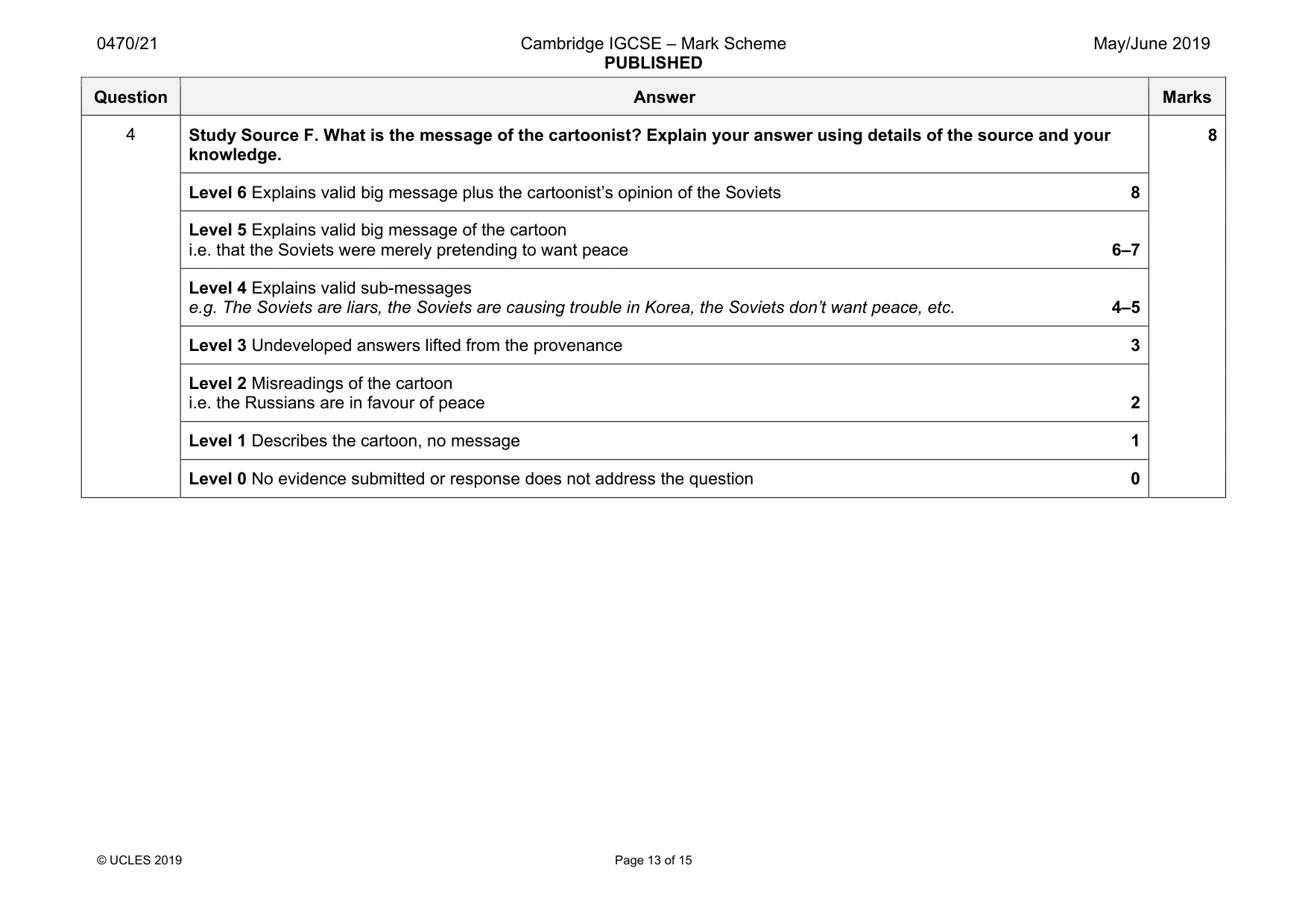
0470/21 Cambridge IGCSE – Mark Scheme PUBLISHED May/June 2019 © UCLES 2019 Page 13 of 15 Question Answer Marks 4 Study Source F. What is the message of the cartoonist? Explain your answer using details of the source and your knowledge. 8 Level 6 Explains valid big message plus the cartoonist’s opinion of the Soviets 8 Level 5 Explains valid big message of the cartoon i.e. that the Soviets were merely pretending to want peace 6–7 Level 4 Explains valid sub-messages e.g. The Soviets are liars, the Soviets are causing trouble in Korea, the Soviets don’t want peace, etc. 4–5 Level 3 Undeveloped answers lifted from the provenance 3 Level 2 Misreadings of the cartoon i.e. the Russians are in favour of peace 2 Level 1 Describes the cartoon, no message 1 Level 0 No evidence submitted or response does not address the question 0
Mark scheme, page 14
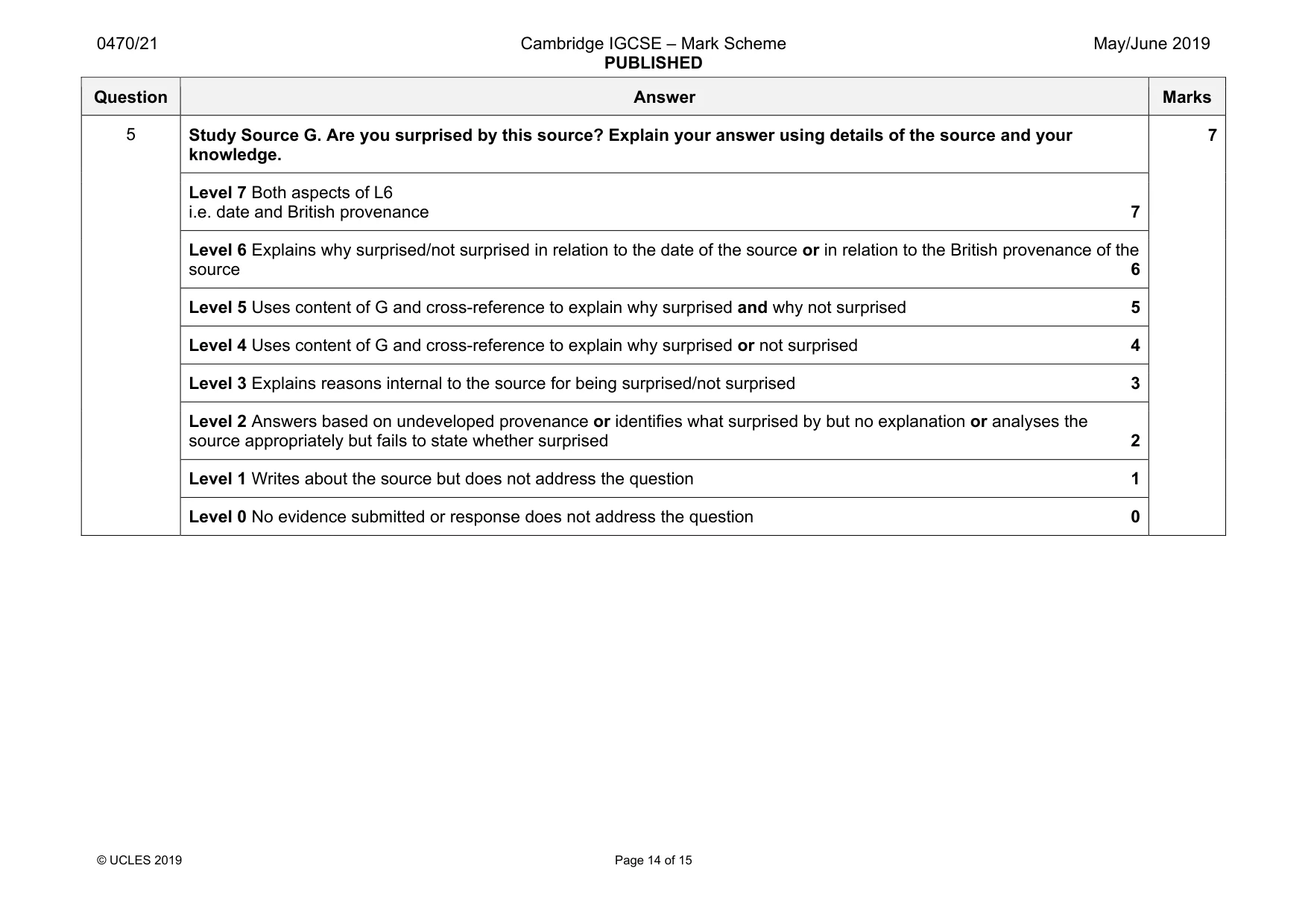
0470/21 Cambridge IGCSE – Mark Scheme PUBLISHED May/June 2019 © UCLES 2019 Page 14 of 15 Question Answer Marks 5 Study Source G. Are you surprised by this source? Explain your answer using details of the source and your knowledge. 7 Level 7 Both aspects of L6 i.e. date and British provenance 7 Level 6 Explains why surprised/not surprised in relation to the date of the source or in relation to the British provenance of the source 6 Level 5 Uses content of G and cross-reference to explain why surprised and why not surprised 5 Level 4 Uses content of G and cross-reference to explain why surprised or not surprised 4 Level 3 Explains reasons internal to the source for being surprised/not surprised 3 Level 2 Answers based on undeveloped provenance or identifies what surprised by but no explanation or analyses the source appropriately but fails to state whether surprised 2 Level 1 Writes about the source but does not address the question 1 Level 0 No evidence submitted or response does not address the question 0
Mark scheme, page 15
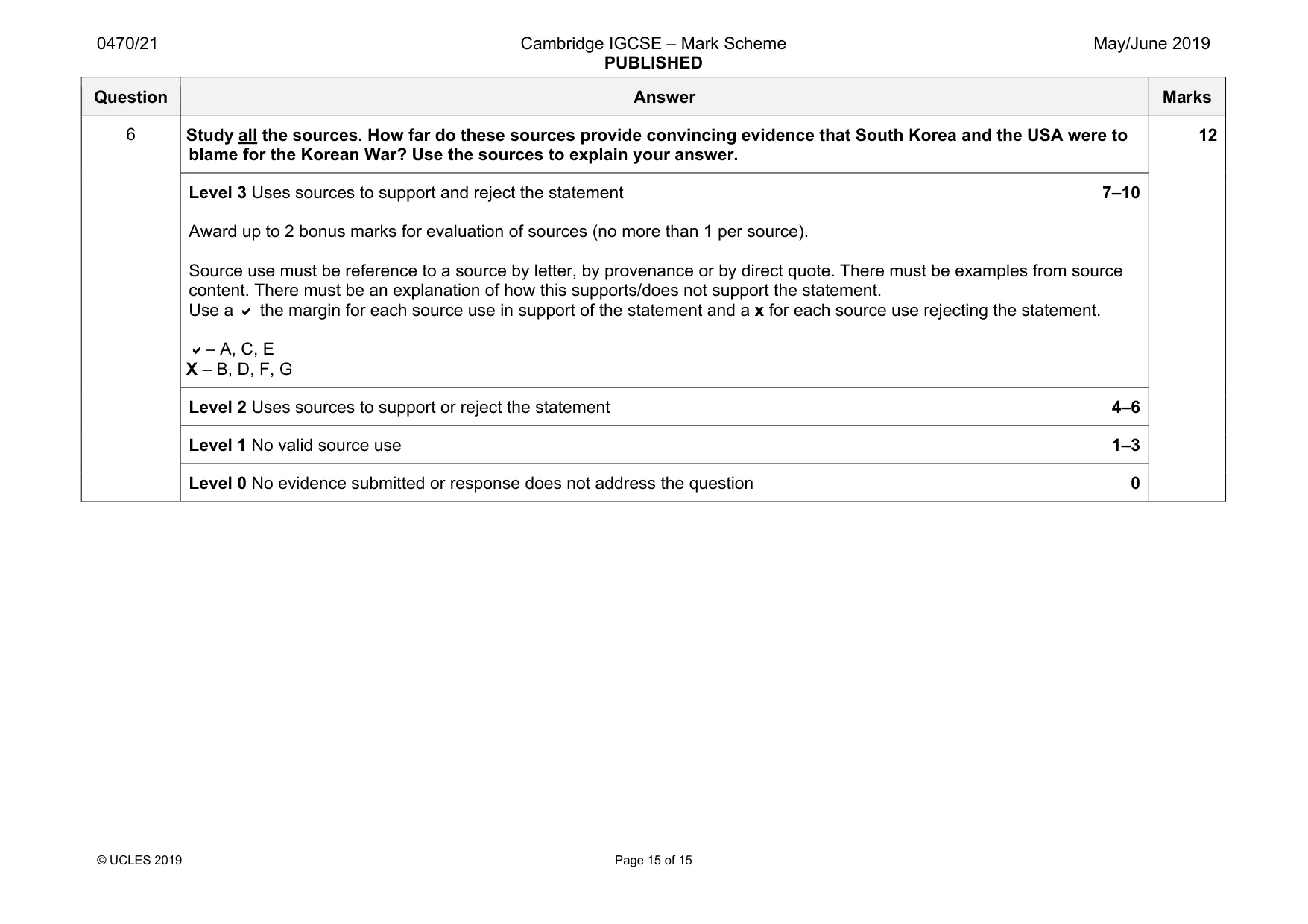
0470/21 Cambridge IGCSE – Mark Scheme PUBLISHED May/June 2019 © UCLES 2019 Page 15 of 15 Question Answer Marks 6 Study all the sources. How far do these sources provide convincing evidence that South Korea and the USA were to blame for the Korean War? Use the sources to explain your answer. 12 Level 3 Uses sources to support and reject the statement 7–10 Award up to 2 bonus marks for evaluation of sources (no more than 1 per source). Source use must be reference to a source by letter, by provenance or by direct quote. There must be examples from source content. There must be an explanation of how this supports/does not support the statement. Use a D the margin for each source use in support of the statement and a x for each source use rejecting the statement. D– A, C, E X – B, D, F, G Level 2 Uses sources to support or reject the statement 4–6 Level 1 No valid source use 1–3 Level 0 No evidence submitted or response does not address the question 0
What you needed in this session
Cambridge’s own grade thresholds for 2019 May/June, Paper 2 · Variant 1. A higher threshold means an easier paper — the bar moves with how the cohort did.