Cambridge IGCSE History 0470 — 2019 May/June Paper 2 · Variant 2
0470/22/M/J/19 · 50 marks · ≈56 min
The question paper and its mark scheme, free to read here and free to download. This is Cambridge’s own paper, exactly as it was sat.
Question paper16 pages
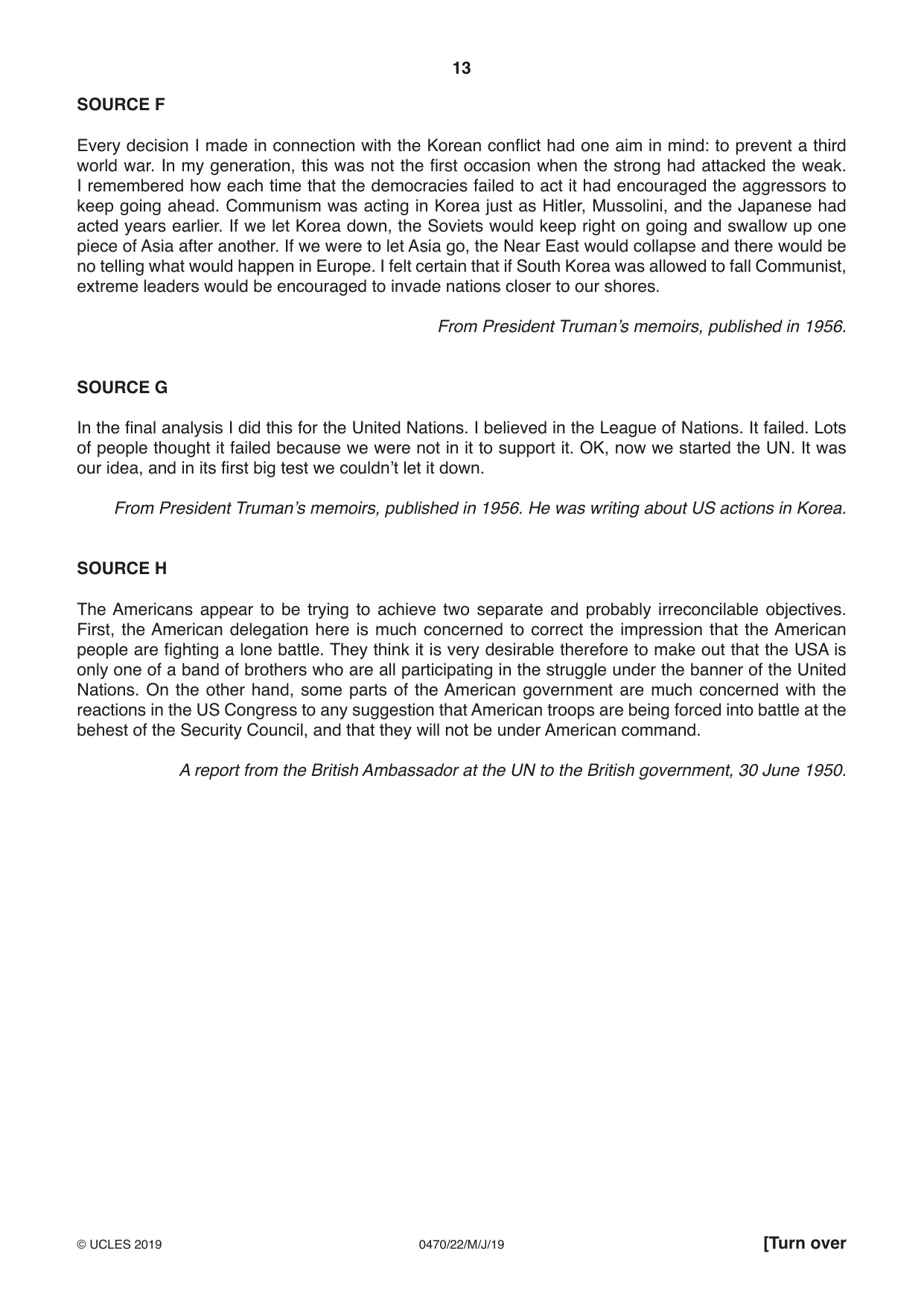
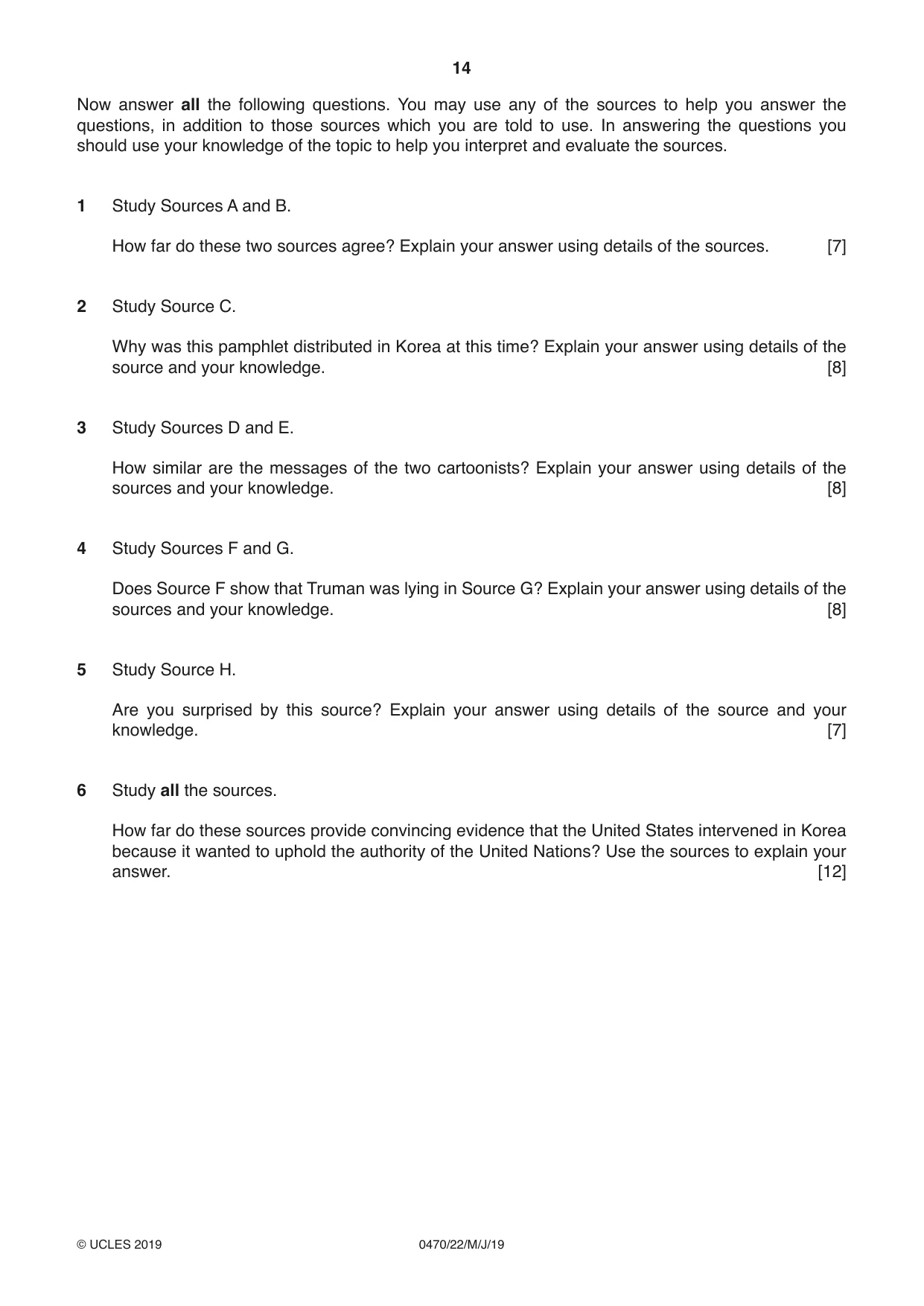

Mark scheme15 pages
Answers below. Sit the paper first if you are practising.
Paper as text
Question paper, page 1
This document consists of 13 printed pages, 3 blank pages and 1 Insert. DC (JP/TP) 167393/4 © UCLES 2019 [Turn over Cambridge Assessment International Education Cambridge International General Certificate of Secondary Education * 0 3 3 6 8 6 3 8 4 0 * HISTORY 0470/22 Paper 2 May/June 2019 2 hours No Additional Materials are required. READ THESE INSTRUCTIONS FIRST An answer booklet is provided inside this question paper. You should follow the instructions on the front cover of the answer booklet. If you need additional answer paper ask the invigilator for a continuation booklet. This paper has two options. Choose one option, and then answer all of the questions on that topic. Option A: Nineteenth century topic [p2–p6] Option B: Twentieth century topic [p8–p14] The number of marks is given in brackets [ ] at the end of each question or part question. This syllabus is regulated for use in England, Wales and Northern Ireland as a Cambridge International Level 1/Level 2 Certificate.
Question paper, page 2
2 0470/22/M/J/19 © UCLES 2019 Option A: Nineteenth century topic WHOSE FAULT WAS THE SECOND OPIUM WAR OF 1856–60? Study the Background Information and the sources carefully, and then answer all the questions. Background Information There are different views about whether Britain or China was responsible for the Second Opium War which began in 1856. There are different versions about what happened and who was in the right when Chinese officials boarded a British-registered ship, the Arrow, in Canton harbour. Some historians claim that Britain used the incident as an excuse to attack China because it wanted to increase its power there. Others claim that the Chinese had no right to board the Arrow, had failed to implement earlier treaties and were uncooperative in the negotiations that followed the incident. The Arrow incident and the war that followed caused much controversy in Britain, with the government being defeated in Parliament over it in March 1857. This led to a general election in April, which was called ‘the Chinese election’, with Palmerston’s government fighting for its life. Who was to blame for the Second Opium War? SOURCE A The Second Opium War was a continuation of the first. With imperialism hitting its high point in the 1850s, western countries wanted more of a say in China. The treaties that China signed with France and the United States in the 1840s allowed for negotiations after twelve years. The British also wanted this privilege and wanted to renegotiate the Treaty of Nanking. The British used their ‘most favoured nation status’ to demand all of China be open to merchants, legalisation of the opium trade, ambassadors to be allowed to reside in Peking, and the English version of treaties to take precedence over the Chinese version. The Chinese refused all the demands. Tensions came to a head on 8 October 1856 when Chinese officials boarded the Arrow, which they suspected of being involved in piracy and smuggling. The officials arrested twelve Chinese subjects from the ship. The Arrow was a Chinese-owned ship registered in Hong Kong but the British claimed it had recently been registered to them. The British demanded the release of the pirates as if they were fine, upstanding British citizens. They claimed that as the Arrow was British-registered it was protected under the Treaty of Nanking. The British argument was a weak one and they then resorted to claiming that the Arrow had been flying the British flag, which the Chinese soldiers had taken down and insulted. Yeh Ming-ch’en, the Chinese government’s Commissioner at Canton, insisted that the Arrow was not flying the British flag. Actually, the Arrow’s registration had expired a few days earlier so it had no right to fly the British flag at the time and her crew’s arrest by the Chinese authorities was lawful. Negotiations broke down but not before all the sailors had been returned with a letter promising great care would be taken that British ships were not boarded improperly. This did not stop the British attacking Canton. From a recent history book.
Question paper, page 3
3 0470/22/M/J/19 © UCLES 2019 [Turn over SOURCE B The 1850s saw the rapid growth of imperialism. The western powers wanted to expand their overseas markets and establish new ports of call. The outbreak of fresh hostilities under such circumstances was almost inevitable because Chinese officials were extremely reluctant to enact the terms of the treaties of 1842–44. The hopes of foreign merchants that the end of the First Opium War would make life easier for them were soon disappointed. The Chinese showed themselves no more prepared to regard foreigners as equals than they had ever been. Since the French and Americans had extracted concessions about renegotiation after twelve years, Great Britain insisted upon exercising its ‘most-favoured nation status’. The British demanded that China open all her ports to foreign trade, legalise the importation of opium from British possessions in India and Burma and permit the establishment of a British embassy in Peking. For two years Chinese court officials stalled, trying to buy time. Events ran out of their control when, on 8 October 1856, officials boarded the Chinese-owned, but Hong Kong-based, merchant ship Arrow. The Arrow was owned by a Chinese settler in Hong Kong and had been registered under a Colonial Ordinance which authorised the use of the British flag on Chinese-owned vessels, so as to give them immunity from attack. The Arrow was rumoured to be involved in smuggling and piracy and the British flag which it had been flying was hauled down and twelve Chinese subjects were arrested. The British trade officials naturally argued that as a foreign vessel that was British-registered, the Arrow’s activities did not fall under Chinese legal jurisdiction and the sailors should be released. The British Consul, Harry Parkes, added that if the men were returned he would be prepared to join with Chinese officials in investigating any crime of which they might be accused. The Imperial Commissioner replied that the prisoners had been seized in connection with a case of piracy and only released nine of them. In return, the British had no alternative but to shell the city. From a recent history book.
Question paper, page 4
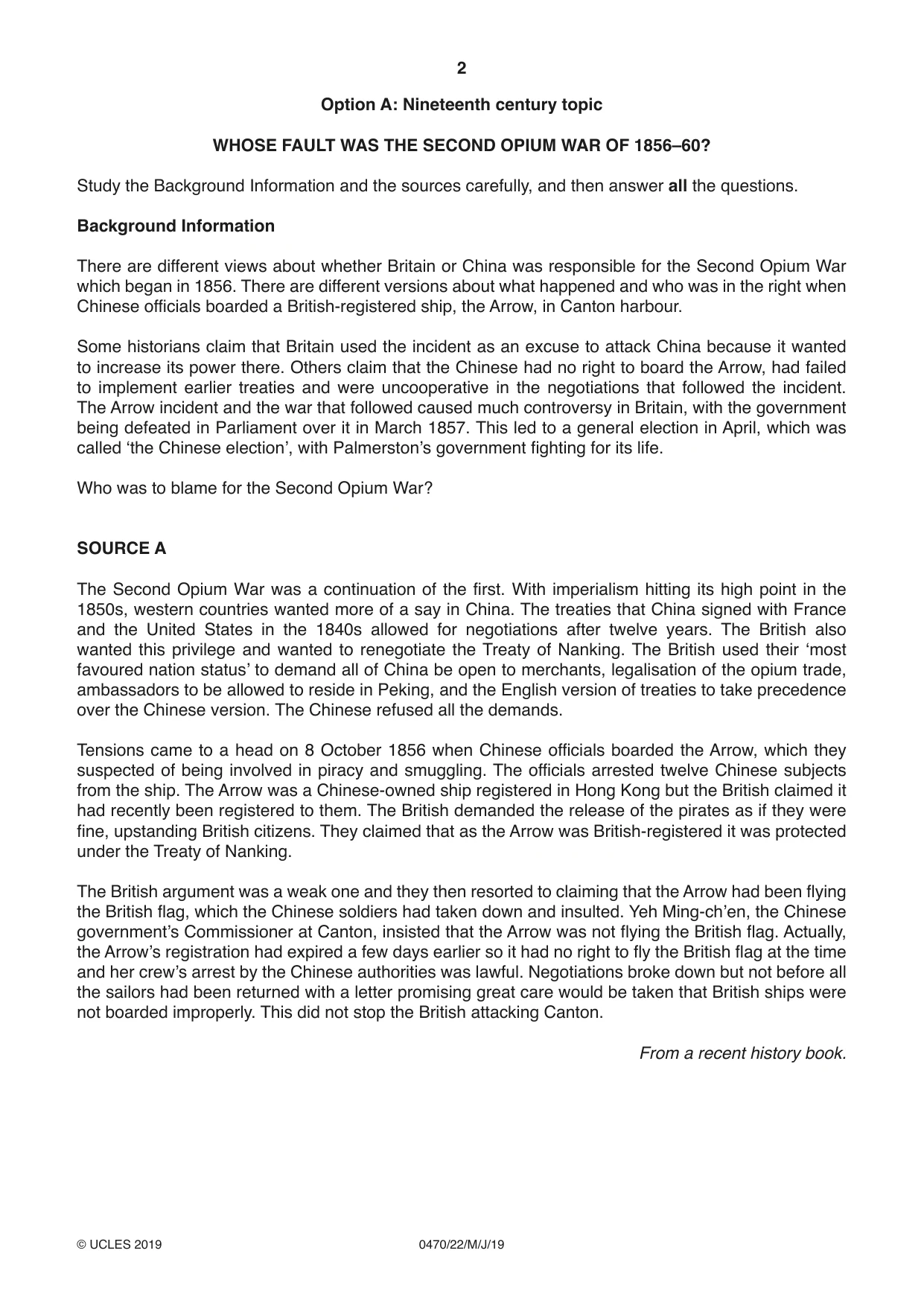
4 0470/22/M/J/19 © UCLES 2019 SOURCE C An illustration of events on the Arrow published in a British magazine in October 1856. SOURCE D It appears, on examination, that the Arrow had no right to hoist the British flag, the licence to do so expired on 27 September, from which period she has not been entitled to British protection. A letter from Sir John Bowring, Governor of Hong Kong, to Harry Parkes, British Consul in Canton, 10 October 1856. SOURCE E There is no doubt that the Arrow lawfully bore the British flag, under a register granted by me. A letter from Sir John Bowring to Yeh Ming-ch’en, 14 October 1856. SOURCE F Yeh is one of the most savage barbarians that ever disgraced a nation, guilty of every crime that could degrade and debase human nature. He is an insolent barbarian who violated the British flag, broke the terms of treaties, offered rewards for the heads of British subjects and planned their destruction by murder, assassination and poison. The British Prime Minister, Lord Palmerston, speaking at a public meeting during the election campaign in 1857.
Question paper, page 5
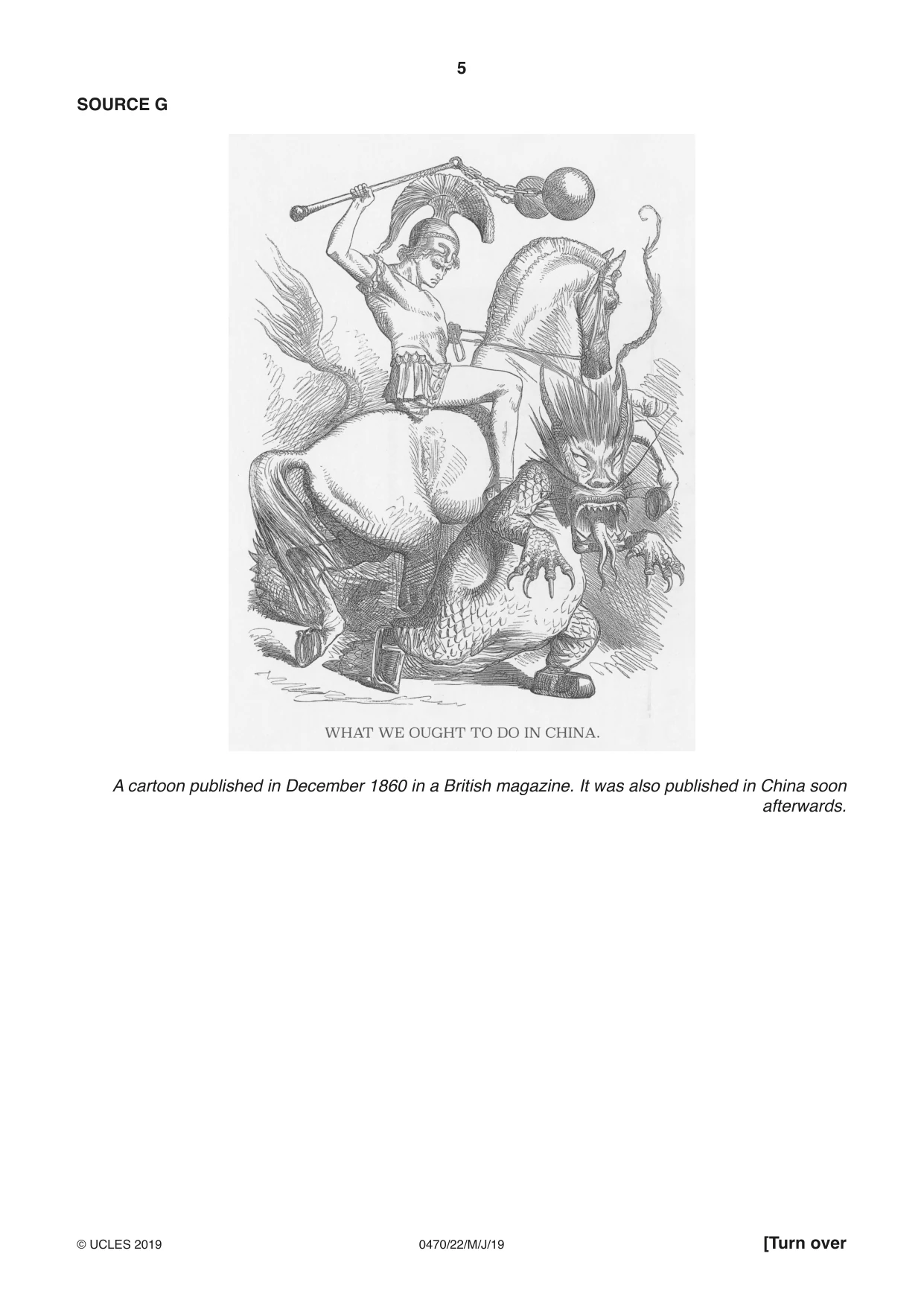
5 0470/22/M/J/19 © UCLES 2019 [Turn over SOURCE G A cartoon published in December 1860 in a British magazine. It was also published in China soon afterwards.
Question paper, page 6
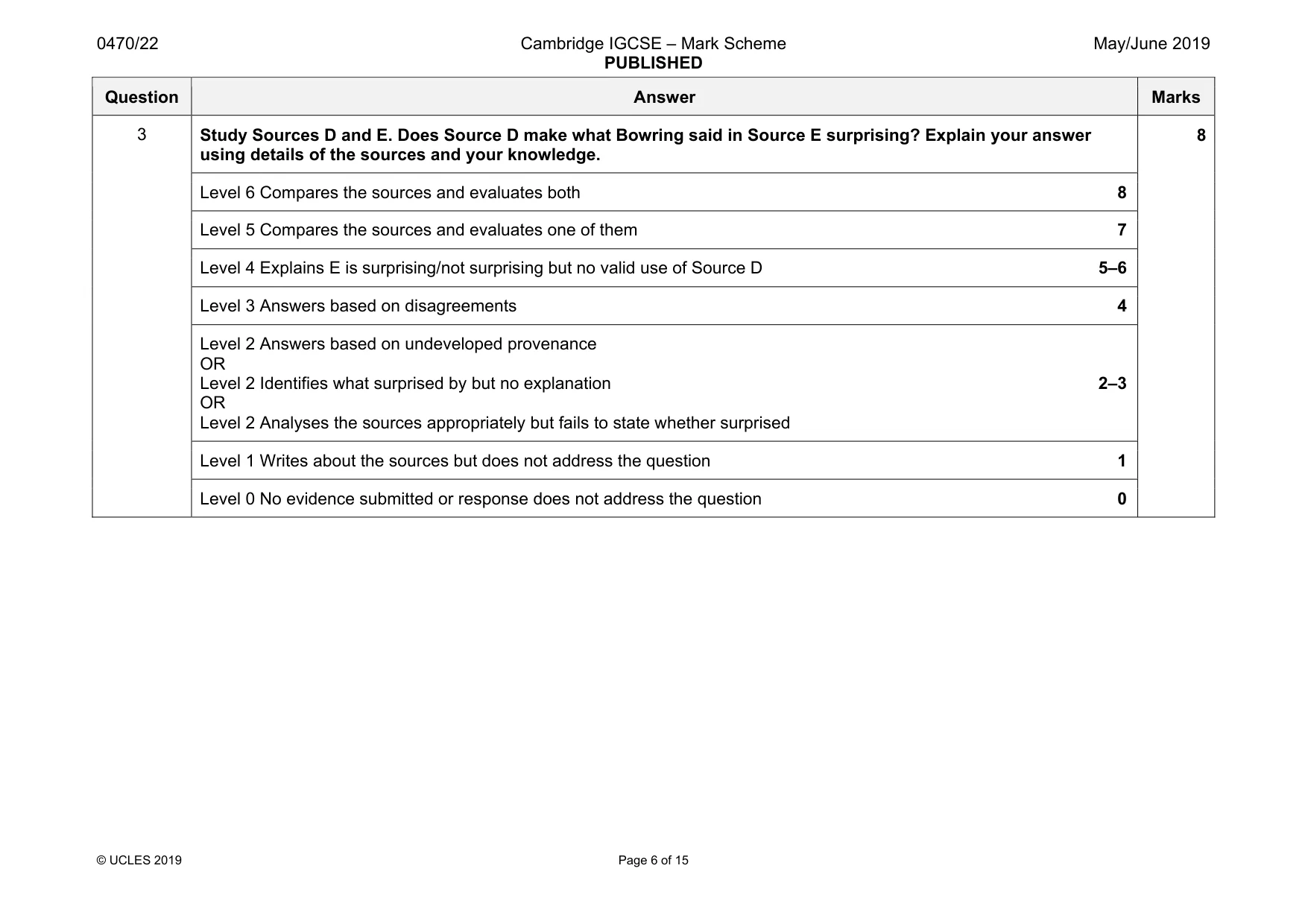
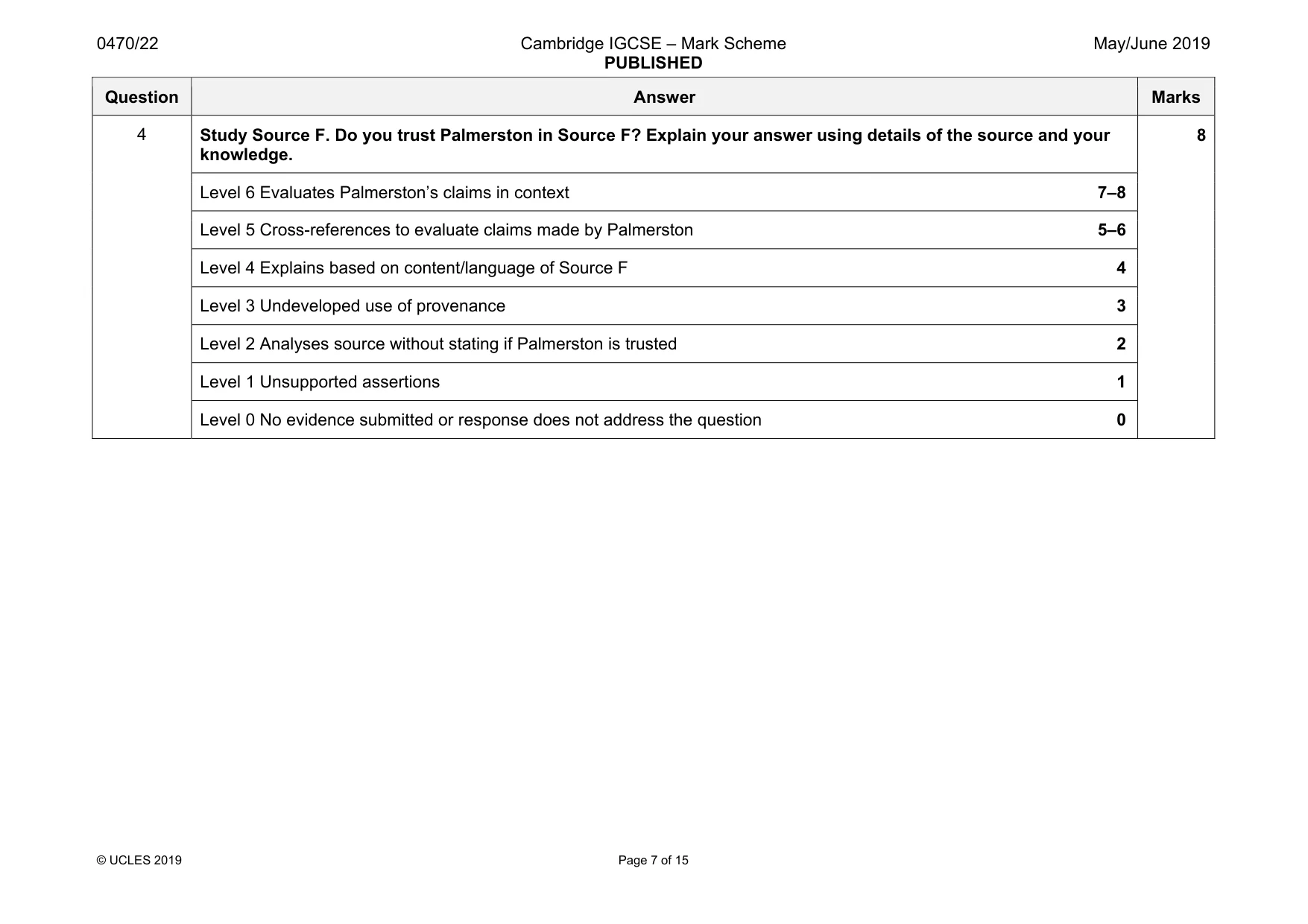
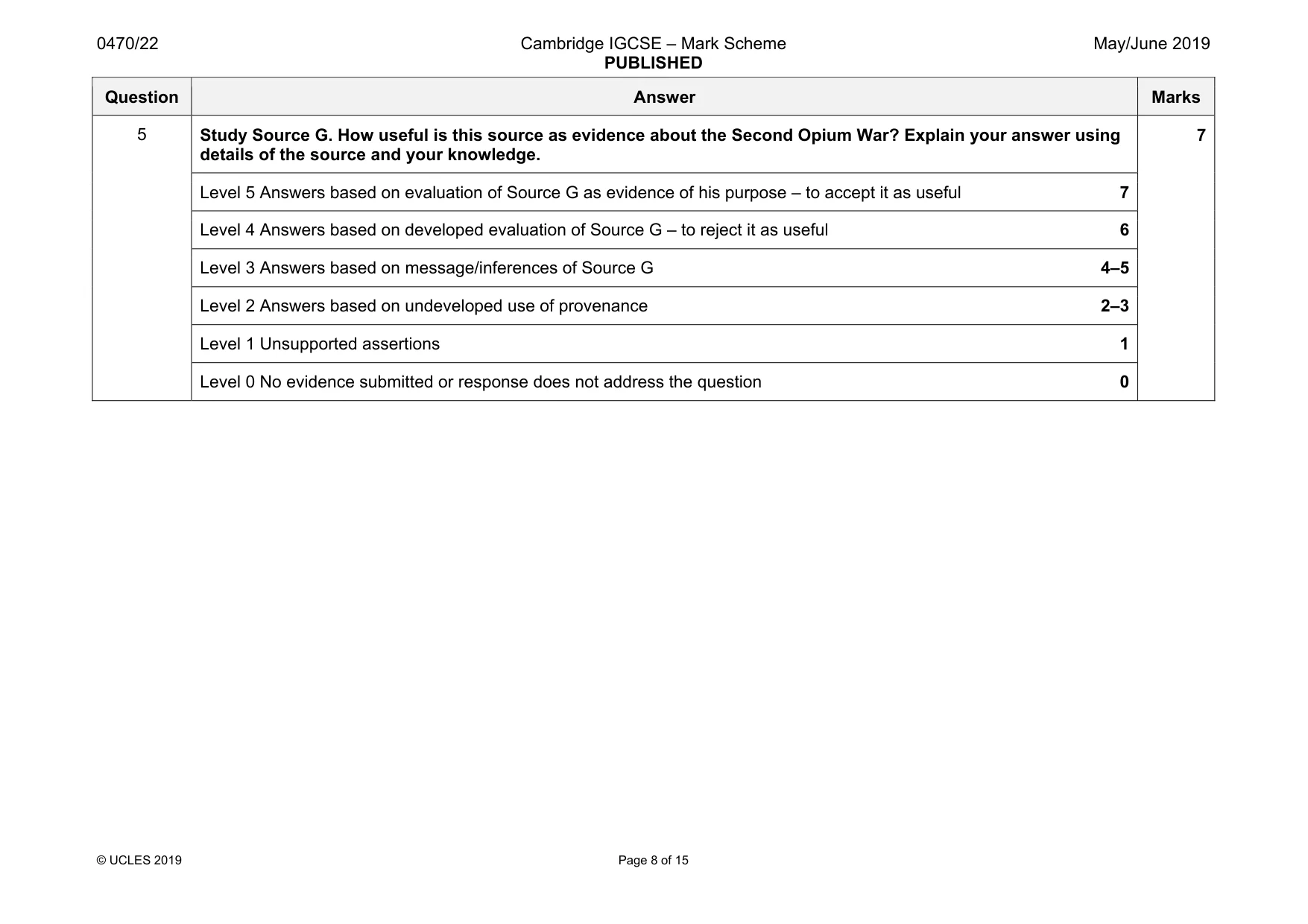
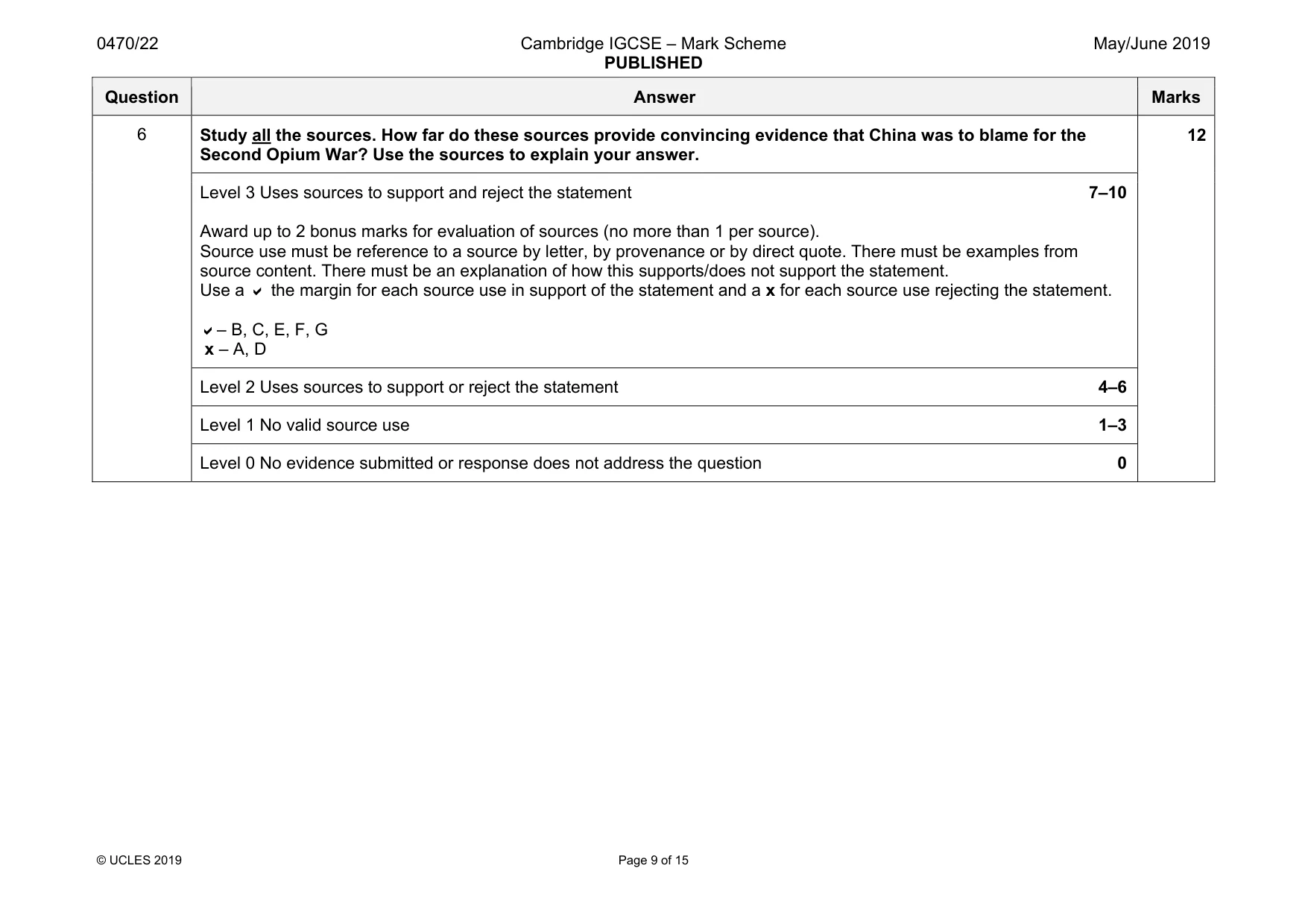
6 0470/22/M/J/19 © UCLES 2019 Now answer all the following questions. You may use any of the sources to help you answer the questions, in addition to those sources which you are told to use. In answering the questions you should use your knowledge of the topic to help you interpret and evaluate the sources. 1 Study Sources A and B. How far do these two sources agree? Explain your answer using details of the sources. [8] 2 Study Source C. Why was this illustration published in a British magazine in October 1856? Explain your answer using details of the source and your knowledge. [7] 3 Study Sources D and E. Does Source D make what Bowring said in Source E surprising? Explain your answer using details of the sources and your knowledge. [8] 4 Study Source F. Do you trust Palmerston in Source F? Explain your answer using details of the source and your knowledge. [8] 5 Study Source G. How useful is this source as evidence about the Second Opium War? Explain your answer using details of the source and your knowledge. [7] 6 Study all the sources. How far do these sources provide convincing evidence that China was to blame for the Second Opium War? Use the sources to explain your answer. [12]
Question paper, page 7
7 0470/22/M/J/19 © UCLES 2019 [Turn over BLANK PAGE
Question paper, page 8
8 0470/22/M/J/19 © UCLES 2019 Option B: Twentieth century topic WAS SUPPORTING THE UNITED NATIONS THE REASON WHY THE USA INTERVENED IN KOREA? Study the Background Information and the sources carefully, and then answer all the questions. Background Information The Korean War started on 25 June 1950. This was the first big test of the United Nations. On the same day, the United Nations’ Security Council condemned the North Korean invasion of South Korea. On 27 June, the Security Council issued a resolution requesting member states to provide military assistance to South Korea. At the same time, President Truman ordered American forces to help the South. Many countries contributed to the military effort but it was dominated by the Americans. Although it was officially a United Nations’ intervention, the USA took charge. How far did the USA intervene in Korea to support the United Nations? SOURCE A The events now taking place in Korea broke out on 25 June as the result of a provocative attack by the troops of the South Korean authorities on the frontier areas of the Korean People’s Democratic Republic. This attack was the outcome of a premeditated plan. On 31 October 1949, the Defence Minister of the South Korean Government told newspaper correspondents that the South Korean troops were strong enough to take Pyongyang within a few days. It is not difficult to understand that South Korea could only make such statements because they felt that they had American support. One month before, a member of the American government told Congress that 100 000 officers and men of the South Korean Army, equipped with American weapons, could begin war at any time. The United States’ Government tries to justify armed intervention against North Korea by alleging that it was undertaken on the authorisation of the Security Council. The falsity of such an allegation strikes the eye. What really happened? It is known that the United States’ Government had started armed intervention in Korea before the Security Council was summoned to meet on 27 June. The Security Council merely rubber-stamped and back-dated the resolution proposed by the United States’ Government, approving their aggressive actions. The illegal resolution of 27 June, adopted by the Security Council under pressure from the United States’ Government, shows that the Security Council is acting as a tool utilised by the United States for unleashing war. From a statement by Andrei Gromyko, Soviet Deputy Minister of Foreign Affairs, 4 July 1950, published in a Soviet newspaper. Pyongyang is the capital city of North Korea.
Question paper, page 9
9 0470/22/M/J/19 © UCLES 2019 [Turn over SOURCE B I want to talk to you tonight about the situation in Korea, and about what it means to the security of the United States and to our hopes for peace in the world. On Sunday 25 June, Communist forces attacked South Korea. This attack has made it clear that the international Communist movement is willing to use armed invasion to conquer independent nations. The attack upon South Korea was a violation of the Charter of the United Nations. By their actions in Korea, Communist leaders have demonstrated their contempt for the basic moral principles on which the United Nations is founded. This is a direct challenge to the efforts of the free nations to build the kind of world in which men can live in freedom and peace. The size and speed of the attack make it perfectly plain that it had been plotted long in advance. Secretary of State Acheson called me and informed me that, with my approval, he would ask for an immediate meeting of the United Nations’ Security Council on 27 June. One of the main reasons the Security Council was set up was to stop outbreaks of aggression like this before they develop into general conflicts. The Council passed a resolution which called for the invaders of South Korea to stop fighting, and to withdraw. The Council called on all members of the United Nations to help carry out this resolution. The Communist invaders carried on with their attack. The Security Council then met again. It recommended that members of the United Nations help South Korea repel the attack and help restore peace and security in that area. Fifty-two of the fifty-nine countries which are members of the United Nations have given their support to the action. These actions by the United Nations have now made it clear that lawless aggression will be met with force. For our part, we shall continue to support the United Nations’ action to restore peace in the world. From a radio broadcast to the American people by President Truman, 19 July 1950.
Question paper, page 10
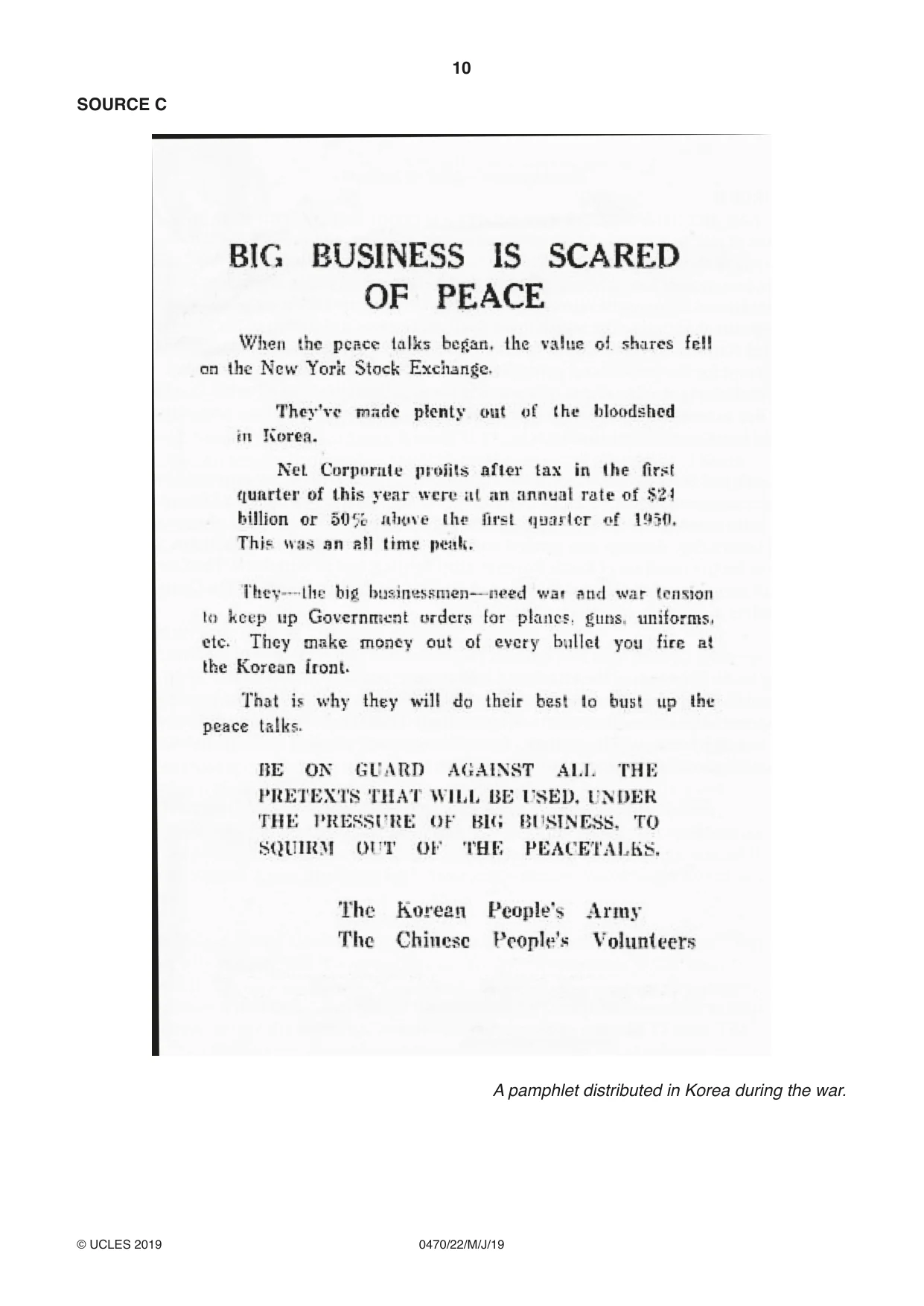
10 0470/22/M/J/19 © UCLES 2019 SOURCE C A pamphlet distributed in Korea during the war.
Question paper, page 11
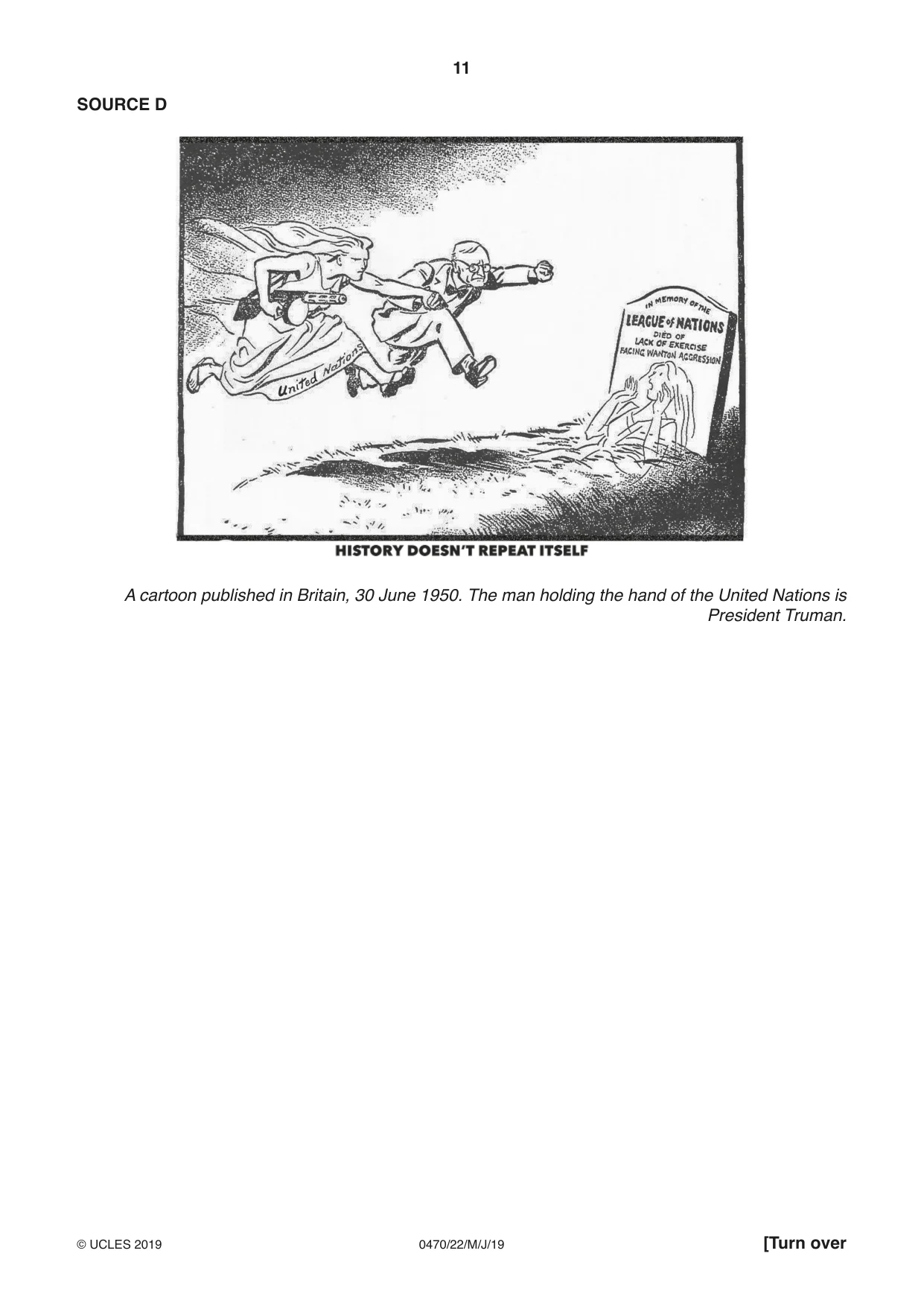
11 0470/22/M/J/19 © UCLES 2019 [Turn over SOURCE D A cartoon published in Britain, 30 June 1950. The man holding the hand of the United Nations is President Truman.
Question paper, page 12
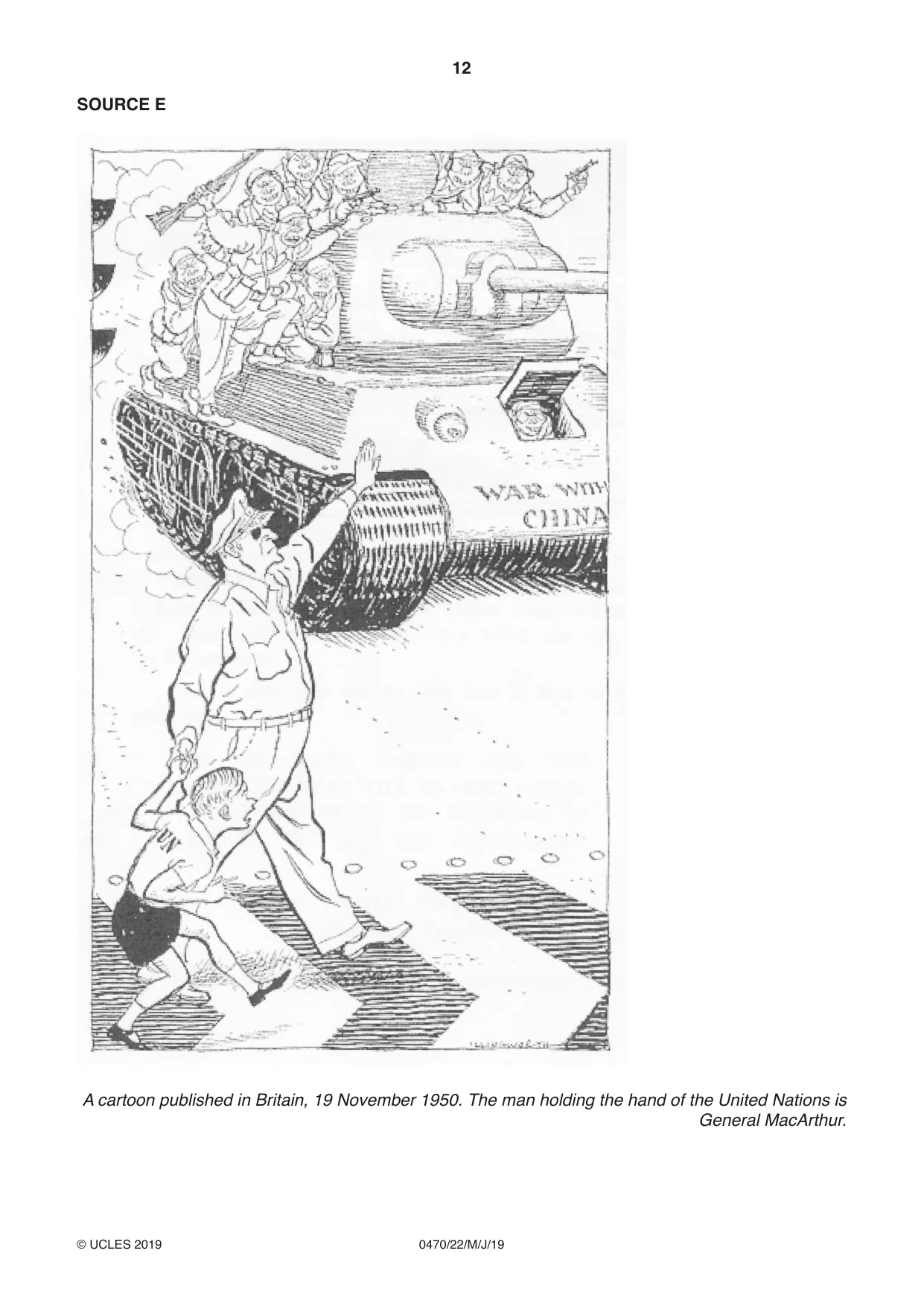
12 0470/22/M/J/19 © UCLES 2019 SOURCE E A cartoon published in Britain, 19 November 1950. The man holding the hand of the United Nations is General MacArthur.
Question paper, page 13
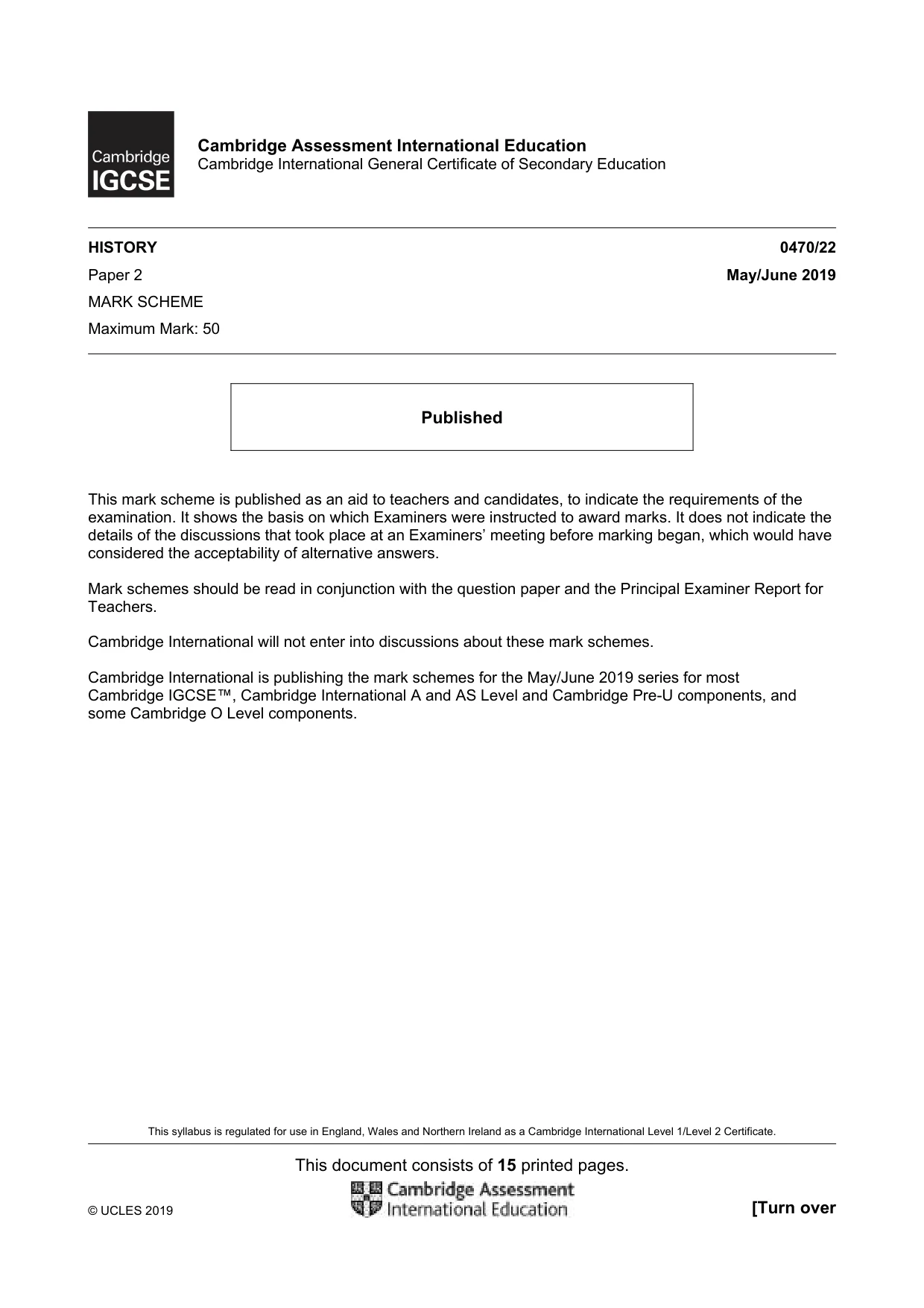
13 0470/22/M/J/19 © UCLES 2019 [Turn over SOURCE F Every decision I made in connection with the Korean conflict had one aim in mind: to prevent a third world war. In my generation, this was not the first occasion when the strong had attacked the weak. I remembered how each time that the democracies failed to act it had encouraged the aggressors to keep going ahead. Communism was acting in Korea just as Hitler, Mussolini, and the Japanese had acted years earlier. If we let Korea down, the Soviets would keep right on going and swallow up one piece of Asia after another. If we were to let Asia go, the Near East would collapse and there would be no telling what would happen in Europe. I felt certain that if South Korea was allowed to fall Communist, extreme leaders would be encouraged to invade nations closer to our shores. From President Truman’s memoirs, published in 1956. SOURCE G In the final analysis I did this for the United Nations. I believed in the League of Nations. It failed. Lots of people thought it failed because we were not in it to support it. OK, now we started the UN. It was our idea, and in its first big test we couldn’t let it down. From President Truman’s memoirs, published in 1956. He was writing about US actions in Korea. SOURCE H The Americans appear to be trying to achieve two separate and probably irreconcilable objectives. First, the American delegation here is much concerned to correct the impression that the American people are fighting a lone battle. They think it is very desirable therefore to make out that the USA is only one of a band of brothers who are all participating in the struggle under the banner of the United Nations. On the other hand, some parts of the American government are much concerned with the reactions in the US Congress to any suggestion that American troops are being forced into battle at the behest of the Security Council, and that they will not be under American command. A report from the British Ambassador at the UN to the British government, 30 June 1950.
Question paper, page 14
14 0470/22/M/J/19 © UCLES 2019 Now answer all the following questions. You may use any of the sources to help you answer the questions, in addition to those sources which you are told to use. In answering the questions you should use your knowledge of the topic to help you interpret and evaluate the sources. 1 Study Sources A and B. How far do these two sources agree? Explain your answer using details of the sources. [7] 2 Study Source C. Why was this pamphlet distributed in Korea at this time? Explain your answer using details of the source and your knowledge. [8] 3 Study Sources D and E. How similar are the messages of the two cartoonists? Explain your answer using details of the sources and your knowledge. [8] 4 Study Sources F and G. Does Source F show that Truman was lying in Source G? Explain your answer using details of the sources and your knowledge. [8] 5 Study Source H. Are you surprised by this source? Explain your answer using details of the source and your knowledge. [7] 6 Study all the sources. How far do these sources provide convincing evidence that the United States intervened in Korea because it wanted to uphold the authority of the United Nations? Use the sources to explain your answer. [12]
Question paper, page 15
15 0470/22/M/J/19 © UCLES 2019 BLANK PAGE
Question paper, page 16
16 0470/22/M/J/19 © UCLES 2019 BLANK PAGE Permission to reproduce items where third-party owned material protected by copyright is included has been sought and cleared where possible. Every reasonable effort has been made by the publisher (UCLES) to trace copyright holders, but if any items requiring clearance have unwittingly been included, the publisher will be pleased to make amends at the earliest possible opportunity. To avoid the issue of disclosure of answer-related information to candidates, all copyright acknowledgements are reproduced online in the Cambridge Assessment International Education Copyright Acknowledgements Booklet. This is produced for each series of examinations and is freely available to download at www.cambridgeinternational.org after the live examination series. Cambridge Assessment International Education is part of the Cambridge Assessment Group. Cambridge Assessment is the brand name of the University of Cambridge Local Examinations Syndicate (UCLES), which itself is a department of the University of Cambridge.
Mark scheme, page 1
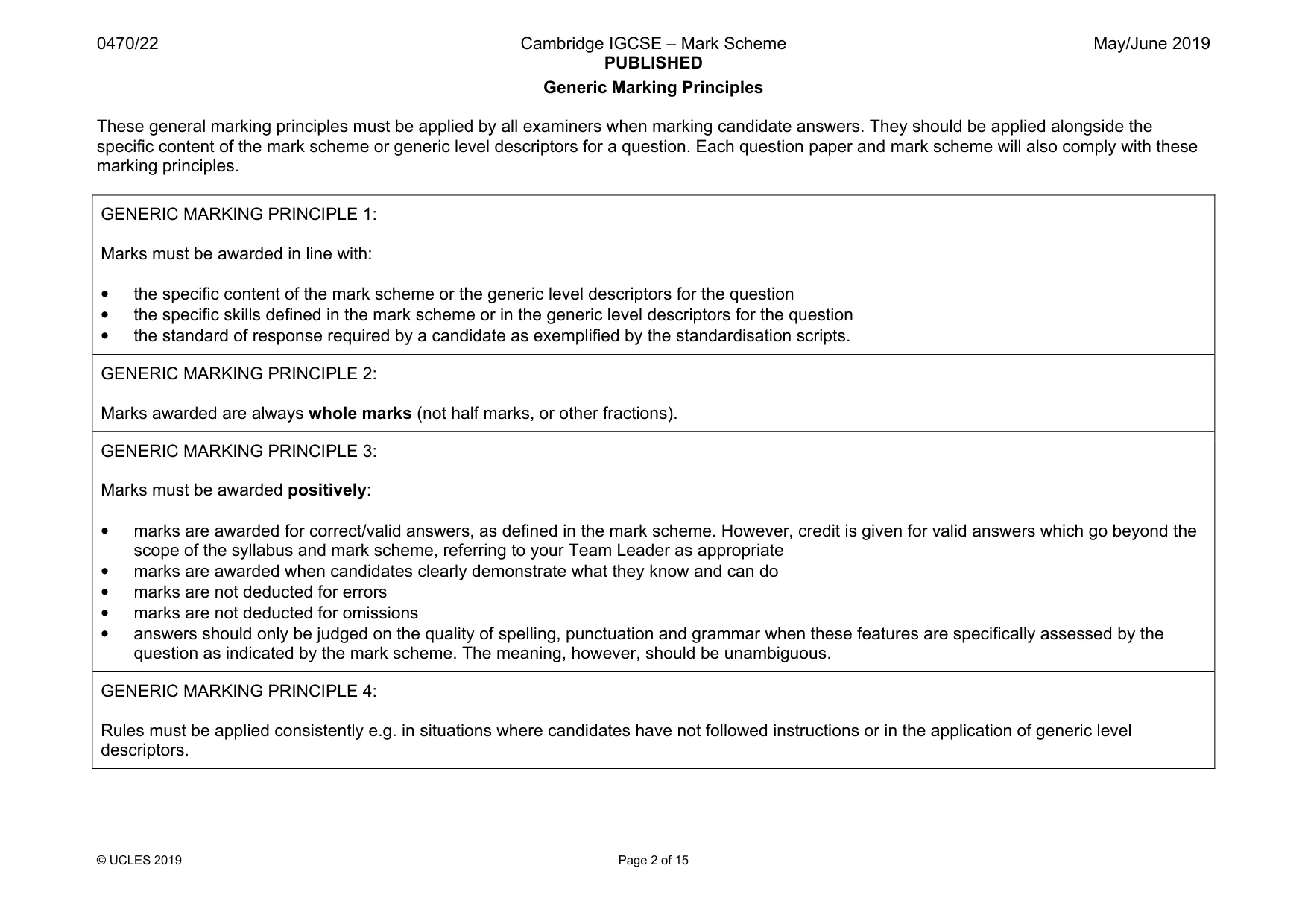
This syllabus is regulated for use in England, Wales and Northern Ireland as a Cambridge International Level 1/Level 2 Certificate. This document consists of 15 printed pages. © UCLES 2019 [Turn over Cambridge Assessment International Education Cambridge International General Certificate of Secondary Education HISTORY 0470/22 Paper 2 May/June 2019 MARK SCHEME Maximum Mark: 50 Published This mark scheme is published as an aid to teachers and candidates, to indicate the requirements of the examination. It shows the basis on which Examiners were instructed to award marks. It does not indicate the details of the discussions that took place at an Examiners’ meeting before marking began, which would have considered the acceptability of alternative answers. Mark schemes should be read in conjunction with the question paper and the Principal Examiner Report for Teachers. Cambridge International will not enter into discussions about these mark schemes. Cambridge International is publishing the mark schemes for the May/June 2019 series for most Cambridge IGCSE™, Cambridge International A and AS Level and Cambridge Pre-U components, and some Cambridge O Level components.
Mark scheme, page 2
0470/22 Cambridge IGCSE – Mark Scheme PUBLISHED May/June 2019 © UCLES 2019 Page 2 of 15 Generic Marking Principles These general marking principles must be applied by all examiners when marking candidate answers. They should be applied alongside the specific content of the mark scheme or generic level descriptors for a question. Each question paper and mark scheme will also comply with these marking principles. GENERIC MARKING PRINCIPLE 1: Marks must be awarded in line with: • the specific content of the mark scheme or the generic level descriptors for the question • the specific skills defined in the mark scheme or in the generic level descriptors for the question • the standard of response required by a candidate as exemplified by the standardisation scripts. GENERIC MARKING PRINCIPLE 2: Marks awarded are always whole marks (not half marks, or other fractions). GENERIC MARKING PRINCIPLE 3: Marks must be awarded positively: • marks are awarded for correct/valid answers, as defined in the mark scheme. However, credit is given for valid answers which go beyond the scope of the syllabus and mark scheme, referring to your Team Leader as appropriate • marks are awarded when candidates clearly demonstrate what they know and can do • marks are not deducted for errors • marks are not deducted for omissions • answers should only be judged on the quality of spelling, punctuation and grammar when these features are specifically assessed by the question as indicated by the mark scheme. The meaning, however, should be unambiguous. GENERIC MARKING PRINCIPLE 4: Rules must be applied consistently e.g. in situations where candidates have not followed instructions or in the application of generic level descriptors.
Mark scheme, page 3
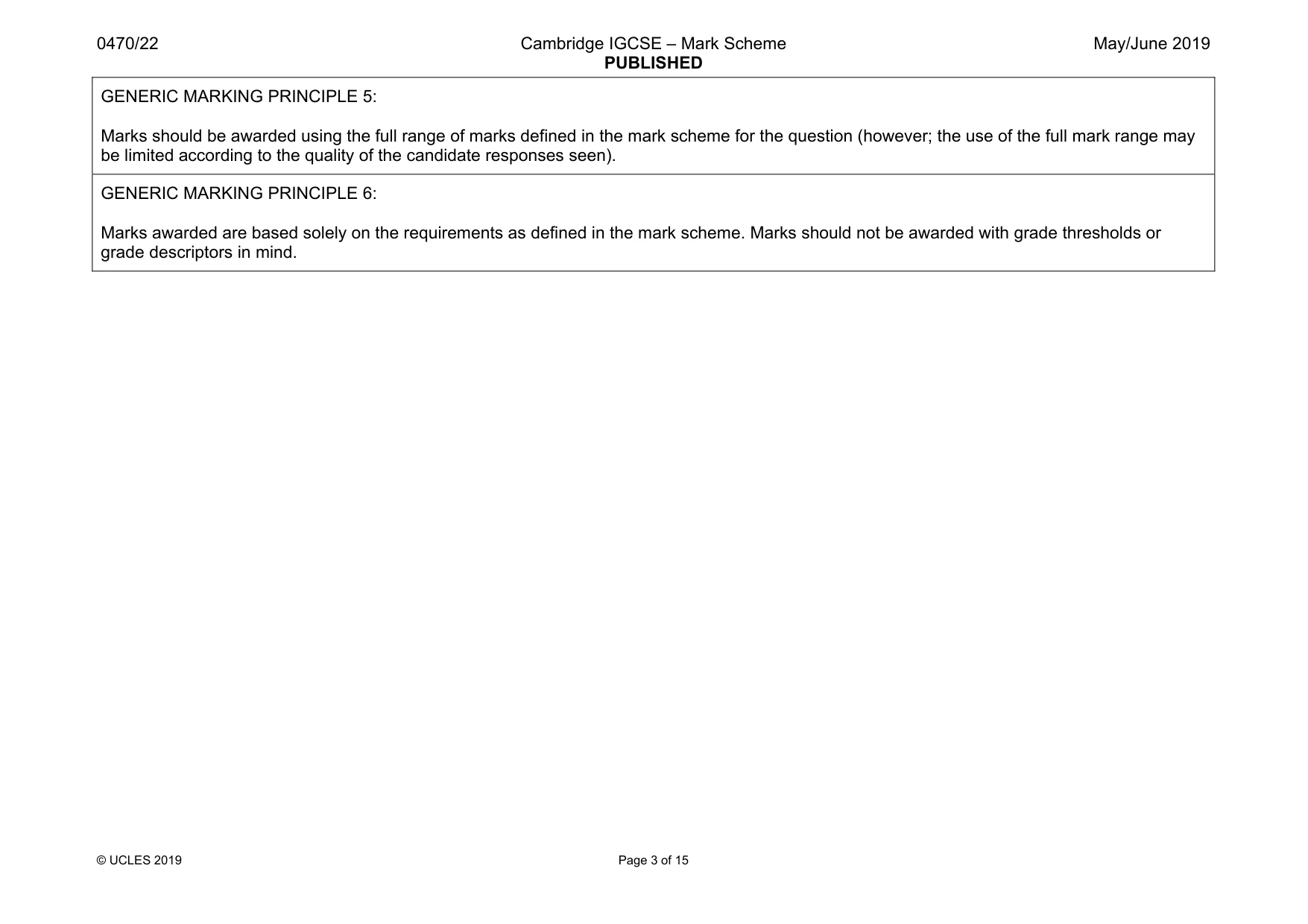
0470/22 Cambridge IGCSE – Mark Scheme PUBLISHED May/June 2019 © UCLES 2019 Page 3 of 15 GENERIC MARKING PRINCIPLE 5: Marks should be awarded using the full range of marks defined in the mark scheme for the question (however; the use of the full mark range may be limited according to the quality of the candidate responses seen). GENERIC MARKING PRINCIPLE 6: Marks awarded are based solely on the requirements as defined in the mark scheme. Marks should not be awarded with grade thresholds or grade descriptors in mind.
Mark scheme, page 4
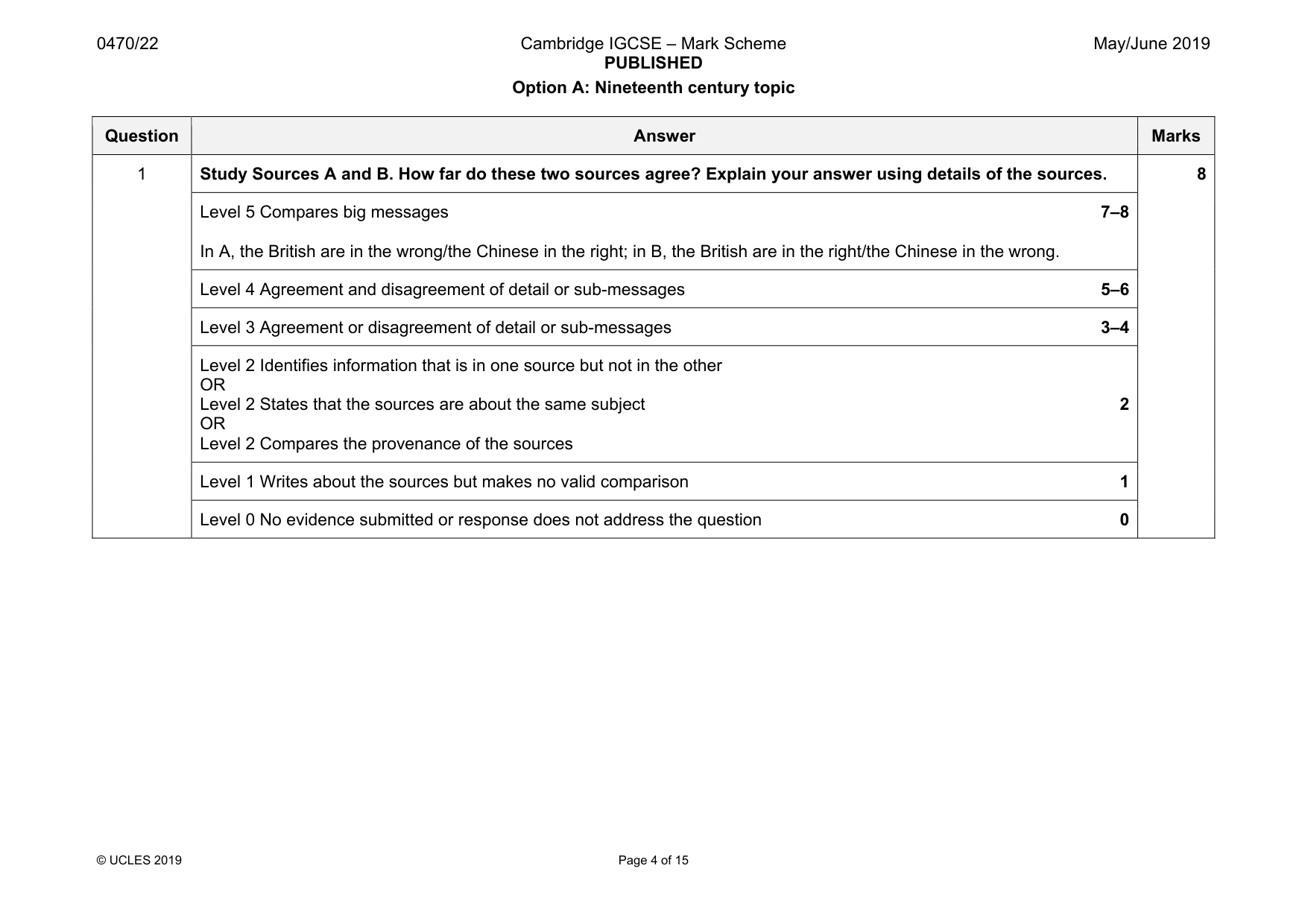
0470/22 Cambridge IGCSE – Mark Scheme PUBLISHED May/June 2019 © UCLES 2019 Page 4 of 15 Option A: Nineteenth century topic Question Answer Marks 1 Study Sources A and B. How far do these two sources agree? Explain your answer using details of the sources. 8 Level 5 Compares big messages 7–8 In A, the British are in the wrong/the Chinese in the right; in B, the British are in the right/the Chinese in the wrong. Level 4 Agreement and disagreement of detail or sub-messages 5–6 Level 3 Agreement or disagreement of detail or sub-messages 3–4 Level 2 Identifies information that is in one source but not in the other OR Level 2 States that the sources are about the same subject 2 OR Level 2 Compares the provenance of the sources Level 1 Writes about the sources but makes no valid comparison 1 Level 0 No evidence submitted or response does not address the question 0
Mark scheme, page 5
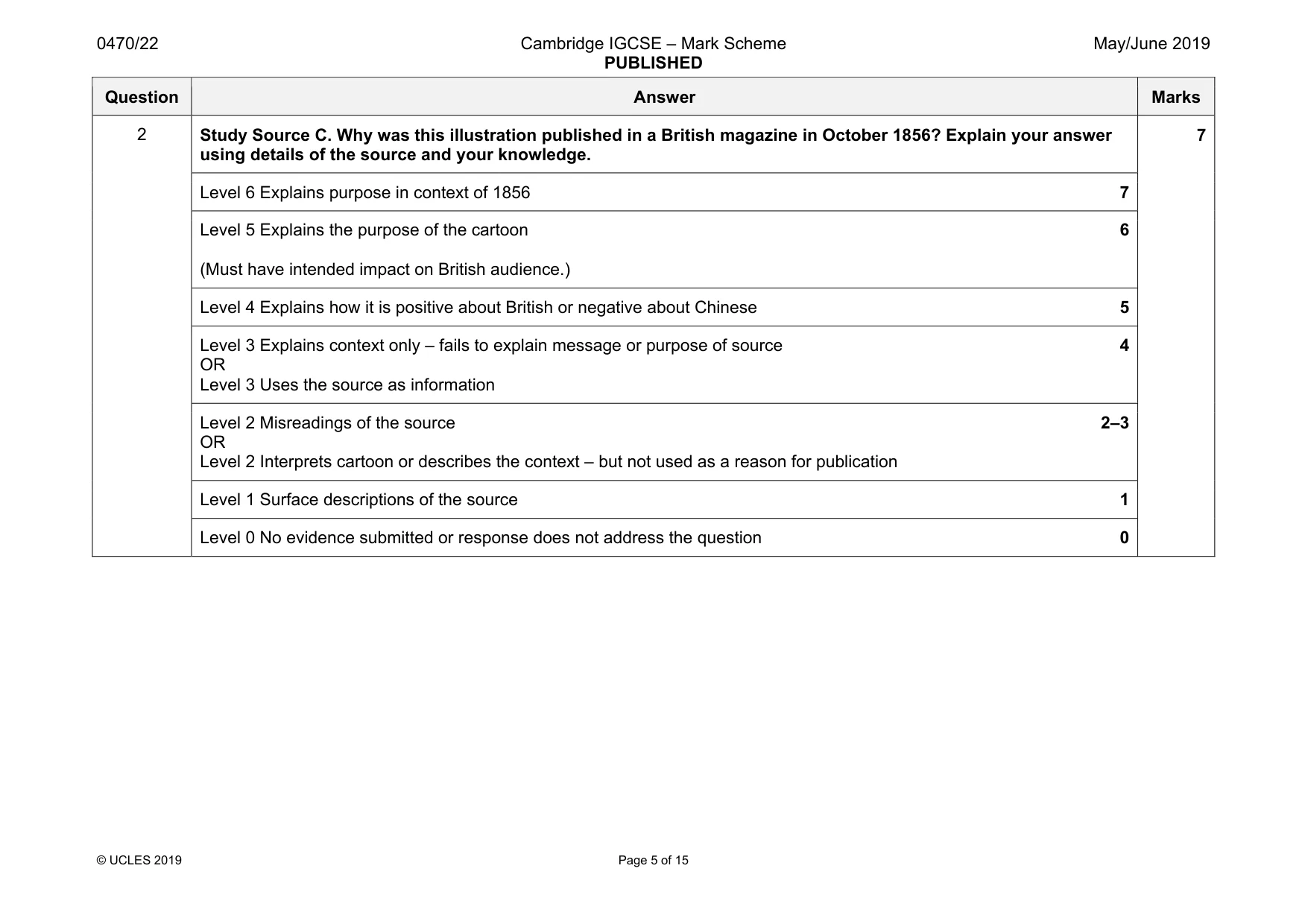
0470/22 Cambridge IGCSE – Mark Scheme PUBLISHED May/June 2019 © UCLES 2019 Page 5 of 15 Question Answer Marks 2 Study Source C. Why was this illustration published in a British magazine in October 1856? Explain your answer using details of the source and your knowledge. 7 Level 6 Explains purpose in context of 1856 7 Level 5 Explains the purpose of the cartoon 6 (Must have intended impact on British audience.) Level 4 Explains how it is positive about British or negative about Chinese 5 Level 3 Explains context only – fails to explain message or purpose of source 4 OR Level 3 Uses the source as information Level 2 Misreadings of the source 2–3 OR Level 2 Interprets cartoon or describes the context – but not used as a reason for publication Level 1 Surface descriptions of the source 1 Level 0 No evidence submitted or response does not address the question 0
Mark scheme, page 6
0470/22 Cambridge IGCSE – Mark Scheme PUBLISHED May/June 2019 © UCLES 2019 Page 6 of 15 Question Answer Marks 3 Study Sources D and E. Does Source D make what Bowring said in Source E surprising? Explain your answer using details of the sources and your knowledge. 8 Level 6 Compares the sources and evaluates both 8 Level 5 Compares the sources and evaluates one of them 7 Level 4 Explains E is surprising/not surprising but no valid use of Source D 5–6 Level 3 Answers based on disagreements 4 Level 2 Answers based on undeveloped provenance OR Level 2 Identifies what surprised by but no explanation 2–3 OR Level 2 Analyses the sources appropriately but fails to state whether surprised Level 1 Writes about the sources but does not address the question 1 Level 0 No evidence submitted or response does not address the question 0
Mark scheme, page 7
0470/22 Cambridge IGCSE – Mark Scheme PUBLISHED May/June 2019 © UCLES 2019 Page 7 of 15 Question Answer Marks 4 Study Source F. Do you trust Palmerston in Source F? Explain your answer using details of the source and your knowledge. 8 Level 6 Evaluates Palmerston’s claims in context 7–8 Level 5 Cross-references to evaluate claims made by Palmerston 5–6 Level 4 Explains based on content/language of Source F 4 Level 3 Undeveloped use of provenance 3 Level 2 Analyses source without stating if Palmerston is trusted 2 Level 1 Unsupported assertions 1 Level 0 No evidence submitted or response does not address the question 0
Mark scheme, page 8
0470/22 Cambridge IGCSE – Mark Scheme PUBLISHED May/June 2019 © UCLES 2019 Page 8 of 15 Question Answer Marks 5 Study Source G. How useful is this source as evidence about the Second Opium War? Explain your answer using details of the source and your knowledge. 7 Level 5 Answers based on evaluation of Source G as evidence of his purpose – to accept it as useful 7 Level 4 Answers based on developed evaluation of Source G – to reject it as useful 6 Level 3 Answers based on message/inferences of Source G 4–5 Level 2 Answers based on undeveloped use of provenance 2–3 Level 1 Unsupported assertions 1 Level 0 No evidence submitted or response does not address the question 0
Mark scheme, page 9
0470/22 Cambridge IGCSE – Mark Scheme PUBLISHED May/June 2019 © UCLES 2019 Page 9 of 15 Question Answer Marks 6 Study all the sources. How far do these sources provide convincing evidence that China was to blame for the Second Opium War? Use the sources to explain your answer. 12 Level 3 Uses sources to support and reject the statement 7–10 Award up to 2 bonus marks for evaluation of sources (no more than 1 per source). Source use must be reference to a source by letter, by provenance or by direct quote. There must be examples from source content. There must be an explanation of how this supports/does not support the statement. Use a D the margin for each source use in support of the statement and a x for each source use rejecting the statement. D– B, C, E, F, G x – A, D Level 2 Uses sources to support or reject the statement 4–6 Level 1 No valid source use 1–3 Level 0 No evidence submitted or response does not address the question 0
Mark scheme, page 10
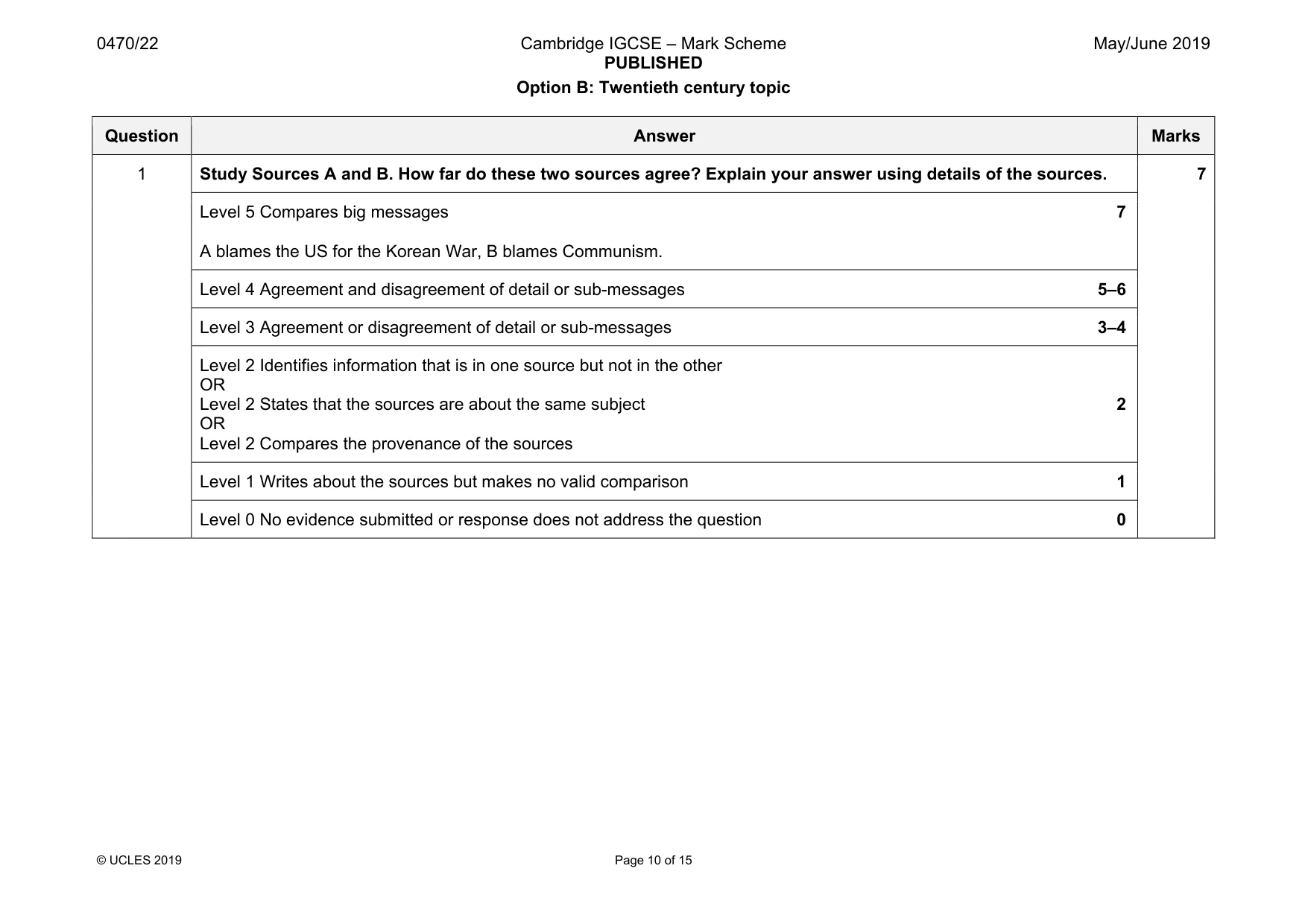
0470/22 Cambridge IGCSE – Mark Scheme PUBLISHED May/June 2019 © UCLES 2019 Page 10 of 15 Option B: Twentieth century topic Question Answer Marks 1 Study Sources A and B. How far do these two sources agree? Explain your answer using details of the sources. 7 Level 5 Compares big messages 7 A blames the US for the Korean War, B blames Communism. Level 4 Agreement and disagreement of detail or sub-messages 5–6 Level 3 Agreement or disagreement of detail or sub-messages 3–4 Level 2 Identifies information that is in one source but not in the other OR Level 2 States that the sources are about the same subject 2 OR Level 2 Compares the provenance of the sources Level 1 Writes about the sources but makes no valid comparison 1 Level 0 No evidence submitted or response does not address the question 0
Mark scheme, page 11
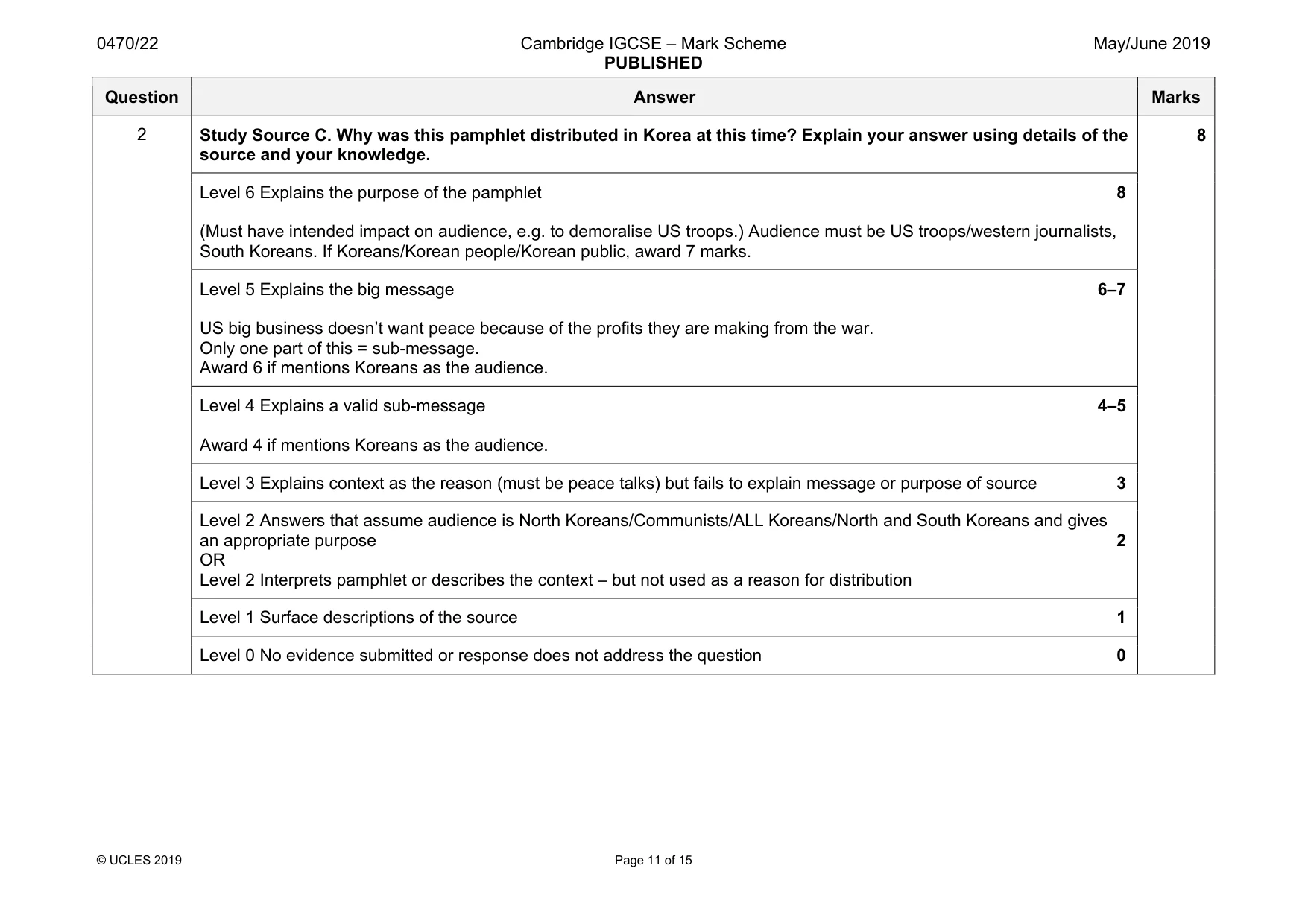
0470/22 Cambridge IGCSE – Mark Scheme PUBLISHED May/June 2019 © UCLES 2019 Page 11 of 15 Question Answer Marks 2 Study Source C. Why was this pamphlet distributed in Korea at this time? Explain your answer using details of the source and your knowledge. 8 Level 6 Explains the purpose of the pamphlet 8 (Must have intended impact on audience, e.g. to demoralise US troops.) Audience must be US troops/western journalists, South Koreans. If Koreans/Korean people/Korean public, award 7 marks. Level 5 Explains the big message 6–7 US big business doesn’t want peace because of the profits they are making from the war. Only one part of this = sub-message. Award 6 if mentions Koreans as the audience. Level 4 Explains a valid sub-message 4–5 Award 4 if mentions Koreans as the audience. Level 3 Explains context as the reason (must be peace talks) but fails to explain message or purpose of source 3 Level 2 Answers that assume audience is North Koreans/Communists/ALL Koreans/North and South Koreans and gives an appropriate purpose 2 OR Level 2 Interprets pamphlet or describes the context – but not used as a reason for distribution Level 1 Surface descriptions of the source 1 Level 0 No evidence submitted or response does not address the question 0
Mark scheme, page 12
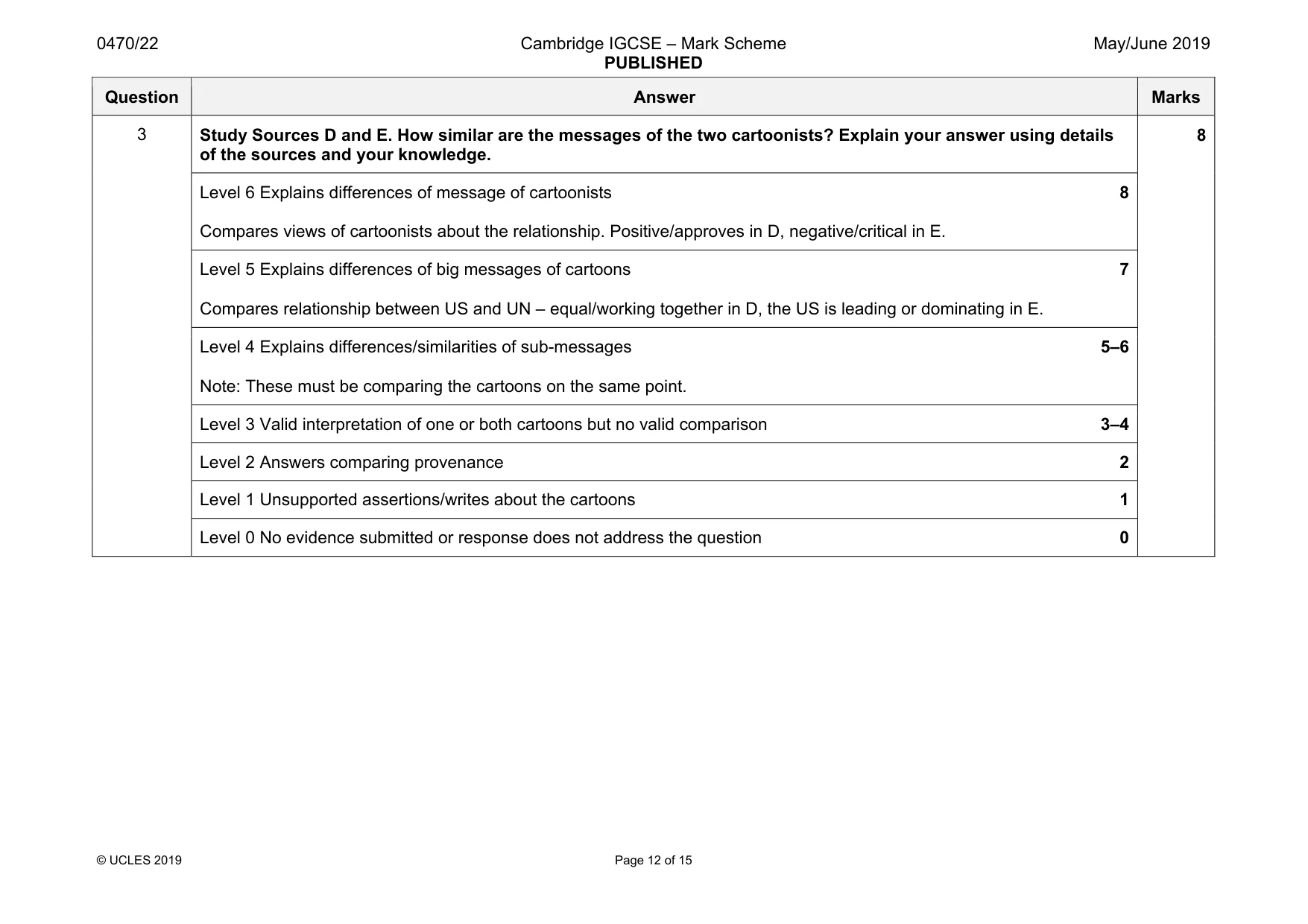
0470/22 Cambridge IGCSE – Mark Scheme PUBLISHED May/June 2019 © UCLES 2019 Page 12 of 15 Question Answer Marks 3 Study Sources D and E. How similar are the messages of the two cartoonists? Explain your answer using details of the sources and your knowledge. 8 Level 6 Explains differences of message of cartoonists 8 Compares views of cartoonists about the relationship. Positive/approves in D, negative/critical in E. Level 5 Explains differences of big messages of cartoons 7 Compares relationship between US and UN – equal/working together in D, the US is leading or dominating in E. Level 4 Explains differences/similarities of sub-messages 5–6 Note: These must be comparing the cartoons on the same point. Level 3 Valid interpretation of one or both cartoons but no valid comparison 3–4 Level 2 Answers comparing provenance 2 Level 1 Unsupported assertions/writes about the cartoons 1 Level 0 No evidence submitted or response does not address the question 0
Mark scheme, page 13
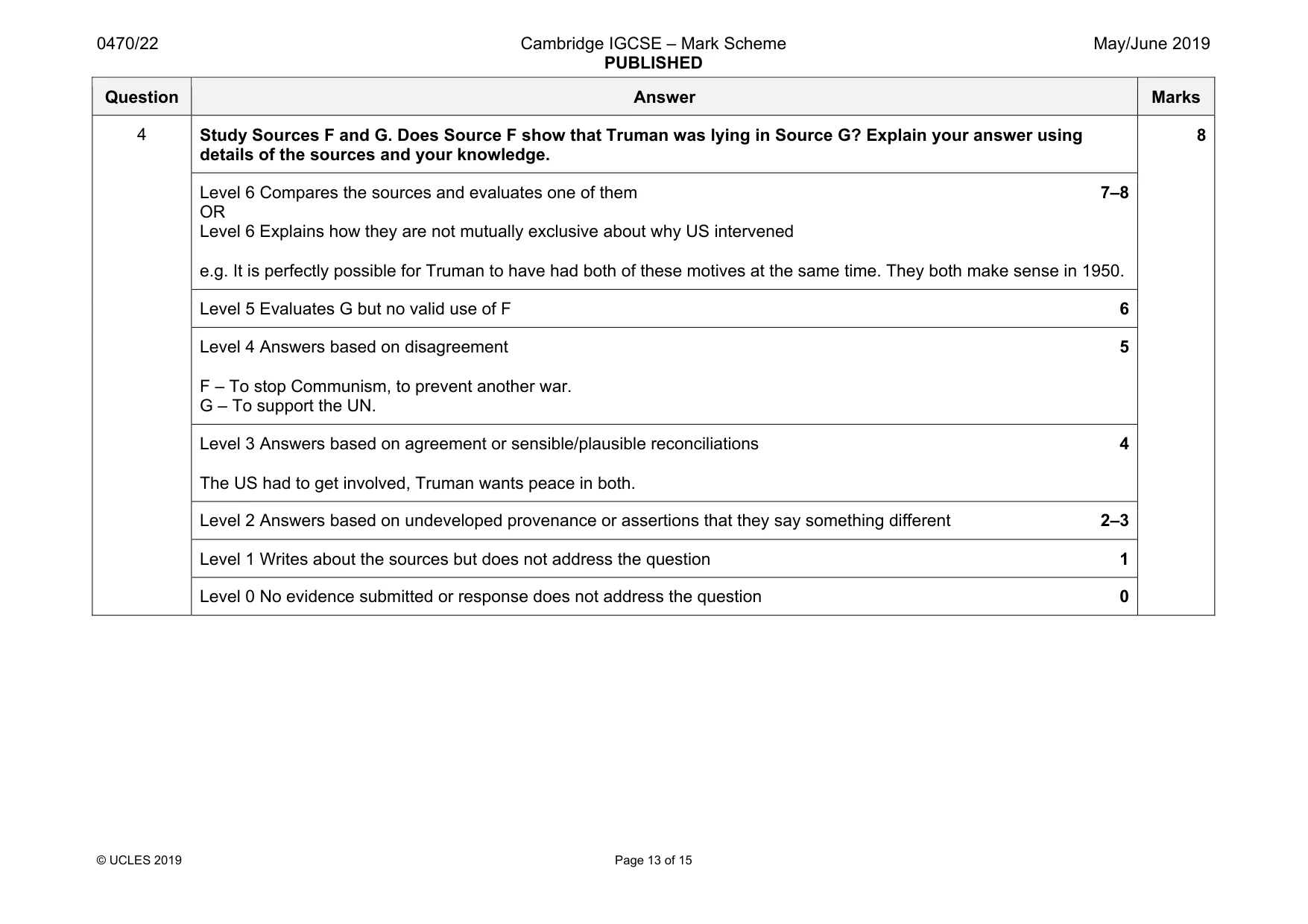
0470/22 Cambridge IGCSE – Mark Scheme PUBLISHED May/June 2019 © UCLES 2019 Page 13 of 15 Question Answer Marks 4 Study Sources F and G. Does Source F show that Truman was lying in Source G? Explain your answer using details of the sources and your knowledge. 8 Level 6 Compares the sources and evaluates one of them 7–8 OR Level 6 Explains how they are not mutually exclusive about why US intervened e.g. It is perfectly possible for Truman to have had both of these motives at the same time. They both make sense in 1950. Level 5 Evaluates G but no valid use of F 6 Level 4 Answers based on disagreement 5 F – To stop Communism, to prevent another war. G – To support the UN. Level 3 Answers based on agreement or sensible/plausible reconciliations 4 The US had to get involved, Truman wants peace in both. Level 2 Answers based on undeveloped provenance or assertions that they say something different 2–3 Level 1 Writes about the sources but does not address the question 1 Level 0 No evidence submitted or response does not address the question 0
Mark scheme, page 14
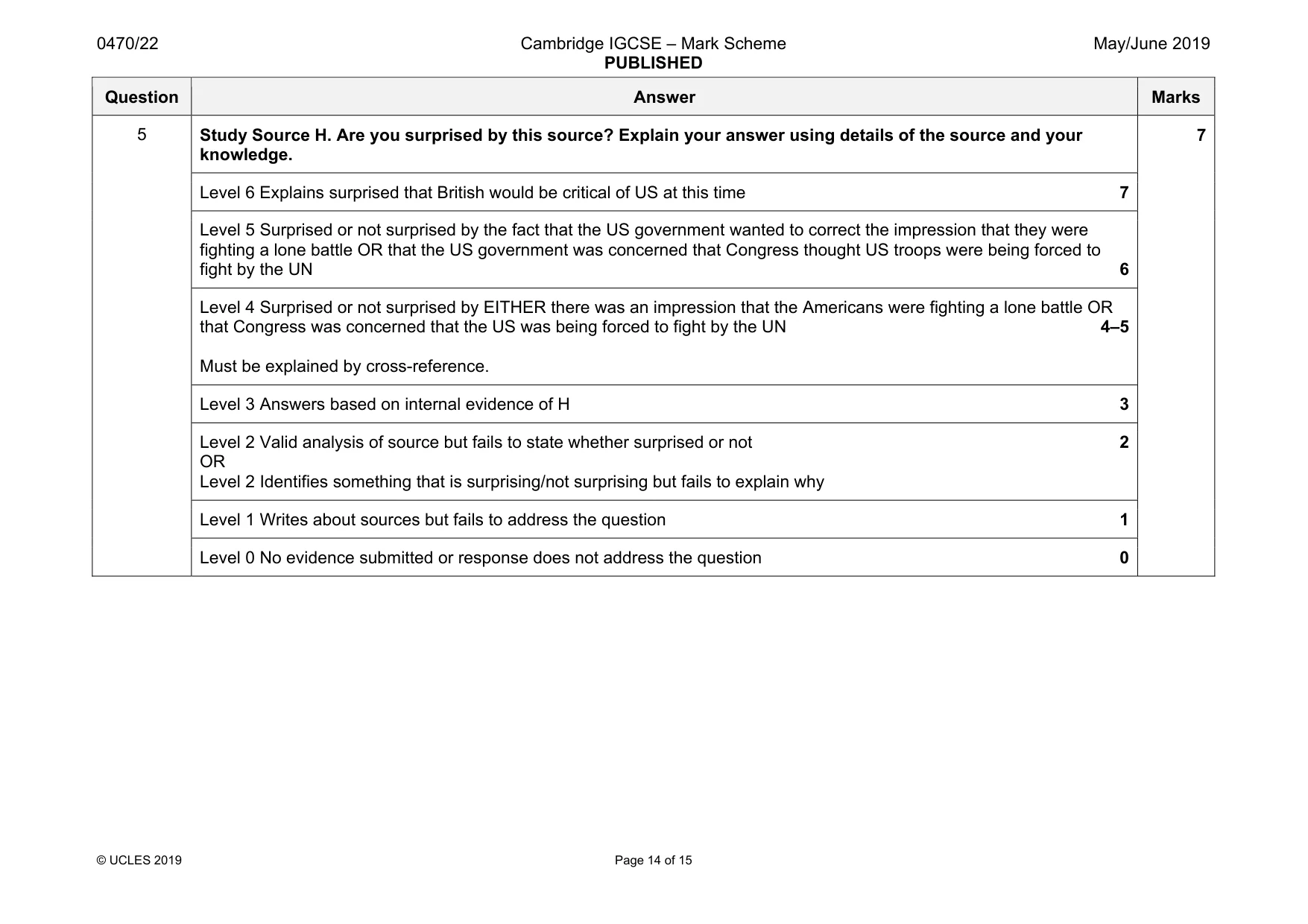
0470/22 Cambridge IGCSE – Mark Scheme PUBLISHED May/June 2019 © UCLES 2019 Page 14 of 15 Question Answer Marks 5 Study Source H. Are you surprised by this source? Explain your answer using details of the source and your knowledge. 7 Level 6 Explains surprised that British would be critical of US at this time 7 Level 5 Surprised or not surprised by the fact that the US government wanted to correct the impression that they were fighting a lone battle OR that the US government was concerned that Congress thought US troops were being forced to fight by the UN 6 Level 4 Surprised or not surprised by EITHER there was an impression that the Americans were fighting a lone battle OR that Congress was concerned that the US was being forced to fight by the UN 4–5 Must be explained by cross-reference. Level 3 Answers based on internal evidence of H 3 Level 2 Valid analysis of source but fails to state whether surprised or not 2 OR Level 2 Identifies something that is surprising/not surprising but fails to explain why Level 1 Writes about sources but fails to address the question 1 Level 0 No evidence submitted or response does not address the question 0
Mark scheme, page 15
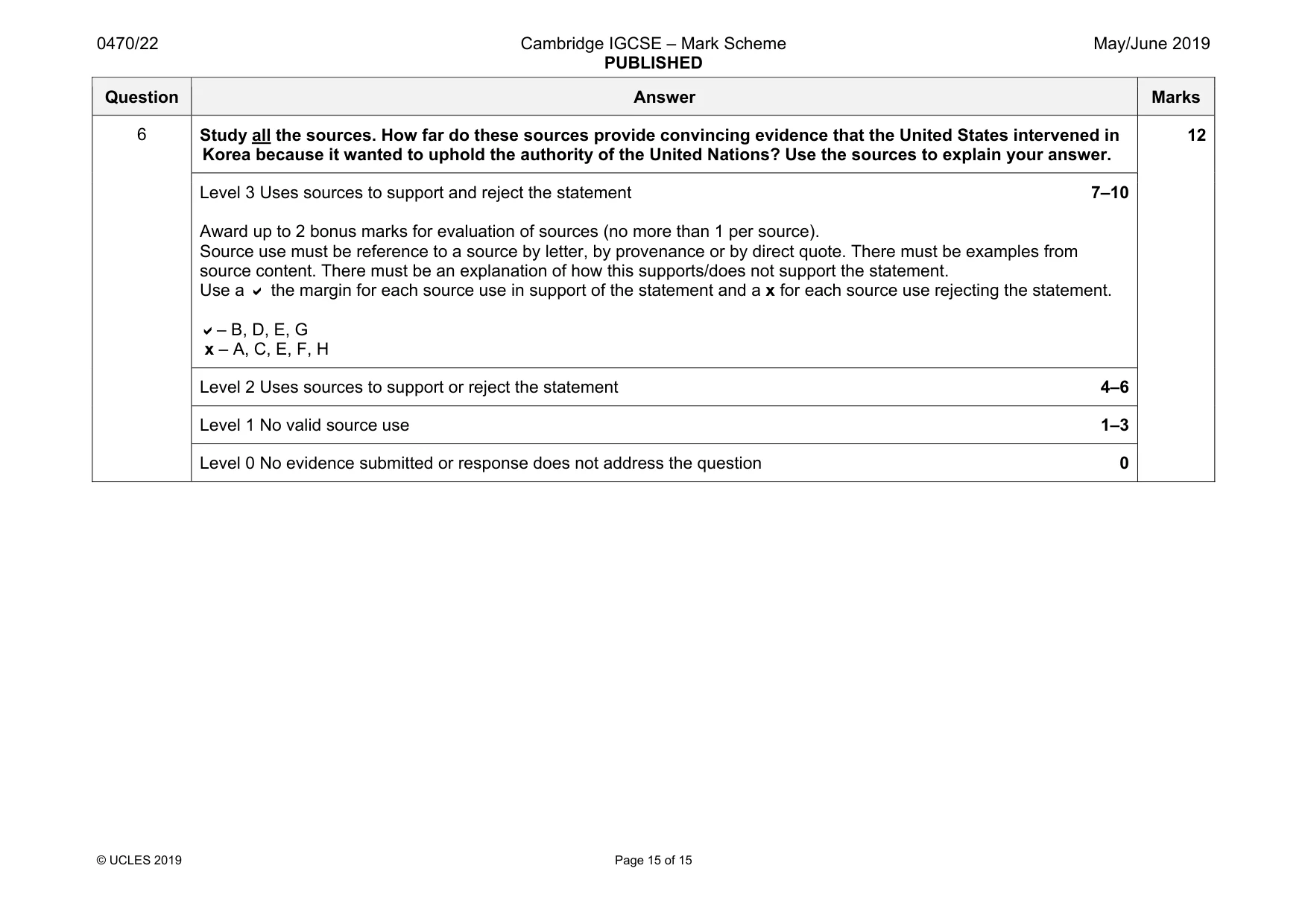
0470/22 Cambridge IGCSE – Mark Scheme PUBLISHED May/June 2019 © UCLES 2019 Page 15 of 15 Question Answer Marks 6 Study all the sources. How far do these sources provide convincing evidence that the United States intervened in Korea because it wanted to uphold the authority of the United Nations? Use the sources to explain your answer. 12 Level 3 Uses sources to support and reject the statement 7–10 Award up to 2 bonus marks for evaluation of sources (no more than 1 per source). Source use must be reference to a source by letter, by provenance or by direct quote. There must be examples from source content. There must be an explanation of how this supports/does not support the statement. Use a D the margin for each source use in support of the statement and a x for each source use rejecting the statement. D– B, D, E, G x – A, C, E, F, H Level 2 Uses sources to support or reject the statement 4–6 Level 1 No valid source use 1–3 Level 0 No evidence submitted or response does not address the question 0
What you needed in this session
Cambridge’s own grade thresholds for 2019 May/June, Paper 2 · Variant 2. A higher threshold means an easier paper — the bar moves with how the cohort did.