Cambridge IGCSE History 0470 — 2018 Oct/Nov Paper 4 · Variant 3
0470/43/O/N/18 · 40 marks · ≈45 min
The question paper and its mark scheme, free to read here and free to download. This is Cambridge’s own paper, exactly as it was sat.
Question paper4 pages

Mark scheme13 pages
Answers below. Sit the paper first if you are practising.
Paper as text
Question paper, page 1
Cambridge International Examinations Cambridge International General Certificate of Secondary Education 0470/43 October/November 2018 1 hour HISTORY Paper 4 Alternative to Coursework Additional Materials: Answer Booklet/Paper READ THESE INSTRUCTIONS FIRST An answer booklet is provided inside this question paper. You should follow the instructions on the front cover of the answer booklet. If you need additional answer paper ask the invigilator for a continuation booklet. Answer one question from your chosen Depth Study. The number of marks is given in brackets [ ] at the end of each question or part question. This syllabus is approved for use in England, Wales and Northern Ireland as a Cambridge International Level 1/Level 2 Certificate. This document consists of 3 printed pages and 1 blank page. [Turn over 11_0470_43_2018_1.13 © UCLES 2018 *5638847291*
Question paper, page 2
Answer one question from your chosen Depth Study. DEPTH STUDY A: THE FIRST WORLD WAR, 1914–1918 How important was the use of poisonous gas in changing the nature of warfare on the Western Front? Explain your answer. [40] 1 How significant was Britain’s control of the seas in bringing about Germany’s defeat? Explain your answer. [40] 2 DEPTH STUDY B: GERMANY, 1918–1945 How important was the role of the president in the government of the Weimar Republic to 1933? Explain your answer. [40] 3 How significant was the use of concentration camps in Hitler’s control of Germany after 1933? Explain your answer. [40] 4 DEPTH STUDY C: RUSSIA, 1905–1941 How important was the Cheka in the Bolsheviks’ consolidation of power to 1921? Explain your answer. [40] 5 How significant were splits amongst the leadership of the Communist Party in allowing Stalin to gain control of Russia? Explain your answer. [40] 6 DEPTH STUDY D: THE USA, 1919–1941 How important was religion in causing intolerance in the USA in the 1920s? Explain your answer. [40] 7 How significant was the gap between the rich and the poor in the USA in causing the Wall Street Crash? Explain your answer. [40] 8 DEPTH STUDY E: CHINA, c.1930–c.1990 How important was Chiang Kai-shek to the failure of the Nationalist government? Explain your answer. [40] 9 How significant were Communist reforms in improving life in the countryside by 1960? Explain your answer. [40] 10 11_0470_43_2018_1.13 © UCLES 2018 2
Question paper, page 3
DEPTH STUDY F: SOUTH AFRICA, c.1940–c.1994 How important was the colour bar in employment in the lives of the non-white population in South Africa after 1948? Explain your answer. [40] 11 How significant was Verwoerd in the development of apartheid? Explain your answer. [40] 12 DEPTH STUDY G: ISRAELIS AND PALESTINIANS SINCE 1945 How important was Jewish immigration in causing unrest in Palestine up to 1948? Explain your answer. [40] 13 How significant was the Six–Day War in shaping Arab–Israeli relations to 1996? Explain your answer. [40] 14 11_0470_43_2018_1.13 © UCLES 2018 3
Question paper, page 4
BLANK PAGE Permission to reproduce items where third-party owned material protected by copyright is included has been sought and cleared where possible. Every reasonable effort has been made by the publisher (UCLES) to trace copyright holders, but if any items requiring clearance have unwittingly been included, the publisher will be pleased to make amends at the earliest possible opportunity. To avoid the issue of disclosure of answer-related information to candidates, all copyright acknowledgements are reproduced online in the Cambridge International Examinations Copyright Acknowledgements Booklet. This is produced for each series of examinations and is freely available to download at www.cie.org.uk after the live examination series. Cambridge International Examinations is part of the Cambridge Assessment Group. Cambridge Assessment is the brand name of University of Cambridge Local Examinations Syndicate (UCLES), which is itself a department of the University of Cambridge. 11_0470_43_2018_1.13 © UCLES 2018 4
Mark scheme, page 1
This syllabus is approved for use in England, Wales and Northern Ireland as a Cambridge International Level 1/Level 2 Certificate. This document consists of 13 printed pages. © UCLES 2018 [Turn over Cambridge Assessment International Education Cambridge International General Certificate of Secondary Education HISTORY 0470/43 Paper 4 Alternative to Coursework October/November 2018 MARK SCHEME Maximum Mark: 40 Published This mark scheme is published as an aid to teachers and candidates, to indicate the requirements of the examination. It shows the basis on which Examiners were instructed to award marks. It does not indicate the details of the discussions that took place at an Examiners’ meeting before marking began, which would have considered the acceptability of alternative answers. Mark schemes should be read in conjunction with the question paper and the Principal Examiner Report for Teachers. Cambridge International will not enter into discussions about these mark schemes. Cambridge International is publishing the mark schemes for the October/November 2018 series for most Cambridge IGCSE™, Cambridge International A and AS Level components and some Cambridge O Level components.
Mark scheme, page 2
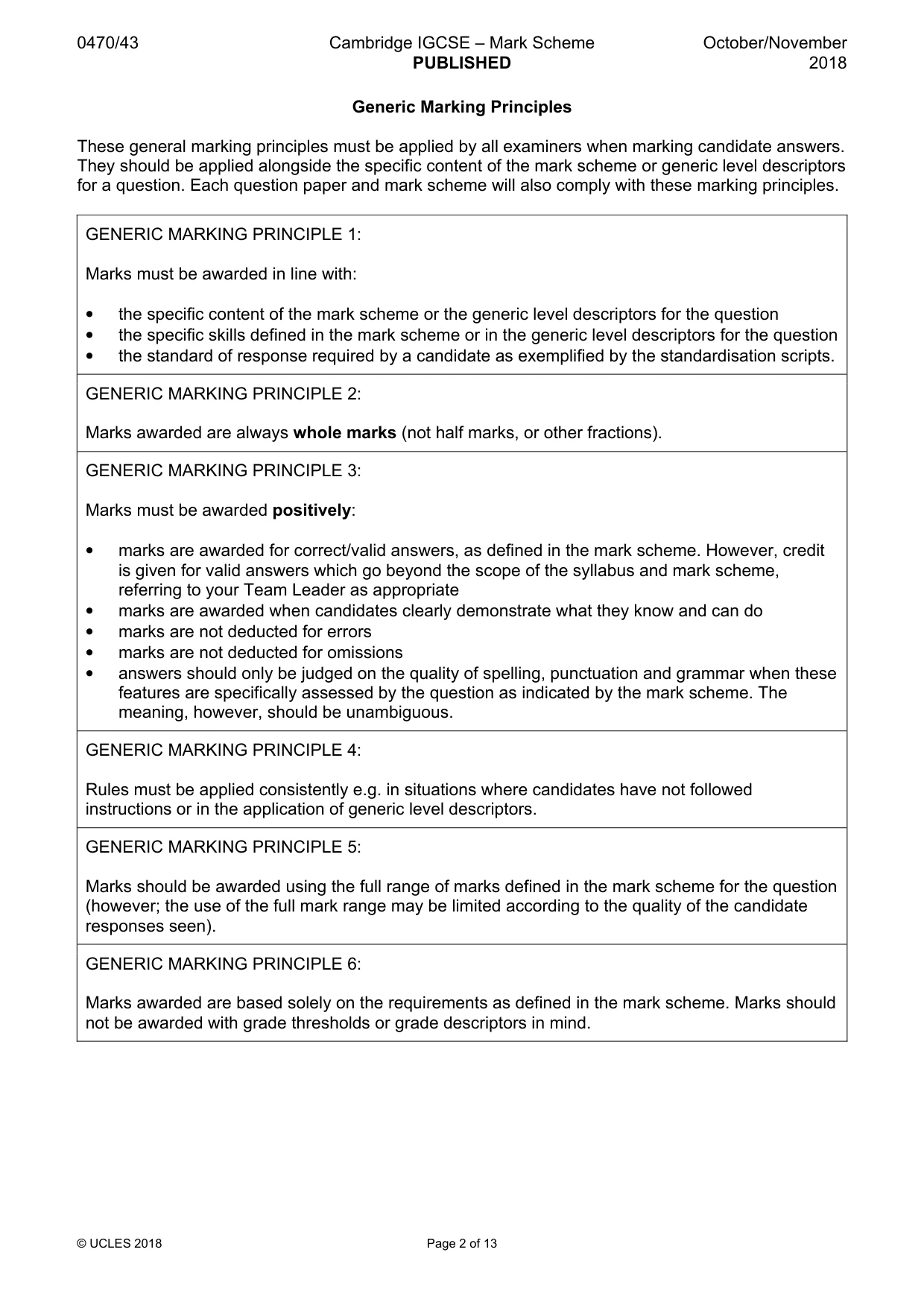
0470/43 Cambridge IGCSE – Mark Scheme PUBLISHED October/November 2018 © UCLES 2018 Page 2 of 13 Generic Marking Principles These general marking principles must be applied by all examiners when marking candidate answers. They should be applied alongside the specific content of the mark scheme or generic level descriptors for a question. Each question paper and mark scheme will also comply with these marking principles. GENERIC MARKING PRINCIPLE 1: Marks must be awarded in line with: • the specific content of the mark scheme or the generic level descriptors for the question • the specific skills defined in the mark scheme or in the generic level descriptors for the question • the standard of response required by a candidate as exemplified by the standardisation scripts. GENERIC MARKING PRINCIPLE 2: Marks awarded are always whole marks (not half marks, or other fractions). GENERIC MARKING PRINCIPLE 3: Marks must be awarded positively: • marks are awarded for correct/valid answers, as defined in the mark scheme. However, credit is given for valid answers which go beyond the scope of the syllabus and mark scheme, referring to your Team Leader as appropriate • marks are awarded when candidates clearly demonstrate what they know and can do • marks are not deducted for errors • marks are not deducted for omissions • answers should only be judged on the quality of spelling, punctuation and grammar when these features are specifically assessed by the question as indicated by the mark scheme. The meaning, however, should be unambiguous. GENERIC MARKING PRINCIPLE 4: Rules must be applied consistently e.g. in situations where candidates have not followed instructions or in the application of generic level descriptors. GENERIC MARKING PRINCIPLE 5: Marks should be awarded using the full range of marks defined in the mark scheme for the question (however; the use of the full mark range may be limited according to the quality of the candidate responses seen). GENERIC MARKING PRINCIPLE 6: Marks awarded are based solely on the requirements as defined in the mark scheme. Marks should not be awarded with grade thresholds or grade descriptors in mind.
Mark scheme, page 3
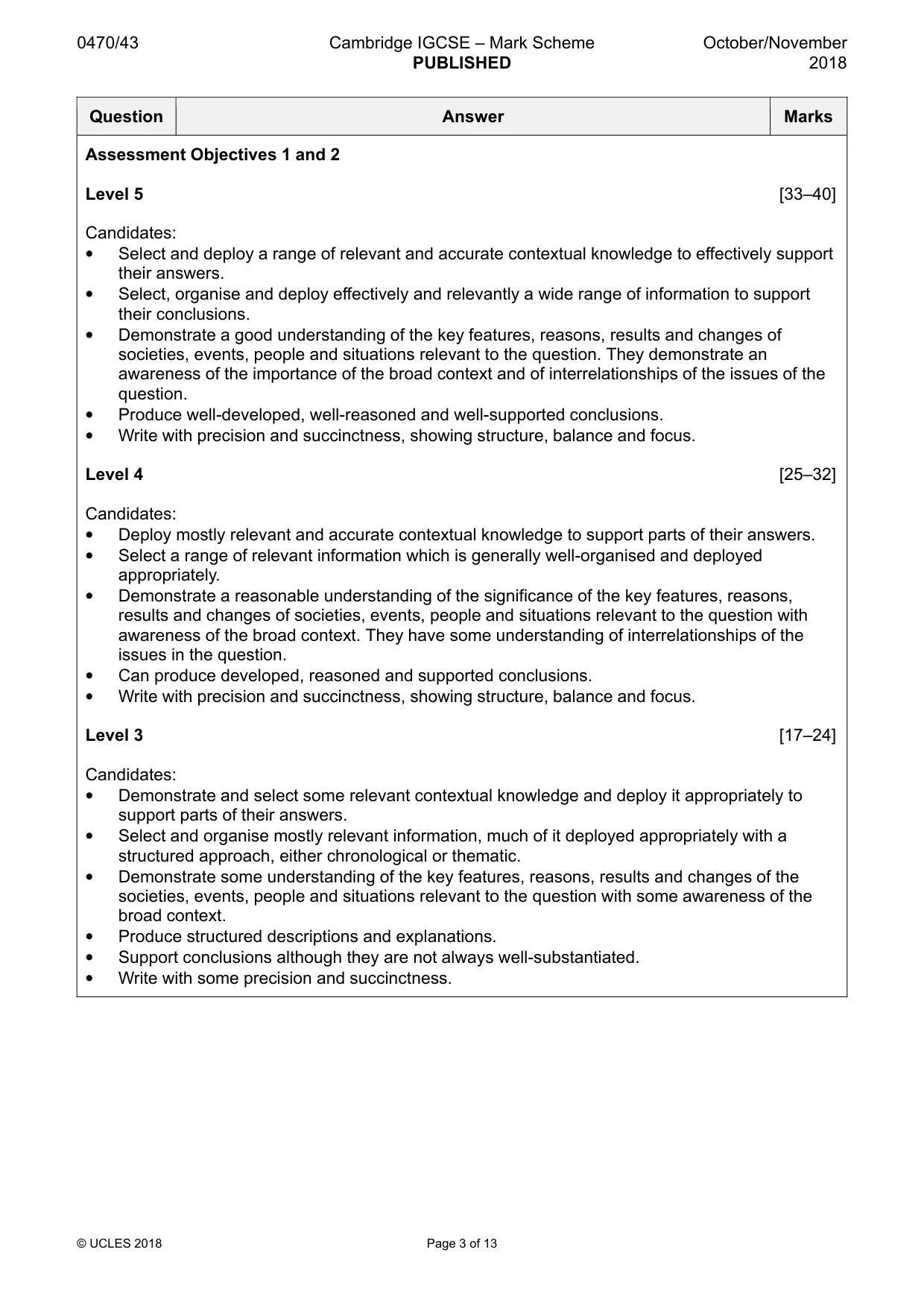
0470/43 Cambridge IGCSE – Mark Scheme PUBLISHED October/November 2018 © UCLES 2018 Page 3 of 13 Question Answer Marks Assessment Objectives 1 and 2 Level 5 [33–40] Candidates: • Select and deploy a range of relevant and accurate contextual knowledge to effectively support their answers. • Select, organise and deploy effectively and relevantly a wide range of information to support their conclusions. • Demonstrate a good understanding of the key features, reasons, results and changes of societies, events, people and situations relevant to the question. They demonstrate an awareness of the importance of the broad context and of interrelationships of the issues of the question. • Produce well-developed, well-reasoned and well-supported conclusions. • Write with precision and succinctness, showing structure, balance and focus. Level 4 [25–32] Candidates: • Deploy mostly relevant and accurate contextual knowledge to support parts of their answers. • Select a range of relevant information which is generally well-organised and deployed appropriately. • Demonstrate a reasonable understanding of the significance of the key features, reasons, results and changes of societies, events, people and situations relevant to the question with awareness of the broad context. They have some understanding of interrelationships of the issues in the question. • Can produce developed, reasoned and supported conclusions. • Write with precision and succinctness, showing structure, balance and focus. Level 3 [17–24] Candidates: • Demonstrate and select some relevant contextual knowledge and deploy it appropriately to support parts of their answers. • Select and organise mostly relevant information, much of it deployed appropriately with a structured approach, either chronological or thematic. • Demonstrate some understanding of the key features, reasons, results and changes of the societies, events, people and situations relevant to the question with some awareness of the broad context. • Produce structured descriptions and explanations. • Support conclusions although they are not always well-substantiated. • Write with some precision and succinctness.
Mark scheme, page 4
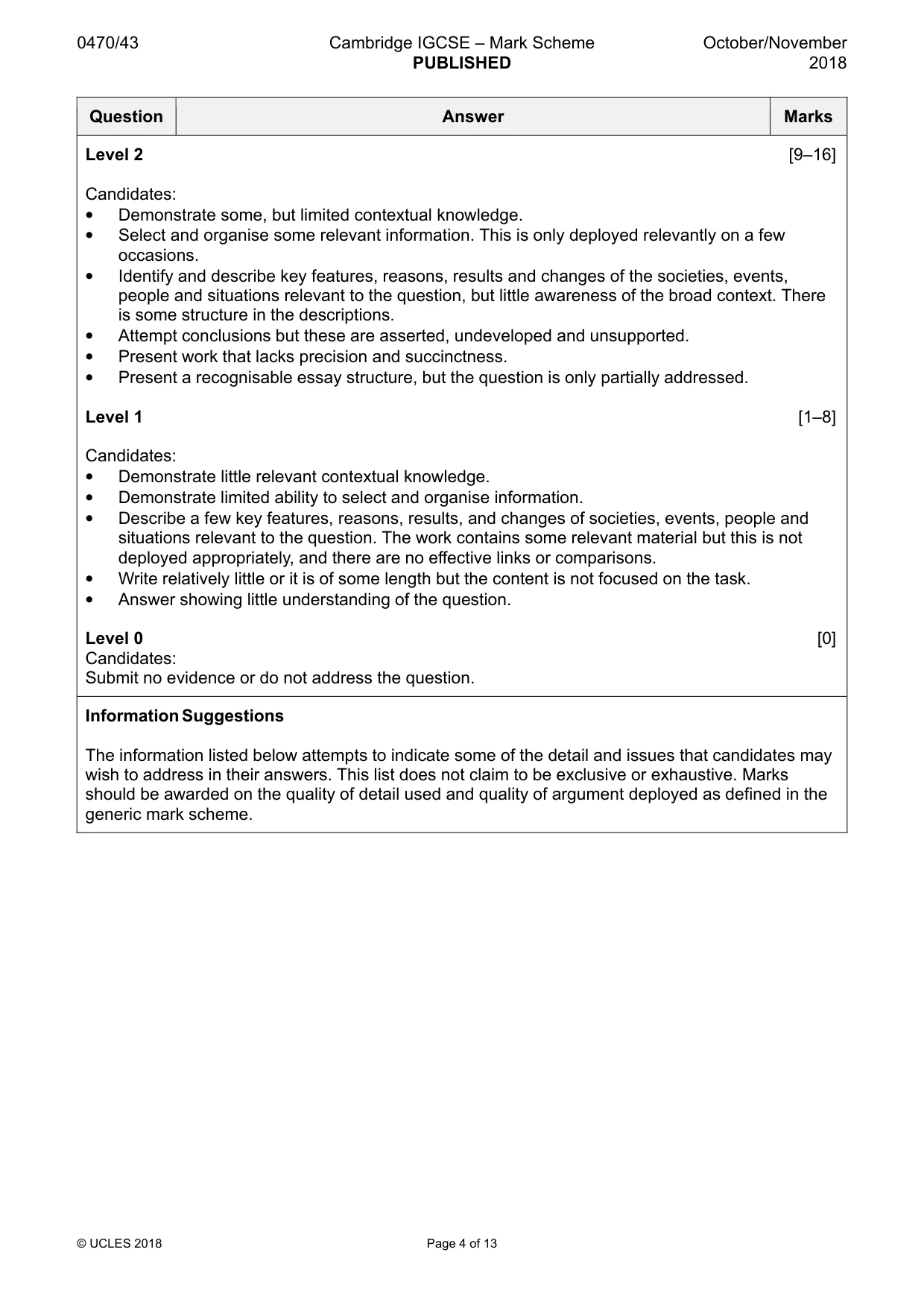
0470/43 Cambridge IGCSE – Mark Scheme PUBLISHED October/November 2018 © UCLES 2018 Page 4 of 13 Question Answer Marks Level 2 [9–16] Candidates: • Demonstrate some, but limited contextual knowledge. • Select and organise some relevant information. This is only deployed relevantly on a few occasions. • Identify and describe key features, reasons, results and changes of the societies, events, people and situations relevant to the question, but little awareness of the broad context. There is some structure in the descriptions. • Attempt conclusions but these are asserted, undeveloped and unsupported. • Present work that lacks precision and succinctness. • Present a recognisable essay structure, but the question is only partially addressed. Level 1 [1–8] Candidates: • Demonstrate little relevant contextual knowledge. • Demonstrate limited ability to select and organise information. • Describe a few key features, reasons, results, and changes of societies, events, people and situations relevant to the question. The work contains some relevant material but this is not deployed appropriately, and there are no effective links or comparisons. • Write relatively little or it is of some length but the content is not focused on the task. • Answer showing little understanding of the question. Level 0 [0] Candidates: Submit no evidence or do not address the question. Information Suggestions The information listed below attempts to indicate some of the detail and issues that candidates may wish to address in their answers. This list does not claim to be exclusive or exhaustive. Marks should be awarded on the quality of detail used and quality of argument deployed as defined in the generic mark scheme.
Mark scheme, page 5
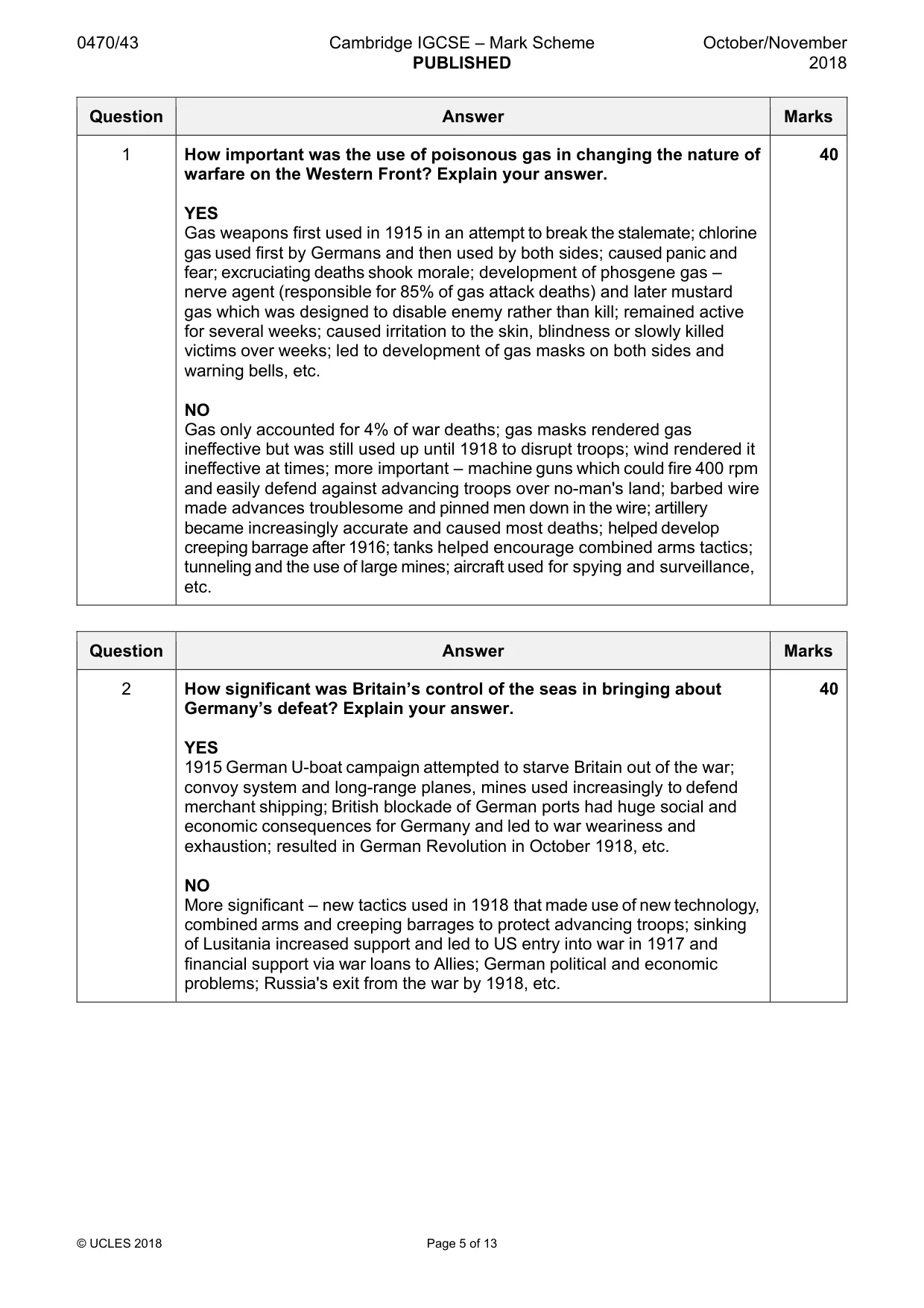
0470/43 Cambridge IGCSE – Mark Scheme PUBLISHED October/November 2018 © UCLES 2018 Page 5 of 13 Question Answer Marks 1 How important was the use of poisonous gas in changing the nature of warfare on the Western Front? Explain your answer. YES Gas weapons first used in 1915 in an attempt to break the stalemate; chlorine gas used first by Germans and then used by both sides; caused panic and fear; excruciating deaths shook morale; development of phosgene gas – nerve agent (responsible for 85% of gas attack deaths) and later mustard gas which was designed to disable enemy rather than kill; remained active for several weeks; caused irritation to the skin, blindness or slowly killed victims over weeks; led to development of gas masks on both sides and warning bells, etc. NO Gas only accounted for 4% of war deaths; gas masks rendered gas ineffective but was still used up until 1918 to disrupt troops; wind rendered it ineffective at times; more important – machine guns which could fire 400 rpm and easily defend against advancing troops over no-man's land; barbed wire made advances troublesome and pinned men down in the wire; artillery became increasingly accurate and caused most deaths; helped develop creeping barrage after 1916; tanks helped encourage combined arms tactics; tunneling and the use of large mines; aircraft used for spying and surveillance, etc. 40 Question Answer Marks 2 How significant was Britain’s control of the seas in bringing about Germany’s defeat? Explain your answer. YES 1915 German U-boat campaign attempted to starve Britain out of the war; convoy system and long-range planes, mines used increasingly to defend merchant shipping; British blockade of German ports had huge social and economic consequences for Germany and led to war weariness and exhaustion; resulted in German Revolution in October 1918, etc. NO More significant – new tactics used in 1918 that made use of new technology, combined arms and creeping barrages to protect advancing troops; sinking of Lusitania increased support and led to US entry into war in 1917 and financial support via war loans to Allies; German political and economic problems; Russia's exit from the war by 1918, etc. 40
Mark scheme, page 6
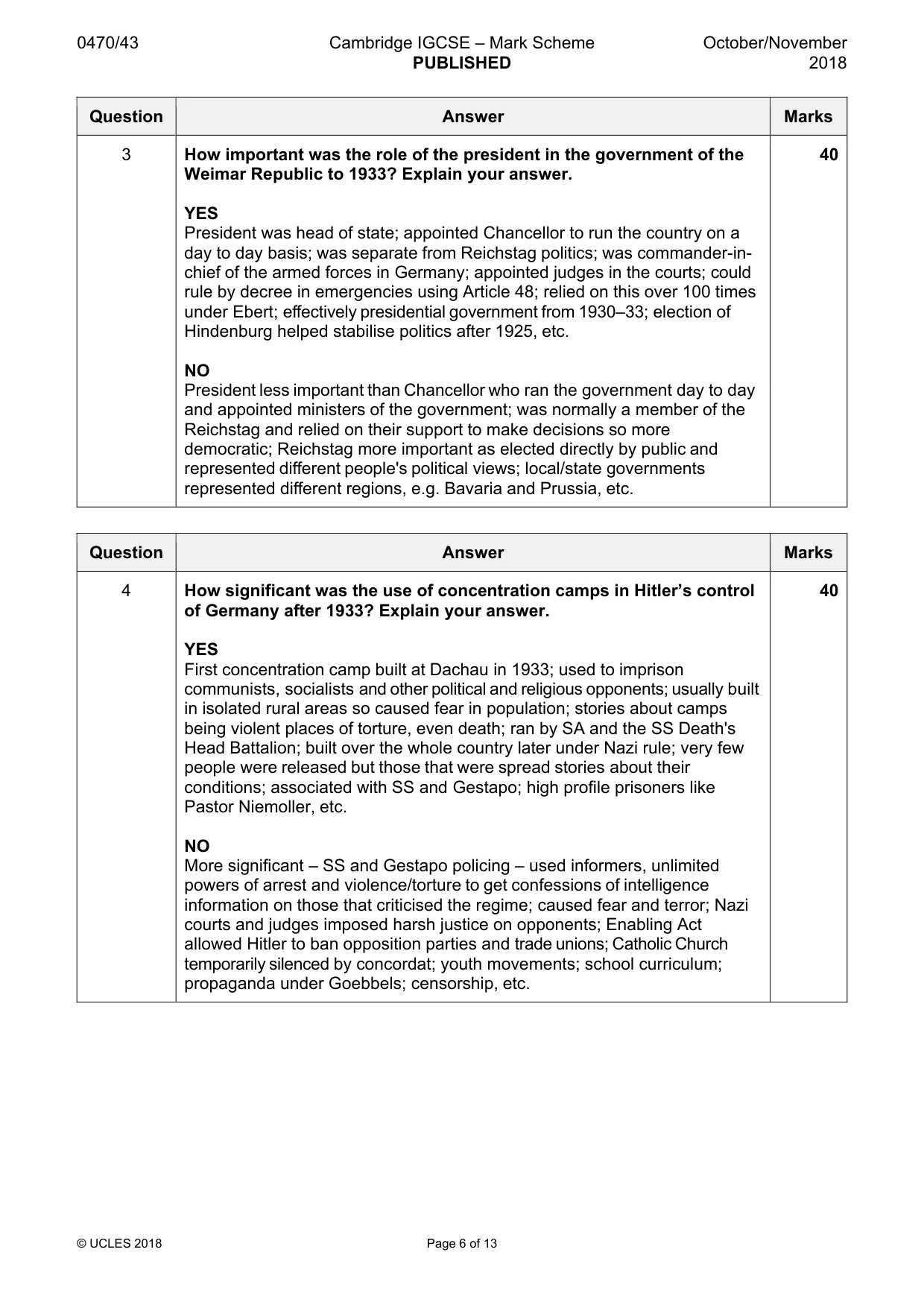
0470/43 Cambridge IGCSE – Mark Scheme PUBLISHED October/November 2018 © UCLES 2018 Page 6 of 13 Question Answer Marks 3 How important was the role of the president in the government of the Weimar Republic to 1933? Explain your answer. YES President was head of state; appointed Chancellor to run the country on a day to day basis; was separate from Reichstag politics; was commander-in- chief of the armed forces in Germany; appointed judges in the courts; could rule by decree in emergencies using Article 48; relied on this over 100 times under Ebert; effectively presidential government from 1930–33; election of Hindenburg helped stabilise politics after 1925, etc. NO President less important than Chancellor who ran the government day to day and appointed ministers of the government; was normally a member of the Reichstag and relied on their support to make decisions so more democratic; Reichstag more important as elected directly by public and represented different people's political views; local/state governments represented different regions, e.g. Bavaria and Prussia, etc. 40 Question Answer Marks 4 How significant was the use of concentration camps in Hitler’s control of Germany after 1933? Explain your answer. YES First concentration camp built at Dachau in 1933; used to imprison communists, socialists and other political and religious opponents; usually built in isolated rural areas so caused fear in population; stories about camps being violent places of torture, even death; ran by SA and the SS Death's Head Battalion; built over the whole country later under Nazi rule; very few people were released but those that were spread stories about their conditions; associated with SS and Gestapo; high profile prisoners like Pastor Niemoller, etc. NO More significant – SS and Gestapo policing – used informers, unlimited powers of arrest and violence/torture to get confessions of intelligence information on those that criticised the regime; caused fear and terror; Nazi courts and judges imposed harsh justice on opponents; Enabling Act allowed Hitler to ban opposition parties and trade unions; Catholic Church temporarily silenced by concordat; youth movements; school curriculum; propaganda under Goebbels; censorship, etc. 40
Mark scheme, page 7
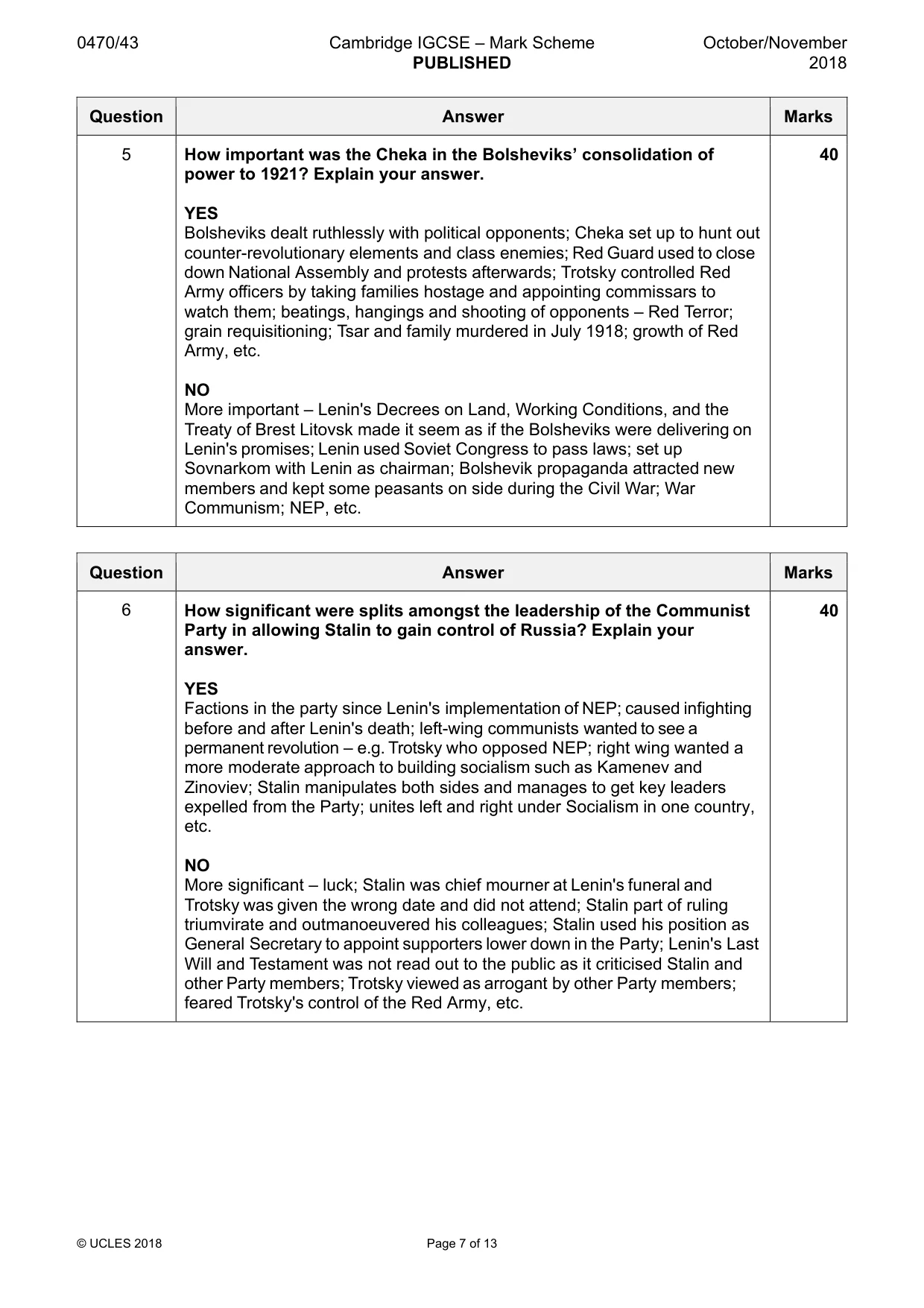
0470/43 Cambridge IGCSE – Mark Scheme PUBLISHED October/November 2018 © UCLES 2018 Page 7 of 13 Question Answer Marks 5 How important was the Cheka in the Bolsheviks’ consolidation of power to 1921? Explain your answer. YES Bolsheviks dealt ruthlessly with political opponents; Cheka set up to hunt out counter-revolutionary elements and class enemies; Red Guard used to close down National Assembly and protests afterwards; Trotsky controlled Red Army officers by taking families hostage and appointing commissars to watch them; beatings, hangings and shooting of opponents – Red Terror; grain requisitioning; Tsar and family murdered in July 1918; growth of Red Army, etc. NO More important – Lenin's Decrees on Land, Working Conditions, and the Treaty of Brest Litovsk made it seem as if the Bolsheviks were delivering on Lenin's promises; Lenin used Soviet Congress to pass laws; set up Sovnarkom with Lenin as chairman; Bolshevik propaganda attracted new members and kept some peasants on side during the Civil War; War Communism; NEP, etc. 40 Question Answer Marks 6 How significant were splits amongst the leadership of the Communist Party in allowing Stalin to gain control of Russia? Explain your answer. YES Factions in the party since Lenin's implementation of NEP; caused infighting before and after Lenin's death; left-wing communists wanted to see a permanent revolution – e.g. Trotsky who opposed NEP; right wing wanted a more moderate approach to building socialism such as Kamenev and Zinoviev; Stalin manipulates both sides and manages to get key leaders expelled from the Party; unites left and right under Socialism in one country, etc. NO More significant – luck; Stalin was chief mourner at Lenin's funeral and Trotsky was given the wrong date and did not attend; Stalin part of ruling triumvirate and outmanoeuvered his colleagues; Stalin used his position as General Secretary to appoint supporters lower down in the Party; Lenin's Last Will and Testament was not read out to the public as it criticised Stalin and other Party members; Trotsky viewed as arrogant by other Party members; feared Trotsky's control of the Red Army, etc. 40
Mark scheme, page 8
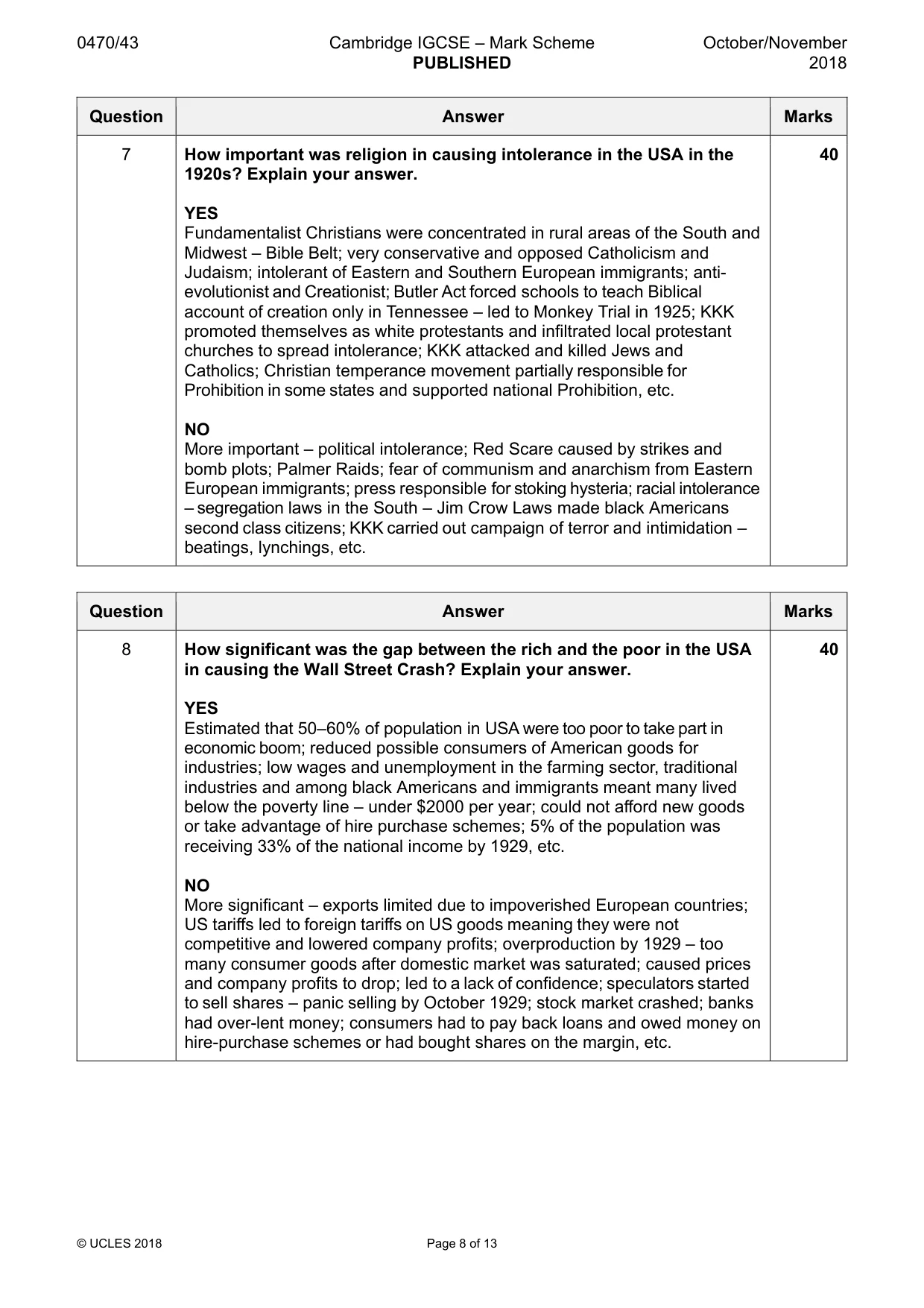
0470/43 Cambridge IGCSE – Mark Scheme PUBLISHED October/November 2018 © UCLES 2018 Page 8 of 13 Question Answer Marks 7 How important was religion in causing intolerance in the USA in the 1920s? Explain your answer. YES Fundamentalist Christians were concentrated in rural areas of the South and Midwest – Bible Belt; very conservative and opposed Catholicism and Judaism; intolerant of Eastern and Southern European immigrants; anti- evolutionist and Creationist; Butler Act forced schools to teach Biblical account of creation only in Tennessee – led to Monkey Trial in 1925; KKK promoted themselves as white protestants and infiltrated local protestant churches to spread intolerance; KKK attacked and killed Jews and Catholics; Christian temperance movement partially responsible for Prohibition in some states and supported national Prohibition, etc. NO More important – political intolerance; Red Scare caused by strikes and bomb plots; Palmer Raids; fear of communism and anarchism from Eastern European immigrants; press responsible for stoking hysteria; racial intolerance – segregation laws in the South – Jim Crow Laws made black Americans second class citizens; KKK carried out campaign of terror and intimidation – beatings, lynchings, etc. 40 Question Answer Marks 8 How significant was the gap between the rich and the poor in the USA in causing the Wall Street Crash? Explain your answer. YES Estimated that 50–60% of population in USA were too poor to take part in economic boom; reduced possible consumers of American goods for industries; low wages and unemployment in the farming sector, traditional industries and among black Americans and immigrants meant many lived below the poverty line – under $2000 per year; could not afford new goods or take advantage of hire purchase schemes; 5% of the population was receiving 33% of the national income by 1929, etc. NO More significant – exports limited due to impoverished European countries; US tariffs led to foreign tariffs on US goods meaning they were not competitive and lowered company profits; overproduction by 1929 – too many consumer goods after domestic market was saturated; caused prices and company profits to drop; led to a lack of confidence; speculators started to sell shares – panic selling by October 1929; stock market crashed; banks had over-lent money; consumers had to pay back loans and owed money on hire-purchase schemes or had bought shares on the margin, etc. 40
Mark scheme, page 9
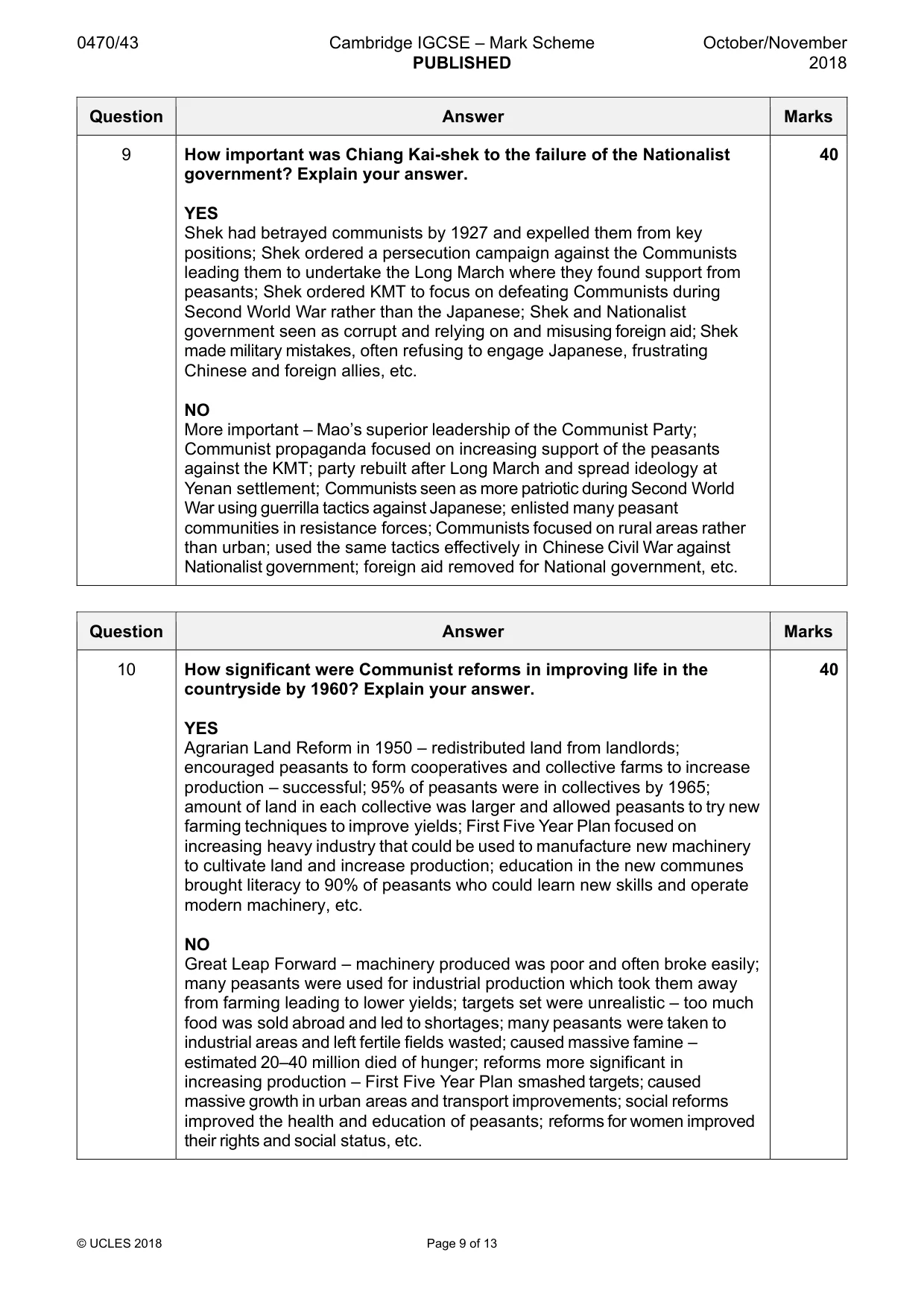
0470/43 Cambridge IGCSE – Mark Scheme PUBLISHED October/November 2018 © UCLES 2018 Page 9 of 13 Question Answer Marks 9 How important was Chiang Kai-shek to the failure of the Nationalist government? Explain your answer. YES Shek had betrayed communists by 1927 and expelled them from key positions; Shek ordered a persecution campaign against the Communists leading them to undertake the Long March where they found support from peasants; Shek ordered KMT to focus on defeating Communists during Second World War rather than the Japanese; Shek and Nationalist government seen as corrupt and relying on and misusing foreign aid; Shek made military mistakes, often refusing to engage Japanese, frustrating Chinese and foreign allies, etc. NO More important – Mao’s superior leadership of the Communist Party; Communist propaganda focused on increasing support of the peasants against the KMT; party rebuilt after Long March and spread ideology at Yenan settlement; Communists seen as more patriotic during Second World War using guerrilla tactics against Japanese; enlisted many peasant communities in resistance forces; Communists focused on rural areas rather than urban; used the same tactics effectively in Chinese Civil War against Nationalist government; foreign aid removed for National government, etc. 40 Question Answer Marks 10 How significant were Communist reforms in improving life in the countryside by 1960? Explain your answer. YES Agrarian Land Reform in 1950 – redistributed land from landlords; encouraged peasants to form cooperatives and collective farms to increase production – successful; 95% of peasants were in collectives by 1965; amount of land in each collective was larger and allowed peasants to try new farming techniques to improve yields; First Five Year Plan focused on increasing heavy industry that could be used to manufacture new machinery to cultivate land and increase production; education in the new communes brought literacy to 90% of peasants who could learn new skills and operate modern machinery, etc. NO Great Leap Forward – machinery produced was poor and often broke easily; many peasants were used for industrial production which took them away from farming leading to lower yields; targets set were unrealistic – too much food was sold abroad and led to shortages; many peasants were taken to industrial areas and left fertile fields wasted; caused massive famine – estimated 20–40 million died of hunger; reforms more significant in increasing production – First Five Year Plan smashed targets; caused massive growth in urban areas and transport improvements; social reforms improved the health and education of peasants; reforms for women improved their rights and social status, etc. 40
Mark scheme, page 10
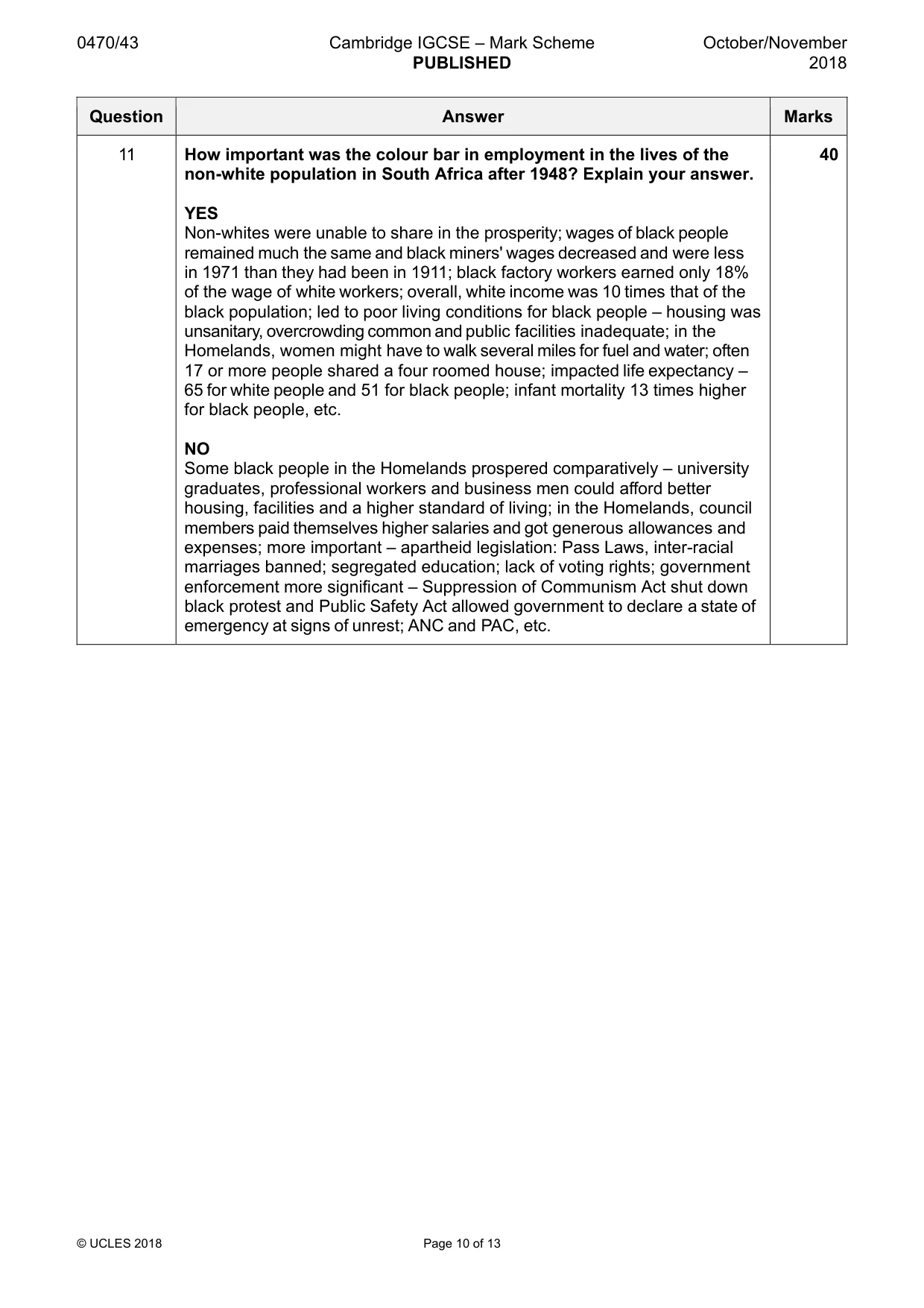
0470/43 Cambridge IGCSE – Mark Scheme PUBLISHED October/November 2018 © UCLES 2018 Page 10 of 13 Question Answer Marks 11 How important was the colour bar in employment in the lives of the non-white population in South Africa after 1948? Explain your answer. YES Non-whites were unable to share in the prosperity; wages of black people remained much the same and black miners' wages decreased and were less in 1971 than they had been in 1911; black factory workers earned only 18% of the wage of white workers; overall, white income was 10 times that of the black population; led to poor living conditions for black people – housing was unsanitary, overcrowding common and public facilities inadequate; in the Homelands, women might have to walk several miles for fuel and water; often 17 or more people shared a four roomed house; impacted life expectancy – 65 for white people and 51 for black people; infant mortality 13 times higher for black people, etc. NO Some black people in the Homelands prospered comparatively – university graduates, professional workers and business men could afford better housing, facilities and a higher standard of living; in the Homelands, council members paid themselves higher salaries and got generous allowances and expenses; more important – apartheid legislation: Pass Laws, inter-racial marriages banned; segregated education; lack of voting rights; government enforcement more significant – Suppression of Communism Act shut down black protest and Public Safety Act allowed government to declare a state of emergency at signs of unrest; ANC and PAC, etc. 40
Mark scheme, page 11
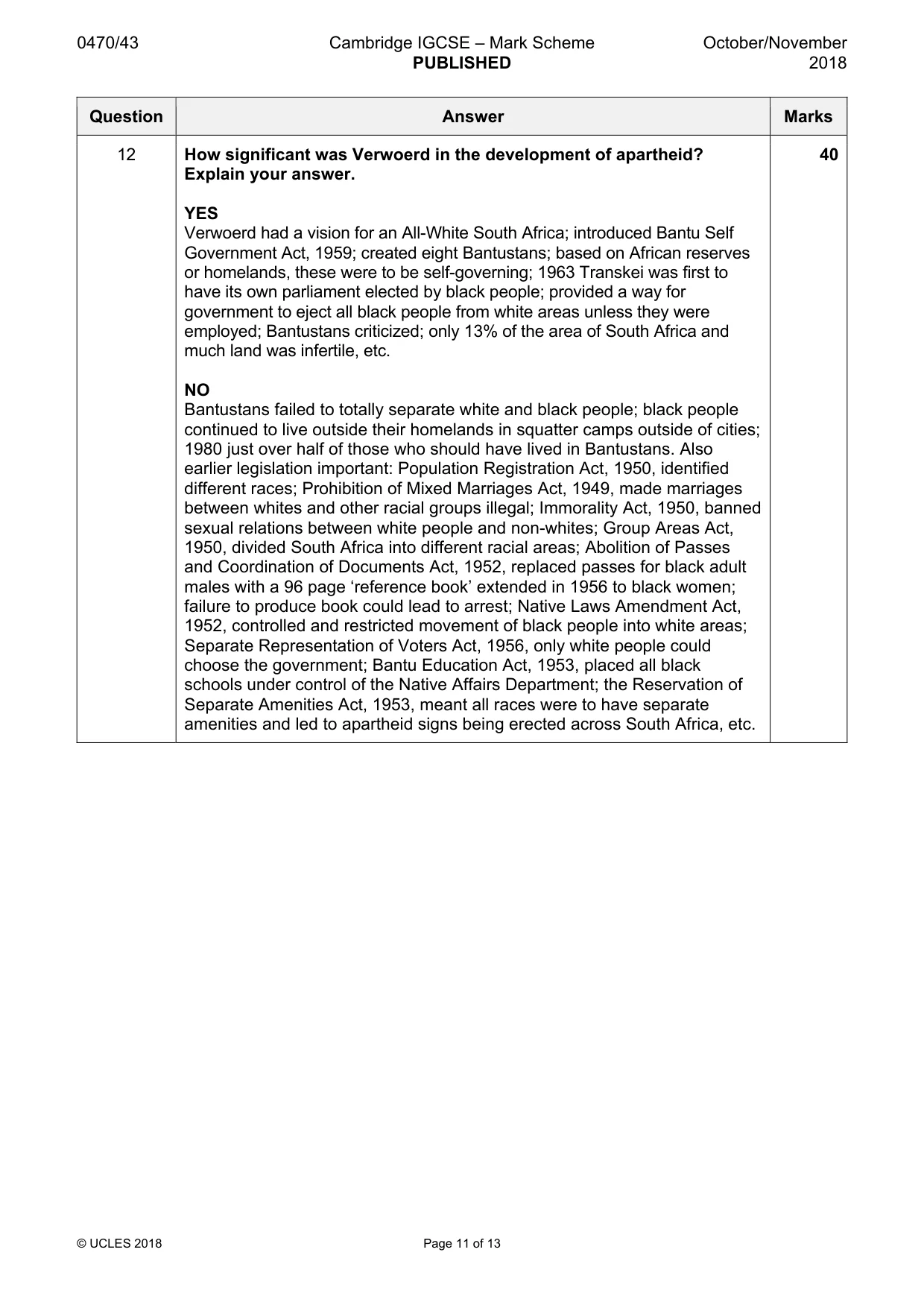
0470/43 Cambridge IGCSE – Mark Scheme PUBLISHED October/November 2018 © UCLES 2018 Page 11 of 13 Question Answer Marks 12 How significant was Verwoerd in the development of apartheid? Explain your answer. YES Verwoerd had a vision for an All-White South Africa; introduced Bantu Self Government Act, 1959; created eight Bantustans; based on African reserves or homelands, these were to be self-governing; 1963 Transkei was first to have its own parliament elected by black people; provided a way for government to eject all black people from white areas unless they were employed; Bantustans criticized; only 13% of the area of South Africa and much land was infertile, etc. NO Bantustans failed to totally separate white and black people; black people continued to live outside their homelands in squatter camps outside of cities; 1980 just over half of those who should have lived in Bantustans. Also earlier legislation important: Population Registration Act, 1950, identified different races; Prohibition of Mixed Marriages Act, 1949, made marriages between whites and other racial groups illegal; Immorality Act, 1950, banned sexual relations between white people and non-whites; Group Areas Act, 1950, divided South Africa into different racial areas; Abolition of Passes and Coordination of Documents Act, 1952, replaced passes for black adult males with a 96 page ‘reference book’ extended in 1956 to black women; failure to produce book could lead to arrest; Native Laws Amendment Act, 1952, controlled and restricted movement of black people into white areas; Separate Representation of Voters Act, 1956, only white people could choose the government; Bantu Education Act, 1953, placed all black schools under control of the Native Affairs Department; the Reservation of Separate Amenities Act, 1953, meant all races were to have separate amenities and led to apartheid signs being erected across South Africa, etc. 40
Mark scheme, page 12
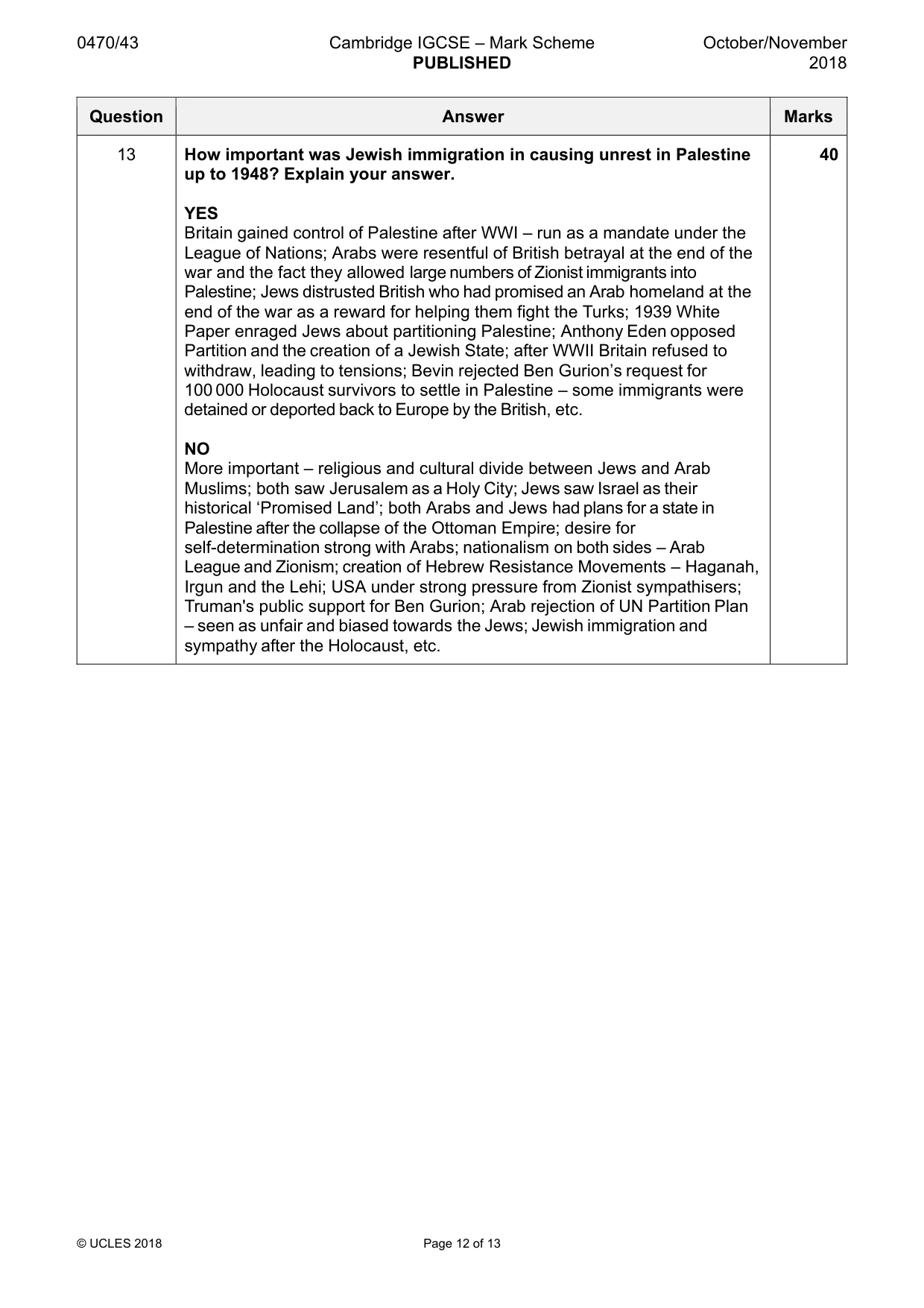
0470/43 Cambridge IGCSE – Mark Scheme PUBLISHED October/November 2018 © UCLES 2018 Page 12 of 13 Question Answer Marks 13 How important was Jewish immigration in causing unrest in Palestine up to 1948? Explain your answer. YES Britain gained control of Palestine after WWI – run as a mandate under the League of Nations; Arabs were resentful of British betrayal at the end of the war and the fact they allowed large numbers of Zionist immigrants into Palestine; Jews distrusted British who had promised an Arab homeland at the end of the war as a reward for helping them fight the Turks; 1939 White Paper enraged Jews about partitioning Palestine; Anthony Eden opposed Partition and the creation of a Jewish State; after WWII Britain refused to withdraw, leading to tensions; Bevin rejected Ben Gurion’s request for 100 000 Holocaust survivors to settle in Palestine – some immigrants were detained or deported back to Europe by the British, etc. NO More important – religious and cultural divide between Jews and Arab Muslims; both saw Jerusalem as a Holy City; Jews saw Israel as their historical ‘Promised Land’; both Arabs and Jews had plans for a state in Palestine after the collapse of the Ottoman Empire; desire for self-determination strong with Arabs; nationalism on both sides – Arab League and Zionism; creation of Hebrew Resistance Movements – Haganah, Irgun and the Lehi; USA under strong pressure from Zionist sympathisers; Truman's public support for Ben Gurion; Arab rejection of UN Partition Plan – seen as unfair and biased towards the Jews; Jewish immigration and sympathy after the Holocaust, etc. 40
Mark scheme, page 13
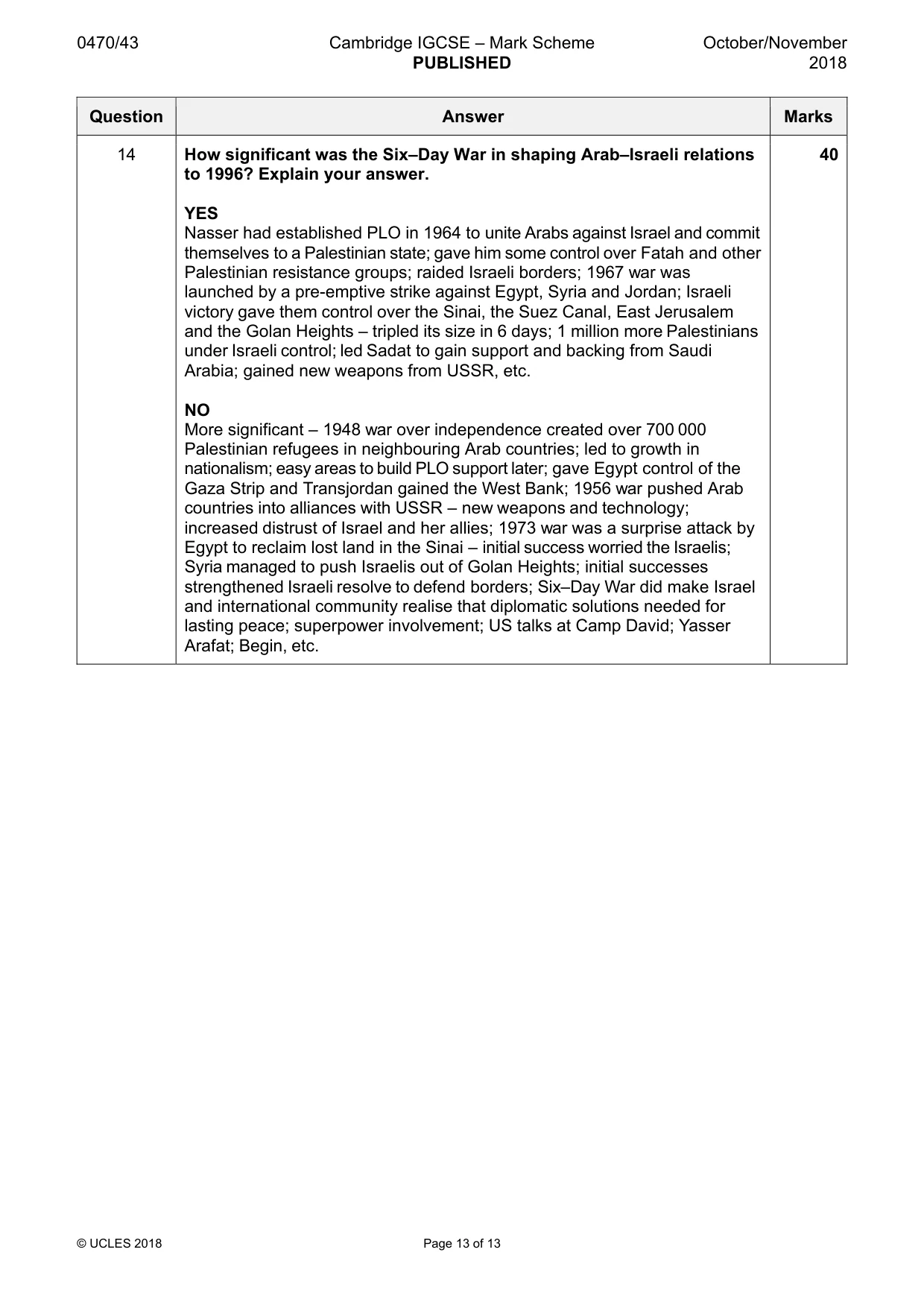
0470/43 Cambridge IGCSE – Mark Scheme PUBLISHED October/November 2018 © UCLES 2018 Page 13 of 13 Question Answer Marks 14 How significant was the Six–Day War in shaping Arab–Israeli relations to 1996? Explain your answer. YES Nasser had established PLO in 1964 to unite Arabs against Israel and commit themselves to a Palestinian state; gave him some control over Fatah and other Palestinian resistance groups; raided Israeli borders; 1967 war was launched by a pre-emptive strike against Egypt, Syria and Jordan; Israeli victory gave them control over the Sinai, the Suez Canal, East Jerusalem and the Golan Heights – tripled its size in 6 days; 1 million more Palestinians under Israeli control; led Sadat to gain support and backing from Saudi Arabia; gained new weapons from USSR, etc. NO More significant – 1948 war over independence created over 700 000 Palestinian refugees in neighbouring Arab countries; led to growth in nationalism; easy areas to build PLO support later; gave Egypt control of the Gaza Strip and Transjordan gained the West Bank; 1956 war pushed Arab countries into alliances with USSR – new weapons and technology; increased distrust of Israel and her allies; 1973 war was a surprise attack by Egypt to reclaim lost land in the Sinai – initial success worried the Israelis; Syria managed to push Israelis out of Golan Heights; initial successes strengthened Israeli resolve to defend borders; Six–Day War did make Israel and international community realise that diplomatic solutions needed for lasting peace; superpower involvement; US talks at Camp David; Yasser Arafat; Begin, etc. 40
What you needed in this session
Cambridge’s own grade thresholds for 2018 Oct/Nov, Paper 4 · Variant 3. A higher threshold means an easier paper — the bar moves with how the cohort did.