Cambridge IGCSE History 0470 — 2018 Oct/Nov Paper 4 · Variant 1
0470/41/O/N/18 · 40 marks · ≈45 min
The question paper and its mark scheme, free to read here and free to download. This is Cambridge’s own paper, exactly as it was sat.
Question paper4 pages

Mark scheme12 pages
Answers below. Sit the paper first if you are practising.
Paper as text
Question paper, page 1
Cambridge International Examinations Cambridge International General Certificate of Secondary Education 0470/41 October/November 2018 1 hour HISTORY Paper 4 Alternative to Coursework Additional Materials: Answer Booklet/Paper READ THESE INSTRUCTIONS FIRST An answer booklet is provided inside this question paper. You should follow the instructions on the front cover of the answer booklet. If you need additional answer paper ask the invigilator for a continuation booklet. Answer one question from your chosen Depth Study. The number of marks is given in brackets [ ] at the end of each question or part question. The syllabus is approved for use in England, Wales and Northern Ireland as a Cambridge International Level 1/Level 2 Certificate. This document consists of 3 printed pages and 1 blank page. [Turn over 11_0470_41_2018_1.16 © UCLES 2018 *7260676194*
Question paper, page 2
Answer one question from your chosen Depth Study. DEPTH STUDY A: THE FIRST WORLD WAR, 1914–1918 How important was military defeat in causing Russia to leave the war in 1918? Explain your answer. [40] 1 How significant was the collapse of the Home Front in bringing about Germany’s decision in 1918 to ask for an armistice? Explain your answer. [40] 2 DEPTH STUDY B: GERMANY, 1918–1945 How important were Hitler’s election promises as a reason for the growth in support for the Nazi Party by 1933? Explain your answer. [40] 3 How significant were Nazi policies towards the churches in the development of a totalitarian state after 1933? Explain your answer. [40] 4 DEPTH STUDY C: RUSSIA, 1905–1941 How important was the October Manifesto in weakening Tsarist rule? Explain your answer. [40] 5 How significant was the removal of political rivals in allowing Stalin to create a totalitarian state? Explain your answer. [40] 6 DEPTH STUDY D: THE USA, 1919–1941 How important was the availability of new consumer goods in changing people’s lives in the USA in the 1920s? Explain your answer. [40] 7 How significant were the temperance movements in causing the introduction of Prohibition? Explain your answer. [40] 8 DEPTH STUDY E: CHINA, c.1930–c.1990 How important were the actions of the Nationalist government as a reason for Mao’s victory in 1949? Explain your answer. [40] 9 How significant was spreading Maoist ideology in shaping China’s foreign policy after 1949? Explain your answer. [40] 10 11_0470_41_2018_1.16 © UCLES 2018 2
Question paper, page 3
DEPTH STUDY F: SOUTH AFRICA, c.1940–c.1994 How important was agriculture to the development of the economy in South Africa before 1948? Explain your answer. [40] 11 How significant was civil unrest in bringing about the end of white minority rule? Explain your answer. [40] 12 DEPTH STUDY G: ISRAELIS AND PALESTINIANS SINCE 1945 How important was the role of Britain as a cause of conflict in Palestine before 1948? Explain your answer. [40] 13 How significant was Israel in causing the Suez War, 1956? Explain your answer. [40] 14 11_0470_41_2018_1.16 © UCLES 2018 3
Question paper, page 4
BLANK PAGE Permission to reproduce items where third-party owned material protected by copyright is included has been sought and cleared where possible. Every reasonable effort has been made by the publisher (UCLES) to trace copyright holders, but if any items requiring clearance have unwittingly been included, the publisher will be pleased to make amends at the earliest possible opportunity. To avoid the issue of disclosure of answer-related information to candidates, all copyright acknowledgements are reproduced online in the Cambridge International Examinations Copyright Acknowledgements Booklet. This is produced for each series of examinations and is freely available to download at www.cie.org.uk after the live examination series. Cambridge International Examinations is part of the Cambridge Assessment Group. Cambridge Assessment is the brand name of University of Cambridge Local Examinations Syndicate (UCLES), which is itself a department of the University of Cambridge. 11_0470_41_2018_1.16 © UCLES 2018 4
Mark scheme, page 1
This syllabus is approved for use in England, Wales and Northern Ireland as a Cambridge International Level 1/Level 2 Certificate. This document consists of 12 printed pages. © UCLES 2018 [Turn over Cambridge Assessment International Education Cambridge International General Certificate of Secondary Education HISTORY 0470/41 Paper 4 Alternative to Coursework October/November 2018 MARK SCHEME Maximum Mark: 40 Published This mark scheme is published as an aid to teachers and candidates, to indicate the requirements of the examination. It shows the basis on which Examiners were instructed to award marks. It does not indicate the details of the discussions that took place at an Examiners’ meeting before marking began, which would have considered the acceptability of alternative answers. Mark schemes should be read in conjunction with the question paper and the Principal Examiner Report for Teachers. Cambridge International will not enter into discussions about these mark schemes. Cambridge International is publishing the mark schemes for the October/November 2018 series for most Cambridge IGCSE™, Cambridge International A and AS Level components and some Cambridge O Level components.
Mark scheme, page 2
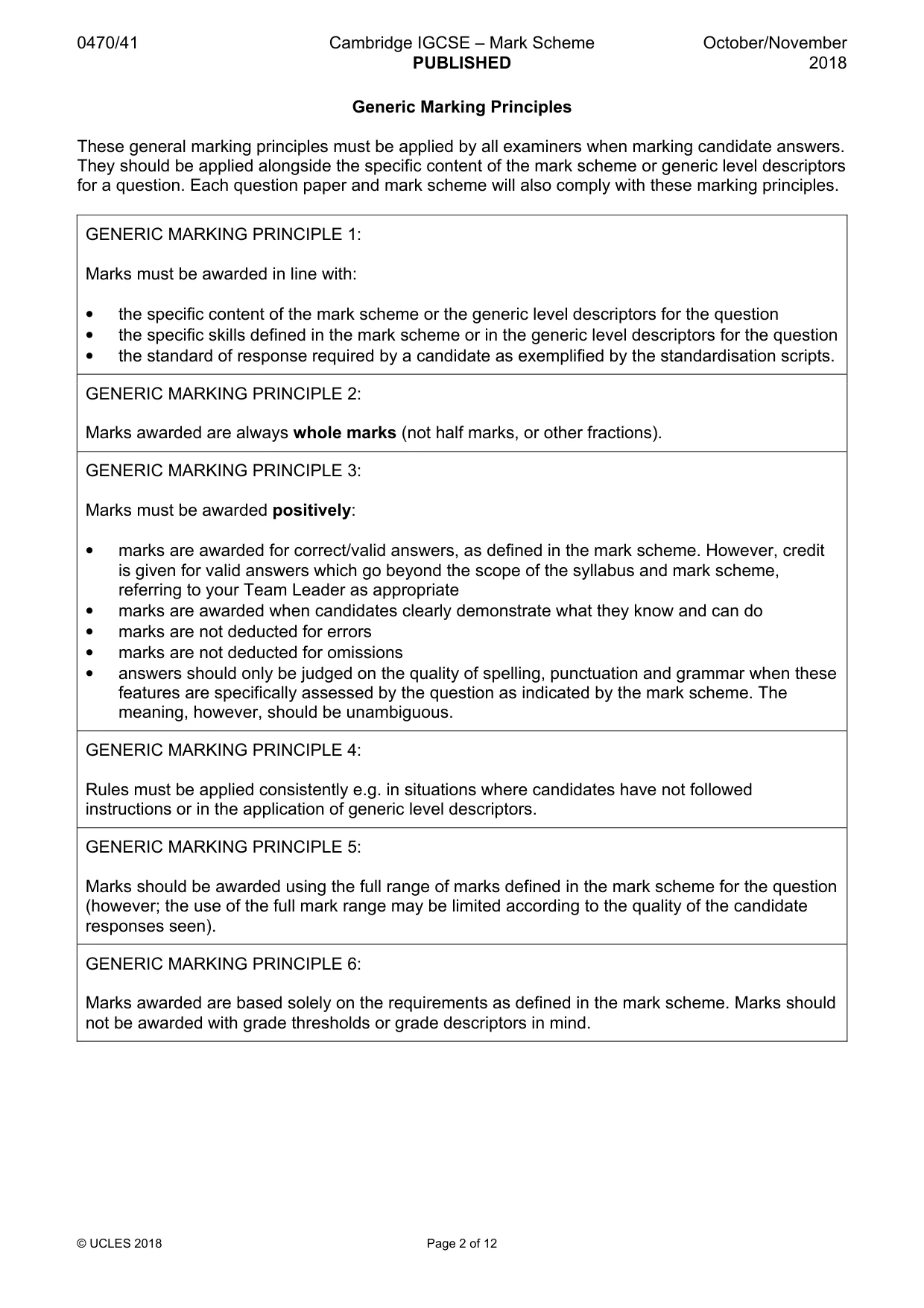
0470/41 Cambridge IGCSE – Mark Scheme PUBLISHED October/November 2018 © UCLES 2018 Page 2 of 12 Generic Marking Principles These general marking principles must be applied by all examiners when marking candidate answers. They should be applied alongside the specific content of the mark scheme or generic level descriptors for a question. Each question paper and mark scheme will also comply with these marking principles. GENERIC MARKING PRINCIPLE 1: Marks must be awarded in line with: • the specific content of the mark scheme or the generic level descriptors for the question • the specific skills defined in the mark scheme or in the generic level descriptors for the question • the standard of response required by a candidate as exemplified by the standardisation scripts. GENERIC MARKING PRINCIPLE 2: Marks awarded are always whole marks (not half marks, or other fractions). GENERIC MARKING PRINCIPLE 3: Marks must be awarded positively: • marks are awarded for correct/valid answers, as defined in the mark scheme. However, credit is given for valid answers which go beyond the scope of the syllabus and mark scheme, referring to your Team Leader as appropriate • marks are awarded when candidates clearly demonstrate what they know and can do • marks are not deducted for errors • marks are not deducted for omissions • answers should only be judged on the quality of spelling, punctuation and grammar when these features are specifically assessed by the question as indicated by the mark scheme. The meaning, however, should be unambiguous. GENERIC MARKING PRINCIPLE 4: Rules must be applied consistently e.g. in situations where candidates have not followed instructions or in the application of generic level descriptors. GENERIC MARKING PRINCIPLE 5: Marks should be awarded using the full range of marks defined in the mark scheme for the question (however; the use of the full mark range may be limited according to the quality of the candidate responses seen). GENERIC MARKING PRINCIPLE 6: Marks awarded are based solely on the requirements as defined in the mark scheme. Marks should not be awarded with grade thresholds or grade descriptors in mind.
Mark scheme, page 3
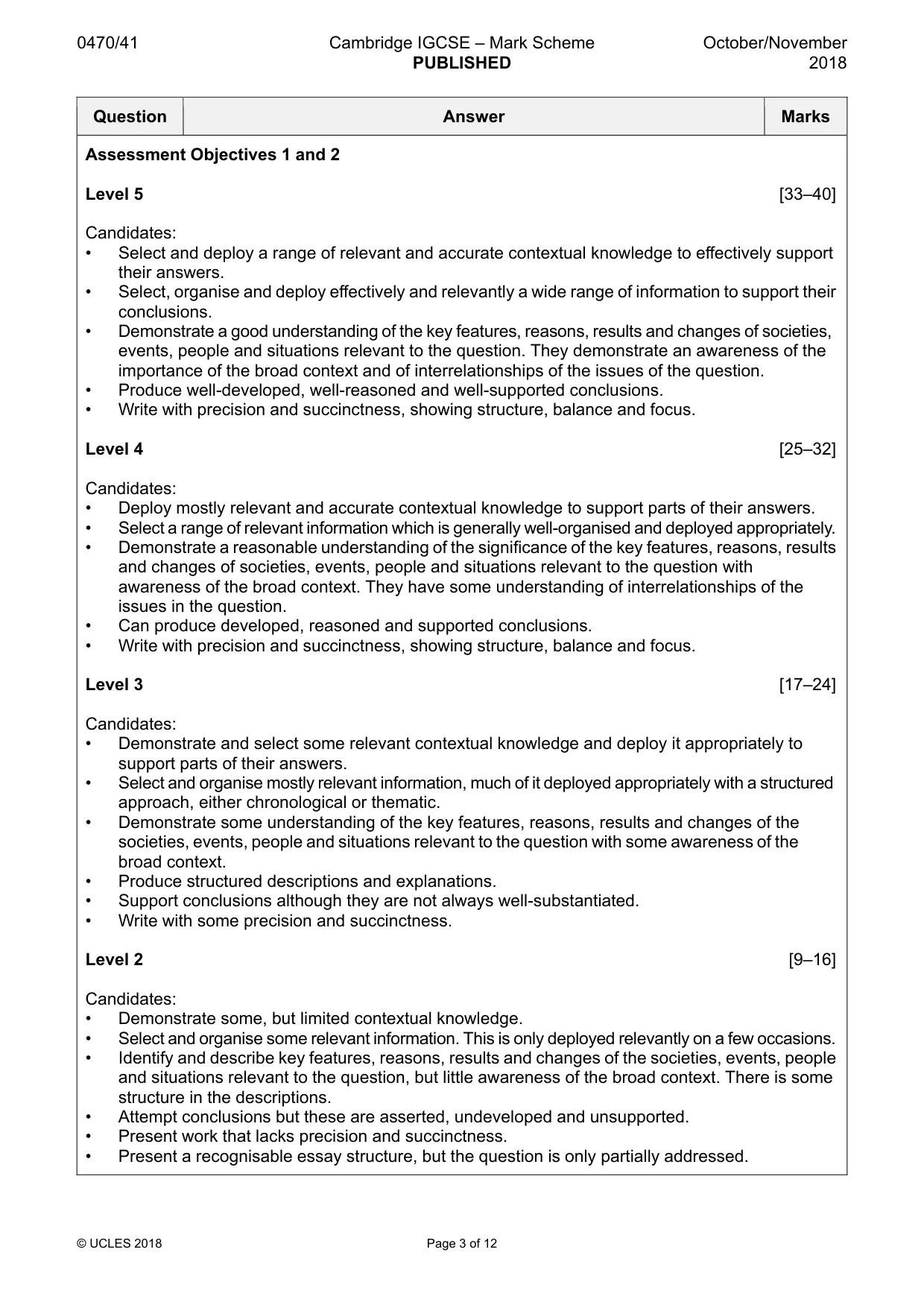
0470/41 Cambridge IGCSE – Mark Scheme PUBLISHED October/November 2018 © UCLES 2018 Page 3 of 12 Question Answer Marks Assessment Objectives 1 and 2 Level 5 [33–40] Candidates: • Select and deploy a range of relevant and accurate contextual knowledge to effectively support their answers. • Select, organise and deploy effectively and relevantly a wide range of information to support their conclusions. • Demonstrate a good understanding of the key features, reasons, results and changes of societies, events, people and situations relevant to the question. They demonstrate an awareness of the importance of the broad context and of interrelationships of the issues of the question. • Produce well-developed, well-reasoned and well-supported conclusions. • Write with precision and succinctness, showing structure, balance and focus. Level 4 [25–32] Candidates: • Deploy mostly relevant and accurate contextual knowledge to support parts of their answers. • Select a range of relevant information which is generally well-organised and deployed appropriately. • Demonstrate a reasonable understanding of the significance of the key features, reasons, results and changes of societies, events, people and situations relevant to the question with awareness of the broad context. They have some understanding of interrelationships of the issues in the question. • Can produce developed, reasoned and supported conclusions. • Write with precision and succinctness, showing structure, balance and focus. Level 3 [17–24] Candidates: • Demonstrate and select some relevant contextual knowledge and deploy it appropriately to support parts of their answers. • Select and organise mostly relevant information, much of it deployed appropriately with a structured approach, either chronological or thematic. • Demonstrate some understanding of the key features, reasons, results and changes of the societies, events, people and situations relevant to the question with some awareness of the broad context. • Produce structured descriptions and explanations. • Support conclusions although they are not always well-substantiated. • Write with some precision and succinctness. Level 2 [9–16] Candidates: • Demonstrate some, but limited contextual knowledge. • Select and organise some relevant information. This is only deployed relevantly on a few occasions. • Identify and describe key features, reasons, results and changes of the societies, events, people and situations relevant to the question, but little awareness of the broad context. There is some structure in the descriptions. • Attempt conclusions but these are asserted, undeveloped and unsupported. • Present work that lacks precision and succinctness. • Present a recognisable essay structure, but the question is only partially addressed.
Mark scheme, page 4
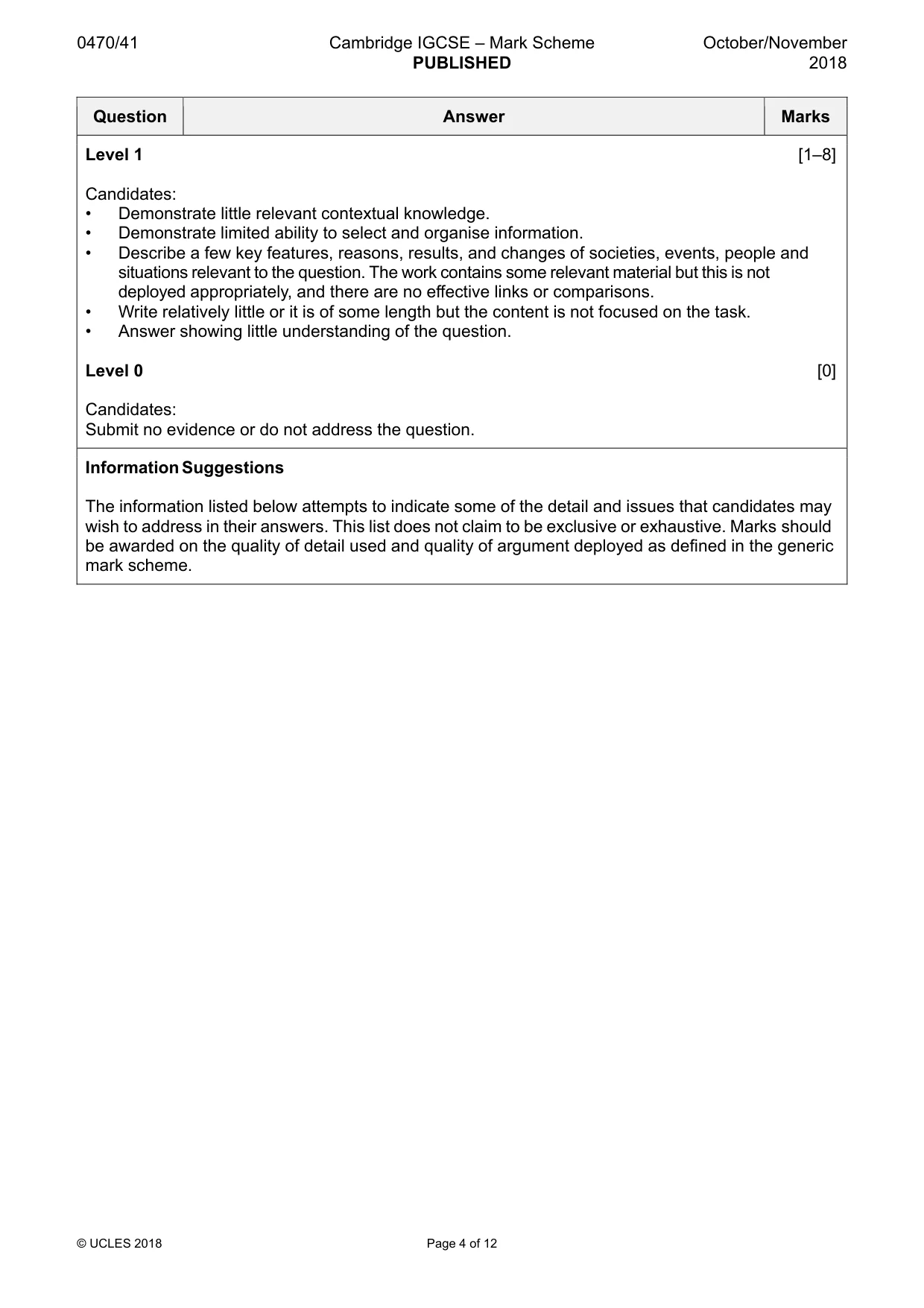
0470/41 Cambridge IGCSE – Mark Scheme PUBLISHED October/November 2018 © UCLES 2018 Page 4 of 12 Question Answer Marks Level 1 [1–8] Candidates: • Demonstrate little relevant contextual knowledge. • Demonstrate limited ability to select and organise information. • Describe a few key features, reasons, results, and changes of societies, events, people and situations relevant to the question. The work contains some relevant material but this is not deployed appropriately, and there are no effective links or comparisons. • Write relatively little or it is of some length but the content is not focused on the task. • Answer showing little understanding of the question. Level 0 [0] Candidates: Submit no evidence or do not address the question. Information Suggestions The information listed below attempts to indicate some of the detail and issues that candidates may wish to address in their answers. This list does not claim to be exclusive or exhaustive. Marks should be awarded on the quality of detail used and quality of argument deployed as defined in the generic mark scheme.
Mark scheme, page 5
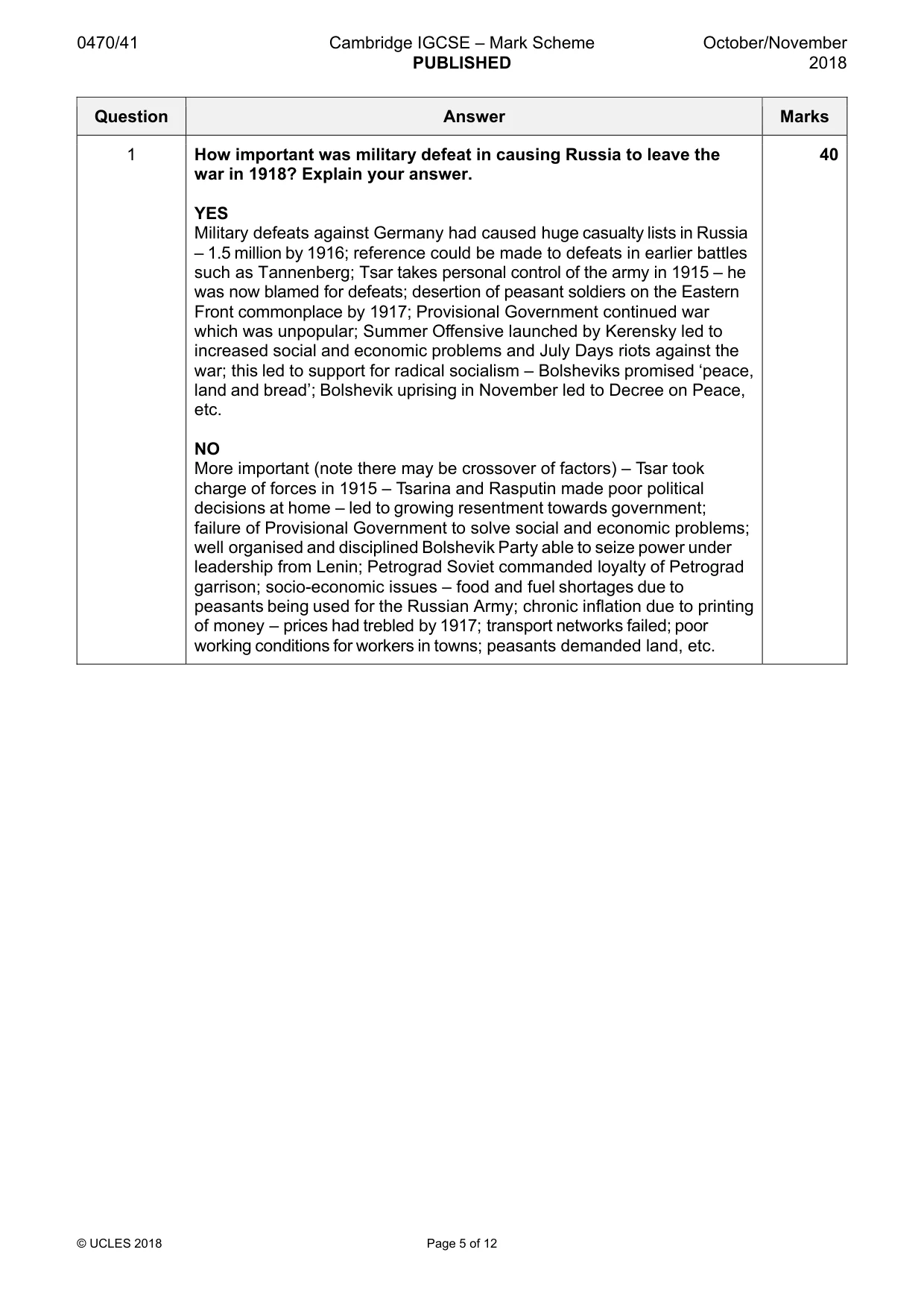
0470/41 Cambridge IGCSE – Mark Scheme PUBLISHED October/November 2018 © UCLES 2018 Page 5 of 12 Question Answer Marks 1 How important was military defeat in causing Russia to leave the war in 1918? Explain your answer. YES Military defeats against Germany had caused huge casualty lists in Russia – 1.5 million by 1916; reference could be made to defeats in earlier battles such as Tannenberg; Tsar takes personal control of the army in 1915 – he was now blamed for defeats; desertion of peasant soldiers on the Eastern Front commonplace by 1917; Provisional Government continued war which was unpopular; Summer Offensive launched by Kerensky led to increased social and economic problems and July Days riots against the war; this led to support for radical socialism – Bolsheviks promised ‘peace, land and bread’; Bolshevik uprising in November led to Decree on Peace, etc. NO More important (note there may be crossover of factors) – Tsar took charge of forces in 1915 – Tsarina and Rasputin made poor political decisions at home – led to growing resentment towards government; failure of Provisional Government to solve social and economic problems; well organised and disciplined Bolshevik Party able to seize power under leadership from Lenin; Petrograd Soviet commanded loyalty of Petrograd garrison; socio-economic issues – food and fuel shortages due to peasants being used for the Russian Army; chronic inflation due to printing of money – prices had trebled by 1917; transport networks failed; poor working conditions for workers in towns; peasants demanded land, etc. 40
Mark scheme, page 6
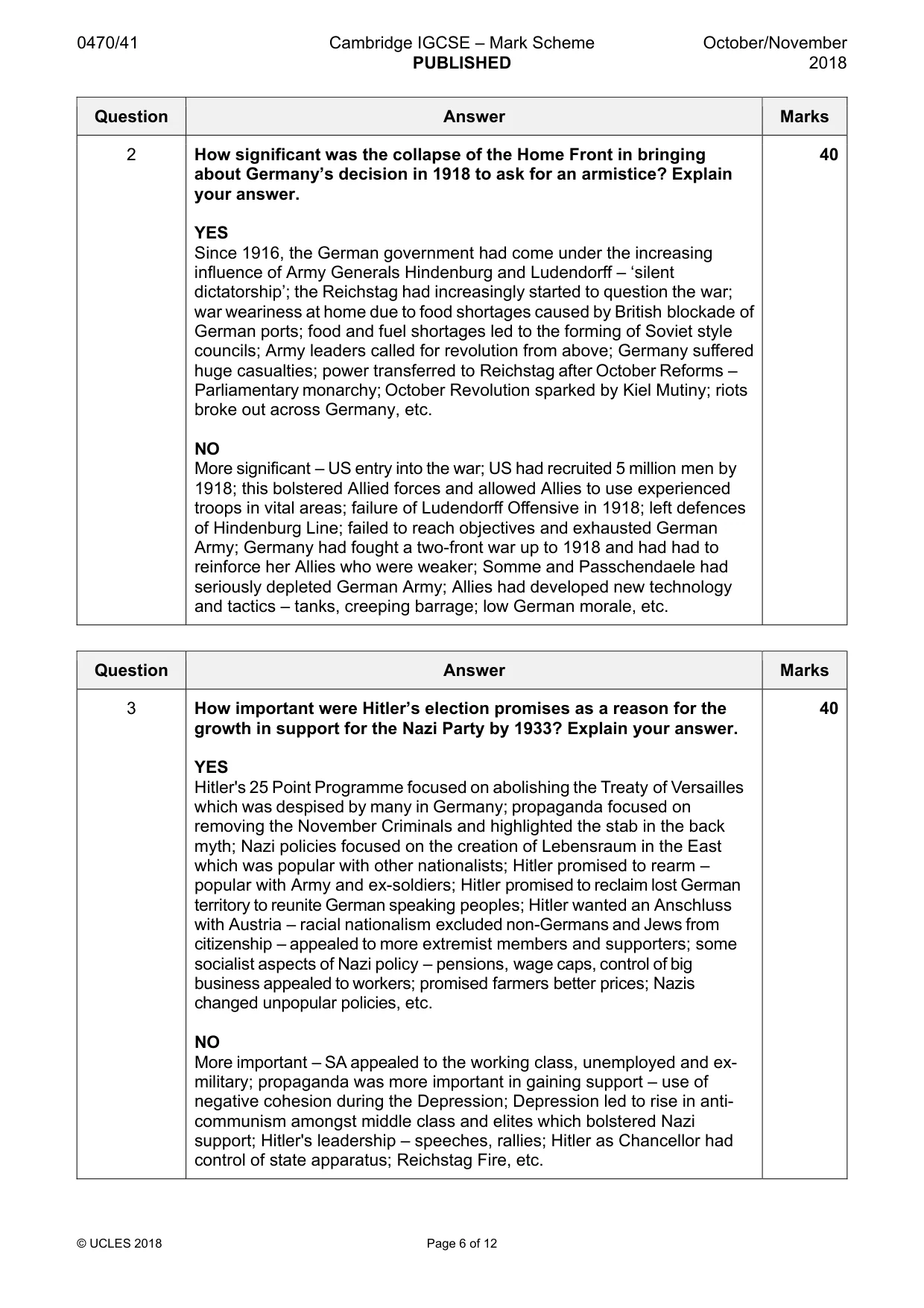
0470/41 Cambridge IGCSE – Mark Scheme PUBLISHED October/November 2018 © UCLES 2018 Page 6 of 12 Question Answer Marks 2 How significant was the collapse of the Home Front in bringing about Germany’s decision in 1918 to ask for an armistice? Explain your answer. YES Since 1916, the German government had come under the increasing influence of Army Generals Hindenburg and Ludendorff – ‘silent dictatorship’; the Reichstag had increasingly started to question the war; war weariness at home due to food shortages caused by British blockade of German ports; food and fuel shortages led to the forming of Soviet style councils; Army leaders called for revolution from above; Germany suffered huge casualties; power transferred to Reichstag after October Reforms – Parliamentary monarchy; October Revolution sparked by Kiel Mutiny; riots broke out across Germany, etc. NO More significant – US entry into the war; US had recruited 5 million men by 1918; this bolstered Allied forces and allowed Allies to use experienced troops in vital areas; failure of Ludendorff Offensive in 1918; left defences of Hindenburg Line; failed to reach objectives and exhausted German Army; Germany had fought a two-front war up to 1918 and had had to reinforce her Allies who were weaker; Somme and Passchendaele had seriously depleted German Army; Allies had developed new technology and tactics – tanks, creeping barrage; low German morale, etc. 40 Question Answer Marks 3 How important were Hitler’s election promises as a reason for the growth in support for the Nazi Party by 1933? Explain your answer. YES Hitler's 25 Point Programme focused on abolishing the Treaty of Versailles which was despised by many in Germany; propaganda focused on removing the November Criminals and highlighted the stab in the back myth; Nazi policies focused on the creation of Lebensraum in the East which was popular with other nationalists; Hitler promised to rearm – popular with Army and ex-soldiers; Hitler promised to reclaim lost German territory to reunite German speaking peoples; Hitler wanted an Anschluss with Austria – racial nationalism excluded non-Germans and Jews from citizenship – appealed to more extremist members and supporters; some socialist aspects of Nazi policy – pensions, wage caps, control of big business appealed to workers; promised farmers better prices; Nazis changed unpopular policies, etc. NO More important – SA appealed to the working class, unemployed and ex- military; propaganda was more important in gaining support – use of negative cohesion during the Depression; Depression led to rise in anti- communism amongst middle class and elites which bolstered Nazi support; Hitler's leadership – speeches, rallies; Hitler as Chancellor had control of state apparatus; Reichstag Fire, etc. 40
Mark scheme, page 7
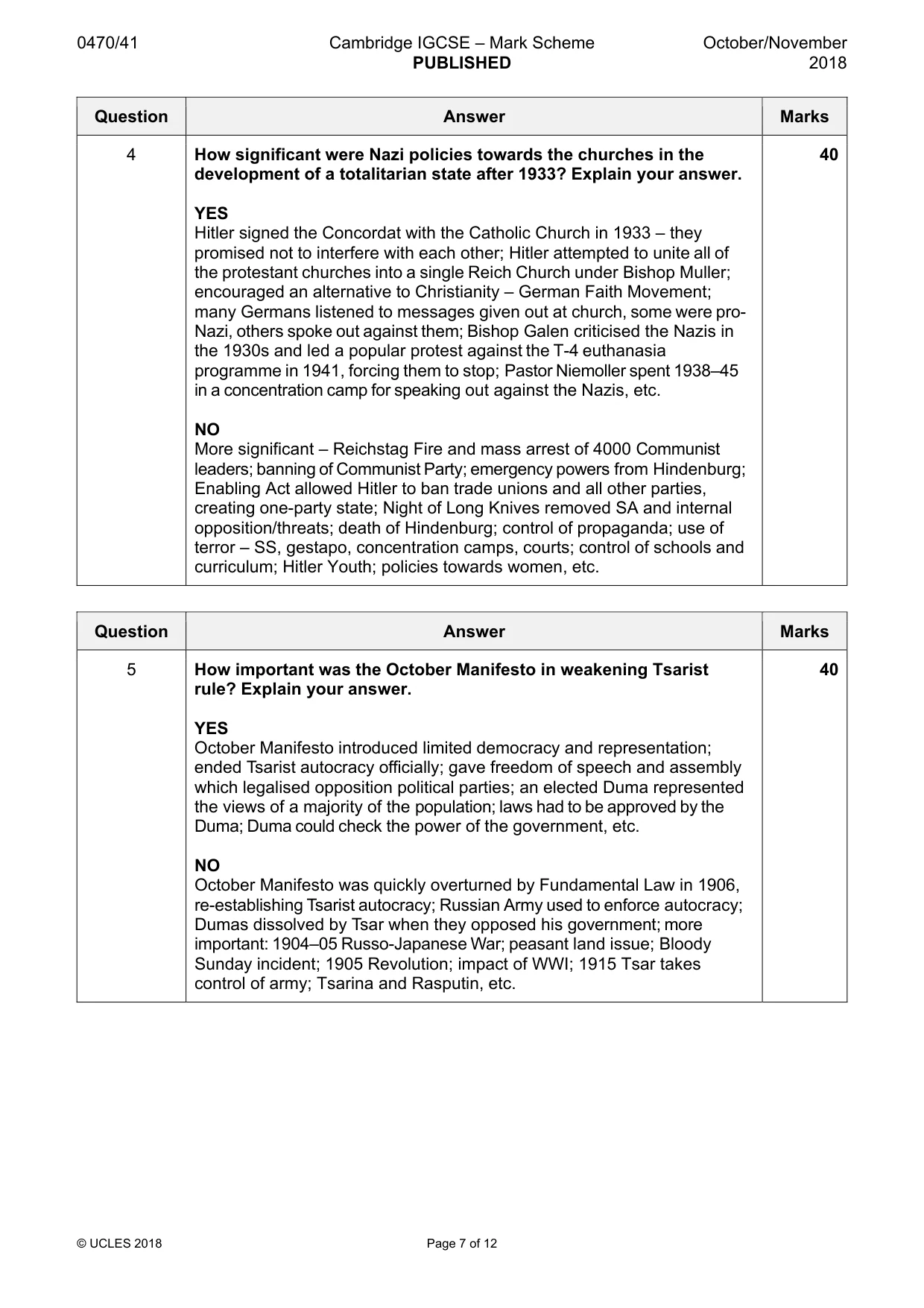
0470/41 Cambridge IGCSE – Mark Scheme PUBLISHED October/November 2018 © UCLES 2018 Page 7 of 12 Question Answer Marks 4 How significant were Nazi policies towards the churches in the development of a totalitarian state after 1933? Explain your answer. YES Hitler signed the Concordat with the Catholic Church in 1933 – they promised not to interfere with each other; Hitler attempted to unite all of the protestant churches into a single Reich Church under Bishop Muller; encouraged an alternative to Christianity – German Faith Movement; many Germans listened to messages given out at church, some were pro- Nazi, others spoke out against them; Bishop Galen criticised the Nazis in the 1930s and led a popular protest against the T-4 euthanasia programme in 1941, forcing them to stop; Pastor Niemoller spent 1938–45 in a concentration camp for speaking out against the Nazis, etc. NO More significant – Reichstag Fire and mass arrest of 4000 Communist leaders; banning of Communist Party; emergency powers from Hindenburg; Enabling Act allowed Hitler to ban trade unions and all other parties, creating one-party state; Night of Long Knives removed SA and internal opposition/threats; death of Hindenburg; control of propaganda; use of terror – SS, gestapo, concentration camps, courts; control of schools and curriculum; Hitler Youth; policies towards women, etc. 40 Question Answer Marks 5 How important was the October Manifesto in weakening Tsarist rule? Explain your answer. YES October Manifesto introduced limited democracy and representation; ended Tsarist autocracy officially; gave freedom of speech and assembly which legalised opposition political parties; an elected Duma represented the views of a majority of the population; laws had to be approved by the Duma; Duma could check the power of the government, etc. NO October Manifesto was quickly overturned by Fundamental Law in 1906, re-establishing Tsarist autocracy; Russian Army used to enforce autocracy; Dumas dissolved by Tsar when they opposed his government; more important: 1904–05 Russo-Japanese War; peasant land issue; Bloody Sunday incident; 1905 Revolution; impact of WWI; 1915 Tsar takes control of army; Tsarina and Rasputin, etc. 40
Mark scheme, page 8
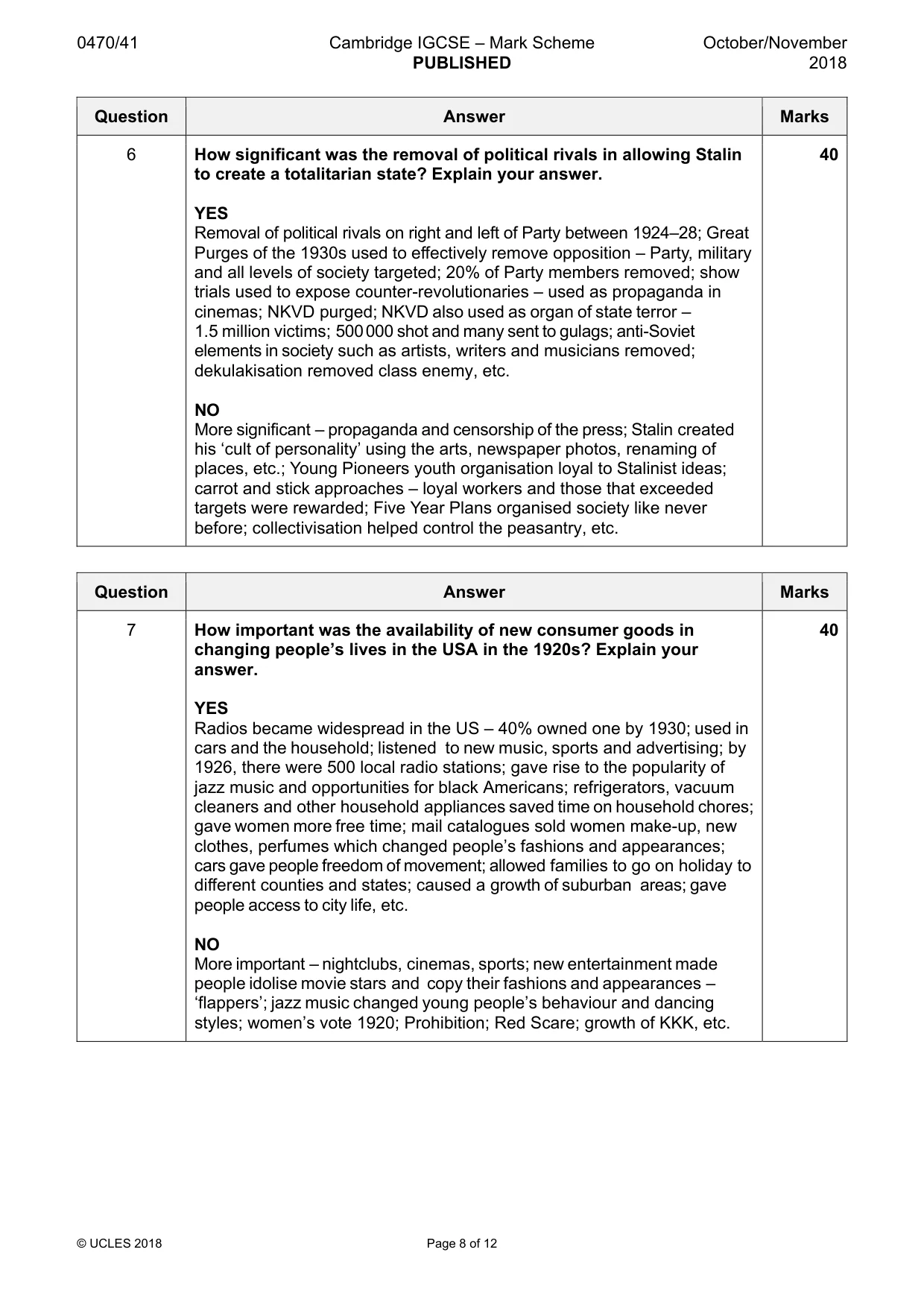
0470/41 Cambridge IGCSE – Mark Scheme PUBLISHED October/November 2018 © UCLES 2018 Page 8 of 12 Question Answer Marks 6 How significant was the removal of political rivals in allowing Stalin to create a totalitarian state? Explain your answer. YES Removal of political rivals on right and left of Party between 1924–28; Great Purges of the 1930s used to effectively remove opposition – Party, military and all levels of society targeted; 20% of Party members removed; show trials used to expose counter-revolutionaries – used as propaganda in cinemas; NKVD purged; NKVD also used as organ of state terror – 1.5 million victims; 500 000 shot and many sent to gulags; anti-Soviet elements in society such as artists, writers and musicians removed; dekulakisation removed class enemy, etc. NO More significant – propaganda and censorship of the press; Stalin created his ‘cult of personality’ using the arts, newspaper photos, renaming of places, etc.; Young Pioneers youth organisation loyal to Stalinist ideas; carrot and stick approaches – loyal workers and those that exceeded targets were rewarded; Five Year Plans organised society like never before; collectivisation helped control the peasantry, etc. 40 Question Answer Marks 7 How important was the availability of new consumer goods in changing people’s lives in the USA in the 1920s? Explain your answer. YES Radios became widespread in the US – 40% owned one by 1930; used in cars and the household; listened to new music, sports and advertising; by 1926, there were 500 local radio stations; gave rise to the popularity of jazz music and opportunities for black Americans; refrigerators, vacuum cleaners and other household appliances saved time on household chores; gave women more free time; mail catalogues sold women make-up, new clothes, perfumes which changed people’s fashions and appearances; cars gave people freedom of movement; allowed families to go on holiday to different counties and states; caused a growth of suburban areas; gave people access to city life, etc. NO More important – nightclubs, cinemas, sports; new entertainment made people idolise movie stars and copy their fashions and appearances – ‘flappers’; jazz music changed young people’s behaviour and dancing styles; women’s vote 1920; Prohibition; Red Scare; growth of KKK, etc. 40
Mark scheme, page 9
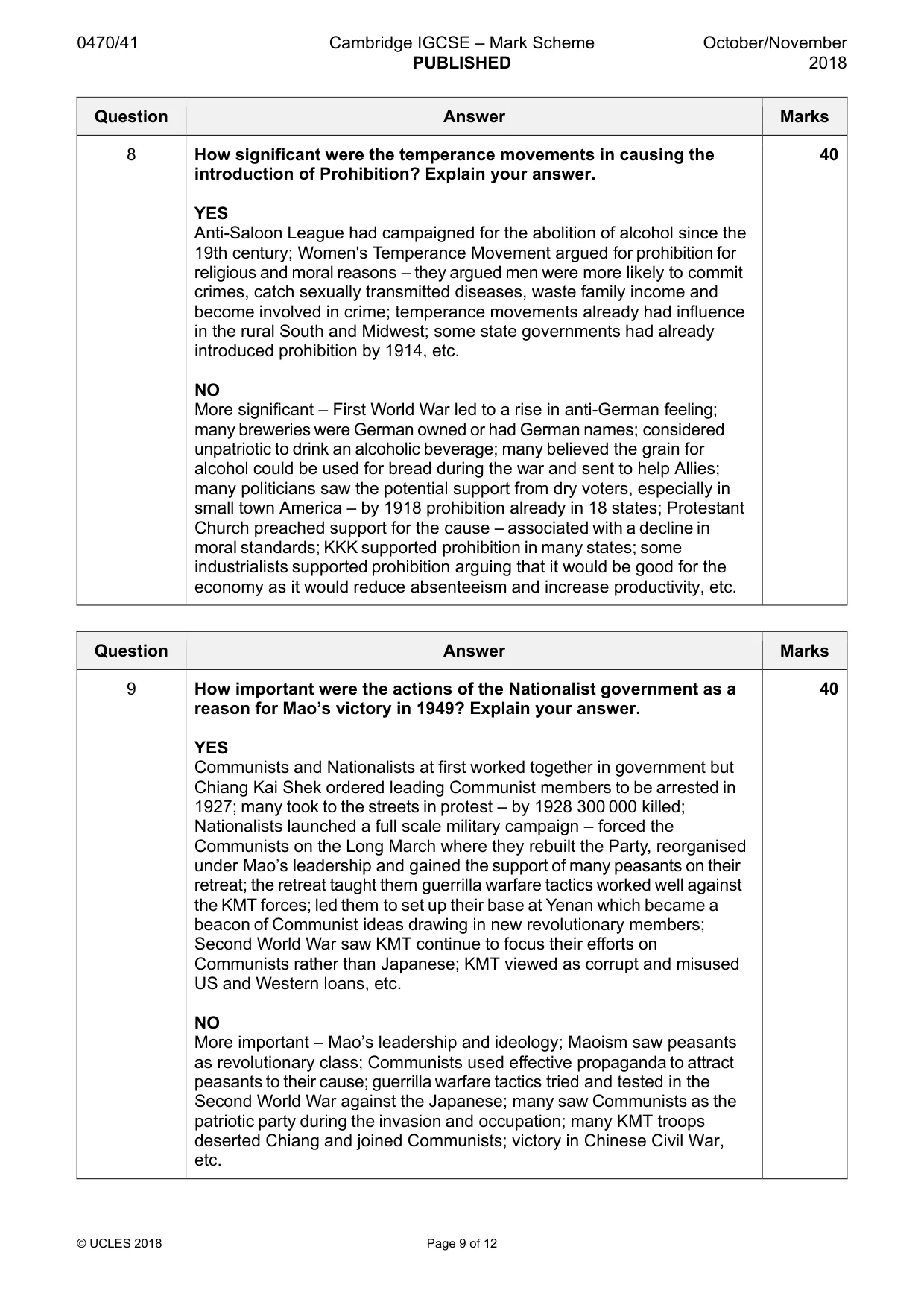
0470/41 Cambridge IGCSE – Mark Scheme PUBLISHED October/November 2018 © UCLES 2018 Page 9 of 12 Question Answer Marks 8 How significant were the temperance movements in causing the introduction of Prohibition? Explain your answer. YES Anti-Saloon League had campaigned for the abolition of alcohol since the 19th century; Women's Temperance Movement argued for prohibition for religious and moral reasons – they argued men were more likely to commit crimes, catch sexually transmitted diseases, waste family income and become involved in crime; temperance movements already had influence in the rural South and Midwest; some state governments had already introduced prohibition by 1914, etc. NO More significant – First World War led to a rise in anti-German feeling; many breweries were German owned or had German names; considered unpatriotic to drink an alcoholic beverage; many believed the grain for alcohol could be used for bread during the war and sent to help Allies; many politicians saw the potential support from dry voters, especially in small town America – by 1918 prohibition already in 18 states; Protestant Church preached support for the cause – associated with a decline in moral standards; KKK supported prohibition in many states; some industrialists supported prohibition arguing that it would be good for the economy as it would reduce absenteeism and increase productivity, etc. 40 Question Answer Marks 9 How important were the actions of the Nationalist government as a reason for Mao’s victory in 1949? Explain your answer. YES Communists and Nationalists at first worked together in government but Chiang Kai Shek ordered leading Communist members to be arrested in 1927; many took to the streets in protest – by 1928 300 000 killed; Nationalists launched a full scale military campaign – forced the Communists on the Long March where they rebuilt the Party, reorganised under Mao’s leadership and gained the support of many peasants on their retreat; the retreat taught them guerrilla warfare tactics worked well against the KMT forces; led them to set up their base at Yenan which became a beacon of Communist ideas drawing in new revolutionary members; Second World War saw KMT continue to focus their efforts on Communists rather than Japanese; KMT viewed as corrupt and misused US and Western loans, etc. NO More important – Mao’s leadership and ideology; Maoism saw peasants as revolutionary class; Communists used effective propaganda to attract peasants to their cause; guerrilla warfare tactics tried and tested in the Second World War against the Japanese; many saw Communists as the patriotic party during the invasion and occupation; many KMT troops deserted Chiang and joined Communists; victory in Chinese Civil War, etc. 40
Mark scheme, page 10
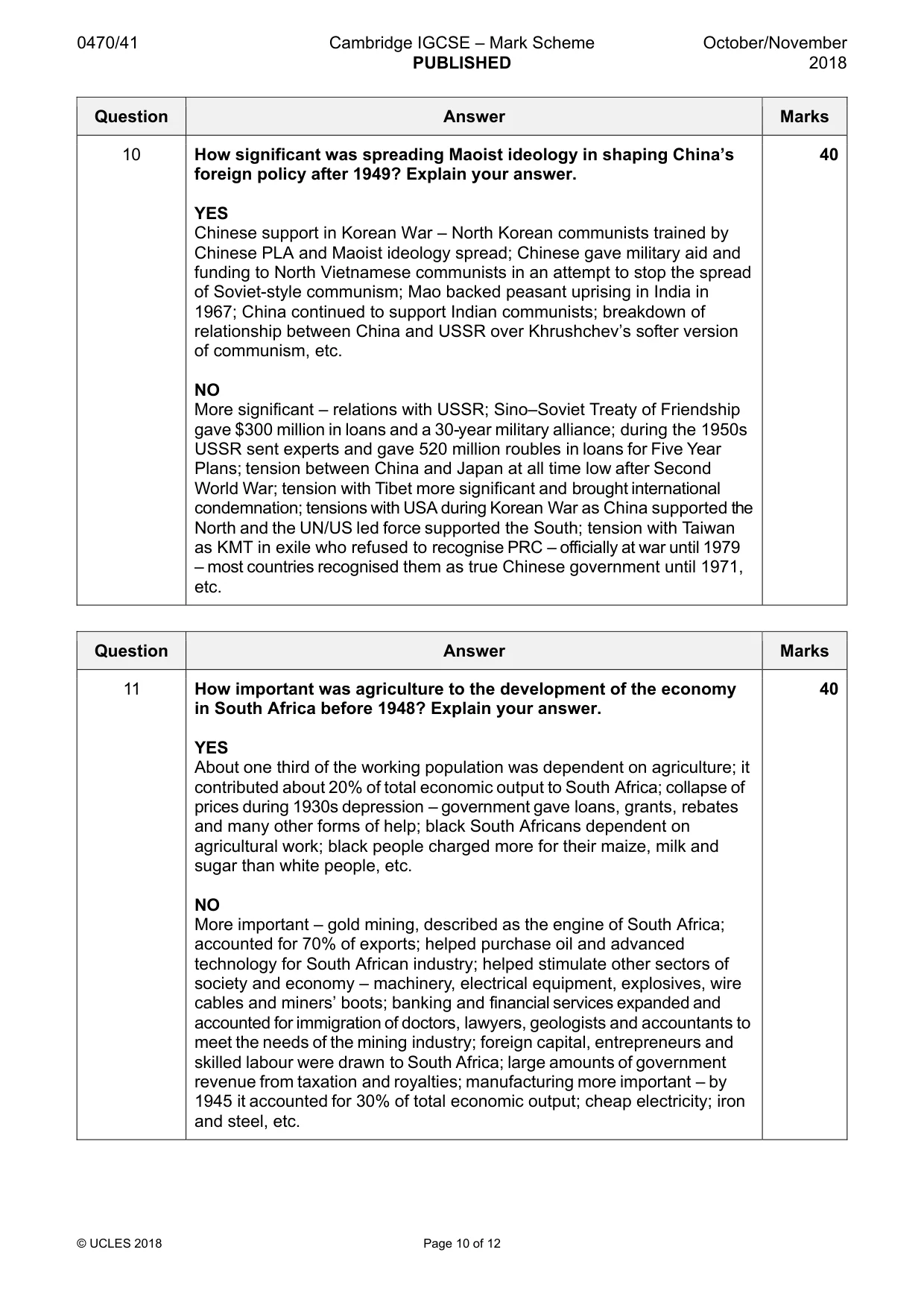
0470/41 Cambridge IGCSE – Mark Scheme PUBLISHED October/November 2018 © UCLES 2018 Page 10 of 12 Question Answer Marks 10 How significant was spreading Maoist ideology in shaping China’s foreign policy after 1949? Explain your answer. YES Chinese support in Korean War – North Korean communists trained by Chinese PLA and Maoist ideology spread; Chinese gave military aid and funding to North Vietnamese communists in an attempt to stop the spread of Soviet-style communism; Mao backed peasant uprising in India in 1967; China continued to support Indian communists; breakdown of relationship between China and USSR over Khrushchev’s softer version of communism, etc. NO More significant – relations with USSR; Sino–Soviet Treaty of Friendship gave $300 million in loans and a 30-year military alliance; during the 1950s USSR sent experts and gave 520 million roubles in loans for Five Year Plans; tension between China and Japan at all time low after Second World War; tension with Tibet more significant and brought international condemnation; tensions with USA during Korean War as China supported the North and the UN/US led force supported the South; tension with Taiwan as KMT in exile who refused to recognise PRC – officially at war until 1979 – most countries recognised them as true Chinese government until 1971, etc. 40 Question Answer Marks 11 How important was agriculture to the development of the economy in South Africa before 1948? Explain your answer. YES About one third of the working population was dependent on agriculture; it contributed about 20% of total economic output to South Africa; collapse of prices during 1930s depression – government gave loans, grants, rebates and many other forms of help; black South Africans dependent on agricultural work; black people charged more for their maize, milk and sugar than white people, etc. NO More important – gold mining, described as the engine of South Africa; accounted for 70% of exports; helped purchase oil and advanced technology for South African industry; helped stimulate other sectors of society and economy – machinery, electrical equipment, explosives, wire cables and miners’ boots; banking and financial services expanded and accounted for immigration of doctors, lawyers, geologists and accountants to meet the needs of the mining industry; foreign capital, entrepreneurs and skilled labour were drawn to South Africa; large amounts of government revenue from taxation and royalties; manufacturing more important – by 1945 it accounted for 30% of total economic output; cheap electricity; iron and steel, etc. 40
Mark scheme, page 11
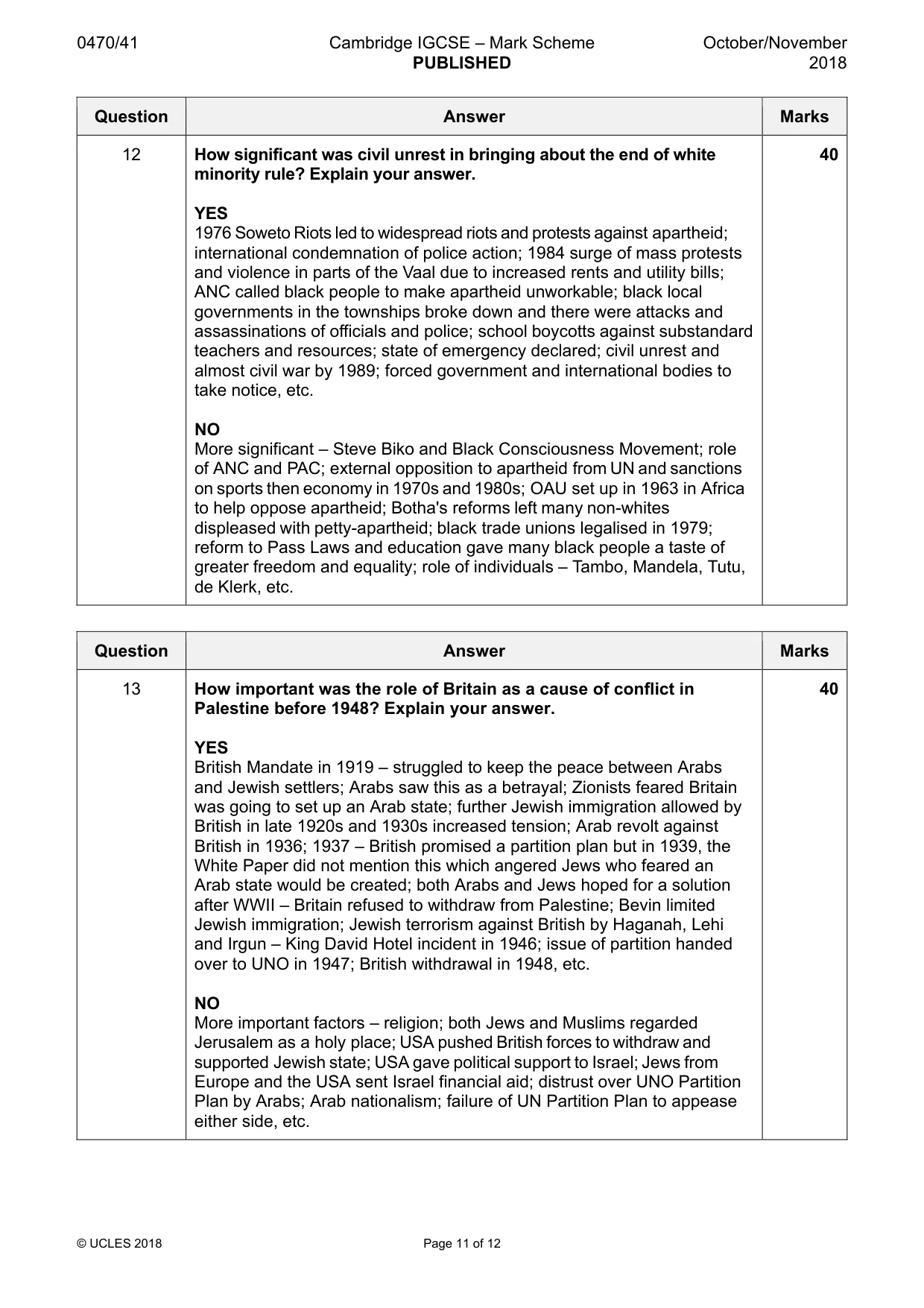
0470/41 Cambridge IGCSE – Mark Scheme PUBLISHED October/November 2018 © UCLES 2018 Page 11 of 12 Question Answer Marks 12 How significant was civil unrest in bringing about the end of white minority rule? Explain your answer. YES 1976 Soweto Riots led to widespread riots and protests against apartheid; international condemnation of police action; 1984 surge of mass protests and violence in parts of the Vaal due to increased rents and utility bills; ANC called black people to make apartheid unworkable; black local governments in the townships broke down and there were attacks and assassinations of officials and police; school boycotts against substandard teachers and resources; state of emergency declared; civil unrest and almost civil war by 1989; forced government and international bodies to take notice, etc. NO More significant – Steve Biko and Black Consciousness Movement; role of ANC and PAC; external opposition to apartheid from UN and sanctions on sports then economy in 1970s and 1980s; OAU set up in 1963 in Africa to help oppose apartheid; Botha's reforms left many non-whites displeased with petty-apartheid; black trade unions legalised in 1979; reform to Pass Laws and education gave many black people a taste of greater freedom and equality; role of individuals – Tambo, Mandela, Tutu, de Klerk, etc. 40 Question Answer Marks 13 How important was the role of Britain as a cause of conflict in Palestine before 1948? Explain your answer. YES British Mandate in 1919 – struggled to keep the peace between Arabs and Jewish settlers; Arabs saw this as a betrayal; Zionists feared Britain was going to set up an Arab state; further Jewish immigration allowed by British in late 1920s and 1930s increased tension; Arab revolt against British in 1936; 1937 – British promised a partition plan but in 1939, the White Paper did not mention this which angered Jews who feared an Arab state would be created; both Arabs and Jews hoped for a solution after WWII – Britain refused to withdraw from Palestine; Bevin limited Jewish immigration; Jewish terrorism against British by Haganah, Lehi and Irgun – King David Hotel incident in 1946; issue of partition handed over to UNO in 1947; British withdrawal in 1948, etc. NO More important factors – religion; both Jews and Muslims regarded Jerusalem as a holy place; USA pushed British forces to withdraw and supported Jewish state; USA gave political support to Israel; Jews from Europe and the USA sent Israel financial aid; distrust over UNO Partition Plan by Arabs; Arab nationalism; failure of UN Partition Plan to appease either side, etc. 40
Mark scheme, page 12
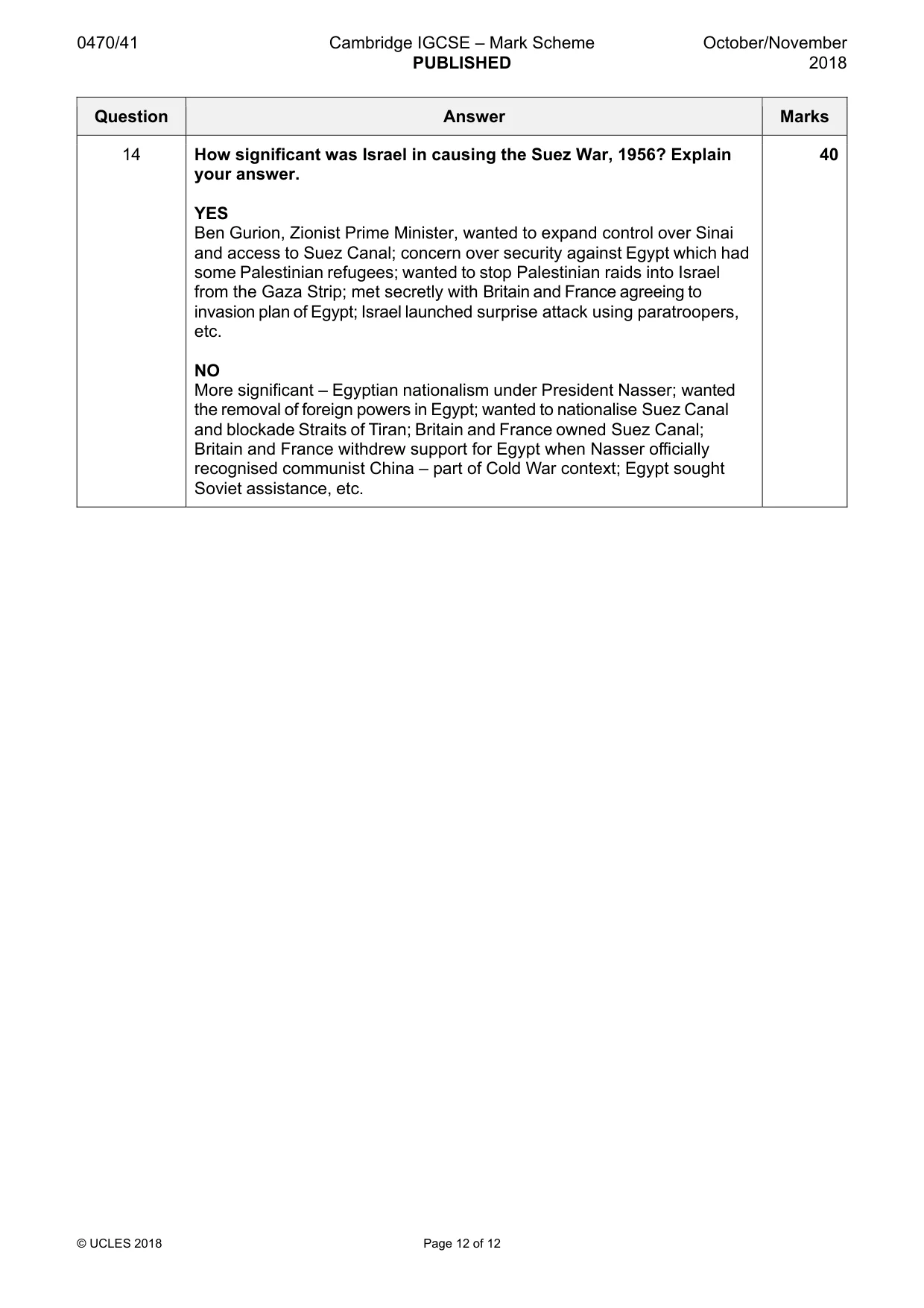
0470/41 Cambridge IGCSE – Mark Scheme PUBLISHED October/November 2018 © UCLES 2018 Page 12 of 12 Question Answer Marks 14 How significant was Israel in causing the Suez War, 1956? Explain your answer. YES Ben Gurion, Zionist Prime Minister, wanted to expand control over Sinai and access to Suez Canal; concern over security against Egypt which had some Palestinian refugees; wanted to stop Palestinian raids into Israel from the Gaza Strip; met secretly with Britain and France agreeing to invasion plan of Egypt; Israel launched surprise attack using paratroopers, etc. NO More significant – Egyptian nationalism under President Nasser; wanted the removal of foreign powers in Egypt; wanted to nationalise Suez Canal and blockade Straits of Tiran; Britain and France owned Suez Canal; Britain and France withdrew support for Egypt when Nasser officially recognised communist China – part of Cold War context; Egypt sought Soviet assistance, etc. 40
What you needed in this session
Cambridge’s own grade thresholds for 2018 Oct/Nov, Paper 4 · Variant 1. A higher threshold means an easier paper — the bar moves with how the cohort did.