Cambridge IGCSE History 0470 — 2018 Oct/Nov Paper 4 · Variant 2
0470/42/O/N/18 · 40 marks · ≈45 min
The question paper and its mark scheme, free to read here and free to download. This is Cambridge’s own paper, exactly as it was sat.
Question paper4 pages

Mark scheme11 pages
Answers below. Sit the paper first if you are practising.
Paper as text
Question paper, page 1
Cambridge International Examinations Cambridge International General Certificate of Secondary Education 0470/42 October/November 2018 1 hour HISTORY Paper 4 Alternative to Coursework Additional Materials: Answer Booklet/Paper READ THESE INSTRUCTIONS FIRST An answer booklet is provided inside this question paper. You should follow the instructions on the front cover of the answer booklet. If you need additional answer paper ask the invigilator for a continuation booklet. Answer one question from your chosen Depth Study. The number of marks is given in brackets [ ] at the end of each question or part question. The syllabus is approved for use in England, Wales and Northern Ireland as a Cambridge International Level 1/Level 2 Certificate. This document consists of 3 printed pages and 1 blank page. [Turn over 11_0470_42_2018_1.15 © UCLES 2018 *3075211172*
Question paper, page 2
Answer one question from your chosen Depth Study. DEPTH STUDY A: THE FIRST WORLD WAR, 1914–1918 How important was military leadership as a reason for high casualties on the Western Front? Explain your answer. [40] 1 How significant were the actions of Ludendorff in bringing about the German surrender in 1918? Explain your answer. [40] 2 DEPTH STUDY B: GERMANY, 1918–1945 How important was the work of Goebbels in enabling the Nazis to control Germany after 1933? Explain your answer. [40] 3 How significant was the Second World War in creating opposition within Germany to the Nazis? Explain your answer. [40] 4 DEPTH STUDY C: RUSSIA, 1905–1941 How important was the role of the Tsarina in bringing about the downfall of the Tsarist government? Explain your answer. [40] 5 How significant was the need to increase food production as a reason for Stalin’s modernisation of Russia? Explain your answer. [40] 6 DEPTH STUDY D: THE USA, 1919–1941 How important was the lack of an overseas market as a reason why farmers did not share in the economic boom? Explain your answer. [40] 7 How significant was the Supreme Court in the opposition to the New Deal? Explain your answer. [40] 8 DEPTH STUDY E: CHINA, c.1930–c.1990 How important were health and education reforms in changing peasants’ lives in the first decade of Communist rule, 1949–1958? Explain your answer. [40] 9 How significant was the persecution of intellectuals to the establishment of a Communist dictatorship in China? Explain your answer. [40] 10 11_0470_42_2018_1.15 © UCLES 2018 2
Question paper, page 3
DEPTH STUDY F: SOUTH AFRICA, c.1940–c.1994 How important was the growth in Black Consciousness to the success of the anti-apartheid movement in South Africa? Explain your answer. [40] 11 How significant were individual leaders in the collapse of white minority rule? Explain your answer. [40] 12 DEPTH STUDY G: ISRAELIS AND PALESTINIANS SINCE 1945 How important was the USA to Israeli successes against its Arab neighbours,1956–1973? Explain your answer. [40] 13 How significant has the Palestine Liberation Organisation (PLO) been in improving the fortunes of the Palestinian people? Explain your answer. [40] 14 11_0470_42_2018_1.15 © UCLES 2018 3
Question paper, page 4
BLANK PAGE Permission to reproduce items where third-party owned material protected by copyright is included has been sought and cleared where possible. Every reasonable effort has been made by the publisher (UCLES) to trace copyright holders, but if any items requiring clearance have unwittingly been included, the publisher will be pleased to make amends at the earliest possible opportunity. To avoid the issue of disclosure of answer-related information to candidates, all copyright acknowledgements are reproduced online in the Cambridge International Examinations Copyright Acknowledgements Booklet. This is produced for each series of examinations and is freely available to download at www.cie.org.uk after the live examination series. Cambridge International Examinations is part of the Cambridge Assessment Group. Cambridge Assessment is the brand name of University of Cambridge Local Examinations Syndicate (UCLES), which is itself a department of the University of Cambridge. 11_0470_42_2018_1.15 © UCLES 2018 4
Mark scheme, page 1
This syllabus is approved for use in England, Wales and Northern Ireland as a Cambridge International Level 1/Level 2 Certificate. This document consists of 11 printed pages. © UCLES 2018 [Turn over Cambridge Assessment International Education Cambridge International General Certificate of Secondary Education HISTORY 0470/42 Paper 4 Alternative to Coursework October/November 2018 MARK SCHEME Maximum Mark: 40 Published This mark scheme is published as an aid to teachers and candidates, to indicate the requirements of the examination. It shows the basis on which Examiners were instructed to award marks. It does not indicate the details of the discussions that took place at an Examiners’ meeting before marking began, which would have considered the acceptability of alternative answers. Mark schemes should be read in conjunction with the question paper and the Principal Examiner Report for Teachers. Cambridge International will not enter into discussions about these mark schemes. Cambridge International is publishing the mark schemes for the October/November 2018 series for most Cambridge IGCSE™, Cambridge International A and AS Level components and some Cambridge O Level components.
Mark scheme, page 2
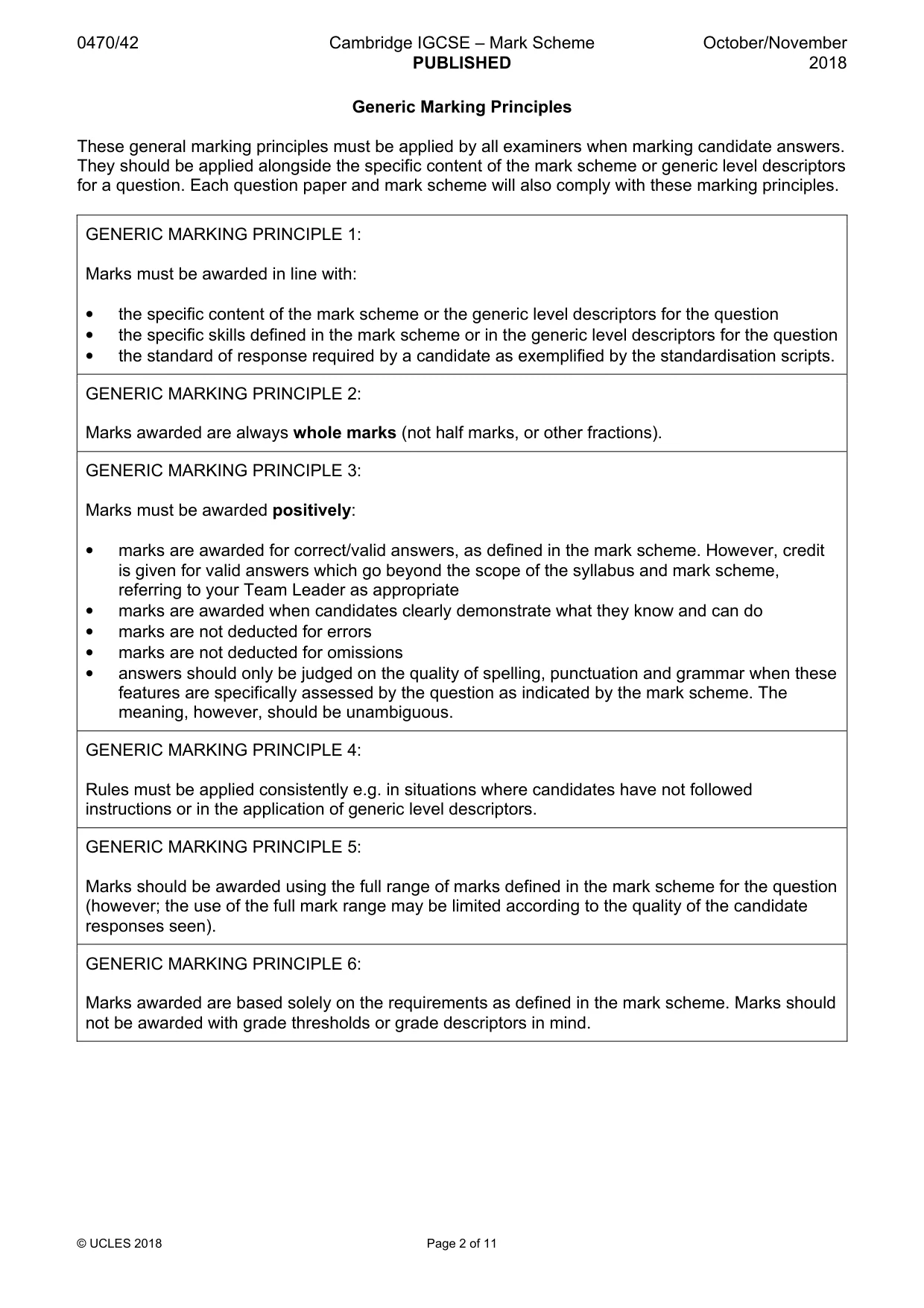
0470/42 Cambridge IGCSE – Mark Scheme PUBLISHED October/November 2018 © UCLES 2018 Page 2 of 11 Generic Marking Principles These general marking principles must be applied by all examiners when marking candidate answers. They should be applied alongside the specific content of the mark scheme or generic level descriptors for a question. Each question paper and mark scheme will also comply with these marking principles. GENERIC MARKING PRINCIPLE 1: Marks must be awarded in line with: • the specific content of the mark scheme or the generic level descriptors for the question • the specific skills defined in the mark scheme or in the generic level descriptors for the question • the standard of response required by a candidate as exemplified by the standardisation scripts. GENERIC MARKING PRINCIPLE 2: Marks awarded are always whole marks (not half marks, or other fractions). GENERIC MARKING PRINCIPLE 3: Marks must be awarded positively: • marks are awarded for correct/valid answers, as defined in the mark scheme. However, credit is given for valid answers which go beyond the scope of the syllabus and mark scheme, referring to your Team Leader as appropriate • marks are awarded when candidates clearly demonstrate what they know and can do • marks are not deducted for errors • marks are not deducted for omissions • answers should only be judged on the quality of spelling, punctuation and grammar when these features are specifically assessed by the question as indicated by the mark scheme. The meaning, however, should be unambiguous. GENERIC MARKING PRINCIPLE 4: Rules must be applied consistently e.g. in situations where candidates have not followed instructions or in the application of generic level descriptors. GENERIC MARKING PRINCIPLE 5: Marks should be awarded using the full range of marks defined in the mark scheme for the question (however; the use of the full mark range may be limited according to the quality of the candidate responses seen). GENERIC MARKING PRINCIPLE 6: Marks awarded are based solely on the requirements as defined in the mark scheme. Marks should not be awarded with grade thresholds or grade descriptors in mind.
Mark scheme, page 3
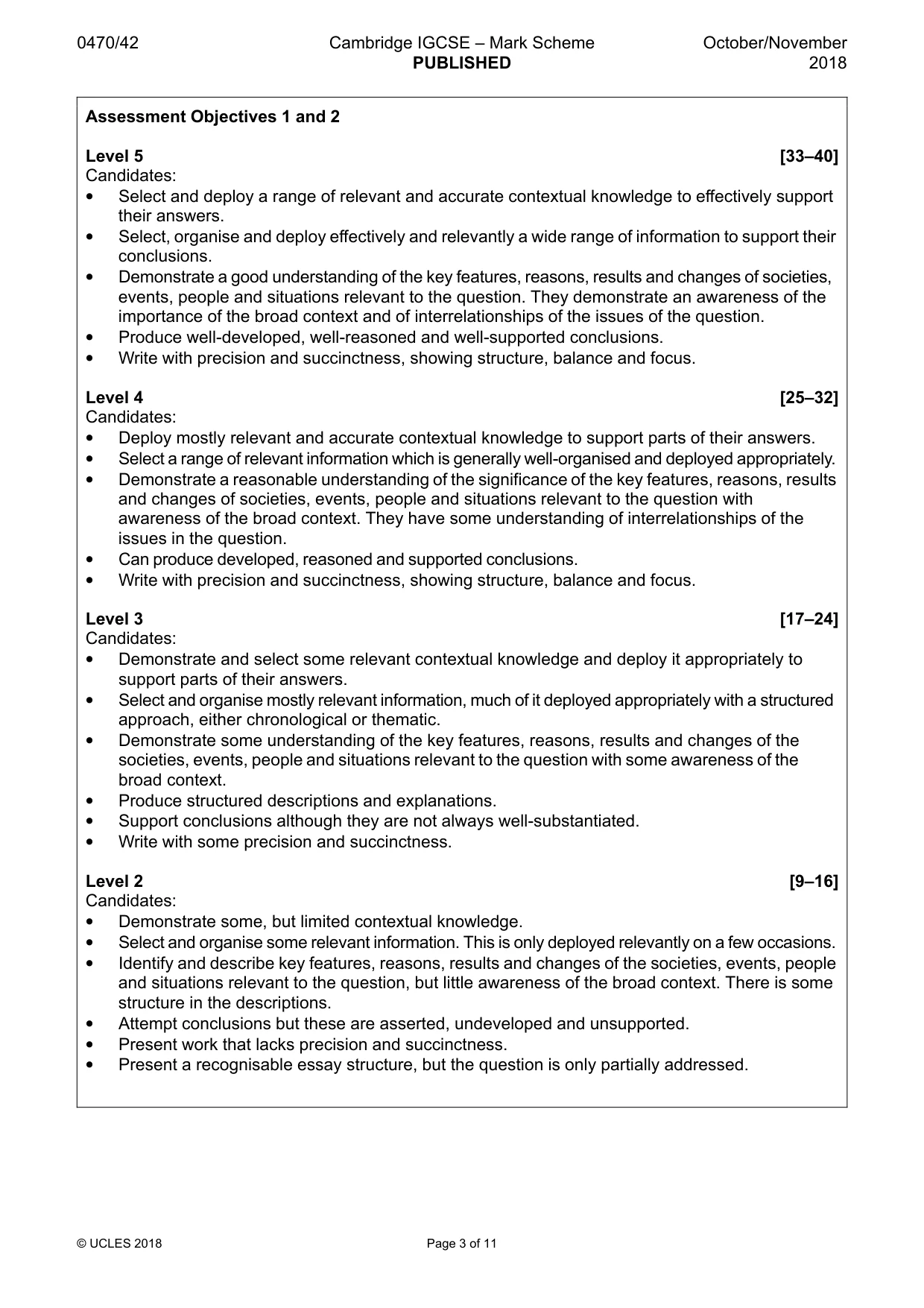
0470/42 Cambridge IGCSE – Mark Scheme PUBLISHED October/November 2018 © UCLES 2018 Page 3 of 11 Assessment Objectives 1 and 2 Level 5 [33–40] Candidates: • Select and deploy a range of relevant and accurate contextual knowledge to effectively support their answers. • Select, organise and deploy effectively and relevantly a wide range of information to support their conclusions. • Demonstrate a good understanding of the key features, reasons, results and changes of societies, events, people and situations relevant to the question. They demonstrate an awareness of the importance of the broad context and of interrelationships of the issues of the question. • Produce well-developed, well-reasoned and well-supported conclusions. • Write with precision and succinctness, showing structure, balance and focus. Level 4 [25–32] Candidates: • Deploy mostly relevant and accurate contextual knowledge to support parts of their answers. • Select a range of relevant information which is generally well-organised and deployed appropriately. • Demonstrate a reasonable understanding of the significance of the key features, reasons, results and changes of societies, events, people and situations relevant to the question with awareness of the broad context. They have some understanding of interrelationships of the issues in the question. • Can produce developed, reasoned and supported conclusions. • Write with precision and succinctness, showing structure, balance and focus. Level 3 [17–24] Candidates: • Demonstrate and select some relevant contextual knowledge and deploy it appropriately to support parts of their answers. • Select and organise mostly relevant information, much of it deployed appropriately with a structured approach, either chronological or thematic. • Demonstrate some understanding of the key features, reasons, results and changes of the societies, events, people and situations relevant to the question with some awareness of the broad context. • Produce structured descriptions and explanations. • Support conclusions although they are not always well-substantiated. • Write with some precision and succinctness. Level 2 [9–16] Candidates: • Demonstrate some, but limited contextual knowledge. • Select and organise some relevant information. This is only deployed relevantly on a few occasions. • Identify and describe key features, reasons, results and changes of the societies, events, people and situations relevant to the question, but little awareness of the broad context. There is some structure in the descriptions. • Attempt conclusions but these are asserted, undeveloped and unsupported. • Present work that lacks precision and succinctness. • Present a recognisable essay structure, but the question is only partially addressed.
Mark scheme, page 4
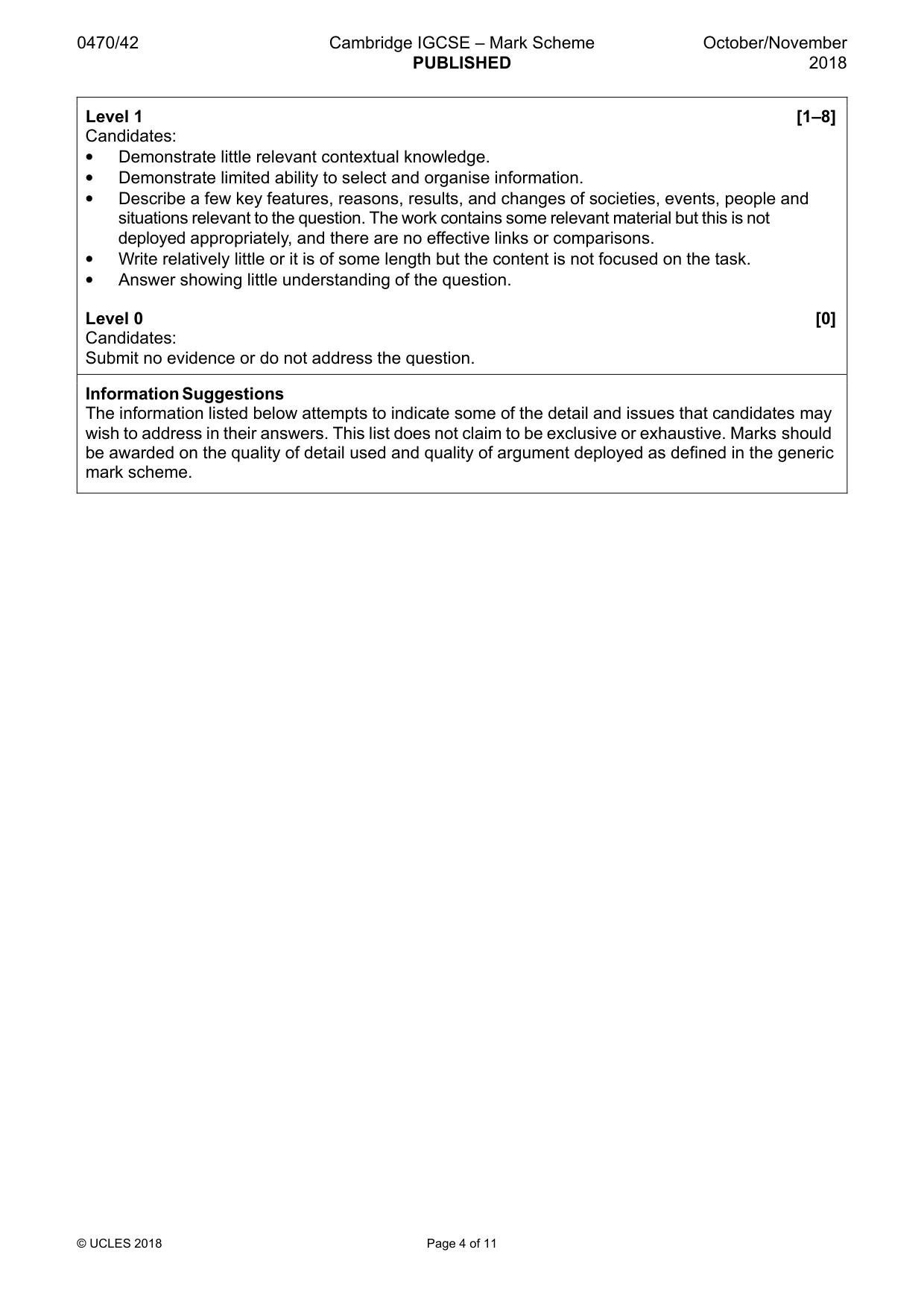
0470/42 Cambridge IGCSE – Mark Scheme PUBLISHED October/November 2018 © UCLES 2018 Page 4 of 11 Level 1 [1–8] Candidates: • Demonstrate little relevant contextual knowledge. • Demonstrate limited ability to select and organise information. • Describe a few key features, reasons, results, and changes of societies, events, people and situations relevant to the question. The work contains some relevant material but this is not deployed appropriately, and there are no effective links or comparisons. • Write relatively little or it is of some length but the content is not focused on the task. • Answer showing little understanding of the question. Level 0 [0] Candidates: Submit no evidence or do not address the question. Information Suggestions The information listed below attempts to indicate some of the detail and issues that candidates may wish to address in their answers. This list does not claim to be exclusive or exhaustive. Marks should be awarded on the quality of detail used and quality of argument deployed as defined in the generic mark scheme.
Mark scheme, page 5
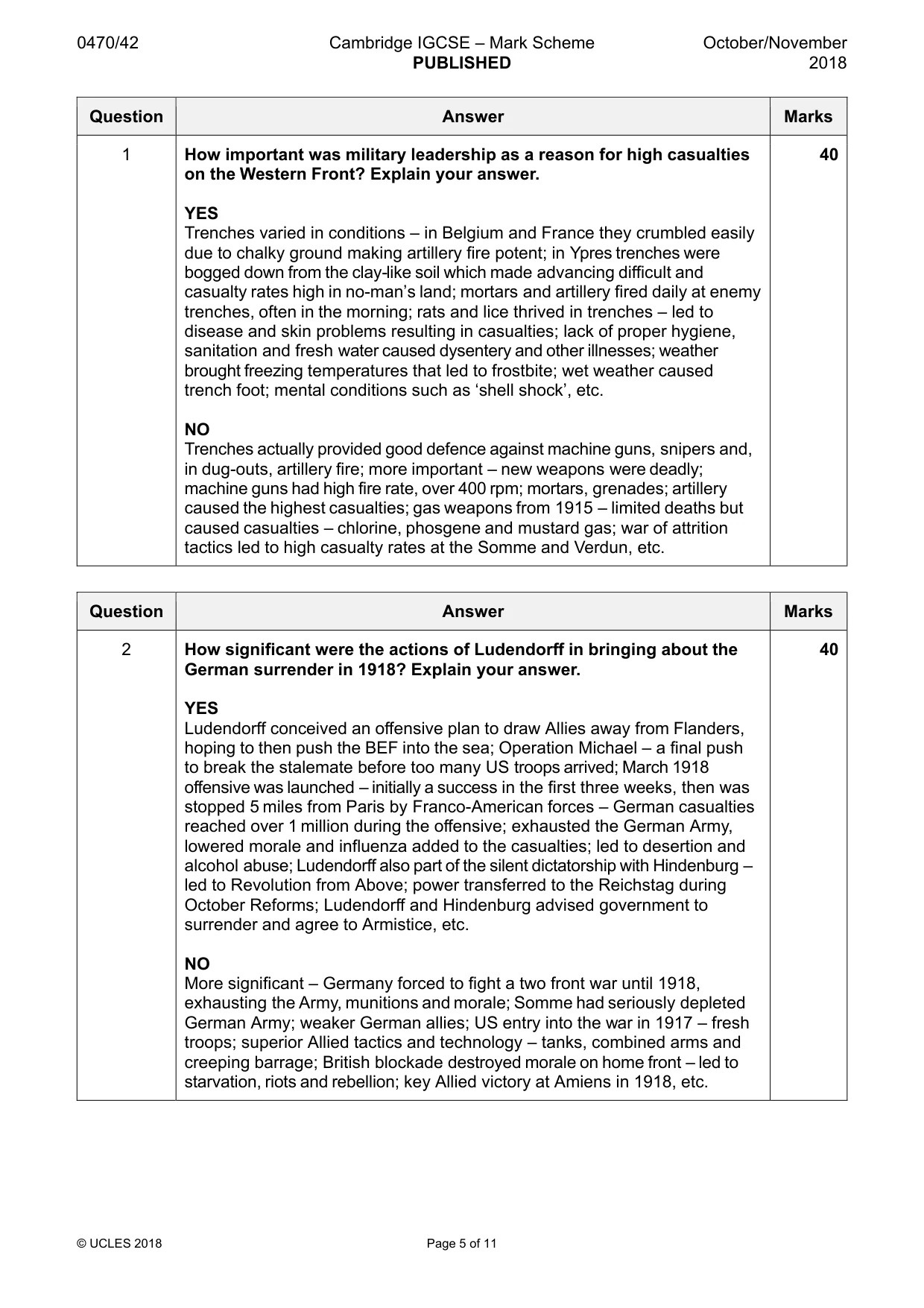
0470/42 Cambridge IGCSE – Mark Scheme PUBLISHED October/November 2018 © UCLES 2018 Page 5 of 11 Question Answer Marks 1 How important was military leadership as a reason for high casualties on the Western Front? Explain your answer. YES Trenches varied in conditions – in Belgium and France they crumbled easily due to chalky ground making artillery fire potent; in Ypres trenches were bogged down from the clay-like soil which made advancing difficult and casualty rates high in no-man’s land; mortars and artillery fired daily at enemy trenches, often in the morning; rats and lice thrived in trenches – led to disease and skin problems resulting in casualties; lack of proper hygiene, sanitation and fresh water caused dysentery and other illnesses; weather brought freezing temperatures that led to frostbite; wet weather caused trench foot; mental conditions such as ‘shell shock’, etc. NO Trenches actually provided good defence against machine guns, snipers and, in dug-outs, artillery fire; more important – new weapons were deadly; machine guns had high fire rate, over 400 rpm; mortars, grenades; artillery caused the highest casualties; gas weapons from 1915 – limited deaths but caused casualties – chlorine, phosgene and mustard gas; war of attrition tactics led to high casualty rates at the Somme and Verdun, etc. 40 Question Answer Marks 2 How significant were the actions of Ludendorff in bringing about the German surrender in 1918? Explain your answer. YES Ludendorff conceived an offensive plan to draw Allies away from Flanders, hoping to then push the BEF into the sea; Operation Michael – a final push to break the stalemate before too many US troops arrived; March 1918 offensive was launched – initially a success in the first three weeks, then was stopped 5 miles from Paris by Franco-American forces – German casualties reached over 1 million during the offensive; exhausted the German Army, lowered morale and influenza added to the casualties; led to desertion and alcohol abuse; Ludendorff also part of the silent dictatorship with Hindenburg – led to Revolution from Above; power transferred to the Reichstag during October Reforms; Ludendorff and Hindenburg advised government to surrender and agree to Armistice, etc. NO More significant – Germany forced to fight a two front war until 1918, exhausting the Army, munitions and morale; Somme had seriously depleted German Army; weaker German allies; US entry into the war in 1917 – fresh troops; superior Allied tactics and technology – tanks, combined arms and creeping barrage; British blockade destroyed morale on home front – led to starvation, riots and rebellion; key Allied victory at Amiens in 1918, etc. 40
Mark scheme, page 6
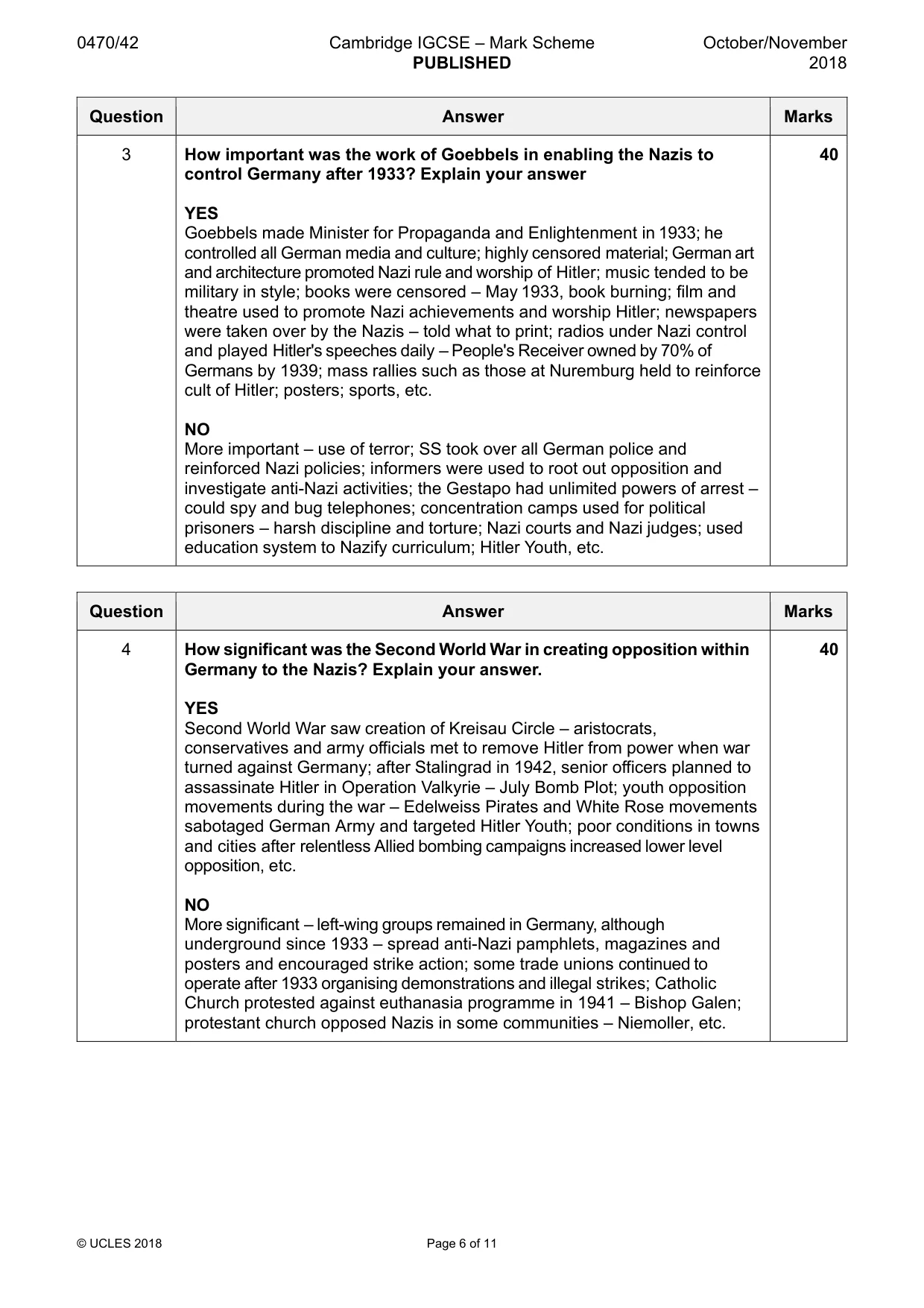
0470/42 Cambridge IGCSE – Mark Scheme PUBLISHED October/November 2018 © UCLES 2018 Page 6 of 11 Question Answer Marks 3 How important was the work of Goebbels in enabling the Nazis to control Germany after 1933? Explain your answer YES Goebbels made Minister for Propaganda and Enlightenment in 1933; he controlled all German media and culture; highly censored material; German art and architecture promoted Nazi rule and worship of Hitler; music tended to be military in style; books were censored – May 1933, book burning; film and theatre used to promote Nazi achievements and worship Hitler; newspapers were taken over by the Nazis – told what to print; radios under Nazi control and played Hitler's speeches daily – People's Receiver owned by 70% of Germans by 1939; mass rallies such as those at Nuremburg held to reinforce cult of Hitler; posters; sports, etc. NO More important – use of terror; SS took over all German police and reinforced Nazi policies; informers were used to root out opposition and investigate anti-Nazi activities; the Gestapo had unlimited powers of arrest – could spy and bug telephones; concentration camps used for political prisoners – harsh discipline and torture; Nazi courts and Nazi judges; used education system to Nazify curriculum; Hitler Youth, etc. 40 Question Answer Marks 4 How significant was the Second World War in creating opposition within Germany to the Nazis? Explain your answer. YES Second World War saw creation of Kreisau Circle – aristocrats, conservatives and army officials met to remove Hitler from power when war turned against Germany; after Stalingrad in 1942, senior officers planned to assassinate Hitler in Operation Valkyrie – July Bomb Plot; youth opposition movements during the war – Edelweiss Pirates and White Rose movements sabotaged German Army and targeted Hitler Youth; poor conditions in towns and cities after relentless Allied bombing campaigns increased lower level opposition, etc. NO More significant – left-wing groups remained in Germany, although underground since 1933 – spread anti-Nazi pamphlets, magazines and posters and encouraged strike action; some trade unions continued to operate after 1933 organising demonstrations and illegal strikes; Catholic Church protested against euthanasia programme in 1941 – Bishop Galen; protestant church opposed Nazis in some communities – Niemoller, etc. 40
Mark scheme, page 7
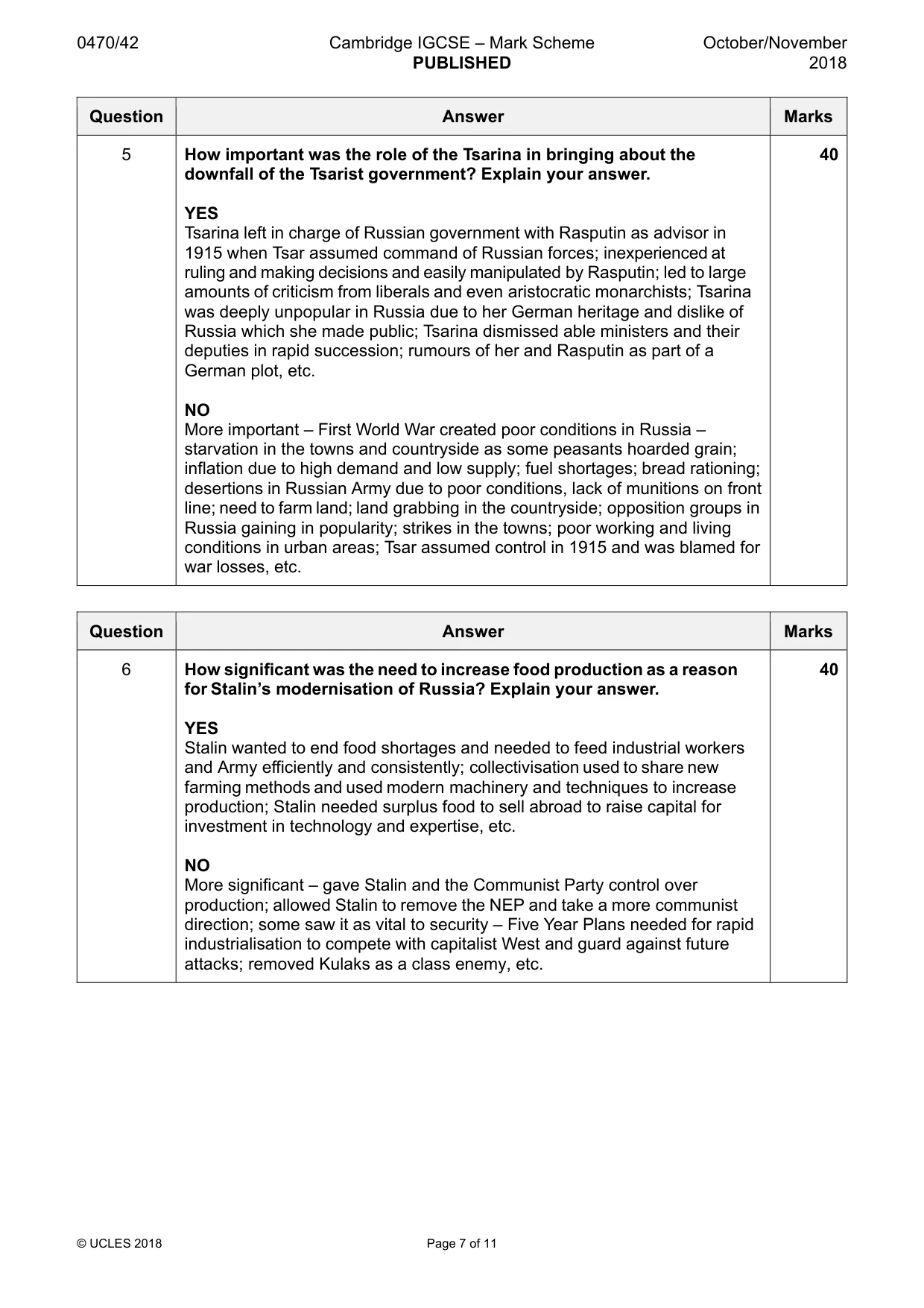
0470/42 Cambridge IGCSE – Mark Scheme PUBLISHED October/November 2018 © UCLES 2018 Page 7 of 11 Question Answer Marks 5 How important was the role of the Tsarina in bringing about the downfall of the Tsarist government? Explain your answer. YES Tsarina left in charge of Russian government with Rasputin as advisor in 1915 when Tsar assumed command of Russian forces; inexperienced at ruling and making decisions and easily manipulated by Rasputin; led to large amounts of criticism from liberals and even aristocratic monarchists; Tsarina was deeply unpopular in Russia due to her German heritage and dislike of Russia which she made public; Tsarina dismissed able ministers and their deputies in rapid succession; rumours of her and Rasputin as part of a German plot, etc. NO More important – First World War created poor conditions in Russia – starvation in the towns and countryside as some peasants hoarded grain; inflation due to high demand and low supply; fuel shortages; bread rationing; desertions in Russian Army due to poor conditions, lack of munitions on front line; need to farm land; land grabbing in the countryside; opposition groups in Russia gaining in popularity; strikes in the towns; poor working and living conditions in urban areas; Tsar assumed control in 1915 and was blamed for war losses, etc. 40 Question Answer Marks 6 How significant was the need to increase food production as a reason for Stalin’s modernisation of Russia? Explain your answer. YES Stalin wanted to end food shortages and needed to feed industrial workers and Army efficiently and consistently; collectivisation used to share new farming methods and used modern machinery and techniques to increase production; Stalin needed surplus food to sell abroad to raise capital for investment in technology and expertise, etc. NO More significant – gave Stalin and the Communist Party control over production; allowed Stalin to remove the NEP and take a more communist direction; some saw it as vital to security – Five Year Plans needed for rapid industrialisation to compete with capitalist West and guard against future attacks; removed Kulaks as a class enemy, etc. 40
Mark scheme, page 8
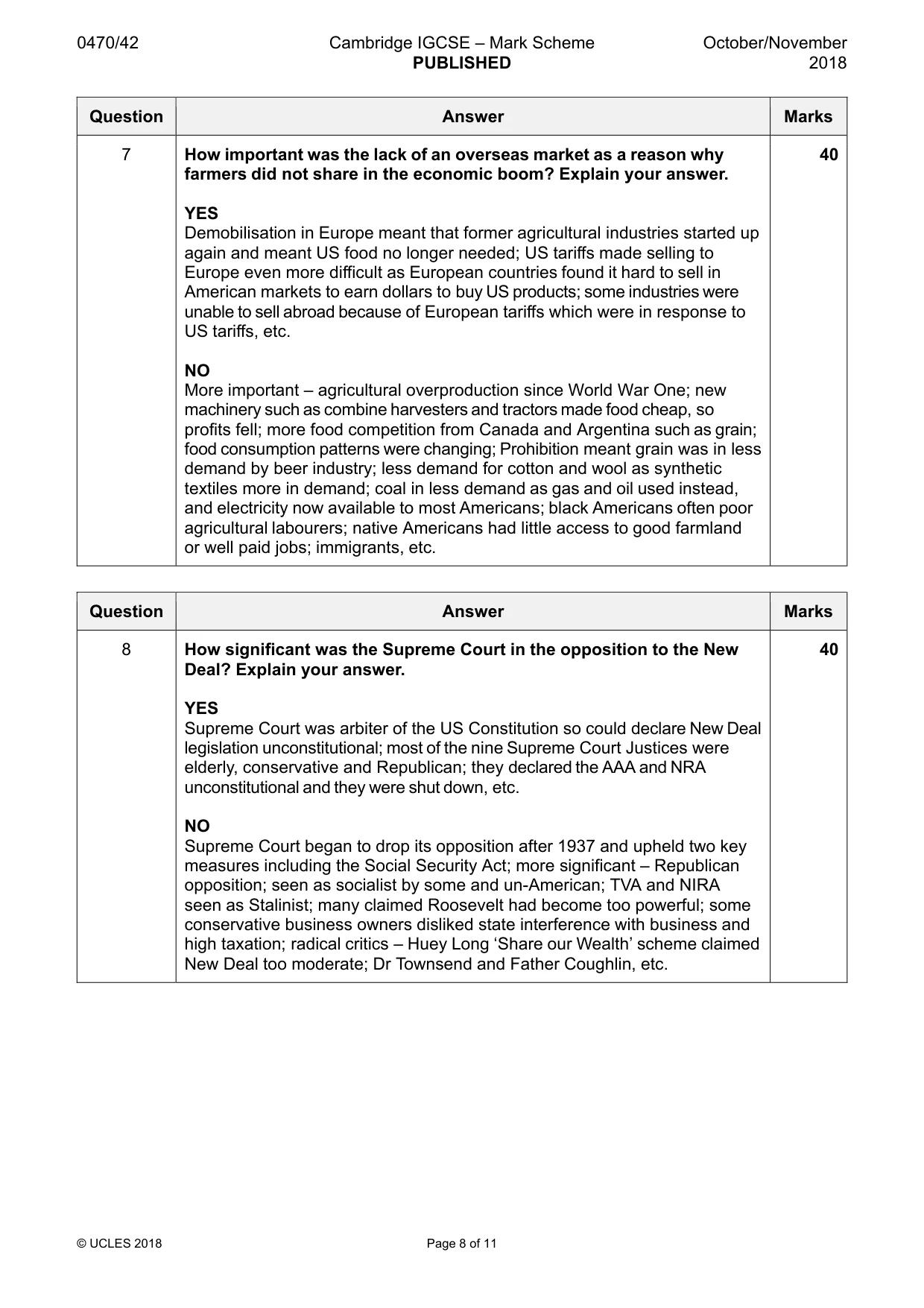
0470/42 Cambridge IGCSE – Mark Scheme PUBLISHED October/November 2018 © UCLES 2018 Page 8 of 11 Question Answer Marks 7 How important was the lack of an overseas market as a reason why farmers did not share in the economic boom? Explain your answer. YES Demobilisation in Europe meant that former agricultural industries started up again and meant US food no longer needed; US tariffs made selling to Europe even more difficult as European countries found it hard to sell in American markets to earn dollars to buy US products; some industries were unable to sell abroad because of European tariffs which were in response to US tariffs, etc. NO More important – agricultural overproduction since World War One; new machinery such as combine harvesters and tractors made food cheap, so profits fell; more food competition from Canada and Argentina such as grain; food consumption patterns were changing; Prohibition meant grain was in less demand by beer industry; less demand for cotton and wool as synthetic textiles more in demand; coal in less demand as gas and oil used instead, and electricity now available to most Americans; black Americans often poor agricultural labourers; native Americans had little access to good farmland or well paid jobs; immigrants, etc. 40 Question Answer Marks 8 How significant was the Supreme Court in the opposition to the New Deal? Explain your answer. YES Supreme Court was arbiter of the US Constitution so could declare New Deal legislation unconstitutional; most of the nine Supreme Court Justices were elderly, conservative and Republican; they declared the AAA and NRA unconstitutional and they were shut down, etc. NO Supreme Court began to drop its opposition after 1937 and upheld two key measures including the Social Security Act; more significant – Republican opposition; seen as socialist by some and un-American; TVA and NIRA seen as Stalinist; many claimed Roosevelt had become too powerful; some conservative business owners disliked state interference with business and high taxation; radical critics – Huey Long ‘Share our Wealth’ scheme claimed New Deal too moderate; Dr Townsend and Father Coughlin, etc. 40
Mark scheme, page 9
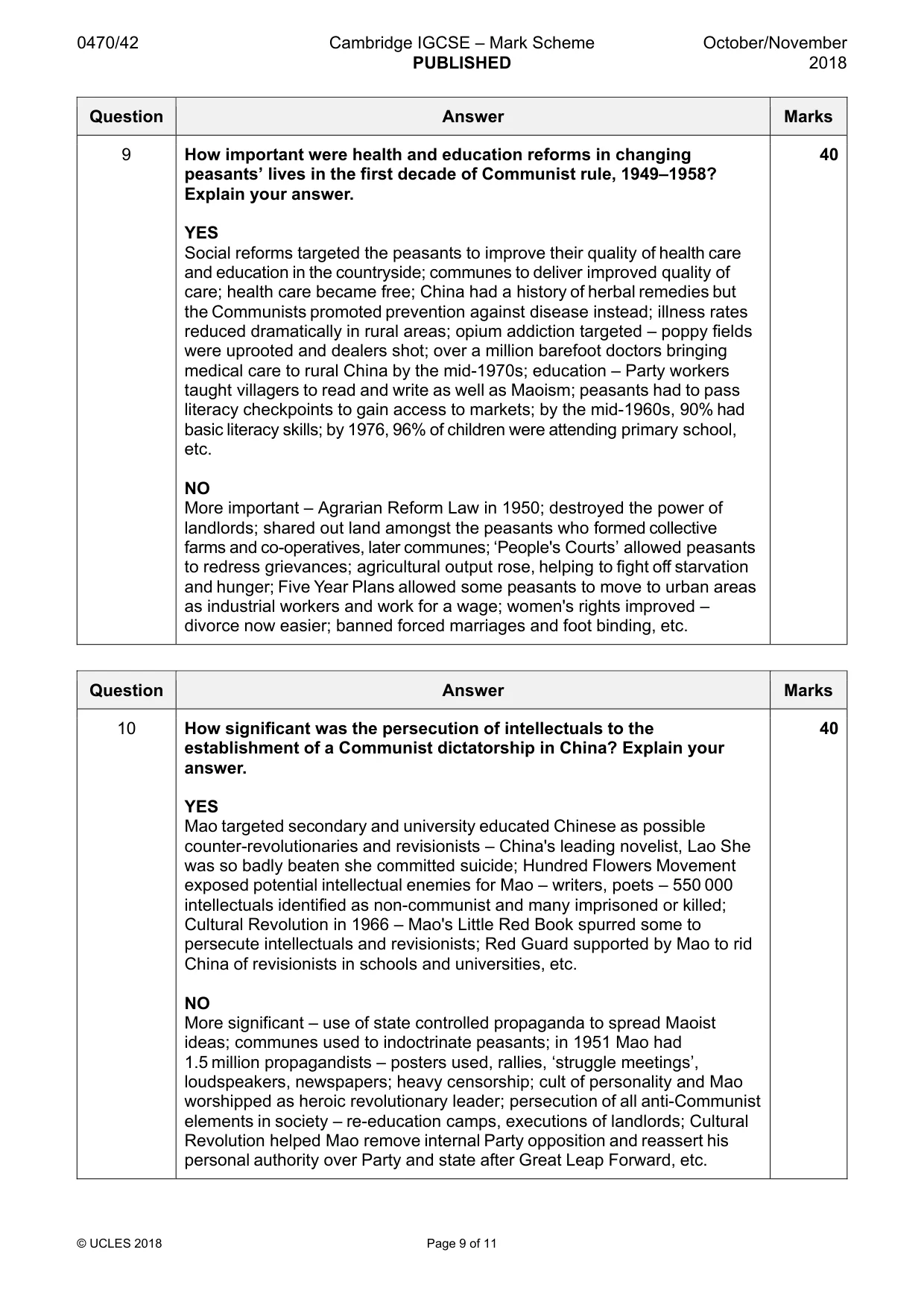
0470/42 Cambridge IGCSE – Mark Scheme PUBLISHED October/November 2018 © UCLES 2018 Page 9 of 11 Question Answer Marks 9 How important were health and education reforms in changing peasants’ lives in the first decade of Communist rule, 1949–1958? Explain your answer. YES Social reforms targeted the peasants to improve their quality of health care and education in the countryside; communes to deliver improved quality of care; health care became free; China had a history of herbal remedies but the Communists promoted prevention against disease instead; illness rates reduced dramatically in rural areas; opium addiction targeted – poppy fields were uprooted and dealers shot; over a million barefoot doctors bringing medical care to rural China by the mid-1970s; education – Party workers taught villagers to read and write as well as Maoism; peasants had to pass literacy checkpoints to gain access to markets; by the mid-1960s, 90% had basic literacy skills; by 1976, 96% of children were attending primary school, etc. NO More important – Agrarian Reform Law in 1950; destroyed the power of landlords; shared out land amongst the peasants who formed collective farms and co-operatives, later communes; ‘People's Courts’ allowed peasants to redress grievances; agricultural output rose, helping to fight off starvation and hunger; Five Year Plans allowed some peasants to move to urban areas as industrial workers and work for a wage; women's rights improved – divorce now easier; banned forced marriages and foot binding, etc. 40 Question Answer Marks 10 How significant was the persecution of intellectuals to the establishment of a Communist dictatorship in China? Explain your answer. YES Mao targeted secondary and university educated Chinese as possible counter-revolutionaries and revisionists – China's leading novelist, Lao She was so badly beaten she committed suicide; Hundred Flowers Movement exposed potential intellectual enemies for Mao – writers, poets – 550 000 intellectuals identified as non-communist and many imprisoned or killed; Cultural Revolution in 1966 – Mao's Little Red Book spurred some to persecute intellectuals and revisionists; Red Guard supported by Mao to rid China of revisionists in schools and universities, etc. NO More significant – use of state controlled propaganda to spread Maoist ideas; communes used to indoctrinate peasants; in 1951 Mao had 1.5 million propagandists – posters used, rallies, ‘struggle meetings’, loudspeakers, newspapers; heavy censorship; cult of personality and Mao worshipped as heroic revolutionary leader; persecution of all anti-Communist elements in society – re-education camps, executions of landlords; Cultural Revolution helped Mao remove internal Party opposition and reassert his personal authority over Party and state after Great Leap Forward, etc. 40
Mark scheme, page 10
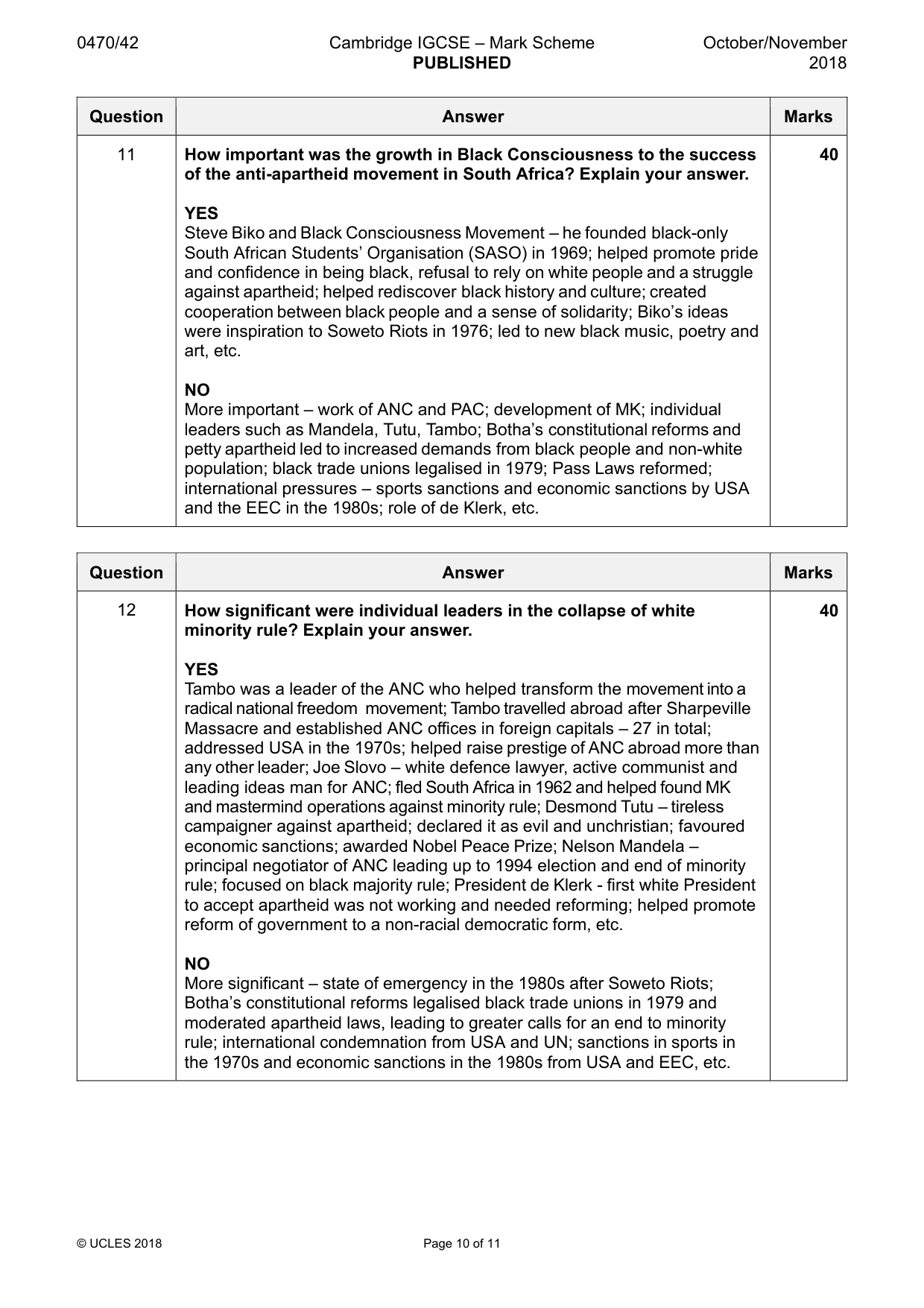
0470/42 Cambridge IGCSE – Mark Scheme PUBLISHED October/November 2018 © UCLES 2018 Page 10 of 11 Question Answer Marks 11 How important was the growth in Black Consciousness to the success of the anti-apartheid movement in South Africa? Explain your answer. YES Steve Biko and Black Consciousness Movement – he founded black-only South African Students’ Organisation (SASO) in 1969; helped promote pride and confidence in being black, refusal to rely on white people and a struggle against apartheid; helped rediscover black history and culture; created cooperation between black people and a sense of solidarity; Biko’s ideas were inspiration to Soweto Riots in 1976; led to new black music, poetry and art, etc. NO More important – work of ANC and PAC; development of MK; individual leaders such as Mandela, Tutu, Tambo; Botha’s constitutional reforms and petty apartheid led to increased demands from black people and non-white population; black trade unions legalised in 1979; Pass Laws reformed; international pressures – sports sanctions and economic sanctions by USA and the EEC in the 1980s; role of de Klerk, etc. 40 Question Answer Marks 12 How significant were individual leaders in the collapse of white minority rule? Explain your answer. YES Tambo was a leader of the ANC who helped transform the movement into a radical national freedom movement; Tambo travelled abroad after Sharpeville Massacre and established ANC offices in foreign capitals – 27 in total; addressed USA in the 1970s; helped raise prestige of ANC abroad more than any other leader; Joe Slovo – white defence lawyer, active communist and leading ideas man for ANC; fled South Africa in 1962 and helped found MK and mastermind operations against minority rule; Desmond Tutu – tireless campaigner against apartheid; declared it as evil and unchristian; favoured economic sanctions; awarded Nobel Peace Prize; Nelson Mandela – principal negotiator of ANC leading up to 1994 election and end of minority rule; focused on black majority rule; President de Klerk - first white President to accept apartheid was not working and needed reforming; helped promote reform of government to a non-racial democratic form, etc. NO More significant – state of emergency in the 1980s after Soweto Riots; Botha’s constitutional reforms legalised black trade unions in 1979 and moderated apartheid laws, leading to greater calls for an end to minority rule; international condemnation from USA and UN; sanctions in sports in the 1970s and economic sanctions in the 1980s from USA and EEC, etc. 40
Mark scheme, page 11
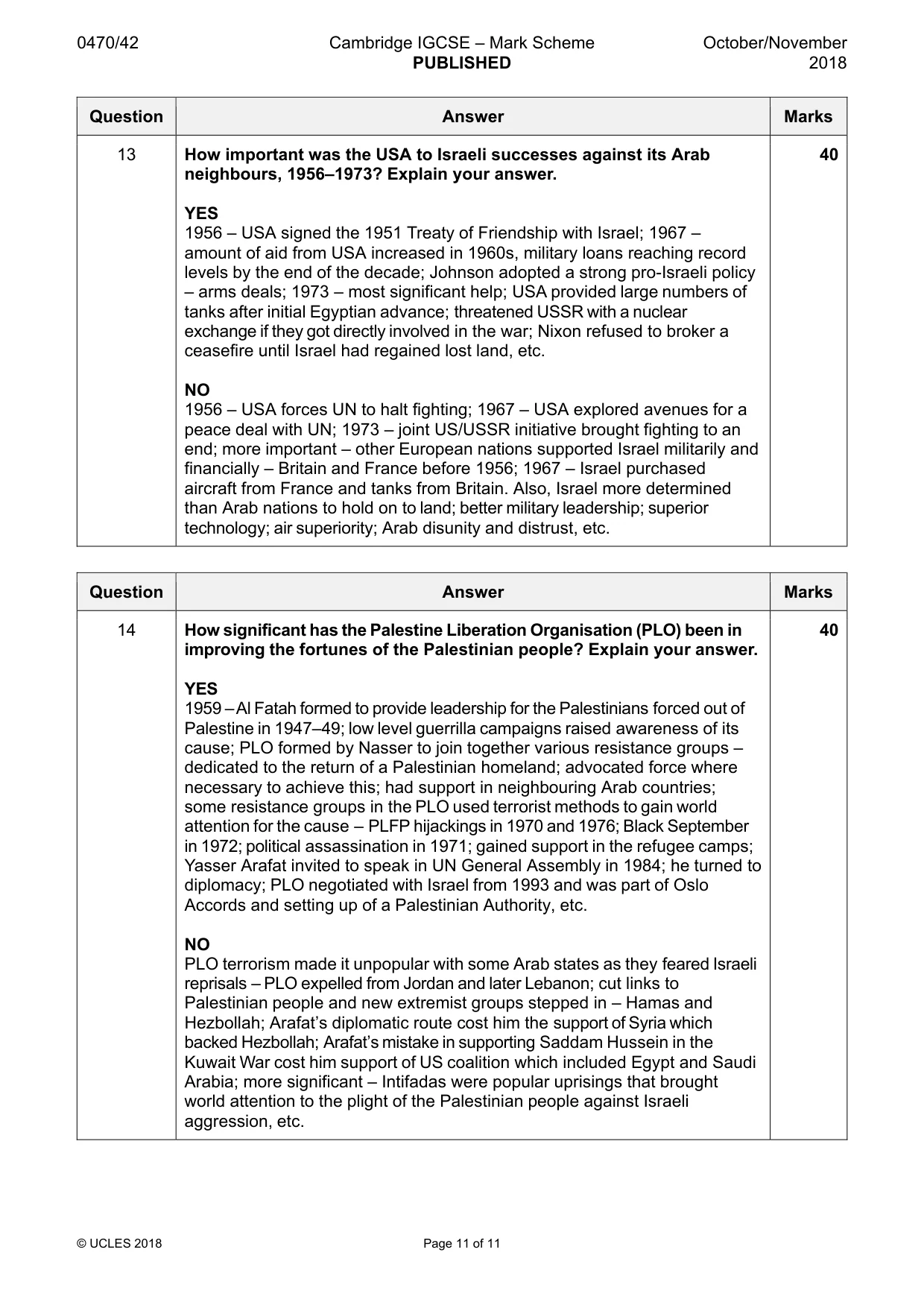
0470/42 Cambridge IGCSE – Mark Scheme PUBLISHED October/November 2018 © UCLES 2018 Page 11 of 11 Question Answer Marks 13 How important was the USA to Israeli successes against its Arab neighbours, 1956–1973? Explain your answer. YES 1956 – USA signed the 1951 Treaty of Friendship with Israel; 1967 – amount of aid from USA increased in 1960s, military loans reaching record levels by the end of the decade; Johnson adopted a strong pro-Israeli policy – arms deals; 1973 – most significant help; USA provided large numbers of tanks after initial Egyptian advance; threatened USSR with a nuclear exchange if they got directly involved in the war; Nixon refused to broker a ceasefire until Israel had regained lost land, etc. NO 1956 – USA forces UN to halt fighting; 1967 – USA explored avenues for a peace deal with UN; 1973 – joint US/USSR initiative brought fighting to an end; more important – other European nations supported Israel militarily and financially – Britain and France before 1956; 1967 – Israel purchased aircraft from France and tanks from Britain. Also, Israel more determined than Arab nations to hold on to land; better military leadership; superior technology; air superiority; Arab disunity and distrust, etc. 40 Question Answer Marks 14 How significant has the Palestine Liberation Organisation (PLO) been in improving the fortunes of the Palestinian people? Explain your answer. YES 1959 – Al Fatah formed to provide leadership for the Palestinians forced out of Palestine in 1947–49; low level guerrilla campaigns raised awareness of its cause; PLO formed by Nasser to join together various resistance groups – dedicated to the return of a Palestinian homeland; advocated force where necessary to achieve this; had support in neighbouring Arab countries; some resistance groups in the PLO used terrorist methods to gain world attention for the cause – PLFP hijackings in 1970 and 1976; Black September in 1972; political assassination in 1971; gained support in the refugee camps; Yasser Arafat invited to speak in UN General Assembly in 1984; he turned to diplomacy; PLO negotiated with Israel from 1993 and was part of Oslo Accords and setting up of a Palestinian Authority, etc. NO PLO terrorism made it unpopular with some Arab states as they feared Israeli reprisals – PLO expelled from Jordan and later Lebanon; cut links to Palestinian people and new extremist groups stepped in – Hamas and Hezbollah; Arafat’s diplomatic route cost him the support of Syria which backed Hezbollah; Arafat’s mistake in supporting Saddam Hussein in the Kuwait War cost him support of US coalition which included Egypt and Saudi Arabia; more significant – Intifadas were popular uprisings that brought world attention to the plight of the Palestinian people against Israeli aggression, etc. 40
What you needed in this session
Cambridge’s own grade thresholds for 2018 Oct/Nov, Paper 4 · Variant 2. A higher threshold means an easier paper — the bar moves with how the cohort did.