Cambridge IGCSE History 0470 — 2018 May/June Paper 2 · Variant 3
0470/23/M/J/18 · 50 marks · ≈56 min
The question paper and its mark scheme, free to read here and free to download. This is Cambridge’s own paper, exactly as it was sat.
Question paper12 pages

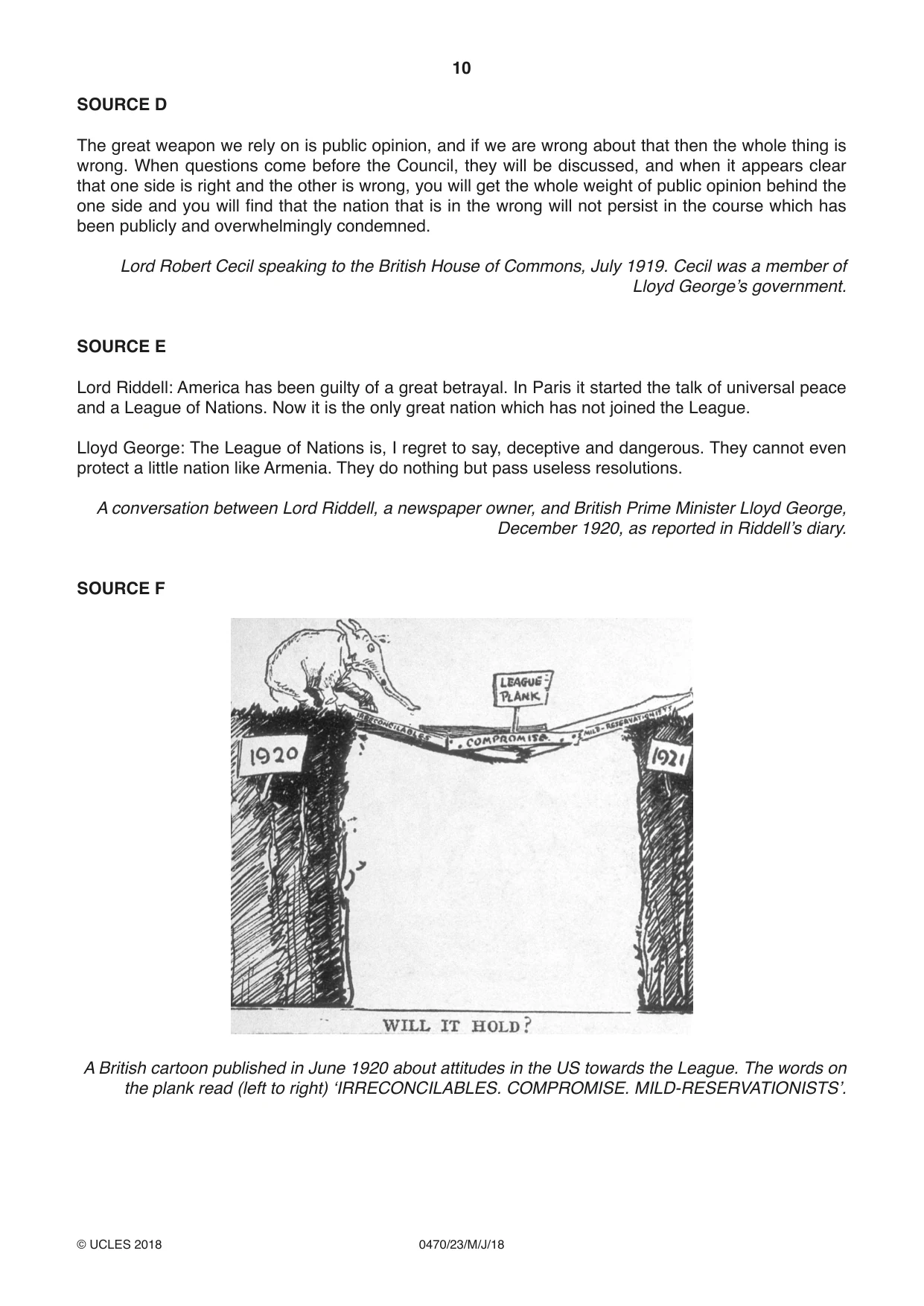
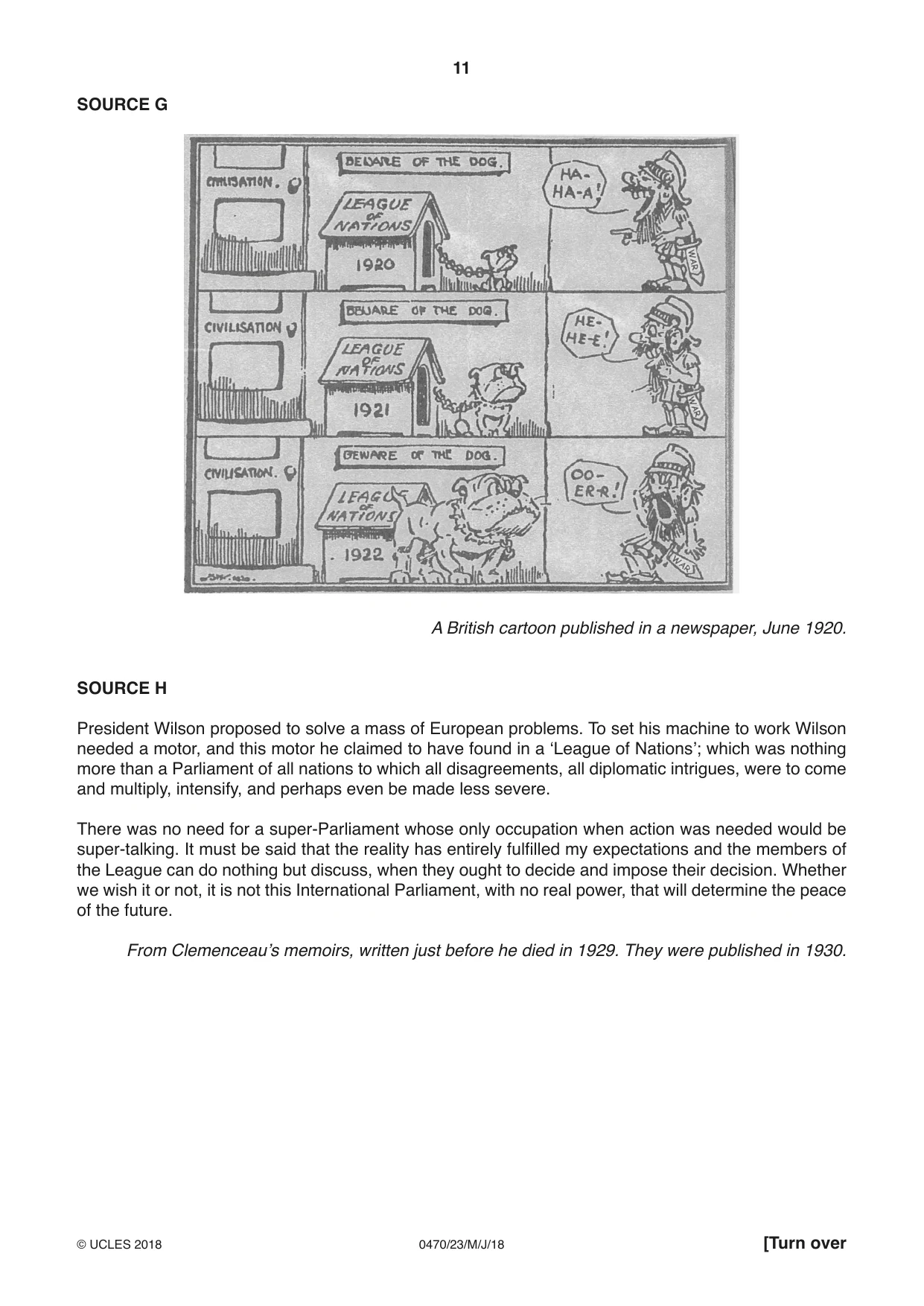
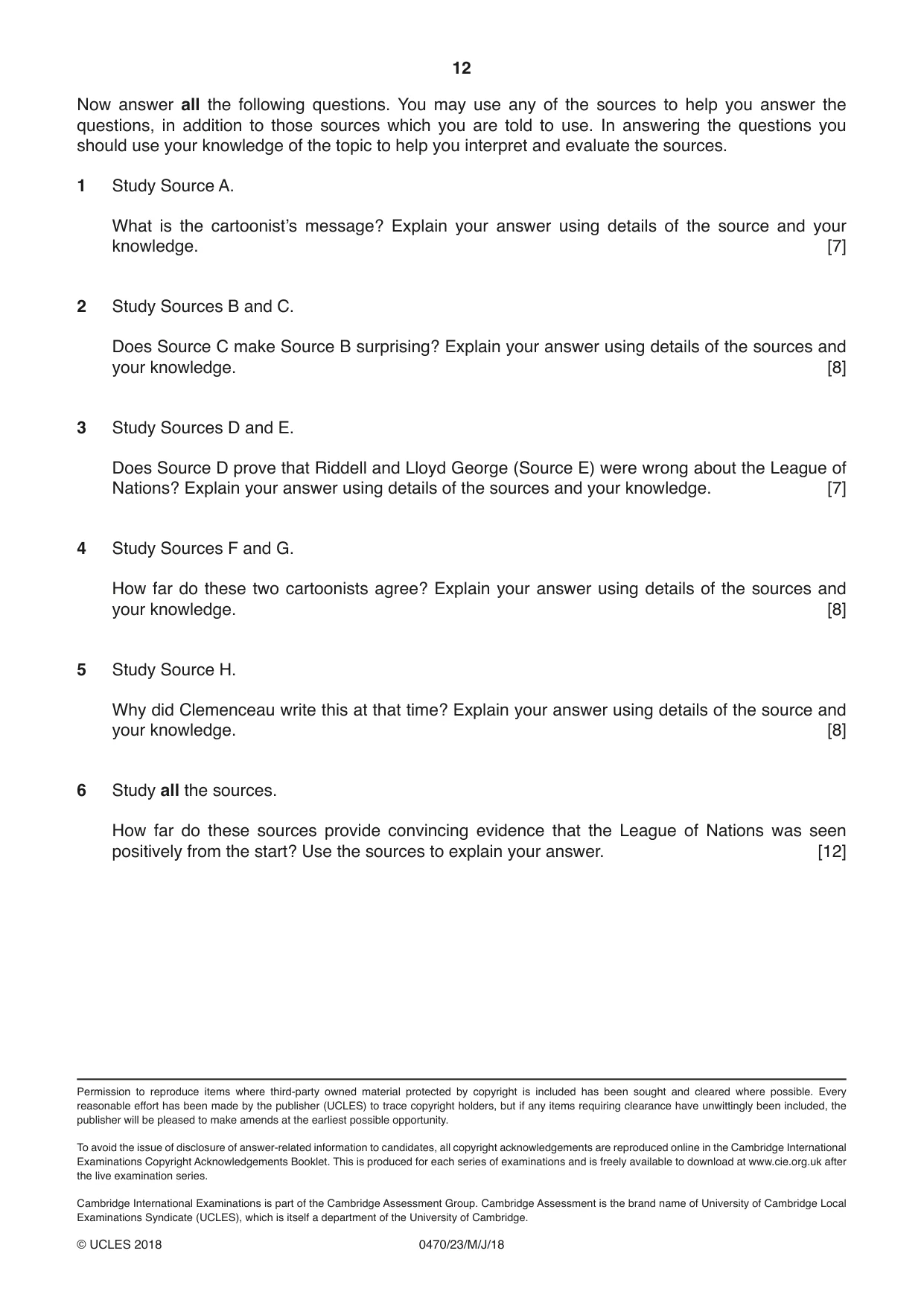
Mark scheme15 pages
Answers below. Sit the paper first if you are practising.
Paper as text
Question paper, page 1
* 0 1 8 6 5 8 9 9 6 9 * This document consists of 11 printed pages, 1 blank page and 1 Insert. DC (CE/SW) 145865/3 © UCLES 2018 [Turn over Cambridge International Examinations Cambridge International General Certificate of Secondary Education HISTORY 0470/23 Paper 2 May/June 2018 2 hours No Additional Materials are required. READ THESE INSTRUCTIONS FIRST An answer booklet is provided inside this question paper. You should follow the instructions on the front cover of the answer booklet. If you need additional answer paper ask the invigilator for a continuation booklet. This paper has two options. Choose one option, and then answer all of the questions on that topic. Option A: 19th Century topic [p2–p6] Option B: 20th Century topic [p8–p12] The number of marks is given in brackets [ ] at the end of each question or part question. This syllabus is approved for use in England, Wales and Northern Ireland as a Cambridge International Level 1/Level 2 Certificate.
Question paper, page 2
2 0470/23/M/J/18 © UCLES 2018 Option A: 19th Century topic WERE BISMARCK AND HIS ACHIEVEMENTS APPRECIATED AT THE TIME? Study the Background Information and the sources carefully, and then answer all the questions. Background Information Despite being largely responsible for Prussian military victories over Denmark, Austria and France and the unification of Germany, Bismarck was not always popular inside and outside Prussia. His methods of ‘iron and blood’ were not admired by everybody; liberals were suspicious of him, while others saw him as intimidating and unscrupulous. Yet, one historian has judged his achievements between 1862 and 1871 as ‘the greatest diplomatic and political achievement by any leader in the last two centuries’. How far were Bismarck and his work appreciated at the time? SOURCE A So far the differences between Austria and Prussia have been limited to the governments. They have now spread to the field of public opinion. I am clear that Count Bismarck thinks that the time has come to mount a great Prussian action abroad. He believes that the circumstances are favourable for this. Such action has been from the beginning the aim of his political career. It would satisfy his ungoverned and unscrupulous, but daring, thirst for achievement. After such a policy the government would more easily master the internal strife in Prussia. It is inconceivable that King William could bring about the legal acceptance of the principles represented by his government without a coup d’état. His Majesty has refused his consent to a coup d’état, which Bismarck may well have recommended. The only way of bringing about sudden change internally must thus be sought in the field of foreign policy. It is such a view that guides Bismarckian policy. How far Bismarck will succeed in winning over His Majesty for his extreme policy is precisely the question on which the whole future depends. A forcible solution goes against the nature of the King. Yet His Majesty is easily accessible to Bismarck’s influence, especially his references to supposed injuries to Prussian honour. A report from an Austrian diplomat in Prussia to the new Austrian Foreign Minister, Count Mensdorff, February 1866. SOURCE B The King wants no war, but only not in the next few months, now Bismarck has twisted things so that the King has become more irritable and finally Bismarck will have ridden him so far that he will not be able to do anything but commit us to war, which will stir up Europe. Bismarck’s talent to manipulate things for the King is great and worthy of admiration. As an expression of his bottomless frivolity and piratical policies some sort of Reich reform idea will be dumped on the carpet probably with proposals for a Reich parliament. With such a man everything is possible. A letter from Crown Prince Frederick to General von Schweinitz, April 1866. Frederick was King William’s son.
Question paper, page 3
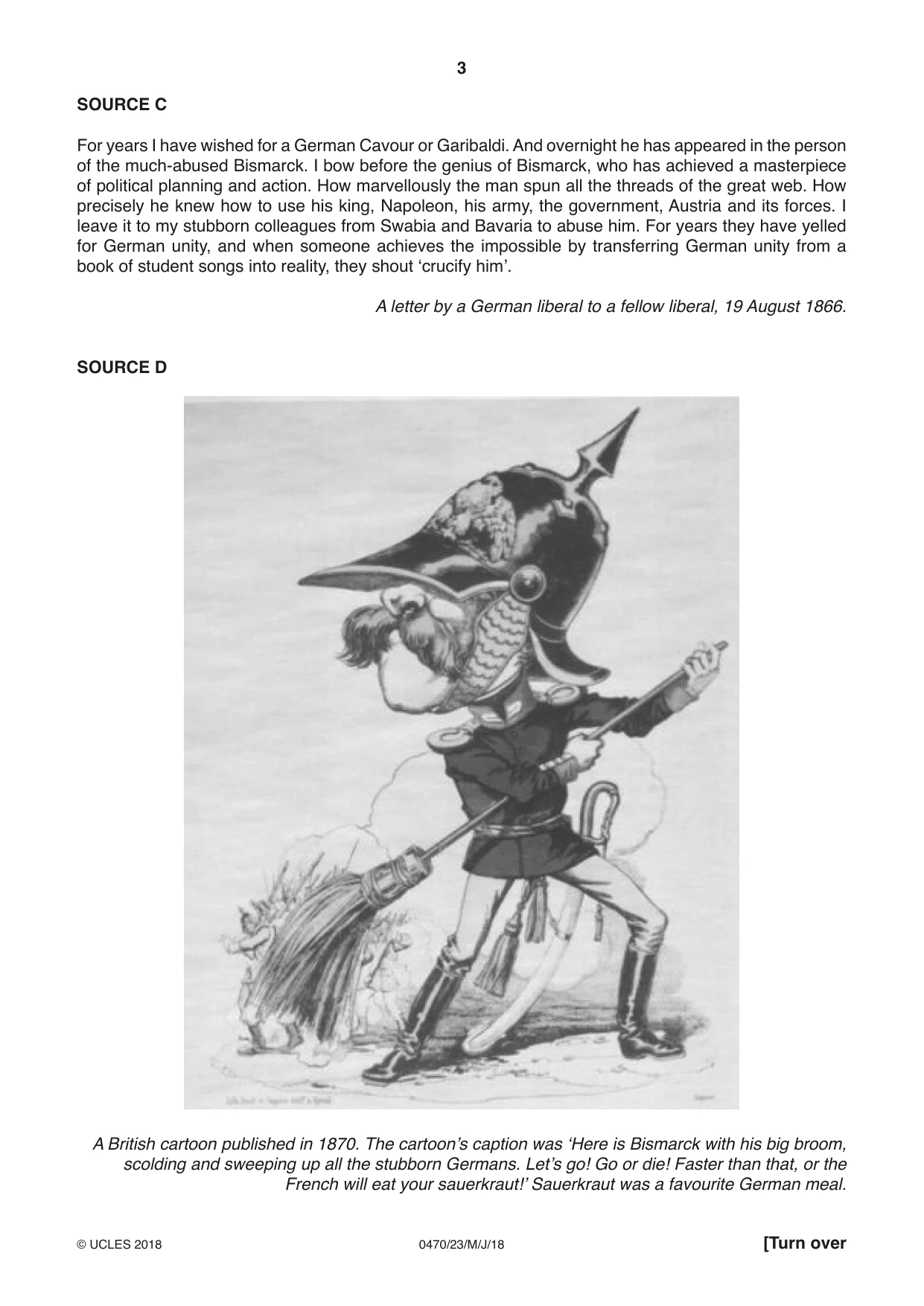
3 0470/23/M/J/18 © UCLES 2018 [Turn over SOURCE C For years I have wished for a German Cavour or Garibaldi. And overnight he has appeared in the person of the much-abused Bismarck. I bow before the genius of Bismarck, who has achieved a masterpiece of political planning and action. How marvellously the man spun all the threads of the great web. How precisely he knew how to use his king, Napoleon, his army, the government, Austria and its forces. I leave it to my stubborn colleagues from Swabia and Bavaria to abuse him. For years they have yelled for German unity, and when someone achieves the impossible by transferring German unity from a book of student songs into reality, they shout ‘crucify him’. A letter by a German liberal to a fellow liberal, 19 August 1866. SOURCE D A British cartoon published in 1870. The cartoon’s caption was ‘Here is Bismarck with his big broom, scolding and sweeping up all the stubborn Germans. Let’s go! Go or die! Faster than that, or the French will eat your sauerkraut!’ Sauerkraut was a favourite German meal.
Question paper, page 4
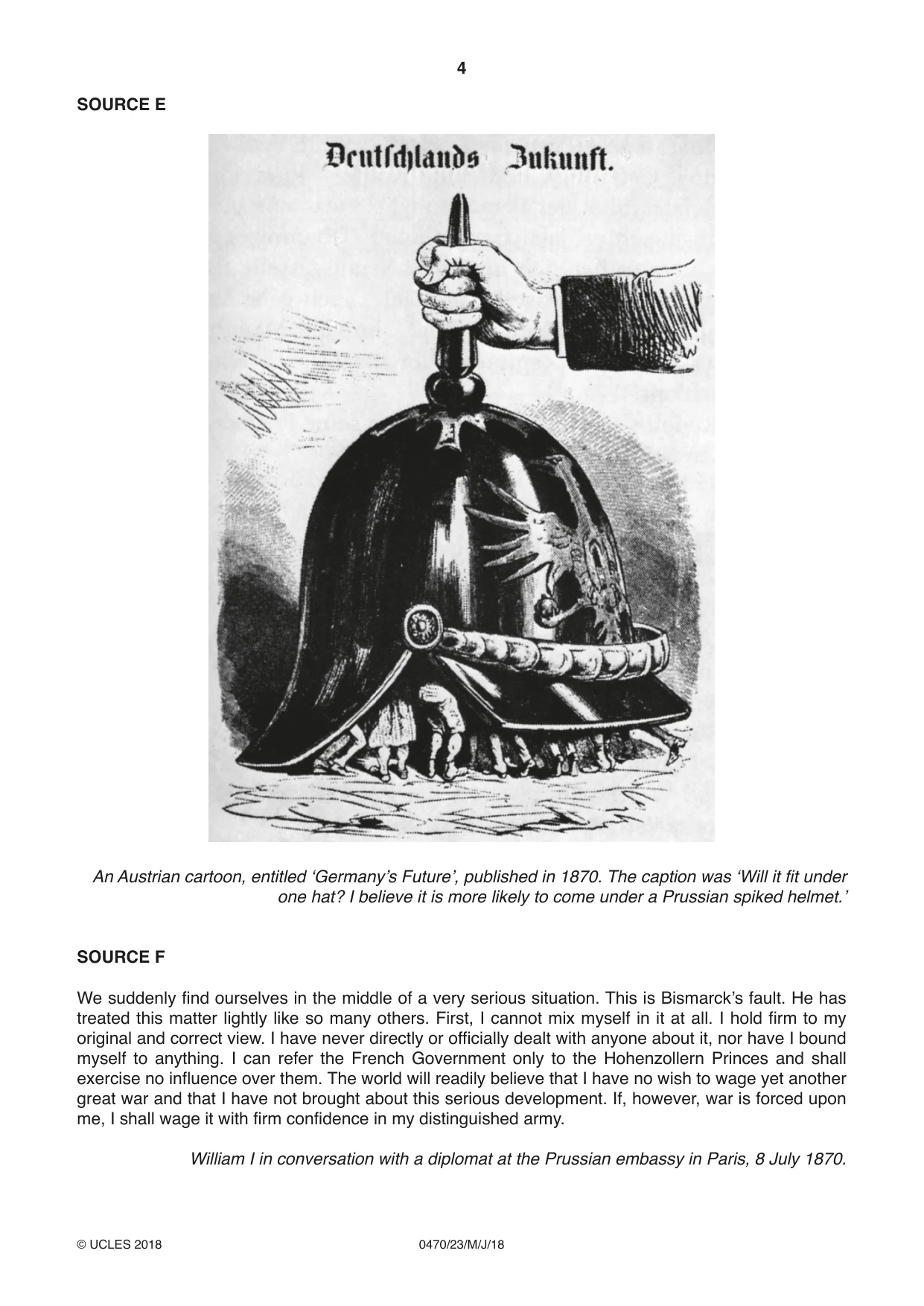
4 0470/23/M/J/18 © UCLES 2018 SOURCE E An Austrian cartoon, entitled ‘Germany’s Future’, published in 1870. The caption was ‘Will it fit under one hat? I believe it is more likely to come under a Prussian spiked helmet.’ SOURCE F We suddenly find ourselves in the middle of a very serious situation. This is Bismarck’s fault. He has treated this matter lightly like so many others. First, I cannot mix myself in it at all. I hold firm to my original and correct view. I have never directly or officially dealt with anyone about it, nor have I bound myself to anything. I can refer the French Government only to the Hohenzollern Princes and shall exercise no influence over them. The world will readily believe that I have no wish to wage yet another great war and that I have not brought about this serious development. If, however, war is forced upon me, I shall wage it with firm confidence in my distinguished army. William I in conversation with a diplomat at the Prussian embassy in Paris, 8 July 1870.
Question paper, page 5
5 0470/23/M/J/18 © UCLES 2018 [Turn over SOURCE G With today’s opening of the first German Reichstag after the re-establishment of a German Empire, the first public activity of the Empire begins. The brilliant position now occupied by Prussia has been achieved through an unexpectedly rapid sequence of events during the past six years. The work to which I called you ten years ago falls within this time. How you have justified the confidence with which I then summoned you, lies open to the world. It is to your advice, caution, your unending activity that Prussia and Germany owe this world-historical occurrence. Although the reward for such deeds is felt within you I am nevertheless urged and bound to express to you publicly and permanently the thanks of the Fatherland and mine. I elevate you therefore, to the rank of a Prussian Prince. A letter from William I to Bismarck, March 1871.
Question paper, page 6
6 0470/23/M/J/18 © UCLES 2018 Now answer all the following questions. You may use any of the sources to help you answer the questions, in addition to those sources which you are told to use. In answering the questions you should use your knowledge of the topic to help you interpret and evaluate the sources. 1 Study Source A. What impressions does this source give of Bismarck? Explain your answer using details of the source and your knowledge. [7] 2 Study Source B. Why did the Crown Prince send this letter in April 1866? Explain your answer using details of the source and your knowledge. [8] 3 Study Sources C and D. How far do these two sources agree? Explain your answer using details of the sources and your knowledge. [8] 4 Study Source E. What is the cartoonist’s message? Explain your answer using details of the source and your knowledge. [7] 5 Study Sources F and G. How far does Source G make Source F surprising? Explain your answer using details of the sources and your knowledge. [8] 6 Study all the sources. How far do these sources provide convincing evidence that Bismarck and his achievements were admired? Use the sources to explain your answer. [12]
Question paper, page 7
7 0470/23/M/J/18 © UCLES 2018 [Turn over BLANK PAGE
Question paper, page 8
8 0470/23/M/J/18 © UCLES 2018 Option B: 20th Century topic WAS THE LEAGUE OF NATIONS SEEN IN A POSITIVE WAY FROM THE START? Study the Background Information and the sources carefully, and then answer all the questions. Background Information The dreadful experience of the First World War led to several ideas for a league of nations that would protect peace in the future. Perhaps the leading supporter of such an organisation was President Wilson, who suggested it in a speech in January 1918. The League of Nations came into existence on 10 January 1920 after lengthy negotiations at the Paris Peace Conference. There was much opposition to the League in the USA but in other places hopes were higher. As the League attempted to deal with the first international disputes after the First World War, people began to reach conclusions about the League. Was the League seen in a positive way in its early years? SOURCE A A British cartoon published in 1919.
Question paper, page 9
9 0470/23/M/J/18 © UCLES 2018 [Turn over SOURCE B The independence of the United States is precious not just to ourselves but to the world. Is there any country today which can compare with it in peace and in freedom? In agreeing to a League and taking on these obligations in a desire for the good of mankind we would be dealing with nations every one of which has its own individual interest to serve. I am thinking of what is best for the world, for if the United States fails, the best hopes of mankind fail with it. I have only ever had one allegiance. I have only loved one flag and I cannot share that devotion with the mongrel banner invented for a league. Internationalism, illustrated by the Communists, is to me repulsive. The United States is the world’s best hope, but if you chain it in the interests and quarrels of other nations, if you tangle it in the intrigues of Europe, you will destroy its power for good and endanger its very existence. Leave the United States to march freely through the centuries to come as in the years that have gone. Strong, generous, and confident, the United States has nobly served mankind. We are told that we shall ‘break the heart of the world’ if we do not take this League just as it stands. I feel that the hearts of the vast majority of mankind would beat on strongly and steadily if the League were to perish altogether. Ideals have been thrust upon us as an argument for the League. Are ideals confined to this deformed experiment, tainted, as it is, with political deals? From a speech given by Henry Cabot Lodge in Washington D.C. on 12 August 1919. Lodge was a Republican member of the US Senate. SOURCE C As I have crossed our country I have seen that men have been busy creating an absolutely false impression of the League of Nations. In order to check the falsehoods that have clustered around this great subject, I want to tell you a few very simple things about the League. Unless we get the united purpose and power of the great Governments of the world behind this settlement, it will fall down like a house of cards. There is only one power to put behind the liberation of mankind, and that is the power of mankind. It is the power of the united moral forces of the world, and in the Covenant of the League of Nations the moral forces of the world are mobilised. They enter into a solemn promise to one another that they will never use their power against one another for aggression and if they do that, war will be in the far background. What of our pledges to the men that lie dead in France? We said that they went over there to see to it that there never was such a war again. Again and again, my fellow citizens, mothers who lost their sons in France have come to me and, taking my hand, have shed tears and said, ‘God bless you, Mr. President!’ Why, my fellow citizens, should they ask God to bless me? They believe that wrapped up with the liberty of the world is the protection of that liberty by the joint powers of all civilised people. There seem to me to stand between us and the rejection of the League, the ranks of those soldiers, not only those who came home, but those who are ghosts on the fields of France. One of President Wilson’s last speeches in the USA, September 1919.
Question paper, page 10
10 0470/23/M/J/18 © UCLES 2018 SOURCE D The great weapon we rely on is public opinion, and if we are wrong about that then the whole thing is wrong. When questions come before the Council, they will be discussed, and when it appears clear that one side is right and the other is wrong, you will get the whole weight of public opinion behind the one side and you will find that the nation that is in the wrong will not persist in the course which has been publicly and overwhelmingly condemned. Lord Robert Cecil speaking to the British House of Commons, July 1919. Cecil was a member of Lloyd George’s government. SOURCE E Lord Riddell: America has been guilty of a great betrayal. In Paris it started the talk of universal peace and a League of Nations. Now it is the only great nation which has not joined the League. Lloyd George: The League of Nations is, I regret to say, deceptive and dangerous. They cannot even protect a little nation like Armenia. They do nothing but pass useless resolutions. A conversation between Lord Riddell, a newspaper owner, and British Prime Minister Lloyd George, December 1920, as reported in Riddell’s diary. SOURCE F A British cartoon published in June 1920 about attitudes in the US towards the League. The words on the plank read (left to right) ‘IRRECONCILABLES. COMPROMISE. MILD-RESERVATIONISTS’.
Question paper, page 11
11 0470/23/M/J/18 © UCLES 2018 [Turn over SOURCE G A British cartoon published in a newspaper, June 1920. SOURCE H President Wilson proposed to solve a mass of European problems. To set his machine to work Wilson needed a motor, and this motor he claimed to have found in a ‘League of Nations’; which was nothing more than a Parliament of all nations to which all disagreements, all diplomatic intrigues, were to come and multiply, intensify, and perhaps even be made less severe. There was no need for a super-Parliament whose only occupation when action was needed would be super-talking. It must be said that the reality has entirely fulfilled my expectations and the members of the League can do nothing but discuss, when they ought to decide and impose their decision. Whether we wish it or not, it is not this International Parliament, with no real power, that will determine the peace of the future. From Clemenceau’s memoirs, written just before he died in 1929. They were published in 1930.
Question paper, page 12
12 0470/23/M/J/18 © UCLES 2018 Permission to reproduce items where third-party owned material protected by copyright is included has been sought and cleared where possible. Every reasonable effort has been made by the publisher (UCLES) to trace copyright holders, but if any items requiring clearance have unwittingly been included, the publisher will be pleased to make amends at the earliest possible opportunity. To avoid the issue of disclosure of answer-related information to candidates, all copyright acknowledgements are reproduced online in the Cambridge International Examinations Copyright Acknowledgements Booklet. This is produced for each series of examinations and is freely available to download at www.cie.org.uk after the live examination series. Cambridge International Examinations is part of the Cambridge Assessment Group. Cambridge Assessment is the brand name of University of Cambridge Local Examinations Syndicate (UCLES), which is itself a department of the University of Cambridge. Now answer all the following questions. You may use any of the sources to help you answer the questions, in addition to those sources which you are told to use. In answering the questions you should use your knowledge of the topic to help you interpret and evaluate the sources. 1 Study Source A. What is the cartoonist’s message? Explain your answer using details of the source and your knowledge. [7] 2 Study Sources B and C. Does Source C make Source B surprising? Explain your answer using details of the sources and your knowledge. [8] 3 Study Sources D and E. Does Source D prove that Riddell and Lloyd George (Source E) were wrong about the League of Nations? Explain your answer using details of the sources and your knowledge. [7] 4 Study Sources F and G. How far do these two cartoonists agree? Explain your answer using details of the sources and your knowledge. [8] 5 Study Source H. Why did Clemenceau write this at that time? Explain your answer using details of the source and your knowledge. [8] 6 Study all the sources. How far do these sources provide convincing evidence that the League of Nations was seen positively from the start? Use the sources to explain your answer. [12]
Mark scheme, page 1
IGCSE™ is a registered trademark. This syllabus is approved for use in England, Wales and Northern Ireland as a Cambridge International Level 1/Level 2 Certificate. This document consists of 15 printed pages. © UCLES 2018 [Turn over Cambridge Assessment International Education Cambridge International General Certificate of Secondary Education HISTORY 0470/23 Paper 2 May/June 2018 MARK SCHEME Maximum Mark: 50 Published This mark scheme is published as an aid to teachers and candidates, to indicate the requirements of the examination. It shows the basis on which Examiners were instructed to award marks. It does not indicate the details of the discussions that took place at an Examiners’ meeting before marking began, which would have considered the acceptability of alternative answers. Mark schemes should be read in conjunction with the question paper and the Principal Examiner Report for Teachers. Cambridge International will not enter into discussions about these mark schemes. Cambridge International is publishing the mark schemes for the May/June 2018 series for most Cambridge IGCSE™, Cambridge International A and AS Level and Cambridge Pre-U components, and some Cambridge O Level components.
Mark scheme, page 2
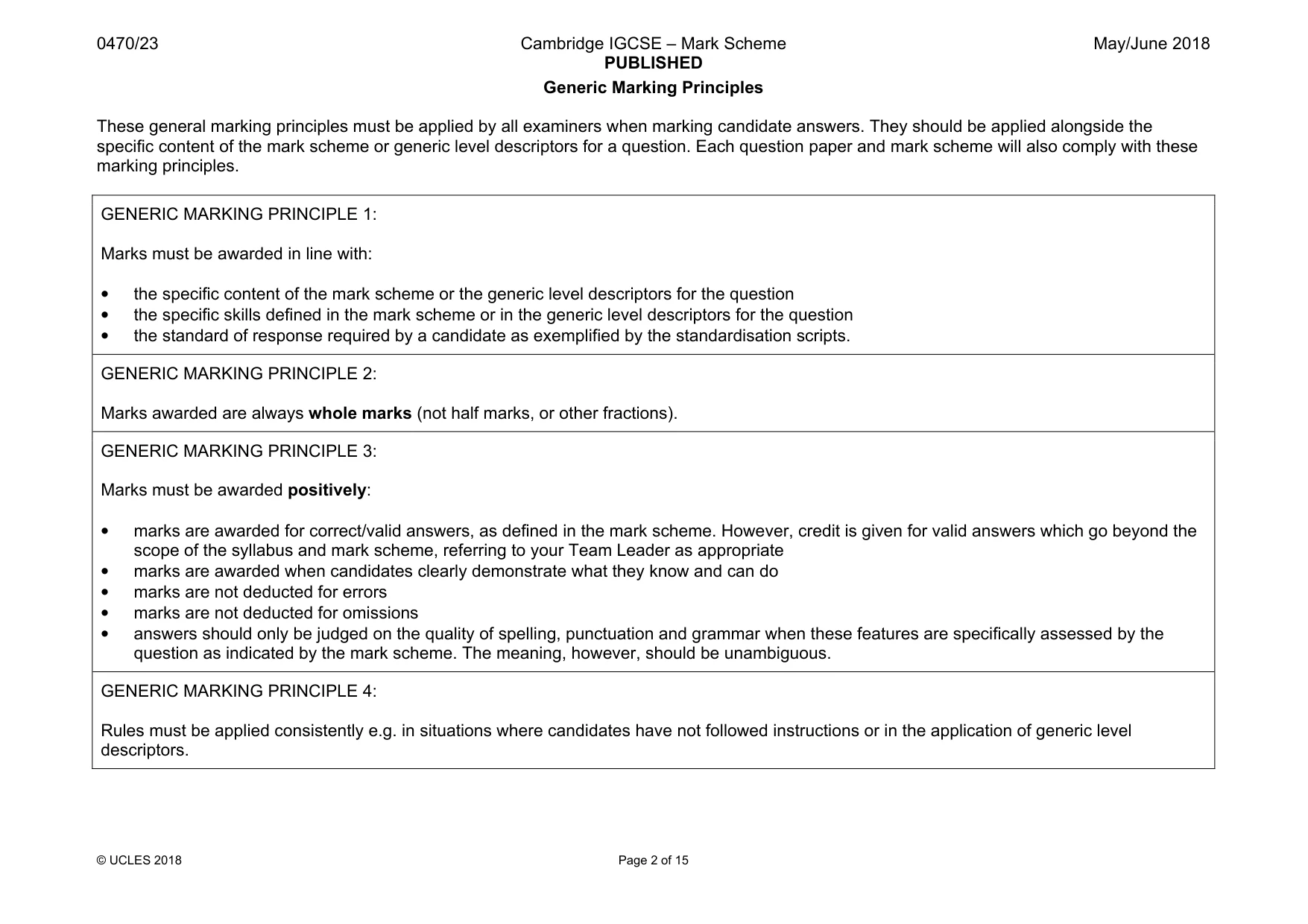
0470/23 Cambridge IGCSE – Mark Scheme PUBLISHED May/June 2018 © UCLES 2018 Page 2 of 15 Generic Marking Principles These general marking principles must be applied by all examiners when marking candidate answers. They should be applied alongside the specific content of the mark scheme or generic level descriptors for a question. Each question paper and mark scheme will also comply with these marking principles. GENERIC MARKING PRINCIPLE 1: Marks must be awarded in line with: • the specific content of the mark scheme or the generic level descriptors for the question • the specific skills defined in the mark scheme or in the generic level descriptors for the question • the standard of response required by a candidate as exemplified by the standardisation scripts. GENERIC MARKING PRINCIPLE 2: Marks awarded are always whole marks (not half marks, or other fractions). GENERIC MARKING PRINCIPLE 3: Marks must be awarded positively: • marks are awarded for correct/valid answers, as defined in the mark scheme. However, credit is given for valid answers which go beyond the scope of the syllabus and mark scheme, referring to your Team Leader as appropriate • marks are awarded when candidates clearly demonstrate what they know and can do • marks are not deducted for errors • marks are not deducted for omissions • answers should only be judged on the quality of spelling, punctuation and grammar when these features are specifically assessed by the question as indicated by the mark scheme. The meaning, however, should be unambiguous. GENERIC MARKING PRINCIPLE 4: Rules must be applied consistently e.g. in situations where candidates have not followed instructions or in the application of generic level descriptors.
Mark scheme, page 3
0470/23 Cambridge IGCSE – Mark Scheme PUBLISHED May/June 2018 © UCLES 2018 Page 3 of 15 GENERIC MARKING PRINCIPLE 5: Marks should be awarded using the full range of marks defined in the mark scheme for the question (however; the use of the full mark range may be limited according to the quality of the candidate responses seen). GENERIC MARKING PRINCIPLE 6: Marks awarded are based solely on the requirements as defined in the mark scheme. Marks should not be awarded with grade thresholds or grade descriptors in mind.
Mark scheme, page 4
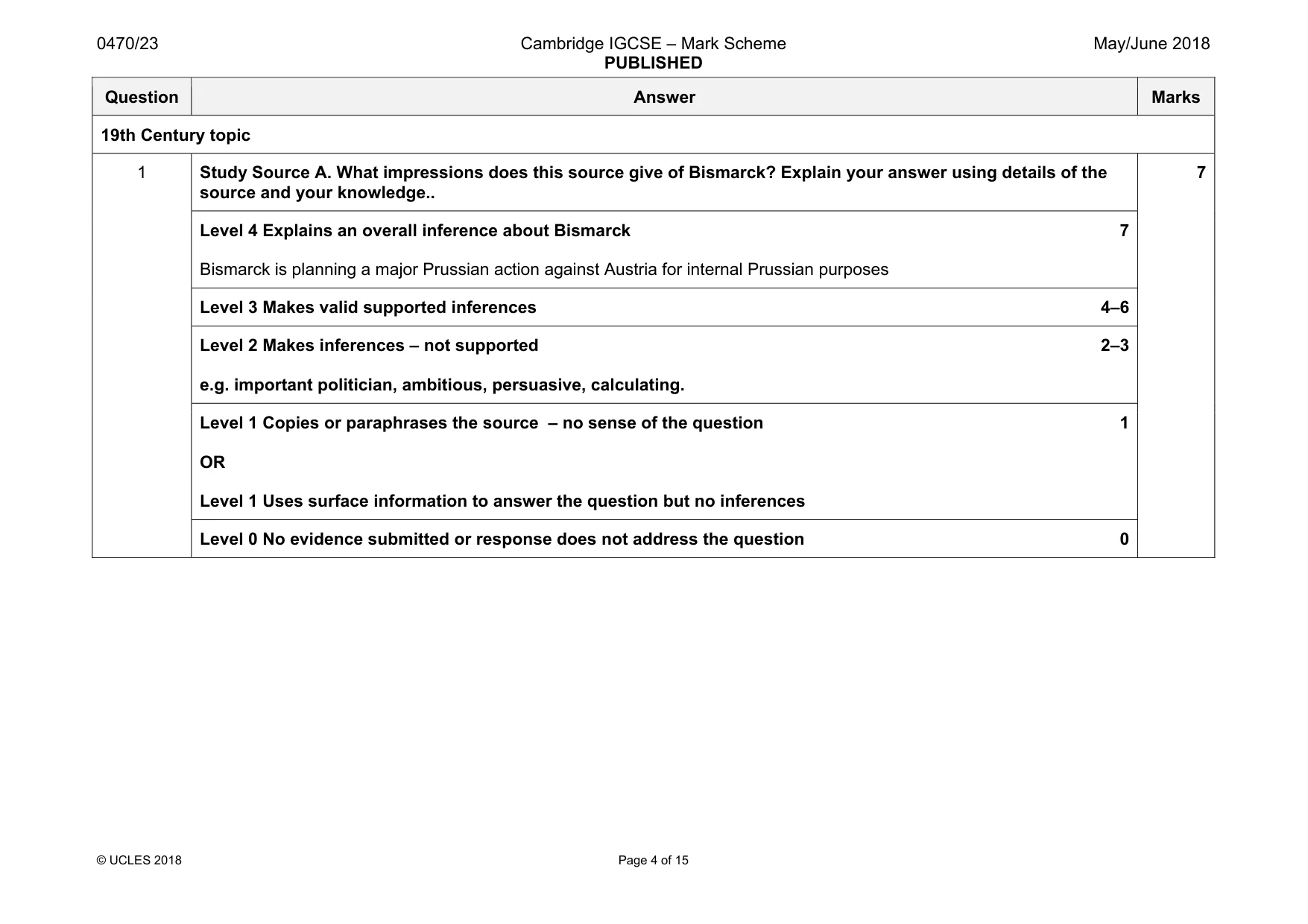
0470/23 Cambridge IGCSE – Mark Scheme PUBLISHED May/June 2018 © UCLES 2018 Page 4 of 15 Question Answer Marks 19th Century topic 1 Study Source A. What impressions does this source give of Bismarck? Explain your answer using details of the source and your knowledge.. 7 Level 4 Explains an overall inference about Bismarck 7 Bismarck is planning a major Prussian action against Austria for internal Prussian purposes Level 3 Makes valid supported inferences 4–6 Level 2 Makes inferences – not supported 2–3 e.g. important politician, ambitious, persuasive, calculating. Level 1 Copies or paraphrases the source – no sense of the question 1 OR Level 1 Uses surface information to answer the question but no inferences Level 0 No evidence submitted or response does not address the question 0
Mark scheme, page 5
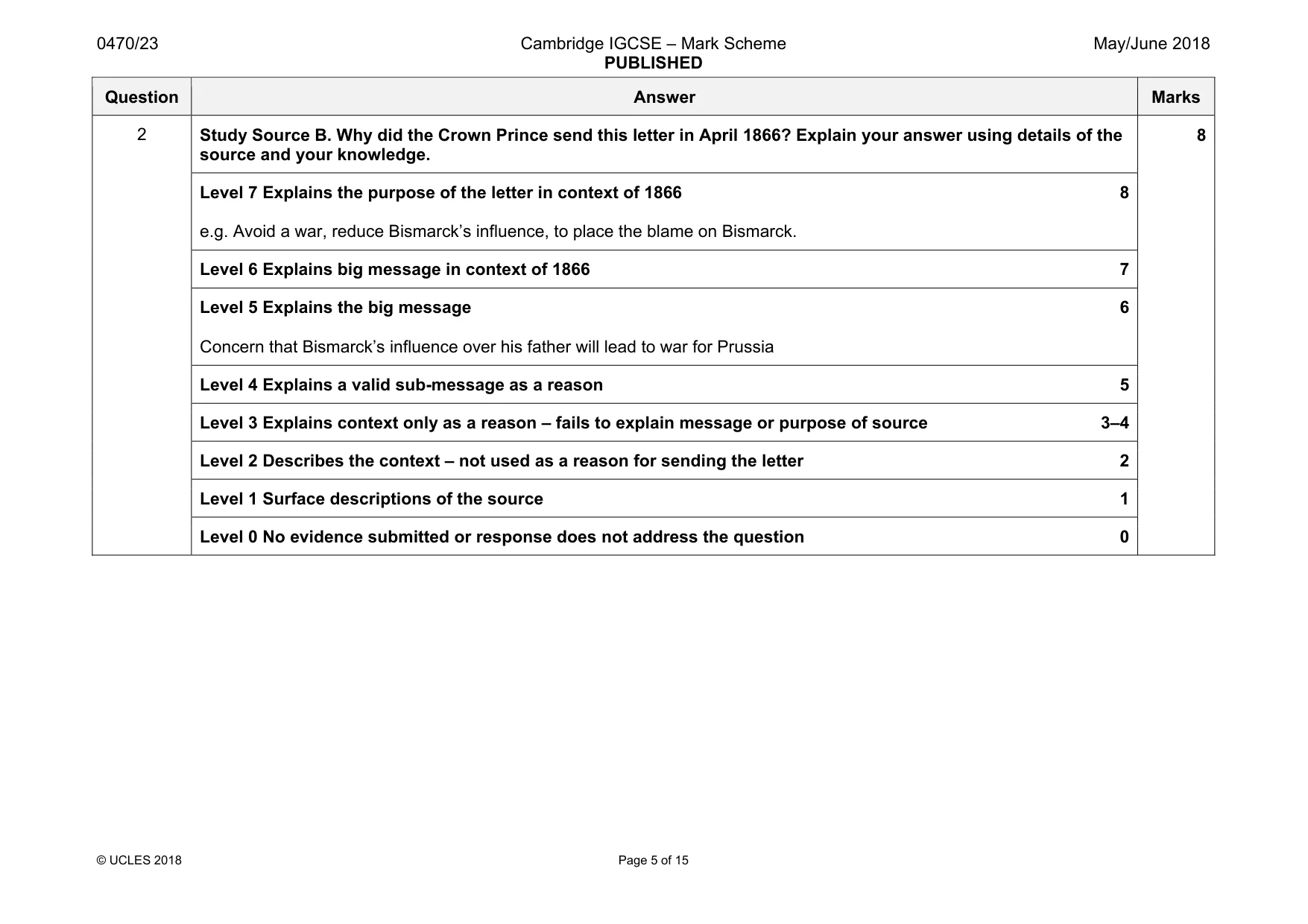
0470/23 Cambridge IGCSE – Mark Scheme PUBLISHED May/June 2018 © UCLES 2018 Page 5 of 15 Question Answer Marks 2 Study Source B. Why did the Crown Prince send this letter in April 1866? Explain your answer using details of the source and your knowledge. 8 Level 7 Explains the purpose of the letter in context of 1866 8 e.g. Avoid a war, reduce Bismarck’s influence, to place the blame on Bismarck. Level 6 Explains big message in context of 1866 7 Level 5 Explains the big message 6 Concern that Bismarck’s influence over his father will lead to war for Prussia Level 4 Explains a valid sub-message as a reason 5 Level 3 Explains context only as a reason – fails to explain message or purpose of source 3–4 Level 2 Describes the context – not used as a reason for sending the letter 2 Level 1 Surface descriptions of the source 1 Level 0 No evidence submitted or response does not address the question 0
Mark scheme, page 6
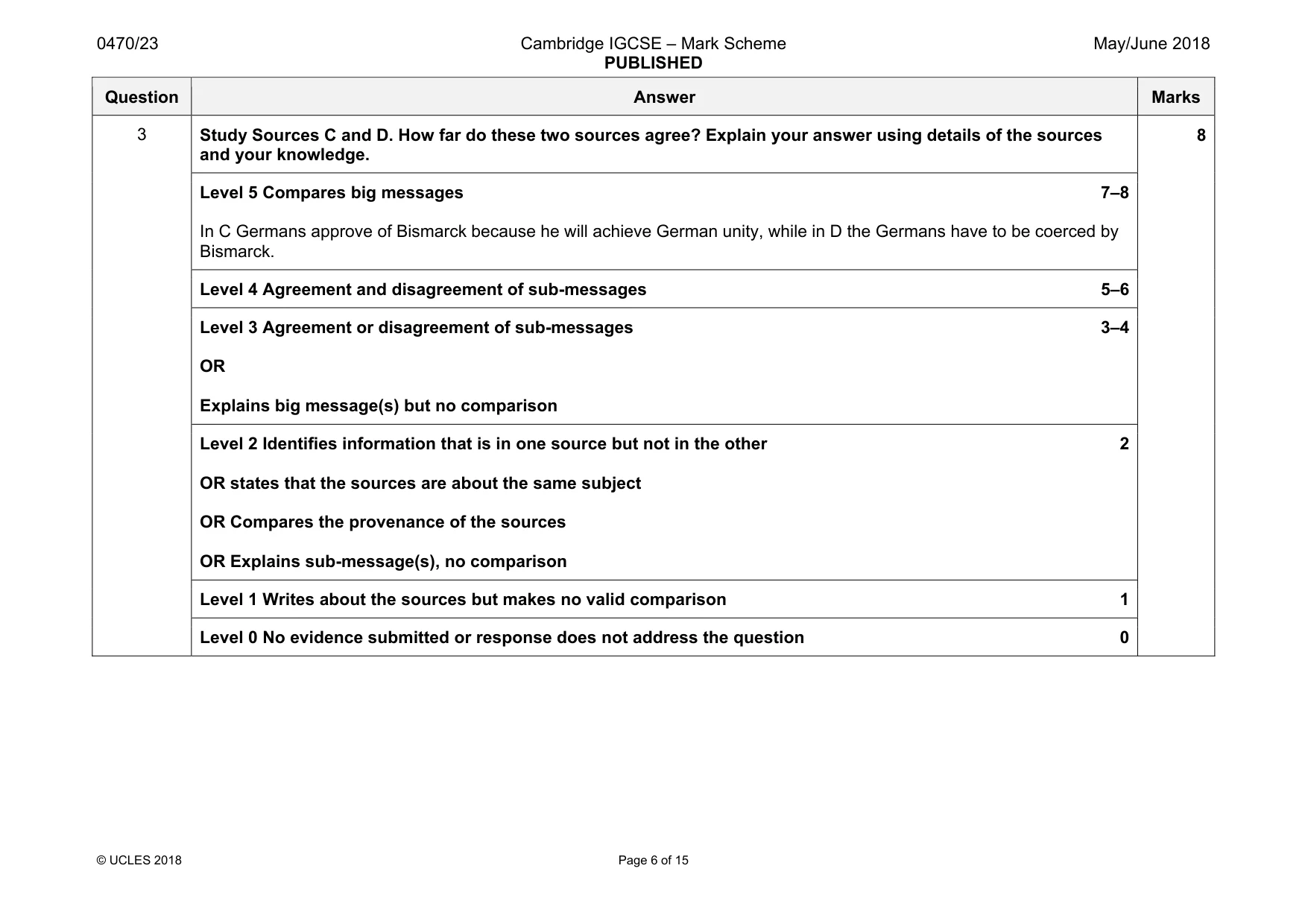
0470/23 Cambridge IGCSE – Mark Scheme PUBLISHED May/June 2018 © UCLES 2018 Page 6 of 15 Question Answer Marks 3 Study Sources C and D. How far do these two sources agree? Explain your answer using details of the sources and your knowledge. 8 Level 5 Compares big messages 7–8 In C Germans approve of Bismarck because he will achieve German unity, while in D the Germans have to be coerced by Bismarck. Level 4 Agreement and disagreement of sub-messages 5–6 Level 3 Agreement or disagreement of sub-messages 3–4 OR Explains big message(s) but no comparison Level 2 Identifies information that is in one source but not in the other 2 OR states that the sources are about the same subject OR Compares the provenance of the sources OR Explains sub-message(s), no comparison Level 1 Writes about the sources but makes no valid comparison 1 Level 0 No evidence submitted or response does not address the question 0
Mark scheme, page 7
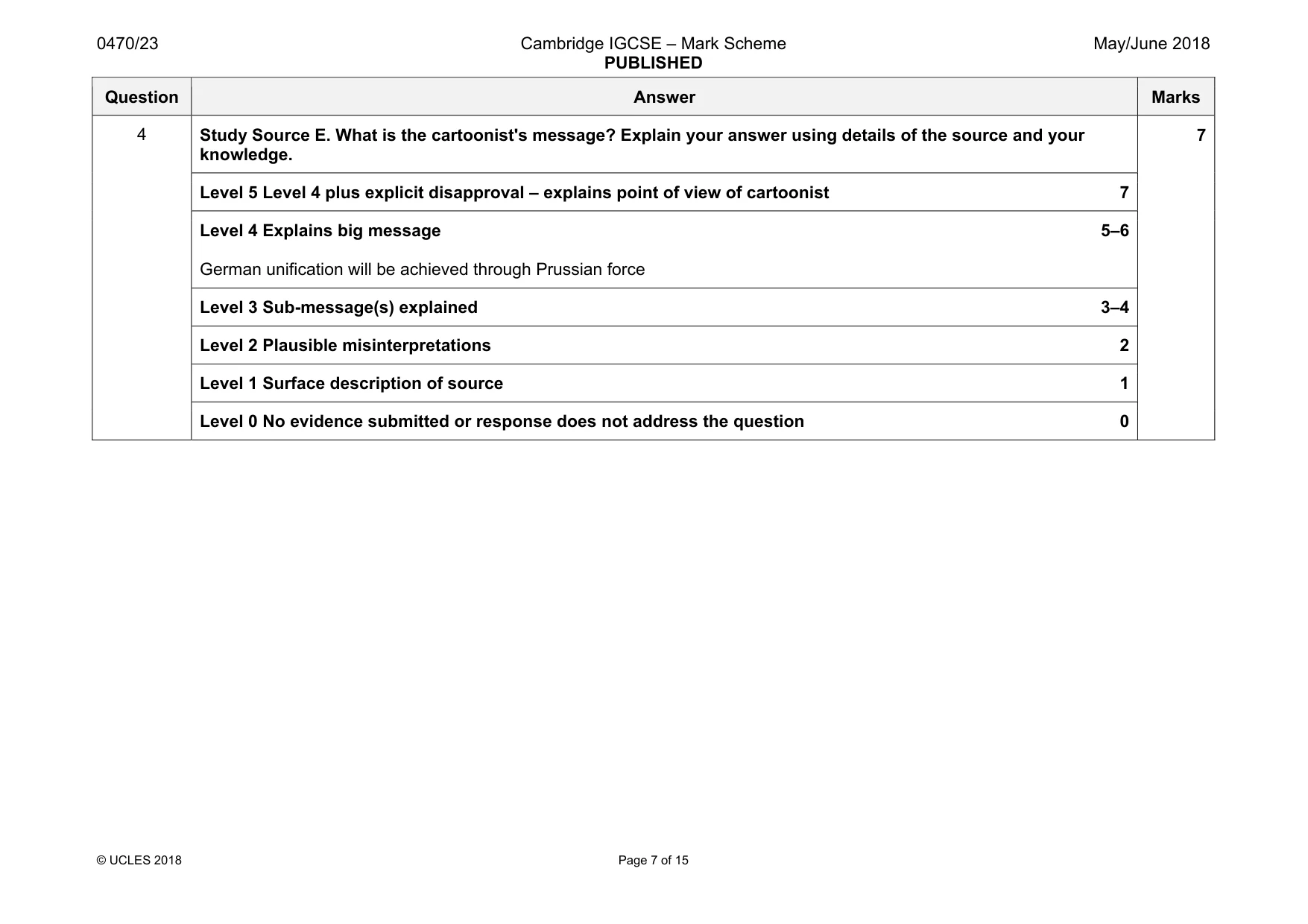
0470/23 Cambridge IGCSE – Mark Scheme PUBLISHED May/June 2018 © UCLES 2018 Page 7 of 15 Question Answer Marks 4 Study Source E. What is the cartoonist's message? Explain your answer using details of the source and your knowledge. 7 Level 5 Level 4 plus explicit disapproval – explains point of view of cartoonist 7 Level 4 Explains big message 5–6 German unification will be achieved through Prussian force Level 3 Sub-message(s) explained 3–4 Level 2 Plausible misinterpretations 2 Level 1 Surface description of source 1 Level 0 No evidence submitted or response does not address the question 0
Mark scheme, page 8
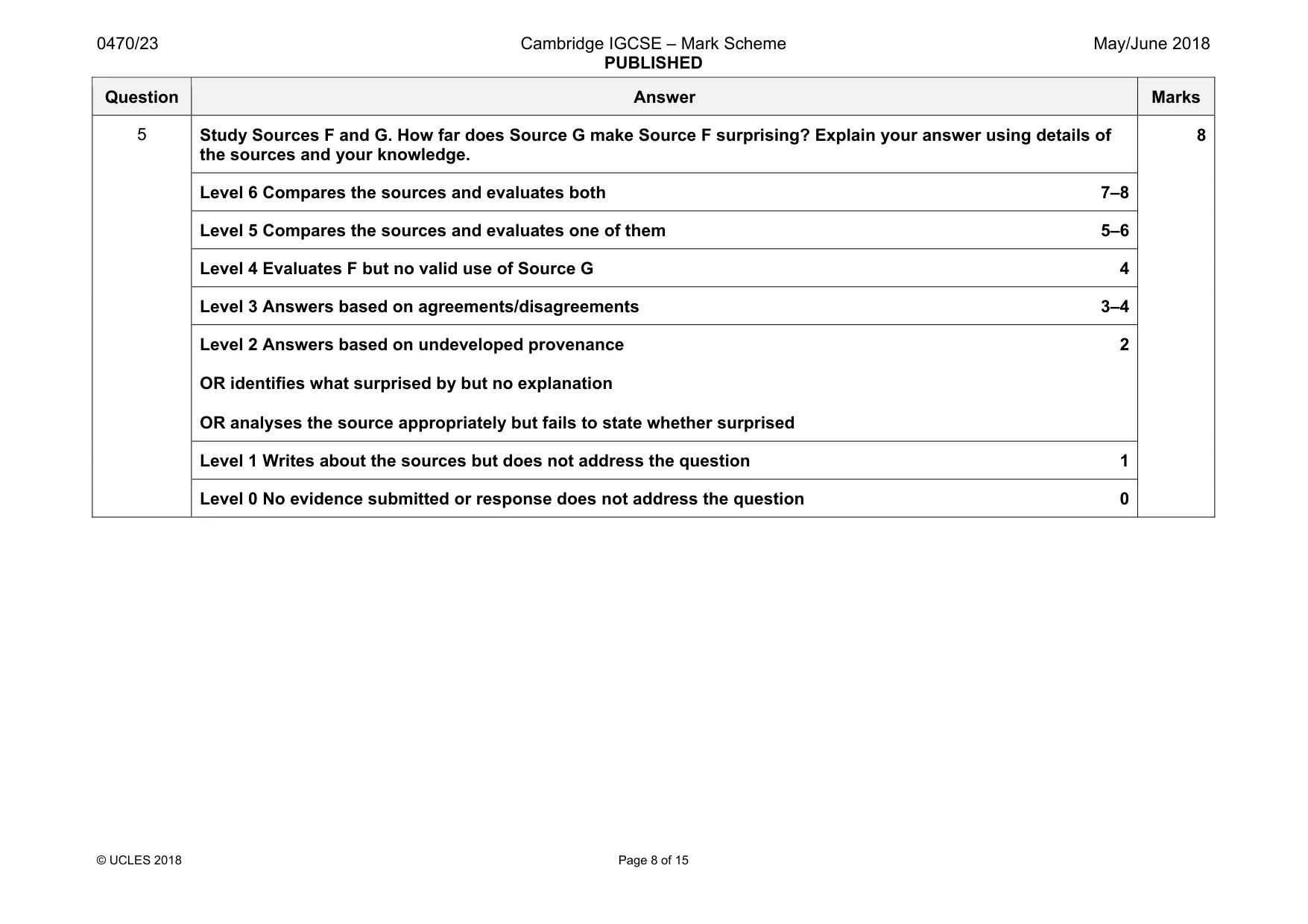
0470/23 Cambridge IGCSE – Mark Scheme PUBLISHED May/June 2018 © UCLES 2018 Page 8 of 15 Question Answer Marks 5 Study Sources F and G. How far does Source G make Source F surprising? Explain your answer using details of the sources and your knowledge. 8 Level 6 Compares the sources and evaluates both 7–8 Level 5 Compares the sources and evaluates one of them 5–6 Level 4 Evaluates F but no valid use of Source G 4 Level 3 Answers based on agreements/disagreements 3–4 Level 2 Answers based on undeveloped provenance 2 OR identifies what surprised by but no explanation OR analyses the source appropriately but fails to state whether surprised Level 1 Writes about the sources but does not address the question 1 Level 0 No evidence submitted or response does not address the question 0
Mark scheme, page 9
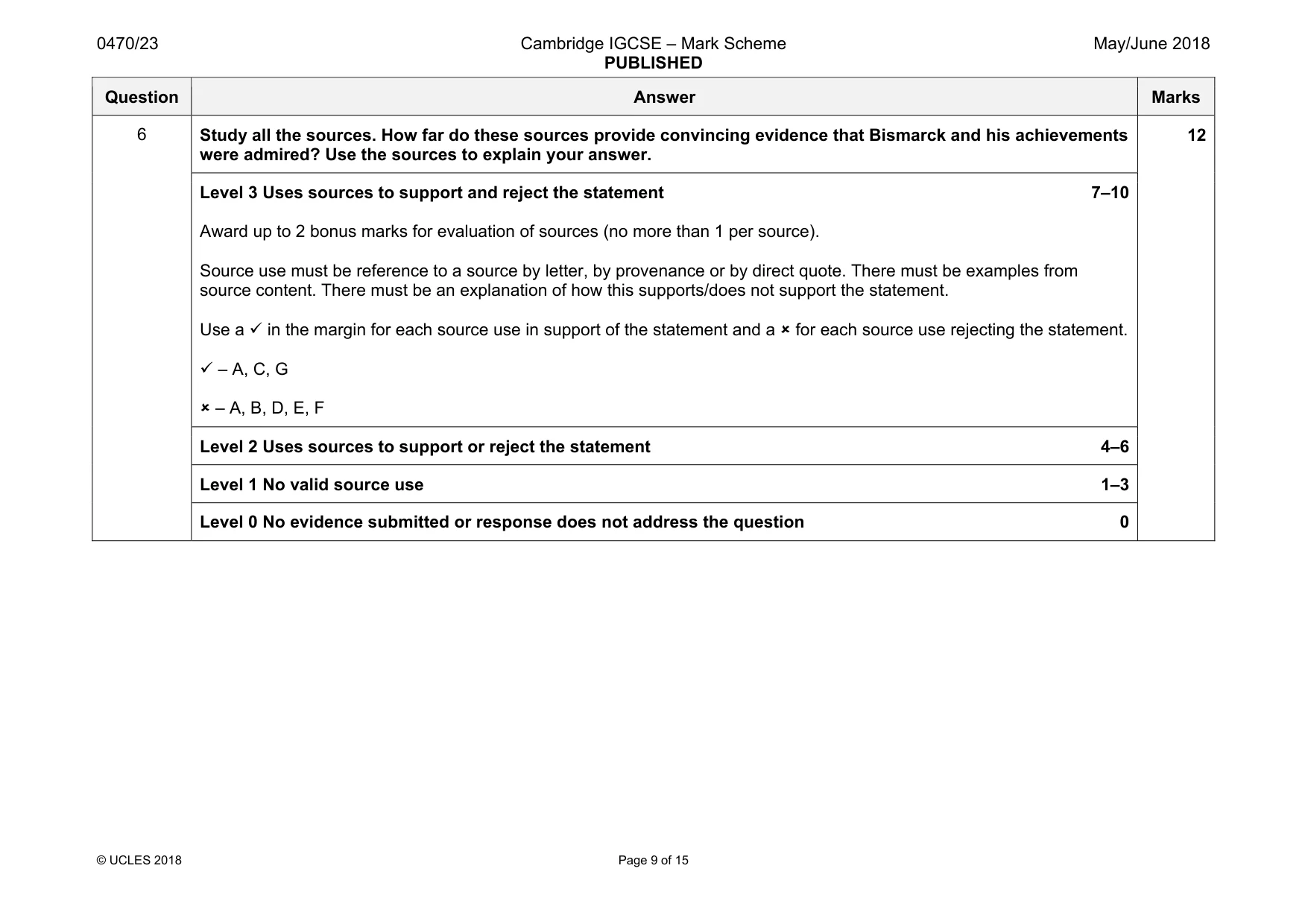
0470/23 Cambridge IGCSE – Mark Scheme PUBLISHED May/June 2018 © UCLES 2018 Page 9 of 15 Question Answer Marks 6 Study all the sources. How far do these sources provide convincing evidence that Bismarck and his achievements were admired? Use the sources to explain your answer. 12 Level 3 Uses sources to support and reject the statement 7–10 Award up to 2 bonus marks for evaluation of sources (no more than 1 per source). Source use must be reference to a source by letter, by provenance or by direct quote. There must be examples from source content. There must be an explanation of how this supports/does not support the statement. Use a 9 in the margin for each source use in support of the statement and a 8 for each source use rejecting the statement. 9 – A, C, G 8 – A, B, D, E, F Level 2 Uses sources to support or reject the statement 4–6 Level 1 No valid source use 1–3 Level 0 No evidence submitted or response does not address the question 0
Mark scheme, page 10
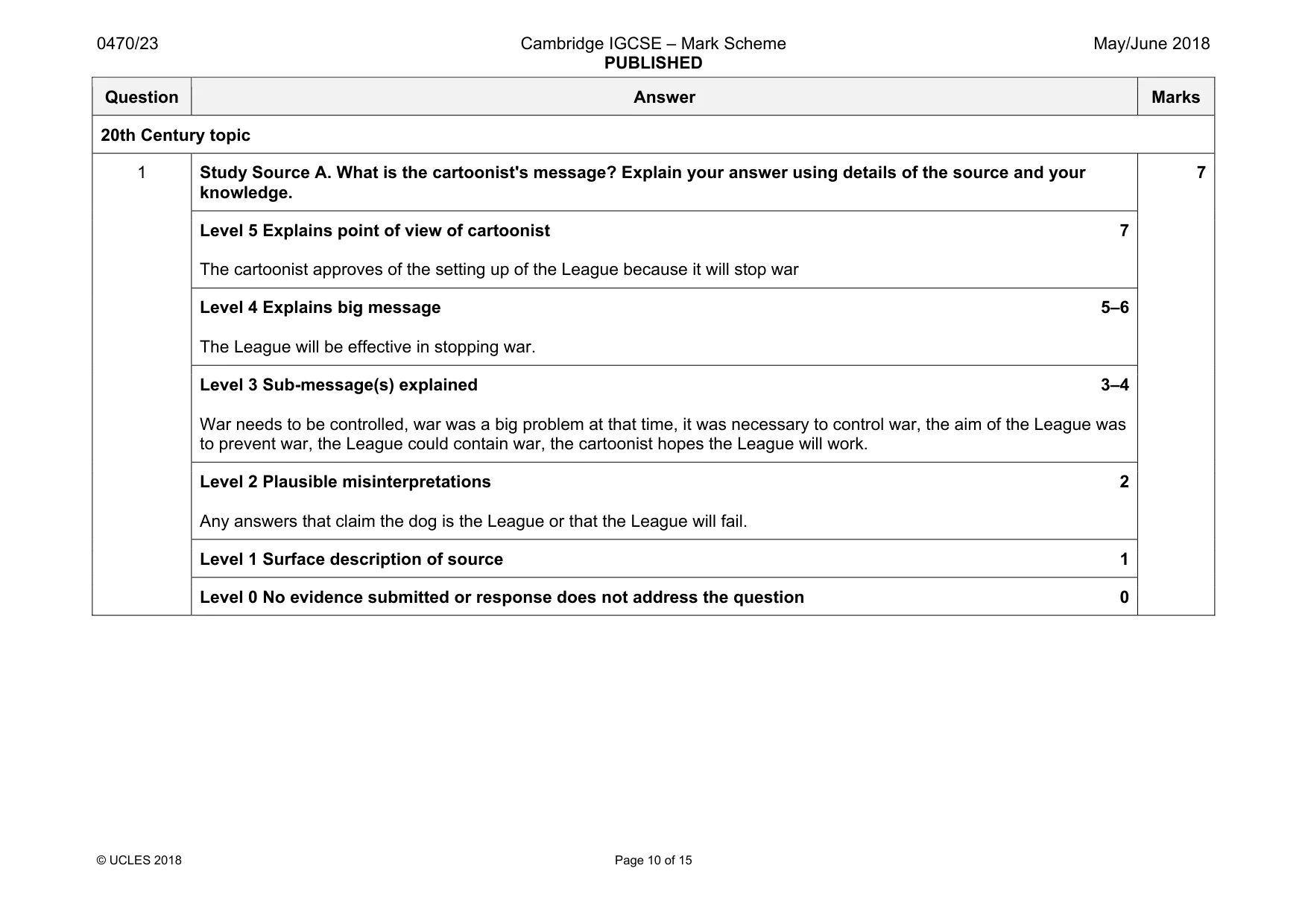
0470/23 Cambridge IGCSE – Mark Scheme PUBLISHED May/June 2018 © UCLES 2018 Page 10 of 15 Question Answer Marks 20th Century topic 1 Study Source A. What is the cartoonist's message? Explain your answer using details of the source and your knowledge. 7 Level 5 Explains point of view of cartoonist 7 The cartoonist approves of the setting up of the League because it will stop war Level 4 Explains big message 5–6 The League will be effective in stopping war. Level 3 Sub-message(s) explained 3–4 War needs to be controlled, war was a big problem at that time, it was necessary to control war, the aim of the League was to prevent war, the League could contain war, the cartoonist hopes the League will work. Level 2 Plausible misinterpretations 2 Any answers that claim the dog is the League or that the League will fail. Level 1 Surface description of source 1 Level 0 No evidence submitted or response does not address the question 0
Mark scheme, page 11
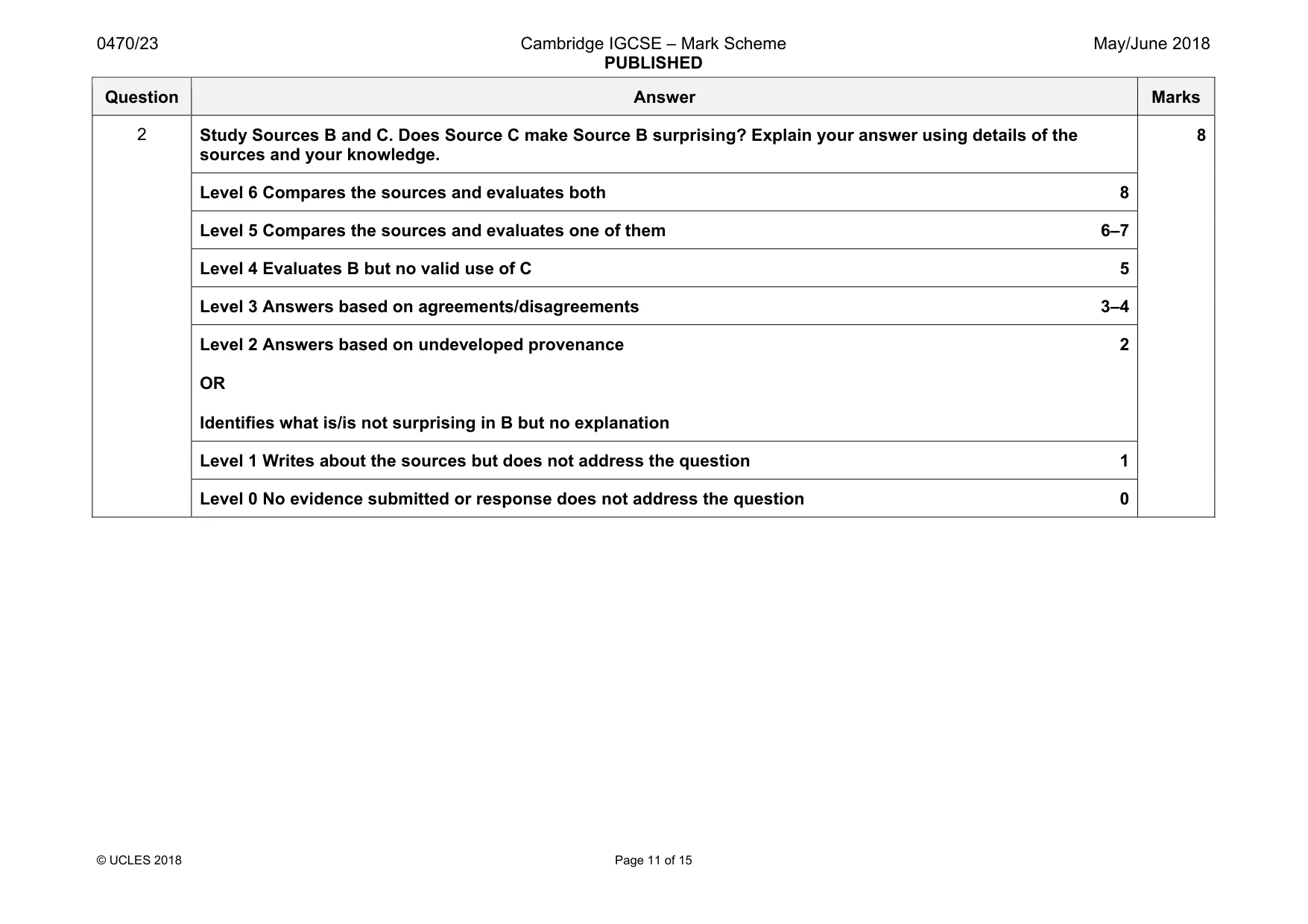
0470/23 Cambridge IGCSE – Mark Scheme PUBLISHED May/June 2018 © UCLES 2018 Page 11 of 15 Question Answer Marks 2 Study Sources B and C. Does Source C make Source B surprising? Explain your answer using details of the sources and your knowledge. 8 Level 6 Compares the sources and evaluates both 8 Level 5 Compares the sources and evaluates one of them 6–7 Level 4 Evaluates B but no valid use of C 5 Level 3 Answers based on agreements/disagreements 3–4 Level 2 Answers based on undeveloped provenance 2 OR Identifies what is/is not surprising in B but no explanation Level 1 Writes about the sources but does not address the question 1 Level 0 No evidence submitted or response does not address the question 0
Mark scheme, page 12
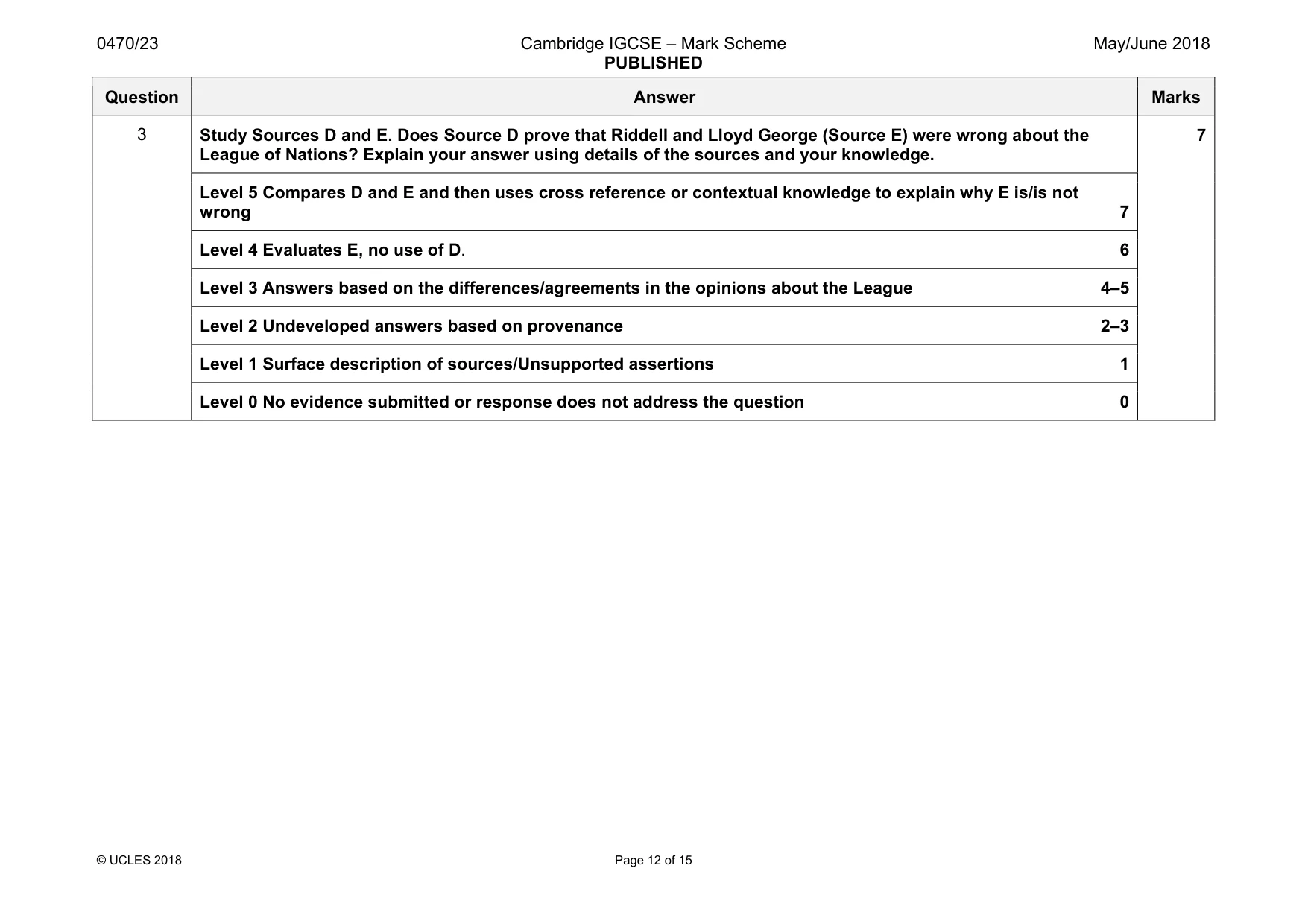
0470/23 Cambridge IGCSE – Mark Scheme PUBLISHED May/June 2018 © UCLES 2018 Page 12 of 15 Question Answer Marks 3 Study Sources D and E. Does Source D prove that Riddell and Lloyd George (Source E) were wrong about the League of Nations? Explain your answer using details of the sources and your knowledge. 7 Level 5 Compares D and E and then uses cross reference or contextual knowledge to explain why E is/is not wrong 7 Level 4 Evaluates E, no use of D. 6 Level 3 Answers based on the differences/agreements in the opinions about the League 4–5 Level 2 Undeveloped answers based on provenance 2–3 Level 1 Surface description of sources/Unsupported assertions 1 Level 0 No evidence submitted or response does not address the question 0
Mark scheme, page 13
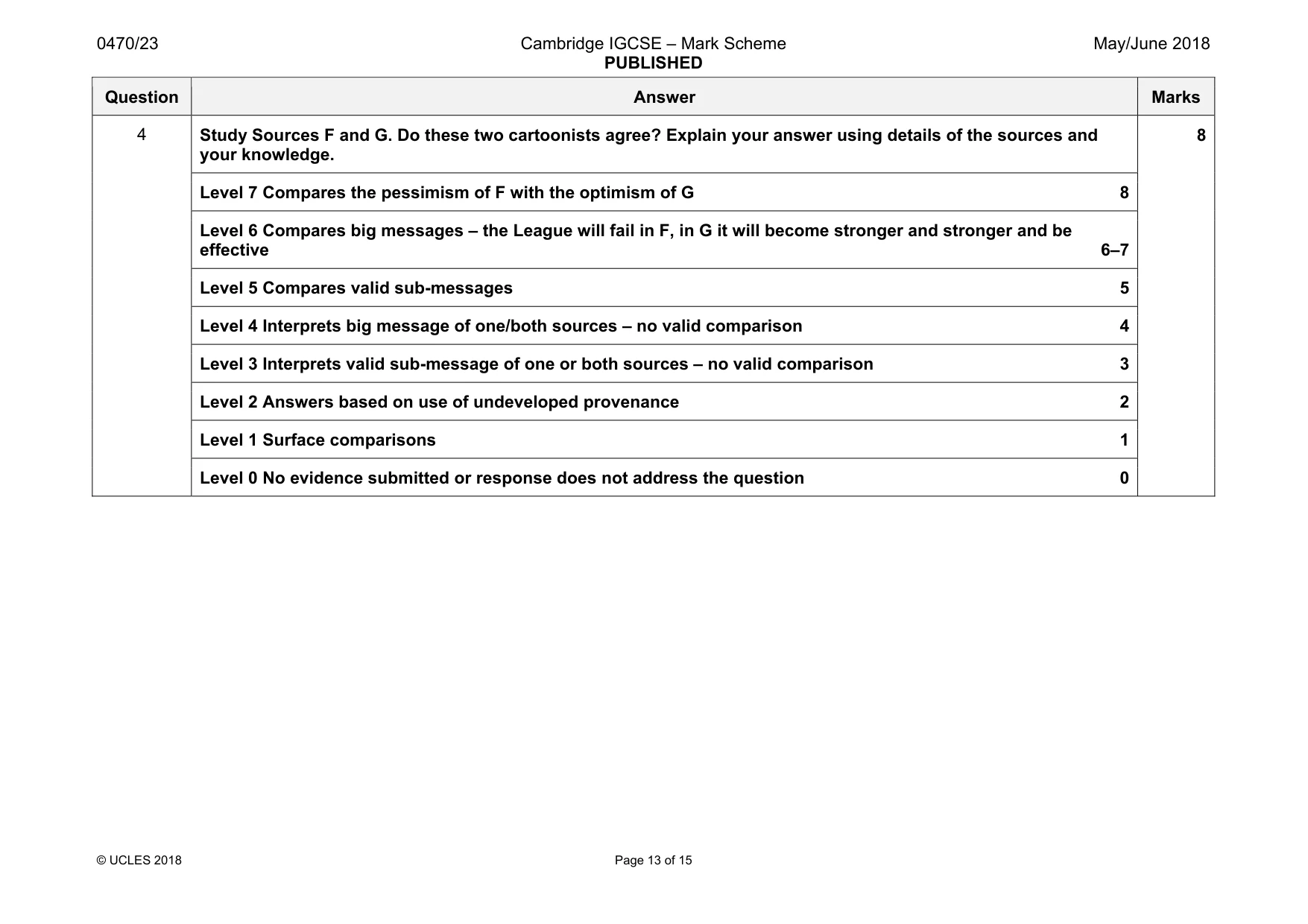
0470/23 Cambridge IGCSE – Mark Scheme PUBLISHED May/June 2018 © UCLES 2018 Page 13 of 15 Question Answer Marks 4 Study Sources F and G. Do these two cartoonists agree? Explain your answer using details of the sources and your knowledge. 8 Level 7 Compares the pessimism of F with the optimism of G 8 Level 6 Compares big messages – the League will fail in F, in G it will become stronger and stronger and be effective 6–7 Level 5 Compares valid sub-messages 5 Level 4 Interprets big message of one/both sources – no valid comparison 4 Level 3 Interprets valid sub-message of one or both sources – no valid comparison 3 Level 2 Answers based on use of undeveloped provenance 2 Level 1 Surface comparisons 1 Level 0 No evidence submitted or response does not address the question 0
Mark scheme, page 14
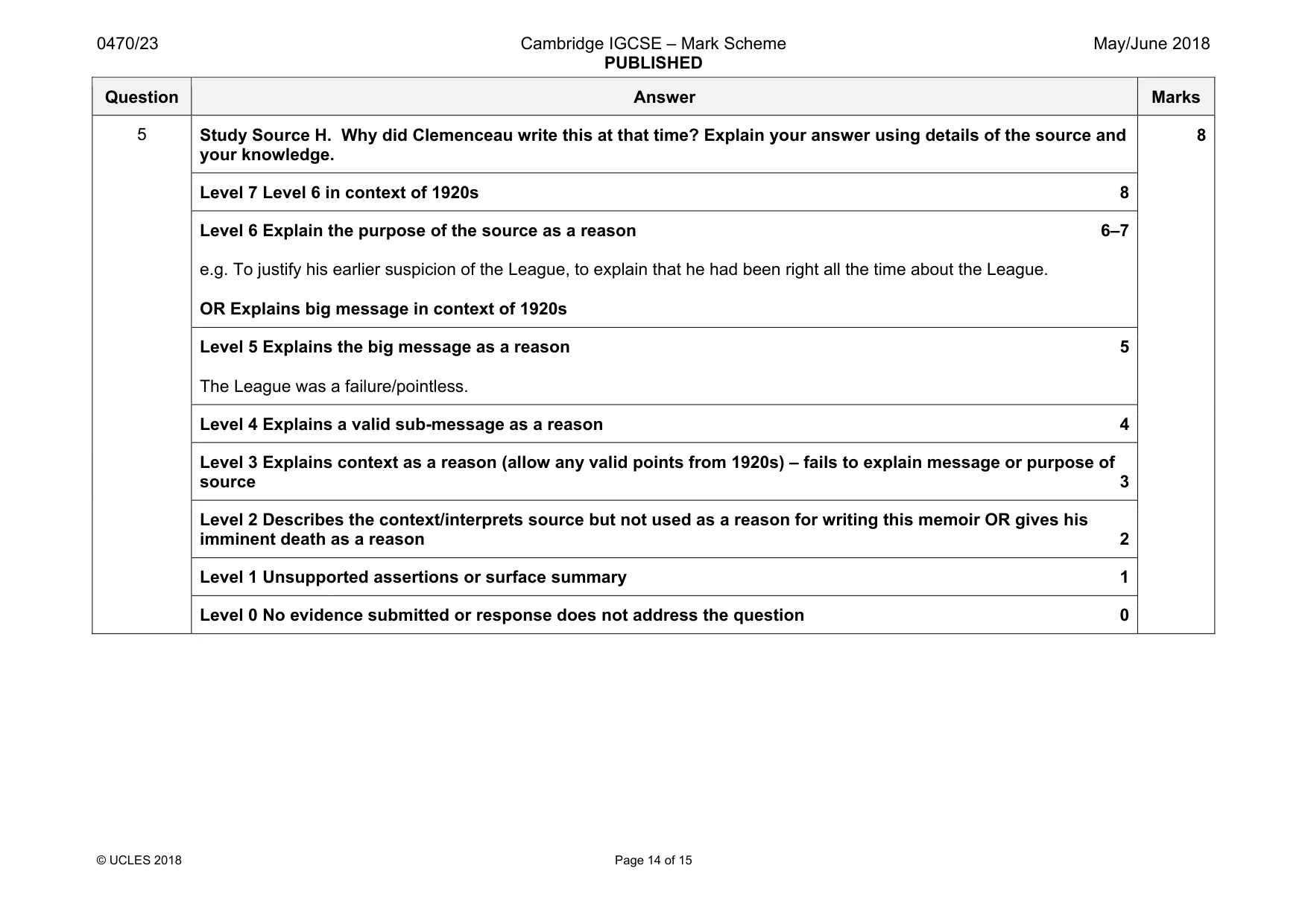
0470/23 Cambridge IGCSE – Mark Scheme PUBLISHED May/June 2018 © UCLES 2018 Page 14 of 15 Question Answer Marks 5 Study Source H. Why did Clemenceau write this at that time? Explain your answer using details of the source and your knowledge. 8 Level 7 Level 6 in context of 1920s 8 Level 6 Explain the purpose of the source as a reason 6–7 e.g. To justify his earlier suspicion of the League, to explain that he had been right all the time about the League. OR Explains big message in context of 1920s Level 5 Explains the big message as a reason 5 The League was a failure/pointless. Level 4 Explains a valid sub-message as a reason 4 Level 3 Explains context as a reason (allow any valid points from 1920s) – fails to explain message or purpose of source 3 Level 2 Describes the context/interprets source but not used as a reason for writing this memoir OR gives his imminent death as a reason 2 Level 1 Unsupported assertions or surface summary 1 Level 0 No evidence submitted or response does not address the question 0
Mark scheme, page 15
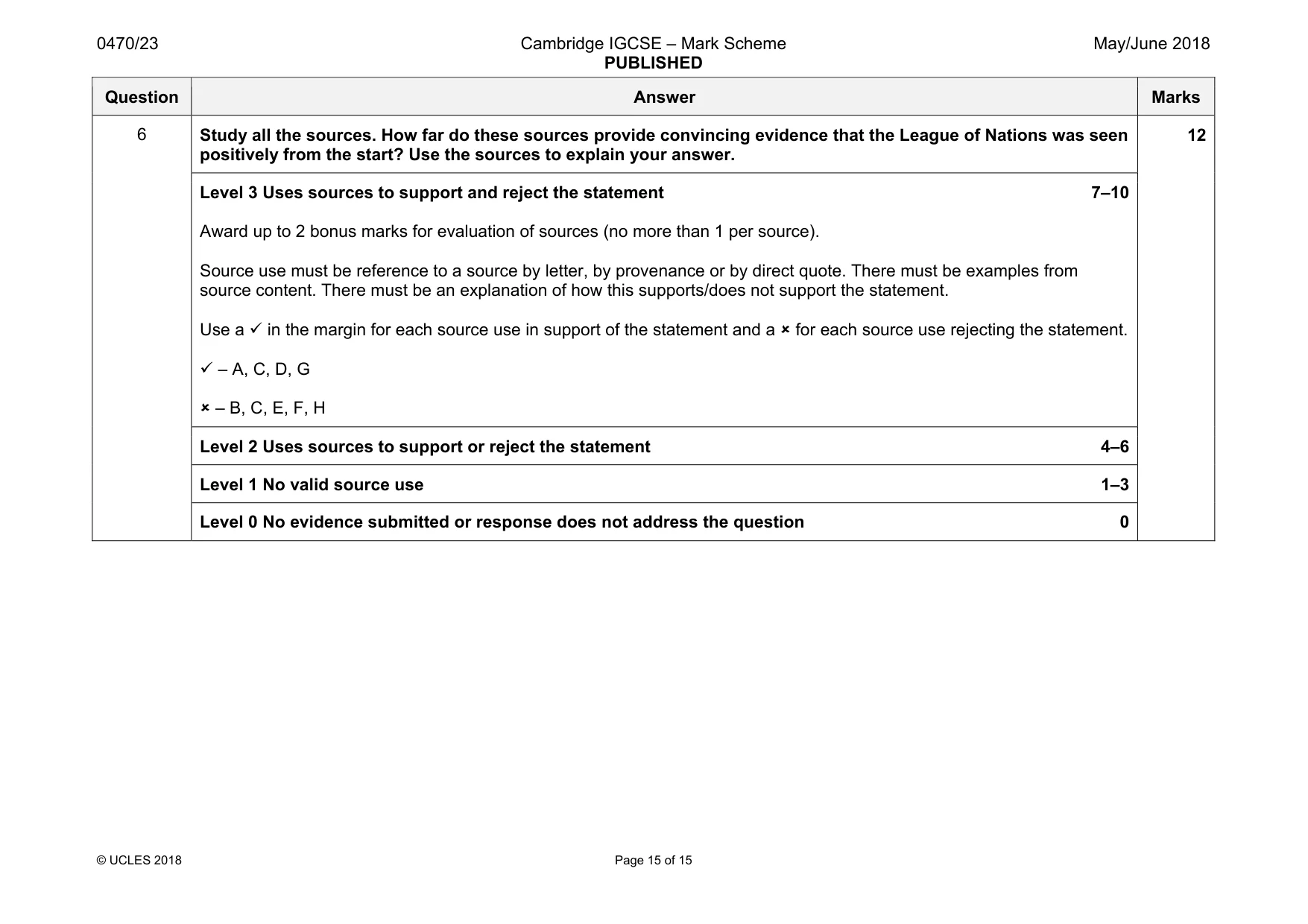
0470/23 Cambridge IGCSE – Mark Scheme PUBLISHED May/June 2018 © UCLES 2018 Page 15 of 15 Question Answer Marks 6 Study all the sources. How far do these sources provide convincing evidence that the League of Nations was seen positively from the start? Use the sources to explain your answer. 12 Level 3 Uses sources to support and reject the statement 7–10 Award up to 2 bonus marks for evaluation of sources (no more than 1 per source). Source use must be reference to a source by letter, by provenance or by direct quote. There must be examples from source content. There must be an explanation of how this supports/does not support the statement. Use a 9 in the margin for each source use in support of the statement and a 8 for each source use rejecting the statement. 9 – A, C, D, G 8 – B, C, E, F, H Level 2 Uses sources to support or reject the statement 4–6 Level 1 No valid source use 1–3 Level 0 No evidence submitted or response does not address the question 0
What you needed in this session
Cambridge’s own grade thresholds for 2018 May/June, Paper 2 · Variant 3. A higher threshold means an easier paper — the bar moves with how the cohort did.