Cambridge IGCSE History 0470 — 2018 May/June Paper 2 · Variant 1
0470/21/M/J/18 · 50 marks · ≈56 min
The question paper and its mark scheme, free to read here and free to download. This is Cambridge’s own paper, exactly as it was sat.
Question paper12 pages

Mark scheme15 pages
Answers below. Sit the paper first if you are practising.
Paper as text
Question paper, page 1
* 0 2 6 3 9 8 3 5 5 2 * This document consists of 11 printed pages, 1 blank page and 1 Insert. DC (CE/SW) 145867/3 © UCLES 2018 [Turn over Cambridge International Examinations Cambridge International General Certificate of Secondary Education HISTORY 0470/21 Paper 2 May/June 2018 2 hours No Additional Materials are required. READ THESE INSTRUCTIONS FIRST An answer booklet is provided inside this question paper. You should follow the instructions on the front cover of the answer booklet. If you need additional answer paper ask the invigilator for a continuation booklet. This paper has two options. Choose one option, and answer all of the questions on that topic. Option A: 19th Century topic [p2–p6] Option B: 20th Century topic [p8–p12] The number of marks is given in brackets [ ] at the end of each question or part question. This syllabus is approved for use in England, Wales and Northern Ireland as a Cambridge International Level 1/Level 2 Certificate.
Question paper, page 2
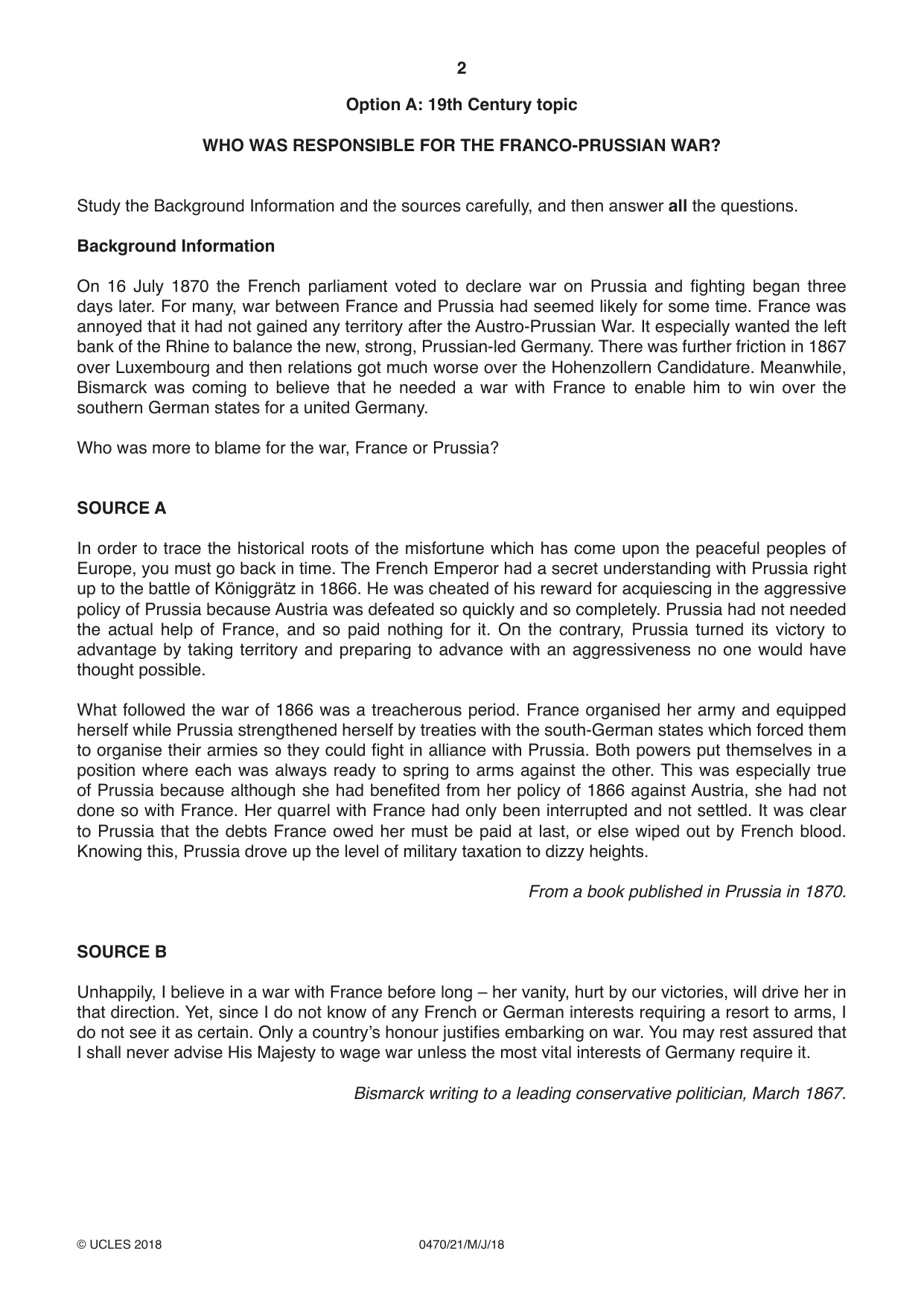
2 0470/21/M/J/18 © UCLES 2018 Option A: 19th Century topic WHO WAS RESPONSIBLE FOR THE FRANCO-PRUSSIAN WAR? Study the Background Information and the sources carefully, and then answer all the questions. Background Information On 16 July 1870 the French parliament voted to declare war on Prussia and fighting began three days later. For many, war between France and Prussia had seemed likely for some time. France was annoyed that it had not gained any territory after the Austro-Prussian War. It especially wanted the left bank of the Rhine to balance the new, strong, Prussian-led Germany. There was further friction in 1867 over Luxembourg and then relations got much worse over the Hohenzollern Candidature. Meanwhile, Bismarck was coming to believe that he needed a war with France to enable him to win over the southern German states for a united Germany. Who was more to blame for the war, France or Prussia? SOURCE A In order to trace the historical roots of the misfortune which has come upon the peaceful peoples of Europe, you must go back in time. The French Emperor had a secret understanding with Prussia right up to the battle of Königgrätz in 1866. He was cheated of his reward for acquiescing in the aggressive policy of Prussia because Austria was defeated so quickly and so completely. Prussia had not needed the actual help of France, and so paid nothing for it. On the contrary, Prussia turned its victory to advantage by taking territory and preparing to advance with an aggressiveness no one would have thought possible. What followed the war of 1866 was a treacherous period. France organised her army and equipped herself while Prussia strengthened herself by treaties with the south-German states which forced them to organise their armies so they could fight in alliance with Prussia. Both powers put themselves in a position where each was always ready to spring to arms against the other. This was especially true of Prussia because although she had benefited from her policy of 1866 against Austria, she had not done so with France. Her quarrel with France had only been interrupted and not settled. It was clear to Prussia that the debts France owed her must be paid at last, or else wiped out by French blood. Knowing this, Prussia drove up the level of military taxation to dizzy heights. From a book published in Prussia in 1870. SOURCE B Unhappily, I believe in a war with France before long – her vanity, hurt by our victories, will drive her in that direction. Yet, since I do not know of any French or German interests requiring a resort to arms, I do not see it as certain. Only a country’s honour justifies embarking on war. You may rest assured that I shall never advise His Majesty to wage war unless the most vital interests of Germany require it. Bismarck writing to a leading conservative politician, March 1867.
Question paper, page 3
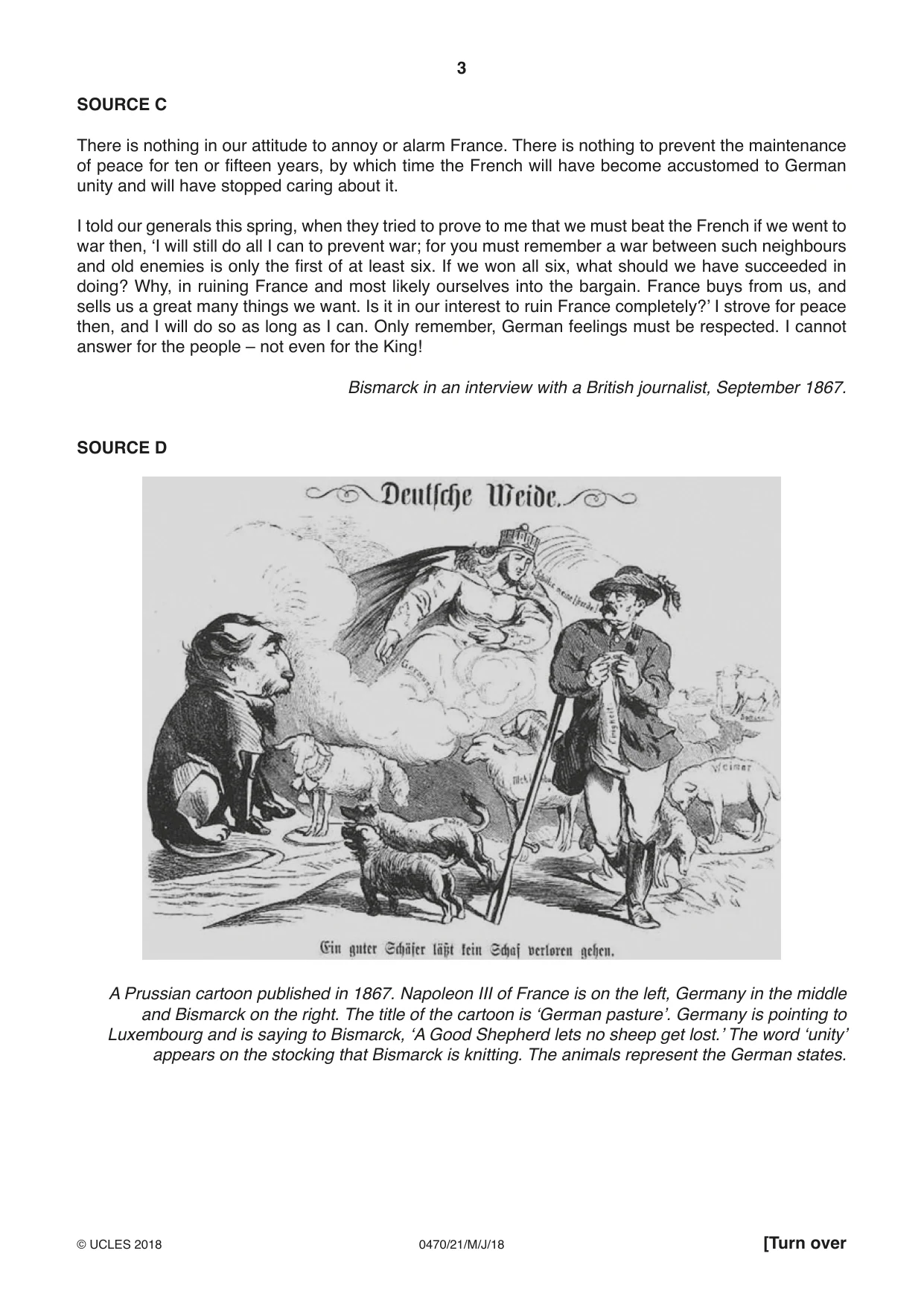
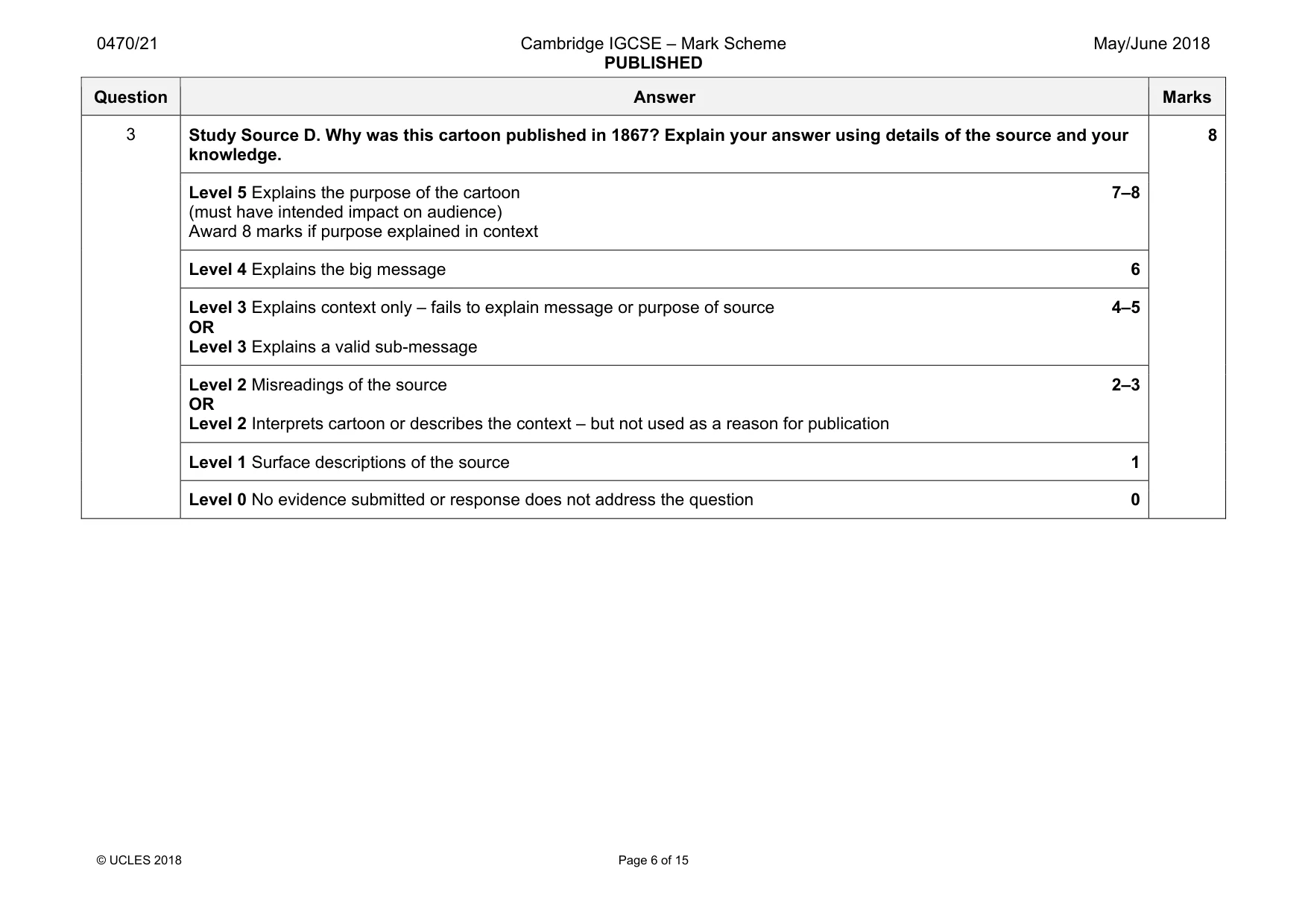
3 0470/21/M/J/18 © UCLES 2018 [Turn over SOURCE C There is nothing in our attitude to annoy or alarm France. There is nothing to prevent the maintenance of peace for ten or fifteen years, by which time the French will have become accustomed to German unity and will have stopped caring about it. I told our generals this spring, when they tried to prove to me that we must beat the French if we went to war then, ‘I will still do all I can to prevent war; for you must remember a war between such neighbours and old enemies is only the first of at least six. If we won all six, what should we have succeeded in doing? Why, in ruining France and most likely ourselves into the bargain. France buys from us, and sells us a great many things we want. Is it in our interest to ruin France completely?’ I strove for peace then, and I will do so as long as I can. Only remember, German feelings must be respected. I cannot answer for the people – not even for the King! Bismarck in an interview with a British journalist, September 1867. SOURCE D A Prussian cartoon published in 1867. Napoleon III of France is on the left, Germany in the middle and Bismarck on the right. The title of the cartoon is ‘German pasture’. Germany is pointing to Luxembourg and is saying to Bismarck, ‘A Good Shepherd lets no sheep get lost.’ The word ‘unity’ appears on the stocking that Bismarck is knitting. The animals represent the German states.
Question paper, page 4
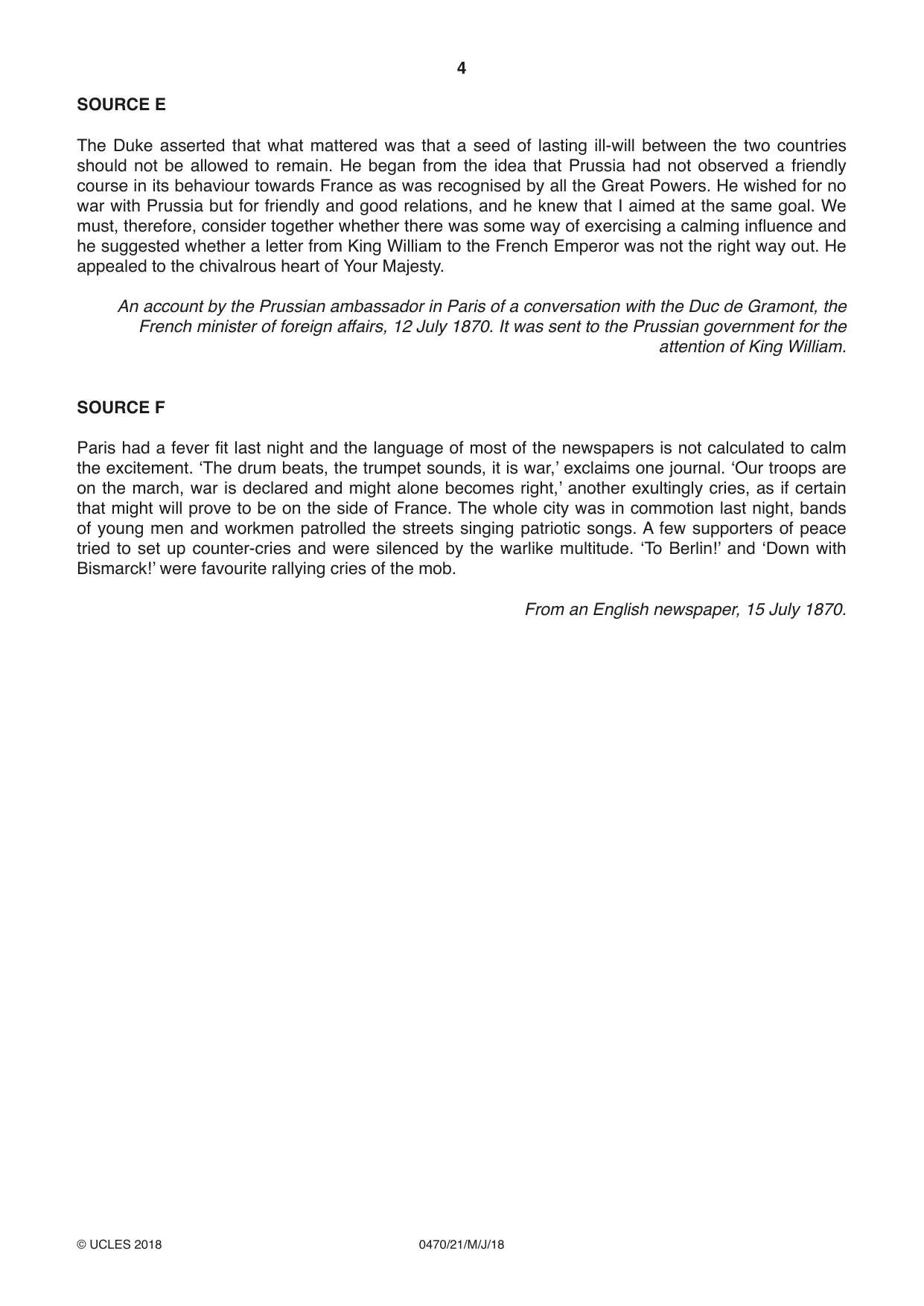
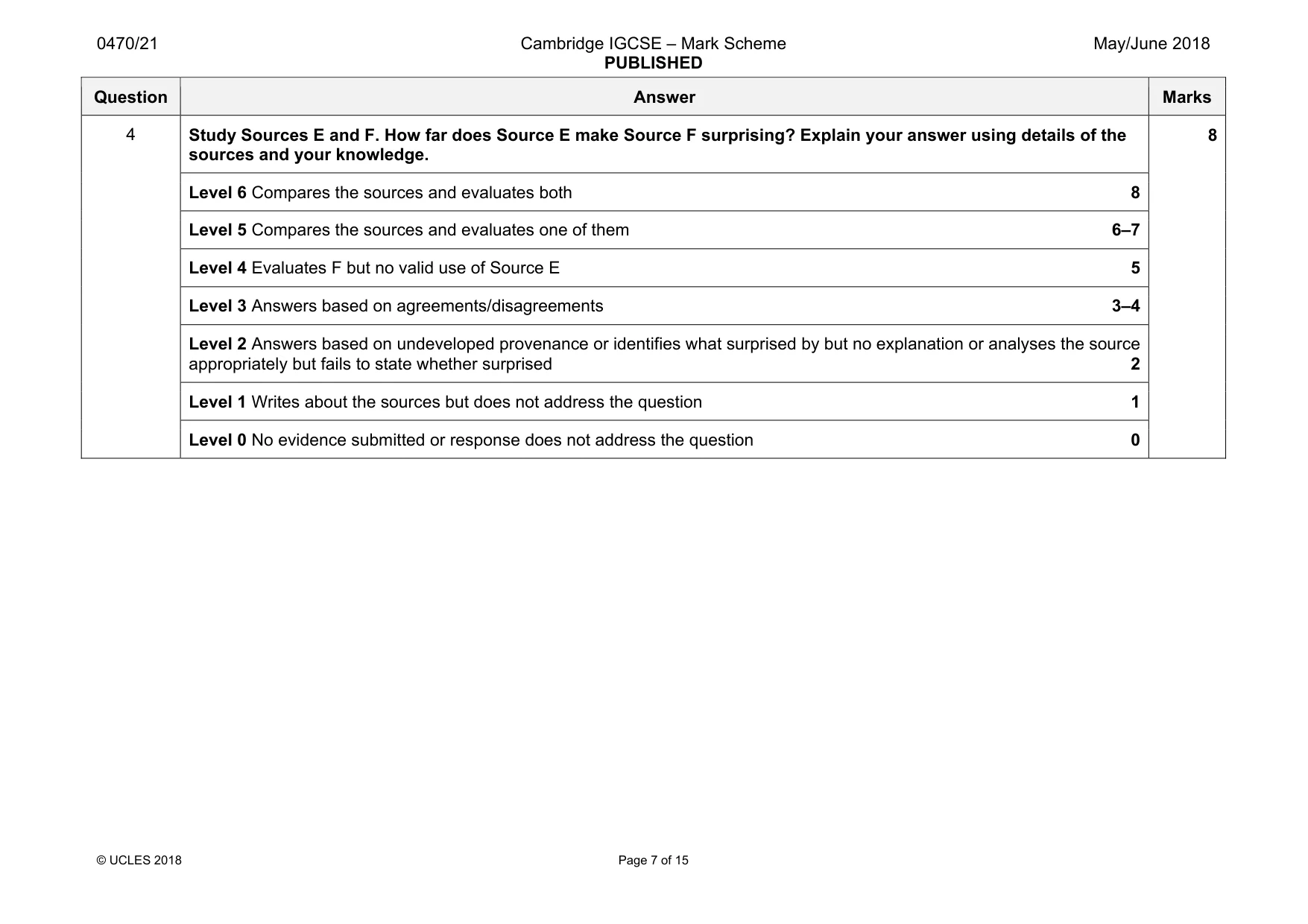
4 0470/21/M/J/18 © UCLES 2018 SOURCE E The Duke asserted that what mattered was that a seed of lasting ill-will between the two countries should not be allowed to remain. He began from the idea that Prussia had not observed a friendly course in its behaviour towards France as was recognised by all the Great Powers. He wished for no war with Prussia but for friendly and good relations, and he knew that I aimed at the same goal. We must, therefore, consider together whether there was some way of exercising a calming influence and he suggested whether a letter from King William to the French Emperor was not the right way out. He appealed to the chivalrous heart of Your Majesty. An account by the Prussian ambassador in Paris of a conversation with the Duc de Gramont, the French minister of foreign affairs, 12 July 1870. It was sent to the Prussian government for the attention of King William. SOURCE F Paris had a fever fit last night and the language of most of the newspapers is not calculated to calm the excitement. ‘The drum beats, the trumpet sounds, it is war,’ exclaims one journal. ‘Our troops are on the march, war is declared and might alone becomes right,’ another exultingly cries, as if certain that might will prove to be on the side of France. The whole city was in commotion last night, bands of young men and workmen patrolled the streets singing patriotic songs. A few supporters of peace tried to set up counter-cries and were silenced by the warlike multitude. ‘To Berlin!’ and ‘Down with Bismarck!’ were favourite rallying cries of the mob. From an English newspaper, 15 July 1870.
Question paper, page 5
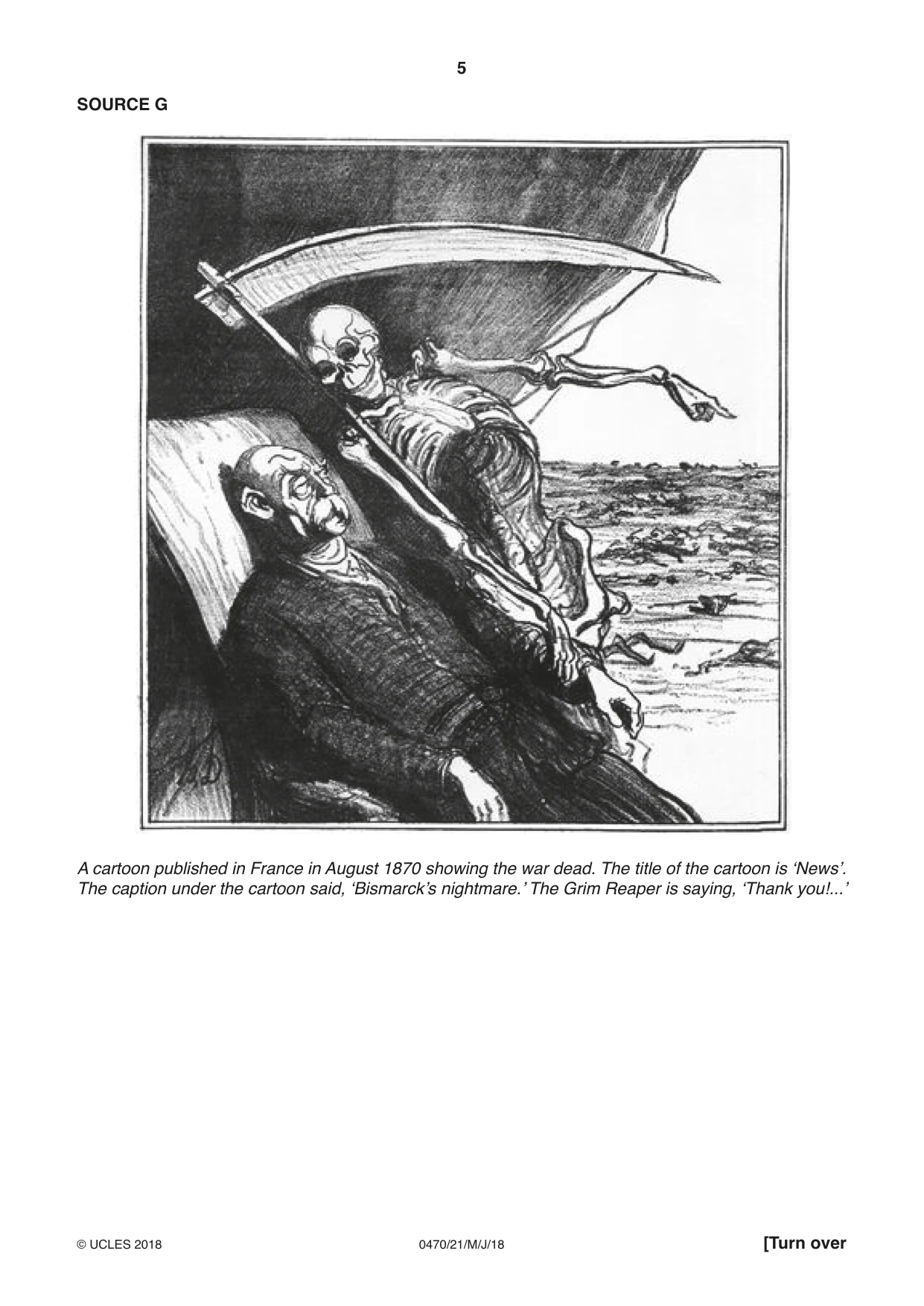
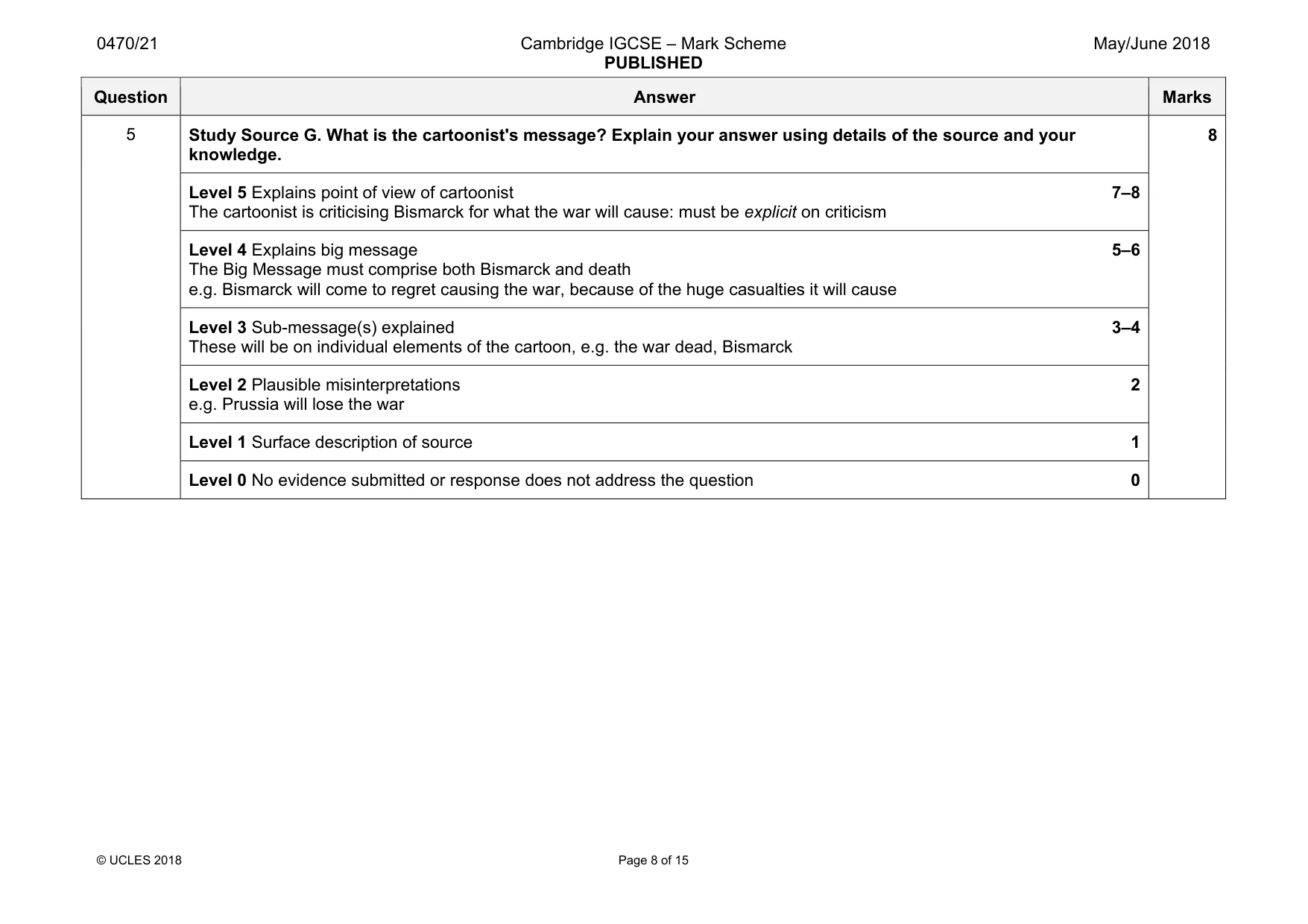
5 0470/21/M/J/18 © UCLES 2018 [Turn over SOURCE G A cartoon published in France in August 1870 showing the war dead. The title of the cartoon is ‘News’. The caption under the cartoon said, ‘Bismarck’s nightmare.’ The Grim Reaper is saying, ‘Thank you!...’
Question paper, page 6
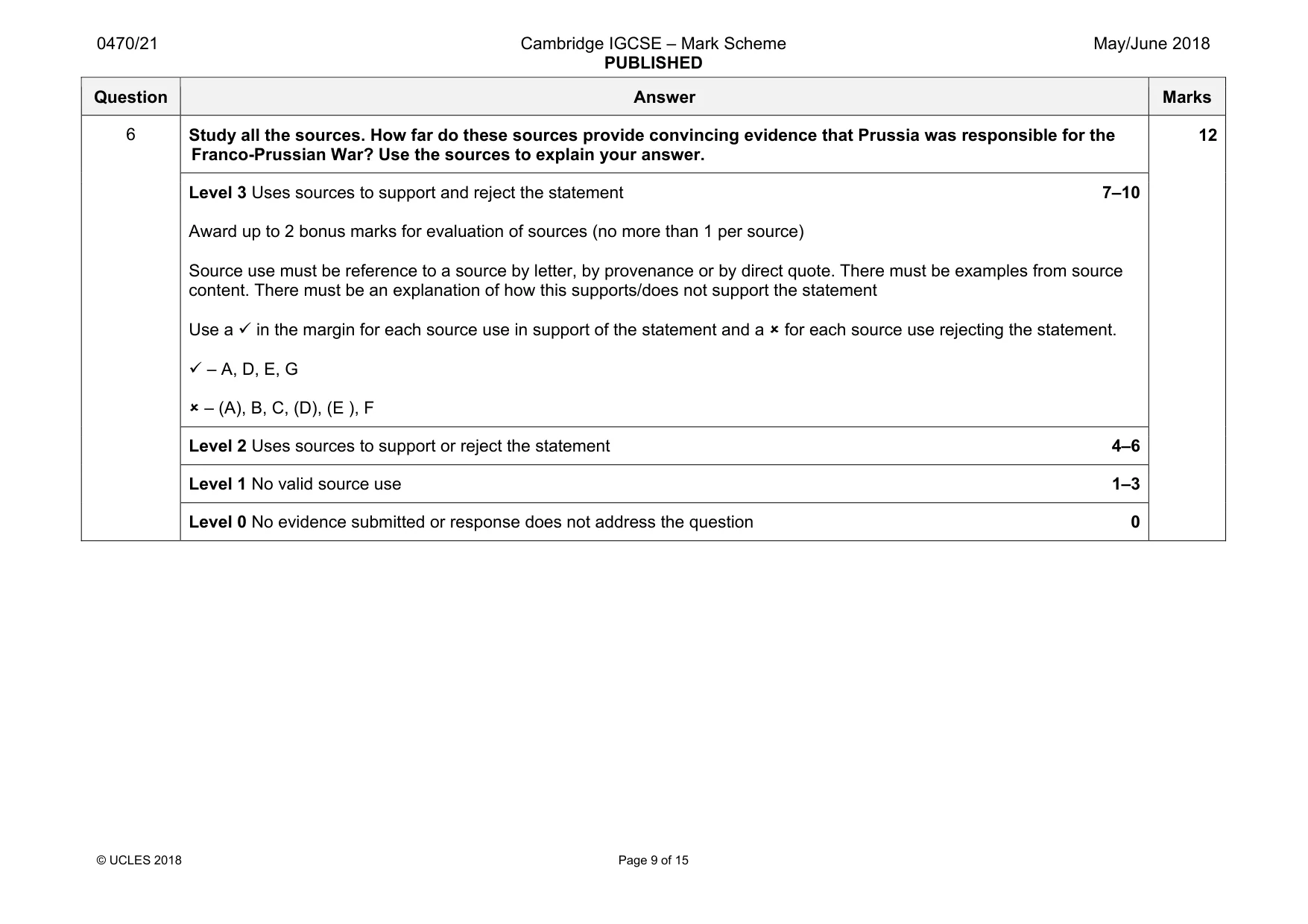
6 0470/21/M/J/18 © UCLES 2018 Now answer all the following questions. You may use any of the sources to help you answer the questions, in addition to those sources which you are told to use. In answering the questions you should use your knowledge of the topic to help you interpret and evaluate the sources. 1 Study Source A. What impressions does this source give of the events leading up to the Franco-Prussian War? Explain your answer using details of the source. [6] 2 Study Sources B and C. Does Source C prove that Bismarck was lying in Source B? Explain your answer using details of the sources and your knowledge. [8] 3 Study Source D. Why was this cartoon published in 1867? Explain your answer using details of the source and your knowledge. [8] 4 Study Sources E and F. How far does Source E make Source F surprising? Explain your answer using details of the sources and your knowledge. [8] 5 Study Source G. What is the cartoonist’s message? Explain your answer using details of the source and your knowledge. [8] 6 Study all the sources. How far do these sources provide convincing evidence that Prussia was responsible for the Franco-Prussian War? Use the sources to explain your answer. [12]
Question paper, page 7
7 0470/21/M/J/18 © UCLES 2018 [Turn over BLANK PAGE
Question paper, page 8
8 0470/21/M/J/18 © UCLES 2018 Option B: 20th Century topic DID THE LEAGUE OF NATIONS LACK SUPPORT FROM THE BEGINNING? Study the Background Information and the sources carefully, and then answer all the questions. Background Information Some historians claim that the League never had a chance of succeeding because from the start it did not have enough support. However, the dreadful experience of the First World War did lead to several ideas for a league of nations that would protect peace in the future. Perhaps the leading supporter of such an organisation was President Wilson, who suggested it in a speech in January 1918. The League of Nations came into existence on 10 January 1920 after lengthy negotiations at the Paris Peace Conference. There was much opposition to the League in the USA. In other countries there was much debate over whether the League could perform a useful role. Was the League doomed to fail from the start because there was so little support for it? SOURCE A The creation of an association of the nations of the world was the summit of Wilson’s ambition. Many Americans shared his enthusiasm. When Wilson spoke at a meeting of the League to Enforce Peace its influence soared in the struggle to shape a postwar international organisation. Yet its high profile hid a great deal of disagreement among Americans about the nature of a league, especially over the degree to which a league should have judicial, as opposed to economic or military, means to prevent war. Nor was popular support for a league found only in the United States. In Great Britain there had been a pro-league movement for some time and when Wilson made his Fourteen Points speech in January 1918 it transformed the league idea into Britain’s chief aim. There is little evidence that the League held any particular attraction for Lloyd George. In fact, to him Wilson’s enthusiasm seemed almost ludicrous. However, public opinion in Britain was strongly on the side of a league. A league of nations was a much less pressing topic in France. French conservatives paid it little attention, preferring instead to focus on the requirements of traditional balance-of-power diplomacy. French liberals supported the idea of a league, while the powerful socialists remained fearful that a league would hide the ambitions of international capitalism. Clemenceau saw the League as a potential threat to France’s safety. Its very existence might lull the world into a sense of false security and prevent the negotiation of a new web of international alliances similar to the Triple Entente which had saved France in 1914. From a recent history book.
Question paper, page 9
9 0470/21/M/J/18 © UCLES 2018 [Turn over SOURCE B In Paris, Wilson insisted on chairing the league commission because for him the League of Nations was the centrepiece of the peace settlements. The picture sometimes painted of Wilson sailing across the Atlantic bearing the gift of the League of Nations is false. Many Europeans had long wanted a better way of managing international relations. Lloyd George went along with Wilson’s insistence that the League should be the first task of the Peace Conference, not merely out of cynical desire to keep the Americans happy. He was after all a Liberal, the leader of a party with a strong opposition to war. As a skilled politician, he also knew the British public and knew that it would be a disaster to come back from the peace conference without a league of nations. But the League never caught his imagination. In France, there was deep pessimism about international cooperation to end war. On the other hand there was a willingness, especially among liberals, to give the League a try. Clemenceau had mixed feelings and was not, as is sometimes said, hostile. But he was determined that it would not be said that France had blocked the League. In the USA public opinion provided general support for the League but no clear guidance as to its shape. Should it use force or moral persuasion? By April 1919 Wilson was feeling pleased, but he dangerously assumed that he had the support to get the League through Congress. From a history book published in 2001. SOURCE C Those who thought that the League was only a project of international friendliness will change their minds when they read the Covenant published today. Peace and its preservation have been brought down from the clouds; what is more, peace in this Covenant is for the first time equipped with powers of its own. It is the cause of pride to recognise in the Covenant so much work of Englishmen. From The Times newspaper, published in England in February 1919. SOURCE D The Commission, on the initiative of President Wilson, wisely decided not to worry about what might happen in the future and confined itself to making the present safe. The mystic Society of Nations has become a league of the Five Great Powers which beat Germany and which mean to consolidate both victory and peace. A close alliance will result between the USA, England, France, Italy and Japan. The future is open to a better settlement, but that naturally is as yet vague. From Le Figaro newspaper, published in France in February 1919.
Question paper, page 10
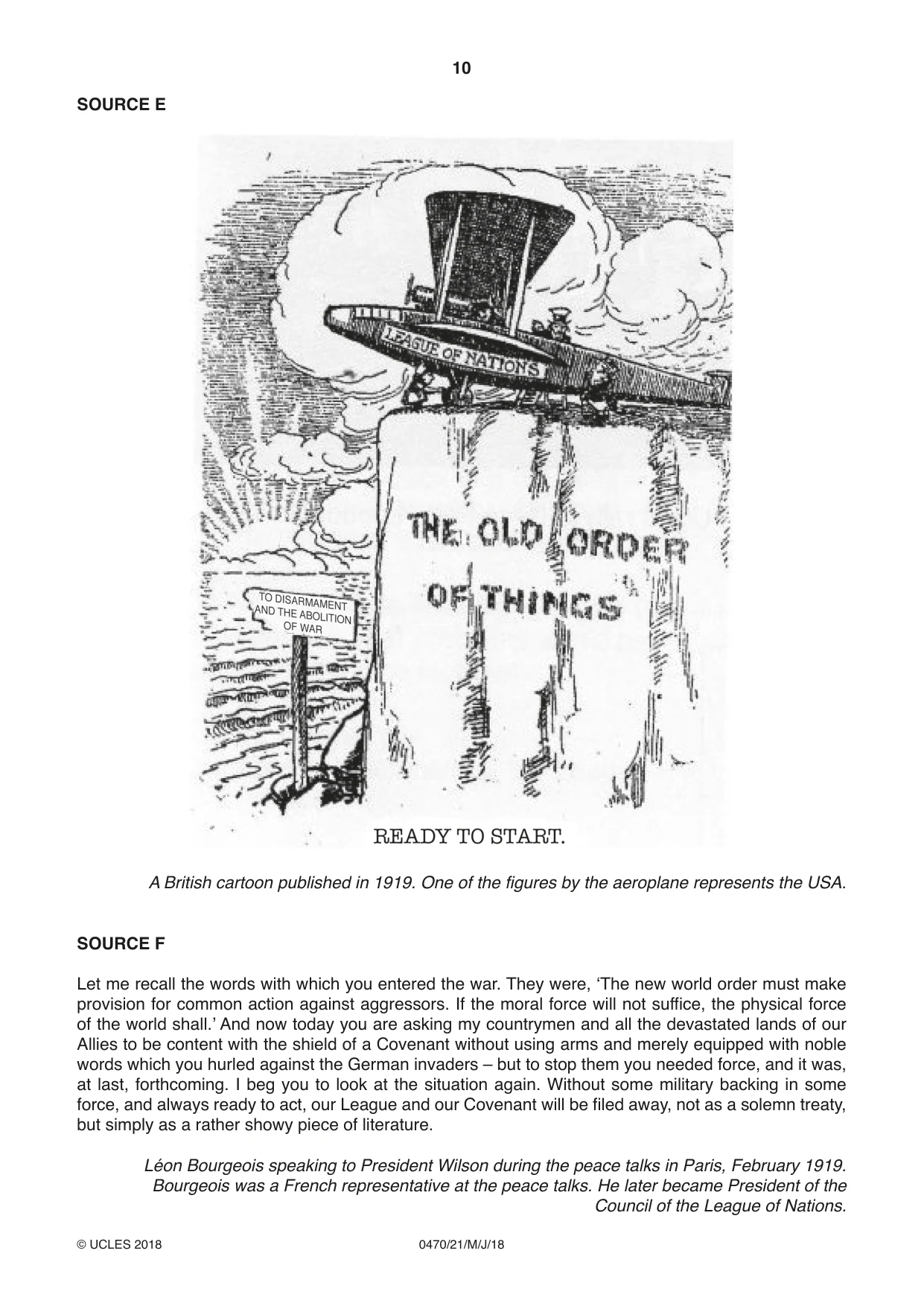
10 0470/21/M/J/18 © UCLES 2018 SOURCE E A British cartoon published in 1919. One of the figures by the aeroplane represents the USA. SOURCE F Let me recall the words with which you entered the war. They were, ‘The new world order must make provision for common action against aggressors. If the moral force will not suffice, the physical force of the world shall.’ And now today you are asking my countrymen and all the devastated lands of our Allies to be content with the shield of a Covenant without using arms and merely equipped with noble words which you hurled against the German invaders – but to stop them you needed force, and it was, at last, forthcoming. I beg you to look at the situation again. Without some military backing in some force, and always ready to act, our League and our Covenant will be filed away, not as a solemn treaty, but simply as a rather showy piece of literature. Léon Bourgeois speaking to President Wilson during the peace talks in Paris, February 1919. Bourgeois was a French representative at the peace talks. He later became President of the Council of the League of Nations.
Question paper, page 11
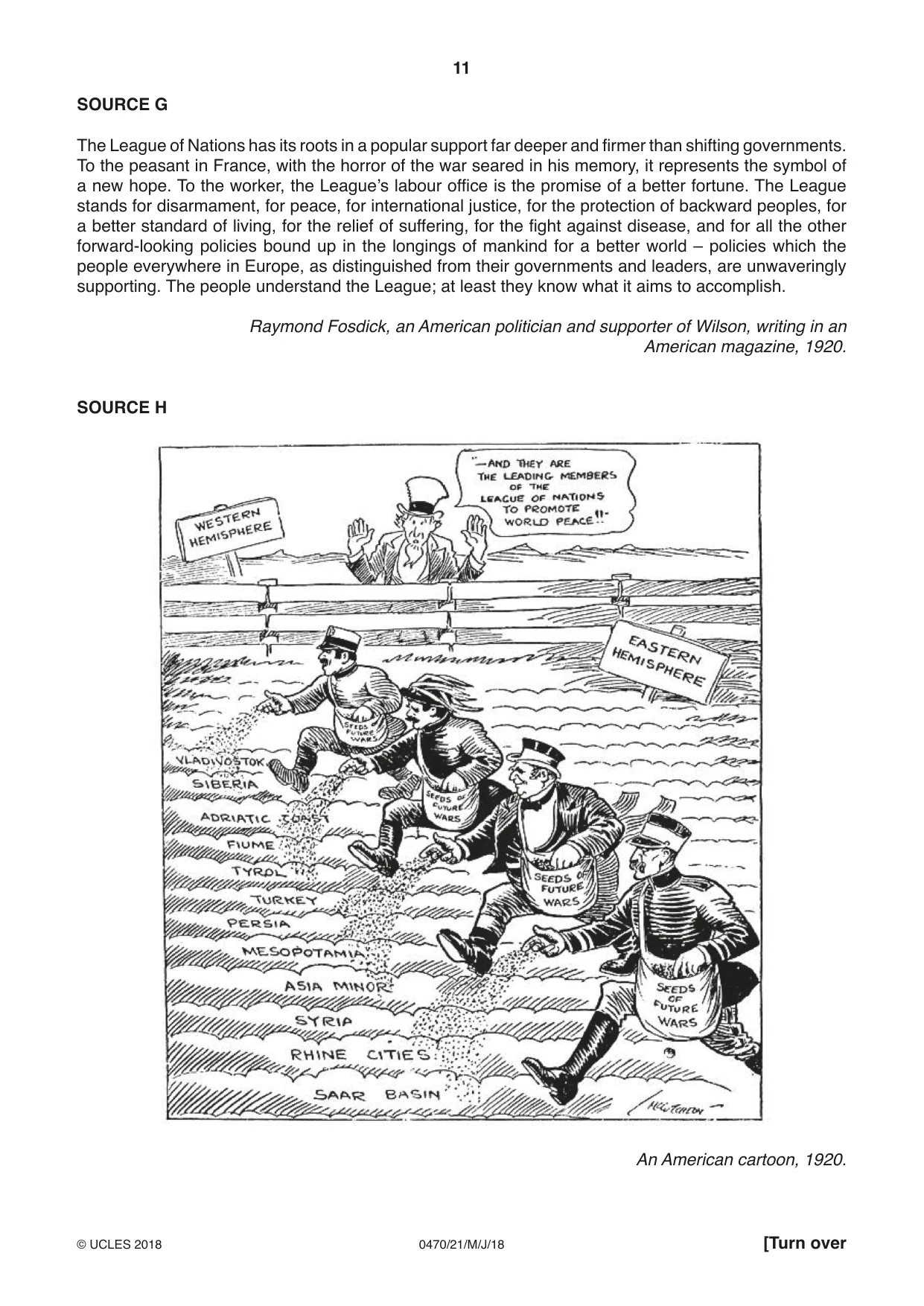
11 0470/21/M/J/18 © UCLES 2018 [Turn over SOURCE G The League of Nations has its roots in a popular support far deeper and firmer than shifting governments. To the peasant in France, with the horror of the war seared in his memory, it represents the symbol of a new hope. To the worker, the League’s labour office is the promise of a better fortune. The League stands for disarmament, for peace, for international justice, for the protection of backward peoples, for a better standard of living, for the relief of suffering, for the fight against disease, and for all the other forward-looking policies bound up in the longings of mankind for a better world – policies which the people everywhere in Europe, as distinguished from their governments and leaders, are unwaveringly supporting. The people understand the League; at least they know what it aims to accomplish. Raymond Fosdick, an American politician and supporter of Wilson, writing in an American magazine, 1920. SOURCE H An American cartoon, 1920.
Question paper, page 12
12 0470/21/M/J/18 © UCLES 2018 Permission to reproduce items where third-party owned material protected by copyright is included has been sought and cleared where possible. Every reasonable effort has been made by the publisher (UCLES) to trace copyright holders, but if any items requiring clearance have unwittingly been included, the publisher will be pleased to make amends at the earliest possible opportunity. To avoid the issue of disclosure of answer-related information to candidates, all copyright acknowledgements are reproduced online in the Cambridge International Examinations Copyright Acknowledgements Booklet. This is produced for each series of examinations and is freely available to download at www.cie.org.uk after the live examination series. Cambridge International Examinations is part of the Cambridge Assessment Group. Cambridge Assessment is the brand name of University of Cambridge Local Examinations Syndicate (UCLES), which is itself a department of the University of Cambridge. Now answer all the following questions. You may use any of the sources to help you answer the questions, in addition to those sources which you are told to use. In answering the questions you should use your knowledge of the topic to help you interpret and evaluate the sources. 1 Study Sources A and B. How far do these two sources agree? Explain your answer using details of the sources. [7] 2 Study Sources C and D. Does Source D prove that Source C was wrong? Explain your answer using details of the sources and your knowledge. [8] 3 Study Source E. Why was this cartoon published in 1919? Explain your answer using details of the source and your knowledge. [8] 4 Study Source F. Why was Bourgeois speaking to Wilson like this? Explain your answer using details of the source and your knowledge. [7] 5 Study Sources G and H. Does Source G make Source H surprising? Explain your answer using details of the sources and your knowledge. [8] 6 Study all the sources. How far do these sources provide convincing evidence that the League of Nations had little support from the beginning? Use the sources to explain your answer. [12]
Mark scheme, page 1
IGCSE™ is a registered trademark. This syllabus is approved for use in England, Wales and Northern Ireland as a Cambridge International Level 1/Level 2 Certificate. This document consists of 15 printed pages. © UCLES 2018 [Turn over Cambridge Assessment International Education Cambridge International General Certificate of Secondary Education HISTORY 0470/21 Paper 2 May/June 2018 MARK SCHEME Maximum Mark: 50 Published This mark scheme is published as an aid to teachers and candidates, to indicate the requirements of the examination. It shows the basis on which Examiners were instructed to award marks. It does not indicate the details of the discussions that took place at an Examiners’ meeting before marking began, which would have considered the acceptability of alternative answers. Mark schemes should be read in conjunction with the question paper and the Principal Examiner Report for Teachers. Cambridge International will not enter into discussions about these mark schemes. Cambridge International is publishing the mark schemes for the May/June 2018 series for most Cambridge IGCSE™, Cambridge International A and AS Level and Cambridge Pre-U components, and some Cambridge O Level components.
Mark scheme, page 2
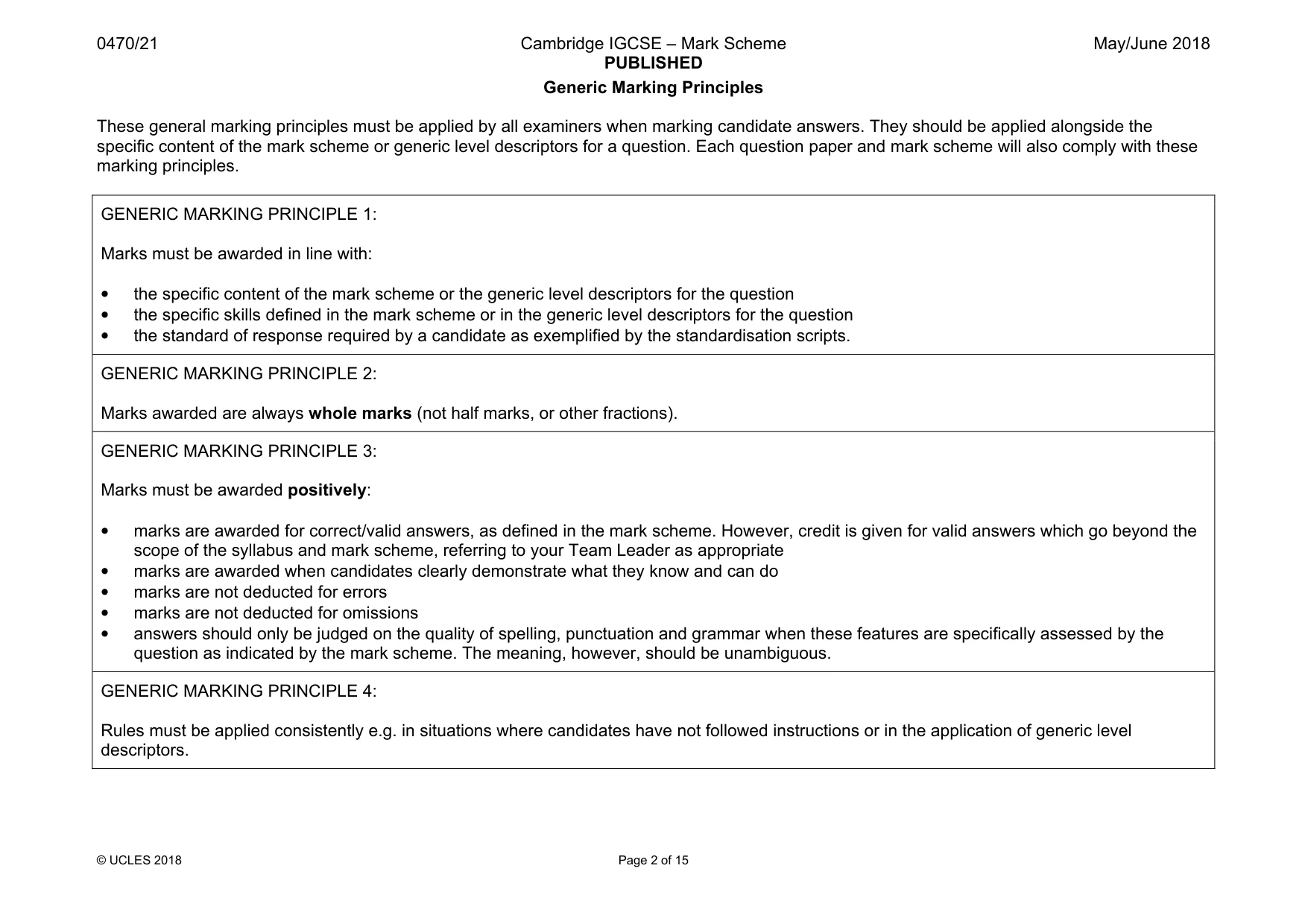
0470/21 Cambridge IGCSE – Mark Scheme PUBLISHED May/June 2018 © UCLES 2018 Page 2 of 15 Generic Marking Principles These general marking principles must be applied by all examiners when marking candidate answers. They should be applied alongside the specific content of the mark scheme or generic level descriptors for a question. Each question paper and mark scheme will also comply with these marking principles. GENERIC MARKING PRINCIPLE 1: Marks must be awarded in line with: • the specific content of the mark scheme or the generic level descriptors for the question • the specific skills defined in the mark scheme or in the generic level descriptors for the question • the standard of response required by a candidate as exemplified by the standardisation scripts. GENERIC MARKING PRINCIPLE 2: Marks awarded are always whole marks (not half marks, or other fractions). GENERIC MARKING PRINCIPLE 3: Marks must be awarded positively: • marks are awarded for correct/valid answers, as defined in the mark scheme. However, credit is given for valid answers which go beyond the scope of the syllabus and mark scheme, referring to your Team Leader as appropriate • marks are awarded when candidates clearly demonstrate what they know and can do • marks are not deducted for errors • marks are not deducted for omissions • answers should only be judged on the quality of spelling, punctuation and grammar when these features are specifically assessed by the question as indicated by the mark scheme. The meaning, however, should be unambiguous. GENERIC MARKING PRINCIPLE 4: Rules must be applied consistently e.g. in situations where candidates have not followed instructions or in the application of generic level descriptors.
Mark scheme, page 3
0470/21 Cambridge IGCSE – Mark Scheme PUBLISHED May/June 2018 © UCLES 2018 Page 3 of 15 GENERIC MARKING PRINCIPLE 5: Marks should be awarded using the full range of marks defined in the mark scheme for the question (however; the use of the full mark range may be limited according to the quality of the candidate responses seen). GENERIC MARKING PRINCIPLE 6: Marks awarded are based solely on the requirements as defined in the mark scheme. Marks should not be awarded with grade thresholds or grade descriptors in mind.
Mark scheme, page 4
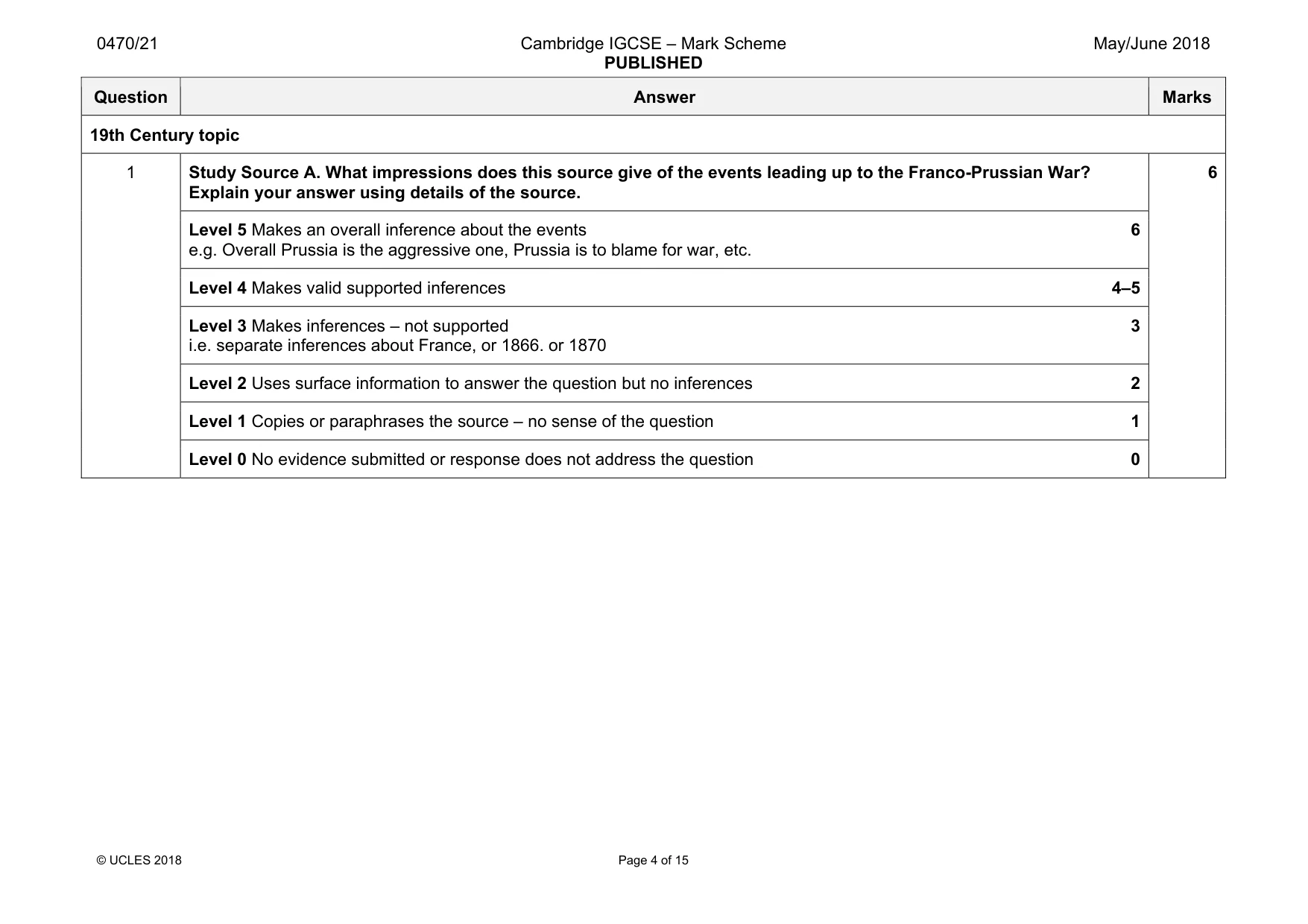
0470/21 Cambridge IGCSE – Mark Scheme PUBLISHED May/June 2018 © UCLES 2018 Page 4 of 15 Question Answer Marks 19th Century topic 1 Study Source A. What impressions does this source give of the events leading up to the Franco-Prussian War? Explain your answer using details of the source. 6 Level 5 Makes an overall inference about the events 6 e.g. Overall Prussia is the aggressive one, Prussia is to blame for war, etc. Level 4 Makes valid supported inferences 4–5 Level 3 Makes inferences – not supported 3 i.e. separate inferences about France, or 1866. or 1870 Level 2 Uses surface information to answer the question but no inferences 2 Level 1 Copies or paraphrases the source – no sense of the question 1 Level 0 No evidence submitted or response does not address the question 0
Mark scheme, page 5
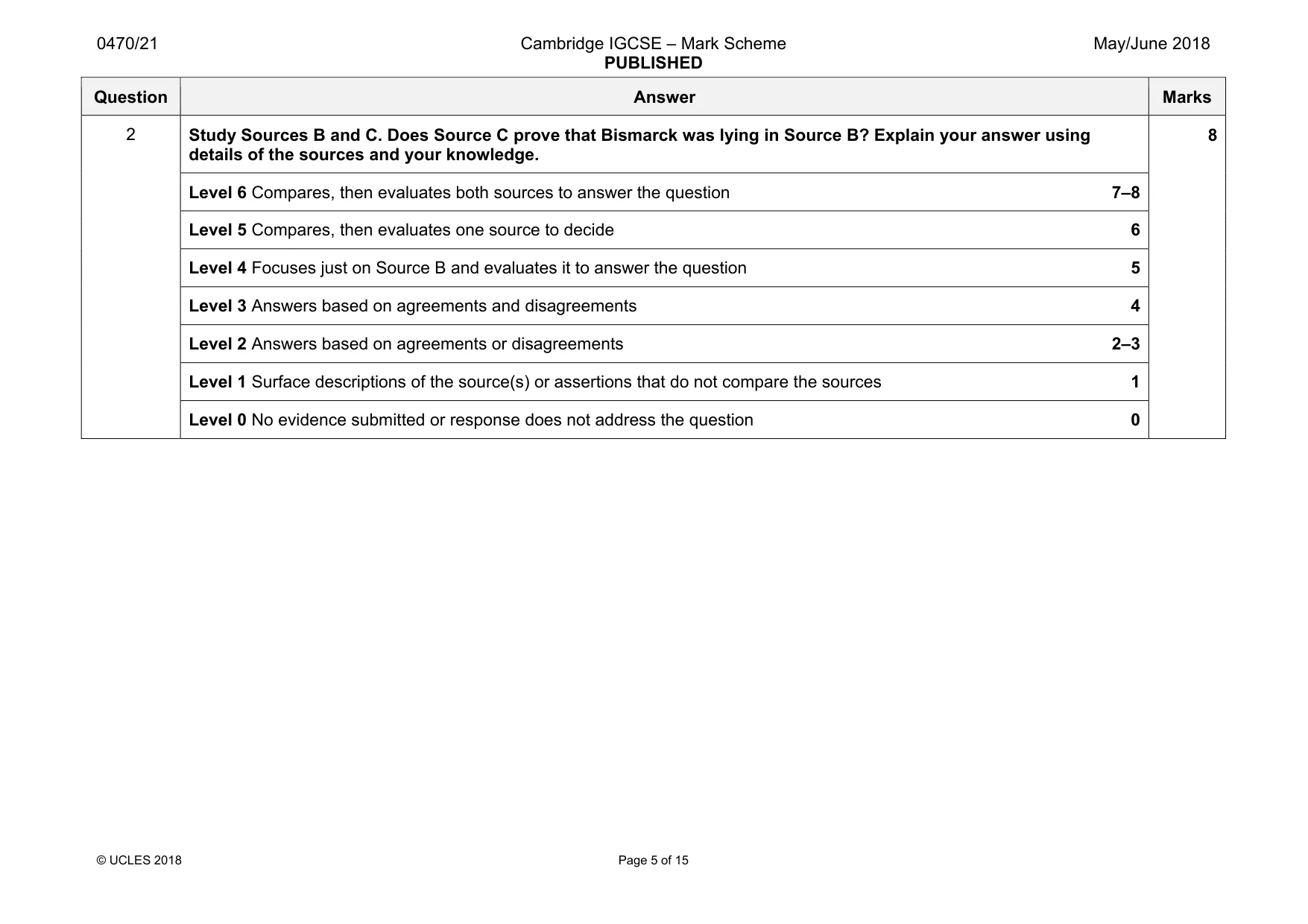
0470/21 Cambridge IGCSE – Mark Scheme PUBLISHED May/June 2018 © UCLES 2018 Page 5 of 15 Question Answer Marks 2 Study Sources B and C. Does Source C prove that Bismarck was lying in Source B? Explain your answer using details of the sources and your knowledge. 8 Level 6 Compares, then evaluates both sources to answer the question 7–8 Level 5 Compares, then evaluates one source to decide 6 Level 4 Focuses just on Source B and evaluates it to answer the question 5 Level 3 Answers based on agreements and disagreements 4 Level 2 Answers based on agreements or disagreements 2–3 Level 1 Surface descriptions of the source(s) or assertions that do not compare the sources 1 Level 0 No evidence submitted or response does not address the question 0
Mark scheme, page 6
0470/21 Cambridge IGCSE – Mark Scheme PUBLISHED May/June 2018 © UCLES 2018 Page 6 of 15 Question Answer Marks 3 Study Source D. Why was this cartoon published in 1867? Explain your answer using details of the source and your knowledge. 8 Level 5 Explains the purpose of the cartoon 7–8 (must have intended impact on audience) Award 8 marks if purpose explained in context Level 4 Explains the big message 6 Level 3 Explains context only – fails to explain message or purpose of source 4–5 OR Level 3 Explains a valid sub-message Level 2 Misreadings of the source 2–3 OR Level 2 Interprets cartoon or describes the context – but not used as a reason for publication Level 1 Surface descriptions of the source 1 Level 0 No evidence submitted or response does not address the question 0
Mark scheme, page 7
0470/21 Cambridge IGCSE – Mark Scheme PUBLISHED May/June 2018 © UCLES 2018 Page 7 of 15 Question Answer Marks 4 Study Sources E and F. How far does Source E make Source F surprising? Explain your answer using details of the sources and your knowledge. 8 Level 6 Compares the sources and evaluates both 8 Level 5 Compares the sources and evaluates one of them 6–7 Level 4 Evaluates F but no valid use of Source E 5 Level 3 Answers based on agreements/disagreements 3–4 Level 2 Answers based on undeveloped provenance or identifies what surprised by but no explanation or analyses the source appropriately but fails to state whether surprised 2 Level 1 Writes about the sources but does not address the question 1 Level 0 No evidence submitted or response does not address the question 0
Mark scheme, page 8
0470/21 Cambridge IGCSE – Mark Scheme PUBLISHED May/June 2018 © UCLES 2018 Page 8 of 15 Question Answer Marks 5 Study Source G. What is the cartoonist's message? Explain your answer using details of the source and your knowledge. 8 Level 5 Explains point of view of cartoonist 7–8 The cartoonist is criticising Bismarck for what the war will cause: must be explicit on criticism Level 4 Explains big message 5–6 The Big Message must comprise both Bismarck and death e.g. Bismarck will come to regret causing the war, because of the huge casualties it will cause Level 3 Sub-message(s) explained 3–4 These will be on individual elements of the cartoon, e.g. the war dead, Bismarck Level 2 Plausible misinterpretations 2 e.g. Prussia will lose the war Level 1 Surface description of source 1 Level 0 No evidence submitted or response does not address the question 0
Mark scheme, page 9
0470/21 Cambridge IGCSE – Mark Scheme PUBLISHED May/June 2018 © UCLES 2018 Page 9 of 15 Question Answer Marks 6 Study all the sources. How far do these sources provide convincing evidence that Prussia was responsible for the Franco-Prussian War? Use the sources to explain your answer. 12 Level 3 Uses sources to support and reject the statement 7–10 Award up to 2 bonus marks for evaluation of sources (no more than 1 per source) Source use must be reference to a source by letter, by provenance or by direct quote. There must be examples from source content. There must be an explanation of how this supports/does not support the statement Use a 9 in the margin for each source use in support of the statement and a 8 for each source use rejecting the statement. 9 – A, D, E, G 8 – (A), B, C, (D), (E ), F Level 2 Uses sources to support or reject the statement 4–6 Level 1 No valid source use 1–3 Level 0 No evidence submitted or response does not address the question 0
Mark scheme, page 10
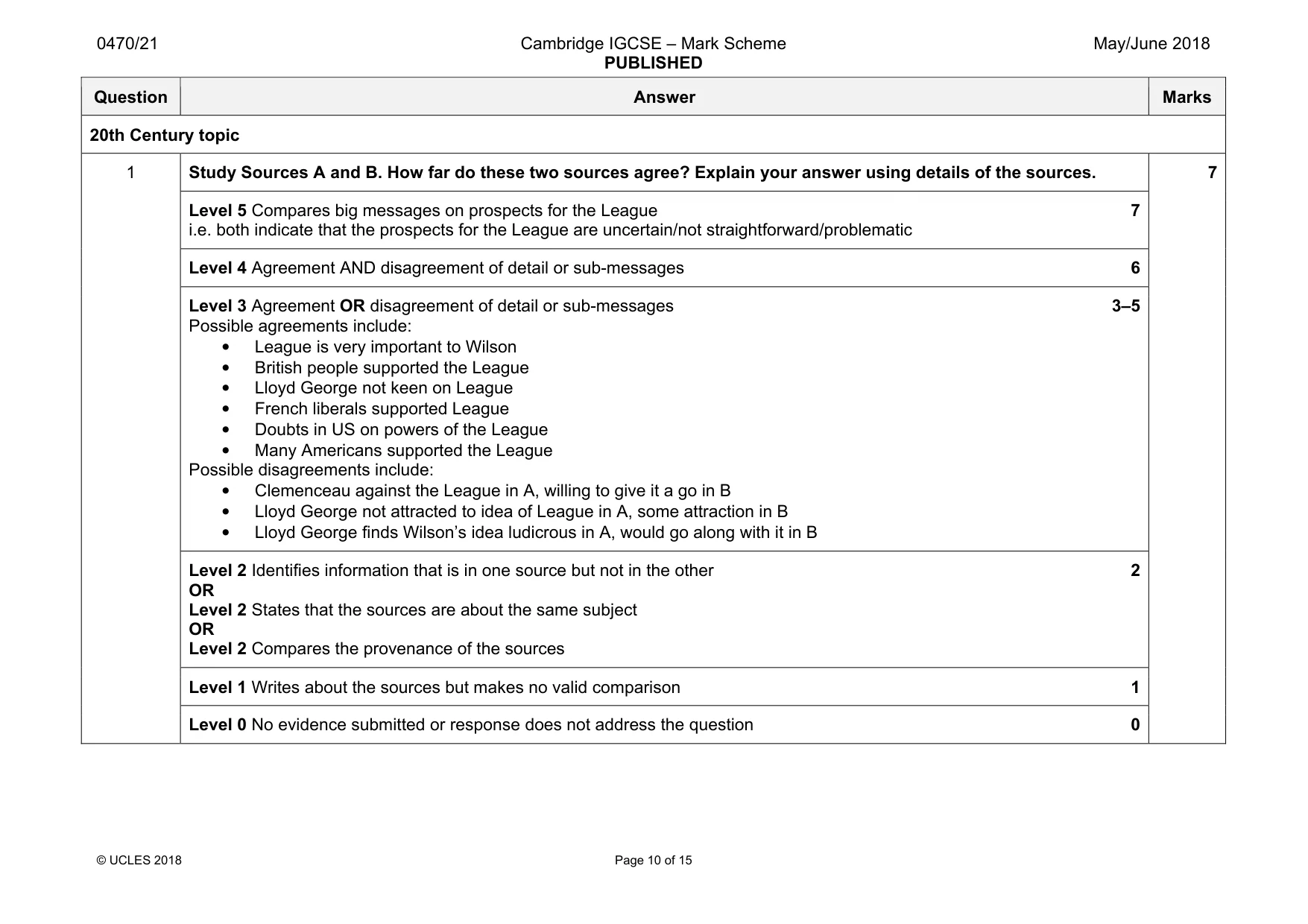
0470/21 Cambridge IGCSE – Mark Scheme PUBLISHED May/June 2018 © UCLES 2018 Page 10 of 15 Question Answer Marks 20th Century topic 1 Study Sources A and B. How far do these two sources agree? Explain your answer using details of the sources. 7 Level 5 Compares big messages on prospects for the League 7 i.e. both indicate that the prospects for the League are uncertain/not straightforward/problematic Level 4 Agreement AND disagreement of detail or sub-messages 6 Level 3 Agreement OR disagreement of detail or sub-messages 3–5 Possible agreements include: • League is very important to Wilson • British people supported the League • Lloyd George not keen on League • French liberals supported League • Doubts in US on powers of the League • Many Americans supported the League Possible disagreements include: • Clemenceau against the League in A, willing to give it a go in B • Lloyd George not attracted to idea of League in A, some attraction in B • Lloyd George finds Wilson’s idea ludicrous in A, would go along with it in B Level 2 Identifies information that is in one source but not in the other 2 OR Level 2 States that the sources are about the same subject OR Level 2 Compares the provenance of the sources Level 1 Writes about the sources but makes no valid comparison 1 Level 0 No evidence submitted or response does not address the question 0
Mark scheme, page 11
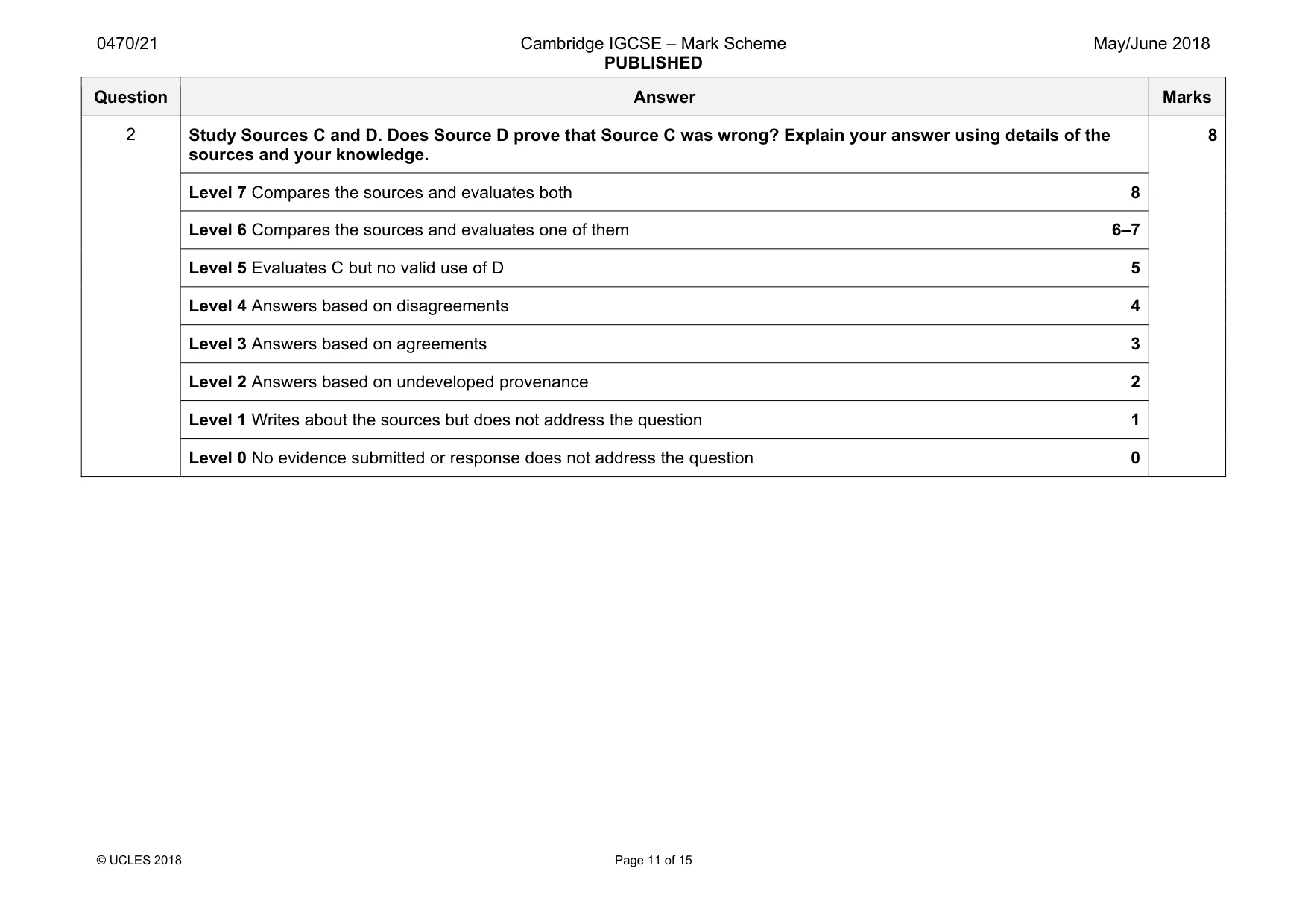
0470/21 Cambridge IGCSE – Mark Scheme PUBLISHED May/June 2018 © UCLES 2018 Page 11 of 15 Question Answer Marks 2 Study Sources C and D. Does Source D prove that Source C was wrong? Explain your answer using details of the sources and your knowledge. 8 Level 7 Compares the sources and evaluates both 8 Level 6 Compares the sources and evaluates one of them 6–7 Level 5 Evaluates C but no valid use of D 5 Level 4 Answers based on disagreements 4 Level 3 Answers based on agreements 3 Level 2 Answers based on undeveloped provenance 2 Level 1 Writes about the sources but does not address the question 1 Level 0 No evidence submitted or response does not address the question 0
Mark scheme, page 12
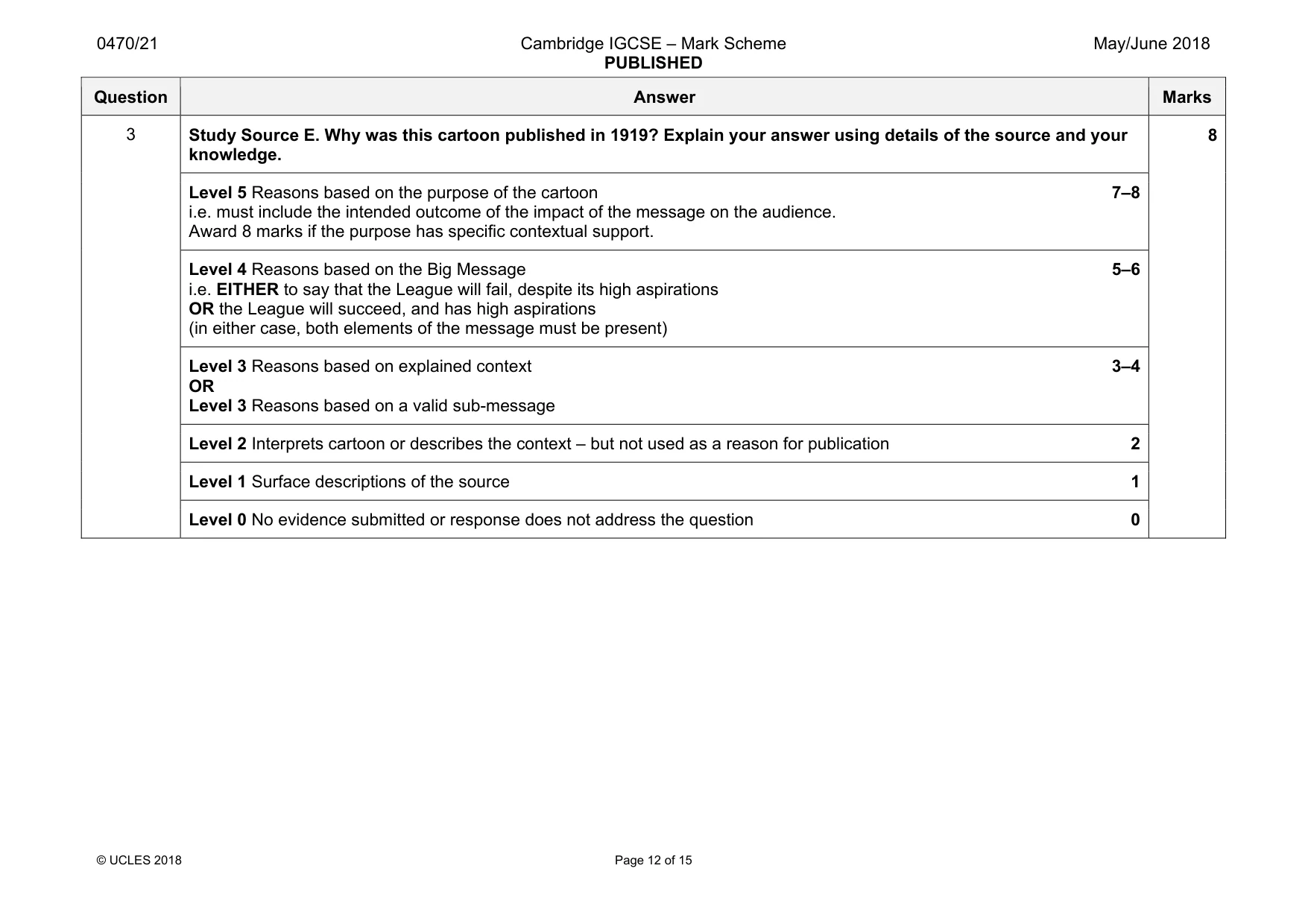
0470/21 Cambridge IGCSE – Mark Scheme PUBLISHED May/June 2018 © UCLES 2018 Page 12 of 15 Question Answer Marks 3 Study Source E. Why was this cartoon published in 1919? Explain your answer using details of the source and your knowledge. 8 Level 5 Reasons based on the purpose of the cartoon 7–8 i.e. must include the intended outcome of the impact of the message on the audience. Award 8 marks if the purpose has specific contextual support. Level 4 Reasons based on the Big Message 5–6 i.e. EITHER to say that the League will fail, despite its high aspirations OR the League will succeed, and has high aspirations (in either case, both elements of the message must be present) Level 3 Reasons based on explained context 3–4 OR Level 3 Reasons based on a valid sub-message Level 2 Interprets cartoon or describes the context – but not used as a reason for publication 2 Level 1 Surface descriptions of the source 1 Level 0 No evidence submitted or response does not address the question 0
Mark scheme, page 13
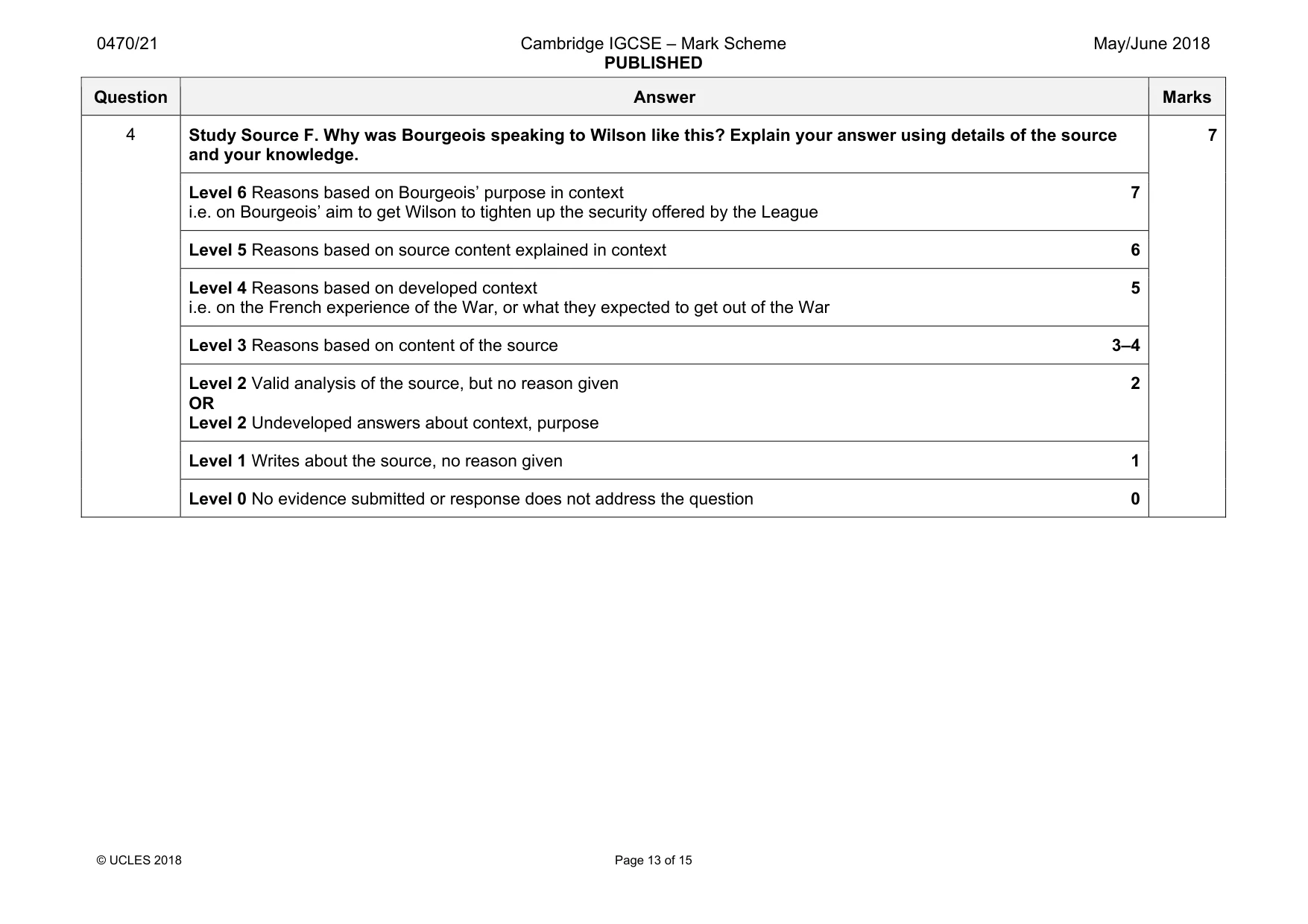
0470/21 Cambridge IGCSE – Mark Scheme PUBLISHED May/June 2018 © UCLES 2018 Page 13 of 15 Question Answer Marks 4 Study Source F. Why was Bourgeois speaking to Wilson like this? Explain your answer using details of the source and your knowledge. 7 Level 6 Reasons based on Bourgeois’ purpose in context 7 i.e. on Bourgeois’ aim to get Wilson to tighten up the security offered by the League Level 5 Reasons based on source content explained in context 6 Level 4 Reasons based on developed context 5 i.e. on the French experience of the War, or what they expected to get out of the War Level 3 Reasons based on content of the source 3–4 Level 2 Valid analysis of the source, but no reason given 2 OR Level 2 Undeveloped answers about context, purpose Level 1 Writes about the source, no reason given 1 Level 0 No evidence submitted or response does not address the question 0
Mark scheme, page 14
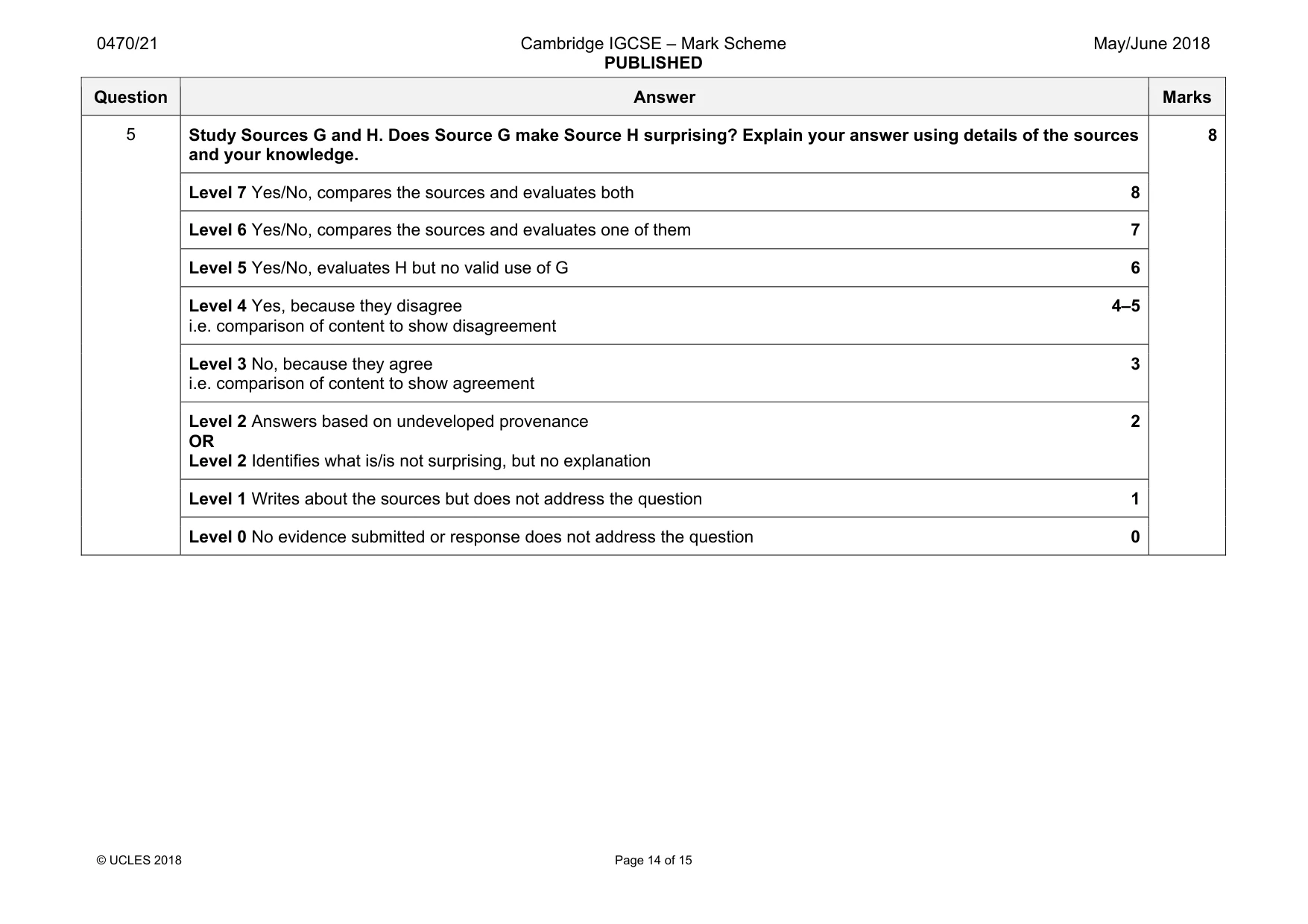
0470/21 Cambridge IGCSE – Mark Scheme PUBLISHED May/June 2018 © UCLES 2018 Page 14 of 15 Question Answer Marks 5 Study Sources G and H. Does Source G make Source H surprising? Explain your answer using details of the sources and your knowledge. 8 Level 7 Yes/No, compares the sources and evaluates both 8 Level 6 Yes/No, compares the sources and evaluates one of them 7 Level 5 Yes/No, evaluates H but no valid use of G 6 Level 4 Yes, because they disagree 4–5 i.e. comparison of content to show disagreement Level 3 No, because they agree 3 i.e. comparison of content to show agreement Level 2 Answers based on undeveloped provenance 2 OR Level 2 Identifies what is/is not surprising, but no explanation Level 1 Writes about the sources but does not address the question 1 Level 0 No evidence submitted or response does not address the question 0
Mark scheme, page 15
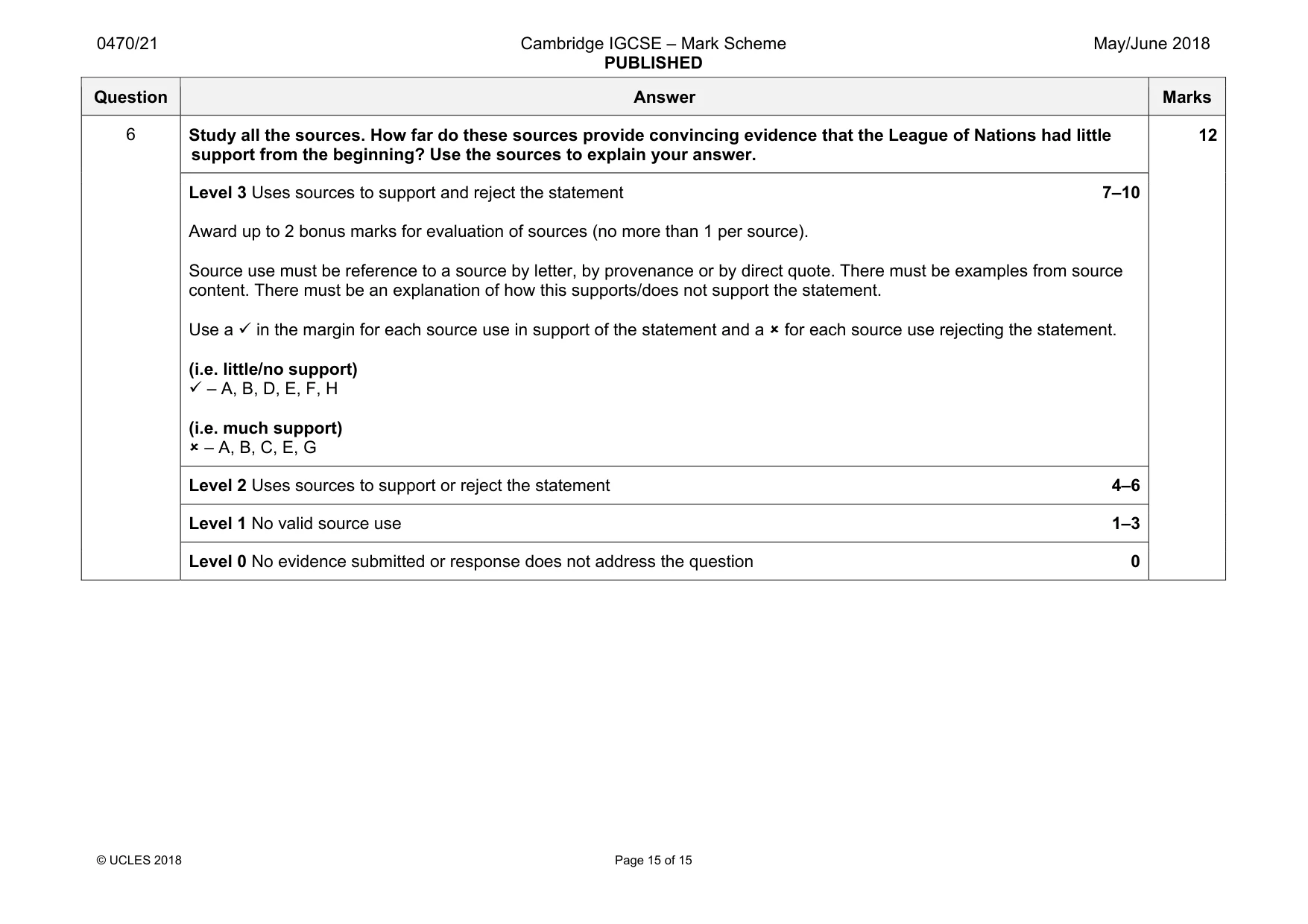
0470/21 Cambridge IGCSE – Mark Scheme PUBLISHED May/June 2018 © UCLES 2018 Page 15 of 15 Question Answer Marks 6 Study all the sources. How far do these sources provide convincing evidence that the League of Nations had little support from the beginning? Use the sources to explain your answer. 12 Level 3 Uses sources to support and reject the statement 7–10 Award up to 2 bonus marks for evaluation of sources (no more than 1 per source). Source use must be reference to a source by letter, by provenance or by direct quote. There must be examples from source content. There must be an explanation of how this supports/does not support the statement. Use a 9 in the margin for each source use in support of the statement and a 8 for each source use rejecting the statement. (i.e. little/no support) 9 – A, B, D, E, F, H (i.e. much support) 8 – A, B, C, E, G Level 2 Uses sources to support or reject the statement 4–6 Level 1 No valid source use 1–3 Level 0 No evidence submitted or response does not address the question 0
What you needed in this session
Cambridge’s own grade thresholds for 2018 May/June, Paper 2 · Variant 1. A higher threshold means an easier paper — the bar moves with how the cohort did.