Cambridge IGCSE History 0470 — 2018 May/June Paper 2 · Variant 2
0470/22/M/J/18 · 50 marks · ≈56 min
The question paper and its mark scheme, free to read here and free to download. This is Cambridge’s own paper, exactly as it was sat.
Question paper12 pages
Mark scheme14 pages
Answers below. Sit the paper first if you are practising.
Paper as text
Question paper, page 1
* 4 2 2 2 0 7 0 8 9 8 * This document consists of 12 printed pages and 1 Insert. DC (CE/SW) 145866/3 © UCLES 2018 [Turn over Cambridge International Examinations Cambridge International General Certificate of Secondary Education HISTORY 0470/22 Paper 2 May/June 2018 2 hours No Additional Materials are required. READ THESE INSTRUCTIONS FIRST An answer booklet is provided inside this question paper. You should follow the instructions on the front cover of the answer booklet. If you need additional answer paper ask the invigilator for a continuation booklet. This paper has two options. Choose one option, and then answer all of the questions on that topic. Option A: 19th Century topic [p2–p5] Option B: 20th Century topic [p6–p12] The number of marks is given in brackets [ ] at the end of each question or part question. This syllabus is approved for use in England, Wales and Northern Ireland as a Cambridge International Level 1/Level 2 Certificate.
Question paper, page 2
2 0470/22/M/J/18 © UCLES 2018 Option A: 19th Century topic WAS BISMARCK RESPONSIBLE FOR THE WAR WITH AUSTRIA? Study the Background Information and the sources carefully, and then answer all the questions. Background Information The question of who should lead Germany had become important by the middle of the nineteenth century. Traditionally Austria was the leader but Prussia was fast growing in power. The rivalry between Austria and Prussia increased, particularly when William I came to the Prussian throne in 1861 and Bismarck became his chief minister in 1862. Some historians have argued that Bismarck planned the unification of Germany from the beginning. They claimed he engineered the war with Denmark in 1864, the Austro-Prussian War in June 1866 and the later war with France, to bring about a united Germany dominated by Prussia. Did he manipulate Austria and other European countries to bring about the Austro-Prussian War and thus destroy Austrian influence in Germany? How far was Bismarck responsible for the Austro-Prussian War? SOURCE A Bismarck became aware of Austria’s hostility to Prussia and he formed the conclusion that a struggle between Austria and Prussia was inevitable. For that struggle he steadily prepared. In 1863 Austria still seemed the stronger and those wanting a united Germany looked to it for leadership. In that year the position of the Danish duchies was raised by the death of the King of Denmark. This was the foreign crisis that Bismarck had been waiting for. The enormous skill with which he used this problem for his purpose of resolving the rivalry between Prussia and Austria laid the foundation for his later success against Austria. Austria played into Bismarck’s hands by joining Germany in rejecting the Diet’s attempts to make Frederick of Augustenburg Duke of the duchies. Bismarck persuaded Austria that to give the Diet a free hand was to open the floodgates of German democracy. Fighting in the duchies ended in victory for Austria and Germany but Bismarck’s most difficult step was yet to come. How was he to evict Austria and obtain the duchies for Prussia? In April 1866 Italy agreed to declare war on Austria if war broke out between Prussia and Austria within three months. Bismarck now had three months in which to provoke war. Bismarck complained that Austria was encouraging the claims of the Augustenburgs in Holstein and despatched Prussian troops. When the German Diet agreed to mobilise against Prussia, Bismarck declared war on members of the Bund including Austria. In the peace that followed Austrian defeat, Austria ceased to form part of Germany. The unification of Germany had begun. All Bismarck needed to complete it was a successful war with France. From a history book published in 1915.
Question paper, page 3
3 0470/22/M/J/18 © UCLES 2018 [Turn over SOURCE B Bismarck’s real aim was to preserve Prussia as a great power and therefore above all to reorder Prussia’s relations with Austria and with Germany. Bismarck always liked to show that he had intended to do whatever he actually did. In later life he claimed that he had always intended to fight Austria and unify Germany. In reality, Bismarck’s greatness lay not in controlling events but in going with events so as to seem to control them. He had no defined plan when he became Minister-President in 1862. He followed two contradictory aims: the policy he liked of winning Austria back to the conservative alliance, and the policy which he disliked of seizing the leadership of Germany and bringing Austria to her senses by defeat. By 1863 everybody in Germany, including those who hoped for a united Germany, but excepting the Prussian officer corps, looked to Austria for leadership. The issue that was to change this was that of Schleswig and Holstein. Austria acted foolishly by helping conquer the Duchies for Prussia. However, afterwards Bismarck offered an alliance to Austria. His offer that Austria should give up its rights in the Duchies in exchange for Prussian help in the reconquest of Lombardy was sincere. There were times in the crisis of 1865–1866 when it looked as if Austria was happy to provoke a war with Prussia. Austria’s request to the German Diet to intervene in the conflict broke the Treaty of Gastein (which said that all matters to do with the Duchies should be dealt with by Austria and Prussia only) and led to the outbreak of war. Although nearly all Germany was on the Austrian side, the war lasted just three weeks and the result was that Austria withdrew from German affairs. Germany had been conquered not united. From a history book published in 1935. SOURCE C Germany is clearly too small for both Prussia and Austria. As long as an honourable arrangement concerning the influence of each in Germany cannot be concluded and carried out, we will both plough the same disputed acre, and Austria will remain the only state to whom we can permanently lose, or from whom we can permanently gain. In the not too distant future, we shall have to fight for our existence against Austria. It is not within our power to avoid that, since the course of events in Germany has no other solution. A letter from Bismarck to a leading military adviser of the Prussian King, 1856. At the time Bismarck was the Prussian representative at the German Diet. SOURCE D A true German policy is only possible when Austria and Prussia are united and take the lead. We consider combination, such as the joint action in waging war which is our immediate political purpose, as the foundation of an enduring unity. If Prussia and Austria are not united, politically Germany does not exist. If we hesitate, the collapse of Germany will be brought about by a few unarmed small states whose whole significance consists in the misdirected courage of their Parliaments and newspapers. A letter from Bismarck to the Prussian Ambassador in Austria, August 1864.
Question paper, page 4
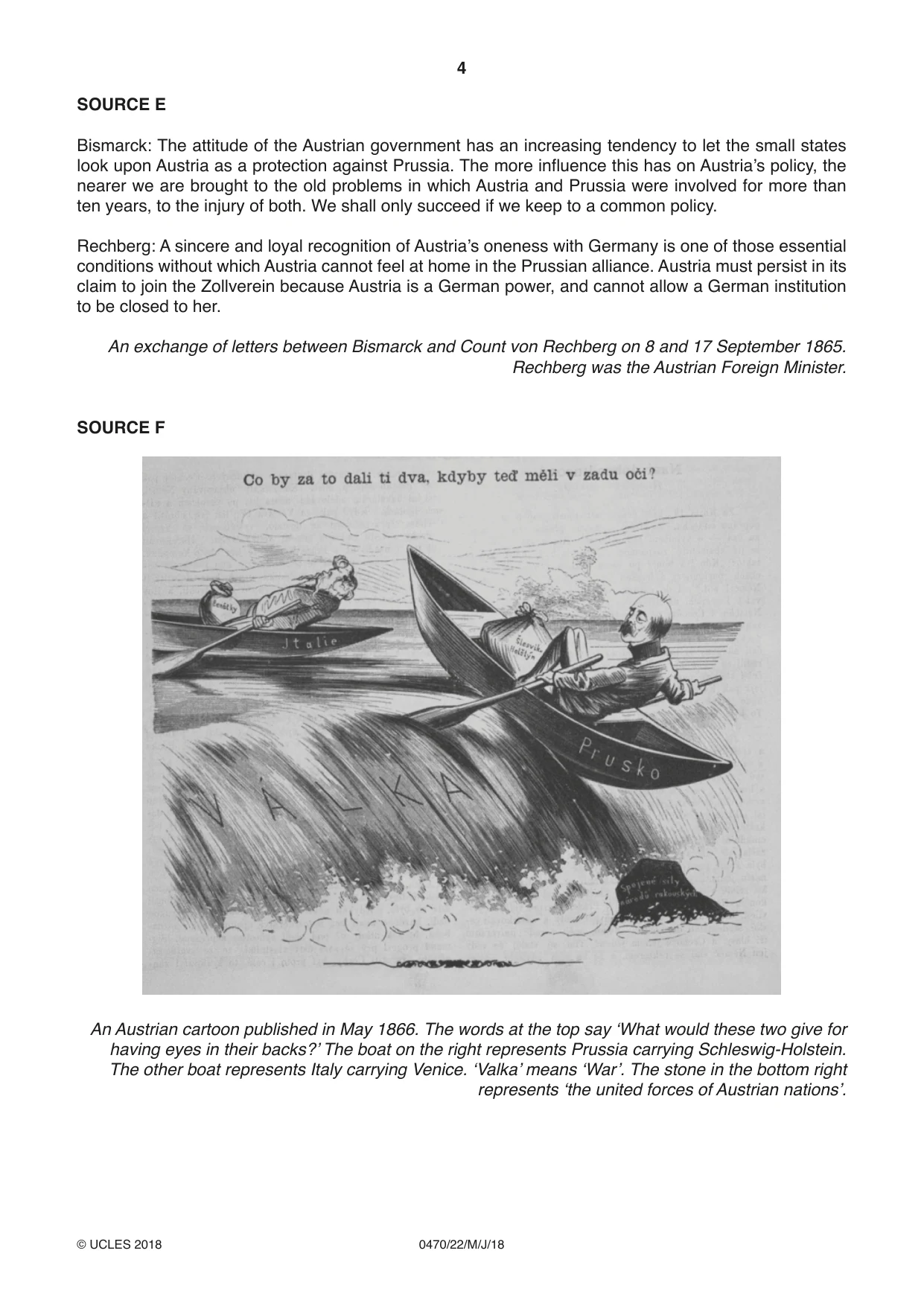
4 0470/22/M/J/18 © UCLES 2018 SOURCE E Bismarck: The attitude of the Austrian government has an increasing tendency to let the small states look upon Austria as a protection against Prussia. The more influence this has on Austria’s policy, the nearer we are brought to the old problems in which Austria and Prussia were involved for more than ten years, to the injury of both. We shall only succeed if we keep to a common policy. Rechberg: A sincere and loyal recognition of Austria’s oneness with Germany is one of those essential conditions without which Austria cannot feel at home in the Prussian alliance. Austria must persist in its claim to join the Zollverein because Austria is a German power, and cannot allow a German institution to be closed to her. An exchange of letters between Bismarck and Count von Rechberg on 8 and 17 September 1865. Rechberg was the Austrian Foreign Minister. SOURCE F An Austrian cartoon published in May 1866. The words at the top say ‘What would these two give for having eyes in their backs?’ The boat on the right represents Prussia carrying Schleswig-Holstein. The other boat represents Italy carrying Venice. ‘Valka’ means ‘War’. The stone in the bottom right represents ‘the united forces of Austrian nations’.
Question paper, page 5
5 0470/22/M/J/18 © UCLES 2018 [Turn over SOURCE G To My People! At this instant Prussia’s army is advancing to a decisive conflict. The country is in danger. Austria and a great part of Germany are armed against us. Some years ago I extended to the Emperor of Austria the hand of friendship. This I hoped would bring that co-operation which should lead to the domestic welfare of Germany and the increase of its prestige among nations. But this hope has been disappointed. Austria will not forget that its princes once ruled over Germany. In the more youthful but powerfully developing Prussia she refuses to see a natural ally, but sees only a hostile rival. Prussia – so Austria reasons – must be opposed on every occasion. Prussia shall be weakened, destroyed, dishonoured. With Prussia no treaties are to be observed; the confederated princes have been roused against Prussia. But who can rob us of a single foot of Prussian soil if king and people are united? A public proclamation issued by William I on 18 June 1866. Now answer all the following questions. You may use any of the sources to help you answer the questions, in addition to those sources which you are told to use. In answering the questions you should use your knowledge of the topic to help you interpret and evaluate the sources. 1 Study Sources A and B. How far do these two sources agree? Explain your answer using details of the sources. [8] 2 Study Sources C and D. Does Source C make Source D surprising? Explain your answer using details of the sources and your knowledge. [8] 3 Study Source E. How useful is this exchange of letters to historians studying the Austro-Prussian War? Explain your answer using details of the source and your knowledge. [6] 4 Study Source F. What is the cartoonist’s message? Explain your answer using details of the source and your knowledge. [8] 5 Study Source G. Why did King William issue this proclamation in June 1866? Explain your answer using details of the source and your knowledge. [8] 6 Study all the sources. How far do these sources provide convincing evidence that Bismarck was responsible for the Austro-Prussian War? Use the sources to explain your answer. [12]
Question paper, page 6
6 0470/22/M/J/18 © UCLES 2018 Option B: 20th Century topic WHY DID THE LEAGUE FAIL OVER MANCHURIA? Study the Background Information and the sources carefully, and then answer all the questions. Background Information Manchuria was a lawless part of China where Japan had certain rights and interests. It was permitted, for example, to guard its railway which ran into Manchuria. By 1931 Japan was suffering badly from the depression and Manchuria seemed to promise a source of food and raw materials, and land for the surplus Japanese population. In September 1931, following an incident along the railway line, Japan invaded a small part of Manchuria. China appealed to the League of Nations but it was slow to act and by March 1932 Japan had taken over the whole of Manchuria and named it Manchukuo. The League’s Lytton Report, published in October 1932, stated that the Japanese invasion was not justified. However, it was too late. Japan rejected the report, left the League and kept Manchuria. Who was mainly responsible for the failure of the League over Manchuria? Was it the Great Powers such as Britain, France, the USA and the USSR? Was it Japan? Or was the League itself to blame? SOURCE A The League of Nations was intensely Eurocentric in its concerns, and for most of its predominantly European membership Manchuria was very far away indeed. Of the three major outside powers involved in the China-Japan dispute, only Britain was a member of the League and the United States and Soviet Union both viewed the Geneva system with suspicion. The Dutch and the French were sympathetic towards the Japanese. The Dutch found a stable Japan a far more attractive prospect than a nationalist and revolutionary China. The French, too, kept a low profile in Geneva. They saw Japan as a source of stability in the region. Because none of the permanent members of the Council favoured intervention in what was a remote dispute which the League was ill-prepared to handle, the great-power delegates used their influence to restrict the scope of the League’s involvement and to avoid the application of sanctions. It would be the smaller nations at Geneva which would make the defence of China a test of the League’s prestige and authority. It was Britain, the United States, and the Soviet Union, and not the League, that would determine the international response to the Japanese assault on Manchuria. Though they did not work together, their policies were basically the same. None of them thought it to be in its national interest to challenge Japan. The British government even believed that Japan had a strong case in Manchuria. From a history book published in 2007.
Question paper, page 7
7 0470/22/M/J/18 © UCLES 2018 [Turn over SOURCE B It is sometimes said that what happened in Manchuria was thousands of miles away so Europe did not concern itself overmuch. This is not supported by records from the time. At Geneva there was immediate recognition that this was a test of the League’s authority. When trouble erupted at Mukden there was a sense of shock due to the fact that in the previous decade Japan had been a conscientious and often valuable member of the League. At first there was no assumption in the League of Japanese guilt. The Council was ready to give Japan time to sort things out and for the Japanese to deal directly with the Chinese. The Americans dragged their feet and made no secret of their view that the Council should stand aside while the two powers in dispute tried to come to an agreement between themselves. Britain’s line was one of conciliation and an avoidance of threats. It regarded Japan as a longstanding friend who was supporting capitalism in the Far East and believed that Japan had real grievances against China. The French were also anxious to avoid sanctions against Japan. The statesmen at Geneva knew that the League was on trial, and that, after Manchuria, the world’s expectations of the League, and particularly those of the smaller powers, had been dangerously reduced. What mattered for the future of the League was that Japan had committed blatant aggression and the League had failed to do anything. From a history book published in 1973. SOURCE C The League of Nations should be upheld. The Cabinet recognised, however, that the sanctions provided for in Article 16 of the League’s Covenant were not suitable and could not in practice be applied in the present case. In the interests of the League itself, therefore, every effort must be made to avoid the Chinese appeal being shifted from a summoning of the Council to a request for sanctions or military action. If necessary, it must be impressed on the Chinese delegate that he must assist the League and not throw the responsibility on the other members of the Council. The official minutes of a meeting of the British government, November 1931.
Question paper, page 8
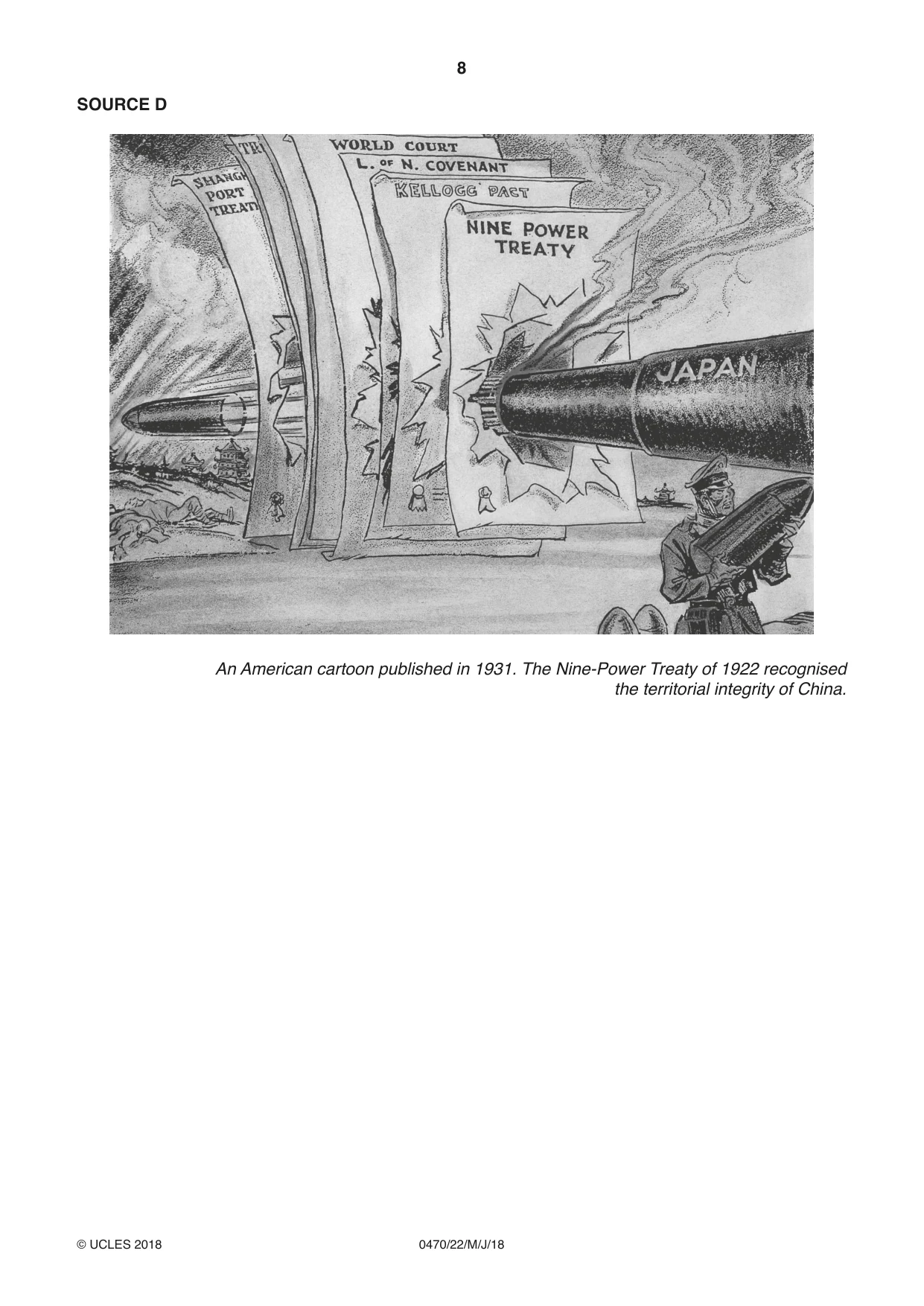
8 0470/22/M/J/18 © UCLES 2018 SOURCE D An American cartoon published in 1931. The Nine-Power Treaty of 1922 recognised the territorial integrity of China.
Question paper, page 9
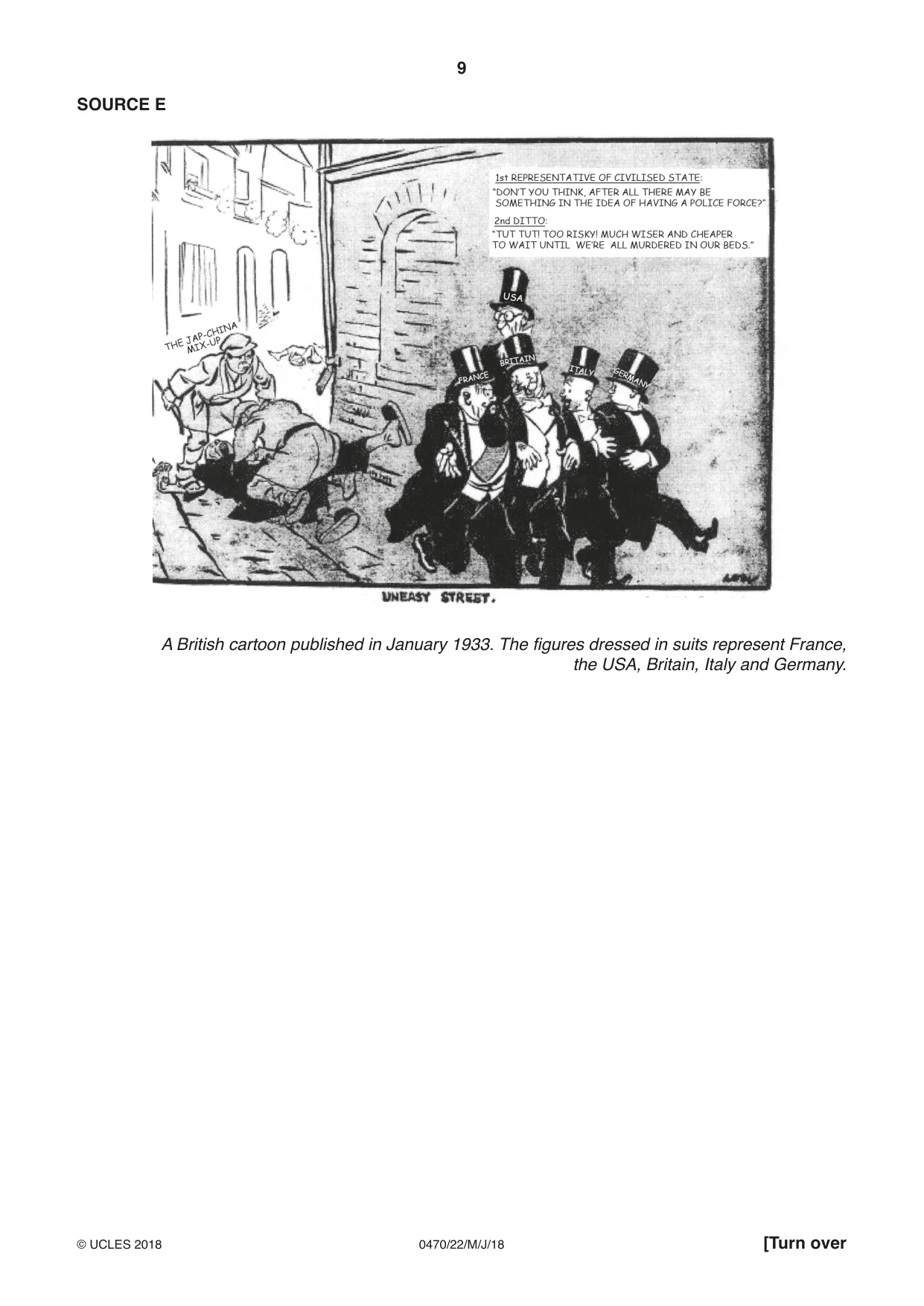
9 0470/22/M/J/18 © UCLES 2018 [Turn over SOURCE E A British cartoon published in January 1933. The figures dressed in suits represent France, the USA, Britain, Italy and Germany.
Question paper, page 10
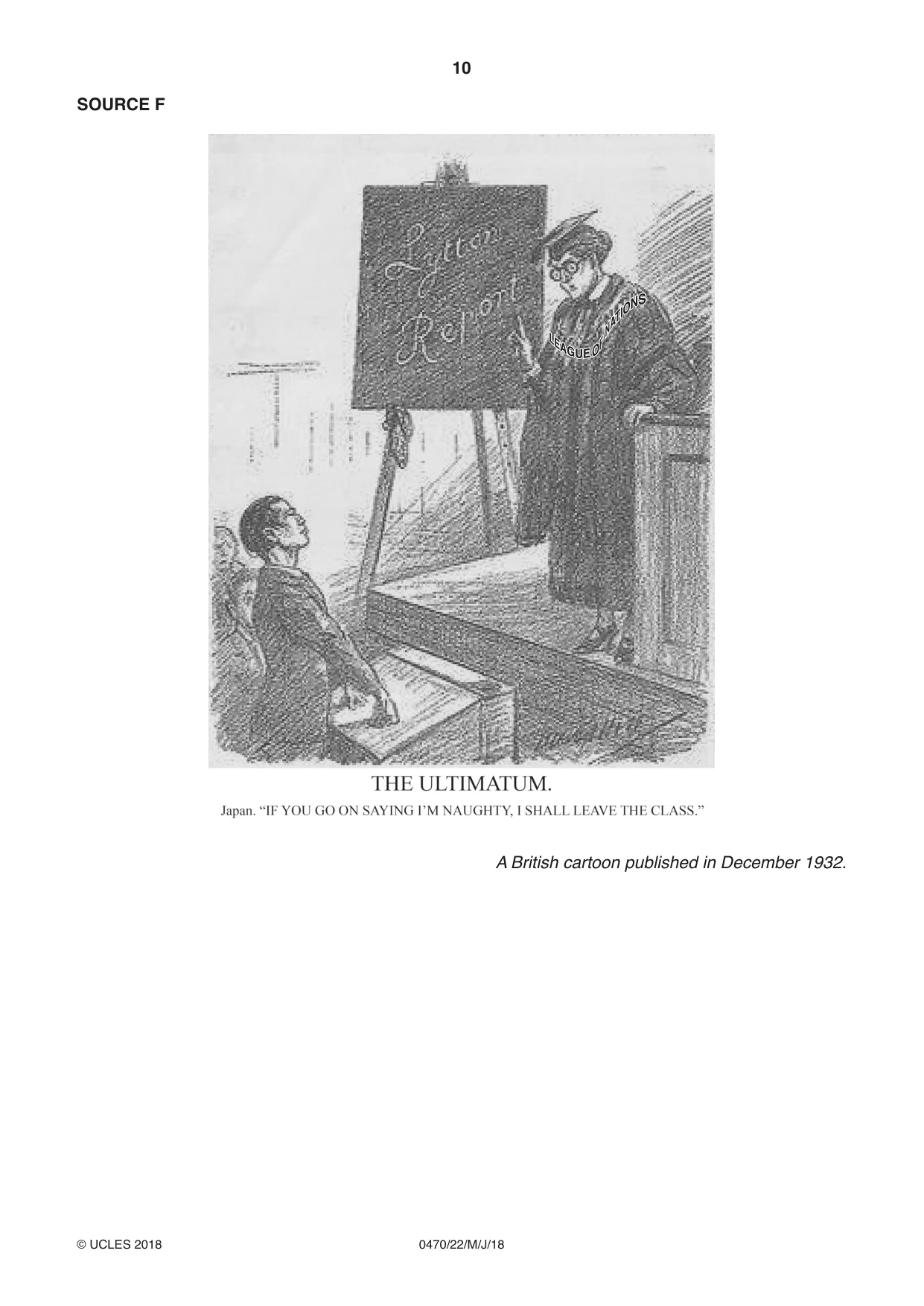
10 0470/22/M/J/18 © UCLES 2018 SOURCE F L E A G U E O F N A T I O N S A British cartoon published in December 1932.
Question paper, page 11
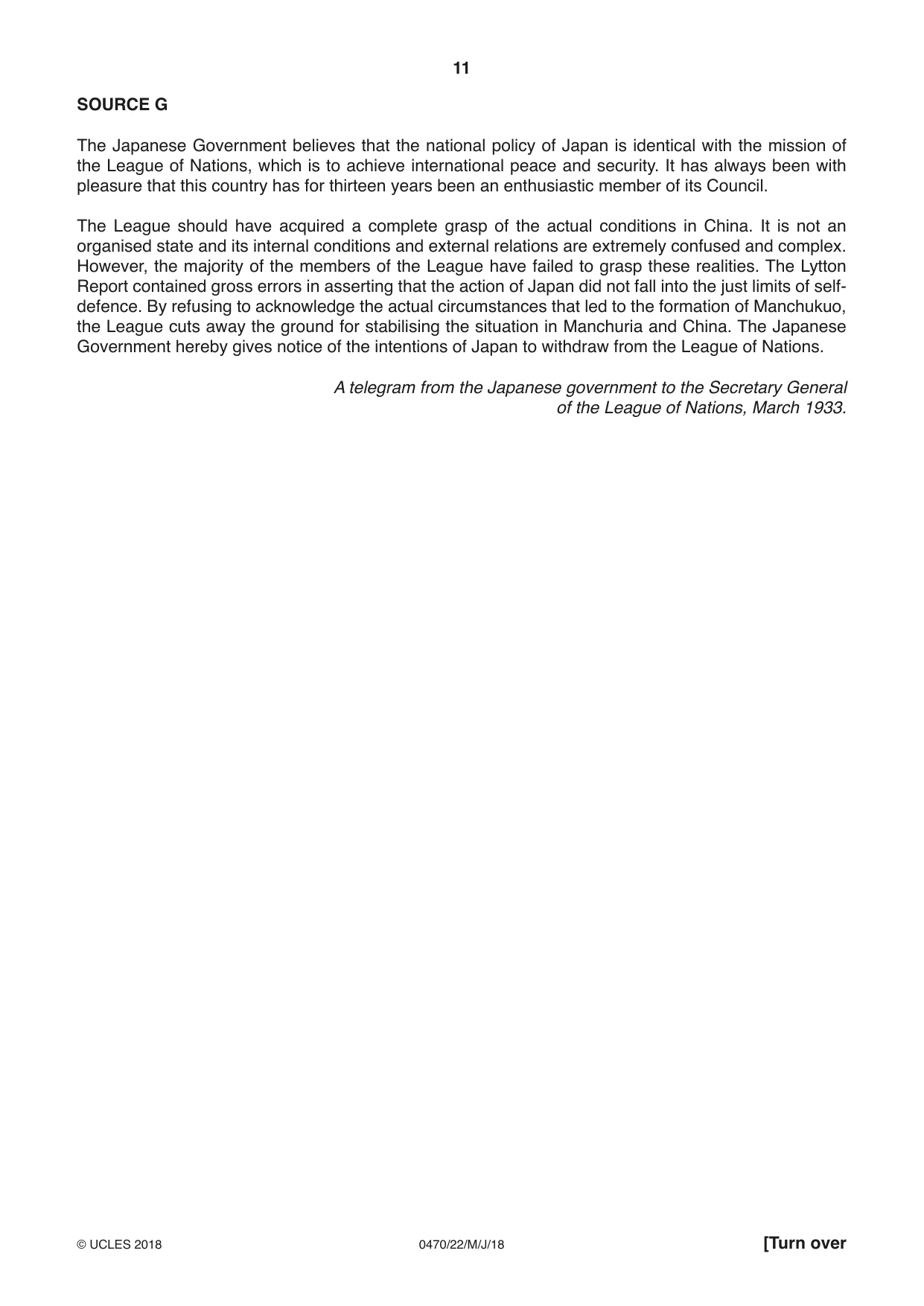
11 0470/22/M/J/18 © UCLES 2018 [Turn over SOURCE G The Japanese Government believes that the national policy of Japan is identical with the mission of the League of Nations, which is to achieve international peace and security. It has always been with pleasure that this country has for thirteen years been an enthusiastic member of its Council. The League should have acquired a complete grasp of the actual conditions in China. It is not an organised state and its internal conditions and external relations are extremely confused and complex. However, the majority of the members of the League have failed to grasp these realities. The Lytton Report contained gross errors in asserting that the action of Japan did not fall into the just limits of self- defence. By refusing to acknowledge the actual circumstances that led to the formation of Manchukuo, the League cuts away the ground for stabilising the situation in Manchuria and China. The Japanese Government hereby gives notice of the intentions of Japan to withdraw from the League of Nations. A telegram from the Japanese government to the Secretary General of the League of Nations, March 1933.
Question paper, page 12
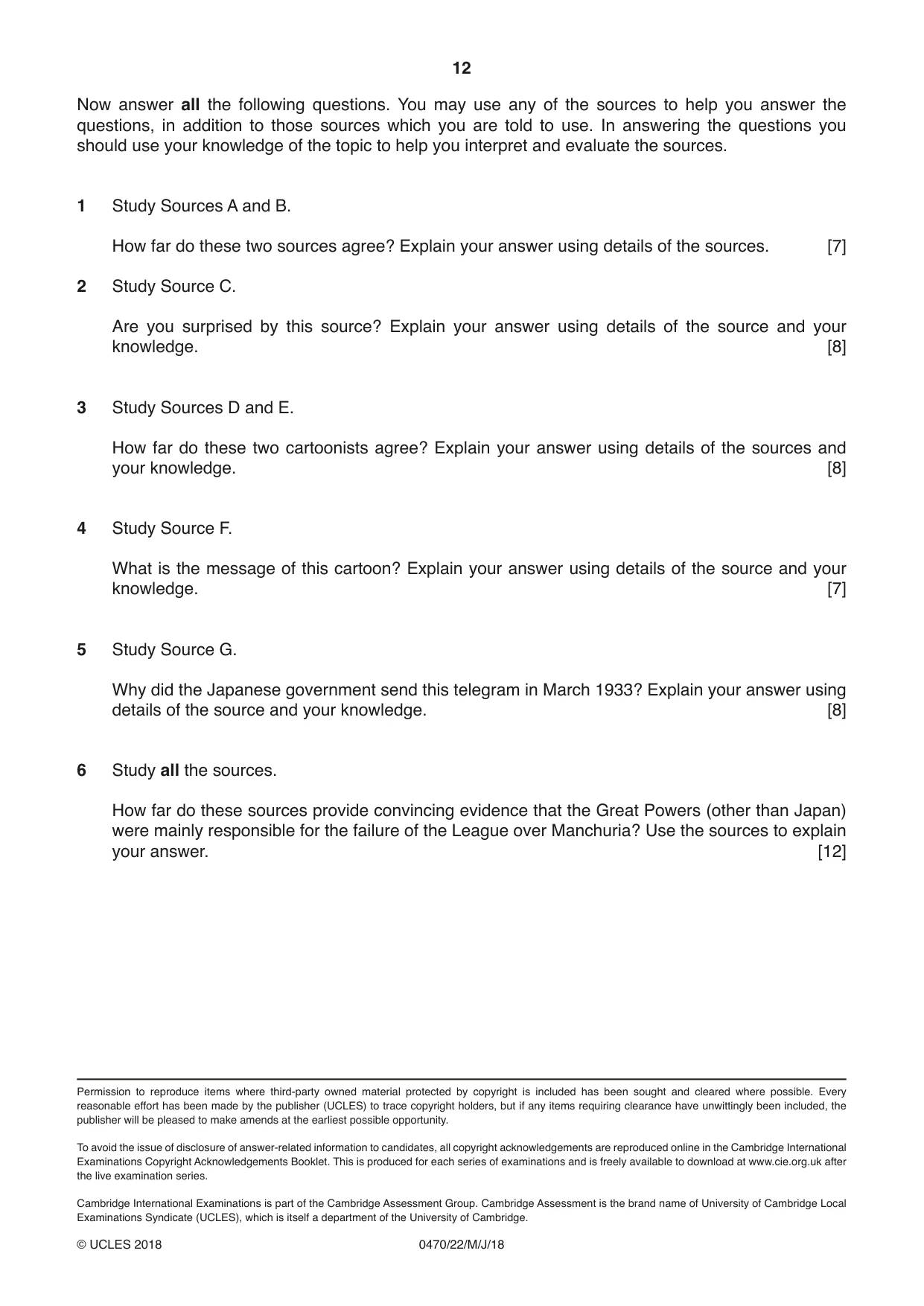
12 0470/22/M/J/18 © UCLES 2018 Permission to reproduce items where third-party owned material protected by copyright is included has been sought and cleared where possible. Every reasonable effort has been made by the publisher (UCLES) to trace copyright holders, but if any items requiring clearance have unwittingly been included, the publisher will be pleased to make amends at the earliest possible opportunity. To avoid the issue of disclosure of answer-related information to candidates, all copyright acknowledgements are reproduced online in the Cambridge International Examinations Copyright Acknowledgements Booklet. This is produced for each series of examinations and is freely available to download at www.cie.org.uk after the live examination series. Cambridge International Examinations is part of the Cambridge Assessment Group. Cambridge Assessment is the brand name of University of Cambridge Local Examinations Syndicate (UCLES), which is itself a department of the University of Cambridge. Now answer all the following questions. You may use any of the sources to help you answer the questions, in addition to those sources which you are told to use. In answering the questions you should use your knowledge of the topic to help you interpret and evaluate the sources. 1 Study Sources A and B. How far do these two sources agree? Explain your answer using details of the sources. [7] 2 Study Source C. Are you surprised by this source? Explain your answer using details of the source and your knowledge. [8] 3 Study Sources D and E. How far do these two cartoonists agree? Explain your answer using details of the sources and your knowledge. [8] 4 Study Source F. What is the message of this cartoon? Explain your answer using details of the source and your knowledge. [7] 5 Study Source G. Why did the Japanese government send this telegram in March 1933? Explain your answer using details of the source and your knowledge. [8] 6 Study all the sources. How far do these sources provide convincing evidence that the Great Powers (other than Japan) were mainly responsible for the failure of the League over Manchuria? Use the sources to explain your answer. [12]
Mark scheme, page 1
IGCSE™ is a registered trademark. This syllabus is approved for use in England, Wales and Northern Ireland as a Cambridge International Level 1/Level 2 Certificate. This document consists of 14 printed pages. © UCLES 2018 [Turn over Cambridge Assessment International Education Cambridge International General Certificate of Secondary Education HISTORY 0470/22 Paper 2 May/June 2018 MARK SCHEME Maximum Mark: 50 Published This mark scheme is published as an aid to teachers and candidates, to indicate the requirements of the examination. It shows the basis on which Examiners were instructed to award marks. It does not indicate the details of the discussions that took place at an Examiners’ meeting before marking began, which would have considered the acceptability of alternative answers. Mark schemes should be read in conjunction with the question paper and the Principal Examiner Report for Teachers. Cambridge International will not enter into discussions about these mark schemes. Cambridge International is publishing the mark schemes for the May/June 2018 series for most Cambridge IGCSE™, Cambridge International A and AS Level and Cambridge Pre-U components, and some Cambridge O Level components.
Mark scheme, page 2
0470/22 Cambridge IGCSE – Mark Scheme PUBLISHED May/June 2018 © UCLES 2018 Page 2 of 14 Generic Marking Principles These general marking principles must be applied by all examiners when marking candidate answers. They should be applied alongside the specific content of the mark scheme or generic level descriptors for a question. Each question paper and mark scheme will also comply with these marking principles. GENERIC MARKING PRINCIPLE 1: Marks must be awarded in line with: • the specific content of the mark scheme or the generic level descriptors for the question • the specific skills defined in the mark scheme or in the generic level descriptors for the question • the standard of response required by a candidate as exemplified by the standardisation scripts. GENERIC MARKING PRINCIPLE 2: Marks awarded are always whole marks (not half marks, or other fractions). GENERIC MARKING PRINCIPLE 3: Marks must be awarded positively: • marks are awarded for correct/valid answers, as defined in the mark scheme. However, credit is given for valid answers which go beyond the scope of the syllabus and mark scheme, referring to your Team Leader as appropriate • marks are awarded when candidates clearly demonstrate what they know and can do • marks are not deducted for errors • marks are not deducted for omissions • answers should only be judged on the quality of spelling, punctuation and grammar when these features are specifically assessed by the question as indicated by the mark scheme. The meaning, however, should be unambiguous. GENERIC MARKING PRINCIPLE 4: Rules must be applied consistently e.g. in situations where candidates have not followed instructions or in the application of generic level descriptors.
Mark scheme, page 3
0470/22 Cambridge IGCSE – Mark Scheme PUBLISHED May/June 2018 © UCLES 2018 Page 3 of 14 GENERIC MARKING PRINCIPLE 5: Marks should be awarded using the full range of marks defined in the mark scheme for the question (however; the use of the full mark range may be limited according to the quality of the candidate responses seen). GENERIC MARKING PRINCIPLE 6: Marks awarded are based solely on the requirements as defined in the mark scheme. Marks should not be awarded with grade thresholds or grade descriptors in mind.
Mark scheme, page 4
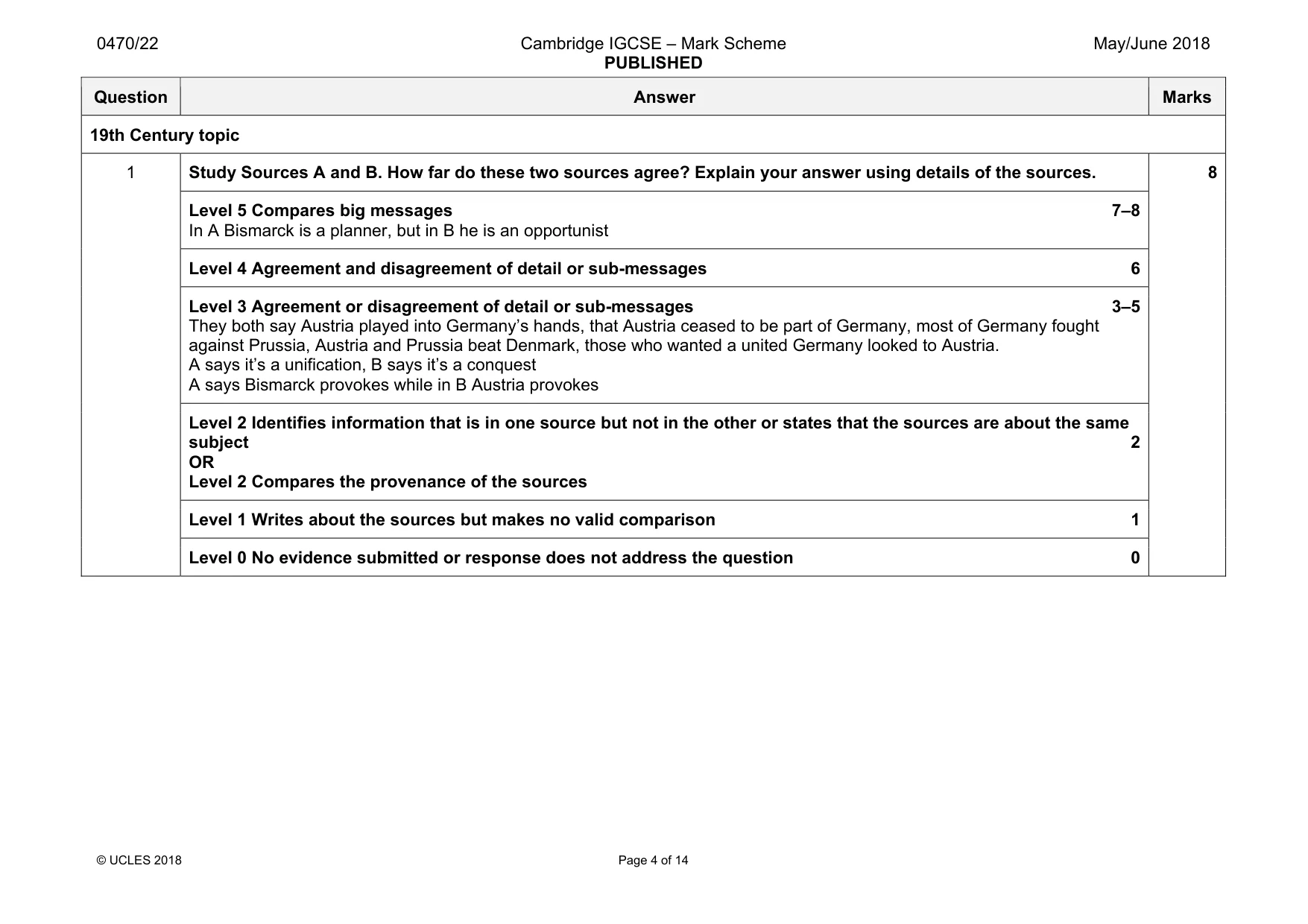
0470/22 Cambridge IGCSE – Mark Scheme PUBLISHED May/June 2018 © UCLES 2018 Page 4 of 14 Question Answer Marks 19th Century topic 1 Study Sources A and B. How far do these two sources agree? Explain your answer using details of the sources. 8 Level 5 Compares big messages 7–8 In A Bismarck is a planner, but in B he is an opportunist Level 4 Agreement and disagreement of detail or sub-messages 6 Level 3 Agreement or disagreement of detail or sub-messages 3–5 They both say Austria played into Germany’s hands, that Austria ceased to be part of Germany, most of Germany fought against Prussia, Austria and Prussia beat Denmark, those who wanted a united Germany looked to Austria. A says it’s a unification, B says it’s a conquest A says Bismarck provokes while in B Austria provokes Level 2 Identifies information that is in one source but not in the other or states that the sources are about the same subject 2 OR Level 2 Compares the provenance of the sources Level 1 Writes about the sources but makes no valid comparison 1 Level 0 No evidence submitted or response does not address the question 0
Mark scheme, page 5
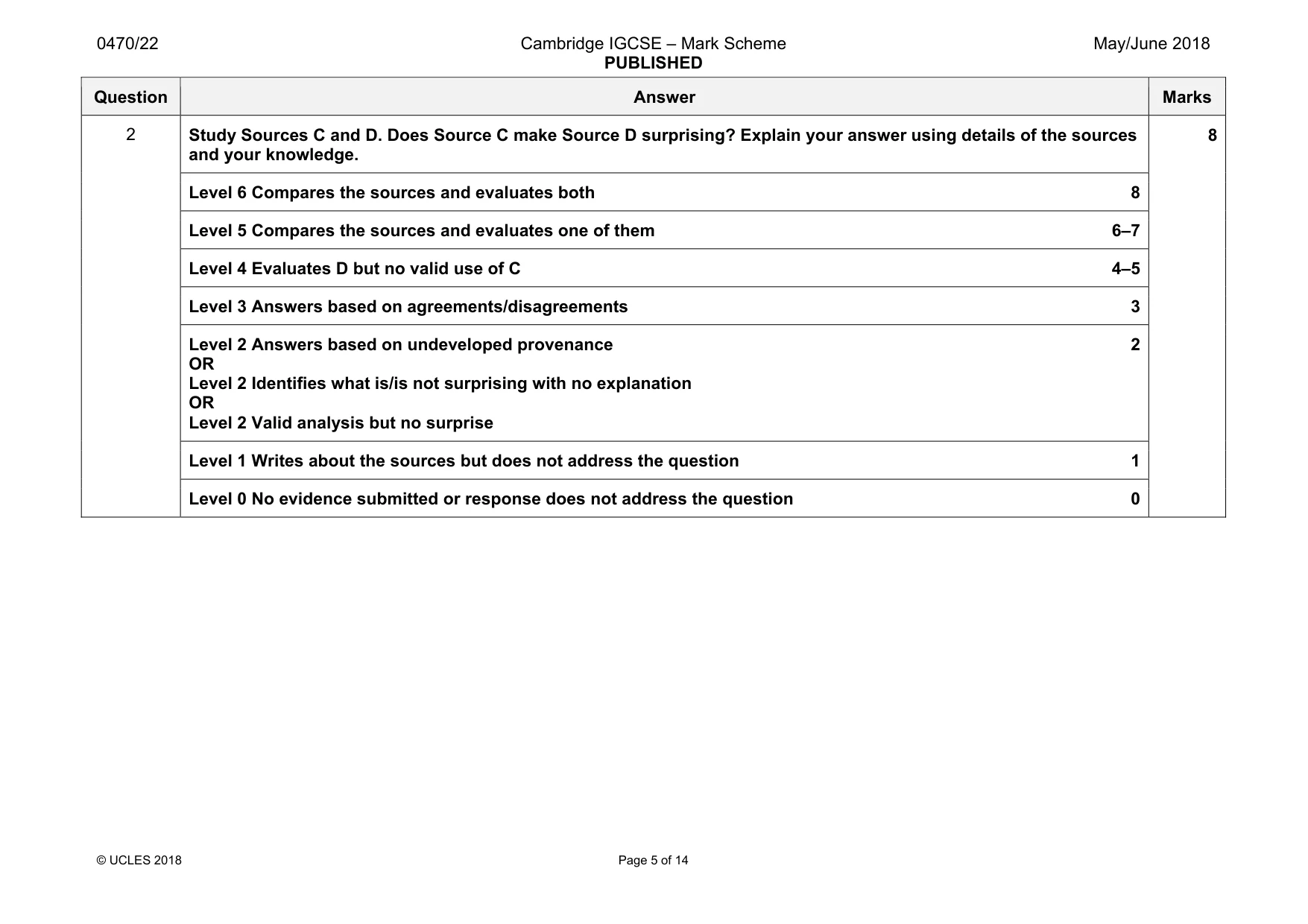
0470/22 Cambridge IGCSE – Mark Scheme PUBLISHED May/June 2018 © UCLES 2018 Page 5 of 14 Question Answer Marks 2 Study Sources C and D. Does Source C make Source D surprising? Explain your answer using details of the sources and your knowledge. 8 Level 6 Compares the sources and evaluates both 8 Level 5 Compares the sources and evaluates one of them 6–7 Level 4 Evaluates D but no valid use of C 4–5 Level 3 Answers based on agreements/disagreements 3 Level 2 Answers based on undeveloped provenance 2 OR Level 2 Identifies what is/is not surprising with no explanation OR Level 2 Valid analysis but no surprise Level 1 Writes about the sources but does not address the question 1 Level 0 No evidence submitted or response does not address the question 0
Mark scheme, page 6
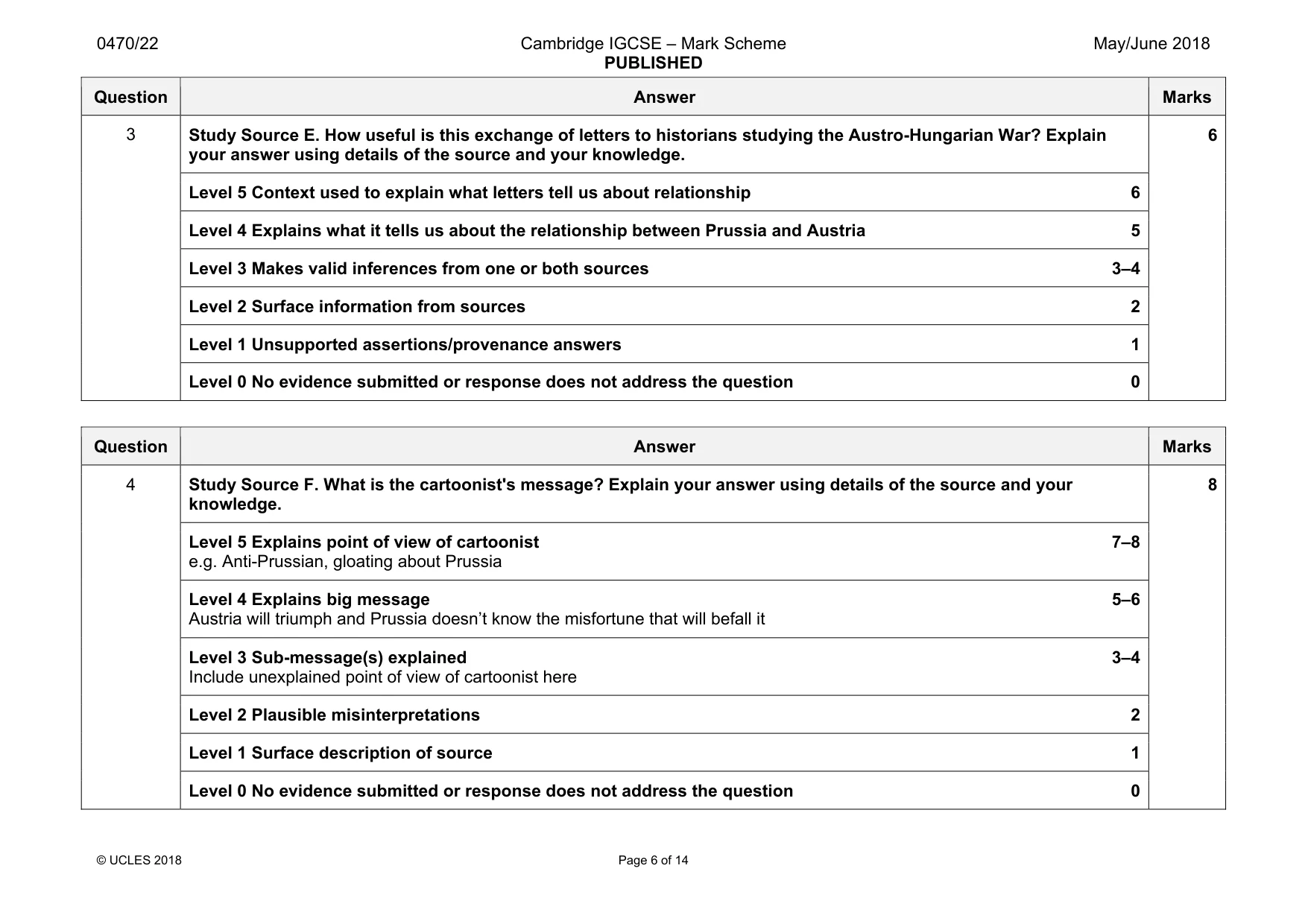
0470/22 Cambridge IGCSE – Mark Scheme PUBLISHED May/June 2018 © UCLES 2018 Page 6 of 14 Question Answer Marks 3 Study Source E. How useful is this exchange of letters to historians studying the Austro-Hungarian War? Explain your answer using details of the source and your knowledge. 6 Level 5 Context used to explain what letters tell us about relationship 6 Level 4 Explains what it tells us about the relationship between Prussia and Austria 5 Level 3 Makes valid inferences from one or both sources 3–4 Level 2 Surface information from sources 2 Level 1 Unsupported assertions/provenance answers 1 Level 0 No evidence submitted or response does not address the question 0 Question Answer Marks 4 Study Source F. What is the cartoonist's message? Explain your answer using details of the source and your knowledge. 8 Level 5 Explains point of view of cartoonist 7–8 e.g. Anti-Prussian, gloating about Prussia Level 4 Explains big message 5–6 Austria will triumph and Prussia doesn’t know the misfortune that will befall it Level 3 Sub-message(s) explained 3–4 Include unexplained point of view of cartoonist here Level 2 Plausible misinterpretations 2 Level 1 Surface description of source 1 Level 0 No evidence submitted or response does not address the question 0
Mark scheme, page 7
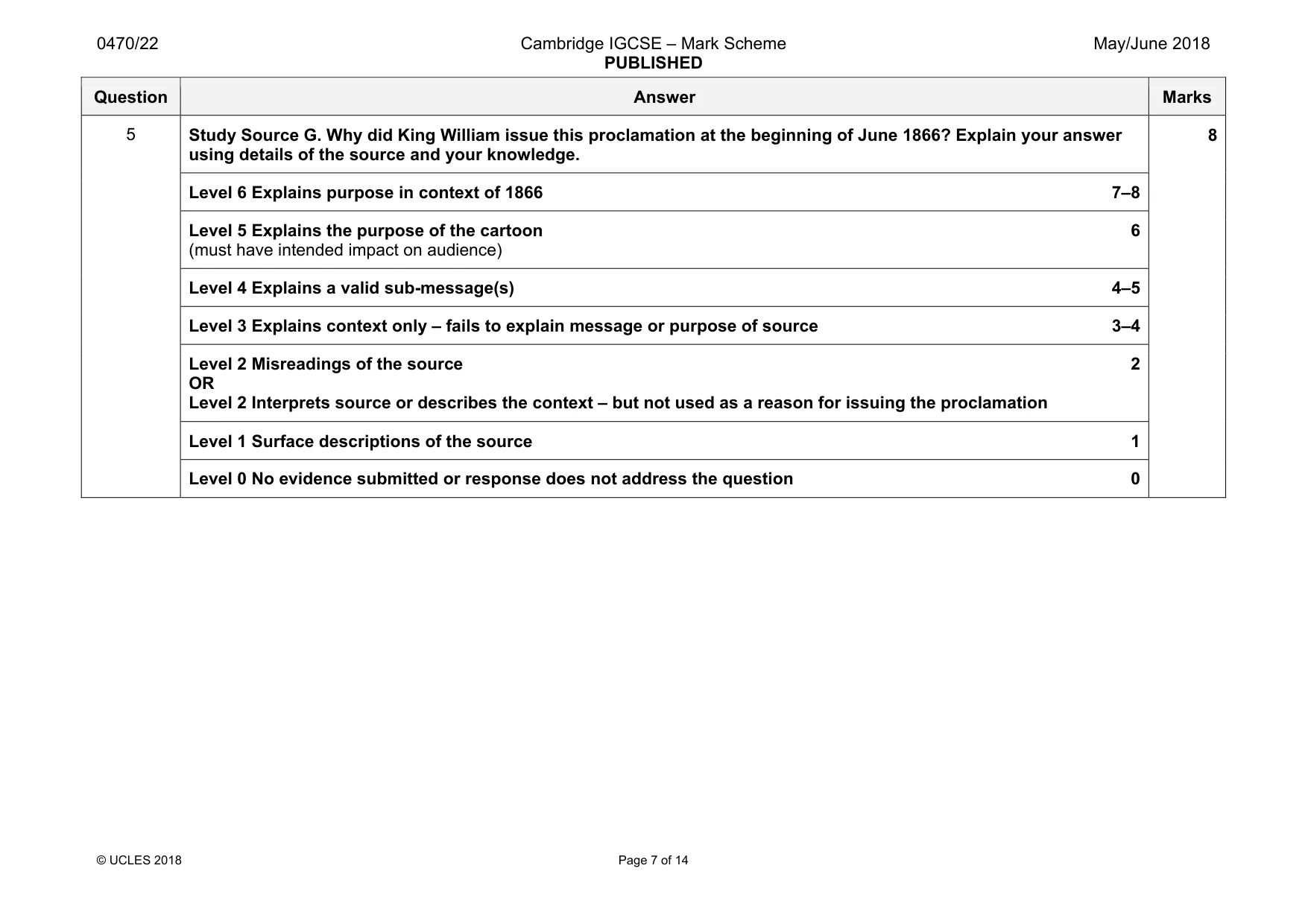
0470/22 Cambridge IGCSE – Mark Scheme PUBLISHED May/June 2018 © UCLES 2018 Page 7 of 14 Question Answer Marks 5 Study Source G. Why did King William issue this proclamation at the beginning of June 1866? Explain your answer using details of the source and your knowledge. 8 Level 6 Explains purpose in context of 1866 7–8 Level 5 Explains the purpose of the cartoon 6 (must have intended impact on audience) Level 4 Explains a valid sub-message(s) 4–5 Level 3 Explains context only – fails to explain message or purpose of source 3–4 Level 2 Misreadings of the source 2 OR Level 2 Interprets source or describes the context – but not used as a reason for issuing the proclamation Level 1 Surface descriptions of the source 1 Level 0 No evidence submitted or response does not address the question 0
Mark scheme, page 8
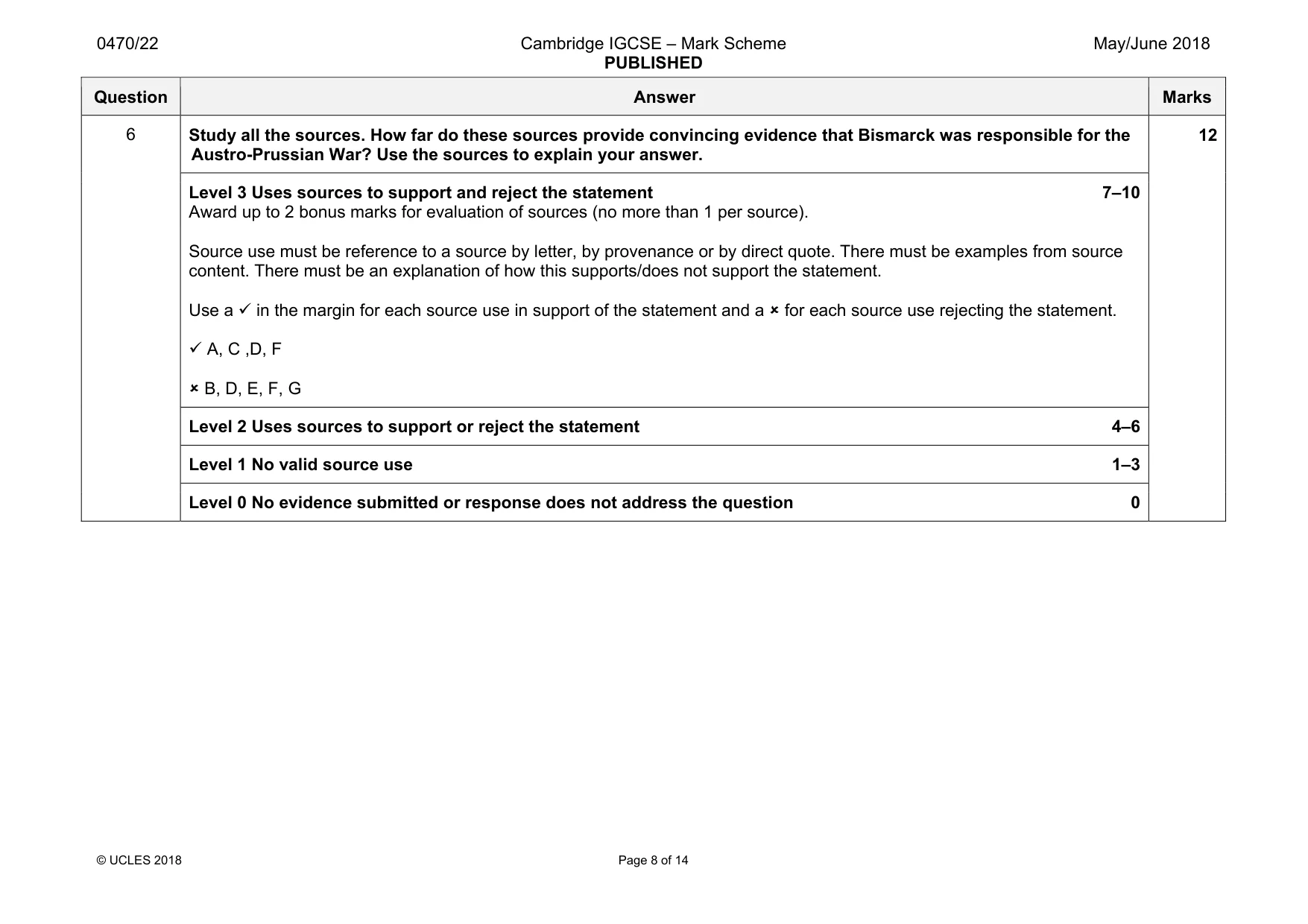
0470/22 Cambridge IGCSE – Mark Scheme PUBLISHED May/June 2018 © UCLES 2018 Page 8 of 14 Question Answer Marks 6 Study all the sources. How far do these sources provide convincing evidence that Bismarck was responsible for the Austro-Prussian War? Use the sources to explain your answer. 12 Level 3 Uses sources to support and reject the statement 7–10 Award up to 2 bonus marks for evaluation of sources (no more than 1 per source). Source use must be reference to a source by letter, by provenance or by direct quote. There must be examples from source content. There must be an explanation of how this supports/does not support the statement. Use a 9 in the margin for each source use in support of the statement and a 8 for each source use rejecting the statement. 9 A, C ,D, F 8 B, D, E, F, G Level 2 Uses sources to support or reject the statement 4–6 Level 1 No valid source use 1–3 Level 0 No evidence submitted or response does not address the question 0
Mark scheme, page 9
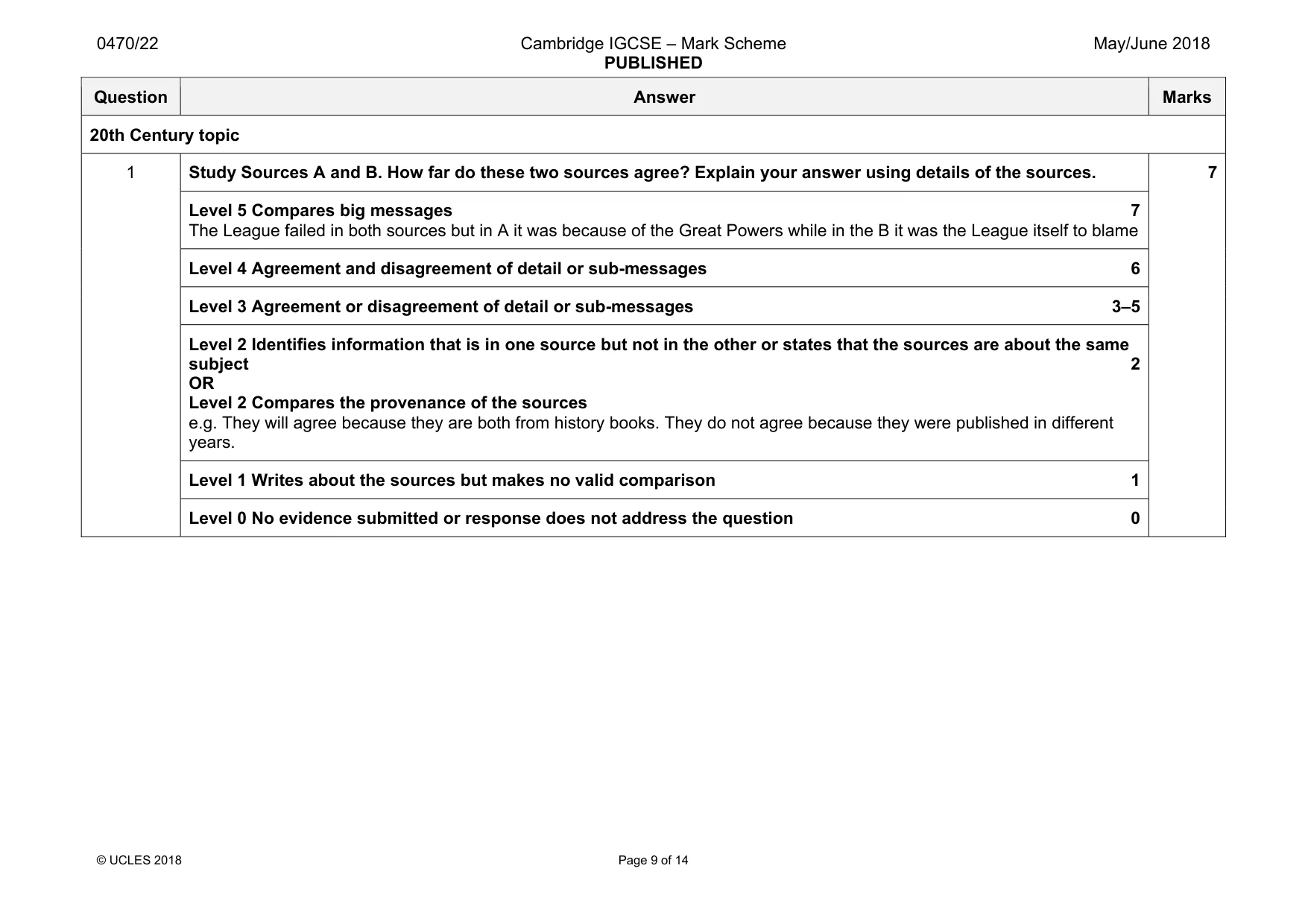
0470/22 Cambridge IGCSE – Mark Scheme PUBLISHED May/June 2018 © UCLES 2018 Page 9 of 14 Question Answer Marks 20th Century topic 1 Study Sources A and B. How far do these two sources agree? Explain your answer using details of the sources. 7 Level 5 Compares big messages 7 The League failed in both sources but in A it was because of the Great Powers while in the B it was the League itself to blame Level 4 Agreement and disagreement of detail or sub-messages 6 Level 3 Agreement or disagreement of detail or sub-messages 3–5 Level 2 Identifies information that is in one source but not in the other or states that the sources are about the same subject 2 OR Level 2 Compares the provenance of the sources e.g. They will agree because they are both from history books. They do not agree because they were published in different years. Level 1 Writes about the sources but makes no valid comparison 1 Level 0 No evidence submitted or response does not address the question 0
Mark scheme, page 10
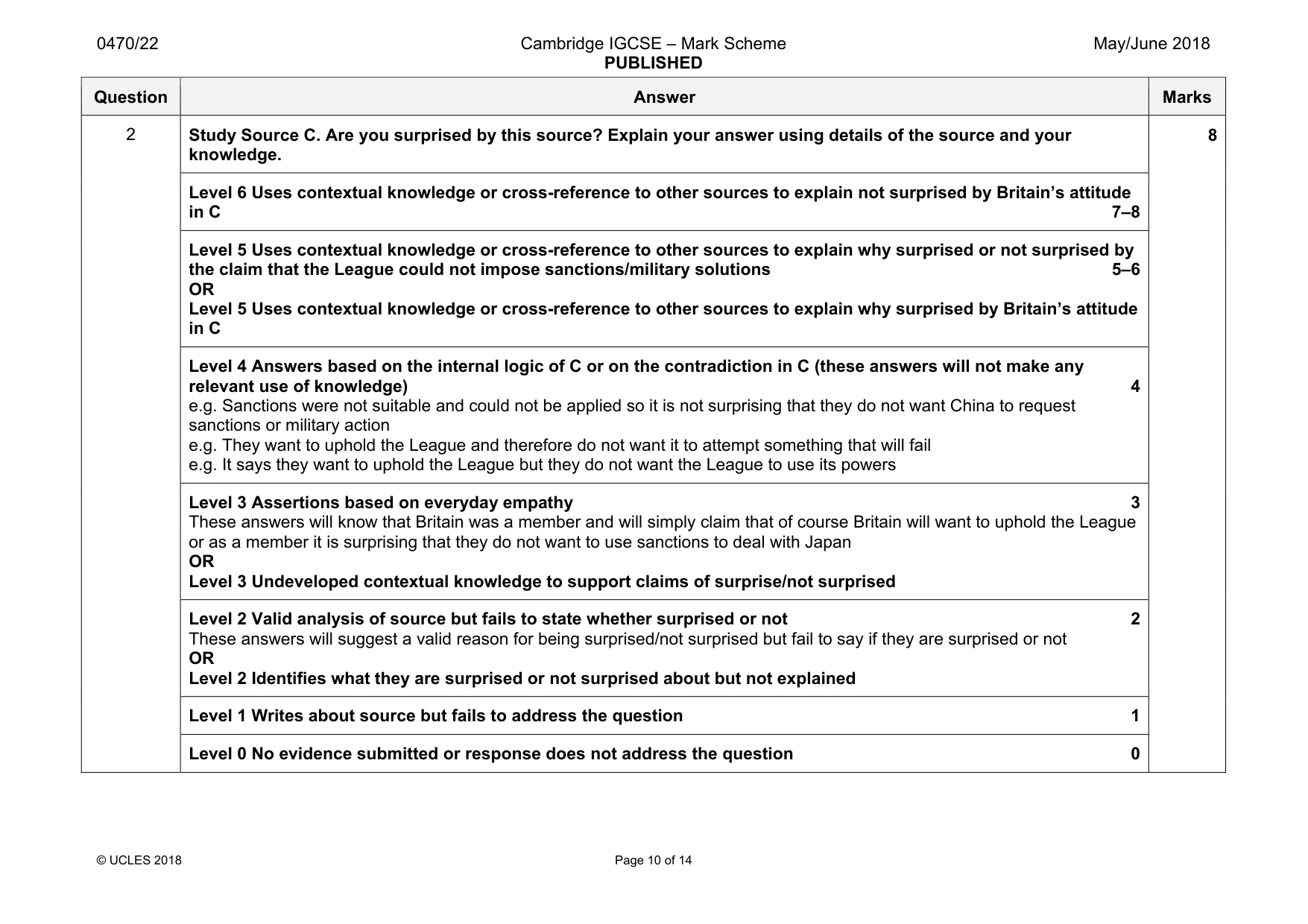
0470/22 Cambridge IGCSE – Mark Scheme PUBLISHED May/June 2018 © UCLES 2018 Page 10 of 14 Question Answer Marks 2 Study Source C. Are you surprised by this source? Explain your answer using details of the source and your knowledge. 8 Level 6 Uses contextual knowledge or cross-reference to other sources to explain not surprised by Britain’s attitude in C 7–8 Level 5 Uses contextual knowledge or cross-reference to other sources to explain why surprised or not surprised by the claim that the League could not impose sanctions/military solutions 5–6 OR Level 5 Uses contextual knowledge or cross-reference to other sources to explain why surprised by Britain’s attitude in C Level 4 Answers based on the internal logic of C or on the contradiction in C (these answers will not make any relevant use of knowledge) 4 e.g. Sanctions were not suitable and could not be applied so it is not surprising that they do not want China to request sanctions or military action e.g. They want to uphold the League and therefore do not want it to attempt something that will fail e.g. It says they want to uphold the League but they do not want the League to use its powers Level 3 Assertions based on everyday empathy 3 These answers will know that Britain was a member and will simply claim that of course Britain will want to uphold the League or as a member it is surprising that they do not want to use sanctions to deal with Japan OR Level 3 Undeveloped contextual knowledge to support claims of surprise/not surprised Level 2 Valid analysis of source but fails to state whether surprised or not 2 These answers will suggest a valid reason for being surprised/not surprised but fail to say if they are surprised or not OR Level 2 Identifies what they are surprised or not surprised about but not explained Level 1 Writes about source but fails to address the question 1 Level 0 No evidence submitted or response does not address the question 0
Mark scheme, page 11
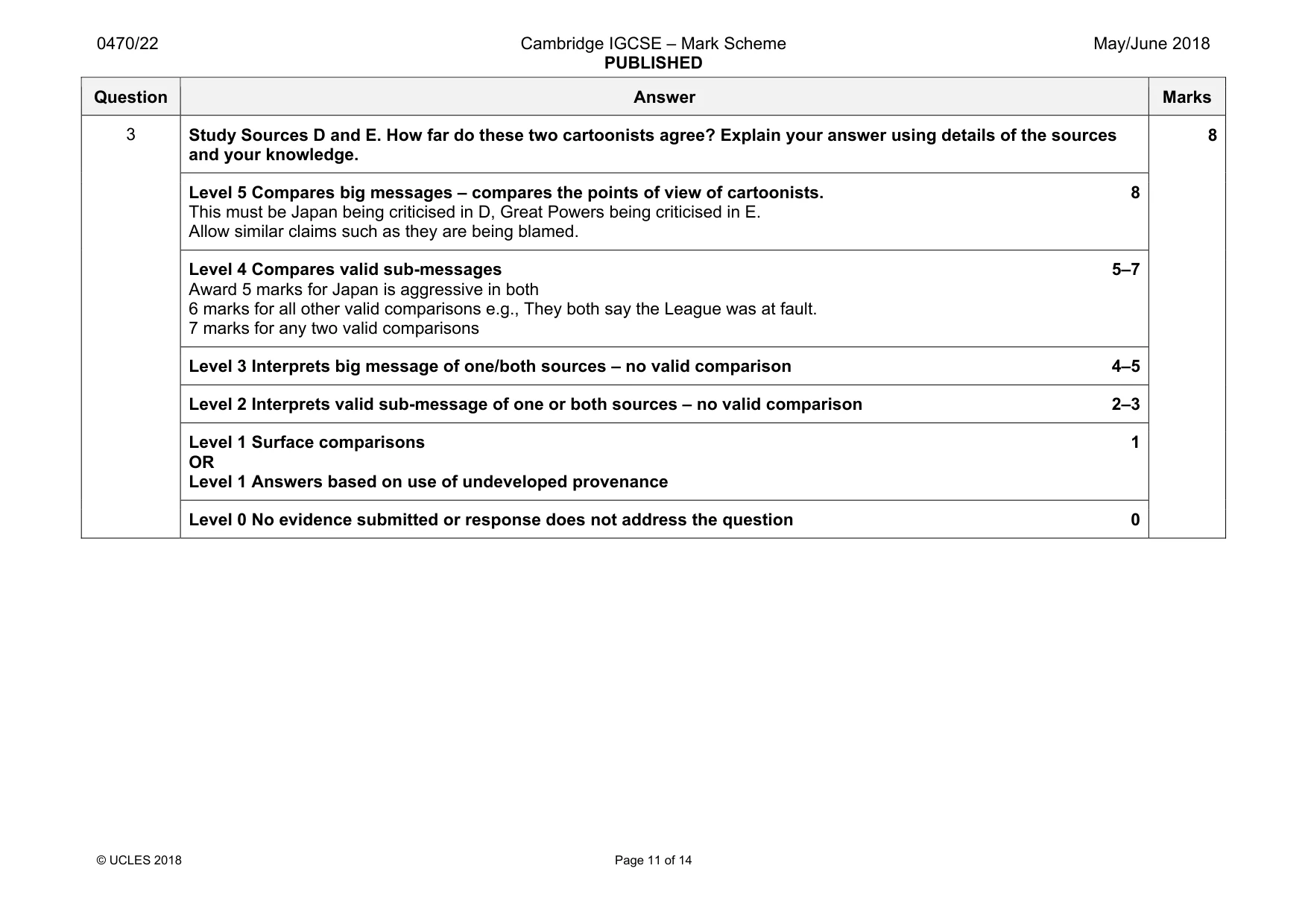
0470/22 Cambridge IGCSE – Mark Scheme PUBLISHED May/June 2018 © UCLES 2018 Page 11 of 14 Question Answer Marks 3 Study Sources D and E. How far do these two cartoonists agree? Explain your answer using details of the sources and your knowledge. 8 Level 5 Compares big messages – compares the points of view of cartoonists. 8 This must be Japan being criticised in D, Great Powers being criticised in E. Allow similar claims such as they are being blamed. Level 4 Compares valid sub-messages 5–7 Award 5 marks for Japan is aggressive in both 6 marks for all other valid comparisons e.g., They both say the League was at fault. 7 marks for any two valid comparisons Level 3 Interprets big message of one/both sources – no valid comparison 4–5 Level 2 Interprets valid sub-message of one or both sources – no valid comparison 2–3 Level 1 Surface comparisons 1 OR Level 1 Answers based on use of undeveloped provenance Level 0 No evidence submitted or response does not address the question 0
Mark scheme, page 12
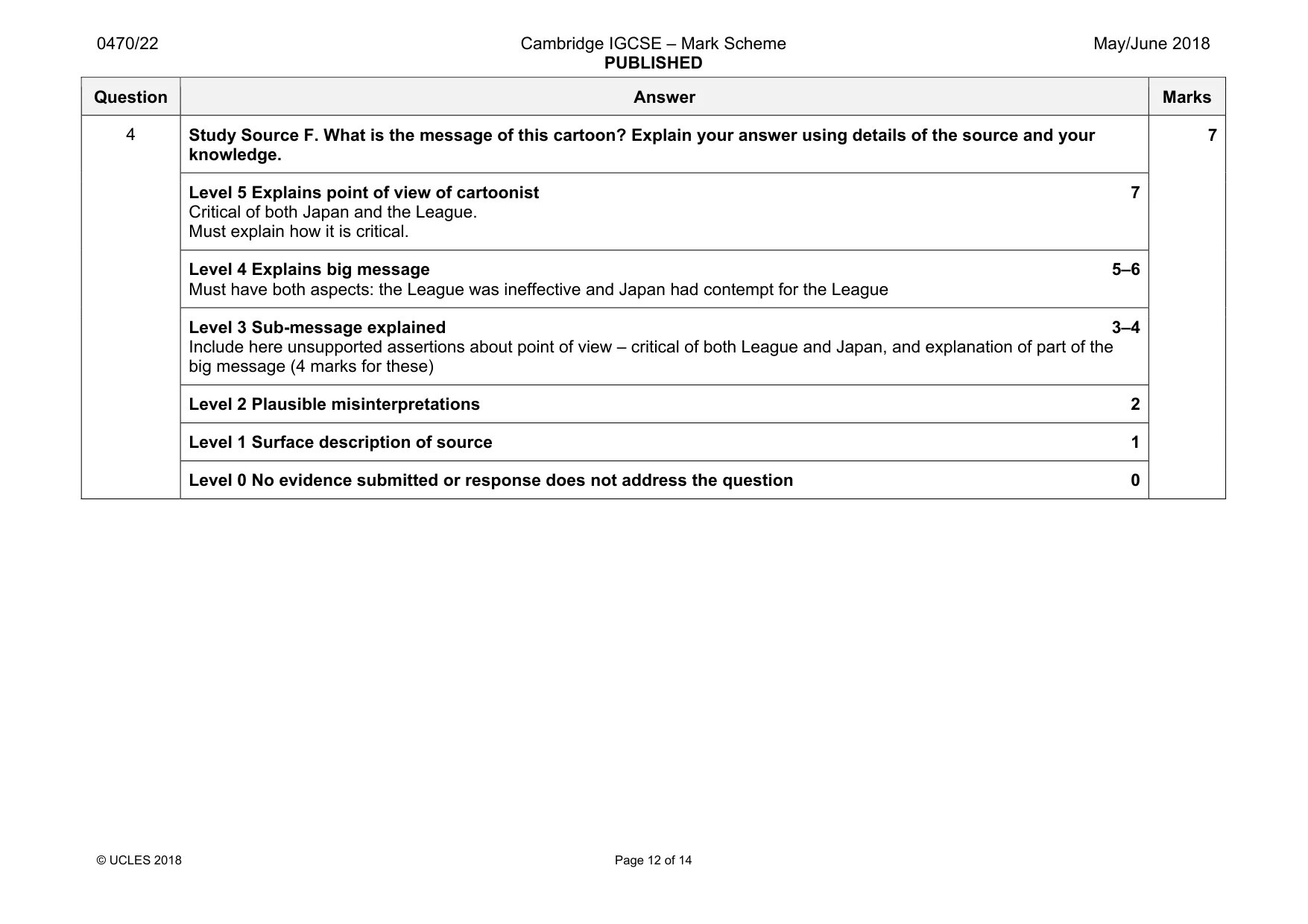
0470/22 Cambridge IGCSE – Mark Scheme PUBLISHED May/June 2018 © UCLES 2018 Page 12 of 14 Question Answer Marks 4 Study Source F. What is the message of this cartoon? Explain your answer using details of the source and your knowledge. 7 Level 5 Explains point of view of cartoonist 7 Critical of both Japan and the League. Must explain how it is critical. Level 4 Explains big message 5–6 Must have both aspects: the League was ineffective and Japan had contempt for the League Level 3 Sub-message explained 3–4 Include here unsupported assertions about point of view – critical of both League and Japan, and explanation of part of the big message (4 marks for these) Level 2 Plausible misinterpretations 2 Level 1 Surface description of source 1 Level 0 No evidence submitted or response does not address the question 0
Mark scheme, page 13
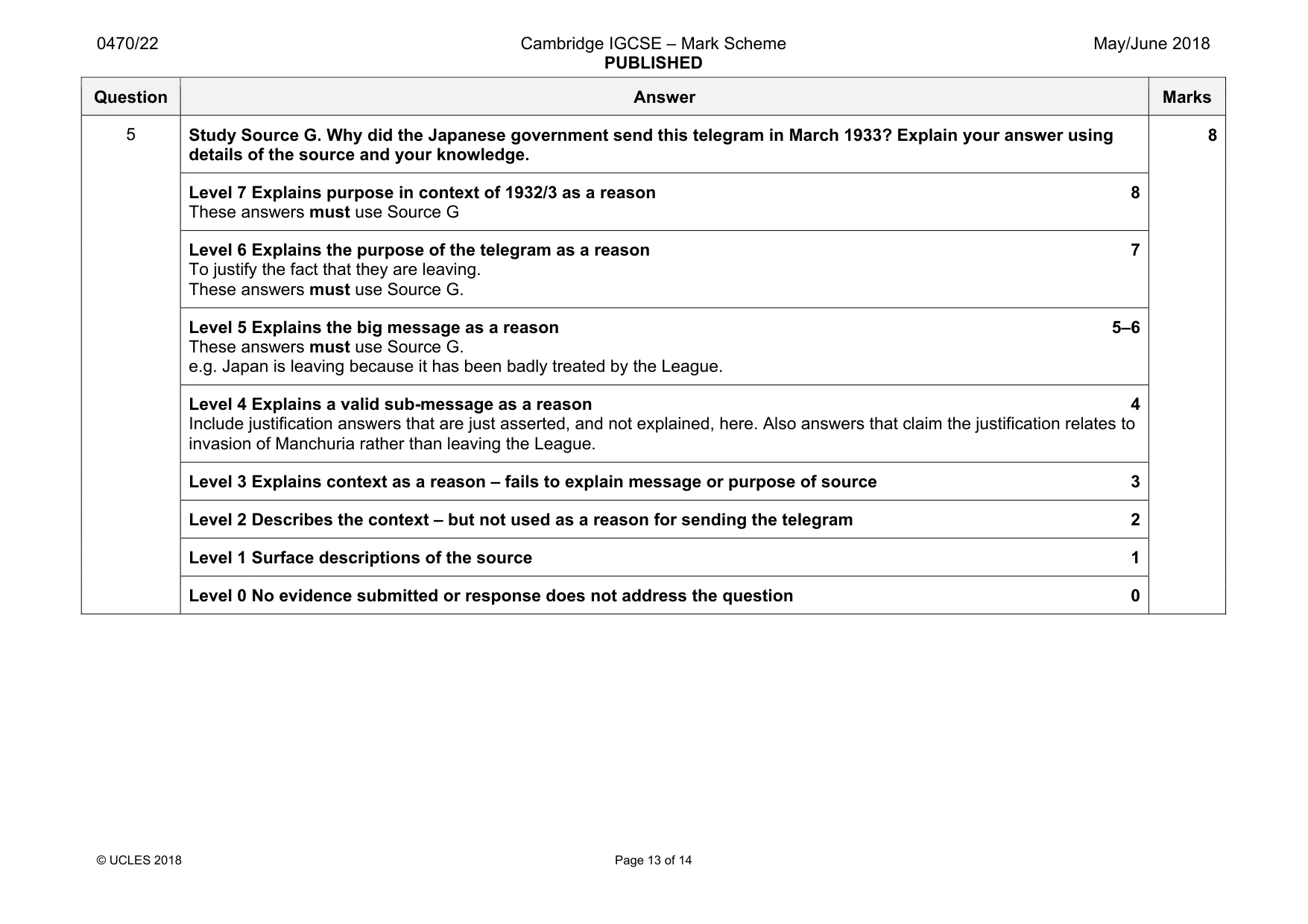
0470/22 Cambridge IGCSE – Mark Scheme PUBLISHED May/June 2018 © UCLES 2018 Page 13 of 14 Question Answer Marks 5 Study Source G. Why did the Japanese government send this telegram in March 1933? Explain your answer using details of the source and your knowledge. 8 Level 7 Explains purpose in context of 1932/3 as a reason 8 These answers must use Source G Level 6 Explains the purpose of the telegram as a reason 7 To justify the fact that they are leaving. These answers must use Source G. Level 5 Explains the big message as a reason 5–6 These answers must use Source G. e.g. Japan is leaving because it has been badly treated by the League. Level 4 Explains a valid sub-message as a reason 4 Include justification answers that are just asserted, and not explained, here. Also answers that claim the justification relates to invasion of Manchuria rather than leaving the League. Level 3 Explains context as a reason – fails to explain message or purpose of source 3 Level 2 Describes the context – but not used as a reason for sending the telegram 2 Level 1 Surface descriptions of the source 1 Level 0 No evidence submitted or response does not address the question 0
Mark scheme, page 14
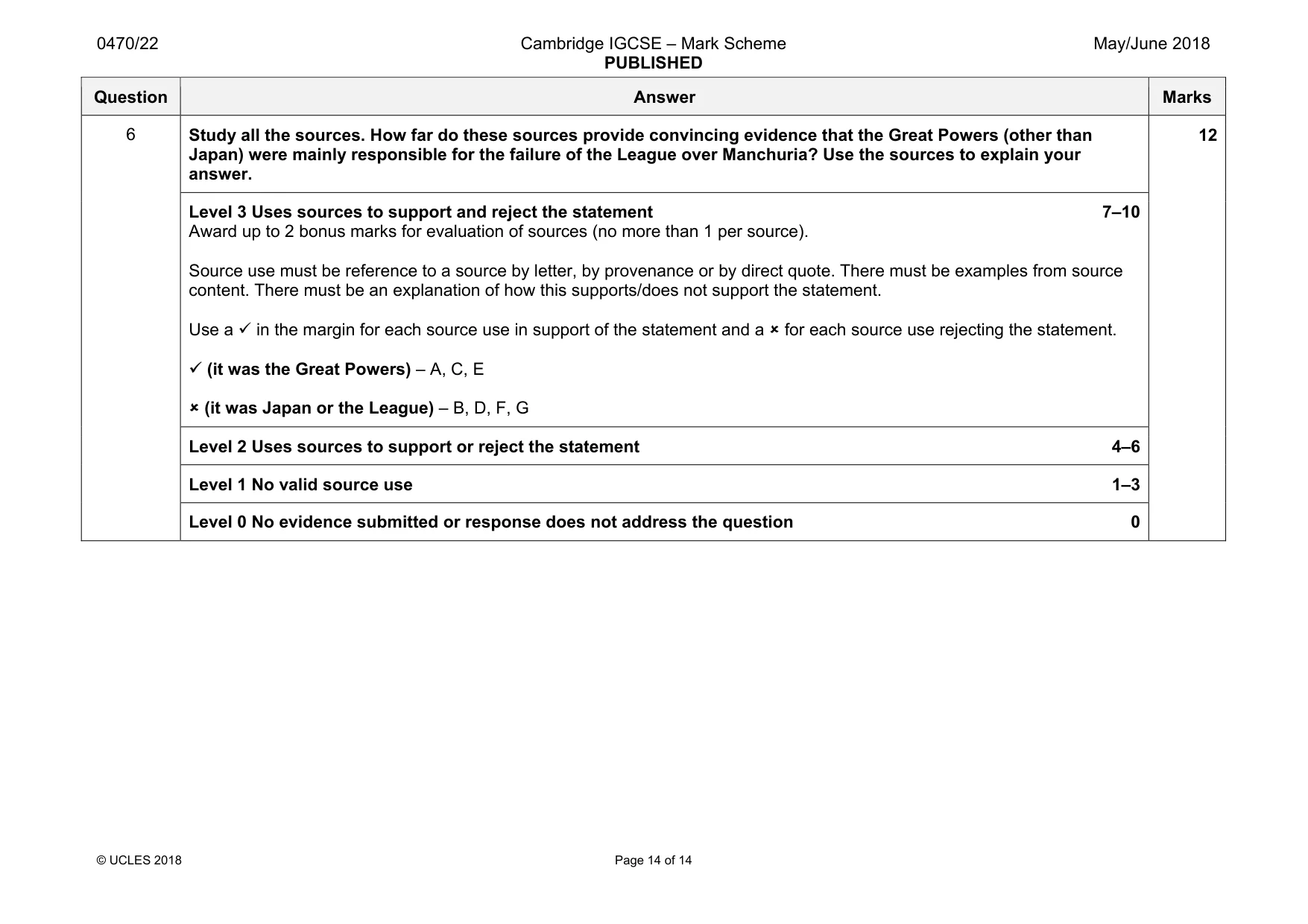
0470/22 Cambridge IGCSE – Mark Scheme PUBLISHED May/June 2018 © UCLES 2018 Page 14 of 14 Question Answer Marks 6 Study all the sources. How far do these sources provide convincing evidence that the Great Powers (other than Japan) were mainly responsible for the failure of the League over Manchuria? Use the sources to explain your answer. 12 Level 3 Uses sources to support and reject the statement 7–10 Award up to 2 bonus marks for evaluation of sources (no more than 1 per source). Source use must be reference to a source by letter, by provenance or by direct quote. There must be examples from source content. There must be an explanation of how this supports/does not support the statement. Use a 9 in the margin for each source use in support of the statement and a 8 for each source use rejecting the statement. 9 (it was the Great Powers) – A, C, E 8 (it was Japan or the League) – B, D, F, G Level 2 Uses sources to support or reject the statement 4–6 Level 1 No valid source use 1–3 Level 0 No evidence submitted or response does not address the question 0
What you needed in this session
Cambridge’s own grade thresholds for 2018 May/June, Paper 2 · Variant 2. A higher threshold means an easier paper — the bar moves with how the cohort did.