Cambridge IGCSE History 0470 — 2017 Oct/Nov Paper 4 · Variant 3
0470/43/O/N/17 · 40 marks · ≈45 min
The question paper and its mark scheme, free to read here and free to download. This is Cambridge’s own paper, exactly as it was sat.
Question paper4 pages

Mark scheme17 pages
Answers below. Sit the paper first if you are practising.
Paper as text
Question paper, page 1
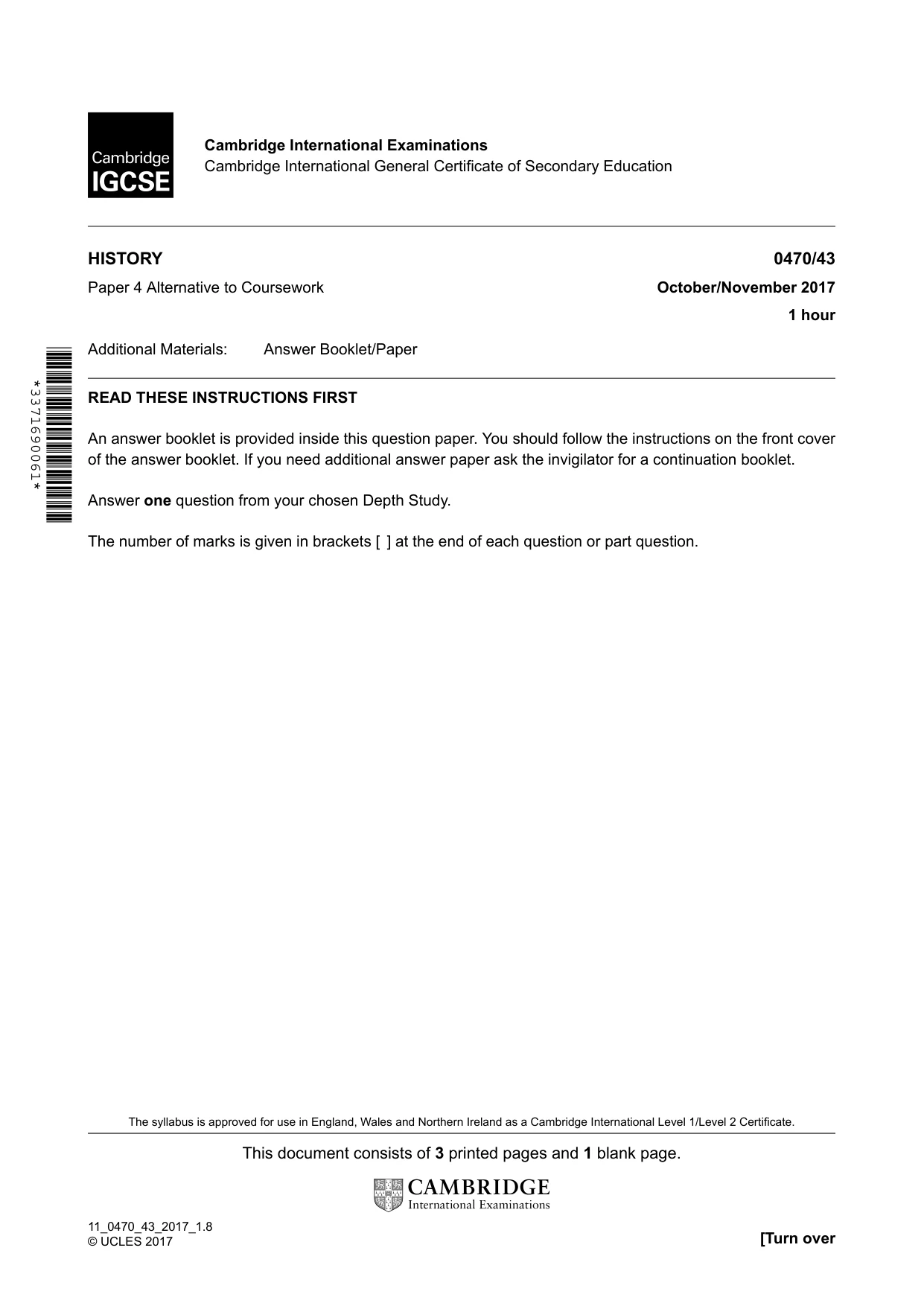
Cambridge International Examinations Cambridge International General Certificate of Secondary Education 0470/43 October/November 2017 1 hour HISTORY Paper 4 Alternative to Coursework Additional Materials: Answer Booklet/Paper READ THESE INSTRUCTIONS FIRST An answer booklet is provided inside this question paper. You should follow the instructions on the front cover of the answer booklet. If you need additional answer paper ask the invigilator for a continuation booklet. Answer one question from your chosen Depth Study. The number of marks is given in brackets [ ] at the end of each question or part question. The syllabus is approved for use in England, Wales and Northern Ireland as a Cambridge International Level 1/Level 2 Certificate. This document consists of 3 printed pages and 1 blank page. [Turn over 11_0470_43_2017_1.8 © UCLES 2017 *3371690061*
Question paper, page 2
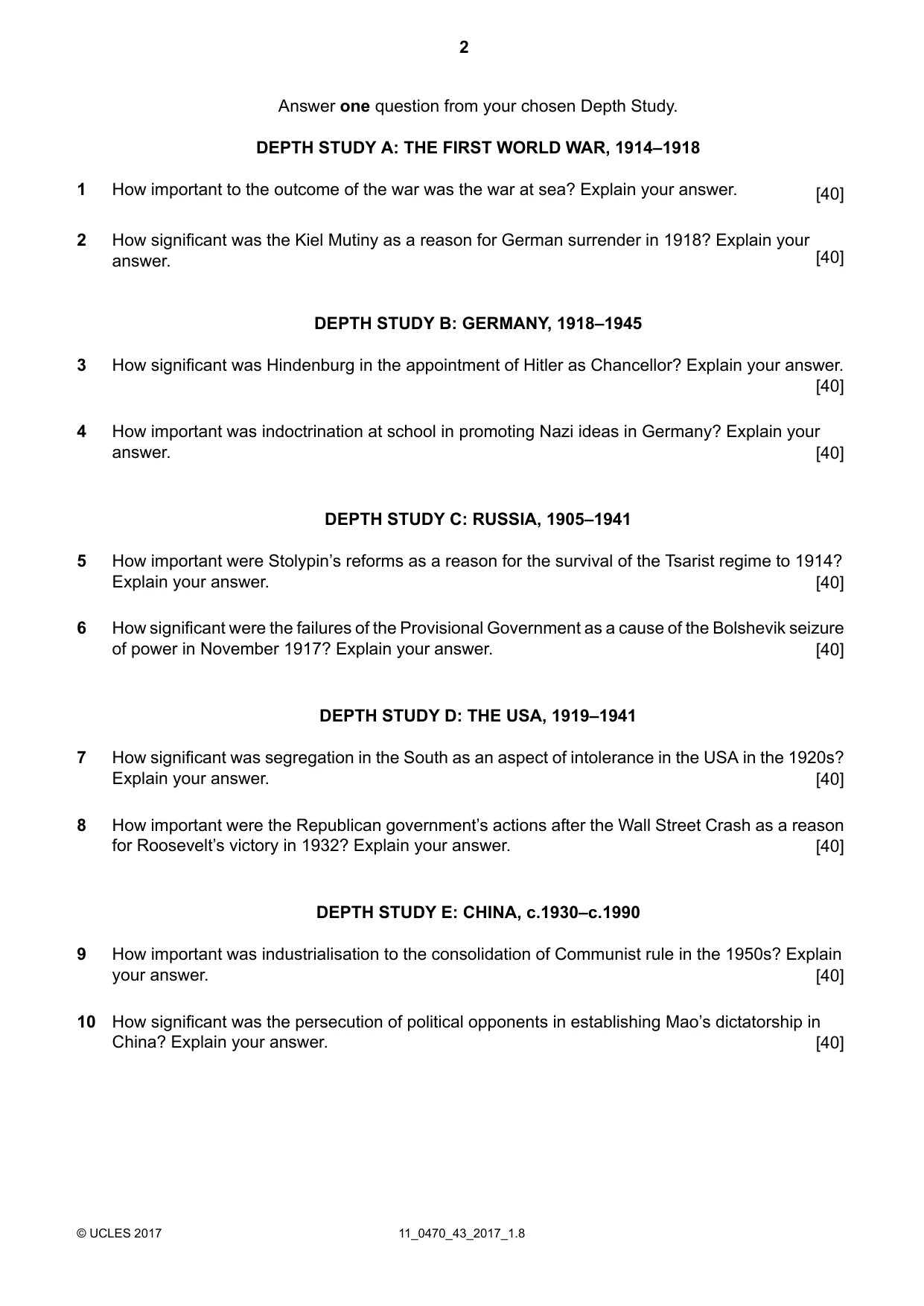
Answer one question from your chosen Depth Study. DEPTH STUDY A: THE FIRST WORLD WAR, 1914–1918 How important to the outcome of the war was the war at sea? Explain your answer. [40] 1 How significant was the Kiel Mutiny as a reason for German surrender in 1918? Explain your answer. [40] 2 DEPTH STUDY B: GERMANY, 1918–1945 How significant was Hindenburg in the appointment of Hitler as Chancellor? Explain your answer. [40] 3 How important was indoctrination at school in promoting Nazi ideas in Germany? Explain your answer. [40] 4 DEPTH STUDY C: RUSSIA, 1905–1941 How important were Stolypin’s reforms as a reason for the survival of the Tsarist regime to 1914? Explain your answer. [40] 5 How significant were the failures of the Provisional Government as a cause of the Bolshevik seizure of power in November 1917? Explain your answer. [40] 6 DEPTH STUDY D: THE USA, 1919–1941 How significant was segregation in the South as an aspect of intolerance in the USA in the 1920s? Explain your answer. [40] 7 How important were the Republican government’s actions after the Wall Street Crash as a reason for Roosevelt’s victory in 1932? Explain your answer. [40] 8 DEPTH STUDY E: CHINA, c.1930–c.1990 How important was industrialisation to the consolidation of Communist rule in the 1950s? Explain your answer. [40] 9 How significant was the persecution of political opponents in establishing Mao’s dictatorship in China? Explain your answer. [40] 10 11_0470_43_2017_1.8 © UCLES 2017 2
Question paper, page 3
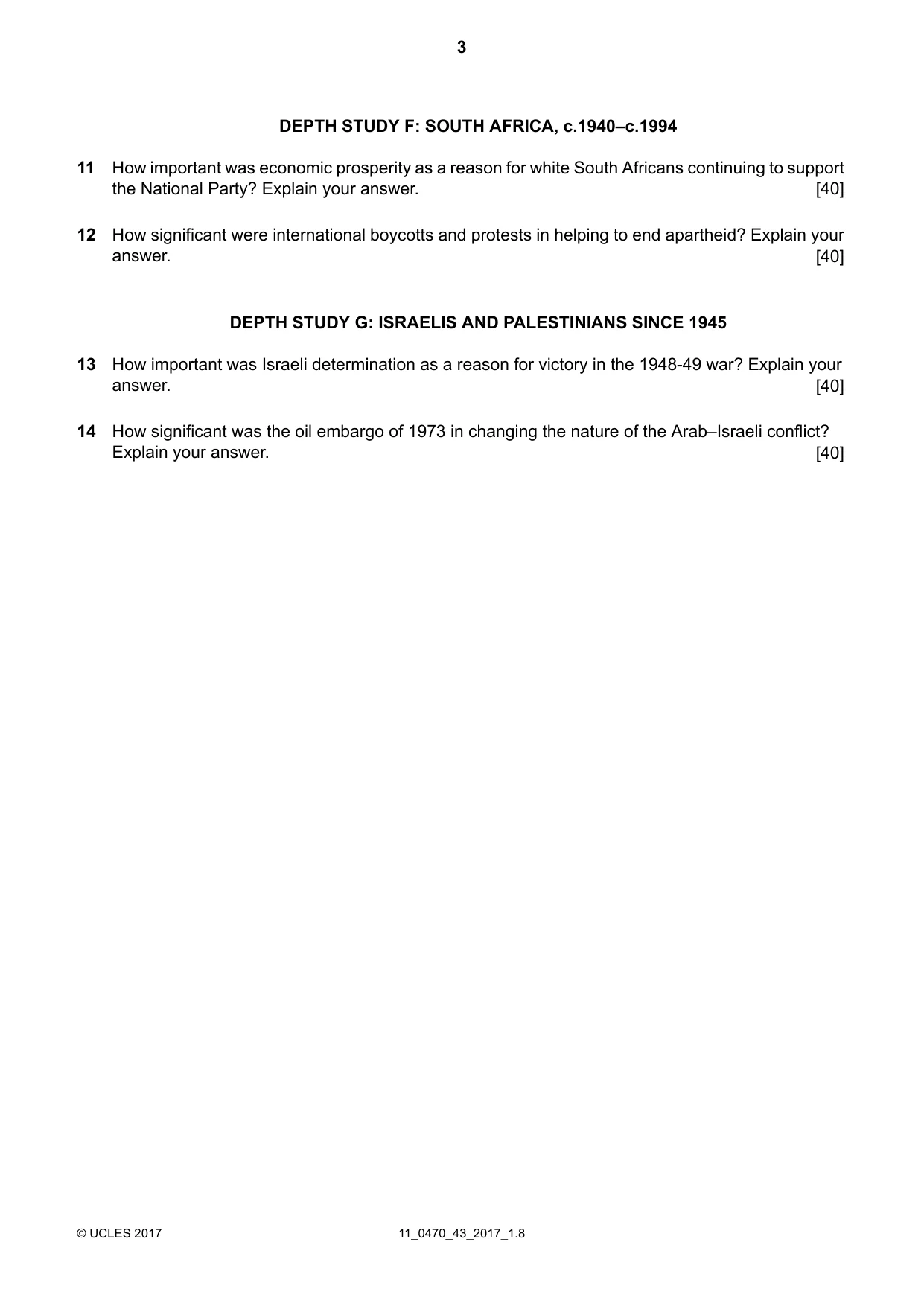
DEPTH STUDY F: SOUTH AFRICA, c.1940–c.1994 How important was economic prosperity as a reason for white South Africans continuing to support the National Party? Explain your answer. [40] 11 How significant were international boycotts and protests in helping to end apartheid? Explain your answer. [40] 12 DEPTH STUDY G: ISRAELIS AND PALESTINIANS SINCE 1945 How important was Israeli determination as a reason for victory in the 1948-49 war? Explain your answer. [40] 13 How significant was the oil embargo of 1973 in changing the nature of the Arab–Israeli conflict? Explain your answer. [40] 14 11_0470_43_2017_1.8 © UCLES 2017 3
Question paper, page 4
BLANK PAGE Permission to reproduce items where third-party owned material protected by copyright is included has been sought and cleared where possible. Every reasonable effort has been made by the publisher (UCLES) to trace copyright holders, but if any items requiring clearance have unwittingly been included, the publisher will be pleased to make amends at the earliest possible opportunity. To avoid the issue of disclosure of answer-related information to candidates, all copyright acknowledgements are reproduced online in the Cambridge International Examinations Copyright Acknowledgements Booklet. This is produced for each series of examinations and is freely available to download at www.cie.org.uk after the live examination series. Cambridge International Examinations is part of the Cambridge Assessment Group. Cambridge Assessment is the brand name of University of Cambridge Local Examinations Syndicate (UCLES), which is itself a department of the University of Cambridge. 11_0470_43_2017_1.8 © UCLES 2017 4
Mark scheme, page 1
® IGCSE is a registered trademark. This syllabus is approved for use in England, Wales and Northern Ireland as a Cambridge International Level 1/Level 2 Certificate. This document consists of 17 printed pages. © UCLES 2017 [Turn over Cambridge Assessment International Education Cambridge International General Certificate of Secondary Education HISTORY 0470/43 Paper 4 Alternative to Coursework October/November 2017 MARK SCHEME Maximum Mark: 40 Published This mark scheme is published as an aid to teachers and candidates, to indicate the requirements of the examination. It shows the basis on which Examiners were instructed to award marks. It does not indicate the details of the discussions that took place at an Examiners’ meeting before marking began, which would have considered the acceptability of alternative answers. Mark schemes should be read in conjunction with the question paper and the Principal Examiner Report for Teachers. Cambridge International will not enter into discussions about these mark schemes. Cambridge International is publishing the mark schemes for the October/November 2017 series for most Cambridge IGCSE®, Cambridge International A and AS Level components and some Cambridge O Level components.
Mark scheme, page 2
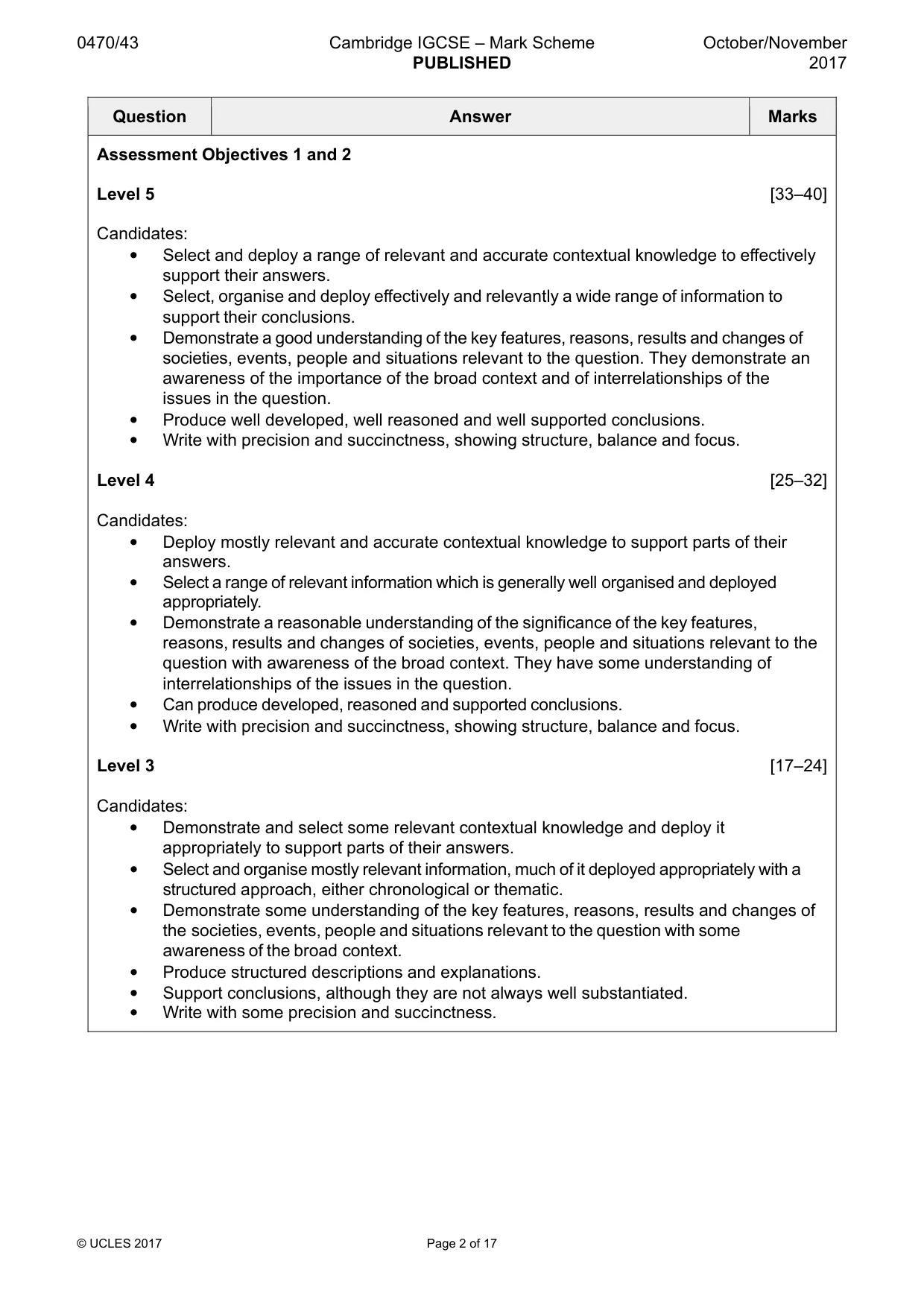
0470/43 Cambridge IGCSE – Mark Scheme PUBLISHED October/November 2017 © UCLES 2017 Page 2 of 17 Question Answer Marks Assessment Objectives 1 and 2 Level 5 [33–40] Candidates: • Select and deploy a range of relevant and accurate contextual knowledge to effectively support their answers. • Select, organise and deploy effectively and relevantly a wide range of information to support their conclusions. • Demonstrate a good understanding of the key features, reasons, results and changes of societies, events, people and situations relevant to the question. They demonstrate an awareness of the importance of the broad context and of interrelationships of the issues in the question. • Produce well developed, well reasoned and well supported conclusions. • Write with precision and succinctness, showing structure, balance and focus. Level 4 [25–32] Candidates: • Deploy mostly relevant and accurate contextual knowledge to support parts of their answers. • Select a range of relevant information which is generally well organised and deployed appropriately. • Demonstrate a reasonable understanding of the significance of the key features, reasons, results and changes of societies, events, people and situations relevant to the question with awareness of the broad context. They have some understanding of interrelationships of the issues in the question. • Can produce developed, reasoned and supported conclusions. • Write with precision and succinctness, showing structure, balance and focus. Level 3 [17–24] Candidates: • Demonstrate and select some relevant contextual knowledge and deploy it appropriately to support parts of their answers. • Select and organise mostly relevant information, much of it deployed appropriately with a structured approach, either chronological or thematic. • Demonstrate some understanding of the key features, reasons, results and changes of the societies, events, people and situations relevant to the question with some awareness of the broad context. • Produce structured descriptions and explanations. • Support conclusions, although they are not always well substantiated. • Write with some precision and succinctness.
Mark scheme, page 3
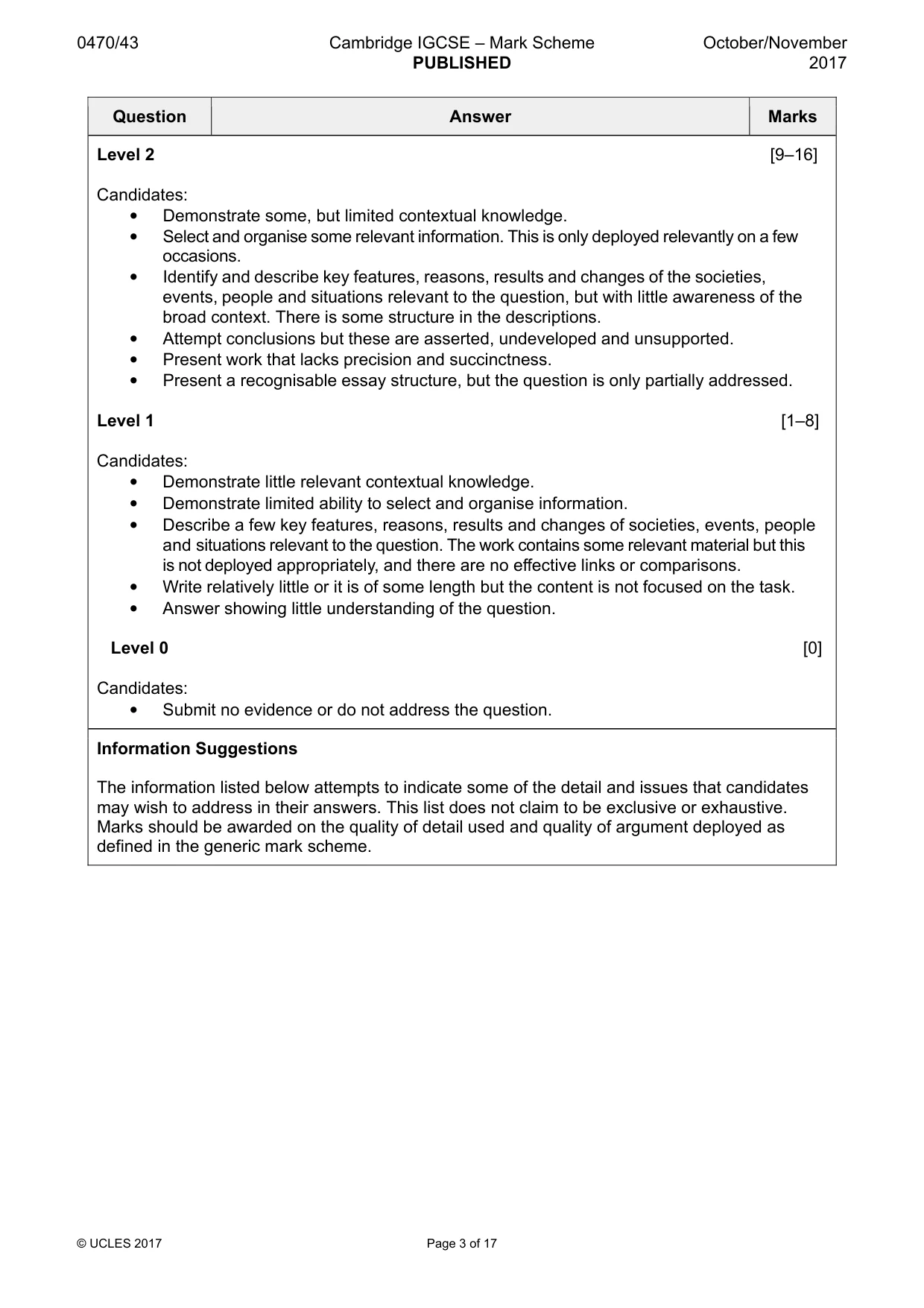
0470/43 Cambridge IGCSE – Mark Scheme PUBLISHED October/November 2017 © UCLES 2017 Page 3 of 17 Question Answer Marks Level 2 [9–16] Candidates: • Demonstrate some, but limited contextual knowledge. • Select and organise some relevant information. This is only deployed relevantly on a few occasions. • Identify and describe key features, reasons, results and changes of the societies, events, people and situations relevant to the question, but with little awareness of the broad context. There is some structure in the descriptions. • Attempt conclusions but these are asserted, undeveloped and unsupported. • Present work that lacks precision and succinctness. • Present a recognisable essay structure, but the question is only partially addressed. Level 1 [1–8] Candidates: • Demonstrate little relevant contextual knowledge. • Demonstrate limited ability to select and organise information. • Describe a few key features, reasons, results and changes of societies, events, people and situations relevant to the question. The work contains some relevant material but this is not deployed appropriately, and there are no effective links or comparisons. • Write relatively little or it is of some length but the content is not focused on the task. • Answer showing little understanding of the question. Level 0 [0] Candidates: • Submit no evidence or do not address the question. Information Suggestions The information listed below attempts to indicate some of the detail and issues that candidates may wish to address in their answers. This list does not claim to be exclusive or exhaustive. Marks should be awarded on the quality of detail used and quality of argument deployed as defined in the generic mark scheme.
Mark scheme, page 4
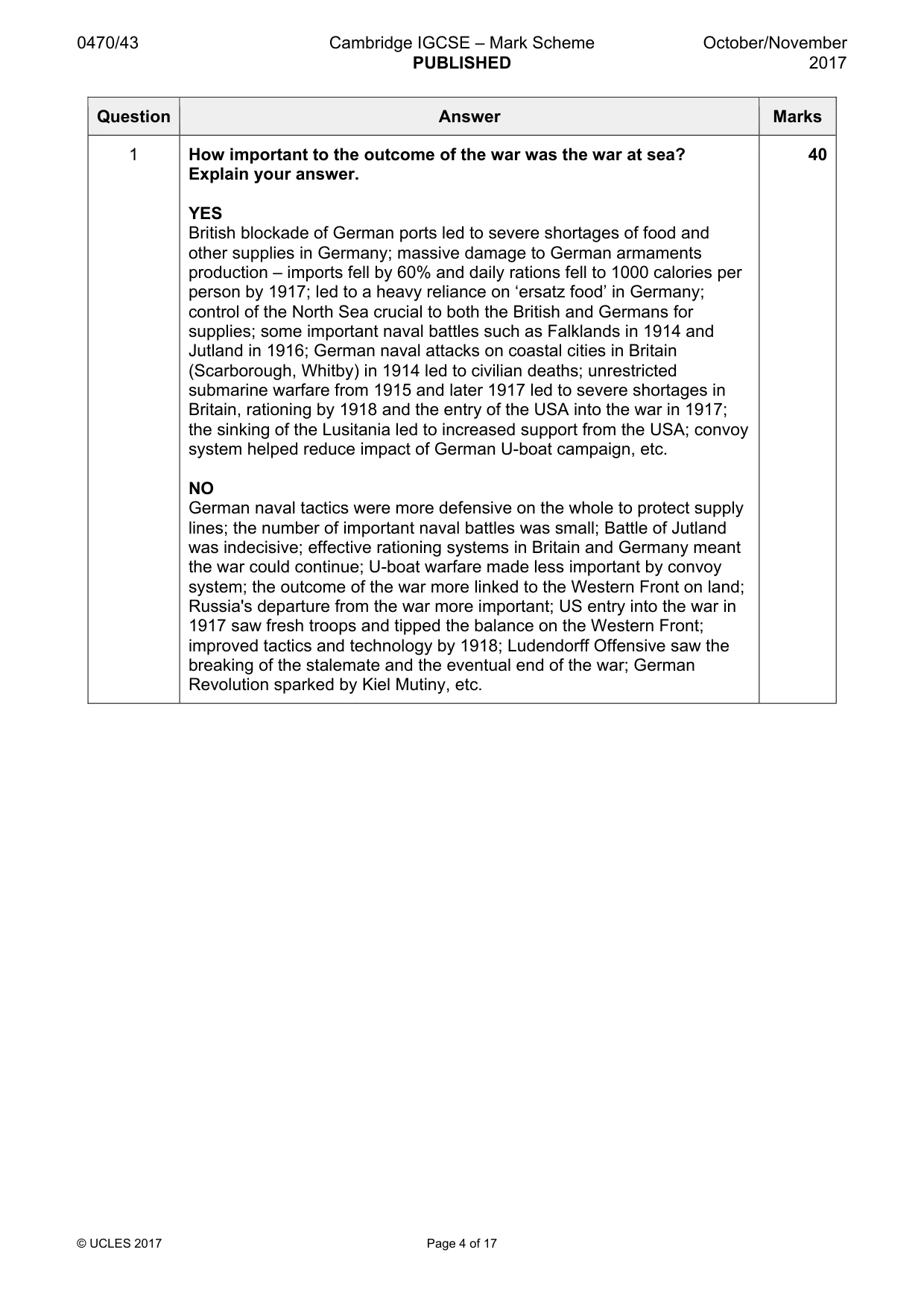
0470/43 Cambridge IGCSE – Mark Scheme PUBLISHED October/November 2017 © UCLES 2017 Page 4 of 17 Question Answer Marks 1 How important to the outcome of the war was the war at sea? Explain your answer. YES British blockade of German ports led to severe shortages of food and other supplies in Germany; massive damage to German armaments production – imports fell by 60% and daily rations fell to 1000 calories per person by 1917; led to a heavy reliance on ‘ersatz food’ in Germany; control of the North Sea crucial to both the British and Germans for supplies; some important naval battles such as Falklands in 1914 and Jutland in 1916; German naval attacks on coastal cities in Britain (Scarborough, Whitby) in 1914 led to civilian deaths; unrestricted submarine warfare from 1915 and later 1917 led to severe shortages in Britain, rationing by 1918 and the entry of the USA into the war in 1917; the sinking of the Lusitania led to increased support from the USA; convoy system helped reduce impact of German U-boat campaign, etc. NO German naval tactics were more defensive on the whole to protect supply lines; the number of important naval battles was small; Battle of Jutland was indecisive; effective rationing systems in Britain and Germany meant the war could continue; U-boat warfare made less important by convoy system; the outcome of the war more linked to the Western Front on land; Russia's departure from the war more important; US entry into the war in 1917 saw fresh troops and tipped the balance on the Western Front; improved tactics and technology by 1918; Ludendorff Offensive saw the breaking of the stalemate and the eventual end of the war; German Revolution sparked by Kiel Mutiny, etc. 40
Mark scheme, page 5
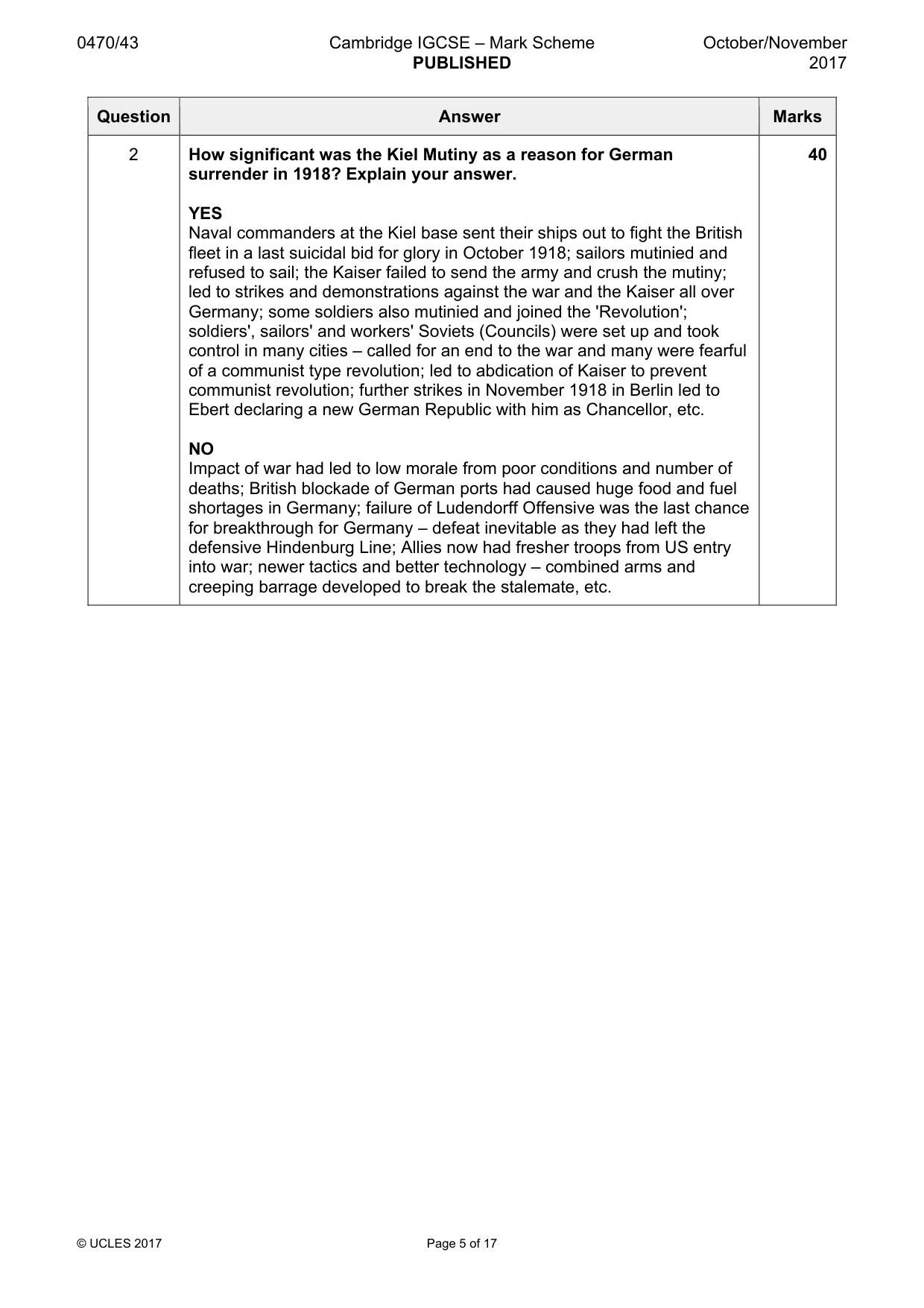
0470/43 Cambridge IGCSE – Mark Scheme PUBLISHED October/November 2017 © UCLES 2017 Page 5 of 17 Question Answer Marks 2 How significant was the Kiel Mutiny as a reason for German surrender in 1918? Explain your answer. YES Naval commanders at the Kiel base sent their ships out to fight the British fleet in a last suicidal bid for glory in October 1918; sailors mutinied and refused to sail; the Kaiser failed to send the army and crush the mutiny; led to strikes and demonstrations against the war and the Kaiser all over Germany; some soldiers also mutinied and joined the 'Revolution'; soldiers', sailors' and workers' Soviets (Councils) were set up and took control in many cities – called for an end to the war and many were fearful of a communist type revolution; led to abdication of Kaiser to prevent communist revolution; further strikes in November 1918 in Berlin led to Ebert declaring a new German Republic with him as Chancellor, etc. NO Impact of war had led to low morale from poor conditions and number of deaths; British blockade of German ports had caused huge food and fuel shortages in Germany; failure of Ludendorff Offensive was the last chance for breakthrough for Germany – defeat inevitable as they had left the defensive Hindenburg Line; Allies now had fresher troops from US entry into war; newer tactics and better technology – combined arms and creeping barrage developed to break the stalemate, etc. 40
Mark scheme, page 6
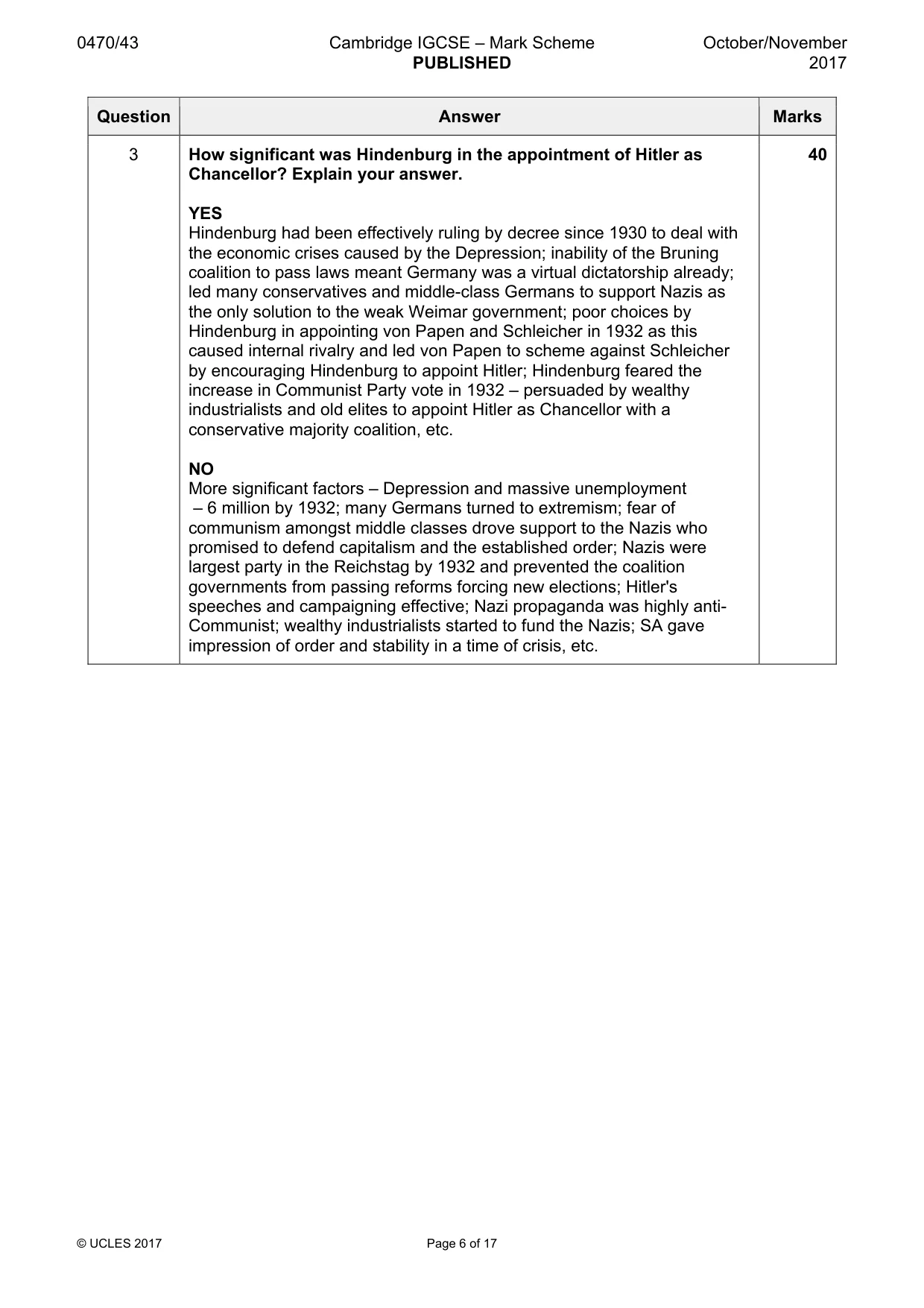
0470/43 Cambridge IGCSE – Mark Scheme PUBLISHED October/November 2017 © UCLES 2017 Page 6 of 17 Question Answer Marks 3 How significant was Hindenburg in the appointment of Hitler as Chancellor? Explain your answer. YES Hindenburg had been effectively ruling by decree since 1930 to deal with the economic crises caused by the Depression; inability of the Bruning coalition to pass laws meant Germany was a virtual dictatorship already; led many conservatives and middle-class Germans to support Nazis as the only solution to the weak Weimar government; poor choices by Hindenburg in appointing von Papen and Schleicher in 1932 as this caused internal rivalry and led von Papen to scheme against Schleicher by encouraging Hindenburg to appoint Hitler; Hindenburg feared the increase in Communist Party vote in 1932 – persuaded by wealthy industrialists and old elites to appoint Hitler as Chancellor with a conservative majority coalition, etc. NO More significant factors – Depression and massive unemployment – 6 million by 1932; many Germans turned to extremism; fear of communism amongst middle classes drove support to the Nazis who promised to defend capitalism and the established order; Nazis were largest party in the Reichstag by 1932 and prevented the coalition governments from passing reforms forcing new elections; Hitler's speeches and campaigning effective; Nazi propaganda was highly anti- Communist; wealthy industrialists started to fund the Nazis; SA gave impression of order and stability in a time of crisis, etc. 40
Mark scheme, page 7
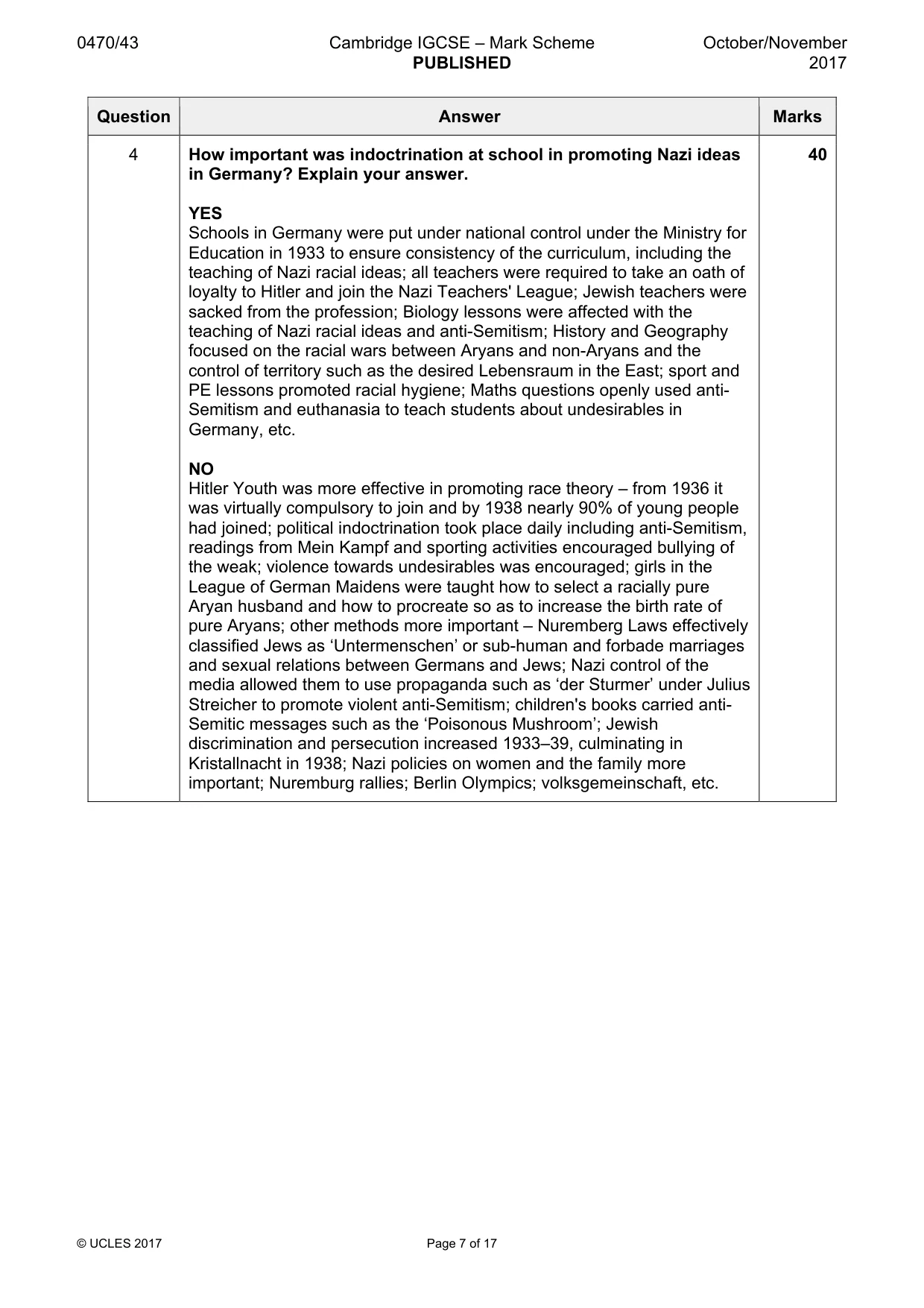
0470/43 Cambridge IGCSE – Mark Scheme PUBLISHED October/November 2017 © UCLES 2017 Page 7 of 17 Question Answer Marks 4 How important was indoctrination at school in promoting Nazi ideas in Germany? Explain your answer. YES Schools in Germany were put under national control under the Ministry for Education in 1933 to ensure consistency of the curriculum, including the teaching of Nazi racial ideas; all teachers were required to take an oath of loyalty to Hitler and join the Nazi Teachers' League; Jewish teachers were sacked from the profession; Biology lessons were affected with the teaching of Nazi racial ideas and anti-Semitism; History and Geography focused on the racial wars between Aryans and non-Aryans and the control of territory such as the desired Lebensraum in the East; sport and PE lessons promoted racial hygiene; Maths questions openly used anti- Semitism and euthanasia to teach students about undesirables in Germany, etc. NO Hitler Youth was more effective in promoting race theory – from 1936 it was virtually compulsory to join and by 1938 nearly 90% of young people had joined; political indoctrination took place daily including anti-Semitism, readings from Mein Kampf and sporting activities encouraged bullying of the weak; violence towards undesirables was encouraged; girls in the League of German Maidens were taught how to select a racially pure Aryan husband and how to procreate so as to increase the birth rate of pure Aryans; other methods more important – Nuremberg Laws effectively classified Jews as ‘Untermenschen’ or sub-human and forbade marriages and sexual relations between Germans and Jews; Nazi control of the media allowed them to use propaganda such as ‘der Sturmer’ under Julius Streicher to promote violent anti-Semitism; children's books carried anti- Semitic messages such as the ‘Poisonous Mushroom’; Jewish discrimination and persecution increased 1933–39, culminating in Kristallnacht in 1938; Nazi policies on women and the family more important; Nuremburg rallies; Berlin Olympics; volksgemeinschaft, etc. 40
Mark scheme, page 8
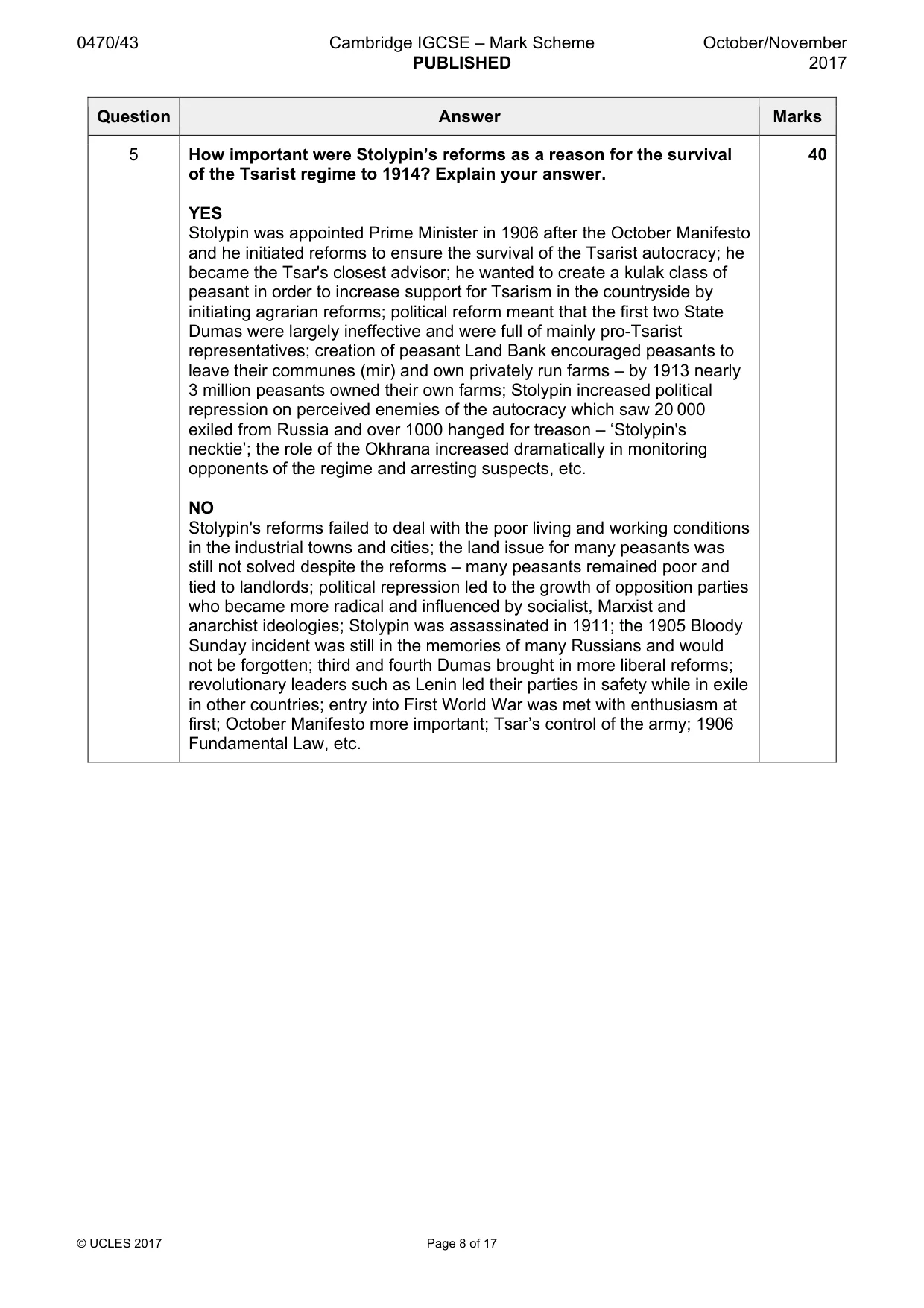
0470/43 Cambridge IGCSE – Mark Scheme PUBLISHED October/November 2017 © UCLES 2017 Page 8 of 17 Question Answer Marks 5 How important were Stolypin’s reforms as a reason for the survival of the Tsarist regime to 1914? Explain your answer. YES Stolypin was appointed Prime Minister in 1906 after the October Manifesto and he initiated reforms to ensure the survival of the Tsarist autocracy; he became the Tsar's closest advisor; he wanted to create a kulak class of peasant in order to increase support for Tsarism in the countryside by initiating agrarian reforms; political reform meant that the first two State Dumas were largely ineffective and were full of mainly pro-Tsarist representatives; creation of peasant Land Bank encouraged peasants to leave their communes (mir) and own privately run farms – by 1913 nearly 3 million peasants owned their own farms; Stolypin increased political repression on perceived enemies of the autocracy which saw 20 000 exiled from Russia and over 1000 hanged for treason – ‘Stolypin's necktie’; the role of the Okhrana increased dramatically in monitoring opponents of the regime and arresting suspects, etc. NO Stolypin's reforms failed to deal with the poor living and working conditions in the industrial towns and cities; the land issue for many peasants was still not solved despite the reforms – many peasants remained poor and tied to landlords; political repression led to the growth of opposition parties who became more radical and influenced by socialist, Marxist and anarchist ideologies; Stolypin was assassinated in 1911; the 1905 Bloody Sunday incident was still in the memories of many Russians and would not be forgotten; third and fourth Dumas brought in more liberal reforms; revolutionary leaders such as Lenin led their parties in safety while in exile in other countries; entry into First World War was met with enthusiasm at first; October Manifesto more important; Tsar’s control of the army; 1906 Fundamental Law, etc. 40
Mark scheme, page 9
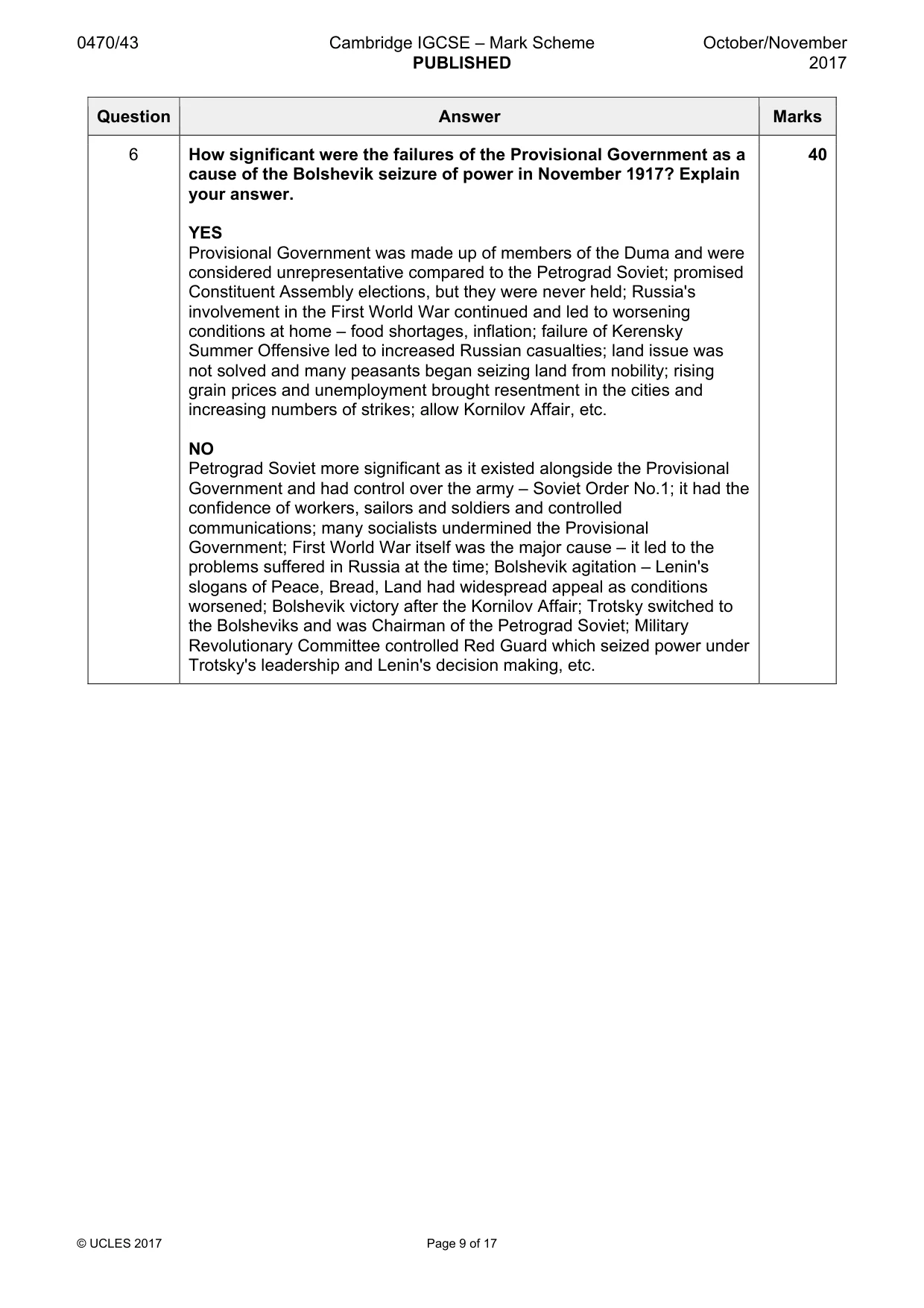
0470/43 Cambridge IGCSE – Mark Scheme PUBLISHED October/November 2017 © UCLES 2017 Page 9 of 17 Question Answer Marks 6 How significant were the failures of the Provisional Government as a cause of the Bolshevik seizure of power in November 1917? Explain your answer. YES Provisional Government was made up of members of the Duma and were considered unrepresentative compared to the Petrograd Soviet; promised Constituent Assembly elections, but they were never held; Russia's involvement in the First World War continued and led to worsening conditions at home – food shortages, inflation; failure of Kerensky Summer Offensive led to increased Russian casualties; land issue was not solved and many peasants began seizing land from nobility; rising grain prices and unemployment brought resentment in the cities and increasing numbers of strikes; allow Kornilov Affair, etc. NO Petrograd Soviet more significant as it existed alongside the Provisional Government and had control over the army – Soviet Order No.1; it had the confidence of workers, sailors and soldiers and controlled communications; many socialists undermined the Provisional Government; First World War itself was the major cause – it led to the problems suffered in Russia at the time; Bolshevik agitation – Lenin's slogans of Peace, Bread, Land had widespread appeal as conditions worsened; Bolshevik victory after the Kornilov Affair; Trotsky switched to the Bolsheviks and was Chairman of the Petrograd Soviet; Military Revolutionary Committee controlled Red Guard which seized power under Trotsky's leadership and Lenin's decision making, etc. 40
Mark scheme, page 10
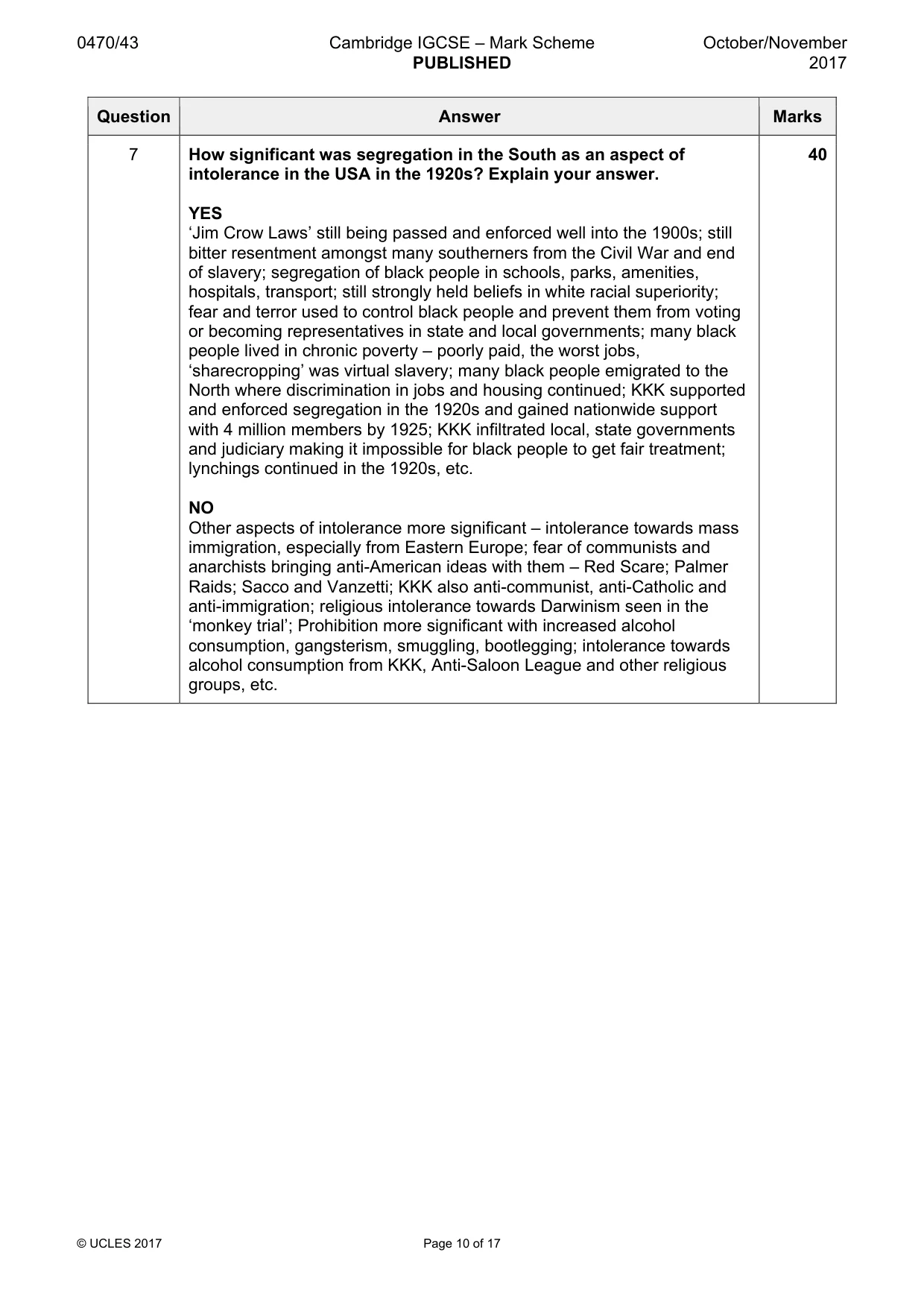
0470/43 Cambridge IGCSE – Mark Scheme PUBLISHED October/November 2017 © UCLES 2017 Page 10 of 17 Question Answer Marks 7 How significant was segregation in the South as an aspect of intolerance in the USA in the 1920s? Explain your answer. YES ‘Jim Crow Laws’ still being passed and enforced well into the 1900s; still bitter resentment amongst many southerners from the Civil War and end of slavery; segregation of black people in schools, parks, amenities, hospitals, transport; still strongly held beliefs in white racial superiority; fear and terror used to control black people and prevent them from voting or becoming representatives in state and local governments; many black people lived in chronic poverty – poorly paid, the worst jobs, ‘sharecropping’ was virtual slavery; many black people emigrated to the North where discrimination in jobs and housing continued; KKK supported and enforced segregation in the 1920s and gained nationwide support with 4 million members by 1925; KKK infiltrated local, state governments and judiciary making it impossible for black people to get fair treatment; lynchings continued in the 1920s, etc. NO Other aspects of intolerance more significant – intolerance towards mass immigration, especially from Eastern Europe; fear of communists and anarchists bringing anti-American ideas with them – Red Scare; Palmer Raids; Sacco and Vanzetti; KKK also anti-communist, anti-Catholic and anti-immigration; religious intolerance towards Darwinism seen in the ‘monkey trial’; Prohibition more significant with increased alcohol consumption, gangsterism, smuggling, bootlegging; intolerance towards alcohol consumption from KKK, Anti-Saloon League and other religious groups, etc. 40
Mark scheme, page 11
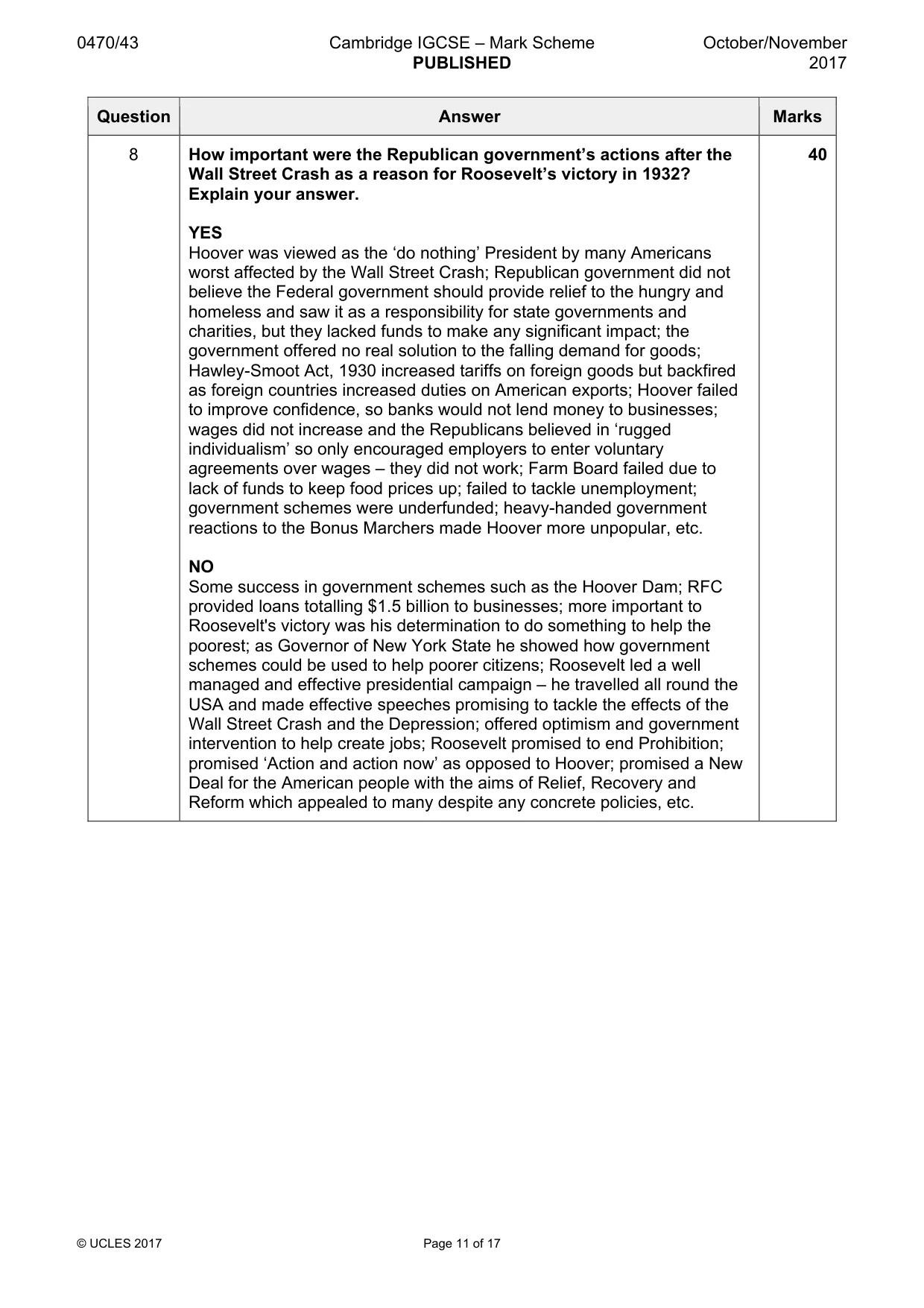
0470/43 Cambridge IGCSE – Mark Scheme PUBLISHED October/November 2017 © UCLES 2017 Page 11 of 17 Question Answer Marks 8 How important were the Republican government’s actions after the Wall Street Crash as a reason for Roosevelt’s victory in 1932? Explain your answer. YES Hoover was viewed as the ‘do nothing’ President by many Americans worst affected by the Wall Street Crash; Republican government did not believe the Federal government should provide relief to the hungry and homeless and saw it as a responsibility for state governments and charities, but they lacked funds to make any significant impact; the government offered no real solution to the falling demand for goods; Hawley-Smoot Act, 1930 increased tariffs on foreign goods but backfired as foreign countries increased duties on American exports; Hoover failed to improve confidence, so banks would not lend money to businesses; wages did not increase and the Republicans believed in ‘rugged individualism’ so only encouraged employers to enter voluntary agreements over wages – they did not work; Farm Board failed due to lack of funds to keep food prices up; failed to tackle unemployment; government schemes were underfunded; heavy-handed government reactions to the Bonus Marchers made Hoover more unpopular, etc. NO Some success in government schemes such as the Hoover Dam; RFC provided loans totalling $1.5 billion to businesses; more important to Roosevelt's victory was his determination to do something to help the poorest; as Governor of New York State he showed how government schemes could be used to help poorer citizens; Roosevelt led a well managed and effective presidential campaign – he travelled all round the USA and made effective speeches promising to tackle the effects of the Wall Street Crash and the Depression; offered optimism and government intervention to help create jobs; Roosevelt promised to end Prohibition; promised ‘Action and action now’ as opposed to Hoover; promised a New Deal for the American people with the aims of Relief, Recovery and Reform which appealed to many despite any concrete policies, etc. 40
Mark scheme, page 12
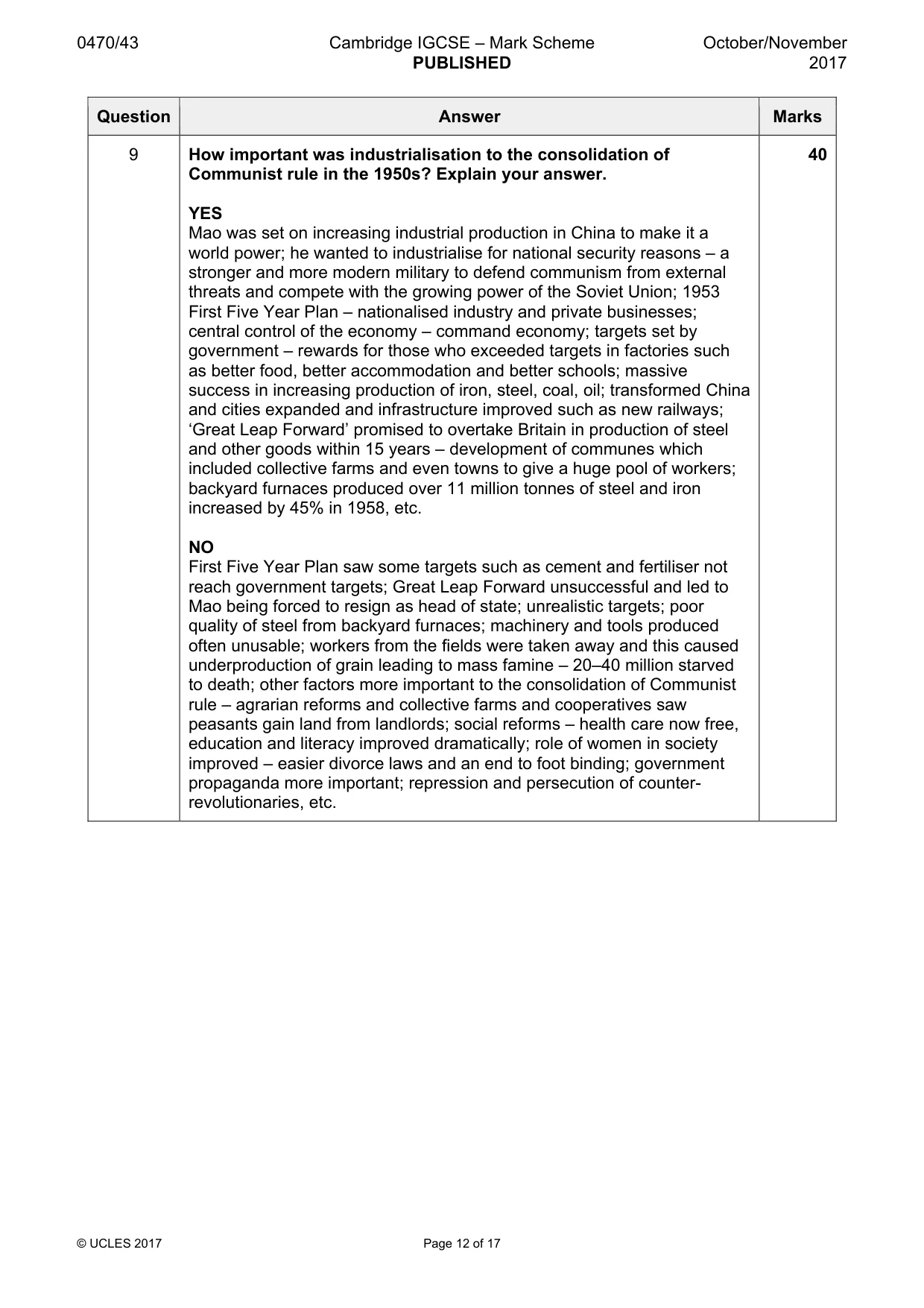
0470/43 Cambridge IGCSE – Mark Scheme PUBLISHED October/November 2017 © UCLES 2017 Page 12 of 17 Question Answer Marks 9 How important was industrialisation to the consolidation of Communist rule in the 1950s? Explain your answer. YES Mao was set on increasing industrial production in China to make it a world power; he wanted to industrialise for national security reasons – a stronger and more modern military to defend communism from external threats and compete with the growing power of the Soviet Union; 1953 First Five Year Plan – nationalised industry and private businesses; central control of the economy – command economy; targets set by government – rewards for those who exceeded targets in factories such as better food, better accommodation and better schools; massive success in increasing production of iron, steel, coal, oil; transformed China and cities expanded and infrastructure improved such as new railways; ‘Great Leap Forward’ promised to overtake Britain in production of steel and other goods within 15 years – development of communes which included collective farms and even towns to give a huge pool of workers; backyard furnaces produced over 11 million tonnes of steel and iron increased by 45% in 1958, etc. NO First Five Year Plan saw some targets such as cement and fertiliser not reach government targets; Great Leap Forward unsuccessful and led to Mao being forced to resign as head of state; unrealistic targets; poor quality of steel from backyard furnaces; machinery and tools produced often unusable; workers from the fields were taken away and this caused underproduction of grain leading to mass famine – 20–40 million starved to death; other factors more important to the consolidation of Communist rule – agrarian reforms and collective farms and cooperatives saw peasants gain land from landlords; social reforms – health care now free, education and literacy improved dramatically; role of women in society improved – easier divorce laws and an end to foot binding; government propaganda more important; repression and persecution of counter- revolutionaries, etc. 40
Mark scheme, page 13
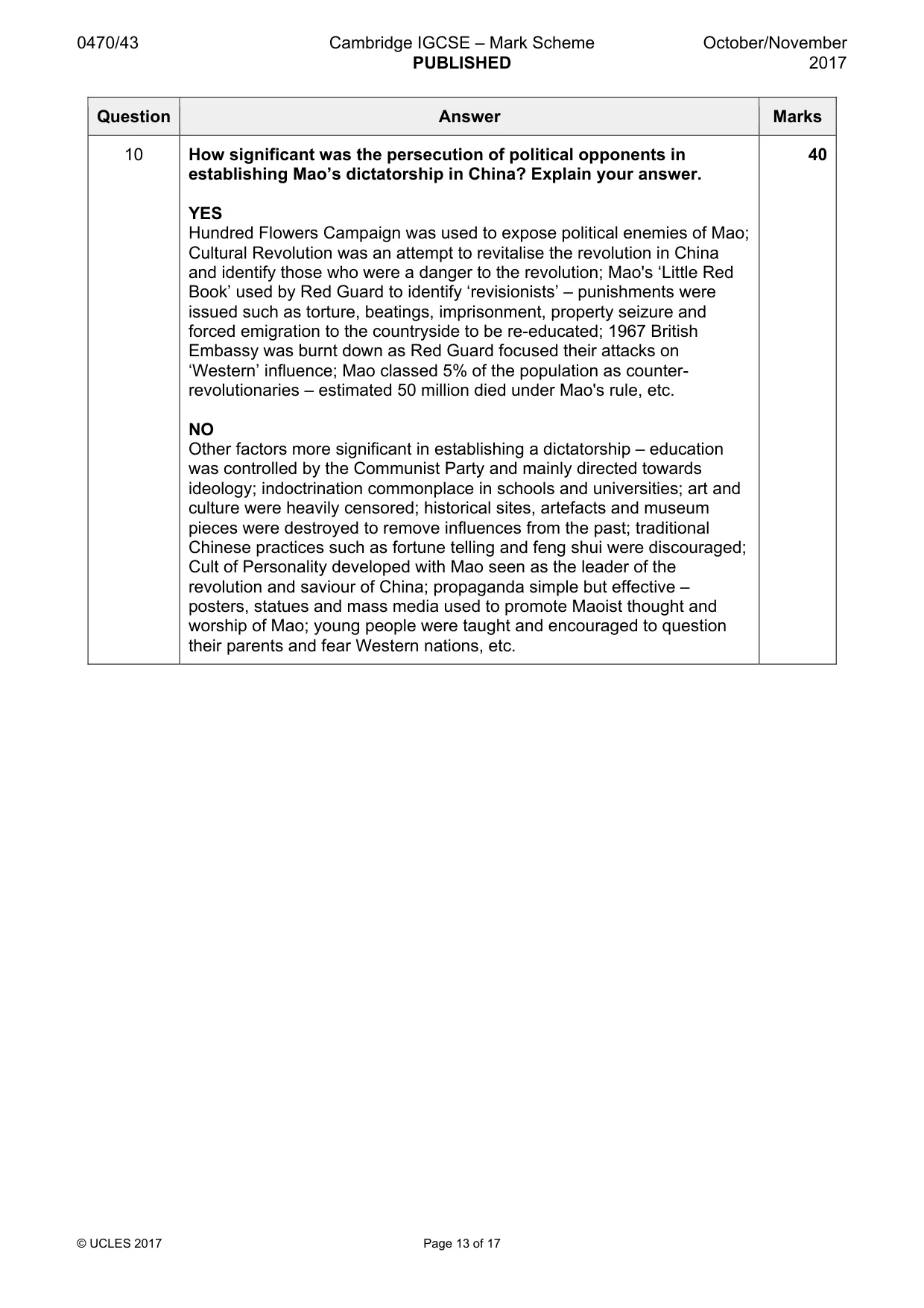
0470/43 Cambridge IGCSE – Mark Scheme PUBLISHED October/November 2017 © UCLES 2017 Page 13 of 17 Question Answer Marks 10 How significant was the persecution of political opponents in establishing Mao’s dictatorship in China? Explain your answer. YES Hundred Flowers Campaign was used to expose political enemies of Mao; Cultural Revolution was an attempt to revitalise the revolution in China and identify those who were a danger to the revolution; Mao's ‘Little Red Book’ used by Red Guard to identify ‘revisionists’ – punishments were issued such as torture, beatings, imprisonment, property seizure and forced emigration to the countryside to be re-educated; 1967 British Embassy was burnt down as Red Guard focused their attacks on ‘Western’ influence; Mao classed 5% of the population as counter- revolutionaries – estimated 50 million died under Mao's rule, etc. NO Other factors more significant in establishing a dictatorship – education was controlled by the Communist Party and mainly directed towards ideology; indoctrination commonplace in schools and universities; art and culture were heavily censored; historical sites, artefacts and museum pieces were destroyed to remove influences from the past; traditional Chinese practices such as fortune telling and feng shui were discouraged; Cult of Personality developed with Mao seen as the leader of the revolution and saviour of China; propaganda simple but effective – posters, statues and mass media used to promote Maoist thought and worship of Mao; young people were taught and encouraged to question their parents and fear Western nations, etc. 40
Mark scheme, page 14
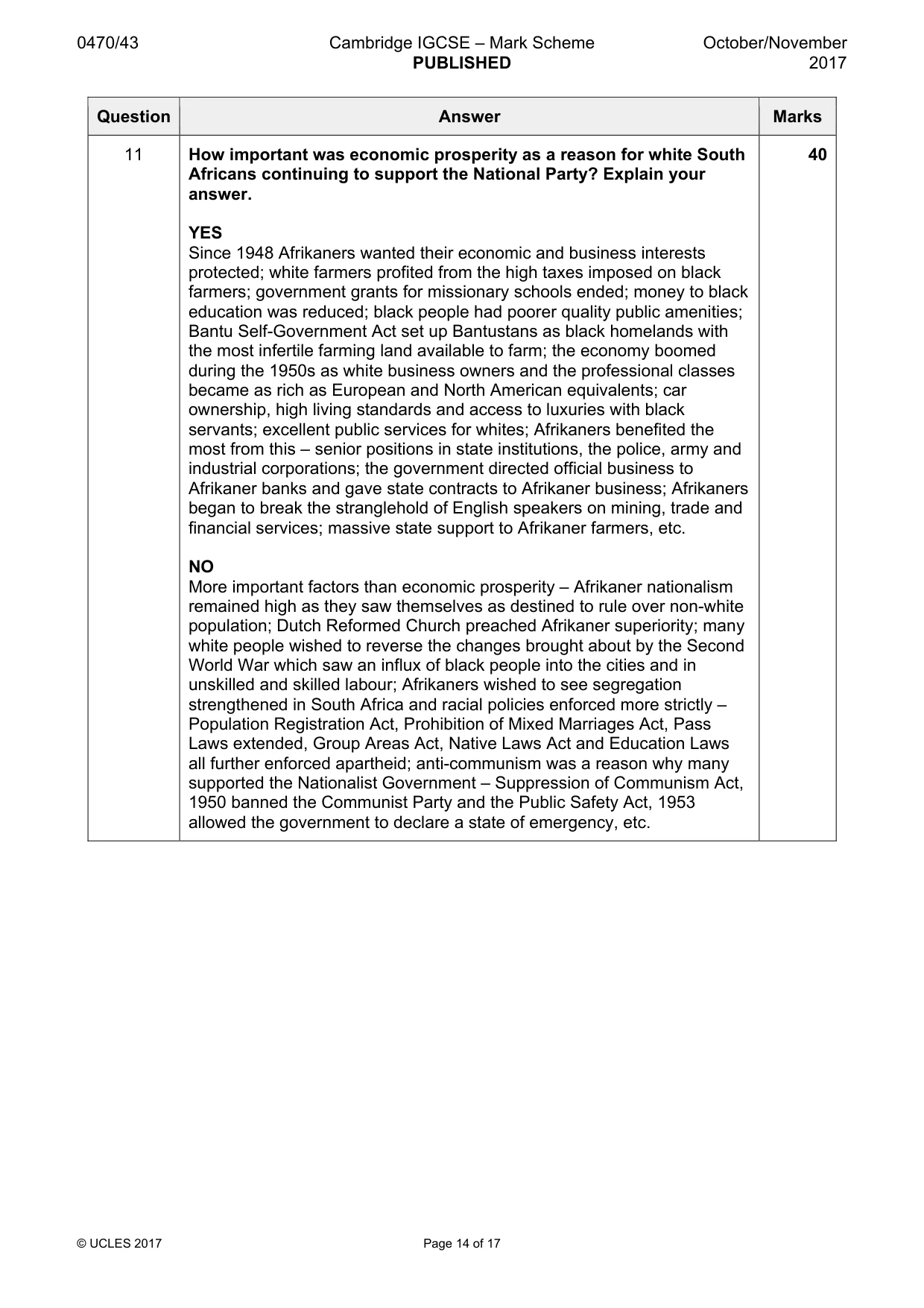
0470/43 Cambridge IGCSE – Mark Scheme PUBLISHED October/November 2017 © UCLES 2017 Page 14 of 17 Question Answer Marks 11 How important was economic prosperity as a reason for white South Africans continuing to support the National Party? Explain your answer. YES Since 1948 Afrikaners wanted their economic and business interests protected; white farmers profited from the high taxes imposed on black farmers; government grants for missionary schools ended; money to black education was reduced; black people had poorer quality public amenities; Bantu Self-Government Act set up Bantustans as black homelands with the most infertile farming land available to farm; the economy boomed during the 1950s as white business owners and the professional classes became as rich as European and North American equivalents; car ownership, high living standards and access to luxuries with black servants; excellent public services for whites; Afrikaners benefited the most from this – senior positions in state institutions, the police, army and industrial corporations; the government directed official business to Afrikaner banks and gave state contracts to Afrikaner business; Afrikaners began to break the stranglehold of English speakers on mining, trade and financial services; massive state support to Afrikaner farmers, etc. NO More important factors than economic prosperity – Afrikaner nationalism remained high as they saw themselves as destined to rule over non-white population; Dutch Reformed Church preached Afrikaner superiority; many white people wished to reverse the changes brought about by the Second World War which saw an influx of black people into the cities and in unskilled and skilled labour; Afrikaners wished to see segregation strengthened in South Africa and racial policies enforced more strictly – Population Registration Act, Prohibition of Mixed Marriages Act, Pass Laws extended, Group Areas Act, Native Laws Act and Education Laws all further enforced apartheid; anti-communism was a reason why many supported the Nationalist Government – Suppression of Communism Act, 1950 banned the Communist Party and the Public Safety Act, 1953 allowed the government to declare a state of emergency, etc. 40
Mark scheme, page 15
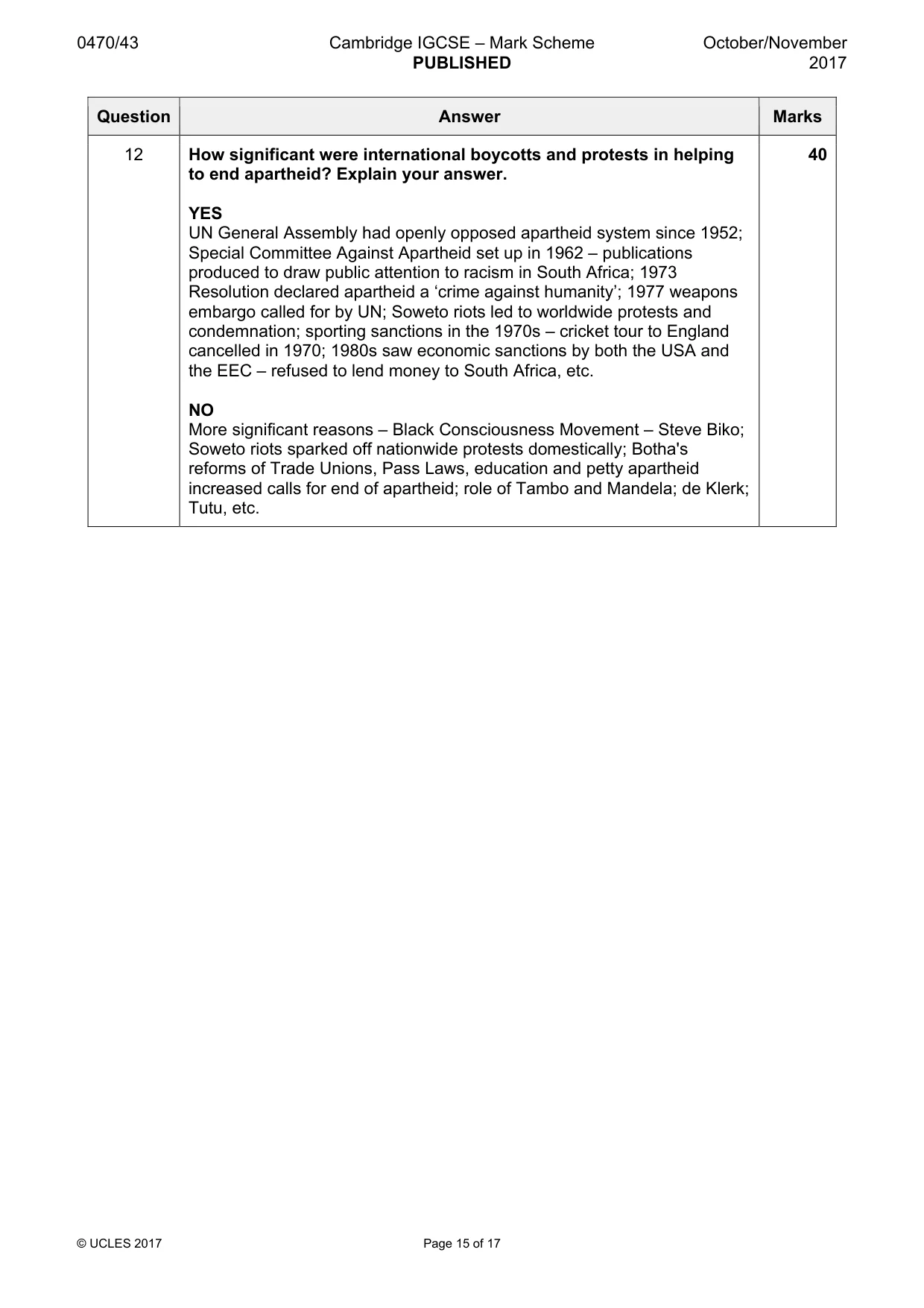
0470/43 Cambridge IGCSE – Mark Scheme PUBLISHED October/November 2017 © UCLES 2017 Page 15 of 17 Question Answer Marks 12 How significant were international boycotts and protests in helping to end apartheid? Explain your answer. YES UN General Assembly had openly opposed apartheid system since 1952; Special Committee Against Apartheid set up in 1962 – publications produced to draw public attention to racism in South Africa; 1973 Resolution declared apartheid a ‘crime against humanity’; 1977 weapons embargo called for by UN; Soweto riots led to worldwide protests and condemnation; sporting sanctions in the 1970s – cricket tour to England cancelled in 1970; 1980s saw economic sanctions by both the USA and the EEC – refused to lend money to South Africa, etc. NO More significant reasons – Black Consciousness Movement – Steve Biko; Soweto riots sparked off nationwide protests domestically; Botha's reforms of Trade Unions, Pass Laws, education and petty apartheid increased calls for end of apartheid; role of Tambo and Mandela; de Klerk; Tutu, etc. 40
Mark scheme, page 16
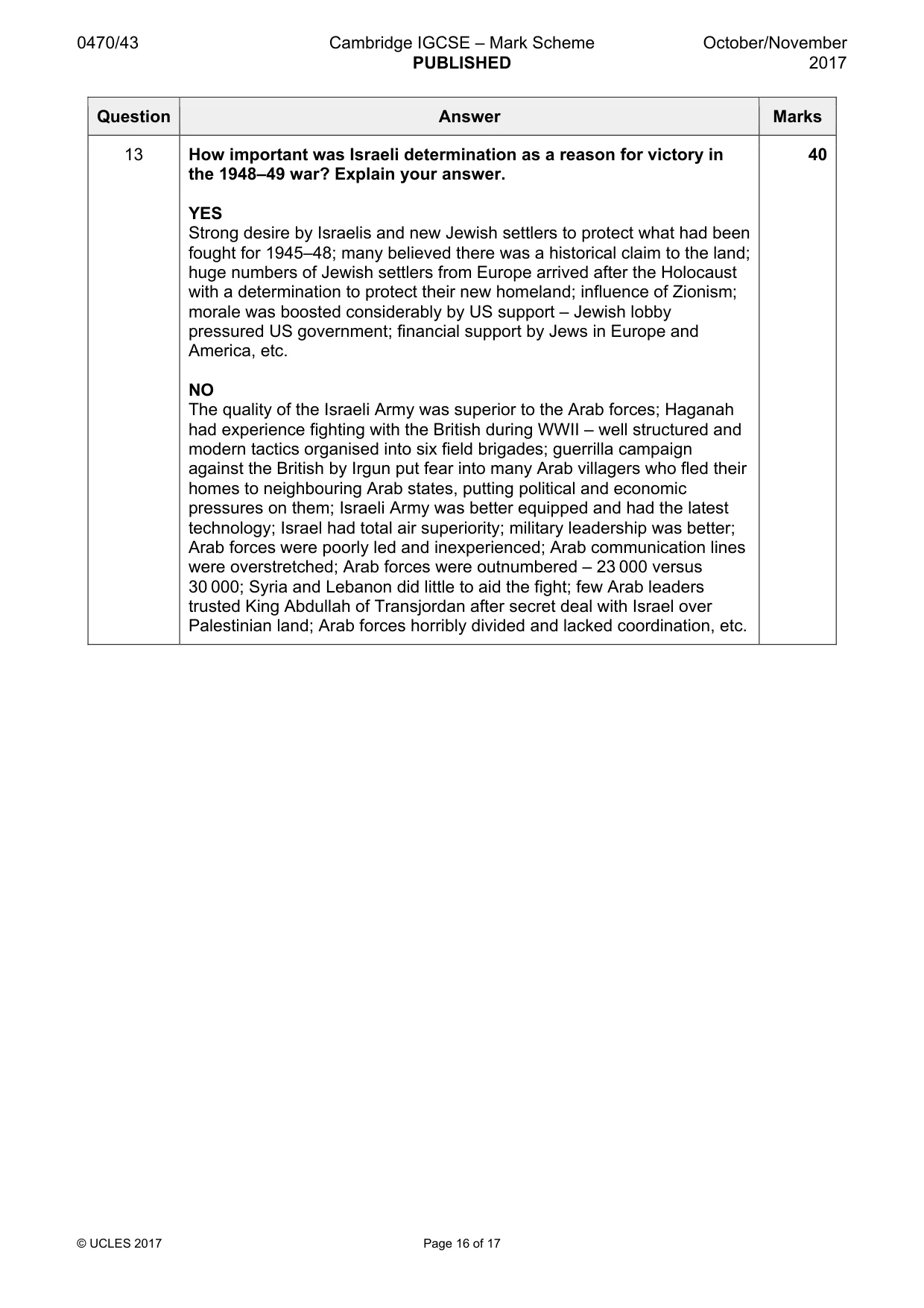
0470/43 Cambridge IGCSE – Mark Scheme PUBLISHED October/November 2017 © UCLES 2017 Page 16 of 17 Question Answer Marks 13 How important was Israeli determination as a reason for victory in the 1948–49 war? Explain your answer. YES Strong desire by Israelis and new Jewish settlers to protect what had been fought for 1945–48; many believed there was a historical claim to the land; huge numbers of Jewish settlers from Europe arrived after the Holocaust with a determination to protect their new homeland; influence of Zionism; morale was boosted considerably by US support – Jewish lobby pressured US government; financial support by Jews in Europe and America, etc. NO The quality of the Israeli Army was superior to the Arab forces; Haganah had experience fighting with the British during WWII – well structured and modern tactics organised into six field brigades; guerrilla campaign against the British by Irgun put fear into many Arab villagers who fled their homes to neighbouring Arab states, putting political and economic pressures on them; Israeli Army was better equipped and had the latest technology; Israel had total air superiority; military leadership was better; Arab forces were poorly led and inexperienced; Arab communication lines were overstretched; Arab forces were outnumbered – 23 000 versus 30 000; Syria and Lebanon did little to aid the fight; few Arab leaders trusted King Abdullah of Transjordan after secret deal with Israel over Palestinian land; Arab forces horribly divided and lacked coordination, etc. 40
Mark scheme, page 17
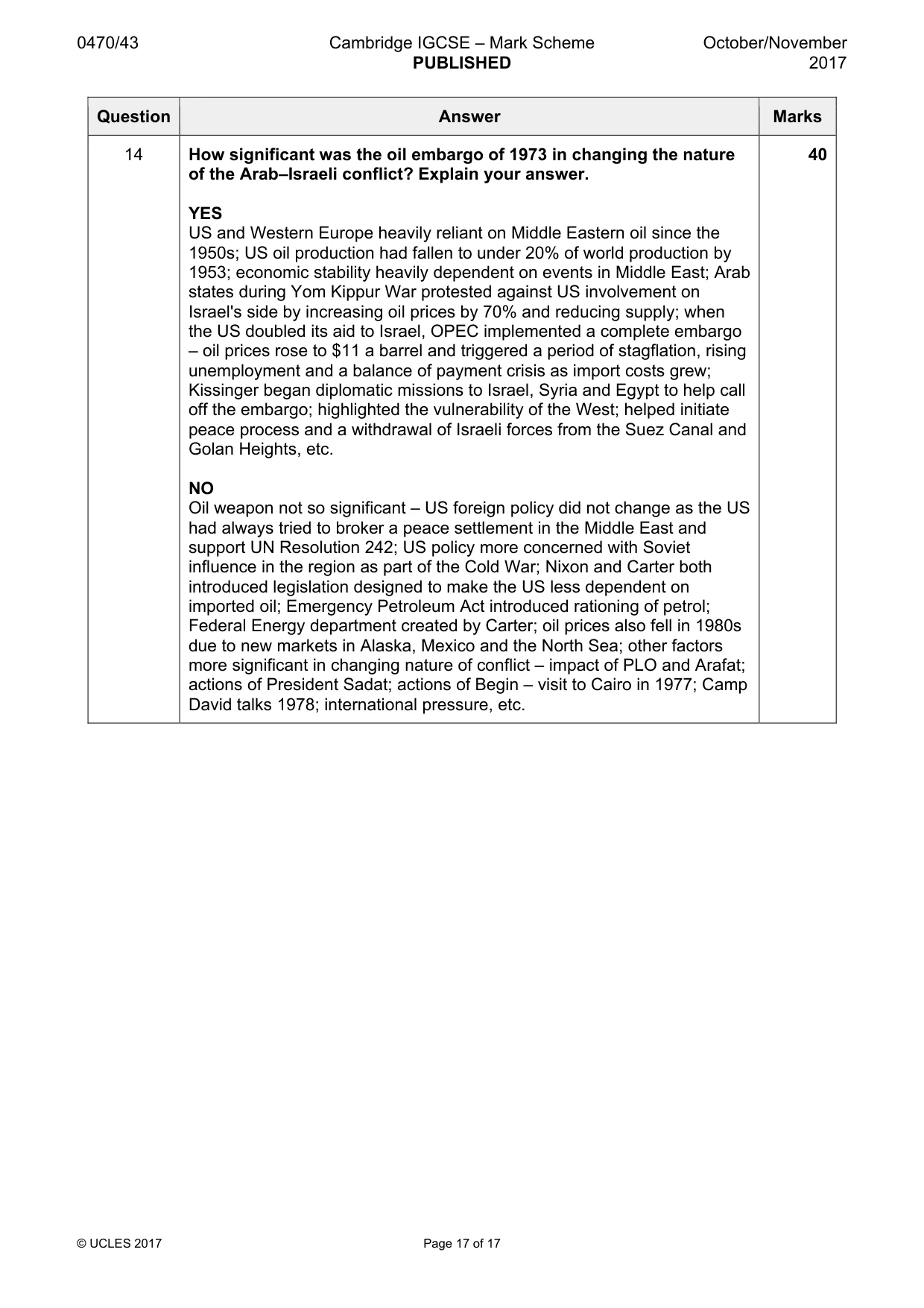
0470/43 Cambridge IGCSE – Mark Scheme PUBLISHED October/November 2017 © UCLES 2017 Page 17 of 17 Question Answer Marks 14 How significant was the oil embargo of 1973 in changing the nature of the Arab–Israeli conflict? Explain your answer. YES US and Western Europe heavily reliant on Middle Eastern oil since the 1950s; US oil production had fallen to under 20% of world production by 1953; economic stability heavily dependent on events in Middle East; Arab states during Yom Kippur War protested against US involvement on Israel's side by increasing oil prices by 70% and reducing supply; when the US doubled its aid to Israel, OPEC implemented a complete embargo – oil prices rose to $11 a barrel and triggered a period of stagflation, rising unemployment and a balance of payment crisis as import costs grew; Kissinger began diplomatic missions to Israel, Syria and Egypt to help call off the embargo; highlighted the vulnerability of the West; helped initiate peace process and a withdrawal of Israeli forces from the Suez Canal and Golan Heights, etc. NO Oil weapon not so significant – US foreign policy did not change as the US had always tried to broker a peace settlement in the Middle East and support UN Resolution 242; US policy more concerned with Soviet influence in the region as part of the Cold War; Nixon and Carter both introduced legislation designed to make the US less dependent on imported oil; Emergency Petroleum Act introduced rationing of petrol; Federal Energy department created by Carter; oil prices also fell in 1980s due to new markets in Alaska, Mexico and the North Sea; other factors more significant in changing nature of conflict – impact of PLO and Arafat; actions of President Sadat; actions of Begin – visit to Cairo in 1977; Camp David talks 1978; international pressure, etc. 40
What you needed in this session
Cambridge’s own grade thresholds for 2017 Oct/Nov, Paper 4 · Variant 3. A higher threshold means an easier paper — the bar moves with how the cohort did.