Cambridge IGCSE History 0470 — 2017 Oct/Nov Paper 4 · Variant 2
0470/42/O/N/17 · 40 marks · ≈45 min
The question paper and its mark scheme, free to read here and free to download. This is Cambridge’s own paper, exactly as it was sat.
Question paper4 pages

Mark scheme12 pages
Answers below. Sit the paper first if you are practising.
Paper as text
Question paper, page 1
Cambridge International Examinations Cambridge International General Certificate of Secondary Education 0470/42 October/November 2017 1 hour HISTORY Paper 4 Alternative to Coursework Additional Materials: Answer Booklet/Paper READ THESE INSTRUCTIONS FIRST An answer booklet is provided inside this question paper. You should follow the instructions on the front cover of the answer booklet. If you need additional answer paper ask the invigilator for a continuation booklet. Answer one question from your chosen Depth Study. The number of marks is given in brackets [ ] at the end of each question or part question. The syllabus is approved for use in England, Wales and Northern Ireland as a Cambridge International Level 1/Level 2 Certificate. This document consists of 3 printed pages and 1 blank page. [Turn over 11_0470_42_2017_1.8 © UCLES 2017 *2582500214*
Question paper, page 2
Answer one question from your chosen Depth Study. DEPTH STUDY A: THE FIRST WORLD WAR, 1914–1918 How important was poor intelligence as a reason for the huge losses in the Battle of the Somme? Explain your answer. [40] 1 How significant was the Treaty of Brest-Litovsk to the outcome of the First World War? Explain your answer. [40] 2 DEPTH STUDY B: GERMANY, 1918–1945 How significant were violence and intimidation in allowing Hitler to control Germany by 1934? Explain your answer. [40] 3 How important were policies towards the workers to the popularity of the Nazi regime by 1939? Explain your answer. [40] 4 DEPTH STUDY C: RUSSIA, 1905–1941 How significant were the social and economic effects of the war in allowing the Bolsheviks to increase their popularity? Explain your answer. [40] 5 How important was national security as a reason for Stalin’s economic policies? Explain your answer. [40] 6 DEPTH STUDY D: THE USA, 1919–1941 How important was confidence in the economy as a cause of prosperity in the 1920s? Explain your answer. [40] 7 How significant was political opposition in weakening the impact of the New Deal? Explain your answer. [40] 8 DEPTH STUDY E: CHINA, c.1930–c.1990 How important were improvements in women’s lives in the social changes brought about by the Chinese Communist Party? Explain your answer. [40] 9 How significant to China’s international relations was the spreading of communist ideas? Explain your answer. [40] 10 11_0470_42_2017_1.8 © UCLES 2017 2
Question paper, page 3
DEPTH STUDY F: SOUTH AFRICA, c.1940–c.1994 How significant was segregation in education as a feature of apartheid? Explain your answer. [40] 11 How important was the policy of ‘Total Strategy’ as a reason for the growing opposition in the 1980s to white minority rule? Explain your answer. [40] 12 DEPTH STUDY G: ISRAELIS AND PALESTINIANS SINCE 1945 How important were the conditions in the Palestinian refugee camps as a reason for the development of Palestinian nationalism? Explain your answer. [40] 13 How significant was Hamas as a cause of the breakdown of the peace process between Israelis and Palestinians? Explain your answer. [40] 14 11_0470_42_2017_1.8 © UCLES 2017 3
Question paper, page 4
BLANK PAGE Permission to reproduce items where third-party owned material protected by copyright is included has been sought and cleared where possible. Every reasonable effort has been made by the publisher (UCLES) to trace copyright holders, but if any items requiring clearance have unwittingly been included, the publisher will be pleased to make amends at the earliest possible opportunity. To avoid the issue of disclosure of answer-related information to candidates, all copyright acknowledgements are reproduced online in the Cambridge International Examinations Copyright Acknowledgements Booklet. This is produced for each series of examinations and is freely available to download at www.cie.org.uk after the live examination series. Cambridge International Examinations is part of the Cambridge Assessment Group. Cambridge Assessment is the brand name of University of Cambridge Local Examinations Syndicate (UCLES), which is itself a department of the University of Cambridge. 11_0470_42_2017_1.8 © UCLES 2017 4
Mark scheme, page 1
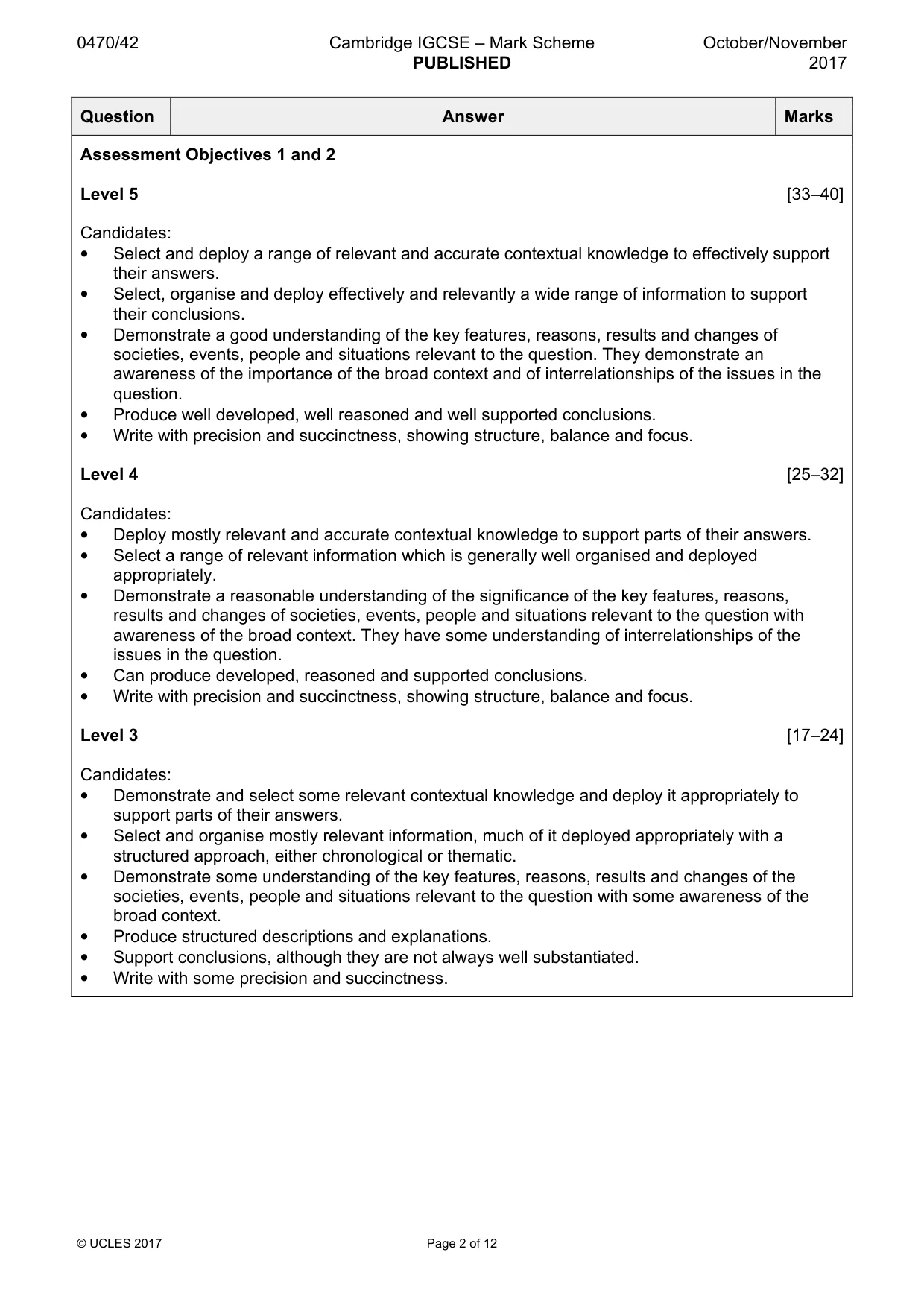
® IGCSE is a registered trademark. This syllabus is approved for use in England, Wales and Northern Ireland as a Cambridge International Level 1/Level 2 Certificate. This document consists of 12 printed pages. © UCLES 2017 [Turn over Cambridge Assessment International Education Cambridge International General Certificate of Secondary Education HISTORY 0470/42 Paper 4 Alternative to Coursework October/November 2017 MARK SCHEME Maximum Mark: 40 Published This mark scheme is published as an aid to teachers and candidates, to indicate the requirements of the examination. It shows the basis on which Examiners were instructed to award marks. It does not indicate the details of the discussions that took place at an Examiners’ meeting before marking began, which would have considered the acceptability of alternative answers. Mark schemes should be read in conjunction with the question paper and the Principal Examiner Report for Teachers. Cambridge International will not enter into discussions about these mark schemes. Cambridge International is publishing the mark schemes for the October/November 2017 series for most Cambridge IGCSE®, Cambridge International A and AS Level components and some Cambridge O Level components.
Mark scheme, page 2
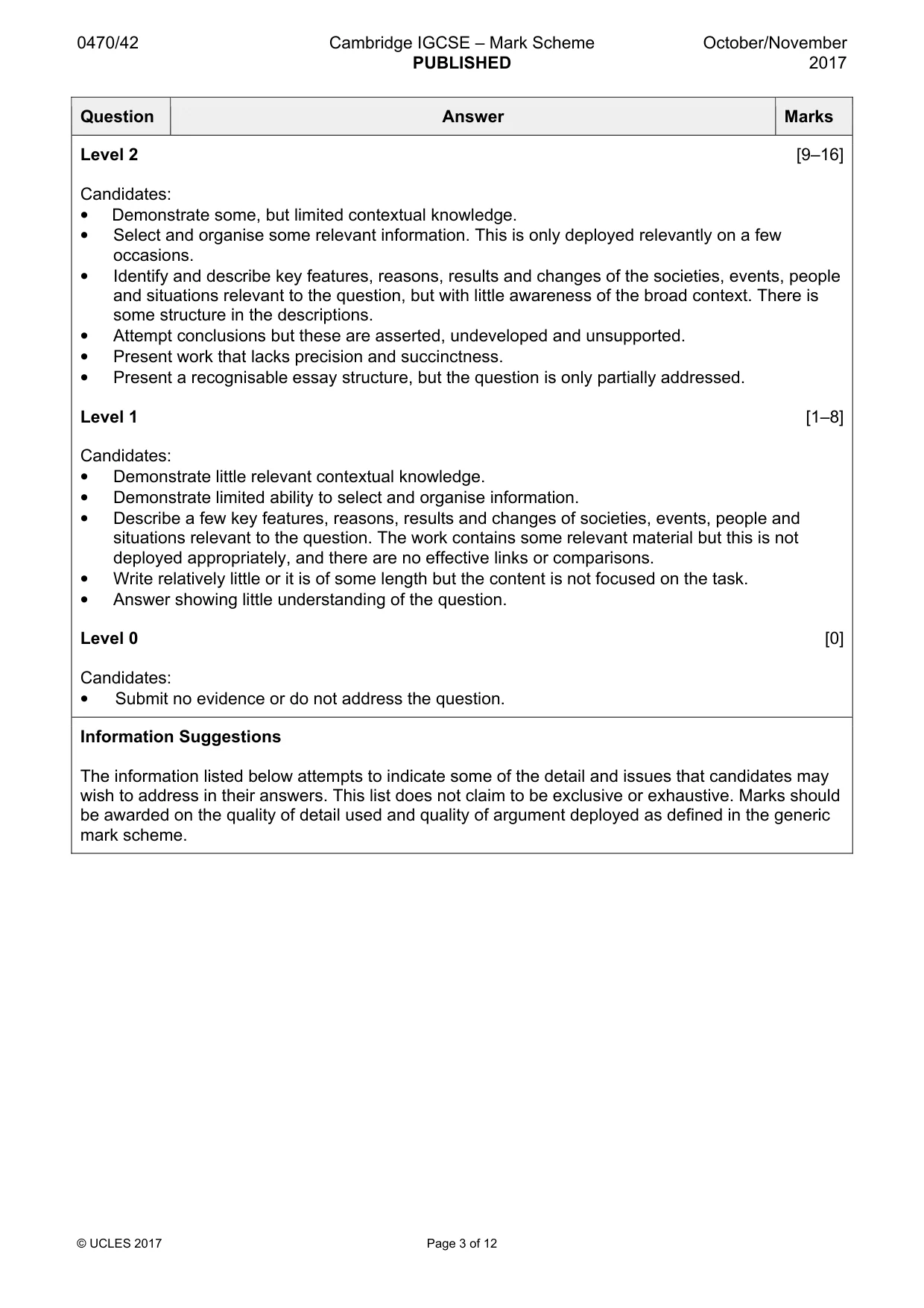
0470/42 Cambridge IGCSE – Mark Scheme PUBLISHED October/November 2017 © UCLES 2017 Page 2 of 12 Question Answer Marks Assessment Objectives 1 and 2 Level 5 [33–40] Candidates: • Select and deploy a range of relevant and accurate contextual knowledge to effectively support their answers. • Select, organise and deploy effectively and relevantly a wide range of information to support their conclusions. • Demonstrate a good understanding of the key features, reasons, results and changes of societies, events, people and situations relevant to the question. They demonstrate an awareness of the importance of the broad context and of interrelationships of the issues in the question. • Produce well developed, well reasoned and well supported conclusions. • Write with precision and succinctness, showing structure, balance and focus. Level 4 [25–32] Candidates: • Deploy mostly relevant and accurate contextual knowledge to support parts of their answers. • Select a range of relevant information which is generally well organised and deployed appropriately. • Demonstrate a reasonable understanding of the significance of the key features, reasons, results and changes of societies, events, people and situations relevant to the question with awareness of the broad context. They have some understanding of interrelationships of the issues in the question. • Can produce developed, reasoned and supported conclusions. • Write with precision and succinctness, showing structure, balance and focus. Level 3 [17–24] Candidates: • Demonstrate and select some relevant contextual knowledge and deploy it appropriately to support parts of their answers. • Select and organise mostly relevant information, much of it deployed appropriately with a structured approach, either chronological or thematic. • Demonstrate some understanding of the key features, reasons, results and changes of the societies, events, people and situations relevant to the question with some awareness of the broad context. • Produce structured descriptions and explanations. • Support conclusions, although they are not always well substantiated. • Write with some precision and succinctness.
Mark scheme, page 3
0470/42 Cambridge IGCSE – Mark Scheme PUBLISHED October/November 2017 © UCLES 2017 Page 3 of 12 Question Answer Marks Level 2 [9–16] Candidates: • Demonstrate some, but limited contextual knowledge. • Select and organise some relevant information. This is only deployed relevantly on a few occasions. • Identify and describe key features, reasons, results and changes of the societies, events, people and situations relevant to the question, but with little awareness of the broad context. There is some structure in the descriptions. • Attempt conclusions but these are asserted, undeveloped and unsupported. • Present work that lacks precision and succinctness. • Present a recognisable essay structure, but the question is only partially addressed. Level 1 [1–8] Candidates: • Demonstrate little relevant contextual knowledge. • Demonstrate limited ability to select and organise information. • Describe a few key features, reasons, results and changes of societies, events, people and situations relevant to the question. The work contains some relevant material but this is not deployed appropriately, and there are no effective links or comparisons. • Write relatively little or it is of some length but the content is not focused on the task. • Answer showing little understanding of the question. Level 0 [0] Candidates: • Submit no evidence or do not address the question. Information Suggestions The information listed below attempts to indicate some of the detail and issues that candidates may wish to address in their answers. This list does not claim to be exclusive or exhaustive. Marks should be awarded on the quality of detail used and quality of argument deployed as defined in the generic mark scheme.
Mark scheme, page 4
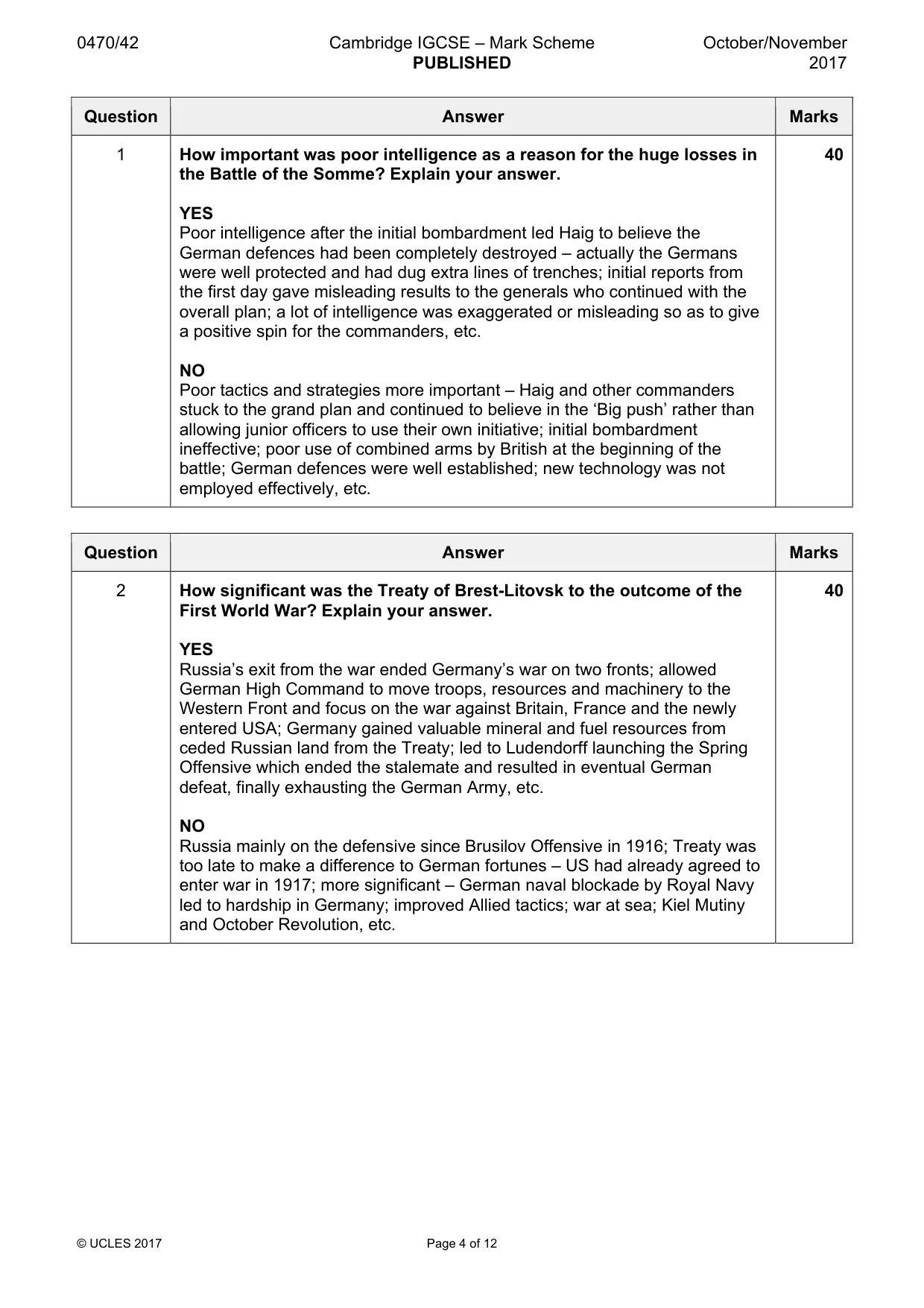
0470/42 Cambridge IGCSE – Mark Scheme PUBLISHED October/November 2017 © UCLES 2017 Page 4 of 12 Question Answer Marks 1 How important was poor intelligence as a reason for the huge losses in the Battle of the Somme? Explain your answer. YES Poor intelligence after the initial bombardment led Haig to believe the German defences had been completely destroyed – actually the Germans were well protected and had dug extra lines of trenches; initial reports from the first day gave misleading results to the generals who continued with the overall plan; a lot of intelligence was exaggerated or misleading so as to give a positive spin for the commanders, etc. NO Poor tactics and strategies more important – Haig and other commanders stuck to the grand plan and continued to believe in the ‘Big push’ rather than allowing junior officers to use their own initiative; initial bombardment ineffective; poor use of combined arms by British at the beginning of the battle; German defences were well established; new technology was not employed effectively, etc. 40 Question Answer Marks 2 How significant was the Treaty of Brest-Litovsk to the outcome of the First World War? Explain your answer. YES Russia’s exit from the war ended Germany’s war on two fronts; allowed German High Command to move troops, resources and machinery to the Western Front and focus on the war against Britain, France and the newly entered USA; Germany gained valuable mineral and fuel resources from ceded Russian land from the Treaty; led to Ludendorff launching the Spring Offensive which ended the stalemate and resulted in eventual German defeat, finally exhausting the German Army, etc. NO Russia mainly on the defensive since Brusilov Offensive in 1916; Treaty was too late to make a difference to German fortunes – US had already agreed to enter war in 1917; more significant – German naval blockade by Royal Navy led to hardship in Germany; improved Allied tactics; war at sea; Kiel Mutiny and October Revolution, etc. 40
Mark scheme, page 5
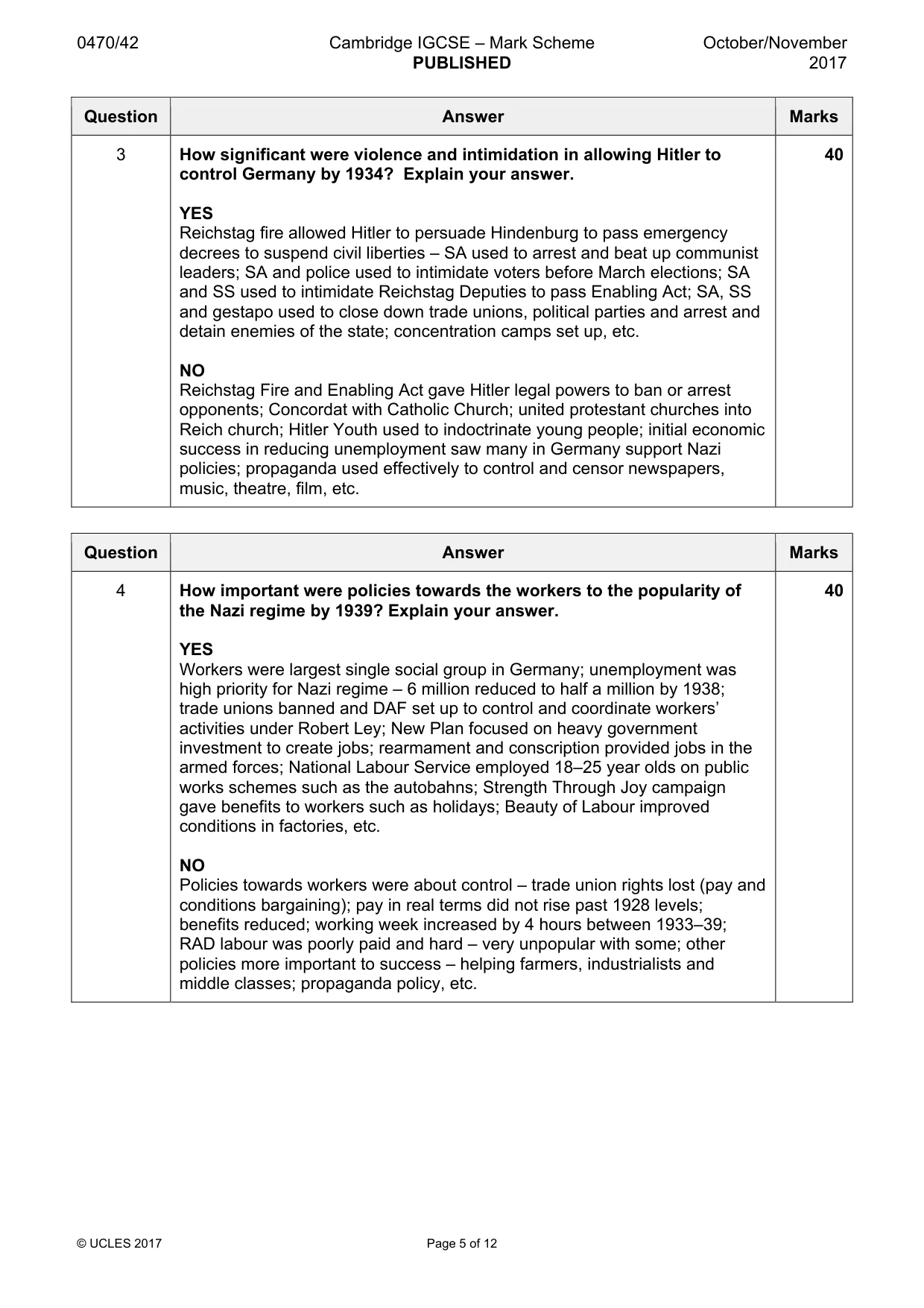
0470/42 Cambridge IGCSE – Mark Scheme PUBLISHED October/November 2017 © UCLES 2017 Page 5 of 12 Question Answer Marks 3 How significant were violence and intimidation in allowing Hitler to control Germany by 1934? Explain your answer. YES Reichstag fire allowed Hitler to persuade Hindenburg to pass emergency decrees to suspend civil liberties – SA used to arrest and beat up communist leaders; SA and police used to intimidate voters before March elections; SA and SS used to intimidate Reichstag Deputies to pass Enabling Act; SA, SS and gestapo used to close down trade unions, political parties and arrest and detain enemies of the state; concentration camps set up, etc. NO Reichstag Fire and Enabling Act gave Hitler legal powers to ban or arrest opponents; Concordat with Catholic Church; united protestant churches into Reich church; Hitler Youth used to indoctrinate young people; initial economic success in reducing unemployment saw many in Germany support Nazi policies; propaganda used effectively to control and censor newspapers, music, theatre, film, etc. 40 Question Answer Marks 4 How important were policies towards the workers to the popularity of the Nazi regime by 1939? Explain your answer. YES Workers were largest single social group in Germany; unemployment was high priority for Nazi regime – 6 million reduced to half a million by 1938; trade unions banned and DAF set up to control and coordinate workers’ activities under Robert Ley; New Plan focused on heavy government investment to create jobs; rearmament and conscription provided jobs in the armed forces; National Labour Service employed 18–25 year olds on public works schemes such as the autobahns; Strength Through Joy campaign gave benefits to workers such as holidays; Beauty of Labour improved conditions in factories, etc. NO Policies towards workers were about control – trade union rights lost (pay and conditions bargaining); pay in real terms did not rise past 1928 levels; benefits reduced; working week increased by 4 hours between 1933–39; RAD labour was poorly paid and hard – very unpopular with some; other policies more important to success – helping farmers, industrialists and middle classes; propaganda policy, etc. 40
Mark scheme, page 6
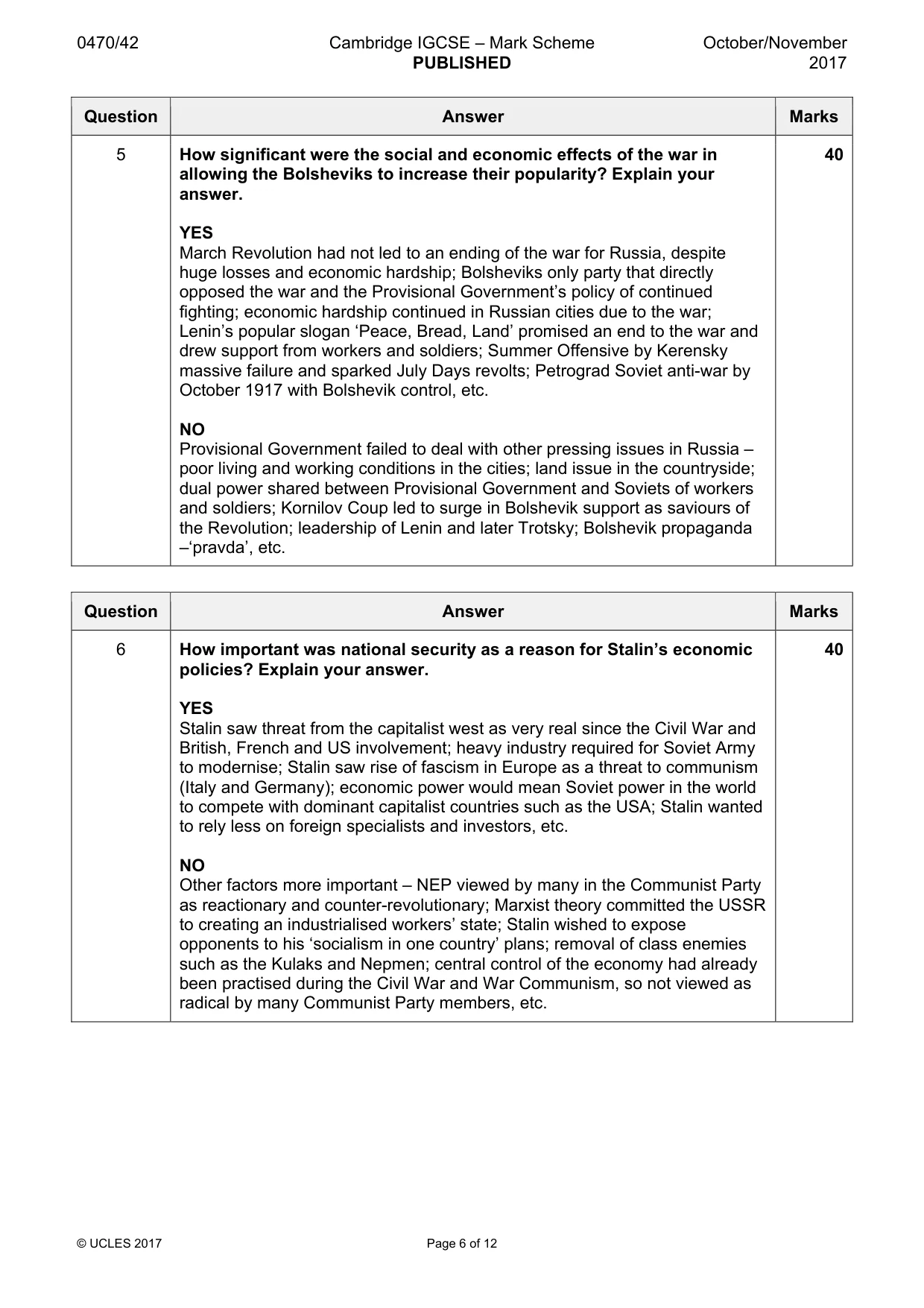
0470/42 Cambridge IGCSE – Mark Scheme PUBLISHED October/November 2017 © UCLES 2017 Page 6 of 12 Question Answer Marks 5 How significant were the social and economic effects of the war in allowing the Bolsheviks to increase their popularity? Explain your answer. YES March Revolution had not led to an ending of the war for Russia, despite huge losses and economic hardship; Bolsheviks only party that directly opposed the war and the Provisional Government’s policy of continued fighting; economic hardship continued in Russian cities due to the war; Lenin’s popular slogan ‘Peace, Bread, Land’ promised an end to the war and drew support from workers and soldiers; Summer Offensive by Kerensky massive failure and sparked July Days revolts; Petrograd Soviet anti-war by October 1917 with Bolshevik control, etc. NO Provisional Government failed to deal with other pressing issues in Russia – poor living and working conditions in the cities; land issue in the countryside; dual power shared between Provisional Government and Soviets of workers and soldiers; Kornilov Coup led to surge in Bolshevik support as saviours of the Revolution; leadership of Lenin and later Trotsky; Bolshevik propaganda –‘pravda’, etc. 40 Question Answer Marks 6 How important was national security as a reason for Stalin’s economic policies? Explain your answer. YES Stalin saw threat from the capitalist west as very real since the Civil War and British, French and US involvement; heavy industry required for Soviet Army to modernise; Stalin saw rise of fascism in Europe as a threat to communism (Italy and Germany); economic power would mean Soviet power in the world to compete with dominant capitalist countries such as the USA; Stalin wanted to rely less on foreign specialists and investors, etc. NO Other factors more important – NEP viewed by many in the Communist Party as reactionary and counter-revolutionary; Marxist theory committed the USSR to creating an industrialised workers’ state; Stalin wished to expose opponents to his ‘socialism in one country’ plans; removal of class enemies such as the Kulaks and Nepmen; central control of the economy had already been practised during the Civil War and War Communism, so not viewed as radical by many Communist Party members, etc. 40
Mark scheme, page 7
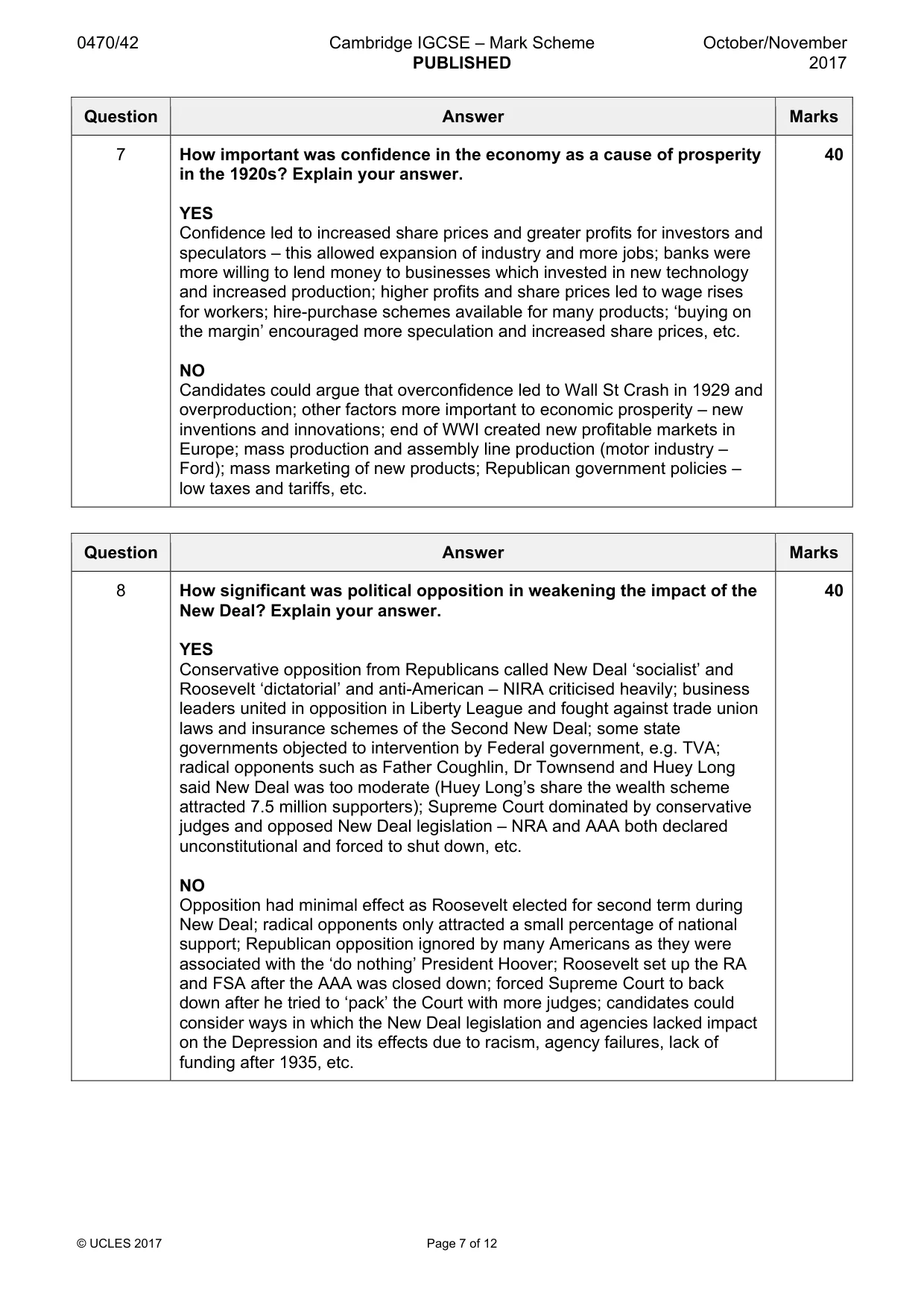
0470/42 Cambridge IGCSE – Mark Scheme PUBLISHED October/November 2017 © UCLES 2017 Page 7 of 12 Question Answer Marks 7 How important was confidence in the economy as a cause of prosperity in the 1920s? Explain your answer. YES Confidence led to increased share prices and greater profits for investors and speculators – this allowed expansion of industry and more jobs; banks were more willing to lend money to businesses which invested in new technology and increased production; higher profits and share prices led to wage rises for workers; hire-purchase schemes available for many products; ‘buying on the margin’ encouraged more speculation and increased share prices, etc. NO Candidates could argue that overconfidence led to Wall St Crash in 1929 and overproduction; other factors more important to economic prosperity – new inventions and innovations; end of WWI created new profitable markets in Europe; mass production and assembly line production (motor industry – Ford); mass marketing of new products; Republican government policies – low taxes and tariffs, etc. 40 Question Answer Marks 8 How significant was political opposition in weakening the impact of the New Deal? Explain your answer. YES Conservative opposition from Republicans called New Deal ‘socialist’ and Roosevelt ‘dictatorial’ and anti-American – NIRA criticised heavily; business leaders united in opposition in Liberty League and fought against trade union laws and insurance schemes of the Second New Deal; some state governments objected to intervention by Federal government, e.g. TVA; radical opponents such as Father Coughlin, Dr Townsend and Huey Long said New Deal was too moderate (Huey Long’s share the wealth scheme attracted 7.5 million supporters); Supreme Court dominated by conservative judges and opposed New Deal legislation – NRA and AAA both declared unconstitutional and forced to shut down, etc. NO Opposition had minimal effect as Roosevelt elected for second term during New Deal; radical opponents only attracted a small percentage of national support; Republican opposition ignored by many Americans as they were associated with the ‘do nothing’ President Hoover; Roosevelt set up the RA and FSA after the AAA was closed down; forced Supreme Court to back down after he tried to ‘pack’ the Court with more judges; candidates could consider ways in which the New Deal legislation and agencies lacked impact on the Depression and its effects due to racism, agency failures, lack of funding after 1935, etc. 40
Mark scheme, page 8
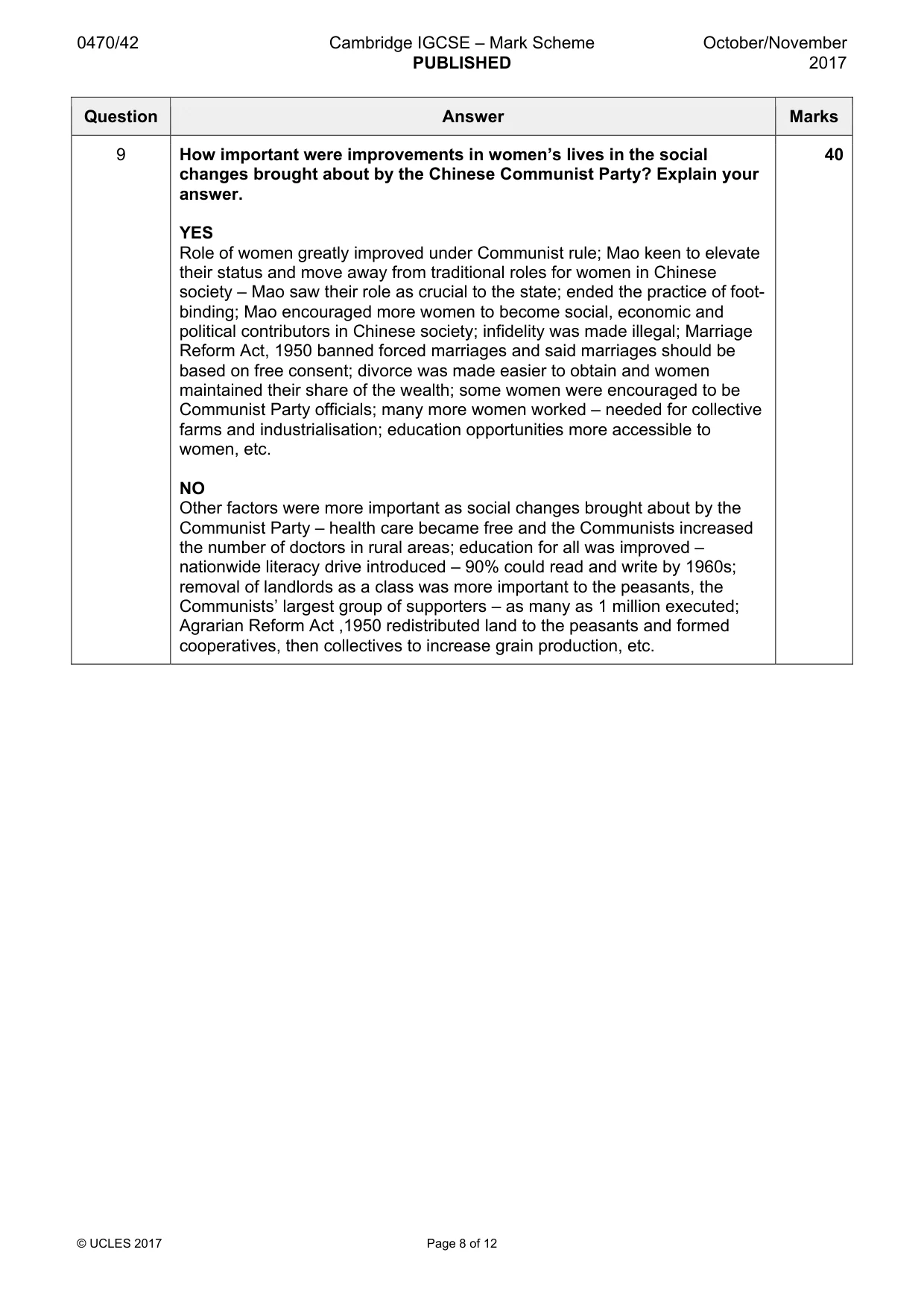
0470/42 Cambridge IGCSE – Mark Scheme PUBLISHED October/November 2017 © UCLES 2017 Page 8 of 12 Question Answer Marks 9 How important were improvements in women’s lives in the social changes brought about by the Chinese Communist Party? Explain your answer. YES Role of women greatly improved under Communist rule; Mao keen to elevate their status and move away from traditional roles for women in Chinese society – Mao saw their role as crucial to the state; ended the practice of foot- binding; Mao encouraged more women to become social, economic and political contributors in Chinese society; infidelity was made illegal; Marriage Reform Act, 1950 banned forced marriages and said marriages should be based on free consent; divorce was made easier to obtain and women maintained their share of the wealth; some women were encouraged to be Communist Party officials; many more women worked – needed for collective farms and industrialisation; education opportunities more accessible to women, etc. NO Other factors were more important as social changes brought about by the Communist Party – health care became free and the Communists increased the number of doctors in rural areas; education for all was improved – nationwide literacy drive introduced – 90% could read and write by 1960s; removal of landlords as a class was more important to the peasants, the Communists’ largest group of supporters – as many as 1 million executed; Agrarian Reform Act ,1950 redistributed land to the peasants and formed cooperatives, then collectives to increase grain production, etc. 40
Mark scheme, page 9
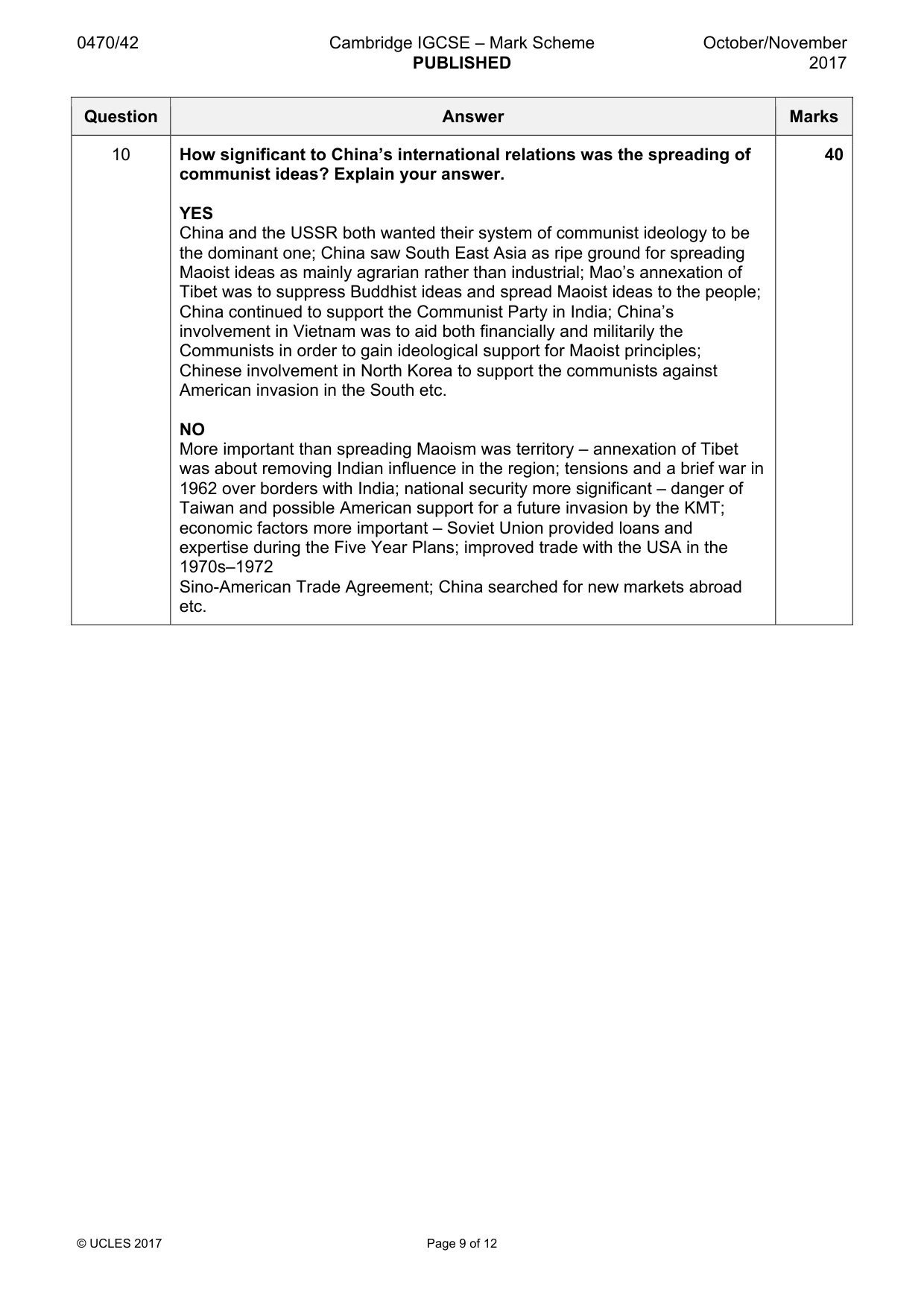
0470/42 Cambridge IGCSE – Mark Scheme PUBLISHED October/November 2017 © UCLES 2017 Page 9 of 12 Question Answer Marks 10 How significant to China’s international relations was the spreading of communist ideas? Explain your answer. YES China and the USSR both wanted their system of communist ideology to be the dominant one; China saw South East Asia as ripe ground for spreading Maoist ideas as mainly agrarian rather than industrial; Mao’s annexation of Tibet was to suppress Buddhist ideas and spread Maoist ideas to the people; China continued to support the Communist Party in India; China’s involvement in Vietnam was to aid both financially and militarily the Communists in order to gain ideological support for Maoist principles; Chinese involvement in North Korea to support the communists against American invasion in the South etc. NO More important than spreading Maoism was territory – annexation of Tibet was about removing Indian influence in the region; tensions and a brief war in 1962 over borders with India; national security more significant – danger of Taiwan and possible American support for a future invasion by the KMT; economic factors more important – Soviet Union provided loans and expertise during the Five Year Plans; improved trade with the USA in the 1970s–1972 Sino-American Trade Agreement; China searched for new markets abroad etc. 40
Mark scheme, page 10
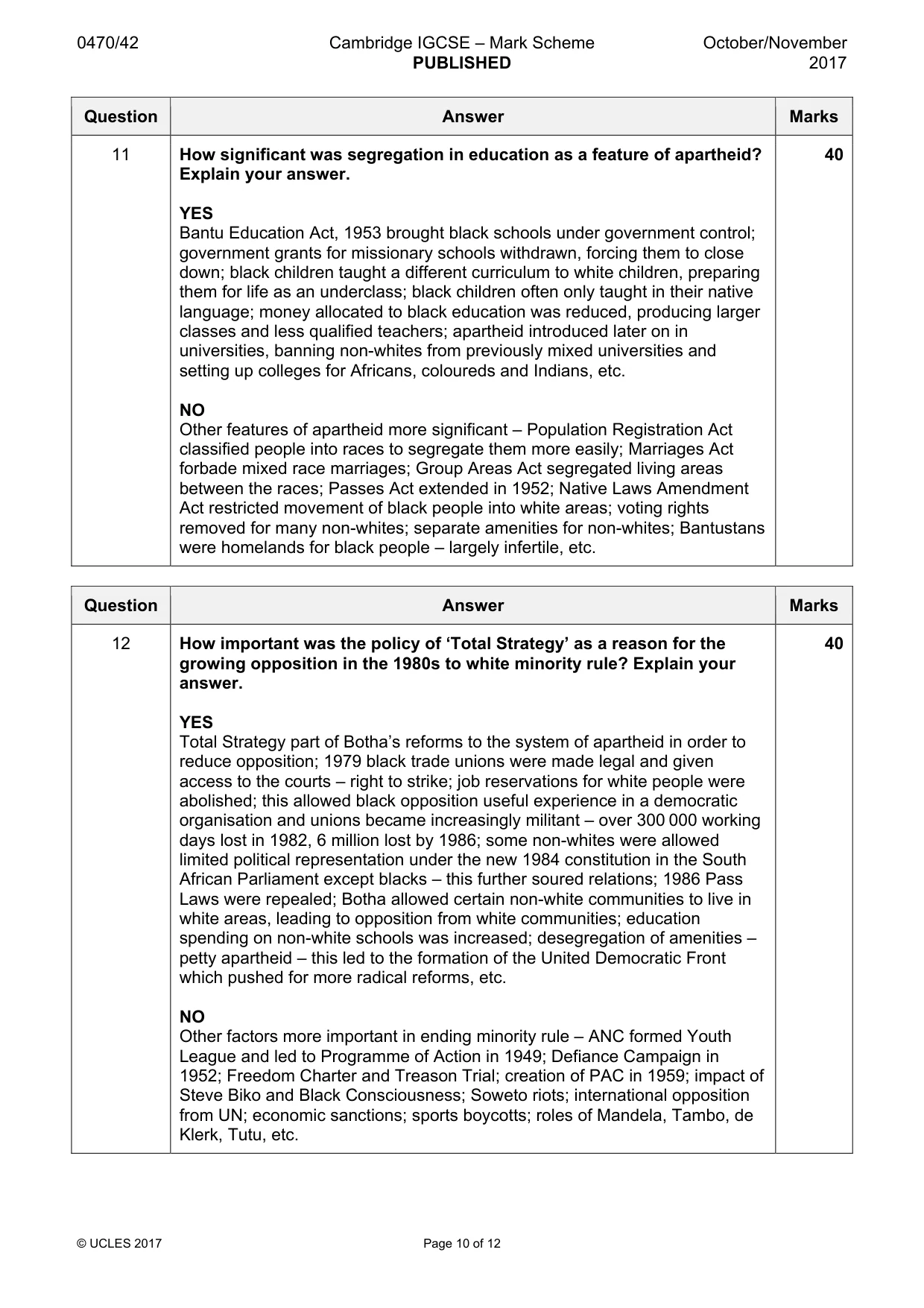
0470/42 Cambridge IGCSE – Mark Scheme PUBLISHED October/November 2017 © UCLES 2017 Page 10 of 12 Question Answer Marks 11 How significant was segregation in education as a feature of apartheid? Explain your answer. YES Bantu Education Act, 1953 brought black schools under government control; government grants for missionary schools withdrawn, forcing them to close down; black children taught a different curriculum to white children, preparing them for life as an underclass; black children often only taught in their native language; money allocated to black education was reduced, producing larger classes and less qualified teachers; apartheid introduced later on in universities, banning non-whites from previously mixed universities and setting up colleges for Africans, coloureds and Indians, etc. NO Other features of apartheid more significant – Population Registration Act classified people into races to segregate them more easily; Marriages Act forbade mixed race marriages; Group Areas Act segregated living areas between the races; Passes Act extended in 1952; Native Laws Amendment Act restricted movement of black people into white areas; voting rights removed for many non-whites; separate amenities for non-whites; Bantustans were homelands for black people – largely infertile, etc. 40 Question Answer Marks 12 How important was the policy of ‘Total Strategy’ as a reason for the growing opposition in the 1980s to white minority rule? Explain your answer. YES Total Strategy part of Botha’s reforms to the system of apartheid in order to reduce opposition; 1979 black trade unions were made legal and given access to the courts – right to strike; job reservations for white people were abolished; this allowed black opposition useful experience in a democratic organisation and unions became increasingly militant – over 300 000 working days lost in 1982, 6 million lost by 1986; some non-whites were allowed limited political representation under the new 1984 constitution in the South African Parliament except blacks – this further soured relations; 1986 Pass Laws were repealed; Botha allowed certain non-white communities to live in white areas, leading to opposition from white communities; education spending on non-white schools was increased; desegregation of amenities – petty apartheid – this led to the formation of the United Democratic Front which pushed for more radical reforms, etc. NO Other factors more important in ending minority rule – ANC formed Youth League and led to Programme of Action in 1949; Defiance Campaign in 1952; Freedom Charter and Treason Trial; creation of PAC in 1959; impact of Steve Biko and Black Consciousness; Soweto riots; international opposition from UN; economic sanctions; sports boycotts; roles of Mandela, Tambo, de Klerk, Tutu, etc. 40
Mark scheme, page 11
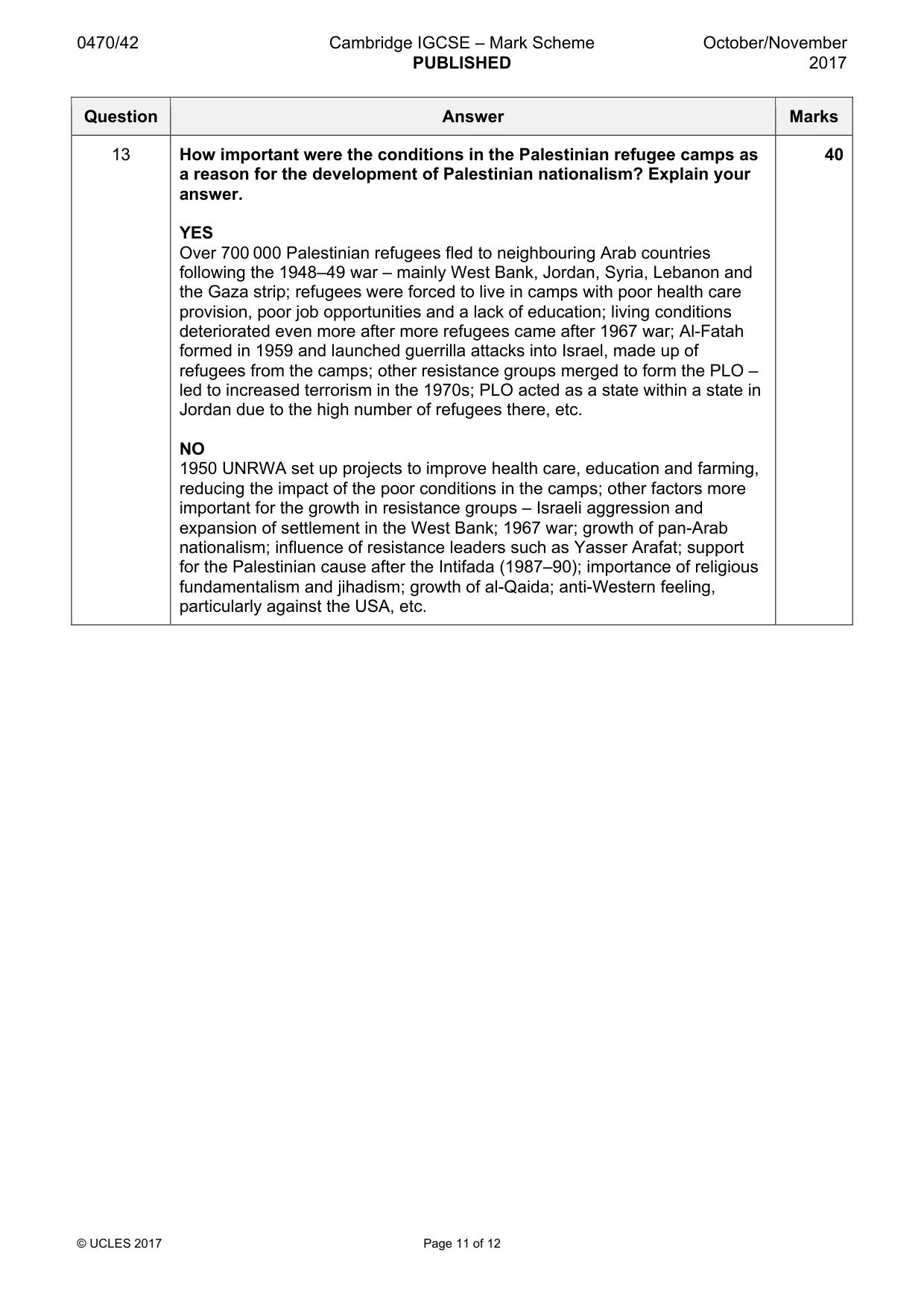
0470/42 Cambridge IGCSE – Mark Scheme PUBLISHED October/November 2017 © UCLES 2017 Page 11 of 12 Question Answer Marks 13 How important were the conditions in the Palestinian refugee camps as a reason for the development of Palestinian nationalism? Explain your answer. YES Over 700 000 Palestinian refugees fled to neighbouring Arab countries following the 1948–49 war – mainly West Bank, Jordan, Syria, Lebanon and the Gaza strip; refugees were forced to live in camps with poor health care provision, poor job opportunities and a lack of education; living conditions deteriorated even more after more refugees came after 1967 war; Al-Fatah formed in 1959 and launched guerrilla attacks into Israel, made up of refugees from the camps; other resistance groups merged to form the PLO – led to increased terrorism in the 1970s; PLO acted as a state within a state in Jordan due to the high number of refugees there, etc. NO 1950 UNRWA set up projects to improve health care, education and farming, reducing the impact of the poor conditions in the camps; other factors more important for the growth in resistance groups – Israeli aggression and expansion of settlement in the West Bank; 1967 war; growth of pan-Arab nationalism; influence of resistance leaders such as Yasser Arafat; support for the Palestinian cause after the Intifada (1987–90); importance of religious fundamentalism and jihadism; growth of al-Qaida; anti-Western feeling, particularly against the USA, etc. 40
Mark scheme, page 12
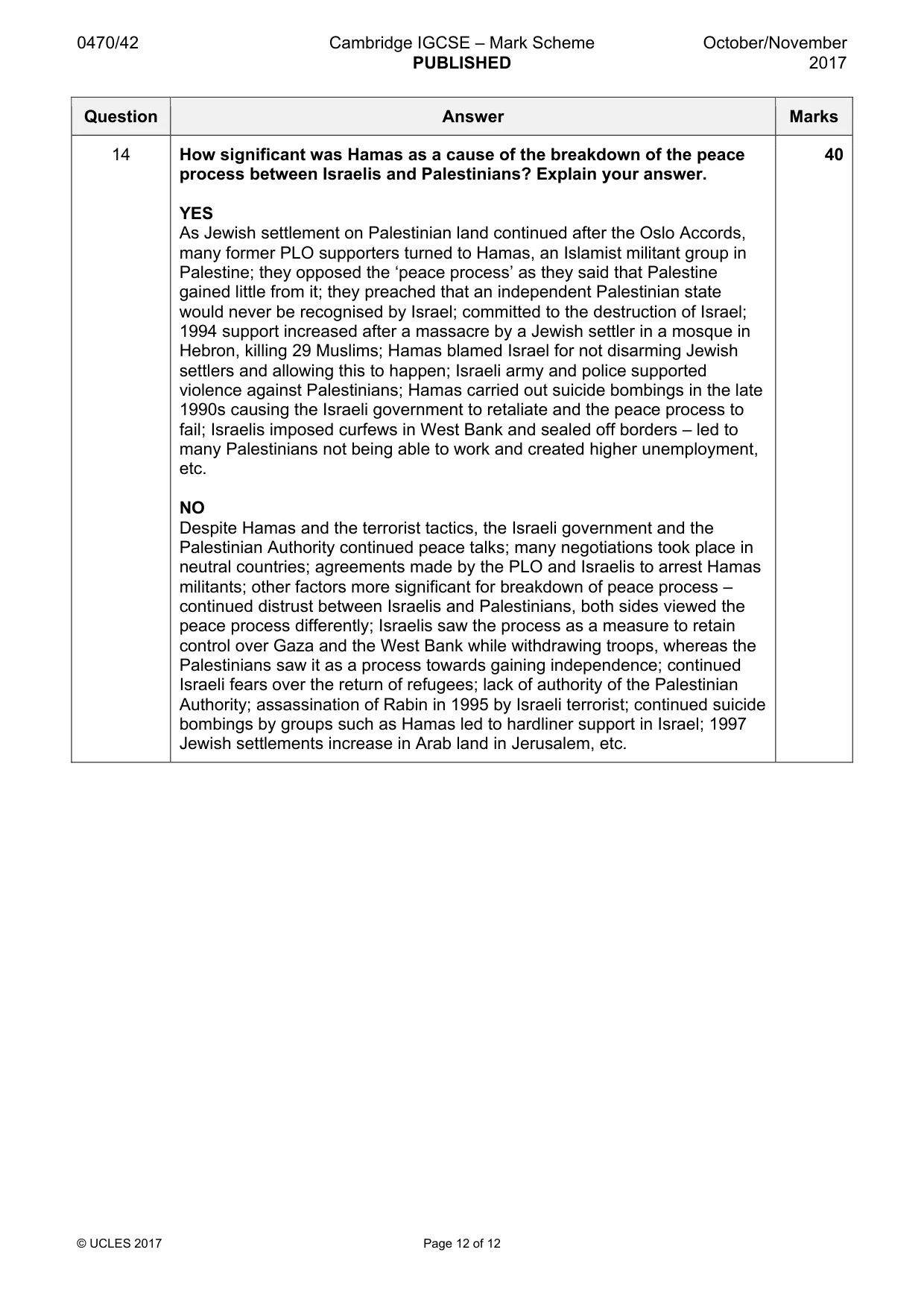
0470/42 Cambridge IGCSE – Mark Scheme PUBLISHED October/November 2017 © UCLES 2017 Page 12 of 12 Question Answer Marks 14 How significant was Hamas as a cause of the breakdown of the peace process between Israelis and Palestinians? Explain your answer. YES As Jewish settlement on Palestinian land continued after the Oslo Accords, many former PLO supporters turned to Hamas, an Islamist militant group in Palestine; they opposed the ‘peace process’ as they said that Palestine gained little from it; they preached that an independent Palestinian state would never be recognised by Israel; committed to the destruction of Israel; 1994 support increased after a massacre by a Jewish settler in a mosque in Hebron, killing 29 Muslims; Hamas blamed Israel for not disarming Jewish settlers and allowing this to happen; Israeli army and police supported violence against Palestinians; Hamas carried out suicide bombings in the late 1990s causing the Israeli government to retaliate and the peace process to fail; Israelis imposed curfews in West Bank and sealed off borders – led to many Palestinians not being able to work and created higher unemployment, etc. NO Despite Hamas and the terrorist tactics, the Israeli government and the Palestinian Authority continued peace talks; many negotiations took place in neutral countries; agreements made by the PLO and Israelis to arrest Hamas militants; other factors more significant for breakdown of peace process – continued distrust between Israelis and Palestinians, both sides viewed the peace process differently; Israelis saw the process as a measure to retain control over Gaza and the West Bank while withdrawing troops, whereas the Palestinians saw it as a process towards gaining independence; continued Israeli fears over the return of refugees; lack of authority of the Palestinian Authority; assassination of Rabin in 1995 by Israeli terrorist; continued suicide bombings by groups such as Hamas led to hardliner support in Israel; 1997 Jewish settlements increase in Arab land in Jerusalem, etc. 40
What you needed in this session
Cambridge’s own grade thresholds for 2017 Oct/Nov, Paper 4 · Variant 2. A higher threshold means an easier paper — the bar moves with how the cohort did.