Cambridge IGCSE History 0470 — 2017 Oct/Nov Paper 4 · Variant 1
0470/41/O/N/17 · 40 marks · ≈45 min
The question paper and its mark scheme, free to read here and free to download. This is Cambridge’s own paper, exactly as it was sat.
Question paper4 pages
Mark scheme12 pages
Answers below. Sit the paper first if you are practising.
Paper as text
Question paper, page 1
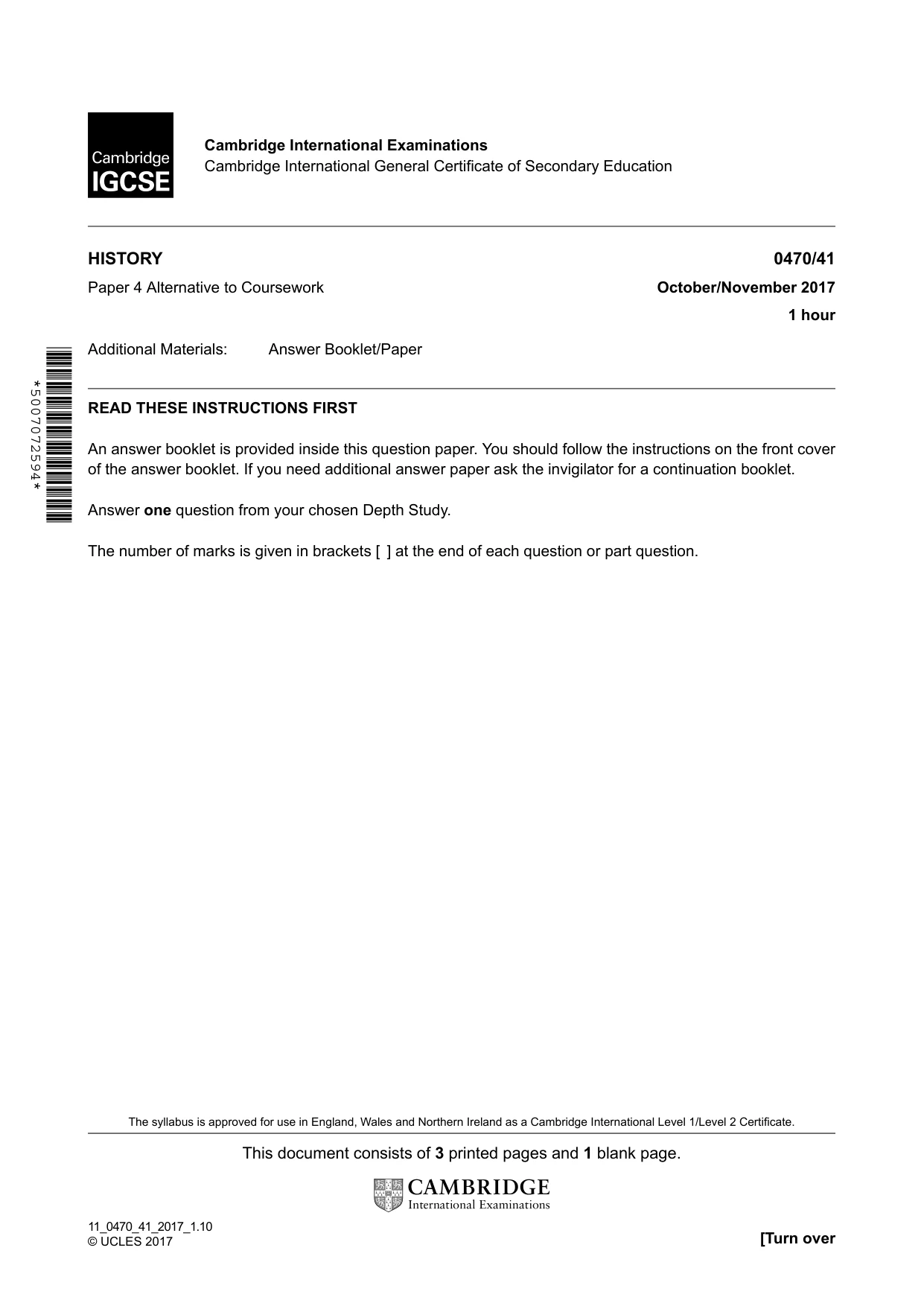
Cambridge International Examinations Cambridge International General Certificate of Secondary Education 0470/41 HISTORY October/November 2017 Paper 4 Alternative to Coursework 1 hour Additional Materials: Answer Booklet/Paper READ THESE INSTRUCTIONS FIRST An answer booklet is provided inside this question paper. You should follow the instructions on the front cover of the answer booklet. If you need additional answer paper ask the invigilator for a continuation booklet. Answer one question from your chosen Depth Study. The number of marks is given in brackets [ ] at the end of each question or part question. The syllabus is approved for use in England, Wales and Northern Ireland as a Cambridge International Level 1/Level 2 Certificate. This document consists of 3 printed pages and 1 blank page. [Turn over 11_0470_41_2017_1.10 © UCLES 2017 *5007072594*
Question paper, page 2
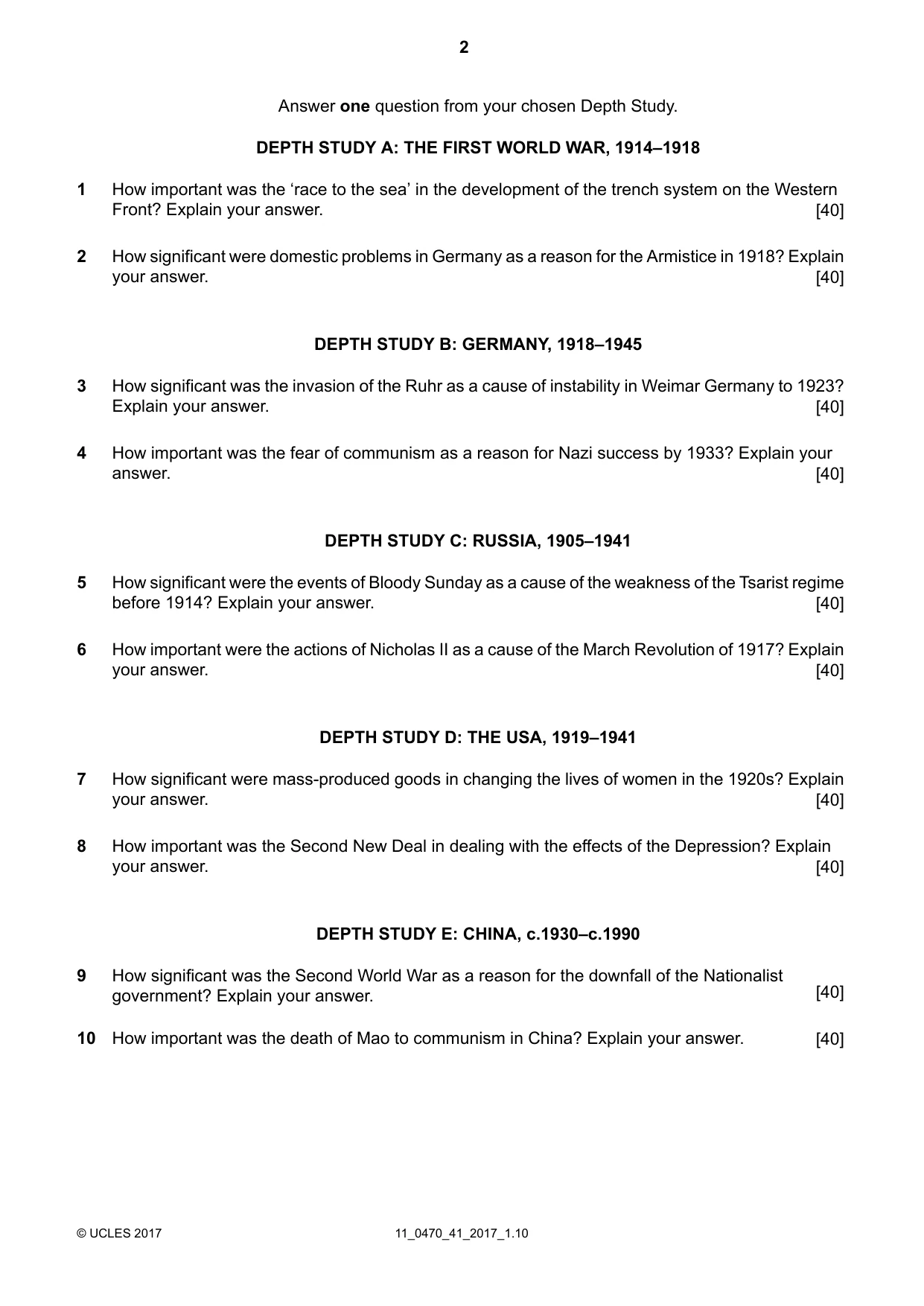
Answer one question from your chosen Depth Study. DEPTH STUDY A: THE FIRST WORLD WAR, 1914–1918 How important was the ‘race to the sea’ in the development of the trench system on the Western Front? Explain your answer. 1 [40] How significant were domestic problems in Germany as a reason for the Armistice in 1918? Explain your answer. 2 [40] DEPTH STUDY B: GERMANY, 1918–1945 How significant was the invasion of the Ruhr as a cause of instability in Weimar Germany to 1923? Explain your answer. 3 [40] How important was the fear of communism as a reason for Nazi success by 1933? Explain your answer. 4 [40] DEPTH STUDY C: RUSSIA, 1905–1941 How significant were the events of Bloody Sunday as a cause of the weakness of the Tsarist regime before 1914? Explain your answer. 5 [40] How important were the actions of Nicholas II as a cause of the March Revolution of 1917? Explain your answer. 6 [40] DEPTH STUDY D: THE USA, 1919–1941 How significant were mass-produced goods in changing the lives of women in the 1920s? Explain your answer. 7 [40] How important was the Second New Deal in dealing with the effects of the Depression? Explain your answer. 8 [40] DEPTH STUDY E: CHINA, c.1930–c.1990 How significant was the Second World War as a reason for the downfall of the Nationalist government? Explain your answer. 9 [40] How important was the death of Mao to communism in China? Explain your answer. 10 [40] 11_0470_41_2017_1.10 © UCLES 2017 2
Question paper, page 3
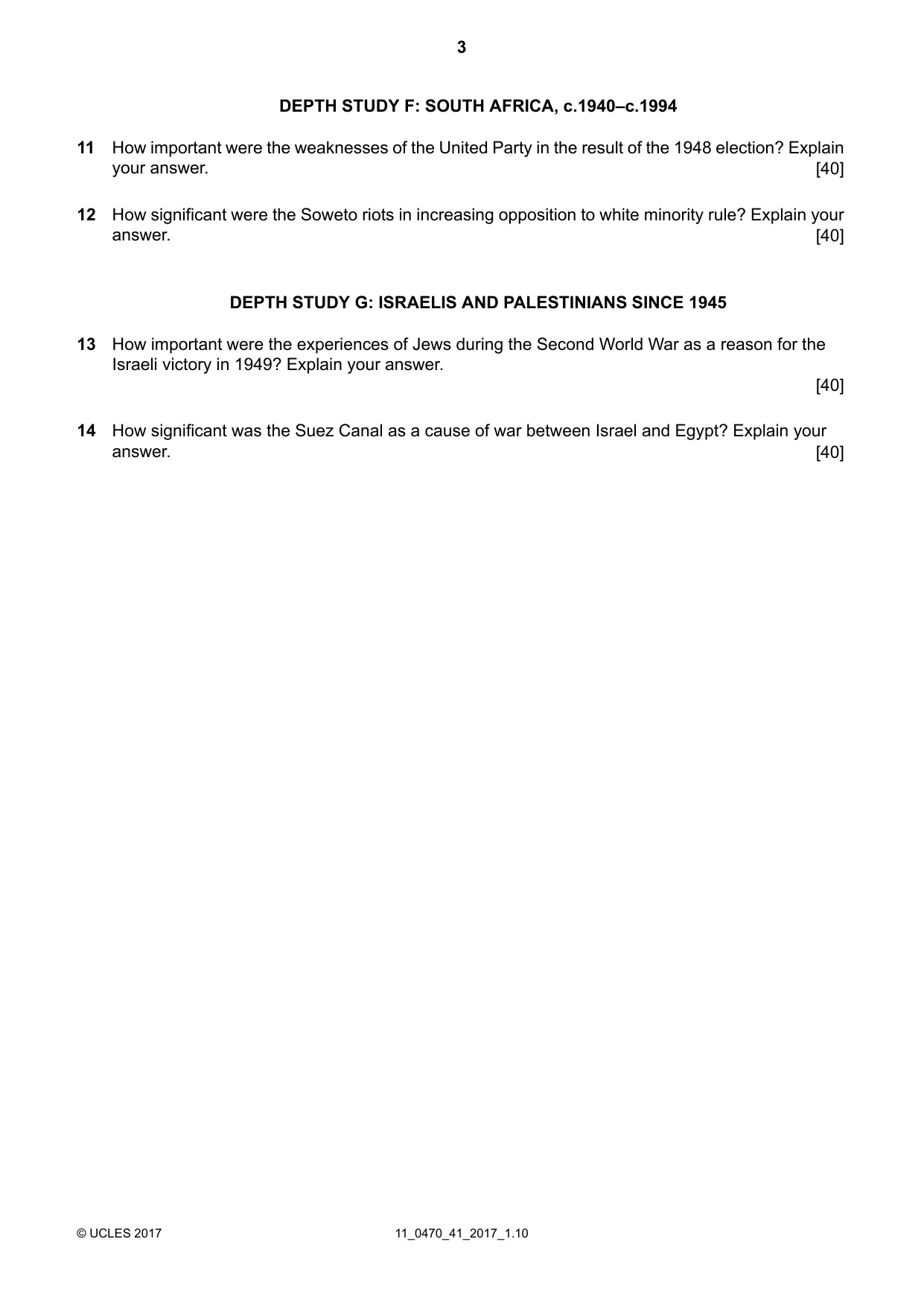
DEPTH STUDY F: SOUTH AFRICA, c.1940–c.1994 How important were the weaknesses of the United Party in the result of the 1948 election? Explain your answer. 11 [40] How significant were the Soweto riots in increasing opposition to white minority rule? Explain your answer. 12 [40] DEPTH STUDY G: ISRAELIS AND PALESTINIANS SINCE 1945 How important were the experiences of Jews during the Second World War as a reason for the Israeli victory in 1949? Explain your answer. 13 [40] How significant was the Suez Canal as a cause of war between Israel and Egypt? Explain your answer. 14 [40] 11_0470_41_2017_1.10 © UCLES 2017 3
Question paper, page 4
BLANK PAGE Permission to reproduce items where third-party owned material protected by copyright is included has been sought and cleared where possible. Every reasonable effort has been made by the publisher (UCLES) to trace copyright holders, but if any items requiring clearance have unwittingly been included, the publisher will be pleased to make amends at the earliest possible opportunity. To avoid the issue of disclosure of answer-related information to candidates, all copyright acknowledgements are reproduced online in the Cambridge International Examinations Copyright Acknowledgements Booklet. This is produced for each series of examinations and is freely available to download at www.cie.org.uk after the live examination series. Cambridge International Examinations is part of the Cambridge Assessment Group. Cambridge Assessment is the brand name of University of Cambridge Local Examinations Syndicate (UCLES), which is itself a department of the University of Cambridge. 11_0470_41_2017_1.10 © UCLES 2017 4
Mark scheme, page 1
® IGCSE is a registered trademark. This syllabus is approved for use in England, Wales and Northern Ireland as a Cambridge International Level 1/Level 2 Certificate. This document consists of 12 printed pages. © UCLES 2017 [Turn over Cambridge Assessment International Education Cambridge International General Certificate of Secondary Education HISTORY 0470/41 Paper 4 Alternative to Coursework October/November 2017 MARK SCHEME Maximum Mark: 40 Published This mark scheme is published as an aid to teachers and candidates, to indicate the requirements of the examination. It shows the basis on which Examiners were instructed to award marks. It does not indicate the details of the discussions that took place at an Examiners’ meeting before marking began, which would have considered the acceptability of alternative answers. Mark schemes should be read in conjunction with the question paper and the Principal Examiner Report for Teachers. Cambridge International will not enter into discussions about these mark schemes. Cambridge International is publishing the mark schemes for the October/November 2017 series for most Cambridge IGCSE®, Cambridge International A and AS Level components and some Cambridge O Level components.
Mark scheme, page 2
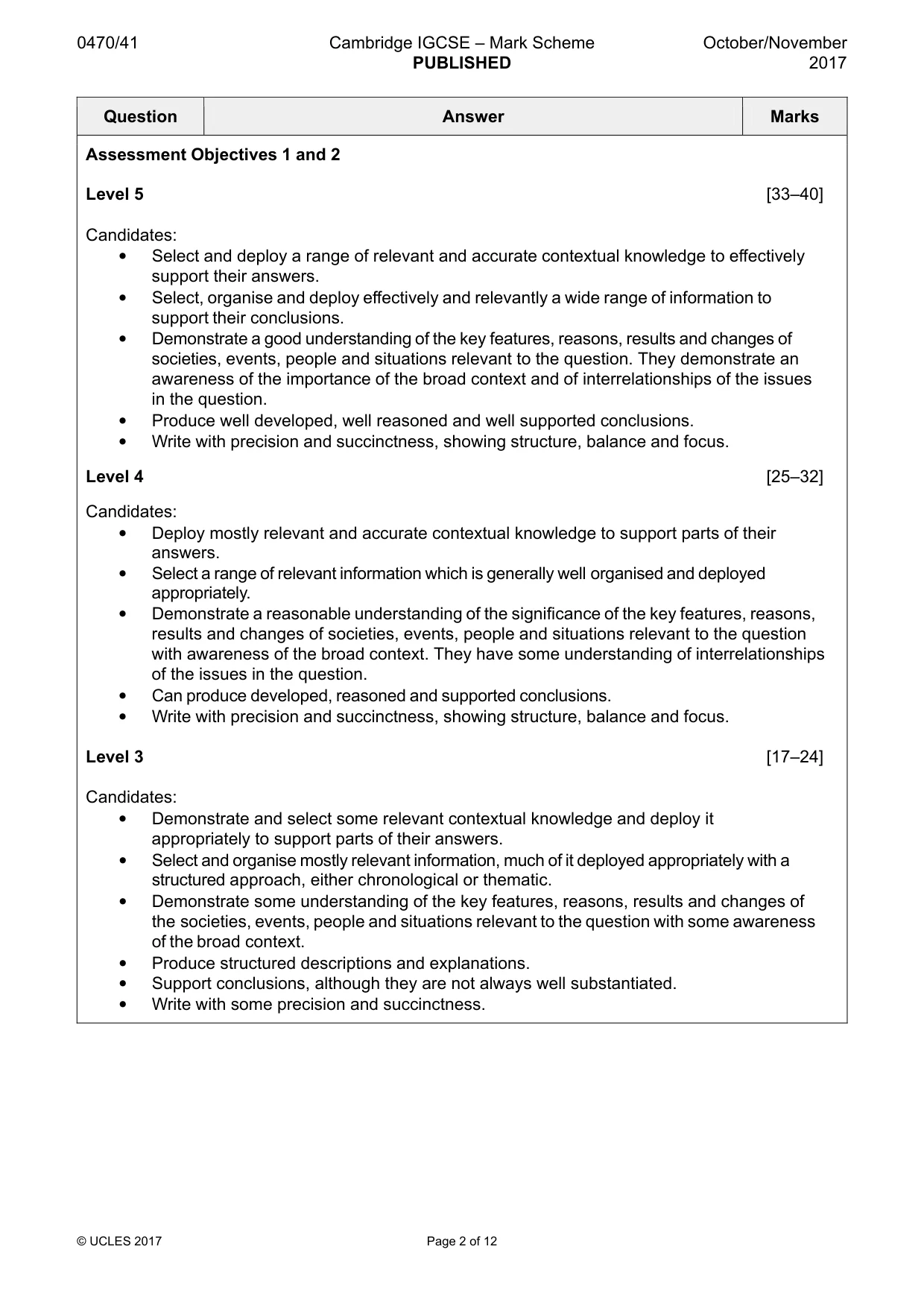
0470/41 Cambridge IGCSE – Mark Scheme PUBLISHED October/November 2017 © UCLES 2017 Page 2 of 12 Question Answer Marks Assessment Objectives 1 and 2 Level 5 [33–40] Candidates: • Select and deploy a range of relevant and accurate contextual knowledge to effectively support their answers. • Select, organise and deploy effectively and relevantly a wide range of information to support their conclusions. • Demonstrate a good understanding of the key features, reasons, results and changes of societies, events, people and situations relevant to the question. They demonstrate an awareness of the importance of the broad context and of interrelationships of the issues in the question. • Produce well developed, well reasoned and well supported conclusions. • Write with precision and succinctness, showing structure, balance and focus. Level 4 [25–32] Candidates: • Deploy mostly relevant and accurate contextual knowledge to support parts of their answers. • Select a range of relevant information which is generally well organised and deployed appropriately. • Demonstrate a reasonable understanding of the significance of the key features, reasons, results and changes of societies, events, people and situations relevant to the question with awareness of the broad context. They have some understanding of interrelationships of the issues in the question. • Can produce developed, reasoned and supported conclusions. • Write with precision and succinctness, showing structure, balance and focus. Level 3 [17–24] Candidates: • Demonstrate and select some relevant contextual knowledge and deploy it appropriately to support parts of their answers. • Select and organise mostly relevant information, much of it deployed appropriately with a structured approach, either chronological or thematic. • Demonstrate some understanding of the key features, reasons, results and changes of the societies, events, people and situations relevant to the question with some awareness of the broad context. • Produce structured descriptions and explanations. • Support conclusions, although they are not always well substantiated. • Write with some precision and succinctness.
Mark scheme, page 3
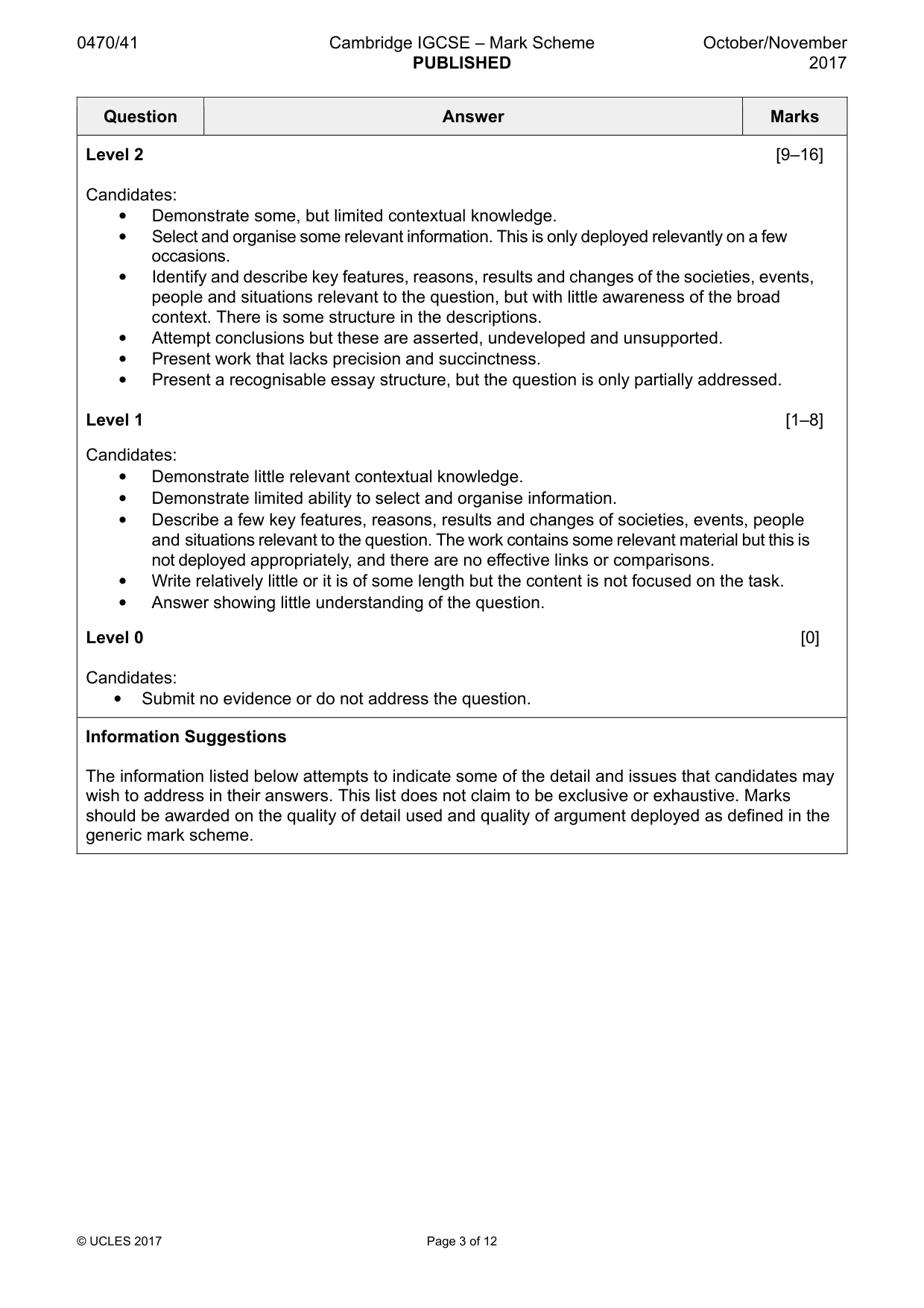
0470/41 Cambridge IGCSE – Mark Scheme PUBLISHED October/November 2017 © UCLES 2017 Page 3 of 12 Question Answer Marks Level 2 [9–16] Candidates: • Demonstrate some, but limited contextual knowledge. • Select and organise some relevant information. This is only deployed relevantly on a few occasions. • Identify and describe key features, reasons, results and changes of the societies, events, people and situations relevant to the question, but with little awareness of the broad context. There is some structure in the descriptions. • Attempt conclusions but these are asserted, undeveloped and unsupported. • Present work that lacks precision and succinctness. • Present a recognisable essay structure, but the question is only partially addressed. Level 1 [1–8] Candidates: • Demonstrate little relevant contextual knowledge. • Demonstrate limited ability to select and organise information. • Describe a few key features, reasons, results and changes of societies, events, people and situations relevant to the question. The work contains some relevant material but this is not deployed appropriately, and there are no effective links or comparisons. • Write relatively little or it is of some length but the content is not focused on the task. • Answer showing little understanding of the question. Level 0 [0] Candidates: • Submit no evidence or do not address the question. Information Suggestions The information listed below attempts to indicate some of the detail and issues that candidates may wish to address in their answers. This list does not claim to be exclusive or exhaustive. Marks should be awarded on the quality of detail used and quality of argument deployed as defined in the generic mark scheme.
Mark scheme, page 4
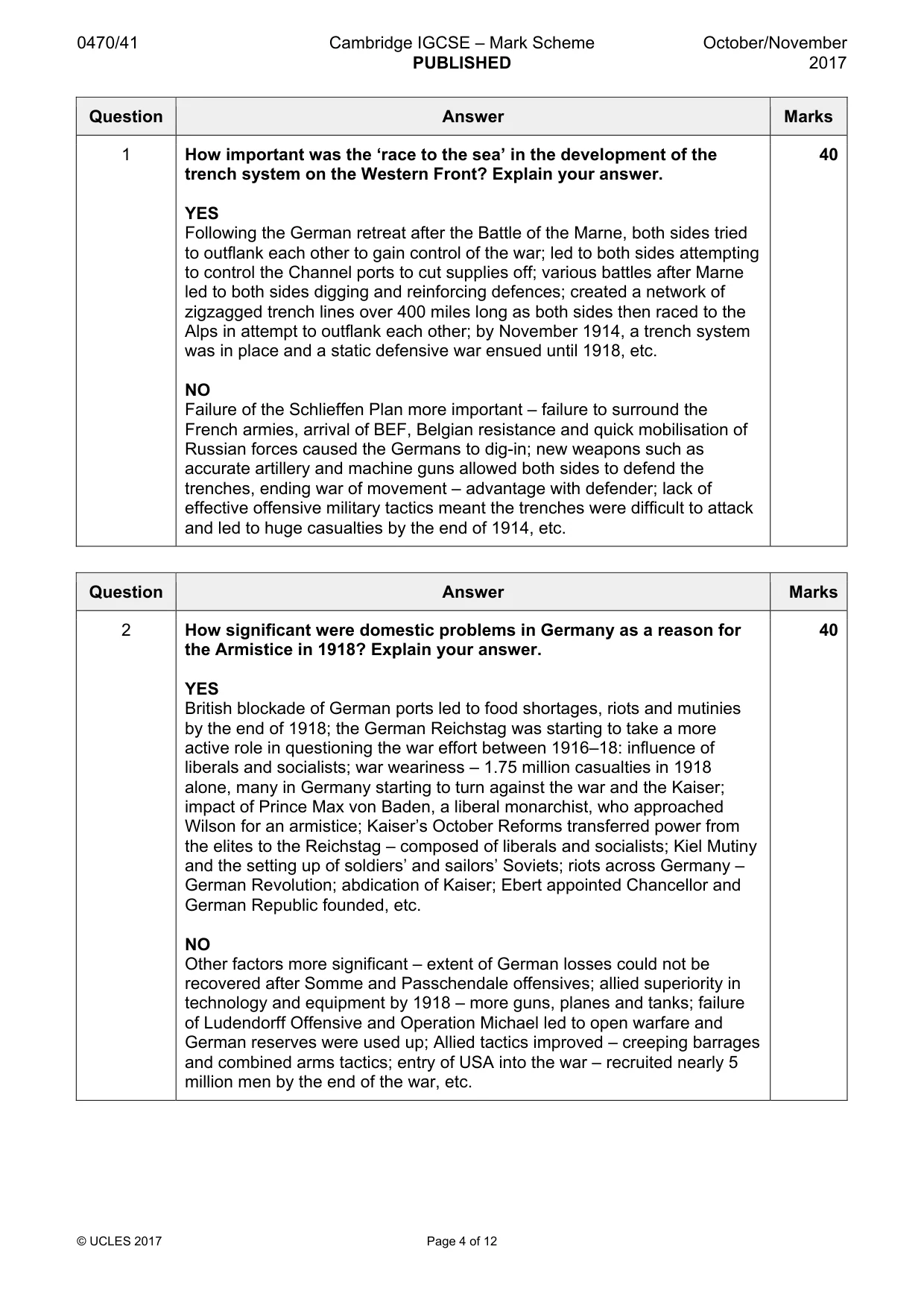
0470/41 Cambridge IGCSE – Mark Scheme PUBLISHED October/November 2017 © UCLES 2017 Page 4 of 12 Question Answer Marks 1 How important was the ‘race to the sea’ in the development of the trench system on the Western Front? Explain your answer. YES Following the German retreat after the Battle of the Marne, both sides tried to outflank each other to gain control of the war; led to both sides attempting to control the Channel ports to cut supplies off; various battles after Marne led to both sides digging and reinforcing defences; created a network of zigzagged trench lines over 400 miles long as both sides then raced to the Alps in attempt to outflank each other; by November 1914, a trench system was in place and a static defensive war ensued until 1918, etc. NO Failure of the Schlieffen Plan more important – failure to surround the French armies, arrival of BEF, Belgian resistance and quick mobilisation of Russian forces caused the Germans to dig-in; new weapons such as accurate artillery and machine guns allowed both sides to defend the trenches, ending war of movement – advantage with defender; lack of effective offensive military tactics meant the trenches were difficult to attack and led to huge casualties by the end of 1914, etc. 40 Question Answer Marks 2 How significant were domestic problems in Germany as a reason for the Armistice in 1918? Explain your answer. YES British blockade of German ports led to food shortages, riots and mutinies by the end of 1918; the German Reichstag was starting to take a more active role in questioning the war effort between 1916–18: influence of liberals and socialists; war weariness – 1.75 million casualties in 1918 alone, many in Germany starting to turn against the war and the Kaiser; impact of Prince Max von Baden, a liberal monarchist, who approached Wilson for an armistice; Kaiser’s October Reforms transferred power from the elites to the Reichstag – composed of liberals and socialists; Kiel Mutiny and the setting up of soldiers’ and sailors’ Soviets; riots across Germany – German Revolution; abdication of Kaiser; Ebert appointed Chancellor and German Republic founded, etc. NO Other factors more significant – extent of German losses could not be recovered after Somme and Passchendale offensives; allied superiority in technology and equipment by 1918 – more guns, planes and tanks; failure of Ludendorff Offensive and Operation Michael led to open warfare and German reserves were used up; Allied tactics improved – creeping barrages and combined arms tactics; entry of USA into the war – recruited nearly 5 million men by the end of the war, etc. 40
Mark scheme, page 5
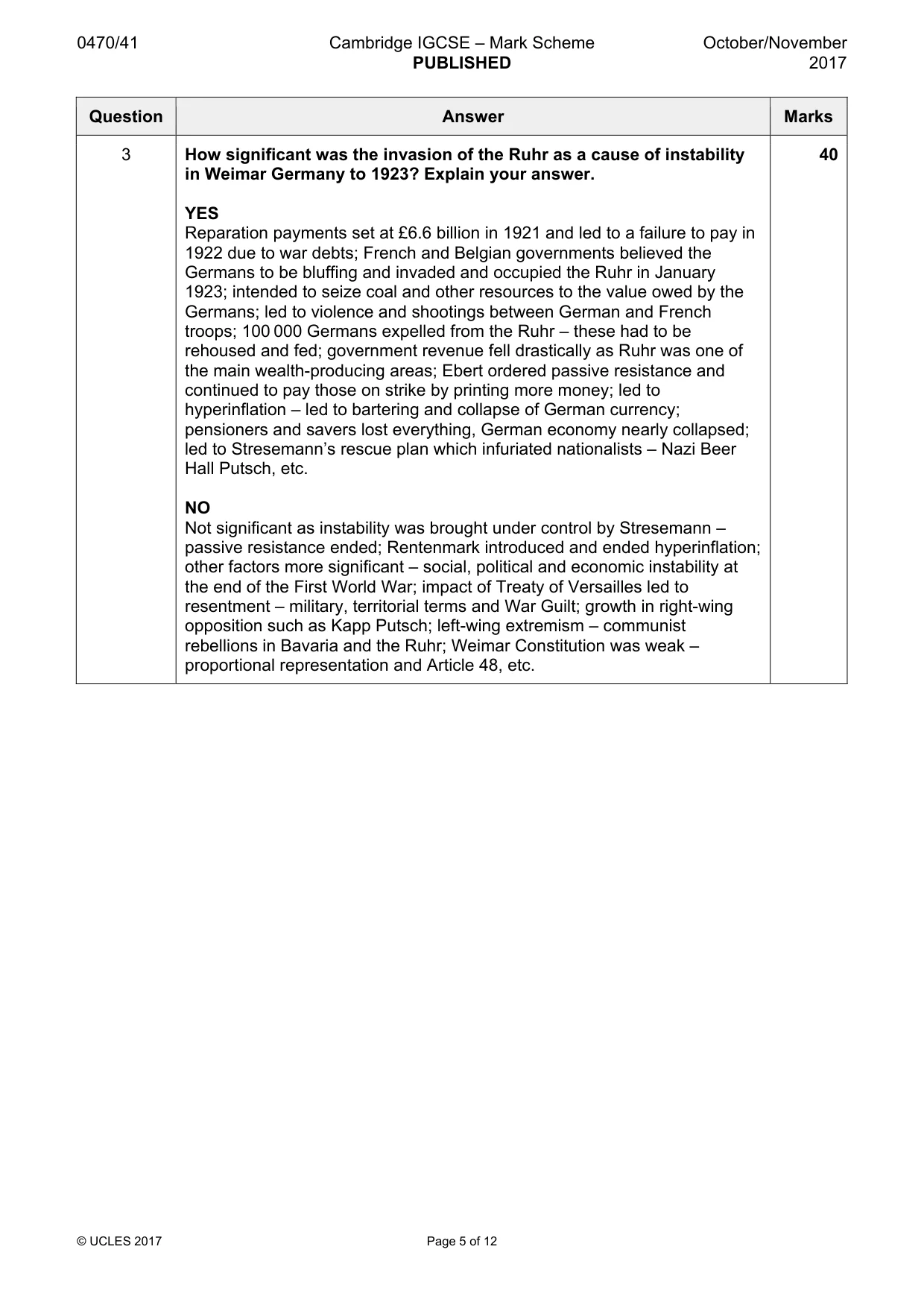
0470/41 Cambridge IGCSE – Mark Scheme PUBLISHED October/November 2017 © UCLES 2017 Page 5 of 12 Question Answer Marks 3 How significant was the invasion of the Ruhr as a cause of instability in Weimar Germany to 1923? Explain your answer. YES Reparation payments set at £6.6 billion in 1921 and led to a failure to pay in 1922 due to war debts; French and Belgian governments believed the Germans to be bluffing and invaded and occupied the Ruhr in January 1923; intended to seize coal and other resources to the value owed by the Germans; led to violence and shootings between German and French troops; 100 000 Germans expelled from the Ruhr – these had to be rehoused and fed; government revenue fell drastically as Ruhr was one of the main wealth-producing areas; Ebert ordered passive resistance and continued to pay those on strike by printing more money; led to hyperinflation – led to bartering and collapse of German currency; pensioners and savers lost everything, German economy nearly collapsed; led to Stresemann’s rescue plan which infuriated nationalists – Nazi Beer Hall Putsch, etc. NO Not significant as instability was brought under control by Stresemann – passive resistance ended; Rentenmark introduced and ended hyperinflation; other factors more significant – social, political and economic instability at the end of the First World War; impact of Treaty of Versailles led to resentment – military, territorial terms and War Guilt; growth in right-wing opposition such as Kapp Putsch; left-wing extremism – communist rebellions in Bavaria and the Ruhr; Weimar Constitution was weak – proportional representation and Article 48, etc. 40
Mark scheme, page 6
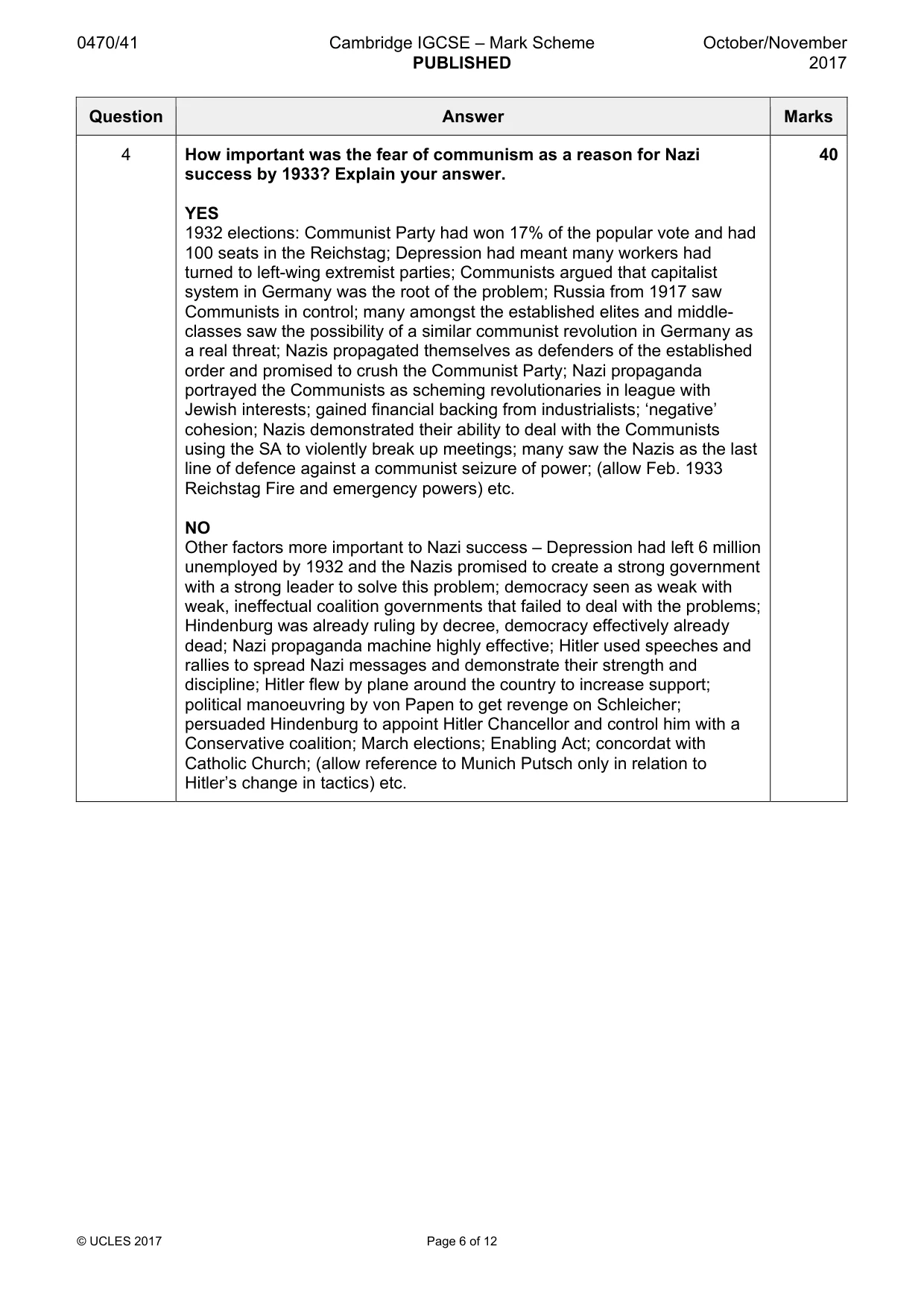
0470/41 Cambridge IGCSE – Mark Scheme PUBLISHED October/November 2017 © UCLES 2017 Page 6 of 12 Question Answer Marks 4 How important was the fear of communism as a reason for Nazi success by 1933? Explain your answer. YES 1932 elections: Communist Party had won 17% of the popular vote and had 100 seats in the Reichstag; Depression had meant many workers had turned to left-wing extremist parties; Communists argued that capitalist system in Germany was the root of the problem; Russia from 1917 saw Communists in control; many amongst the established elites and middle- classes saw the possibility of a similar communist revolution in Germany as a real threat; Nazis propagated themselves as defenders of the established order and promised to crush the Communist Party; Nazi propaganda portrayed the Communists as scheming revolutionaries in league with Jewish interests; gained financial backing from industrialists; ‘negative’ cohesion; Nazis demonstrated their ability to deal with the Communists using the SA to violently break up meetings; many saw the Nazis as the last line of defence against a communist seizure of power; (allow Feb. 1933 Reichstag Fire and emergency powers) etc. NO Other factors more important to Nazi success – Depression had left 6 million unemployed by 1932 and the Nazis promised to create a strong government with a strong leader to solve this problem; democracy seen as weak with weak, ineffectual coalition governments that failed to deal with the problems; Hindenburg was already ruling by decree, democracy effectively already dead; Nazi propaganda machine highly effective; Hitler used speeches and rallies to spread Nazi messages and demonstrate their strength and discipline; Hitler flew by plane around the country to increase support; political manoeuvring by von Papen to get revenge on Schleicher; persuaded Hindenburg to appoint Hitler Chancellor and control him with a Conservative coalition; March elections; Enabling Act; concordat with Catholic Church; (allow reference to Munich Putsch only in relation to Hitler’s change in tactics) etc. 40
Mark scheme, page 7
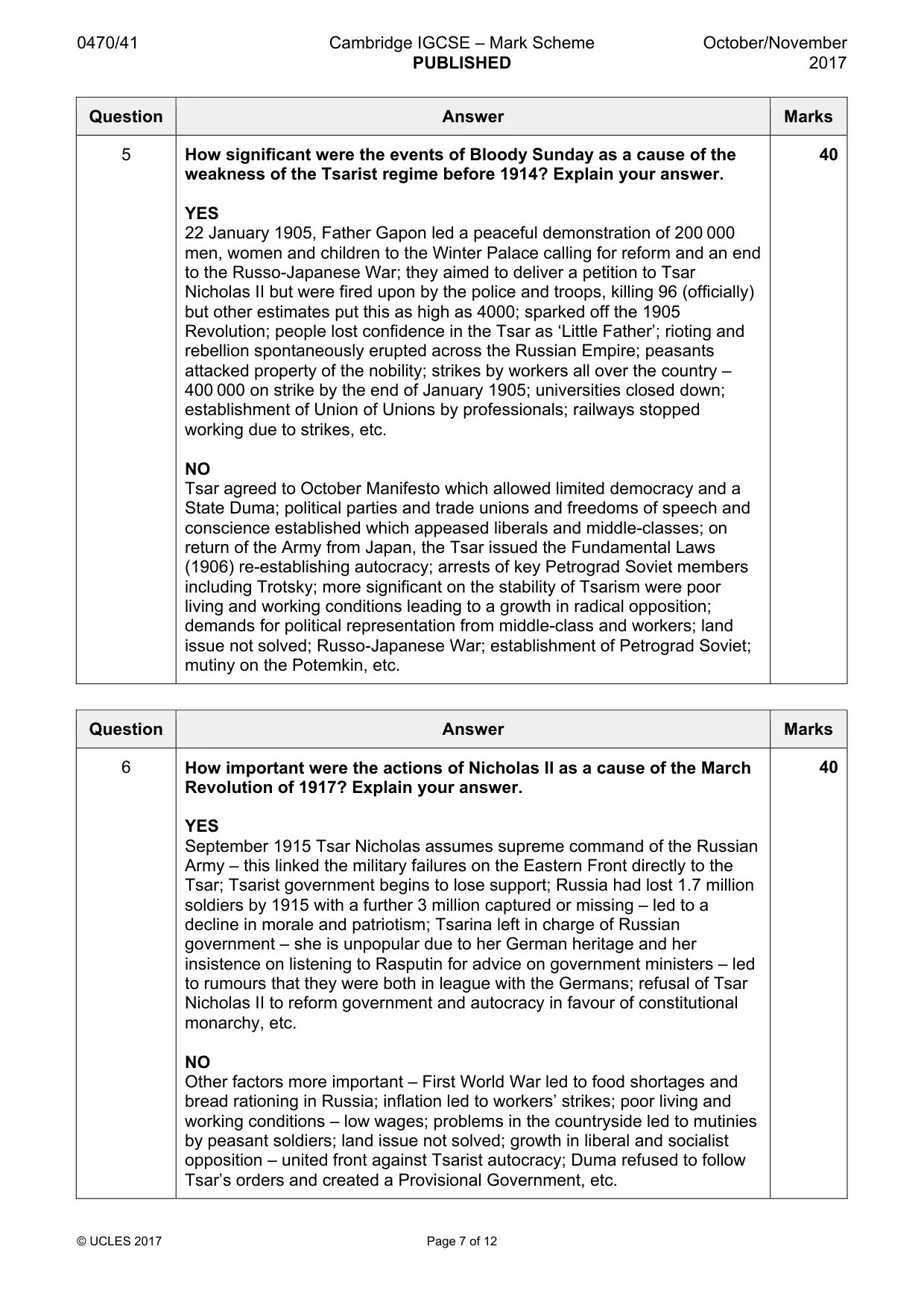
0470/41 Cambridge IGCSE – Mark Scheme PUBLISHED October/November 2017 © UCLES 2017 Page 7 of 12 Question Answer Marks 5 How significant were the events of Bloody Sunday as a cause of the weakness of the Tsarist regime before 1914? Explain your answer. YES 22 January 1905, Father Gapon led a peaceful demonstration of 200 000 men, women and children to the Winter Palace calling for reform and an end to the Russo-Japanese War; they aimed to deliver a petition to Tsar Nicholas II but were fired upon by the police and troops, killing 96 (officially) but other estimates put this as high as 4000; sparked off the 1905 Revolution; people lost confidence in the Tsar as ‘Little Father’; rioting and rebellion spontaneously erupted across the Russian Empire; peasants attacked property of the nobility; strikes by workers all over the country – 400 000 on strike by the end of January 1905; universities closed down; establishment of Union of Unions by professionals; railways stopped working due to strikes, etc. NO Tsar agreed to October Manifesto which allowed limited democracy and a State Duma; political parties and trade unions and freedoms of speech and conscience established which appeased liberals and middle-classes; on return of the Army from Japan, the Tsar issued the Fundamental Laws (1906) re-establishing autocracy; arrests of key Petrograd Soviet members including Trotsky; more significant on the stability of Tsarism were poor living and working conditions leading to a growth in radical opposition; demands for political representation from middle-class and workers; land issue not solved; Russo-Japanese War; establishment of Petrograd Soviet; mutiny on the Potemkin, etc. 40 Question Answer Marks 6 How important were the actions of Nicholas II as a cause of the March Revolution of 1917? Explain your answer. YES September 1915 Tsar Nicholas assumes supreme command of the Russian Army – this linked the military failures on the Eastern Front directly to the Tsar; Tsarist government begins to lose support; Russia had lost 1.7 million soldiers by 1915 with a further 3 million captured or missing – led to a decline in morale and patriotism; Tsarina left in charge of Russian government – she is unpopular due to her German heritage and her insistence on listening to Rasputin for advice on government ministers – led to rumours that they were both in league with the Germans; refusal of Tsar Nicholas II to reform government and autocracy in favour of constitutional monarchy, etc. NO Other factors more important – First World War led to food shortages and bread rationing in Russia; inflation led to workers’ strikes; poor living and working conditions – low wages; problems in the countryside led to mutinies by peasant soldiers; land issue not solved; growth in liberal and socialist opposition – united front against Tsarist autocracy; Duma refused to follow Tsar’s orders and created a Provisional Government, etc. 40
Mark scheme, page 8
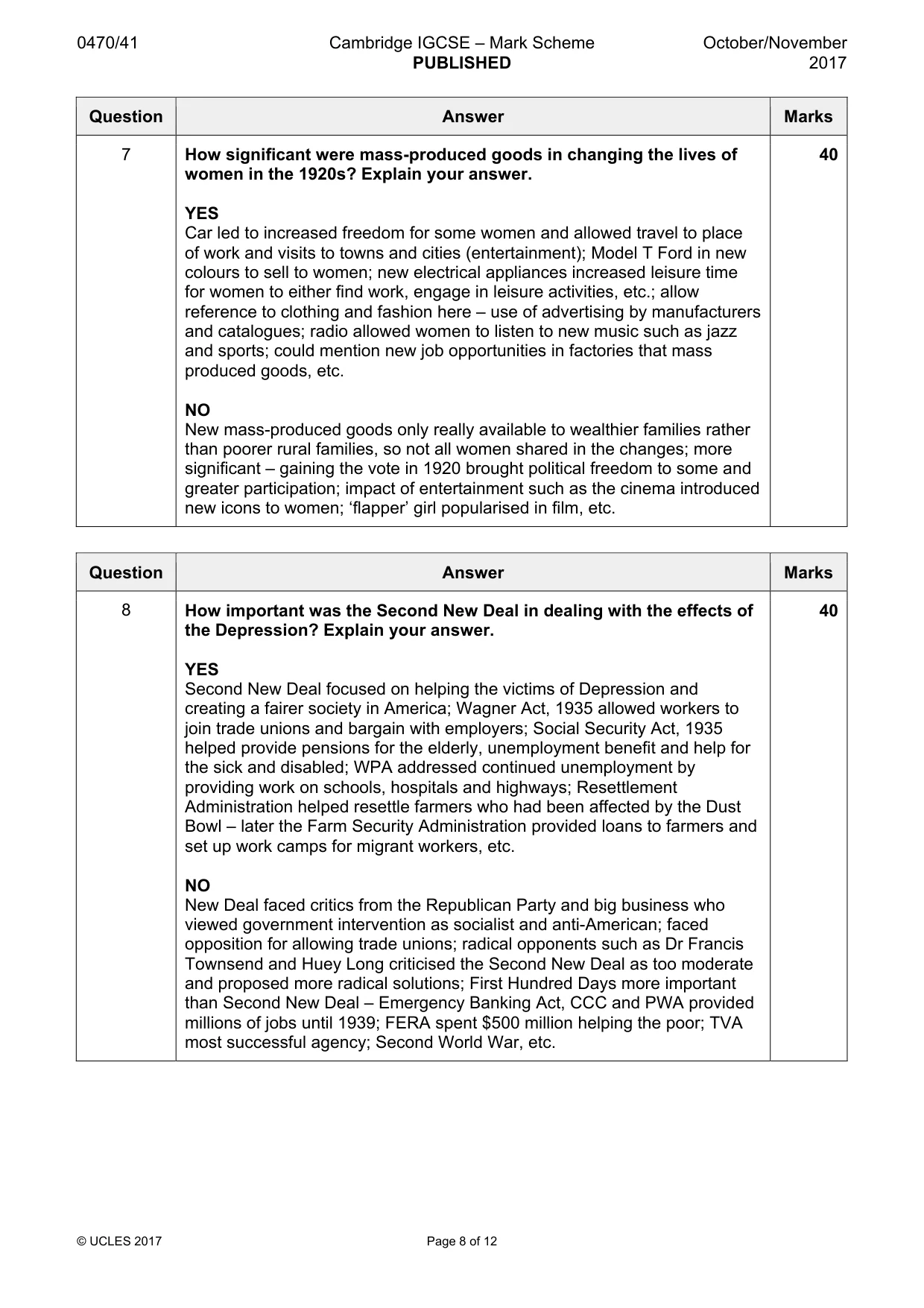
0470/41 Cambridge IGCSE – Mark Scheme PUBLISHED October/November 2017 © UCLES 2017 Page 8 of 12 Question Answer Marks 7 How significant were mass-produced goods in changing the lives of women in the 1920s? Explain your answer. YES Car led to increased freedom for some women and allowed travel to place of work and visits to towns and cities (entertainment); Model T Ford in new colours to sell to women; new electrical appliances increased leisure time for women to either find work, engage in leisure activities, etc.; allow reference to clothing and fashion here – use of advertising by manufacturers and catalogues; radio allowed women to listen to new music such as jazz and sports; could mention new job opportunities in factories that mass produced goods, etc. NO New mass-produced goods only really available to wealthier families rather than poorer rural families, so not all women shared in the changes; more significant – gaining the vote in 1920 brought political freedom to some and greater participation; impact of entertainment such as the cinema introduced new icons to women; ‘flapper’ girl popularised in film, etc. 40 Question Answer Marks 8 How important was the Second New Deal in dealing with the effects of the Depression? Explain your answer. YES Second New Deal focused on helping the victims of Depression and creating a fairer society in America; Wagner Act, 1935 allowed workers to join trade unions and bargain with employers; Social Security Act, 1935 helped provide pensions for the elderly, unemployment benefit and help for the sick and disabled; WPA addressed continued unemployment by providing work on schools, hospitals and highways; Resettlement Administration helped resettle farmers who had been affected by the Dust Bowl – later the Farm Security Administration provided loans to farmers and set up work camps for migrant workers, etc. NO New Deal faced critics from the Republican Party and big business who viewed government intervention as socialist and anti-American; faced opposition for allowing trade unions; radical opponents such as Dr Francis Townsend and Huey Long criticised the Second New Deal as too moderate and proposed more radical solutions; First Hundred Days more important than Second New Deal – Emergency Banking Act, CCC and PWA provided millions of jobs until 1939; FERA spent $500 million helping the poor; TVA most successful agency; Second World War, etc. 40
Mark scheme, page 9
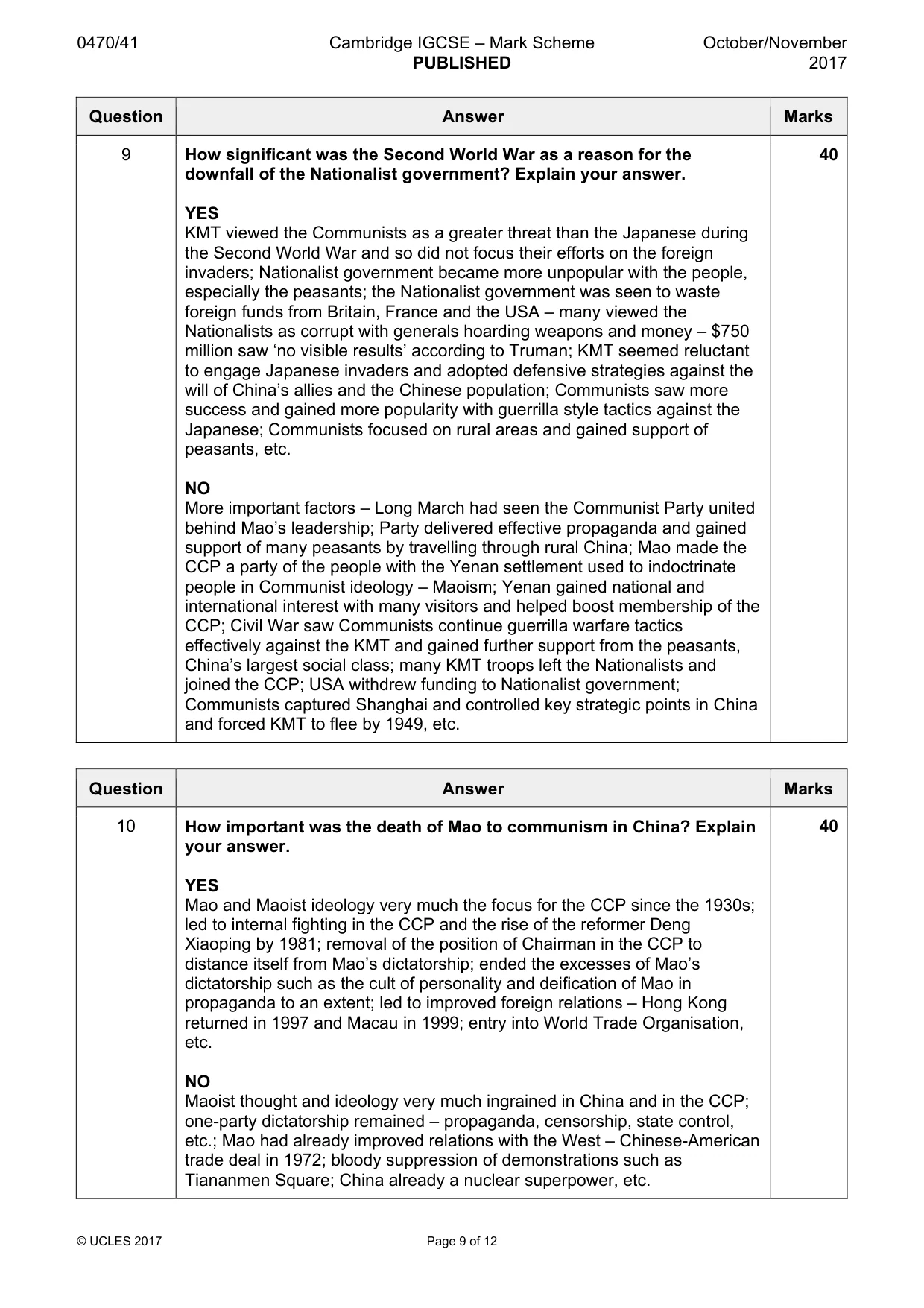
0470/41 Cambridge IGCSE – Mark Scheme PUBLISHED October/November 2017 © UCLES 2017 Page 9 of 12 Question Answer Marks 9 How significant was the Second World War as a reason for the downfall of the Nationalist government? Explain your answer. YES KMT viewed the Communists as a greater threat than the Japanese during the Second World War and so did not focus their efforts on the foreign invaders; Nationalist government became more unpopular with the people, especially the peasants; the Nationalist government was seen to waste foreign funds from Britain, France and the USA – many viewed the Nationalists as corrupt with generals hoarding weapons and money – $750 million saw ‘no visible results’ according to Truman; KMT seemed reluctant to engage Japanese invaders and adopted defensive strategies against the will of China’s allies and the Chinese population; Communists saw more success and gained more popularity with guerrilla style tactics against the Japanese; Communists focused on rural areas and gained support of peasants, etc. NO More important factors – Long March had seen the Communist Party united behind Mao’s leadership; Party delivered effective propaganda and gained support of many peasants by travelling through rural China; Mao made the CCP a party of the people with the Yenan settlement used to indoctrinate people in Communist ideology – Maoism; Yenan gained national and international interest with many visitors and helped boost membership of the CCP; Civil War saw Communists continue guerrilla warfare tactics effectively against the KMT and gained further support from the peasants, China’s largest social class; many KMT troops left the Nationalists and joined the CCP; USA withdrew funding to Nationalist government; Communists captured Shanghai and controlled key strategic points in China and forced KMT to flee by 1949, etc. 40 Question Answer Marks 10 How important was the death of Mao to communism in China? Explain your answer. YES Mao and Maoist ideology very much the focus for the CCP since the 1930s; led to internal fighting in the CCP and the rise of the reformer Deng Xiaoping by 1981; removal of the position of Chairman in the CCP to distance itself from Mao’s dictatorship; ended the excesses of Mao’s dictatorship such as the cult of personality and deification of Mao in propaganda to an extent; led to improved foreign relations – Hong Kong returned in 1997 and Macau in 1999; entry into World Trade Organisation, etc. NO Maoist thought and ideology very much ingrained in China and in the CCP; one-party dictatorship remained – propaganda, censorship, state control, etc.; Mao had already improved relations with the West – Chinese-American trade deal in 1972; bloody suppression of demonstrations such as Tiananmen Square; China already a nuclear superpower, etc. 40
Mark scheme, page 10
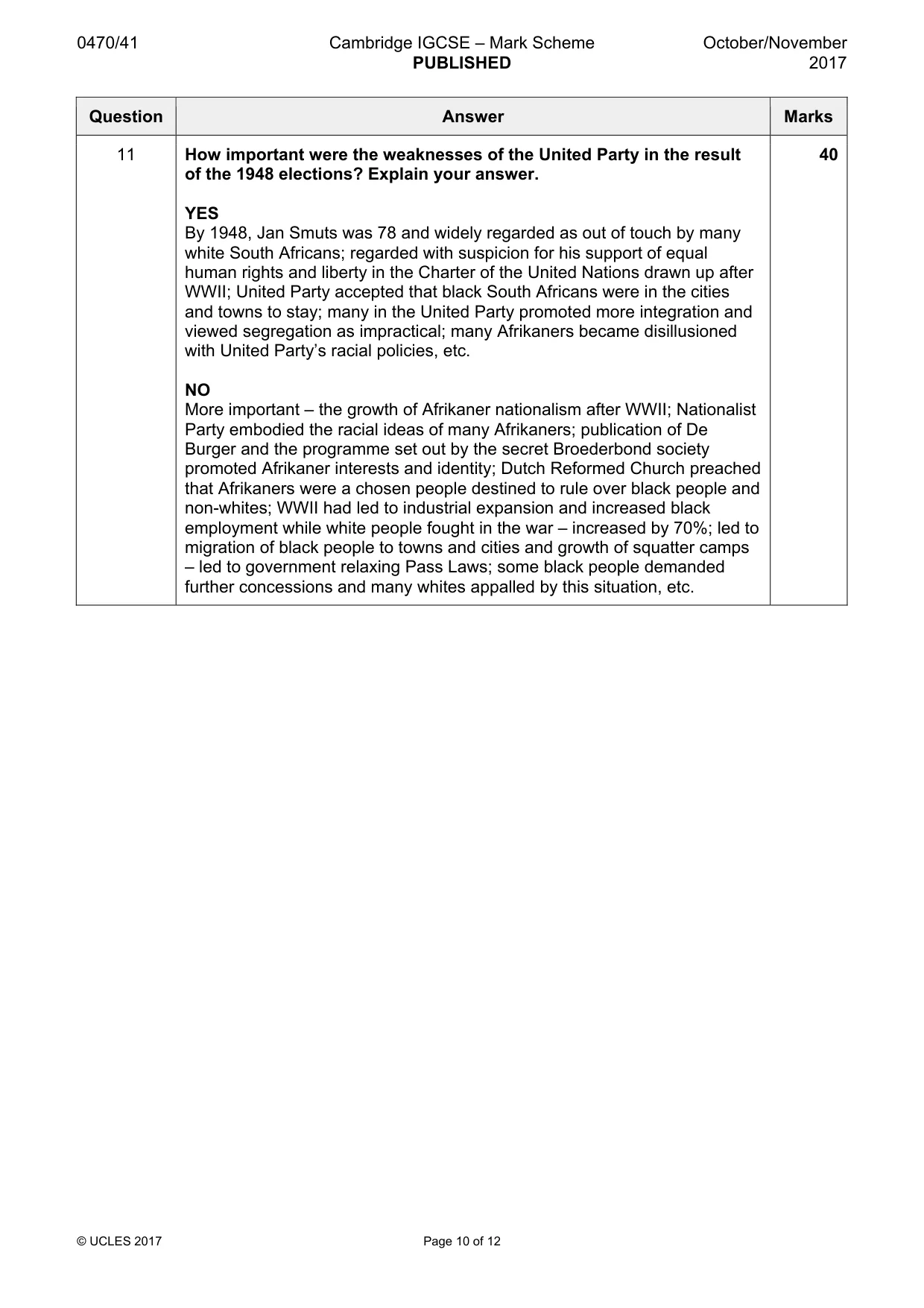
0470/41 Cambridge IGCSE – Mark Scheme PUBLISHED October/November 2017 © UCLES 2017 Page 10 of 12 Question Answer Marks 11 How important were the weaknesses of the United Party in the result of the 1948 elections? Explain your answer. YES By 1948, Jan Smuts was 78 and widely regarded as out of touch by many white South Africans; regarded with suspicion for his support of equal human rights and liberty in the Charter of the United Nations drawn up after WWII; United Party accepted that black South Africans were in the cities and towns to stay; many in the United Party promoted more integration and viewed segregation as impractical; many Afrikaners became disillusioned with United Party’s racial policies, etc. NO More important – the growth of Afrikaner nationalism after WWII; Nationalist Party embodied the racial ideas of many Afrikaners; publication of De Burger and the programme set out by the secret Broederbond society promoted Afrikaner interests and identity; Dutch Reformed Church preached that Afrikaners were a chosen people destined to rule over black people and non-whites; WWII had led to industrial expansion and increased black employment while white people fought in the war – increased by 70%; led to migration of black people to towns and cities and growth of squatter camps – led to government relaxing Pass Laws; some black people demanded further concessions and many whites appalled by this situation, etc. 40
Mark scheme, page 11
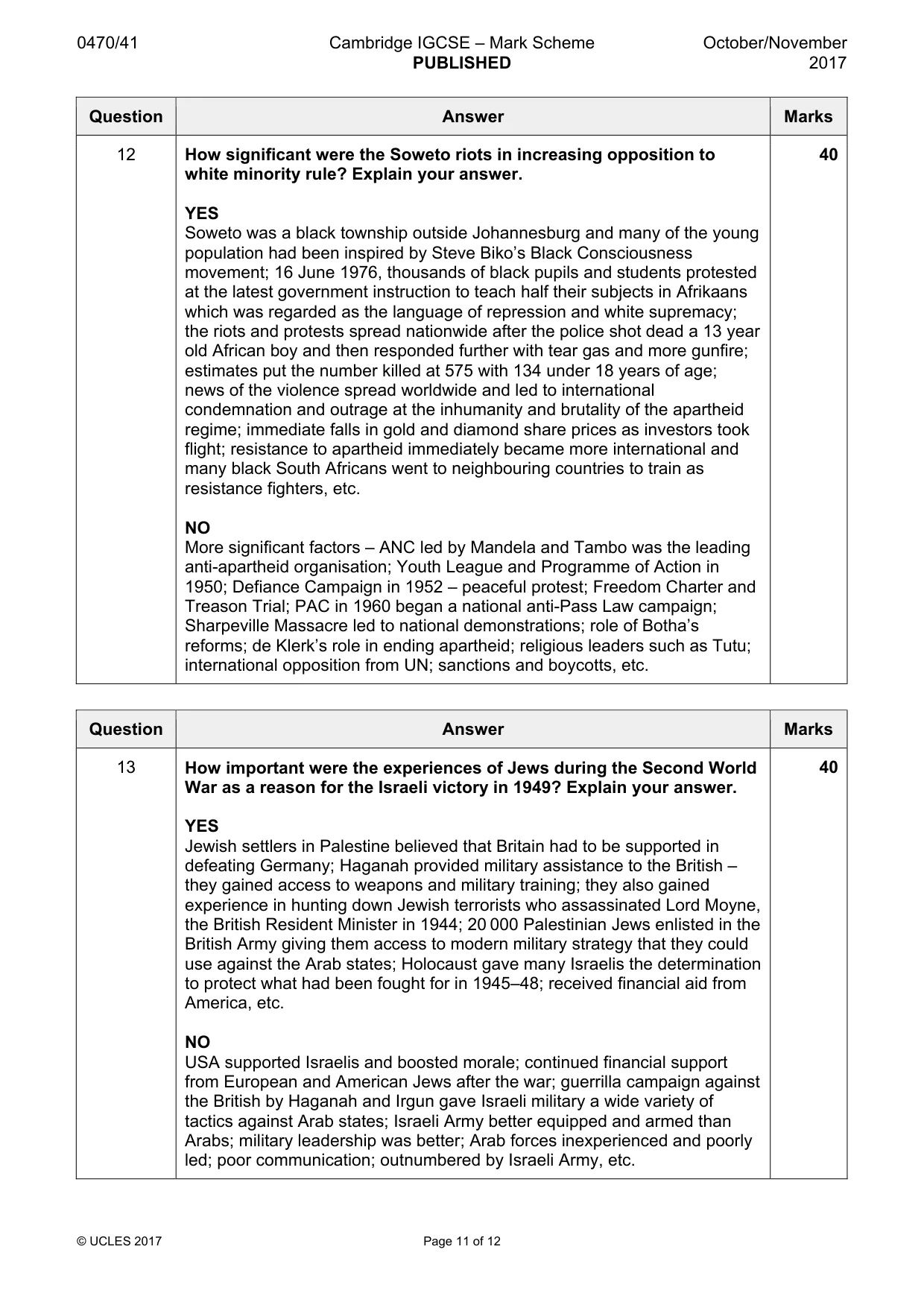
0470/41 Cambridge IGCSE – Mark Scheme PUBLISHED October/November 2017 © UCLES 2017 Page 11 of 12 Question Answer Marks 12 How significant were the Soweto riots in increasing opposition to white minority rule? Explain your answer. YES Soweto was a black township outside Johannesburg and many of the young population had been inspired by Steve Biko’s Black Consciousness movement; 16 June 1976, thousands of black pupils and students protested at the latest government instruction to teach half their subjects in Afrikaans which was regarded as the language of repression and white supremacy; the riots and protests spread nationwide after the police shot dead a 13 year old African boy and then responded further with tear gas and more gunfire; estimates put the number killed at 575 with 134 under 18 years of age; news of the violence spread worldwide and led to international condemnation and outrage at the inhumanity and brutality of the apartheid regime; immediate falls in gold and diamond share prices as investors took flight; resistance to apartheid immediately became more international and many black South Africans went to neighbouring countries to train as resistance fighters, etc. NO More significant factors – ANC led by Mandela and Tambo was the leading anti-apartheid organisation; Youth League and Programme of Action in 1950; Defiance Campaign in 1952 – peaceful protest; Freedom Charter and Treason Trial; PAC in 1960 began a national anti-Pass Law campaign; Sharpeville Massacre led to national demonstrations; role of Botha’s reforms; de Klerk’s role in ending apartheid; religious leaders such as Tutu; international opposition from UN; sanctions and boycotts, etc. 40 Question Answer Marks 13 How important were the experiences of Jews during the Second World War as a reason for the Israeli victory in 1949? Explain your answer. YES Jewish settlers in Palestine believed that Britain had to be supported in defeating Germany; Haganah provided military assistance to the British – they gained access to weapons and military training; they also gained experience in hunting down Jewish terrorists who assassinated Lord Moyne, the British Resident Minister in 1944; 20 000 Palestinian Jews enlisted in the British Army giving them access to modern military strategy that they could use against the Arab states; Holocaust gave many Israelis the determination to protect what had been fought for in 1945–48; received financial aid from America, etc. NO USA supported Israelis and boosted morale; continued financial support from European and American Jews after the war; guerrilla campaign against the British by Haganah and Irgun gave Israeli military a wide variety of tactics against Arab states; Israeli Army better equipped and armed than Arabs; military leadership was better; Arab forces inexperienced and poorly led; poor communication; outnumbered by Israeli Army, etc. 40
Mark scheme, page 12
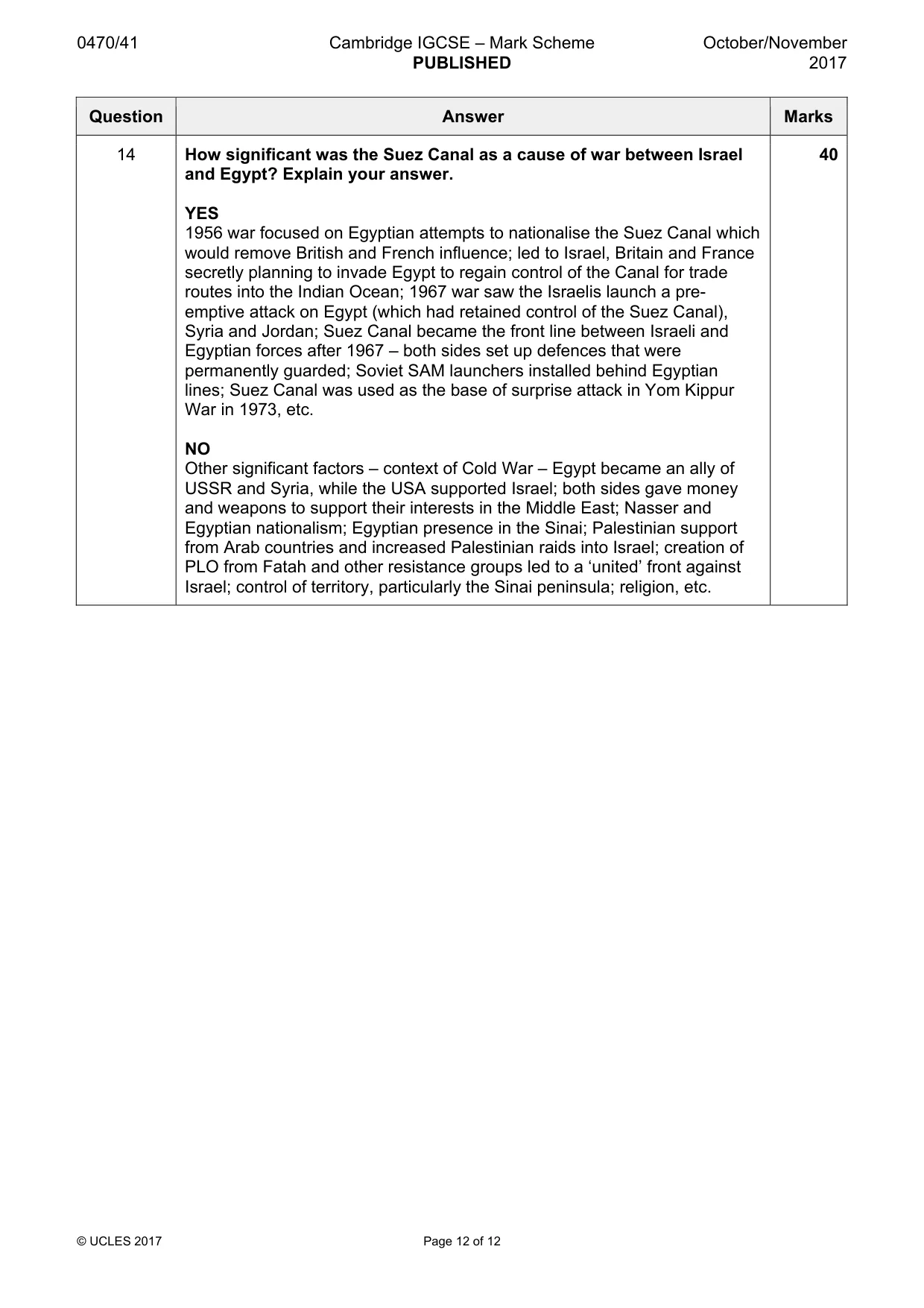
0470/41 Cambridge IGCSE – Mark Scheme PUBLISHED October/November 2017 © UCLES 2017 Page 12 of 12 Question Answer Marks 14 How significant was the Suez Canal as a cause of war between Israel and Egypt? Explain your answer. YES 1956 war focused on Egyptian attempts to nationalise the Suez Canal which would remove British and French influence; led to Israel, Britain and France secretly planning to invade Egypt to regain control of the Canal for trade routes into the Indian Ocean; 1967 war saw the Israelis launch a pre- emptive attack on Egypt (which had retained control of the Suez Canal), Syria and Jordan; Suez Canal became the front line between Israeli and Egyptian forces after 1967 – both sides set up defences that were permanently guarded; Soviet SAM launchers installed behind Egyptian lines; Suez Canal was used as the base of surprise attack in Yom Kippur War in 1973, etc. NO Other significant factors – context of Cold War – Egypt became an ally of USSR and Syria, while the USA supported Israel; both sides gave money and weapons to support their interests in the Middle East; Nasser and Egyptian nationalism; Egyptian presence in the Sinai; Palestinian support from Arab countries and increased Palestinian raids into Israel; creation of PLO from Fatah and other resistance groups led to a ‘united’ front against Israel; control of territory, particularly the Sinai peninsula; religion, etc. 40
What you needed in this session
Cambridge’s own grade thresholds for 2017 Oct/Nov, Paper 4 · Variant 1. A higher threshold means an easier paper — the bar moves with how the cohort did.