Cambridge IGCSE History 0470 — 2016 Oct/Nov Paper 4 · Variant 3
0470/43/O/N/16 · 40 marks · ≈45 min
The question paper and its mark scheme, free to read here and free to download. This is Cambridge’s own paper, exactly as it was sat.
Question paper4 pages
Mark scheme10 pages
Answers below. Sit the paper first if you are practising.
Paper as text
Question paper, page 1
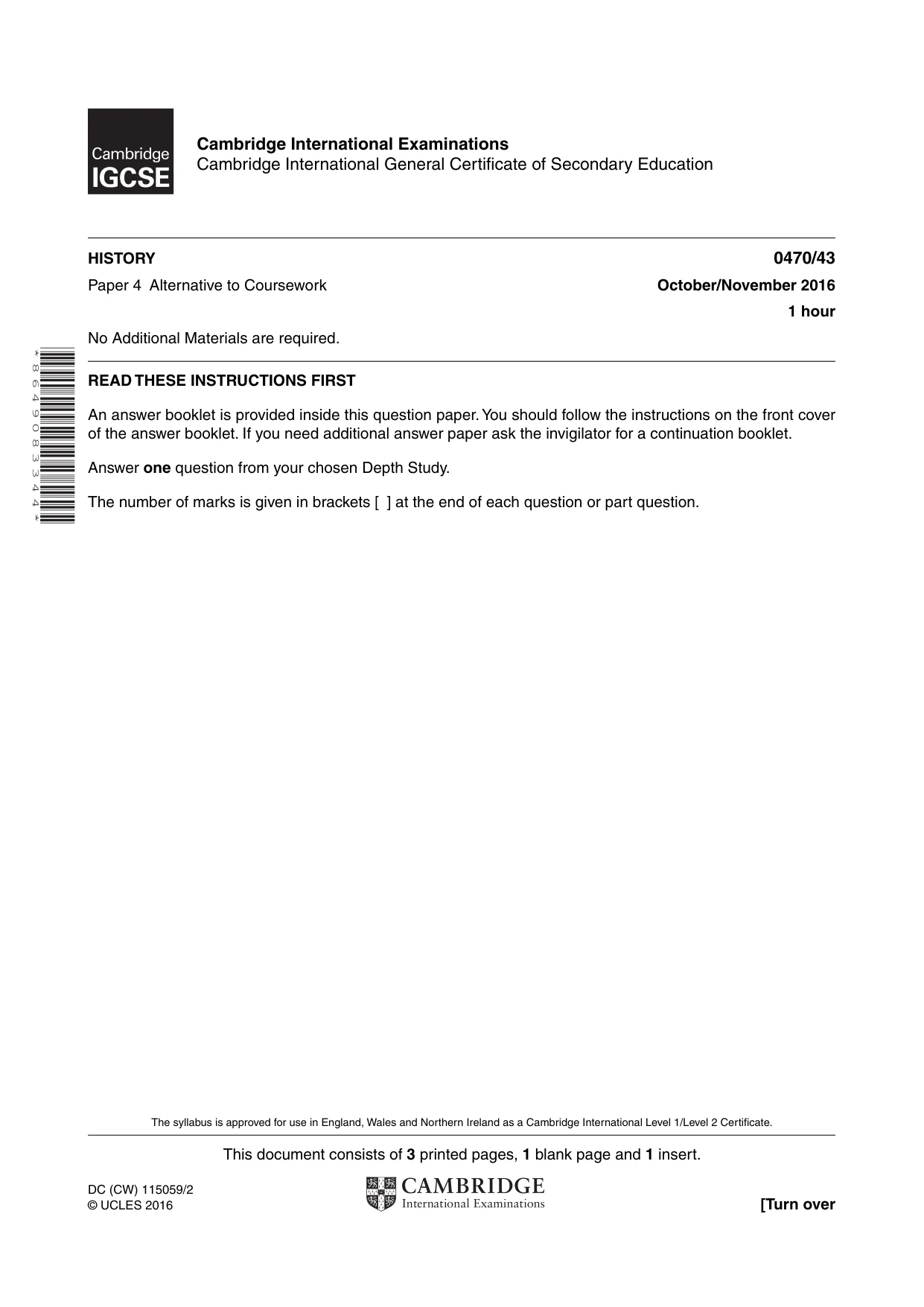
This document consists of 3 printed pages, 1 blank page and 1 insert. DC (CW) 115059/2 © UCLES 2016 [Turn over Cambridge International Examinations Cambridge International General Certificate of Secondary Education * 8 6 4 9 0 8 3 3 4 4 * HISTORY 0470/43 Paper 4 Alternative to Coursework October/November 2016 1 hour No Additional Materials are required. READ THESE INSTRUCTIONS FIRST An answer booklet is provided inside this question paper. You should follow the instructions on the front cover of the answer booklet. If you need additional answer paper ask the invigilator for a continuation booklet. Answer one question from your chosen Depth Study. The number of marks is given in brackets [ ] at the end of each question or part question. The syllabus is approved for use in England, Wales and Northern Ireland as a Cambridge International Level 1/Level 2 Certificate.
Question paper, page 2
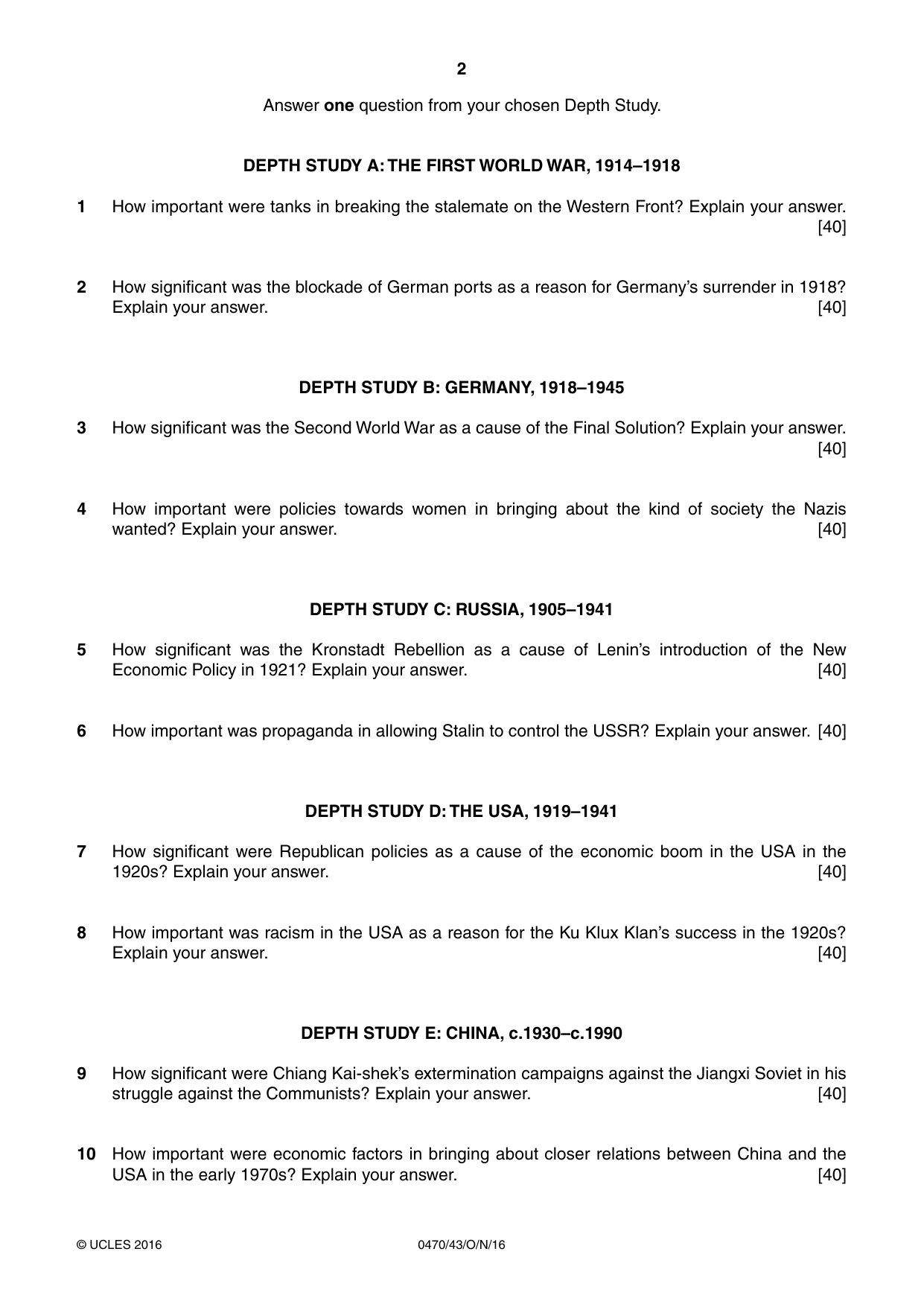
2 0470/43/O/N/16 © UCLES 2016 Answer one question from your chosen Depth Study. DEPTH STUDY A: THE FIRST WORLD WAR, 1914–1918 1 How important were tanks in breaking the stalemate on the Western Front? Explain your answer. [40] 2 How significant was the blockade of German ports as a reason for Germany’s surrender in 1918? Explain your answer. [40] DEPTH STUDY B: GERMANY, 1918–1945 3 How significant was the Second World War as a cause of the Final Solution? Explain your answer. [40] 4 How important were policies towards women in bringing about the kind of society the Nazis wanted? Explain your answer. [40] DEPTH STUDY C: RUSSIA, 1905–1941 5 How significant was the Kronstadt Rebellion as a cause of Lenin’s introduction of the New Economic Policy in 1921? Explain your answer. [40] 6 How important was propaganda in allowing Stalin to control the USSR? Explain your answer. [40] DEPTH STUDY D: THE USA, 1919–1941 7 How significant were Republican policies as a cause of the economic boom in the USA in the 1920s? Explain your answer. [40] 8 How important was racism in the USA as a reason for the Ku Klux Klan’s success in the 1920s? Explain your answer. [40] DEPTH STUDY E: CHINA, c.1930–c.1990 9 How significant were Chiang Kai-shek’s extermination campaigns against the Jiangxi Soviet in his struggle against the Communists? Explain your answer. [40] 10 How important were economic factors in bringing about closer relations between China and the USA in the early 1970s? Explain your answer. [40]
Question paper, page 3
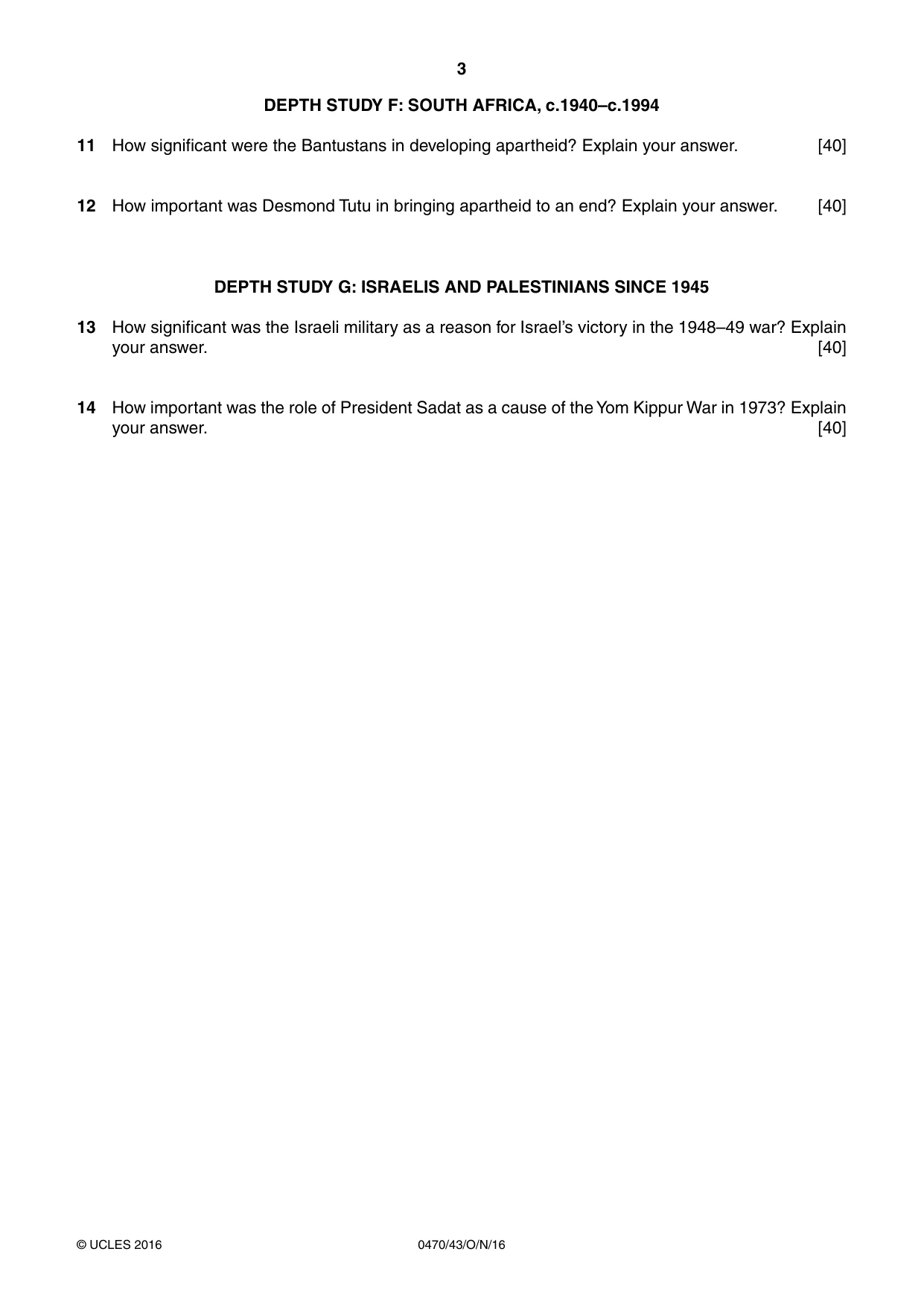
3 0470/43/O/N/16 © UCLES 2016 DEPTH STUDY F: SOUTH AFRICA, c.1940–c.1994 11 How significant were the Bantustans in developing apartheid? Explain your answer. [40] 12 How important was Desmond Tutu in bringing apartheid to an end? Explain your answer. [40] DEPTH STUDY G: ISRAELIS AND PALESTINIANS SINCE 1945 13 How significant was the Israeli military as a reason for Israel’s victory in the 1948–49 war? Explain your answer. [40] 14 How important was the role of President Sadat as a cause of the Yom Kippur War in 1973? Explain your answer. [40]
Question paper, page 4
4 0470/43/O/N/16 © UCLES 2016 BLANK PAGE Permission to reproduce items where third-party owned material protected by copyright is included has been sought and cleared where possible. Every reasonable effort has been made by the publisher (UCLES) to trace copyright holders, but if any items requiring clearance have unwittingly been included, the publisher will be pleased to make amends at the earliest possible opportunity. To avoid the issue of disclosure of answer-related information to candidates, all copyright acknowledgements are reproduced online in the Cambridge International Examinations Copyright Acknowledgements Booklet. This is produced for each series of examinations and is freely available to download at www.cie.org.uk after the live examination series. Cambridge International Examinations is part of the Cambridge Assessment Group. Cambridge Assessment is the brand name of University of Cambridge Local Examinations Syndicate (UCLES), which is itself a department of the University of Cambridge.
Mark scheme, page 1
® IGCSE is the registered trademark of Cambridge International Examinations. This syllabus is approved for use in England, Wales and Northern Ireland as a Cambridge International Level 1/Level 2 Certificate. This document consists of 10 printed pages. © UCLES 2016 [Turn over Cambridge International Examinations Cambridge International General Certificate of Secondary Education HISTORY 0470/43 Paper 4 Alternative to Coursework October/November 2016 MARK SCHEME Maximum Mark: 40 Published This mark scheme is published as an aid to teachers and candidates, to indicate the requirements of the examination. It shows the basis on which Examiners were instructed to award marks. It does not indicate the details of the discussions that took place at an Examiners’ meeting before marking began, which would have considered the acceptability of alternative answers. Mark schemes should be read in conjunction with the question paper and the Principal Examiner Report for Teachers. Cambridge will not enter into discussions about these mark schemes. Cambridge is publishing the mark schemes for the October/November 2016 series for most Cambridge IGCSE®, Cambridge International A and AS Level components and some Cambridge O Level components.
Mark scheme, page 2
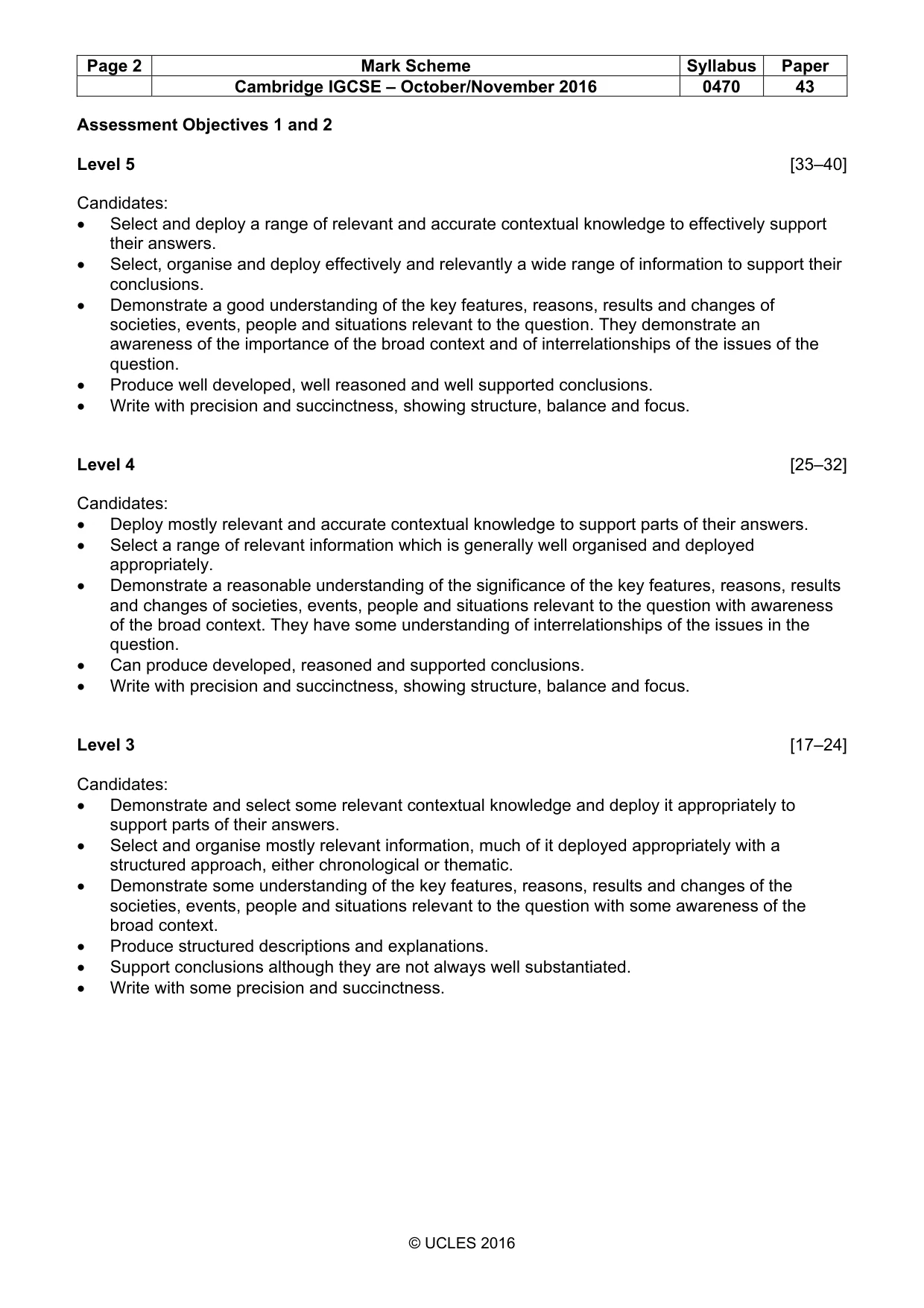
Page 2 Mark Scheme Syllabus Paper Cambridge IGCSE – October/November 2016 0470 43 © UCLES 2016 Assessment Objectives 1 and 2 Level 5 [33–40] Candidates: • Select and deploy a range of relevant and accurate contextual knowledge to effectively support their answers. • Select, organise and deploy effectively and relevantly a wide range of information to support their conclusions. • Demonstrate a good understanding of the key features, reasons, results and changes of societies, events, people and situations relevant to the question. They demonstrate an awareness of the importance of the broad context and of interrelationships of the issues of the question. • Produce well developed, well reasoned and well supported conclusions. • Write with precision and succinctness, showing structure, balance and focus. Level 4 [25–32] Candidates: • Deploy mostly relevant and accurate contextual knowledge to support parts of their answers. • Select a range of relevant information which is generally well organised and deployed appropriately. • Demonstrate a reasonable understanding of the significance of the key features, reasons, results and changes of societies, events, people and situations relevant to the question with awareness of the broad context. They have some understanding of interrelationships of the issues in the question. • Can produce developed, reasoned and supported conclusions. • Write with precision and succinctness, showing structure, balance and focus. Level 3 [17–24] Candidates: • Demonstrate and select some relevant contextual knowledge and deploy it appropriately to support parts of their answers. • Select and organise mostly relevant information, much of it deployed appropriately with a structured approach, either chronological or thematic. • Demonstrate some understanding of the key features, reasons, results and changes of the societies, events, people and situations relevant to the question with some awareness of the broad context. • Produce structured descriptions and explanations. • Support conclusions although they are not always well substantiated. • Write with some precision and succinctness.
Mark scheme, page 3
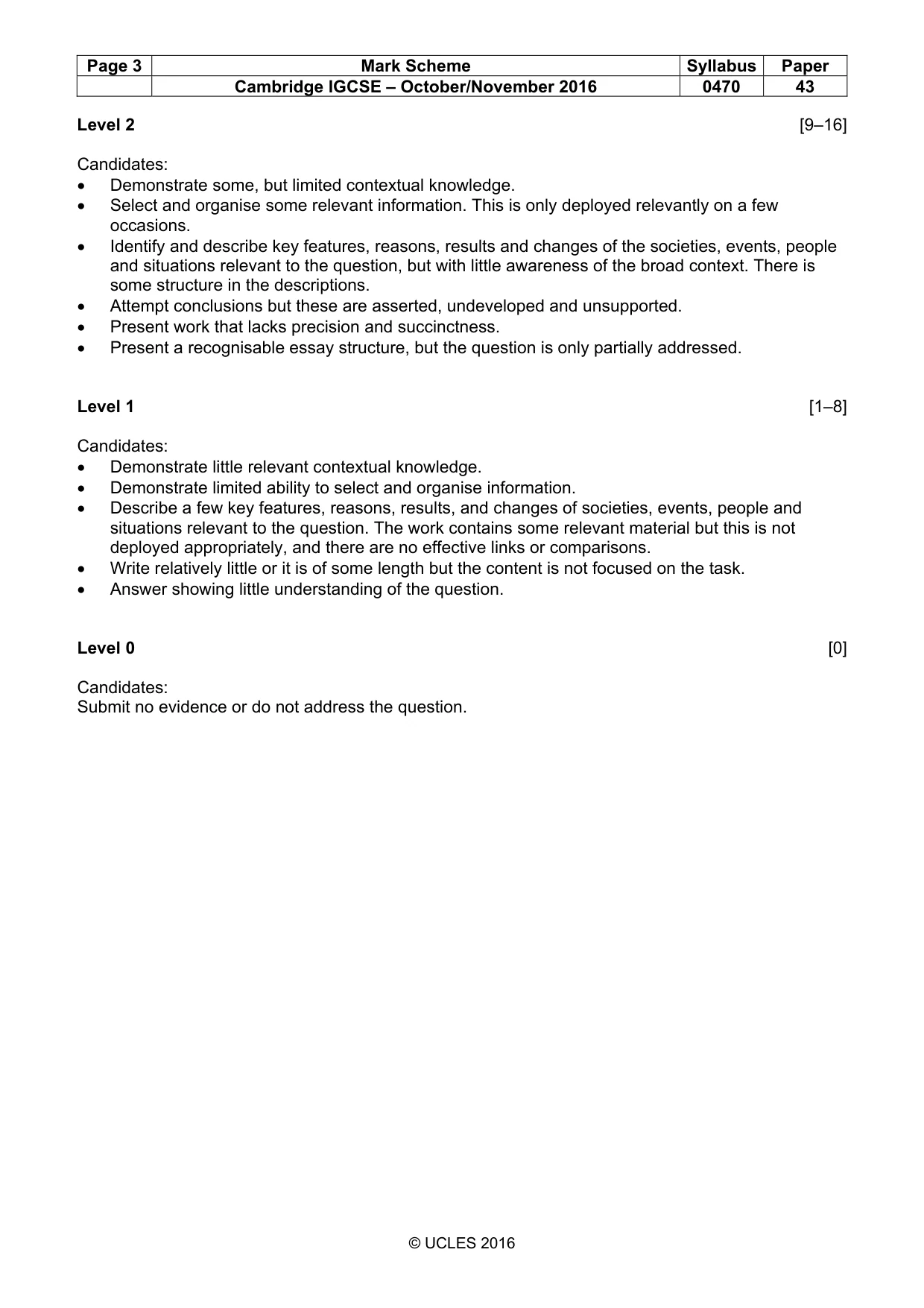
Page 3 Mark Scheme Syllabus Paper Cambridge IGCSE – October/November 2016 0470 43 © UCLES 2016 Level 2 [9–16] Candidates: • Demonstrate some, but limited contextual knowledge. • Select and organise some relevant information. This is only deployed relevantly on a few occasions. • Identify and describe key features, reasons, results and changes of the societies, events, people and situations relevant to the question, but with little awareness of the broad context. There is some structure in the descriptions. • Attempt conclusions but these are asserted, undeveloped and unsupported. • Present work that lacks precision and succinctness. • Present a recognisable essay structure, but the question is only partially addressed. Level 1 [1–8] Candidates: • Demonstrate little relevant contextual knowledge. • Demonstrate limited ability to select and organise information. • Describe a few key features, reasons, results, and changes of societies, events, people and situations relevant to the question. The work contains some relevant material but this is not deployed appropriately, and there are no effective links or comparisons. • Write relatively little or it is of some length but the content is not focused on the task. • Answer showing little understanding of the question. Level 0 [0] Candidates: Submit no evidence or do not address the question.
Mark scheme, page 4
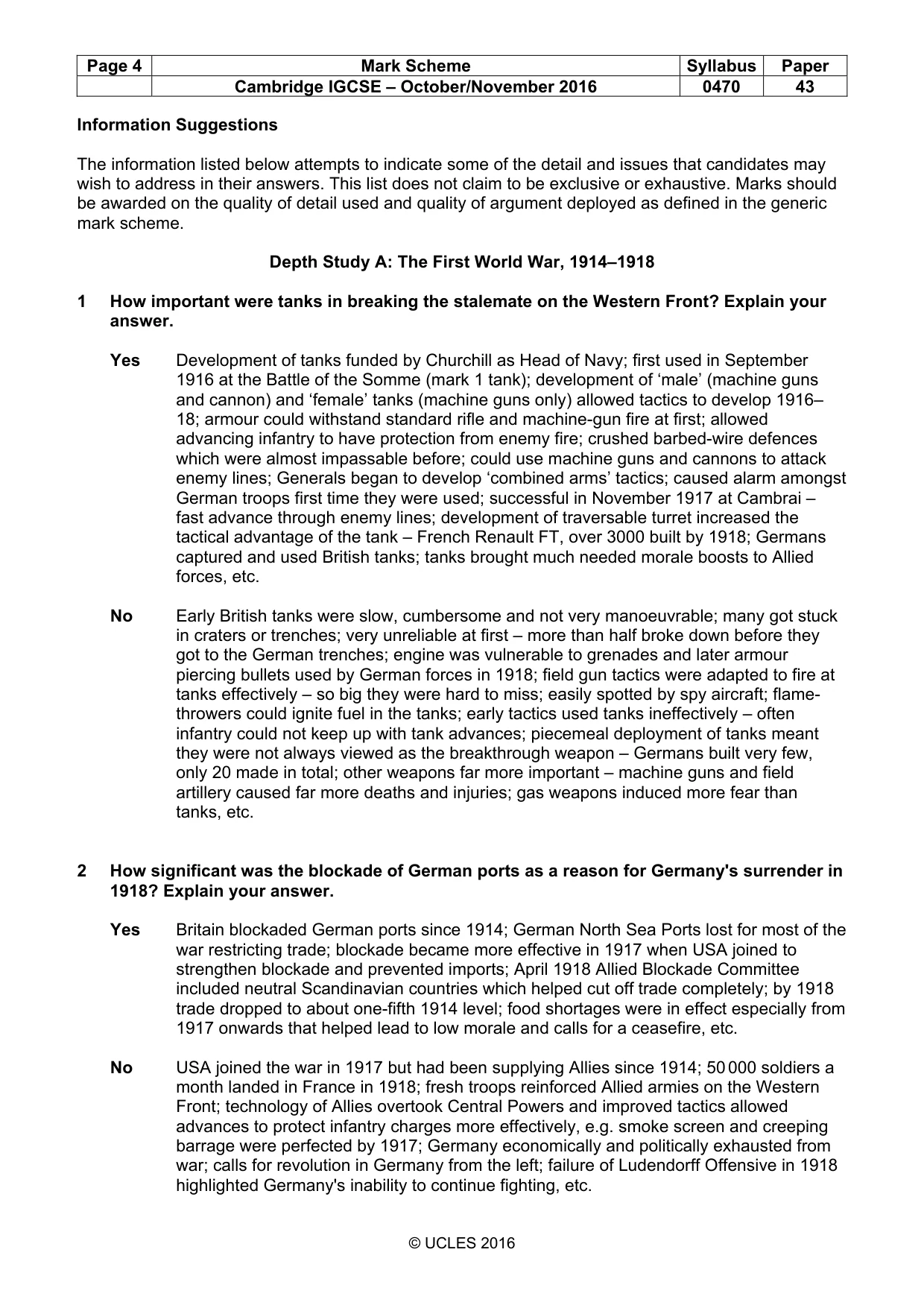
Page 4 Mark Scheme Syllabus Paper Cambridge IGCSE – October/November 2016 0470 43 © UCLES 2016 Information Suggestions The information listed below attempts to indicate some of the detail and issues that candidates may wish to address in their answers. This list does not claim to be exclusive or exhaustive. Marks should be awarded on the quality of detail used and quality of argument deployed as defined in the generic mark scheme. Depth Study A: The First World War, 1914–1918 1 How important were tanks in breaking the stalemate on the Western Front? Explain your answer. Yes Development of tanks funded by Churchill as Head of Navy; first used in September 1916 at the Battle of the Somme (mark 1 tank); development of ‘male’ (machine guns and cannon) and ‘female’ tanks (machine guns only) allowed tactics to develop 1916– 18; armour could withstand standard rifle and machine-gun fire at first; allowed advancing infantry to have protection from enemy fire; crushed barbed-wire defences which were almost impassable before; could use machine guns and cannons to attack enemy lines; Generals began to develop ‘combined arms’ tactics; caused alarm amongst German troops first time they were used; successful in November 1917 at Cambrai – fast advance through enemy lines; development of traversable turret increased the tactical advantage of the tank – French Renault FT, over 3000 built by 1918; Germans captured and used British tanks; tanks brought much needed morale boosts to Allied forces, etc. No Early British tanks were slow, cumbersome and not very manoeuvrable; many got stuck in craters or trenches; very unreliable at first – more than half broke down before they got to the German trenches; engine was vulnerable to grenades and later armour piercing bullets used by German forces in 1918; field gun tactics were adapted to fire at tanks effectively – so big they were hard to miss; easily spotted by spy aircraft; flame- throwers could ignite fuel in the tanks; early tactics used tanks ineffectively – often infantry could not keep up with tank advances; piecemeal deployment of tanks meant they were not always viewed as the breakthrough weapon – Germans built very few, only 20 made in total; other weapons far more important – machine guns and field artillery caused far more deaths and injuries; gas weapons induced more fear than tanks, etc. 2 How significant was the blockade of German ports as a reason for Germany's surrender in 1918? Explain your answer. Yes Britain blockaded German ports since 1914; German North Sea Ports lost for most of the war restricting trade; blockade became more effective in 1917 when USA joined to strengthen blockade and prevented imports; April 1918 Allied Blockade Committee included neutral Scandinavian countries which helped cut off trade completely; by 1918 trade dropped to about one-fifth 1914 level; food shortages were in effect especially from 1917 onwards that helped lead to low morale and calls for a ceasefire, etc. No USA joined the war in 1917 but had been supplying Allies since 1914; 50 000 soldiers a month landed in France in 1918; fresh troops reinforced Allied armies on the Western Front; technology of Allies overtook Central Powers and improved tactics allowed advances to protect infantry charges more effectively, e.g. smoke screen and creeping barrage were perfected by 1917; Germany economically and politically exhausted from war; calls for revolution in Germany from the left; failure of Ludendorff Offensive in 1918 highlighted Germany's inability to continue fighting, etc.
Mark scheme, page 5
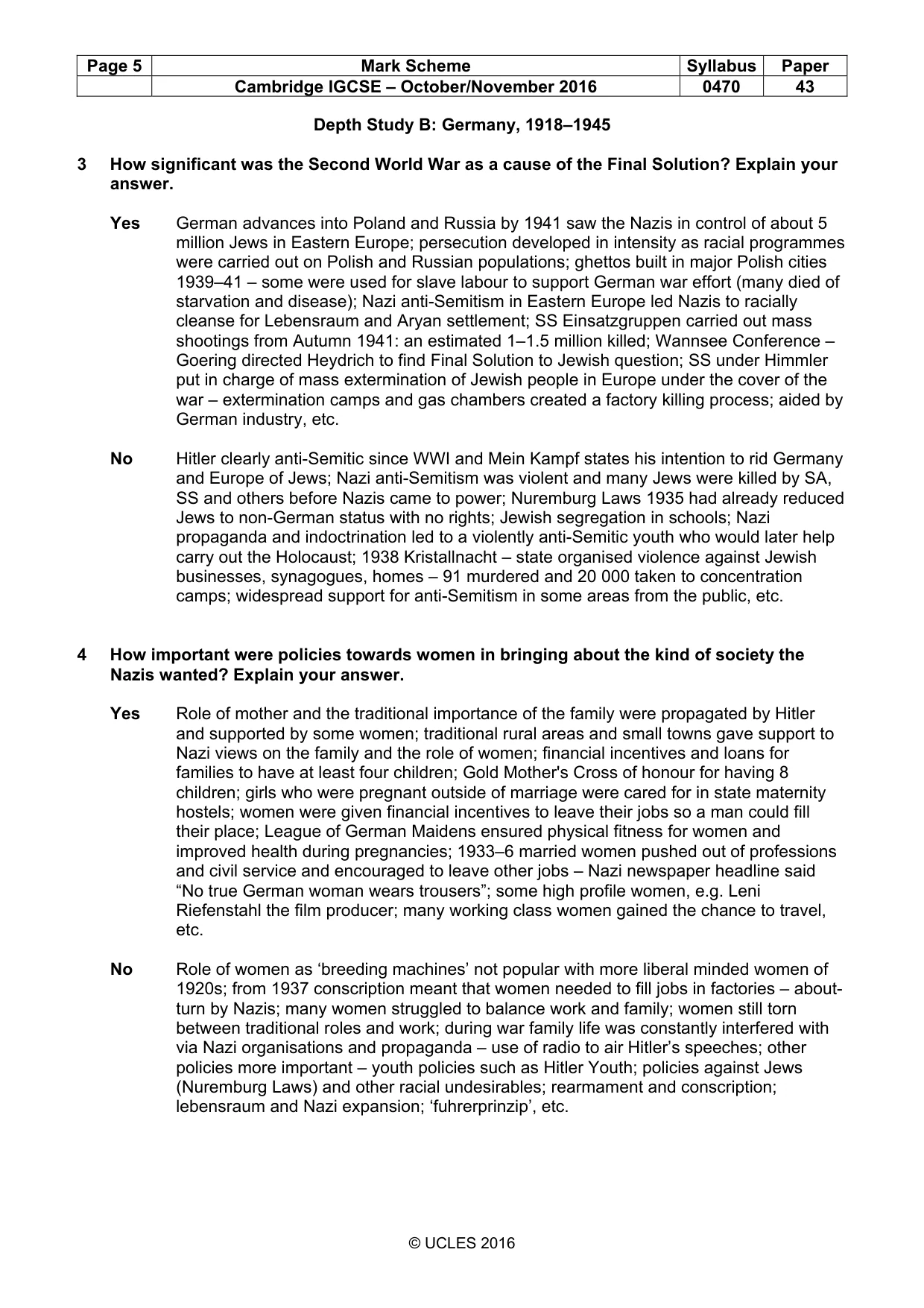
Page 5 Mark Scheme Syllabus Paper Cambridge IGCSE – October/November 2016 0470 43 © UCLES 2016 Depth Study B: Germany, 1918–1945 3 How significant was the Second World War as a cause of the Final Solution? Explain your answer. Yes German advances into Poland and Russia by 1941 saw the Nazis in control of about 5 million Jews in Eastern Europe; persecution developed in intensity as racial programmes were carried out on Polish and Russian populations; ghettos built in major Polish cities 1939–41 – some were used for slave labour to support German war effort (many died of starvation and disease); Nazi anti-Semitism in Eastern Europe led Nazis to racially cleanse for Lebensraum and Aryan settlement; SS Einsatzgruppen carried out mass shootings from Autumn 1941: an estimated 1–1.5 million killed; Wannsee Conference – Goering directed Heydrich to find Final Solution to Jewish question; SS under Himmler put in charge of mass extermination of Jewish people in Europe under the cover of the war – extermination camps and gas chambers created a factory killing process; aided by German industry, etc. No Hitler clearly anti-Semitic since WWI and Mein Kampf states his intention to rid Germany and Europe of Jews; Nazi anti-Semitism was violent and many Jews were killed by SA, SS and others before Nazis came to power; Nuremburg Laws 1935 had already reduced Jews to non-German status with no rights; Jewish segregation in schools; Nazi propaganda and indoctrination led to a violently anti-Semitic youth who would later help carry out the Holocaust; 1938 Kristallnacht – state organised violence against Jewish businesses, synagogues, homes – 91 murdered and 20 000 taken to concentration camps; widespread support for anti-Semitism in some areas from the public, etc. 4 How important were policies towards women in bringing about the kind of society the Nazis wanted? Explain your answer. Yes Role of mother and the traditional importance of the family were propagated by Hitler and supported by some women; traditional rural areas and small towns gave support to Nazi views on the family and the role of women; financial incentives and loans for families to have at least four children; Gold Mother's Cross of honour for having 8 children; girls who were pregnant outside of marriage were cared for in state maternity hostels; women were given financial incentives to leave their jobs so a man could fill their place; League of German Maidens ensured physical fitness for women and improved health during pregnancies; 1933–6 married women pushed out of professions and civil service and encouraged to leave other jobs – Nazi newspaper headline said “No true German woman wears trousers”; some high profile women, e.g. Leni Riefenstahl the film producer; many working class women gained the chance to travel, etc. No Role of women as ‘breeding machines’ not popular with more liberal minded women of 1920s; from 1937 conscription meant that women needed to fill jobs in factories – about- turn by Nazis; many women struggled to balance work and family; women still torn between traditional roles and work; during war family life was constantly interfered with via Nazi organisations and propaganda – use of radio to air Hitler’s speeches; other policies more important – youth policies such as Hitler Youth; policies against Jews (Nuremburg Laws) and other racial undesirables; rearmament and conscription; lebensraum and Nazi expansion; ‘fuhrerprinzip’, etc.
Mark scheme, page 6
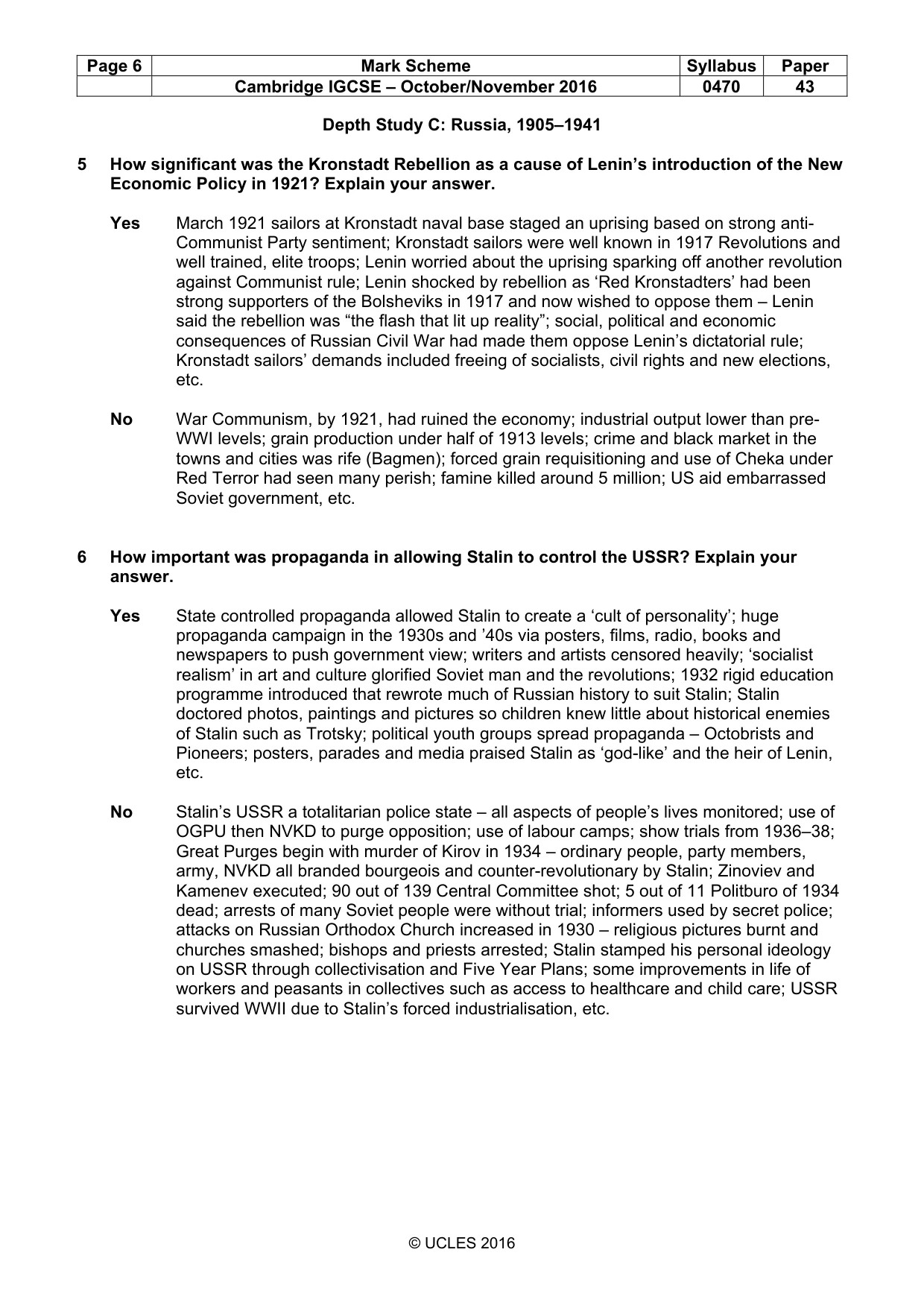
Page 6 Mark Scheme Syllabus Paper Cambridge IGCSE – October/November 2016 0470 43 © UCLES 2016 Depth Study C: Russia, 1905–1941 5 How significant was the Kronstadt Rebellion as a cause of Lenin’s introduction of the New Economic Policy in 1921? Explain your answer. Yes March 1921 sailors at Kronstadt naval base staged an uprising based on strong anti- Communist Party sentiment; Kronstadt sailors were well known in 1917 Revolutions and well trained, elite troops; Lenin worried about the uprising sparking off another revolution against Communist rule; Lenin shocked by rebellion as ‘Red Kronstadters’ had been strong supporters of the Bolsheviks in 1917 and now wished to oppose them – Lenin said the rebellion was “the flash that lit up reality”; social, political and economic consequences of Russian Civil War had made them oppose Lenin’s dictatorial rule; Kronstadt sailors’ demands included freeing of socialists, civil rights and new elections, etc. No War Communism, by 1921, had ruined the economy; industrial output lower than pre- WWI levels; grain production under half of 1913 levels; crime and black market in the towns and cities was rife (Bagmen); forced grain requisitioning and use of Cheka under Red Terror had seen many perish; famine killed around 5 million; US aid embarrassed Soviet government, etc. 6 How important was propaganda in allowing Stalin to control the USSR? Explain your answer. Yes State controlled propaganda allowed Stalin to create a ‘cult of personality’; huge propaganda campaign in the 1930s and ’40s via posters, films, radio, books and newspapers to push government view; writers and artists censored heavily; ‘socialist realism’ in art and culture glorified Soviet man and the revolutions; 1932 rigid education programme introduced that rewrote much of Russian history to suit Stalin; Stalin doctored photos, paintings and pictures so children knew little about historical enemies of Stalin such as Trotsky; political youth groups spread propaganda – Octobrists and Pioneers; posters, parades and media praised Stalin as ‘god-like’ and the heir of Lenin, etc. No Stalin’s USSR a totalitarian police state – all aspects of people’s lives monitored; use of OGPU then NVKD to purge opposition; use of labour camps; show trials from 1936–38; Great Purges begin with murder of Kirov in 1934 – ordinary people, party members, army, NVKD all branded bourgeois and counter-revolutionary by Stalin; Zinoviev and Kamenev executed; 90 out of 139 Central Committee shot; 5 out of 11 Politburo of 1934 dead; arrests of many Soviet people were without trial; informers used by secret police; attacks on Russian Orthodox Church increased in 1930 – religious pictures burnt and churches smashed; bishops and priests arrested; Stalin stamped his personal ideology on USSR through collectivisation and Five Year Plans; some improvements in life of workers and peasants in collectives such as access to healthcare and child care; USSR survived WWII due to Stalin’s forced industrialisation, etc.
Mark scheme, page 7
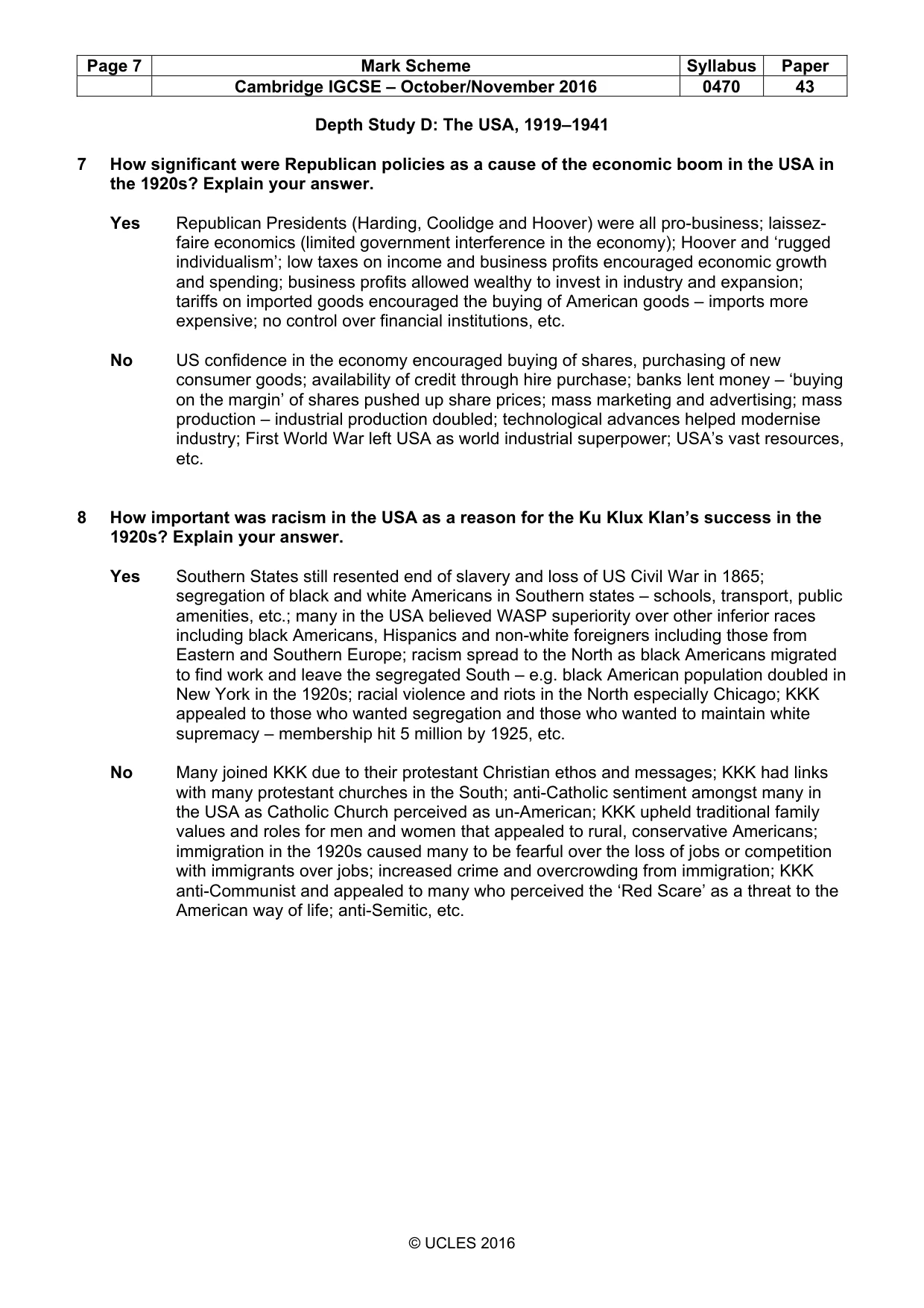
Page 7 Mark Scheme Syllabus Paper Cambridge IGCSE – October/November 2016 0470 43 © UCLES 2016 Depth Study D: The USA, 1919–1941 7 How significant were Republican policies as a cause of the economic boom in the USA in the 1920s? Explain your answer. Yes Republican Presidents (Harding, Coolidge and Hoover) were all pro-business; laissez- faire economics (limited government interference in the economy); Hoover and ‘rugged individualism’; low taxes on income and business profits encouraged economic growth and spending; business profits allowed wealthy to invest in industry and expansion; tariffs on imported goods encouraged the buying of American goods – imports more expensive; no control over financial institutions, etc. No US confidence in the economy encouraged buying of shares, purchasing of new consumer goods; availability of credit through hire purchase; banks lent money – ‘buying on the margin’ of shares pushed up share prices; mass marketing and advertising; mass production – industrial production doubled; technological advances helped modernise industry; First World War left USA as world industrial superpower; USA’s vast resources, etc. 8 How important was racism in the USA as a reason for the Ku Klux Klan’s success in the 1920s? Explain your answer. Yes Southern States still resented end of slavery and loss of US Civil War in 1865; segregation of black and white Americans in Southern states – schools, transport, public amenities, etc.; many in the USA believed WASP superiority over other inferior races including black Americans, Hispanics and non-white foreigners including those from Eastern and Southern Europe; racism spread to the North as black Americans migrated to find work and leave the segregated South – e.g. black American population doubled in New York in the 1920s; racial violence and riots in the North especially Chicago; KKK appealed to those who wanted segregation and those who wanted to maintain white supremacy – membership hit 5 million by 1925, etc. No Many joined KKK due to their protestant Christian ethos and messages; KKK had links with many protestant churches in the South; anti-Catholic sentiment amongst many in the USA as Catholic Church perceived as un-American; KKK upheld traditional family values and roles for men and women that appealed to rural, conservative Americans; immigration in the 1920s caused many to be fearful over the loss of jobs or competition with immigrants over jobs; increased crime and overcrowding from immigration; KKK anti-Communist and appealed to many who perceived the ‘Red Scare’ as a threat to the American way of life; anti-Semitic, etc.
Mark scheme, page 8
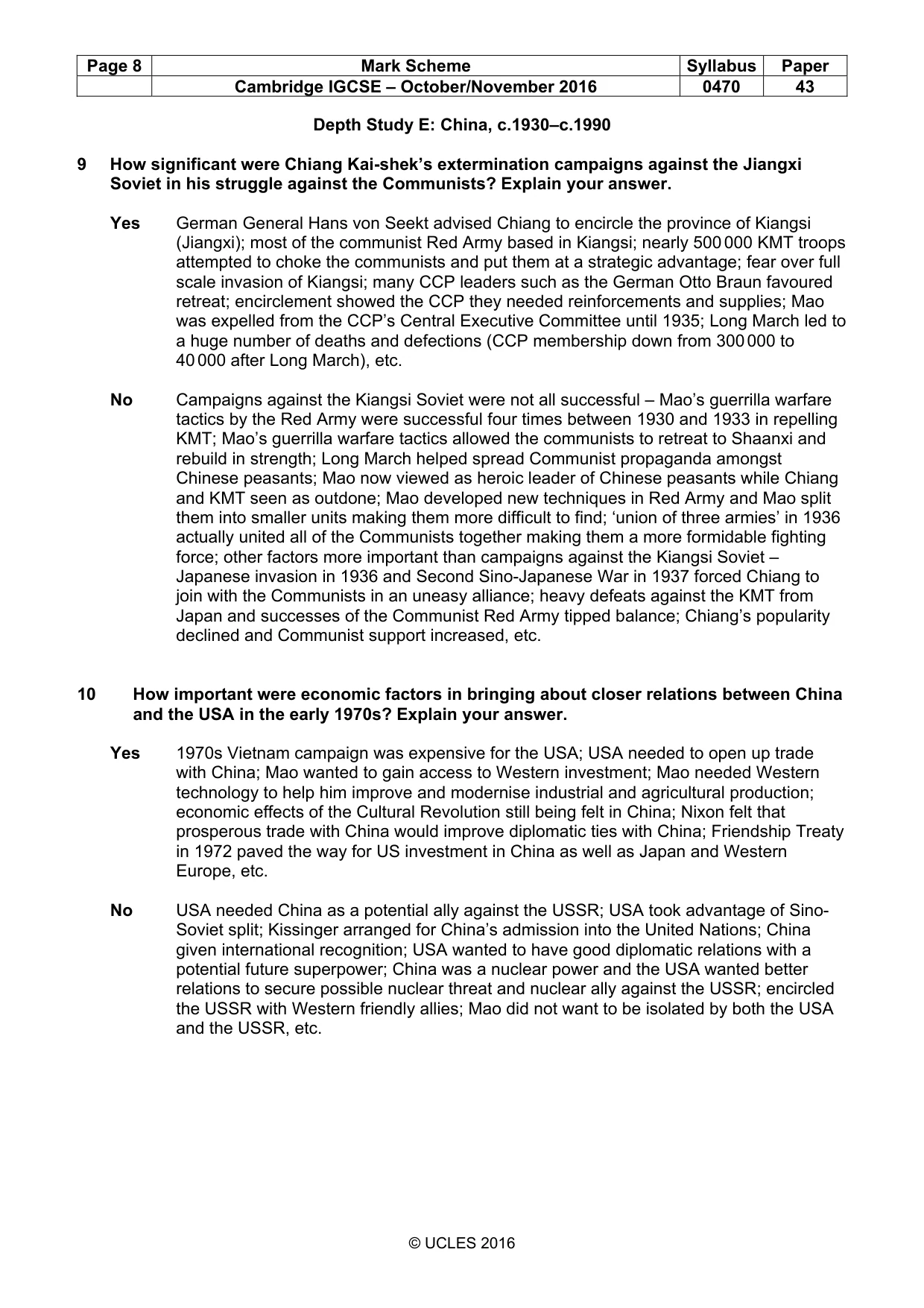
Page 8 Mark Scheme Syllabus Paper Cambridge IGCSE – October/November 2016 0470 43 © UCLES 2016 Depth Study E: China, c.1930–c.1990 9 How significant were Chiang Kai-shek’s extermination campaigns against the Jiangxi Soviet in his struggle against the Communists? Explain your answer. Yes German General Hans von Seekt advised Chiang to encircle the province of Kiangsi (Jiangxi); most of the communist Red Army based in Kiangsi; nearly 500 000 KMT troops attempted to choke the communists and put them at a strategic advantage; fear over full scale invasion of Kiangsi; many CCP leaders such as the German Otto Braun favoured retreat; encirclement showed the CCP they needed reinforcements and supplies; Mao was expelled from the CCP’s Central Executive Committee until 1935; Long March led to a huge number of deaths and defections (CCP membership down from 300 000 to 40 000 after Long March), etc. No Campaigns against the Kiangsi Soviet were not all successful – Mao’s guerrilla warfare tactics by the Red Army were successful four times between 1930 and 1933 in repelling KMT; Mao’s guerrilla warfare tactics allowed the communists to retreat to Shaanxi and rebuild in strength; Long March helped spread Communist propaganda amongst Chinese peasants; Mao now viewed as heroic leader of Chinese peasants while Chiang and KMT seen as outdone; Mao developed new techniques in Red Army and Mao split them into smaller units making them more difficult to find; ‘union of three armies’ in 1936 actually united all of the Communists together making them a more formidable fighting force; other factors more important than campaigns against the Kiangsi Soviet – Japanese invasion in 1936 and Second Sino-Japanese War in 1937 forced Chiang to join with the Communists in an uneasy alliance; heavy defeats against the KMT from Japan and successes of the Communist Red Army tipped balance; Chiang’s popularity declined and Communist support increased, etc. 10 How important were economic factors in bringing about closer relations between China and the USA in the early 1970s? Explain your answer. Yes 1970s Vietnam campaign was expensive for the USA; USA needed to open up trade with China; Mao wanted to gain access to Western investment; Mao needed Western technology to help him improve and modernise industrial and agricultural production; economic effects of the Cultural Revolution still being felt in China; Nixon felt that prosperous trade with China would improve diplomatic ties with China; Friendship Treaty in 1972 paved the way for US investment in China as well as Japan and Western Europe, etc. No USA needed China as a potential ally against the USSR; USA took advantage of Sino- Soviet split; Kissinger arranged for China’s admission into the United Nations; China given international recognition; USA wanted to have good diplomatic relations with a potential future superpower; China was a nuclear power and the USA wanted better relations to secure possible nuclear threat and nuclear ally against the USSR; encircled the USSR with Western friendly allies; Mao did not want to be isolated by both the USA and the USSR, etc.
Mark scheme, page 9
Page 9 Mark Scheme Syllabus Paper Cambridge IGCSE – October/November 2016 0470 43 © UCLES 2016 Depth Study F: South Africa, c.1940–c.1994 11 How significant were the Bantustans in developing apartheid? Explain your answer. Yes Promised his supporters an all-white South Africa by 1978; creation of all-black Bantustans: Bantu – Self-Government Act, 1959; 8 self-governing homelands created (later 10), each a specific homeland for a specific ethnic group; would leave white South Africans the majority ethnic group; government money used to help set up Bantustans; industry and agriculture were prevented from developing in Bantustans; Vorster continued policies and led first Bantustans to independence in 1976; Bantustans had their own flags and anthems; Bantustans were not of equal wealth or size; rulers of the Bantustans still had to be approved by the South African government; foreign and defence policies were still controlled by the SA government, etc. No Many black people still lived and worked outside of Bantustans, e.g. 18% of people from Transkei were registered as working outside of it; 78% of black people from QwaQwa lived in ‘white’ South Africa; they were propped up by government money, e.g. Ciskei had a new capital city Bisho built by government money – 59 million rand spent; growth of townships on the borders with white areas due to the lack of work in Bantustans; other policies more significant – Native Laws Act (restricted movement of workers – influx control), Pass Laws, segregation in education, prohibition of mixed race marriages, segregation of amenities, Group Areas Act separated urban areas into ‘white’, ‘Coloured’ and ‘black’; economic inequality, etc. 12 How important was Desmond Tutu in bringing apartheid to an end? Explain your answer. Yes Churches had been speaking up for black South Africans since before apartheid; church leaders got involved in protests and proclaimed the unchristian nature of apartheid; Allan Boesak and Frank Chikane involved in anti-apartheid demonstrations; Anglican priest Desmond Tutu became General Secretary of the South African Council of Churches in 1978 and denounced apartheid; excellent speaker; won Nobel Peace Prize in 1984; made Bishop of Johannesburg in 1985; Archbishop of Cape Town in 1986 (Head of the Anglican Church in South Africa); Tutu used letters, speeches, sermons, prayers, jokes and a sound understanding of people’s lives to show up the wickedness of apartheid and proclaim South Africa as a “rainbow coloured people”; Tutu called for the release of Nelson Mandela; denounced Botha's reforms, etc. No Financial crisis from 1985 in South Africa highlighted problems; boycotts and uprisings in the 1980s; State of Emergency declared in 1985 – military rule led to widespread condemnation from foreign countries and the UN; United Democratic Front organised in 1983; by 1989 South Africa near crisis and complete civil unrest; control over townships could not be restored; 1990 PAC and ANC unbanned and Mandela released; De Klerk’s role in working towards a new South Africa and equal rights; loss of National Party support forced De Klerk to make changes; De Klerk was religious; end of Cold War meant no danger from international Soviet threat; ANC and National Party work together – mutual respect; return of Oliver Tambo from exile, etc.
Mark scheme, page 10
Page 10 Mark Scheme Syllabus Paper Cambridge IGCSE – October/November 2016 0470 43 © UCLES 2016 Depth Study G: Israelis and Palestinians since 1945 13 How significant was the Israeli military as a reason for Israel’s victory in the 1948–49 war? Explain your answer. Yes Israeli military grew massively on the outbreak of war from 30 000 to 65 000 troops by July and 100 000 by December 1948; faster build-up of arms and troops compared to Arab forces; Israel gained access to more advanced military equipment from Europe – better weapons and communication; 25 000 Israeli troops had gained invaluable experience, training and technology fighting for the British Army during the Second World War; the only well trained Arab force was 10 000 strong – the Arab League of Transjordan; stronger side won; Zionism a strong influence on morale, etc. No Under the political leadership of Ben-Gurion most Israelis were united in the need to use force to establish the State of Israel; the Palestinian Arabs lacked strong, united leadership; many Palestinian leaders had left Palestine in the final days of the British mandate; neighbouring Arab states were slow to plan for invasion; Arab leaders were not united in their goals unlike Israelis; Arab states tended to fight for their own interests – little coordination of efforts; King Abdullah of Transjordan had secret meeting with Israel and reached an understanding that his Arab Legion would not protect all of Jerusalem from Israeli invasion, just east Jerusalem; Arab Legion also remained neutral when Israel fought Egyptian forces – Israel used this to their advantage, etc. 14 How important was the role of President Sadat as a cause of the Yom Kippur War in 1973? Explain your answer. Yes Nasser succeeded by Sadat in 1970; he wanted to regain the Sinai peninsula lost in the 1967 war; Sadat promised conflict with Israel in 1971; Sadat continued to rearm Egypt and build up aircraft and arms using Soviet aid; 1972 Sadat determined to break stalemate – he knew weapons, training and planning in the Egyptian military was much improved; Sadat gained financial support from Saudi Arabia; Syrian leader President Assad also became a strong ally; Sadat and Assad realised that war needed to be sooner rather than later to regain lost territory – secretly prepared for war, chose holiday of Yom Kippur, etc. No Six Day War had no official peace treaty; Egypt and Syria resentful of loss of Sinai and Golan Heights to Israel; fighting broke out over the Suez Canal in 1968 – further clashes over the right of Israel to use the Canal; ‘war of attrition’ had continued since the end of the Six Day War; lack of action from the USA to enter Arab-Israeli peace talks – too busy with Vietnam War; Zionists amongst the six million Jews in the USA opposed any attempt by the USA to ‘bully’ Israel; USA still offered no help even when Sadat expelled 15 000 Soviet advisors form Egypt; Israel ignored Sadat’s threats, as did the rest of the world, etc.
What you needed in this session
Cambridge’s own grade thresholds for 2016 Oct/Nov, Paper 4 · Variant 3. A higher threshold means an easier paper — the bar moves with how the cohort did.