Cambridge IGCSE History 0470 — 2016 Oct/Nov Paper 4 · Variant 2
0470/42/O/N/16 · 40 marks · ≈45 min
The question paper and its mark scheme, free to read here and free to download. This is Cambridge’s own paper, exactly as it was sat.
Question paper4 pages

Mark scheme10 pages
Answers below. Sit the paper first if you are practising.
Paper as text
Question paper, page 1
Cambridge International Examinations Cambridge International General Certificate of Secondary Education 0470/42 October/November 2016 1 hour HISTORY Paper 4 Alternative to Coursework Additional Materials: Answer Booklet/Paper READ THESE INSTRUCTIONS FIRST An answer booklet is provided inside this question paper. You should follow the instructions on the front cover of the answer booklet. If you need additional answer paper ask the invigilator for a continuation booklet. Answer one question from your chosen Depth Study. The number of marks is given in brackets [ ] at the end of each question or part question. The syllabus is approved for use in England, Wales and Northern Ireland as a Cambridge International Level 1/Level 2 Certificate. This document consists of 3 printed pages and 1 blank page. [Turn over 11_0470_42_2016_1.7 © UCLES 2016 *3044365775*
Question paper, page 2
Answer one question from your chosen Depth Study. DEPTH STUDY A: THE FIRST WORLD WAR, 1914–1918 How significant was the entry into the war of the British Expeditionary Force in 1914? Explain your answer. [40] 1 How important was the Zimmermann Telegram as a reason for US entry into the war in 1917? Explain your answer. [40] 2 DEPTH STUDY B: GERMANY, 1918–1945 How significant were the Spartacists to the instability of Germany,1918–23? Explain your answer. [40] 3 How important was control of the media in strengthening Nazi rule in Germany after 1934? Explain your answer. [40] 4 DEPTH STUDY C: RUSSIA, 1905–1941 How important was Rasputin as a cause of growing opposition to Tsarist rule in Russia? Explain your answer. [40] 5 How significant was the New Economic Policy as a reason for the introduction of Stalin's Five-Year Plans? Explain your answer. [40] 6 DEPTH STUDY D: THE USA, 1919–1941 How important was immigration as a cause of intolerance in US society in the 1920s? Explain your answer. [40] 7 How significant was the impact of the New Deal on the unemployed? Explain your answer. [40] 8 DEPTH STUDY E: CHINA, c.1930–c.1990 How important were the actions of the Kuomintang as a reason for the growth in support for the Chinese Communist Party? Explain your answer. [40] 9 How significant was the role of the USA in the emergence of China as a world power? Explain your answer. [40] 10 11_0470_42_2016_1.7 © UCLES 2016 2
Question paper, page 3
DEPTH STUDY F: SOUTH AFRICA, c.1940–c.1994 How important to the development of the South African economy by 1945 was gold mining? Explain your answer. [40] 11 How significant was the impact of government legislation on the lives of non-white South Africans during the 1950s? Explain your answer. [40] 12 DEPTH STUDY G: ISRAELIS AND PALESTINIANS SINCE 1945 How significant was Palestinian terrorism in promoting the Palestinian cause? Explain your answer. [40] 13 How important was the election of Likud in 1977 to relations between Israel and its neighbours? Explain your answer. [40] 14 11_0470_42_2016_1.7 © UCLES 2016 3
Question paper, page 4
BLANK PAGE Permission to reproduce items where third-party owned material protected by copyright is included has been sought and cleared where possible. Every reasonable effort has been made by the publisher (UCLES) to trace copyright holders, but if any items requiring clearance have unwittingly been included, the publisher will be pleased to make amends at the earliest possible opportunity. To avoid the issue of disclosure of answer-related information to candidates, all copyright acknowledgements are reproduced online in the Cambridge International Examinations Copyright Acknowledgements Booklet. This is produced for each series of examinations and is freely available to download at www.cie.org.uk after the live examination series. Cambridge International Examinations is part of the Cambridge Assessment Group. Cambridge Assessment is the brand name of University of Cambridge Local Examinations Syndicate (UCLES), which is itself a department of the University of Cambridge. 11_0470_42_2016_1.7 © UCLES 2016 4
Mark scheme, page 1
® IGCSE is the registered trademark of Cambridge International Examinations. This syllabus is approved for use in England, Wales and Northern Ireland as a Cambridge International Level 1/Level 2 Certificate. This document consists of 10 printed pages. © UCLES 2016 [Turn over Cambridge International Examinations Cambridge International General Certificate of Secondary Education HISTORY 0470/42 Paper 4 Alternative to Coursework October/November 2016 MARK SCHEME Maximum Mark: 40 Published This mark scheme is published as an aid to teachers and candidates, to indicate the requirements of the examination. It shows the basis on which Examiners were instructed to award marks. It does not indicate the details of the discussions that took place at an Examiners’ meeting before marking began, which would have considered the acceptability of alternative answers. Mark schemes should be read in conjunction with the question paper and the Principal Examiner Report for Teachers. Cambridge will not enter into discussions about these mark schemes. Cambridge is publishing the mark schemes for the October/November 2016 series for most Cambridge IGCSE®, Cambridge International A and AS Level components and some Cambridge O Level components.
Mark scheme, page 2
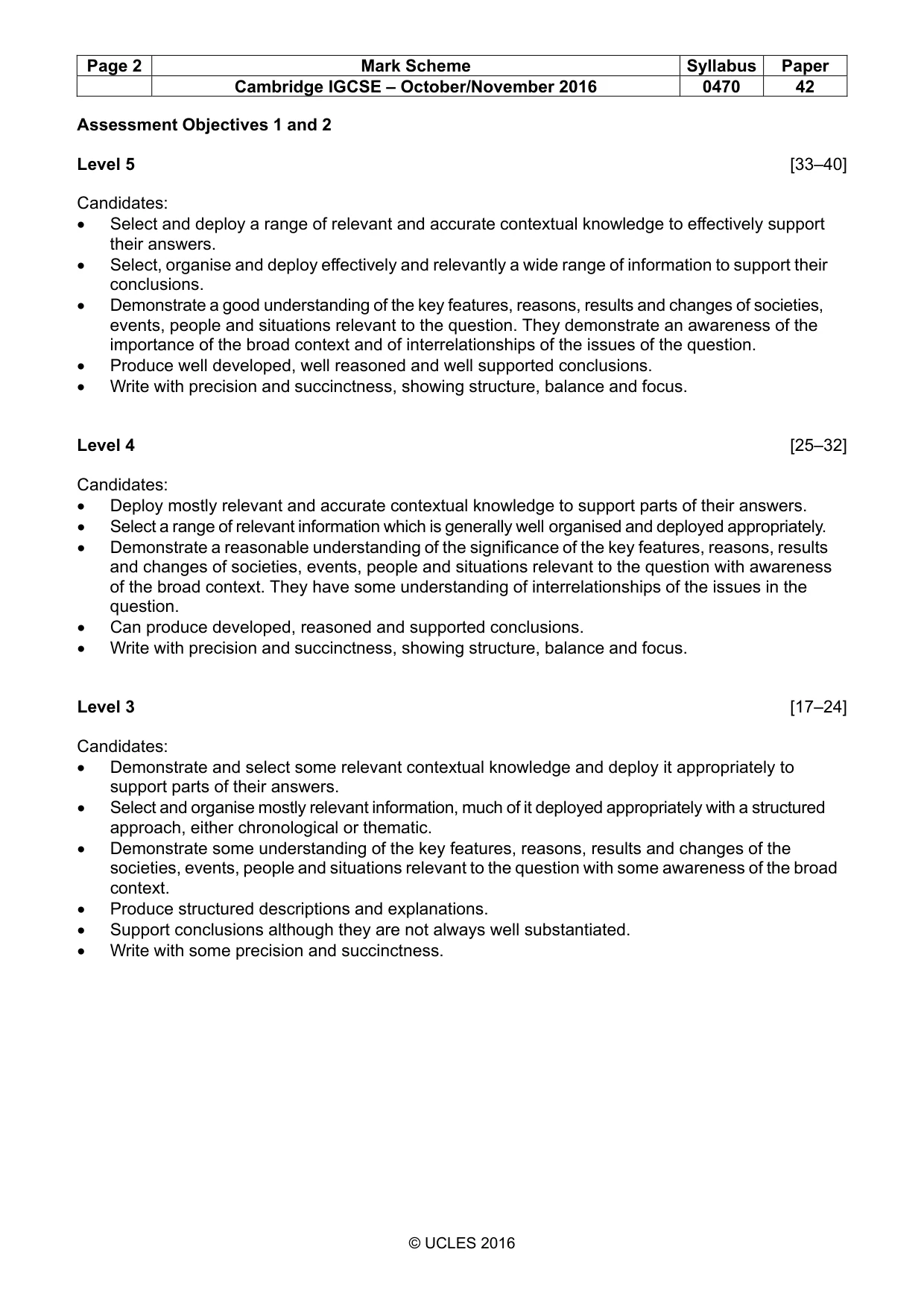
Page 2 Mark Scheme Syllabus Paper Cambridge IGCSE – October/November 2016 0470 42 © UCLES 2016 Assessment Objectives 1 and 2 Level 5 [33–40] Candidates: • Select and deploy a range of relevant and accurate contextual knowledge to effectively support their answers. • Select, organise and deploy effectively and relevantly a wide range of information to support their conclusions. • Demonstrate a good understanding of the key features, reasons, results and changes of societies, events, people and situations relevant to the question. They demonstrate an awareness of the importance of the broad context and of interrelationships of the issues of the question. • Produce well developed, well reasoned and well supported conclusions. • Write with precision and succinctness, showing structure, balance and focus. Level 4 [25–32] Candidates: • Deploy mostly relevant and accurate contextual knowledge to support parts of their answers. • Select a range of relevant information which is generally well organised and deployed appropriately. • Demonstrate a reasonable understanding of the significance of the key features, reasons, results and changes of societies, events, people and situations relevant to the question with awareness of the broad context. They have some understanding of interrelationships of the issues in the question. • Can produce developed, reasoned and supported conclusions. • Write with precision and succinctness, showing structure, balance and focus. Level 3 [17–24] Candidates: • Demonstrate and select some relevant contextual knowledge and deploy it appropriately to support parts of their answers. • Select and organise mostly relevant information, much of it deployed appropriately with a structured approach, either chronological or thematic. • Demonstrate some understanding of the key features, reasons, results and changes of the societies, events, people and situations relevant to the question with some awareness of the broad context. • Produce structured descriptions and explanations. • Support conclusions although they are not always well substantiated. • Write with some precision and succinctness.
Mark scheme, page 3
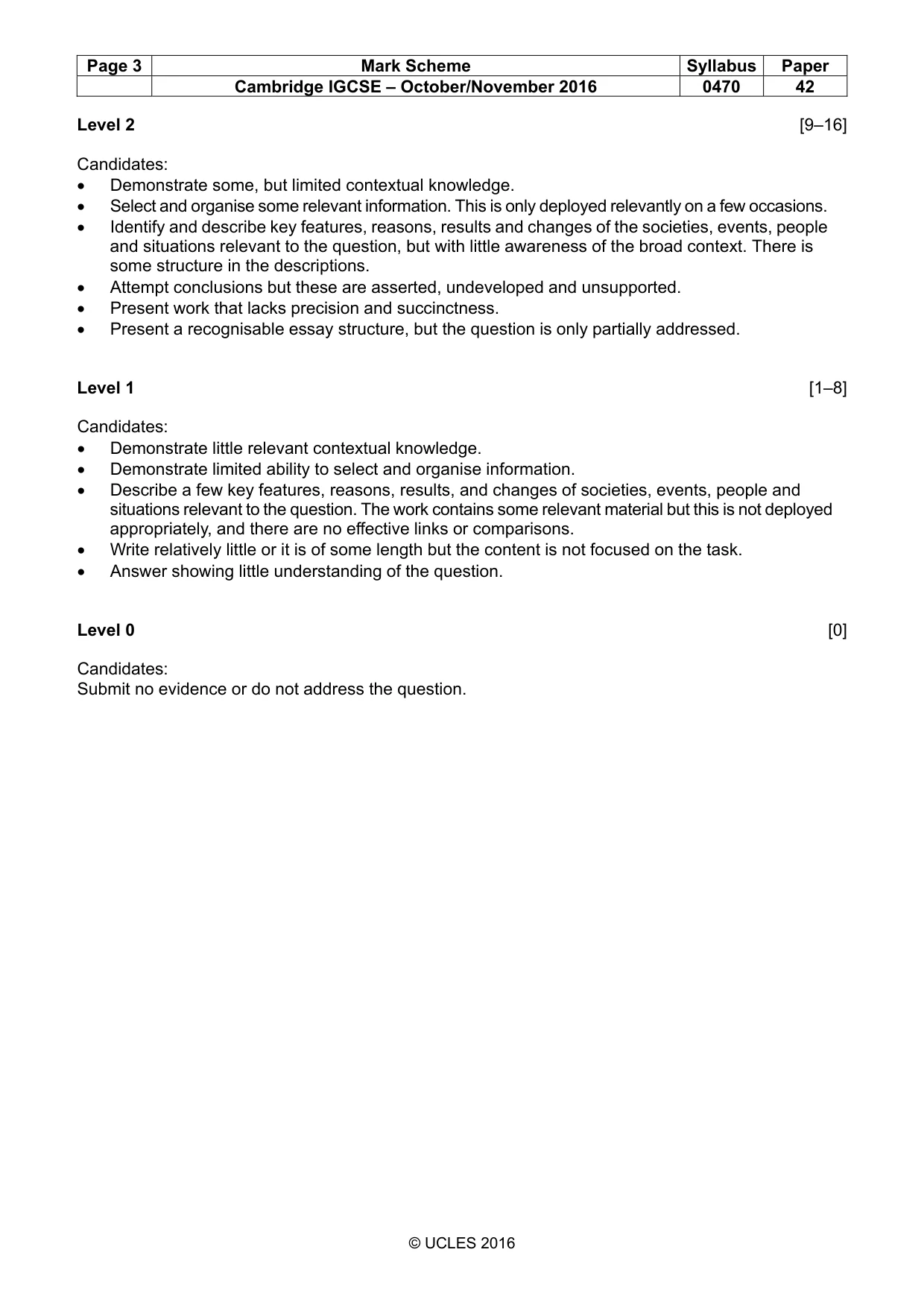
Page 3 Mark Scheme Syllabus Paper Cambridge IGCSE – October/November 2016 0470 42 © UCLES 2016 Level 2 [9–16] Candidates: • Demonstrate some, but limited contextual knowledge. • Select and organise some relevant information. This is only deployed relevantly on a few occasions. • Identify and describe key features, reasons, results and changes of the societies, events, people and situations relevant to the question, but with little awareness of the broad context. There is some structure in the descriptions. • Attempt conclusions but these are asserted, undeveloped and unsupported. • Present work that lacks precision and succinctness. • Present a recognisable essay structure, but the question is only partially addressed. Level 1 [1–8] Candidates: • Demonstrate little relevant contextual knowledge. • Demonstrate limited ability to select and organise information. • Describe a few key features, reasons, results, and changes of societies, events, people and situations relevant to the question. The work contains some relevant material but this is not deployed appropriately, and there are no effective links or comparisons. • Write relatively little or it is of some length but the content is not focused on the task. • Answer showing little understanding of the question. Level 0 [0] Candidates: Submit no evidence or do not address the question.
Mark scheme, page 4
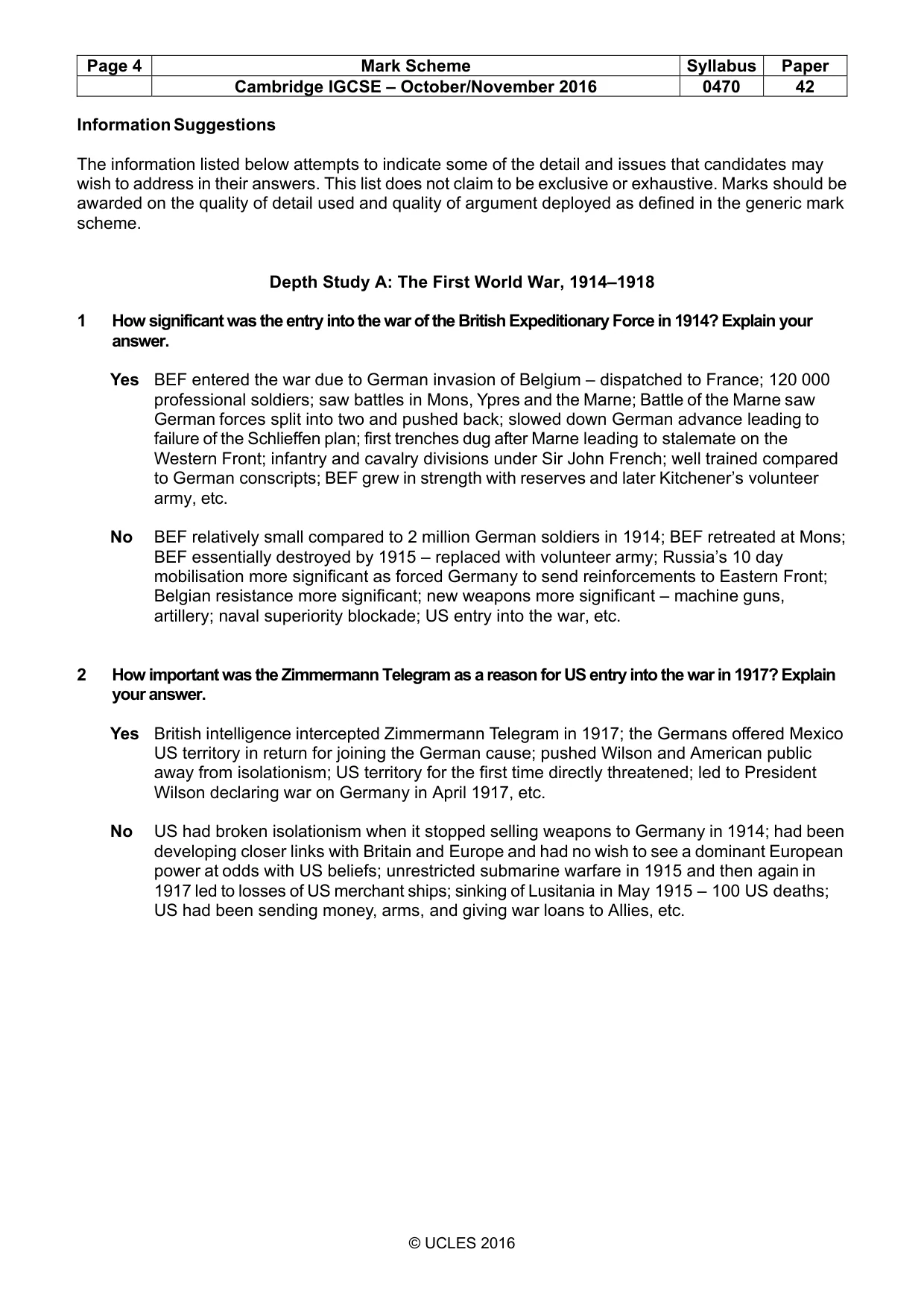
Page 4 Mark Scheme Syllabus Paper Cambridge IGCSE – October/November 2016 0470 42 © UCLES 2016 Information Suggestions The information listed below attempts to indicate some of the detail and issues that candidates may wish to address in their answers. This list does not claim to be exclusive or exhaustive. Marks should be awarded on the quality of detail used and quality of argument deployed as defined in the generic mark scheme. Depth Study A: The First World War, 1914–1918 1 How significant was the entry into the war of the British Expeditionary Force in 1914? Explain your answer. Yes BEF entered the war due to German invasion of Belgium – dispatched to France; 120 000 professional soldiers; saw battles in Mons, Ypres and the Marne; Battle of the Marne saw German forces split into two and pushed back; slowed down German advance leading to failure of the Schlieffen plan; first trenches dug after Marne leading to stalemate on the Western Front; infantry and cavalry divisions under Sir John French; well trained compared to German conscripts; BEF grew in strength with reserves and later Kitchener’s volunteer army, etc. No BEF relatively small compared to 2 million German soldiers in 1914; BEF retreated at Mons; BEF essentially destroyed by 1915 – replaced with volunteer army; Russia’s 10 day mobilisation more significant as forced Germany to send reinforcements to Eastern Front; Belgian resistance more significant; new weapons more significant – machine guns, artillery; naval superiority blockade; US entry into the war, etc. 2 How important was the Zimmermann Telegram as a reason for US entry into the war in 1917? Explain your answer. Yes British intelligence intercepted Zimmermann Telegram in 1917; the Germans offered Mexico US territory in return for joining the German cause; pushed Wilson and American public away from isolationism; US territory for the first time directly threatened; led to President Wilson declaring war on Germany in April 1917, etc. No US had broken isolationism when it stopped selling weapons to Germany in 1914; had been developing closer links with Britain and Europe and had no wish to see a dominant European power at odds with US beliefs; unrestricted submarine warfare in 1915 and then again in 1917 led to losses of US merchant ships; sinking of Lusitania in May 1915 – 100 US deaths; US had been sending money, arms, and giving war loans to Allies, etc.
Mark scheme, page 5
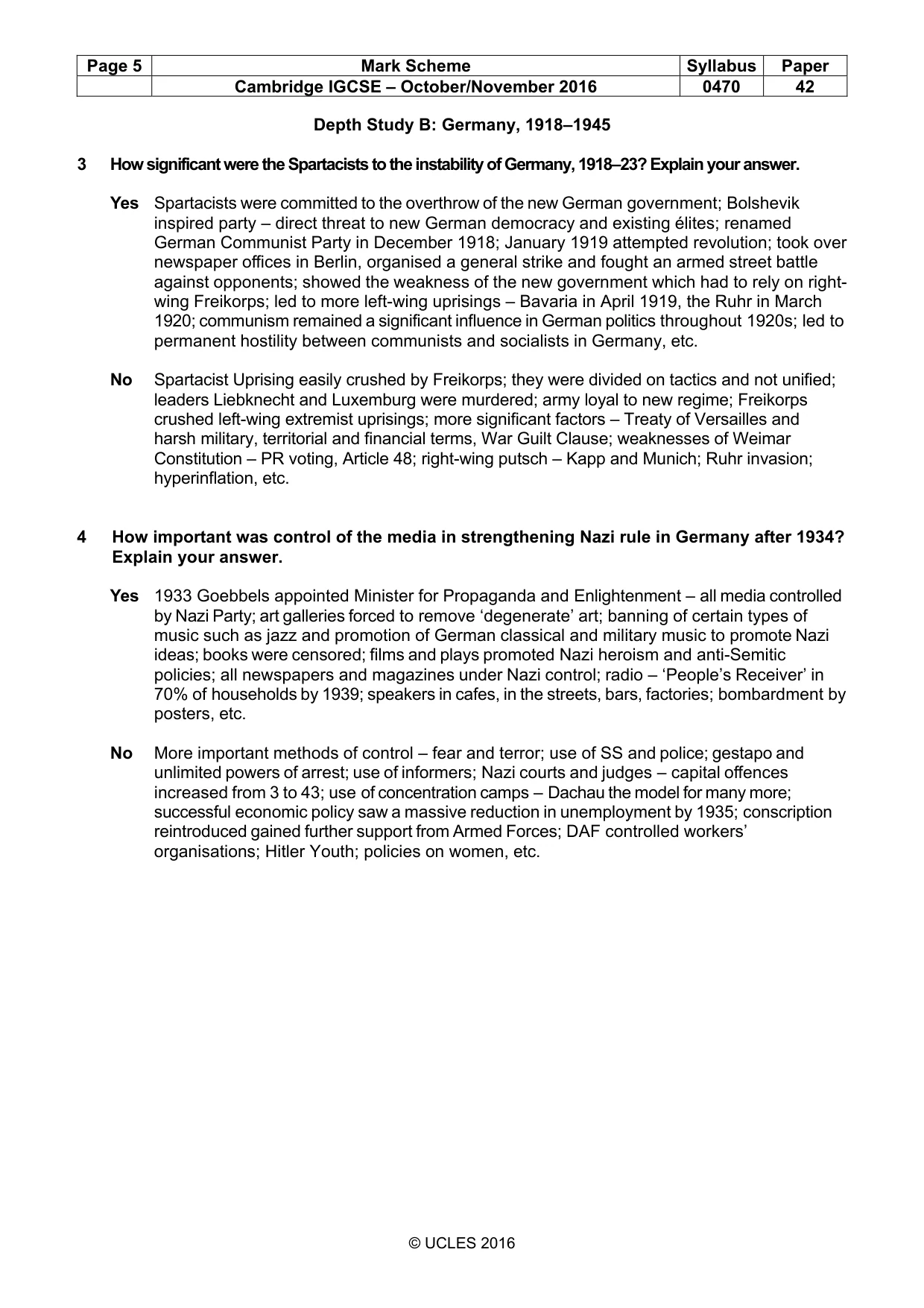
Page 5 Mark Scheme Syllabus Paper Cambridge IGCSE – October/November 2016 0470 42 © UCLES 2016 Depth Study B: Germany, 1918–1945 3 How significant were the Spartacists to the instability of Germany, 1918–23? Explain your answer. Yes Spartacists were committed to the overthrow of the new German government; Bolshevik inspired party – direct threat to new German democracy and existing élites; renamed German Communist Party in December 1918; January 1919 attempted revolution; took over newspaper offices in Berlin, organised a general strike and fought an armed street battle against opponents; showed the weakness of the new government which had to rely on right- wing Freikorps; led to more left-wing uprisings – Bavaria in April 1919, the Ruhr in March 1920; communism remained a significant influence in German politics throughout 1920s; led to permanent hostility between communists and socialists in Germany, etc. No Spartacist Uprising easily crushed by Freikorps; they were divided on tactics and not unified; leaders Liebknecht and Luxemburg were murdered; army loyal to new regime; Freikorps crushed left-wing extremist uprisings; more significant factors – Treaty of Versailles and harsh military, territorial and financial terms, War Guilt Clause; weaknesses of Weimar Constitution – PR voting, Article 48; right-wing putsch – Kapp and Munich; Ruhr invasion; hyperinflation, etc. 4 How important was control of the media in strengthening Nazi rule in Germany after 1934? Explain your answer. Yes 1933 Goebbels appointed Minister for Propaganda and Enlightenment – all media controlled by Nazi Party; art galleries forced to remove ‘degenerate’ art; banning of certain types of music such as jazz and promotion of German classical and military music to promote Nazi ideas; books were censored; films and plays promoted Nazi heroism and anti-Semitic policies; all newspapers and magazines under Nazi control; radio – ‘People’s Receiver’ in 70% of households by 1939; speakers in cafes, in the streets, bars, factories; bombardment by posters, etc. No More important methods of control – fear and terror; use of SS and police; gestapo and unlimited powers of arrest; use of informers; Nazi courts and judges – capital offences increased from 3 to 43; use of concentration camps – Dachau the model for many more; successful economic policy saw a massive reduction in unemployment by 1935; conscription reintroduced gained further support from Armed Forces; DAF controlled workers’ organisations; Hitler Youth; policies on women, etc.
Mark scheme, page 6
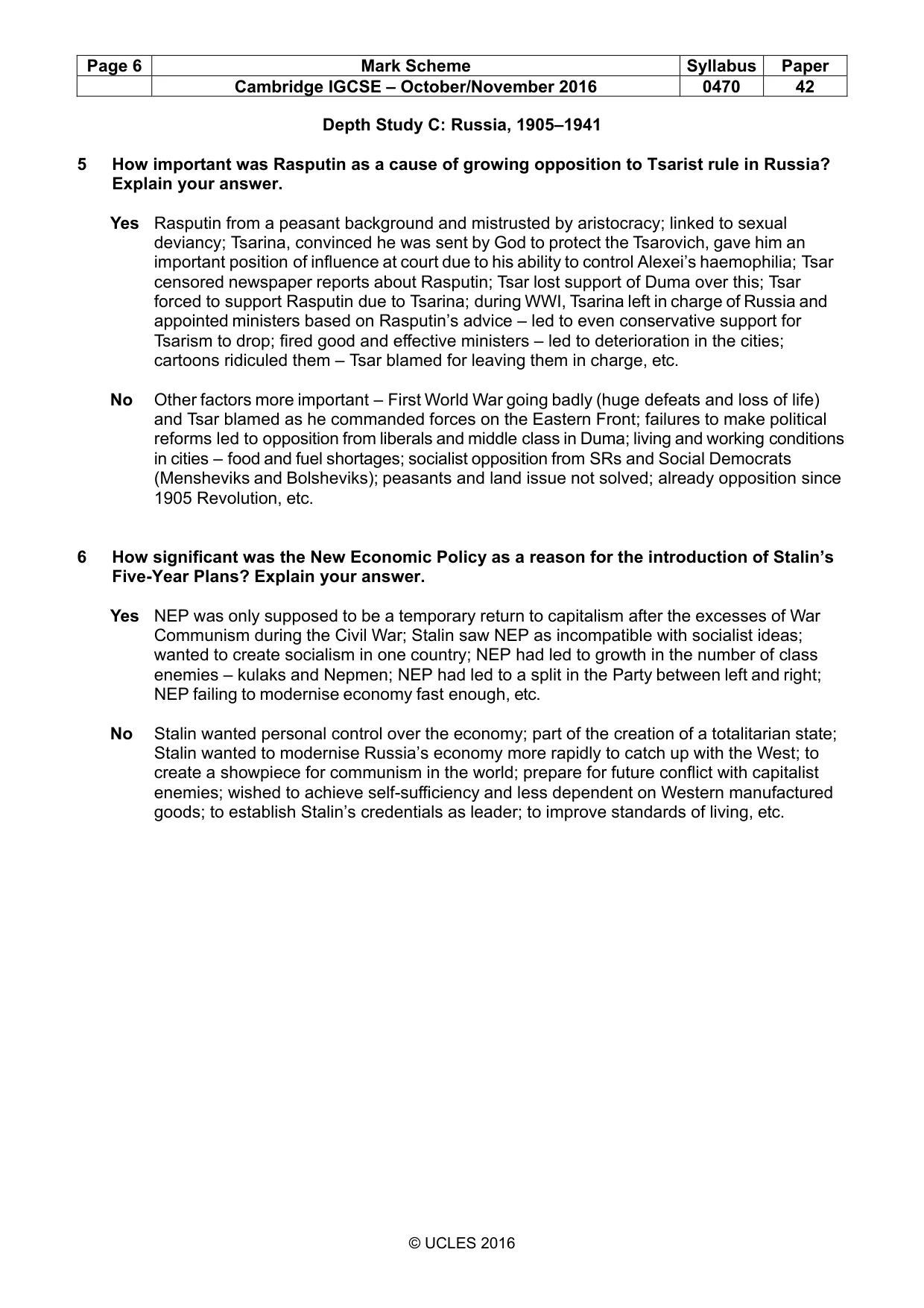
Page 6 Mark Scheme Syllabus Paper Cambridge IGCSE – October/November 2016 0470 42 © UCLES 2016 Depth Study C: Russia, 1905–1941 5 How important was Rasputin as a cause of growing opposition to Tsarist rule in Russia? Explain your answer. Yes Rasputin from a peasant background and mistrusted by aristocracy; linked to sexual deviancy; Tsarina, convinced he was sent by God to protect the Tsarovich, gave him an important position of influence at court due to his ability to control Alexei’s haemophilia; Tsar censored newspaper reports about Rasputin; Tsar lost support of Duma over this; Tsar forced to support Rasputin due to Tsarina; during WWI, Tsarina left in charge of Russia and appointed ministers based on Rasputin’s advice – led to even conservative support for Tsarism to drop; fired good and effective ministers – led to deterioration in the cities; cartoons ridiculed them – Tsar blamed for leaving them in charge, etc. No Other factors more important – First World War going badly (huge defeats and loss of life) and Tsar blamed as he commanded forces on the Eastern Front; failures to make political reforms led to opposition from liberals and middle class in Duma; living and working conditions in cities – food and fuel shortages; socialist opposition from SRs and Social Democrats (Mensheviks and Bolsheviks); peasants and land issue not solved; already opposition since 1905 Revolution, etc. 6 How significant was the New Economic Policy as a reason for the introduction of Stalin’s Five-Year Plans? Explain your answer. Yes NEP was only supposed to be a temporary return to capitalism after the excesses of War Communism during the Civil War; Stalin saw NEP as incompatible with socialist ideas; wanted to create socialism in one country; NEP had led to growth in the number of class enemies – kulaks and Nepmen; NEP had led to a split in the Party between left and right; NEP failing to modernise economy fast enough, etc. No Stalin wanted personal control over the economy; part of the creation of a totalitarian state; Stalin wanted to modernise Russia’s economy more rapidly to catch up with the West; to create a showpiece for communism in the world; prepare for future conflict with capitalist enemies; wished to achieve self-sufficiency and less dependent on Western manufactured goods; to establish Stalin’s credentials as leader; to improve standards of living, etc.
Mark scheme, page 7
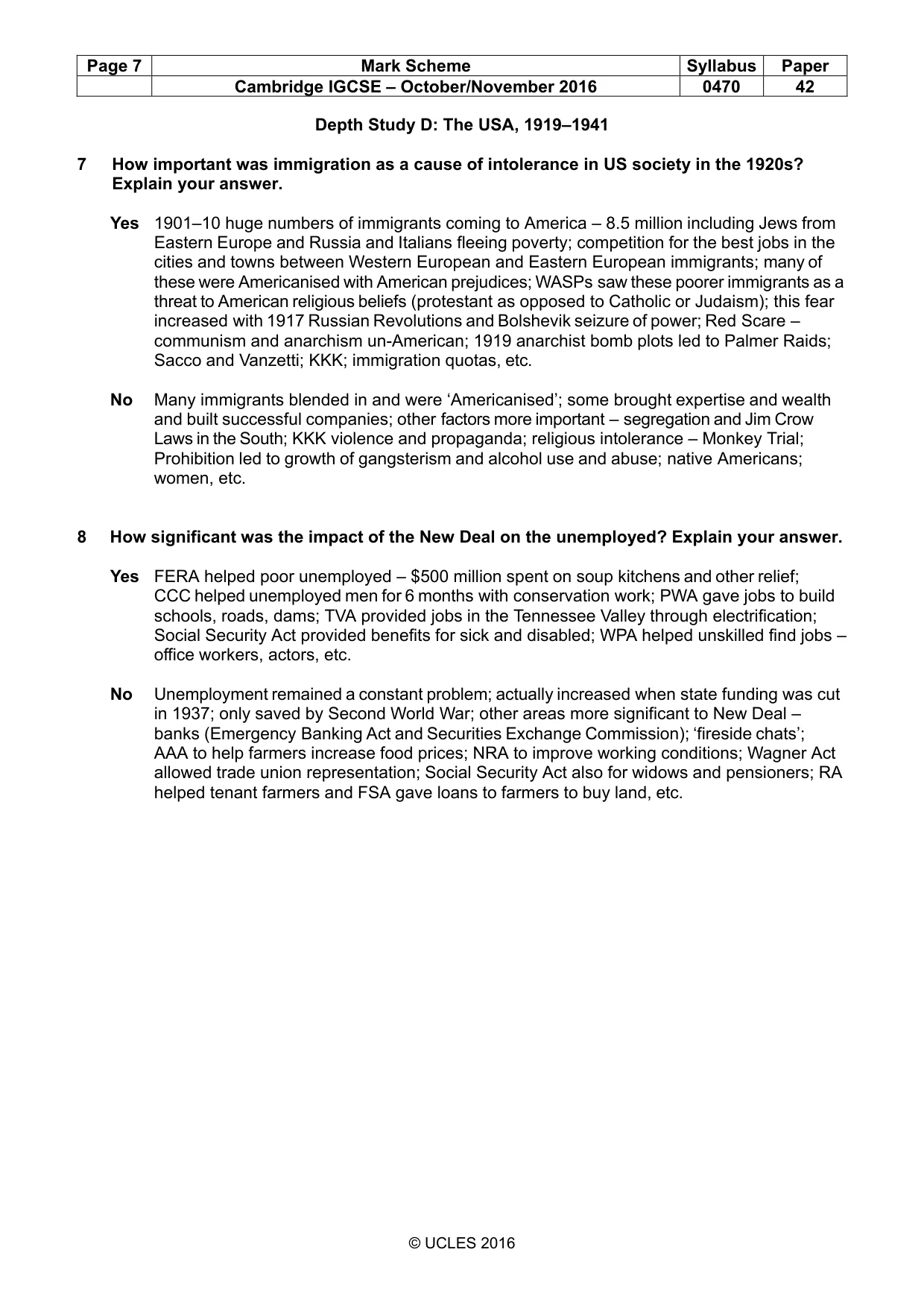
Page 7 Mark Scheme Syllabus Paper Cambridge IGCSE – October/November 2016 0470 42 © UCLES 2016 Depth Study D: The USA, 1919–1941 7 How important was immigration as a cause of intolerance in US society in the 1920s? Explain your answer. Yes 1901–10 huge numbers of immigrants coming to America – 8.5 million including Jews from Eastern Europe and Russia and Italians fleeing poverty; competition for the best jobs in the cities and towns between Western European and Eastern European immigrants; many of these were Americanised with American prejudices; WASPs saw these poorer immigrants as a threat to American religious beliefs (protestant as opposed to Catholic or Judaism); this fear increased with 1917 Russian Revolutions and Bolshevik seizure of power; Red Scare – communism and anarchism un-American; 1919 anarchist bomb plots led to Palmer Raids; Sacco and Vanzetti; KKK; immigration quotas, etc. No Many immigrants blended in and were ‘Americanised’; some brought expertise and wealth and built successful companies; other factors more important – segregation and Jim Crow Laws in the South; KKK violence and propaganda; religious intolerance – Monkey Trial; Prohibition led to growth of gangsterism and alcohol use and abuse; native Americans; women, etc. 8 How significant was the impact of the New Deal on the unemployed? Explain your answer. Yes FERA helped poor unemployed – $500 million spent on soup kitchens and other relief; CCC helped unemployed men for 6 months with conservation work; PWA gave jobs to build schools, roads, dams; TVA provided jobs in the Tennessee Valley through electrification; Social Security Act provided benefits for sick and disabled; WPA helped unskilled find jobs – office workers, actors, etc. No Unemployment remained a constant problem; actually increased when state funding was cut in 1937; only saved by Second World War; other areas more significant to New Deal – banks (Emergency Banking Act and Securities Exchange Commission); ‘fireside chats’; AAA to help farmers increase food prices; NRA to improve working conditions; Wagner Act allowed trade union representation; Social Security Act also for widows and pensioners; RA helped tenant farmers and FSA gave loans to farmers to buy land, etc.
Mark scheme, page 8
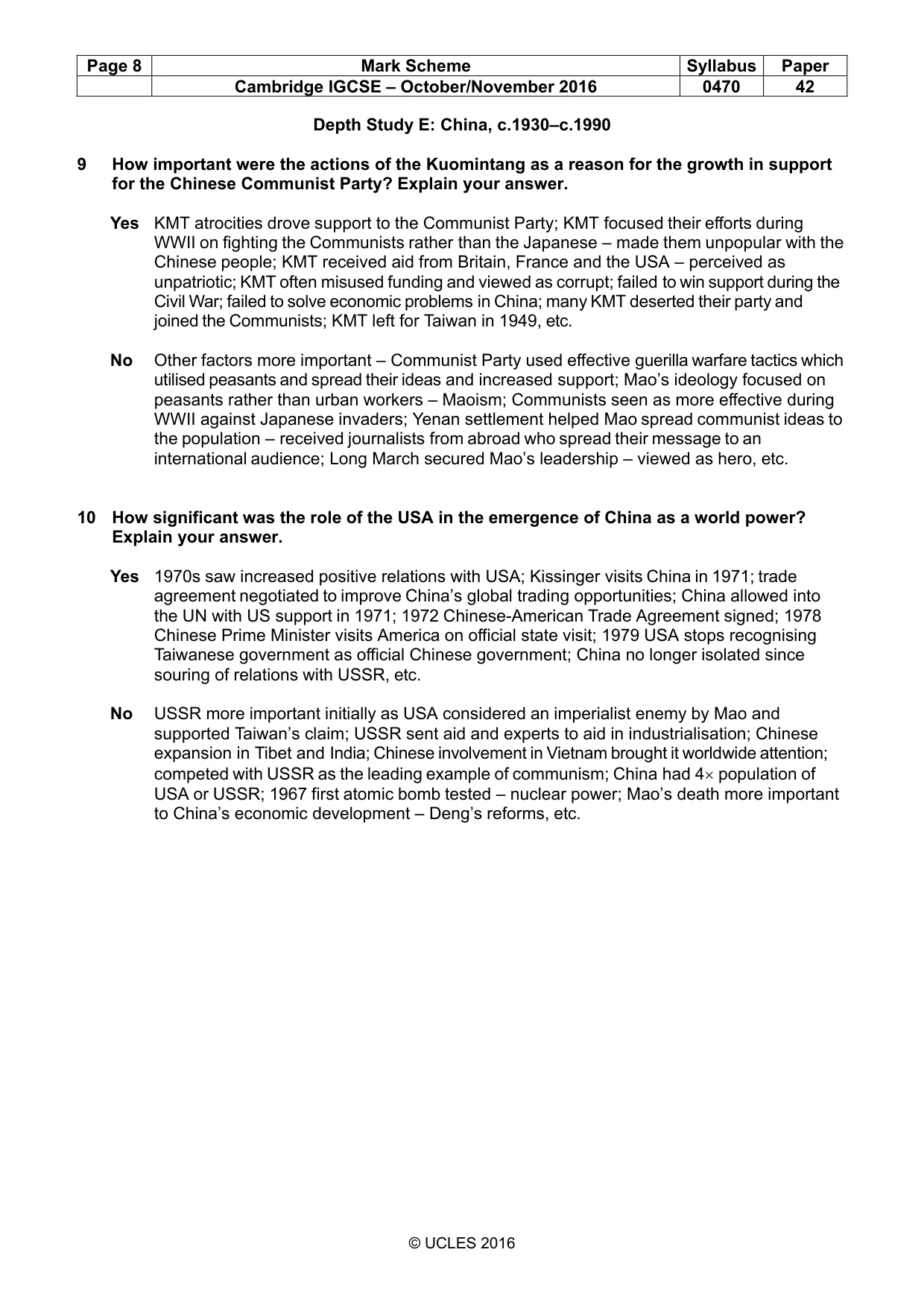
Page 8 Mark Scheme Syllabus Paper Cambridge IGCSE – October/November 2016 0470 42 © UCLES 2016 Depth Study E: China, c.1930–c.1990 9 How important were the actions of the Kuomintang as a reason for the growth in support for the Chinese Communist Party? Explain your answer. Yes KMT atrocities drove support to the Communist Party; KMT focused their efforts during WWII on fighting the Communists rather than the Japanese – made them unpopular with the Chinese people; KMT received aid from Britain, France and the USA – perceived as unpatriotic; KMT often misused funding and viewed as corrupt; failed to win support during the Civil War; failed to solve economic problems in China; many KMT deserted their party and joined the Communists; KMT left for Taiwan in 1949, etc. No Other factors more important – Communist Party used effective guerilla warfare tactics which utilised peasants and spread their ideas and increased support; Mao’s ideology focused on peasants rather than urban workers – Maoism; Communists seen as more effective during WWII against Japanese invaders; Yenan settlement helped Mao spread communist ideas to the population – received journalists from abroad who spread their message to an international audience; Long March secured Mao’s leadership – viewed as hero, etc. 10 How significant was the role of the USA in the emergence of China as a world power? Explain your answer. Yes 1970s saw increased positive relations with USA; Kissinger visits China in 1971; trade agreement negotiated to improve China’s global trading opportunities; China allowed into the UN with US support in 1971; 1972 Chinese-American Trade Agreement signed; 1978 Chinese Prime Minister visits America on official state visit; 1979 USA stops recognising Taiwanese government as official Chinese government; China no longer isolated since souring of relations with USSR, etc. No USSR more important initially as USA considered an imperialist enemy by Mao and supported Taiwan’s claim; USSR sent aid and experts to aid in industrialisation; Chinese expansion in Tibet and India; Chinese involvement in Vietnam brought it worldwide attention; competed with USSR as the leading example of communism; China had 4× population of USA or USSR; 1967 first atomic bomb tested – nuclear power; Mao’s death more important to China’s economic development – Deng’s reforms, etc.
Mark scheme, page 9
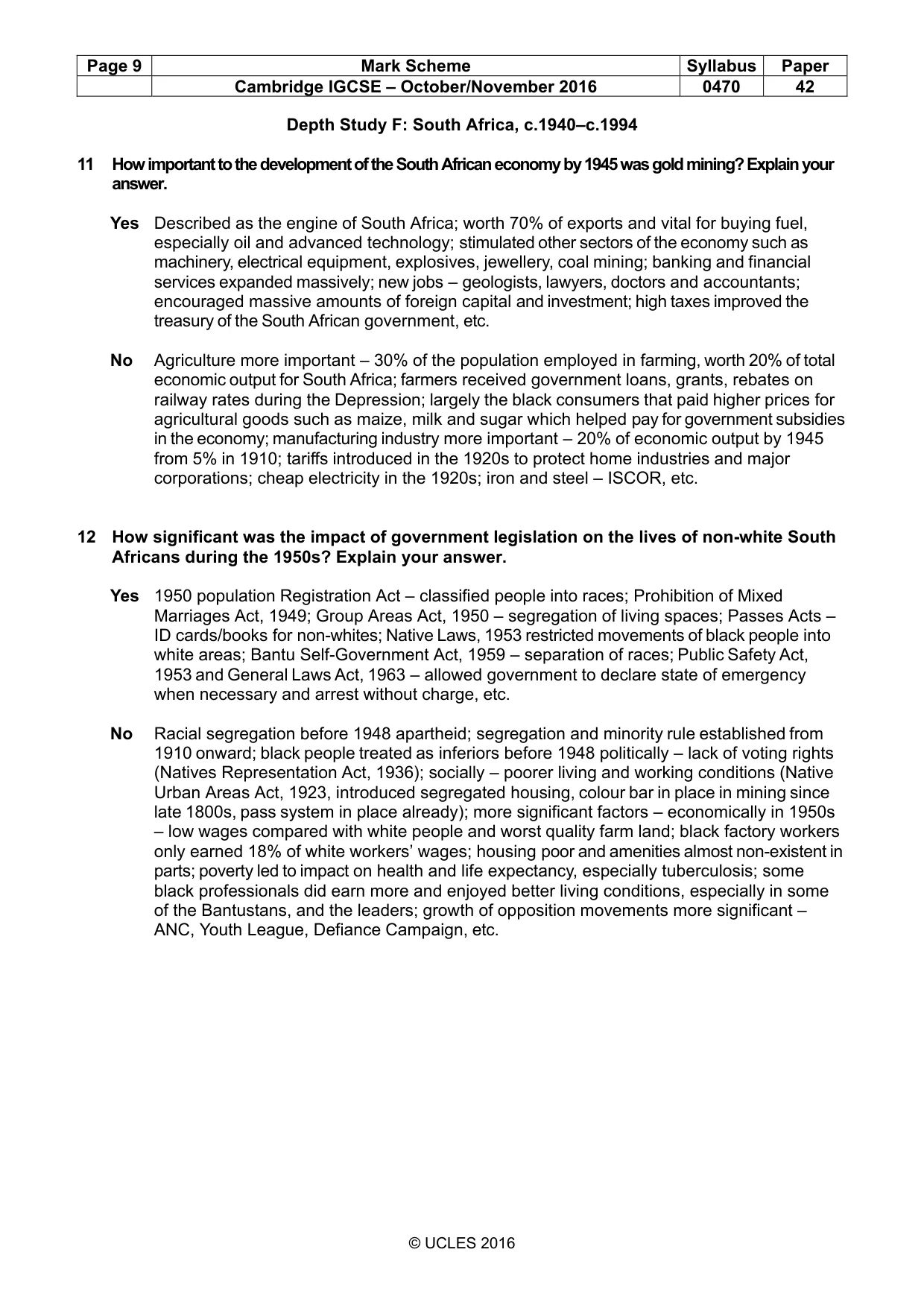
Page 9 Mark Scheme Syllabus Paper Cambridge IGCSE – October/November 2016 0470 42 © UCLES 2016 Depth Study F: South Africa, c.1940–c.1994 11 How important to the development of the South African economy by 1945 was gold mining? Explain your answer. Yes Described as the engine of South Africa; worth 70% of exports and vital for buying fuel, especially oil and advanced technology; stimulated other sectors of the economy such as machinery, electrical equipment, explosives, jewellery, coal mining; banking and financial services expanded massively; new jobs – geologists, lawyers, doctors and accountants; encouraged massive amounts of foreign capital and investment; high taxes improved the treasury of the South African government, etc. No Agriculture more important – 30% of the population employed in farming, worth 20% of total economic output for South Africa; farmers received government loans, grants, rebates on railway rates during the Depression; largely the black consumers that paid higher prices for agricultural goods such as maize, milk and sugar which helped pay for government subsidies in the economy; manufacturing industry more important – 20% of economic output by 1945 from 5% in 1910; tariffs introduced in the 1920s to protect home industries and major corporations; cheap electricity in the 1920s; iron and steel – ISCOR, etc. 12 How significant was the impact of government legislation on the lives of non-white South Africans during the 1950s? Explain your answer. Yes 1950 population Registration Act – classified people into races; Prohibition of Mixed Marriages Act, 1949; Group Areas Act, 1950 – segregation of living spaces; Passes Acts – ID cards/books for non-whites; Native Laws, 1953 restricted movements of black people into white areas; Bantu Self-Government Act, 1959 – separation of races; Public Safety Act, 1953 and General Laws Act, 1963 – allowed government to declare state of emergency when necessary and arrest without charge, etc. No Racial segregation before 1948 apartheid; segregation and minority rule established from 1910 onward; black people treated as inferiors before 1948 politically – lack of voting rights (Natives Representation Act, 1936); socially – poorer living and working conditions (Native Urban Areas Act, 1923, introduced segregated housing, colour bar in place in mining since late 1800s, pass system in place already); more significant factors – economically in 1950s – low wages compared with white people and worst quality farm land; black factory workers only earned 18% of white workers’ wages; housing poor and amenities almost non-existent in parts; poverty led to impact on health and life expectancy, especially tuberculosis; some black professionals did earn more and enjoyed better living conditions, especially in some of the Bantustans, and the leaders; growth of opposition movements more significant – ANC, Youth League, Defiance Campaign, etc.
Mark scheme, page 10
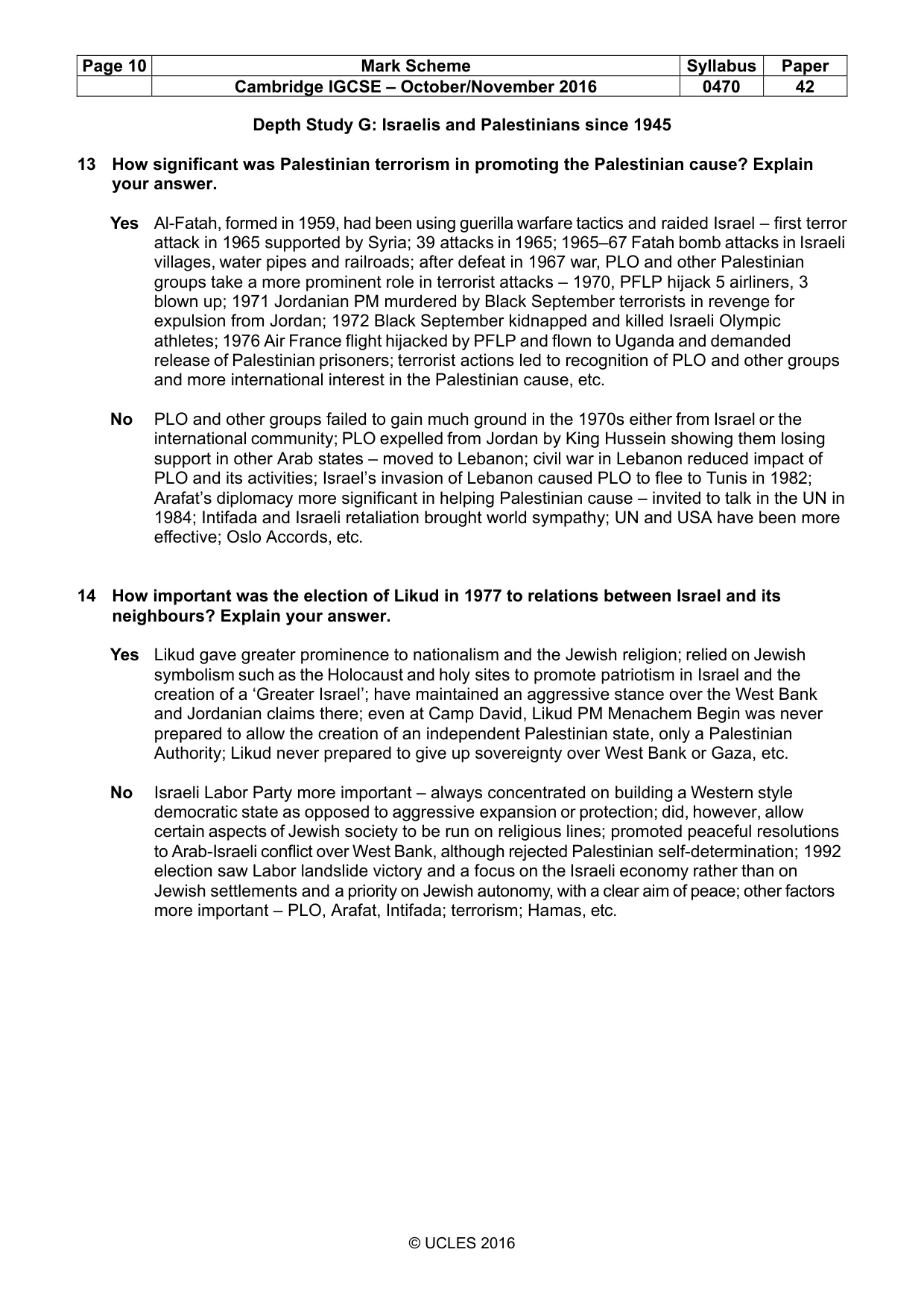
Page 10 Mark Scheme Syllabus Paper Cambridge IGCSE – October/November 2016 0470 42 © UCLES 2016 Depth Study G: Israelis and Palestinians since 1945 13 How significant was Palestinian terrorism in promoting the Palestinian cause? Explain your answer. Yes Al-Fatah, formed in 1959, had been using guerilla warfare tactics and raided Israel – first terror attack in 1965 supported by Syria; 39 attacks in 1965; 1965–67 Fatah bomb attacks in Israeli villages, water pipes and railroads; after defeat in 1967 war, PLO and other Palestinian groups take a more prominent role in terrorist attacks – 1970, PFLP hijack 5 airliners, 3 blown up; 1971 Jordanian PM murdered by Black September terrorists in revenge for expulsion from Jordan; 1972 Black September kidnapped and killed Israeli Olympic athletes; 1976 Air France flight hijacked by PFLP and flown to Uganda and demanded release of Palestinian prisoners; terrorist actions led to recognition of PLO and other groups and more international interest in the Palestinian cause, etc. No PLO and other groups failed to gain much ground in the 1970s either from Israel or the international community; PLO expelled from Jordan by King Hussein showing them losing support in other Arab states – moved to Lebanon; civil war in Lebanon reduced impact of PLO and its activities; Israel’s invasion of Lebanon caused PLO to flee to Tunis in 1982; Arafat’s diplomacy more significant in helping Palestinian cause – invited to talk in the UN in 1984; Intifada and Israeli retaliation brought world sympathy; UN and USA have been more effective; Oslo Accords, etc. 14 How important was the election of Likud in 1977 to relations between Israel and its neighbours? Explain your answer. Yes Likud gave greater prominence to nationalism and the Jewish religion; relied on Jewish symbolism such as the Holocaust and holy sites to promote patriotism in Israel and the creation of a ‘Greater Israel’; have maintained an aggressive stance over the West Bank and Jordanian claims there; even at Camp David, Likud PM Menachem Begin was never prepared to allow the creation of an independent Palestinian state, only a Palestinian Authority; Likud never prepared to give up sovereignty over West Bank or Gaza, etc. No Israeli Labor Party more important – always concentrated on building a Western style democratic state as opposed to aggressive expansion or protection; did, however, allow certain aspects of Jewish society to be run on religious lines; promoted peaceful resolutions to Arab-Israeli conflict over West Bank, although rejected Palestinian self-determination; 1992 election saw Labor landslide victory and a focus on the Israeli economy rather than on Jewish settlements and a priority on Jewish autonomy, with a clear aim of peace; other factors more important – PLO, Arafat, Intifada; terrorism; Hamas, etc.
What you needed in this session
Cambridge’s own grade thresholds for 2016 Oct/Nov, Paper 4 · Variant 2. A higher threshold means an easier paper — the bar moves with how the cohort did.