Cambridge IGCSE History 0470 — 2016 Oct/Nov Paper 4 · Variant 1
0470/41/O/N/16 · 40 marks · ≈45 min
The question paper and its mark scheme, free to read here and free to download. This is Cambridge’s own paper, exactly as it was sat.
Question paper4 pages
Mark scheme10 pages
Answers below. Sit the paper first if you are practising.
Paper as text
Question paper, page 1
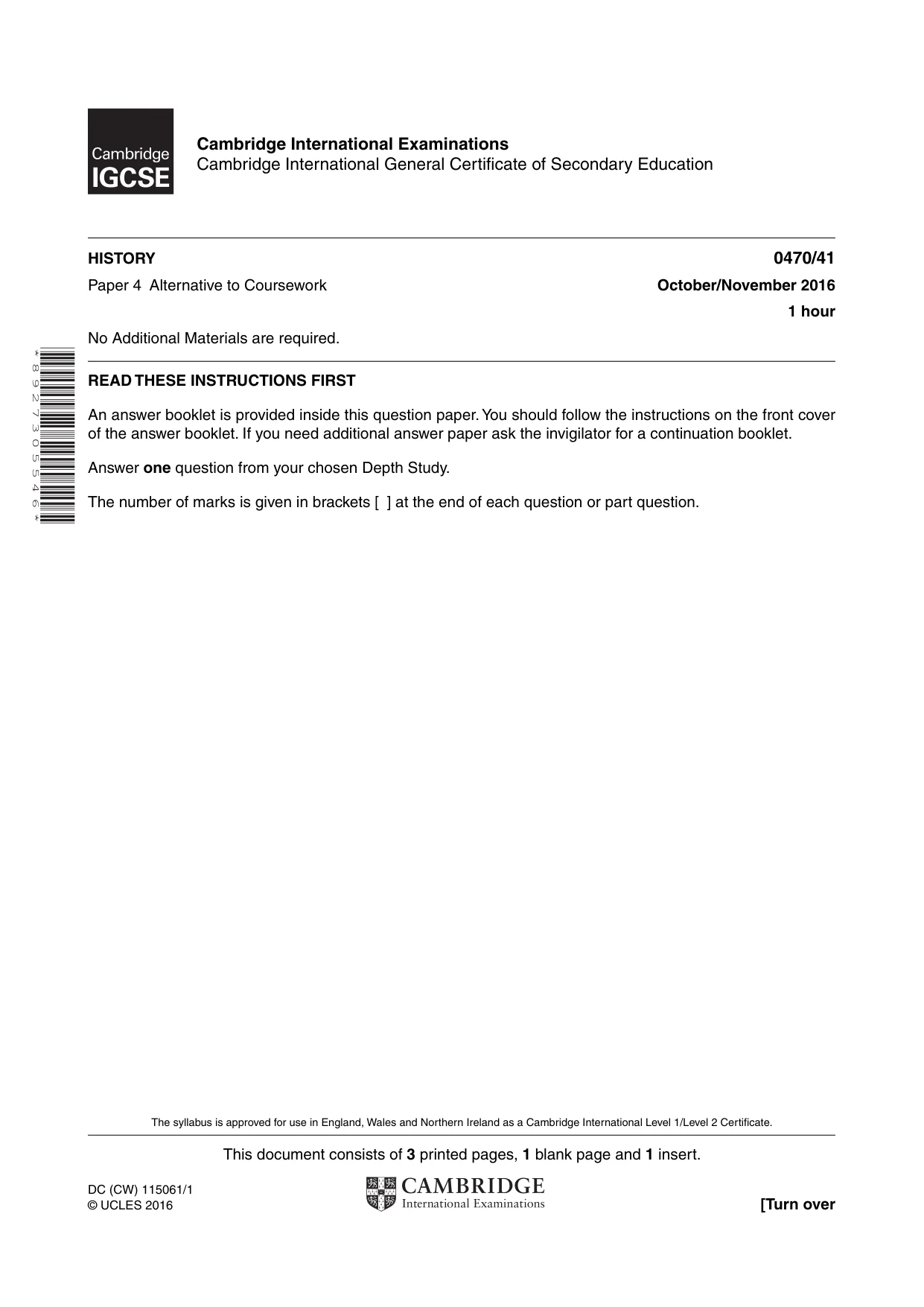
This document consists of 3 printed pages, 1 blank page and 1 insert. DC (CW) 115061/1 © UCLES 2016 [Turn over Cambridge International Examinations Cambridge International General Certificate of Secondary Education * 8 9 2 7 3 0 5 5 4 6 * HISTORY 0470/41 Paper 4 Alternative to Coursework October/November 2016 1 hour No Additional Materials are required. READ THESE INSTRUCTIONS FIRST An answer booklet is provided inside this question paper. You should follow the instructions on the front cover of the answer booklet. If you need additional answer paper ask the invigilator for a continuation booklet. Answer one question from your chosen Depth Study. The number of marks is given in brackets [ ] at the end of each question or part question. The syllabus is approved for use in England, Wales and Northern Ireland as a Cambridge International Level 1/Level 2 Certificate.
Question paper, page 2
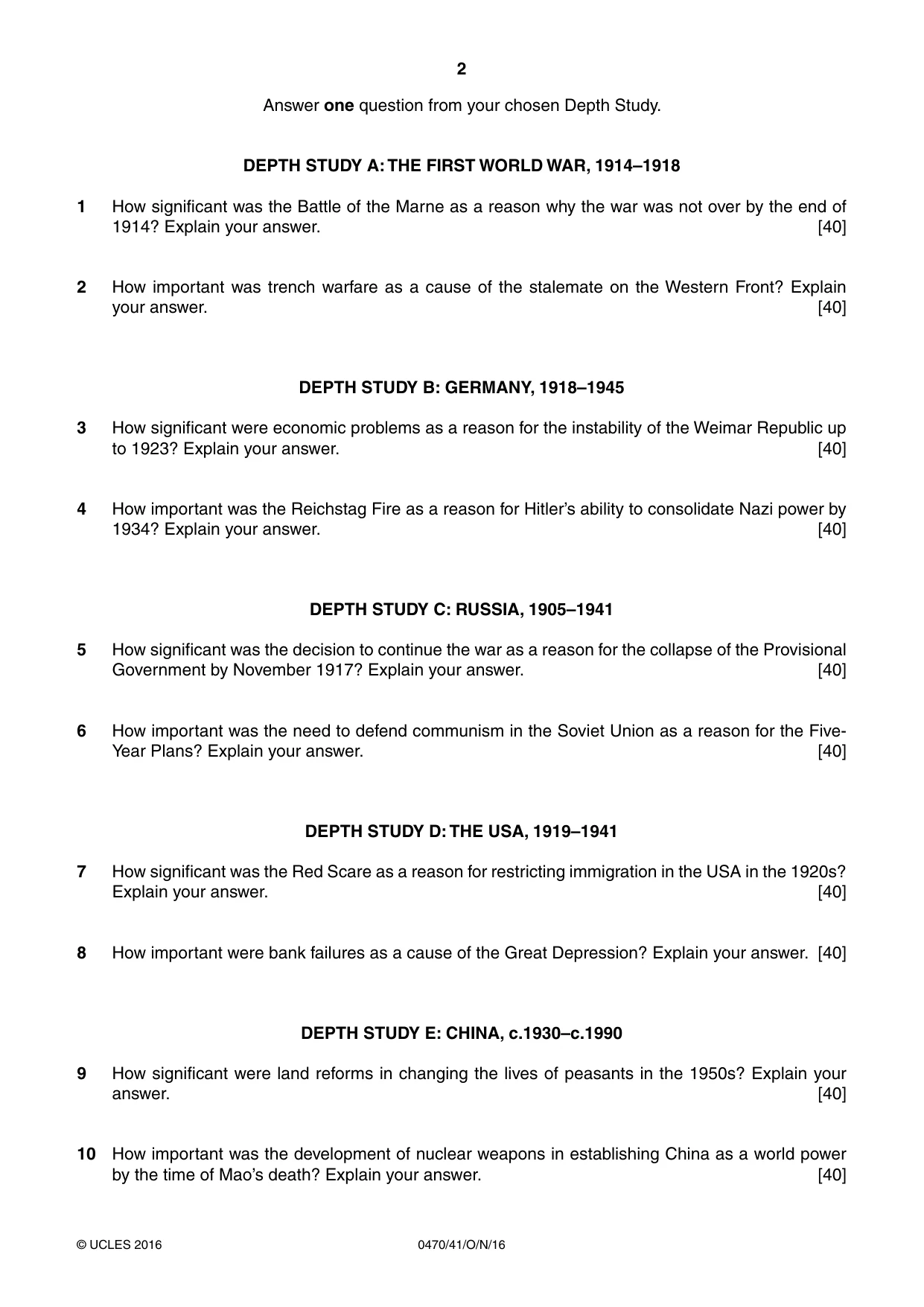
2 0470/41/O/N/16 © UCLES 2016 Answer one question from your chosen Depth Study. DEPTH STUDY A: THE FIRST WORLD WAR, 1914–1918 1 How significant was the Battle of the Marne as a reason why the war was not over by the end of 1914? Explain your answer. [40] 2 How important was trench warfare as a cause of the stalemate on the Western Front? Explain your answer. [40] DEPTH STUDY B: GERMANY, 1918–1945 3 How significant were economic problems as a reason for the instability of the Weimar Republic up to 1923? Explain your answer. [40] 4 How important was the Reichstag Fire as a reason for Hitler’s ability to consolidate Nazi power by 1934? Explain your answer. [40] DEPTH STUDY C: RUSSIA, 1905–1941 5 How significant was the decision to continue the war as a reason for the collapse of the Provisional Government by November 1917? Explain your answer. [40] 6 How important was the need to defend communism in the Soviet Union as a reason for the Five- Year Plans? Explain your answer. [40] DEPTH STUDY D: THE USA, 1919–1941 7 How significant was the Red Scare as a reason for restricting immigration in the USA in the 1920s? Explain your answer. [40] 8 How important were bank failures as a cause of the Great Depression? Explain your answer. [40] DEPTH STUDY E: CHINA, c.1930–c.1990 9 How significant were land reforms in changing the lives of peasants in the 1950s? Explain your answer. [40] 10 How important was the development of nuclear weapons in establishing China as a world power by the time of Mao’s death? Explain your answer. [40]
Question paper, page 3
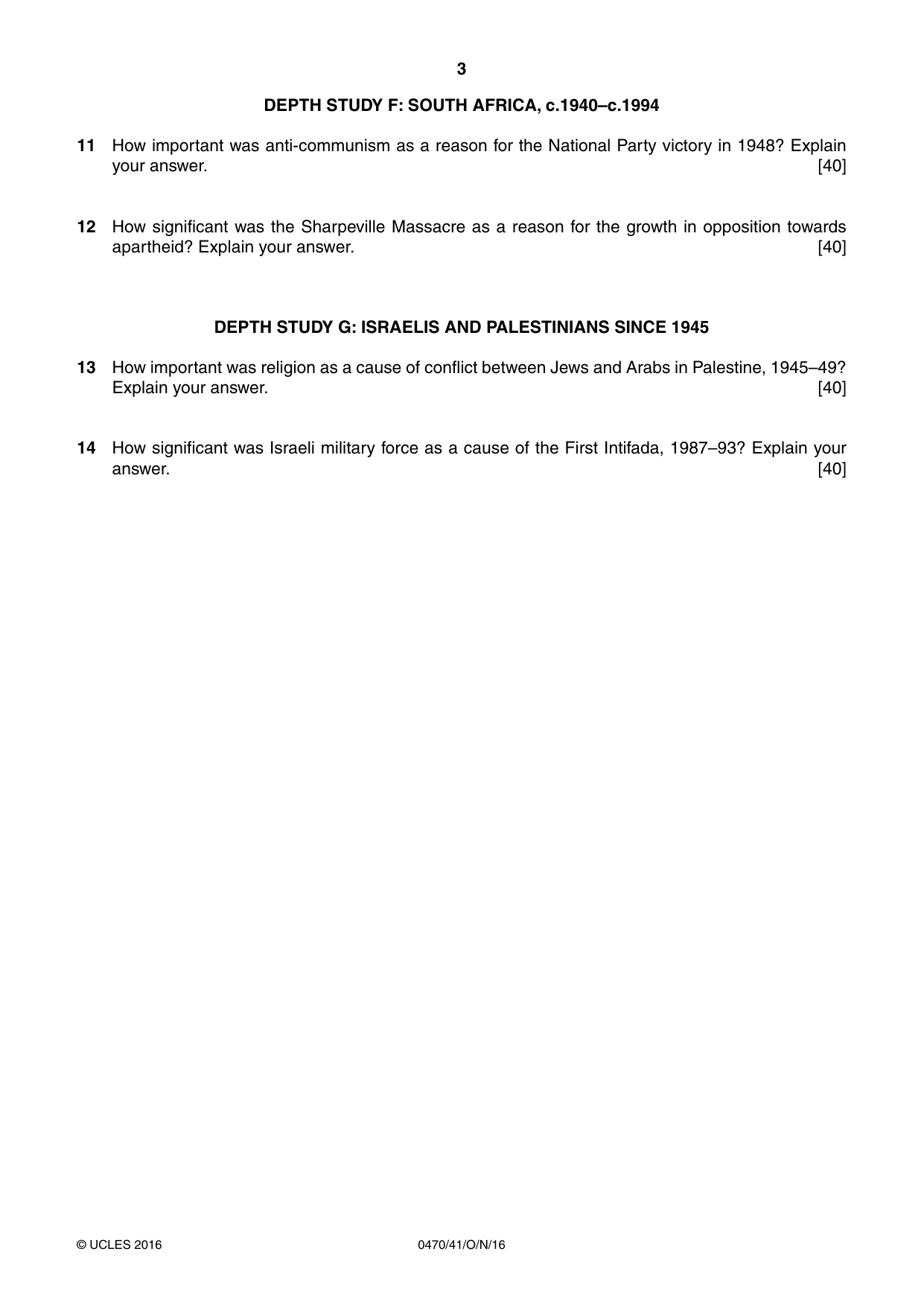
3 0470/41/O/N/16 © UCLES 2016 DEPTH STUDY F: SOUTH AFRICA, c.1940–c.1994 11 How important was anti-communism as a reason for the National Party victory in 1948? Explain your answer. [40] 12 How significant was the Sharpeville Massacre as a reason for the growth in opposition towards apartheid? Explain your answer. [40] DEPTH STUDY G: ISRAELIS AND PALESTINIANS SINCE 1945 13 How important was religion as a cause of conflict between Jews and Arabs in Palestine, 1945–49? Explain your answer. [40] 14 How significant was Israeli military force as a cause of the First Intifada, 1987–93? Explain your answer. [40]
Question paper, page 4
4 0470/41/O/N/16 © UCLES 2016 BLANK PAGE Permission to reproduce items where third-party owned material protected by copyright is included has been sought and cleared where possible. Every reasonable effort has been made by the publisher (UCLES) to trace copyright holders, but if any items requiring clearance have unwittingly been included, the publisher will be pleased to make amends at the earliest possible opportunity. To avoid the issue of disclosure of answer-related information to candidates, all copyright acknowledgements are reproduced online in the Cambridge International Examinations Copyright Acknowledgements Booklet. This is produced for each series of examinations and is freely available to download at www.cie.org.uk after the live examination series. Cambridge International Examinations is part of the Cambridge Assessment Group. Cambridge Assessment is the brand name of University of Cambridge Local Examinations Syndicate (UCLES), which is itself a department of the University of Cambridge.
Mark scheme, page 1
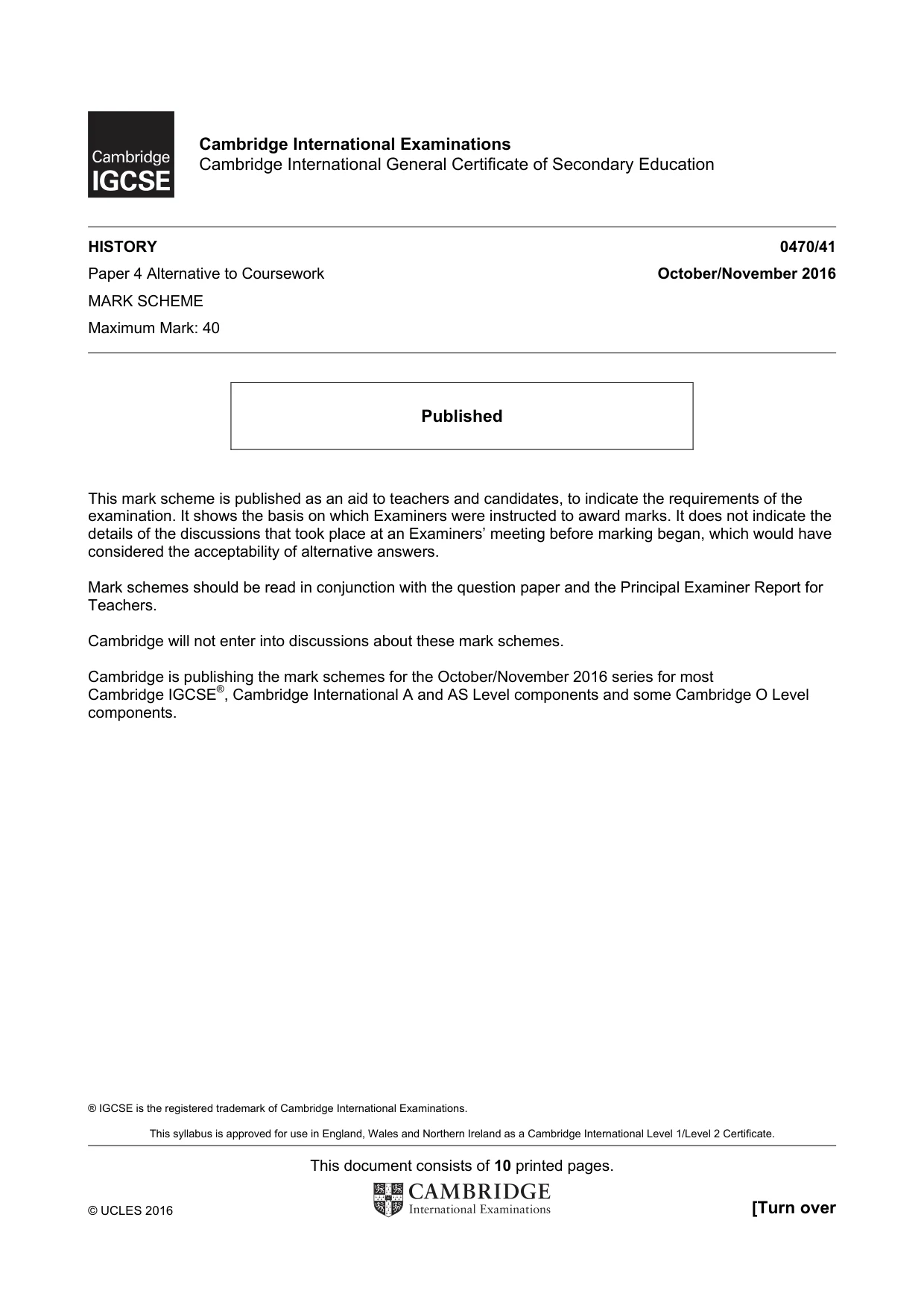
® IGCSE is the registered trademark of Cambridge International Examinations. This syllabus is approved for use in England, Wales and Northern Ireland as a Cambridge International Level 1/Level 2 Certificate. This document consists of 10 printed pages. © UCLES 2016 [Turn over Cambridge International Examinations Cambridge International General Certificate of Secondary Education HISTORY 0470/41 Paper 4 Alternative to Coursework October/November 2016 MARK SCHEME Maximum Mark: 40 Published This mark scheme is published as an aid to teachers and candidates, to indicate the requirements of the examination. It shows the basis on which Examiners were instructed to award marks. It does not indicate the details of the discussions that took place at an Examiners’ meeting before marking began, which would have considered the acceptability of alternative answers. Mark schemes should be read in conjunction with the question paper and the Principal Examiner Report for Teachers. Cambridge will not enter into discussions about these mark schemes. Cambridge is publishing the mark schemes for the October/November 2016 series for most Cambridge IGCSE®, Cambridge International A and AS Level components and some Cambridge O Level components.
Mark scheme, page 2
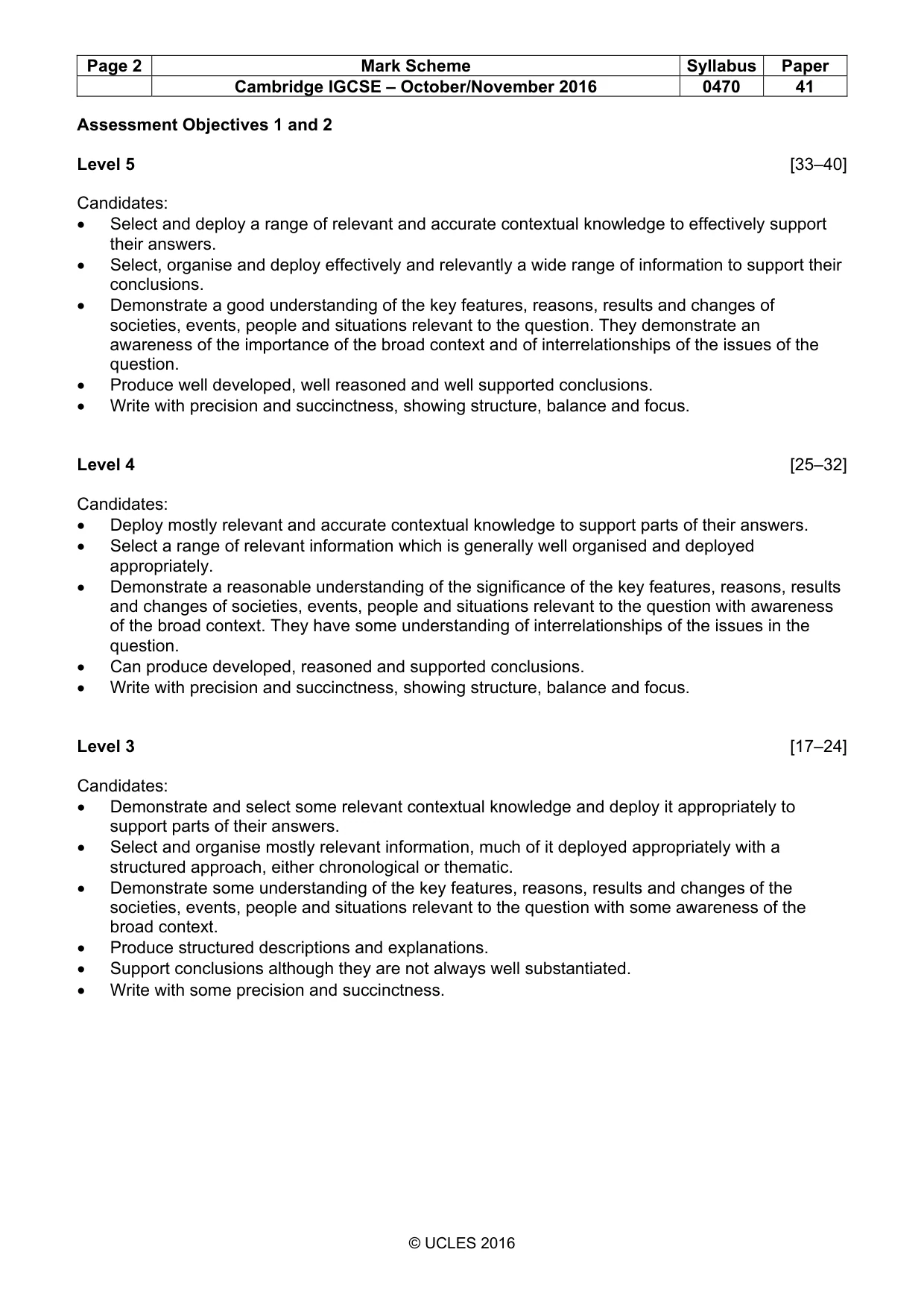
Page 2 Mark Scheme Syllabus Paper Cambridge IGCSE – October/November 2016 0470 41 © UCLES 2016 Assessment Objectives 1 and 2 Level 5 [33–40] Candidates: • Select and deploy a range of relevant and accurate contextual knowledge to effectively support their answers. • Select, organise and deploy effectively and relevantly a wide range of information to support their conclusions. • Demonstrate a good understanding of the key features, reasons, results and changes of societies, events, people and situations relevant to the question. They demonstrate an awareness of the importance of the broad context and of interrelationships of the issues of the question. • Produce well developed, well reasoned and well supported conclusions. • Write with precision and succinctness, showing structure, balance and focus. Level 4 [25–32] Candidates: • Deploy mostly relevant and accurate contextual knowledge to support parts of their answers. • Select a range of relevant information which is generally well organised and deployed appropriately. • Demonstrate a reasonable understanding of the significance of the key features, reasons, results and changes of societies, events, people and situations relevant to the question with awareness of the broad context. They have some understanding of interrelationships of the issues in the question. • Can produce developed, reasoned and supported conclusions. • Write with precision and succinctness, showing structure, balance and focus. Level 3 [17–24] Candidates: • Demonstrate and select some relevant contextual knowledge and deploy it appropriately to support parts of their answers. • Select and organise mostly relevant information, much of it deployed appropriately with a structured approach, either chronological or thematic. • Demonstrate some understanding of the key features, reasons, results and changes of the societies, events, people and situations relevant to the question with some awareness of the broad context. • Produce structured descriptions and explanations. • Support conclusions although they are not always well substantiated. • Write with some precision and succinctness.
Mark scheme, page 3
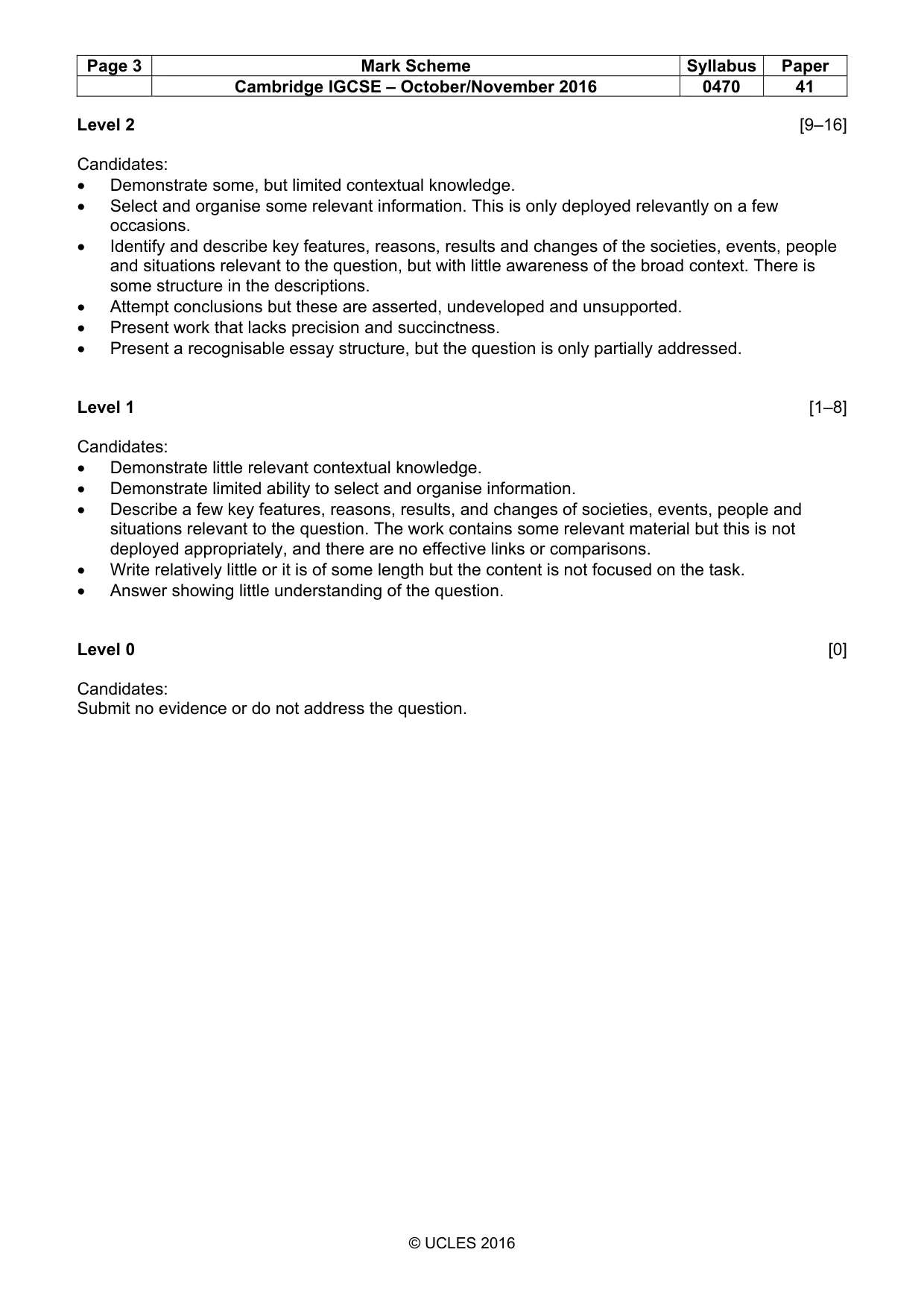
Page 3 Mark Scheme Syllabus Paper Cambridge IGCSE – October/November 2016 0470 41 © UCLES 2016 Level 2 [9–16] Candidates: • Demonstrate some, but limited contextual knowledge. • Select and organise some relevant information. This is only deployed relevantly on a few occasions. • Identify and describe key features, reasons, results and changes of the societies, events, people and situations relevant to the question, but with little awareness of the broad context. There is some structure in the descriptions. • Attempt conclusions but these are asserted, undeveloped and unsupported. • Present work that lacks precision and succinctness. • Present a recognisable essay structure, but the question is only partially addressed. Level 1 [1–8] Candidates: • Demonstrate little relevant contextual knowledge. • Demonstrate limited ability to select and organise information. • Describe a few key features, reasons, results, and changes of societies, events, people and situations relevant to the question. The work contains some relevant material but this is not deployed appropriately, and there are no effective links or comparisons. • Write relatively little or it is of some length but the content is not focused on the task. • Answer showing little understanding of the question. Level 0 [0] Candidates: Submit no evidence or do not address the question.
Mark scheme, page 4
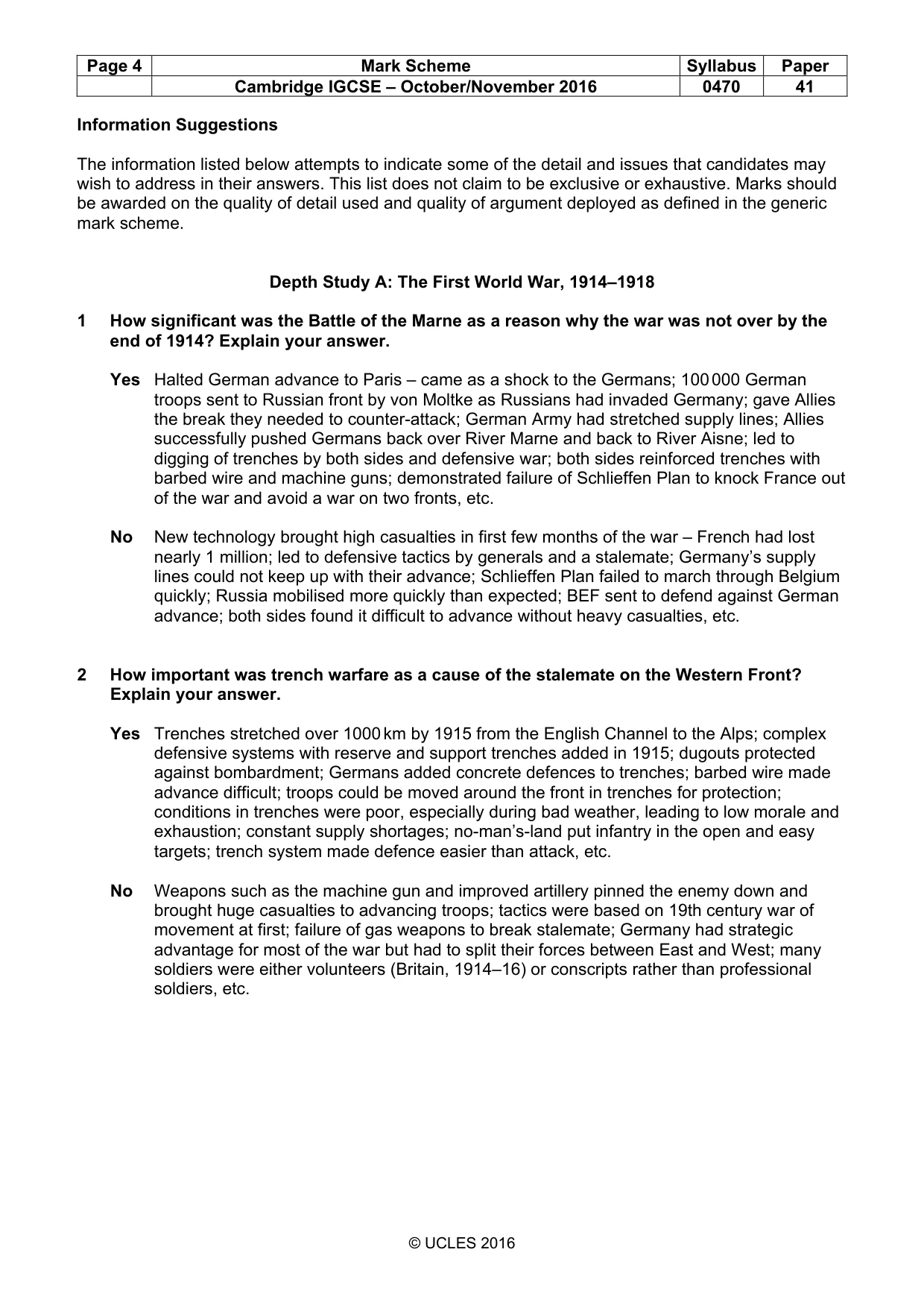
Page 4 Mark Scheme Syllabus Paper Cambridge IGCSE – October/November 2016 0470 41 © UCLES 2016 Information Suggestions The information listed below attempts to indicate some of the detail and issues that candidates may wish to address in their answers. This list does not claim to be exclusive or exhaustive. Marks should be awarded on the quality of detail used and quality of argument deployed as defined in the generic mark scheme. Depth Study A: The First World War, 1914–1918 1 How significant was the Battle of the Marne as a reason why the war was not over by the end of 1914? Explain your answer. Yes Halted German advance to Paris – came as a shock to the Germans; 100 000 German troops sent to Russian front by von Moltke as Russians had invaded Germany; gave Allies the break they needed to counter-attack; German Army had stretched supply lines; Allies successfully pushed Germans back over River Marne and back to River Aisne; led to digging of trenches by both sides and defensive war; both sides reinforced trenches with barbed wire and machine guns; demonstrated failure of Schlieffen Plan to knock France out of the war and avoid a war on two fronts, etc. No New technology brought high casualties in first few months of the war – French had lost nearly 1 million; led to defensive tactics by generals and a stalemate; Germany’s supply lines could not keep up with their advance; Schlieffen Plan failed to march through Belgium quickly; Russia mobilised more quickly than expected; BEF sent to defend against German advance; both sides found it difficult to advance without heavy casualties, etc. 2 How important was trench warfare as a cause of the stalemate on the Western Front? Explain your answer. Yes Trenches stretched over 1000 km by 1915 from the English Channel to the Alps; complex defensive systems with reserve and support trenches added in 1915; dugouts protected against bombardment; Germans added concrete defences to trenches; barbed wire made advance difficult; troops could be moved around the front in trenches for protection; conditions in trenches were poor, especially during bad weather, leading to low morale and exhaustion; constant supply shortages; no-man’s-land put infantry in the open and easy targets; trench system made defence easier than attack, etc. No Weapons such as the machine gun and improved artillery pinned the enemy down and brought huge casualties to advancing troops; tactics were based on 19th century war of movement at first; failure of gas weapons to break stalemate; Germany had strategic advantage for most of the war but had to split their forces between East and West; many soldiers were either volunteers (Britain, 1914–16) or conscripts rather than professional soldiers, etc.
Mark scheme, page 5
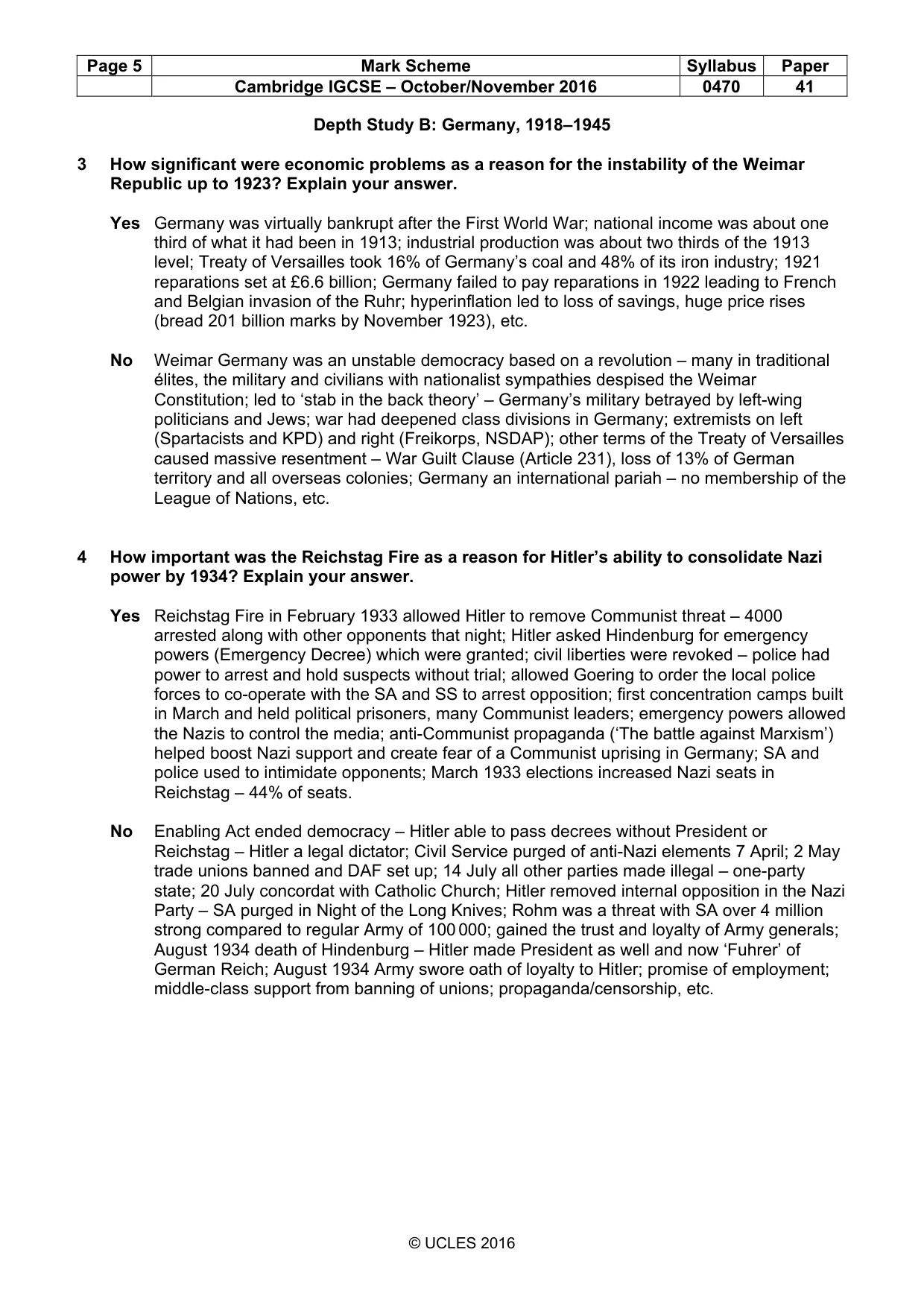
Page 5 Mark Scheme Syllabus Paper Cambridge IGCSE – October/November 2016 0470 41 © UCLES 2016 Depth Study B: Germany, 1918–1945 3 How significant were economic problems as a reason for the instability of the Weimar Republic up to 1923? Explain your answer. Yes Germany was virtually bankrupt after the First World War; national income was about one third of what it had been in 1913; industrial production was about two thirds of the 1913 level; Treaty of Versailles took 16% of Germany’s coal and 48% of its iron industry; 1921 reparations set at £6.6 billion; Germany failed to pay reparations in 1922 leading to French and Belgian invasion of the Ruhr; hyperinflation led to loss of savings, huge price rises (bread 201 billion marks by November 1923), etc. No Weimar Germany was an unstable democracy based on a revolution – many in traditional élites, the military and civilians with nationalist sympathies despised the Weimar Constitution; led to ‘stab in the back theory’ – Germany’s military betrayed by left-wing politicians and Jews; war had deepened class divisions in Germany; extremists on left (Spartacists and KPD) and right (Freikorps, NSDAP); other terms of the Treaty of Versailles caused massive resentment – War Guilt Clause (Article 231), loss of 13% of German territory and all overseas colonies; Germany an international pariah – no membership of the League of Nations, etc. 4 How important was the Reichstag Fire as a reason for Hitler’s ability to consolidate Nazi power by 1934? Explain your answer. Yes Reichstag Fire in February 1933 allowed Hitler to remove Communist threat – 4000 arrested along with other opponents that night; Hitler asked Hindenburg for emergency powers (Emergency Decree) which were granted; civil liberties were revoked – police had power to arrest and hold suspects without trial; allowed Goering to order the local police forces to co-operate with the SA and SS to arrest opposition; first concentration camps built in March and held political prisoners, many Communist leaders; emergency powers allowed the Nazis to control the media; anti-Communist propaganda (‘The battle against Marxism’) helped boost Nazi support and create fear of a Communist uprising in Germany; SA and police used to intimidate opponents; March 1933 elections increased Nazi seats in Reichstag – 44% of seats. No Enabling Act ended democracy – Hitler able to pass decrees without President or Reichstag – Hitler a legal dictator; Civil Service purged of anti-Nazi elements 7 April; 2 May trade unions banned and DAF set up; 14 July all other parties made illegal – one-party state; 20 July concordat with Catholic Church; Hitler removed internal opposition in the Nazi Party – SA purged in Night of the Long Knives; Rohm was a threat with SA over 4 million strong compared to regular Army of 100 000; gained the trust and loyalty of Army generals; August 1934 death of Hindenburg – Hitler made President as well and now ‘Fuhrer’ of German Reich; August 1934 Army swore oath of loyalty to Hitler; promise of employment; middle-class support from banning of unions; propaganda/censorship, etc.
Mark scheme, page 6
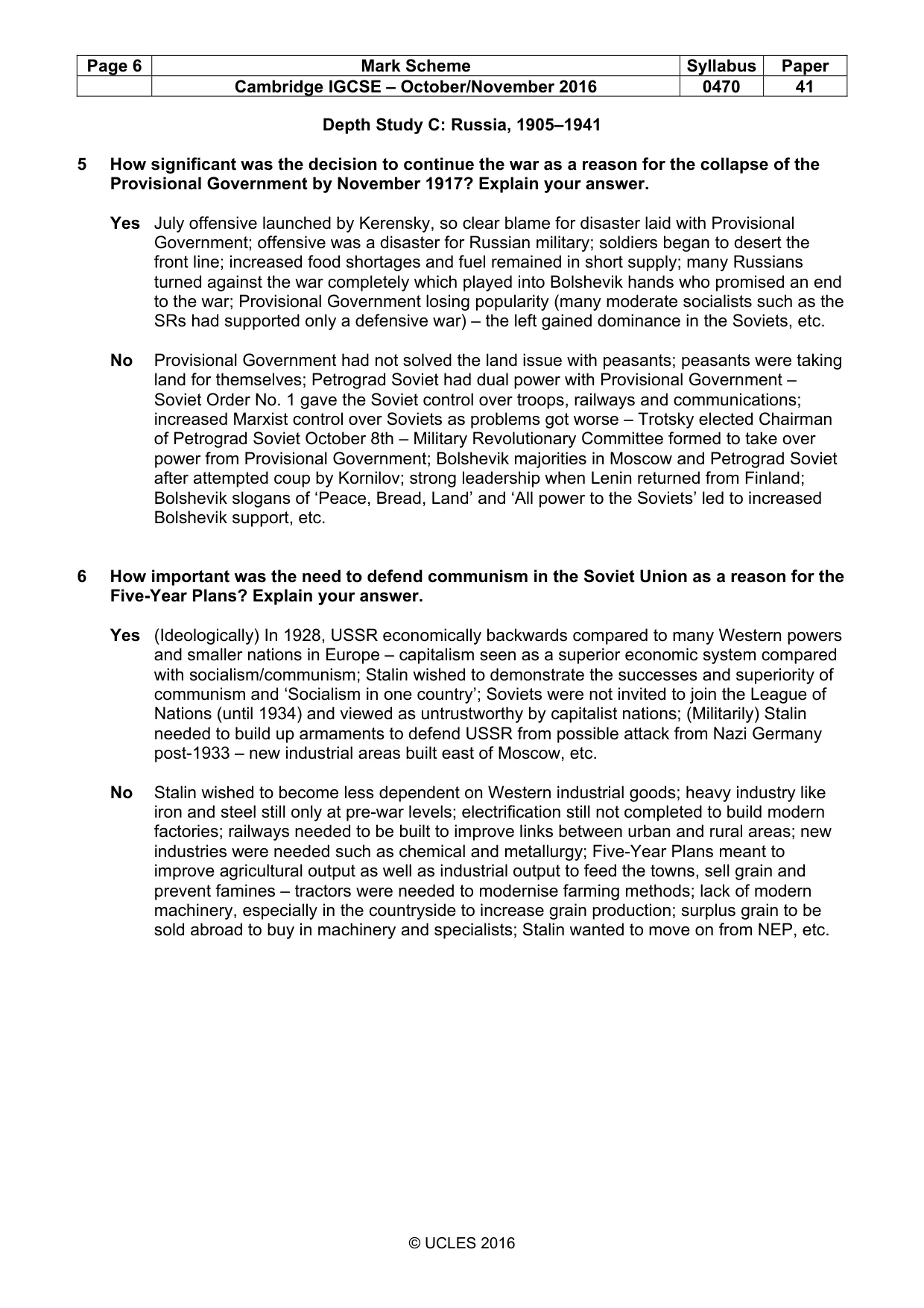
Page 6 Mark Scheme Syllabus Paper Cambridge IGCSE – October/November 2016 0470 41 © UCLES 2016 Depth Study C: Russia, 1905–1941 5 How significant was the decision to continue the war as a reason for the collapse of the Provisional Government by November 1917? Explain your answer. Yes July offensive launched by Kerensky, so clear blame for disaster laid with Provisional Government; offensive was a disaster for Russian military; soldiers began to desert the front line; increased food shortages and fuel remained in short supply; many Russians turned against the war completely which played into Bolshevik hands who promised an end to the war; Provisional Government losing popularity (many moderate socialists such as the SRs had supported only a defensive war) – the left gained dominance in the Soviets, etc. No Provisional Government had not solved the land issue with peasants; peasants were taking land for themselves; Petrograd Soviet had dual power with Provisional Government – Soviet Order No. 1 gave the Soviet control over troops, railways and communications; increased Marxist control over Soviets as problems got worse – Trotsky elected Chairman of Petrograd Soviet October 8th – Military Revolutionary Committee formed to take over power from Provisional Government; Bolshevik majorities in Moscow and Petrograd Soviet after attempted coup by Kornilov; strong leadership when Lenin returned from Finland; Bolshevik slogans of ‘Peace, Bread, Land’ and ‘All power to the Soviets’ led to increased Bolshevik support, etc. 6 How important was the need to defend communism in the Soviet Union as a reason for the Five-Year Plans? Explain your answer. Yes (Ideologically) In 1928, USSR economically backwards compared to many Western powers and smaller nations in Europe – capitalism seen as a superior economic system compared with socialism/communism; Stalin wished to demonstrate the successes and superiority of communism and ‘Socialism in one country’; Soviets were not invited to join the League of Nations (until 1934) and viewed as untrustworthy by capitalist nations; (Militarily) Stalin needed to build up armaments to defend USSR from possible attack from Nazi Germany post-1933 – new industrial areas built east of Moscow, etc. No Stalin wished to become less dependent on Western industrial goods; heavy industry like iron and steel still only at pre-war levels; electrification still not completed to build modern factories; railways needed to be built to improve links between urban and rural areas; new industries were needed such as chemical and metallurgy; Five-Year Plans meant to improve agricultural output as well as industrial output to feed the towns, sell grain and prevent famines – tractors were needed to modernise farming methods; lack of modern machinery, especially in the countryside to increase grain production; surplus grain to be sold abroad to buy in machinery and specialists; Stalin wanted to move on from NEP, etc.
Mark scheme, page 7
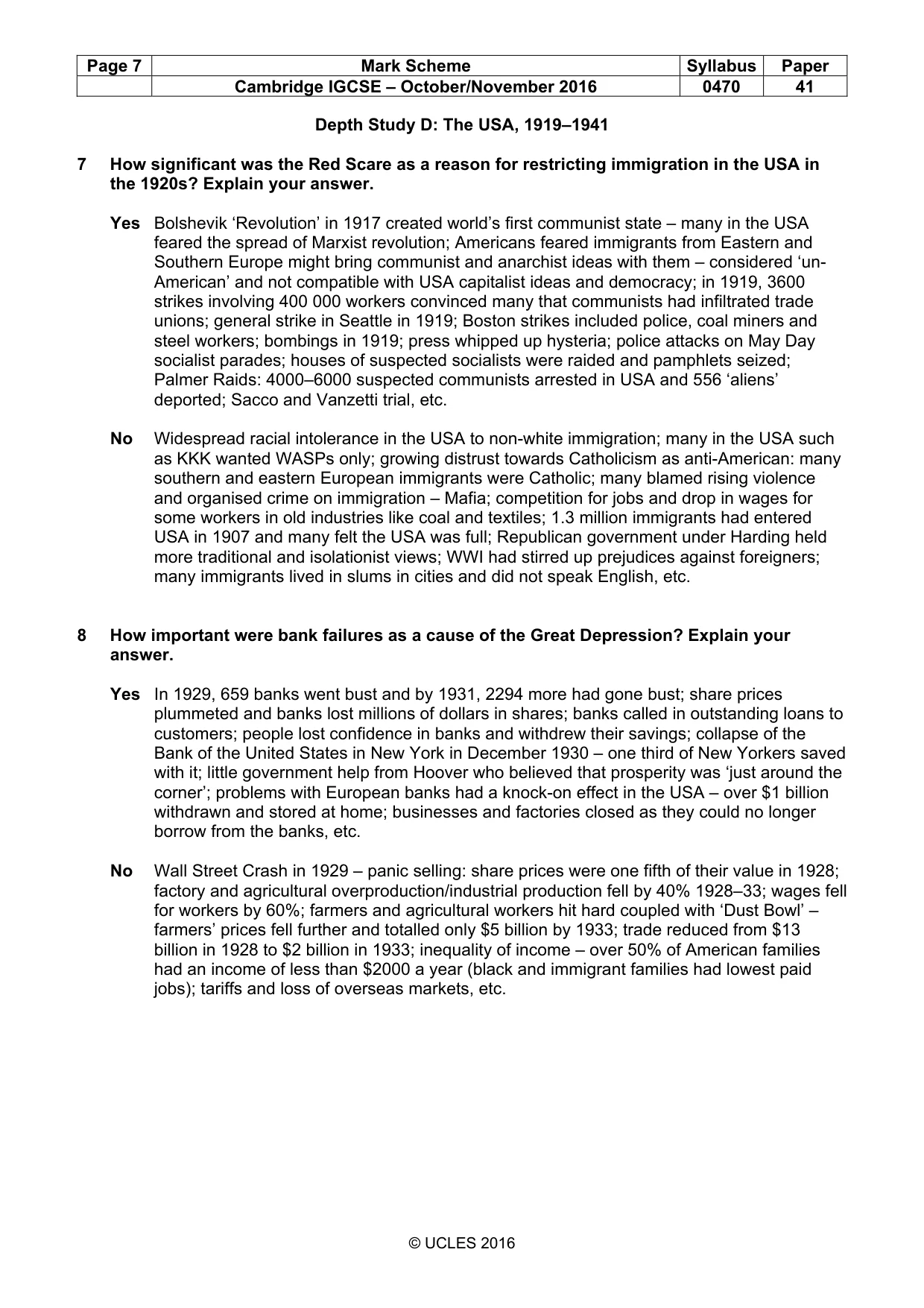
Page 7 Mark Scheme Syllabus Paper Cambridge IGCSE – October/November 2016 0470 41 © UCLES 2016 Depth Study D: The USA, 1919–1941 7 How significant was the Red Scare as a reason for restricting immigration in the USA in the 1920s? Explain your answer. Yes Bolshevik ‘Revolution’ in 1917 created world’s first communist state – many in the USA feared the spread of Marxist revolution; Americans feared immigrants from Eastern and Southern Europe might bring communist and anarchist ideas with them – considered ‘un- American’ and not compatible with USA capitalist ideas and democracy; in 1919, 3600 strikes involving 400 000 workers convinced many that communists had infiltrated trade unions; general strike in Seattle in 1919; Boston strikes included police, coal miners and steel workers; bombings in 1919; press whipped up hysteria; police attacks on May Day socialist parades; houses of suspected socialists were raided and pamphlets seized; Palmer Raids: 4000–6000 suspected communists arrested in USA and 556 ‘aliens’ deported; Sacco and Vanzetti trial, etc. No Widespread racial intolerance in the USA to non-white immigration; many in the USA such as KKK wanted WASPs only; growing distrust towards Catholicism as anti-American: many southern and eastern European immigrants were Catholic; many blamed rising violence and organised crime on immigration – Mafia; competition for jobs and drop in wages for some workers in old industries like coal and textiles; 1.3 million immigrants had entered USA in 1907 and many felt the USA was full; Republican government under Harding held more traditional and isolationist views; WWI had stirred up prejudices against foreigners; many immigrants lived in slums in cities and did not speak English, etc. 8 How important were bank failures as a cause of the Great Depression? Explain your answer. Yes In 1929, 659 banks went bust and by 1931, 2294 more had gone bust; share prices plummeted and banks lost millions of dollars in shares; banks called in outstanding loans to customers; people lost confidence in banks and withdrew their savings; collapse of the Bank of the United States in New York in December 1930 – one third of New Yorkers saved with it; little government help from Hoover who believed that prosperity was ‘just around the corner’; problems with European banks had a knock-on effect in the USA – over $1 billion withdrawn and stored at home; businesses and factories closed as they could no longer borrow from the banks, etc. No Wall Street Crash in 1929 – panic selling: share prices were one fifth of their value in 1928; factory and agricultural overproduction/industrial production fell by 40% 1928–33; wages fell for workers by 60%; farmers and agricultural workers hit hard coupled with ‘Dust Bowl’ – farmers’ prices fell further and totalled only $5 billion by 1933; trade reduced from $13 billion in 1928 to $2 billion in 1933; inequality of income – over 50% of American families had an income of less than $2000 a year (black and immigrant families had lowest paid jobs); tariffs and loss of overseas markets, etc.
Mark scheme, page 8
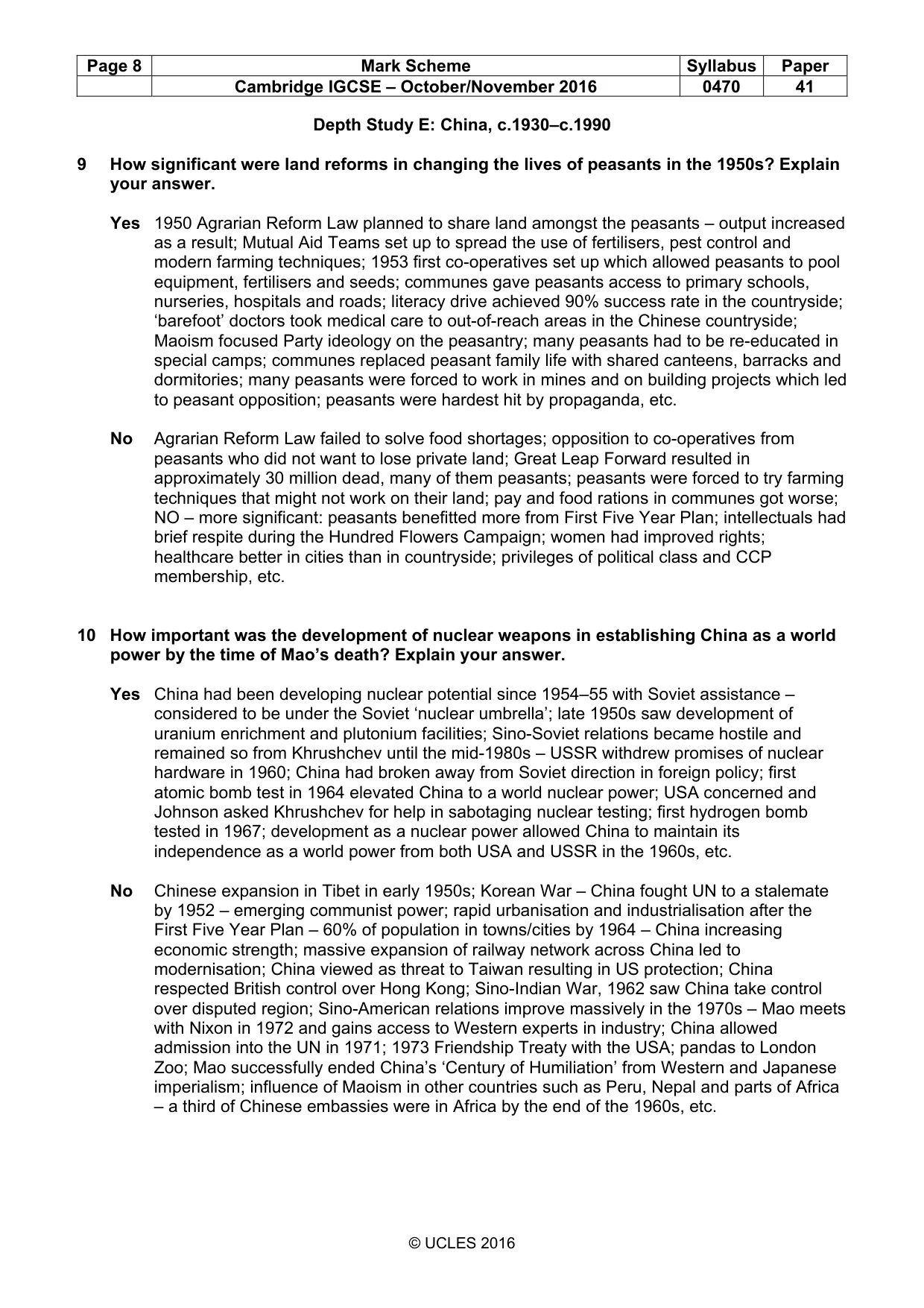
Page 8 Mark Scheme Syllabus Paper Cambridge IGCSE – October/November 2016 0470 41 © UCLES 2016 Depth Study E: China, c.1930–c.1990 9 How significant were land reforms in changing the lives of peasants in the 1950s? Explain your answer. Yes 1950 Agrarian Reform Law planned to share land amongst the peasants – output increased as a result; Mutual Aid Teams set up to spread the use of fertilisers, pest control and modern farming techniques; 1953 first co-operatives set up which allowed peasants to pool equipment, fertilisers and seeds; communes gave peasants access to primary schools, nurseries, hospitals and roads; literacy drive achieved 90% success rate in the countryside; ‘barefoot’ doctors took medical care to out-of-reach areas in the Chinese countryside; Maoism focused Party ideology on the peasantry; many peasants had to be re-educated in special camps; communes replaced peasant family life with shared canteens, barracks and dormitories; many peasants were forced to work in mines and on building projects which led to peasant opposition; peasants were hardest hit by propaganda, etc. No Agrarian Reform Law failed to solve food shortages; opposition to co-operatives from peasants who did not want to lose private land; Great Leap Forward resulted in approximately 30 million dead, many of them peasants; peasants were forced to try farming techniques that might not work on their land; pay and food rations in communes got worse; NO – more significant: peasants benefitted more from First Five Year Plan; intellectuals had brief respite during the Hundred Flowers Campaign; women had improved rights; healthcare better in cities than in countryside; privileges of political class and CCP membership, etc. 10 How important was the development of nuclear weapons in establishing China as a world power by the time of Mao’s death? Explain your answer. Yes China had been developing nuclear potential since 1954–55 with Soviet assistance – considered to be under the Soviet ‘nuclear umbrella’; late 1950s saw development of uranium enrichment and plutonium facilities; Sino-Soviet relations became hostile and remained so from Khrushchev until the mid-1980s – USSR withdrew promises of nuclear hardware in 1960; China had broken away from Soviet direction in foreign policy; first atomic bomb test in 1964 elevated China to a world nuclear power; USA concerned and Johnson asked Khrushchev for help in sabotaging nuclear testing; first hydrogen bomb tested in 1967; development as a nuclear power allowed China to maintain its independence as a world power from both USA and USSR in the 1960s, etc. No Chinese expansion in Tibet in early 1950s; Korean War – China fought UN to a stalemate by 1952 – emerging communist power; rapid urbanisation and industrialisation after the First Five Year Plan – 60% of population in towns/cities by 1964 – China increasing economic strength; massive expansion of railway network across China led to modernisation; China viewed as threat to Taiwan resulting in US protection; China respected British control over Hong Kong; Sino-Indian War, 1962 saw China take control over disputed region; Sino-American relations improve massively in the 1970s – Mao meets with Nixon in 1972 and gains access to Western experts in industry; China allowed admission into the UN in 1971; 1973 Friendship Treaty with the USA; pandas to London Zoo; Mao successfully ended China’s ‘Century of Humiliation’ from Western and Japanese imperialism; influence of Maoism in other countries such as Peru, Nepal and parts of Africa – a third of Chinese embassies were in Africa by the end of the 1960s, etc.
Mark scheme, page 9
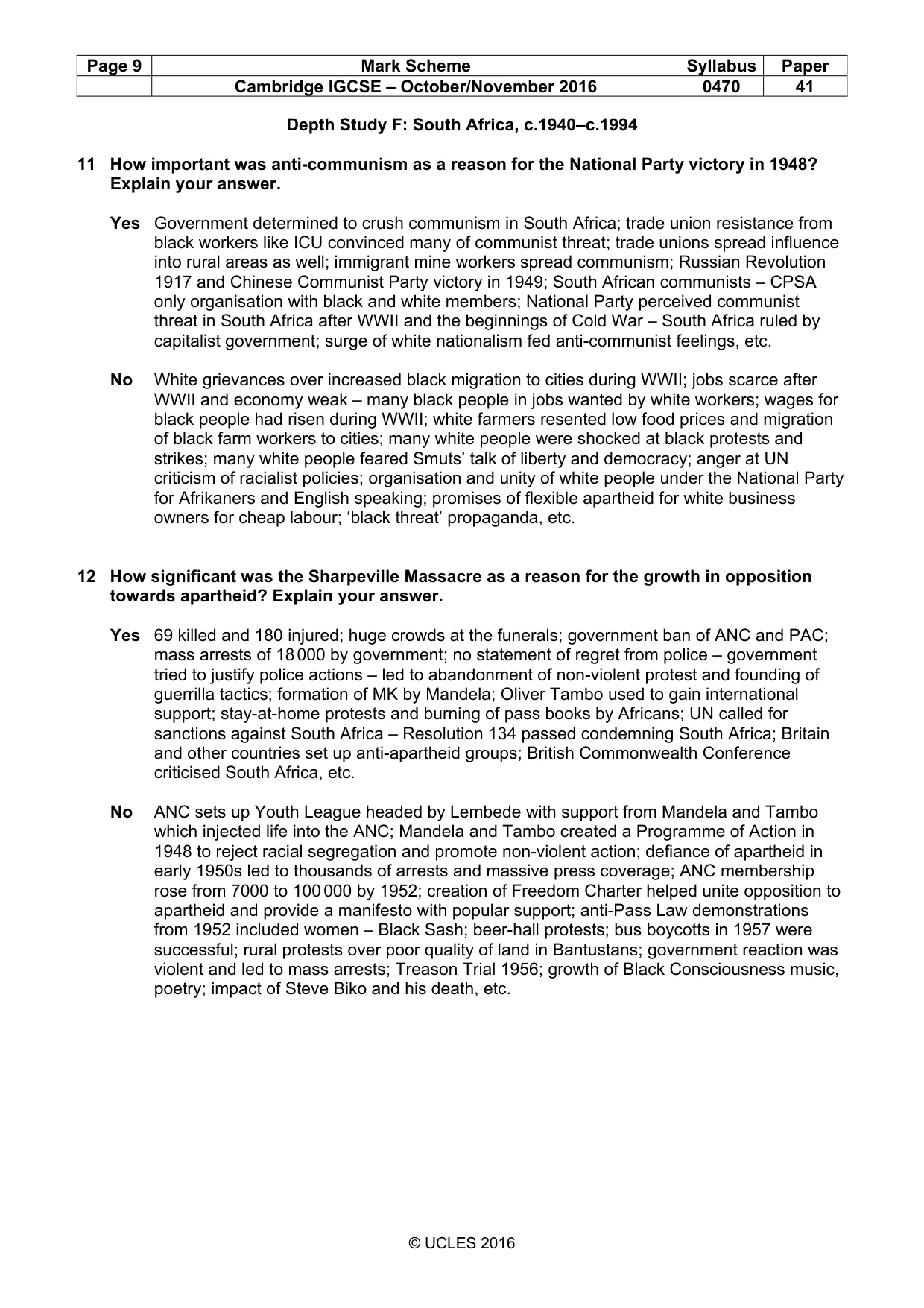
Page 9 Mark Scheme Syllabus Paper Cambridge IGCSE – October/November 2016 0470 41 © UCLES 2016 Depth Study F: South Africa, c.1940–c.1994 11 How important was anti-communism as a reason for the National Party victory in 1948? Explain your answer. Yes Government determined to crush communism in South Africa; trade union resistance from black workers like ICU convinced many of communist threat; trade unions spread influence into rural areas as well; immigrant mine workers spread communism; Russian Revolution 1917 and Chinese Communist Party victory in 1949; South African communists – CPSA only organisation with black and white members; National Party perceived communist threat in South Africa after WWII and the beginnings of Cold War – South Africa ruled by capitalist government; surge of white nationalism fed anti-communist feelings, etc. No White grievances over increased black migration to cities during WWII; jobs scarce after WWII and economy weak – many black people in jobs wanted by white workers; wages for black people had risen during WWII; white farmers resented low food prices and migration of black farm workers to cities; many white people were shocked at black protests and strikes; many white people feared Smuts’ talk of liberty and democracy; anger at UN criticism of racialist policies; organisation and unity of white people under the National Party for Afrikaners and English speaking; promises of flexible apartheid for white business owners for cheap labour; ‘black threat’ propaganda, etc. 12 How significant was the Sharpeville Massacre as a reason for the growth in opposition towards apartheid? Explain your answer. Yes 69 killed and 180 injured; huge crowds at the funerals; government ban of ANC and PAC; mass arrests of 18 000 by government; no statement of regret from police – government tried to justify police actions – led to abandonment of non-violent protest and founding of guerrilla tactics; formation of MK by Mandela; Oliver Tambo used to gain international support; stay-at-home protests and burning of pass books by Africans; UN called for sanctions against South Africa – Resolution 134 passed condemning South Africa; Britain and other countries set up anti-apartheid groups; British Commonwealth Conference criticised South Africa, etc. No ANC sets up Youth League headed by Lembede with support from Mandela and Tambo which injected life into the ANC; Mandela and Tambo created a Programme of Action in 1948 to reject racial segregation and promote non-violent action; defiance of apartheid in early 1950s led to thousands of arrests and massive press coverage; ANC membership rose from 7000 to 100 000 by 1952; creation of Freedom Charter helped unite opposition to apartheid and provide a manifesto with popular support; anti-Pass Law demonstrations from 1952 included women – Black Sash; beer-hall protests; bus boycotts in 1957 were successful; rural protests over poor quality of land in Bantustans; government reaction was violent and led to mass arrests; Treason Trial 1956; growth of Black Consciousness music, poetry; impact of Steve Biko and his death, etc.
Mark scheme, page 10
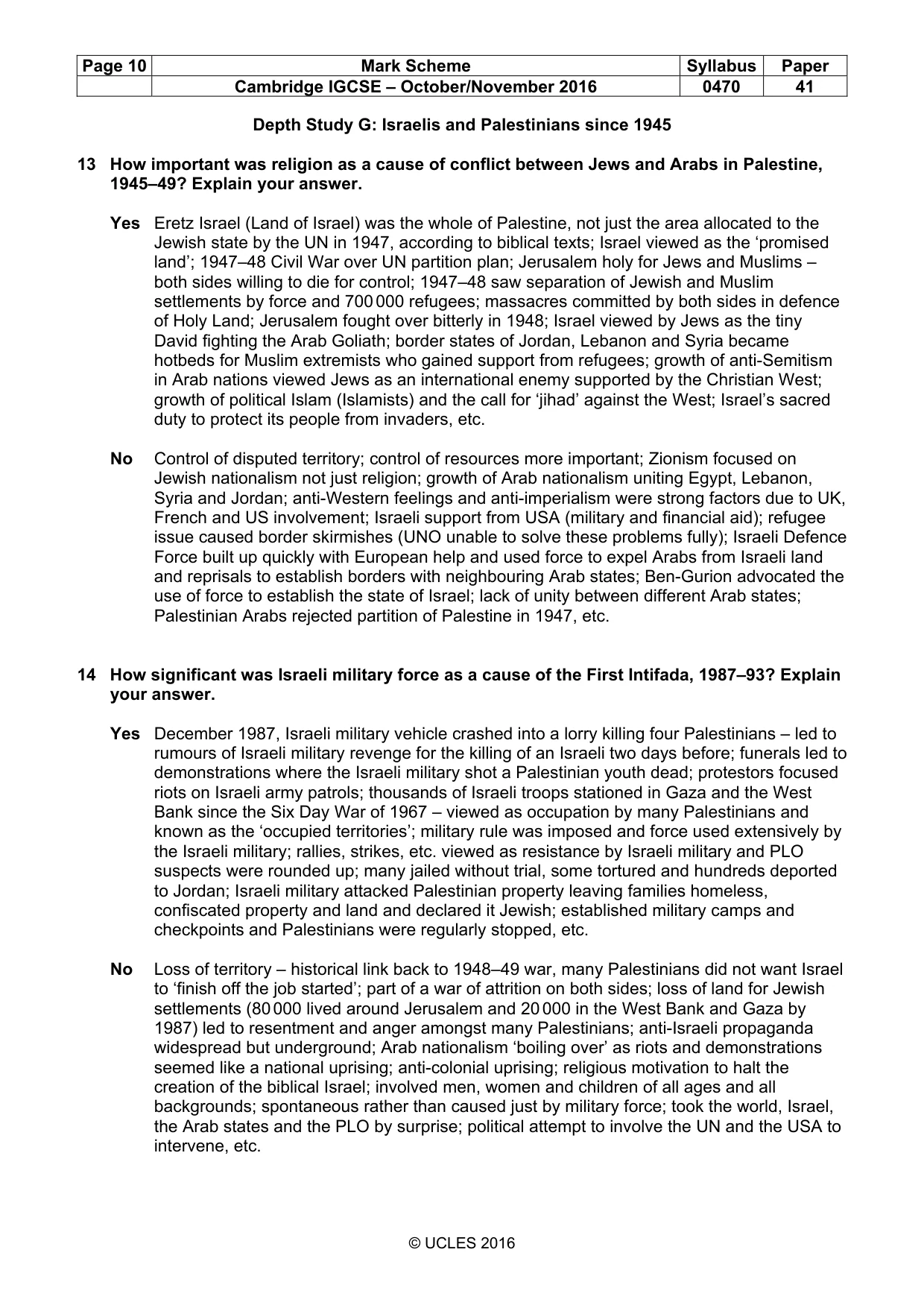
Page 10 Mark Scheme Syllabus Paper Cambridge IGCSE – October/November 2016 0470 41 © UCLES 2016 Depth Study G: Israelis and Palestinians since 1945 13 How important was religion as a cause of conflict between Jews and Arabs in Palestine, 1945–49? Explain your answer. Yes Eretz Israel (Land of Israel) was the whole of Palestine, not just the area allocated to the Jewish state by the UN in 1947, according to biblical texts; Israel viewed as the ‘promised land’; 1947–48 Civil War over UN partition plan; Jerusalem holy for Jews and Muslims – both sides willing to die for control; 1947–48 saw separation of Jewish and Muslim settlements by force and 700 000 refugees; massacres committed by both sides in defence of Holy Land; Jerusalem fought over bitterly in 1948; Israel viewed by Jews as the tiny David fighting the Arab Goliath; border states of Jordan, Lebanon and Syria became hotbeds for Muslim extremists who gained support from refugees; growth of anti-Semitism in Arab nations viewed Jews as an international enemy supported by the Christian West; growth of political Islam (Islamists) and the call for ‘jihad’ against the West; Israel’s sacred duty to protect its people from invaders, etc. No Control of disputed territory; control of resources more important; Zionism focused on Jewish nationalism not just religion; growth of Arab nationalism uniting Egypt, Lebanon, Syria and Jordan; anti-Western feelings and anti-imperialism were strong factors due to UK, French and US involvement; Israeli support from USA (military and financial aid); refugee issue caused border skirmishes (UNO unable to solve these problems fully); Israeli Defence Force built up quickly with European help and used force to expel Arabs from Israeli land and reprisals to establish borders with neighbouring Arab states; Ben-Gurion advocated the use of force to establish the state of Israel; lack of unity between different Arab states; Palestinian Arabs rejected partition of Palestine in 1947, etc. 14 How significant was Israeli military force as a cause of the First Intifada, 1987–93? Explain your answer. Yes December 1987, Israeli military vehicle crashed into a lorry killing four Palestinians – led to rumours of Israeli military revenge for the killing of an Israeli two days before; funerals led to demonstrations where the Israeli military shot a Palestinian youth dead; protestors focused riots on Israeli army patrols; thousands of Israeli troops stationed in Gaza and the West Bank since the Six Day War of 1967 – viewed as occupation by many Palestinians and known as the ‘occupied territories’; military rule was imposed and force used extensively by the Israeli military; rallies, strikes, etc. viewed as resistance by Israeli military and PLO suspects were rounded up; many jailed without trial, some tortured and hundreds deported to Jordan; Israeli military attacked Palestinian property leaving families homeless, confiscated property and land and declared it Jewish; established military camps and checkpoints and Palestinians were regularly stopped, etc. No Loss of territory – historical link back to 1948–49 war, many Palestinians did not want Israel to ‘finish off the job started’; part of a war of attrition on both sides; loss of land for Jewish settlements (80 000 lived around Jerusalem and 20 000 in the West Bank and Gaza by 1987) led to resentment and anger amongst many Palestinians; anti-Israeli propaganda widespread but underground; Arab nationalism ‘boiling over’ as riots and demonstrations seemed like a national uprising; anti-colonial uprising; religious motivation to halt the creation of the biblical Israel; involved men, women and children of all ages and all backgrounds; spontaneous rather than caused just by military force; took the world, Israel, the Arab states and the PLO by surprise; political attempt to involve the UN and the USA to intervene, etc.
What you needed in this session
Cambridge’s own grade thresholds for 2016 Oct/Nov, Paper 4 · Variant 1. A higher threshold means an easier paper — the bar moves with how the cohort did.