Cambridge IGCSE History 0470 — 2015 Oct/Nov Paper 4 · Variant 3
0470/43/O/N/15 · 40 marks · ≈45 min
The question paper and its mark scheme, free to read here and free to download. This is Cambridge’s own paper, exactly as it was sat.
Question paper4 pages

Mark scheme10 pages
Answers below. Sit the paper first if you are practising.
Paper as text
Question paper, page 1
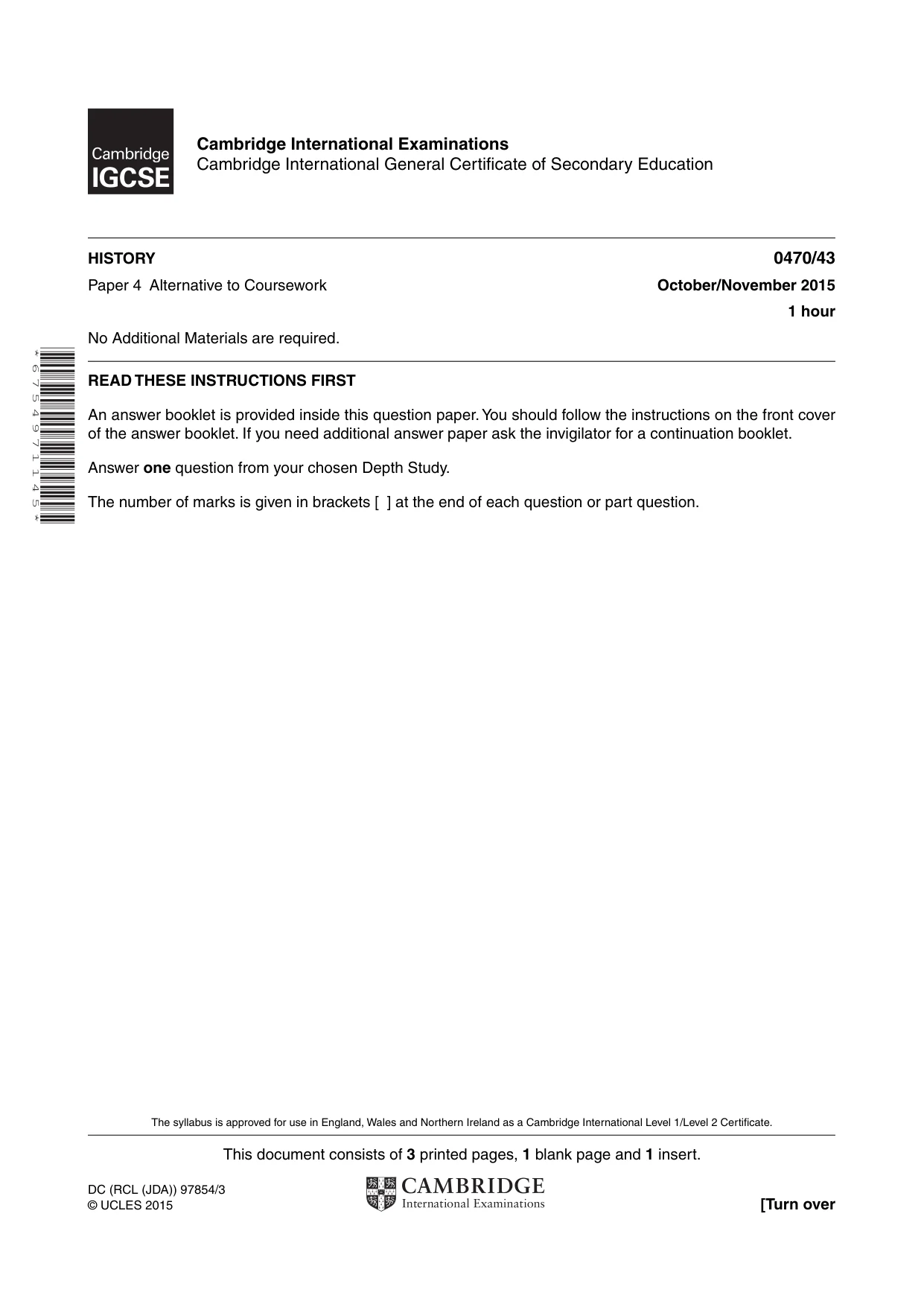
This document consists of 3 printed pages, 1 blank page and 1 insert. DC (RCL (JDA)) 97854/3 © UCLES 2015 [Turn over Cambridge International Examinations Cambridge International General Certificate of Secondary Education * 6 7 5 4 9 7 1 1 4 5 * HISTORY 0470/43 Paper 4 Alternative to Coursework October/November 2015 1 hour No Additional Materials are required. READ THESE INSTRUCTIONS FIRST An answer booklet is provided inside this question paper. You should follow the instructions on the front cover of the answer booklet. If you need additional answer paper ask the invigilator for a continuation booklet. Answer one question from your chosen Depth Study. The number of marks is given in brackets [ ] at the end of each question or part question. The syllabus is approved for use in England, Wales and Northern Ireland as a Cambridge International Level 1/Level 2 Certificate.
Question paper, page 2
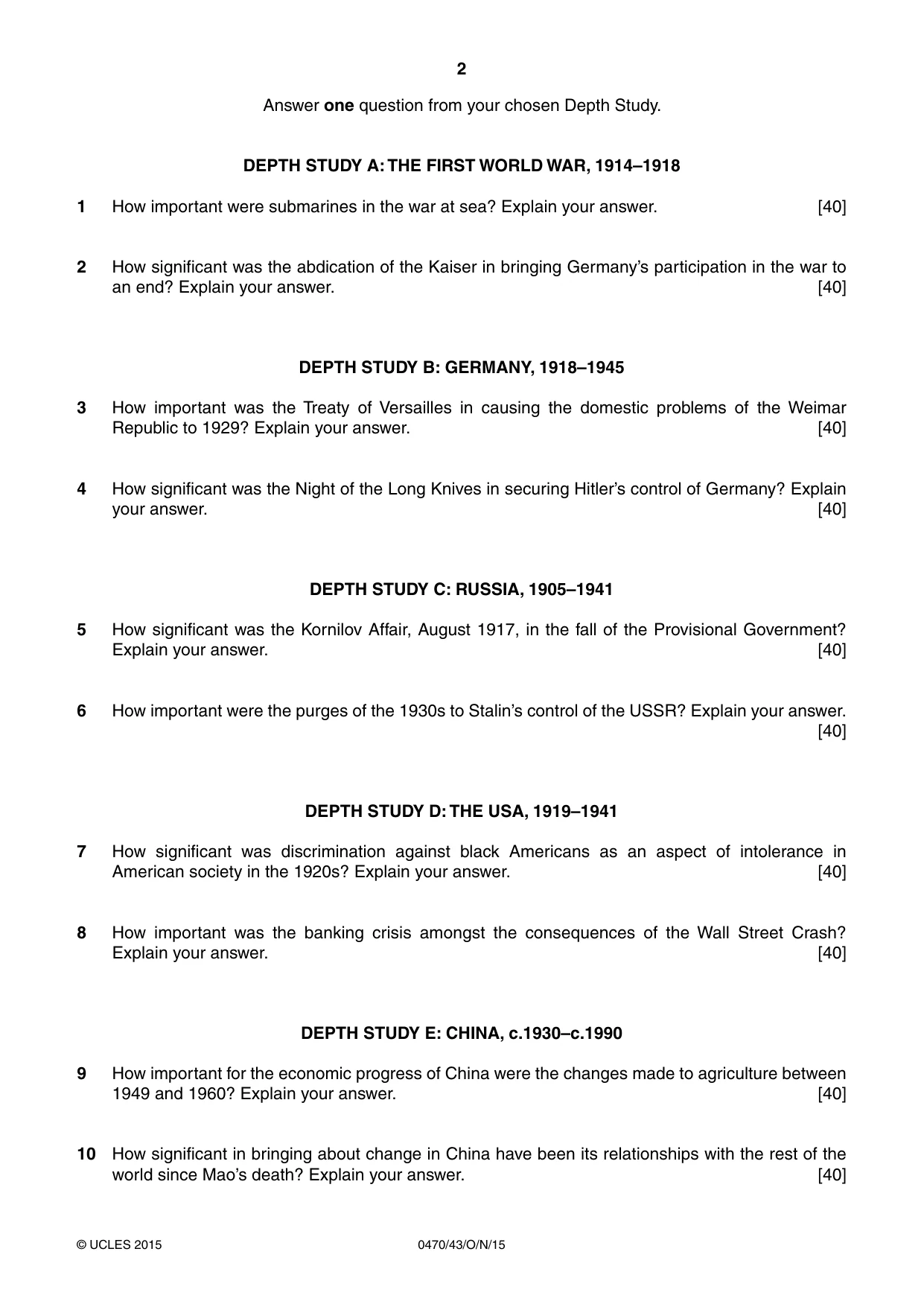
2 0470/43/O/N/15 © UCLES 2015 Answer one question from your chosen Depth Study. DEPTH STUDY A: THE FIRST WORLD WAR, 1914–1918 1 How important were submarines in the war at sea? Explain your answer. [40] 2 How significant was the abdication of the Kaiser in bringing Germany’s participation in the war to an end? Explain your answer. [40] DEPTH STUDY B: GERMANY, 1918–1945 3 How important was the Treaty of Versailles in causing the domestic problems of the Weimar Republic to 1929? Explain your answer. [40] 4 How significant was the Night of the Long Knives in securing Hitler’s control of Germany? Explain your answer. [40] DEPTH STUDY C: RUSSIA, 1905–1941 5 How significant was the Kornilov Affair, August 1917, in the fall of the Provisional Government? Explain your answer. [40] 6 How important were the purges of the 1930s to Stalin’s control of the USSR? Explain your answer. [40] DEPTH STUDY D: THE USA, 1919–1941 7 How significant was discrimination against black Americans as an aspect of intolerance in American society in the 1920s? Explain your answer. [40] 8 How important was the banking crisis amongst the consequences of the Wall Street Crash? Explain your answer. [40] DEPTH STUDY E: CHINA, c.1930–c.1990 9 How important for the economic progress of China were the changes made to agriculture between 1949 and 1960? Explain your answer. [40] 10 How significant in bringing about change in China have been its relationships with the rest of the world since Mao’s death? Explain your answer. [40]
Question paper, page 3
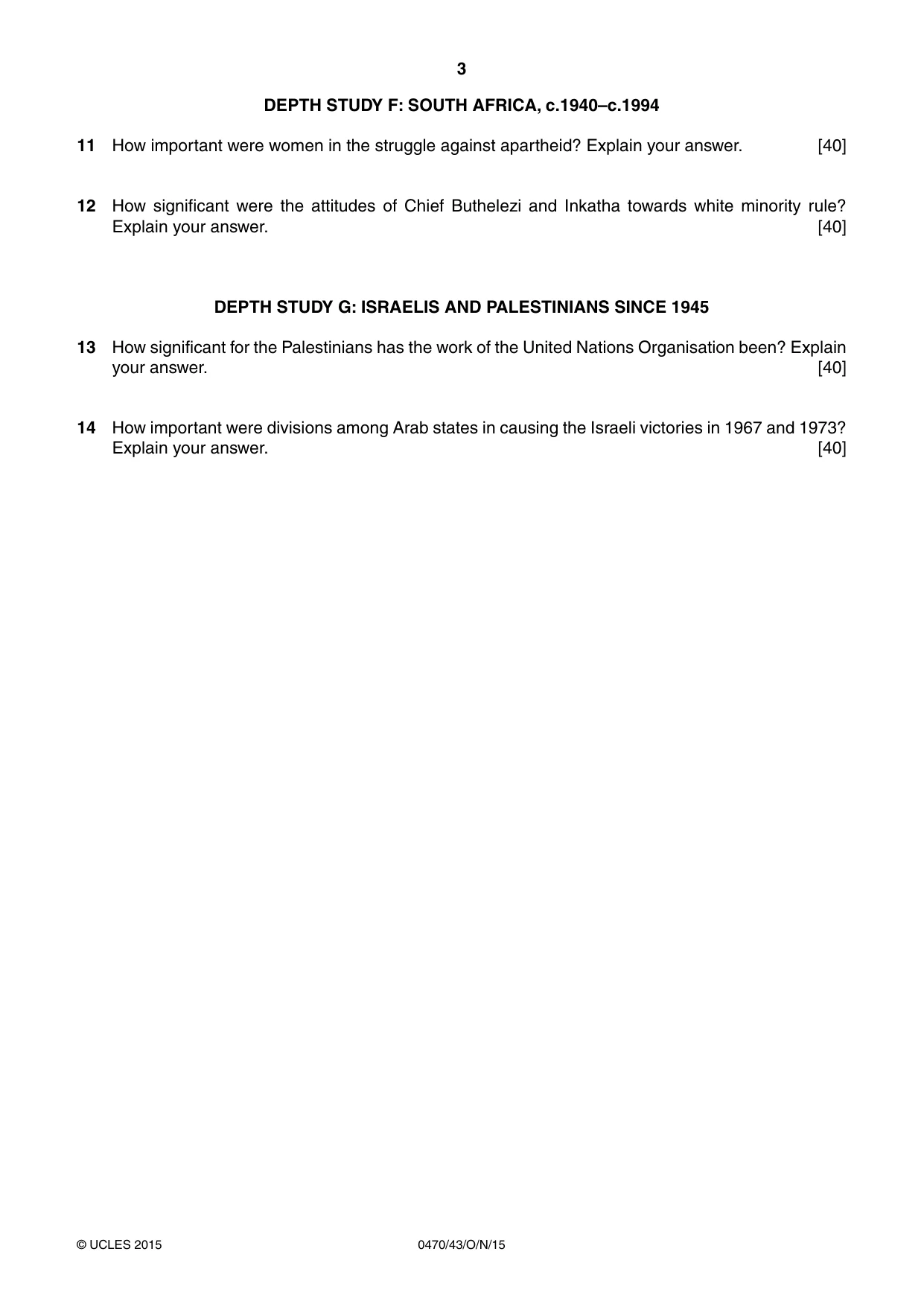
3 0470/43/O/N/15 © UCLES 2015 DEPTH STUDY F: SOUTH AFRICA, c.1940–c.1994 11 How important were women in the struggle against apartheid? Explain your answer. [40] 12 How significant were the attitudes of Chief Buthelezi and Inkatha towards white minority rule? Explain your answer. [40] DEPTH STUDY G: ISRAELIS AND PALESTINIANS SINCE 1945 13 How significant for the Palestinians has the work of the United Nations Organisation been? Explain your answer. [40] 14 How important were divisions among Arab states in causing the Israeli victories in 1967 and 1973? Explain your answer. [40]
Question paper, page 4
4 0470/43/O/N/15 © UCLES 2015 BLANK PAGE Permission to reproduce items where third-party owned material protected by copyright is included has been sought and cleared where possible. Every reasonable effort has been made by the publisher (UCLES) to trace copyright holders, but if any items requiring clearance have unwittingly been included, the publisher will be pleased to make amends at the earliest possible opportunity. To avoid the issue of disclosure of answer-related information to candidates, all copyright acknowledgements are reproduced online in the Cambridge International Examinations Copyright Acknowledgements Booklet. This is produced for each series of examinations and is freely available to download at www.cie.org.uk after the live examination series. Cambridge International Examinations is part of the Cambridge Assessment Group. Cambridge Assessment is the brand name of University of Cambridge Local Examinations Syndicate (UCLES), which is itself a department of the University of Cambridge.
Mark scheme, page 1
® IGCSE is the registered trademark of Cambridge International Examinations. CAMBRIDGE INTERNATIONAL EXAMINATIONS Cambridge International General Certificate of Secondary Education MARK SCHEME for the October/November 2015 series 0470 HISTORY 0470/43 Paper 4 (Alternative to Coursework), maximum raw mark 40 This mark scheme is published as an aid to teachers and candidates, to indicate the requirements of the examination. It shows the basis on which Examiners were instructed to award marks. It does not indicate the details of the discussions that took place at an Examiners’ meeting before marking began, which would have considered the acceptability of alternative answers. Mark schemes should be read in conjunction with the question paper and the Principal Examiner Report for Teachers. Cambridge will not enter into discussions about these mark schemes. Cambridge is publishing the mark schemes for the October/November 2015 series for most Cambridge IGCSE®, Cambridge International A and AS Level components and some Cambridge O Level components.
Mark scheme, page 2
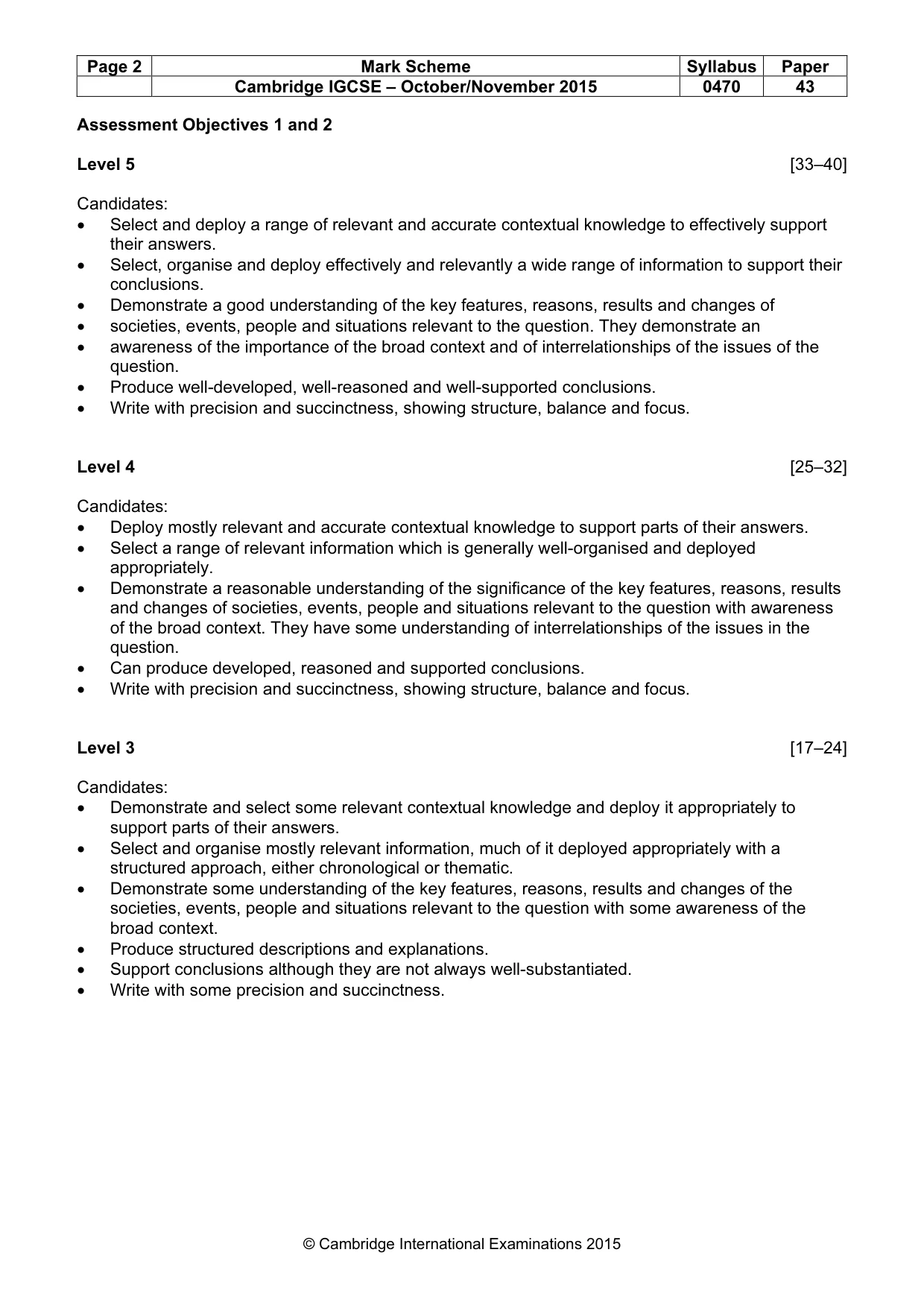
Page 2 Mark Scheme Syllabus Paper Cambridge IGCSE – October/November 2015 0470 43 © Cambridge International Examinations 2015 Assessment Objectives 1 and 2 Level 5 [33–40] Candidates: • Select and deploy a range of relevant and accurate contextual knowledge to effectively support their answers. • Select, organise and deploy effectively and relevantly a wide range of information to support their conclusions. • Demonstrate a good understanding of the key features, reasons, results and changes of • societies, events, people and situations relevant to the question. They demonstrate an • awareness of the importance of the broad context and of interrelationships of the issues of the question. • Produce well-developed, well-reasoned and well-supported conclusions. • Write with precision and succinctness, showing structure, balance and focus. Level 4 [25–32] Candidates: • Deploy mostly relevant and accurate contextual knowledge to support parts of their answers. • Select a range of relevant information which is generally well-organised and deployed appropriately. • Demonstrate a reasonable understanding of the significance of the key features, reasons, results and changes of societies, events, people and situations relevant to the question with awareness of the broad context. They have some understanding of interrelationships of the issues in the question. • Can produce developed, reasoned and supported conclusions. • Write with precision and succinctness, showing structure, balance and focus. Level 3 [17–24] Candidates: • Demonstrate and select some relevant contextual knowledge and deploy it appropriately to support parts of their answers. • Select and organise mostly relevant information, much of it deployed appropriately with a structured approach, either chronological or thematic. • Demonstrate some understanding of the key features, reasons, results and changes of the societies, events, people and situations relevant to the question with some awareness of the broad context. • Produce structured descriptions and explanations. • Support conclusions although they are not always well-substantiated. • Write with some precision and succinctness.
Mark scheme, page 3
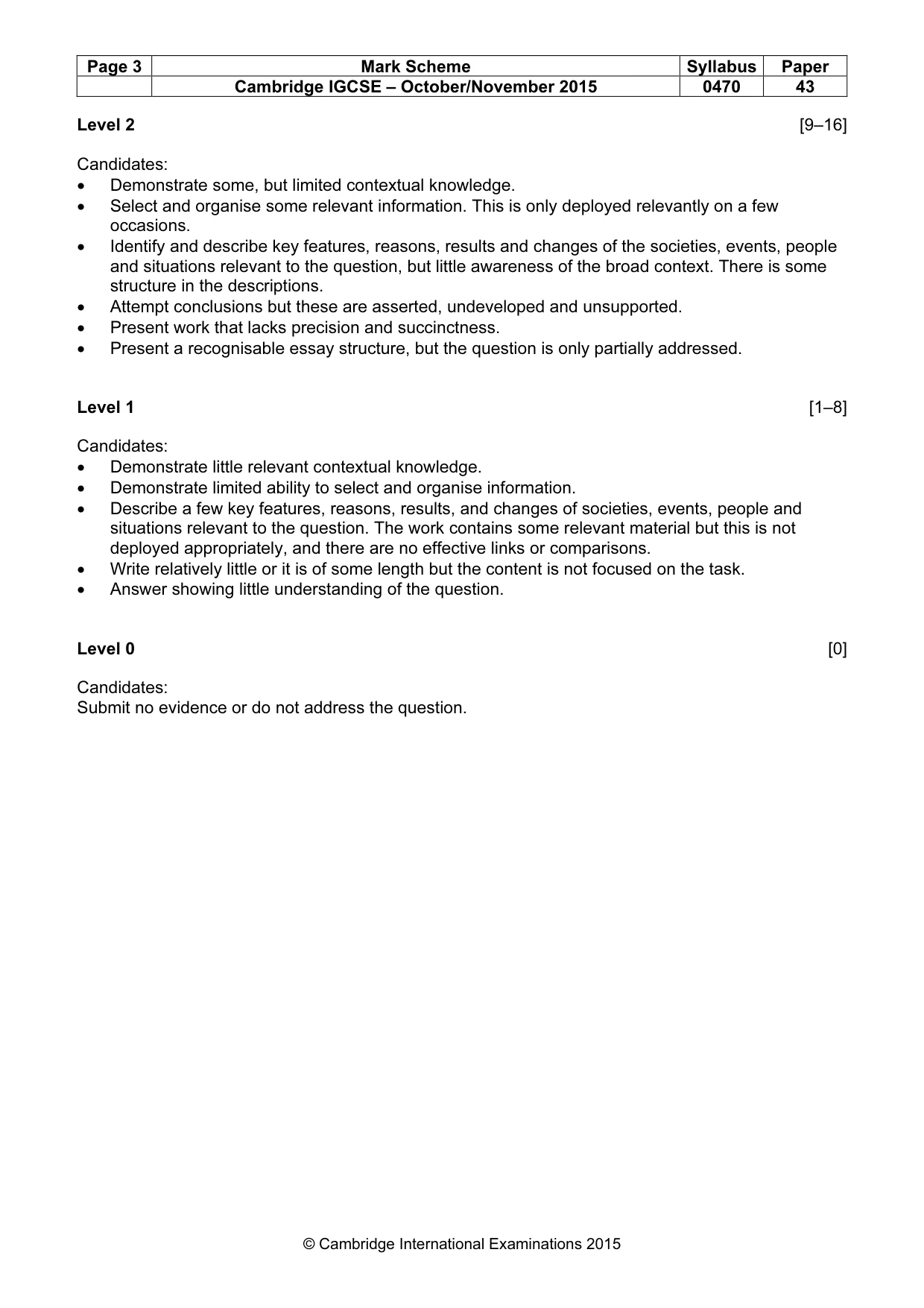
Page 3 Mark Scheme Syllabus Paper Cambridge IGCSE – October/November 2015 0470 43 © Cambridge International Examinations 2015 Level 2 [9–16] Candidates: • Demonstrate some, but limited contextual knowledge. • Select and organise some relevant information. This is only deployed relevantly on a few occasions. • Identify and describe key features, reasons, results and changes of the societies, events, people and situations relevant to the question, but little awareness of the broad context. There is some structure in the descriptions. • Attempt conclusions but these are asserted, undeveloped and unsupported. • Present work that lacks precision and succinctness. • Present a recognisable essay structure, but the question is only partially addressed. Level 1 [1–8] Candidates: • Demonstrate little relevant contextual knowledge. • Demonstrate limited ability to select and organise information. • Describe a few key features, reasons, results, and changes of societies, events, people and situations relevant to the question. The work contains some relevant material but this is not deployed appropriately, and there are no effective links or comparisons. • Write relatively little or it is of some length but the content is not focused on the task. • Answer showing little understanding of the question. Level 0 [0] Candidates: Submit no evidence or do not address the question.
Mark scheme, page 4
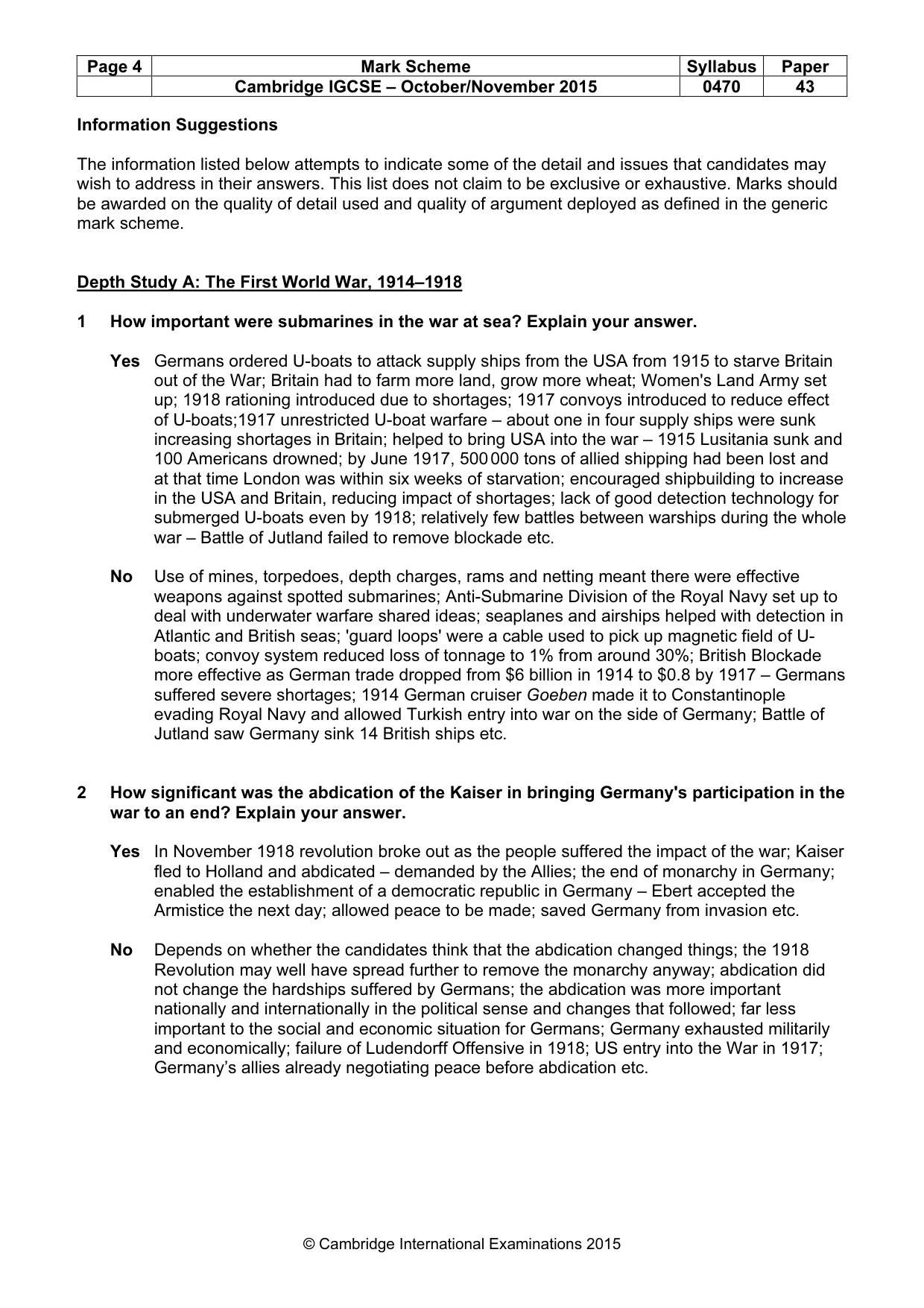
Page 4 Mark Scheme Syllabus Paper Cambridge IGCSE – October/November 2015 0470 43 © Cambridge International Examinations 2015 Information Suggestions The information listed below attempts to indicate some of the detail and issues that candidates may wish to address in their answers. This list does not claim to be exclusive or exhaustive. Marks should be awarded on the quality of detail used and quality of argument deployed as defined in the generic mark scheme. Depth Study A: The First World War, 1914–1918 1 How important were submarines in the war at sea? Explain your answer. Yes Germans ordered U-boats to attack supply ships from the USA from 1915 to starve Britain out of the War; Britain had to farm more land, grow more wheat; Women's Land Army set up; 1918 rationing introduced due to shortages; 1917 convoys introduced to reduce effect of U-boats;1917 unrestricted U-boat warfare – about one in four supply ships were sunk increasing shortages in Britain; helped to bring USA into the war – 1915 Lusitania sunk and 100 Americans drowned; by June 1917, 500 000 tons of allied shipping had been lost and at that time London was within six weeks of starvation; encouraged shipbuilding to increase in the USA and Britain, reducing impact of shortages; lack of good detection technology for submerged U-boats even by 1918; relatively few battles between warships during the whole war – Battle of Jutland failed to remove blockade etc. No Use of mines, torpedoes, depth charges, rams and netting meant there were effective weapons against spotted submarines; Anti-Submarine Division of the Royal Navy set up to deal with underwater warfare shared ideas; seaplanes and airships helped with detection in Atlantic and British seas; 'guard loops' were a cable used to pick up magnetic field of U- boats; convoy system reduced loss of tonnage to 1% from around 30%; British Blockade more effective as German trade dropped from $6 billion in 1914 to $0.8 by 1917 – Germans suffered severe shortages; 1914 German cruiser Goeben made it to Constantinople evading Royal Navy and allowed Turkish entry into war on the side of Germany; Battle of Jutland saw Germany sink 14 British ships etc. 2 How significant was the abdication of the Kaiser in bringing Germany's participation in the war to an end? Explain your answer. Yes In November 1918 revolution broke out as the people suffered the impact of the war; Kaiser fled to Holland and abdicated – demanded by the Allies; the end of monarchy in Germany; enabled the establishment of a democratic republic in Germany – Ebert accepted the Armistice the next day; allowed peace to be made; saved Germany from invasion etc. No Depends on whether the candidates think that the abdication changed things; the 1918 Revolution may well have spread further to remove the monarchy anyway; abdication did not change the hardships suffered by Germans; the abdication was more important nationally and internationally in the political sense and changes that followed; far less important to the social and economic situation for Germans; Germany exhausted militarily and economically; failure of Ludendorff Offensive in 1918; US entry into the War in 1917; Germany’s allies already negotiating peace before abdication etc.
Mark scheme, page 5
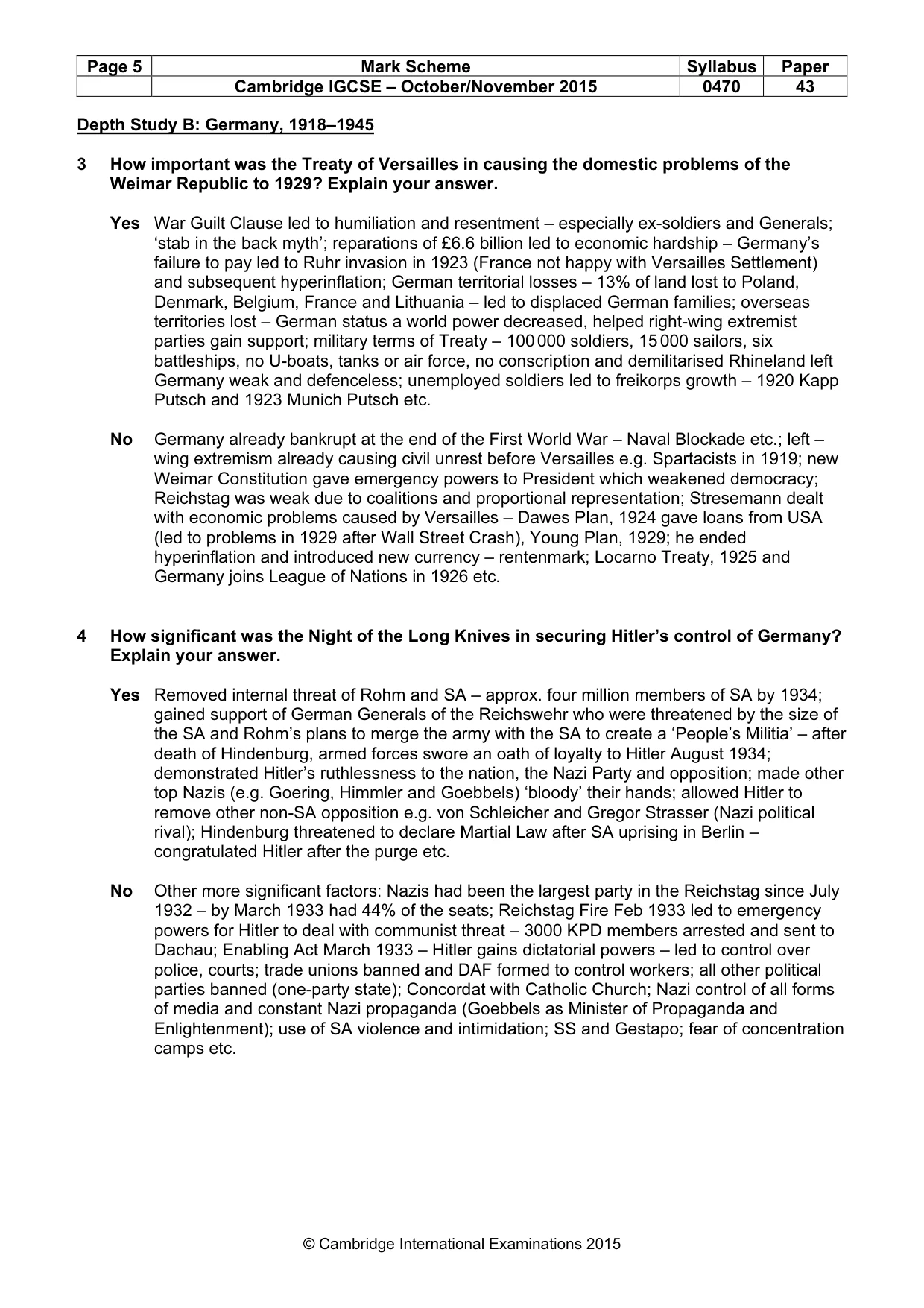
Page 5 Mark Scheme Syllabus Paper Cambridge IGCSE – October/November 2015 0470 43 © Cambridge International Examinations 2015 Depth Study B: Germany, 1918–1945 3 How important was the Treaty of Versailles in causing the domestic problems of the Weimar Republic to 1929? Explain your answer. Yes War Guilt Clause led to humiliation and resentment – especially ex-soldiers and Generals; ‘stab in the back myth’; reparations of £6.6 billion led to economic hardship – Germany’s failure to pay led to Ruhr invasion in 1923 (France not happy with Versailles Settlement) and subsequent hyperinflation; German territorial losses – 13% of land lost to Poland, Denmark, Belgium, France and Lithuania – led to displaced German families; overseas territories lost – German status a world power decreased, helped right-wing extremist parties gain support; military terms of Treaty – 100 000 soldiers, 15 000 sailors, six battleships, no U-boats, tanks or air force, no conscription and demilitarised Rhineland left Germany weak and defenceless; unemployed soldiers led to freikorps growth – 1920 Kapp Putsch and 1923 Munich Putsch etc. No Germany already bankrupt at the end of the First World War – Naval Blockade etc.; left – wing extremism already causing civil unrest before Versailles e.g. Spartacists in 1919; new Weimar Constitution gave emergency powers to President which weakened democracy; Reichstag was weak due to coalitions and proportional representation; Stresemann dealt with economic problems caused by Versailles – Dawes Plan, 1924 gave loans from USA (led to problems in 1929 after Wall Street Crash), Young Plan, 1929; he ended hyperinflation and introduced new currency – rentenmark; Locarno Treaty, 1925 and Germany joins League of Nations in 1926 etc. 4 How significant was the Night of the Long Knives in securing Hitler’s control of Germany? Explain your answer. Yes Removed internal threat of Rohm and SA – approx. four million members of SA by 1934; gained support of German Generals of the Reichswehr who were threatened by the size of the SA and Rohm’s plans to merge the army with the SA to create a ‘People’s Militia’ – after death of Hindenburg, armed forces swore an oath of loyalty to Hitler August 1934; demonstrated Hitler’s ruthlessness to the nation, the Nazi Party and opposition; made other top Nazis (e.g. Goering, Himmler and Goebbels) ‘bloody’ their hands; allowed Hitler to remove other non-SA opposition e.g. von Schleicher and Gregor Strasser (Nazi political rival); Hindenburg threatened to declare Martial Law after SA uprising in Berlin – congratulated Hitler after the purge etc. No Other more significant factors: Nazis had been the largest party in the Reichstag since July 1932 – by March 1933 had 44% of the seats; Reichstag Fire Feb 1933 led to emergency powers for Hitler to deal with communist threat – 3000 KPD members arrested and sent to Dachau; Enabling Act March 1933 – Hitler gains dictatorial powers – led to control over police, courts; trade unions banned and DAF formed to control workers; all other political parties banned (one-party state); Concordat with Catholic Church; Nazi control of all forms of media and constant Nazi propaganda (Goebbels as Minister of Propaganda and Enlightenment); use of SA violence and intimidation; SS and Gestapo; fear of concentration camps etc.
Mark scheme, page 6
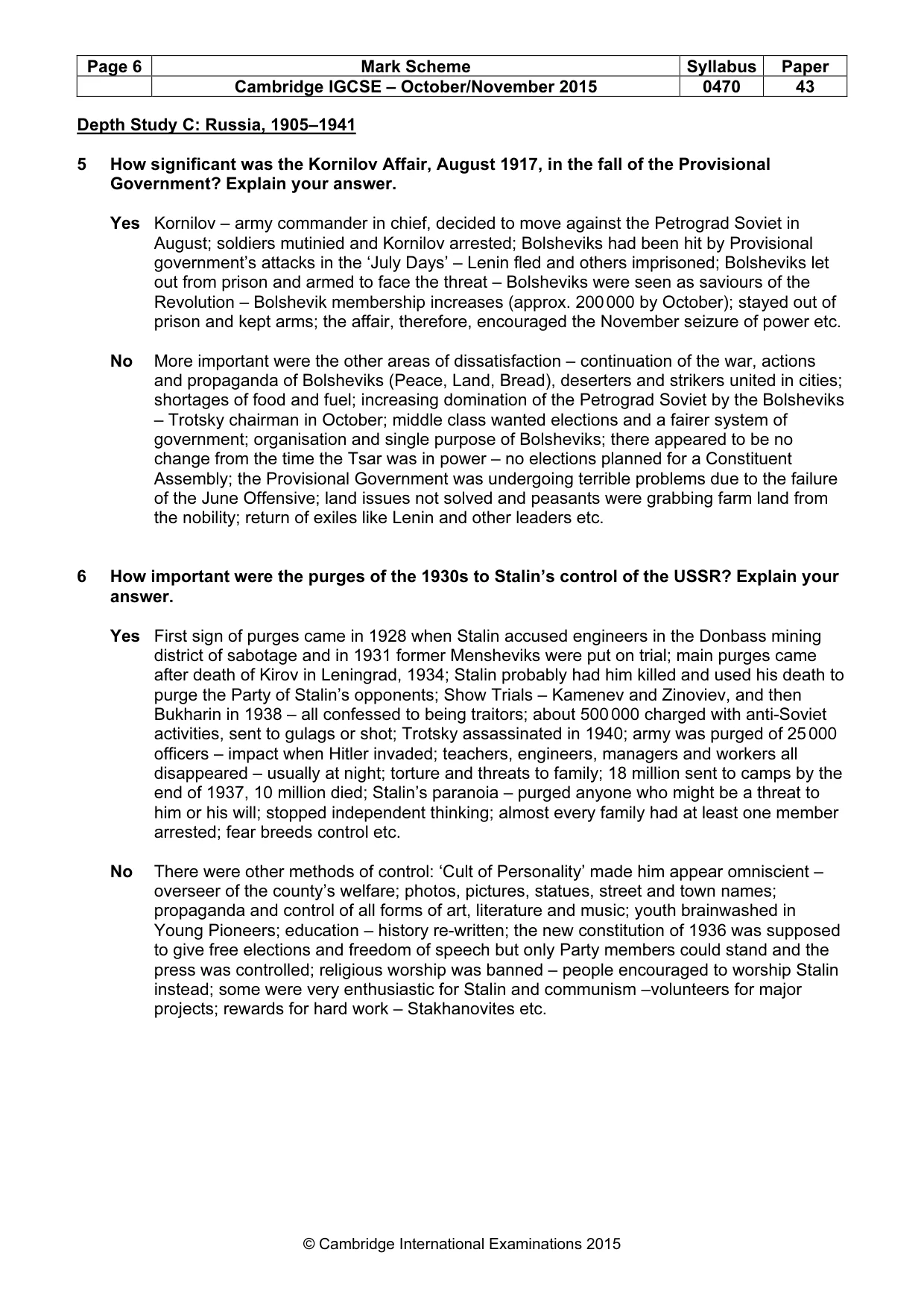
Page 6 Mark Scheme Syllabus Paper Cambridge IGCSE – October/November 2015 0470 43 © Cambridge International Examinations 2015 Depth Study C: Russia, 1905–1941 5 How significant was the Kornilov Affair, August 1917, in the fall of the Provisional Government? Explain your answer. Yes Kornilov – army commander in chief, decided to move against the Petrograd Soviet in August; soldiers mutinied and Kornilov arrested; Bolsheviks had been hit by Provisional government’s attacks in the ‘July Days’ – Lenin fled and others imprisoned; Bolsheviks let out from prison and armed to face the threat – Bolsheviks were seen as saviours of the Revolution – Bolshevik membership increases (approx. 200 000 by October); stayed out of prison and kept arms; the affair, therefore, encouraged the November seizure of power etc. No More important were the other areas of dissatisfaction – continuation of the war, actions and propaganda of Bolsheviks (Peace, Land, Bread), deserters and strikers united in cities; shortages of food and fuel; increasing domination of the Petrograd Soviet by the Bolsheviks – Trotsky chairman in October; middle class wanted elections and a fairer system of government; organisation and single purpose of Bolsheviks; there appeared to be no change from the time the Tsar was in power – no elections planned for a Constituent Assembly; the Provisional Government was undergoing terrible problems due to the failure of the June Offensive; land issues not solved and peasants were grabbing farm land from the nobility; return of exiles like Lenin and other leaders etc. 6 How important were the purges of the 1930s to Stalin’s control of the USSR? Explain your answer. Yes First sign of purges came in 1928 when Stalin accused engineers in the Donbass mining district of sabotage and in 1931 former Mensheviks were put on trial; main purges came after death of Kirov in Leningrad, 1934; Stalin probably had him killed and used his death to purge the Party of Stalin’s opponents; Show Trials – Kamenev and Zinoviev, and then Bukharin in 1938 – all confessed to being traitors; about 500 000 charged with anti-Soviet activities, sent to gulags or shot; Trotsky assassinated in 1940; army was purged of 25 000 officers – impact when Hitler invaded; teachers, engineers, managers and workers all disappeared – usually at night; torture and threats to family; 18 million sent to camps by the end of 1937, 10 million died; Stalin’s paranoia – purged anyone who might be a threat to him or his will; stopped independent thinking; almost every family had at least one member arrested; fear breeds control etc. No There were other methods of control: ‘Cult of Personality’ made him appear omniscient – overseer of the county’s welfare; photos, pictures, statues, street and town names; propaganda and control of all forms of art, literature and music; youth brainwashed in Young Pioneers; education – history re-written; the new constitution of 1936 was supposed to give free elections and freedom of speech but only Party members could stand and the press was controlled; religious worship was banned – people encouraged to worship Stalin instead; some were very enthusiastic for Stalin and communism –volunteers for major projects; rewards for hard work – Stakhanovites etc.
Mark scheme, page 7
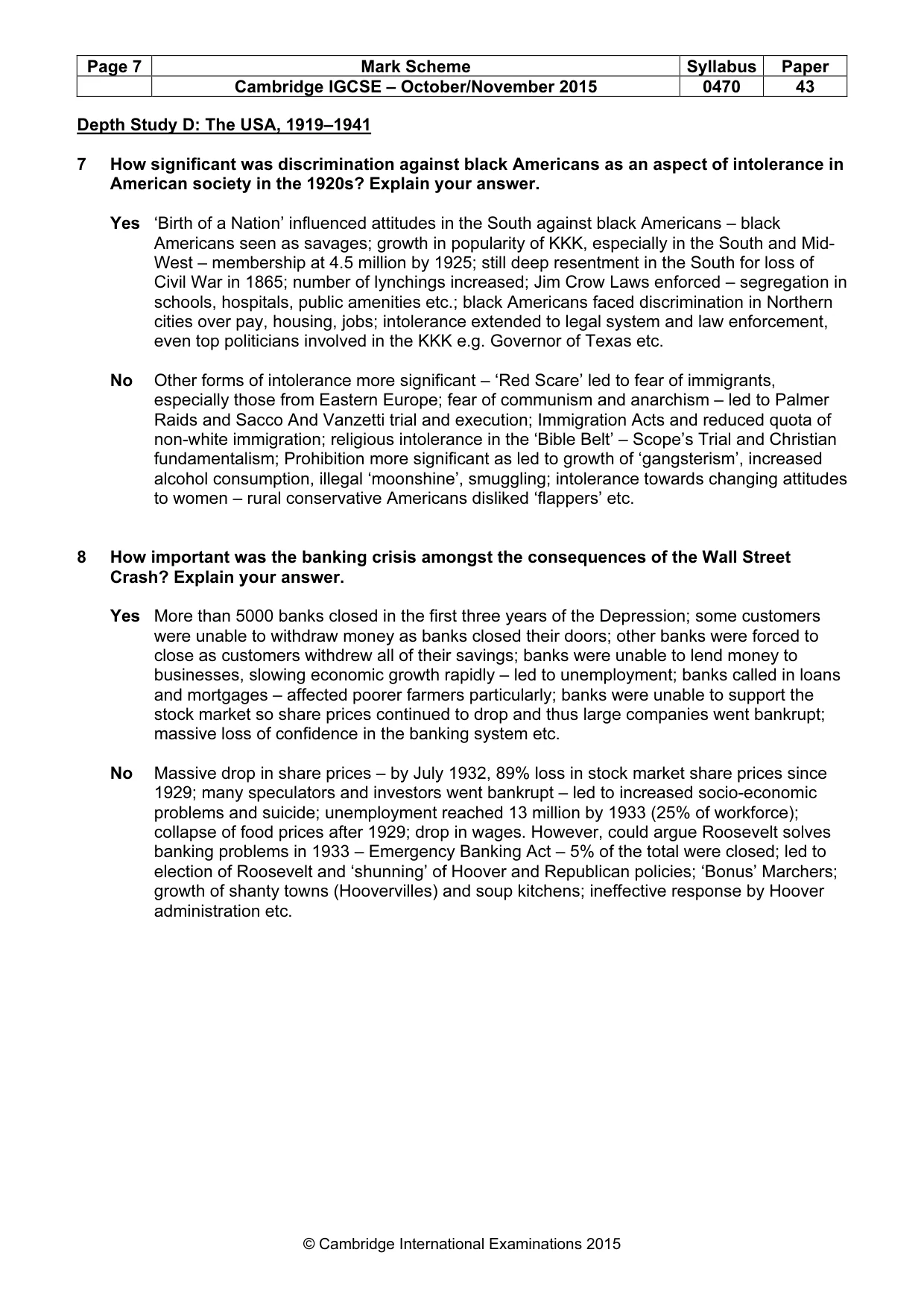
Page 7 Mark Scheme Syllabus Paper Cambridge IGCSE – October/November 2015 0470 43 © Cambridge International Examinations 2015 Depth Study D: The USA, 1919–1941 7 How significant was discrimination against black Americans as an aspect of intolerance in American society in the 1920s? Explain your answer. Yes ‘Birth of a Nation’ influenced attitudes in the South against black Americans – black Americans seen as savages; growth in popularity of KKK, especially in the South and Mid- West – membership at 4.5 million by 1925; still deep resentment in the South for loss of Civil War in 1865; number of lynchings increased; Jim Crow Laws enforced – segregation in schools, hospitals, public amenities etc.; black Americans faced discrimination in Northern cities over pay, housing, jobs; intolerance extended to legal system and law enforcement, even top politicians involved in the KKK e.g. Governor of Texas etc. No Other forms of intolerance more significant – ‘Red Scare’ led to fear of immigrants, especially those from Eastern Europe; fear of communism and anarchism – led to Palmer Raids and Sacco And Vanzetti trial and execution; Immigration Acts and reduced quota of non-white immigration; religious intolerance in the ‘Bible Belt’ – Scope’s Trial and Christian fundamentalism; Prohibition more significant as led to growth of ‘gangsterism’, increased alcohol consumption, illegal ‘moonshine’, smuggling; intolerance towards changing attitudes to women – rural conservative Americans disliked ‘flappers’ etc. 8 How important was the banking crisis amongst the consequences of the Wall Street Crash? Explain your answer. Yes More than 5000 banks closed in the first three years of the Depression; some customers were unable to withdraw money as banks closed their doors; other banks were forced to close as customers withdrew all of their savings; banks were unable to lend money to businesses, slowing economic growth rapidly – led to unemployment; banks called in loans and mortgages – affected poorer farmers particularly; banks were unable to support the stock market so share prices continued to drop and thus large companies went bankrupt; massive loss of confidence in the banking system etc. No Massive drop in share prices – by July 1932, 89% loss in stock market share prices since 1929; many speculators and investors went bankrupt – led to increased socio-economic problems and suicide; unemployment reached 13 million by 1933 (25% of workforce); collapse of food prices after 1929; drop in wages. However, could argue Roosevelt solves banking problems in 1933 – Emergency Banking Act – 5% of the total were closed; led to election of Roosevelt and ‘shunning’ of Hoover and Republican policies; ‘Bonus’ Marchers; growth of shanty towns (Hoovervilles) and soup kitchens; ineffective response by Hoover administration etc.
Mark scheme, page 8
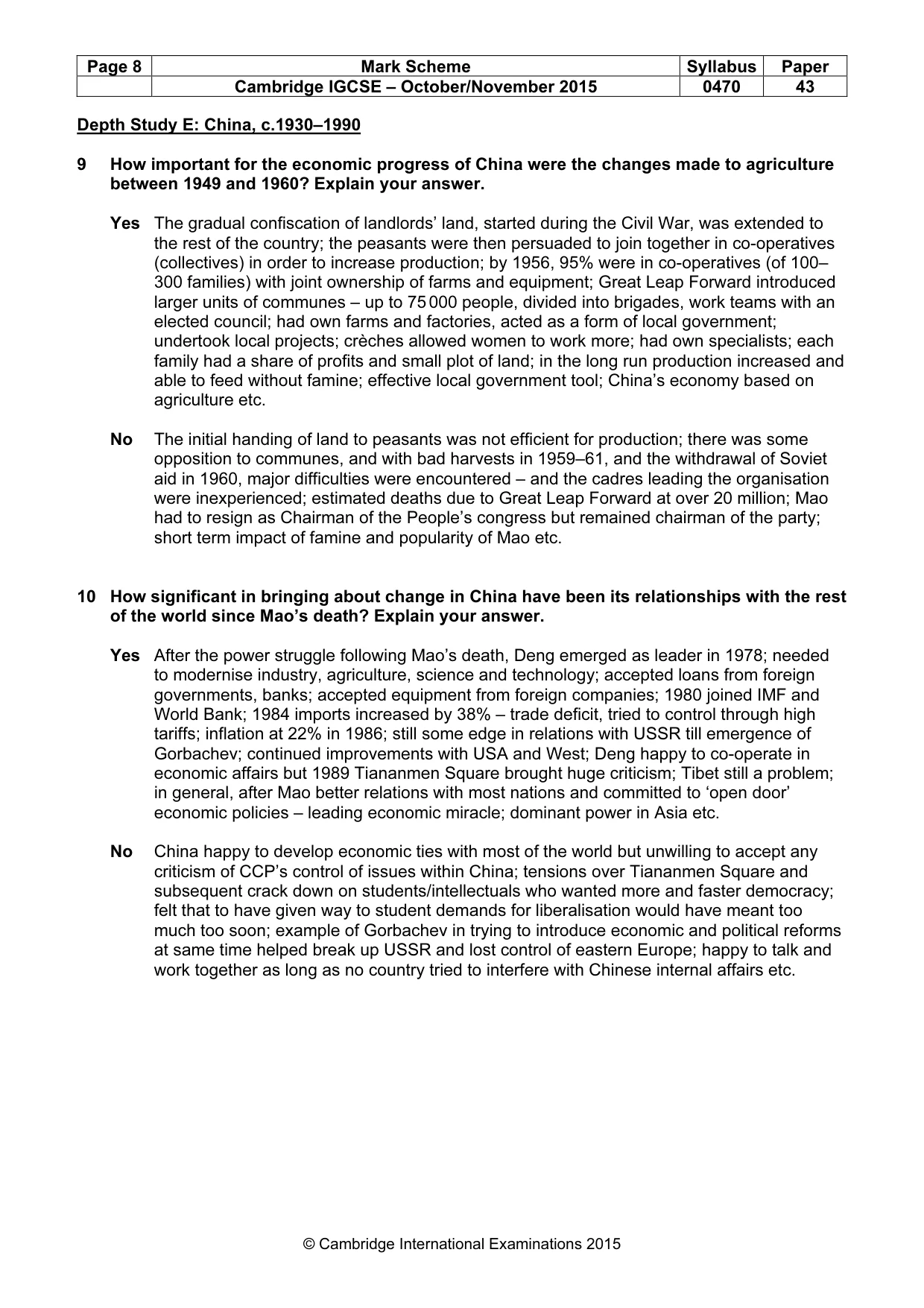
Page 8 Mark Scheme Syllabus Paper Cambridge IGCSE – October/November 2015 0470 43 © Cambridge International Examinations 2015 Depth Study E: China, c.1930–1990 9 How important for the economic progress of China were the changes made to agriculture between 1949 and 1960? Explain your answer. Yes The gradual confiscation of landlords’ land, started during the Civil War, was extended to the rest of the country; the peasants were then persuaded to join together in co-operatives (collectives) in order to increase production; by 1956, 95% were in co-operatives (of 100– 300 families) with joint ownership of farms and equipment; Great Leap Forward introduced larger units of communes – up to 75 000 people, divided into brigades, work teams with an elected council; had own farms and factories, acted as a form of local government; undertook local projects; crèches allowed women to work more; had own specialists; each family had a share of profits and small plot of land; in the long run production increased and able to feed without famine; effective local government tool; China’s economy based on agriculture etc. No The initial handing of land to peasants was not efficient for production; there was some opposition to communes, and with bad harvests in 1959–61, and the withdrawal of Soviet aid in 1960, major difficulties were encountered – and the cadres leading the organisation were inexperienced; estimated deaths due to Great Leap Forward at over 20 million; Mao had to resign as Chairman of the People’s congress but remained chairman of the party; short term impact of famine and popularity of Mao etc. 10 How significant in bringing about change in China have been its relationships with the rest of the world since Mao’s death? Explain your answer. Yes After the power struggle following Mao’s death, Deng emerged as leader in 1978; needed to modernise industry, agriculture, science and technology; accepted loans from foreign governments, banks; accepted equipment from foreign companies; 1980 joined IMF and World Bank; 1984 imports increased by 38% – trade deficit, tried to control through high tariffs; inflation at 22% in 1986; still some edge in relations with USSR till emergence of Gorbachev; continued improvements with USA and West; Deng happy to co-operate in economic affairs but 1989 Tiananmen Square brought huge criticism; Tibet still a problem; in general, after Mao better relations with most nations and committed to ‘open door’ economic policies – leading economic miracle; dominant power in Asia etc. No China happy to develop economic ties with most of the world but unwilling to accept any criticism of CCP’s control of issues within China; tensions over Tiananmen Square and subsequent crack down on students/intellectuals who wanted more and faster democracy; felt that to have given way to student demands for liberalisation would have meant too much too soon; example of Gorbachev in trying to introduce economic and political reforms at same time helped break up USSR and lost control of eastern Europe; happy to talk and work together as long as no country tried to interfere with Chinese internal affairs etc.
Mark scheme, page 9
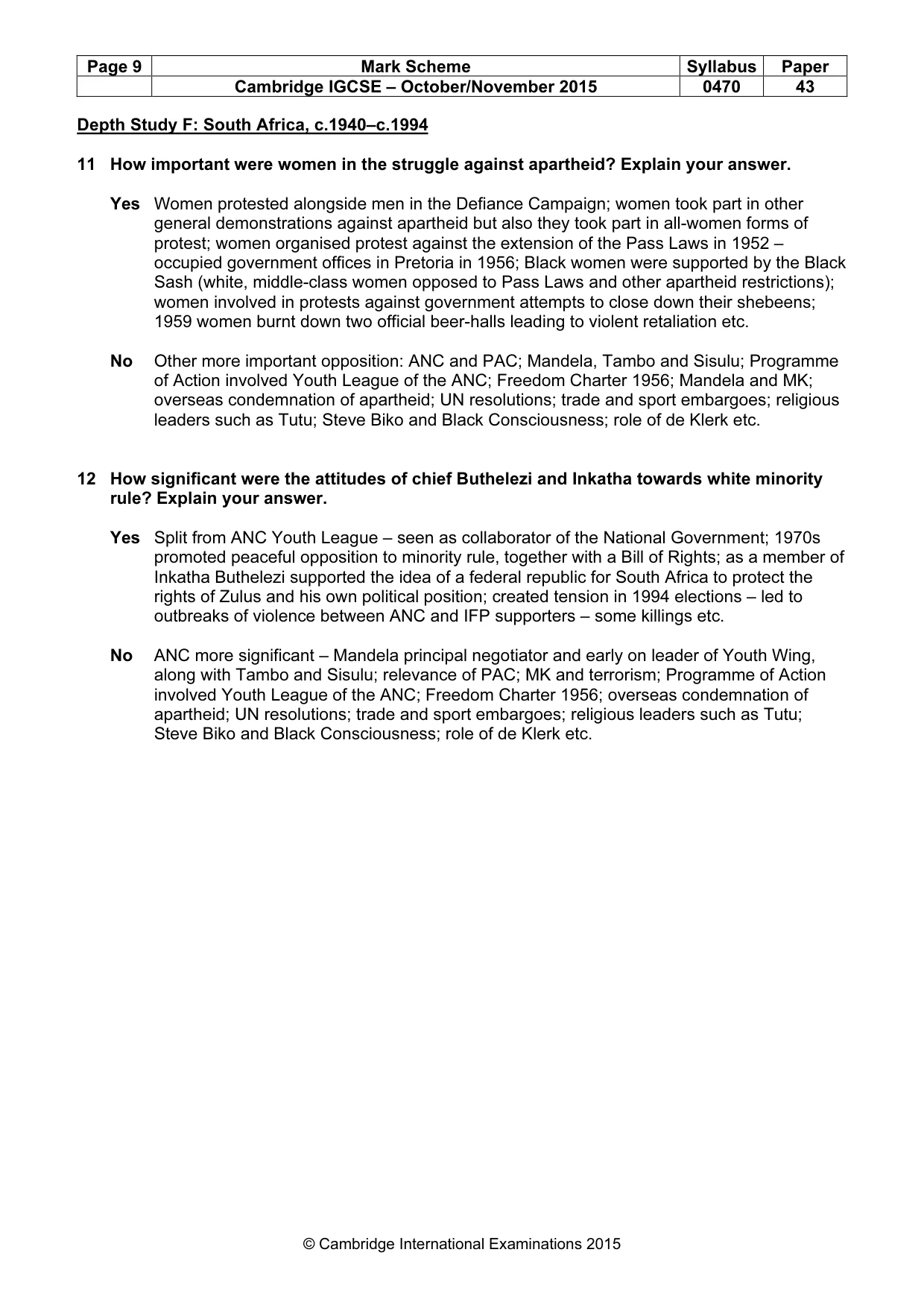
Page 9 Mark Scheme Syllabus Paper Cambridge IGCSE – October/November 2015 0470 43 © Cambridge International Examinations 2015 Depth Study F: South Africa, c.1940–c.1994 11 How important were women in the struggle against apartheid? Explain your answer. Yes Women protested alongside men in the Defiance Campaign; women took part in other general demonstrations against apartheid but also they took part in all-women forms of protest; women organised protest against the extension of the Pass Laws in 1952 – occupied government offices in Pretoria in 1956; Black women were supported by the Black Sash (white, middle-class women opposed to Pass Laws and other apartheid restrictions); women involved in protests against government attempts to close down their shebeens; 1959 women burnt down two official beer-halls leading to violent retaliation etc. No Other more important opposition: ANC and PAC; Mandela, Tambo and Sisulu; Programme of Action involved Youth League of the ANC; Freedom Charter 1956; Mandela and MK; overseas condemnation of apartheid; UN resolutions; trade and sport embargoes; religious leaders such as Tutu; Steve Biko and Black Consciousness; role of de Klerk etc. 12 How significant were the attitudes of chief Buthelezi and Inkatha towards white minority rule? Explain your answer. Yes Split from ANC Youth League – seen as collaborator of the National Government; 1970s promoted peaceful opposition to minority rule, together with a Bill of Rights; as a member of Inkatha Buthelezi supported the idea of a federal republic for South Africa to protect the rights of Zulus and his own political position; created tension in 1994 elections – led to outbreaks of violence between ANC and IFP supporters – some killings etc. No ANC more significant – Mandela principal negotiator and early on leader of Youth Wing, along with Tambo and Sisulu; relevance of PAC; MK and terrorism; Programme of Action involved Youth League of the ANC; Freedom Charter 1956; overseas condemnation of apartheid; UN resolutions; trade and sport embargoes; religious leaders such as Tutu; Steve Biko and Black Consciousness; role of de Klerk etc.
Mark scheme, page 10
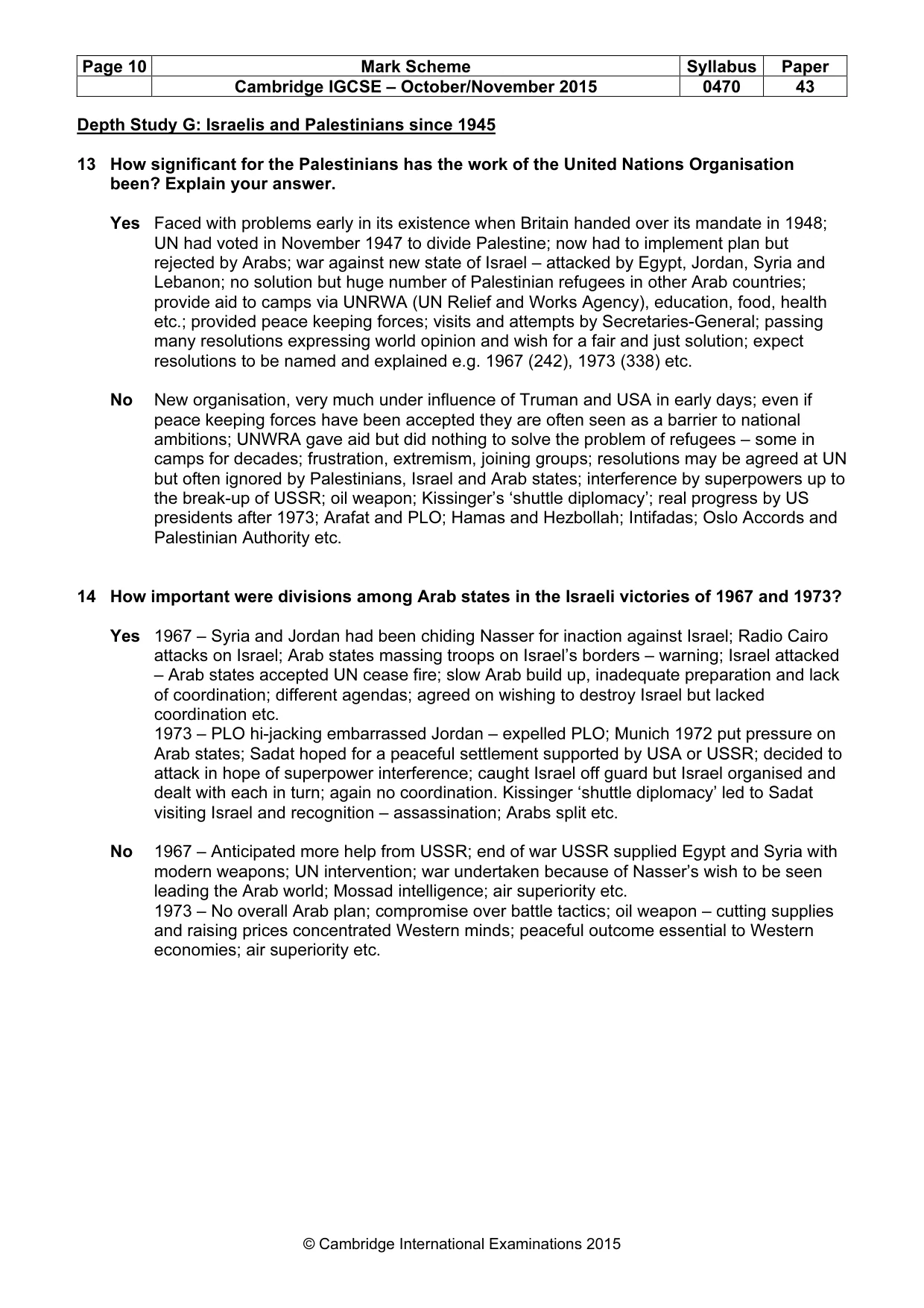
Page 10 Mark Scheme Syllabus Paper Cambridge IGCSE – October/November 2015 0470 43 © Cambridge International Examinations 2015 Depth Study G: Israelis and Palestinians since 1945 13 How significant for the Palestinians has the work of the United Nations Organisation been? Explain your answer. Yes Faced with problems early in its existence when Britain handed over its mandate in 1948; UN had voted in November 1947 to divide Palestine; now had to implement plan but rejected by Arabs; war against new state of Israel – attacked by Egypt, Jordan, Syria and Lebanon; no solution but huge number of Palestinian refugees in other Arab countries; provide aid to camps via UNRWA (UN Relief and Works Agency), education, food, health etc.; provided peace keeping forces; visits and attempts by Secretaries-General; passing many resolutions expressing world opinion and wish for a fair and just solution; expect resolutions to be named and explained e.g. 1967 (242), 1973 (338) etc. No New organisation, very much under influence of Truman and USA in early days; even if peace keeping forces have been accepted they are often seen as a barrier to national ambitions; UNWRA gave aid but did nothing to solve the problem of refugees – some in camps for decades; frustration, extremism, joining groups; resolutions may be agreed at UN but often ignored by Palestinians, Israel and Arab states; interference by superpowers up to the break-up of USSR; oil weapon; Kissinger’s ‘shuttle diplomacy’; real progress by US presidents after 1973; Arafat and PLO; Hamas and Hezbollah; Intifadas; Oslo Accords and Palestinian Authority etc. 14 How important were divisions among Arab states in the Israeli victories of 1967 and 1973? Yes 1967 – Syria and Jordan had been chiding Nasser for inaction against Israel; Radio Cairo attacks on Israel; Arab states massing troops on Israel’s borders – warning; Israel attacked – Arab states accepted UN cease fire; slow Arab build up, inadequate preparation and lack of coordination; different agendas; agreed on wishing to destroy Israel but lacked coordination etc. 1973 – PLO hi-jacking embarrassed Jordan – expelled PLO; Munich 1972 put pressure on Arab states; Sadat hoped for a peaceful settlement supported by USA or USSR; decided to attack in hope of superpower interference; caught Israel off guard but Israel organised and dealt with each in turn; again no coordination. Kissinger ‘shuttle diplomacy’ led to Sadat visiting Israel and recognition – assassination; Arabs split etc. No 1967 – Anticipated more help from USSR; end of war USSR supplied Egypt and Syria with modern weapons; UN intervention; war undertaken because of Nasser’s wish to be seen leading the Arab world; Mossad intelligence; air superiority etc. 1973 – No overall Arab plan; compromise over battle tactics; oil weapon – cutting supplies and raising prices concentrated Western minds; peaceful outcome essential to Western economies; air superiority etc.
What you needed in this session
Cambridge’s own grade thresholds for 2015 Oct/Nov, Paper 4 · Variant 3. A higher threshold means an easier paper — the bar moves with how the cohort did.