Cambridge IGCSE History 0470 — 2015 Oct/Nov Paper 4 · Variant 1
0470/41/O/N/15 · 40 marks · ≈45 min
The question paper and its mark scheme, free to read here and free to download. This is Cambridge’s own paper, exactly as it was sat.
Question paper4 pages

Mark scheme10 pages
Answers below. Sit the paper first if you are practising.
Paper as text
Question paper, page 1
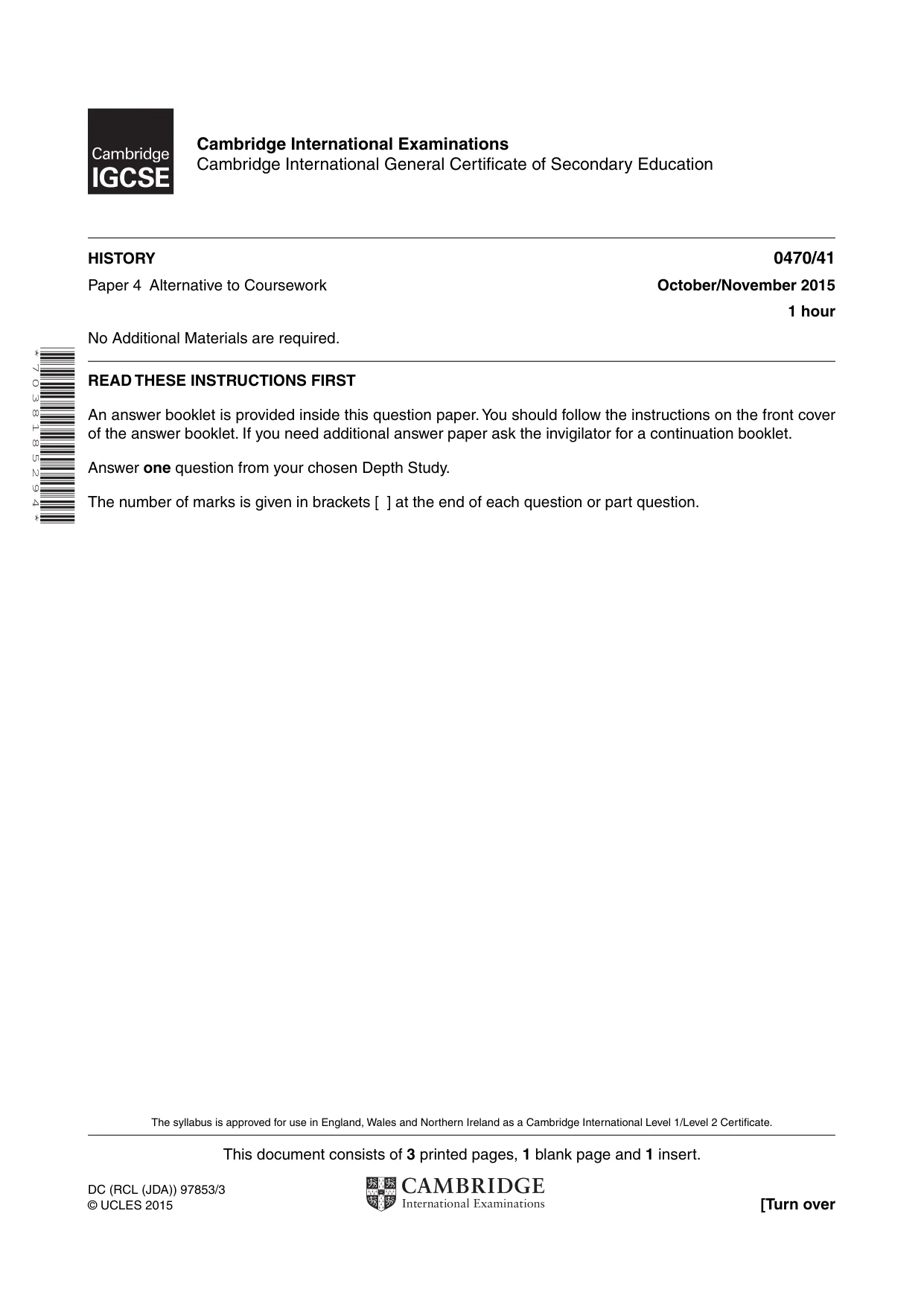
This document consists of 3 printed pages, 1 blank page and 1 insert. DC (RCL (JDA)) 97853/3 © UCLES 2015 [Turn over Cambridge International Examinations Cambridge International General Certificate of Secondary Education * 7 0 3 8 1 8 5 2 9 4 * HISTORY 0470/41 Paper 4 Alternative to Coursework October/November 2015 1 hour No Additional Materials are required. READ THESE INSTRUCTIONS FIRST An answer booklet is provided inside this question paper. You should follow the instructions on the front cover of the answer booklet. If you need additional answer paper ask the invigilator for a continuation booklet. Answer one question from your chosen Depth Study. The number of marks is given in brackets [ ] at the end of each question or part question. The syllabus is approved for use in England, Wales and Northern Ireland as a Cambridge International Level 1/Level 2 Certificate.
Question paper, page 2
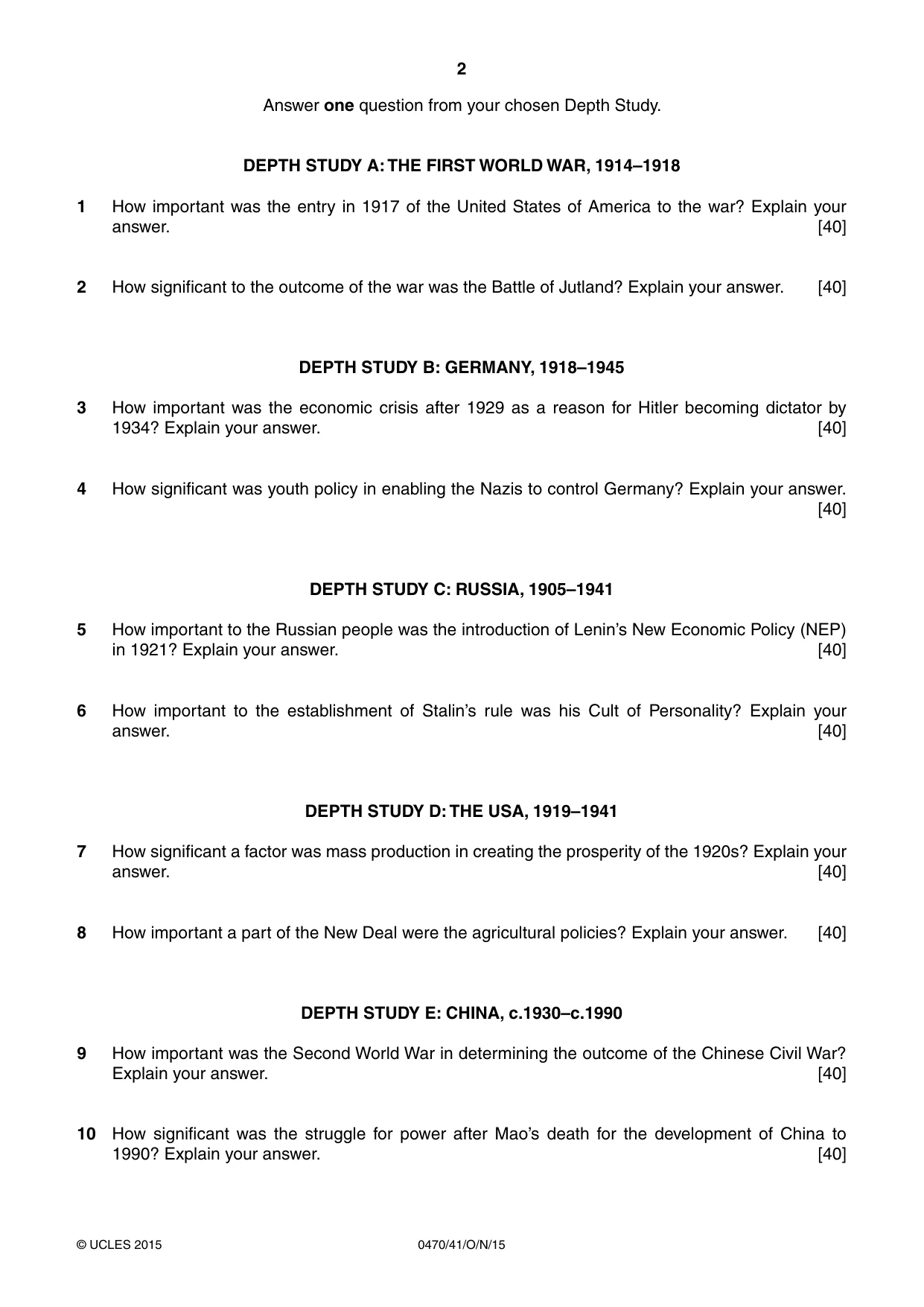
2 0470/41/O/N/15 © UCLES 2015 Answer one question from your chosen Depth Study. DEPTH STUDY A: THE FIRST WORLD WAR, 1914–1918 1 How important was the entry in 1917 of the United States of America to the war? Explain your answer. [40] 2 How significant to the outcome of the war was the Battle of Jutland? Explain your answer. [40] DEPTH STUDY B: GERMANY, 1918–1945 3 How important was the economic crisis after 1929 as a reason for Hitler becoming dictator by 1934? Explain your answer. [40] 4 How significant was youth policy in enabling the Nazis to control Germany? Explain your answer. [40] DEPTH STUDY C: RUSSIA, 1905–1941 5 How important to the Russian people was the introduction of Lenin’s New Economic Policy (NEP) in 1921? Explain your answer. [40] 6 How important to the establishment of Stalin’s rule was his Cult of Personality? Explain your answer. [40] DEPTH STUDY D: THE USA, 1919–1941 7 How significant a factor was mass production in creating the prosperity of the 1920s? Explain your answer. [40] 8 How important a part of the New Deal were the agricultural policies? Explain your answer. [40] DEPTH STUDY E: CHINA, c.1930–c.1990 9 How important was the Second World War in determining the outcome of the Chinese Civil War? Explain your answer. [40] 10 How significant was the struggle for power after Mao’s death for the development of China to 1990? Explain your answer. [40]
Question paper, page 3
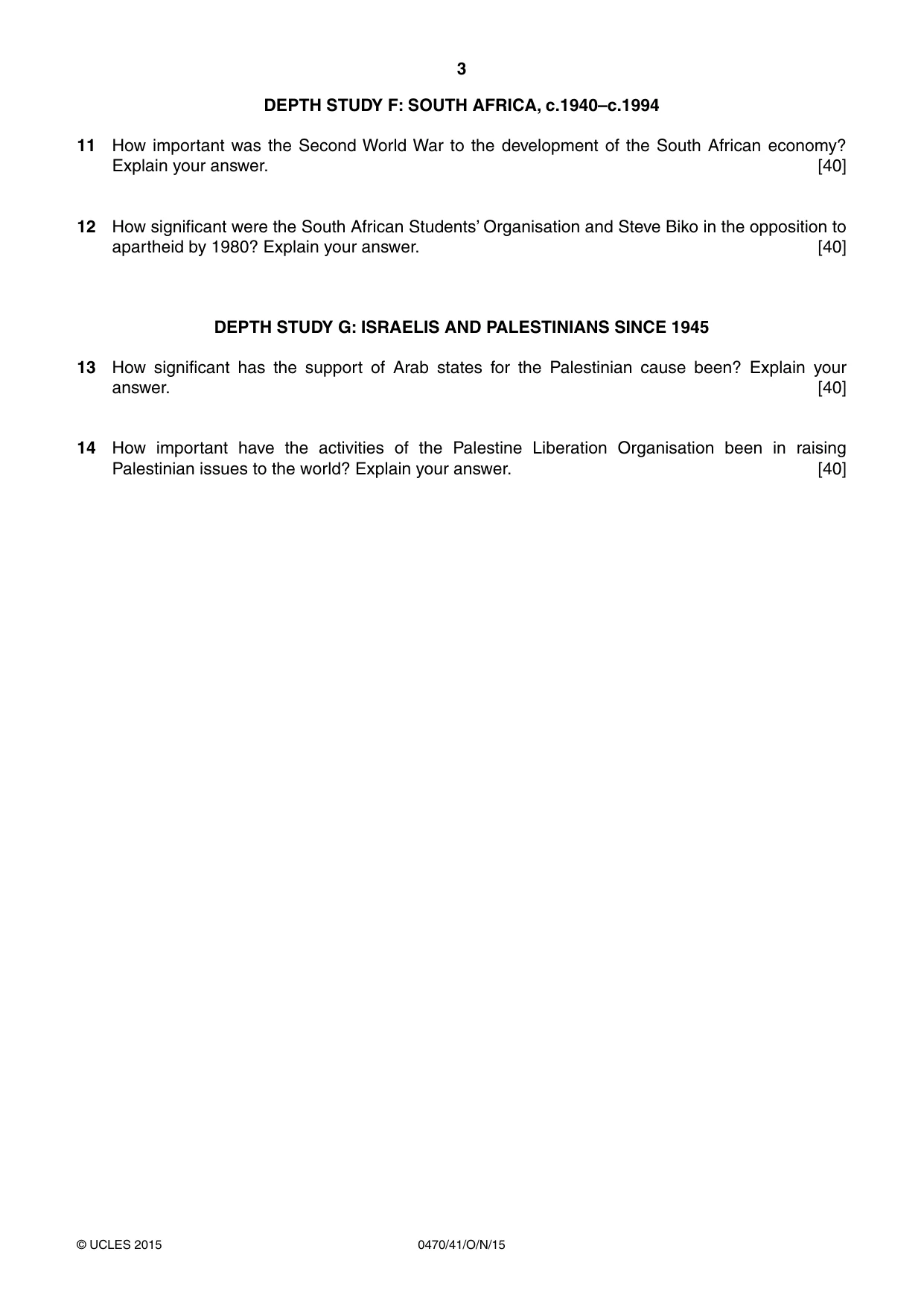
3 0470/41/O/N/15 © UCLES 2015 DEPTH STUDY F: SOUTH AFRICA, c.1940–c.1994 11 How important was the Second World War to the development of the South African economy? Explain your answer. [40] 12 How significant were the South African Students’ Organisation and Steve Biko in the opposition to apartheid by 1980? Explain your answer. [40] DEPTH STUDY G: ISRAELIS AND PALESTINIANS SINCE 1945 13 How significant has the support of Arab states for the Palestinian cause been? Explain your answer. [40] 14 How important have the activities of the Palestine Liberation Organisation been in raising Palestinian issues to the world? Explain your answer. [40]
Question paper, page 4
4 0470/41/O/N/15 © UCLES 2015 BLANK PAGE Permission to reproduce items where third-party owned material protected by copyright is included has been sought and cleared where possible. Every reasonable effort has been made by the publisher (UCLES) to trace copyright holders, but if any items requiring clearance have unwittingly been included, the publisher will be pleased to make amends at the earliest possible opportunity. To avoid the issue of disclosure of answer-related information to candidates, all copyright acknowledgements are reproduced online in the Cambridge International Examinations Copyright Acknowledgements Booklet. This is produced for each series of examinations and is freely available to download at www.cie.org.uk after the live examination series. Cambridge International Examinations is part of the Cambridge Assessment Group. Cambridge Assessment is the brand name of University of Cambridge Local Examinations Syndicate (UCLES), which is itself a department of the University of Cambridge.
Mark scheme, page 1
® IGCSE is the registered trademark of Cambridge International Examinations. CAMBRIDGE INTERNATIONAL EXAMINATIONS Cambridge International General Certificate of Secondary Education MARK SCHEME for the October/November 2015 series 0470 HISTORY 0470/41 Paper 4 (Alternative to Coursework), maximum raw mark 40 This mark scheme is published as an aid to teachers and candidates, to indicate the requirements of the examination. It shows the basis on which Examiners were instructed to award marks. It does not indicate the details of the discussions that took place at an Examiners’ meeting before marking began, which would have considered the acceptability of alternative answers. Mark schemes should be read in conjunction with the question paper and the Principal Examiner Report for Teachers. Cambridge will not enter into discussions about these mark schemes. Cambridge is publishing the mark schemes for the October/November 2015 series for most Cambridge IGCSE®, Cambridge International A and AS Level components and some Cambridge O Level components.
Mark scheme, page 2
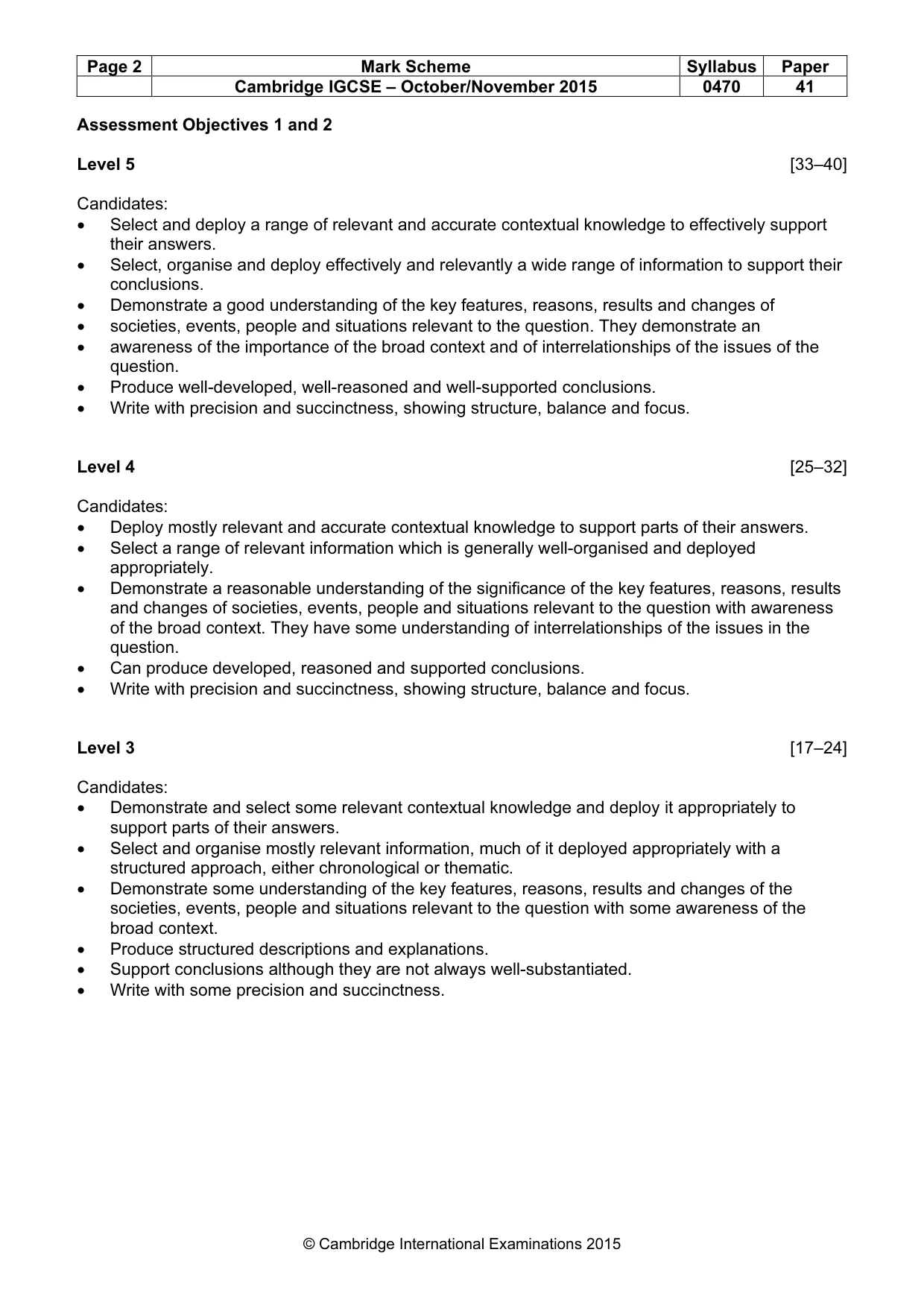
Page 2 Mark Scheme Syllabus Paper Cambridge IGCSE – October/November 2015 0470 41 © Cambridge International Examinations 2015 Assessment Objectives 1 and 2 Level 5 [33–40] Candidates: • Select and deploy a range of relevant and accurate contextual knowledge to effectively support their answers. • Select, organise and deploy effectively and relevantly a wide range of information to support their conclusions. • Demonstrate a good understanding of the key features, reasons, results and changes of • societies, events, people and situations relevant to the question. They demonstrate an • awareness of the importance of the broad context and of interrelationships of the issues of the question. • Produce well-developed, well-reasoned and well-supported conclusions. • Write with precision and succinctness, showing structure, balance and focus. Level 4 [25–32] Candidates: • Deploy mostly relevant and accurate contextual knowledge to support parts of their answers. • Select a range of relevant information which is generally well-organised and deployed appropriately. • Demonstrate a reasonable understanding of the significance of the key features, reasons, results and changes of societies, events, people and situations relevant to the question with awareness of the broad context. They have some understanding of interrelationships of the issues in the question. • Can produce developed, reasoned and supported conclusions. • Write with precision and succinctness, showing structure, balance and focus. Level 3 [17–24] Candidates: • Demonstrate and select some relevant contextual knowledge and deploy it appropriately to support parts of their answers. • Select and organise mostly relevant information, much of it deployed appropriately with a structured approach, either chronological or thematic. • Demonstrate some understanding of the key features, reasons, results and changes of the societies, events, people and situations relevant to the question with some awareness of the broad context. • Produce structured descriptions and explanations. • Support conclusions although they are not always well-substantiated. • Write with some precision and succinctness.
Mark scheme, page 3
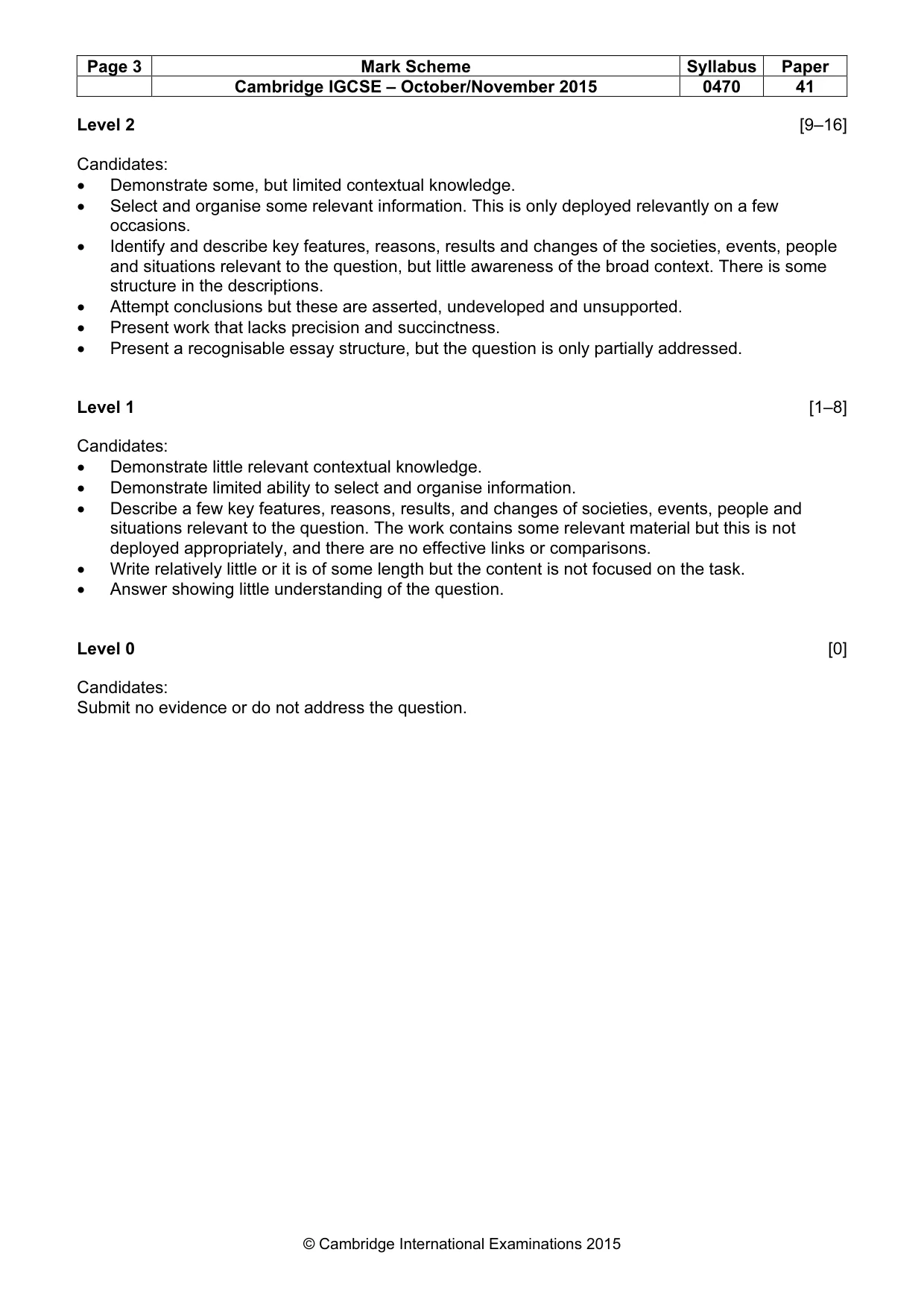
Page 3 Mark Scheme Syllabus Paper Cambridge IGCSE – October/November 2015 0470 41 © Cambridge International Examinations 2015 Level 2 [9–16] Candidates: • Demonstrate some, but limited contextual knowledge. • Select and organise some relevant information. This is only deployed relevantly on a few occasions. • Identify and describe key features, reasons, results and changes of the societies, events, people and situations relevant to the question, but little awareness of the broad context. There is some structure in the descriptions. • Attempt conclusions but these are asserted, undeveloped and unsupported. • Present work that lacks precision and succinctness. • Present a recognisable essay structure, but the question is only partially addressed. Level 1 [1–8] Candidates: • Demonstrate little relevant contextual knowledge. • Demonstrate limited ability to select and organise information. • Describe a few key features, reasons, results, and changes of societies, events, people and situations relevant to the question. The work contains some relevant material but this is not deployed appropriately, and there are no effective links or comparisons. • Write relatively little or it is of some length but the content is not focused on the task. • Answer showing little understanding of the question. Level 0 [0] Candidates: Submit no evidence or do not address the question.
Mark scheme, page 4
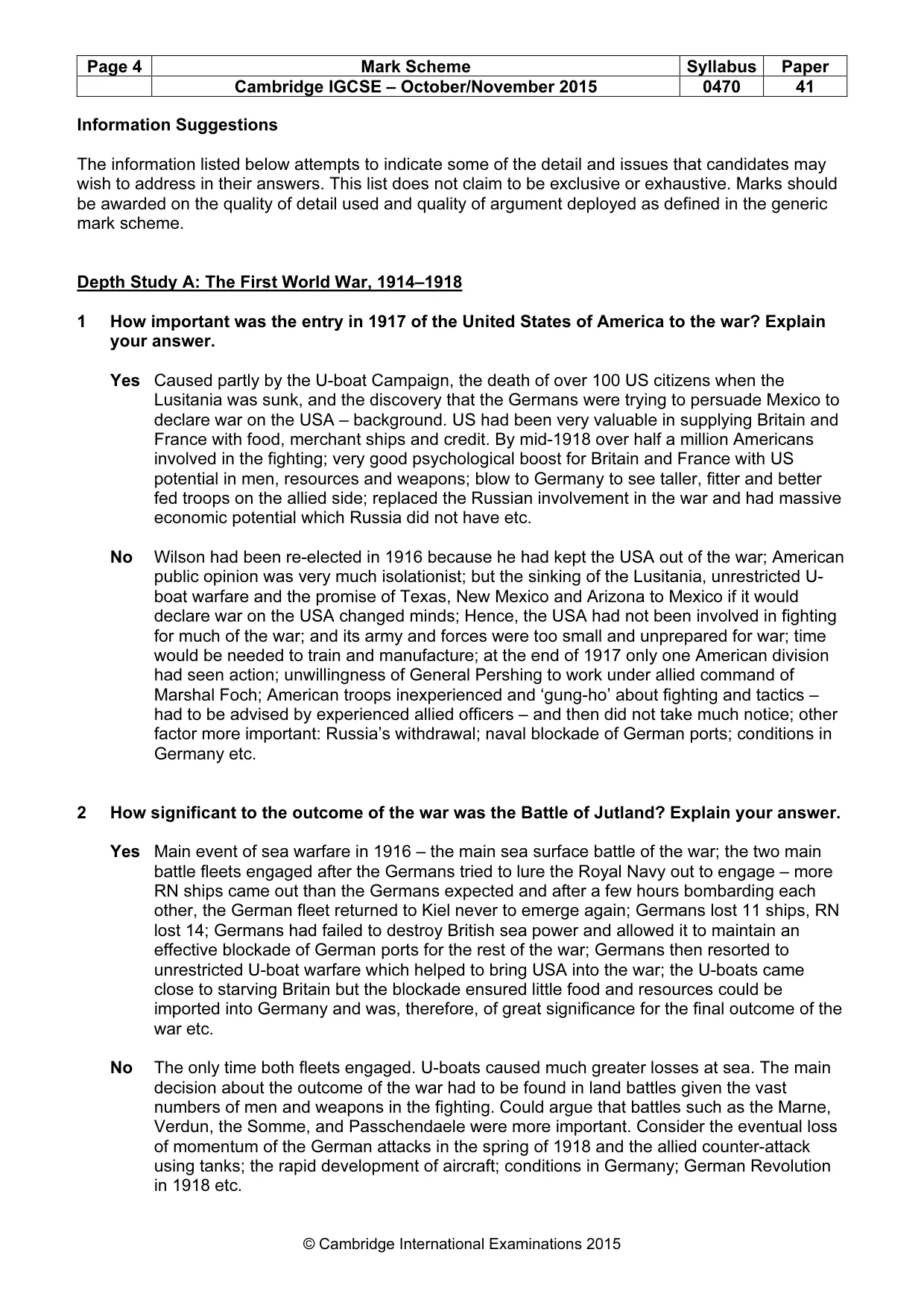
Page 4 Mark Scheme Syllabus Paper Cambridge IGCSE – October/November 2015 0470 41 © Cambridge International Examinations 2015 Information Suggestions The information listed below attempts to indicate some of the detail and issues that candidates may wish to address in their answers. This list does not claim to be exclusive or exhaustive. Marks should be awarded on the quality of detail used and quality of argument deployed as defined in the generic mark scheme. Depth Study A: The First World War, 1914–1918 1 How important was the entry in 1917 of the United States of America to the war? Explain your answer. Yes Caused partly by the U-boat Campaign, the death of over 100 US citizens when the Lusitania was sunk, and the discovery that the Germans were trying to persuade Mexico to declare war on the USA – background. US had been very valuable in supplying Britain and France with food, merchant ships and credit. By mid-1918 over half a million Americans involved in the fighting; very good psychological boost for Britain and France with US potential in men, resources and weapons; blow to Germany to see taller, fitter and better fed troops on the allied side; replaced the Russian involvement in the war and had massive economic potential which Russia did not have etc. No Wilson had been re-elected in 1916 because he had kept the USA out of the war; American public opinion was very much isolationist; but the sinking of the Lusitania, unrestricted U- boat warfare and the promise of Texas, New Mexico and Arizona to Mexico if it would declare war on the USA changed minds; Hence, the USA had not been involved in fighting for much of the war; and its army and forces were too small and unprepared for war; time would be needed to train and manufacture; at the end of 1917 only one American division had seen action; unwillingness of General Pershing to work under allied command of Marshal Foch; American troops inexperienced and ‘gung-ho’ about fighting and tactics – had to be advised by experienced allied officers – and then did not take much notice; other factor more important: Russia’s withdrawal; naval blockade of German ports; conditions in Germany etc. 2 How significant to the outcome of the war was the Battle of Jutland? Explain your answer. Yes Main event of sea warfare in 1916 – the main sea surface battle of the war; the two main battle fleets engaged after the Germans tried to lure the Royal Navy out to engage – more RN ships came out than the Germans expected and after a few hours bombarding each other, the German fleet returned to Kiel never to emerge again; Germans lost 11 ships, RN lost 14; Germans had failed to destroy British sea power and allowed it to maintain an effective blockade of German ports for the rest of the war; Germans then resorted to unrestricted U-boat warfare which helped to bring USA into the war; the U-boats came close to starving Britain but the blockade ensured little food and resources could be imported into Germany and was, therefore, of great significance for the final outcome of the war etc. No The only time both fleets engaged. U-boats caused much greater losses at sea. The main decision about the outcome of the war had to be found in land battles given the vast numbers of men and weapons in the fighting. Could argue that battles such as the Marne, Verdun, the Somme, and Passchendaele were more important. Consider the eventual loss of momentum of the German attacks in the spring of 1918 and the allied counter-attack using tanks; the rapid development of aircraft; conditions in Germany; German Revolution in 1918 etc.
Mark scheme, page 5
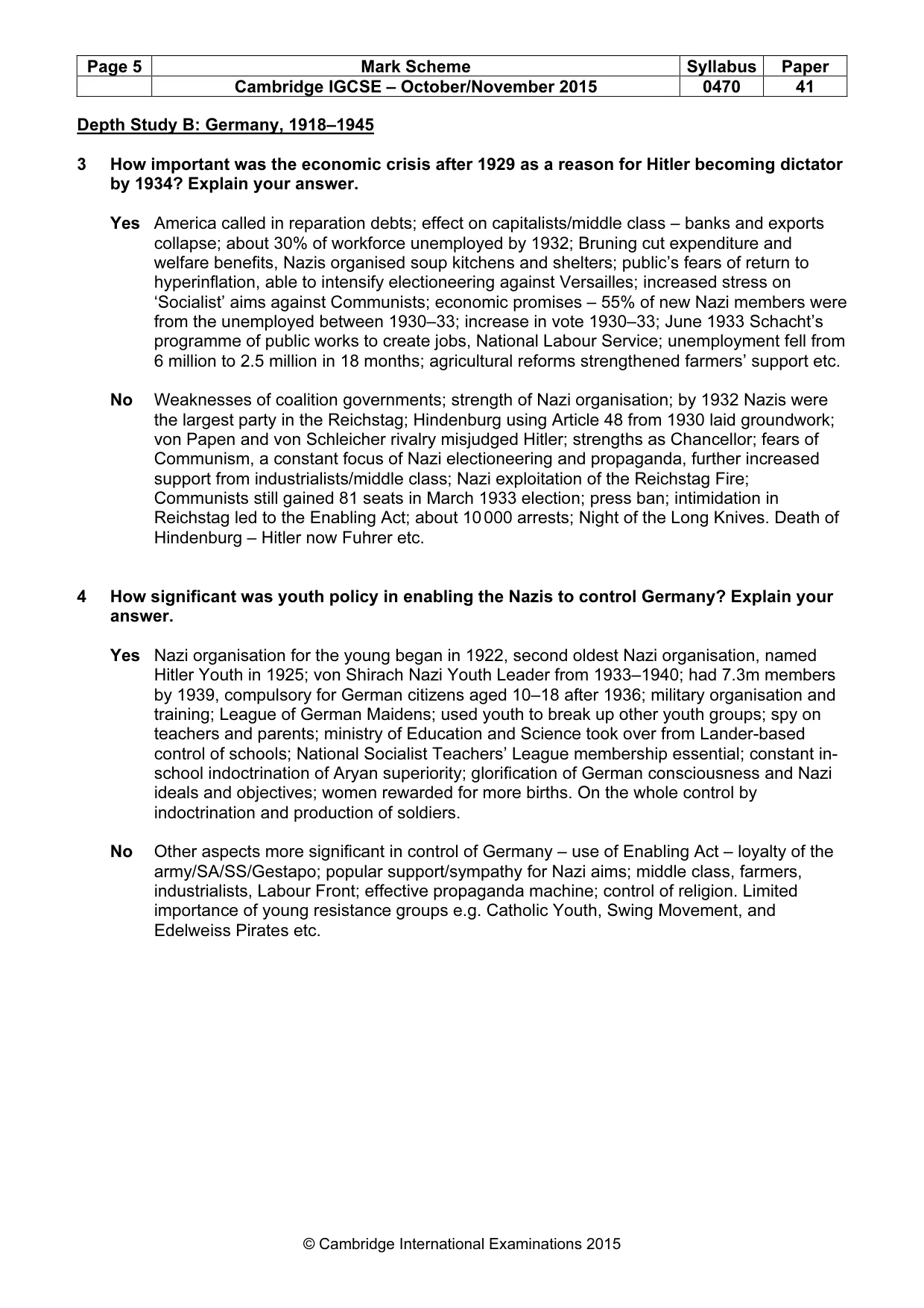
Page 5 Mark Scheme Syllabus Paper Cambridge IGCSE – October/November 2015 0470 41 © Cambridge International Examinations 2015 Depth Study B: Germany, 1918–1945 3 How important was the economic crisis after 1929 as a reason for Hitler becoming dictator by 1934? Explain your answer. Yes America called in reparation debts; effect on capitalists/middle class – banks and exports collapse; about 30% of workforce unemployed by 1932; Bruning cut expenditure and welfare benefits, Nazis organised soup kitchens and shelters; public’s fears of return to hyperinflation, able to intensify electioneering against Versailles; increased stress on ‘Socialist’ aims against Communists; economic promises – 55% of new Nazi members were from the unemployed between 1930–33; increase in vote 1930–33; June 1933 Schacht’s programme of public works to create jobs, National Labour Service; unemployment fell from 6 million to 2.5 million in 18 months; agricultural reforms strengthened farmers’ support etc. No Weaknesses of coalition governments; strength of Nazi organisation; by 1932 Nazis were the largest party in the Reichstag; Hindenburg using Article 48 from 1930 laid groundwork; von Papen and von Schleicher rivalry misjudged Hitler; strengths as Chancellor; fears of Communism, a constant focus of Nazi electioneering and propaganda, further increased support from industrialists/middle class; Nazi exploitation of the Reichstag Fire; Communists still gained 81 seats in March 1933 election; press ban; intimidation in Reichstag led to the Enabling Act; about 10 000 arrests; Night of the Long Knives. Death of Hindenburg – Hitler now Fuhrer etc. 4 How significant was youth policy in enabling the Nazis to control Germany? Explain your answer. Yes Nazi organisation for the young began in 1922, second oldest Nazi organisation, named Hitler Youth in 1925; von Shirach Nazi Youth Leader from 1933–1940; had 7.3m members by 1939, compulsory for German citizens aged 10–18 after 1936; military organisation and training; League of German Maidens; used youth to break up other youth groups; spy on teachers and parents; ministry of Education and Science took over from Lander-based control of schools; National Socialist Teachers’ League membership essential; constant in- school indoctrination of Aryan superiority; glorification of German consciousness and Nazi ideals and objectives; women rewarded for more births. On the whole control by indoctrination and production of soldiers. No Other aspects more significant in control of Germany – use of Enabling Act – loyalty of the army/SA/SS/Gestapo; popular support/sympathy for Nazi aims; middle class, farmers, industrialists, Labour Front; effective propaganda machine; control of religion. Limited importance of young resistance groups e.g. Catholic Youth, Swing Movement, and Edelweiss Pirates etc.
Mark scheme, page 6
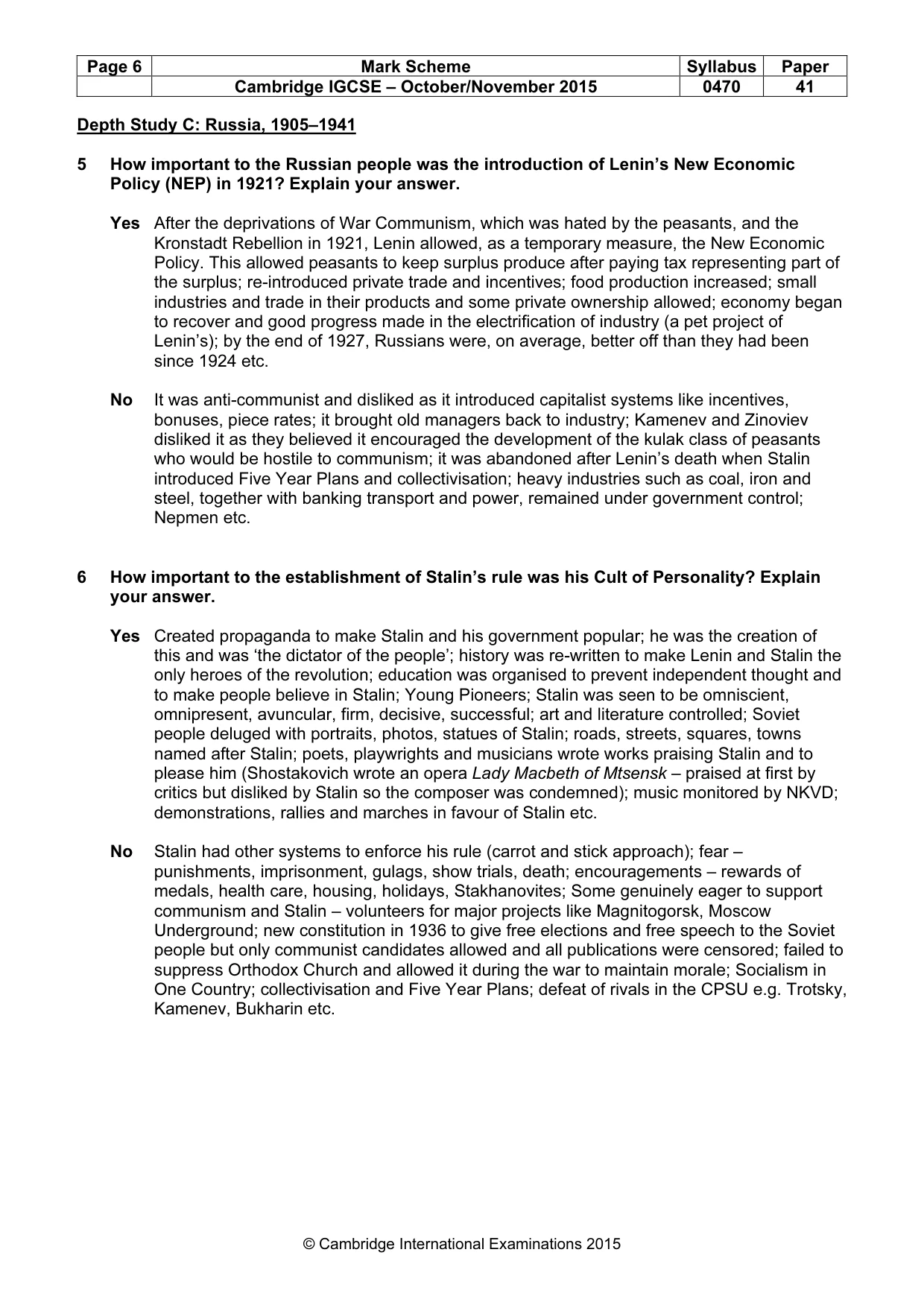
Page 6 Mark Scheme Syllabus Paper Cambridge IGCSE – October/November 2015 0470 41 © Cambridge International Examinations 2015 Depth Study C: Russia, 1905–1941 5 How important to the Russian people was the introduction of Lenin’s New Economic Policy (NEP) in 1921? Explain your answer. Yes After the deprivations of War Communism, which was hated by the peasants, and the Kronstadt Rebellion in 1921, Lenin allowed, as a temporary measure, the New Economic Policy. This allowed peasants to keep surplus produce after paying tax representing part of the surplus; re-introduced private trade and incentives; food production increased; small industries and trade in their products and some private ownership allowed; economy began to recover and good progress made in the electrification of industry (a pet project of Lenin’s); by the end of 1927, Russians were, on average, better off than they had been since 1924 etc. No It was anti-communist and disliked as it introduced capitalist systems like incentives, bonuses, piece rates; it brought old managers back to industry; Kamenev and Zinoviev disliked it as they believed it encouraged the development of the kulak class of peasants who would be hostile to communism; it was abandoned after Lenin’s death when Stalin introduced Five Year Plans and collectivisation; heavy industries such as coal, iron and steel, together with banking transport and power, remained under government control; Nepmen etc. 6 How important to the establishment of Stalin’s rule was his Cult of Personality? Explain your answer. Yes Created propaganda to make Stalin and his government popular; he was the creation of this and was ‘the dictator of the people’; history was re-written to make Lenin and Stalin the only heroes of the revolution; education was organised to prevent independent thought and to make people believe in Stalin; Young Pioneers; Stalin was seen to be omniscient, omnipresent, avuncular, firm, decisive, successful; art and literature controlled; Soviet people deluged with portraits, photos, statues of Stalin; roads, streets, squares, towns named after Stalin; poets, playwrights and musicians wrote works praising Stalin and to please him (Shostakovich wrote an opera Lady Macbeth of Mtsensk – praised at first by critics but disliked by Stalin so the composer was condemned); music monitored by NKVD; demonstrations, rallies and marches in favour of Stalin etc. No Stalin had other systems to enforce his rule (carrot and stick approach); fear – punishments, imprisonment, gulags, show trials, death; encouragements – rewards of medals, health care, housing, holidays, Stakhanovites; Some genuinely eager to support communism and Stalin – volunteers for major projects like Magnitogorsk, Moscow Underground; new constitution in 1936 to give free elections and free speech to the Soviet people but only communist candidates allowed and all publications were censored; failed to suppress Orthodox Church and allowed it during the war to maintain morale; Socialism in One Country; collectivisation and Five Year Plans; defeat of rivals in the CPSU e.g. Trotsky, Kamenev, Bukharin etc.
Mark scheme, page 7
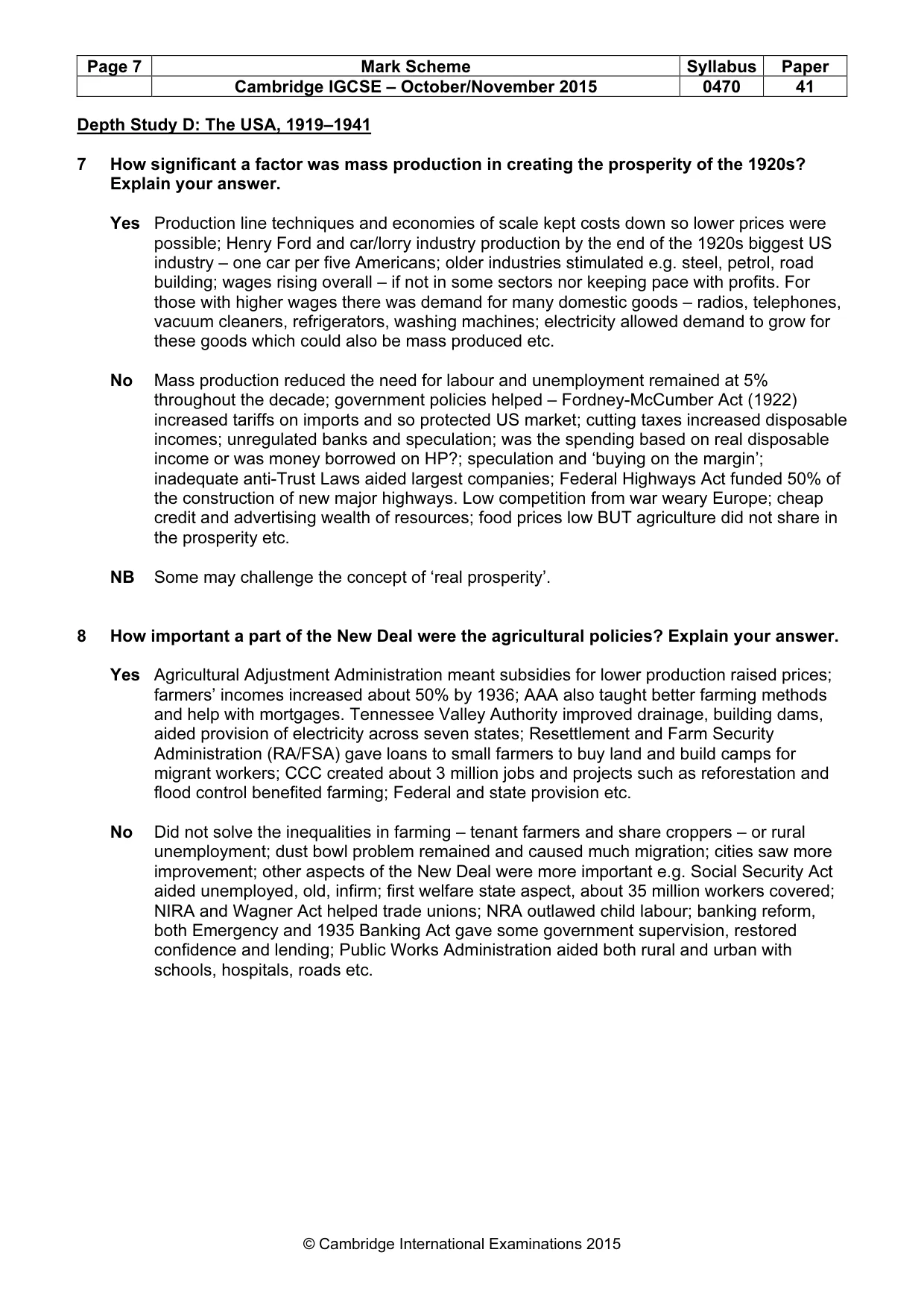
Page 7 Mark Scheme Syllabus Paper Cambridge IGCSE – October/November 2015 0470 41 © Cambridge International Examinations 2015 Depth Study D: The USA, 1919–1941 7 How significant a factor was mass production in creating the prosperity of the 1920s? Explain your answer. Yes Production line techniques and economies of scale kept costs down so lower prices were possible; Henry Ford and car/lorry industry production by the end of the 1920s biggest US industry – one car per five Americans; older industries stimulated e.g. steel, petrol, road building; wages rising overall – if not in some sectors nor keeping pace with profits. For those with higher wages there was demand for many domestic goods – radios, telephones, vacuum cleaners, refrigerators, washing machines; electricity allowed demand to grow for these goods which could also be mass produced etc. No Mass production reduced the need for labour and unemployment remained at 5% throughout the decade; government policies helped – Fordney-McCumber Act (1922) increased tariffs on imports and so protected US market; cutting taxes increased disposable incomes; unregulated banks and speculation; was the spending based on real disposable income or was money borrowed on HP?; speculation and ‘buying on the margin’; inadequate anti-Trust Laws aided largest companies; Federal Highways Act funded 50% of the construction of new major highways. Low competition from war weary Europe; cheap credit and advertising wealth of resources; food prices low BUT agriculture did not share in the prosperity etc. NB Some may challenge the concept of ‘real prosperity’. 8 How important a part of the New Deal were the agricultural policies? Explain your answer. Yes Agricultural Adjustment Administration meant subsidies for lower production raised prices; farmers’ incomes increased about 50% by 1936; AAA also taught better farming methods and help with mortgages. Tennessee Valley Authority improved drainage, building dams, aided provision of electricity across seven states; Resettlement and Farm Security Administration (RA/FSA) gave loans to small farmers to buy land and build camps for migrant workers; CCC created about 3 million jobs and projects such as reforestation and flood control benefited farming; Federal and state provision etc. No Did not solve the inequalities in farming – tenant farmers and share croppers – or rural unemployment; dust bowl problem remained and caused much migration; cities saw more improvement; other aspects of the New Deal were more important e.g. Social Security Act aided unemployed, old, infirm; first welfare state aspect, about 35 million workers covered; NIRA and Wagner Act helped trade unions; NRA outlawed child labour; banking reform, both Emergency and 1935 Banking Act gave some government supervision, restored confidence and lending; Public Works Administration aided both rural and urban with schools, hospitals, roads etc.
Mark scheme, page 8
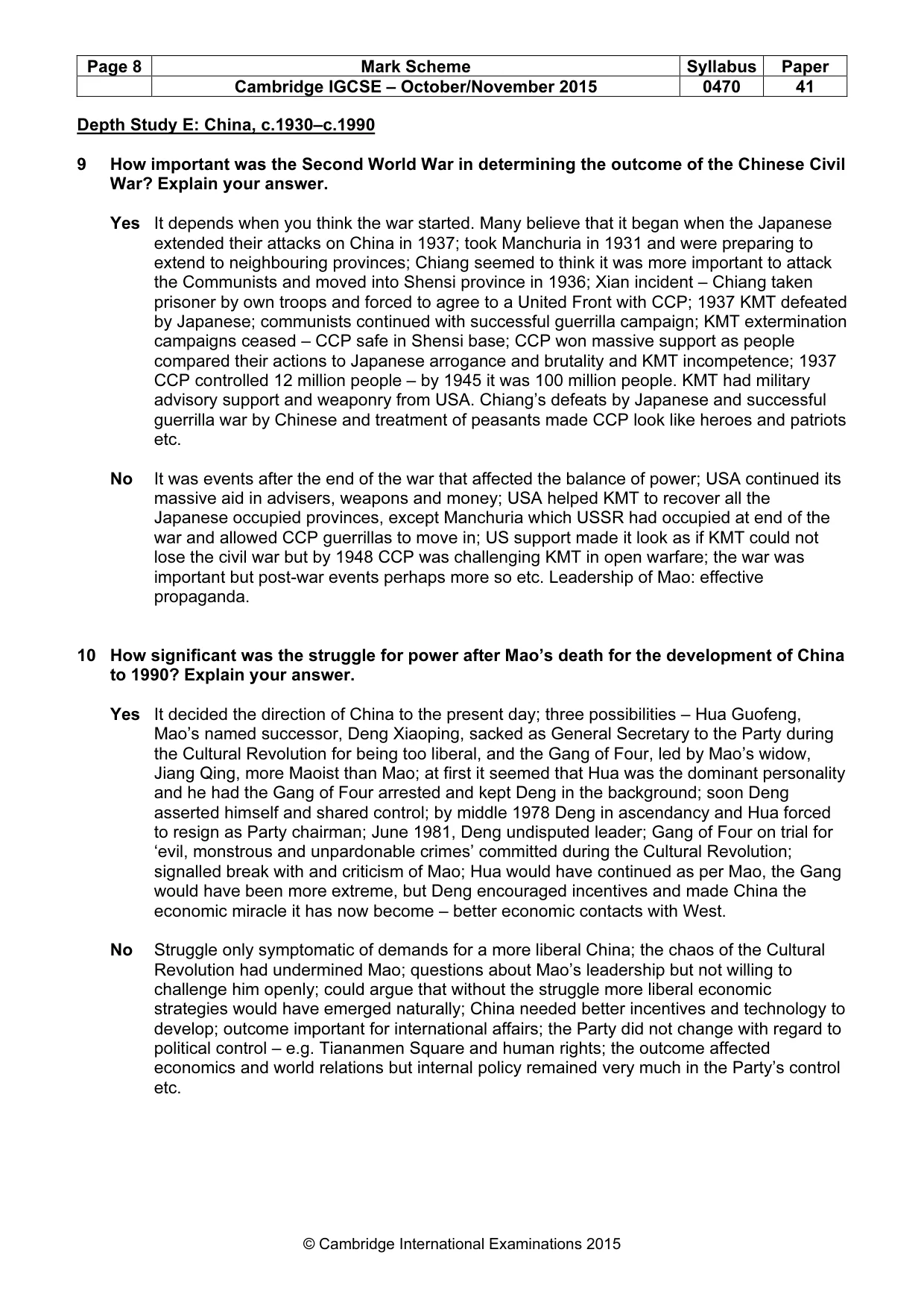
Page 8 Mark Scheme Syllabus Paper Cambridge IGCSE – October/November 2015 0470 41 © Cambridge International Examinations 2015 Depth Study E: China, c.1930–c.1990 9 How important was the Second World War in determining the outcome of the Chinese Civil War? Explain your answer. Yes It depends when you think the war started. Many believe that it began when the Japanese extended their attacks on China in 1937; took Manchuria in 1931 and were preparing to extend to neighbouring provinces; Chiang seemed to think it was more important to attack the Communists and moved into Shensi province in 1936; Xian incident – Chiang taken prisoner by own troops and forced to agree to a United Front with CCP; 1937 KMT defeated by Japanese; communists continued with successful guerrilla campaign; KMT extermination campaigns ceased – CCP safe in Shensi base; CCP won massive support as people compared their actions to Japanese arrogance and brutality and KMT incompetence; 1937 CCP controlled 12 million people – by 1945 it was 100 million people. KMT had military advisory support and weaponry from USA. Chiang’s defeats by Japanese and successful guerrilla war by Chinese and treatment of peasants made CCP look like heroes and patriots etc. No It was events after the end of the war that affected the balance of power; USA continued its massive aid in advisers, weapons and money; USA helped KMT to recover all the Japanese occupied provinces, except Manchuria which USSR had occupied at end of the war and allowed CCP guerrillas to move in; US support made it look as if KMT could not lose the civil war but by 1948 CCP was challenging KMT in open warfare; the war was important but post-war events perhaps more so etc. Leadership of Mao: effective propaganda. 10 How significant was the struggle for power after Mao’s death for the development of China to 1990? Explain your answer. Yes It decided the direction of China to the present day; three possibilities – Hua Guofeng, Mao’s named successor, Deng Xiaoping, sacked as General Secretary to the Party during the Cultural Revolution for being too liberal, and the Gang of Four, led by Mao’s widow, Jiang Qing, more Maoist than Mao; at first it seemed that Hua was the dominant personality and he had the Gang of Four arrested and kept Deng in the background; soon Deng asserted himself and shared control; by middle 1978 Deng in ascendancy and Hua forced to resign as Party chairman; June 1981, Deng undisputed leader; Gang of Four on trial for ‘evil, monstrous and unpardonable crimes’ committed during the Cultural Revolution; signalled break with and criticism of Mao; Hua would have continued as per Mao, the Gang would have been more extreme, but Deng encouraged incentives and made China the economic miracle it has now become – better economic contacts with West. No Struggle only symptomatic of demands for a more liberal China; the chaos of the Cultural Revolution had undermined Mao; questions about Mao’s leadership but not willing to challenge him openly; could argue that without the struggle more liberal economic strategies would have emerged naturally; China needed better incentives and technology to develop; outcome important for international affairs; the Party did not change with regard to political control – e.g. Tiananmen Square and human rights; the outcome affected economics and world relations but internal policy remained very much in the Party’s control etc.
Mark scheme, page 9
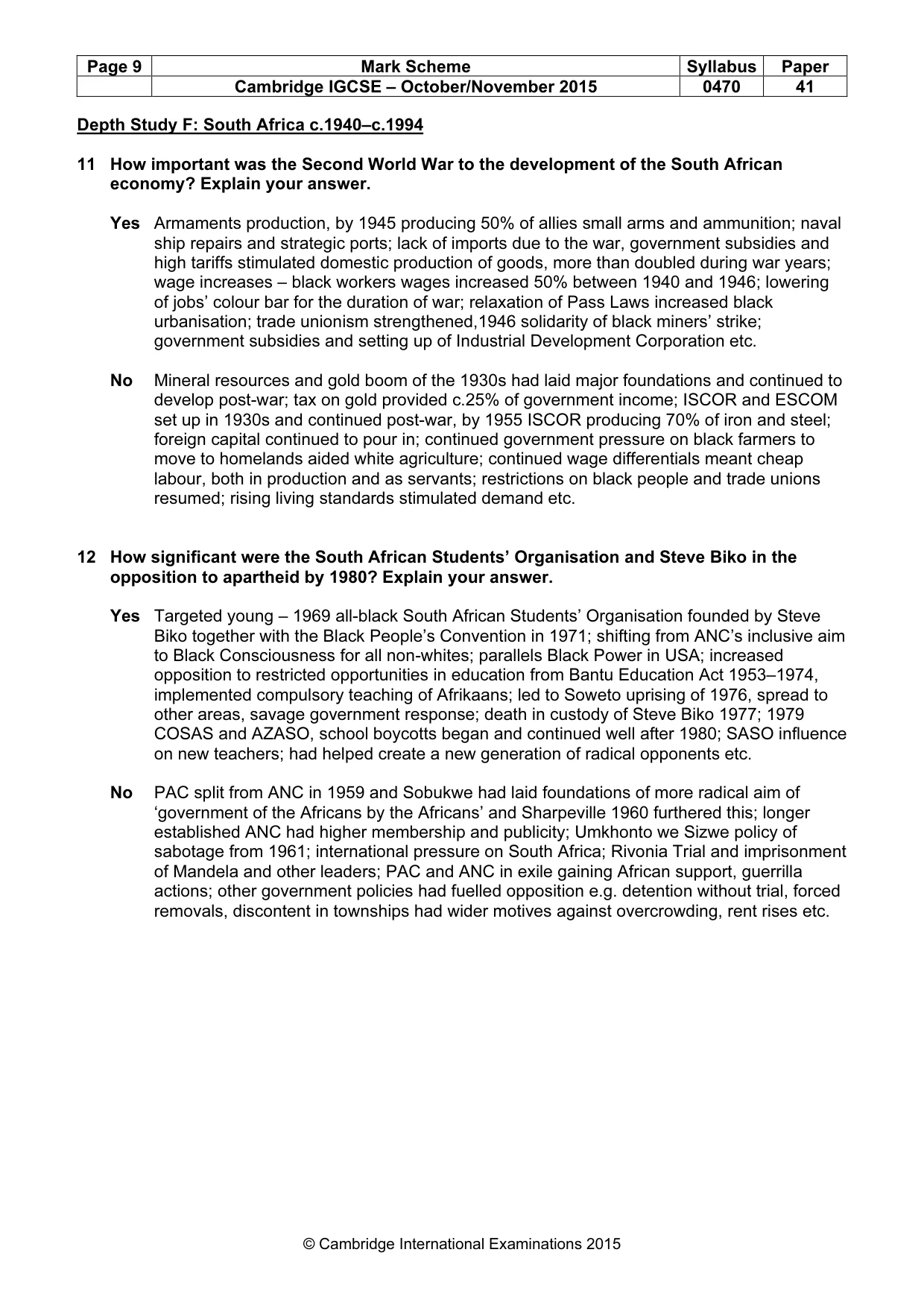
Page 9 Mark Scheme Syllabus Paper Cambridge IGCSE – October/November 2015 0470 41 © Cambridge International Examinations 2015 Depth Study F: South Africa c.1940–c.1994 11 How important was the Second World War to the development of the South African economy? Explain your answer. Yes Armaments production, by 1945 producing 50% of allies small arms and ammunition; naval ship repairs and strategic ports; lack of imports due to the war, government subsidies and high tariffs stimulated domestic production of goods, more than doubled during war years; wage increases – black workers wages increased 50% between 1940 and 1946; lowering of jobs’ colour bar for the duration of war; relaxation of Pass Laws increased black urbanisation; trade unionism strengthened,1946 solidarity of black miners’ strike; government subsidies and setting up of Industrial Development Corporation etc. No Mineral resources and gold boom of the 1930s had laid major foundations and continued to develop post-war; tax on gold provided c.25% of government income; ISCOR and ESCOM set up in 1930s and continued post-war, by 1955 ISCOR producing 70% of iron and steel; foreign capital continued to pour in; continued government pressure on black farmers to move to homelands aided white agriculture; continued wage differentials meant cheap labour, both in production and as servants; restrictions on black people and trade unions resumed; rising living standards stimulated demand etc. 12 How significant were the South African Students’ Organisation and Steve Biko in the opposition to apartheid by 1980? Explain your answer. Yes Targeted young – 1969 all-black South African Students’ Organisation founded by Steve Biko together with the Black People’s Convention in 1971; shifting from ANC’s inclusive aim to Black Consciousness for all non-whites; parallels Black Power in USA; increased opposition to restricted opportunities in education from Bantu Education Act 1953–1974, implemented compulsory teaching of Afrikaans; led to Soweto uprising of 1976, spread to other areas, savage government response; death in custody of Steve Biko 1977; 1979 COSAS and AZASO, school boycotts began and continued well after 1980; SASO influence on new teachers; had helped create a new generation of radical opponents etc. No PAC split from ANC in 1959 and Sobukwe had laid foundations of more radical aim of ‘government of the Africans by the Africans’ and Sharpeville 1960 furthered this; longer established ANC had higher membership and publicity; Umkhonto we Sizwe policy of sabotage from 1961; international pressure on South Africa; Rivonia Trial and imprisonment of Mandela and other leaders; PAC and ANC in exile gaining African support, guerrilla actions; other government policies had fuelled opposition e.g. detention without trial, forced removals, discontent in townships had wider motives against overcrowding, rent rises etc.
Mark scheme, page 10
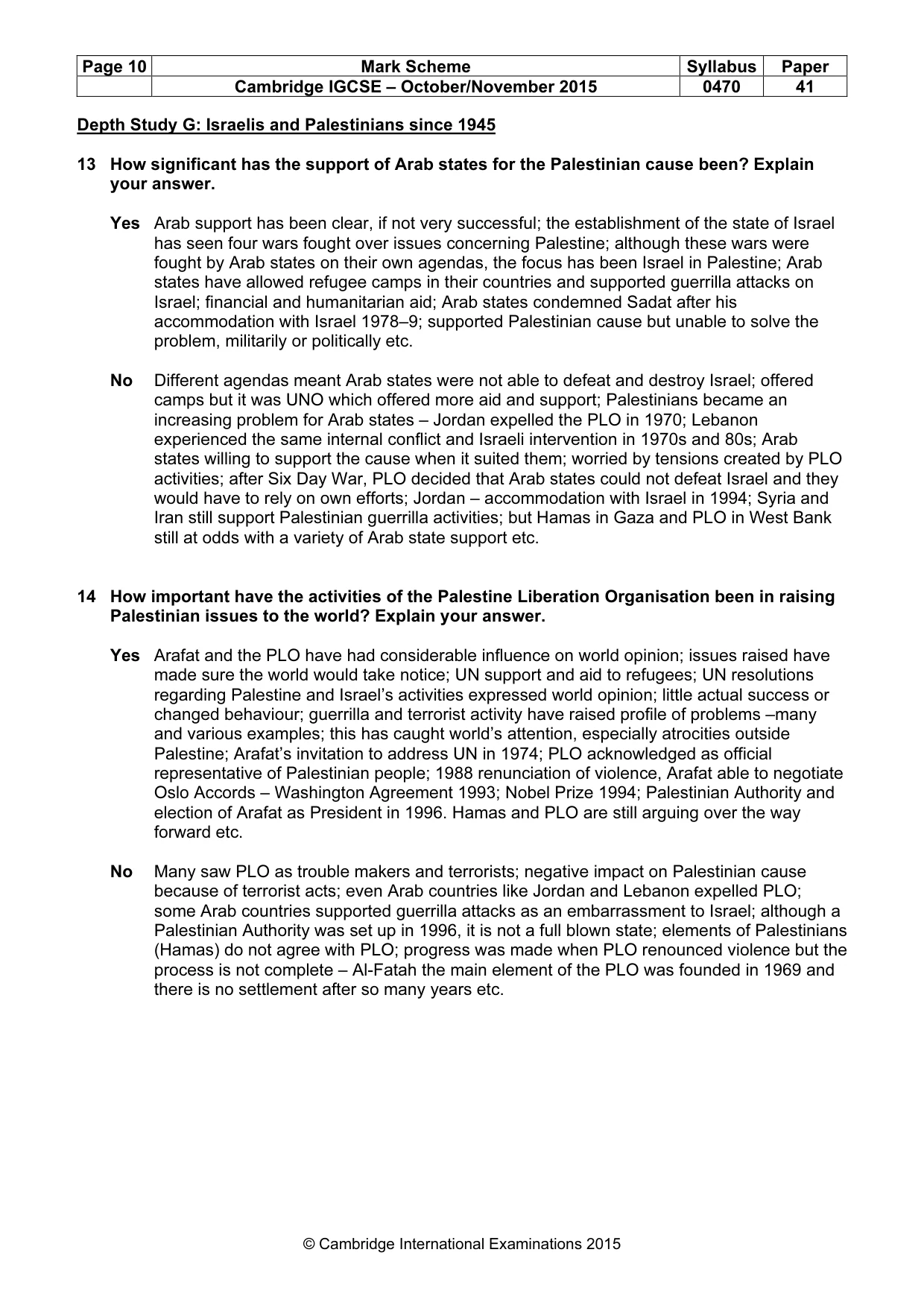
Page 10 Mark Scheme Syllabus Paper Cambridge IGCSE – October/November 2015 0470 41 © Cambridge International Examinations 2015 Depth Study G: Israelis and Palestinians since 1945 13 How significant has the support of Arab states for the Palestinian cause been? Explain your answer. Yes Arab support has been clear, if not very successful; the establishment of the state of Israel has seen four wars fought over issues concerning Palestine; although these wars were fought by Arab states on their own agendas, the focus has been Israel in Palestine; Arab states have allowed refugee camps in their countries and supported guerrilla attacks on Israel; financial and humanitarian aid; Arab states condemned Sadat after his accommodation with Israel 1978–9; supported Palestinian cause but unable to solve the problem, militarily or politically etc. No Different agendas meant Arab states were not able to defeat and destroy Israel; offered camps but it was UNO which offered more aid and support; Palestinians became an increasing problem for Arab states – Jordan expelled the PLO in 1970; Lebanon experienced the same internal conflict and Israeli intervention in 1970s and 80s; Arab states willing to support the cause when it suited them; worried by tensions created by PLO activities; after Six Day War, PLO decided that Arab states could not defeat Israel and they would have to rely on own efforts; Jordan – accommodation with Israel in 1994; Syria and Iran still support Palestinian guerrilla activities; but Hamas in Gaza and PLO in West Bank still at odds with a variety of Arab state support etc. 14 How important have the activities of the Palestine Liberation Organisation been in raising Palestinian issues to the world? Explain your answer. Yes Arafat and the PLO have had considerable influence on world opinion; issues raised have made sure the world would take notice; UN support and aid to refugees; UN resolutions regarding Palestine and Israel’s activities expressed world opinion; little actual success or changed behaviour; guerrilla and terrorist activity have raised profile of problems –many and various examples; this has caught world’s attention, especially atrocities outside Palestine; Arafat’s invitation to address UN in 1974; PLO acknowledged as official representative of Palestinian people; 1988 renunciation of violence, Arafat able to negotiate Oslo Accords – Washington Agreement 1993; Nobel Prize 1994; Palestinian Authority and election of Arafat as President in 1996. Hamas and PLO are still arguing over the way forward etc. No Many saw PLO as trouble makers and terrorists; negative impact on Palestinian cause because of terrorist acts; even Arab countries like Jordan and Lebanon expelled PLO; some Arab countries supported guerrilla attacks as an embarrassment to Israel; although a Palestinian Authority was set up in 1996, it is not a full blown state; elements of Palestinians (Hamas) do not agree with PLO; progress was made when PLO renounced violence but the process is not complete – Al-Fatah the main element of the PLO was founded in 1969 and there is no settlement after so many years etc.
What you needed in this session
Cambridge’s own grade thresholds for 2015 Oct/Nov, Paper 4 · Variant 1. A higher threshold means an easier paper — the bar moves with how the cohort did.