Cambridge IGCSE History 0470 — 2015 Oct/Nov Paper 4 · Variant 2
0470/42/O/N/15 · 40 marks · ≈45 min
The question paper and its mark scheme, free to read here and free to download. This is Cambridge’s own paper, exactly as it was sat.
Question paper4 pages

Mark scheme10 pages
Answers below. Sit the paper first if you are practising.
Paper as text
Question paper, page 1
This document consists of 3 printed pages, 1 blank page and 1 insert. DC (RCL (JDA)) 97855/3 © UCLES 2015 [Turn over Cambridge International Examinations Cambridge International General Certificate of Secondary Education * 3 5 7 5 7 9 9 4 6 6 * HISTORY 0470/42 Paper 4 Alternative to Coursework October/November 2015 1 hour No Additional Materials are required. READ THESE INSTRUCTIONS FIRST An answer booklet is provided inside this question paper. You should follow the instructions on the front cover of the answer booklet. If you need additional answer paper ask the invigilator for a continuation booklet. Answer one question from your chosen Depth Study. The number of marks is given in brackets [ ] at the end of each question or part question. The syllabus is approved for use in England, Wales and Northern Ireland as a Cambridge International Level 1/Level 2 Certificate.
Question paper, page 2
2 0470/42/O/N/15 © UCLES 2015 Answer one question from your chosen Depth Study. DEPTH STUDY A: THE FIRST WORLD WAR, 1914–1918 1 How significant was the Gallipoli Campaign in 1915? Explain your answer. [40] 2 How important was the use of aircraft to the conduct of the war? Explain your answer. [40] DEPTH STUDY B: GERMANY, 1918–1945 3 How significant were Röhm and the SA in the development of the Nazi Party to 1934? Explain your answer. [40] 4 How important were women in German society under the Nazis? Explain your answer. [40] DEPTH STUDY C: RUSSIA, 1905–1941 5 How important was Bolshevik agitation in the fall of the Provisional Government in 1917? Explain your answer. [40] 6 How significant was collectivisation in modernising the Soviet economy? Explain your answer. [40] DEPTH STUDY D: THE USA, 1919–1941 7 How significant was the Ku Klux Klan during the 1920s? Explain your answer. [40] 8 How important were President Roosevelt’s ‘Hundred Days’ from March to June 1933 in dealing with the consequences of the Wall Street Crash? Explain your answer. [40] DEPTH STUDY E: CHINA, c.1930–c.1990 9 How important in bringing about social change between 1949 and 1958 were women’s rights reforms? Explain your answer. [40] 10 How significant to Mao’s control of China was the Hundred Flowers Campaign, 1956–57? Explain your answer. [40]
Question paper, page 3
3 0470/42/O/N/15 © UCLES 2015 DEPTH STUDY F: SOUTH AFRICA, c.1940–c.1994 11 How important was the Freedom Charter of 1955 in the development of opposition to apartheid? Explain your answer. [40] 12 How significant was white opposition to the transition to majority rule between 1980 and 1994? Explain your answer. [40] DEPTH STUDY G: ISRAELIS AND PALESTINIANS SINCE 1945 13 How significant to the peace process in the Middle East have the rivalries between Palestinian groups been? Explain your answer. [40] 14 How important a role has oil played in the Arab-Israeli conflict? Explain your answer. [40]
Question paper, page 4
4 0470/42/O/N/15 © UCLES 2015 BLANK PAGE Permission to reproduce items where third-party owned material protected by copyright is included has been sought and cleared where possible. Every reasonable effort has been made by the publisher (UCLES) to trace copyright holders, but if any items requiring clearance have unwittingly been included, the publisher will be pleased to make amends at the earliest possible opportunity. To avoid the issue of disclosure of answer-related information to candidates, all copyright acknowledgements are reproduced online in the Cambridge International Examinations Copyright Acknowledgements Booklet. This is produced for each series of examinations and is freely available to download at www.cie.org.uk after the live examination series. Cambridge International Examinations is part of the Cambridge Assessment Group. Cambridge Assessment is the brand name of University of Cambridge Local Examinations Syndicate (UCLES), which is itself a department of the University of Cambridge.
Mark scheme, page 1
® IGCSE is the registered trademark of Cambridge International Examinations. CAMBRIDGE INTERNATIONAL EXAMINATIONS Cambridge International General Certificate of Secondary Education MARK SCHEME for the October/November 2015 series 0470 HISTORY 0470/42 Paper 4 (Alternative to Coursework), maximum raw mark 40 This mark scheme is published as an aid to teachers and candidates, to indicate the requirements of the examination. It shows the basis on which Examiners were instructed to award marks. It does not indicate the details of the discussions that took place at an Examiners’ meeting before marking began, which would have considered the acceptability of alternative answers. Mark schemes should be read in conjunction with the question paper and the Principal Examiner Report for Teachers. Cambridge will not enter into discussions about these mark schemes. Cambridge is publishing the mark schemes for the October/November 2015 series for most Cambridge IGCSE®, Cambridge International A and AS Level components and some Cambridge O Level components.
Mark scheme, page 2
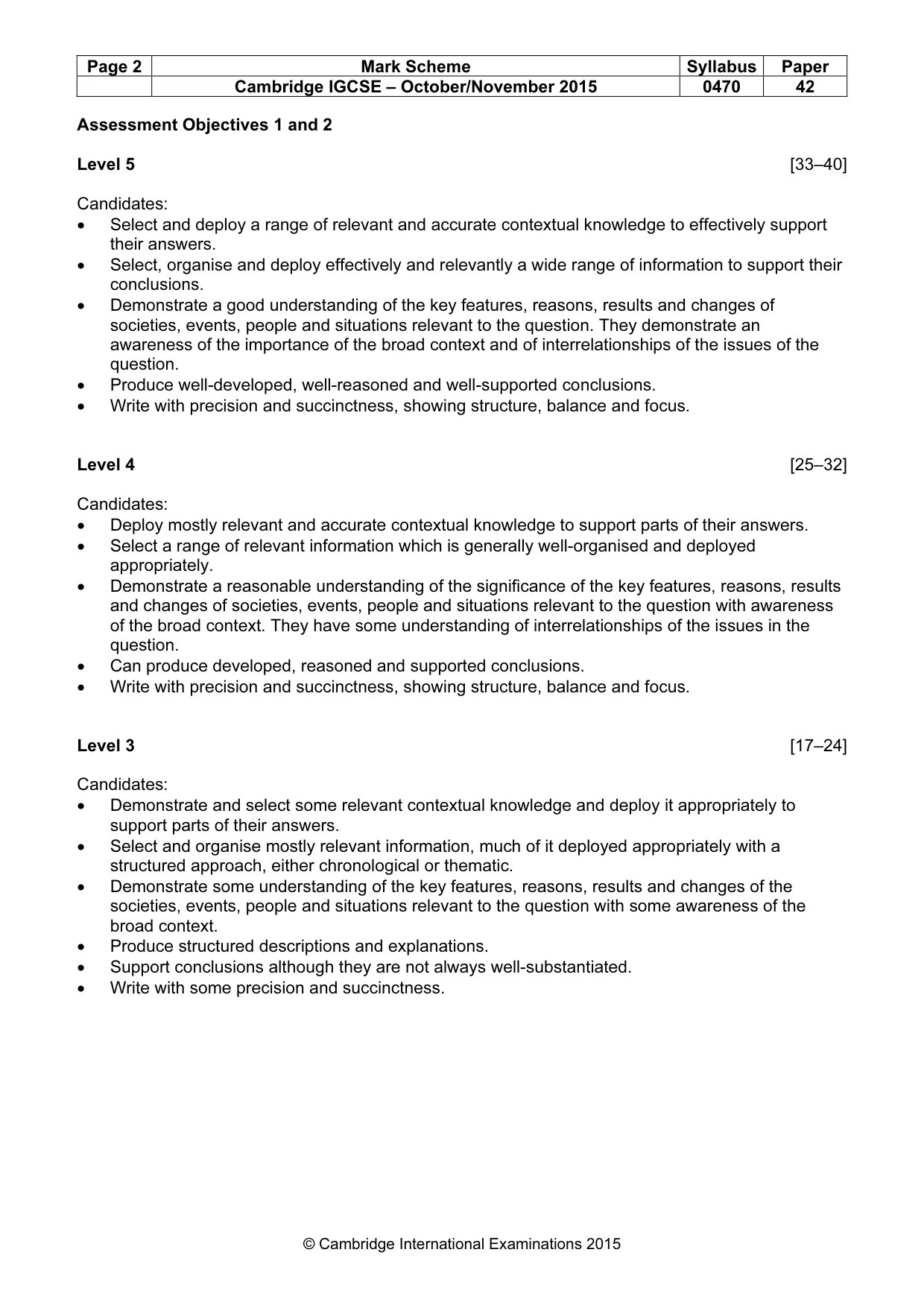
Page 2 Mark Scheme Syllabus Paper Cambridge IGCSE – October/November 2015 0470 42 © Cambridge International Examinations 2015 Assessment Objectives 1 and 2 Level 5 [33–40] Candidates: • Select and deploy a range of relevant and accurate contextual knowledge to effectively support their answers. • Select, organise and deploy effectively and relevantly a wide range of information to support their conclusions. • Demonstrate a good understanding of the key features, reasons, results and changes of societies, events, people and situations relevant to the question. They demonstrate an awareness of the importance of the broad context and of interrelationships of the issues of the question. • Produce well-developed, well-reasoned and well-supported conclusions. • Write with precision and succinctness, showing structure, balance and focus. Level 4 [25–32] Candidates: • Deploy mostly relevant and accurate contextual knowledge to support parts of their answers. • Select a range of relevant information which is generally well-organised and deployed appropriately. • Demonstrate a reasonable understanding of the significance of the key features, reasons, results and changes of societies, events, people and situations relevant to the question with awareness of the broad context. They have some understanding of interrelationships of the issues in the question. • Can produce developed, reasoned and supported conclusions. • Write with precision and succinctness, showing structure, balance and focus. Level 3 [17–24] Candidates: • Demonstrate and select some relevant contextual knowledge and deploy it appropriately to support parts of their answers. • Select and organise mostly relevant information, much of it deployed appropriately with a structured approach, either chronological or thematic. • Demonstrate some understanding of the key features, reasons, results and changes of the societies, events, people and situations relevant to the question with some awareness of the broad context. • Produce structured descriptions and explanations. • Support conclusions although they are not always well-substantiated. • Write with some precision and succinctness.
Mark scheme, page 3
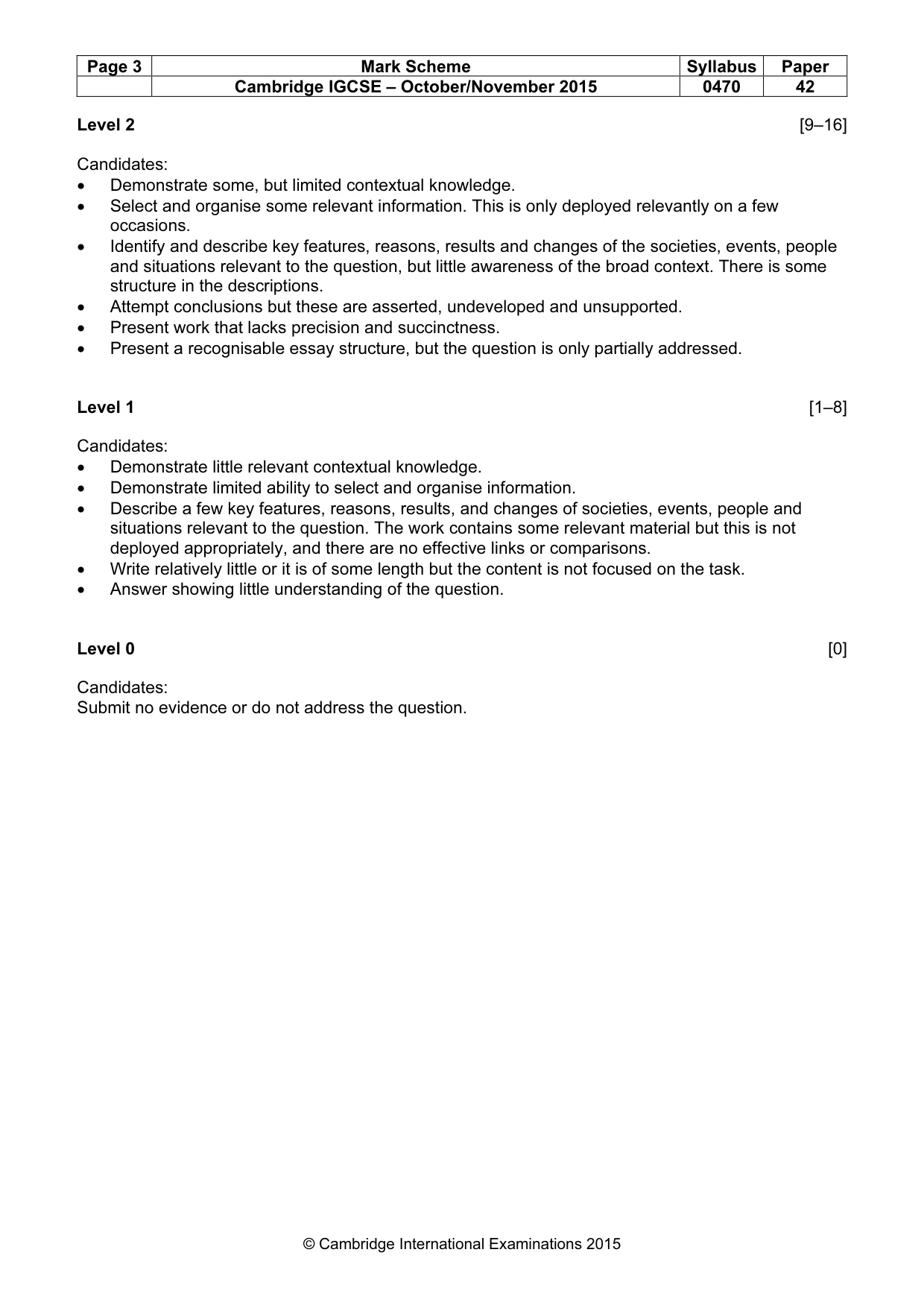
Page 3 Mark Scheme Syllabus Paper Cambridge IGCSE – October/November 2015 0470 42 © Cambridge International Examinations 2015 Level 2 [9–16] Candidates: • Demonstrate some, but limited contextual knowledge. • Select and organise some relevant information. This is only deployed relevantly on a few occasions. • Identify and describe key features, reasons, results and changes of the societies, events, people and situations relevant to the question, but little awareness of the broad context. There is some structure in the descriptions. • Attempt conclusions but these are asserted, undeveloped and unsupported. • Present work that lacks precision and succinctness. • Present a recognisable essay structure, but the question is only partially addressed. Level 1 [1–8] Candidates: • Demonstrate little relevant contextual knowledge. • Demonstrate limited ability to select and organise information. • Describe a few key features, reasons, results, and changes of societies, events, people and situations relevant to the question. The work contains some relevant material but this is not deployed appropriately, and there are no effective links or comparisons. • Write relatively little or it is of some length but the content is not focused on the task. • Answer showing little understanding of the question. Level 0 [0] Candidates: Submit no evidence or do not address the question.
Mark scheme, page 4
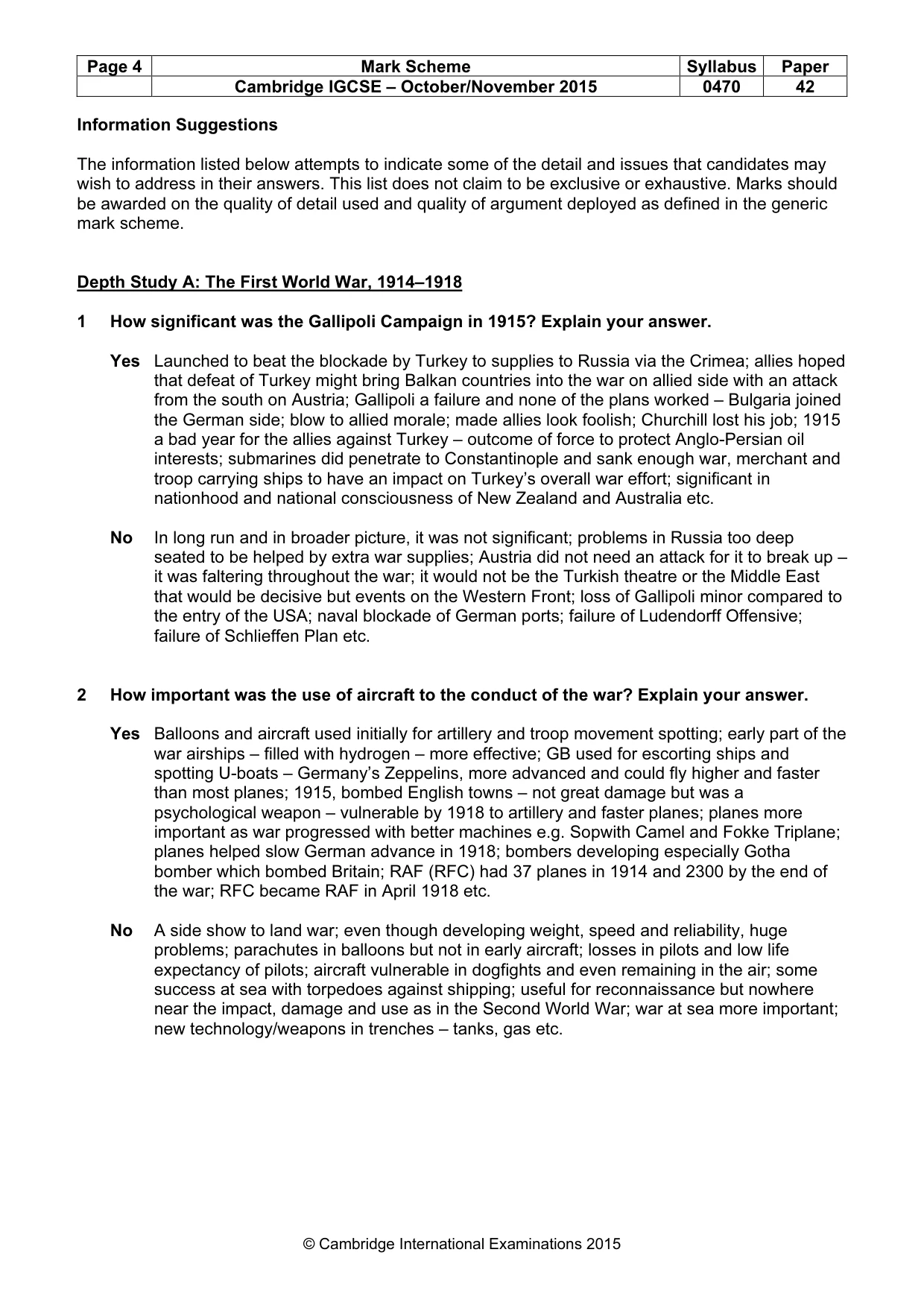
Page 4 Mark Scheme Syllabus Paper Cambridge IGCSE – October/November 2015 0470 42 © Cambridge International Examinations 2015 Information Suggestions The information listed below attempts to indicate some of the detail and issues that candidates may wish to address in their answers. This list does not claim to be exclusive or exhaustive. Marks should be awarded on the quality of detail used and quality of argument deployed as defined in the generic mark scheme. Depth Study A: The First World War, 1914–1918 1 How significant was the Gallipoli Campaign in 1915? Explain your answer. Yes Launched to beat the blockade by Turkey to supplies to Russia via the Crimea; allies hoped that defeat of Turkey might bring Balkan countries into the war on allied side with an attack from the south on Austria; Gallipoli a failure and none of the plans worked – Bulgaria joined the German side; blow to allied morale; made allies look foolish; Churchill lost his job; 1915 a bad year for the allies against Turkey – outcome of force to protect Anglo-Persian oil interests; submarines did penetrate to Constantinople and sank enough war, merchant and troop carrying ships to have an impact on Turkey’s overall war effort; significant in nationhood and national consciousness of New Zealand and Australia etc. No In long run and in broader picture, it was not significant; problems in Russia too deep seated to be helped by extra war supplies; Austria did not need an attack for it to break up – it was faltering throughout the war; it would not be the Turkish theatre or the Middle East that would be decisive but events on the Western Front; loss of Gallipoli minor compared to the entry of the USA; naval blockade of German ports; failure of Ludendorff Offensive; failure of Schlieffen Plan etc. 2 How important was the use of aircraft to the conduct of the war? Explain your answer. Yes Balloons and aircraft used initially for artillery and troop movement spotting; early part of the war airships – filled with hydrogen – more effective; GB used for escorting ships and spotting U-boats – Germany’s Zeppelins, more advanced and could fly higher and faster than most planes; 1915, bombed English towns – not great damage but was a psychological weapon – vulnerable by 1918 to artillery and faster planes; planes more important as war progressed with better machines e.g. Sopwith Camel and Fokke Triplane; planes helped slow German advance in 1918; bombers developing especially Gotha bomber which bombed Britain; RAF (RFC) had 37 planes in 1914 and 2300 by the end of the war; RFC became RAF in April 1918 etc. No A side show to land war; even though developing weight, speed and reliability, huge problems; parachutes in balloons but not in early aircraft; losses in pilots and low life expectancy of pilots; aircraft vulnerable in dogfights and even remaining in the air; some success at sea with torpedoes against shipping; useful for reconnaissance but nowhere near the impact, damage and use as in the Second World War; war at sea more important; new technology/weapons in trenches – tanks, gas etc.
Mark scheme, page 5
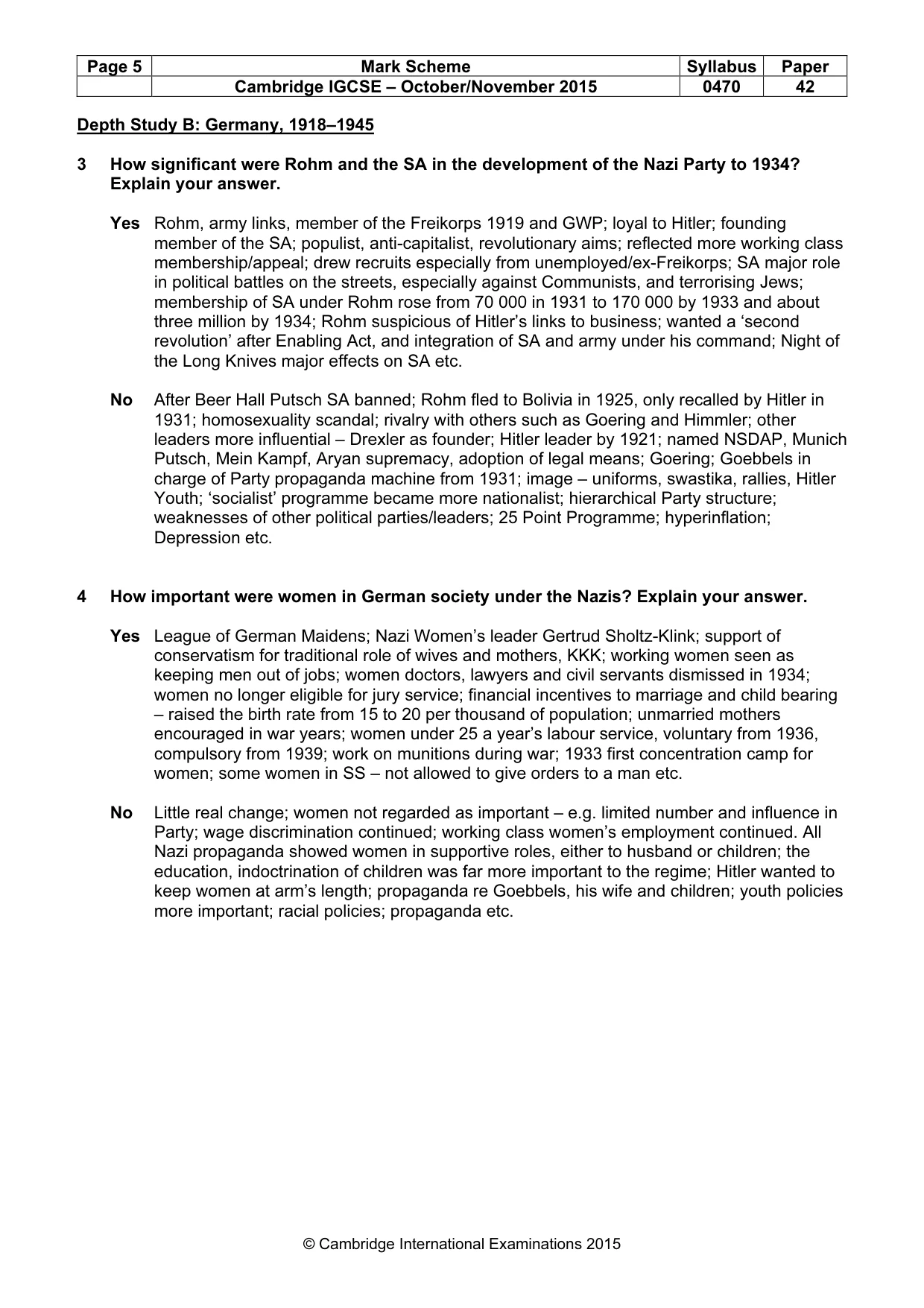
Page 5 Mark Scheme Syllabus Paper Cambridge IGCSE – October/November 2015 0470 42 © Cambridge International Examinations 2015 Depth Study B: Germany, 1918–1945 3 How significant were Rohm and the SA in the development of the Nazi Party to 1934? Explain your answer. Yes Rohm, army links, member of the Freikorps 1919 and GWP; loyal to Hitler; founding member of the SA; populist, anti-capitalist, revolutionary aims; reflected more working class membership/appeal; drew recruits especially from unemployed/ex-Freikorps; SA major role in political battles on the streets, especially against Communists, and terrorising Jews; membership of SA under Rohm rose from 70 000 in 1931 to 170 000 by 1933 and about three million by 1934; Rohm suspicious of Hitler’s links to business; wanted a ‘second revolution’ after Enabling Act, and integration of SA and army under his command; Night of the Long Knives major effects on SA etc. No After Beer Hall Putsch SA banned; Rohm fled to Bolivia in 1925, only recalled by Hitler in 1931; homosexuality scandal; rivalry with others such as Goering and Himmler; other leaders more influential – Drexler as founder; Hitler leader by 1921; named NSDAP, Munich Putsch, Mein Kampf, Aryan supremacy, adoption of legal means; Goering; Goebbels in charge of Party propaganda machine from 1931; image – uniforms, swastika, rallies, Hitler Youth; ‘socialist’ programme became more nationalist; hierarchical Party structure; weaknesses of other political parties/leaders; 25 Point Programme; hyperinflation; Depression etc. 4 How important were women in German society under the Nazis? Explain your answer. Yes League of German Maidens; Nazi Women’s leader Gertrud Sholtz-Klink; support of conservatism for traditional role of wives and mothers, KKK; working women seen as keeping men out of jobs; women doctors, lawyers and civil servants dismissed in 1934; women no longer eligible for jury service; financial incentives to marriage and child bearing – raised the birth rate from 15 to 20 per thousand of population; unmarried mothers encouraged in war years; women under 25 a year’s labour service, voluntary from 1936, compulsory from 1939; work on munitions during war; 1933 first concentration camp for women; some women in SS – not allowed to give orders to a man etc. No Little real change; women not regarded as important – e.g. limited number and influence in Party; wage discrimination continued; working class women’s employment continued. All Nazi propaganda showed women in supportive roles, either to husband or children; the education, indoctrination of children was far more important to the regime; Hitler wanted to keep women at arm’s length; propaganda re Goebbels, his wife and children; youth policies more important; racial policies; propaganda etc.
Mark scheme, page 6
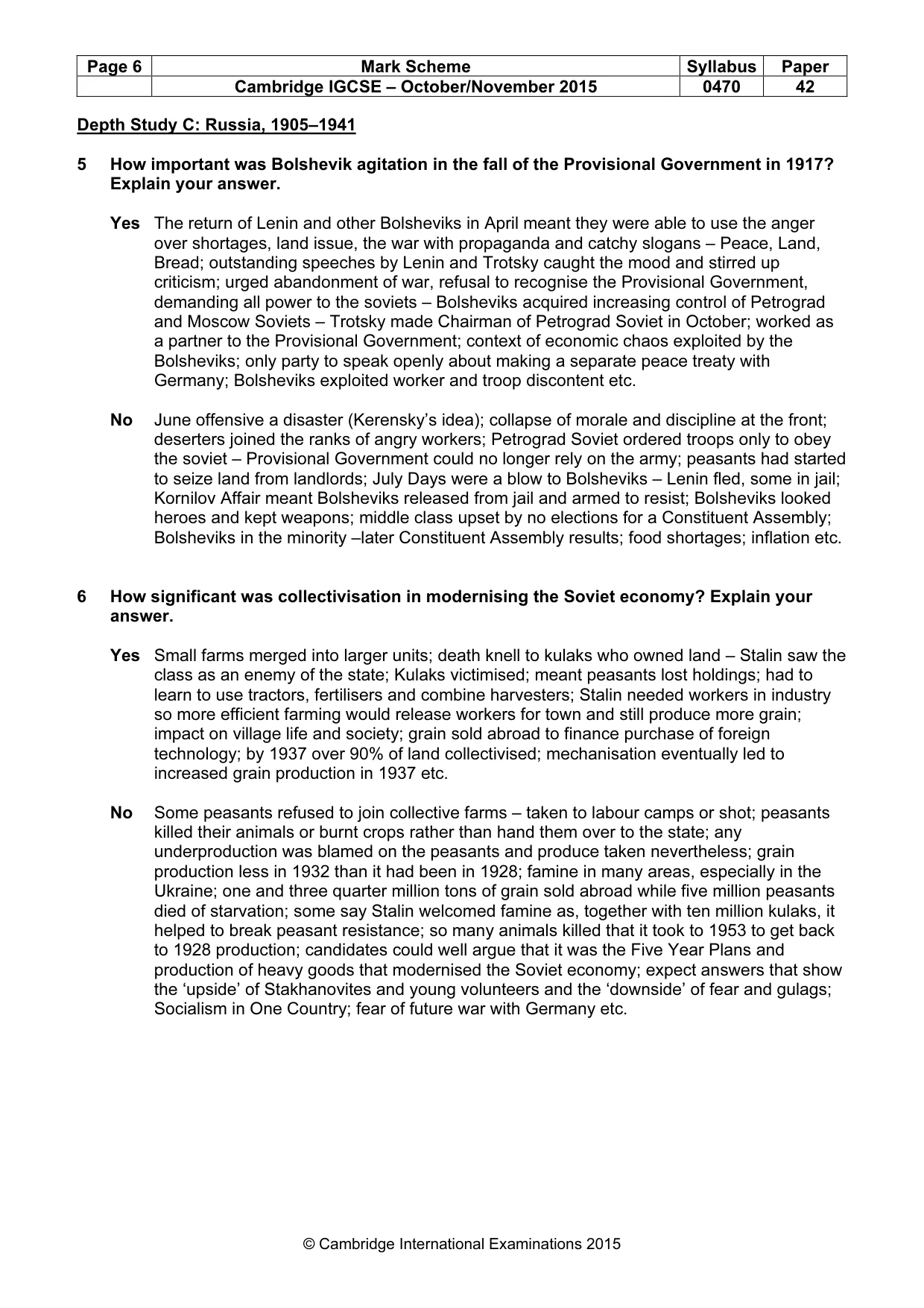
Page 6 Mark Scheme Syllabus Paper Cambridge IGCSE – October/November 2015 0470 42 © Cambridge International Examinations 2015 Depth Study C: Russia, 1905–1941 5 How important was Bolshevik agitation in the fall of the Provisional Government in 1917? Explain your answer. Yes The return of Lenin and other Bolsheviks in April meant they were able to use the anger over shortages, land issue, the war with propaganda and catchy slogans – Peace, Land, Bread; outstanding speeches by Lenin and Trotsky caught the mood and stirred up criticism; urged abandonment of war, refusal to recognise the Provisional Government, demanding all power to the soviets – Bolsheviks acquired increasing control of Petrograd and Moscow Soviets – Trotsky made Chairman of Petrograd Soviet in October; worked as a partner to the Provisional Government; context of economic chaos exploited by the Bolsheviks; only party to speak openly about making a separate peace treaty with Germany; Bolsheviks exploited worker and troop discontent etc. No June offensive a disaster (Kerensky’s idea); collapse of morale and discipline at the front; deserters joined the ranks of angry workers; Petrograd Soviet ordered troops only to obey the soviet – Provisional Government could no longer rely on the army; peasants had started to seize land from landlords; July Days were a blow to Bolsheviks – Lenin fled, some in jail; Kornilov Affair meant Bolsheviks released from jail and armed to resist; Bolsheviks looked heroes and kept weapons; middle class upset by no elections for a Constituent Assembly; Bolsheviks in the minority –later Constituent Assembly results; food shortages; inflation etc. 6 How significant was collectivisation in modernising the Soviet economy? Explain your answer. Yes Small farms merged into larger units; death knell to kulaks who owned land – Stalin saw the class as an enemy of the state; Kulaks victimised; meant peasants lost holdings; had to learn to use tractors, fertilisers and combine harvesters; Stalin needed workers in industry so more efficient farming would release workers for town and still produce more grain; impact on village life and society; grain sold abroad to finance purchase of foreign technology; by 1937 over 90% of land collectivised; mechanisation eventually led to increased grain production in 1937 etc. No Some peasants refused to join collective farms – taken to labour camps or shot; peasants killed their animals or burnt crops rather than hand them over to the state; any underproduction was blamed on the peasants and produce taken nevertheless; grain production less in 1932 than it had been in 1928; famine in many areas, especially in the Ukraine; one and three quarter million tons of grain sold abroad while five million peasants died of starvation; some say Stalin welcomed famine as, together with ten million kulaks, it helped to break peasant resistance; so many animals killed that it took to 1953 to get back to 1928 production; candidates could well argue that it was the Five Year Plans and production of heavy goods that modernised the Soviet economy; expect answers that show the ‘upside’ of Stakhanovites and young volunteers and the ‘downside’ of fear and gulags; Socialism in One Country; fear of future war with Germany etc.
Mark scheme, page 7
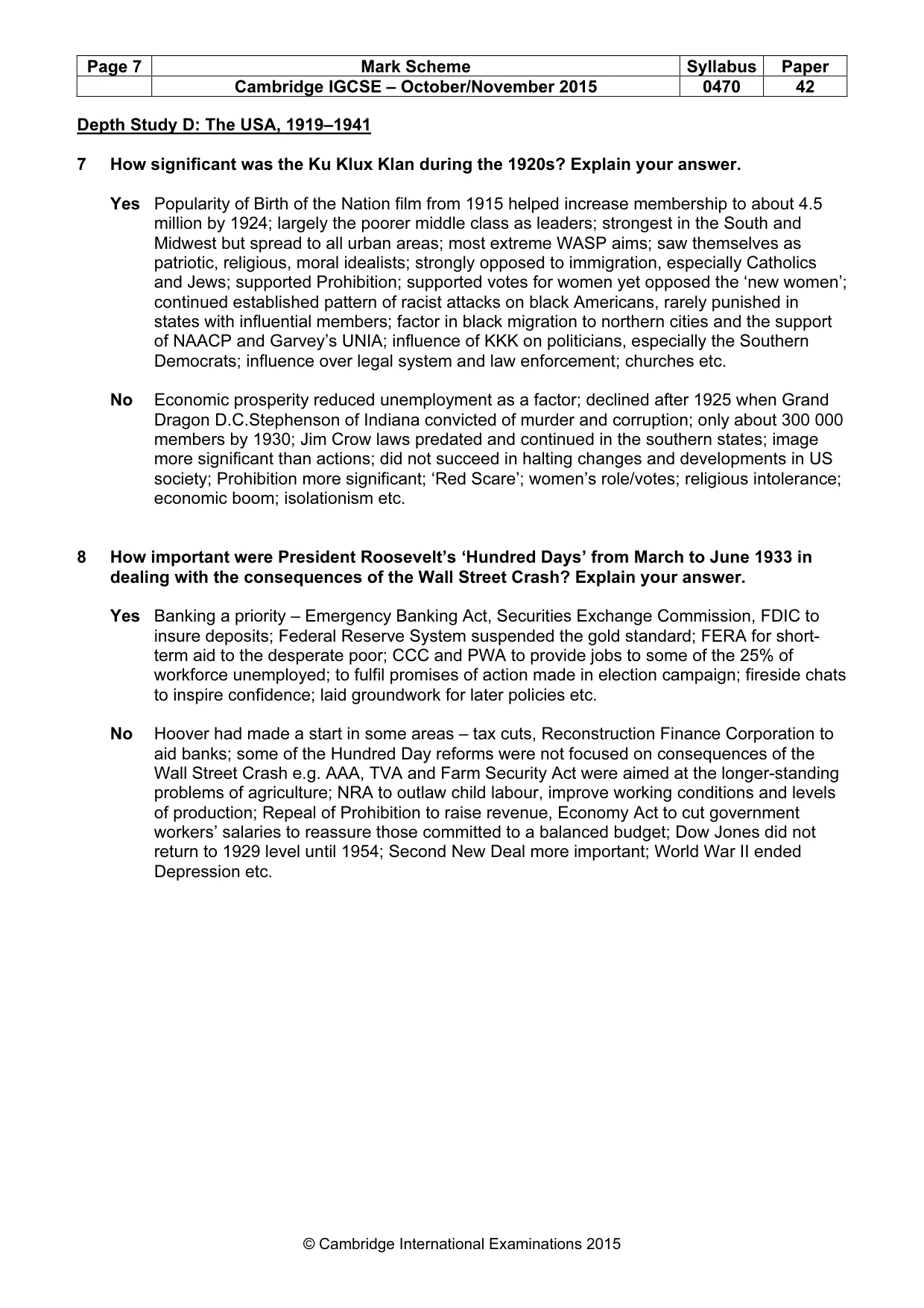
Page 7 Mark Scheme Syllabus Paper Cambridge IGCSE – October/November 2015 0470 42 © Cambridge International Examinations 2015 Depth Study D: The USA, 1919–1941 7 How significant was the Ku Klux Klan during the 1920s? Explain your answer. Yes Popularity of Birth of the Nation film from 1915 helped increase membership to about 4.5 million by 1924; largely the poorer middle class as leaders; strongest in the South and Midwest but spread to all urban areas; most extreme WASP aims; saw themselves as patriotic, religious, moral idealists; strongly opposed to immigration, especially Catholics and Jews; supported Prohibition; supported votes for women yet opposed the ‘new women’; continued established pattern of racist attacks on black Americans, rarely punished in states with influential members; factor in black migration to northern cities and the support of NAACP and Garvey’s UNIA; influence of KKK on politicians, especially the Southern Democrats; influence over legal system and law enforcement; churches etc. No Economic prosperity reduced unemployment as a factor; declined after 1925 when Grand Dragon D.C.Stephenson of Indiana convicted of murder and corruption; only about 300 000 members by 1930; Jim Crow laws predated and continued in the southern states; image more significant than actions; did not succeed in halting changes and developments in US society; Prohibition more significant; ‘Red Scare’; women’s role/votes; religious intolerance; economic boom; isolationism etc. 8 How important were President Roosevelt’s ‘Hundred Days’ from March to June 1933 in dealing with the consequences of the Wall Street Crash? Explain your answer. Yes Banking a priority – Emergency Banking Act, Securities Exchange Commission, FDIC to insure deposits; Federal Reserve System suspended the gold standard; FERA for short- term aid to the desperate poor; CCC and PWA to provide jobs to some of the 25% of workforce unemployed; to fulfil promises of action made in election campaign; fireside chats to inspire confidence; laid groundwork for later policies etc. No Hoover had made a start in some areas – tax cuts, Reconstruction Finance Corporation to aid banks; some of the Hundred Day reforms were not focused on consequences of the Wall Street Crash e.g. AAA, TVA and Farm Security Act were aimed at the longer-standing problems of agriculture; NRA to outlaw child labour, improve working conditions and levels of production; Repeal of Prohibition to raise revenue, Economy Act to cut government workers’ salaries to reassure those committed to a balanced budget; Dow Jones did not return to 1929 level until 1954; Second New Deal more important; World War II ended Depression etc.
Mark scheme, page 8
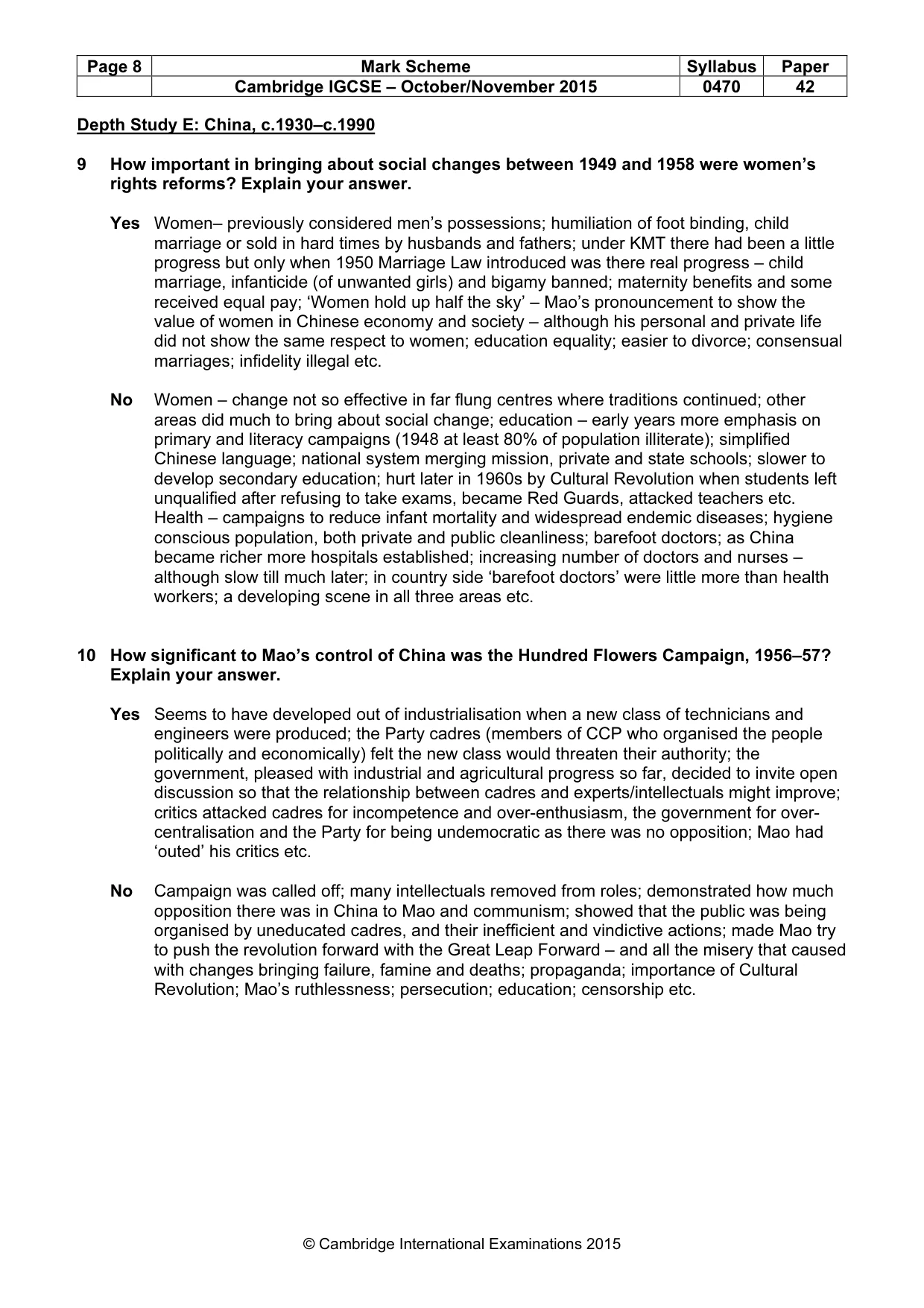
Page 8 Mark Scheme Syllabus Paper Cambridge IGCSE – October/November 2015 0470 42 © Cambridge International Examinations 2015 Depth Study E: China, c.1930–c.1990 9 How important in bringing about social changes between 1949 and 1958 were women’s rights reforms? Explain your answer. Yes Women– previously considered men’s possessions; humiliation of foot binding, child marriage or sold in hard times by husbands and fathers; under KMT there had been a little progress but only when 1950 Marriage Law introduced was there real progress – child marriage, infanticide (of unwanted girls) and bigamy banned; maternity benefits and some received equal pay; ‘Women hold up half the sky’ – Mao’s pronouncement to show the value of women in Chinese economy and society – although his personal and private life did not show the same respect to women; education equality; easier to divorce; consensual marriages; infidelity illegal etc. No Women – change not so effective in far flung centres where traditions continued; other areas did much to bring about social change; education – early years more emphasis on primary and literacy campaigns (1948 at least 80% of population illiterate); simplified Chinese language; national system merging mission, private and state schools; slower to develop secondary education; hurt later in 1960s by Cultural Revolution when students left unqualified after refusing to take exams, became Red Guards, attacked teachers etc. Health – campaigns to reduce infant mortality and widespread endemic diseases; hygiene conscious population, both private and public cleanliness; barefoot doctors; as China became richer more hospitals established; increasing number of doctors and nurses – although slow till much later; in country side ‘barefoot doctors’ were little more than health workers; a developing scene in all three areas etc. 10 How significant to Mao’s control of China was the Hundred Flowers Campaign, 1956–57? Explain your answer. Yes Seems to have developed out of industrialisation when a new class of technicians and engineers were produced; the Party cadres (members of CCP who organised the people politically and economically) felt the new class would threaten their authority; the government, pleased with industrial and agricultural progress so far, decided to invite open discussion so that the relationship between cadres and experts/intellectuals might improve; critics attacked cadres for incompetence and over-enthusiasm, the government for over- centralisation and the Party for being undemocratic as there was no opposition; Mao had ‘outed’ his critics etc. No Campaign was called off; many intellectuals removed from roles; demonstrated how much opposition there was in China to Mao and communism; showed that the public was being organised by uneducated cadres, and their inefficient and vindictive actions; made Mao try to push the revolution forward with the Great Leap Forward – and all the misery that caused with changes bringing failure, famine and deaths; propaganda; importance of Cultural Revolution; Mao’s ruthlessness; persecution; education; censorship etc.
Mark scheme, page 9
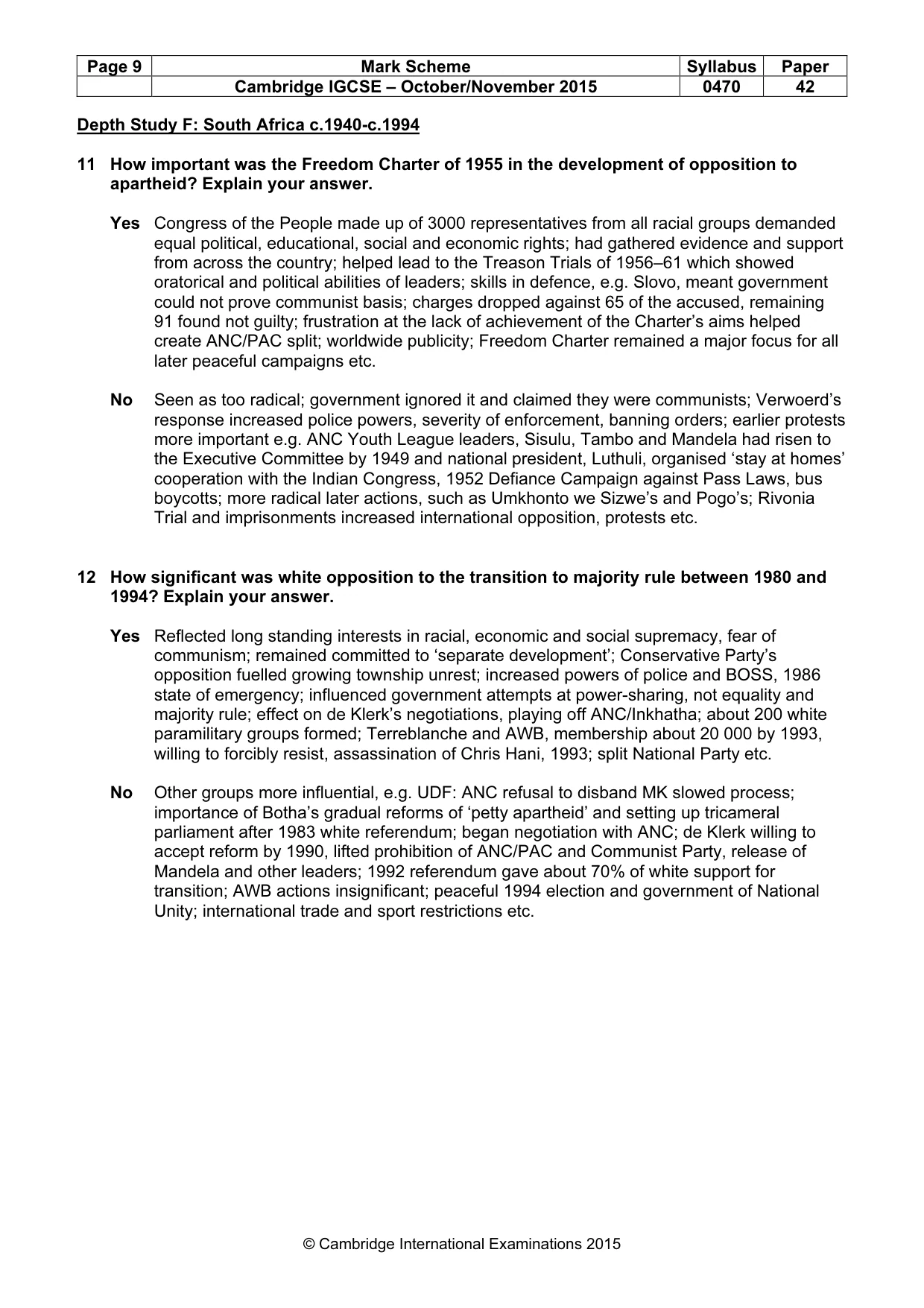
Page 9 Mark Scheme Syllabus Paper Cambridge IGCSE – October/November 2015 0470 42 © Cambridge International Examinations 2015 Depth Study F: South Africa c.1940-c.1994 11 How important was the Freedom Charter of 1955 in the development of opposition to apartheid? Explain your answer. Yes Congress of the People made up of 3000 representatives from all racial groups demanded equal political, educational, social and economic rights; had gathered evidence and support from across the country; helped lead to the Treason Trials of 1956–61 which showed oratorical and political abilities of leaders; skills in defence, e.g. Slovo, meant government could not prove communist basis; charges dropped against 65 of the accused, remaining 91 found not guilty; frustration at the lack of achievement of the Charter’s aims helped create ANC/PAC split; worldwide publicity; Freedom Charter remained a major focus for all later peaceful campaigns etc. No Seen as too radical; government ignored it and claimed they were communists; Verwoerd’s response increased police powers, severity of enforcement, banning orders; earlier protests more important e.g. ANC Youth League leaders, Sisulu, Tambo and Mandela had risen to the Executive Committee by 1949 and national president, Luthuli, organised ‘stay at homes’ cooperation with the Indian Congress, 1952 Defiance Campaign against Pass Laws, bus boycotts; more radical later actions, such as Umkhonto we Sizwe’s and Pogo’s; Rivonia Trial and imprisonments increased international opposition, protests etc. 12 How significant was white opposition to the transition to majority rule between 1980 and 1994? Explain your answer. Yes Reflected long standing interests in racial, economic and social supremacy, fear of communism; remained committed to ‘separate development’; Conservative Party’s opposition fuelled growing township unrest; increased powers of police and BOSS, 1986 state of emergency; influenced government attempts at power-sharing, not equality and majority rule; effect on de Klerk’s negotiations, playing off ANC/Inkhatha; about 200 white paramilitary groups formed; Terreblanche and AWB, membership about 20 000 by 1993, willing to forcibly resist, assassination of Chris Hani, 1993; split National Party etc. No Other groups more influential, e.g. UDF: ANC refusal to disband MK slowed process; importance of Botha’s gradual reforms of ‘petty apartheid’ and setting up tricameral parliament after 1983 white referendum; began negotiation with ANC; de Klerk willing to accept reform by 1990, lifted prohibition of ANC/PAC and Communist Party, release of Mandela and other leaders; 1992 referendum gave about 70% of white support for transition; AWB actions insignificant; peaceful 1994 election and government of National Unity; international trade and sport restrictions etc.
Mark scheme, page 10
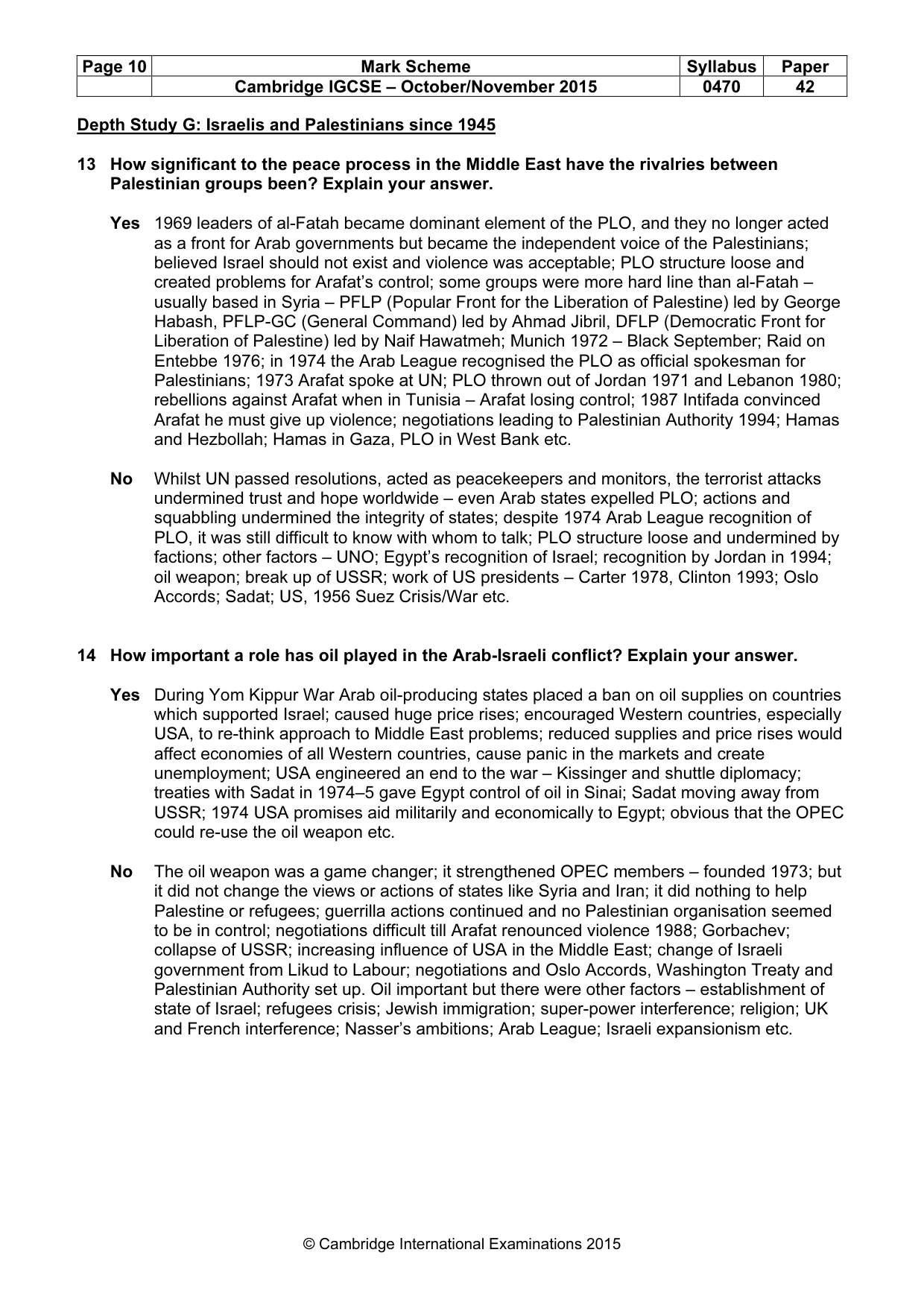
Page 10 Mark Scheme Syllabus Paper Cambridge IGCSE – October/November 2015 0470 42 © Cambridge International Examinations 2015 Depth Study G: Israelis and Palestinians since 1945 13 How significant to the peace process in the Middle East have the rivalries between Palestinian groups been? Explain your answer. Yes 1969 leaders of al-Fatah became dominant element of the PLO, and they no longer acted as a front for Arab governments but became the independent voice of the Palestinians; believed Israel should not exist and violence was acceptable; PLO structure loose and created problems for Arafat’s control; some groups were more hard line than al-Fatah – usually based in Syria – PFLP (Popular Front for the Liberation of Palestine) led by George Habash, PFLP-GC (General Command) led by Ahmad Jibril, DFLP (Democratic Front for Liberation of Palestine) led by Naif Hawatmeh; Munich 1972 – Black September; Raid on Entebbe 1976; in 1974 the Arab League recognised the PLO as official spokesman for Palestinians; 1973 Arafat spoke at UN; PLO thrown out of Jordan 1971 and Lebanon 1980; rebellions against Arafat when in Tunisia – Arafat losing control; 1987 Intifada convinced Arafat he must give up violence; negotiations leading to Palestinian Authority 1994; Hamas and Hezbollah; Hamas in Gaza, PLO in West Bank etc. No Whilst UN passed resolutions, acted as peacekeepers and monitors, the terrorist attacks undermined trust and hope worldwide – even Arab states expelled PLO; actions and squabbling undermined the integrity of states; despite 1974 Arab League recognition of PLO, it was still difficult to know with whom to talk; PLO structure loose and undermined by factions; other factors – UNO; Egypt’s recognition of Israel; recognition by Jordan in 1994; oil weapon; break up of USSR; work of US presidents – Carter 1978, Clinton 1993; Oslo Accords; Sadat; US, 1956 Suez Crisis/War etc. 14 How important a role has oil played in the Arab-Israeli conflict? Explain your answer. Yes During Yom Kippur War Arab oil-producing states placed a ban on oil supplies on countries which supported Israel; caused huge price rises; encouraged Western countries, especially USA, to re-think approach to Middle East problems; reduced supplies and price rises would affect economies of all Western countries, cause panic in the markets and create unemployment; USA engineered an end to the war – Kissinger and shuttle diplomacy; treaties with Sadat in 1974–5 gave Egypt control of oil in Sinai; Sadat moving away from USSR; 1974 USA promises aid militarily and economically to Egypt; obvious that the OPEC could re-use the oil weapon etc. No The oil weapon was a game changer; it strengthened OPEC members – founded 1973; but it did not change the views or actions of states like Syria and Iran; it did nothing to help Palestine or refugees; guerrilla actions continued and no Palestinian organisation seemed to be in control; negotiations difficult till Arafat renounced violence 1988; Gorbachev; collapse of USSR; increasing influence of USA in the Middle East; change of Israeli government from Likud to Labour; negotiations and Oslo Accords, Washington Treaty and Palestinian Authority set up. Oil important but there were other factors – establishment of state of Israel; refugees crisis; Jewish immigration; super-power interference; religion; UK and French interference; Nasser’s ambitions; Arab League; Israeli expansionism etc.
What you needed in this session
Cambridge’s own grade thresholds for 2015 Oct/Nov, Paper 4 · Variant 2. A higher threshold means an easier paper — the bar moves with how the cohort did.