Cambridge IGCSE History 0470 — 2014 Oct/Nov Paper 4 · Variant 3
0470/43/O/N/14 · 40 marks · ≈45 min
The question paper and its mark scheme, free to read here and free to download. This is Cambridge’s own paper, exactly as it was sat.
Question paper12 pages
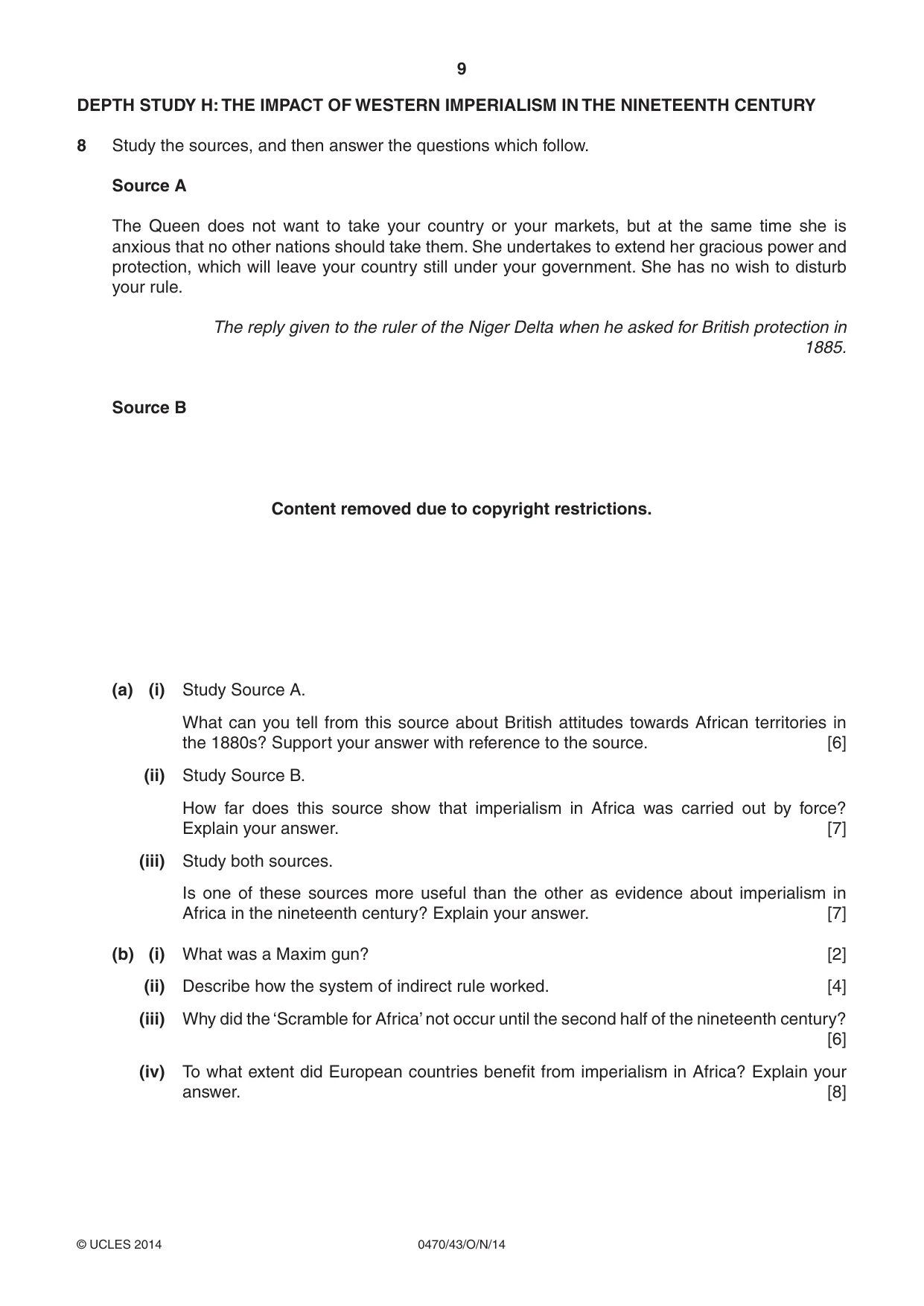


Mark scheme17 pages
Answers below. Sit the paper first if you are practising.
Paper as text
Question paper, page 1
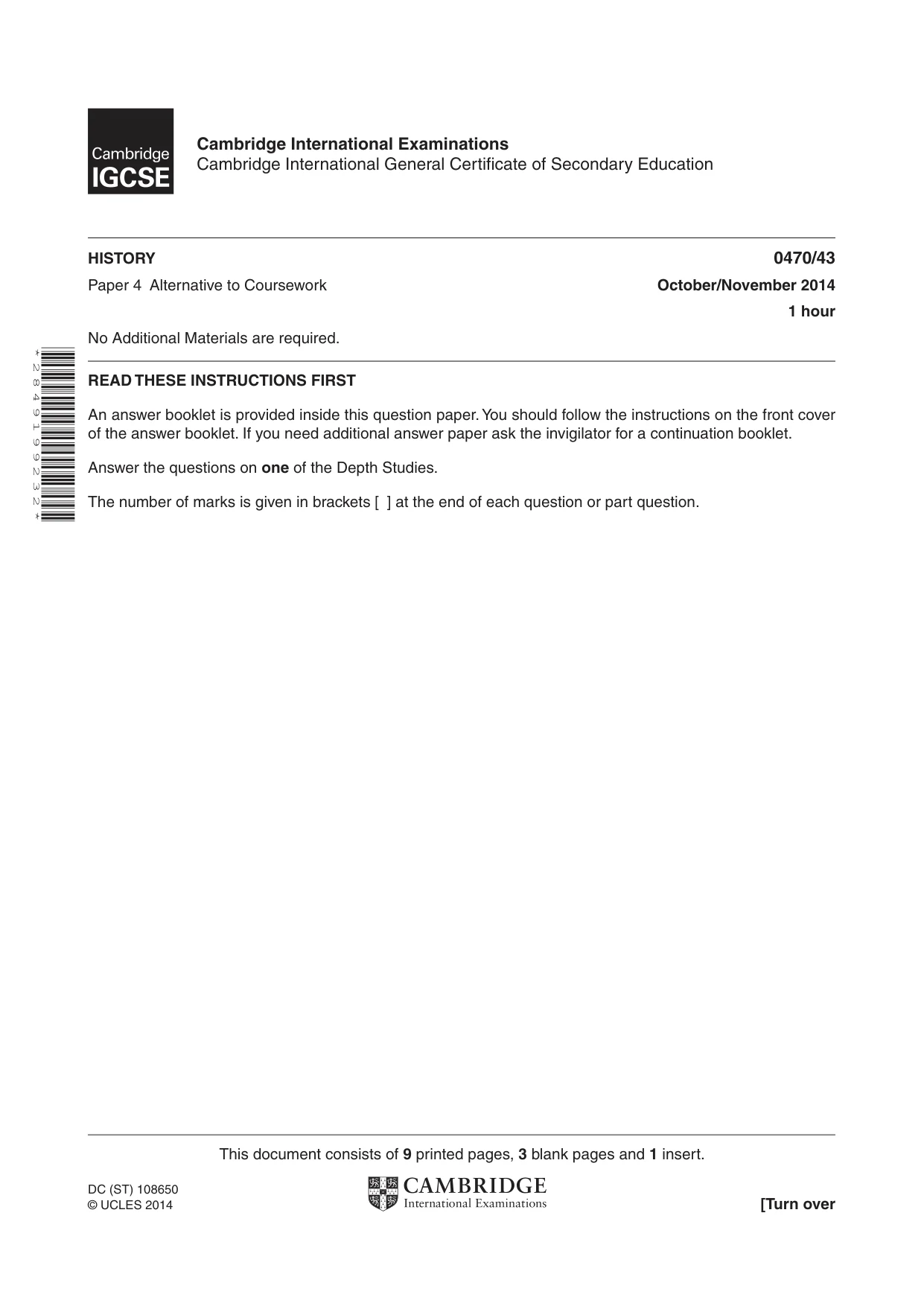
This document consists of 9 printed pages, 3 blank pages and 1 insert. DC (ST) 108650 © UCLES 2014 [Turn over Cambridge International Examinations Cambridge International General Certificate of Secondary Education * 2 8 4 9 1 9 9 2 3 2 * HISTORY 0470/43 Paper 4 Alternative to Coursework October/November 2014 1 hour No Additional Materials are required. READ THESE INSTRUCTIONS FIRST An answer booklet is provided inside this question paper. You should follow the instructions on the front cover of the answer booklet. If you need additional answer paper ask the invigilator for a continuation booklet. Answer the questions on one of the Depth Studies. The number of marks is given in brackets [ ] at the end of each question or part question.
Question paper, page 2
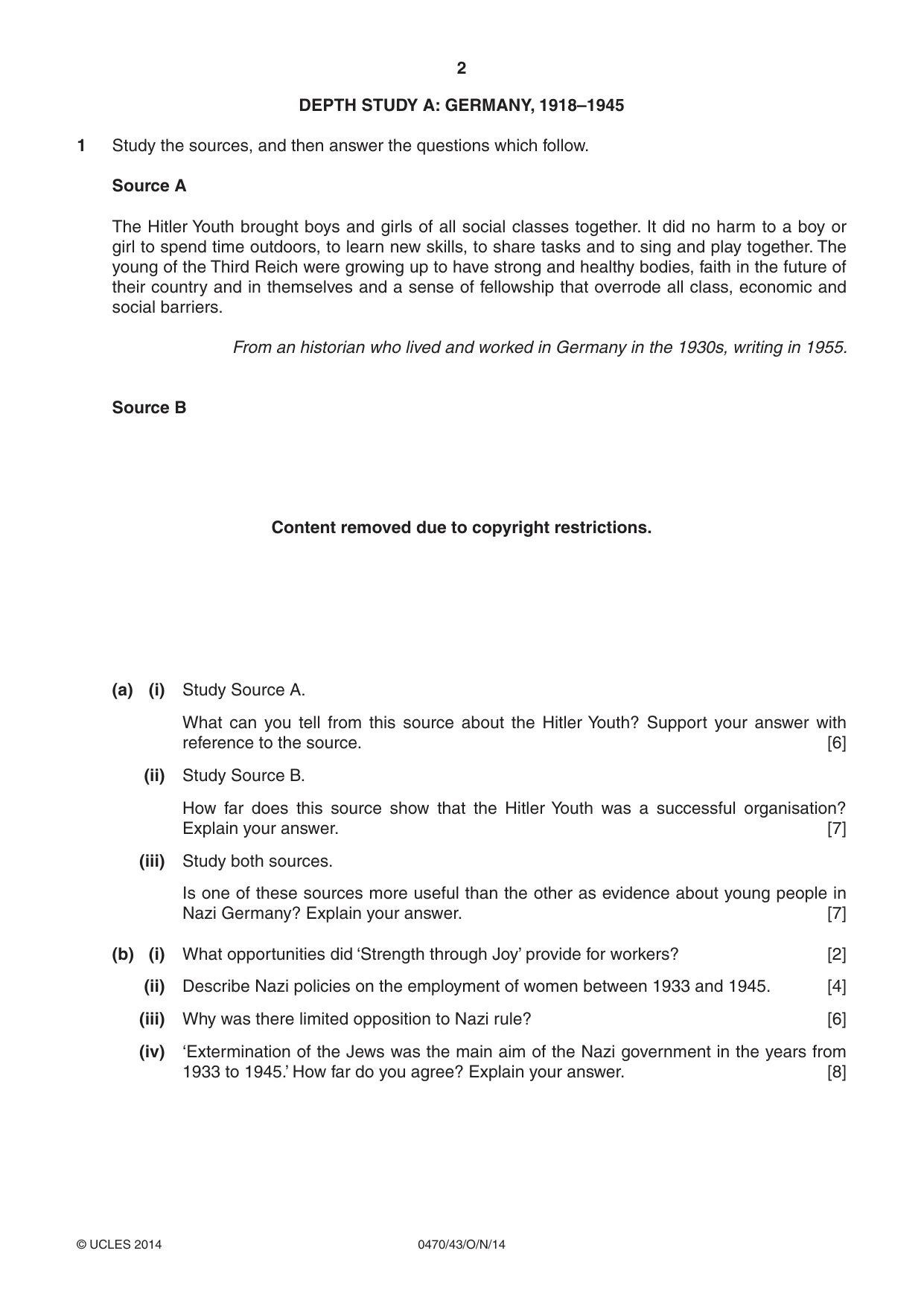
2 0470/43/O/N/14 © UCLES 2014 DEPTH STUDY A: GERMANY, 1918–1945 1 Study the sources, and then answer the questions which follow. Source A The Hitler Youth brought boys and girls of all social classes together. It did no harm to a boy or girl to spend time outdoors, to learn new skills, to share tasks and to sing and play together. The young of the Third Reich were growing up to have strong and healthy bodies, faith in the future of their country and in themselves and a sense of fellowship that overrode all class, economic and social barriers. From an historian who lived and worked in Germany in the 1930s, writing in 1955. Source B (a) (i) Study Source A. What can you tell from this source about the Hitler Youth? Support your answer with reference to the source. [6] (ii) Study Source B. How far does this source show that the Hitler Youth was a successful organisation? Explain your answer. [7] (iii) Study both sources. Is one of these sources more useful than the other as evidence about young people in Nazi Germany? Explain your answer. [7] (b) (i) What opportunities did ‘Strength through Joy’ provide for workers? [2] (ii) Describe Nazi policies on the employment of women between 1933 and 1945. [4] (iii) Why was there limited opposition to Nazi rule? [6] (iv) ‘Extermination of the Jews was the main aim of the Nazi government in the years from 1933 to 1945.’ How far do you agree? Explain your answer. [8] Content removed due to copyright restrictions.
Question paper, page 3
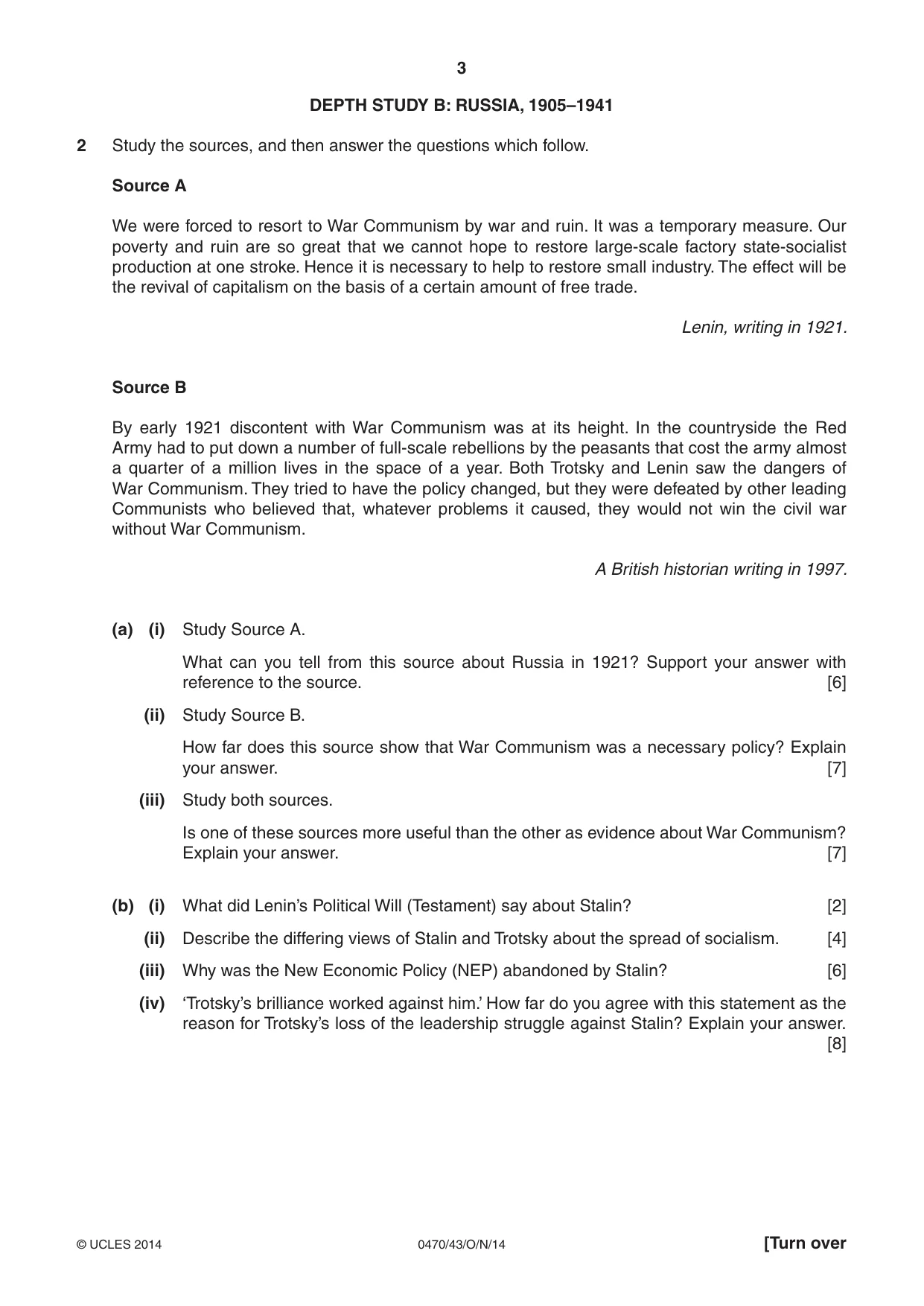
3 0470/43/O/N/14 © UCLES 2014 [Turn over DEPTH STUDY B: RUSSIA, 1905–1941 2 Study the sources, and then answer the questions which follow. Source A We were forced to resort to War Communism by war and ruin. It was a temporary measure. Our poverty and ruin are so great that we cannot hope to restore large-scale factory state-socialist production at one stroke. Hence it is necessary to help to restore small industry. The effect will be the revival of capitalism on the basis of a certain amount of free trade. Lenin, writing in 1921. Source B By early 1921 discontent with War Communism was at its height. In the countryside the Red Army had to put down a number of full-scale rebellions by the peasants that cost the army almost a quarter of a million lives in the space of a year. Both Trotsky and Lenin saw the dangers of War Communism. They tried to have the policy changed, but they were defeated by other leading Communists who believed that, whatever problems it caused, they would not win the civil war without War Communism. A British historian writing in 1997. (a) (i) Study Source A. What can you tell from this source about Russia in 1921? Support your answer with reference to the source. [6] (ii) Study Source B. How far does this source show that War Communism was a necessary policy? Explain your answer. [7] (iii) Study both sources. Is one of these sources more useful than the other as evidence about War Communism? Explain your answer. [7] (b) (i) What did Lenin’s Political Will (Testament) say about Stalin? [2] (ii) Describe the differing views of Stalin and Trotsky about the spread of socialism. [4] (iii) Why was the New Economic Policy (NEP) abandoned by Stalin? [6] (iv) ‘Trotsky’s brilliance worked against him.’ How far do you agree with this statement as the reason for Trotsky’s loss of the leadership struggle against Stalin? Explain your answer. [8]
Question paper, page 4
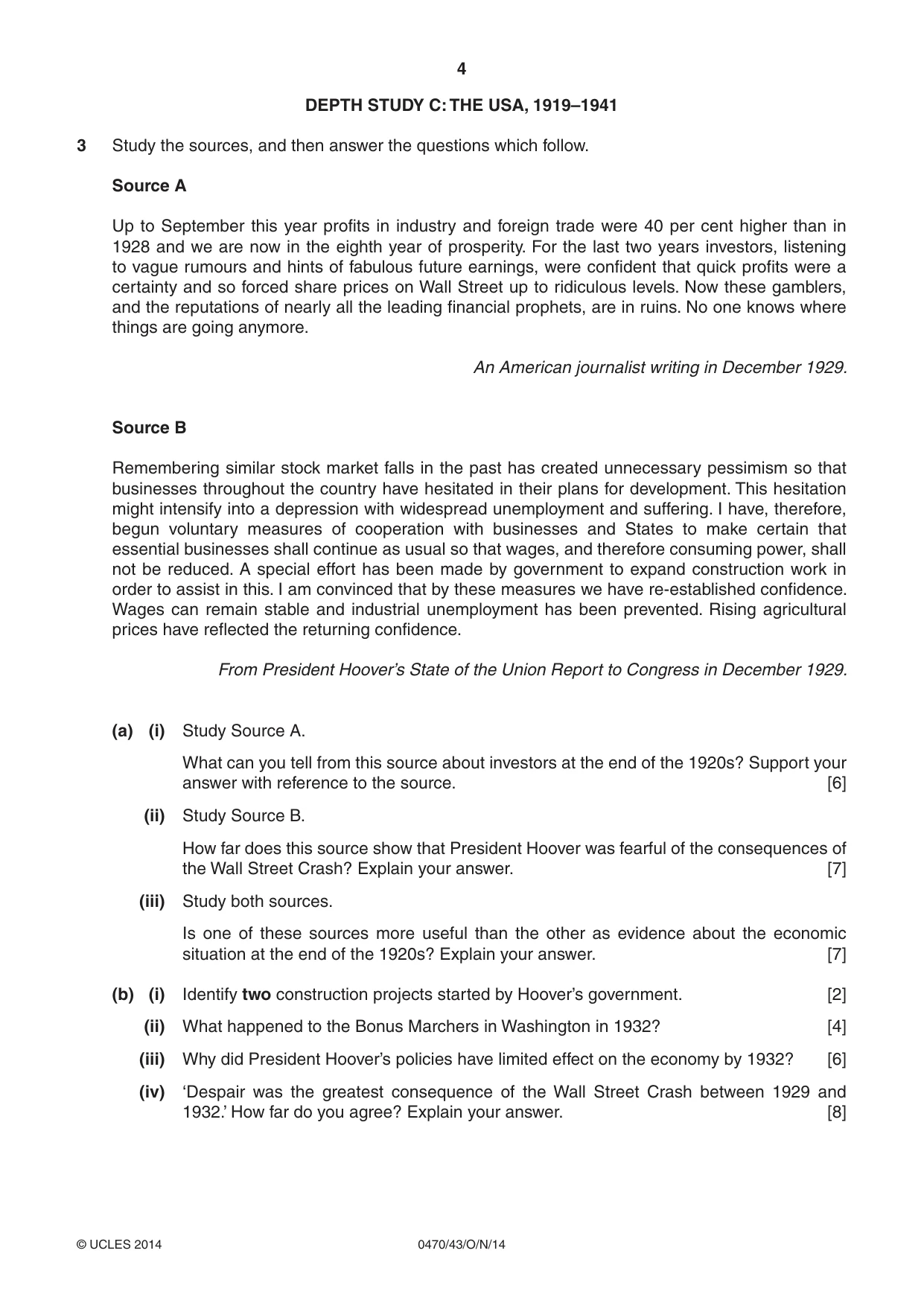
4 0470/43/O/N/14 © UCLES 2014 DEPTH STUDY C: THE USA, 1919–1941 3 Study the sources, and then answer the questions which follow. Source A Up to September this year profits in industry and foreign trade were 40 per cent higher than in 1928 and we are now in the eighth year of prosperity. For the last two years investors, listening to vague rumours and hints of fabulous future earnings, were confident that quick profits were a certainty and so forced share prices on Wall Street up to ridiculous levels. Now these gamblers, and the reputations of nearly all the leading financial prophets, are in ruins. No one knows where things are going anymore. An American journalist writing in December 1929. Source B Remembering similar stock market falls in the past has created unnecessary pessimism so that businesses throughout the country have hesitated in their plans for development. This hesitation might intensify into a depression with widespread unemployment and suffering. I have, therefore, begun voluntary measures of cooperation with businesses and States to make certain that essential businesses shall continue as usual so that wages, and therefore consuming power, shall not be reduced. A special effort has been made by government to expand construction work in order to assist in this. I am convinced that by these measures we have re-established confidence. Wages can remain stable and industrial unemployment has been prevented. Rising agricultural prices have reflected the returning confidence. From President Hoover’s State of the Union Report to Congress in December 1929. (a) (i) Study Source A. What can you tell from this source about investors at the end of the 1920s? Support your answer with reference to the source. [6] (ii) Study Source B. How far does this source show that President Hoover was fearful of the consequences of the Wall Street Crash? Explain your answer. [7] (iii) Study both sources. Is one of these sources more useful than the other as evidence about the economic situation at the end of the 1920s? Explain your answer. [7] (b) (i) Identify two construction projects started by Hoover’s government. [2] (ii) What happened to the Bonus Marchers in Washington in 1932? [4] (iii) Why did President Hoover’s policies have limited effect on the economy by 1932? [6] (iv) ‘Despair was the greatest consequence of the Wall Street Crash between 1929 and 1932.’ How far do you agree? Explain your answer. [8]
Question paper, page 5
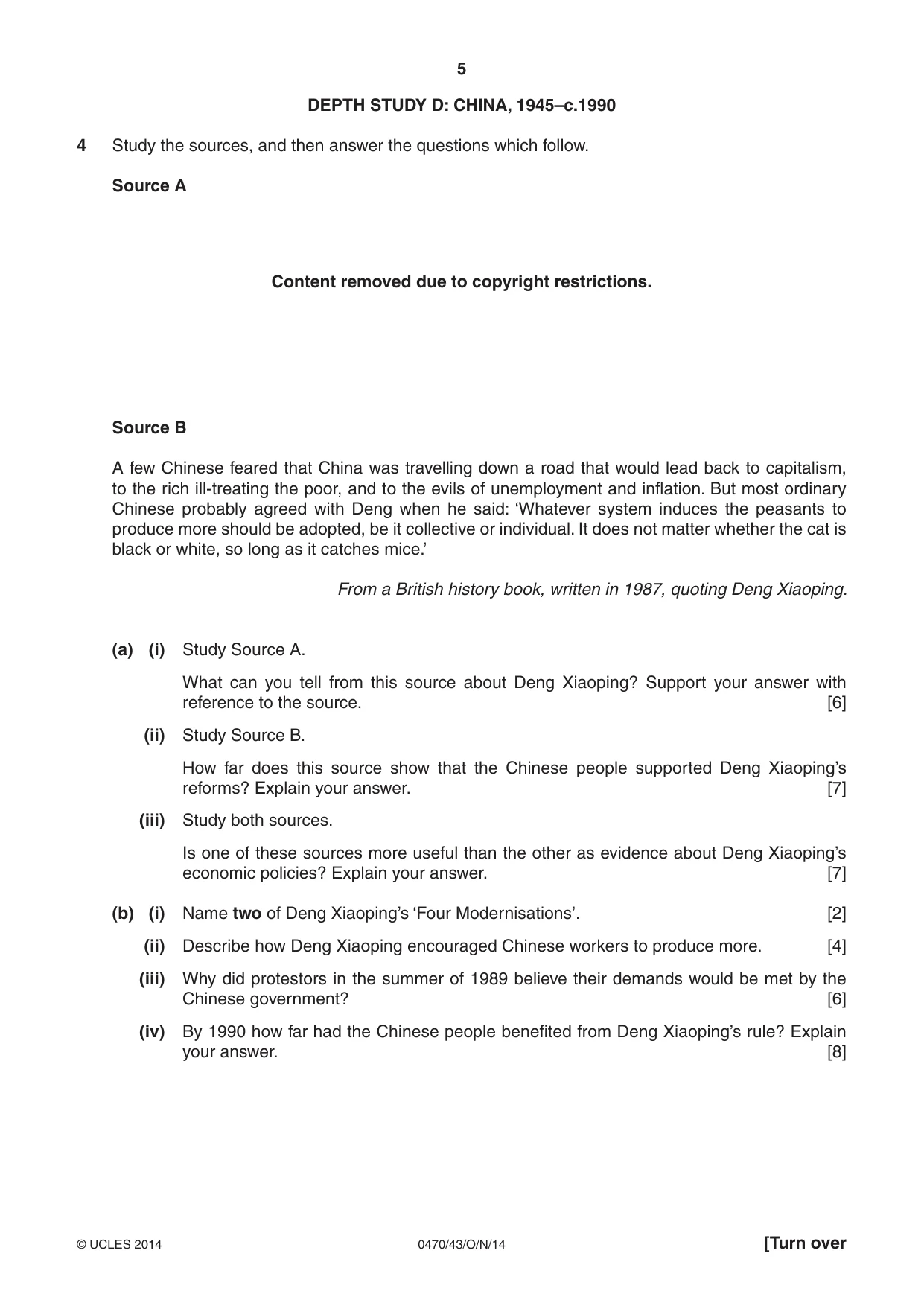
5 0470/43/O/N/14 © UCLES 2014 [Turn over DEPTH STUDY D: CHINA, 1945–c.1990 4 Study the sources, and then answer the questions which follow. Source A Source B A few Chinese feared that China was travelling down a road that would lead back to capitalism, to the rich ill-treating the poor, and to the evils of unemployment and inflation. But most ordinary Chinese probably agreed with Deng when he said: ‘Whatever system induces the peasants to produce more should be adopted, be it collective or individual. It does not matter whether the cat is black or white, so long as it catches mice.’ From a British history book, written in 1987, quoting Deng Xiaoping. (a) (i) Study Source A. What can you tell from this source about Deng Xiaoping? Support your answer with reference to the source. [6] (ii) Study Source B. How far does this source show that the Chinese people supported Deng Xiaoping’s reforms? Explain your answer. [7] (iii) Study both sources. Is one of these sources more useful than the other as evidence about Deng Xiaoping’s economic policies? Explain your answer. [7] (b) (i) Name two of Deng Xiaoping’s ‘Four Modernisations’. [2] (ii) Describe how Deng Xiaoping encouraged Chinese workers to produce more. [4] (iii) Why did protestors in the summer of 1989 believe their demands would be met by the Chinese government? [6] (iv) By 1990 how far had the Chinese people benefited from Deng Xiaoping’s rule? Explain your answer. [8] Content removed due to copyright restrictions.
Question paper, page 6
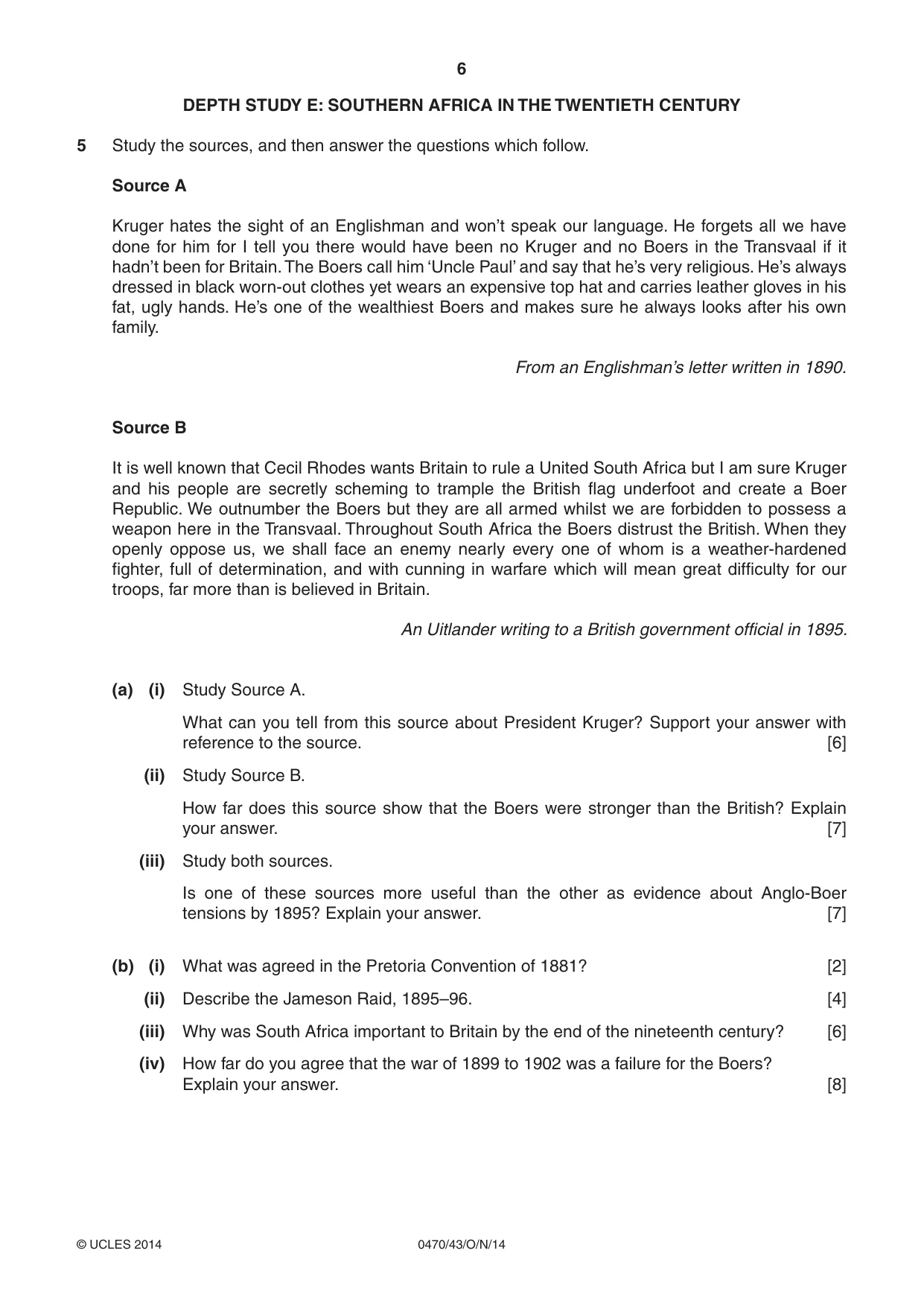
6 0470/43/O/N/14 © UCLES 2014 DEPTH STUDY E: SOUTHERN AFRICA IN THE TWENTIETH CENTURY 5 Study the sources, and then answer the questions which follow. Source A Kruger hates the sight of an Englishman and won’t speak our language. He forgets all we have done for him for I tell you there would have been no Kruger and no Boers in the Transvaal if it hadn’t been for Britain. The Boers call him ‘Uncle Paul’ and say that he’s very religious. He’s always dressed in black worn-out clothes yet wears an expensive top hat and carries leather gloves in his fat, ugly hands. He’s one of the wealthiest Boers and makes sure he always looks after his own family. From an Englishman’s letter written in 1890. Source B It is well known that Cecil Rhodes wants Britain to rule a United South Africa but I am sure Kruger and his people are secretly scheming to trample the British flag underfoot and create a Boer Republic. We outnumber the Boers but they are all armed whilst we are forbidden to possess a weapon here in the Transvaal. Throughout South Africa the Boers distrust the British. When they openly oppose us, we shall face an enemy nearly every one of whom is a weather-hardened fighter, full of determination, and with cunning in warfare which will mean great difficulty for our troops, far more than is believed in Britain. An Uitlander writing to a British government official in 1895. (a) (i) Study Source A. What can you tell from this source about President Kruger? Support your answer with reference to the source. [6] (ii) Study Source B. How far does this source show that the Boers were stronger than the British? Explain your answer. [7] (iii) Study both sources. Is one of these sources more useful than the other as evidence about Anglo-Boer tensions by 1895? Explain your answer. [7] (b) (i) What was agreed in the Pretoria Convention of 1881? [2] (ii) Describe the Jameson Raid, 1895–96. [4] (iii) Why was South Africa important to Britain by the end of the nineteenth century? [6] (iv) How far do you agree that the war of 1899 to 1902 was a failure for the Boers? Explain your answer. [8]
Question paper, page 7
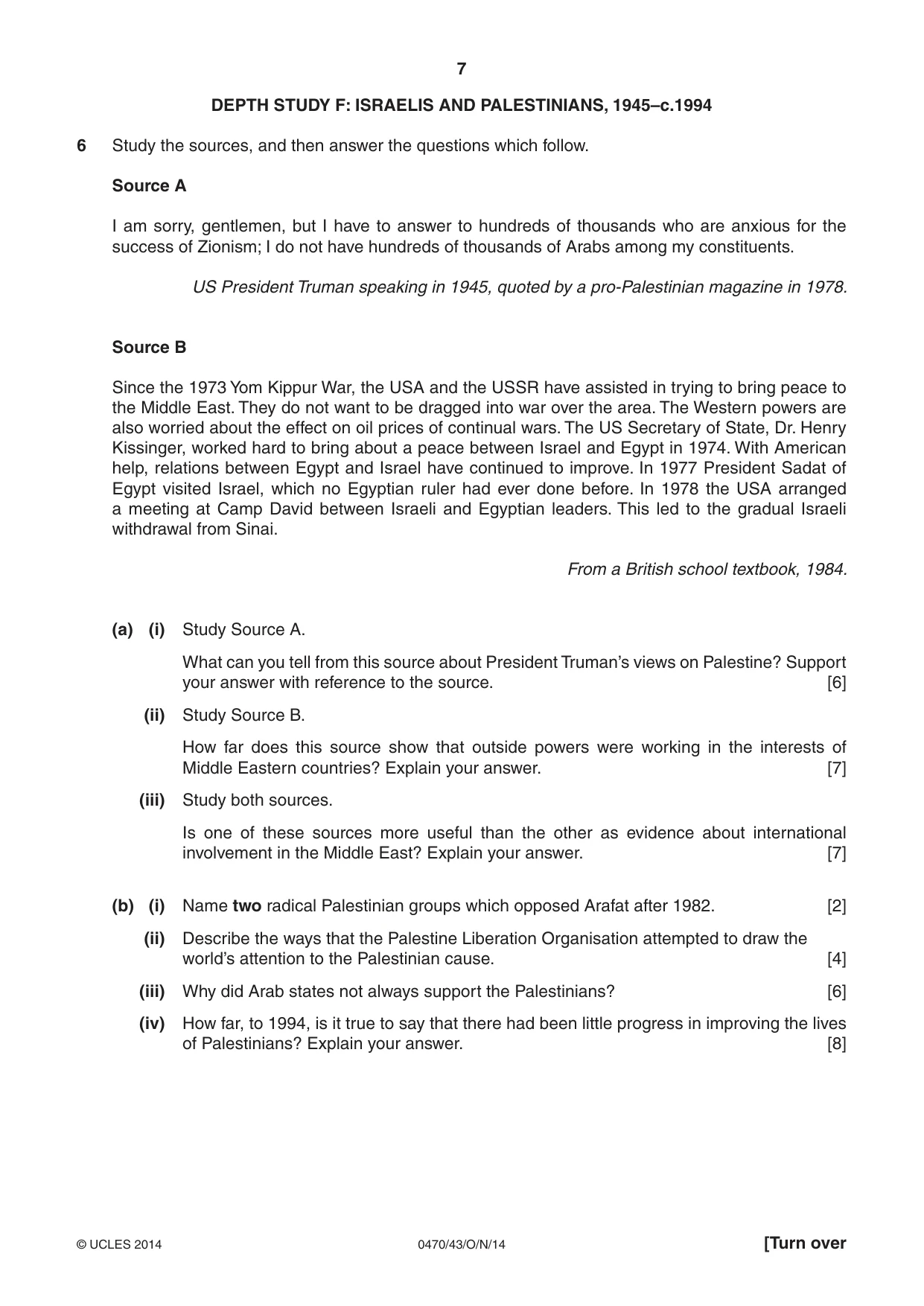
7 0470/43/O/N/14 © UCLES 2014 [Turn over DEPTH STUDY F: ISRAELIS AND PALESTINIANS, 1945–c.1994 6 Study the sources, and then answer the questions which follow. Source A I am sorry, gentlemen, but I have to answer to hundreds of thousands who are anxious for the success of Zionism; I do not have hundreds of thousands of Arabs among my constituents. US President Truman speaking in 1945, quoted by a pro-Palestinian magazine in 1978. Source B Since the 1973 Yom Kippur War, the USA and the USSR have assisted in trying to bring peace to the Middle East. They do not want to be dragged into war over the area. The Western powers are also worried about the effect on oil prices of continual wars. The US Secretary of State, Dr. Henry Kissinger, worked hard to bring about a peace between Israel and Egypt in 1974. With American help, relations between Egypt and Israel have continued to improve. In 1977 President Sadat of Egypt visited Israel, which no Egyptian ruler had ever done before. In 1978 the USA arranged a meeting at Camp David between Israeli and Egyptian leaders. This led to the gradual Israeli withdrawal from Sinai. From a British school textbook, 1984. (a) (i) Study Source A. What can you tell from this source about President Truman’s views on Palestine? Support your answer with reference to the source. [6] (ii) Study Source B. How far does this source show that outside powers were working in the interests of Middle Eastern countries? Explain your answer. [7] (iii) Study both sources. Is one of these sources more useful than the other as evidence about international involvement in the Middle East? Explain your answer. [7] (b) (i) Name two radical Palestinian groups which opposed Arafat after 1982. [2] (ii) Describe the ways that the Palestine Liberation Organisation attempted to draw the world’s attention to the Palestinian cause. [4] (iii) Why did Arab states not always support the Palestinians? [6] (iv) How far, to 1994, is it true to say that there had been little progress in improving the lives of Palestinians? Explain your answer. [8]
Question paper, page 8
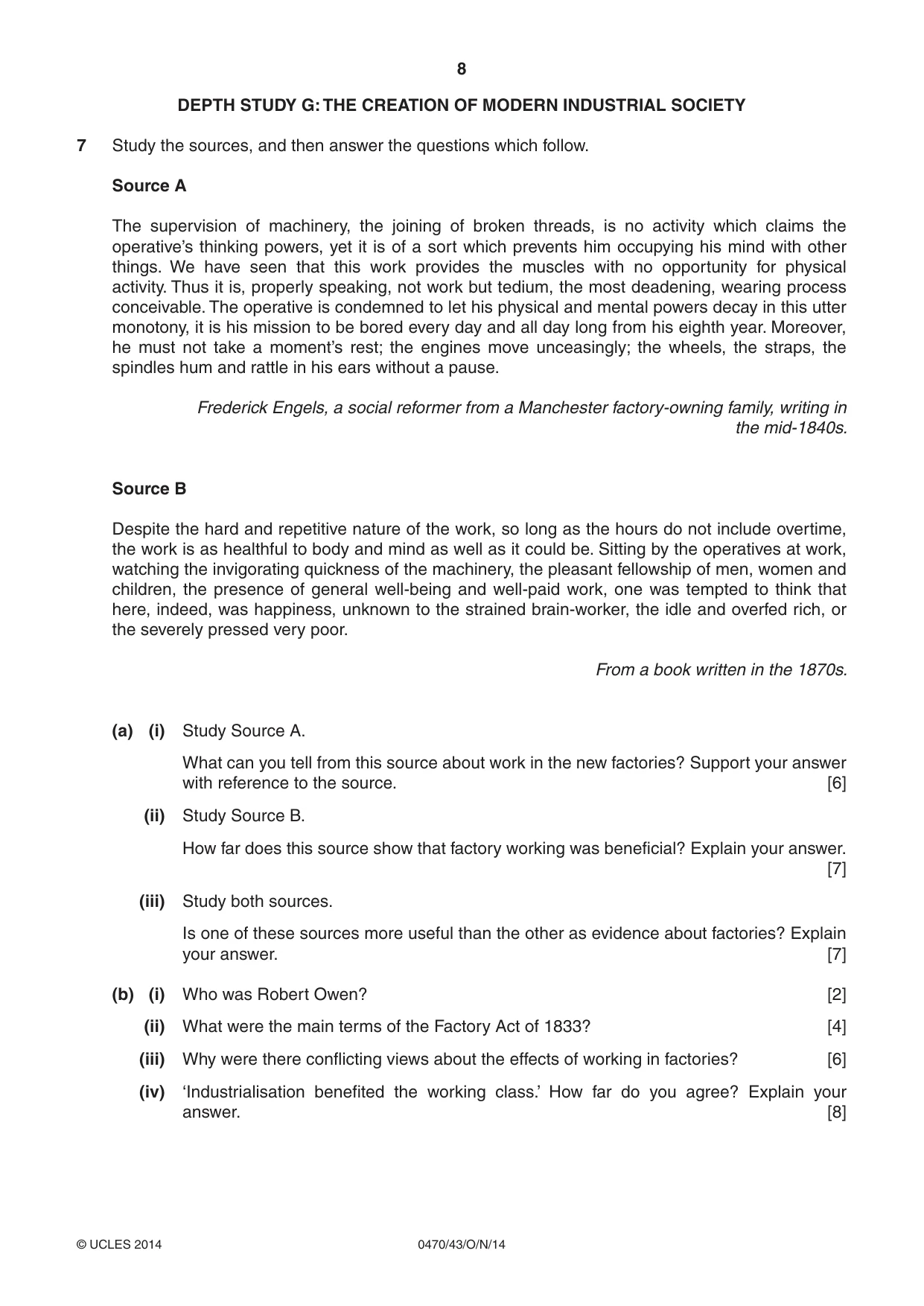
8 0470/43/O/N/14 © UCLES 2014 DEPTH STUDY G: THE CREATION OF MODERN INDUSTRIAL SOCIETY 7 Study the sources, and then answer the questions which follow. Source A The supervision of machinery, the joining of broken threads, is no activity which claims the operative’s thinking powers, yet it is of a sort which prevents him occupying his mind with other things. We have seen that this work provides the muscles with no opportunity for physical activity. Thus it is, properly speaking, not work but tedium, the most deadening, wearing process conceivable. The operative is condemned to let his physical and mental powers decay in this utter monotony, it is his mission to be bored every day and all day long from his eighth year. Moreover, he must not take a moment’s rest; the engines move unceasingly; the wheels, the straps, the spindles hum and rattle in his ears without a pause. Frederick Engels, a social reformer from a Manchester factory-owning family, writing in the mid-1840s. Source B Despite the hard and repetitive nature of the work, so long as the hours do not include overtime, the work is as healthful to body and mind as well as it could be. Sitting by the operatives at work, watching the invigorating quickness of the machinery, the pleasant fellowship of men, women and children, the presence of general well-being and well-paid work, one was tempted to think that here, indeed, was happiness, unknown to the strained brain-worker, the idle and overfed rich, or the severely pressed very poor. From a book written in the 1870s. (a) (i) Study Source A. What can you tell from this source about work in the new factories? Support your answer with reference to the source. [6] (ii) Study Source B. How far does this source show that factory working was beneficial? Explain your answer. [7] (iii) Study both sources. Is one of these sources more useful than the other as evidence about factories? Explain your answer. [7] (b) (i) Who was Robert Owen? [2] (ii) What were the main terms of the Factory Act of 1833? [4] (iii) Why were there conflicting views about the effects of working in factories? [6] (iv) ‘Industrialisation benefited the working class.’ How far do you agree? Explain your answer. [8]
Question paper, page 9
9 0470/43/O/N/14 © UCLES 2014 DEPTH STUDY H: THE IMPACT OF WESTERN IMPERIALISM IN THE NINETEENTH CENTURY 8 Study the sources, and then answer the questions which follow. Source A The Queen does not want to take your country or your markets, but at the same time she is anxious that no other nations should take them. She undertakes to extend her gracious power and protection, which will leave your country still under your government. She has no wish to disturb your rule. The reply given to the ruler of the Niger Delta when he asked for British protection in 1885. Source B (a) (i) Study Source A. What can you tell from this source about British attitudes towards African territories in the 1880s? Support your answer with reference to the source. [6] (ii) Study Source B. How far does this source show that imperialism in Africa was carried out by force? Explain your answer. [7] (iii) Study both sources. Is one of these sources more useful than the other as evidence about imperialism in Africa in the nineteenth century? Explain your answer. [7] (b) (i) What was a Maxim gun? [2] (ii) Describe how the system of indirect rule worked. [4] (iii) Why did the ‘Scramble for Africa’ not occur until the second half of the nineteenth century? [6] (iv) To what extent did European countries benefit from imperialism in Africa? Explain your answer. [8] Content removed due to copyright restrictions.
Question paper, page 10
10 0470/43/O/N/14 © UCLES 2014 BLANK PAGE
Question paper, page 11
11 0470/43/O/N/14 © UCLES 2014 BLANK PAGE
Question paper, page 12
12 0470/43/O/N/14 © UCLES 2014 BLANK PAGE Copyright Acknowledgements: Depth Study A Source A © William Schirer; The Rise & Fall of the Third Reich; Book Club Associates; 1970. Depth Study A Source B © Richard J. Evans; The Third Reich in Power; Penguin Books Ltd; 2005. Depth Study B Source A © Lenin; 1921. Depth Study B Source B © Philip Ingram; Russia and the USSR 1905–1991; Cambridge University Press; 1997. Depth Study C Source A © Stuart Chase; Article in the Nation; 1929; http://memory.loc.gov/cgi-in/query/e?ammem/cool:@field(DOCID+@lit(lg493)). Depth Study C Source B © President Hoover’s State of the Union Report to Congress; December 1929. Depth Study D Source A © Will Hutton; The Writing on the Wall; Little, Brown Book Group; 2007. Depth Study D Source B © Bryn O’Callaghan; A History of the Twentieth Century; Longman; 1987. Depth Study E Source A © An Englishman’s letter; 1890. Depth Study E Source B © An Uitlander writing to a British government official; 1895. Depth Study F Source A © Speech by US President Truman; 1945. Depth Study F Source B © Christopher Culpin; Making History; Collins Educational; 1984. Depth Study G Source A © Frederick Engels, writing in the mid-1840s. Depth Study G Source B © Beatrice Webb; My Apprenticeship. Depth Study H Source A © Reply given to the ruler of the Niger Delta when he asked for British protection in 1885. Depth Study H Source B © The Economist; 1999; www.economist.com/node/347120. Permission to reproduce items where third-party owned material protected by copyright is included has been sought and cleared where possible. Every reasonable effort has been made by the publisher (UCLES) to trace copyright holders, but if any items requiring clearance have unwittingly been included, the publisher will be pleased to make amends at the earliest possible opportunity. Cambridge International Examinations is part of the Cambridge Assessment Group. Cambridge Assessment is the brand name of University of Cambridge Local Examinations Syndicate (UCLES), which is itself a department of the University of Cambridge.
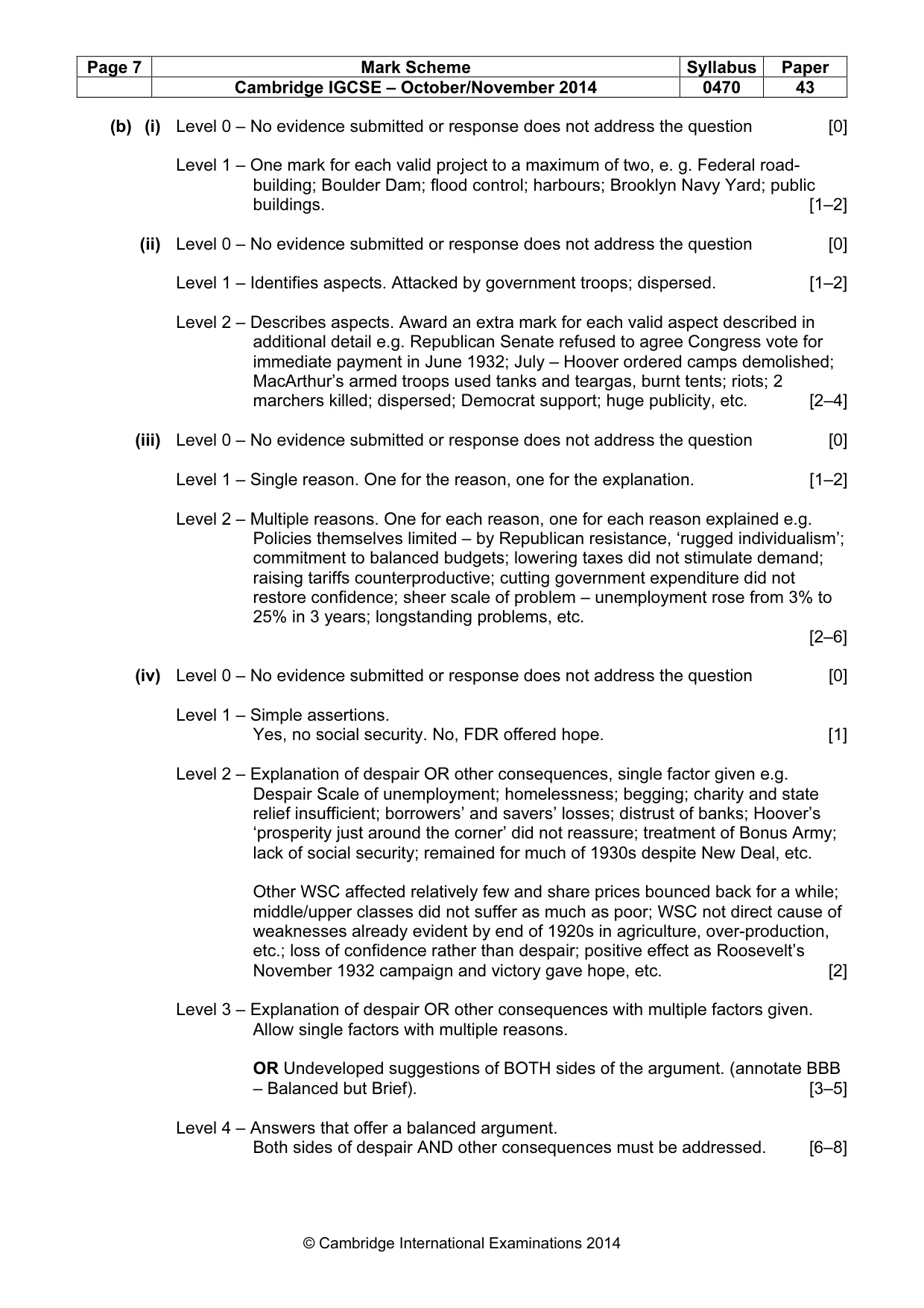
Mark scheme, page 1
® IGCSE is the registered trademark of Cambridge International Examinations. CAMBRIDGE INTERNATIONAL EXAMINATIONS Cambridge International General Certificate of Secondary Education MARK SCHEME for the October/November 2014 series 0470 HISTORY 0470/43 Paper 4 (Alternative to coursework), maximum raw mark 40 This mark scheme is published as an aid to teachers and candidates, to indicate the requirements of the examination. It shows the basis on which Examiners were instructed to award marks. It does not indicate the details of the discussions that took place at an Examiners’ meeting before marking began, which would have considered the acceptability of alternative answers. Mark schemes should be read in conjunction with the question paper and the Principal Examiner Report for Teachers. Cambridge will not enter into discussions about these mark schemes. Cambridge is publishing the mark schemes for the October/November 2014 series for most Cambridge IGCSE®, Cambridge International A and AS Level components and some Cambridge O Level components.
Mark scheme, page 2
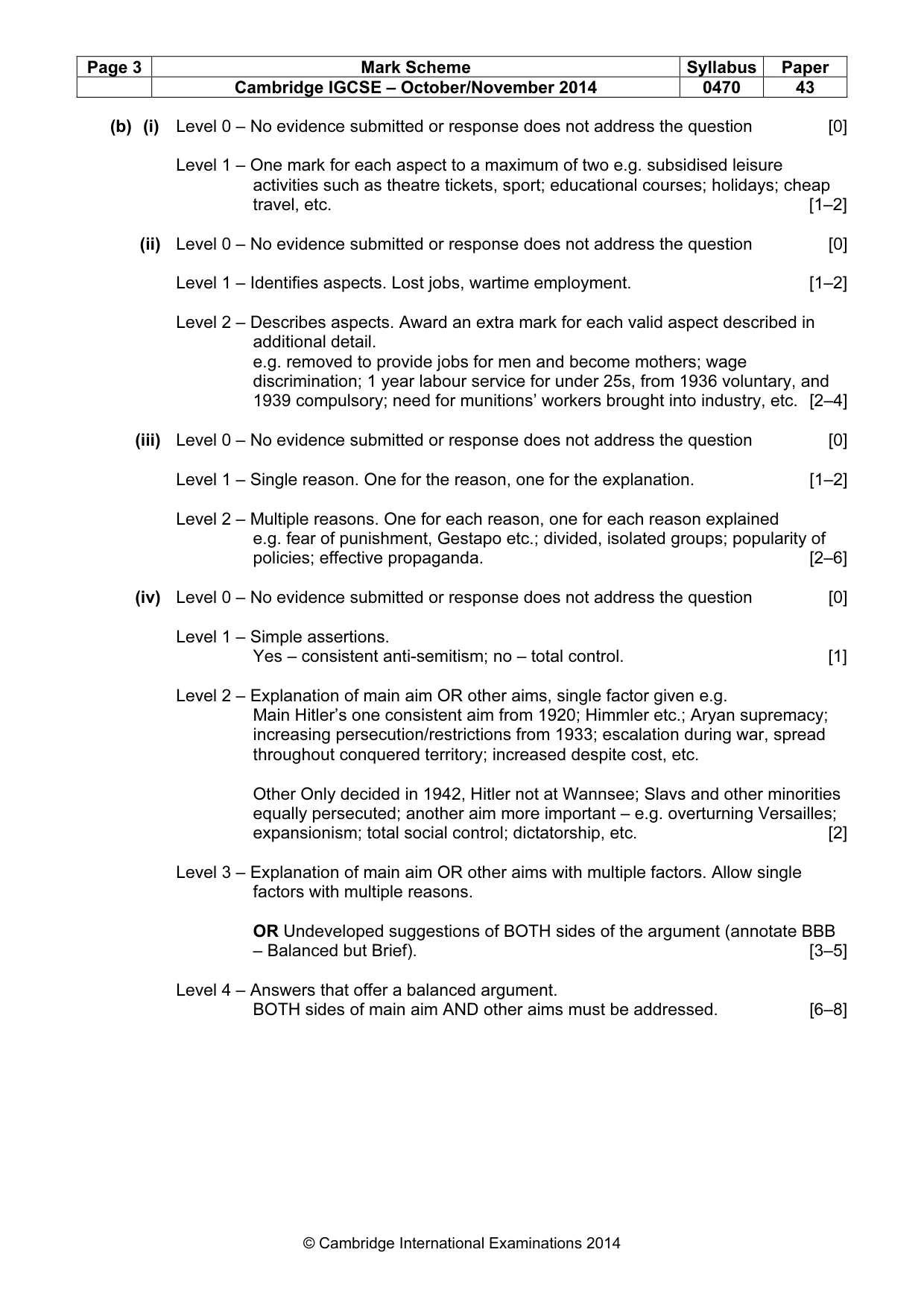
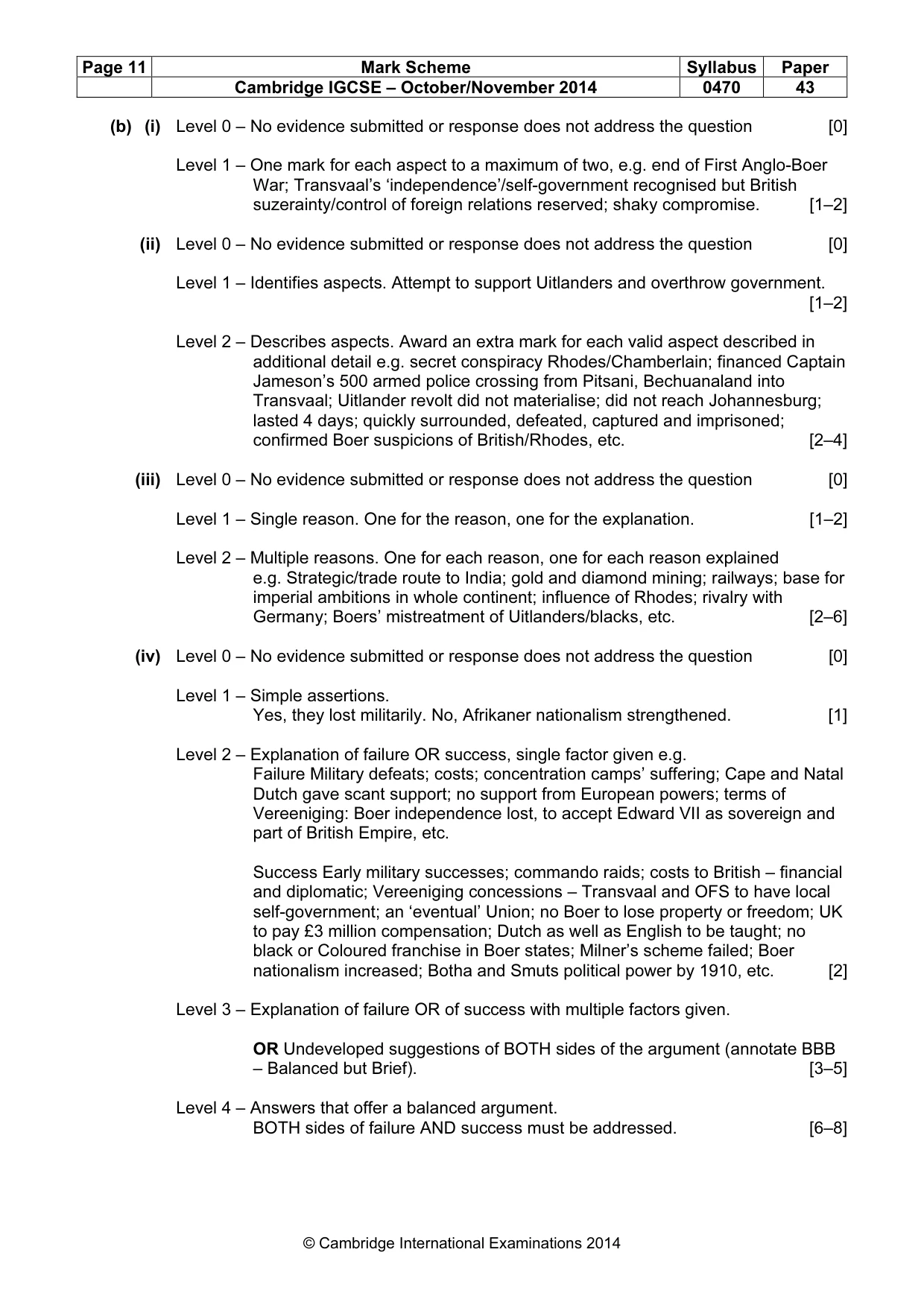
Page 2 Mark Scheme Syllabus Paper Cambridge IGCSE – October/November 2014 0470 43 © Cambridge International Examinations 2014 Depth Study A: Germany 1918–1945 1 (a) (i) Level 0 – No evidence submitted or response does not address the question [0] Level 1 – Repeats material stated in the source, no inference made. [1–2] Level 2 – Makes valid inferences unsupported from the source e.g. egalitarian; beneficial; built patriotism and confidence. [3–4] Level 3 – Supports valid inferences with reference to the source e.g. ‘all social classes’; ‘new skills’, ‘strong and healthy’; ‘faith in the future’, etc. [5–6] (ii) Level 0 – No evidence submitted or response does not address the question [0] Level 1 – Agrees OR disagrees, unsupported from the source. [1–2] Level 2 – Agrees OR disagrees, supported from the source e.g. Yes Increased membership; means for military training and indoctrination; popular aspects; became compulsory. No Not full youth membership even when compulsory; indoctrination not total success; resentment of some as too demanding. [3–5] Level 3 – Agrees AND disagrees, supported from the source. Addresses the issue of ‘How far’. [6–7] (iii) Level 0 – No evidence submitted or response does not address the question [0] Level 1 – Useful/not useful – Choice made on the basis that one is more detailed/gives more information, but does not specify what information. [1] Level 2 – Useful/not useful – One is an eyewitness account and the other is British so they could both be biased/unreliable. [2] Level 3 – Choice made on the nature or amount of information given. Must specify what information. [3–5] Level 4 – Choice made on the grounds of reliability. Discussion of utility must be made on valid evaluation of source(s) in context. Include at this Level answers that cross reference between A and B to show reliability. 6 marks for one source, 7 marks for both. [6–7]
Mark scheme, page 3
Page 3 Mark Scheme Syllabus Paper Cambridge IGCSE – October/November 2014 0470 43 © Cambridge International Examinations 2014 (b) (i) Level 0 – No evidence submitted or response does not address the question [0] Level 1 – One mark for each aspect to a maximum of two e.g. subsidised leisure activities such as theatre tickets, sport; educational courses; holidays; cheap travel, etc. [1–2] (ii) Level 0 – No evidence submitted or response does not address the question [0] Level 1 – Identifies aspects. Lost jobs, wartime employment. [1–2] Level 2 – Describes aspects. Award an extra mark for each valid aspect described in additional detail. e.g. removed to provide jobs for men and become mothers; wage discrimination; 1 year labour service for under 25s, from 1936 voluntary, and 1939 compulsory; need for munitions’ workers brought into industry, etc. [2–4] (iii) Level 0 – No evidence submitted or response does not address the question [0] Level 1 – Single reason. One for the reason, one for the explanation. [1–2] Level 2 – Multiple reasons. One for each reason, one for each reason explained e.g. fear of punishment, Gestapo etc.; divided, isolated groups; popularity of policies; effective propaganda. [2–6] (iv) Level 0 – No evidence submitted or response does not address the question [0] Level 1 – Simple assertions. Yes – consistent anti-semitism; no – total control. [1] Level 2 – Explanation of main aim OR other aims, single factor given e.g. Main Hitler’s one consistent aim from 1920; Himmler etc.; Aryan supremacy; increasing persecution/restrictions from 1933; escalation during war, spread throughout conquered territory; increased despite cost, etc. Other Only decided in 1942, Hitler not at Wannsee; Slavs and other minorities equally persecuted; another aim more important – e.g. overturning Versailles; expansionism; total social control; dictatorship, etc. [2] Level 3 – Explanation of main aim OR other aims with multiple factors. Allow single factors with multiple reasons. OR Undeveloped suggestions of BOTH sides of the argument (annotate BBB – Balanced but Brief). [3–5] Level 4 – Answers that offer a balanced argument. BOTH sides of main aim AND other aims must be addressed. [6–8]
Mark scheme, page 4
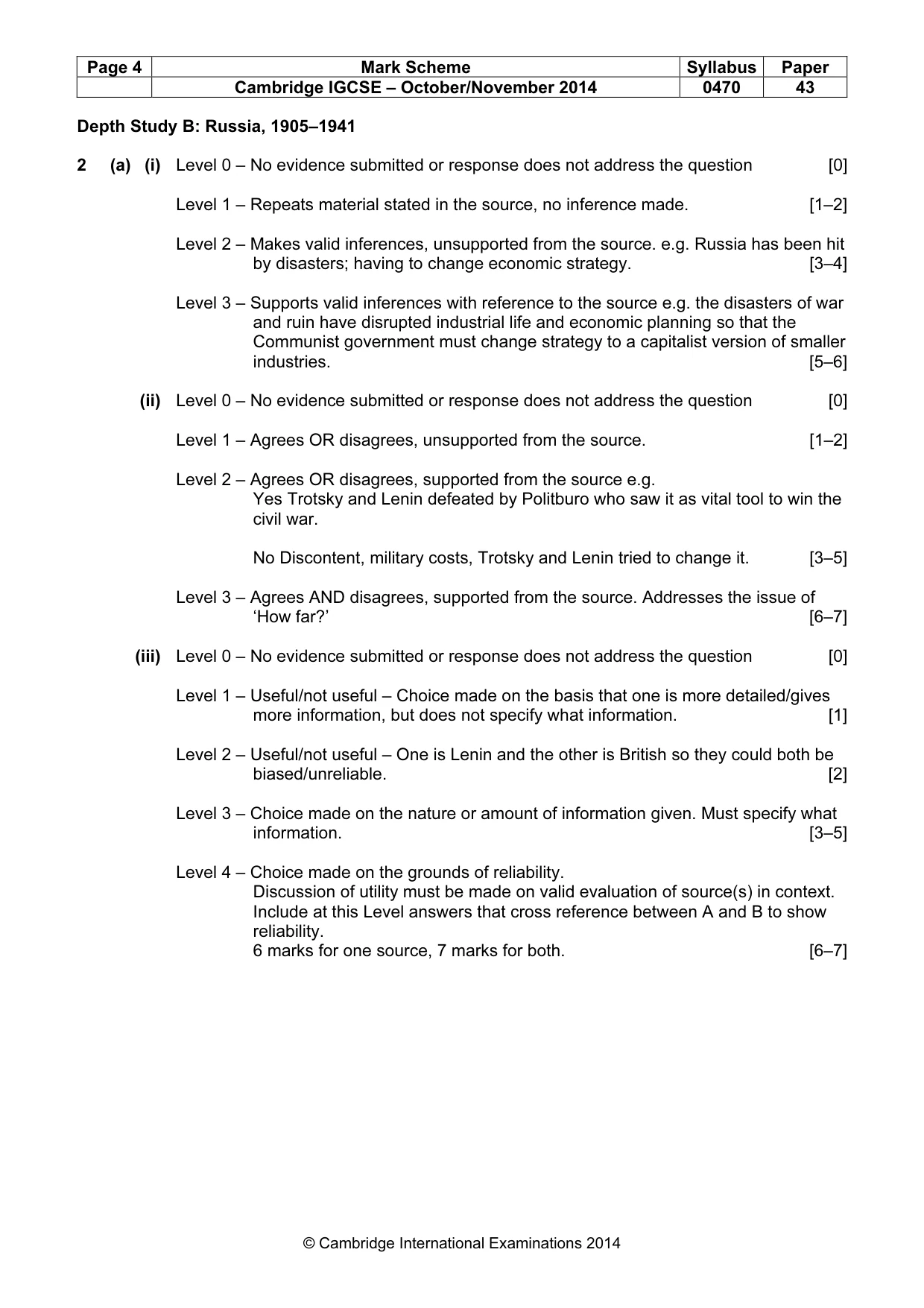
Page 4 Mark Scheme Syllabus Paper Cambridge IGCSE – October/November 2014 0470 43 © Cambridge International Examinations 2014 Depth Study B: Russia, 1905–1941 2 (a) (i) Level 0 – No evidence submitted or response does not address the question [0] Level 1 – Repeats material stated in the source, no inference made. [1–2] Level 2 – Makes valid inferences, unsupported from the source. e.g. Russia has been hit by disasters; having to change economic strategy. [3–4] Level 3 – Supports valid inferences with reference to the source e.g. the disasters of war and ruin have disrupted industrial life and economic planning so that the Communist government must change strategy to a capitalist version of smaller industries. [5–6] (ii) Level 0 – No evidence submitted or response does not address the question [0] Level 1 – Agrees OR disagrees, unsupported from the source. [1–2] Level 2 – Agrees OR disagrees, supported from the source e.g. Yes Trotsky and Lenin defeated by Politburo who saw it as vital tool to win the civil war. No Discontent, military costs, Trotsky and Lenin tried to change it. [3–5] Level 3 – Agrees AND disagrees, supported from the source. Addresses the issue of ‘How far?’ [6–7] (iii) Level 0 – No evidence submitted or response does not address the question [0] Level 1 – Useful/not useful – Choice made on the basis that one is more detailed/gives more information, but does not specify what information. [1] Level 2 – Useful/not useful – One is Lenin and the other is British so they could both be biased/unreliable. [2] Level 3 – Choice made on the nature or amount of information given. Must specify what information. [3–5] Level 4 – Choice made on the grounds of reliability. Discussion of utility must be made on valid evaluation of source(s) in context. Include at this Level answers that cross reference between A and B to show reliability. 6 marks for one source, 7 marks for both. [6–7]
Mark scheme, page 5
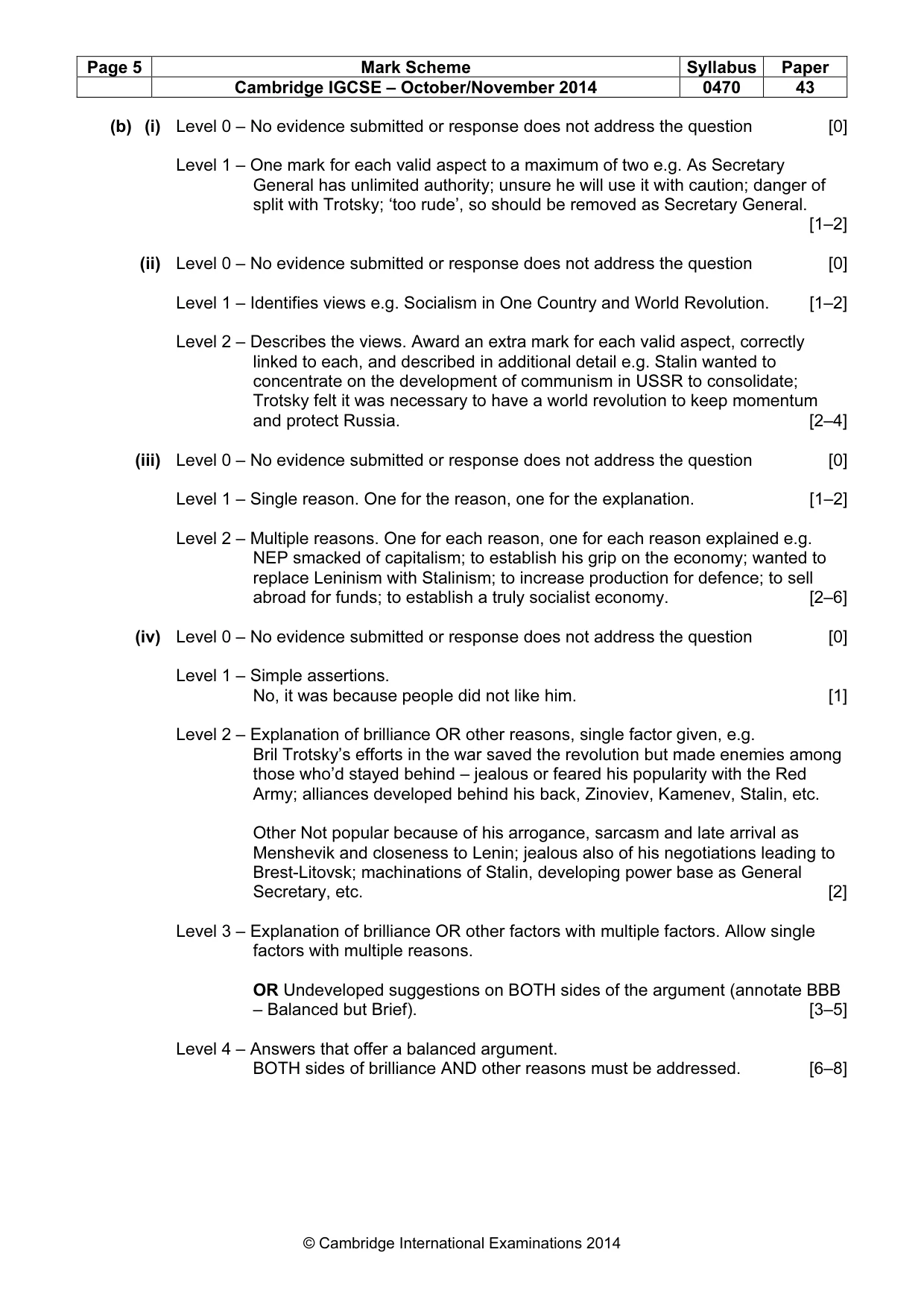
Page 5 Mark Scheme Syllabus Paper Cambridge IGCSE – October/November 2014 0470 43 © Cambridge International Examinations 2014 (b) (i) Level 0 – No evidence submitted or response does not address the question [0] Level 1 – One mark for each valid aspect to a maximum of two e.g. As Secretary General has unlimited authority; unsure he will use it with caution; danger of split with Trotsky; ‘too rude’, so should be removed as Secretary General. [1–2] (ii) Level 0 – No evidence submitted or response does not address the question [0] Level 1 – Identifies views e.g. Socialism in One Country and World Revolution. [1–2] Level 2 – Describes the views. Award an extra mark for each valid aspect, correctly linked to each, and described in additional detail e.g. Stalin wanted to concentrate on the development of communism in USSR to consolidate; Trotsky felt it was necessary to have a world revolution to keep momentum and protect Russia. [2–4] (iii) Level 0 – No evidence submitted or response does not address the question [0] Level 1 – Single reason. One for the reason, one for the explanation. [1–2] Level 2 – Multiple reasons. One for each reason, one for each reason explained e.g. NEP smacked of capitalism; to establish his grip on the economy; wanted to replace Leninism with Stalinism; to increase production for defence; to sell abroad for funds; to establish a truly socialist economy. [2–6] (iv) Level 0 – No evidence submitted or response does not address the question [0] Level 1 – Simple assertions. No, it was because people did not like him. [1] Level 2 – Explanation of brilliance OR other reasons, single factor given, e.g. Bril Trotsky’s efforts in the war saved the revolution but made enemies among those who’d stayed behind – jealous or feared his popularity with the Red Army; alliances developed behind his back, Zinoviev, Kamenev, Stalin, etc. Other Not popular because of his arrogance, sarcasm and late arrival as Menshevik and closeness to Lenin; jealous also of his negotiations leading to Brest-Litovsk; machinations of Stalin, developing power base as General Secretary, etc. [2] Level 3 – Explanation of brilliance OR other factors with multiple factors. Allow single factors with multiple reasons. OR Undeveloped suggestions on BOTH sides of the argument (annotate BBB – Balanced but Brief). [3–5] Level 4 – Answers that offer a balanced argument. BOTH sides of brilliance AND other reasons must be addressed. [6–8]
Mark scheme, page 6
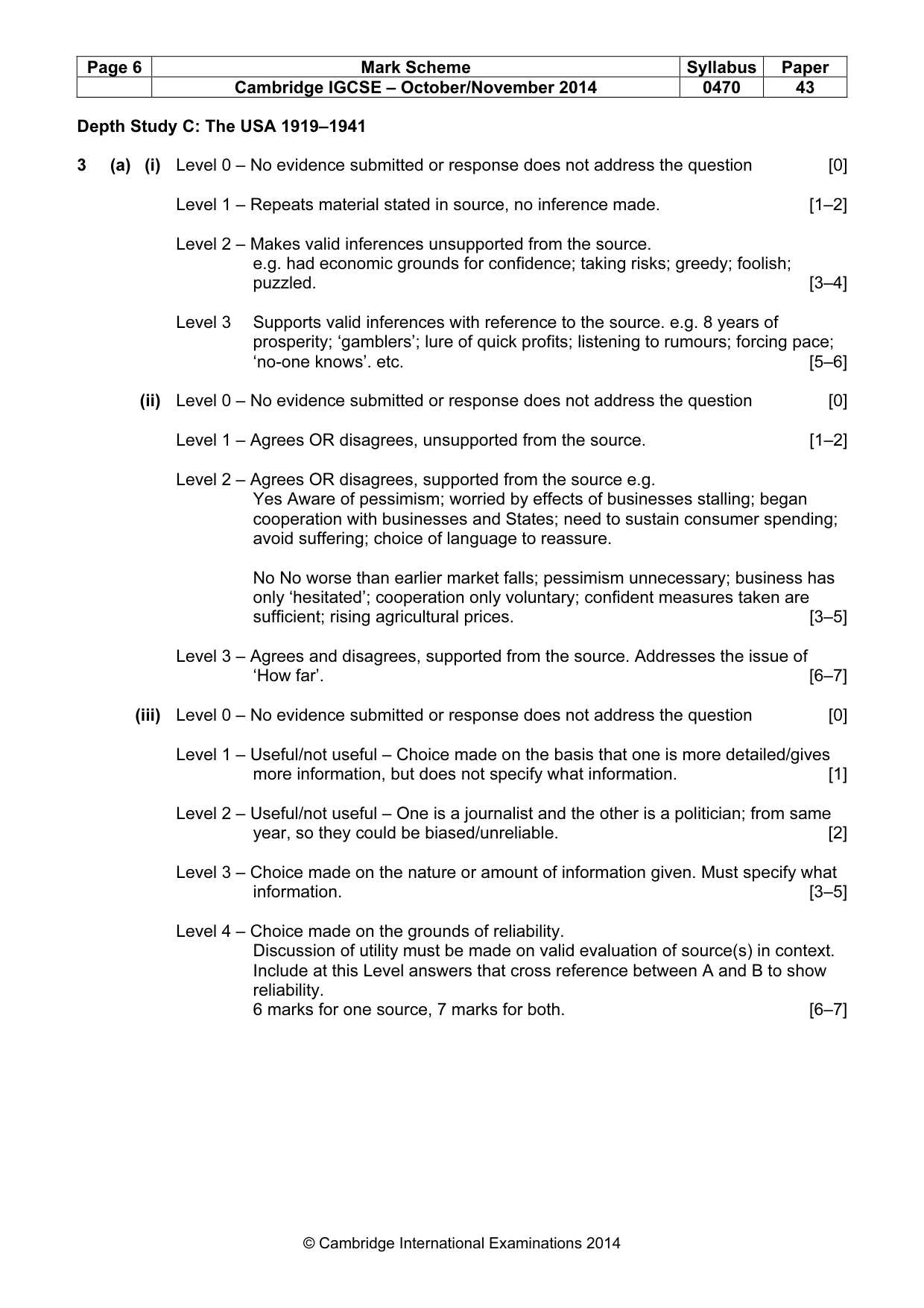
Page 6 Mark Scheme Syllabus Paper Cambridge IGCSE – October/November 2014 0470 43 © Cambridge International Examinations 2014 Depth Study C: The USA 1919–1941 3 (a) (i) Level 0 – No evidence submitted or response does not address the question [0] Level 1 – Repeats material stated in source, no inference made. [1–2] Level 2 – Makes valid inferences unsupported from the source. e.g. had economic grounds for confidence; taking risks; greedy; foolish; puzzled. [3–4] Level 3 Supports valid inferences with reference to the source. e.g. 8 years of prosperity; ‘gamblers’; lure of quick profits; listening to rumours; forcing pace; ‘no-one knows’. etc. [5–6] (ii) Level 0 – No evidence submitted or response does not address the question [0] Level 1 – Agrees OR disagrees, unsupported from the source. [1–2] Level 2 – Agrees OR disagrees, supported from the source e.g. Yes Aware of pessimism; worried by effects of businesses stalling; began cooperation with businesses and States; need to sustain consumer spending; avoid suffering; choice of language to reassure. No No worse than earlier market falls; pessimism unnecessary; business has only ‘hesitated’; cooperation only voluntary; confident measures taken are sufficient; rising agricultural prices. [3–5] Level 3 – Agrees and disagrees, supported from the source. Addresses the issue of ‘How far’. [6–7] (iii) Level 0 – No evidence submitted or response does not address the question [0] Level 1 – Useful/not useful – Choice made on the basis that one is more detailed/gives more information, but does not specify what information. [1] Level 2 – Useful/not useful – One is a journalist and the other is a politician; from same year, so they could be biased/unreliable. [2] Level 3 – Choice made on the nature or amount of information given. Must specify what information. [3–5] Level 4 – Choice made on the grounds of reliability. Discussion of utility must be made on valid evaluation of source(s) in context. Include at this Level answers that cross reference between A and B to show reliability. 6 marks for one source, 7 marks for both. [6–7]
Mark scheme, page 7
Page 7 Mark Scheme Syllabus Paper Cambridge IGCSE – October/November 2014 0470 43 © Cambridge International Examinations 2014 (b) (i) Level 0 – No evidence submitted or response does not address the question [0] Level 1 – One mark for each valid project to a maximum of two, e. g. Federal road- building; Boulder Dam; flood control; harbours; Brooklyn Navy Yard; public buildings. [1–2] (ii) Level 0 – No evidence submitted or response does not address the question [0] Level 1 – Identifies aspects. Attacked by government troops; dispersed. [1–2] Level 2 – Describes aspects. Award an extra mark for each valid aspect described in additional detail e.g. Republican Senate refused to agree Congress vote for immediate payment in June 1932; July – Hoover ordered camps demolished; MacArthur’s armed troops used tanks and teargas, burnt tents; riots; 2 marchers killed; dispersed; Democrat support; huge publicity, etc. [2–4] (iii) Level 0 – No evidence submitted or response does not address the question [0] Level 1 – Single reason. One for the reason, one for the explanation. [1–2] Level 2 – Multiple reasons. One for each reason, one for each reason explained e.g. Policies themselves limited – by Republican resistance, ‘rugged individualism’; commitment to balanced budgets; lowering taxes did not stimulate demand; raising tariffs counterproductive; cutting government expenditure did not restore confidence; sheer scale of problem – unemployment rose from 3% to 25% in 3 years; longstanding problems, etc. [2–6] (iv) Level 0 – No evidence submitted or response does not address the question [0] Level 1 – Simple assertions. Yes, no social security. No, FDR offered hope. [1] Level 2 – Explanation of despair OR other consequences, single factor given e.g. Despair Scale of unemployment; homelessness; begging; charity and state relief insufficient; borrowers’ and savers’ losses; distrust of banks; Hoover’s ‘prosperity just around the corner’ did not reassure; treatment of Bonus Army; lack of social security; remained for much of 1930s despite New Deal, etc. Other WSC affected relatively few and share prices bounced back for a while; middle/upper classes did not suffer as much as poor; WSC not direct cause of weaknesses already evident by end of 1920s in agriculture, over-production, etc.; loss of confidence rather than despair; positive effect as Roosevelt’s November 1932 campaign and victory gave hope, etc. [2] Level 3 – Explanation of despair OR other consequences with multiple factors given. Allow single factors with multiple reasons. OR Undeveloped suggestions of BOTH sides of the argument. (annotate BBB – Balanced but Brief). [3–5] Level 4 – Answers that offer a balanced argument. Both sides of despair AND other consequences must be addressed. [6–8]
Mark scheme, page 8
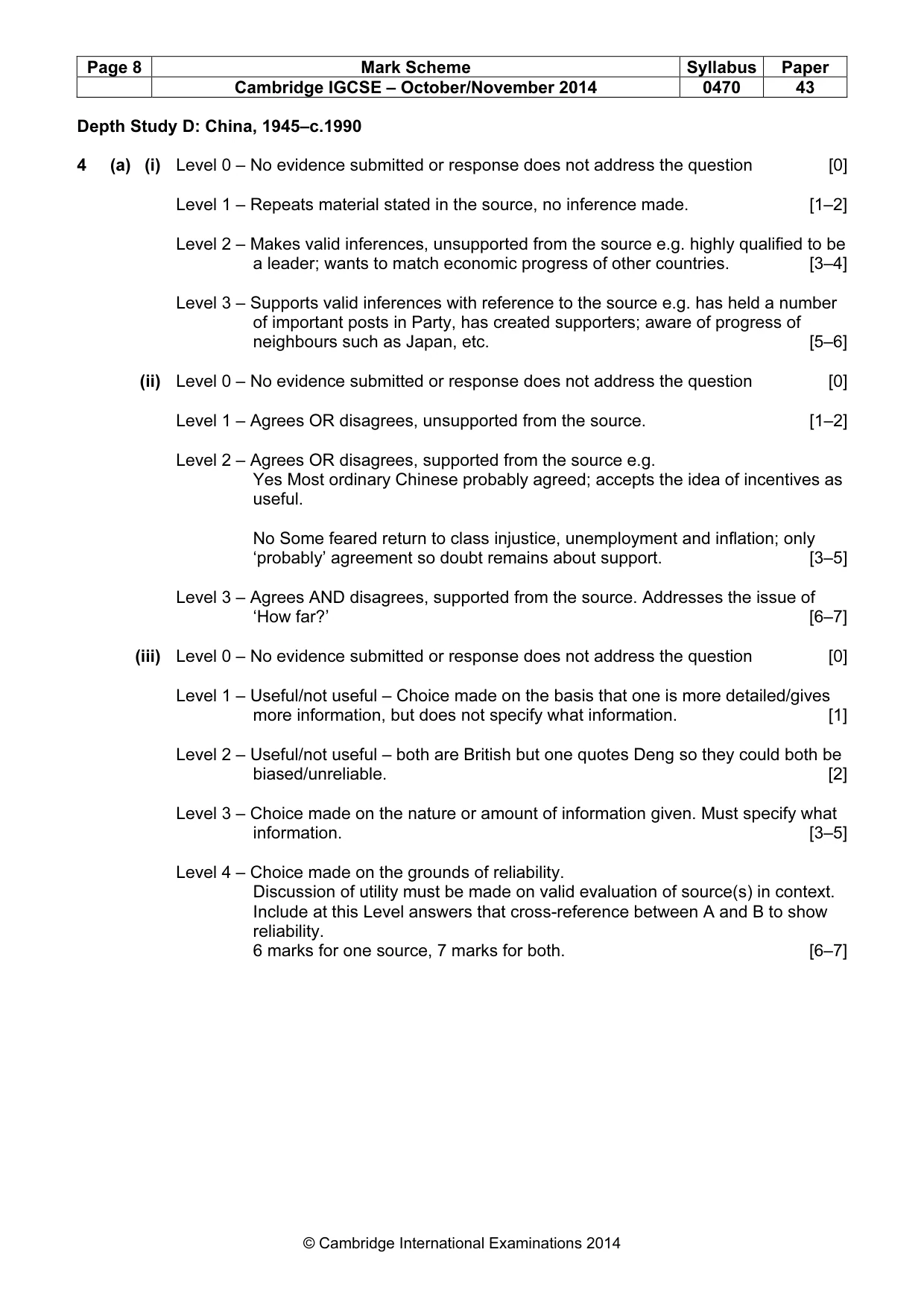
Page 8 Mark Scheme Syllabus Paper Cambridge IGCSE – October/November 2014 0470 43 © Cambridge International Examinations 2014 Depth Study D: China, 1945–c.1990 4 (a) (i) Level 0 – No evidence submitted or response does not address the question [0] Level 1 – Repeats material stated in the source, no inference made. [1–2] Level 2 – Makes valid inferences, unsupported from the source e.g. highly qualified to be a leader; wants to match economic progress of other countries. [3–4] Level 3 – Supports valid inferences with reference to the source e.g. has held a number of important posts in Party, has created supporters; aware of progress of neighbours such as Japan, etc. [5–6] (ii) Level 0 – No evidence submitted or response does not address the question [0] Level 1 – Agrees OR disagrees, unsupported from the source. [1–2] Level 2 – Agrees OR disagrees, supported from the source e.g. Yes Most ordinary Chinese probably agreed; accepts the idea of incentives as useful. No Some feared return to class injustice, unemployment and inflation; only ‘probably’ agreement so doubt remains about support. [3–5] Level 3 – Agrees AND disagrees, supported from the source. Addresses the issue of ‘How far?’ [6–7] (iii) Level 0 – No evidence submitted or response does not address the question [0] Level 1 – Useful/not useful – Choice made on the basis that one is more detailed/gives more information, but does not specify what information. [1] Level 2 – Useful/not useful – both are British but one quotes Deng so they could both be biased/unreliable. [2] Level 3 – Choice made on the nature or amount of information given. Must specify what information. [3–5] Level 4 – Choice made on the grounds of reliability. Discussion of utility must be made on valid evaluation of source(s) in context. Include at this Level answers that cross-reference between A and B to show reliability. 6 marks for one source, 7 marks for both. [6–7]
Mark scheme, page 9
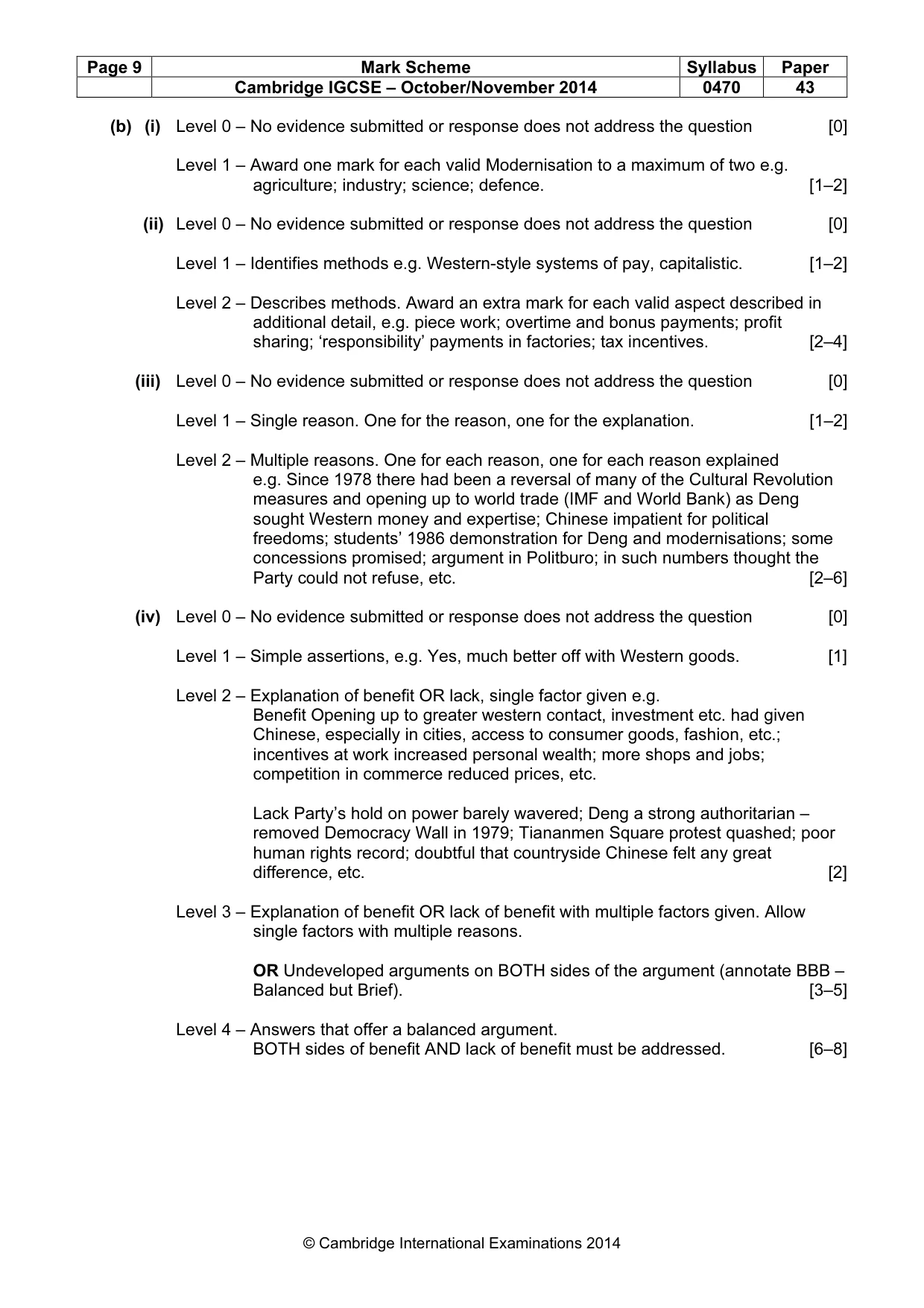
Page 9 Mark Scheme Syllabus Paper Cambridge IGCSE – October/November 2014 0470 43 © Cambridge International Examinations 2014 (b) (i) Level 0 – No evidence submitted or response does not address the question [0] Level 1 – Award one mark for each valid Modernisation to a maximum of two e.g. agriculture; industry; science; defence. [1–2] (ii) Level 0 – No evidence submitted or response does not address the question [0] Level 1 – Identifies methods e.g. Western-style systems of pay, capitalistic. [1–2] Level 2 – Describes methods. Award an extra mark for each valid aspect described in additional detail, e.g. piece work; overtime and bonus payments; profit sharing; ‘responsibility’ payments in factories; tax incentives. [2–4] (iii) Level 0 – No evidence submitted or response does not address the question [0] Level 1 – Single reason. One for the reason, one for the explanation. [1–2] Level 2 – Multiple reasons. One for each reason, one for each reason explained e.g. Since 1978 there had been a reversal of many of the Cultural Revolution measures and opening up to world trade (IMF and World Bank) as Deng sought Western money and expertise; Chinese impatient for political freedoms; students’ 1986 demonstration for Deng and modernisations; some concessions promised; argument in Politburo; in such numbers thought the Party could not refuse, etc. [2–6] (iv) Level 0 – No evidence submitted or response does not address the question [0] Level 1 – Simple assertions, e.g. Yes, much better off with Western goods. [1] Level 2 – Explanation of benefit OR lack, single factor given e.g. Benefit Opening up to greater western contact, investment etc. had given Chinese, especially in cities, access to consumer goods, fashion, etc.; incentives at work increased personal wealth; more shops and jobs; competition in commerce reduced prices, etc. Lack Party’s hold on power barely wavered; Deng a strong authoritarian – removed Democracy Wall in 1979; Tiananmen Square protest quashed; poor human rights record; doubtful that countryside Chinese felt any great difference, etc. [2] Level 3 – Explanation of benefit OR lack of benefit with multiple factors given. Allow single factors with multiple reasons. OR Undeveloped arguments on BOTH sides of the argument (annotate BBB – Balanced but Brief). [3–5] Level 4 – Answers that offer a balanced argument. BOTH sides of benefit AND lack of benefit must be addressed. [6–8]
Mark scheme, page 10
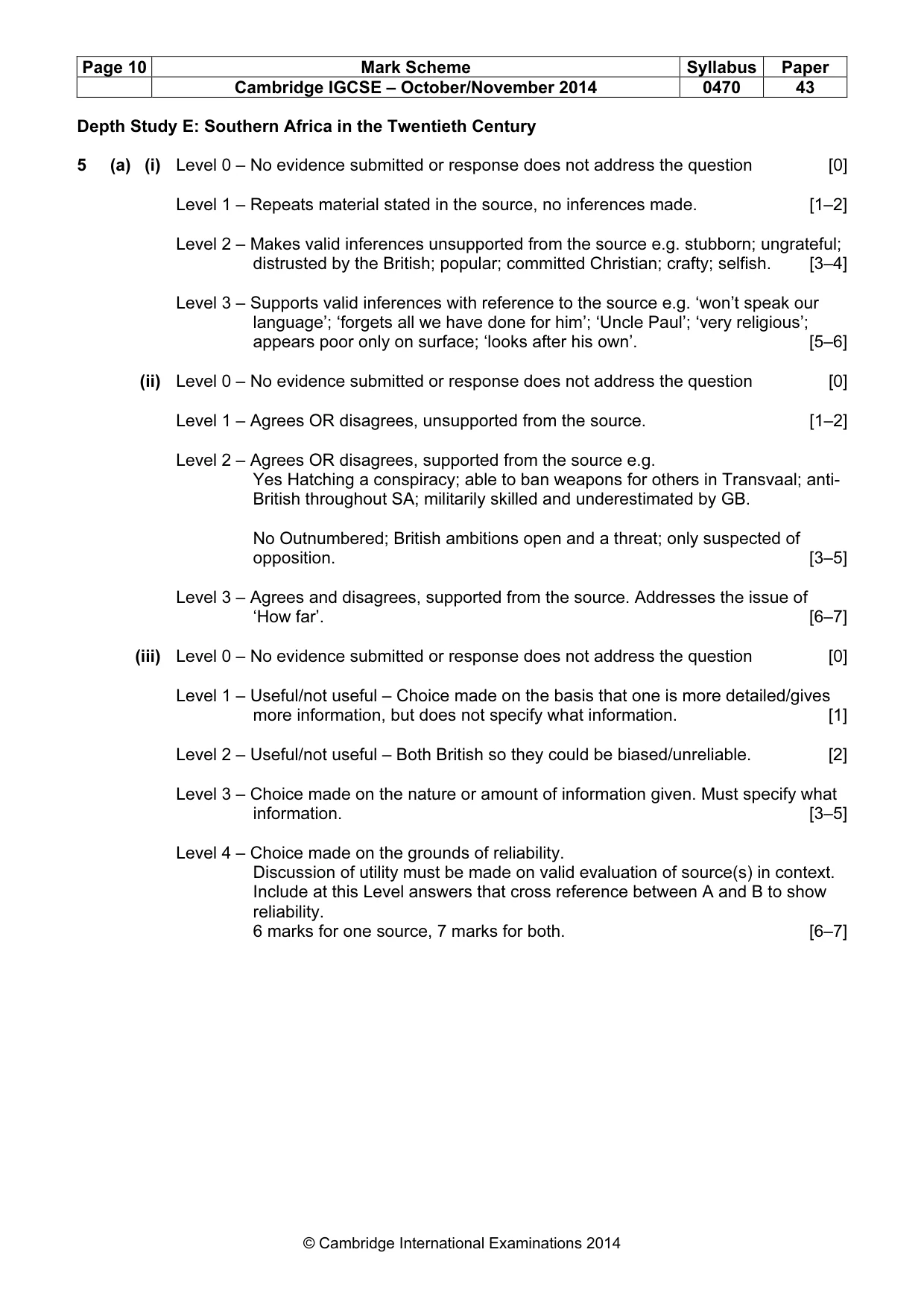
Page 10 Mark Scheme Syllabus Paper Cambridge IGCSE – October/November 2014 0470 43 © Cambridge International Examinations 2014 Depth Study E: Southern Africa in the Twentieth Century 5 (a) (i) Level 0 – No evidence submitted or response does not address the question [0] Level 1 – Repeats material stated in the source, no inferences made. [1–2] Level 2 – Makes valid inferences unsupported from the source e.g. stubborn; ungrateful; distrusted by the British; popular; committed Christian; crafty; selfish. [3–4] Level 3 – Supports valid inferences with reference to the source e.g. ‘won’t speak our language’; ‘forgets all we have done for him’; ‘Uncle Paul’; ‘very religious’; appears poor only on surface; ‘looks after his own’. [5–6] (ii) Level 0 – No evidence submitted or response does not address the question [0] Level 1 – Agrees OR disagrees, unsupported from the source. [1–2] Level 2 – Agrees OR disagrees, supported from the source e.g. Yes Hatching a conspiracy; able to ban weapons for others in Transvaal; anti- British throughout SA; militarily skilled and underestimated by GB. No Outnumbered; British ambitions open and a threat; only suspected of opposition. [3–5] Level 3 – Agrees and disagrees, supported from the source. Addresses the issue of ‘How far’. [6–7] (iii) Level 0 – No evidence submitted or response does not address the question [0] Level 1 – Useful/not useful – Choice made on the basis that one is more detailed/gives more information, but does not specify what information. [1] Level 2 – Useful/not useful – Both British so they could be biased/unreliable. [2] Level 3 – Choice made on the nature or amount of information given. Must specify what information. [3–5] Level 4 – Choice made on the grounds of reliability. Discussion of utility must be made on valid evaluation of source(s) in context. Include at this Level answers that cross reference between A and B to show reliability. 6 marks for one source, 7 marks for both. [6–7]
Mark scheme, page 11
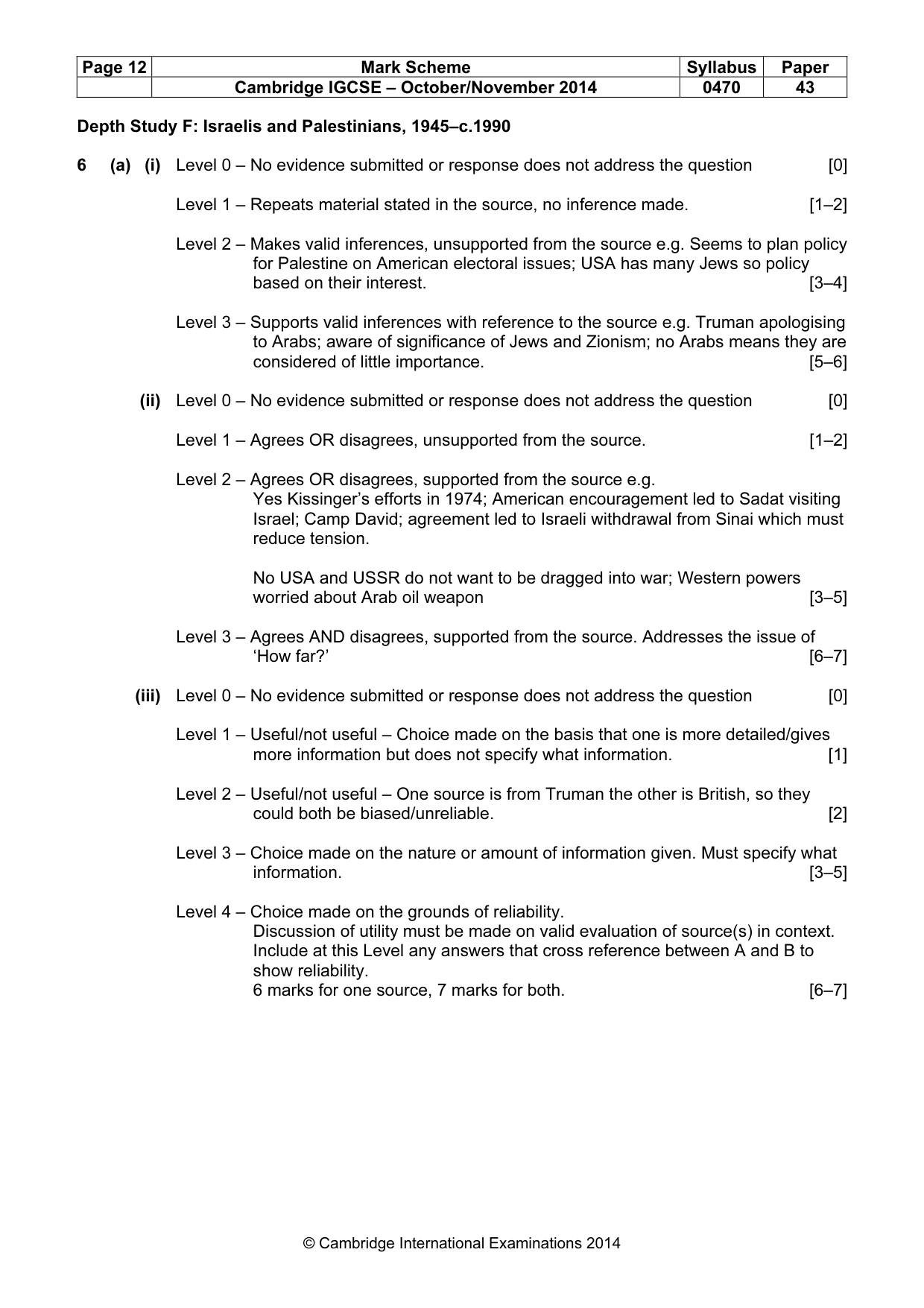
Page 11 Mark Scheme Syllabus Paper Cambridge IGCSE – October/November 2014 0470 43 © Cambridge International Examinations 2014 (b) (i) Level 0 – No evidence submitted or response does not address the question [0] Level 1 – One mark for each aspect to a maximum of two, e.g. end of First Anglo-Boer War; Transvaal’s ‘independence’/self-government recognised but British suzerainty/control of foreign relations reserved; shaky compromise. [1–2] (ii) Level 0 – No evidence submitted or response does not address the question [0] Level 1 – Identifies aspects. Attempt to support Uitlanders and overthrow government. [1–2] Level 2 – Describes aspects. Award an extra mark for each valid aspect described in additional detail e.g. secret conspiracy Rhodes/Chamberlain; financed Captain Jameson’s 500 armed police crossing from Pitsani, Bechuanaland into Transvaal; Uitlander revolt did not materialise; did not reach Johannesburg; lasted 4 days; quickly surrounded, defeated, captured and imprisoned; confirmed Boer suspicions of British/Rhodes, etc. [2–4] (iii) Level 0 – No evidence submitted or response does not address the question [0] Level 1 – Single reason. One for the reason, one for the explanation. [1–2] Level 2 – Multiple reasons. One for each reason, one for each reason explained e.g. Strategic/trade route to India; gold and diamond mining; railways; base for imperial ambitions in whole continent; influence of Rhodes; rivalry with Germany; Boers’ mistreatment of Uitlanders/blacks, etc. [2–6] (iv) Level 0 – No evidence submitted or response does not address the question [0] Level 1 – Simple assertions. Yes, they lost militarily. No, Afrikaner nationalism strengthened. [1] Level 2 – Explanation of failure OR success, single factor given e.g. Failure Military defeats; costs; concentration camps’ suffering; Cape and Natal Dutch gave scant support; no support from European powers; terms of Vereeniging: Boer independence lost, to accept Edward VII as sovereign and part of British Empire, etc. Success Early military successes; commando raids; costs to British – financial and diplomatic; Vereeniging concessions – Transvaal and OFS to have local self-government; an ‘eventual’ Union; no Boer to lose property or freedom; UK to pay £3 million compensation; Dutch as well as English to be taught; no black or Coloured franchise in Boer states; Milner’s scheme failed; Boer nationalism increased; Botha and Smuts political power by 1910, etc. [2] Level 3 – Explanation of failure OR of success with multiple factors given. OR Undeveloped suggestions of BOTH sides of the argument (annotate BBB – Balanced but Brief). [3–5] Level 4 – Answers that offer a balanced argument. BOTH sides of failure AND success must be addressed. [6–8]
Mark scheme, page 12
Page 12 Mark Scheme Syllabus Paper Cambridge IGCSE – October/November 2014 0470 43 © Cambridge International Examinations 2014 Depth Study F: Israelis and Palestinians, 1945–c.1990 6 (a) (i) Level 0 – No evidence submitted or response does not address the question [0] Level 1 – Repeats material stated in the source, no inference made. [1–2] Level 2 – Makes valid inferences, unsupported from the source e.g. Seems to plan policy for Palestine on American electoral issues; USA has many Jews so policy based on their interest. [3–4] Level 3 – Supports valid inferences with reference to the source e.g. Truman apologising to Arabs; aware of significance of Jews and Zionism; no Arabs means they are considered of little importance. [5–6] (ii) Level 0 – No evidence submitted or response does not address the question [0] Level 1 – Agrees OR disagrees, unsupported from the source. [1–2] Level 2 – Agrees OR disagrees, supported from the source e.g. Yes Kissinger’s efforts in 1974; American encouragement led to Sadat visiting Israel; Camp David; agreement led to Israeli withdrawal from Sinai which must reduce tension. No USA and USSR do not want to be dragged into war; Western powers worried about Arab oil weapon [3–5] Level 3 – Agrees AND disagrees, supported from the source. Addresses the issue of ‘How far?’ [6–7] (iii) Level 0 – No evidence submitted or response does not address the question [0] Level 1 – Useful/not useful – Choice made on the basis that one is more detailed/gives more information but does not specify what information. [1] Level 2 – Useful/not useful – One source is from Truman the other is British, so they could both be biased/unreliable. [2] Level 3 – Choice made on the nature or amount of information given. Must specify what information. [3–5] Level 4 – Choice made on the grounds of reliability. Discussion of utility must be made on valid evaluation of source(s) in context. Include at this Level any answers that cross reference between A and B to show reliability. 6 marks for one source, 7 marks for both. [6–7]
Mark scheme, page 13
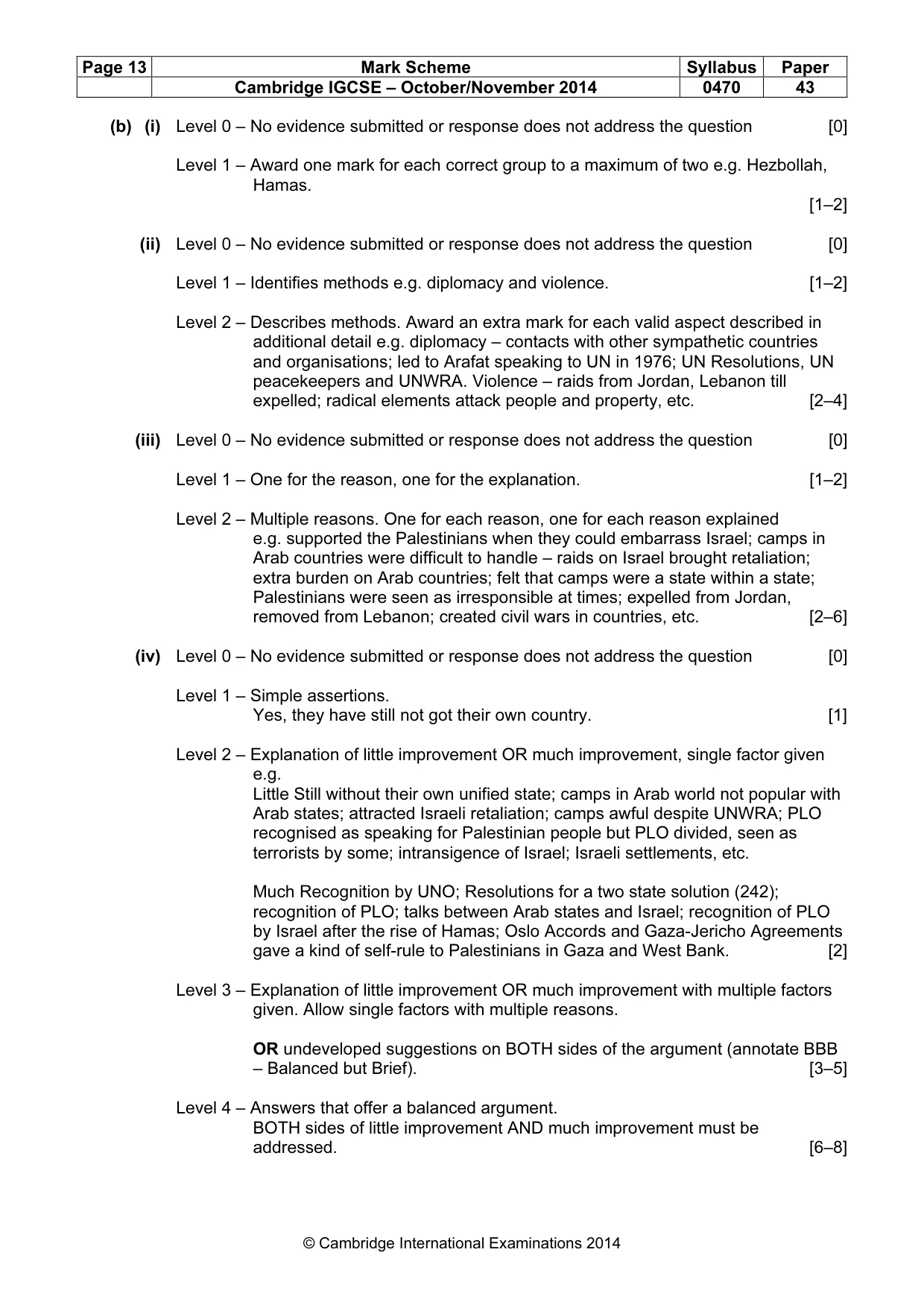
Page 13 Mark Scheme Syllabus Paper Cambridge IGCSE – October/November 2014 0470 43 © Cambridge International Examinations 2014 (b) (i) Level 0 – No evidence submitted or response does not address the question [0] Level 1 – Award one mark for each correct group to a maximum of two e.g. Hezbollah, Hamas. [1–2] (ii) Level 0 – No evidence submitted or response does not address the question [0] Level 1 – Identifies methods e.g. diplomacy and violence. [1–2] Level 2 – Describes methods. Award an extra mark for each valid aspect described in additional detail e.g. diplomacy – contacts with other sympathetic countries and organisations; led to Arafat speaking to UN in 1976; UN Resolutions, UN peacekeepers and UNWRA. Violence – raids from Jordan, Lebanon till expelled; radical elements attack people and property, etc. [2–4] (iii) Level 0 – No evidence submitted or response does not address the question [0] Level 1 – One for the reason, one for the explanation. [1–2] Level 2 – Multiple reasons. One for each reason, one for each reason explained e.g. supported the Palestinians when they could embarrass Israel; camps in Arab countries were difficult to handle – raids on Israel brought retaliation; extra burden on Arab countries; felt that camps were a state within a state; Palestinians were seen as irresponsible at times; expelled from Jordan, removed from Lebanon; created civil wars in countries, etc. [2–6] (iv) Level 0 – No evidence submitted or response does not address the question [0] Level 1 – Simple assertions. Yes, they have still not got their own country. [1] Level 2 – Explanation of little improvement OR much improvement, single factor given e.g. Little Still without their own unified state; camps in Arab world not popular with Arab states; attracted Israeli retaliation; camps awful despite UNWRA; PLO recognised as speaking for Palestinian people but PLO divided, seen as terrorists by some; intransigence of Israel; Israeli settlements, etc. Much Recognition by UNO; Resolutions for a two state solution (242); recognition of PLO; talks between Arab states and Israel; recognition of PLO by Israel after the rise of Hamas; Oslo Accords and Gaza-Jericho Agreements gave a kind of self-rule to Palestinians in Gaza and West Bank. [2] Level 3 – Explanation of little improvement OR much improvement with multiple factors given. Allow single factors with multiple reasons. OR undeveloped suggestions on BOTH sides of the argument (annotate BBB – Balanced but Brief). [3–5] Level 4 – Answers that offer a balanced argument. BOTH sides of little improvement AND much improvement must be addressed. [6–8]
Mark scheme, page 14
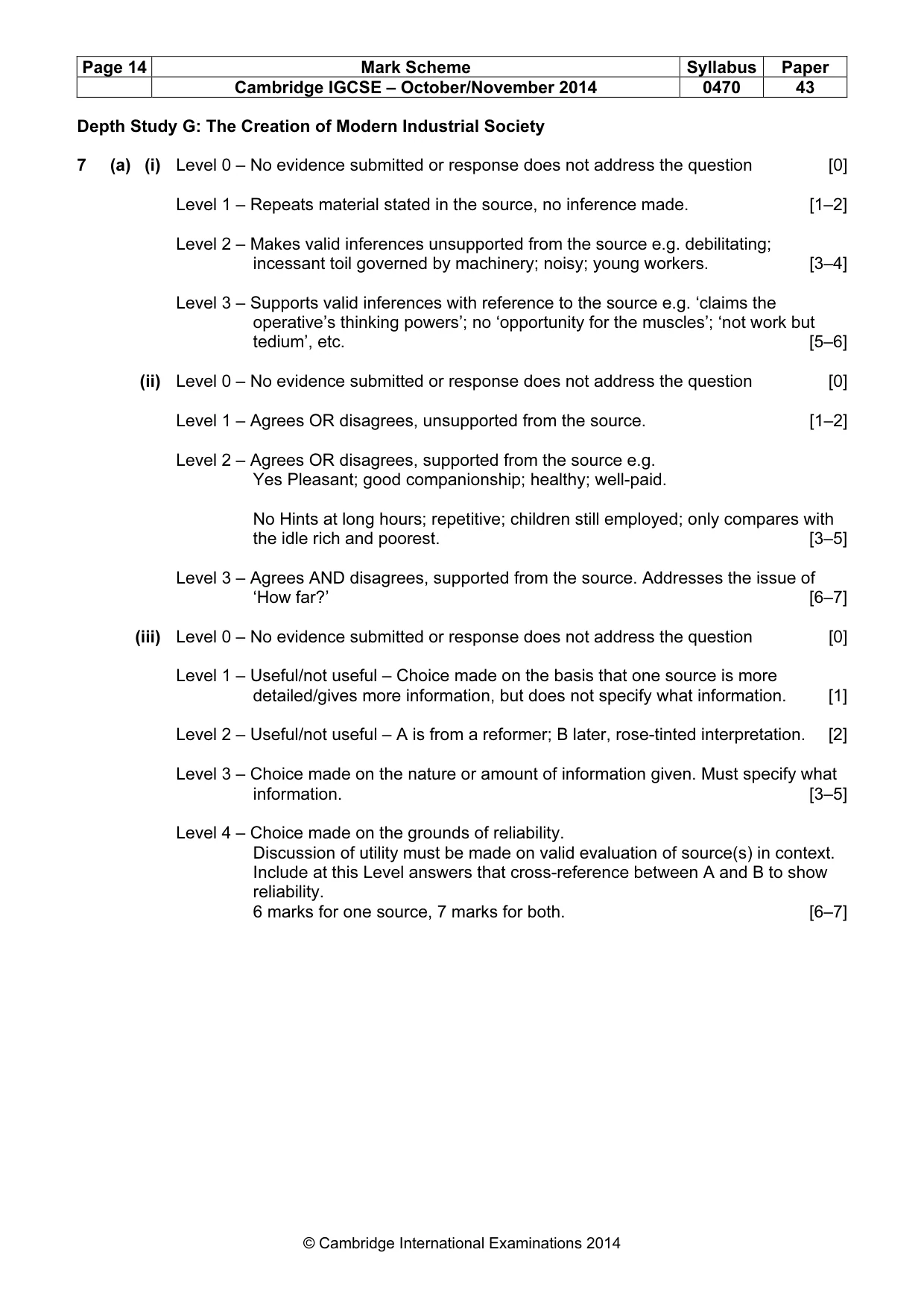
Page 14 Mark Scheme Syllabus Paper Cambridge IGCSE – October/November 2014 0470 43 © Cambridge International Examinations 2014 Depth Study G: The Creation of Modern Industrial Society 7 (a) (i) Level 0 – No evidence submitted or response does not address the question [0] Level 1 – Repeats material stated in the source, no inference made. [1–2] Level 2 – Makes valid inferences unsupported from the source e.g. debilitating; incessant toil governed by machinery; noisy; young workers. [3–4] Level 3 – Supports valid inferences with reference to the source e.g. ‘claims the operative’s thinking powers’; no ‘opportunity for the muscles’; ‘not work but tedium’, etc. [5–6] (ii) Level 0 – No evidence submitted or response does not address the question [0] Level 1 – Agrees OR disagrees, unsupported from the source. [1–2] Level 2 – Agrees OR disagrees, supported from the source e.g. Yes Pleasant; good companionship; healthy; well-paid. No Hints at long hours; repetitive; children still employed; only compares with the idle rich and poorest. [3–5] Level 3 – Agrees AND disagrees, supported from the source. Addresses the issue of ‘How far?’ [6–7] (iii) Level 0 – No evidence submitted or response does not address the question [0] Level 1 – Useful/not useful – Choice made on the basis that one source is more detailed/gives more information, but does not specify what information. [1] Level 2 – Useful/not useful – A is from a reformer; B later, rose-tinted interpretation. [2] Level 3 – Choice made on the nature or amount of information given. Must specify what information. [3–5] Level 4 – Choice made on the grounds of reliability. Discussion of utility must be made on valid evaluation of source(s) in context. Include at this Level answers that cross-reference between A and B to show reliability. 6 marks for one source, 7 marks for both. [6–7]
Mark scheme, page 15
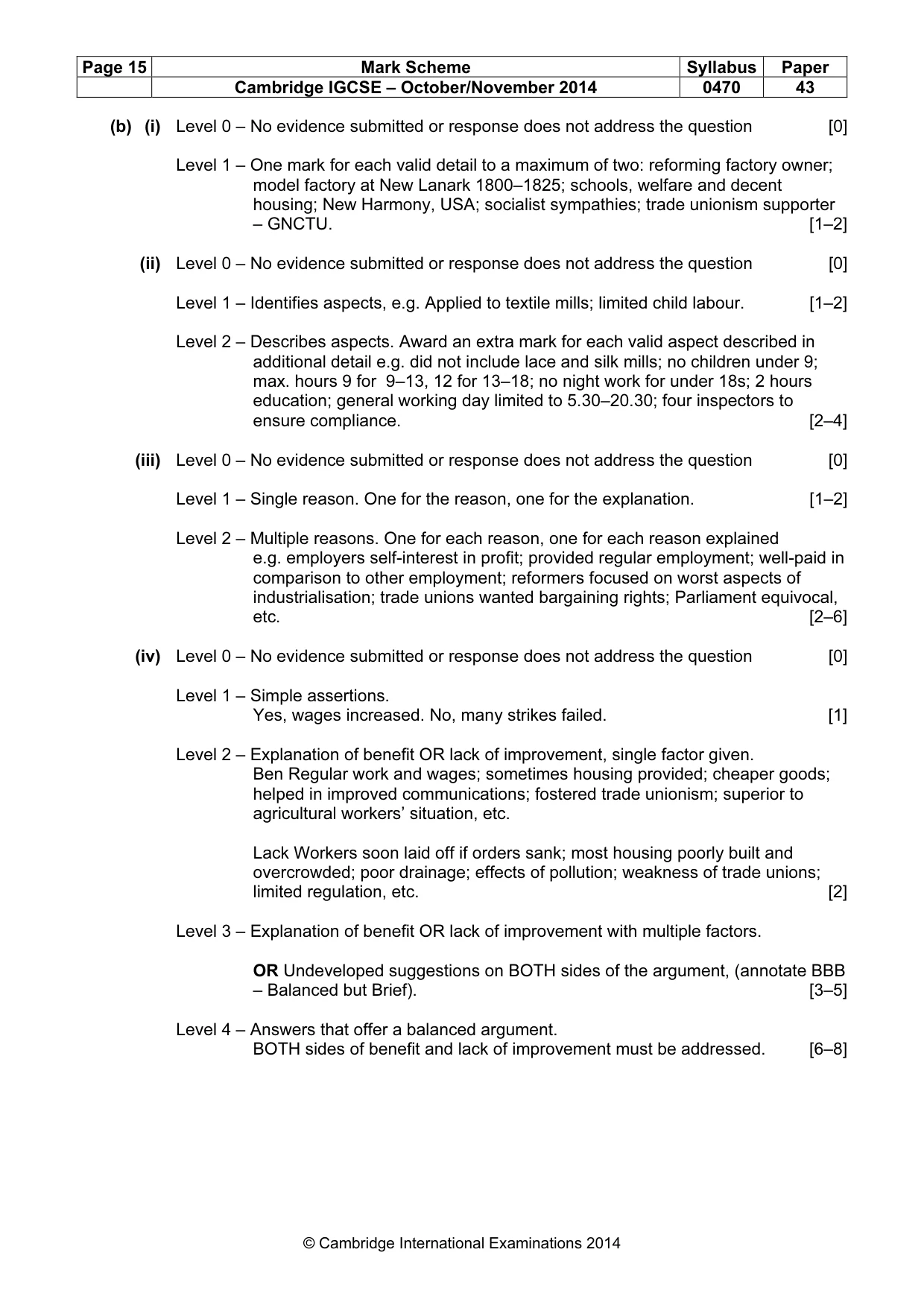
Page 15 Mark Scheme Syllabus Paper Cambridge IGCSE – October/November 2014 0470 43 © Cambridge International Examinations 2014 (b) (i) Level 0 – No evidence submitted or response does not address the question [0] Level 1 – One mark for each valid detail to a maximum of two: reforming factory owner; model factory at New Lanark 1800–1825; schools, welfare and decent housing; New Harmony, USA; socialist sympathies; trade unionism supporter – GNCTU. [1–2] (ii) Level 0 – No evidence submitted or response does not address the question [0] Level 1 – Identifies aspects, e.g. Applied to textile mills; limited child labour. [1–2] Level 2 – Describes aspects. Award an extra mark for each valid aspect described in additional detail e.g. did not include lace and silk mills; no children under 9; max. hours 9 for 9–13, 12 for 13–18; no night work for under 18s; 2 hours education; general working day limited to 5.30–20.30; four inspectors to ensure compliance. [2–4] (iii) Level 0 – No evidence submitted or response does not address the question [0] Level 1 – Single reason. One for the reason, one for the explanation. [1–2] Level 2 – Multiple reasons. One for each reason, one for each reason explained e.g. employers self-interest in profit; provided regular employment; well-paid in comparison to other employment; reformers focused on worst aspects of industrialisation; trade unions wanted bargaining rights; Parliament equivocal, etc. [2–6] (iv) Level 0 – No evidence submitted or response does not address the question [0] Level 1 – Simple assertions. Yes, wages increased. No, many strikes failed. [1] Level 2 – Explanation of benefit OR lack of improvement, single factor given. Ben Regular work and wages; sometimes housing provided; cheaper goods; helped in improved communications; fostered trade unionism; superior to agricultural workers’ situation, etc. Lack Workers soon laid off if orders sank; most housing poorly built and overcrowded; poor drainage; effects of pollution; weakness of trade unions; limited regulation, etc. [2] Level 3 – Explanation of benefit OR lack of improvement with multiple factors. OR Undeveloped suggestions on BOTH sides of the argument, (annotate BBB – Balanced but Brief). [3–5] Level 4 – Answers that offer a balanced argument. BOTH sides of benefit and lack of improvement must be addressed. [6–8]
Mark scheme, page 16
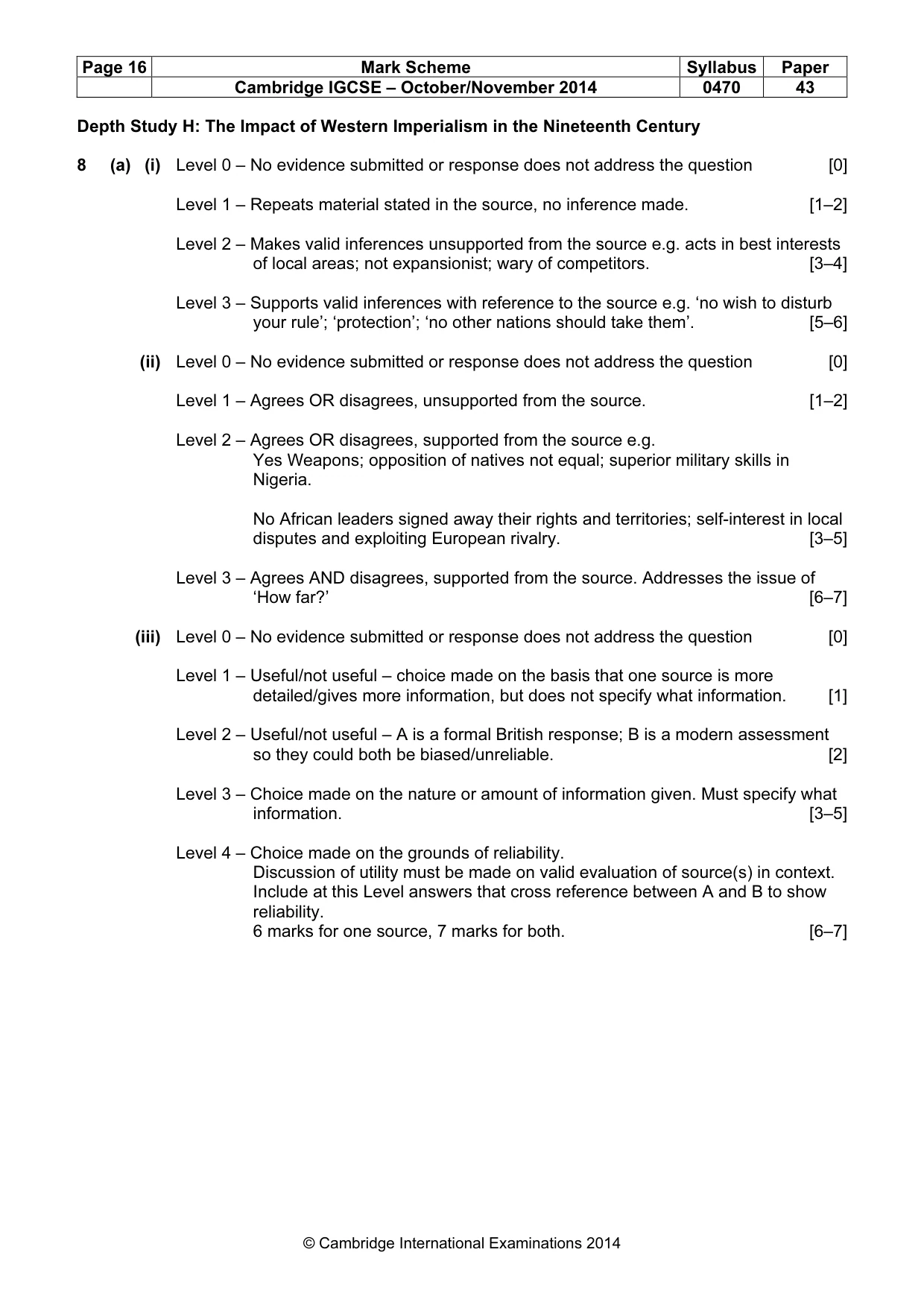
Page 16 Mark Scheme Syllabus Paper Cambridge IGCSE – October/November 2014 0470 43 © Cambridge International Examinations 2014 Depth Study H: The Impact of Western Imperialism in the Nineteenth Century 8 (a) (i) Level 0 – No evidence submitted or response does not address the question [0] Level 1 – Repeats material stated in the source, no inference made. [1–2] Level 2 – Makes valid inferences unsupported from the source e.g. acts in best interests of local areas; not expansionist; wary of competitors. [3–4] Level 3 – Supports valid inferences with reference to the source e.g. ‘no wish to disturb your rule’; ‘protection’; ‘no other nations should take them’. [5–6] (ii) Level 0 – No evidence submitted or response does not address the question [0] Level 1 – Agrees OR disagrees, unsupported from the source. [1–2] Level 2 – Agrees OR disagrees, supported from the source e.g. Yes Weapons; opposition of natives not equal; superior military skills in Nigeria. No African leaders signed away their rights and territories; self-interest in local disputes and exploiting European rivalry. [3–5] Level 3 – Agrees AND disagrees, supported from the source. Addresses the issue of ‘How far?’ [6–7] (iii) Level 0 – No evidence submitted or response does not address the question [0] Level 1 – Useful/not useful – choice made on the basis that one source is more detailed/gives more information, but does not specify what information. [1] Level 2 – Useful/not useful – A is a formal British response; B is a modern assessment so they could both be biased/unreliable. [2] Level 3 – Choice made on the nature or amount of information given. Must specify what information. [3–5] Level 4 – Choice made on the grounds of reliability. Discussion of utility must be made on valid evaluation of source(s) in context. Include at this Level answers that cross reference between A and B to show reliability. 6 marks for one source, 7 marks for both. [6–7]
Mark scheme, page 17
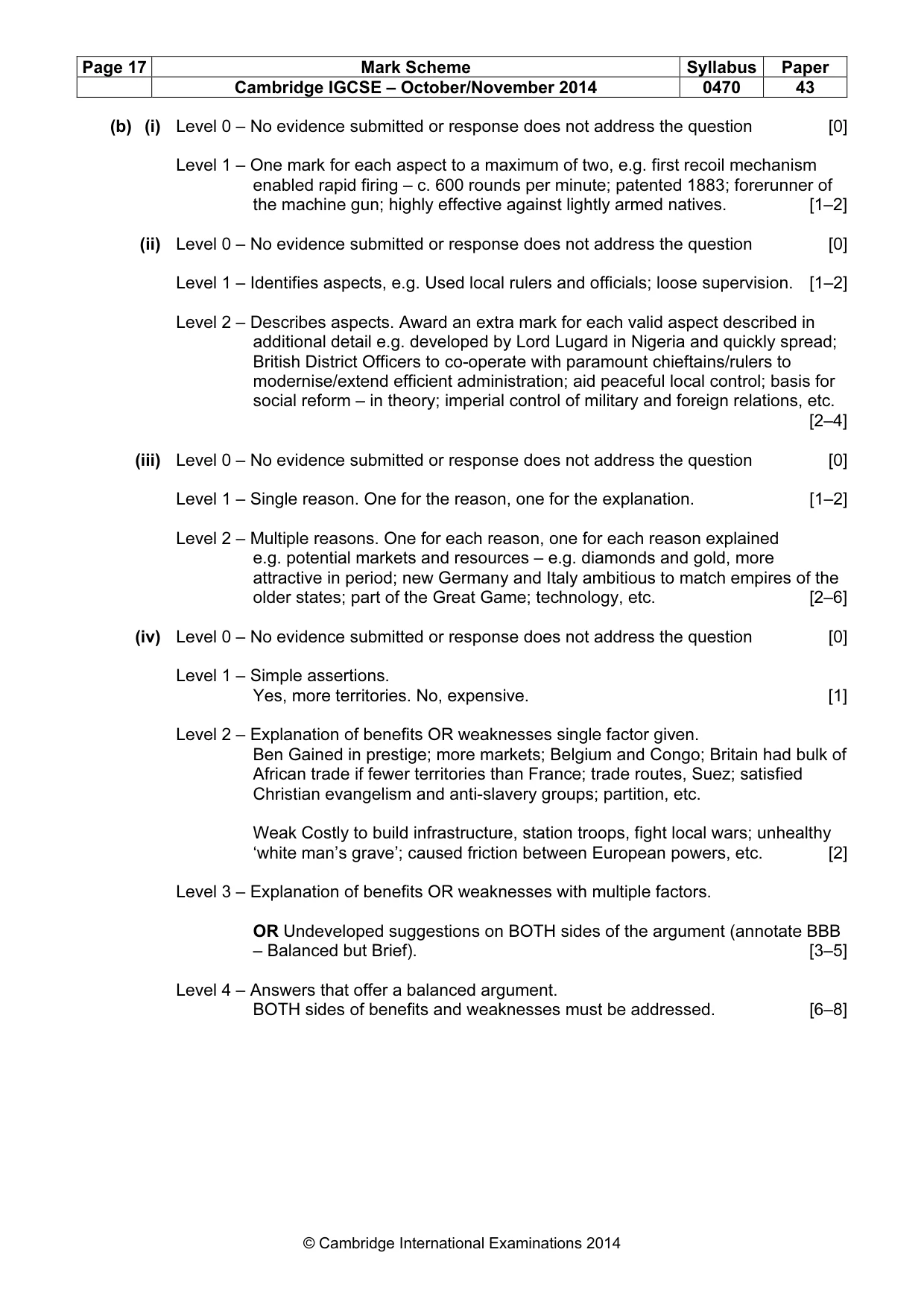
Page 17 Mark Scheme Syllabus Paper Cambridge IGCSE – October/November 2014 0470 43 © Cambridge International Examinations 2014 (b) (i) Level 0 – No evidence submitted or response does not address the question [0] Level 1 – One mark for each aspect to a maximum of two, e.g. first recoil mechanism enabled rapid firing – c. 600 rounds per minute; patented 1883; forerunner of the machine gun; highly effective against lightly armed natives. [1–2] (ii) Level 0 – No evidence submitted or response does not address the question [0] Level 1 – Identifies aspects, e.g. Used local rulers and officials; loose supervision. [1–2] Level 2 – Describes aspects. Award an extra mark for each valid aspect described in additional detail e.g. developed by Lord Lugard in Nigeria and quickly spread; British District Officers to co-operate with paramount chieftains/rulers to modernise/extend efficient administration; aid peaceful local control; basis for social reform – in theory; imperial control of military and foreign relations, etc. [2–4] (iii) Level 0 – No evidence submitted or response does not address the question [0] Level 1 – Single reason. One for the reason, one for the explanation. [1–2] Level 2 – Multiple reasons. One for each reason, one for each reason explained e.g. potential markets and resources – e.g. diamonds and gold, more attractive in period; new Germany and Italy ambitious to match empires of the older states; part of the Great Game; technology, etc. [2–6] (iv) Level 0 – No evidence submitted or response does not address the question [0] Level 1 – Simple assertions. Yes, more territories. No, expensive. [1] Level 2 – Explanation of benefits OR weaknesses single factor given. Ben Gained in prestige; more markets; Belgium and Congo; Britain had bulk of African trade if fewer territories than France; trade routes, Suez; satisfied Christian evangelism and anti-slavery groups; partition, etc. Weak Costly to build infrastructure, station troops, fight local wars; unhealthy ‘white man’s grave’; caused friction between European powers, etc. [2] Level 3 – Explanation of benefits OR weaknesses with multiple factors. OR Undeveloped suggestions on BOTH sides of the argument (annotate BBB – Balanced but Brief). [3–5] Level 4 – Answers that offer a balanced argument. BOTH sides of benefits and weaknesses must be addressed. [6–8]
What you needed in this session
Cambridge’s own grade thresholds for 2014 Oct/Nov, Paper 4 · Variant 3. A higher threshold means an easier paper — the bar moves with how the cohort did.