Cambridge IGCSE History 0470 — 2014 Oct/Nov Paper 4 · Variant 2
0470/42/O/N/14 · 40 marks · ≈45 min
The question paper and its mark scheme, free to read here and free to download. This is Cambridge’s own paper, exactly as it was sat.
Question paper12 pages

Mark scheme18 pages
Answers below. Sit the paper first if you are practising.
Paper as text
Question paper, page 1
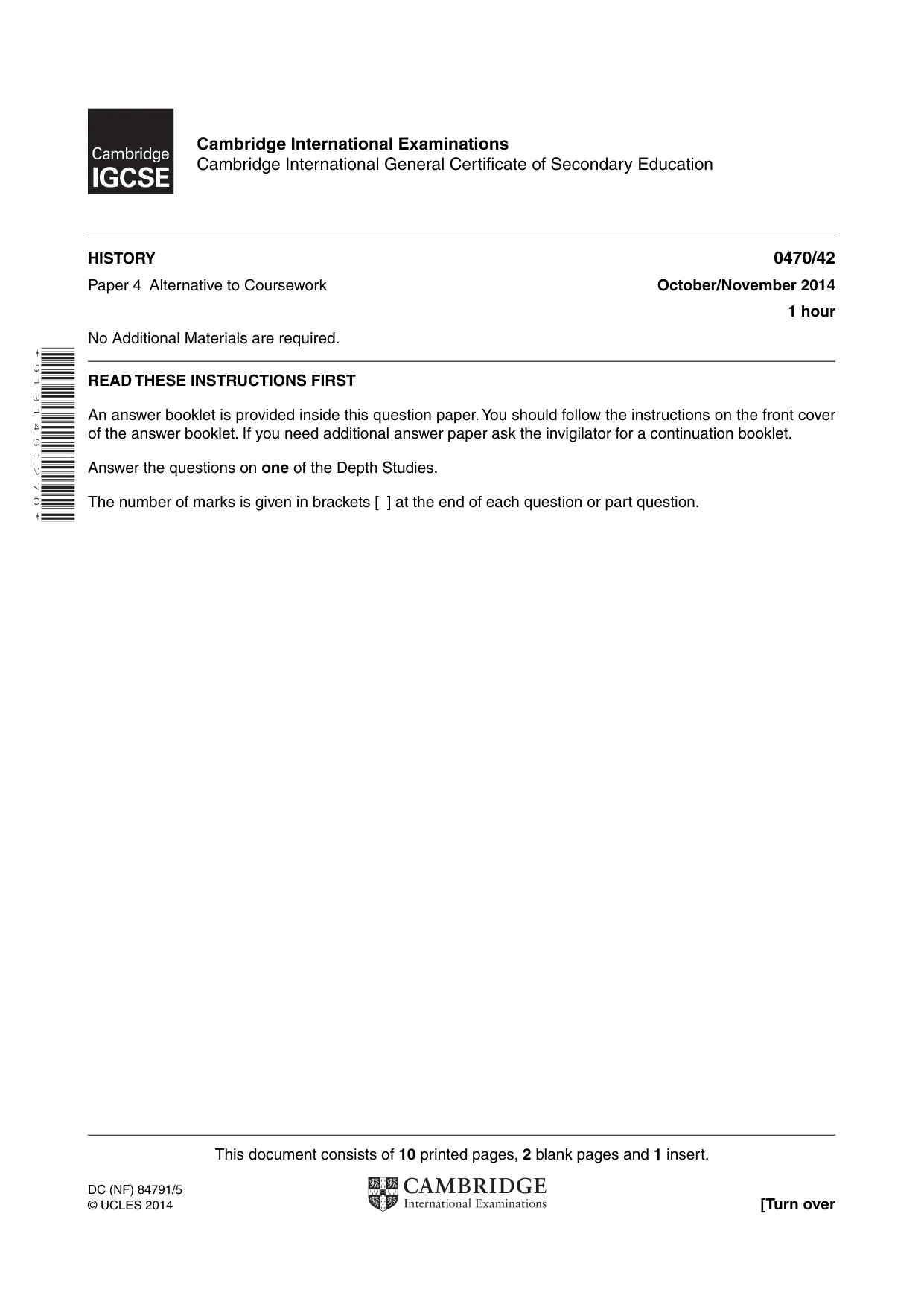
This document consists of 10 printed pages, 2 blank pages and 1 insert. DC (NF) 84791/5 © UCLES 2014 [Turn over Cambridge International Examinations Cambridge International General Certificate of Secondary Education * 9 1 3 1 4 9 1 2 7 0 * HISTORY 0470/42 Paper 4 Alternative to Coursework October/November 2014 1 hour No Additional Materials are required. READ THESE INSTRUCTIONS FIRST An answer booklet is provided inside this question paper. You should follow the instructions on the front cover of the answer booklet. If you need additional answer paper ask the invigilator for a continuation booklet. Answer the questions on one of the Depth Studies. The number of marks is given in brackets [ ] at the end of each question or part question.
Question paper, page 2
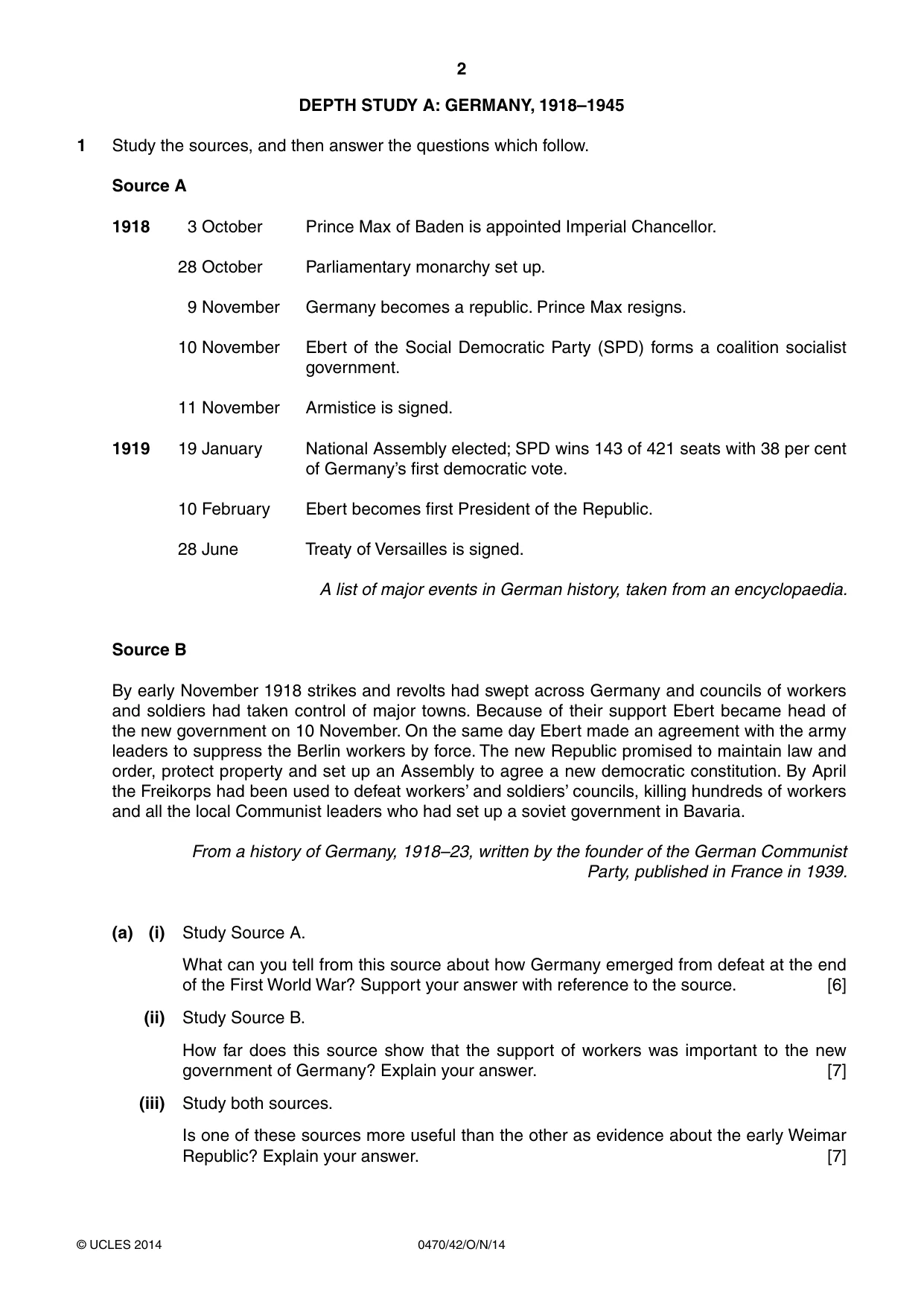
2 0470/42/O/N/14 © UCLES 2014 DEPTH STUDY A: GERMANY, 1918–1945 1 Study the sources, and then answer the questions which follow. Source A 1918 3 October Prince Max of Baden is appointed Imperial Chancellor. 28 October Parliamentary monarchy set up. 9 November Germany becomes a republic. Prince Max resigns. 10 November Ebert of the Social Democratic Party (SPD) forms a coalition socialist government. 11 November Armistice is signed. 1919 19 January National Assembly elected; SPD wins 143 of 421 seats with 38 per cent of Germany’s first democratic vote. 10 February Ebert becomes first President of the Republic. 28 June Treaty of Versailles is signed. A list of major events in German history, taken from an encyclopaedia. Source B By early November 1918 strikes and revolts had swept across Germany and councils of workers and soldiers had taken control of major towns. Because of their support Ebert became head of the new government on 10 November. On the same day Ebert made an agreement with the army leaders to suppress the Berlin workers by force. The new Republic promised to maintain law and order, protect property and set up an Assembly to agree a new democratic constitution. By April the Freikorps had been used to defeat workers’ and soldiers’ councils, killing hundreds of workers and all the local Communist leaders who had set up a soviet government in Bavaria. From a history of Germany, 1918–23, written by the founder of the German Communist Party, published in France in 1939. (a) (i) Study Source A. What can you tell from this source about how Germany emerged from defeat at the end of the First World War? Support your answer with reference to the source. [6] (ii) Study Source B. How far does this source show that the support of workers was important to the new government of Germany? Explain your answer. [7] (iii) Study both sources. Is one of these sources more useful than the other as evidence about the early Weimar Republic? Explain your answer. [7]
Question paper, page 3
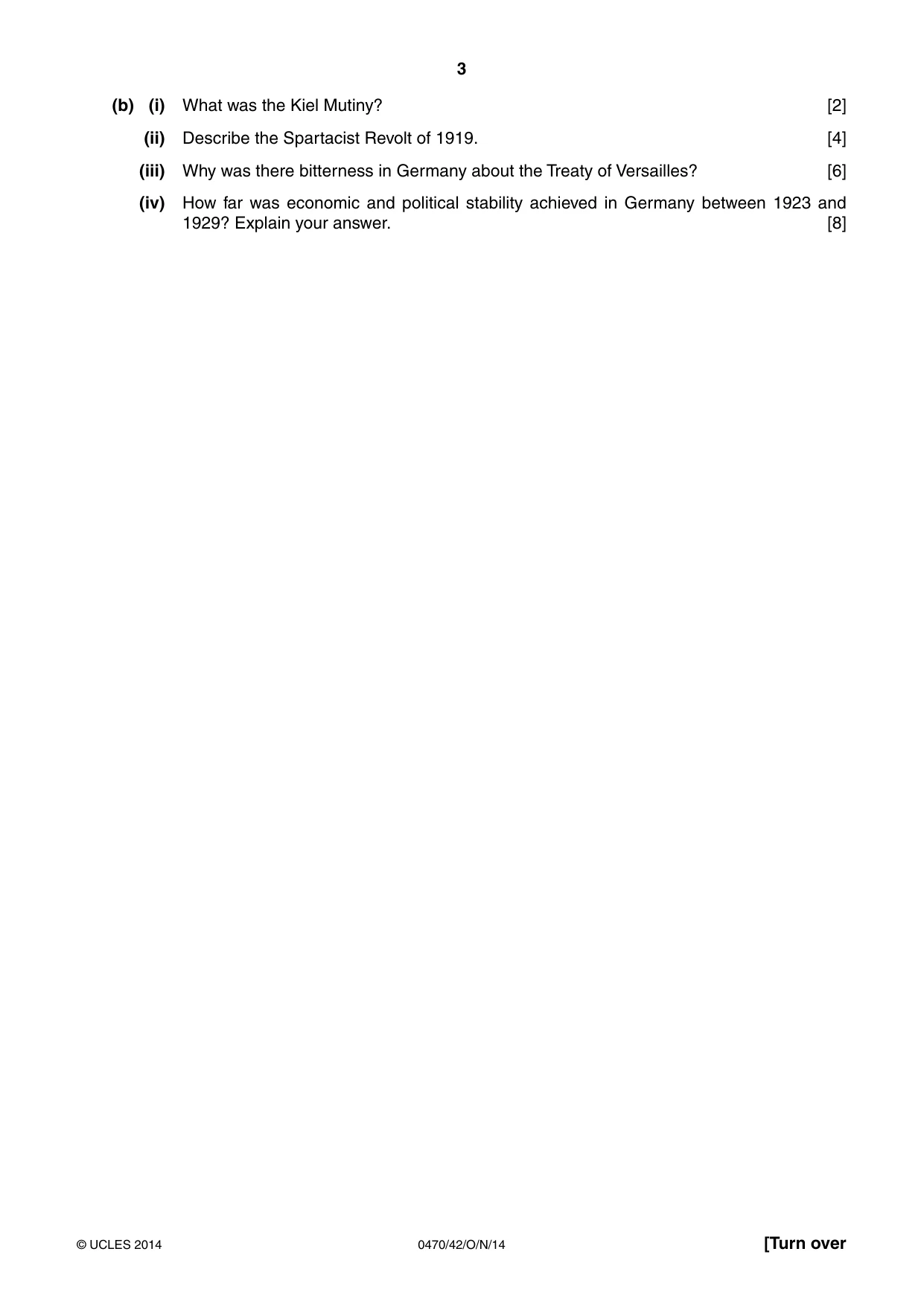
3 0470/42/O/N/14 © UCLES 2014 [Turn over (b) (i) What was the Kiel Mutiny? [2] (ii) Describe the Spartacist Revolt of 1919. [4] (iii) Why was there bitterness in Germany about the Treaty of Versailles? [6] (iv) How far was economic and political stability achieved in Germany between 1923 and 1929? Explain your answer. [8]
Question paper, page 4
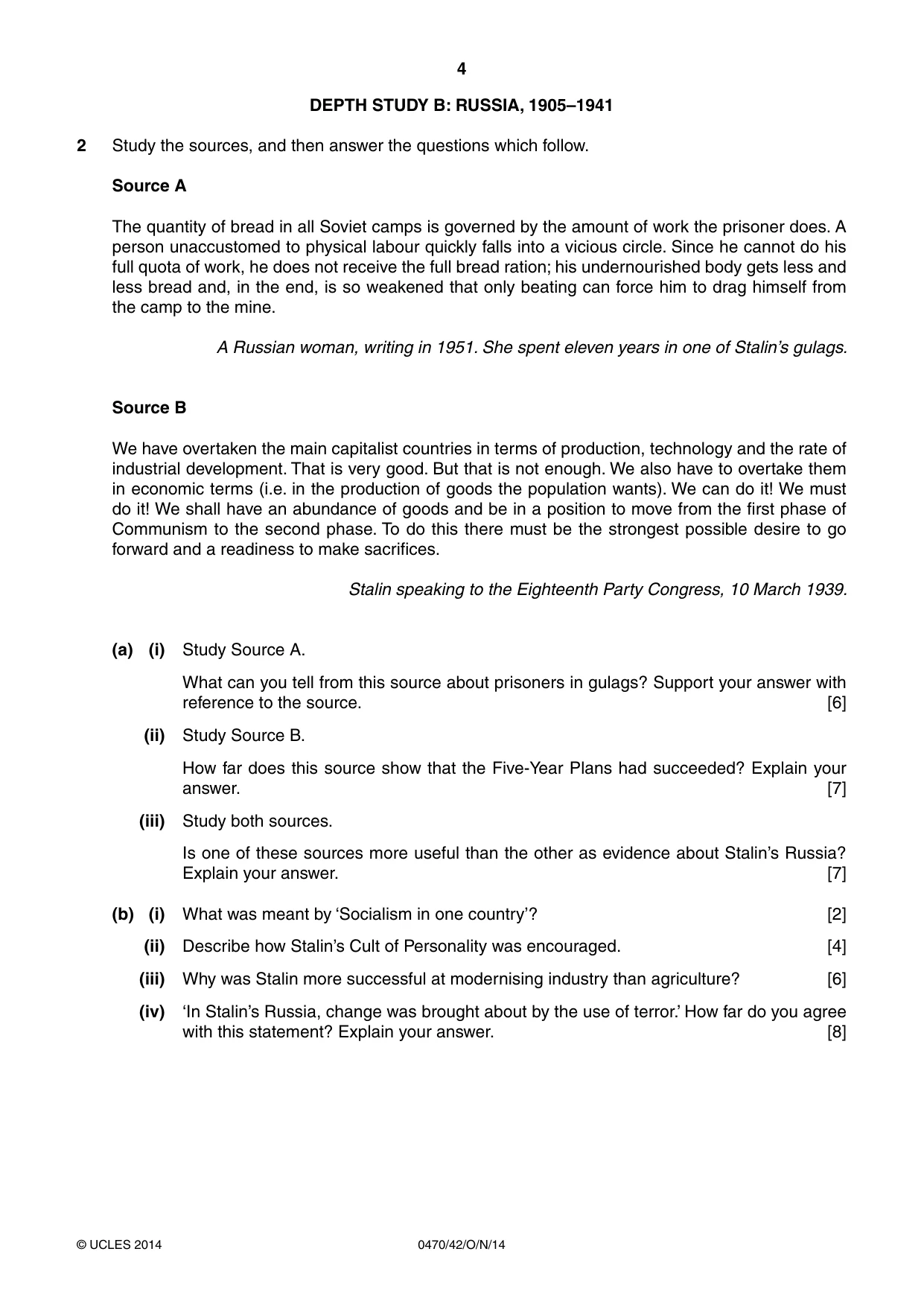
4 0470/42/O/N/14 © UCLES 2014 DEPTH STUDY B: RUSSIA, 1905–1941 2 Study the sources, and then answer the questions which follow. Source A The quantity of bread in all Soviet camps is governed by the amount of work the prisoner does. A person unaccustomed to physical labour quickly falls into a vicious circle. Since he cannot do his full quota of work, he does not receive the full bread ration; his undernourished body gets less and less bread and, in the end, is so weakened that only beating can force him to drag himself from the camp to the mine. A Russian woman, writing in 1951. She spent eleven years in one of Stalin’s gulags. Source B We have overtaken the main capitalist countries in terms of production, technology and the rate of industrial development. That is very good. But that is not enough. We also have to overtake them in economic terms (i.e. in the production of goods the population wants). We can do it! We must do it! We shall have an abundance of goods and be in a position to move from the first phase of Communism to the second phase. To do this there must be the strongest possible desire to go forward and a readiness to make sacrifices. Stalin speaking to the Eighteenth Party Congress, 10 March 1939. (a) (i) Study Source A. What can you tell from this source about prisoners in gulags? Support your answer with reference to the source. [6] (ii) Study Source B. How far does this source show that the Five-Year Plans had succeeded? Explain your answer. [7] (iii) Study both sources. Is one of these sources more useful than the other as evidence about Stalin’s Russia? Explain your answer. [7] (b) (i) What was meant by ‘Socialism in one country’? [2] (ii) Describe how Stalin’s Cult of Personality was encouraged. [4] (iii) Why was Stalin more successful at modernising industry than agriculture? [6] (iv) ‘In Stalin’s Russia, change was brought about by the use of terror.’ How far do you agree with this statement? Explain your answer. [8]
Question paper, page 5
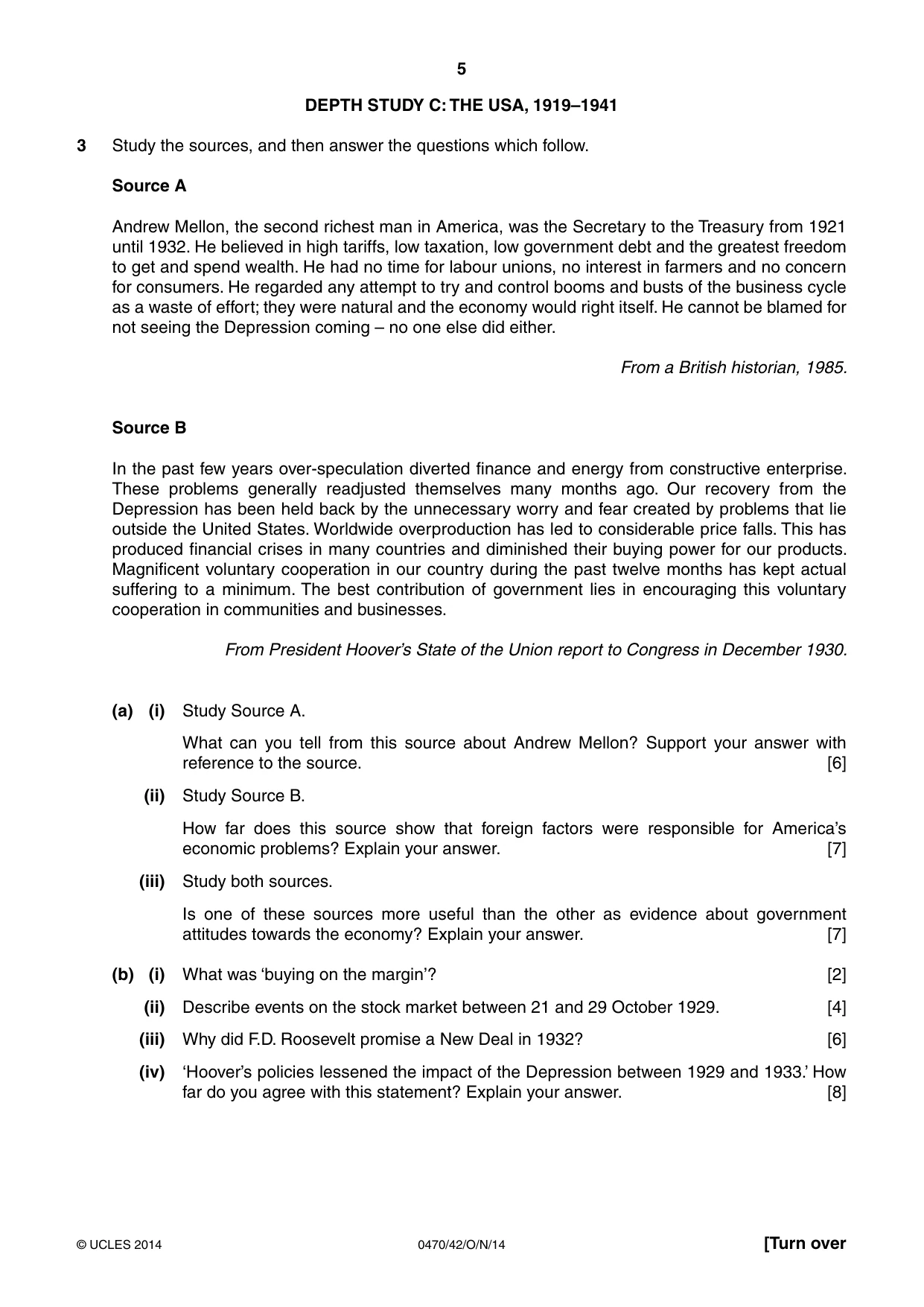
5 0470/42/O/N/14 © UCLES 2014 [Turn over DEPTH STUDY C: THE USA, 1919–1941 3 Study the sources, and then answer the questions which follow. Source A Andrew Mellon, the second richest man in America, was the Secretary to the Treasury from 1921 until 1932. He believed in high tariffs, low taxation, low government debt and the greatest freedom to get and spend wealth. He had no time for labour unions, no interest in farmers and no concern for consumers. He regarded any attempt to try and control booms and busts of the business cycle as a waste of effort; they were natural and the economy would right itself. He cannot be blamed for not seeing the Depression coming – no one else did either. From a British historian, 1985. Source B In the past few years over-speculation diverted finance and energy from constructive enterprise. These problems generally readjusted themselves many months ago. Our recovery from the Depression has been held back by the unnecessary worry and fear created by problems that lie outside the United States. Worldwide overproduction has led to considerable price falls. This has produced financial crises in many countries and diminished their buying power for our products. Magnificent voluntary cooperation in our country during the past twelve months has kept actual suffering to a minimum. The best contribution of government lies in encouraging this voluntary cooperation in communities and businesses. From President Hoover’s State of the Union report to Congress in December 1930. (a) (i) Study Source A. What can you tell from this source about Andrew Mellon? Support your answer with reference to the source. [6] (ii) Study Source B. How far does this source show that foreign factors were responsible for America’s economic problems? Explain your answer. [7] (iii) Study both sources. Is one of these sources more useful than the other as evidence about government attitudes towards the economy? Explain your answer. [7] (b) (i) What was ‘buying on the margin’? [2] (ii) Describe events on the stock market between 21 and 29 October 1929. [4] (iii) Why did F.D. Roosevelt promise a New Deal in 1932? [6] (iv) ‘Hoover’s policies lessened the impact of the Depression between 1929 and 1933.’ How far do you agree with this statement? Explain your answer. [8]
Question paper, page 6
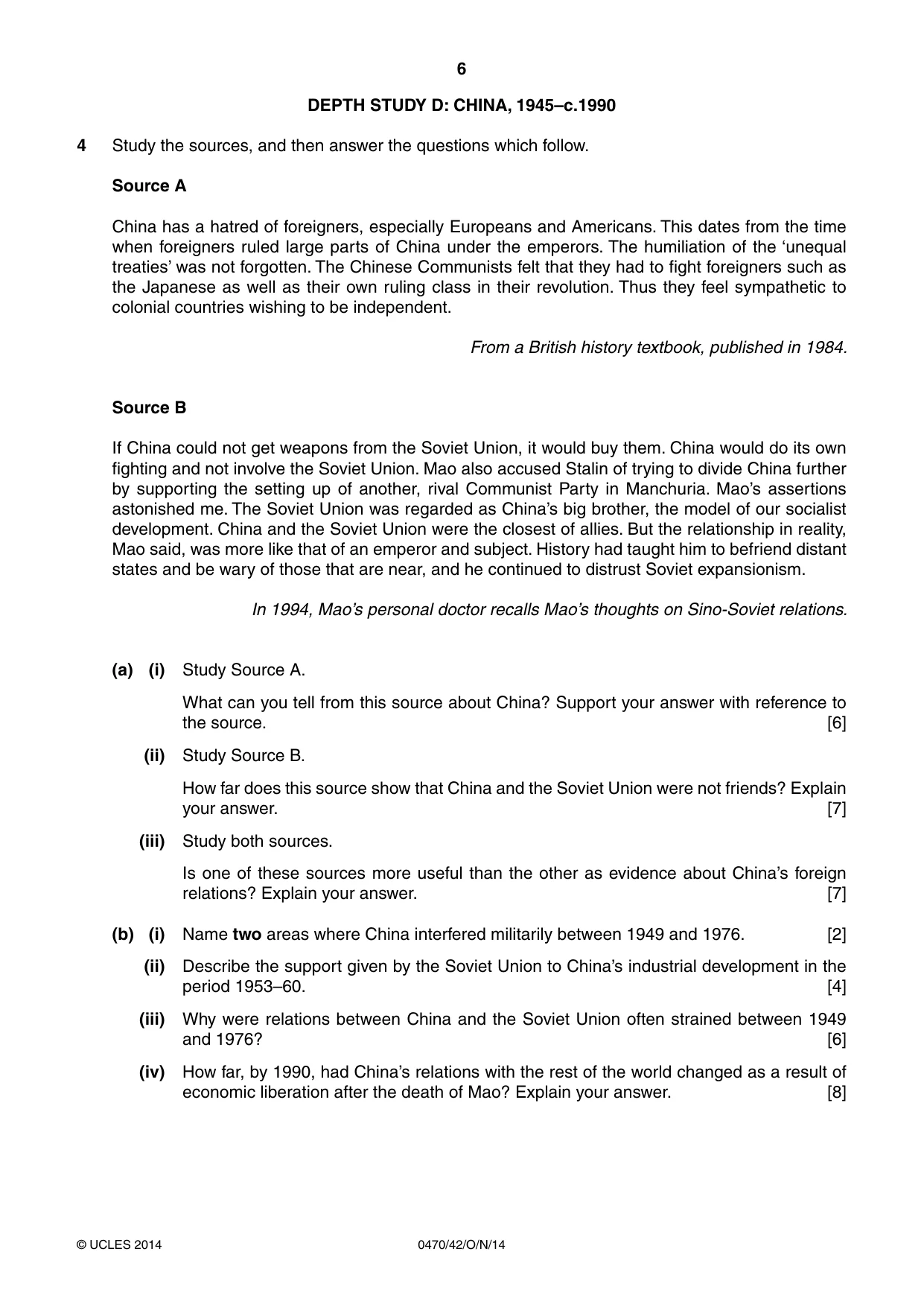
6 0470/42/O/N/14 © UCLES 2014 DEPTH STUDY D: CHINA, 1945–c.1990 4 Study the sources, and then answer the questions which follow. Source A China has a hatred of foreigners, especially Europeans and Americans. This dates from the time when foreigners ruled large parts of China under the emperors. The humiliation of the ‘unequal treaties’ was not forgotten. The Chinese Communists felt that they had to fight foreigners such as the Japanese as well as their own ruling class in their revolution. Thus they feel sympathetic to colonial countries wishing to be independent. From a British history textbook, published in 1984. Source B If China could not get weapons from the Soviet Union, it would buy them. China would do its own fighting and not involve the Soviet Union. Mao also accused Stalin of trying to divide China further by supporting the setting up of another, rival Communist Party in Manchuria. Mao’s assertions astonished me. The Soviet Union was regarded as China’s big brother, the model of our socialist development. China and the Soviet Union were the closest of allies. But the relationship in reality, Mao said, was more like that of an emperor and subject. History had taught him to befriend distant states and be wary of those that are near, and he continued to distrust Soviet expansionism. In 1994, Mao’s personal doctor recalls Mao’s thoughts on Sino-Soviet relations. (a) (i) Study Source A. What can you tell from this source about China? Support your answer with reference to the source. [6] (ii) Study Source B. How far does this source show that China and the Soviet Union were not friends? Explain your answer. [7] (iii) Study both sources. Is one of these sources more useful than the other as evidence about China’s foreign relations? Explain your answer. [7] (b) (i) Name two areas where China interfered militarily between 1949 and 1976. [2] (ii) Describe the support given by the Soviet Union to China’s industrial development in the period 1953–60. [4] (iii) Why were relations between China and the Soviet Union often strained between 1949 and 1976? [6] (iv) How far, by 1990, had China’s relations with the rest of the world changed as a result of economic liberation after the death of Mao? Explain your answer. [8]
Question paper, page 7
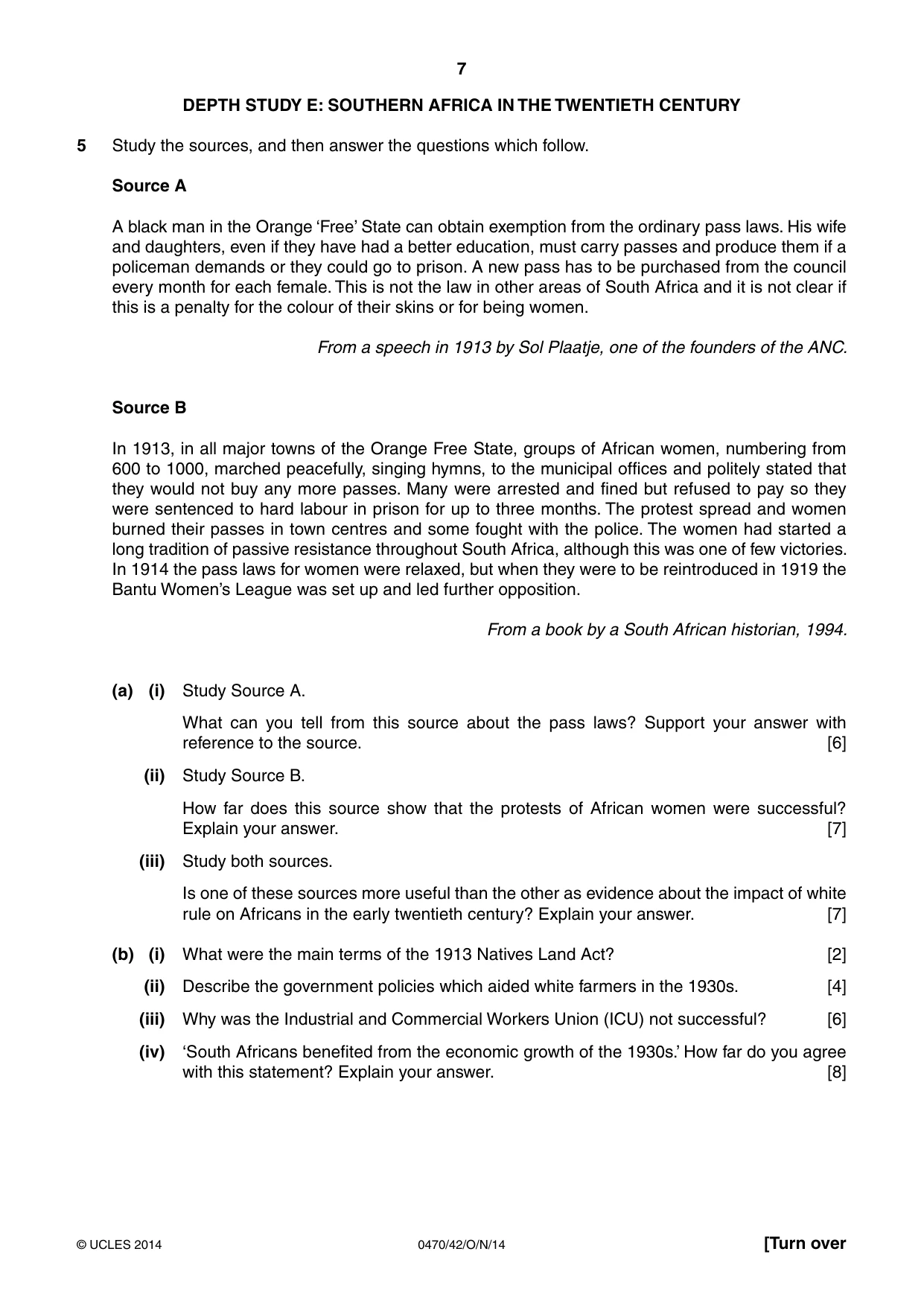
7 0470/42/O/N/14 © UCLES 2014 [Turn over DEPTH STUDY E: SOUTHERN AFRICA IN THE TWENTIETH CENTURY 5 Study the sources, and then answer the questions which follow. Source A A black man in the Orange ‘Free’ State can obtain exemption from the ordinary pass laws. His wife and daughters, even if they have had a better education, must carry passes and produce them if a policeman demands or they could go to prison. A new pass has to be purchased from the council every month for each female. This is not the law in other areas of South Africa and it is not clear if this is a penalty for the colour of their skins or for being women. From a speech in 1913 by Sol Plaatje, one of the founders of the ANC. Source B In 1913, in all major towns of the Orange Free State, groups of African women, numbering from 600 to 1000, marched peacefully, singing hymns, to the municipal offices and politely stated that they would not buy any more passes. Many were arrested and fined but refused to pay so they were sentenced to hard labour in prison for up to three months. The protest spread and women burned their passes in town centres and some fought with the police. The women had started a long tradition of passive resistance throughout South Africa, although this was one of few victories. In 1914 the pass laws for women were relaxed, but when they were to be reintroduced in 1919 the Bantu Women’s League was set up and led further opposition. From a book by a South African historian, 1994. (a) (i) Study Source A. What can you tell from this source about the pass laws? Support your answer with reference to the source. [6] (ii) Study Source B. How far does this source show that the protests of African women were successful? Explain your answer. [7] (iii) Study both sources. Is one of these sources more useful than the other as evidence about the impact of white rule on Africans in the early twentieth century? Explain your answer. [7] (b) (i) What were the main terms of the 1913 Natives Land Act? [2] (ii) Describe the government policies which aided white farmers in the 1930s. [4] (iii) Why was the Industrial and Commercial Workers Union (ICU) not successful? [6] (iv) ‘South Africans benefited from the economic growth of the 1930s.’ How far do you agree with this statement? Explain your answer. [8]
Question paper, page 8
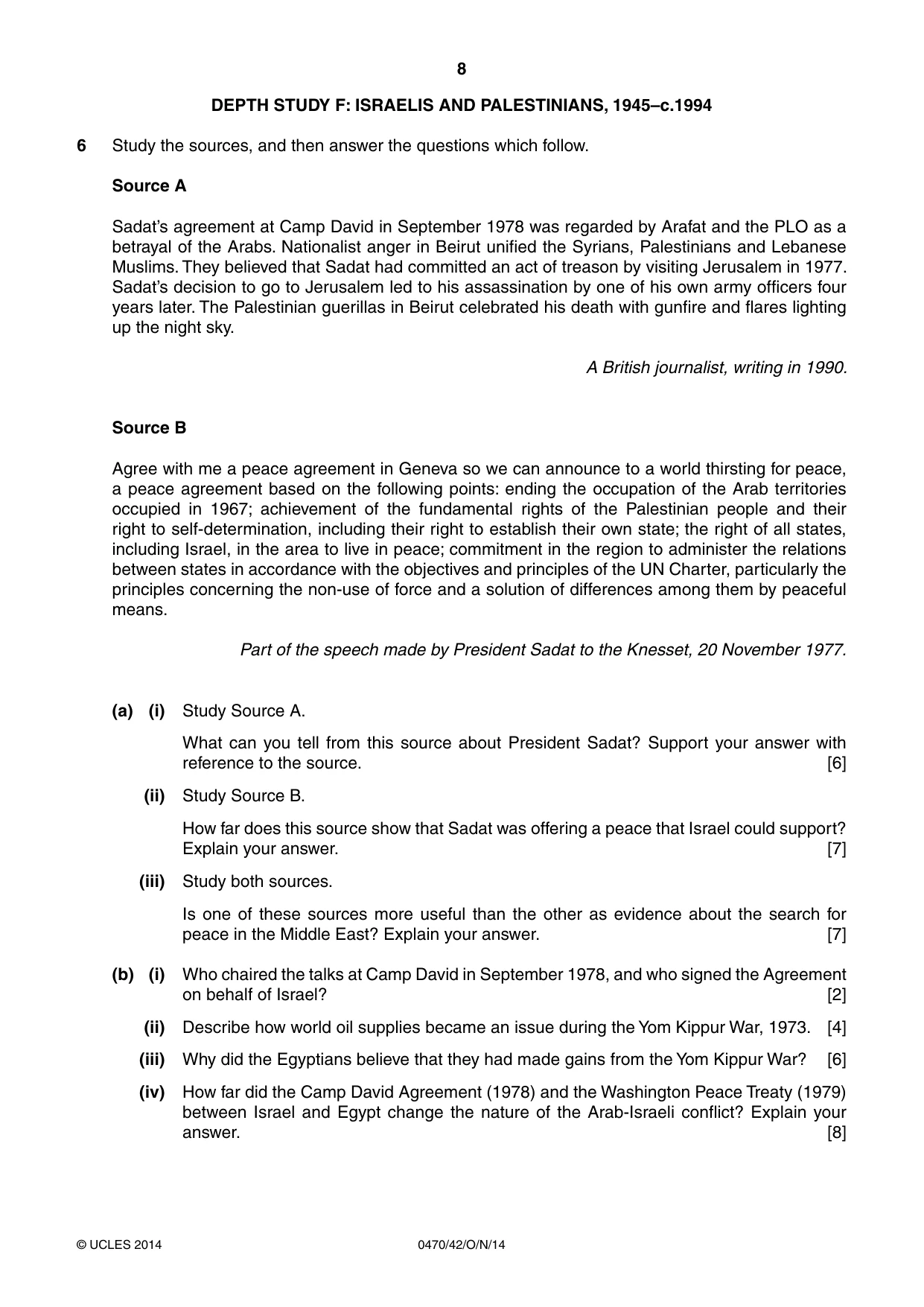
8 0470/42/O/N/14 © UCLES 2014 DEPTH STUDY F: ISRAELIS AND PALESTINIANS, 1945–c.1994 6 Study the sources, and then answer the questions which follow. Source A Sadat’s agreement at Camp David in September 1978 was regarded by Arafat and the PLO as a betrayal of the Arabs. Nationalist anger in Beirut unified the Syrians, Palestinians and Lebanese Muslims. They believed that Sadat had committed an act of treason by visiting Jerusalem in 1977. Sadat’s decision to go to Jerusalem led to his assassination by one of his own army officers four years later. The Palestinian guerillas in Beirut celebrated his death with gunfire and flares lighting up the night sky. A British journalist, writing in 1990. Source B Agree with me a peace agreement in Geneva so we can announce to a world thirsting for peace, a peace agreement based on the following points: ending the occupation of the Arab territories occupied in 1967; achievement of the fundamental rights of the Palestinian people and their right to self-determination, including their right to establish their own state; the right of all states, including Israel, in the area to live in peace; commitment in the region to administer the relations between states in accordance with the objectives and principles of the UN Charter, particularly the principles concerning the non-use of force and a solution of differences among them by peaceful means. Part of the speech made by President Sadat to the Knesset, 20 November 1977. (a) (i) Study Source A. What can you tell from this source about President Sadat? Support your answer with reference to the source. [6] (ii) Study Source B. How far does this source show that Sadat was offering a peace that Israel could support? Explain your answer. [7] (iii) Study both sources. Is one of these sources more useful than the other as evidence about the search for peace in the Middle East? Explain your answer. [7] (b) (i) Who chaired the talks at Camp David in September 1978, and who signed the Agreement on behalf of Israel? [2] (ii) Describe how world oil supplies became an issue during the Yom Kippur War, 1973. [4] (iii) Why did the Egyptians believe that they had made gains from the Yom Kippur War? [6] (iv) How far did the Camp David Agreement (1978) and the Washington Peace Treaty (1979) between Israel and Egypt change the nature of the Arab-Israeli conflict? Explain your answer. [8]
Question paper, page 9
9 0470/42/O/N/14 © UCLES 2014 [Turn over DEPTH STUDY G: THE CREATION OF MODERN INDUSTRIAL SOCIETY 7 Study the sources, and then answer the questions which follow. Source A The population employed in the cotton factories rises at five o’clock and works from six till eight o’clock and returns home for half an hour for breakfast. The operatives return to the mills until twelve o’clock when an hour is allowed for dinner. At the end of the hour they are all again employed in the mills, where they continue until seven o’clock or a later hour. The wages obtained by the operatives are, in general, sufficient to provide them with the decent comforts of life. But the wages of certain classes are exceedingly meagre. More than half the inhabitants require the assistance of a public charity. From a book titled ‘Social Conditions and Education of the People in England and Europe’, published in 1850. Source B The new conditions of work imposed further psychological strains. There were many men whose skill, once an important element in community life and a source of personal pride, was now wanted by no-one. Much of the new employment involved long repetitive hours doing jobs that were meaningless in themselves, a mere portion of a process that ended in a product the worker would not consume. Many tasks now involved the worker in keeping himself to a machine powered by a great engine, the whole controlled by managers. These managers would probably also be of the working class but distinguished in their ability to manipulate the new system. Divisions of interest thus came within the family as some rose and others did not. But despite all this, the worker was not crushed and showed an extraordinary adaptability to this new life. From a book about the rise of industrial society, published in 1964. (a) (i) Study Source A. What can you tell from this source about the lives of factory workers? Support your answer with reference to the source. [6] (ii) Study Source B. How far does this source show that industrialisation affected workers badly? Explain your answer. [7] (iii) Study both sources. Is one of these sources more useful than the other as evidence about factories in the nineteenth century? Explain your answer. [7] (b) (i) Name two textile inventions which helped bring about the Factory Age. [2] (ii) What part did steam power play in the industrial revolution? [4] (iii) Why were large numbers of women and children employed in the new textile mills? [6] (iv) ‘Transport improvements were the most important factor in the creation of a new industrial society.’ How far do you agree with this statement? Explain your answer. [8]
Question paper, page 10
10 0470/42/O/N/14 © UCLES 2014 DEPTH STUDY H: THE IMPACT OF WESTERN IMPERIALISM IN THE NINETEENTH CENTURY 8 Study the sources, and then answer the questions which follow. Source A The African knows no peace. One day you may see peace and plenty, well-tilled fields, and children playing in the sun. On the next you may find corpses of the men, the bodies of children half-burnt in the flames which consumed the village, while the women are captives of the victorious raiders. British rule, which will stop this lawless raiding and this constant inter-tribal war, will be the greatest blessing that Africa has ever known. Lord Lugard wrote this whilst employed by the British Imperial East Africa Company in the early 1890s. Source B To Sir Charles Gordon, My Dear Friend, I wish you good day. It is I, M’tesa, King of Uganda, who sends you this letter. I wish to be a friend of the white man. Therefore hear my words which I say: I want a priest who will show the way of God; I want gold, silver, iron and bronze; I want clothing for my people and myself to wear; I want excellent guns and good cannons; I want good houses for my country; I want my people to know God. From a letter from the King of Uganda to General Gordon in March 1876. (a) (i) Study Source A. What can you tell from this source about the British view of Africa in the late nineteenth century? Support your answer with reference to the source. [6] (ii) Study Source B. How far does this source show that Africans welcomed imperialism because it brought Christianity in the nineteenth century? Explain your answer. [7] (iii) Study both sources. Is one of these sources more useful than the other as evidence about the benefits imperialism was claimed to bring to Africa? Explain your answer. [7] (b) (i) What was indirect rule? [2] (ii) Describe the work of missionaries. [4] (iii) Why was the Berlin Conference of 1884–5 held? [6] (iv) How far was European imperialism harmful to Africans? Explain your answer. [8]
Question paper, page 11
11 0470/42/O/N/14 © UCLES 2014 BLANK PAGE
Question paper, page 12
12 0470/42/O/N/14 © UCLES 2014 BLANK PAGE Copyright Acknowledgements: Depth Study A Source A © G. W. H. Hunt. Depth Study A Source B © Rosa Luxemburg, founder of the German Communist Party; 1939. Depth Study B Source A © A Russian woman; 1951. Depth Study B Source B © Stalin speaking to the Eighteenth Party Congress; 10 March 1939. Depth Study C Source A © Hugh Brogan; History of the United States of America; Penguin Books Ltd; 1985. Depth Study C Source B © President Hoover’s State of the Union report to Congress; December 1930. Depth Study D Source A © Christopher Culpin; Making History; Collins Educational; 1984. Depth Study D Source B © Mao’s personal doctor recalls Mao’s thoughts on Sino-Soviet relations; 1994. Depth Study E Source A © A speech by Sol Plaatje, one of the founders of the ANC; 1913. Depth Study E Source B © William Beinart; Twentieth Century South Africa; Oxford University Press; 1994. Depth Study F Source A © Robert Fisk; Pity the Nation: Lebanon at War; Andre Deutsch; 1990 Depth Study F Source B © Dan Cohn Sherbok & Dawoud El-Alami; The Palestine-Israeli Conflict; Oneworld Publications; 2001. Depth Study G Source A © Peter Lane; Documents on Social and Economic History 1750–1870; Macmillan; 1968. Depth Study G Source B © From a book about the rise of industrial society, published in 1964. Depth Study H Source A © Lord Lugard whilst employed by the British Imperial East Africa Company in the early 1890s. Depth Study H Source B © A letter from the King of Uganda to General Gordon; March 1876. Permission to reproduce items where third-party owned material protected by copyright is included has been sought and cleared where possible. Every reasonable effort has been made by the publisher (UCLES) to trace copyright holders, but if any items requiring clearance have unwittingly been included, the publisher will be pleased to make amends at the earliest possible opportunity. Cambridge International Examinations is part of the Cambridge Assessment Group. Cambridge Assessment is the brand name of University of Cambridge Local Examinations Syndicate (UCLES), which is itself a department of the University of Cambridge.
Mark scheme, page 1
® IGCSE is the registered trademark of Cambridge International Examinations. CAMBRIDGE INTERNATIONAL EXAMINATIONS Cambridge International General Certificate of Secondary Education MARK SCHEME for the October/November 2014 series 0470 HISTORY 0470/42 Paper 4 (Alternative to Coursework), maximum raw mark 40 This mark scheme is published as an aid to teachers and candidates, to indicate the requirements of the examination. It shows the basis on which Examiners were instructed to award marks. It does not indicate the details of the discussions that took place at an Examiners’ meeting before marking began, which would have considered the acceptability of alternative answers. Mark schemes should be read in conjunction with the question paper and the Principal Examiner Report for Teachers. Cambridge will not enter into discussions about these mark schemes. Cambridge is publishing the mark schemes for the October/November 2014 series for most Cambridge IGCSE®, Cambridge International A and AS Level components and some Cambridge O Level components.
Mark scheme, page 2
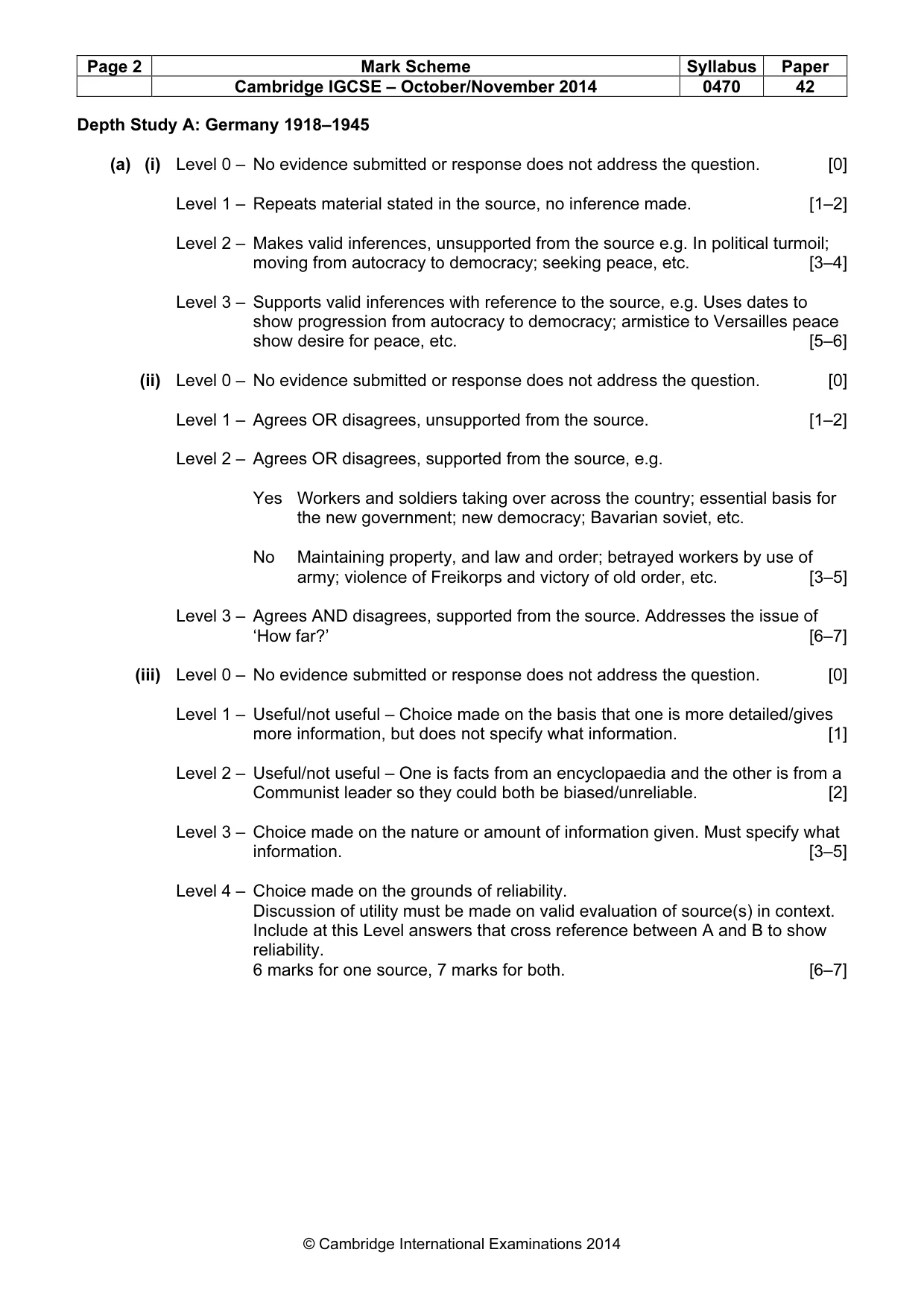
Page 2 Mark Scheme Syllabus Paper Cambridge IGCSE – October/November 2014 0470 42 © Cambridge International Examinations 2014 Depth Study A: Germany 1918–1945 (a) (i) Level 0 – No evidence submitted or response does not address the question. [0] Level 1 – Repeats material stated in the source, no inference made. [1–2] Level 2 – Makes valid inferences, unsupported from the source e.g. In political turmoil; moving from autocracy to democracy; seeking peace, etc. [3–4] Level 3 – Supports valid inferences with reference to the source, e.g. Uses dates to show progression from autocracy to democracy; armistice to Versailles peace show desire for peace, etc. [5–6] (ii) Level 0 – No evidence submitted or response does not address the question. [0] Level 1 – Agrees OR disagrees, unsupported from the source. [1–2] Level 2 – Agrees OR disagrees, supported from the source, e.g. Yes Workers and soldiers taking over across the country; essential basis for the new government; new democracy; Bavarian soviet, etc. No Maintaining property, and law and order; betrayed workers by use of army; violence of Freikorps and victory of old order, etc. [3–5] Level 3 – Agrees AND disagrees, supported from the source. Addresses the issue of ‘How far?’ [6–7] (iii) Level 0 – No evidence submitted or response does not address the question. [0] Level 1 – Useful/not useful – Choice made on the basis that one is more detailed/gives more information, but does not specify what information. [1] Level 2 – Useful/not useful – One is facts from an encyclopaedia and the other is from a Communist leader so they could both be biased/unreliable. [2] Level 3 – Choice made on the nature or amount of information given. Must specify what information. [3–5] Level 4 – Choice made on the grounds of reliability. Discussion of utility must be made on valid evaluation of source(s) in context. Include at this Level answers that cross reference between A and B to show reliability. 6 marks for one source, 7 marks for both. [6–7]
Mark scheme, page 3
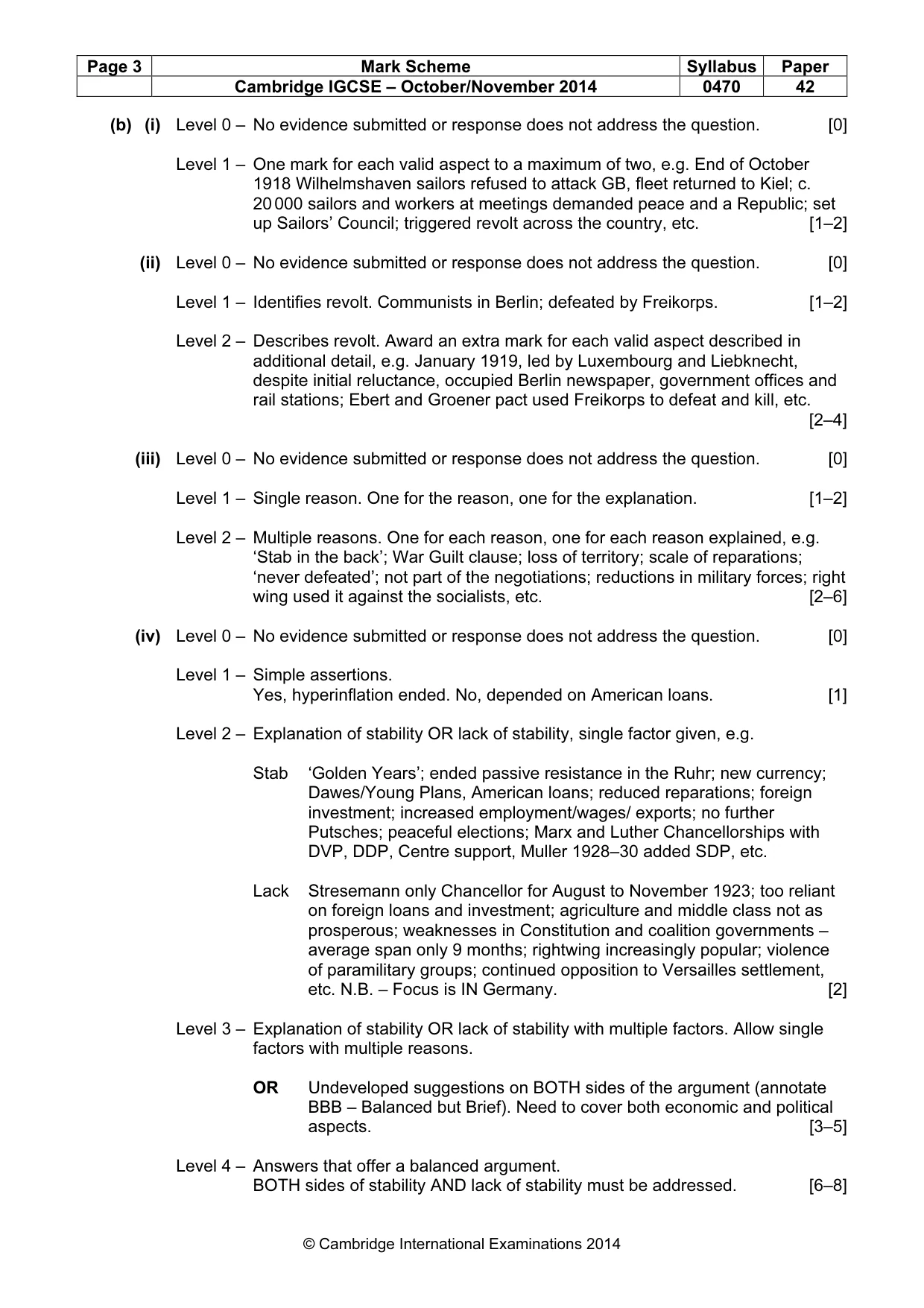
Page 3 Mark Scheme Syllabus Paper Cambridge IGCSE – October/November 2014 0470 42 © Cambridge International Examinations 2014 (b) (i) Level 0 – No evidence submitted or response does not address the question. [0] Level 1 – One mark for each valid aspect to a maximum of two, e.g. End of October 1918 Wilhelmshaven sailors refused to attack GB, fleet returned to Kiel; c. 20 000 sailors and workers at meetings demanded peace and a Republic; set up Sailors’ Council; triggered revolt across the country, etc. [1–2] (ii) Level 0 – No evidence submitted or response does not address the question. [0] Level 1 – Identifies revolt. Communists in Berlin; defeated by Freikorps. [1–2] Level 2 – Describes revolt. Award an extra mark for each valid aspect described in additional detail, e.g. January 1919, led by Luxembourg and Liebknecht, despite initial reluctance, occupied Berlin newspaper, government offices and rail stations; Ebert and Groener pact used Freikorps to defeat and kill, etc. [2–4] (iii) Level 0 – No evidence submitted or response does not address the question. [0] Level 1 – Single reason. One for the reason, one for the explanation. [1–2] Level 2 – Multiple reasons. One for each reason, one for each reason explained, e.g. ‘Stab in the back’; War Guilt clause; loss of territory; scale of reparations; ‘never defeated’; not part of the negotiations; reductions in military forces; right wing used it against the socialists, etc. [2–6] (iv) Level 0 – No evidence submitted or response does not address the question. [0] Level 1 – Simple assertions. Yes, hyperinflation ended. No, depended on American loans. [1] Level 2 – Explanation of stability OR lack of stability, single factor given, e.g. Stab ‘Golden Years’; ended passive resistance in the Ruhr; new currency; Dawes/Young Plans, American loans; reduced reparations; foreign investment; increased employment/wages/ exports; no further Putsches; peaceful elections; Marx and Luther Chancellorships with DVP, DDP, Centre support, Muller 1928–30 added SDP, etc. Lack Stresemann only Chancellor for August to November 1923; too reliant on foreign loans and investment; agriculture and middle class not as prosperous; weaknesses in Constitution and coalition governments – average span only 9 months; rightwing increasingly popular; violence of paramilitary groups; continued opposition to Versailles settlement, etc. N.B. – Focus is IN Germany. [2] Level 3 – Explanation of stability OR lack of stability with multiple factors. Allow single factors with multiple reasons. OR Undeveloped suggestions on BOTH sides of the argument (annotate BBB – Balanced but Brief). Need to cover both economic and political aspects. [3–5] Level 4 – Answers that offer a balanced argument. BOTH sides of stability AND lack of stability must be addressed. [6–8]
Mark scheme, page 4
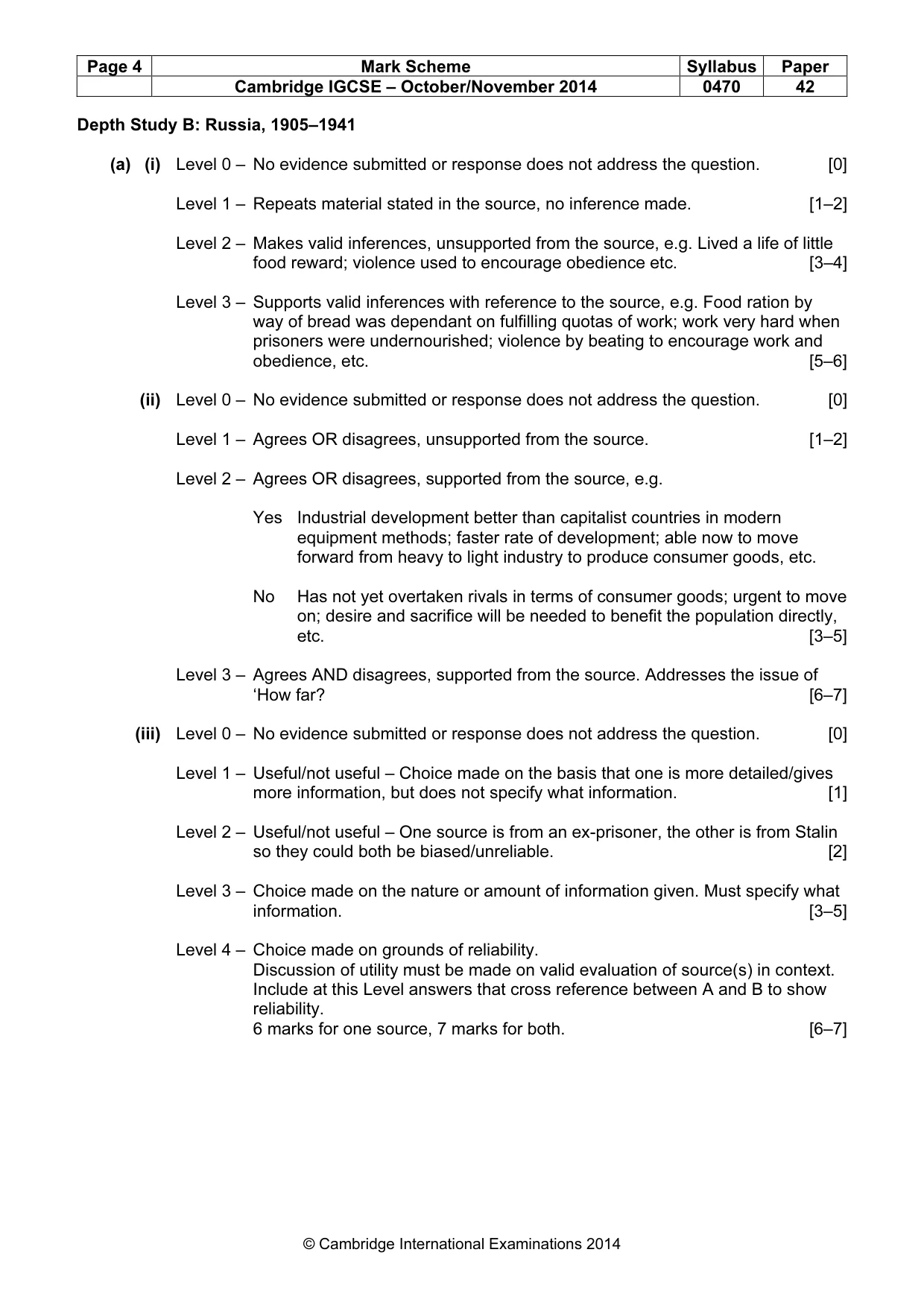
Page 4 Mark Scheme Syllabus Paper Cambridge IGCSE – October/November 2014 0470 42 © Cambridge International Examinations 2014 Depth Study B: Russia, 1905–1941 (a) (i) Level 0 – No evidence submitted or response does not address the question. [0] Level 1 – Repeats material stated in the source, no inference made. [1–2] Level 2 – Makes valid inferences, unsupported from the source, e.g. Lived a life of little food reward; violence used to encourage obedience etc. [3–4] Level 3 – Supports valid inferences with reference to the source, e.g. Food ration by way of bread was dependant on fulfilling quotas of work; work very hard when prisoners were undernourished; violence by beating to encourage work and obedience, etc. [5–6] (ii) Level 0 – No evidence submitted or response does not address the question. [0] Level 1 – Agrees OR disagrees, unsupported from the source. [1–2] Level 2 – Agrees OR disagrees, supported from the source, e.g. Yes Industrial development better than capitalist countries in modern equipment methods; faster rate of development; able now to move forward from heavy to light industry to produce consumer goods, etc. No Has not yet overtaken rivals in terms of consumer goods; urgent to move on; desire and sacrifice will be needed to benefit the population directly, etc. [3–5] Level 3 – Agrees AND disagrees, supported from the source. Addresses the issue of ‘How far? [6–7] (iii) Level 0 – No evidence submitted or response does not address the question. [0] Level 1 – Useful/not useful – Choice made on the basis that one is more detailed/gives more information, but does not specify what information. [1] Level 2 – Useful/not useful – One source is from an ex-prisoner, the other is from Stalin so they could both be biased/unreliable. [2] Level 3 – Choice made on the nature or amount of information given. Must specify what information. [3–5] Level 4 – Choice made on grounds of reliability. Discussion of utility must be made on valid evaluation of source(s) in context. Include at this Level answers that cross reference between A and B to show reliability. 6 marks for one source, 7 marks for both. [6–7]
Mark scheme, page 5
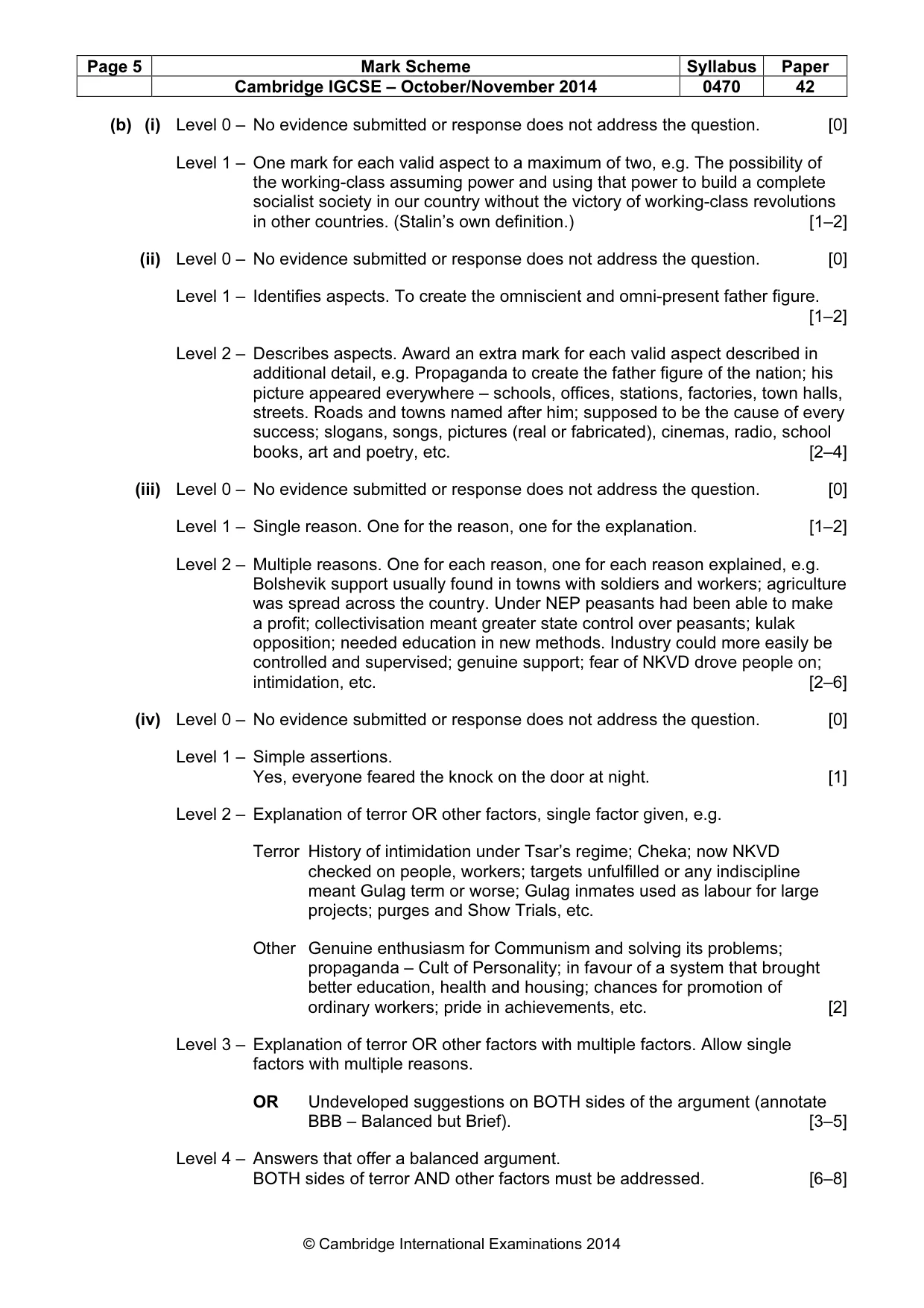
Page 5 Mark Scheme Syllabus Paper Cambridge IGCSE – October/November 2014 0470 42 © Cambridge International Examinations 2014 (b) (i) Level 0 – No evidence submitted or response does not address the question. [0] Level 1 – One mark for each valid aspect to a maximum of two, e.g. The possibility of the working-class assuming power and using that power to build a complete socialist society in our country without the victory of working-class revolutions in other countries. (Stalin’s own definition.) [1–2] (ii) Level 0 – No evidence submitted or response does not address the question. [0] Level 1 – Identifies aspects. To create the omniscient and omni-present father figure. [1–2] Level 2 – Describes aspects. Award an extra mark for each valid aspect described in additional detail, e.g. Propaganda to create the father figure of the nation; his picture appeared everywhere – schools, offices, stations, factories, town halls, streets. Roads and towns named after him; supposed to be the cause of every success; slogans, songs, pictures (real or fabricated), cinemas, radio, school books, art and poetry, etc. [2–4] (iii) Level 0 – No evidence submitted or response does not address the question. [0] Level 1 – Single reason. One for the reason, one for the explanation. [1–2] Level 2 – Multiple reasons. One for each reason, one for each reason explained, e.g. Bolshevik support usually found in towns with soldiers and workers; agriculture was spread across the country. Under NEP peasants had been able to make a profit; collectivisation meant greater state control over peasants; kulak opposition; needed education in new methods. Industry could more easily be controlled and supervised; genuine support; fear of NKVD drove people on; intimidation, etc. [2–6] (iv) Level 0 – No evidence submitted or response does not address the question. [0] Level 1 – Simple assertions. Yes, everyone feared the knock on the door at night. [1] Level 2 – Explanation of terror OR other factors, single factor given, e.g. Terror History of intimidation under Tsar’s regime; Cheka; now NKVD checked on people, workers; targets unfulfilled or any indiscipline meant Gulag term or worse; Gulag inmates used as labour for large projects; purges and Show Trials, etc. Other Genuine enthusiasm for Communism and solving its problems; propaganda – Cult of Personality; in favour of a system that brought better education, health and housing; chances for promotion of ordinary workers; pride in achievements, etc. [2] Level 3 – Explanation of terror OR other factors with multiple factors. Allow single factors with multiple reasons. OR Undeveloped suggestions on BOTH sides of the argument (annotate BBB – Balanced but Brief). [3–5] Level 4 – Answers that offer a balanced argument. BOTH sides of terror AND other factors must be addressed. [6–8]
Mark scheme, page 6
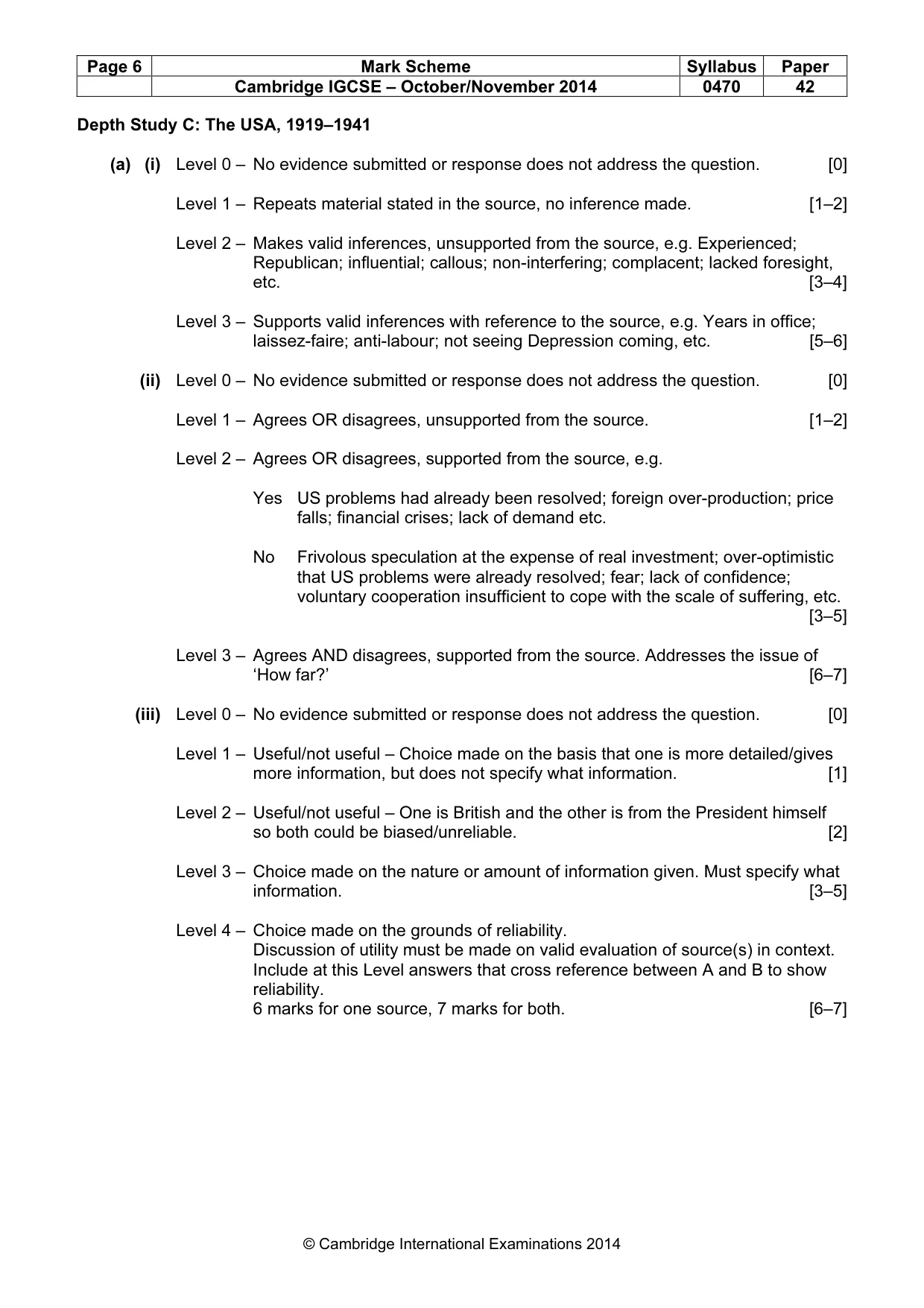
Page 6 Mark Scheme Syllabus Paper Cambridge IGCSE – October/November 2014 0470 42 © Cambridge International Examinations 2014 Depth Study C: The USA, 1919–1941 (a) (i) Level 0 – No evidence submitted or response does not address the question. [0] Level 1 – Repeats material stated in the source, no inference made. [1–2] Level 2 – Makes valid inferences, unsupported from the source, e.g. Experienced; Republican; influential; callous; non-interfering; complacent; lacked foresight, etc. [3–4] Level 3 – Supports valid inferences with reference to the source, e.g. Years in office; laissez-faire; anti-labour; not seeing Depression coming, etc. [5–6] (ii) Level 0 – No evidence submitted or response does not address the question. [0] Level 1 – Agrees OR disagrees, unsupported from the source. [1–2] Level 2 – Agrees OR disagrees, supported from the source, e.g. Yes US problems had already been resolved; foreign over-production; price falls; financial crises; lack of demand etc. No Frivolous speculation at the expense of real investment; over-optimistic that US problems were already resolved; fear; lack of confidence; voluntary cooperation insufficient to cope with the scale of suffering, etc. [3–5] Level 3 – Agrees AND disagrees, supported from the source. Addresses the issue of ‘How far?’ [6–7] (iii) Level 0 – No evidence submitted or response does not address the question. [0] Level 1 – Useful/not useful – Choice made on the basis that one is more detailed/gives more information, but does not specify what information. [1] Level 2 – Useful/not useful – One is British and the other is from the President himself so both could be biased/unreliable. [2] Level 3 – Choice made on the nature or amount of information given. Must specify what information. [3–5] Level 4 – Choice made on the grounds of reliability. Discussion of utility must be made on valid evaluation of source(s) in context. Include at this Level answers that cross reference between A and B to show reliability. 6 marks for one source, 7 marks for both. [6–7]
Mark scheme, page 7
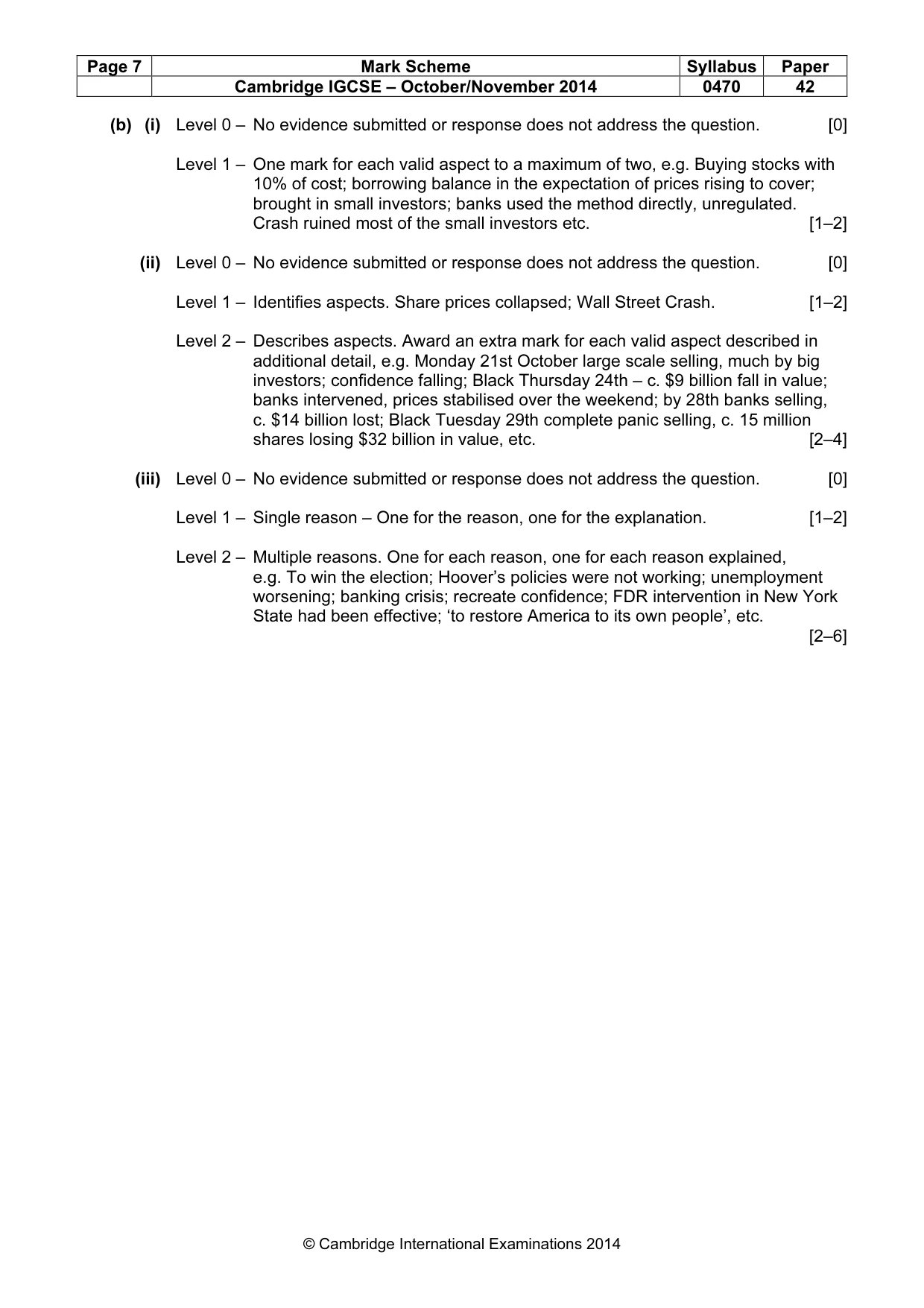
Page 7 Mark Scheme Syllabus Paper Cambridge IGCSE – October/November 2014 0470 42 © Cambridge International Examinations 2014 (b) (i) Level 0 – No evidence submitted or response does not address the question. [0] Level 1 – One mark for each valid aspect to a maximum of two, e.g. Buying stocks with 10% of cost; borrowing balance in the expectation of prices rising to cover; brought in small investors; banks used the method directly, unregulated. Crash ruined most of the small investors etc. [1–2] (ii) Level 0 – No evidence submitted or response does not address the question. [0] Level 1 – Identifies aspects. Share prices collapsed; Wall Street Crash. [1–2] Level 2 – Describes aspects. Award an extra mark for each valid aspect described in additional detail, e.g. Monday 21st October large scale selling, much by big investors; confidence falling; Black Thursday 24th – c. $9 billion fall in value; banks intervened, prices stabilised over the weekend; by 28th banks selling, c. $14 billion lost; Black Tuesday 29th complete panic selling, c. 15 million shares losing $32 billion in value, etc. [2–4] (iii) Level 0 – No evidence submitted or response does not address the question. [0] Level 1 – Single reason – One for the reason, one for the explanation. [1–2] Level 2 – Multiple reasons. One for each reason, one for each reason explained, e.g. To win the election; Hoover’s policies were not working; unemployment worsening; banking crisis; recreate confidence; FDR intervention in New York State had been effective; ‘to restore America to its own people’, etc. [2–6]
Mark scheme, page 8
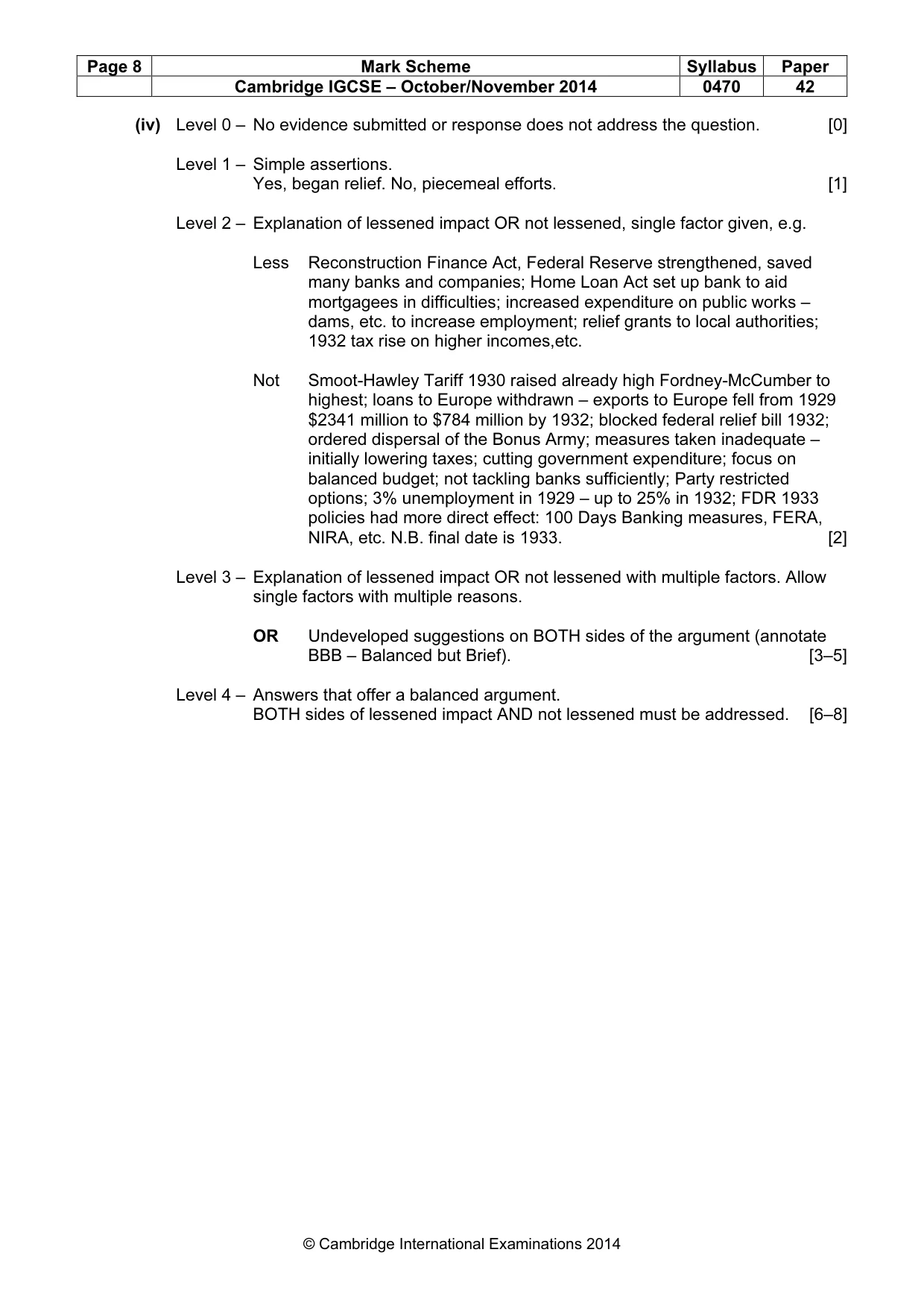
Page 8 Mark Scheme Syllabus Paper Cambridge IGCSE – October/November 2014 0470 42 © Cambridge International Examinations 2014 (iv) Level 0 – No evidence submitted or response does not address the question. [0] Level 1 – Simple assertions. Yes, began relief. No, piecemeal efforts. [1] Level 2 – Explanation of lessened impact OR not lessened, single factor given, e.g. Less Reconstruction Finance Act, Federal Reserve strengthened, saved many banks and companies; Home Loan Act set up bank to aid mortgagees in difficulties; increased expenditure on public works – dams, etc. to increase employment; relief grants to local authorities; 1932 tax rise on higher incomes,etc. Not Smoot-Hawley Tariff 1930 raised already high Fordney-McCumber to highest; loans to Europe withdrawn – exports to Europe fell from 1929 $2341 million to $784 million by 1932; blocked federal relief bill 1932; ordered dispersal of the Bonus Army; measures taken inadequate – initially lowering taxes; cutting government expenditure; focus on balanced budget; not tackling banks sufficiently; Party restricted options; 3% unemployment in 1929 – up to 25% in 1932; FDR 1933 policies had more direct effect: 100 Days Banking measures, FERA, NIRA, etc. N.B. final date is 1933. [2] Level 3 – Explanation of lessened impact OR not lessened with multiple factors. Allow single factors with multiple reasons. OR Undeveloped suggestions on BOTH sides of the argument (annotate BBB – Balanced but Brief). [3–5] Level 4 – Answers that offer a balanced argument. BOTH sides of lessened impact AND not lessened must be addressed. [6–8]
Mark scheme, page 9
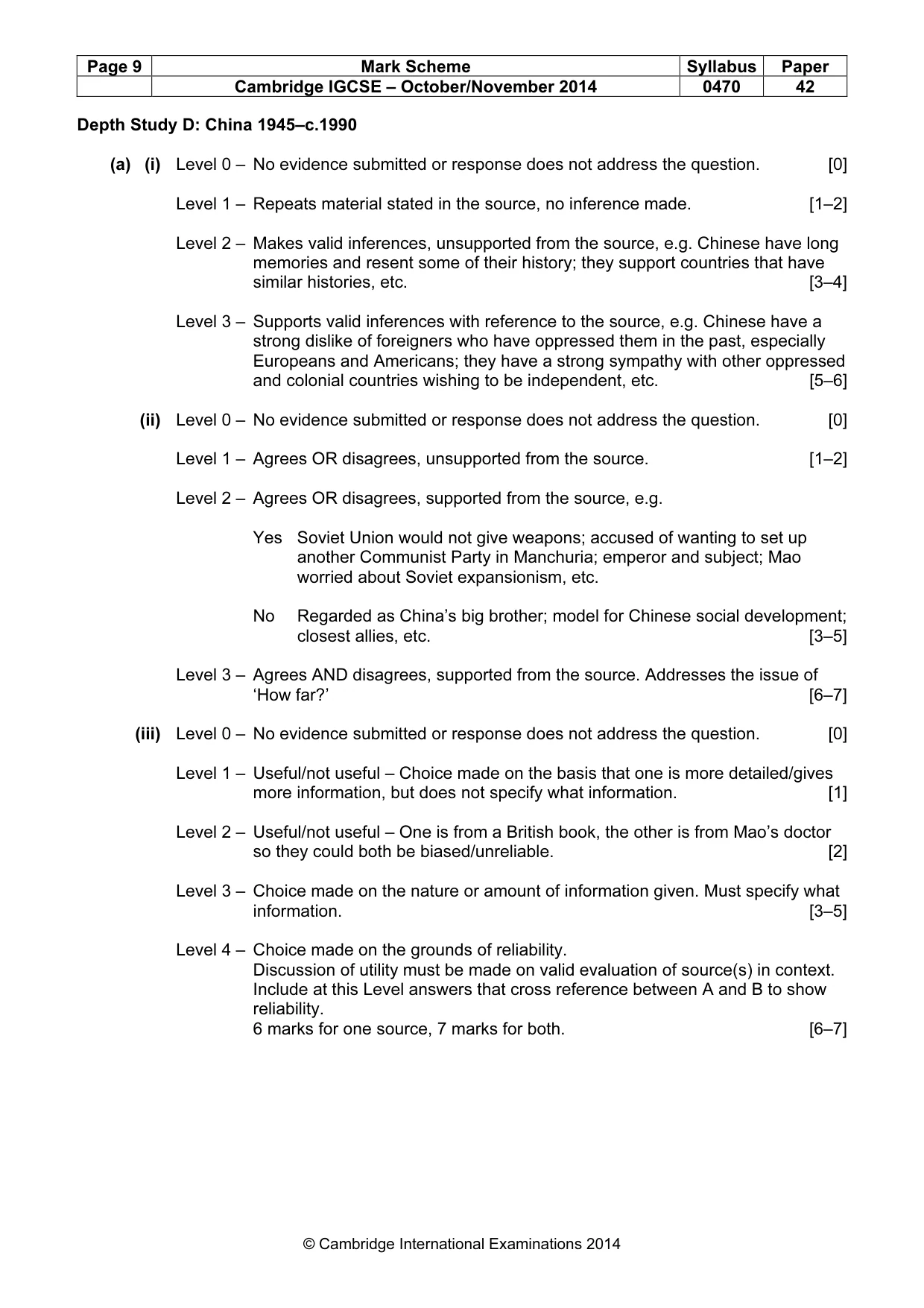
Page 9 Mark Scheme Syllabus Paper Cambridge IGCSE – October/November 2014 0470 42 © Cambridge International Examinations 2014 Depth Study D: China 1945–c.1990 (a) (i) Level 0 – No evidence submitted or response does not address the question. [0] Level 1 – Repeats material stated in the source, no inference made. [1–2] Level 2 – Makes valid inferences, unsupported from the source, e.g. Chinese have long memories and resent some of their history; they support countries that have similar histories, etc. [3–4] Level 3 – Supports valid inferences with reference to the source, e.g. Chinese have a strong dislike of foreigners who have oppressed them in the past, especially Europeans and Americans; they have a strong sympathy with other oppressed and colonial countries wishing to be independent, etc. [5–6] (ii) Level 0 – No evidence submitted or response does not address the question. [0] Level 1 – Agrees OR disagrees, unsupported from the source. [1–2] Level 2 – Agrees OR disagrees, supported from the source, e.g. Yes Soviet Union would not give weapons; accused of wanting to set up another Communist Party in Manchuria; emperor and subject; Mao worried about Soviet expansionism, etc. No Regarded as China’s big brother; model for Chinese social development; closest allies, etc. [3–5] Level 3 – Agrees AND disagrees, supported from the source. Addresses the issue of ‘How far?’ [6–7] (iii) Level 0 – No evidence submitted or response does not address the question. [0] Level 1 – Useful/not useful – Choice made on the basis that one is more detailed/gives more information, but does not specify what information. [1] Level 2 – Useful/not useful – One is from a British book, the other is from Mao’s doctor so they could both be biased/unreliable. [2] Level 3 – Choice made on the nature or amount of information given. Must specify what information. [3–5] Level 4 – Choice made on the grounds of reliability. Discussion of utility must be made on valid evaluation of source(s) in context. Include at this Level answers that cross reference between A and B to show reliability. 6 marks for one source, 7 marks for both. [6–7]
Mark scheme, page 10
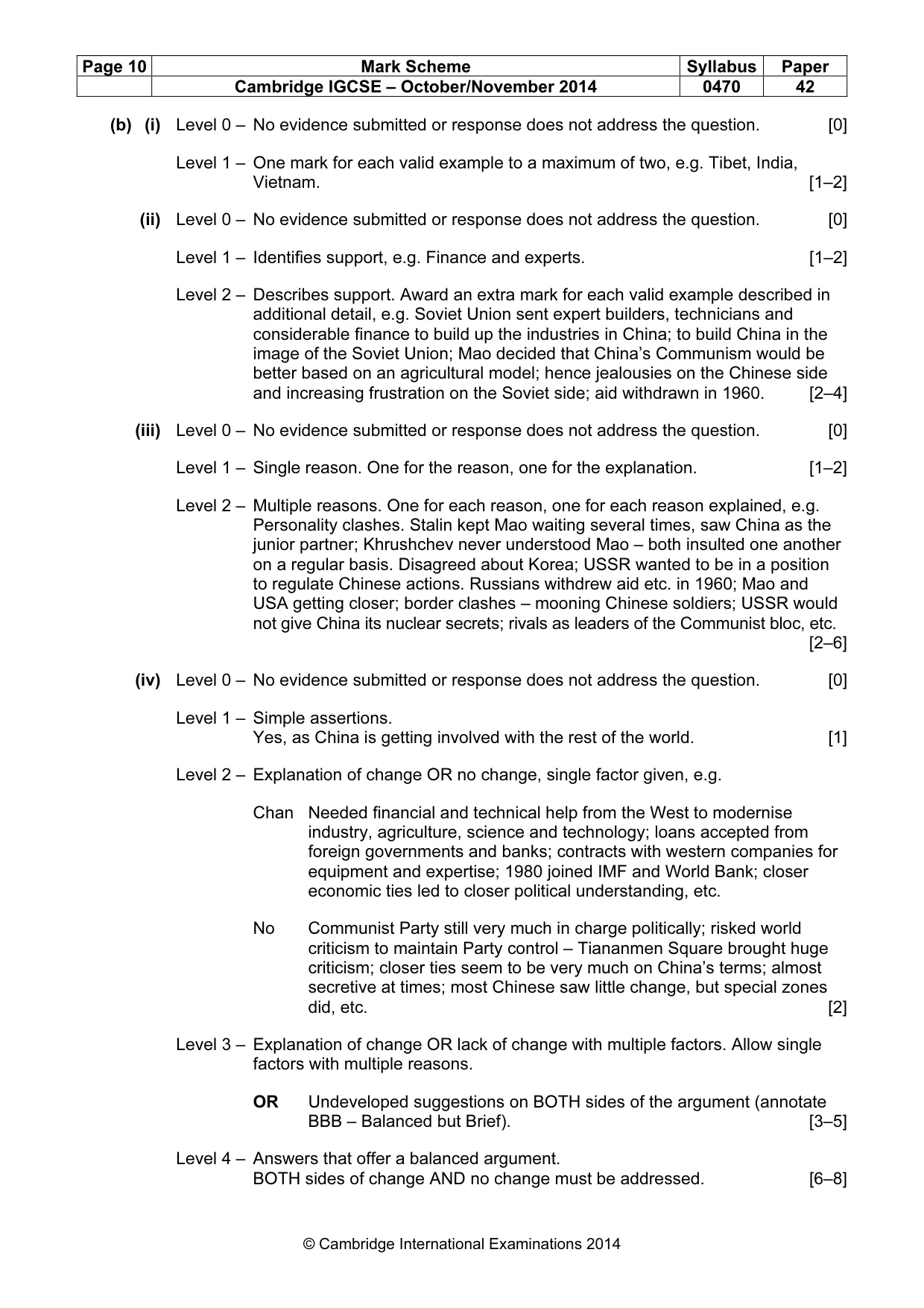
Page 10 Mark Scheme Syllabus Paper Cambridge IGCSE – October/November 2014 0470 42 © Cambridge International Examinations 2014 (b) (i) Level 0 – No evidence submitted or response does not address the question. [0] Level 1 – One mark for each valid example to a maximum of two, e.g. Tibet, India, Vietnam. [1–2] (ii) Level 0 – No evidence submitted or response does not address the question. [0] Level 1 – Identifies support, e.g. Finance and experts. [1–2] Level 2 – Describes support. Award an extra mark for each valid example described in additional detail, e.g. Soviet Union sent expert builders, technicians and considerable finance to build up the industries in China; to build China in the image of the Soviet Union; Mao decided that China’s Communism would be better based on an agricultural model; hence jealousies on the Chinese side and increasing frustration on the Soviet side; aid withdrawn in 1960. [2–4] (iii) Level 0 – No evidence submitted or response does not address the question. [0] Level 1 – Single reason. One for the reason, one for the explanation. [1–2] Level 2 – Multiple reasons. One for each reason, one for each reason explained, e.g. Personality clashes. Stalin kept Mao waiting several times, saw China as the junior partner; Khrushchev never understood Mao – both insulted one another on a regular basis. Disagreed about Korea; USSR wanted to be in a position to regulate Chinese actions. Russians withdrew aid etc. in 1960; Mao and USA getting closer; border clashes – mooning Chinese soldiers; USSR would not give China its nuclear secrets; rivals as leaders of the Communist bloc, etc. [2–6] (iv) Level 0 – No evidence submitted or response does not address the question. [0] Level 1 – Simple assertions. Yes, as China is getting involved with the rest of the world. [1] Level 2 – Explanation of change OR no change, single factor given, e.g. Chan Needed financial and technical help from the West to modernise industry, agriculture, science and technology; loans accepted from foreign governments and banks; contracts with western companies for equipment and expertise; 1980 joined IMF and World Bank; closer economic ties led to closer political understanding, etc. No Communist Party still very much in charge politically; risked world criticism to maintain Party control – Tiananmen Square brought huge criticism; closer ties seem to be very much on China’s terms; almost secretive at times; most Chinese saw little change, but special zones did, etc. [2] Level 3 – Explanation of change OR lack of change with multiple factors. Allow single factors with multiple reasons. OR Undeveloped suggestions on BOTH sides of the argument (annotate BBB – Balanced but Brief). [3–5] Level 4 – Answers that offer a balanced argument. BOTH sides of change AND no change must be addressed. [6–8]
Mark scheme, page 11
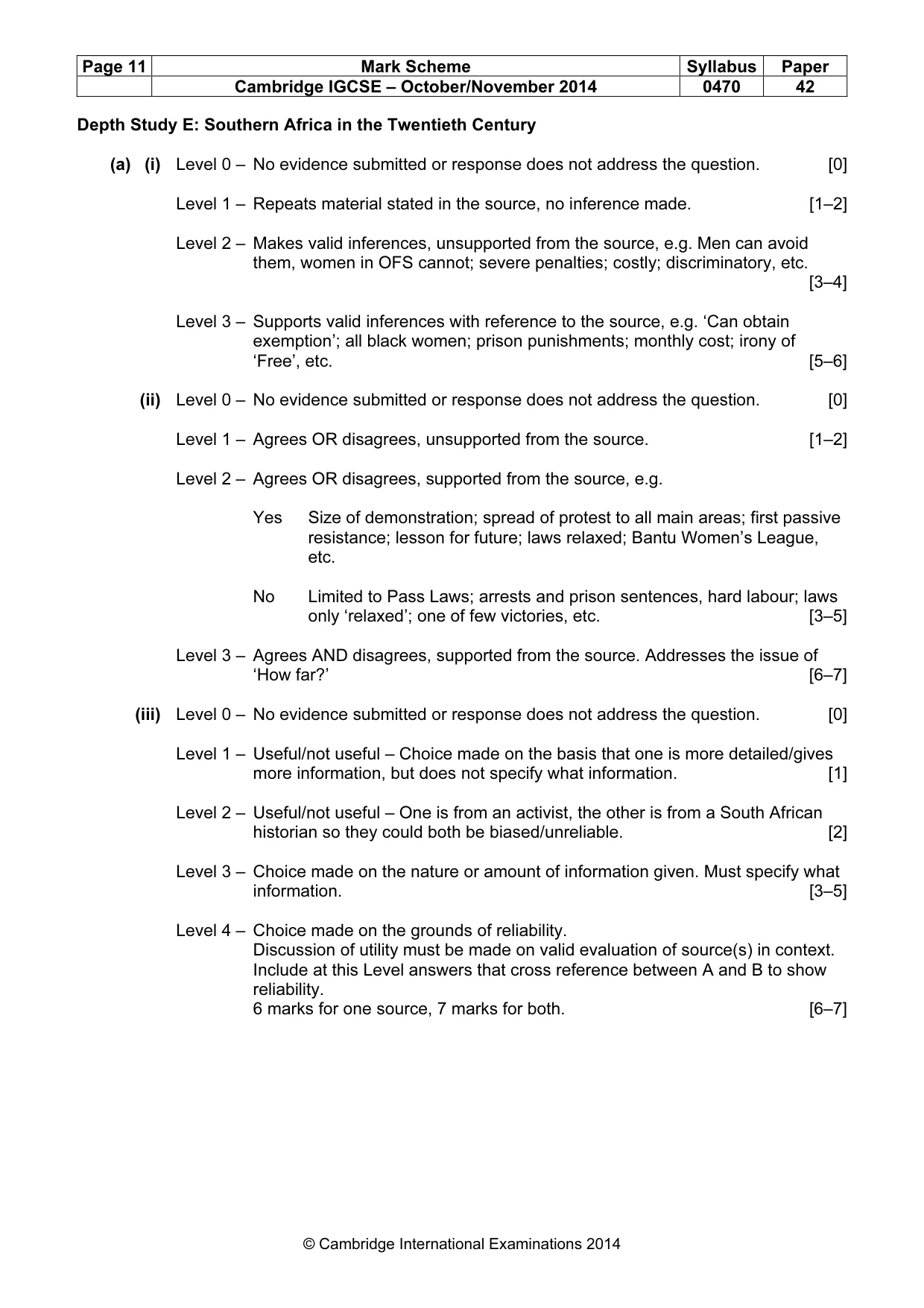
Page 11 Mark Scheme Syllabus Paper Cambridge IGCSE – October/November 2014 0470 42 © Cambridge International Examinations 2014 Depth Study E: Southern Africa in the Twentieth Century (a) (i) Level 0 – No evidence submitted or response does not address the question. [0] Level 1 – Repeats material stated in the source, no inference made. [1–2] Level 2 – Makes valid inferences, unsupported from the source, e.g. Men can avoid them, women in OFS cannot; severe penalties; costly; discriminatory, etc. [3–4] Level 3 – Supports valid inferences with reference to the source, e.g. ‘Can obtain exemption’; all black women; prison punishments; monthly cost; irony of ‘Free’, etc. [5–6] (ii) Level 0 – No evidence submitted or response does not address the question. [0] Level 1 – Agrees OR disagrees, unsupported from the source. [1–2] Level 2 – Agrees OR disagrees, supported from the source, e.g. Yes Size of demonstration; spread of protest to all main areas; first passive resistance; lesson for future; laws relaxed; Bantu Women’s League, etc. No Limited to Pass Laws; arrests and prison sentences, hard labour; laws only ‘relaxed’; one of few victories, etc. [3–5] Level 3 – Agrees AND disagrees, supported from the source. Addresses the issue of ‘How far?’ [6–7] (iii) Level 0 – No evidence submitted or response does not address the question. [0] Level 1 – Useful/not useful – Choice made on the basis that one is more detailed/gives more information, but does not specify what information. [1] Level 2 – Useful/not useful – One is from an activist, the other is from a South African historian so they could both be biased/unreliable. [2] Level 3 – Choice made on the nature or amount of information given. Must specify what information. [3–5] Level 4 – Choice made on the grounds of reliability. Discussion of utility must be made on valid evaluation of source(s) in context. Include at this Level answers that cross reference between A and B to show reliability. 6 marks for one source, 7 marks for both. [6–7]
Mark scheme, page 12
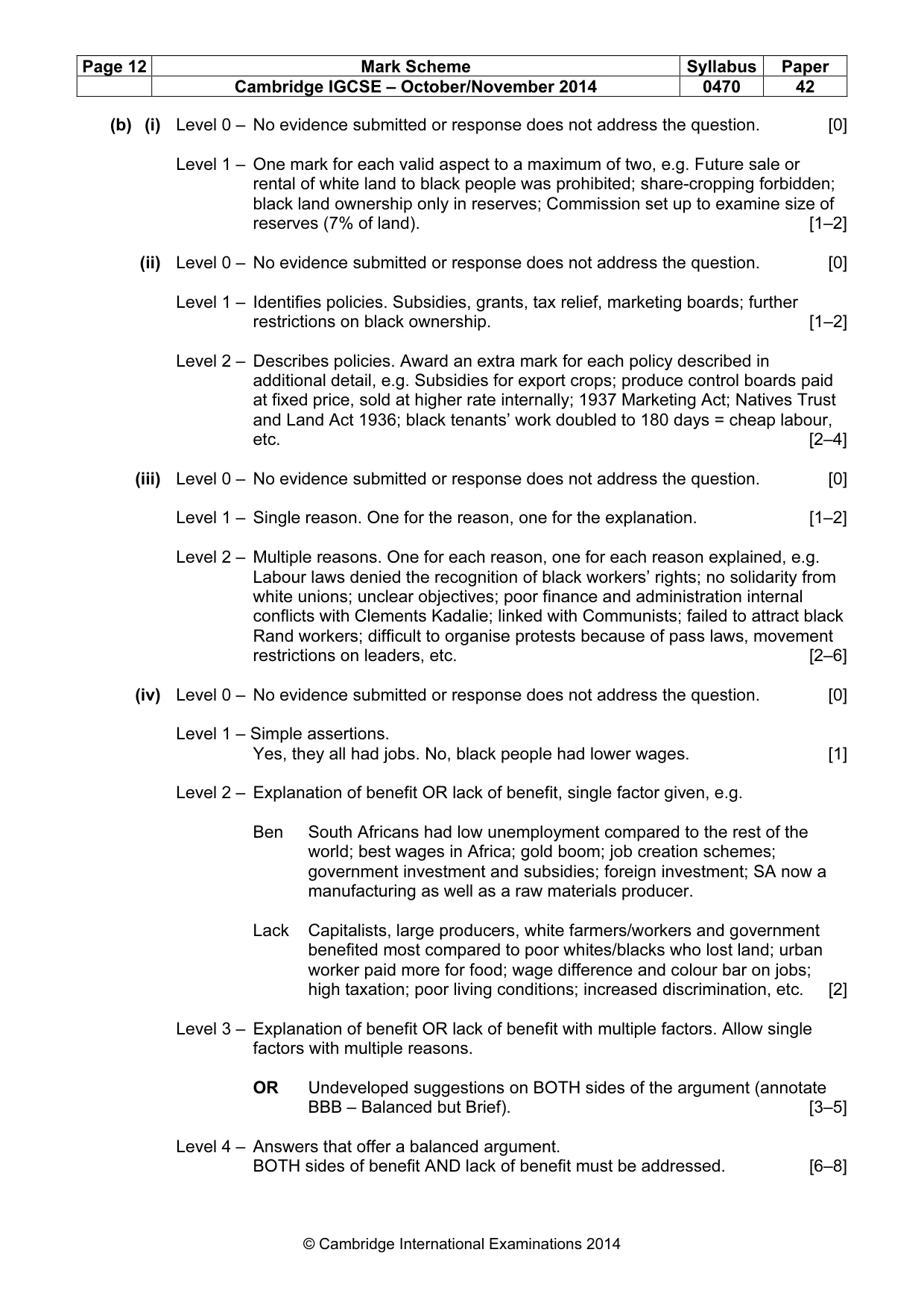
Page 12 Mark Scheme Syllabus Paper Cambridge IGCSE – October/November 2014 0470 42 © Cambridge International Examinations 2014 (b) (i) Level 0 – No evidence submitted or response does not address the question. [0] Level 1 – One mark for each valid aspect to a maximum of two, e.g. Future sale or rental of white land to black people was prohibited; share-cropping forbidden; black land ownership only in reserves; Commission set up to examine size of reserves (7% of land). [1–2] (ii) Level 0 – No evidence submitted or response does not address the question. [0] Level 1 – Identifies policies. Subsidies, grants, tax relief, marketing boards; further restrictions on black ownership. [1–2] Level 2 – Describes policies. Award an extra mark for each policy described in additional detail, e.g. Subsidies for export crops; produce control boards paid at fixed price, sold at higher rate internally; 1937 Marketing Act; Natives Trust and Land Act 1936; black tenants’ work doubled to 180 days = cheap labour, etc. [2–4] (iii) Level 0 – No evidence submitted or response does not address the question. [0] Level 1 – Single reason. One for the reason, one for the explanation. [1–2] Level 2 – Multiple reasons. One for each reason, one for each reason explained, e.g. Labour laws denied the recognition of black workers’ rights; no solidarity from white unions; unclear objectives; poor finance and administration internal conflicts with Clements Kadalie; linked with Communists; failed to attract black Rand workers; difficult to organise protests because of pass laws, movement restrictions on leaders, etc. [2–6] (iv) Level 0 – No evidence submitted or response does not address the question. [0] Level 1 – Simple assertions. Yes, they all had jobs. No, black people had lower wages. [1] Level 2 – Explanation of benefit OR lack of benefit, single factor given, e.g. Ben South Africans had low unemployment compared to the rest of the world; best wages in Africa; gold boom; job creation schemes; government investment and subsidies; foreign investment; SA now a manufacturing as well as a raw materials producer. Lack Capitalists, large producers, white farmers/workers and government benefited most compared to poor whites/blacks who lost land; urban worker paid more for food; wage difference and colour bar on jobs; high taxation; poor living conditions; increased discrimination, etc. [2] Level 3 – Explanation of benefit OR lack of benefit with multiple factors. Allow single factors with multiple reasons. OR Undeveloped suggestions on BOTH sides of the argument (annotate BBB – Balanced but Brief). [3–5] Level 4 – Answers that offer a balanced argument. BOTH sides of benefit AND lack of benefit must be addressed. [6–8]
Mark scheme, page 13
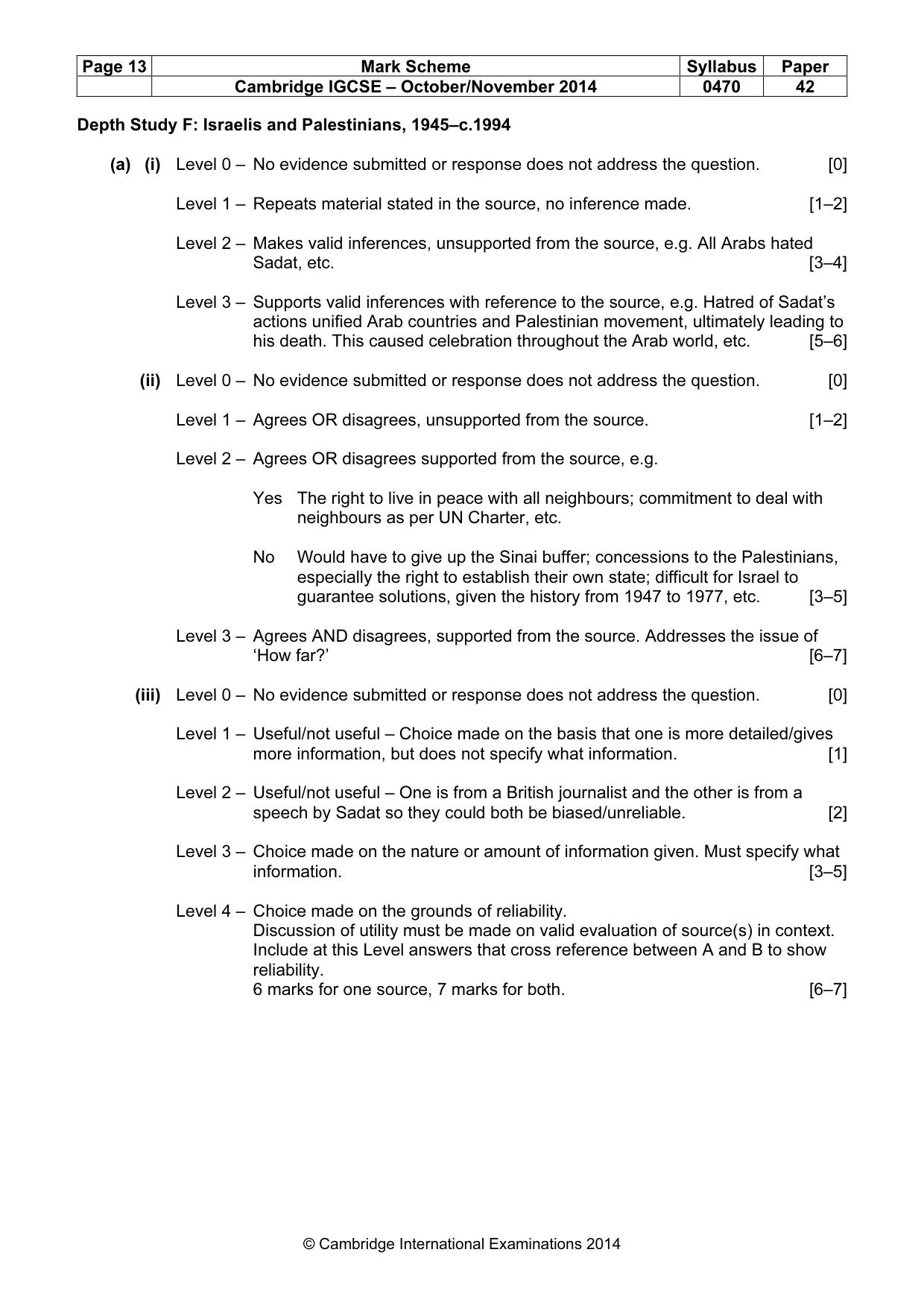
Page 13 Mark Scheme Syllabus Paper Cambridge IGCSE – October/November 2014 0470 42 © Cambridge International Examinations 2014 Depth Study F: Israelis and Palestinians, 1945–c.1994 (a) (i) Level 0 – No evidence submitted or response does not address the question. [0] Level 1 – Repeats material stated in the source, no inference made. [1–2] Level 2 – Makes valid inferences, unsupported from the source, e.g. All Arabs hated Sadat, etc. [3–4] Level 3 – Supports valid inferences with reference to the source, e.g. Hatred of Sadat’s actions unified Arab countries and Palestinian movement, ultimately leading to his death. This caused celebration throughout the Arab world, etc. [5–6] (ii) Level 0 – No evidence submitted or response does not address the question. [0] Level 1 – Agrees OR disagrees, unsupported from the source. [1–2] Level 2 – Agrees OR disagrees supported from the source, e.g. Yes The right to live in peace with all neighbours; commitment to deal with neighbours as per UN Charter, etc. No Would have to give up the Sinai buffer; concessions to the Palestinians, especially the right to establish their own state; difficult for Israel to guarantee solutions, given the history from 1947 to 1977, etc. [3–5] Level 3 – Agrees AND disagrees, supported from the source. Addresses the issue of ‘How far?’ [6–7] (iii) Level 0 – No evidence submitted or response does not address the question. [0] Level 1 – Useful/not useful – Choice made on the basis that one is more detailed/gives more information, but does not specify what information. [1] Level 2 – Useful/not useful – One is from a British journalist and the other is from a speech by Sadat so they could both be biased/unreliable. [2] Level 3 – Choice made on the nature or amount of information given. Must specify what information. [3–5] Level 4 – Choice made on the grounds of reliability. Discussion of utility must be made on valid evaluation of source(s) in context. Include at this Level answers that cross reference between A and B to show reliability. 6 marks for one source, 7 marks for both. [6–7]
Mark scheme, page 14
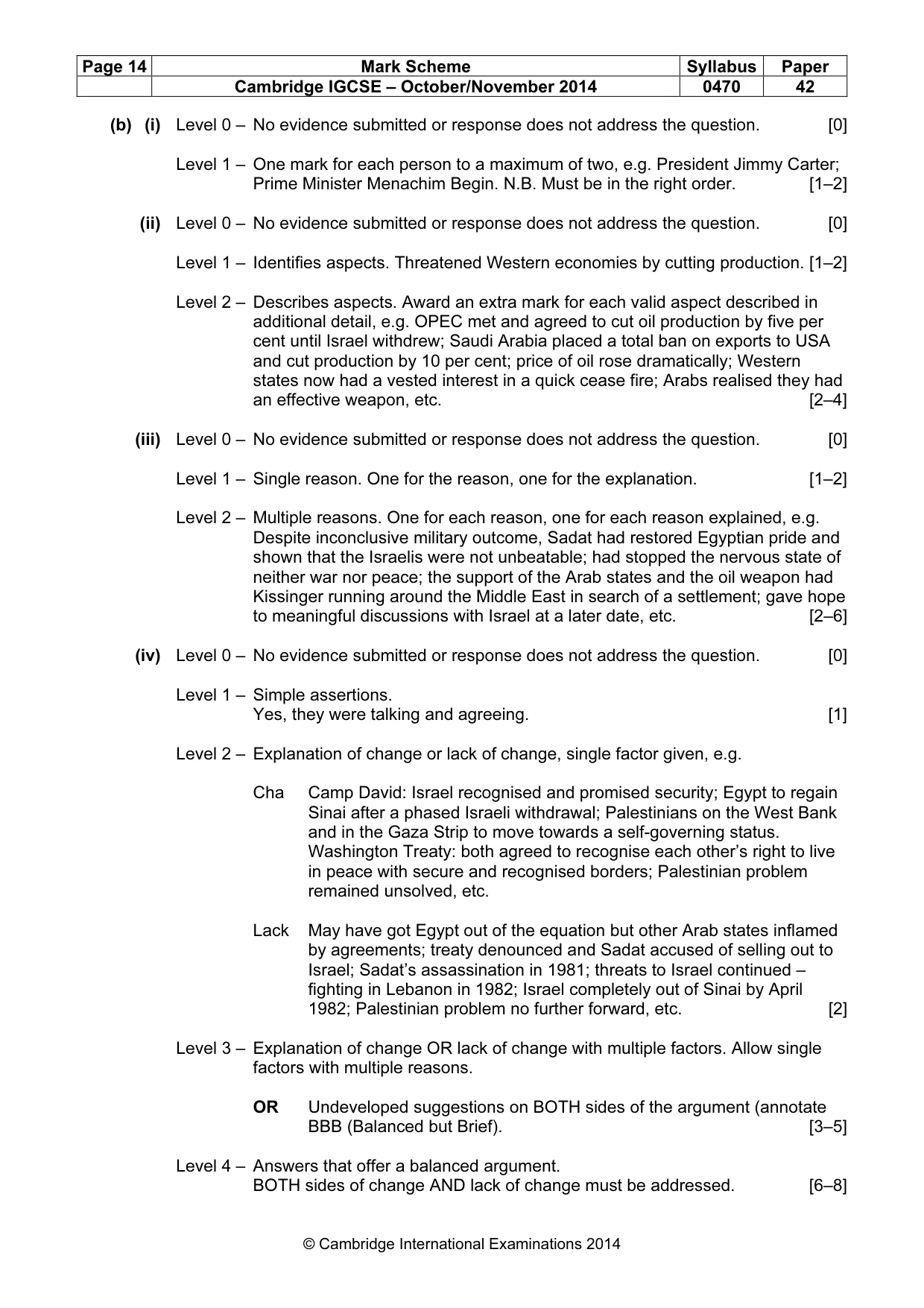
Page 14 Mark Scheme Syllabus Paper Cambridge IGCSE – October/November 2014 0470 42 © Cambridge International Examinations 2014 (b) (i) Level 0 – No evidence submitted or response does not address the question. [0] Level 1 – One mark for each person to a maximum of two, e.g. President Jimmy Carter; Prime Minister Menachim Begin. N.B. Must be in the right order. [1–2] (ii) Level 0 – No evidence submitted or response does not address the question. [0] Level 1 – Identifies aspects. Threatened Western economies by cutting production. [1–2] Level 2 – Describes aspects. Award an extra mark for each valid aspect described in additional detail, e.g. OPEC met and agreed to cut oil production by five per cent until Israel withdrew; Saudi Arabia placed a total ban on exports to USA and cut production by 10 per cent; price of oil rose dramatically; Western states now had a vested interest in a quick cease fire; Arabs realised they had an effective weapon, etc. [2–4] (iii) Level 0 – No evidence submitted or response does not address the question. [0] Level 1 – Single reason. One for the reason, one for the explanation. [1–2] Level 2 – Multiple reasons. One for each reason, one for each reason explained, e.g. Despite inconclusive military outcome, Sadat had restored Egyptian pride and shown that the Israelis were not unbeatable; had stopped the nervous state of neither war nor peace; the support of the Arab states and the oil weapon had Kissinger running around the Middle East in search of a settlement; gave hope to meaningful discussions with Israel at a later date, etc. [2–6] (iv) Level 0 – No evidence submitted or response does not address the question. [0] Level 1 – Simple assertions. Yes, they were talking and agreeing. [1] Level 2 – Explanation of change or lack of change, single factor given, e.g. Cha Camp David: Israel recognised and promised security; Egypt to regain Sinai after a phased Israeli withdrawal; Palestinians on the West Bank and in the Gaza Strip to move towards a self-governing status. Washington Treaty: both agreed to recognise each other’s right to live in peace with secure and recognised borders; Palestinian problem remained unsolved, etc. Lack May have got Egypt out of the equation but other Arab states inflamed by agreements; treaty denounced and Sadat accused of selling out to Israel; Sadat’s assassination in 1981; threats to Israel continued – fighting in Lebanon in 1982; Israel completely out of Sinai by April 1982; Palestinian problem no further forward, etc. [2] Level 3 – Explanation of change OR lack of change with multiple factors. Allow single factors with multiple reasons. OR Undeveloped suggestions on BOTH sides of the argument (annotate BBB (Balanced but Brief). [3–5] Level 4 – Answers that offer a balanced argument. BOTH sides of change AND lack of change must be addressed. [6–8]
Mark scheme, page 15
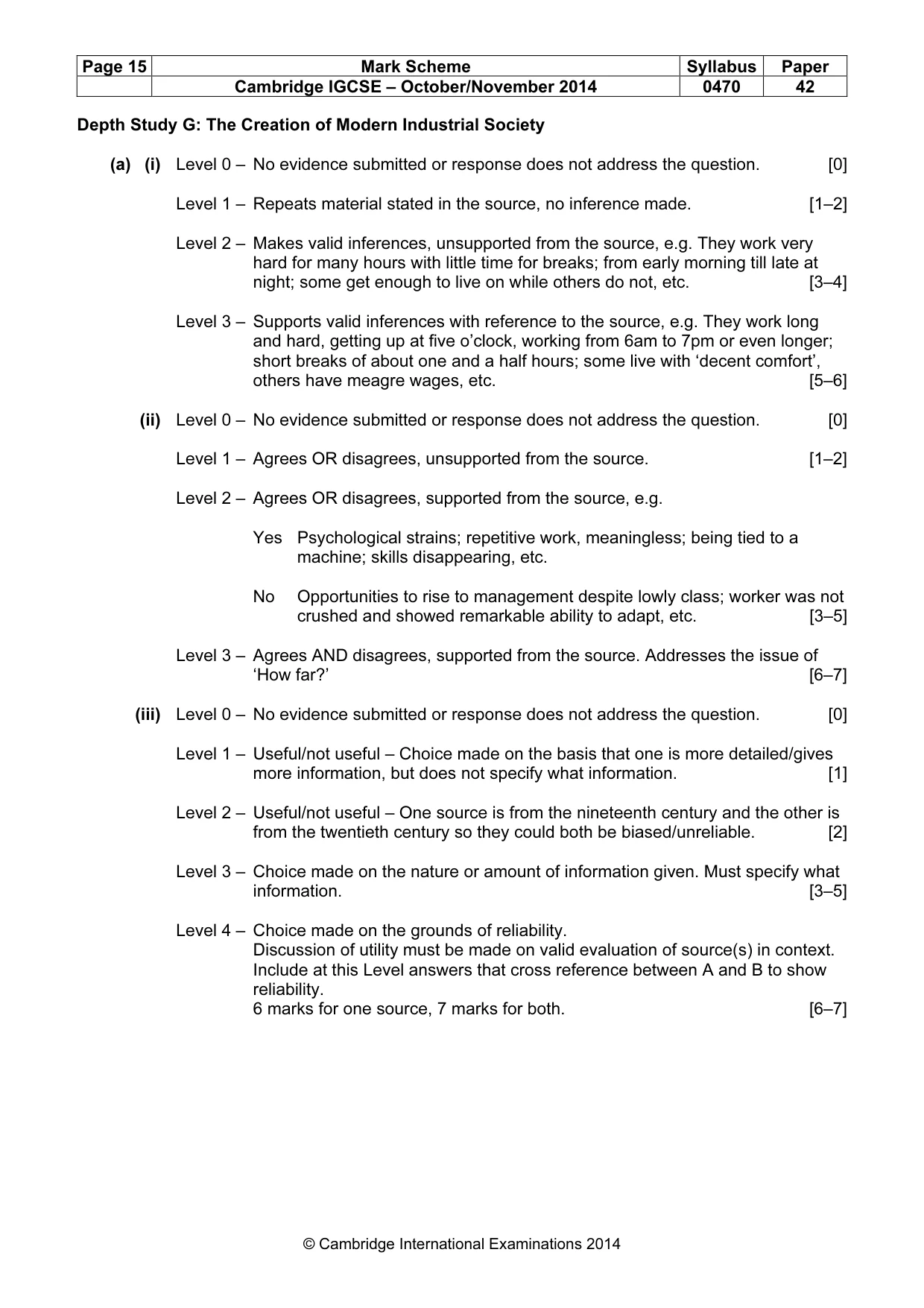
Page 15 Mark Scheme Syllabus Paper Cambridge IGCSE – October/November 2014 0470 42 © Cambridge International Examinations 2014 Depth Study G: The Creation of Modern Industrial Society (a) (i) Level 0 – No evidence submitted or response does not address the question. [0] Level 1 – Repeats material stated in the source, no inference made. [1–2] Level 2 – Makes valid inferences, unsupported from the source, e.g. They work very hard for many hours with little time for breaks; from early morning till late at night; some get enough to live on while others do not, etc. [3–4] Level 3 – Supports valid inferences with reference to the source, e.g. They work long and hard, getting up at five o’clock, working from 6am to 7pm or even longer; short breaks of about one and a half hours; some live with ‘decent comfort’, others have meagre wages, etc. [5–6] (ii) Level 0 – No evidence submitted or response does not address the question. [0] Level 1 – Agrees OR disagrees, unsupported from the source. [1–2] Level 2 – Agrees OR disagrees, supported from the source, e.g. Yes Psychological strains; repetitive work, meaningless; being tied to a machine; skills disappearing, etc. No Opportunities to rise to management despite lowly class; worker was not crushed and showed remarkable ability to adapt, etc. [3–5] Level 3 – Agrees AND disagrees, supported from the source. Addresses the issue of ‘How far?’ [6–7] (iii) Level 0 – No evidence submitted or response does not address the question. [0] Level 1 – Useful/not useful – Choice made on the basis that one is more detailed/gives more information, but does not specify what information. [1] Level 2 – Useful/not useful – One source is from the nineteenth century and the other is from the twentieth century so they could both be biased/unreliable. [2] Level 3 – Choice made on the nature or amount of information given. Must specify what information. [3–5] Level 4 – Choice made on the grounds of reliability. Discussion of utility must be made on valid evaluation of source(s) in context. Include at this Level answers that cross reference between A and B to show reliability. 6 marks for one source, 7 marks for both. [6–7]
Mark scheme, page 16
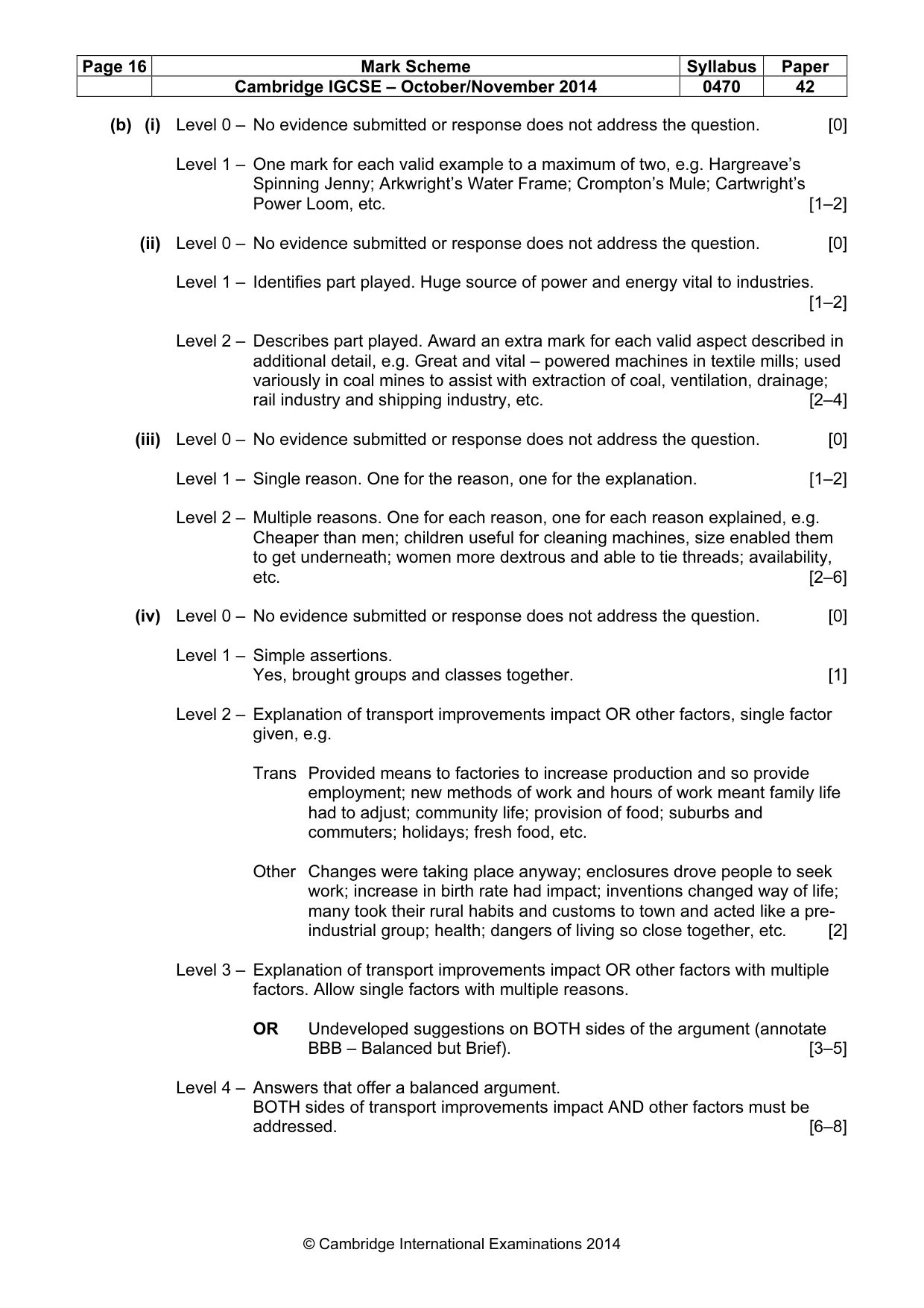
Page 16 Mark Scheme Syllabus Paper Cambridge IGCSE – October/November 2014 0470 42 © Cambridge International Examinations 2014 (b) (i) Level 0 – No evidence submitted or response does not address the question. [0] Level 1 – One mark for each valid example to a maximum of two, e.g. Hargreave’s Spinning Jenny; Arkwright’s Water Frame; Crompton’s Mule; Cartwright’s Power Loom, etc. [1–2] (ii) Level 0 – No evidence submitted or response does not address the question. [0] Level 1 – Identifies part played. Huge source of power and energy vital to industries. [1–2] Level 2 – Describes part played. Award an extra mark for each valid aspect described in additional detail, e.g. Great and vital – powered machines in textile mills; used variously in coal mines to assist with extraction of coal, ventilation, drainage; rail industry and shipping industry, etc. [2–4] (iii) Level 0 – No evidence submitted or response does not address the question. [0] Level 1 – Single reason. One for the reason, one for the explanation. [1–2] Level 2 – Multiple reasons. One for each reason, one for each reason explained, e.g. Cheaper than men; children useful for cleaning machines, size enabled them to get underneath; women more dextrous and able to tie threads; availability, etc. [2–6] (iv) Level 0 – No evidence submitted or response does not address the question. [0] Level 1 – Simple assertions. Yes, brought groups and classes together. [1] Level 2 – Explanation of transport improvements impact OR other factors, single factor given, e.g. Trans Provided means to factories to increase production and so provide employment; new methods of work and hours of work meant family life had to adjust; community life; provision of food; suburbs and commuters; holidays; fresh food, etc. Other Changes were taking place anyway; enclosures drove people to seek work; increase in birth rate had impact; inventions changed way of life; many took their rural habits and customs to town and acted like a pre- industrial group; health; dangers of living so close together, etc. [2] Level 3 – Explanation of transport improvements impact OR other factors with multiple factors. Allow single factors with multiple reasons. OR Undeveloped suggestions on BOTH sides of the argument (annotate BBB – Balanced but Brief). [3–5] Level 4 – Answers that offer a balanced argument. BOTH sides of transport improvements impact AND other factors must be addressed. [6–8]
Mark scheme, page 17
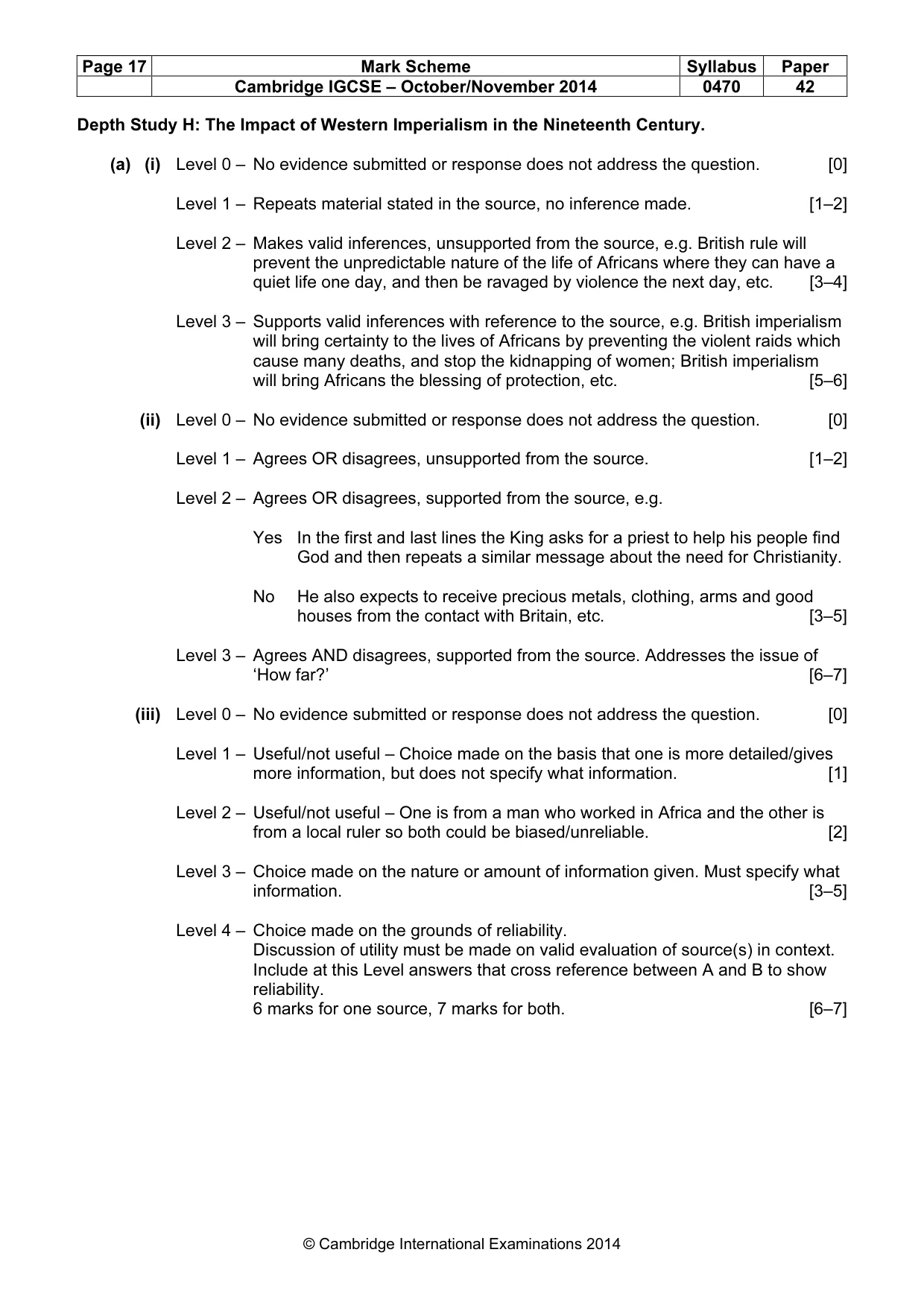
Page 17 Mark Scheme Syllabus Paper Cambridge IGCSE – October/November 2014 0470 42 © Cambridge International Examinations 2014 Depth Study H: The Impact of Western Imperialism in the Nineteenth Century. (a) (i) Level 0 – No evidence submitted or response does not address the question. [0] Level 1 – Repeats material stated in the source, no inference made. [1–2] Level 2 – Makes valid inferences, unsupported from the source, e.g. British rule will prevent the unpredictable nature of the life of Africans where they can have a quiet life one day, and then be ravaged by violence the next day, etc. [3–4] Level 3 – Supports valid inferences with reference to the source, e.g. British imperialism will bring certainty to the lives of Africans by preventing the violent raids which cause many deaths, and stop the kidnapping of women; British imperialism will bring Africans the blessing of protection, etc. [5–6] (ii) Level 0 – No evidence submitted or response does not address the question. [0] Level 1 – Agrees OR disagrees, unsupported from the source. [1–2] Level 2 – Agrees OR disagrees, supported from the source, e.g. Yes In the first and last lines the King asks for a priest to help his people find God and then repeats a similar message about the need for Christianity. No He also expects to receive precious metals, clothing, arms and good houses from the contact with Britain, etc. [3–5] Level 3 – Agrees AND disagrees, supported from the source. Addresses the issue of ‘How far?’ [6–7] (iii) Level 0 – No evidence submitted or response does not address the question. [0] Level 1 – Useful/not useful – Choice made on the basis that one is more detailed/gives more information, but does not specify what information. [1] Level 2 – Useful/not useful – One is from a man who worked in Africa and the other is from a local ruler so both could be biased/unreliable. [2] Level 3 – Choice made on the nature or amount of information given. Must specify what information. [3–5] Level 4 – Choice made on the grounds of reliability. Discussion of utility must be made on valid evaluation of source(s) in context. Include at this Level answers that cross reference between A and B to show reliability. 6 marks for one source, 7 marks for both. [6–7]
Mark scheme, page 18
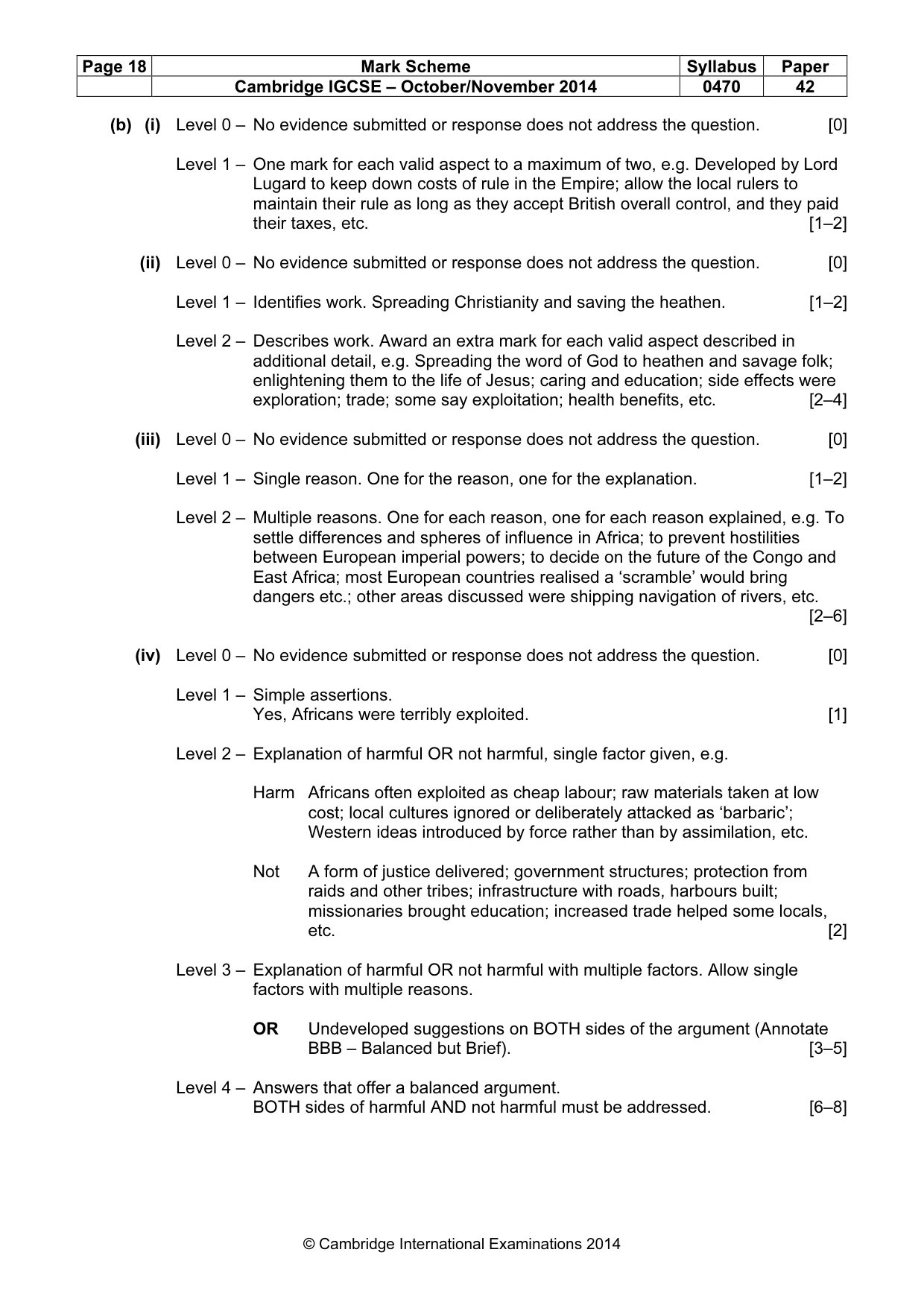
Page 18 Mark Scheme Syllabus Paper Cambridge IGCSE – October/November 2014 0470 42 © Cambridge International Examinations 2014 (b) (i) Level 0 – No evidence submitted or response does not address the question. [0] Level 1 – One mark for each valid aspect to a maximum of two, e.g. Developed by Lord Lugard to keep down costs of rule in the Empire; allow the local rulers to maintain their rule as long as they accept British overall control, and they paid their taxes, etc. [1–2] (ii) Level 0 – No evidence submitted or response does not address the question. [0] Level 1 – Identifies work. Spreading Christianity and saving the heathen. [1–2] Level 2 – Describes work. Award an extra mark for each valid aspect described in additional detail, e.g. Spreading the word of God to heathen and savage folk; enlightening them to the life of Jesus; caring and education; side effects were exploration; trade; some say exploitation; health benefits, etc. [2–4] (iii) Level 0 – No evidence submitted or response does not address the question. [0] Level 1 – Single reason. One for the reason, one for the explanation. [1–2] Level 2 – Multiple reasons. One for each reason, one for each reason explained, e.g. To settle differences and spheres of influence in Africa; to prevent hostilities between European imperial powers; to decide on the future of the Congo and East Africa; most European countries realised a ‘scramble’ would bring dangers etc.; other areas discussed were shipping navigation of rivers, etc. [2–6] (iv) Level 0 – No evidence submitted or response does not address the question. [0] Level 1 – Simple assertions. Yes, Africans were terribly exploited. [1] Level 2 – Explanation of harmful OR not harmful, single factor given, e.g. Harm Africans often exploited as cheap labour; raw materials taken at low cost; local cultures ignored or deliberately attacked as ‘barbaric’; Western ideas introduced by force rather than by assimilation, etc. Not A form of justice delivered; government structures; protection from raids and other tribes; infrastructure with roads, harbours built; missionaries brought education; increased trade helped some locals, etc. [2] Level 3 – Explanation of harmful OR not harmful with multiple factors. Allow single factors with multiple reasons. OR Undeveloped suggestions on BOTH sides of the argument (Annotate BBB – Balanced but Brief). [3–5] Level 4 – Answers that offer a balanced argument. BOTH sides of harmful AND not harmful must be addressed. [6–8]
What you needed in this session
Cambridge’s own grade thresholds for 2014 Oct/Nov, Paper 4 · Variant 2. A higher threshold means an easier paper — the bar moves with how the cohort did.