Cambridge IGCSE History 0470 — 2014 Oct/Nov Paper 4 · Variant 1
0470/41/O/N/14 · 40 marks · ≈45 min
The question paper and its mark scheme, free to read here and free to download. This is Cambridge’s own paper, exactly as it was sat.
Question paper12 pages


Mark scheme20 pages
Answers below. Sit the paper first if you are practising.
Paper as text
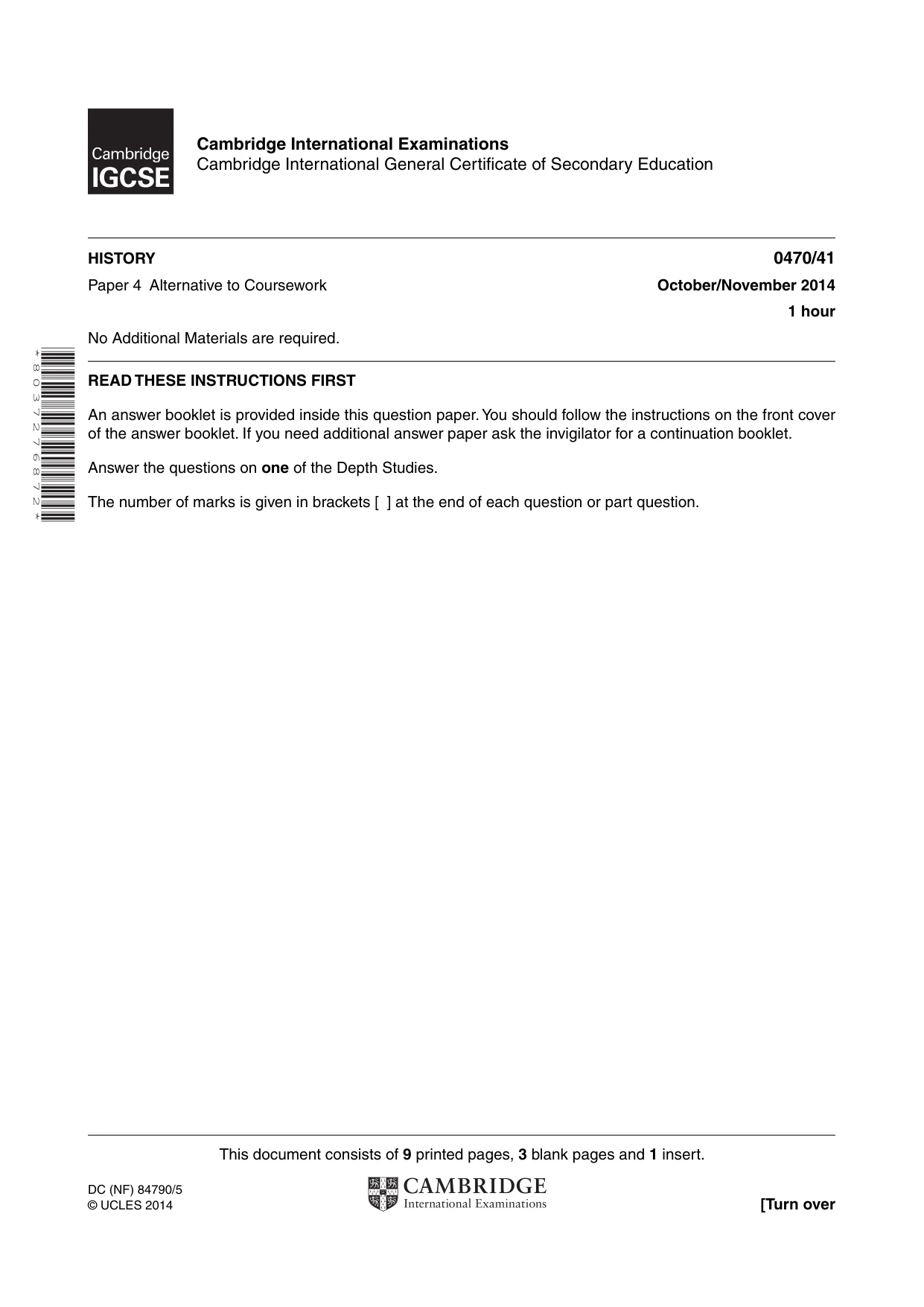
Question paper, page 1
This document consists of 9 printed pages, 3 blank pages and 1 insert. DC (NF) 84790/5 © UCLES 2014 [Turn over Cambridge International Examinations Cambridge International General Certificate of Secondary Education * 8 0 3 7 2 7 6 8 7 2 * HISTORY 0470/41 Paper 4 Alternative to Coursework October/November 2014 1 hour No Additional Materials are required. READ THESE INSTRUCTIONS FIRST An answer booklet is provided inside this question paper. You should follow the instructions on the front cover of the answer booklet. If you need additional answer paper ask the invigilator for a continuation booklet. Answer the questions on one of the Depth Studies. The number of marks is given in brackets [ ] at the end of each question or part question.
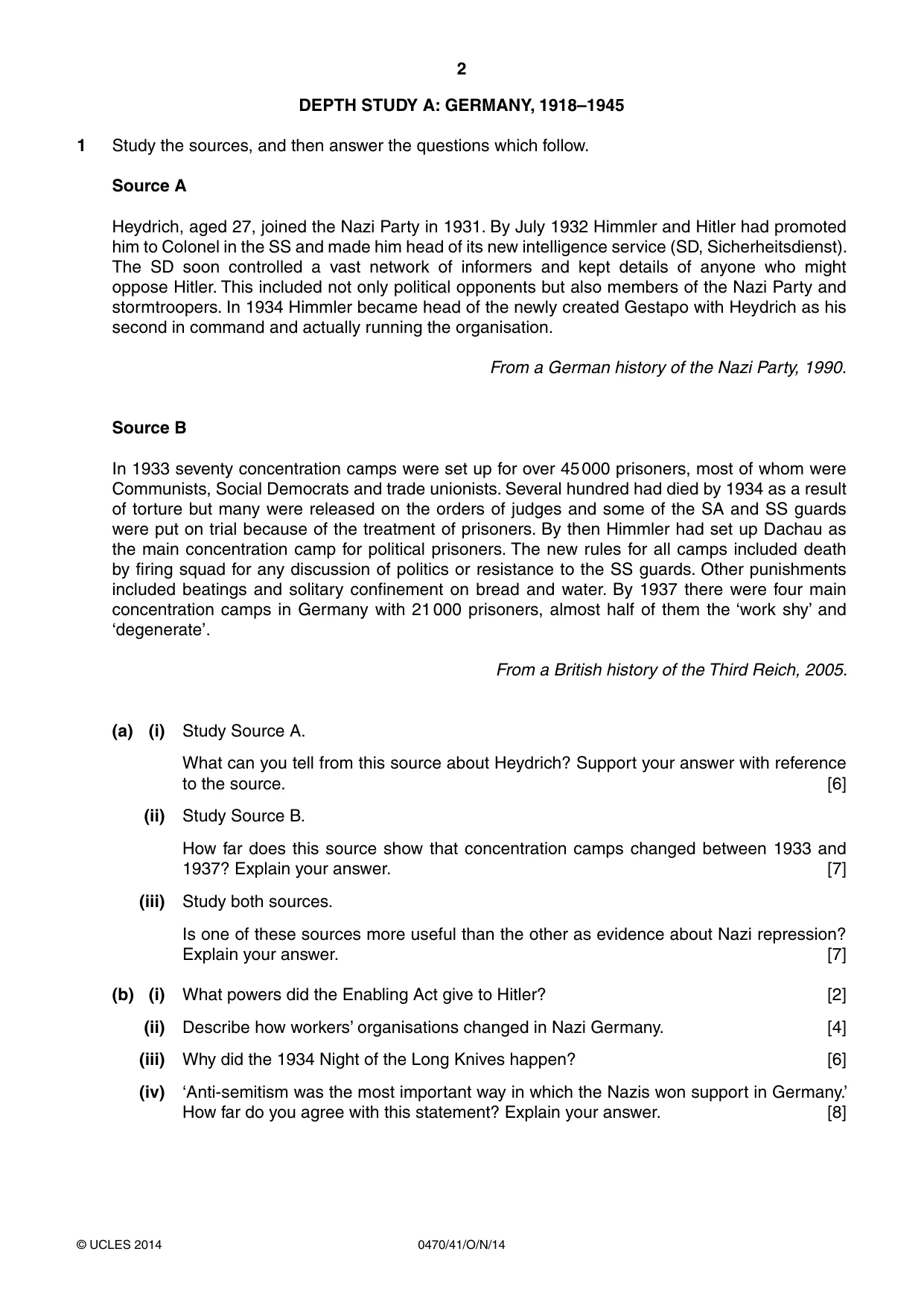
Question paper, page 2
2 0470/41/O/N/14 © UCLES 2014 DEPTH STUDY A: GERMANY, 1918–1945 1 Study the sources, and then answer the questions which follow. Source A Heydrich, aged 27, joined the Nazi Party in 1931. By July 1932 Himmler and Hitler had promoted him to Colonel in the SS and made him head of its new intelligence service (SD, Sicherheitsdienst). The SD soon controlled a vast network of informers and kept details of anyone who might oppose Hitler. This included not only political opponents but also members of the Nazi Party and stormtroopers. In 1934 Himmler became head of the newly created Gestapo with Heydrich as his second in command and actually running the organisation. From a German history of the Nazi Party, 1990. Source B In 1933 seventy concentration camps were set up for over 45 000 prisoners, most of whom were Communists, Social Democrats and trade unionists. Several hundred had died by 1934 as a result of torture but many were released on the orders of judges and some of the SA and SS guards were put on trial because of the treatment of prisoners. By then Himmler had set up Dachau as the main concentration camp for political prisoners. The new rules for all camps included death by firing squad for any discussion of politics or resistance to the SS guards. Other punishments included beatings and solitary confinement on bread and water. By 1937 there were four main concentration camps in Germany with 21 000 prisoners, almost half of them the ‘work shy’ and ‘degenerate’. From a British history of the Third Reich, 2005. (a) (i) Study Source A. What can you tell from this source about Heydrich? Support your answer with reference to the source. [6] (ii) Study Source B. How far does this source show that concentration camps changed between 1933 and 1937? Explain your answer. [7] (iii) Study both sources. Is one of these sources more useful than the other as evidence about Nazi repression? Explain your answer. [7] (b) (i) What powers did the Enabling Act give to Hitler? [2] (ii) Describe how workers’ organisations changed in Nazi Germany. [4] (iii) Why did the 1934 Night of the Long Knives happen? [6] (iv) ‘Anti-semitism was the most important way in which the Nazis won support in Germany.’ How far do you agree with this statement? Explain your answer. [8]
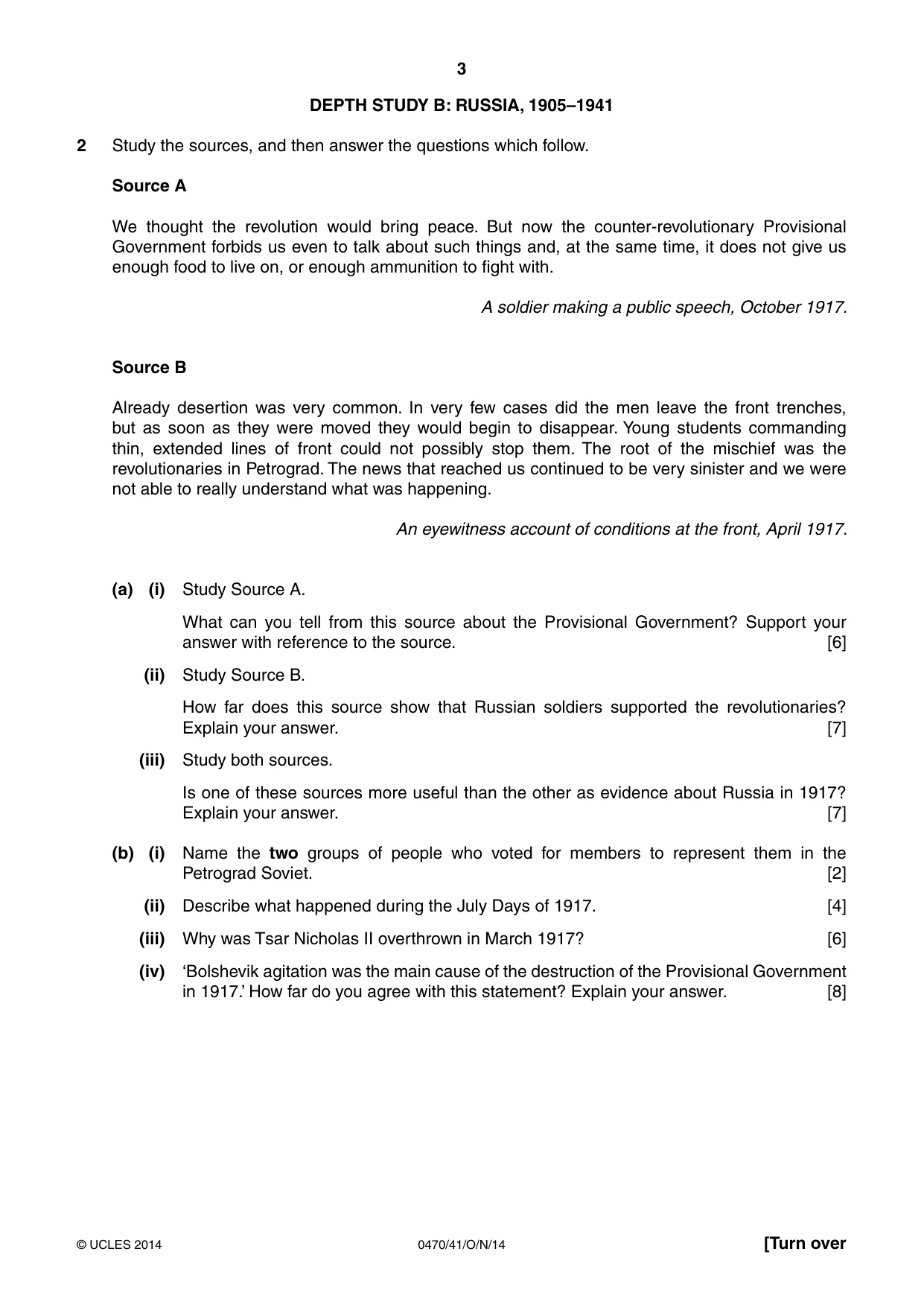
Question paper, page 3
3 0470/41/O/N/14 © UCLES 2014 [Turn over DEPTH STUDY B: RUSSIA, 1905–1941 2 Study the sources, and then answer the questions which follow. Source A We thought the revolution would bring peace. But now the counter-revolutionary Provisional Government forbids us even to talk about such things and, at the same time, it does not give us enough food to live on, or enough ammunition to fight with. A soldier making a public speech, October 1917. Source B Already desertion was very common. In very few cases did the men leave the front trenches, but as soon as they were moved they would begin to disappear. Young students commanding thin, extended lines of front could not possibly stop them. The root of the mischief was the revolutionaries in Petrograd. The news that reached us continued to be very sinister and we were not able to really understand what was happening. An eyewitness account of conditions at the front, April 1917. (a) (i) Study Source A. What can you tell from this source about the Provisional Government? Support your answer with reference to the source. [6] (ii) Study Source B. How far does this source show that Russian soldiers supported the revolutionaries? Explain your answer. [7] (iii) Study both sources. Is one of these sources more useful than the other as evidence about Russia in 1917? Explain your answer. [7] (b) (i) Name the two groups of people who voted for members to represent them in the Petrograd Soviet. [2] (ii) Describe what happened during the July Days of 1917. [4] (iii) Why was Tsar Nicholas II overthrown in March 1917? [6] (iv) ‘Bolshevik agitation was the main cause of the destruction of the Provisional Government in 1917.’ How far do you agree with this statement? Explain your answer. [8]
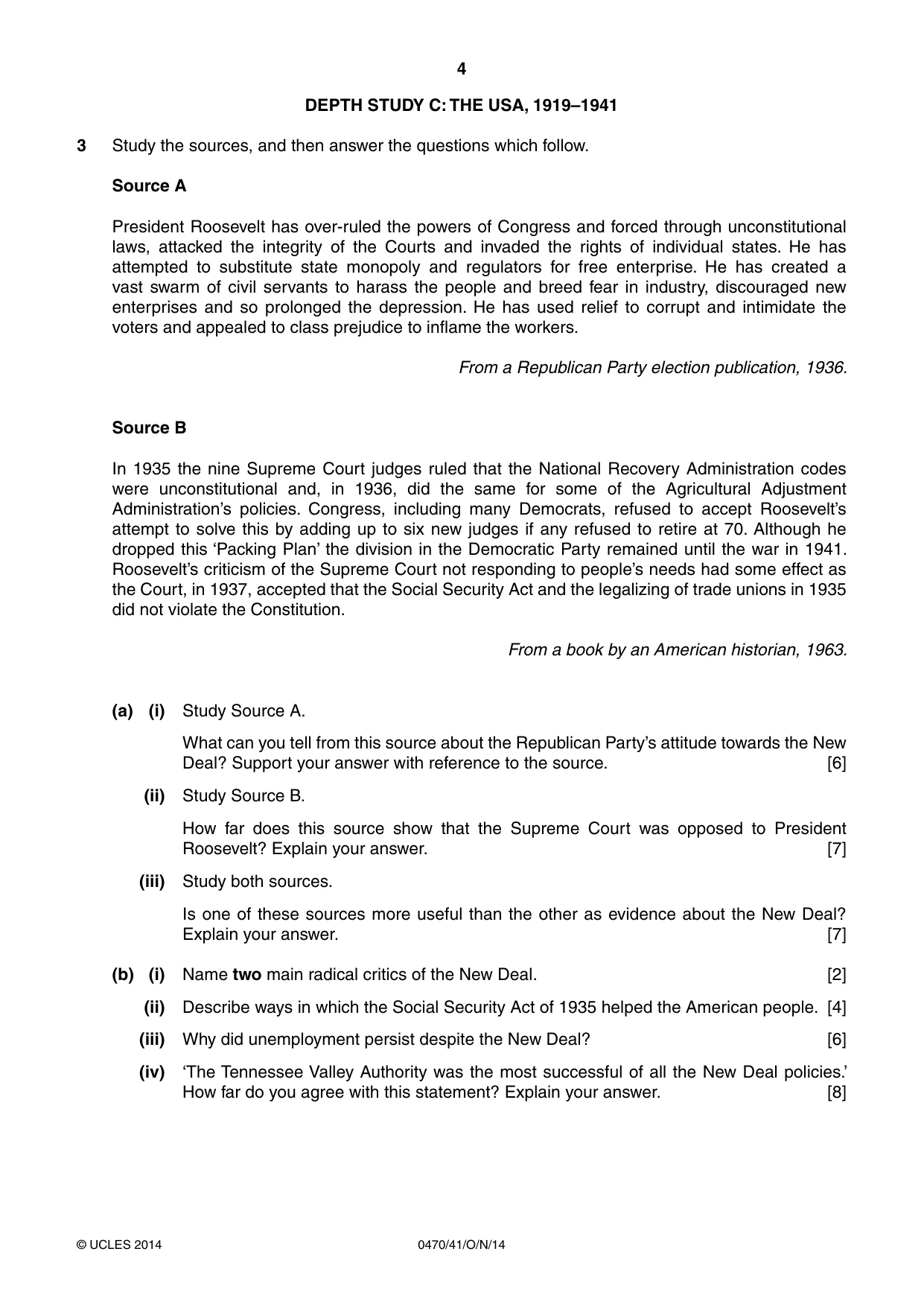
Question paper, page 4
4 0470/41/O/N/14 © UCLES 2014 DEPTH STUDY C: THE USA, 1919–1941 3 Study the sources, and then answer the questions which follow. Source A President Roosevelt has over-ruled the powers of Congress and forced through unconstitutional laws, attacked the integrity of the Courts and invaded the rights of individual states. He has attempted to substitute state monopoly and regulators for free enterprise. He has created a vast swarm of civil servants to harass the people and breed fear in industry, discouraged new enterprises and so prolonged the depression. He has used relief to corrupt and intimidate the voters and appealed to class prejudice to inflame the workers. From a Republican Party election publication, 1936. Source B In 1935 the nine Supreme Court judges ruled that the National Recovery Administration codes were unconstitutional and, in 1936, did the same for some of the Agricultural Adjustment Administration’s policies. Congress, including many Democrats, refused to accept Roosevelt’s attempt to solve this by adding up to six new judges if any refused to retire at 70. Although he dropped this ‘Packing Plan’ the division in the Democratic Party remained until the war in 1941. Roosevelt’s criticism of the Supreme Court not responding to people’s needs had some effect as the Court, in 1937, accepted that the Social Security Act and the legalizing of trade unions in 1935 did not violate the Constitution. From a book by an American historian, 1963. (a) (i) Study Source A. What can you tell from this source about the Republican Party’s attitude towards the New Deal? Support your answer with reference to the source. [6] (ii) Study Source B. How far does this source show that the Supreme Court was opposed to President Roosevelt? Explain your answer. [7] (iii) Study both sources. Is one of these sources more useful than the other as evidence about the New Deal? Explain your answer. [7] (b) (i) Name two main radical critics of the New Deal. [2] (ii) Describe ways in which the Social Security Act of 1935 helped the American people. [4] (iii) Why did unemployment persist despite the New Deal? [6] (iv) ‘The Tennessee Valley Authority was the most successful of all the New Deal policies.’ How far do you agree with this statement? Explain your answer. [8]
Question paper, page 5
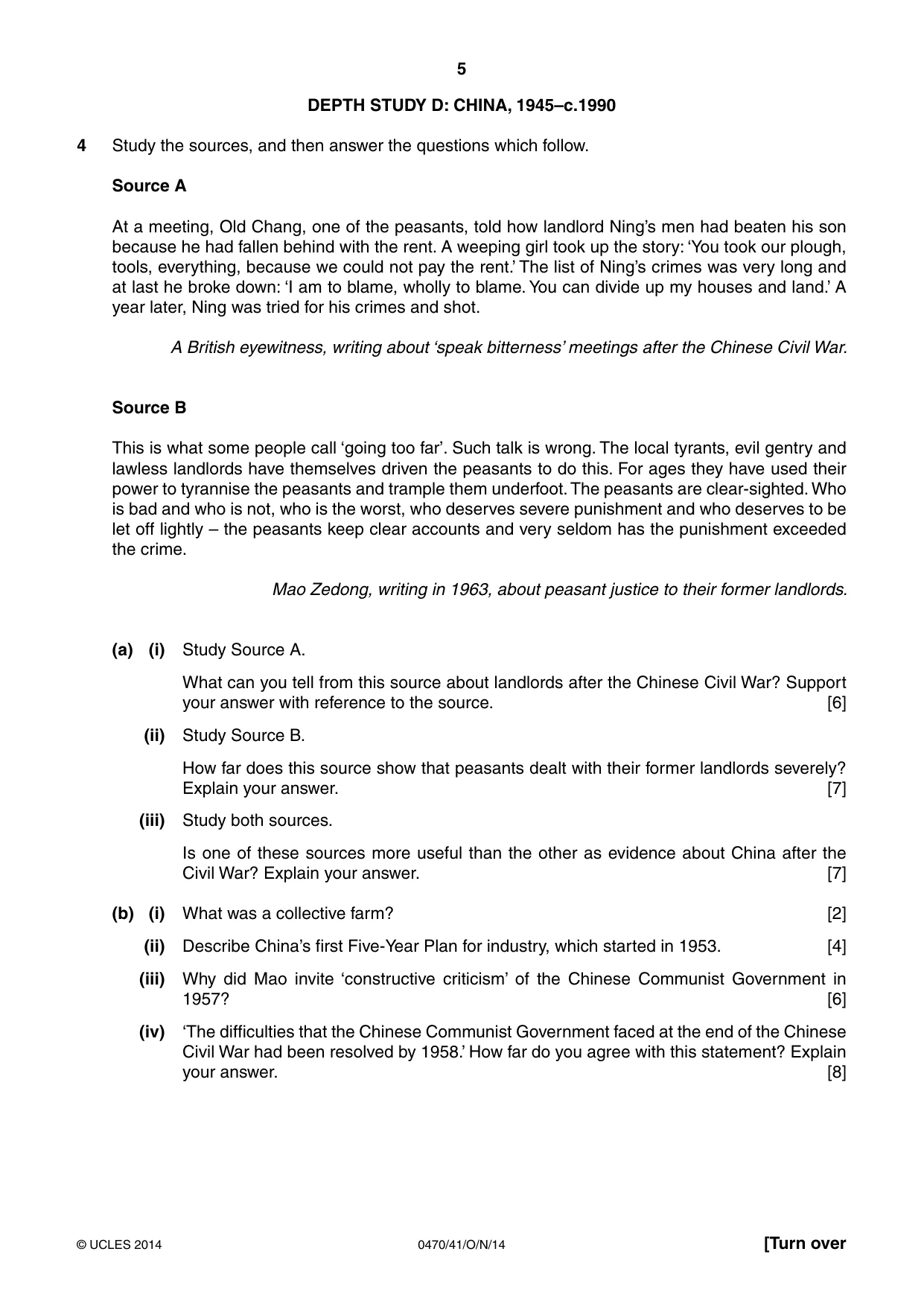
5 0470/41/O/N/14 © UCLES 2014 [Turn over DEPTH STUDY D: CHINA, 1945–c.1990 4 Study the sources, and then answer the questions which follow. Source A At a meeting, Old Chang, one of the peasants, told how landlord Ning’s men had beaten his son because he had fallen behind with the rent. A weeping girl took up the story: ‘You took our plough, tools, everything, because we could not pay the rent.’ The list of Ning’s crimes was very long and at last he broke down: ‘I am to blame, wholly to blame. You can divide up my houses and land.’ A year later, Ning was tried for his crimes and shot. A British eyewitness, writing about ‘speak bitterness’ meetings after the Chinese Civil War. Source B This is what some people call ‘going too far’. Such talk is wrong. The local tyrants, evil gentry and lawless landlords have themselves driven the peasants to do this. For ages they have used their power to tyrannise the peasants and trample them underfoot. The peasants are clear-sighted. Who is bad and who is not, who is the worst, who deserves severe punishment and who deserves to be let off lightly – the peasants keep clear accounts and very seldom has the punishment exceeded the crime. Mao Zedong, writing in 1963, about peasant justice to their former landlords. (a) (i) Study Source A. What can you tell from this source about landlords after the Chinese Civil War? Support your answer with reference to the source. [6] (ii) Study Source B. How far does this source show that peasants dealt with their former landlords severely? Explain your answer. [7] (iii) Study both sources. Is one of these sources more useful than the other as evidence about China after the Civil War? Explain your answer. [7] (b) (i) What was a collective farm? [2] (ii) Describe China’s first Five-Year Plan for industry, which started in 1953. [4] (iii) Why did Mao invite ‘constructive criticism’ of the Chinese Communist Government in 1957? [6] (iv) ‘The difficulties that the Chinese Communist Government faced at the end of the Chinese Civil War had been resolved by 1958.’ How far do you agree with this statement? Explain your answer. [8]
Question paper, page 6
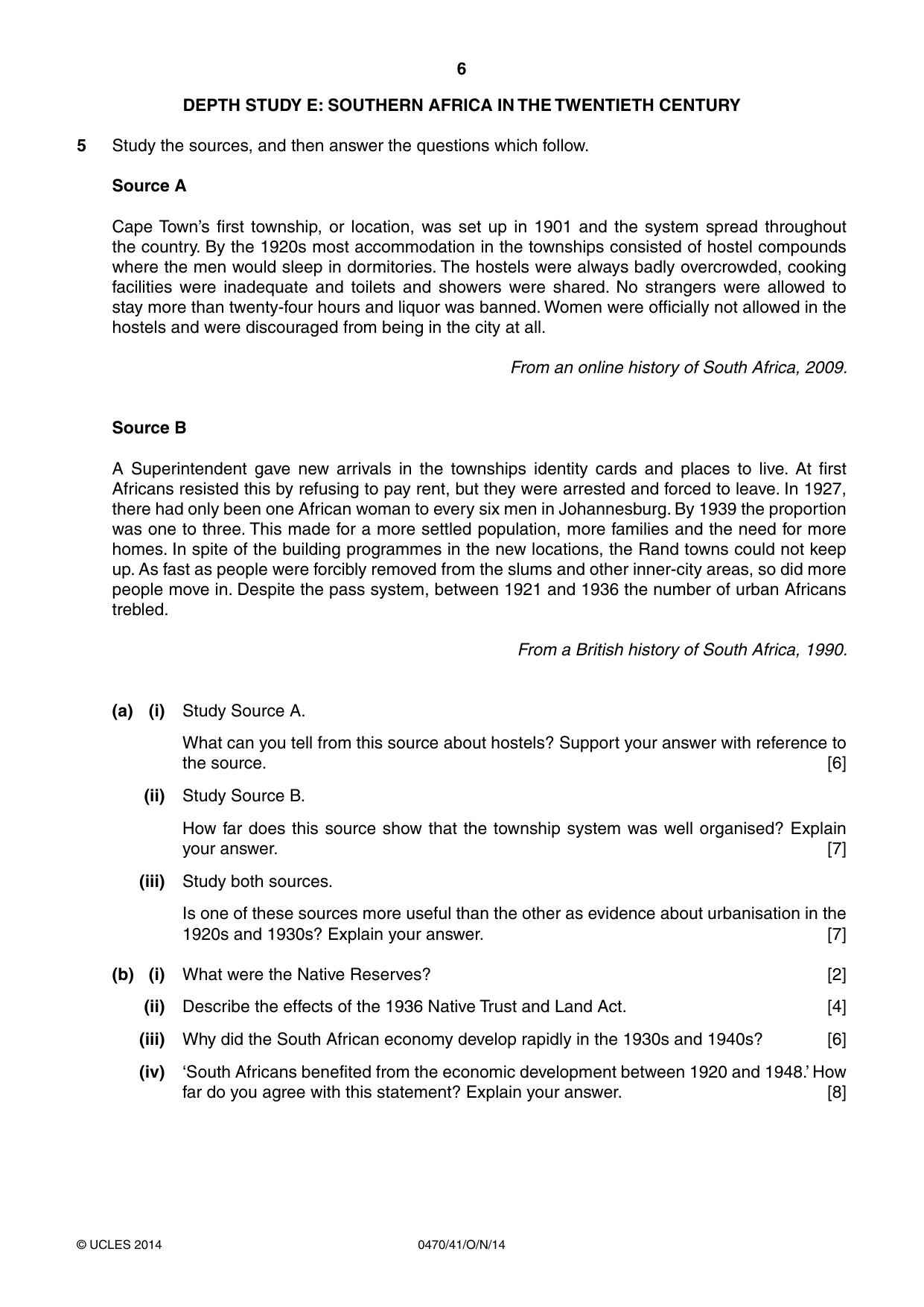
6 0470/41/O/N/14 © UCLES 2014 DEPTH STUDY E: SOUTHERN AFRICA IN THE TWENTIETH CENTURY 5 Study the sources, and then answer the questions which follow. Source A Cape Town’s first township, or location, was set up in 1901 and the system spread throughout the country. By the 1920s most accommodation in the townships consisted of hostel compounds where the men would sleep in dormitories. The hostels were always badly overcrowded, cooking facilities were inadequate and toilets and showers were shared. No strangers were allowed to stay more than twenty-four hours and liquor was banned. Women were officially not allowed in the hostels and were discouraged from being in the city at all. From an online history of South Africa, 2009. Source B A Superintendent gave new arrivals in the townships identity cards and places to live. At first Africans resisted this by refusing to pay rent, but they were arrested and forced to leave. In 1927, there had only been one African woman to every six men in Johannesburg. By 1939 the proportion was one to three. This made for a more settled population, more families and the need for more homes. In spite of the building programmes in the new locations, the Rand towns could not keep up. As fast as people were forcibly removed from the slums and other inner-city areas, so did more people move in. Despite the pass system, between 1921 and 1936 the number of urban Africans trebled. From a British history of South Africa, 1990. (a) (i) Study Source A. What can you tell from this source about hostels? Support your answer with reference to the source. [6] (ii) Study Source B. How far does this source show that the township system was well organised? Explain your answer. [7] (iii) Study both sources. Is one of these sources more useful than the other as evidence about urbanisation in the 1920s and 1930s? Explain your answer. [7] (b) (i) What were the Native Reserves? [2] (ii) Describe the effects of the 1936 Native Trust and Land Act. [4] (iii) Why did the South African economy develop rapidly in the 1930s and 1940s? [6] (iv) ‘South Africans benefited from the economic development between 1920 and 1948.’ How far do you agree with this statement? Explain your answer. [8]
Question paper, page 7
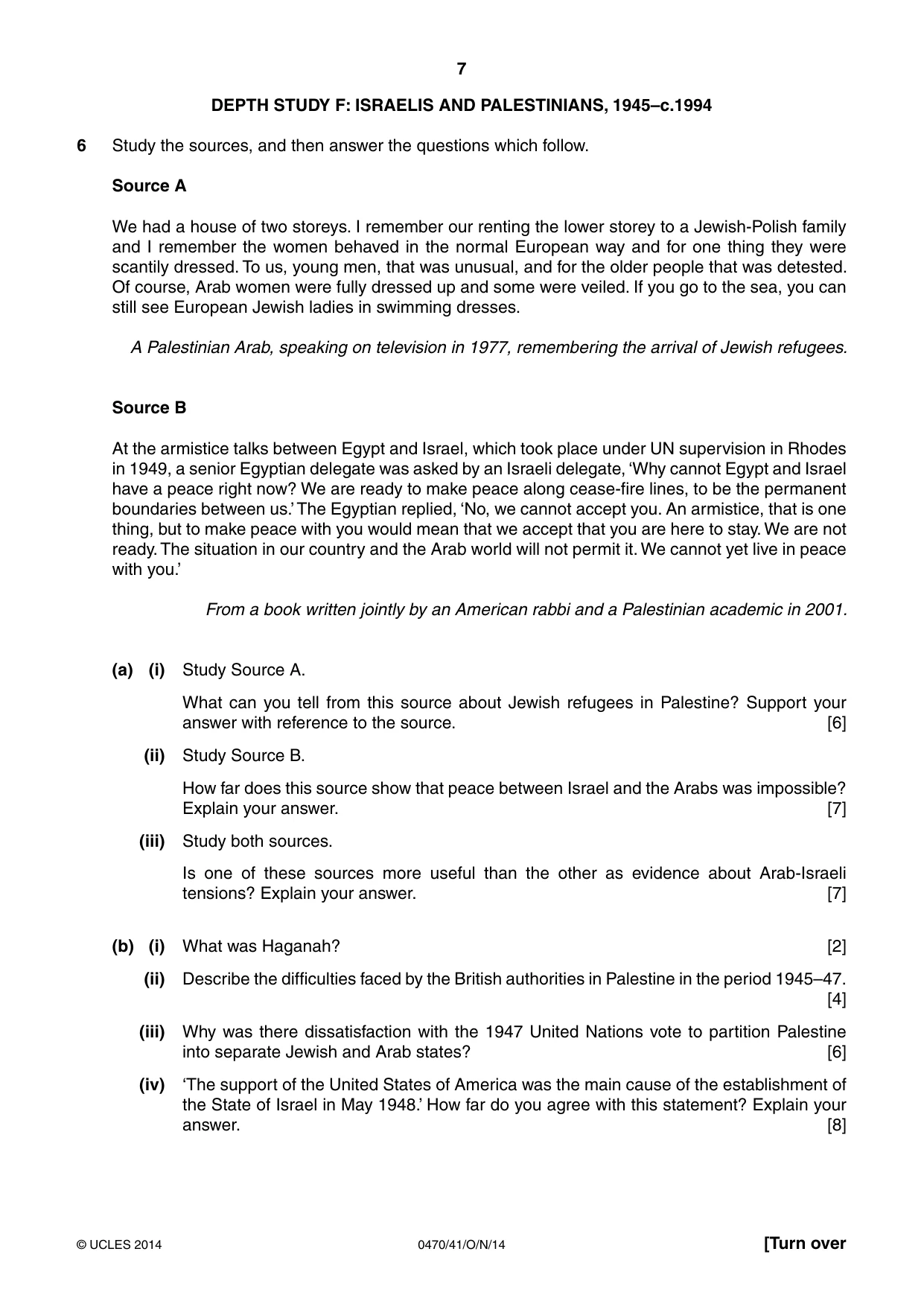
7 0470/41/O/N/14 © UCLES 2014 [Turn over DEPTH STUDY F: ISRAELIS AND PALESTINIANS, 1945–c.1994 6 Study the sources, and then answer the questions which follow. Source A We had a house of two storeys. I remember our renting the lower storey to a Jewish-Polish family and I remember the women behaved in the normal European way and for one thing they were scantily dressed. To us, young men, that was unusual, and for the older people that was detested. Of course, Arab women were fully dressed up and some were veiled. If you go to the sea, you can still see European Jewish ladies in swimming dresses. A Palestinian Arab, speaking on television in 1977, remembering the arrival of Jewish refugees. Source B At the armistice talks between Egypt and Israel, which took place under UN supervision in Rhodes in 1949, a senior Egyptian delegate was asked by an Israeli delegate, ‘Why cannot Egypt and Israel have a peace right now? We are ready to make peace along cease-fire lines, to be the permanent boundaries between us.’ The Egyptian replied, ‘No, we cannot accept you. An armistice, that is one thing, but to make peace with you would mean that we accept that you are here to stay. We are not ready. The situation in our country and the Arab world will not permit it. We cannot yet live in peace with you.’ From a book written jointly by an American rabbi and a Palestinian academic in 2001. (a) (i) Study Source A. What can you tell from this source about Jewish refugees in Palestine? Support your answer with reference to the source. [6] (ii) Study Source B. How far does this source show that peace between Israel and the Arabs was impossible? Explain your answer. [7] (iii) Study both sources. Is one of these sources more useful than the other as evidence about Arab-Israeli tensions? Explain your answer. [7] (b) (i) What was Haganah? [2] (ii) Describe the difficulties faced by the British authorities in Palestine in the period 1945–47. [4] (iii) Why was there dissatisfaction with the 1947 United Nations vote to partition Palestine into separate Jewish and Arab states? [6] (iv) ‘The support of the United States of America was the main cause of the establishment of the State of Israel in May 1948.’ How far do you agree with this statement? Explain your answer. [8]
Question paper, page 8
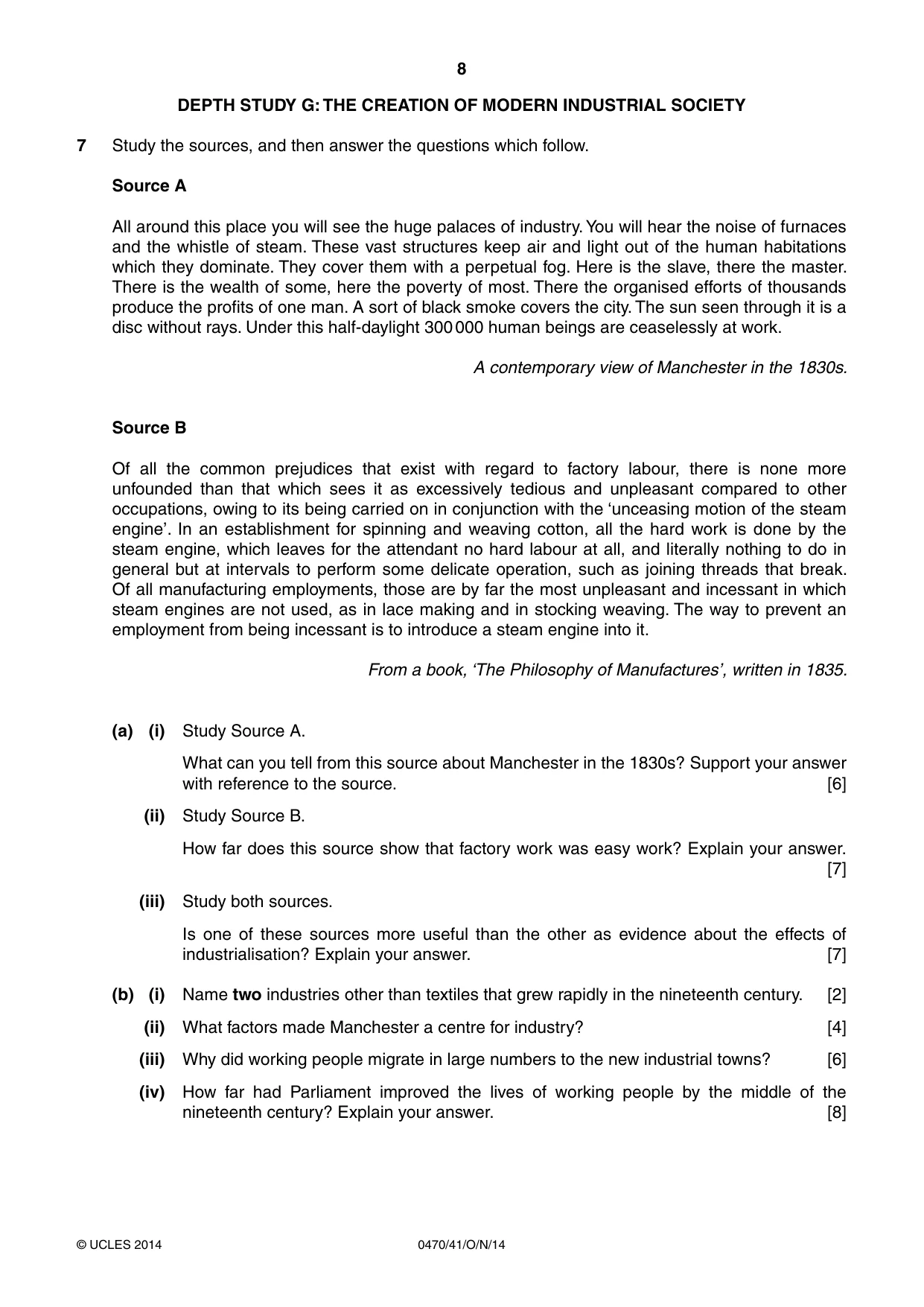
8 0470/41/O/N/14 © UCLES 2014 DEPTH STUDY G: THE CREATION OF MODERN INDUSTRIAL SOCIETY 7 Study the sources, and then answer the questions which follow. Source A All around this place you will see the huge palaces of industry. You will hear the noise of furnaces and the whistle of steam. These vast structures keep air and light out of the human habitations which they dominate. They cover them with a perpetual fog. Here is the slave, there the master. There is the wealth of some, here the poverty of most. There the organised efforts of thousands produce the profits of one man. A sort of black smoke covers the city. The sun seen through it is a disc without rays. Under this half-daylight 300 000 human beings are ceaselessly at work. A contemporary view of Manchester in the 1830s. Source B Of all the common prejudices that exist with regard to factory labour, there is none more unfounded than that which sees it as excessively tedious and unpleasant compared to other occupations, owing to its being carried on in conjunction with the ‘unceasing motion of the steam engine’. In an establishment for spinning and weaving cotton, all the hard work is done by the steam engine, which leaves for the attendant no hard labour at all, and literally nothing to do in general but at intervals to perform some delicate operation, such as joining threads that break. Of all manufacturing employments, those are by far the most unpleasant and incessant in which steam engines are not used, as in lace making and in stocking weaving. The way to prevent an employment from being incessant is to introduce a steam engine into it. From a book, ‘The Philosophy of Manufactures’, written in 1835. (a) (i) Study Source A. What can you tell from this source about Manchester in the 1830s? Support your answer with reference to the source. [6] (ii) Study Source B. How far does this source show that factory work was easy work? Explain your answer. [7] (iii) Study both sources. Is one of these sources more useful than the other as evidence about the effects of industrialisation? Explain your answer. [7] (b) (i) Name two industries other than textiles that grew rapidly in the nineteenth century. [2] (ii) What factors made Manchester a centre for industry? [4] (iii) Why did working people migrate in large numbers to the new industrial towns? [6] (iv) How far had Parliament improved the lives of working people by the middle of the nineteenth century? Explain your answer. [8]
Question paper, page 9
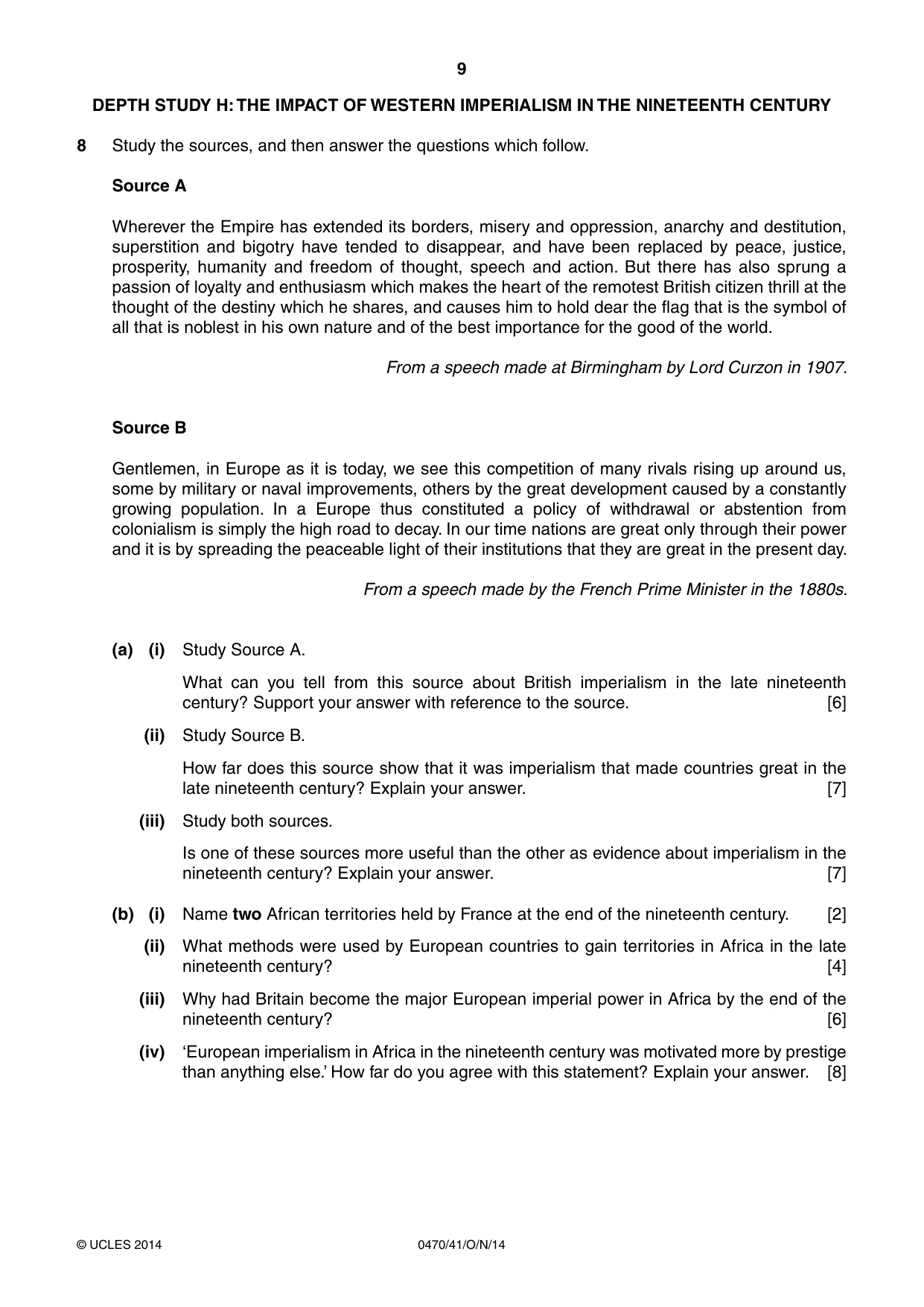
9 0470/41/O/N/14 © UCLES 2014 DEPTH STUDY H: THE IMPACT OF WESTERN IMPERIALISM IN THE NINETEENTH CENTURY 8 Study the sources, and then answer the questions which follow. Source A Wherever the Empire has extended its borders, misery and oppression, anarchy and destitution, superstition and bigotry have tended to disappear, and have been replaced by peace, justice, prosperity, humanity and freedom of thought, speech and action. But there has also sprung a passion of loyalty and enthusiasm which makes the heart of the remotest British citizen thrill at the thought of the destiny which he shares, and causes him to hold dear the flag that is the symbol of all that is noblest in his own nature and of the best importance for the good of the world. From a speech made at Birmingham by Lord Curzon in 1907. Source B Gentlemen, in Europe as it is today, we see this competition of many rivals rising up around us, some by military or naval improvements, others by the great development caused by a constantly growing population. In a Europe thus constituted a policy of withdrawal or abstention from colonialism is simply the high road to decay. In our time nations are great only through their power and it is by spreading the peaceable light of their institutions that they are great in the present day. From a speech made by the French Prime Minister in the 1880s. (a) (i) Study Source A. What can you tell from this source about British imperialism in the late nineteenth century? Support your answer with reference to the source. [6] (ii) Study Source B. How far does this source show that it was imperialism that made countries great in the late nineteenth century? Explain your answer. [7] (iii) Study both sources. Is one of these sources more useful than the other as evidence about imperialism in the nineteenth century? Explain your answer. [7] (b) (i) Name two African territories held by France at the end of the nineteenth century. [2] (ii) What methods were used by European countries to gain territories in Africa in the late nineteenth century? [4] (iii) Why had Britain become the major European imperial power in Africa by the end of the nineteenth century? [6] (iv) ‘European imperialism in Africa in the nineteenth century was motivated more by prestige than anything else.’ How far do you agree with this statement? Explain your answer. [8]
Question paper, page 10
10 0470/41/O/N/14 © UCLES 2014 BLANK PAGE
Question paper, page 11
11 0470/41/O/N/14 © UCLES 2014 BLANK PAGE
Question paper, page 12
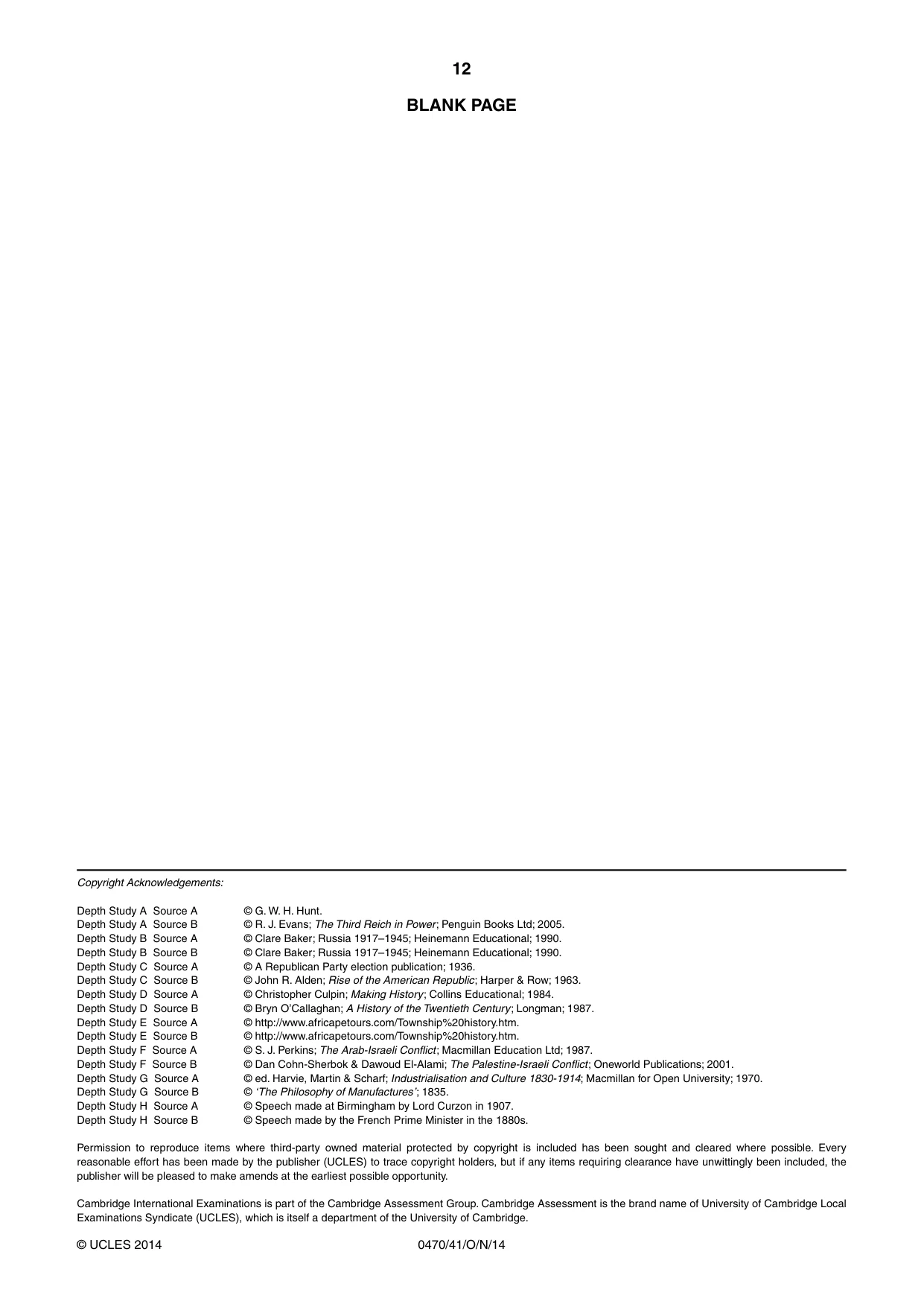
12 0470/41/O/N/14 © UCLES 2014 BLANK PAGE Copyright Acknowledgements: Depth Study A Source A © G. W. H. Hunt. Depth Study A Source B © R. J. Evans; The Third Reich in Power; Penguin Books Ltd; 2005. Depth Study B Source A © Clare Baker; Russia 1917–1945; Heinemann Educational; 1990. Depth Study B Source B © Clare Baker; Russia 1917–1945; Heinemann Educational; 1990. Depth Study C Source A © A Republican Party election publication; 1936. Depth Study C Source B © John R. Alden; Rise of the American Republic; Harper & Row; 1963. Depth Study D Source A © Christopher Culpin; Making History; Collins Educational; 1984. Depth Study D Source B © Bryn O’Callaghan; A History of the Twentieth Century; Longman; 1987. Depth Study E Source A © http://www.africapetours.com/Township%20history.htm. Depth Study E Source B © http://www.africapetours.com/Township%20history.htm. Depth Study F Source A © S. J. Perkins; The Arab-Israeli Conflict; Macmillan Education Ltd; 1987. Depth Study F Source B © Dan Cohn-Sherbok & Dawoud El-Alami; The Palestine-Israeli Conflict; Oneworld Publications; 2001. Depth Study G Source A © ed. Harvie, Martin & Scharf; Industrialisation and Culture 1830-1914; Macmillan for Open University; 1970. Depth Study G Source B © ‘The Philosophy of Manufactures’; 1835. Depth Study H Source A © Speech made at Birmingham by Lord Curzon in 1907. Depth Study H Source B © Speech made by the French Prime Minister in the 1880s. Permission to reproduce items where third-party owned material protected by copyright is included has been sought and cleared where possible. Every reasonable effort has been made by the publisher (UCLES) to trace copyright holders, but if any items requiring clearance have unwittingly been included, the publisher will be pleased to make amends at the earliest possible opportunity. Cambridge International Examinations is part of the Cambridge Assessment Group. Cambridge Assessment is the brand name of University of Cambridge Local Examinations Syndicate (UCLES), which is itself a department of the University of Cambridge.
Mark scheme, page 1
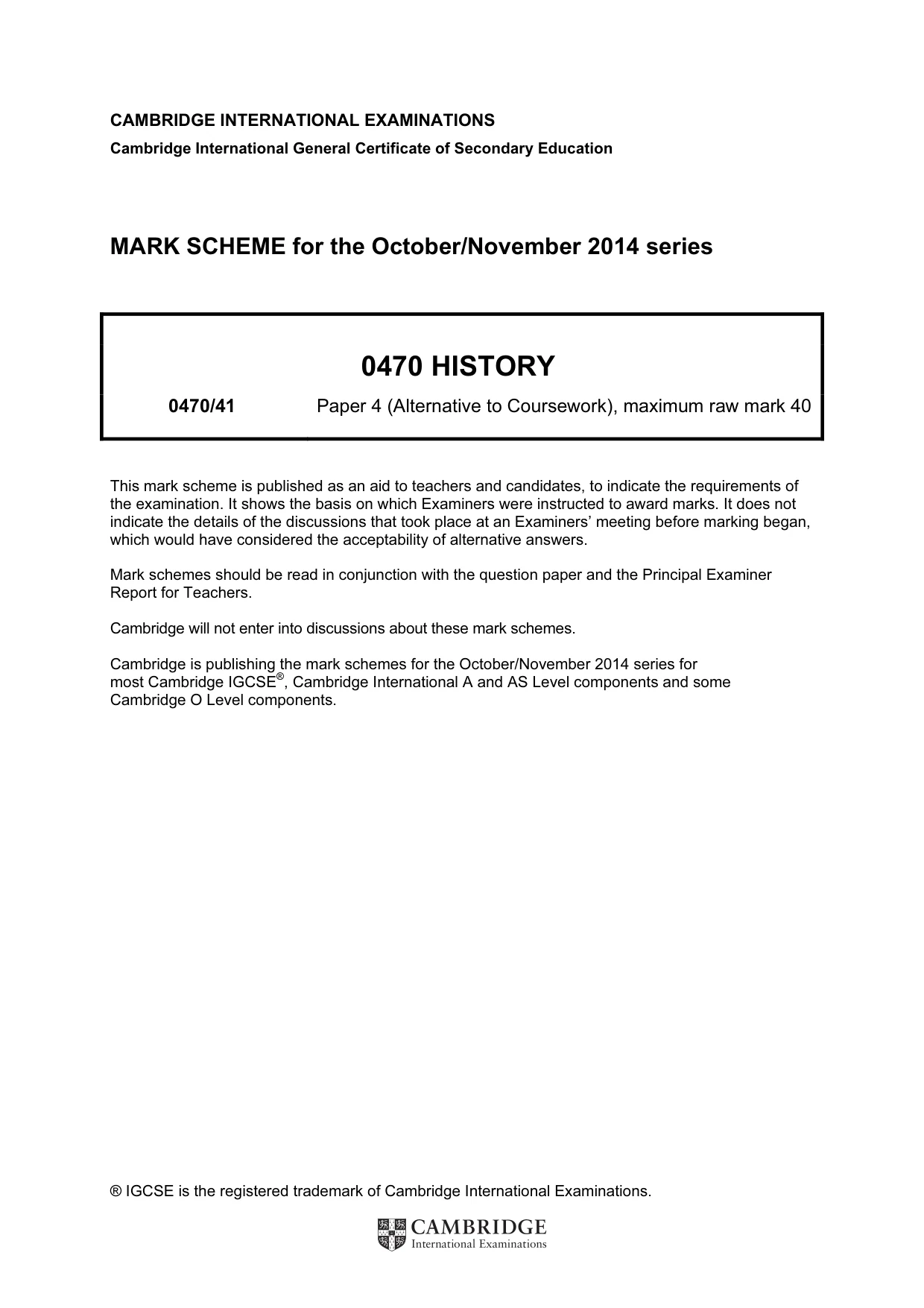
® IGCSE is the registered trademark of Cambridge International Examinations. CAMBRIDGE INTERNATIONAL EXAMINATIONS Cambridge International General Certificate of Secondary Education MARK SCHEME for the October/November 2014 series 0470 HISTORY 0470/41 Paper 4 (Alternative to Coursework), maximum raw mark 40 This mark scheme is published as an aid to teachers and candidates, to indicate the requirements of the examination. It shows the basis on which Examiners were instructed to award marks. It does not indicate the details of the discussions that took place at an Examiners’ meeting before marking began, which would have considered the acceptability of alternative answers. Mark schemes should be read in conjunction with the question paper and the Principal Examiner Report for Teachers. Cambridge will not enter into discussions about these mark schemes. Cambridge is publishing the mark schemes for the October/November 2014 series for most Cambridge IGCSE®, Cambridge International A and AS Level components and some Cambridge O Level components.
Mark scheme, page 2
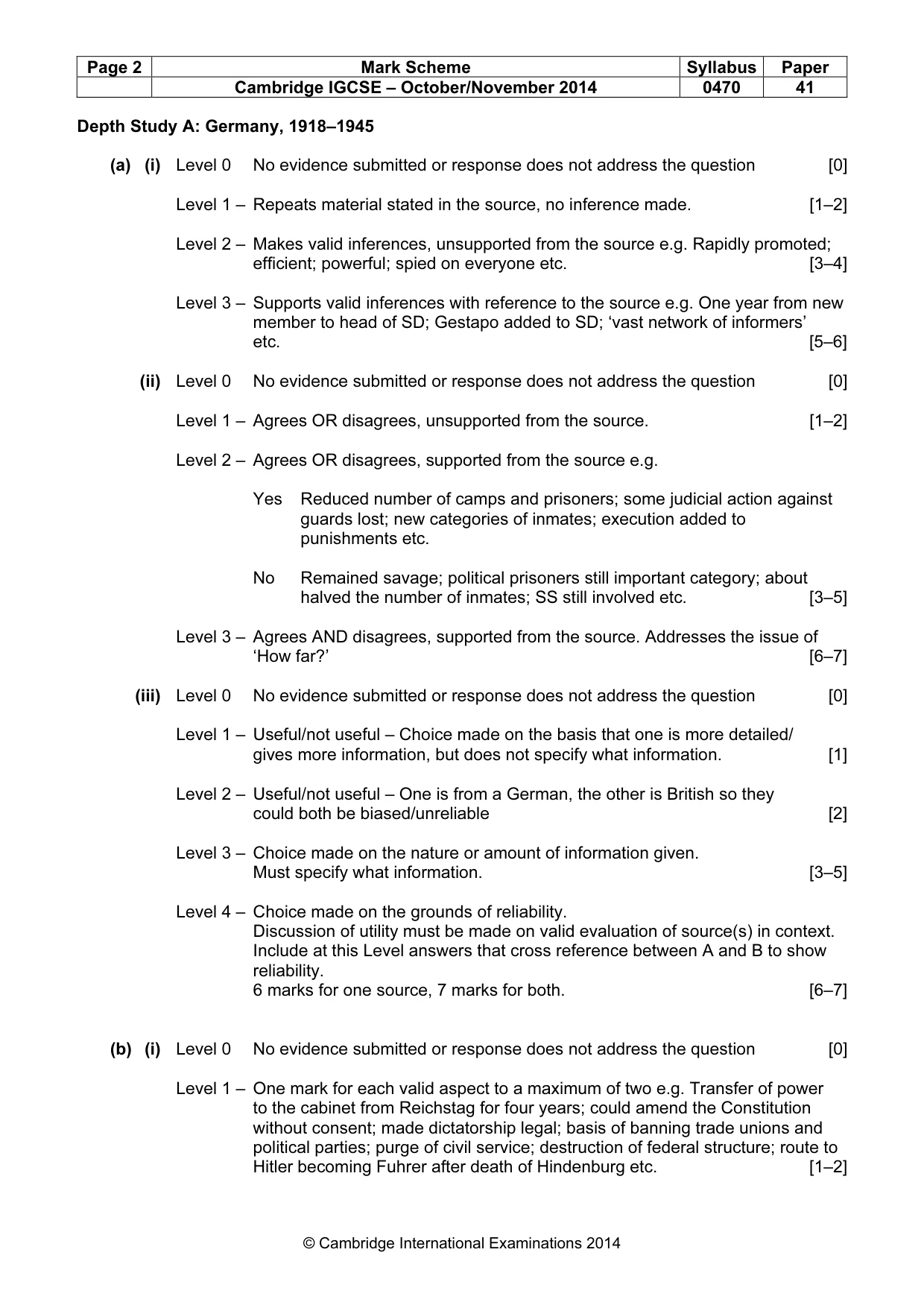
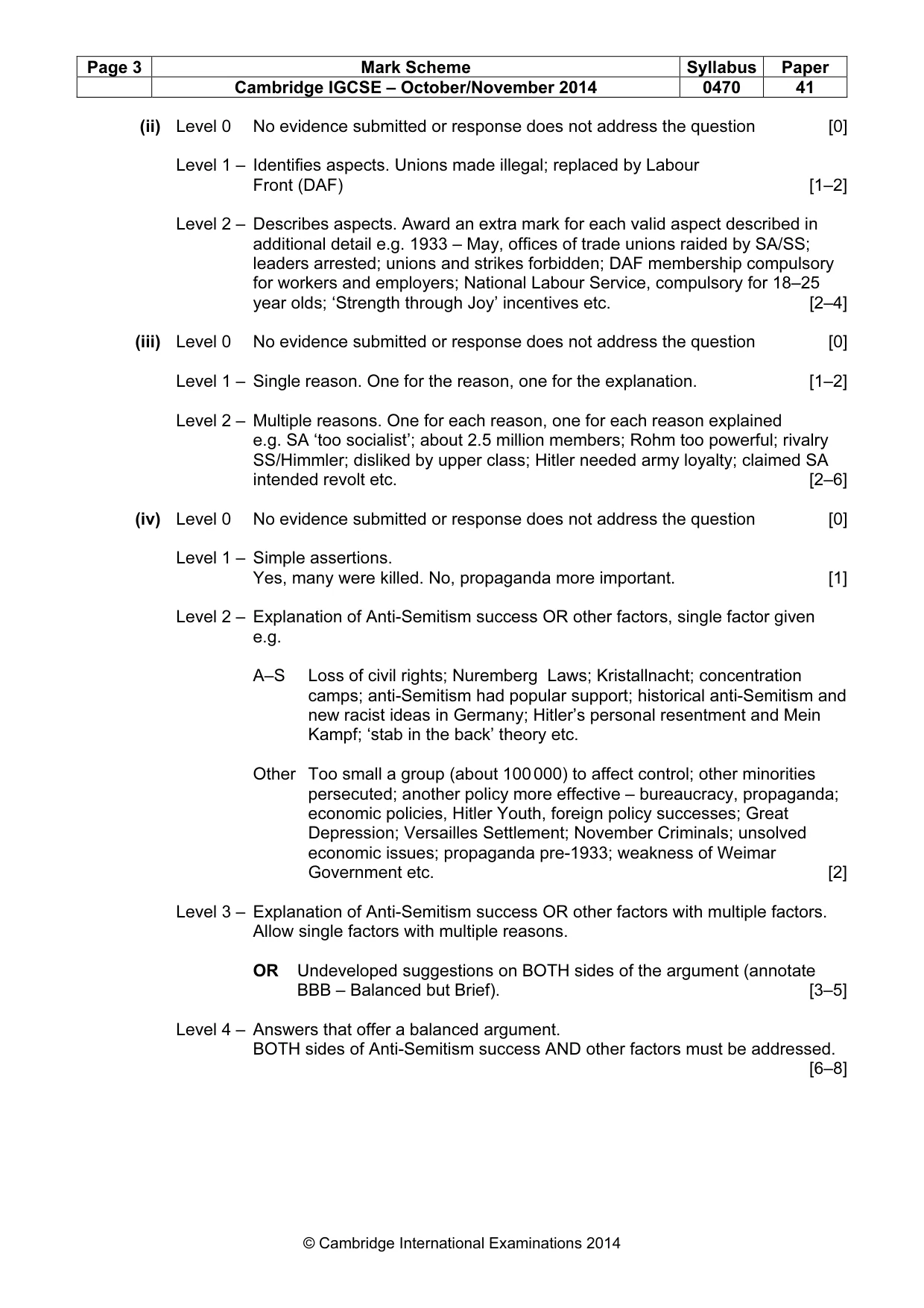
Page 2 Mark Scheme Syllabus Paper Cambridge IGCSE – October/November 2014 0470 41 © Cambridge International Examinations 2014 Depth Study A: Germany, 1918–1945 (a) (i) Level 0 No evidence submitted or response does not address the question [0] Level 1 – Repeats material stated in the source, no inference made. [1–2] Level 2 – Makes valid inferences, unsupported from the source e.g. Rapidly promoted; efficient; powerful; spied on everyone etc. [3–4] Level 3 – Supports valid inferences with reference to the source e.g. One year from new member to head of SD; Gestapo added to SD; ‘vast network of informers’ etc. [5–6] (ii) Level 0 No evidence submitted or response does not address the question [0] Level 1 – Agrees OR disagrees, unsupported from the source. [1–2] Level 2 – Agrees OR disagrees, supported from the source e.g. Yes Reduced number of camps and prisoners; some judicial action against guards lost; new categories of inmates; execution added to punishments etc. No Remained savage; political prisoners still important category; about halved the number of inmates; SS still involved etc. [3–5] Level 3 – Agrees AND disagrees, supported from the source. Addresses the issue of ‘How far?’ [6–7] (iii) Level 0 No evidence submitted or response does not address the question [0] Level 1 – Useful/not useful – Choice made on the basis that one is more detailed/ gives more information, but does not specify what information. [1] Level 2 – Useful/not useful – One is from a German, the other is British so they could both be biased/unreliable [2] Level 3 – Choice made on the nature or amount of information given. Must specify what information. [3–5] Level 4 – Choice made on the grounds of reliability. Discussion of utility must be made on valid evaluation of source(s) in context. Include at this Level answers that cross reference between A and B to show reliability. 6 marks for one source, 7 marks for both. [6–7] (b) (i) Level 0 No evidence submitted or response does not address the question [0] Level 1 – One mark for each valid aspect to a maximum of two e.g. Transfer of power to the cabinet from Reichstag for four years; could amend the Constitution without consent; made dictatorship legal; basis of banning trade unions and political parties; purge of civil service; destruction of federal structure; route to Hitler becoming Fuhrer after death of Hindenburg etc. [1–2]
Mark scheme, page 3
Page 3 Mark Scheme Syllabus Paper Cambridge IGCSE – October/November 2014 0470 41 © Cambridge International Examinations 2014 (ii) Level 0 No evidence submitted or response does not address the question [0] Level 1 – Identifies aspects. Unions made illegal; replaced by Labour Front (DAF) [1–2] Level 2 – Describes aspects. Award an extra mark for each valid aspect described in additional detail e.g. 1933 – May, offices of trade unions raided by SA/SS; leaders arrested; unions and strikes forbidden; DAF membership compulsory for workers and employers; National Labour Service, compulsory for 18–25 year olds; ‘Strength through Joy’ incentives etc. [2–4] (iii) Level 0 No evidence submitted or response does not address the question [0] Level 1 – Single reason. One for the reason, one for the explanation. [1–2] Level 2 – Multiple reasons. One for each reason, one for each reason explained e.g. SA ‘too socialist’; about 2.5 million members; Rohm too powerful; rivalry SS/Himmler; disliked by upper class; Hitler needed army loyalty; claimed SA intended revolt etc. [2–6] (iv) Level 0 No evidence submitted or response does not address the question [0] Level 1 – Simple assertions. Yes, many were killed. No, propaganda more important. [1] Level 2 – Explanation of Anti-Semitism success OR other factors, single factor given e.g. A–S Loss of civil rights; Nuremberg Laws; Kristallnacht; concentration camps; anti-Semitism had popular support; historical anti-Semitism and new racist ideas in Germany; Hitler’s personal resentment and Mein Kampf; ‘stab in the back’ theory etc. Other Too small a group (about 100 000) to affect control; other minorities persecuted; another policy more effective – bureaucracy, propaganda; economic policies, Hitler Youth, foreign policy successes; Great Depression; Versailles Settlement; November Criminals; unsolved economic issues; propaganda pre-1933; weakness of Weimar Government etc. [2] Level 3 – Explanation of Anti-Semitism success OR other factors with multiple factors. Allow single factors with multiple reasons. OR Undeveloped suggestions on BOTH sides of the argument (annotate BBB – Balanced but Brief). [3–5] Level 4 – Answers that offer a balanced argument. BOTH sides of Anti-Semitism success AND other factors must be addressed. [6–8]
Mark scheme, page 4
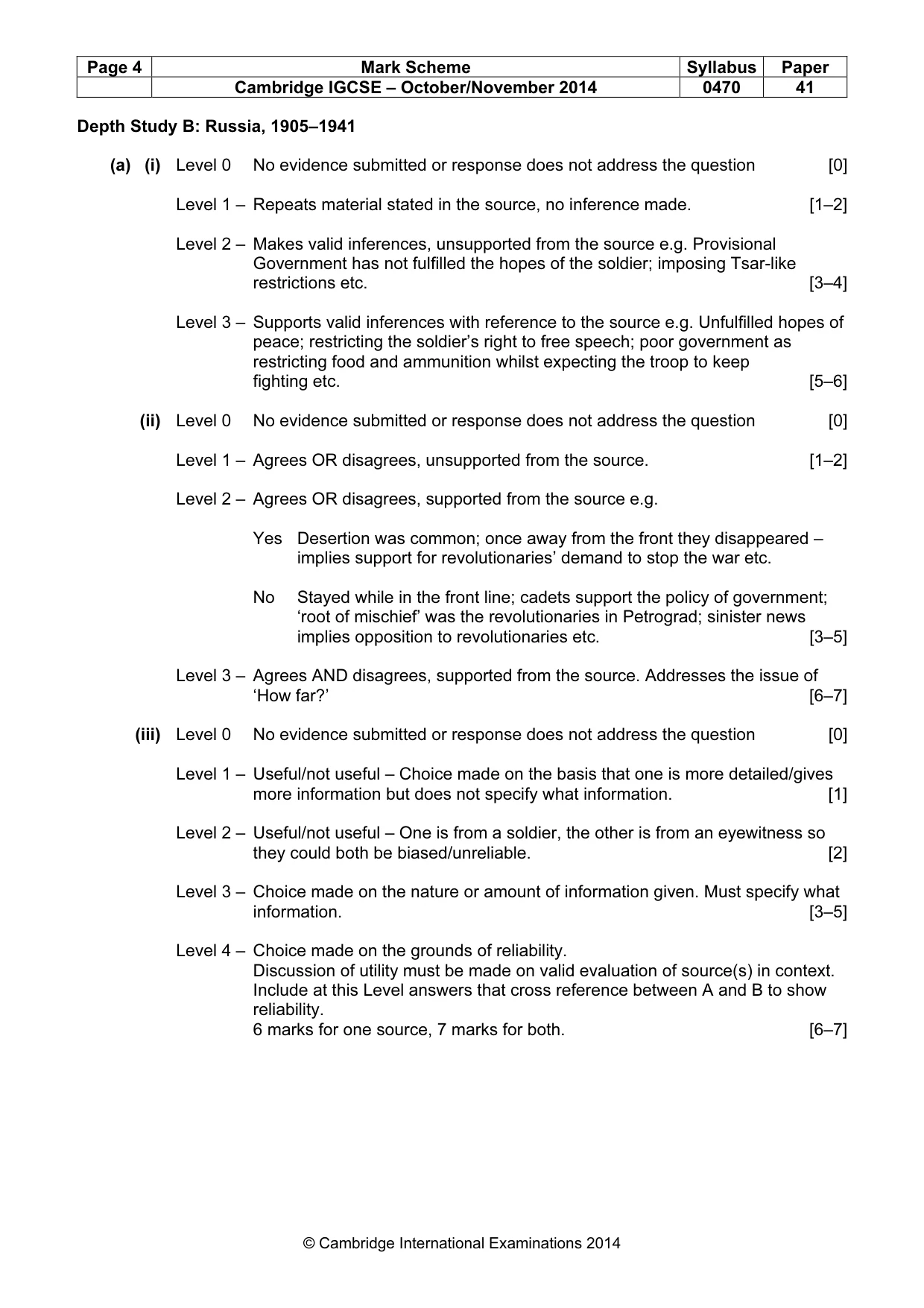
Page 4 Mark Scheme Syllabus Paper Cambridge IGCSE – October/November 2014 0470 41 © Cambridge International Examinations 2014 Depth Study B: Russia, 1905–1941 (a) (i) Level 0 No evidence submitted or response does not address the question [0] Level 1 – Repeats material stated in the source, no inference made. [1–2] Level 2 – Makes valid inferences, unsupported from the source e.g. Provisional Government has not fulfilled the hopes of the soldier; imposing Tsar-like restrictions etc. [3–4] Level 3 – Supports valid inferences with reference to the source e.g. Unfulfilled hopes of peace; restricting the soldier’s right to free speech; poor government as restricting food and ammunition whilst expecting the troop to keep fighting etc. [5–6] (ii) Level 0 No evidence submitted or response does not address the question [0] Level 1 – Agrees OR disagrees, unsupported from the source. [1–2] Level 2 – Agrees OR disagrees, supported from the source e.g. Yes Desertion was common; once away from the front they disappeared – implies support for revolutionaries’ demand to stop the war etc. No Stayed while in the front line; cadets support the policy of government; ‘root of mischief’ was the revolutionaries in Petrograd; sinister news implies opposition to revolutionaries etc. [3–5] Level 3 – Agrees AND disagrees, supported from the source. Addresses the issue of ‘How far?’ [6–7] (iii) Level 0 No evidence submitted or response does not address the question [0] Level 1 – Useful/not useful – Choice made on the basis that one is more detailed/gives more information but does not specify what information. [1] Level 2 – Useful/not useful – One is from a soldier, the other is from an eyewitness so they could both be biased/unreliable. [2] Level 3 – Choice made on the nature or amount of information given. Must specify what information. [3–5] Level 4 – Choice made on the grounds of reliability. Discussion of utility must be made on valid evaluation of source(s) in context. Include at this Level answers that cross reference between A and B to show reliability. 6 marks for one source, 7 marks for both. [6–7]
Mark scheme, page 5
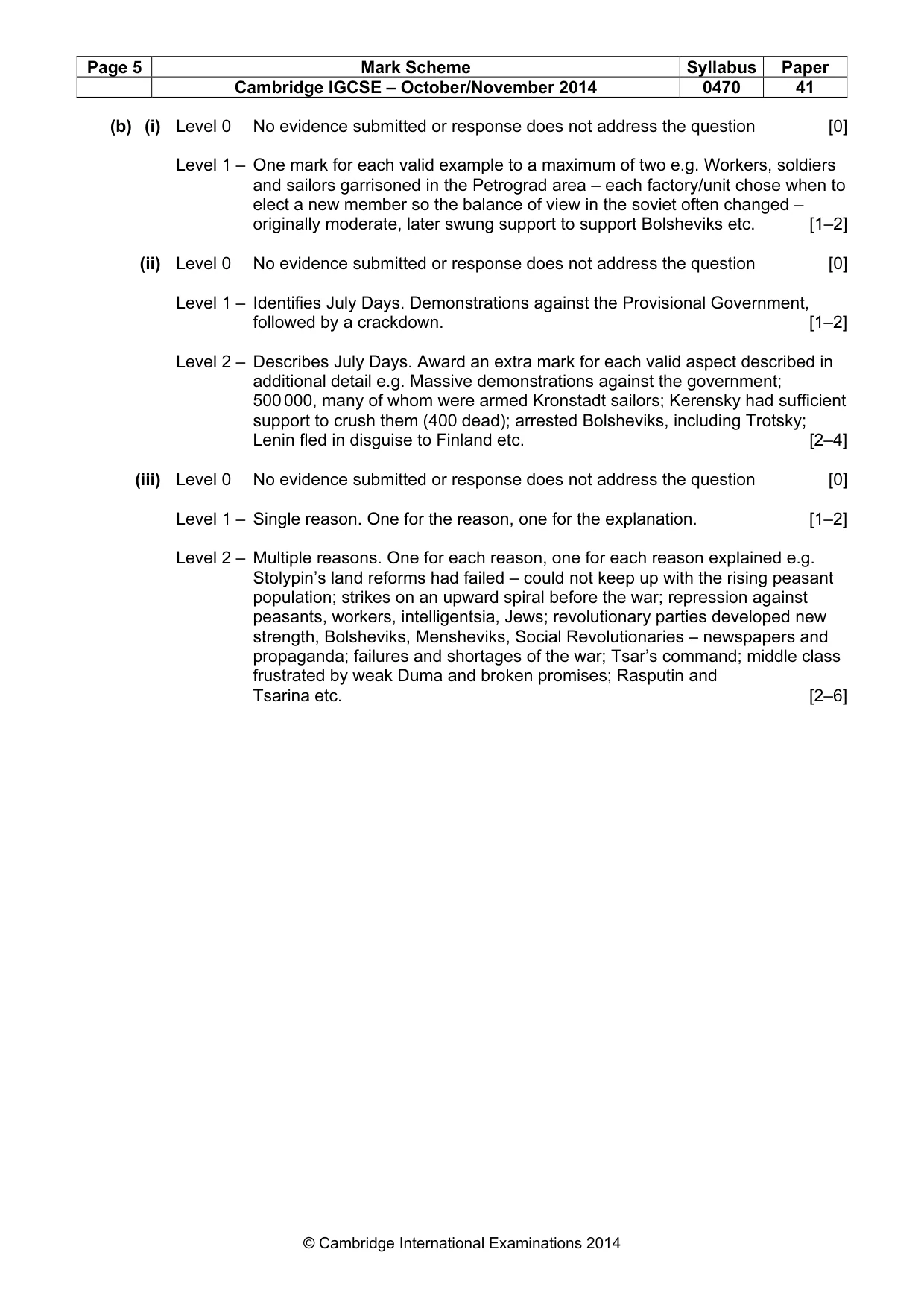
Page 5 Mark Scheme Syllabus Paper Cambridge IGCSE – October/November 2014 0470 41 © Cambridge International Examinations 2014 (b) (i) Level 0 No evidence submitted or response does not address the question [0] Level 1 – One mark for each valid example to a maximum of two e.g. Workers, soldiers and sailors garrisoned in the Petrograd area – each factory/unit chose when to elect a new member so the balance of view in the soviet often changed – originally moderate, later swung support to support Bolsheviks etc. [1–2] (ii) Level 0 No evidence submitted or response does not address the question [0] Level 1 – Identifies July Days. Demonstrations against the Provisional Government, followed by a crackdown. [1–2] Level 2 – Describes July Days. Award an extra mark for each valid aspect described in additional detail e.g. Massive demonstrations against the government; 500 000, many of whom were armed Kronstadt sailors; Kerensky had sufficient support to crush them (400 dead); arrested Bolsheviks, including Trotsky; Lenin fled in disguise to Finland etc. [2–4] (iii) Level 0 No evidence submitted or response does not address the question [0] Level 1 – Single reason. One for the reason, one for the explanation. [1–2] Level 2 – Multiple reasons. One for each reason, one for each reason explained e.g. Stolypin’s land reforms had failed – could not keep up with the rising peasant population; strikes on an upward spiral before the war; repression against peasants, workers, intelligentsia, Jews; revolutionary parties developed new strength, Bolsheviks, Mensheviks, Social Revolutionaries – newspapers and propaganda; failures and shortages of the war; Tsar’s command; middle class frustrated by weak Duma and broken promises; Rasputin and Tsarina etc. [2–6]
Mark scheme, page 6
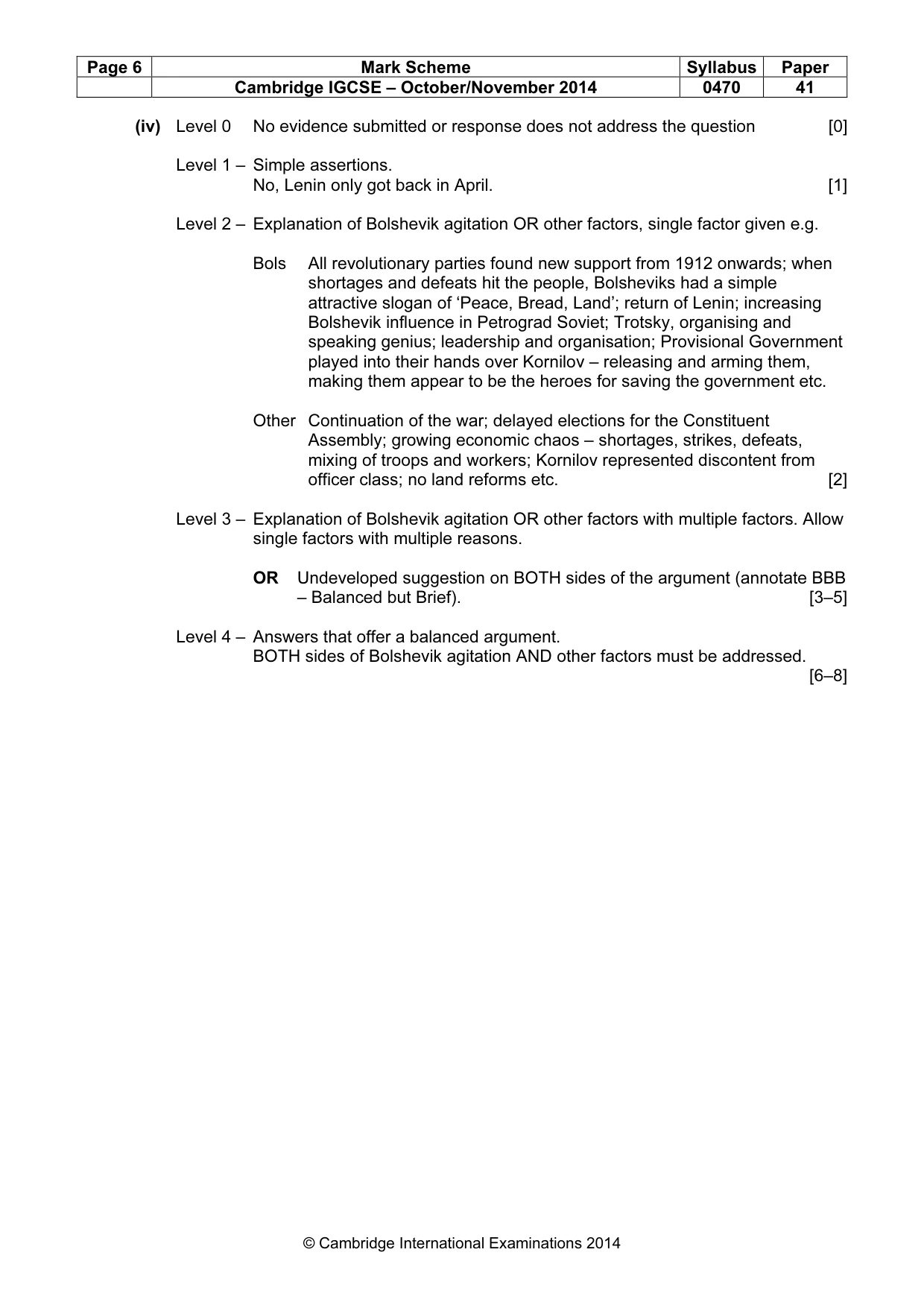
Page 6 Mark Scheme Syllabus Paper Cambridge IGCSE – October/November 2014 0470 41 © Cambridge International Examinations 2014 (iv) Level 0 No evidence submitted or response does not address the question [0] Level 1 – Simple assertions. No, Lenin only got back in April. [1] Level 2 – Explanation of Bolshevik agitation OR other factors, single factor given e.g. Bols All revolutionary parties found new support from 1912 onwards; when shortages and defeats hit the people, Bolsheviks had a simple attractive slogan of ‘Peace, Bread, Land’; return of Lenin; increasing Bolshevik influence in Petrograd Soviet; Trotsky, organising and speaking genius; leadership and organisation; Provisional Government played into their hands over Kornilov – releasing and arming them, making them appear to be the heroes for saving the government etc. Other Continuation of the war; delayed elections for the Constituent Assembly; growing economic chaos – shortages, strikes, defeats, mixing of troops and workers; Kornilov represented discontent from officer class; no land reforms etc. [2] Level 3 – Explanation of Bolshevik agitation OR other factors with multiple factors. Allow single factors with multiple reasons. OR Undeveloped suggestion on BOTH sides of the argument (annotate BBB – Balanced but Brief). [3–5] Level 4 – Answers that offer a balanced argument. BOTH sides of Bolshevik agitation AND other factors must be addressed. [6–8]
Mark scheme, page 7
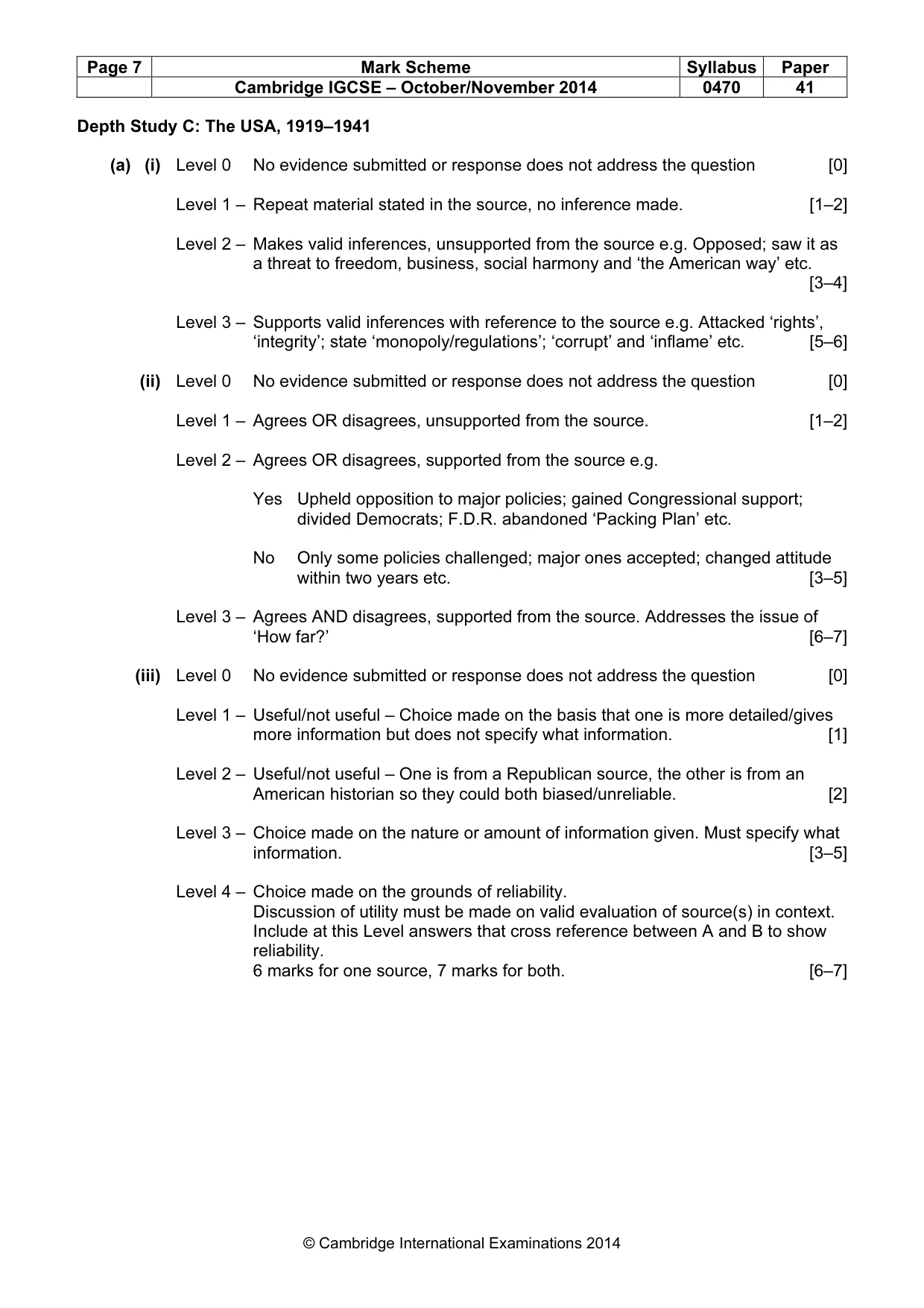
Page 7 Mark Scheme Syllabus Paper Cambridge IGCSE – October/November 2014 0470 41 © Cambridge International Examinations 2014 Depth Study C: The USA, 1919–1941 (a) (i) Level 0 No evidence submitted or response does not address the question [0] Level 1 – Repeat material stated in the source, no inference made. [1–2] Level 2 – Makes valid inferences, unsupported from the source e.g. Opposed; saw it as a threat to freedom, business, social harmony and ‘the American way’ etc. [3–4] Level 3 – Supports valid inferences with reference to the source e.g. Attacked ‘rights’, ‘integrity’; state ‘monopoly/regulations’; ‘corrupt’ and ‘inflame’ etc. [5–6] (ii) Level 0 No evidence submitted or response does not address the question [0] Level 1 – Agrees OR disagrees, unsupported from the source. [1–2] Level 2 – Agrees OR disagrees, supported from the source e.g. Yes Upheld opposition to major policies; gained Congressional support; divided Democrats; F.D.R. abandoned ‘Packing Plan’ etc. No Only some policies challenged; major ones accepted; changed attitude within two years etc. [3–5] Level 3 – Agrees AND disagrees, supported from the source. Addresses the issue of ‘How far?’ [6–7] (iii) Level 0 No evidence submitted or response does not address the question [0] Level 1 – Useful/not useful – Choice made on the basis that one is more detailed/gives more information but does not specify what information. [1] Level 2 – Useful/not useful – One is from a Republican source, the other is from an American historian so they could both biased/unreliable. [2] Level 3 – Choice made on the nature or amount of information given. Must specify what information. [3–5] Level 4 – Choice made on the grounds of reliability. Discussion of utility must be made on valid evaluation of source(s) in context. Include at this Level answers that cross reference between A and B to show reliability. 6 marks for one source, 7 marks for both. [6–7]
Mark scheme, page 8
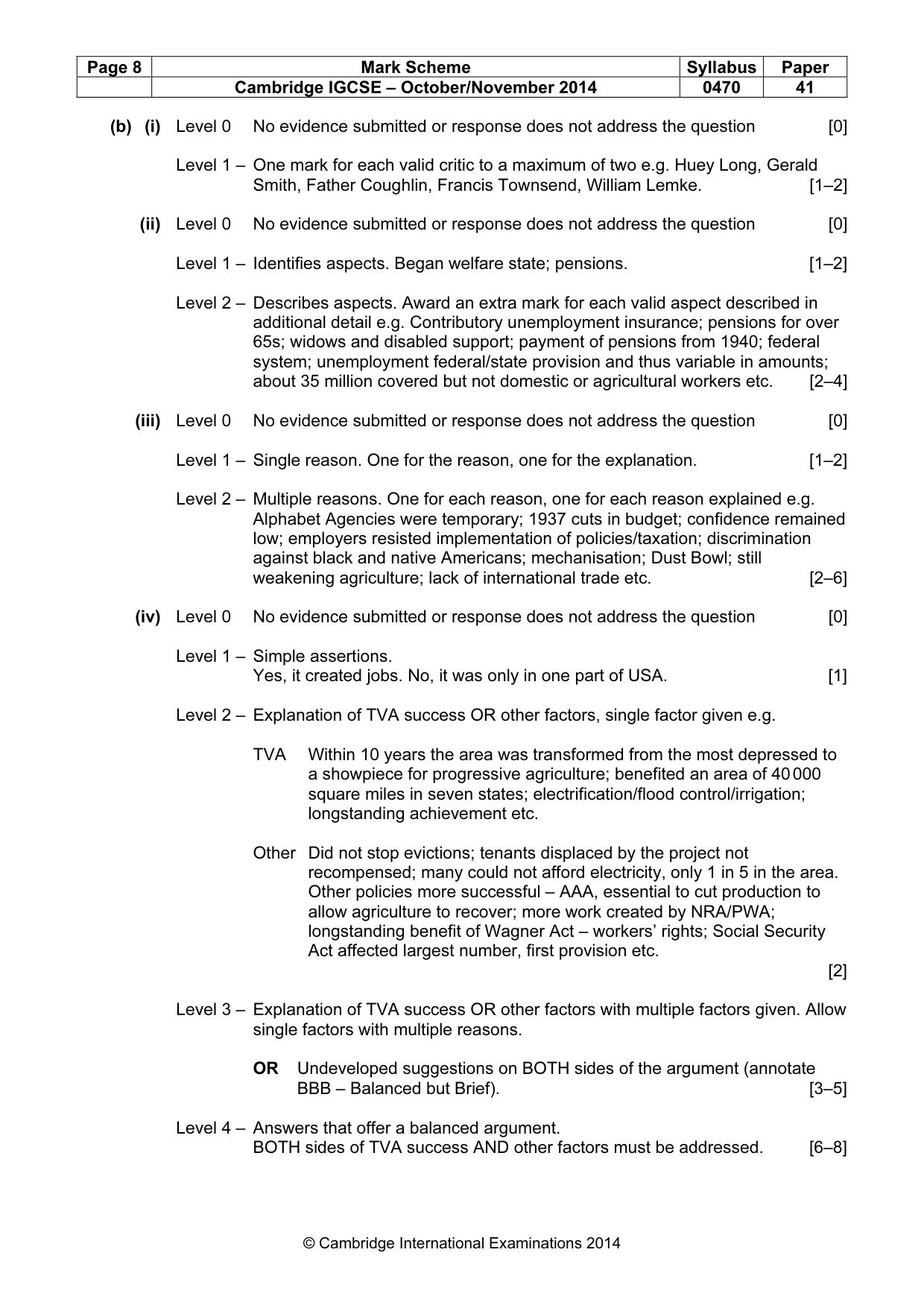
Page 8 Mark Scheme Syllabus Paper Cambridge IGCSE – October/November 2014 0470 41 © Cambridge International Examinations 2014 (b) (i) Level 0 No evidence submitted or response does not address the question [0] Level 1 – One mark for each valid critic to a maximum of two e.g. Huey Long, Gerald Smith, Father Coughlin, Francis Townsend, William Lemke. [1–2] (ii) Level 0 No evidence submitted or response does not address the question [0] Level 1 – Identifies aspects. Began welfare state; pensions. [1–2] Level 2 – Describes aspects. Award an extra mark for each valid aspect described in additional detail e.g. Contributory unemployment insurance; pensions for over 65s; widows and disabled support; payment of pensions from 1940; federal system; unemployment federal/state provision and thus variable in amounts; about 35 million covered but not domestic or agricultural workers etc. [2–4] (iii) Level 0 No evidence submitted or response does not address the question [0] Level 1 – Single reason. One for the reason, one for the explanation. [1–2] Level 2 – Multiple reasons. One for each reason, one for each reason explained e.g. Alphabet Agencies were temporary; 1937 cuts in budget; confidence remained low; employers resisted implementation of policies/taxation; discrimination against black and native Americans; mechanisation; Dust Bowl; still weakening agriculture; lack of international trade etc. [2–6] (iv) Level 0 No evidence submitted or response does not address the question [0] Level 1 – Simple assertions. Yes, it created jobs. No, it was only in one part of USA. [1] Level 2 – Explanation of TVA success OR other factors, single factor given e.g. TVA Within 10 years the area was transformed from the most depressed to a showpiece for progressive agriculture; benefited an area of 40 000 square miles in seven states; electrification/flood control/irrigation; longstanding achievement etc. Other Did not stop evictions; tenants displaced by the project not recompensed; many could not afford electricity, only 1 in 5 in the area. Other policies more successful – AAA, essential to cut production to allow agriculture to recover; more work created by NRA/PWA; longstanding benefit of Wagner Act – workers’ rights; Social Security Act affected largest number, first provision etc. [2] Level 3 – Explanation of TVA success OR other factors with multiple factors given. Allow single factors with multiple reasons. OR Undeveloped suggestions on BOTH sides of the argument (annotate BBB – Balanced but Brief). [3–5] Level 4 – Answers that offer a balanced argument. BOTH sides of TVA success AND other factors must be addressed. [6–8]
Mark scheme, page 9
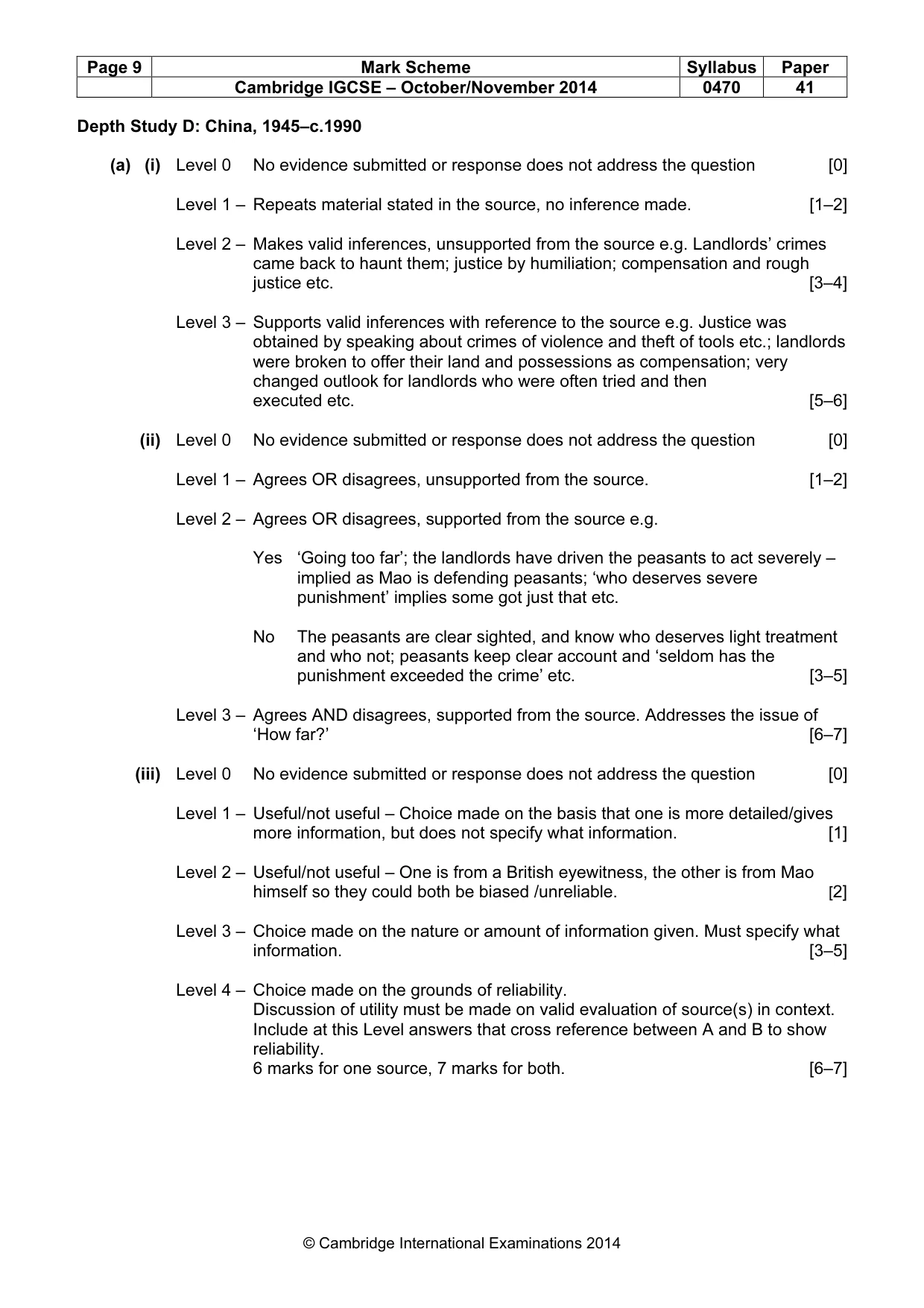
Page 9 Mark Scheme Syllabus Paper Cambridge IGCSE – October/November 2014 0470 41 © Cambridge International Examinations 2014 Depth Study D: China, 1945–c.1990 (a) (i) Level 0 No evidence submitted or response does not address the question [0] Level 1 – Repeats material stated in the source, no inference made. [1–2] Level 2 – Makes valid inferences, unsupported from the source e.g. Landlords’ crimes came back to haunt them; justice by humiliation; compensation and rough justice etc. [3–4] Level 3 – Supports valid inferences with reference to the source e.g. Justice was obtained by speaking about crimes of violence and theft of tools etc.; landlords were broken to offer their land and possessions as compensation; very changed outlook for landlords who were often tried and then executed etc. [5–6] (ii) Level 0 No evidence submitted or response does not address the question [0] Level 1 – Agrees OR disagrees, unsupported from the source. [1–2] Level 2 – Agrees OR disagrees, supported from the source e.g. Yes ‘Going too far’; the landlords have driven the peasants to act severely – implied as Mao is defending peasants; ‘who deserves severe punishment’ implies some got just that etc. No The peasants are clear sighted, and know who deserves light treatment and who not; peasants keep clear account and ‘seldom has the punishment exceeded the crime’ etc. [3–5] Level 3 – Agrees AND disagrees, supported from the source. Addresses the issue of ‘How far?’ [6–7] (iii) Level 0 No evidence submitted or response does not address the question [0] Level 1 – Useful/not useful – Choice made on the basis that one is more detailed/gives more information, but does not specify what information. [1] Level 2 – Useful/not useful – One is from a British eyewitness, the other is from Mao himself so they could both be biased /unreliable. [2] Level 3 – Choice made on the nature or amount of information given. Must specify what information. [3–5] Level 4 – Choice made on the grounds of reliability. Discussion of utility must be made on valid evaluation of source(s) in context. Include at this Level answers that cross reference between A and B to show reliability. 6 marks for one source, 7 marks for both. [6–7]
Mark scheme, page 10
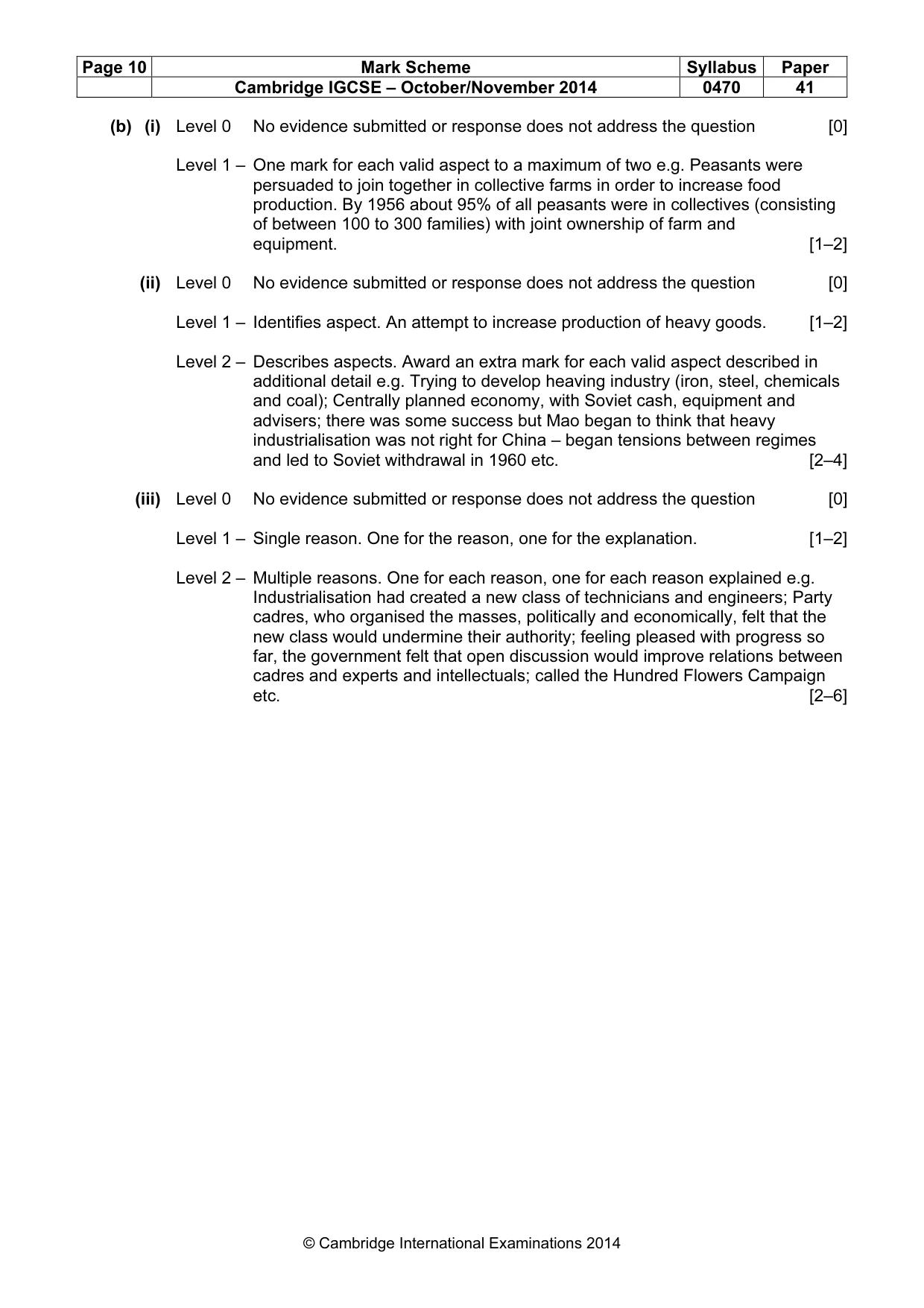
Page 10 Mark Scheme Syllabus Paper Cambridge IGCSE – October/November 2014 0470 41 © Cambridge International Examinations 2014 (b) (i) Level 0 No evidence submitted or response does not address the question [0] Level 1 – One mark for each valid aspect to a maximum of two e.g. Peasants were persuaded to join together in collective farms in order to increase food production. By 1956 about 95% of all peasants were in collectives (consisting of between 100 to 300 families) with joint ownership of farm and equipment. [1–2] (ii) Level 0 No evidence submitted or response does not address the question [0] Level 1 – Identifies aspect. An attempt to increase production of heavy goods. [1–2] Level 2 – Describes aspects. Award an extra mark for each valid aspect described in additional detail e.g. Trying to develop heaving industry (iron, steel, chemicals and coal); Centrally planned economy, with Soviet cash, equipment and advisers; there was some success but Mao began to think that heavy industrialisation was not right for China – began tensions between regimes and led to Soviet withdrawal in 1960 etc. [2–4] (iii) Level 0 No evidence submitted or response does not address the question [0] Level 1 – Single reason. One for the reason, one for the explanation. [1–2] Level 2 – Multiple reasons. One for each reason, one for each reason explained e.g. Industrialisation had created a new class of technicians and engineers; Party cadres, who organised the masses, politically and economically, felt that the new class would undermine their authority; feeling pleased with progress so far, the government felt that open discussion would improve relations between cadres and experts and intellectuals; called the Hundred Flowers Campaign etc. [2–6]
Mark scheme, page 11
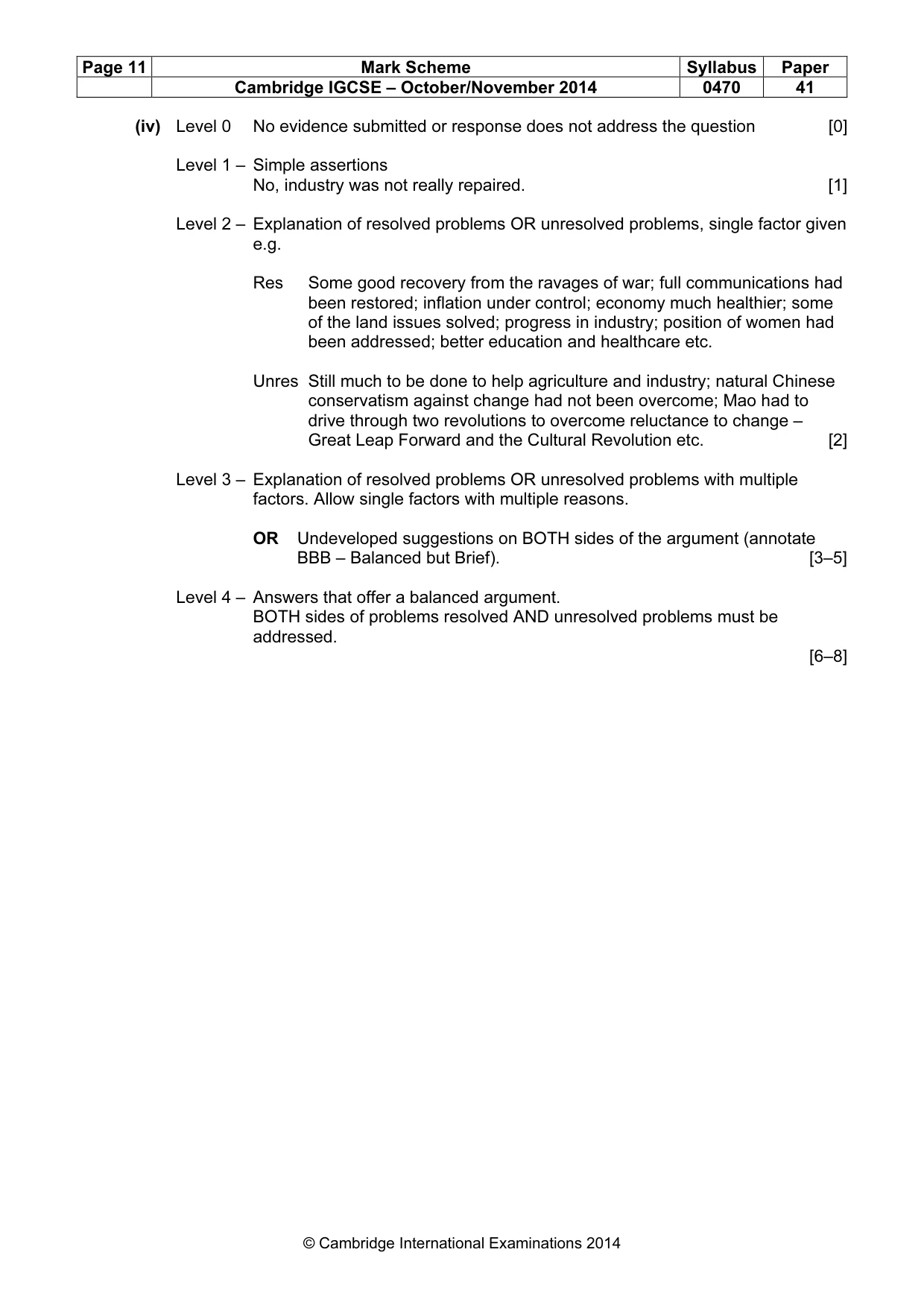
Page 11 Mark Scheme Syllabus Paper Cambridge IGCSE – October/November 2014 0470 41 © Cambridge International Examinations 2014 (iv) Level 0 No evidence submitted or response does not address the question [0] Level 1 – Simple assertions No, industry was not really repaired. [1] Level 2 – Explanation of resolved problems OR unresolved problems, single factor given e.g. Res Some good recovery from the ravages of war; full communications had been restored; inflation under control; economy much healthier; some of the land issues solved; progress in industry; position of women had been addressed; better education and healthcare etc. Unres Still much to be done to help agriculture and industry; natural Chinese conservatism against change had not been overcome; Mao had to drive through two revolutions to overcome reluctance to change – Great Leap Forward and the Cultural Revolution etc. [2] Level 3 – Explanation of resolved problems OR unresolved problems with multiple factors. Allow single factors with multiple reasons. OR Undeveloped suggestions on BOTH sides of the argument (annotate BBB – Balanced but Brief). [3–5] Level 4 – Answers that offer a balanced argument. BOTH sides of problems resolved AND unresolved problems must be addressed. [6–8]
Mark scheme, page 12
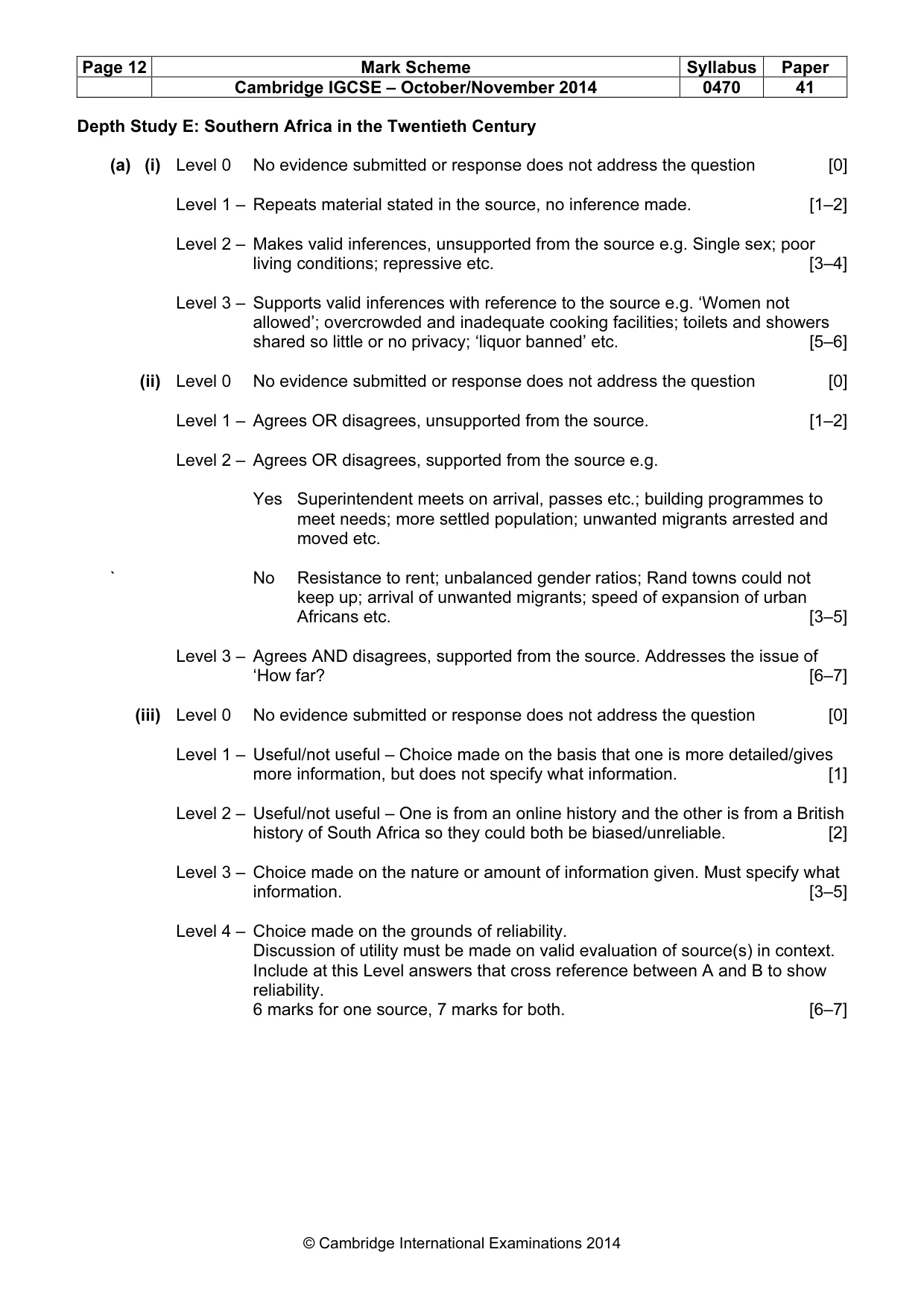
Page 12 Mark Scheme Syllabus Paper Cambridge IGCSE – October/November 2014 0470 41 © Cambridge International Examinations 2014 Depth Study E: Southern Africa in the Twentieth Century (a) (i) Level 0 No evidence submitted or response does not address the question [0] Level 1 – Repeats material stated in the source, no inference made. [1–2] Level 2 – Makes valid inferences, unsupported from the source e.g. Single sex; poor living conditions; repressive etc. [3–4] Level 3 – Supports valid inferences with reference to the source e.g. ‘Women not allowed’; overcrowded and inadequate cooking facilities; toilets and showers shared so little or no privacy; ‘liquor banned’ etc. [5–6] (ii) Level 0 No evidence submitted or response does not address the question [0] Level 1 – Agrees OR disagrees, unsupported from the source. [1–2] Level 2 – Agrees OR disagrees, supported from the source e.g. Yes Superintendent meets on arrival, passes etc.; building programmes to meet needs; more settled population; unwanted migrants arrested and moved etc. ` No Resistance to rent; unbalanced gender ratios; Rand towns could not keep up; arrival of unwanted migrants; speed of expansion of urban Africans etc. [3–5] Level 3 – Agrees AND disagrees, supported from the source. Addresses the issue of ‘How far? [6–7] (iii) Level 0 No evidence submitted or response does not address the question [0] Level 1 – Useful/not useful – Choice made on the basis that one is more detailed/gives more information, but does not specify what information. [1] Level 2 – Useful/not useful – One is from an online history and the other is from a British history of South Africa so they could both be biased/unreliable. [2] Level 3 – Choice made on the nature or amount of information given. Must specify what information. [3–5] Level 4 – Choice made on the grounds of reliability. Discussion of utility must be made on valid evaluation of source(s) in context. Include at this Level answers that cross reference between A and B to show reliability. 6 marks for one source, 7 marks for both. [6–7]
Mark scheme, page 13
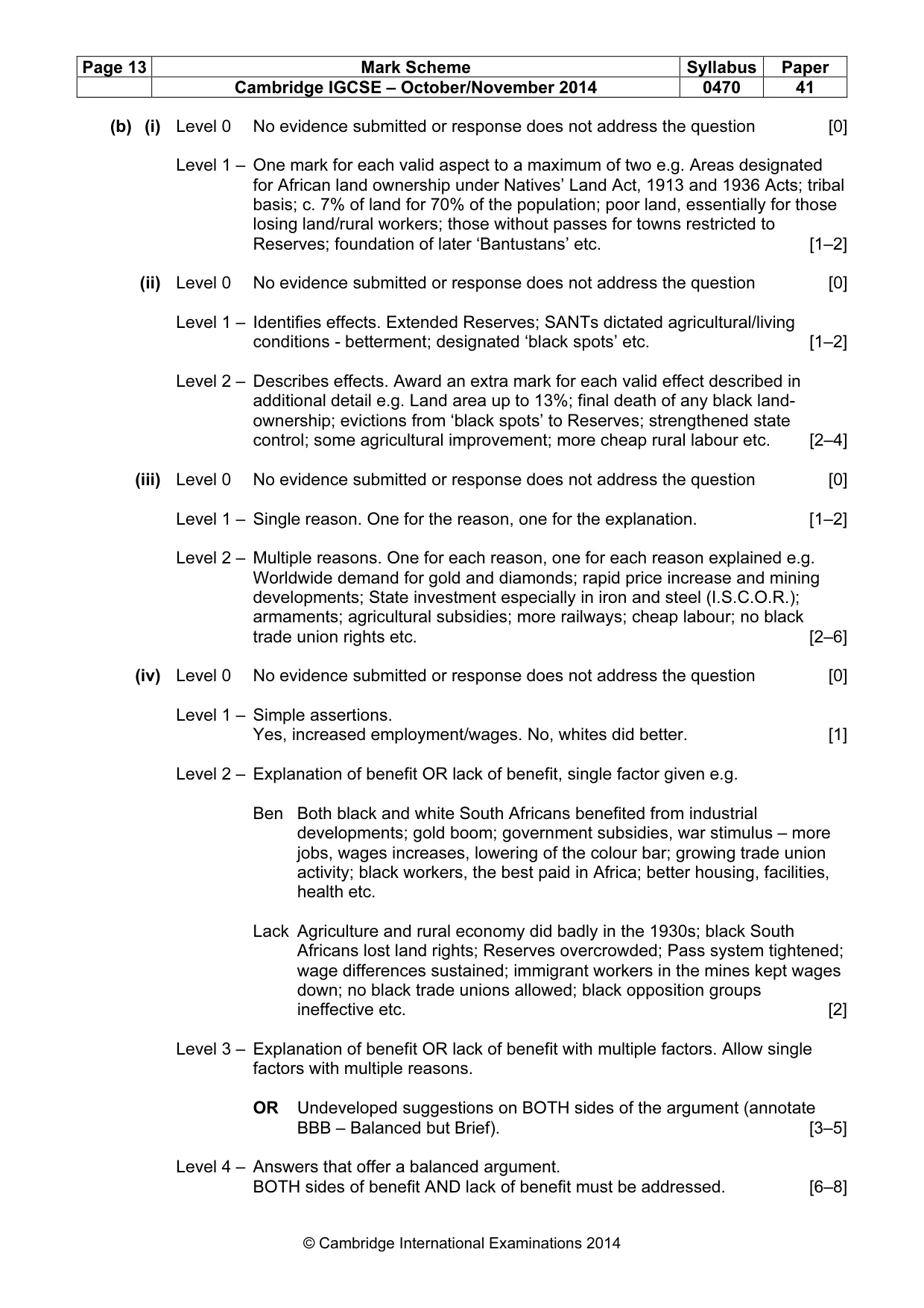
Page 13 Mark Scheme Syllabus Paper Cambridge IGCSE – October/November 2014 0470 41 © Cambridge International Examinations 2014 (b) (i) Level 0 No evidence submitted or response does not address the question [0] Level 1 – One mark for each valid aspect to a maximum of two e.g. Areas designated for African land ownership under Natives’ Land Act, 1913 and 1936 Acts; tribal basis; c. 7% of land for 70% of the population; poor land, essentially for those losing land/rural workers; those without passes for towns restricted to Reserves; foundation of later ‘Bantustans’ etc. [1–2] (ii) Level 0 No evidence submitted or response does not address the question [0] Level 1 – Identifies effects. Extended Reserves; SANTs dictated agricultural/living conditions - betterment; designated ‘black spots’ etc. [1–2] Level 2 – Describes effects. Award an extra mark for each valid effect described in additional detail e.g. Land area up to 13%; final death of any black land- ownership; evictions from ‘black spots’ to Reserves; strengthened state control; some agricultural improvement; more cheap rural labour etc. [2–4] (iii) Level 0 No evidence submitted or response does not address the question [0] Level 1 – Single reason. One for the reason, one for the explanation. [1–2] Level 2 – Multiple reasons. One for each reason, one for each reason explained e.g. Worldwide demand for gold and diamonds; rapid price increase and mining developments; State investment especially in iron and steel (I.S.C.O.R.); armaments; agricultural subsidies; more railways; cheap labour; no black trade union rights etc. [2–6] (iv) Level 0 No evidence submitted or response does not address the question [0] Level 1 – Simple assertions. Yes, increased employment/wages. No, whites did better. [1] Level 2 – Explanation of benefit OR lack of benefit, single factor given e.g. Ben Both black and white South Africans benefited from industrial developments; gold boom; government subsidies, war stimulus – more jobs, wages increases, lowering of the colour bar; growing trade union activity; black workers, the best paid in Africa; better housing, facilities, health etc. Lack Agriculture and rural economy did badly in the 1930s; black South Africans lost land rights; Reserves overcrowded; Pass system tightened; wage differences sustained; immigrant workers in the mines kept wages down; no black trade unions allowed; black opposition groups ineffective etc. [2] Level 3 – Explanation of benefit OR lack of benefit with multiple factors. Allow single factors with multiple reasons. OR Undeveloped suggestions on BOTH sides of the argument (annotate BBB – Balanced but Brief). [3–5] Level 4 – Answers that offer a balanced argument. BOTH sides of benefit AND lack of benefit must be addressed. [6–8]
Mark scheme, page 14
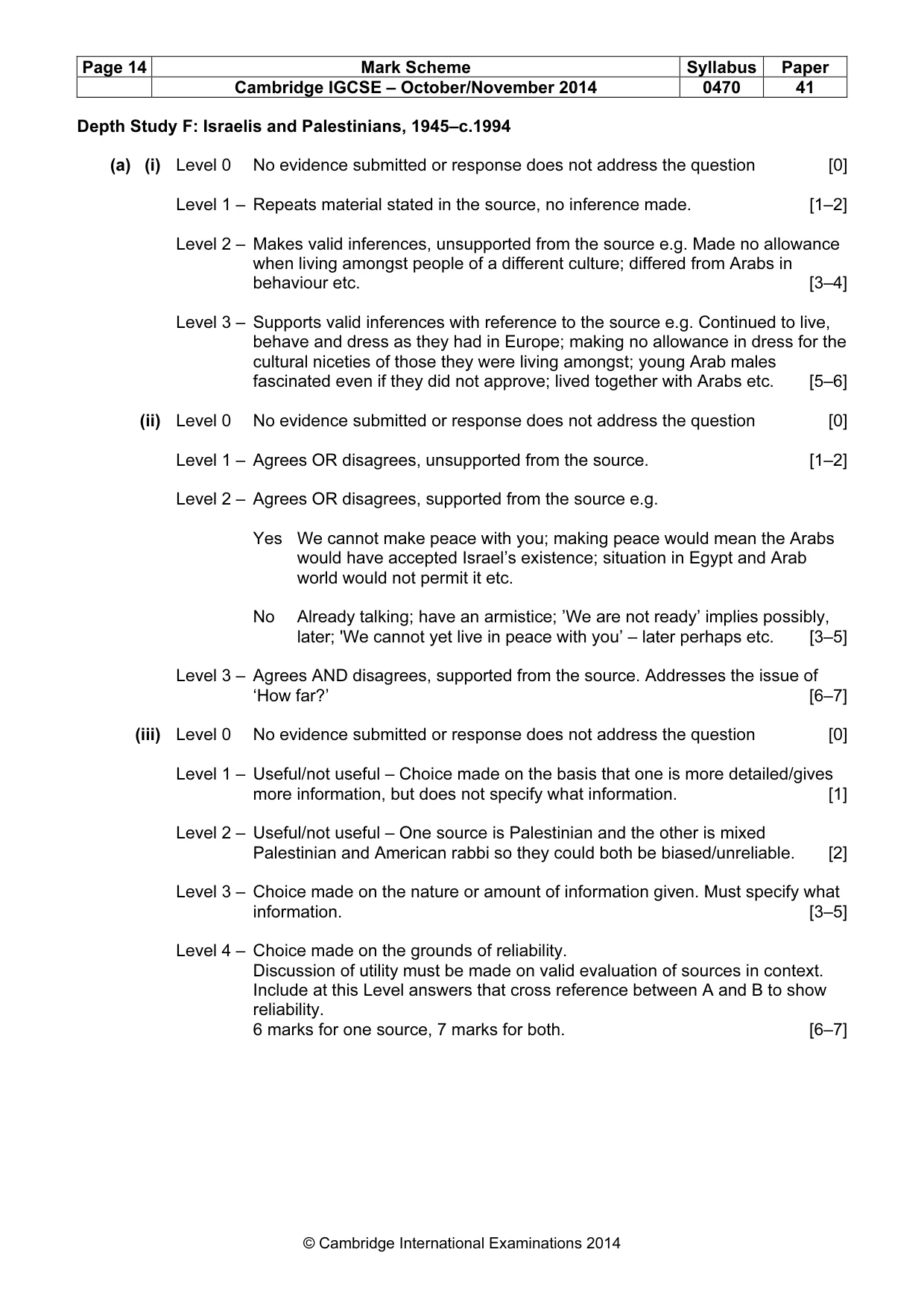
Page 14 Mark Scheme Syllabus Paper Cambridge IGCSE – October/November 2014 0470 41 © Cambridge International Examinations 2014 Depth Study F: Israelis and Palestinians, 1945–c.1994 (a) (i) Level 0 No evidence submitted or response does not address the question [0] Level 1 – Repeats material stated in the source, no inference made. [1–2] Level 2 – Makes valid inferences, unsupported from the source e.g. Made no allowance when living amongst people of a different culture; differed from Arabs in behaviour etc. [3–4] Level 3 – Supports valid inferences with reference to the source e.g. Continued to live, behave and dress as they had in Europe; making no allowance in dress for the cultural niceties of those they were living amongst; young Arab males fascinated even if they did not approve; lived together with Arabs etc. [5–6] (ii) Level 0 No evidence submitted or response does not address the question [0] Level 1 – Agrees OR disagrees, unsupported from the source. [1–2] Level 2 – Agrees OR disagrees, supported from the source e.g. Yes We cannot make peace with you; making peace would mean the Arabs would have accepted Israel’s existence; situation in Egypt and Arab world would not permit it etc. No Already talking; have an armistice; ’We are not ready’ implies possibly, later; 'We cannot yet live in peace with you’ – later perhaps etc. [3–5] Level 3 – Agrees AND disagrees, supported from the source. Addresses the issue of ‘How far?’ [6–7] (iii) Level 0 No evidence submitted or response does not address the question [0] Level 1 – Useful/not useful – Choice made on the basis that one is more detailed/gives more information, but does not specify what information. [1] Level 2 – Useful/not useful – One source is Palestinian and the other is mixed Palestinian and American rabbi so they could both be biased/unreliable. [2] Level 3 – Choice made on the nature or amount of information given. Must specify what information. [3–5] Level 4 – Choice made on the grounds of reliability. Discussion of utility must be made on valid evaluation of sources in context. Include at this Level answers that cross reference between A and B to show reliability. 6 marks for one source, 7 marks for both. [6–7]
Mark scheme, page 15
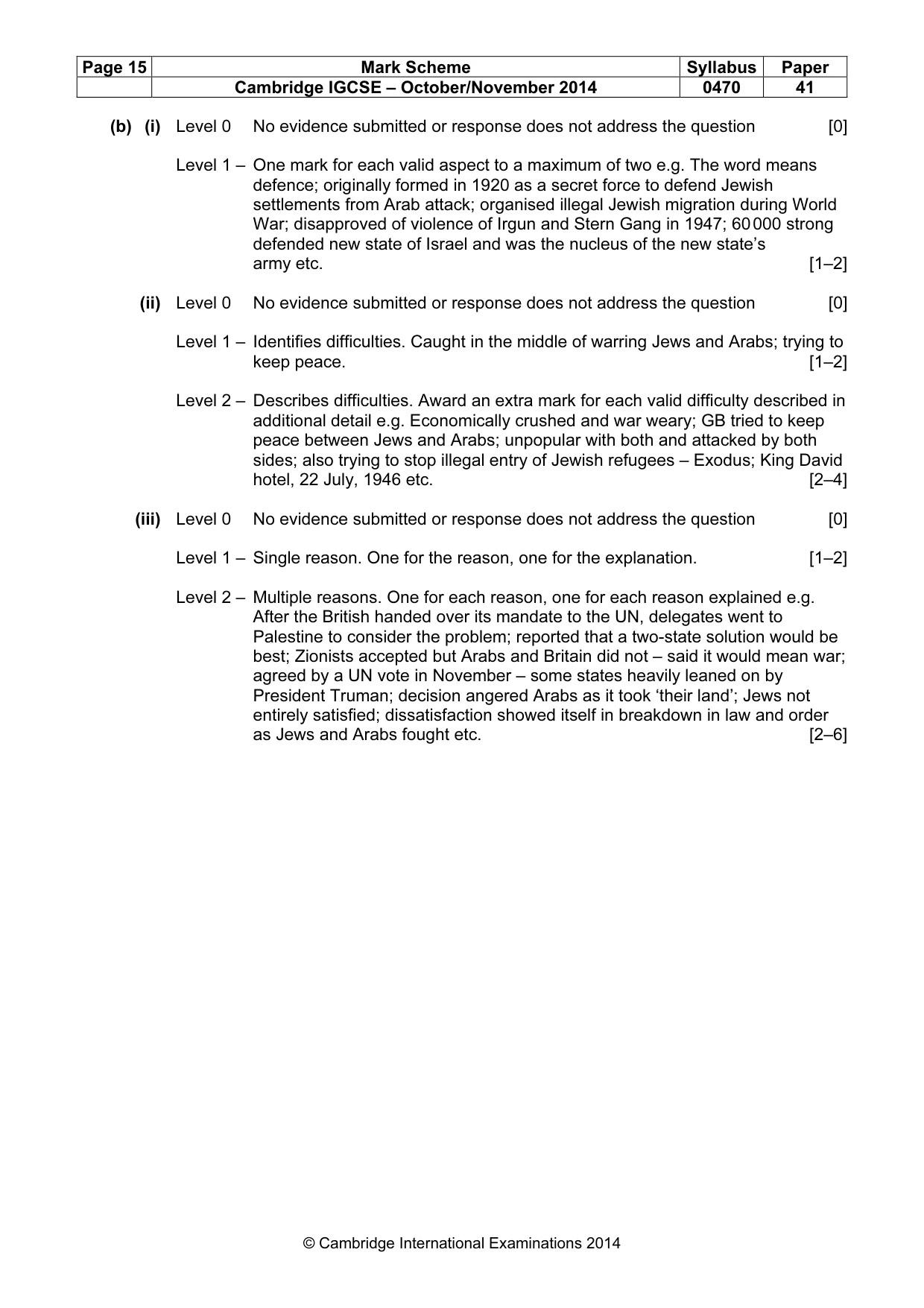
Page 15 Mark Scheme Syllabus Paper Cambridge IGCSE – October/November 2014 0470 41 © Cambridge International Examinations 2014 (b) (i) Level 0 No evidence submitted or response does not address the question [0] Level 1 – One mark for each valid aspect to a maximum of two e.g. The word means defence; originally formed in 1920 as a secret force to defend Jewish settlements from Arab attack; organised illegal Jewish migration during World War; disapproved of violence of Irgun and Stern Gang in 1947; 60 000 strong defended new state of Israel and was the nucleus of the new state’s army etc. [1–2] (ii) Level 0 No evidence submitted or response does not address the question [0] Level 1 – Identifies difficulties. Caught in the middle of warring Jews and Arabs; trying to keep peace. [1–2] Level 2 – Describes difficulties. Award an extra mark for each valid difficulty described in additional detail e.g. Economically crushed and war weary; GB tried to keep peace between Jews and Arabs; unpopular with both and attacked by both sides; also trying to stop illegal entry of Jewish refugees – Exodus; King David hotel, 22 July, 1946 etc. [2–4] (iii) Level 0 No evidence submitted or response does not address the question [0] Level 1 – Single reason. One for the reason, one for the explanation. [1–2] Level 2 – Multiple reasons. One for each reason, one for each reason explained e.g. After the British handed over its mandate to the UN, delegates went to Palestine to consider the problem; reported that a two-state solution would be best; Zionists accepted but Arabs and Britain did not – said it would mean war; agreed by a UN vote in November – some states heavily leaned on by President Truman; decision angered Arabs as it took ‘their land’; Jews not entirely satisfied; dissatisfaction showed itself in breakdown in law and order as Jews and Arabs fought etc. [2–6]
Mark scheme, page 16
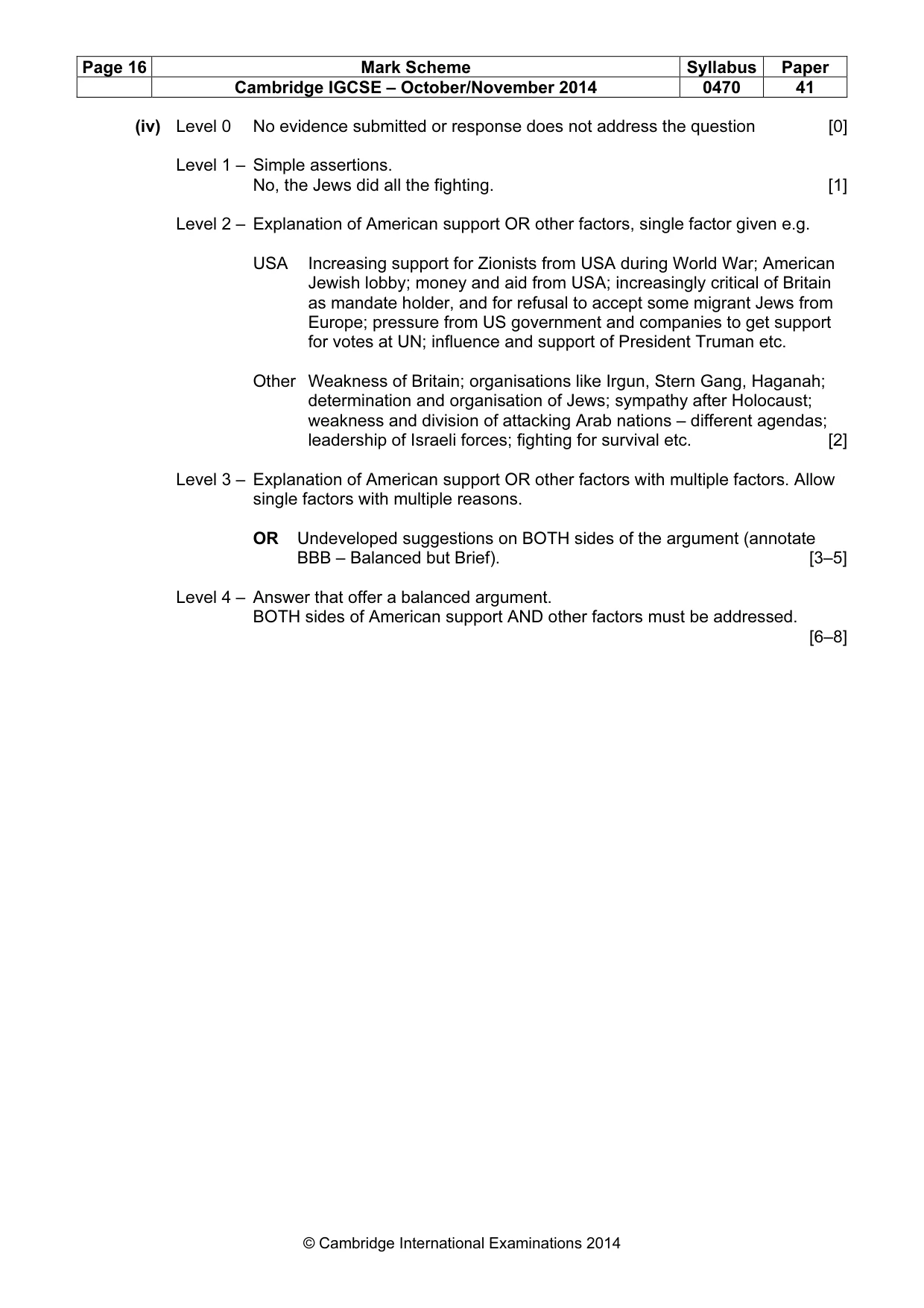
Page 16 Mark Scheme Syllabus Paper Cambridge IGCSE – October/November 2014 0470 41 © Cambridge International Examinations 2014 (iv) Level 0 No evidence submitted or response does not address the question [0] Level 1 – Simple assertions. No, the Jews did all the fighting. [1] Level 2 – Explanation of American support OR other factors, single factor given e.g. USA Increasing support for Zionists from USA during World War; American Jewish lobby; money and aid from USA; increasingly critical of Britain as mandate holder, and for refusal to accept some migrant Jews from Europe; pressure from US government and companies to get support for votes at UN; influence and support of President Truman etc. Other Weakness of Britain; organisations like Irgun, Stern Gang, Haganah; determination and organisation of Jews; sympathy after Holocaust; weakness and division of attacking Arab nations – different agendas; leadership of Israeli forces; fighting for survival etc. [2] Level 3 – Explanation of American support OR other factors with multiple factors. Allow single factors with multiple reasons. OR Undeveloped suggestions on BOTH sides of the argument (annotate BBB – Balanced but Brief). [3–5] Level 4 – Answer that offer a balanced argument. BOTH sides of American support AND other factors must be addressed. [6–8]
Mark scheme, page 17
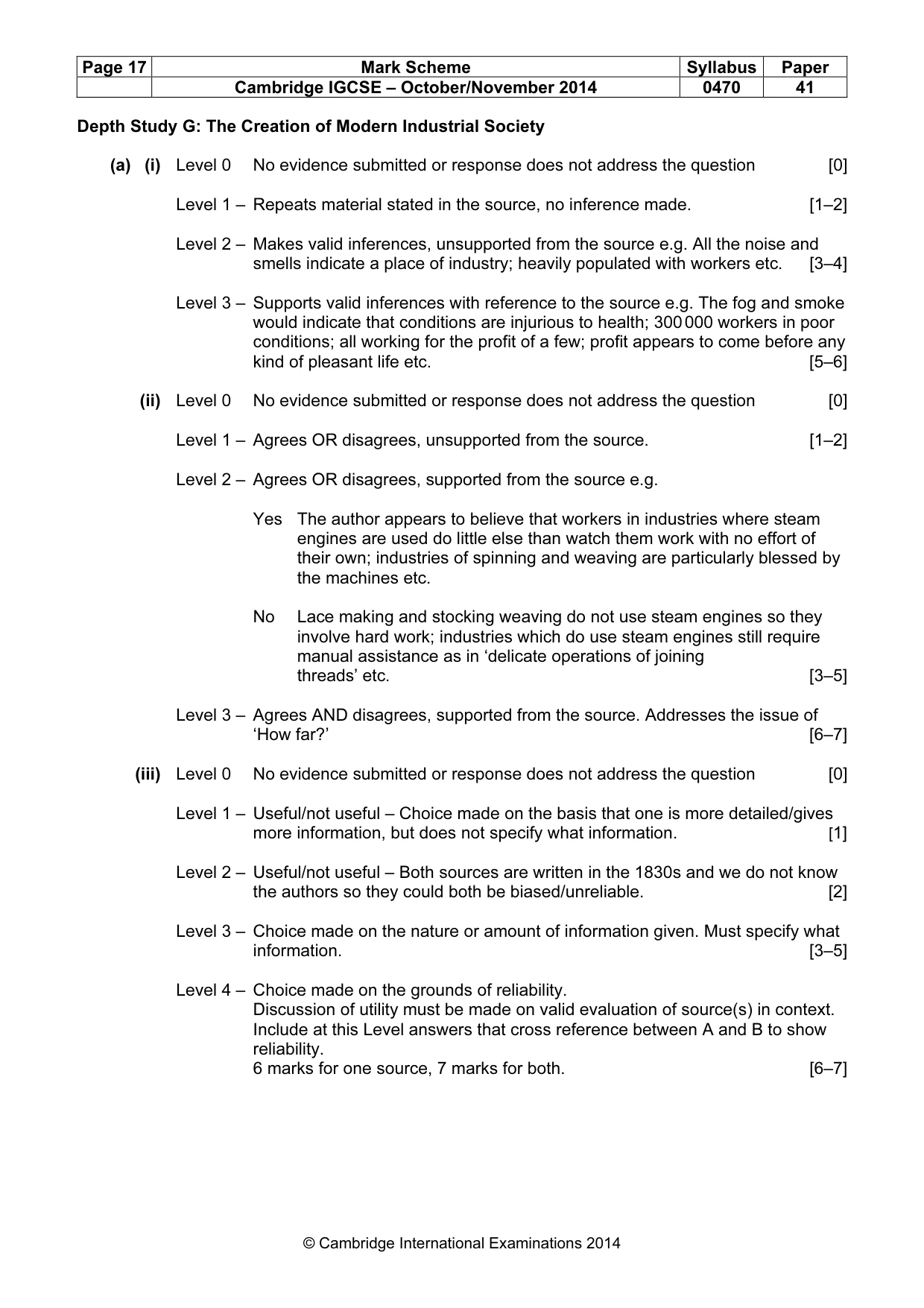
Page 17 Mark Scheme Syllabus Paper Cambridge IGCSE – October/November 2014 0470 41 © Cambridge International Examinations 2014 Depth Study G: The Creation of Modern Industrial Society (a) (i) Level 0 No evidence submitted or response does not address the question [0] Level 1 – Repeats material stated in the source, no inference made. [1–2] Level 2 – Makes valid inferences, unsupported from the source e.g. All the noise and smells indicate a place of industry; heavily populated with workers etc. [3–4] Level 3 – Supports valid inferences with reference to the source e.g. The fog and smoke would indicate that conditions are injurious to health; 300 000 workers in poor conditions; all working for the profit of a few; profit appears to come before any kind of pleasant life etc. [5–6] (ii) Level 0 No evidence submitted or response does not address the question [0] Level 1 – Agrees OR disagrees, unsupported from the source. [1–2] Level 2 – Agrees OR disagrees, supported from the source e.g. Yes The author appears to believe that workers in industries where steam engines are used do little else than watch them work with no effort of their own; industries of spinning and weaving are particularly blessed by the machines etc. No Lace making and stocking weaving do not use steam engines so they involve hard work; industries which do use steam engines still require manual assistance as in ‘delicate operations of joining threads’ etc. [3–5] Level 3 – Agrees AND disagrees, supported from the source. Addresses the issue of ‘How far?’ [6–7] (iii) Level 0 No evidence submitted or response does not address the question [0] Level 1 – Useful/not useful – Choice made on the basis that one is more detailed/gives more information, but does not specify what information. [1] Level 2 – Useful/not useful – Both sources are written in the 1830s and we do not know the authors so they could both be biased/unreliable. [2] Level 3 – Choice made on the nature or amount of information given. Must specify what information. [3–5] Level 4 – Choice made on the grounds of reliability. Discussion of utility must be made on valid evaluation of source(s) in context. Include at this Level answers that cross reference between A and B to show reliability. 6 marks for one source, 7 marks for both. [6–7]
Mark scheme, page 18
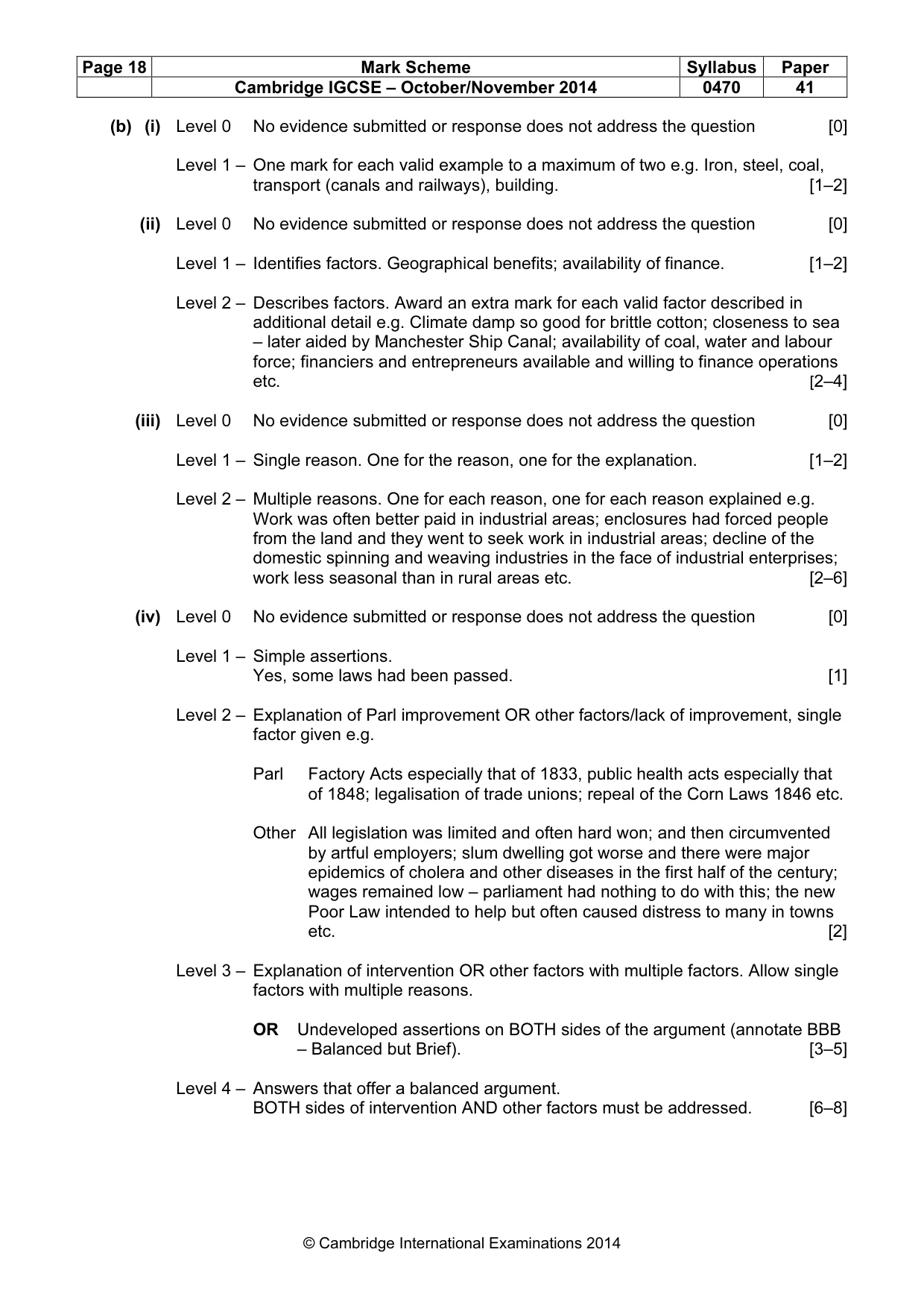
Page 18 Mark Scheme Syllabus Paper Cambridge IGCSE – October/November 2014 0470 41 © Cambridge International Examinations 2014 (b) (i) Level 0 No evidence submitted or response does not address the question [0] Level 1 – One mark for each valid example to a maximum of two e.g. Iron, steel, coal, transport (canals and railways), building. [1–2] (ii) Level 0 No evidence submitted or response does not address the question [0] Level 1 – Identifies factors. Geographical benefits; availability of finance. [1–2] Level 2 – Describes factors. Award an extra mark for each valid factor described in additional detail e.g. Climate damp so good for brittle cotton; closeness to sea – later aided by Manchester Ship Canal; availability of coal, water and labour force; financiers and entrepreneurs available and willing to finance operations etc. [2–4] (iii) Level 0 No evidence submitted or response does not address the question [0] Level 1 – Single reason. One for the reason, one for the explanation. [1–2] Level 2 – Multiple reasons. One for each reason, one for each reason explained e.g. Work was often better paid in industrial areas; enclosures had forced people from the land and they went to seek work in industrial areas; decline of the domestic spinning and weaving industries in the face of industrial enterprises; work less seasonal than in rural areas etc. [2–6] (iv) Level 0 No evidence submitted or response does not address the question [0] Level 1 – Simple assertions. Yes, some laws had been passed. [1] Level 2 – Explanation of Parl improvement OR other factors/lack of improvement, single factor given e.g. Parl Factory Acts especially that of 1833, public health acts especially that of 1848; legalisation of trade unions; repeal of the Corn Laws 1846 etc. Other All legislation was limited and often hard won; and then circumvented by artful employers; slum dwelling got worse and there were major epidemics of cholera and other diseases in the first half of the century; wages remained low – parliament had nothing to do with this; the new Poor Law intended to help but often caused distress to many in towns etc. [2] Level 3 – Explanation of intervention OR other factors with multiple factors. Allow single factors with multiple reasons. OR Undeveloped assertions on BOTH sides of the argument (annotate BBB – Balanced but Brief). [3–5] Level 4 – Answers that offer a balanced argument. BOTH sides of intervention AND other factors must be addressed. [6–8]
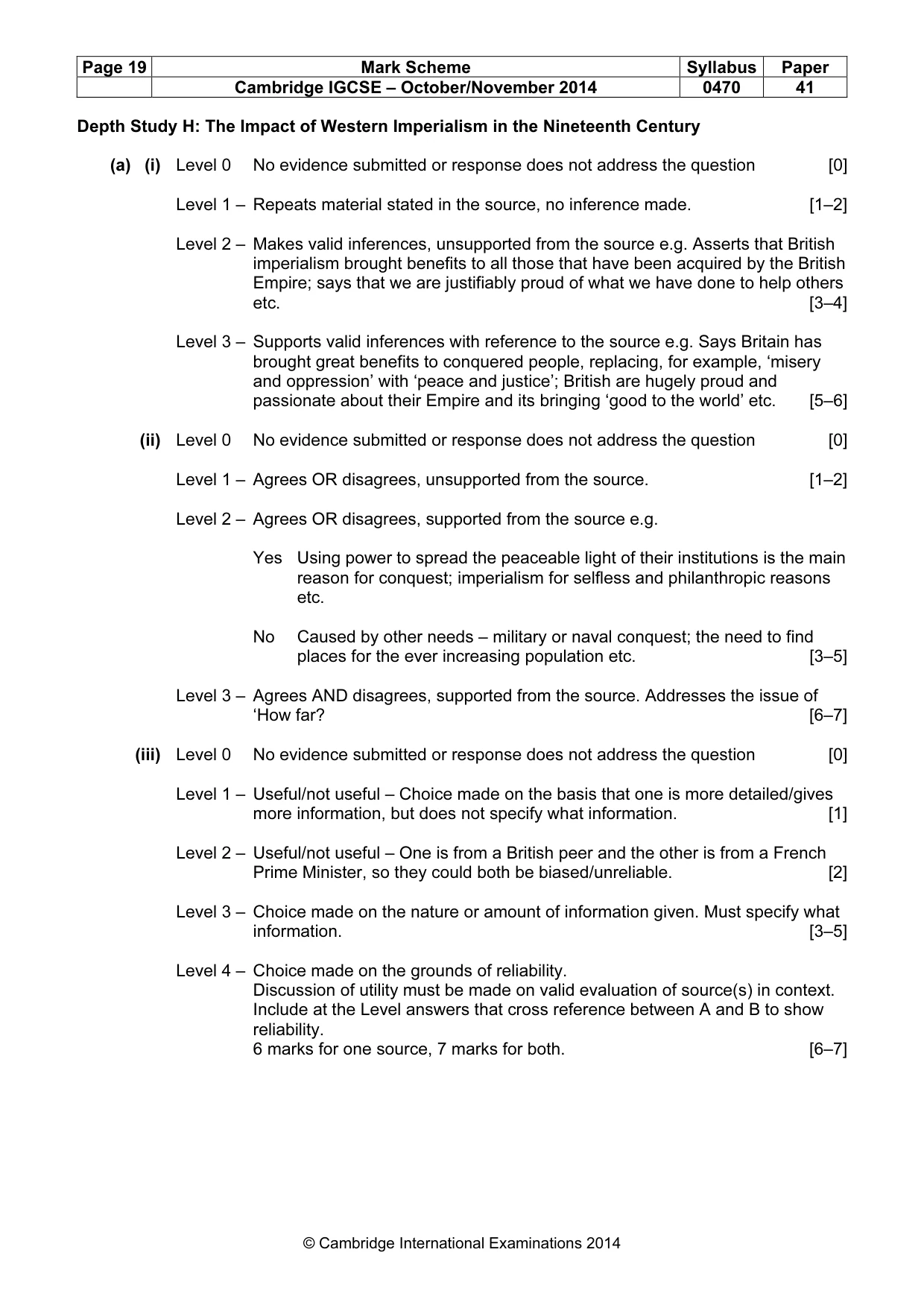
Mark scheme, page 19
Page 19 Mark Scheme Syllabus Paper Cambridge IGCSE – October/November 2014 0470 41 © Cambridge International Examinations 2014 Depth Study H: The Impact of Western Imperialism in the Nineteenth Century (a) (i) Level 0 No evidence submitted or response does not address the question [0] Level 1 – Repeats material stated in the source, no inference made. [1–2] Level 2 – Makes valid inferences, unsupported from the source e.g. Asserts that British imperialism brought benefits to all those that have been acquired by the British Empire; says that we are justifiably proud of what we have done to help others etc. [3–4] Level 3 – Supports valid inferences with reference to the source e.g. Says Britain has brought great benefits to conquered people, replacing, for example, ‘misery and oppression’ with ‘peace and justice’; British are hugely proud and passionate about their Empire and its bringing ‘good to the world’ etc. [5–6] (ii) Level 0 No evidence submitted or response does not address the question [0] Level 1 – Agrees OR disagrees, unsupported from the source. [1–2] Level 2 – Agrees OR disagrees, supported from the source e.g. Yes Using power to spread the peaceable light of their institutions is the main reason for conquest; imperialism for selfless and philanthropic reasons etc. No Caused by other needs – military or naval conquest; the need to find places for the ever increasing population etc. [3–5] Level 3 – Agrees AND disagrees, supported from the source. Addresses the issue of ‘How far? [6–7] (iii) Level 0 No evidence submitted or response does not address the question [0] Level 1 – Useful/not useful – Choice made on the basis that one is more detailed/gives more information, but does not specify what information. [1] Level 2 – Useful/not useful – One is from a British peer and the other is from a French Prime Minister, so they could both be biased/unreliable. [2] Level 3 – Choice made on the nature or amount of information given. Must specify what information. [3–5] Level 4 – Choice made on the grounds of reliability. Discussion of utility must be made on valid evaluation of source(s) in context. Include at the Level answers that cross reference between A and B to show reliability. 6 marks for one source, 7 marks for both. [6–7]
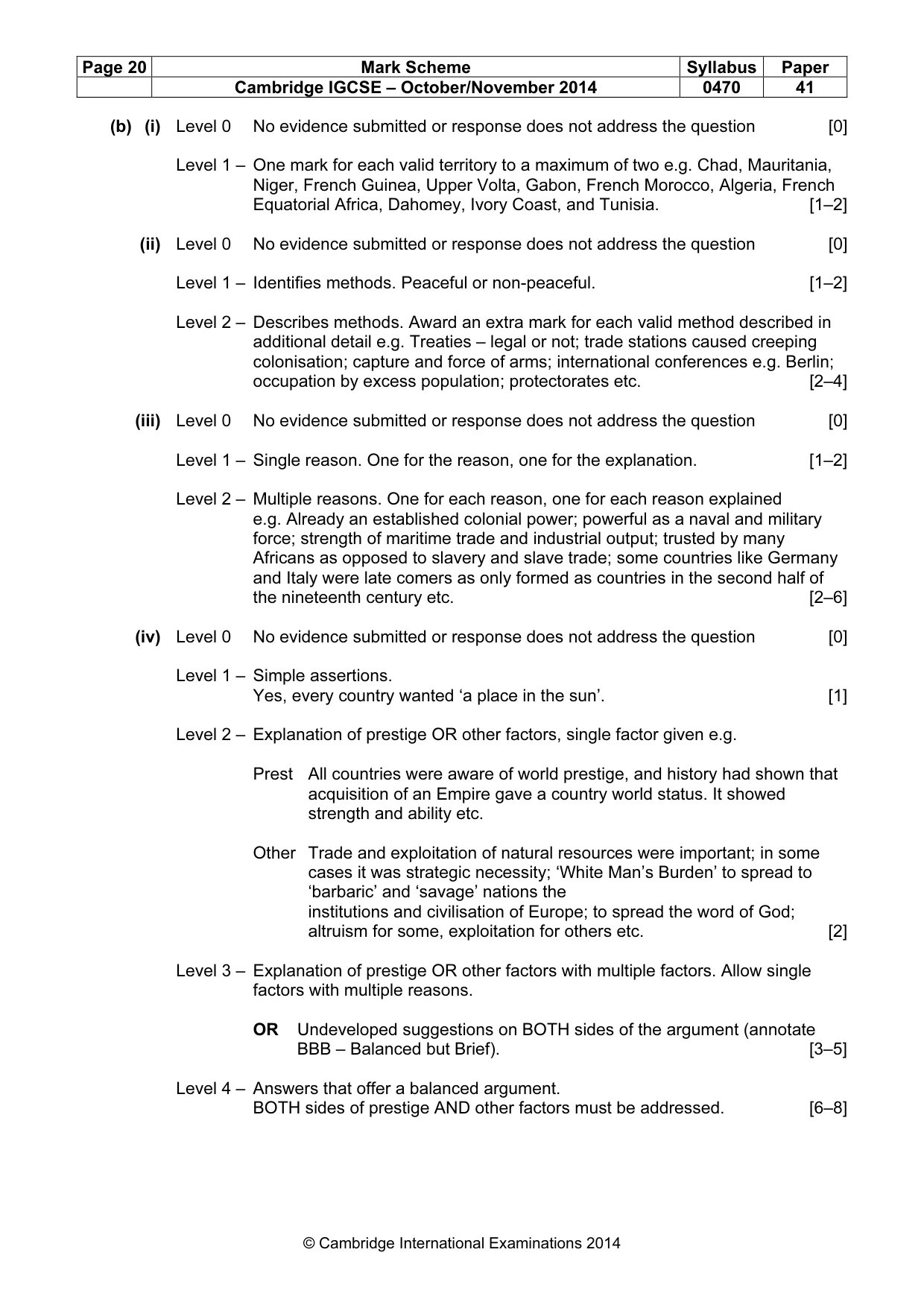
Mark scheme, page 20
Page 20 Mark Scheme Syllabus Paper Cambridge IGCSE – October/November 2014 0470 41 © Cambridge International Examinations 2014 (b) (i) Level 0 No evidence submitted or response does not address the question [0] Level 1 – One mark for each valid territory to a maximum of two e.g. Chad, Mauritania, Niger, French Guinea, Upper Volta, Gabon, French Morocco, Algeria, French Equatorial Africa, Dahomey, Ivory Coast, and Tunisia. [1–2] (ii) Level 0 No evidence submitted or response does not address the question [0] Level 1 – Identifies methods. Peaceful or non-peaceful. [1–2] Level 2 – Describes methods. Award an extra mark for each valid method described in additional detail e.g. Treaties – legal or not; trade stations caused creeping colonisation; capture and force of arms; international conferences e.g. Berlin; occupation by excess population; protectorates etc. [2–4] (iii) Level 0 No evidence submitted or response does not address the question [0] Level 1 – Single reason. One for the reason, one for the explanation. [1–2] Level 2 – Multiple reasons. One for each reason, one for each reason explained e.g. Already an established colonial power; powerful as a naval and military force; strength of maritime trade and industrial output; trusted by many Africans as opposed to slavery and slave trade; some countries like Germany and Italy were late comers as only formed as countries in the second half of the nineteenth century etc. [2–6] (iv) Level 0 No evidence submitted or response does not address the question [0] Level 1 – Simple assertions. Yes, every country wanted ‘a place in the sun’. [1] Level 2 – Explanation of prestige OR other factors, single factor given e.g. Prest All countries were aware of world prestige, and history had shown that acquisition of an Empire gave a country world status. It showed strength and ability etc. Other Trade and exploitation of natural resources were important; in some cases it was strategic necessity; ‘White Man’s Burden’ to spread to ‘barbaric’ and ‘savage’ nations the institutions and civilisation of Europe; to spread the word of God; altruism for some, exploitation for others etc. [2] Level 3 – Explanation of prestige OR other factors with multiple factors. Allow single factors with multiple reasons. OR Undeveloped suggestions on BOTH sides of the argument (annotate BBB – Balanced but Brief). [3–5] Level 4 – Answers that offer a balanced argument. BOTH sides of prestige AND other factors must be addressed. [6–8]
What you needed in this session
Cambridge’s own grade thresholds for 2014 Oct/Nov, Paper 4 · Variant 1. A higher threshold means an easier paper — the bar moves with how the cohort did.