Cambridge IGCSE History 0470 — 2014 May/June Paper 4 · Variant 3
0470/43/M/J/14 · 40 marks · ≈45 min
The question paper and its mark scheme, free to read here and free to download. This is Cambridge’s own paper, exactly as it was sat.
Question paper12 pages

Mark scheme18 pages
Answers below. Sit the paper first if you are practising.
Paper as text
Question paper, page 1
This document consists of 10 printed pages, 2 blank pages and 1 insert. DC (RCL (KM)) 83220/4 © UCLES 2014 [Turn over Cambridge International Examinations Cambridge International General Certificate of Secondary Education * 5 5 9 4 4 8 1 5 2 8 * HISTORY 0470/43 Paper 4 Alternative to Coursework May/June 2014 1 hour No Additional Materials are required. READ THESE INSTRUCTIONS FIRST An answer booklet is provided inside this question paper. You should follow the instructions on the front cover of the answer booklet. If you need additional answer paper ask the invigilator for a continuation booklet. Answer the questions on one of the Depth Studies. The number of marks is given in brackets [ ] at the end of each question or part question.
Question paper, page 2
2 0470/43/M/J/14 © UCLES 2014 DEPTH STUDY A: GERMANY, 1918–1945 1 Study the sources, and then answer the questions which follow. Source A By 1935 Jews had been banned from all professions and government jobs. The Nuremberg Laws then deprived us of the vote and forbade marriage to Aryans. Anyone with Jewish grandparents was defined as a Jew. My father had been a high officer during the First World War and won the Iron Cross medal. In 1935 he also received another medal which Hitler gave to all those who fought on the frontline throughout the war. My father could not believe how the same man would throw him out of the country. From the memories of a German Jewish woman who was eight years old in 1935. Source B In a speech to the Reichstag in January 1939 Hitler said, ‘If the Jewish financiers in and outside Europe succeed in plunging us once more into war then the result will not be the victory of Communism which they aim for, but the annihilation of the Jews in Europe!’ In November 1941 Goebbels wrote in the official newspaper, ‘By reason of their birth all Jews are members of an international conspiracy against Germany. The war is their fault and they are responsible for every soldier’s death. The fact that the Jew still supports his parasitical existence in German cities is no proof that he is one of us, no more than a flea is a domestic pet.’ From a British historian, 1991. (a) (i) Study Source A. What can you tell from this source about Jewish people in Germany? Support your answer with reference to the source. [6] (ii) Study Source B. How far does this source show that hatred of Communism was the reason for Nazi opposition to the Jews? Explain your answer. [7] (iii) Study both sources. Is one of these sources more useful than the other as evidence about Nazi anti-semitism? Explain your answer. [7] (b) (i) What was the SS? [2] (ii) Describe what happened on Kristallnacht, 9–10 November 1938. [4] (iii) Why was control of the economy important to the Nazis? [6] (iv) ‘Creating fear was the most successful way for the Nazis to control Germany between 1933 and 1945.’ How far do you agree? Explain your answer. [8]
Question paper, page 3
3 0470/43/M/J/14 © UCLES 2014 [Turn over DEPTH STUDY B: RUSSIA, 1905–1941 2 Study the sources, and then answer the questions which follow. Source A Throughout history Russia has been beaten again and again because she was backward. All have beaten her because of her military, industrial and agricultural backwardness. If you are backward and weak, then you are in the wrong and may be beaten and enslaved. If you are strong people must beware of you. It is sometimes asked whether it is possible to slow down industrialisation a bit. No, comrades, it is not possible. To slacken would mean falling behind. And those that fall behind get beaten. Stalin speaking in 1931. Source B During the Five-Year Plans the methods used to get maximum production were old capitalist tricks like piecework (paying for the number of items produced instead of hours worked) and bonus payments to workers who produced more than their fellows. There was a famous record-breaker called Stakhanov, a coal miner. He and other ‘Stakhanovites’ became national heroes, rewarded with trips to Moscow, Party membership, medals, holidays and extra pay. Stakhanovite targets were set as production ‘norms’ for other workers in the industry, who naturally failed to meet them and so could be paid less than the normal rate of pay. From a British history book, published in 1978. (a) (i) Study Source A. What can you tell from this source about Stalin’s views on industrialisation? Support your answer with reference to the source. [6] (ii) Study Source B. How far does this source show that workers were rewarded well during the Five-Year Plans? Explain your answer. [7] (iii) Study both sources. Is one of these sources more useful than the other as evidence about the Five-Year Plans? Explain your answer. [7] (b) (i) What happened at Magnitogorsk? [2] (ii) Describe the main features and purpose of a gulag. [4] (iii) Why did Stalin embark on the modernisation of Soviet industry in 1928? [6] (iv) ‘Stalin’s changes in agriculture and industry were successful.’ How far do you agree? Explain your answer. [8]
Question paper, page 4
4 0470/43/M/J/14 © UCLES 2014 DEPTH STUDY C: THE USA, 1919–1941 3 Study the sources, and then answer the questions which follow. Source A Of both property owners and tenants: 96 per cent of homes do not have electricity; 35 per cent no toilet whatsoever; 70 per cent have no water supply; 20 per cent of families have automobiles; 30 per cent own battery-operated record players and 5 per cent have radios. Even in the best of times not enough money is raised by local taxes to support adequate schools, hospitals or road construction. This is typical of much of the State. From a government survey of a farming area in Tennessee in 1933. Source B After the Tennessee Valley Authority was set up in 1933 about a third of the people in the Norris Valley, who had to lose their homes, found work building the local dam which was completed in 1936. In the huge area of land flooded, farm owners were given cash by the government for their property and help in finding new homes. Tenants, who had no land to sell, received nothing. Almost 60 per cent of the families who had to move remained in the local area – one that suffered from the same problems of overcrowding and poor farming conditions that had troubled them in their old homes, even if they did now have electricity. From a magazine article entitled ‘The New Deal’s Best Asset – the TVA’, written by an economist in 1939. (a) (i) Study Source A. What does this source tell you about life in the Tennessee countryside? Support your answer with reference to the source. [6] (ii) Study Source B. How far does this source show that the Tennessee Valley Authority was a success in the 1930s? Explain your answer. [7] (iii) Study both sources. Is one of these sources more useful than the other as evidence about the Tennessee Valley Authority? Explain your answer. [7] (b) (i) What were ‘the fireside chats’? [2] (ii) Describe President Roosevelt’s policies to deal with the banking crisis in 1933. [4] (iii) Why was there opposition to New Deal policies? [6] (iv) ‘The Alphabet Agencies had less effect than other aspects of the New Deal.’ How far do you agree? Explain your answer. [8]
Question paper, page 5
5 0470/43/M/J/14 © UCLES 2014 [Turn over DEPTH STUDY D: CHINA, 1945–c.1990 4 Study the sources, and then answer the questions which follow. Source A Over this weekend we have learned the extent of the disaster that has befallen China and the United States. The responsibility for this failure of our foreign policy in the Far East rests with the Presidency. So concerned were our diplomats and their advisers with the imperfection of the democratic system in China, after twenty years of war and tales of corruption in high places, that they lost sight of our tremendous stake in a non-Communist China. Congress must now take up the responsibility of preventing the onrushing tide of Communism from engulfing all of Asia. From a speech by John F. Kennedy to Congress on the Communist capture of Peking (Beijing), January 1949. Source B Flags of surrender are flying tonight in Shanghai, China’s largest city, which fell suddenly with few shots fired, after a month-long siege. Although a fierce battle continues to the east of the city, where Nationalist troops fight to keep the one remaining escape corridor, defending troops are waiting at barricades to surrender their weapons to green-uniformed Communist soldiers and be marched to prison camps. The victors are putting up posters urging the population to stay calm – and assuring them they have nothing to fear. From a British newspaper report, 26 May 1949. (a) (i) Study Source A. What can you tell from this source about the United States’ policies towards China? Support your answer with reference to the source. [6] (ii) Study Source B. How far does this source show that the Nationalist forces showed little resistance in the Shanghai area? Explain your answer. [7] (iii) Study both sources. Is one of these sources more useful than the other as evidence about the Chinese Civil War? Explain your answer. [7] (b) (i) Name two changes to women’s rights made by the Chinese Communist government by 1950. [2] (ii) Describe how the Communists dealt with the land issue in areas they occupied during the Chinese Civil War. [4] (iii) Why did the United States support the Nationalist government in China? [6] (iv) How far was the land issue the most serious problem facing the new Chinese Communist government in 1949? Explain your answer. [8]
Question paper, page 6
6 0470/43/M/J/14 © UCLES 2014 DEPTH STUDY E: SOUTHERN AFRICA IN THE TWENTIETH CENTURY 5 Study the sources, and then answer the questions which follow. Source A Bram Fischer was an Afrikaner barrister who defended the accused in the Treason and Rivonia Trials, between 1956 and 1964. In 1965 he went into hiding and wrote that ‘I owe it to the political prisoners, to the banished, to the silenced and to those under house arrest, not to remain a spectator but to act.’ In November 1965 he was captured by police and tried for his membership of the Communist Party and for his links with Umkhonto we Sizwe. He refused to give evidence because that could endanger other people and was sentenced to life imprisonment. He was allowed out to die in 1975. From the autobiography of Helen Joseph, one of the white defendants in the Treason Trials, written in 1986. Source B For many years communists have been the only political group in South Africa prepared to treat Africans as human beings and equals; willing to eat with us, talk with us, live with us, and work with us to gain black political rights. Because of this, there are many Africans who, today, tend to equate freedom with communism. The government claims that all who believe in democratic government and African freedom are communists and bans many of them under the Suppression of Communism Act. Although I have never been a member of the Communist Party, I myself have been named, banned and imprisoned under that Act because of the role I played in the Defiance Campaign of 1952. From Nelson Mandela’s opening speech at the Rivonia Trial, 1964. (a) (i) Study Source A. What can you tell from this source about opposition to apartheid? Support your answer with reference to the source. [6] (ii) Study Source B. How far does this source show that African opponents of apartheid supported communism? Explain your answer. [7] (iii) Study both sources. Is one of these sources more useful than the other as evidence about government responses to opposition in the 1950s and 1960s? Explain your answer. [7] (b) (i) Who was Albert Luthuli? [2] (ii) Describe the effects of the 1953 Separate Amenities Act. [4] (iii) Why was the Bantu Authorities Act of 1951 important? [6] (iv) To what extent had non-violent opposition to apartheid been a failure by 1965? Explain your answer. [8]
Question paper, page 7
7 0470/43/M/J/14 © UCLES 2014 [Turn over DEPTH STUDY F: ISRAELIS AND PALESTINIANS, 1945–c. 1994 6 Study the sources, and then answer the questions which follow. Source A Despite their desire for independence, and dislike of Israeli occupation, the Palestinians living in the West Bank and Gaza benefited from the general social and economic policies of Israel. Before 1967 there were no universities; six were established after 1967. A British historian, writing in 1993. He is Jewish, works in the United Kingdom, but also has a house in Jerusalem. Source B Most Israelis claim that the Arabs living in their country are treated reasonably in view of the circumstances. Most of the charges of brutality and repression are, they say, part of the Arab propaganda campaign against Israel. The fact that so many Arabs remain in Israel would suggest that most do not consider life there too severe or lacking in opportunities. Israelis admit that there has been some dislocation and resettlement of Arabs but this has been due to the destruction caused by war, various urban building schemes, the development of new agricultural villages and the creation of military bases on the borders of the country. From a British textbook, published in 1977. (a) (i) Study Source A. What can you tell from this source about Palestinians in Israel after the occupation of Gaza and the West Bank? Support your answer with reference to the source. [6] (ii) Study Source B. How far does this source show that Palestinian Arabs living in Israel were treated fairly? Explain your answer. [7] (iii) Study both sources. Is one of these sources more useful than the other as evidence about the lives of Palestinians living in Israel? Explain your answer. [7] (b) (i) What is a kibbutz? [2] (ii) Describe what happened during the Intifada. [4] (iii) Why has the West Bank area been an issue between Israel and Palestinian Arabs since 1947? [6] (iv) How far did the Oslo Accords, 1993, give Palestinian Arabs control over Gaza and the West Bank by the end of 1994? Explain your answer. [8]
Question paper, page 8
8 0470/43/M/J/14 © UCLES 2014 DEPTH STUDY G: THE CREATION OF MODERN INDUSTRIAL SOCIETY 7 Study the sources, and then answer the questions which follow. Source A The dock labourers and their allies have won a remarkable victory. The dock companies have granted all their demands and the strike will remain a most significant event in the relations between capital and labour. There is first the fact that the dock labourers, possessed of no special skill, industry or strength, have been able to combine. But this was by no means the only phenomenon of the strike. The hard case of the men brought the sympathy of all the various categories of riverside labourers. It took a powerful hold upon public opinion and drew sympathy and material support from all quarters. Thus the men were placed above starvation. They were enabled to bargain on equal terms with their employers and they were eventually successful. The hints given by the great strike will probably not be neglected in the future. The alliance of riverside labourers, possessing various grades of skill and social standing, will probably be taken as an encouragement to carry into effect wider federation of labour. From ‘The Times’ newspaper, 16 September 1889. Source B The dockers had left off work because their rates of wages were not high enough and they had declared their intention of not returning until they got their sixpence an hour. Had they stuck to this they would have been all right, but as it is they have consented to go back to work on the promise to receive it on 4 November. This concession, supported by the capitalist press, is a most serious sign of weakness on the part of their leaders. The men, through their leaders, have gone back on their word. All this excitement, all this hardship for only one solid advantage and that advantage not to be enjoyed until November. In the meantime, which is the worst thing of all, the men who have been struggling and fighting for the last five weeks have been pledged to behave well to the scoundrels and traitors who have been fighting against them. From the socialist publication, ‘Justice’, 21 September 1889. (a) (i) Study Source A. What can you tell from this source about the Dockers’ Strike of 1889? Support your answer with reference to the source. [6] (ii) Study Source B. How far does this source show that the Dockers’ Strike was not successful? Explain your answer. [7] (iii) Study both sources. Is one of these sources more useful than the other as evidence about the Dockers’ Strike? Explain your answer. [7] (b) (i) Name two people prominent in the strikes of 1888–89. [2] (ii) Describe the problems faced by workers in the docks in the years before the strike. [4] (iii) Why did trade union membership increase in the last quarter of the nineteenth century? [6] (iv) ‘New Unionism had changed the lives of the majority of workers by the end of the nineteenth century.’ How far do you agree? Explain your answer. [8]
Question paper, page 9
9 0470/43/M/J/14 © UCLES 2014 [Turn over BLANK PAGE TURN OVER FOR QUESTION 8.
Question paper, page 10
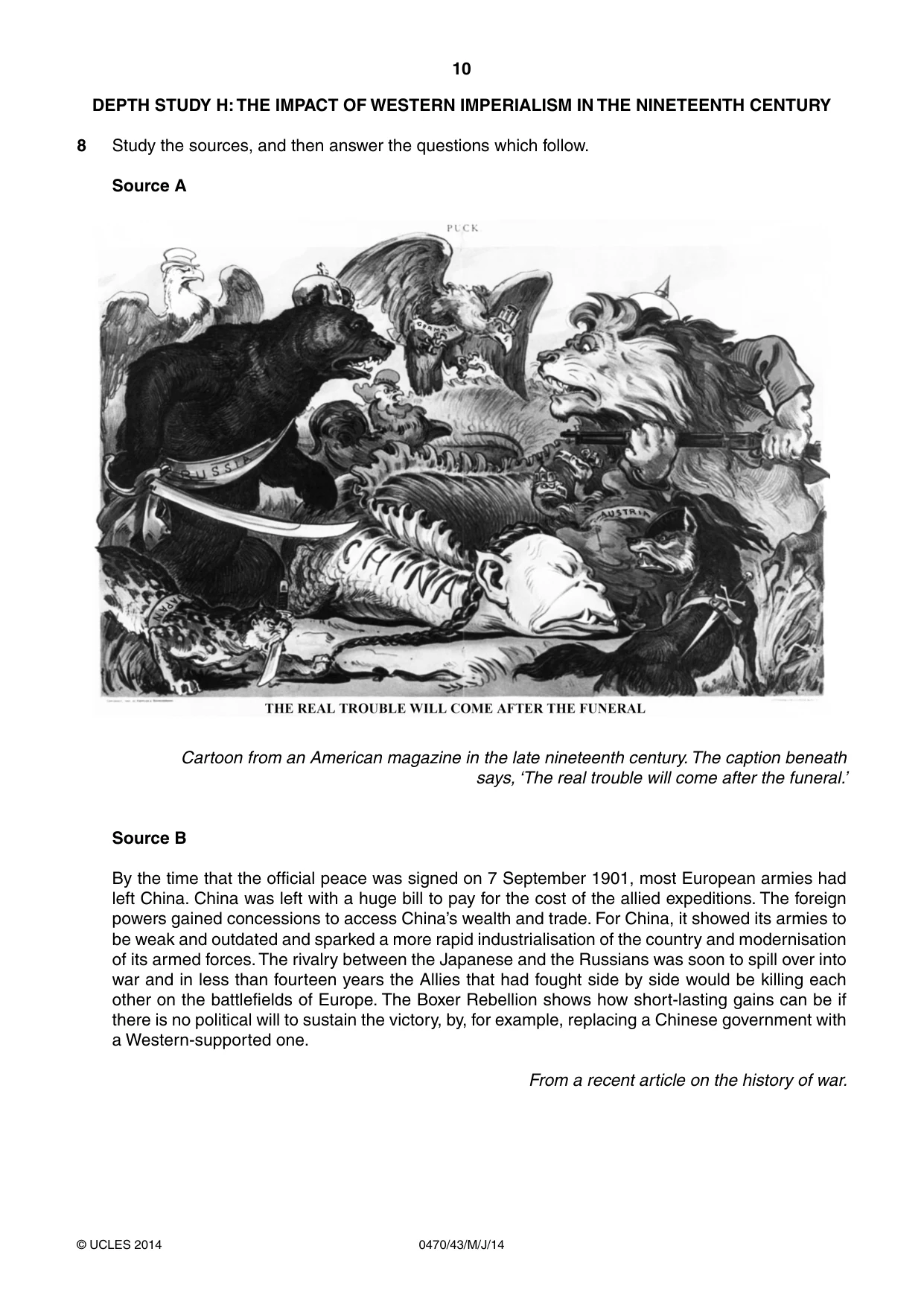
10 0470/43/M/J/14 © UCLES 2014 DEPTH STUDY H: THE IMPACT OF WESTERN IMPERIALISM IN THE NINETEENTH CENTURY 8 Study the sources, and then answer the questions which follow. Source A Cartoon from an American magazine in the late nineteenth century. The caption beneath says, ‘The real trouble will come after the funeral.’ Source B By the time that the official peace was signed on 7 September 1901, most European armies had left China. China was left with a huge bill to pay for the cost of the allied expeditions. The foreign powers gained concessions to access China’s wealth and trade. For China, it showed its armies to be weak and outdated and sparked a more rapid industrialisation of the country and modernisation of its armed forces. The rivalry between the Japanese and the Russians was soon to spill over into war and in less than fourteen years the Allies that had fought side by side would be killing each other on the battlefields of Europe. The Boxer Rebellion shows how short-lasting gains can be if there is no political will to sustain the victory, by, for example, replacing a Chinese government with a Western-supported one. From a recent article on the history of war.
Question paper, page 11
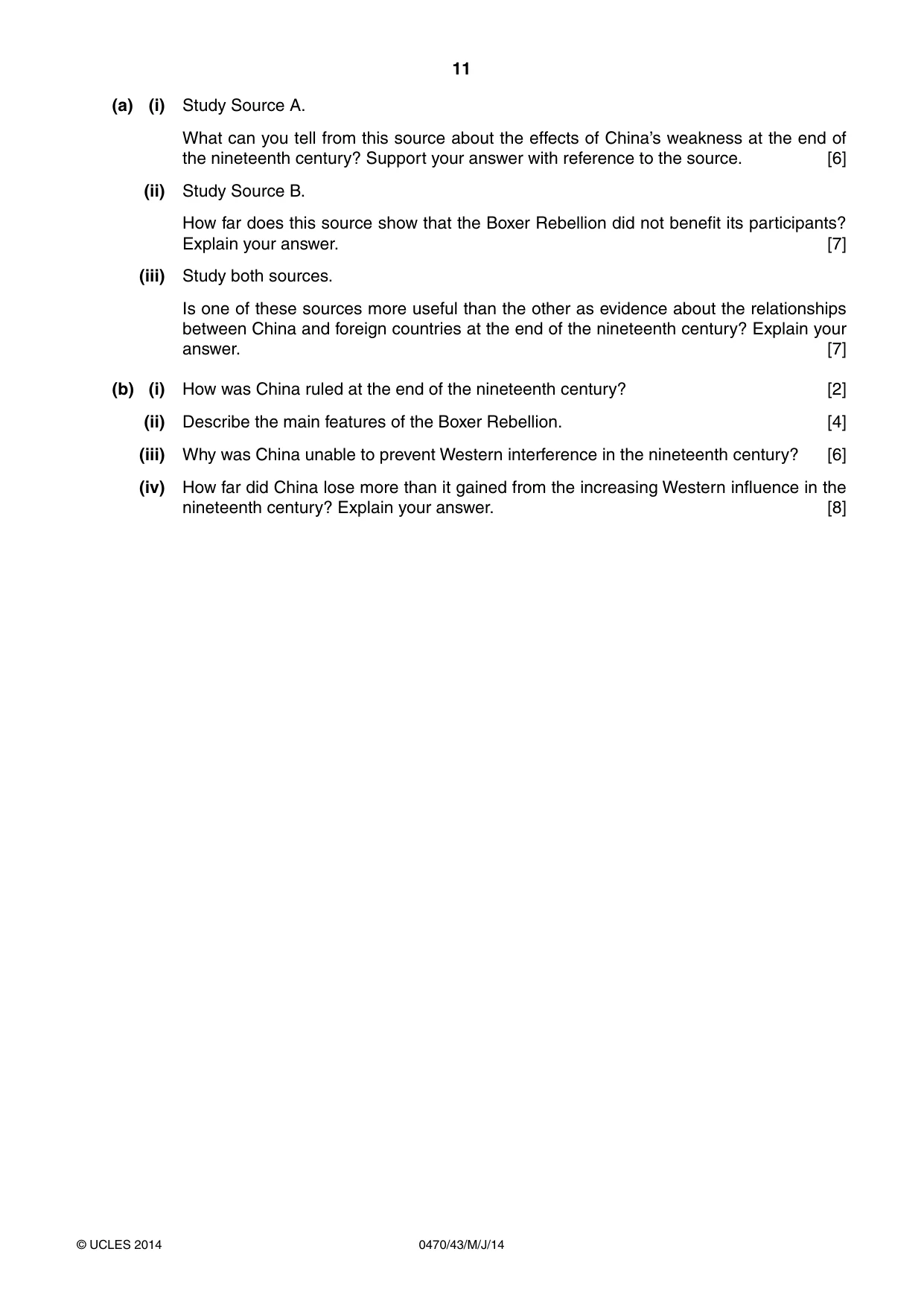
11 0470/43/M/J/14 © UCLES 2014 (a) (i) Study Source A. What can you tell from this source about the effects of China’s weakness at the end of the nineteenth century? Support your answer with reference to the source. [6] (ii) Study Source B. How far does this source show that the Boxer Rebellion did not benefit its participants? Explain your answer. [7] (iii) Study both sources. Is one of these sources more useful than the other as evidence about the relationships between China and foreign countries at the end of the nineteenth century? Explain your answer. [7] (b) (i) How was China ruled at the end of the nineteenth century? [2] (ii) Describe the main features of the Boxer Rebellion. [4] (iii) Why was China unable to prevent Western interference in the nineteenth century? [6] (iv) How far did China lose more than it gained from the increasing Western influence in the nineteenth century? Explain your answer. [8]
Question paper, page 12
12 0470/43/M/J/14 © UCLES 2014 BLANK PAGE Copyright Acknowledgements: Depth Study A Source A © From the memories of a German Jewish woman who was eight years old in 1935. Depth Study A Source B © John Laver; Nazi Germany 1933-1945; Hodder & Stoughton Ltd; 1991. Depth Study B Source A © Stalin speaking in 1931. Depth Study B Source B © Harriet Ward; World Powers in the Twentieth Century; Heinemann Educational Books Ltd; 1978. Depth Study C Source A © From a government survey of a farming area in Tennessee in 1933. Depth Study C Source B © From a magazine article entitled, ‘The New Deal’s Best Asset – the TVA’ written by an economist in 1939. Depth Study D Source A © From a speech by John F. Kennedy to Congress on the Communist capture of Peking (Beijing), January 1949. Depth Study D Source B © From a British newspaper report, 26 May 1949. Depth Study E Source A © Helen Joseph; Side by Side; Zed Books Ltd; 1986. Depth Study E Source B © From Nelson Mandela’s opening speech at the Rivonia Trial, 1964. Depth Study F Source A © A British historian, writing in 1993. Depth Study F Source B © Schools Council History 13-16 Project; The Arab-Israeli Conflict; Holmes McDougal; 1977. Depth Study G Source A © From The Times newspaper, 16 September 1889. Depth Study G Source B © From the socialist publication, ‘Justice’, 21 September 1889. Permission to reproduce items where third-party owned material protected by copyright is included has been sought and cleared where possible. Every reasonable effort has been made by the publisher (UCLES) to trace copyright holders, but if any items requiring clearance have unwittingly been included, the publisher will be pleased to make amends at the earliest possible opportunity. Cambridge International Examinations is part of the Cambridge Assessment Group. Cambridge Assessment is the brand name of University of Cambridge Local Examinations Syndicate (UCLES), which is itself a department of the University of Cambridge.
Mark scheme, page 1
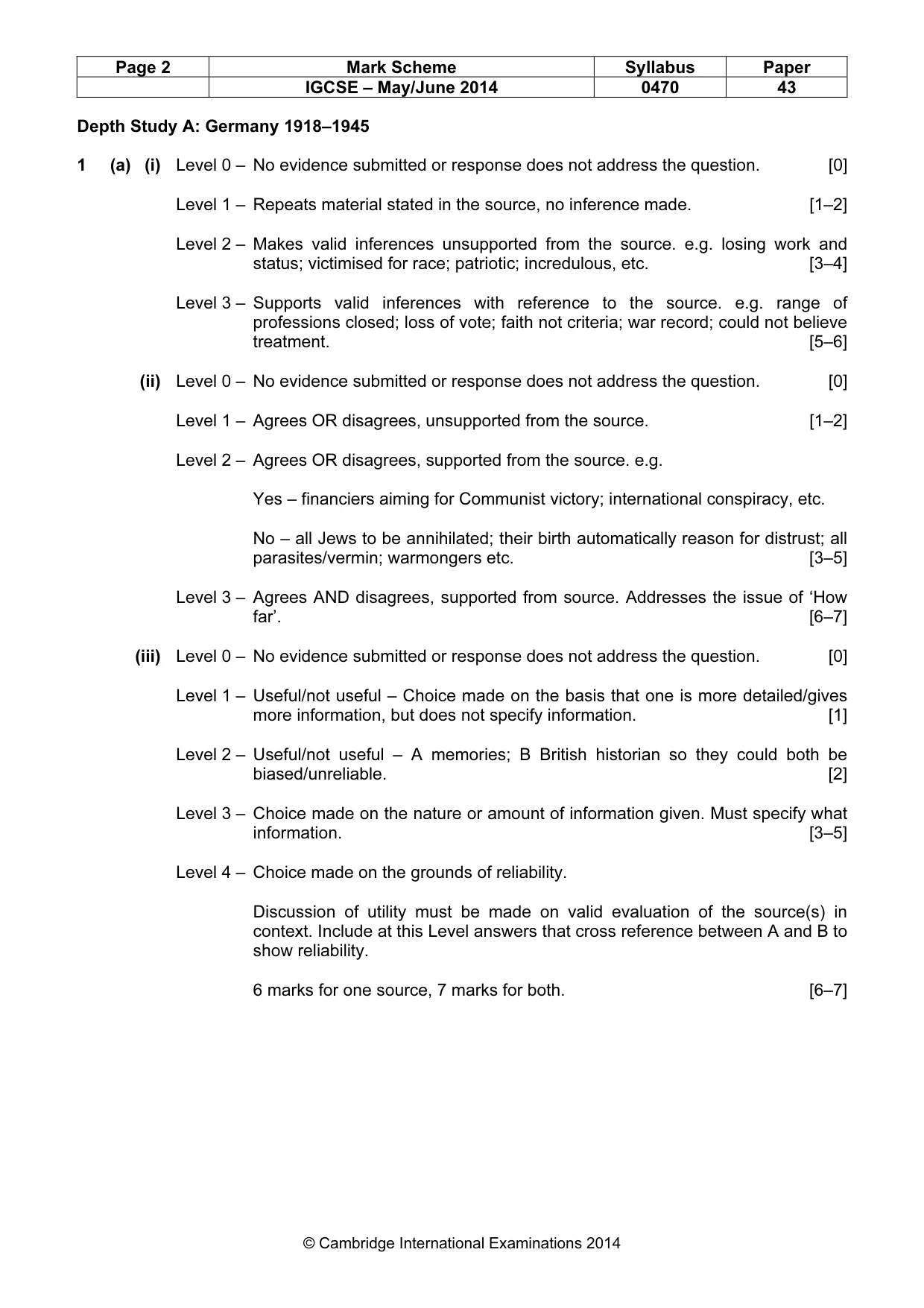
CAMBRIDGE INTERNATIONAL EXAMINATIONS International General Certificate of Secondary Education MARK SCHEME for the May/June 2014 series 0470 HISTORY 0470/43 Paper 4 (Alternative to Coursework), maximum raw mark 40 This mark scheme is published as an aid to teachers and candidates, to indicate the requirements of the examination. It shows the basis on which Examiners were instructed to award marks. It does not indicate the details of the discussions that took place at an Examiners’ meeting before marking began, which would have considered the acceptability of alternative answers. Mark schemes should be read in conjunction with the question paper and the Principal Examiner Report for Teachers. Cambridge will not enter into discussions about these mark schemes. Cambridge is publishing the mark schemes for the May/June 2014 series for most IGCSE, GCE Advanced Level and Advanced Subsidiary Level components and some Ordinary Level components.
Mark scheme, page 2
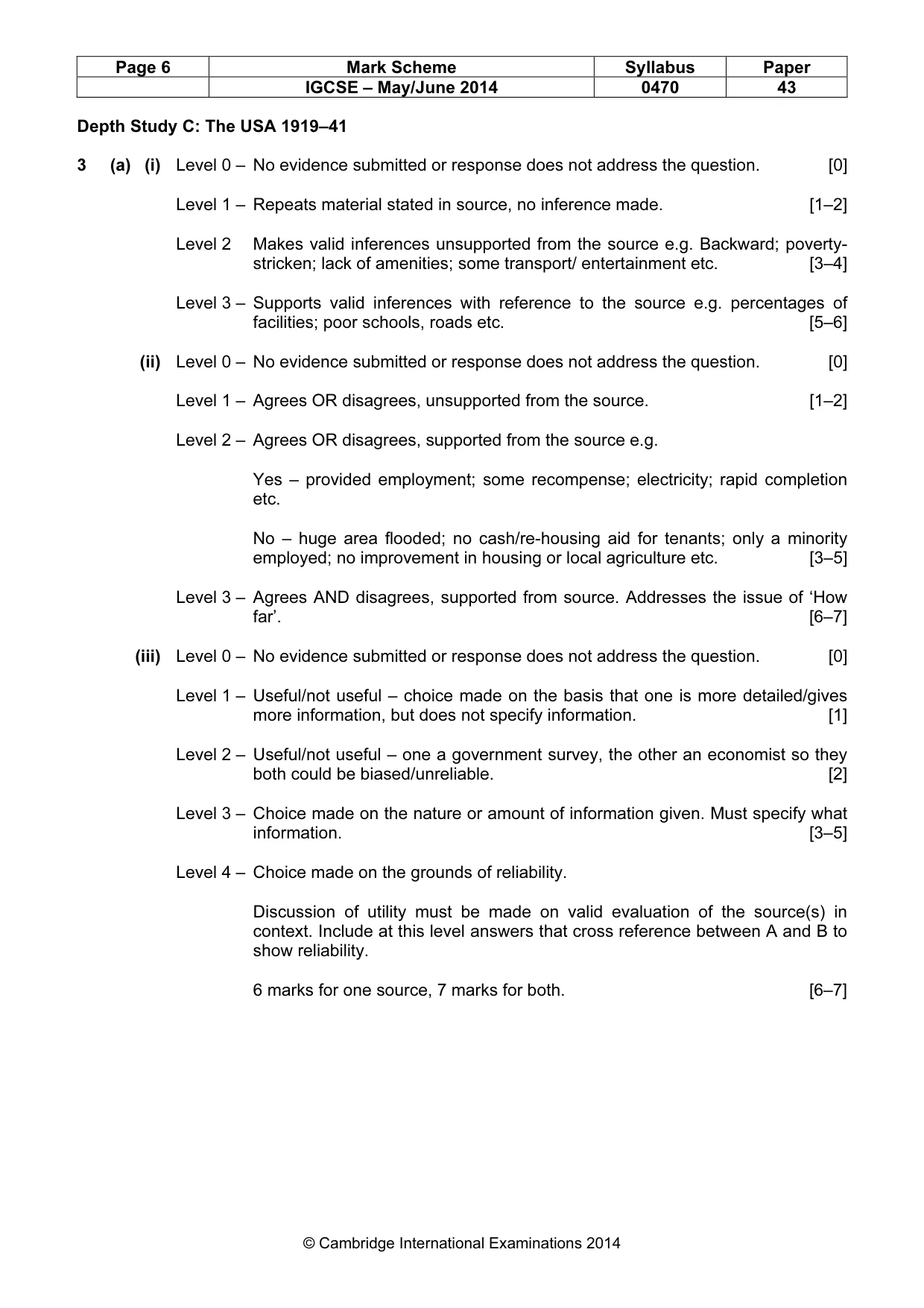
Page 2 Mark Scheme Syllabus Paper IGCSE – May/June 2014 0470 43 © Cambridge International Examinations 2014 Depth Study A: Germany 1918–1945 1 (a) (i) Level 0 – No evidence submitted or response does not address the question. [0] Level 1 – Repeats material stated in the source, no inference made. [1–2] Level 2 – Makes valid inferences unsupported from the source. e.g. losing work and status; victimised for race; patriotic; incredulous, etc. [3–4] Level 3 – Supports valid inferences with reference to the source. e.g. range of professions closed; loss of vote; faith not criteria; war record; could not believe treatment. [5–6] (ii) Level 0 – No evidence submitted or response does not address the question. [0] Level 1 – Agrees OR disagrees, unsupported from the source. [1–2] Level 2 – Agrees OR disagrees, supported from the source. e.g. Yes – financiers aiming for Communist victory; international conspiracy, etc. No – all Jews to be annihilated; their birth automatically reason for distrust; all parasites/vermin; warmongers etc. [3–5] Level 3 – Agrees AND disagrees, supported from source. Addresses the issue of ‘How far’. [6–7] (iii) Level 0 – No evidence submitted or response does not address the question. [0] Level 1 – Useful/not useful – Choice made on the basis that one is more detailed/gives more information, but does not specify information. [1] Level 2 – Useful/not useful – A memories; B British historian so they could both be biased/unreliable. [2] Level 3 – Choice made on the nature or amount of information given. Must specify what information. [3–5] Level 4 – Choice made on the grounds of reliability. Discussion of utility must be made on valid evaluation of the source(s) in context. Include at this Level answers that cross reference between A and B to show reliability. 6 marks for one source, 7 marks for both. [6–7]
Mark scheme, page 3
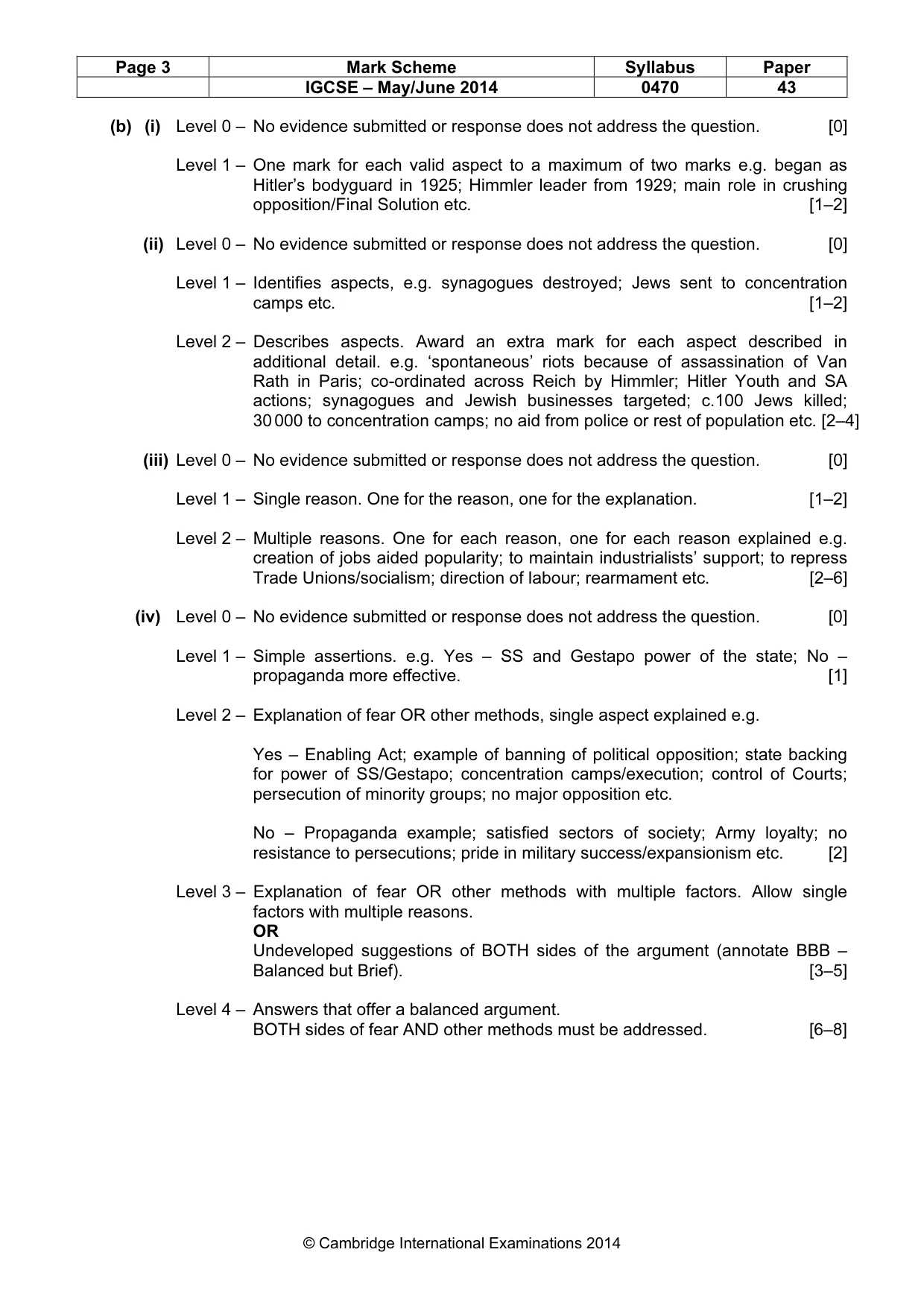
Page 3 Mark Scheme Syllabus Paper IGCSE – May/June 2014 0470 43 © Cambridge International Examinations 2014 (b) (i) Level 0 – No evidence submitted or response does not address the question. [0] Level 1 – One mark for each valid aspect to a maximum of two marks e.g. began as Hitler’s bodyguard in 1925; Himmler leader from 1929; main role in crushing opposition/Final Solution etc. [1–2] (ii) Level 0 – No evidence submitted or response does not address the question. [0] Level 1 – Identifies aspects, e.g. synagogues destroyed; Jews sent to concentration camps etc. [1–2] Level 2 – Describes aspects. Award an extra mark for each aspect described in additional detail. e.g. ‘spontaneous’ riots because of assassination of Van Rath in Paris; co-ordinated across Reich by Himmler; Hitler Youth and SA actions; synagogues and Jewish businesses targeted; c.100 Jews killed; 30 000 to concentration camps; no aid from police or rest of population etc. [2–4] (iii) Level 0 – No evidence submitted or response does not address the question. [0] Level 1 – Single reason. One for the reason, one for the explanation. [1–2] Level 2 – Multiple reasons. One for each reason, one for each reason explained e.g. creation of jobs aided popularity; to maintain industrialists’ support; to repress Trade Unions/socialism; direction of labour; rearmament etc. [2–6] (iv) Level 0 – No evidence submitted or response does not address the question. [0] Level 1 – Simple assertions. e.g. Yes – SS and Gestapo power of the state; No – propaganda more effective. [1] Level 2 – Explanation of fear OR other methods, single aspect explained e.g. Yes – Enabling Act; example of banning of political opposition; state backing for power of SS/Gestapo; concentration camps/execution; control of Courts; persecution of minority groups; no major opposition etc. No – Propaganda example; satisfied sectors of society; Army loyalty; no resistance to persecutions; pride in military success/expansionism etc. [2] Level 3 – Explanation of fear OR other methods with multiple factors. Allow single factors with multiple reasons. OR Undeveloped suggestions of BOTH sides of the argument (annotate BBB – Balanced but Brief). [3–5] Level 4 – Answers that offer a balanced argument. BOTH sides of fear AND other methods must be addressed. [6–8]
Mark scheme, page 4
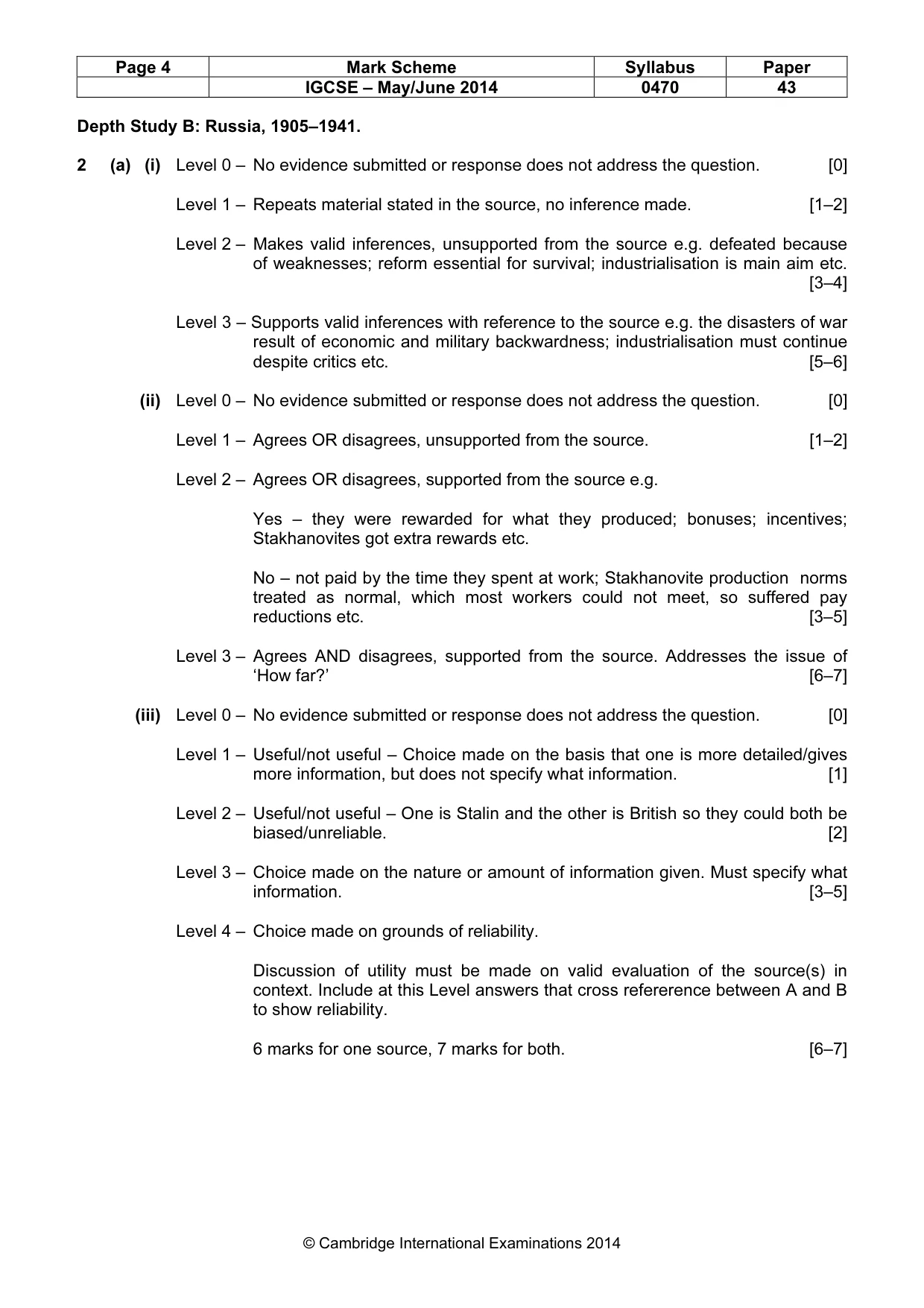
Page 4 Mark Scheme Syllabus Paper IGCSE – May/June 2014 0470 43 © Cambridge International Examinations 2014 Depth Study B: Russia, 1905–1941. 2 (a) (i) Level 0 – No evidence submitted or response does not address the question. [0] Level 1 – Repeats material stated in the source, no inference made. [1–2] Level 2 – Makes valid inferences, unsupported from the source e.g. defeated because of weaknesses; reform essential for survival; industrialisation is main aim etc. [3–4] Level 3 – Supports valid inferences with reference to the source e.g. the disasters of war result of economic and military backwardness; industrialisation must continue despite critics etc. [5–6] (ii) Level 0 – No evidence submitted or response does not address the question. [0] Level 1 – Agrees OR disagrees, unsupported from the source. [1–2] Level 2 – Agrees OR disagrees, supported from the source e.g. Yes – they were rewarded for what they produced; bonuses; incentives; Stakhanovites got extra rewards etc. No – not paid by the time they spent at work; Stakhanovite production norms treated as normal, which most workers could not meet, so suffered pay reductions etc. [3–5] Level 3 – Agrees AND disagrees, supported from the source. Addresses the issue of ‘How far?’ [6–7] (iii) Level 0 – No evidence submitted or response does not address the question. [0] Level 1 – Useful/not useful – Choice made on the basis that one is more detailed/gives more information, but does not specify what information. [1] Level 2 – Useful/not useful – One is Stalin and the other is British so they could both be biased/unreliable. [2] Level 3 – Choice made on the nature or amount of information given. Must specify what information. [3–5] Level 4 – Choice made on grounds of reliability. Discussion of utility must be made on valid evaluation of the source(s) in context. Include at this Level answers that cross refererence between A and B to show reliability. 6 marks for one source, 7 marks for both. [6–7]
Mark scheme, page 5
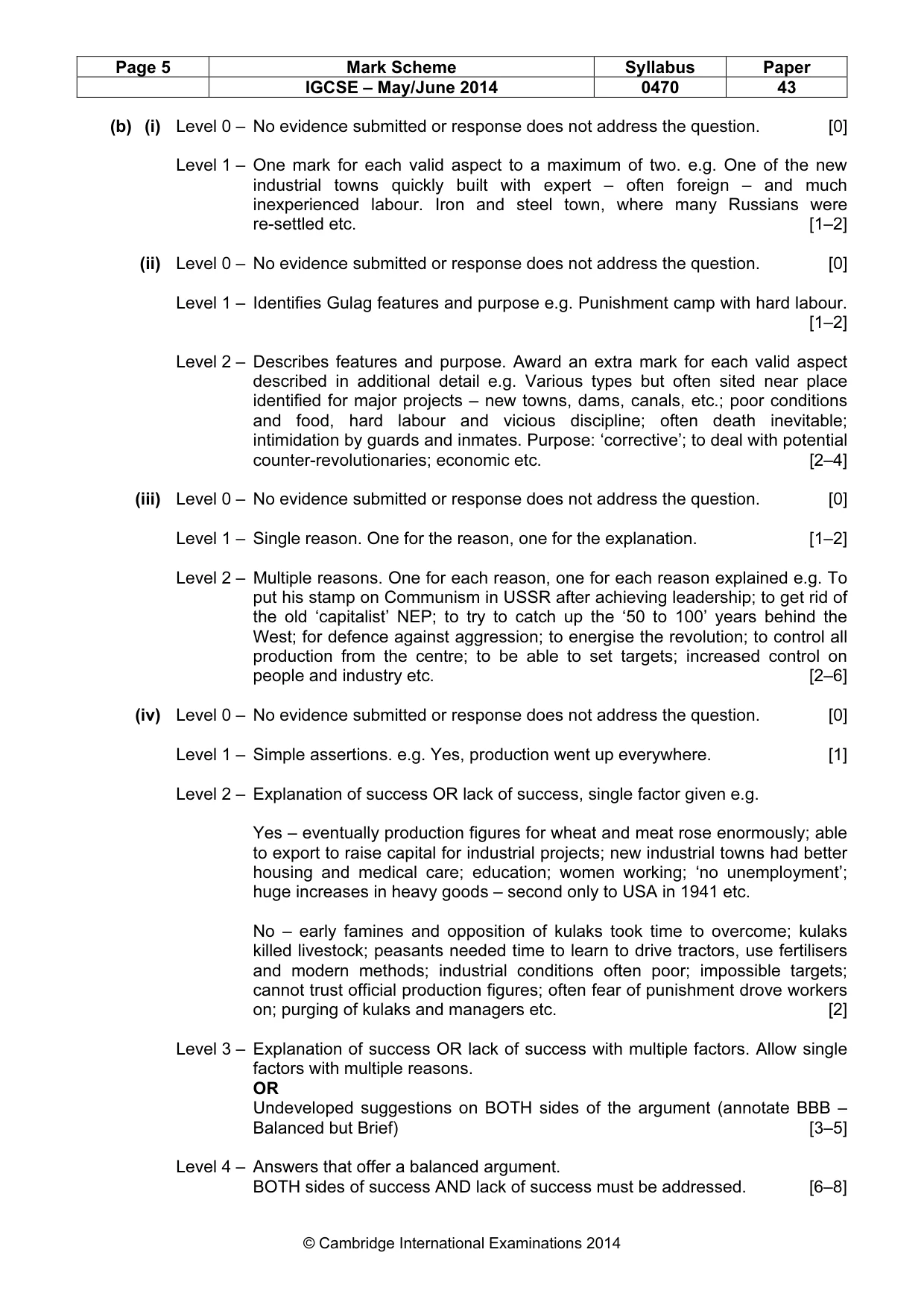
Page 5 Mark Scheme Syllabus Paper IGCSE – May/June 2014 0470 43 © Cambridge International Examinations 2014 (b) (i) Level 0 – No evidence submitted or response does not address the question. [0] Level 1 – One mark for each valid aspect to a maximum of two. e.g. One of the new industrial towns quickly built with expert – often foreign – and much inexperienced labour. Iron and steel town, where many Russians were re-settled etc. [1–2] (ii) Level 0 – No evidence submitted or response does not address the question. [0] Level 1 – Identifies Gulag features and purpose e.g. Punishment camp with hard labour. [1–2] Level 2 – Describes features and purpose. Award an extra mark for each valid aspect described in additional detail e.g. Various types but often sited near place identified for major projects – new towns, dams, canals, etc.; poor conditions and food, hard labour and vicious discipline; often death inevitable; intimidation by guards and inmates. Purpose: ‘corrective’; to deal with potential counter-revolutionaries; economic etc. [2–4] (iii) Level 0 – No evidence submitted or response does not address the question. [0] Level 1 – Single reason. One for the reason, one for the explanation. [1–2] Level 2 – Multiple reasons. One for each reason, one for each reason explained e.g. To put his stamp on Communism in USSR after achieving leadership; to get rid of the old ‘capitalist’ NEP; to try to catch up the ‘50 to 100’ years behind the West; for defence against aggression; to energise the revolution; to control all production from the centre; to be able to set targets; increased control on people and industry etc. [2–6] (iv) Level 0 – No evidence submitted or response does not address the question. [0] Level 1 – Simple assertions. e.g. Yes, production went up everywhere. [1] Level 2 – Explanation of success OR lack of success, single factor given e.g. Yes – eventually production figures for wheat and meat rose enormously; able to export to raise capital for industrial projects; new industrial towns had better housing and medical care; education; women working; ‘no unemployment’; huge increases in heavy goods – second only to USA in 1941 etc. No – early famines and opposition of kulaks took time to overcome; kulaks killed livestock; peasants needed time to learn to drive tractors, use fertilisers and modern methods; industrial conditions often poor; impossible targets; cannot trust official production figures; often fear of punishment drove workers on; purging of kulaks and managers etc. [2] Level 3 – Explanation of success OR lack of success with multiple factors. Allow single factors with multiple reasons. OR Undeveloped suggestions on BOTH sides of the argument (annotate BBB – Balanced but Brief) [3–5] Level 4 – Answers that offer a balanced argument. BOTH sides of success AND lack of success must be addressed. [6–8]
Mark scheme, page 6
Page 6 Mark Scheme Syllabus Paper IGCSE – May/June 2014 0470 43 © Cambridge International Examinations 2014 Depth Study C: The USA 1919–41 3 (a) (i) Level 0 – No evidence submitted or response does not address the question. [0] Level 1 – Repeats material stated in source, no inference made. [1–2] Level 2 Makes valid inferences unsupported from the source e.g. Backward; poverty- stricken; lack of amenities; some transport/ entertainment etc. [3–4] Level 3 – Supports valid inferences with reference to the source e.g. percentages of facilities; poor schools, roads etc. [5–6] (ii) Level 0 – No evidence submitted or response does not address the question. [0] Level 1 – Agrees OR disagrees, unsupported from the source. [1–2] Level 2 – Agrees OR disagrees, supported from the source e.g. Yes – provided employment; some recompense; electricity; rapid completion etc. No – huge area flooded; no cash/re-housing aid for tenants; only a minority employed; no improvement in housing or local agriculture etc. [3–5] Level 3 – Agrees AND disagrees, supported from source. Addresses the issue of ‘How far’. [6–7] (iii) Level 0 – No evidence submitted or response does not address the question. [0] Level 1 – Useful/not useful – choice made on the basis that one is more detailed/gives more information, but does not specify information. [1] Level 2 – Useful/not useful – one a government survey, the other an economist so they both could be biased/unreliable. [2] Level 3 – Choice made on the nature or amount of information given. Must specify what information. [3–5] Level 4 – Choice made on the grounds of reliability. Discussion of utility must be made on valid evaluation of the source(s) in context. Include at this level answers that cross reference between A and B to show reliability. 6 marks for one source, 7 marks for both. [6–7]
Mark scheme, page 7
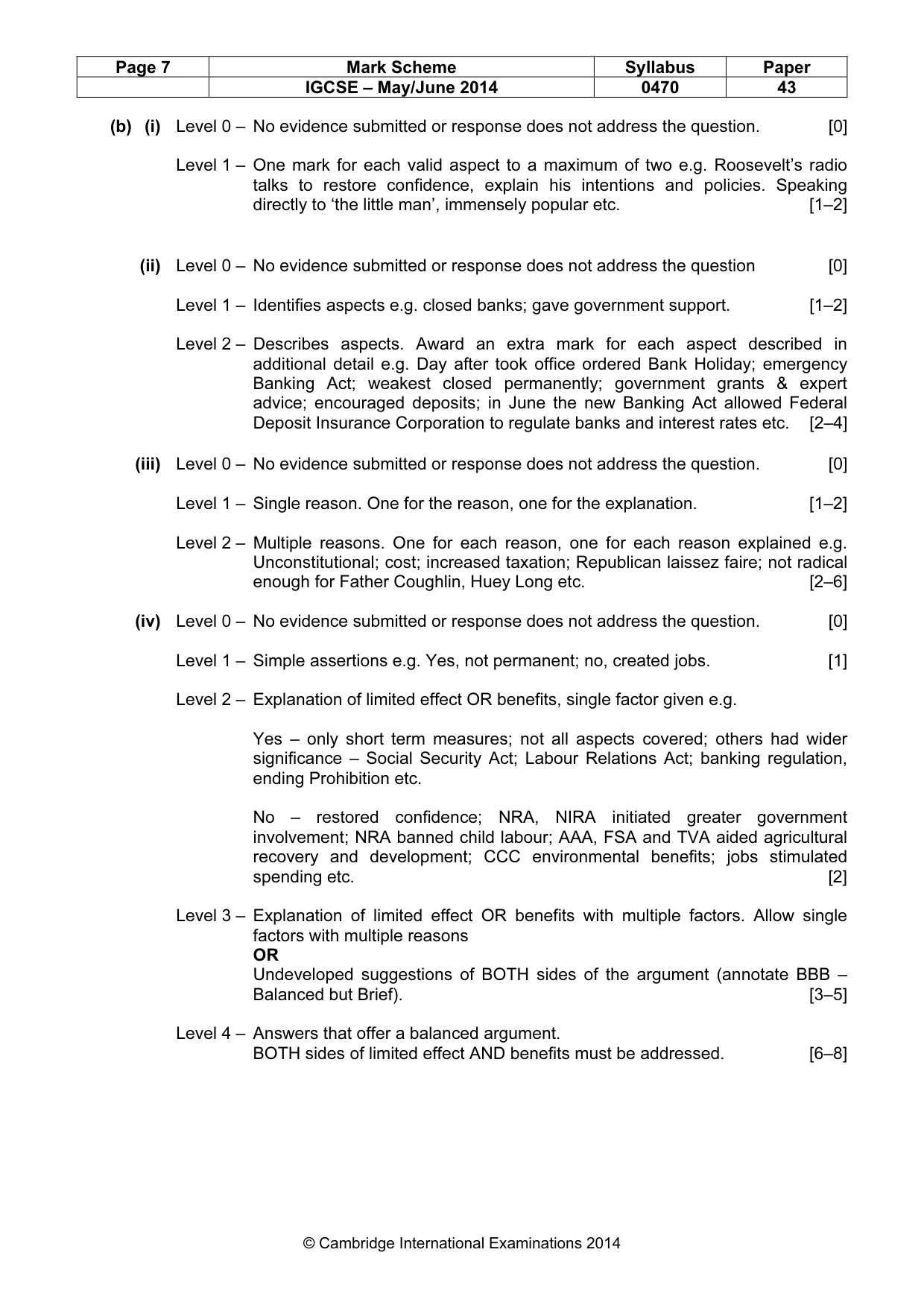
Page 7 Mark Scheme Syllabus Paper IGCSE – May/June 2014 0470 43 © Cambridge International Examinations 2014 (b) (i) Level 0 – No evidence submitted or response does not address the question. [0] Level 1 – One mark for each valid aspect to a maximum of two e.g. Roosevelt’s radio talks to restore confidence, explain his intentions and policies. Speaking directly to ‘the little man’, immensely popular etc. [1–2] (ii) Level 0 – No evidence submitted or response does not address the question [0] Level 1 – Identifies aspects e.g. closed banks; gave government support. [1–2] Level 2 – Describes aspects. Award an extra mark for each aspect described in additional detail e.g. Day after took office ordered Bank Holiday; emergency Banking Act; weakest closed permanently; government grants & expert advice; encouraged deposits; in June the new Banking Act allowed Federal Deposit Insurance Corporation to regulate banks and interest rates etc. [2–4] (iii) Level 0 – No evidence submitted or response does not address the question. [0] Level 1 – Single reason. One for the reason, one for the explanation. [1–2] Level 2 – Multiple reasons. One for each reason, one for each reason explained e.g. Unconstitutional; cost; increased taxation; Republican laissez faire; not radical enough for Father Coughlin, Huey Long etc. [2–6] (iv) Level 0 – No evidence submitted or response does not address the question. [0] Level 1 – Simple assertions e.g. Yes, not permanent; no, created jobs. [1] Level 2 – Explanation of limited effect OR benefits, single factor given e.g. Yes – only short term measures; not all aspects covered; others had wider significance – Social Security Act; Labour Relations Act; banking regulation, ending Prohibition etc. No – restored confidence; NRA, NIRA initiated greater government involvement; NRA banned child labour; AAA, FSA and TVA aided agricultural recovery and development; CCC environmental benefits; jobs stimulated spending etc. [2] Level 3 – Explanation of limited effect OR benefits with multiple factors. Allow single factors with multiple reasons OR Undeveloped suggestions of BOTH sides of the argument (annotate BBB – Balanced but Brief). [3–5] Level 4 – Answers that offer a balanced argument. BOTH sides of limited effect AND benefits must be addressed. [6–8]
Mark scheme, page 8
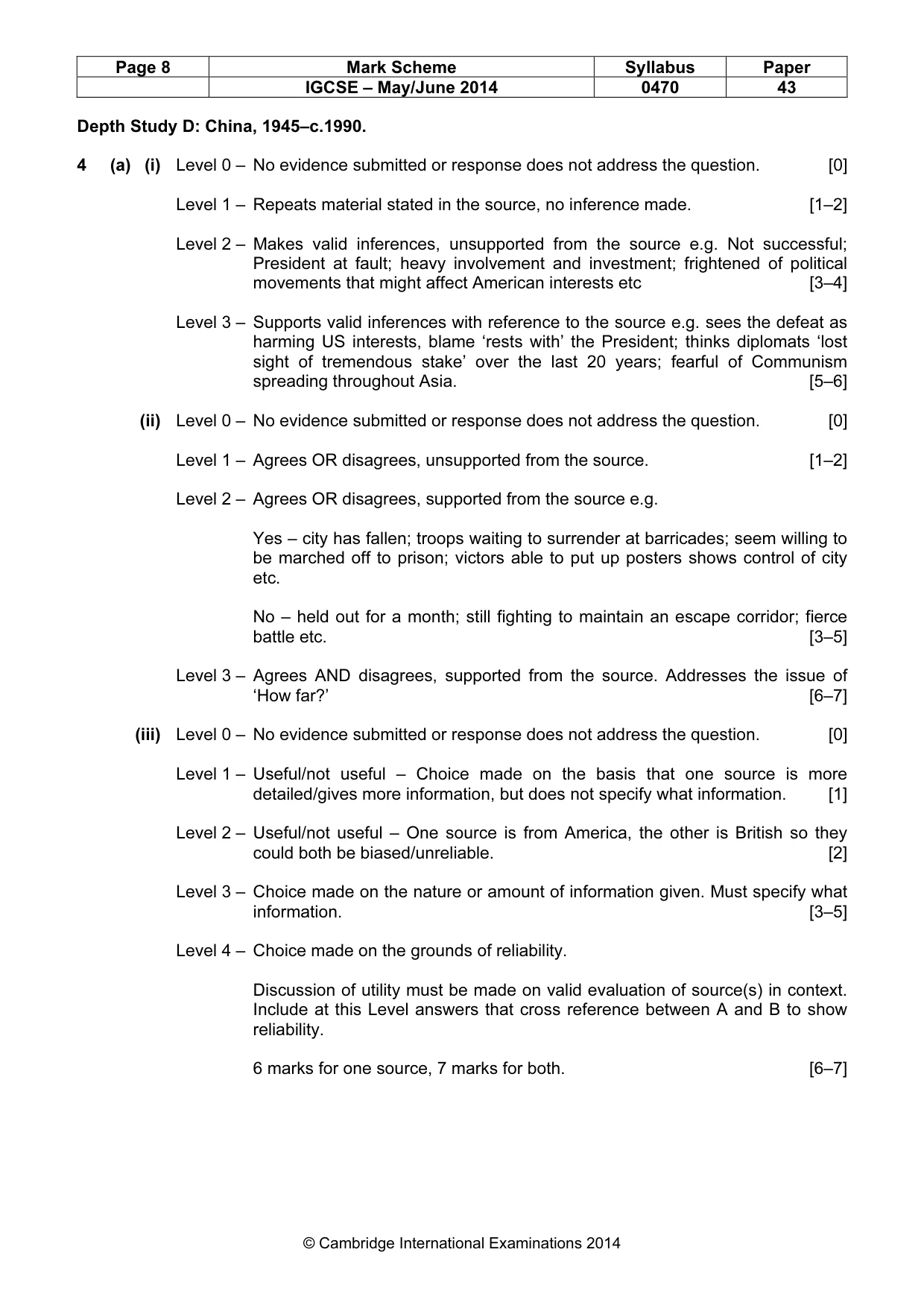
Page 8 Mark Scheme Syllabus Paper IGCSE – May/June 2014 0470 43 © Cambridge International Examinations 2014 Depth Study D: China, 1945–c.1990. 4 (a) (i) Level 0 – No evidence submitted or response does not address the question. [0] Level 1 – Repeats material stated in the source, no inference made. [1–2] Level 2 – Makes valid inferences, unsupported from the source e.g. Not successful; President at fault; heavy involvement and investment; frightened of political movements that might affect American interests etc [3–4] Level 3 – Supports valid inferences with reference to the source e.g. sees the defeat as harming US interests, blame ‘rests with’ the President; thinks diplomats ‘lost sight of tremendous stake’ over the last 20 years; fearful of Communism spreading throughout Asia. [5–6] (ii) Level 0 – No evidence submitted or response does not address the question. [0] Level 1 – Agrees OR disagrees, unsupported from the source. [1–2] Level 2 – Agrees OR disagrees, supported from the source e.g. Yes – city has fallen; troops waiting to surrender at barricades; seem willing to be marched off to prison; victors able to put up posters shows control of city etc. No – held out for a month; still fighting to maintain an escape corridor; fierce battle etc. [3–5] Level 3 – Agrees AND disagrees, supported from the source. Addresses the issue of ‘How far?’ [6–7] (iii) Level 0 – No evidence submitted or response does not address the question. [0] Level 1 – Useful/not useful – Choice made on the basis that one source is more detailed/gives more information, but does not specify what information. [1] Level 2 – Useful/not useful – One source is from America, the other is British so they could both be biased/unreliable. [2] Level 3 – Choice made on the nature or amount of information given. Must specify what information. [3–5] Level 4 – Choice made on the grounds of reliability. Discussion of utility must be made on valid evaluation of source(s) in context. Include at this Level answers that cross reference between A and B to show reliability. 6 marks for one source, 7 marks for both. [6–7]
Mark scheme, page 9
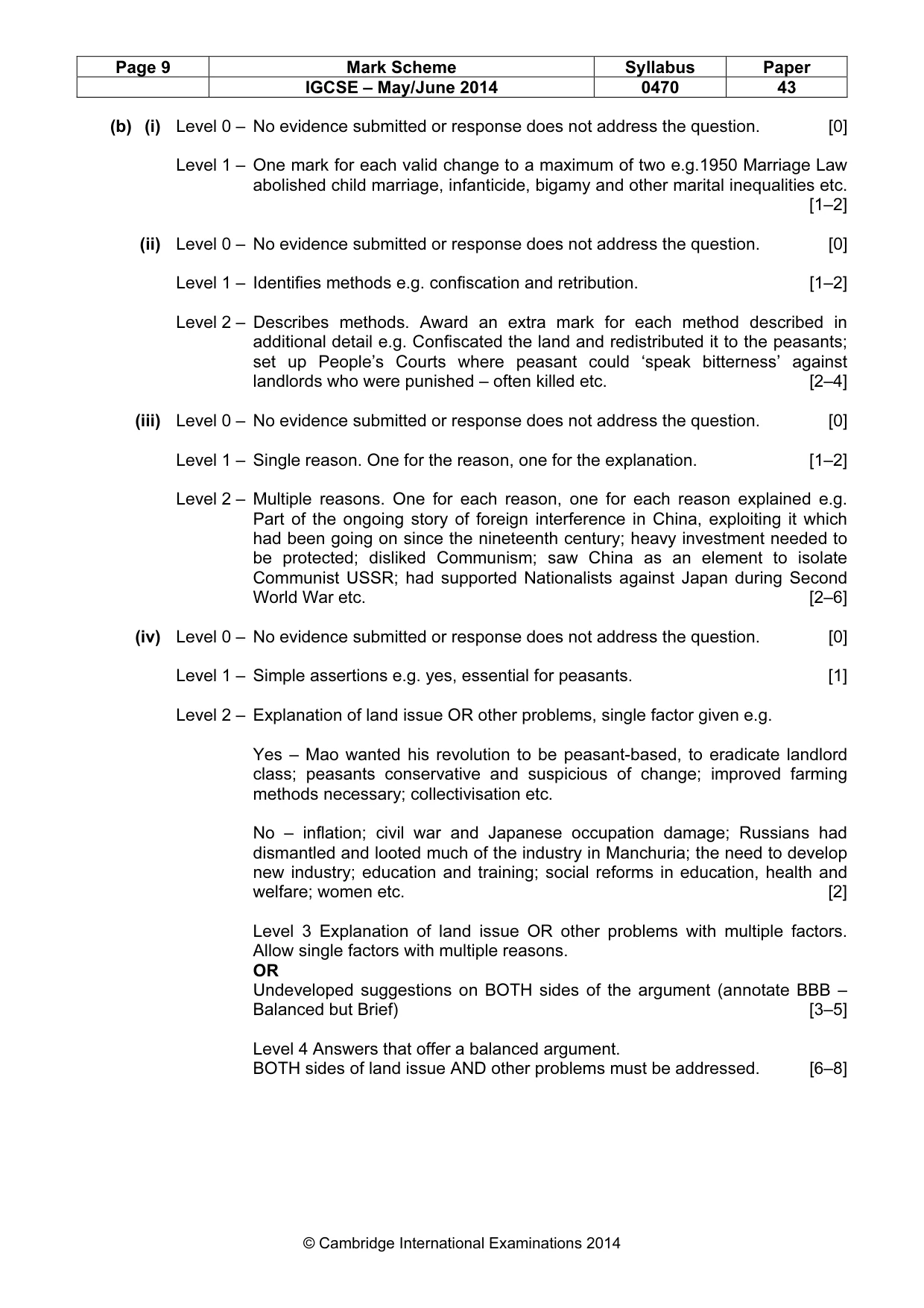
Page 9 Mark Scheme Syllabus Paper IGCSE – May/June 2014 0470 43 © Cambridge International Examinations 2014 (b) (i) Level 0 – No evidence submitted or response does not address the question. [0] Level 1 – One mark for each valid change to a maximum of two e.g.1950 Marriage Law abolished child marriage, infanticide, bigamy and other marital inequalities etc. [1–2] (ii) Level 0 – No evidence submitted or response does not address the question. [0] Level 1 – Identifies methods e.g. confiscation and retribution. [1–2] Level 2 – Describes methods. Award an extra mark for each method described in additional detail e.g. Confiscated the land and redistributed it to the peasants; set up People’s Courts where peasant could ‘speak bitterness’ against landlords who were punished – often killed etc. [2–4] (iii) Level 0 – No evidence submitted or response does not address the question. [0] Level 1 – Single reason. One for the reason, one for the explanation. [1–2] Level 2 – Multiple reasons. One for each reason, one for each reason explained e.g. Part of the ongoing story of foreign interference in China, exploiting it which had been going on since the nineteenth century; heavy investment needed to be protected; disliked Communism; saw China as an element to isolate Communist USSR; had supported Nationalists against Japan during Second World War etc. [2–6] (iv) Level 0 – No evidence submitted or response does not address the question. [0] Level 1 – Simple assertions e.g. yes, essential for peasants. [1] Level 2 – Explanation of land issue OR other problems, single factor given e.g. Yes – Mao wanted his revolution to be peasant-based, to eradicate landlord class; peasants conservative and suspicious of change; improved farming methods necessary; collectivisation etc. No – inflation; civil war and Japanese occupation damage; Russians had dismantled and looted much of the industry in Manchuria; the need to develop new industry; education and training; social reforms in education, health and welfare; women etc. [2] Level 3 Explanation of land issue OR other problems with multiple factors. Allow single factors with multiple reasons. OR Undeveloped suggestions on BOTH sides of the argument (annotate BBB – Balanced but Brief) [3–5] Level 4 Answers that offer a balanced argument. BOTH sides of land issue AND other problems must be addressed. [6–8]
Mark scheme, page 10
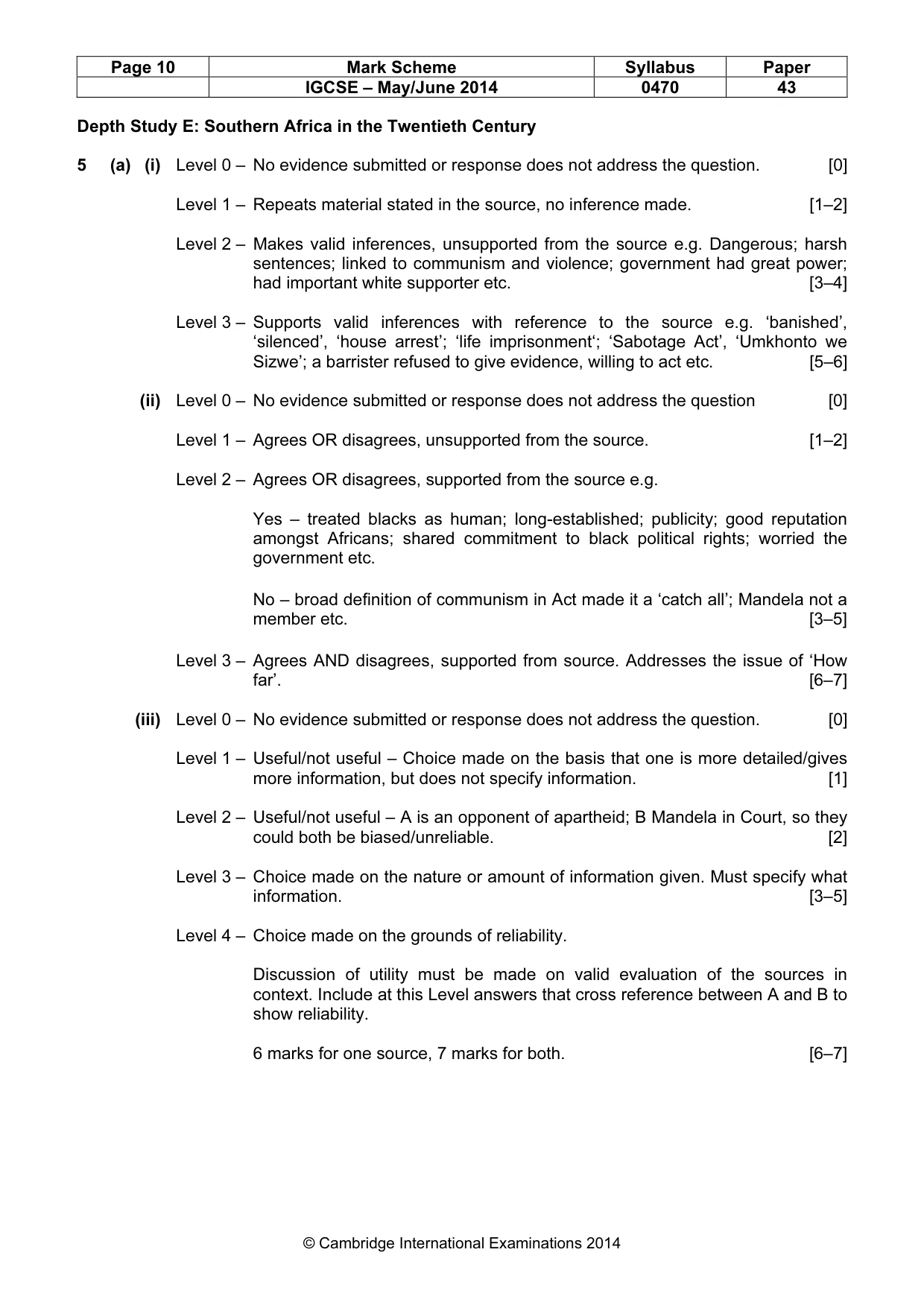
Page 10 Mark Scheme Syllabus Paper IGCSE – May/June 2014 0470 43 © Cambridge International Examinations 2014 Depth Study E: Southern Africa in the Twentieth Century 5 (a) (i) Level 0 – No evidence submitted or response does not address the question. [0] Level 1 – Repeats material stated in the source, no inference made. [1–2] Level 2 – Makes valid inferences, unsupported from the source e.g. Dangerous; harsh sentences; linked to communism and violence; government had great power; had important white supporter etc. [3–4] Level 3 – Supports valid inferences with reference to the source e.g. ‘banished’, ‘silenced’, ‘house arrest’; ‘life imprisonment‘; ‘Sabotage Act’, ‘Umkhonto we Sizwe’; a barrister refused to give evidence, willing to act etc. [5–6] (ii) Level 0 – No evidence submitted or response does not address the question [0] Level 1 – Agrees OR disagrees, unsupported from the source. [1–2] Level 2 – Agrees OR disagrees, supported from the source e.g. Yes – treated blacks as human; long-established; publicity; good reputation amongst Africans; shared commitment to black political rights; worried the government etc. No – broad definition of communism in Act made it a ‘catch all’; Mandela not a member etc. [3–5] Level 3 – Agrees AND disagrees, supported from source. Addresses the issue of ‘How far’. [6–7] (iii) Level 0 – No evidence submitted or response does not address the question. [0] Level 1 – Useful/not useful – Choice made on the basis that one is more detailed/gives more information, but does not specify information. [1] Level 2 – Useful/not useful – A is an opponent of apartheid; B Mandela in Court, so they could both be biased/unreliable. [2] Level 3 – Choice made on the nature or amount of information given. Must specify what information. [3–5] Level 4 – Choice made on the grounds of reliability. Discussion of utility must be made on valid evaluation of the sources in context. Include at this Level answers that cross reference between A and B to show reliability. 6 marks for one source, 7 marks for both. [6–7]
Mark scheme, page 11
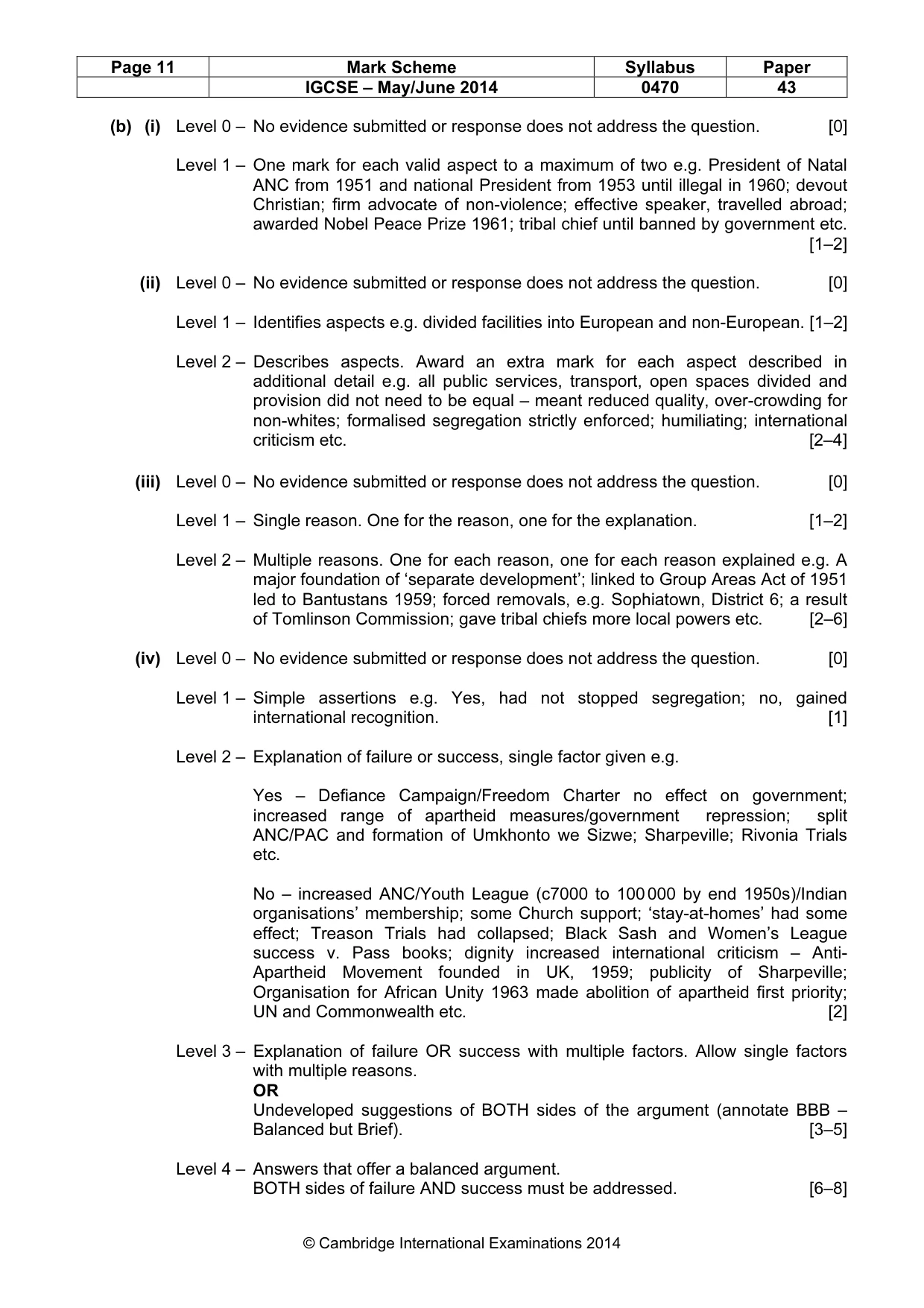
Page 11 Mark Scheme Syllabus Paper IGCSE – May/June 2014 0470 43 © Cambridge International Examinations 2014 (b) (i) Level 0 – No evidence submitted or response does not address the question. [0] Level 1 – One mark for each valid aspect to a maximum of two e.g. President of Natal ANC from 1951 and national President from 1953 until illegal in 1960; devout Christian; firm advocate of non-violence; effective speaker, travelled abroad; awarded Nobel Peace Prize 1961; tribal chief until banned by government etc. [1–2] (ii) Level 0 – No evidence submitted or response does not address the question. [0] Level 1 – Identifies aspects e.g. divided facilities into European and non-European. [1–2] Level 2 – Describes aspects. Award an extra mark for each aspect described in additional detail e.g. all public services, transport, open spaces divided and provision did not need to be equal – meant reduced quality, over-crowding for non-whites; formalised segregation strictly enforced; humiliating; international criticism etc. [2–4] (iii) Level 0 – No evidence submitted or response does not address the question. [0] Level 1 – Single reason. One for the reason, one for the explanation. [1–2] Level 2 – Multiple reasons. One for each reason, one for each reason explained e.g. A major foundation of ‘separate development’; linked to Group Areas Act of 1951 led to Bantustans 1959; forced removals, e.g. Sophiatown, District 6; a result of Tomlinson Commission; gave tribal chiefs more local powers etc. [2–6] (iv) Level 0 – No evidence submitted or response does not address the question. [0] Level 1 – Simple assertions e.g. Yes, had not stopped segregation; no, gained international recognition. [1] Level 2 – Explanation of failure or success, single factor given e.g. Yes – Defiance Campaign/Freedom Charter no effect on government; increased range of apartheid measures/government repression; split ANC/PAC and formation of Umkhonto we Sizwe; Sharpeville; Rivonia Trials etc. No – increased ANC/Youth League (c7000 to 100 000 by end 1950s)/Indian organisations’ membership; some Church support; ‘stay-at-homes’ had some effect; Treason Trials had collapsed; Black Sash and Women’s League success v. Pass books; dignity increased international criticism – Anti- Apartheid Movement founded in UK, 1959; publicity of Sharpeville; Organisation for African Unity 1963 made abolition of apartheid first priority; UN and Commonwealth etc. [2] Level 3 – Explanation of failure OR success with multiple factors. Allow single factors with multiple reasons. OR Undeveloped suggestions of BOTH sides of the argument (annotate BBB – Balanced but Brief). [3–5] Level 4 – Answers that offer a balanced argument. BOTH sides of failure AND success must be addressed. [6–8]
Mark scheme, page 12
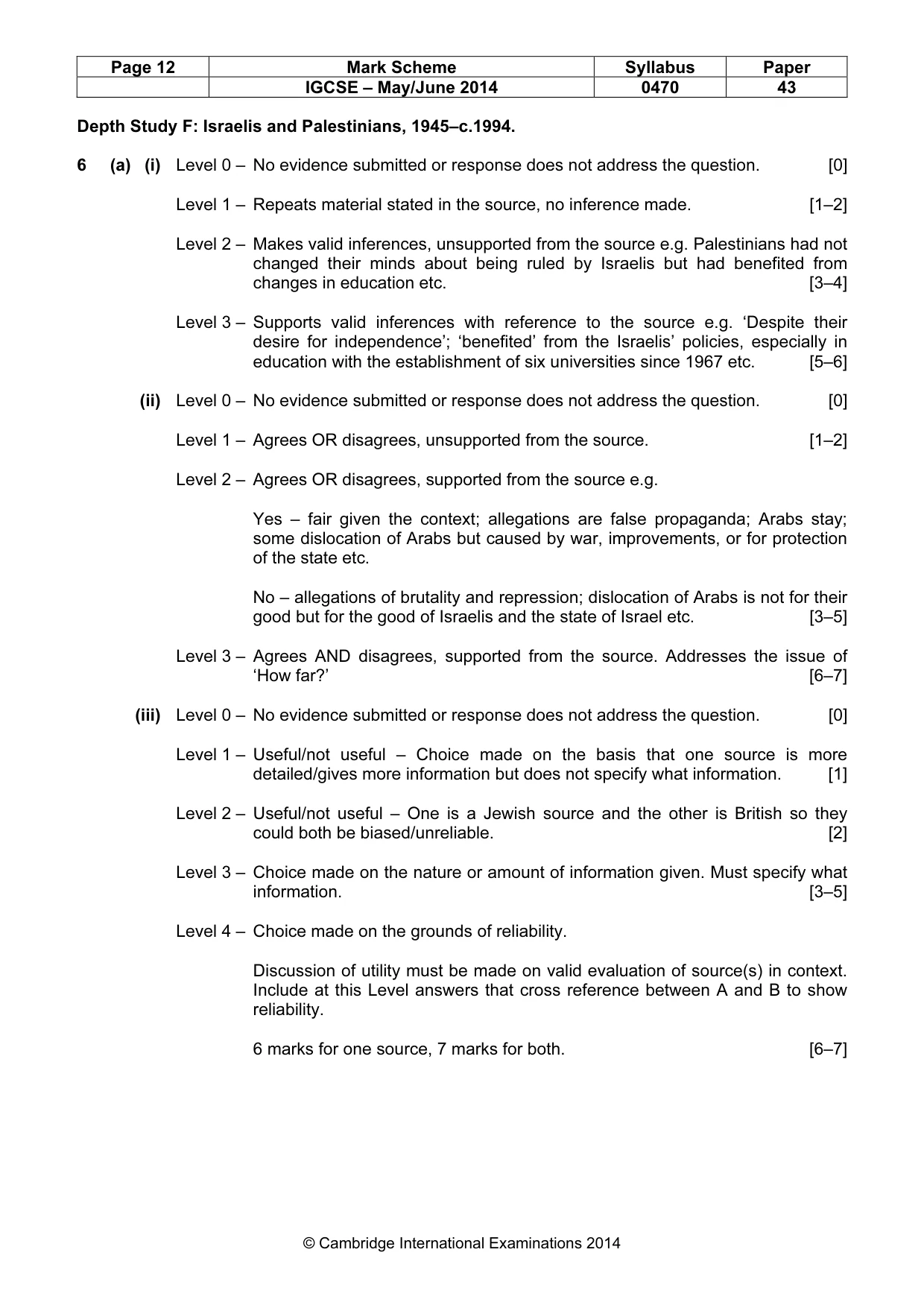
Page 12 Mark Scheme Syllabus Paper IGCSE – May/June 2014 0470 43 © Cambridge International Examinations 2014 Depth Study F: Israelis and Palestinians, 1945–c.1994. 6 (a) (i) Level 0 – No evidence submitted or response does not address the question. [0] Level 1 – Repeats material stated in the source, no inference made. [1–2] Level 2 – Makes valid inferences, unsupported from the source e.g. Palestinians had not changed their minds about being ruled by Israelis but had benefited from changes in education etc. [3–4] Level 3 – Supports valid inferences with reference to the source e.g. ‘Despite their desire for independence’; ‘benefited’ from the Israelis’ policies, especially in education with the establishment of six universities since 1967 etc. [5–6] (ii) Level 0 – No evidence submitted or response does not address the question. [0] Level 1 – Agrees OR disagrees, unsupported from the source. [1–2] Level 2 – Agrees OR disagrees, supported from the source e.g. Yes – fair given the context; allegations are false propaganda; Arabs stay; some dislocation of Arabs but caused by war, improvements, or for protection of the state etc. No – allegations of brutality and repression; dislocation of Arabs is not for their good but for the good of Israelis and the state of Israel etc. [3–5] Level 3 – Agrees AND disagrees, supported from the source. Addresses the issue of ‘How far?’ [6–7] (iii) Level 0 – No evidence submitted or response does not address the question. [0] Level 1 – Useful/not useful – Choice made on the basis that one source is more detailed/gives more information but does not specify what information. [1] Level 2 – Useful/not useful – One is a Jewish source and the other is British so they could both be biased/unreliable. [2] Level 3 – Choice made on the nature or amount of information given. Must specify what information. [3–5] Level 4 – Choice made on the grounds of reliability. Discussion of utility must be made on valid evaluation of source(s) in context. Include at this Level answers that cross reference between A and B to show reliability. 6 marks for one source, 7 marks for both. [6–7]
Mark scheme, page 13
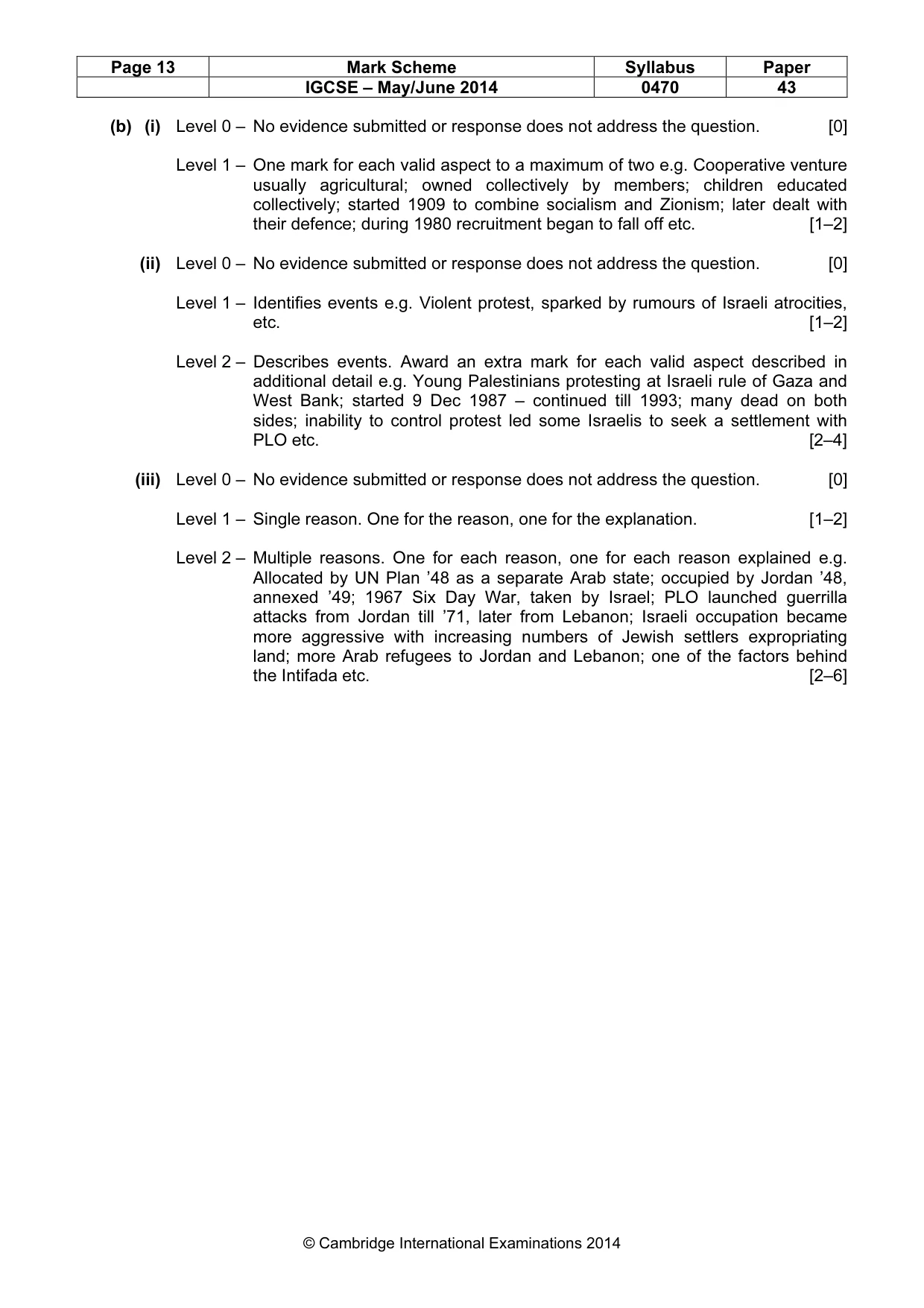
Page 13 Mark Scheme Syllabus Paper IGCSE – May/June 2014 0470 43 © Cambridge International Examinations 2014 (b) (i) Level 0 – No evidence submitted or response does not address the question. [0] Level 1 – One mark for each valid aspect to a maximum of two e.g. Cooperative venture usually agricultural; owned collectively by members; children educated collectively; started 1909 to combine socialism and Zionism; later dealt with their defence; during 1980 recruitment began to fall off etc. [1–2] (ii) Level 0 – No evidence submitted or response does not address the question. [0] Level 1 – Identifies events e.g. Violent protest, sparked by rumours of Israeli atrocities, etc. [1–2] Level 2 – Describes events. Award an extra mark for each valid aspect described in additional detail e.g. Young Palestinians protesting at Israeli rule of Gaza and West Bank; started 9 Dec 1987 – continued till 1993; many dead on both sides; inability to control protest led some Israelis to seek a settlement with PLO etc. [2–4] (iii) Level 0 – No evidence submitted or response does not address the question. [0] Level 1 – Single reason. One for the reason, one for the explanation. [1–2] Level 2 – Multiple reasons. One for each reason, one for each reason explained e.g. Allocated by UN Plan ’48 as a separate Arab state; occupied by Jordan ’48, annexed ’49; 1967 Six Day War, taken by Israel; PLO launched guerrilla attacks from Jordan till ’71, later from Lebanon; Israeli occupation became more aggressive with increasing numbers of Jewish settlers expropriating land; more Arab refugees to Jordan and Lebanon; one of the factors behind the Intifada etc. [2–6]
Mark scheme, page 14
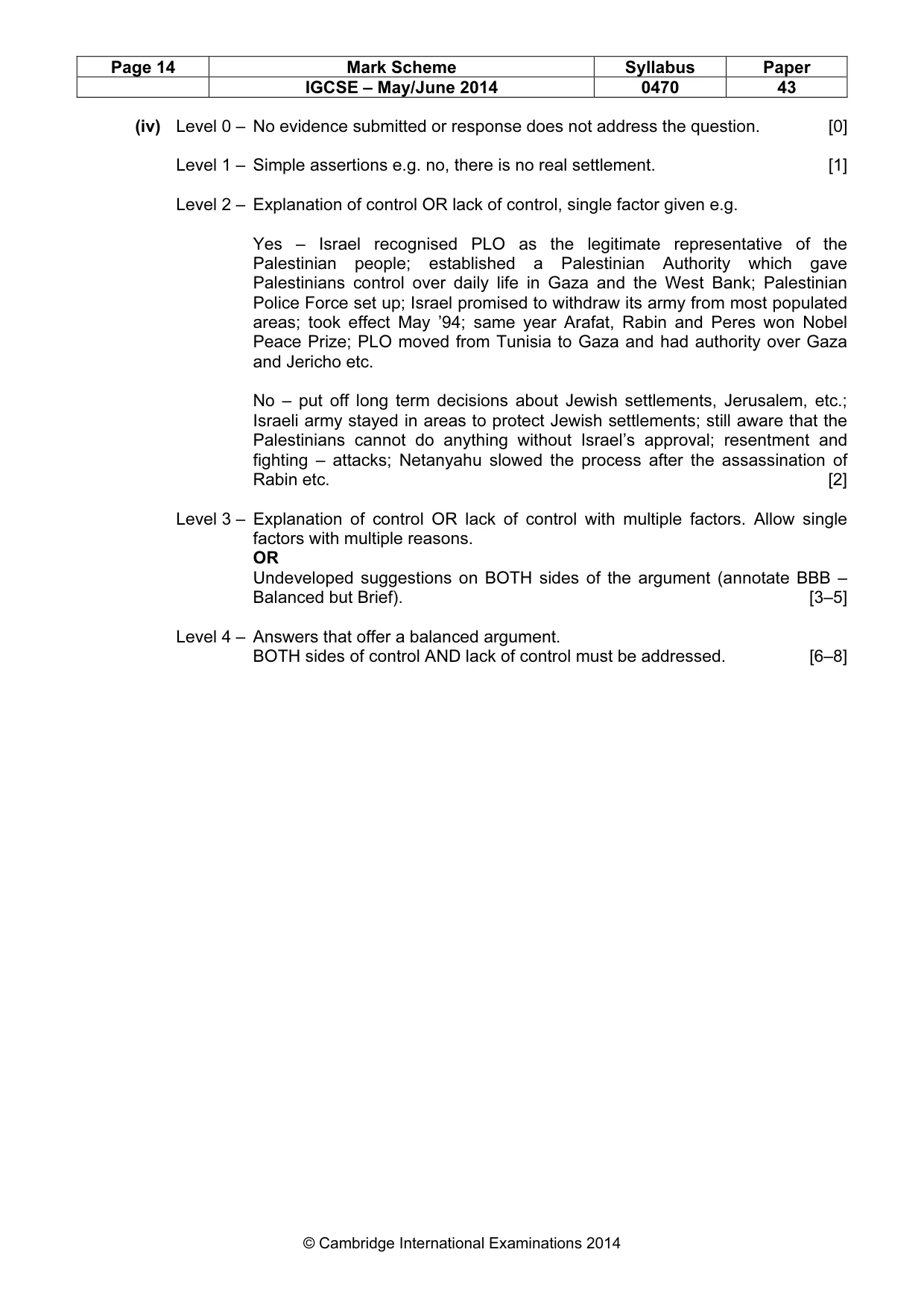
Page 14 Mark Scheme Syllabus Paper IGCSE – May/June 2014 0470 43 © Cambridge International Examinations 2014 (iv) Level 0 – No evidence submitted or response does not address the question. [0] Level 1 – Simple assertions e.g. no, there is no real settlement. [1] Level 2 – Explanation of control OR lack of control, single factor given e.g. Yes – Israel recognised PLO as the legitimate representative of the Palestinian people; established a Palestinian Authority which gave Palestinians control over daily life in Gaza and the West Bank; Palestinian Police Force set up; Israel promised to withdraw its army from most populated areas; took effect May ’94; same year Arafat, Rabin and Peres won Nobel Peace Prize; PLO moved from Tunisia to Gaza and had authority over Gaza and Jericho etc. No – put off long term decisions about Jewish settlements, Jerusalem, etc.; Israeli army stayed in areas to protect Jewish settlements; still aware that the Palestinians cannot do anything without Israel’s approval; resentment and fighting – attacks; Netanyahu slowed the process after the assassination of Rabin etc. [2] Level 3 – Explanation of control OR lack of control with multiple factors. Allow single factors with multiple reasons. OR Undeveloped suggestions on BOTH sides of the argument (annotate BBB – Balanced but Brief). [3–5] Level 4 – Answers that offer a balanced argument. BOTH sides of control AND lack of control must be addressed. [6–8]
Mark scheme, page 15
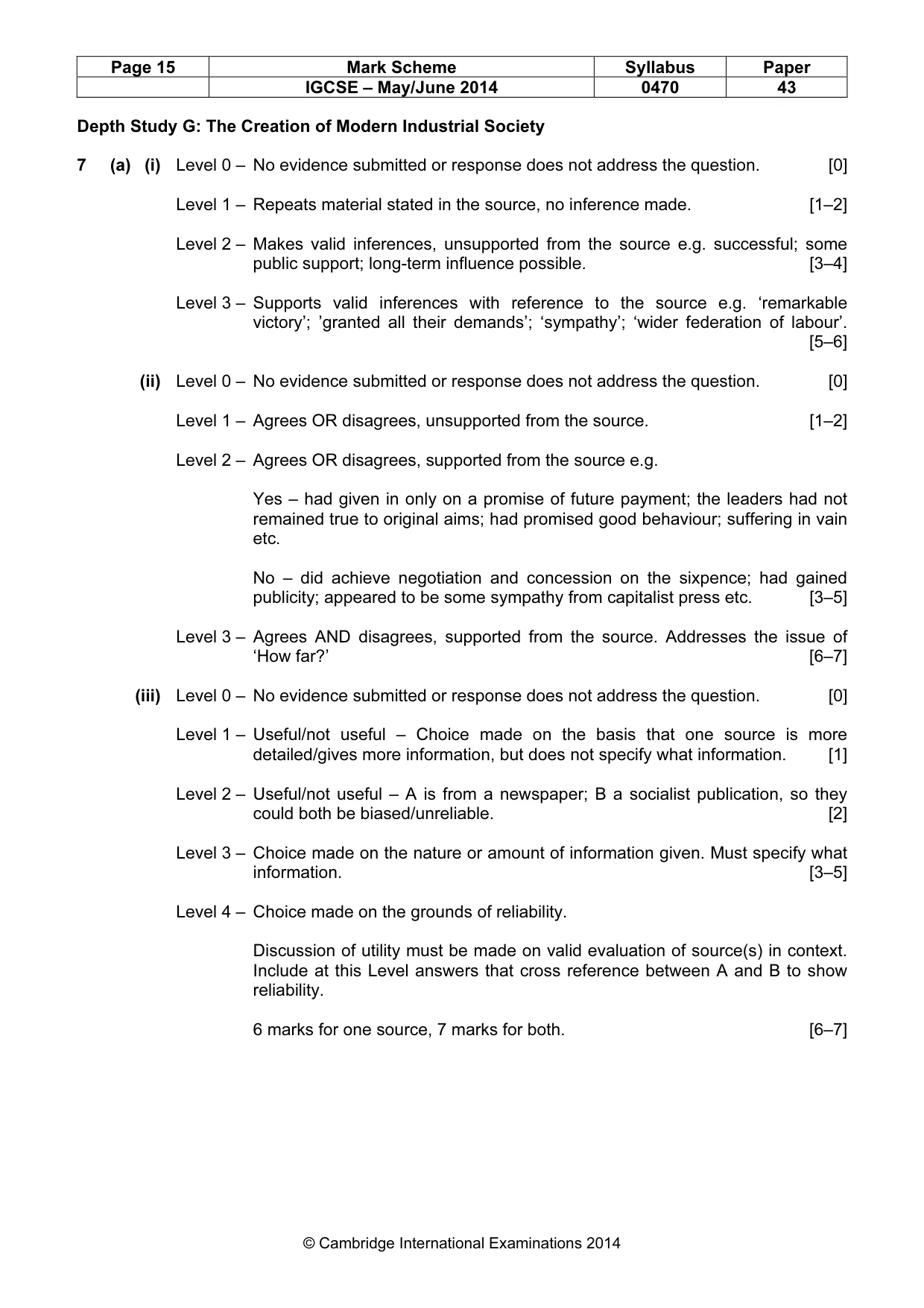
Page 15 Mark Scheme Syllabus Paper IGCSE – May/June 2014 0470 43 © Cambridge International Examinations 2014 Depth Study G: The Creation of Modern Industrial Society 7 (a) (i) Level 0 – No evidence submitted or response does not address the question. [0] Level 1 – Repeats material stated in the source, no inference made. [1–2] Level 2 – Makes valid inferences, unsupported from the source e.g. successful; some public support; long-term influence possible. [3–4] Level 3 – Supports valid inferences with reference to the source e.g. ‘remarkable victory’; ’granted all their demands’; ‘sympathy’; ‘wider federation of labour’. [5–6] (ii) Level 0 – No evidence submitted or response does not address the question. [0] Level 1 – Agrees OR disagrees, unsupported from the source. [1–2] Level 2 – Agrees OR disagrees, supported from the source e.g. Yes – had given in only on a promise of future payment; the leaders had not remained true to original aims; had promised good behaviour; suffering in vain etc. No – did achieve negotiation and concession on the sixpence; had gained publicity; appeared to be some sympathy from capitalist press etc. [3–5] Level 3 – Agrees AND disagrees, supported from the source. Addresses the issue of ‘How far?’ [6–7] (iii) Level 0 – No evidence submitted or response does not address the question. [0] Level 1 – Useful/not useful – Choice made on the basis that one source is more detailed/gives more information, but does not specify what information. [1] Level 2 – Useful/not useful – A is from a newspaper; B a socialist publication, so they could both be biased/unreliable. [2] Level 3 – Choice made on the nature or amount of information given. Must specify what information. [3–5] Level 4 – Choice made on the grounds of reliability. Discussion of utility must be made on valid evaluation of source(s) in context. Include at this Level answers that cross reference between A and B to show reliability. 6 marks for one source, 7 marks for both. [6–7]
Mark scheme, page 16
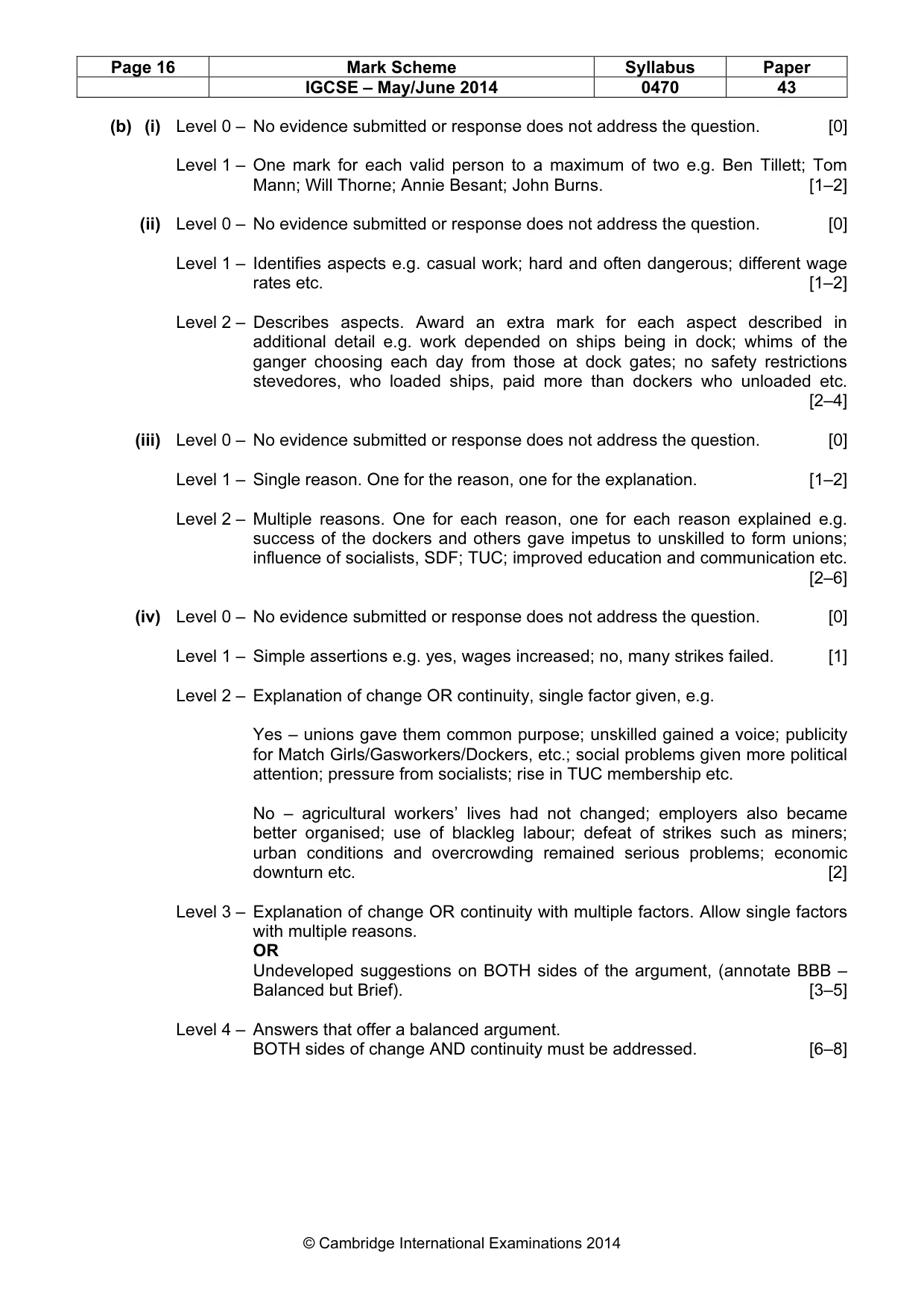
Page 16 Mark Scheme Syllabus Paper IGCSE – May/June 2014 0470 43 © Cambridge International Examinations 2014 (b) (i) Level 0 – No evidence submitted or response does not address the question. [0] Level 1 – One mark for each valid person to a maximum of two e.g. Ben Tillett; Tom Mann; Will Thorne; Annie Besant; John Burns. [1–2] (ii) Level 0 – No evidence submitted or response does not address the question. [0] Level 1 – Identifies aspects e.g. casual work; hard and often dangerous; different wage rates etc. [1–2] Level 2 – Describes aspects. Award an extra mark for each aspect described in additional detail e.g. work depended on ships being in dock; whims of the ganger choosing each day from those at dock gates; no safety restrictions stevedores, who loaded ships, paid more than dockers who unloaded etc. [2–4] (iii) Level 0 – No evidence submitted or response does not address the question. [0] Level 1 – Single reason. One for the reason, one for the explanation. [1–2] Level 2 – Multiple reasons. One for each reason, one for each reason explained e.g. success of the dockers and others gave impetus to unskilled to form unions; influence of socialists, SDF; TUC; improved education and communication etc. [2–6] (iv) Level 0 – No evidence submitted or response does not address the question. [0] Level 1 – Simple assertions e.g. yes, wages increased; no, many strikes failed. [1] Level 2 – Explanation of change OR continuity, single factor given, e.g. Yes – unions gave them common purpose; unskilled gained a voice; publicity for Match Girls/Gasworkers/Dockers, etc.; social problems given more political attention; pressure from socialists; rise in TUC membership etc. No – agricultural workers’ lives had not changed; employers also became better organised; use of blackleg labour; defeat of strikes such as miners; urban conditions and overcrowding remained serious problems; economic downturn etc. [2] Level 3 – Explanation of change OR continuity with multiple factors. Allow single factors with multiple reasons. OR Undeveloped suggestions on BOTH sides of the argument, (annotate BBB – Balanced but Brief). [3–5] Level 4 – Answers that offer a balanced argument. BOTH sides of change AND continuity must be addressed. [6–8]
Mark scheme, page 17
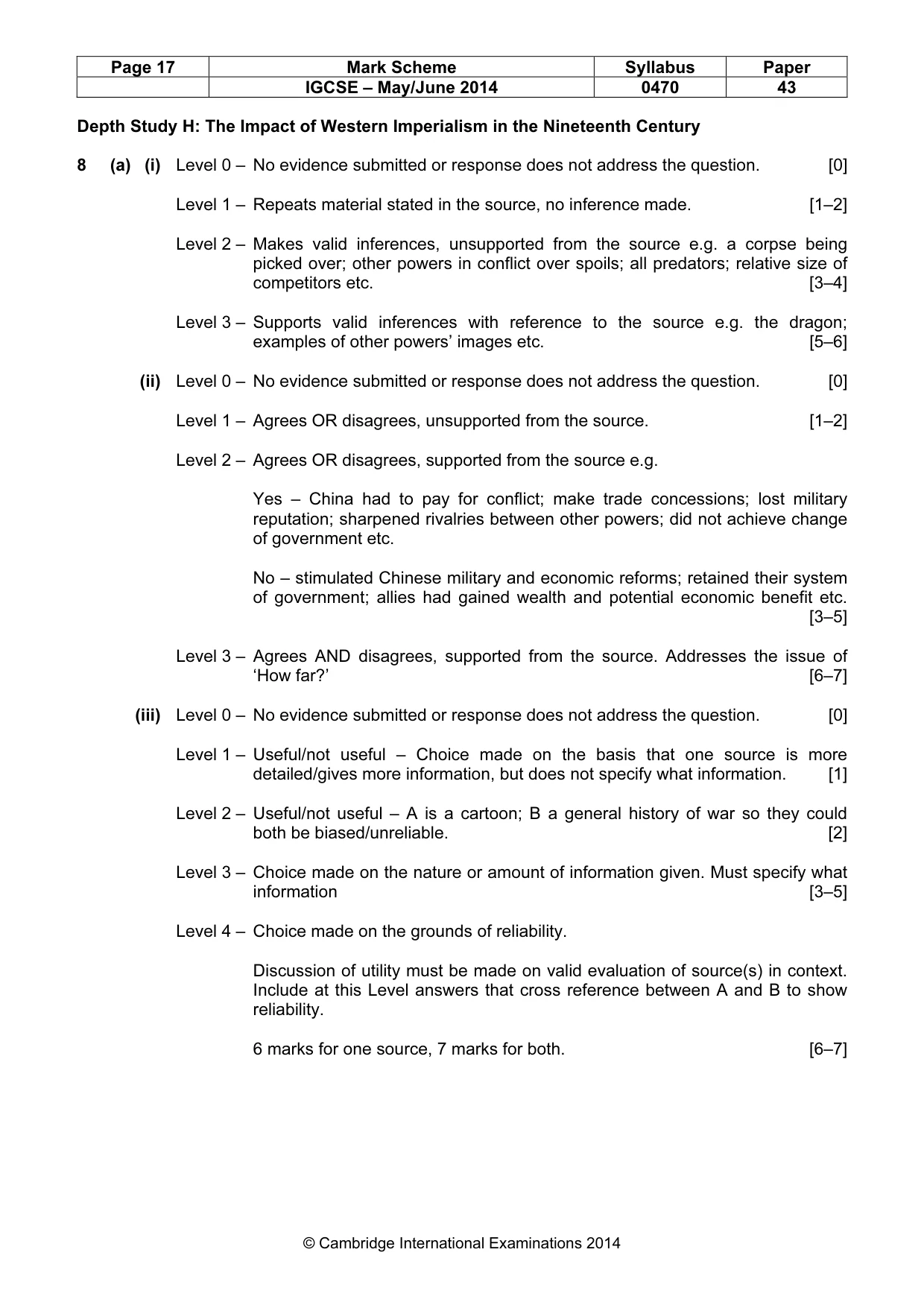
Page 17 Mark Scheme Syllabus Paper IGCSE – May/June 2014 0470 43 © Cambridge International Examinations 2014 Depth Study H: The Impact of Western Imperialism in the Nineteenth Century 8 (a) (i) Level 0 – No evidence submitted or response does not address the question. [0] Level 1 – Repeats material stated in the source, no inference made. [1–2] Level 2 – Makes valid inferences, unsupported from the source e.g. a corpse being picked over; other powers in conflict over spoils; all predators; relative size of competitors etc. [3–4] Level 3 – Supports valid inferences with reference to the source e.g. the dragon; examples of other powers’ images etc. [5–6] (ii) Level 0 – No evidence submitted or response does not address the question. [0] Level 1 – Agrees OR disagrees, unsupported from the source. [1–2] Level 2 – Agrees OR disagrees, supported from the source e.g. Yes – China had to pay for conflict; make trade concessions; lost military reputation; sharpened rivalries between other powers; did not achieve change of government etc. No – stimulated Chinese military and economic reforms; retained their system of government; allies had gained wealth and potential economic benefit etc. [3–5] Level 3 – Agrees AND disagrees, supported from the source. Addresses the issue of ‘How far?’ [6–7] (iii) Level 0 – No evidence submitted or response does not address the question. [0] Level 1 – Useful/not useful – Choice made on the basis that one source is more detailed/gives more information, but does not specify what information. [1] Level 2 – Useful/not useful – A is a cartoon; B a general history of war so they could both be biased/unreliable. [2] Level 3 – Choice made on the nature or amount of information given. Must specify what information [3–5] Level 4 – Choice made on the grounds of reliability. Discussion of utility must be made on valid evaluation of source(s) in context. Include at this Level answers that cross reference between A and B to show reliability. 6 marks for one source, 7 marks for both. [6–7]
Mark scheme, page 18
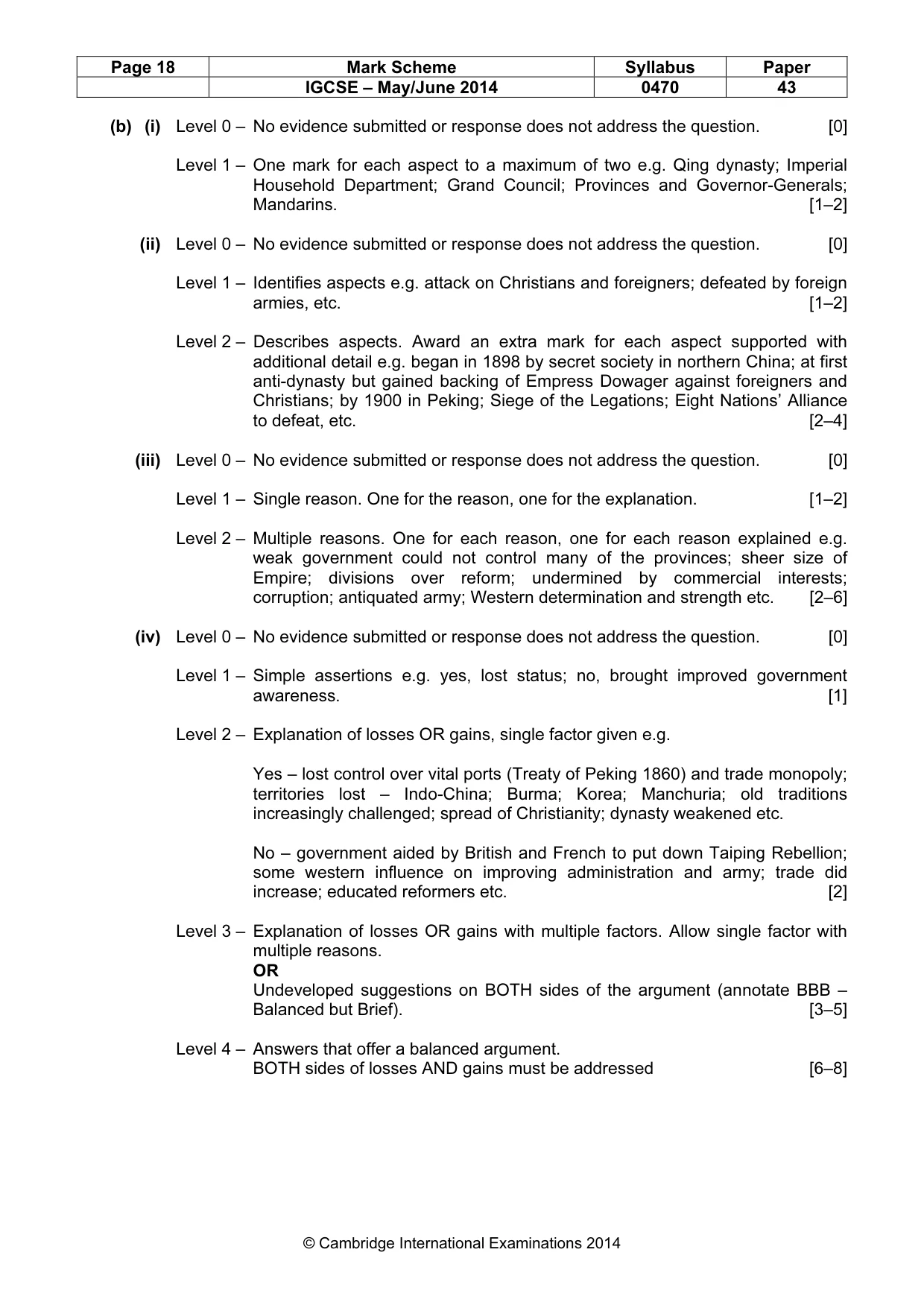
Page 18 Mark Scheme Syllabus Paper IGCSE – May/June 2014 0470 43 © Cambridge International Examinations 2014 (b) (i) Level 0 – No evidence submitted or response does not address the question. [0] Level 1 – One mark for each aspect to a maximum of two e.g. Qing dynasty; Imperial Household Department; Grand Council; Provinces and Governor-Generals; Mandarins. [1–2] (ii) Level 0 – No evidence submitted or response does not address the question. [0] Level 1 – Identifies aspects e.g. attack on Christians and foreigners; defeated by foreign armies, etc. [1–2] Level 2 – Describes aspects. Award an extra mark for each aspect supported with additional detail e.g. began in 1898 by secret society in northern China; at first anti-dynasty but gained backing of Empress Dowager against foreigners and Christians; by 1900 in Peking; Siege of the Legations; Eight Nations’ Alliance to defeat, etc. [2–4] (iii) Level 0 – No evidence submitted or response does not address the question. [0] Level 1 – Single reason. One for the reason, one for the explanation. [1–2] Level 2 – Multiple reasons. One for each reason, one for each reason explained e.g. weak government could not control many of the provinces; sheer size of Empire; divisions over reform; undermined by commercial interests; corruption; antiquated army; Western determination and strength etc. [2–6] (iv) Level 0 – No evidence submitted or response does not address the question. [0] Level 1 – Simple assertions e.g. yes, lost status; no, brought improved government awareness. [1] Level 2 – Explanation of losses OR gains, single factor given e.g. Yes – lost control over vital ports (Treaty of Peking 1860) and trade monopoly; territories lost – Indo-China; Burma; Korea; Manchuria; old traditions increasingly challenged; spread of Christianity; dynasty weakened etc. No – government aided by British and French to put down Taiping Rebellion; some western influence on improving administration and army; trade did increase; educated reformers etc. [2] Level 3 – Explanation of losses OR gains with multiple factors. Allow single factor with multiple reasons. OR Undeveloped suggestions on BOTH sides of the argument (annotate BBB – Balanced but Brief). [3–5] Level 4 – Answers that offer a balanced argument. BOTH sides of losses AND gains must be addressed [6–8]
What you needed in this session
Cambridge’s own grade thresholds for 2014 May/June, Paper 4 · Variant 3. A higher threshold means an easier paper — the bar moves with how the cohort did.