Cambridge IGCSE History 0470 — 2014 May/June Paper 4 · Variant 2
0470/42/M/J/14 · 40 marks · ≈45 min
The question paper and its mark scheme, free to read here and free to download. This is Cambridge’s own paper, exactly as it was sat.
Question paper12 pages
Mark scheme17 pages
Answers below. Sit the paper first if you are practising.
Paper as text
Question paper, page 1
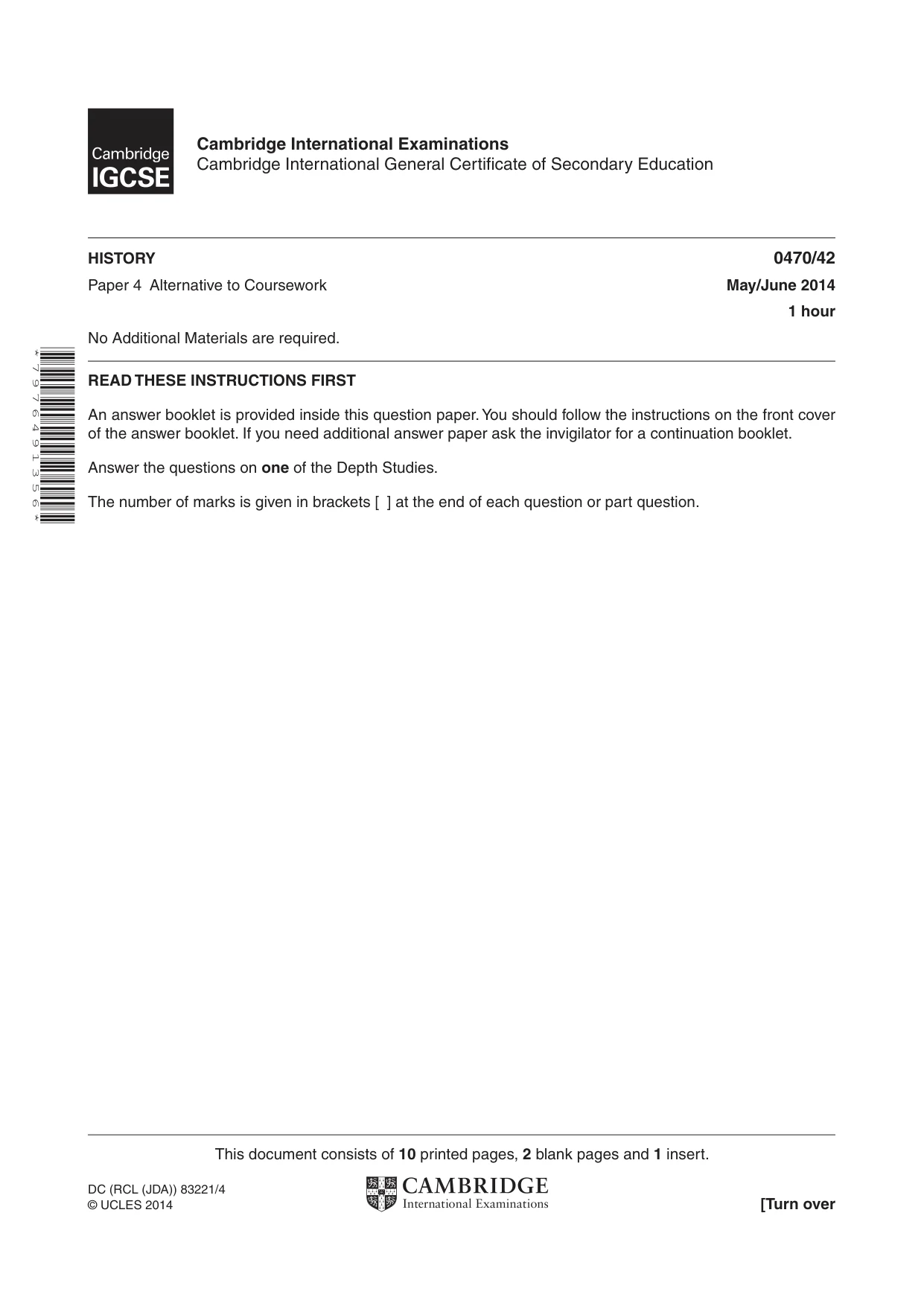
This document consists of 10 printed pages, 2 blank pages and 1 insert. DC (RCL (JDA)) 83221/4 © UCLES 2014 [Turn over Cambridge International Examinations Cambridge International General Certificate of Secondary Education * 7 9 7 6 4 9 1 3 5 6 * HISTORY 0470/42 Paper 4 Alternative to Coursework May/June 2014 1 hour No Additional Materials are required. READ THESE INSTRUCTIONS FIRST An answer booklet is provided inside this question paper. You should follow the instructions on the front cover of the answer booklet. If you need additional answer paper ask the invigilator for a continuation booklet. Answer the questions on one of the Depth Studies. The number of marks is given in brackets [ ] at the end of each question or part question.
Question paper, page 2
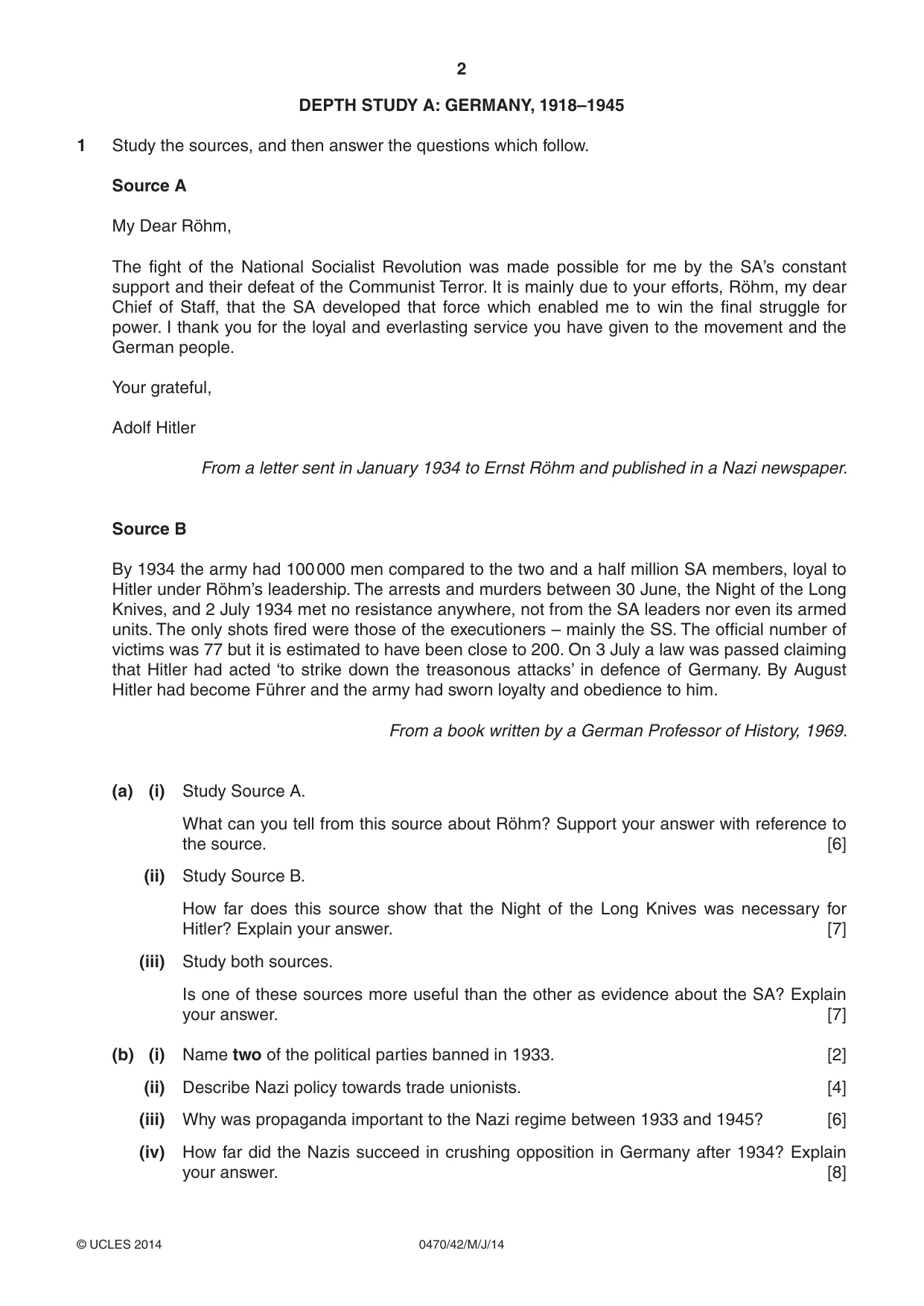
2 0470/42/M/J/14 © UCLES 2014 DEPTH STUDY A: GERMANY, 1918–1945 1 Study the sources, and then answer the questions which follow. Source A My Dear Röhm, The fight of the National Socialist Revolution was made possible for me by the SA’s constant support and their defeat of the Communist Terror. It is mainly due to your efforts, Röhm, my dear Chief of Staff, that the SA developed that force which enabled me to win the final struggle for power. I thank you for the loyal and everlasting service you have given to the movement and the German people. Your grateful, Adolf Hitler From a letter sent in January 1934 to Ernst Röhm and published in a Nazi newspaper. Source B By 1934 the army had 100 000 men compared to the two and a half million SA members, loyal to Hitler under Röhm’s leadership. The arrests and murders between 30 June, the Night of the Long Knives, and 2 July 1934 met no resistance anywhere, not from the SA leaders nor even its armed units. The only shots fired were those of the executioners – mainly the SS. The official number of victims was 77 but it is estimated to have been close to 200. On 3 July a law was passed claiming that Hitler had acted ‘to strike down the treasonous attacks’ in defence of Germany. By August Hitler had become Führer and the army had sworn loyalty and obedience to him. From a book written by a German Professor of History, 1969. (a) (i) Study Source A. What can you tell from this source about Röhm? Support your answer with reference to the source. [6] (ii) Study Source B. How far does this source show that the Night of the Long Knives was necessary for Hitler? Explain your answer. [7] (iii) Study both sources. Is one of these sources more useful than the other as evidence about the SA? Explain your answer. [7] (b) (i) Name two of the political parties banned in 1933. [2] (ii) Describe Nazi policy towards trade unionists. [4] (iii) Why was propaganda important to the Nazi regime between 1933 and 1945? [6] (iv) How far did the Nazis succeed in crushing opposition in Germany after 1934? Explain your answer. [8]
Question paper, page 3
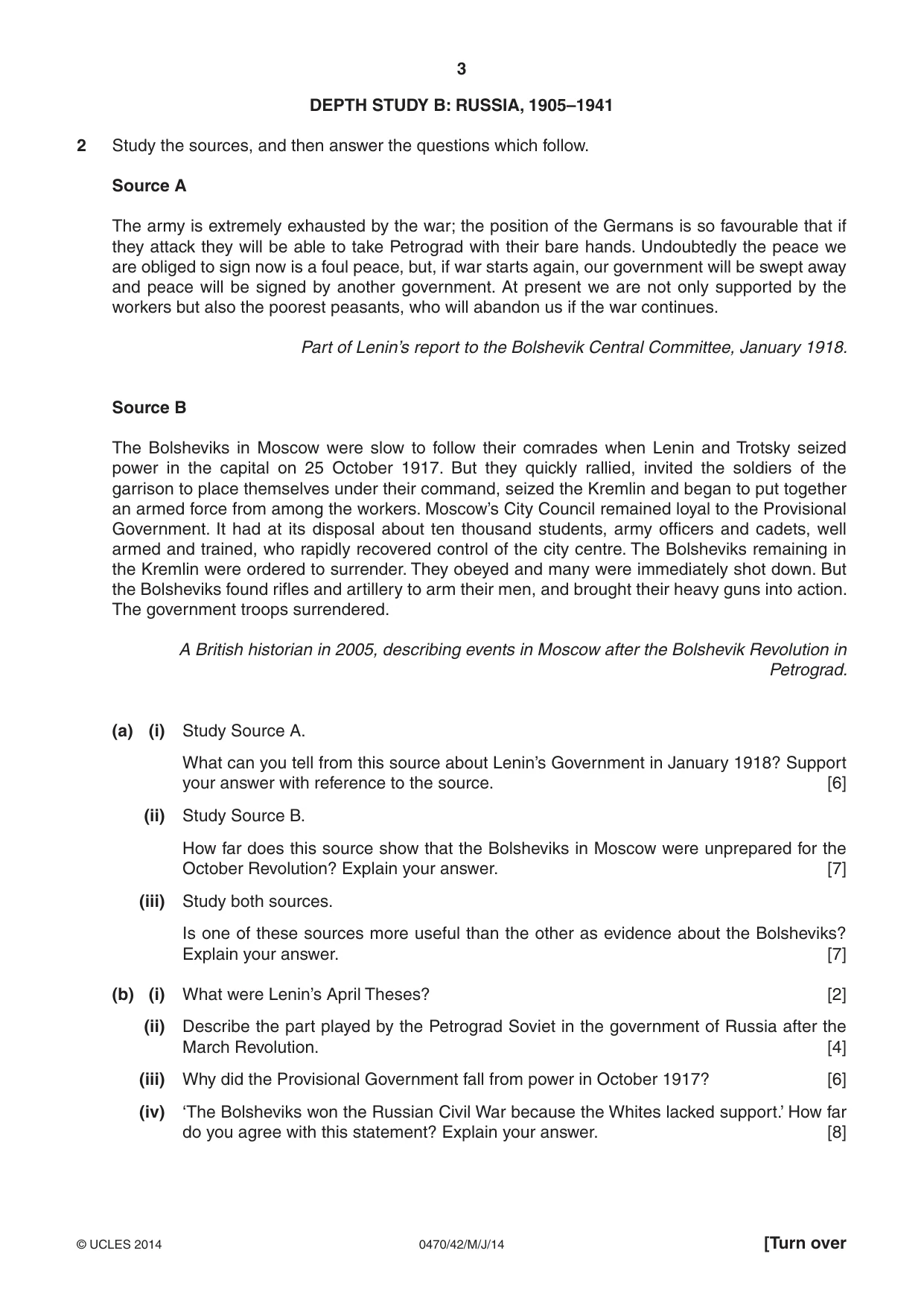
3 0470/42/M/J/14 © UCLES 2014 [Turn over DEPTH STUDY B: RUSSIA, 1905–1941 2 Study the sources, and then answer the questions which follow. Source A The army is extremely exhausted by the war; the position of the Germans is so favourable that if they attack they will be able to take Petrograd with their bare hands. Undoubtedly the peace we are obliged to sign now is a foul peace, but, if war starts again, our government will be swept away and peace will be signed by another government. At present we are not only supported by the workers but also the poorest peasants, who will abandon us if the war continues. Part of Lenin’s report to the Bolshevik Central Committee, January 1918. Source B The Bolsheviks in Moscow were slow to follow their comrades when Lenin and Trotsky seized power in the capital on 25 October 1917. But they quickly rallied, invited the soldiers of the garrison to place themselves under their command, seized the Kremlin and began to put together an armed force from among the workers. Moscow’s City Council remained loyal to the Provisional Government. It had at its disposal about ten thousand students, army officers and cadets, well armed and trained, who rapidly recovered control of the city centre. The Bolsheviks remaining in the Kremlin were ordered to surrender. They obeyed and many were immediately shot down. But the Bolsheviks found rifles and artillery to arm their men, and brought their heavy guns into action. The government troops surrendered. A British historian in 2005, describing events in Moscow after the Bolshevik Revolution in Petrograd. (a) (i) Study Source A. What can you tell from this source about Lenin’s Government in January 1918? Support your answer with reference to the source. [6] (ii) Study Source B. How far does this source show that the Bolsheviks in Moscow were unprepared for the October Revolution? Explain your answer. [7] (iii) Study both sources. Is one of these sources more useful than the other as evidence about the Bolsheviks? Explain your answer. [7] (b) (i) What were Lenin’s April Theses? [2] (ii) Describe the part played by the Petrograd Soviet in the government of Russia after the March Revolution. [4] (iii) Why did the Provisional Government fall from power in October 1917? [6] (iv) ‘The Bolsheviks won the Russian Civil War because the Whites lacked support.’ How far do you agree with this statement? Explain your answer. [8]
Question paper, page 4
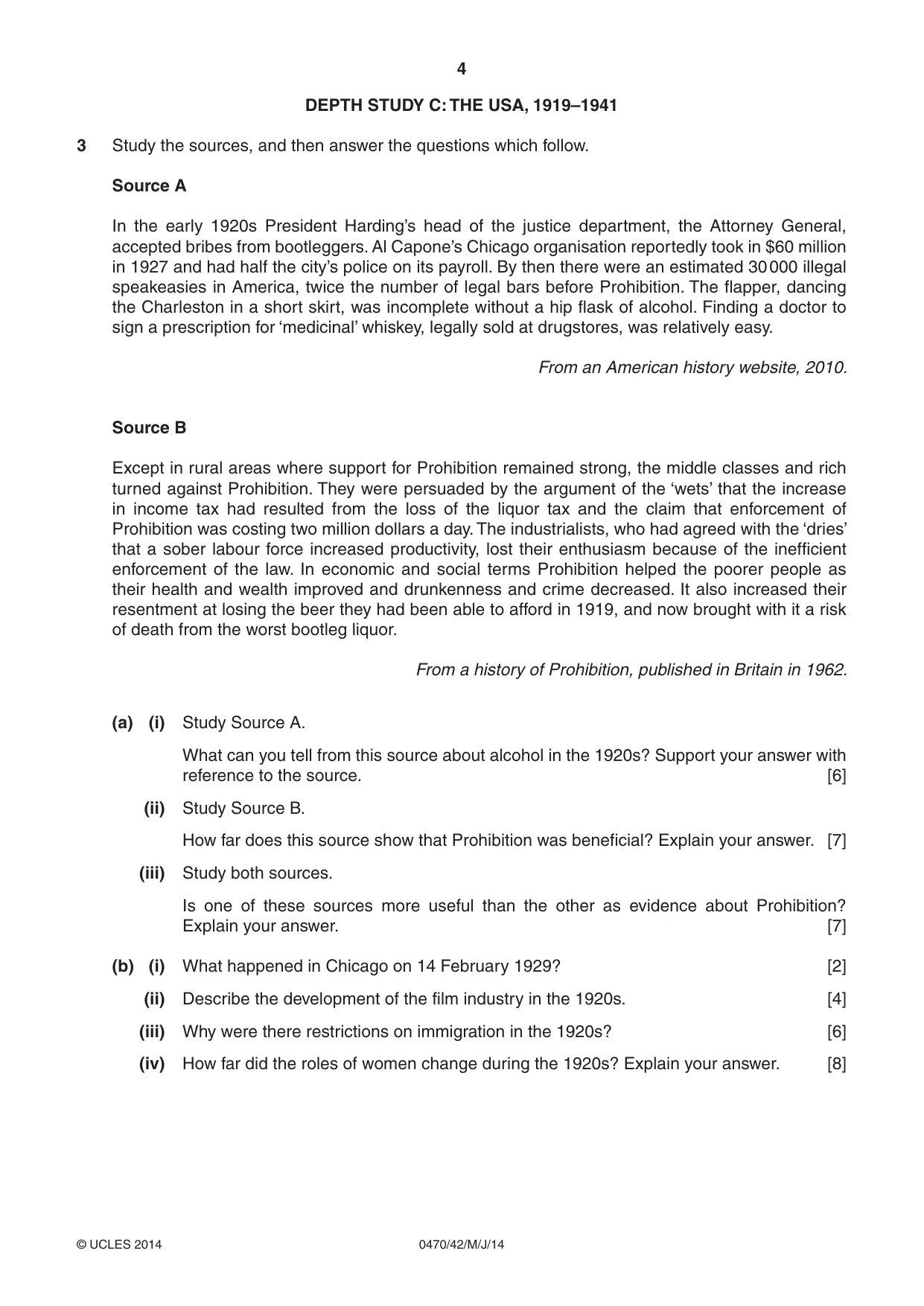
4 0470/42/M/J/14 © UCLES 2014 DEPTH STUDY C: THE USA, 1919–1941 3 Study the sources, and then answer the questions which follow. Source A In the early 1920s President Harding’s head of the justice department, the Attorney General, accepted bribes from bootleggers. Al Capone’s Chicago organisation reportedly took in $60 million in 1927 and had half the city’s police on its payroll. By then there were an estimated 30 000 illegal speakeasies in America, twice the number of legal bars before Prohibition. The flapper, dancing the Charleston in a short skirt, was incomplete without a hip flask of alcohol. Finding a doctor to sign a prescription for ‘medicinal’ whiskey, legally sold at drugstores, was relatively easy. From an American history website, 2010. Source B Except in rural areas where support for Prohibition remained strong, the middle classes and rich turned against Prohibition. They were persuaded by the argument of the ‘wets’ that the increase in income tax had resulted from the loss of the liquor tax and the claim that enforcement of Prohibition was costing two million dollars a day. The industrialists, who had agreed with the ‘dries’ that a sober labour force increased productivity, lost their enthusiasm because of the inefficient enforcement of the law. In economic and social terms Prohibition helped the poorer people as their health and wealth improved and drunkenness and crime decreased. It also increased their resentment at losing the beer they had been able to afford in 1919, and now brought with it a risk of death from the worst bootleg liquor. From a history of Prohibition, published in Britain in 1962. (a) (i) Study Source A. What can you tell from this source about alcohol in the 1920s? Support your answer with reference to the source. [6] (ii) Study Source B. How far does this source show that Prohibition was beneficial? Explain your answer. [7] (iii) Study both sources. Is one of these sources more useful than the other as evidence about Prohibition? Explain your answer. [7] (b) (i) What happened in Chicago on 14 February 1929? [2] (ii) Describe the development of the film industry in the 1920s. [4] (iii) Why were there restrictions on immigration in the 1920s? [6] (iv) How far did the roles of women change during the 1920s? Explain your answer. [8]
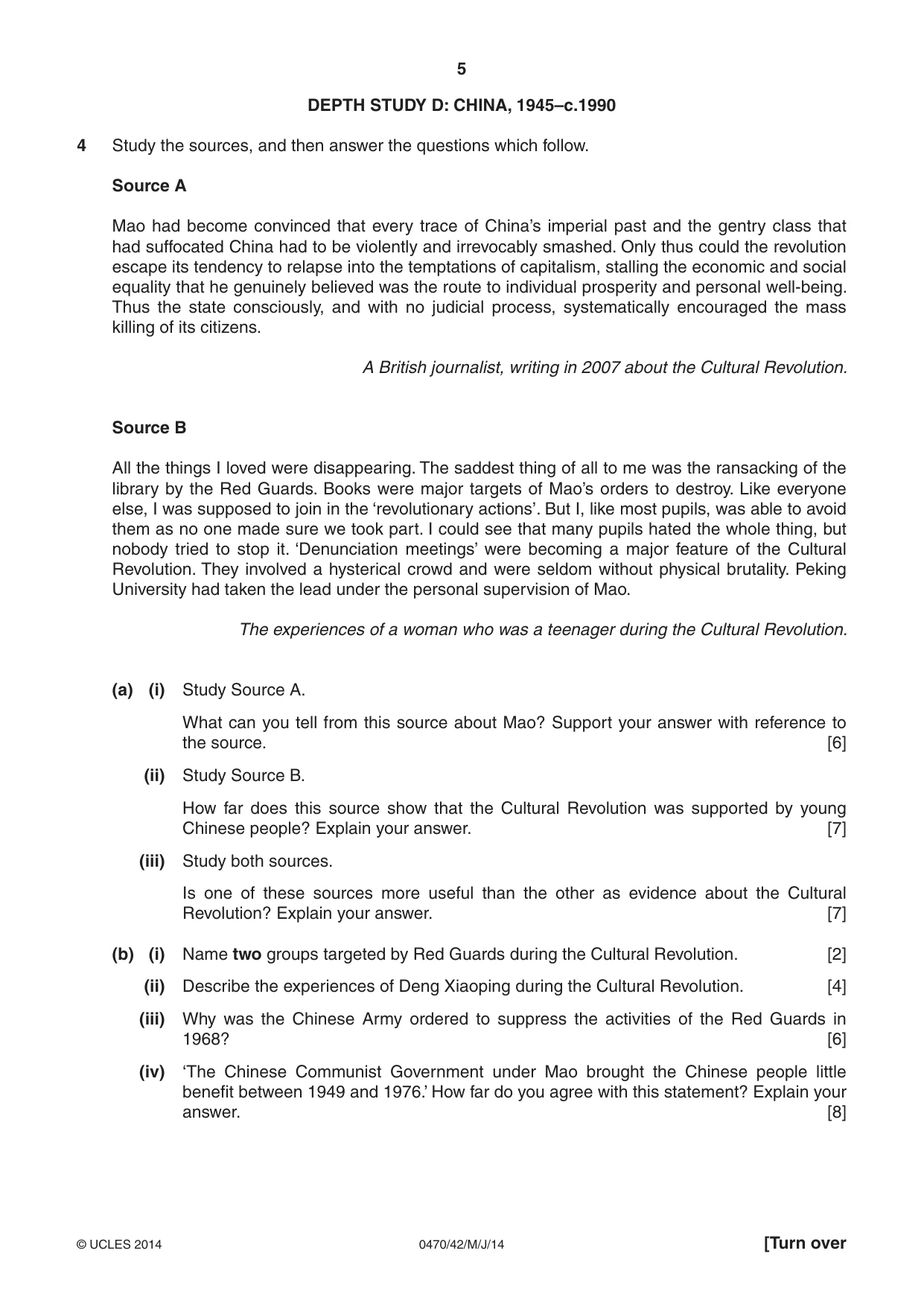
Question paper, page 5
5 0470/42/M/J/14 © UCLES 2014 [Turn over DEPTH STUDY D: CHINA, 1945–c.1990 4 Study the sources, and then answer the questions which follow. Source A Mao had become convinced that every trace of China’s imperial past and the gentry class that had suffocated China had to be violently and irrevocably smashed. Only thus could the revolution escape its tendency to relapse into the temptations of capitalism, stalling the economic and social equality that he genuinely believed was the route to individual prosperity and personal well-being. Thus the state consciously, and with no judicial process, systematically encouraged the mass killing of its citizens. A British journalist, writing in 2007 about the Cultural Revolution. Source B All the things I loved were disappearing. The saddest thing of all to me was the ransacking of the library by the Red Guards. Books were major targets of Mao’s orders to destroy. Like everyone else, I was supposed to join in the ‘revolutionary actions’. But I, like most pupils, was able to avoid them as no one made sure we took part. I could see that many pupils hated the whole thing, but nobody tried to stop it. ‘Denunciation meetings’ were becoming a major feature of the Cultural Revolution. They involved a hysterical crowd and were seldom without physical brutality. Peking University had taken the lead under the personal supervision of Mao. The experiences of a woman who was a teenager during the Cultural Revolution. (a) (i) Study Source A. What can you tell from this source about Mao? Support your answer with reference to the source. [6] (ii) Study Source B. How far does this source show that the Cultural Revolution was supported by young Chinese people? Explain your answer. [7] (iii) Study both sources. Is one of these sources more useful than the other as evidence about the Cultural Revolution? Explain your answer. [7] (b) (i) Name two groups targeted by Red Guards during the Cultural Revolution. [2] (ii) Describe the experiences of Deng Xiaoping during the Cultural Revolution. [4] (iii) Why was the Chinese Army ordered to suppress the activities of the Red Guards in 1968? [6] (iv) ‘The Chinese Communist Government under Mao brought the Chinese people little benefit between 1949 and 1976.’ How far do you agree with this statement? Explain your answer. [8]
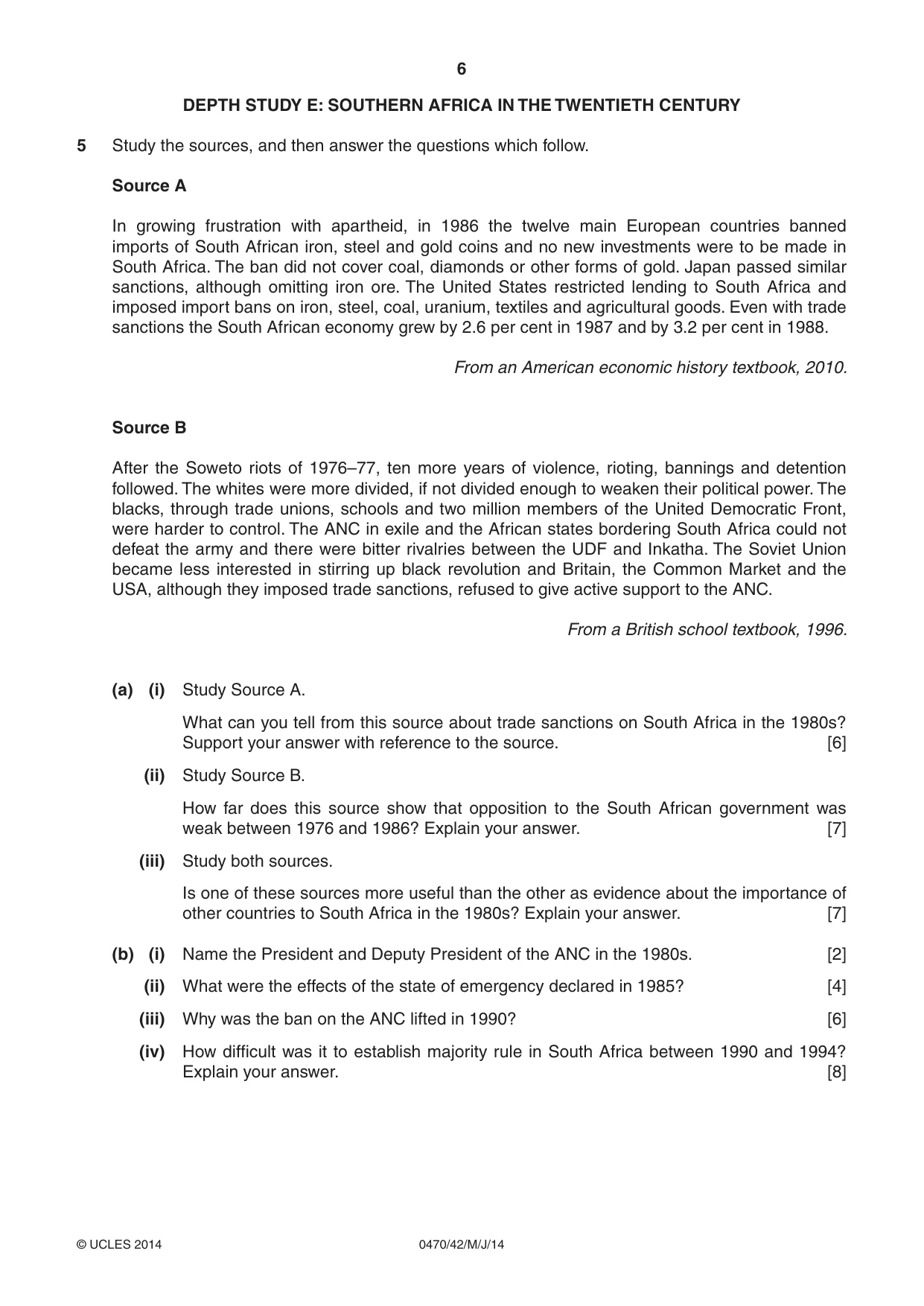
Question paper, page 6
6 0470/42/M/J/14 © UCLES 2014 DEPTH STUDY E: SOUTHERN AFRICA IN THE TWENTIETH CENTURY 5 Study the sources, and then answer the questions which follow. Source A In growing frustration with apartheid, in 1986 the twelve main European countries banned imports of South African iron, steel and gold coins and no new investments were to be made in South Africa. The ban did not cover coal, diamonds or other forms of gold. Japan passed similar sanctions, although omitting iron ore. The United States restricted lending to South Africa and imposed import bans on iron, steel, coal, uranium, textiles and agricultural goods. Even with trade sanctions the South African economy grew by 2.6 per cent in 1987 and by 3.2 per cent in 1988. From an American economic history textbook, 2010. Source B After the Soweto riots of 1976–77, ten more years of violence, rioting, bannings and detention followed. The whites were more divided, if not divided enough to weaken their political power. The blacks, through trade unions, schools and two million members of the United Democratic Front, were harder to control. The ANC in exile and the African states bordering South Africa could not defeat the army and there were bitter rivalries between the UDF and Inkatha. The Soviet Union became less interested in stirring up black revolution and Britain, the Common Market and the USA, although they imposed trade sanctions, refused to give active support to the ANC. From a British school textbook, 1996. (a) (i) Study Source A. What can you tell from this source about trade sanctions on South Africa in the 1980s? Support your answer with reference to the source. [6] (ii) Study Source B. How far does this source show that opposition to the South African government was weak between 1976 and 1986? Explain your answer. [7] (iii) Study both sources. Is one of these sources more useful than the other as evidence about the importance of other countries to South Africa in the 1980s? Explain your answer. [7] (b) (i) Name the President and Deputy President of the ANC in the 1980s. [2] (ii) What were the effects of the state of emergency declared in 1985? [4] (iii) Why was the ban on the ANC lifted in 1990? [6] (iv) How difficult was it to establish majority rule in South Africa between 1990 and 1994? Explain your answer. [8]
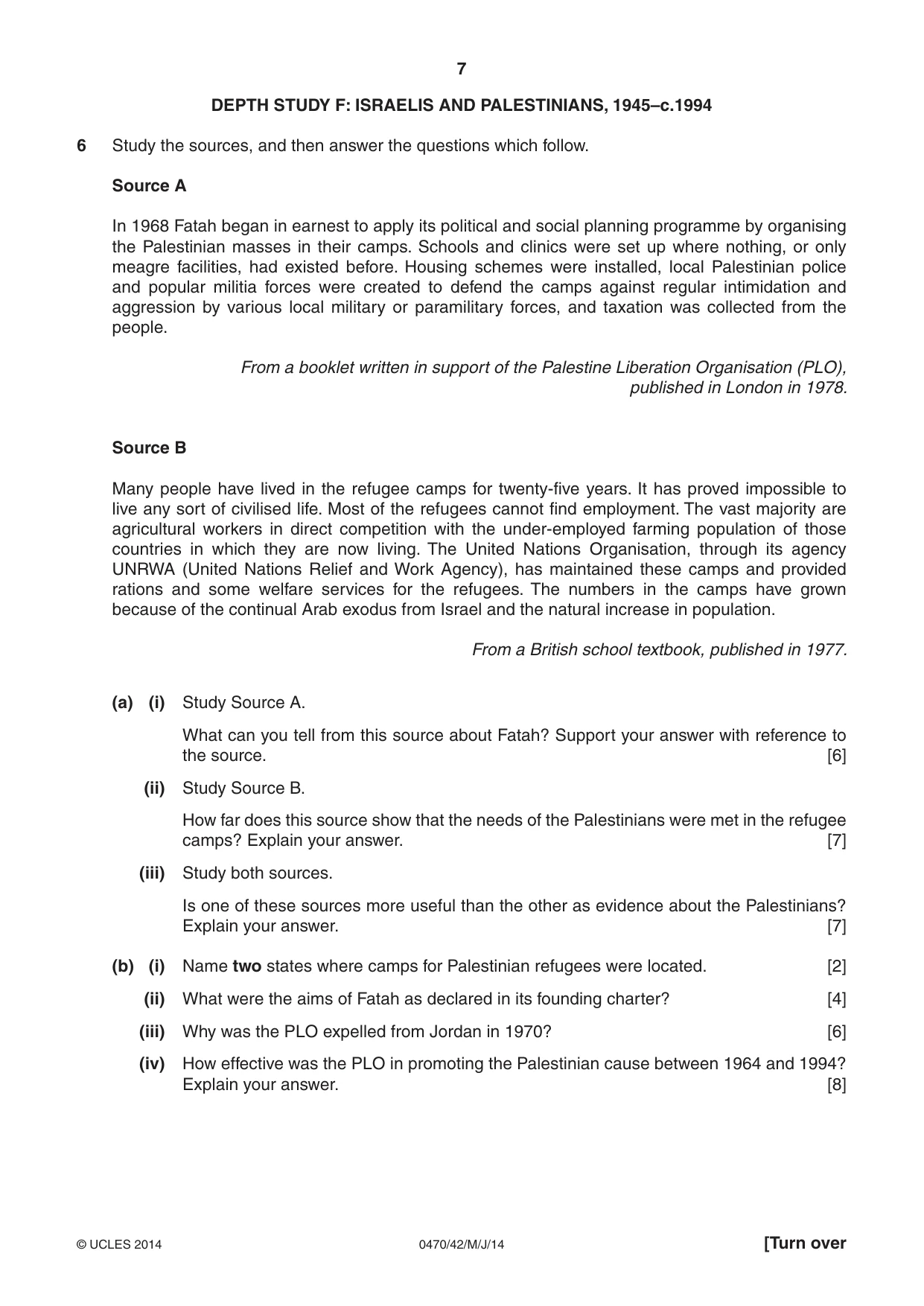
Question paper, page 7
7 0470/42/M/J/14 © UCLES 2014 [Turn over DEPTH STUDY F: ISRAELIS AND PALESTINIANS, 1945–c.1994 6 Study the sources, and then answer the questions which follow. Source A In 1968 Fatah began in earnest to apply its political and social planning programme by organising the Palestinian masses in their camps. Schools and clinics were set up where nothing, or only meagre facilities, had existed before. Housing schemes were installed, local Palestinian police and popular militia forces were created to defend the camps against regular intimidation and aggression by various local military or paramilitary forces, and taxation was collected from the people. From a booklet written in support of the Palestine Liberation Organisation (PLO), published in London in 1978. Source B Many people have lived in the refugee camps for twenty-five years. It has proved impossible to live any sort of civilised life. Most of the refugees cannot find employment. The vast majority are agricultural workers in direct competition with the under-employed farming population of those countries in which they are now living. The United Nations Organisation, through its agency UNRWA (United Nations Relief and Work Agency), has maintained these camps and provided rations and some welfare services for the refugees. The numbers in the camps have grown because of the continual Arab exodus from Israel and the natural increase in population. From a British school textbook, published in 1977. (a) (i) Study Source A. What can you tell from this source about Fatah? Support your answer with reference to the source. [6] (ii) Study Source B. How far does this source show that the needs of the Palestinians were met in the refugee camps? Explain your answer. [7] (iii) Study both sources. Is one of these sources more useful than the other as evidence about the Palestinians? Explain your answer. [7] (b) (i) Name two states where camps for Palestinian refugees were located. [2] (ii) What were the aims of Fatah as declared in its founding charter? [4] (iii) Why was the PLO expelled from Jordan in 1970? [6] (iv) How effective was the PLO in promoting the Palestinian cause between 1964 and 1994? Explain your answer. [8]
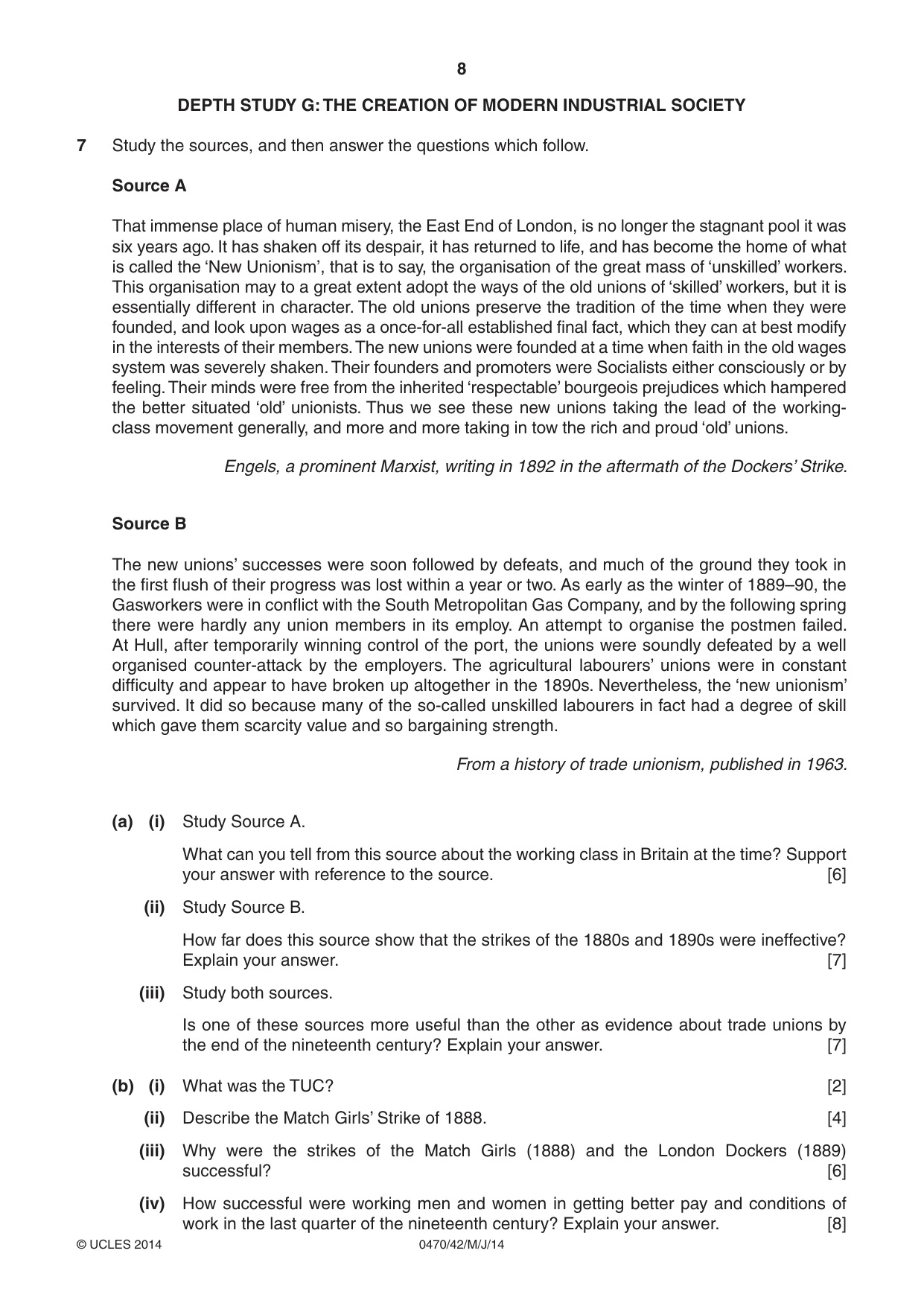
Question paper, page 8
8 0470/42/M/J/14 © UCLES 2014 DEPTH STUDY G: THE CREATION OF MODERN INDUSTRIAL SOCIETY 7 Study the sources, and then answer the questions which follow. Source A That immense place of human misery, the East End of London, is no longer the stagnant pool it was six years ago. It has shaken off its despair, it has returned to life, and has become the home of what is called the ‘New Unionism’, that is to say, the organisation of the great mass of ‘unskilled’ workers. This organisation may to a great extent adopt the ways of the old unions of ‘skilled’ workers, but it is essentially different in character. The old unions preserve the tradition of the time when they were founded, and look upon wages as a once-for-all established final fact, which they can at best modify in the interests of their members. The new unions were founded at a time when faith in the old wages system was severely shaken. Their founders and promoters were Socialists either consciously or by feeling. Their minds were free from the inherited ‘respectable’ bourgeois prejudices which hampered the better situated ‘old’ unionists. Thus we see these new unions taking the lead of the working- class movement generally, and more and more taking in tow the rich and proud ‘old’ unions. Engels, a prominent Marxist, writing in 1892 in the aftermath of the Dockers’ Strike. Source B The new unions’ successes were soon followed by defeats, and much of the ground they took in the first flush of their progress was lost within a year or two. As early as the winter of 1889–90, the Gasworkers were in conflict with the South Metropolitan Gas Company, and by the following spring there were hardly any union members in its employ. An attempt to organise the postmen failed. At Hull, after temporarily winning control of the port, the unions were soundly defeated by a well organised counter-attack by the employers. The agricultural labourers’ unions were in constant difficulty and appear to have broken up altogether in the 1890s. Nevertheless, the ‘new unionism’ survived. It did so because many of the so-called unskilled labourers in fact had a degree of skill which gave them scarcity value and so bargaining strength. From a history of trade unionism, published in 1963. (a) (i) Study Source A. What can you tell from this source about the working class in Britain at the time? Support your answer with reference to the source. [6] (ii) Study Source B. How far does this source show that the strikes of the 1880s and 1890s were ineffective? Explain your answer. [7] (iii) Study both sources. Is one of these sources more useful than the other as evidence about trade unions by the end of the nineteenth century? Explain your answer. [7] (b) (i) What was the TUC? [2] (ii) Describe the Match Girls’ Strike of 1888. [4] (iii) Why were the strikes of the Match Girls (1888) and the London Dockers (1889) successful? [6] (iv) How successful were working men and women in getting better pay and conditions of work in the last quarter of the nineteenth century? Explain your answer. [8]
Question paper, page 9
9 0470/42/M/J/14 © UCLES 2014 [Turn over BLANK PAGE TURN OVER FOR QUESTION 8.
Question paper, page 10
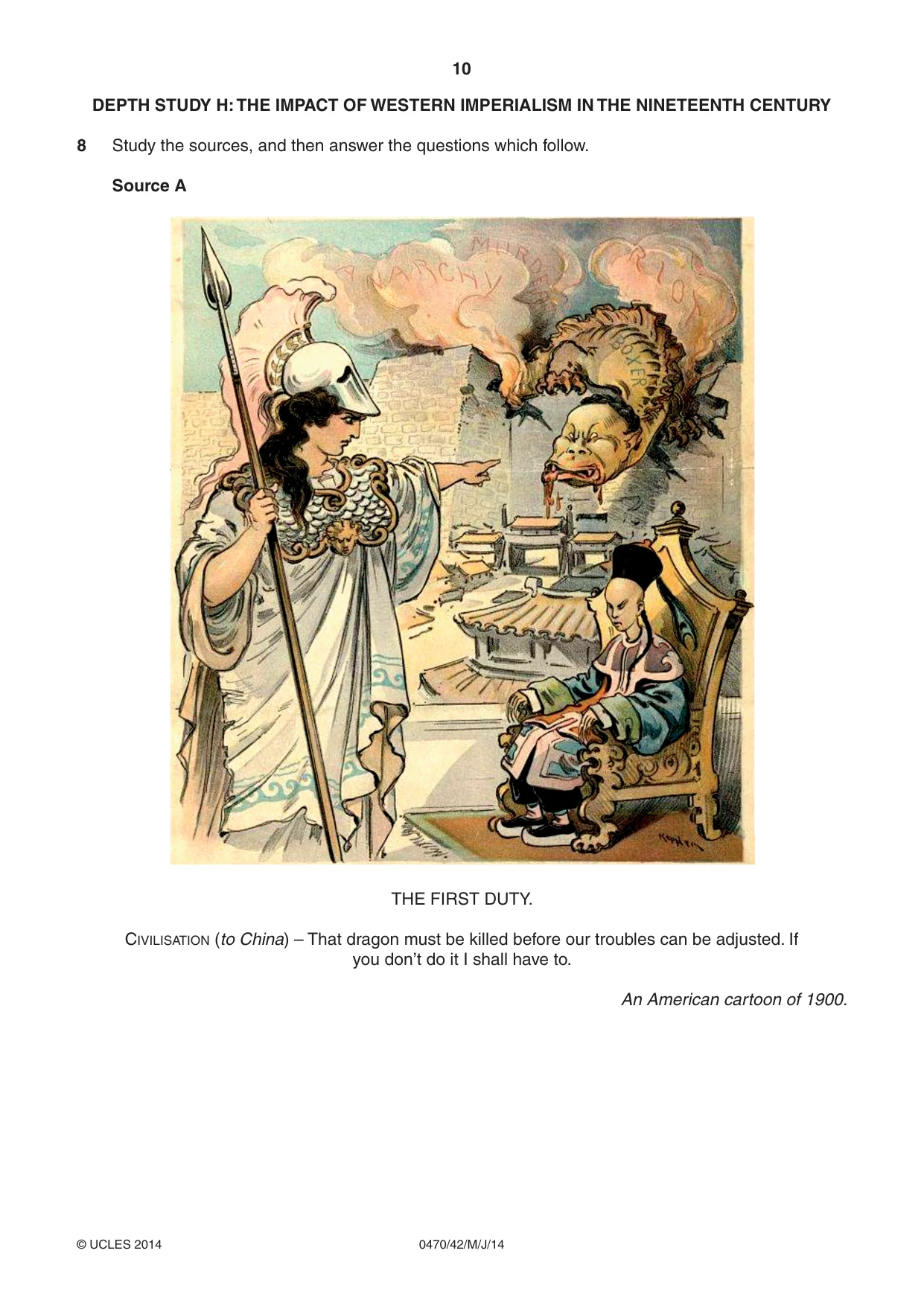
10 0470/42/M/J/14 © UCLES 2014 DEPTH STUDY H: THE IMPACT OF WESTERN IMPERIALISM IN THE NINETEENTH CENTURY 8 Study the sources, and then answer the questions which follow. Source A THE FIRST DUTY. CIVILISATION (to China) – That dragon must be killed before our troubles can be adjusted. If you don’t do it I shall have to. An American cartoon of 1900.
Question paper, page 11
11 0470/42/M/J/14 © UCLES 2014 Source B The Western powers saw China as primitive and ripe for exploitation. At no point did the Western powers see China as an equal, despite the fact that Chinese civilisation pre-dated their own. When, in June 1900, the Empress released an edict explaining that secret societies were part of Chinese culture, the powers were furious as this gave almost official support to the Boxer movement. The Boxer movement started to spiral out of control and massacres of Chinese Christians began along with anti-Western riots and destruction of foreign property. Therefore, the Western powers gave the Chinese twenty-four hours to put down the Boxers or they would use their own troops to deal with the rising. From a recent article on the history of war. (a) (i) Study Source A. What can you tell from this source about Western attitudes towards China in 1900? Support your answer with reference to the source. [6] (ii) Study Source B. How far does this source show that it was the massacre of the Christians which caused the Western powers to intervene? Explain your answer. [7] (iii) Study both sources. Is one of these sources more useful than the other as evidence about the Western powers’ relationship with China at the end of the nineteenth century? Explain your answer. [7] (b) (i) Name two Chinese cities in which there was a significant European presence by the end of the nineteenth century. [2] (ii) Describe the siege of Beijing (Peking) in 1900. [4] (iii) Why were the Japanese able to defeat China in 1894–95? [6] (iv) ‘The decline of China in the nineteenth century was caused by Britain.’ How far do you agree with this statement? Explain your answer. [8]
Question paper, page 12
12 0470/42/M/J/14 © UCLES 2014 BLANK PAGE Copyright Acknowledgements: Depth Study A Source A © From a letter sent in January 1934 to Ernst Röhm and published in a Nazi newspaper. Depth Study A Source B © Karl Bracher; The German Dictatorship; Penguin Books Ltd; 1973. Depth Study B Source A © Part of Lenin’s report to the Bolshevik Central Committee, January 1918. Depth Study B Source B © Roderick Braithwaite; Moscow 1941; Profile Books Ltd; 2005. Depth Study C Source A © http://www.digitalhistory.uh.edu/database/article_display.cfm?HHID=441. Depth Study C Source B © Andrew Sinclair; Prohibition; New English Library Ltd; 1965. Depth Study D Source A © Will Hutton; The Writing on the Wall; Little, Brown Book Group; 2007. Depth Study D Source B © The experiences of a woman who was a teenager during the Cultural Revolution. Depth Study E Source A © T. Tyrer. Depth Study E Source B © M. Roberts; A History of South Africa; Longman; 1996. Depth Study F Source A © From a booklet written in support of the Palestine Liberation Organisation, published in London in 1978. Depth Study F Source B © Schools Council History 13-16 Project; Arab-Israeli Conflict; Holmes McDougal; 1977. Depth Study G Source A © Engels, writing in 1892 in the aftermath of the Dockers’ Strike. Depth Study G Source B © From a history of trade unionism, published in 1963. Permission to reproduce items where third-party owned material protected by copyright is included has been sought and cleared where possible. Every reasonable effort has been made by the publisher (UCLES) to trace copyright holders, but if any items requiring clearance have unwittingly been included, the publisher will be pleased to make amends at the earliest possible opportunity. Cambridge International Examinations is part of the Cambridge Assessment Group. Cambridge Assessment is the brand name of University of Cambridge Local Examinations Syndicate (UCLES), which is itself a department of the University of Cambridge.
Mark scheme, page 1
CAMBRIDGE INTERNATIONAL EXAMINATIONS International General Certificate of Secondary Education MARK SCHEME for the May/June 2014 series 0470 HISTORY 0470/42 Paper 4 (Alternative to Coursework), maximum raw mark 40 This mark scheme is published as an aid to teachers and candidates, to indicate the requirements of the examination. It shows the basis on which Examiners were instructed to award marks. It does not indicate the details of the discussions that took place at an Examiners’ meeting before marking began, which would have considered the acceptability of alternative answers. Mark schemes should be read in conjunction with the question paper and the Principal Examiner Report for Teachers. Cambridge will not enter into discussions about these mark schemes. Cambridge is publishing the mark schemes for the May/June 2014 series for most IGCSE, GCE Advanced Level and Advanced Subsidiary Level components and some Ordinary Level components.
Mark scheme, page 2
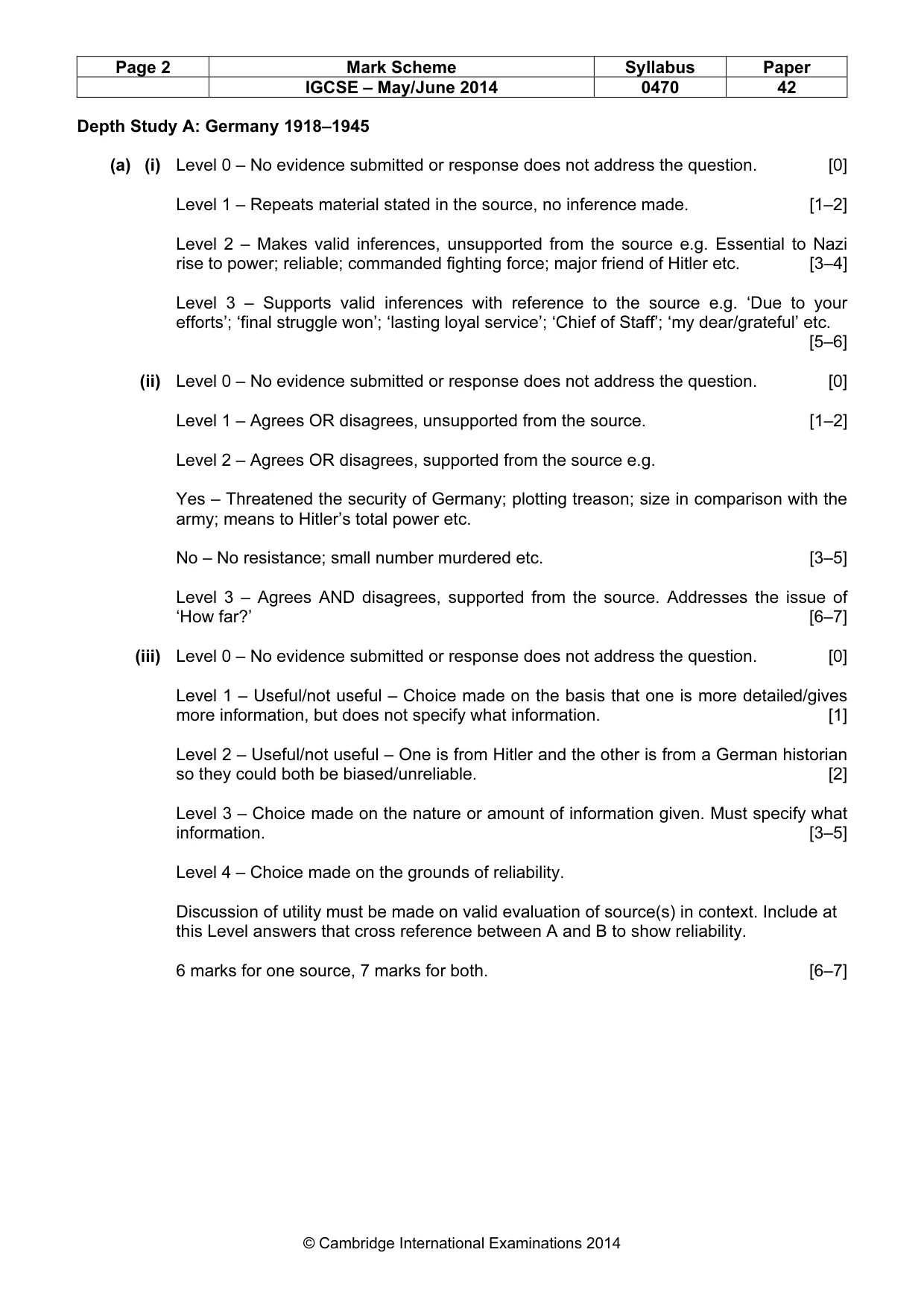
Page 2 Mark Scheme Syllabus Paper IGCSE – May/June 2014 0470 42 © Cambridge International Examinations 2014 Depth Study A: Germany 1918–1945 (a) (i) Level 0 – No evidence submitted or response does not address the question. [0] Level 1 – Repeats material stated in the source, no inference made. [1–2] Level 2 – Makes valid inferences, unsupported from the source e.g. Essential to Nazi rise to power; reliable; commanded fighting force; major friend of Hitler etc. [3–4] Level 3 – Supports valid inferences with reference to the source e.g. ‘Due to your efforts’; ‘final struggle won’; ‘lasting loyal service’; ‘Chief of Staff’; ‘my dear/grateful’ etc. [5–6] (ii) Level 0 – No evidence submitted or response does not address the question. [0] Level 1 – Agrees OR disagrees, unsupported from the source. [1–2] Level 2 – Agrees OR disagrees, supported from the source e.g. Yes – Threatened the security of Germany; plotting treason; size in comparison with the army; means to Hitler’s total power etc. No – No resistance; small number murdered etc. [3–5] Level 3 – Agrees AND disagrees, supported from the source. Addresses the issue of ‘How far?’ [6–7] (iii) Level 0 – No evidence submitted or response does not address the question. [0] Level 1 – Useful/not useful – Choice made on the basis that one is more detailed/gives more information, but does not specify what information. [1] Level 2 – Useful/not useful – One is from Hitler and the other is from a German historian so they could both be biased/unreliable. [2] Level 3 – Choice made on the nature or amount of information given. Must specify what information. [3–5] Level 4 – Choice made on the grounds of reliability. Discussion of utility must be made on valid evaluation of source(s) in context. Include at this Level answers that cross reference between A and B to show reliability. 6 marks for one source, 7 marks for both. [6–7]
Mark scheme, page 3
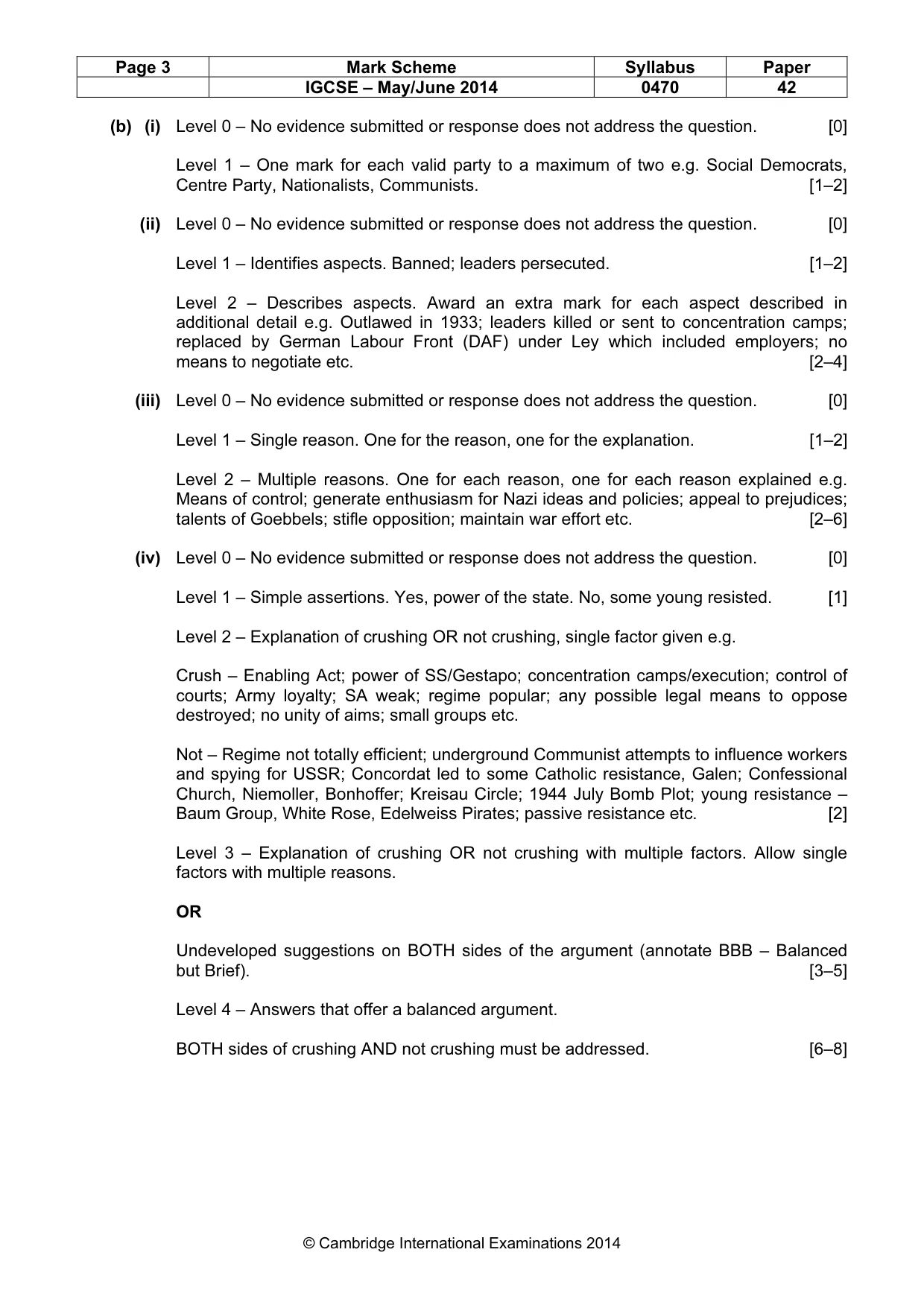
Page 3 Mark Scheme Syllabus Paper IGCSE – May/June 2014 0470 42 © Cambridge International Examinations 2014 (b) (i) Level 0 – No evidence submitted or response does not address the question. [0] Level 1 – One mark for each valid party to a maximum of two e.g. Social Democrats, Centre Party, Nationalists, Communists. [1–2] (ii) Level 0 – No evidence submitted or response does not address the question. [0] Level 1 – Identifies aspects. Banned; leaders persecuted. [1–2] Level 2 – Describes aspects. Award an extra mark for each aspect described in additional detail e.g. Outlawed in 1933; leaders killed or sent to concentration camps; replaced by German Labour Front (DAF) under Ley which included employers; no means to negotiate etc. [2–4] (iii) Level 0 – No evidence submitted or response does not address the question. [0] Level 1 – Single reason. One for the reason, one for the explanation. [1–2] Level 2 – Multiple reasons. One for each reason, one for each reason explained e.g. Means of control; generate enthusiasm for Nazi ideas and policies; appeal to prejudices; talents of Goebbels; stifle opposition; maintain war effort etc. [2–6] (iv) Level 0 – No evidence submitted or response does not address the question. [0] Level 1 – Simple assertions. Yes, power of the state. No, some young resisted. [1] Level 2 – Explanation of crushing OR not crushing, single factor given e.g. Crush – Enabling Act; power of SS/Gestapo; concentration camps/execution; control of courts; Army loyalty; SA weak; regime popular; any possible legal means to oppose destroyed; no unity of aims; small groups etc. Not – Regime not totally efficient; underground Communist attempts to influence workers and spying for USSR; Concordat led to some Catholic resistance, Galen; Confessional Church, Niemoller, Bonhoffer; Kreisau Circle; 1944 July Bomb Plot; young resistance – Baum Group, White Rose, Edelweiss Pirates; passive resistance etc. [2] Level 3 – Explanation of crushing OR not crushing with multiple factors. Allow single factors with multiple reasons. OR Undeveloped suggestions on BOTH sides of the argument (annotate BBB – Balanced but Brief). [3–5] Level 4 – Answers that offer a balanced argument. BOTH sides of crushing AND not crushing must be addressed. [6–8]
Mark scheme, page 4
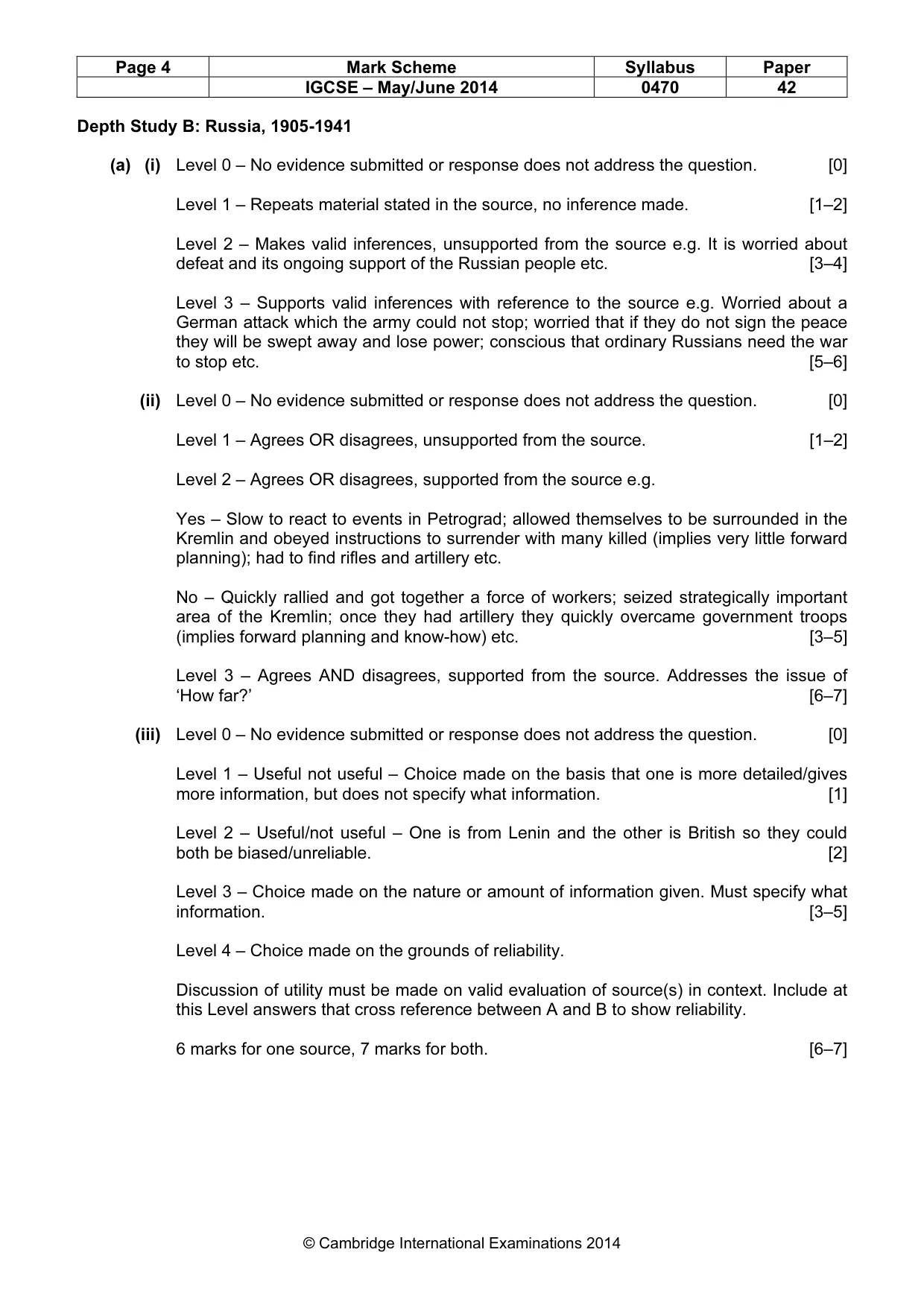
Page 4 Mark Scheme Syllabus Paper IGCSE – May/June 2014 0470 42 © Cambridge International Examinations 2014 Depth Study B: Russia, 1905-1941 (a) (i) Level 0 – No evidence submitted or response does not address the question. [0] Level 1 – Repeats material stated in the source, no inference made. [1–2] Level 2 – Makes valid inferences, unsupported from the source e.g. It is worried about defeat and its ongoing support of the Russian people etc. [3–4] Level 3 – Supports valid inferences with reference to the source e.g. Worried about a German attack which the army could not stop; worried that if they do not sign the peace they will be swept away and lose power; conscious that ordinary Russians need the war to stop etc. [5–6] (ii) Level 0 – No evidence submitted or response does not address the question. [0] Level 1 – Agrees OR disagrees, unsupported from the source. [1–2] Level 2 – Agrees OR disagrees, supported from the source e.g. Yes – Slow to react to events in Petrograd; allowed themselves to be surrounded in the Kremlin and obeyed instructions to surrender with many killed (implies very little forward planning); had to find rifles and artillery etc. No – Quickly rallied and got together a force of workers; seized strategically important area of the Kremlin; once they had artillery they quickly overcame government troops (implies forward planning and know-how) etc. [3–5] Level 3 – Agrees AND disagrees, supported from the source. Addresses the issue of ‘How far?’ [6–7] (iii) Level 0 – No evidence submitted or response does not address the question. [0] Level 1 – Useful not useful – Choice made on the basis that one is more detailed/gives more information, but does not specify what information. [1] Level 2 – Useful/not useful – One is from Lenin and the other is British so they could both be biased/unreliable. [2] Level 3 – Choice made on the nature or amount of information given. Must specify what information. [3–5] Level 4 – Choice made on the grounds of reliability. Discussion of utility must be made on valid evaluation of source(s) in context. Include at this Level answers that cross reference between A and B to show reliability. 6 marks for one source, 7 marks for both. [6–7]
Mark scheme, page 5
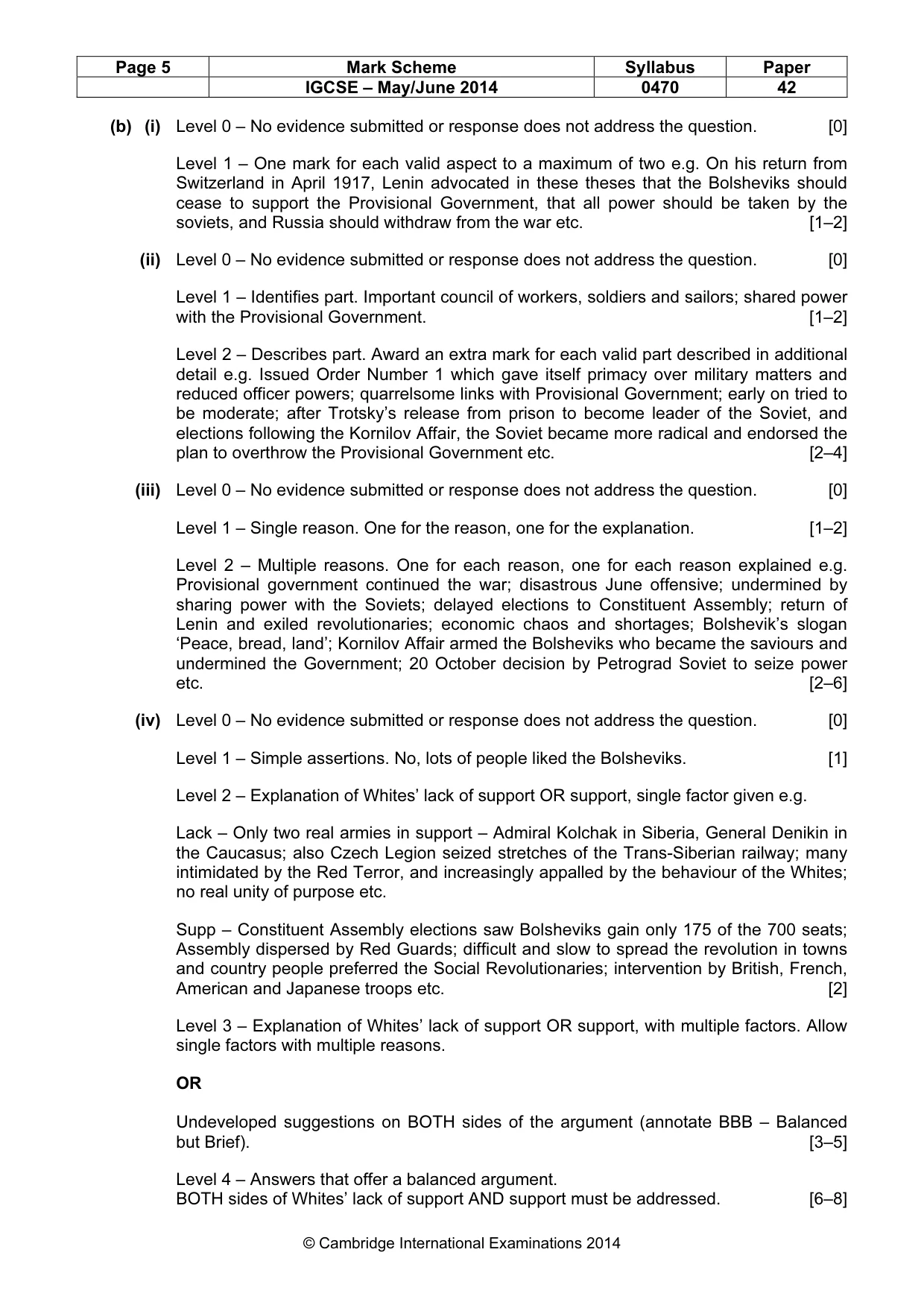
Page 5 Mark Scheme Syllabus Paper IGCSE – May/June 2014 0470 42 © Cambridge International Examinations 2014 (b) (i) Level 0 – No evidence submitted or response does not address the question. [0] Level 1 – One mark for each valid aspect to a maximum of two e.g. On his return from Switzerland in April 1917, Lenin advocated in these theses that the Bolsheviks should cease to support the Provisional Government, that all power should be taken by the soviets, and Russia should withdraw from the war etc. [1–2] (ii) Level 0 – No evidence submitted or response does not address the question. [0] Level 1 – Identifies part. Important council of workers, soldiers and sailors; shared power with the Provisional Government. [1–2] Level 2 – Describes part. Award an extra mark for each valid part described in additional detail e.g. Issued Order Number 1 which gave itself primacy over military matters and reduced officer powers; quarrelsome links with Provisional Government; early on tried to be moderate; after Trotsky’s release from prison to become leader of the Soviet, and elections following the Kornilov Affair, the Soviet became more radical and endorsed the plan to overthrow the Provisional Government etc. [2–4] (iii) Level 0 – No evidence submitted or response does not address the question. [0] Level 1 – Single reason. One for the reason, one for the explanation. [1–2] Level 2 – Multiple reasons. One for each reason, one for each reason explained e.g. Provisional government continued the war; disastrous June offensive; undermined by sharing power with the Soviets; delayed elections to Constituent Assembly; return of Lenin and exiled revolutionaries; economic chaos and shortages; Bolshevik’s slogan ‘Peace, bread, land’; Kornilov Affair armed the Bolsheviks who became the saviours and undermined the Government; 20 October decision by Petrograd Soviet to seize power etc. [2–6] (iv) Level 0 – No evidence submitted or response does not address the question. [0] Level 1 – Simple assertions. No, lots of people liked the Bolsheviks. [1] Level 2 – Explanation of Whites’ lack of support OR support, single factor given e.g. Lack – Only two real armies in support – Admiral Kolchak in Siberia, General Denikin in the Caucasus; also Czech Legion seized stretches of the Trans-Siberian railway; many intimidated by the Red Terror, and increasingly appalled by the behaviour of the Whites; no real unity of purpose etc. Supp – Constituent Assembly elections saw Bolsheviks gain only 175 of the 700 seats; Assembly dispersed by Red Guards; difficult and slow to spread the revolution in towns and country people preferred the Social Revolutionaries; intervention by British, French, American and Japanese troops etc. [2] Level 3 – Explanation of Whites’ lack of support OR support, with multiple factors. Allow single factors with multiple reasons. OR Undeveloped suggestions on BOTH sides of the argument (annotate BBB – Balanced but Brief). [3–5] Level 4 – Answers that offer a balanced argument. BOTH sides of Whites’ lack of support AND support must be addressed. [6–8]
Mark scheme, page 6
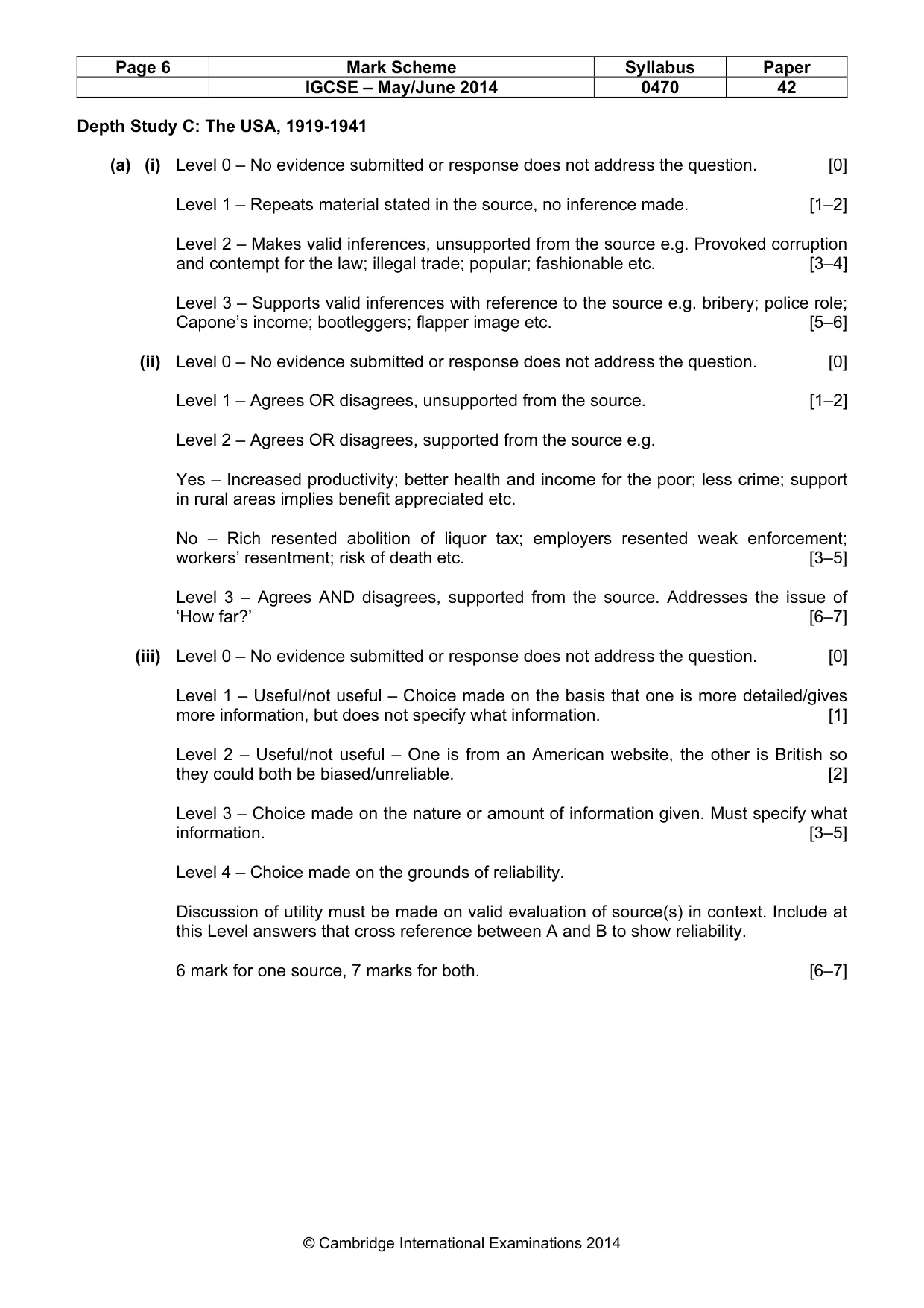
Page 6 Mark Scheme Syllabus Paper IGCSE – May/June 2014 0470 42 © Cambridge International Examinations 2014 Depth Study C: The USA, 1919-1941 (a) (i) Level 0 – No evidence submitted or response does not address the question. [0] Level 1 – Repeats material stated in the source, no inference made. [1–2] Level 2 – Makes valid inferences, unsupported from the source e.g. Provoked corruption and contempt for the law; illegal trade; popular; fashionable etc. [3–4] Level 3 – Supports valid inferences with reference to the source e.g. bribery; police role; Capone’s income; bootleggers; flapper image etc. [5–6] (ii) Level 0 – No evidence submitted or response does not address the question. [0] Level 1 – Agrees OR disagrees, unsupported from the source. [1–2] Level 2 – Agrees OR disagrees, supported from the source e.g. Yes – Increased productivity; better health and income for the poor; less crime; support in rural areas implies benefit appreciated etc. No – Rich resented abolition of liquor tax; employers resented weak enforcement; workers’ resentment; risk of death etc. [3–5] Level 3 – Agrees AND disagrees, supported from the source. Addresses the issue of ‘How far?’ [6–7] (iii) Level 0 – No evidence submitted or response does not address the question. [0] Level 1 – Useful/not useful – Choice made on the basis that one is more detailed/gives more information, but does not specify what information. [1] Level 2 – Useful/not useful – One is from an American website, the other is British so they could both be biased/unreliable. [2] Level 3 – Choice made on the nature or amount of information given. Must specify what information. [3–5] Level 4 – Choice made on the grounds of reliability. Discussion of utility must be made on valid evaluation of source(s) in context. Include at this Level answers that cross reference between A and B to show reliability. 6 mark for one source, 7 marks for both. [6–7]
Mark scheme, page 7
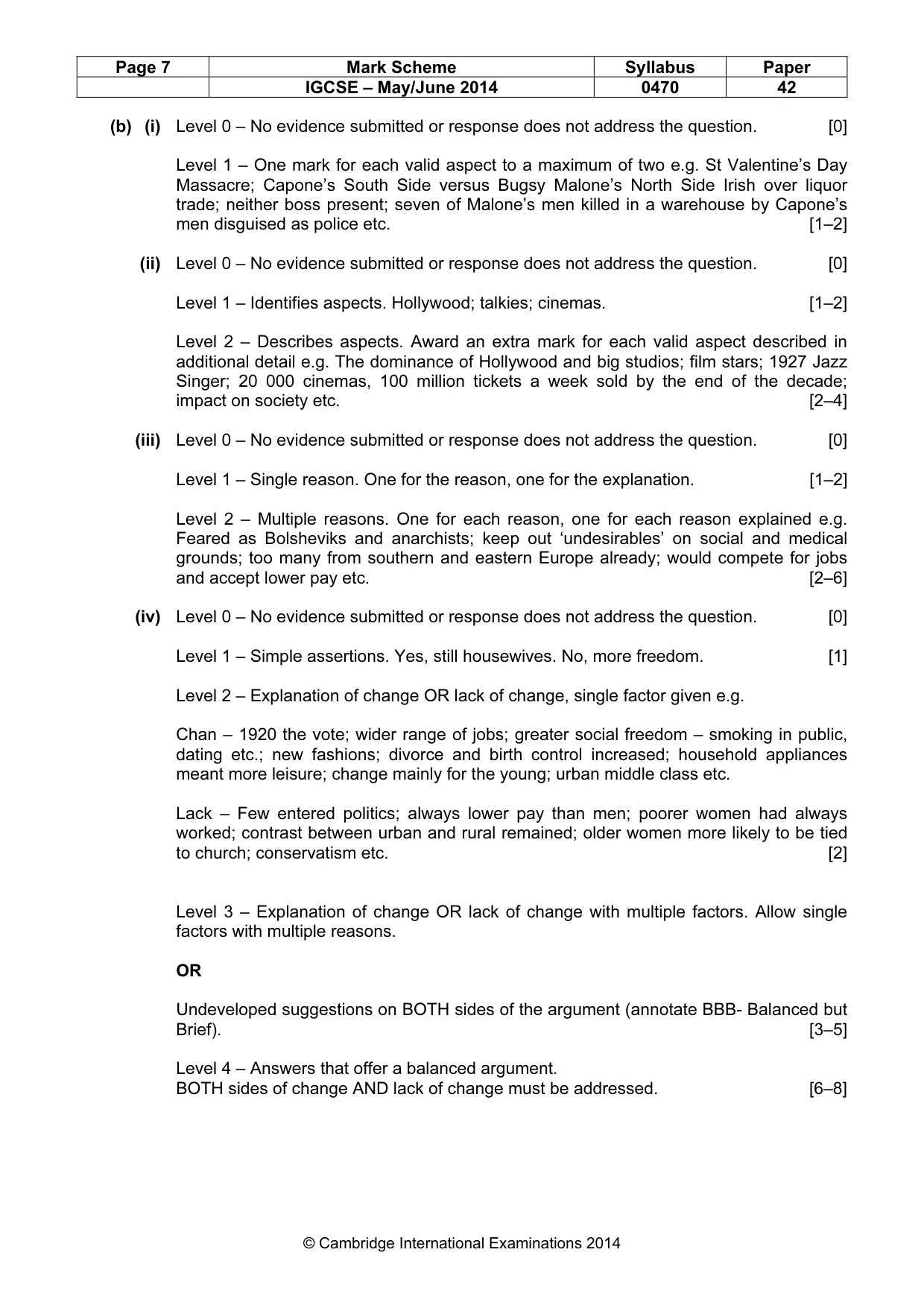
Page 7 Mark Scheme Syllabus Paper IGCSE – May/June 2014 0470 42 © Cambridge International Examinations 2014 (b) (i) Level 0 – No evidence submitted or response does not address the question. [0] Level 1 – One mark for each valid aspect to a maximum of two e.g. St Valentine’s Day Massacre; Capone’s South Side versus Bugsy Malone’s North Side Irish over liquor trade; neither boss present; seven of Malone’s men killed in a warehouse by Capone’s men disguised as police etc. [1–2] (ii) Level 0 – No evidence submitted or response does not address the question. [0] Level 1 – Identifies aspects. Hollywood; talkies; cinemas. [1–2] Level 2 – Describes aspects. Award an extra mark for each valid aspect described in additional detail e.g. The dominance of Hollywood and big studios; film stars; 1927 Jazz Singer; 20 000 cinemas, 100 million tickets a week sold by the end of the decade; impact on society etc. [2–4] (iii) Level 0 – No evidence submitted or response does not address the question. [0] Level 1 – Single reason. One for the reason, one for the explanation. [1–2] Level 2 – Multiple reasons. One for each reason, one for each reason explained e.g. Feared as Bolsheviks and anarchists; keep out ‘undesirables’ on social and medical grounds; too many from southern and eastern Europe already; would compete for jobs and accept lower pay etc. [2–6] (iv) Level 0 – No evidence submitted or response does not address the question. [0] Level 1 – Simple assertions. Yes, still housewives. No, more freedom. [1] Level 2 – Explanation of change OR lack of change, single factor given e.g. Chan – 1920 the vote; wider range of jobs; greater social freedom – smoking in public, dating etc.; new fashions; divorce and birth control increased; household appliances meant more leisure; change mainly for the young; urban middle class etc. Lack – Few entered politics; always lower pay than men; poorer women had always worked; contrast between urban and rural remained; older women more likely to be tied to church; conservatism etc. [2] Level 3 – Explanation of change OR lack of change with multiple factors. Allow single factors with multiple reasons. OR Undeveloped suggestions on BOTH sides of the argument (annotate BBB- Balanced but Brief). [3–5] Level 4 – Answers that offer a balanced argument. BOTH sides of change AND lack of change must be addressed. [6–8]
Mark scheme, page 8
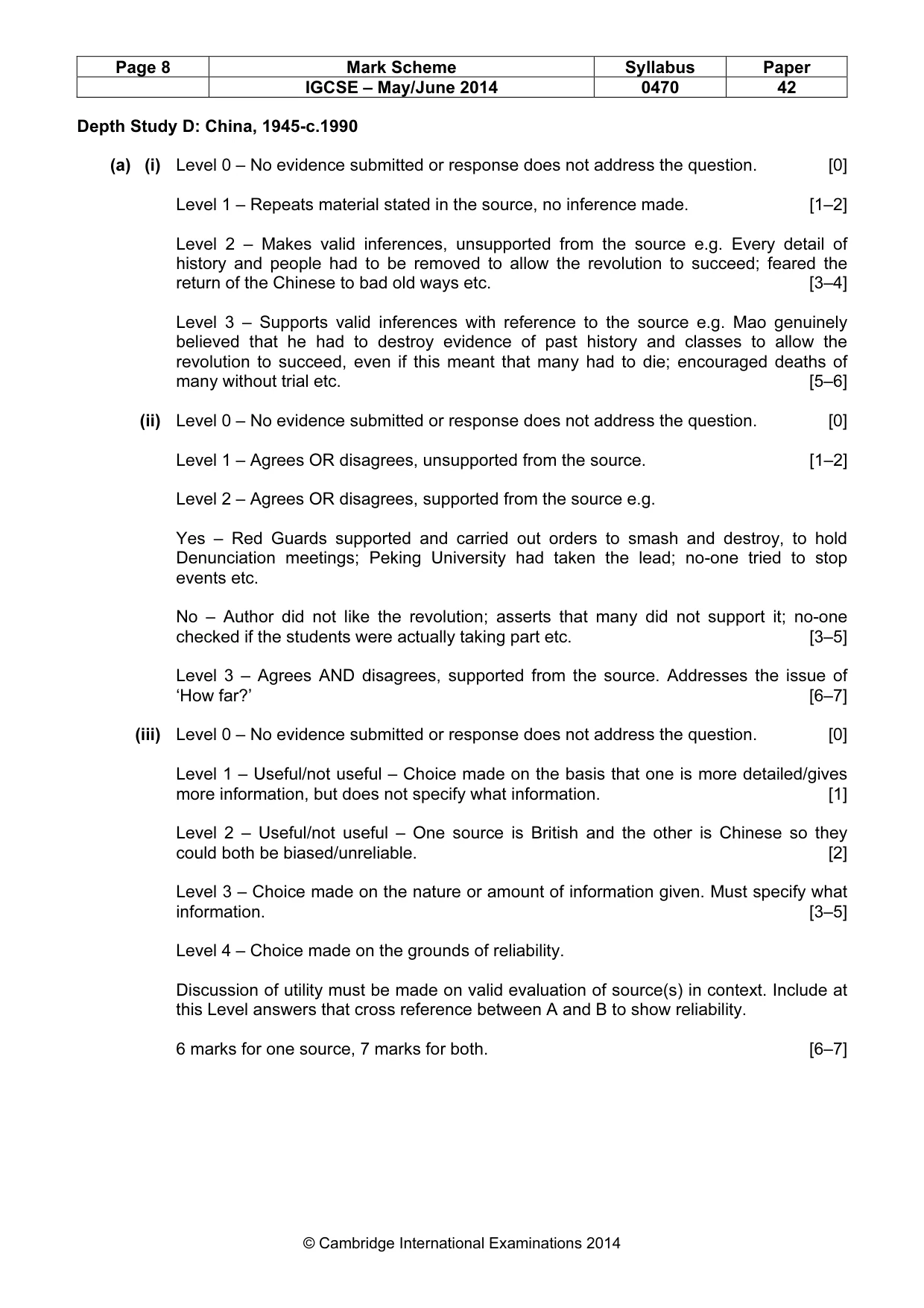
Page 8 Mark Scheme Syllabus Paper IGCSE – May/June 2014 0470 42 © Cambridge International Examinations 2014 Depth Study D: China, 1945-c.1990 (a) (i) Level 0 – No evidence submitted or response does not address the question. [0] Level 1 – Repeats material stated in the source, no inference made. [1–2] Level 2 – Makes valid inferences, unsupported from the source e.g. Every detail of history and people had to be removed to allow the revolution to succeed; feared the return of the Chinese to bad old ways etc. [3–4] Level 3 – Supports valid inferences with reference to the source e.g. Mao genuinely believed that he had to destroy evidence of past history and classes to allow the revolution to succeed, even if this meant that many had to die; encouraged deaths of many without trial etc. [5–6] (ii) Level 0 – No evidence submitted or response does not address the question. [0] Level 1 – Agrees OR disagrees, unsupported from the source. [1–2] Level 2 – Agrees OR disagrees, supported from the source e.g. Yes – Red Guards supported and carried out orders to smash and destroy, to hold Denunciation meetings; Peking University had taken the lead; no-one tried to stop events etc. No – Author did not like the revolution; asserts that many did not support it; no-one checked if the students were actually taking part etc. [3–5] Level 3 – Agrees AND disagrees, supported from the source. Addresses the issue of ‘How far?’ [6–7] (iii) Level 0 – No evidence submitted or response does not address the question. [0] Level 1 – Useful/not useful – Choice made on the basis that one is more detailed/gives more information, but does not specify what information. [1] Level 2 – Useful/not useful – One source is British and the other is Chinese so they could both be biased/unreliable. [2] Level 3 – Choice made on the nature or amount of information given. Must specify what information. [3–5] Level 4 – Choice made on the grounds of reliability. Discussion of utility must be made on valid evaluation of source(s) in context. Include at this Level answers that cross reference between A and B to show reliability. 6 marks for one source, 7 marks for both. [6–7]
Mark scheme, page 9
Page 9 Mark Scheme Syllabus Paper IGCSE – May/June 2014 0470 42 © Cambridge International Examinations 2014 (b) (i) Level 0 – No evidence submitted or response does not address the question. [0] Level 1 – One mark for each valid example to a maximum of two e.g. Academics, teachers, government officials, managers – anyone who could be branded as anti- revolutionary etc. [1–2] (ii) Level 0 – No evidence submitted or response does not address the question. [0] Level 1 – Identifies experiences. Mao saw him as a rival and punished him. [1–2] Level 2 – Describes experiences. Award an extra mark for each valid aspect described in additional detail e.g. Mao used the revolution to get rid of rivals; Deng was condemned as a reactionary; deprived of all posts; he had to recant his bourgeois- reactionary tendencies; packed off to labour in a factory; did not complain. Zhou Enlai began his re-instatement in 1973 etc. [2–4] (iii) Level 0 – No evidence submitted or response does not address the question. [0] Level 1 – Single reason. One for the reason, one for the explanation. [1–2] Level 2 – Multiple reasons. One for each reason, one for each reason explained e.g. Red Guards had caused economic and social chaos and it was getting worse; Mao could see that if things continued much of the progress made since 1949 would be destroyed; Mao had reasserted his authority and most of his rivals were dead, in prison or working as labourers; time to call a halt to chaos and uncertainty etc. [2–6] (iv) Level 0 – No evidence submitted or response does not address the question. [0] Level 1 – Simple assertions. Yes, look at how many died during the Great Leap Forward. [1] Level 2 – Explanation of little benefit OR much benefit, single factor given e.g. Little – For many in the countryside little change would be noticed in their daily lives; violent outcomes and famine of the Great Leap Forward; death and destruction of the Cultural Revolution; withdrawal of Soviet aid meant less industrial training and support etc. Much – Landlord class had gone, land redistributed; improvements in education and health; equality for women; despite failures, agricultural and industrial outputs increased; Chinese said to have become more confident and unified with increasing successes, especially after the withdrawal of Soviet aid etc. [2] Level 3 – Explanation of little benefit OR much benefit with multiple factors. Allow single factors with multiple reasons. OR Undeveloped suggestions on BOTH sides of the argument (annotate BBB – Balanced but Brief). [3–5] Level 4 – Answers that offer a balanced argument. BOTH sides of little benefit AND much benefit must be addressed. [6–8]
Mark scheme, page 10
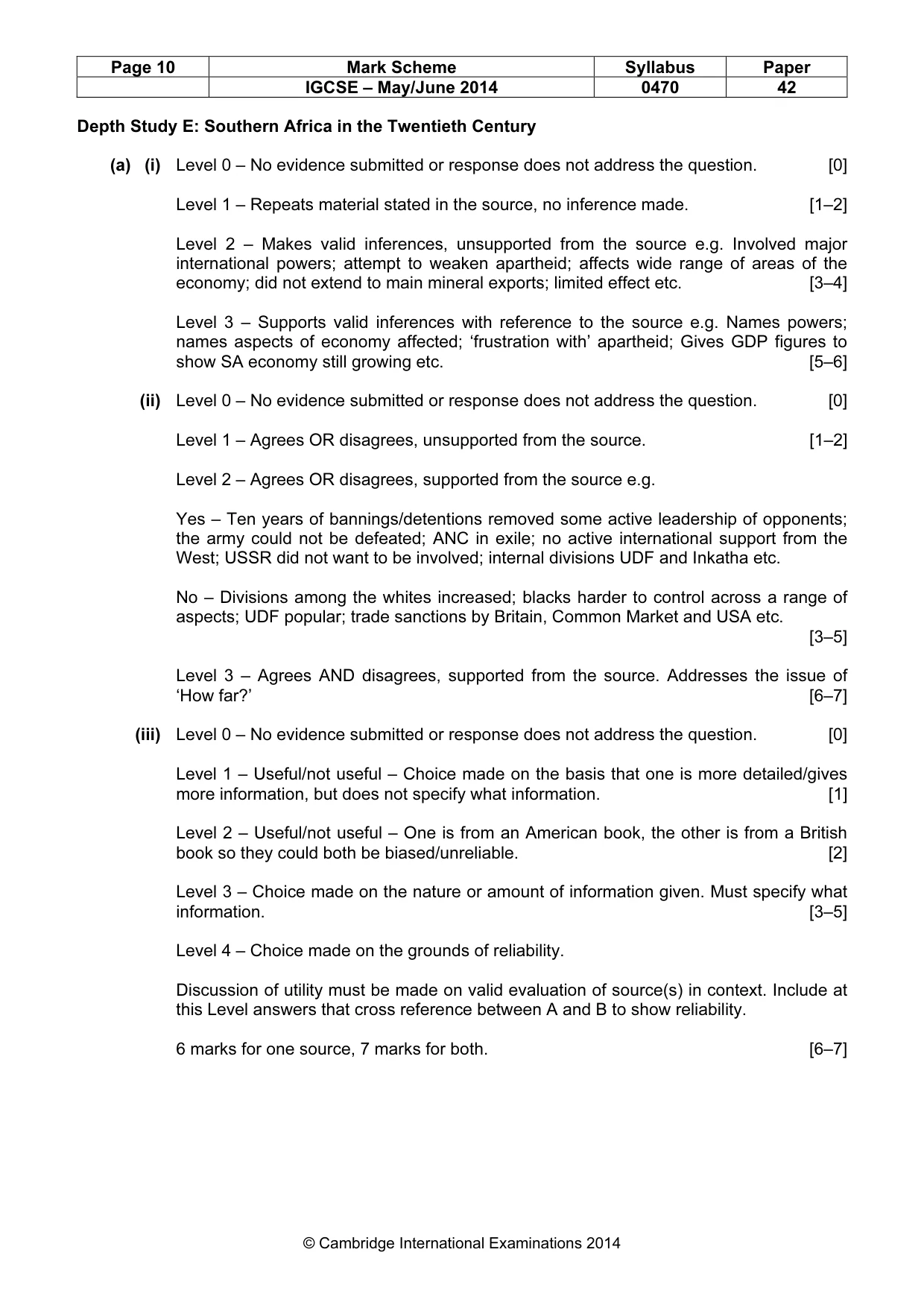
Page 10 Mark Scheme Syllabus Paper IGCSE – May/June 2014 0470 42 © Cambridge International Examinations 2014 Depth Study E: Southern Africa in the Twentieth Century (a) (i) Level 0 – No evidence submitted or response does not address the question. [0] Level 1 – Repeats material stated in the source, no inference made. [1–2] Level 2 – Makes valid inferences, unsupported from the source e.g. Involved major international powers; attempt to weaken apartheid; affects wide range of areas of the economy; did not extend to main mineral exports; limited effect etc. [3–4] Level 3 – Supports valid inferences with reference to the source e.g. Names powers; names aspects of economy affected; ‘frustration with’ apartheid; Gives GDP figures to show SA economy still growing etc. [5–6] (ii) Level 0 – No evidence submitted or response does not address the question. [0] Level 1 – Agrees OR disagrees, unsupported from the source. [1–2] Level 2 – Agrees OR disagrees, supported from the source e.g. Yes – Ten years of bannings/detentions removed some active leadership of opponents; the army could not be defeated; ANC in exile; no active international support from the West; USSR did not want to be involved; internal divisions UDF and Inkatha etc. No – Divisions among the whites increased; blacks harder to control across a range of aspects; UDF popular; trade sanctions by Britain, Common Market and USA etc. [3–5] Level 3 – Agrees AND disagrees, supported from the source. Addresses the issue of ‘How far?’ [6–7] (iii) Level 0 – No evidence submitted or response does not address the question. [0] Level 1 – Useful/not useful – Choice made on the basis that one is more detailed/gives more information, but does not specify what information. [1] Level 2 – Useful/not useful – One is from an American book, the other is from a British book so they could both be biased/unreliable. [2] Level 3 – Choice made on the nature or amount of information given. Must specify what information. [3–5] Level 4 – Choice made on the grounds of reliability. Discussion of utility must be made on valid evaluation of source(s) in context. Include at this Level answers that cross reference between A and B to show reliability. 6 marks for one source, 7 marks for both. [6–7]
Mark scheme, page 11
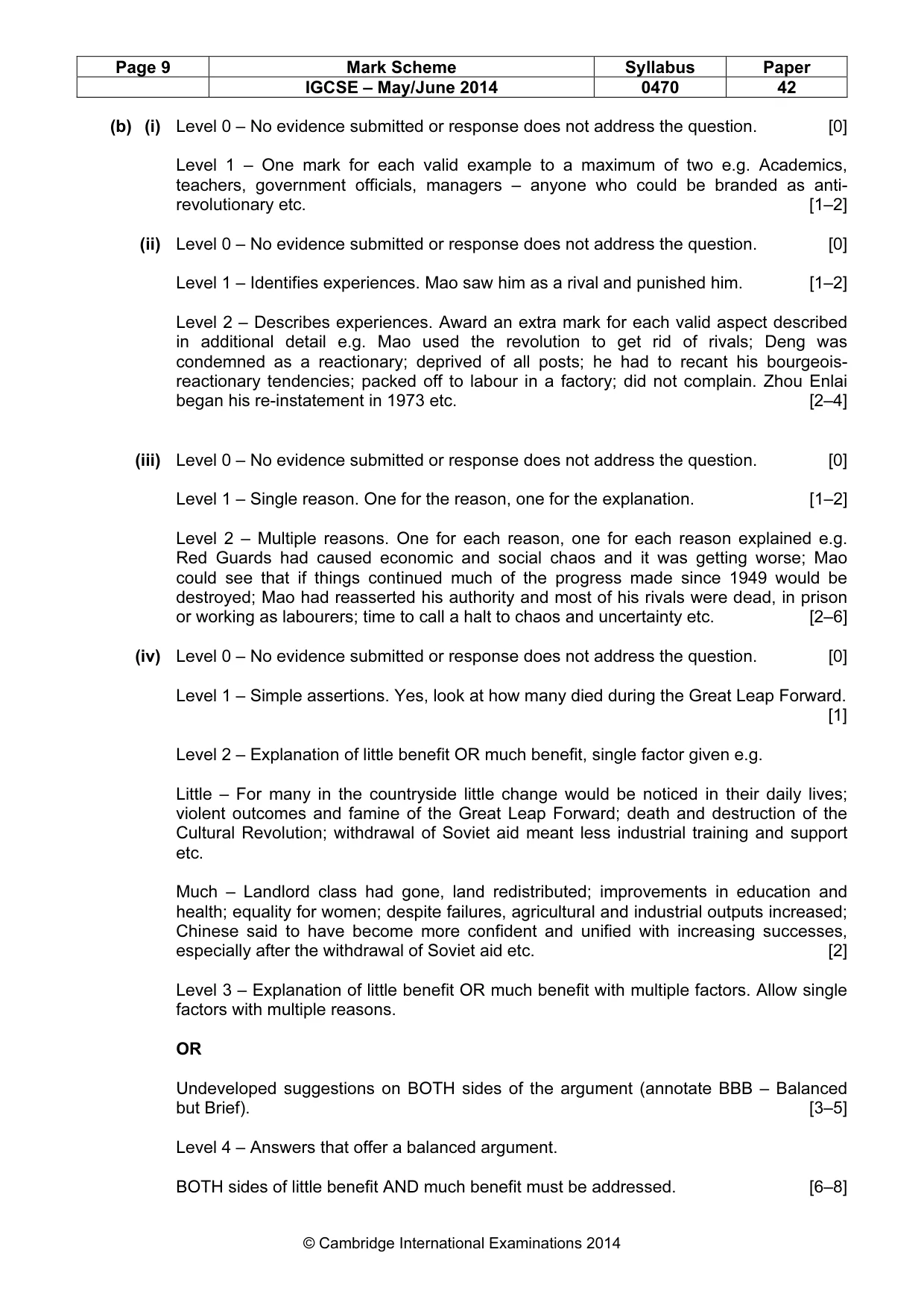
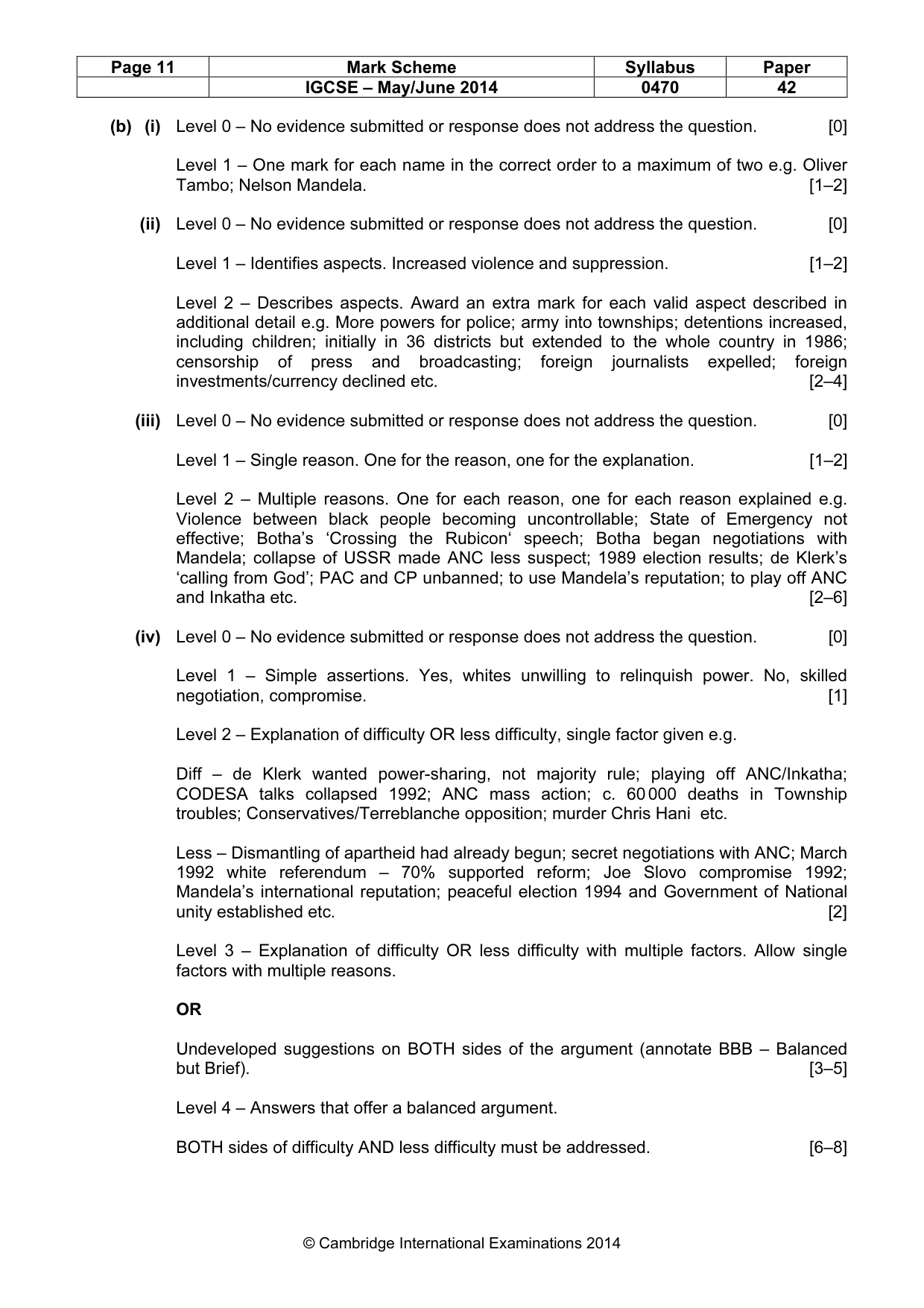
Page 11 Mark Scheme Syllabus Paper IGCSE – May/June 2014 0470 42 © Cambridge International Examinations 2014 (b) (i) Level 0 – No evidence submitted or response does not address the question. [0] Level 1 – One mark for each name in the correct order to a maximum of two e.g. Oliver Tambo; Nelson Mandela. [1–2] (ii) Level 0 – No evidence submitted or response does not address the question. [0] Level 1 – Identifies aspects. Increased violence and suppression. [1–2] Level 2 – Describes aspects. Award an extra mark for each valid aspect described in additional detail e.g. More powers for police; army into townships; detentions increased, including children; initially in 36 districts but extended to the whole country in 1986; censorship of press and broadcasting; foreign journalists expelled; foreign investments/currency declined etc. [2–4] (iii) Level 0 – No evidence submitted or response does not address the question. [0] Level 1 – Single reason. One for the reason, one for the explanation. [1–2] Level 2 – Multiple reasons. One for each reason, one for each reason explained e.g. Violence between black people becoming uncontrollable; State of Emergency not effective; Botha’s ‘Crossing the Rubicon‘ speech; Botha began negotiations with Mandela; collapse of USSR made ANC less suspect; 1989 election results; de Klerk’s ‘calling from God’; PAC and CP unbanned; to use Mandela’s reputation; to play off ANC and Inkatha etc. [2–6] (iv) Level 0 – No evidence submitted or response does not address the question. [0] Level 1 – Simple assertions. Yes, whites unwilling to relinquish power. No, skilled negotiation, compromise. [1] Level 2 – Explanation of difficulty OR less difficulty, single factor given e.g. Diff – de Klerk wanted power-sharing, not majority rule; playing off ANC/Inkatha; CODESA talks collapsed 1992; ANC mass action; c. 60 000 deaths in Township troubles; Conservatives/Terreblanche opposition; murder Chris Hani etc. Less – Dismantling of apartheid had already begun; secret negotiations with ANC; March 1992 white referendum – 70% supported reform; Joe Slovo compromise 1992; Mandela’s international reputation; peaceful election 1994 and Government of National unity established etc. [2] Level 3 – Explanation of difficulty OR less difficulty with multiple factors. Allow single factors with multiple reasons. OR Undeveloped suggestions on BOTH sides of the argument (annotate BBB – Balanced but Brief). [3–5] Level 4 – Answers that offer a balanced argument. BOTH sides of difficulty AND less difficulty must be addressed. [6–8]
Mark scheme, page 12
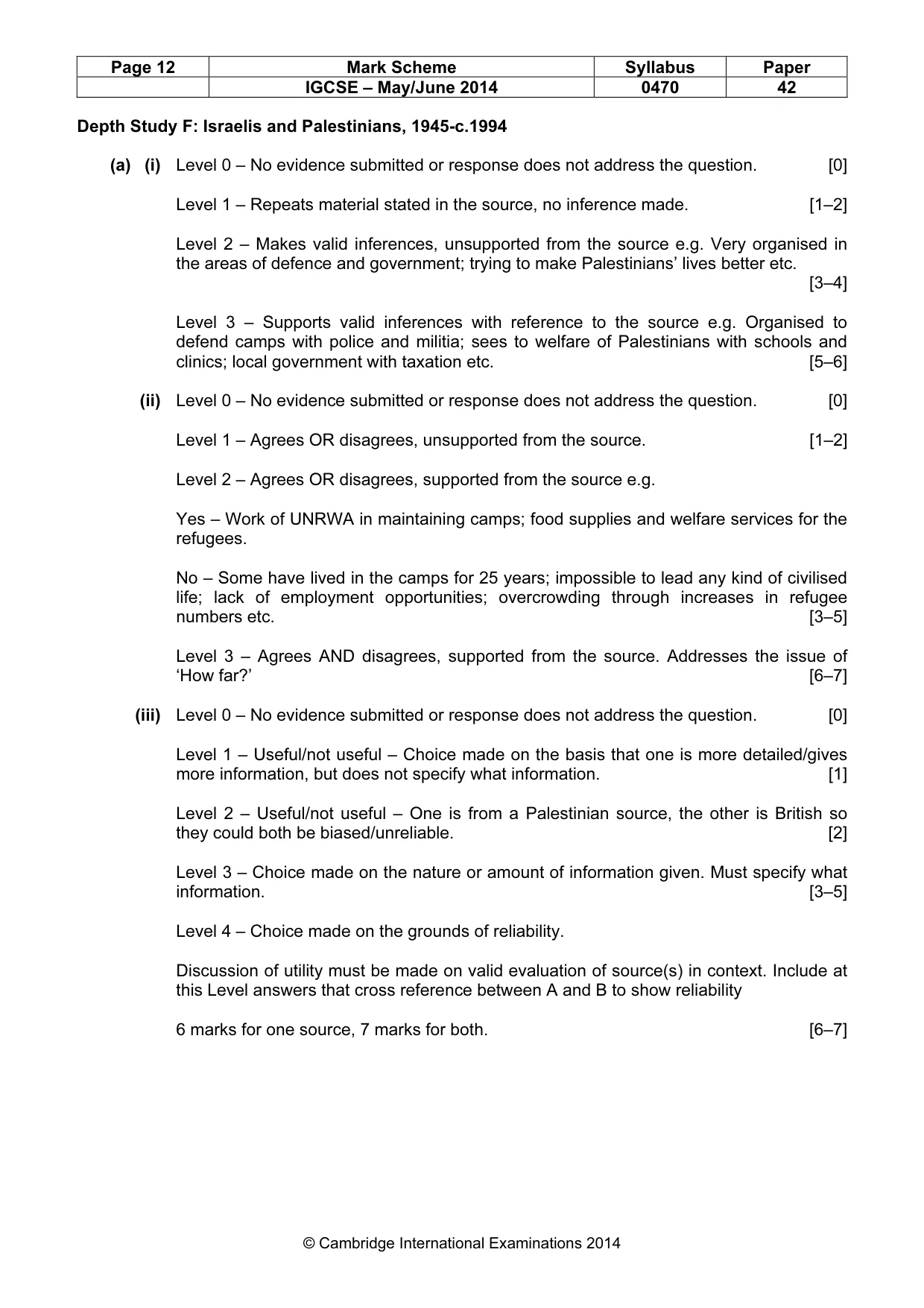
Page 12 Mark Scheme Syllabus Paper IGCSE – May/June 2014 0470 42 © Cambridge International Examinations 2014 Depth Study F: Israelis and Palestinians, 1945-c.1994 (a) (i) Level 0 – No evidence submitted or response does not address the question. [0] Level 1 – Repeats material stated in the source, no inference made. [1–2] Level 2 – Makes valid inferences, unsupported from the source e.g. Very organised in the areas of defence and government; trying to make Palestinians’ lives better etc. [3–4] Level 3 – Supports valid inferences with reference to the source e.g. Organised to defend camps with police and militia; sees to welfare of Palestinians with schools and clinics; local government with taxation etc. [5–6] (ii) Level 0 – No evidence submitted or response does not address the question. [0] Level 1 – Agrees OR disagrees, unsupported from the source. [1–2] Level 2 – Agrees OR disagrees, supported from the source e.g. Yes – Work of UNRWA in maintaining camps; food supplies and welfare services for the refugees. No – Some have lived in the camps for 25 years; impossible to lead any kind of civilised life; lack of employment opportunities; overcrowding through increases in refugee numbers etc. [3–5] Level 3 – Agrees AND disagrees, supported from the source. Addresses the issue of ‘How far?’ [6–7] (iii) Level 0 – No evidence submitted or response does not address the question. [0] Level 1 – Useful/not useful – Choice made on the basis that one is more detailed/gives more information, but does not specify what information. [1] Level 2 – Useful/not useful – One is from a Palestinian source, the other is British so they could both be biased/unreliable. [2] Level 3 – Choice made on the nature or amount of information given. Must specify what information. [3–5] Level 4 – Choice made on the grounds of reliability. Discussion of utility must be made on valid evaluation of source(s) in context. Include at this Level answers that cross reference between A and B to show reliability 6 marks for one source, 7 marks for both. [6–7]
Mark scheme, page 13
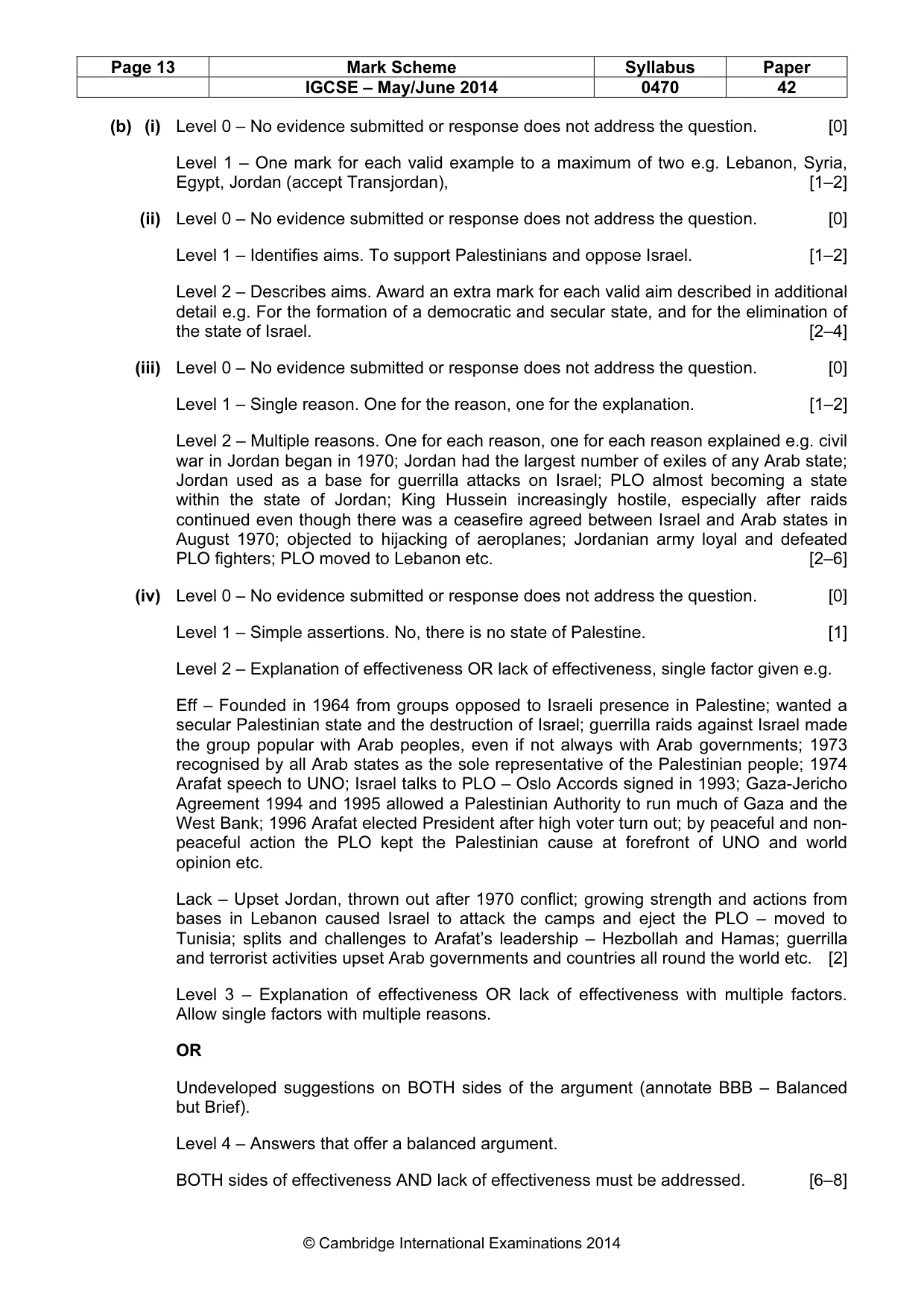
Page 13 Mark Scheme Syllabus Paper IGCSE – May/June 2014 0470 42 © Cambridge International Examinations 2014 (b) (i) Level 0 – No evidence submitted or response does not address the question. [0] Level 1 – One mark for each valid example to a maximum of two e.g. Lebanon, Syria, Egypt, Jordan (accept Transjordan), [1–2] (ii) Level 0 – No evidence submitted or response does not address the question. [0] Level 1 – Identifies aims. To support Palestinians and oppose Israel. [1–2] Level 2 – Describes aims. Award an extra mark for each valid aim described in additional detail e.g. For the formation of a democratic and secular state, and for the elimination of the state of Israel. [2–4] (iii) Level 0 – No evidence submitted or response does not address the question. [0] Level 1 – Single reason. One for the reason, one for the explanation. [1–2] Level 2 – Multiple reasons. One for each reason, one for each reason explained e.g. civil war in Jordan began in 1970; Jordan had the largest number of exiles of any Arab state; Jordan used as a base for guerrilla attacks on Israel; PLO almost becoming a state within the state of Jordan; King Hussein increasingly hostile, especially after raids continued even though there was a ceasefire agreed between Israel and Arab states in August 1970; objected to hijacking of aeroplanes; Jordanian army loyal and defeated PLO fighters; PLO moved to Lebanon etc. [2–6] (iv) Level 0 – No evidence submitted or response does not address the question. [0] Level 1 – Simple assertions. No, there is no state of Palestine. [1] Level 2 – Explanation of effectiveness OR lack of effectiveness, single factor given e.g. Eff – Founded in 1964 from groups opposed to Israeli presence in Palestine; wanted a secular Palestinian state and the destruction of Israel; guerrilla raids against Israel made the group popular with Arab peoples, even if not always with Arab governments; 1973 recognised by all Arab states as the sole representative of the Palestinian people; 1974 Arafat speech to UNO; Israel talks to PLO – Oslo Accords signed in 1993; Gaza-Jericho Agreement 1994 and 1995 allowed a Palestinian Authority to run much of Gaza and the West Bank; 1996 Arafat elected President after high voter turn out; by peaceful and non- peaceful action the PLO kept the Palestinian cause at forefront of UNO and world opinion etc. Lack – Upset Jordan, thrown out after 1970 conflict; growing strength and actions from bases in Lebanon caused Israel to attack the camps and eject the PLO – moved to Tunisia; splits and challenges to Arafat’s leadership – Hezbollah and Hamas; guerrilla and terrorist activities upset Arab governments and countries all round the world etc. [2] Level 3 – Explanation of effectiveness OR lack of effectiveness with multiple factors. Allow single factors with multiple reasons. OR Undeveloped suggestions on BOTH sides of the argument (annotate BBB – Balanced but Brief). Level 4 – Answers that offer a balanced argument. BOTH sides of effectiveness AND lack of effectiveness must be addressed. [6–8]
Mark scheme, page 14
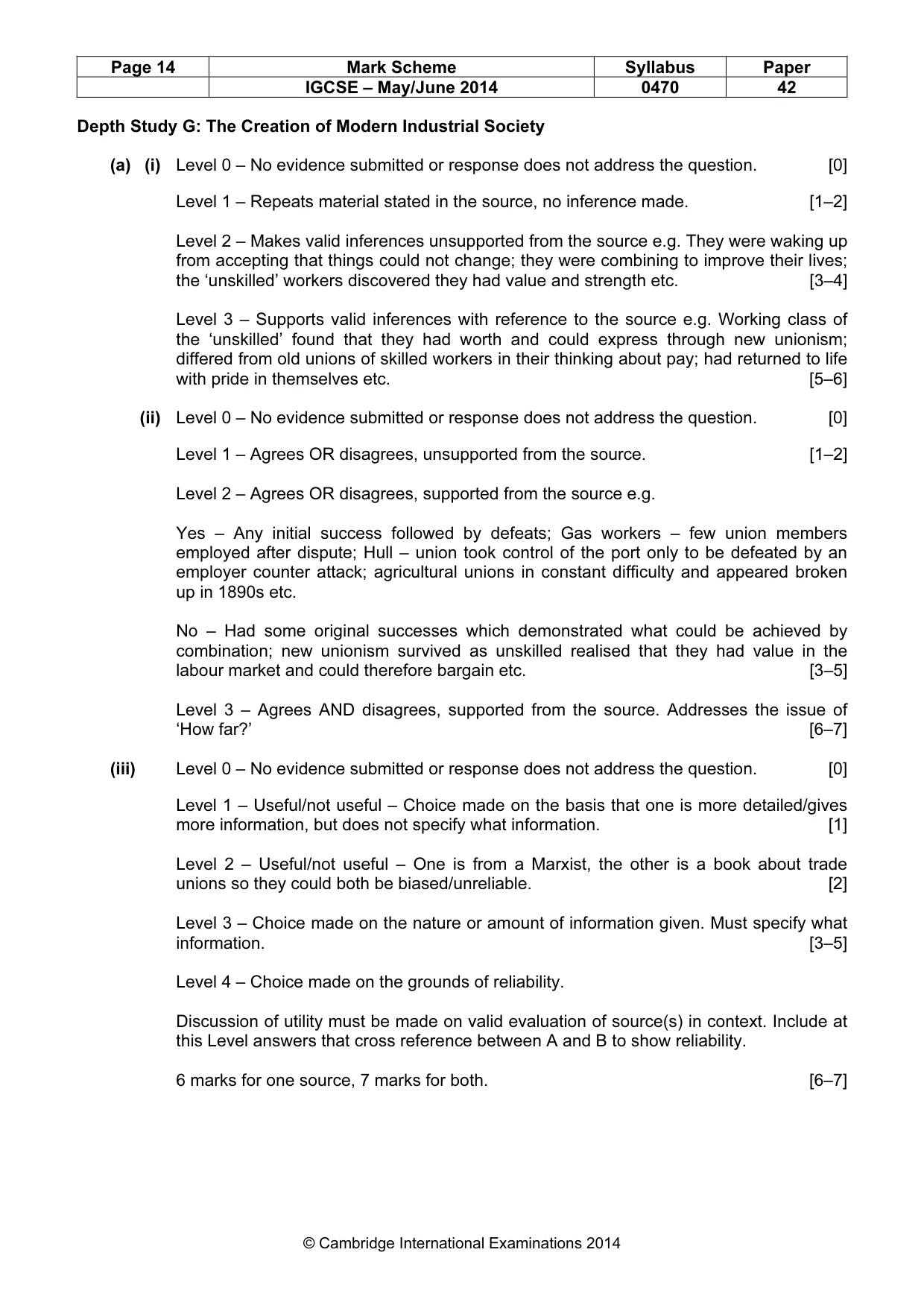
Page 14 Mark Scheme Syllabus Paper IGCSE – May/June 2014 0470 42 © Cambridge International Examinations 2014 Depth Study G: The Creation of Modern Industrial Society (a) (i) Level 0 – No evidence submitted or response does not address the question. [0] Level 1 – Repeats material stated in the source, no inference made. [1–2] Level 2 – Makes valid inferences unsupported from the source e.g. They were waking up from accepting that things could not change; they were combining to improve their lives; the ‘unskilled’ workers discovered they had value and strength etc. [3–4] Level 3 – Supports valid inferences with reference to the source e.g. Working class of the ‘unskilled’ found that they had worth and could express through new unionism; differed from old unions of skilled workers in their thinking about pay; had returned to life with pride in themselves etc. [5–6] (ii) Level 0 – No evidence submitted or response does not address the question. [0] Level 1 – Agrees OR disagrees, unsupported from the source. [1–2] Level 2 – Agrees OR disagrees, supported from the source e.g. Yes – Any initial success followed by defeats; Gas workers – few union members employed after dispute; Hull – union took control of the port only to be defeated by an employer counter attack; agricultural unions in constant difficulty and appeared broken up in 1890s etc. No – Had some original successes which demonstrated what could be achieved by combination; new unionism survived as unskilled realised that they had value in the labour market and could therefore bargain etc. [3–5] Level 3 – Agrees AND disagrees, supported from the source. Addresses the issue of ‘How far?’ [6–7] (iii) Level 0 – No evidence submitted or response does not address the question. [0] Level 1 – Useful/not useful – Choice made on the basis that one is more detailed/gives more information, but does not specify what information. [1] Level 2 – Useful/not useful – One is from a Marxist, the other is a book about trade unions so they could both be biased/unreliable. [2] Level 3 – Choice made on the nature or amount of information given. Must specify what information. [3–5] Level 4 – Choice made on the grounds of reliability. Discussion of utility must be made on valid evaluation of source(s) in context. Include at this Level answers that cross reference between A and B to show reliability. 6 marks for one source, 7 marks for both. [6–7]
Mark scheme, page 15
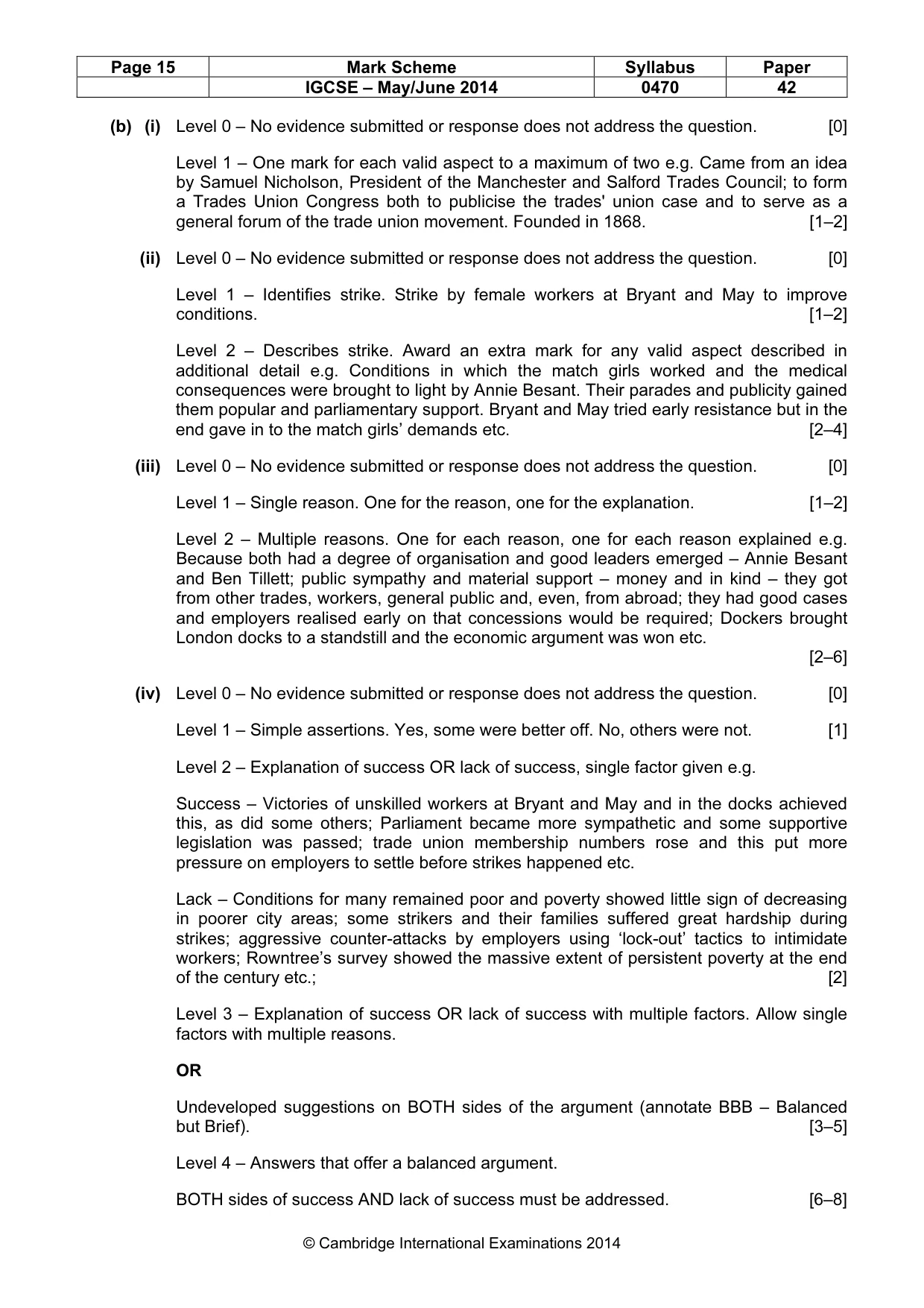
Page 15 Mark Scheme Syllabus Paper IGCSE – May/June 2014 0470 42 © Cambridge International Examinations 2014 (b) (i) Level 0 – No evidence submitted or response does not address the question. [0] Level 1 – One mark for each valid aspect to a maximum of two e.g. Came from an idea by Samuel Nicholson, President of the Manchester and Salford Trades Council; to form a Trades Union Congress both to publicise the trades' union case and to serve as a general forum of the trade union movement. Founded in 1868. [1–2] (ii) Level 0 – No evidence submitted or response does not address the question. [0] Level 1 – Identifies strike. Strike by female workers at Bryant and May to improve conditions. [1–2] Level 2 – Describes strike. Award an extra mark for any valid aspect described in additional detail e.g. Conditions in which the match girls worked and the medical consequences were brought to light by Annie Besant. Their parades and publicity gained them popular and parliamentary support. Bryant and May tried early resistance but in the end gave in to the match girls’ demands etc. [2–4] (iii) Level 0 – No evidence submitted or response does not address the question. [0] Level 1 – Single reason. One for the reason, one for the explanation. [1–2] Level 2 – Multiple reasons. One for each reason, one for each reason explained e.g. Because both had a degree of organisation and good leaders emerged – Annie Besant and Ben Tillett; public sympathy and material support – money and in kind – they got from other trades, workers, general public and, even, from abroad; they had good cases and employers realised early on that concessions would be required; Dockers brought London docks to a standstill and the economic argument was won etc. [2–6] (iv) Level 0 – No evidence submitted or response does not address the question. [0] Level 1 – Simple assertions. Yes, some were better off. No, others were not. [1] Level 2 – Explanation of success OR lack of success, single factor given e.g. Success – Victories of unskilled workers at Bryant and May and in the docks achieved this, as did some others; Parliament became more sympathetic and some supportive legislation was passed; trade union membership numbers rose and this put more pressure on employers to settle before strikes happened etc. Lack – Conditions for many remained poor and poverty showed little sign of decreasing in poorer city areas; some strikers and their families suffered great hardship during strikes; aggressive counter-attacks by employers using ‘lock-out’ tactics to intimidate workers; Rowntree’s survey showed the massive extent of persistent poverty at the end of the century etc.; [2] Level 3 – Explanation of success OR lack of success with multiple factors. Allow single factors with multiple reasons. OR Undeveloped suggestions on BOTH sides of the argument (annotate BBB – Balanced but Brief). [3–5] Level 4 – Answers that offer a balanced argument. BOTH sides of success AND lack of success must be addressed. [6–8]
Mark scheme, page 16
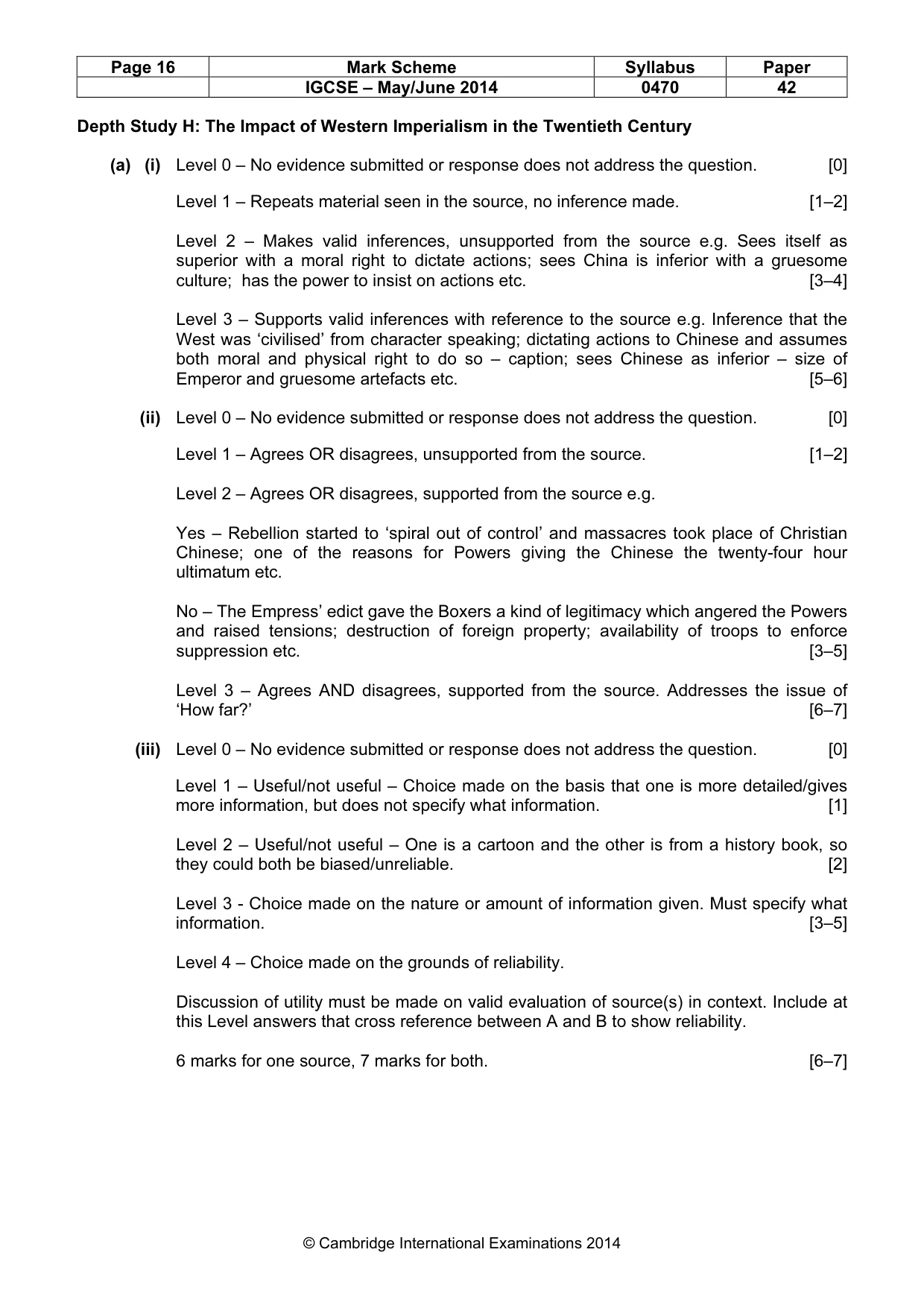
Page 16 Mark Scheme Syllabus Paper IGCSE – May/June 2014 0470 42 © Cambridge International Examinations 2014 Depth Study H: The Impact of Western Imperialism in the Twentieth Century (a) (i) Level 0 – No evidence submitted or response does not address the question. [0] Level 1 – Repeats material seen in the source, no inference made. [1–2] Level 2 – Makes valid inferences, unsupported from the source e.g. Sees itself as superior with a moral right to dictate actions; sees China is inferior with a gruesome culture; has the power to insist on actions etc. [3–4] Level 3 – Supports valid inferences with reference to the source e.g. Inference that the West was ‘civilised’ from character speaking; dictating actions to Chinese and assumes both moral and physical right to do so – caption; sees Chinese as inferior – size of Emperor and gruesome artefacts etc. [5–6] (ii) Level 0 – No evidence submitted or response does not address the question. [0] Level 1 – Agrees OR disagrees, unsupported from the source. [1–2] Level 2 – Agrees OR disagrees, supported from the source e.g. Yes – Rebellion started to ‘spiral out of control’ and massacres took place of Christian Chinese; one of the reasons for Powers giving the Chinese the twenty-four hour ultimatum etc. No – The Empress’ edict gave the Boxers a kind of legitimacy which angered the Powers and raised tensions; destruction of foreign property; availability of troops to enforce suppression etc. [3–5] Level 3 – Agrees AND disagrees, supported from the source. Addresses the issue of ‘How far?’ [6–7] (iii) Level 0 – No evidence submitted or response does not address the question. [0] Level 1 – Useful/not useful – Choice made on the basis that one is more detailed/gives more information, but does not specify what information. [1] Level 2 – Useful/not useful – One is a cartoon and the other is from a history book, so they could both be biased/unreliable. [2] Level 3 - Choice made on the nature or amount of information given. Must specify what information. [3–5] Level 4 – Choice made on the grounds of reliability. Discussion of utility must be made on valid evaluation of source(s) in context. Include at this Level answers that cross reference between A and B to show reliability. 6 marks for one source, 7 marks for both. [6–7]
Mark scheme, page 17
Page 17 Mark Scheme Syllabus Paper IGCSE – May/June 2014 0470 42 © Cambridge International Examinations 2014 (b) (i) Level 0 – No evidence submitted or response does not address the question. [0] Level 1 – One mark for each valid city to a maximum of two e.g. Peking, Shanghai, Canton, Swatow, Amoy, Ning Po etc. [1–2] (ii) Level 0 – No evidence submitted or response does not address the question. [0] Level 1 – Identifies aspects. Attack on and siege of foreigners by Boxers in Peking.[1–2] Level 2 – Describes aspects. Award an extra mark for each valid aspect described in additional detail e.g. There were several foreign legations in the city with some guards; they fought off several attacks by the Chinese and, although besieged and suffering great hardships, few foreign lives were lost during the 55 day siege; relieved by a combined allied force etc. [2–4] (iii) Level 0 – No evidence submitted or response does not address the question. [0] Level 1 – Single reason. One for the reason, one for the explanation. [1–2] Level 2 – Multiple reasons. One for each reason, one for each reason explained e.g. long term – Chinese decline and foreign interventions, weak government etc. led to a weak prosecution of the war; Japan had decided to modernise during the nineteenth century and attitudes were of a modern, military country. Short term – China was poorly armed and organised with a divided leadership; Japan had a modernised army, well- trained and well-armed etc. [2–6] (iv) Level 0 – No evidence submitted or response does not address the question. [0] Level 1 – Simple assertions. Yes, Britain was a great imperial power. [1] Level 2 – Explanation of Britain causing decline OR other factors, single factor given e.g. Brit – British victory in the Opium Wars weakened China both militarily and politically; Britain forced China to accept unfavourable trade treaties which weakened it economically and encouraged other countries to seek treaties; British missionaries helped to create divisions in Chinese societies etc. Other – China already in a state of decay and decaying further; still feudal and no new technology or ways of thinking; weak and intrigue ridden dynasty; other nations interfered and helped in the decline of China etc. [2] Level 3 – Explanation of Britain causing decline OR other factors with multiple factors. Allow single factors with multiple reasons. OR Undeveloped suggestions on BOTH sides of the argument (annotate BBB – Balanced but Brief). [3–5] Level 4 – Answers that offer a balanced argument. BOTH sides of Britain causing decline AND other factors must be addressed. [6–8]
What you needed in this session
Cambridge’s own grade thresholds for 2014 May/June, Paper 4 · Variant 2. A higher threshold means an easier paper — the bar moves with how the cohort did.