Cambridge IGCSE History 0470 — 2014 May/June Paper 4 · Variant 1
0470/41/M/J/14 · 40 marks · ≈45 min
The question paper and its mark scheme, free to read here and free to download. This is Cambridge’s own paper, exactly as it was sat.
Question paper12 pages

Mark scheme17 pages
Answers below. Sit the paper first if you are practising.
Paper as text
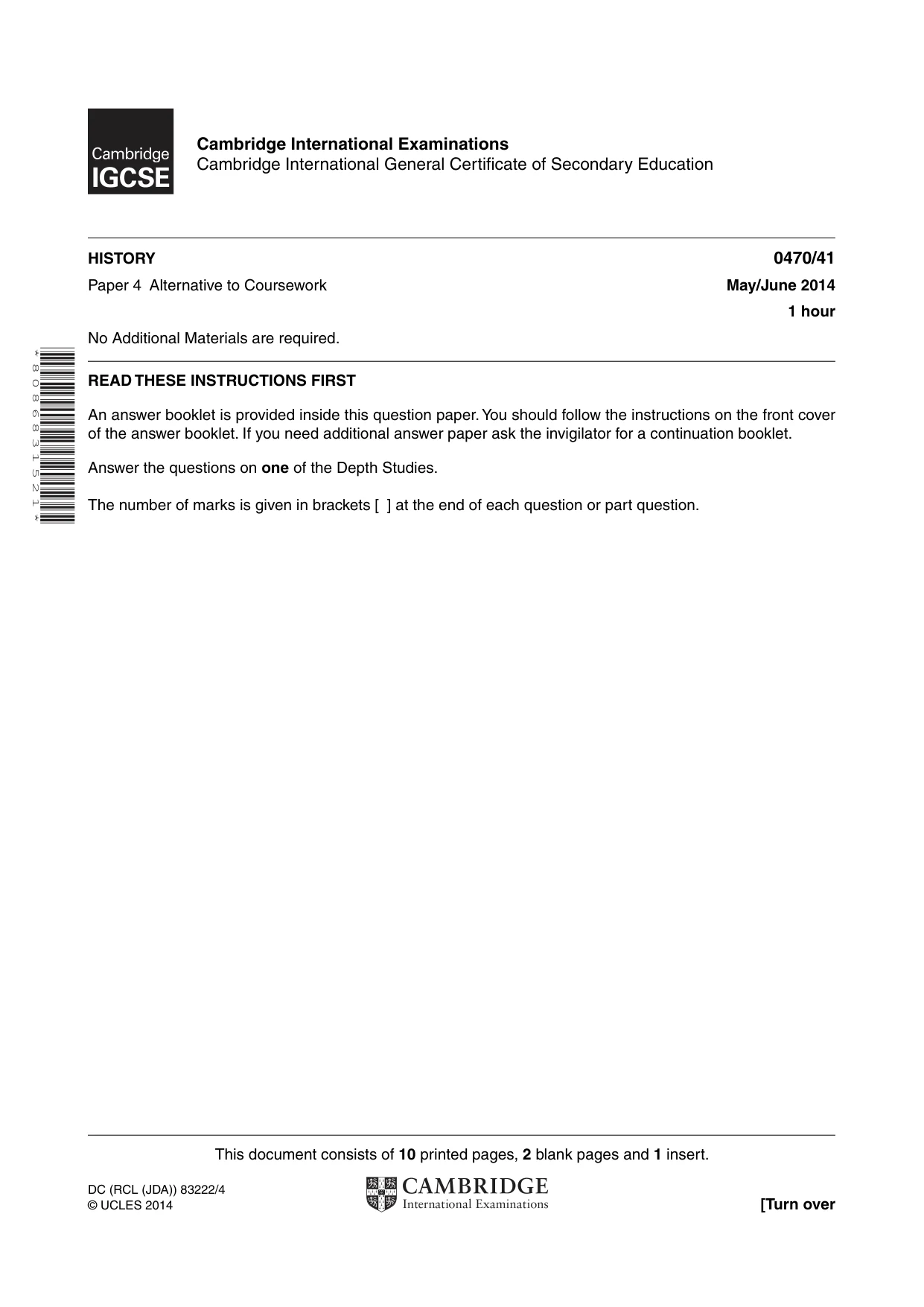
Question paper, page 1
This document consists of 10 printed pages, 2 blank pages and 1 insert. DC (RCL (JDA)) 83222/4 © UCLES 2014 [Turn over Cambridge International Examinations Cambridge International General Certificate of Secondary Education * 8 0 8 6 8 3 1 5 2 1 * HISTORY 0470/41 Paper 4 Alternative to Coursework May/June 2014 1 hour No Additional Materials are required. READ THESE INSTRUCTIONS FIRST An answer booklet is provided inside this question paper. You should follow the instructions on the front cover of the answer booklet. If you need additional answer paper ask the invigilator for a continuation booklet. Answer the questions on one of the Depth Studies. The number of marks is given in brackets [ ] at the end of each question or part question.
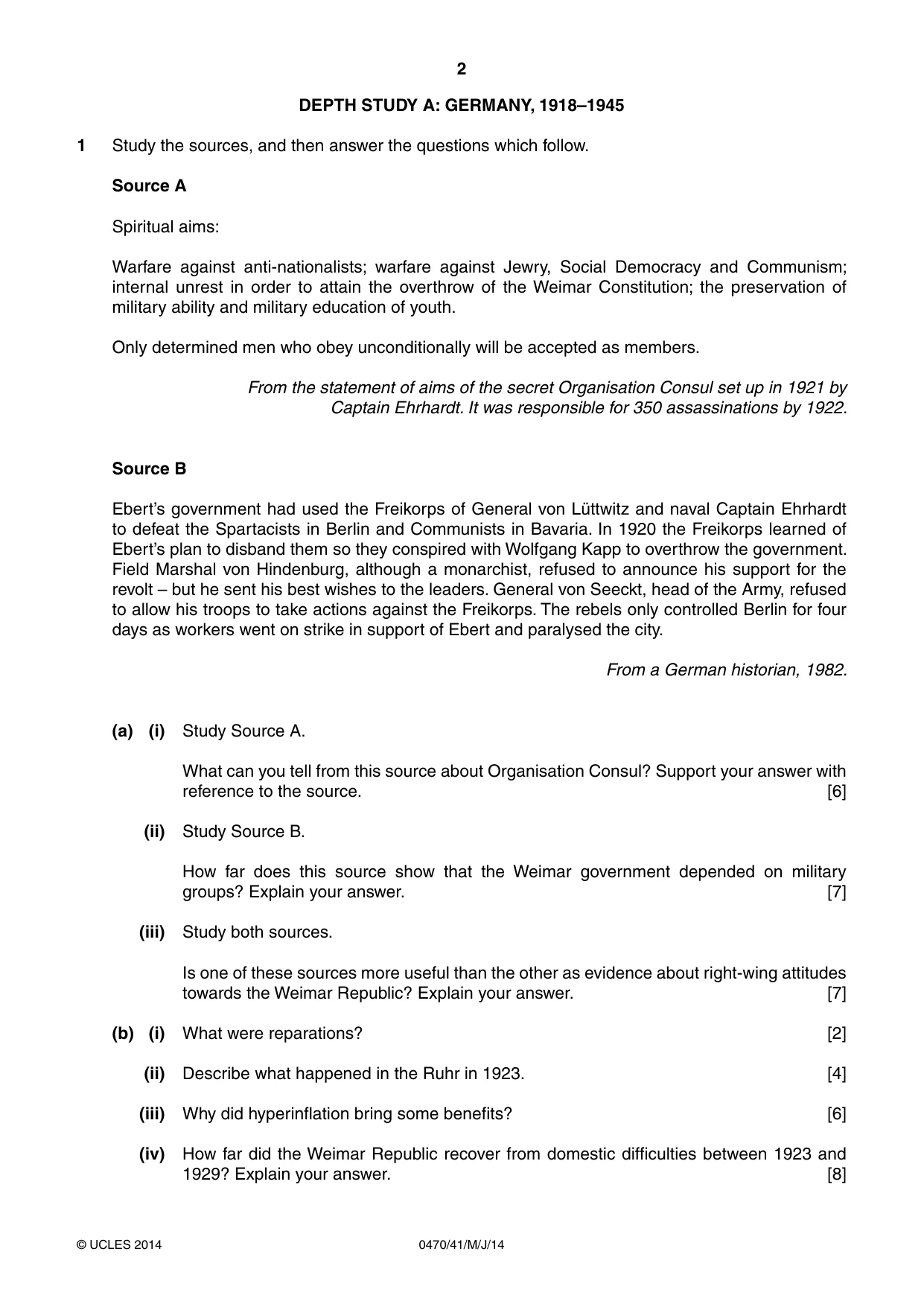
Question paper, page 2
2 0470/41/M/J/14 © UCLES 2014 DEPTH STUDY A: GERMANY, 1918–1945 1 Study the sources, and then answer the questions which follow. Source A Spiritual aims: Warfare against anti-nationalists; warfare against Jewry, Social Democracy and Communism; internal unrest in order to attain the overthrow of the Weimar Constitution; the preservation of military ability and military education of youth. Only determined men who obey unconditionally will be accepted as members. From the statement of aims of the secret Organisation Consul set up in 1921 by Captain Ehrhardt. It was responsible for 350 assassinations by 1922. Source B Ebert’s government had used the Freikorps of General von Lüttwitz and naval Captain Ehrhardt to defeat the Spartacists in Berlin and Communists in Bavaria. In 1920 the Freikorps learned of Ebert’s plan to disband them so they conspired with Wolfgang Kapp to overthrow the government. Field Marshal von Hindenburg, although a monarchist, refused to announce his support for the revolt – but he sent his best wishes to the leaders. General von Seeckt, head of the Army, refused to allow his troops to take actions against the Freikorps. The rebels only controlled Berlin for four days as workers went on strike in support of Ebert and paralysed the city. From a German historian, 1982. (a) (i) Study Source A. What can you tell from this source about Organisation Consul? Support your answer with reference to the source. [6] (ii) Study Source B. How far does this source show that the Weimar government depended on military groups? Explain your answer. [7] (iii) Study both sources. Is one of these sources more useful than the other as evidence about right-wing attitudes towards the Weimar Republic? Explain your answer. [7] (b) (i) What were reparations? [2] (ii) Describe what happened in the Ruhr in 1923. [4] (iii) Why did hyperinflation bring some benefits? [6] (iv) How far did the Weimar Republic recover from domestic difficulties between 1923 and 1929? Explain your answer. [8]
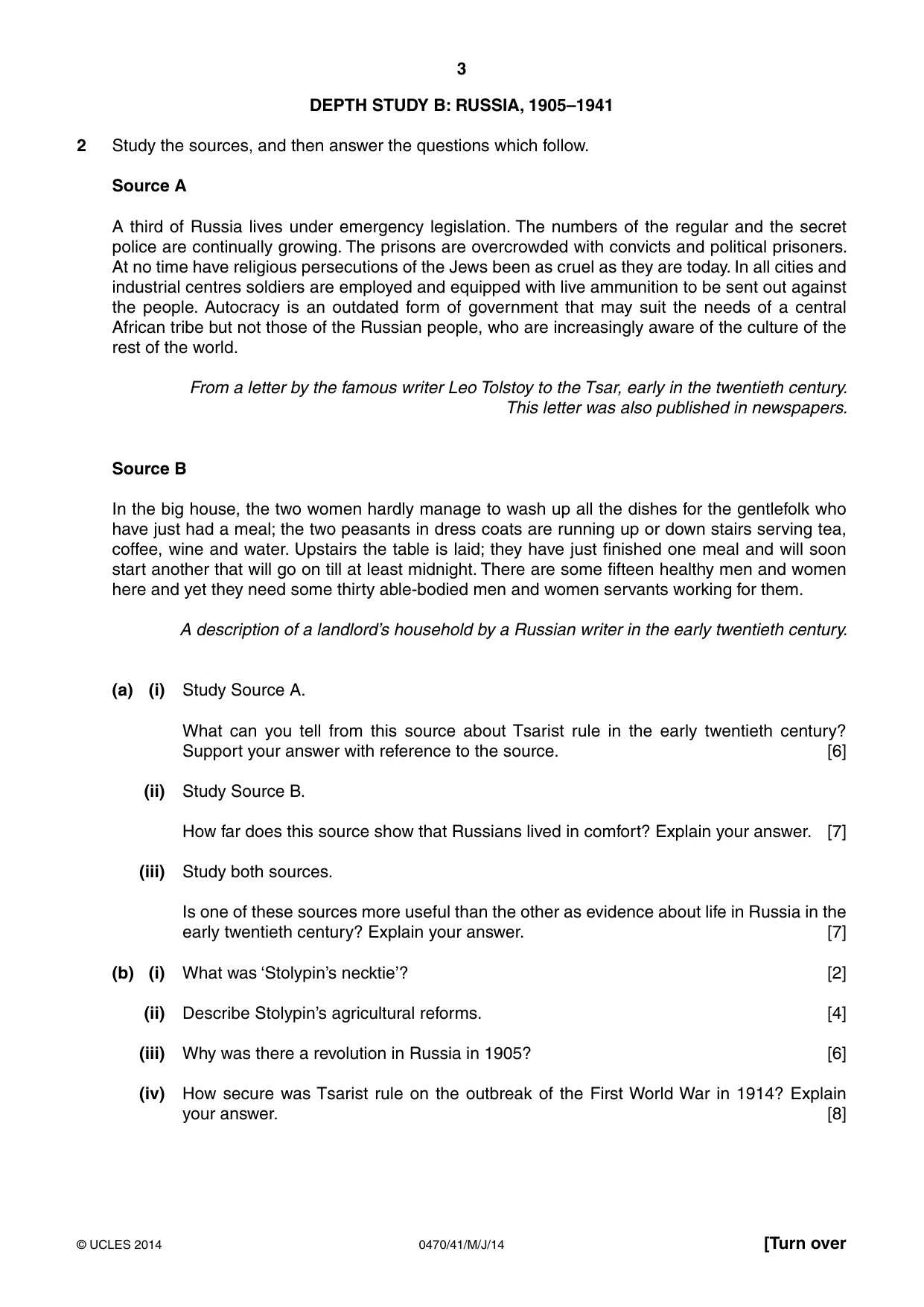
Question paper, page 3
3 0470/41/M/J/14 © UCLES 2014 [Turn over DEPTH STUDY B: RUSSIA, 1905–1941 2 Study the sources, and then answer the questions which follow. Source A A third of Russia lives under emergency legislation. The numbers of the regular and the secret police are continually growing. The prisons are overcrowded with convicts and political prisoners. At no time have religious persecutions of the Jews been as cruel as they are today. In all cities and industrial centres soldiers are employed and equipped with live ammunition to be sent out against the people. Autocracy is an outdated form of government that may suit the needs of a central African tribe but not those of the Russian people, who are increasingly aware of the culture of the rest of the world. From a letter by the famous writer Leo Tolstoy to the Tsar, early in the twentieth century. This letter was also published in newspapers. Source B In the big house, the two women hardly manage to wash up all the dishes for the gentlefolk who have just had a meal; the two peasants in dress coats are running up or down stairs serving tea, coffee, wine and water. Upstairs the table is laid; they have just finished one meal and will soon start another that will go on till at least midnight. There are some fifteen healthy men and women here and yet they need some thirty able-bodied men and women servants working for them. A description of a landlord’s household by a Russian writer in the early twentieth century. (a) (i) Study Source A. What can you tell from this source about Tsarist rule in the early twentieth century? Support your answer with reference to the source. [6] (ii) Study Source B. How far does this source show that Russians lived in comfort? Explain your answer. [7] (iii) Study both sources. Is one of these sources more useful than the other as evidence about life in Russia in the early twentieth century? Explain your answer. [7] (b) (i) What was ‘Stolypin’s necktie’? [2] (ii) Describe Stolypin’s agricultural reforms. [4] (iii) Why was there a revolution in Russia in 1905? [6] (iv) How secure was Tsarist rule on the outbreak of the First World War in 1914? Explain your answer. [8]
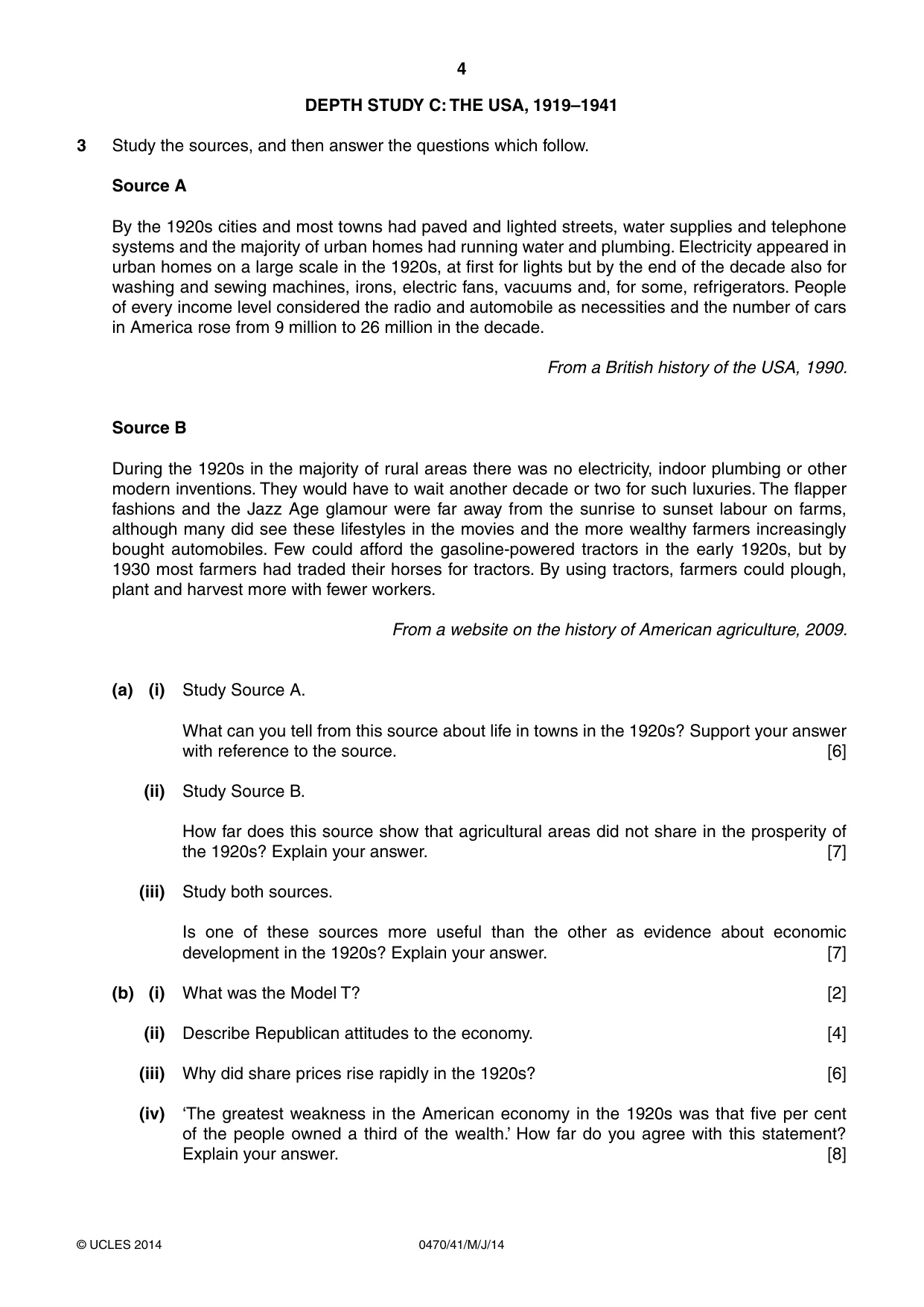
Question paper, page 4
4 0470/41/M/J/14 © UCLES 2014 DEPTH STUDY C: THE USA, 1919–1941 3 Study the sources, and then answer the questions which follow. Source A By the 1920s cities and most towns had paved and lighted streets, water supplies and telephone systems and the majority of urban homes had running water and plumbing. Electricity appeared in urban homes on a large scale in the 1920s, at first for lights but by the end of the decade also for washing and sewing machines, irons, electric fans, vacuums and, for some, refrigerators. People of every income level considered the radio and automobile as necessities and the number of cars in America rose from 9 million to 26 million in the decade. From a British history of the USA, 1990. Source B During the 1920s in the majority of rural areas there was no electricity, indoor plumbing or other modern inventions. They would have to wait another decade or two for such luxuries. The flapper fashions and the Jazz Age glamour were far away from the sunrise to sunset labour on farms, although many did see these lifestyles in the movies and the more wealthy farmers increasingly bought automobiles. Few could afford the gasoline-powered tractors in the early 1920s, but by 1930 most farmers had traded their horses for tractors. By using tractors, farmers could plough, plant and harvest more with fewer workers. From a website on the history of American agriculture, 2009. (a) (i) Study Source A. What can you tell from this source about life in towns in the 1920s? Support your answer with reference to the source. [6] (ii) Study Source B. How far does this source show that agricultural areas did not share in the prosperity of the 1920s? Explain your answer. [7] (iii) Study both sources. Is one of these sources more useful than the other as evidence about economic development in the 1920s? Explain your answer. [7] (b) (i) What was the Model T? [2] (ii) Describe Republican attitudes to the economy. [4] (iii) Why did share prices rise rapidly in the 1920s? [6] (iv) ‘The greatest weakness in the American economy in the 1920s was that five per cent of the people owned a third of the wealth.’ How far do you agree with this statement? Explain your answer. [8]
Question paper, page 5
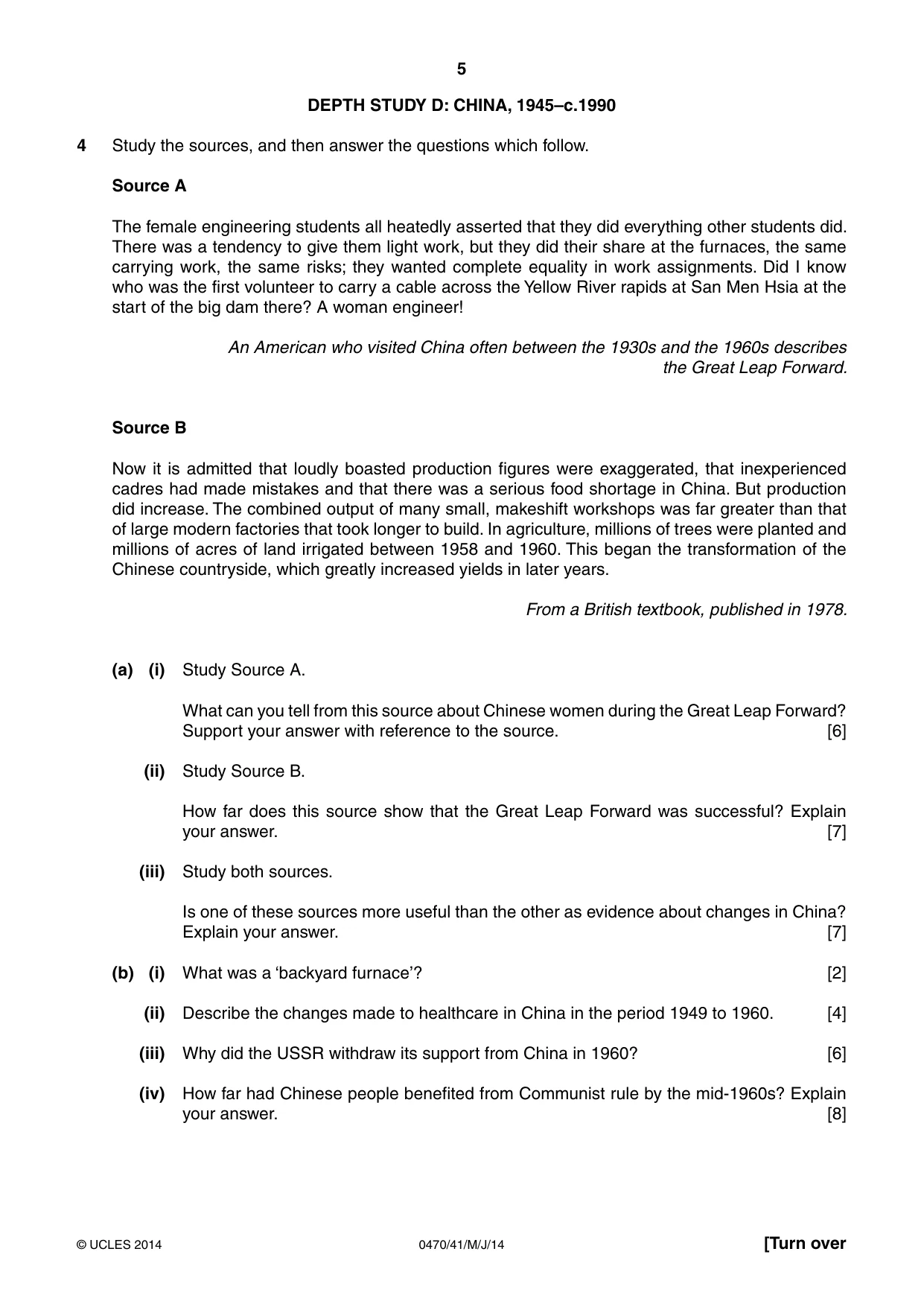
5 0470/41/M/J/14 © UCLES 2014 [Turn over DEPTH STUDY D: CHINA, 1945–c.1990 4 Study the sources, and then answer the questions which follow. Source A The female engineering students all heatedly asserted that they did everything other students did. There was a tendency to give them light work, but they did their share at the furnaces, the same carrying work, the same risks; they wanted complete equality in work assignments. Did I know who was the first volunteer to carry a cable across the Yellow River rapids at San Men Hsia at the start of the big dam there? A woman engineer! An American who visited China often between the 1930s and the 1960s describes the Great Leap Forward. Source B Now it is admitted that loudly boasted production figures were exaggerated, that inexperienced cadres had made mistakes and that there was a serious food shortage in China. But production did increase. The combined output of many small, makeshift workshops was far greater than that of large modern factories that took longer to build. In agriculture, millions of trees were planted and millions of acres of land irrigated between 1958 and 1960. This began the transformation of the Chinese countryside, which greatly increased yields in later years. From a British textbook, published in 1978. (a) (i) Study Source A. What can you tell from this source about Chinese women during the Great Leap Forward? Support your answer with reference to the source. [6] (ii) Study Source B. How far does this source show that the Great Leap Forward was successful? Explain your answer. [7] (iii) Study both sources. Is one of these sources more useful than the other as evidence about changes in China? Explain your answer. [7] (b) (i) What was a ‘backyard furnace’? [2] (ii) Describe the changes made to healthcare in China in the period 1949 to 1960. [4] (iii) Why did the USSR withdraw its support from China in 1960? [6] (iv) How far had Chinese people benefited from Communist rule by the mid-1960s? Explain your answer. [8]
Question paper, page 6
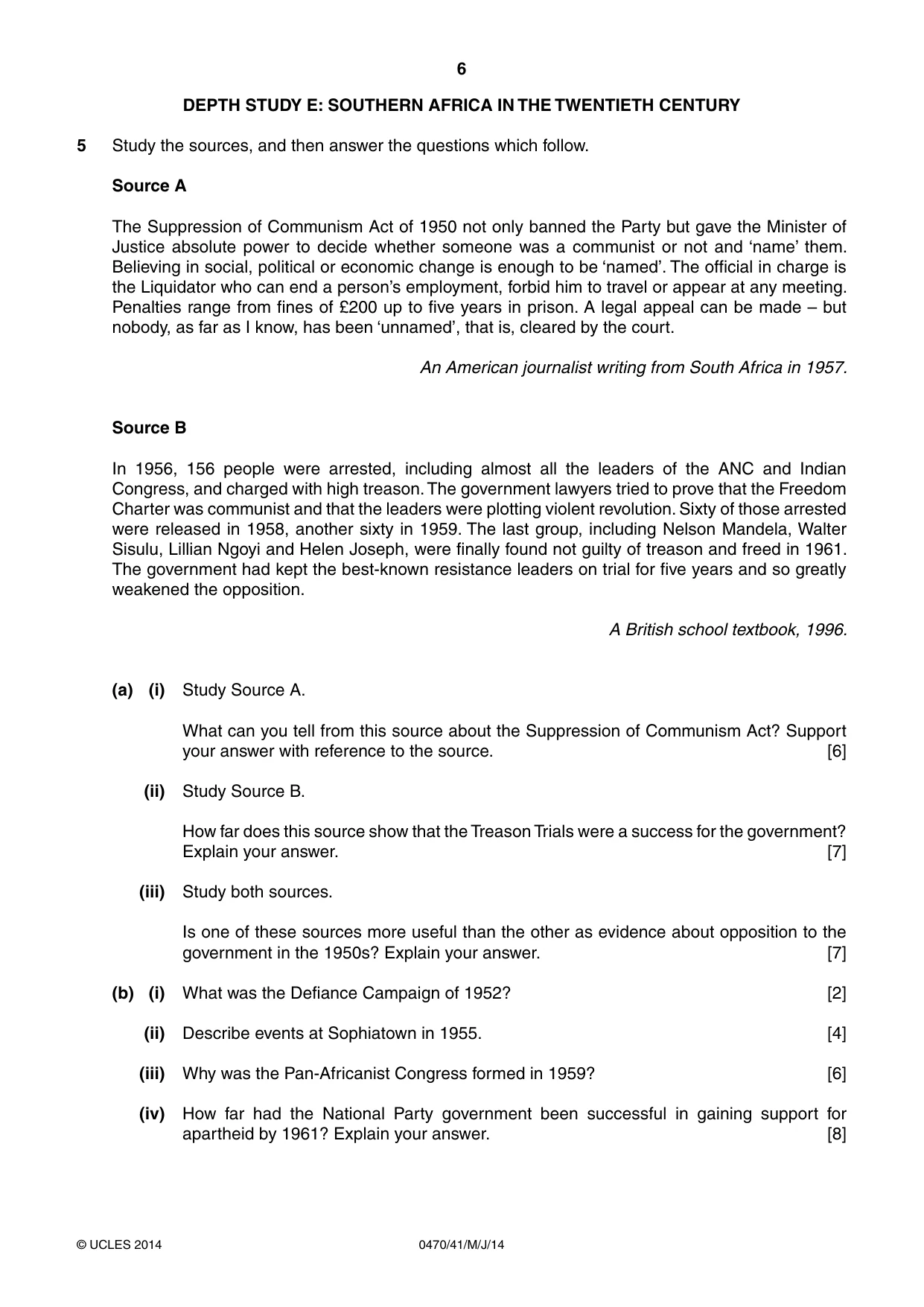
6 0470/41/M/J/14 © UCLES 2014 DEPTH STUDY E: SOUTHERN AFRICA IN THE TWENTIETH CENTURY 5 Study the sources, and then answer the questions which follow. Source A The Suppression of Communism Act of 1950 not only banned the Party but gave the Minister of Justice absolute power to decide whether someone was a communist or not and ‘name’ them. Believing in social, political or economic change is enough to be ‘named’. The official in charge is the Liquidator who can end a person’s employment, forbid him to travel or appear at any meeting. Penalties range from fines of £200 up to five years in prison. A legal appeal can be made – but nobody, as far as I know, has been ‘unnamed’, that is, cleared by the court. An American journalist writing from South Africa in 1957. Source B In 1956, 156 people were arrested, including almost all the leaders of the ANC and Indian Congress, and charged with high treason. The government lawyers tried to prove that the Freedom Charter was communist and that the leaders were plotting violent revolution. Sixty of those arrested were released in 1958, another sixty in 1959. The last group, including Nelson Mandela, Walter Sisulu, Lillian Ngoyi and Helen Joseph, were finally found not guilty of treason and freed in 1961. The government had kept the best-known resistance leaders on trial for five years and so greatly weakened the opposition. A British school textbook, 1996. (a) (i) Study Source A. What can you tell from this source about the Suppression of Communism Act? Support your answer with reference to the source. [6] (ii) Study Source B. How far does this source show that the Treason Trials were a success for the government? Explain your answer. [7] (iii) Study both sources. Is one of these sources more useful than the other as evidence about opposition to the government in the 1950s? Explain your answer. [7] (b) (i) What was the Defiance Campaign of 1952? [2] (ii) Describe events at Sophiatown in 1955. [4] (iii) Why was the Pan-Africanist Congress formed in 1959? [6] (iv) How far had the National Party government been successful in gaining support for apartheid by 1961? Explain your answer. [8]
Question paper, page 7
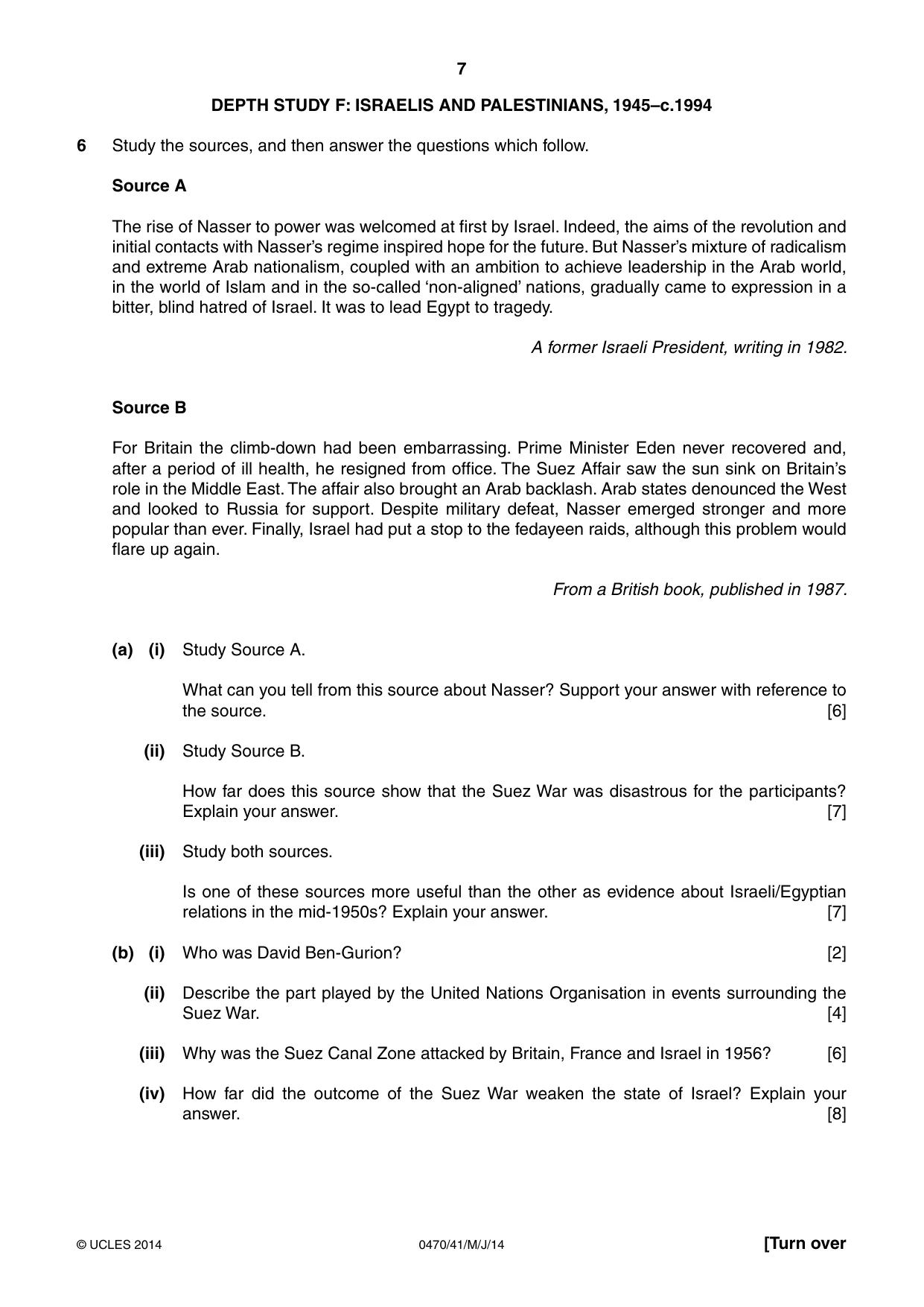
7 0470/41/M/J/14 © UCLES 2014 [Turn over DEPTH STUDY F: ISRAELIS AND PALESTINIANS, 1945–c.1994 6 Study the sources, and then answer the questions which follow. Source A The rise of Nasser to power was welcomed at first by Israel. Indeed, the aims of the revolution and initial contacts with Nasser’s regime inspired hope for the future. But Nasser’s mixture of radicalism and extreme Arab nationalism, coupled with an ambition to achieve leadership in the Arab world, in the world of Islam and in the so-called ‘non-aligned’ nations, gradually came to expression in a bitter, blind hatred of Israel. It was to lead Egypt to tragedy. A former Israeli President, writing in 1982. Source B For Britain the climb-down had been embarrassing. Prime Minister Eden never recovered and, after a period of ill health, he resigned from office. The Suez Affair saw the sun sink on Britain’s role in the Middle East. The affair also brought an Arab backlash. Arab states denounced the West and looked to Russia for support. Despite military defeat, Nasser emerged stronger and more popular than ever. Finally, Israel had put a stop to the fedayeen raids, although this problem would flare up again. From a British book, published in 1987. (a) (i) Study Source A. What can you tell from this source about Nasser? Support your answer with reference to the source. [6] (ii) Study Source B. How far does this source show that the Suez War was disastrous for the participants? Explain your answer. [7] (iii) Study both sources. Is one of these sources more useful than the other as evidence about Israeli/Egyptian relations in the mid-1950s? Explain your answer. [7] (b) (i) Who was David Ben-Gurion? [2] (ii) Describe the part played by the United Nations Organisation in events surrounding the Suez War. [4] (iii) Why was the Suez Canal Zone attacked by Britain, France and Israel in 1956? [6] (iv) How far did the outcome of the Suez War weaken the state of Israel? Explain your answer. [8]
Question paper, page 8
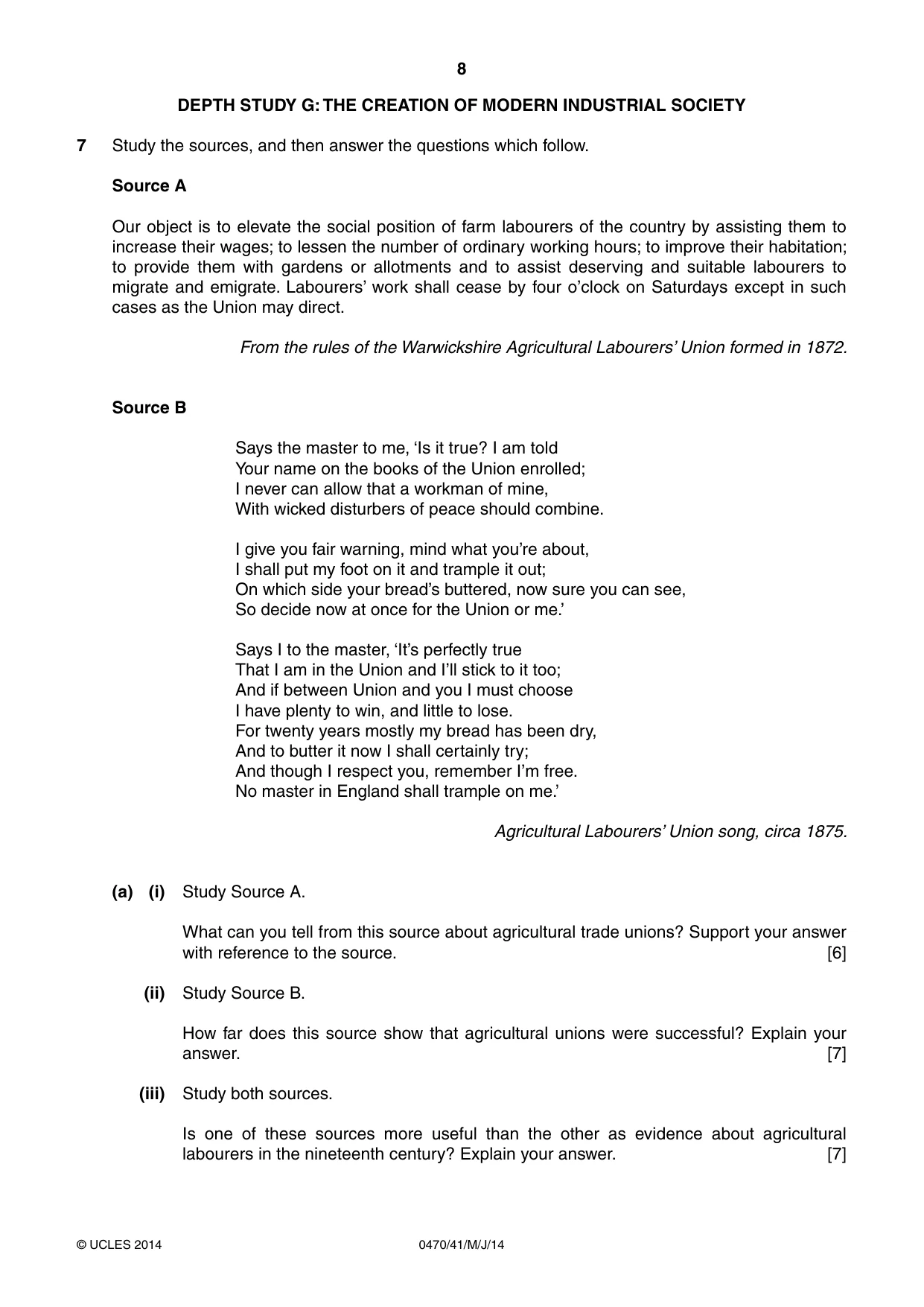
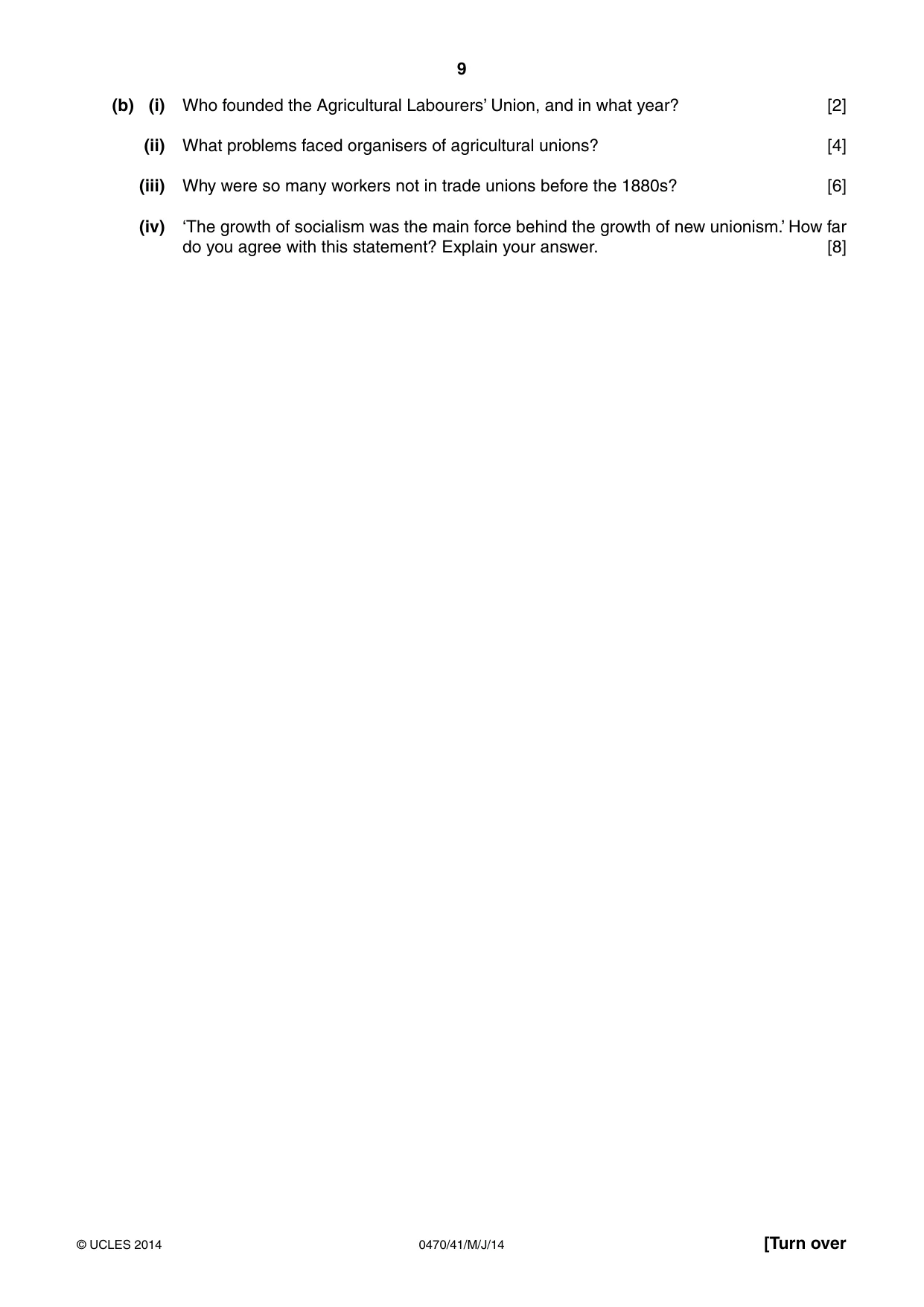
8 0470/41/M/J/14 © UCLES 2014 DEPTH STUDY G: THE CREATION OF MODERN INDUSTRIAL SOCIETY 7 Study the sources, and then answer the questions which follow. Source A Our object is to elevate the social position of farm labourers of the country by assisting them to increase their wages; to lessen the number of ordinary working hours; to improve their habitation; to provide them with gardens or allotments and to assist deserving and suitable labourers to migrate and emigrate. Labourers’ work shall cease by four o’clock on Saturdays except in such cases as the Union may direct. From the rules of the Warwickshire Agricultural Labourers’ Union formed in 1872. Source B Says the master to me, ‘Is it true? I am told Your name on the books of the Union enrolled; I never can allow that a workman of mine, With wicked disturbers of peace should combine. I give you fair warning, mind what you’re about, I shall put my foot on it and trample it out; On which side your bread’s buttered, now sure you can see, So decide now at once for the Union or me.’ Says I to the master, ‘It’s perfectly true That I am in the Union and I’ll stick to it too; And if between Union and you I must choose I have plenty to win, and little to lose. For twenty years mostly my bread has been dry, And to butter it now I shall certainly try; And though I respect you, remember I’m free. No master in England shall trample on me.’ Agricultural Labourers’ Union song, circa 1875. (a) (i) Study Source A. What can you tell from this source about agricultural trade unions? Support your answer with reference to the source. [6] (ii) Study Source B. How far does this source show that agricultural unions were successful? Explain your answer. [7] (iii) Study both sources. Is one of these sources more useful than the other as evidence about agricultural labourers in the nineteenth century? Explain your answer. [7]
Question paper, page 9
9 0470/41/M/J/14 © UCLES 2014 [Turn over (b) (i) Who founded the Agricultural Labourers’ Union, and in what year? [2] (ii) What problems faced organisers of agricultural unions? [4] (iii) Why were so many workers not in trade unions before the 1880s? [6] (iv) ‘The growth of socialism was the main force behind the growth of new unionism.’ How far do you agree with this statement? Explain your answer. [8]
Question paper, page 10
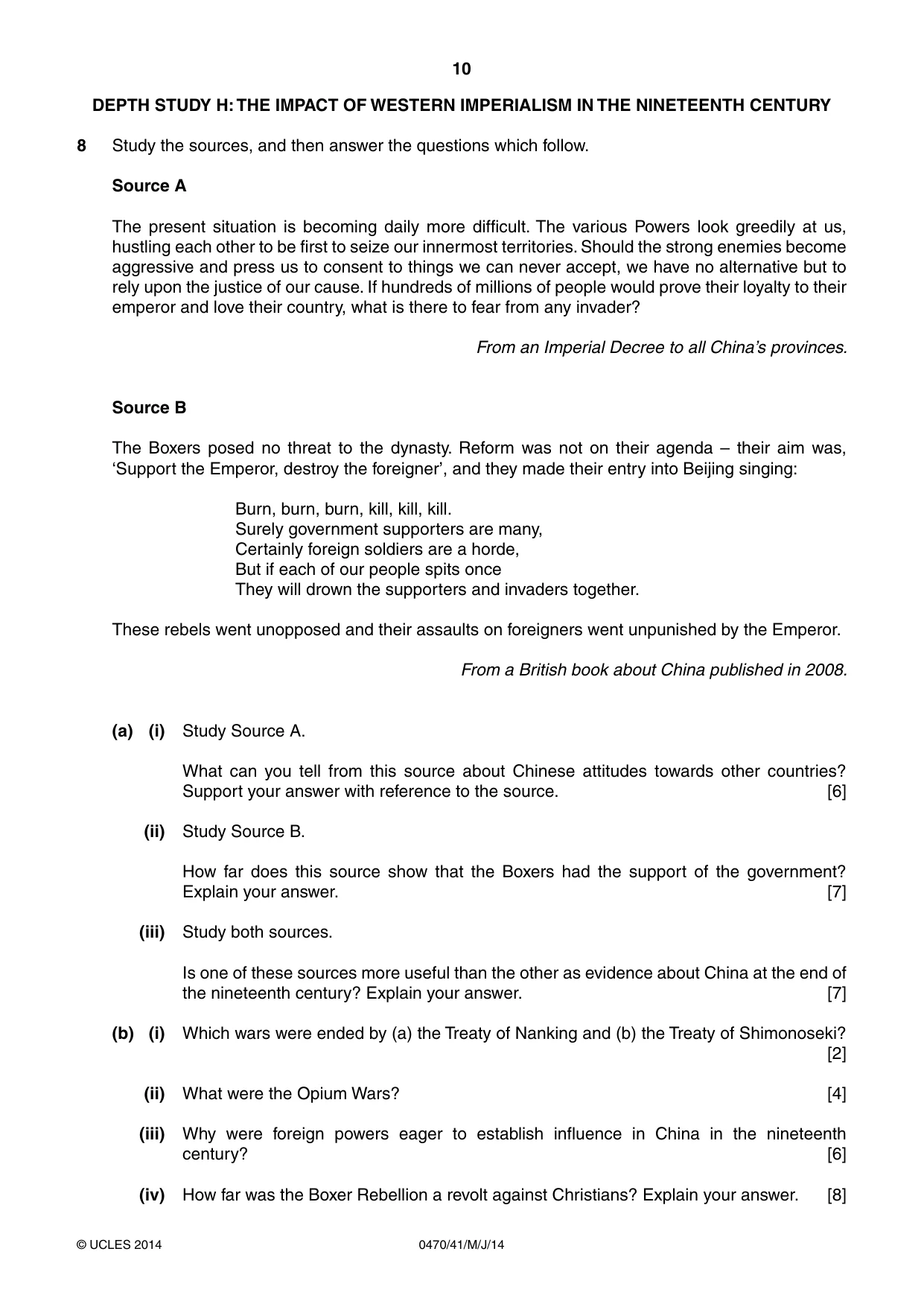
10 0470/41/M/J/14 © UCLES 2014 DEPTH STUDY H: THE IMPACT OF WESTERN IMPERIALISM IN THE NINETEENTH CENTURY 8 Study the sources, and then answer the questions which follow. Source A The present situation is becoming daily more difficult. The various Powers look greedily at us, hustling each other to be first to seize our innermost territories. Should the strong enemies become aggressive and press us to consent to things we can never accept, we have no alternative but to rely upon the justice of our cause. If hundreds of millions of people would prove their loyalty to their emperor and love their country, what is there to fear from any invader? From an Imperial Decree to all China’s provinces. Source B The Boxers posed no threat to the dynasty. Reform was not on their agenda – their aim was, ‘Support the Emperor, destroy the foreigner’, and they made their entry into Beijing singing: Burn, burn, burn, kill, kill, kill. Surely government supporters are many, Certainly foreign soldiers are a horde, But if each of our people spits once They will drown the supporters and invaders together. These rebels went unopposed and their assaults on foreigners went unpunished by the Emperor. From a British book about China published in 2008. (a) (i) Study Source A. What can you tell from this source about Chinese attitudes towards other countries? Support your answer with reference to the source. [6] (ii) Study Source B. How far does this source show that the Boxers had the support of the government? Explain your answer. [7] (iii) Study both sources. Is one of these sources more useful than the other as evidence about China at the end of the nineteenth century? Explain your answer. [7] (b) (i) Which wars were ended by (a) the Treaty of Nanking and (b) the Treaty of Shimonoseki? [2] (ii) What were the Opium Wars? [4] (iii) Why were foreign powers eager to establish influence in China in the nineteenth century? [6] (iv) How far was the Boxer Rebellion a revolt against Christians? Explain your answer. [8]
Question paper, page 11
11 0470/41/M/J/14 © UCLES 2014 BLANK PAGE
Question paper, page 12
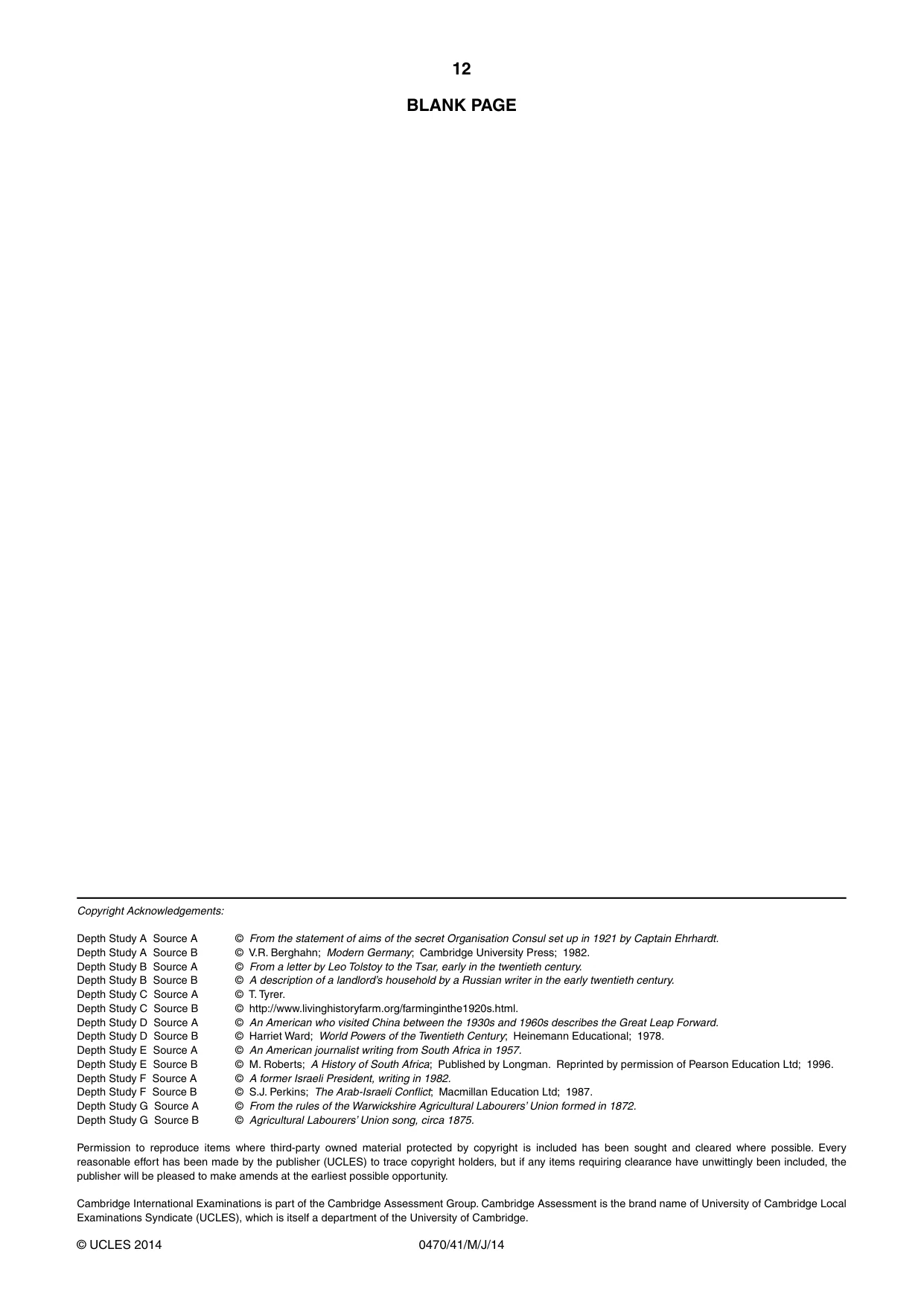
12 0470/41/M/J/14 © UCLES 2014 BLANK PAGE Copyright Acknowledgements: Depth Study A Source A © From the statement of aims of the secret Organisation Consul set up in 1921 by Captain Ehrhardt. Depth Study A Source B © V.R. Berghahn; Modern Germany; Cambridge University Press; 1982. Depth Study B Source A © From a letter by Leo Tolstoy to the Tsar, early in the twentieth century. Depth Study B Source B © A description of a landlord’s household by a Russian writer in the early twentieth century. Depth Study C Source A © T. Tyrer. Depth Study C Source B © http://www.livinghistoryfarm.org/farminginthe1920s.html. Depth Study D Source A © An American who visited China between the 1930s and 1960s describes the Great Leap Forward. Depth Study D Source B © Harriet Ward; World Powers of the Twentieth Century; Heinemann Educational; 1978. Depth Study E Source A © An American journalist writing from South Africa in 1957. Depth Study E Source B © M. Roberts; A History of South Africa; Published by Longman. Reprinted by permission of Pearson Education Ltd; 1996. Depth Study F Source A © A former Israeli President, writing in 1982. Depth Study F Source B © S.J. Perkins; The Arab-Israeli Conflict; Macmillan Education Ltd; 1987. Depth Study G Source A © From the rules of the Warwickshire Agricultural Labourers’ Union formed in 1872. Depth Study G Source B © Agricultural Labourers’ Union song, circa 1875. Permission to reproduce items where third-party owned material protected by copyright is included has been sought and cleared where possible. Every reasonable effort has been made by the publisher (UCLES) to trace copyright holders, but if any items requiring clearance have unwittingly been included, the publisher will be pleased to make amends at the earliest possible opportunity. Cambridge International Examinations is part of the Cambridge Assessment Group. Cambridge Assessment is the brand name of University of Cambridge Local Examinations Syndicate (UCLES), which is itself a department of the University of Cambridge.
Mark scheme, page 1
CAMBRIDGE INTERNATIONAL EXAMINATIONS International General Certificate of Secondary Education MARK SCHEME for the May/June 2014 series 0470 HISTORY 0470/41 Paper 4 (Alternative to Coursework), maximum raw mark 40 This mark scheme is published as an aid to teachers and candidates, to indicate the requirements of the examination. It shows the basis on which Examiners were instructed to award marks. It does not indicate the details of the discussions that took place at an Examiners’ meeting before marking began, which would have considered the acceptability of alternative answers. Mark schemes should be read in conjunction with the question paper and the Principal Examiner Report for Teachers. Cambridge will not enter into discussions about these mark schemes. Cambridge is publishing the mark schemes for the May/June 2014 series for most IGCSE, GCE Advanced Level and Advanced Subsidiary Level components and some Ordinary Level components.
Mark scheme, page 2
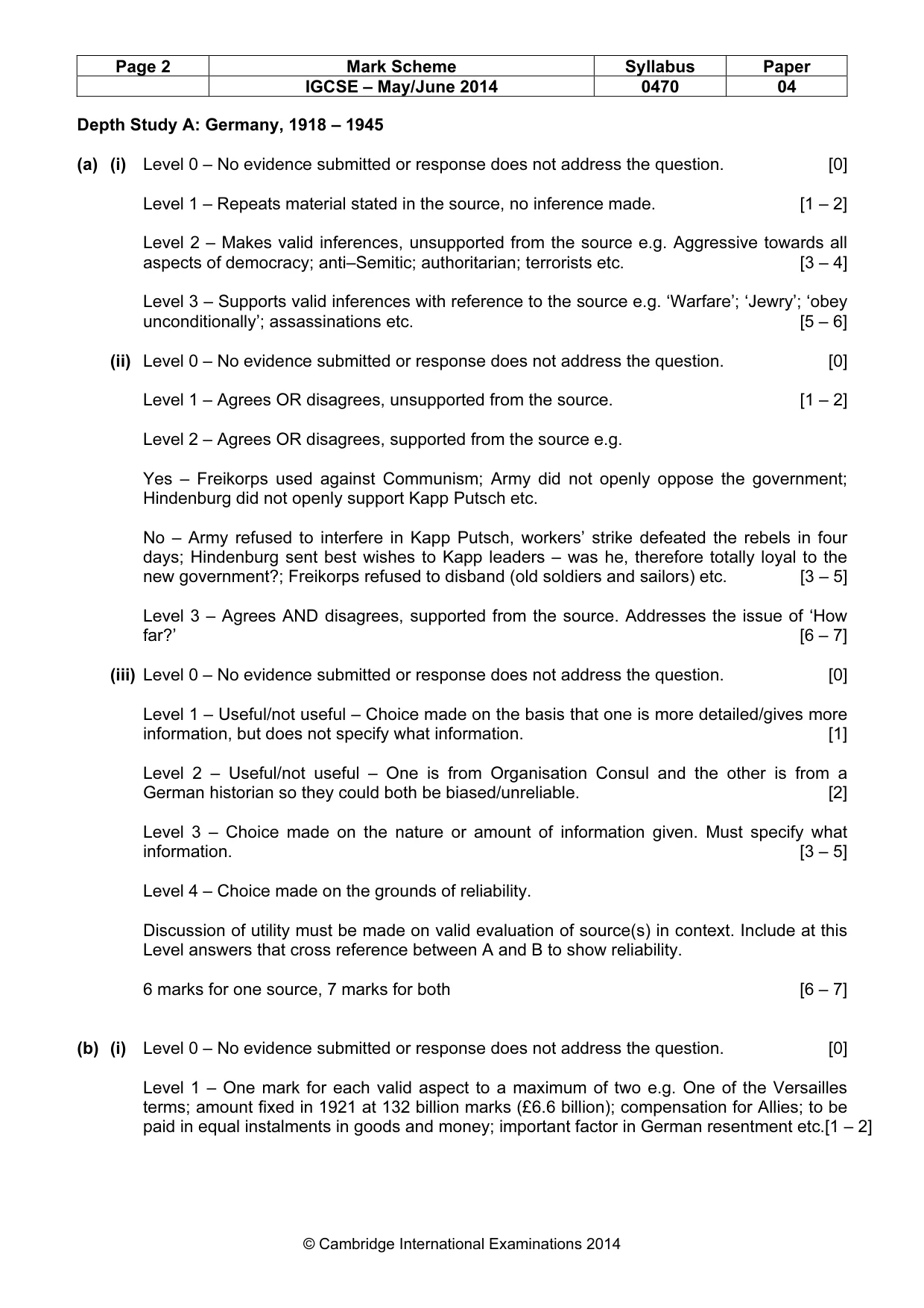
Page 2 Mark Scheme Syllabus Paper IGCSE – May/June 2014 0470 04 © Cambridge International Examinations 2014 Depth Study A: Germany, 1918 – 1945 (a) (i) Level 0 – No evidence submitted or response does not address the question. [0] Level 1 – Repeats material stated in the source, no inference made. [1 – 2] Level 2 – Makes valid inferences, unsupported from the source e.g. Aggressive towards all aspects of democracy; anti–Semitic; authoritarian; terrorists etc. [3 – 4] Level 3 – Supports valid inferences with reference to the source e.g. ‘Warfare’; ‘Jewry’; ‘obey unconditionally’; assassinations etc. [5 – 6] (ii) Level 0 – No evidence submitted or response does not address the question. [0] Level 1 – Agrees OR disagrees, unsupported from the source. [1 – 2] Level 2 – Agrees OR disagrees, supported from the source e.g. Yes – Freikorps used against Communism; Army did not openly oppose the government; Hindenburg did not openly support Kapp Putsch etc. No – Army refused to interfere in Kapp Putsch, workers’ strike defeated the rebels in four days; Hindenburg sent best wishes to Kapp leaders – was he, therefore totally loyal to the new government?; Freikorps refused to disband (old soldiers and sailors) etc. [3 – 5] Level 3 – Agrees AND disagrees, supported from the source. Addresses the issue of ‘How far?’ [6 – 7] (iii) Level 0 – No evidence submitted or response does not address the question. [0] Level 1 – Useful/not useful – Choice made on the basis that one is more detailed/gives more information, but does not specify what information. [1] Level 2 – Useful/not useful – One is from Organisation Consul and the other is from a German historian so they could both be biased/unreliable. [2] Level 3 – Choice made on the nature or amount of information given. Must specify what information. [3 – 5] Level 4 – Choice made on the grounds of reliability. Discussion of utility must be made on valid evaluation of source(s) in context. Include at this Level answers that cross reference between A and B to show reliability. 6 marks for one source, 7 marks for both [6 – 7] (b) (i) Level 0 – No evidence submitted or response does not address the question. [0] Level 1 – One mark for each valid aspect to a maximum of two e.g. One of the Versailles terms; amount fixed in 1921 at 132 billion marks (£6.6 billion); compensation for Allies; to be paid in equal instalments in goods and money; important factor in German resentment etc.[1 – 2]
Mark scheme, page 3
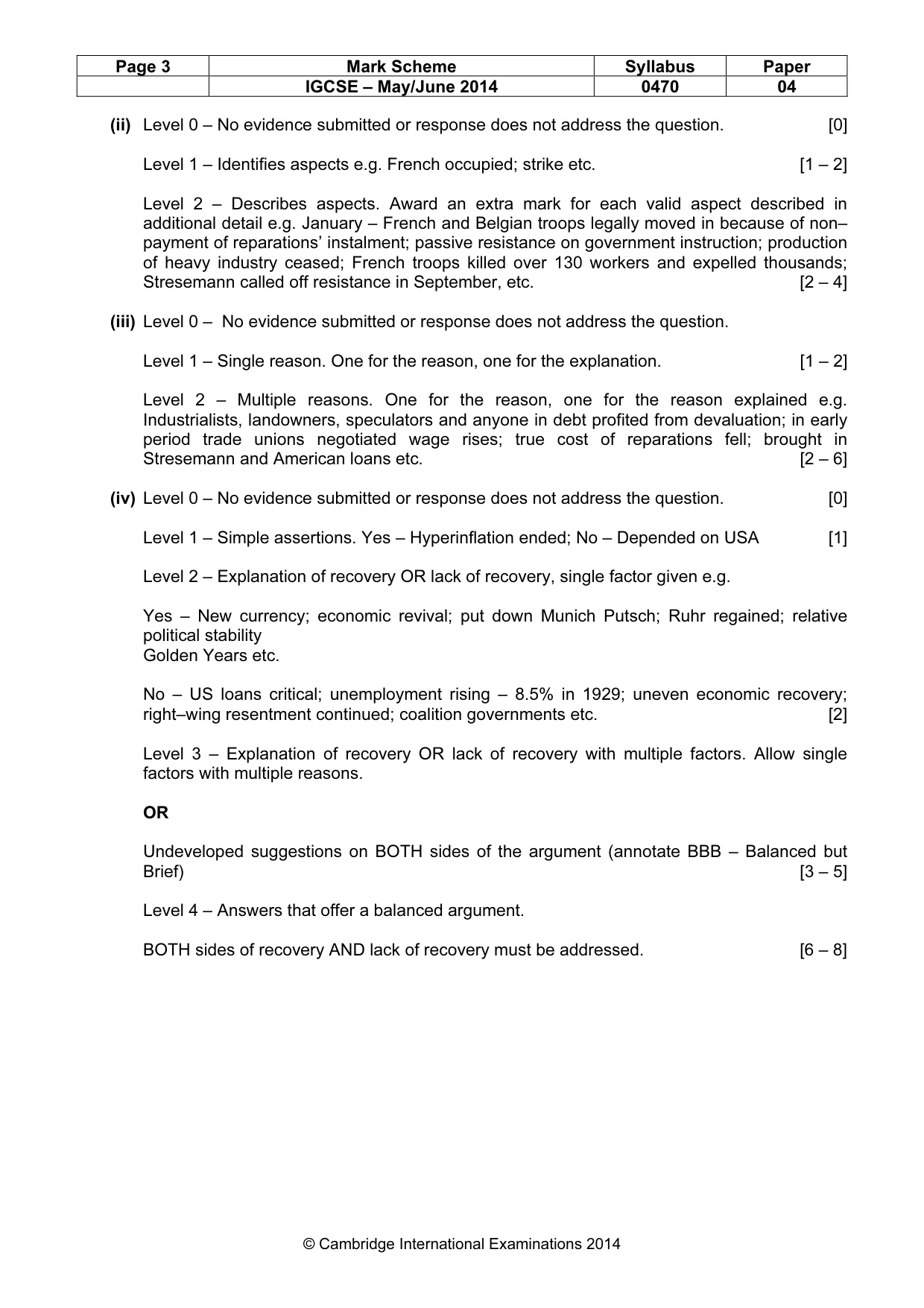
Page 3 Mark Scheme Syllabus Paper IGCSE – May/June 2014 0470 04 © Cambridge International Examinations 2014 (ii) Level 0 – No evidence submitted or response does not address the question. [0] Level 1 – Identifies aspects e.g. French occupied; strike etc. [1 – 2] Level 2 – Describes aspects. Award an extra mark for each valid aspect described in additional detail e.g. January – French and Belgian troops legally moved in because of non– payment of reparations’ instalment; passive resistance on government instruction; production of heavy industry ceased; French troops killed over 130 workers and expelled thousands; Stresemann called off resistance in September, etc. [2 – 4] (iii) Level 0 – No evidence submitted or response does not address the question. Level 1 – Single reason. One for the reason, one for the explanation. [1 – 2] Level 2 – Multiple reasons. One for the reason, one for the reason explained e.g. Industrialists, landowners, speculators and anyone in debt profited from devaluation; in early period trade unions negotiated wage rises; true cost of reparations fell; brought in Stresemann and American loans etc. [2 – 6] (iv) Level 0 – No evidence submitted or response does not address the question. [0] Level 1 – Simple assertions. Yes – Hyperinflation ended; No – Depended on USA [1] Level 2 – Explanation of recovery OR lack of recovery, single factor given e.g. Yes – New currency; economic revival; put down Munich Putsch; Ruhr regained; relative political stability Golden Years etc. No – US loans critical; unemployment rising – 8.5% in 1929; uneven economic recovery; right–wing resentment continued; coalition governments etc. [2] Level 3 – Explanation of recovery OR lack of recovery with multiple factors. Allow single factors with multiple reasons. OR Undeveloped suggestions on BOTH sides of the argument (annotate BBB – Balanced but Brief) [3 – 5] Level 4 – Answers that offer a balanced argument. BOTH sides of recovery AND lack of recovery must be addressed. [6 – 8]
Mark scheme, page 4
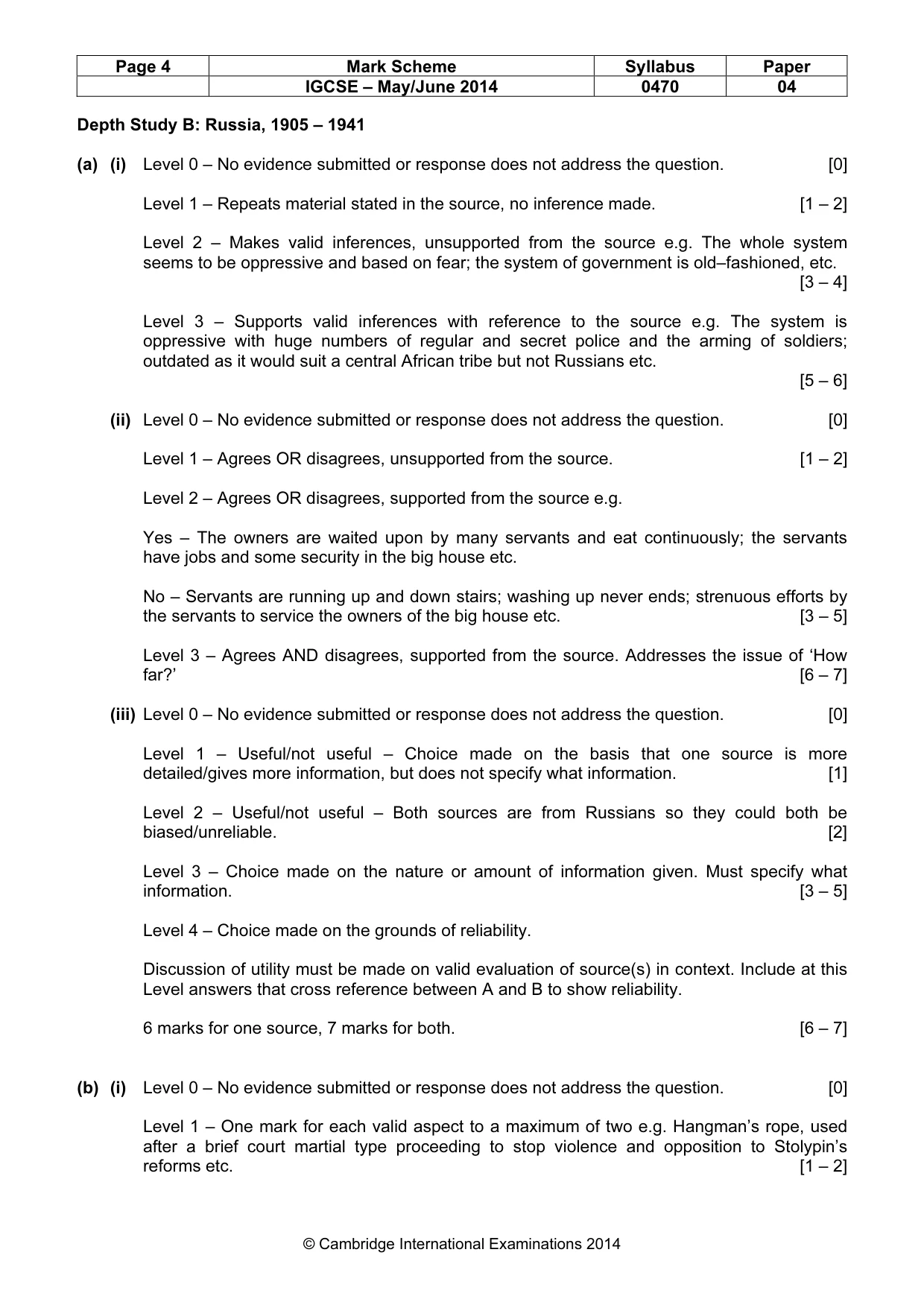
Page 4 Mark Scheme Syllabus Paper IGCSE – May/June 2014 0470 04 © Cambridge International Examinations 2014 Depth Study B: Russia, 1905 – 1941 (a) (i) Level 0 – No evidence submitted or response does not address the question. [0] Level 1 – Repeats material stated in the source, no inference made. [1 – 2] Level 2 – Makes valid inferences, unsupported from the source e.g. The whole system seems to be oppressive and based on fear; the system of government is old–fashioned, etc. [3 – 4] Level 3 – Supports valid inferences with reference to the source e.g. The system is oppressive with huge numbers of regular and secret police and the arming of soldiers; outdated as it would suit a central African tribe but not Russians etc. [5 – 6] (ii) Level 0 – No evidence submitted or response does not address the question. [0] Level 1 – Agrees OR disagrees, unsupported from the source. [1 – 2] Level 2 – Agrees OR disagrees, supported from the source e.g. Yes – The owners are waited upon by many servants and eat continuously; the servants have jobs and some security in the big house etc. No – Servants are running up and down stairs; washing up never ends; strenuous efforts by the servants to service the owners of the big house etc. [3 – 5] Level 3 – Agrees AND disagrees, supported from the source. Addresses the issue of ‘How far?’ [6 – 7] (iii) Level 0 – No evidence submitted or response does not address the question. [0] Level 1 – Useful/not useful – Choice made on the basis that one source is more detailed/gives more information, but does not specify what information. [1] Level 2 – Useful/not useful – Both sources are from Russians so they could both be biased/unreliable. [2] Level 3 – Choice made on the nature or amount of information given. Must specify what information. [3 – 5] Level 4 – Choice made on the grounds of reliability. Discussion of utility must be made on valid evaluation of source(s) in context. Include at this Level answers that cross reference between A and B to show reliability. 6 marks for one source, 7 marks for both. [6 – 7] (b) (i) Level 0 – No evidence submitted or response does not address the question. [0] Level 1 – One mark for each valid aspect to a maximum of two e.g. Hangman’s rope, used after a brief court martial type proceeding to stop violence and opposition to Stolypin’s reforms etc. [1 – 2]
Mark scheme, page 5
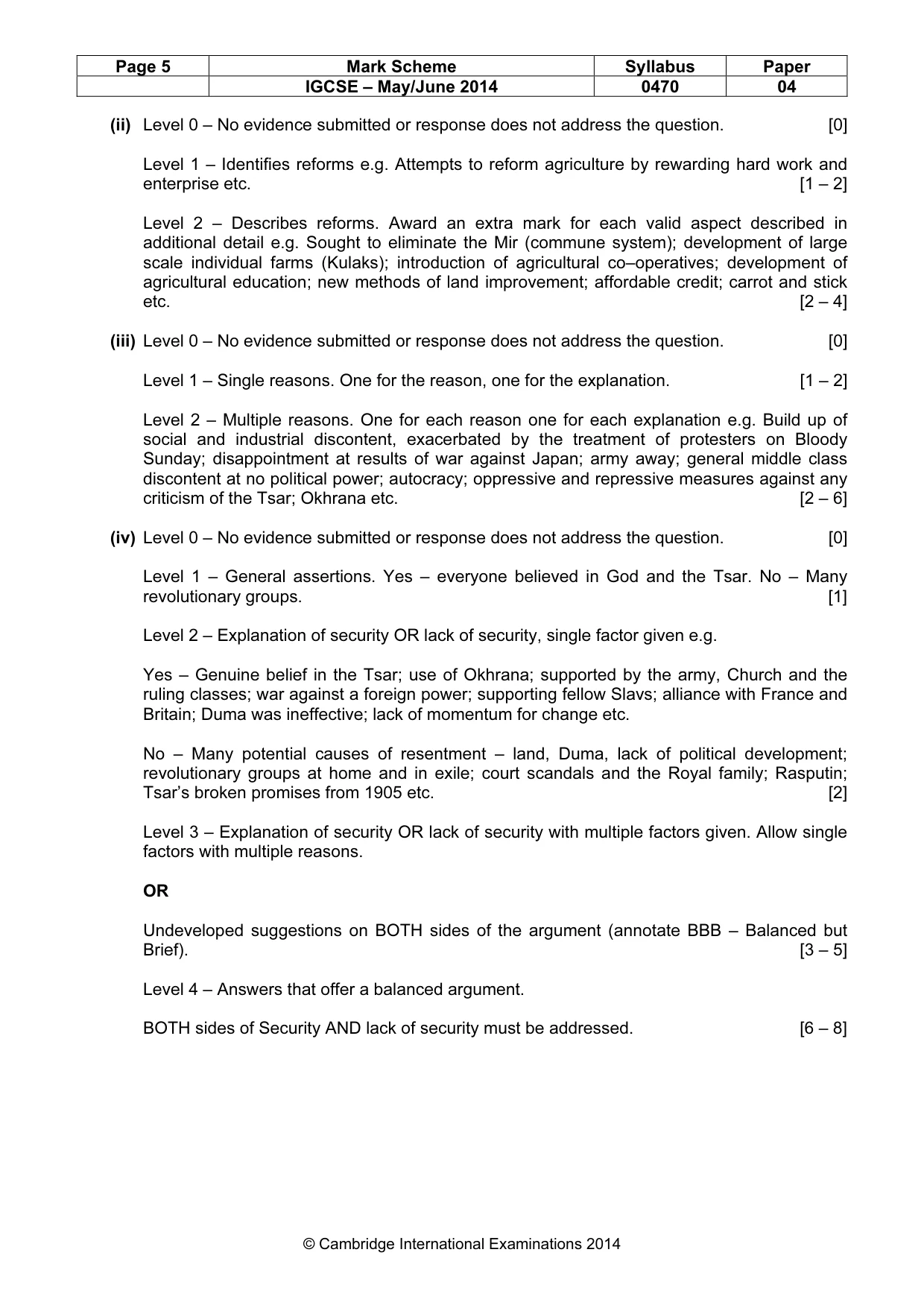
Page 5 Mark Scheme Syllabus Paper IGCSE – May/June 2014 0470 04 © Cambridge International Examinations 2014 (ii) Level 0 – No evidence submitted or response does not address the question. [0] Level 1 – Identifies reforms e.g. Attempts to reform agriculture by rewarding hard work and enterprise etc. [1 – 2] Level 2 – Describes reforms. Award an extra mark for each valid aspect described in additional detail e.g. Sought to eliminate the Mir (commune system); development of large scale individual farms (Kulaks); introduction of agricultural co–operatives; development of agricultural education; new methods of land improvement; affordable credit; carrot and stick etc. [2 – 4] (iii) Level 0 – No evidence submitted or response does not address the question. [0] Level 1 – Single reasons. One for the reason, one for the explanation. [1 – 2] Level 2 – Multiple reasons. One for each reason one for each explanation e.g. Build up of social and industrial discontent, exacerbated by the treatment of protesters on Bloody Sunday; disappointment at results of war against Japan; army away; general middle class discontent at no political power; autocracy; oppressive and repressive measures against any criticism of the Tsar; Okhrana etc. [2 – 6] (iv) Level 0 – No evidence submitted or response does not address the question. [0] Level 1 – General assertions. Yes – everyone believed in God and the Tsar. No – Many revolutionary groups. [1] Level 2 – Explanation of security OR lack of security, single factor given e.g. Yes – Genuine belief in the Tsar; use of Okhrana; supported by the army, Church and the ruling classes; war against a foreign power; supporting fellow Slavs; alliance with France and Britain; Duma was ineffective; lack of momentum for change etc. No – Many potential causes of resentment – land, Duma, lack of political development; revolutionary groups at home and in exile; court scandals and the Royal family; Rasputin; Tsar’s broken promises from 1905 etc. [2] Level 3 – Explanation of security OR lack of security with multiple factors given. Allow single factors with multiple reasons. OR Undeveloped suggestions on BOTH sides of the argument (annotate BBB – Balanced but Brief). [3 – 5] Level 4 – Answers that offer a balanced argument. BOTH sides of Security AND lack of security must be addressed. [6 – 8]
Mark scheme, page 6
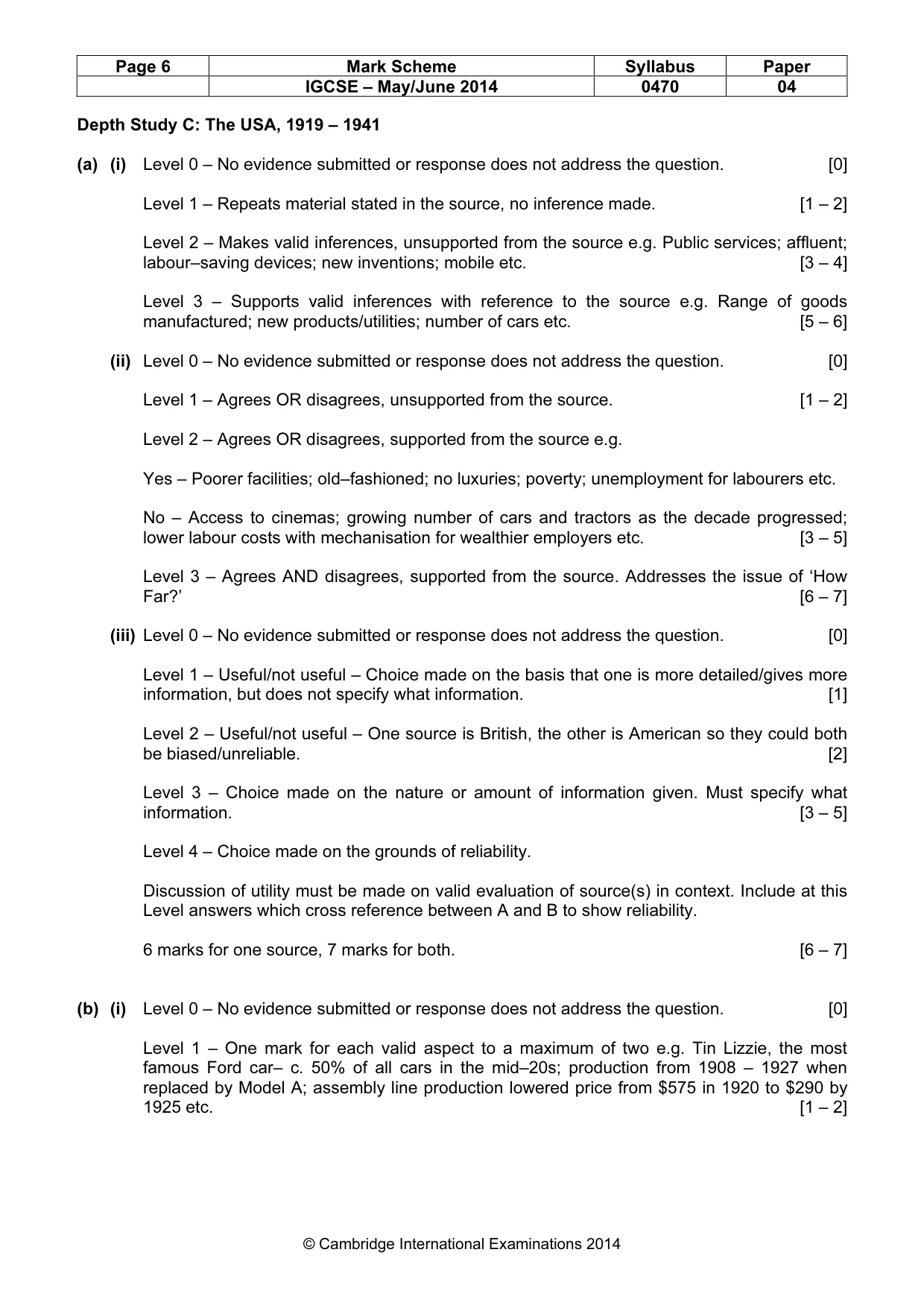
Page 6 Mark Scheme Syllabus Paper IGCSE – May/June 2014 0470 04 © Cambridge International Examinations 2014 Depth Study C: The USA, 1919 – 1941 (a) (i) Level 0 – No evidence submitted or response does not address the question. [0] Level 1 – Repeats material stated in the source, no inference made. [1 – 2] Level 2 – Makes valid inferences, unsupported from the source e.g. Public services; affluent; labour–saving devices; new inventions; mobile etc. [3 – 4] Level 3 – Supports valid inferences with reference to the source e.g. Range of goods manufactured; new products/utilities; number of cars etc. [5 – 6] (ii) Level 0 – No evidence submitted or response does not address the question. [0] Level 1 – Agrees OR disagrees, unsupported from the source. [1 – 2] Level 2 – Agrees OR disagrees, supported from the source e.g. Yes – Poorer facilities; old–fashioned; no luxuries; poverty; unemployment for labourers etc. No – Access to cinemas; growing number of cars and tractors as the decade progressed; lower labour costs with mechanisation for wealthier employers etc. [3 – 5] Level 3 – Agrees AND disagrees, supported from the source. Addresses the issue of ‘How Far?’ [6 – 7] (iii) Level 0 – No evidence submitted or response does not address the question. [0] Level 1 – Useful/not useful – Choice made on the basis that one is more detailed/gives more information, but does not specify what information. [1] Level 2 – Useful/not useful – One source is British, the other is American so they could both be biased/unreliable. [2] Level 3 – Choice made on the nature or amount of information given. Must specify what information. [3 – 5] Level 4 – Choice made on the grounds of reliability. Discussion of utility must be made on valid evaluation of source(s) in context. Include at this Level answers which cross reference between A and B to show reliability. 6 marks for one source, 7 marks for both. [6 – 7] (b) (i) Level 0 – No evidence submitted or response does not address the question. [0] Level 1 – One mark for each valid aspect to a maximum of two e.g. Tin Lizzie, the most famous Ford car– c. 50% of all cars in the mid–20s; production from 1908 – 1927 when replaced by Model A; assembly line production lowered price from $575 in 1920 to $290 by 1925 etc. [1 – 2]
Mark scheme, page 7
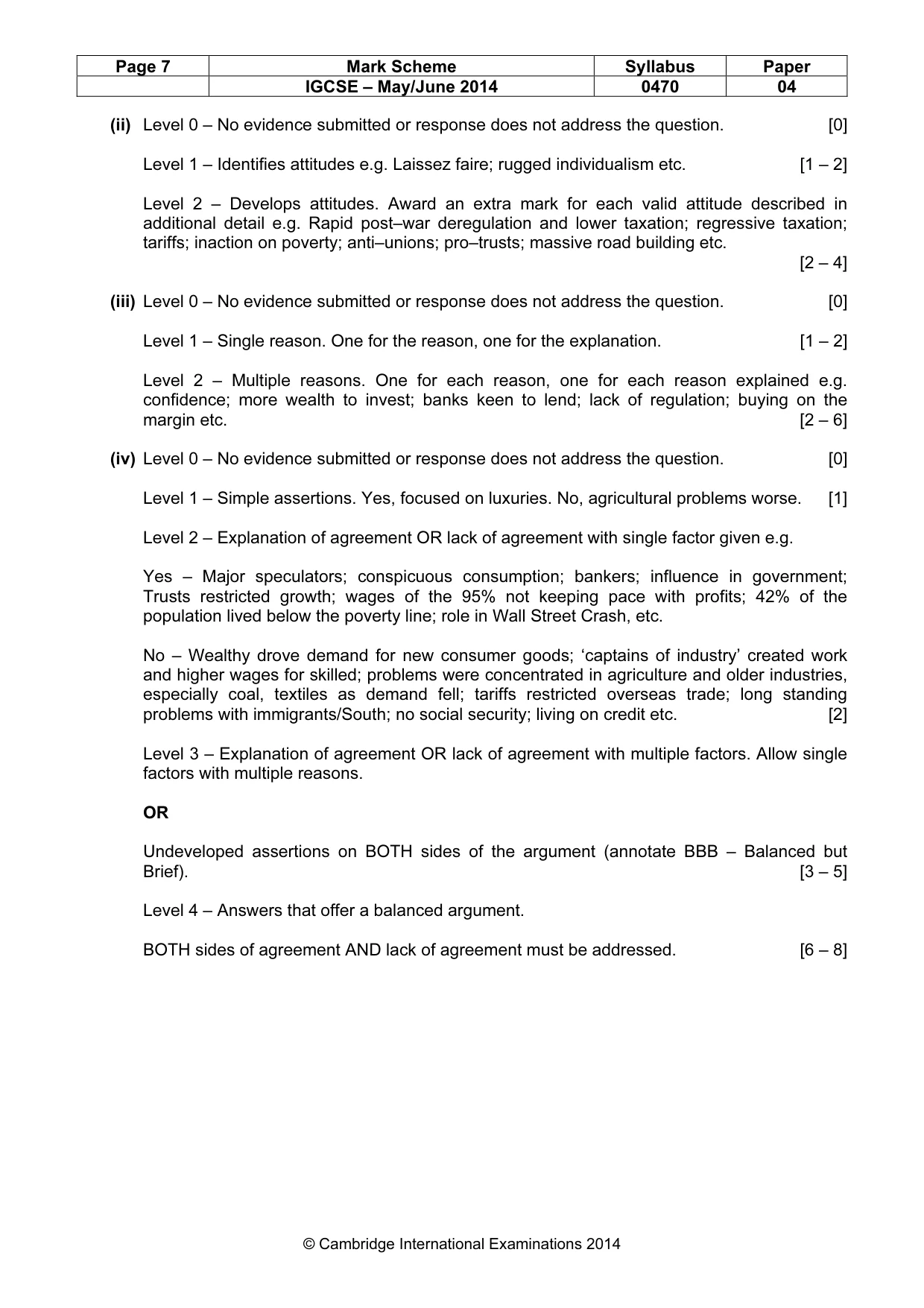
Page 7 Mark Scheme Syllabus Paper IGCSE – May/June 2014 0470 04 © Cambridge International Examinations 2014 (ii) Level 0 – No evidence submitted or response does not address the question. [0] Level 1 – Identifies attitudes e.g. Laissez faire; rugged individualism etc. [1 – 2] Level 2 – Develops attitudes. Award an extra mark for each valid attitude described in additional detail e.g. Rapid post–war deregulation and lower taxation; regressive taxation; tariffs; inaction on poverty; anti–unions; pro–trusts; massive road building etc. [2 – 4] (iii) Level 0 – No evidence submitted or response does not address the question. [0] Level 1 – Single reason. One for the reason, one for the explanation. [1 – 2] Level 2 – Multiple reasons. One for each reason, one for each reason explained e.g. confidence; more wealth to invest; banks keen to lend; lack of regulation; buying on the margin etc. [2 – 6] (iv) Level 0 – No evidence submitted or response does not address the question. [0] Level 1 – Simple assertions. Yes, focused on luxuries. No, agricultural problems worse. [1] Level 2 – Explanation of agreement OR lack of agreement with single factor given e.g. Yes – Major speculators; conspicuous consumption; bankers; influence in government; Trusts restricted growth; wages of the 95% not keeping pace with profits; 42% of the population lived below the poverty line; role in Wall Street Crash, etc. No – Wealthy drove demand for new consumer goods; ‘captains of industry’ created work and higher wages for skilled; problems were concentrated in agriculture and older industries, especially coal, textiles as demand fell; tariffs restricted overseas trade; long standing problems with immigrants/South; no social security; living on credit etc. [2] Level 3 – Explanation of agreement OR lack of agreement with multiple factors. Allow single factors with multiple reasons. OR Undeveloped assertions on BOTH sides of the argument (annotate BBB – Balanced but Brief). [3 – 5] Level 4 – Answers that offer a balanced argument. BOTH sides of agreement AND lack of agreement must be addressed. [6 – 8]
Mark scheme, page 8
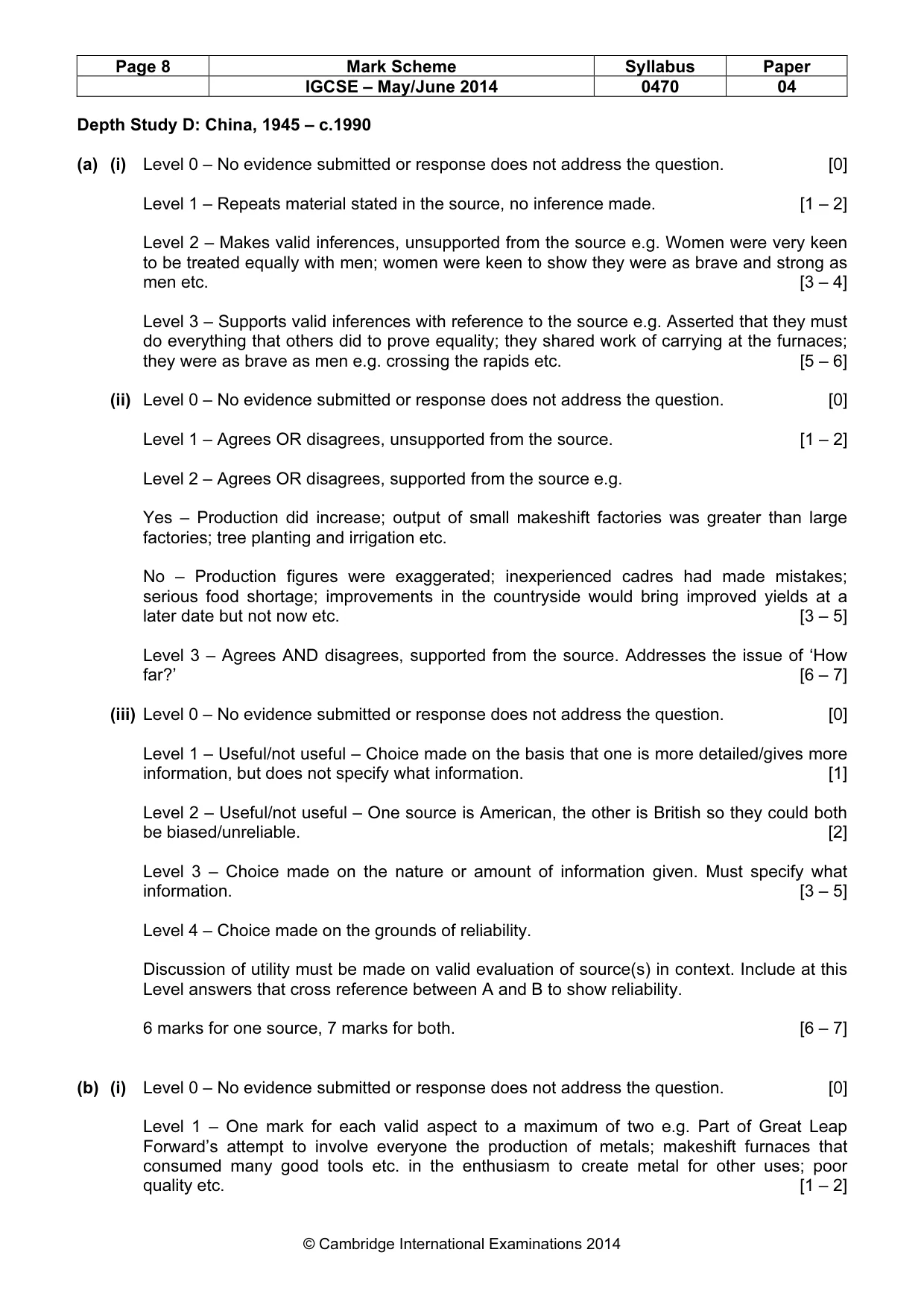
Page 8 Mark Scheme Syllabus Paper IGCSE – May/June 2014 0470 04 © Cambridge International Examinations 2014 Depth Study D: China, 1945 – c.1990 (a) (i) Level 0 – No evidence submitted or response does not address the question. [0] Level 1 – Repeats material stated in the source, no inference made. [1 – 2] Level 2 – Makes valid inferences, unsupported from the source e.g. Women were very keen to be treated equally with men; women were keen to show they were as brave and strong as men etc. [3 – 4] Level 3 – Supports valid inferences with reference to the source e.g. Asserted that they must do everything that others did to prove equality; they shared work of carrying at the furnaces; they were as brave as men e.g. crossing the rapids etc. [5 – 6] (ii) Level 0 – No evidence submitted or response does not address the question. [0] Level 1 – Agrees OR disagrees, unsupported from the source. [1 – 2] Level 2 – Agrees OR disagrees, supported from the source e.g. Yes – Production did increase; output of small makeshift factories was greater than large factories; tree planting and irrigation etc. No – Production figures were exaggerated; inexperienced cadres had made mistakes; serious food shortage; improvements in the countryside would bring improved yields at a later date but not now etc. [3 – 5] Level 3 – Agrees AND disagrees, supported from the source. Addresses the issue of ‘How far?’ [6 – 7] (iii) Level 0 – No evidence submitted or response does not address the question. [0] Level 1 – Useful/not useful – Choice made on the basis that one is more detailed/gives more information, but does not specify what information. [1] Level 2 – Useful/not useful – One source is American, the other is British so they could both be biased/unreliable. [2] Level 3 – Choice made on the nature or amount of information given. Must specify what information. [3 – 5] Level 4 – Choice made on the grounds of reliability. Discussion of utility must be made on valid evaluation of source(s) in context. Include at this Level answers that cross reference between A and B to show reliability. 6 marks for one source, 7 marks for both. [6 – 7] (b) (i) Level 0 – No evidence submitted or response does not address the question. [0] Level 1 – One mark for each valid aspect to a maximum of two e.g. Part of Great Leap Forward’s attempt to involve everyone the production of metals; makeshift furnaces that consumed many good tools etc. in the enthusiasm to create metal for other uses; poor quality etc. [1 – 2]
Mark scheme, page 9
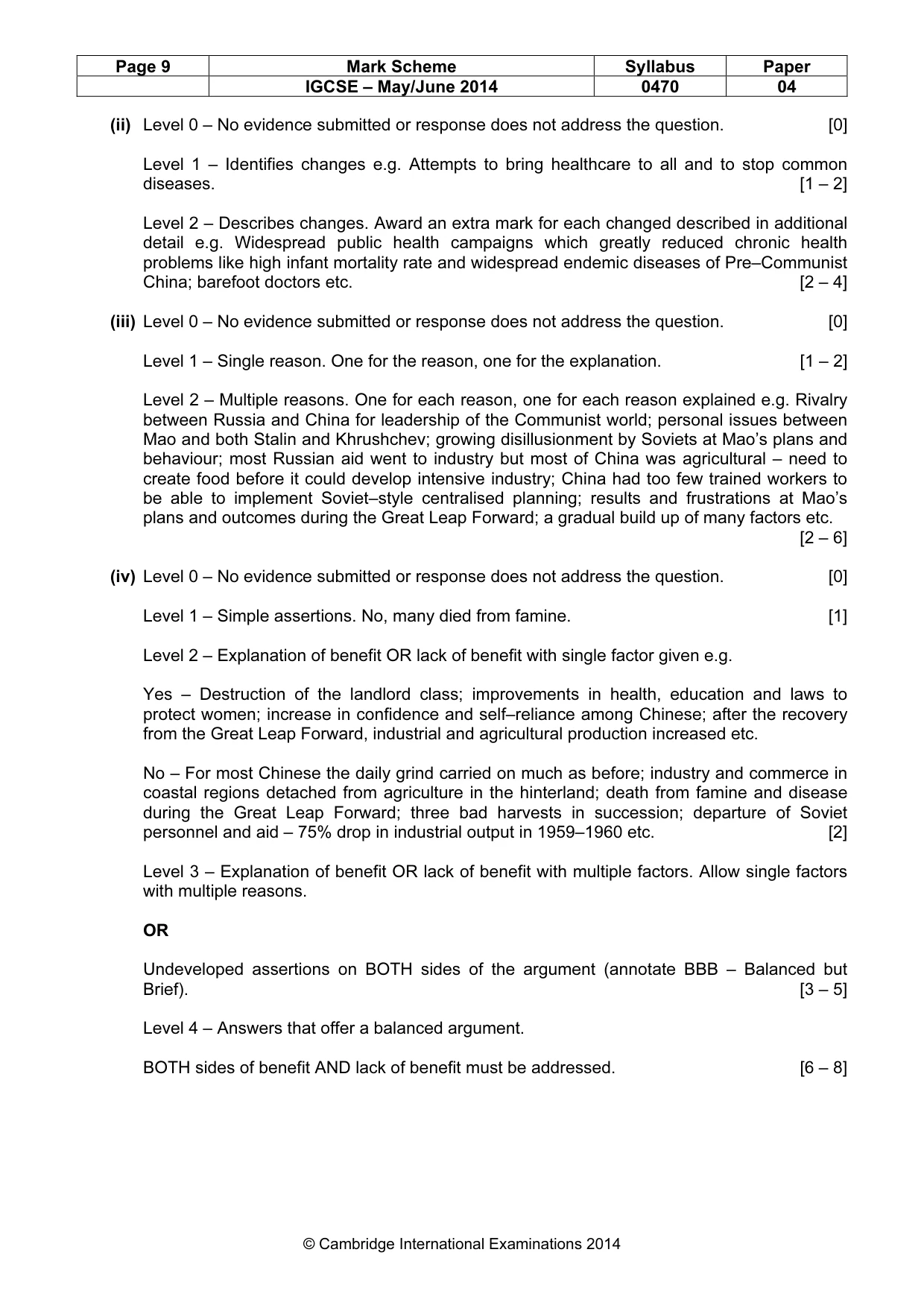
Page 9 Mark Scheme Syllabus Paper IGCSE – May/June 2014 0470 04 © Cambridge International Examinations 2014 (ii) Level 0 – No evidence submitted or response does not address the question. [0] Level 1 – Identifies changes e.g. Attempts to bring healthcare to all and to stop common diseases. [1 – 2] Level 2 – Describes changes. Award an extra mark for each changed described in additional detail e.g. Widespread public health campaigns which greatly reduced chronic health problems like high infant mortality rate and widespread endemic diseases of Pre–Communist China; barefoot doctors etc. [2 – 4] (iii) Level 0 – No evidence submitted or response does not address the question. [0] Level 1 – Single reason. One for the reason, one for the explanation. [1 – 2] Level 2 – Multiple reasons. One for each reason, one for each reason explained e.g. Rivalry between Russia and China for leadership of the Communist world; personal issues between Mao and both Stalin and Khrushchev; growing disillusionment by Soviets at Mao’s plans and behaviour; most Russian aid went to industry but most of China was agricultural – need to create food before it could develop intensive industry; China had too few trained workers to be able to implement Soviet–style centralised planning; results and frustrations at Mao’s plans and outcomes during the Great Leap Forward; a gradual build up of many factors etc. [2 – 6] (iv) Level 0 – No evidence submitted or response does not address the question. [0] Level 1 – Simple assertions. No, many died from famine. [1] Level 2 – Explanation of benefit OR lack of benefit with single factor given e.g. Yes – Destruction of the landlord class; improvements in health, education and laws to protect women; increase in confidence and self–reliance among Chinese; after the recovery from the Great Leap Forward, industrial and agricultural production increased etc. No – For most Chinese the daily grind carried on much as before; industry and commerce in coastal regions detached from agriculture in the hinterland; death from famine and disease during the Great Leap Forward; three bad harvests in succession; departure of Soviet personnel and aid – 75% drop in industrial output in 1959–1960 etc. [2] Level 3 – Explanation of benefit OR lack of benefit with multiple factors. Allow single factors with multiple reasons. OR Undeveloped assertions on BOTH sides of the argument (annotate BBB – Balanced but Brief). [3 – 5] Level 4 – Answers that offer a balanced argument. BOTH sides of benefit AND lack of benefit must be addressed. [6 – 8]
Mark scheme, page 10
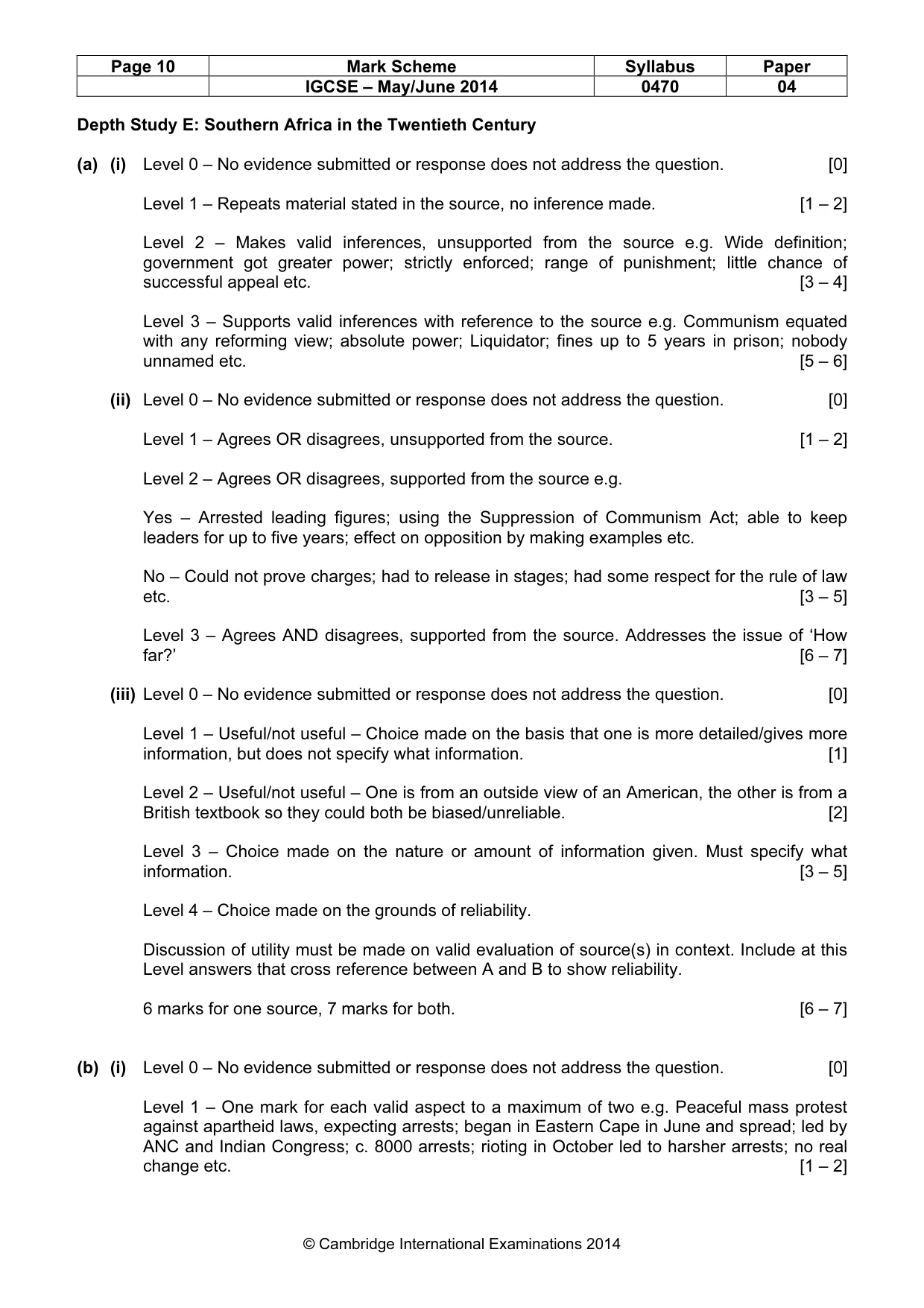
Page 10 Mark Scheme Syllabus Paper IGCSE – May/June 2014 0470 04 © Cambridge International Examinations 2014 Depth Study E: Southern Africa in the Twentieth Century (a) (i) Level 0 – No evidence submitted or response does not address the question. [0] Level 1 – Repeats material stated in the source, no inference made. [1 – 2] Level 2 – Makes valid inferences, unsupported from the source e.g. Wide definition; government got greater power; strictly enforced; range of punishment; little chance of successful appeal etc. [3 – 4] Level 3 – Supports valid inferences with reference to the source e.g. Communism equated with any reforming view; absolute power; Liquidator; fines up to 5 years in prison; nobody unnamed etc. [5 – 6] (ii) Level 0 – No evidence submitted or response does not address the question. [0] Level 1 – Agrees OR disagrees, unsupported from the source. [1 – 2] Level 2 – Agrees OR disagrees, supported from the source e.g. Yes – Arrested leading figures; using the Suppression of Communism Act; able to keep leaders for up to five years; effect on opposition by making examples etc. No – Could not prove charges; had to release in stages; had some respect for the rule of law etc. [3 – 5] Level 3 – Agrees AND disagrees, supported from the source. Addresses the issue of ‘How far?’ [6 – 7] (iii) Level 0 – No evidence submitted or response does not address the question. [0] Level 1 – Useful/not useful – Choice made on the basis that one is more detailed/gives more information, but does not specify what information. [1] Level 2 – Useful/not useful – One is from an outside view of an American, the other is from a British textbook so they could both be biased/unreliable. [2] Level 3 – Choice made on the nature or amount of information given. Must specify what information. [3 – 5] Level 4 – Choice made on the grounds of reliability. Discussion of utility must be made on valid evaluation of source(s) in context. Include at this Level answers that cross reference between A and B to show reliability. 6 marks for one source, 7 marks for both. [6 – 7] (b) (i) Level 0 – No evidence submitted or response does not address the question. [0] Level 1 – One mark for each valid aspect to a maximum of two e.g. Peaceful mass protest against apartheid laws, expecting arrests; began in Eastern Cape in June and spread; led by ANC and Indian Congress; c. 8000 arrests; rioting in October led to harsher arrests; no real change etc. [1 – 2]
Mark scheme, page 11
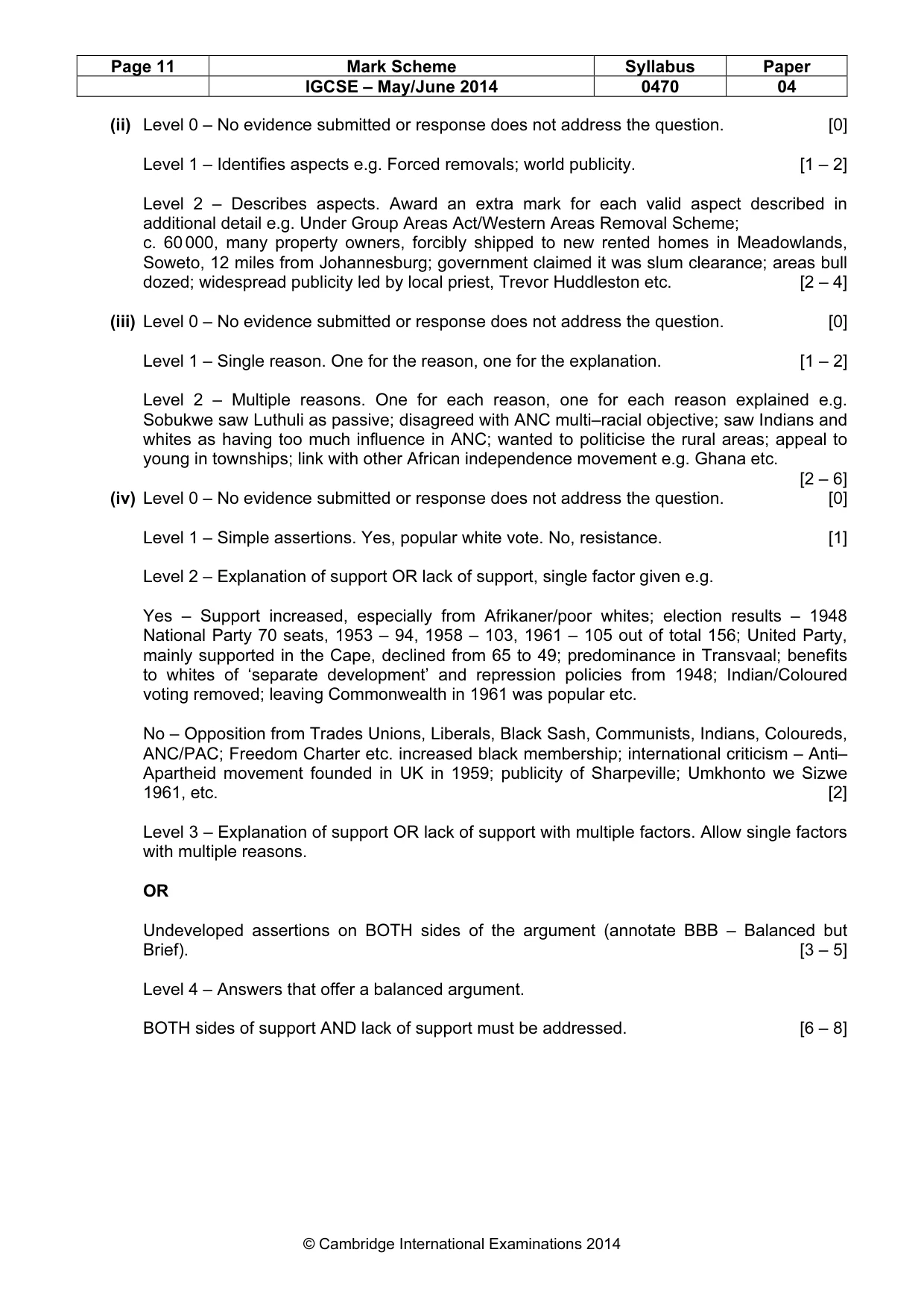
Page 11 Mark Scheme Syllabus Paper IGCSE – May/June 2014 0470 04 © Cambridge International Examinations 2014 (ii) Level 0 – No evidence submitted or response does not address the question. [0] Level 1 – Identifies aspects e.g. Forced removals; world publicity. [1 – 2] Level 2 – Describes aspects. Award an extra mark for each valid aspect described in additional detail e.g. Under Group Areas Act/Western Areas Removal Scheme; c. 60 000, many property owners, forcibly shipped to new rented homes in Meadowlands, Soweto, 12 miles from Johannesburg; government claimed it was slum clearance; areas bull dozed; widespread publicity led by local priest, Trevor Huddleston etc. [2 – 4] (iii) Level 0 – No evidence submitted or response does not address the question. [0] Level 1 – Single reason. One for the reason, one for the explanation. [1 – 2] Level 2 – Multiple reasons. One for each reason, one for each reason explained e.g. Sobukwe saw Luthuli as passive; disagreed with ANC multi–racial objective; saw Indians and whites as having too much influence in ANC; wanted to politicise the rural areas; appeal to young in townships; link with other African independence movement e.g. Ghana etc. [2 – 6] (iv) Level 0 – No evidence submitted or response does not address the question. [0] Level 1 – Simple assertions. Yes, popular white vote. No, resistance. [1] Level 2 – Explanation of support OR lack of support, single factor given e.g. Yes – Support increased, especially from Afrikaner/poor whites; election results – 1948 National Party 70 seats, 1953 – 94, 1958 – 103, 1961 – 105 out of total 156; United Party, mainly supported in the Cape, declined from 65 to 49; predominance in Transvaal; benefits to whites of ‘separate development’ and repression policies from 1948; Indian/Coloured voting removed; leaving Commonwealth in 1961 was popular etc. No – Opposition from Trades Unions, Liberals, Black Sash, Communists, Indians, Coloureds, ANC/PAC; Freedom Charter etc. increased black membership; international criticism – Anti– Apartheid movement founded in UK in 1959; publicity of Sharpeville; Umkhonto we Sizwe 1961, etc. [2] Level 3 – Explanation of support OR lack of support with multiple factors. Allow single factors with multiple reasons. OR Undeveloped assertions on BOTH sides of the argument (annotate BBB – Balanced but Brief). [3 – 5] Level 4 – Answers that offer a balanced argument. BOTH sides of support AND lack of support must be addressed. [6 – 8]
Mark scheme, page 12
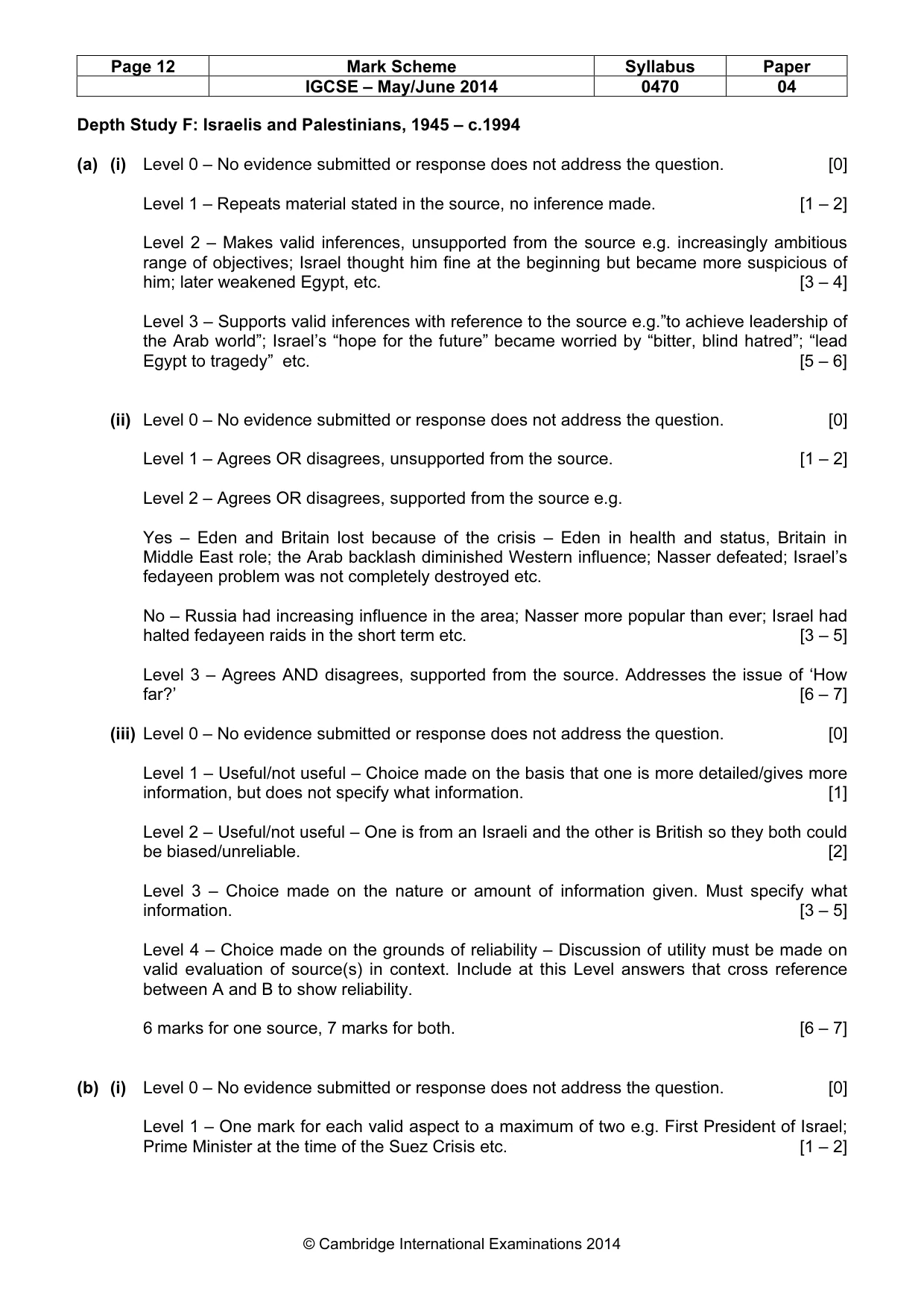
Page 12 Mark Scheme Syllabus Paper IGCSE – May/June 2014 0470 04 © Cambridge International Examinations 2014 Depth Study F: Israelis and Palestinians, 1945 – c.1994 (a) (i) Level 0 – No evidence submitted or response does not address the question. [0] Level 1 – Repeats material stated in the source, no inference made. [1 – 2] Level 2 – Makes valid inferences, unsupported from the source e.g. increasingly ambitious range of objectives; Israel thought him fine at the beginning but became more suspicious of him; later weakened Egypt, etc. [3 – 4] Level 3 – Supports valid inferences with reference to the source e.g.”to achieve leadership of the Arab world”; Israel’s “hope for the future” became worried by “bitter, blind hatred”; “lead Egypt to tragedy” etc. [5 – 6] (ii) Level 0 – No evidence submitted or response does not address the question. [0] Level 1 – Agrees OR disagrees, unsupported from the source. [1 – 2] Level 2 – Agrees OR disagrees, supported from the source e.g. Yes – Eden and Britain lost because of the crisis – Eden in health and status, Britain in Middle East role; the Arab backlash diminished Western influence; Nasser defeated; Israel’s fedayeen problem was not completely destroyed etc. No – Russia had increasing influence in the area; Nasser more popular than ever; Israel had halted fedayeen raids in the short term etc. [3 – 5] Level 3 – Agrees AND disagrees, supported from the source. Addresses the issue of ‘How far?’ [6 – 7] (iii) Level 0 – No evidence submitted or response does not address the question. [0] Level 1 – Useful/not useful – Choice made on the basis that one is more detailed/gives more information, but does not specify what information. [1] Level 2 – Useful/not useful – One is from an Israeli and the other is British so they both could be biased/unreliable. [2] Level 3 – Choice made on the nature or amount of information given. Must specify what information. [3 – 5] Level 4 – Choice made on the grounds of reliability – Discussion of utility must be made on valid evaluation of source(s) in context. Include at this Level answers that cross reference between A and B to show reliability. 6 marks for one source, 7 marks for both. [6 – 7] (b) (i) Level 0 – No evidence submitted or response does not address the question. [0] Level 1 – One mark for each valid aspect to a maximum of two e.g. First President of Israel; Prime Minister at the time of the Suez Crisis etc. [1 – 2]
Mark scheme, page 13
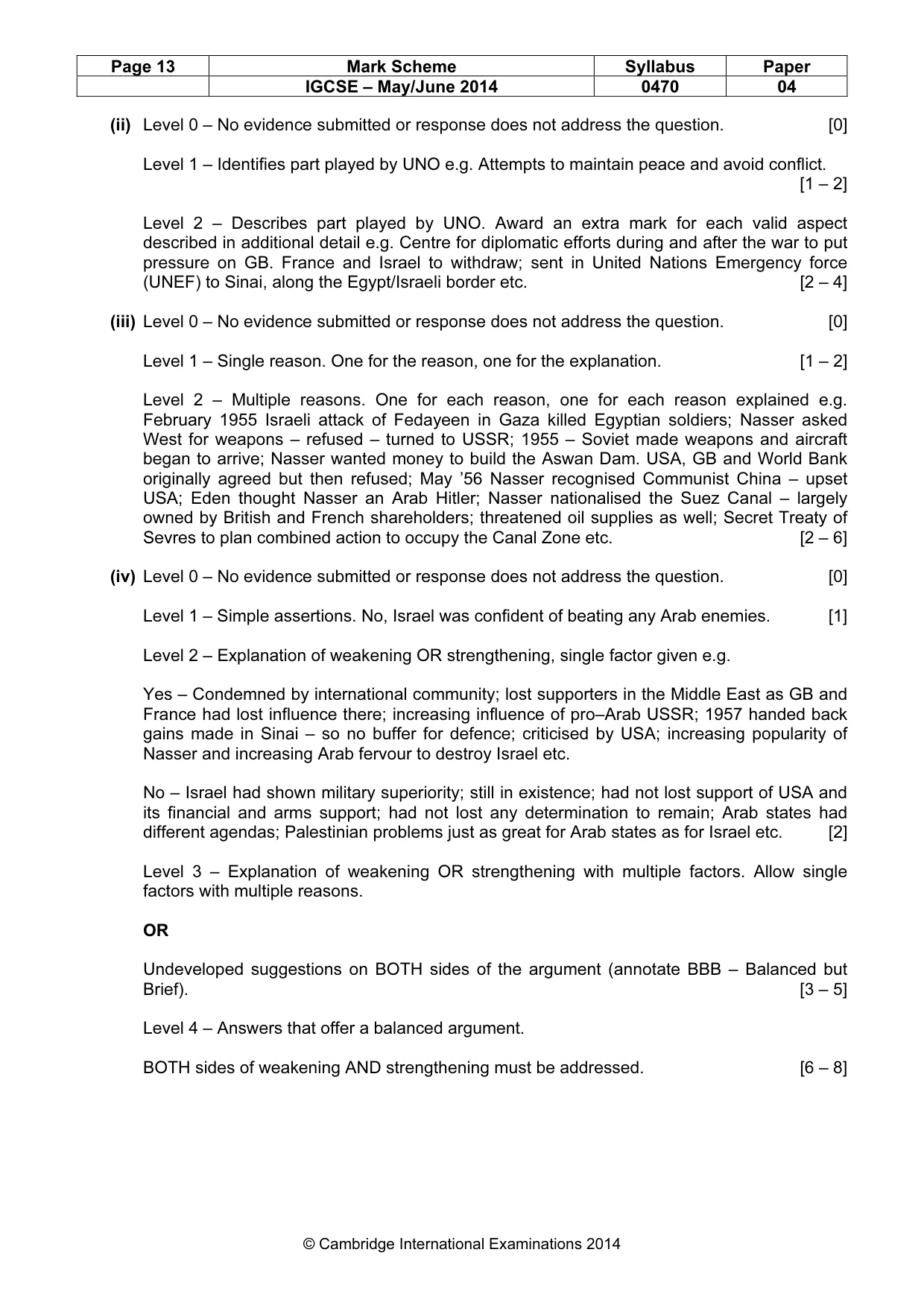
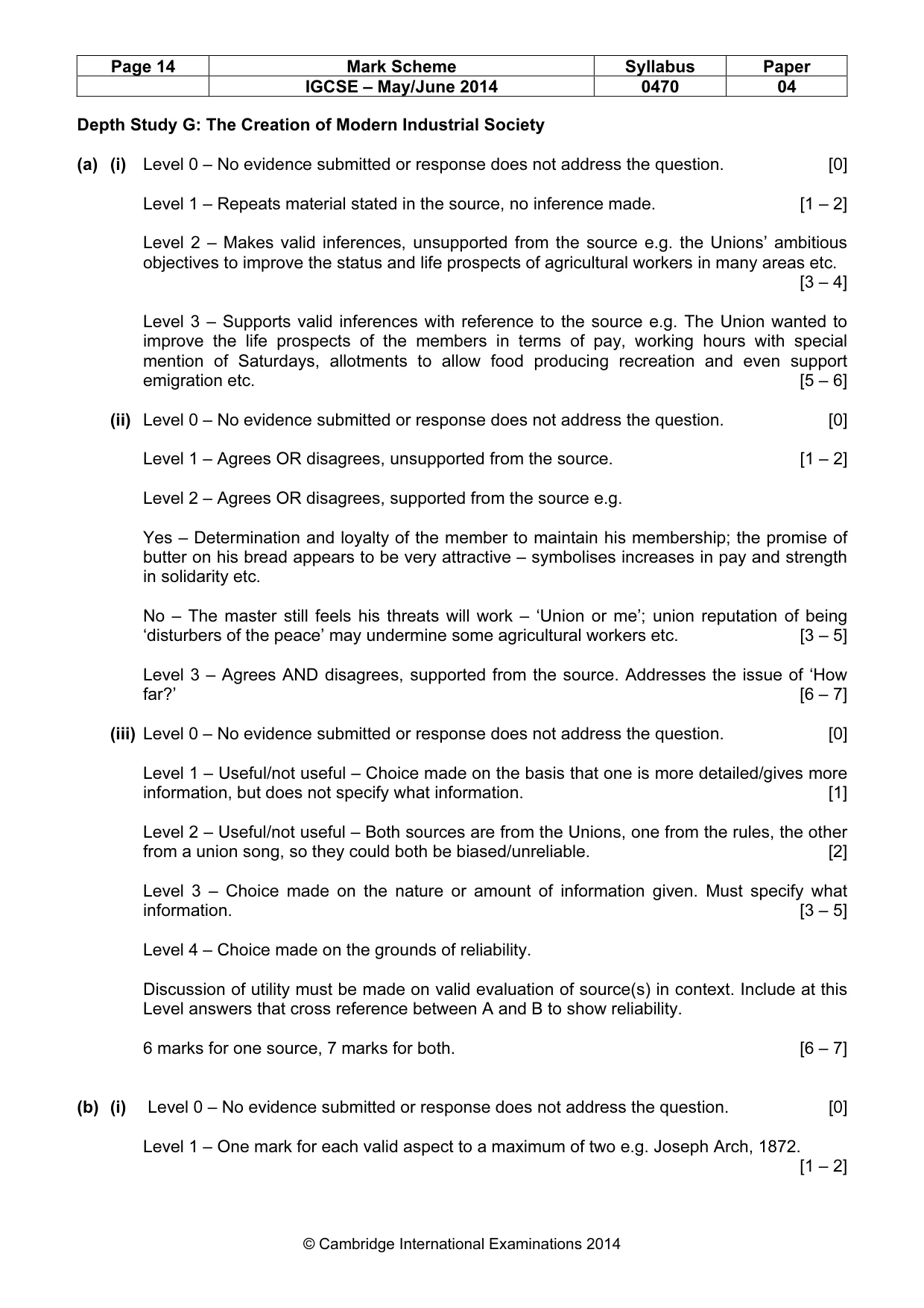
Page 13 Mark Scheme Syllabus Paper IGCSE – May/June 2014 0470 04 © Cambridge International Examinations 2014 (ii) Level 0 – No evidence submitted or response does not address the question. [0] Level 1 – Identifies part played by UNO e.g. Attempts to maintain peace and avoid conflict. [1 – 2] Level 2 – Describes part played by UNO. Award an extra mark for each valid aspect described in additional detail e.g. Centre for diplomatic efforts during and after the war to put pressure on GB. France and Israel to withdraw; sent in United Nations Emergency force (UNEF) to Sinai, along the Egypt/Israeli border etc. [2 – 4] (iii) Level 0 – No evidence submitted or response does not address the question. [0] Level 1 – Single reason. One for the reason, one for the explanation. [1 – 2] Level 2 – Multiple reasons. One for each reason, one for each reason explained e.g. February 1955 Israeli attack of Fedayeen in Gaza killed Egyptian soldiers; Nasser asked West for weapons – refused – turned to USSR; 1955 – Soviet made weapons and aircraft began to arrive; Nasser wanted money to build the Aswan Dam. USA, GB and World Bank originally agreed but then refused; May ’56 Nasser recognised Communist China – upset USA; Eden thought Nasser an Arab Hitler; Nasser nationalised the Suez Canal – largely owned by British and French shareholders; threatened oil supplies as well; Secret Treaty of Sevres to plan combined action to occupy the Canal Zone etc. [2 – 6] (iv) Level 0 – No evidence submitted or response does not address the question. [0] Level 1 – Simple assertions. No, Israel was confident of beating any Arab enemies. [1] Level 2 – Explanation of weakening OR strengthening, single factor given e.g. Yes – Condemned by international community; lost supporters in the Middle East as GB and France had lost influence there; increasing influence of pro–Arab USSR; 1957 handed back gains made in Sinai – so no buffer for defence; criticised by USA; increasing popularity of Nasser and increasing Arab fervour to destroy Israel etc. No – Israel had shown military superiority; still in existence; had not lost support of USA and its financial and arms support; had not lost any determination to remain; Arab states had different agendas; Palestinian problems just as great for Arab states as for Israel etc. [2] Level 3 – Explanation of weakening OR strengthening with multiple factors. Allow single factors with multiple reasons. OR Undeveloped suggestions on BOTH sides of the argument (annotate BBB – Balanced but Brief). [3 – 5] Level 4 – Answers that offer a balanced argument. BOTH sides of weakening AND strengthening must be addressed. [6 – 8]
Mark scheme, page 14
Page 14 Mark Scheme Syllabus Paper IGCSE – May/June 2014 0470 04 © Cambridge International Examinations 2014 Depth Study G: The Creation of Modern Industrial Society (a) (i) Level 0 – No evidence submitted or response does not address the question. [0] Level 1 – Repeats material stated in the source, no inference made. [1 – 2] Level 2 – Makes valid inferences, unsupported from the source e.g. the Unions’ ambitious objectives to improve the status and life prospects of agricultural workers in many areas etc. [3 – 4] Level 3 – Supports valid inferences with reference to the source e.g. The Union wanted to improve the life prospects of the members in terms of pay, working hours with special mention of Saturdays, allotments to allow food producing recreation and even support emigration etc. [5 – 6] (ii) Level 0 – No evidence submitted or response does not address the question. [0] Level 1 – Agrees OR disagrees, unsupported from the source. [1 – 2] Level 2 – Agrees OR disagrees, supported from the source e.g. Yes – Determination and loyalty of the member to maintain his membership; the promise of butter on his bread appears to be very attractive – symbolises increases in pay and strength in solidarity etc. No – The master still feels his threats will work – ‘Union or me’; union reputation of being ‘disturbers of the peace’ may undermine some agricultural workers etc. [3 – 5] Level 3 – Agrees AND disagrees, supported from the source. Addresses the issue of ‘How far?’ [6 – 7] (iii) Level 0 – No evidence submitted or response does not address the question. [0] Level 1 – Useful/not useful – Choice made on the basis that one is more detailed/gives more information, but does not specify what information. [1] Level 2 – Useful/not useful – Both sources are from the Unions, one from the rules, the other from a union song, so they could both be biased/unreliable. [2] Level 3 – Choice made on the nature or amount of information given. Must specify what information. [3 – 5] Level 4 – Choice made on the grounds of reliability. Discussion of utility must be made on valid evaluation of source(s) in context. Include at this Level answers that cross reference between A and B to show reliability. 6 marks for one source, 7 marks for both. [6 – 7] (b) (i) Level 0 – No evidence submitted or response does not address the question. [0] Level 1 – One mark for each valid aspect to a maximum of two e.g. Joseph Arch, 1872. [1 – 2]
Mark scheme, page 15
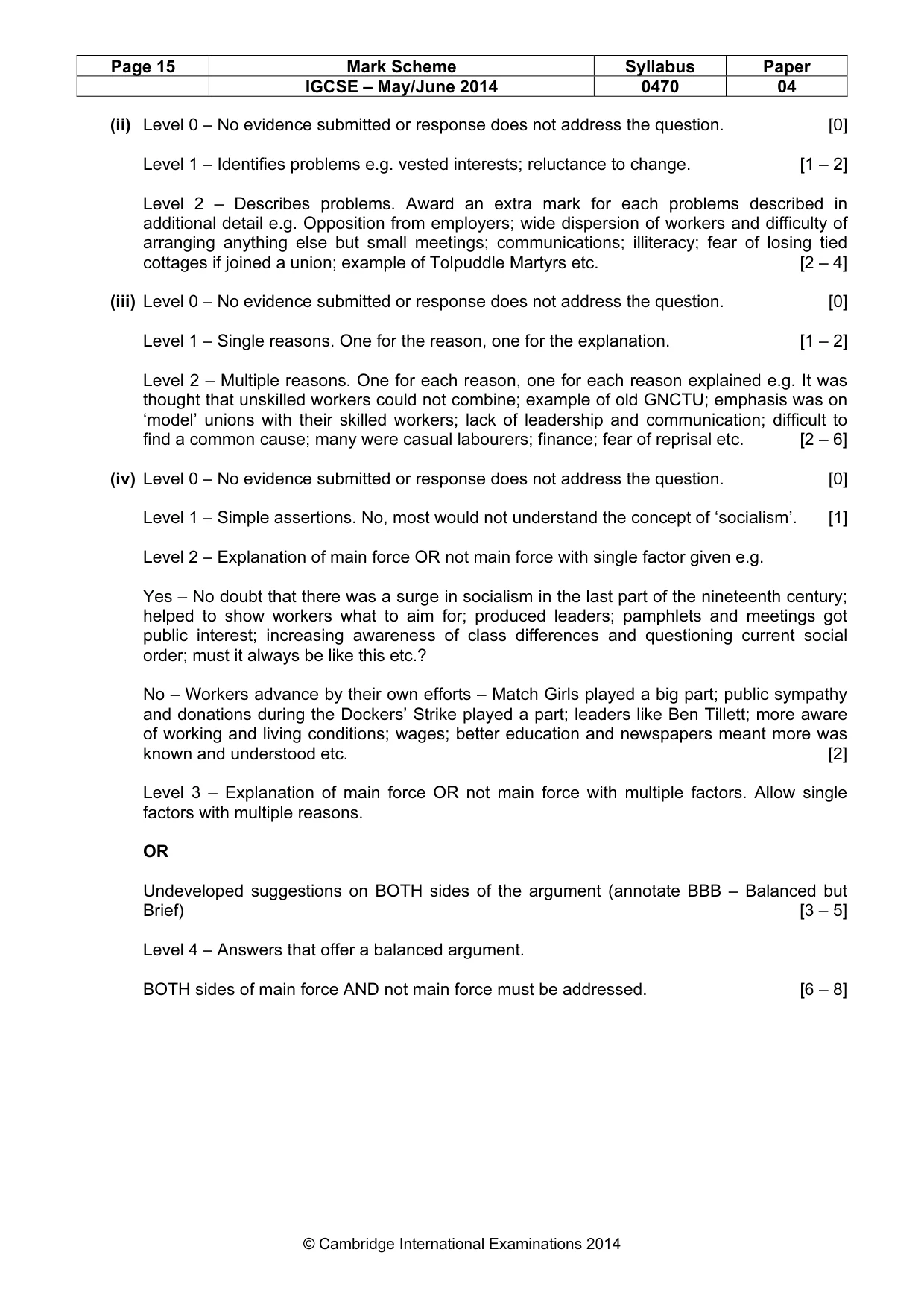
Page 15 Mark Scheme Syllabus Paper IGCSE – May/June 2014 0470 04 © Cambridge International Examinations 2014 (ii) Level 0 – No evidence submitted or response does not address the question. [0] Level 1 – Identifies problems e.g. vested interests; reluctance to change. [1 – 2] Level 2 – Describes problems. Award an extra mark for each problems described in additional detail e.g. Opposition from employers; wide dispersion of workers and difficulty of arranging anything else but small meetings; communications; illiteracy; fear of losing tied cottages if joined a union; example of Tolpuddle Martyrs etc. [2 – 4] (iii) Level 0 – No evidence submitted or response does not address the question. [0] Level 1 – Single reasons. One for the reason, one for the explanation. [1 – 2] Level 2 – Multiple reasons. One for each reason, one for each reason explained e.g. It was thought that unskilled workers could not combine; example of old GNCTU; emphasis was on ‘model’ unions with their skilled workers; lack of leadership and communication; difficult to find a common cause; many were casual labourers; finance; fear of reprisal etc. [2 – 6] (iv) Level 0 – No evidence submitted or response does not address the question. [0] Level 1 – Simple assertions. No, most would not understand the concept of ‘socialism’. [1] Level 2 – Explanation of main force OR not main force with single factor given e.g. Yes – No doubt that there was a surge in socialism in the last part of the nineteenth century; helped to show workers what to aim for; produced leaders; pamphlets and meetings got public interest; increasing awareness of class differences and questioning current social order; must it always be like this etc.? No – Workers advance by their own efforts – Match Girls played a big part; public sympathy and donations during the Dockers’ Strike played a part; leaders like Ben Tillett; more aware of working and living conditions; wages; better education and newspapers meant more was known and understood etc. [2] Level 3 – Explanation of main force OR not main force with multiple factors. Allow single factors with multiple reasons. OR Undeveloped suggestions on BOTH sides of the argument (annotate BBB – Balanced but Brief) [3 – 5] Level 4 – Answers that offer a balanced argument. BOTH sides of main force AND not main force must be addressed. [6 – 8]
Mark scheme, page 16
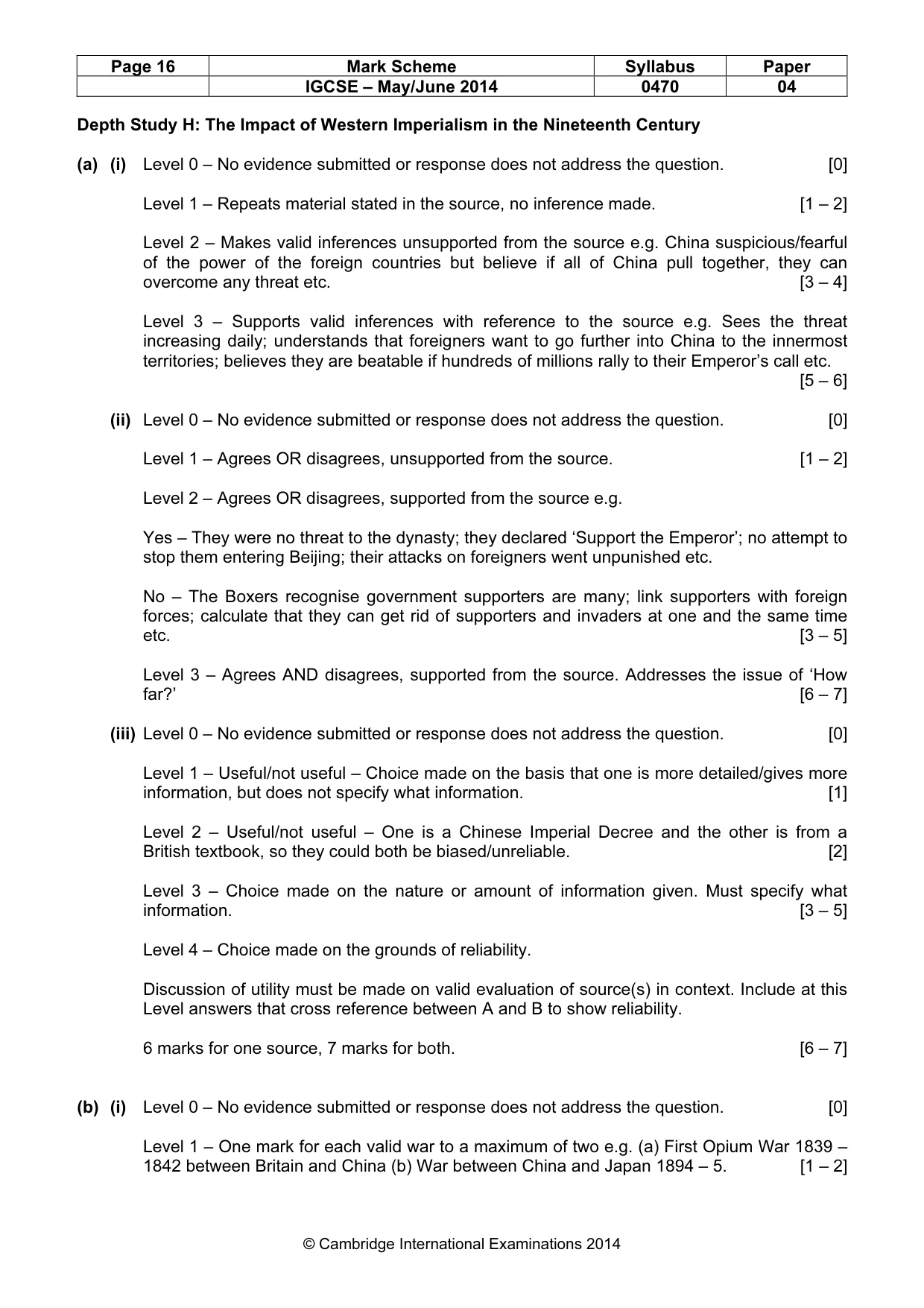
Page 16 Mark Scheme Syllabus Paper IGCSE – May/June 2014 0470 04 © Cambridge International Examinations 2014 Depth Study H: The Impact of Western Imperialism in the Nineteenth Century (a) (i) Level 0 – No evidence submitted or response does not address the question. [0] Level 1 – Repeats material stated in the source, no inference made. [1 – 2] Level 2 – Makes valid inferences unsupported from the source e.g. China suspicious/fearful of the power of the foreign countries but believe if all of China pull together, they can overcome any threat etc. [3 – 4] Level 3 – Supports valid inferences with reference to the source e.g. Sees the threat increasing daily; understands that foreigners want to go further into China to the innermost territories; believes they are beatable if hundreds of millions rally to their Emperor’s call etc. [5 – 6] (ii) Level 0 – No evidence submitted or response does not address the question. [0] Level 1 – Agrees OR disagrees, unsupported from the source. [1 – 2] Level 2 – Agrees OR disagrees, supported from the source e.g. Yes – They were no threat to the dynasty; they declared ‘Support the Emperor’; no attempt to stop them entering Beijing; their attacks on foreigners went unpunished etc. No – The Boxers recognise government supporters are many; link supporters with foreign forces; calculate that they can get rid of supporters and invaders at one and the same time etc. [3 – 5] Level 3 – Agrees AND disagrees, supported from the source. Addresses the issue of ‘How far?’ [6 – 7] (iii) Level 0 – No evidence submitted or response does not address the question. [0] Level 1 – Useful/not useful – Choice made on the basis that one is more detailed/gives more information, but does not specify what information. [1] Level 2 – Useful/not useful – One is a Chinese Imperial Decree and the other is from a British textbook, so they could both be biased/unreliable. [2] Level 3 – Choice made on the nature or amount of information given. Must specify what information. [3 – 5] Level 4 – Choice made on the grounds of reliability. Discussion of utility must be made on valid evaluation of source(s) in context. Include at this Level answers that cross reference between A and B to show reliability. 6 marks for one source, 7 marks for both. [6 – 7] (b) (i) Level 0 – No evidence submitted or response does not address the question. [0] Level 1 – One mark for each valid war to a maximum of two e.g. (a) First Opium War 1839 – 1842 between Britain and China (b) War between China and Japan 1894 – 5. [1 – 2]
Mark scheme, page 17
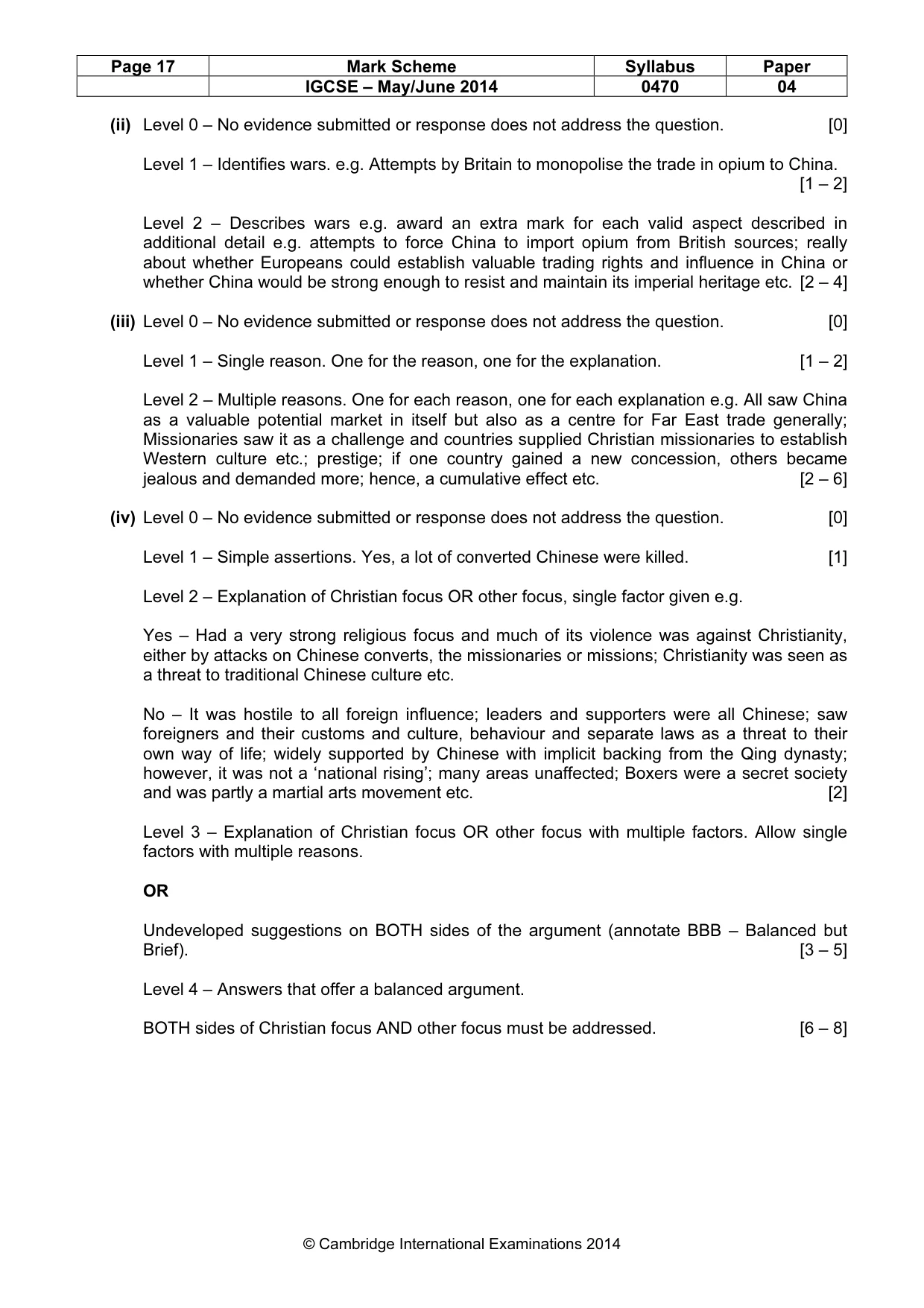
Page 17 Mark Scheme Syllabus Paper IGCSE – May/June 2014 0470 04 © Cambridge International Examinations 2014 (ii) Level 0 – No evidence submitted or response does not address the question. [0] Level 1 – Identifies wars. e.g. Attempts by Britain to monopolise the trade in opium to China. [1 – 2] Level 2 – Describes wars e.g. award an extra mark for each valid aspect described in additional detail e.g. attempts to force China to import opium from British sources; really about whether Europeans could establish valuable trading rights and influence in China or whether China would be strong enough to resist and maintain its imperial heritage etc. [2 – 4] (iii) Level 0 – No evidence submitted or response does not address the question. [0] Level 1 – Single reason. One for the reason, one for the explanation. [1 – 2] Level 2 – Multiple reasons. One for each reason, one for each explanation e.g. All saw China as a valuable potential market in itself but also as a centre for Far East trade generally; Missionaries saw it as a challenge and countries supplied Christian missionaries to establish Western culture etc.; prestige; if one country gained a new concession, others became jealous and demanded more; hence, a cumulative effect etc. [2 – 6] (iv) Level 0 – No evidence submitted or response does not address the question. [0] Level 1 – Simple assertions. Yes, a lot of converted Chinese were killed. [1] Level 2 – Explanation of Christian focus OR other focus, single factor given e.g. Yes – Had a very strong religious focus and much of its violence was against Christianity, either by attacks on Chinese converts, the missionaries or missions; Christianity was seen as a threat to traditional Chinese culture etc. No – It was hostile to all foreign influence; leaders and supporters were all Chinese; saw foreigners and their customs and culture, behaviour and separate laws as a threat to their own way of life; widely supported by Chinese with implicit backing from the Qing dynasty; however, it was not a ‘national rising’; many areas unaffected; Boxers were a secret society and was partly a martial arts movement etc. [2] Level 3 – Explanation of Christian focus OR other focus with multiple factors. Allow single factors with multiple reasons. OR Undeveloped suggestions on BOTH sides of the argument (annotate BBB – Balanced but Brief). [3 – 5] Level 4 – Answers that offer a balanced argument. BOTH sides of Christian focus AND other focus must be addressed. [6 – 8]
What you needed in this session
Cambridge’s own grade thresholds for 2014 May/June, Paper 4 · Variant 1. A higher threshold means an easier paper — the bar moves with how the cohort did.