Cambridge IGCSE History 0470 — 2014 May/June Paper 2 · Variant 3
0470/23/M/J/14 · 50 marks · ≈56 min
The question paper and its mark scheme, free to read here and free to download. This is Cambridge’s own paper, exactly as it was sat.
Question paper16 pages


Mark scheme9 pages
Answers below. Sit the paper first if you are practising.
Paper as text
Question paper, page 1
This document consists of 13 printed pages, 3 blank pages and 1 insert. DC (SJF/JG) 79340/3 © UCLES 2014 [Turn over Cambridge International Examinations Cambridge International General Certificate of Secondary Education * 4 2 8 1 2 9 0 6 9 9 * HISTORY 0470/23 Paper 2 May/June 2014 2 hours No Additional Materials are required. READ THESE INSTRUCTIONS FIRST An answer booklet is provided inside this question paper. You should follow the instructions on the front cover of the answer booklet. If you need additional answer paper ask the invigilator for a continuation booklet. This paper has two options. Choose one option, and then answer all of the questions on that topic. Option A: 19th Century topic [p2–p6] Option B: 20th Century topic [p7–p13] The number of marks is given in brackets [ ] at the end of each question or part question.
Question paper, page 2
2 0470/23/M/J/14 © UCLES 2014 Option A: 19th Century topic WAS SLAVERY THE CAUSE OF TENSIONS BETWEEN NORTH AND SOUTH? Study the Background Information and the sources carefully, and then answer all the questions. Background Information Historians have long debated the causes of the increasing tensions between the North and South of the USA in the 1850s and 1860s. Some argue that slavery was the main cause but other reasons have been suggested such as states’ rights, the power of the North, economics and the election of Lincoln as President. It can be argued that by 1860 the United States had become a nation of two clearly different regions. The South became increasingly worried about the growing population, economic development and political power of the North. Southern states were also concerned about what they saw as threats to their traditional way of life, rights and values. They were also afraid that the North was dominating Congress and that it would be increasingly difficult for them to influence the national government in Washington. Was the issue of slavery just one of many tensions between North and South or was it the key reason why they could not live together? SOURCE A The people of Georgia, having dissolved their political connection with the Government of the United States of America, present to their confederates and the world the causes which have led to the separation. For the last ten years we have had numerous causes of complaint against non-slave-holding states with reference to the subject of African slavery. These states have endeavoured to weaken our security, to disturb our peace, and have placed the two sections of the Union for many years past in the condition of virtual civil war. The people of Georgia have declared with equal firmness that they shall not rule over them. The prosperity of the North was greatly dependent on the Federal Government, that of the South not at all. In the first years of the Republic the commercial and manufacturing interests of the North began to seek profit and growth at the expense of the agricultural interests. Not content with these great and unjust advantages, they have sought to throw the burden of their business as much as possible upon the public. The manufacturing interest entered into the same struggle early, and has demanded from Government special favours. This interest was confined mainly to the Eastern and Middle non-slave- holding states. It held great power and influence, and its demands were in full proportion to its power. A declaration by the state of Georgia on 29 January 1861.
Question paper, page 3
3 0470/23/M/J/14 © UCLES 2014 [Turn over SOURCE B Texas has consented to become one of the Confederated Union to promote her welfare and insure the blessings of peace and liberty to her people. The Federal Government has almost entirely failed to protect the lives and property of the people of Texas against the Indian savages on our border, and the murderous bandits from the neighbouring territory of Mexico. In all the non-slave-holding states, the people have formed themselves into a party based upon an unnatural feeling of hostility to the southern states and their system of African slavery. They have trampled upon our rights and encouraged lawless organisations to steal our slaves and prevent their recapture. They have sent pamphlets and papers among us to stir up slave rebellion. They have impoverished the slave-holding states by unequal legislation, thereby enriching themselves. And, finally, they have elected as president and vice-president two men whose chief claims to such high positions are their approval of these schemes for the ruin of the slave-holding states. The servitude of the African race, as existing in these states, is mutually beneficial to both the bonded and the free, and is justified by the revealed will of the Almighty God. A declaration by the state of Texas on 2 February 1861. SOURCE C You free-soil agitators are not interested in slavery. You only want to limit slave territory so that you may have an opportunity of cheating us, gain a majority in Congress and make the government an engine of northern expansion. You desire to weaken the political power of the southern states. And why? Because you want to promote the industry of the North, at the expense of the people of the South and their industry. From a speech by Jefferson Davis in the late 1850s. Davis was Senator for Mississippi which left the Union in January 1861. In February 1861, Davis was elected President of the newly-formed Confederacy. SOURCE D My main object in this struggle is to save the Union, and is not either to save or to destroy slavery. If I could save the Union without freeing any slave I would do it, and if I could save it by freeing all the slaves I would do it; and if I could save it by freeing some and leaving others alone I would also do that. I have here stated my purpose according to my view of official duty and I intend no modification of my often-expressed personal wish that all men everywhere could be free. From a letter by Lincoln published in a newspaper, 22 August 1862. He was replying to a demand in another newspaper for the immediate and total abolition of slavery.
Question paper, page 4
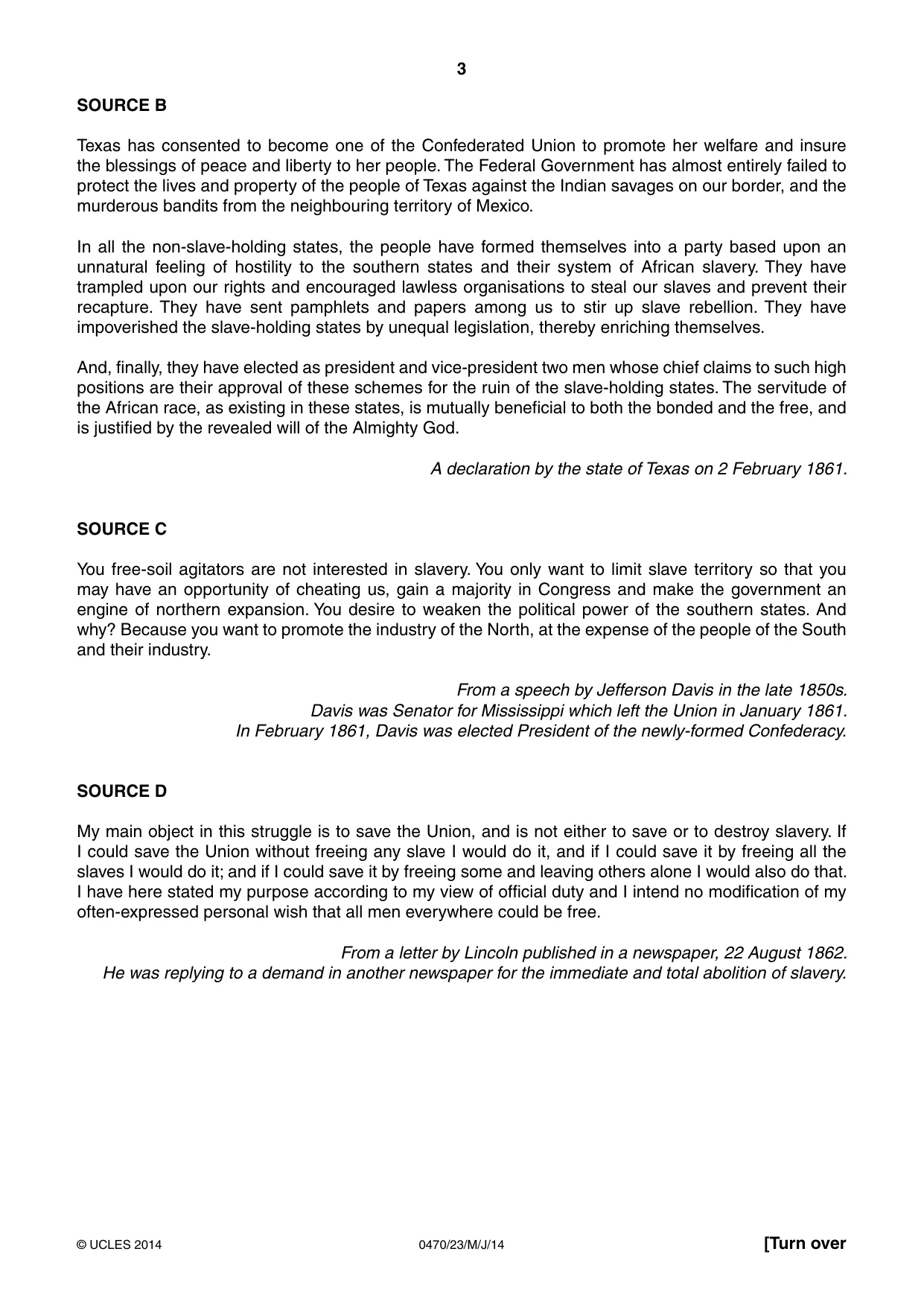
4 0470/23/M/J/14 © UCLES 2014 SOURCE E One-eighth of the whole population were coloured slaves. Not distributed generally over the Union but localised in the Southern part of it. All knew that slavery was, somehow, the cause of the war. To strengthen, perpetuate and extend slavery was the object for which the rebels would break the Union, even by war, while the government claimed no right to do more than to restrict the territorial enlargement of it. From Lincoln’s speech after being re-elected as President, March 1865. SOURCE F A cartoon published in February 1861. It shows Lincoln. The group of advisers chosen by the President was called the Cabinet.
Question paper, page 5
5 0470/23/M/J/14 © UCLES 2014 [Turn over SOURCE G The Republican Party stands forth today, hideous, revolting, hateful, a menace not only to the Union of these states, but to Society, to Liberty and to Law. It has drawn to it the corrupt, the vile, the immoral, the wasteful, the lawless. It is a fiend, it supports lawless Democracy, it is a law unto itself and it supports the will of a wild mob. From the lead article in a newspaper from Georgia, 1860. SOURCE H There are two apparent basic causes of this war. One is Slavery and the other is State Rights. But the latter is only a cover for the former. If Slavery were out of the way there would be no trouble from State Rights. The war, then, is for Slavery, and nothing else. It is an insane attempt to vindicate by arms the lordship which had been already asserted in debate. With mad-cap audacity it seeks to install this Barbarism as the truest Civilisation. Slavery is declared to be the ‘corner-stone’ of the new edifice. From a speech by Charles Sumner, a Republican politician, July 1863.
Question paper, page 6
6 0470/23/M/J/14 © UCLES 2014 Now answer all the following questions. You may use any of the sources to help you answer the questions, in addition to those sources which you are told to use. In answering the questions you should use your knowledge of the topic to help you interpret and evaluate the sources. 1 Study Sources A and B. How far do Sources A and B agree? Explain your answer using details of the sources. [7] 2 Study Source C. Are you surprised by this source? Explain your answer using details of the source and your knowledge. [8] 3 Study Sources D and E. Does Source E prove that Lincoln was lying in Source D? Explain your answer using details of the sources and your knowledge. [8] 4 Study Source F. Why was this source published in February 1861? Explain your answer using details of the source and your knowledge. [8] 5 Study Source G. How useful is this source to a historian studying the causes of the Civil War? Explain your answer using details of the source and your knowledge. [7] 6 Study all the sources. How far do these sources provide convincing evidence that slavery was the main reason why North and South could not live together? Use the sources to explain your answer. [12]
Question paper, page 7
7 0470/23/M/J/14 © UCLES 2014 [Turn over Option B: 20th Century topic HOW DID AMERICA REACT TO THE MY LAI MASSACRE? Study the Background Information and the sources carefully, and then answer all the questions. Background Information On 16 March 1968 Charlie Company of the 23rd Infantry Division of the American army entered the Vietnamese village of My Lai and rounded up and killed over sixty defenceless men, women and children. Later that day they killed hundreds more of the villagers. In 1971 Lieutenant Calley and 25 other soldiers from Charlie Company were put on trial. Calley was the only one convicted. Captain Medina, Calley’s commanding officer, who some of the soldiers claimed had given orders to kill the villagers, was acquitted. In May 1971 Calley was found guilty of murder and was sentenced to life in prison with hard labour. However, two days later, President Nixon ordered Calley’s release while his appeal was being heard. He eventually served just over three years under house arrest. By 1971 America was already divided over the war in Vietnam. What was the reaction of Americans to this massacre? SOURCE A In 1971, Colonel Robert Heini reported that ‘By every conceivable indicator, our army that now remains in Vietnam is in a state approaching collapse with individual units avoiding or having refused combat, murdering their officers and non-commissioned officers, drug-ridden and dispirited where not near- mutinous.’ For some time stories had been circulating about deteriorating behaviour amongst US soldiers. Efforts were made by the US army to suppress information about the raping and killing of Vietnamese civilians but eventually, after considerable pressure from certain newspapers, it was decided to put Lieutenant William Calley on trial for war crimes. In March 1971, Calley was found guilty of murdering 109 Vietnamese civilians at My Lai. He was sentenced to life imprisonment but he only served three years before being released from prison. During the war, twenty-five US soldiers were charged with war crimes but William Calley was the only one found guilty. Calley received considerable sympathy from the American public when he stated, ‘My troops were getting massacred and mauled by an enemy I couldn’t see, I couldn’t feel, I couldn’t touch. Nobody in the military system ever described them as anything other than Communists.’ Even Seymour Hersh, the reporter who had first published details of the My Lai killings, admitted that Calley was ‘as much a victim as the people he shot’. Critics of the war argued that, as the US government totally disregarded the welfare of Vietnamese civilians when it ordered the use of weapons such as napalm and Agent Orange, it was hypocritical to charge individual soldiers with war crimes. As the mother of one of the soldiers accused of killing civilians at My Lai asserted: ‘I sent them (the US army) a good boy, and they made him a murderer.’ Another US marine accused of killing innocent civilians wrote later that it was the nature of the war that resulted in so many war crimes being committed: ‘In a guerrilla war, the line between legitimate and illegitimate killing is blurred. The policies of free-fire zones, in which a soldier is permitted to shoot at any human target, armed or unarmed, further confuse the fighting man’s moral senses.’ From a recent account of My Lai.
Question paper, page 8
8 0470/23/M/J/14 © UCLES 2014 SOURCE B Thirty-eight years ago, on 16 March 1968, a company of US Army combat soldiers swept into the South Vietnamese hamlet of My Lai, rounded up the 500 unarmed residents, all women, children and old men, and executed them in cold blood, Nazi-style. No weapons were found in the village, and the whole operation only took four hours. Although there was a massive cover-up of this operation, those who carried out this ‘business-as- usual’ war zone event did not deny the details of the slaughter when the case came to trial several years later. But the story did eventually filter back to the Western news media, thanks to a couple of courageous witnesses and journalists whose consciences were still intact. An Army court-martial trial was eventually convened against some of the soldiers, including Lieutenant William Calley and Company C commanding officer, Ernest Medina. According to many of the soldiers in Company C, Medina ordered the killing of ‘every living thing in My Lai’ including, obviously, innocent noncombatants – men, women, children and even farm animals. Calley was charged with the murder of 109 civilians. In his defence statement he stated that he had been taught to hate all Vietnamese, even children, who, he was told, ‘were very good at planting mines’. The massacre was documented by many of Medina’s soldiers and recorded by photographers, but the Army still tried to cover it up. The cases were tried in military courts with juries of Army officers, which eventually either dropped the charges against all of the defendants (except Calley) or acquitted those accused. Medina and all the others who were among the soldiers killing that day went free, and only Calley was convicted of the murders of ‘at least 20 civilians’. He was sentenced to life imprisonment for his crime but, under pressure from patriotic pro-war Americans, President Nixon pardoned him within weeks of the verdict. The trial stimulated a lot of interest because it occurred during the rising outcry of millions of Americans against the war. Many ethical Americans were sick of the killing. However, 79 per cent of those that were polled strenuously objected to Calley’s conviction, veterans’ groups even voicing the opinion that instead of condemnation, he should have received medals of honour for killing ‘Commie Gooks’. From a history book published in 2009.
Question paper, page 9
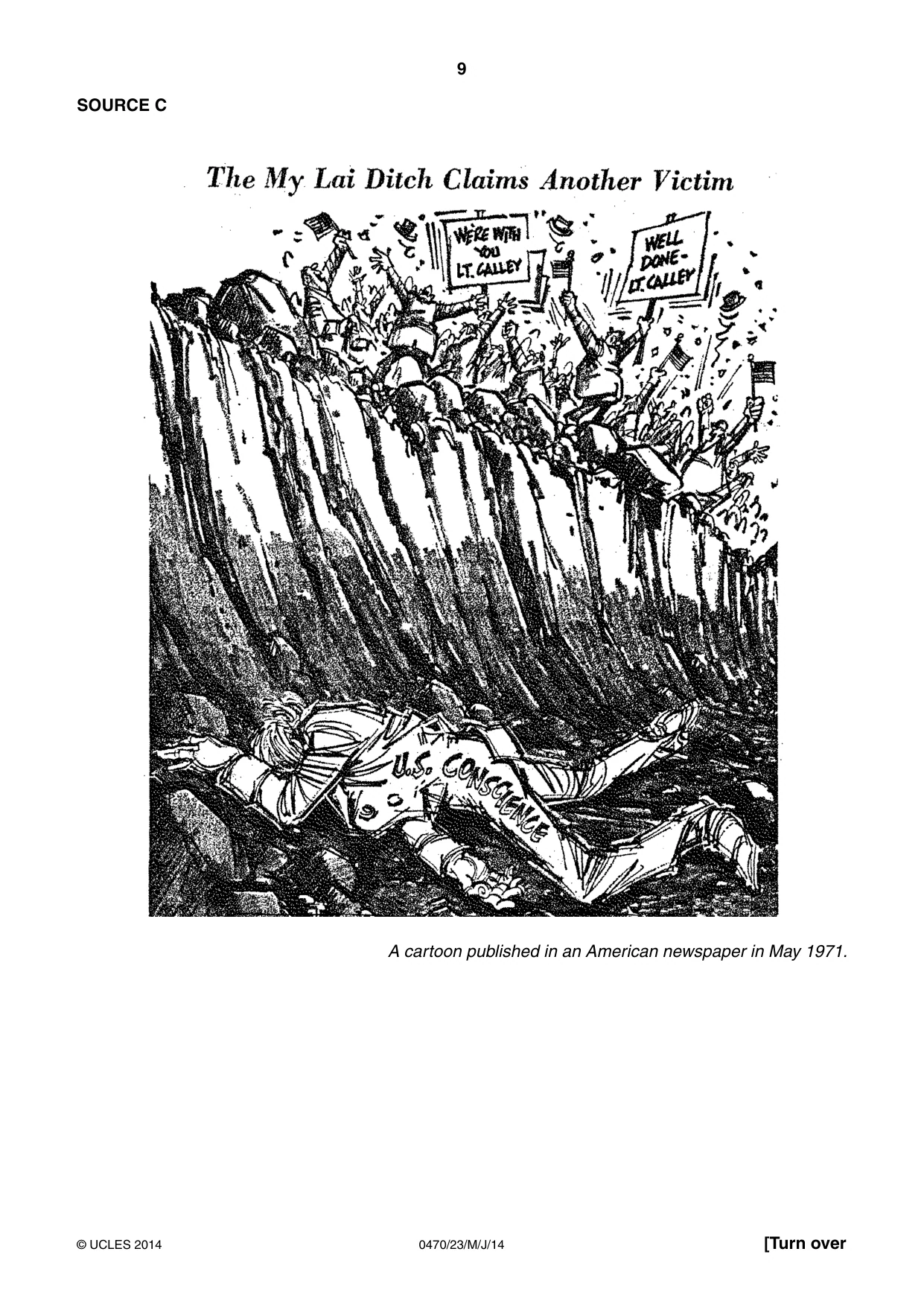
9 0470/23/M/J/14 © UCLES 2014 [Turn over SOURCE C A cartoon published in an American newspaper in May 1971.
Question paper, page 10
10 0470/23/M/J/14 © UCLES 2014 SOURCE D In the two days he had been in prison a recording of ‘The Battle Hymn of Lieutenant Calley’ had sold 200 000 copies. A book published at that time about My Lai had as its first chapter ‘It Never Happened – Besides They Deserved It.’ In an extraordinary wave of sympathy Americans sent 5000 telegrams to the President, running 100 to 1 in Calley’s favour. On the political left those against the war saw Calley as a victim caught up in an immoral war. They wanted the generals and politicians put on trial for war crimes. Those on the right thought the verdict insulted all American troops fighting in Vietnam. At a ‘Rally for Calley’ near where he was in prison a local minister, the Reverend Michael Lord, said ‘There was a crucifixion 2 000 years ago of a man named Jesus Christ. I don’t think we need another crucifixion of a man named Rusty Calley.’ Charles W. Colson, the President’s special adviser, argued that if Calley was freed from prison ‘it would allow the President to capture public support.’ From a book published in 1992. SOURCE E There are several factors which argue against direct Presidential involvement with the case. The facts show that Lieutenant Calley and members of his unit secured the village without a firefight, established complete control over the inhabitants – who were unarmed, unresisting civilians, placed them in convenient groups and then shot them. The conduct for which Calley has been convicted is a gross violation of the law of war. Therefore Presidential involvement at this time could have a damaging effect on world opinion. Therefore the President should not intervene or become involved in this case. The advice given to President Nixon in 1971 by his lawyer and senior advisers. SOURCE F In making your decision, have you considered those six loyal soldiers who served on the jury; the men who, since giving their verdict, have found themselves and their families the subject of vicious attacks upon their honour, integrity, and loyalty to this nation? It would seem to me to be more appropriate for you as the President to have said something on their behalf and to provide moral leadership for this nation. You should stand fully behind the law of this land on a moral issue which is so clear. For this nation to condone the acts of Lieutenant Calley is to make us no better than our enemies. From a letter to President Nixon from the lawyer who had prosecuted Calley. The letter was sent after Nixon decided to release Calley from prison.
Question paper, page 11
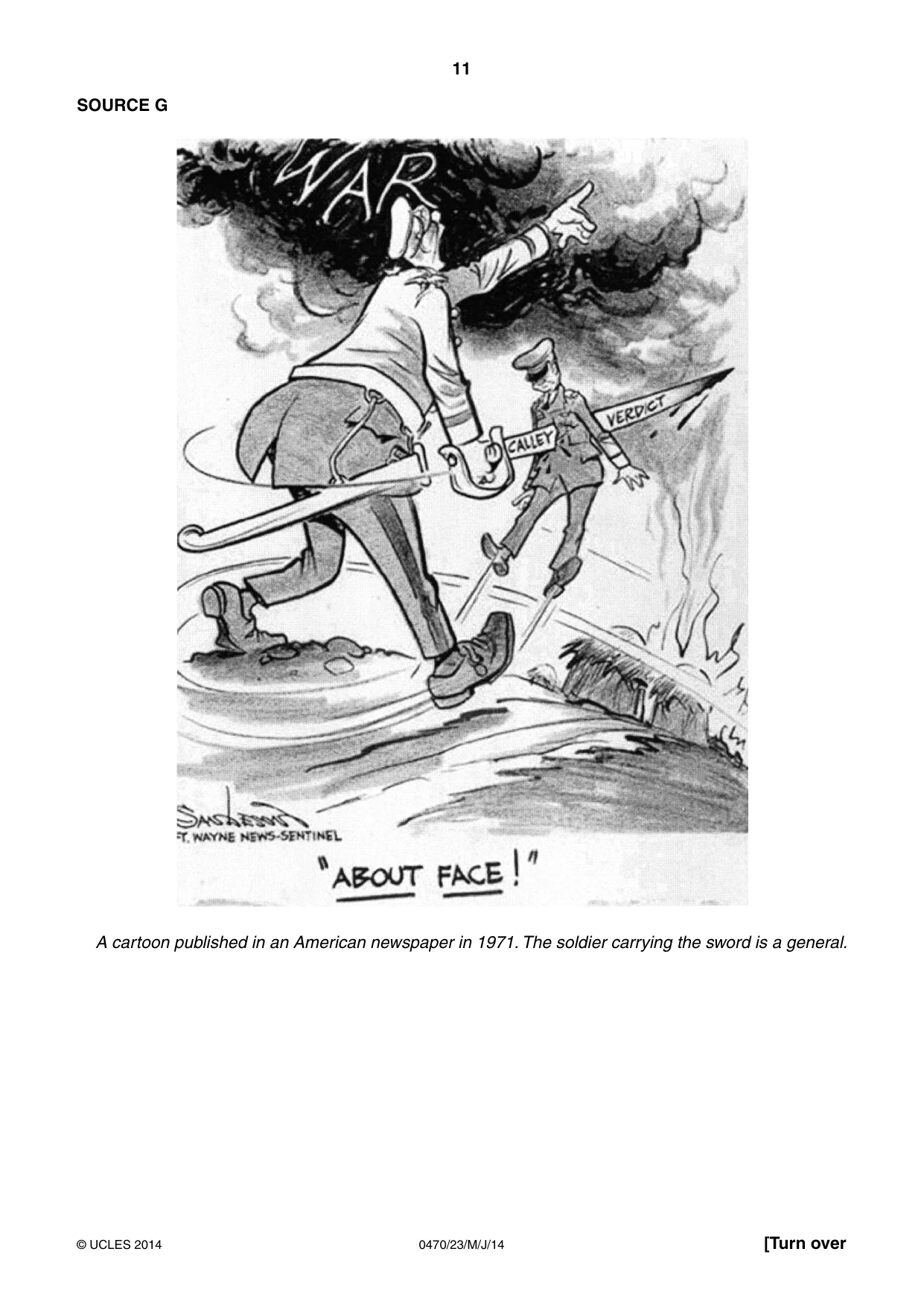
11 0470/23/M/J/14 © UCLES 2014 [Turn over SOURCE G A cartoon published in an American newspaper in 1971. The soldier carrying the sword is a general.
Question paper, page 12
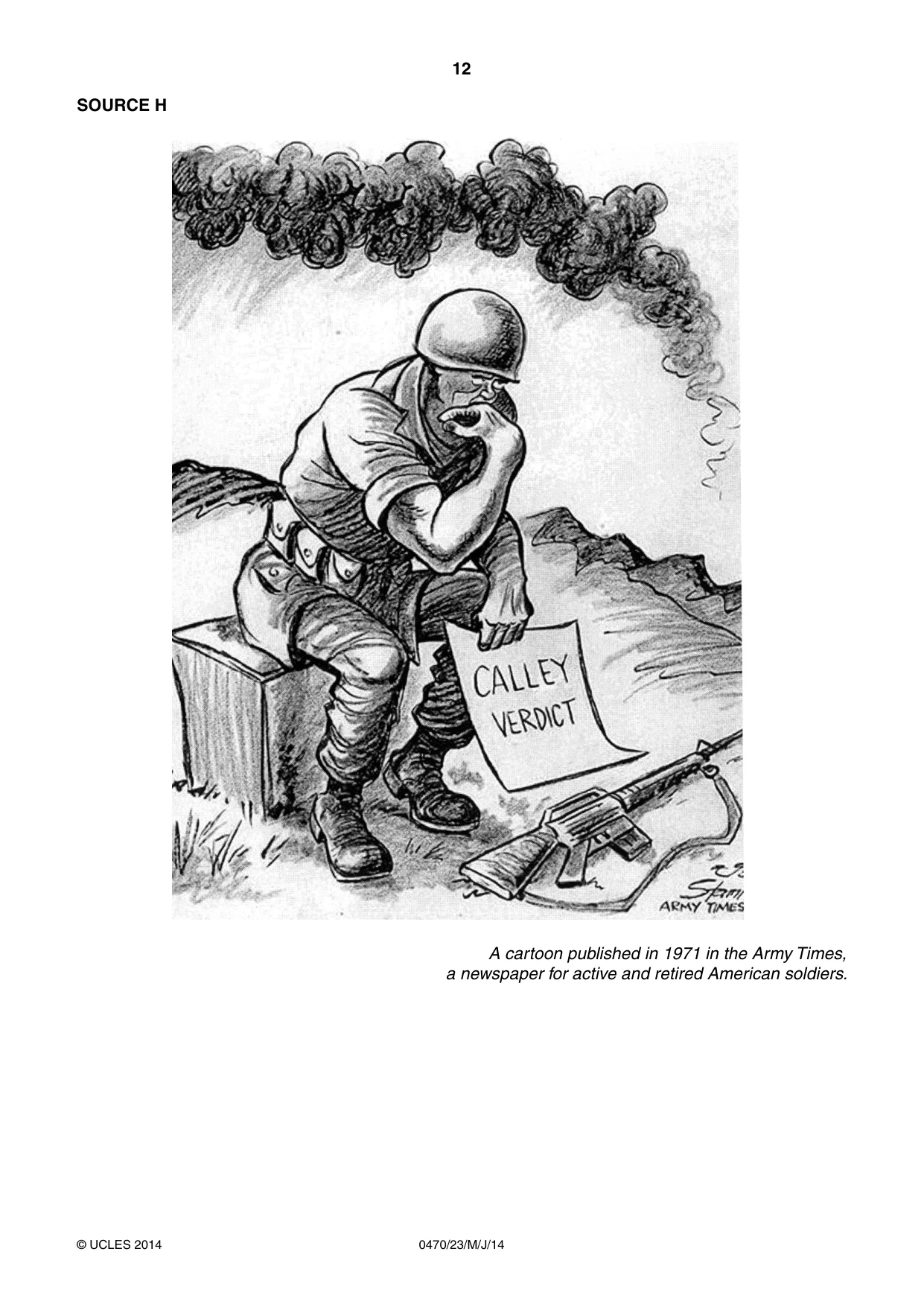
12 0470/23/M/J/14 © UCLES 2014 SOURCE H A cartoon published in 1971 in the Army Times, a newspaper for active and retired American soldiers.
Question paper, page 13
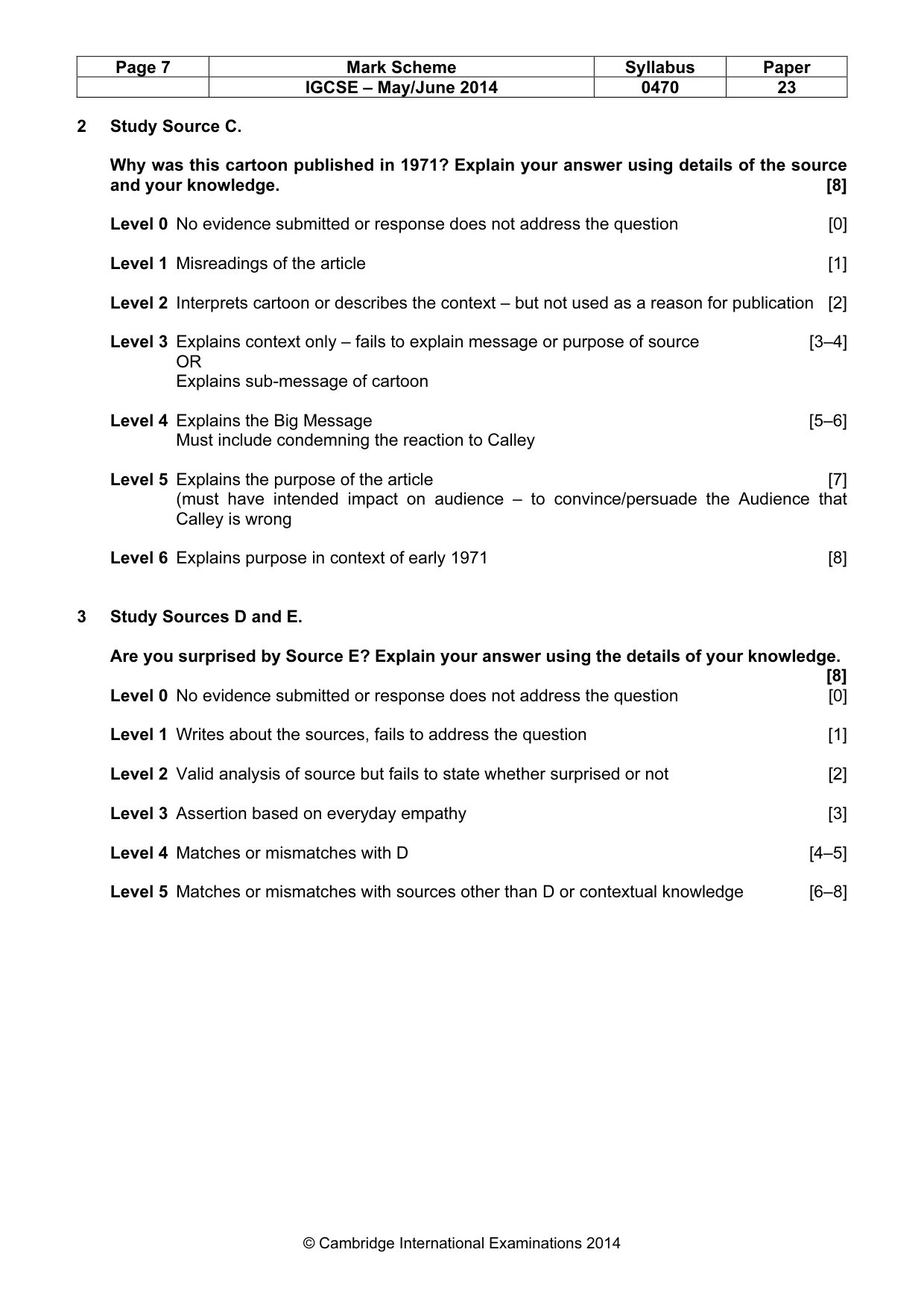
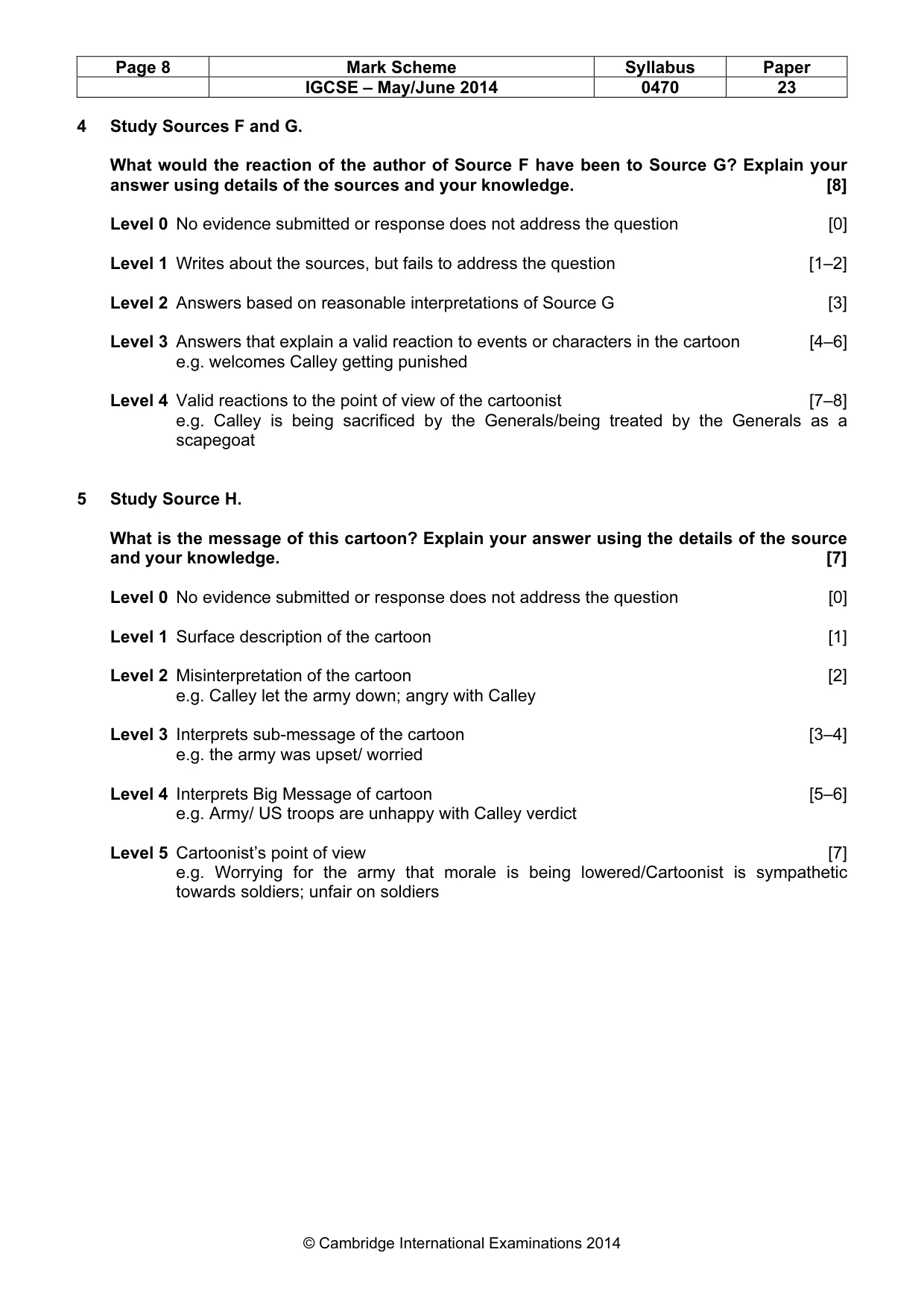
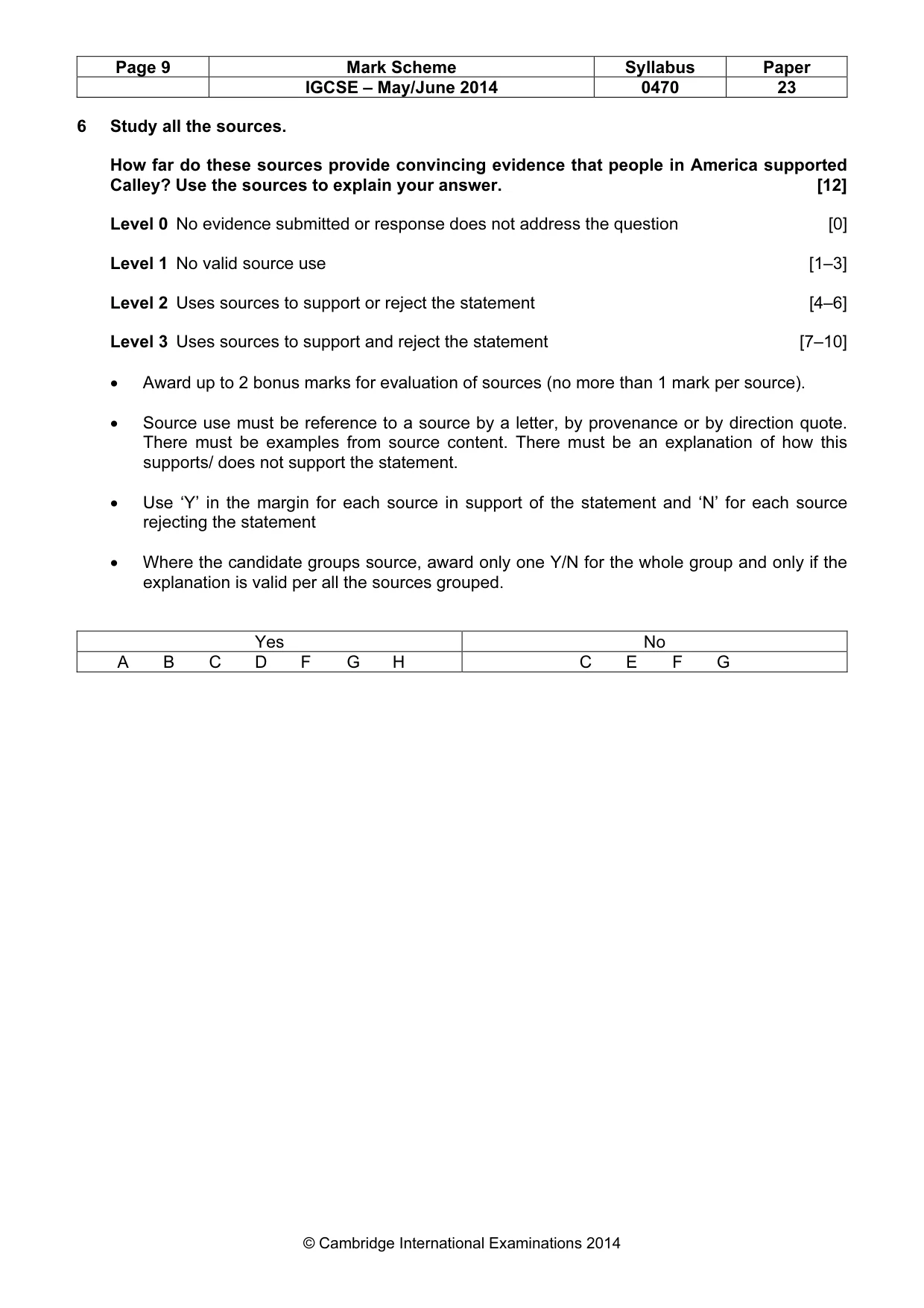
13 0470/23/M/J/14 © UCLES 2014 Now answer all the following questions. You may use any of the sources to help you answer the questions, in addition to those sources which you are told to use. In answering the questions you should use your knowledge of the topic to help you interpret and evaluate the sources. 1 Study Sources A and B. How far do these two sources agree? Explain your answer using details of the sources. [7] 2 Study Source C. Why was this cartoon published in 1971? Explain your answer using details of the source and your knowledge. [8] 3 Study Sources D and E. Are you surprised by Source E? Explain your answer using details of the sources and your knowledge. [8] 4 Study Sources F and G. What would the reaction of the author of Source F have been to Source G? Explain your answer using details of the sources and your knowledge. [8] 5 Study Source H. What is the message of this cartoon? Explain your answer using details of the source and your knowledge. [7] 6 Study all the sources. How far do these sources provide convincing evidence that people in America supported Calley? Use the sources to explain your answer. [12]
Question paper, page 14
14 0470/23/M/J/14 © UCLES 2014 BLANK PAGE
Question paper, page 15
15 0470/23/M/J/14 © UCLES 2014 BLANK PAGE
Question paper, page 16
16 0470/23/M/J/14 © UCLES 2014 Copyright Acknowledgements: Option B Source A © John Simkin; September 1997 – June 2013; www.spartacus.schoolnet.co.uk/VNmylai.htm. Option B Source B © Gary G Kohls; The My Lai Massacre Revisited ; 16 March 2009; www.spartacus.schoolnet.co.uk/VNmylai.htm. Option B Source D © M Bilton & K Sim; Four Hours in My Lai ; Viking Books; 1992. Option B Source G © Association of American Editorial Cartoonists. Option B Source H © Association of American Editorial Cartoonists. Permission to reproduce items where third-party owned material protected by copyright is included has been sought and cleared where possible. Every reasonable effort has been made by the publisher (UCLES) to trace copyright holders, but if any items requiring clearance have unwittingly been included, the publisher will be pleased to make amends at the earliest possible opportunity. Cambridge International Examinations is part of the Cambridge Assessment Group. Cambridge Assessment is the brand name of University of Cambridge Local Examinations Syndicate (UCLES), which is itself a department of the University of Cambridge. BLANK PAGE
Mark scheme, page 1
CAMBRIDGE INTERNATIONAL EXAMINATIONS International General Certificate of Secondary Education MARK SCHEME for the May/June 2014 series 0470 HISTORY 0470/23 Paper 2, maximum raw mark 50 This mark scheme is published as an aid to teachers and candidates, to indicate the requirements of the examination. It shows the basis on which Examiners were instructed to award marks. It does not indicate the details of the discussions that took place at an Examiners’ meeting before marking began, which would have considered the acceptability of alternative answers. Mark schemes should be read in conjunction with the question paper and the Principal Examiner Report for Teachers. Cambridge will not enter into discussions about these mark schemes. Cambridge is publishing the mark schemes for the May/June 2014 series for most IGCSE, GCE Advanced Level and Advanced Subsidiary Level components and some Ordinary Level components.
Mark scheme, page 2
Page 2 Mark Scheme Syllabus Paper IGCSE – May/June 2014 0470 23 © Cambridge International Examinations 2014 19th Century topic WAS SLAVERY THE CAUSE OF TENSION BETWEEN NORTH AND SOUTH? 1 Study Sources A and B. How far do sources A and B agree? Explain your answer using details of the sources. [7] Level 0 No evidence submitted or response does not address the question [0] Level 1 Writes about the sources but makes no valid comparison [1] Level 2 Identifies information that is in one source but not in the other [2] OR States that the sources are about the same subject OR Compares the provenance of the two sources Level 3 Agreement OR disagreement of details or sub-messages [3–4] Agreements include: North is against slavery North is trying to disrupt the South States have left the Union States complain about the North Both opposed the federal government Disagreements include: Leaving Union for different reasons Level 4 Agreement AND disagreement of details or sub-messages [5–6] Level 5 Compares Big Messages [7] Agreement: States are leaving the Union because of the North’s action/ Blaming the North 2 Study Source C. Are you surprised by this source? Explain your answer using details of the source and your knowledge. [8] Level 0 No evidence submitted or response does not address the question [0] Level 1 Writes about the source, but fails to address the question [1] Level 2 Valid analysis of source but fails to state whether surprised or not [2] OR Identifies something to be surprised/ not surprised about, but not explained Level 3 Answers based on undeveloped provenance [3] e.g. Jefferson Davies and dates
Mark scheme, page 3
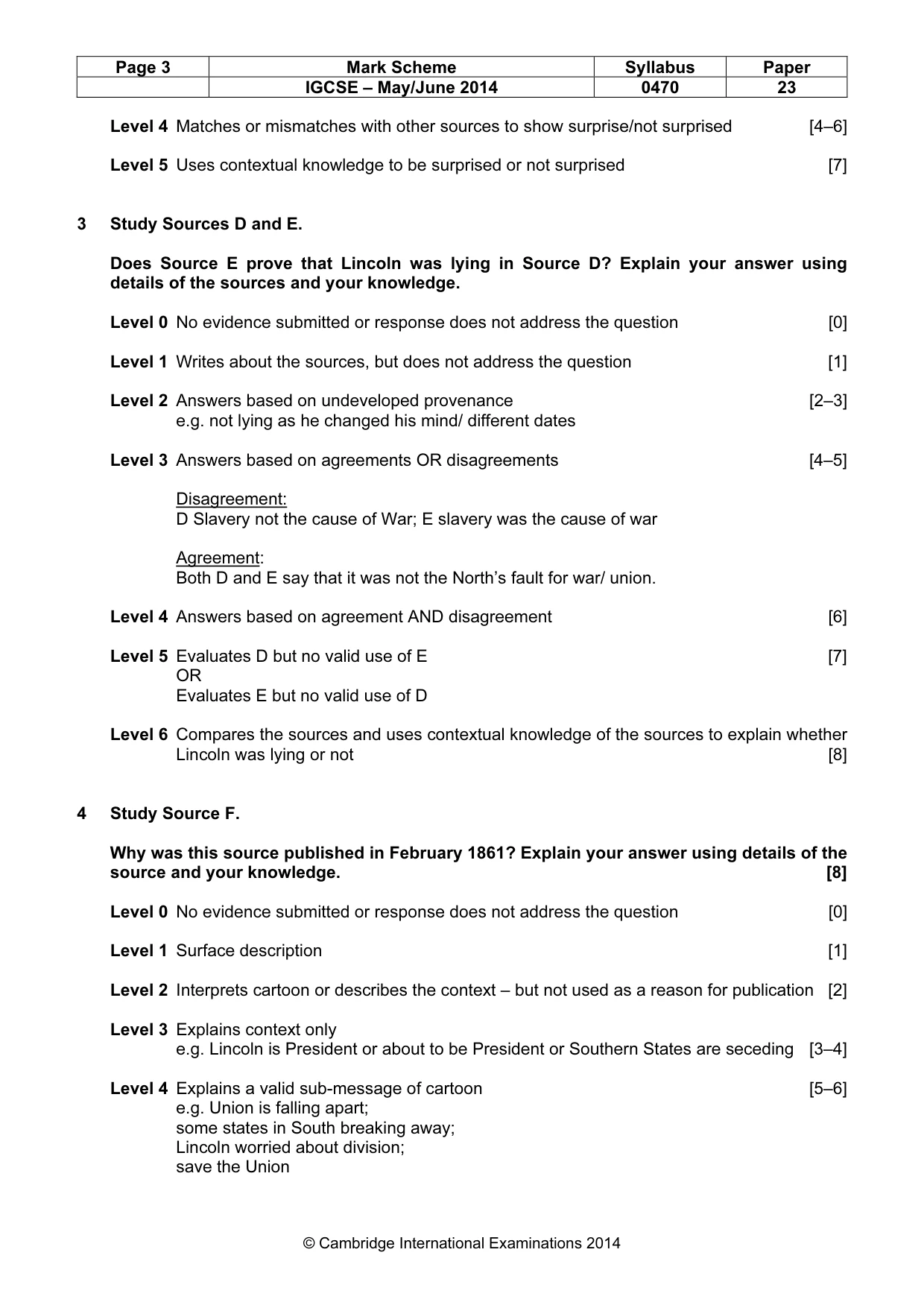
Page 3 Mark Scheme Syllabus Paper IGCSE – May/June 2014 0470 23 © Cambridge International Examinations 2014 Level 4 Matches or mismatches with other sources to show surprise/not surprised [4–6] Level 5 Uses contextual knowledge to be surprised or not surprised [7] 3 Study Sources D and E. Does Source E prove that Lincoln was lying in Source D? Explain your answer using details of the sources and your knowledge. Level 0 No evidence submitted or response does not address the question [0] Level 1 Writes about the sources, but does not address the question [1] Level 2 Answers based on undeveloped provenance [2–3] e.g. not lying as he changed his mind/ different dates Level 3 Answers based on agreements OR disagreements [4–5] Disagreement: D Slavery not the cause of War; E slavery was the cause of war Agreement: Both D and E say that it was not the North’s fault for war/ union. Level 4 Answers based on agreement AND disagreement [6] Level 5 Evaluates D but no valid use of E [7] OR Evaluates E but no valid use of D Level 6 Compares the sources and uses contextual knowledge of the sources to explain whether Lincoln was lying or not [8] 4 Study Source F. Why was this source published in February 1861? Explain your answer using details of the source and your knowledge. [8] Level 0 No evidence submitted or response does not address the question [0] Level 1 Surface description [1] Level 2 Interprets cartoon or describes the context – but not used as a reason for publication [2] Level 3 Explains context only e.g. Lincoln is President or about to be President or Southern States are seceding [3–4] Level 4 Explains a valid sub-message of cartoon [5–6] e.g. Union is falling apart; some states in South breaking away; Lincoln worried about division; save the Union
Mark scheme, page 4
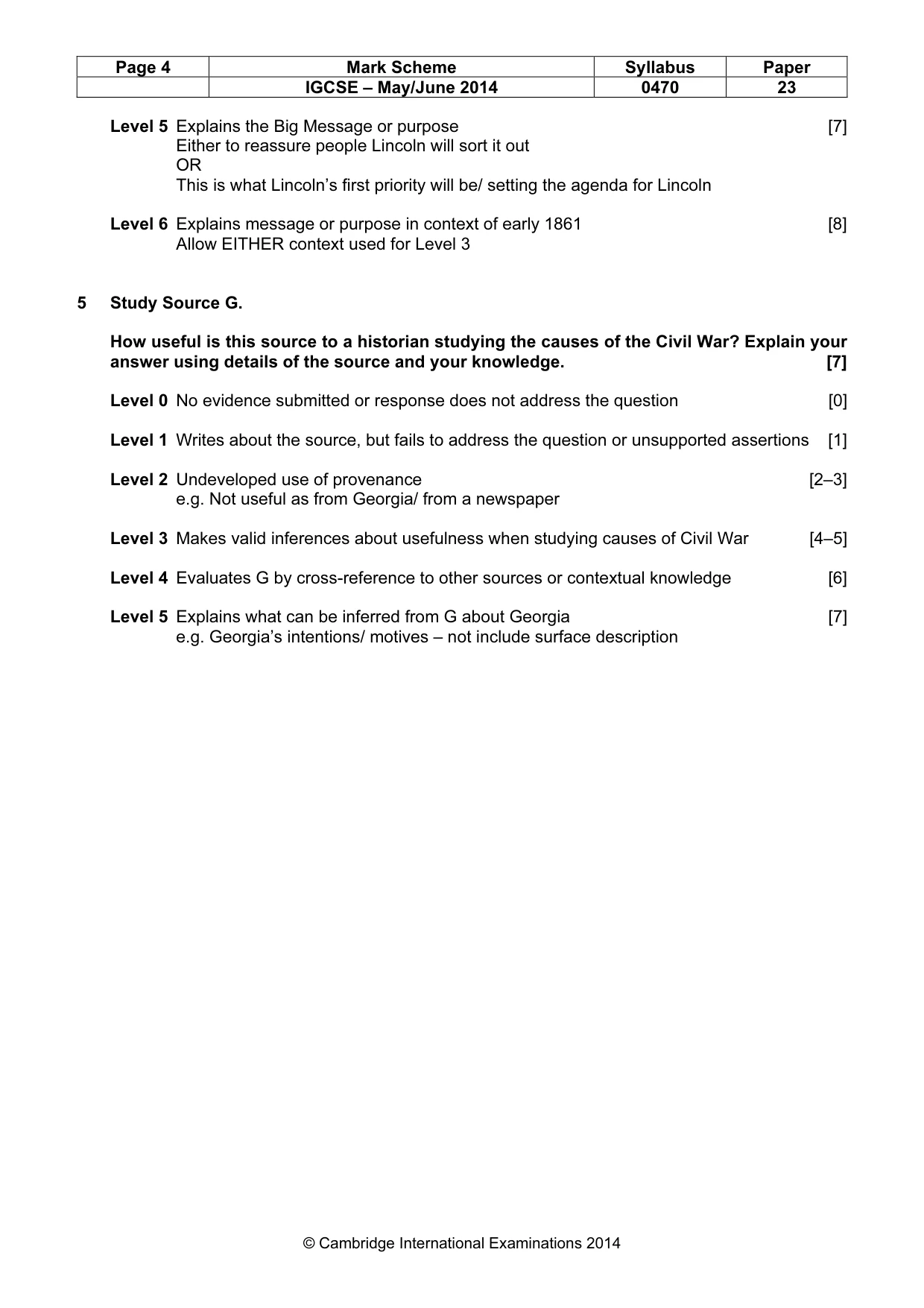
Page 4 Mark Scheme Syllabus Paper IGCSE – May/June 2014 0470 23 © Cambridge International Examinations 2014 Level 5 Explains the Big Message or purpose [7] Either to reassure people Lincoln will sort it out OR This is what Lincoln’s first priority will be/ setting the agenda for Lincoln Level 6 Explains message or purpose in context of early 1861 [8] Allow EITHER context used for Level 3 5 Study Source G. How useful is this source to a historian studying the causes of the Civil War? Explain your answer using details of the source and your knowledge. [7] Level 0 No evidence submitted or response does not address the question [0] Level 1 Writes about the source, but fails to address the question or unsupported assertions [1] Level 2 Undeveloped use of provenance [2–3] e.g. Not useful as from Georgia/ from a newspaper Level 3 Makes valid inferences about usefulness when studying causes of Civil War [4–5] Level 4 Evaluates G by cross-reference to other sources or contextual knowledge [6] Level 5 Explains what can be inferred from G about Georgia [7] e.g. Georgia’s intentions/ motives – not include surface description
Mark scheme, page 5
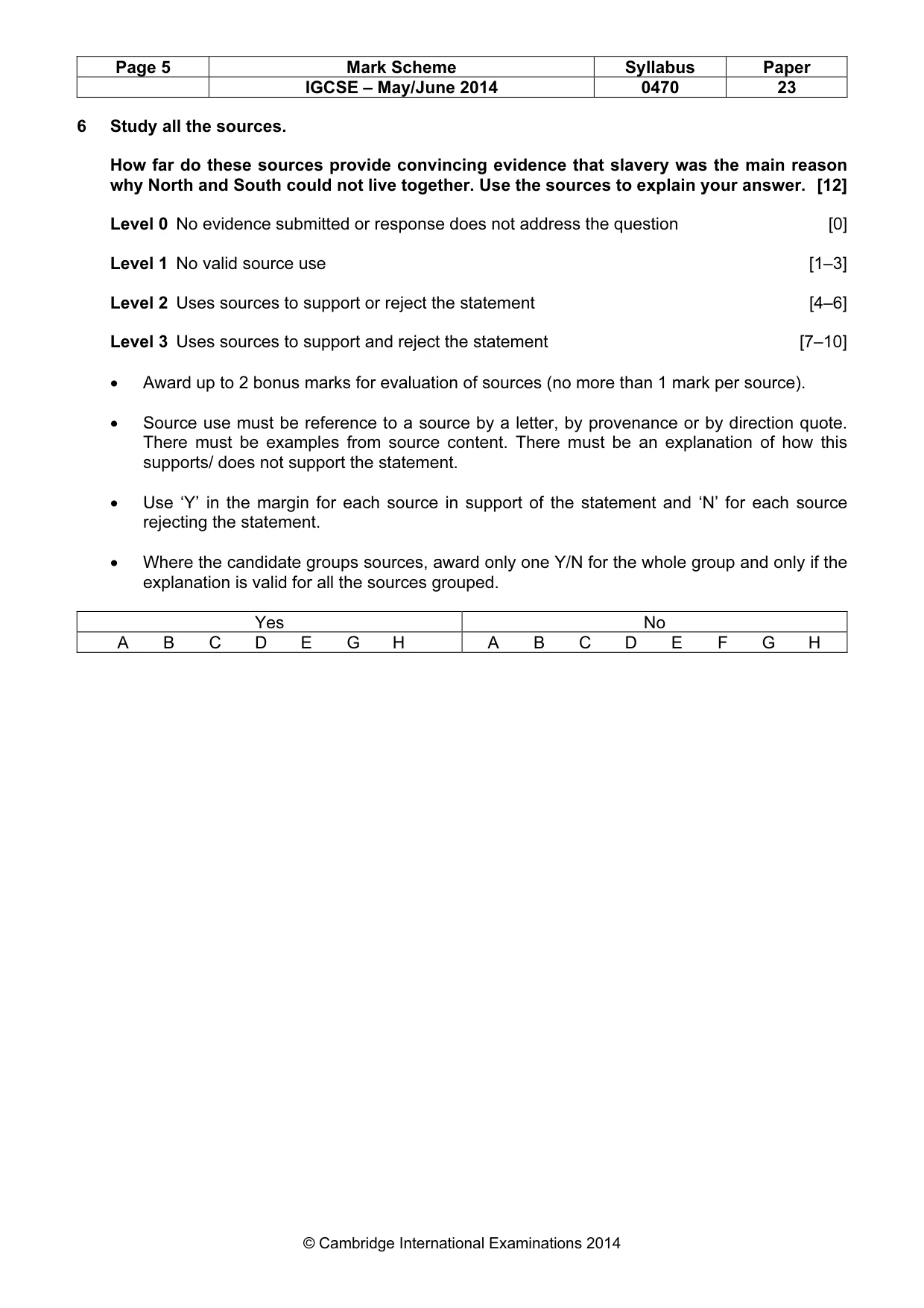
Page 5 Mark Scheme Syllabus Paper IGCSE – May/June 2014 0470 23 © Cambridge International Examinations 2014 6 Study all the sources. How far do these sources provide convincing evidence that slavery was the main reason why North and South could not live together. Use the sources to explain your answer. [12] Level 0 No evidence submitted or response does not address the question [0] Level 1 No valid source use [1–3] Level 2 Uses sources to support or reject the statement [4–6] Level 3 Uses sources to support and reject the statement [7–10] • Award up to 2 bonus marks for evaluation of sources (no more than 1 mark per source). • Source use must be reference to a source by a letter, by provenance or by direction quote. There must be examples from source content. There must be an explanation of how this supports/ does not support the statement. • Use ‘Y’ in the margin for each source in support of the statement and ‘N’ for each source rejecting the statement. • Where the candidate groups sources, award only one Y/N for the whole group and only if the explanation is valid for all the sources grouped. Yes No A B C D E G H A B C D E F G H
Mark scheme, page 6
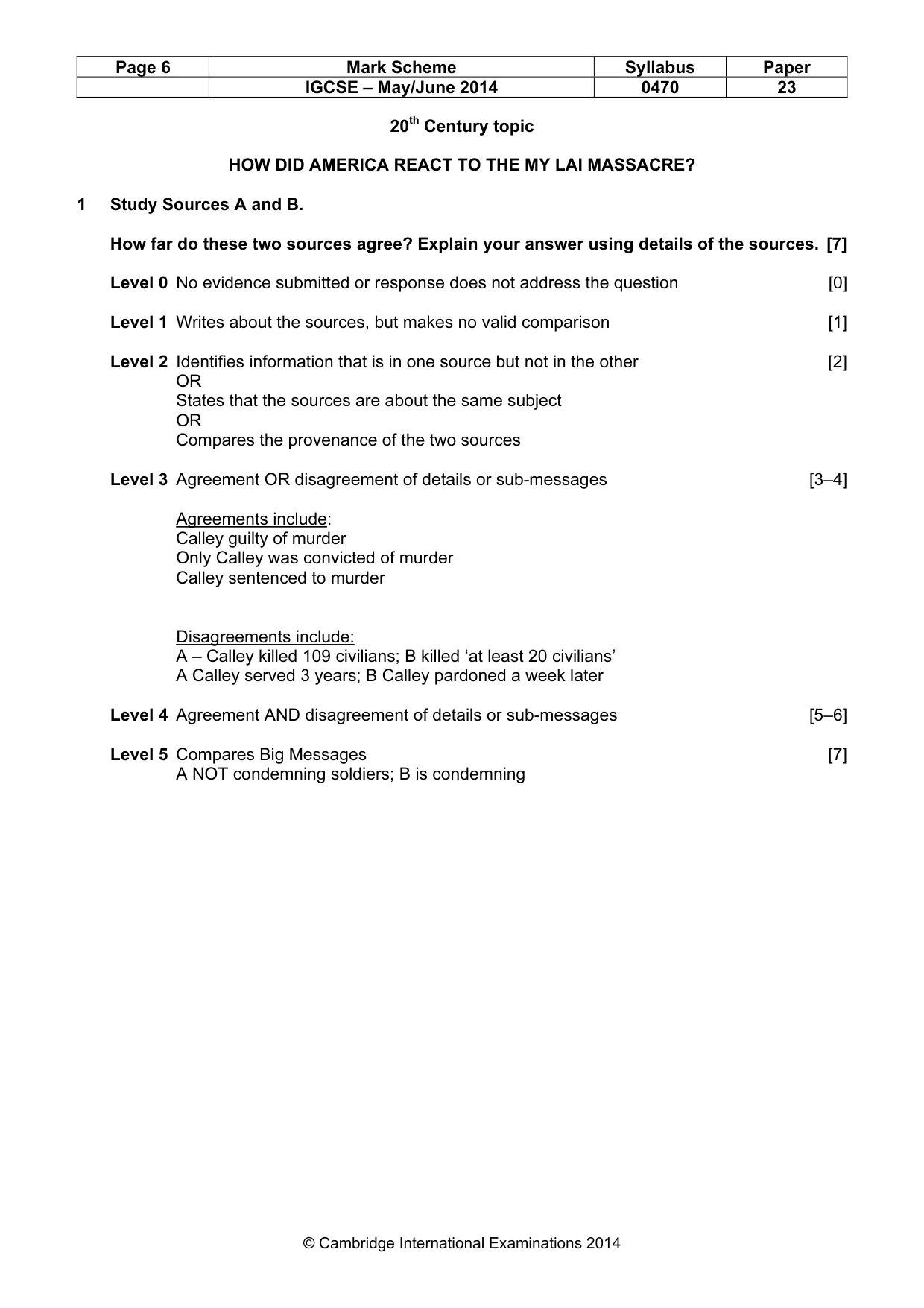
Page 6 Mark Scheme Syllabus Paper IGCSE – May/June 2014 0470 23 © Cambridge International Examinations 2014 20th Century topic HOW DID AMERICA REACT TO THE MY LAI MASSACRE? 1 Study Sources A and B. How far do these two sources agree? Explain your answer using details of the sources. [7] Level 0 No evidence submitted or response does not address the question [0] Level 1 Writes about the sources, but makes no valid comparison [1] Level 2 Identifies information that is in one source but not in the other [2] OR States that the sources are about the same subject OR Compares the provenance of the two sources Level 3 Agreement OR disagreement of details or sub-messages [3–4] Agreements include: Calley guilty of murder Only Calley was convicted of murder Calley sentenced to murder Disagreements include: A – Calley killed 109 civilians; B killed ‘at least 20 civilians’ A Calley served 3 years; B Calley pardoned a week later Level 4 Agreement AND disagreement of details or sub-messages [5–6] Level 5 Compares Big Messages [7] A NOT condemning soldiers; B is condemning
Mark scheme, page 7
Page 7 Mark Scheme Syllabus Paper IGCSE – May/June 2014 0470 23 © Cambridge International Examinations 2014 2 Study Source C. Why was this cartoon published in 1971? Explain your answer using details of the source and your knowledge. [8] Level 0 No evidence submitted or response does not address the question [0] Level 1 Misreadings of the article [1] Level 2 Interprets cartoon or describes the context – but not used as a reason for publication [2] Level 3 Explains context only – fails to explain message or purpose of source [3–4] OR Explains sub-message of cartoon Level 4 Explains the Big Message [5–6] Must include condemning the reaction to Calley Level 5 Explains the purpose of the article [7] (must have intended impact on audience – to convince/persuade the Audience that Calley is wrong Level 6 Explains purpose in context of early 1971 [8] 3 Study Sources D and E. Are you surprised by Source E? Explain your answer using the details of your knowledge. [8] Level 0 No evidence submitted or response does not address the question [0] Level 1 Writes about the sources, fails to address the question [1] Level 2 Valid analysis of source but fails to state whether surprised or not [2] Level 3 Assertion based on everyday empathy [3] Level 4 Matches or mismatches with D [4–5] Level 5 Matches or mismatches with sources other than D or contextual knowledge [6–8]
Mark scheme, page 8
Page 8 Mark Scheme Syllabus Paper IGCSE – May/June 2014 0470 23 © Cambridge International Examinations 2014 4 Study Sources F and G. What would the reaction of the author of Source F have been to Source G? Explain your answer using details of the sources and your knowledge. [8] Level 0 No evidence submitted or response does not address the question [0] Level 1 Writes about the sources, but fails to address the question [1–2] Level 2 Answers based on reasonable interpretations of Source G [3] Level 3 Answers that explain a valid reaction to events or characters in the cartoon [4–6] e.g. welcomes Calley getting punished Level 4 Valid reactions to the point of view of the cartoonist [7–8] e.g. Calley is being sacrificed by the Generals/being treated by the Generals as a scapegoat 5 Study Source H. What is the message of this cartoon? Explain your answer using the details of the source and your knowledge. [7] Level 0 No evidence submitted or response does not address the question [0] Level 1 Surface description of the cartoon [1] Level 2 Misinterpretation of the cartoon [2] e.g. Calley let the army down; angry with Calley Level 3 Interprets sub-message of the cartoon [3–4] e.g. the army was upset/ worried Level 4 Interprets Big Message of cartoon [5–6] e.g. Army/ US troops are unhappy with Calley verdict Level 5 Cartoonist’s point of view [7] e.g. Worrying for the army that morale is being lowered/Cartoonist is sympathetic towards soldiers; unfair on soldiers
Mark scheme, page 9
Page 9 Mark Scheme Syllabus Paper IGCSE – May/June 2014 0470 23 © Cambridge International Examinations 2014 6 Study all the sources. How far do these sources provide convincing evidence that people in America supported Calley? Use the sources to explain your answer. [12] Level 0 No evidence submitted or response does not address the question [0] Level 1 No valid source use [1–3] Level 2 Uses sources to support or reject the statement [4–6] Level 3 Uses sources to support and reject the statement [7–10] • Award up to 2 bonus marks for evaluation of sources (no more than 1 mark per source). • Source use must be reference to a source by a letter, by provenance or by direction quote. There must be examples from source content. There must be an explanation of how this supports/ does not support the statement. • Use ‘Y’ in the margin for each source in support of the statement and ‘N’ for each source rejecting the statement • Where the candidate groups source, award only one Y/N for the whole group and only if the explanation is valid per all the sources grouped. Yes No A B C D F G H C E F G
What you needed in this session
Cambridge’s own grade thresholds for 2014 May/June, Paper 2 · Variant 3. A higher threshold means an easier paper — the bar moves with how the cohort did.