Cambridge IGCSE History 0470 — 2014 May/June Paper 2 · Variant 1
0470/21/M/J/14 · 50 marks · ≈56 min
The question paper and its mark scheme, free to read here and free to download. This is Cambridge’s own paper, exactly as it was sat.
Question paper16 pages

Mark scheme7 pages
Answers below. Sit the paper first if you are practising.
Paper as text
Question paper, page 1
This document consists of 14 printed pages, 2 blank pages and 1 insert. DC (SJF/JG) 79327/3 © UCLES 2014 [Turn over Cambridge International Examinations Cambridge International General Certificate of Secondary Education * 9 9 5 5 9 5 2 4 2 5 * HISTORY 0470/21 Paper 2 May/June 2014 2 hours No Additional Materials are required. READ THESE INSTRUCTIONS FIRST An answer booklet is provided inside this question paper. You should follow the instructions on the front cover of the answer booklet. If you need additional answer paper ask the invigilator for a continuation booklet. This paper has two options. Choose one option, and answer all of the questions on that topic. Option A: 19th Century topic [p2–p7] Option B: 20th Century topic [p8–p14] The number of marks is given in brackets [ ] at the end of each question or part question.
Question paper, page 2
2 0470/21/M/J/14 © UCLES 2014 Option A: 19th Century topic WAS THE AMERICAN CIVIL WAR FOUGHT OVER SLAVERY? Study the Background Information and the sources carefully, and then answer all the questions. Background Information The concern of northerners about slavery increased dramatically in the 1850s. Developments such as the publication of Uncle Tom’s Cabin in 1852 and the Kansas-Nebraska Act of 1854 contributed to their fears. However, southerners were just as worried. They saw the economic and political power of the North as a threat to the rights and independence of southern states, especially their right to own slaves. After Lincoln’s election as president in 1860 southern states began to secede from the Union and, in April 1861, the first shots of the Civil War were fired. Was the American Civil War fought over slavery, the rights of the South or the preservation of the Union? SOURCE A The Confederate president on 12 April ordered the bombardment of Fort Sumter. Civil War had begun. With the fort’s surrender, Lincoln declared that rebellion existed in the seceded states. To suppress it he called for the loyal states to supply 75 000 militia volunteers, ordered an expansion of the regular army, proclaimed a blockade of the southern coast and authorised the expenditure of millions of dollars for military purposes. By the end of May four more slave states seceded, rather than take part in the coercion of their southern brothers. Whether Lincoln craftily manoeuvred the South into firing the first shot or simply took a calculated risk of war, creating a situation that placed the onus of striking the first blow on Jefferson Davis rather than himself, the result galvanised public opinion in the North. The attack on Fort Sumter clarified in northern minds the direct opposition between free and slave societies that abolitionists and many Republicans had long insisted on. In Quincy, Illinois, a mass meeting of Democrats and Republicans unanimously adopted resolutions pledging ‘support’ to the government in its efforts for ‘suppression of rebellion, preservation of the Union, punishment of treason’. In none of his proclamations did Lincoln mention the word ‘slavery’ or indicate that military efforts had any purpose other than to suppress rebellion that prevented the upholding of the laws. In his call for 75 000 militiamen he stated that the ‘utmost care’ would be taken to avoid any interference with property in the seceded states. He even stopped his generals issuing local emancipation decrees in the early months of the war. Lincoln believed that making slavery a target of the war effort would drive all the states of the Upper South to secede and shatter northern unity. When an abolitionist told his audience in Wayland, Massachusetts, that slaves should be allowed ‘to fight on our side’, his audience responded that the war was about national unity, ‘and they wouldn’t hear a word about those blacks’. As so often Lincoln sought the lowest common factor in public opinion – in this case a war to preserve the Union. From a history book published in 2010.
Question paper, page 3
3 0470/21/M/J/14 © UCLES 2014 [Turn over SOURCE B Some historians think that Lincoln deliberately manoeuvred the Confederacy into firing the first shots. Others believe that his main concern in attempting to resupply Fort Sumter was to try to give himself more time. In reality, it seems likely that Lincoln was trying to keep as many options open as possible. He hoped to preserve peace, but was willing to risk war. At 4.30 am on 12 April 1861, the opening shots of the Civil War were fired. After the surrender of Fort Sumter, Lincoln called upon the state militia to muster 70 000 men. This call for troops prompted the secession of Virginia, North Carolina, Arkansas and Tennessee. Secession did not necessarily mean war. Lincoln’s government could have allowed the southern states to depart in peace. But Lincoln and the Republicans were committed to preventing slavery expansion. Lincoln also laid great emphasis on the Union, which was evoked almost as a religious concept. Lincoln called the Union ‘the last, best hope of mankind’. Without Union, he believed, American freedom would be destroyed. Furthermore, he and many other Unionists thought that secession was a bluff, and that once the South saw it could not prevail, it would return to the Union. However, it was slavery which had led to the divide between North and South. Differences arising from the slavery issue led to the secession of the Southern states. The Confederacy was ready to fight to the death for states’ rights and, in particular, the right to preserve slavery. Although few northerners were willing to fight to free the slave, most were prepared to fight to save the Union. The slave issue meant they had to fight to save the Union. From a recent account of the beginnings of the Civil War.
Question paper, page 4
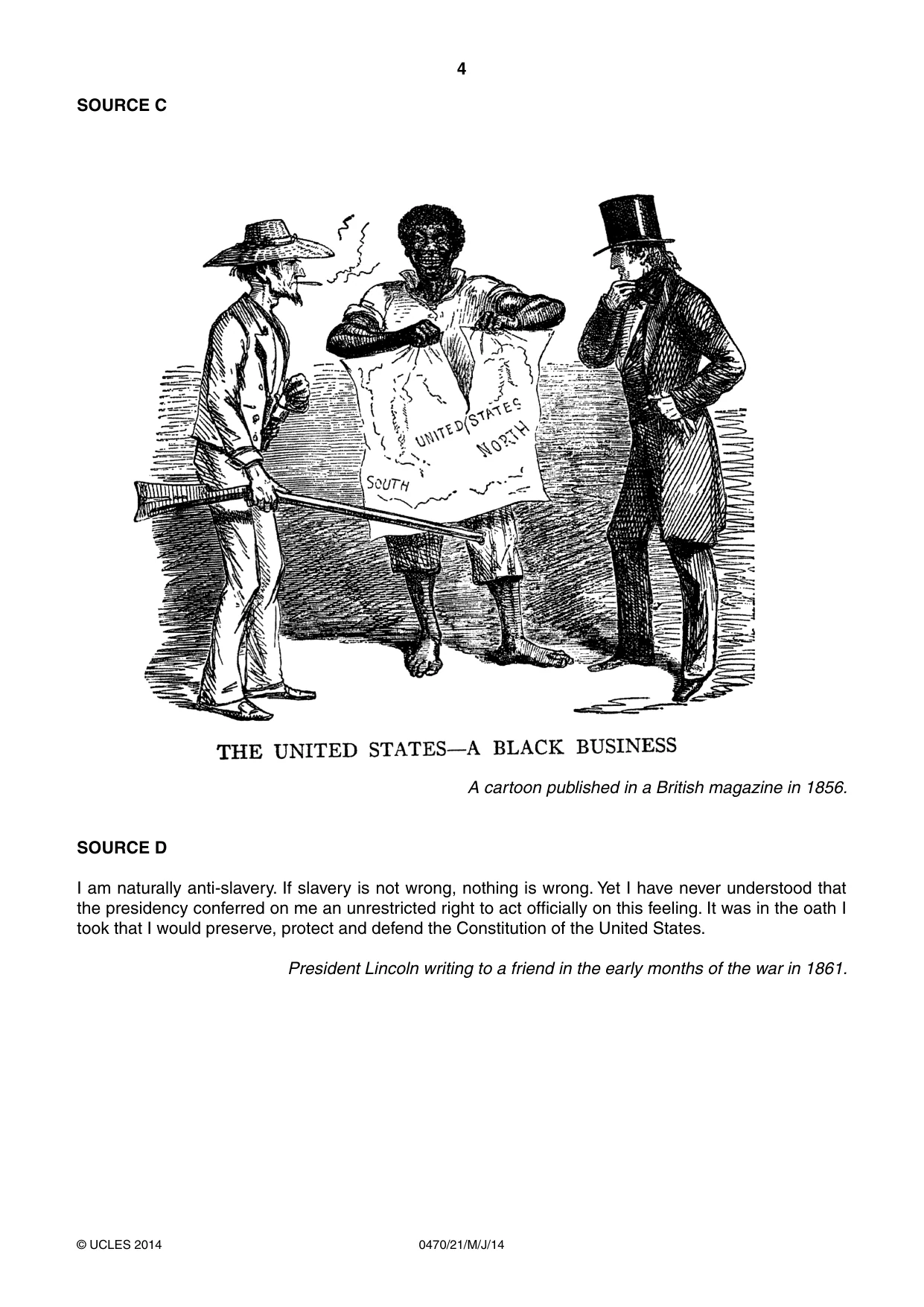
4 0470/21/M/J/14 © UCLES 2014 SOURCE C A cartoon published in a British magazine in 1856. SOURCE D I am naturally anti-slavery. If slavery is not wrong, nothing is wrong. Yet I have never understood that the presidency conferred on me an unrestricted right to act officially on this feeling. It was in the oath I took that I would preserve, protect and defend the Constitution of the United States. President Lincoln writing to a friend in the early months of the war in 1861.
Question paper, page 5
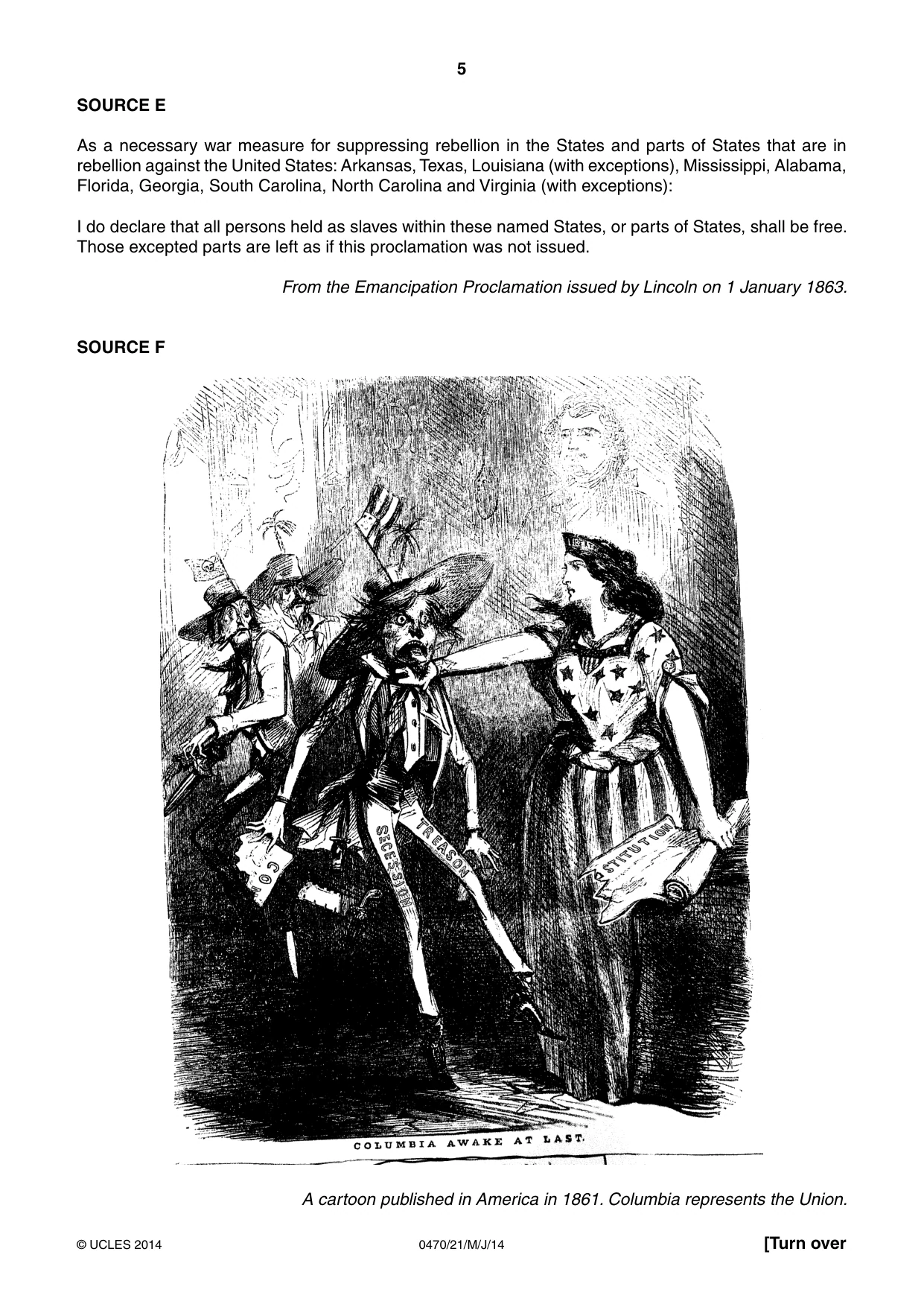
5 0470/21/M/J/14 © UCLES 2014 [Turn over SOURCE E As a necessary war measure for suppressing rebellion in the States and parts of States that are in rebellion against the United States: Arkansas, Texas, Louisiana (with exceptions), Mississippi, Alabama, Florida, Georgia, South Carolina, North Carolina and Virginia (with exceptions): I do declare that all persons held as slaves within these named States, or parts of States, shall be free. Those excepted parts are left as if this proclamation was not issued. From the Emancipation Proclamation issued by Lincoln on 1 January 1863. SOURCE F A cartoon published in America in 1861. Columbia represents the Union.
Question paper, page 6
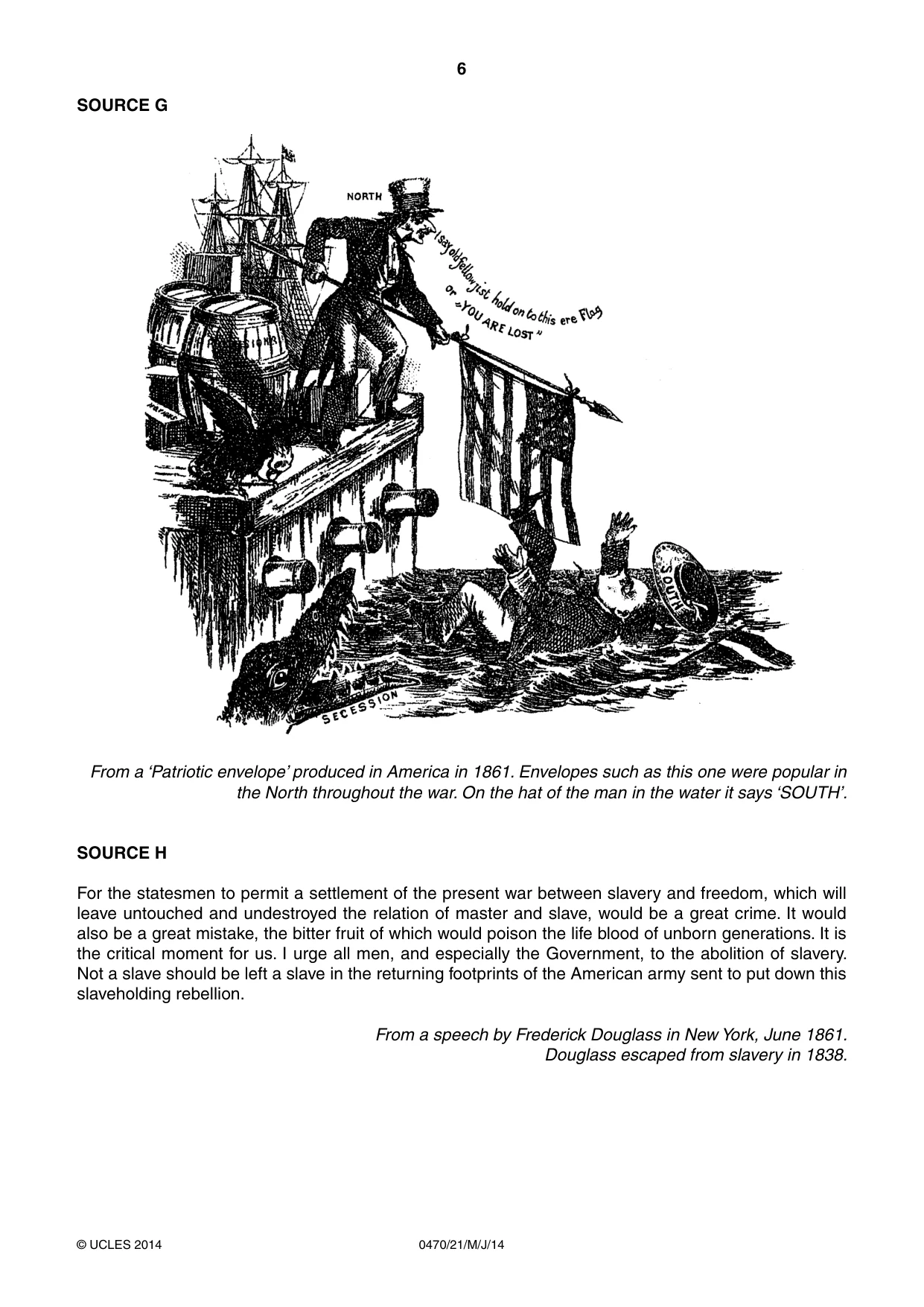
6 0470/21/M/J/14 © UCLES 2014 SOURCE G From a ‘Patriotic envelope’ produced in America in 1861. Envelopes such as this one were popular in the North throughout the war. On the hat of the man in the water it says ‘SOUTH’. SOURCE H For the statesmen to permit a settlement of the present war between slavery and freedom, which will leave untouched and undestroyed the relation of master and slave, would be a great crime. It would also be a great mistake, the bitter fruit of which would poison the life blood of unborn generations. It is the critical moment for us. I urge all men, and especially the Government, to the abolition of slavery. Not a slave should be left a slave in the returning footprints of the American army sent to put down this slaveholding rebellion. From a speech by Frederick Douglass in New York, June 1861. Douglass escaped from slavery in 1838.
Question paper, page 7
7 0470/21/M/J/14 © UCLES 2014 [Turn over Now answer all the following questions. You may use any of the sources to help you answer the questions, in addition to those sources which you are told to use. In answering the questions you should use your knowledge of the topic to help you interpret and evaluate the sources. 1 Study Sources A and B. How far do Sources A and B agree? Explain your answer using details of the sources. [7] 2 Study Source C. What is the message of this cartoon? Explain your answer using details of the source and your knowledge. [8] 3 Study Sources D and E. Does Source E prove that Lincoln was lying in Source D? Explain your answer using details of the sources and your knowledge. [8] 4 Study Sources F and G. How far would these two cartoonists have agreed? Explain your answer using details of the sources and your knowledge. [8] 5 Study Source H. Are you surprised by this source? Explain your answer using details of the source and your knowledge. [7] 6 Study all the sources. How far do these sources provide convincing evidence that the American Civil War was fought over slavery? Use the sources to explain your answer. [12]
Question paper, page 8
8 0470/21/M/J/14 © UCLES 2014 Option B: 20th Century topic HOW FAR DID THE SUPERPOWERS ACT RESPONSIBLY OVER CUBA? Study the Background Information and the sources carefully, and then answer all the questions. Background Information Ever since the Cuban Revolution in 1959 when Castro took over control of Cuba and began to turn the country towards communism and the Soviet Union, Cuba had been a concern for the United States and a source of tension with the Soviet Union. Even after supporting the failed invasion in 1961 by Cuban exiles, the United States continued to plan an economic blockade of Cuba and another invasion. Meanwhile, the Soviet Union poured economic help, troops and armaments into Cuba. It claimed this was to defend Cuba. On the morning of Sunday 14 October 1962, a U-2 spy plane photographed Soviet missile sites under construction in Cuba. For two weeks, until the crisis ended on 28 October, many feared that the world was on the brink of a nuclear war. Did the actions of America and Russia during the crisis make the situation worse or did they act in a sensible manner? How reasonably did the superpowers act over Cuba? SOURCE A Within the past week, unmistakable evidence has established the fact that a series of offensive missile sites is now in preparation on Cuba. The purpose of these bases can be none other than to provide a nuclear strike capability against the Western Hemisphere. Turning Cuba into an important strategic base is an open threat to the peace and security of the Americas. This action contradicts the repeated promises of Soviet spokesmen that the arms build-up in Cuba would be defensive. Our objective must be to prevent the use of these missiles against this or any other country, and to secure their withdrawal from the Western Hemisphere. Only last Thursday the Soviet Foreign Minister Gromyko told me that Soviet assistance to Cuba was, and I quote, ‘only for the purpose of contributing to the defence of Cuba’. Acting in our own defence and of the entire Western world, I have directed that a strict quarantine on all offensive military equipment under shipment to Cuba be started. All ships, if found to contain cargoes of offensive weapons, will be turned back. Our goal is both peace and freedom around the world. From a speech on television to the American people by President Kennedy, 22 October 1962.
Question paper, page 9
9 0470/21/M/J/14 © UCLES 2014 [Turn over SOURCE B The United States demands that military equipment which Cuba needs for self-defence should be removed from Cuban territory. The USSR is in favour of all troops being withdrawn from foreign territories. However, the United States has its armed forces and armaments scattered throughout the world. US spokesmen are continually boasting that American planes can attack the Soviet Union at any time. Peace-loving states cannot fail to protest against the actions announced by the US President with regard to ships sailing towards Cuba on the high seas. The establishment of an actual blockade of Cuba by the United States is an unheard-of violation of international law. The arrogant actions of American imperialism could lead to consequences disastrous to all mankind. The Soviet Union calls on all Governments to raise their voices in protest against the aggressive actions of the United States, to denounce these actions, and to bar the way to the unleashing of nuclear war by the US government. From a statement issued by the Soviet Government, 23 October 1962. SOURCE C 19 October General LeMay (in charge of the US air force): If we don’t do anything to Cuba, then they’re going to push on Berlin and push real hard because they have got us on the run. I just don’t see any other solution right now. A blockade would be considered by a lot of our friends as being a weak response. 22 October Nitze (second in charge of the Defence Department of the American Government): A Soviet nuclear attack requires the immediate implementation of the European Defence Plan. President Kennedy: What’s the European Defence Plan? Nitze: Nuclear War. From the records of meetings held by President Kennedy to decide how to react to the discovery of the missiles. SOURCE D During the crisis President Kennedy spent more time trying to determine the effect of a particular course of action on Khrushchev or the Russians than on anything else. What guided all his decisions was an effort not to disgrace Khrushchev, not to humiliate the Soviet Union. That is why he was reluctant to stop and search a Russian ship; this was why he was opposed to attacking the missile sites. President Kennedy understood that the Soviet Union did not want war, and they understood that we wished to avoid armed conflict. From Robert Kennedy’s book about the Cuban Missile Crisis, published in 1968. Robert Kennedy was the President’s brother and a member of the US government during the crisis. He was the President’s closest adviser and held many talks with Soviet officials.
Question paper, page 10
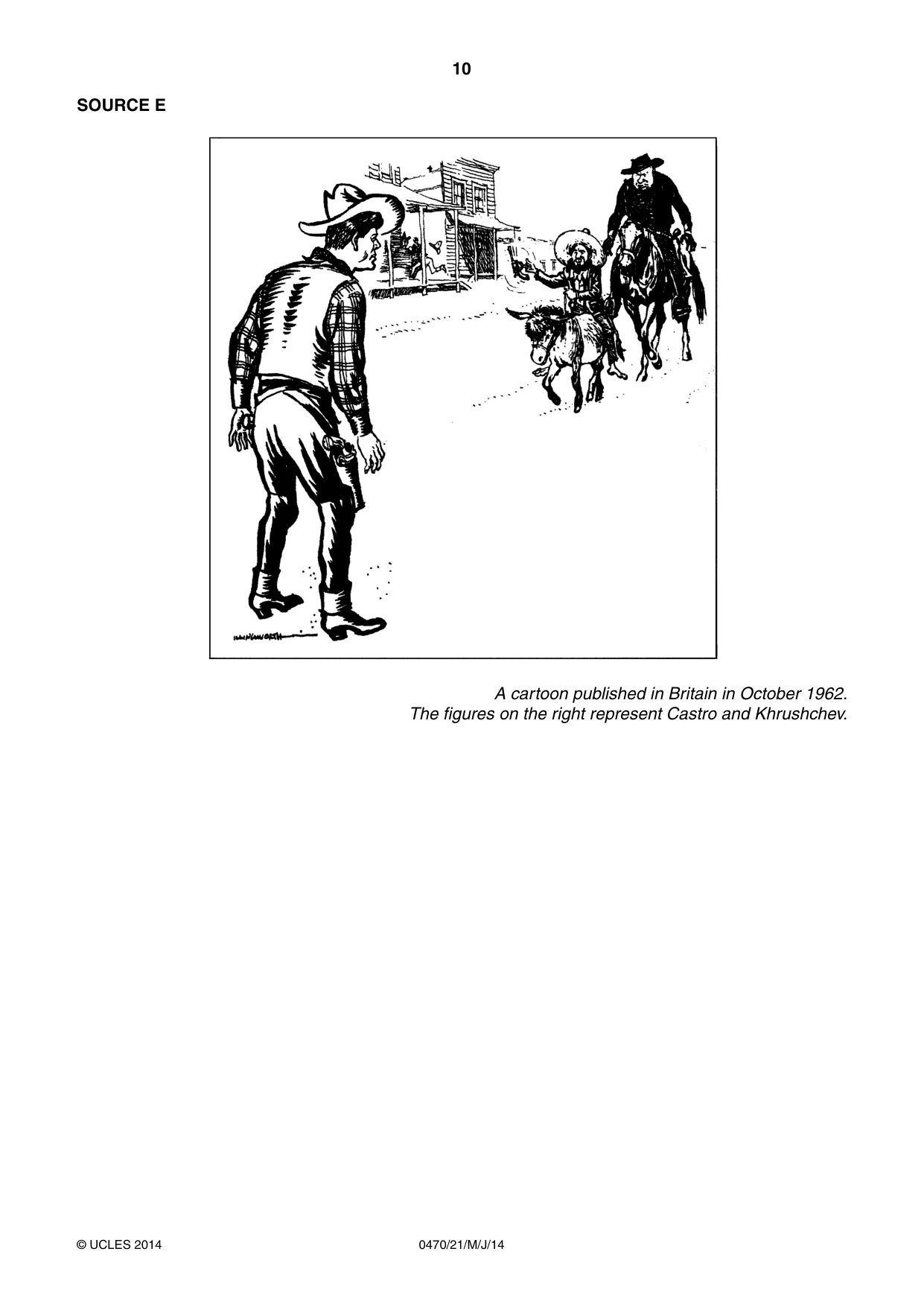
10 0470/21/M/J/14 © UCLES 2014 SOURCE E A cartoon published in Britain in October 1962. The figures on the right represent Castro and Khrushchev.
Question paper, page 11
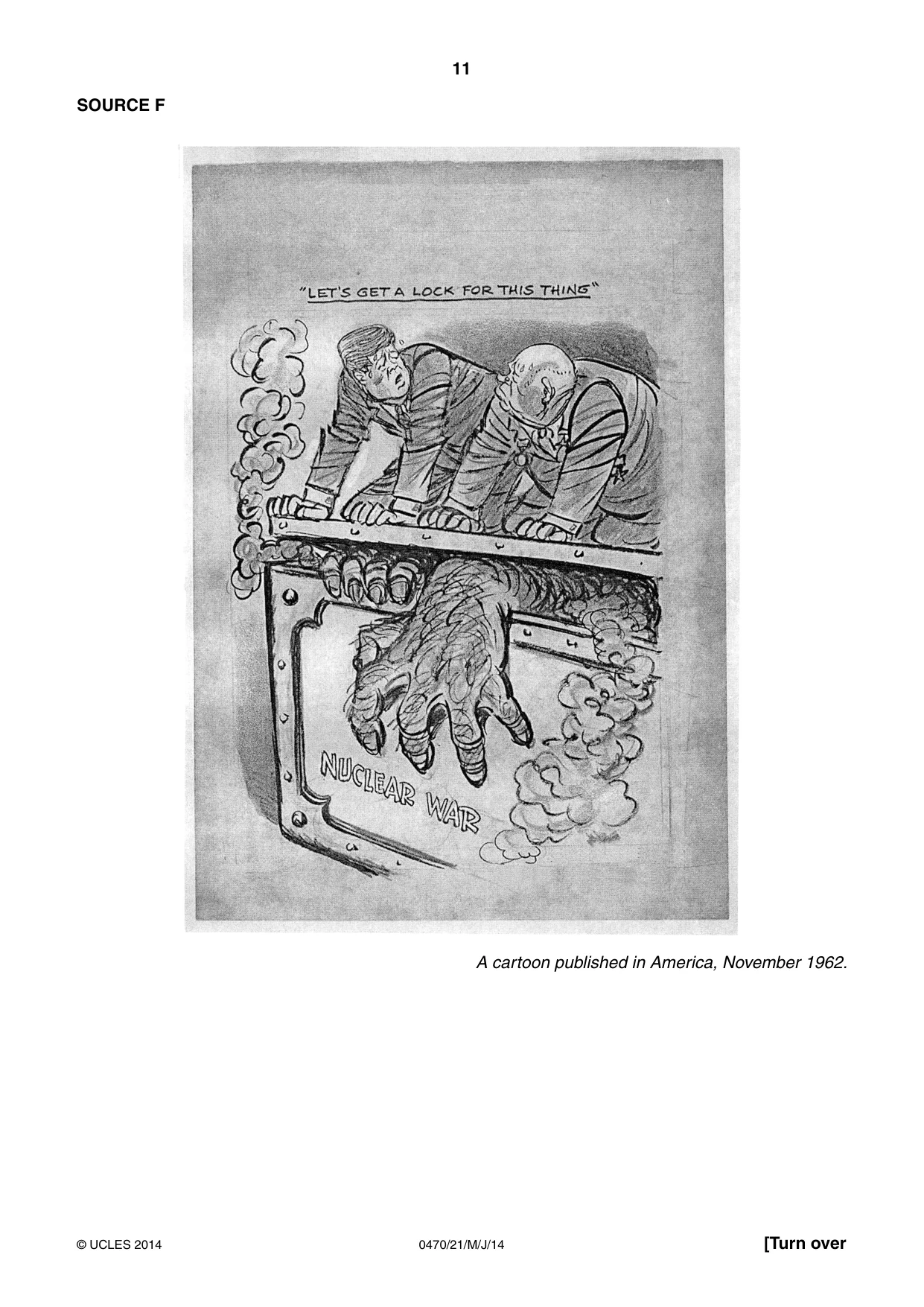
11 0470/21/M/J/14 © UCLES 2014 [Turn over SOURCE F A cartoon published in America, November 1962.
Question paper, page 12
12 0470/21/M/J/14 © UCLES 2014 SOURCE G The climax came when Dobrynin reported that an exhausted Robert Kennedy had said to him, ‘The President is in a grave situation and he does not know how to get out of it. We are under very severe stress. In fact we are under pressure from our military to use force against Cuba. We want to ask you to pass President Kennedy’s message to Chairman Khrushchev through unofficial channels. President Kennedy implores Chairman Khrushchev to accept his offer and to take into consideration the peculiarities of the American situation. Even though the President is very much against starting a war, an irreversible chain of events could occur against his will. This is why the President is appealing directly to Chairman Khrushchev for help in stopping this conflict. If the situation continues much longer, the President is not sure that the military will not overthrow him and seize power. The American army could get out of control.’ We could see that we had to change our position. We sent the Americans a note saying that we agreed to remove our missiles on the condition that the President gave us his assurance that there would be no invasion of Cuba. Finally Kennedy gave in and agreed to make a statement giving us such an assurance. A description of a meeting between Dobrynin, the Soviet Ambassador in America, and Robert Kennedy on 27 October, from Khrushchev’s memoirs, published in 1971.
Question paper, page 13
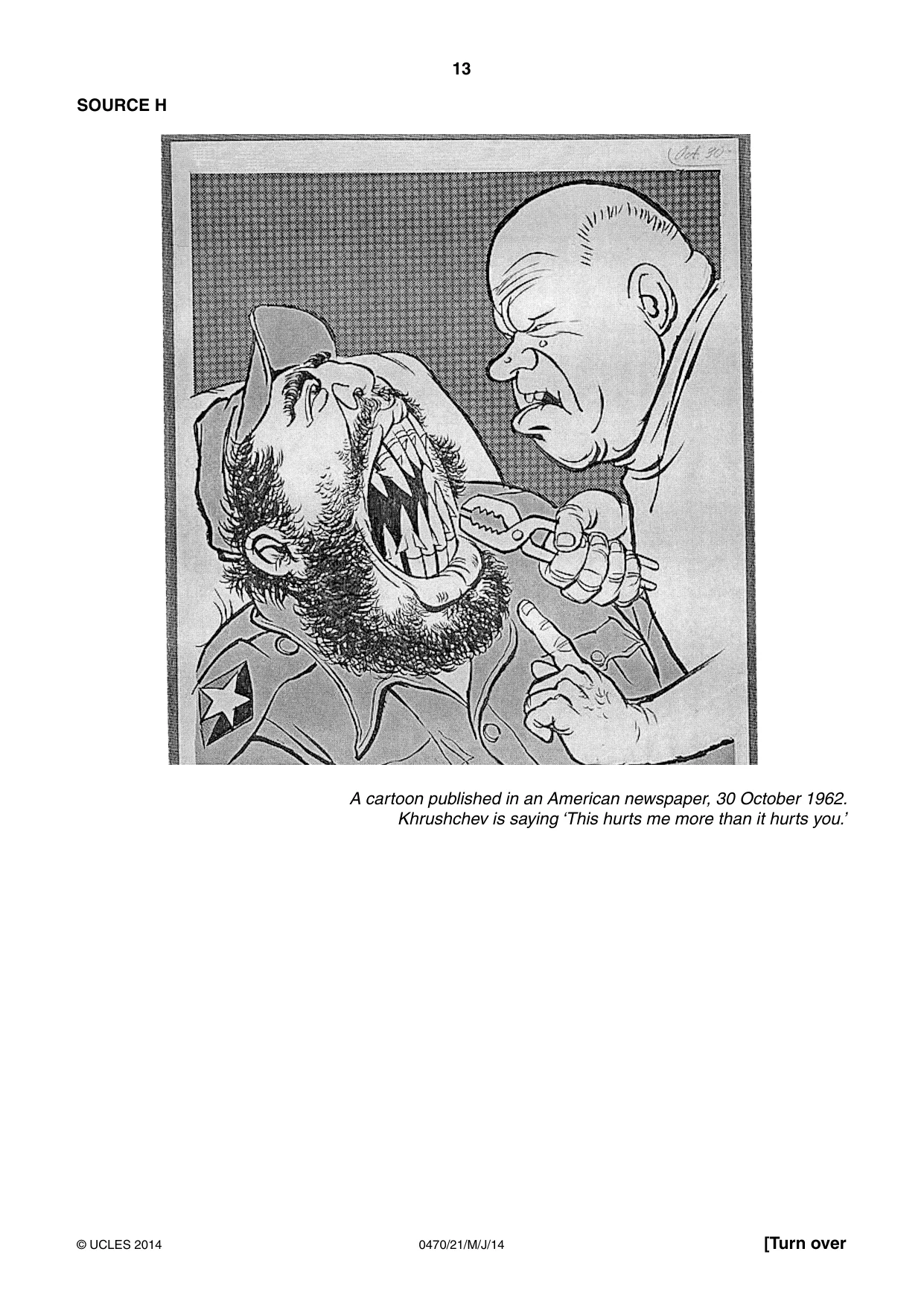
13 0470/21/M/J/14 © UCLES 2014 [Turn over SOURCE H A cartoon published in an American newspaper, 30 October 1962. Khrushchev is saying ‘This hurts me more than it hurts you.’
Question paper, page 14
14 0470/21/M/J/14 © UCLES 2014 Now answer all the following questions. You may use any of the sources to help you answer the questions, in addition to those sources which you are told to use. In answering the questions you should use your knowledge of the topic to help you interpret and evaluate the sources. 1 Study Sources A and B. How different are these two sources? Explain your answer using the sources and your knowledge. [7] 2 Study Sources C and D. Are you surprised by Source D? Explain your answer using details of the sources and your knowledge. [8] 3 Study Sources E and F. How similar are the messages of these two cartoons? Explain your answer using details of the sources and your knowledge. [8] 4 Study Source G. How far do you trust this source? Explain your answer using details of the source and your knowledge. [8] 5 Study Source H. Why was this source published at the end of October 1962? Explain your answer using details of the source and your knowledge. [7] 6 Study all the sources. How far do these sources provide convincing evidence that the superpowers acted responsibly during the Cuban Missile Crisis? Use the sources to explain your answer. [12]
Question paper, page 15
15 0470/21/M/J/14 © UCLES 2014 BLANK PAGE
Question paper, page 16
16 0470/21/M/J/14 © UCLES 2014 Copyright Acknowledgements: Option A Sources A & B © E Foner; The Fiery Trial ; W W Norton Ltd; 2010. Option A Source C © Ref: PCH10177-48562; John Leech; The Dis-United States – A Black Business; www.punchcartoons.com. Option B Source D © R Kennedy; Thirteen Days; Macmillan; 1969. Option B Source E © Express Picture Library. Option B Source F © ww.filibustercartoons.com/jfk.htm. Option B Source G © ed. E Crankshaw; Khrushchev Remembers; Andre Deutsch; 1971. Option B Source H © Edmund Valtman; The Editorial Cartoons of Edmund S Valtman 1961-1991; Esto Incorporated; 1991. Permission to reproduce items where third-party owned material protected by copyright is included has been sought and cleared where possible. Every reasonable effort has been made by the publisher (UCLES) to trace copyright holders, but if any items requiring clearance have unwittingly been included, the publisher will be pleased to make amends at the earliest possible opportunity. Cambridge International Examinations is part of the Cambridge Assessment Group. Cambridge Assessment is the brand name of University of Cambridge Local Examinations Syndicate (UCLES), which is itself a department of the University of Cambridge. BLANK PAGE
Mark scheme, page 1
CAMBRIDGE INTERNATIONAL EXAMINATIONS International General Certificate of Secondary Education MARK SCHEME for the May/June 2014 series 0470 HISTORY 0470/21 Paper 2, maximum raw mark 50 This mark scheme is published as an aid to teachers and candidates, to indicate the requirements of the examination. It shows the basis on which Examiners were instructed to award marks. It does not indicate the details of the discussions that took place at an Examiners’ meeting before marking began, which would have considered the acceptability of alternative answers. Mark schemes should be read in conjunction with the question paper and the Principal Examiner Report for Teachers. Cambridge will not enter into discussions about these mark schemes. Cambridge is publishing the mark schemes for the May/June 2014 series for most IGCSE, GCE Advanced Level and Advanced Subsidiary Level components and some Ordinary Level components.
Mark scheme, page 2
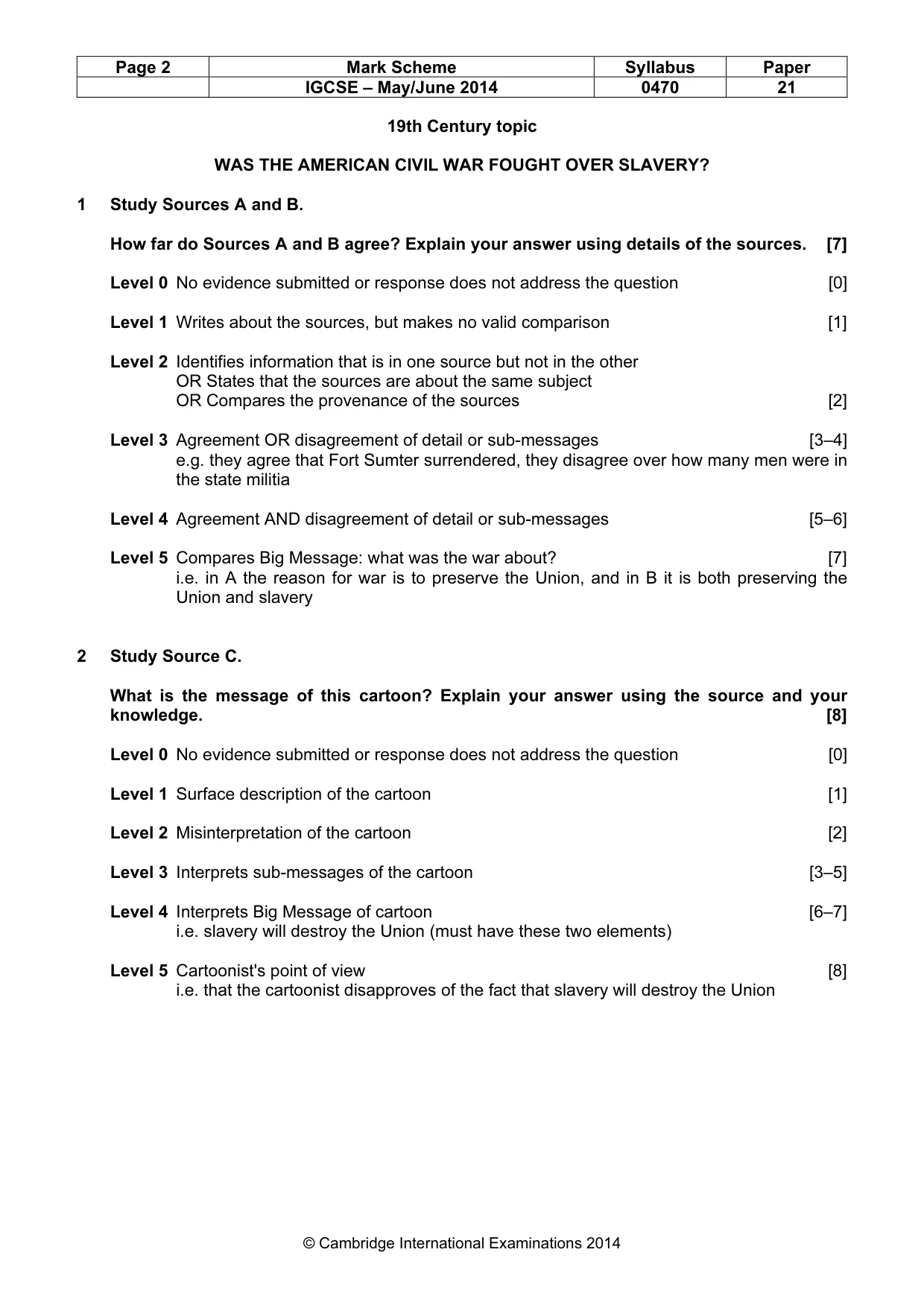
Page 2 Mark Scheme Syllabus Paper IGCSE – May/June 2014 0470 21 © Cambridge International Examinations 2014 19th Century topic WAS THE AMERICAN CIVIL WAR FOUGHT OVER SLAVERY? 1 Study Sources A and B. How far do Sources A and B agree? Explain your answer using details of the sources. [7] Level 0 No evidence submitted or response does not address the question [0] Level 1 Writes about the sources, but makes no valid comparison [1] Level 2 Identifies information that is in one source but not in the other OR States that the sources are about the same subject OR Compares the provenance of the sources [2] Level 3 Agreement OR disagreement of detail or sub-messages [3–4] e.g. they agree that Fort Sumter surrendered, they disagree over how many men were in the state militia Level 4 Agreement AND disagreement of detail or sub-messages [5–6] Level 5 Compares Big Message: what was the war about? [7] i.e. in A the reason for war is to preserve the Union, and in B it is both preserving the Union and slavery 2 Study Source C. What is the message of this cartoon? Explain your answer using the source and your knowledge. [8] Level 0 No evidence submitted or response does not address the question [0] Level 1 Surface description of the cartoon [1] Level 2 Misinterpretation of the cartoon [2] Level 3 Interprets sub-messages of the cartoon [3–5] Level 4 Interprets Big Message of cartoon [6–7] i.e. slavery will destroy the Union (must have these two elements) Level 5 Cartoonist's point of view [8] i.e. that the cartoonist disapproves of the fact that slavery will destroy the Union
Mark scheme, page 3
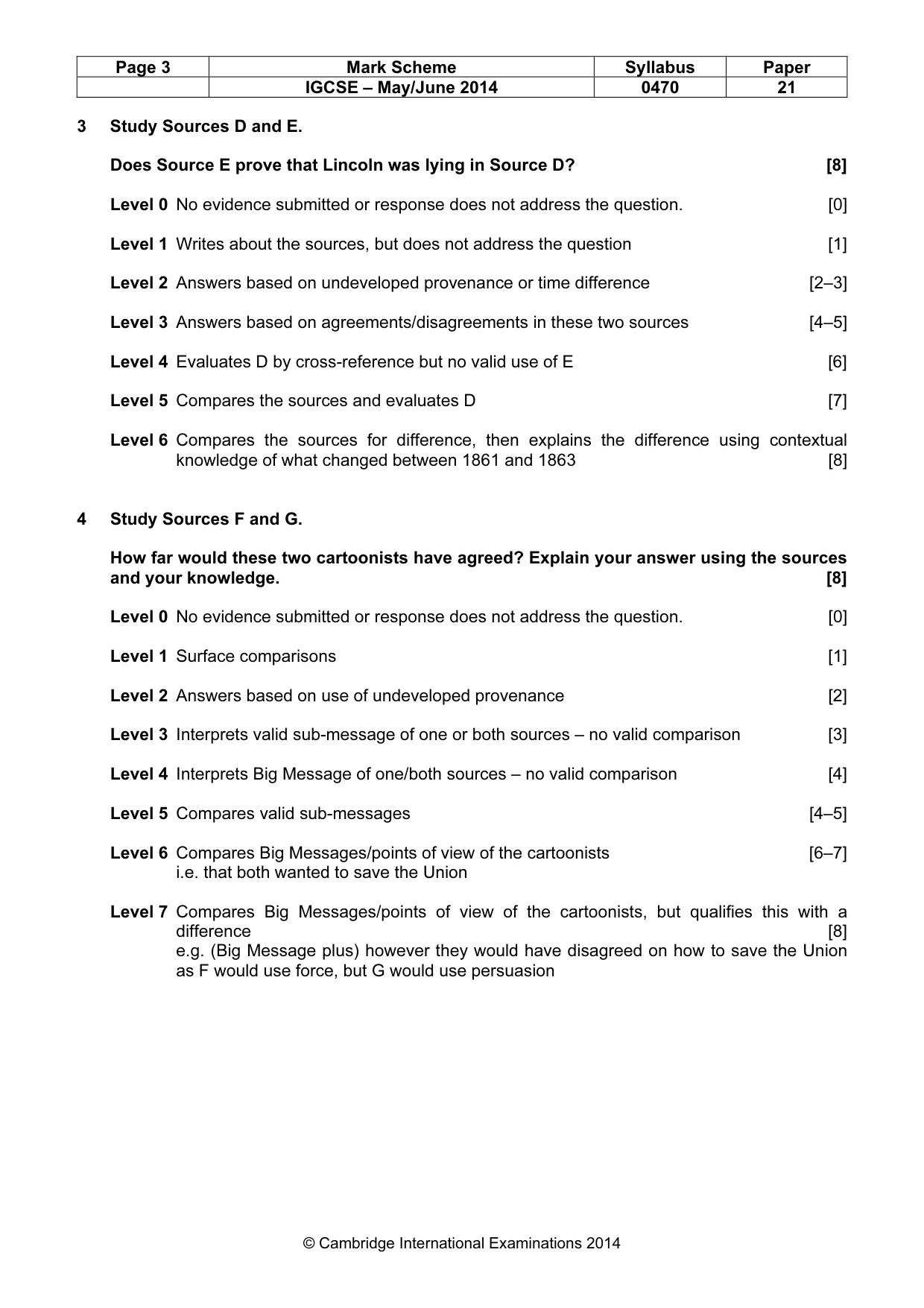
Page 3 Mark Scheme Syllabus Paper IGCSE – May/June 2014 0470 21 © Cambridge International Examinations 2014 3 Study Sources D and E. Does Source E prove that Lincoln was lying in Source D? [8] Level 0 No evidence submitted or response does not address the question. [0] Level 1 Writes about the sources, but does not address the question [1] Level 2 Answers based on undeveloped provenance or time difference [2–3] Level 3 Answers based on agreements/disagreements in these two sources [4–5] Level 4 Evaluates D by cross-reference but no valid use of E [6] Level 5 Compares the sources and evaluates D [7] Level 6 Compares the sources for difference, then explains the difference using contextual knowledge of what changed between 1861 and 1863 [8] 4 Study Sources F and G. How far would these two cartoonists have agreed? Explain your answer using the sources and your knowledge. [8] Level 0 No evidence submitted or response does not address the question. [0] Level 1 Surface comparisons [1] Level 2 Answers based on use of undeveloped provenance [2] Level 3 Interprets valid sub-message of one or both sources – no valid comparison [3] Level 4 Interprets Big Message of one/both sources – no valid comparison [4] Level 5 Compares valid sub-messages [4–5] Level 6 Compares Big Messages/points of view of the cartoonists [6–7] i.e. that both wanted to save the Union Level 7 Compares Big Messages/points of view of the cartoonists, but qualifies this with a difference [8] e.g. (Big Message plus) however they would have disagreed on how to save the Union as F would use force, but G would use persuasion
Mark scheme, page 4
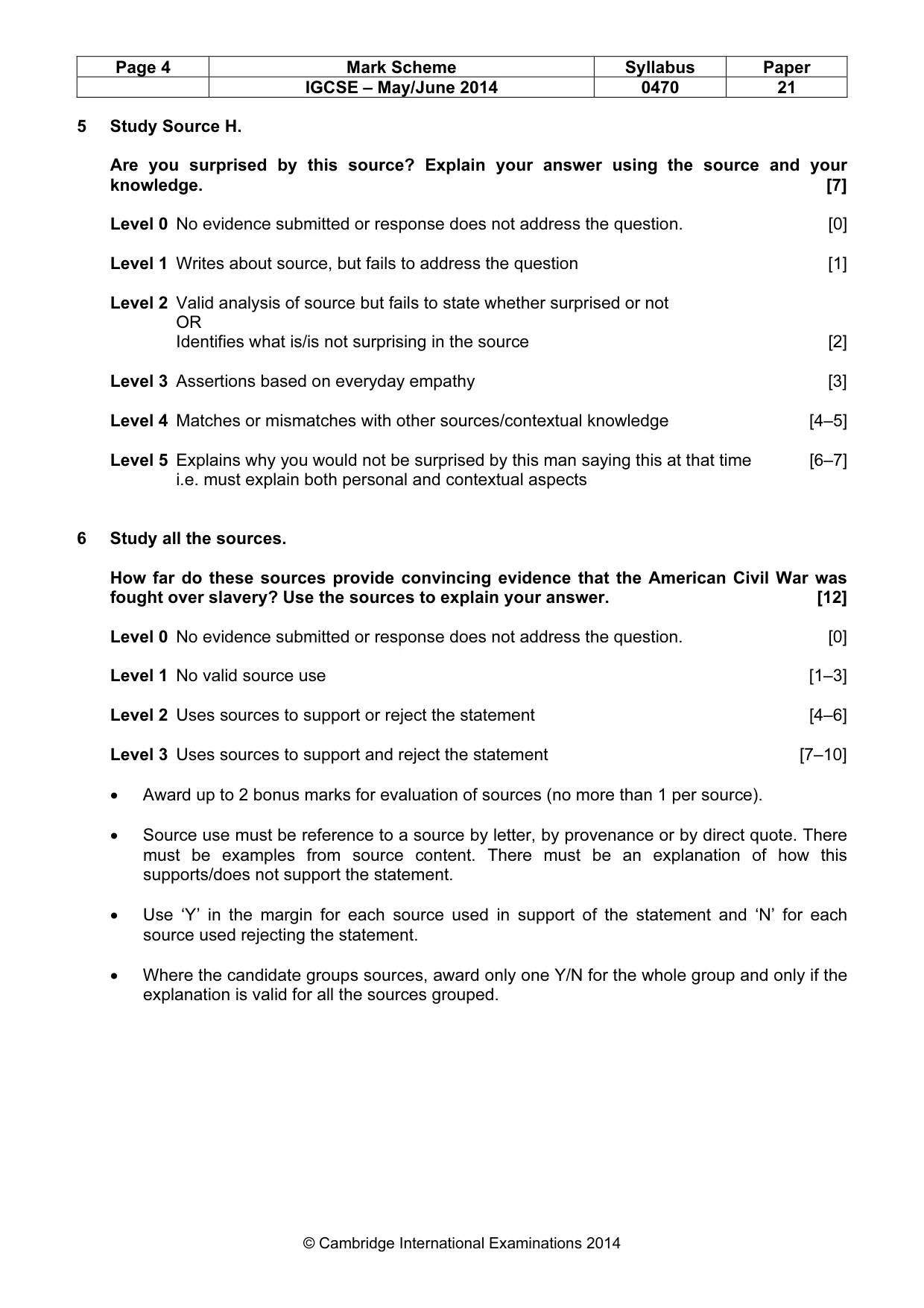
Page 4 Mark Scheme Syllabus Paper IGCSE – May/June 2014 0470 21 © Cambridge International Examinations 2014 5 Study Source H. Are you surprised by this source? Explain your answer using the source and your knowledge. [7] Level 0 No evidence submitted or response does not address the question. [0] Level 1 Writes about source, but fails to address the question [1] Level 2 Valid analysis of source but fails to state whether surprised or not OR Identifies what is/is not surprising in the source [2] Level 3 Assertions based on everyday empathy [3] Level 4 Matches or mismatches with other sources/contextual knowledge [4–5] Level 5 Explains why you would not be surprised by this man saying this at that time [6–7] i.e. must explain both personal and contextual aspects 6 Study all the sources. How far do these sources provide convincing evidence that the American Civil War was fought over slavery? Use the sources to explain your answer. [12] Level 0 No evidence submitted or response does not address the question. [0] Level 1 No valid source use [1–3] Level 2 Uses sources to support or reject the statement [4–6] Level 3 Uses sources to support and reject the statement [7–10] • Award up to 2 bonus marks for evaluation of sources (no more than 1 per source). • Source use must be reference to a source by letter, by provenance or by direct quote. There must be examples from source content. There must be an explanation of how this supports/does not support the statement. • Use ‘Y’ in the margin for each source used in support of the statement and ‘N’ for each source used rejecting the statement. • Where the candidate groups sources, award only one Y/N for the whole group and only if the explanation is valid for all the sources grouped.
Mark scheme, page 5
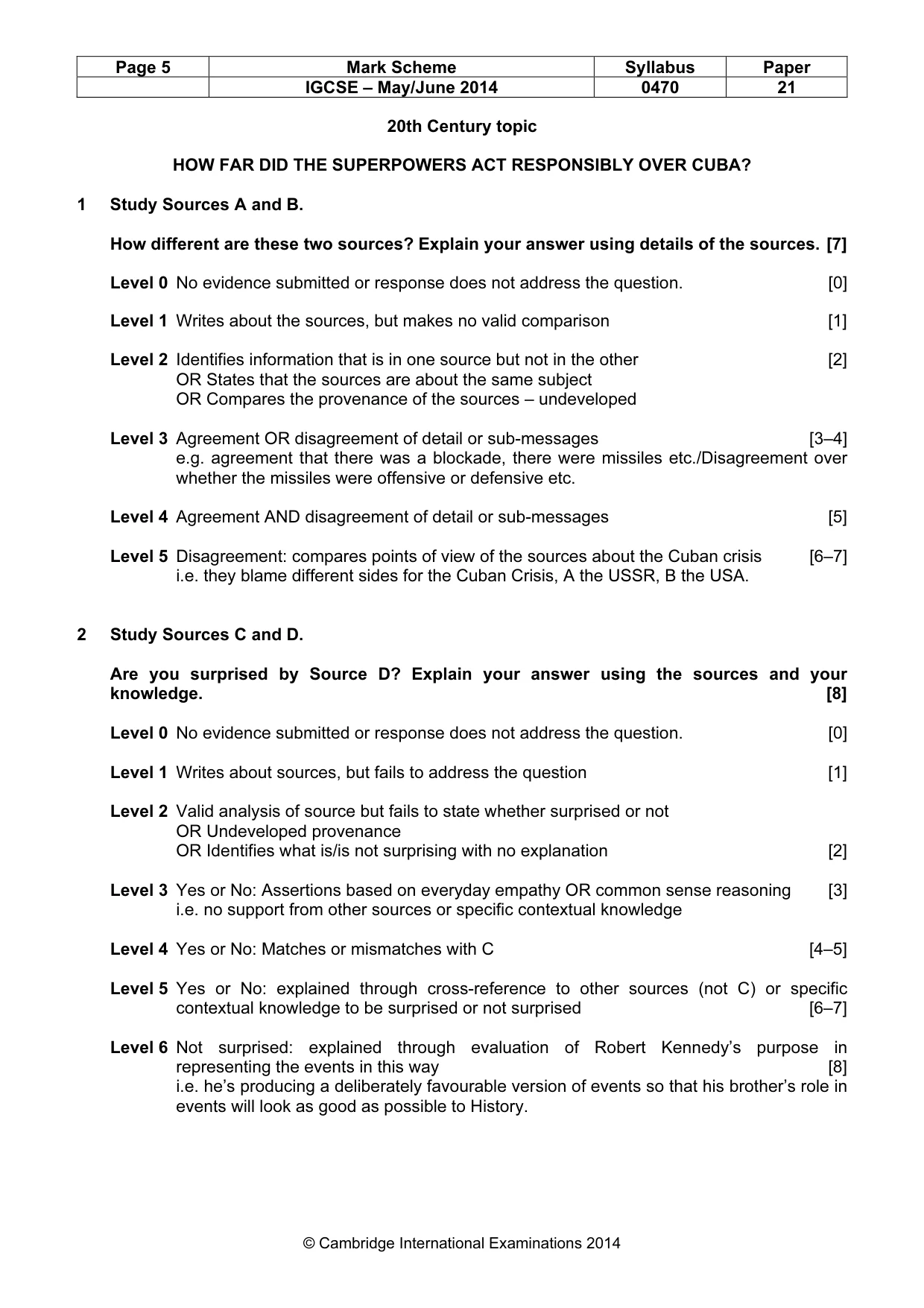
Page 5 Mark Scheme Syllabus Paper IGCSE – May/June 2014 0470 21 © Cambridge International Examinations 2014 20th Century topic HOW FAR DID THE SUPERPOWERS ACT RESPONSIBLY OVER CUBA? 1 Study Sources A and B. How different are these two sources? Explain your answer using details of the sources. [7] Level 0 No evidence submitted or response does not address the question. [0] Level 1 Writes about the sources, but makes no valid comparison [1] Level 2 Identifies information that is in one source but not in the other [2] OR States that the sources are about the same subject OR Compares the provenance of the sources – undeveloped Level 3 Agreement OR disagreement of detail or sub-messages [3–4] e.g. agreement that there was a blockade, there were missiles etc./Disagreement over whether the missiles were offensive or defensive etc. Level 4 Agreement AND disagreement of detail or sub-messages [5] Level 5 Disagreement: compares points of view of the sources about the Cuban crisis [6–7] i.e. they blame different sides for the Cuban Crisis, A the USSR, B the USA. 2 Study Sources C and D. Are you surprised by Source D? Explain your answer using the sources and your knowledge. [8] Level 0 No evidence submitted or response does not address the question. [0] Level 1 Writes about sources, but fails to address the question [1] Level 2 Valid analysis of source but fails to state whether surprised or not OR Undeveloped provenance OR Identifies what is/is not surprising with no explanation [2] Level 3 Yes or No: Assertions based on everyday empathy OR common sense reasoning [3] i.e. no support from other sources or specific contextual knowledge Level 4 Yes or No: Matches or mismatches with C [4–5] Level 5 Yes or No: explained through cross-reference to other sources (not C) or specific contextual knowledge to be surprised or not surprised [6–7] Level 6 Not surprised: explained through evaluation of Robert Kennedy’s purpose in representing the events in this way [8] i.e. he’s producing a deliberately favourable version of events so that his brother’s role in events will look as good as possible to History.
Mark scheme, page 6
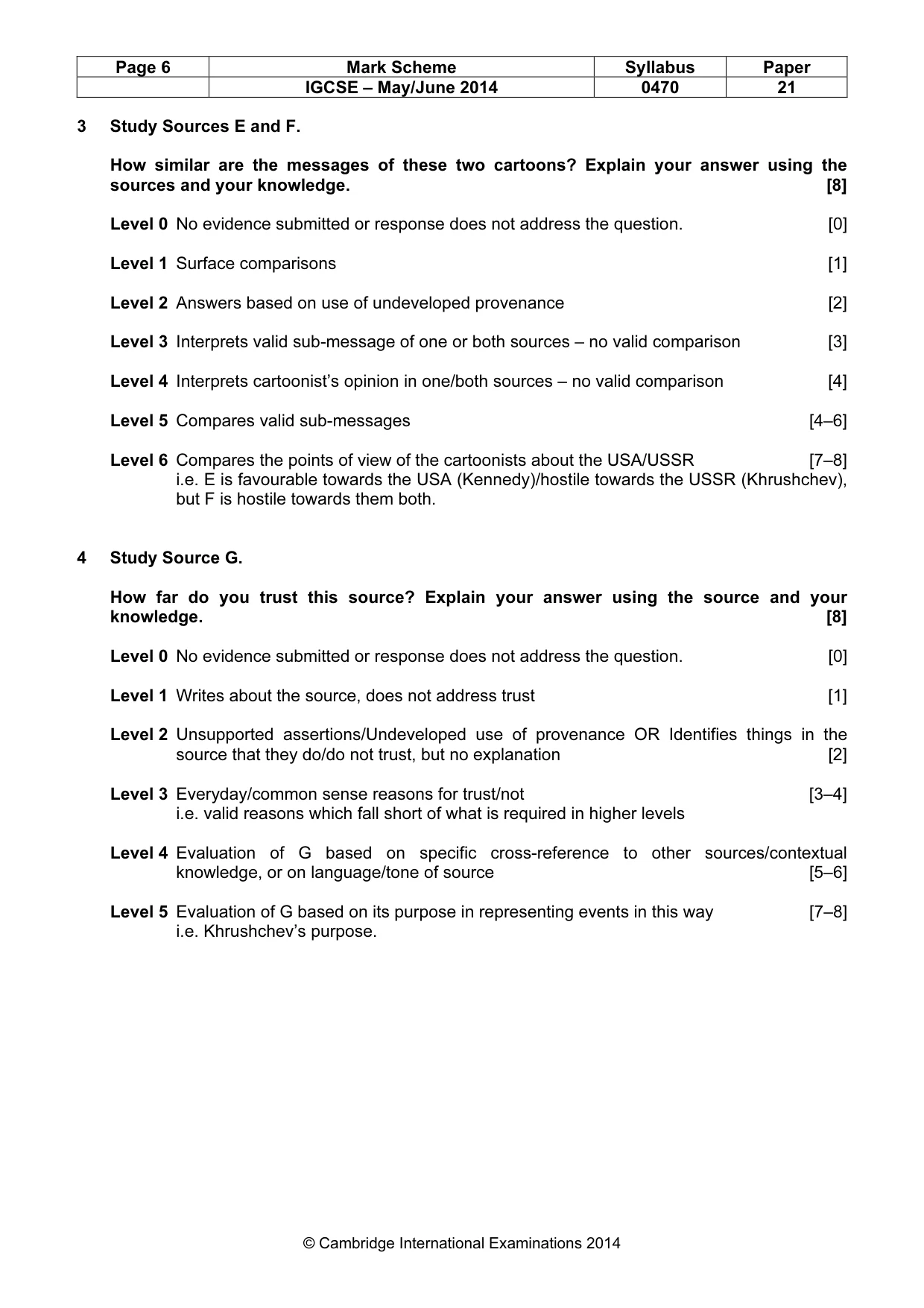
Page 6 Mark Scheme Syllabus Paper IGCSE – May/June 2014 0470 21 © Cambridge International Examinations 2014 3 Study Sources E and F. How similar are the messages of these two cartoons? Explain your answer using the sources and your knowledge. [8] Level 0 No evidence submitted or response does not address the question. [0] Level 1 Surface comparisons [1] Level 2 Answers based on use of undeveloped provenance [2] Level 3 Interprets valid sub-message of one or both sources – no valid comparison [3] Level 4 Interprets cartoonist’s opinion in one/both sources – no valid comparison [4] Level 5 Compares valid sub-messages [4–6] Level 6 Compares the points of view of the cartoonists about the USA/USSR [7–8] i.e. E is favourable towards the USA (Kennedy)/hostile towards the USSR (Khrushchev), but F is hostile towards them both. 4 Study Source G. How far do you trust this source? Explain your answer using the source and your knowledge. [8] Level 0 No evidence submitted or response does not address the question. [0] Level 1 Writes about the source, does not address trust [1] Level 2 Unsupported assertions/Undeveloped use of provenance OR Identifies things in the source that they do/do not trust, but no explanation [2] Level 3 Everyday/common sense reasons for trust/not [3–4] i.e. valid reasons which fall short of what is required in higher levels Level 4 Evaluation of G based on specific cross-reference to other sources/contextual knowledge, or on language/tone of source [5–6] Level 5 Evaluation of G based on its purpose in representing events in this way [7–8] i.e. Khrushchev’s purpose.
Mark scheme, page 7
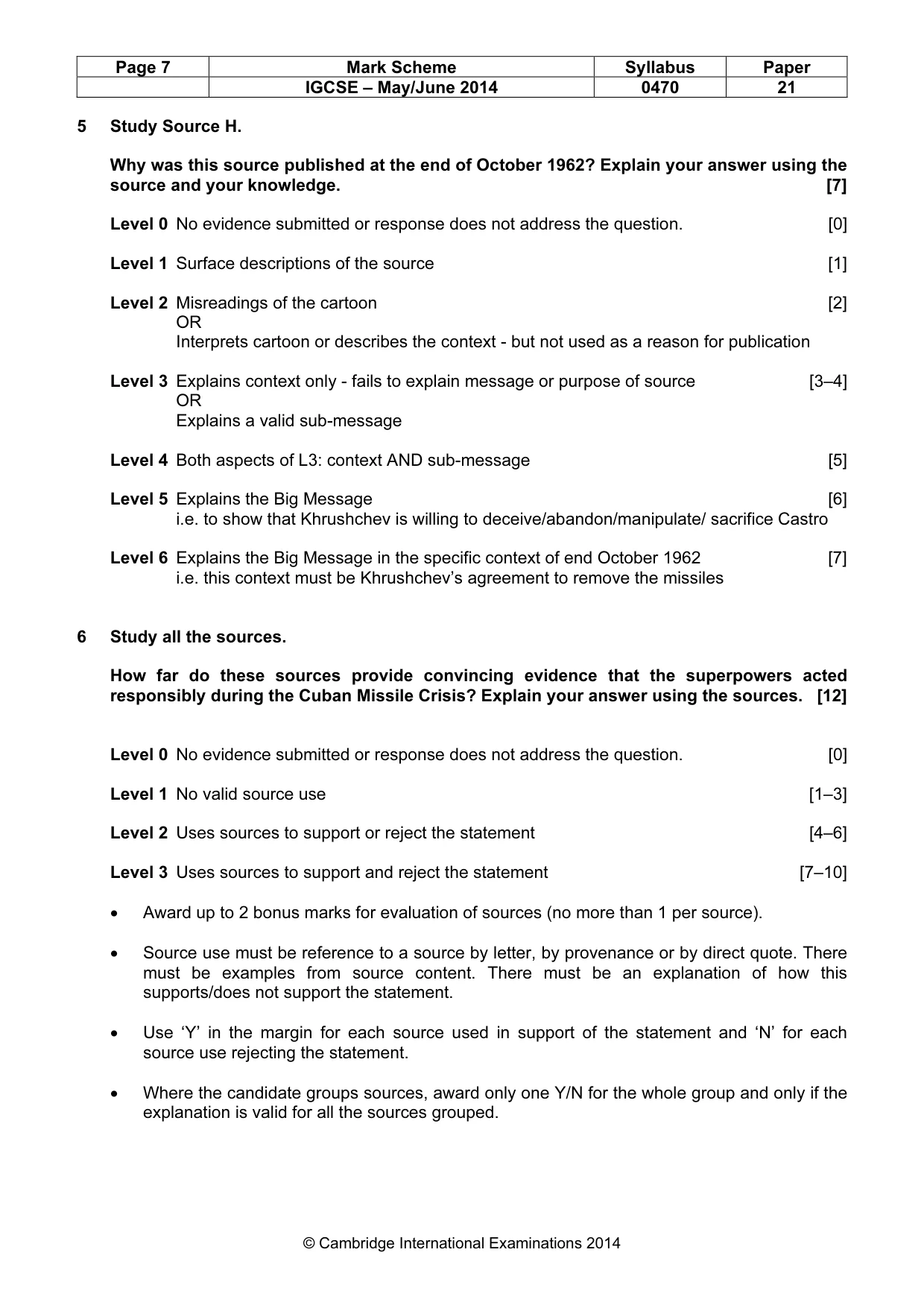
Page 7 Mark Scheme Syllabus Paper IGCSE – May/June 2014 0470 21 © Cambridge International Examinations 2014 5 Study Source H. Why was this source published at the end of October 1962? Explain your answer using the source and your knowledge. [7] Level 0 No evidence submitted or response does not address the question. [0] Level 1 Surface descriptions of the source [1] Level 2 Misreadings of the cartoon [2] OR Interprets cartoon or describes the context - but not used as a reason for publication Level 3 Explains context only - fails to explain message or purpose of source [3–4] OR Explains a valid sub-message Level 4 Both aspects of L3: context AND sub-message [5] Level 5 Explains the Big Message [6] i.e. to show that Khrushchev is willing to deceive/abandon/manipulate/ sacrifice Castro Level 6 Explains the Big Message in the specific context of end October 1962 [7] i.e. this context must be Khrushchev’s agreement to remove the missiles 6 Study all the sources. How far do these sources provide convincing evidence that the superpowers acted responsibly during the Cuban Missile Crisis? Explain your answer using the sources. [12] Level 0 No evidence submitted or response does not address the question. [0] Level 1 No valid source use [1–3] Level 2 Uses sources to support or reject the statement [4–6] Level 3 Uses sources to support and reject the statement [7–10] • Award up to 2 bonus marks for evaluation of sources (no more than 1 per source). • Source use must be reference to a source by letter, by provenance or by direct quote. There must be examples from source content. There must be an explanation of how this supports/does not support the statement. • Use ‘Y’ in the margin for each source used in support of the statement and ‘N’ for each source use rejecting the statement. • Where the candidate groups sources, award only one Y/N for the whole group and only if the explanation is valid for all the sources grouped.
What you needed in this session
Cambridge’s own grade thresholds for 2014 May/June, Paper 2 · Variant 1. A higher threshold means an easier paper — the bar moves with how the cohort did.