Cambridge IGCSE History 0470 — 2014 May/June Paper 2 · Variant 2
0470/22/M/J/14 · 50 marks · ≈56 min
The question paper and its mark scheme, free to read here and free to download. This is Cambridge’s own paper, exactly as it was sat.
Question paper16 pages


Mark scheme8 pages
Answers below. Sit the paper first if you are practising.
Paper as text
Question paper, page 1
This document consists of 13 printed pages, 3 blank pages and 1 insert. DC (SJF/JG) 79339/2 © UCLES 2014 [Turn over Cambridge International Examinations Cambridge International General Certificate of Secondary Education * 5 6 4 5 1 8 9 7 1 4 * HISTORY 0470/22 Paper 2 May/June 2014 2 hours No Additional Materials are required. READ THESE INSTRUCTIONS FIRST An answer booklet is provided inside this question paper. You should follow the instructions on the front cover of the answer booklet. If you need additional answer paper ask the invigilator for a continuation booklet. This paper has two options. Choose one option, and then answer all of the questions on that topic. Option A: 19th Century topic [p2–p7] Option B: 20th Century topic [p8–p13] The number of marks is given in brackets [ ] at the end of each question or part question.
Question paper, page 2
2 0470/22/M/J/14 © UCLES 2014 Option A: 19th Century topic HOW IMPORTANT WAS LINCOLN IN CAUSING SOUTHERN STATES TO LEAVE THE UNION? Study the Background Information and the sources carefully, and then answer all the questions. Background Information Tensions between northern and southern states of the USA had reached breaking point by 1860. Tensions existed over slavery, states’ rights, the power of the federal government and economic policies. On 6 November 1860 Lincoln was elected president. In the following month, South Carolina was the first state to secede. It was followed by six more states early in 1861 and by more later in the year. Was Lincoln’s election as president in 1860 the most important reason for the secession of southern states? SOURCE A The 1850s was a decade when all the vigour and hot blood of America seemed to concentrate into opposing channels of fear and self-righteousness. In defiance of federal law, the Abolitionists increased their help to fugitive slaves and got at least fifty thousand of them away by an organised underground. And there was the strange, brave, John Brown, who raided a federal arsenal with the intention of arming the slaves in the southern states. He was caught, tried and hanged. All this was enough to taunt the southerners to the point where they talked of secession and meant it. It was left to the Supreme Court to shatter the hope of compromise. From the moment of the Court’s decision in the Dred Scott case that a slave was not a citizen and that Congress could not exclude slavery from a free state, the national political situation was changed and state secession was a real possibility. The two halves of America fell apart. On 20 December 1860 a state convention in South Carolina dissolved the union between it and all the other states. By 1 February, the rest of the Deep South followed. In March a new president, Abraham Lincoln, declared secession void and promised to hold all government property. In April Lincoln ordered a fleet to go and relieve the Fort Sumter forces. The commander of the Confederate forces invited the garrison to leave. It refused and the Southerners opened fire. On 13 April the Union forces surrendered and the war was on. Lincoln immediately called upon those states remaining in the Union for troops. The Upper South states now had to commit themselves. Virginia, Tennessee, Arkansas and North Carolina, deciding that slavery was their cornerstone, voted to join the Confederacy. A recent account of events leading up to the Civil War.
Question paper, page 3
3 0470/22/M/J/14 © UCLES 2014 [Turn over SOURCE B In the 1850s it was the Fugitive Slave Law that was the important turning point and stirred sectional conflict. It was intended by the South as a reminder to the North and the federal government of their constitutional obligations towards slavery. John Brown’s raid merely helped to create the emotional climate in which the presidential election of 1860 was held, while the Supreme Court’s decision over Dred Scott made Northerners fear that slavery would be legal everywhere. However, the election of Abraham Lincoln to the presidency on 6 November is usually viewed as the beginning of a chain of events that erupted into civil war in April 1861. Lincoln won all the free states and none of the slave states. When the election results were announced, the people of Charleston, South Carolina, began meeting and talking of secession. On 20 December 1860 South Carolina dissolved the Union when its legislature voted to secede. The secession of the first seven Southern states took place in the months following the election. South Carolina went first, followed by Mississippi, Florida, Alabama, Georgia, Louisiana and Texas. The last four – Virginia, Arkansas, North Carolina, and Tennessee – seceded after the Confederate attack on Fort Sumter in April of 1861. In the end, it was the South’s refusal to accept the will of the majority in a national presidential election that prompted them to opt out of the Union. In his first inaugural address, Lincoln again assured the South that he was not interested in their slaves. Again the South did not believe him. His speech, however, stressed a keen interest in preserving the United States, which he saw as the last hope for representative government left on earth. Anything else would be a violation of his oath to preserve and defend the Constitution. No government, Lincoln argued, could allow its own illegal dissolution. A recent account of events leading up to the Civil War.
Question paper, page 4
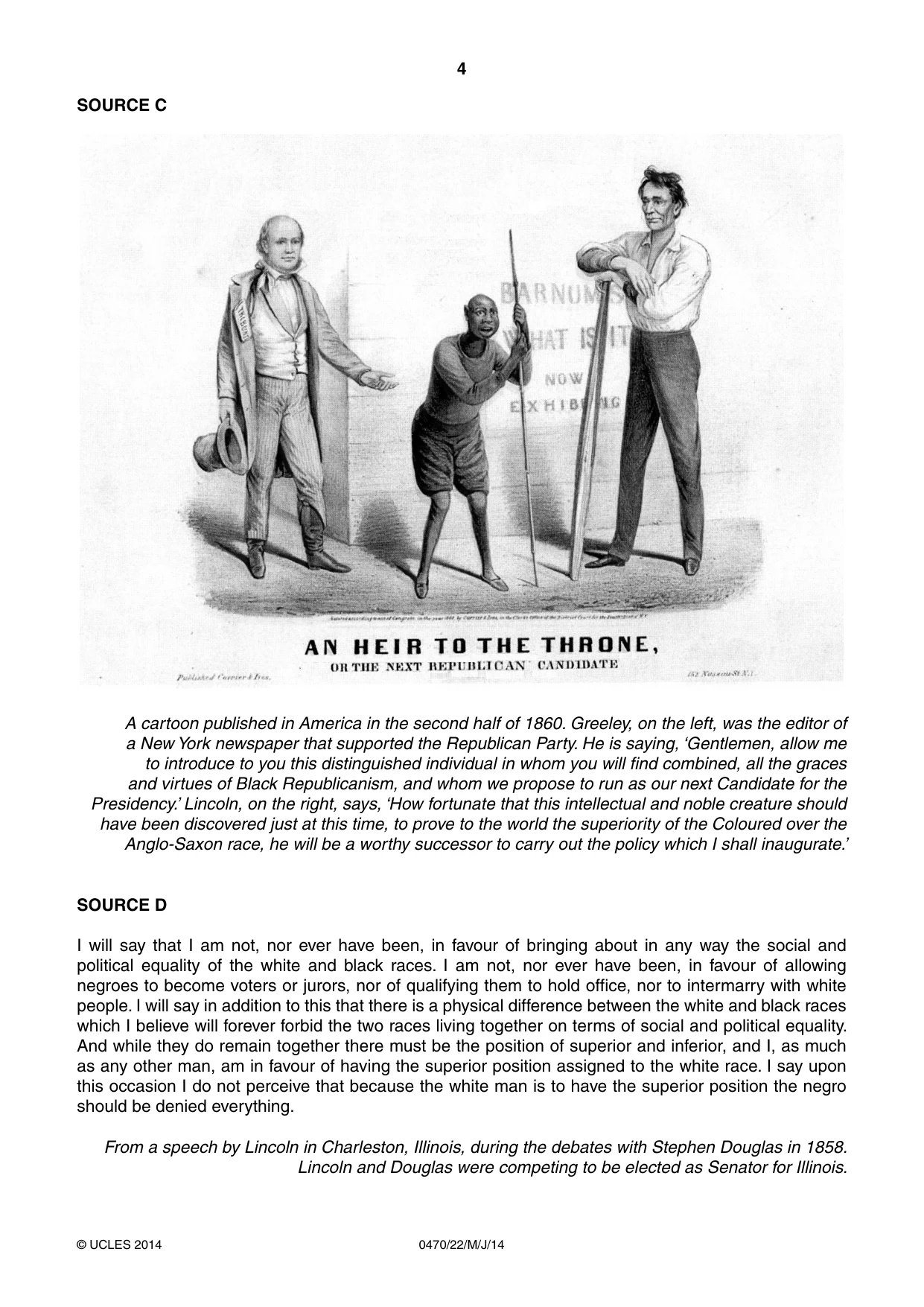
4 0470/22/M/J/14 © UCLES 2014 SOURCE C A cartoon published in America in the second half of 1860. Greeley, on the left, was the editor of a New York newspaper that supported the Republican Party. He is saying, ‘Gentlemen, allow me to introduce to you this distinguished individual in whom you will find combined, all the graces and virtues of Black Republicanism, and whom we propose to run as our next Candidate for the Presidency.’ Lincoln, on the right, says, ‘How fortunate that this intellectual and noble creature should have been discovered just at this time, to prove to the world the superiority of the Coloured over the Anglo-Saxon race, he will be a worthy successor to carry out the policy which I shall inaugurate.’ SOURCE D I will say that I am not, nor ever have been, in favour of bringing about in any way the social and political equality of the white and black races. I am not, nor ever have been, in favour of allowing negroes to become voters or jurors, nor of qualifying them to hold office, nor to intermarry with white people. I will say in addition to this that there is a physical difference between the white and black races which I believe will forever forbid the two races living together on terms of social and political equality. And while they do remain together there must be the position of superior and inferior, and I, as much as any other man, am in favour of having the superior position assigned to the white race. I say upon this occasion I do not perceive that because the white man is to have the superior position the negro should be denied everything. From a speech by Lincoln in Charleston, Illinois, during the debates with Stephen Douglas in 1858. Lincoln and Douglas were competing to be elected as Senator for Illinois.
Question paper, page 5
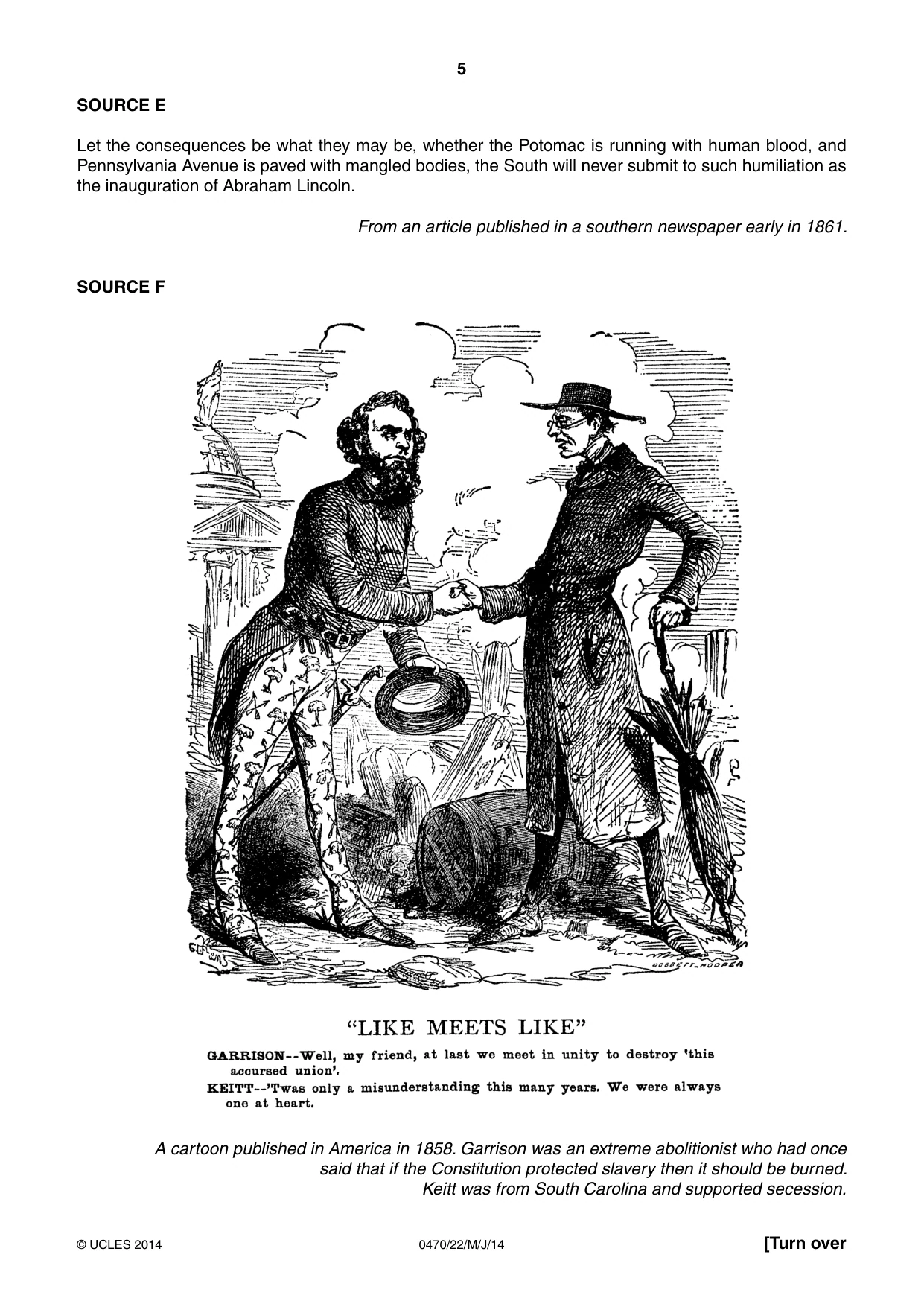
5 0470/22/M/J/14 © UCLES 2014 [Turn over SOURCE E Let the consequences be what they may be, whether the Potomac is running with human blood, and Pennsylvania Avenue is paved with mangled bodies, the South will never submit to such humiliation as the inauguration of Abraham Lincoln. From an article published in a southern newspaper early in 1861. SOURCE F A cartoon published in America in 1858. Garrison was an extreme abolitionist who had once said that if the Constitution protected slavery then it should be burned. Keitt was from South Carolina and supported secession.
Question paper, page 6
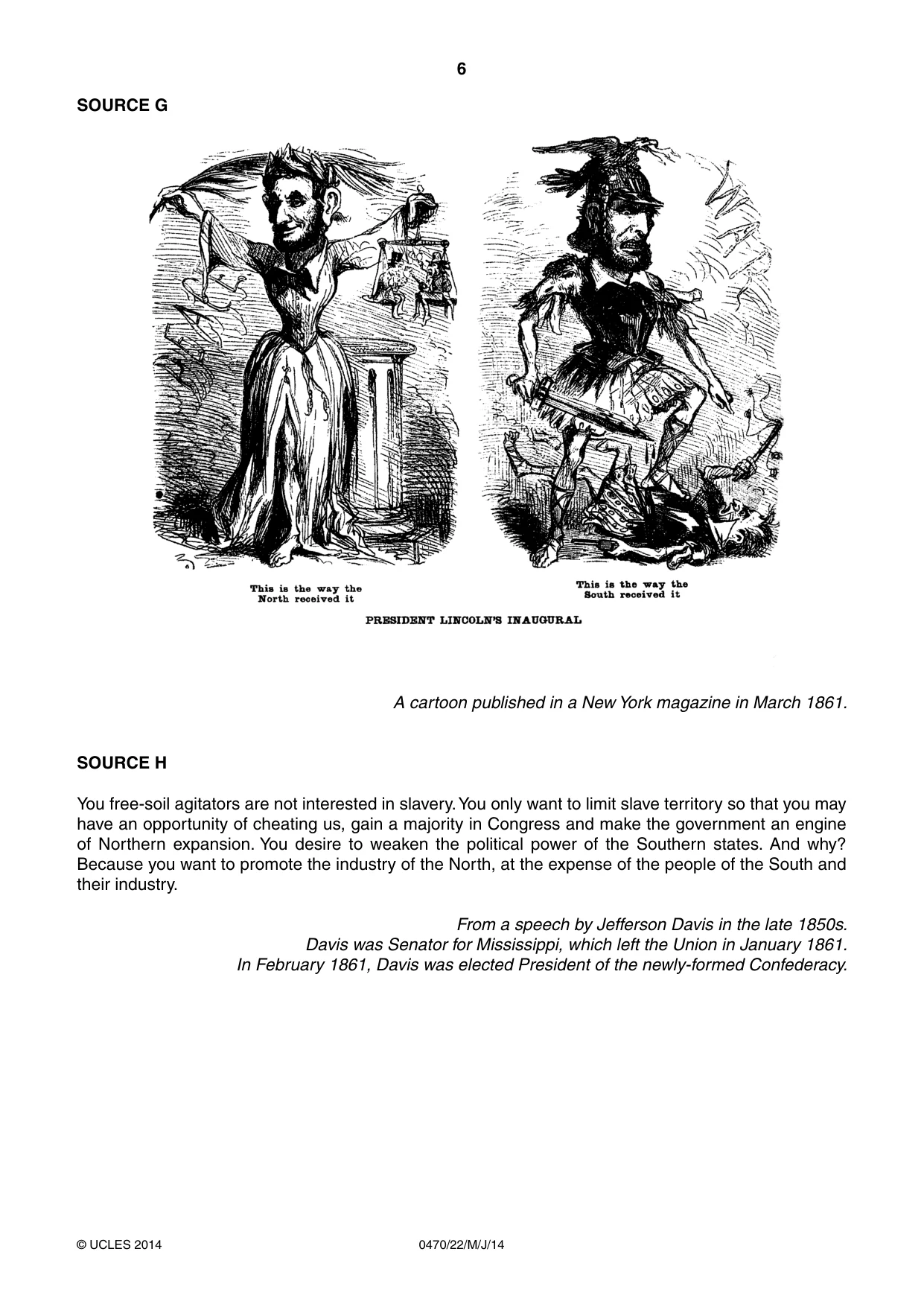
6 0470/22/M/J/14 © UCLES 2014 SOURCE G A cartoon published in a New York magazine in March 1861. SOURCE H You free-soil agitators are not interested in slavery. You only want to limit slave territory so that you may have an opportunity of cheating us, gain a majority in Congress and make the government an engine of Northern expansion. You desire to weaken the political power of the Southern states. And why? Because you want to promote the industry of the North, at the expense of the people of the South and their industry. From a speech by Jefferson Davis in the late 1850s. Davis was Senator for Mississippi, which left the Union in January 1861. In February 1861, Davis was elected President of the newly-formed Confederacy.
Question paper, page 7
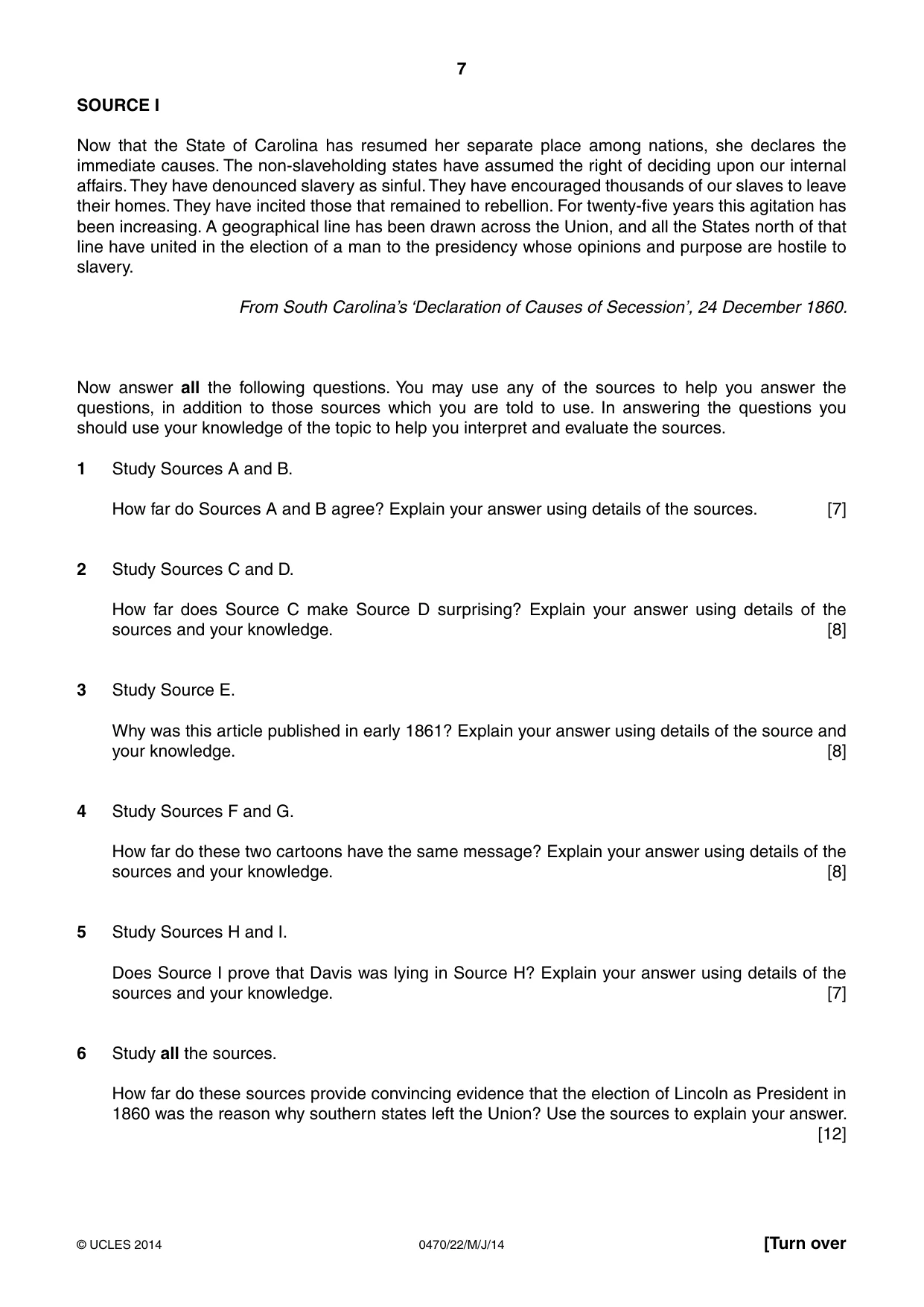
7 0470/22/M/J/14 © UCLES 2014 [Turn over SOURCE I Now that the State of Carolina has resumed her separate place among nations, she declares the immediate causes. The non-slaveholding states have assumed the right of deciding upon our internal affairs. They have denounced slavery as sinful. They have encouraged thousands of our slaves to leave their homes. They have incited those that remained to rebellion. For twenty-five years this agitation has been increasing. A geographical line has been drawn across the Union, and all the States north of that line have united in the election of a man to the presidency whose opinions and purpose are hostile to slavery. From South Carolina’s ‘Declaration of Causes of Secession’, 24 December 1860. Now answer all the following questions. You may use any of the sources to help you answer the questions, in addition to those sources which you are told to use. In answering the questions you should use your knowledge of the topic to help you interpret and evaluate the sources. 1 Study Sources A and B. How far do Sources A and B agree? Explain your answer using details of the sources. [7] 2 Study Sources C and D. How far does Source C make Source D surprising? Explain your answer using details of the sources and your knowledge. [8] 3 Study Source E. Why was this article published in early 1861? Explain your answer using details of the source and your knowledge. [8] 4 Study Sources F and G. How far do these two cartoons have the same message? Explain your answer using details of the sources and your knowledge. [8] 5 Study Sources H and I. Does Source I prove that Davis was lying in Source H? Explain your answer using details of the sources and your knowledge. [7] 6 Study all the sources. How far do these sources provide convincing evidence that the election of Lincoln as President in 1860 was the reason why southern states left the Union? Use the sources to explain your answer. [12]
Question paper, page 8
8 0470/22/M/J/14 © UCLES 2014 Option B: 20th Century topic WHO OR WHAT WAS TO BLAME FOR THE BAY OF PIGS FIASCO IN 1961? Study the Background Information and the sources carefully, and then answer all the questions. Background Information On 17 April 1961, less than three months after Kennedy became President of the USA, 1400 Cuban exiles invaded Cuba in an attempt to overthrow Castro and his communist government. The invasion was a disaster. Within three days the Cuban armed forces defeated the invaders, who had barely got off the beaches where they had been pounded by Cuban artillery and infantry. The invasion was planned while Eisenhower was still President, with Vice-President Nixon and the Central Intelligence Agency (the CIA) being the driving forces behind the plans. The failure of the invasion was enormously embarrassing for Kennedy, but who was really responsible for the fiasco?
Question paper, page 9
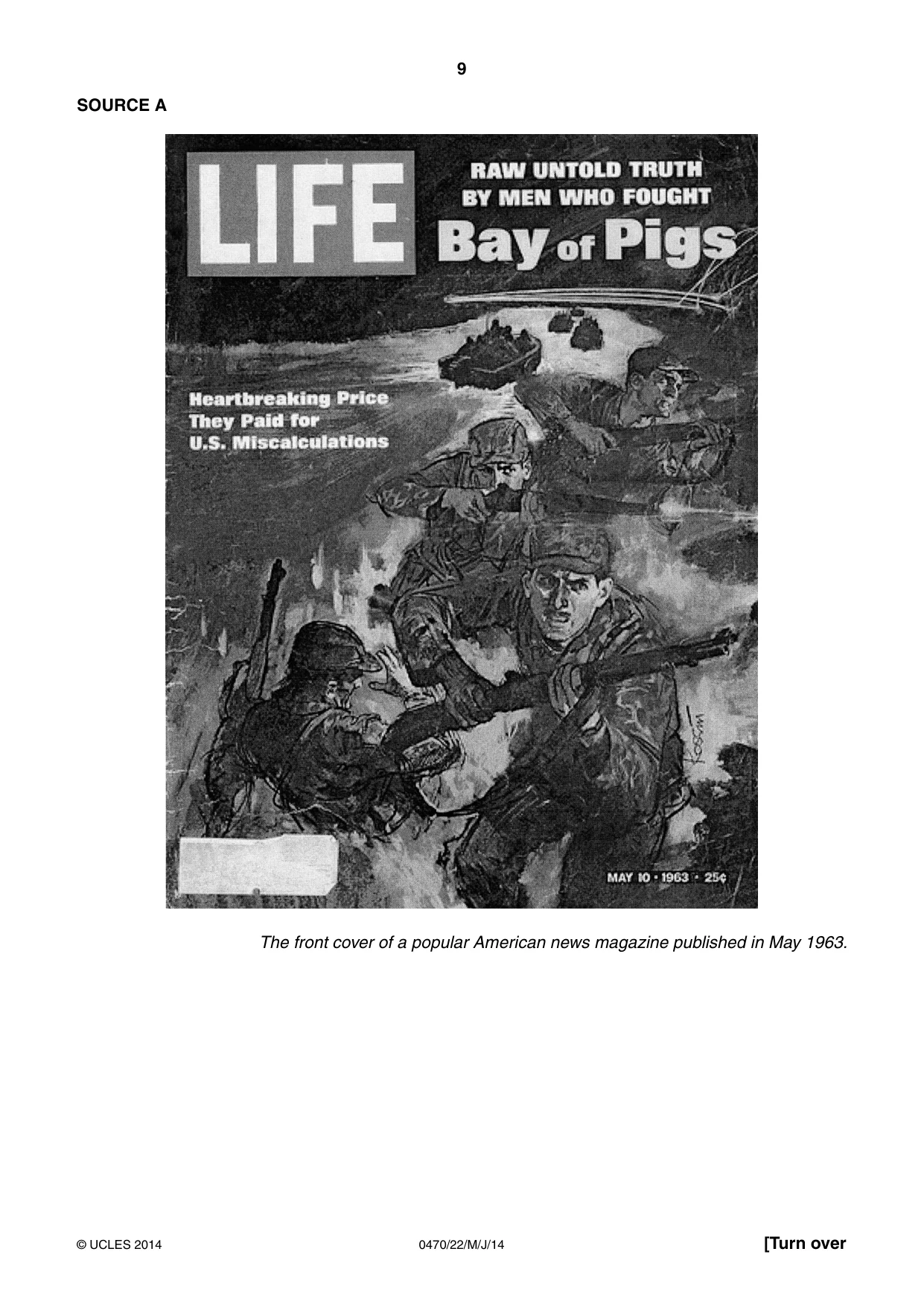
9 0470/22/M/J/14 © UCLES 2014 [Turn over SOURCE A The front cover of a popular American news magazine published in May 1963.
Question paper, page 10
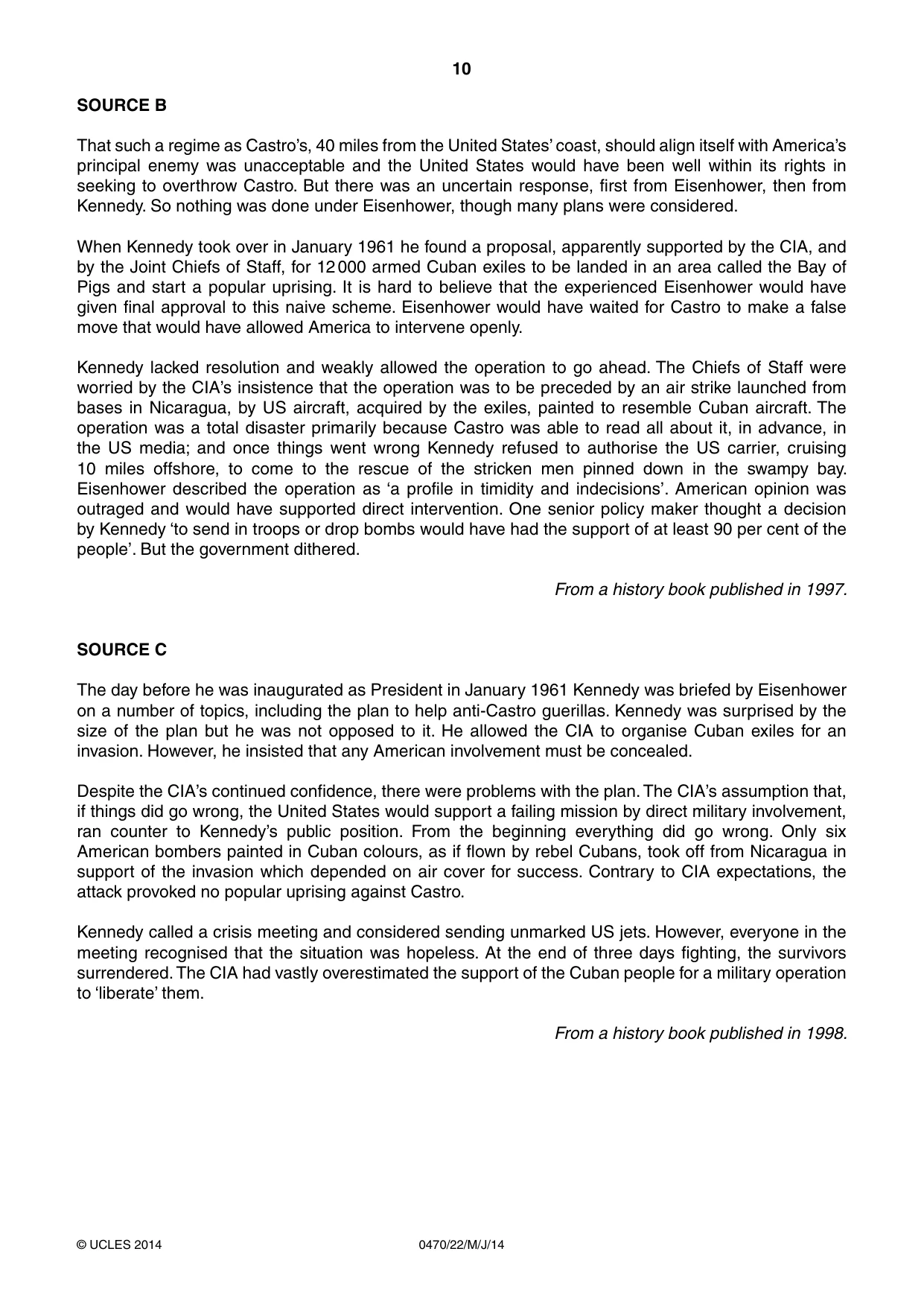
10 0470/22/M/J/14 © UCLES 2014 SOURCE B That such a regime as Castro’s, 40 miles from the United States’ coast, should align itself with America’s principal enemy was unacceptable and the United States would have been well within its rights in seeking to overthrow Castro. But there was an uncertain response, first from Eisenhower, then from Kennedy. So nothing was done under Eisenhower, though many plans were considered. When Kennedy took over in January 1961 he found a proposal, apparently supported by the CIA, and by the Joint Chiefs of Staff, for 12 000 armed Cuban exiles to be landed in an area called the Bay of Pigs and start a popular uprising. It is hard to believe that the experienced Eisenhower would have given final approval to this naive scheme. Eisenhower would have waited for Castro to make a false move that would have allowed America to intervene openly. Kennedy lacked resolution and weakly allowed the operation to go ahead. The Chiefs of Staff were worried by the CIA’s insistence that the operation was to be preceded by an air strike launched from bases in Nicaragua, by US aircraft, acquired by the exiles, painted to resemble Cuban aircraft. The operation was a total disaster primarily because Castro was able to read all about it, in advance, in the US media; and once things went wrong Kennedy refused to authorise the US carrier, cruising 10 miles offshore, to come to the rescue of the stricken men pinned down in the swampy bay. Eisenhower described the operation as ‘a profile in timidity and indecisions’. American opinion was outraged and would have supported direct intervention. One senior policy maker thought a decision by Kennedy ‘to send in troops or drop bombs would have had the support of at least 90 per cent of the people’. But the government dithered. From a history book published in 1997. SOURCE C The day before he was inaugurated as President in January 1961 Kennedy was briefed by Eisenhower on a number of topics, including the plan to help anti-Castro guerillas. Kennedy was surprised by the size of the plan but he was not opposed to it. He allowed the CIA to organise Cuban exiles for an invasion. However, he insisted that any American involvement must be concealed. Despite the CIA’s continued confidence, there were problems with the plan. The CIA’s assumption that, if things did go wrong, the United States would support a failing mission by direct military involvement, ran counter to Kennedy’s public position. From the beginning everything did go wrong. Only six American bombers painted in Cuban colours, as if flown by rebel Cubans, took off from Nicaragua in support of the invasion which depended on air cover for success. Contrary to CIA expectations, the attack provoked no popular uprising against Castro. Kennedy called a crisis meeting and considered sending unmarked US jets. However, everyone in the meeting recognised that the situation was hopeless. At the end of three days fighting, the survivors surrendered. The CIA had vastly overestimated the support of the Cuban people for a military operation to ‘liberate’ them. From a history book published in 1998.
Question paper, page 11
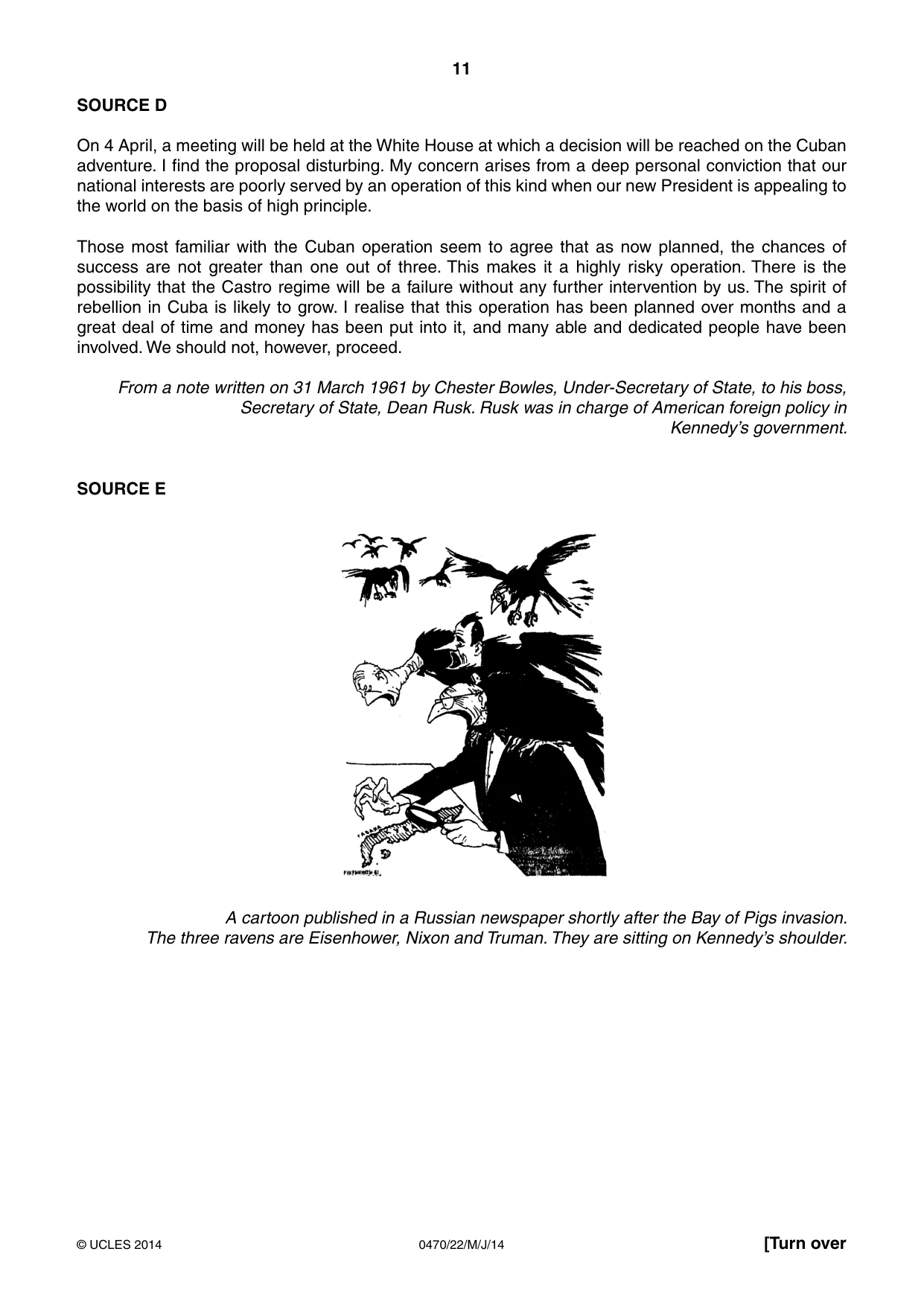
11 0470/22/M/J/14 © UCLES 2014 [Turn over SOURCE D On 4 April, a meeting will be held at the White House at which a decision will be reached on the Cuban adventure. I find the proposal disturbing. My concern arises from a deep personal conviction that our national interests are poorly served by an operation of this kind when our new President is appealing to the world on the basis of high principle. Those most familiar with the Cuban operation seem to agree that as now planned, the chances of success are not greater than one out of three. This makes it a highly risky operation. There is the possibility that the Castro regime will be a failure without any further intervention by us. The spirit of rebellion in Cuba is likely to grow. I realise that this operation has been planned over months and a great deal of time and money has been put into it, and many able and dedicated people have been involved. We should not, however, proceed. From a note written on 31 March 1961 by Chester Bowles, Under-Secretary of State, to his boss, Secretary of State, Dean Rusk. Rusk was in charge of American foreign policy in Kennedy’s government. SOURCE E A cartoon published in a Russian newspaper shortly after the Bay of Pigs invasion. The three ravens are Eisenhower, Nixon and Truman. They are sitting on Kennedy’s shoulder.
Question paper, page 12
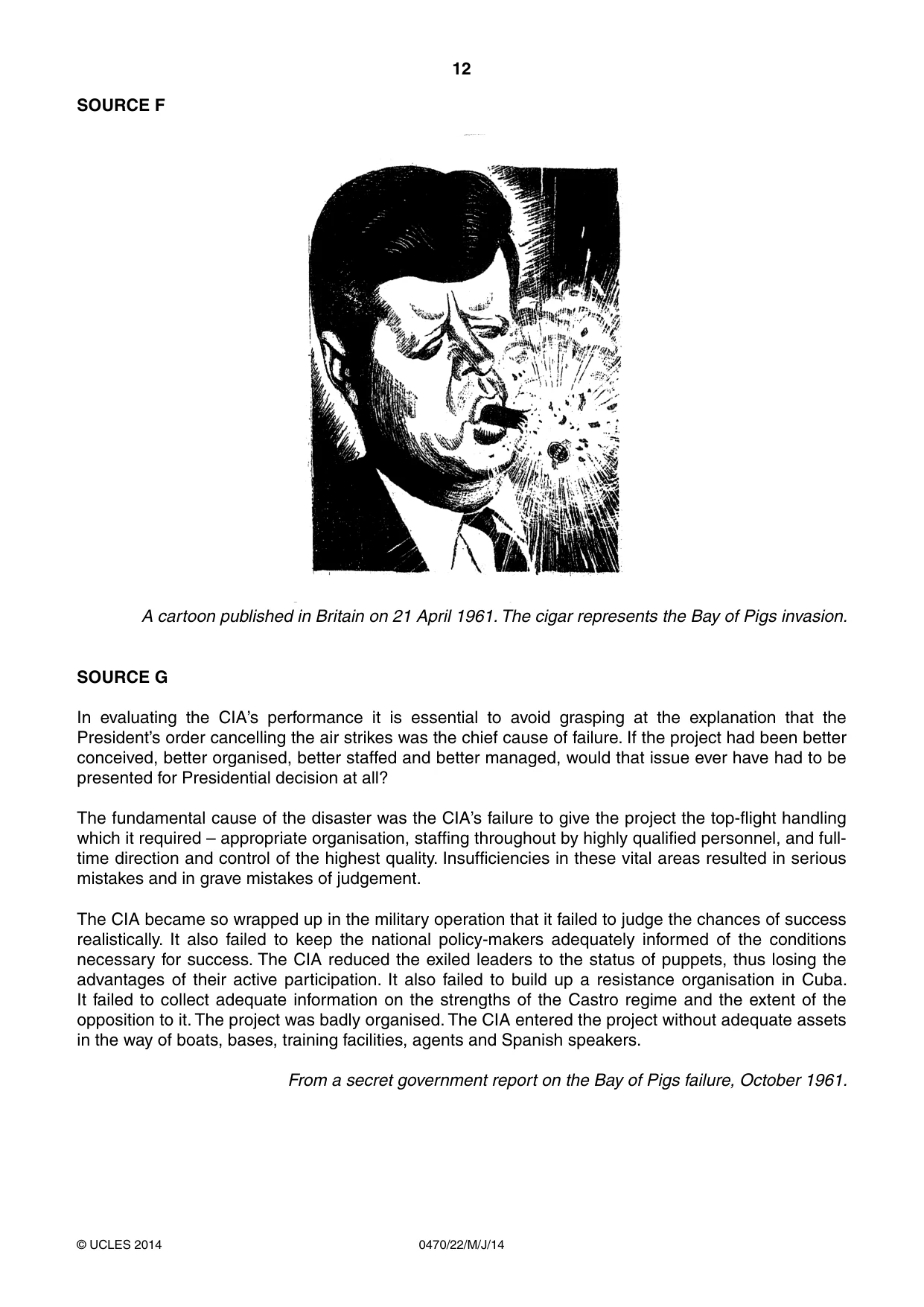
12 0470/22/M/J/14 © UCLES 2014 SOURCE F A cartoon published in Britain on 21 April 1961. The cigar represents the Bay of Pigs invasion. SOURCE G In evaluating the CIA’s performance it is essential to avoid grasping at the explanation that the President’s order cancelling the air strikes was the chief cause of failure. If the project had been better conceived, better organised, better staffed and better managed, would that issue ever have had to be presented for Presidential decision at all? The fundamental cause of the disaster was the CIA’s failure to give the project the top-flight handling which it required – appropriate organisation, staffing throughout by highly qualified personnel, and full- time direction and control of the highest quality. Insufficiencies in these vital areas resulted in serious mistakes and in grave mistakes of judgement. The CIA became so wrapped up in the military operation that it failed to judge the chances of success realistically. It also failed to keep the national policy-makers adequately informed of the conditions necessary for success. The CIA reduced the exiled leaders to the status of puppets, thus losing the advantages of their active participation. It also failed to build up a resistance organisation in Cuba. It failed to collect adequate information on the strengths of the Castro regime and the extent of the opposition to it. The project was badly organised. The CIA entered the project without adequate assets in the way of boats, bases, training facilities, agents and Spanish speakers. From a secret government report on the Bay of Pigs failure, October 1961.
Question paper, page 13
13 0470/22/M/J/14 © UCLES 2014 SOURCE H The allegations are rejected. Alleged defects of organisation had little to do with the unsuccessful outcome. The limiting factor on air operations was the competence of Cuban air crews. The air strike should not have been cancelled. The military plan was a good one. The important decisions were governmental, not those of the CIA. From the CIA response to Source G, January 1962. Now answer all the following questions. You may use any of the sources to help you answer the questions, in addition to those sources which you are told to use. In answering the questions you should use your knowledge of the topic to help you interpret and evaluate the sources. 1 Study Source A. What can you learn about the Bay of Pigs invasion from this source? Explain your answer using details of the source and your knowledge. [7] 2 Study Sources B and C. How far do these two sources agree? Explain your answer using details of the sources. [7] 3 Study Source D. Are you surprised by this source? Explain your answer using details of the source and your knowledge. [8] 4 Study Sources E and F. How similar are the messages of these two cartoons? Explain your answer using details of the sources and your knowledge. [8] 5 Study Sources G and H. Does Source H prove that Source G is wrong? Explain your answer using details of the sources and your knowledge. [8] 6 Study all the sources. How far do these sources provide convincing evidence that Kennedy was responsible for the Bay of Pigs fiasco? Use the sources to explain your answer. [12]
Question paper, page 14
14 0470/22/M/J/14 © UCLES 2014 BLANK PAGE
Question paper, page 15
15 0470/22/M/J/14 © UCLES 2014 BLANK PAGE
Question paper, page 16
16 0470/22/M/J/14 © UCLES 2014 Copyright Acknowledgements: Option B Source A © Life Magazine ; 10 May 1963. Option B Source B © P. Johnson; A History of the American People ; Weidenfeld & Nicolson; 1997. Option B Source C © J. Isaacs & T. Downing; The Cold War ; Bantam Press; 1998. Option B Source F © Cartoon; Daily Mail; 2007. Permission to reproduce items where third-party owned material protected by copyright is included has been sought and cleared where possible. Every reasonable effort has been made by the publisher (UCLES) to trace copyright holders, but if any items requiring clearance have unwittingly been included, the publisher will be pleased to make amends at the earliest possible opportunity. Cambridge International Examinations is part of the Cambridge Assessment Group. Cambridge Assessment is the brand name of University of Cambridge Local Examinations Syndicate (UCLES), which is itself a department of the University of Cambridge. BLANK PAGE
Mark scheme, page 1
CAMBRIDGE INTERNATIONAL EXAMINATIONS International General Certificate of Secondary Education MARK SCHEME for the May/June 2014 series 0470 HISTORY 0470/22 Paper 2, maximum raw mark 50 This mark scheme is published as an aid to teachers and candidates, to indicate the requirements of the examination. It shows the basis on which Examiners were instructed to award marks. It does not indicate the details of the discussions that took place at an Examiners’ meeting before marking began, which would have considered the acceptability of alternative answers. Mark schemes should be read in conjunction with the question paper and the Principal Examiner Report for Teachers. Cambridge will not enter into discussions about these mark schemes. Cambridge is publishing the mark schemes for the May/June 2014 series for most IGCSE, GCE Advanced Level and Advanced Subsidiary Level components and some Ordinary Level components.
Mark scheme, page 2
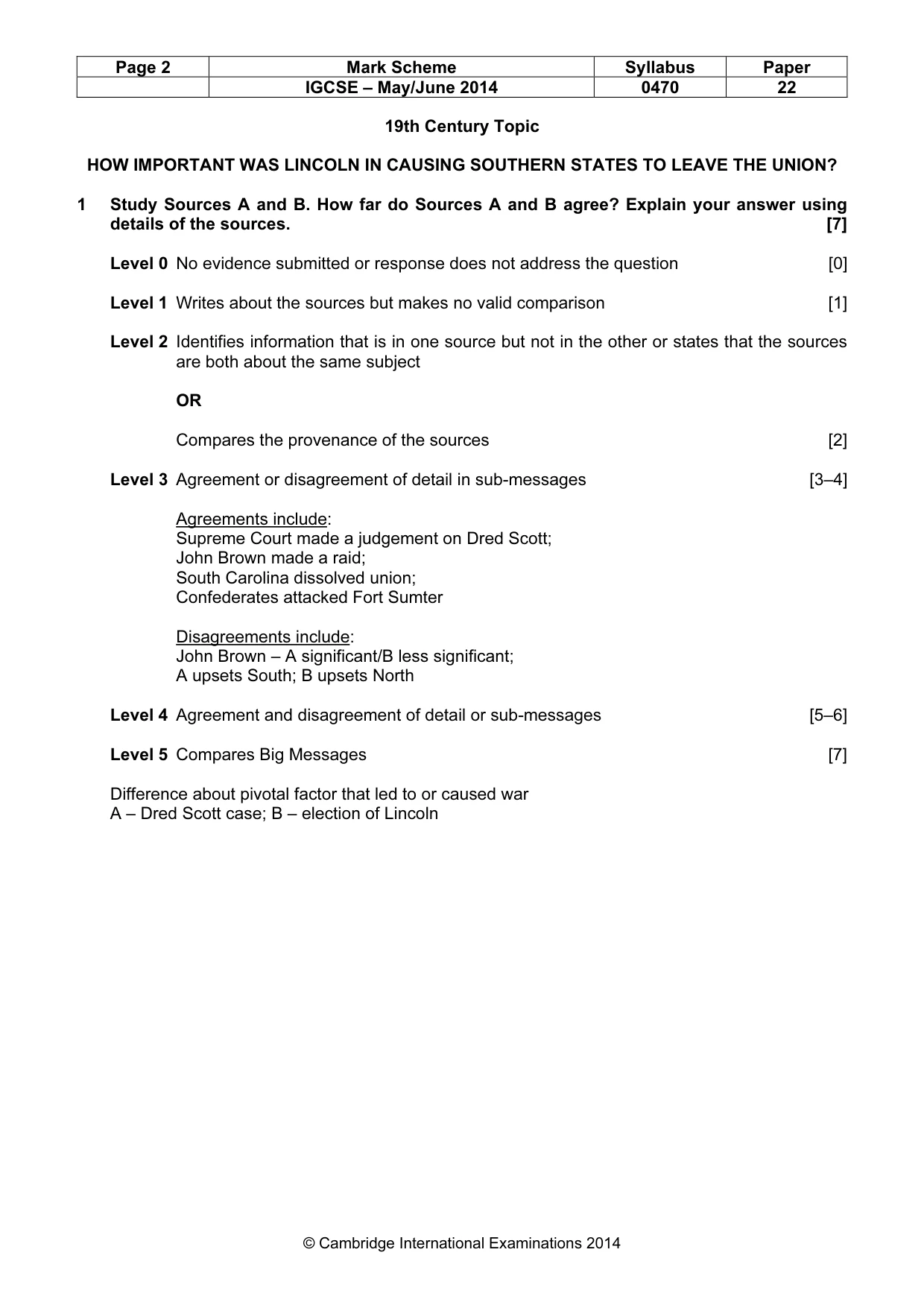
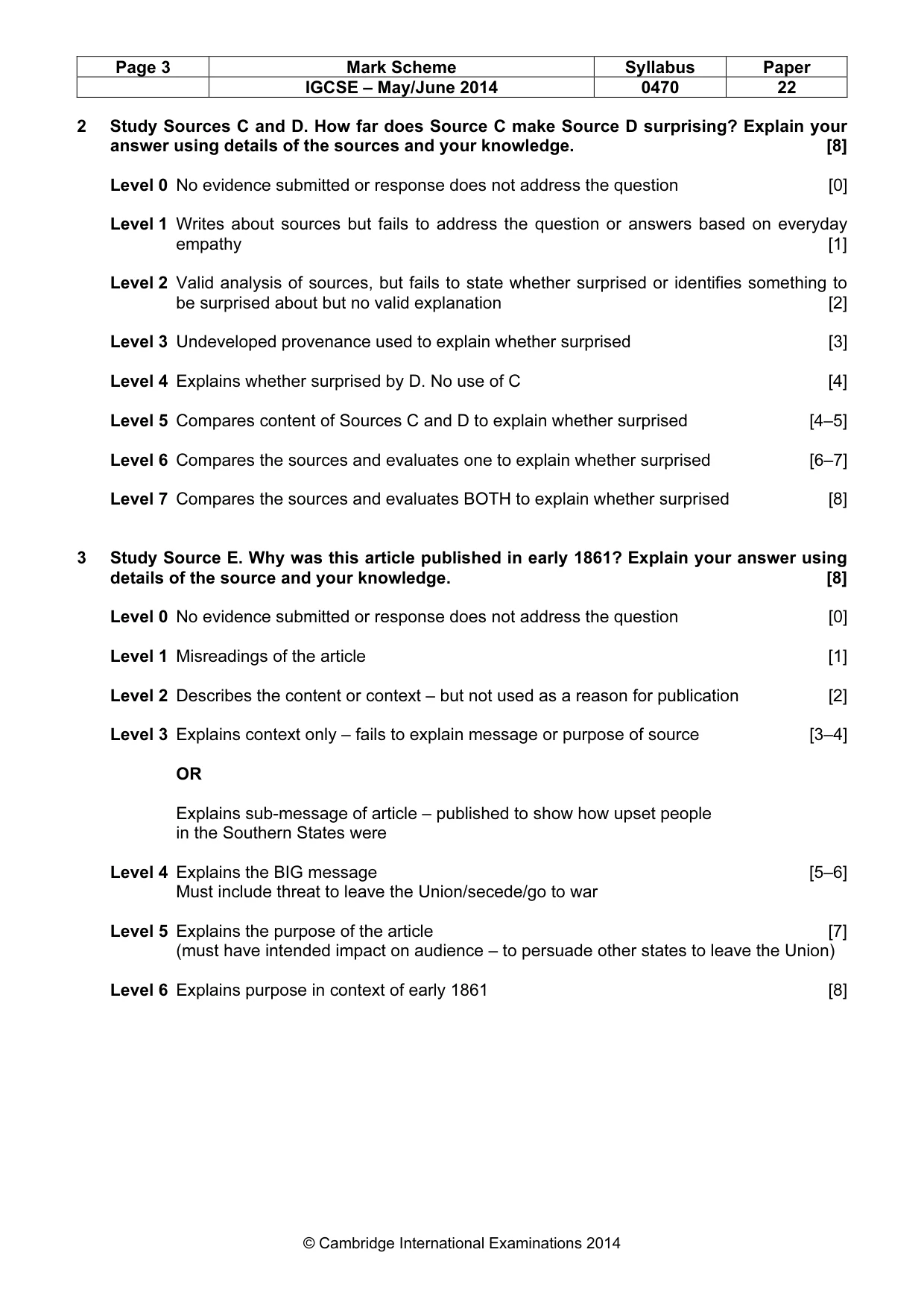
Page 2 Mark Scheme Syllabus Paper IGCSE – May/June 2014 0470 22 © Cambridge International Examinations 2014 19th Century Topic HOW IMPORTANT WAS LINCOLN IN CAUSING SOUTHERN STATES TO LEAVE THE UNION? 1 Study Sources A and B. How far do Sources A and B agree? Explain your answer using details of the sources. [7] Level 0 No evidence submitted or response does not address the question [0] Level 1 Writes about the sources but makes no valid comparison [1] Level 2 Identifies information that is in one source but not in the other or states that the sources are both about the same subject OR Compares the provenance of the sources [2] Level 3 Agreement or disagreement of detail in sub-messages [3–4] Agreements include: Supreme Court made a judgement on Dred Scott; John Brown made a raid; South Carolina dissolved union; Confederates attacked Fort Sumter Disagreements include: John Brown – A significant/B less significant; A upsets South; B upsets North Level 4 Agreement and disagreement of detail or sub-messages [5–6] Level 5 Compares Big Messages [7] Difference about pivotal factor that led to or caused war A – Dred Scott case; B – election of Lincoln
Mark scheme, page 3
Page 3 Mark Scheme Syllabus Paper IGCSE – May/June 2014 0470 22 © Cambridge International Examinations 2014 2 Study Sources C and D. How far does Source C make Source D surprising? Explain your answer using details of the sources and your knowledge. [8] Level 0 No evidence submitted or response does not address the question [0] Level 1 Writes about sources but fails to address the question or answers based on everyday empathy [1] Level 2 Valid analysis of sources, but fails to state whether surprised or identifies something to be surprised about but no valid explanation [2] Level 3 Undeveloped provenance used to explain whether surprised [3] Level 4 Explains whether surprised by D. No use of C [4] Level 5 Compares content of Sources C and D to explain whether surprised [4–5] Level 6 Compares the sources and evaluates one to explain whether surprised [6–7] Level 7 Compares the sources and evaluates BOTH to explain whether surprised [8] 3 Study Source E. Why was this article published in early 1861? Explain your answer using details of the source and your knowledge. [8] Level 0 No evidence submitted or response does not address the question [0] Level 1 Misreadings of the article [1] Level 2 Describes the content or context – but not used as a reason for publication [2] Level 3 Explains context only – fails to explain message or purpose of source [3–4] OR Explains sub-message of article – published to show how upset people in the Southern States were Level 4 Explains the BIG message [5–6] Must include threat to leave the Union/secede/go to war Level 5 Explains the purpose of the article [7] (must have intended impact on audience – to persuade other states to leave the Union) Level 6 Explains purpose in context of early 1861 [8]
Mark scheme, page 4
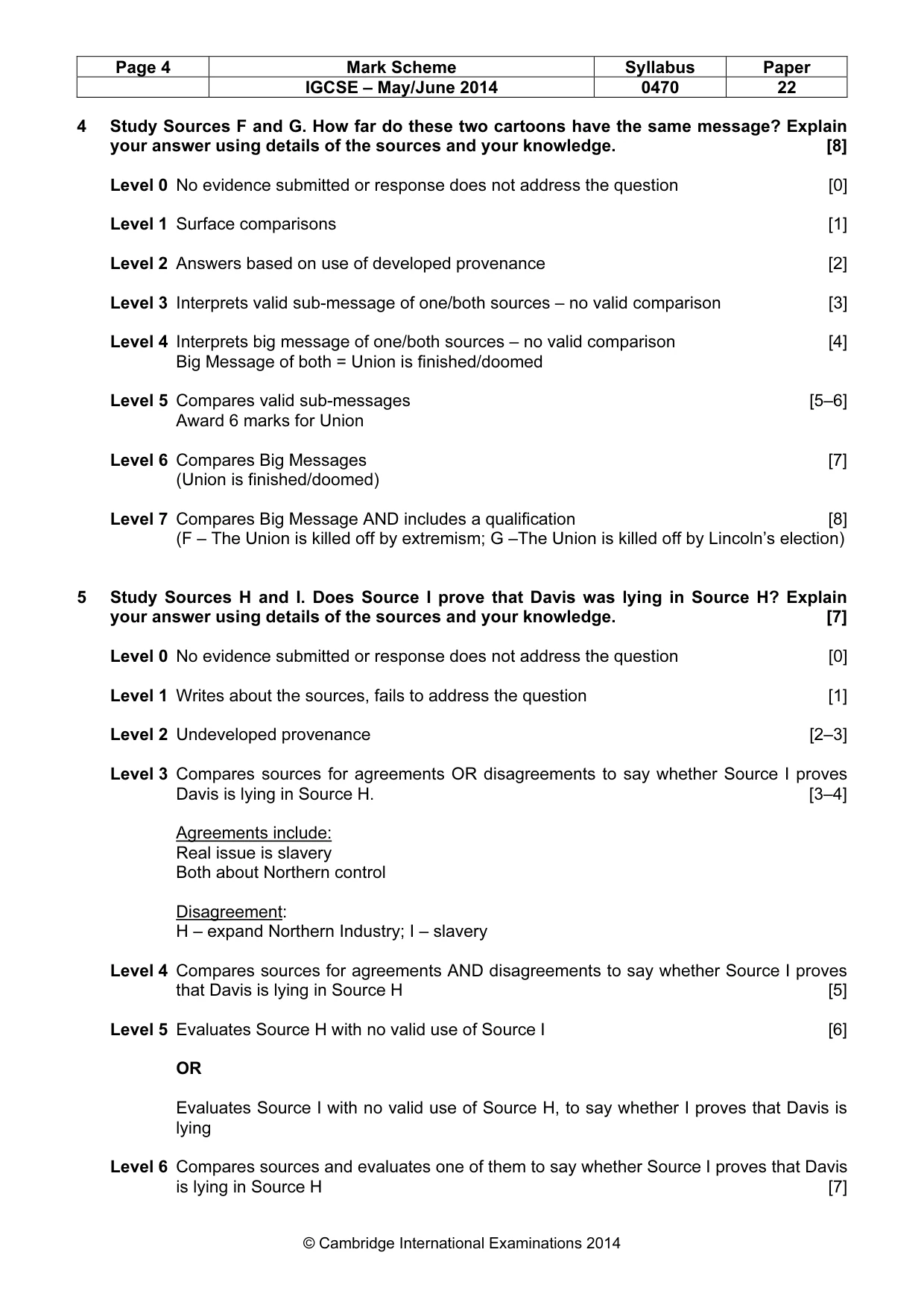
Page 4 Mark Scheme Syllabus Paper IGCSE – May/June 2014 0470 22 © Cambridge International Examinations 2014 4 Study Sources F and G. How far do these two cartoons have the same message? Explain your answer using details of the sources and your knowledge. [8] Level 0 No evidence submitted or response does not address the question [0] Level 1 Surface comparisons [1] Level 2 Answers based on use of developed provenance [2] Level 3 Interprets valid sub-message of one/both sources – no valid comparison [3] Level 4 Interprets big message of one/both sources – no valid comparison [4] Big Message of both = Union is finished/doomed Level 5 Compares valid sub-messages [5–6] Award 6 marks for Union Level 6 Compares Big Messages [7] (Union is finished/doomed) Level 7 Compares Big Message AND includes a qualification [8] (F – The Union is killed off by extremism; G –The Union is killed off by Lincoln’s election) 5 Study Sources H and I. Does Source I prove that Davis was lying in Source H? Explain your answer using details of the sources and your knowledge. [7] Level 0 No evidence submitted or response does not address the question [0] Level 1 Writes about the sources, fails to address the question [1] Level 2 Undeveloped provenance [2–3] Level 3 Compares sources for agreements OR disagreements to say whether Source I proves Davis is lying in Source H. [3–4] Agreements include: Real issue is slavery Both about Northern control Disagreement: H – expand Northern Industry; I – slavery Level 4 Compares sources for agreements AND disagreements to say whether Source I proves that Davis is lying in Source H [5] Level 5 Evaluates Source H with no valid use of Source I [6] OR Evaluates Source I with no valid use of Source H, to say whether I proves that Davis is lying Level 6 Compares sources and evaluates one of them to say whether Source I proves that Davis is lying in Source H [7]
Mark scheme, page 5
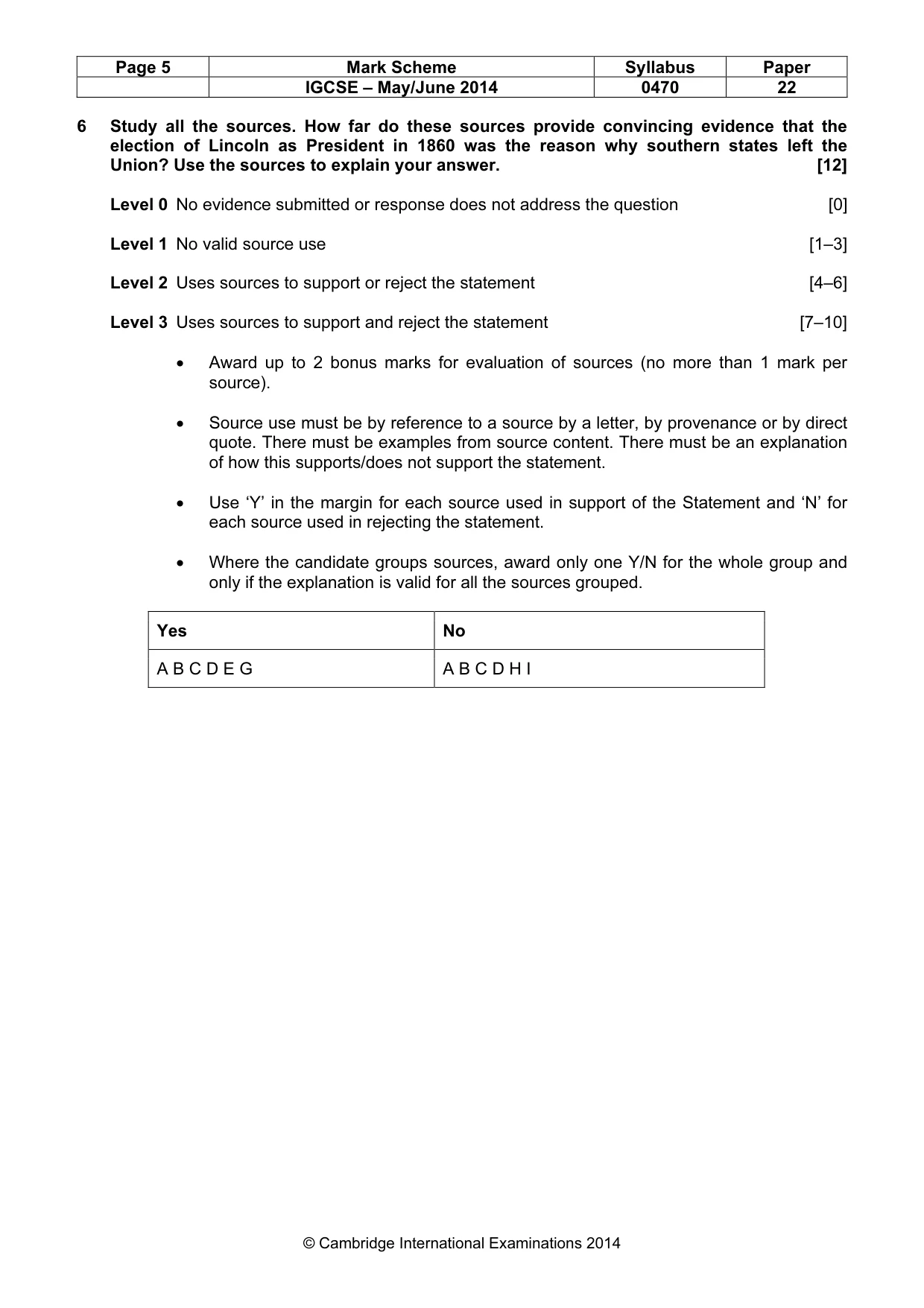
Page 5 Mark Scheme Syllabus Paper IGCSE – May/June 2014 0470 22 © Cambridge International Examinations 2014 6 Study all the sources. How far do these sources provide convincing evidence that the election of Lincoln as President in 1860 was the reason why southern states left the Union? Use the sources to explain your answer. [12] Level 0 No evidence submitted or response does not address the question [0] Level 1 No valid source use [1–3] Level 2 Uses sources to support or reject the statement [4–6] Level 3 Uses sources to support and reject the statement [7–10] • Award up to 2 bonus marks for evaluation of sources (no more than 1 mark per source). • Source use must be by reference to a source by a letter, by provenance or by direct quote. There must be examples from source content. There must be an explanation of how this supports/does not support the statement. • Use ‘Y’ in the margin for each source used in support of the Statement and ‘N’ for each source used in rejecting the statement. • Where the candidate groups sources, award only one Y/N for the whole group and only if the explanation is valid for all the sources grouped. Yes No A B C D E G A B C D H I
Mark scheme, page 6
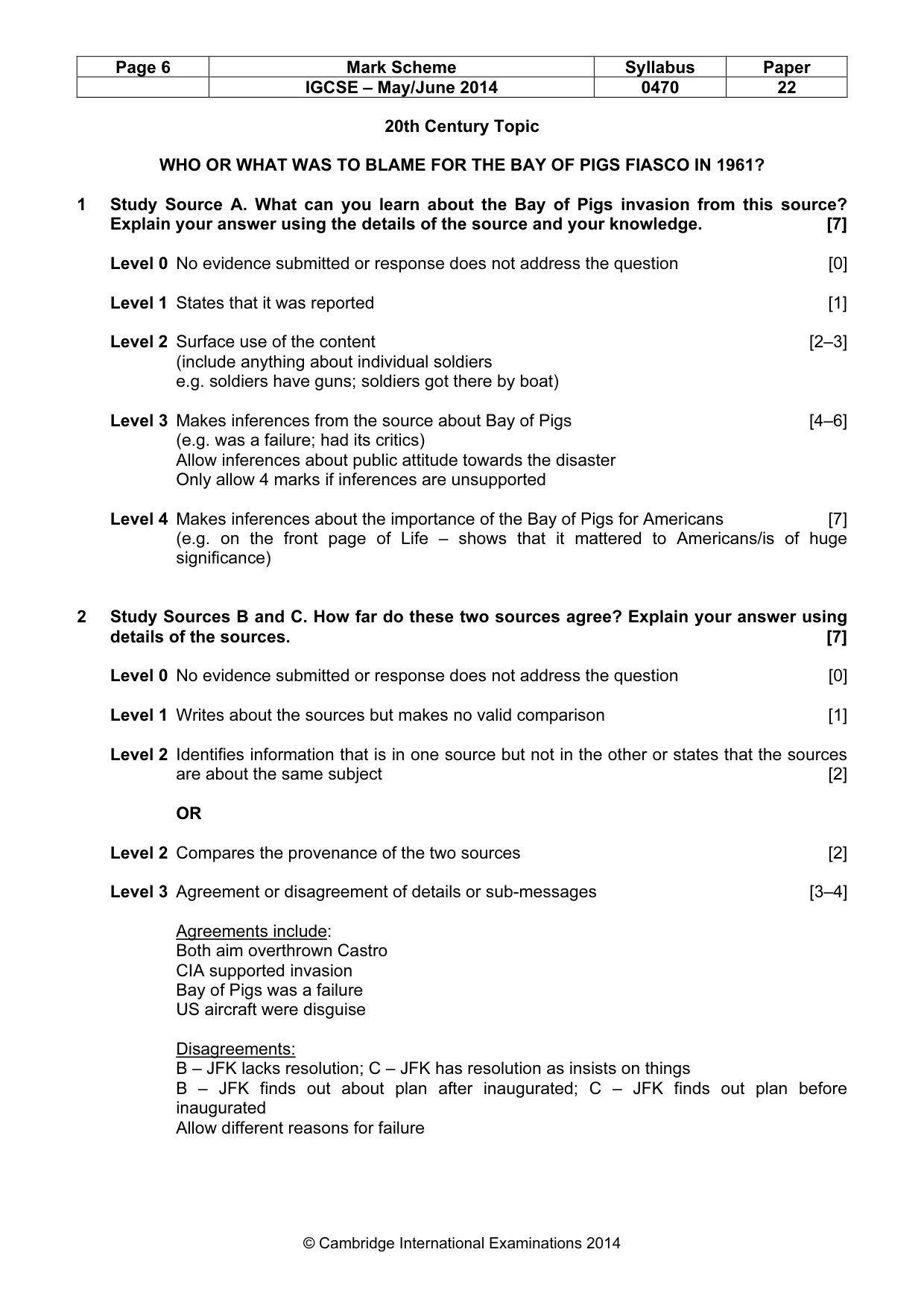
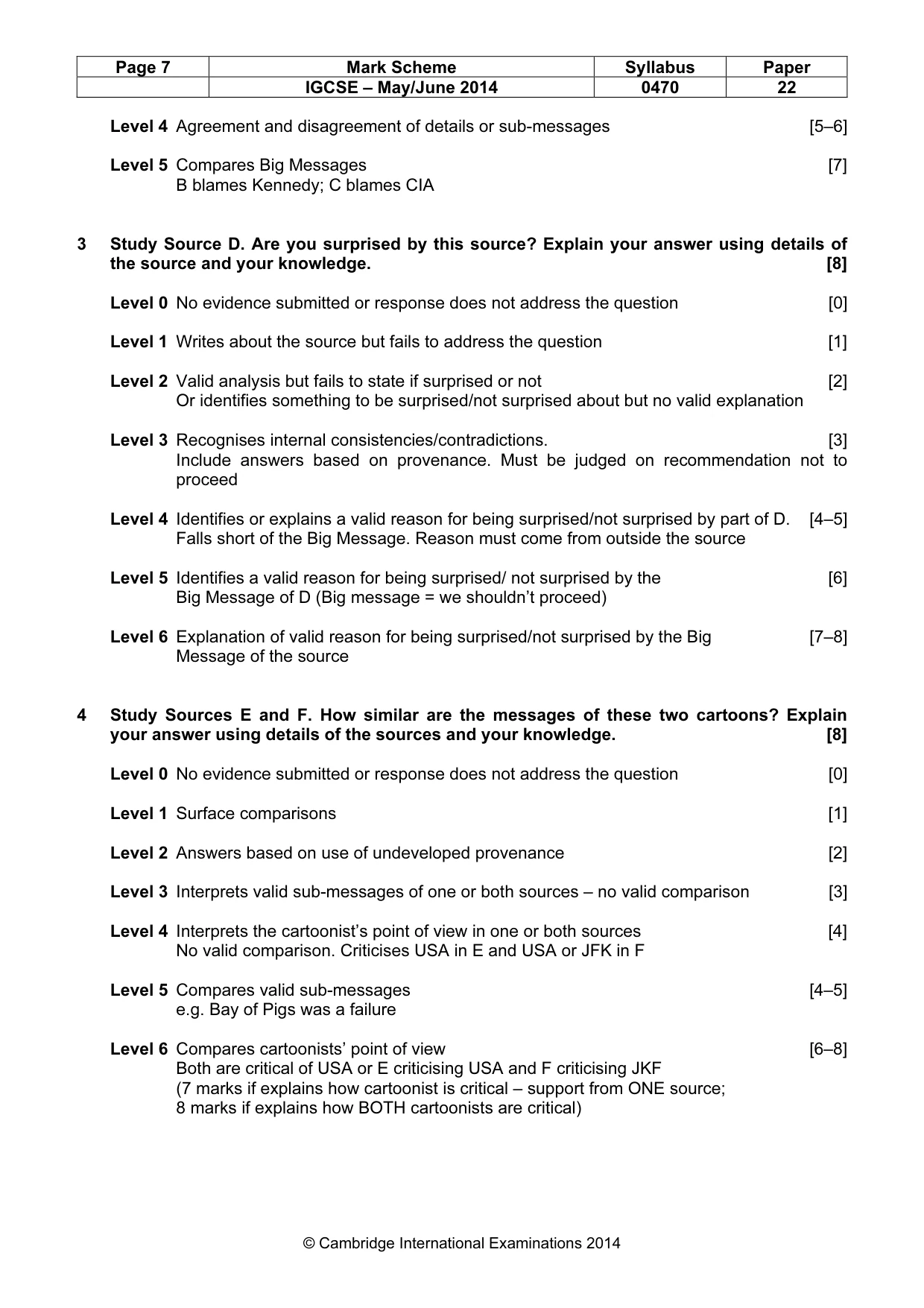
Page 6 Mark Scheme Syllabus Paper IGCSE – May/June 2014 0470 22 © Cambridge International Examinations 2014 20th Century Topic WHO OR WHAT WAS TO BLAME FOR THE BAY OF PIGS FIASCO IN 1961? 1 Study Source A. What can you learn about the Bay of Pigs invasion from this source? Explain your answer using the details of the source and your knowledge. [7] Level 0 No evidence submitted or response does not address the question [0] Level 1 States that it was reported [1] Level 2 Surface use of the content [2–3] (include anything about individual soldiers e.g. soldiers have guns; soldiers got there by boat) Level 3 Makes inferences from the source about Bay of Pigs [4–6] (e.g. was a failure; had its critics) Allow inferences about public attitude towards the disaster Only allow 4 marks if inferences are unsupported Level 4 Makes inferences about the importance of the Bay of Pigs for Americans [7] (e.g. on the front page of Life – shows that it mattered to Americans/is of huge significance) 2 Study Sources B and C. How far do these two sources agree? Explain your answer using details of the sources. [7] Level 0 No evidence submitted or response does not address the question [0] Level 1 Writes about the sources but makes no valid comparison [1] Level 2 Identifies information that is in one source but not in the other or states that the sources are about the same subject [2] OR Level 2 Compares the provenance of the two sources [2] Level 3 Agreement or disagreement of details or sub-messages [3–4] Agreements include: Both aim overthrown Castro CIA supported invasion Bay of Pigs was a failure US aircraft were disguise Disagreements: B – JFK lacks resolution; C – JFK has resolution as insists on things B – JFK finds out about plan after inaugurated; C – JFK finds out plan before inaugurated Allow different reasons for failure
Mark scheme, page 7
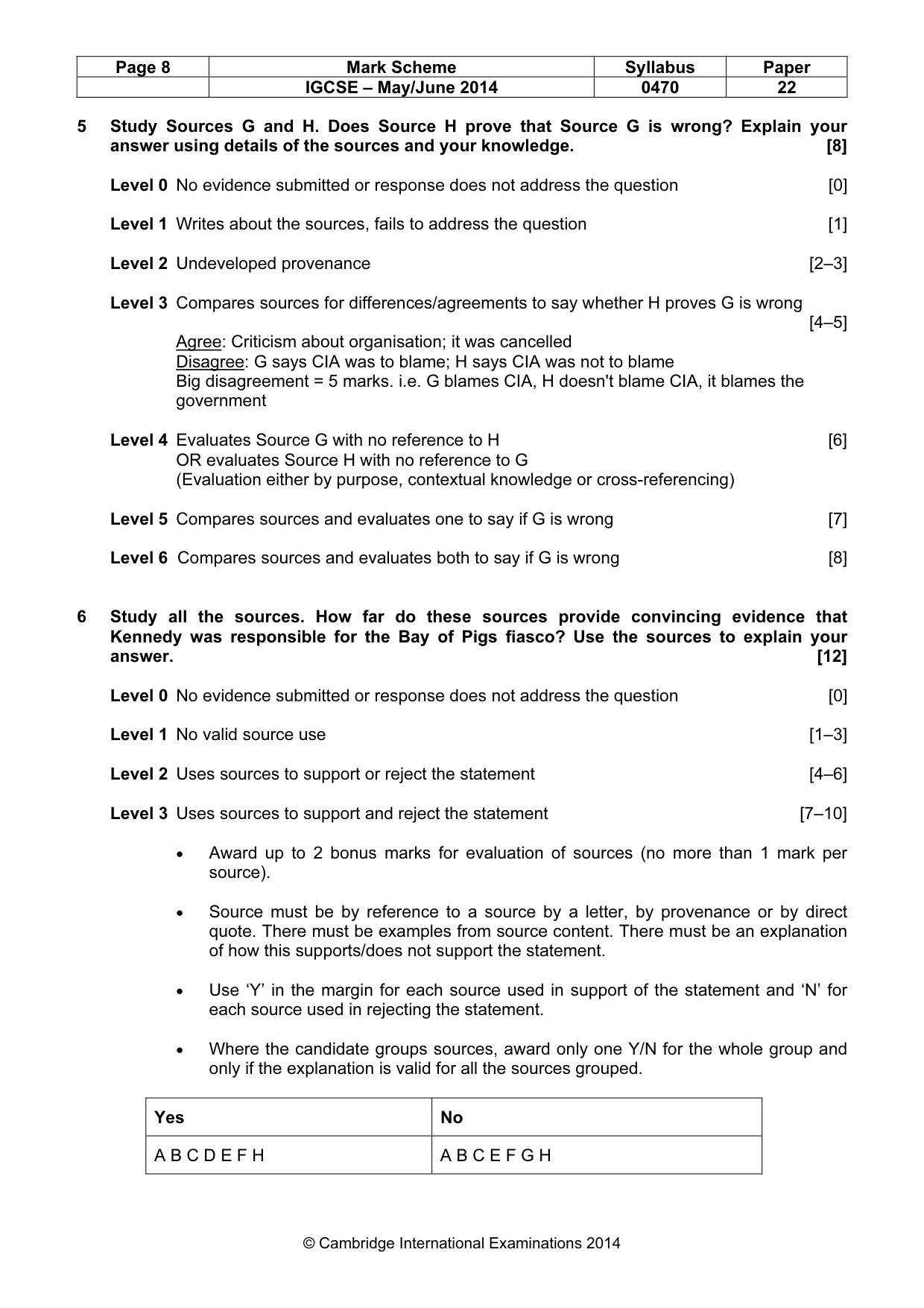
Page 7 Mark Scheme Syllabus Paper IGCSE – May/June 2014 0470 22 © Cambridge International Examinations 2014 Level 4 Agreement and disagreement of details or sub-messages [5–6] Level 5 Compares Big Messages [7] B blames Kennedy; C blames CIA 3 Study Source D. Are you surprised by this source? Explain your answer using details of the source and your knowledge. [8] Level 0 No evidence submitted or response does not address the question [0] Level 1 Writes about the source but fails to address the question [1] Level 2 Valid analysis but fails to state if surprised or not [2] Or identifies something to be surprised/not surprised about but no valid explanation Level 3 Recognises internal consistencies/contradictions. [3] Include answers based on provenance. Must be judged on recommendation not to proceed Level 4 Identifies or explains a valid reason for being surprised/not surprised by part of D. [4–5] Falls short of the Big Message. Reason must come from outside the source Level 5 Identifies a valid reason for being surprised/ not surprised by the [6] Big Message of D (Big message = we shouldn’t proceed) Level 6 Explanation of valid reason for being surprised/not surprised by the Big [7–8] Message of the source 4 Study Sources E and F. How similar are the messages of these two cartoons? Explain your answer using details of the sources and your knowledge. [8] Level 0 No evidence submitted or response does not address the question [0] Level 1 Surface comparisons [1] Level 2 Answers based on use of undeveloped provenance [2] Level 3 Interprets valid sub-messages of one or both sources – no valid comparison [3] Level 4 Interprets the cartoonist’s point of view in one or both sources [4] No valid comparison. Criticises USA in E and USA or JFK in F Level 5 Compares valid sub-messages [4–5] e.g. Bay of Pigs was a failure Level 6 Compares cartoonists’ point of view [6–8] Both are critical of USA or E criticising USA and F criticising JKF (7 marks if explains how cartoonist is critical – support from ONE source; 8 marks if explains how BOTH cartoonists are critical)
Mark scheme, page 8
Page 8 Mark Scheme Syllabus Paper IGCSE – May/June 2014 0470 22 © Cambridge International Examinations 2014 5 Study Sources G and H. Does Source H prove that Source G is wrong? Explain your answer using details of the sources and your knowledge. [8] Level 0 No evidence submitted or response does not address the question [0] Level 1 Writes about the sources, fails to address the question [1] Level 2 Undeveloped provenance [2–3] Level 3 Compares sources for differences/agreements to say whether H proves G is wrong [4–5] Agree: Criticism about organisation; it was cancelled Disagree: G says CIA was to blame; H says CIA was not to blame Big disagreement = 5 marks. i.e. G blames CIA, H doesn't blame CIA, it blames the government Level 4 Evaluates Source G with no reference to H [6] OR evaluates Source H with no reference to G (Evaluation either by purpose, contextual knowledge or cross-referencing) Level 5 Compares sources and evaluates one to say if G is wrong [7] Level 6 Compares sources and evaluates both to say if G is wrong [8] 6 Study all the sources. How far do these sources provide convincing evidence that Kennedy was responsible for the Bay of Pigs fiasco? Use the sources to explain your answer. [12] Level 0 No evidence submitted or response does not address the question [0] Level 1 No valid source use [1–3] Level 2 Uses sources to support or reject the statement [4–6] Level 3 Uses sources to support and reject the statement [7–10] • Award up to 2 bonus marks for evaluation of sources (no more than 1 mark per source). • Source must be by reference to a source by a letter, by provenance or by direct quote. There must be examples from source content. There must be an explanation of how this supports/does not support the statement. • Use ‘Y’ in the margin for each source used in support of the statement and ‘N’ for each source used in rejecting the statement. • Where the candidate groups sources, award only one Y/N for the whole group and only if the explanation is valid for all the sources grouped. Yes No A B C D E F H A B C E F G H
What you needed in this session
Cambridge’s own grade thresholds for 2014 May/June, Paper 2 · Variant 2. A higher threshold means an easier paper — the bar moves with how the cohort did.