Cambridge IGCSE History 0470 — 2013 Oct/Nov Paper 4 · Variant 3
0470/43/O/N/13 · 40 marks · ≈45 min
The question paper and its mark scheme, free to read here and free to download. This is Cambridge’s own paper, exactly as it was sat.
Question paper12 pages

Mark scheme19 pages
Answers below. Sit the paper first if you are practising.
Paper as text
Question paper, page 1
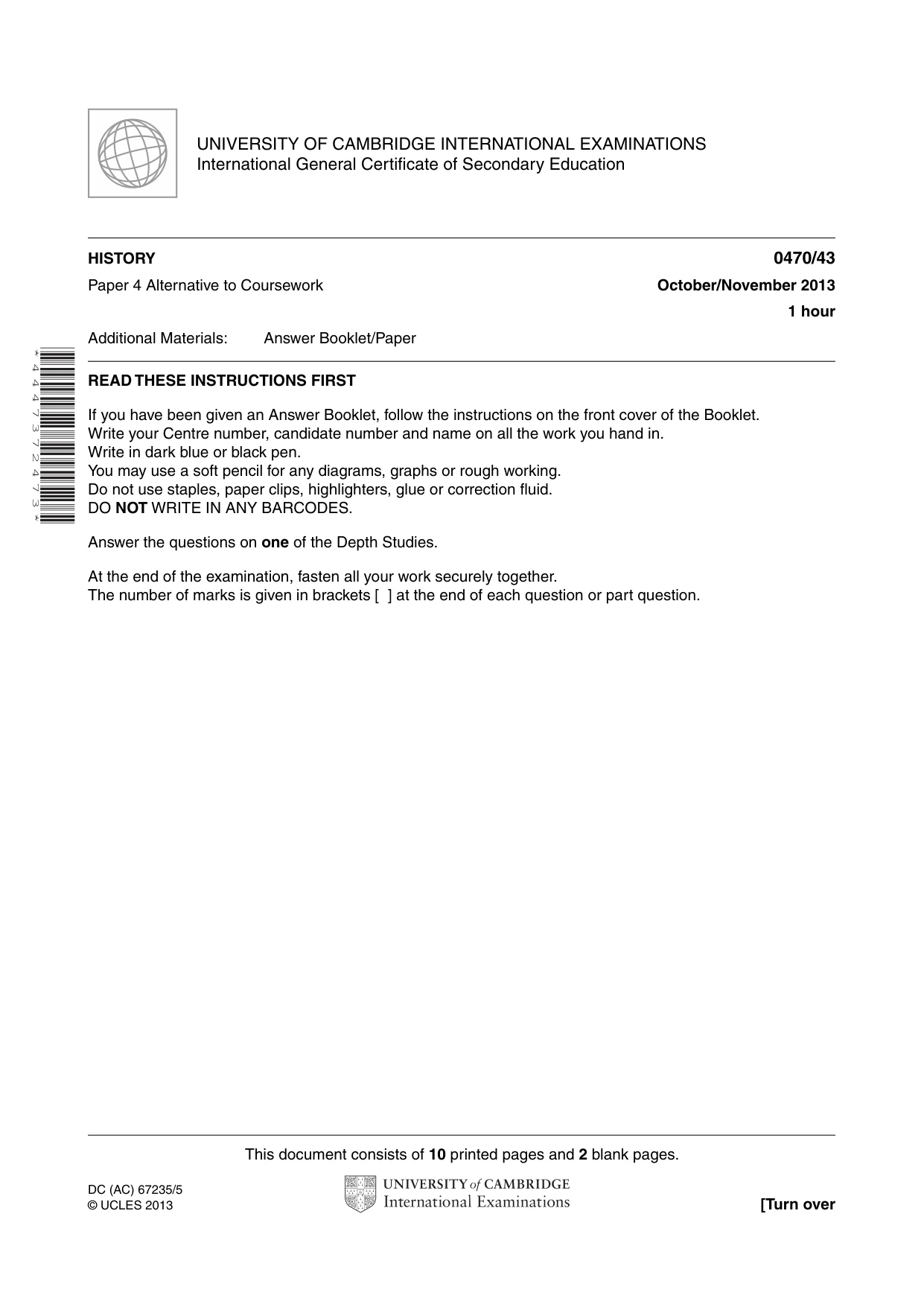
This document consists of 10 printed pages and 2 blank pages. DC (AC) 67235/5 © UCLES 2013 [Turn over UNIVERSITY OF CAMBRIDGE INTERNATIONAL EXAMINATIONS International General Certificate of Secondary Education * 4 4 4 7 3 7 2 4 7 3 * HISTORY 0470/43 Paper 4 Alternative to Coursework October/November 2013 1 hour Additional Materials: Answer Booklet/Paper READ THESE INSTRUCTIONS FIRST If you have been given an Answer Booklet, follow the instructions on the front cover of the Booklet. Write your Centre number, candidate number and name on all the work you hand in. Write in dark blue or black pen. You may use a soft pencil for any diagrams, graphs or rough working. Do not use staples, paper clips, highlighters, glue or correction fluid. DO NOT WRITE IN ANY BARCODES. Answer the questions on one of the Depth Studies. At the end of the examination, fasten all your work securely together. The number of marks is given in brackets [ ] at the end of each question or part question.
Question paper, page 2
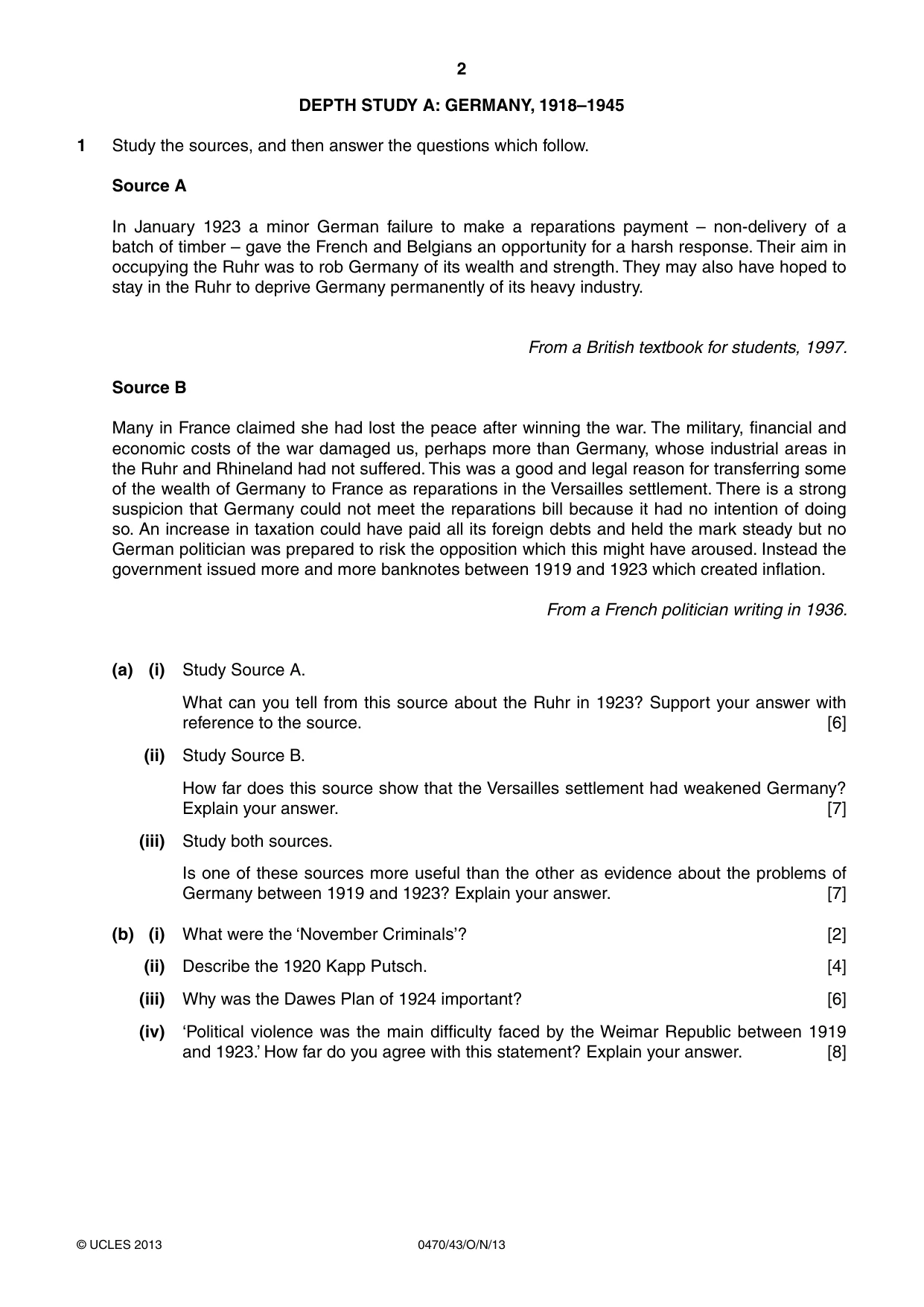
2 0470/43/O/N/13 © UCLES 2013 DEPTH STUDY A: GERMANY, 1918–1945 1 Study the sources, and then answer the questions which follow. Source A In January 1923 a minor German failure to make a reparations payment – non-delivery of a batch of timber – gave the French and Belgians an opportunity for a harsh response. Their aim in occupying the Ruhr was to rob Germany of its wealth and strength. They may also have hoped to stay in the Ruhr to deprive Germany permanently of its heavy industry. From a British textbook for students, 1997. Source B Many in France claimed she had lost the peace after winning the war. The military, financial and economic costs of the war damaged us, perhaps more than Germany, whose industrial areas in the Ruhr and Rhineland had not suffered. This was a good and legal reason for transferring some of the wealth of Germany to France as reparations in the Versailles settlement. There is a strong suspicion that Germany could not meet the reparations bill because it had no intention of doing so. An increase in taxation could have paid all its foreign debts and held the mark steady but no German politician was prepared to risk the opposition which this might have aroused. Instead the government issued more and more banknotes between 1919 and 1923 which created inflation. From a French politician writing in 1936. (a) (i) Study Source A. What can you tell from this source about the Ruhr in 1923? Support your answer with reference to the source. [6] (ii) Study Source B. How far does this source show that the Versailles settlement had weakened Germany? Explain your answer. [7] (iii) Study both sources. Is one of these sources more useful than the other as evidence about the problems of Germany between 1919 and 1923? Explain your answer. [7] (b) (i) What were the ‘November Criminals’? [2] (ii) Describe the 1920 Kapp Putsch. [4] (iii) Why was the Dawes Plan of 1924 important? [6] (iv) ‘Political violence was the main difficulty faced by the Weimar Republic between 1919 and 1923.’ How far do you agree with this statement? Explain your answer. [8]
Question paper, page 3
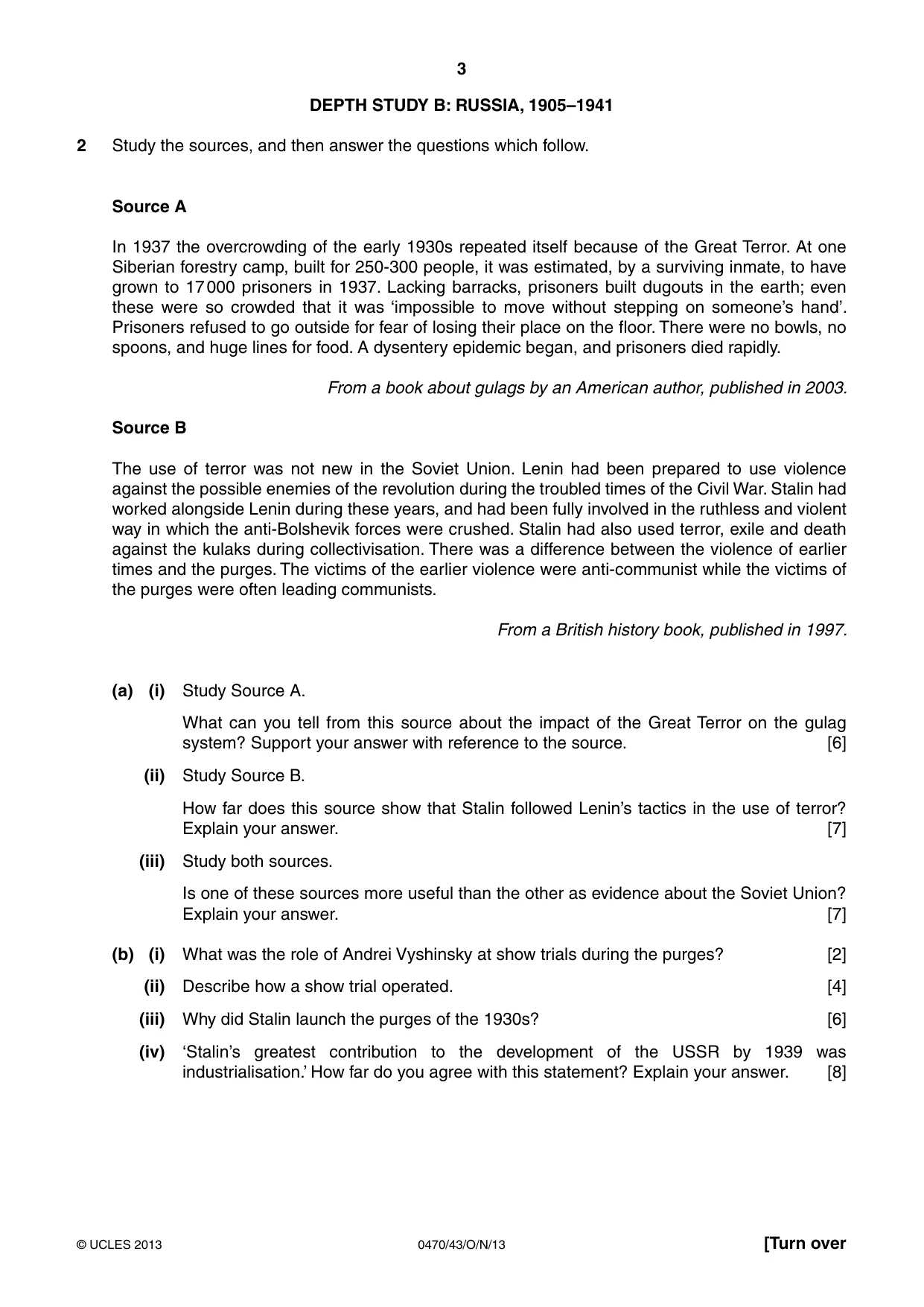
3 0470/43/O/N/13 © UCLES 2013 [Turn over DEPTH STUDY B: RUSSIA, 1905–1941 2 Study the sources, and then answer the questions which follow. Source A In 1937 the overcrowding of the early 1930s repeated itself because of the Great Terror. At one Siberian forestry camp, built for 250-300 people, it was estimated, by a surviving inmate, to have grown to 17 000 prisoners in 1937. Lacking barracks, prisoners built dugouts in the earth; even these were so crowded that it was ‘impossible to move without stepping on someone’s hand’. Prisoners refused to go outside for fear of losing their place on the floor. There were no bowls, no spoons, and huge lines for food. A dysentery epidemic began, and prisoners died rapidly. From a book about gulags by an American author, published in 2003. Source B The use of terror was not new in the Soviet Union. Lenin had been prepared to use violence against the possible enemies of the revolution during the troubled times of the Civil War. Stalin had worked alongside Lenin during these years, and had been fully involved in the ruthless and violent way in which the anti-Bolshevik forces were crushed. Stalin had also used terror, exile and death against the kulaks during collectivisation. There was a difference between the violence of earlier times and the purges. The victims of the earlier violence were anti-communist while the victims of the purges were often leading communists. From a British history book, published in 1997. (a) (i) Study Source A. What can you tell from this source about the impact of the Great Terror on the gulag system? Support your answer with reference to the source. [6] (ii) Study Source B. How far does this source show that Stalin followed Lenin’s tactics in the use of terror? Explain your answer. [7] (iii) Study both sources. Is one of these sources more useful than the other as evidence about the Soviet Union? Explain your answer. [7] (b) (i) What was the role of Andrei Vyshinsky at show trials during the purges? [2] (ii) Describe how a show trial operated. [4] (iii) Why did Stalin launch the purges of the 1930s? [6] (iv) ‘Stalin’s greatest contribution to the development of the USSR by 1939 was industrialisation.’ How far do you agree with this statement? Explain your answer. [8]
Question paper, page 4
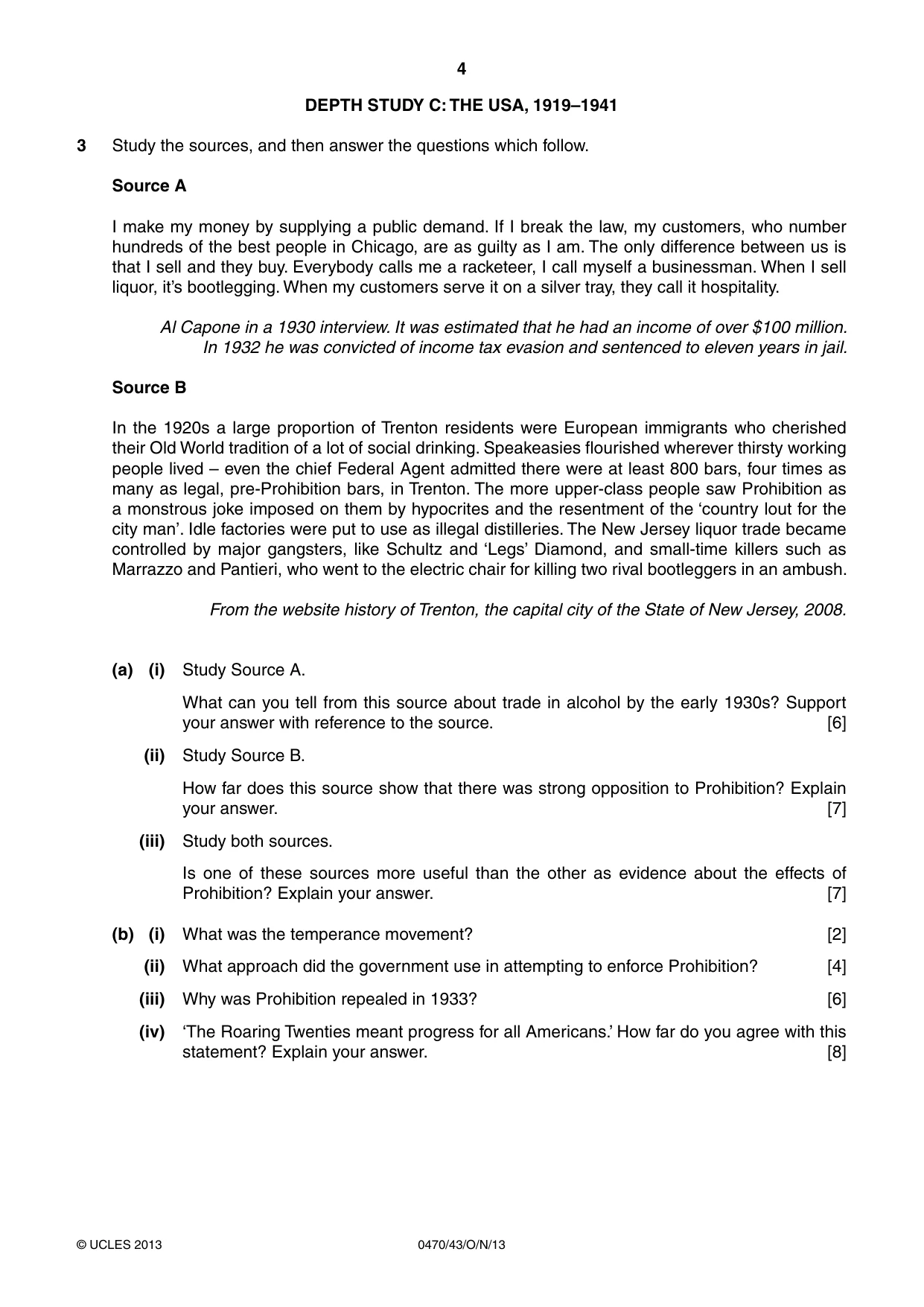
4 0470/43/O/N/13 © UCLES 2013 DEPTH STUDY C: THE USA, 1919–1941 3 Study the sources, and then answer the questions which follow. Source A I make my money by supplying a public demand. If I break the law, my customers, who number hundreds of the best people in Chicago, are as guilty as I am. The only difference between us is that I sell and they buy. Everybody calls me a racketeer, I call myself a businessman. When I sell liquor, it’s bootlegging. When my customers serve it on a silver tray, they call it hospitality. Al Capone in a 1930 interview. It was estimated that he had an income of over $100 million. In 1932 he was convicted of income tax evasion and sentenced to eleven years in jail. Source B In the 1920s a large proportion of Trenton residents were European immigrants who cherished their Old World tradition of a lot of social drinking. Speakeasies flourished wherever thirsty working people lived – even the chief Federal Agent admitted there were at least 800 bars, four times as many as legal, pre-Prohibition bars, in Trenton. The more upper-class people saw Prohibition as a monstrous joke imposed on them by hypocrites and the resentment of the ‘country lout for the city man’. Idle factories were put to use as illegal distilleries. The New Jersey liquor trade became controlled by major gangsters, like Schultz and ‘Legs’ Diamond, and small-time killers such as Marrazzo and Pantieri, who went to the electric chair for killing two rival bootleggers in an ambush. From the website history of Trenton, the capital city of the State of New Jersey, 2008. (a) (i) Study Source A. What can you tell from this source about trade in alcohol by the early 1930s? Support your answer with reference to the source. [6] (ii) Study Source B. How far does this source show that there was strong opposition to Prohibition? Explain your answer. [7] (iii) Study both sources. Is one of these sources more useful than the other as evidence about the effects of Prohibition? Explain your answer. [7] (b) (i) What was the temperance movement? [2] (ii) What approach did the government use in attempting to enforce Prohibition? [4] (iii) Why was Prohibition repealed in 1933? [6] (iv) ‘The Roaring Twenties meant progress for all Americans.’ How far do you agree with this statement? Explain your answer. [8]
Question paper, page 5
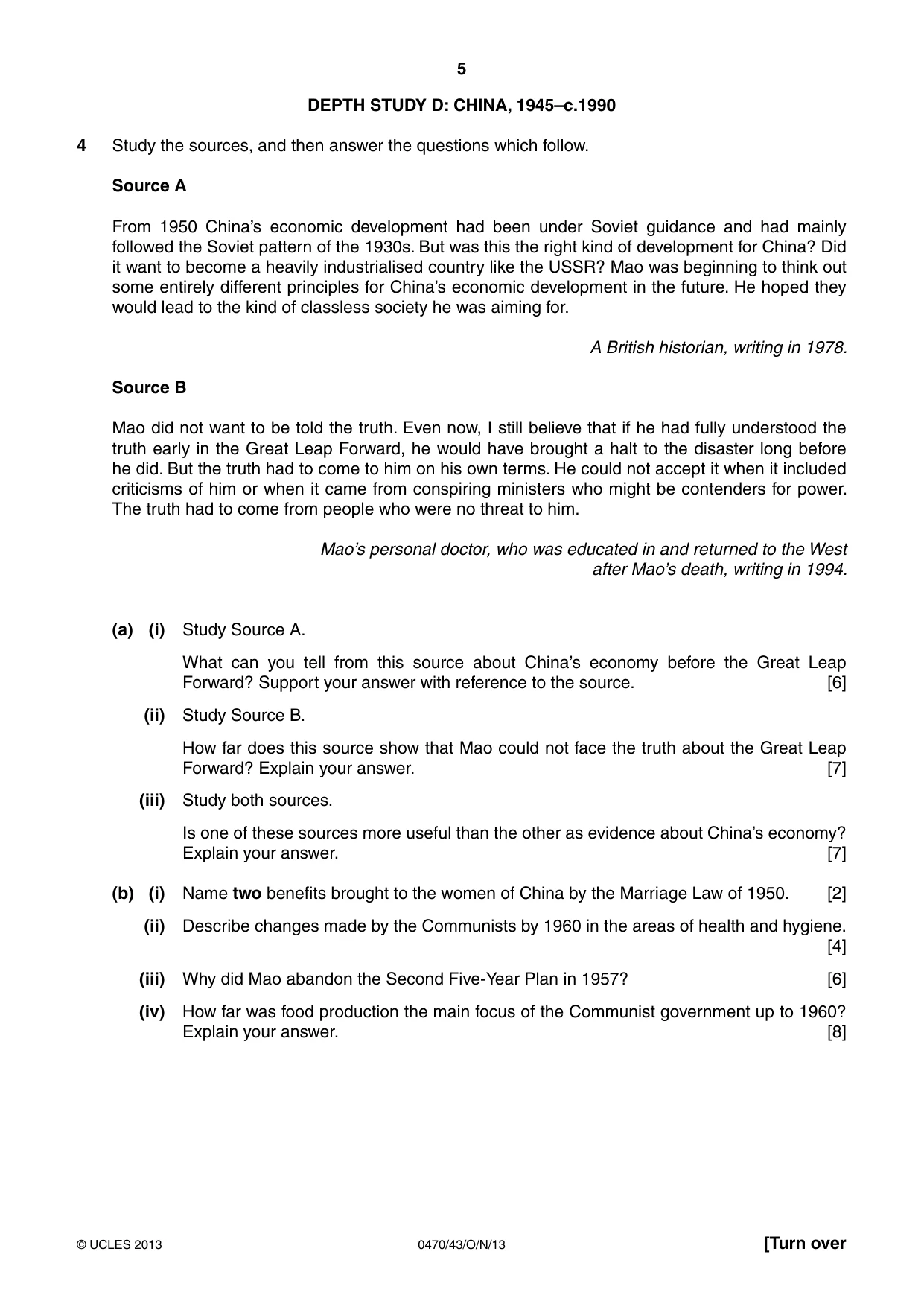
5 0470/43/O/N/13 © UCLES 2013 [Turn over DEPTH STUDY D: CHINA, 1945–c.1990 4 Study the sources, and then answer the questions which follow. Source A From 1950 China’s economic development had been under Soviet guidance and had mainly followed the Soviet pattern of the 1930s. But was this the right kind of development for China? Did it want to become a heavily industrialised country like the USSR? Mao was beginning to think out some entirely different principles for China’s economic development in the future. He hoped they would lead to the kind of classless society he was aiming for. A British historian, writing in 1978. Source B Mao did not want to be told the truth. Even now, I still believe that if he had fully understood the truth early in the Great Leap Forward, he would have brought a halt to the disaster long before he did. But the truth had to come to him on his own terms. He could not accept it when it included criticisms of him or when it came from conspiring ministers who might be contenders for power. The truth had to come from people who were no threat to him. Mao’s personal doctor, who was educated in and returned to the West after Mao’s death, writing in 1994. (a) (i) Study Source A. What can you tell from this source about China’s economy before the Great Leap Forward? Support your answer with reference to the source. [6] (ii) Study Source B. How far does this source show that Mao could not face the truth about the Great Leap Forward? Explain your answer. [7] (iii) Study both sources. Is one of these sources more useful than the other as evidence about China’s economy? Explain your answer. [7] (b) (i) Name two benefits brought to the women of China by the Marriage Law of 1950. [2] (ii) Describe changes made by the Communists by 1960 in the areas of health and hygiene. [4] (iii) Why did Mao abandon the Second Five-Year Plan in 1957? [6] (iv) How far was food production the main focus of the Communist government up to 1960? Explain your answer. [8]
Question paper, page 6
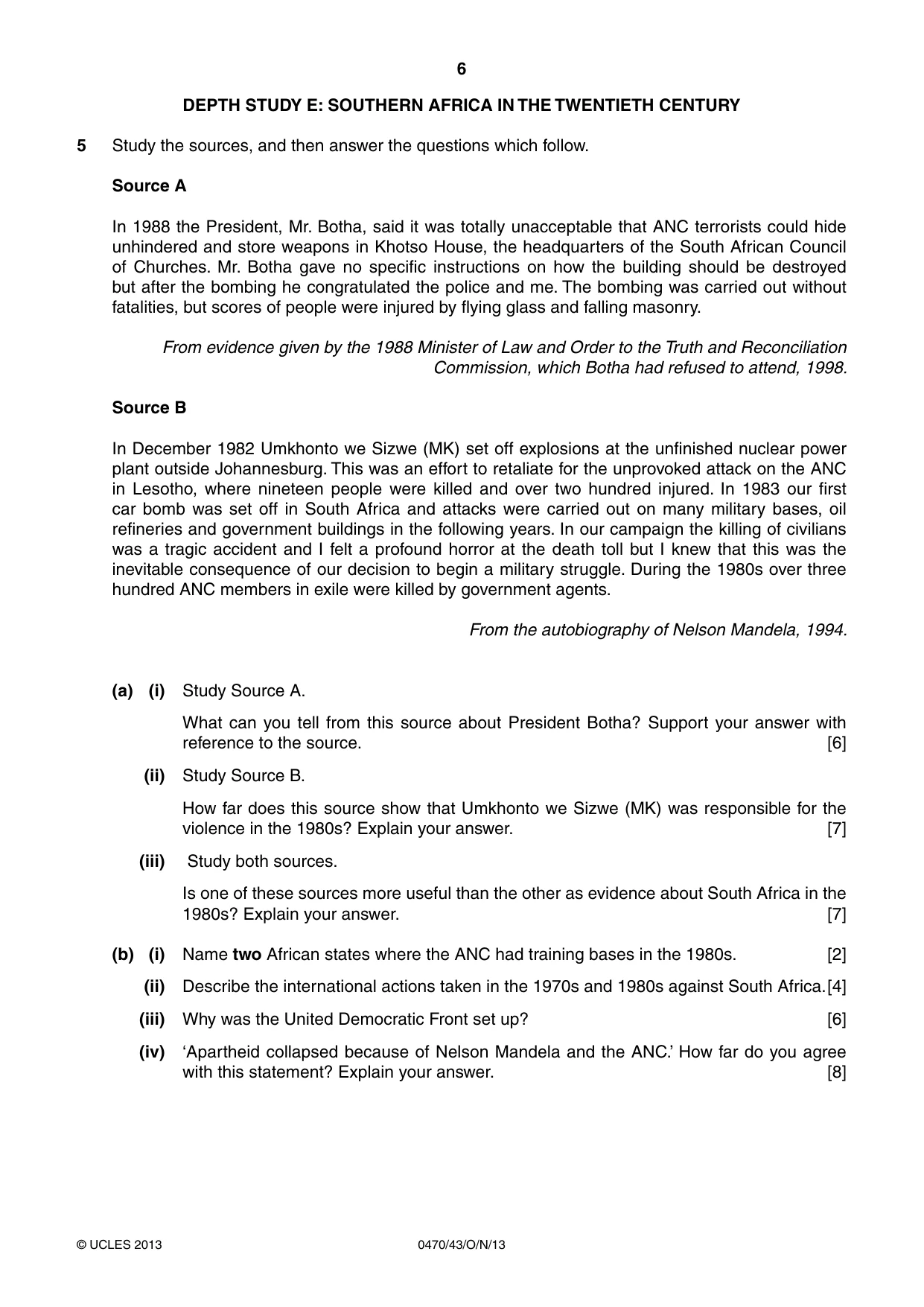
6 0470/43/O/N/13 © UCLES 2013 DEPTH STUDY E: SOUTHERN AFRICA IN THE TWENTIETH CENTURY 5 Study the sources, and then answer the questions which follow. Source A In 1988 the President, Mr. Botha, said it was totally unacceptable that ANC terrorists could hide unhindered and store weapons in Khotso House, the headquarters of the South African Council of Churches. Mr. Botha gave no specific instructions on how the building should be destroyed but after the bombing he congratulated the police and me. The bombing was carried out without fatalities, but scores of people were injured by flying glass and falling masonry. From evidence given by the 1988 Minister of Law and Order to the Truth and Reconciliation Commission, which Botha had refused to attend, 1998. Source B In December 1982 Umkhonto we Sizwe (MK) set off explosions at the unfinished nuclear power plant outside Johannesburg. This was an effort to retaliate for the unprovoked attack on the ANC in Lesotho, where nineteen people were killed and over two hundred injured. In 1983 our first car bomb was set off in South Africa and attacks were carried out on many military bases, oil refineries and government buildings in the following years. In our campaign the killing of civilians was a tragic accident and I felt a profound horror at the death toll but I knew that this was the inevitable consequence of our decision to begin a military struggle. During the 1980s over three hundred ANC members in exile were killed by government agents. From the autobiography of Nelson Mandela, 1994. (a) (i) Study Source A. What can you tell from this source about President Botha? Support your answer with reference to the source. [6] (ii) Study Source B. How far does this source show that Umkhonto we Sizwe (MK) was responsible for the violence in the 1980s? Explain your answer. [7] (iii) Study both sources. Is one of these sources more useful than the other as evidence about South Africa in the 1980s? Explain your answer. [7] (b) (i) Name two African states where the ANC had training bases in the 1980s. [2] (ii) Describe the international actions taken in the 1970s and 1980s against South Africa. [4] (iii) Why was the United Democratic Front set up? [6] (iv) ‘Apartheid collapsed because of Nelson Mandela and the ANC.’ How far do you agree with this statement? Explain your answer. [8]
Question paper, page 7
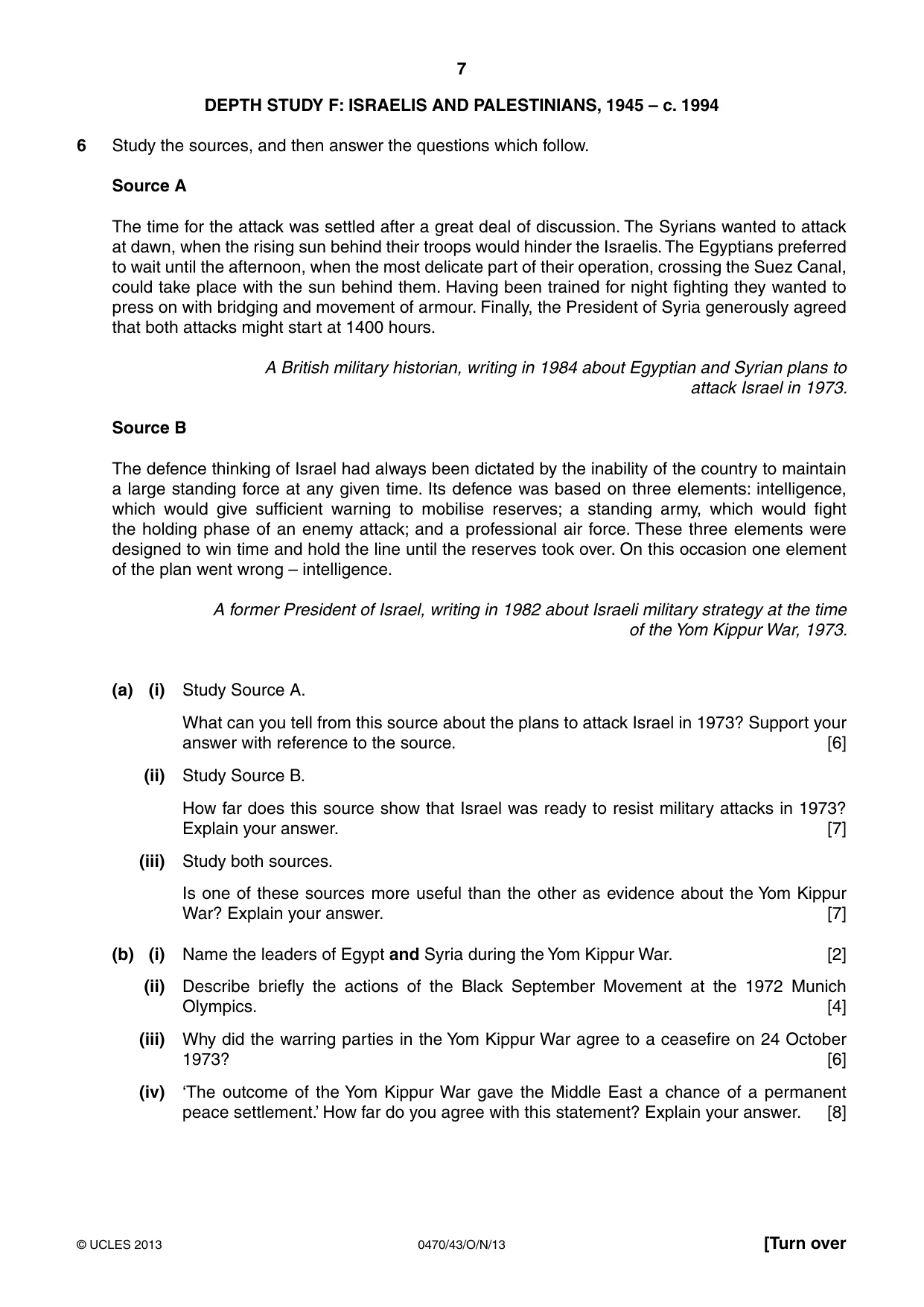
7 0470/43/O/N/13 © UCLES 2013 [Turn over DEPTH STUDY F: ISRAELIS AND PALESTINIANS, 1945 – c. 1994 6 Study the sources, and then answer the questions which follow. Source A The time for the attack was settled after a great deal of discussion. The Syrians wanted to attack at dawn, when the rising sun behind their troops would hinder the Israelis. The Egyptians preferred to wait until the afternoon, when the most delicate part of their operation, crossing the Suez Canal, could take place with the sun behind them. Having been trained for night fighting they wanted to press on with bridging and movement of armour. Finally, the President of Syria generously agreed that both attacks might start at 1400 hours. A British military historian, writing in 1984 about Egyptian and Syrian plans to attack Israel in 1973. Source B The defence thinking of Israel had always been dictated by the inability of the country to maintain a large standing force at any given time. Its defence was based on three elements: intelligence, which would give sufficient warning to mobilise reserves; a standing army, which would fight the holding phase of an enemy attack; and a professional air force. These three elements were designed to win time and hold the line until the reserves took over. On this occasion one element of the plan went wrong – intelligence. A former President of Israel, writing in 1982 about Israeli military strategy at the time of the Yom Kippur War, 1973. (a) (i) Study Source A. What can you tell from this source about the plans to attack Israel in 1973? Support your answer with reference to the source. [6] (ii) Study Source B. How far does this source show that Israel was ready to resist military attacks in 1973? Explain your answer. [7] (iii) Study both sources. Is one of these sources more useful than the other as evidence about the Yom Kippur War? Explain your answer. [7] (b) (i) Name the leaders of Egypt and Syria during the Yom Kippur War. [2] (ii) Describe briefly the actions of the Black September Movement at the 1972 Munich Olympics. [4] (iii) Why did the warring parties in the Yom Kippur War agree to a ceasefire on 24 October 1973? [6] (iv) ‘The outcome of the Yom Kippur War gave the Middle East a chance of a permanent peace settlement.’ How far do you agree with this statement? Explain your answer. [8]
Question paper, page 8
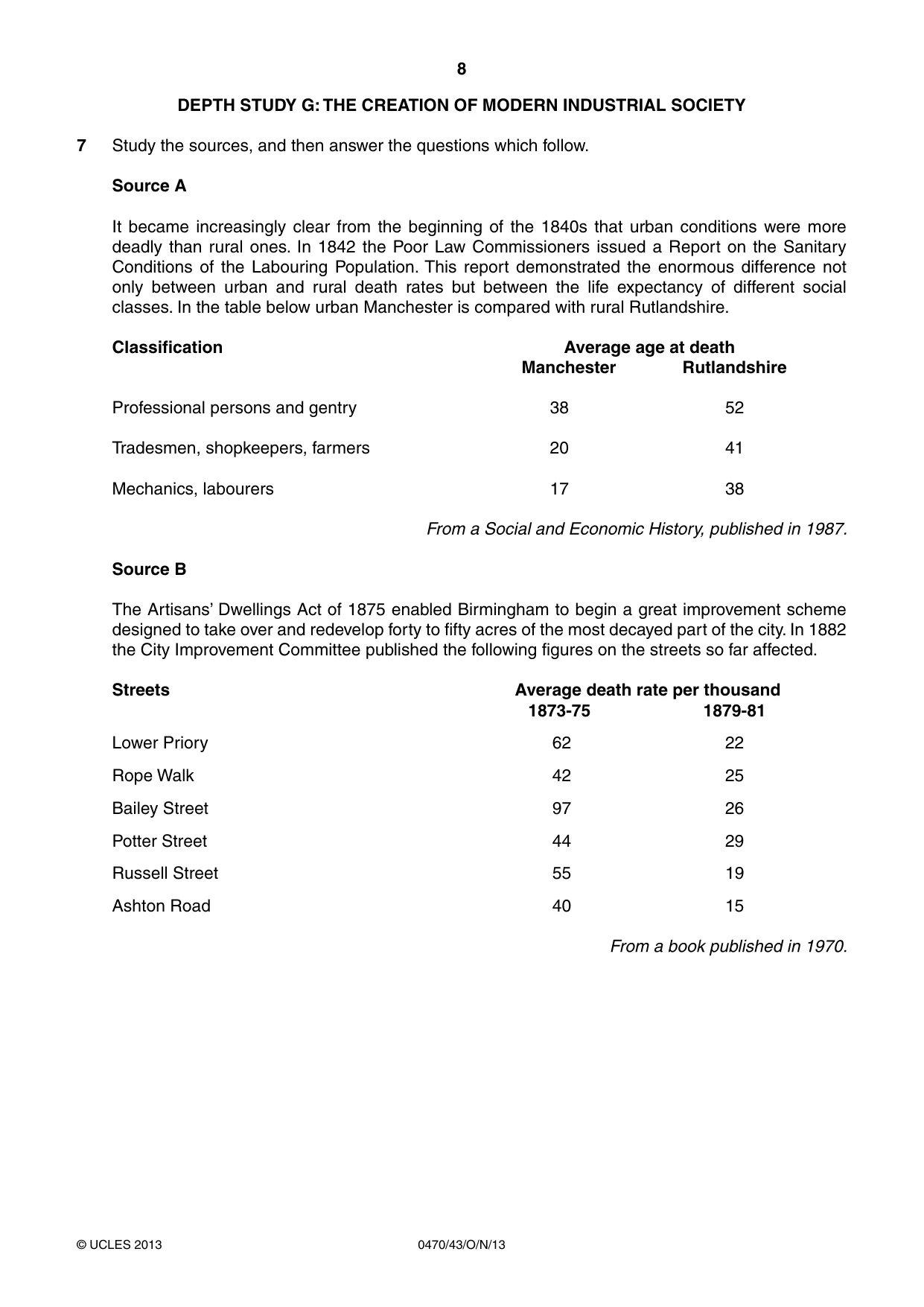
8 0470/43/O/N/13 © UCLES 2013 DEPTH STUDY G: THE CREATION OF MODERN INDUSTRIAL SOCIETY 7 Study the sources, and then answer the questions which follow. Source A It became increasingly clear from the beginning of the 1840s that urban conditions were more deadly than rural ones. In 1842 the Poor Law Commissioners issued a Report on the Sanitary Conditions of the Labouring Population. This report demonstrated the enormous difference not only between urban and rural death rates but between the life expectancy of different social classes. In the table below urban Manchester is compared with rural Rutlandshire. Classification Average age at death Manchester Rutlandshire Professional persons and gentry 38 52 Tradesmen, shopkeepers, farmers 20 41 Mechanics, labourers 17 38 From a Social and Economic History, published in 1987. Source B The Artisans’ Dwellings Act of 1875 enabled Birmingham to begin a great improvement scheme designed to take over and redevelop forty to fifty acres of the most decayed part of the city. In 1882 the City Improvement Committee published the following figures on the streets so far affected. Streets Average death rate per thousand 1873-75 1879-81 Lower Priory 62 22 Rope Walk 42 25 Bailey Street 97 26 Potter Street 44 29 Russell Street 55 19 Ashton Road 40 15 From a book published in 1970.
Question paper, page 9
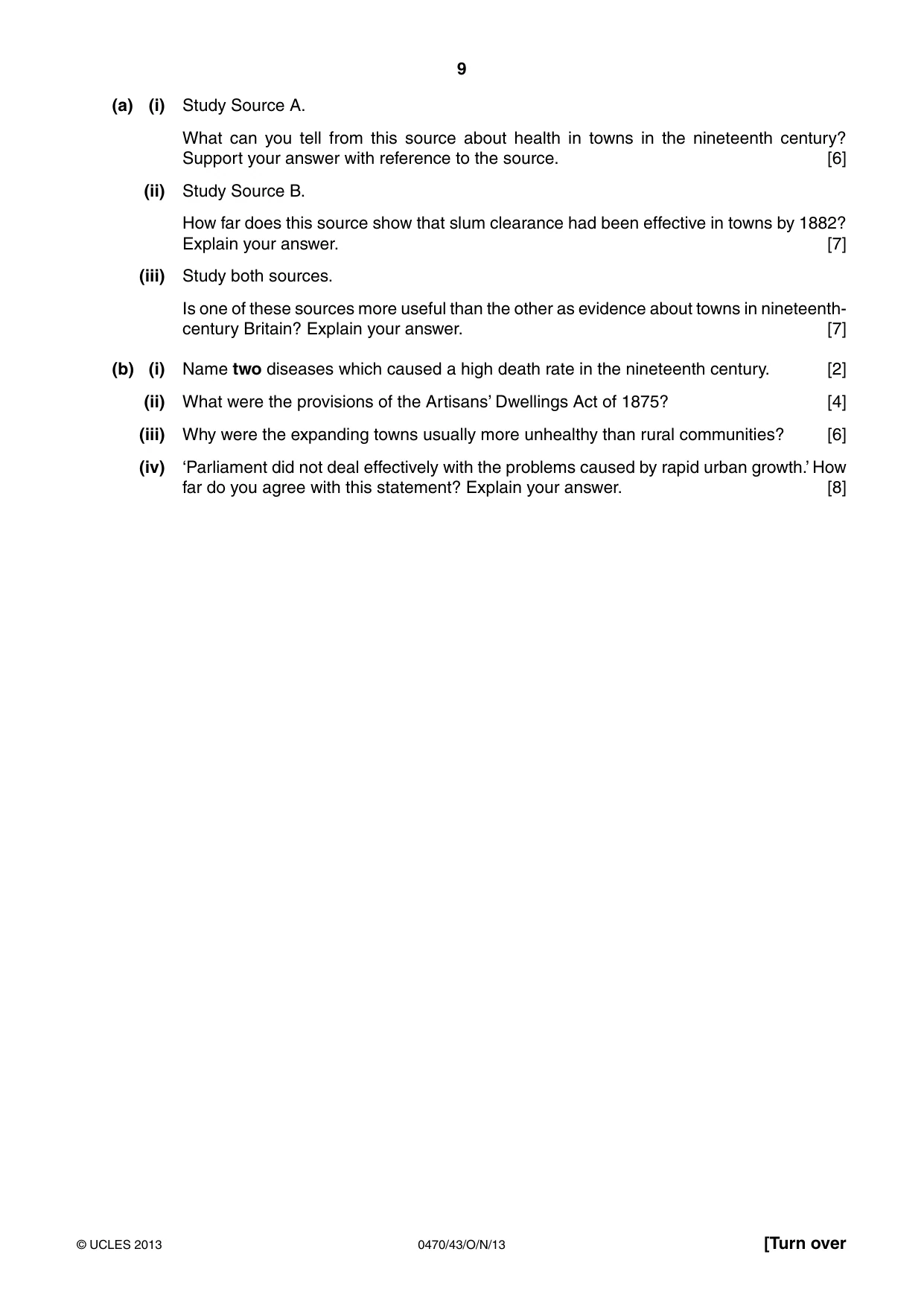
9 0470/43/O/N/13 © UCLES 2013 [Turn over (a) (i) Study Source A. What can you tell from this source about health in towns in the nineteenth century? Support your answer with reference to the source. [6] (ii) Study Source B. How far does this source show that slum clearance had been effective in towns by 1882? Explain your answer. [7] (iii) Study both sources. Is one of these sources more useful than the other as evidence about towns in nineteenth- century Britain? Explain your answer. [7] (b) (i) Name two diseases which caused a high death rate in the nineteenth century. [2] (ii) What were the provisions of the Artisans’ Dwellings Act of 1875? [4] (iii) Why were the expanding towns usually more unhealthy than rural communities? [6] (iv) ‘Parliament did not deal effectively with the problems caused by rapid urban growth.’ How far do you agree with this statement? Explain your answer. [8]
Question paper, page 10
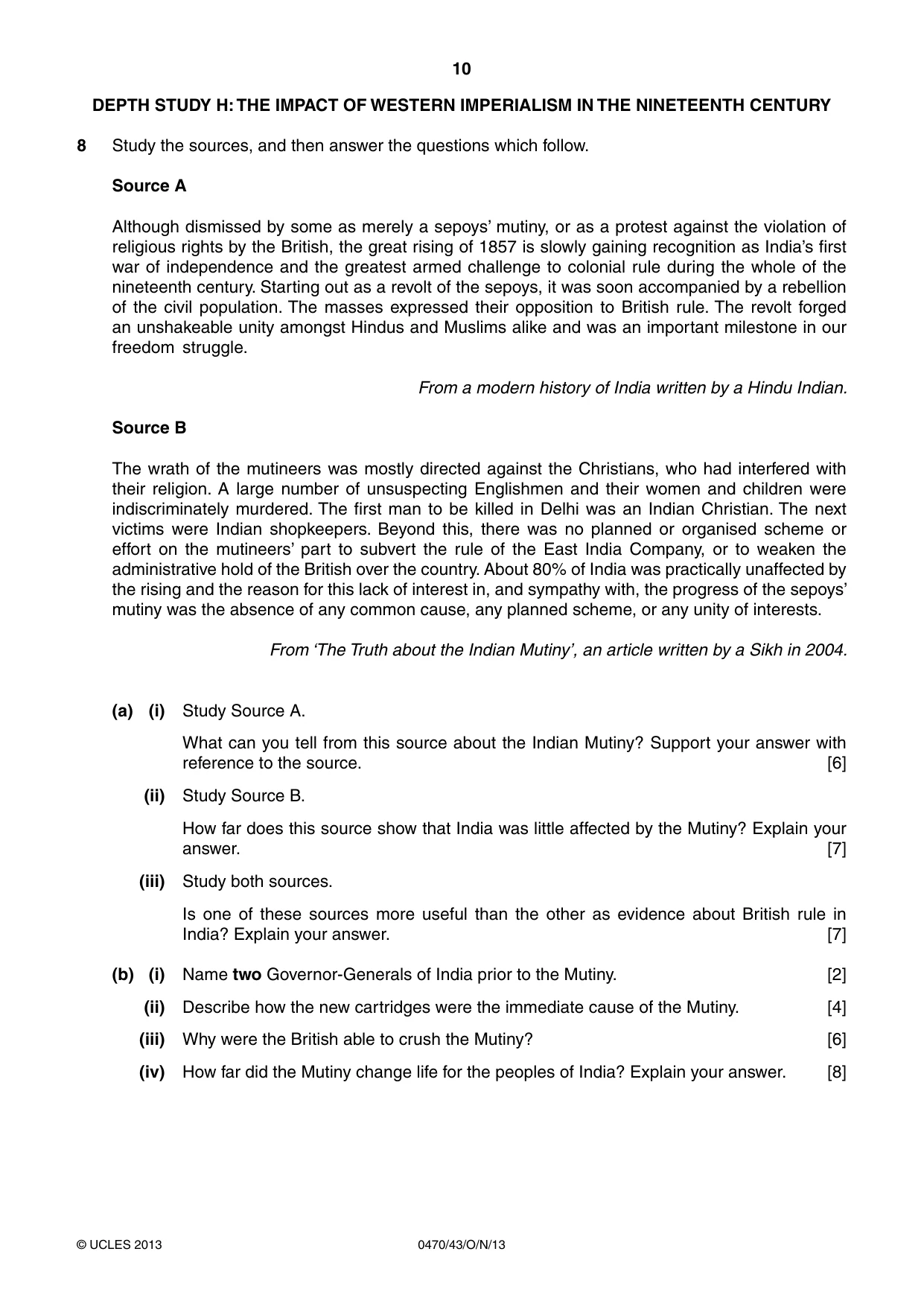
10 0470/43/O/N/13 © UCLES 2013 DEPTH STUDY H: THE IMPACT OF WESTERN IMPERIALISM IN THE NINETEENTH CENTURY 8 Study the sources, and then answer the questions which follow. Source A Although dismissed by some as merely a sepoys’ mutiny, or as a protest against the violation of religious rights by the British, the great rising of 1857 is slowly gaining recognition as India’s first war of independence and the greatest armed challenge to colonial rule during the whole of the nineteenth century. Starting out as a revolt of the sepoys, it was soon accompanied by a rebellion of the civil population. The masses expressed their opposition to British rule. The revolt forged an unshakeable unity amongst Hindus and Muslims alike and was an important milestone in our freedom struggle. From a modern history of India written by a Hindu Indian. Source B The wrath of the mutineers was mostly directed against the Christians, who had interfered with their religion. A large number of unsuspecting Englishmen and their women and children were indiscriminately murdered. The first man to be killed in Delhi was an Indian Christian. The next victims were Indian shopkeepers. Beyond this, there was no planned or organised scheme or effort on the mutineers’ part to subvert the rule of the East India Company, or to weaken the administrative hold of the British over the country. About 80% of India was practically unaffected by the rising and the reason for this lack of interest in, and sympathy with, the progress of the sepoys’ mutiny was the absence of any common cause, any planned scheme, or any unity of interests. From ‘The Truth about the Indian Mutiny’, an article written by a Sikh in 2004. (a) (i) Study Source A. What can you tell from this source about the Indian Mutiny? Support your answer with reference to the source. [6] (ii) Study Source B. How far does this source show that India was little affected by the Mutiny? Explain your answer. [7] (iii) Study both sources. Is one of these sources more useful than the other as evidence about British rule in India? Explain your answer. [7] (b) (i) Name two Governor-Generals of India prior to the Mutiny. [2] (ii) Describe how the new cartridges were the immediate cause of the Mutiny. [4] (iii) Why were the British able to crush the Mutiny? [6] (iv) How far did the Mutiny change life for the peoples of India? Explain your answer. [8]
Question paper, page 11
11 0470/43/O/N/13 © UCLES 2013 BLANK PAGE
Question paper, page 12
12 0470/43/O/N/13 © UCLES 2013 Copyright Acknowledgements: Depth Study A Source A © A White; The Weimar Republic; Published by Collins Educational; Reprinted by permission of HarperCollins Publishers; 1997. Depth Study B Source A © A Applebaum; Gulag, A History; Penguin Books Ltd; 2003. Depth Study B Source B © P Ingram; Russia 1905-1991; Cambridge University Press; 1997. Depth Study C Source A © Al Capone in a 1930 interview. Depth Study C Source B © From the website history of Trenton, the capital city of the State of New Jersey, 2008; www.capitalcentury.com/1926.html. Depth Study D Source A © H Ward; World Powers in the Twentieth Century; Heinemann Educational; 1978. Depth Study D Source B © From The Private Life of Chairman Mao by Li Zhisui, published by Chatto & Windus. Reprinted by permission of The Random House Group Ltd; 1996. Depth Study E Source A © Evidence given by the 1988 Minister of Law and Order to the Truth and Reconciliation Commission which Mr Botha had refused to attend, 1998. Depth Study E Source B © amended: N Mandela; Long Walk to Freedom; Little, Brown & Co; 1994. Depth Study F Source A © J N Westwood; The History of the Middle East; Bison Books Ltd; 1984. Depth Study F Source B © Chaim Herzog; The Arab-Israeli Wars; Greenhill Books; 1982. Depth Study G Source A © T May; An Economic & Social History of Britain 1760-1970; Longman; 1987. Depth Study G Source B © K Dawson & P Wall; Public Health & Housing; Oxford University Press; 1970. Depth Study H Source A © www.ind.history.com. Depth Study H Source B © The Truth About The Indian Mutiny; Sikh Spectrum.com; 2004. Permission to reproduce items where third-party owned material protected by copyright is included has been sought and cleared where possible. Every reasonable effort has been made by the publisher (UCLES) to trace copyright holders, but if any items requiring clearance have unwittingly been included, the publisher will be pleased to make amends at the earliest possible opportunity. University of Cambridge International Examinations is part of the Cambridge Assessment Group. Cambridge Assessment is the brand name of University of Cambridge Local Examinations Syndicate (UCLES), which is itself a department of the University of Cambridge. BLANK PAGE
Mark scheme, page 1
CAMBRIDGE INTERNATIONAL EXAMINATIONS International General Certificate of Secondary Education MARK SCHEME for the October/November 2013 series 0470 HISTORY 0470/43 Paper 4 (Alternative to Coursework), maximum raw mark 40 This mark scheme is published as an aid to teachers and candidates, to indicate the requirements of the examination. It shows the basis on which Examiners were instructed to award marks. It does not indicate the details of the discussions that took place at an Examiners’ meeting before marking began, which would have considered the acceptability of alternative answers. Mark schemes should be read in conjunction with the question paper and the Principal Examiner Report for Teachers. Cambridge will not enter into discussions about these mark schemes. Cambridge is publishing the mark schemes for the October/November 2013 series for most IGCSE, GCE Advanced Level and Advanced Subsidiary Level components and some Ordinary Level components.
Mark scheme, page 2
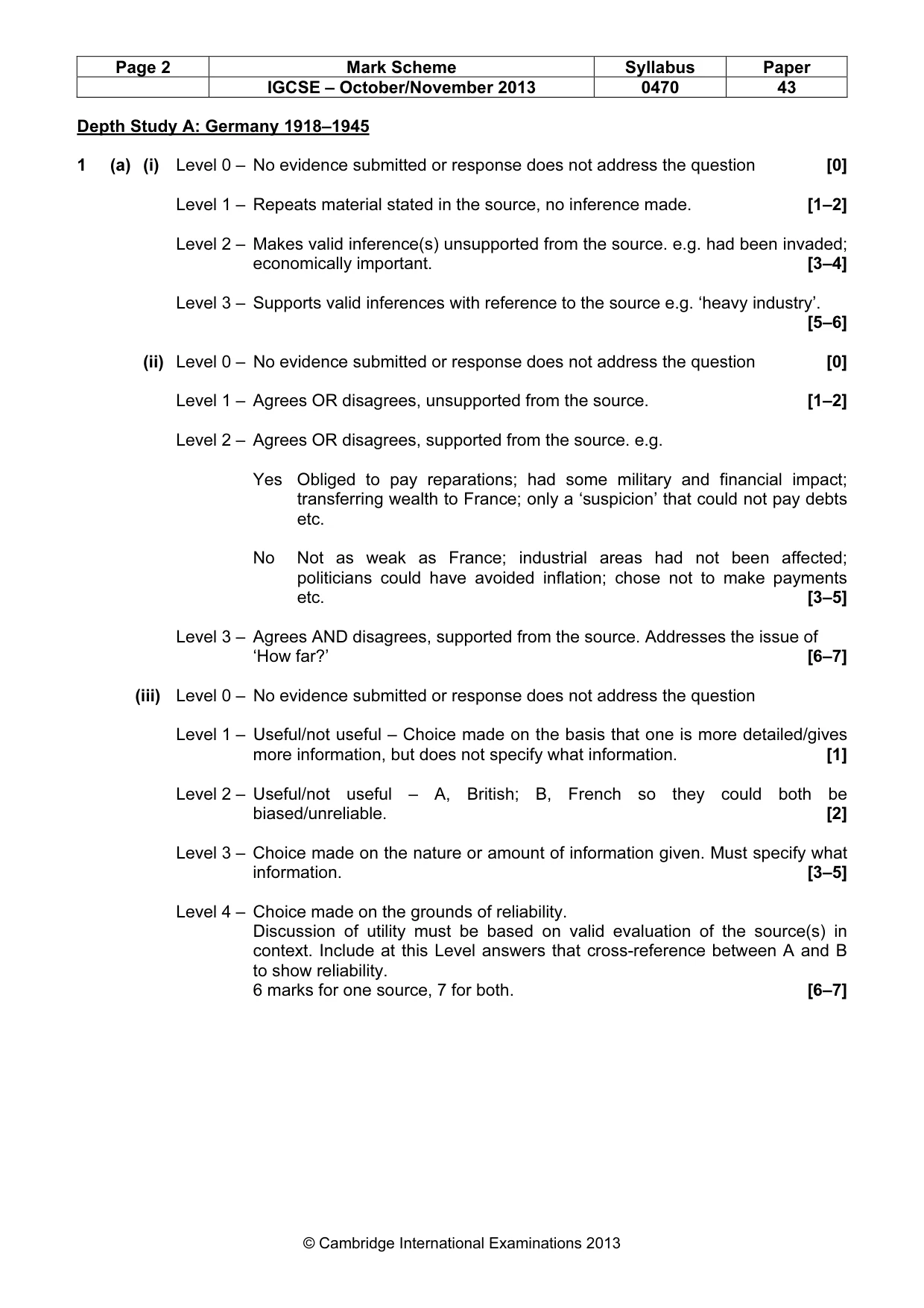
Page 2 Mark Scheme Syllabus Paper IGCSE – October/November 2013 0470 43 © Cambridge International Examinations 2013 Depth Study A: Germany 1918–1945 1 (a) (i) Level 0 – No evidence submitted or response does not address the question [0] Level 1 – Repeats material stated in the source, no inference made. [1–2] Level 2 – Makes valid inference(s) unsupported from the source. e.g. had been invaded; economically important. [3–4] Level 3 – Supports valid inferences with reference to the source e.g. ‘heavy industry’. [5–6] (ii) Level 0 – No evidence submitted or response does not address the question [0] Level 1 – Agrees OR disagrees, unsupported from the source. [1–2] Level 2 – Agrees OR disagrees, supported from the source. e.g. Yes Obliged to pay reparations; had some military and financial impact; transferring wealth to France; only a ‘suspicion’ that could not pay debts etc. No Not as weak as France; industrial areas had not been affected; politicians could have avoided inflation; chose not to make payments etc. [3–5] Level 3 – Agrees AND disagrees, supported from the source. Addresses the issue of ‘How far?’ [6–7] (iii) Level 0 – No evidence submitted or response does not address the question Level 1 – Useful/not useful – Choice made on the basis that one is more detailed/gives more information, but does not specify what information. [1] Level 2 – Useful/not useful – A, British; B, French so they could both be biased/unreliable. [2] Level 3 – Choice made on the nature or amount of information given. Must specify what information. [3–5] Level 4 – Choice made on the grounds of reliability. Discussion of utility must be based on valid evaluation of the source(s) in context. Include at this Level answers that cross-reference between A and B to show reliability. 6 marks for one source, 7 for both. [6–7]
Mark scheme, page 3
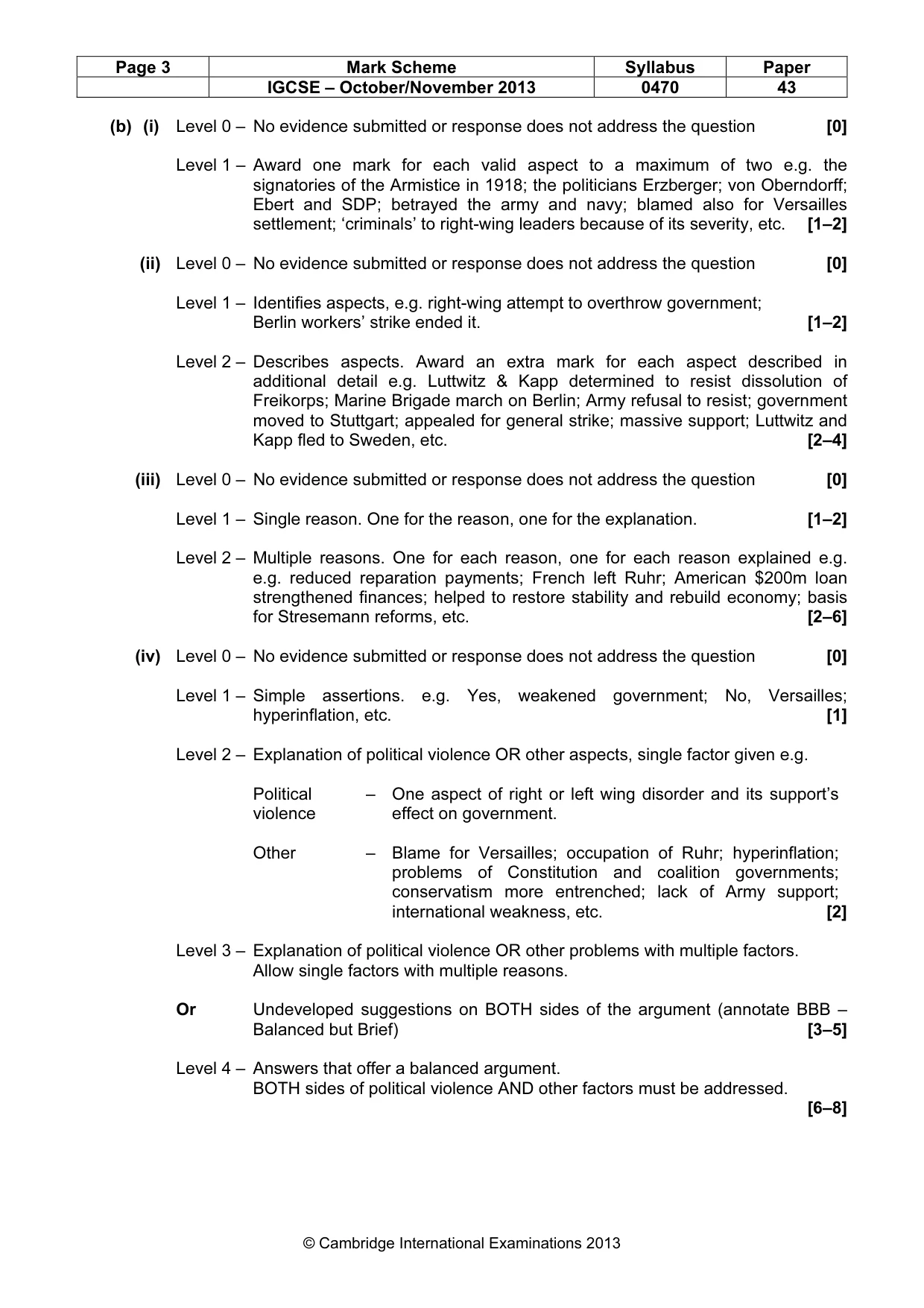
Page 3 Mark Scheme Syllabus Paper IGCSE – October/November 2013 0470 43 © Cambridge International Examinations 2013 (b) (i) Level 0 – No evidence submitted or response does not address the question [0] Level 1 – Award one mark for each valid aspect to a maximum of two e.g. the signatories of the Armistice in 1918; the politicians Erzberger; von Oberndorff; Ebert and SDP; betrayed the army and navy; blamed also for Versailles settlement; ‘criminals’ to right-wing leaders because of its severity, etc. [1–2] (ii) Level 0 – No evidence submitted or response does not address the question [0] Level 1 – Identifies aspects, e.g. right-wing attempt to overthrow government; Berlin workers’ strike ended it. [1–2] Level 2 – Describes aspects. Award an extra mark for each aspect described in additional detail e.g. Luttwitz & Kapp determined to resist dissolution of Freikorps; Marine Brigade march on Berlin; Army refusal to resist; government moved to Stuttgart; appealed for general strike; massive support; Luttwitz and Kapp fled to Sweden, etc. [2–4] (iii) Level 0 – No evidence submitted or response does not address the question [0] Level 1 – Single reason. One for the reason, one for the explanation. [1–2] Level 2 – Multiple reasons. One for each reason, one for each reason explained e.g. e.g. reduced reparation payments; French left Ruhr; American $200m loan strengthened finances; helped to restore stability and rebuild economy; basis for Stresemann reforms, etc. [2–6] (iv) Level 0 – No evidence submitted or response does not address the question [0] Level 1 – Simple assertions. e.g. Yes, weakened government; No, Versailles; hyperinflation, etc. [1] Level 2 – Explanation of political violence OR other aspects, single factor given e.g. Political violence – One aspect of right or left wing disorder and its support’s effect on government. Other – Blame for Versailles; occupation of Ruhr; hyperinflation; problems of Constitution and coalition governments; conservatism more entrenched; lack of Army support; international weakness, etc. [2] Level 3 – Explanation of political violence OR other problems with multiple factors. Allow single factors with multiple reasons. Or Undeveloped suggestions on BOTH sides of the argument (annotate BBB – Balanced but Brief) [3–5] Level 4 – Answers that offer a balanced argument. BOTH sides of political violence AND other factors must be addressed. [6–8]
Mark scheme, page 4
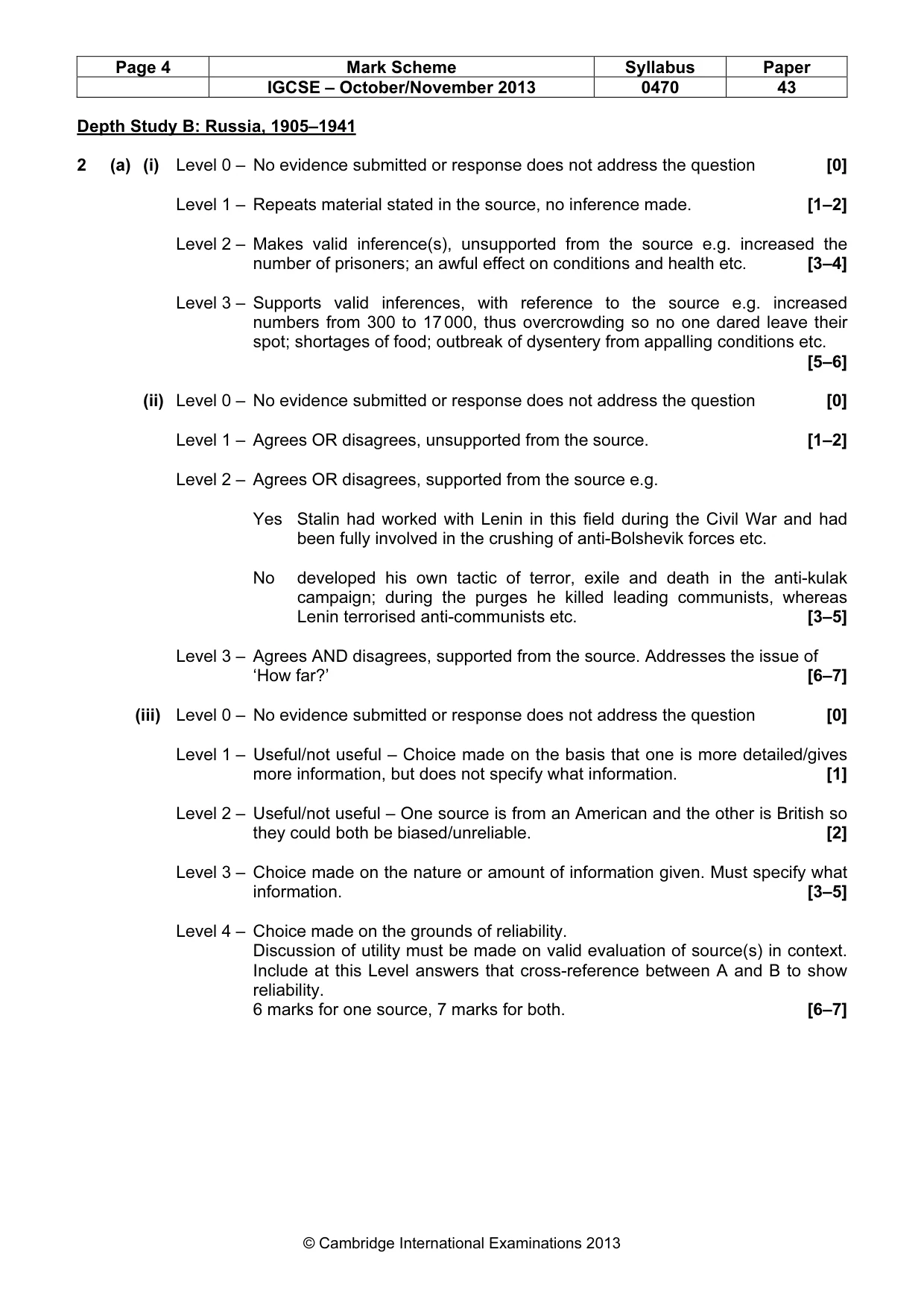
Page 4 Mark Scheme Syllabus Paper IGCSE – October/November 2013 0470 43 © Cambridge International Examinations 2013 Depth Study B: Russia, 1905–1941 2 (a) (i) Level 0 – No evidence submitted or response does not address the question [0] Level 1 – Repeats material stated in the source, no inference made. [1–2] Level 2 – Makes valid inference(s), unsupported from the source e.g. increased the number of prisoners; an awful effect on conditions and health etc. [3–4] Level 3 – Supports valid inferences, with reference to the source e.g. increased numbers from 300 to 17 000, thus overcrowding so no one dared leave their spot; shortages of food; outbreak of dysentery from appalling conditions etc. [5–6] (ii) Level 0 – No evidence submitted or response does not address the question [0] Level 1 – Agrees OR disagrees, unsupported from the source. [1–2] Level 2 – Agrees OR disagrees, supported from the source e.g. Yes Stalin had worked with Lenin in this field during the Civil War and had been fully involved in the crushing of anti-Bolshevik forces etc. No developed his own tactic of terror, exile and death in the anti-kulak campaign; during the purges he killed leading communists, whereas Lenin terrorised anti-communists etc. [3–5] Level 3 – Agrees AND disagrees, supported from the source. Addresses the issue of ‘How far?’ [6–7] (iii) Level 0 – No evidence submitted or response does not address the question [0] Level 1 – Useful/not useful – Choice made on the basis that one is more detailed/gives more information, but does not specify what information. [1] Level 2 – Useful/not useful – One source is from an American and the other is British so they could both be biased/unreliable. [2] Level 3 – Choice made on the nature or amount of information given. Must specify what information. [3–5] Level 4 – Choice made on the grounds of reliability. Discussion of utility must be made on valid evaluation of source(s) in context. Include at this Level answers that cross-reference between A and B to show reliability. 6 marks for one source, 7 marks for both. [6–7]
Mark scheme, page 5
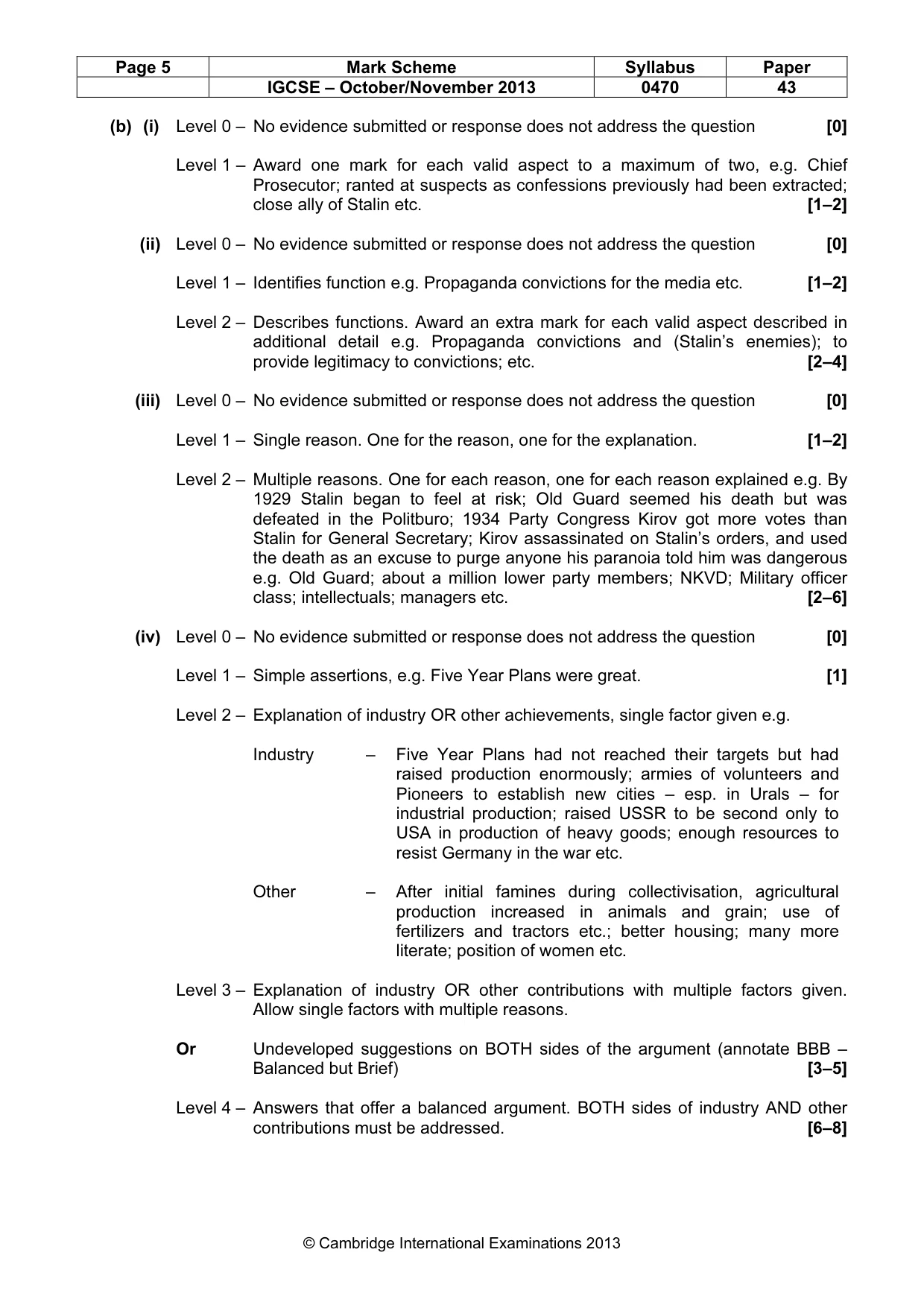
Page 5 Mark Scheme Syllabus Paper IGCSE – October/November 2013 0470 43 © Cambridge International Examinations 2013 (b) (i) Level 0 – No evidence submitted or response does not address the question [0] Level 1 – Award one mark for each valid aspect to a maximum of two, e.g. Chief Prosecutor; ranted at suspects as confessions previously had been extracted; close ally of Stalin etc. [1–2] (ii) Level 0 – No evidence submitted or response does not address the question [0] Level 1 – Identifies function e.g. Propaganda convictions for the media etc. [1–2] Level 2 – Describes functions. Award an extra mark for each valid aspect described in additional detail e.g. Propaganda convictions and (Stalin’s enemies); to provide legitimacy to convictions; etc. [2–4] (iii) Level 0 – No evidence submitted or response does not address the question [0] Level 1 – Single reason. One for the reason, one for the explanation. [1–2] Level 2 – Multiple reasons. One for each reason, one for each reason explained e.g. By 1929 Stalin began to feel at risk; Old Guard seemed his death but was defeated in the Politburo; 1934 Party Congress Kirov got more votes than Stalin for General Secretary; Kirov assassinated on Stalin’s orders, and used the death as an excuse to purge anyone his paranoia told him was dangerous e.g. Old Guard; about a million lower party members; NKVD; Military officer class; intellectuals; managers etc. [2–6] (iv) Level 0 – No evidence submitted or response does not address the question [0] Level 1 – Simple assertions, e.g. Five Year Plans were great. [1] Level 2 – Explanation of industry OR other achievements, single factor given e.g. Industry – Five Year Plans had not reached their targets but had raised production enormously; armies of volunteers and Pioneers to establish new cities – esp. in Urals – for industrial production; raised USSR to be second only to USA in production of heavy goods; enough resources to resist Germany in the war etc. Other – After initial famines during collectivisation, agricultural production increased in animals and grain; use of fertilizers and tractors etc.; better housing; many more literate; position of women etc. Level 3 – Explanation of industry OR other contributions with multiple factors given. Allow single factors with multiple reasons. Or Undeveloped suggestions on BOTH sides of the argument (annotate BBB – Balanced but Brief) [3–5] Level 4 – Answers that offer a balanced argument. BOTH sides of industry AND other contributions must be addressed. [6–8]
Mark scheme, page 6
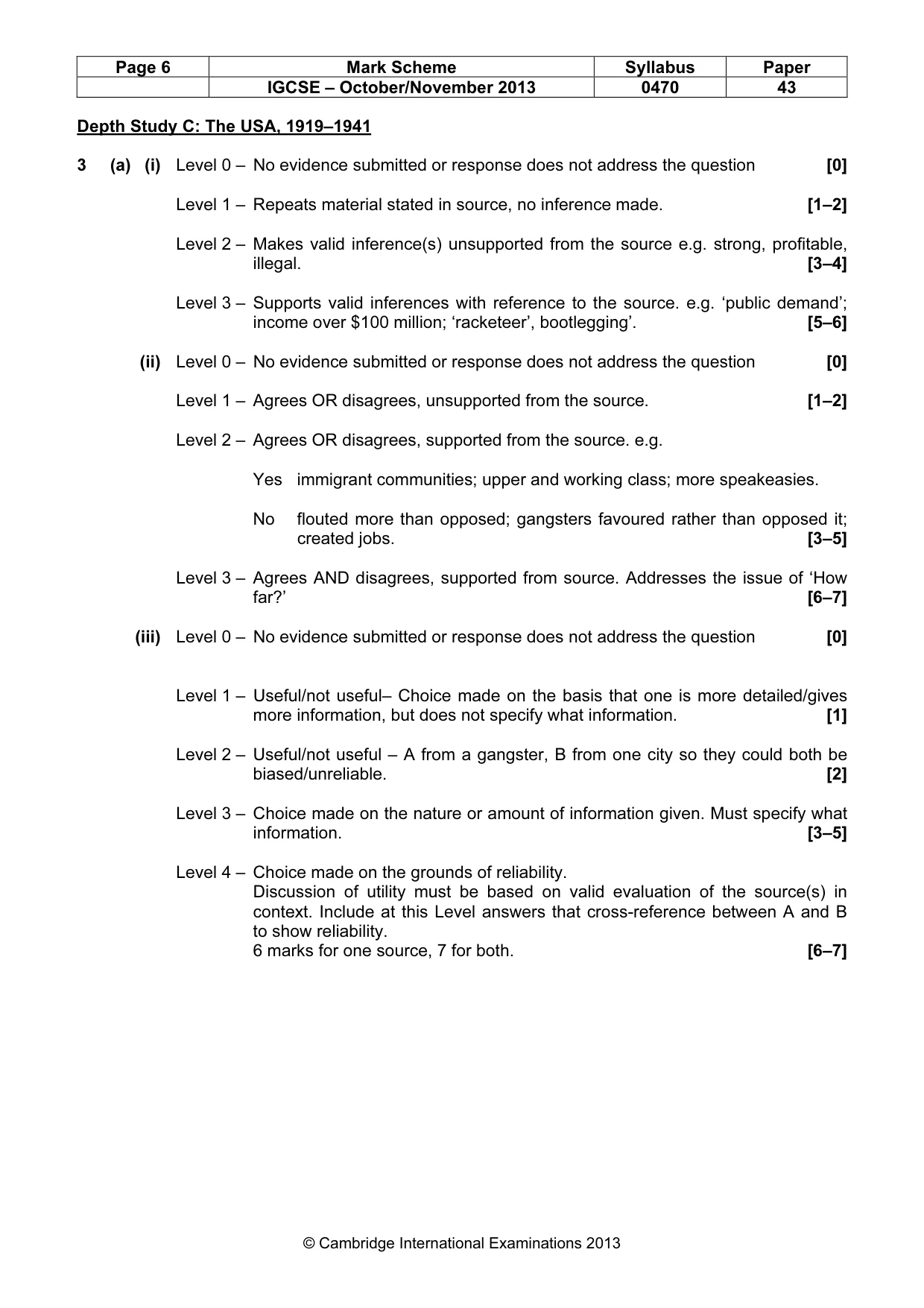
Page 6 Mark Scheme Syllabus Paper IGCSE – October/November 2013 0470 43 © Cambridge International Examinations 2013 Depth Study C: The USA, 1919–1941 3 (a) (i) Level 0 – No evidence submitted or response does not address the question [0] Level 1 – Repeats material stated in source, no inference made. [1–2] Level 2 – Makes valid inference(s) unsupported from the source e.g. strong, profitable, illegal. [3–4] Level 3 – Supports valid inferences with reference to the source. e.g. ‘public demand’; income over $100 million; ‘racketeer’, bootlegging’. [5–6] (ii) Level 0 – No evidence submitted or response does not address the question [0] Level 1 – Agrees OR disagrees, unsupported from the source. [1–2] Level 2 – Agrees OR disagrees, supported from the source. e.g. Yes immigrant communities; upper and working class; more speakeasies. No flouted more than opposed; gangsters favoured rather than opposed it; created jobs. [3–5] Level 3 – Agrees AND disagrees, supported from source. Addresses the issue of ‘How far?’ [6–7] (iii) Level 0 – No evidence submitted or response does not address the question [0] Level 1 – Useful/not useful– Choice made on the basis that one is more detailed/gives more information, but does not specify what information. [1] Level 2 – Useful/not useful – A from a gangster, B from one city so they could both be biased/unreliable. [2] Level 3 – Choice made on the nature or amount of information given. Must specify what information. [3–5] Level 4 – Choice made on the grounds of reliability. Discussion of utility must be based on valid evaluation of the source(s) in context. Include at this Level answers that cross-reference between A and B to show reliability. 6 marks for one source, 7 for both. [6–7]
Mark scheme, page 7
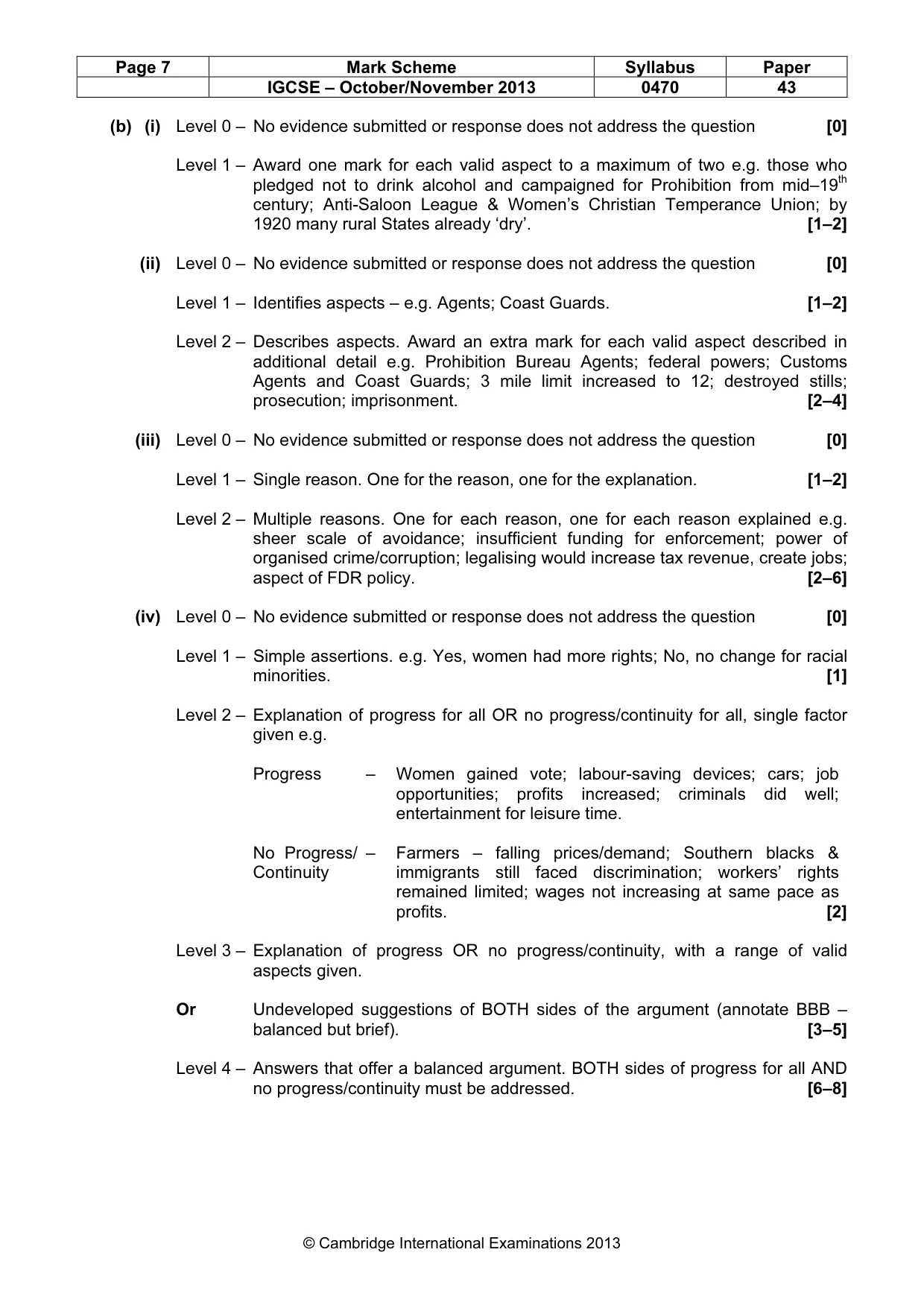
Page 7 Mark Scheme Syllabus Paper IGCSE – October/November 2013 0470 43 © Cambridge International Examinations 2013 (b) (i) Level 0 – No evidence submitted or response does not address the question [0] Level 1 – Award one mark for each valid aspect to a maximum of two e.g. those who pledged not to drink alcohol and campaigned for Prohibition from mid–19th century; Anti-Saloon League & Women’s Christian Temperance Union; by 1920 many rural States already ‘dry’. [1–2] (ii) Level 0 – No evidence submitted or response does not address the question [0] Level 1 – Identifies aspects – e.g. Agents; Coast Guards. [1–2] Level 2 – Describes aspects. Award an extra mark for each valid aspect described in additional detail e.g. Prohibition Bureau Agents; federal powers; Customs Agents and Coast Guards; 3 mile limit increased to 12; destroyed stills; prosecution; imprisonment. [2–4] (iii) Level 0 – No evidence submitted or response does not address the question [0] Level 1 – Single reason. One for the reason, one for the explanation. [1–2] Level 2 – Multiple reasons. One for each reason, one for each reason explained e.g. sheer scale of avoidance; insufficient funding for enforcement; power of organised crime/corruption; legalising would increase tax revenue, create jobs; aspect of FDR policy. [2–6] (iv) Level 0 – No evidence submitted or response does not address the question [0] Level 1 – Simple assertions. e.g. Yes, women had more rights; No, no change for racial minorities. [1] Level 2 – Explanation of progress for all OR no progress/continuity for all, single factor given e.g. Progress – Women gained vote; labour-saving devices; cars; job opportunities; profits increased; criminals did well; entertainment for leisure time. No Progress/ Continuity – Farmers – falling prices/demand; Southern blacks & immigrants still faced discrimination; workers’ rights remained limited; wages not increasing at same pace as profits. [2] Level 3 – Explanation of progress OR no progress/continuity, with a range of valid aspects given. Or Undeveloped suggestions of BOTH sides of the argument (annotate BBB – balanced but brief). [3–5] Level 4 – Answers that offer a balanced argument. BOTH sides of progress for all AND no progress/continuity must be addressed. [6–8]
Mark scheme, page 8
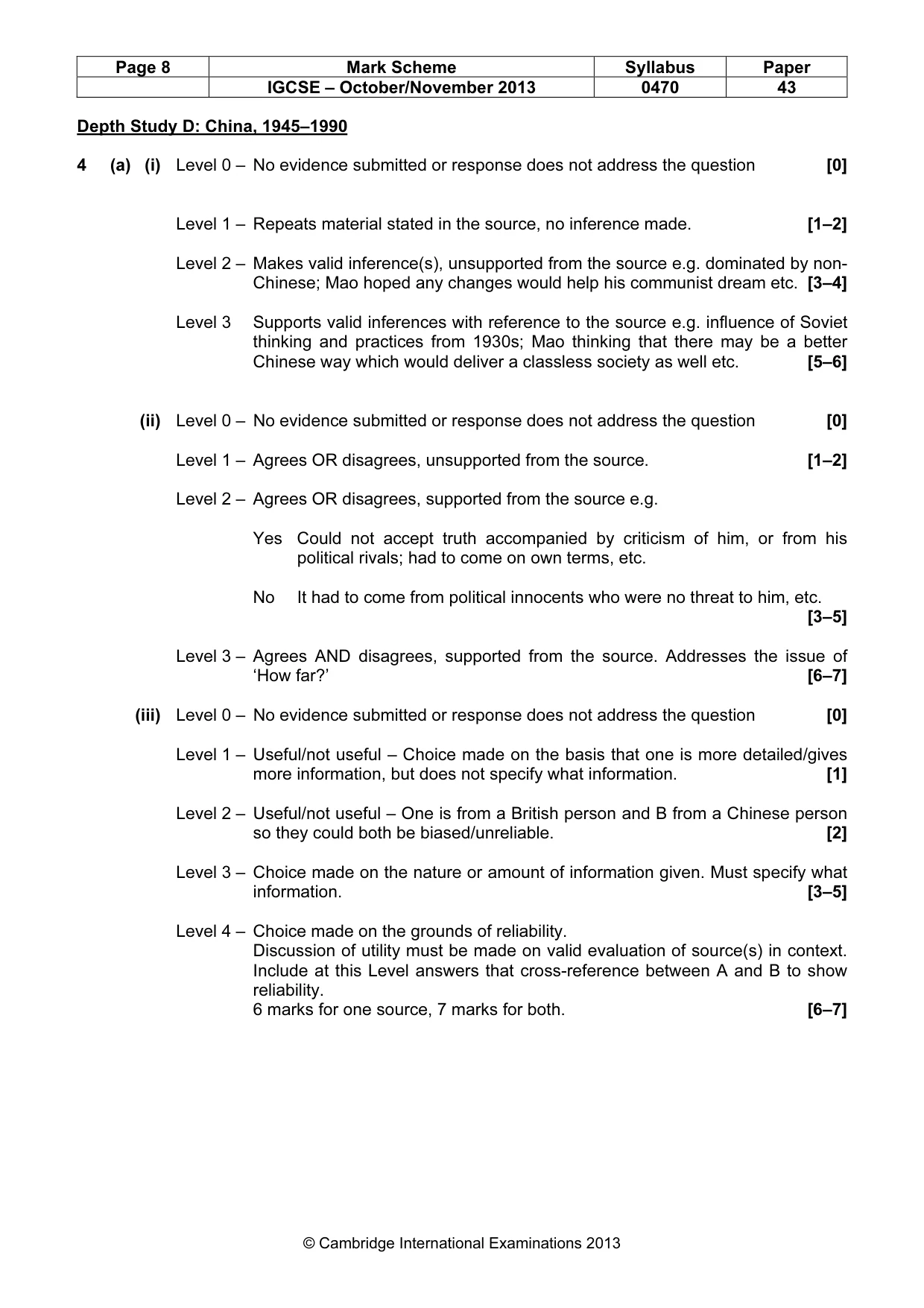
Page 8 Mark Scheme Syllabus Paper IGCSE – October/November 2013 0470 43 © Cambridge International Examinations 2013 Depth Study D: China, 1945–1990 4 (a) (i) Level 0 – No evidence submitted or response does not address the question [0] Level 1 – Repeats material stated in the source, no inference made. [1–2] Level 2 – Makes valid inference(s), unsupported from the source e.g. dominated by non- Chinese; Mao hoped any changes would help his communist dream etc. [3–4] Level 3 Supports valid inferences with reference to the source e.g. influence of Soviet thinking and practices from 1930s; Mao thinking that there may be a better Chinese way which would deliver a classless society as well etc. [5–6] (ii) Level 0 – No evidence submitted or response does not address the question [0] Level 1 – Agrees OR disagrees, unsupported from the source. [1–2] Level 2 – Agrees OR disagrees, supported from the source e.g. Yes Could not accept truth accompanied by criticism of him, or from his political rivals; had to come on own terms, etc. No It had to come from political innocents who were no threat to him, etc. [3–5] Level 3 – Agrees AND disagrees, supported from the source. Addresses the issue of ‘How far?’ [6–7] (iii) Level 0 – No evidence submitted or response does not address the question [0] Level 1 – Useful/not useful – Choice made on the basis that one is more detailed/gives more information, but does not specify what information. [1] Level 2 – Useful/not useful – One is from a British person and B from a Chinese person so they could both be biased/unreliable. [2] Level 3 – Choice made on the nature or amount of information given. Must specify what information. [3–5] Level 4 – Choice made on the grounds of reliability. Discussion of utility must be made on valid evaluation of source(s) in context. Include at this Level answers that cross-reference between A and B to show reliability. 6 marks for one source, 7 marks for both. [6–7]
Mark scheme, page 9
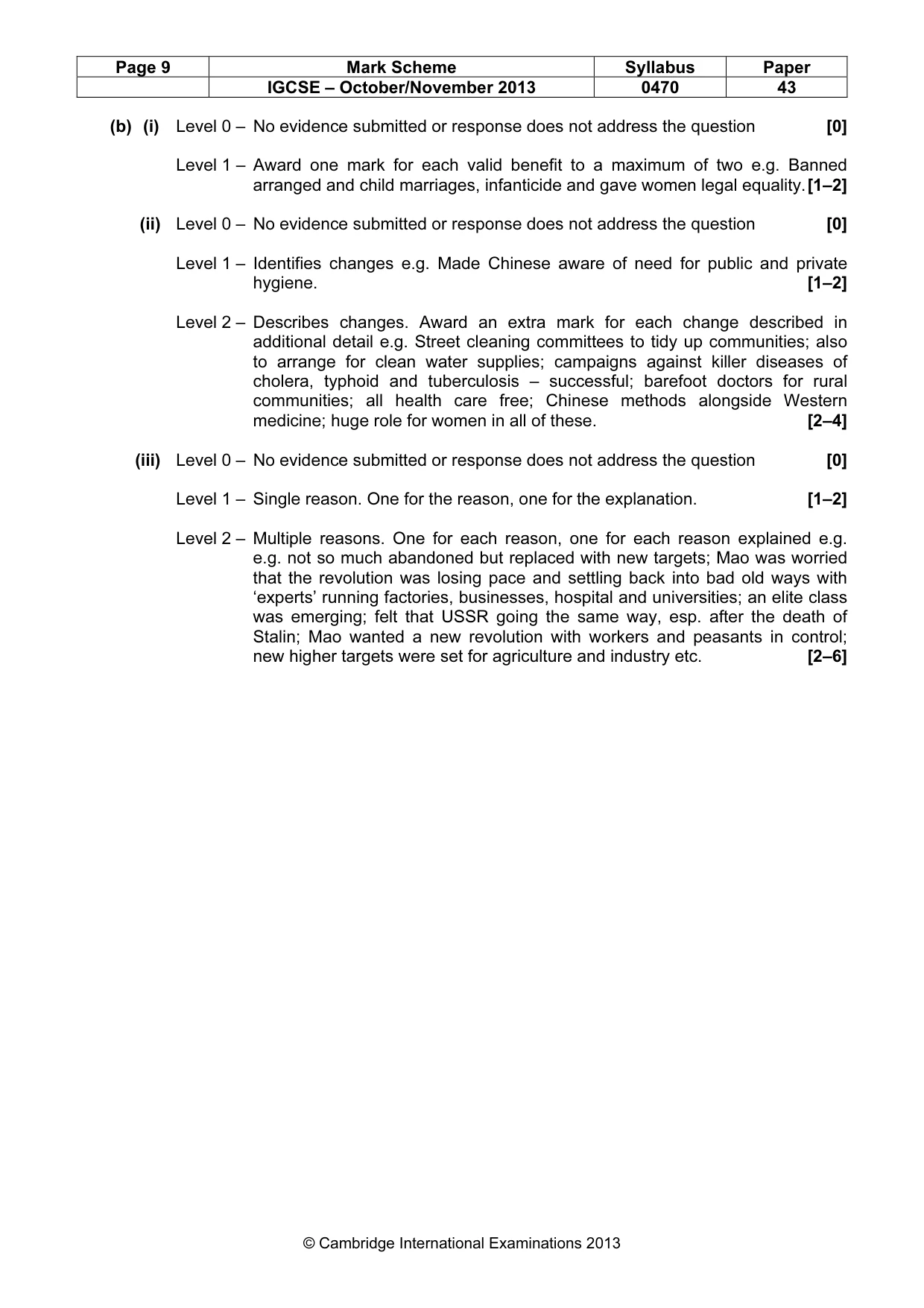
Page 9 Mark Scheme Syllabus Paper IGCSE – October/November 2013 0470 43 © Cambridge International Examinations 2013 (b) (i) Level 0 – No evidence submitted or response does not address the question [0] Level 1 – Award one mark for each valid benefit to a maximum of two e.g. Banned arranged and child marriages, infanticide and gave women legal equality. [1–2] (ii) Level 0 – No evidence submitted or response does not address the question [0] Level 1 – Identifies changes e.g. Made Chinese aware of need for public and private hygiene. [1–2] Level 2 – Describes changes. Award an extra mark for each change described in additional detail e.g. Street cleaning committees to tidy up communities; also to arrange for clean water supplies; campaigns against killer diseases of cholera, typhoid and tuberculosis – successful; barefoot doctors for rural communities; all health care free; Chinese methods alongside Western medicine; huge role for women in all of these. [2–4] (iii) Level 0 – No evidence submitted or response does not address the question [0] Level 1 – Single reason. One for the reason, one for the explanation. [1–2] Level 2 – Multiple reasons. One for each reason, one for each reason explained e.g. e.g. not so much abandoned but replaced with new targets; Mao was worried that the revolution was losing pace and settling back into bad old ways with ‘experts’ running factories, businesses, hospital and universities; an elite class was emerging; felt that USSR going the same way, esp. after the death of Stalin; Mao wanted a new revolution with workers and peasants in control; new higher targets were set for agriculture and industry etc. [2–6]
Mark scheme, page 10
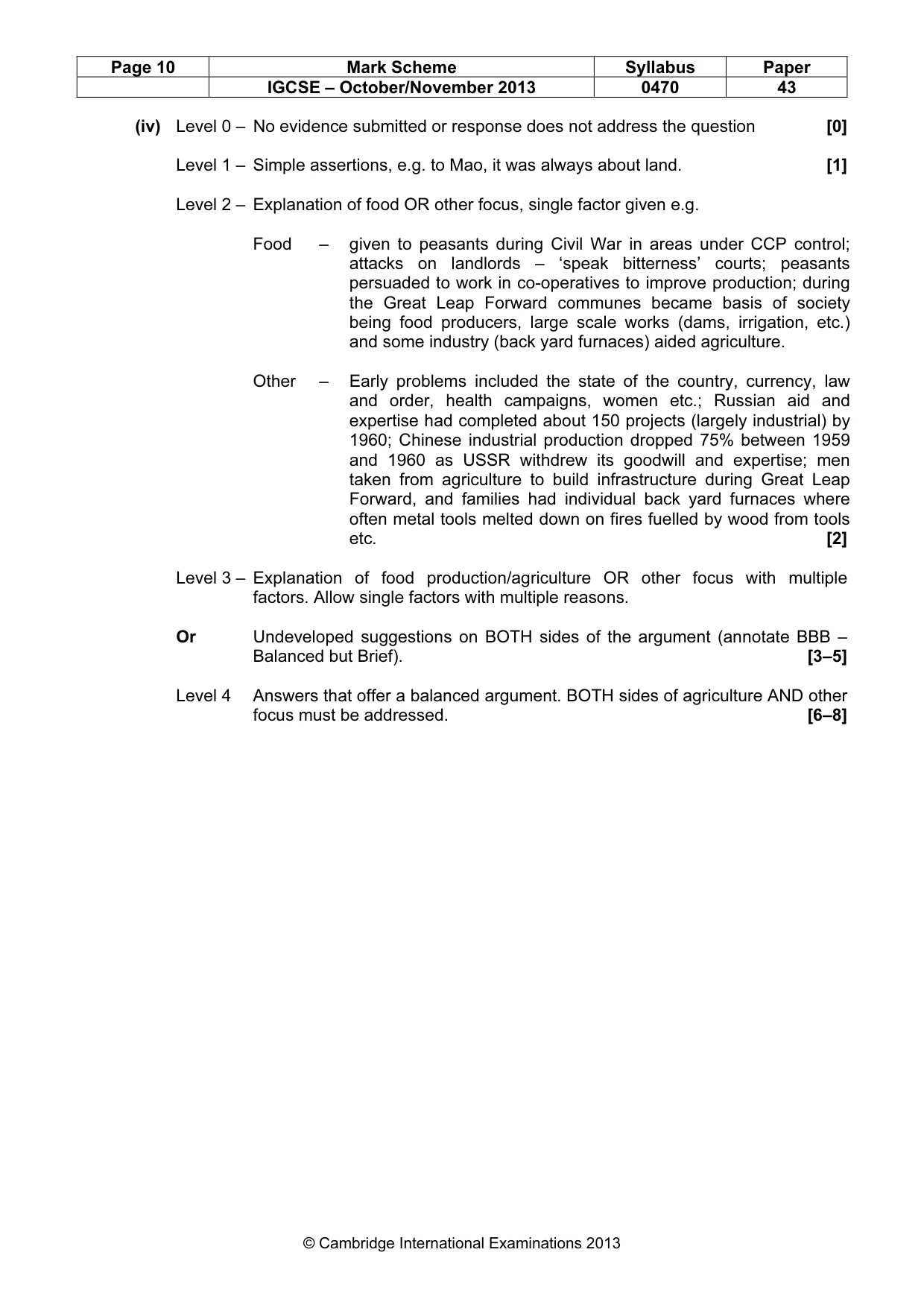
Page 10 Mark Scheme Syllabus Paper IGCSE – October/November 2013 0470 43 © Cambridge International Examinations 2013 (iv) Level 0 – No evidence submitted or response does not address the question [0] Level 1 – Simple assertions, e.g. to Mao, it was always about land. [1] Level 2 – Explanation of food OR other focus, single factor given e.g. Food – given to peasants during Civil War in areas under CCP control; attacks on landlords – ‘speak bitterness’ courts; peasants persuaded to work in co-operatives to improve production; during the Great Leap Forward communes became basis of society being food producers, large scale works (dams, irrigation, etc.) and some industry (back yard furnaces) aided agriculture. Other – Early problems included the state of the country, currency, law and order, health campaigns, women etc.; Russian aid and expertise had completed about 150 projects (largely industrial) by 1960; Chinese industrial production dropped 75% between 1959 and 1960 as USSR withdrew its goodwill and expertise; men taken from agriculture to build infrastructure during Great Leap Forward, and families had individual back yard furnaces where often metal tools melted down on fires fuelled by wood from tools etc. [2] Level 3 – Explanation of food production/agriculture OR other focus with multiple factors. Allow single factors with multiple reasons. Or Undeveloped suggestions on BOTH sides of the argument (annotate BBB – Balanced but Brief). [3–5] Level 4 Answers that offer a balanced argument. BOTH sides of agriculture AND other focus must be addressed. [6–8]
Mark scheme, page 11
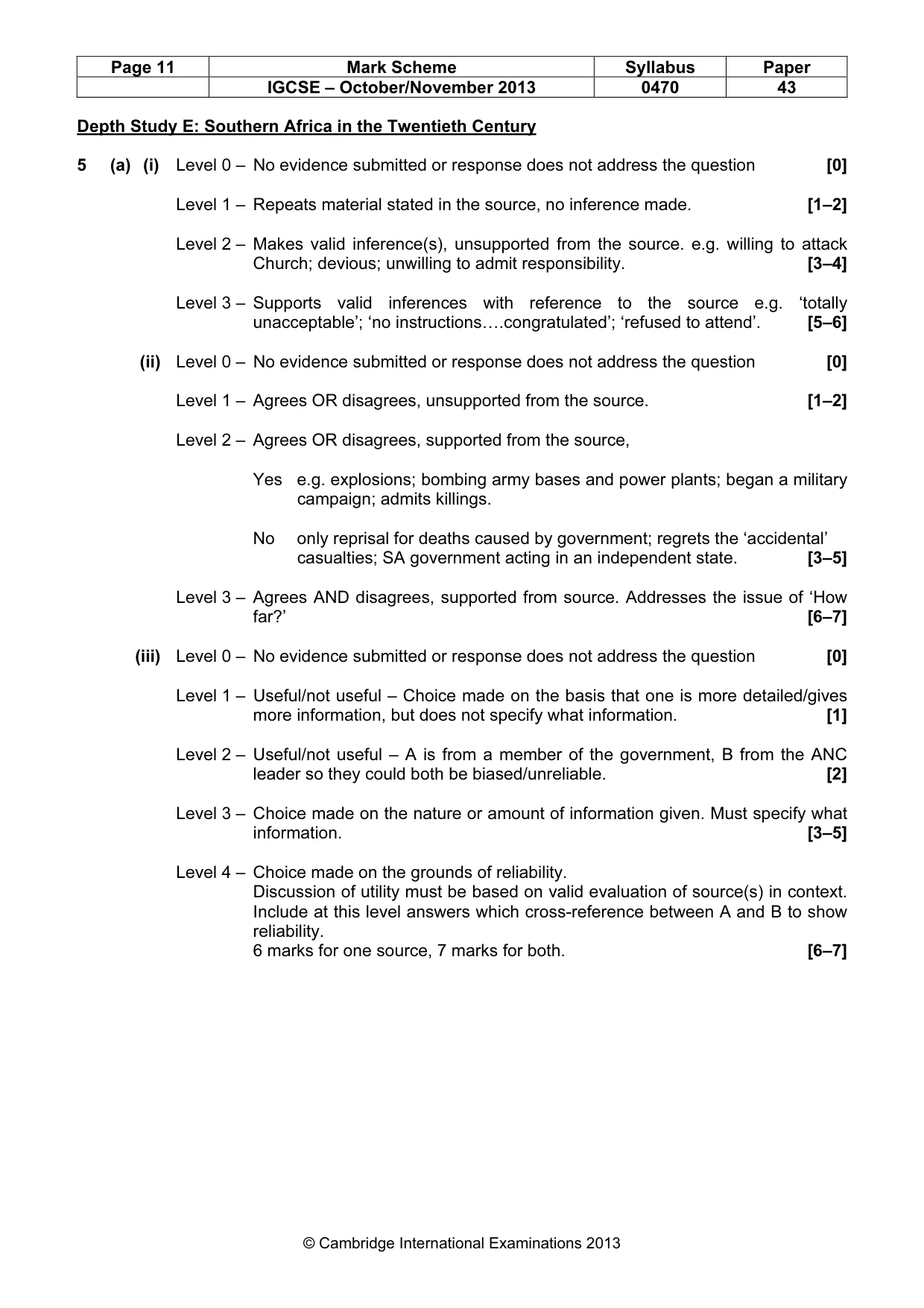
Page 11 Mark Scheme Syllabus Paper IGCSE – October/November 2013 0470 43 © Cambridge International Examinations 2013 Depth Study E: Southern Africa in the Twentieth Century 5 (a) (i) Level 0 – No evidence submitted or response does not address the question [0] Level 1 – Repeats material stated in the source, no inference made. [1–2] Level 2 – Makes valid inference(s), unsupported from the source. e.g. willing to attack Church; devious; unwilling to admit responsibility. [3–4] Level 3 – Supports valid inferences with reference to the source e.g. ‘totally unacceptable’; ‘no instructions….congratulated’; ‘refused to attend’. [5–6] (ii) Level 0 – No evidence submitted or response does not address the question [0] Level 1 – Agrees OR disagrees, unsupported from the source. [1–2] Level 2 – Agrees OR disagrees, supported from the source, Yes e.g. explosions; bombing army bases and power plants; began a military campaign; admits killings. No only reprisal for deaths caused by government; regrets the ‘accidental’ casualties; SA government acting in an independent state. [3–5] Level 3 – Agrees AND disagrees, supported from source. Addresses the issue of ‘How far?’ [6–7] (iii) Level 0 – No evidence submitted or response does not address the question [0] Level 1 – Useful/not useful – Choice made on the basis that one is more detailed/gives more information, but does not specify what information. [1] Level 2 – Useful/not useful – A is from a member of the government, B from the ANC leader so they could both be biased/unreliable. [2] Level 3 – Choice made on the nature or amount of information given. Must specify what information. [3–5] Level 4 – Choice made on the grounds of reliability. Discussion of utility must be based on valid evaluation of source(s) in context. Include at this level answers which cross-reference between A and B to show reliability. 6 marks for one source, 7 marks for both. [6–7]
Mark scheme, page 12
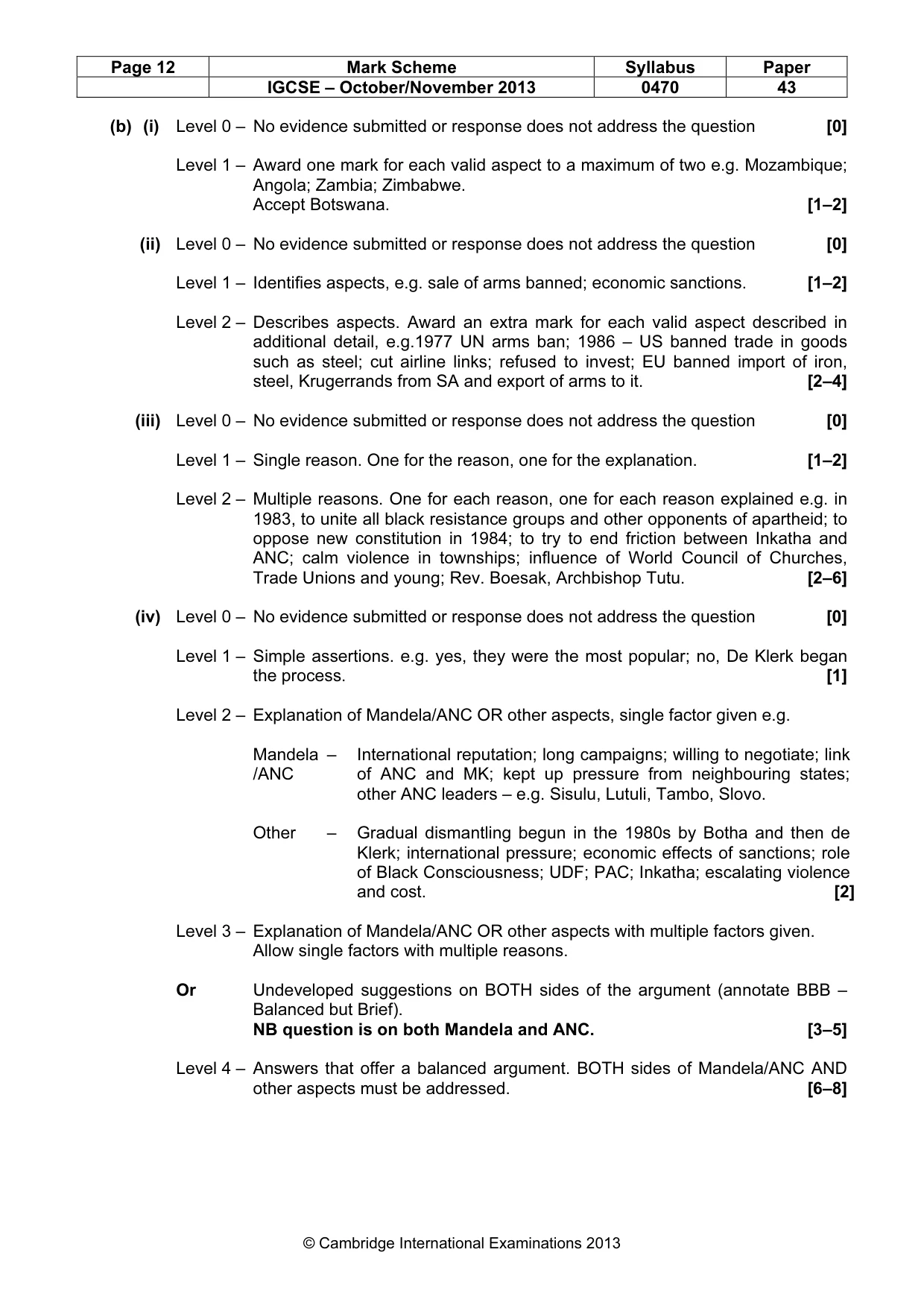
Page 12 Mark Scheme Syllabus Paper IGCSE – October/November 2013 0470 43 © Cambridge International Examinations 2013 (b) (i) Level 0 – No evidence submitted or response does not address the question [0] Level 1 – Award one mark for each valid aspect to a maximum of two e.g. Mozambique; Angola; Zambia; Zimbabwe. Accept Botswana. [1–2] (ii) Level 0 – No evidence submitted or response does not address the question [0] Level 1 – Identifies aspects, e.g. sale of arms banned; economic sanctions. [1–2] Level 2 – Describes aspects. Award an extra mark for each valid aspect described in additional detail, e.g.1977 UN arms ban; 1986 – US banned trade in goods such as steel; cut airline links; refused to invest; EU banned import of iron, steel, Krugerrands from SA and export of arms to it. [2–4] (iii) Level 0 – No evidence submitted or response does not address the question [0] Level 1 – Single reason. One for the reason, one for the explanation. [1–2] Level 2 – Multiple reasons. One for each reason, one for each reason explained e.g. in 1983, to unite all black resistance groups and other opponents of apartheid; to oppose new constitution in 1984; to try to end friction between Inkatha and ANC; calm violence in townships; influence of World Council of Churches, Trade Unions and young; Rev. Boesak, Archbishop Tutu. [2–6] (iv) Level 0 – No evidence submitted or response does not address the question [0] Level 1 – Simple assertions. e.g. yes, they were the most popular; no, De Klerk began the process. [1] Level 2 – Explanation of Mandela/ANC OR other aspects, single factor given e.g. Mandela /ANC – International reputation; long campaigns; willing to negotiate; link of ANC and MK; kept up pressure from neighbouring states; other ANC leaders – e.g. Sisulu, Lutuli, Tambo, Slovo. Other – Gradual dismantling begun in the 1980s by Botha and then de Klerk; international pressure; economic effects of sanctions; role of Black Consciousness; UDF; PAC; Inkatha; escalating violence and cost. [2] Level 3 – Explanation of Mandela/ANC OR other aspects with multiple factors given. Allow single factors with multiple reasons. Or Undeveloped suggestions on BOTH sides of the argument (annotate BBB – Balanced but Brief). NB question is on both Mandela and ANC. [3–5] Level 4 – Answers that offer a balanced argument. BOTH sides of Mandela/ANC AND other aspects must be addressed. [6–8]
Mark scheme, page 13
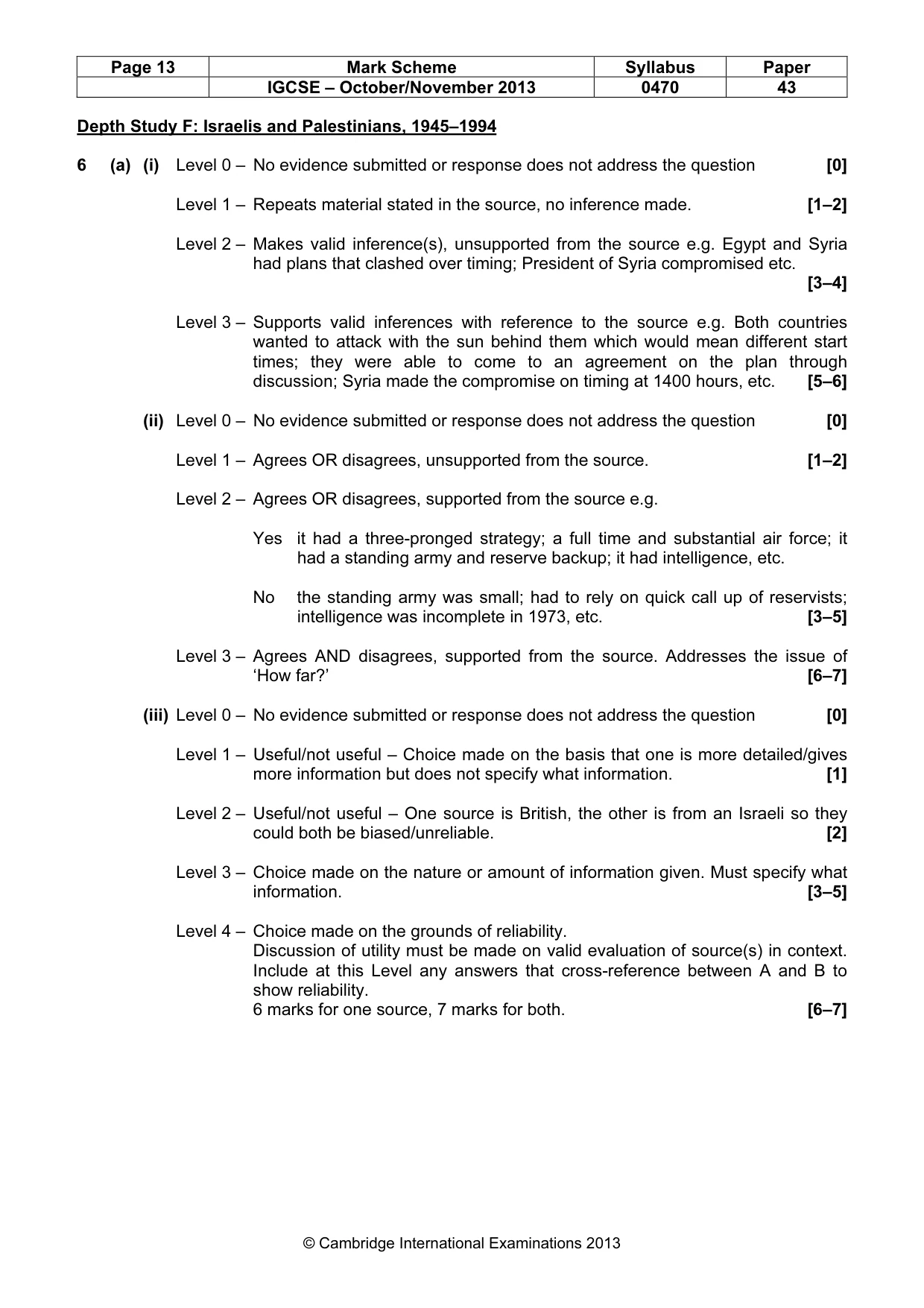
Page 13 Mark Scheme Syllabus Paper IGCSE – October/November 2013 0470 43 © Cambridge International Examinations 2013 Depth Study F: Israelis and Palestinians, 1945–1994 6 (a) (i) Level 0 – No evidence submitted or response does not address the question [0] Level 1 – Repeats material stated in the source, no inference made. [1–2] Level 2 – Makes valid inference(s), unsupported from the source e.g. Egypt and Syria had plans that clashed over timing; President of Syria compromised etc. [3–4] Level 3 – Supports valid inferences with reference to the source e.g. Both countries wanted to attack with the sun behind them which would mean different start times; they were able to come to an agreement on the plan through discussion; Syria made the compromise on timing at 1400 hours, etc. [5–6] (ii) Level 0 – No evidence submitted or response does not address the question [0] Level 1 – Agrees OR disagrees, unsupported from the source. [1–2] Level 2 – Agrees OR disagrees, supported from the source e.g. Yes it had a three-pronged strategy; a full time and substantial air force; it had a standing army and reserve backup; it had intelligence, etc. No the standing army was small; had to rely on quick call up of reservists; intelligence was incomplete in 1973, etc. [3–5] Level 3 – Agrees AND disagrees, supported from the source. Addresses the issue of ‘How far?’ [6–7] (iii) Level 0 – No evidence submitted or response does not address the question [0] Level 1 – Useful/not useful – Choice made on the basis that one is more detailed/gives more information but does not specify what information. [1] Level 2 – Useful/not useful – One source is British, the other is from an Israeli so they could both be biased/unreliable. [2] Level 3 – Choice made on the nature or amount of information given. Must specify what information. [3–5] Level 4 – Choice made on the grounds of reliability. Discussion of utility must be made on valid evaluation of source(s) in context. Include at this Level any answers that cross-reference between A and B to show reliability. 6 marks for one source, 7 marks for both. [6–7]
Mark scheme, page 14
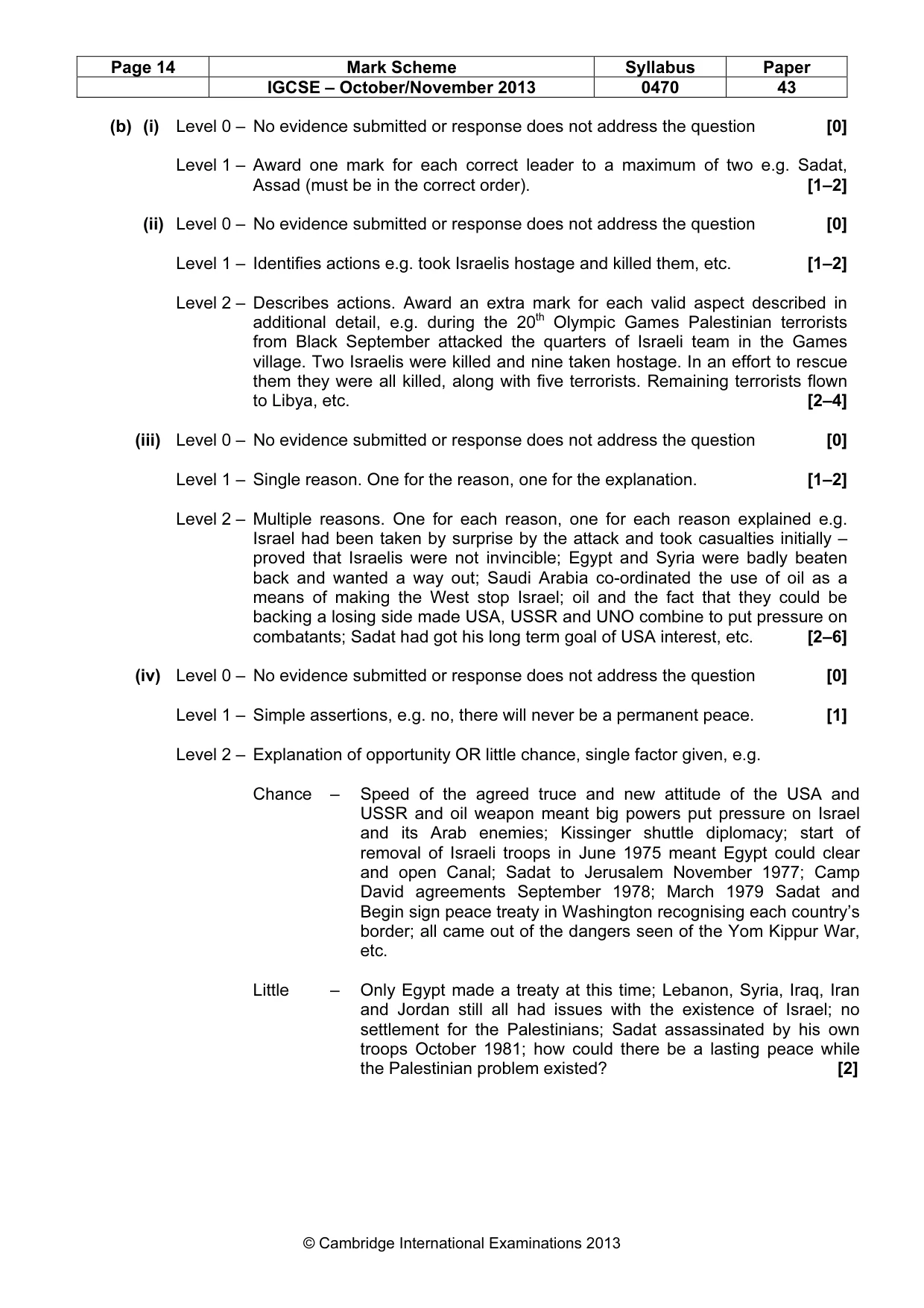
Page 14 Mark Scheme Syllabus Paper IGCSE – October/November 2013 0470 43 © Cambridge International Examinations 2013 (b) (i) Level 0 – No evidence submitted or response does not address the question [0] Level 1 – Award one mark for each correct leader to a maximum of two e.g. Sadat, Assad (must be in the correct order). [1–2] (ii) Level 0 – No evidence submitted or response does not address the question [0] Level 1 – Identifies actions e.g. took Israelis hostage and killed them, etc. [1–2] Level 2 – Describes actions. Award an extra mark for each valid aspect described in additional detail, e.g. during the 20th Olympic Games Palestinian terrorists from Black September attacked the quarters of Israeli team in the Games village. Two Israelis were killed and nine taken hostage. In an effort to rescue them they were all killed, along with five terrorists. Remaining terrorists flown to Libya, etc. [2–4] (iii) Level 0 – No evidence submitted or response does not address the question [0] Level 1 – Single reason. One for the reason, one for the explanation. [1–2] Level 2 – Multiple reasons. One for each reason, one for each reason explained e.g. Israel had been taken by surprise by the attack and took casualties initially – proved that Israelis were not invincible; Egypt and Syria were badly beaten back and wanted a way out; Saudi Arabia co-ordinated the use of oil as a means of making the West stop Israel; oil and the fact that they could be backing a losing side made USA, USSR and UNO combine to put pressure on combatants; Sadat had got his long term goal of USA interest, etc. [2–6] (iv) Level 0 – No evidence submitted or response does not address the question [0] Level 1 – Simple assertions, e.g. no, there will never be a permanent peace. [1] Level 2 – Explanation of opportunity OR little chance, single factor given, e.g. Chance – Speed of the agreed truce and new attitude of the USA and USSR and oil weapon meant big powers put pressure on Israel and its Arab enemies; Kissinger shuttle diplomacy; start of removal of Israeli troops in June 1975 meant Egypt could clear and open Canal; Sadat to Jerusalem November 1977; Camp David agreements September 1978; March 1979 Sadat and Begin sign peace treaty in Washington recognising each country’s border; all came out of the dangers seen of the Yom Kippur War, etc. Little – Only Egypt made a treaty at this time; Lebanon, Syria, Iraq, Iran and Jordan still all had issues with the existence of Israel; no settlement for the Palestinians; Sadat assassinated by his own troops October 1981; how could there be a lasting peace while the Palestinian problem existed? [2]
Mark scheme, page 15
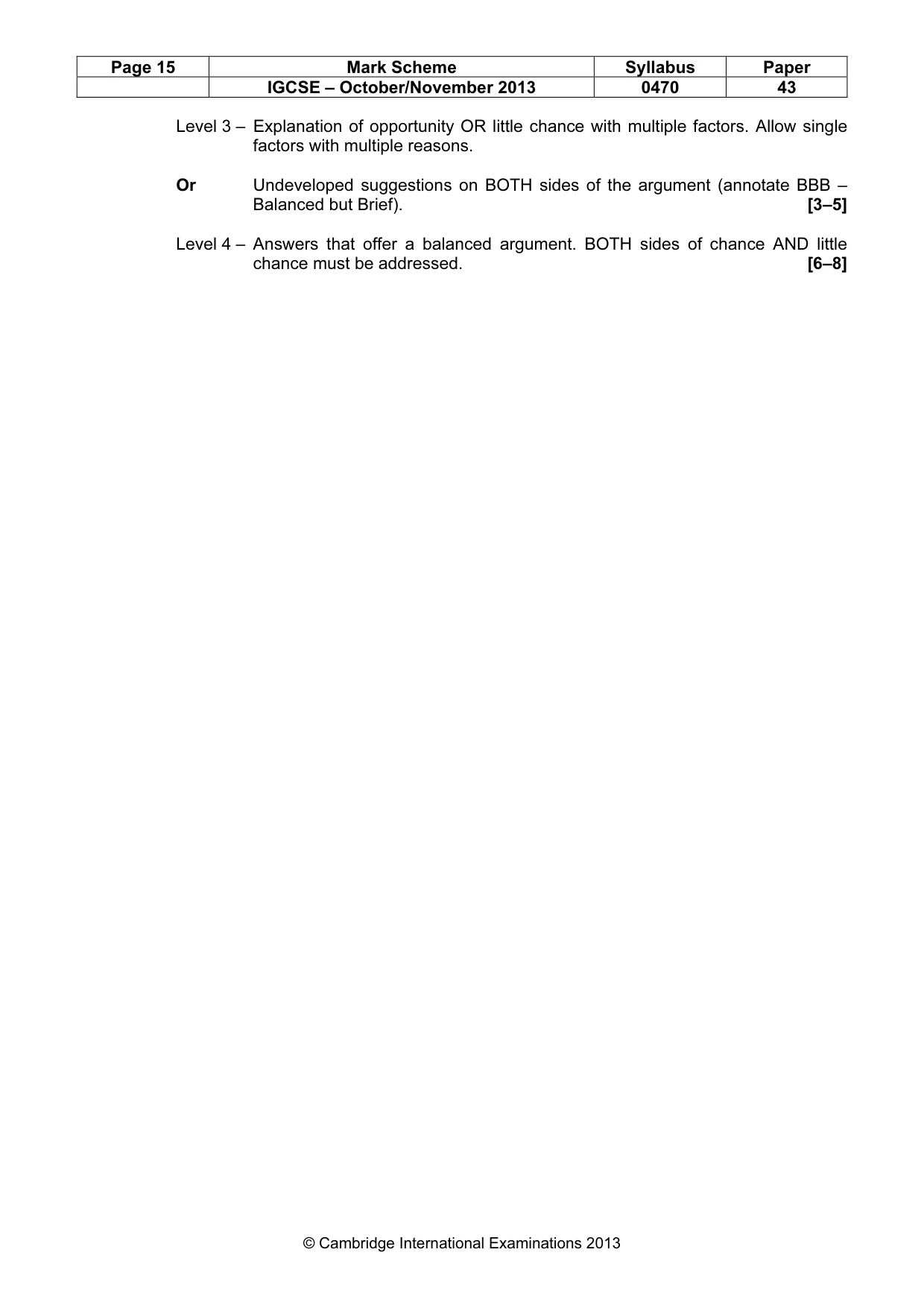
Page 15 Mark Scheme Syllabus Paper IGCSE – October/November 2013 0470 43 © Cambridge International Examinations 2013 Level 3 – Explanation of opportunity OR little chance with multiple factors. Allow single factors with multiple reasons. Or Undeveloped suggestions on BOTH sides of the argument (annotate BBB – Balanced but Brief). [3–5] Level 4 – Answers that offer a balanced argument. BOTH sides of chance AND little chance must be addressed. [6–8]
Mark scheme, page 16
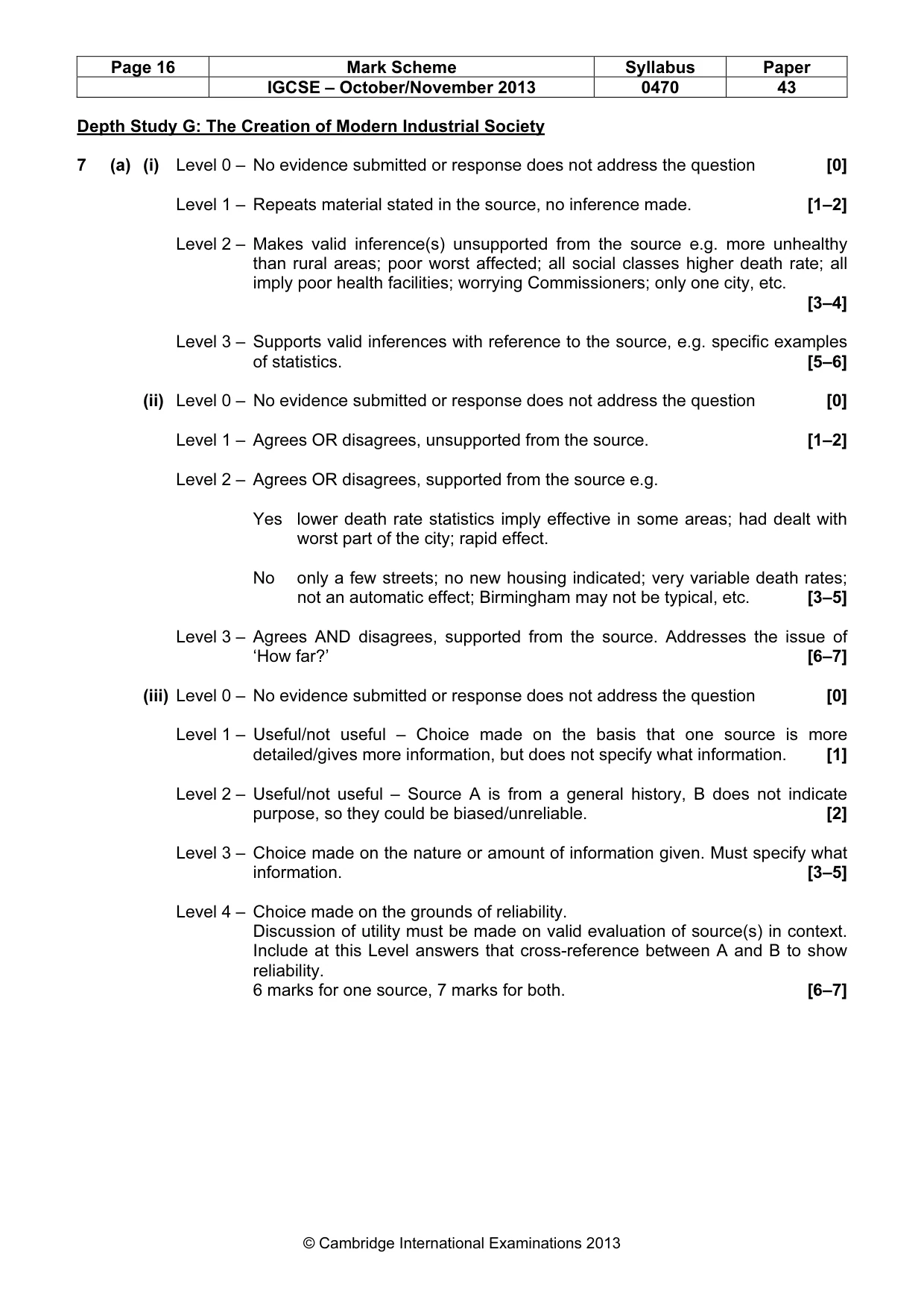
Page 16 Mark Scheme Syllabus Paper IGCSE – October/November 2013 0470 43 © Cambridge International Examinations 2013 Depth Study G: The Creation of Modern Industrial Society 7 (a) (i) Level 0 – No evidence submitted or response does not address the question [0] Level 1 – Repeats material stated in the source, no inference made. [1–2] Level 2 – Makes valid inference(s) unsupported from the source e.g. more unhealthy than rural areas; poor worst affected; all social classes higher death rate; all imply poor health facilities; worrying Commissioners; only one city, etc. [3–4] Level 3 – Supports valid inferences with reference to the source, e.g. specific examples of statistics. [5–6] (ii) Level 0 – No evidence submitted or response does not address the question [0] Level 1 – Agrees OR disagrees, unsupported from the source. [1–2] Level 2 – Agrees OR disagrees, supported from the source e.g. Yes lower death rate statistics imply effective in some areas; had dealt with worst part of the city; rapid effect. No only a few streets; no new housing indicated; very variable death rates; not an automatic effect; Birmingham may not be typical, etc. [3–5] Level 3 – Agrees AND disagrees, supported from the source. Addresses the issue of ‘How far?’ [6–7] (iii) Level 0 – No evidence submitted or response does not address the question [0] Level 1 – Useful/not useful – Choice made on the basis that one source is more detailed/gives more information, but does not specify what information. [1] Level 2 – Useful/not useful – Source A is from a general history, B does not indicate purpose, so they could be biased/unreliable. [2] Level 3 – Choice made on the nature or amount of information given. Must specify what information. [3–5] Level 4 – Choice made on the grounds of reliability. Discussion of utility must be made on valid evaluation of source(s) in context. Include at this Level answers that cross-reference between A and B to show reliability. 6 marks for one source, 7 marks for both. [6–7]
Mark scheme, page 17
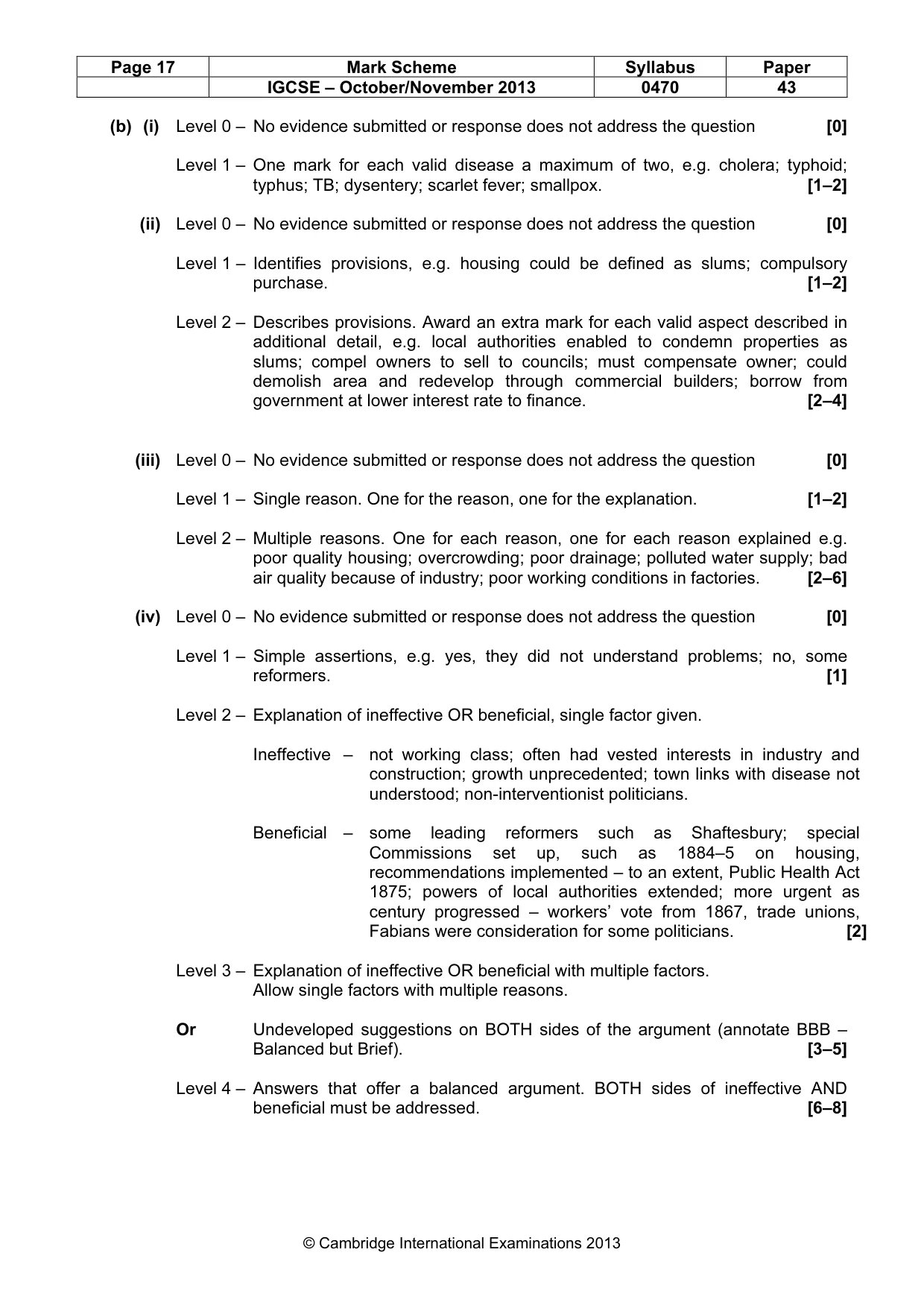
Page 17 Mark Scheme Syllabus Paper IGCSE – October/November 2013 0470 43 © Cambridge International Examinations 2013 (b) (i) Level 0 – No evidence submitted or response does not address the question [0] Level 1 – One mark for each valid disease a maximum of two, e.g. cholera; typhoid; typhus; TB; dysentery; scarlet fever; smallpox. [1–2] (ii) Level 0 – No evidence submitted or response does not address the question [0] Level 1 – Identifies provisions, e.g. housing could be defined as slums; compulsory purchase. [1–2] Level 2 – Describes provisions. Award an extra mark for each valid aspect described in additional detail, e.g. local authorities enabled to condemn properties as slums; compel owners to sell to councils; must compensate owner; could demolish area and redevelop through commercial builders; borrow from government at lower interest rate to finance. [2–4] (iii) Level 0 – No evidence submitted or response does not address the question [0] Level 1 – Single reason. One for the reason, one for the explanation. [1–2] Level 2 – Multiple reasons. One for each reason, one for each reason explained e.g. poor quality housing; overcrowding; poor drainage; polluted water supply; bad air quality because of industry; poor working conditions in factories. [2–6] (iv) Level 0 – No evidence submitted or response does not address the question [0] Level 1 – Simple assertions, e.g. yes, they did not understand problems; no, some reformers. [1] Level 2 – Explanation of ineffective OR beneficial, single factor given. Ineffective – not working class; often had vested interests in industry and construction; growth unprecedented; town links with disease not understood; non-interventionist politicians. Beneficial – some leading reformers such as Shaftesbury; special Commissions set up, such as 1884–5 on housing, recommendations implemented – to an extent, Public Health Act 1875; powers of local authorities extended; more urgent as century progressed – workers’ vote from 1867, trade unions, Fabians were consideration for some politicians. [2] Level 3 – Explanation of ineffective OR beneficial with multiple factors. Allow single factors with multiple reasons. Or Undeveloped suggestions on BOTH sides of the argument (annotate BBB – Balanced but Brief). [3–5] Level 4 – Answers that offer a balanced argument. BOTH sides of ineffective AND beneficial must be addressed. [6–8]
Mark scheme, page 18
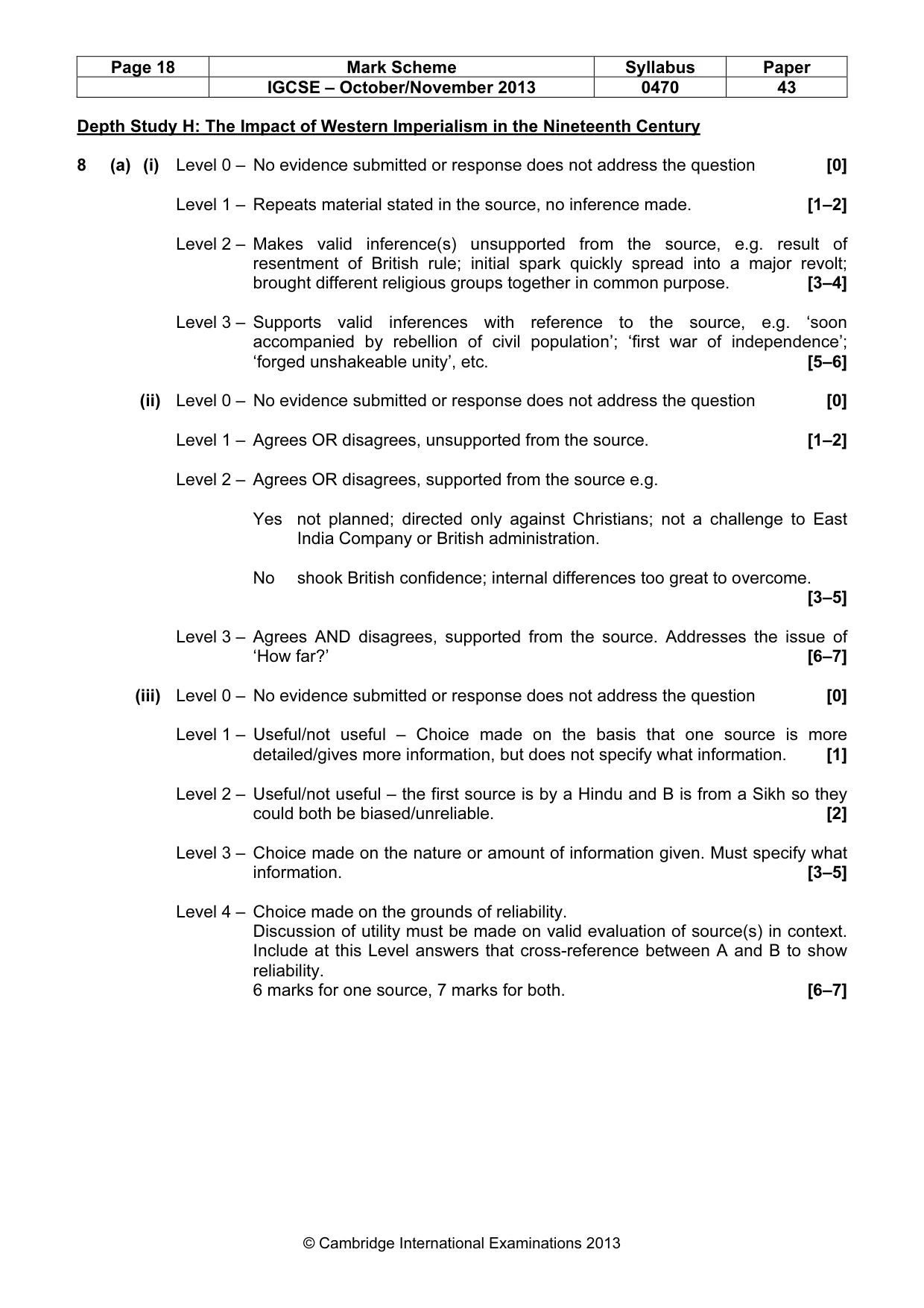
Page 18 Mark Scheme Syllabus Paper IGCSE – October/November 2013 0470 43 © Cambridge International Examinations 2013 Depth Study H: The Impact of Western Imperialism in the Nineteenth Century 8 (a) (i) Level 0 – No evidence submitted or response does not address the question [0] Level 1 – Repeats material stated in the source, no inference made. [1–2] Level 2 – Makes valid inference(s) unsupported from the source, e.g. result of resentment of British rule; initial spark quickly spread into a major revolt; brought different religious groups together in common purpose. [3–4] Level 3 – Supports valid inferences with reference to the source, e.g. ‘soon accompanied by rebellion of civil population’; ‘first war of independence’; ‘forged unshakeable unity’, etc. [5–6] (ii) Level 0 – No evidence submitted or response does not address the question [0] Level 1 – Agrees OR disagrees, unsupported from the source. [1–2] Level 2 – Agrees OR disagrees, supported from the source e.g. Yes not planned; directed only against Christians; not a challenge to East India Company or British administration. No shook British confidence; internal differences too great to overcome. [3–5] Level 3 – Agrees AND disagrees, supported from the source. Addresses the issue of ‘How far?’ [6–7] (iii) Level 0 – No evidence submitted or response does not address the question [0] Level 1 – Useful/not useful – Choice made on the basis that one source is more detailed/gives more information, but does not specify what information. [1] Level 2 – Useful/not useful – the first source is by a Hindu and B is from a Sikh so they could both be biased/unreliable. [2] Level 3 – Choice made on the nature or amount of information given. Must specify what information. [3–5] Level 4 – Choice made on the grounds of reliability. Discussion of utility must be made on valid evaluation of source(s) in context. Include at this Level answers that cross-reference between A and B to show reliability. 6 marks for one source, 7 marks for both. [6–7]
Mark scheme, page 19
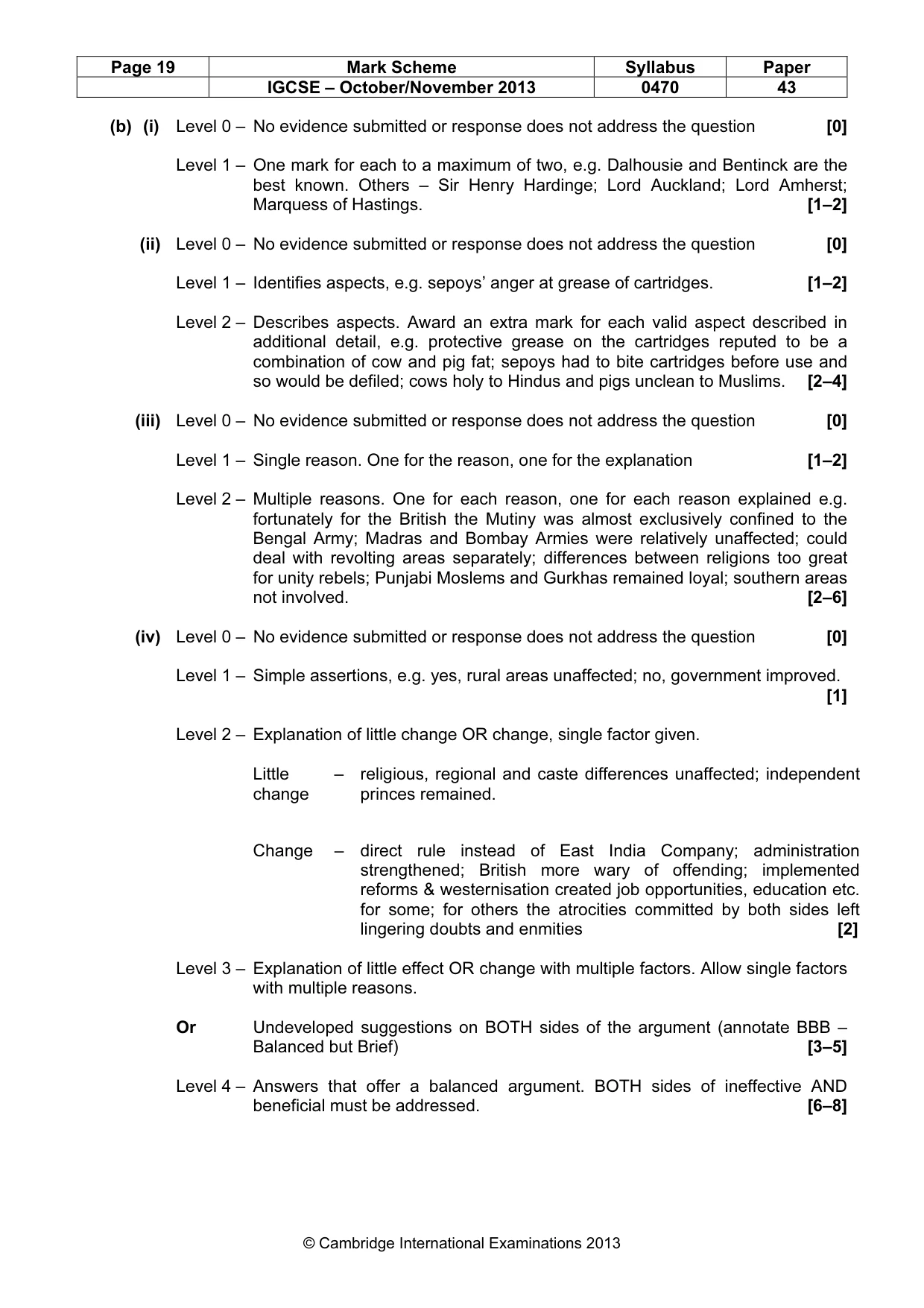
Page 19 Mark Scheme Syllabus Paper IGCSE – October/November 2013 0470 43 © Cambridge International Examinations 2013 (b) (i) Level 0 – No evidence submitted or response does not address the question [0] Level 1 – One mark for each to a maximum of two, e.g. Dalhousie and Bentinck are the best known. Others – Sir Henry Hardinge; Lord Auckland; Lord Amherst; Marquess of Hastings. [1–2] (ii) Level 0 – No evidence submitted or response does not address the question [0] Level 1 – Identifies aspects, e.g. sepoys’ anger at grease of cartridges. [1–2] Level 2 – Describes aspects. Award an extra mark for each valid aspect described in additional detail, e.g. protective grease on the cartridges reputed to be a combination of cow and pig fat; sepoys had to bite cartridges before use and so would be defiled; cows holy to Hindus and pigs unclean to Muslims. [2–4] (iii) Level 0 – No evidence submitted or response does not address the question [0] Level 1 – Single reason. One for the reason, one for the explanation [1–2] Level 2 – Multiple reasons. One for each reason, one for each reason explained e.g. fortunately for the British the Mutiny was almost exclusively confined to the Bengal Army; Madras and Bombay Armies were relatively unaffected; could deal with revolting areas separately; differences between religions too great for unity rebels; Punjabi Moslems and Gurkhas remained loyal; southern areas not involved. [2–6] (iv) Level 0 – No evidence submitted or response does not address the question [0] Level 1 – Simple assertions, e.g. yes, rural areas unaffected; no, government improved. [1] Level 2 – Explanation of little change OR change, single factor given. Little change – religious, regional and caste differences unaffected; independent princes remained. Change – direct rule instead of East India Company; administration strengthened; British more wary of offending; implemented reforms & westernisation created job opportunities, education etc. for some; for others the atrocities committed by both sides left lingering doubts and enmities [2] Level 3 – Explanation of little effect OR change with multiple factors. Allow single factors with multiple reasons. Or Undeveloped suggestions on BOTH sides of the argument (annotate BBB – Balanced but Brief) [3–5] Level 4 – Answers that offer a balanced argument. BOTH sides of ineffective AND beneficial must be addressed. [6–8]
What you needed in this session
Cambridge’s own grade thresholds for 2013 Oct/Nov, Paper 4 · Variant 3. A higher threshold means an easier paper — the bar moves with how the cohort did.