Cambridge IGCSE History 0470 — 2013 Oct/Nov Paper 4 · Variant 2
0470/42/O/N/13 · 40 marks · ≈45 min
The question paper and its mark scheme, free to read here and free to download. This is Cambridge’s own paper, exactly as it was sat.
Question paper12 pages
Mark scheme17 pages
Answers below. Sit the paper first if you are practising.
Paper as text
Question paper, page 1
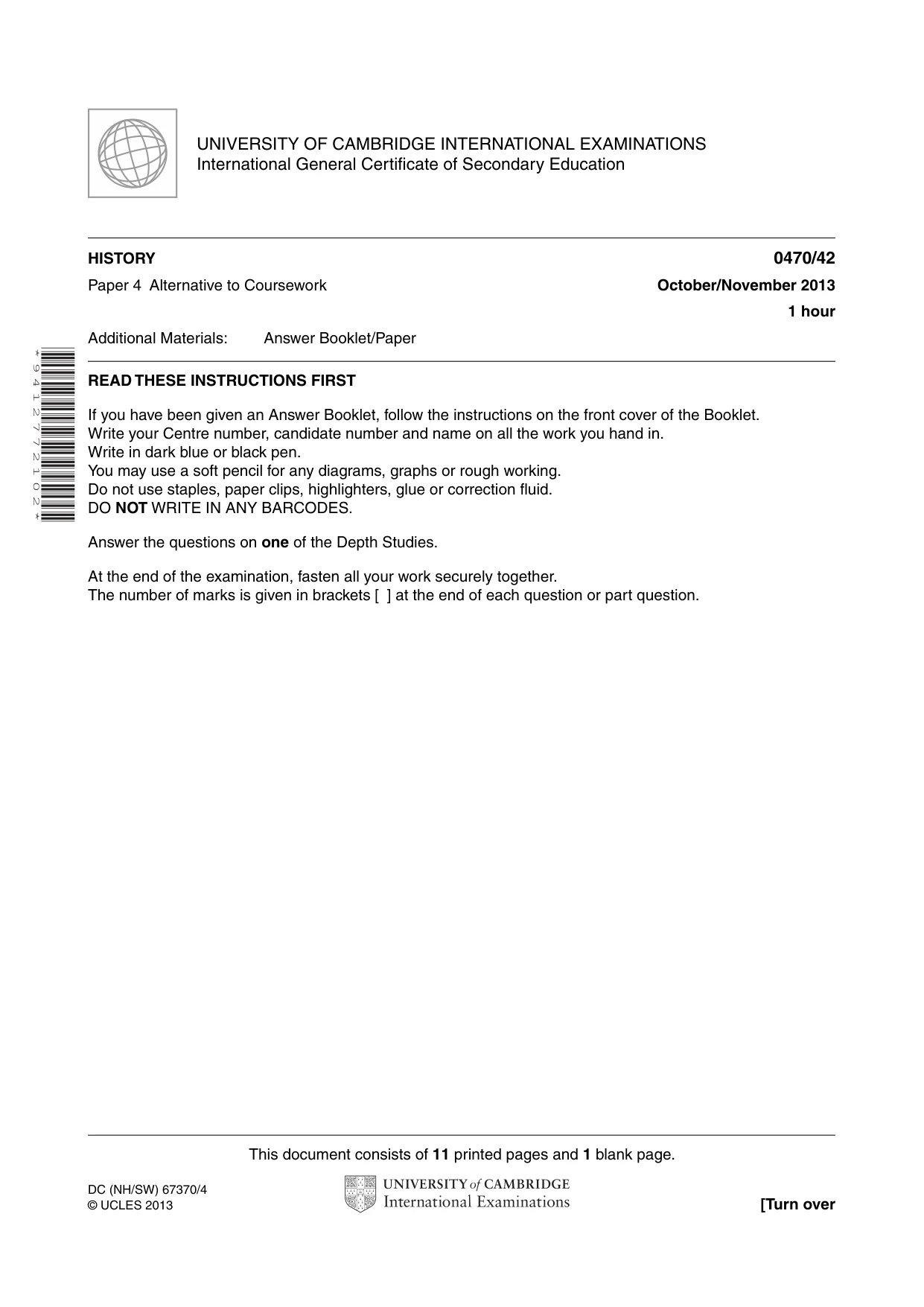
This document consists of 11 printed pages and 1 blank page. DC (NH/SW) 67370/4 © UCLES 2013 [Turn over UNIVERSITY OF CAMBRIDGE INTERNATIONAL EXAMINATIONS International General Certificate of Secondary Education * 9 4 1 2 7 7 2 1 0 2 * HISTORY 0470/42 Paper 4 Alternative to Coursework October/November 2013 1 hour Additional Materials: Answer Booklet/Paper READ THESE INSTRUCTIONS FIRST If you have been given an Answer Booklet, follow the instructions on the front cover of the Booklet. Write your Centre number, candidate number and name on all the work you hand in. Write in dark blue or black pen. You may use a soft pencil for any diagrams, graphs or rough working. Do not use staples, paper clips, highlighters, glue or correction fluid. DO NOT WRITE IN ANY BARCODES. Answer the questions on one of the Depth Studies. At the end of the examination, fasten all your work securely together. The number of marks is given in brackets [ ] at the end of each question or part question.
Question paper, page 2
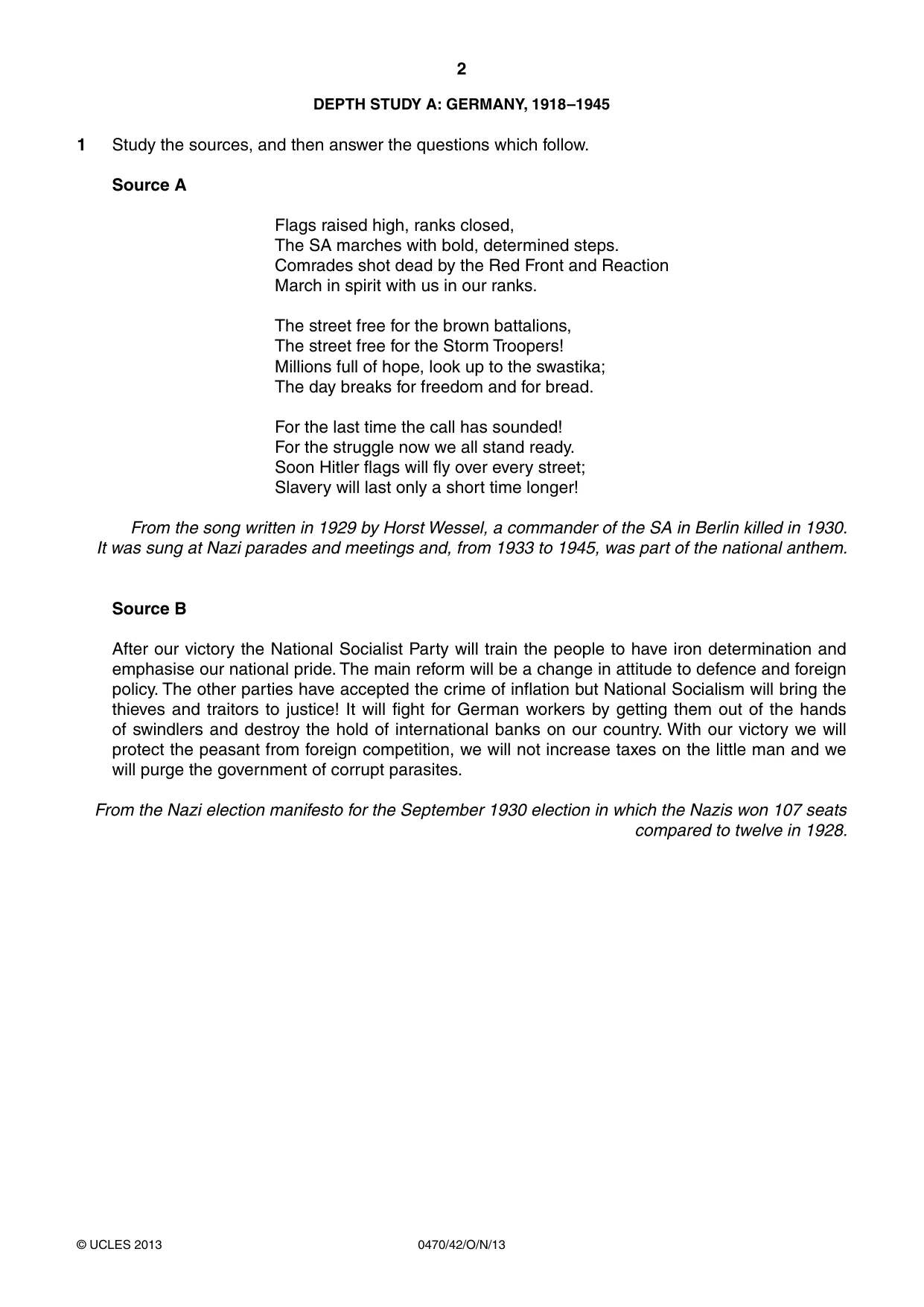
2 0470/42/O/N/13 © UCLES 2013 DEPTH STUDY A: GERMANY, 1918–1945 1 Study the sources, and then answer the questions which follow. Source A Flags raised high, ranks closed, The SA marches with bold, determined steps. Comrades shot dead by the Red Front and Reaction March in spirit with us in our ranks. The street free for the brown battalions, The street free for the Storm Troopers! Millions full of hope, look up to the swastika; The day breaks for freedom and for bread. For the last time the call has sounded! For the struggle now we all stand ready. Soon Hitler flags will fly over every street; Slavery will last only a short time longer! From the song written in 1929 by Horst Wessel, a commander of the SA in Berlin killed in 1930. It was sung at Nazi parades and meetings and, from 1933 to 1945, was part of the national anthem. Source B After our victory the National Socialist Party will train the people to have iron determination and emphasise our national pride. The main reform will be a change in attitude to defence and foreign policy. The other parties have accepted the crime of inflation but National Socialism will bring the thieves and traitors to justice! It will fight for German workers by getting them out of the hands of swindlers and destroy the hold of international banks on our country. With our victory we will protect the peasant from foreign competition, we will not increase taxes on the little man and we will purge the government of corrupt parasites. From the Nazi election manifesto for the September 1930 election in which the Nazis won 107 seats compared to twelve in 1928.
Question paper, page 3
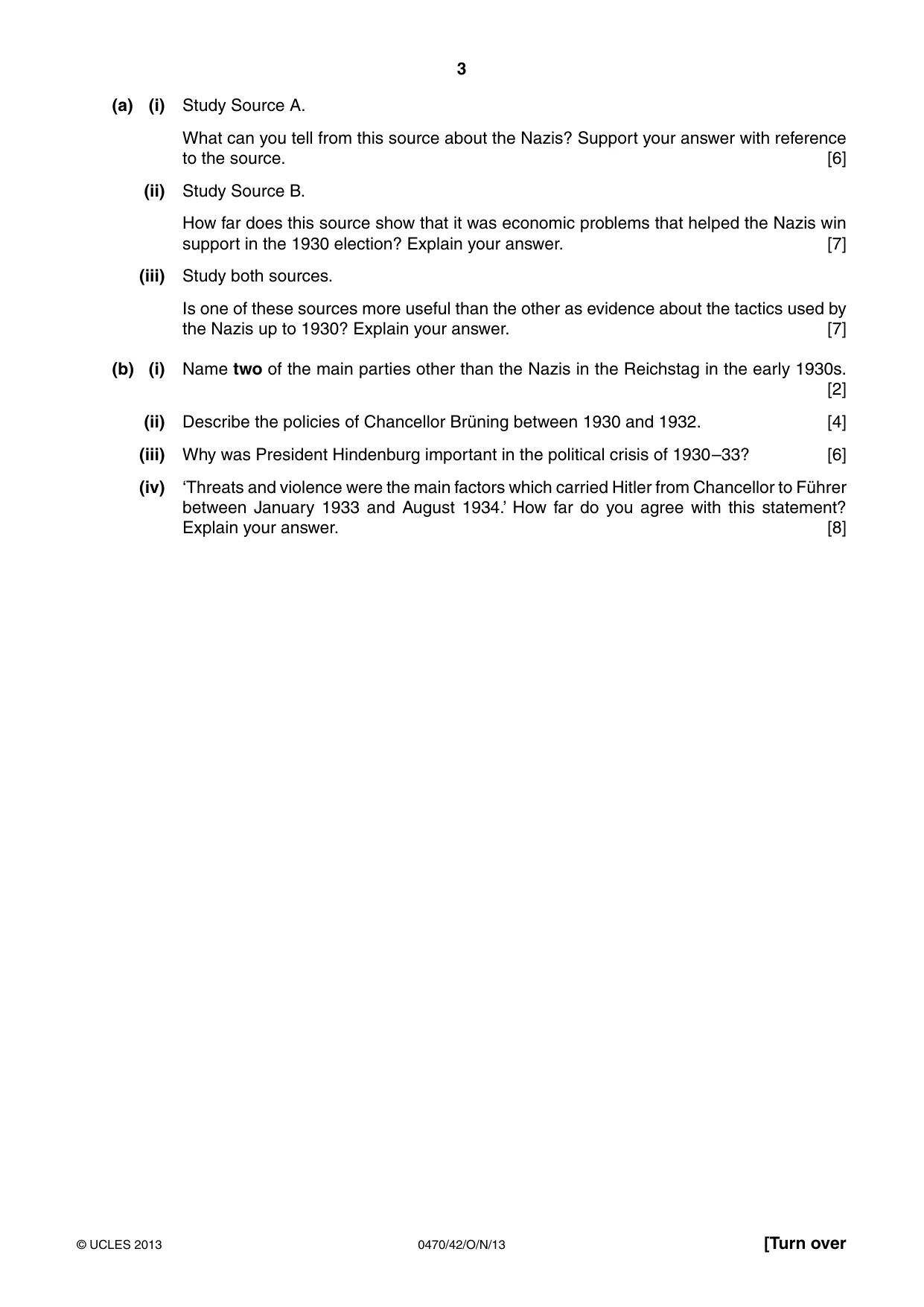
3 0470/42/O/N/13 © UCLES 2013 [Turn over (a) (i) Study Source A. What can you tell from this source about the Nazis? Support your answer with reference to the source. [6] (ii) Study Source B. How far does this source show that it was economic problems that helped the Nazis win support in the 1930 election? Explain your answer. [7] (iii) Study both sources. Is one of these sources more useful than the other as evidence about the tactics used by the Nazis up to 1930? Explain your answer. [7] (b) (i) Name two of the main parties other than the Nazis in the Reichstag in the early 1930s. [2] (ii) Describe the policies of Chancellor Brüning between 1930 and 1932. [4] (iii) Why was President Hindenburg important in the political crisis of 1930–33? [6] (iv) ‘Threats and violence were the main factors which carried Hitler from Chancellor to Führer between January 1933 and August 1934.’ How far do you agree with this statement? Explain your answer. [8]
Question paper, page 4
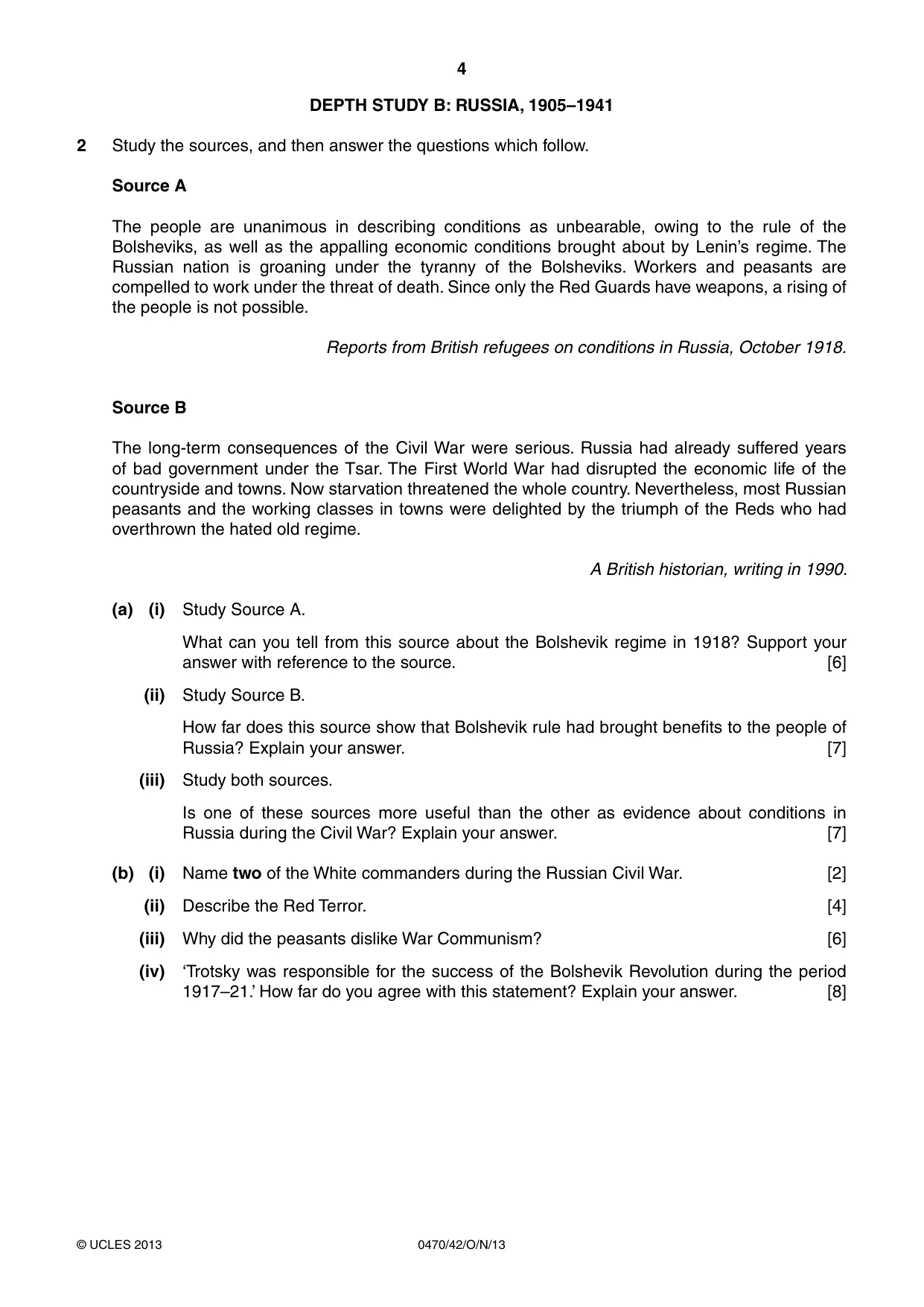
4 0470/42/O/N/13 © UCLES 2013 DEPTH STUDY B: RUSSIA, 1905–1941 2 Study the sources, and then answer the questions which follow. Source A The people are unanimous in describing conditions as unbearable, owing to the rule of the Bolsheviks, as well as the appalling economic conditions brought about by Lenin’s regime. The Russian nation is groaning under the tyranny of the Bolsheviks. Workers and peasants are compelled to work under the threat of death. Since only the Red Guards have weapons, a rising of the people is not possible. Reports from British refugees on conditions in Russia, October 1918. Source B The long-term consequences of the Civil War were serious. Russia had already suffered years of bad government under the Tsar. The First World War had disrupted the economic life of the countryside and towns. Now starvation threatened the whole country. Nevertheless, most Russian peasants and the working classes in towns were delighted by the triumph of the Reds who had overthrown the hated old regime. A British historian, writing in 1990. (a) (i) Study Source A. What can you tell from this source about the Bolshevik regime in 1918? Support your answer with reference to the source. [6] (ii) Study Source B. How far does this source show that Bolshevik rule had brought benefits to the people of Russia? Explain your answer. [7] (iii) Study both sources. Is one of these sources more useful than the other as evidence about conditions in Russia during the Civil War? Explain your answer. [7] (b) (i) Name two of the White commanders during the Russian Civil War. [2] (ii) Describe the Red Terror. [4] (iii) Why did the peasants dislike War Communism? [6] (iv) ‘Trotsky was responsible for the success of the Bolshevik Revolution during the period 1917–21.’ How far do you agree with this statement? Explain your answer. [8]
Question paper, page 5
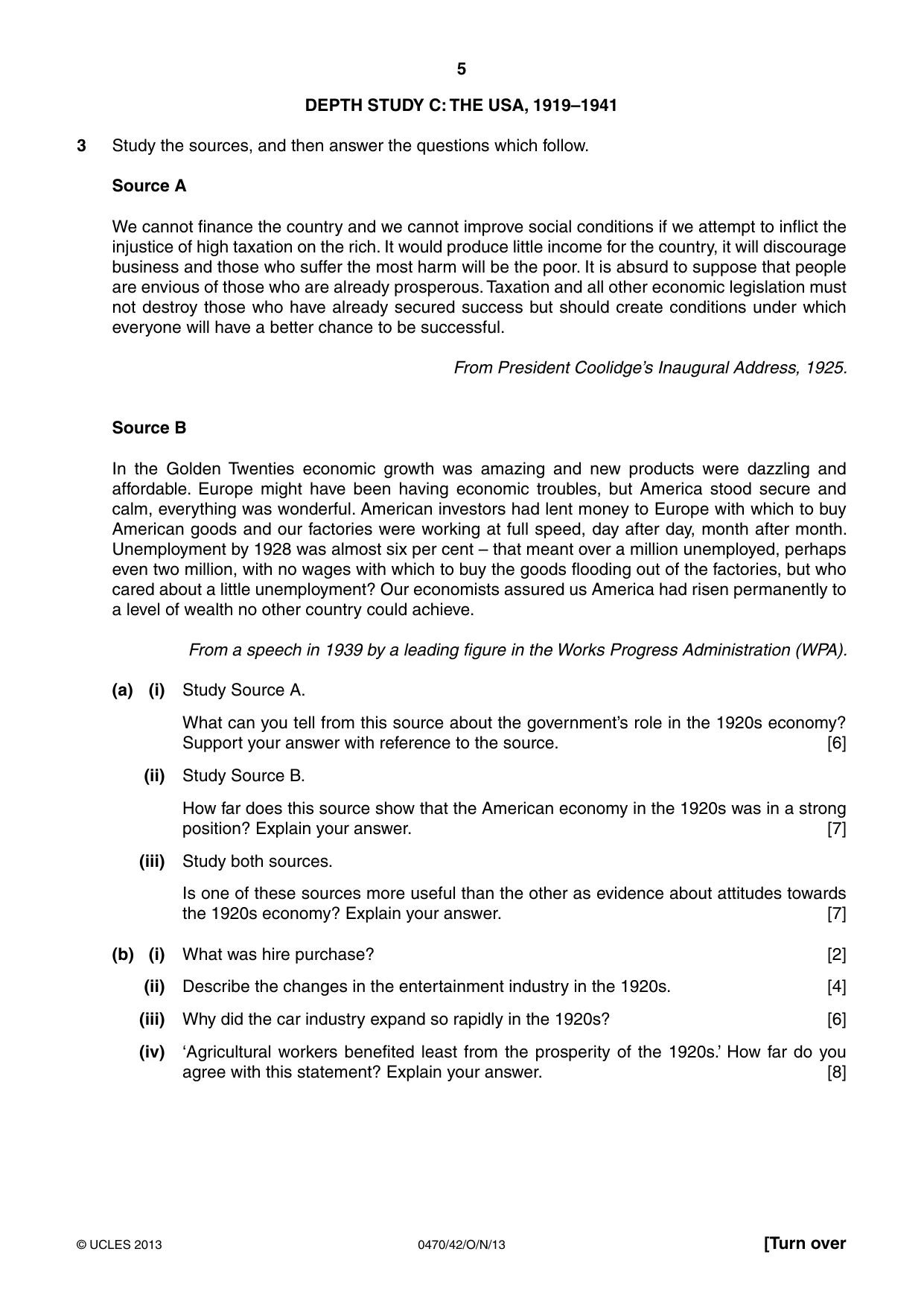
5 0470/42/O/N/13 © UCLES 2013 [Turn over DEPTH STUDY C: THE USA, 1919–1941 3 Study the sources, and then answer the questions which follow. Source A We cannot finance the country and we cannot improve social conditions if we attempt to inflict the injustice of high taxation on the rich. It would produce little income for the country, it will discourage business and those who suffer the most harm will be the poor. It is absurd to suppose that people are envious of those who are already prosperous. Taxation and all other economic legislation must not destroy those who have already secured success but should create conditions under which everyone will have a better chance to be successful. From President Coolidge’s Inaugural Address, 1925. Source B In the Golden Twenties economic growth was amazing and new products were dazzling and affordable. Europe might have been having economic troubles, but America stood secure and calm, everything was wonderful. American investors had lent money to Europe with which to buy American goods and our factories were working at full speed, day after day, month after month. Unemployment by 1928 was almost six per cent – that meant over a million unemployed, perhaps even two million, with no wages with which to buy the goods flooding out of the factories, but who cared about a little unemployment? Our economists assured us America had risen permanently to a level of wealth no other country could achieve. From a speech in 1939 by a leading figure in the Works Progress Administration (WPA). (a) (i) Study Source A. What can you tell from this source about the government’s role in the 1920s economy? Support your answer with reference to the source. [6] (ii) Study Source B. How far does this source show that the American economy in the 1920s was in a strong position? Explain your answer. [7] (iii) Study both sources. Is one of these sources more useful than the other as evidence about attitudes towards the 1920s economy? Explain your answer. [7] (b) (i) What was hire purchase? [2] (ii) Describe the changes in the entertainment industry in the 1920s. [4] (iii) Why did the car industry expand so rapidly in the 1920s? [6] (iv) ‘Agricultural workers benefited least from the prosperity of the 1920s.’ How far do you agree with this statement? Explain your answer. [8]
Question paper, page 6
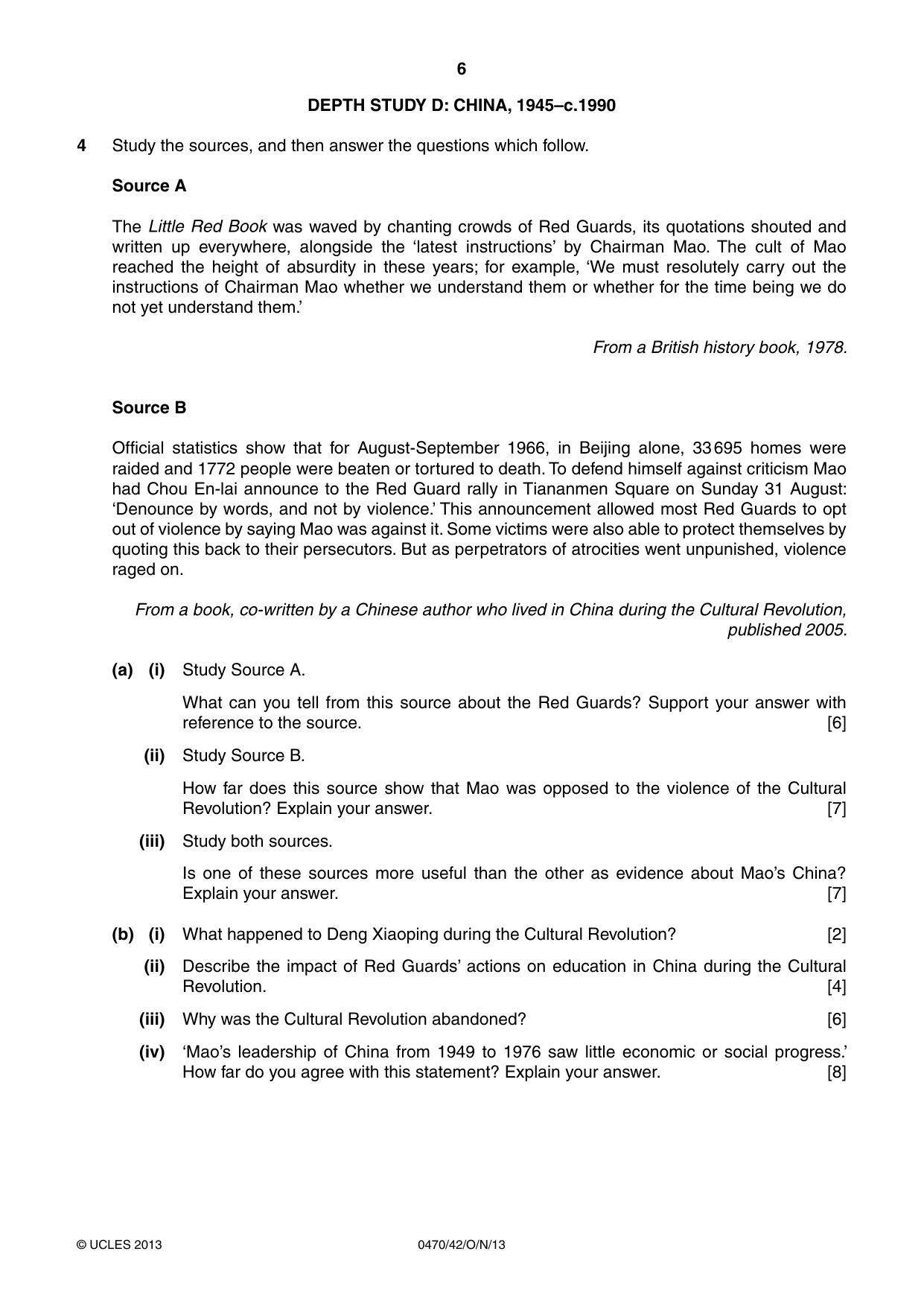
6 0470/42/O/N/13 © UCLES 2013 DEPTH STUDY D: CHINA, 1945–c.1990 4 Study the sources, and then answer the questions which follow. Source A The Little Red Book was waved by chanting crowds of Red Guards, its quotations shouted and written up everywhere, alongside the ‘latest instructions’ by Chairman Mao. The cult of Mao reached the height of absurdity in these years; for example, ‘We must resolutely carry out the instructions of Chairman Mao whether we understand them or whether for the time being we do not yet understand them.’ From a British history book, 1978. Source B Official statistics show that for August-September 1966, in Beijing alone, 33 695 homes were raided and 1772 people were beaten or tortured to death. To defend himself against criticism Mao had Chou En-lai announce to the Red Guard rally in Tiananmen Square on Sunday 31 August: ‘Denounce by words, and not by violence.’ This announcement allowed most Red Guards to opt out of violence by saying Mao was against it. Some victims were also able to protect themselves by quoting this back to their persecutors. But as perpetrators of atrocities went unpunished, violence raged on. From a book, co-written by a Chinese author who lived in China during the Cultural Revolution, published 2005. (a) (i) Study Source A. What can you tell from this source about the Red Guards? Support your answer with reference to the source. [6] (ii) Study Source B. How far does this source show that Mao was opposed to the violence of the Cultural Revolution? Explain your answer. [7] (iii) Study both sources. Is one of these sources more useful than the other as evidence about Mao’s China? Explain your answer. [7] (b) (i) What happened to Deng Xiaoping during the Cultural Revolution? [2] (ii) Describe the impact of Red Guards’ actions on education in China during the Cultural Revolution. [4] (iii) Why was the Cultural Revolution abandoned? [6] (iv) ‘Mao’s leadership of China from 1949 to 1976 saw little economic or social progress.’ How far do you agree with this statement? Explain your answer. [8]
Question paper, page 7
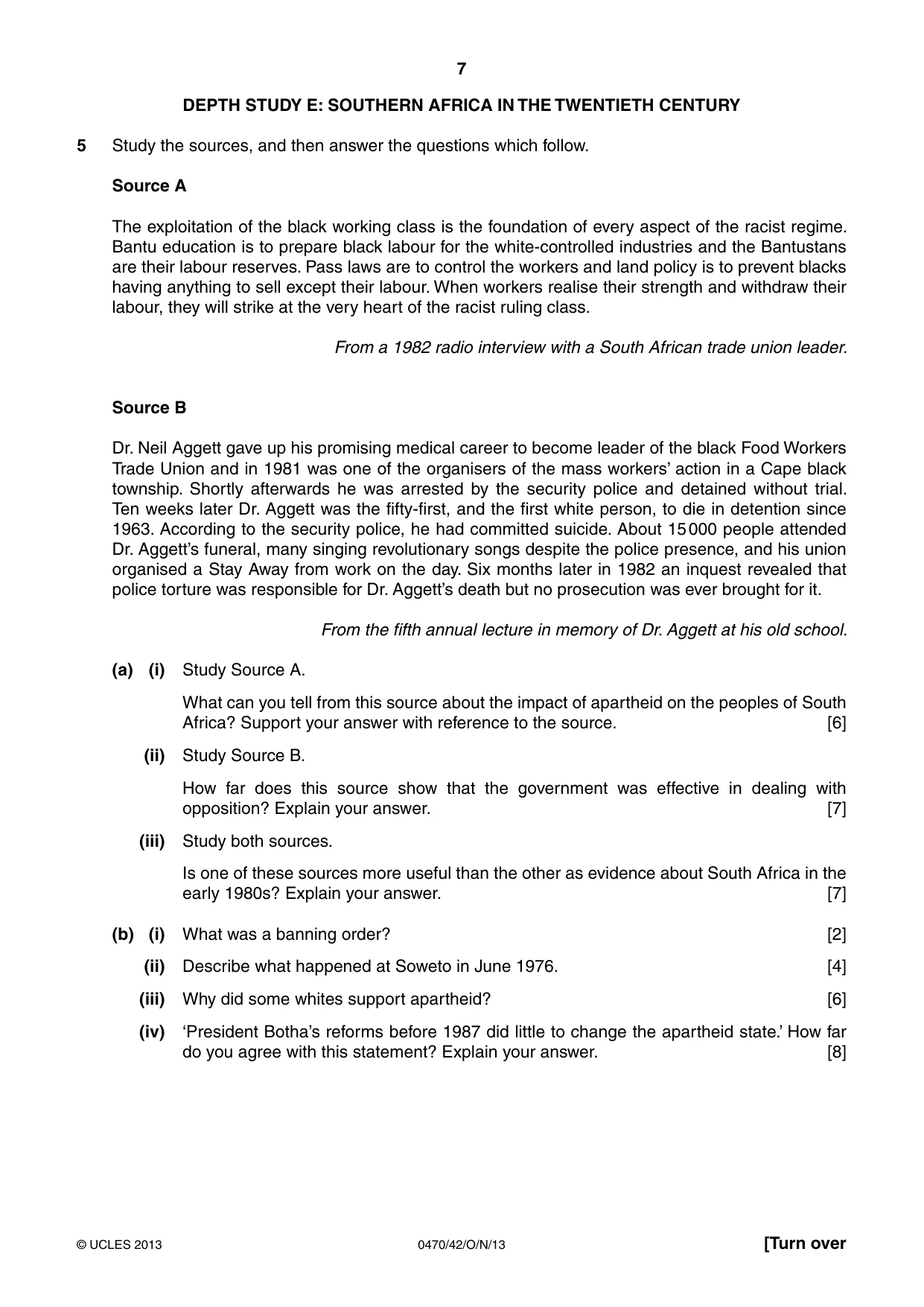
7 0470/42/O/N/13 © UCLES 2013 [Turn over DEPTH STUDY E: SOUTHERN AFRICA IN THE TWENTIETH CENTURY 5 Study the sources, and then answer the questions which follow. Source A The exploitation of the black working class is the foundation of every aspect of the racist regime. Bantu education is to prepare black labour for the white-controlled industries and the Bantustans are their labour reserves. Pass laws are to control the workers and land policy is to prevent blacks having anything to sell except their labour. When workers realise their strength and withdraw their labour, they will strike at the very heart of the racist ruling class. From a 1982 radio interview with a South African trade union leader. Source B Dr. Neil Aggett gave up his promising medical career to become leader of the black Food Workers Trade Union and in 1981 was one of the organisers of the mass workers’ action in a Cape black township. Shortly afterwards he was arrested by the security police and detained without trial. Ten weeks later Dr. Aggett was the fifty-first, and the first white person, to die in detention since 1963. According to the security police, he had committed suicide. About 15 000 people attended Dr. Aggett’s funeral, many singing revolutionary songs despite the police presence, and his union organised a Stay Away from work on the day. Six months later in 1982 an inquest revealed that police torture was responsible for Dr. Aggett’s death but no prosecution was ever brought for it. From the fifth annual lecture in memory of Dr. Aggett at his old school. (a) (i) Study Source A. What can you tell from this source about the impact of apartheid on the peoples of South Africa? Support your answer with reference to the source. [6] (ii) Study Source B. How far does this source show that the government was effective in dealing with opposition? Explain your answer. [7] (iii) Study both sources. Is one of these sources more useful than the other as evidence about South Africa in the early 1980s? Explain your answer. [7] (b) (i) What was a banning order? [2] (ii) Describe what happened at Soweto in June 1976. [4] (iii) Why did some whites support apartheid? [6] (iv) ‘President Botha’s reforms before 1987 did little to change the apartheid state.’ How far do you agree with this statement? Explain your answer. [8]
Question paper, page 8
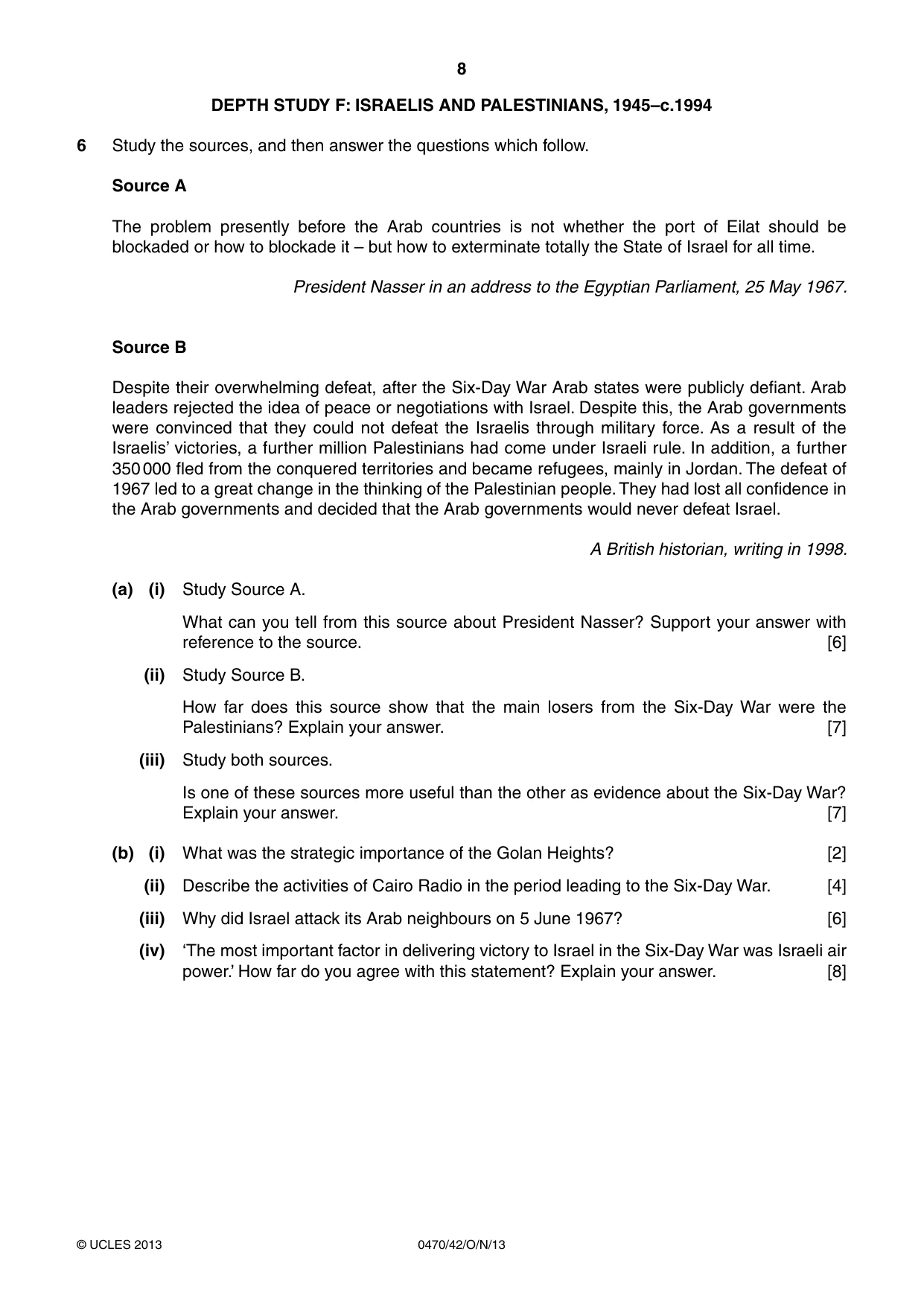
8 0470/42/O/N/13 © UCLES 2013 DEPTH STUDY F: ISRAELIS AND PALESTINIANS, 1945–c.1994 6 Study the sources, and then answer the questions which follow. Source A The problem presently before the Arab countries is not whether the port of Eilat should be blockaded or how to blockade it – but how to exterminate totally the State of Israel for all time. President Nasser in an address to the Egyptian Parliament, 25 May 1967. Source B Despite their overwhelming defeat, after the Six-Day War Arab states were publicly defiant. Arab leaders rejected the idea of peace or negotiations with Israel. Despite this, the Arab governments were convinced that they could not defeat the Israelis through military force. As a result of the Israelis’ victories, a further million Palestinians had come under Israeli rule. In addition, a further 350 000 fled from the conquered territories and became refugees, mainly in Jordan. The defeat of 1967 led to a great change in the thinking of the Palestinian people. They had lost all confidence in the Arab governments and decided that the Arab governments would never defeat Israel. A British historian, writing in 1998. (a) (i) Study Source A. What can you tell from this source about President Nasser? Support your answer with reference to the source. [6] (ii) Study Source B. How far does this source show that the main losers from the Six-Day War were the Palestinians? Explain your answer. [7] (iii) Study both sources. Is one of these sources more useful than the other as evidence about the Six-Day War? Explain your answer. [7] (b) (i) What was the strategic importance of the Golan Heights? [2] (ii) Describe the activities of Cairo Radio in the period leading to the Six-Day War. [4] (iii) Why did Israel attack its Arab neighbours on 5 June 1967? [6] (iv) ‘The most important factor in delivering victory to Israel in the Six-Day War was Israeli air power.’ How far do you agree with this statement? Explain your answer. [8]
Question paper, page 9
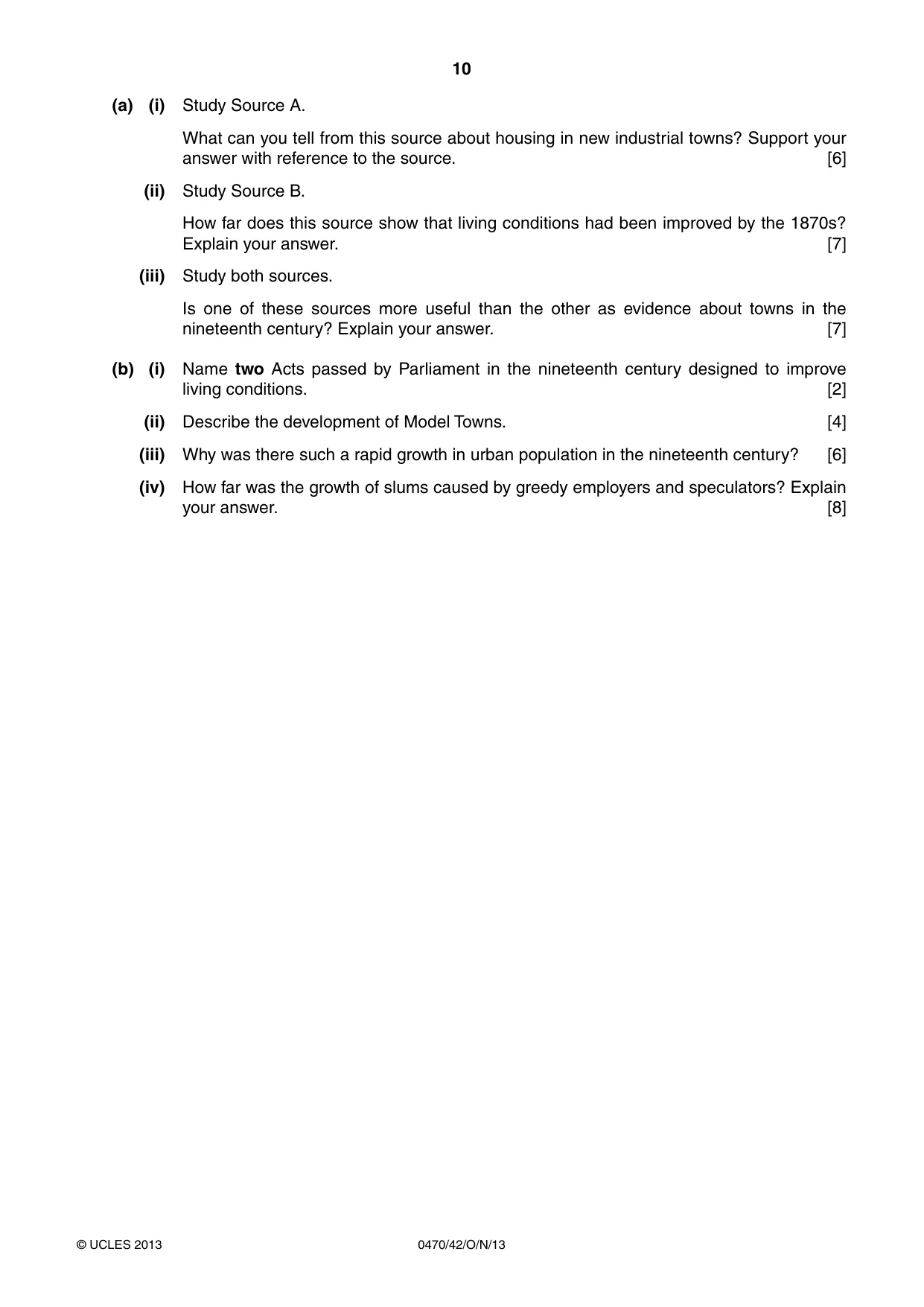
9 0470/42/O/N/13 © UCLES 2013 [Turn over DEPTH STUDY G: THE CREATION OF MODERN INDUSTRIAL SOCIETY 7 Study the sources, and then answer the questions which follow. Source A Drawing of houses in Preston, with an open sewer running between them. Source B How fortunate we are that our councils are so enlightened. Towards the end of the sixties a few Birmingham men found that a strong and able Town Council might do almost as much to improve the conditions of life in the town as Parliament itself. They had a growing enthusiasm for what a great and prosperous town like Birmingham might do for its people. They spoke of sweeping away streets in which it was not possible to live a decent and healthy life, of making the town cleaner, sweeter and brighter. They made sure that good water was to be supplied plentifully and at the lowest possible prices. A clergyman in Birmingham, writing in the 1870s.
Question paper, page 10
10 0470/42/O/N/13 © UCLES 2013 (a) (i) Study Source A. What can you tell from this source about housing in new industrial towns? Support your answer with reference to the source. [6] (ii) Study Source B. How far does this source show that living conditions had been improved by the 1870s? Explain your answer. [7] (iii) Study both sources. Is one of these sources more useful than the other as evidence about towns in the nineteenth century? Explain your answer. [7] (b) (i) Name two Acts passed by Parliament in the nineteenth century designed to improve living conditions. [2] (ii) Describe the development of Model Towns. [4] (iii) Why was there such a rapid growth in urban population in the nineteenth century? [6] (iv) How far was the growth of slums caused by greedy employers and speculators? Explain your answer. [8]
Question paper, page 11
11 0470/42/O/N/13 © UCLES 2013 DEPTH STUDY H: THE IMPACT OF WESTERN IMPERIALISM IN THE NINETEENTH CENTURY 8 Study the sources, and then answer the questions which follow. Source A Our readers are familiar enough with the original source of mischief – a report whether true or false, that the cartridges served out to the troops had been smeared with pig fat and that each sepoy, in biting or handling the cartridge before putting it in his gun, incurred a pollution involving loss of caste – the most terrible of all calamities to a Hindu. The magnitude of the horror of this misfortune among them cannot be understood by those who are not familiar with the character and traditions of these people. The Guardian newspaper, 30 June 1857. Source B As the century progressed problems began to emerge. By 1857 a thousand officers of the Bengal Army were on detachment elsewhere, weakening the bond between officers and sepoys. Those that remained were often the duller or less enterprising, who had come to India because it was the only place where they might have friends or relatives in high positions. Such men often hated India and its people. A captain in the Madras Army wrote, ‘I regret to say that it is too often the case that our own European officers do not treat the Indians as they should be treated. People come out to India thinking that because a man is black he is to be despised and we find new young officers talking about “those horrible black sepoys”.’ But it was not just the army that was disaffected. Lord Dalhousie had been a reformer keen to bring to the peoples of India the benefits of modern western nations. The British attempted to bring order and justice but reform brought resentment. Both native civilians and sepoys wanted their old India, and their old army, left as it was. From a book about the Indian Mutiny published in 2007. (a) (i) Study Source A. What can you tell from this source about the coming of the Mutiny? Support your answer with reference to the source. [6] (ii) Study Source B. How far can you tell from this source that it was problems in the army that caused the Mutiny? Explain your answer. [7] (iii) Study both sources. Is one of these sources more useful than the other as evidence about the grievances of the Indian people? Explain your answer. [7] (b) (i) Name two towns besieged during the Mutiny. [2] (ii) Describe Lord Dalhousie’s policies. [4] (iii) Why did so many British people go to India in the nineteenth century? [6] (iv) ‘The Indian Mutiny was unavoidable.’ How far do you agree with this statement? Explain your answer. [8]
Question paper, page 12
12 0470/42/O/N/13 © UCLES 2013 BLANK PAGE Copyright Acknowledgements: Depth Study A Source A © From the song sung at Nazi parades and meetings, written in 1929 by Horst Wessel. Depth Study A Source B © From the Nazi election manifesto for the September 1930 election. Depth Study B Source A © Norman Lowe; Mastering Modern World History; Macmillan Press Ltd; Reproduced with permission of Palgrave Macmillan; 1982. Depth Study B Source B © Clare Baker; Russia, 1917-1945; Heinemann Educational; 1990. Depth Study C Source A © From President Coolidge’s Inaugural Address, 1925. Depth Study C Source B © From a speech in 1939 by a leading figure in the Works’ Progress Administration (WPA). Depth Study D Source A © Harriet Ward; World Powers in the Twentieth Century; Heinemann Educational; 1978. Depth Study D Source B © Jung Chang & Jon Halliday; Mao, The Unknown Story; Published by Jonathan Cape. Reprinted by permission of the Random House Group Ltd; 2008. Depth Study E Source A © From a 1982 radio interview with a South African trade union leader. Depth Study E Source B © adapted: The Fifth Annual Lecture in Memory of Dr Aggett at his old school, 2007; http://www.kingswoodcollege.com/uploads/ files/Neil%20Aggett%20Memorial%20Lecture%20by. Depth Study F Source A © S J Perkins; Arab-Israeli Conflict; Macmillan Press Ltd; Reproduced with permission of Palgrave Macmillan; 1987. Depth Study F Source B © Tony McAleavy; The Arab-Israeli Conflict; Cambridge University Press; 1998. Depth Study G Source A © R Watson; Edwin Chadwick, Poor Law and Public Health; Published by Longman; 1969. Depth Study G Source B © K Dawson & P Wall; Public Health & Housing; Oxford University Press; 1970. Depth Study H Source A © www.guardian.co.uk/theguardian/from-the-archive-blog/2011/May/10/guardian; Guardian News & Media Ltd; 10 May 2011. Depth Study H Source B © J Spilsbury; The Indian Mutiny; Phoenix; 2007. Permission to reproduce items where third-party owned material protected by copyright is included has been sought and cleared where possible. Every reasonable effort has been made by the publisher (UCLES) to trace copyright holders, but if any items requiring clearance have unwittingly been included, the publisher will be pleased to make amends at the earliest possible opportunity. University of Cambridge International Examinations is part of the Cambridge Assessment Group. Cambridge Assessment is the brand name of University of Cambridge Local Examinations Syndicate (UCLES), which is itself a department of the University of Cambridge.
Mark scheme, page 1
CAMBRIDGE INTERNATIONAL EXAMINATIONS International General Certificate of Secondary Education MARK SCHEME for the October/November 2013 series 0470 HISTORY 0470/42 Paper 4 (Alternative to Coursework), maximum raw mark 40 This mark scheme is published as an aid to teachers and candidates, to indicate the requirements of the examination. It shows the basis on which Examiners were instructed to award marks. It does not indicate the details of the discussions that took place at an Examiners’ meeting before marking began, which would have considered the acceptability of alternative answers. Mark schemes should be read in conjunction with the question paper and the Principal Examiner Report for Teachers. Cambridge will not enter into discussions about these mark schemes. Cambridge is publishing the mark schemes for the October/November 2013 series for most IGCSE, GCE Advanced Level and Advanced Subsidiary Level components and some Ordinary Level components.
Mark scheme, page 2
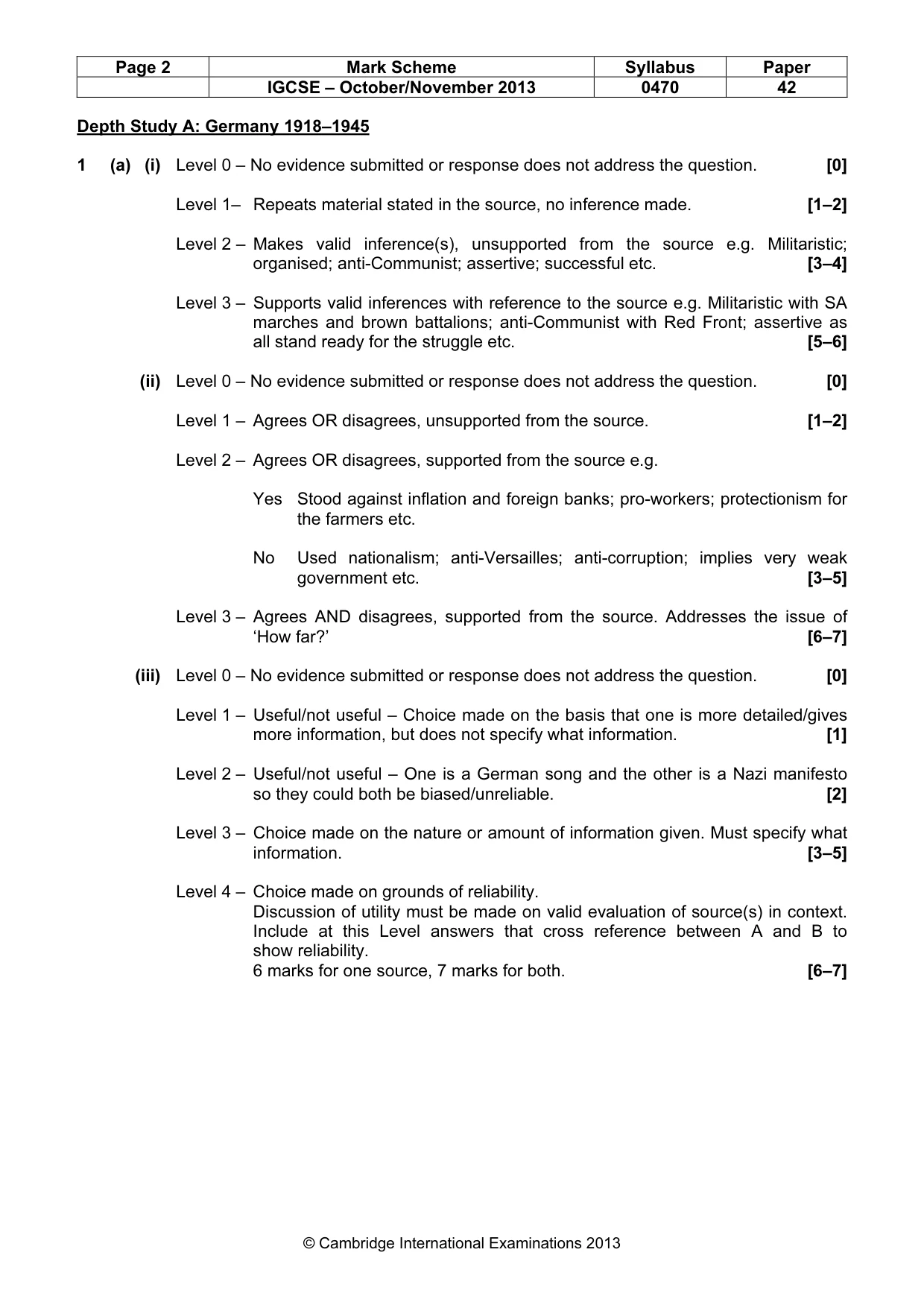
Page 2 Mark Scheme Syllabus Paper IGCSE – October/November 2013 0470 42 © Cambridge International Examinations 2013 Depth Study A: Germany 1918–1945 1 (a) (i) Level 0 – No evidence submitted or response does not address the question. [0] Level 1– Repeats material stated in the source, no inference made. [1–2] Level 2 – Makes valid inference(s), unsupported from the source e.g. Militaristic; organised; anti-Communist; assertive; successful etc. [3–4] Level 3 – Supports valid inferences with reference to the source e.g. Militaristic with SA marches and brown battalions; anti-Communist with Red Front; assertive as all stand ready for the struggle etc. [5–6] (ii) Level 0 – No evidence submitted or response does not address the question. [0] Level 1 – Agrees OR disagrees, unsupported from the source. [1–2] Level 2 – Agrees OR disagrees, supported from the source e.g. Yes Stood against inflation and foreign banks; pro-workers; protectionism for the farmers etc. No Used nationalism; anti-Versailles; anti-corruption; implies very weak government etc. [3–5] Level 3 – Agrees AND disagrees, supported from the source. Addresses the issue of ‘How far?’ [6–7] (iii) Level 0 – No evidence submitted or response does not address the question. [0] Level 1 – Useful/not useful – Choice made on the basis that one is more detailed/gives more information, but does not specify what information. [1] Level 2 – Useful/not useful – One is a German song and the other is a Nazi manifesto so they could both be biased/unreliable. [2] Level 3 – Choice made on the nature or amount of information given. Must specify what information. [3–5] Level 4 – Choice made on grounds of reliability. Discussion of utility must be made on valid evaluation of source(s) in context. Include at this Level answers that cross reference between A and B to show reliability. 6 marks for one source, 7 marks for both. [6–7]
Mark scheme, page 3
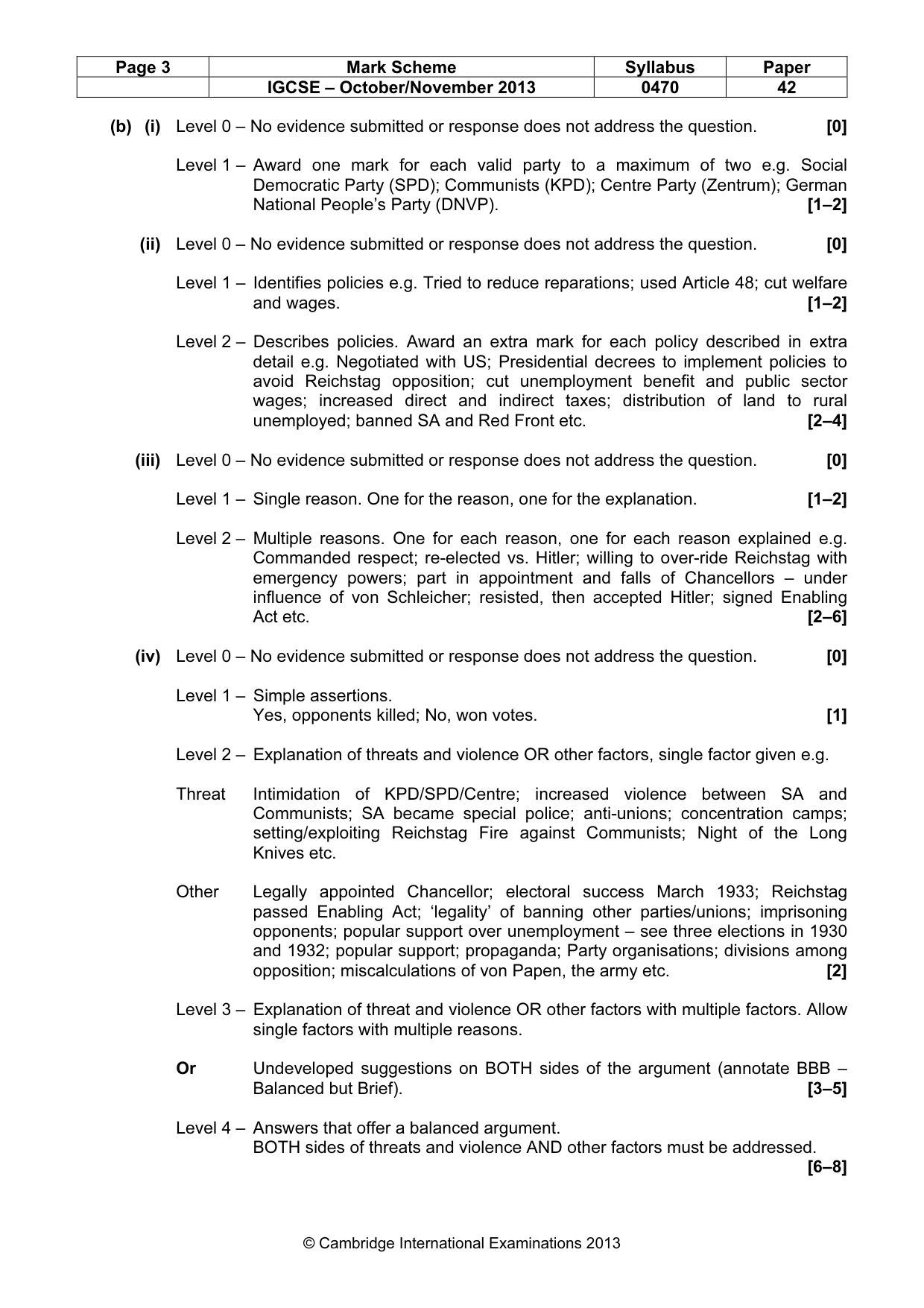
Page 3 Mark Scheme Syllabus Paper IGCSE – October/November 2013 0470 42 © Cambridge International Examinations 2013 (b) (i) Level 0 – No evidence submitted or response does not address the question. [0] Level 1 – Award one mark for each valid party to a maximum of two e.g. Social Democratic Party (SPD); Communists (KPD); Centre Party (Zentrum); German National People’s Party (DNVP). [1–2] (ii) Level 0 – No evidence submitted or response does not address the question. [0] Level 1 – Identifies policies e.g. Tried to reduce reparations; used Article 48; cut welfare and wages. [1–2] Level 2 – Describes policies. Award an extra mark for each policy described in extra detail e.g. Negotiated with US; Presidential decrees to implement policies to avoid Reichstag opposition; cut unemployment benefit and public sector wages; increased direct and indirect taxes; distribution of land to rural unemployed; banned SA and Red Front etc. [2–4] (iii) Level 0 – No evidence submitted or response does not address the question. [0] Level 1 – Single reason. One for the reason, one for the explanation. [1–2] Level 2 – Multiple reasons. One for each reason, one for each reason explained e.g. Commanded respect; re-elected vs. Hitler; willing to over-ride Reichstag with emergency powers; part in appointment and falls of Chancellors – under influence of von Schleicher; resisted, then accepted Hitler; signed Enabling Act etc. [2–6] (iv) Level 0 – No evidence submitted or response does not address the question. [0] Level 1 – Simple assertions. Yes, opponents killed; No, won votes. [1] Level 2 – Explanation of threats and violence OR other factors, single factor given e.g. Threat Intimidation of KPD/SPD/Centre; increased violence between SA and Communists; SA became special police; anti-unions; concentration camps; setting/exploiting Reichstag Fire against Communists; Night of the Long Knives etc. Other Legally appointed Chancellor; electoral success March 1933; Reichstag passed Enabling Act; ‘legality’ of banning other parties/unions; imprisoning opponents; popular support over unemployment – see three elections in 1930 and 1932; popular support; propaganda; Party organisations; divisions among opposition; miscalculations of von Papen, the army etc. [2] Level 3 – Explanation of threat and violence OR other factors with multiple factors. Allow single factors with multiple reasons. Or Undeveloped suggestions on BOTH sides of the argument (annotate BBB – Balanced but Brief). [3–5] Level 4 – Answers that offer a balanced argument. BOTH sides of threats and violence AND other factors must be addressed. [6–8]
Mark scheme, page 4
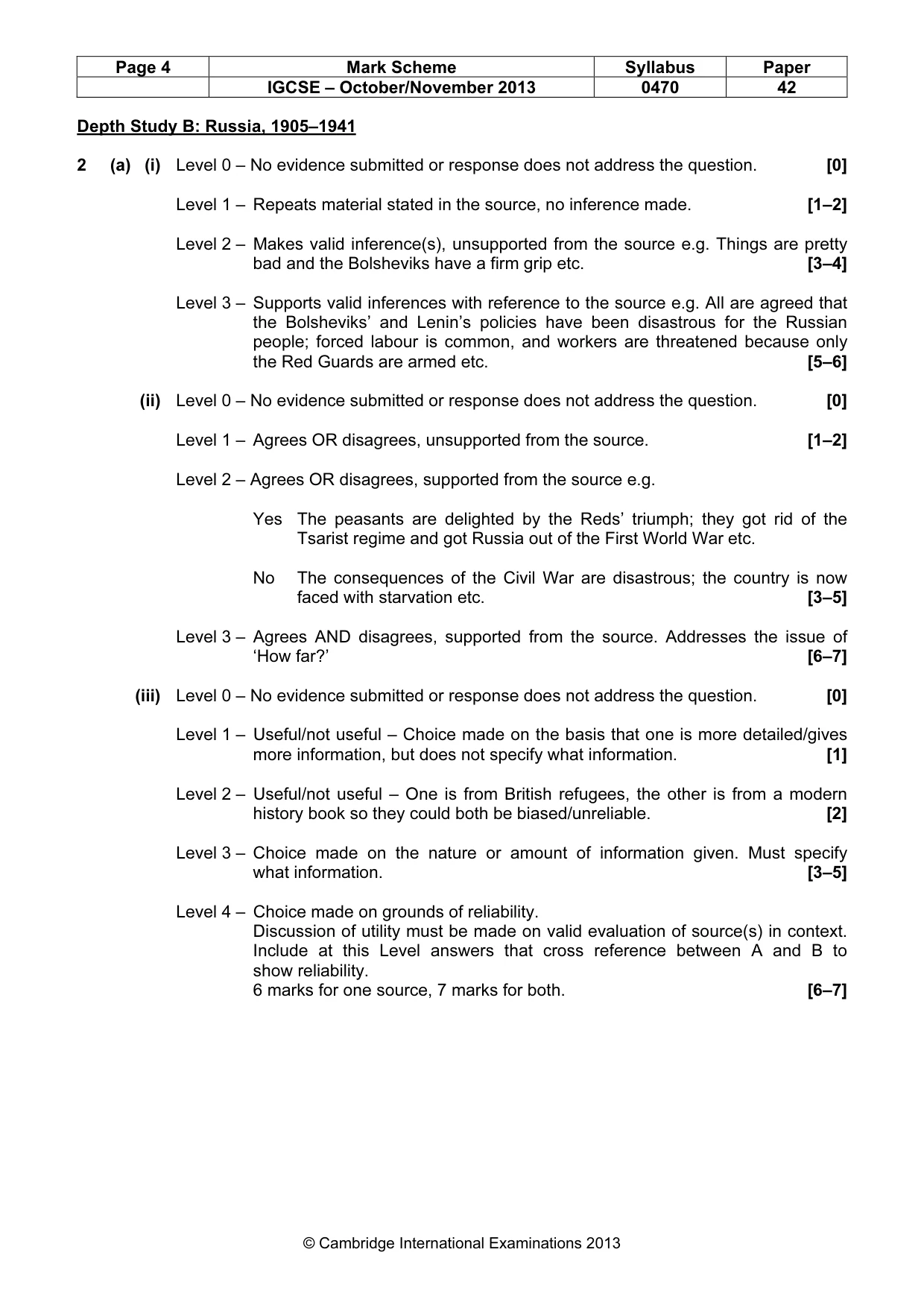
Page 4 Mark Scheme Syllabus Paper IGCSE – October/November 2013 0470 42 © Cambridge International Examinations 2013 Depth Study B: Russia, 1905–1941 2 (a) (i) Level 0 – No evidence submitted or response does not address the question. [0] Level 1 – Repeats material stated in the source, no inference made. [1–2] Level 2 – Makes valid inference(s), unsupported from the source e.g. Things are pretty bad and the Bolsheviks have a firm grip etc. [3–4] Level 3 – Supports valid inferences with reference to the source e.g. All are agreed that the Bolsheviks’ and Lenin’s policies have been disastrous for the Russian people; forced labour is common, and workers are threatened because only the Red Guards are armed etc. [5–6] (ii) Level 0 – No evidence submitted or response does not address the question. [0] Level 1 – Agrees OR disagrees, unsupported from the source. [1–2] Level 2 – Agrees OR disagrees, supported from the source e.g. Yes The peasants are delighted by the Reds’ triumph; they got rid of the Tsarist regime and got Russia out of the First World War etc. No The consequences of the Civil War are disastrous; the country is now faced with starvation etc. [3–5] Level 3 – Agrees AND disagrees, supported from the source. Addresses the issue of ‘How far?’ [6–7] (iii) Level 0 – No evidence submitted or response does not address the question. [0] Level 1 – Useful/not useful – Choice made on the basis that one is more detailed/gives more information, but does not specify what information. [1] Level 2 – Useful/not useful – One is from British refugees, the other is from a modern history book so they could both be biased/unreliable. [2] Level 3 – Choice made on the nature or amount of information given. Must specify what information. [3–5] Level 4 – Choice made on grounds of reliability. Discussion of utility must be made on valid evaluation of source(s) in context. Include at this Level answers that cross reference between A and B to show reliability. 6 marks for one source, 7 marks for both. [6–7]
Mark scheme, page 5
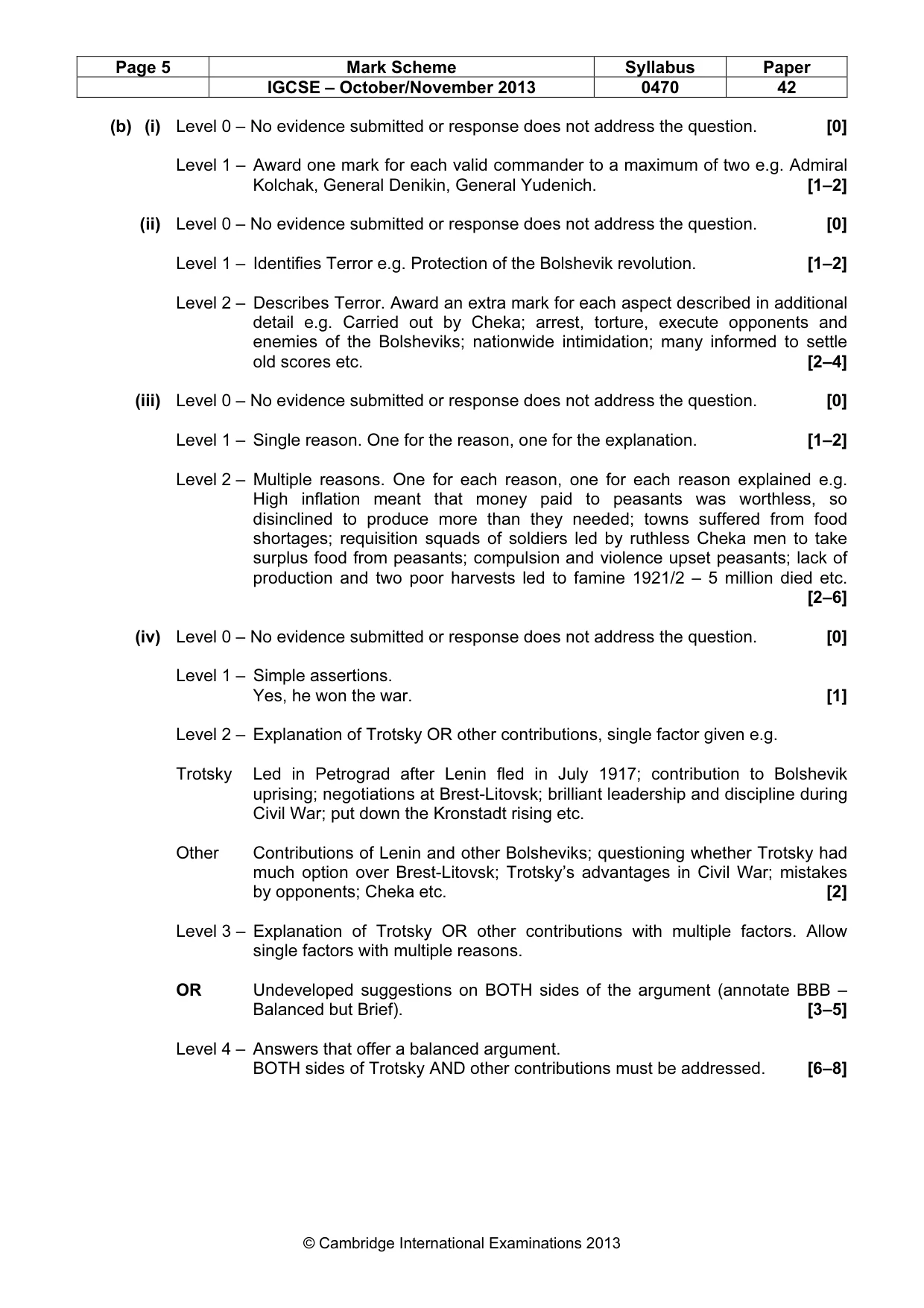
Page 5 Mark Scheme Syllabus Paper IGCSE – October/November 2013 0470 42 © Cambridge International Examinations 2013 (b) (i) Level 0 – No evidence submitted or response does not address the question. [0] Level 1 – Award one mark for each valid commander to a maximum of two e.g. Admiral Kolchak, General Denikin, General Yudenich. [1–2] (ii) Level 0 – No evidence submitted or response does not address the question. [0] Level 1 – Identifies Terror e.g. Protection of the Bolshevik revolution. [1–2] Level 2 – Describes Terror. Award an extra mark for each aspect described in additional detail e.g. Carried out by Cheka; arrest, torture, execute opponents and enemies of the Bolsheviks; nationwide intimidation; many informed to settle old scores etc. [2–4] (iii) Level 0 – No evidence submitted or response does not address the question. [0] Level 1 – Single reason. One for the reason, one for the explanation. [1–2] Level 2 – Multiple reasons. One for each reason, one for each reason explained e.g. High inflation meant that money paid to peasants was worthless, so disinclined to produce more than they needed; towns suffered from food shortages; requisition squads of soldiers led by ruthless Cheka men to take surplus food from peasants; compulsion and violence upset peasants; lack of production and two poor harvests led to famine 1921/2 – 5 million died etc. [2–6] (iv) Level 0 – No evidence submitted or response does not address the question. [0] Level 1 – Simple assertions. Yes, he won the war. [1] Level 2 – Explanation of Trotsky OR other contributions, single factor given e.g. Trotsky Led in Petrograd after Lenin fled in July 1917; contribution to Bolshevik uprising; negotiations at Brest-Litovsk; brilliant leadership and discipline during Civil War; put down the Kronstadt rising etc. Other Contributions of Lenin and other Bolsheviks; questioning whether Trotsky had much option over Brest-Litovsk; Trotsky’s advantages in Civil War; mistakes by opponents; Cheka etc. [2] Level 3 – Explanation of Trotsky OR other contributions with multiple factors. Allow single factors with multiple reasons. OR Undeveloped suggestions on BOTH sides of the argument (annotate BBB – Balanced but Brief). [3–5] Level 4 – Answers that offer a balanced argument. BOTH sides of Trotsky AND other contributions must be addressed. [6–8]
Mark scheme, page 6
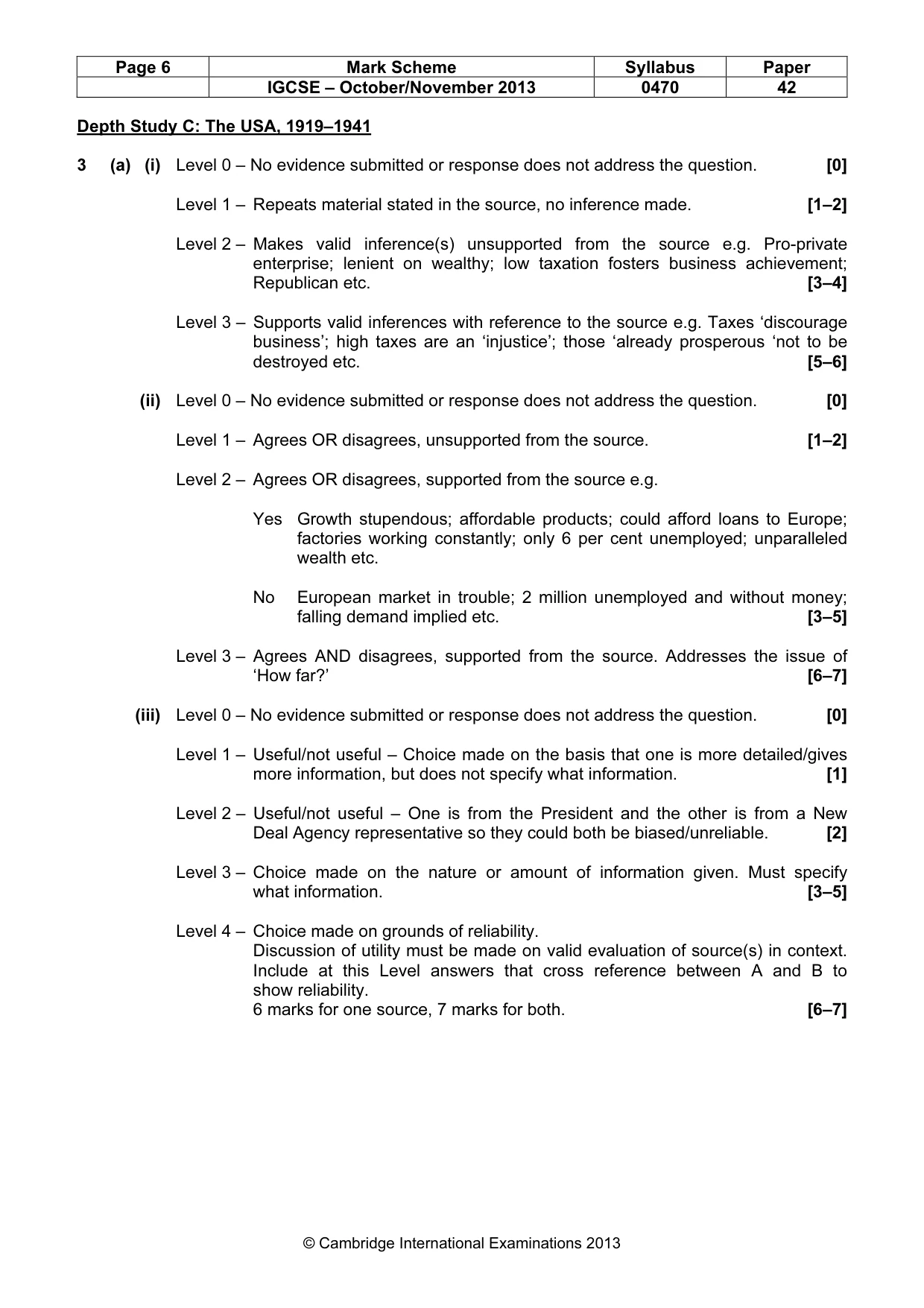
Page 6 Mark Scheme Syllabus Paper IGCSE – October/November 2013 0470 42 © Cambridge International Examinations 2013 Depth Study C: The USA, 1919–1941 3 (a) (i) Level 0 – No evidence submitted or response does not address the question. [0] Level 1 – Repeats material stated in the source, no inference made. [1–2] Level 2 – Makes valid inference(s) unsupported from the source e.g. Pro-private enterprise; lenient on wealthy; low taxation fosters business achievement; Republican etc. [3–4] Level 3 – Supports valid inferences with reference to the source e.g. Taxes ‘discourage business’; high taxes are an ‘injustice’; those ‘already prosperous ‘not to be destroyed etc. [5–6] (ii) Level 0 – No evidence submitted or response does not address the question. [0] Level 1 – Agrees OR disagrees, unsupported from the source. [1–2] Level 2 – Agrees OR disagrees, supported from the source e.g. Yes Growth stupendous; affordable products; could afford loans to Europe; factories working constantly; only 6 per cent unemployed; unparalleled wealth etc. No European market in trouble; 2 million unemployed and without money; falling demand implied etc. [3–5] Level 3 – Agrees AND disagrees, supported from the source. Addresses the issue of ‘How far?’ [6–7] (iii) Level 0 – No evidence submitted or response does not address the question. [0] Level 1 – Useful/not useful – Choice made on the basis that one is more detailed/gives more information, but does not specify what information. [1] Level 2 – Useful/not useful – One is from the President and the other is from a New Deal Agency representative so they could both be biased/unreliable. [2] Level 3 – Choice made on the nature or amount of information given. Must specify what information. [3–5] Level 4 – Choice made on grounds of reliability. Discussion of utility must be made on valid evaluation of source(s) in context. Include at this Level answers that cross reference between A and B to show reliability. 6 marks for one source, 7 marks for both. [6–7]
Mark scheme, page 7
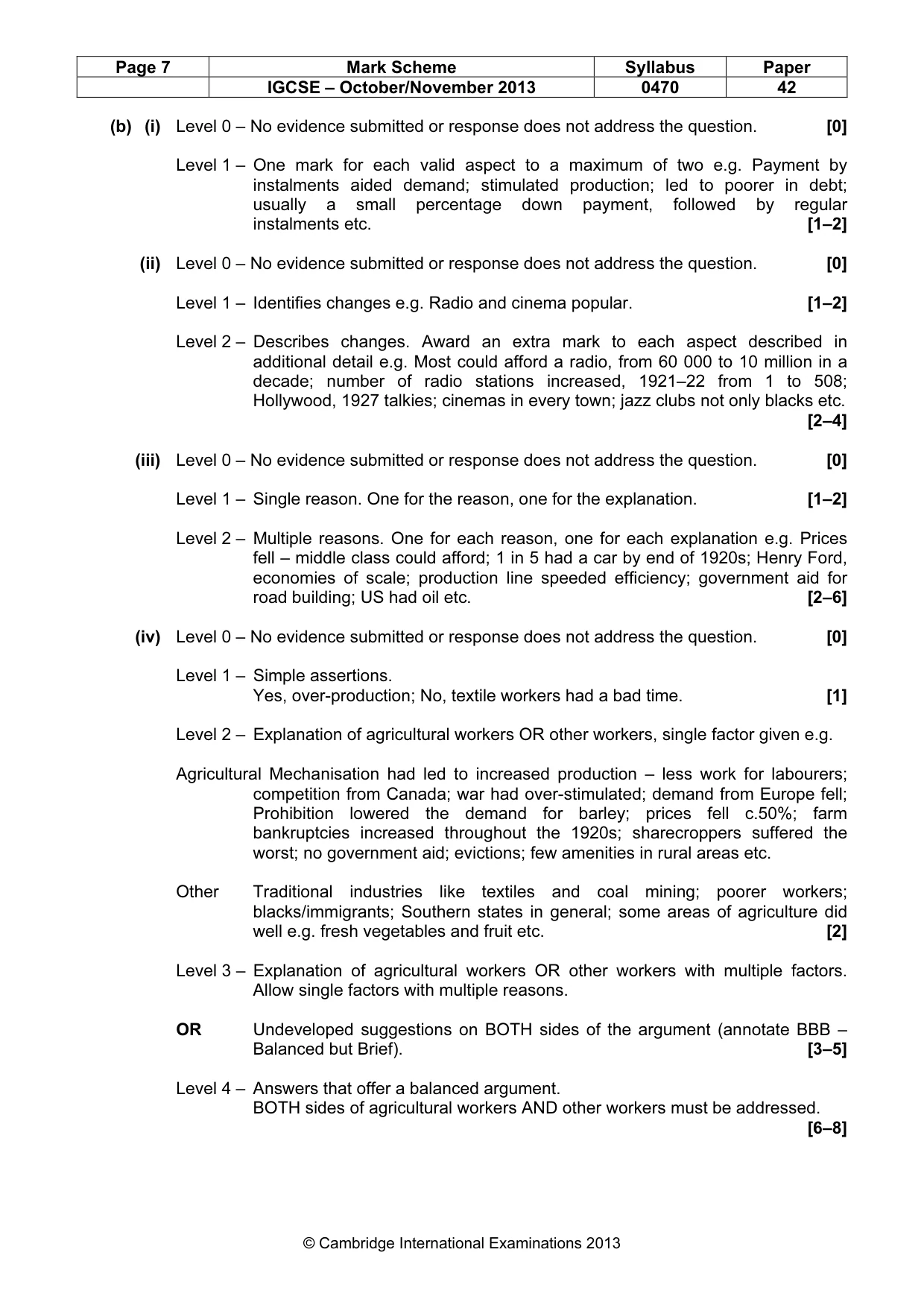
Page 7 Mark Scheme Syllabus Paper IGCSE – October/November 2013 0470 42 © Cambridge International Examinations 2013 (b) (i) Level 0 – No evidence submitted or response does not address the question. [0] Level 1 – One mark for each valid aspect to a maximum of two e.g. Payment by instalments aided demand; stimulated production; led to poorer in debt; usually a small percentage down payment, followed by regular instalments etc. [1–2] (ii) Level 0 – No evidence submitted or response does not address the question. [0] Level 1 – Identifies changes e.g. Radio and cinema popular. [1–2] Level 2 – Describes changes. Award an extra mark to each aspect described in additional detail e.g. Most could afford a radio, from 60 000 to 10 million in a decade; number of radio stations increased, 1921–22 from 1 to 508; Hollywood, 1927 talkies; cinemas in every town; jazz clubs not only blacks etc. [2–4] (iii) Level 0 – No evidence submitted or response does not address the question. [0] Level 1 – Single reason. One for the reason, one for the explanation. [1–2] Level 2 – Multiple reasons. One for each reason, one for each explanation e.g. Prices fell – middle class could afford; 1 in 5 had a car by end of 1920s; Henry Ford, economies of scale; production line speeded efficiency; government aid for road building; US had oil etc. [2–6] (iv) Level 0 – No evidence submitted or response does not address the question. [0] Level 1 – Simple assertions. Yes, over-production; No, textile workers had a bad time. [1] Level 2 – Explanation of agricultural workers OR other workers, single factor given e.g. Agricultural Mechanisation had led to increased production – less work for labourers; competition from Canada; war had over-stimulated; demand from Europe fell; Prohibition lowered the demand for barley; prices fell c.50%; farm bankruptcies increased throughout the 1920s; sharecroppers suffered the worst; no government aid; evictions; few amenities in rural areas etc. Other Traditional industries like textiles and coal mining; poorer workers; blacks/immigrants; Southern states in general; some areas of agriculture did well e.g. fresh vegetables and fruit etc. [2] Level 3 – Explanation of agricultural workers OR other workers with multiple factors. Allow single factors with multiple reasons. OR Undeveloped suggestions on BOTH sides of the argument (annotate BBB – Balanced but Brief). [3–5] Level 4 – Answers that offer a balanced argument. BOTH sides of agricultural workers AND other workers must be addressed. [6–8]
Mark scheme, page 8
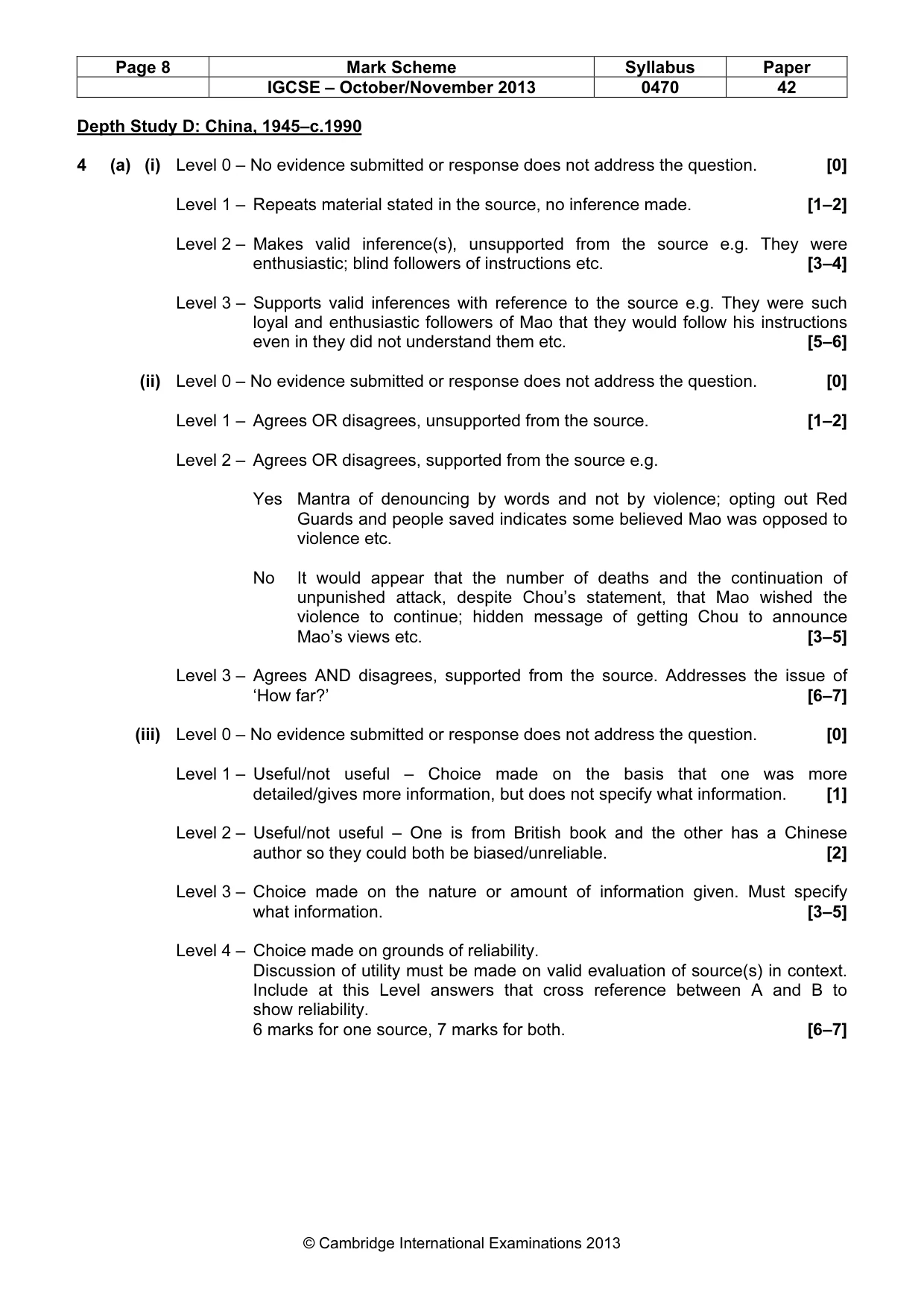
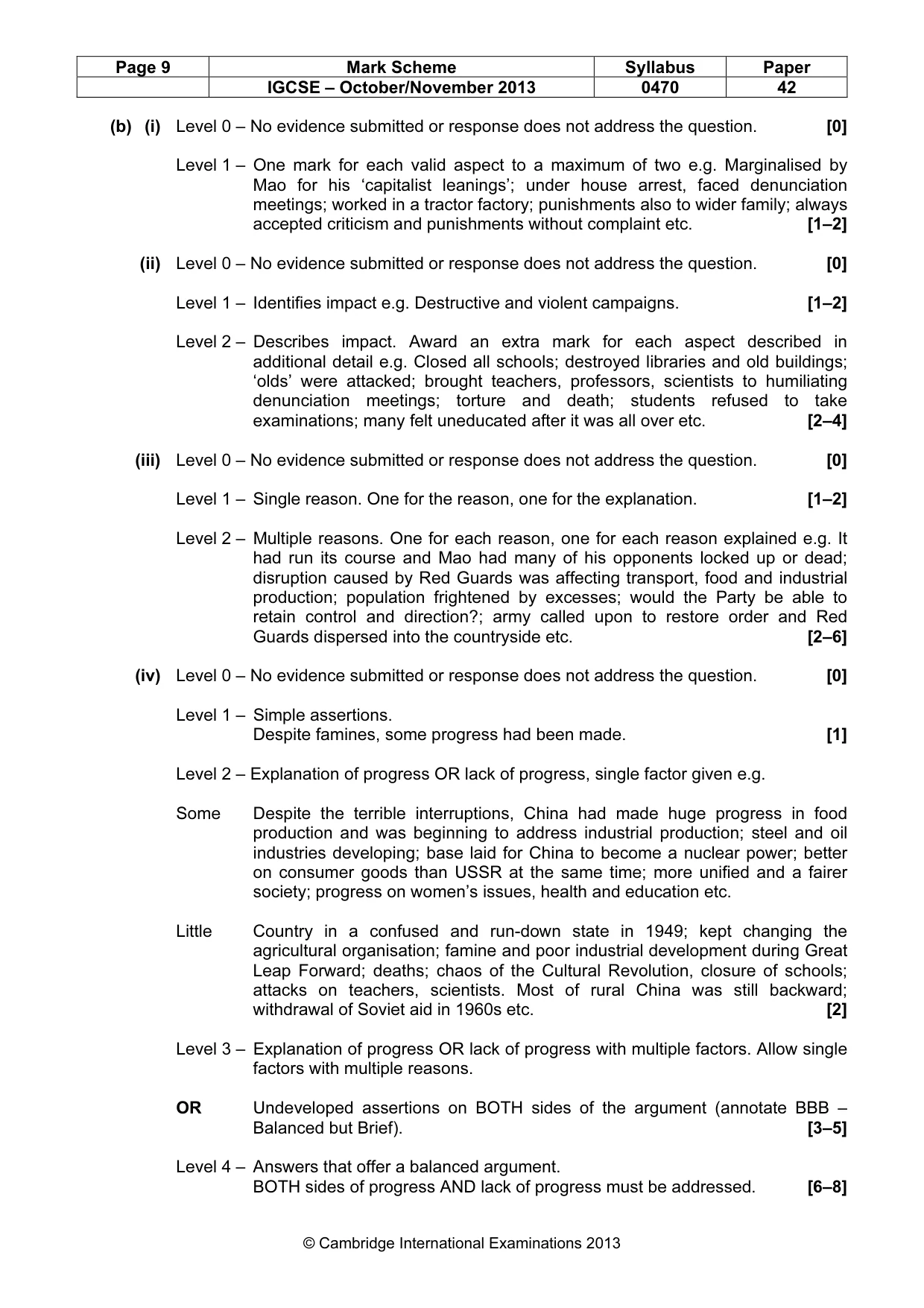
Page 8 Mark Scheme Syllabus Paper IGCSE – October/November 2013 0470 42 © Cambridge International Examinations 2013 Depth Study D: China, 1945–c.1990 4 (a) (i) Level 0 – No evidence submitted or response does not address the question. [0] Level 1 – Repeats material stated in the source, no inference made. [1–2] Level 2 – Makes valid inference(s), unsupported from the source e.g. They were enthusiastic; blind followers of instructions etc. [3–4] Level 3 – Supports valid inferences with reference to the source e.g. They were such loyal and enthusiastic followers of Mao that they would follow his instructions even in they did not understand them etc. [5–6] (ii) Level 0 – No evidence submitted or response does not address the question. [0] Level 1 – Agrees OR disagrees, unsupported from the source. [1–2] Level 2 – Agrees OR disagrees, supported from the source e.g. Yes Mantra of denouncing by words and not by violence; opting out Red Guards and people saved indicates some believed Mao was opposed to violence etc. No It would appear that the number of deaths and the continuation of unpunished attack, despite Chou’s statement, that Mao wished the violence to continue; hidden message of getting Chou to announce Mao’s views etc. [3–5] Level 3 – Agrees AND disagrees, supported from the source. Addresses the issue of ‘How far?’ [6–7] (iii) Level 0 – No evidence submitted or response does not address the question. [0] Level 1 – Useful/not useful – Choice made on the basis that one was more detailed/gives more information, but does not specify what information. [1] Level 2 – Useful/not useful – One is from British book and the other has a Chinese author so they could both be biased/unreliable. [2] Level 3 – Choice made on the nature or amount of information given. Must specify what information. [3–5] Level 4 – Choice made on grounds of reliability. Discussion of utility must be made on valid evaluation of source(s) in context. Include at this Level answers that cross reference between A and B to show reliability. 6 marks for one source, 7 marks for both. [6–7]
Mark scheme, page 9
Page 9 Mark Scheme Syllabus Paper IGCSE – October/November 2013 0470 42 © Cambridge International Examinations 2013 (b) (i) Level 0 – No evidence submitted or response does not address the question. [0] Level 1 – One mark for each valid aspect to a maximum of two e.g. Marginalised by Mao for his ‘capitalist leanings’; under house arrest, faced denunciation meetings; worked in a tractor factory; punishments also to wider family; always accepted criticism and punishments without complaint etc. [1–2] (ii) Level 0 – No evidence submitted or response does not address the question. [0] Level 1 – Identifies impact e.g. Destructive and violent campaigns. [1–2] Level 2 – Describes impact. Award an extra mark for each aspect described in additional detail e.g. Closed all schools; destroyed libraries and old buildings; ‘olds’ were attacked; brought teachers, professors, scientists to humiliating denunciation meetings; torture and death; students refused to take examinations; many felt uneducated after it was all over etc. [2–4] (iii) Level 0 – No evidence submitted or response does not address the question. [0] Level 1 – Single reason. One for the reason, one for the explanation. [1–2] Level 2 – Multiple reasons. One for each reason, one for each reason explained e.g. It had run its course and Mao had many of his opponents locked up or dead; disruption caused by Red Guards was affecting transport, food and industrial production; population frightened by excesses; would the Party be able to retain control and direction?; army called upon to restore order and Red Guards dispersed into the countryside etc. [2–6] (iv) Level 0 – No evidence submitted or response does not address the question. [0] Level 1 – Simple assertions. Despite famines, some progress had been made. [1] Level 2 – Explanation of progress OR lack of progress, single factor given e.g. Some Despite the terrible interruptions, China had made huge progress in food production and was beginning to address industrial production; steel and oil industries developing; base laid for China to become a nuclear power; better on consumer goods than USSR at the same time; more unified and a fairer society; progress on women’s issues, health and education etc. Little Country in a confused and run-down state in 1949; kept changing the agricultural organisation; famine and poor industrial development during Great Leap Forward; deaths; chaos of the Cultural Revolution, closure of schools; attacks on teachers, scientists. Most of rural China was still backward; withdrawal of Soviet aid in 1960s etc. [2] Level 3 – Explanation of progress OR lack of progress with multiple factors. Allow single factors with multiple reasons. OR Undeveloped assertions on BOTH sides of the argument (annotate BBB – Balanced but Brief). [3–5] Level 4 – Answers that offer a balanced argument. BOTH sides of progress AND lack of progress must be addressed. [6–8]
Mark scheme, page 10
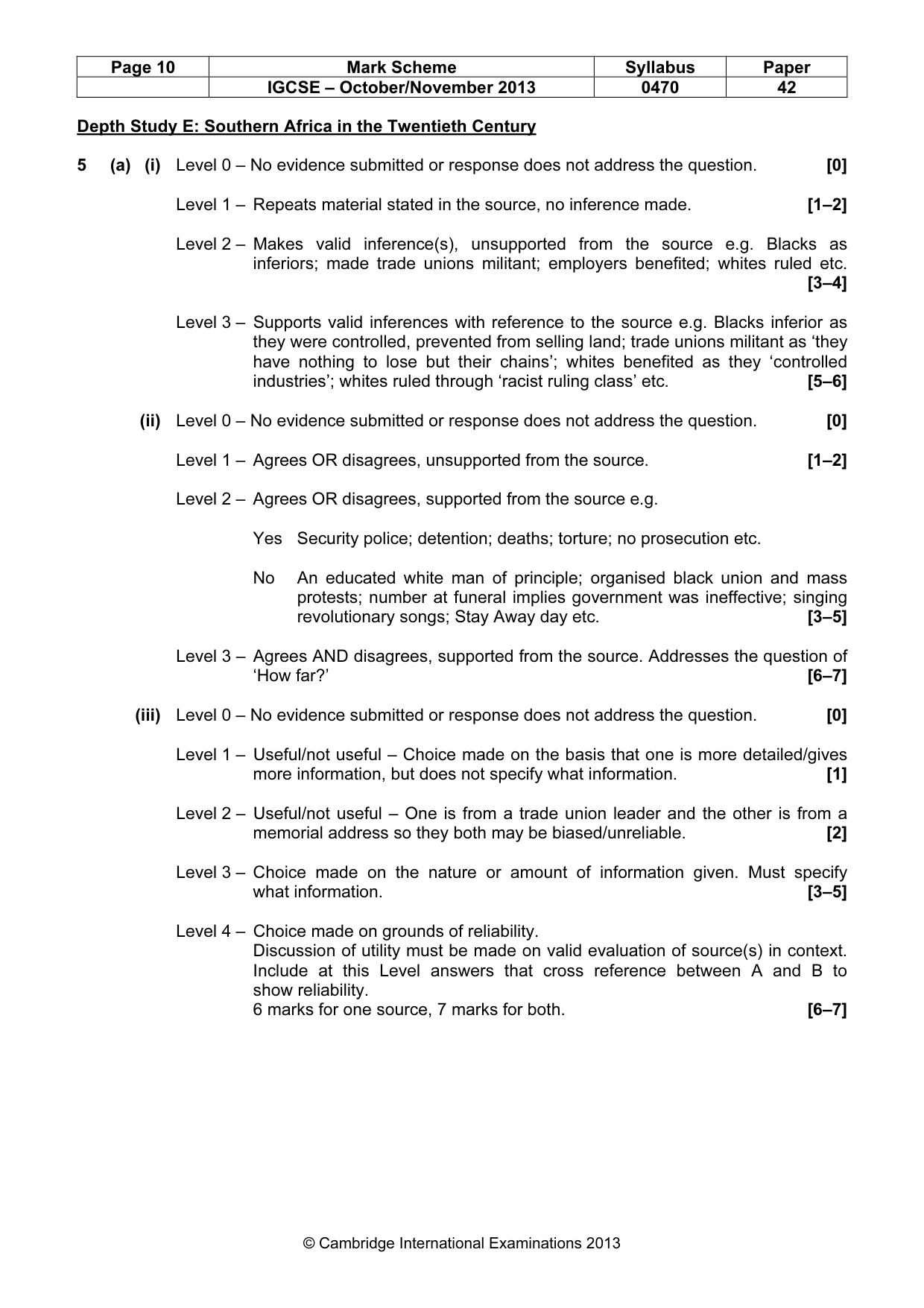
Page 10 Mark Scheme Syllabus Paper IGCSE – October/November 2013 0470 42 © Cambridge International Examinations 2013 Depth Study E: Southern Africa in the Twentieth Century 5 (a) (i) Level 0 – No evidence submitted or response does not address the question. [0] Level 1 – Repeats material stated in the source, no inference made. [1–2] Level 2 – Makes valid inference(s), unsupported from the source e.g. Blacks as inferiors; made trade unions militant; employers benefited; whites ruled etc. [3–4] Level 3 – Supports valid inferences with reference to the source e.g. Blacks inferior as they were controlled, prevented from selling land; trade unions militant as ‘they have nothing to lose but their chains’; whites benefited as they ‘controlled industries’; whites ruled through ‘racist ruling class’ etc. [5–6] (ii) Level 0 – No evidence submitted or response does not address the question. [0] Level 1 – Agrees OR disagrees, unsupported from the source. [1–2] Level 2 – Agrees OR disagrees, supported from the source e.g. Yes Security police; detention; deaths; torture; no prosecution etc. No An educated white man of principle; organised black union and mass protests; number at funeral implies government was ineffective; singing revolutionary songs; Stay Away day etc. [3–5] Level 3 – Agrees AND disagrees, supported from the source. Addresses the question of ‘How far?’ [6–7] (iii) Level 0 – No evidence submitted or response does not address the question. [0] Level 1 – Useful/not useful – Choice made on the basis that one is more detailed/gives more information, but does not specify what information. [1] Level 2 – Useful/not useful – One is from a trade union leader and the other is from a memorial address so they both may be biased/unreliable. [2] Level 3 – Choice made on the nature or amount of information given. Must specify what information. [3–5] Level 4 – Choice made on grounds of reliability. Discussion of utility must be made on valid evaluation of source(s) in context. Include at this Level answers that cross reference between A and B to show reliability. 6 marks for one source, 7 marks for both. [6–7]
Mark scheme, page 11
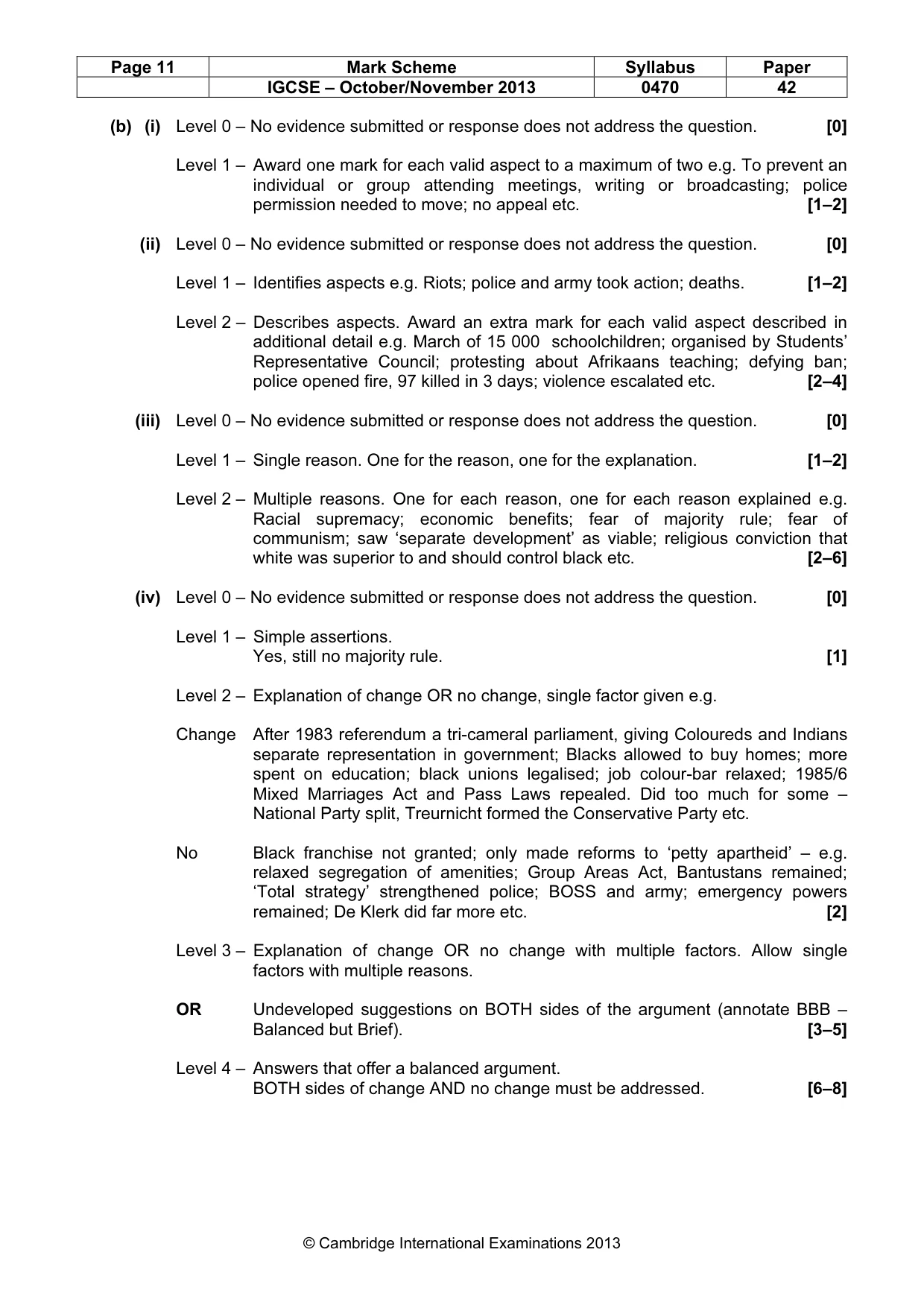
Page 11 Mark Scheme Syllabus Paper IGCSE – October/November 2013 0470 42 © Cambridge International Examinations 2013 (b) (i) Level 0 – No evidence submitted or response does not address the question. [0] Level 1 – Award one mark for each valid aspect to a maximum of two e.g. To prevent an individual or group attending meetings, writing or broadcasting; police permission needed to move; no appeal etc. [1–2] (ii) Level 0 – No evidence submitted or response does not address the question. [0] Level 1 – Identifies aspects e.g. Riots; police and army took action; deaths. [1–2] Level 2 – Describes aspects. Award an extra mark for each valid aspect described in additional detail e.g. March of 15 000 schoolchildren; organised by Students’ Representative Council; protesting about Afrikaans teaching; defying ban; police opened fire, 97 killed in 3 days; violence escalated etc. [2–4] (iii) Level 0 – No evidence submitted or response does not address the question. [0] Level 1 – Single reason. One for the reason, one for the explanation. [1–2] Level 2 – Multiple reasons. One for each reason, one for each reason explained e.g. Racial supremacy; economic benefits; fear of majority rule; fear of communism; saw ‘separate development’ as viable; religious conviction that white was superior to and should control black etc. [2–6] (iv) Level 0 – No evidence submitted or response does not address the question. [0] Level 1 – Simple assertions. Yes, still no majority rule. [1] Level 2 – Explanation of change OR no change, single factor given e.g. Change After 1983 referendum a tri-cameral parliament, giving Coloureds and Indians separate representation in government; Blacks allowed to buy homes; more spent on education; black unions legalised; job colour-bar relaxed; 1985/6 Mixed Marriages Act and Pass Laws repealed. Did too much for some – National Party split, Treurnicht formed the Conservative Party etc. No Black franchise not granted; only made reforms to ‘petty apartheid’ – e.g. relaxed segregation of amenities; Group Areas Act, Bantustans remained; ‘Total strategy’ strengthened police; BOSS and army; emergency powers remained; De Klerk did far more etc. [2] Level 3 – Explanation of change OR no change with multiple factors. Allow single factors with multiple reasons. OR Undeveloped suggestions on BOTH sides of the argument (annotate BBB – Balanced but Brief). [3–5] Level 4 – Answers that offer a balanced argument. BOTH sides of change AND no change must be addressed. [6–8]
Mark scheme, page 12
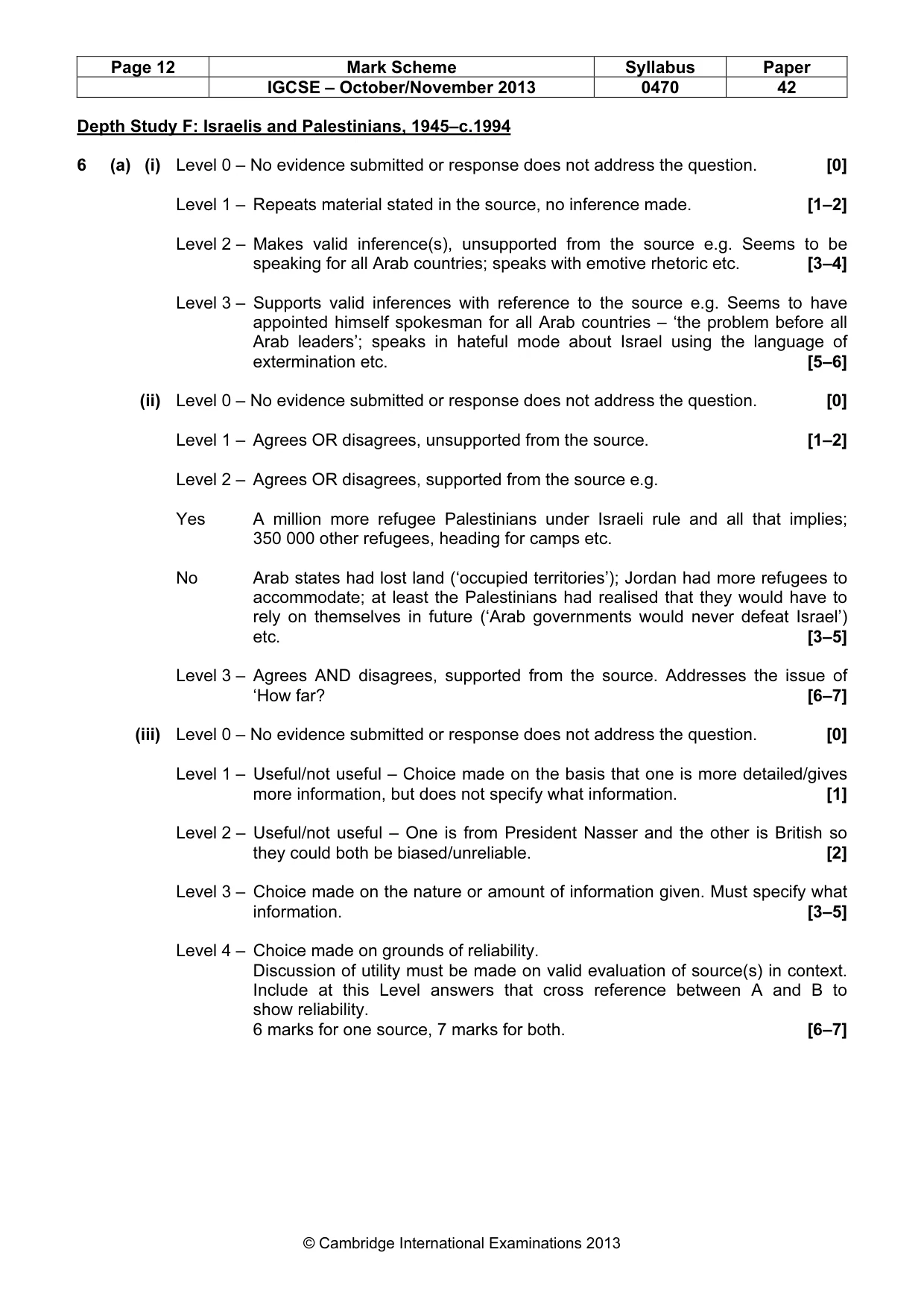
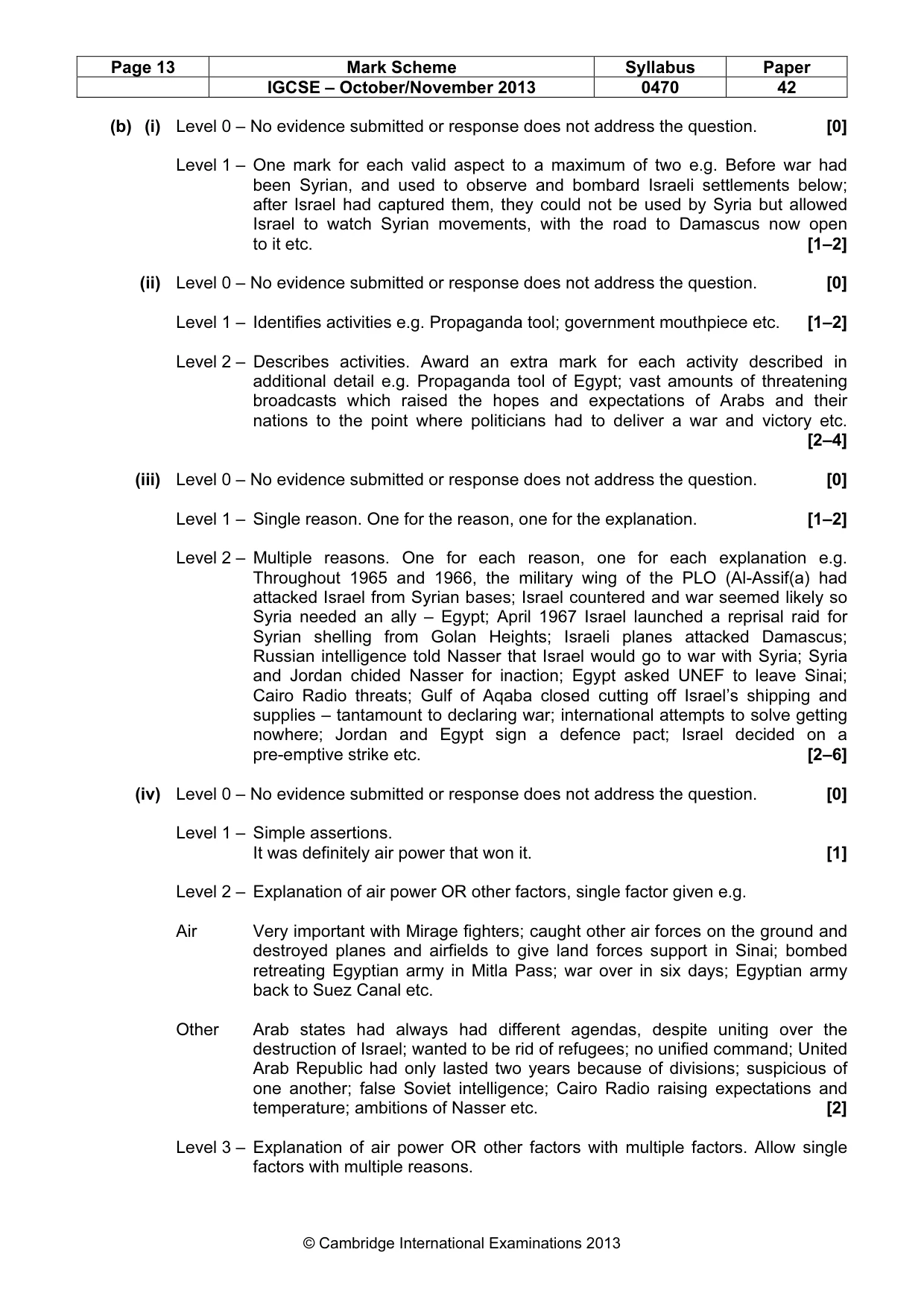
Page 12 Mark Scheme Syllabus Paper IGCSE – October/November 2013 0470 42 © Cambridge International Examinations 2013 Depth Study F: Israelis and Palestinians, 1945–c.1994 6 (a) (i) Level 0 – No evidence submitted or response does not address the question. [0] Level 1 – Repeats material stated in the source, no inference made. [1–2] Level 2 – Makes valid inference(s), unsupported from the source e.g. Seems to be speaking for all Arab countries; speaks with emotive rhetoric etc. [3–4] Level 3 – Supports valid inferences with reference to the source e.g. Seems to have appointed himself spokesman for all Arab countries – ‘the problem before all Arab leaders’; speaks in hateful mode about Israel using the language of extermination etc. [5–6] (ii) Level 0 – No evidence submitted or response does not address the question. [0] Level 1 – Agrees OR disagrees, unsupported from the source. [1–2] Level 2 – Agrees OR disagrees, supported from the source e.g. Yes A million more refugee Palestinians under Israeli rule and all that implies; 350 000 other refugees, heading for camps etc. No Arab states had lost land (‘occupied territories’); Jordan had more refugees to accommodate; at least the Palestinians had realised that they would have to rely on themselves in future (‘Arab governments would never defeat Israel’) etc. [3–5] Level 3 – Agrees AND disagrees, supported from the source. Addresses the issue of ‘How far? [6–7] (iii) Level 0 – No evidence submitted or response does not address the question. [0] Level 1 – Useful/not useful – Choice made on the basis that one is more detailed/gives more information, but does not specify what information. [1] Level 2 – Useful/not useful – One is from President Nasser and the other is British so they could both be biased/unreliable. [2] Level 3 – Choice made on the nature or amount of information given. Must specify what information. [3–5] Level 4 – Choice made on grounds of reliability. Discussion of utility must be made on valid evaluation of source(s) in context. Include at this Level answers that cross reference between A and B to show reliability. 6 marks for one source, 7 marks for both. [6–7]
Mark scheme, page 13
Page 13 Mark Scheme Syllabus Paper IGCSE – October/November 2013 0470 42 © Cambridge International Examinations 2013 (b) (i) Level 0 – No evidence submitted or response does not address the question. [0] Level 1 – One mark for each valid aspect to a maximum of two e.g. Before war had been Syrian, and used to observe and bombard Israeli settlements below; after Israel had captured them, they could not be used by Syria but allowed Israel to watch Syrian movements, with the road to Damascus now open to it etc. [1–2] (ii) Level 0 – No evidence submitted or response does not address the question. [0] Level 1 – Identifies activities e.g. Propaganda tool; government mouthpiece etc. [1–2] Level 2 – Describes activities. Award an extra mark for each activity described in additional detail e.g. Propaganda tool of Egypt; vast amounts of threatening broadcasts which raised the hopes and expectations of Arabs and their nations to the point where politicians had to deliver a war and victory etc. [2–4] (iii) Level 0 – No evidence submitted or response does not address the question. [0] Level 1 – Single reason. One for the reason, one for the explanation. [1–2] Level 2 – Multiple reasons. One for each reason, one for each explanation e.g. Throughout 1965 and 1966, the military wing of the PLO (Al-Assif(a) had attacked Israel from Syrian bases; Israel countered and war seemed likely so Syria needed an ally – Egypt; April 1967 Israel launched a reprisal raid for Syrian shelling from Golan Heights; Israeli planes attacked Damascus; Russian intelligence told Nasser that Israel would go to war with Syria; Syria and Jordan chided Nasser for inaction; Egypt asked UNEF to leave Sinai; Cairo Radio threats; Gulf of Aqaba closed cutting off Israel’s shipping and supplies – tantamount to declaring war; international attempts to solve getting nowhere; Jordan and Egypt sign a defence pact; Israel decided on a pre-emptive strike etc. [2–6] (iv) Level 0 – No evidence submitted or response does not address the question. [0] Level 1 – Simple assertions. It was definitely air power that won it. [1] Level 2 – Explanation of air power OR other factors, single factor given e.g. Air Very important with Mirage fighters; caught other air forces on the ground and destroyed planes and airfields to give land forces support in Sinai; bombed retreating Egyptian army in Mitla Pass; war over in six days; Egyptian army back to Suez Canal etc. Other Arab states had always had different agendas, despite uniting over the destruction of Israel; wanted to be rid of refugees; no unified command; United Arab Republic had only lasted two years because of divisions; suspicious of one another; false Soviet intelligence; Cairo Radio raising expectations and temperature; ambitions of Nasser etc. [2] Level 3 – Explanation of air power OR other factors with multiple factors. Allow single factors with multiple reasons.
Mark scheme, page 14
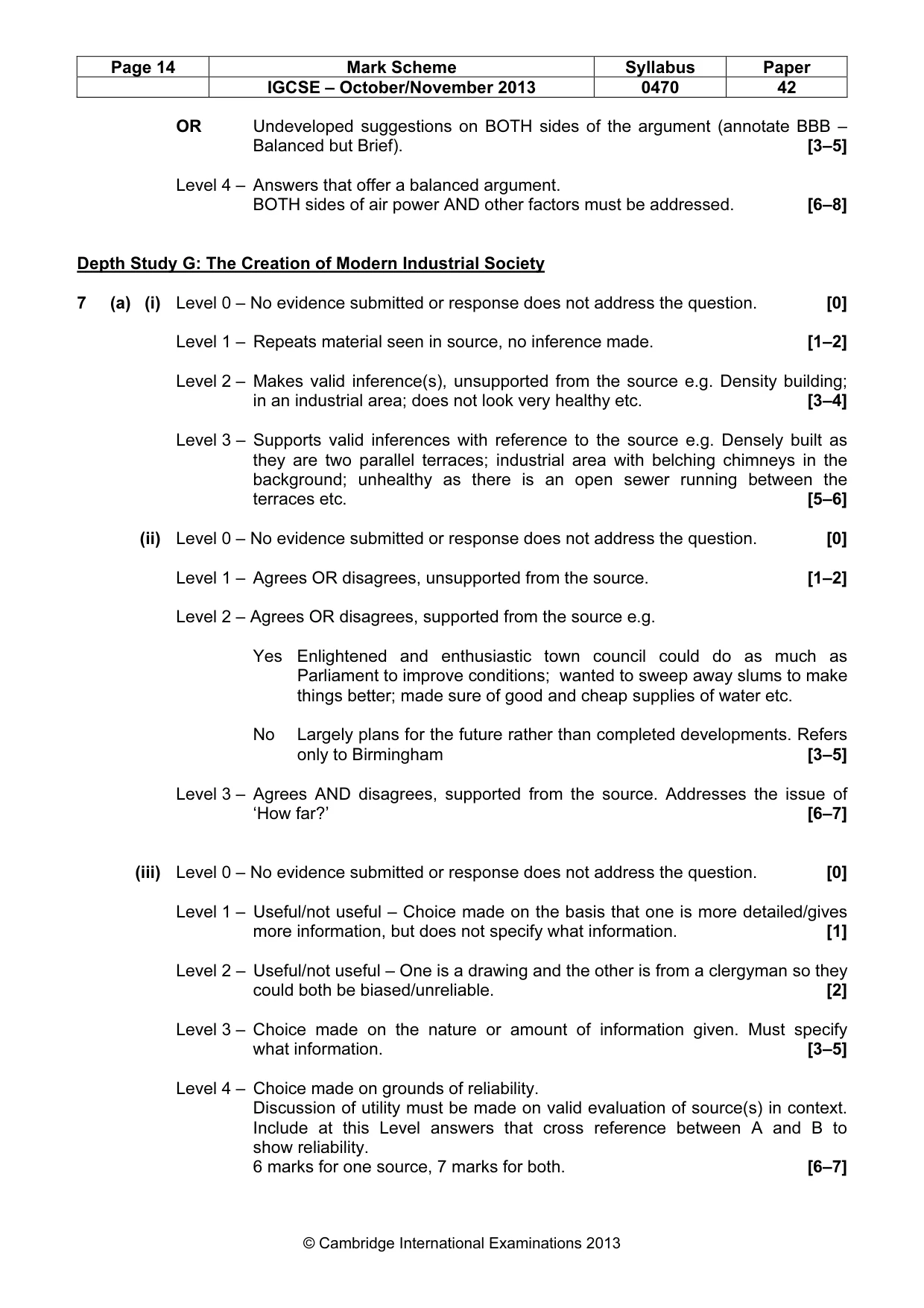
Page 14 Mark Scheme Syllabus Paper IGCSE – October/November 2013 0470 42 © Cambridge International Examinations 2013 OR Undeveloped suggestions on BOTH sides of the argument (annotate BBB – Balanced but Brief). [3–5] Level 4 – Answers that offer a balanced argument. BOTH sides of air power AND other factors must be addressed. [6–8] Depth Study G: The Creation of Modern Industrial Society 7 (a) (i) Level 0 – No evidence submitted or response does not address the question. [0] Level 1 – Repeats material seen in source, no inference made. [1–2] Level 2 – Makes valid inference(s), unsupported from the source e.g. Density building; in an industrial area; does not look very healthy etc. [3–4] Level 3 – Supports valid inferences with reference to the source e.g. Densely built as they are two parallel terraces; industrial area with belching chimneys in the background; unhealthy as there is an open sewer running between the terraces etc. [5–6] (ii) Level 0 – No evidence submitted or response does not address the question. [0] Level 1 – Agrees OR disagrees, unsupported from the source. [1–2] Level 2 – Agrees OR disagrees, supported from the source e.g. Yes Enlightened and enthusiastic town council could do as much as Parliament to improve conditions; wanted to sweep away slums to make things better; made sure of good and cheap supplies of water etc. No Largely plans for the future rather than completed developments. Refers only to Birmingham [3–5] Level 3 – Agrees AND disagrees, supported from the source. Addresses the issue of ‘How far?’ [6–7] (iii) Level 0 – No evidence submitted or response does not address the question. [0] Level 1 – Useful/not useful – Choice made on the basis that one is more detailed/gives more information, but does not specify what information. [1] Level 2 – Useful/not useful – One is a drawing and the other is from a clergyman so they could both be biased/unreliable. [2] Level 3 – Choice made on the nature or amount of information given. Must specify what information. [3–5] Level 4 – Choice made on grounds of reliability. Discussion of utility must be made on valid evaluation of source(s) in context. Include at this Level answers that cross reference between A and B to show reliability. 6 marks for one source, 7 marks for both. [6–7]
Mark scheme, page 15
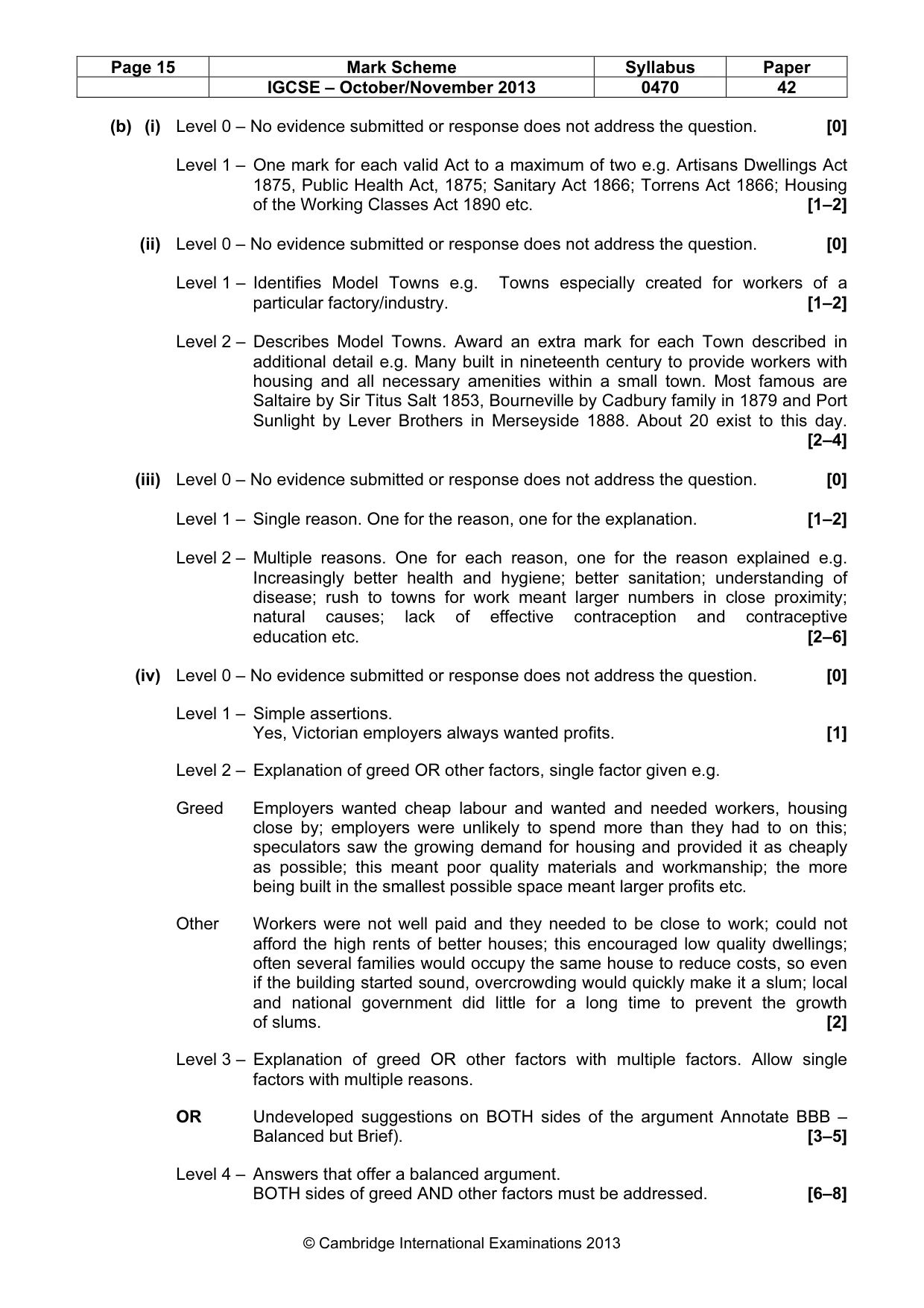
Page 15 Mark Scheme Syllabus Paper IGCSE – October/November 2013 0470 42 © Cambridge International Examinations 2013 (b) (i) Level 0 – No evidence submitted or response does not address the question. [0] Level 1 – One mark for each valid Act to a maximum of two e.g. Artisans Dwellings Act 1875, Public Health Act, 1875; Sanitary Act 1866; Torrens Act 1866; Housing of the Working Classes Act 1890 etc. [1–2] (ii) Level 0 – No evidence submitted or response does not address the question. [0] Level 1 – Identifies Model Towns e.g. Towns especially created for workers of a particular factory/industry. [1–2] Level 2 – Describes Model Towns. Award an extra mark for each Town described in additional detail e.g. Many built in nineteenth century to provide workers with housing and all necessary amenities within a small town. Most famous are Saltaire by Sir Titus Salt 1853, Bourneville by Cadbury family in 1879 and Port Sunlight by Lever Brothers in Merseyside 1888. About 20 exist to this day. [2–4] (iii) Level 0 – No evidence submitted or response does not address the question. [0] Level 1 – Single reason. One for the reason, one for the explanation. [1–2] Level 2 – Multiple reasons. One for each reason, one for the reason explained e.g. Increasingly better health and hygiene; better sanitation; understanding of disease; rush to towns for work meant larger numbers in close proximity; natural causes; lack of effective contraception and contraceptive education etc. [2–6] (iv) Level 0 – No evidence submitted or response does not address the question. [0] Level 1 – Simple assertions. Yes, Victorian employers always wanted profits. [1] Level 2 – Explanation of greed OR other factors, single factor given e.g. Greed Employers wanted cheap labour and wanted and needed workers, housing close by; employers were unlikely to spend more than they had to on this; speculators saw the growing demand for housing and provided it as cheaply as possible; this meant poor quality materials and workmanship; the more being built in the smallest possible space meant larger profits etc. Other Workers were not well paid and they needed to be close to work; could not afford the high rents of better houses; this encouraged low quality dwellings; often several families would occupy the same house to reduce costs, so even if the building started sound, overcrowding would quickly make it a slum; local and national government did little for a long time to prevent the growth of slums. [2] Level 3 – Explanation of greed OR other factors with multiple factors. Allow single factors with multiple reasons. OR Undeveloped suggestions on BOTH sides of the argument Annotate BBB – Balanced but Brief). [3–5] Level 4 – Answers that offer a balanced argument. BOTH sides of greed AND other factors must be addressed. [6–8]
Mark scheme, page 16
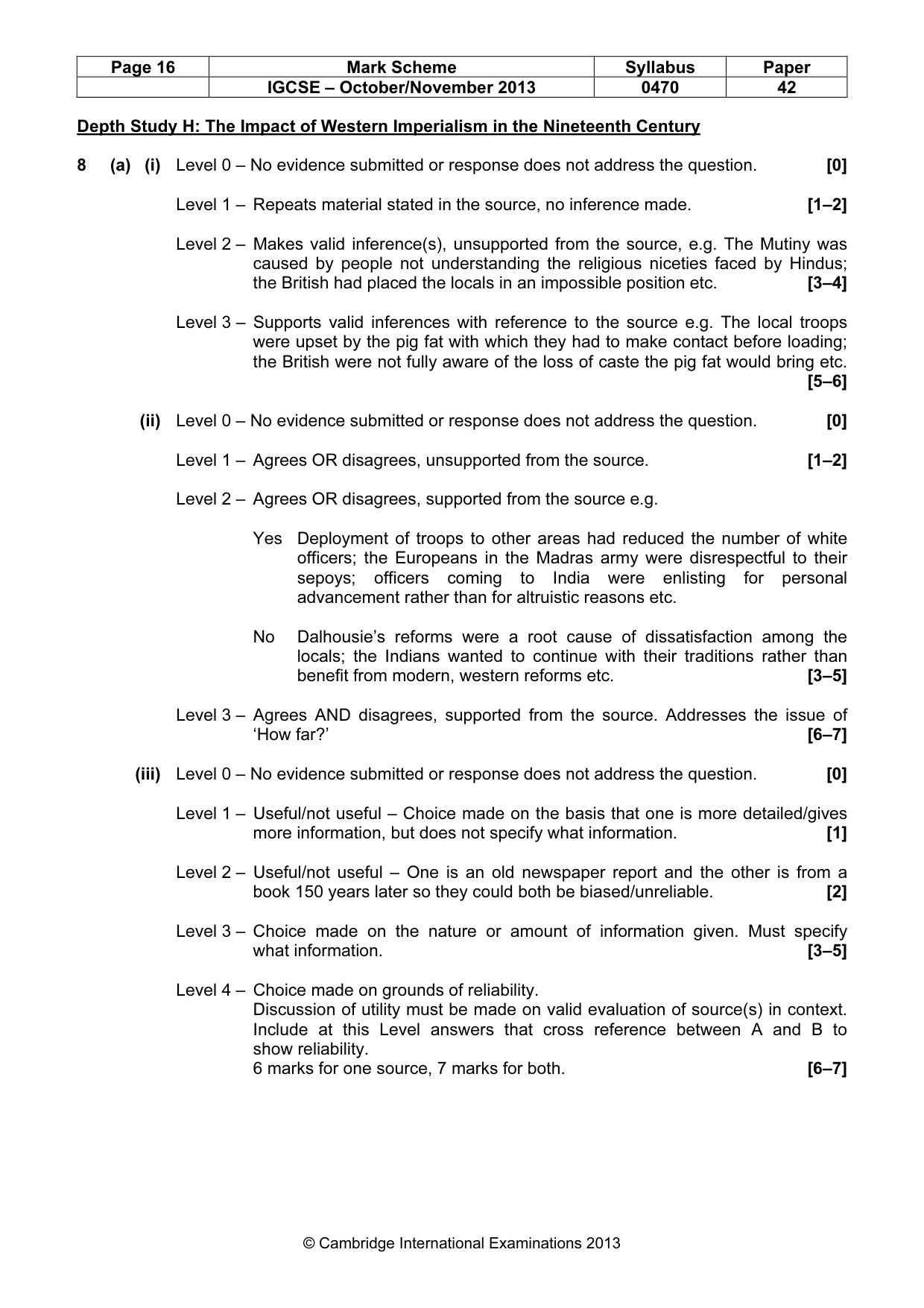
Page 16 Mark Scheme Syllabus Paper IGCSE – October/November 2013 0470 42 © Cambridge International Examinations 2013 Depth Study H: The Impact of Western Imperialism in the Nineteenth Century 8 (a) (i) Level 0 – No evidence submitted or response does not address the question. [0] Level 1 – Repeats material stated in the source, no inference made. [1–2] Level 2 – Makes valid inference(s), unsupported from the source, e.g. The Mutiny was caused by people not understanding the religious niceties faced by Hindus; the British had placed the locals in an impossible position etc. [3–4] Level 3 – Supports valid inferences with reference to the source e.g. The local troops were upset by the pig fat with which they had to make contact before loading; the British were not fully aware of the loss of caste the pig fat would bring etc. [5–6] (ii) Level 0 – No evidence submitted or response does not address the question. [0] Level 1 – Agrees OR disagrees, unsupported from the source. [1–2] Level 2 – Agrees OR disagrees, supported from the source e.g. Yes Deployment of troops to other areas had reduced the number of white officers; the Europeans in the Madras army were disrespectful to their sepoys; officers coming to India were enlisting for personal advancement rather than for altruistic reasons etc. No Dalhousie’s reforms were a root cause of dissatisfaction among the locals; the Indians wanted to continue with their traditions rather than benefit from modern, western reforms etc. [3–5] Level 3 – Agrees AND disagrees, supported from the source. Addresses the issue of ‘How far?’ [6–7] (iii) Level 0 – No evidence submitted or response does not address the question. [0] Level 1 – Useful/not useful – Choice made on the basis that one is more detailed/gives more information, but does not specify what information. [1] Level 2 – Useful/not useful – One is an old newspaper report and the other is from a book 150 years later so they could both be biased/unreliable. [2] Level 3 – Choice made on the nature or amount of information given. Must specify what information. [3–5] Level 4 – Choice made on grounds of reliability. Discussion of utility must be made on valid evaluation of source(s) in context. Include at this Level answers that cross reference between A and B to show reliability. 6 marks for one source, 7 marks for both. [6–7]
Mark scheme, page 17
Page 17 Mark Scheme Syllabus Paper IGCSE – October/November 2013 0470 42 © Cambridge International Examinations 2013 (b) (i) Level 0 – No evidence submitted or response does not address the question. [0] Level 1 – One mark for each correct city to a maximum of two e.g. Cawnpore, Lucknow. Accept Delhi. [1–2] (ii) Level 0 – No evidence submitted or response does not address the question. [0] Level 1 – Identifies policies e.g. Attempts to westernise and improve India. [1–2] Level 2 – Describes policies. Award an extra mark for policies described in additional detail e.g. Banning suttee and thuggee; ending infanticide; attempts to improve infrastructure – railways etc.; reform of justice system and civil service etc. [2–4] (iii) Level 0 – No evidence submitted or response does not address the question. [0] Level 1 – Single reason. One for the reason, one for the explanation. [1–2] Level 2 – Multiple reasons. One for each reason, one for each reason explained e.g. A place to make one’s fortune; plenty of influential people there to help with careers; lack of opportunity in Britain; romantic feeling that India had attractions and magic; East India Company was a huge employer; money and fortune etc. [2–6] (iv) Level 0 – No evidence submitted or response does not address the question. [0] Level 1 – Simple assertions. Yes, anyone with a brain could see it coming. [1] Level 2 – Explanation of unavoidability OR other outcomes, single factor given e.g. Unavoidable There were so many points of disaffection both within the army and outside that some ‘explosion’ was likely to happen; many foretold it; the attitude of the British towards the Indians had deteriorated and this was breeding resentment; westernisation, interference with local customs, was bound to be advanced and all this caused local resentment etc. Other Some of the causes, like interference with religious customs, could have been avoided or moderated but the seeds of the rebellion would have remained; no local population would welcome control by an outside force for ever; in the event the majority of the Indian army and population did not revolt etc. [2] Level 3 – Explanation of unavoidability OR other outcomes with multiple factor. Allow single factors with multiple reasons. OR Undeveloped suggestions on BOTH sides of the argument (annotate BBB – Balanced but Brief). [3–5] Level 4 – Answers that offer a balanced argument. BOTH sides of unavoidability AND other outcomes must be addressed. [6–8]
What you needed in this session
Cambridge’s own grade thresholds for 2013 Oct/Nov, Paper 4 · Variant 2. A higher threshold means an easier paper — the bar moves with how the cohort did.