Cambridge IGCSE History 0470 — 2013 Oct/Nov Paper 4 · Variant 1
0470/41/O/N/13 · 40 marks · ≈45 min
The question paper and its mark scheme, free to read here and free to download. This is Cambridge’s own paper, exactly as it was sat.
Question paper12 pages

Mark scheme17 pages
Answers below. Sit the paper first if you are practising.
Paper as text
Question paper, page 1
This document consists of 10 printed pages and 2 blank pages. DC (AC/SW) 67236/4 © UCLES 2013 [Turn over UNIVERSITY OF CAMBRIDGE INTERNATIONAL EXAMINATIONS International General Certificate of Secondary Education * 2 7 6 6 8 8 0 1 0 0 * HISTORY 0470/41 Paper 4 Alternative to Coursework October/November 2013 1 hour Additional Materials: Answer Booklet/Paper READ THESE INSTRUCTIONS FIRST If you have been given an Answer Booklet, follow the instructions on the front cover of the Booklet. Write your Centre number, candidate number and name on all the work you hand in. Write in dark blue or black pen. You may use a soft pencil for any diagrams, graphs or rough working. Do not use staples, paper clips, highlighters, glue or correction fluid. DO NOT WRITE IN ANY BARCODES. Answer the questions on one of the Depth Studies. At the end of the examination, fasten all your work securely together. The number of marks is given in brackets [ ] at the end of each question or part question.
Question paper, page 2
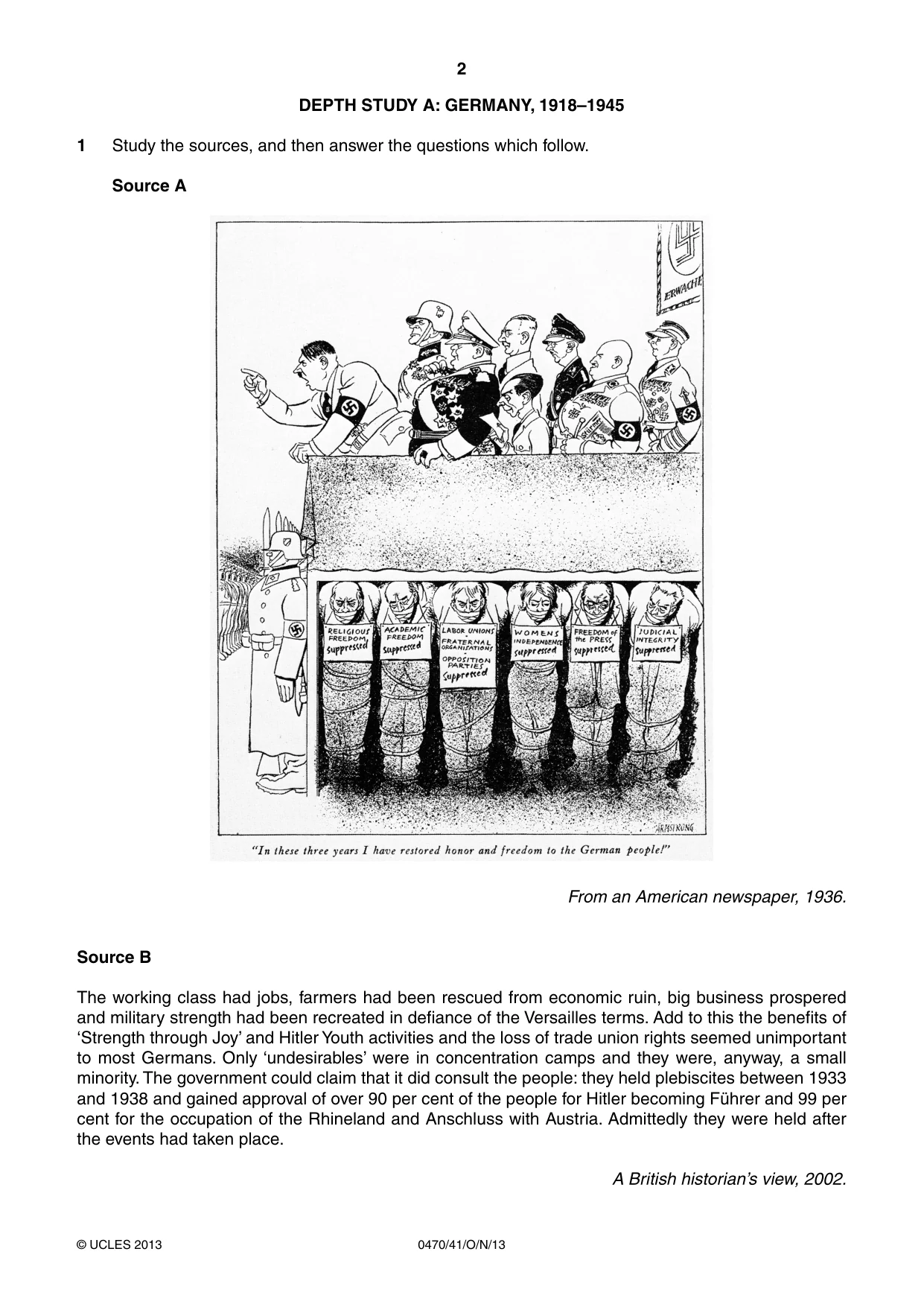
2 0470/41/O/N/13 © UCLES 2013 DEPTH STUDY A: GERMANY, 1918–1945 1 Study the sources, and then answer the questions which follow. Source A From an American newspaper, 1936. Source B The working class had jobs, farmers had been rescued from economic ruin, big business prospered and military strength had been recreated in defiance of the Versailles terms. Add to this the benefits of ‘Strength through Joy’ and Hitler Youth activities and the loss of trade union rights seemed unimportant to most Germans. Only ‘undesirables’ were in concentration camps and they were, anyway, a small minority. The government could claim that it did consult the people: they held plebiscites between 1933 and 1938 and gained approval of over 90 per cent of the people for Hitler becoming Führer and 99 per cent for the occupation of the Rhineland and Anschluss with Austria. Admittedly they were held after the events had taken place. A British historian’s view, 2002.
Question paper, page 3
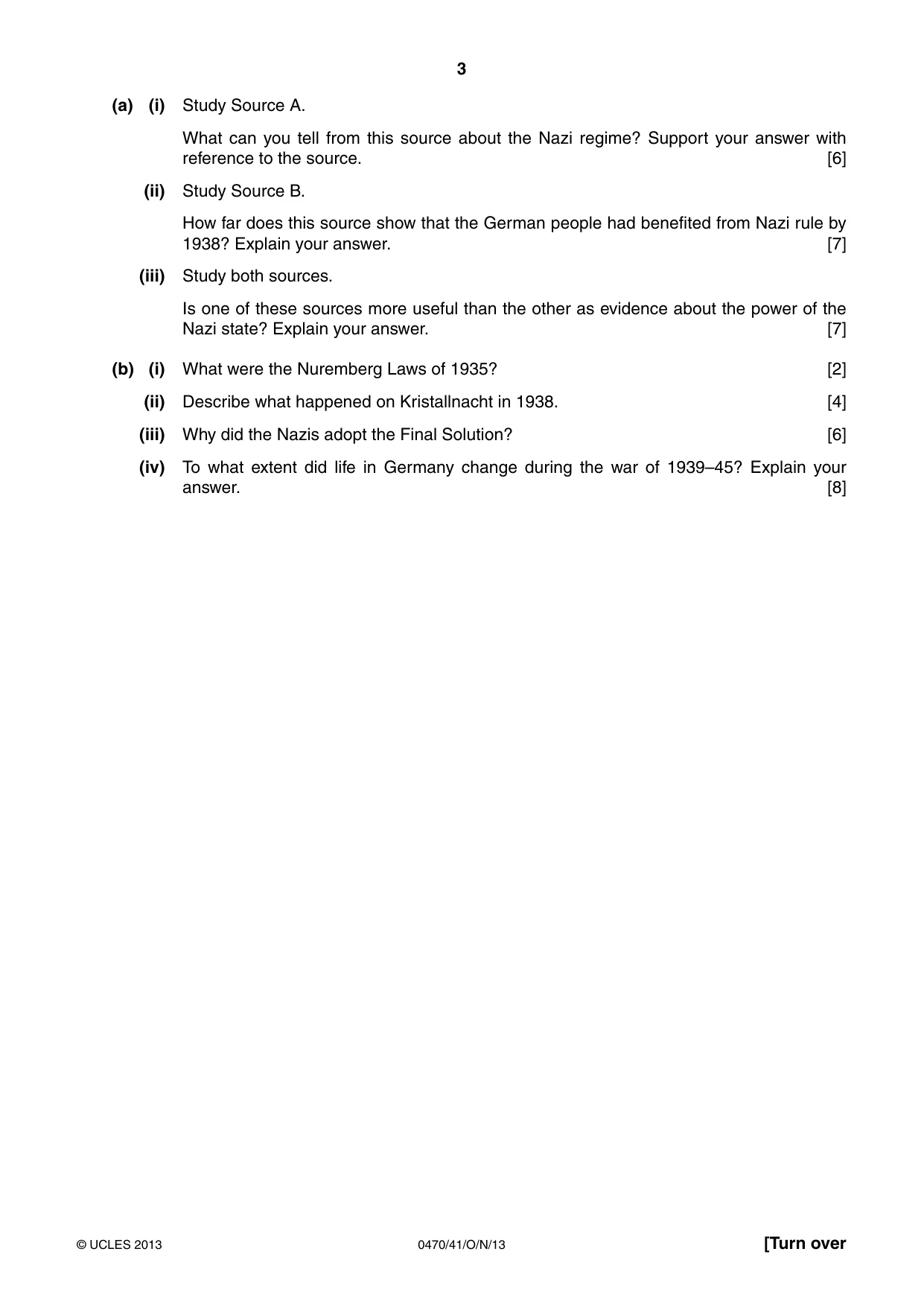
3 0470/41/O/N/13 © UCLES 2013 [Turn over (a) (i) Study Source A. What can you tell from this source about the Nazi regime? Support your answer with reference to the source. [6] (ii) Study Source B. How far does this source show that the German people had benefited from Nazi rule by 1938? Explain your answer. [7] (iii) Study both sources. Is one of these sources more useful than the other as evidence about the power of the Nazi state? Explain your answer. [7] (b) (i) What were the Nuremberg Laws of 1935? [2] (ii) Describe what happened on Kristallnacht in 1938. [4] (iii) Why did the Nazis adopt the Final Solution? [6] (iv) To what extent did life in Germany change during the war of 1939–45? Explain your answer. [8]
Question paper, page 4
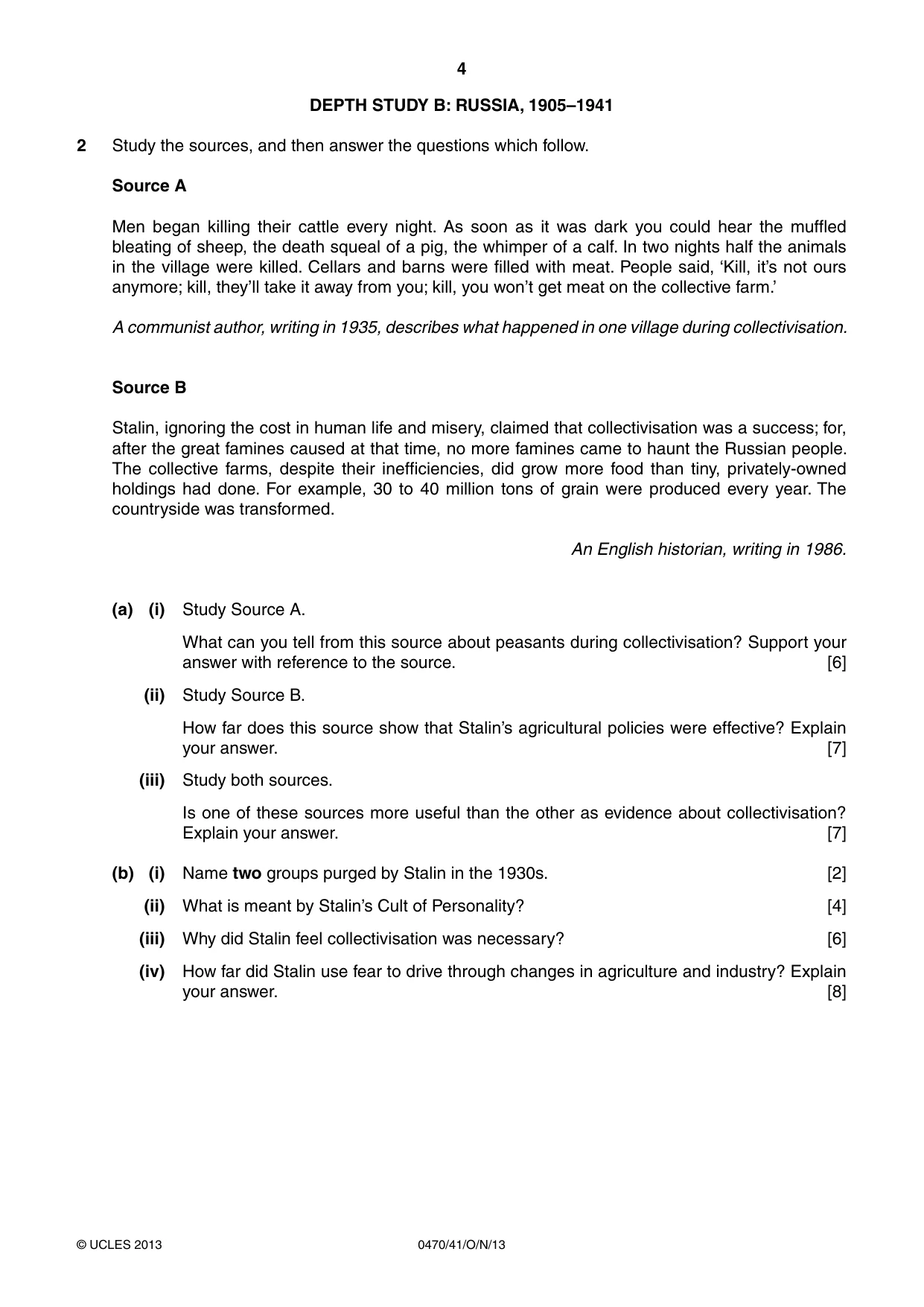
4 0470/41/O/N/13 © UCLES 2013 DEPTH STUDY B: RUSSIA, 1905–1941 2 Study the sources, and then answer the questions which follow. Source A Men began killing their cattle every night. As soon as it was dark you could hear the muffled bleating of sheep, the death squeal of a pig, the whimper of a calf. In two nights half the animals in the village were killed. Cellars and barns were filled with meat. People said, ‘Kill, it’s not ours anymore; kill, they’ll take it away from you; kill, you won’t get meat on the collective farm.’ A communist author, writing in 1935, describes what happened in one village during collectivisation. Source B Stalin, ignoring the cost in human life and misery, claimed that collectivisation was a success; for, after the great famines caused at that time, no more famines came to haunt the Russian people. The collective farms, despite their inefficiencies, did grow more food than tiny, privately-owned holdings had done. For example, 30 to 40 million tons of grain were produced every year. The countryside was transformed. An English historian, writing in 1986. (a) (i) Study Source A. What can you tell from this source about peasants during collectivisation? Support your answer with reference to the source. [6] (ii) Study Source B. How far does this source show that Stalin’s agricultural policies were effective? Explain your answer. [7] (iii) Study both sources. Is one of these sources more useful than the other as evidence about collectivisation? Explain your answer. [7] (b) (i) Name two groups purged by Stalin in the 1930s. [2] (ii) What is meant by Stalin’s Cult of Personality? [4] (iii) Why did Stalin feel collectivisation was necessary? [6] (iv) How far did Stalin use fear to drive through changes in agriculture and industry? Explain your answer. [8]
Question paper, page 5
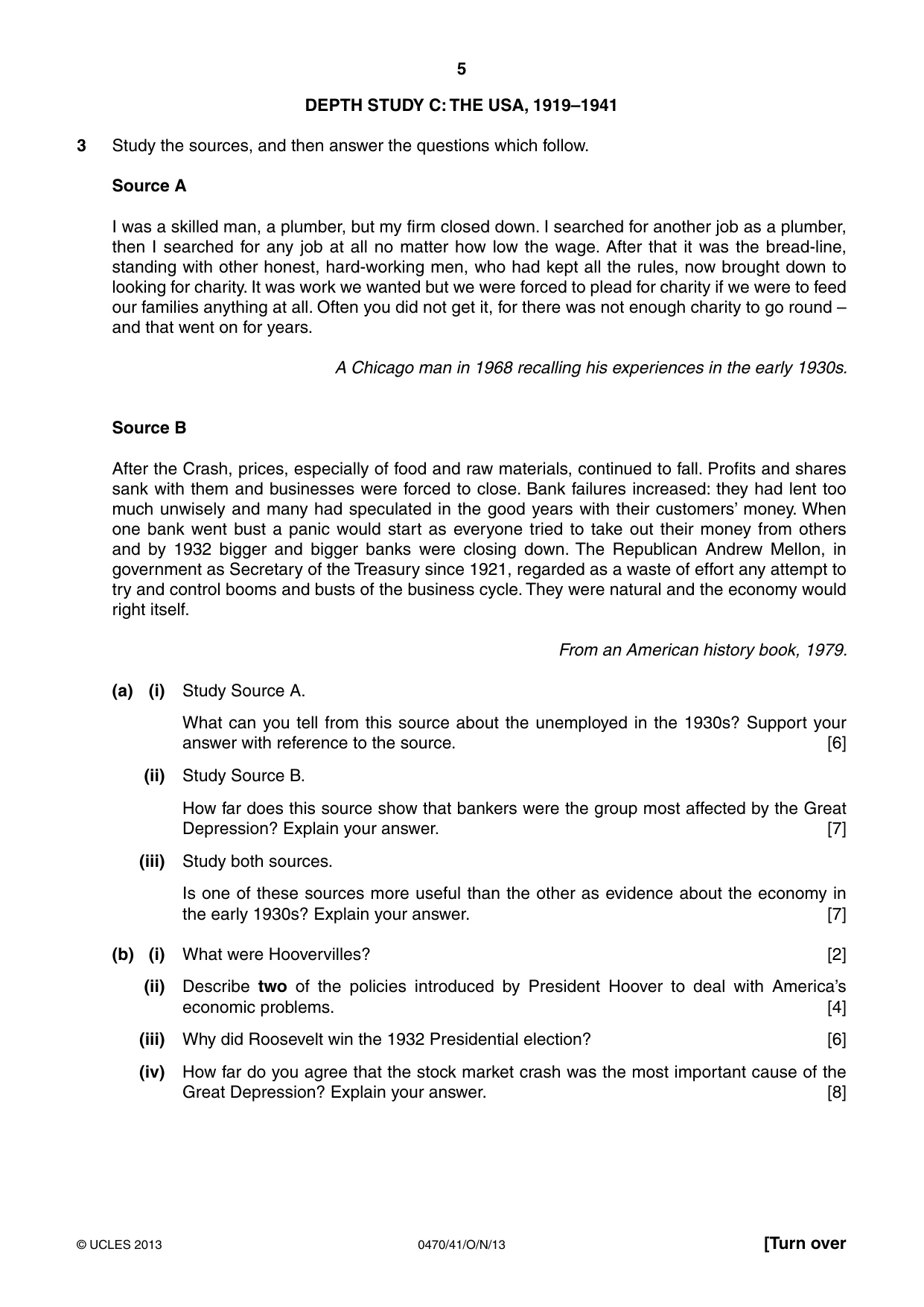
5 0470/41/O/N/13 © UCLES 2013 [Turn over DEPTH STUDY C: THE USA, 1919–1941 3 Study the sources, and then answer the questions which follow. Source A I was a skilled man, a plumber, but my firm closed down. I searched for another job as a plumber, then I searched for any job at all no matter how low the wage. After that it was the bread-line, standing with other honest, hard-working men, who had kept all the rules, now brought down to looking for charity. It was work we wanted but we were forced to plead for charity if we were to feed our families anything at all. Often you did not get it, for there was not enough charity to go round – and that went on for years. A Chicago man in 1968 recalling his experiences in the early 1930s. Source B After the Crash, prices, especially of food and raw materials, continued to fall. Profits and shares sank with them and businesses were forced to close. Bank failures increased: they had lent too much unwisely and many had speculated in the good years with their customers’ money. When one bank went bust a panic would start as everyone tried to take out their money from others and by 1932 bigger and bigger banks were closing down. The Republican Andrew Mellon, in government as Secretary of the Treasury since 1921, regarded as a waste of effort any attempt to try and control booms and busts of the business cycle. They were natural and the economy would right itself. From an American history book, 1979. (a) (i) Study Source A. What can you tell from this source about the unemployed in the 1930s? Support your answer with reference to the source. [6] (ii) Study Source B. How far does this source show that bankers were the group most affected by the Great Depression? Explain your answer. [7] (iii) Study both sources. Is one of these sources more useful than the other as evidence about the economy in the early 1930s? Explain your answer. [7] (b) (i) What were Hoovervilles? [2] (ii) Describe two of the policies introduced by President Hoover to deal with America’s economic problems. [4] (iii) Why did Roosevelt win the 1932 Presidential election? [6] (iv) How far do you agree that the stock market crash was the most important cause of the Great Depression? Explain your answer. [8]
Question paper, page 6
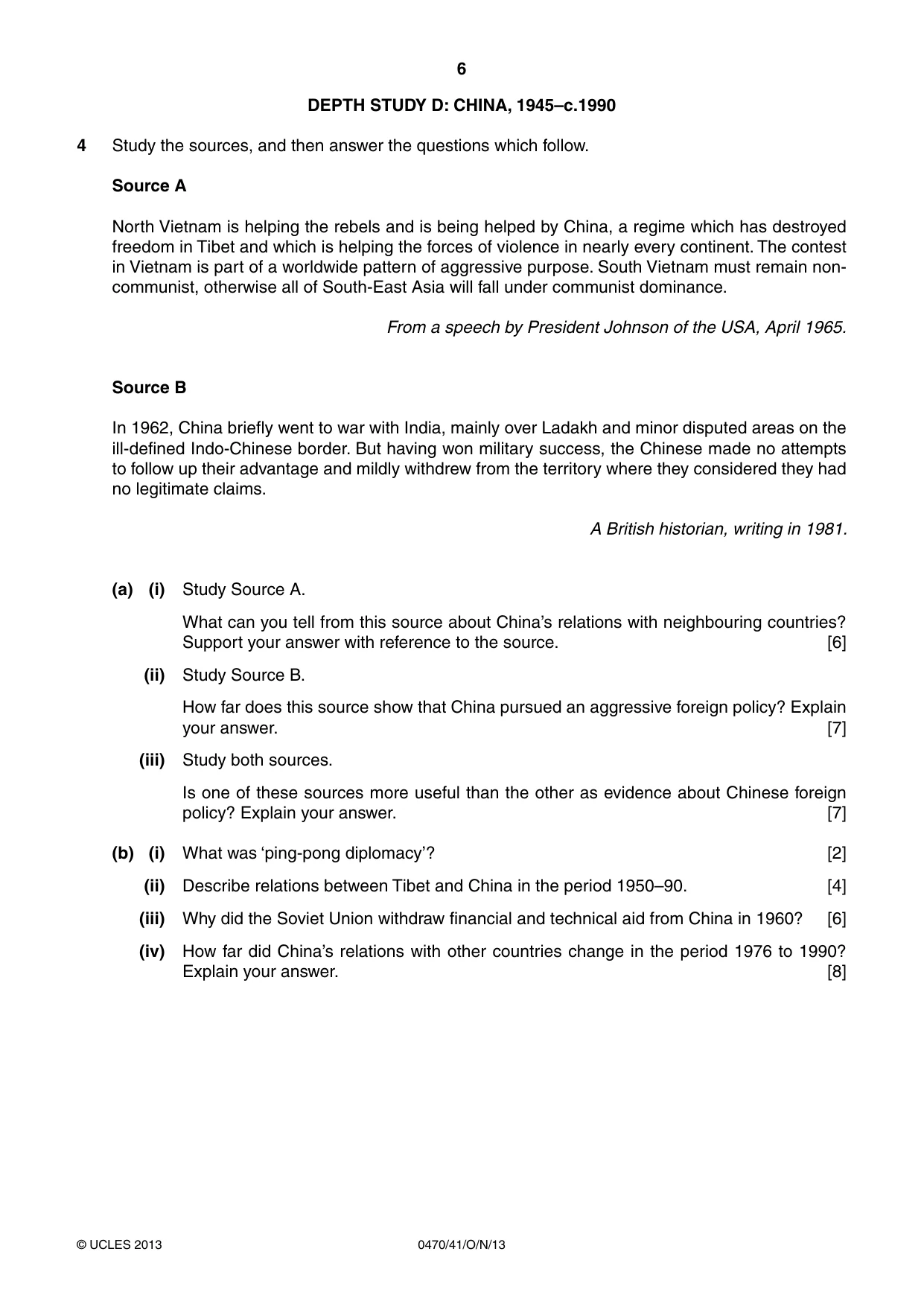
6 0470/41/O/N/13 © UCLES 2013 DEPTH STUDY D: CHINA, 1945–c.1990 4 Study the sources, and then answer the questions which follow. Source A North Vietnam is helping the rebels and is being helped by China, a regime which has destroyed freedom in Tibet and which is helping the forces of violence in nearly every continent. The contest in Vietnam is part of a worldwide pattern of aggressive purpose. South Vietnam must remain non- communist, otherwise all of South-East Asia will fall under communist dominance. From a speech by President Johnson of the USA, April 1965. Source B In 1962, China briefly went to war with India, mainly over Ladakh and minor disputed areas on the ill-defined Indo-Chinese border. But having won military success, the Chinese made no attempts to follow up their advantage and mildly withdrew from the territory where they considered they had no legitimate claims. A British historian, writing in 1981. (a) (i) Study Source A. What can you tell from this source about China’s relations with neighbouring countries? Support your answer with reference to the source. [6] (ii) Study Source B. How far does this source show that China pursued an aggressive foreign policy? Explain your answer. [7] (iii) Study both sources. Is one of these sources more useful than the other as evidence about Chinese foreign policy? Explain your answer. [7] (b) (i) What was ‘ping-pong diplomacy’? [2] (ii) Describe relations between Tibet and China in the period 1950–90. [4] (iii) Why did the Soviet Union withdraw financial and technical aid from China in 1960? [6] (iv) How far did China’s relations with other countries change in the period 1976 to 1990? Explain your answer. [8]
Question paper, page 7
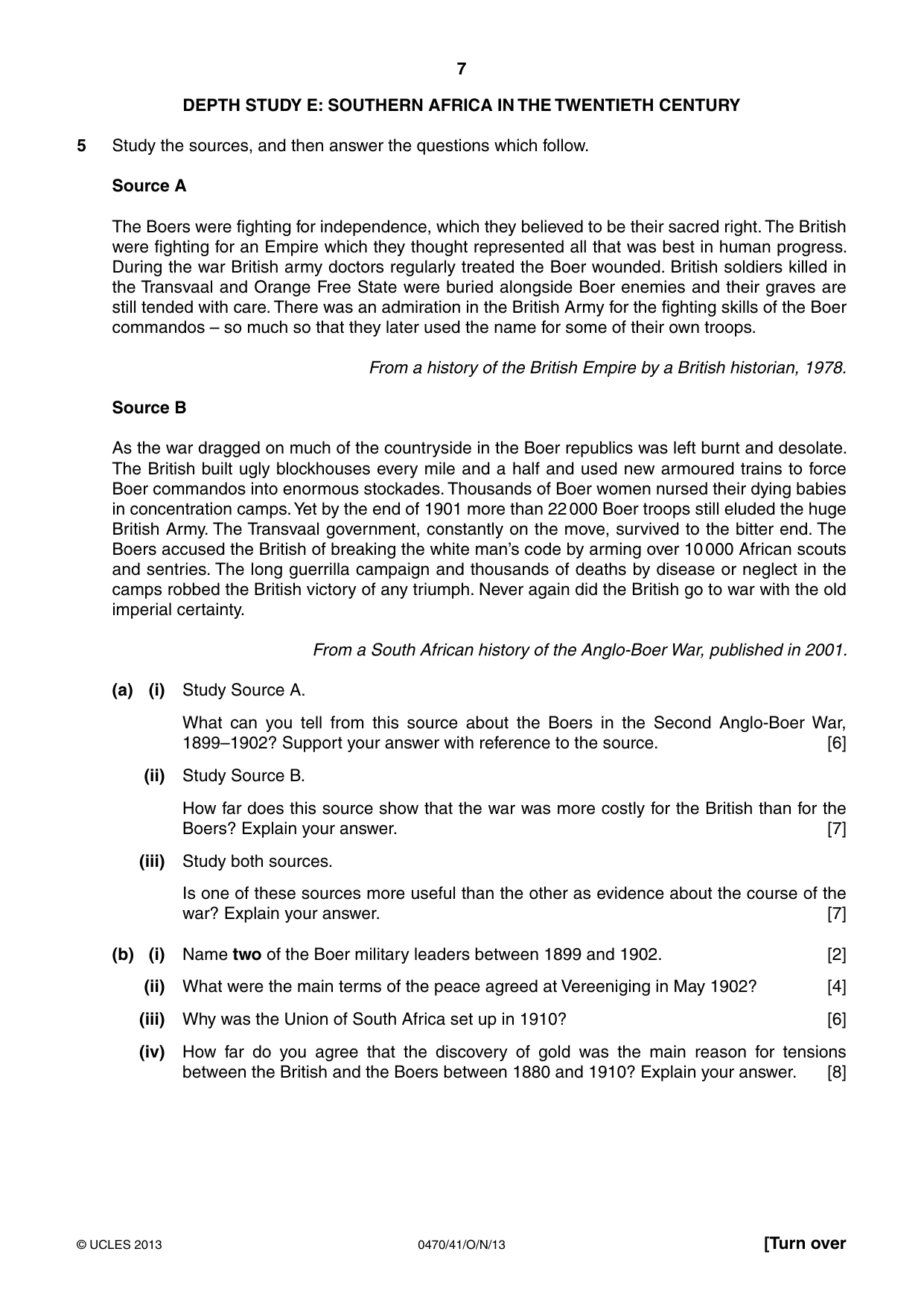
7 0470/41/O/N/13 © UCLES 2013 [Turn over DEPTH STUDY E: SOUTHERN AFRICA IN THE TWENTIETH CENTURY 5 Study the sources, and then answer the questions which follow. Source A The Boers were fighting for independence, which they believed to be their sacred right. The British were fighting for an Empire which they thought represented all that was best in human progress. During the war British army doctors regularly treated the Boer wounded. British soldiers killed in the Transvaal and Orange Free State were buried alongside Boer enemies and their graves are still tended with care. There was an admiration in the British Army for the fighting skills of the Boer commandos – so much so that they later used the name for some of their own troops. From a history of the British Empire by a British historian, 1978. Source B As the war dragged on much of the countryside in the Boer republics was left burnt and desolate. The British built ugly blockhouses every mile and a half and used new armoured trains to force Boer commandos into enormous stockades. Thousands of Boer women nursed their dying babies in concentration camps. Yet by the end of 1901 more than 22 000 Boer troops still eluded the huge British Army. The Transvaal government, constantly on the move, survived to the bitter end. The Boers accused the British of breaking the white man’s code by arming over 10 000 African scouts and sentries. The long guerrilla campaign and thousands of deaths by disease or neglect in the camps robbed the British victory of any triumph. Never again did the British go to war with the old imperial certainty. From a South African history of the Anglo-Boer War, published in 2001. (a) (i) Study Source A. What can you tell from this source about the Boers in the Second Anglo-Boer War, 1899–1902? Support your answer with reference to the source. [6] (ii) Study Source B. How far does this source show that the war was more costly for the British than for the Boers? Explain your answer. [7] (iii) Study both sources. Is one of these sources more useful than the other as evidence about the course of the war? Explain your answer. [7] (b) (i) Name two of the Boer military leaders between 1899 and 1902. [2] (ii) What were the main terms of the peace agreed at Vereeniging in May 1902? [4] (iii) Why was the Union of South Africa set up in 1910? [6] (iv) How far do you agree that the discovery of gold was the main reason for tensions between the British and the Boers between 1880 and 1910? Explain your answer. [8]
Question paper, page 8
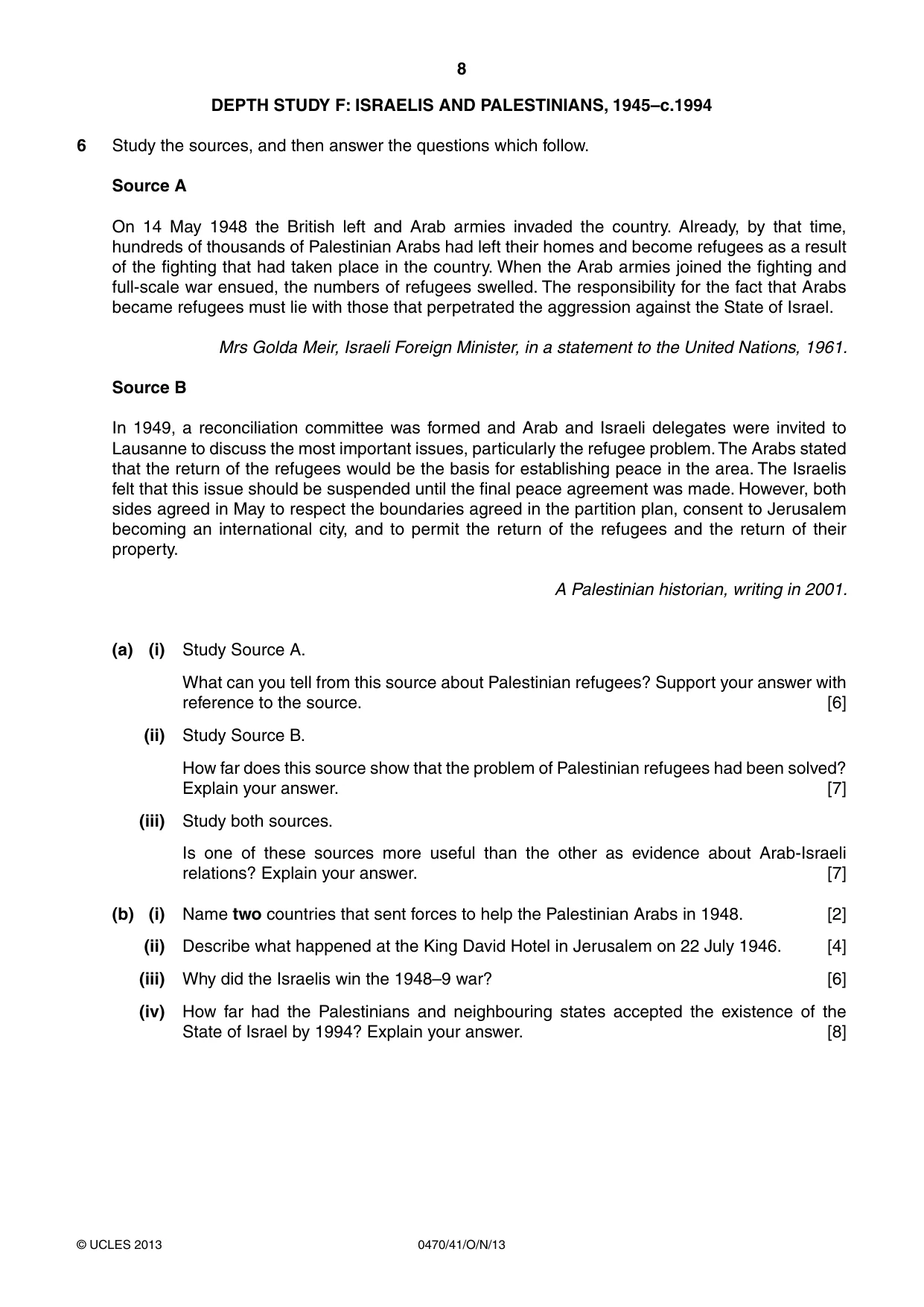
8 0470/41/O/N/13 © UCLES 2013 DEPTH STUDY F: ISRAELIS AND PALESTINIANS, 1945–c.1994 6 Study the sources, and then answer the questions which follow. Source A On 14 May 1948 the British left and Arab armies invaded the country. Already, by that time, hundreds of thousands of Palestinian Arabs had left their homes and become refugees as a result of the fighting that had taken place in the country. When the Arab armies joined the fighting and full-scale war ensued, the numbers of refugees swelled. The responsibility for the fact that Arabs became refugees must lie with those that perpetrated the aggression against the State of Israel. Mrs Golda Meir, Israeli Foreign Minister, in a statement to the United Nations, 1961. Source B In 1949, a reconciliation committee was formed and Arab and Israeli delegates were invited to Lausanne to discuss the most important issues, particularly the refugee problem. The Arabs stated that the return of the refugees would be the basis for establishing peace in the area. The Israelis felt that this issue should be suspended until the final peace agreement was made. However, both sides agreed in May to respect the boundaries agreed in the partition plan, consent to Jerusalem becoming an international city, and to permit the return of the refugees and the return of their property. A Palestinian historian, writing in 2001. (a) (i) Study Source A. What can you tell from this source about Palestinian refugees? Support your answer with reference to the source. [6] (ii) Study Source B. How far does this source show that the problem of Palestinian refugees had been solved? Explain your answer. [7] (iii) Study both sources. Is one of these sources more useful than the other as evidence about Arab-Israeli relations? Explain your answer. [7] (b) (i) Name two countries that sent forces to help the Palestinian Arabs in 1948. [2] (ii) Describe what happened at the King David Hotel in Jerusalem on 22 July 1946. [4] (iii) Why did the Israelis win the 1948–9 war? [6] (iv) How far had the Palestinians and neighbouring states accepted the existence of the State of Israel by 1994? Explain your answer. [8]
Question paper, page 9
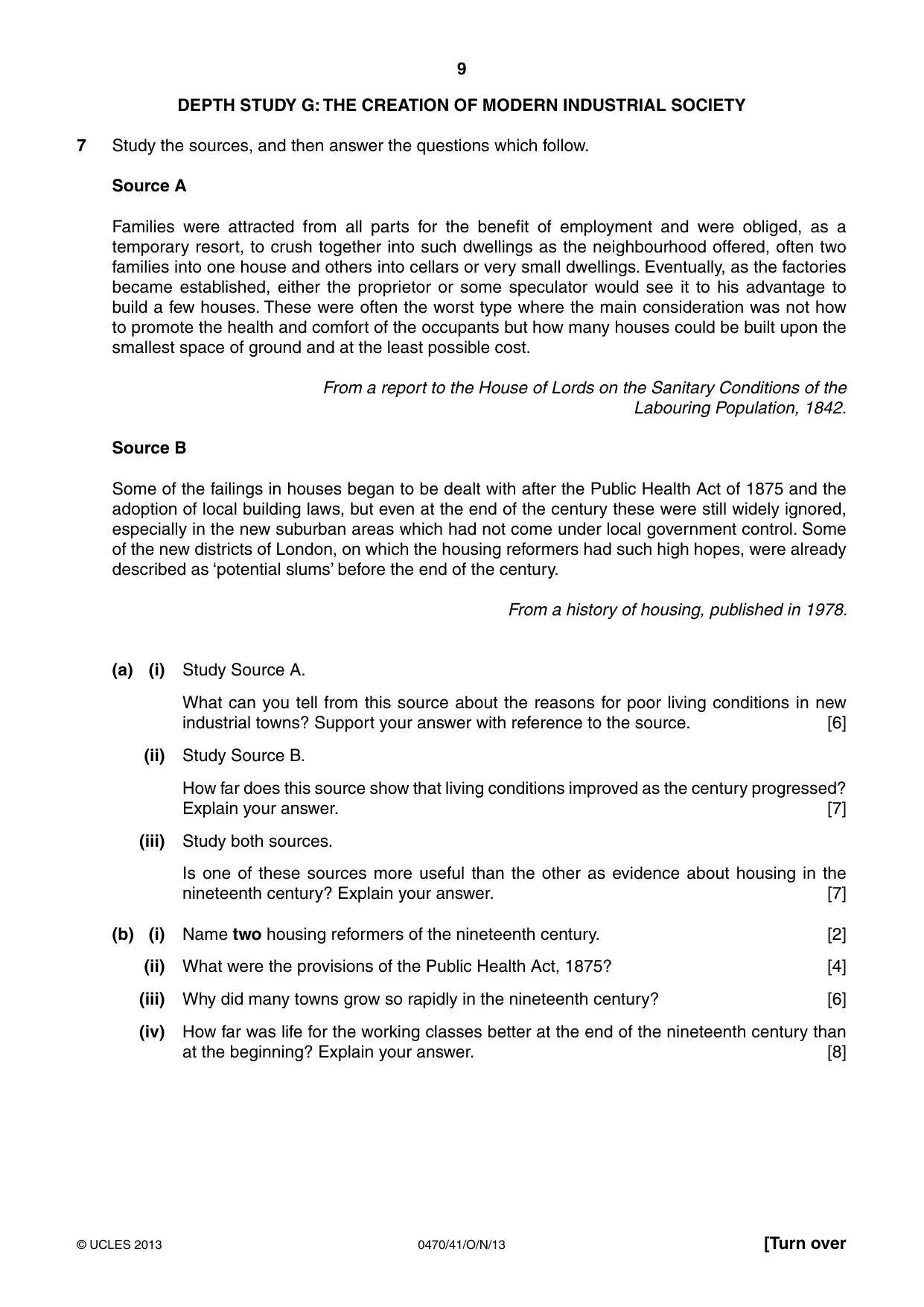
9 0470/41/O/N/13 © UCLES 2013 [Turn over DEPTH STUDY G: THE CREATION OF MODERN INDUSTRIAL SOCIETY 7 Study the sources, and then answer the questions which follow. Source A Families were attracted from all parts for the benefit of employment and were obliged, as a temporary resort, to crush together into such dwellings as the neighbourhood offered, often two families into one house and others into cellars or very small dwellings. Eventually, as the factories became established, either the proprietor or some speculator would see it to his advantage to build a few houses. These were often the worst type where the main consideration was not how to promote the health and comfort of the occupants but how many houses could be built upon the smallest space of ground and at the least possible cost. From a report to the House of Lords on the Sanitary Conditions of the Labouring Population, 1842. Source B Some of the failings in houses began to be dealt with after the Public Health Act of 1875 and the adoption of local building laws, but even at the end of the century these were still widely ignored, especially in the new suburban areas which had not come under local government control. Some of the new districts of London, on which the housing reformers had such high hopes, were already described as ‘potential slums’ before the end of the century. From a history of housing, published in 1978. (a) (i) Study Source A. What can you tell from this source about the reasons for poor living conditions in new industrial towns? Support your answer with reference to the source. [6] (ii) Study Source B. How far does this source show that living conditions improved as the century progressed? Explain your answer. [7] (iii) Study both sources. Is one of these sources more useful than the other as evidence about housing in the nineteenth century? Explain your answer. [7] (b) (i) Name two housing reformers of the nineteenth century. [2] (ii) What were the provisions of the Public Health Act, 1875? [4] (iii) Why did many towns grow so rapidly in the nineteenth century? [6] (iv) How far was life for the working classes better at the end of the nineteenth century than at the beginning? Explain your answer. [8]
Question paper, page 10
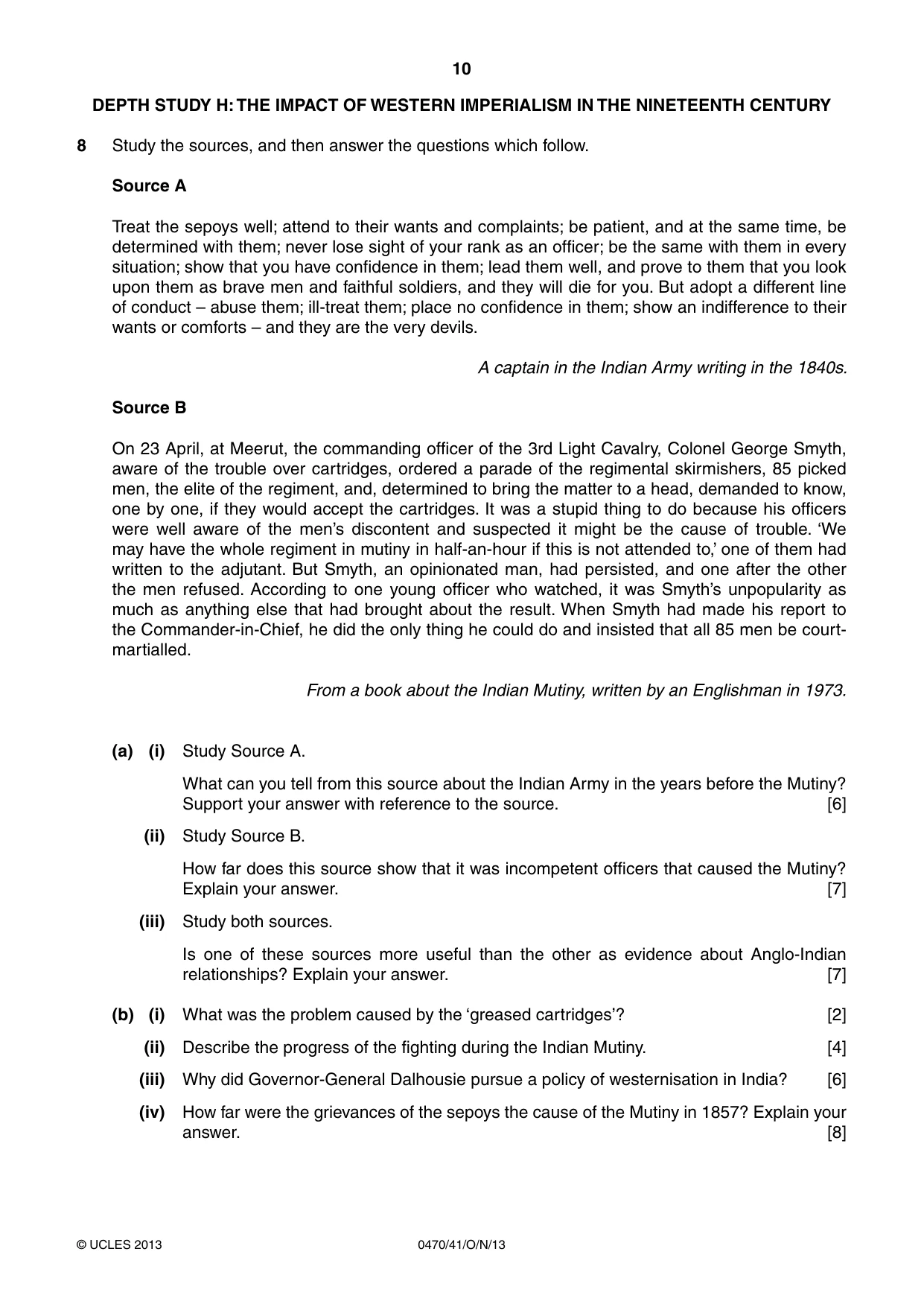
10 0470/41/O/N/13 © UCLES 2013 DEPTH STUDY H: THE IMPACT OF WESTERN IMPERIALISM IN THE NINETEENTH CENTURY 8 Study the sources, and then answer the questions which follow. Source A Treat the sepoys well; attend to their wants and complaints; be patient, and at the same time, be determined with them; never lose sight of your rank as an officer; be the same with them in every situation; show that you have confidence in them; lead them well, and prove to them that you look upon them as brave men and faithful soldiers, and they will die for you. But adopt a different line of conduct – abuse them; ill-treat them; place no confidence in them; show an indifference to their wants or comforts – and they are the very devils. A captain in the Indian Army writing in the 1840s. Source B On 23 April, at Meerut, the commanding officer of the 3rd Light Cavalry, Colonel George Smyth, aware of the trouble over cartridges, ordered a parade of the regimental skirmishers, 85 picked men, the elite of the regiment, and, determined to bring the matter to a head, demanded to know, one by one, if they would accept the cartridges. It was a stupid thing to do because his officers were well aware of the men’s discontent and suspected it might be the cause of trouble. ‘We may have the whole regiment in mutiny in half-an-hour if this is not attended to,’ one of them had written to the adjutant. But Smyth, an opinionated man, had persisted, and one after the other the men refused. According to one young officer who watched, it was Smyth’s unpopularity as much as anything else that had brought about the result. When Smyth had made his report to the Commander-in-Chief, he did the only thing he could do and insisted that all 85 men be court- martialled. From a book about the Indian Mutiny, written by an Englishman in 1973. (a) (i) Study Source A. What can you tell from this source about the Indian Army in the years before the Mutiny? Support your answer with reference to the source. [6] (ii) Study Source B. How far does this source show that it was incompetent officers that caused the Mutiny? Explain your answer. [7] (iii) Study both sources. Is one of these sources more useful than the other as evidence about Anglo-Indian relationships? Explain your answer. [7] (b) (i) What was the problem caused by the ‘greased cartridges’? [2] (ii) Describe the progress of the fighting during the Indian Mutiny. [4] (iii) Why did Governor-General Dalhousie pursue a policy of westernisation in India? [6] (iv) How far were the grievances of the sepoys the cause of the Mutiny in 1857? Explain your answer. [8]
Question paper, page 11
11 0470/41/O/N/13 © UCLES 2013 BLANK PAGE
Question paper, page 12
12 0470/41/O/N/13 © UCLES 2013 Copyright Acknowledgements: Depth Study A Source A © White & Hadley; Germany 1918–49; Collins Educational / Bildarchiv Preussischer Kulturbesitz; 1990. Depth Study A Source B © From a British historian’s view; 2002. Depth Study B Source A © Mikhail Sholokhov; Virgin Soil Upturned ; 1935; in Philip Ingham; Russia and the USSR; Cambridge University Press; 1997. Depth Study B Source B © E. Roberts; Stalin, Man of Steel ; in Ben Walsh; Modern World History; Reproduced by permission of Hodder Education; 1996. Depth Study C Source A © A Chicago man in 1968 recalling his experience of the early 1930s. Depth Study C Source B © T. Howarth; Twentieth Century History ; Longman Group Ltd; 1987. Depth Study D Source A © Norman Lowe; Mastering Modern World History; Macmillan Press Ltd. Reproduced with permission of Palgrave Macmillan; 1982. Depth Study D Source B © Tony McAleavy; Modern World History ; Cambridge University Press; 1996. Depth Study E Source A © adapted: J Morris; Farewell to the Trumpets; Penguin Books Ltd; 1981. Depth Study E Source B © From a South African history of the Anglo-Boer War; 2001. Depth Study F Source A © S. J. Perkins; The Arab-Israeli Conflict ; Macmillan Press Ltd. Reproduced with permission of Palgrave Macmillan; 1987. Depth Study F Source B © Dan Cohn-Sherbok & Dawoud El-Alami; The Palestine-Israeli Conflict; A Beginner’s Guide; Oneworld Publications; 2001. Depth Study G Source A © R. Tames; Documents of the Industrial Revolution; Hutchinson Education; 1971. Depth Study G Source B © J. Burnett; A Social History of Housing 1815–1970; David & Charles; 1978. Depth Study H Source A © J. Spilsbury; The Indian Mutiny ; Phoenix; 2007. Depth Study H Source B © J. Harris; The Indian Mutiny ; Granada Publishing Ltd, 1973. Permission to reproduce items where third-party owned material protected by copyright is included has been sought and cleared where possible. Every reasonable effort has been made by the publisher (UCLES) to trace copyright holders, but if any items requiring clearance have unwittingly been included, the publisher will be pleased to make amends at the earliest possible opportunity. University of Cambridge International Examinations is part of the Cambridge Assessment Group. Cambridge Assessment is the brand name of University of Cambridge Local Examinations Syndicate (UCLES), which is itself a department of the University of Cambridge. BLANK PAGE
Mark scheme, page 1
CAMBRIDGE INTERNATIONAL EXAMINATIONS International General Certificate of Secondary Education MARK SCHEME for the October/November 2013 series 0470 HISTORY 0470/41 Paper 4 (Alternative to Coursework), maximum raw mark 40 This mark scheme is published as an aid to teachers and candidates, to indicate the requirements of the examination. It shows the basis on which Examiners were instructed to award marks. It does not indicate the details of the discussions that took place at an Examiners’ meeting before marking began, which would have considered the acceptability of alternative answers. Mark schemes should be read in conjunction with the question paper and the Principal Examiner Report for Teachers. Cambridge will not enter into discussions about these mark schemes. Cambridge is publishing the mark schemes for the October/November 2013 series for most IGCSE, GCE Advanced Level and Advanced Subsidiary Level components and some Ordinary Level components.
Mark scheme, page 2
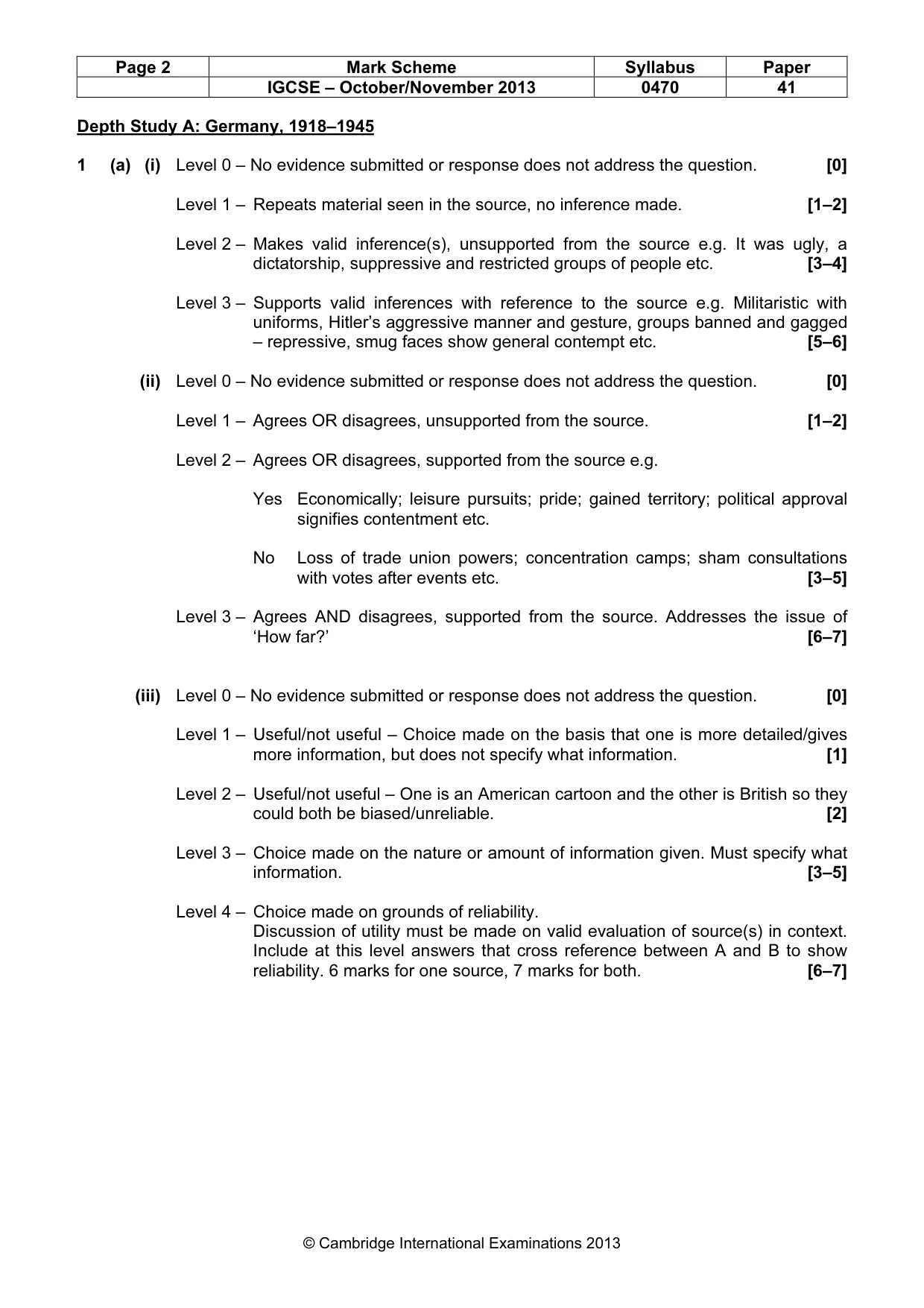
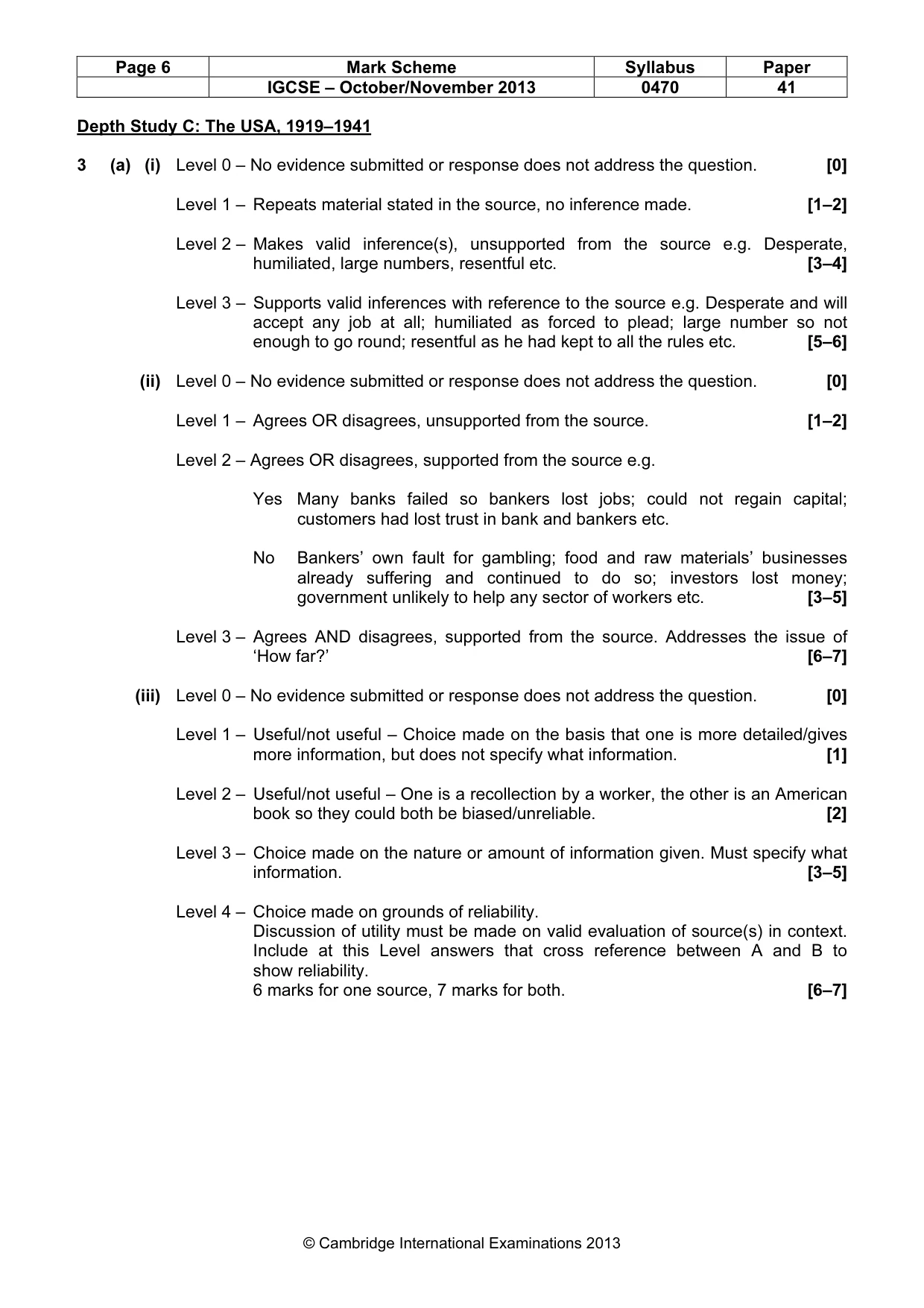
Page 2 Mark Scheme Syllabus Paper IGCSE – October/November 2013 0470 41 © Cambridge International Examinations 2013 Depth Study A: Germany, 1918–1945 1 (a) (i) Level 0 – No evidence submitted or response does not address the question. [0] Level 1 – Repeats material seen in the source, no inference made. [1–2] Level 2 – Makes valid inference(s), unsupported from the source e.g. It was ugly, a dictatorship, suppressive and restricted groups of people etc. [3–4] Level 3 – Supports valid inferences with reference to the source e.g. Militaristic with uniforms, Hitler’s aggressive manner and gesture, groups banned and gagged – repressive, smug faces show general contempt etc. [5–6] (ii) Level 0 – No evidence submitted or response does not address the question. [0] Level 1 – Agrees OR disagrees, unsupported from the source. [1–2] Level 2 – Agrees OR disagrees, supported from the source e.g. Yes Economically; leisure pursuits; pride; gained territory; political approval signifies contentment etc. No Loss of trade union powers; concentration camps; sham consultations with votes after events etc. [3–5] Level 3 – Agrees AND disagrees, supported from the source. Addresses the issue of ‘How far?’ [6–7] (iii) Level 0 – No evidence submitted or response does not address the question. [0] Level 1 – Useful/not useful – Choice made on the basis that one is more detailed/gives more information, but does not specify what information. [1] Level 2 – Useful/not useful – One is an American cartoon and the other is British so they could both be biased/unreliable. [2] Level 3 – Choice made on the nature or amount of information given. Must specify what information. [3–5] Level 4 – Choice made on grounds of reliability. Discussion of utility must be made on valid evaluation of source(s) in context. Include at this level answers that cross reference between A and B to show reliability. 6 marks for one source, 7 marks for both. [6–7]
Mark scheme, page 3
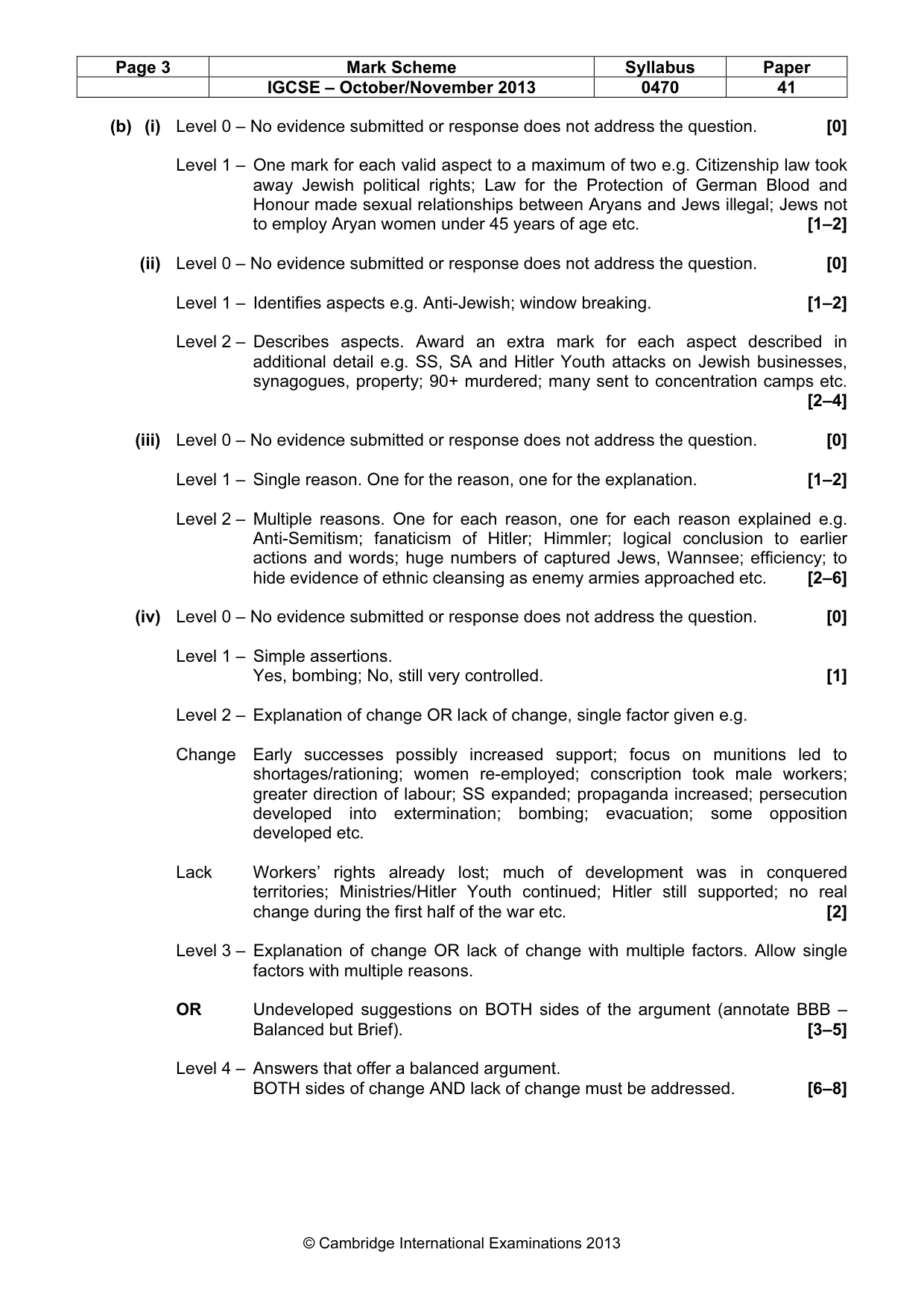
Page 3 Mark Scheme Syllabus Paper IGCSE – October/November 2013 0470 41 © Cambridge International Examinations 2013 (b) (i) Level 0 – No evidence submitted or response does not address the question. [0] Level 1 – One mark for each valid aspect to a maximum of two e.g. Citizenship law took away Jewish political rights; Law for the Protection of German Blood and Honour made sexual relationships between Aryans and Jews illegal; Jews not to employ Aryan women under 45 years of age etc. [1–2] (ii) Level 0 – No evidence submitted or response does not address the question. [0] Level 1 – Identifies aspects e.g. Anti-Jewish; window breaking. [1–2] Level 2 – Describes aspects. Award an extra mark for each aspect described in additional detail e.g. SS, SA and Hitler Youth attacks on Jewish businesses, synagogues, property; 90+ murdered; many sent to concentration camps etc. [2–4] (iii) Level 0 – No evidence submitted or response does not address the question. [0] Level 1 – Single reason. One for the reason, one for the explanation. [1–2] Level 2 – Multiple reasons. One for each reason, one for each reason explained e.g. Anti-Semitism; fanaticism of Hitler; Himmler; logical conclusion to earlier actions and words; huge numbers of captured Jews, Wannsee; efficiency; to hide evidence of ethnic cleansing as enemy armies approached etc. [2–6] (iv) Level 0 – No evidence submitted or response does not address the question. [0] Level 1 – Simple assertions. Yes, bombing; No, still very controlled. [1] Level 2 – Explanation of change OR lack of change, single factor given e.g. Change Early successes possibly increased support; focus on munitions led to shortages/rationing; women re-employed; conscription took male workers; greater direction of labour; SS expanded; propaganda increased; persecution developed into extermination; bombing; evacuation; some opposition developed etc. Lack Workers’ rights already lost; much of development was in conquered territories; Ministries/Hitler Youth continued; Hitler still supported; no real change during the first half of the war etc. [2] Level 3 – Explanation of change OR lack of change with multiple factors. Allow single factors with multiple reasons. OR Undeveloped suggestions on BOTH sides of the argument (annotate BBB – Balanced but Brief). [3–5] Level 4 – Answers that offer a balanced argument. BOTH sides of change AND lack of change must be addressed. [6–8]
Mark scheme, page 4
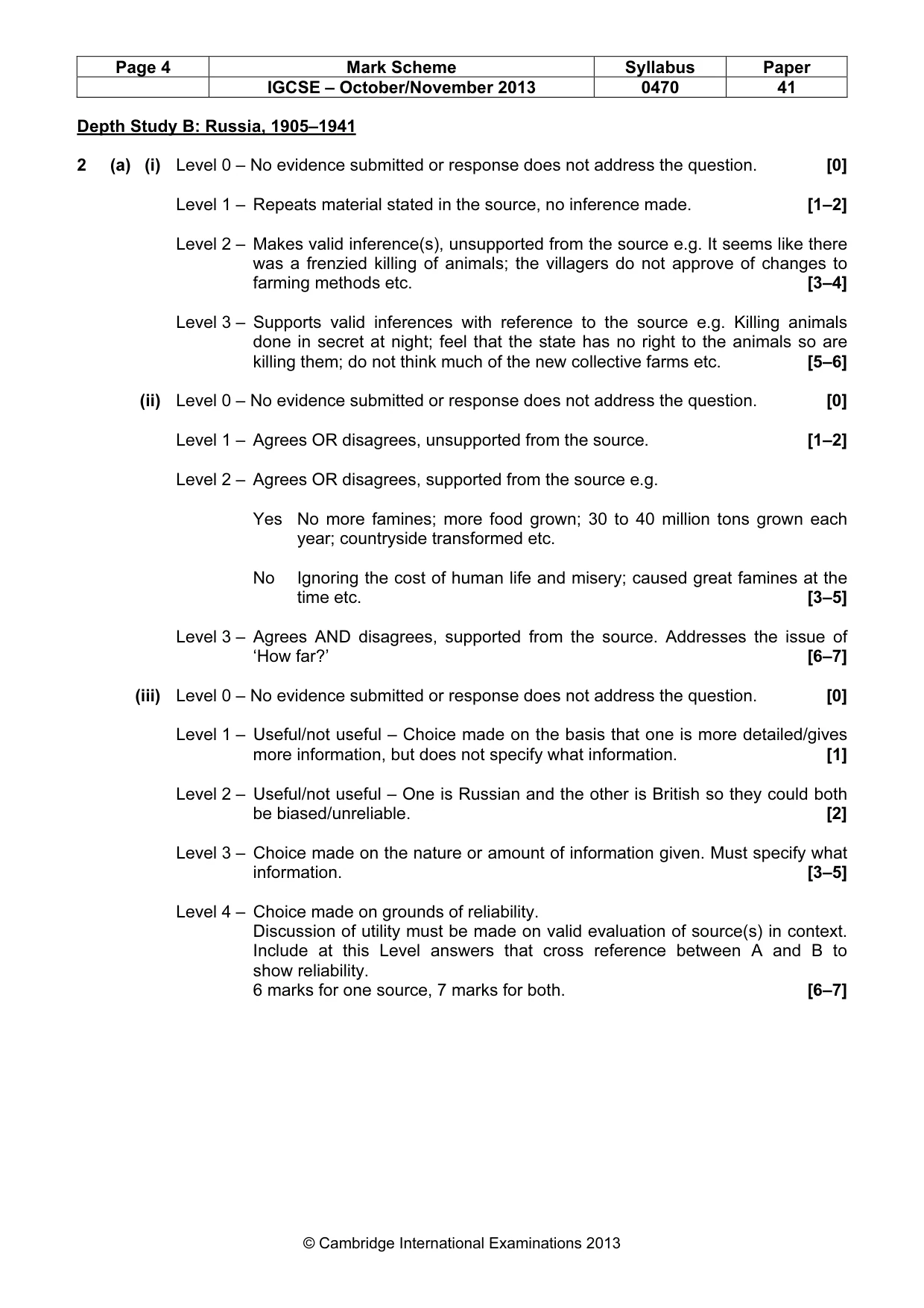
Page 4 Mark Scheme Syllabus Paper IGCSE – October/November 2013 0470 41 © Cambridge International Examinations 2013 Depth Study B: Russia, 1905–1941 2 (a) (i) Level 0 – No evidence submitted or response does not address the question. [0] Level 1 – Repeats material stated in the source, no inference made. [1–2] Level 2 – Makes valid inference(s), unsupported from the source e.g. It seems like there was a frenzied killing of animals; the villagers do not approve of changes to farming methods etc. [3–4] Level 3 – Supports valid inferences with reference to the source e.g. Killing animals done in secret at night; feel that the state has no right to the animals so are killing them; do not think much of the new collective farms etc. [5–6] (ii) Level 0 – No evidence submitted or response does not address the question. [0] Level 1 – Agrees OR disagrees, unsupported from the source. [1–2] Level 2 – Agrees OR disagrees, supported from the source e.g. Yes No more famines; more food grown; 30 to 40 million tons grown each year; countryside transformed etc. No Ignoring the cost of human life and misery; caused great famines at the time etc. [3–5] Level 3 – Agrees AND disagrees, supported from the source. Addresses the issue of ‘How far?’ [6–7] (iii) Level 0 – No evidence submitted or response does not address the question. [0] Level 1 – Useful/not useful – Choice made on the basis that one is more detailed/gives more information, but does not specify what information. [1] Level 2 – Useful/not useful – One is Russian and the other is British so they could both be biased/unreliable. [2] Level 3 – Choice made on the nature or amount of information given. Must specify what information. [3–5] Level 4 – Choice made on grounds of reliability. Discussion of utility must be made on valid evaluation of source(s) in context. Include at this Level answers that cross reference between A and B to show reliability. 6 marks for one source, 7 marks for both. [6–7]
Mark scheme, page 5
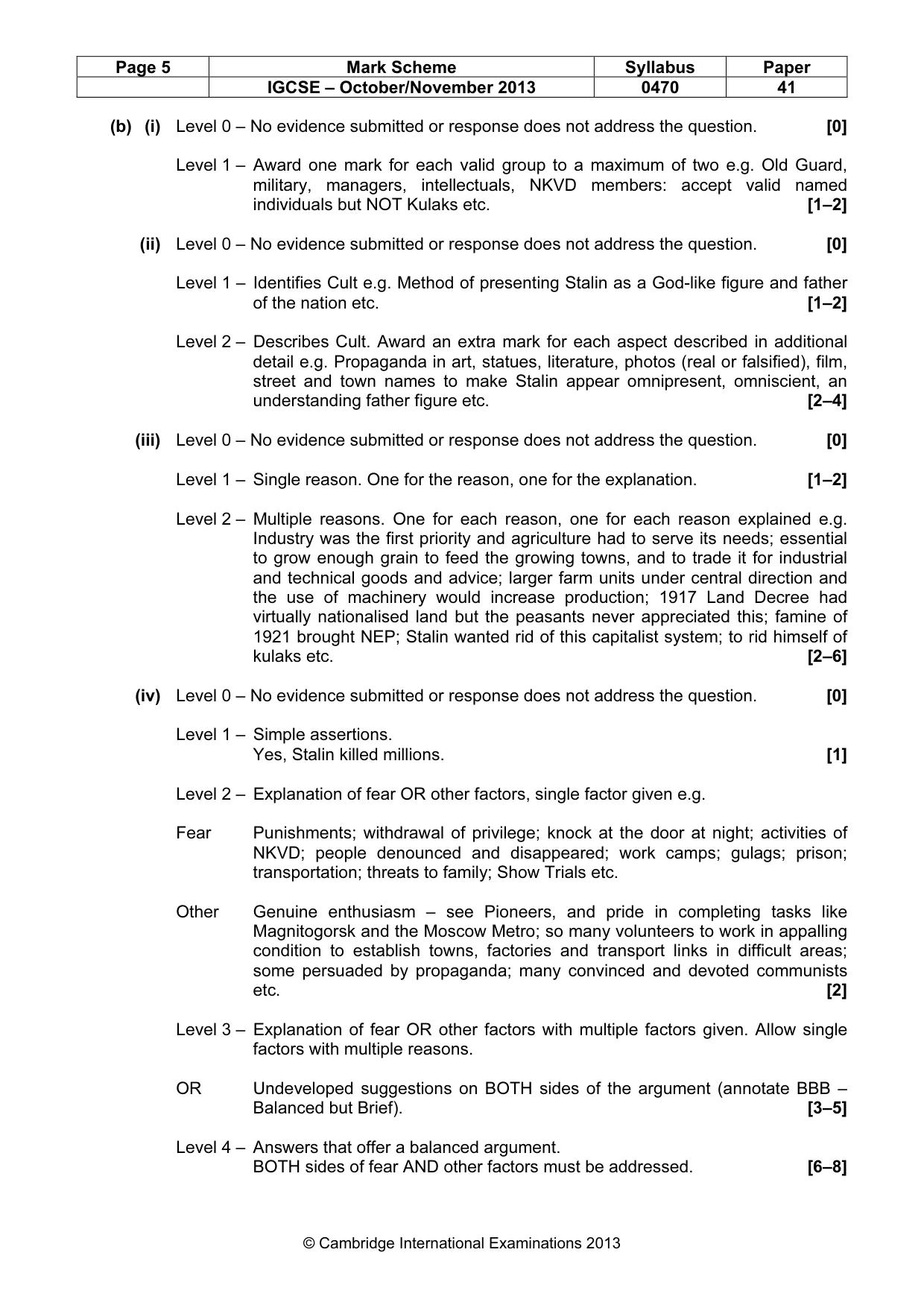
Page 5 Mark Scheme Syllabus Paper IGCSE – October/November 2013 0470 41 © Cambridge International Examinations 2013 (b) (i) Level 0 – No evidence submitted or response does not address the question. [0] Level 1 – Award one mark for each valid group to a maximum of two e.g. Old Guard, military, managers, intellectuals, NKVD members: accept valid named individuals but NOT Kulaks etc. [1–2] (ii) Level 0 – No evidence submitted or response does not address the question. [0] Level 1 – Identifies Cult e.g. Method of presenting Stalin as a God-like figure and father of the nation etc. [1–2] Level 2 – Describes Cult. Award an extra mark for each aspect described in additional detail e.g. Propaganda in art, statues, literature, photos (real or falsified), film, street and town names to make Stalin appear omnipresent, omniscient, an understanding father figure etc. [2–4] (iii) Level 0 – No evidence submitted or response does not address the question. [0] Level 1 – Single reason. One for the reason, one for the explanation. [1–2] Level 2 – Multiple reasons. One for each reason, one for each reason explained e.g. Industry was the first priority and agriculture had to serve its needs; essential to grow enough grain to feed the growing towns, and to trade it for industrial and technical goods and advice; larger farm units under central direction and the use of machinery would increase production; 1917 Land Decree had virtually nationalised land but the peasants never appreciated this; famine of 1921 brought NEP; Stalin wanted rid of this capitalist system; to rid himself of kulaks etc. [2–6] (iv) Level 0 – No evidence submitted or response does not address the question. [0] Level 1 – Simple assertions. Yes, Stalin killed millions. [1] Level 2 – Explanation of fear OR other factors, single factor given e.g. Fear Punishments; withdrawal of privilege; knock at the door at night; activities of NKVD; people denounced and disappeared; work camps; gulags; prison; transportation; threats to family; Show Trials etc. Other Genuine enthusiasm – see Pioneers, and pride in completing tasks like Magnitogorsk and the Moscow Metro; so many volunteers to work in appalling condition to establish towns, factories and transport links in difficult areas; some persuaded by propaganda; many convinced and devoted communists etc. [2] Level 3 – Explanation of fear OR other factors with multiple factors given. Allow single factors with multiple reasons. OR Undeveloped suggestions on BOTH sides of the argument (annotate BBB – Balanced but Brief). [3–5] Level 4 – Answers that offer a balanced argument. BOTH sides of fear AND other factors must be addressed. [6–8]
Mark scheme, page 6
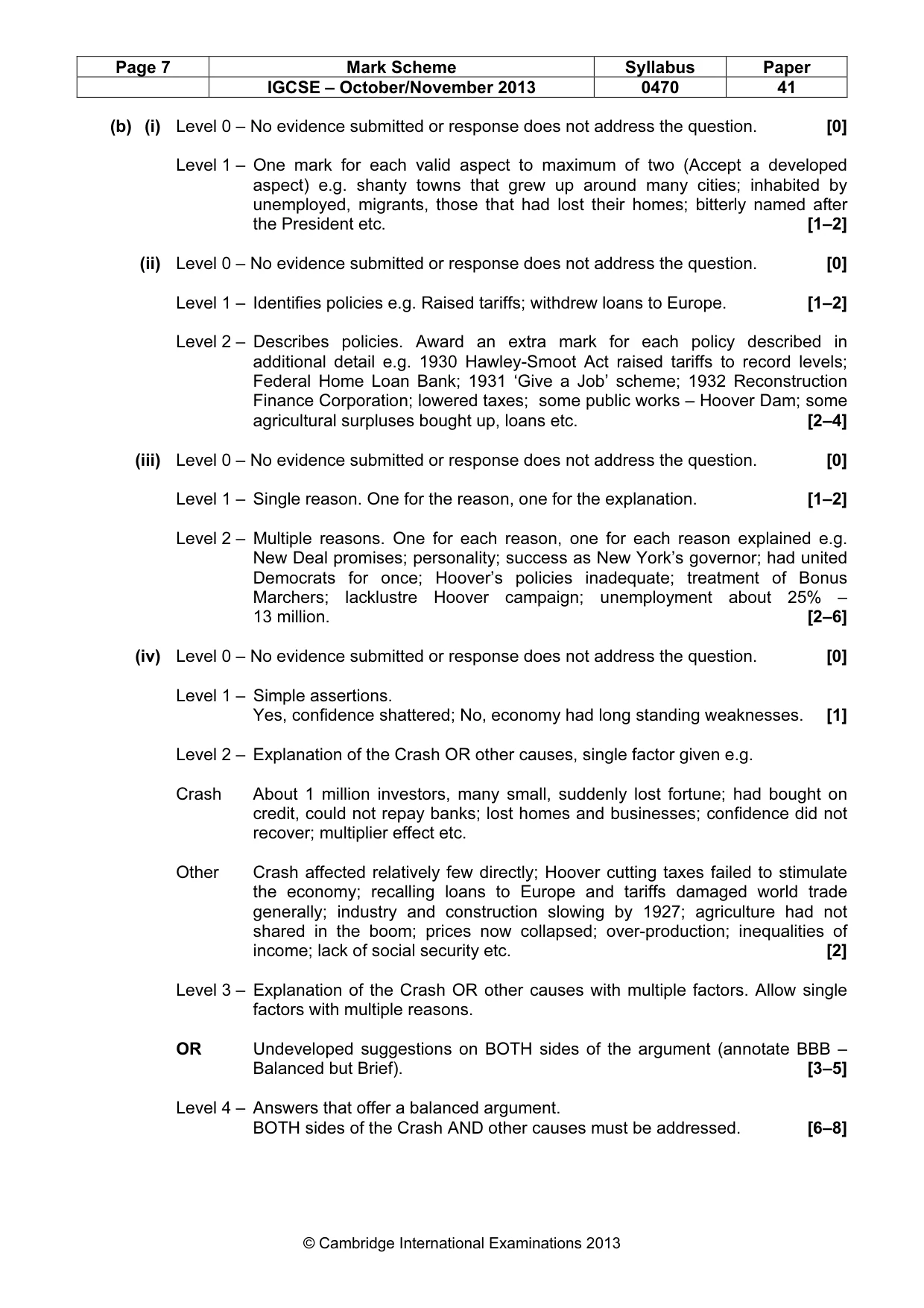
Page 6 Mark Scheme Syllabus Paper IGCSE – October/November 2013 0470 41 © Cambridge International Examinations 2013 Depth Study C: The USA, 1919–1941 3 (a) (i) Level 0 – No evidence submitted or response does not address the question. [0] Level 1 – Repeats material stated in the source, no inference made. [1–2] Level 2 – Makes valid inference(s), unsupported from the source e.g. Desperate, humiliated, large numbers, resentful etc. [3–4] Level 3 – Supports valid inferences with reference to the source e.g. Desperate and will accept any job at all; humiliated as forced to plead; large number so not enough to go round; resentful as he had kept to all the rules etc. [5–6] (ii) Level 0 – No evidence submitted or response does not address the question. [0] Level 1 – Agrees OR disagrees, unsupported from the source. [1–2] Level 2 – Agrees OR disagrees, supported from the source e.g. Yes Many banks failed so bankers lost jobs; could not regain capital; customers had lost trust in bank and bankers etc. No Bankers’ own fault for gambling; food and raw materials’ businesses already suffering and continued to do so; investors lost money; government unlikely to help any sector of workers etc. [3–5] Level 3 – Agrees AND disagrees, supported from the source. Addresses the issue of ‘How far?’ [6–7] (iii) Level 0 – No evidence submitted or response does not address the question. [0] Level 1 – Useful/not useful – Choice made on the basis that one is more detailed/gives more information, but does not specify what information. [1] Level 2 – Useful/not useful – One is a recollection by a worker, the other is an American book so they could both be biased/unreliable. [2] Level 3 – Choice made on the nature or amount of information given. Must specify what information. [3–5] Level 4 – Choice made on grounds of reliability. Discussion of utility must be made on valid evaluation of source(s) in context. Include at this Level answers that cross reference between A and B to show reliability. 6 marks for one source, 7 marks for both. [6–7]
Mark scheme, page 7
Page 7 Mark Scheme Syllabus Paper IGCSE – October/November 2013 0470 41 © Cambridge International Examinations 2013 (b) (i) Level 0 – No evidence submitted or response does not address the question. [0] Level 1 – One mark for each valid aspect to maximum of two (Accept a developed aspect) e.g. shanty towns that grew up around many cities; inhabited by unemployed, migrants, those that had lost their homes; bitterly named after the President etc. [1–2] (ii) Level 0 – No evidence submitted or response does not address the question. [0] Level 1 – Identifies policies e.g. Raised tariffs; withdrew loans to Europe. [1–2] Level 2 – Describes policies. Award an extra mark for each policy described in additional detail e.g. 1930 Hawley-Smoot Act raised tariffs to record levels; Federal Home Loan Bank; 1931 ‘Give a Job’ scheme; 1932 Reconstruction Finance Corporation; lowered taxes; some public works – Hoover Dam; some agricultural surpluses bought up, loans etc. [2–4] (iii) Level 0 – No evidence submitted or response does not address the question. [0] Level 1 – Single reason. One for the reason, one for the explanation. [1–2] Level 2 – Multiple reasons. One for each reason, one for each reason explained e.g. New Deal promises; personality; success as New York’s governor; had united Democrats for once; Hoover’s policies inadequate; treatment of Bonus Marchers; lacklustre Hoover campaign; unemployment about 25% – 13 million. [2–6] (iv) Level 0 – No evidence submitted or response does not address the question. [0] Level 1 – Simple assertions. Yes, confidence shattered; No, economy had long standing weaknesses. [1] Level 2 – Explanation of the Crash OR other causes, single factor given e.g. Crash About 1 million investors, many small, suddenly lost fortune; had bought on credit, could not repay banks; lost homes and businesses; confidence did not recover; multiplier effect etc. Other Crash affected relatively few directly; Hoover cutting taxes failed to stimulate the economy; recalling loans to Europe and tariffs damaged world trade generally; industry and construction slowing by 1927; agriculture had not shared in the boom; prices now collapsed; over-production; inequalities of income; lack of social security etc. [2] Level 3 – Explanation of the Crash OR other causes with multiple factors. Allow single factors with multiple reasons. OR Undeveloped suggestions on BOTH sides of the argument (annotate BBB – Balanced but Brief). [3–5] Level 4 – Answers that offer a balanced argument. BOTH sides of the Crash AND other causes must be addressed. [6–8]
Mark scheme, page 8
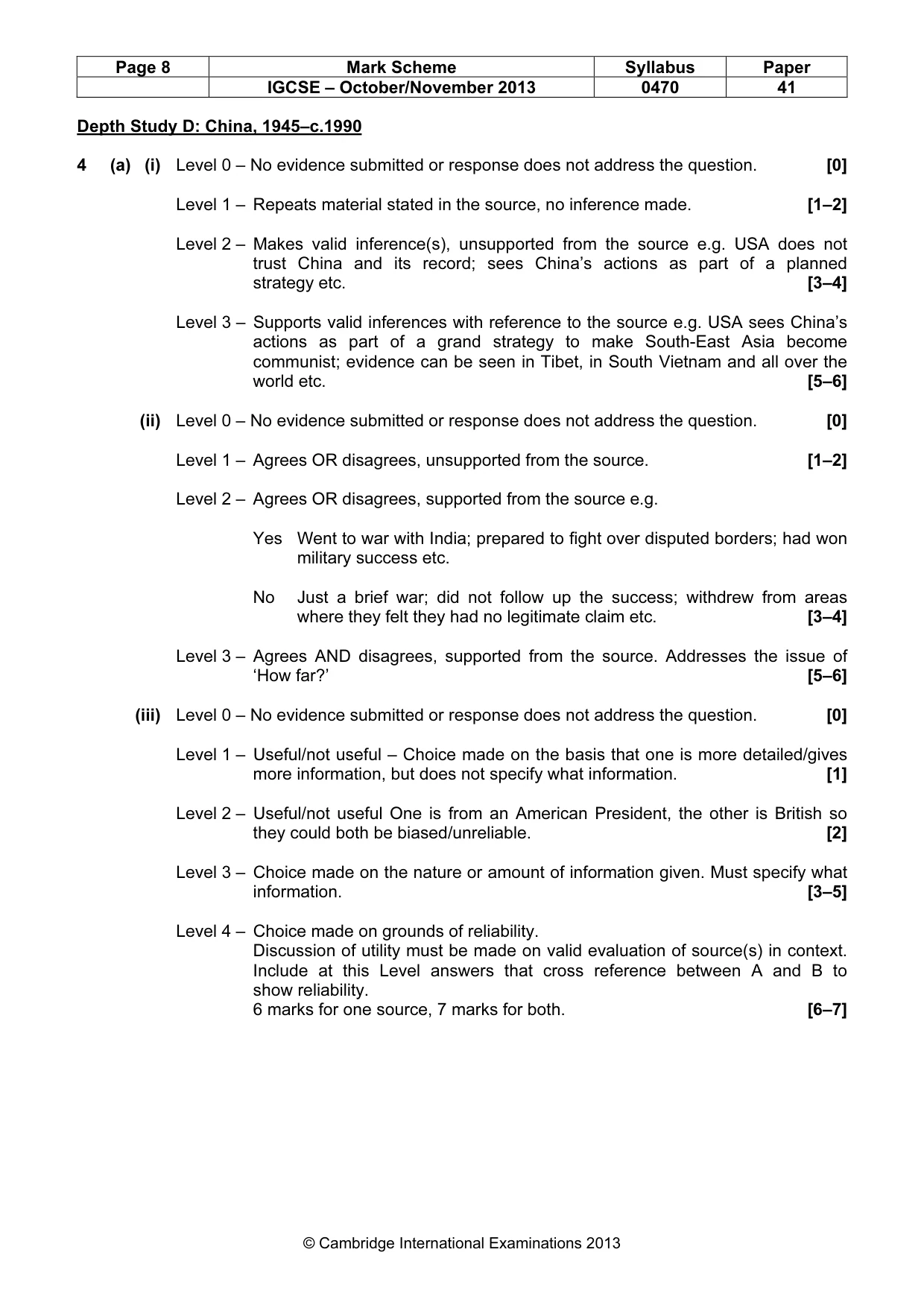
Page 8 Mark Scheme Syllabus Paper IGCSE – October/November 2013 0470 41 © Cambridge International Examinations 2013 Depth Study D: China, 1945–c.1990 4 (a) (i) Level 0 – No evidence submitted or response does not address the question. [0] Level 1 – Repeats material stated in the source, no inference made. [1–2] Level 2 – Makes valid inference(s), unsupported from the source e.g. USA does not trust China and its record; sees China’s actions as part of a planned strategy etc. [3–4] Level 3 – Supports valid inferences with reference to the source e.g. USA sees China’s actions as part of a grand strategy to make South-East Asia become communist; evidence can be seen in Tibet, in South Vietnam and all over the world etc. [5–6] (ii) Level 0 – No evidence submitted or response does not address the question. [0] Level 1 – Agrees OR disagrees, unsupported from the source. [1–2] Level 2 – Agrees OR disagrees, supported from the source e.g. Yes Went to war with India; prepared to fight over disputed borders; had won military success etc. No Just a brief war; did not follow up the success; withdrew from areas where they felt they had no legitimate claim etc. [3–4] Level 3 – Agrees AND disagrees, supported from the source. Addresses the issue of ‘How far?’ [5–6] (iii) Level 0 – No evidence submitted or response does not address the question. [0] Level 1 – Useful/not useful – Choice made on the basis that one is more detailed/gives more information, but does not specify what information. [1] Level 2 – Useful/not useful One is from an American President, the other is British so they could both be biased/unreliable. [2] Level 3 – Choice made on the nature or amount of information given. Must specify what information. [3–5] Level 4 – Choice made on grounds of reliability. Discussion of utility must be made on valid evaluation of source(s) in context. Include at this Level answers that cross reference between A and B to show reliability. 6 marks for one source, 7 marks for both. [6–7]
Mark scheme, page 9
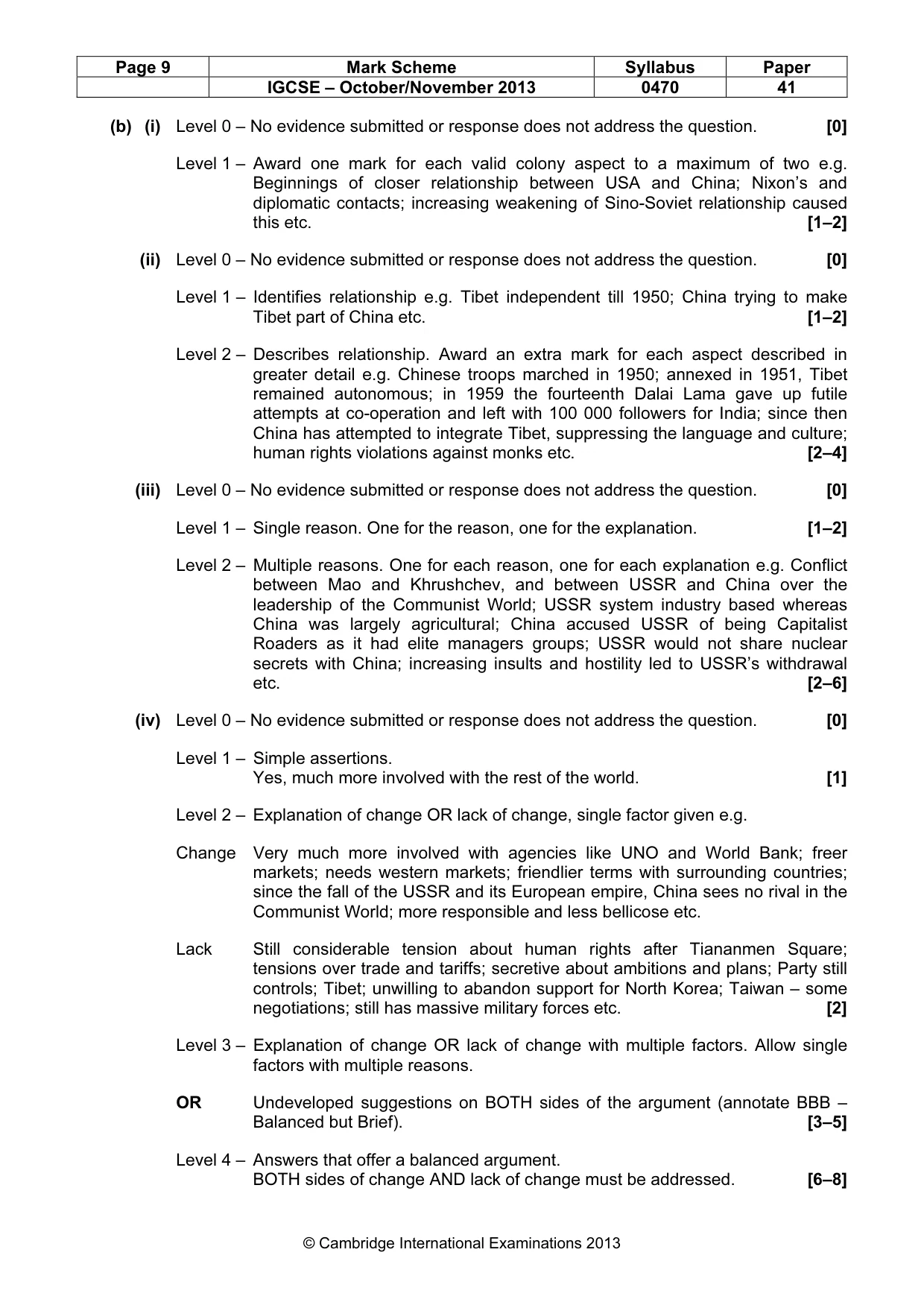
Page 9 Mark Scheme Syllabus Paper IGCSE – October/November 2013 0470 41 © Cambridge International Examinations 2013 (b) (i) Level 0 – No evidence submitted or response does not address the question. [0] Level 1 – Award one mark for each valid colony aspect to a maximum of two e.g. Beginnings of closer relationship between USA and China; Nixon’s and diplomatic contacts; increasing weakening of Sino-Soviet relationship caused this etc. [1–2] (ii) Level 0 – No evidence submitted or response does not address the question. [0] Level 1 – Identifies relationship e.g. Tibet independent till 1950; China trying to make Tibet part of China etc. [1–2] Level 2 – Describes relationship. Award an extra mark for each aspect described in greater detail e.g. Chinese troops marched in 1950; annexed in 1951, Tibet remained autonomous; in 1959 the fourteenth Dalai Lama gave up futile attempts at co-operation and left with 100 000 followers for India; since then China has attempted to integrate Tibet, suppressing the language and culture; human rights violations against monks etc. [2–4] (iii) Level 0 – No evidence submitted or response does not address the question. [0] Level 1 – Single reason. One for the reason, one for the explanation. [1–2] Level 2 – Multiple reasons. One for each reason, one for each explanation e.g. Conflict between Mao and Khrushchev, and between USSR and China over the leadership of the Communist World; USSR system industry based whereas China was largely agricultural; China accused USSR of being Capitalist Roaders as it had elite managers groups; USSR would not share nuclear secrets with China; increasing insults and hostility led to USSR’s withdrawal etc. [2–6] (iv) Level 0 – No evidence submitted or response does not address the question. [0] Level 1 – Simple assertions. Yes, much more involved with the rest of the world. [1] Level 2 – Explanation of change OR lack of change, single factor given e.g. Change Very much more involved with agencies like UNO and World Bank; freer markets; needs western markets; friendlier terms with surrounding countries; since the fall of the USSR and its European empire, China sees no rival in the Communist World; more responsible and less bellicose etc. Lack Still considerable tension about human rights after Tiananmen Square; tensions over trade and tariffs; secretive about ambitions and plans; Party still controls; Tibet; unwilling to abandon support for North Korea; Taiwan – some negotiations; still has massive military forces etc. [2] Level 3 – Explanation of change OR lack of change with multiple factors. Allow single factors with multiple reasons. OR Undeveloped suggestions on BOTH sides of the argument (annotate BBB – Balanced but Brief). [3–5] Level 4 – Answers that offer a balanced argument. BOTH sides of change AND lack of change must be addressed. [6–8]
Mark scheme, page 10
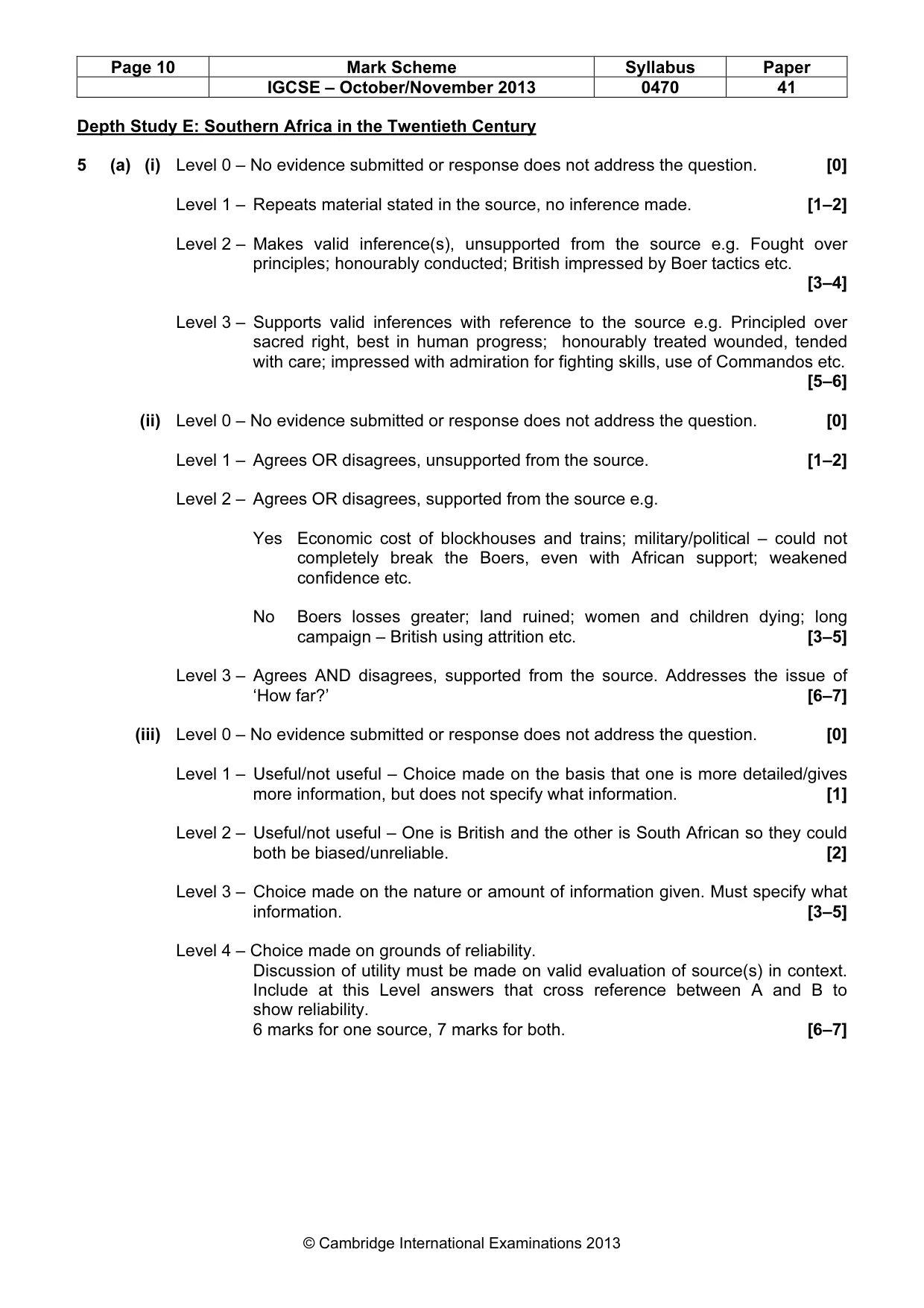
Page 10 Mark Scheme Syllabus Paper IGCSE – October/November 2013 0470 41 © Cambridge International Examinations 2013 Depth Study E: Southern Africa in the Twentieth Century 5 (a) (i) Level 0 – No evidence submitted or response does not address the question. [0] Level 1 – Repeats material stated in the source, no inference made. [1–2] Level 2 – Makes valid inference(s), unsupported from the source e.g. Fought over principles; honourably conducted; British impressed by Boer tactics etc. [3–4] Level 3 – Supports valid inferences with reference to the source e.g. Principled over sacred right, best in human progress; honourably treated wounded, tended with care; impressed with admiration for fighting skills, use of Commandos etc. [5–6] (ii) Level 0 – No evidence submitted or response does not address the question. [0] Level 1 – Agrees OR disagrees, unsupported from the source. [1–2] Level 2 – Agrees OR disagrees, supported from the source e.g. Yes Economic cost of blockhouses and trains; military/political – could not completely break the Boers, even with African support; weakened confidence etc. No Boers losses greater; land ruined; women and children dying; long campaign – British using attrition etc. [3–5] Level 3 – Agrees AND disagrees, supported from the source. Addresses the issue of ‘How far?’ [6–7] (iii) Level 0 – No evidence submitted or response does not address the question. [0] Level 1 – Useful/not useful – Choice made on the basis that one is more detailed/gives more information, but does not specify what information. [1] Level 2 – Useful/not useful – One is British and the other is South African so they could both be biased/unreliable. [2] Level 3 – Choice made on the nature or amount of information given. Must specify what information. [3–5] Level 4 – Choice made on grounds of reliability. Discussion of utility must be made on valid evaluation of source(s) in context. Include at this Level answers that cross reference between A and B to show reliability. 6 marks for one source, 7 marks for both. [6–7]
Mark scheme, page 11
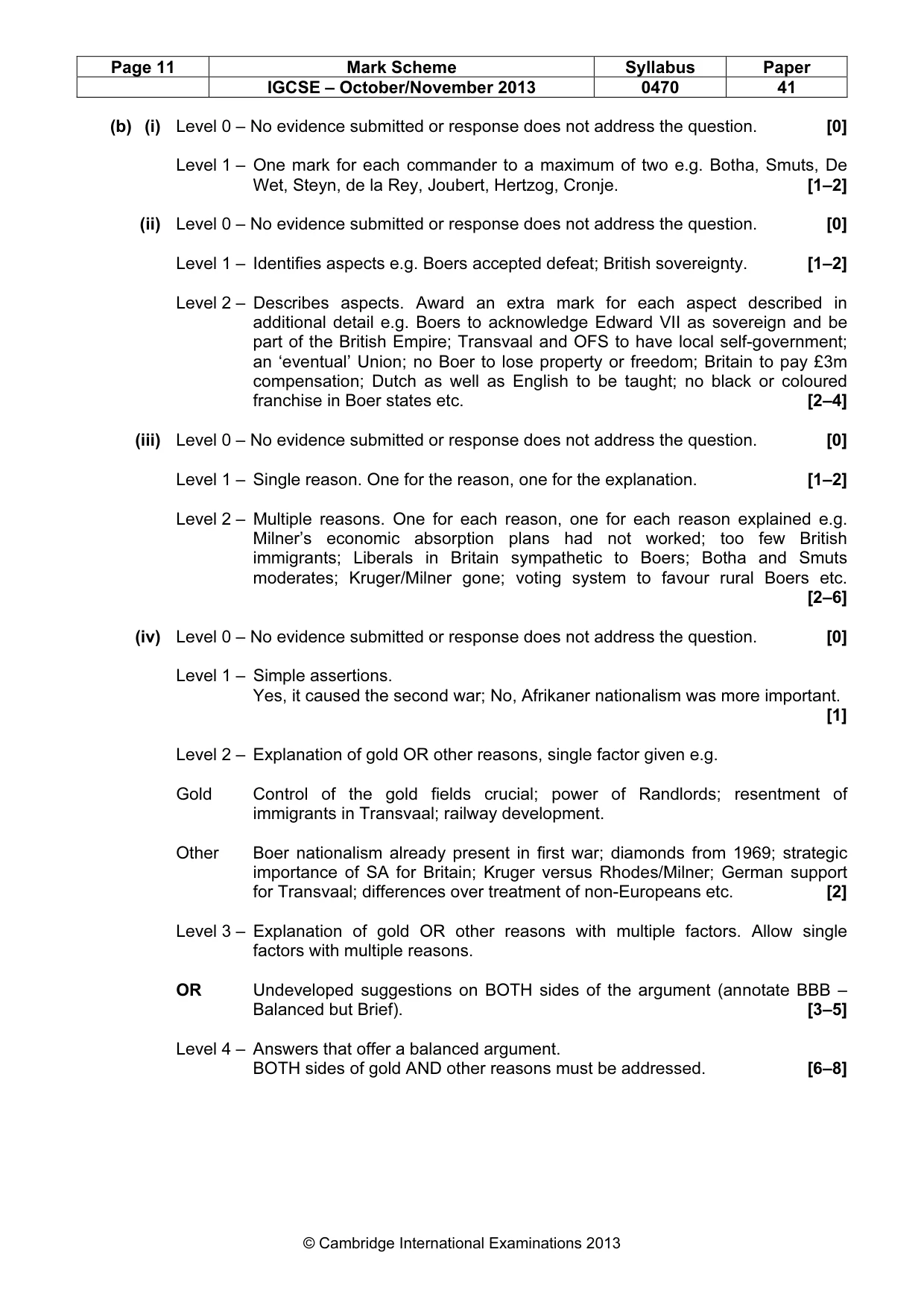
Page 11 Mark Scheme Syllabus Paper IGCSE – October/November 2013 0470 41 © Cambridge International Examinations 2013 (b) (i) Level 0 – No evidence submitted or response does not address the question. [0] Level 1 – One mark for each commander to a maximum of two e.g. Botha, Smuts, De Wet, Steyn, de la Rey, Joubert, Hertzog, Cronje. [1–2] (ii) Level 0 – No evidence submitted or response does not address the question. [0] Level 1 – Identifies aspects e.g. Boers accepted defeat; British sovereignty. [1–2] Level 2 – Describes aspects. Award an extra mark for each aspect described in additional detail e.g. Boers to acknowledge Edward VII as sovereign and be part of the British Empire; Transvaal and OFS to have local self-government; an ‘eventual’ Union; no Boer to lose property or freedom; Britain to pay £3m compensation; Dutch as well as English to be taught; no black or coloured franchise in Boer states etc. [2–4] (iii) Level 0 – No evidence submitted or response does not address the question. [0] Level 1 – Single reason. One for the reason, one for the explanation. [1–2] Level 2 – Multiple reasons. One for each reason, one for each reason explained e.g. Milner’s economic absorption plans had not worked; too few British immigrants; Liberals in Britain sympathetic to Boers; Botha and Smuts moderates; Kruger/Milner gone; voting system to favour rural Boers etc. [2–6] (iv) Level 0 – No evidence submitted or response does not address the question. [0] Level 1 – Simple assertions. Yes, it caused the second war; No, Afrikaner nationalism was more important. [1] Level 2 – Explanation of gold OR other reasons, single factor given e.g. Gold Control of the gold fields crucial; power of Randlords; resentment of immigrants in Transvaal; railway development. Other Boer nationalism already present in first war; diamonds from 1969; strategic importance of SA for Britain; Kruger versus Rhodes/Milner; German support for Transvaal; differences over treatment of non-Europeans etc. [2] Level 3 – Explanation of gold OR other reasons with multiple factors. Allow single factors with multiple reasons. OR Undeveloped suggestions on BOTH sides of the argument (annotate BBB – Balanced but Brief). [3–5] Level 4 – Answers that offer a balanced argument. BOTH sides of gold AND other reasons must be addressed. [6–8]
Mark scheme, page 12
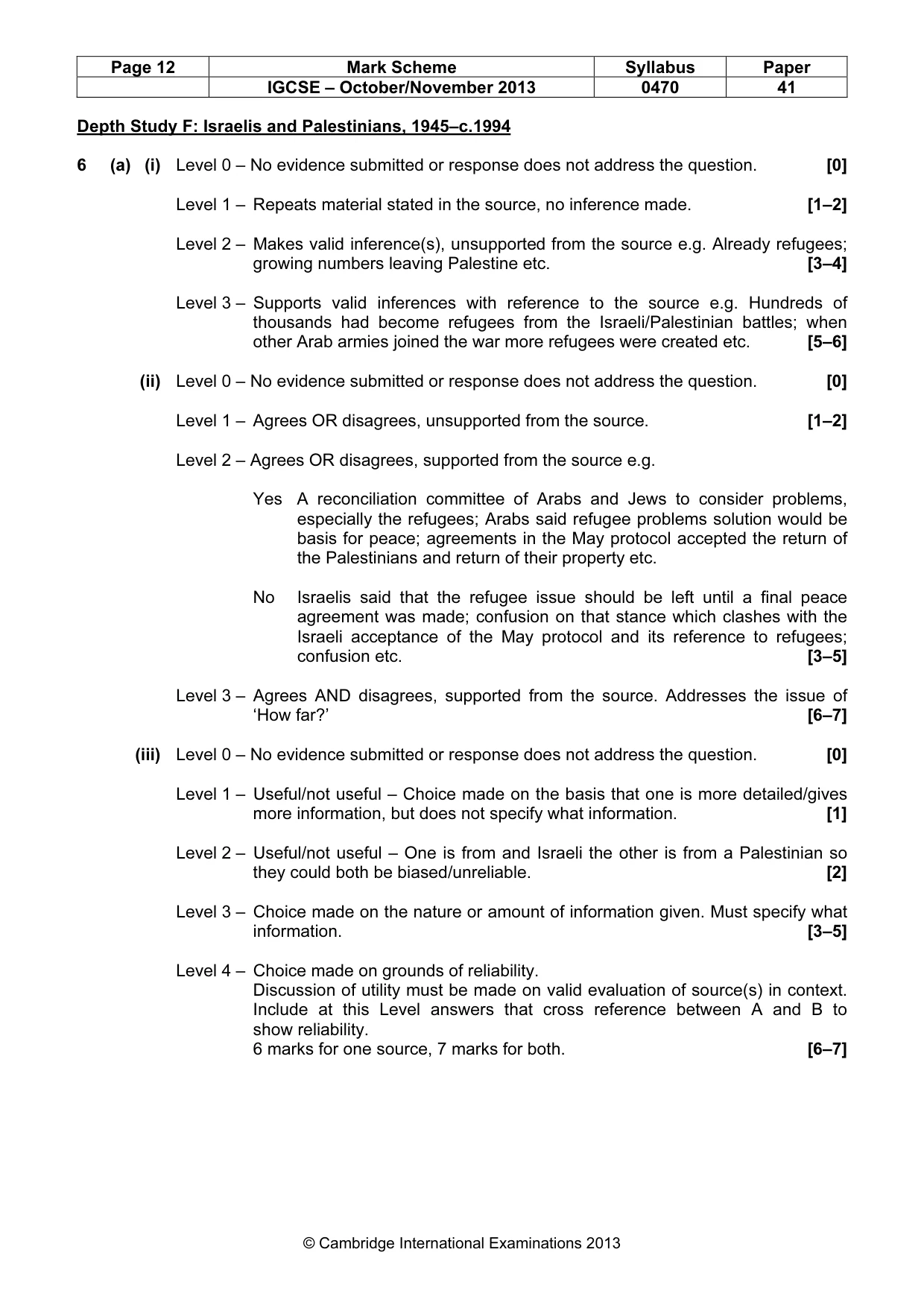
Page 12 Mark Scheme Syllabus Paper IGCSE – October/November 2013 0470 41 © Cambridge International Examinations 2013 Depth Study F: Israelis and Palestinians, 1945–c.1994 6 (a) (i) Level 0 – No evidence submitted or response does not address the question. [0] Level 1 – Repeats material stated in the source, no inference made. [1–2] Level 2 – Makes valid inference(s), unsupported from the source e.g. Already refugees; growing numbers leaving Palestine etc. [3–4] Level 3 – Supports valid inferences with reference to the source e.g. Hundreds of thousands had become refugees from the Israeli/Palestinian battles; when other Arab armies joined the war more refugees were created etc. [5–6] (ii) Level 0 – No evidence submitted or response does not address the question. [0] Level 1 – Agrees OR disagrees, unsupported from the source. [1–2] Level 2 – Agrees OR disagrees, supported from the source e.g. Yes A reconciliation committee of Arabs and Jews to consider problems, especially the refugees; Arabs said refugee problems solution would be basis for peace; agreements in the May protocol accepted the return of the Palestinians and return of their property etc. No Israelis said that the refugee issue should be left until a final peace agreement was made; confusion on that stance which clashes with the Israeli acceptance of the May protocol and its reference to refugees; confusion etc. [3–5] Level 3 – Agrees AND disagrees, supported from the source. Addresses the issue of ‘How far?’ [6–7] (iii) Level 0 – No evidence submitted or response does not address the question. [0] Level 1 – Useful/not useful – Choice made on the basis that one is more detailed/gives more information, but does not specify what information. [1] Level 2 – Useful/not useful – One is from and Israeli the other is from a Palestinian so they could both be biased/unreliable. [2] Level 3 – Choice made on the nature or amount of information given. Must specify what information. [3–5] Level 4 – Choice made on grounds of reliability. Discussion of utility must be made on valid evaluation of source(s) in context. Include at this Level answers that cross reference between A and B to show reliability. 6 marks for one source, 7 marks for both. [6–7]
Mark scheme, page 13
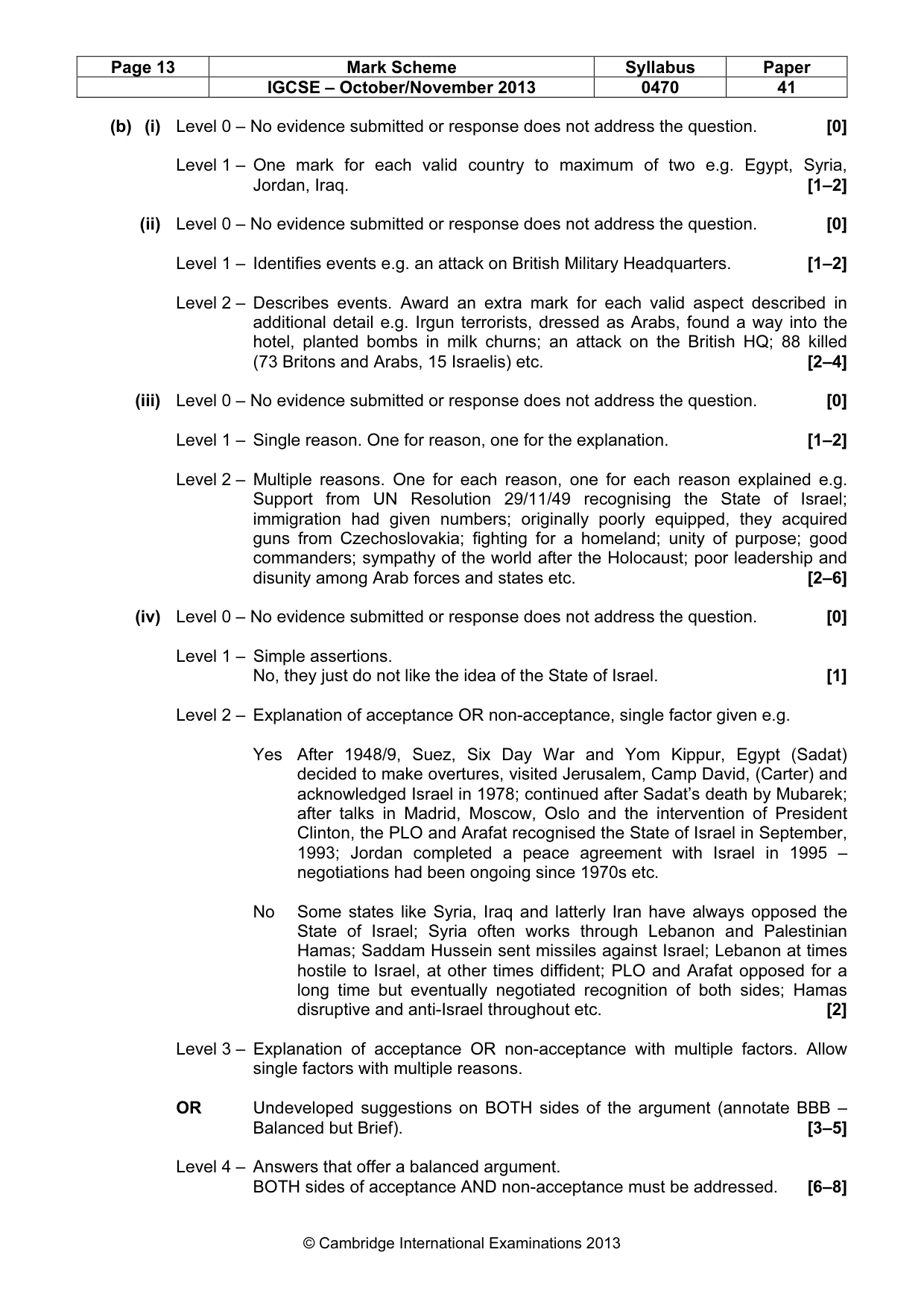
Page 13 Mark Scheme Syllabus Paper IGCSE – October/November 2013 0470 41 © Cambridge International Examinations 2013 (b) (i) Level 0 – No evidence submitted or response does not address the question. [0] Level 1 – One mark for each valid country to maximum of two e.g. Egypt, Syria, Jordan, Iraq. [1–2] (ii) Level 0 – No evidence submitted or response does not address the question. [0] Level 1 – Identifies events e.g. an attack on British Military Headquarters. [1–2] Level 2 – Describes events. Award an extra mark for each valid aspect described in additional detail e.g. Irgun terrorists, dressed as Arabs, found a way into the hotel, planted bombs in milk churns; an attack on the British HQ; 88 killed (73 Britons and Arabs, 15 Israelis) etc. [2–4] (iii) Level 0 – No evidence submitted or response does not address the question. [0] Level 1 – Single reason. One for reason, one for the explanation. [1–2] Level 2 – Multiple reasons. One for each reason, one for each reason explained e.g. Support from UN Resolution 29/11/49 recognising the State of Israel; immigration had given numbers; originally poorly equipped, they acquired guns from Czechoslovakia; fighting for a homeland; unity of purpose; good commanders; sympathy of the world after the Holocaust; poor leadership and disunity among Arab forces and states etc. [2–6] (iv) Level 0 – No evidence submitted or response does not address the question. [0] Level 1 – Simple assertions. No, they just do not like the idea of the State of Israel. [1] Level 2 – Explanation of acceptance OR non-acceptance, single factor given e.g. Yes After 1948/9, Suez, Six Day War and Yom Kippur, Egypt (Sadat) decided to make overtures, visited Jerusalem, Camp David, (Carter) and acknowledged Israel in 1978; continued after Sadat’s death by Mubarek; after talks in Madrid, Moscow, Oslo and the intervention of President Clinton, the PLO and Arafat recognised the State of Israel in September, 1993; Jordan completed a peace agreement with Israel in 1995 – negotiations had been ongoing since 1970s etc. No Some states like Syria, Iraq and latterly Iran have always opposed the State of Israel; Syria often works through Lebanon and Palestinian Hamas; Saddam Hussein sent missiles against Israel; Lebanon at times hostile to Israel, at other times diffident; PLO and Arafat opposed for a long time but eventually negotiated recognition of both sides; Hamas disruptive and anti-Israel throughout etc. [2] Level 3 – Explanation of acceptance OR non-acceptance with multiple factors. Allow single factors with multiple reasons. OR Undeveloped suggestions on BOTH sides of the argument (annotate BBB – Balanced but Brief). [3–5] Level 4 – Answers that offer a balanced argument. BOTH sides of acceptance AND non-acceptance must be addressed. [6–8]
Mark scheme, page 14
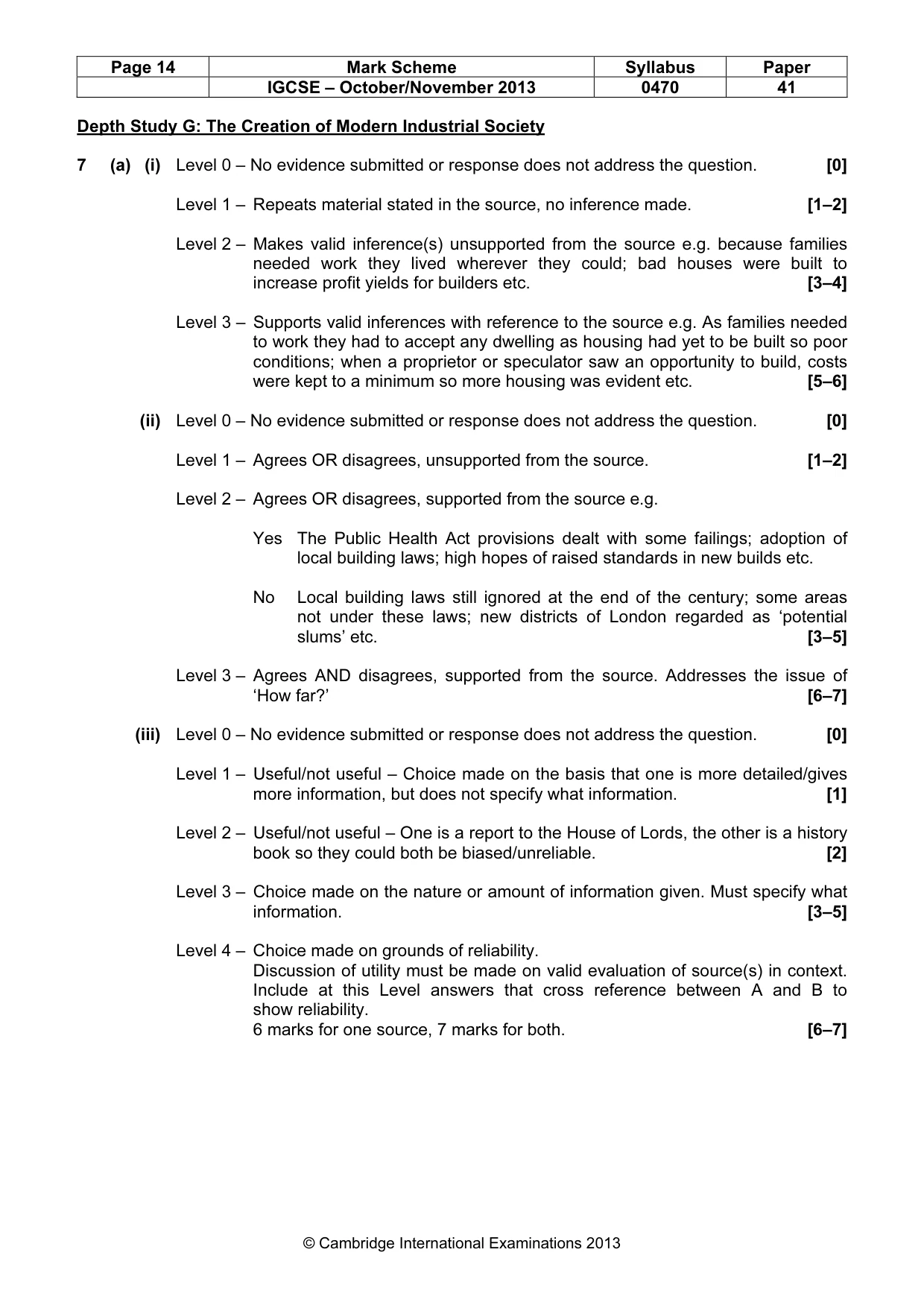
Page 14 Mark Scheme Syllabus Paper IGCSE – October/November 2013 0470 41 © Cambridge International Examinations 2013 Depth Study G: The Creation of Modern Industrial Society 7 (a) (i) Level 0 – No evidence submitted or response does not address the question. [0] Level 1 – Repeats material stated in the source, no inference made. [1–2] Level 2 – Makes valid inference(s) unsupported from the source e.g. because families needed work they lived wherever they could; bad houses were built to increase profit yields for builders etc. [3–4] Level 3 – Supports valid inferences with reference to the source e.g. As families needed to work they had to accept any dwelling as housing had yet to be built so poor conditions; when a proprietor or speculator saw an opportunity to build, costs were kept to a minimum so more housing was evident etc. [5–6] (ii) Level 0 – No evidence submitted or response does not address the question. [0] Level 1 – Agrees OR disagrees, unsupported from the source. [1–2] Level 2 – Agrees OR disagrees, supported from the source e.g. Yes The Public Health Act provisions dealt with some failings; adoption of local building laws; high hopes of raised standards in new builds etc. No Local building laws still ignored at the end of the century; some areas not under these laws; new districts of London regarded as ‘potential slums’ etc. [3–5] Level 3 – Agrees AND disagrees, supported from the source. Addresses the issue of ‘How far?’ [6–7] (iii) Level 0 – No evidence submitted or response does not address the question. [0] Level 1 – Useful/not useful – Choice made on the basis that one is more detailed/gives more information, but does not specify what information. [1] Level 2 – Useful/not useful – One is a report to the House of Lords, the other is a history book so they could both be biased/unreliable. [2] Level 3 – Choice made on the nature or amount of information given. Must specify what information. [3–5] Level 4 – Choice made on grounds of reliability. Discussion of utility must be made on valid evaluation of source(s) in context. Include at this Level answers that cross reference between A and B to show reliability. 6 marks for one source, 7 marks for both. [6–7]
Mark scheme, page 15
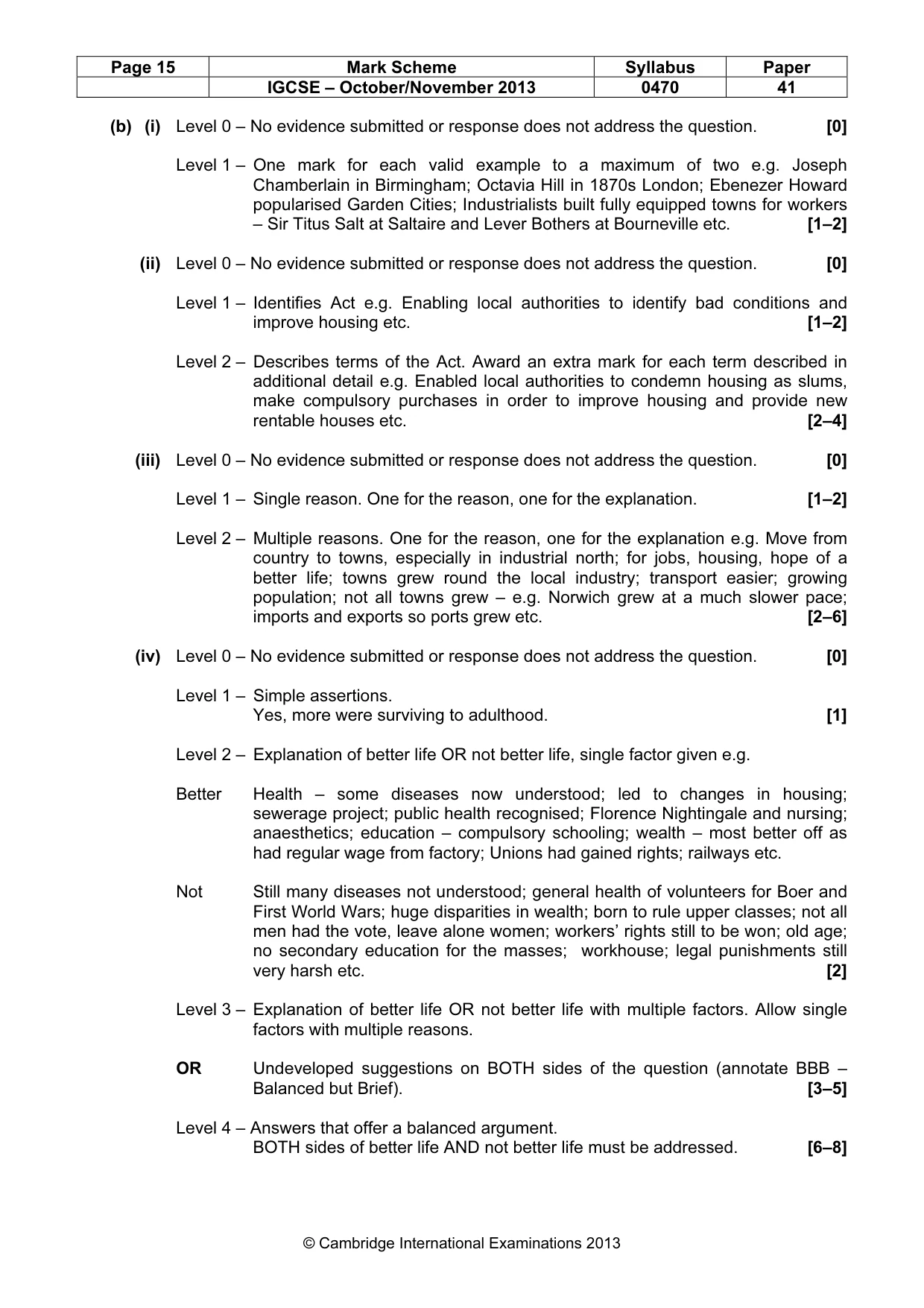
Page 15 Mark Scheme Syllabus Paper IGCSE – October/November 2013 0470 41 © Cambridge International Examinations 2013 (b) (i) Level 0 – No evidence submitted or response does not address the question. [0] Level 1 – One mark for each valid example to a maximum of two e.g. Joseph Chamberlain in Birmingham; Octavia Hill in 1870s London; Ebenezer Howard popularised Garden Cities; Industrialists built fully equipped towns for workers – Sir Titus Salt at Saltaire and Lever Bothers at Bourneville etc. [1–2] (ii) Level 0 – No evidence submitted or response does not address the question. [0] Level 1 – Identifies Act e.g. Enabling local authorities to identify bad conditions and improve housing etc. [1–2] Level 2 – Describes terms of the Act. Award an extra mark for each term described in additional detail e.g. Enabled local authorities to condemn housing as slums, make compulsory purchases in order to improve housing and provide new rentable houses etc. [2–4] (iii) Level 0 – No evidence submitted or response does not address the question. [0] Level 1 – Single reason. One for the reason, one for the explanation. [1–2] Level 2 – Multiple reasons. One for the reason, one for the explanation e.g. Move from country to towns, especially in industrial north; for jobs, housing, hope of a better life; towns grew round the local industry; transport easier; growing population; not all towns grew – e.g. Norwich grew at a much slower pace; imports and exports so ports grew etc. [2–6] (iv) Level 0 – No evidence submitted or response does not address the question. [0] Level 1 – Simple assertions. Yes, more were surviving to adulthood. [1] Level 2 – Explanation of better life OR not better life, single factor given e.g. Better Health – some diseases now understood; led to changes in housing; sewerage project; public health recognised; Florence Nightingale and nursing; anaesthetics; education – compulsory schooling; wealth – most better off as had regular wage from factory; Unions had gained rights; railways etc. Not Still many diseases not understood; general health of volunteers for Boer and First World Wars; huge disparities in wealth; born to rule upper classes; not all men had the vote, leave alone women; workers’ rights still to be won; old age; no secondary education for the masses; workhouse; legal punishments still very harsh etc. [2] Level 3 – Explanation of better life OR not better life with multiple factors. Allow single factors with multiple reasons. OR Undeveloped suggestions on BOTH sides of the question (annotate BBB – Balanced but Brief). [3–5] Level 4 – Answers that offer a balanced argument. BOTH sides of better life AND not better life must be addressed. [6–8]
Mark scheme, page 16
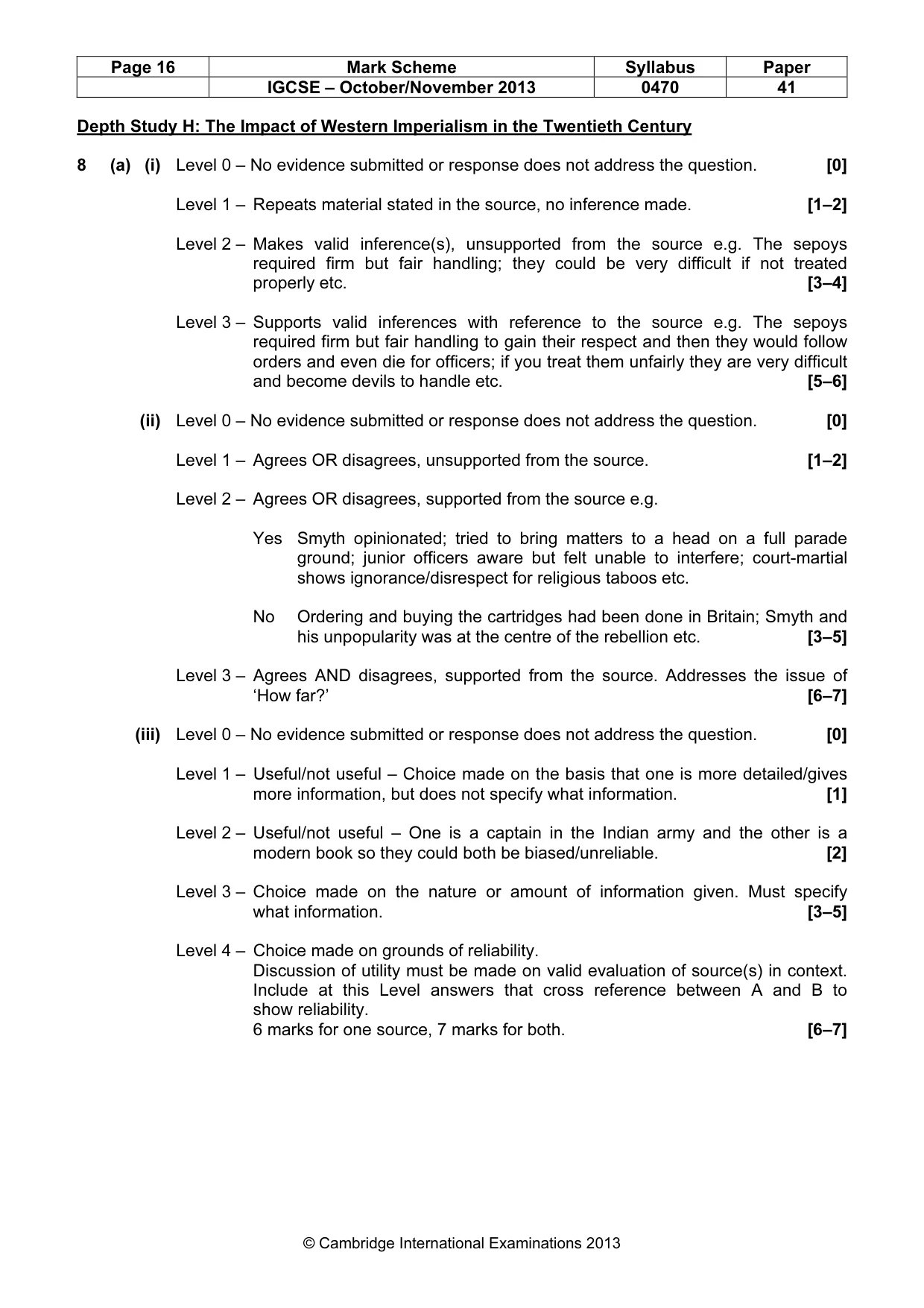
Page 16 Mark Scheme Syllabus Paper IGCSE – October/November 2013 0470 41 © Cambridge International Examinations 2013 Depth Study H: The Impact of Western Imperialism in the Twentieth Century 8 (a) (i) Level 0 – No evidence submitted or response does not address the question. [0] Level 1 – Repeats material stated in the source, no inference made. [1–2] Level 2 – Makes valid inference(s), unsupported from the source e.g. The sepoys required firm but fair handling; they could be very difficult if not treated properly etc. [3–4] Level 3 – Supports valid inferences with reference to the source e.g. The sepoys required firm but fair handling to gain their respect and then they would follow orders and even die for officers; if you treat them unfairly they are very difficult and become devils to handle etc. [5–6] (ii) Level 0 – No evidence submitted or response does not address the question. [0] Level 1 – Agrees OR disagrees, unsupported from the source. [1–2] Level 2 – Agrees OR disagrees, supported from the source e.g. Yes Smyth opinionated; tried to bring matters to a head on a full parade ground; junior officers aware but felt unable to interfere; court-martial shows ignorance/disrespect for religious taboos etc. No Ordering and buying the cartridges had been done in Britain; Smyth and his unpopularity was at the centre of the rebellion etc. [3–5] Level 3 – Agrees AND disagrees, supported from the source. Addresses the issue of ‘How far?’ [6–7] (iii) Level 0 – No evidence submitted or response does not address the question. [0] Level 1 – Useful/not useful – Choice made on the basis that one is more detailed/gives more information, but does not specify what information. [1] Level 2 – Useful/not useful – One is a captain in the Indian army and the other is a modern book so they could both be biased/unreliable. [2] Level 3 – Choice made on the nature or amount of information given. Must specify what information. [3–5] Level 4 – Choice made on grounds of reliability. Discussion of utility must be made on valid evaluation of source(s) in context. Include at this Level answers that cross reference between A and B to show reliability. 6 marks for one source, 7 marks for both. [6–7]
Mark scheme, page 17
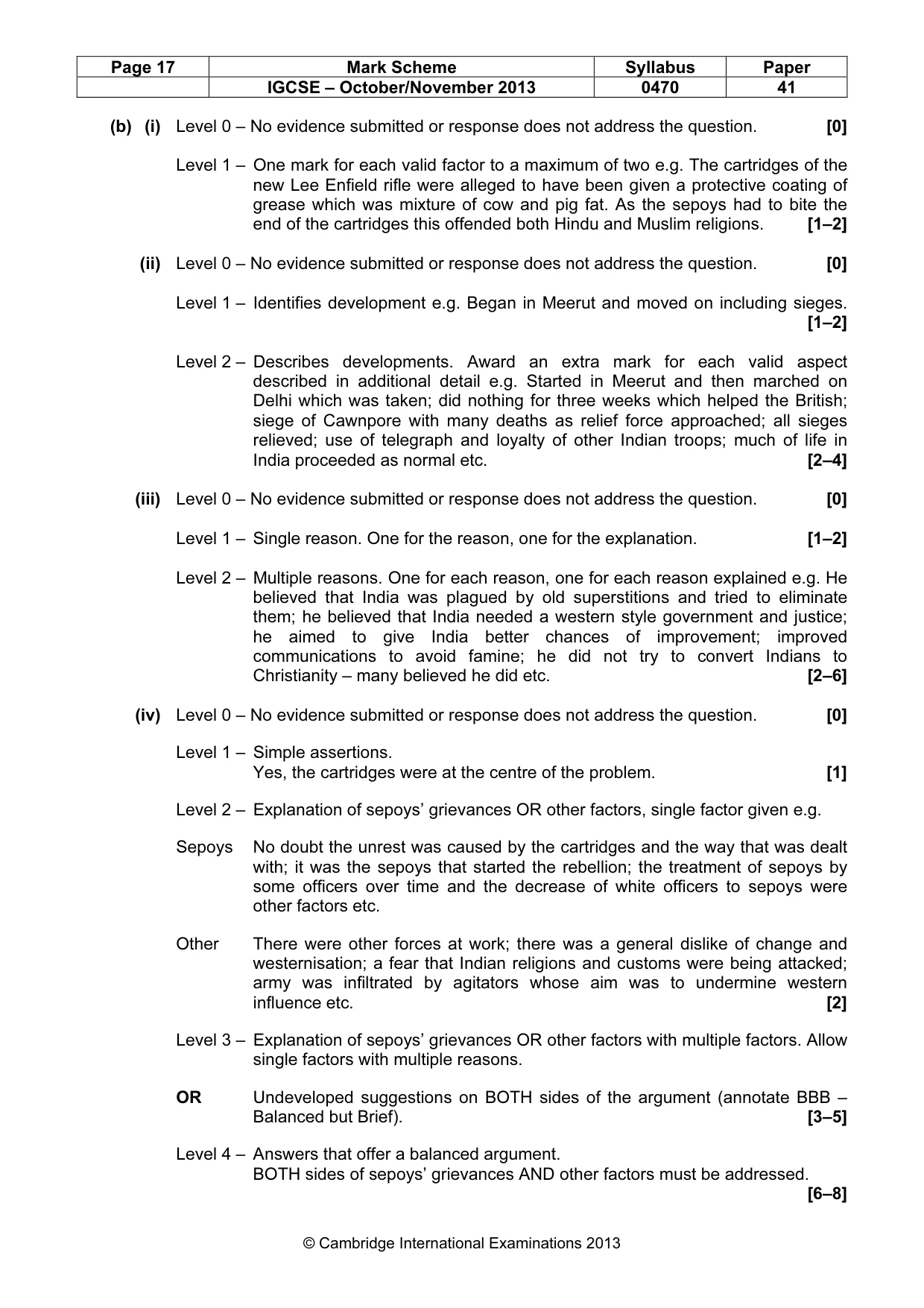
Page 17 Mark Scheme Syllabus Paper IGCSE – October/November 2013 0470 41 © Cambridge International Examinations 2013 (b) (i) Level 0 – No evidence submitted or response does not address the question. [0] Level 1 – One mark for each valid factor to a maximum of two e.g. The cartridges of the new Lee Enfield rifle were alleged to have been given a protective coating of grease which was mixture of cow and pig fat. As the sepoys had to bite the end of the cartridges this offended both Hindu and Muslim religions. [1–2] (ii) Level 0 – No evidence submitted or response does not address the question. [0] Level 1 – Identifies development e.g. Began in Meerut and moved on including sieges. [1–2] Level 2 – Describes developments. Award an extra mark for each valid aspect described in additional detail e.g. Started in Meerut and then marched on Delhi which was taken; did nothing for three weeks which helped the British; siege of Cawnpore with many deaths as relief force approached; all sieges relieved; use of telegraph and loyalty of other Indian troops; much of life in India proceeded as normal etc. [2–4] (iii) Level 0 – No evidence submitted or response does not address the question. [0] Level 1 – Single reason. One for the reason, one for the explanation. [1–2] Level 2 – Multiple reasons. One for each reason, one for each reason explained e.g. He believed that India was plagued by old superstitions and tried to eliminate them; he believed that India needed a western style government and justice; he aimed to give India better chances of improvement; improved communications to avoid famine; he did not try to convert Indians to Christianity – many believed he did etc. [2–6] (iv) Level 0 – No evidence submitted or response does not address the question. [0] Level 1 – Simple assertions. Yes, the cartridges were at the centre of the problem. [1] Level 2 – Explanation of sepoys’ grievances OR other factors, single factor given e.g. Sepoys No doubt the unrest was caused by the cartridges and the way that was dealt with; it was the sepoys that started the rebellion; the treatment of sepoys by some officers over time and the decrease of white officers to sepoys were other factors etc. Other There were other forces at work; there was a general dislike of change and westernisation; a fear that Indian religions and customs were being attacked; army was infiltrated by agitators whose aim was to undermine western influence etc. [2] Level 3 – Explanation of sepoys’ grievances OR other factors with multiple factors. Allow single factors with multiple reasons. OR Undeveloped suggestions on BOTH sides of the argument (annotate BBB – Balanced but Brief). [3–5] Level 4 – Answers that offer a balanced argument. BOTH sides of sepoys’ grievances AND other factors must be addressed. [6–8]
What you needed in this session
Cambridge’s own grade thresholds for 2013 Oct/Nov, Paper 4 · Variant 1. A higher threshold means an easier paper — the bar moves with how the cohort did.