Cambridge IGCSE History 0470 — 2013 May/June Paper 4 · Variant 3
0470/43/M/J/13 · 40 marks · ≈45 min
The question paper and its mark scheme, free to read here and free to download. This is Cambridge’s own paper, exactly as it was sat.
Question paper12 pages


Mark scheme22 pages
Answers below. Sit the paper first if you are practising.
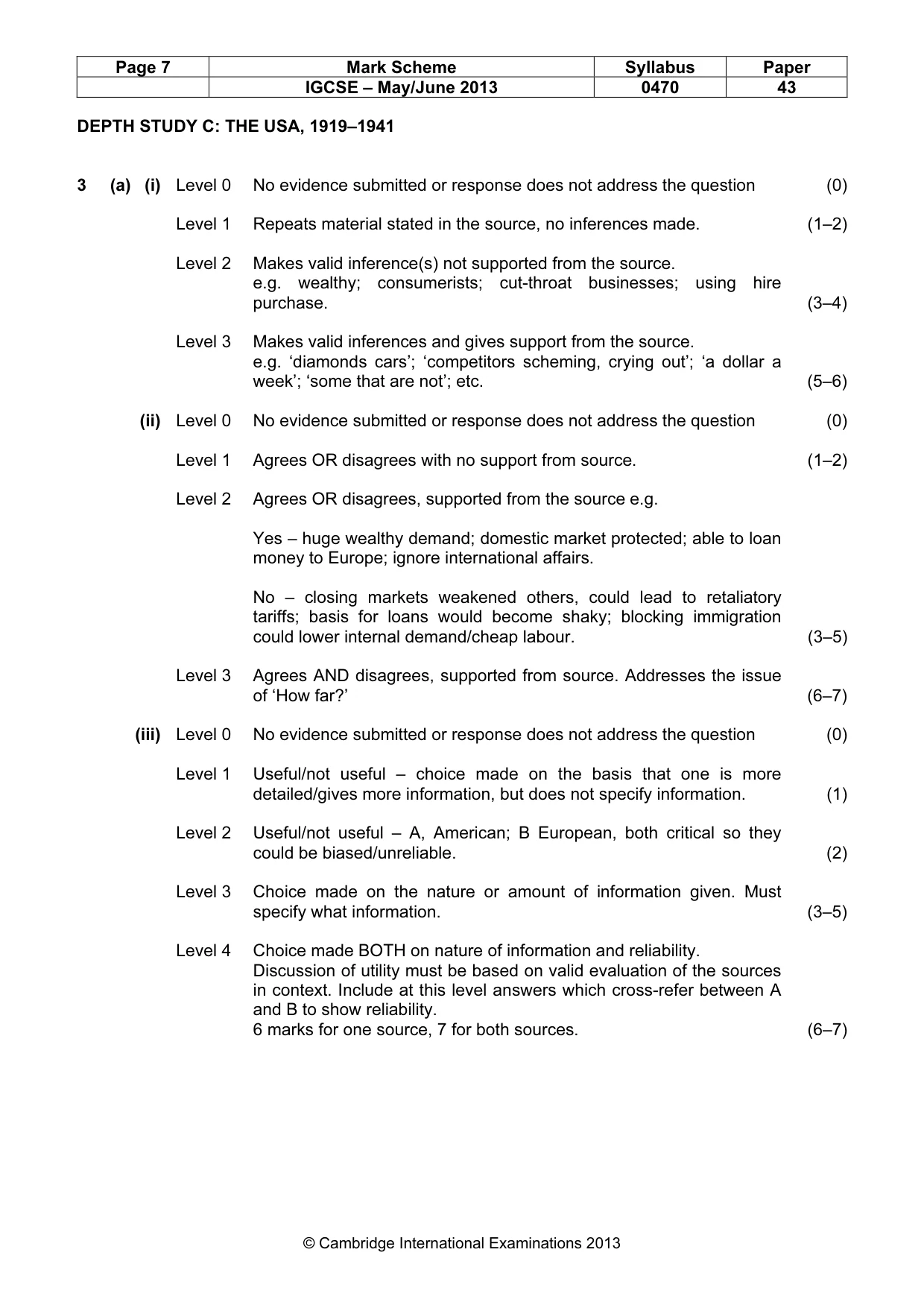
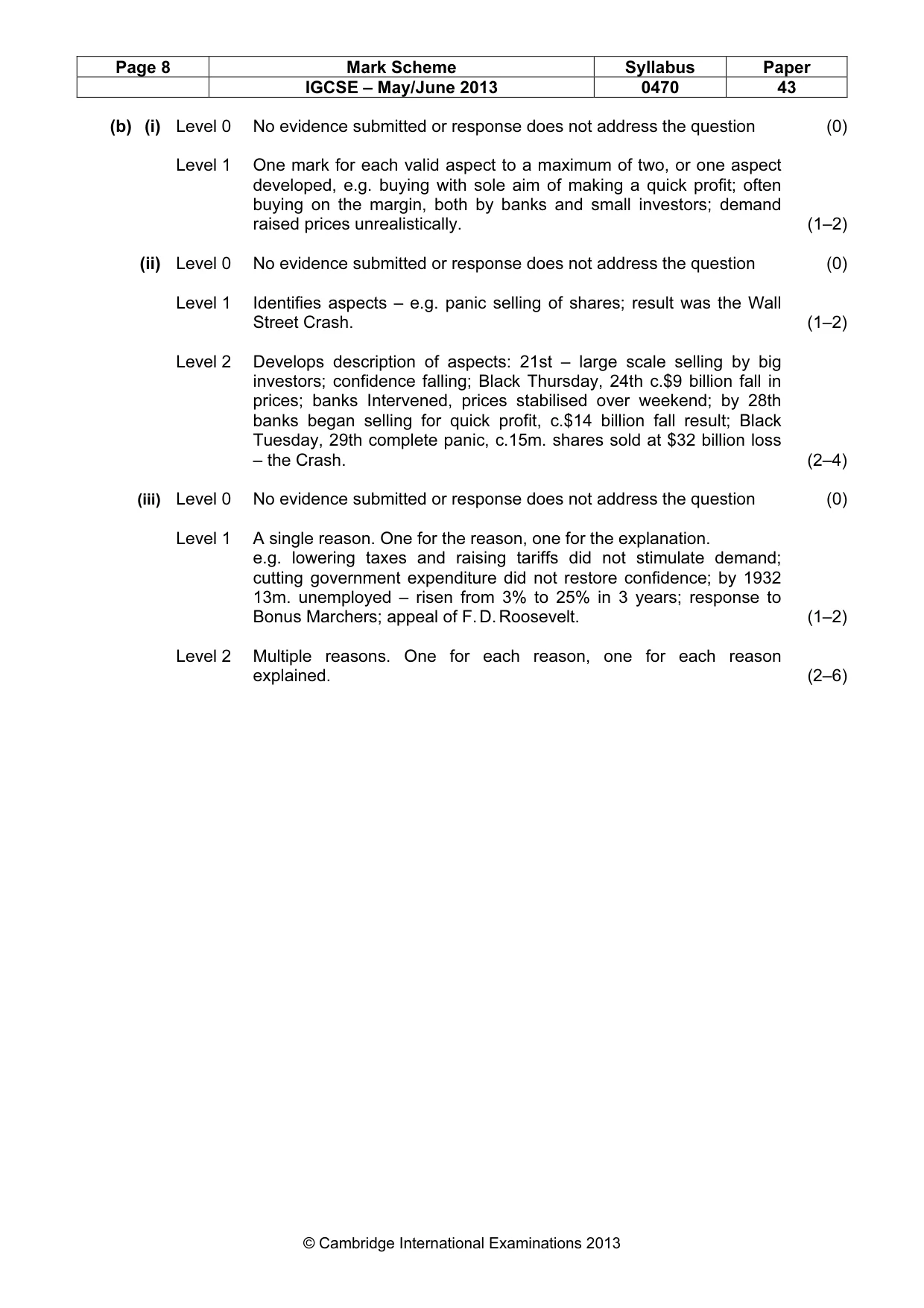
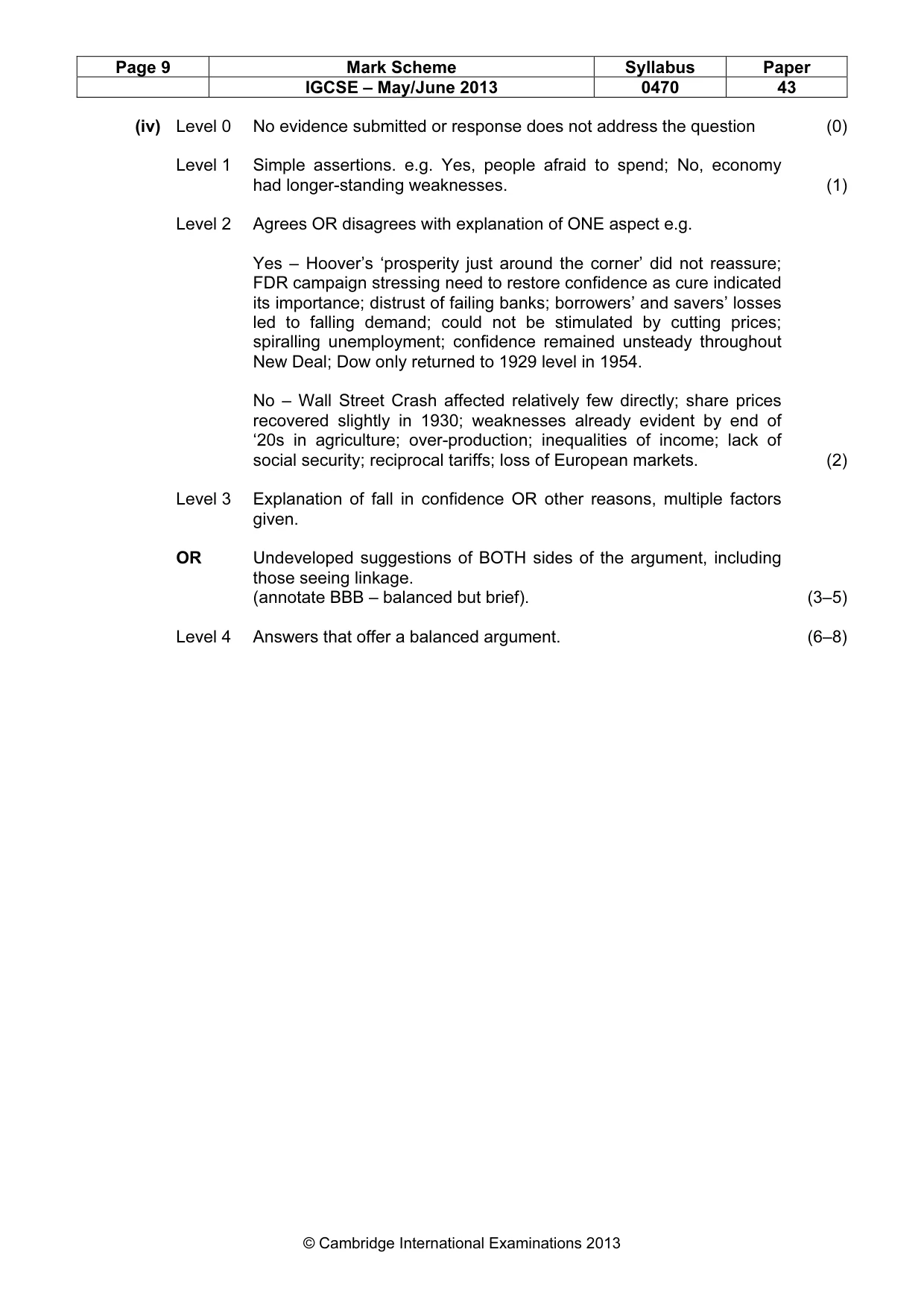
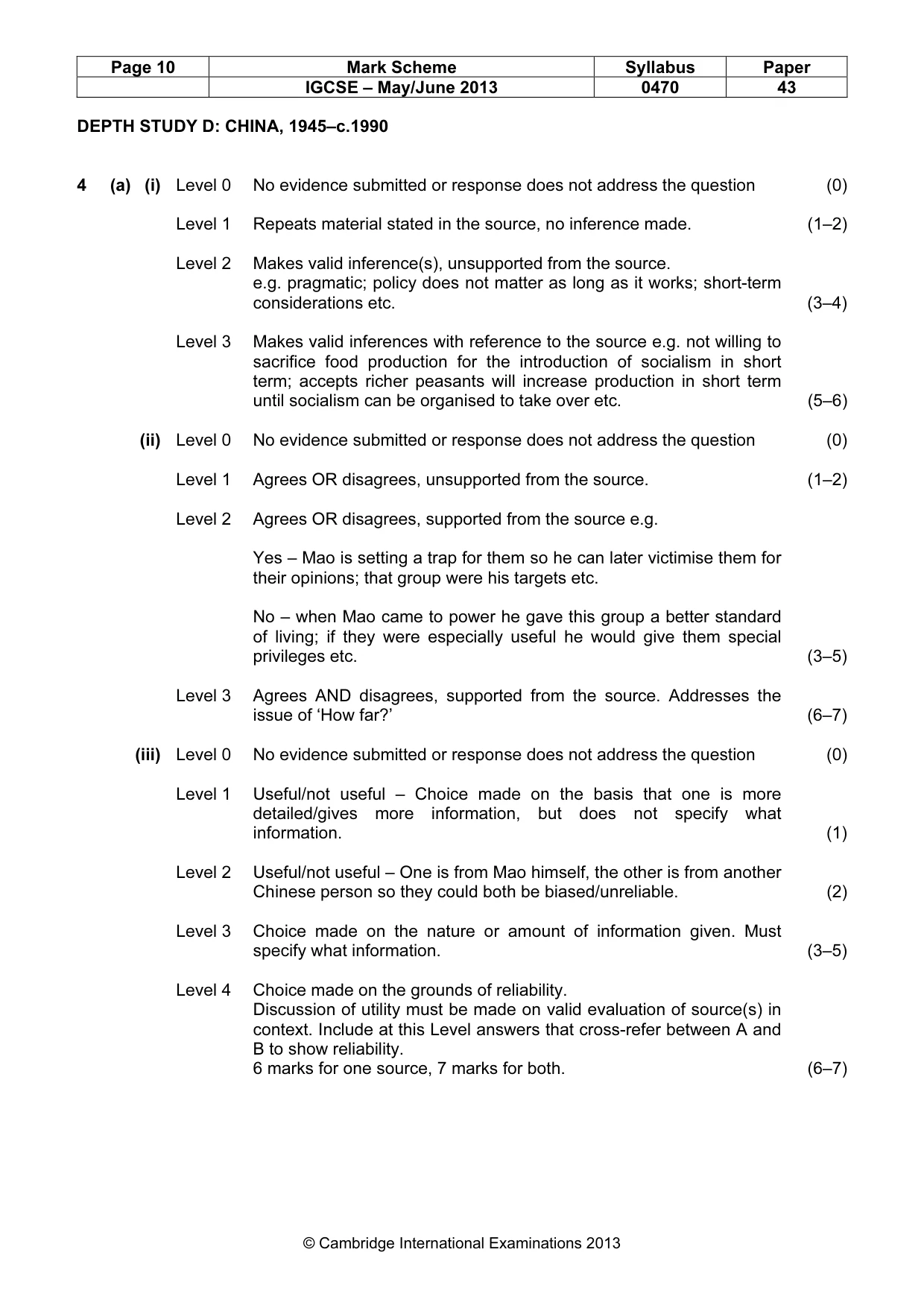

Paper as text
Question paper, page 1
This document consists of 9 printed pages and 3 blank pages. DC (SJF) 66118/6 © UCLES 2013 [Turn over UNIVERSITY OF CAMBRIDGE INTERNATIONAL EXAMINATIONS International General Certificate of Secondary Education * 7 6 9 7 0 5 4 2 4 1 * HISTORY 0470/43 Paper 4 Alternative to Coursework May/June 2013 1 hour Additional Materials: Answer Booklet/Paper READ THESE INSTRUCTIONS FIRST If you have been given an Answer Booklet, follow the instructions on the front cover of the Booklet. Write your Centre number, candidate number and name on all the work you hand in. Write in dark blue or black pen. You may use a soft pencil for any diagrams, graphs or rough working. Do not use staples, paper clips, highlighters, glue or correction fluid. Answer the questions on one of the Depth Studies. At the end of the examination, fasten all your work securely together. The number of marks is given in brackets [ ] at the end of each question or part question.
Question paper, page 2
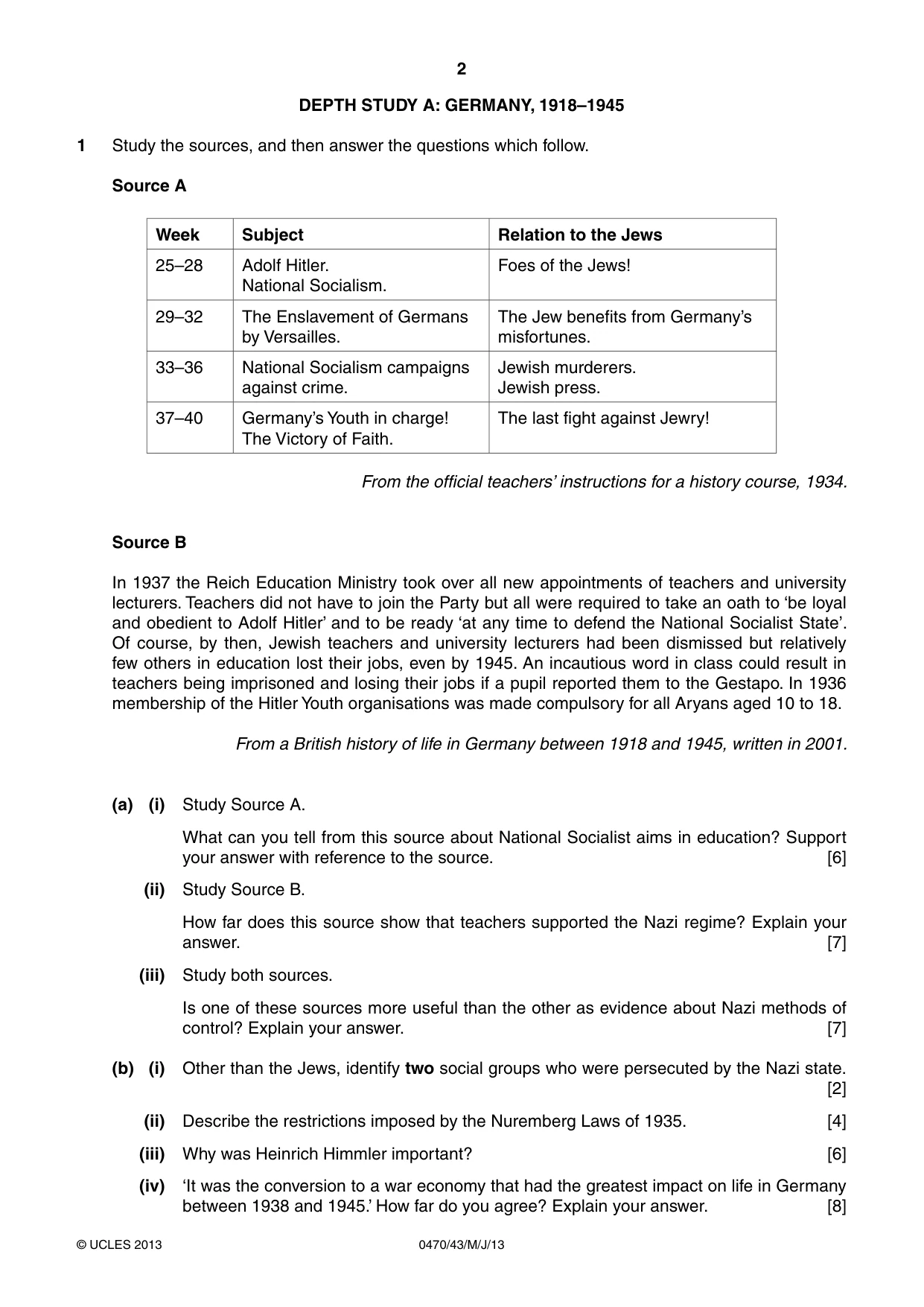
2 0470/43/M/J/13 © UCLES 2013 DEPTH STUDY A: GERMANY, 1918–1945 1 Study the sources, and then answer the questions which follow. Source A Week Subject Relation to the Jews 25–28 Adolf Hitler. National Socialism. Foes of the Jews! 29–32 The Enslavement of Germans by Versailles. The Jew benefits from Germany’s misfortunes. 33–36 National Socialism campaigns against crime. Jewish murderers. Jewish press. 37–40 Germany’s Youth in charge! The Victory of Faith. The last fight against Jewry! From the official teachers’ instructions for a history course, 1934. Source B In 1937 the Reich Education Ministry took over all new appointments of teachers and university lecturers. Teachers did not have to join the Party but all were required to take an oath to ‘be loyal and obedient to Adolf Hitler’ and to be ready ‘at any time to defend the National Socialist State’. Of course, by then, Jewish teachers and university lecturers had been dismissed but relatively few others in education lost their jobs, even by 1945. An incautious word in class could result in teachers being imprisoned and losing their jobs if a pupil reported them to the Gestapo. In 1936 membership of the Hitler Youth organisations was made compulsory for all Aryans aged 10 to 18. From a British history of life in Germany between 1918 and 1945, written in 2001. (a) (i) Study Source A. What can you tell from this source about National Socialist aims in education? Support your answer with reference to the source. [6] (ii) Study Source B. How far does this source show that teachers supported the Nazi regime? Explain your answer. [7] (iii) Study both sources. Is one of these sources more useful than the other as evidence about Nazi methods of control? Explain your answer. [7] (b) (i) Other than the Jews, identify two social groups who were persecuted by the Nazi state. [2] (ii) Describe the restrictions imposed by the Nuremberg Laws of 1935. [4] (iii) Why was Heinrich Himmler important? [6] (iv) ‘It was the conversion to a war economy that had the greatest impact on life in Germany between 1938 and 1945.’ How far do you agree? Explain your answer. [8]
Question paper, page 3
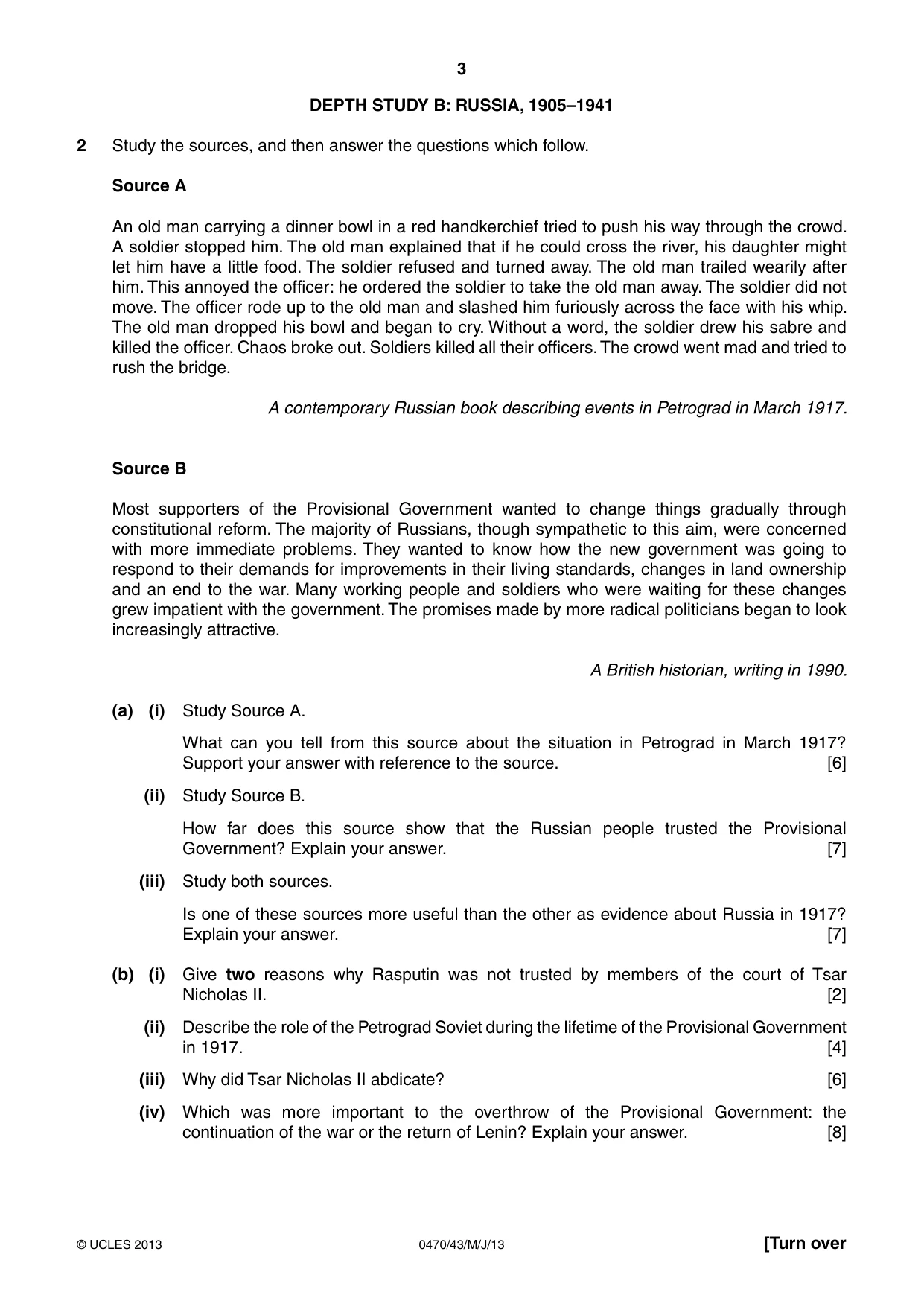
3 0470/43/M/J/13 © UCLES 2013 [Turn over DEPTH STUDY B: RUSSIA, 1905–1941 2 Study the sources, and then answer the questions which follow. Source A An old man carrying a dinner bowl in a red handkerchief tried to push his way through the crowd. A soldier stopped him. The old man explained that if he could cross the river, his daughter might let him have a little food. The soldier refused and turned away. The old man trailed wearily after him. This annoyed the officer: he ordered the soldier to take the old man away. The soldier did not move. The officer rode up to the old man and slashed him furiously across the face with his whip. The old man dropped his bowl and began to cry. Without a word, the soldier drew his sabre and killed the officer. Chaos broke out. Soldiers killed all their officers. The crowd went mad and tried to rush the bridge. A contemporary Russian book describing events in Petrograd in March 1917. Source B Most supporters of the Provisional Government wanted to change things gradually through constitutional reform. The majority of Russians, though sympathetic to this aim, were concerned with more immediate problems. They wanted to know how the new government was going to respond to their demands for improvements in their living standards, changes in land ownership and an end to the war. Many working people and soldiers who were waiting for these changes grew impatient with the government. The promises made by more radical politicians began to look increasingly attractive. A British historian, writing in 1990. (a) (i) Study Source A. What can you tell from this source about the situation in Petrograd in March 1917? Support your answer with reference to the source. [6] (ii) Study Source B. How far does this source show that the Russian people trusted the Provisional Government? Explain your answer. [7] (iii) Study both sources. Is one of these sources more useful than the other as evidence about Russia in 1917? Explain your answer. [7] (b) (i) Give two reasons why Rasputin was not trusted by members of the court of Tsar Nicholas II. [2] (ii) Describe the role of the Petrograd Soviet during the lifetime of the Provisional Government in 1917. [4] (iii) Why did Tsar Nicholas II abdicate? [6] (iv) Which was more important to the overthrow of the Provisional Government: the continuation of the war or the return of Lenin? Explain your answer. [8]
Question paper, page 4
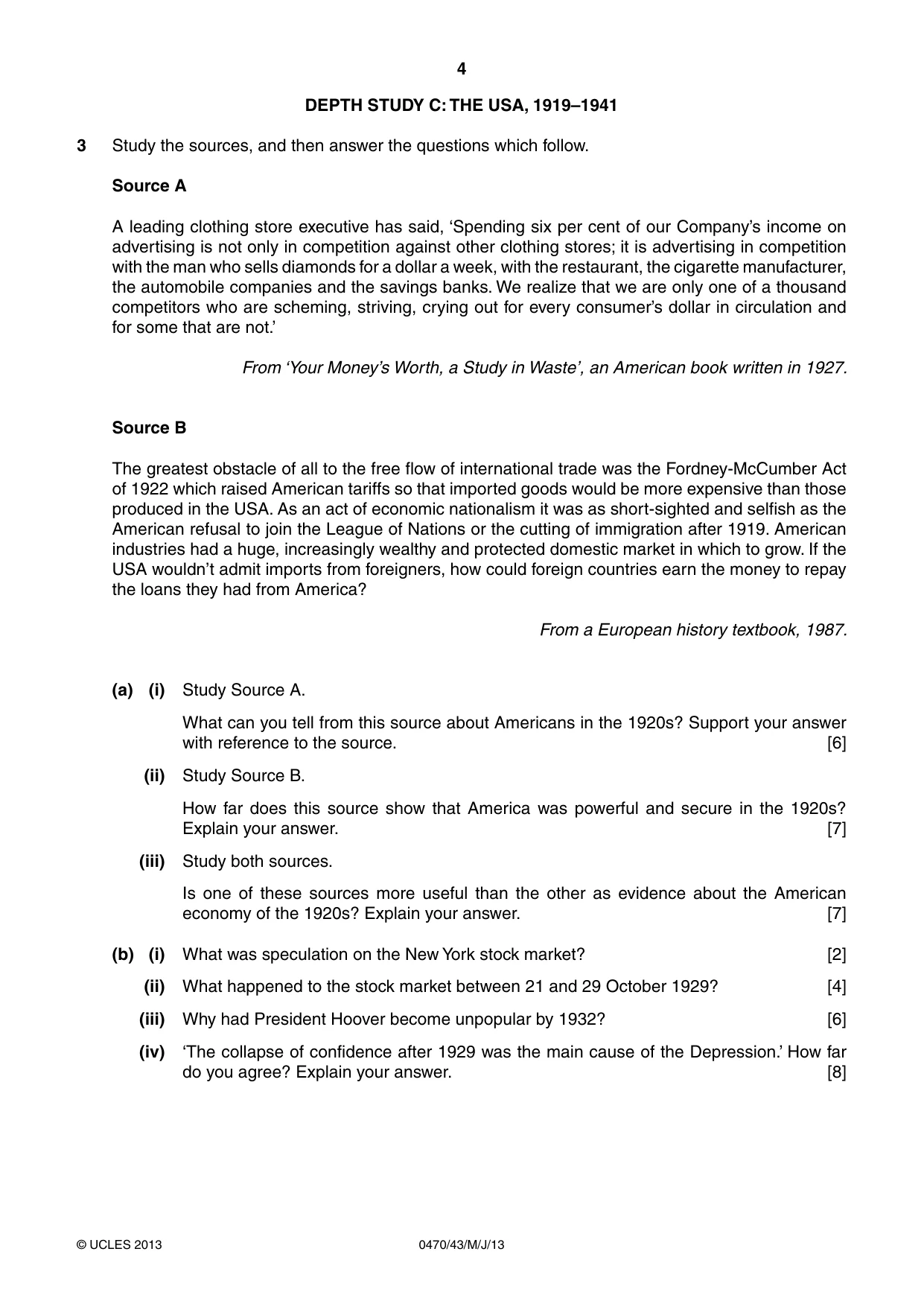
4 0470/43/M/J/13 © UCLES 2013 DEPTH STUDY C: THE USA, 1919–1941 3 Study the sources, and then answer the questions which follow. Source A A leading clothing store executive has said, ‘Spending six per cent of our Company’s income on advertising is not only in competition against other clothing stores; it is advertising in competition with the man who sells diamonds for a dollar a week, with the restaurant, the cigarette manufacturer, the automobile companies and the savings banks. We realize that we are only one of a thousand competitors who are scheming, striving, crying out for every consumer’s dollar in circulation and for some that are not.’ From ‘Your Money’s Worth, a Study in Waste’, an American book written in 1927. Source B The greatest obstacle of all to the free flow of international trade was the Fordney-McCumber Act of 1922 which raised American tariffs so that imported goods would be more expensive than those produced in the USA. As an act of economic nationalism it was as short-sighted and selfish as the American refusal to join the League of Nations or the cutting of immigration after 1919. American industries had a huge, increasingly wealthy and protected domestic market in which to grow. If the USA wouldn’t admit imports from foreigners, how could foreign countries earn the money to repay the loans they had from America? From a European history textbook, 1987. (a) (i) Study Source A. What can you tell from this source about Americans in the 1920s? Support your answer with reference to the source. [6] (ii) Study Source B. How far does this source show that America was powerful and secure in the 1920s? Explain your answer. [7] (iii) Study both sources. Is one of these sources more useful than the other as evidence about the American economy of the 1920s? Explain your answer. [7] (b) (i) What was speculation on the New York stock market? [2] (ii) What happened to the stock market between 21 and 29 October 1929? [4] (iii) Why had President Hoover become unpopular by 1932? [6] (iv) ‘The collapse of confidence after 1929 was the main cause of the Depression.’ How far do you agree? Explain your answer. [8]
Question paper, page 5
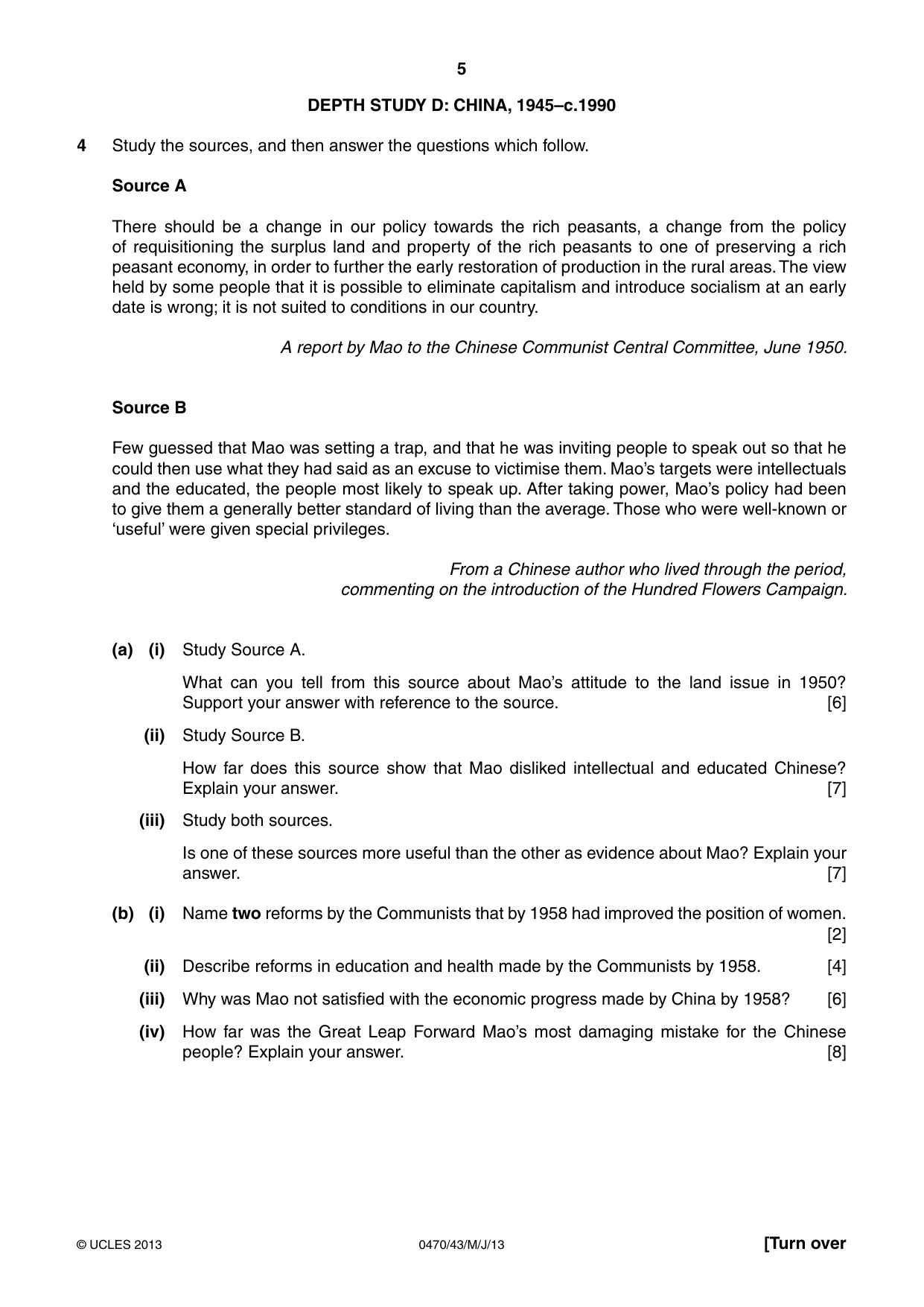
5 0470/43/M/J/13 © UCLES 2013 [Turn over DEPTH STUDY D: CHINA, 1945–c.1990 4 Study the sources, and then answer the questions which follow. Source A There should be a change in our policy towards the rich peasants, a change from the policy of requisitioning the surplus land and property of the rich peasants to one of preserving a rich peasant economy, in order to further the early restoration of production in the rural areas. The view held by some people that it is possible to eliminate capitalism and introduce socialism at an early date is wrong; it is not suited to conditions in our country. A report by Mao to the Chinese Communist Central Committee, June 1950. Source B Few guessed that Mao was setting a trap, and that he was inviting people to speak out so that he could then use what they had said as an excuse to victimise them. Mao’s targets were intellectuals and the educated, the people most likely to speak up. After taking power, Mao’s policy had been to give them a generally better standard of living than the average. Those who were well-known or ‘useful’ were given special privileges. From a Chinese author who lived through the period, commenting on the introduction of the Hundred Flowers Campaign. (a) (i) Study Source A. What can you tell from this source about Mao’s attitude to the land issue in 1950? Support your answer with reference to the source. [6] (ii) Study Source B. How far does this source show that Mao disliked intellectual and educated Chinese? Explain your answer. [7] (iii) Study both sources. Is one of these sources more useful than the other as evidence about Mao? Explain your answer. [7] (b) (i) Name two reforms by the Communists that by 1958 had improved the position of women. [2] (ii) Describe reforms in education and health made by the Communists by 1958. [4] (iii) Why was Mao not satisfied with the economic progress made by China by 1958? [6] (iv) How far was the Great Leap Forward Mao’s most damaging mistake for the Chinese people? Explain your answer. [8]
Question paper, page 6
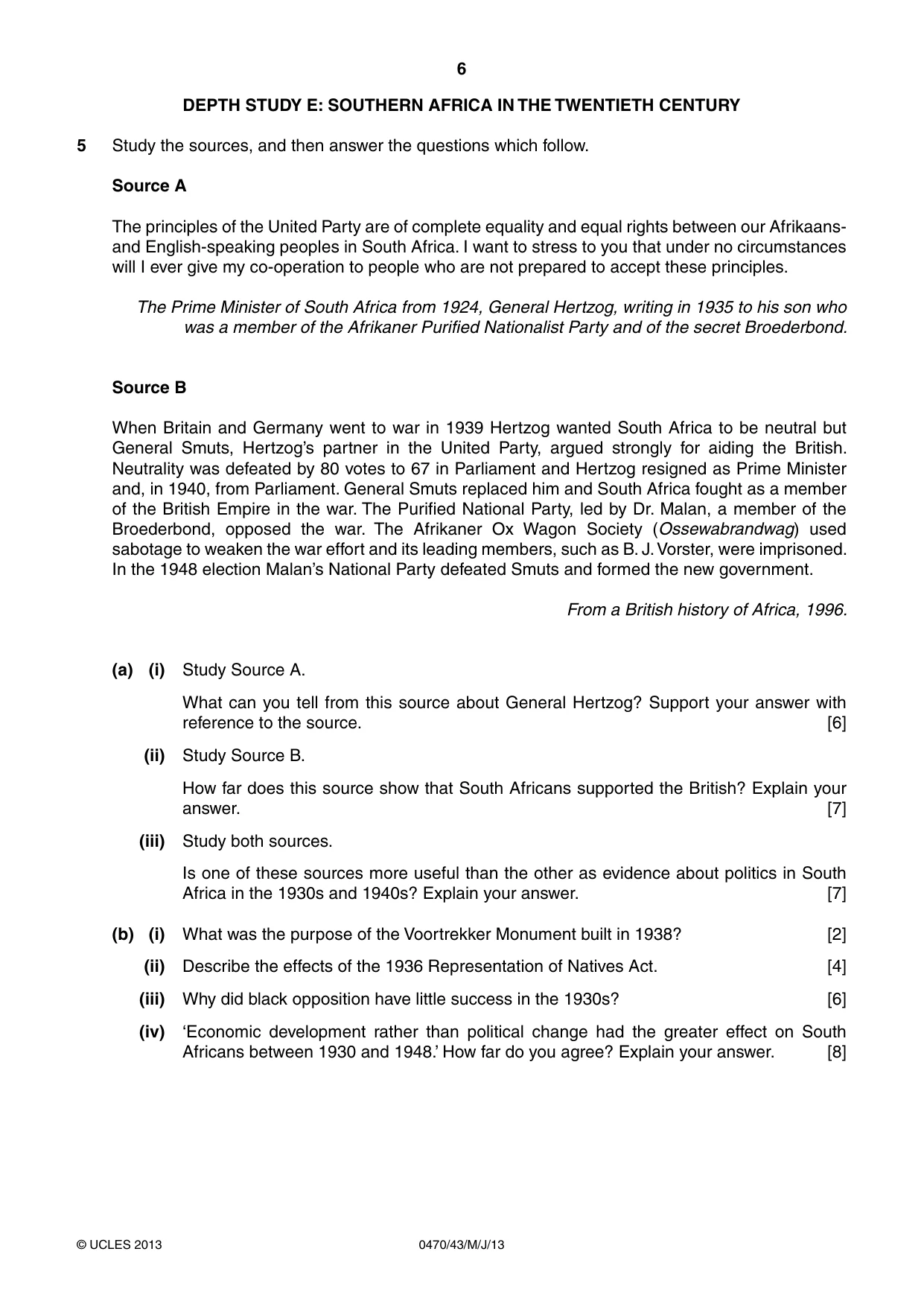
6 0470/43/M/J/13 © UCLES 2013 DEPTH STUDY E: SOUTHERN AFRICA IN THE TWENTIETH CENTURY 5 Study the sources, and then answer the questions which follow. Source A The principles of the United Party are of complete equality and equal rights between our Afrikaans- and English-speaking peoples in South Africa. I want to stress to you that under no circumstances will I ever give my co-operation to people who are not prepared to accept these principles. The Prime Minister of South Africa from 1924, General Hertzog, writing in 1935 to his son who was a member of the Afrikaner Purified Nationalist Party and of the secret Broederbond. Source B When Britain and Germany went to war in 1939 Hertzog wanted South Africa to be neutral but General Smuts, Hertzog’s partner in the United Party, argued strongly for aiding the British. Neutrality was defeated by 80 votes to 67 in Parliament and Hertzog resigned as Prime Minister and, in 1940, from Parliament. General Smuts replaced him and South Africa fought as a member of the British Empire in the war. The Purified National Party, led by Dr. Malan, a member of the Broederbond, opposed the war. The Afrikaner Ox Wagon Society (Ossewabrandwag) used sabotage to weaken the war effort and its leading members, such as B. J. Vorster, were imprisoned. In the 1948 election Malan’s National Party defeated Smuts and formed the new government. From a British history of Africa, 1996. (a) (i) Study Source A. What can you tell from this source about General Hertzog? Support your answer with reference to the source. [6] (ii) Study Source B. How far does this source show that South Africans supported the British? Explain your answer. [7] (iii) Study both sources. Is one of these sources more useful than the other as evidence about politics in South Africa in the 1930s and 1940s? Explain your answer. [7] (b) (i) What was the purpose of the Voortrekker Monument built in 1938? [2] (ii) Describe the effects of the 1936 Representation of Natives Act. [4] (iii) Why did black opposition have little success in the 1930s? [6] (iv) ‘Economic development rather than political change had the greater effect on South Africans between 1930 and 1948.’ How far do you agree? Explain your answer. [8]
Question paper, page 7
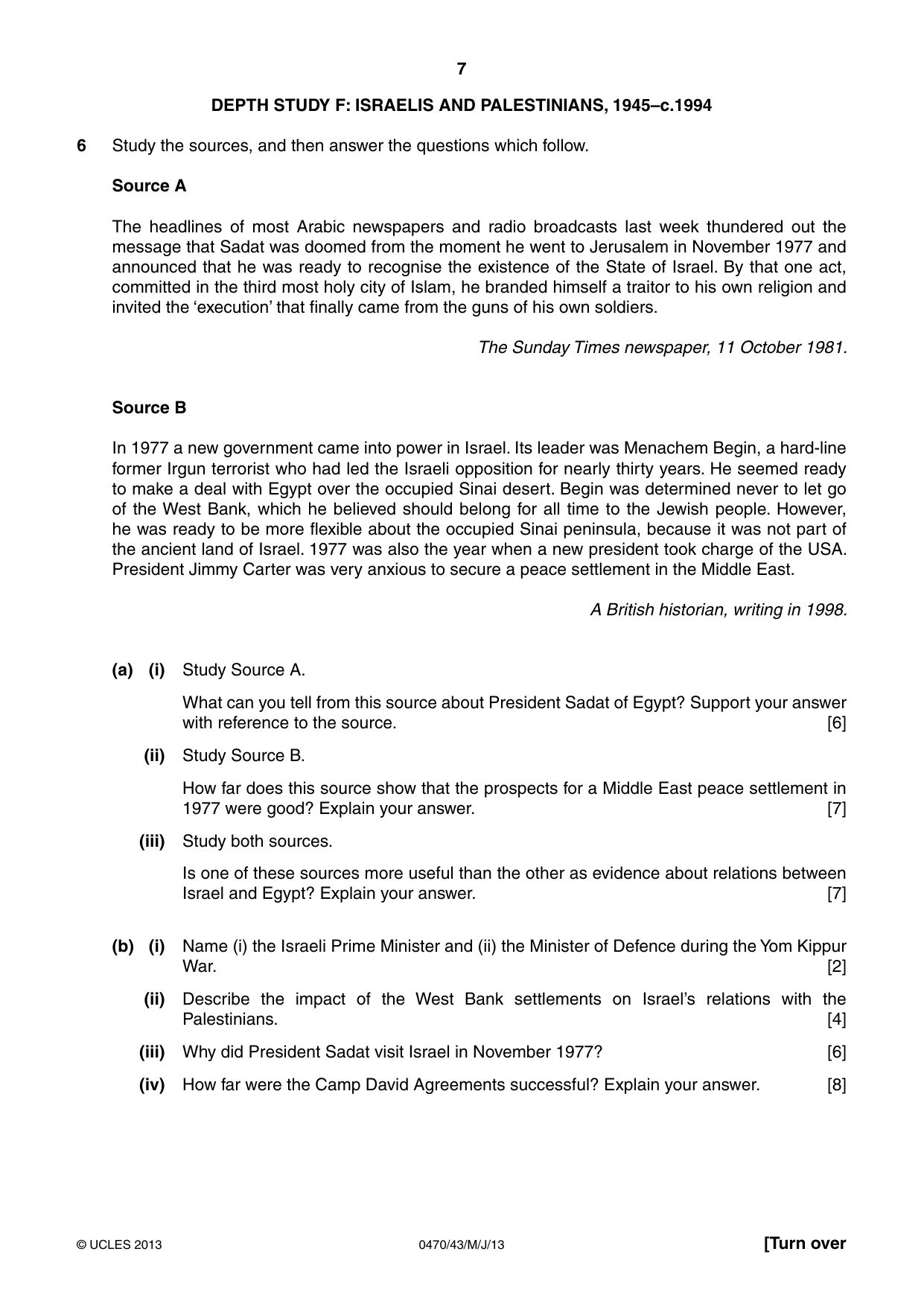
7 0470/43/M/J/13 © UCLES 2013 [Turn over DEPTH STUDY F: ISRAELIS AND PALESTINIANS, 1945–c.1994 6 Study the sources, and then answer the questions which follow. Source A The headlines of most Arabic newspapers and radio broadcasts last week thundered out the message that Sadat was doomed from the moment he went to Jerusalem in November 1977 and announced that he was ready to recognise the existence of the State of Israel. By that one act, committed in the third most holy city of Islam, he branded himself a traitor to his own religion and invited the ‘execution’ that finally came from the guns of his own soldiers. The Sunday Times newspaper, 11 October 1981. Source B In 1977 a new government came into power in Israel. Its leader was Menachem Begin, a hard-line former Irgun terrorist who had led the Israeli opposition for nearly thirty years. He seemed ready to make a deal with Egypt over the occupied Sinai desert. Begin was determined never to let go of the West Bank, which he believed should belong for all time to the Jewish people. However, he was ready to be more flexible about the occupied Sinai peninsula, because it was not part of the ancient land of Israel. 1977 was also the year when a new president took charge of the USA. President Jimmy Carter was very anxious to secure a peace settlement in the Middle East. A British historian, writing in 1998. (a) (i) Study Source A. What can you tell from this source about President Sadat of Egypt? Support your answer with reference to the source. [6] (ii) Study Source B. How far does this source show that the prospects for a Middle East peace settlement in 1977 were good? Explain your answer. [7] (iii) Study both sources. Is one of these sources more useful than the other as evidence about relations between Israel and Egypt? Explain your answer. [7] (b) (i) Name (i) the Israeli Prime Minister and (ii) the Minister of Defence during the Yom Kippur War. [2] (ii) Describe the impact of the West Bank settlements on Israel’s relations with the Palestinians. [4] (iii) Why did President Sadat visit Israel in November 1977? [6] (iv) How far were the Camp David Agreements successful? Explain your answer. [8]
Question paper, page 8
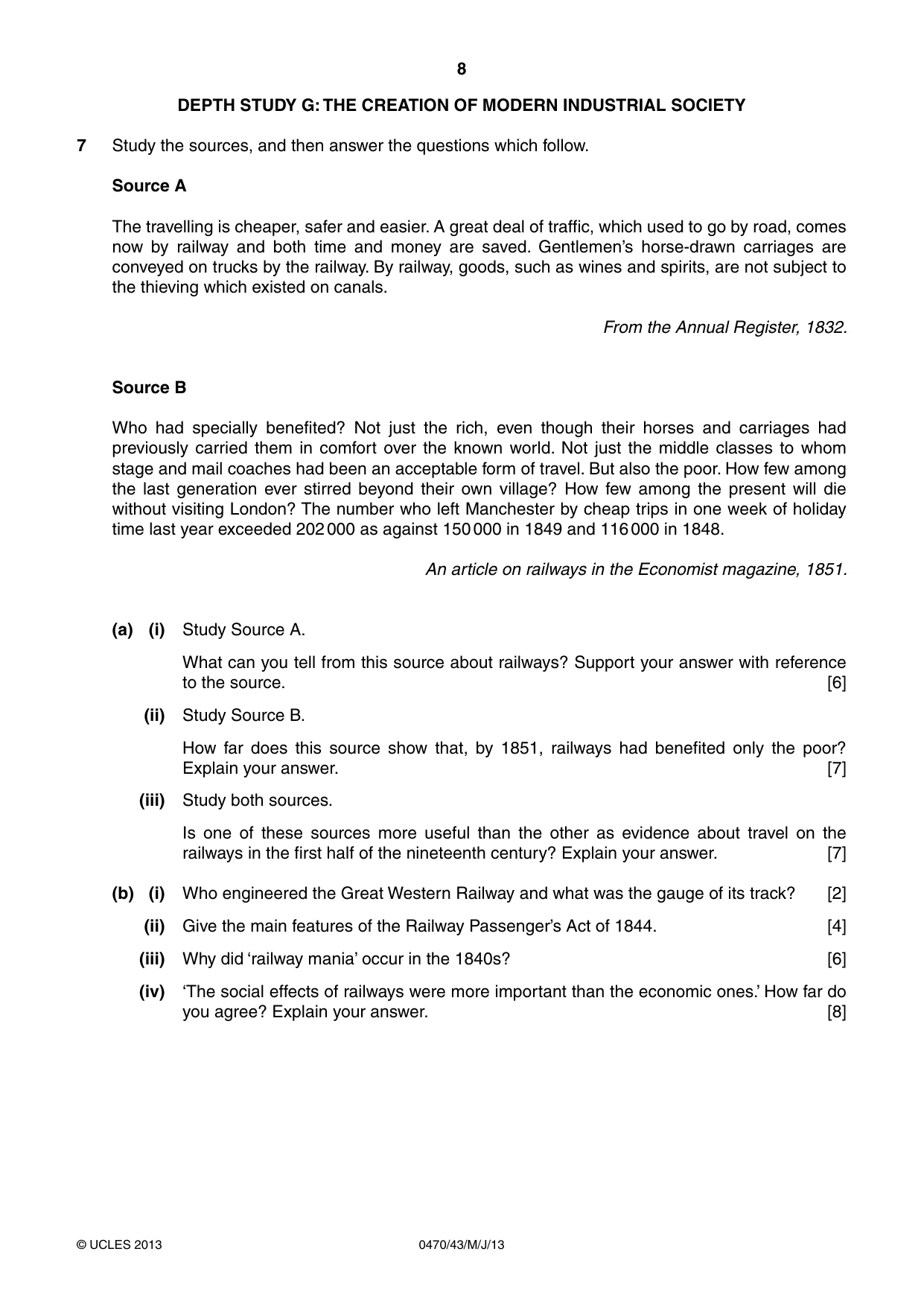
8 0470/43/M/J/13 © UCLES 2013 DEPTH STUDY G: THE CREATION OF MODERN INDUSTRIAL SOCIETY 7 Study the sources, and then answer the questions which follow. Source A The travelling is cheaper, safer and easier. A great deal of traffic, which used to go by road, comes now by railway and both time and money are saved. Gentlemen’s horse-drawn carriages are conveyed on trucks by the railway. By railway, goods, such as wines and spirits, are not subject to the thieving which existed on canals. From the Annual Register, 1832. Source B Who had specially benefited? Not just the rich, even though their horses and carriages had previously carried them in comfort over the known world. Not just the middle classes to whom stage and mail coaches had been an acceptable form of travel. But also the poor. How few among the last generation ever stirred beyond their own village? How few among the present will die without visiting London? The number who left Manchester by cheap trips in one week of holiday time last year exceeded 202 000 as against 150 000 in 1849 and 116 000 in 1848. An article on railways in the Economist magazine, 1851. (a) (i) Study Source A. What can you tell from this source about railways? Support your answer with reference to the source. [6] (ii) Study Source B. How far does this source show that, by 1851, railways had benefited only the poor? Explain your answer. [7] (iii) Study both sources. Is one of these sources more useful than the other as evidence about travel on the railways in the first half of the nineteenth century? Explain your answer. [7] (b) (i) Who engineered the Great Western Railway and what was the gauge of its track? [2] (ii) Give the main features of the Railway Passenger’s Act of 1844. [4] (iii) Why did ‘railway mania’ occur in the 1840s? [6] (iv) ‘The social effects of railways were more important than the economic ones.’ How far do you agree? Explain your answer. [8]
Question paper, page 9
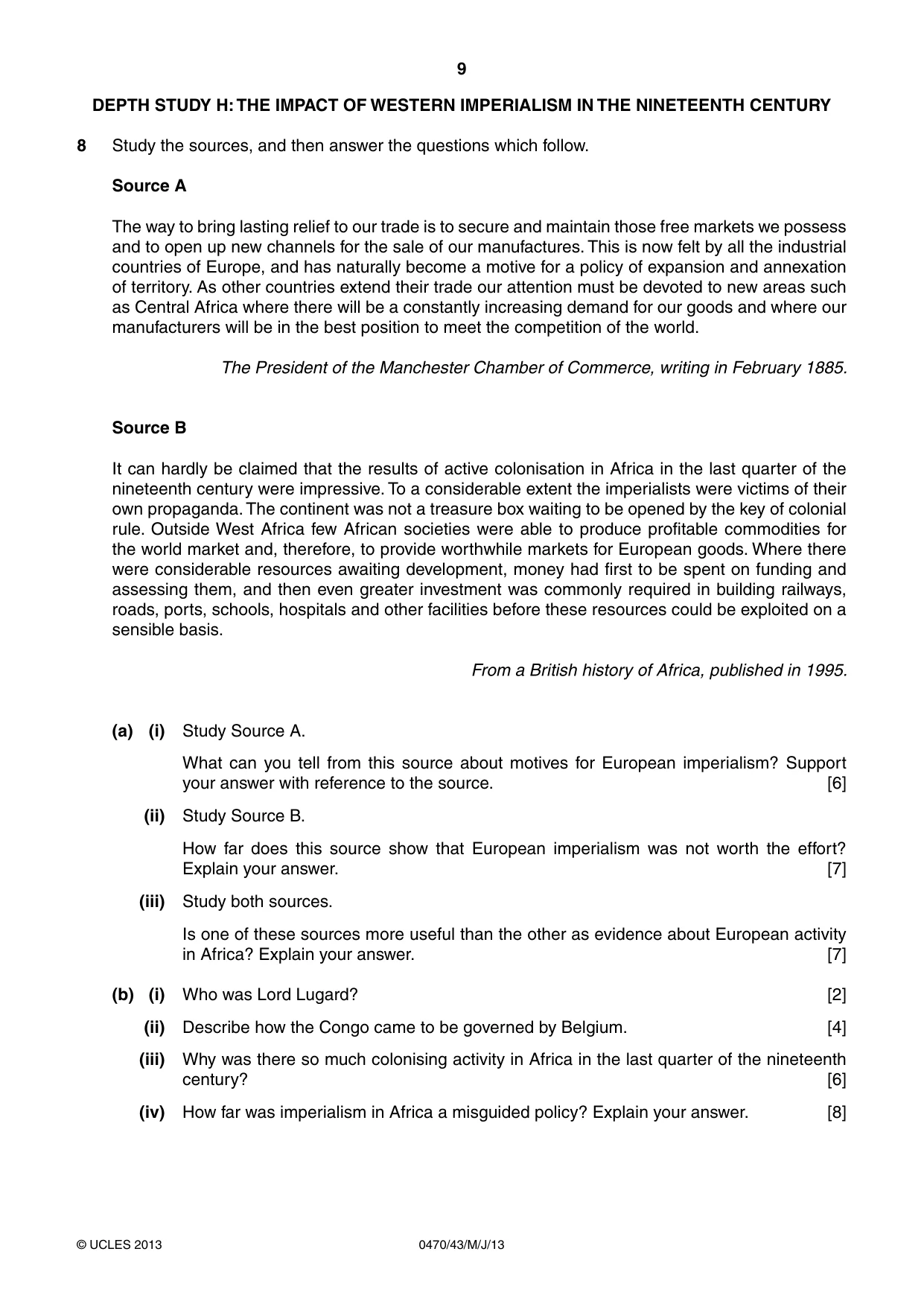
9 0470/43/M/J/13 © UCLES 2013 DEPTH STUDY H: THE IMPACT OF WESTERN IMPERIALISM IN THE NINETEENTH CENTURY 8 Study the sources, and then answer the questions which follow. Source A The way to bring lasting relief to our trade is to secure and maintain those free markets we possess and to open up new channels for the sale of our manufactures. This is now felt by all the industrial countries of Europe, and has naturally become a motive for a policy of expansion and annexation of territory. As other countries extend their trade our attention must be devoted to new areas such as Central Africa where there will be a constantly increasing demand for our goods and where our manufacturers will be in the best position to meet the competition of the world. The President of the Manchester Chamber of Commerce, writing in February 1885. Source B It can hardly be claimed that the results of active colonisation in Africa in the last quarter of the nineteenth century were impressive. To a considerable extent the imperialists were victims of their own propaganda. The continent was not a treasure box waiting to be opened by the key of colonial rule. Outside West Africa few African societies were able to produce profitable commodities for the world market and, therefore, to provide worthwhile markets for European goods. Where there were considerable resources awaiting development, money had first to be spent on funding and assessing them, and then even greater investment was commonly required in building railways, roads, ports, schools, hospitals and other facilities before these resources could be exploited on a sensible basis. From a British history of Africa, published in 1995. (a) (i) Study Source A. What can you tell from this source about motives for European imperialism? Support your answer with reference to the source. [6] (ii) Study Source B. How far does this source show that European imperialism was not worth the effort? Explain your answer. [7] (iii) Study both sources. Is one of these sources more useful than the other as evidence about European activity in Africa? Explain your answer. [7] (b) (i) Who was Lord Lugard? [2] (ii) Describe how the Congo came to be governed by Belgium. [4] (iii) Why was there so much colonising activity in Africa in the last quarter of the nineteenth century? [6] (iv) How far was imperialism in Africa a misguided policy? Explain your answer. [8]
Question paper, page 10
10 0470/43/M/J/13 © UCLES 2013 BLANK PAGE
Question paper, page 11
11 0470/43/M/J/13 © UCLES 2013 BLANK PAGE
Question paper, page 12
12 0470/43/M/J/13 © UCLES 2013 BLANK PAGE Copyright Acknowledgements: Depth Study A Source A Depth Study B Source A Depth Study B Source B Depth Study C Source A Depth Study C Source B Depth Study D Source A Depth Study D Source B Depth Study E Source A Depth Study E Source B Depth Study F Source A Depth Study F Source B Depth Study G Source A Depth Study G Source B Depth Study H Source A Depth Study H Source B © A history course recommended in the official teacher’s instructions; 1934. © N Poliakoff; Coco the Clown; in Christopher Culpin; Making History; Published by Collins Educational. Reprinted by permission of HarperCollins Publishers; 1984. © Clare Baker; Russia, 1917-1945; Heinemann Educational; 1990. © Your Money’s Worth, a Study in Waste; from an American book written in 1927. © Tony Howarth & J Brooman; Twentieth Century History; Published by Longman. Reprinted by permission of Pearson Education Ltd; 1987. © Harriet Ward; World Powers in the Twentieth Century; Heinemann Educational; 1978. © Jung Chang & John Halliday; Mao, The Unknown Story; Published by Jonathan Cape. Reprinted by permission of the Random House Group Ltd; 2005. © The Prime Minister of South Africa from 1924, General Hertzog, writing in 1935 to his son who was a member of the Afrikaner Purified Nationalist Party and of the secret Broederbond. © M Roberts; A History of South Africa; Published by Longman. Reprinted by permission of Pearson Education Ltd; 1996. © Peter Wilsher; Who was really to blame?; The Sunday Times, 11 October 1981; in Tony McAleavy; The Arab-Israeli Conflict; Cambridge University Press; 1998. © Tony McAleavy; The Arab-Israeli Conflict; Cambridge University Press; 1998. © N Tonge & M Quincey; British Social & Economic History 1800-1900; Macmillan; 1980. © R Tames; Documents of the Industrial Revolution; Hutchinson; 1971. © W G Hynes; The Economics of Empire; Longman; 1979. © J D Fage; A History of Africa; Routledge; 1995. Permission to reproduce items where third-party owned material protected by copyright is included has been sought and cleared where possible. Every reasonable effort has been made by the publisher (UCLES) to trace copyright holders, but if any items requiring clearance have unwittingly been included, the publisher will be pleased to make amends at the earliest possible opportunity. University of Cambridge International Examinations is part of the Cambridge Assessment Group. Cambridge Assessment is the brand name of University of Cambridge Local Examinations Syndicate (UCLES), which is itself a department of the University of Cambridge.
Mark scheme, page 1
CAMBRIDGE INTERNATIONAL EXAMINATIONS International General Certificate of Secondary Education MARK SCHEME for the May/June 2013 series 0470 HISTORY 0470/43 Paper 4 (Alternative to Coursework), maximum raw mark 40 This mark scheme is published as an aid to teachers and candidates, to indicate the requirements of the examination. It shows the basis on which Examiners were instructed to award marks. It does not indicate the details of the discussions that took place at an Examiners’ meeting before marking began, which would have considered the acceptability of alternative answers. Mark schemes should be read in conjunction with the question paper and the Principal Examiner Report for Teachers. Cambridge will not enter into discussions about these mark schemes. Cambridge is publishing the mark schemes for the May/June 2013 series for most IGCSE, GCE Advanced Level and Advanced Subsidiary Level components and some Ordinary Level components.
Mark scheme, page 2
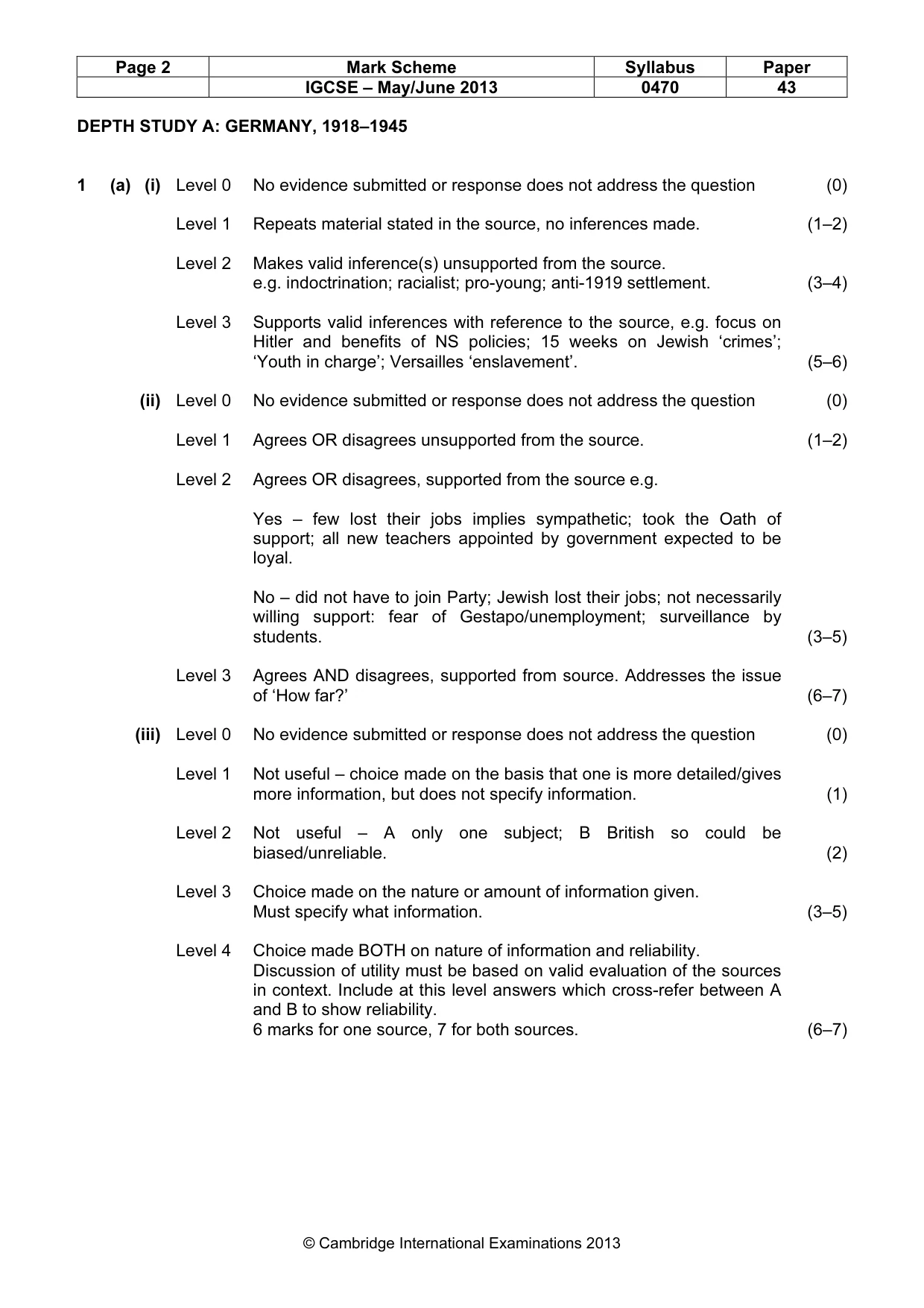
Page 2 Mark Scheme Syllabus Paper IGCSE – May/June 2013 0470 43 © Cambridge International Examinations 2013 DEPTH STUDY A: GERMANY, 1918–1945 1 (a) (i) Level 0 No evidence submitted or response does not address the question (0) Level 1 Repeats material stated in the source, no inferences made. (1–2) Level 2 Makes valid inference(s) unsupported from the source. e.g. indoctrination; racialist; pro-young; anti-1919 settlement. (3–4) Level 3 Supports valid inferences with reference to the source, e.g. focus on Hitler and benefits of NS policies; 15 weeks on Jewish ‘crimes’; ‘Youth in charge’; Versailles ‘enslavement’. (5–6) (ii) Level 0 No evidence submitted or response does not address the question (0) Level 1 Agrees OR disagrees unsupported from the source. (1–2) Level 2 Agrees OR disagrees, supported from the source e.g. Yes – few lost their jobs implies sympathetic; took the Oath of support; all new teachers appointed by government expected to be loyal. No – did not have to join Party; Jewish lost their jobs; not necessarily willing support: fear of Gestapo/unemployment; surveillance by students. (3–5) Level 3 Agrees AND disagrees, supported from source. Addresses the issue of ‘How far?’ (6–7) (iii) Level 0 No evidence submitted or response does not address the question (0) Level 1 Not useful – choice made on the basis that one is more detailed/gives more information, but does not specify information. (1) Level 2 Not useful – A only one subject; B British so could be biased/unreliable. (2) Level 3 Choice made on the nature or amount of information given. Must specify what information. (3–5) Level 4 Choice made BOTH on nature of information and reliability. Discussion of utility must be based on valid evaluation of the sources in context. Include at this level answers which cross-refer between A and B to show reliability. 6 marks for one source, 7 for both sources. (6–7)
Mark scheme, page 3
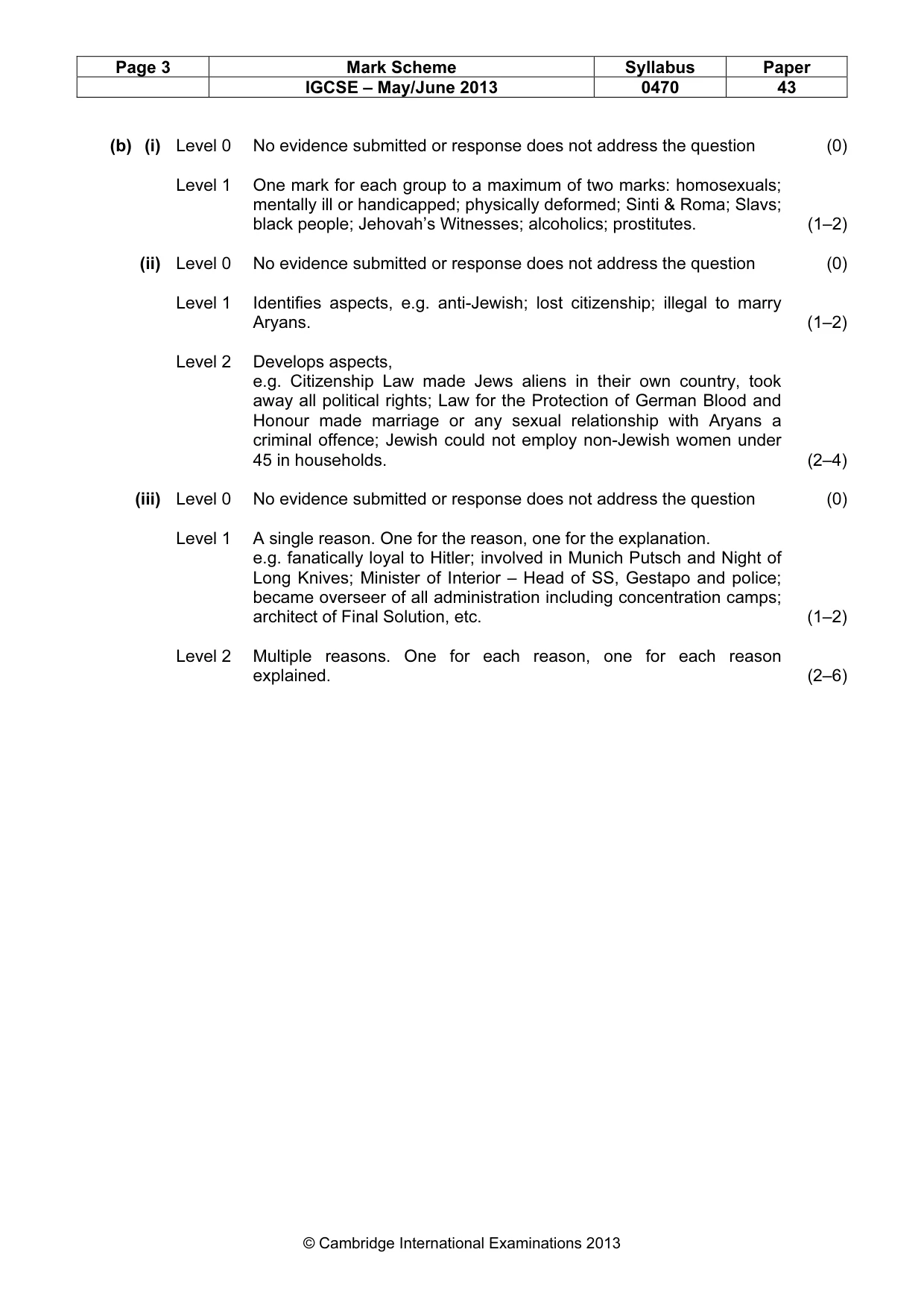
Page 3 Mark Scheme Syllabus Paper IGCSE – May/June 2013 0470 43 © Cambridge International Examinations 2013 (b) (i) Level 0 No evidence submitted or response does not address the question (0) Level 1 One mark for each group to a maximum of two marks: homosexuals; mentally ill or handicapped; physically deformed; Sinti & Roma; Slavs; black people; Jehovah’s Witnesses; alcoholics; prostitutes. (1–2) (ii) Level 0 No evidence submitted or response does not address the question (0) Level 1 Identifies aspects, e.g. anti-Jewish; lost citizenship; illegal to marry Aryans. (1–2) Level 2 Develops aspects, e.g. Citizenship Law made Jews aliens in their own country, took away all political rights; Law for the Protection of German Blood and Honour made marriage or any sexual relationship with Aryans a criminal offence; Jewish could not employ non-Jewish women under 45 in households. (2–4) (iii) Level 0 No evidence submitted or response does not address the question (0) Level 1 A single reason. One for the reason, one for the explanation. e.g. fanatically loyal to Hitler; involved in Munich Putsch and Night of Long Knives; Minister of Interior – Head of SS, Gestapo and police; became overseer of all administration including concentration camps; architect of Final Solution, etc. (1–2) Level 2 Multiple reasons. One for each reason, one for each reason explained. (2–6)
Mark scheme, page 4
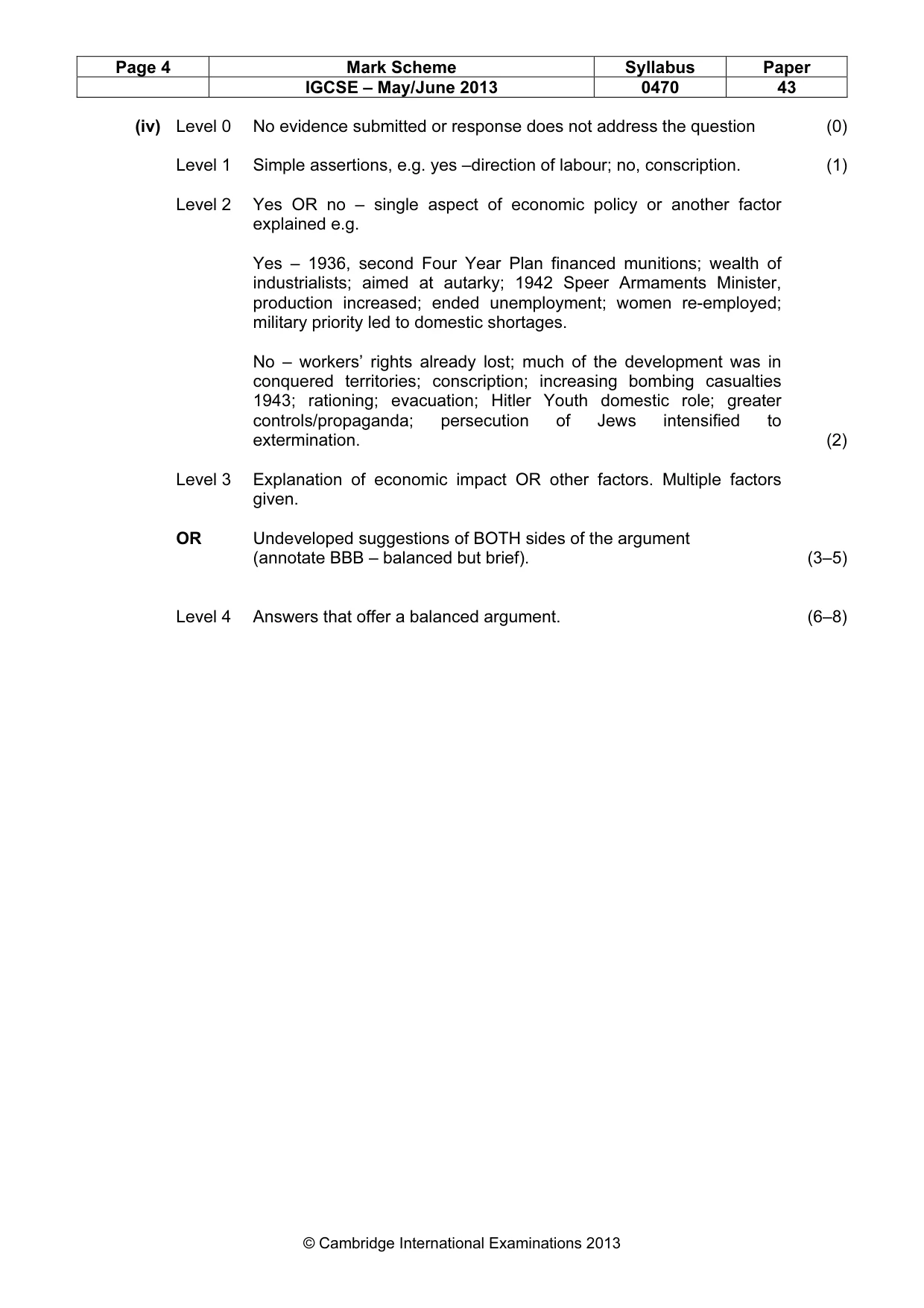
Page 4 Mark Scheme Syllabus Paper IGCSE – May/June 2013 0470 43 © Cambridge International Examinations 2013 (iv) Level 0 No evidence submitted or response does not address the question (0) Level 1 Simple assertions, e.g. yes –direction of labour; no, conscription. (1) Level 2 Yes OR no – single aspect of economic policy or another factor explained e.g. Yes – 1936, second Four Year Plan financed munitions; wealth of industrialists; aimed at autarky; 1942 Speer Armaments Minister, production increased; ended unemployment; women re-employed; military priority led to domestic shortages. No – workers’ rights already lost; much of the development was in conquered territories; conscription; increasing bombing casualties 1943; rationing; evacuation; Hitler Youth domestic role; greater controls/propaganda; persecution of Jews intensified to extermination. (2) Level 3 Explanation of economic impact OR other factors. Multiple factors given. OR Undeveloped suggestions of BOTH sides of the argument (annotate BBB – balanced but brief). (3–5) Level 4 Answers that offer a balanced argument. (6–8)
Mark scheme, page 5
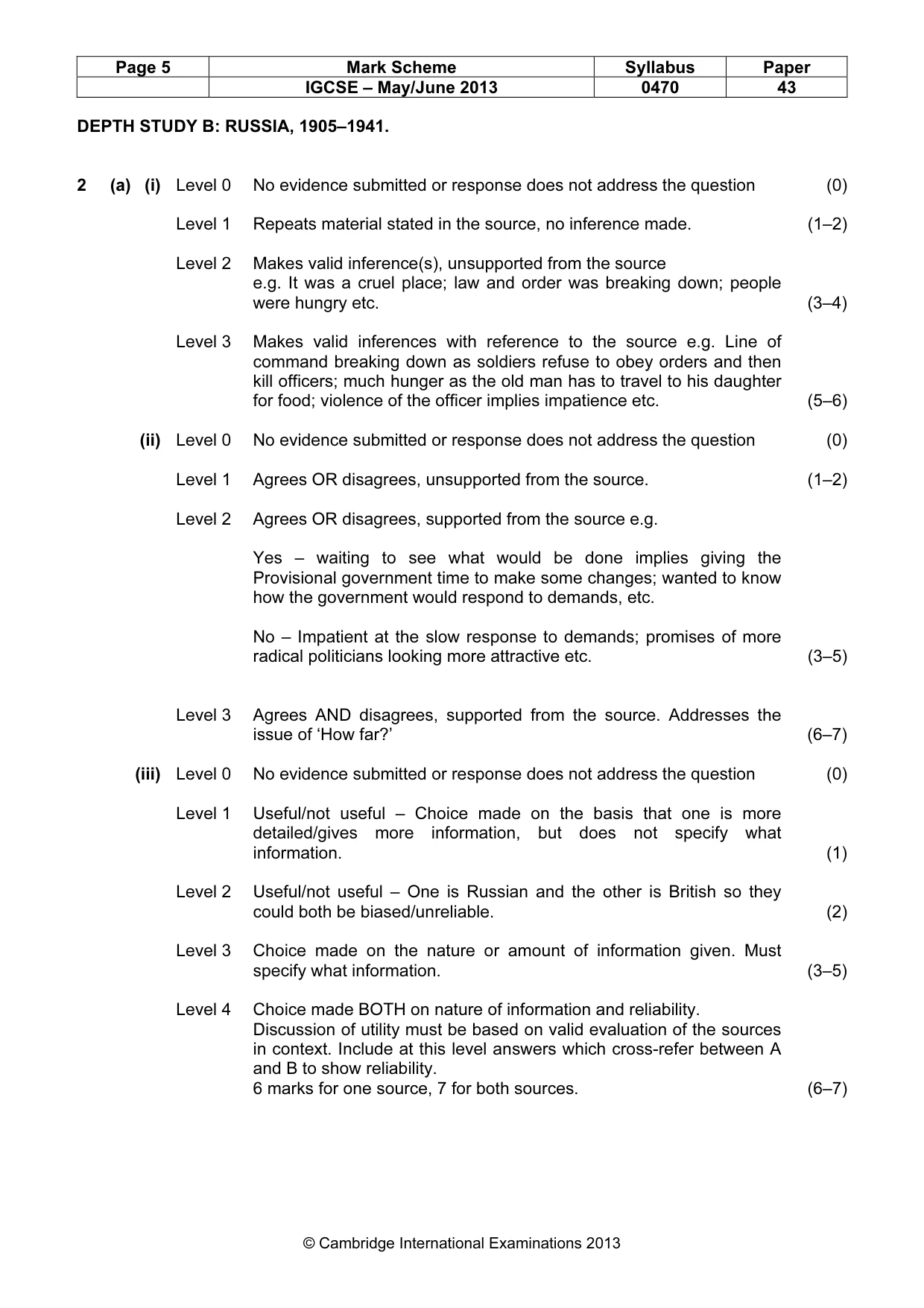
Page 5 Mark Scheme Syllabus Paper IGCSE – May/June 2013 0470 43 © Cambridge International Examinations 2013 DEPTH STUDY B: RUSSIA, 1905–1941. 2 (a) (i) Level 0 No evidence submitted or response does not address the question (0) Level 1 Repeats material stated in the source, no inference made. (1–2) Level 2 Makes valid inference(s), unsupported from the source e.g. It was a cruel place; law and order was breaking down; people were hungry etc. (3–4) Level 3 Makes valid inferences with reference to the source e.g. Line of command breaking down as soldiers refuse to obey orders and then kill officers; much hunger as the old man has to travel to his daughter for food; violence of the officer implies impatience etc. (5–6) (ii) Level 0 No evidence submitted or response does not address the question (0) Level 1 Agrees OR disagrees, unsupported from the source. (1–2) Level 2 Agrees OR disagrees, supported from the source e.g. Yes – waiting to see what would be done implies giving the Provisional government time to make some changes; wanted to know how the government would respond to demands, etc. No – Impatient at the slow response to demands; promises of more radical politicians looking more attractive etc. (3–5) Level 3 Agrees AND disagrees, supported from the source. Addresses the issue of ‘How far?’ (6–7) (iii) Level 0 No evidence submitted or response does not address the question (0) Level 1 Useful/not useful – Choice made on the basis that one is more detailed/gives more information, but does not specify what information. (1) Level 2 Useful/not useful – One is Russian and the other is British so they could both be biased/unreliable. (2) Level 3 Choice made on the nature or amount of information given. Must specify what information. (3–5) Level 4 Choice made BOTH on nature of information and reliability. Discussion of utility must be based on valid evaluation of the sources in context. Include at this level answers which cross-refer between A and B to show reliability. 6 marks for one source, 7 for both sources. (6–7)
Mark scheme, page 6
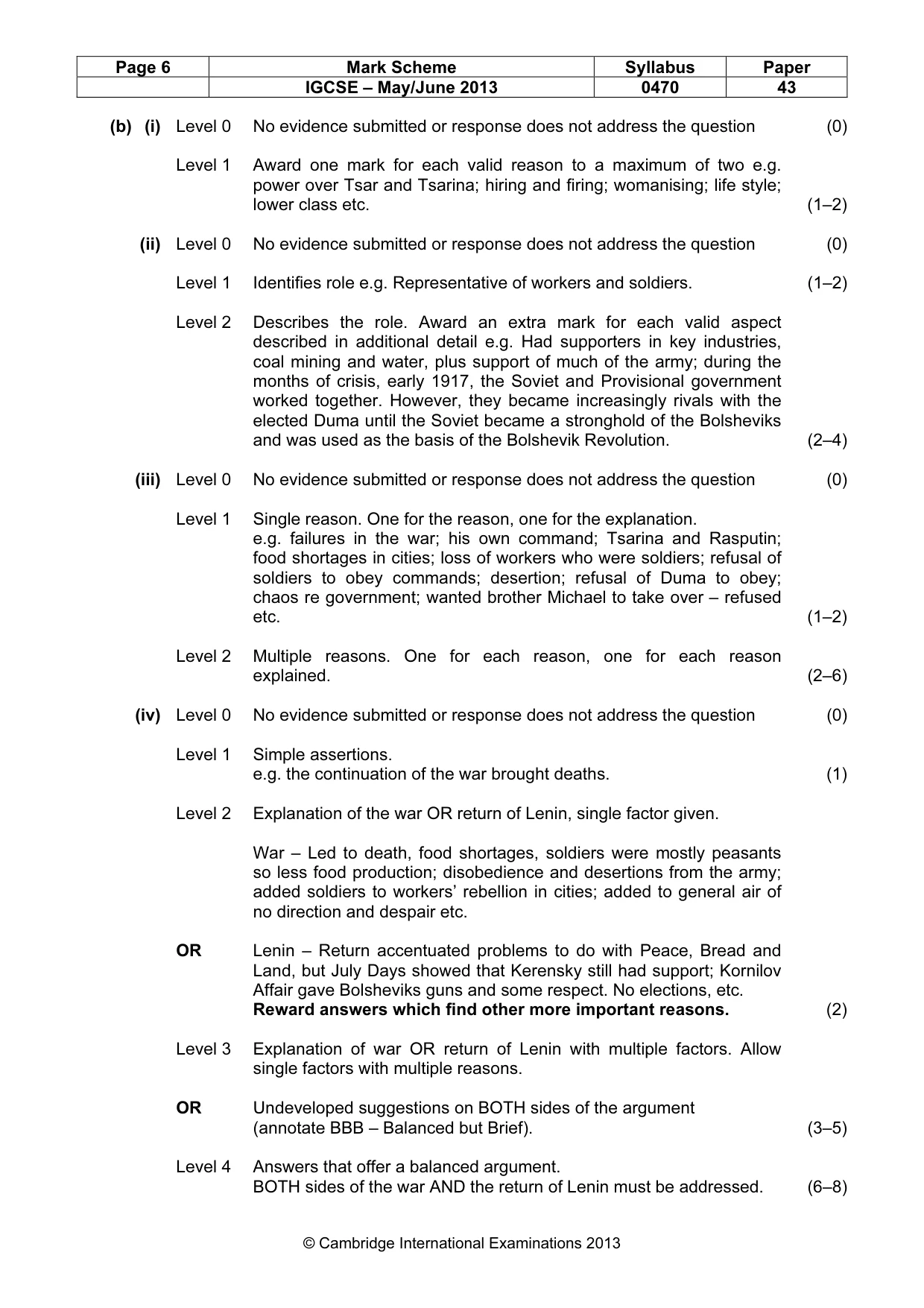
Page 6 Mark Scheme Syllabus Paper IGCSE – May/June 2013 0470 43 © Cambridge International Examinations 2013 (b) (i) Level 0 No evidence submitted or response does not address the question (0) Level 1 Award one mark for each valid reason to a maximum of two e.g. power over Tsar and Tsarina; hiring and firing; womanising; life style; lower class etc. (1–2) (ii) Level 0 No evidence submitted or response does not address the question (0) Level 1 Identifies role e.g. Representative of workers and soldiers. (1–2) Level 2 Describes the role. Award an extra mark for each valid aspect described in additional detail e.g. Had supporters in key industries, coal mining and water, plus support of much of the army; during the months of crisis, early 1917, the Soviet and Provisional government worked together. However, they became increasingly rivals with the elected Duma until the Soviet became a stronghold of the Bolsheviks and was used as the basis of the Bolshevik Revolution. (2–4) (iii) Level 0 No evidence submitted or response does not address the question (0) Level 1 Single reason. One for the reason, one for the explanation. e.g. failures in the war; his own command; Tsarina and Rasputin; food shortages in cities; loss of workers who were soldiers; refusal of soldiers to obey commands; desertion; refusal of Duma to obey; chaos re government; wanted brother Michael to take over – refused etc. (1–2) Level 2 Multiple reasons. One for each reason, one for each reason explained. (2–6) (iv) Level 0 No evidence submitted or response does not address the question (0) Level 1 Simple assertions. e.g. the continuation of the war brought deaths. (1) Level 2 Explanation of the war OR return of Lenin, single factor given. War – Led to death, food shortages, soldiers were mostly peasants so less food production; disobedience and desertions from the army; added soldiers to workers’ rebellion in cities; added to general air of no direction and despair etc. OR Lenin – Return accentuated problems to do with Peace, Bread and Land, but July Days showed that Kerensky still had support; Kornilov Affair gave Bolsheviks guns and some respect. No elections, etc. Reward answers which find other more important reasons. (2) Level 3 Explanation of war OR return of Lenin with multiple factors. Allow single factors with multiple reasons. OR Undeveloped suggestions on BOTH sides of the argument (annotate BBB – Balanced but Brief). (3–5) Level 4 Answers that offer a balanced argument. BOTH sides of the war AND the return of Lenin must be addressed. (6–8)
Mark scheme, page 7
Page 7 Mark Scheme Syllabus Paper IGCSE – May/June 2013 0470 43 © Cambridge International Examinations 2013 DEPTH STUDY C: THE USA, 1919–1941 3 (a) (i) Level 0 No evidence submitted or response does not address the question (0) Level 1 Repeats material stated in the source, no inferences made. (1–2) Level 2 Makes valid inference(s) not supported from the source. e.g. wealthy; consumerists; cut-throat businesses; using hire purchase. (3–4) Level 3 Makes valid inferences and gives support from the source. e.g. ‘diamonds cars’; ‘competitors scheming, crying out’; ‘a dollar a week’; ‘some that are not’; etc. (5–6) (ii) Level 0 No evidence submitted or response does not address the question (0) Level 1 Agrees OR disagrees with no support from source. (1–2) Level 2 Agrees OR disagrees, supported from the source e.g. Yes – huge wealthy demand; domestic market protected; able to loan money to Europe; ignore international affairs. No – closing markets weakened others, could lead to retaliatory tariffs; basis for loans would become shaky; blocking immigration could lower internal demand/cheap labour. (3–5) Level 3 Agrees AND disagrees, supported from source. Addresses the issue of ‘How far?’ (6–7) (iii) Level 0 No evidence submitted or response does not address the question (0) Level 1 Useful/not useful – choice made on the basis that one is more detailed/gives more information, but does not specify information. (1) Level 2 Useful/not useful – A, American; B European, both critical so they could be biased/unreliable. (2) Level 3 Choice made on the nature or amount of information given. Must specify what information. (3–5) Level 4 Choice made BOTH on nature of information and reliability. Discussion of utility must be based on valid evaluation of the sources in context. Include at this level answers which cross-refer between A and B to show reliability. 6 marks for one source, 7 for both sources. (6–7)
Mark scheme, page 8
Page 8 Mark Scheme Syllabus Paper IGCSE – May/June 2013 0470 43 © Cambridge International Examinations 2013 (b) (i) Level 0 No evidence submitted or response does not address the question (0) Level 1 One mark for each valid aspect to a maximum of two, or one aspect developed, e.g. buying with sole aim of making a quick profit; often buying on the margin, both by banks and small investors; demand raised prices unrealistically. (1–2) (ii) Level 0 No evidence submitted or response does not address the question (0) Level 1 Identifies aspects – e.g. panic selling of shares; result was the Wall Street Crash. (1–2) Level 2 Develops description of aspects: 21st – large scale selling by big investors; confidence falling; Black Thursday, 24th c.$9 billion fall in prices; banks Intervened, prices stabilised over weekend; by 28th banks began selling for quick profit, c.$14 billion fall result; Black Tuesday, 29th complete panic, c.15m. shares sold at $32 billion loss – the Crash. (2–4) (iii) Level 0 No evidence submitted or response does not address the question (0) Level 1 A single reason. One for the reason, one for the explanation. e.g. lowering taxes and raising tariffs did not stimulate demand; cutting government expenditure did not restore confidence; by 1932 13m. unemployed – risen from 3% to 25% in 3 years; response to Bonus Marchers; appeal of F. D. Roosevelt. (1–2) Level 2 Multiple reasons. One for each reason, one for each reason explained. (2–6)
Mark scheme, page 9
Page 9 Mark Scheme Syllabus Paper IGCSE – May/June 2013 0470 43 © Cambridge International Examinations 2013 (iv) Level 0 No evidence submitted or response does not address the question (0) Level 1 Simple assertions. e.g. Yes, people afraid to spend; No, economy had longer-standing weaknesses. (1) Level 2 Agrees OR disagrees with explanation of ONE aspect e.g. Yes – Hoover’s ‘prosperity just around the corner’ did not reassure; FDR campaign stressing need to restore confidence as cure indicated its importance; distrust of failing banks; borrowers’ and savers’ losses led to falling demand; could not be stimulated by cutting prices; spiralling unemployment; confidence remained unsteady throughout New Deal; Dow only returned to 1929 level in 1954. No – Wall Street Crash affected relatively few directly; share prices recovered slightly in 1930; weaknesses already evident by end of ‘20s in agriculture; over-production; inequalities of income; lack of social security; reciprocal tariffs; loss of European markets. (2) Level 3 Explanation of fall in confidence OR other reasons, multiple factors given. OR Undeveloped suggestions of BOTH sides of the argument, including those seeing linkage. (annotate BBB – balanced but brief). (3–5) Level 4 Answers that offer a balanced argument. (6–8)
Mark scheme, page 10
Page 10 Mark Scheme Syllabus Paper IGCSE – May/June 2013 0470 43 © Cambridge International Examinations 2013 DEPTH STUDY D: CHINA, 1945–c.1990 4 (a) (i) Level 0 No evidence submitted or response does not address the question (0) Level 1 Repeats material stated in the source, no inference made. (1–2) Level 2 Makes valid inference(s), unsupported from the source. e.g. pragmatic; policy does not matter as long as it works; short-term considerations etc. (3–4) Level 3 Makes valid inferences with reference to the source e.g. not willing to sacrifice food production for the introduction of socialism in short term; accepts richer peasants will increase production in short term until socialism can be organised to take over etc. (5–6) (ii) Level 0 No evidence submitted or response does not address the question (0) Level 1 Agrees OR disagrees, unsupported from the source. (1–2) Level 2 Agrees OR disagrees, supported from the source e.g. Yes – Mao is setting a trap for them so he can later victimise them for their opinions; that group were his targets etc. No – when Mao came to power he gave this group a better standard of living; if they were especially useful he would give them special privileges etc. (3–5) Level 3 Agrees AND disagrees, supported from the source. Addresses the issue of ‘How far?’ (6–7) (iii) Level 0 No evidence submitted or response does not address the question (0) Level 1 Useful/not useful – Choice made on the basis that one is more detailed/gives more information, but does not specify what information. (1) Level 2 Useful/not useful – One is from Mao himself, the other is from another Chinese person so they could both be biased/unreliable. (2) Level 3 Choice made on the nature or amount of information given. Must specify what information. (3–5) Level 4 Choice made on the grounds of reliability. Discussion of utility must be made on valid evaluation of source(s) in context. Include at this Level answers that cross-refer between A and B to show reliability. 6 marks for one source, 7 marks for both. (6–7)
Mark scheme, page 11
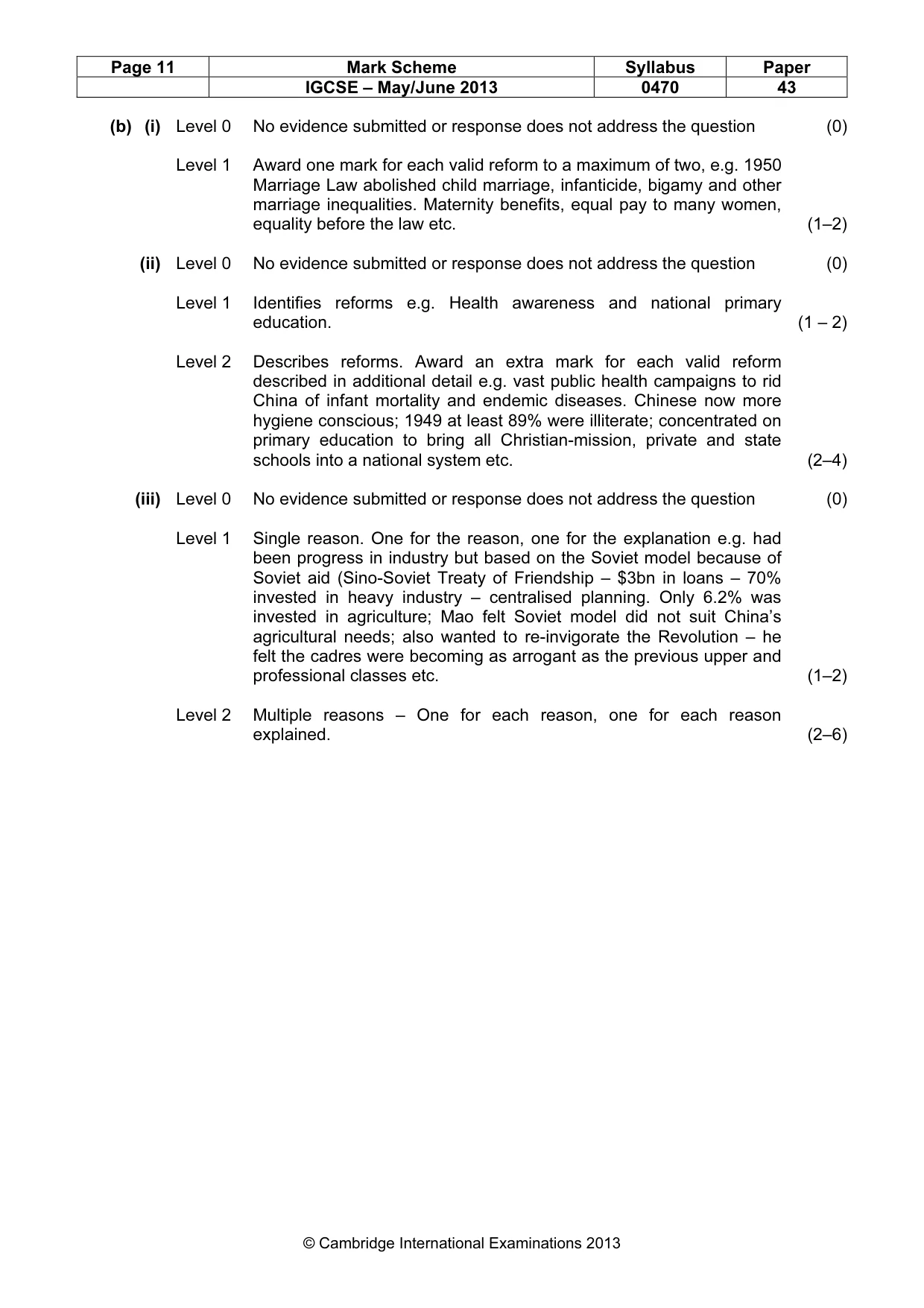
Page 11 Mark Scheme Syllabus Paper IGCSE – May/June 2013 0470 43 © Cambridge International Examinations 2013 (b) (i) Level 0 No evidence submitted or response does not address the question (0) Level 1 Award one mark for each valid reform to a maximum of two, e.g. 1950 Marriage Law abolished child marriage, infanticide, bigamy and other marriage inequalities. Maternity benefits, equal pay to many women, equality before the law etc. (1–2) (ii) Level 0 No evidence submitted or response does not address the question (0) Level 1 Identifies reforms e.g. Health awareness and national primary education. (1 – 2) Level 2 Describes reforms. Award an extra mark for each valid reform described in additional detail e.g. vast public health campaigns to rid China of infant mortality and endemic diseases. Chinese now more hygiene conscious; 1949 at least 89% were illiterate; concentrated on primary education to bring all Christian-mission, private and state schools into a national system etc. (2–4) (iii) Level 0 No evidence submitted or response does not address the question (0) Level 1 Single reason. One for the reason, one for the explanation e.g. had been progress in industry but based on the Soviet model because of Soviet aid (Sino-Soviet Treaty of Friendship – $3bn in loans – 70% invested in heavy industry – centralised planning. Only 6.2% was invested in agriculture; Mao felt Soviet model did not suit China’s agricultural needs; also wanted to re-invigorate the Revolution – he felt the cadres were becoming as arrogant as the previous upper and professional classes etc. (1–2) Level 2 Multiple reasons – One for each reason, one for each reason explained. (2–6)
Mark scheme, page 12
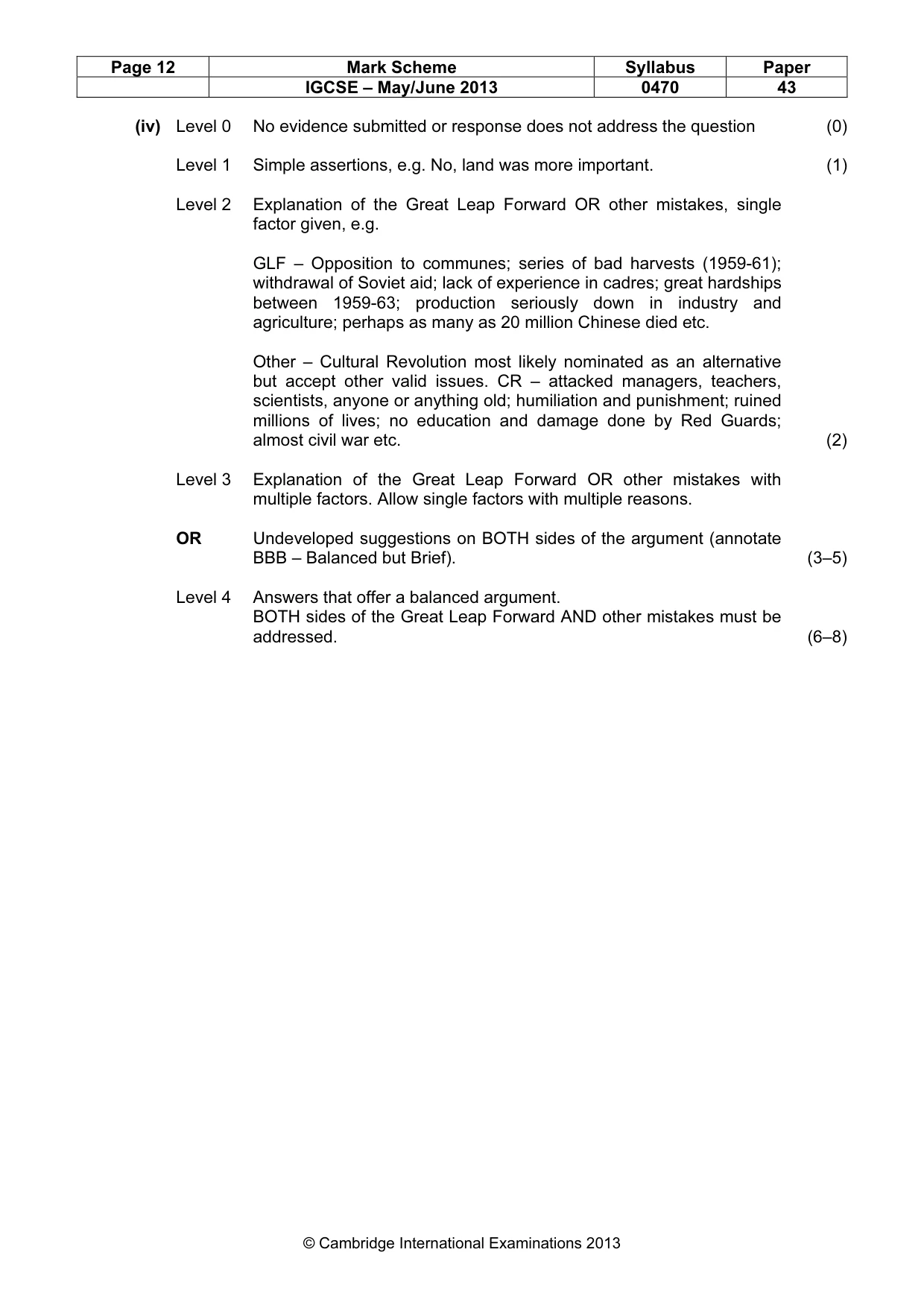
Page 12 Mark Scheme Syllabus Paper IGCSE – May/June 2013 0470 43 © Cambridge International Examinations 2013 (iv) Level 0 No evidence submitted or response does not address the question (0) Level 1 Simple assertions, e.g. No, land was more important. (1) Level 2 Explanation of the Great Leap Forward OR other mistakes, single factor given, e.g. GLF – Opposition to communes; series of bad harvests (1959-61); withdrawal of Soviet aid; lack of experience in cadres; great hardships between 1959-63; production seriously down in industry and agriculture; perhaps as many as 20 million Chinese died etc. Other – Cultural Revolution most likely nominated as an alternative but accept other valid issues. CR – attacked managers, teachers, scientists, anyone or anything old; humiliation and punishment; ruined millions of lives; no education and damage done by Red Guards; almost civil war etc. (2) Level 3 Explanation of the Great Leap Forward OR other mistakes with multiple factors. Allow single factors with multiple reasons. OR Undeveloped suggestions on BOTH sides of the argument (annotate BBB – Balanced but Brief). (3–5) Level 4 Answers that offer a balanced argument. BOTH sides of the Great Leap Forward AND other mistakes must be addressed. (6–8)
Mark scheme, page 13
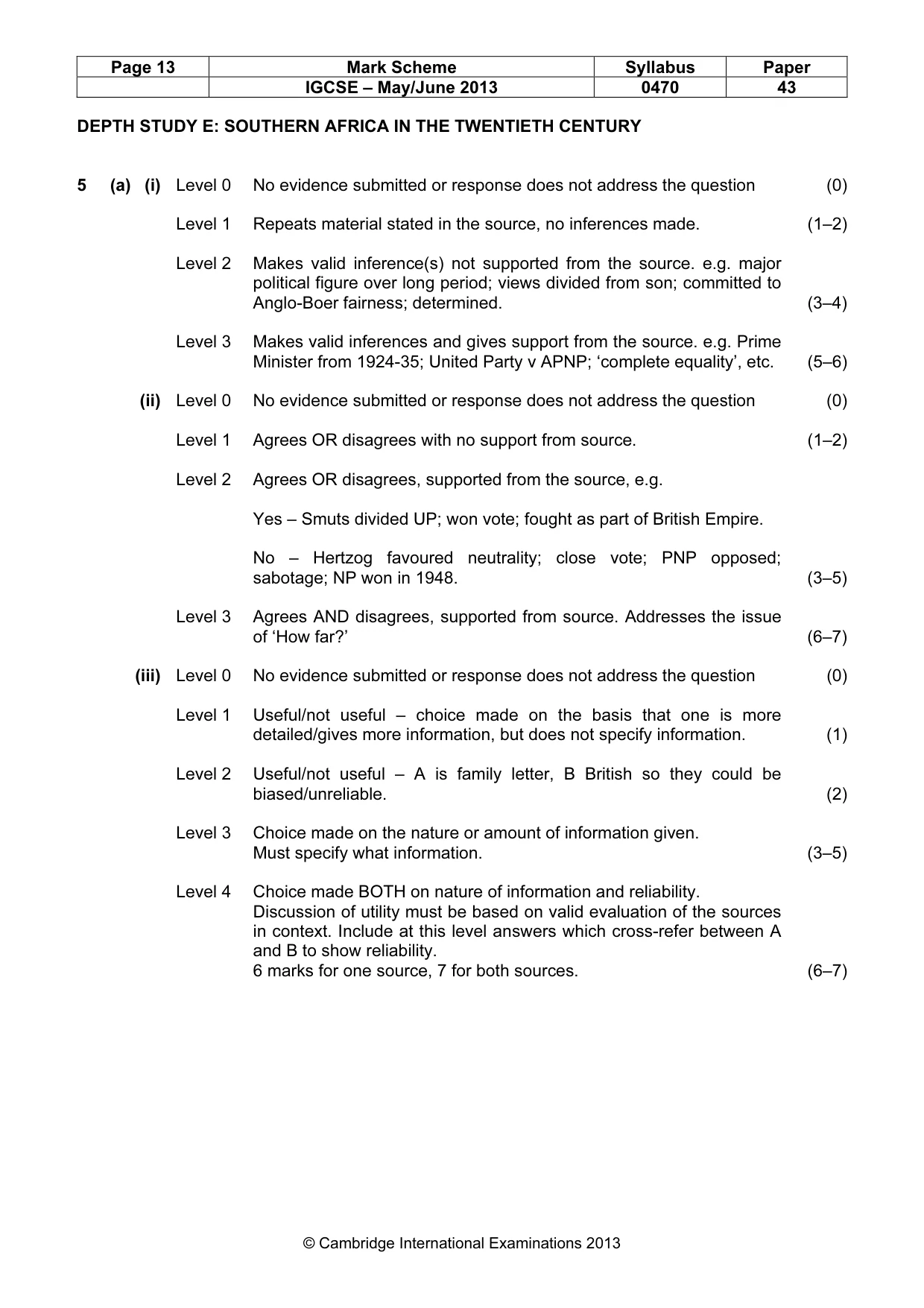
Page 13 Mark Scheme Syllabus Paper IGCSE – May/June 2013 0470 43 © Cambridge International Examinations 2013 DEPTH STUDY E: SOUTHERN AFRICA IN THE TWENTIETH CENTURY 5 (a) (i) Level 0 No evidence submitted or response does not address the question (0) Level 1 Repeats material stated in the source, no inferences made. (1–2) Level 2 Makes valid inference(s) not supported from the source. e.g. major political figure over long period; views divided from son; committed to Anglo-Boer fairness; determined. (3–4) Level 3 Makes valid inferences and gives support from the source. e.g. Prime Minister from 1924-35; United Party v APNP; ‘complete equality’, etc. (5–6) (ii) Level 0 No evidence submitted or response does not address the question (0) Level 1 Agrees OR disagrees with no support from source. (1–2) Level 2 Agrees OR disagrees, supported from the source, e.g. Yes – Smuts divided UP; won vote; fought as part of British Empire. No – Hertzog favoured neutrality; close vote; PNP opposed; sabotage; NP won in 1948. (3–5) Level 3 Agrees AND disagrees, supported from source. Addresses the issue of ‘How far?’ (6–7) (iii) Level 0 No evidence submitted or response does not address the question (0) Level 1 Useful/not useful – choice made on the basis that one is more detailed/gives more information, but does not specify information. (1) Level 2 Useful/not useful – A is family letter, B British so they could be biased/unreliable. (2) Level 3 Choice made on the nature or amount of information given. Must specify what information. (3–5) Level 4 Choice made BOTH on nature of information and reliability. Discussion of utility must be based on valid evaluation of the sources in context. Include at this level answers which cross-refer between A and B to show reliability. 6 marks for one source, 7 for both sources. (6–7)
Mark scheme, page 14
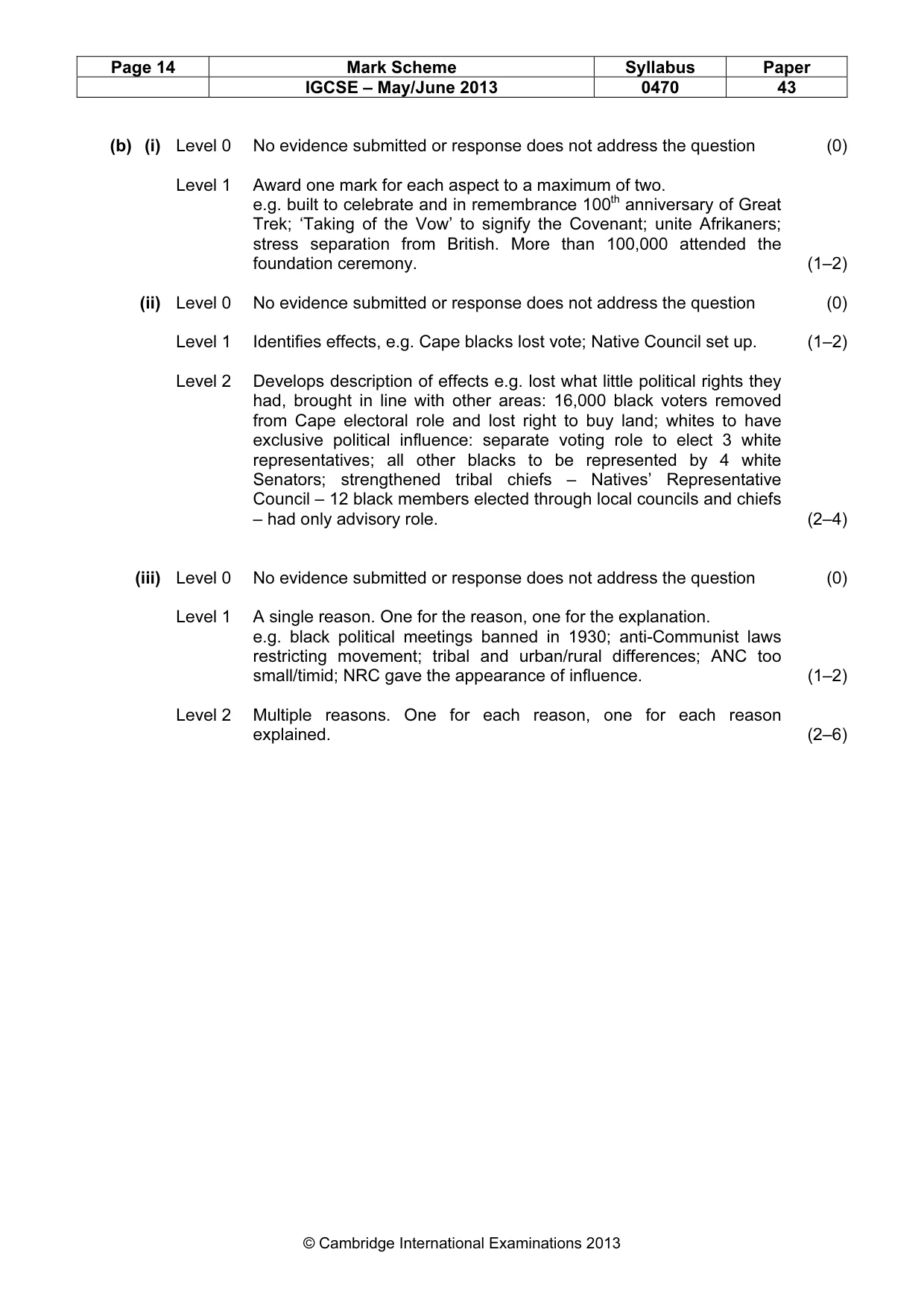
Page 14 Mark Scheme Syllabus Paper IGCSE – May/June 2013 0470 43 © Cambridge International Examinations 2013 (b) (i) Level 0 No evidence submitted or response does not address the question (0) Level 1 Award one mark for each aspect to a maximum of two. e.g. built to celebrate and in remembrance 100th anniversary of Great Trek; ‘Taking of the Vow’ to signify the Covenant; unite Afrikaners; stress separation from British. More than 100,000 attended the foundation ceremony. (1–2) (ii) Level 0 No evidence submitted or response does not address the question (0) Level 1 Identifies effects, e.g. Cape blacks lost vote; Native Council set up. (1–2) Level 2 Develops description of effects e.g. lost what little political rights they had, brought in line with other areas: 16,000 black voters removed from Cape electoral role and lost right to buy land; whites to have exclusive political influence: separate voting role to elect 3 white representatives; all other blacks to be represented by 4 white Senators; strengthened tribal chiefs – Natives’ Representative Council – 12 black members elected through local councils and chiefs – had only advisory role. (2–4) (iii) Level 0 No evidence submitted or response does not address the question (0) Level 1 A single reason. One for the reason, one for the explanation. e.g. black political meetings banned in 1930; anti-Communist laws restricting movement; tribal and urban/rural differences; ANC too small/timid; NRC gave the appearance of influence. (1–2) Level 2 Multiple reasons. One for each reason, one for each reason explained. (2–6)
Mark scheme, page 15
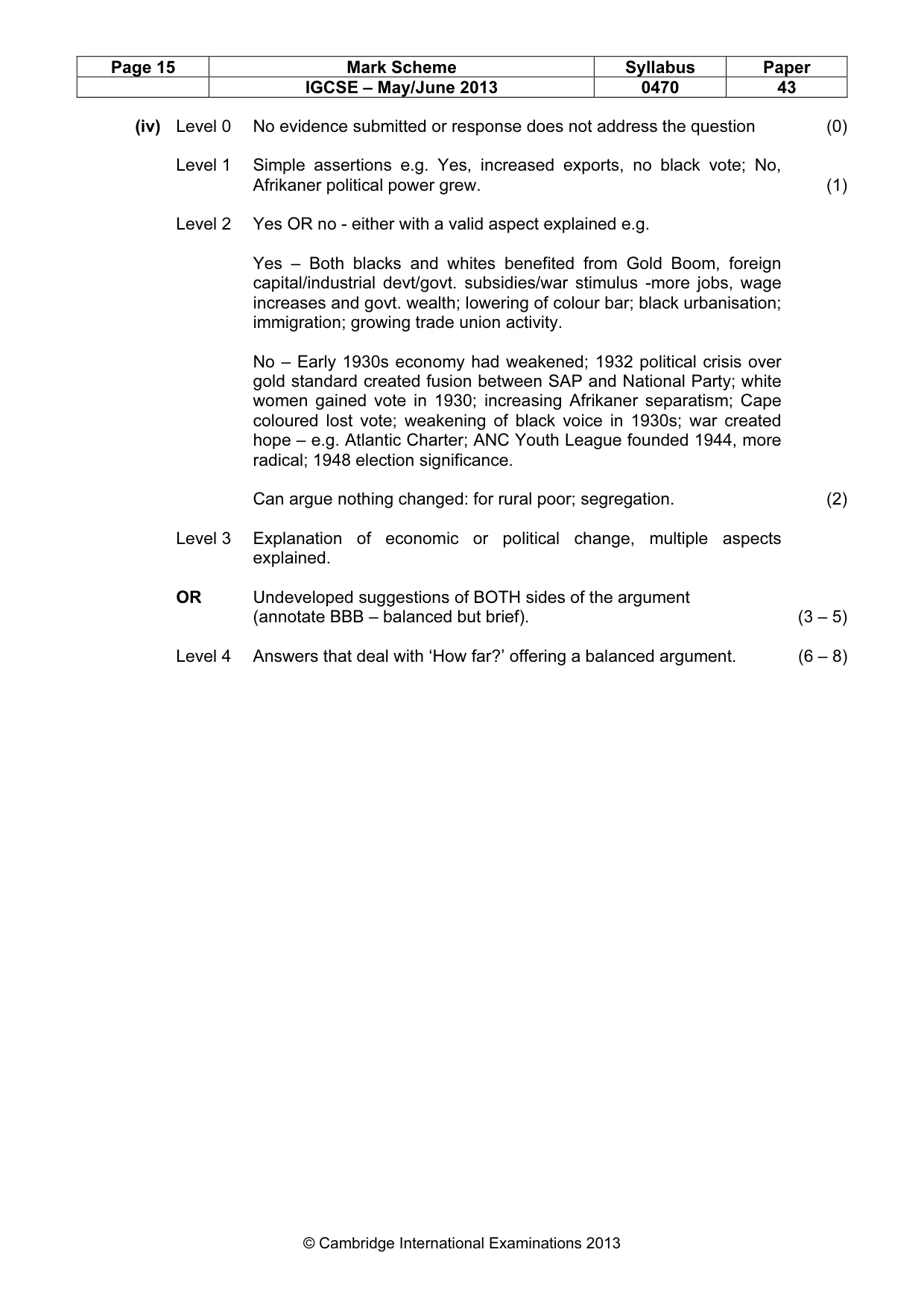
Page 15 Mark Scheme Syllabus Paper IGCSE – May/June 2013 0470 43 © Cambridge International Examinations 2013 (iv) Level 0 No evidence submitted or response does not address the question (0) Level 1 Simple assertions e.g. Yes, increased exports, no black vote; No, Afrikaner political power grew. (1) Level 2 Yes OR no - either with a valid aspect explained e.g. Yes – Both blacks and whites benefited from Gold Boom, foreign capital/industrial devt/govt. subsidies/war stimulus -more jobs, wage increases and govt. wealth; lowering of colour bar; black urbanisation; immigration; growing trade union activity. No – Early 1930s economy had weakened; 1932 political crisis over gold standard created fusion between SAP and National Party; white women gained vote in 1930; increasing Afrikaner separatism; Cape coloured lost vote; weakening of black voice in 1930s; war created hope – e.g. Atlantic Charter; ANC Youth League founded 1944, more radical; 1948 election significance. Can argue nothing changed: for rural poor; segregation. (2) Level 3 Explanation of economic or political change, multiple aspects explained. OR Undeveloped suggestions of BOTH sides of the argument (annotate BBB – balanced but brief). (3 – 5) Level 4 Answers that deal with ‘How far?’ offering a balanced argument. (6 – 8)
Mark scheme, page 16
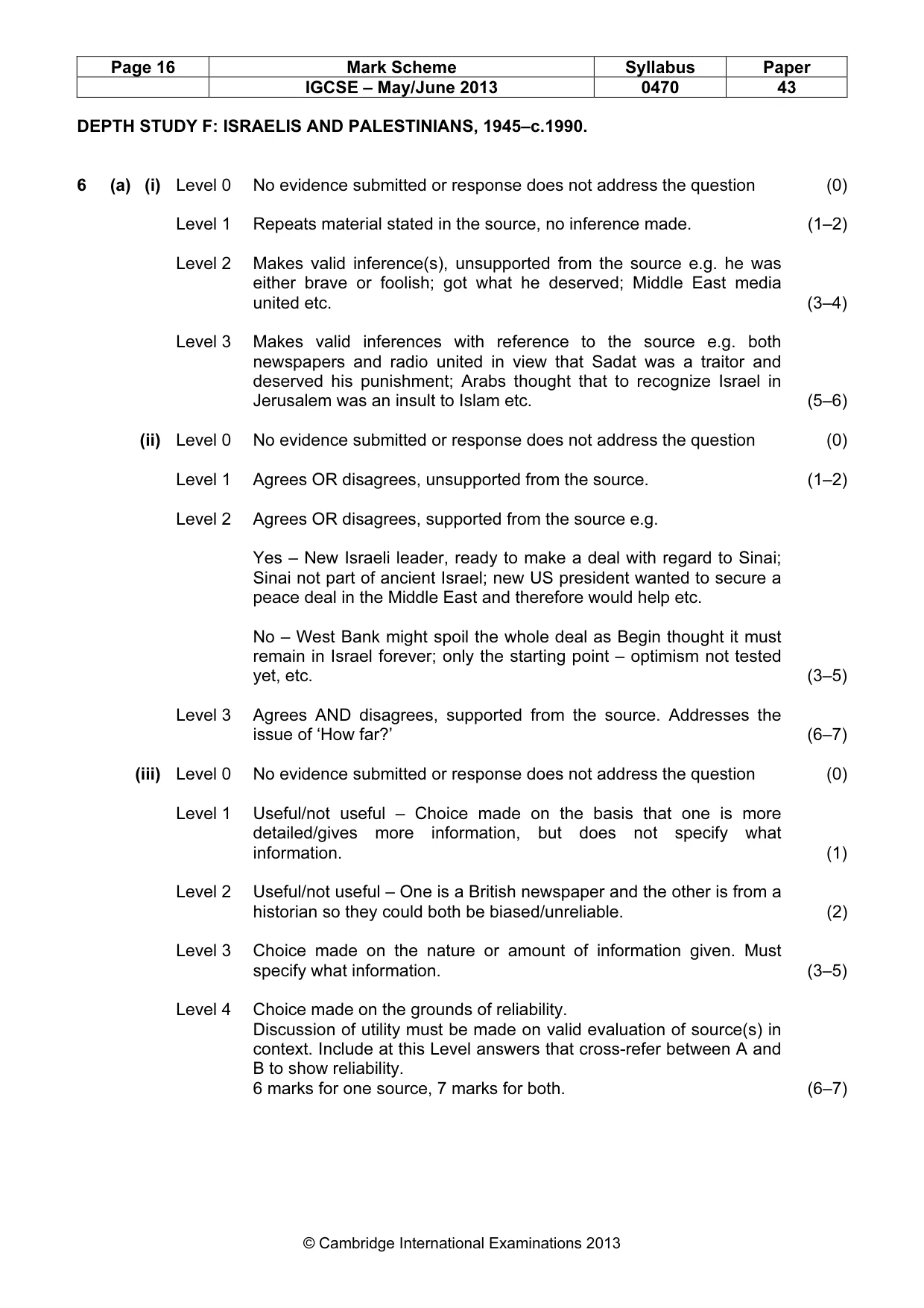
Page 16 Mark Scheme Syllabus Paper IGCSE – May/June 2013 0470 43 © Cambridge International Examinations 2013 DEPTH STUDY F: ISRAELIS AND PALESTINIANS, 1945–c.1990. 6 (a) (i) Level 0 No evidence submitted or response does not address the question (0) Level 1 Repeats material stated in the source, no inference made. (1–2) Level 2 Makes valid inference(s), unsupported from the source e.g. he was either brave or foolish; got what he deserved; Middle East media united etc. (3–4) Level 3 Makes valid inferences with reference to the source e.g. both newspapers and radio united in view that Sadat was a traitor and deserved his punishment; Arabs thought that to recognize Israel in Jerusalem was an insult to Islam etc. (5–6) (ii) Level 0 No evidence submitted or response does not address the question (0) Level 1 Agrees OR disagrees, unsupported from the source. (1–2) Level 2 Agrees OR disagrees, supported from the source e.g. Yes – New Israeli leader, ready to make a deal with regard to Sinai; Sinai not part of ancient Israel; new US president wanted to secure a peace deal in the Middle East and therefore would help etc. No – West Bank might spoil the whole deal as Begin thought it must remain in Israel forever; only the starting point – optimism not tested yet, etc. (3–5) Level 3 Agrees AND disagrees, supported from the source. Addresses the issue of ‘How far?’ (6–7) (iii) Level 0 No evidence submitted or response does not address the question (0) Level 1 Useful/not useful – Choice made on the basis that one is more detailed/gives more information, but does not specify what information. (1) Level 2 Useful/not useful – One is a British newspaper and the other is from a historian so they could both be biased/unreliable. (2) Level 3 Choice made on the nature or amount of information given. Must specify what information. (3–5) Level 4 Choice made on the grounds of reliability. Discussion of utility must be made on valid evaluation of source(s) in context. Include at this Level answers that cross-refer between A and B to show reliability. 6 marks for one source, 7 marks for both. (6–7)
Mark scheme, page 17
Page 17 Mark Scheme Syllabus Paper IGCSE – May/June 2013 0470 43 © Cambridge International Examinations 2013 (b) (i) Level 0 No evidence submitted or response does not address the question (0) Level 1 One mark for each correct answer to a maximum of two - Golda Meir; Moshe Dayan. Must be in correct order. (1–2) (ii) Level 0 No evidence submitted or response does not address the question (0) Level 1 Identifies impact e.g. both claimed ownership. (1–2) Level 2 Describes impact. Award an extra mark for each valid aspect described in additional detail e.g. Taken from Jordan during the Six Day War 1967; both Begin and Dayan stated that it should never be given back; Jewish settlements of housing and communities, to defend and absorb the land; religious importance of the area re. Jerusalem for both sides; resentment between Jews and Palestinians, and a cause throughout the Arab world etc. (2–4) (iii) Level 0 No evidence submitted or response does not address the question (0) Level 1 Single reason. One for the reason, one for the reason explained. e.g. Egypt in financial and economic difficulties with war; domestic costs rising; felt much could be saved if borders were safe; wanted Sinai back; persuasion by Kissinger; willing to risk unpopularity with other Arab nations to secure a deal; felt other nations would gradually follow suit, etc. (1–2) Level 2 Multiple reasons. One for each reason, one for each reason explained. (2–6)
Mark scheme, page 18
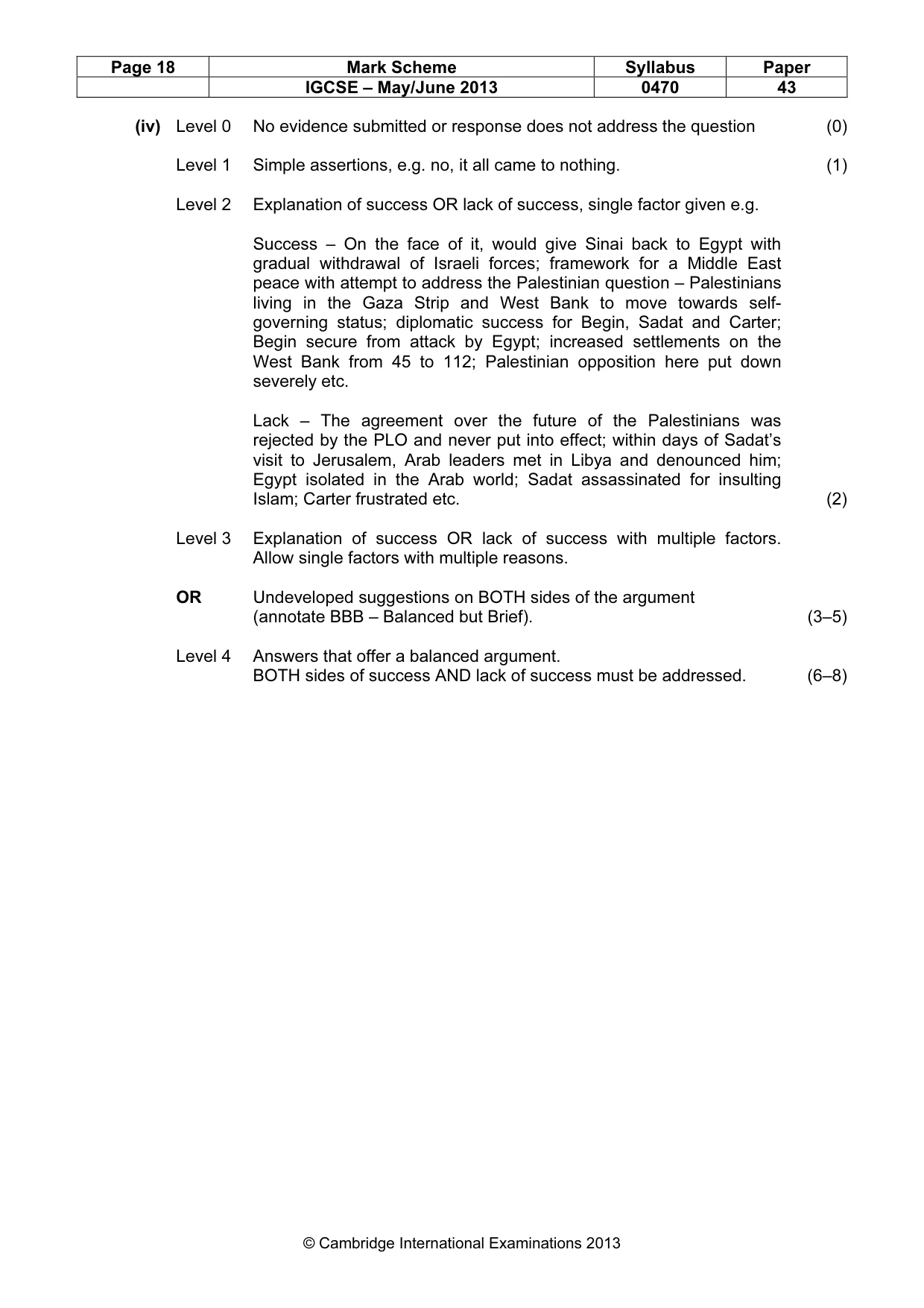
Page 18 Mark Scheme Syllabus Paper IGCSE – May/June 2013 0470 43 © Cambridge International Examinations 2013 (iv) Level 0 No evidence submitted or response does not address the question (0) Level 1 Simple assertions, e.g. no, it all came to nothing. (1) Level 2 Explanation of success OR lack of success, single factor given e.g. Success – On the face of it, would give Sinai back to Egypt with gradual withdrawal of Israeli forces; framework for a Middle East peace with attempt to address the Palestinian question – Palestinians living in the Gaza Strip and West Bank to move towards self- governing status; diplomatic success for Begin, Sadat and Carter; Begin secure from attack by Egypt; increased settlements on the West Bank from 45 to 112; Palestinian opposition here put down severely etc. Lack – The agreement over the future of the Palestinians was rejected by the PLO and never put into effect; within days of Sadat’s visit to Jerusalem, Arab leaders met in Libya and denounced him; Egypt isolated in the Arab world; Sadat assassinated for insulting Islam; Carter frustrated etc. (2) Level 3 Explanation of success OR lack of success with multiple factors. Allow single factors with multiple reasons. OR Undeveloped suggestions on BOTH sides of the argument (annotate BBB – Balanced but Brief). (3–5) Level 4 Answers that offer a balanced argument. BOTH sides of success AND lack of success must be addressed. (6–8)
Mark scheme, page 19
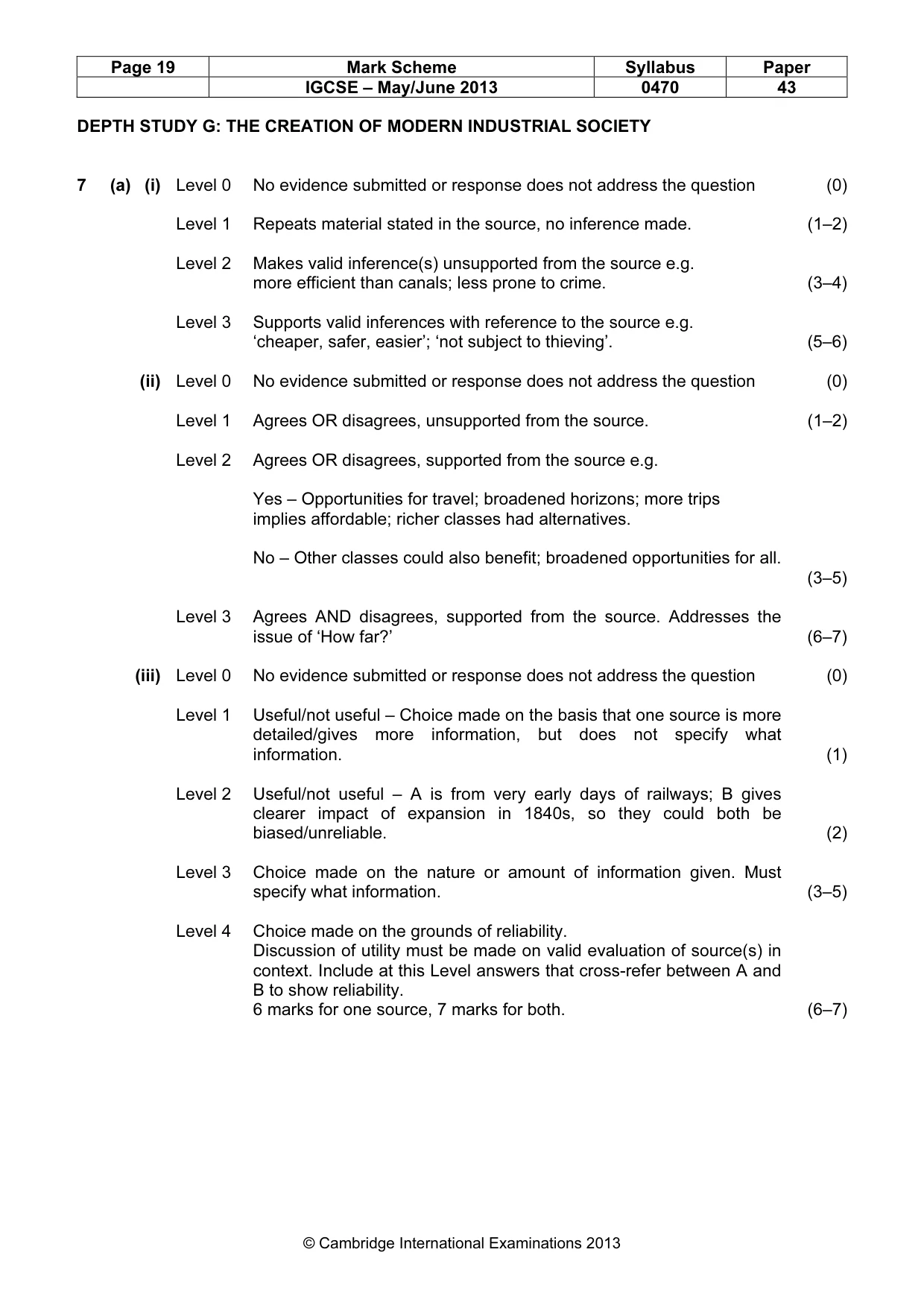
Page 19 Mark Scheme Syllabus Paper IGCSE – May/June 2013 0470 43 © Cambridge International Examinations 2013 DEPTH STUDY G: THE CREATION OF MODERN INDUSTRIAL SOCIETY 7 (a) (i) Level 0 No evidence submitted or response does not address the question (0) Level 1 Repeats material stated in the source, no inference made. (1–2) Level 2 Makes valid inference(s) unsupported from the source e.g. more efficient than canals; less prone to crime. (3–4) Level 3 Supports valid inferences with reference to the source e.g. ‘cheaper, safer, easier’; ‘not subject to thieving’. (5–6) (ii) Level 0 No evidence submitted or response does not address the question (0) Level 1 Agrees OR disagrees, unsupported from the source. (1–2) Level 2 Agrees OR disagrees, supported from the source e.g. Yes – Opportunities for travel; broadened horizons; more trips implies affordable; richer classes had alternatives. No – Other classes could also benefit; broadened opportunities for all. (3–5) Level 3 Agrees AND disagrees, supported from the source. Addresses the issue of ‘How far?’ (6–7) (iii) Level 0 No evidence submitted or response does not address the question (0) Level 1 Useful/not useful – Choice made on the basis that one source is more detailed/gives more information, but does not specify what information. (1) Level 2 Useful/not useful – A is from very early days of railways; B gives clearer impact of expansion in 1840s, so they could both be biased/unreliable. (2) Level 3 Choice made on the nature or amount of information given. Must specify what information. (3–5) Level 4 Choice made on the grounds of reliability. Discussion of utility must be made on valid evaluation of source(s) in context. Include at this Level answers that cross-refer between A and B to show reliability. 6 marks for one source, 7 marks for both. (6–7)
Mark scheme, page 20
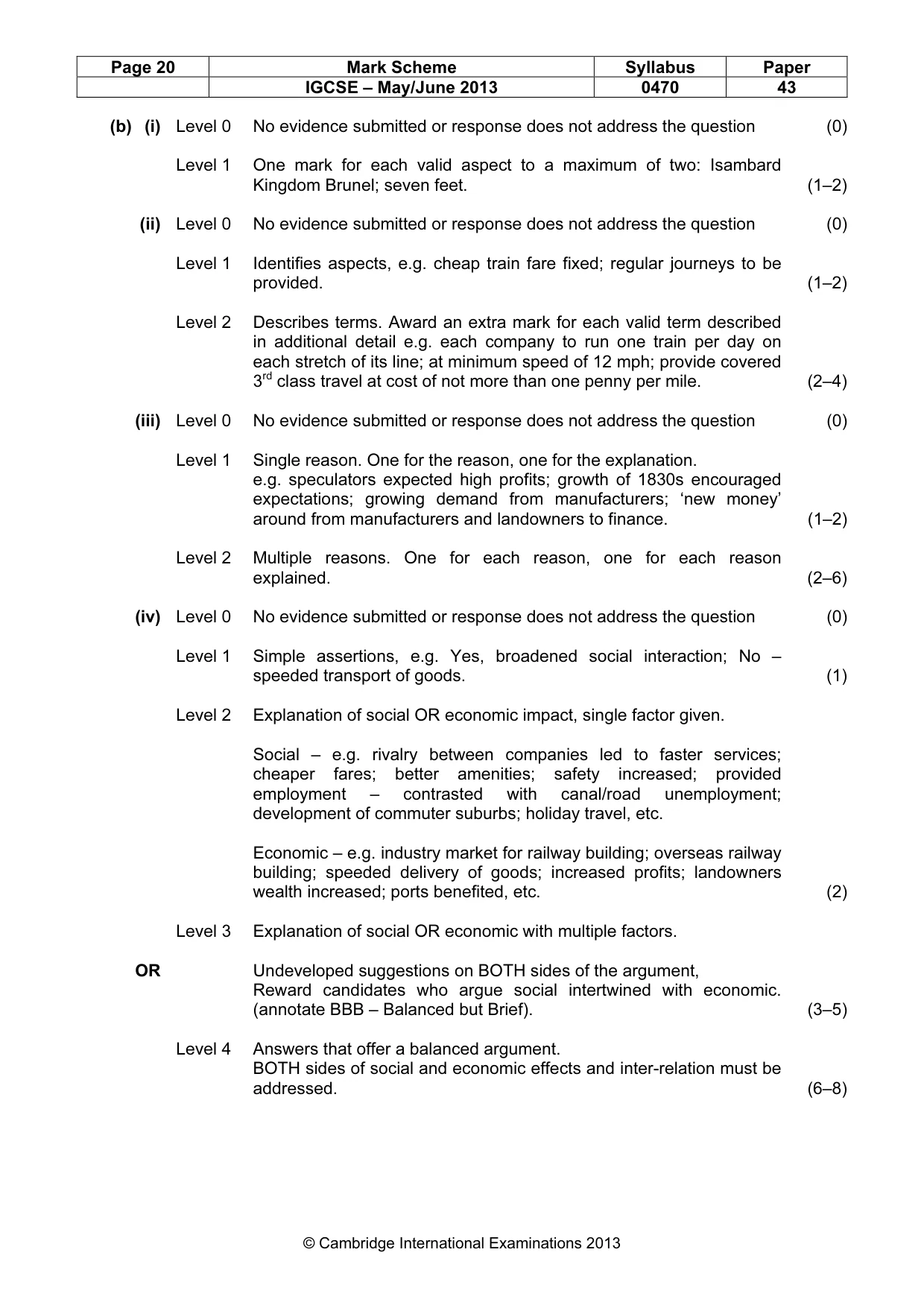
Page 20 Mark Scheme Syllabus Paper IGCSE – May/June 2013 0470 43 © Cambridge International Examinations 2013 (b) (i) Level 0 No evidence submitted or response does not address the question (0) Level 1 One mark for each valid aspect to a maximum of two: Isambard Kingdom Brunel; seven feet. (1–2) (ii) Level 0 No evidence submitted or response does not address the question (0) Level 1 Identifies aspects, e.g. cheap train fare fixed; regular journeys to be provided. (1–2) Level 2 Describes terms. Award an extra mark for each valid term described in additional detail e.g. each company to run one train per day on each stretch of its line; at minimum speed of 12 mph; provide covered 3rd class travel at cost of not more than one penny per mile. (2–4) (iii) Level 0 No evidence submitted or response does not address the question (0) Level 1 Single reason. One for the reason, one for the explanation. e.g. speculators expected high profits; growth of 1830s encouraged expectations; growing demand from manufacturers; ‘new money’ around from manufacturers and landowners to finance. (1–2) Level 2 Multiple reasons. One for each reason, one for each reason explained. (2–6) (iv) Level 0 No evidence submitted or response does not address the question (0) Level 1 Simple assertions, e.g. Yes, broadened social interaction; No – speeded transport of goods. (1) Level 2 Explanation of social OR economic impact, single factor given. Social – e.g. rivalry between companies led to faster services; cheaper fares; better amenities; safety increased; provided employment – contrasted with canal/road unemployment; development of commuter suburbs; holiday travel, etc. Economic – e.g. industry market for railway building; overseas railway building; speeded delivery of goods; increased profits; landowners wealth increased; ports benefited, etc. (2) Level 3 Explanation of social OR economic with multiple factors. OR Undeveloped suggestions on BOTH sides of the argument, Reward candidates who argue social intertwined with economic. (annotate BBB – Balanced but Brief). (3–5) Level 4 Answers that offer a balanced argument. BOTH sides of social and economic effects and inter-relation must be addressed. (6–8)
Mark scheme, page 21
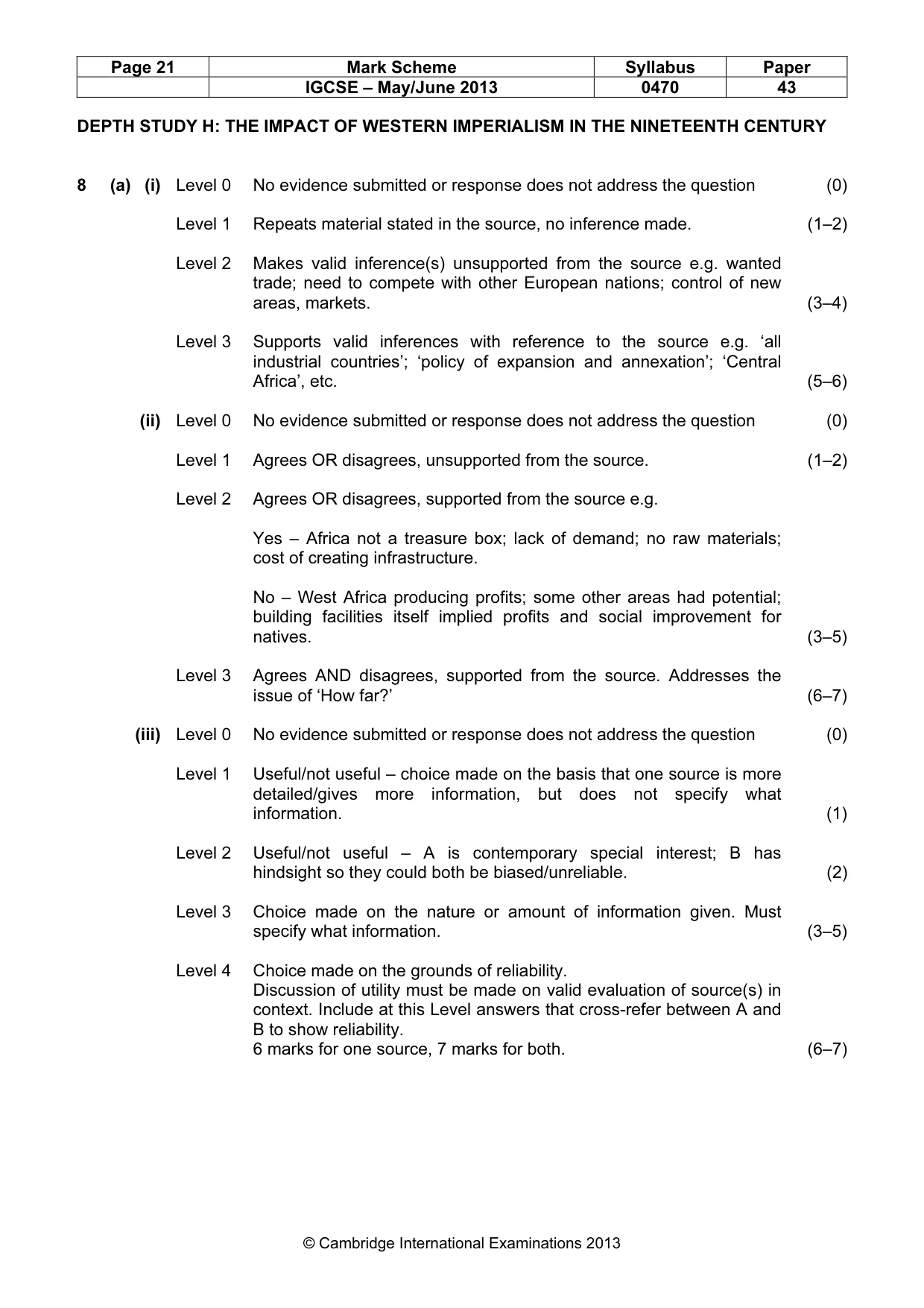
Page 21 Mark Scheme Syllabus Paper IGCSE – May/June 2013 0470 43 © Cambridge International Examinations 2013 DEPTH STUDY H: THE IMPACT OF WESTERN IMPERIALISM IN THE NINETEENTH CENTURY 8 (a) (i) Level 0 No evidence submitted or response does not address the question (0) Level 1 Repeats material stated in the source, no inference made. (1–2) Level 2 Makes valid inference(s) unsupported from the source e.g. wanted trade; need to compete with other European nations; control of new areas, markets. (3–4) Level 3 Supports valid inferences with reference to the source e.g. ‘all industrial countries’; ‘policy of expansion and annexation’; ‘Central Africa’, etc. (5–6) (ii) Level 0 No evidence submitted or response does not address the question (0) Level 1 Agrees OR disagrees, unsupported from the source. (1–2) Level 2 Agrees OR disagrees, supported from the source e.g. Yes – Africa not a treasure box; lack of demand; no raw materials; cost of creating infrastructure. No – West Africa producing profits; some other areas had potential; building facilities itself implied profits and social improvement for natives. (3–5) Level 3 Agrees AND disagrees, supported from the source. Addresses the issue of ‘How far?’ (6–7) (iii) Level 0 No evidence submitted or response does not address the question (0) Level 1 Useful/not useful – choice made on the basis that one source is more detailed/gives more information, but does not specify what information. (1) Level 2 Useful/not useful – A is contemporary special interest; B has hindsight so they could both be biased/unreliable. (2) Level 3 Choice made on the nature or amount of information given. Must specify what information. (3–5) Level 4 Choice made on the grounds of reliability. Discussion of utility must be made on valid evaluation of source(s) in context. Include at this Level answers that cross-refer between A and B to show reliability. 6 marks for one source, 7 marks for both. (6–7)
Mark scheme, page 22
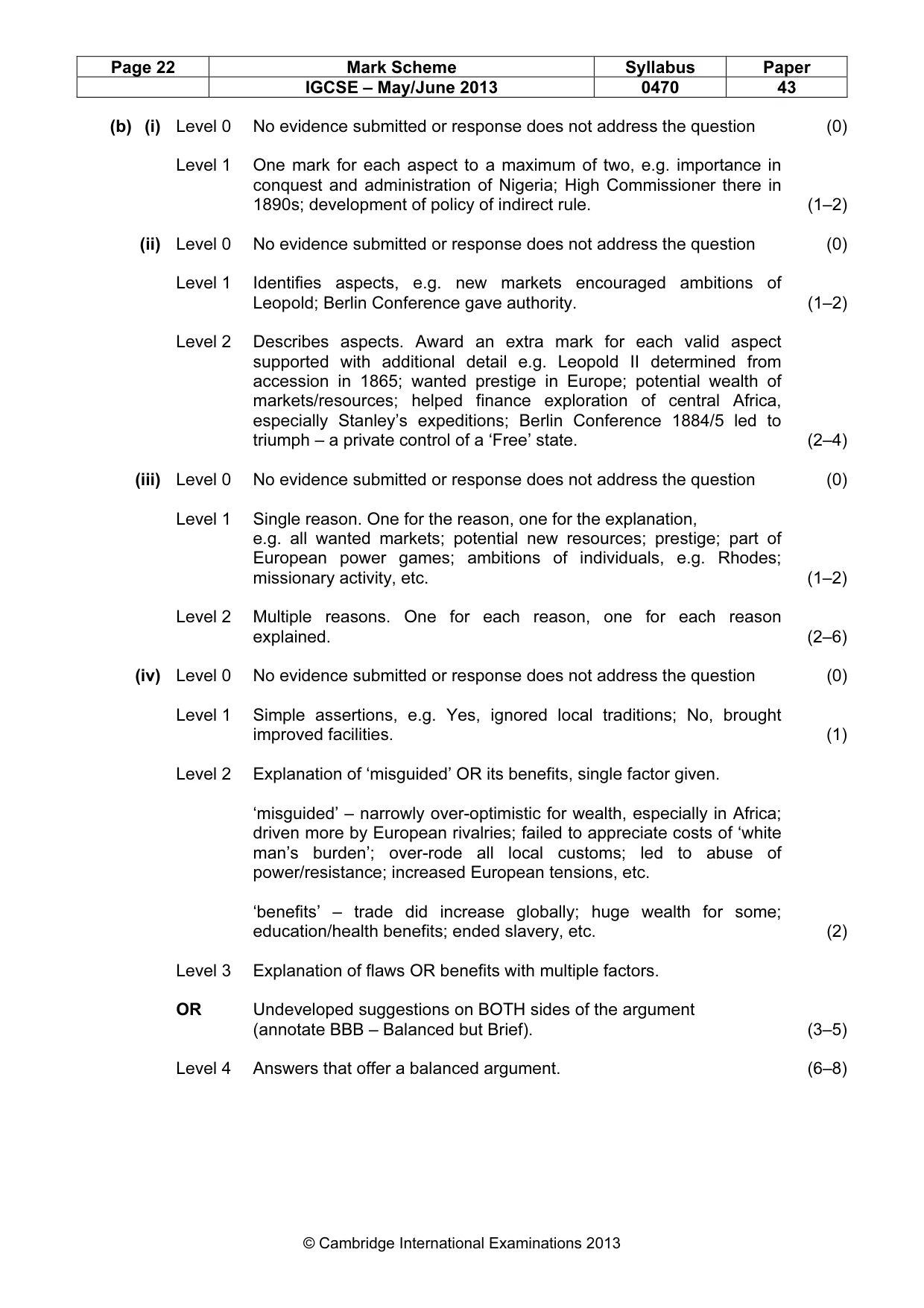
Page 22 Mark Scheme Syllabus Paper IGCSE – May/June 2013 0470 43 © Cambridge International Examinations 2013 (b) (i) Level 0 No evidence submitted or response does not address the question (0) Level 1 One mark for each aspect to a maximum of two, e.g. importance in conquest and administration of Nigeria; High Commissioner there in 1890s; development of policy of indirect rule. (1–2) (ii) Level 0 No evidence submitted or response does not address the question (0) Level 1 Identifies aspects, e.g. new markets encouraged ambitions of Leopold; Berlin Conference gave authority. (1–2) Level 2 Describes aspects. Award an extra mark for each valid aspect supported with additional detail e.g. Leopold II determined from accession in 1865; wanted prestige in Europe; potential wealth of markets/resources; helped finance exploration of central Africa, especially Stanley’s expeditions; Berlin Conference 1884/5 led to triumph – a private control of a ‘Free’ state. (2–4) (iii) Level 0 No evidence submitted or response does not address the question (0) Level 1 Single reason. One for the reason, one for the explanation, e.g. all wanted markets; potential new resources; prestige; part of European power games; ambitions of individuals, e.g. Rhodes; missionary activity, etc. (1–2) Level 2 Multiple reasons. One for each reason, one for each reason explained. (2–6) (iv) Level 0 No evidence submitted or response does not address the question (0) Level 1 Simple assertions, e.g. Yes, ignored local traditions; No, brought improved facilities. (1) Level 2 Explanation of ‘misguided’ OR its benefits, single factor given. ‘misguided’ – narrowly over-optimistic for wealth, especially in Africa; driven more by European rivalries; failed to appreciate costs of ‘white man’s burden’; over-rode all local customs; led to abuse of power/resistance; increased European tensions, etc. ‘benefits’ – trade did increase globally; huge wealth for some; education/health benefits; ended slavery, etc. (2) Level 3 Explanation of flaws OR benefits with multiple factors. OR Undeveloped suggestions on BOTH sides of the argument (annotate BBB – Balanced but Brief). (3–5) Level 4 Answers that offer a balanced argument. (6–8)
What you needed in this session
Cambridge’s own grade thresholds for 2013 May/June, Paper 4 · Variant 3. A higher threshold means an easier paper — the bar moves with how the cohort did.