Cambridge IGCSE History 0470 — 2013 May/June Paper 4 · Variant 2
0470/42/M/J/13 · 40 marks · ≈45 min
The question paper and its mark scheme, free to read here and free to download. This is Cambridge’s own paper, exactly as it was sat.
Question paper12 pages
Mark scheme18 pages
Answers below. Sit the paper first if you are practising.
Paper as text
Question paper, page 1
This document consists of 12 printed pages. DC (LEG/CGW) 66908/5 © UCLES 2013 [Turn over UNIVERSITY OF CAMBRIDGE INTERNATIONAL EXAMINATIONS International General Certificate of Secondary Education * 2 6 1 4 7 4 0 4 0 4 * HISTORY 0470/42 Paper 4 Alternative to Coursework May/June 2013 1 hour Additional Materials: Answer Booklet/Paper READ THESE INSTRUCTIONS FIRST If you have been given an Answer Booklet, follow the instructions on the front cover of the Booklet. Write your Centre number, candidate number and name on all the work you hand in. Write in dark blue or black pen. You may use a soft pencil for any diagrams, graphs or rough working. Do not use staples, paper clips, highlighters, glue or correction fluid. Answer the questions on one of the Depth Studies. At the end of the examination, fasten all your work securely together. The number of marks is given in brackets [ ] at the end of each question or part question.
Question paper, page 2
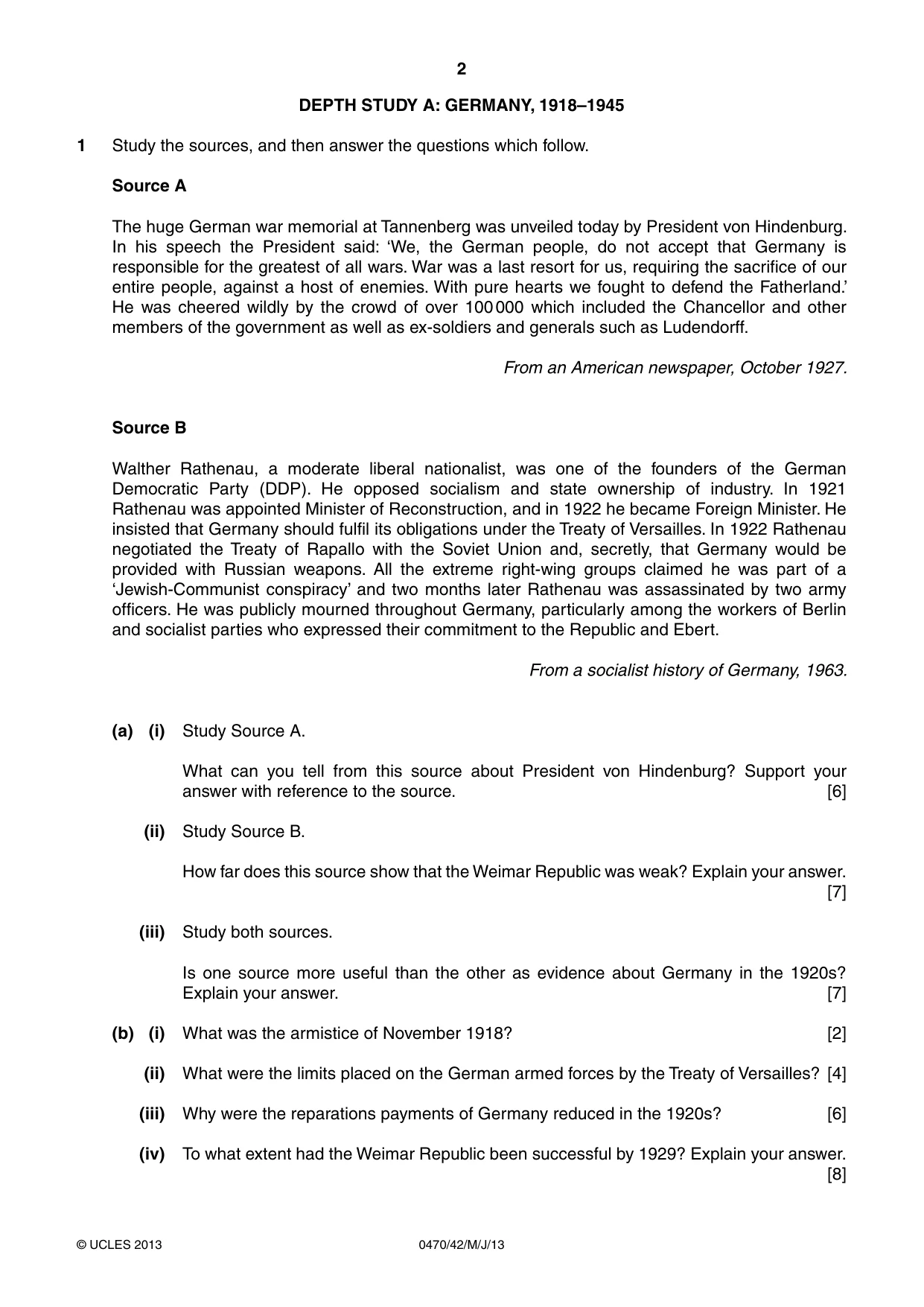
2 0470/42/M/J/13 © UCLES 2013 DEPTH STUDY A: GERMANY, 1918–1945 1 Study the sources, and then answer the questions which follow. Source A The huge German war memorial at Tannenberg was unveiled today by President von Hindenburg. In his speech the President said: ‘We, the German people, do not accept that Germany is responsible for the greatest of all wars. War was a last resort for us, requiring the sacrifice of our entire people, against a host of enemies. With pure hearts we fought to defend the Fatherland.’ He was cheered wildly by the crowd of over 100 000 which included the Chancellor and other members of the government as well as ex-soldiers and generals such as Ludendorff. From an American newspaper, October 1927. Source B Walther Rathenau, a moderate liberal nationalist, was one of the founders of the German Democratic Party (DDP). He opposed socialism and state ownership of industry. In 1921 Rathenau was appointed Minister of Reconstruction, and in 1922 he became Foreign Minister. He insisted that Germany should fulfil its obligations under the Treaty of Versailles. In 1922 Rathenau negotiated the Treaty of Rapallo with the Soviet Union and, secretly, that Germany would be provided with Russian weapons. All the extreme right-wing groups claimed he was part of a ‘Jewish-Communist conspiracy’ and two months later Rathenau was assassinated by two army officers. He was publicly mourned throughout Germany, particularly among the workers of Berlin and socialist parties who expressed their commitment to the Republic and Ebert. From a socialist history of Germany, 1963. (a) (i) Study Source A. What can you tell from this source about President von Hindenburg? Support your answer with reference to the source. [6] (ii) Study Source B. How far does this source show that the Weimar Republic was weak? Explain your answer. [7] (iii) Study both sources. Is one source more useful than the other as evidence about Germany in the 1920s? Explain your answer. [7] (b) (i) What was the armistice of November 1918? [2] (ii) What were the limits placed on the German armed forces by the Treaty of Versailles? [4] (iii) Why were the reparations payments of Germany reduced in the 1920s? [6] (iv) To what extent had the Weimar Republic been successful by 1929? Explain your answer. [8]
Question paper, page 3
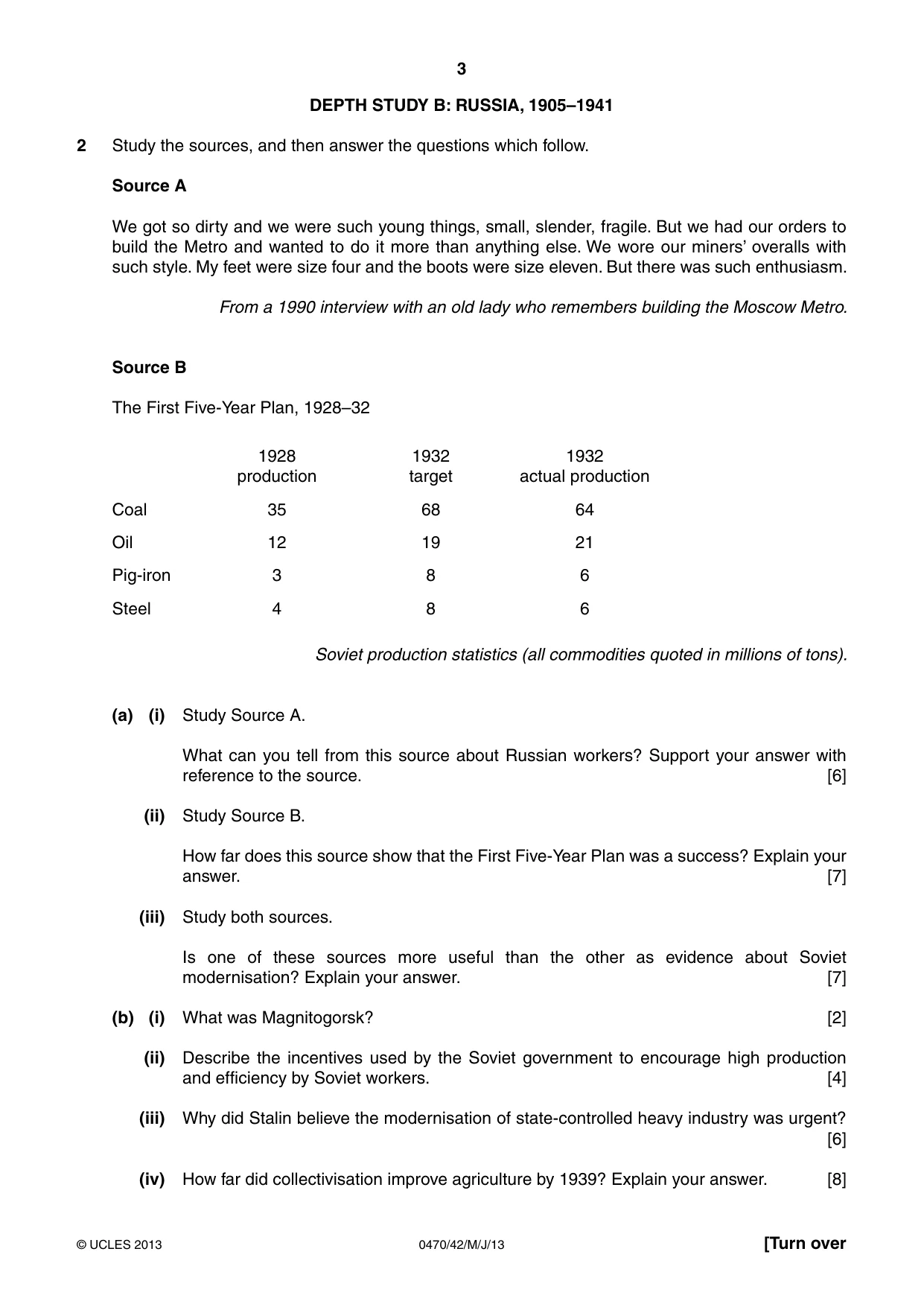
3 0470/42/M/J/13 © UCLES 2013 [Turn over DEPTH STUDY B: RUSSIA, 1905–1941 2 Study the sources, and then answer the questions which follow. Source A We got so dirty and we were such young things, small, slender, fragile. But we had our orders to build the Metro and wanted to do it more than anything else. We wore our miners’ overalls with such style. My feet were size four and the boots were size eleven. But there was such enthusiasm. From a 1990 interview with an old lady who remembers building the Moscow Metro. Source B The First Five-Year Plan, 1928–32 1928 production 1932 target 1932 actual production Coal 35 68 64 Oil 12 19 21 Pig-iron 3 8 6 Steel 4 8 6 Soviet production statistics (all commodities quoted in millions of tons). (a) (i) Study Source A. What can you tell from this source about Russian workers? Support your answer with reference to the source. [6] (ii) Study Source B. How far does this source show that the First Five-Year Plan was a success? Explain your answer. [7] (iii) Study both sources. Is one of these sources more useful than the other as evidence about Soviet modernisation? Explain your answer. [7] (b) (i) What was Magnitogorsk? [2] (ii) Describe the incentives used by the Soviet government to encourage high production and efficiency by Soviet workers. [4] (iii) Why did Stalin believe the modernisation of state-controlled heavy industry was urgent? [6] (iv) How far did collectivisation improve agriculture by 1939? Explain your answer. [8]
Question paper, page 4
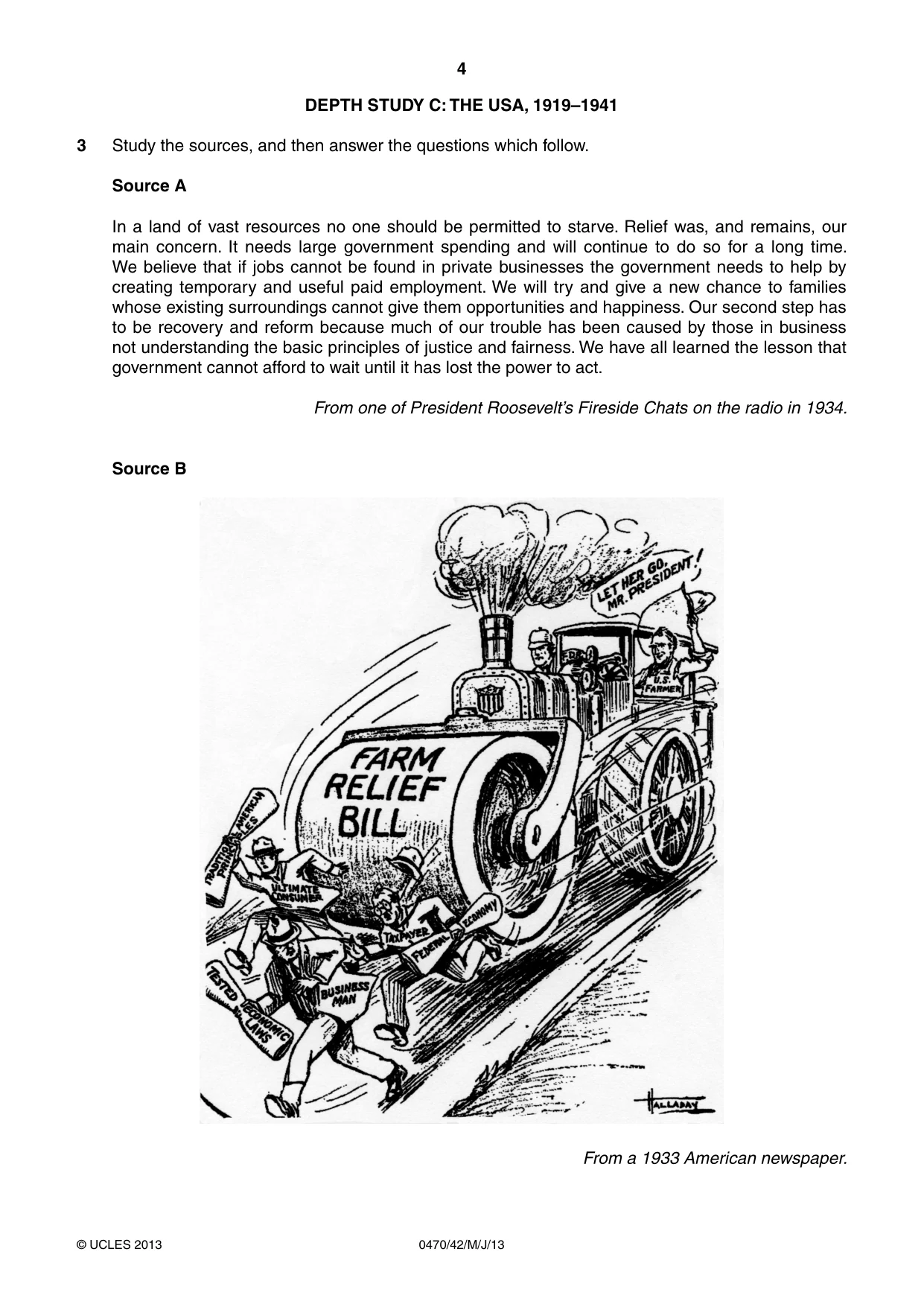
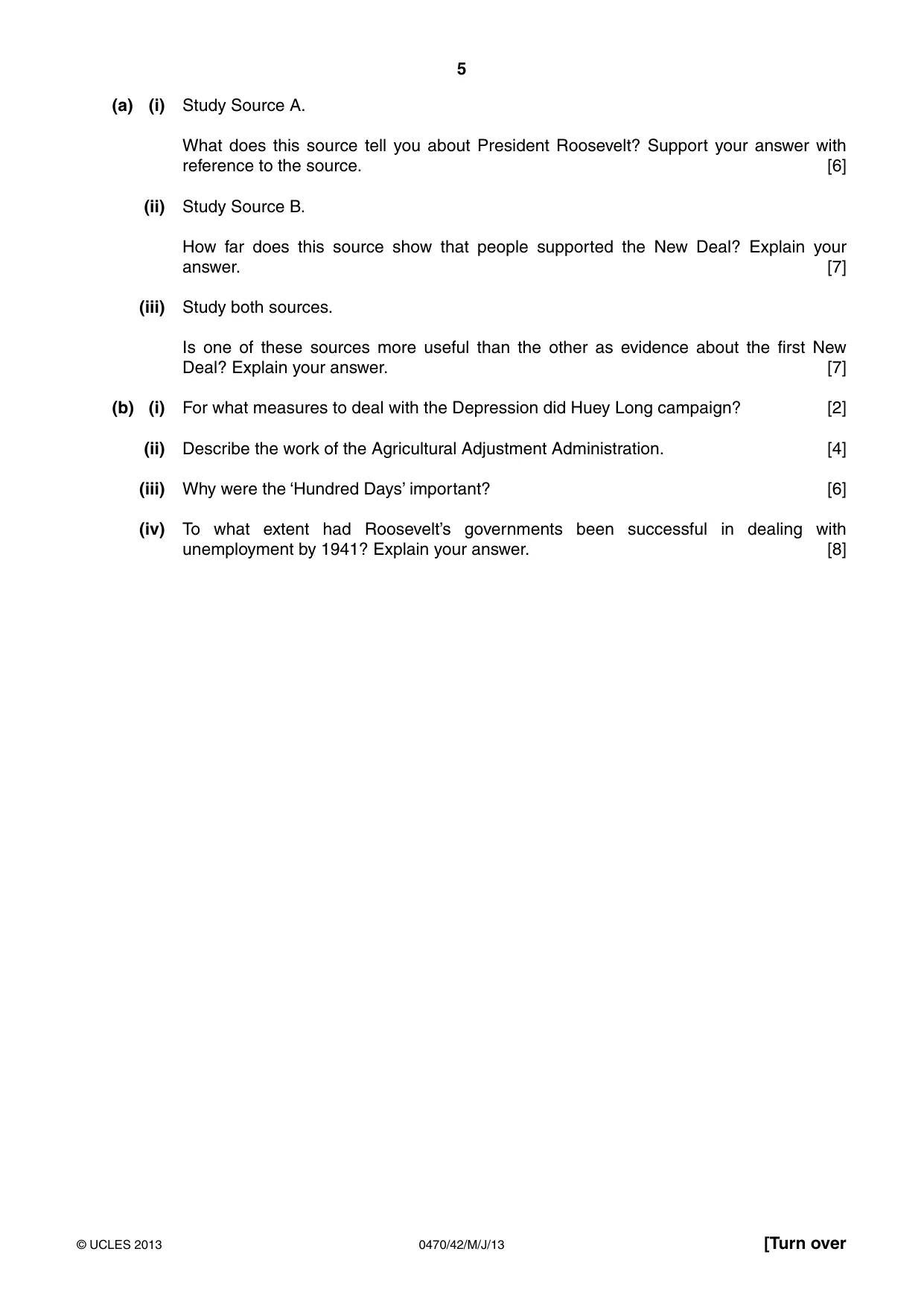
4 0470/42/M/J/13 © UCLES 2013 DEPTH STUDY C: THE USA, 1919–1941 3 Study the sources, and then answer the questions which follow. Source A In a land of vast resources no one should be permitted to starve. Relief was, and remains, our main concern. It needs large government spending and will continue to do so for a long time. We believe that if jobs cannot be found in private businesses the government needs to help by creating temporary and useful paid employment. We will try and give a new chance to families whose existing surroundings cannot give them opportunities and happiness. Our second step has to be recovery and reform because much of our trouble has been caused by those in business not understanding the basic principles of justice and fairness. We have all learned the lesson that government cannot afford to wait until it has lost the power to act. From one of President Roosevelt’s Fireside Chats on the radio in 1934. Source B From a 1933 American newspaper.
Question paper, page 5
5 0470/42/M/J/13 © UCLES 2013 [Turn over (a) (i) Study Source A. What does this source tell you about President Roosevelt? Support your answer with reference to the source. [6] (ii) Study Source B. How far does this source show that people supported the New Deal? Explain your answer. [7] (iii) Study both sources. Is one of these sources more useful than the other as evidence about the first New Deal? Explain your answer. [7] (b) (i) For what measures to deal with the Depression did Huey Long campaign? [2] (ii) Describe the work of the Agricultural Adjustment Administration. [4] (iii) Why were the ‘Hundred Days’ important? [6] (iv) To what extent had Roosevelt’s governments been successful in dealing with unemployment by 1941? Explain your answer. [8]
Question paper, page 6
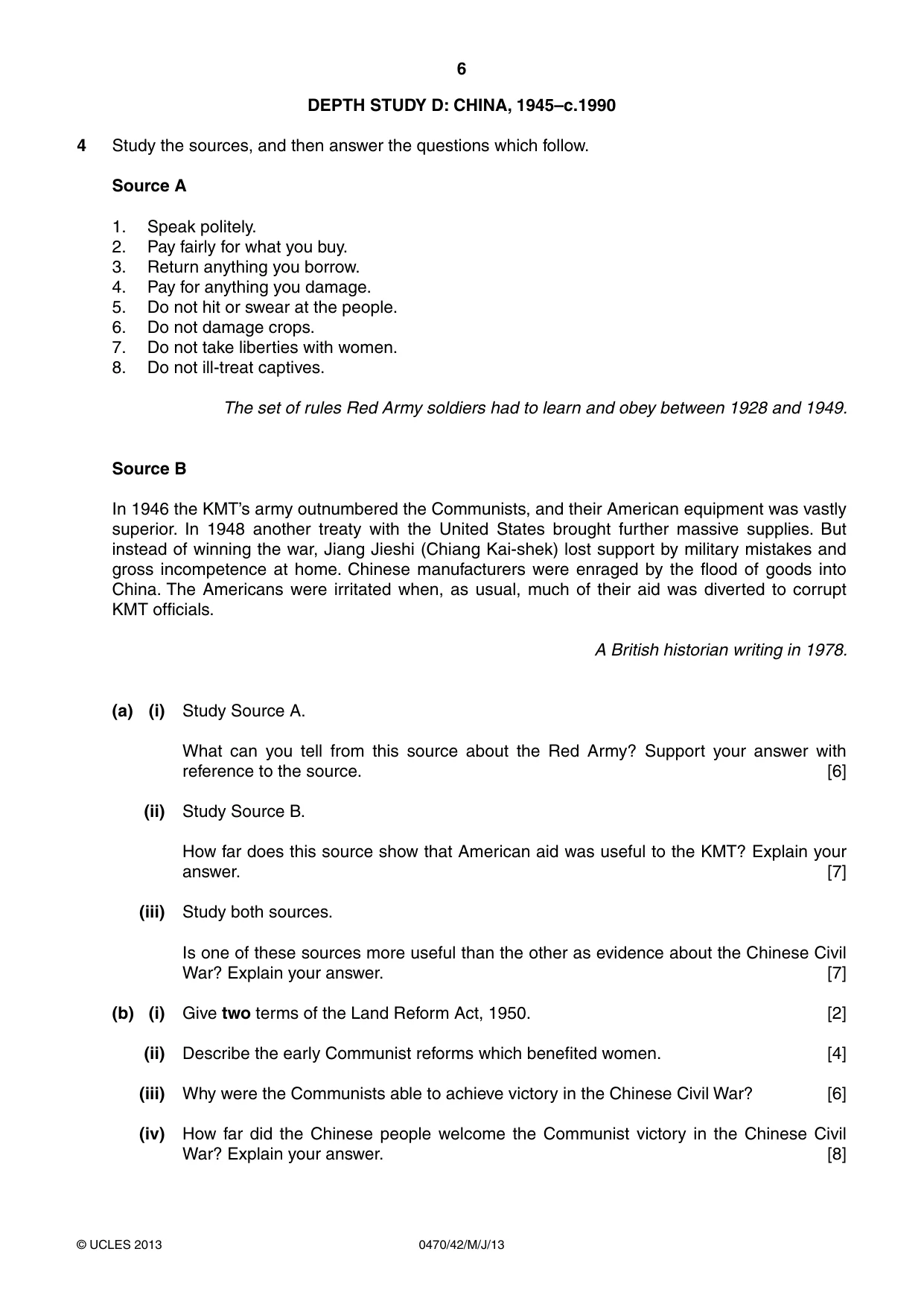
6 0470/42/M/J/13 © UCLES 2013 DEPTH STUDY D: CHINA, 1945–c.1990 4 Study the sources, and then answer the questions which follow. Source A 1. Speak politely. 2. Pay fairly for what you buy. 3. Return anything you borrow. 4. Pay for anything you damage. 5. Do not hit or swear at the people. 6. Do not damage crops. 7. Do not take liberties with women. 8. Do not ill-treat captives. The set of rules Red Army soldiers had to learn and obey between 1928 and 1949. Source B In 1946 the KMT’s army outnumbered the Communists, and their American equipment was vastly superior. In 1948 another treaty with the United States brought further massive supplies. But instead of winning the war, Jiang Jieshi (Chiang Kai-shek) lost support by military mistakes and gross incompetence at home. Chinese manufacturers were enraged by the flood of goods into China. The Americans were irritated when, as usual, much of their aid was diverted to corrupt KMT officials. A British historian writing in 1978. (a) (i) Study Source A. What can you tell from this source about the Red Army? Support your answer with reference to the source. [6] (ii) Study Source B. How far does this source show that American aid was useful to the KMT? Explain your answer. [7] (iii) Study both sources. Is one of these sources more useful than the other as evidence about the Chinese Civil War? Explain your answer. [7] (b) (i) Give two terms of the Land Reform Act, 1950. [2] (ii) Describe the early Communist reforms which benefited women. [4] (iii) Why were the Communists able to achieve victory in the Chinese Civil War? [6] (iv) How far did the Chinese people welcome the Communist victory in the Chinese Civil War? Explain your answer. [8]
Question paper, page 7
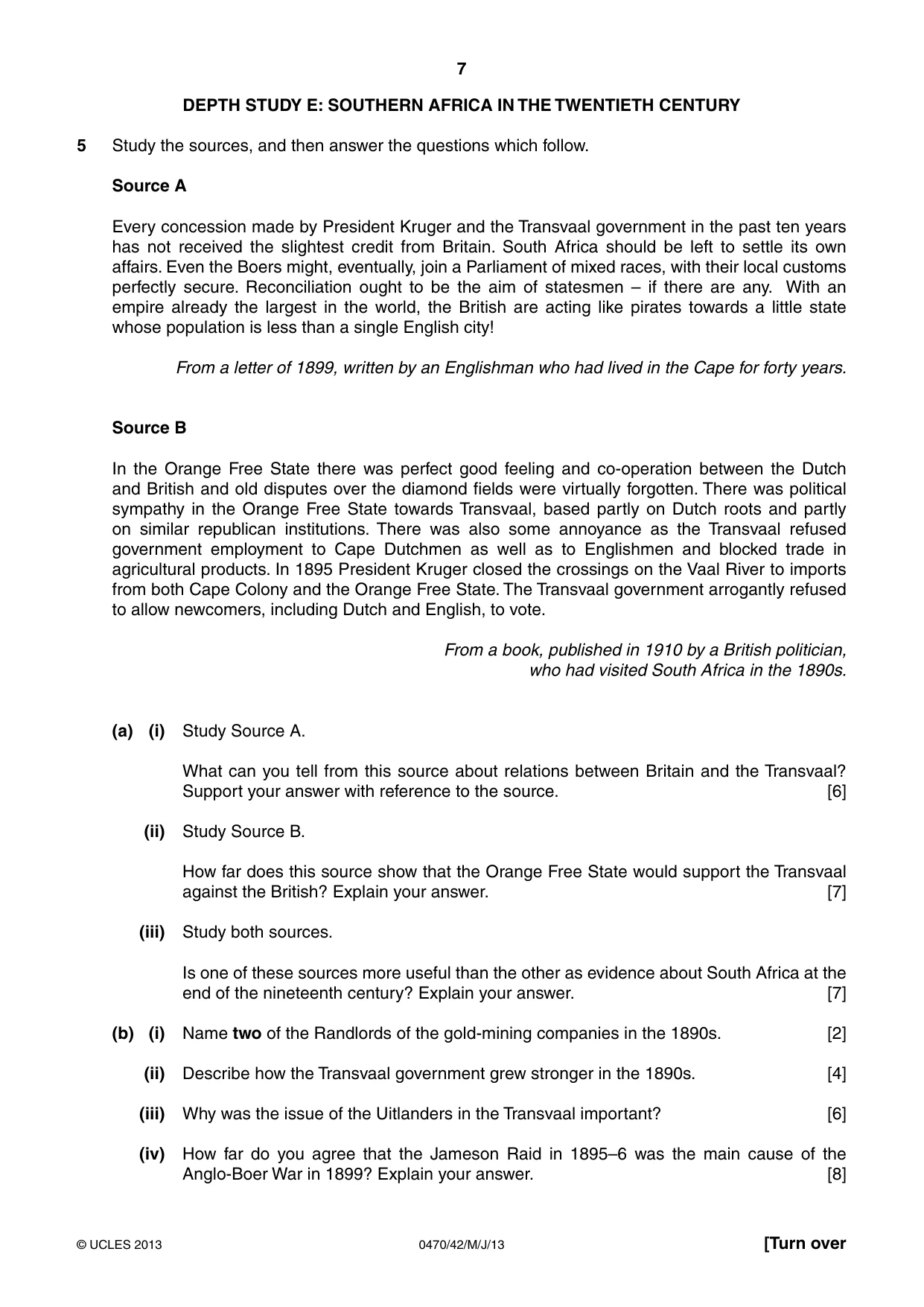
7 0470/42/M/J/13 © UCLES 2013 [Turn over DEPTH STUDY E: SOUTHERN AFRICA IN THE TWENTIETH CENTURY 5 Study the sources, and then answer the questions which follow. Source A Every concession made by President Kruger and the Transvaal government in the past ten years has not received the slightest credit from Britain. South Africa should be left to settle its own affairs. Even the Boers might, eventually, join a Parliament of mixed races, with their local customs perfectly secure. Reconciliation ought to be the aim of statesmen – if there are any. With an empire already the largest in the world, the British are acting like pirates towards a little state whose population is less than a single English city! From a letter of 1899, written by an Englishman who had lived in the Cape for forty years. Source B In the Orange Free State there was perfect good feeling and co-operation between the Dutch and British and old disputes over the diamond fields were virtually forgotten. There was political sympathy in the Orange Free State towards Transvaal, based partly on Dutch roots and partly on similar republican institutions. There was also some annoyance as the Transvaal refused government employment to Cape Dutchmen as well as to Englishmen and blocked trade in agricultural products. In 1895 President Kruger closed the crossings on the Vaal River to imports from both Cape Colony and the Orange Free State. The Transvaal government arrogantly refused to allow newcomers, including Dutch and English, to vote. From a book, published in 1910 by a British politician, who had visited South Africa in the 1890s. (a) (i) Study Source A. What can you tell from this source about relations between Britain and the Transvaal? Support your answer with reference to the source. [6] (ii) Study Source B. How far does this source show that the Orange Free State would support the Transvaal against the British? Explain your answer. [7] (iii) Study both sources. Is one of these sources more useful than the other as evidence about South Africa at the end of the nineteenth century? Explain your answer. [7] (b) (i) Name two of the Randlords of the gold-mining companies in the 1890s. [2] (ii) Describe how the Transvaal government grew stronger in the 1890s. [4] (iii) Why was the issue of the Uitlanders in the Transvaal important? [6] (iv) How far do you agree that the Jameson Raid in 1895–6 was the main cause of the Anglo-Boer War in 1899? Explain your answer. [8]
Question paper, page 8
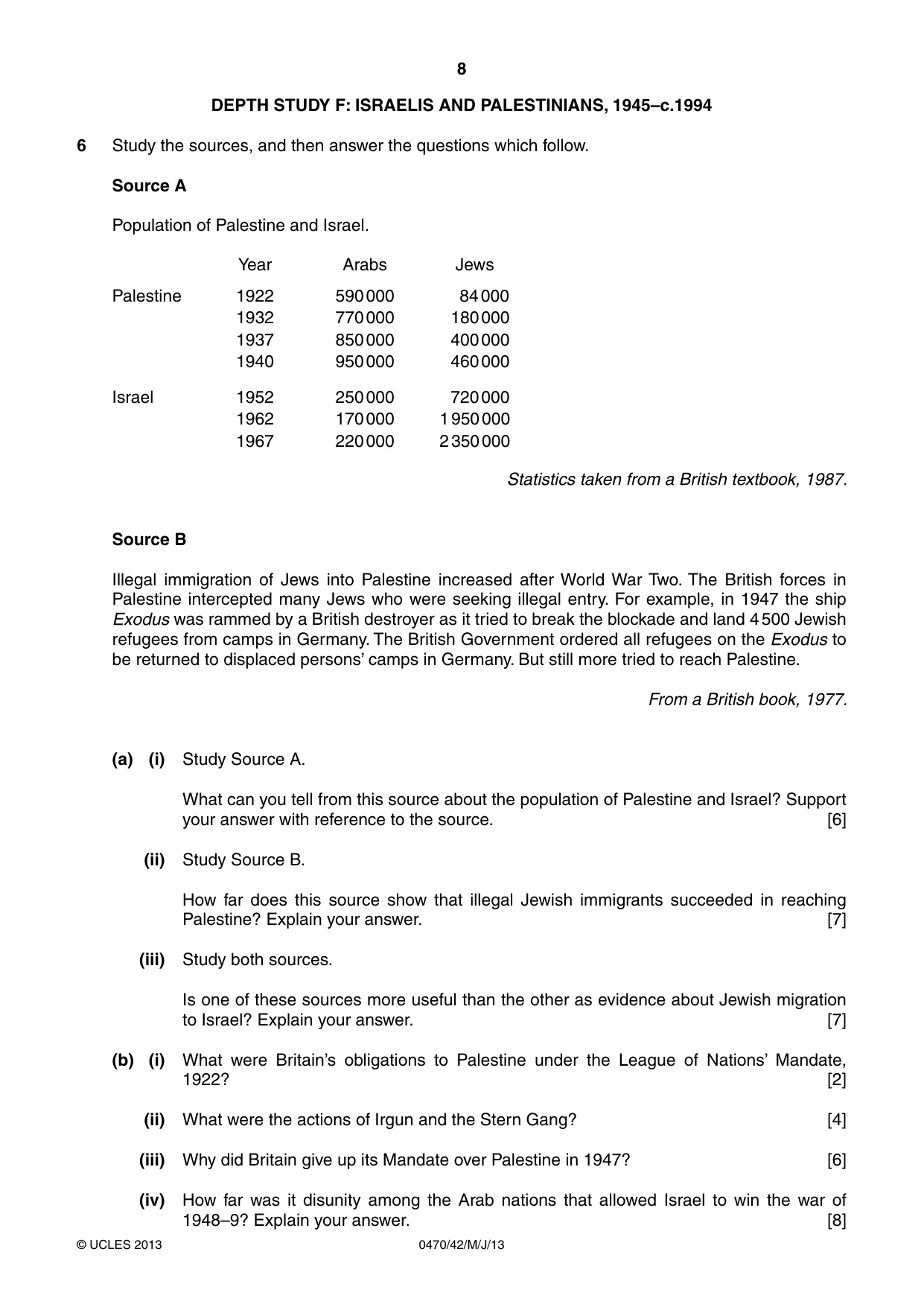
8 0470/42/M/J/13 © UCLES 2013 DEPTH STUDY F: ISRAELIS AND PALESTINIANS, 1945–c.1994 6 Study the sources, and then answer the questions which follow. Source A Population of Palestine and Israel. Year Arabs Jews Palestine 1922 590 000 84 000 1932 770 000 180 000 1937 850 000 400 000 1940 950 000 460 000 Israel 1952 250 000 720 000 1962 170 000 1 950 000 1967 220 000 2 350 000 Statistics taken from a British textbook, 1987. Source B Illegal immigration of Jews into Palestine increased after World War Two. The British forces in Palestine intercepted many Jews who were seeking illegal entry. For example, in 1947 the ship Exodus was rammed by a British destroyer as it tried to break the blockade and land 4 500 Jewish refugees from camps in Germany. The British Government ordered all refugees on the Exodus to be returned to displaced persons’ camps in Germany. But still more tried to reach Palestine. From a British book, 1977. (a) (i) Study Source A. What can you tell from this source about the population of Palestine and Israel? Support your answer with reference to the source. [6] (ii) Study Source B. How far does this source show that illegal Jewish immigrants succeeded in reaching Palestine? Explain your answer. [7] (iii) Study both sources. Is one of these sources more useful than the other as evidence about Jewish migration to Israel? Explain your answer. [7] (b) (i) What were Britain’s obligations to Palestine under the League of Nations’ Mandate, 1922? [2] (ii) What were the actions of Irgun and the Stern Gang? [4] (iii) Why did Britain give up its Mandate over Palestine in 1947? [6] (iv) How far was it disunity among the Arab nations that allowed Israel to win the war of 1948–9? Explain your answer. [8]
Question paper, page 9
9 0470/42/M/J/13 © UCLES 2013 [Turn over DEPTH STUDY G: THE CREATION OF MODERN INDUSTRIAL SOCIETY 7 Study the sources, and then answer the questions which follow. Source A Sketch made in 1859 of a Parliamentary train from London to the Midlands. Source B By 1870 the railways were now accessible to a large proportion of the population. But, although the railways were accepted and well used, they were not loved or even trusted. Some of their nicknames say it all: the Manchester, Sheffield and Lincolnshire company was the ‘Mucky, Slow and Lazy’, while the Oxford, Worcester and Wolverhampton was the ‘Old, Worse and Worse’. The task facing the railways in winning over the public was a complex one. When they tried to improve the comfort of their passengers their profitability went down. Competition and the parliamentary trains kept the fares down. From a book about railways published in 2007.
Question paper, page 10
10 0470/42/M/J/13 © UCLES 2013 (a) (i) Study Source A. What can you tell from this source about passenger traffic on the railways in 1859? Support your answer with reference to the source. [6] (ii) Study Source B. How far does this source show that railway companies cared about their passengers? Explain your answer. [7] (iii) Study both sources. Is one of these sources more useful than the other as evidence about railways? Explain your answer. [7] (b) (i) Name two important railway builders/engineers of the first half of the nineteenth century. [2] (ii) What problems did passengers face when using railways in the first half of the nineteenth century? [4] (iii) Why did railways grow so rapidly in the nineteenth century? [6] (iv) How far was the growth of industrial Britain in the nineteenth century due to the coming of the railways? Explain your answer. [8]
Question paper, page 11
11 0470/42/M/J/13 © UCLES 2013 [Turn over DEPTH STUDY H: THE IMPACT OF WESTERN IMPERIALISM IN THE NINETEENTH CENTURY 8 Study the sources, and then answer the questions which follow. Source A Dearest Madam, We your servants have joined together and thought it’s better to write you a nice loving letter which will tell you about our wishes. We wish to have your laws in our towns. We will do according to your Consul’s word. Plenty was here in our country. Plenty murder and plenty idol worshippers. We have spoken to the English Consul plenty times about having an English government here. We never have an answer from you, so we wish to write to you ourselves. When we heard about Calabar River, how they have English laws in their towns, and how they put away all superstitions, oh, we shall be very glad to be like Calabar now. We are etc. King Acqua, Prince Dido Acqua, Prince Black, Prince Joe Garner etc. A letter sent by the Kings of the Oil Rivers (Nigeria) to Queen Victoria in 1879. Source B How can we doubt that the French will take them? If there is one thing clearer than another, it seems to be that the French have a settled policy in Africa, both on the East and West coast, and that the policy is not in our interests. Railways are being laid in Senegal, and new trading stations recently established on the Ivory Coast and by Brazza in the Congo. The French agent is at work in the Niger delta and the captain of the French ships is trying to induce the natives at the mouths of that river to accept his treaties. If he succeeds in this, British trade will have no chance of existence except at the mercy of French officials. Action seems to be forced on us. Only one course seems possible and that is to take on ourselves the Protectorates of the native states at the mouth of the Oil Rivers and on the adjoining coast. The Head of the African Department at the British Foreign Office reporting to the government in 1883 about the Oil Rivers. (a) (i) Study Source A. What does this source tell you about African attitudes towards British imperialism? Support your answer with reference to the source. [6] (ii) Study Source B. How far does this source show that the main British aim in Africa was to outwit the French? Explain your answer. [7] (iii) Study both sources. Is one of these sources more useful than the other as evidence about the British in West Africa? Explain your answer. [7]
Question paper, page 12
12 0470/42/M/J/13 © UCLES 2013 (b) (i) Name two British colonies in West Africa in the nineteenth century. [2] (ii) What do you understand by the term ‘trade follows the flag’? [4] (iii) Why did Germany have fewer colonies in Africa than Britain by the end of the nineteenth century? [6] (iv) How far is the term ‘the Scramble for Africa’ justified? Explain your answer. [8] Copyright Acknowledgements: Depth Study A Source A © From an American newspaper; 1927. Depth Study A Source B © From a socialist history of Germany; 1963. Depth Study B Source A © Ben Walsh; Modern World History; Reproduced by permission of Hodder Education; 1996. Depth Study B Source B © Christopher Culpin; Making History; Published by Collins Educational. Reprinted by permission of HarperCollins Publishers. Collins Educational; 1984. Depth Study C Source A © From an American newspaper; 1933. Depth Study C Source B © From one of President Roosevelt’s Fireside Chats on the radio; 1934. Depth Study D Source A © Christopher Culpin; Making History; Published by Collins Educational. Reprinted by permission of HarperCollins Publishers. Collins Educational; 1984. Depth Study D Source B © Harriet Ward; World Powers of the Twentieth Century; Heinemann Books Ltd; 1978. Depth Study E Source A © From a letter of an Englishman who had lived in the Cape for forty years; 1899. Depth Study E Source B © From a British politician, who had visited South Africa in the 1890’s, in a book published in 1910. Depth Study F Source A © Bryn O’Callaghan; A History of the Twentieth Century; Published by Longman. Reprinted by permission of Pearson Education Ltd; 1987. Depth Study F Source B © Schools Council History Project; Arab Israeli Conflict; Holmes McDougall Ltd; 1997. Depth Study G Source A © Sketch made in 1859 of a Parliamentary Train from London to the Midlands. Depth Study H Source A © Text of a letter sent by the Kings of the Oil Rivers (Nigeria) to Queen Victoria; 1879. Depth Study H Source B © The Head of the African Department at the British Foreign Office reporting to the government in 1883 about the Oil Rivers. Permission to reproduce items where third-party owned material protected by copyright is included has been sought and cleared where possible. Every reasonable effort has been made by the publisher (UCLES) to trace copyright holders, but if any items requiring clearance have unwittingly been included, the publisher will be pleased to make amends at the earliest possible opportunity. University of Cambridge International Examinations is part of the Cambridge Assessment Group. Cambridge Assessment is the brand name of University of Cambridge Local Examinations Syndicate (UCLES), which is itself a department of the University of Cambridge.
Mark scheme, page 1
CAMBRIDGE INTERNATIONAL EXAMINATIONS International General Certificate of Secondary Education MARK SCHEME for the May/June 2013 series 0470 HISTORY 0470/42 Paper 4, (Alternative to Coursework), maximum raw mark 40 This mark scheme is published as an aid to teachers and candidates, to indicate the requirements of the examination. It shows the basis on which Examiners were instructed to award marks. It does not indicate the details of the discussions that took place at an Examiners’ meeting before marking began, which would have considered the acceptability of alternative answers. Mark schemes should be read in conjunction with the question paper and the Principal Examiner Report for Teachers. Cambridge will not enter into discussions about these mark schemes. Cambridge is publishing the mark schemes for the May/June 2013 series for most IGCSE, GCE Advanced Level and Advanced Subsidiary Level components and some Ordinary Level components.
Mark scheme, page 2
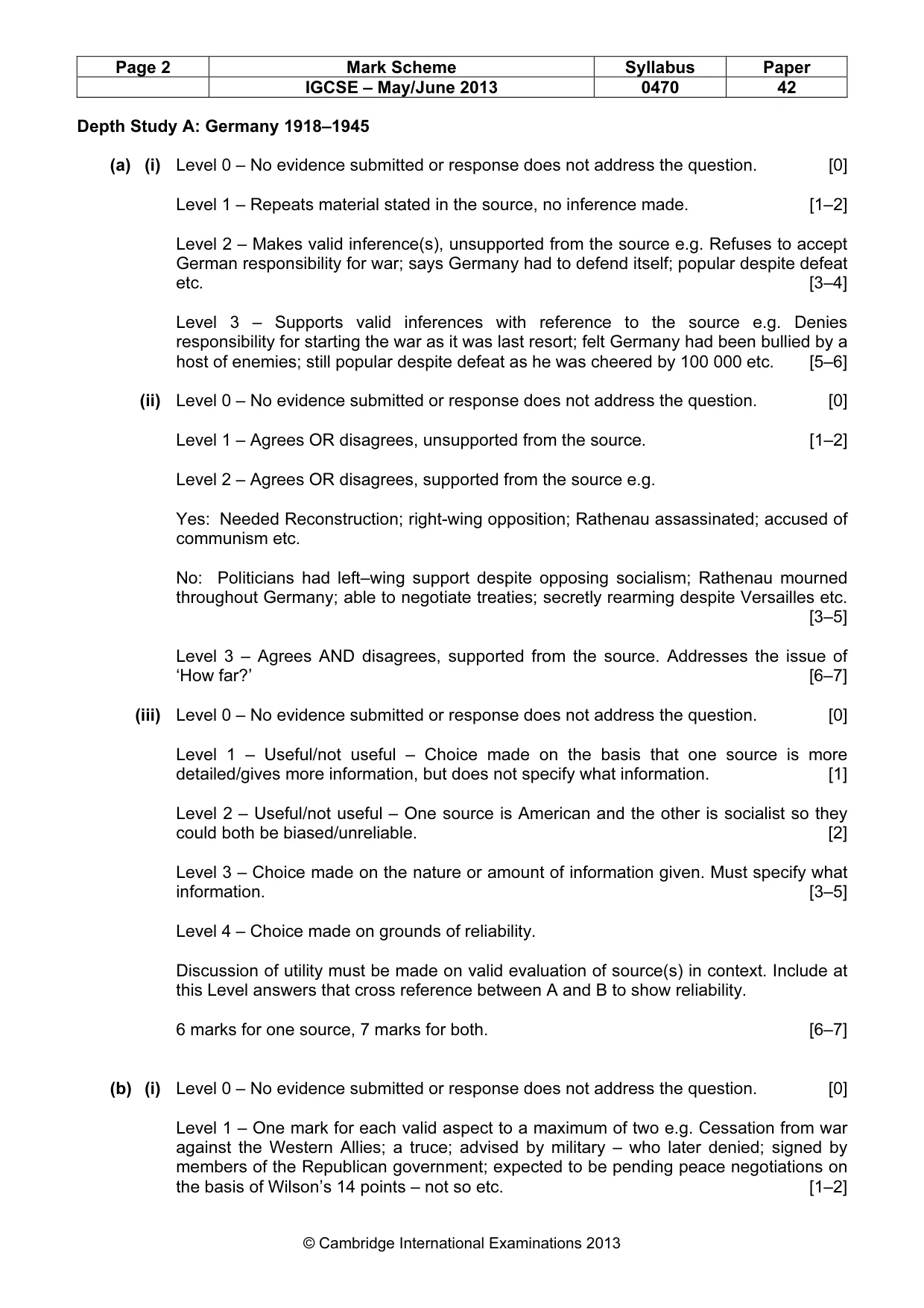
Page 2 Mark Scheme Syllabus Paper IGCSE – May/June 2013 0470 42 © Cambridge International Examinations 2013 Depth Study A: Germany 1918–1945 (a) (i) Level 0 – No evidence submitted or response does not address the question. [0] Level 1 – Repeats material stated in the source, no inference made. [1–2] Level 2 – Makes valid inference(s), unsupported from the source e.g. Refuses to accept German responsibility for war; says Germany had to defend itself; popular despite defeat etc. [3–4] Level 3 – Supports valid inferences with reference to the source e.g. Denies responsibility for starting the war as it was last resort; felt Germany had been bullied by a host of enemies; still popular despite defeat as he was cheered by 100 000 etc. [5–6] (ii) Level 0 – No evidence submitted or response does not address the question. [0] Level 1 – Agrees OR disagrees, unsupported from the source. [1–2] Level 2 – Agrees OR disagrees, supported from the source e.g. Yes: Needed Reconstruction; right-wing opposition; Rathenau assassinated; accused of communism etc. No: Politicians had left–wing support despite opposing socialism; Rathenau mourned throughout Germany; able to negotiate treaties; secretly rearming despite Versailles etc. [3–5] Level 3 – Agrees AND disagrees, supported from the source. Addresses the issue of ‘How far?’ [6–7] (iii) Level 0 – No evidence submitted or response does not address the question. [0] Level 1 – Useful/not useful – Choice made on the basis that one source is more detailed/gives more information, but does not specify what information. [1] Level 2 – Useful/not useful – One source is American and the other is socialist so they could both be biased/unreliable. [2] Level 3 – Choice made on the nature or amount of information given. Must specify what information. [3–5] Level 4 – Choice made on grounds of reliability. Discussion of utility must be made on valid evaluation of source(s) in context. Include at this Level answers that cross reference between A and B to show reliability. 6 marks for one source, 7 marks for both. [6–7] (b) (i) Level 0 – No evidence submitted or response does not address the question. [0] Level 1 – One mark for each valid aspect to a maximum of two e.g. Cessation from war against the Western Allies; a truce; advised by military – who later denied; signed by members of the Republican government; expected to be pending peace negotiations on the basis of Wilson’s 14 points – not so etc. [1–2]
Mark scheme, page 3
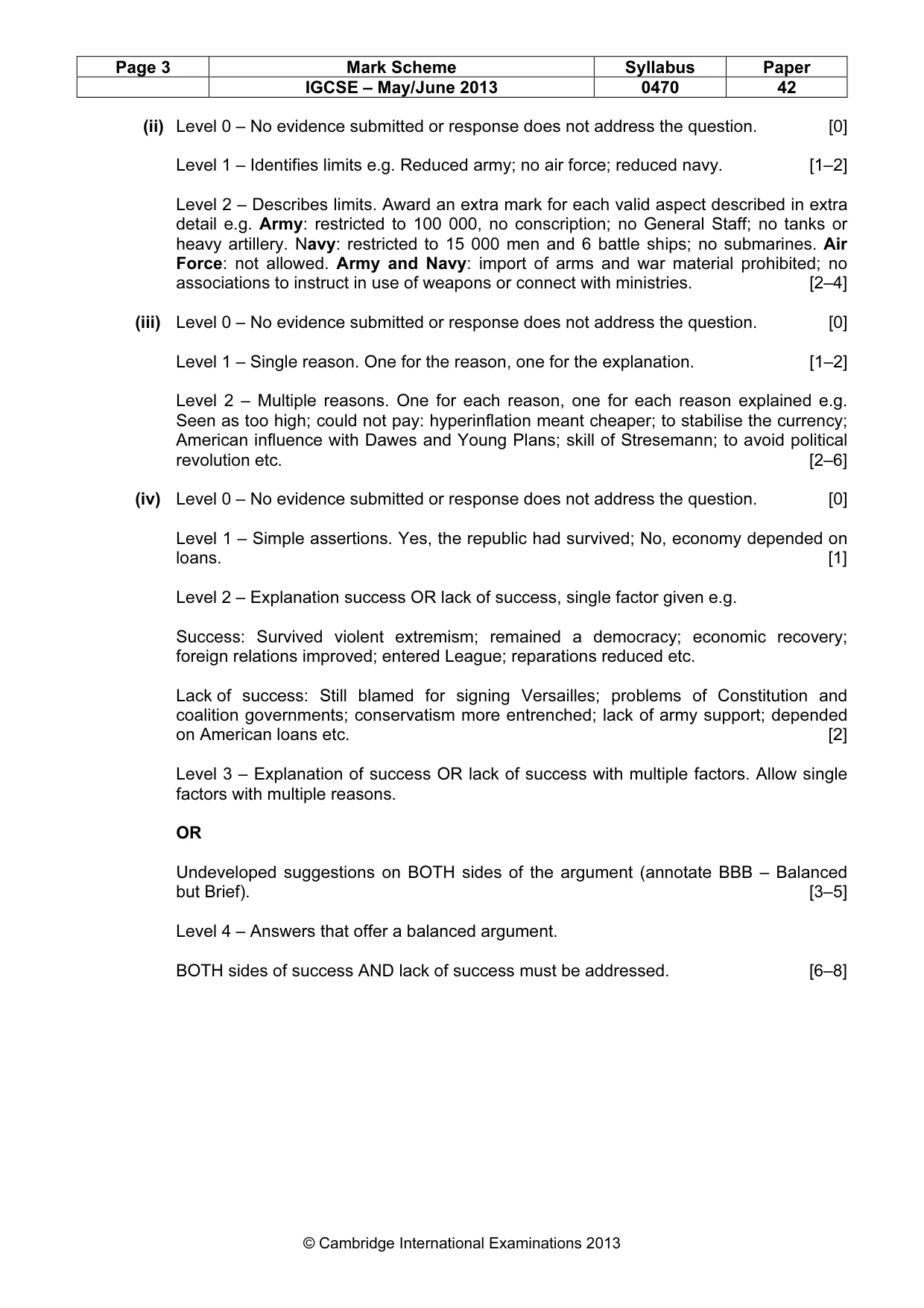
Page 3 Mark Scheme Syllabus Paper IGCSE – May/June 2013 0470 42 © Cambridge International Examinations 2013 (ii) Level 0 – No evidence submitted or response does not address the question. [0] Level 1 – Identifies limits e.g. Reduced army; no air force; reduced navy. [1–2] Level 2 – Describes limits. Award an extra mark for each valid aspect described in extra detail e.g. Army: restricted to 100 000, no conscription; no General Staff; no tanks or heavy artillery. Navy: restricted to 15 000 men and 6 battle ships; no submarines. Air Force: not allowed. Army and Navy: import of arms and war material prohibited; no associations to instruct in use of weapons or connect with ministries. [2–4] (iii) Level 0 – No evidence submitted or response does not address the question. [0] Level 1 – Single reason. One for the reason, one for the explanation. [1–2] Level 2 – Multiple reasons. One for each reason, one for each reason explained e.g. Seen as too high; could not pay: hyperinflation meant cheaper; to stabilise the currency; American influence with Dawes and Young Plans; skill of Stresemann; to avoid political revolution etc. [2–6] (iv) Level 0 – No evidence submitted or response does not address the question. [0] Level 1 – Simple assertions. Yes, the republic had survived; No, economy depended on loans. [1] Level 2 – Explanation success OR lack of success, single factor given e.g. Success: Survived violent extremism; remained a democracy; economic recovery; foreign relations improved; entered League; reparations reduced etc. Lack of success: Still blamed for signing Versailles; problems of Constitution and coalition governments; conservatism more entrenched; lack of army support; depended on American loans etc. [2] Level 3 – Explanation of success OR lack of success with multiple factors. Allow single factors with multiple reasons. OR Undeveloped suggestions on BOTH sides of the argument (annotate BBB – Balanced but Brief). [3–5] Level 4 – Answers that offer a balanced argument. BOTH sides of success AND lack of success must be addressed. [6–8]
Mark scheme, page 4
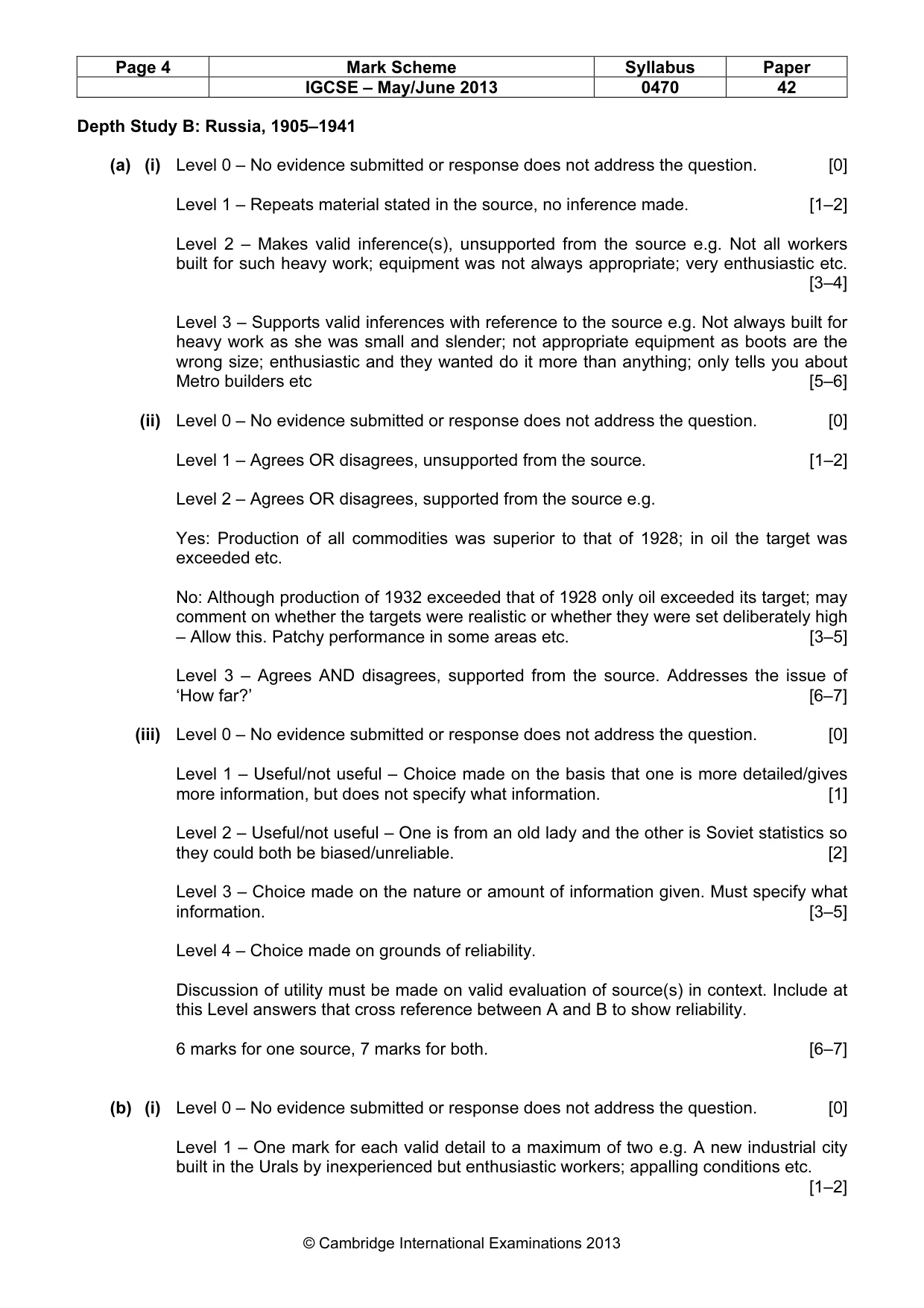
Page 4 Mark Scheme Syllabus Paper IGCSE – May/June 2013 0470 42 © Cambridge International Examinations 2013 Depth Study B: Russia, 1905–1941 (a) (i) Level 0 – No evidence submitted or response does not address the question. [0] Level 1 – Repeats material stated in the source, no inference made. [1–2] Level 2 – Makes valid inference(s), unsupported from the source e.g. Not all workers built for such heavy work; equipment was not always appropriate; very enthusiastic etc. [3–4] Level 3 – Supports valid inferences with reference to the source e.g. Not always built for heavy work as she was small and slender; not appropriate equipment as boots are the wrong size; enthusiastic and they wanted do it more than anything; only tells you about Metro builders etc [5–6] (ii) Level 0 – No evidence submitted or response does not address the question. [0] Level 1 – Agrees OR disagrees, unsupported from the source. [1–2] Level 2 – Agrees OR disagrees, supported from the source e.g. Yes: Production of all commodities was superior to that of 1928; in oil the target was exceeded etc. No: Although production of 1932 exceeded that of 1928 only oil exceeded its target; may comment on whether the targets were realistic or whether they were set deliberately high – Allow this. Patchy performance in some areas etc. [3–5] Level 3 – Agrees AND disagrees, supported from the source. Addresses the issue of ‘How far?’ [6–7] (iii) Level 0 – No evidence submitted or response does not address the question. [0] Level 1 – Useful/not useful – Choice made on the basis that one is more detailed/gives more information, but does not specify what information. [1] Level 2 – Useful/not useful – One is from an old lady and the other is Soviet statistics so they could both be biased/unreliable. [2] Level 3 – Choice made on the nature or amount of information given. Must specify what information. [3–5] Level 4 – Choice made on grounds of reliability. Discussion of utility must be made on valid evaluation of source(s) in context. Include at this Level answers that cross reference between A and B to show reliability. 6 marks for one source, 7 marks for both. [6–7] (b) (i) Level 0 – No evidence submitted or response does not address the question. [0] Level 1 – One mark for each valid detail to a maximum of two e.g. A new industrial city built in the Urals by inexperienced but enthusiastic workers; appalling conditions etc. [1–2]
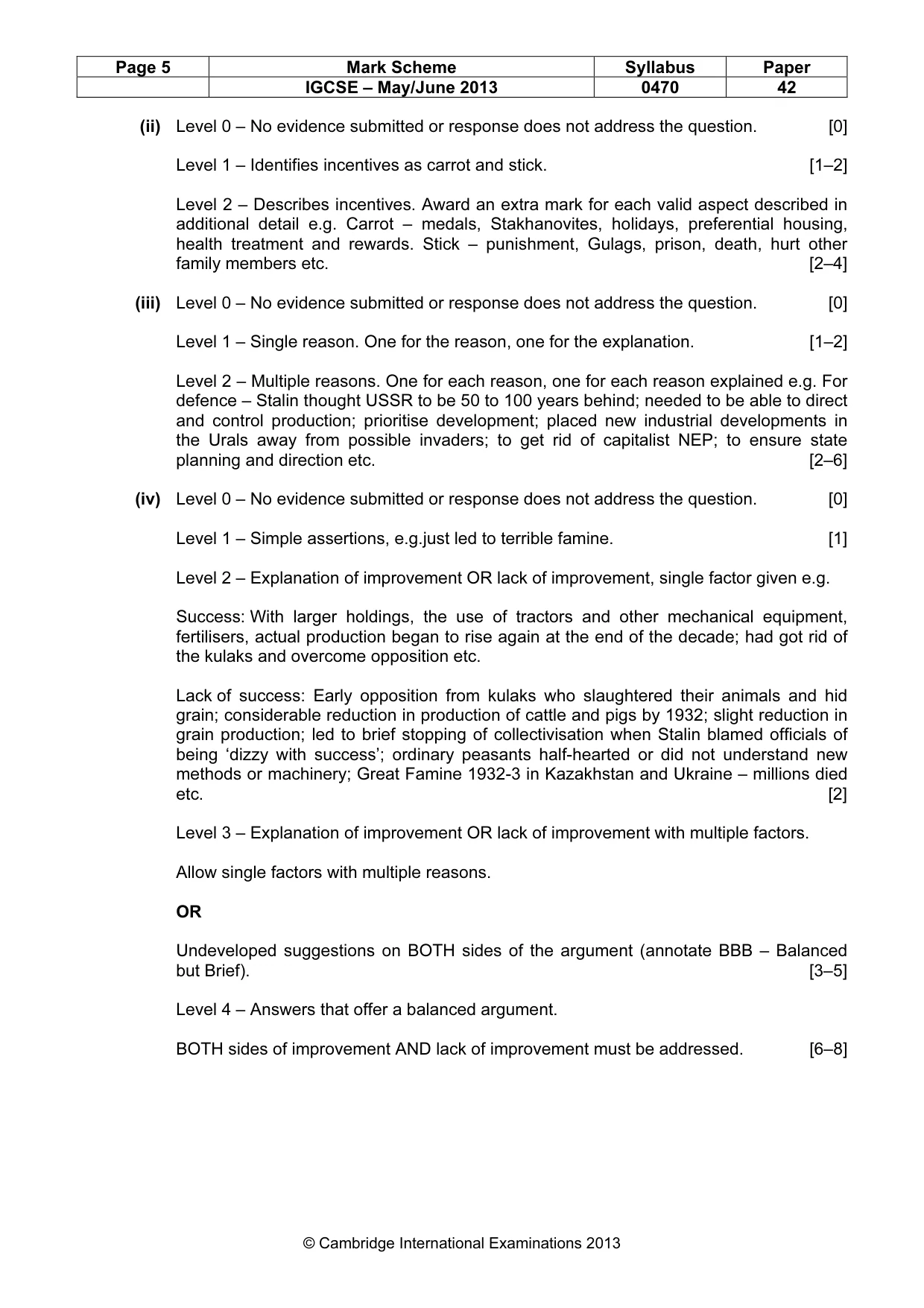
Mark scheme, page 5
Page 5 Mark Scheme Syllabus Paper IGCSE – May/June 2013 0470 42 © Cambridge International Examinations 2013 (ii) Level 0 – No evidence submitted or response does not address the question. [0] Level 1 – Identifies incentives as carrot and stick. [1–2] Level 2 – Describes incentives. Award an extra mark for each valid aspect described in additional detail e.g. Carrot – medals, Stakhanovites, holidays, preferential housing, health treatment and rewards. Stick – punishment, Gulags, prison, death, hurt other family members etc. [2–4] (iii) Level 0 – No evidence submitted or response does not address the question. [0] Level 1 – Single reason. One for the reason, one for the explanation. [1–2] Level 2 – Multiple reasons. One for each reason, one for each reason explained e.g. For defence – Stalin thought USSR to be 50 to 100 years behind; needed to be able to direct and control production; prioritise development; placed new industrial developments in the Urals away from possible invaders; to get rid of capitalist NEP; to ensure state planning and direction etc. [2–6] (iv) Level 0 – No evidence submitted or response does not address the question. [0] Level 1 – Simple assertions, e.g.just led to terrible famine. [1] Level 2 – Explanation of improvement OR lack of improvement, single factor given e.g. Success: With larger holdings, the use of tractors and other mechanical equipment, fertilisers, actual production began to rise again at the end of the decade; had got rid of the kulaks and overcome opposition etc. Lack of success: Early opposition from kulaks who slaughtered their animals and hid grain; considerable reduction in production of cattle and pigs by 1932; slight reduction in grain production; led to brief stopping of collectivisation when Stalin blamed officials of being ‘dizzy with success’; ordinary peasants half-hearted or did not understand new methods or machinery; Great Famine 1932-3 in Kazakhstan and Ukraine – millions died etc. [2] Level 3 – Explanation of improvement OR lack of improvement with multiple factors. Allow single factors with multiple reasons. OR Undeveloped suggestions on BOTH sides of the argument (annotate BBB – Balanced but Brief). [3–5] Level 4 – Answers that offer a balanced argument. BOTH sides of improvement AND lack of improvement must be addressed. [6–8]
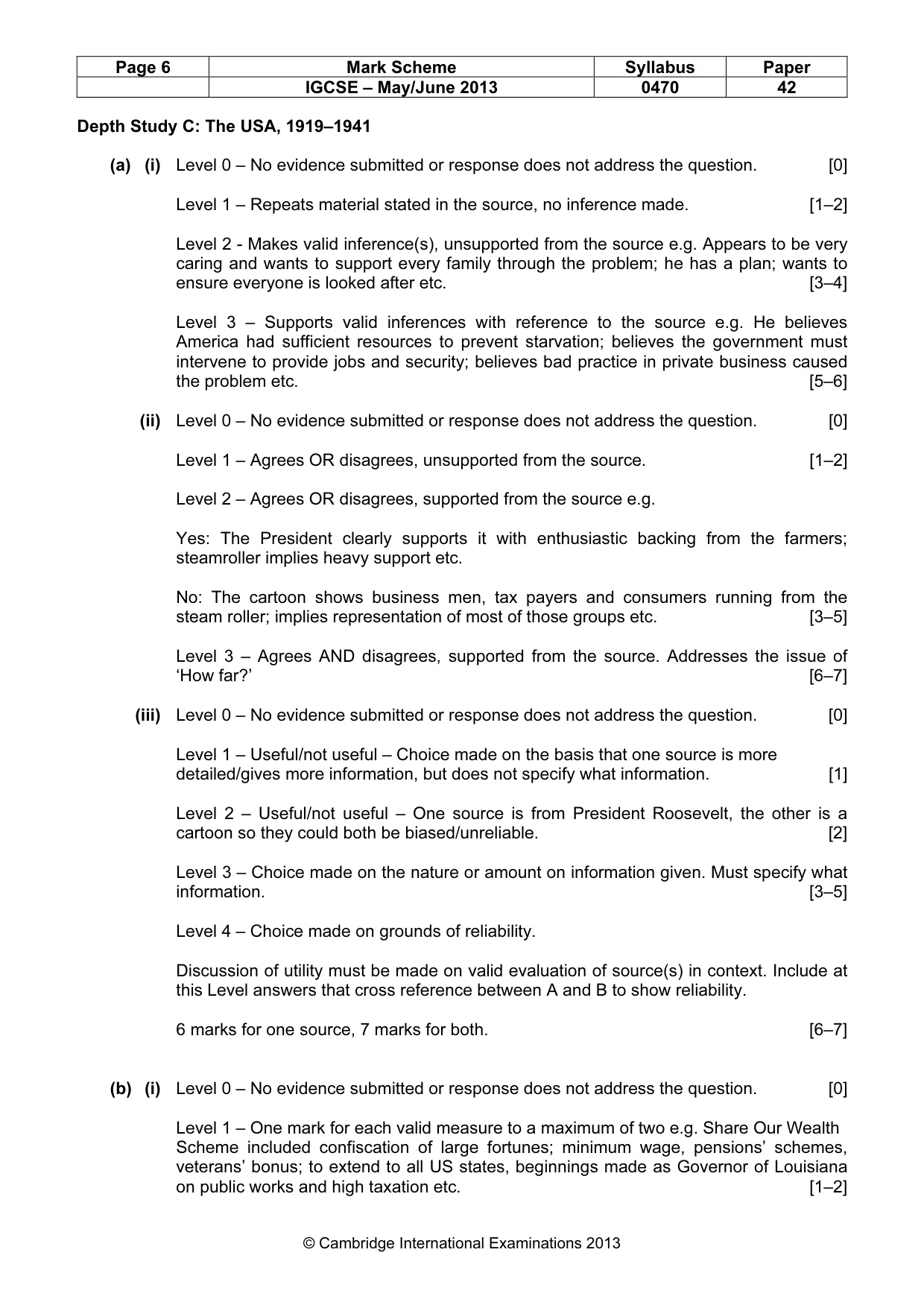
Mark scheme, page 6
Page 6 Mark Scheme Syllabus Paper IGCSE – May/June 2013 0470 42 © Cambridge International Examinations 2013 Depth Study C: The USA, 1919–1941 (a) (i) Level 0 – No evidence submitted or response does not address the question. [0] Level 1 – Repeats material stated in the source, no inference made. [1–2] Level 2 - Makes valid inference(s), unsupported from the source e.g. Appears to be very caring and wants to support every family through the problem; he has a plan; wants to ensure everyone is looked after etc. [3–4] Level 3 – Supports valid inferences with reference to the source e.g. He believes America had sufficient resources to prevent starvation; believes the government must intervene to provide jobs and security; believes bad practice in private business caused the problem etc. [5–6] (ii) Level 0 – No evidence submitted or response does not address the question. [0] Level 1 – Agrees OR disagrees, unsupported from the source. [1–2] Level 2 – Agrees OR disagrees, supported from the source e.g. Yes: The President clearly supports it with enthusiastic backing from the farmers; steamroller implies heavy support etc. No: The cartoon shows business men, tax payers and consumers running from the steam roller; implies representation of most of those groups etc. [3–5] Level 3 – Agrees AND disagrees, supported from the source. Addresses the issue of ‘How far?’ [6–7] (iii) Level 0 – No evidence submitted or response does not address the question. [0] Level 1 – Useful/not useful – Choice made on the basis that one source is more detailed/gives more information, but does not specify what information. [1] Level 2 – Useful/not useful – One source is from President Roosevelt, the other is a cartoon so they could both be biased/unreliable. [2] Level 3 – Choice made on the nature or amount on information given. Must specify what information. [3–5] Level 4 – Choice made on grounds of reliability. Discussion of utility must be made on valid evaluation of source(s) in context. Include at this Level answers that cross reference between A and B to show reliability. 6 marks for one source, 7 marks for both. [6–7] (b) (i) Level 0 – No evidence submitted or response does not address the question. [0] Level 1 – One mark for each valid measure to a maximum of two e.g. Share Our Wealth Scheme included confiscation of large fortunes; minimum wage, pensions’ schemes, veterans’ bonus; to extend to all US states, beginnings made as Governor of Louisiana on public works and high taxation etc. [1–2]
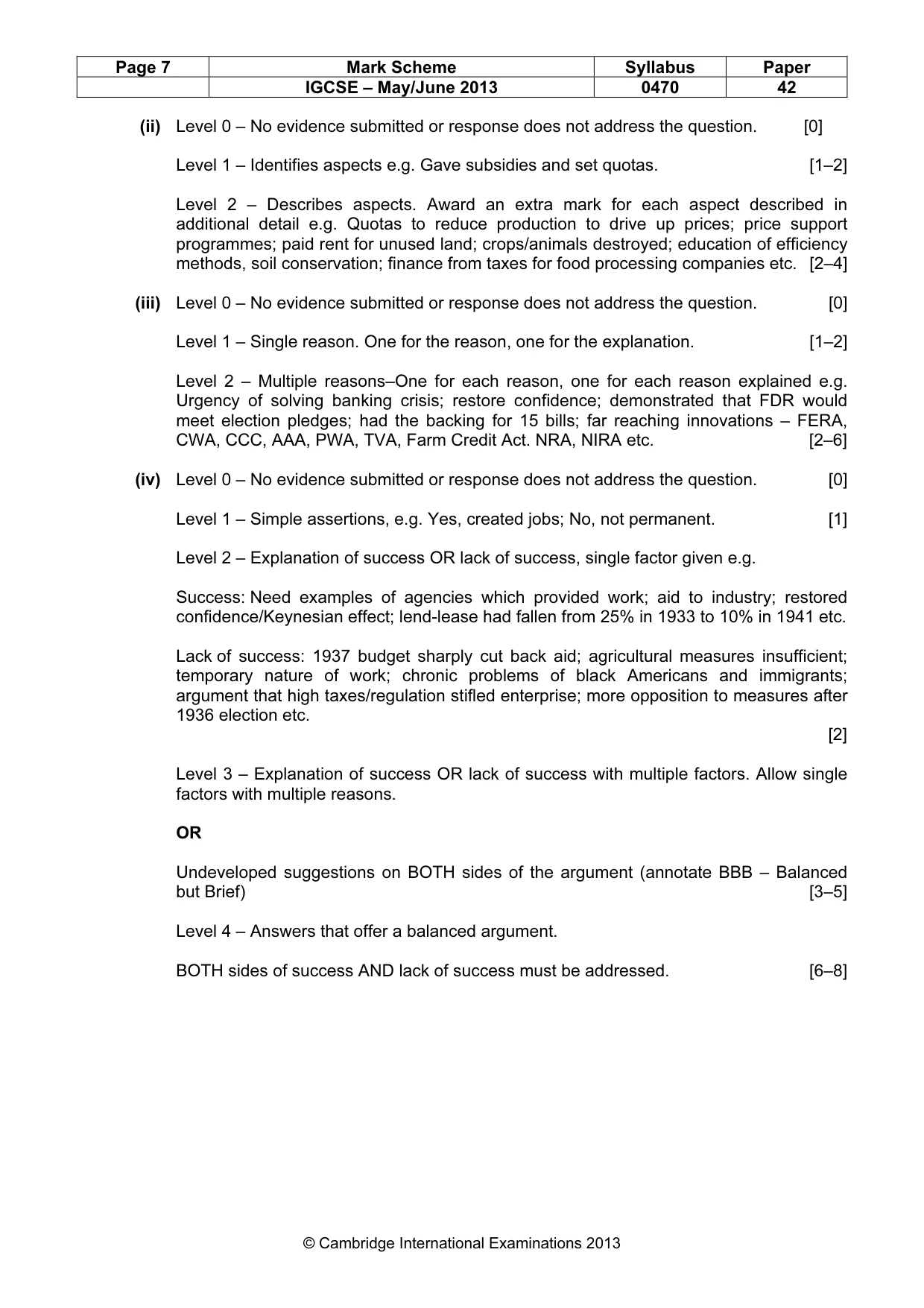
Mark scheme, page 7
Page 7 Mark Scheme Syllabus Paper IGCSE – May/June 2013 0470 42 © Cambridge International Examinations 2013 (ii) Level 0 – No evidence submitted or response does not address the question. [0] Level 1 – Identifies aspects e.g. Gave subsidies and set quotas. [1–2] Level 2 – Describes aspects. Award an extra mark for each aspect described in additional detail e.g. Quotas to reduce production to drive up prices; price support programmes; paid rent for unused land; crops/animals destroyed; education of efficiency methods, soil conservation; finance from taxes for food processing companies etc. [2–4] (iii) Level 0 – No evidence submitted or response does not address the question. [0] Level 1 – Single reason. One for the reason, one for the explanation. [1–2] Level 2 – Multiple reasons–One for each reason, one for each reason explained e.g. Urgency of solving banking crisis; restore confidence; demonstrated that FDR would meet election pledges; had the backing for 15 bills; far reaching innovations – FERA, CWA, CCC, AAA, PWA, TVA, Farm Credit Act. NRA, NIRA etc. [2–6] (iv) Level 0 – No evidence submitted or response does not address the question. [0] Level 1 – Simple assertions, e.g. Yes, created jobs; No, not permanent. [1] Level 2 – Explanation of success OR lack of success, single factor given e.g. Success: Need examples of agencies which provided work; aid to industry; restored confidence/Keynesian effect; lend-lease had fallen from 25% in 1933 to 10% in 1941 etc. Lack of success: 1937 budget sharply cut back aid; agricultural measures insufficient; temporary nature of work; chronic problems of black Americans and immigrants; argument that high taxes/regulation stifled enterprise; more opposition to measures after 1936 election etc. [2] Level 3 – Explanation of success OR lack of success with multiple factors. Allow single factors with multiple reasons. OR Undeveloped suggestions on BOTH sides of the argument (annotate BBB – Balanced but Brief) [3–5] Level 4 – Answers that offer a balanced argument. BOTH sides of success AND lack of success must be addressed. [6–8]
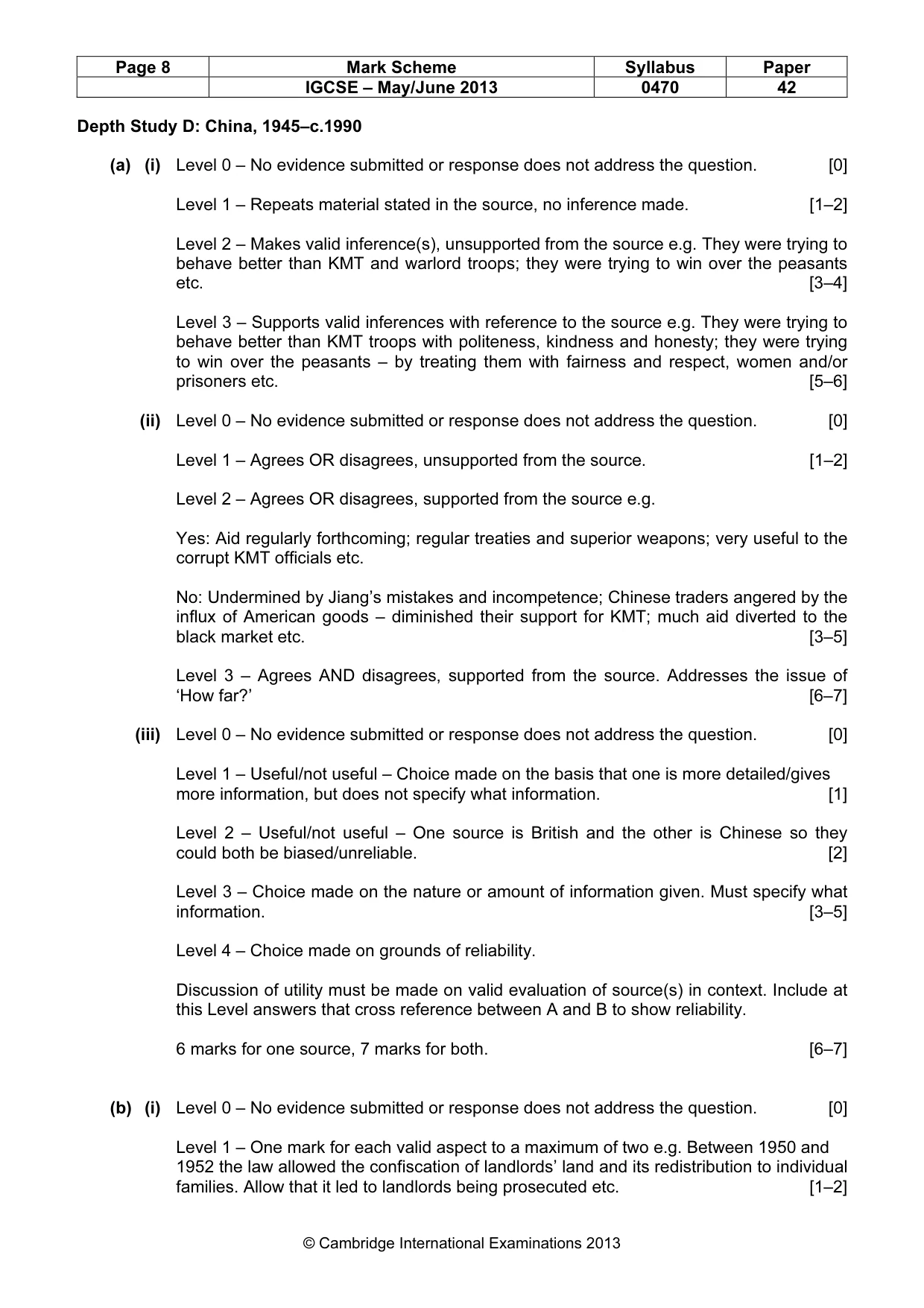
Mark scheme, page 8
Page 8 Mark Scheme Syllabus Paper IGCSE – May/June 2013 0470 42 © Cambridge International Examinations 2013 Depth Study D: China, 1945–c.1990 (a) (i) Level 0 – No evidence submitted or response does not address the question. [0] Level 1 – Repeats material stated in the source, no inference made. [1–2] Level 2 – Makes valid inference(s), unsupported from the source e.g. They were trying to behave better than KMT and warlord troops; they were trying to win over the peasants etc. [3–4] Level 3 – Supports valid inferences with reference to the source e.g. They were trying to behave better than KMT troops with politeness, kindness and honesty; they were trying to win over the peasants – by treating them with fairness and respect, women and/or prisoners etc. [5–6] (ii) Level 0 – No evidence submitted or response does not address the question. [0] Level 1 – Agrees OR disagrees, unsupported from the source. [1–2] Level 2 – Agrees OR disagrees, supported from the source e.g. Yes: Aid regularly forthcoming; regular treaties and superior weapons; very useful to the corrupt KMT officials etc. No: Undermined by Jiang’s mistakes and incompetence; Chinese traders angered by the influx of American goods – diminished their support for KMT; much aid diverted to the black market etc. [3–5] Level 3 – Agrees AND disagrees, supported from the source. Addresses the issue of ‘How far?’ [6–7] (iii) Level 0 – No evidence submitted or response does not address the question. [0] Level 1 – Useful/not useful – Choice made on the basis that one is more detailed/gives more information, but does not specify what information. [1] Level 2 – Useful/not useful – One source is British and the other is Chinese so they could both be biased/unreliable. [2] Level 3 – Choice made on the nature or amount of information given. Must specify what information. [3–5] Level 4 – Choice made on grounds of reliability. Discussion of utility must be made on valid evaluation of source(s) in context. Include at this Level answers that cross reference between A and B to show reliability. 6 marks for one source, 7 marks for both. [6–7] (b) (i) Level 0 – No evidence submitted or response does not address the question. [0] Level 1 – One mark for each valid aspect to a maximum of two e.g. Between 1950 and 1952 the law allowed the confiscation of landlords’ land and its redistribution to individual families. Allow that it led to landlords being prosecuted etc. [1–2]
Mark scheme, page 9
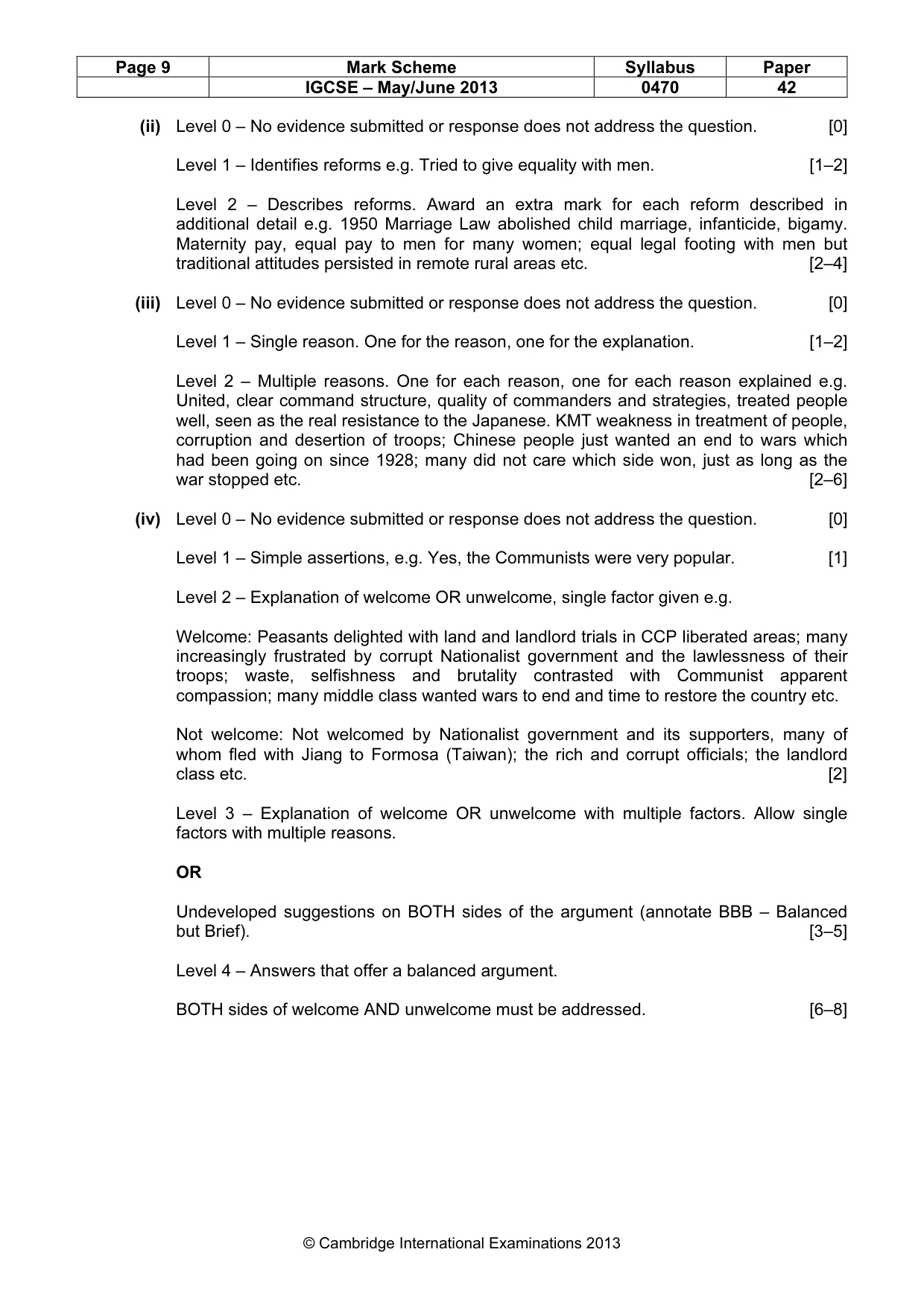
Page 9 Mark Scheme Syllabus Paper IGCSE – May/June 2013 0470 42 © Cambridge International Examinations 2013 (ii) Level 0 – No evidence submitted or response does not address the question. [0] Level 1 – Identifies reforms e.g. Tried to give equality with men. [1–2] Level 2 – Describes reforms. Award an extra mark for each reform described in additional detail e.g. 1950 Marriage Law abolished child marriage, infanticide, bigamy. Maternity pay, equal pay to men for many women; equal legal footing with men but traditional attitudes persisted in remote rural areas etc. [2–4] (iii) Level 0 – No evidence submitted or response does not address the question. [0] Level 1 – Single reason. One for the reason, one for the explanation. [1–2] Level 2 – Multiple reasons. One for each reason, one for each reason explained e.g. United, clear command structure, quality of commanders and strategies, treated people well, seen as the real resistance to the Japanese. KMT weakness in treatment of people, corruption and desertion of troops; Chinese people just wanted an end to wars which had been going on since 1928; many did not care which side won, just as long as the war stopped etc. [2–6] (iv) Level 0 – No evidence submitted or response does not address the question. [0] Level 1 – Simple assertions, e.g. Yes, the Communists were very popular. [1] Level 2 – Explanation of welcome OR unwelcome, single factor given e.g. Welcome: Peasants delighted with land and landlord trials in CCP liberated areas; many increasingly frustrated by corrupt Nationalist government and the lawlessness of their troops; waste, selfishness and brutality contrasted with Communist apparent compassion; many middle class wanted wars to end and time to restore the country etc. Not welcome: Not welcomed by Nationalist government and its supporters, many of whom fled with Jiang to Formosa (Taiwan); the rich and corrupt officials; the landlord class etc. [2] Level 3 – Explanation of welcome OR unwelcome with multiple factors. Allow single factors with multiple reasons. OR Undeveloped suggestions on BOTH sides of the argument (annotate BBB – Balanced but Brief). [3–5] Level 4 – Answers that offer a balanced argument. BOTH sides of welcome AND unwelcome must be addressed. [6–8]
Mark scheme, page 10
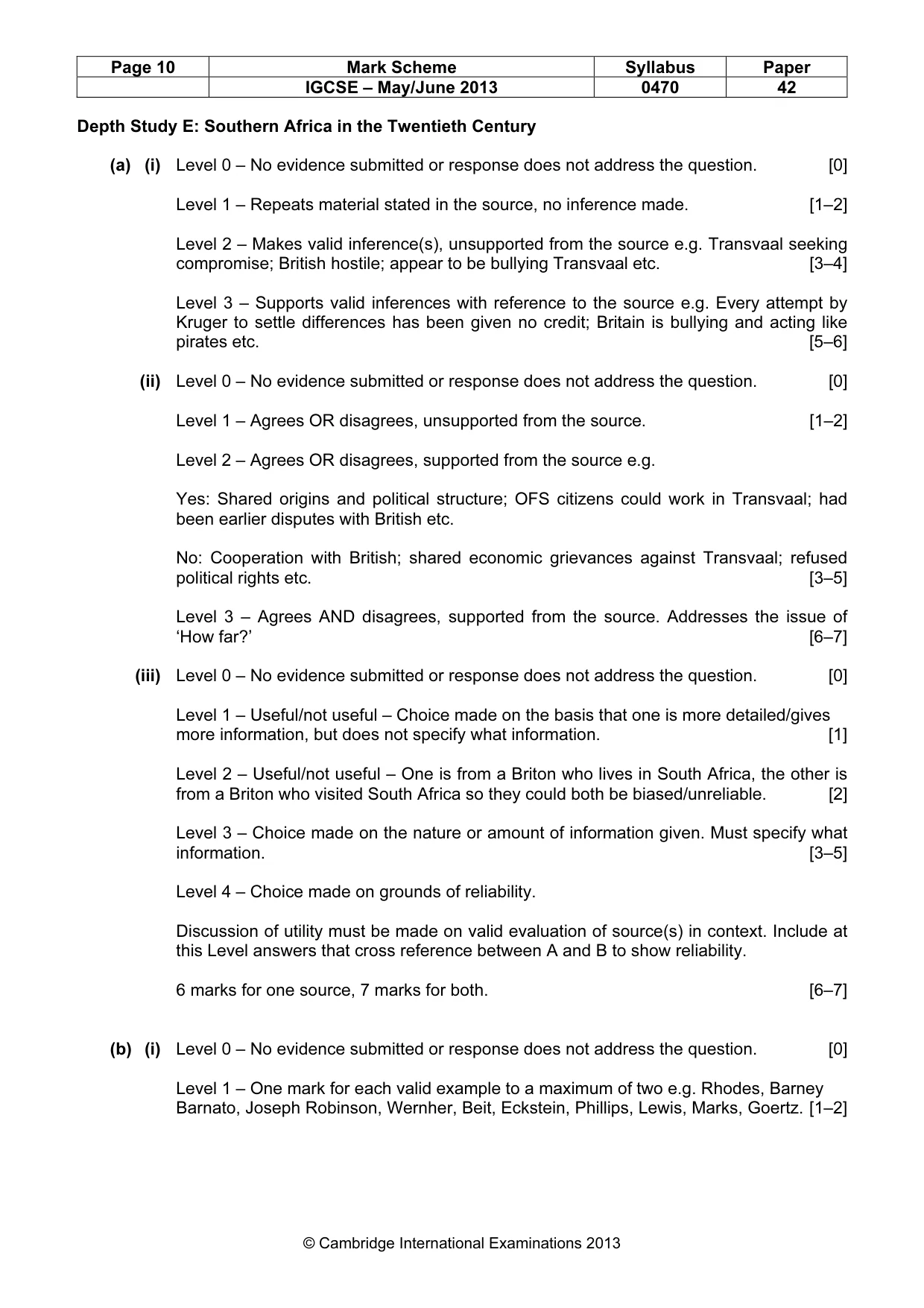
Page 10 Mark Scheme Syllabus Paper IGCSE – May/June 2013 0470 42 © Cambridge International Examinations 2013 Depth Study E: Southern Africa in the Twentieth Century (a) (i) Level 0 – No evidence submitted or response does not address the question. [0] Level 1 – Repeats material stated in the source, no inference made. [1–2] Level 2 – Makes valid inference(s), unsupported from the source e.g. Transvaal seeking compromise; British hostile; appear to be bullying Transvaal etc. [3–4] Level 3 – Supports valid inferences with reference to the source e.g. Every attempt by Kruger to settle differences has been given no credit; Britain is bullying and acting like pirates etc. [5–6] (ii) Level 0 – No evidence submitted or response does not address the question. [0] Level 1 – Agrees OR disagrees, unsupported from the source. [1–2] Level 2 – Agrees OR disagrees, supported from the source e.g. Yes: Shared origins and political structure; OFS citizens could work in Transvaal; had been earlier disputes with British etc. No: Cooperation with British; shared economic grievances against Transvaal; refused political rights etc. [3–5] Level 3 – Agrees AND disagrees, supported from the source. Addresses the issue of ‘How far?’ [6–7] (iii) Level 0 – No evidence submitted or response does not address the question. [0] Level 1 – Useful/not useful – Choice made on the basis that one is more detailed/gives more information, but does not specify what information. [1] Level 2 – Useful/not useful – One is from a Briton who lives in South Africa, the other is from a Briton who visited South Africa so they could both be biased/unreliable. [2] Level 3 – Choice made on the nature or amount of information given. Must specify what information. [3–5] Level 4 – Choice made on grounds of reliability. Discussion of utility must be made on valid evaluation of source(s) in context. Include at this Level answers that cross reference between A and B to show reliability. 6 marks for one source, 7 marks for both. [6–7] (b) (i) Level 0 – No evidence submitted or response does not address the question. [0] Level 1 – One mark for each valid example to a maximum of two e.g. Rhodes, Barney Barnato, Joseph Robinson, Wernher, Beit, Eckstein, Phillips, Lewis, Marks, Goertz. [1–2]
Mark scheme, page 11
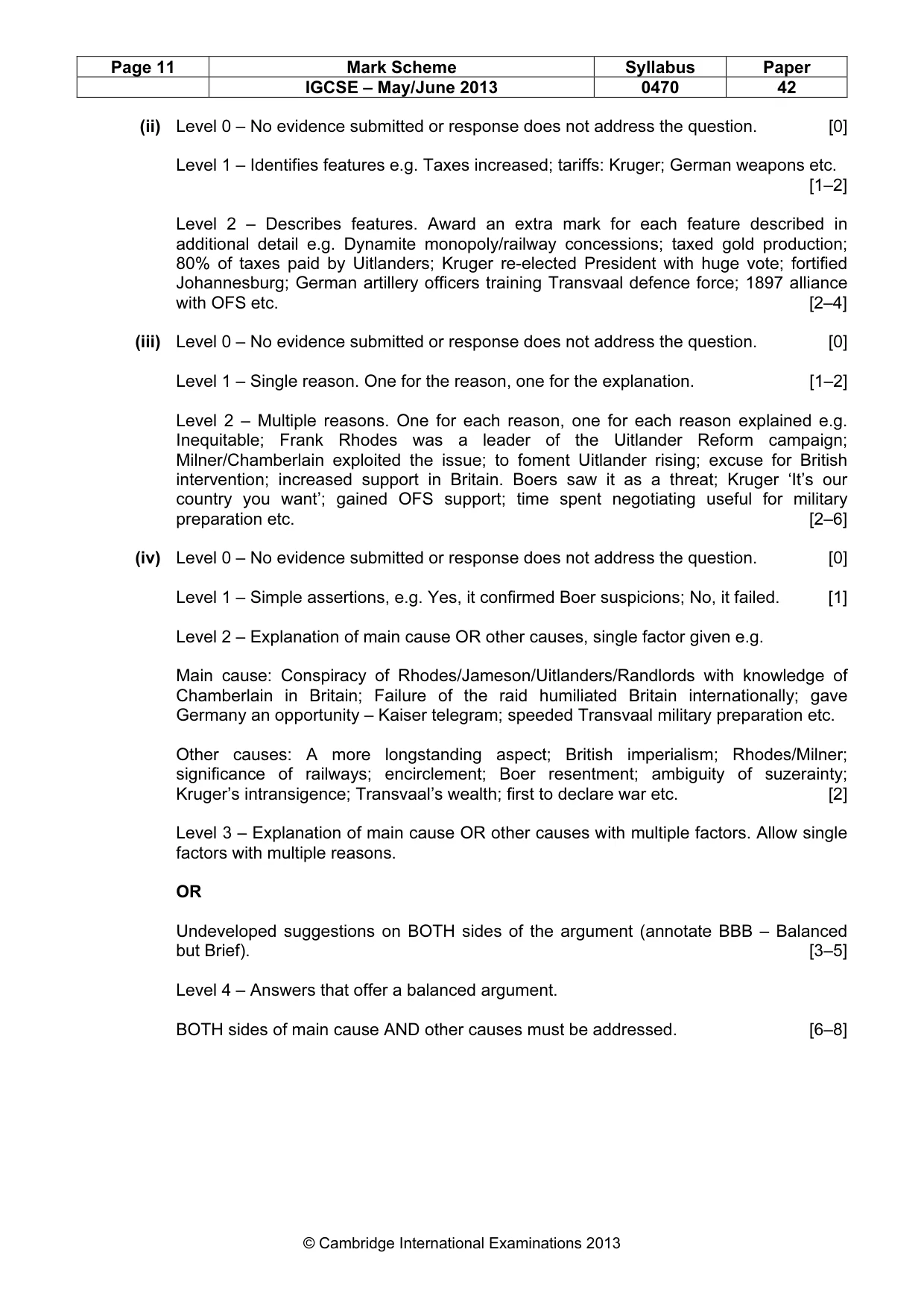
Page 11 Mark Scheme Syllabus Paper IGCSE – May/June 2013 0470 42 © Cambridge International Examinations 2013 (ii) Level 0 – No evidence submitted or response does not address the question. [0] Level 1 – Identifies features e.g. Taxes increased; tariffs: Kruger; German weapons etc. [1–2] Level 2 – Describes features. Award an extra mark for each feature described in additional detail e.g. Dynamite monopoly/railway concessions; taxed gold production; 80% of taxes paid by Uitlanders; Kruger re-elected President with huge vote; fortified Johannesburg; German artillery officers training Transvaal defence force; 1897 alliance with OFS etc. [2–4] (iii) Level 0 – No evidence submitted or response does not address the question. [0] Level 1 – Single reason. One for the reason, one for the explanation. [1–2] Level 2 – Multiple reasons. One for each reason, one for each reason explained e.g. Inequitable; Frank Rhodes was a leader of the Uitlander Reform campaign; Milner/Chamberlain exploited the issue; to foment Uitlander rising; excuse for British intervention; increased support in Britain. Boers saw it as a threat; Kruger ‘It’s our country you want’; gained OFS support; time spent negotiating useful for military preparation etc. [2–6] (iv) Level 0 – No evidence submitted or response does not address the question. [0] Level 1 – Simple assertions, e.g. Yes, it confirmed Boer suspicions; No, it failed. [1] Level 2 – Explanation of main cause OR other causes, single factor given e.g. Main cause: Conspiracy of Rhodes/Jameson/Uitlanders/Randlords with knowledge of Chamberlain in Britain; Failure of the raid humiliated Britain internationally; gave Germany an opportunity – Kaiser telegram; speeded Transvaal military preparation etc. Other causes: A more longstanding aspect; British imperialism; Rhodes/Milner; significance of railways; encirclement; Boer resentment; ambiguity of suzerainty; Kruger’s intransigence; Transvaal’s wealth; first to declare war etc. [2] Level 3 – Explanation of main cause OR other causes with multiple factors. Allow single factors with multiple reasons. OR Undeveloped suggestions on BOTH sides of the argument (annotate BBB – Balanced but Brief). [3–5] Level 4 – Answers that offer a balanced argument. BOTH sides of main cause AND other causes must be addressed. [6–8]
Mark scheme, page 12
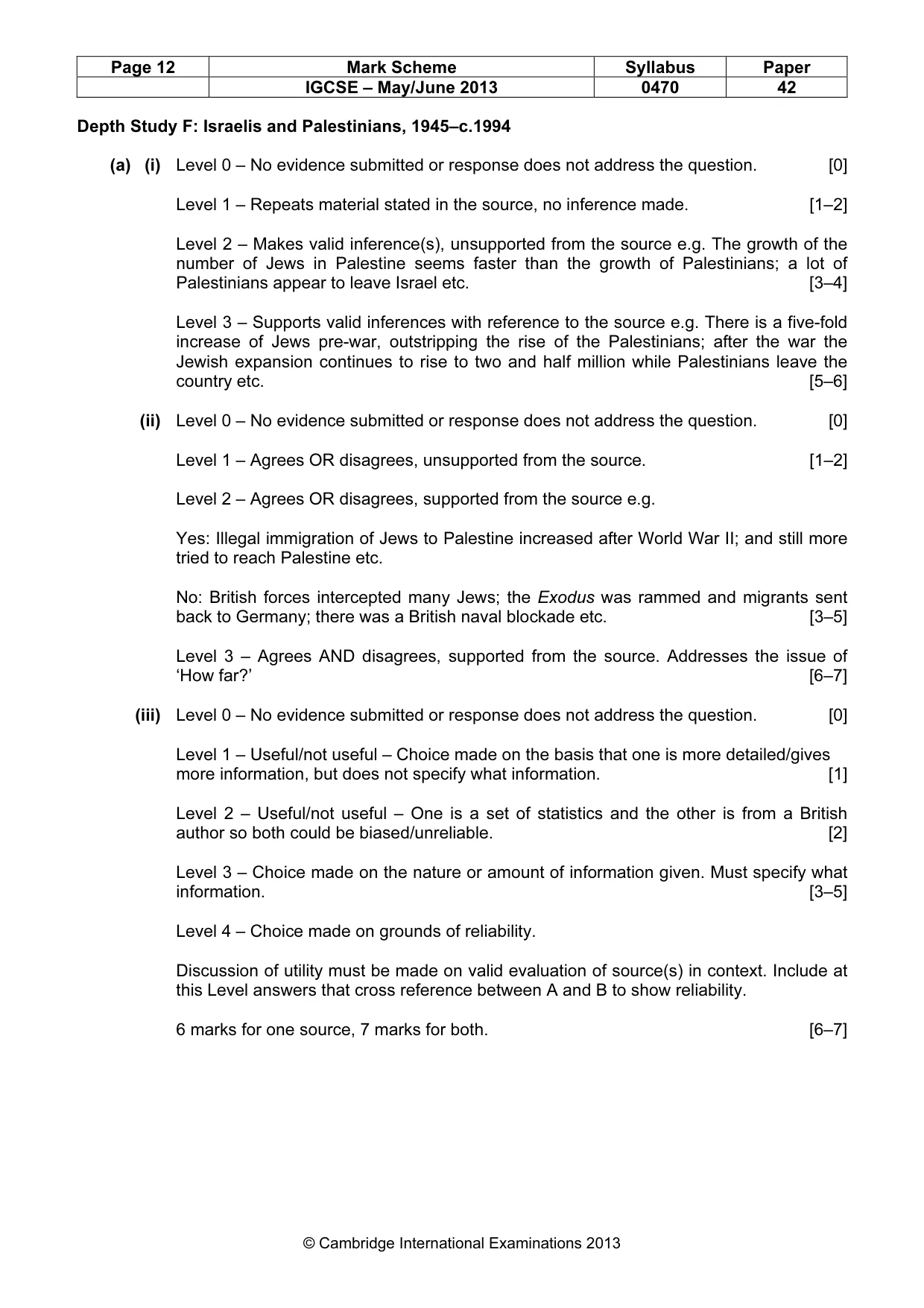
Page 12 Mark Scheme Syllabus Paper IGCSE – May/June 2013 0470 42 © Cambridge International Examinations 2013 Depth Study F: Israelis and Palestinians, 1945–c.1994 (a) (i) Level 0 – No evidence submitted or response does not address the question. [0] Level 1 – Repeats material stated in the source, no inference made. [1–2] Level 2 – Makes valid inference(s), unsupported from the source e.g. The growth of the number of Jews in Palestine seems faster than the growth of Palestinians; a lot of Palestinians appear to leave Israel etc. [3–4] Level 3 – Supports valid inferences with reference to the source e.g. There is a five-fold increase of Jews pre-war, outstripping the rise of the Palestinians; after the war the Jewish expansion continues to rise to two and half million while Palestinians leave the country etc. [5–6] (ii) Level 0 – No evidence submitted or response does not address the question. [0] Level 1 – Agrees OR disagrees, unsupported from the source. [1–2] Level 2 – Agrees OR disagrees, supported from the source e.g. Yes: Illegal immigration of Jews to Palestine increased after World War II; and still more tried to reach Palestine etc. No: British forces intercepted many Jews; the Exodus was rammed and migrants sent back to Germany; there was a British naval blockade etc. [3–5] Level 3 – Agrees AND disagrees, supported from the source. Addresses the issue of ‘How far?’ [6–7] (iii) Level 0 – No evidence submitted or response does not address the question. [0] Level 1 – Useful/not useful – Choice made on the basis that one is more detailed/gives more information, but does not specify what information. [1] Level 2 – Useful/not useful – One is a set of statistics and the other is from a British author so both could be biased/unreliable. [2] Level 3 – Choice made on the nature or amount of information given. Must specify what information. [3–5] Level 4 – Choice made on grounds of reliability. Discussion of utility must be made on valid evaluation of source(s) in context. Include at this Level answers that cross reference between A and B to show reliability. 6 marks for one source, 7 marks for both. [6–7]
Mark scheme, page 13
Page 13 Mark Scheme Syllabus Paper IGCSE – May/June 2013 0470 42 © Cambridge International Examinations 2013 (b) (i) Level 0 – No evidence submitted or response does not address the question. [0] Level 1 – One mark for each valid aspect to a maximum of two e.g. To prepare the area for self-rule at some time in the future; to allow Jewish immigration; to protect the rights of the indigenous Arabs etc. [1–2] (ii) Level 0 – No evidence submitted or response does not address the question. [0] Level 1 – Identifies actions e.g. Both were Jewish terrorist groups. [1–2] Level 2 – Describes actions. Award an extra mark for each activity described in additional detail e.g. Intimidate by attacking property, people or resources of both Palestinians and British; Assassinations (338 British troops killed); bombings – King David Hotel, Jerusalem blown up in July 1946; blowing up power and radio stations; mining roads; slaughter of Palestinians at Deir Yassin in April 1948 by Irgun etc. [2–4] (iii) Level 0 – No evidence submitted or response does not address the question. [0] Level 1 – Single reason. One for the reason, one for the explanation. [1–2] Level 2 – Multiple reasons. One for each reason, one for each reason explained e.g. Britain suffering from war weariness; financially exhausted, with a population needing time to recover; Britain faced hostility from both Jews and Palestinians, and criticism, especially from USA: streams of Jewish migrants and attacks by both Jewish and Palestinian terror groups undermined troops and the British public’s support for undertaking the role; called Jews and Palestinians for talks – never successful; Britain handed over the problem to the new UNO etc. [2–6] (iv) Level 0 – No evidence submitted or response does not address the question. [0] Level 1 – Simple assertions, e.g. The Arab states could never trust one another [1] Level 2 – Explanation of Arab disunity OR other reasons, single factor given e.g. Arab disunity: There had always been disunity and rival ambitions among Arab nations; Arab states did not enter Palestine to fight until after the State of Israel had been proclaimed; initial Arab successes against poorly equipped Israelis who later got rifles from Czechoslovakia; overwhelming advantage of Arab manpower and weapons but personalities and tactics clashed so that Arabs driven out etc. Other reasons: Unity of Israelis to preserve their ‘homeland’; arms from Czechoslovakia; unified command; sympathy and support after Holocaust worldwide; the 29 November 1947 UN Resolution calling for the establishment of a Jewish state gave Jews a feeling of legitimacy; strong support from President Truman and the American Jewish lobby etc. [2]
Mark scheme, page 14
Page 14 Mark Scheme Syllabus Paper IGCSE – May/June 2013 0470 42 © Cambridge International Examinations 2013 Level 3 – Explanation of Arab disunity OR other reasons with multiple factors. Allow single factors with multiple reasons. OR Undeveloped suggestions on BOTH sides of the argument (annotate BBB – Balanced but Brief). [3–5] Level 4 – Answers that offer a balanced argument. BOTH sides of Arab disunity AND other reasons must be addressed. [6–8]
Mark scheme, page 15
Page 15 Mark Scheme Syllabus Paper IGCSE – May/June 2013 0470 42 © Cambridge International Examinations 2013 Depth Study G: The Creation of Modern Industrial Society (a) (i) Level 0 – No evidence submitted or response does not address the question. [0] Level 1 – Repeats material seen in the source, no inference made. [1–2] Level 2 – Makes valid inference(s) unsupported from the source e.g. Very crowded; popular; full of people of all social groups; very little privacy or comfort etc. [3–4] Level 3 – Supports valid inferences with reference to the source e.g. Members of all classes as can be seen by top hats, caps and ladies’ dresses; overcrowded with all seats taken and people standing; popular form of transport with such a large group of passengers etc. [5–6] (ii) Level 0 – No evidence submitted or response does not address the question. [0] Level 1 – Agrees OR disagrees, unsupported from the source. [1–2] Level 2 – Agrees OR disagrees, supported from the source e.g. Yes: They were crowded so acceptable in some ways. Companies tried to improve comfort but profits fell when attempted etc. No: The companies acquired unflattering nicknames which reflected their service; it was competition that kept the prices down etc. [3–5] Level 3 – Agrees AND disagrees, supported from the source. Addresses the issue of ‘How far?’ [6–7] (iii) Level 0 – No evidence submitted or response does not address the question. [0] Level 1 – Useful/not useful – Choice made on the basis that one is more detailed/gives more information, but does not specify what information. [1] Level 2 – Useful/not useful – One source is a sketch and the other is from a recent book so they could both be biased/unreliable. [2] Level 3 – Choice made on the nature or amount of information given. Must specify what information. [3–5] Level 4 – Choice made on grounds of reliability. Discussion of utility must be made on valid evaluation of source(s) in context. Include at this Level answers that cross reference between A and B to show reliability. 6 marks for one source, 7 marks for both. [6–7]
Mark scheme, page 16
Page 16 Mark Scheme Syllabus Paper IGCSE – May/June 2013 0470 42 © Cambridge International Examinations 2013 (b) (i) Level 0 – No evidence submitted or response does not address the question. [0] Level 1 – One mark for each valid example to a maximum of two e.g. George and Robert Stephenson, Brunel, Thomas Brassey. [1–2] (ii) Level 0 – No evidence submitted or response does not address the question. [0] Level 1 – Identifies problems e.g. Safety, comfort, reliability. [1–2] Level 2 – Describes problems. Award an extra mark for each problem described in additional detail e.g. Open carriages at first so a safety risk, also open to the elements; not always cheap to travel so danger to one’s pocket; unreliability of new technology, accidents and break downs; many rail companies, so a long journey involved many tickets, changes and delays etc. [2–4] (iii) Level 0 – No evidence submitted or response does not address the question. [0] Level 1 – Single reason. One for the reason, one for the explanation. [1–2] Level 2 – Multiple reasons. One for each reason, one for each reason explained e.g. Demand from industry and public; speculators believed good profits could be made so a frenzy of line building; improvements in rolling stock and engines increased demand; ready availability of building materials and cheap labour (mainly Irish) etc. [2–6] (iv) Level 0 – No evidence submitted or response does not address the question. [0] Level 1 – Simple assertions, e.g. Yes, it was very popular. [1] Level 2 – Explanation of railways OR other factors, single reason given e.g. Railways: It enabled goods to be transported more widely, quickly and cheaply; the building of the railways boosted other industries like coal and iron/steel; enabled workers to travel to work from outskirts to factories etc. Other factors: Industry was growing rapidly before railways – the canals had been an effective form of transport for some industries; factors of the developments in industries like iron, steel and textiles meant there was growth anyway – but the railways encouraged the growth etc. [2] Level 3 – Explanation of railways OR other factors with multiple factors. Allow single factors with multiple reasons. OR Undeveloped suggestions on BOTH sides of the argument. (annotate BBB – Balanced but Brief). [3–5] Level 4 – Answers that offer a balanced argument. BOTH sides of railways AND other factors must be addressed. [6–8]
Mark scheme, page 17
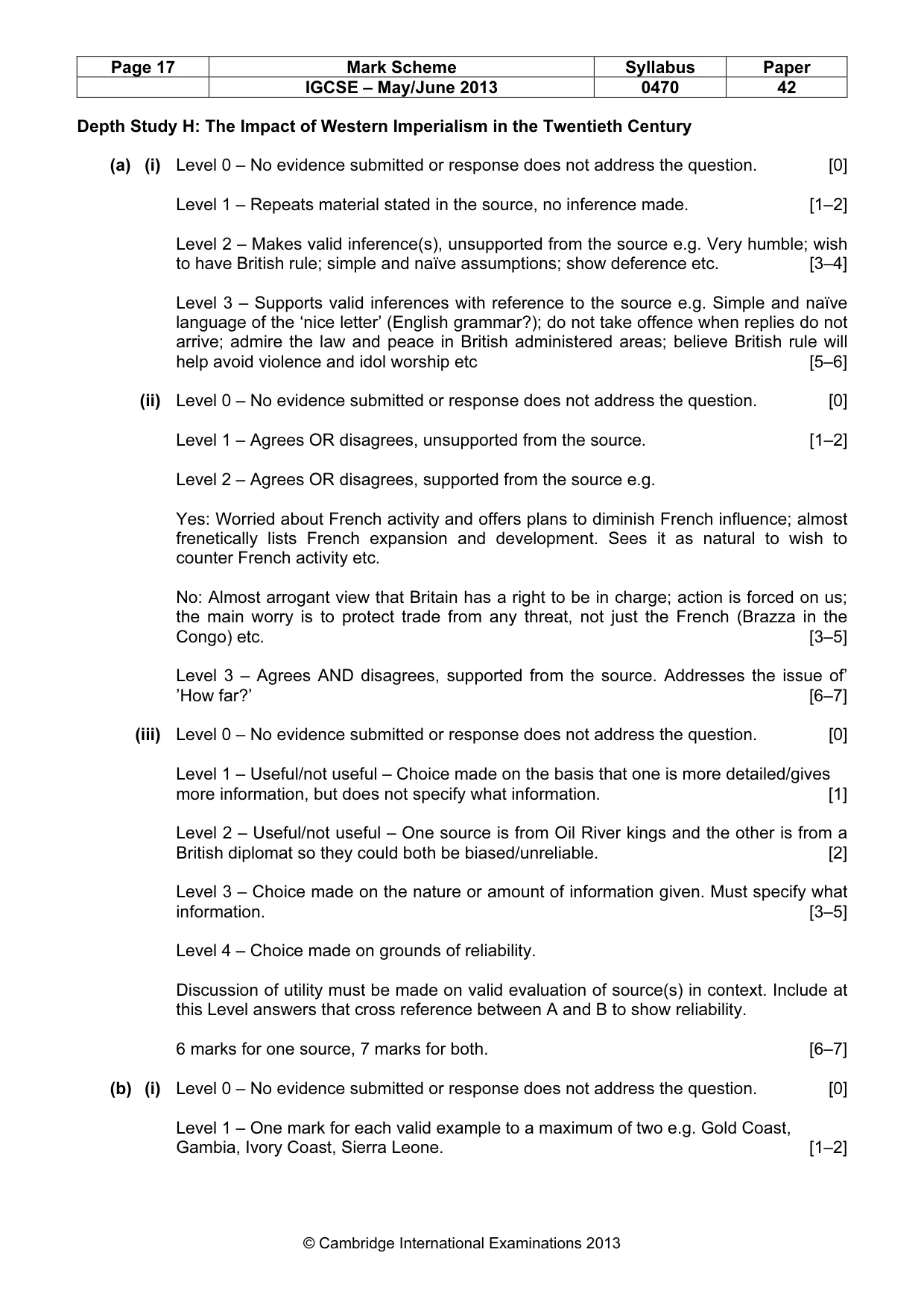
Page 17 Mark Scheme Syllabus Paper IGCSE – May/June 2013 0470 42 © Cambridge International Examinations 2013 Depth Study H: The Impact of Western Imperialism in the Twentieth Century (a) (i) Level 0 – No evidence submitted or response does not address the question. [0] Level 1 – Repeats material stated in the source, no inference made. [1–2] Level 2 – Makes valid inference(s), unsupported from the source e.g. Very humble; wish to have British rule; simple and naïve assumptions; show deference etc. [3–4] Level 3 – Supports valid inferences with reference to the source e.g. Simple and naïve language of the ‘nice letter’ (English grammar?); do not take offence when replies do not arrive; admire the law and peace in British administered areas; believe British rule will help avoid violence and idol worship etc [5–6] (ii) Level 0 – No evidence submitted or response does not address the question. [0] Level 1 – Agrees OR disagrees, unsupported from the source. [1–2] Level 2 – Agrees OR disagrees, supported from the source e.g. Yes: Worried about French activity and offers plans to diminish French influence; almost frenetically lists French expansion and development. Sees it as natural to wish to counter French activity etc. No: Almost arrogant view that Britain has a right to be in charge; action is forced on us; the main worry is to protect trade from any threat, not just the French (Brazza in the Congo) etc. [3–5] Level 3 – Agrees AND disagrees, supported from the source. Addresses the issue of’ ’How far?’ [6–7] (iii) Level 0 – No evidence submitted or response does not address the question. [0] Level 1 – Useful/not useful – Choice made on the basis that one is more detailed/gives more information, but does not specify what information. [1] Level 2 – Useful/not useful – One source is from Oil River kings and the other is from a British diplomat so they could both be biased/unreliable. [2] Level 3 – Choice made on the nature or amount of information given. Must specify what information. [3–5] Level 4 – Choice made on grounds of reliability. Discussion of utility must be made on valid evaluation of source(s) in context. Include at this Level answers that cross reference between A and B to show reliability. 6 marks for one source, 7 marks for both. [6–7] (b) (i) Level 0 – No evidence submitted or response does not address the question. [0] Level 1 – One mark for each valid example to a maximum of two e.g. Gold Coast, Gambia, Ivory Coast, Sierra Leone. [1–2]
Mark scheme, page 18
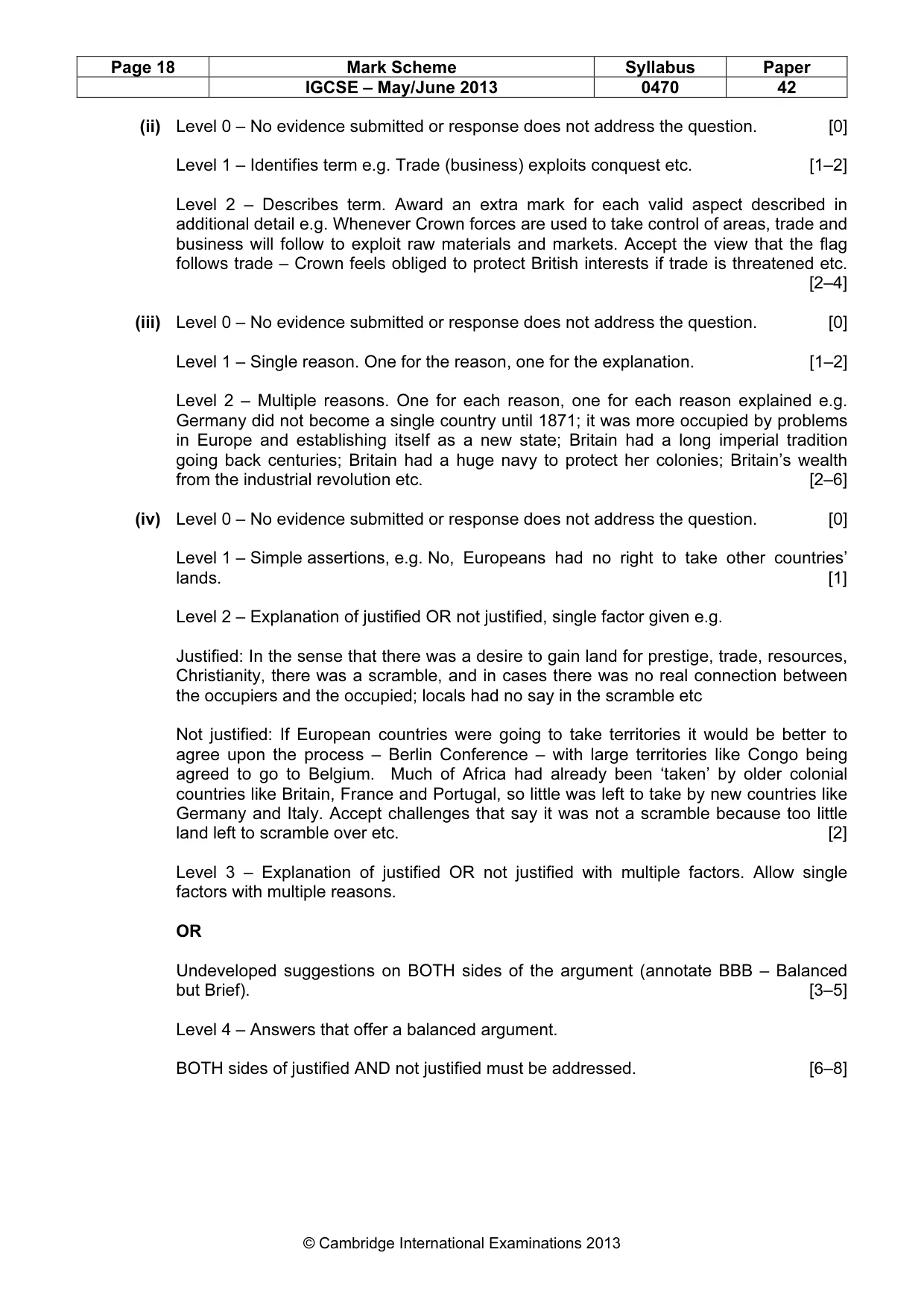
Page 18 Mark Scheme Syllabus Paper IGCSE – May/June 2013 0470 42 © Cambridge International Examinations 2013 (ii) Level 0 – No evidence submitted or response does not address the question. [0] Level 1 – Identifies term e.g. Trade (business) exploits conquest etc. [1–2] Level 2 – Describes term. Award an extra mark for each valid aspect described in additional detail e.g. Whenever Crown forces are used to take control of areas, trade and business will follow to exploit raw materials and markets. Accept the view that the flag follows trade – Crown feels obliged to protect British interests if trade is threatened etc. [2–4] (iii) Level 0 – No evidence submitted or response does not address the question. [0] Level 1 – Single reason. One for the reason, one for the explanation. [1–2] Level 2 – Multiple reasons. One for each reason, one for each reason explained e.g. Germany did not become a single country until 1871; it was more occupied by problems in Europe and establishing itself as a new state; Britain had a long imperial tradition going back centuries; Britain had a huge navy to protect her colonies; Britain’s wealth from the industrial revolution etc. [2–6] (iv) Level 0 – No evidence submitted or response does not address the question. [0] Level 1 – Simple assertions, e.g. No, Europeans had no right to take other countries’ lands. [1] Level 2 – Explanation of justified OR not justified, single factor given e.g. Justified: In the sense that there was a desire to gain land for prestige, trade, resources, Christianity, there was a scramble, and in cases there was no real connection between the occupiers and the occupied; locals had no say in the scramble etc Not justified: If European countries were going to take territories it would be better to agree upon the process – Berlin Conference – with large territories like Congo being agreed to go to Belgium. Much of Africa had already been ‘taken’ by older colonial countries like Britain, France and Portugal, so little was left to take by new countries like Germany and Italy. Accept challenges that say it was not a scramble because too little land left to scramble over etc. [2] Level 3 – Explanation of justified OR not justified with multiple factors. Allow single factors with multiple reasons. OR Undeveloped suggestions on BOTH sides of the argument (annotate BBB – Balanced but Brief). [3–5] Level 4 – Answers that offer a balanced argument. BOTH sides of justified AND not justified must be addressed. [6–8]
What you needed in this session
Cambridge’s own grade thresholds for 2013 May/June, Paper 4 · Variant 2. A higher threshold means an easier paper — the bar moves with how the cohort did.