Cambridge IGCSE History 0470 — 2013 May/June Paper 4 · Variant 1
0470/41/M/J/13 · 40 marks · ≈45 min
The question paper and its mark scheme, free to read here and free to download. This is Cambridge’s own paper, exactly as it was sat.
Question paper12 pages


Mark scheme17 pages
Answers below. Sit the paper first if you are practising.

Paper as text
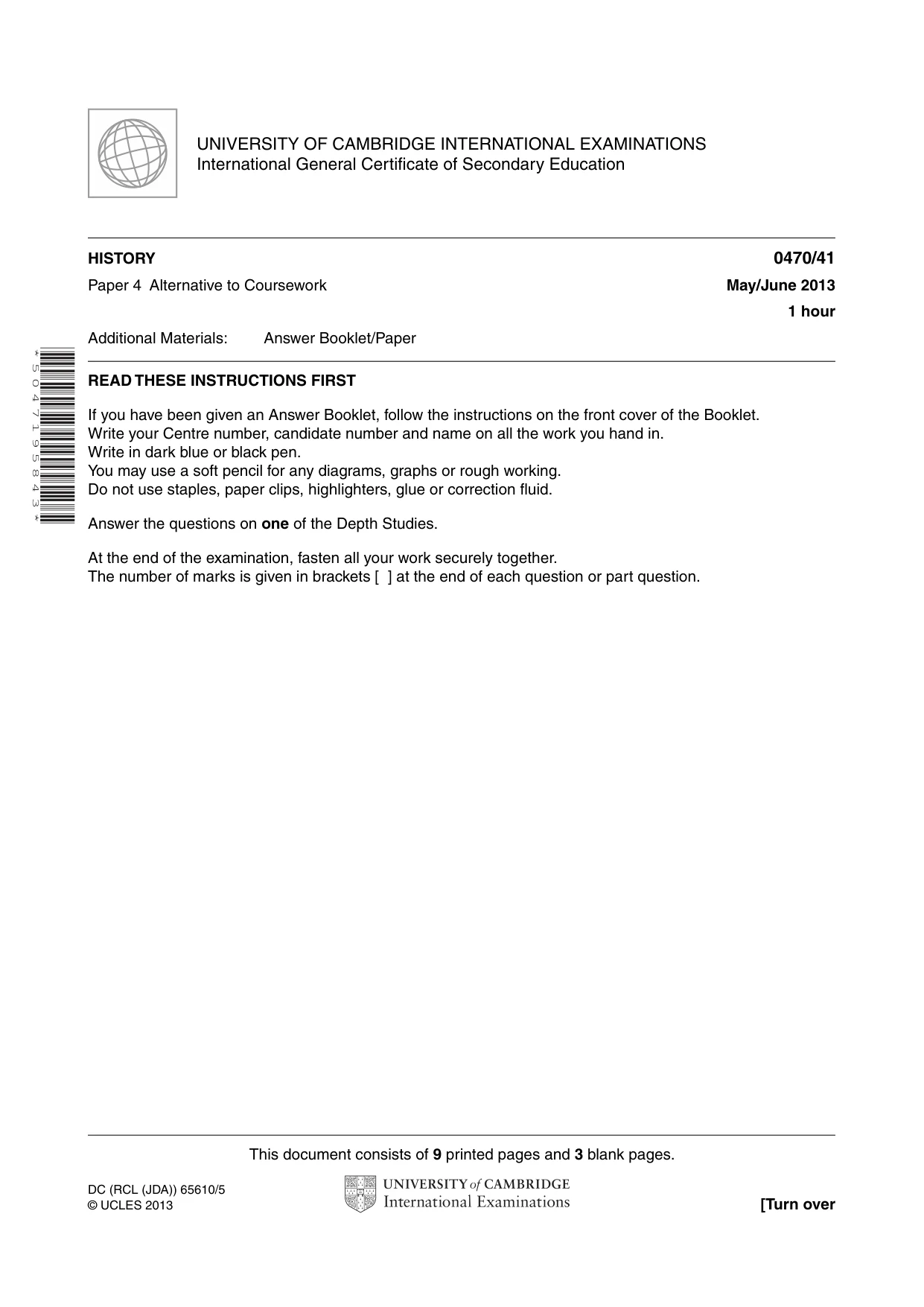
Question paper, page 1
This document consists of 9 printed pages and 3 blank pages. DC (RCL (JDA)) 65610/5 © UCLES 2013 [Turn over UNIVERSITY OF CAMBRIDGE INTERNATIONAL EXAMINATIONS International General Certificate of Secondary Education * 5 0 4 7 1 9 5 8 4 3 * HISTORY 0470/41 Paper 4 Alternative to Coursework May/June 2013 1 hour Additional Materials: Answer Booklet/Paper READ THESE INSTRUCTIONS FIRST If you have been given an Answer Booklet, follow the instructions on the front cover of the Booklet. Write your Centre number, candidate number and name on all the work you hand in. Write in dark blue or black pen. You may use a soft pencil for any diagrams, graphs or rough working. Do not use staples, paper clips, highlighters, glue or correction fluid. Answer the questions on one of the Depth Studies. At the end of the examination, fasten all your work securely together. The number of marks is given in brackets [ ] at the end of each question or part question.
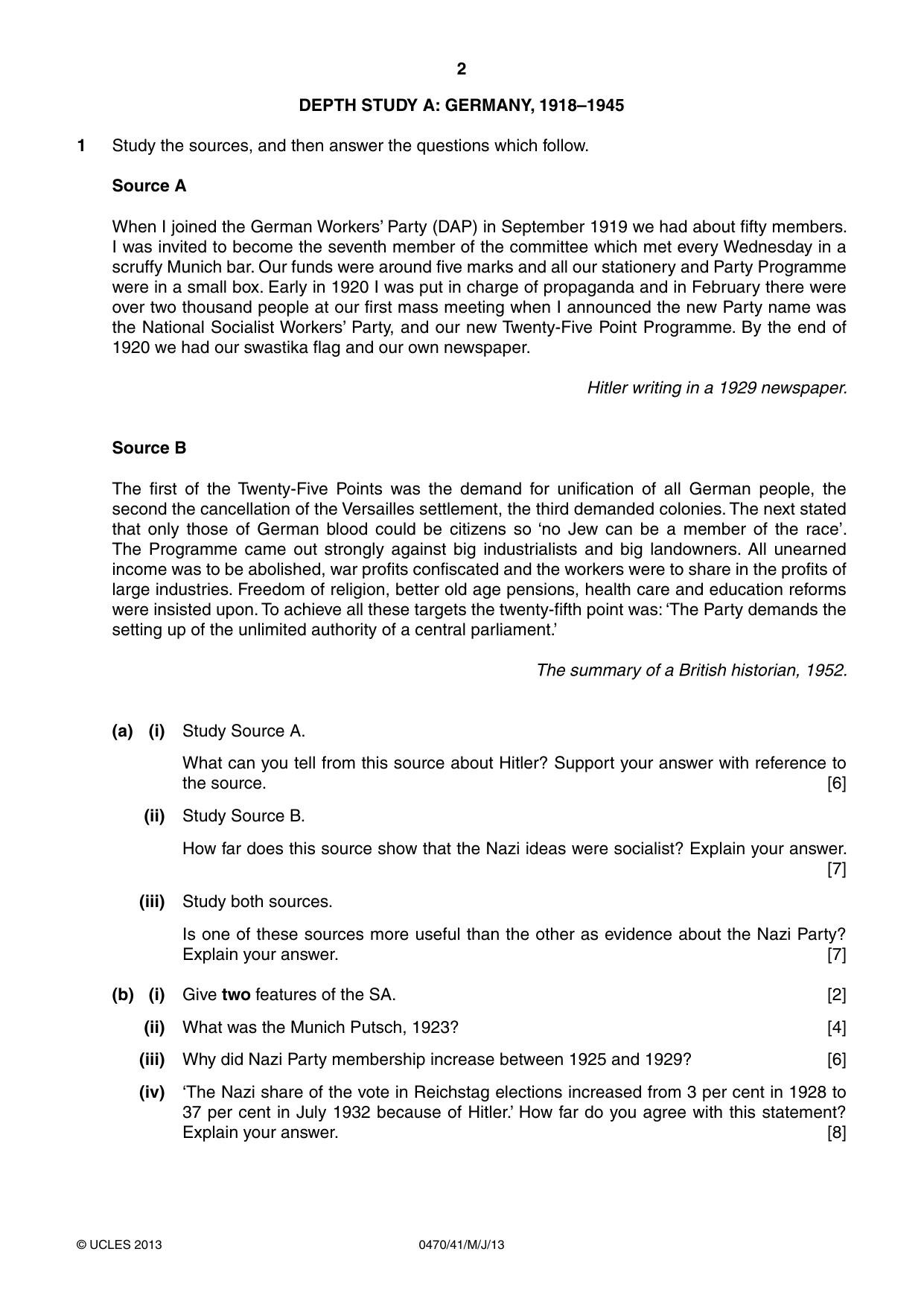
Question paper, page 2
2 0470/41/M/J/13 © UCLES 2013 DEPTH STUDY A: GERMANY, 1918–1945 1 Study the sources, and then answer the questions which follow. Source A When I joined the German Workers’ Party (DAP) in September 1919 we had about fifty members. I was invited to become the seventh member of the committee which met every Wednesday in a scruffy Munich bar. Our funds were around five marks and all our stationery and Party Programme were in a small box. Early in 1920 I was put in charge of propaganda and in February there were over two thousand people at our first mass meeting when I announced the new Party name was the National Socialist Workers’ Party, and our new Twenty-Five Point Programme. By the end of 1920 we had our swastika flag and our own newspaper. Hitler writing in a 1929 newspaper. Source B The first of the Twenty-Five Points was the demand for unification of all German people, the second the cancellation of the Versailles settlement, the third demanded colonies. The next stated that only those of German blood could be citizens so ‘no Jew can be a member of the race’. The Programme came out strongly against big industrialists and big landowners. All unearned income was to be abolished, war profits confiscated and the workers were to share in the profits of large industries. Freedom of religion, better old age pensions, health care and education reforms were insisted upon. To achieve all these targets the twenty-fifth point was: ‘The Party demands the setting up of the unlimited authority of a central parliament.’ The summary of a British historian, 1952. (a) (i) Study Source A. What can you tell from this source about Hitler? Support your answer with reference to the source. [6] (ii) Study Source B. How far does this source show that the Nazi ideas were socialist? Explain your answer. [7] (iii) Study both sources. Is one of these sources more useful than the other as evidence about the Nazi Party? Explain your answer. [7] (b) (i) Give two features of the SA. [2] (ii) What was the Munich Putsch, 1923? [4] (iii) Why did Nazi Party membership increase between 1925 and 1929? [6] (iv) ‘The Nazi share of the vote in Reichstag elections increased from 3 per cent in 1928 to 37 per cent in July 1932 because of Hitler.’ How far do you agree with this statement? Explain your answer. [8]
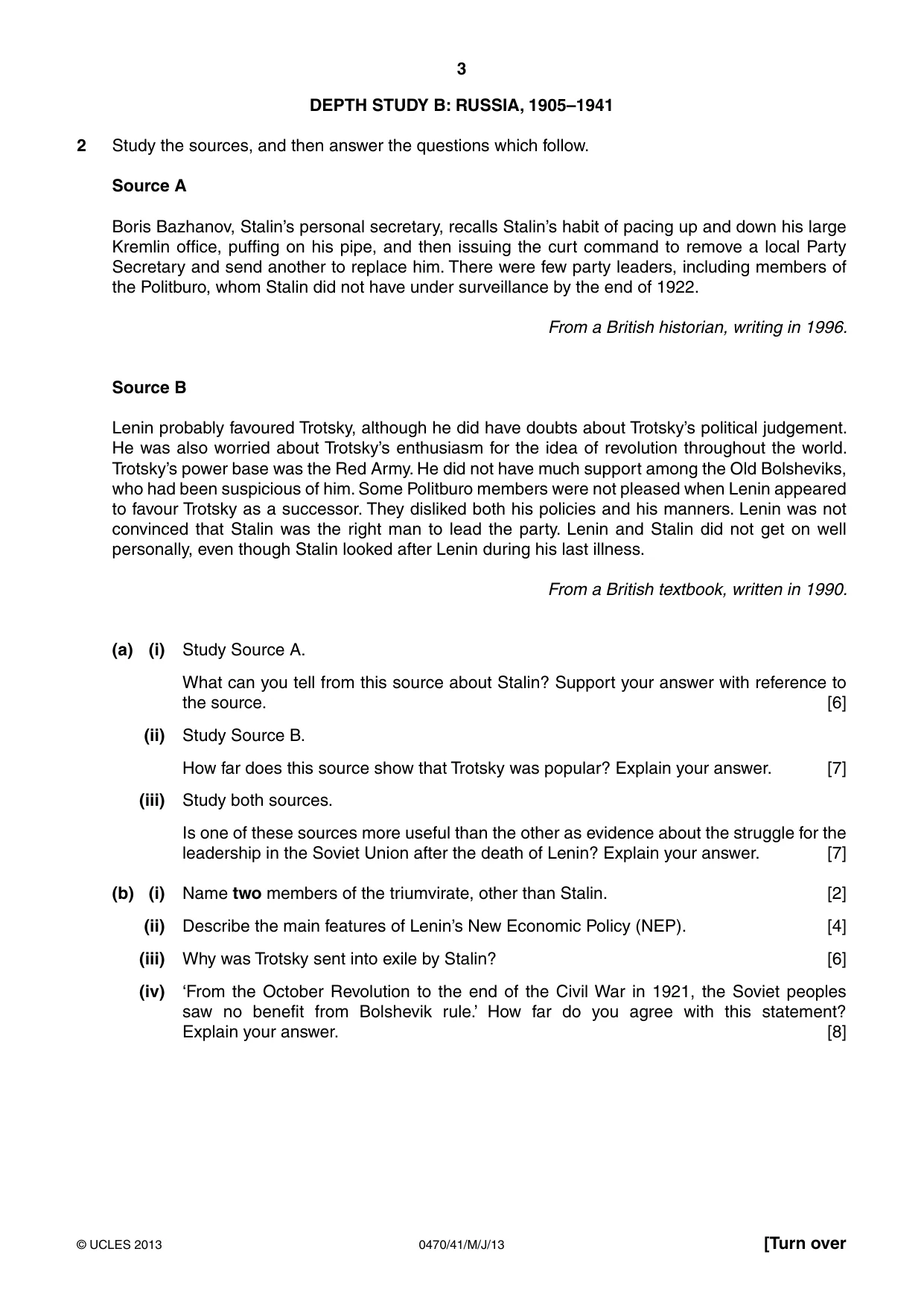
Question paper, page 3
3 0470/41/M/J/13 © UCLES 2013 [Turn over DEPTH STUDY B: RUSSIA, 1905–1941 2 Study the sources, and then answer the questions which follow. Source A Boris Bazhanov, Stalin’s personal secretary, recalls Stalin’s habit of pacing up and down his large Kremlin office, puffing on his pipe, and then issuing the curt command to remove a local Party Secretary and send another to replace him. There were few party leaders, including members of the Politburo, whom Stalin did not have under surveillance by the end of 1922. From a British historian, writing in 1996. Source B Lenin probably favoured Trotsky, although he did have doubts about Trotsky’s political judgement. He was also worried about Trotsky’s enthusiasm for the idea of revolution throughout the world. Trotsky’s power base was the Red Army. He did not have much support among the Old Bolsheviks, who had been suspicious of him. Some Politburo members were not pleased when Lenin appeared to favour Trotsky as a successor. They disliked both his policies and his manners. Lenin was not convinced that Stalin was the right man to lead the party. Lenin and Stalin did not get on well personally, even though Stalin looked after Lenin during his last illness. From a British textbook, written in 1990. (a) (i) Study Source A. What can you tell from this source about Stalin? Support your answer with reference to the source. [6] (ii) Study Source B. How far does this source show that Trotsky was popular? Explain your answer. [7] (iii) Study both sources. Is one of these sources more useful than the other as evidence about the struggle for the leadership in the Soviet Union after the death of Lenin? Explain your answer. [7] (b) (i) Name two members of the triumvirate, other than Stalin. [2] (ii) Describe the main features of Lenin’s New Economic Policy (NEP). [4] (iii) Why was Trotsky sent into exile by Stalin? [6] (iv) ‘From the October Revolution to the end of the Civil War in 1921, the Soviet peoples saw no benefit from Bolshevik rule.’ How far do you agree with this statement? Explain your answer. [8]
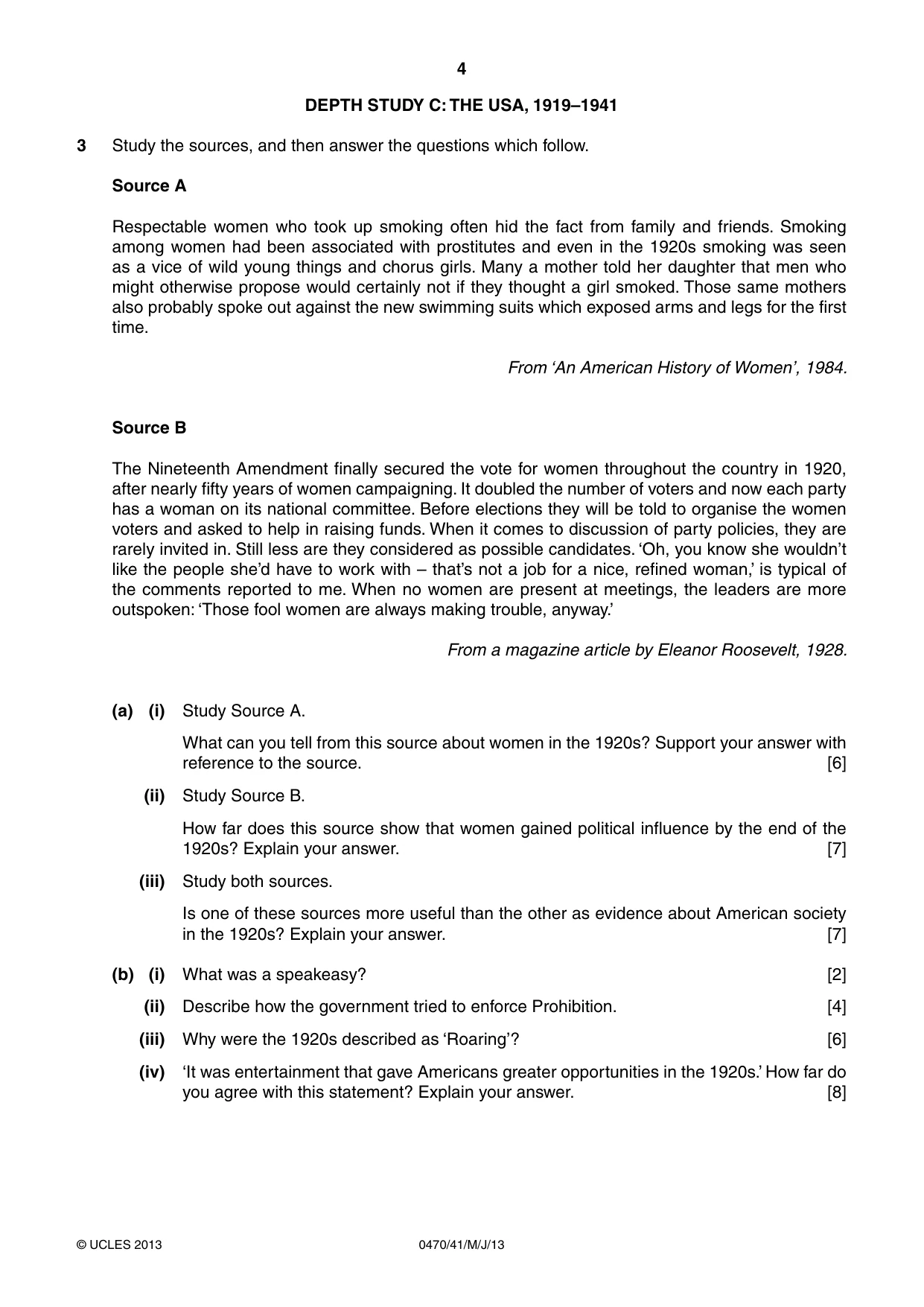
Question paper, page 4
4 0470/41/M/J/13 © UCLES 2013 DEPTH STUDY C: THE USA, 1919–1941 3 Study the sources, and then answer the questions which follow. Source A Respectable women who took up smoking often hid the fact from family and friends. Smoking among women had been associated with prostitutes and even in the 1920s smoking was seen as a vice of wild young things and chorus girls. Many a mother told her daughter that men who might otherwise propose would certainly not if they thought a girl smoked. Those same mothers also probably spoke out against the new swimming suits which exposed arms and legs for the first time. From ‘An American History of Women’, 1984. Source B The Nineteenth Amendment finally secured the vote for women throughout the country in 1920, after nearly fifty years of women campaigning. It doubled the number of voters and now each party has a woman on its national committee. Before elections they will be told to organise the women voters and asked to help in raising funds. When it comes to discussion of party policies, they are rarely invited in. Still less are they considered as possible candidates. ‘Oh, you know she wouldn’t like the people she’d have to work with – that’s not a job for a nice, refined woman,’ is typical of the comments reported to me. When no women are present at meetings, the leaders are more outspoken: ‘Those fool women are always making trouble, anyway.’ From a magazine article by Eleanor Roosevelt, 1928. (a) (i) Study Source A. What can you tell from this source about women in the 1920s? Support your answer with reference to the source. [6] (ii) Study Source B. How far does this source show that women gained political influence by the end of the 1920s? Explain your answer. [7] (iii) Study both sources. Is one of these sources more useful than the other as evidence about American society in the 1920s? Explain your answer. [7] (b) (i) What was a speakeasy? [2] (ii) Describe how the government tried to enforce Prohibition. [4] (iii) Why were the 1920s described as ‘Roaring’? [6] (iv) ‘It was entertainment that gave Americans greater opportunities in the 1920s.’ How far do you agree with this statement? Explain your answer. [8]
Question paper, page 5
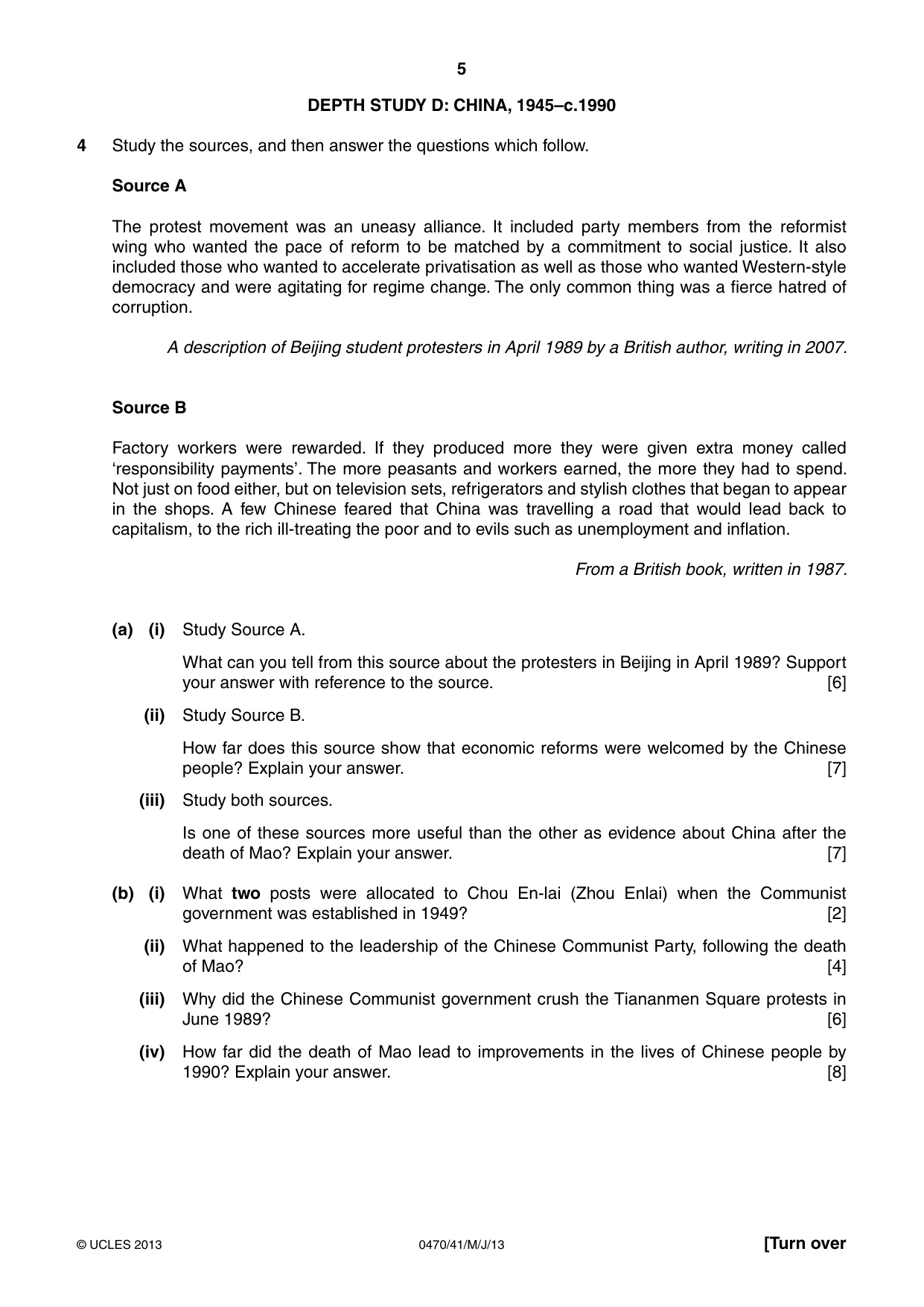
5 0470/41/M/J/13 © UCLES 2013 [Turn over DEPTH STUDY D: CHINA, 1945–c.1990 4 Study the sources, and then answer the questions which follow. Source A The protest movement was an uneasy alliance. It included party members from the reformist wing who wanted the pace of reform to be matched by a commitment to social justice. It also included those who wanted to accelerate privatisation as well as those who wanted Western-style democracy and were agitating for regime change. The only common thing was a fierce hatred of corruption. A description of Beijing student protesters in April 1989 by a British author, writing in 2007. Source B Factory workers were rewarded. If they produced more they were given extra money called ‘responsibility payments’. The more peasants and workers earned, the more they had to spend. Not just on food either, but on television sets, refrigerators and stylish clothes that began to appear in the shops. A few Chinese feared that China was travelling a road that would lead back to capitalism, to the rich ill-treating the poor and to evils such as unemployment and inflation. From a British book, written in 1987. (a) (i) Study Source A. What can you tell from this source about the protesters in Beijing in April 1989? Support your answer with reference to the source. [6] (ii) Study Source B. How far does this source show that economic reforms were welcomed by the Chinese people? Explain your answer. [7] (iii) Study both sources. Is one of these sources more useful than the other as evidence about China after the death of Mao? Explain your answer. [7] (b) (i) What two posts were allocated to Chou En-lai (Zhou Enlai) when the Communist government was established in 1949? [2] (ii) What happened to the leadership of the Chinese Communist Party, following the death of Mao? [4] (iii) Why did the Chinese Communist government crush the Tiananmen Square protests in June 1989? [6] (iv) How far did the death of Mao lead to improvements in the lives of Chinese people by 1990? Explain your answer. [8]
Question paper, page 6
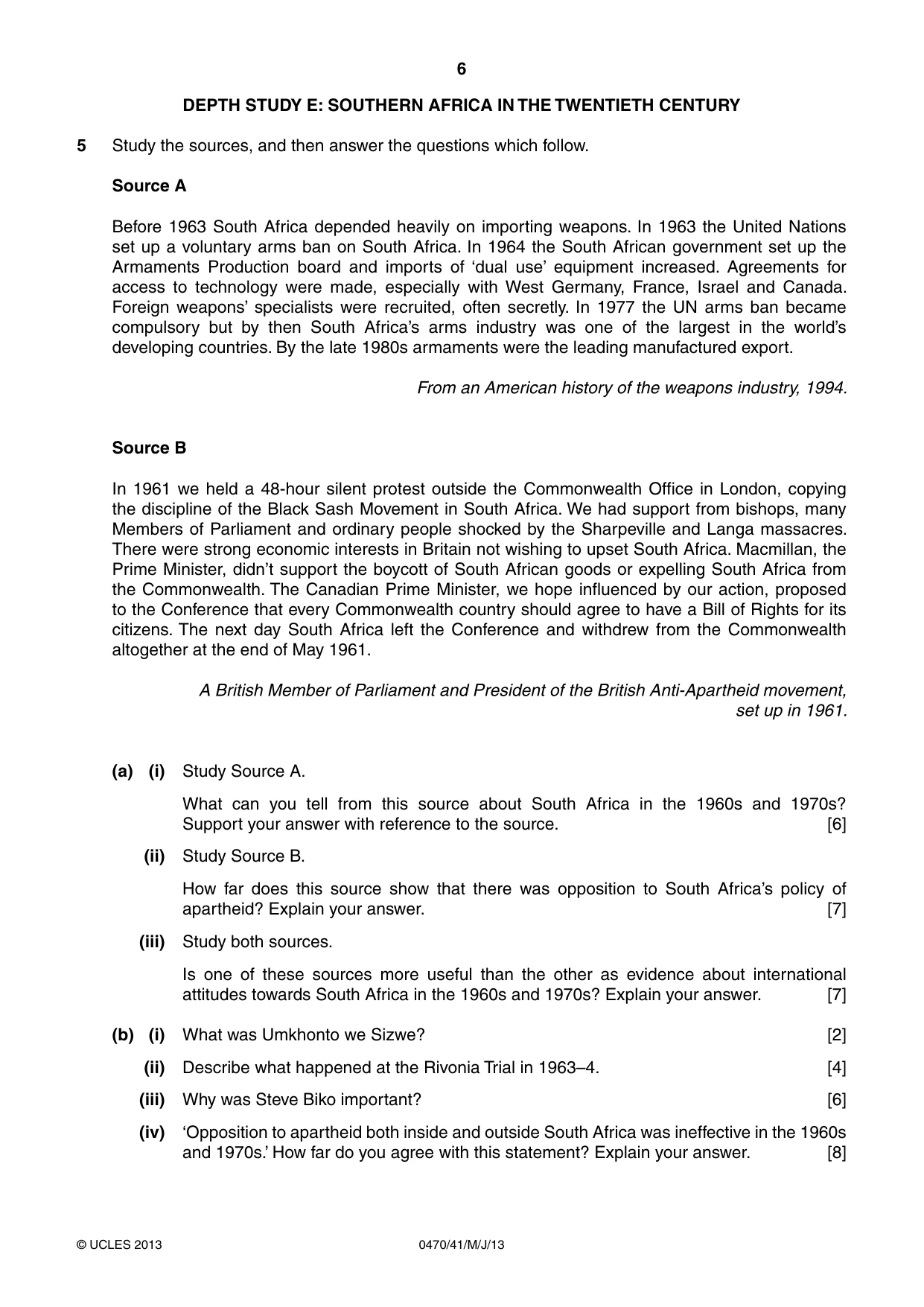
6 0470/41/M/J/13 © UCLES 2013 DEPTH STUDY E: SOUTHERN AFRICA IN THE TWENTIETH CENTURY 5 Study the sources, and then answer the questions which follow. Source A Before 1963 South Africa depended heavily on importing weapons. In 1963 the United Nations set up a voluntary arms ban on South Africa. In 1964 the South African government set up the Armaments Production board and imports of ‘dual use’ equipment increased. Agreements for access to technology were made, especially with West Germany, France, Israel and Canada. Foreign weapons’ specialists were recruited, often secretly. In 1977 the UN arms ban became compulsory but by then South Africa’s arms industry was one of the largest in the world’s developing countries. By the late 1980s armaments were the leading manufactured export. From an American history of the weapons industry, 1994. Source B In 1961 we held a 48-hour silent protest outside the Commonwealth Office in London, copying the discipline of the Black Sash Movement in South Africa. We had support from bishops, many Members of Parliament and ordinary people shocked by the Sharpeville and Langa massacres. There were strong economic interests in Britain not wishing to upset South Africa. Macmillan, the Prime Minister, didn’t support the boycott of South African goods or expelling South Africa from the Commonwealth. The Canadian Prime Minister, we hope influenced by our action, proposed to the Conference that every Commonwealth country should agree to have a Bill of Rights for its citizens. The next day South Africa left the Conference and withdrew from the Commonwealth altogether at the end of May 1961. A British Member of Parliament and President of the British Anti-Apartheid movement, set up in 1961. (a) (i) Study Source A. What can you tell from this source about South Africa in the 1960s and 1970s? Support your answer with reference to the source. [6] (ii) Study Source B. How far does this source show that there was opposition to South Africa’s policy of apartheid? Explain your answer. [7] (iii) Study both sources. Is one of these sources more useful than the other as evidence about international attitudes towards South Africa in the 1960s and 1970s? Explain your answer. [7] (b) (i) What was Umkhonto we Sizwe? [2] (ii) Describe what happened at the Rivonia Trial in 1963–4. [4] (iii) Why was Steve Biko important? [6] (iv) ‘Opposition to apartheid both inside and outside South Africa was ineffective in the 1960s and 1970s.’ How far do you agree with this statement? Explain your answer. [8]
Question paper, page 7
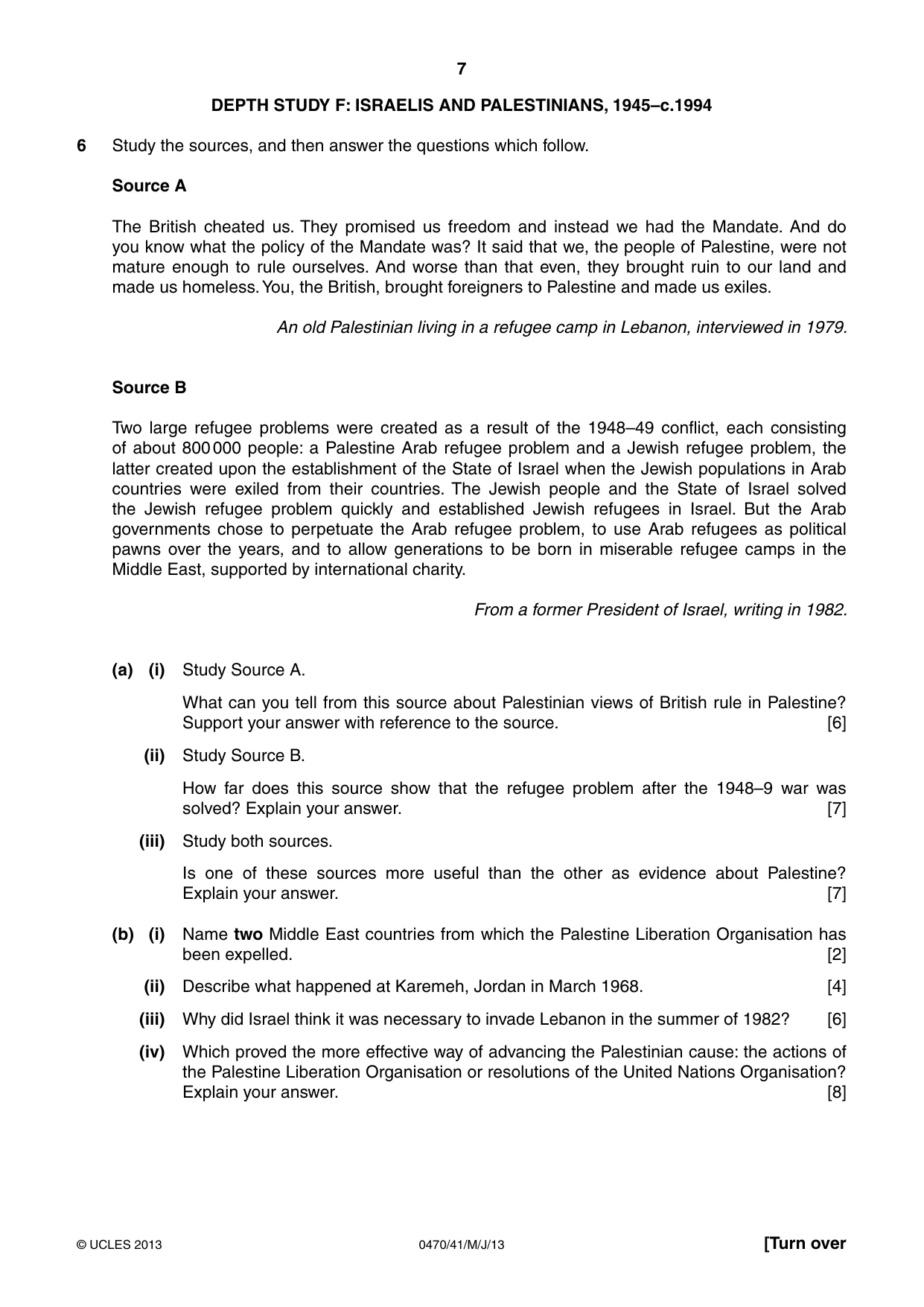
7 0470/41/M/J/13 © UCLES 2013 [Turn over DEPTH STUDY F: ISRAELIS AND PALESTINIANS, 1945–c.1994 6 Study the sources, and then answer the questions which follow. Source A The British cheated us. They promised us freedom and instead we had the Mandate. And do you know what the policy of the Mandate was? It said that we, the people of Palestine, were not mature enough to rule ourselves. And worse than that even, they brought ruin to our land and made us homeless. You, the British, brought foreigners to Palestine and made us exiles. An old Palestinian living in a refugee camp in Lebanon, interviewed in 1979. Source B Two large refugee problems were created as a result of the 1948–49 conflict, each consisting of about 800 000 people: a Palestine Arab refugee problem and a Jewish refugee problem, the latter created upon the establishment of the State of Israel when the Jewish populations in Arab countries were exiled from their countries. The Jewish people and the State of Israel solved the Jewish refugee problem quickly and established Jewish refugees in Israel. But the Arab governments chose to perpetuate the Arab refugee problem, to use Arab refugees as political pawns over the years, and to allow generations to be born in miserable refugee camps in the Middle East, supported by international charity. From a former President of Israel, writing in 1982. (a) (i) Study Source A. What can you tell from this source about Palestinian views of British rule in Palestine? Support your answer with reference to the source. [6] (ii) Study Source B. How far does this source show that the refugee problem after the 1948–9 war was solved? Explain your answer. [7] (iii) Study both sources. Is one of these sources more useful than the other as evidence about Palestine? Explain your answer. [7] (b) (i) Name two Middle East countries from which the Palestine Liberation Organisation has been expelled. [2] (ii) Describe what happened at Karemeh, Jordan in March 1968. [4] (iii) Why did Israel think it was necessary to invade Lebanon in the summer of 1982? [6] (iv) Which proved the more effective way of advancing the Palestinian cause: the actions of the Palestine Liberation Organisation or resolutions of the United Nations Organisation? Explain your answer. [8]
Question paper, page 8
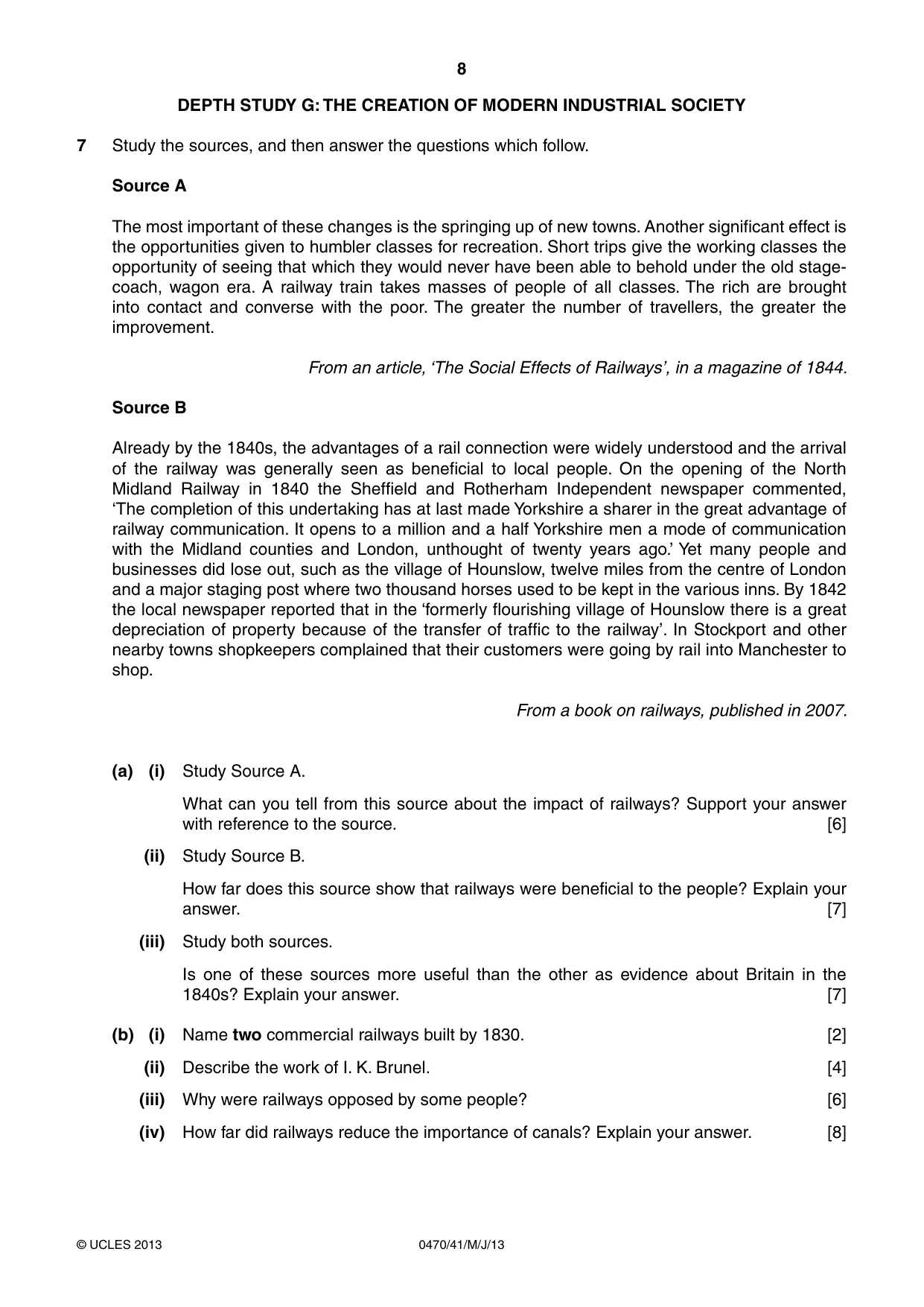
8 0470/41/M/J/13 © UCLES 2013 DEPTH STUDY G: THE CREATION OF MODERN INDUSTRIAL SOCIETY 7 Study the sources, and then answer the questions which follow. Source A The most important of these changes is the springing up of new towns. Another significant effect is the opportunities given to humbler classes for recreation. Short trips give the working classes the opportunity of seeing that which they would never have been able to behold under the old stage- coach, wagon era. A railway train takes masses of people of all classes. The rich are brought into contact and converse with the poor. The greater the number of travellers, the greater the improvement. From an article, ‘The Social Effects of Railways’, in a magazine of 1844. Source B Already by the 1840s, the advantages of a rail connection were widely understood and the arrival of the railway was generally seen as beneficial to local people. On the opening of the North Midland Railway in 1840 the Sheffield and Rotherham Independent newspaper commented, ‘The completion of this undertaking has at last made Yorkshire a sharer in the great advantage of railway communication. It opens to a million and a half Yorkshire men a mode of communication with the Midland counties and London, unthought of twenty years ago.’ Yet many people and businesses did lose out, such as the village of Hounslow, twelve miles from the centre of London and a major staging post where two thousand horses used to be kept in the various inns. By 1842 the local newspaper reported that in the ‘formerly flourishing village of Hounslow there is a great depreciation of property because of the transfer of traffic to the railway’. In Stockport and other nearby towns shopkeepers complained that their customers were going by rail into Manchester to shop. From a book on railways, published in 2007. (a) (i) Study Source A. What can you tell from this source about the impact of railways? Support your answer with reference to the source. [6] (ii) Study Source B. How far does this source show that railways were beneficial to the people? Explain your answer. [7] (iii) Study both sources. Is one of these sources more useful than the other as evidence about Britain in the 1840s? Explain your answer. [7] (b) (i) Name two commercial railways built by 1830. [2] (ii) Describe the work of I. K. Brunel. [4] (iii) Why were railways opposed by some people? [6] (iv) How far did railways reduce the importance of canals? Explain your answer. [8]
Question paper, page 9
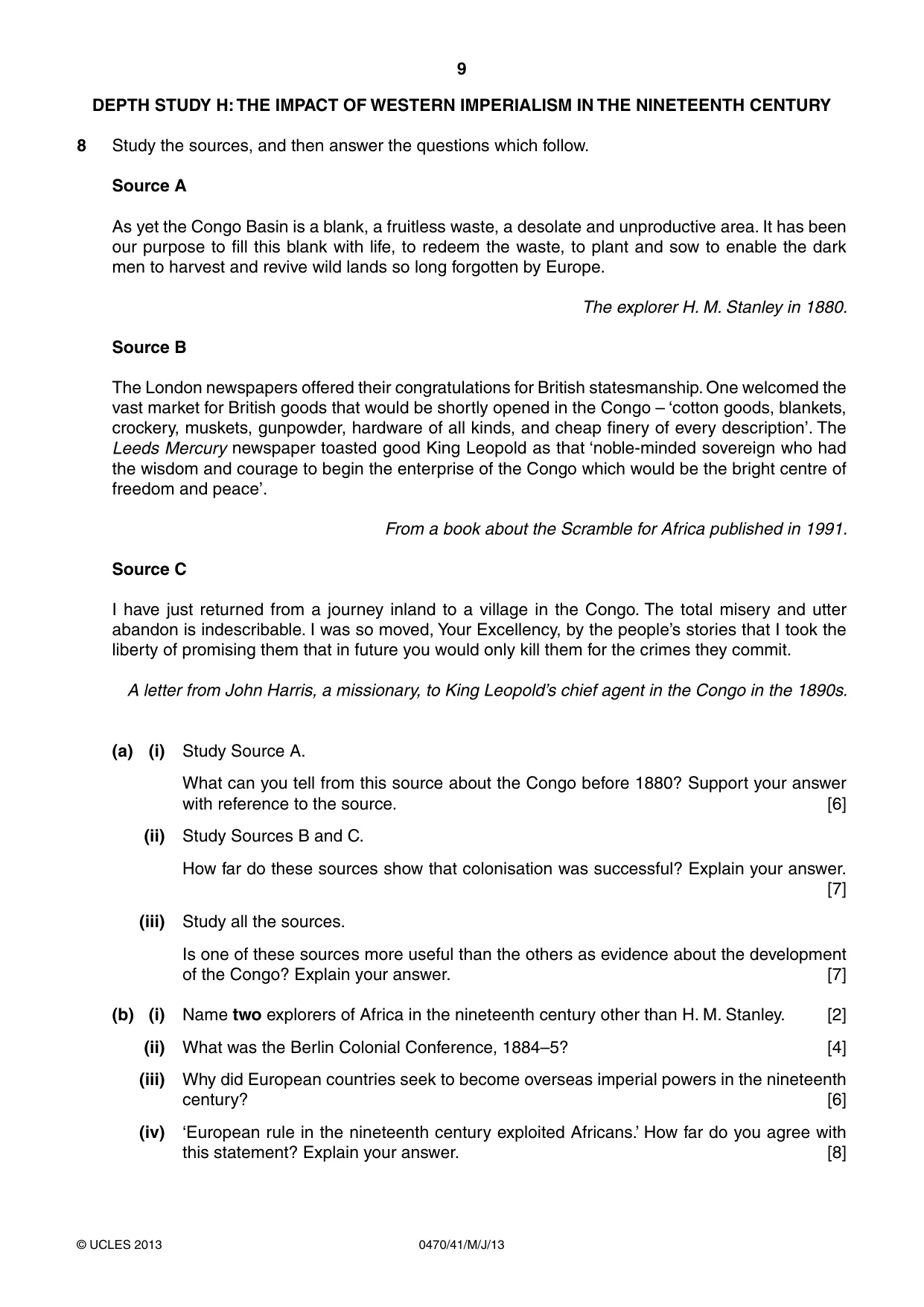
9 0470/41/M/J/13 © UCLES 2013 DEPTH STUDY H: THE IMPACT OF WESTERN IMPERIALISM IN THE NINETEENTH CENTURY 8 Study the sources, and then answer the questions which follow. Source A As yet the Congo Basin is a blank, a fruitless waste, a desolate and unproductive area. It has been our purpose to fill this blank with life, to redeem the waste, to plant and sow to enable the dark men to harvest and revive wild lands so long forgotten by Europe. The explorer H. M. Stanley in 1880. Source B The London newspapers offered their congratulations for British statesmanship. One welcomed the vast market for British goods that would be shortly opened in the Congo – ‘cotton goods, blankets, crockery, muskets, gunpowder, hardware of all kinds, and cheap finery of every description’. The Leeds Mercury newspaper toasted good King Leopold as that ‘noble-minded sovereign who had the wisdom and courage to begin the enterprise of the Congo which would be the bright centre of freedom and peace’. From a book about the Scramble for Africa published in 1991. Source C I have just returned from a journey inland to a village in the Congo. The total misery and utter abandon is indescribable. I was so moved, Your Excellency, by the people’s stories that I took the liberty of promising them that in future you would only kill them for the crimes they commit. A letter from John Harris, a missionary, to King Leopold’s chief agent in the Congo in the 1890s. (a) (i) Study Source A. What can you tell from this source about the Congo before 1880? Support your answer with reference to the source. [6] (ii) Study Sources B and C. How far do these sources show that colonisation was successful? Explain your answer. [7] (iii) Study all the sources. Is one of these sources more useful than the others as evidence about the development of the Congo? Explain your answer. [7] (b) (i) Name two explorers of Africa in the nineteenth century other than H. M. Stanley. [2] (ii) What was the Berlin Colonial Conference, 1884–5? [4] (iii) Why did European countries seek to become overseas imperial powers in the nineteenth century? [6] (iv) ‘European rule in the nineteenth century exploited Africans.’ How far do you agree with this statement? Explain your answer. [8]
Question paper, page 10
10 0470/41/M/J/13 © UCLES 2013 BLANK PAGE
Question paper, page 11
11 0470/41/M/J/13 © UCLES 2013 BLANK PAGE
Question paper, page 12
12 0470/41/M/J/13 © UCLES 2013 BLANK PAGE Copyright Acknowledgments: Depth Study A Source B Depth Study B Source A Depth Study B Source B Depth Study C Source B Depth Study D Source B Depth Study D Source B Depth Study E Source A Depth Study E Source B Depth Study F Source A Depth Study F Source B Depth Study G Source A Depth Study G Source B Depth Study H Source B Depth Study H Source C © A Bullock; Hitler, A Study in Tyranny; Penguin Books Ltd; 1986. © Orlando Figes; A People’s Tragedy; Jonathan Cape; Reprinted by permission of the Random House Group Ltd; 1996. © Clare Baker; Russia 1917-1945; Heinemann Publishers; 1990. © Eleanor Roosevelt; http://newdeal.feri.org/er/er10.htm. © Will Hutton; The Writing on the Wall; Little, Brown Book Group; 2007. © Bryn O’Callaghan; A History of the Twentieth Century; Published by Longman Group UK Ltd; Reprinted by permission of Pearson Education Ltd; 1987. © www.sahistory.org.za/article/anti-apartheid-movement-40-year-perspective-21. © www.sahistory.org.za/article/anti-apartheid-movement-40-year-perspective-21. © Bryn O’Callaghan; A History of the Twentieth Century; Published by Longman Group UK Ltd; Reprinted by permission of Pearson Education Ltd; 1987. © Chaim Hertzog; The Arab-Israeli Wars; Greenhill Books; 2005. © P Sauvain; British Economic & Social History; Stanley Thorne; 1987. © C Wolmar; Fire and Steam; Atlantic Books; 2007. © T Pakenham; The Scramble for Africa; Wiedenfeld & Nicholson; 1991. © T Pakenham; The Scramble for Africa; Wiedenfeld & Nicholson; 1991. Permission to reproduce items where third-party owned material protected by copyright is included has been sought and cleared where possible. Every reasonable effort has been made by the publisher (UCLES) to trace copyright holders, but if any items requiring clearance have unwittingly been included, the publisher will be pleased to make amends at the earliest possible opportunity. University of Cambridge International Examinations is part of the Cambridge Assessment Group. Cambridge Assessment is the brand name of University of Cambridge Local Examinations Syndicate (UCLES), which is itself a department of the University of Cambridge.
Mark scheme, page 1
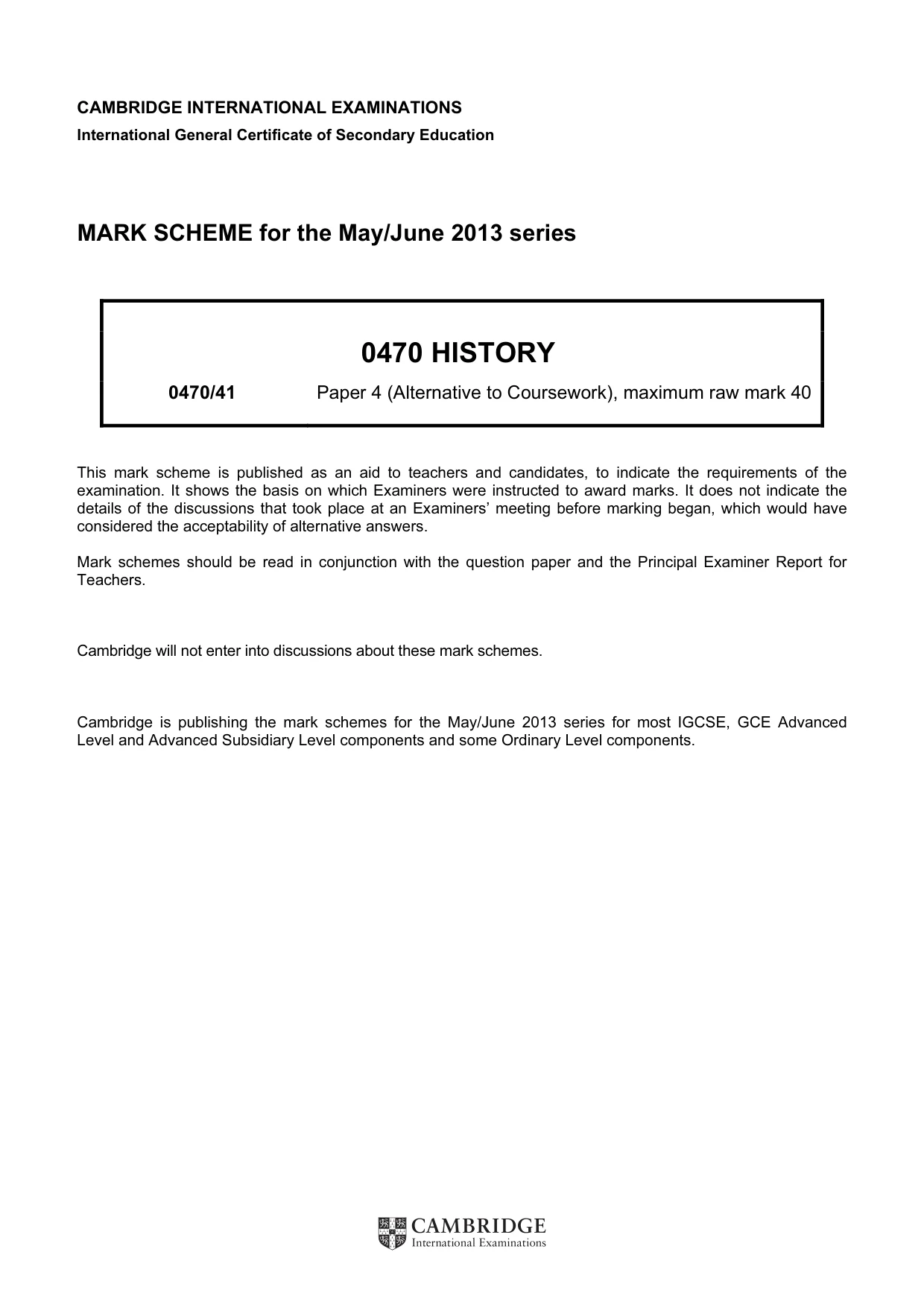
CAMBRIDGE INTERNATIONAL EXAMINATIONS International General Certificate of Secondary Education MARK SCHEME for the May/June 2013 series 0470 HISTORY 0470/41 Paper 4 (Alternative to Coursework), maximum raw mark 40 This mark scheme is published as an aid to teachers and candidates, to indicate the requirements of the examination. It shows the basis on which Examiners were instructed to award marks. It does not indicate the details of the discussions that took place at an Examiners’ meeting before marking began, which would have considered the acceptability of alternative answers. Mark schemes should be read in conjunction with the question paper and the Principal Examiner Report for Teachers. Cambridge will not enter into discussions about these mark schemes. Cambridge is publishing the mark schemes for the May/June 2013 series for most IGCSE, GCE Advanced Level and Advanced Subsidiary Level components and some Ordinary Level components.
Mark scheme, page 2
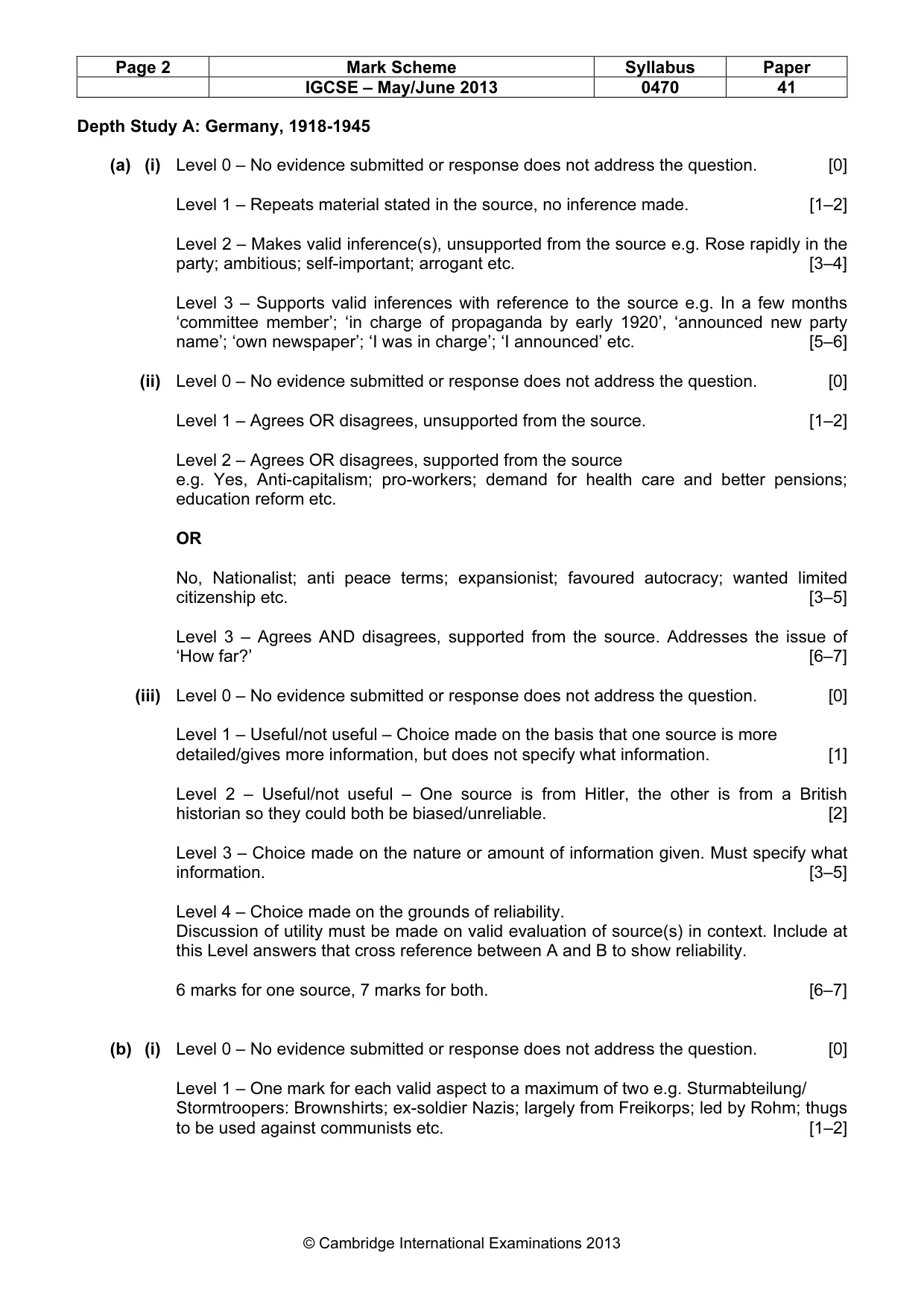
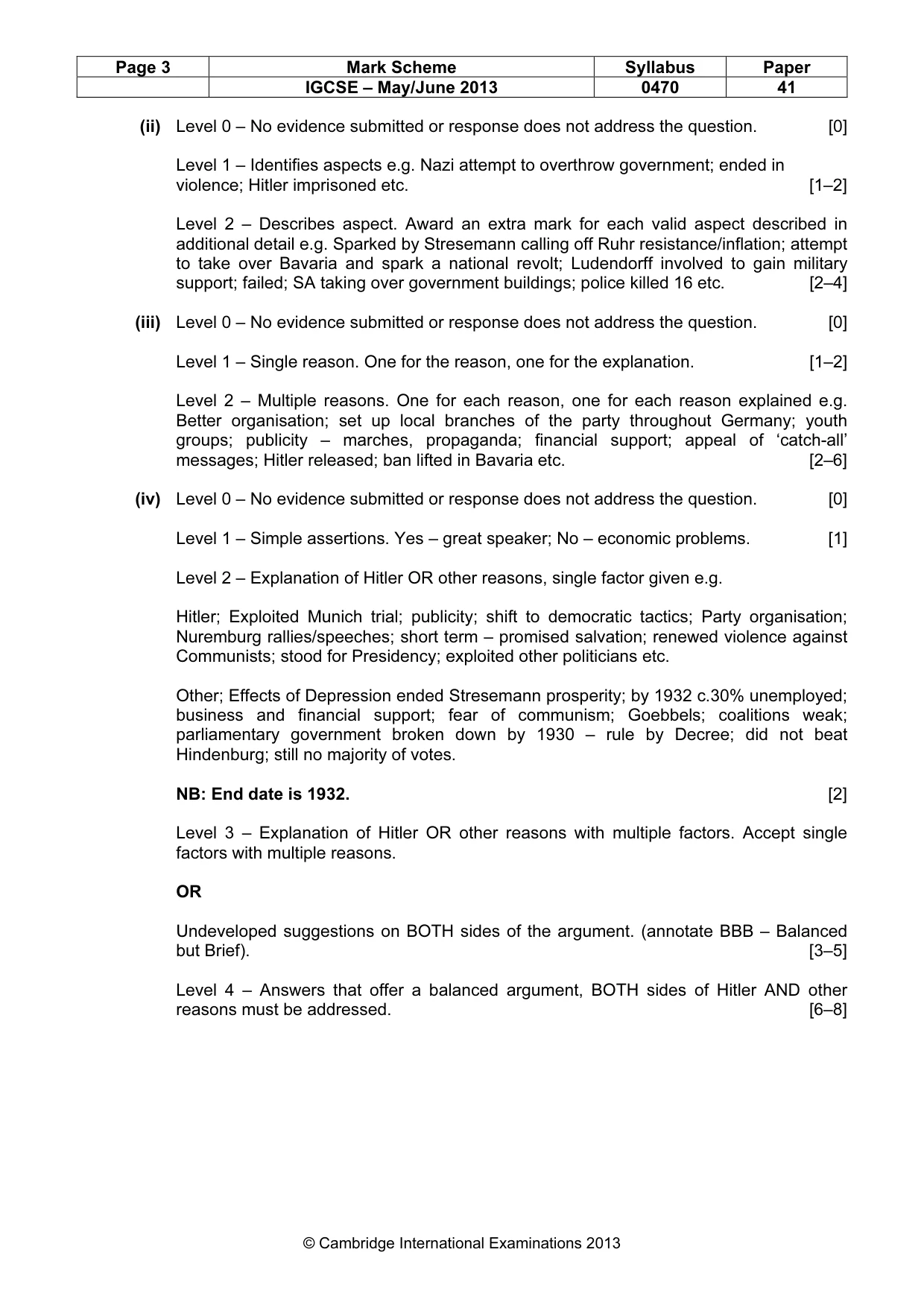
Page 2 Mark Scheme Syllabus Paper IGCSE – May/June 2013 0470 41 © Cambridge International Examinations 2013 Depth Study A: Germany, 1918-1945 (a) (i) Level 0 – No evidence submitted or response does not address the question. [0] Level 1 – Repeats material stated in the source, no inference made. [1–2] Level 2 – Makes valid inference(s), unsupported from the source e.g. Rose rapidly in the party; ambitious; self-important; arrogant etc. [3–4] Level 3 – Supports valid inferences with reference to the source e.g. In a few months ‘committee member’; ‘in charge of propaganda by early 1920’, ‘announced new party name’; ‘own newspaper’; ‘I was in charge’; ‘I announced’ etc. [5–6] (ii) Level 0 – No evidence submitted or response does not address the question. [0] Level 1 – Agrees OR disagrees, unsupported from the source. [1–2] Level 2 – Agrees OR disagrees, supported from the source e.g. Yes, Anti-capitalism; pro-workers; demand for health care and better pensions; education reform etc. OR No, Nationalist; anti peace terms; expansionist; favoured autocracy; wanted limited citizenship etc. [3–5] Level 3 – Agrees AND disagrees, supported from the source. Addresses the issue of ‘How far?’ [6–7] (iii) Level 0 – No evidence submitted or response does not address the question. [0] Level 1 – Useful/not useful – Choice made on the basis that one source is more detailed/gives more information, but does not specify what information. [1] Level 2 – Useful/not useful – One source is from Hitler, the other is from a British historian so they could both be biased/unreliable. [2] Level 3 – Choice made on the nature or amount of information given. Must specify what information. [3–5] Level 4 – Choice made on the grounds of reliability. Discussion of utility must be made on valid evaluation of source(s) in context. Include at this Level answers that cross reference between A and B to show reliability. 6 marks for one source, 7 marks for both. [6–7] (b) (i) Level 0 – No evidence submitted or response does not address the question. [0] Level 1 – One mark for each valid aspect to a maximum of two e.g. Sturmabteilung/ Stormtroopers: Brownshirts; ex-soldier Nazis; largely from Freikorps; led by Rohm; thugs to be used against communists etc. [1–2]
Mark scheme, page 3
Page 3 Mark Scheme Syllabus Paper IGCSE – May/June 2013 0470 41 © Cambridge International Examinations 2013 (ii) Level 0 – No evidence submitted or response does not address the question. [0] Level 1 – Identifies aspects e.g. Nazi attempt to overthrow government; ended in violence; Hitler imprisoned etc. [1–2] Level 2 – Describes aspect. Award an extra mark for each valid aspect described in additional detail e.g. Sparked by Stresemann calling off Ruhr resistance/inflation; attempt to take over Bavaria and spark a national revolt; Ludendorff involved to gain military support; failed; SA taking over government buildings; police killed 16 etc. [2–4] (iii) Level 0 – No evidence submitted or response does not address the question. [0] Level 1 – Single reason. One for the reason, one for the explanation. [1–2] Level 2 – Multiple reasons. One for each reason, one for each reason explained e.g. Better organisation; set up local branches of the party throughout Germany; youth groups; publicity – marches, propaganda; financial support; appeal of ‘catch-all’ messages; Hitler released; ban lifted in Bavaria etc. [2–6] (iv) Level 0 – No evidence submitted or response does not address the question. [0] Level 1 – Simple assertions. Yes – great speaker; No – economic problems. [1] Level 2 – Explanation of Hitler OR other reasons, single factor given e.g. Hitler; Exploited Munich trial; publicity; shift to democratic tactics; Party organisation; Nuremburg rallies/speeches; short term – promised salvation; renewed violence against Communists; stood for Presidency; exploited other politicians etc. Other; Effects of Depression ended Stresemann prosperity; by 1932 c.30% unemployed; business and financial support; fear of communism; Goebbels; coalitions weak; parliamentary government broken down by 1930 – rule by Decree; did not beat Hindenburg; still no majority of votes. NB: End date is 1932. [2] Level 3 – Explanation of Hitler OR other reasons with multiple factors. Accept single factors with multiple reasons. OR Undeveloped suggestions on BOTH sides of the argument. (annotate BBB – Balanced but Brief). [3–5] Level 4 – Answers that offer a balanced argument, BOTH sides of Hitler AND other reasons must be addressed. [6–8]
Mark scheme, page 4
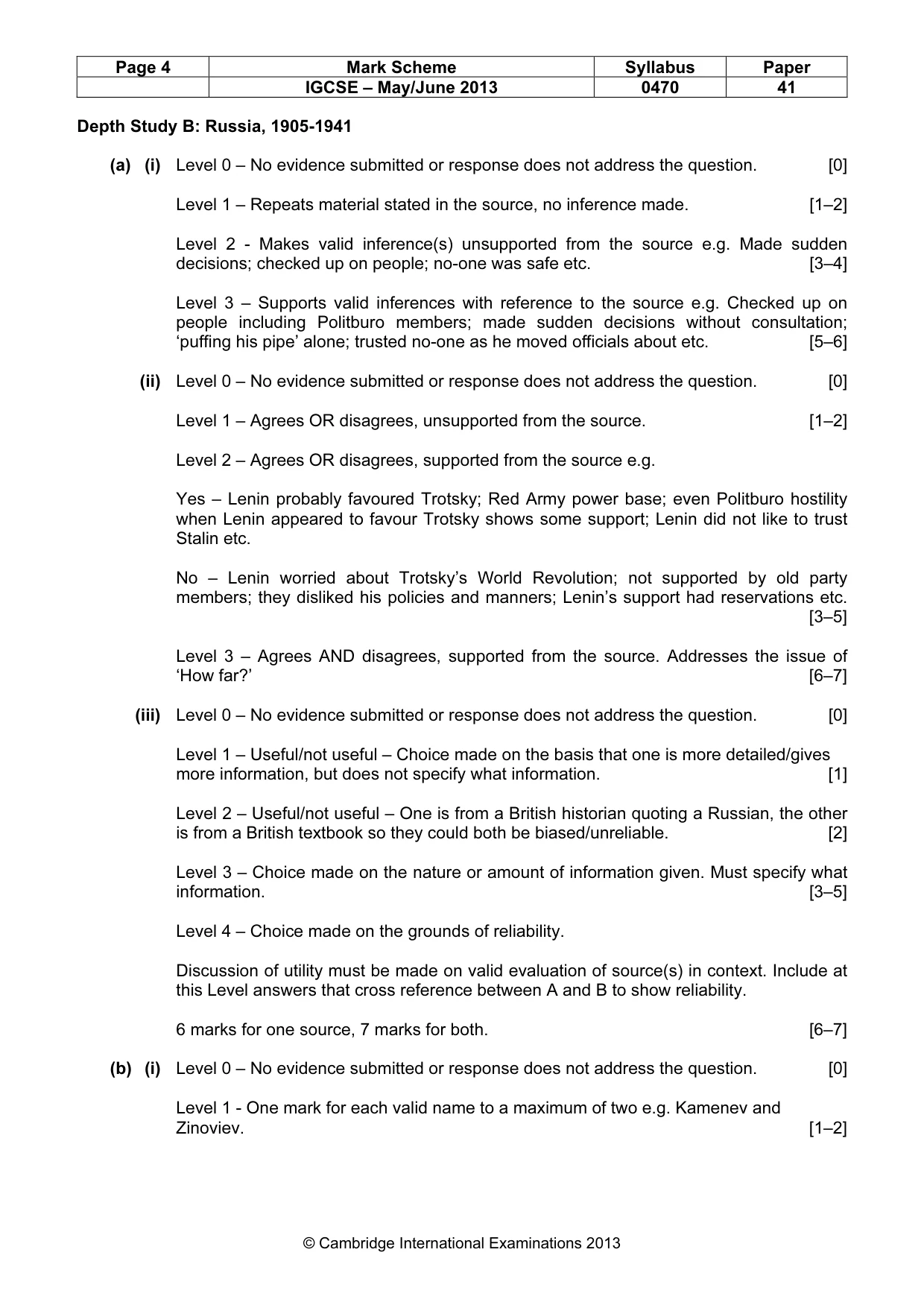
Page 4 Mark Scheme Syllabus Paper IGCSE – May/June 2013 0470 41 © Cambridge International Examinations 2013 Depth Study B: Russia, 1905-1941 (a) (i) Level 0 – No evidence submitted or response does not address the question. [0] Level 1 – Repeats material stated in the source, no inference made. [1–2] Level 2 - Makes valid inference(s) unsupported from the source e.g. Made sudden decisions; checked up on people; no-one was safe etc. [3–4] Level 3 – Supports valid inferences with reference to the source e.g. Checked up on people including Politburo members; made sudden decisions without consultation; ‘puffing his pipe’ alone; trusted no-one as he moved officials about etc. [5–6] (ii) Level 0 – No evidence submitted or response does not address the question. [0] Level 1 – Agrees OR disagrees, unsupported from the source. [1–2] Level 2 – Agrees OR disagrees, supported from the source e.g. Yes – Lenin probably favoured Trotsky; Red Army power base; even Politburo hostility when Lenin appeared to favour Trotsky shows some support; Lenin did not like to trust Stalin etc. No – Lenin worried about Trotsky’s World Revolution; not supported by old party members; they disliked his policies and manners; Lenin’s support had reservations etc. [3–5] Level 3 – Agrees AND disagrees, supported from the source. Addresses the issue of ‘How far?’ [6–7] (iii) Level 0 – No evidence submitted or response does not address the question. [0] Level 1 – Useful/not useful – Choice made on the basis that one is more detailed/gives more information, but does not specify what information. [1] Level 2 – Useful/not useful – One is from a British historian quoting a Russian, the other is from a British textbook so they could both be biased/unreliable. [2] Level 3 – Choice made on the nature or amount of information given. Must specify what information. [3–5] Level 4 – Choice made on the grounds of reliability. Discussion of utility must be made on valid evaluation of source(s) in context. Include at this Level answers that cross reference between A and B to show reliability. 6 marks for one source, 7 marks for both. [6–7] (b) (i) Level 0 – No evidence submitted or response does not address the question. [0] Level 1 - One mark for each valid name to a maximum of two e.g. Kamenev and Zinoviev. [1–2]
Mark scheme, page 5
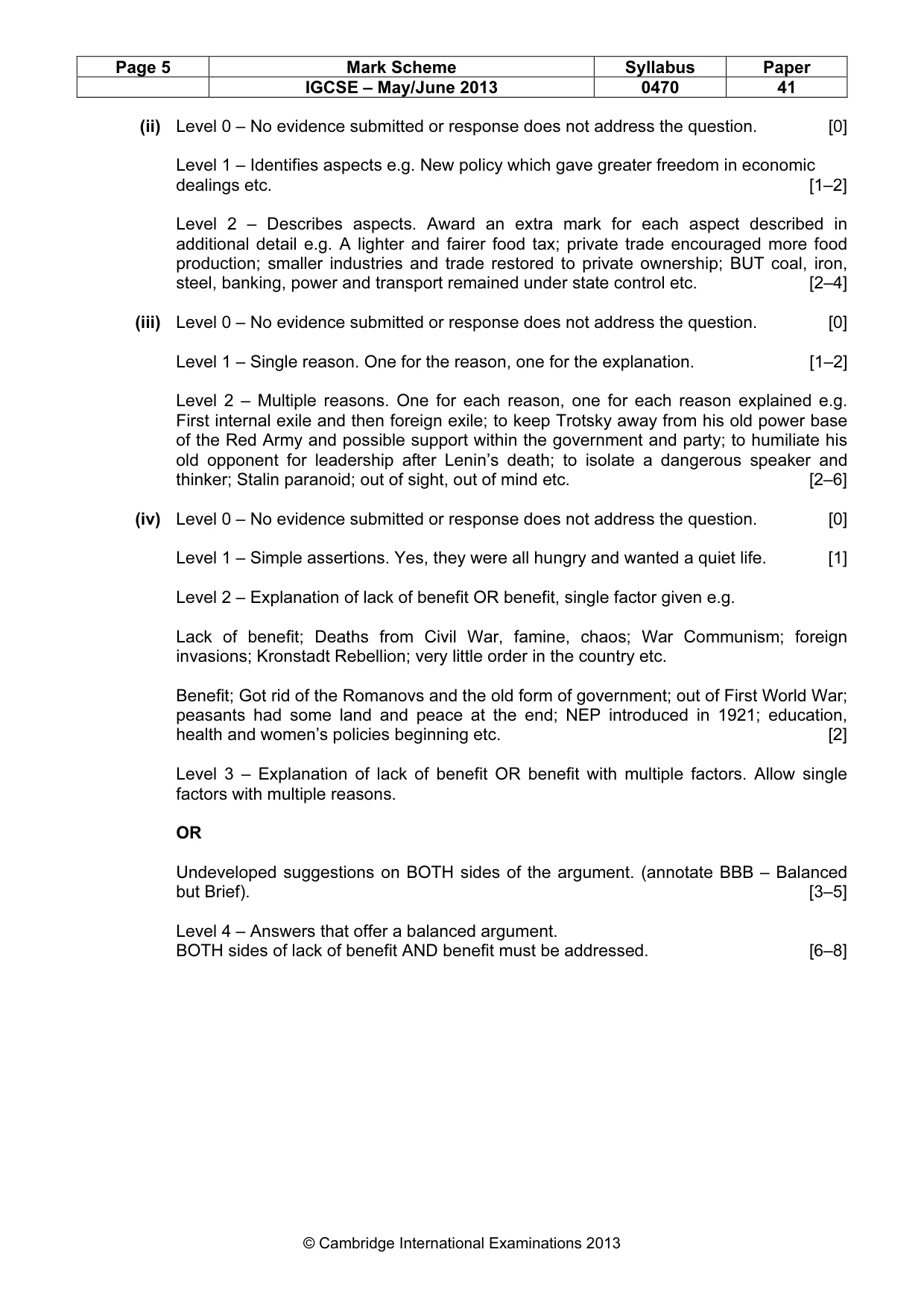
Page 5 Mark Scheme Syllabus Paper IGCSE – May/June 2013 0470 41 © Cambridge International Examinations 2013 (ii) Level 0 – No evidence submitted or response does not address the question. [0] Level 1 – Identifies aspects e.g. New policy which gave greater freedom in economic dealings etc. [1–2] Level 2 – Describes aspects. Award an extra mark for each aspect described in additional detail e.g. A lighter and fairer food tax; private trade encouraged more food production; smaller industries and trade restored to private ownership; BUT coal, iron, steel, banking, power and transport remained under state control etc. [2–4] (iii) Level 0 – No evidence submitted or response does not address the question. [0] Level 1 – Single reason. One for the reason, one for the explanation. [1–2] Level 2 – Multiple reasons. One for each reason, one for each reason explained e.g. First internal exile and then foreign exile; to keep Trotsky away from his old power base of the Red Army and possible support within the government and party; to humiliate his old opponent for leadership after Lenin’s death; to isolate a dangerous speaker and thinker; Stalin paranoid; out of sight, out of mind etc. [2–6] (iv) Level 0 – No evidence submitted or response does not address the question. [0] Level 1 – Simple assertions. Yes, they were all hungry and wanted a quiet life. [1] Level 2 – Explanation of lack of benefit OR benefit, single factor given e.g. Lack of benefit; Deaths from Civil War, famine, chaos; War Communism; foreign invasions; Kronstadt Rebellion; very little order in the country etc. Benefit; Got rid of the Romanovs and the old form of government; out of First World War; peasants had some land and peace at the end; NEP introduced in 1921; education, health and women’s policies beginning etc. [2] Level 3 – Explanation of lack of benefit OR benefit with multiple factors. Allow single factors with multiple reasons. OR Undeveloped suggestions on BOTH sides of the argument. (annotate BBB – Balanced but Brief). [3–5] Level 4 – Answers that offer a balanced argument. BOTH sides of lack of benefit AND benefit must be addressed. [6–8]
Mark scheme, page 6
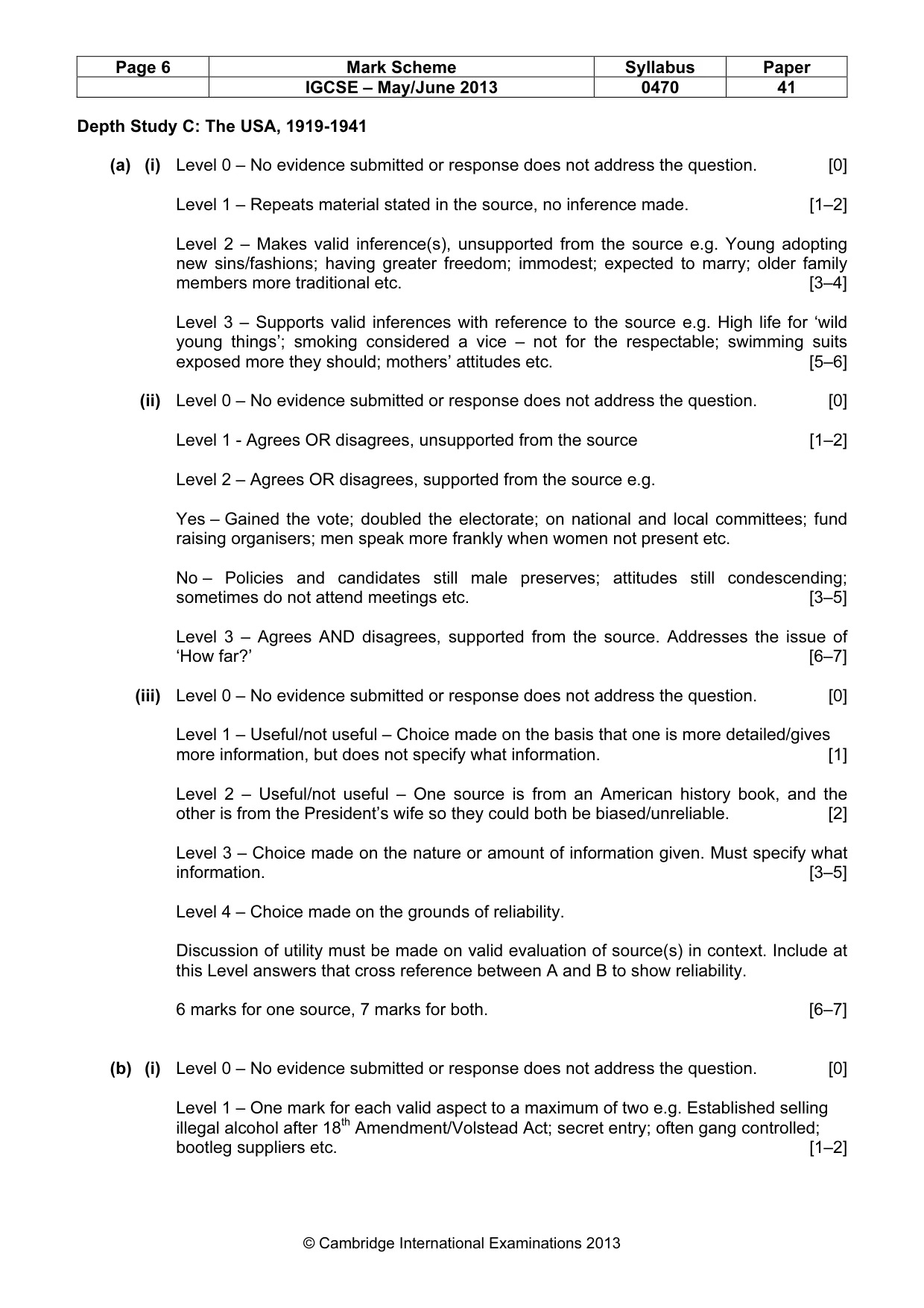
Page 6 Mark Scheme Syllabus Paper IGCSE – May/June 2013 0470 41 © Cambridge International Examinations 2013 Depth Study C: The USA, 1919-1941 (a) (i) Level 0 – No evidence submitted or response does not address the question. [0] Level 1 – Repeats material stated in the source, no inference made. [1–2] Level 2 – Makes valid inference(s), unsupported from the source e.g. Young adopting new sins/fashions; having greater freedom; immodest; expected to marry; older family members more traditional etc. [3–4] Level 3 – Supports valid inferences with reference to the source e.g. High life for ‘wild young things’; smoking considered a vice – not for the respectable; swimming suits exposed more they should; mothers’ attitudes etc. [5–6] (ii) Level 0 – No evidence submitted or response does not address the question. [0] Level 1 - Agrees OR disagrees, unsupported from the source [1–2] Level 2 – Agrees OR disagrees, supported from the source e.g. Yes – Gained the vote; doubled the electorate; on national and local committees; fund raising organisers; men speak more frankly when women not present etc. No – Policies and candidates still male preserves; attitudes still condescending; sometimes do not attend meetings etc. [3–5] Level 3 – Agrees AND disagrees, supported from the source. Addresses the issue of ‘How far?’ [6–7] (iii) Level 0 – No evidence submitted or response does not address the question. [0] Level 1 – Useful/not useful – Choice made on the basis that one is more detailed/gives more information, but does not specify what information. [1] Level 2 – Useful/not useful – One source is from an American history book, and the other is from the President’s wife so they could both be biased/unreliable. [2] Level 3 – Choice made on the nature or amount of information given. Must specify what information. [3–5] Level 4 – Choice made on the grounds of reliability. Discussion of utility must be made on valid evaluation of source(s) in context. Include at this Level answers that cross reference between A and B to show reliability. 6 marks for one source, 7 marks for both. [6–7] (b) (i) Level 0 – No evidence submitted or response does not address the question. [0] Level 1 – One mark for each valid aspect to a maximum of two e.g. Established selling illegal alcohol after 18th Amendment/Volstead Act; secret entry; often gang controlled; bootleg suppliers etc. [1–2]
Mark scheme, page 7
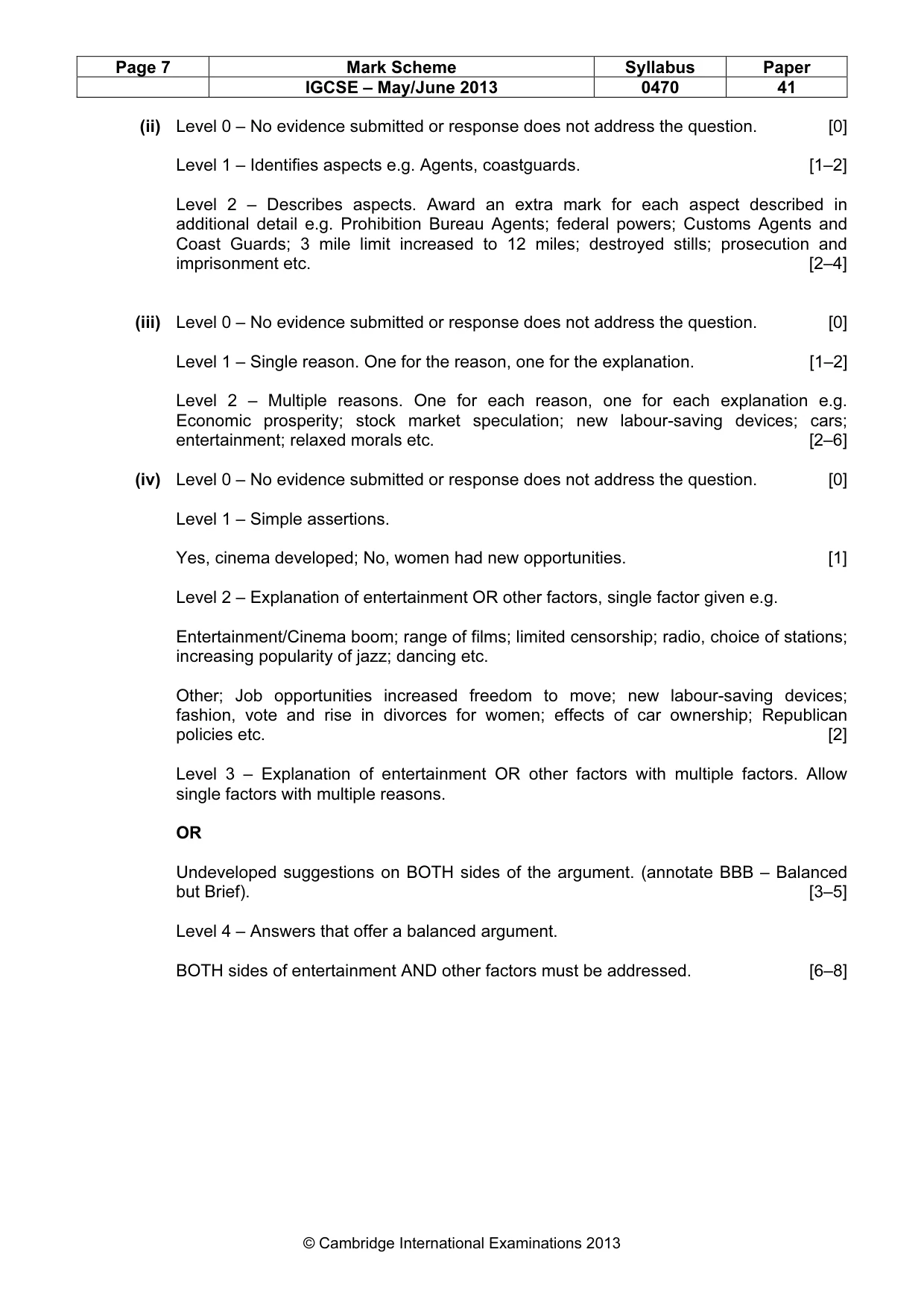
Page 7 Mark Scheme Syllabus Paper IGCSE – May/June 2013 0470 41 © Cambridge International Examinations 2013 (ii) Level 0 – No evidence submitted or response does not address the question. [0] Level 1 – Identifies aspects e.g. Agents, coastguards. [1–2] Level 2 – Describes aspects. Award an extra mark for each aspect described in additional detail e.g. Prohibition Bureau Agents; federal powers; Customs Agents and Coast Guards; 3 mile limit increased to 12 miles; destroyed stills; prosecution and imprisonment etc. [2–4] (iii) Level 0 – No evidence submitted or response does not address the question. [0] Level 1 – Single reason. One for the reason, one for the explanation. [1–2] Level 2 – Multiple reasons. One for each reason, one for each explanation e.g. Economic prosperity; stock market speculation; new labour-saving devices; cars; entertainment; relaxed morals etc. [2–6] (iv) Level 0 – No evidence submitted or response does not address the question. [0] Level 1 – Simple assertions. Yes, cinema developed; No, women had new opportunities. [1] Level 2 – Explanation of entertainment OR other factors, single factor given e.g. Entertainment/Cinema boom; range of films; limited censorship; radio, choice of stations; increasing popularity of jazz; dancing etc. Other; Job opportunities increased freedom to move; new labour-saving devices; fashion, vote and rise in divorces for women; effects of car ownership; Republican policies etc. [2] Level 3 – Explanation of entertainment OR other factors with multiple factors. Allow single factors with multiple reasons. OR Undeveloped suggestions on BOTH sides of the argument. (annotate BBB – Balanced but Brief). [3–5] Level 4 – Answers that offer a balanced argument. BOTH sides of entertainment AND other factors must be addressed. [6–8]
Mark scheme, page 8
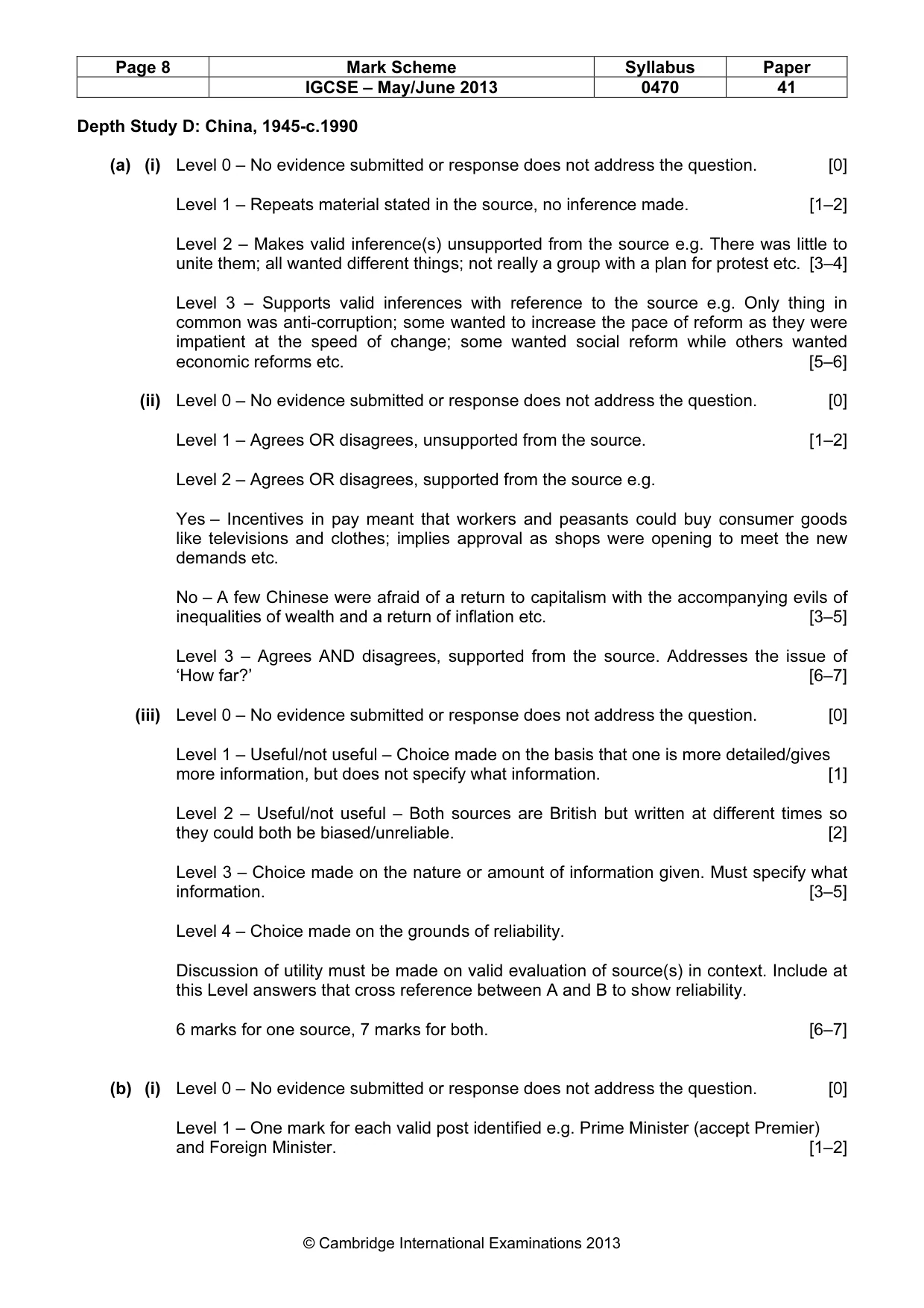
Page 8 Mark Scheme Syllabus Paper IGCSE – May/June 2013 0470 41 © Cambridge International Examinations 2013 Depth Study D: China, 1945-c.1990 (a) (i) Level 0 – No evidence submitted or response does not address the question. [0] Level 1 – Repeats material stated in the source, no inference made. [1–2] Level 2 – Makes valid inference(s) unsupported from the source e.g. There was little to unite them; all wanted different things; not really a group with a plan for protest etc. [3–4] Level 3 – Supports valid inferences with reference to the source e.g. Only thing in common was anti-corruption; some wanted to increase the pace of reform as they were impatient at the speed of change; some wanted social reform while others wanted economic reforms etc. [5–6] (ii) Level 0 – No evidence submitted or response does not address the question. [0] Level 1 – Agrees OR disagrees, unsupported from the source. [1–2] Level 2 – Agrees OR disagrees, supported from the source e.g. Yes – Incentives in pay meant that workers and peasants could buy consumer goods like televisions and clothes; implies approval as shops were opening to meet the new demands etc. No – A few Chinese were afraid of a return to capitalism with the accompanying evils of inequalities of wealth and a return of inflation etc. [3–5] Level 3 – Agrees AND disagrees, supported from the source. Addresses the issue of ‘How far?’ [6–7] (iii) Level 0 – No evidence submitted or response does not address the question. [0] Level 1 – Useful/not useful – Choice made on the basis that one is more detailed/gives more information, but does not specify what information. [1] Level 2 – Useful/not useful – Both sources are British but written at different times so they could both be biased/unreliable. [2] Level 3 – Choice made on the nature or amount of information given. Must specify what information. [3–5] Level 4 – Choice made on the grounds of reliability. Discussion of utility must be made on valid evaluation of source(s) in context. Include at this Level answers that cross reference between A and B to show reliability. 6 marks for one source, 7 marks for both. [6–7] (b) (i) Level 0 – No evidence submitted or response does not address the question. [0] Level 1 – One mark for each valid post identified e.g. Prime Minister (accept Premier) and Foreign Minister. [1–2]
Mark scheme, page 9
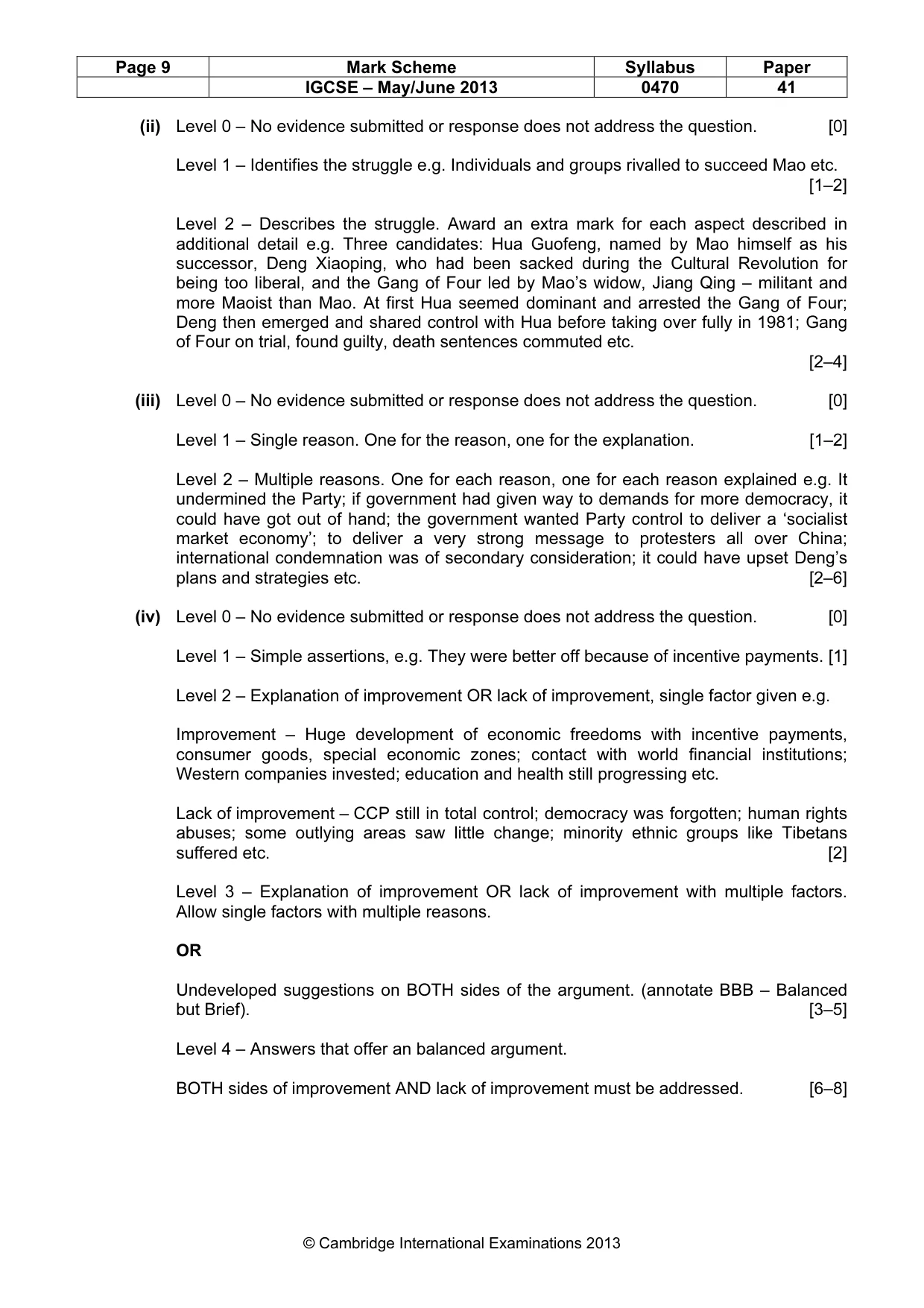
Page 9 Mark Scheme Syllabus Paper IGCSE – May/June 2013 0470 41 © Cambridge International Examinations 2013 (ii) Level 0 – No evidence submitted or response does not address the question. [0] Level 1 – Identifies the struggle e.g. Individuals and groups rivalled to succeed Mao etc. [1–2] Level 2 – Describes the struggle. Award an extra mark for each aspect described in additional detail e.g. Three candidates: Hua Guofeng, named by Mao himself as his successor, Deng Xiaoping, who had been sacked during the Cultural Revolution for being too liberal, and the Gang of Four led by Mao’s widow, Jiang Qing – militant and more Maoist than Mao. At first Hua seemed dominant and arrested the Gang of Four; Deng then emerged and shared control with Hua before taking over fully in 1981; Gang of Four on trial, found guilty, death sentences commuted etc. [2–4] (iii) Level 0 – No evidence submitted or response does not address the question. [0] Level 1 – Single reason. One for the reason, one for the explanation. [1–2] Level 2 – Multiple reasons. One for each reason, one for each reason explained e.g. It undermined the Party; if government had given way to demands for more democracy, it could have got out of hand; the government wanted Party control to deliver a ‘socialist market economy’; to deliver a very strong message to protesters all over China; international condemnation was of secondary consideration; it could have upset Deng’s plans and strategies etc. [2–6] (iv) Level 0 – No evidence submitted or response does not address the question. [0] Level 1 – Simple assertions, e.g. They were better off because of incentive payments. [1] Level 2 – Explanation of improvement OR lack of improvement, single factor given e.g. Improvement – Huge development of economic freedoms with incentive payments, consumer goods, special economic zones; contact with world financial institutions; Western companies invested; education and health still progressing etc. Lack of improvement – CCP still in total control; democracy was forgotten; human rights abuses; some outlying areas saw little change; minority ethnic groups like Tibetans suffered etc. [2] Level 3 – Explanation of improvement OR lack of improvement with multiple factors. Allow single factors with multiple reasons. OR Undeveloped suggestions on BOTH sides of the argument. (annotate BBB – Balanced but Brief). [3–5] Level 4 – Answers that offer an balanced argument. BOTH sides of improvement AND lack of improvement must be addressed. [6–8]
Mark scheme, page 10
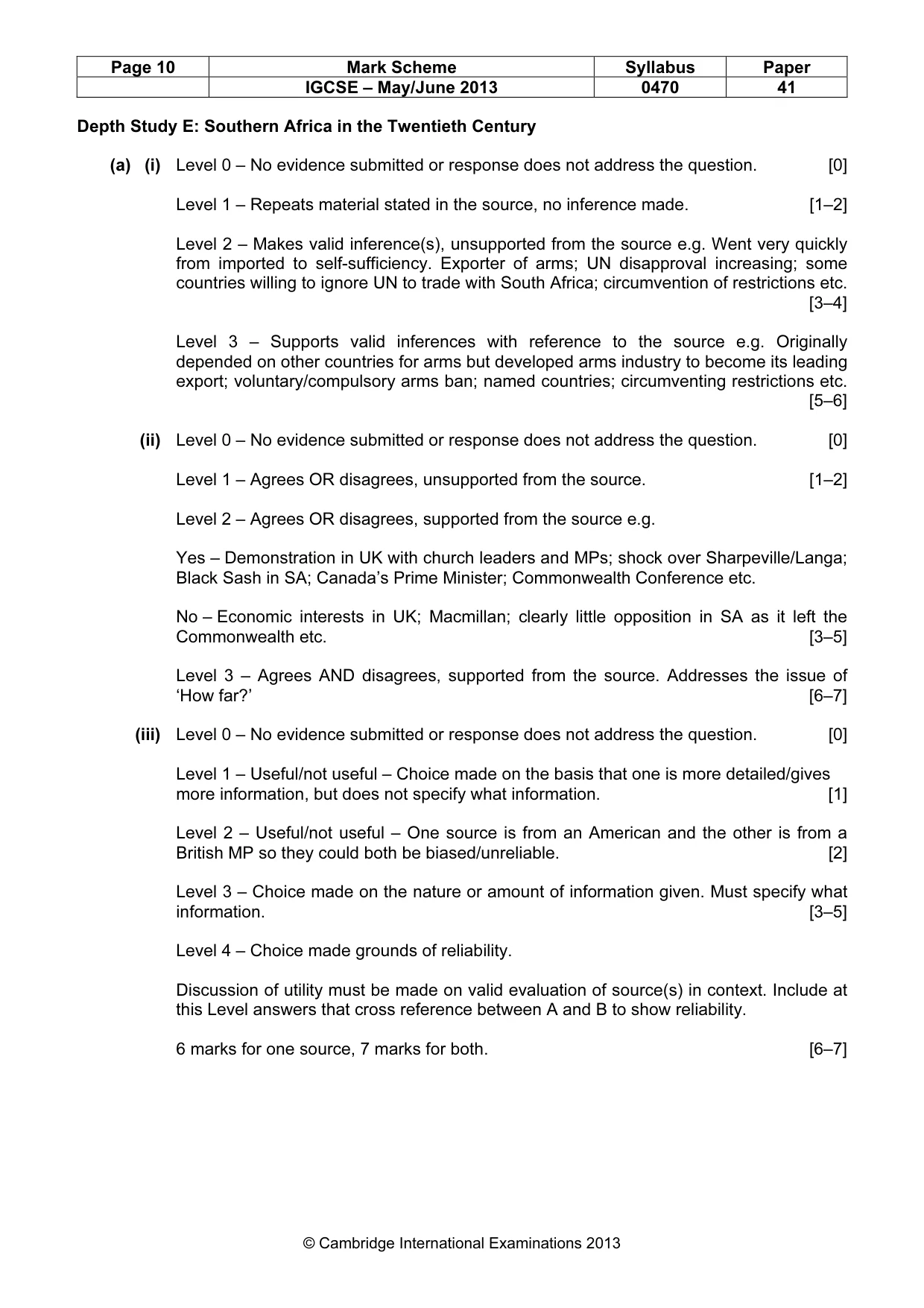
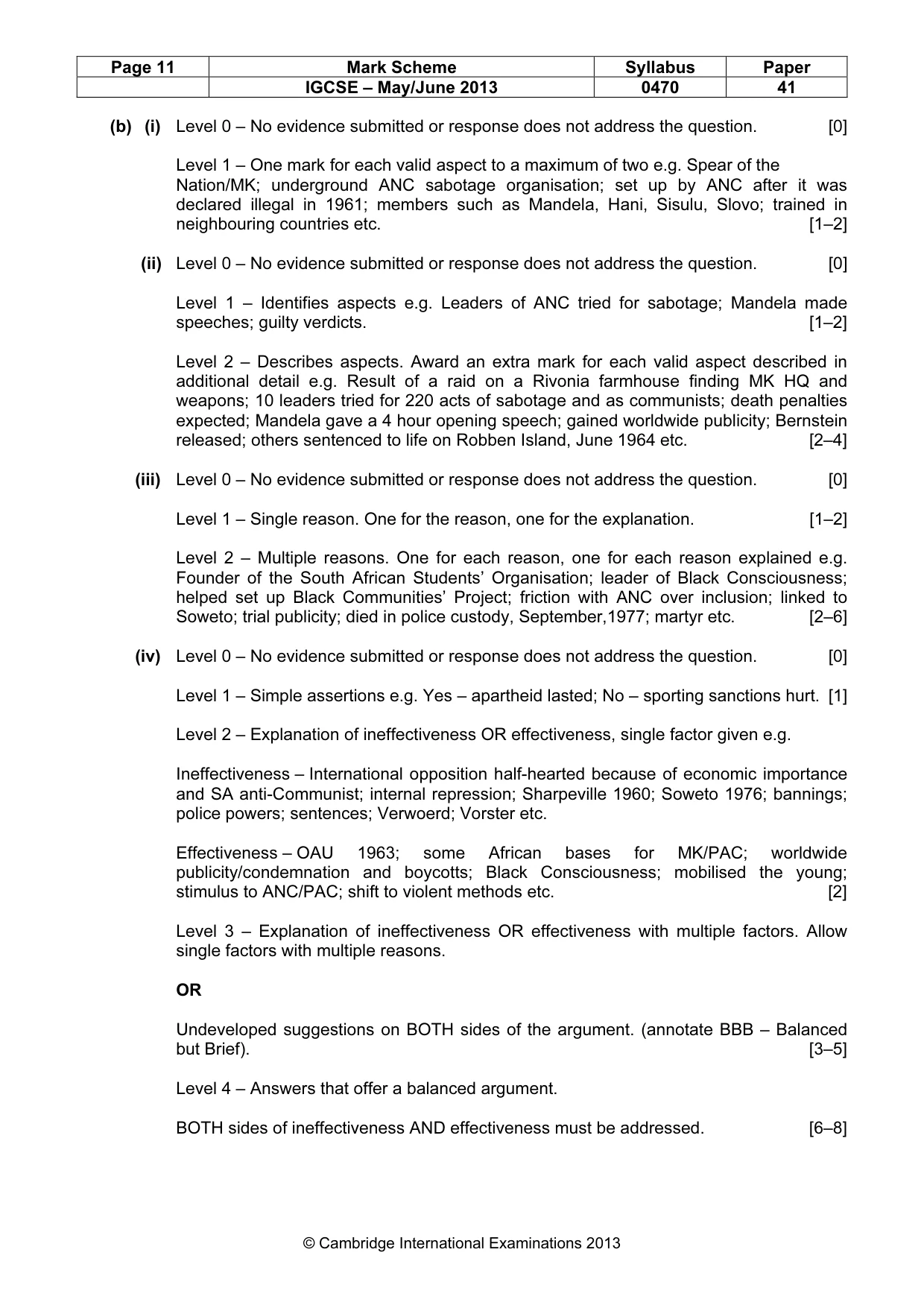
Page 10 Mark Scheme Syllabus Paper IGCSE – May/June 2013 0470 41 © Cambridge International Examinations 2013 Depth Study E: Southern Africa in the Twentieth Century (a) (i) Level 0 – No evidence submitted or response does not address the question. [0] Level 1 – Repeats material stated in the source, no inference made. [1–2] Level 2 – Makes valid inference(s), unsupported from the source e.g. Went very quickly from imported to self-sufficiency. Exporter of arms; UN disapproval increasing; some countries willing to ignore UN to trade with South Africa; circumvention of restrictions etc. [3–4] Level 3 – Supports valid inferences with reference to the source e.g. Originally depended on other countries for arms but developed arms industry to become its leading export; voluntary/compulsory arms ban; named countries; circumventing restrictions etc. [5–6] (ii) Level 0 – No evidence submitted or response does not address the question. [0] Level 1 – Agrees OR disagrees, unsupported from the source. [1–2] Level 2 – Agrees OR disagrees, supported from the source e.g. Yes – Demonstration in UK with church leaders and MPs; shock over Sharpeville/Langa; Black Sash in SA; Canada’s Prime Minister; Commonwealth Conference etc. No – Economic interests in UK; Macmillan; clearly little opposition in SA as it left the Commonwealth etc. [3–5] Level 3 – Agrees AND disagrees, supported from the source. Addresses the issue of ‘How far?’ [6–7] (iii) Level 0 – No evidence submitted or response does not address the question. [0] Level 1 – Useful/not useful – Choice made on the basis that one is more detailed/gives more information, but does not specify what information. [1] Level 2 – Useful/not useful – One source is from an American and the other is from a British MP so they could both be biased/unreliable. [2] Level 3 – Choice made on the nature or amount of information given. Must specify what information. [3–5] Level 4 – Choice made grounds of reliability. Discussion of utility must be made on valid evaluation of source(s) in context. Include at this Level answers that cross reference between A and B to show reliability. 6 marks for one source, 7 marks for both. [6–7]
Mark scheme, page 11
Page 11 Mark Scheme Syllabus Paper IGCSE – May/June 2013 0470 41 © Cambridge International Examinations 2013 (b) (i) Level 0 – No evidence submitted or response does not address the question. [0] Level 1 – One mark for each valid aspect to a maximum of two e.g. Spear of the Nation/MK; underground ANC sabotage organisation; set up by ANC after it was declared illegal in 1961; members such as Mandela, Hani, Sisulu, Slovo; trained in neighbouring countries etc. [1–2] (ii) Level 0 – No evidence submitted or response does not address the question. [0] Level 1 – Identifies aspects e.g. Leaders of ANC tried for sabotage; Mandela made speeches; guilty verdicts. [1–2] Level 2 – Describes aspects. Award an extra mark for each valid aspect described in additional detail e.g. Result of a raid on a Rivonia farmhouse finding MK HQ and weapons; 10 leaders tried for 220 acts of sabotage and as communists; death penalties expected; Mandela gave a 4 hour opening speech; gained worldwide publicity; Bernstein released; others sentenced to life on Robben Island, June 1964 etc. [2–4] (iii) Level 0 – No evidence submitted or response does not address the question. [0] Level 1 – Single reason. One for the reason, one for the explanation. [1–2] Level 2 – Multiple reasons. One for each reason, one for each reason explained e.g. Founder of the South African Students’ Organisation; leader of Black Consciousness; helped set up Black Communities’ Project; friction with ANC over inclusion; linked to Soweto; trial publicity; died in police custody, September,1977; martyr etc. [2–6] (iv) Level 0 – No evidence submitted or response does not address the question. [0] Level 1 – Simple assertions e.g. Yes – apartheid lasted; No – sporting sanctions hurt. [1] Level 2 – Explanation of ineffectiveness OR effectiveness, single factor given e.g. Ineffectiveness – International opposition half-hearted because of economic importance and SA anti-Communist; internal repression; Sharpeville 1960; Soweto 1976; bannings; police powers; sentences; Verwoerd; Vorster etc. Effectiveness – OAU 1963; some African bases for MK/PAC; worldwide publicity/condemnation and boycotts; Black Consciousness; mobilised the young; stimulus to ANC/PAC; shift to violent methods etc. [2] Level 3 – Explanation of ineffectiveness OR effectiveness with multiple factors. Allow single factors with multiple reasons. OR Undeveloped suggestions on BOTH sides of the argument. (annotate BBB – Balanced but Brief). [3–5] Level 4 – Answers that offer a balanced argument. BOTH sides of ineffectiveness AND effectiveness must be addressed. [6–8]
Mark scheme, page 12
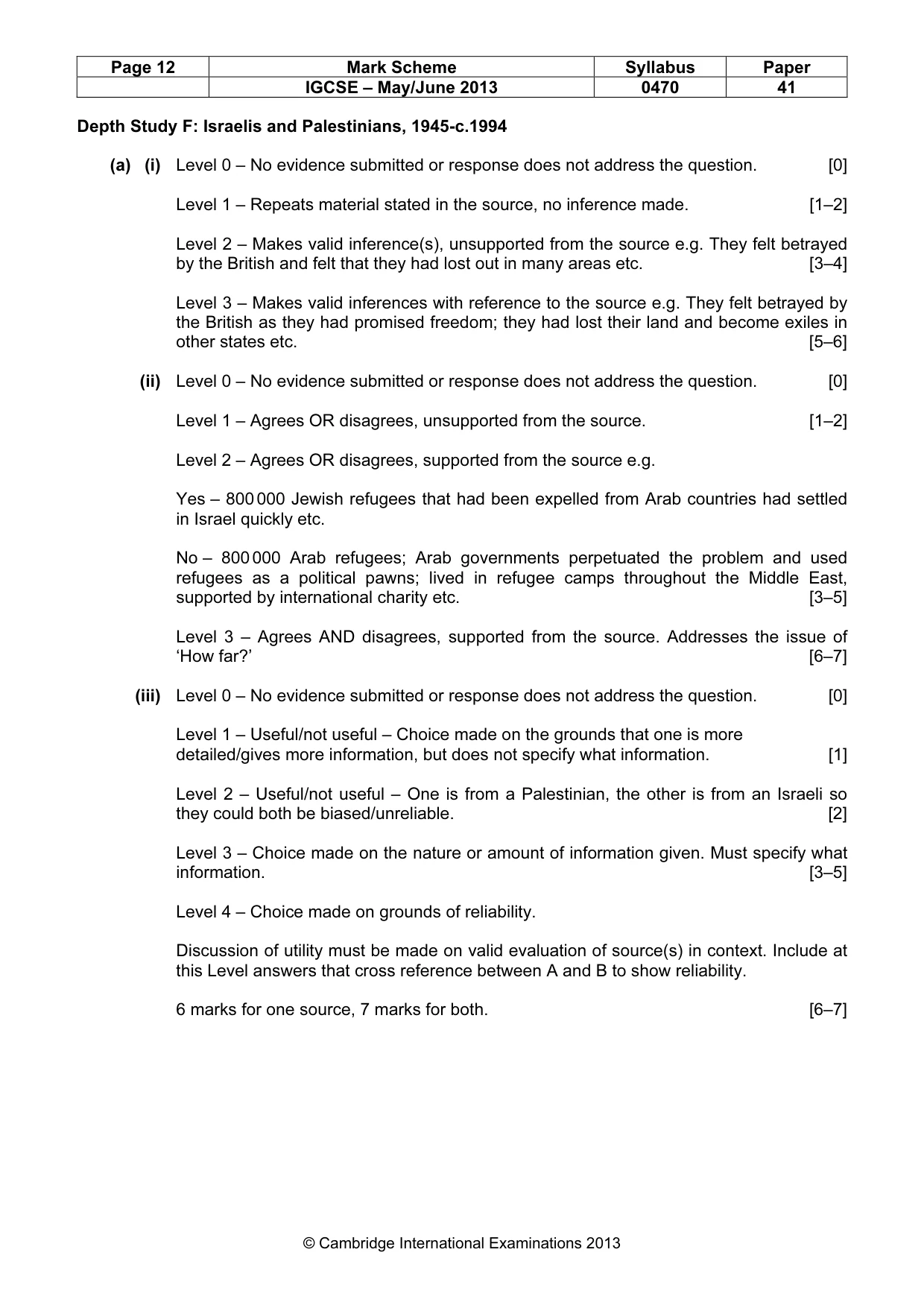
Page 12 Mark Scheme Syllabus Paper IGCSE – May/June 2013 0470 41 © Cambridge International Examinations 2013 Depth Study F: Israelis and Palestinians, 1945-c.1994 (a) (i) Level 0 – No evidence submitted or response does not address the question. [0] Level 1 – Repeats material stated in the source, no inference made. [1–2] Level 2 – Makes valid inference(s), unsupported from the source e.g. They felt betrayed by the British and felt that they had lost out in many areas etc. [3–4] Level 3 – Makes valid inferences with reference to the source e.g. They felt betrayed by the British as they had promised freedom; they had lost their land and become exiles in other states etc. [5–6] (ii) Level 0 – No evidence submitted or response does not address the question. [0] Level 1 – Agrees OR disagrees, unsupported from the source. [1–2] Level 2 – Agrees OR disagrees, supported from the source e.g. Yes – 800 000 Jewish refugees that had been expelled from Arab countries had settled in Israel quickly etc. No – 800 000 Arab refugees; Arab governments perpetuated the problem and used refugees as a political pawns; lived in refugee camps throughout the Middle East, supported by international charity etc. [3–5] Level 3 – Agrees AND disagrees, supported from the source. Addresses the issue of ‘How far?’ [6–7] (iii) Level 0 – No evidence submitted or response does not address the question. [0] Level 1 – Useful/not useful – Choice made on the grounds that one is more detailed/gives more information, but does not specify what information. [1] Level 2 – Useful/not useful – One is from a Palestinian, the other is from an Israeli so they could both be biased/unreliable. [2] Level 3 – Choice made on the nature or amount of information given. Must specify what information. [3–5] Level 4 – Choice made on grounds of reliability. Discussion of utility must be made on valid evaluation of source(s) in context. Include at this Level answers that cross reference between A and B to show reliability. 6 marks for one source, 7 marks for both. [6–7]
Mark scheme, page 13
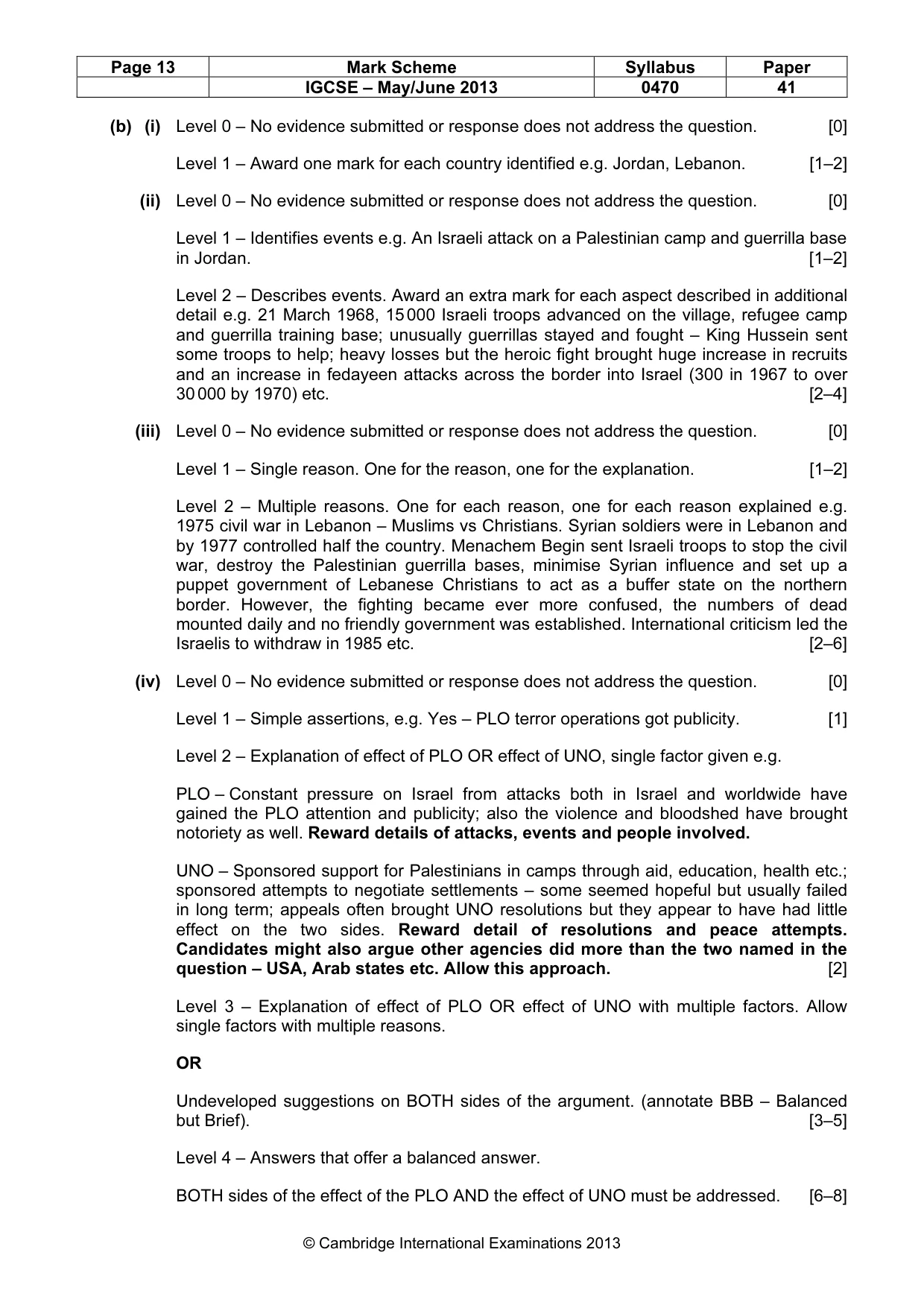
Page 13 Mark Scheme Syllabus Paper IGCSE – May/June 2013 0470 41 © Cambridge International Examinations 2013 (b) (i) Level 0 – No evidence submitted or response does not address the question. [0] Level 1 – Award one mark for each country identified e.g. Jordan, Lebanon. [1–2] (ii) Level 0 – No evidence submitted or response does not address the question. [0] Level 1 – Identifies events e.g. An Israeli attack on a Palestinian camp and guerrilla base in Jordan. [1–2] Level 2 – Describes events. Award an extra mark for each aspect described in additional detail e.g. 21 March 1968, 15 000 Israeli troops advanced on the village, refugee camp and guerrilla training base; unusually guerrillas stayed and fought – King Hussein sent some troops to help; heavy losses but the heroic fight brought huge increase in recruits and an increase in fedayeen attacks across the border into Israel (300 in 1967 to over 30 000 by 1970) etc. [2–4] (iii) Level 0 – No evidence submitted or response does not address the question. [0] Level 1 – Single reason. One for the reason, one for the explanation. [1–2] Level 2 – Multiple reasons. One for each reason, one for each reason explained e.g. 1975 civil war in Lebanon – Muslims vs Christians. Syrian soldiers were in Lebanon and by 1977 controlled half the country. Menachem Begin sent Israeli troops to stop the civil war, destroy the Palestinian guerrilla bases, minimise Syrian influence and set up a puppet government of Lebanese Christians to act as a buffer state on the northern border. However, the fighting became ever more confused, the numbers of dead mounted daily and no friendly government was established. International criticism led the Israelis to withdraw in 1985 etc. [2–6] (iv) Level 0 – No evidence submitted or response does not address the question. [0] Level 1 – Simple assertions, e.g. Yes – PLO terror operations got publicity. [1] Level 2 – Explanation of effect of PLO OR effect of UNO, single factor given e.g. PLO – Constant pressure on Israel from attacks both in Israel and worldwide have gained the PLO attention and publicity; also the violence and bloodshed have brought notoriety as well. Reward details of attacks, events and people involved. UNO – Sponsored support for Palestinians in camps through aid, education, health etc.; sponsored attempts to negotiate settlements – some seemed hopeful but usually failed in long term; appeals often brought UNO resolutions but they appear to have had little effect on the two sides. Reward detail of resolutions and peace attempts. Candidates might also argue other agencies did more than the two named in the question – USA, Arab states etc. Allow this approach. [2] Level 3 – Explanation of effect of PLO OR effect of UNO with multiple factors. Allow single factors with multiple reasons. OR Undeveloped suggestions on BOTH sides of the argument. (annotate BBB – Balanced but Brief). [3–5] Level 4 – Answers that offer a balanced answer. BOTH sides of the effect of the PLO AND the effect of UNO must be addressed. [6–8]
Mark scheme, page 14
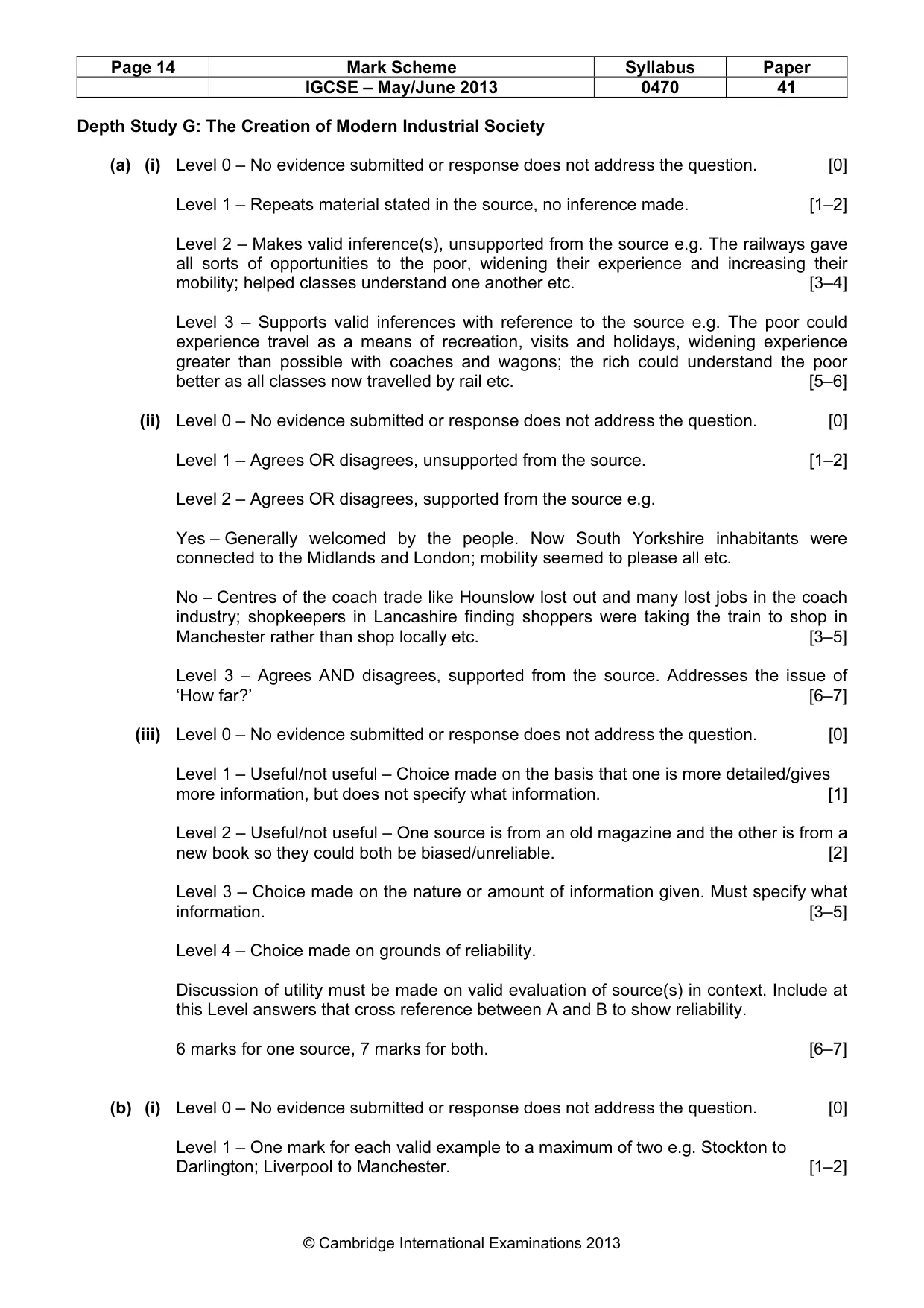
Page 14 Mark Scheme Syllabus Paper IGCSE – May/June 2013 0470 41 © Cambridge International Examinations 2013 Depth Study G: The Creation of Modern Industrial Society (a) (i) Level 0 – No evidence submitted or response does not address the question. [0] Level 1 – Repeats material stated in the source, no inference made. [1–2] Level 2 – Makes valid inference(s), unsupported from the source e.g. The railways gave all sorts of opportunities to the poor, widening their experience and increasing their mobility; helped classes understand one another etc. [3–4] Level 3 – Supports valid inferences with reference to the source e.g. The poor could experience travel as a means of recreation, visits and holidays, widening experience greater than possible with coaches and wagons; the rich could understand the poor better as all classes now travelled by rail etc. [5–6] (ii) Level 0 – No evidence submitted or response does not address the question. [0] Level 1 – Agrees OR disagrees, unsupported from the source. [1–2] Level 2 – Agrees OR disagrees, supported from the source e.g. Yes – Generally welcomed by the people. Now South Yorkshire inhabitants were connected to the Midlands and London; mobility seemed to please all etc. No – Centres of the coach trade like Hounslow lost out and many lost jobs in the coach industry; shopkeepers in Lancashire finding shoppers were taking the train to shop in Manchester rather than shop locally etc. [3–5] Level 3 – Agrees AND disagrees, supported from the source. Addresses the issue of ‘How far?’ [6–7] (iii) Level 0 – No evidence submitted or response does not address the question. [0] Level 1 – Useful/not useful – Choice made on the basis that one is more detailed/gives more information, but does not specify what information. [1] Level 2 – Useful/not useful – One source is from an old magazine and the other is from a new book so they could both be biased/unreliable. [2] Level 3 – Choice made on the nature or amount of information given. Must specify what information. [3–5] Level 4 – Choice made on grounds of reliability. Discussion of utility must be made on valid evaluation of source(s) in context. Include at this Level answers that cross reference between A and B to show reliability. 6 marks for one source, 7 marks for both. [6–7] (b) (i) Level 0 – No evidence submitted or response does not address the question. [0] Level 1 – One mark for each valid example to a maximum of two e.g. Stockton to Darlington; Liverpool to Manchester. [1–2]
Mark scheme, page 15
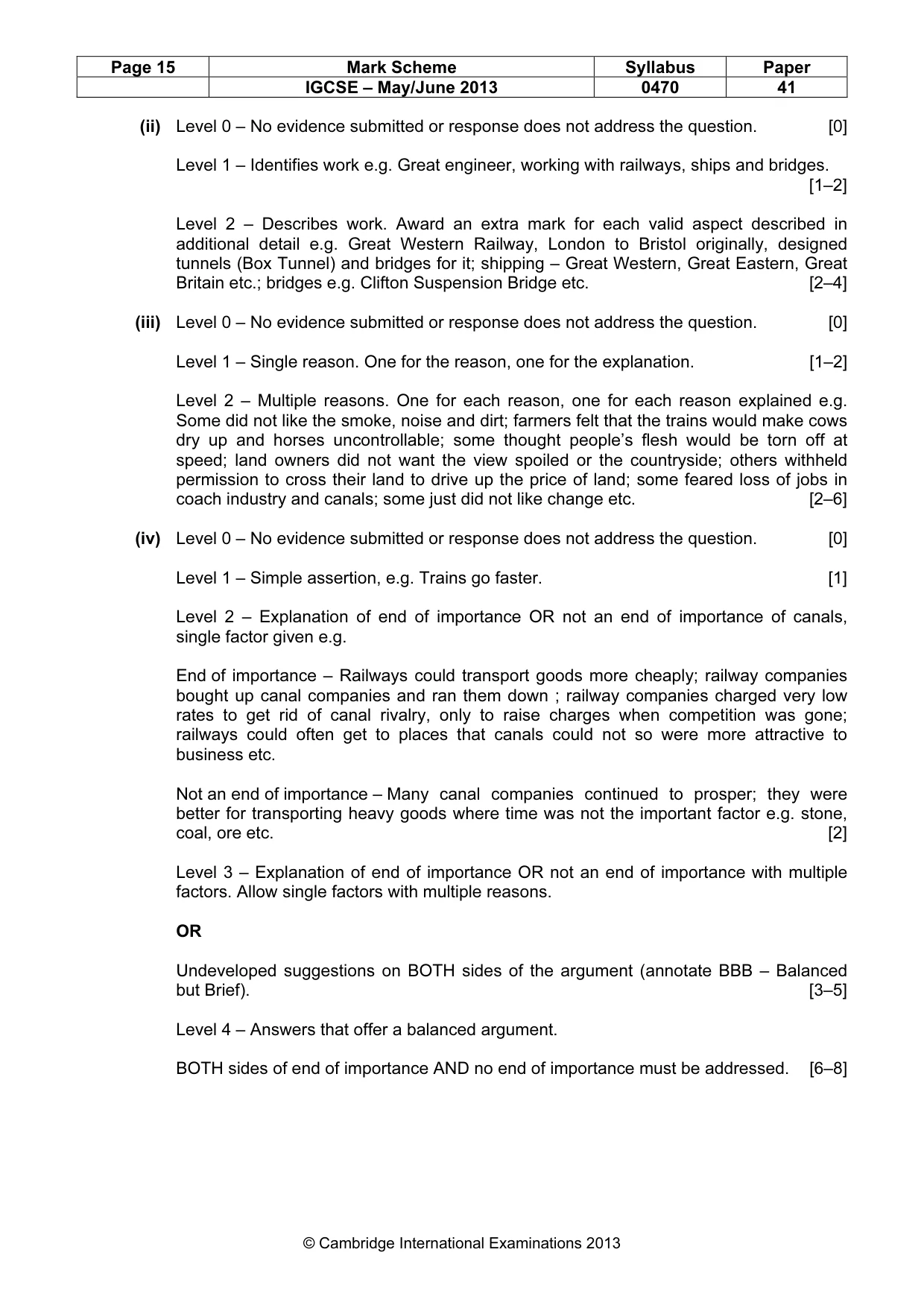
Page 15 Mark Scheme Syllabus Paper IGCSE – May/June 2013 0470 41 © Cambridge International Examinations 2013 (ii) Level 0 – No evidence submitted or response does not address the question. [0] Level 1 – Identifies work e.g. Great engineer, working with railways, ships and bridges. [1–2] Level 2 – Describes work. Award an extra mark for each valid aspect described in additional detail e.g. Great Western Railway, London to Bristol originally, designed tunnels (Box Tunnel) and bridges for it; shipping – Great Western, Great Eastern, Great Britain etc.; bridges e.g. Clifton Suspension Bridge etc. [2–4] (iii) Level 0 – No evidence submitted or response does not address the question. [0] Level 1 – Single reason. One for the reason, one for the explanation. [1–2] Level 2 – Multiple reasons. One for each reason, one for each reason explained e.g. Some did not like the smoke, noise and dirt; farmers felt that the trains would make cows dry up and horses uncontrollable; some thought people’s flesh would be torn off at speed; land owners did not want the view spoiled or the countryside; others withheld permission to cross their land to drive up the price of land; some feared loss of jobs in coach industry and canals; some just did not like change etc. [2–6] (iv) Level 0 – No evidence submitted or response does not address the question. [0] Level 1 – Simple assertion, e.g. Trains go faster. [1] Level 2 – Explanation of end of importance OR not an end of importance of canals, single factor given e.g. End of importance – Railways could transport goods more cheaply; railway companies bought up canal companies and ran them down ; railway companies charged very low rates to get rid of canal rivalry, only to raise charges when competition was gone; railways could often get to places that canals could not so were more attractive to business etc. Not an end of importance – Many canal companies continued to prosper; they were better for transporting heavy goods where time was not the important factor e.g. stone, coal, ore etc. [2] Level 3 – Explanation of end of importance OR not an end of importance with multiple factors. Allow single factors with multiple reasons. OR Undeveloped suggestions on BOTH sides of the argument (annotate BBB – Balanced but Brief). [3–5] Level 4 – Answers that offer a balanced argument. BOTH sides of end of importance AND no end of importance must be addressed. [6–8]
Mark scheme, page 16
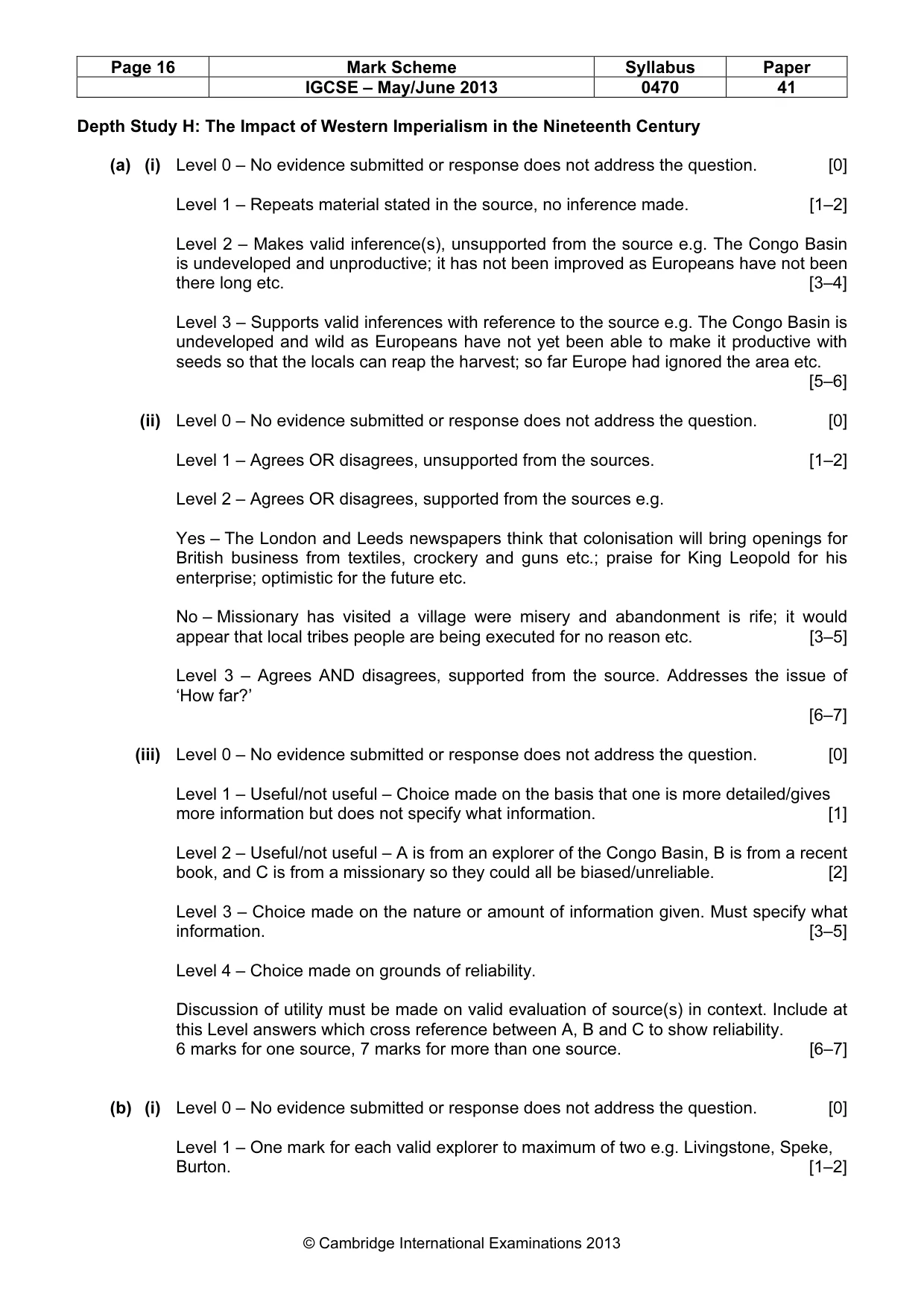
Page 16 Mark Scheme Syllabus Paper IGCSE – May/June 2013 0470 41 © Cambridge International Examinations 2013 Depth Study H: The Impact of Western Imperialism in the Nineteenth Century (a) (i) Level 0 – No evidence submitted or response does not address the question. [0] Level 1 – Repeats material stated in the source, no inference made. [1–2] Level 2 – Makes valid inference(s), unsupported from the source e.g. The Congo Basin is undeveloped and unproductive; it has not been improved as Europeans have not been there long etc. [3–4] Level 3 – Supports valid inferences with reference to the source e.g. The Congo Basin is undeveloped and wild as Europeans have not yet been able to make it productive with seeds so that the locals can reap the harvest; so far Europe had ignored the area etc. [5–6] (ii) Level 0 – No evidence submitted or response does not address the question. [0] Level 1 – Agrees OR disagrees, unsupported from the sources. [1–2] Level 2 – Agrees OR disagrees, supported from the sources e.g. Yes – The London and Leeds newspapers think that colonisation will bring openings for British business from textiles, crockery and guns etc.; praise for King Leopold for his enterprise; optimistic for the future etc. No – Missionary has visited a village were misery and abandonment is rife; it would appear that local tribes people are being executed for no reason etc. [3–5] Level 3 – Agrees AND disagrees, supported from the source. Addresses the issue of ‘How far?’ [6–7] (iii) Level 0 – No evidence submitted or response does not address the question. [0] Level 1 – Useful/not useful – Choice made on the basis that one is more detailed/gives more information but does not specify what information. [1] Level 2 – Useful/not useful – A is from an explorer of the Congo Basin, B is from a recent book, and C is from a missionary so they could all be biased/unreliable. [2] Level 3 – Choice made on the nature or amount of information given. Must specify what information. [3–5] Level 4 – Choice made on grounds of reliability. Discussion of utility must be made on valid evaluation of source(s) in context. Include at this Level answers which cross reference between A, B and C to show reliability. 6 marks for one source, 7 marks for more than one source. [6–7] (b) (i) Level 0 – No evidence submitted or response does not address the question. [0] Level 1 – One mark for each valid explorer to maximum of two e.g. Livingstone, Speke, Burton. [1–2]
Mark scheme, page 17
Page 17 Mark Scheme Syllabus Paper IGCSE – May/June 2013 0470 41 © Cambridge International Examinations 2013 (ii) Level 0 – No evidence submitted or response does not address the question. [0] Level 1 – Identifies Conference e.g. A meeting to carve up Africa amicably without war. [1–2] Level 2 – Describes Conference. Award an extra mark for each aspect described in additional detail e.g. A meeting of European powers to define aspects of African imperialism and influence without going to war – NB areas that were as yet not colonised; to consider the future of the Congo Basin; other areas discussed, slavery, slave trade, navigation rights of coast and rivers etc. [2–4] (iii) Level 0 – No evidence submitted or response does not address the question. [0] Level 1 – Single reason. One for the reason, one for the explanation. [1–2] Level 2 – Multiple reasons. One for each reason, one for each reason explained e.g. Countries wished to become overseas imperial powers to establish prestige and status; some had only just become nations – Italy, Germany; a belief that colonies would be good for trade offering natural resources, cheap labour and ready markets; some were envious of existing imperial powers etc. [2–6] (iv) Level 0 – No evidence submitted or response does not address the question. [0] Level 1 – Simple assertions, e.g. Yes, they treated them badly. [1] Level 2 – Explanation of exploitation OR non-exploitation, single factor given e.g. Exploitation – Europeans tried to extract raw materials and produce cheaply with little regard for the welfare of natives – either workers or owners of lands; particularly bad treatment in Congo; very little evidence of altruistic commercial exploitation etc. Non-exploitation – Europeans brought trade and infrastructure which helped countries develop; treating natives badly was not the main reason for exploitation; missionaries brought Christianity and education etc. [2] Level 3 – Explanation of exploitation OR non-exploitation with multiple factors. Allow single factors with multiple reasons. OR Undeveloped suggestions on BOTH sides of the argument (annotate BBB – Balanced but Brief). [3–5] Level 4 – Answers that offer a balanced argument. BOTH sides of exploitation and non-exploitation must be addressed. [6–8]
What you needed in this session
Cambridge’s own grade thresholds for 2013 May/June, Paper 4 · Variant 1. A higher threshold means an easier paper — the bar moves with how the cohort did.