Cambridge IGCSE History 0470 — 2012 May/June Paper 4 · Variant 3
0470/43/M/J/12 · 40 marks · ≈45 min
The question paper and its mark scheme, free to read here and free to download. This is Cambridge’s own paper, exactly as it was sat.
Question paper12 pages
Mark scheme17 pages
Answers below. Sit the paper first if you are practising.
Paper as text
Question paper, page 1
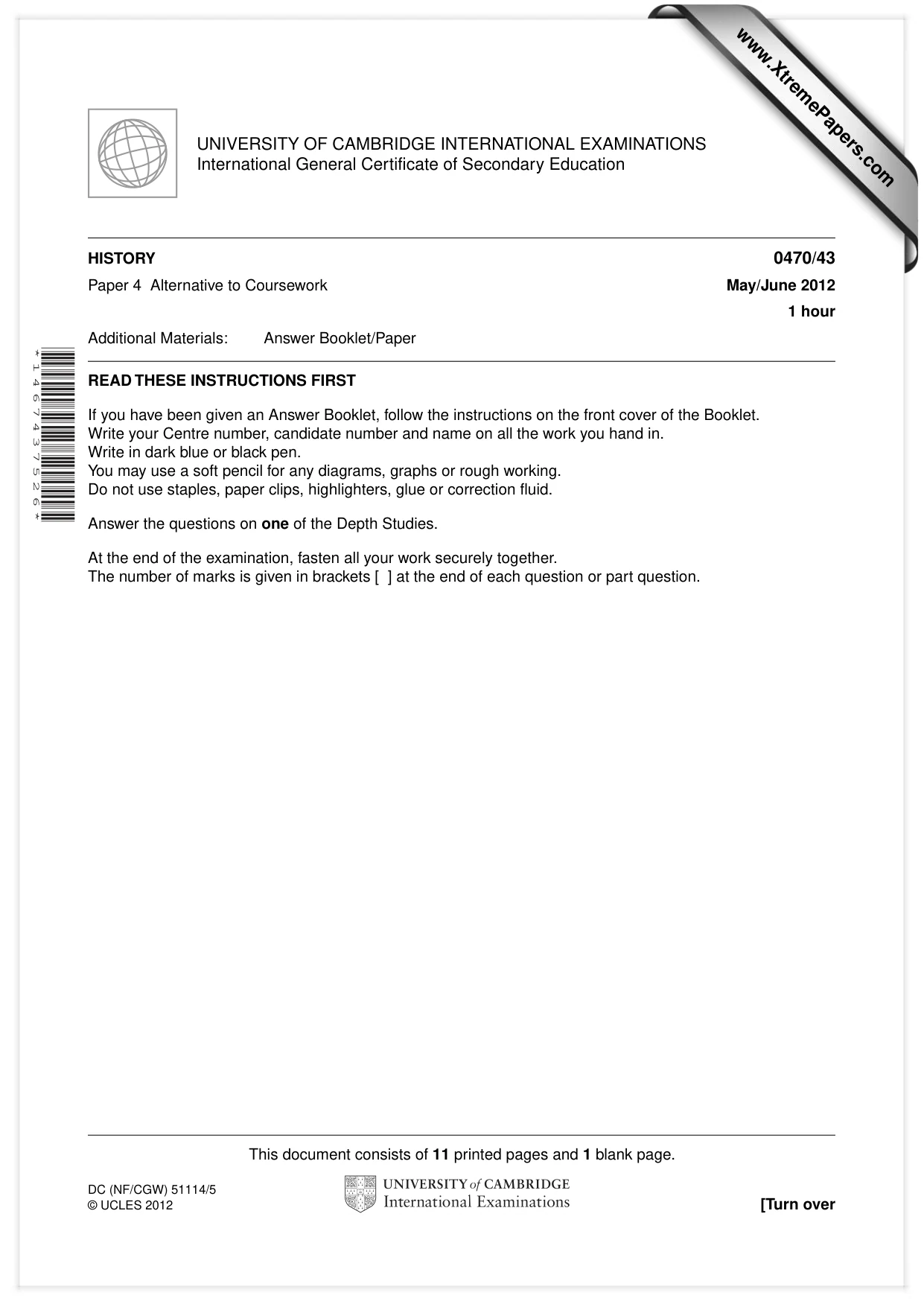
This document consists of 11 printed pages and 1 blank page. DC (NF/CGW) 51114/5 © UCLES 2012 [Turn over UNIVERSITY OF CAMBRIDGE INTERNATIONAL EXAMINATIONS International General Certificate of Secondary Education * 1 4 6 7 4 3 7 5 2 6 * HISTORY 0470/43 Paper 4 Alternative to Coursework May/June 2012 1 hour Additional Materials: Answer Booklet/Paper READ THESE INSTRUCTIONS FIRST If you have been given an Answer Booklet, follow the instructions on the front cover of the Booklet. Write your Centre number, candidate number and name on all the work you hand in. Write in dark blue or black pen. You may use a soft pencil for any diagrams, graphs or rough working. Do not use staples, paper clips, highlighters, glue or correction fluid. Answer the questions on one of the Depth Studies. At the end of the examination, fasten all your work securely together. The number of marks is given in brackets [ ] at the end of each question or part question. www.XtremePapers.com
Question paper, page 2
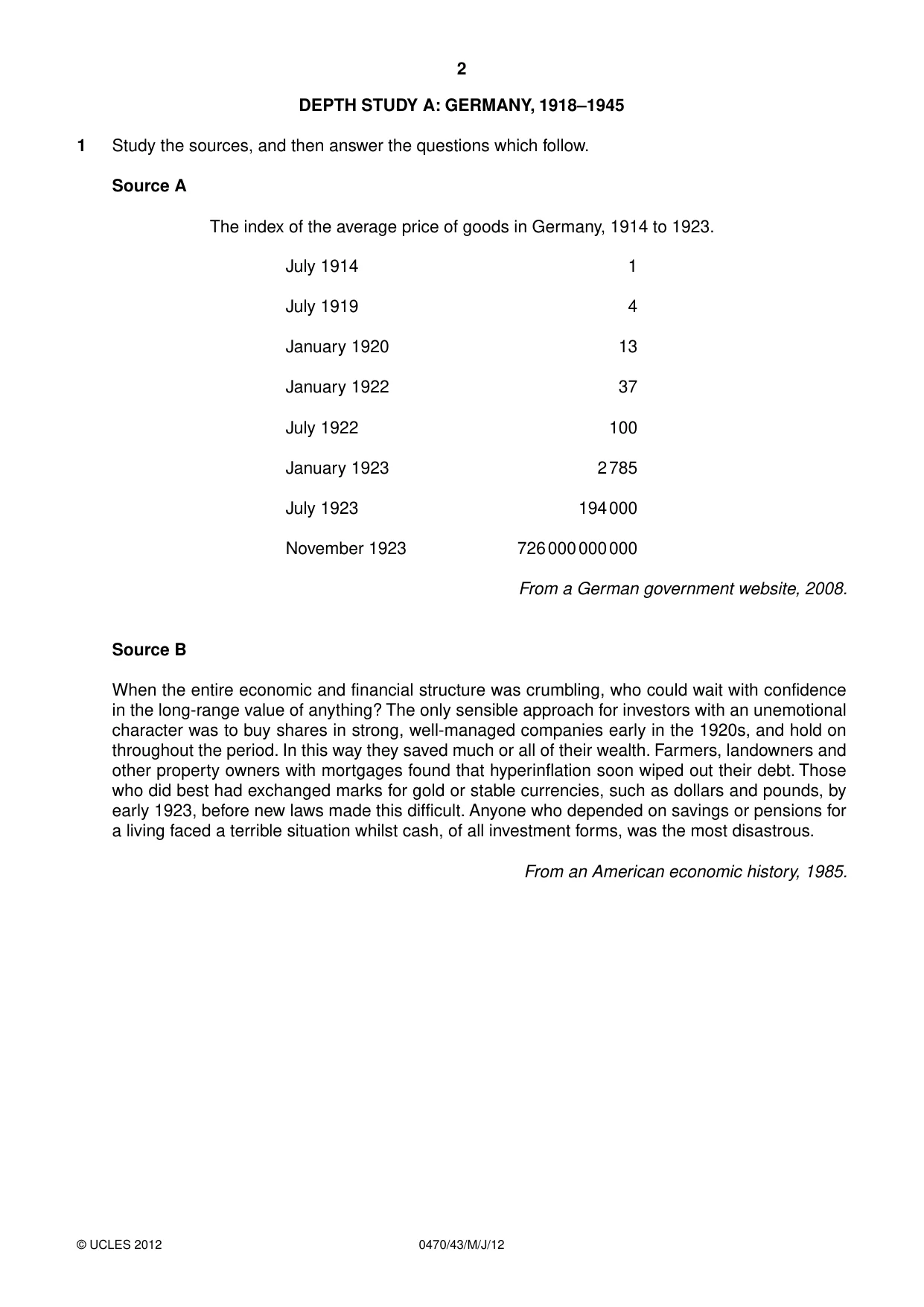
2 0470/43/M/J/12 © UCLES 2012 DEPTH STUDY A: GERMANY, 1918–1945 1 Study the sources, and then answer the questions which follow. Source A The index of the average price of goods in Germany, 1914 to 1923. July 1914 July 1919 January 1920 January 1922 July 1922 January 1923 July 1923 November 1923 1 4 13 37 100 2 785 194 000 726 000 000 000 From a German government website, 2008. Source B When the entire economic and financial structure was crumbling, who could wait with confidence in the long-range value of anything? The only sensible approach for investors with an unemotional character was to buy shares in strong, well-managed companies early in the 1920s, and hold on throughout the period. In this way they saved much or all of their wealth. Farmers, landowners and other property owners with mortgages found that hyperinflation soon wiped out their debt. Those who did best had exchanged marks for gold or stable currencies, such as dollars and pounds, by early 1923, before new laws made this difficult. Anyone who depended on savings or pensions for a living faced a terrible situation whilst cash, of all investment forms, was the most disastrous. From an American economic history, 1985.
Question paper, page 3
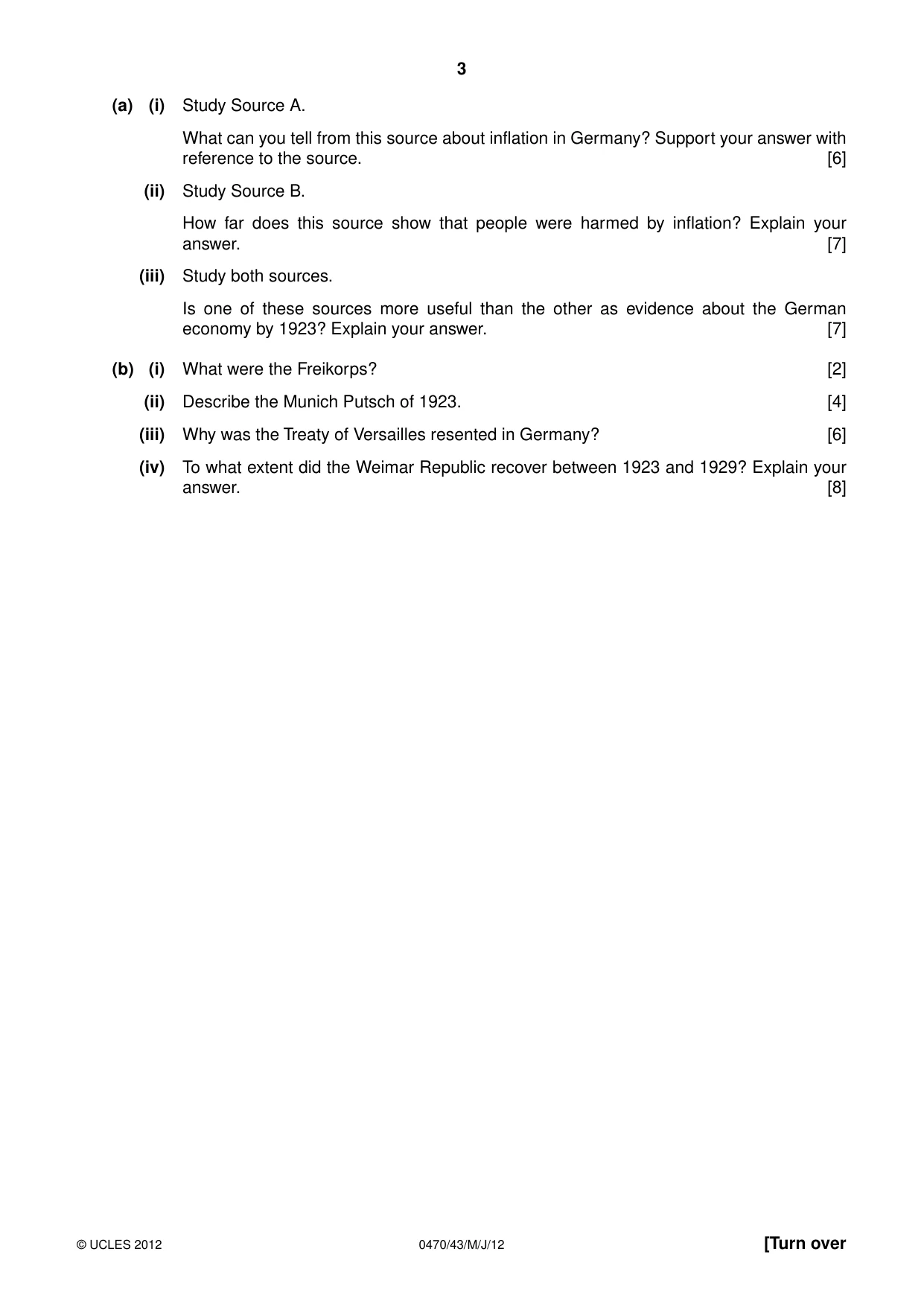
3 0470/43/M/J/12 © UCLES 2012 [Turn over (a) (i) Study Source A. What can you tell from this source about inflation in Germany? Support your answer with reference to the source. [6] (ii) Study Source B. How far does this source show that people were harmed by inflation? Explain your answer. [7] (iii) Study both sources. Is one of these sources more useful than the other as evidence about the German economy by 1923? Explain your answer. [7] (b) (i) What were the Freikorps? [2] (ii) Describe the Munich Putsch of 1923. [4] (iii) Why was the Treaty of Versailles resented in Germany? [6] (iv) To what extent did the Weimar Republic recover between 1923 and 1929? Explain your answer. [8]
Question paper, page 4
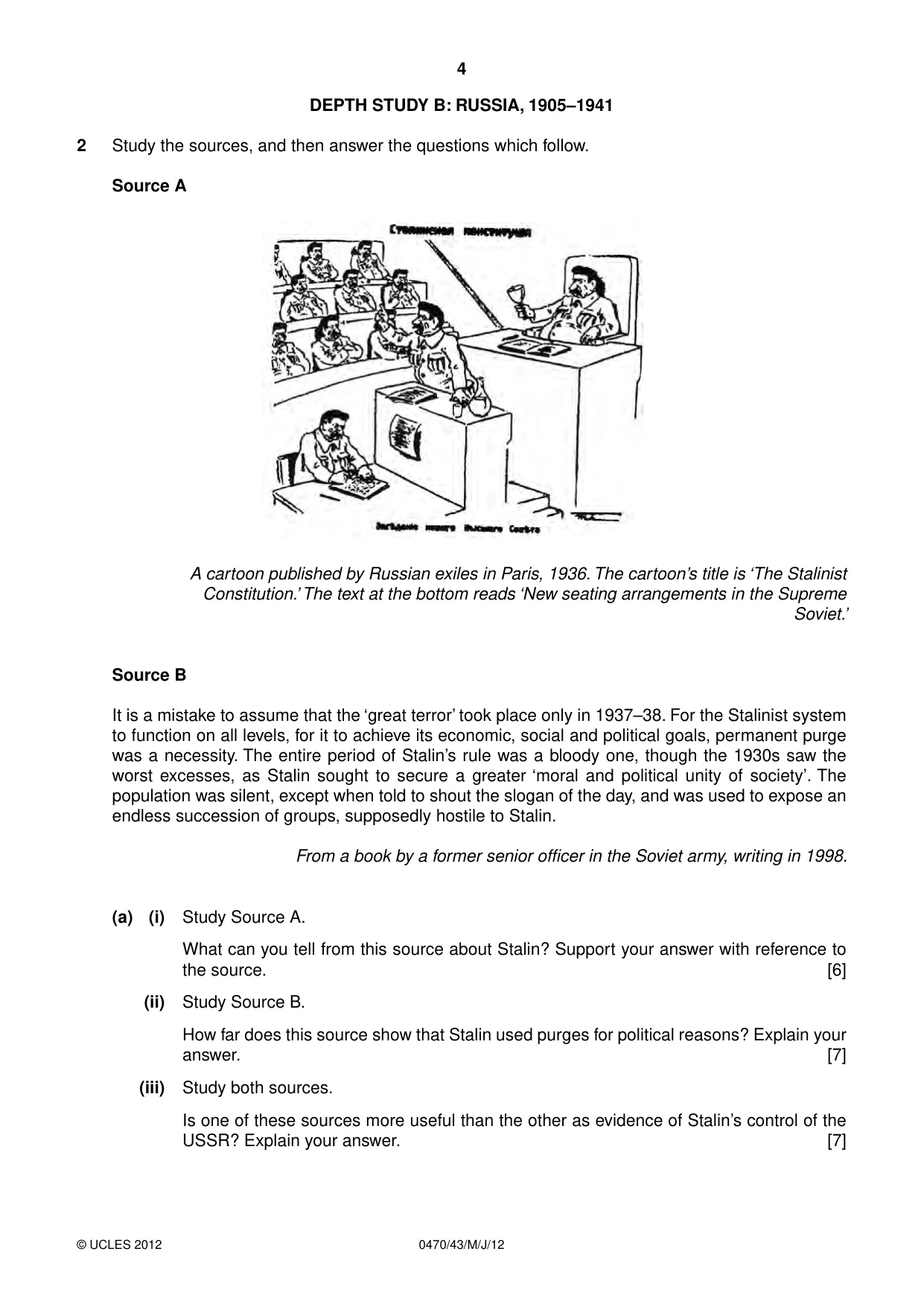
4 0470/43/M/J/12 © UCLES 2012 DEPTH STUDY B: RUSSIA, 1905–1941 2 Study the sources, and then answer the questions which follow. Source A A cartoon published by Russian exiles in Paris, 1936. The cartoon’s title is ‘The Stalinist Constitution.’ The text at the bottom reads ‘New seating arrangements in the Supreme Soviet.’ Source B It is a mistake to assume that the ‘great terror’ took place only in 1937–38. For the Stalinist system to function on all levels, for it to achieve its economic, social and political goals, permanent purge was a necessity. The entire period of Stalin’s rule was a bloody one, though the 1930s saw the worst excesses, as Stalin sought to secure a greater ‘moral and political unity of society’. The population was silent, except when told to shout the slogan of the day, and was used to expose an endless succession of groups, supposedly hostile to Stalin. From a book by a former senior officer in the Soviet army, writing in 1998. (a) (i) Study Source A. What can you tell from this source about Stalin? Support your answer with reference to the source. [6] (ii) Study Source B. How far does this source show that Stalin used purges for political reasons? Explain your answer. [7] (iii) Study both sources. Is one of these sources more useful than the other as evidence of Stalin’s control of the USSR? Explain your answer. [7]
Question paper, page 5
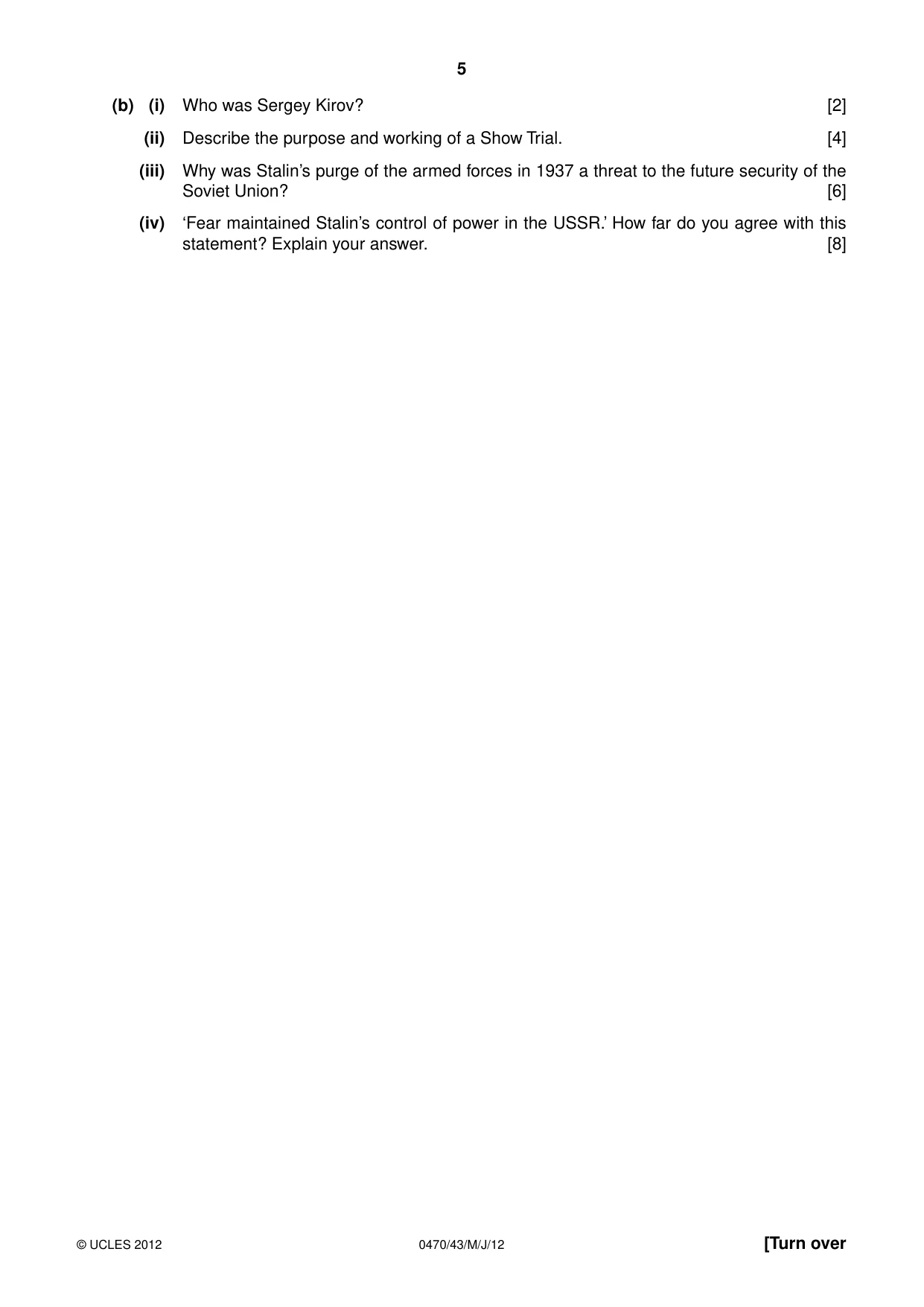
5 0470/43/M/J/12 © UCLES 2012 [Turn over (b) (i) Who was Sergey Kirov? [2] (ii) Describe the purpose and working of a Show Trial. [4] (iii) Why was Stalin’s purge of the armed forces in 1937 a threat to the future security of the Soviet Union? [6] (iv) ‘Fear maintained Stalin’s control of power in the USSR.’ How far do you agree with this statement? Explain your answer. [8]
Question paper, page 6
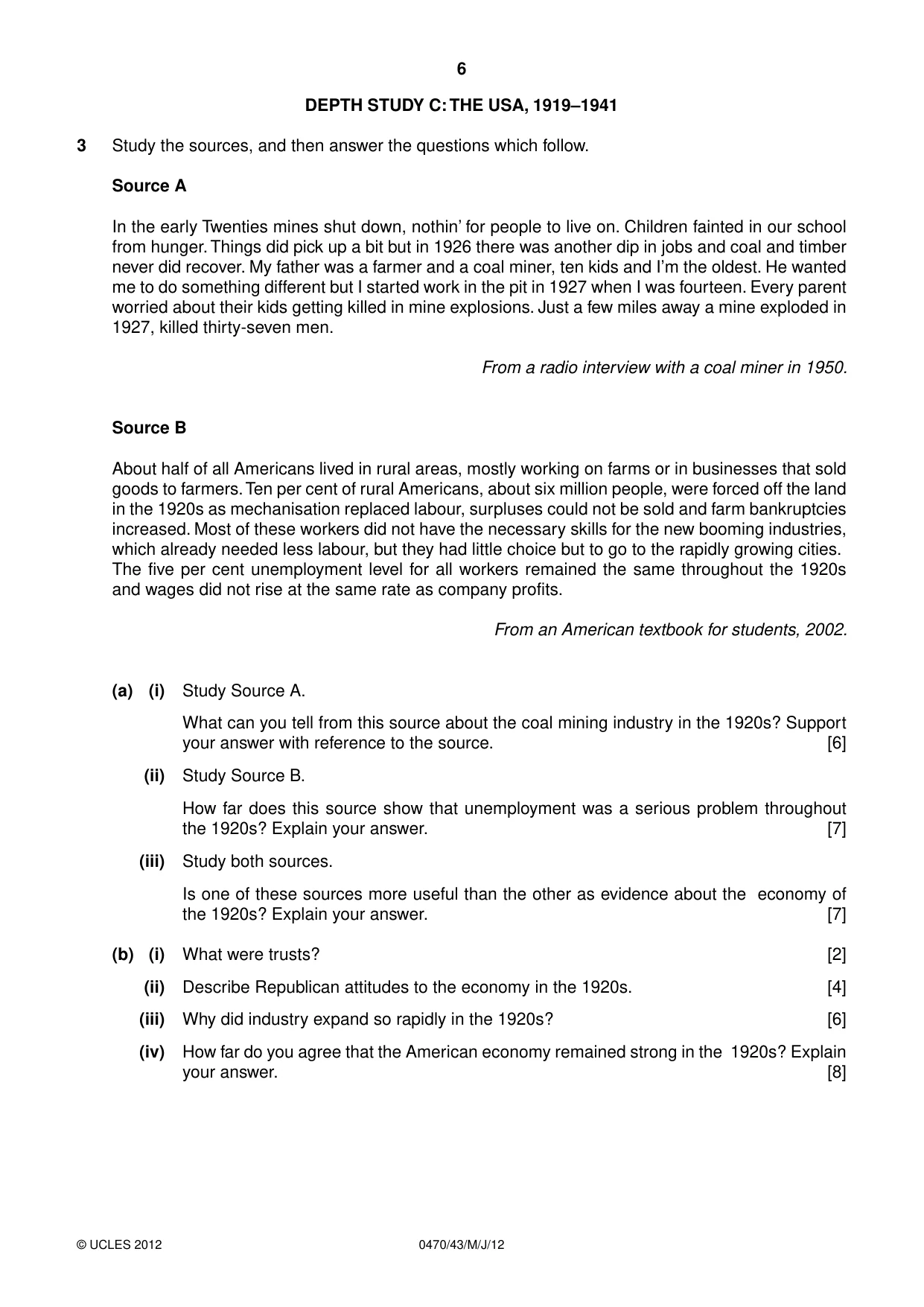
6 0470/43/M/J/12 © UCLES 2012 DEPTH STUDY C: THE USA, 1919–1941 3 Study the sources, and then answer the questions which follow. Source A In the early Twenties mines shut down, nothin’ for people to live on. Children fainted in our school from hunger. Things did pick up a bit but in 1926 there was another dip in jobs and coal and timber never did recover. My father was a farmer and a coal miner, ten kids and I’m the oldest. He wanted me to do something different but I started work in the pit in 1927 when I was fourteen. Every parent worried about their kids getting killed in mine explosions. Just a few miles away a mine exploded in 1927, killed thirty-seven men. From a radio interview with a coal miner in 1950. Source B About half of all Americans lived in rural areas, mostly working on farms or in businesses that sold goods to farmers. Ten per cent of rural Americans, about six million people, were forced off the land in the 1920s as mechanisation replaced labour, surpluses could not be sold and farm bankruptcies increased. Most of these workers did not have the necessary skills for the new booming industries, which already needed less labour, but they had little choice but to go to the rapidly growing cities. The five per cent unemployment level for all workers remained the same throughout the 1920s and wages did not rise at the same rate as company profits. From an American textbook for students, 2002. (a) (i) Study Source A. What can you tell from this source about the coal mining industry in the 1920s? Support your answer with reference to the source. [6] (ii) Study Source B. How far does this source show that unemployment was a serious problem throughout the 1920s? Explain your answer. [7] (iii) Study both sources. Is one of these sources more useful than the other as evidence about the economy of the 1920s? Explain your answer. [7] (b) (i) What were trusts? [2] (ii) Describe Republican attitudes to the economy in the 1920s. [4] (iii) Why did industry expand so rapidly in the 1920s? [6] (iv) How far do you agree that the American economy remained strong in the 1920s? Explain your answer. [8]
Question paper, page 7
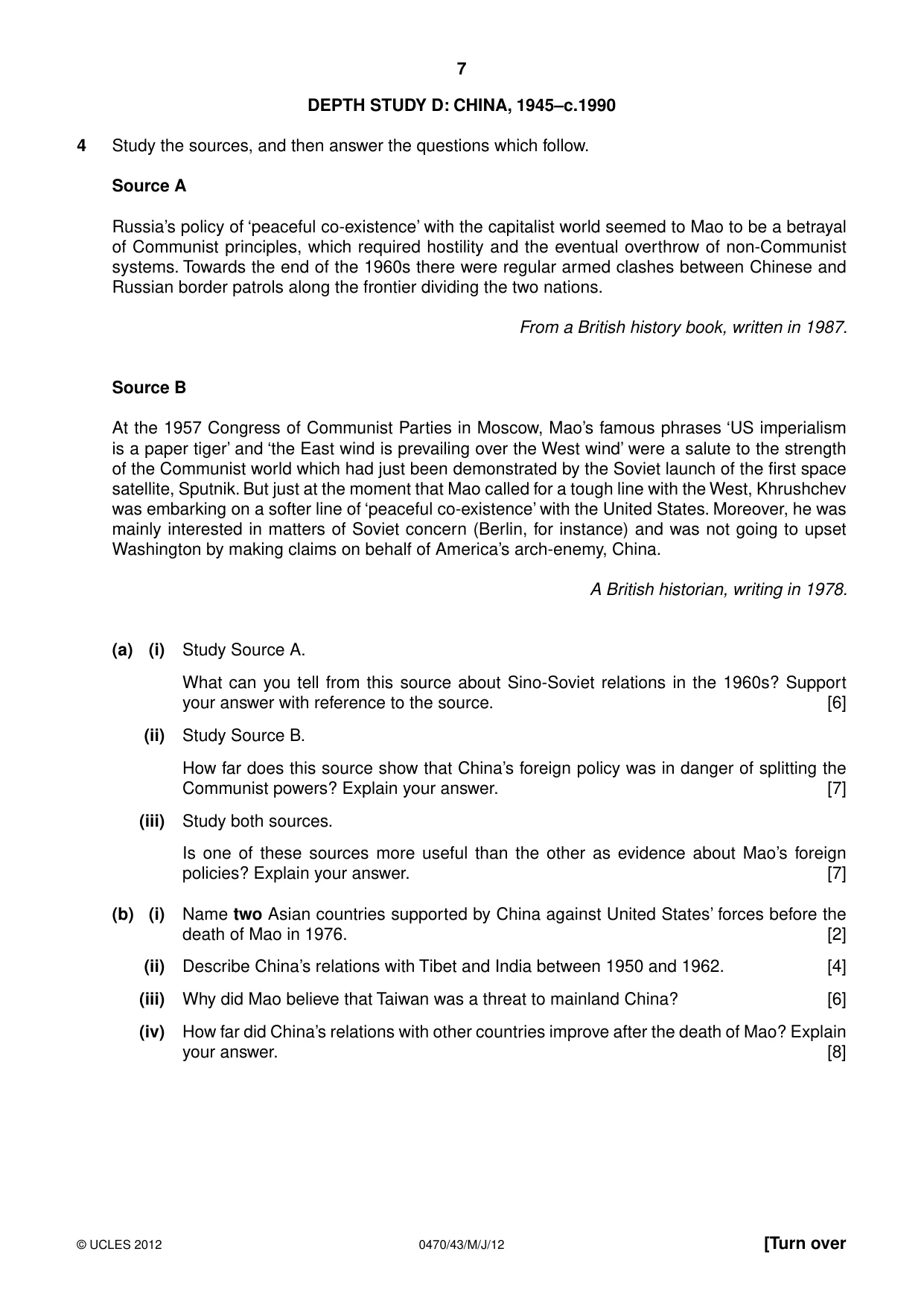
7 0470/43/M/J/12 © UCLES 2012 [Turn over DEPTH STUDY D: CHINA, 1945–c.1990 4 Study the sources, and then answer the questions which follow. Source A Russia’s policy of ‘peaceful co-existence’ with the capitalist world seemed to Mao to be a betrayal of Communist principles, which required hostility and the eventual overthrow of non-Communist systems. Towards the end of the 1960s there were regular armed clashes between Chinese and Russian border patrols along the frontier dividing the two nations. From a British history book, written in 1987. Source B At the 1957 Congress of Communist Parties in Moscow, Mao’s famous phrases ‘US imperialism is a paper tiger’ and ‘the East wind is prevailing over the West wind’ were a salute to the strength of the Communist world which had just been demonstrated by the Soviet launch of the first space satellite, Sputnik. But just at the moment that Mao called for a tough line with the West, Khrushchev was embarking on a softer line of ‘peaceful co-existence’ with the United States. Moreover, he was mainly interested in matters of Soviet concern (Berlin, for instance) and was not going to upset Washington by making claims on behalf of America’s arch-enemy, China. A British historian, writing in 1978. (a) (i) Study Source A. What can you tell from this source about Sino-Soviet relations in the 1960s? Support your answer with reference to the source. [6] (ii) Study Source B. How far does this source show that China’s foreign policy was in danger of splitting the Communist powers? Explain your answer. [7] (iii) Study both sources. Is one of these sources more useful than the other as evidence about Mao’s foreign policies? Explain your answer. [7] (b) (i) Name two Asian countries supported by China against United States’ forces before the death of Mao in 1976. [2] (ii) Describe China’s relations with Tibet and India between 1950 and 1962. [4] (iii) Why did Mao believe that Taiwan was a threat to mainland China? [6] (iv) How far did China’s relations with other countries improve after the death of Mao? Explain your answer. [8]
Question paper, page 8
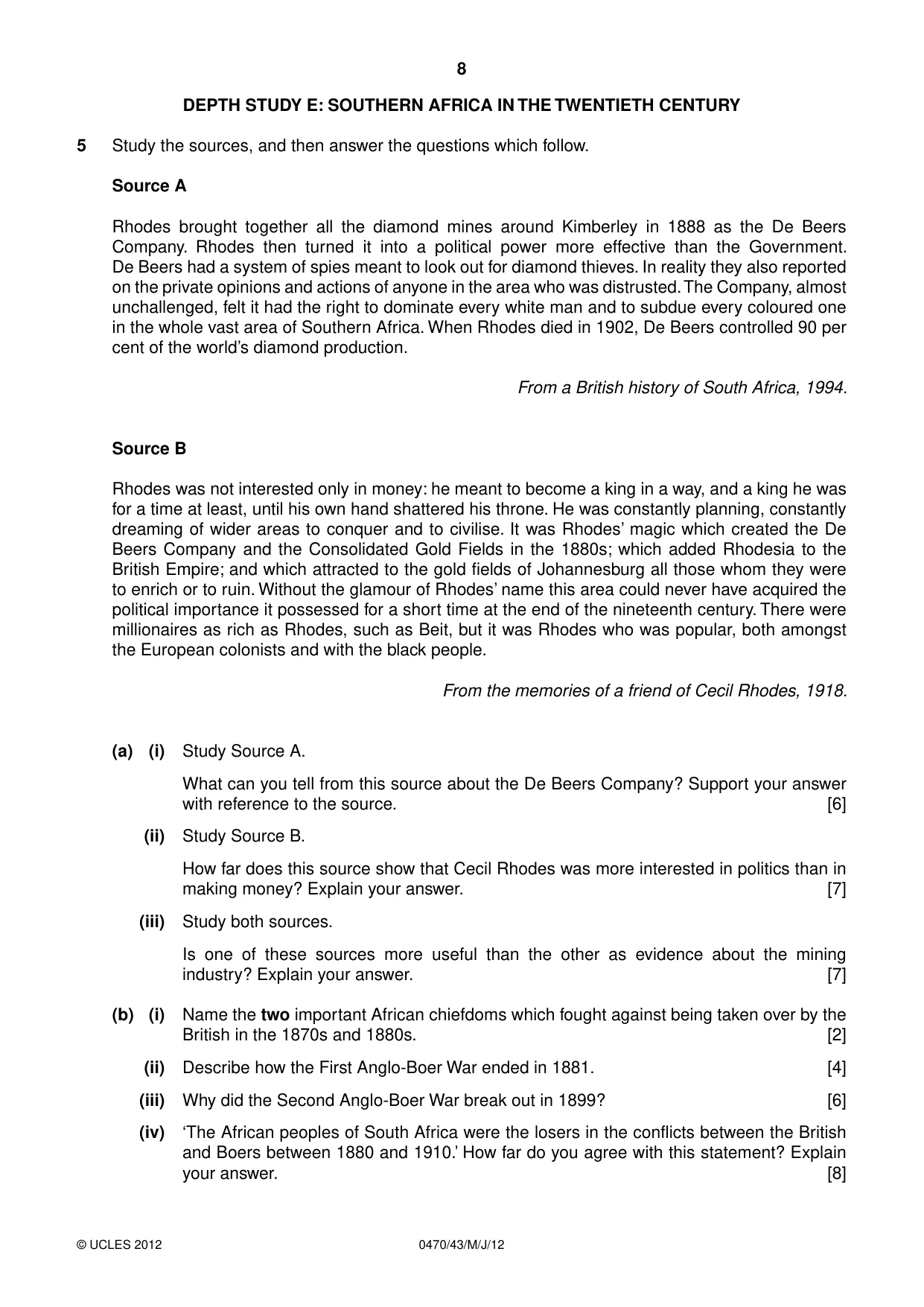
8 0470/43/M/J/12 © UCLES 2012 DEPTH STUDY E: SOUTHERN AFRICA IN THE TWENTIETH CENTURY 5 Study the sources, and then answer the questions which follow. Source A Rhodes brought together all the diamond mines around Kimberley in 1888 as the De Beers Company. Rhodes then turned it into a political power more effective than the Government. De Beers had a system of spies meant to look out for diamond thieves. In reality they also reported on the private opinions and actions of anyone in the area who was distrusted. The Company, almost unchallenged, felt it had the right to dominate every white man and to subdue every coloured one in the whole vast area of Southern Africa. When Rhodes died in 1902, De Beers controlled 90 per cent of the world’s diamond production. From a British history of South Africa, 1994. Source B Rhodes was not interested only in money: he meant to become a king in a way, and a king he was for a time at least, until his own hand shattered his throne. He was constantly planning, constantly dreaming of wider areas to conquer and to civilise. It was Rhodes’ magic which created the De Beers Company and the Consolidated Gold Fields in the 1880s; which added Rhodesia to the British Empire; and which attracted to the gold fields of Johannesburg all those whom they were to enrich or to ruin. Without the glamour of Rhodes’ name this area could never have acquired the political importance it possessed for a short time at the end of the nineteenth century. There were millionaires as rich as Rhodes, such as Beit, but it was Rhodes who was popular, both amongst the European colonists and with the black people. From the memories of a friend of Cecil Rhodes, 1918. (a) (i) Study Source A. What can you tell from this source about the De Beers Company? Support your answer with reference to the source. [6] (ii) Study Source B. How far does this source show that Cecil Rhodes was more interested in politics than in making money? Explain your answer. [7] (iii) Study both sources. Is one of these sources more useful than the other as evidence about the mining industry? Explain your answer. [7] (b) (i) Name the two important African chiefdoms which fought against being taken over by the British in the 1870s and 1880s. [2] (ii) Describe how the First Anglo-Boer War ended in 1881. [4] (iii) Why did the Second Anglo-Boer War break out in 1899? [6] (iv) ‘The African peoples of South Africa were the losers in the conflicts between the British and Boers between 1880 and 1910.’ How far do you agree with this statement? Explain your answer. [8]
Question paper, page 9
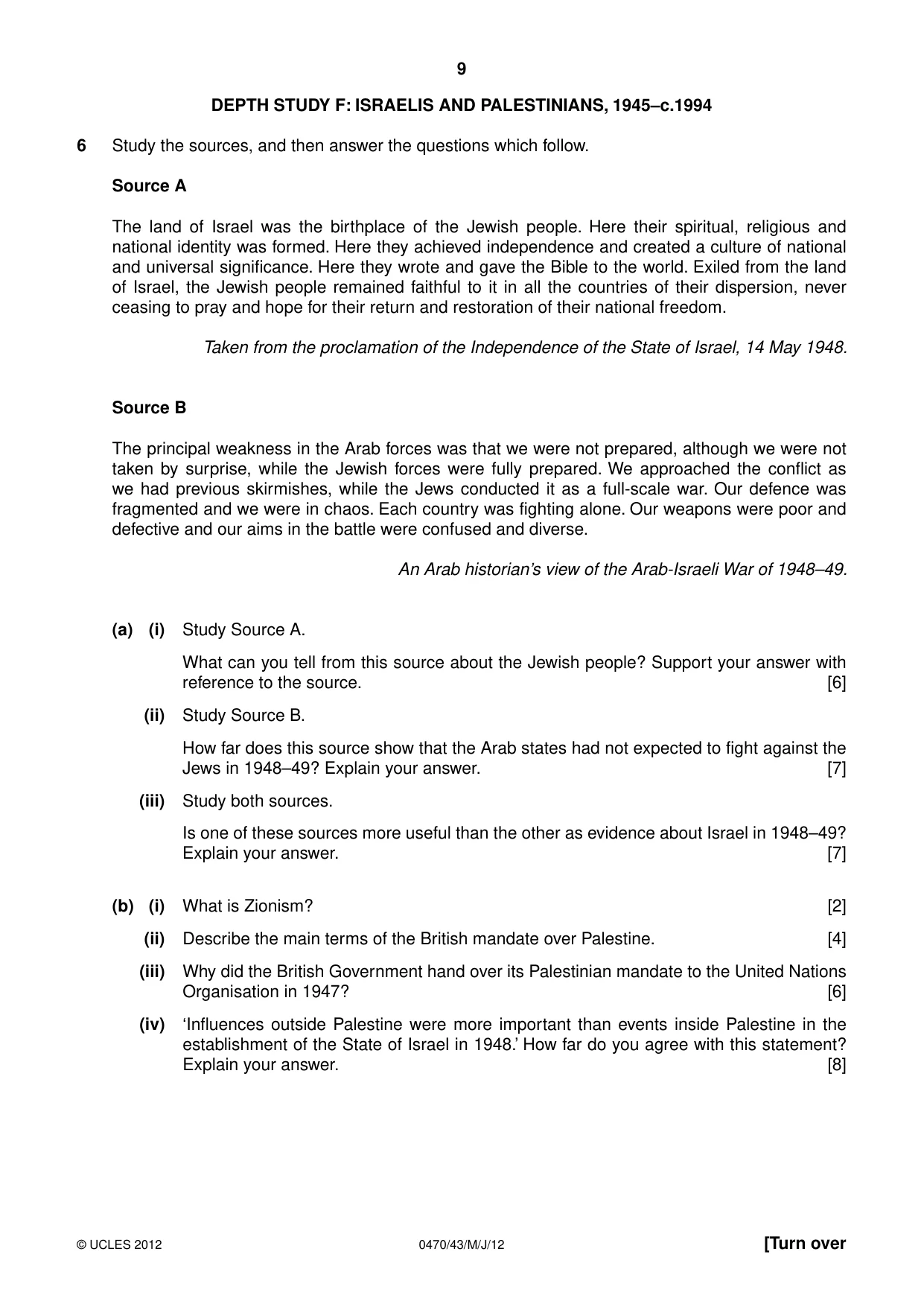
9 0470/43/M/J/12 © UCLES 2012 [Turn over DEPTH STUDY F: ISRAELIS AND PALESTINIANS, 1945–c.1994 6 Study the sources, and then answer the questions which follow. Source A The land of Israel was the birthplace of the Jewish people. Here their spiritual, religious and national identity was formed. Here they achieved independence and created a culture of national and universal significance. Here they wrote and gave the Bible to the world. Exiled from the land of Israel, the Jewish people remained faithful to it in all the countries of their dispersion, never ceasing to pray and hope for their return and restoration of their national freedom. Taken from the proclamation of the Independence of the State of Israel, 14 May 1948. Source B The principal weakness in the Arab forces was that we were not prepared, although we were not taken by surprise, while the Jewish forces were fully prepared. We approached the conflict as we had previous skirmishes, while the Jews conducted it as a full-scale war. Our defence was fragmented and we were in chaos. Each country was fighting alone. Our weapons were poor and defective and our aims in the battle were confused and diverse. An Arab historian’s view of the Arab-Israeli War of 1948–49. (a) (i) Study Source A. What can you tell from this source about the Jewish people? Support your answer with reference to the source. [6] (ii) Study Source B. How far does this source show that the Arab states had not expected to fight against the Jews in 1948–49? Explain your answer. [7] (iii) Study both sources. Is one of these sources more useful than the other as evidence about Israel in 1948–49? Explain your answer. [7] (b) (i) What is Zionism? [2] (ii) Describe the main terms of the British mandate over Palestine. [4] (iii) Why did the British Government hand over its Palestinian mandate to the United Nations Organisation in 1947? [6] (iv) ‘Influences outside Palestine were more important than events inside Palestine in the establishment of the State of Israel in 1948.’ How far do you agree with this statement? Explain your answer. [8]
Question paper, page 10
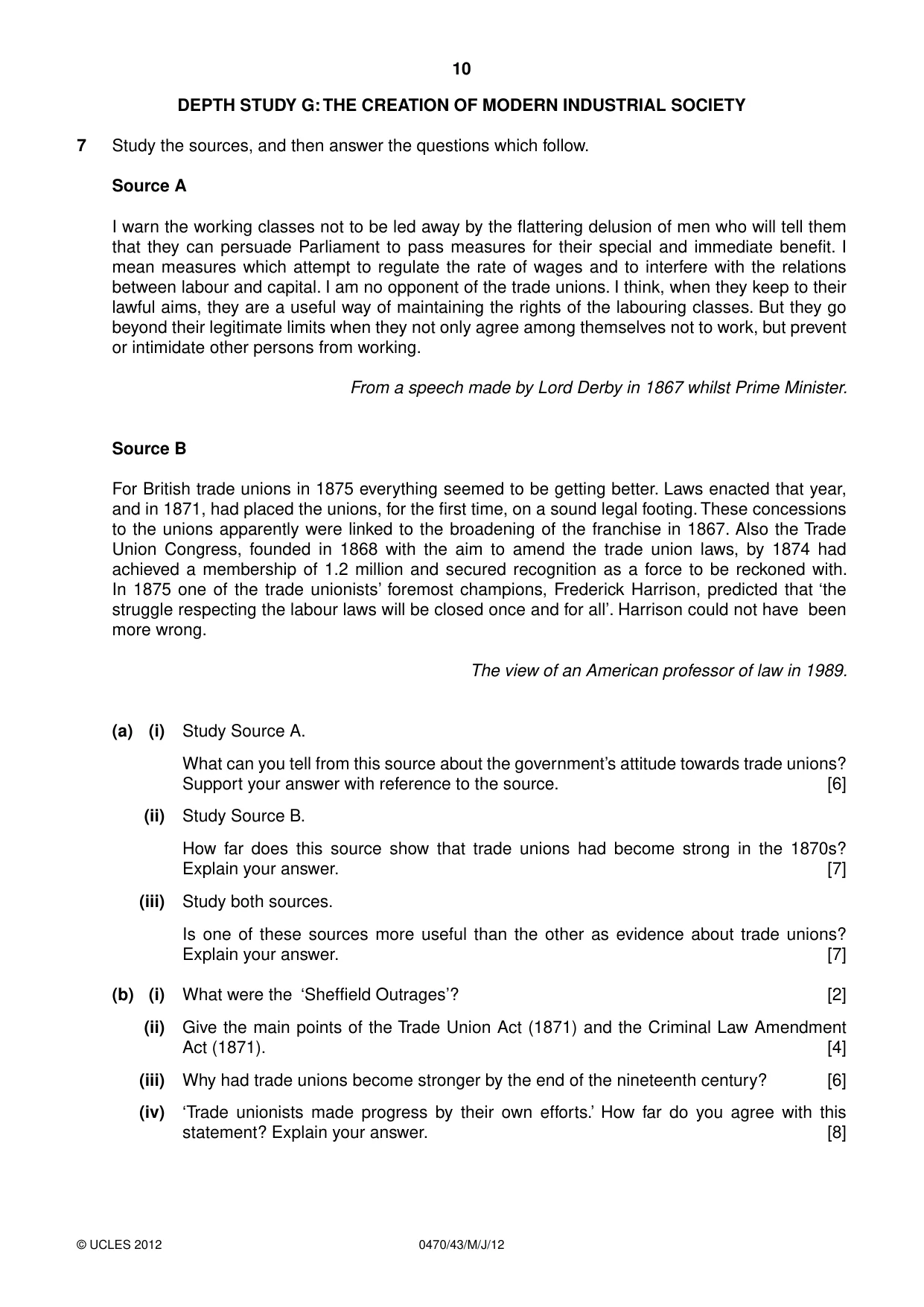
10 0470/43/M/J/12 © UCLES 2012 DEPTH STUDY G: THE CREATION OF MODERN INDUSTRIAL SOCIETY 7 Study the sources, and then answer the questions which follow. Source A I warn the working classes not to be led away by the flattering delusion of men who will tell them that they can persuade Parliament to pass measures for their special and immediate benefit. I mean measures which attempt to regulate the rate of wages and to interfere with the relations between labour and capital. I am no opponent of the trade unions. I think, when they keep to their lawful aims, they are a useful way of maintaining the rights of the labouring classes. But they go beyond their legitimate limits when they not only agree among themselves not to work, but prevent or intimidate other persons from working. From a speech made by Lord Derby in 1867 whilst Prime Minister. Source B For British trade unions in 1875 everything seemed to be getting better. Laws enacted that year, and in 1871, had placed the unions, for the first time, on a sound legal footing. These concessions to the unions apparently were linked to the broadening of the franchise in 1867. Also the Trade Union Congress, founded in 1868 with the aim to amend the trade union laws, by 1874 had achieved a membership of 1.2 million and secured recognition as a force to be reckoned with. In 1875 one of the trade unionists’ foremost champions, Frederick Harrison, predicted that ‘the struggle respecting the labour laws will be closed once and for all’. Harrison could not have been more wrong. The view of an American professor of law in 1989. (a) (i) Study Source A. What can you tell from this source about the government’s attitude towards trade unions? Support your answer with reference to the source. [6] (ii) Study Source B. How far does this source show that trade unions had become strong in the 1870s? Explain your answer. [7] (iii) Study both sources. Is one of these sources more useful than the other as evidence about trade unions? Explain your answer. [7] (b) (i) What were the ‘Sheffield Outrages’? [2] (ii) Give the main points of the Trade Union Act (1871) and the Criminal Law Amendment Act (1871). [4] (iii) Why had trade unions become stronger by the end of the nineteenth century? [6] (iv) ‘Trade unionists made progress by their own efforts.’ How far do you agree with this statement? Explain your answer. [8]
Question paper, page 11
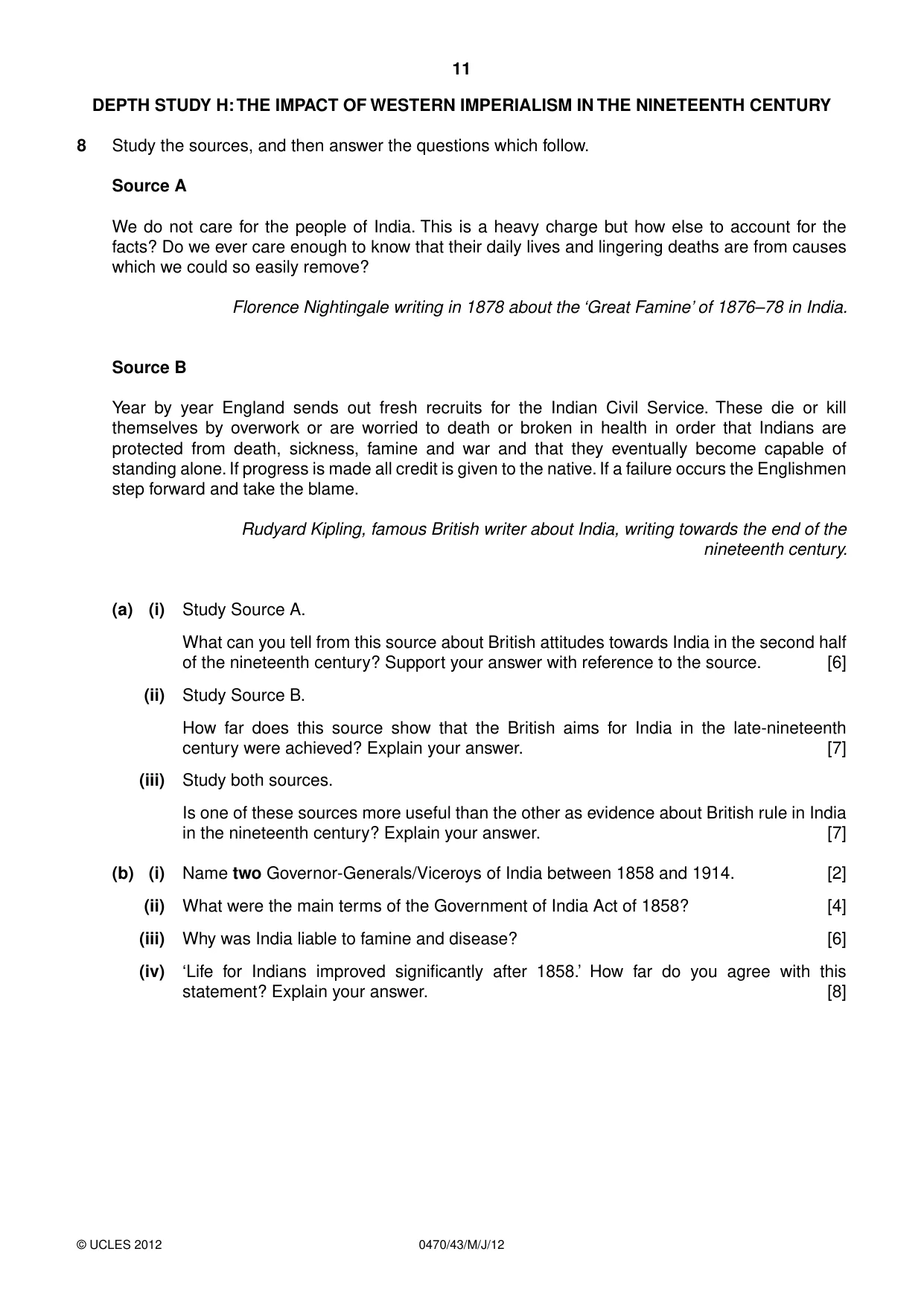
11 0470/43/M/J/12 © UCLES 2012 DEPTH STUDY H: THE IMPACT OF WESTERN IMPERIALISM IN THE NINETEENTH CENTURY 8 Study the sources, and then answer the questions which follow. Source A We do not care for the people of India. This is a heavy charge but how else to account for the facts? Do we ever care enough to know that their daily lives and lingering deaths are from causes which we could so easily remove? Florence Nightingale writing in 1878 about the ‘Great Famine’ of 1876–78 in India. Source B Year by year England sends out fresh recruits for the Indian Civil Service. These die or kill themselves by overwork or are worried to death or broken in health in order that Indians are protected from death, sickness, famine and war and that they eventually become capable of standing alone. If progress is made all credit is given to the native. If a failure occurs the Englishmen step forward and take the blame. Rudyard Kipling, famous British writer about India, writing towards the end of the nineteenth century. (a) (i) Study Source A. What can you tell from this source about British attitudes towards India in the second half of the nineteenth century? Support your answer with reference to the source. [6] (ii) Study Source B. How far does this source show that the British aims for India in the late-nineteenth century were achieved? Explain your answer. [7] (iii) Study both sources. Is one of these sources more useful than the other as evidence about British rule in India in the nineteenth century? Explain your answer. [7] (b) (i) Name two Governor-Generals/Viceroys of India between 1858 and 1914. [2] (ii) What were the main terms of the Government of India Act of 1858? [4] (iii) Why was India liable to famine and disease? [6] (iv) ‘Life for Indians improved significantly after 1858.’ How far do you agree with this statement? Explain your answer. [8]
Question paper, page 12
12 0470/43/M/J/12 © UCLES 2012 BLANK PAGE Copyright Acknowledgements: Depth Study B Source A © Ben Walsh; GCSE Modern World History; Hodder Education; 1996. Depth Study B Source B © Dmitri Volkogonov; The Rise and Fall of the Soviet Empire; HarperCollins; 1998. Depth Study C Source A © Studs Terkel; Hard Times: An Oral History of the Great Depression; The New Press; 2005. Depth Study D Source A © Neil DeMarco; The World This Century; Collins Educational; 1987. Depth Study D Source B © Harriet Ward; World Powers in the Twentieth Century; Heinemann; 1978. Depth Study F Source A © Schools Council History 13-16 Project; Arab-Israeli Conflict; Holmes McDougal; 1977. Depth Study F Source B © Dan Cohn-Sherbok, Dawoud El Alami; The Palestine-Israeli Conflict; Oneworld Publications; 2001. Depth Study G Source A © http://www2.warwick.ac.uk/services/library/mrc/modules/docs/city Depth Study G Source B © Virginia Law Review Association; http://www.jstor.org/stable/1073246 Depth Study H Source A © M Bostridge; Florence Nightingale; Penguin; 2008. Depth Study H Source B © N Ferguson; Empire; Allen Lane; 2003. Permission to reproduce items where third-party owned material protected by copyright is included has been sought and cleared where possible. Every reasonable effort has been made by the publisher (UCLES) to trace copyright holders, but if any items requiring clearance have unwittingly been included, the publisher will be pleased to make amends at the earliest possible opportunity. University of Cambridge International Examinations is part of the Cambridge Assessment Group. Cambridge Assessment is the brand name of University of Cambridge Local Examinations Syndicate (UCLES), which is itself a department of the University of Cambridge.
Mark scheme, page 1
UNIVERSITY OF CAMBRIDGE INTERNATIONAL EXAMINATIONS International General Certificate of Secondary Education MARK SCHEME for the May/June 2012 question paper for the guidance of teachers 0470 HISTORY 0470/43 Paper 4 (Alternative to Coursework), maximum raw mark 40 This mark scheme is published as an aid to teachers and candidates, to indicate the requirements of the examination. It shows the basis on which Examiners were instructed to award marks. It does not indicate the details of the discussions that took place at an Examiners’ meeting before marking began, which would have considered the acceptability of alternative answers. Mark schemes must be read in conjunction with the question papers and the report on the examination. • Cambridge will not enter into discussions or correspondence in connection with these mark schemes. Cambridge is publishing the mark schemes for the May/June 2012 question papers for most IGCSE, GCE Advanced Level and Advanced Subsidiary Level syllabuses and some Ordinary Level syllabuses. www.XtremePapers.com
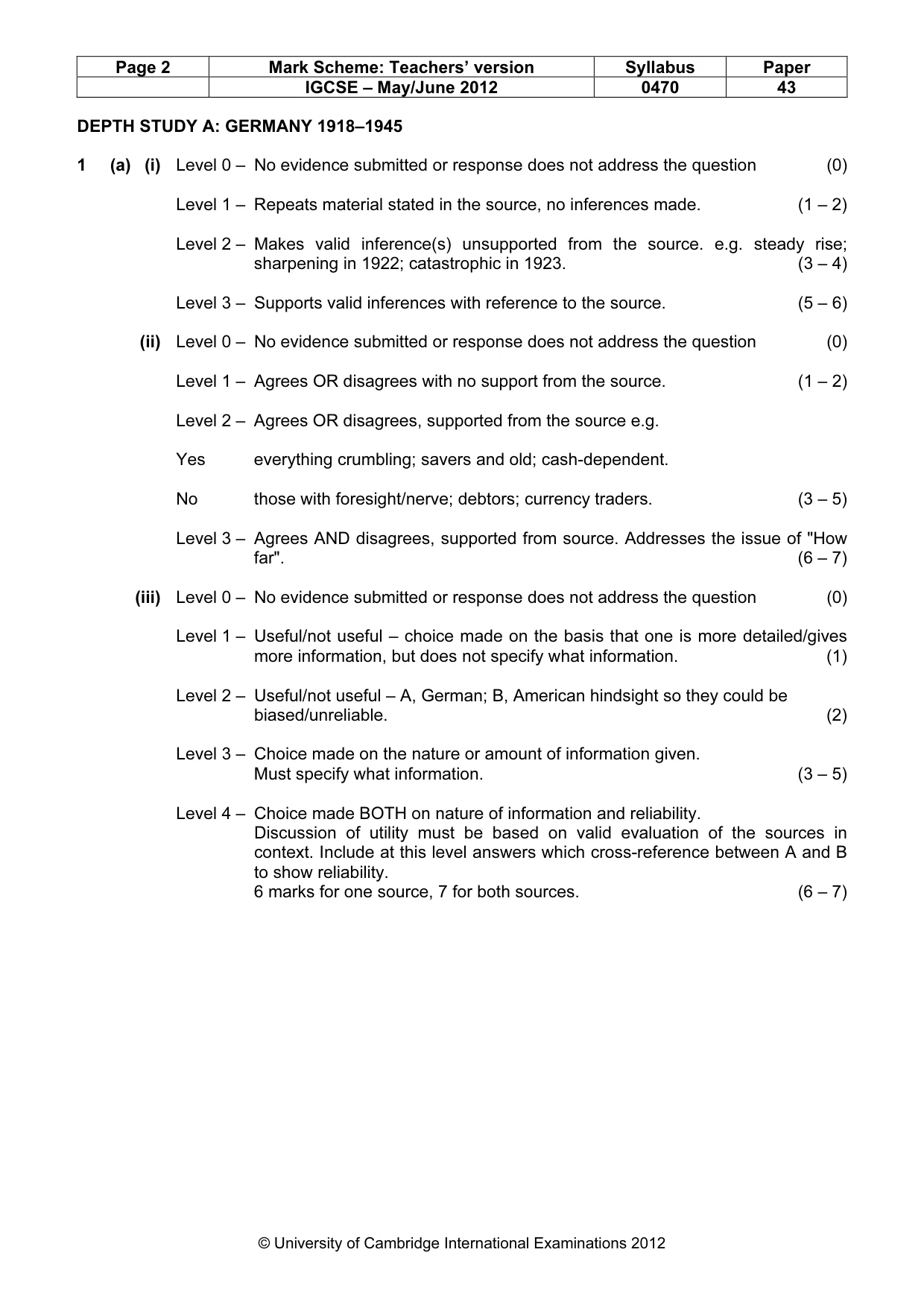
Mark scheme, page 2
Page 2 Mark Scheme: Teachers’ version Syllabus Paper IGCSE – May/June 2012 0470 43 © University of Cambridge International Examinations 2012 DEPTH STUDY A: GERMANY 1918–1945 1 (a) (i) Level 0 – No evidence submitted or response does not address the question (0) Level 1 – Repeats material stated in the source, no inferences made. (1 – 2) Level 2 – Makes valid inference(s) unsupported from the source. e.g. steady rise; sharpening in 1922; catastrophic in 1923. (3 – 4) Level 3 – Supports valid inferences with reference to the source. (5 – 6) (ii) Level 0 – No evidence submitted or response does not address the question (0) Level 1 – Agrees OR disagrees with no support from the source. (1 – 2) Level 2 – Agrees OR disagrees, supported from the source e.g. Yes everything crumbling; savers and old; cash-dependent. No those with foresight/nerve; debtors; currency traders. (3 – 5) Level 3 – Agrees AND disagrees, supported from source. Addresses the issue of "How far". (6 – 7) (iii) Level 0 – No evidence submitted or response does not address the question (0) Level 1 – Useful/not useful – choice made on the basis that one is more detailed/gives more information, but does not specify what information. (1) Level 2 – Useful/not useful – A, German; B, American hindsight so they could be biased/unreliable. (2) Level 3 – Choice made on the nature or amount of information given. Must specify what information. (3 – 5) Level 4 – Choice made BOTH on nature of information and reliability. Discussion of utility must be based on valid evaluation of the sources in context. Include at this level answers which cross-reference between A and B to show reliability. 6 marks for one source, 7 for both sources. (6 – 7)
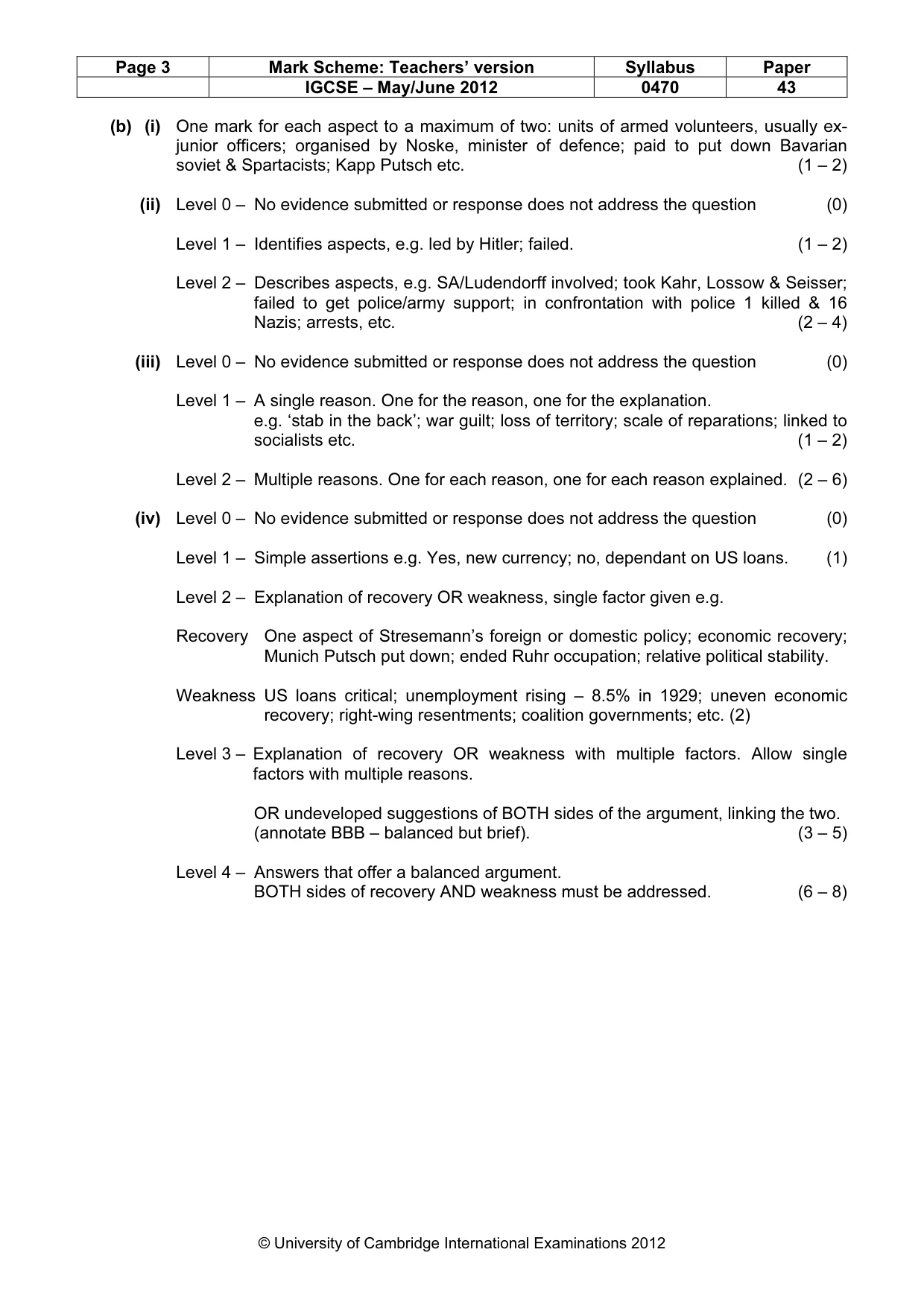
Mark scheme, page 3
Page 3 Mark Scheme: Teachers’ version Syllabus Paper IGCSE – May/June 2012 0470 43 © University of Cambridge International Examinations 2012 (b) (i) One mark for each aspect to a maximum of two: units of armed volunteers, usually ex- junior officers; organised by Noske, minister of defence; paid to put down Bavarian soviet & Spartacists; Kapp Putsch etc. (1 – 2) (ii) Level 0 – No evidence submitted or response does not address the question (0) Level 1 – Identifies aspects, e.g. led by Hitler; failed. (1 – 2) Level 2 – Describes aspects, e.g. SA/Ludendorff involved; took Kahr, Lossow & Seisser; failed to get police/army support; in confrontation with police 1 killed & 16 Nazis; arrests, etc. (2 – 4) (iii) Level 0 – No evidence submitted or response does not address the question (0) Level 1 – A single reason. One for the reason, one for the explanation. e.g. ‘stab in the back’; war guilt; loss of territory; scale of reparations; linked to socialists etc. (1 – 2) Level 2 – Multiple reasons. One for each reason, one for each reason explained. (2 – 6) (iv) Level 0 – No evidence submitted or response does not address the question (0) Level 1 – Simple assertions e.g. Yes, new currency; no, dependant on US loans. (1) Level 2 – Explanation of recovery OR weakness, single factor given e.g. Recovery One aspect of Stresemann’s foreign or domestic policy; economic recovery; Munich Putsch put down; ended Ruhr occupation; relative political stability. Weakness US loans critical; unemployment rising – 8.5% in 1929; uneven economic recovery; right-wing resentments; coalition governments; etc. (2) Level 3 – Explanation of recovery OR weakness with multiple factors. Allow single factors with multiple reasons. OR undeveloped suggestions of BOTH sides of the argument, linking the two. (annotate BBB – balanced but brief). (3 – 5) Level 4 – Answers that offer a balanced argument. BOTH sides of recovery AND weakness must be addressed. (6 – 8)
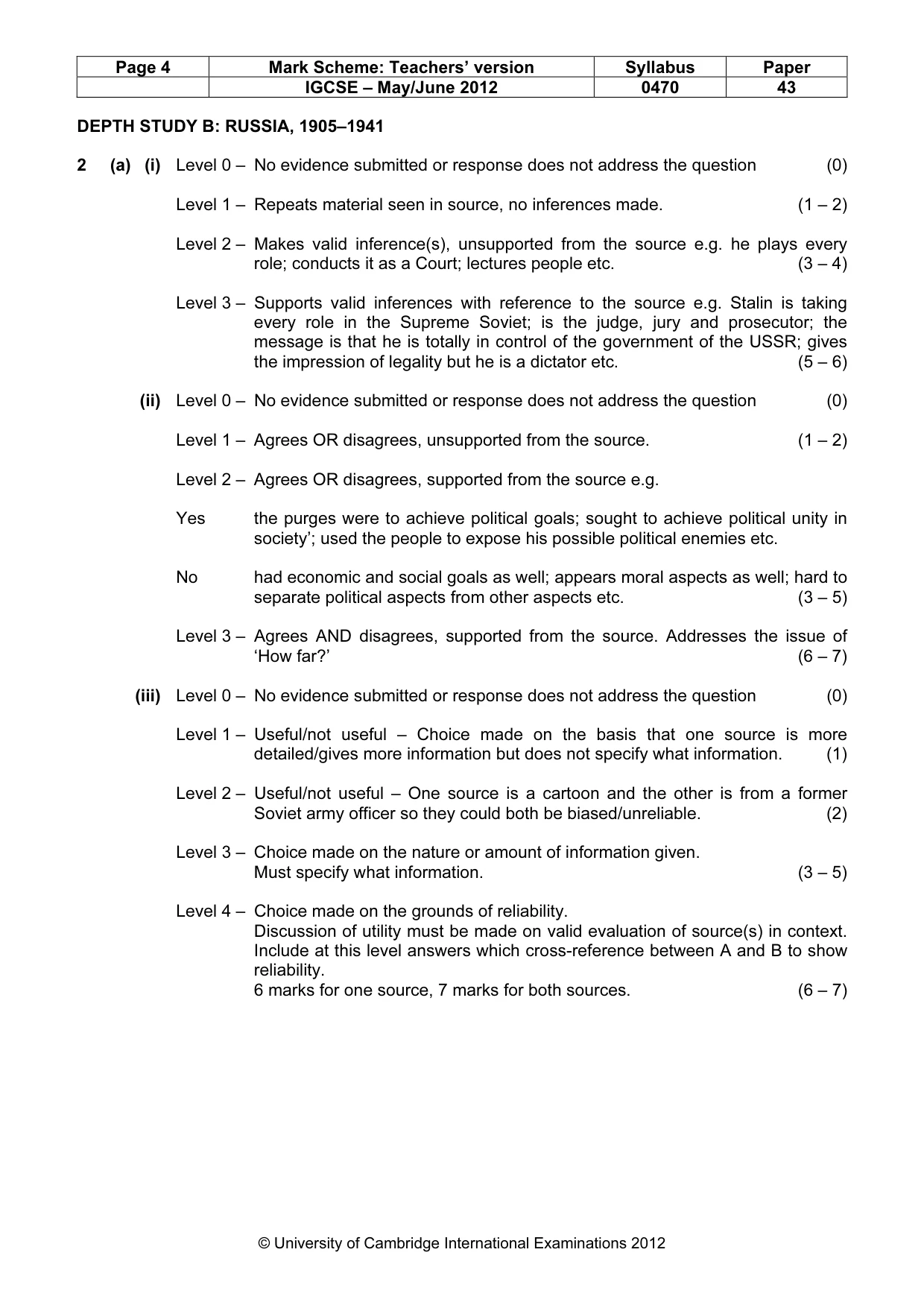
Mark scheme, page 4
Page 4 Mark Scheme: Teachers’ version Syllabus Paper IGCSE – May/June 2012 0470 43 © University of Cambridge International Examinations 2012 DEPTH STUDY B: RUSSIA, 1905–1941 2 (a) (i) Level 0 – No evidence submitted or response does not address the question (0) Level 1 – Repeats material seen in source, no inferences made. (1 – 2) Level 2 – Makes valid inference(s), unsupported from the source e.g. he plays every role; conducts it as a Court; lectures people etc. (3 – 4) Level 3 – Supports valid inferences with reference to the source e.g. Stalin is taking every role in the Supreme Soviet; is the judge, jury and prosecutor; the message is that he is totally in control of the government of the USSR; gives the impression of legality but he is a dictator etc. (5 – 6) (ii) Level 0 – No evidence submitted or response does not address the question (0) Level 1 – Agrees OR disagrees, unsupported from the source. (1 – 2) Level 2 – Agrees OR disagrees, supported from the source e.g. Yes the purges were to achieve political goals; sought to achieve political unity in society’; used the people to expose his possible political enemies etc. No had economic and social goals as well; appears moral aspects as well; hard to separate political aspects from other aspects etc. (3 – 5) Level 3 – Agrees AND disagrees, supported from the source. Addresses the issue of ‘How far?’ (6 – 7) (iii) Level 0 – No evidence submitted or response does not address the question (0) Level 1 – Useful/not useful – Choice made on the basis that one source is more detailed/gives more information but does not specify what information. (1) Level 2 – Useful/not useful – One source is a cartoon and the other is from a former Soviet army officer so they could both be biased/unreliable. (2) Level 3 – Choice made on the nature or amount of information given. Must specify what information. (3 – 5) Level 4 – Choice made on the grounds of reliability. Discussion of utility must be made on valid evaluation of source(s) in context. Include at this level answers which cross-reference between A and B to show reliability. 6 marks for one source, 7 marks for both sources. (6 – 7)
Mark scheme, page 5
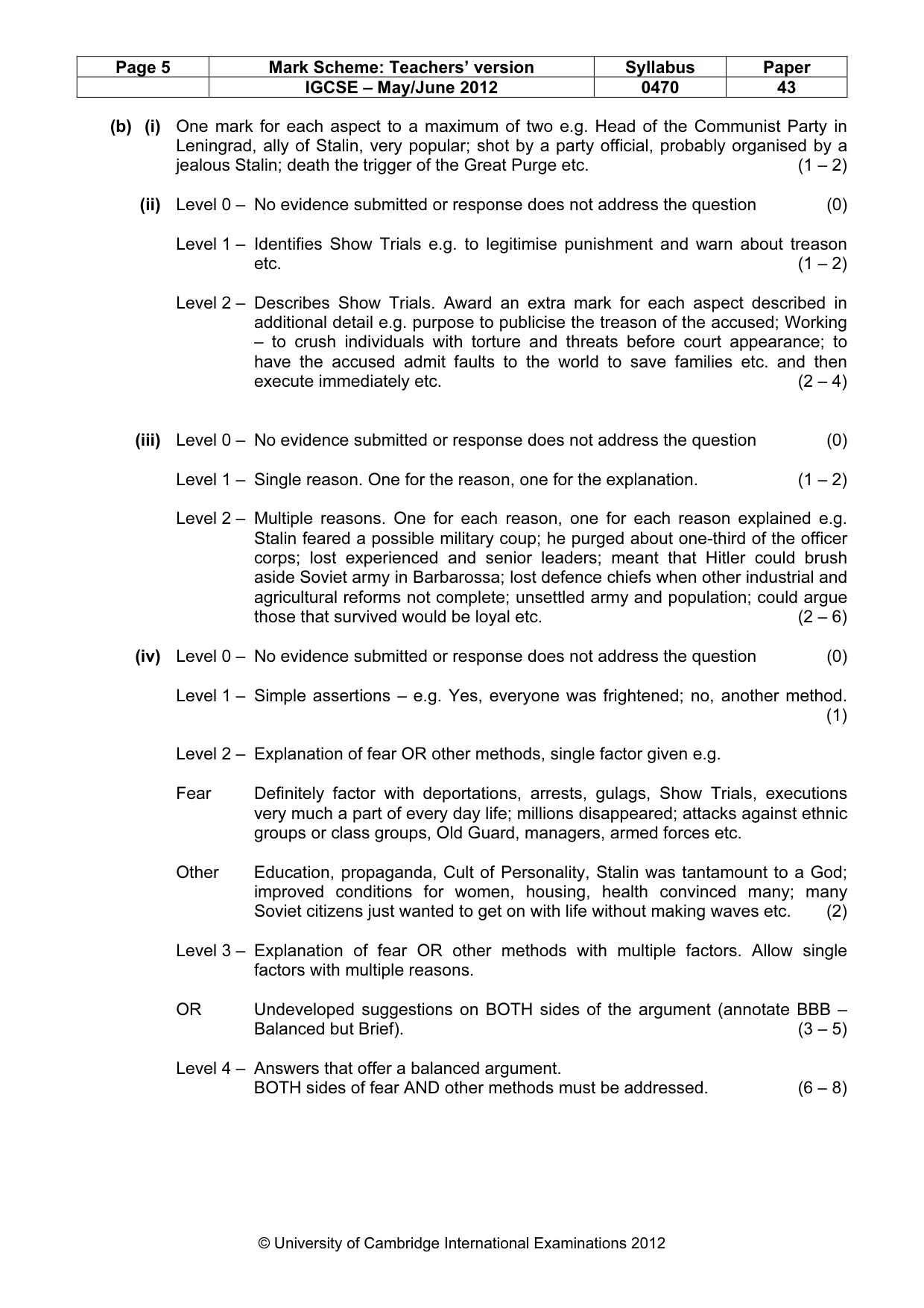
Page 5 Mark Scheme: Teachers’ version Syllabus Paper IGCSE – May/June 2012 0470 43 © University of Cambridge International Examinations 2012 (b) (i) One mark for each aspect to a maximum of two e.g. Head of the Communist Party in Leningrad, ally of Stalin, very popular; shot by a party official, probably organised by a jealous Stalin; death the trigger of the Great Purge etc. (1 – 2) (ii) Level 0 – No evidence submitted or response does not address the question (0) Level 1 – Identifies Show Trials e.g. to legitimise punishment and warn about treason etc. (1 – 2) Level 2 – Describes Show Trials. Award an extra mark for each aspect described in additional detail e.g. purpose to publicise the treason of the accused; Working – to crush individuals with torture and threats before court appearance; to have the accused admit faults to the world to save families etc. and then execute immediately etc. (2 – 4) (iii) Level 0 – No evidence submitted or response does not address the question (0) Level 1 – Single reason. One for the reason, one for the explanation. (1 – 2) Level 2 – Multiple reasons. One for each reason, one for each reason explained e.g. Stalin feared a possible military coup; he purged about one-third of the officer corps; lost experienced and senior leaders; meant that Hitler could brush aside Soviet army in Barbarossa; lost defence chiefs when other industrial and agricultural reforms not complete; unsettled army and population; could argue those that survived would be loyal etc. (2 – 6) (iv) Level 0 – No evidence submitted or response does not address the question (0) Level 1 – Simple assertions – e.g. Yes, everyone was frightened; no, another method. (1) Level 2 – Explanation of fear OR other methods, single factor given e.g. Fear Definitely factor with deportations, arrests, gulags, Show Trials, executions very much a part of every day life; millions disappeared; attacks against ethnic groups or class groups, Old Guard, managers, armed forces etc. Other Education, propaganda, Cult of Personality, Stalin was tantamount to a God; improved conditions for women, housing, health convinced many; many Soviet citizens just wanted to get on with life without making waves etc. (2) Level 3 – Explanation of fear OR other methods with multiple factors. Allow single factors with multiple reasons. OR Undeveloped suggestions on BOTH sides of the argument (annotate BBB – Balanced but Brief). (3 – 5) Level 4 – Answers that offer a balanced argument. BOTH sides of fear AND other methods must be addressed. (6 – 8)
Mark scheme, page 6
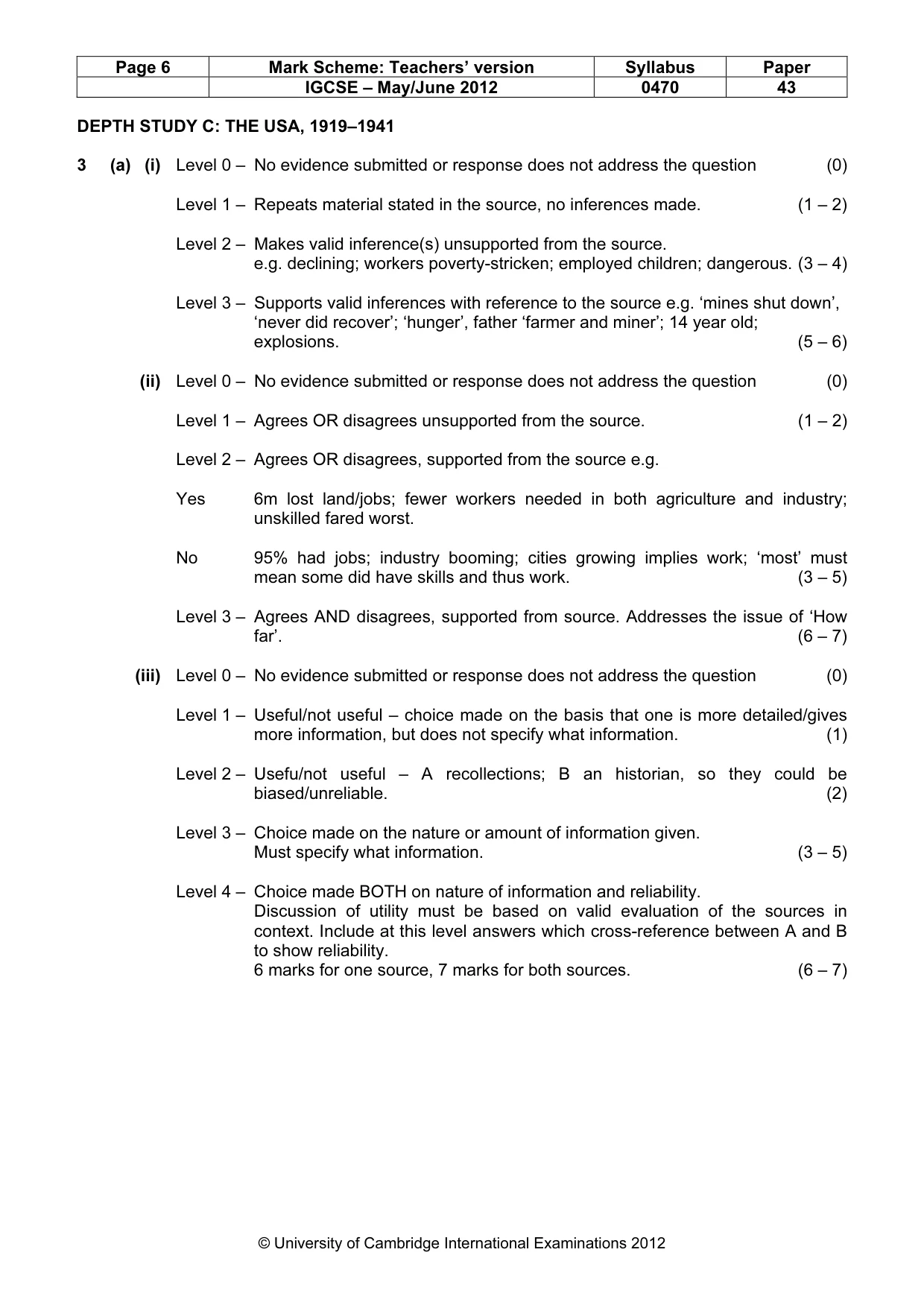
Page 6 Mark Scheme: Teachers’ version Syllabus Paper IGCSE – May/June 2012 0470 43 © University of Cambridge International Examinations 2012 DEPTH STUDY C: THE USA, 1919–1941 3 (a) (i) Level 0 – No evidence submitted or response does not address the question (0) Level 1 – Repeats material stated in the source, no inferences made. (1 – 2) Level 2 – Makes valid inference(s) unsupported from the source. e.g. declining; workers poverty-stricken; employed children; dangerous. (3 – 4) Level 3 – Supports valid inferences with reference to the source e.g. ‘mines shut down’, ‘never did recover’; ‘hunger’, father ‘farmer and miner’; 14 year old; explosions. (5 – 6) (ii) Level 0 – No evidence submitted or response does not address the question (0) Level 1 – Agrees OR disagrees unsupported from the source. (1 – 2) Level 2 – Agrees OR disagrees, supported from the source e.g. Yes 6m lost land/jobs; fewer workers needed in both agriculture and industry; unskilled fared worst. No 95% had jobs; industry booming; cities growing implies work; ‘most’ must mean some did have skills and thus work. (3 – 5) Level 3 – Agrees AND disagrees, supported from source. Addresses the issue of ‘How far’. (6 – 7) (iii) Level 0 – No evidence submitted or response does not address the question (0) Level 1 – Useful/not useful – choice made on the basis that one is more detailed/gives more information, but does not specify what information. (1) Level 2 – Usefu/not useful – A recollections; B an historian, so they could be biased/unreliable. (2) Level 3 – Choice made on the nature or amount of information given. Must specify what information. (3 – 5) Level 4 – Choice made BOTH on nature of information and reliability. Discussion of utility must be based on valid evaluation of the sources in context. Include at this level answers which cross-reference between A and B to show reliability. 6 marks for one source, 7 marks for both sources. (6 – 7)
Mark scheme, page 7
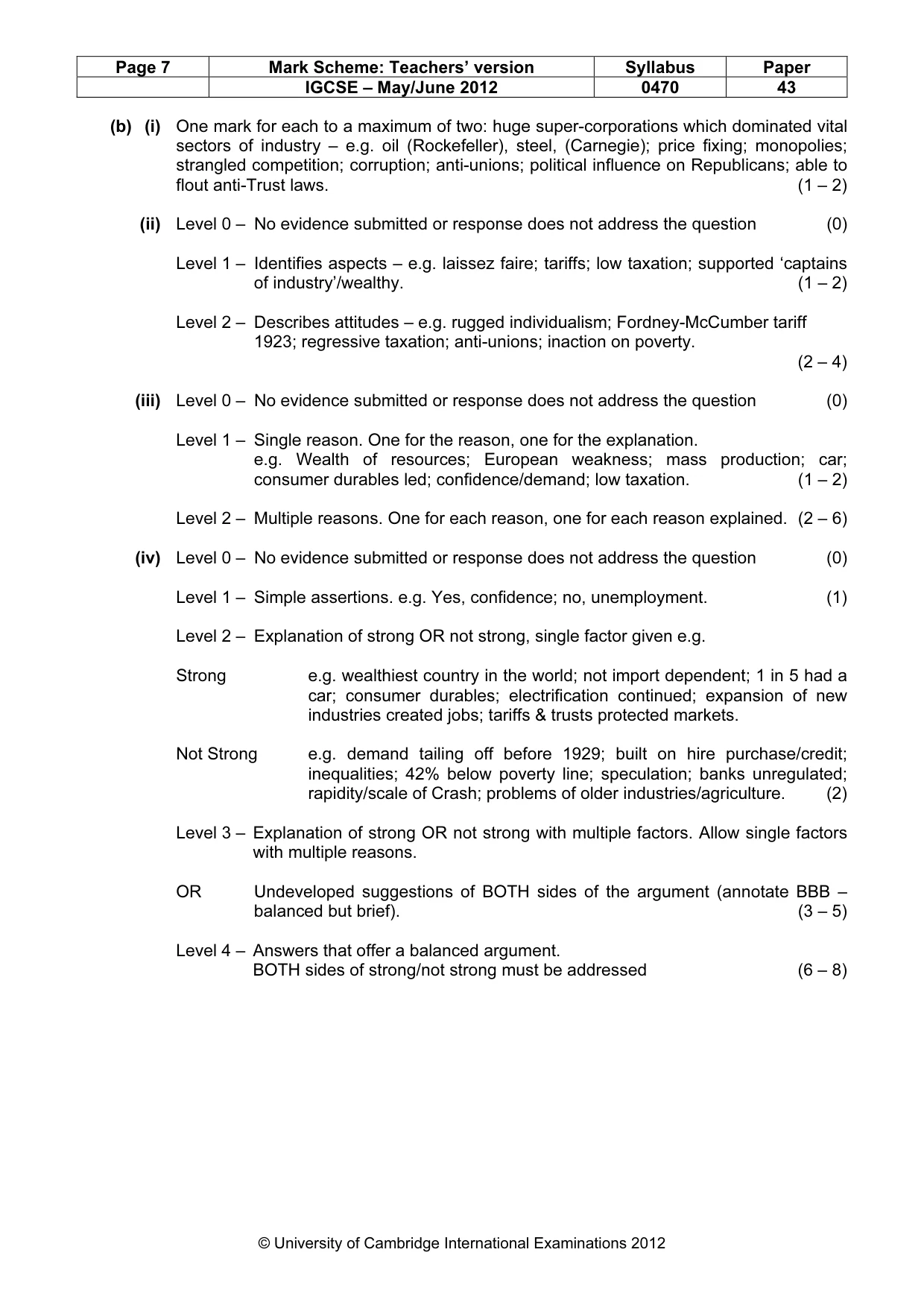
Page 7 Mark Scheme: Teachers’ version Syllabus Paper IGCSE – May/June 2012 0470 43 © University of Cambridge International Examinations 2012 (b) (i) One mark for each to a maximum of two: huge super-corporations which dominated vital sectors of industry – e.g. oil (Rockefeller), steel, (Carnegie); price fixing; monopolies; strangled competition; corruption; anti-unions; political influence on Republicans; able to flout anti-Trust laws. (1 – 2) (ii) Level 0 – No evidence submitted or response does not address the question (0) Level 1 – Identifies aspects – e.g. laissez faire; tariffs; low taxation; supported ‘captains of industry’/wealthy. (1 – 2) Level 2 – Describes attitudes – e.g. rugged individualism; Fordney-McCumber tariff 1923; regressive taxation; anti-unions; inaction on poverty. (2 – 4) (iii) Level 0 – No evidence submitted or response does not address the question (0) Level 1 – Single reason. One for the reason, one for the explanation. e.g. Wealth of resources; European weakness; mass production; car; consumer durables led; confidence/demand; low taxation. (1 – 2) Level 2 – Multiple reasons. One for each reason, one for each reason explained. (2 – 6) (iv) Level 0 – No evidence submitted or response does not address the question (0) Level 1 – Simple assertions. e.g. Yes, confidence; no, unemployment. (1) Level 2 – Explanation of strong OR not strong, single factor given e.g. Strong e.g. wealthiest country in the world; not import dependent; 1 in 5 had a car; consumer durables; electrification continued; expansion of new industries created jobs; tariffs & trusts protected markets. Not Strong e.g. demand tailing off before 1929; built on hire purchase/credit; inequalities; 42% below poverty line; speculation; banks unregulated; rapidity/scale of Crash; problems of older industries/agriculture. (2) Level 3 – Explanation of strong OR not strong with multiple factors. Allow single factors with multiple reasons. OR Undeveloped suggestions of BOTH sides of the argument (annotate BBB – balanced but brief). (3 – 5) Level 4 – Answers that offer a balanced argument. BOTH sides of strong/not strong must be addressed (6 – 8)
Mark scheme, page 8
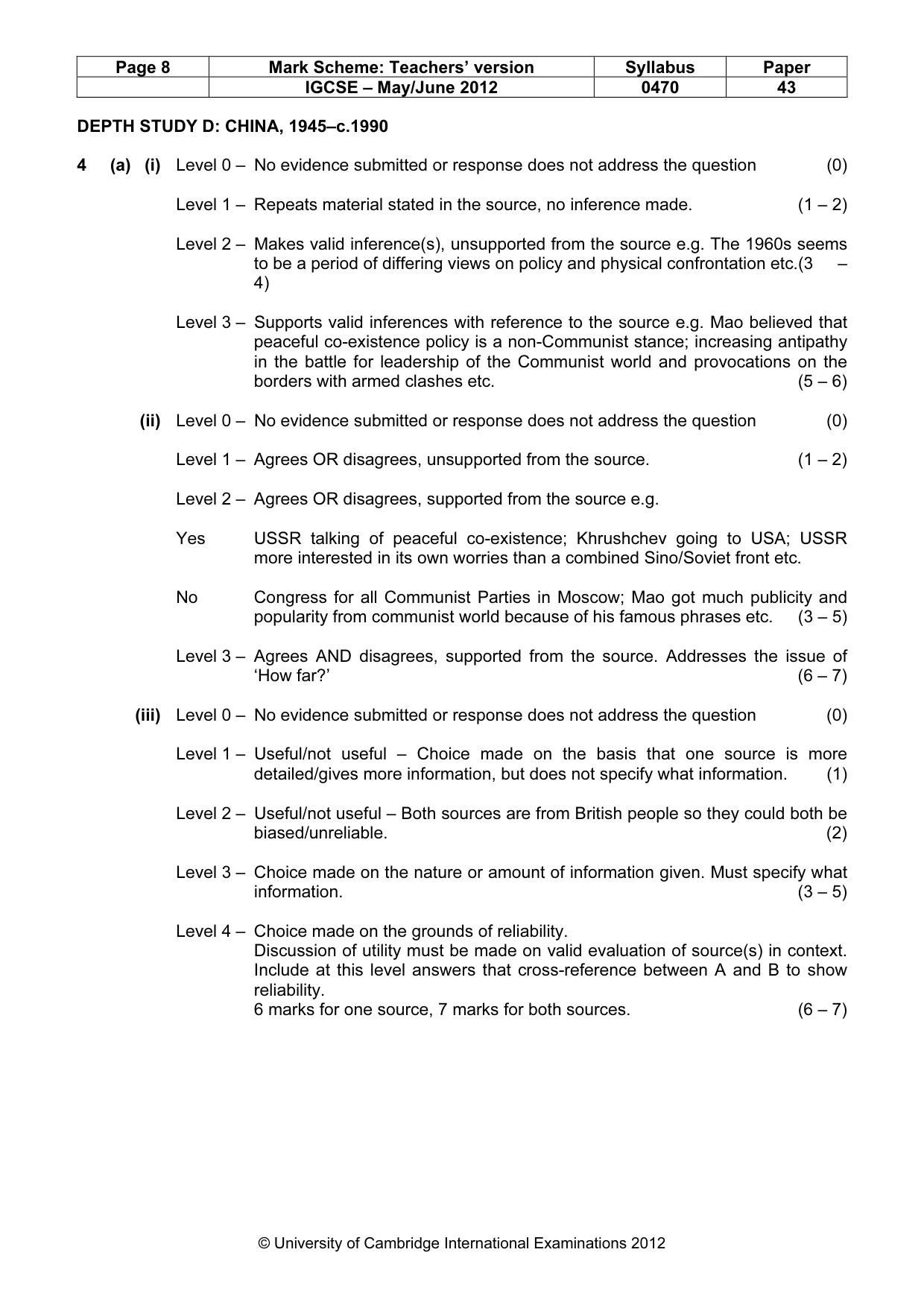
Page 8 Mark Scheme: Teachers’ version Syllabus Paper IGCSE – May/June 2012 0470 43 © University of Cambridge International Examinations 2012 DEPTH STUDY D: CHINA, 1945–c.1990 4 (a) (i) Level 0 – No evidence submitted or response does not address the question (0) Level 1 – Repeats material stated in the source, no inference made. (1 – 2) Level 2 – Makes valid inference(s), unsupported from the source e.g. The 1960s seems to be a period of differing views on policy and physical confrontation etc.(3 – 4) Level 3 – Supports valid inferences with reference to the source e.g. Mao believed that peaceful co-existence policy is a non-Communist stance; increasing antipathy in the battle for leadership of the Communist world and provocations on the borders with armed clashes etc. (5 – 6) (ii) Level 0 – No evidence submitted or response does not address the question (0) Level 1 – Agrees OR disagrees, unsupported from the source. (1 – 2) Level 2 – Agrees OR disagrees, supported from the source e.g. Yes USSR talking of peaceful co-existence; Khrushchev going to USA; USSR more interested in its own worries than a combined Sino/Soviet front etc. No Congress for all Communist Parties in Moscow; Mao got much publicity and popularity from communist world because of his famous phrases etc. (3 – 5) Level 3 – Agrees AND disagrees, supported from the source. Addresses the issue of ‘How far?’ (6 – 7) (iii) Level 0 – No evidence submitted or response does not address the question (0) Level 1 – Useful/not useful – Choice made on the basis that one source is more detailed/gives more information, but does not specify what information. (1) Level 2 – Useful/not useful – Both sources are from British people so they could both be biased/unreliable. (2) Level 3 – Choice made on the nature or amount of information given. Must specify what information. (3 – 5) Level 4 – Choice made on the grounds of reliability. Discussion of utility must be made on valid evaluation of source(s) in context. Include at this level answers that cross-reference between A and B to show reliability. 6 marks for one source, 7 marks for both sources. (6 – 7)
Mark scheme, page 9
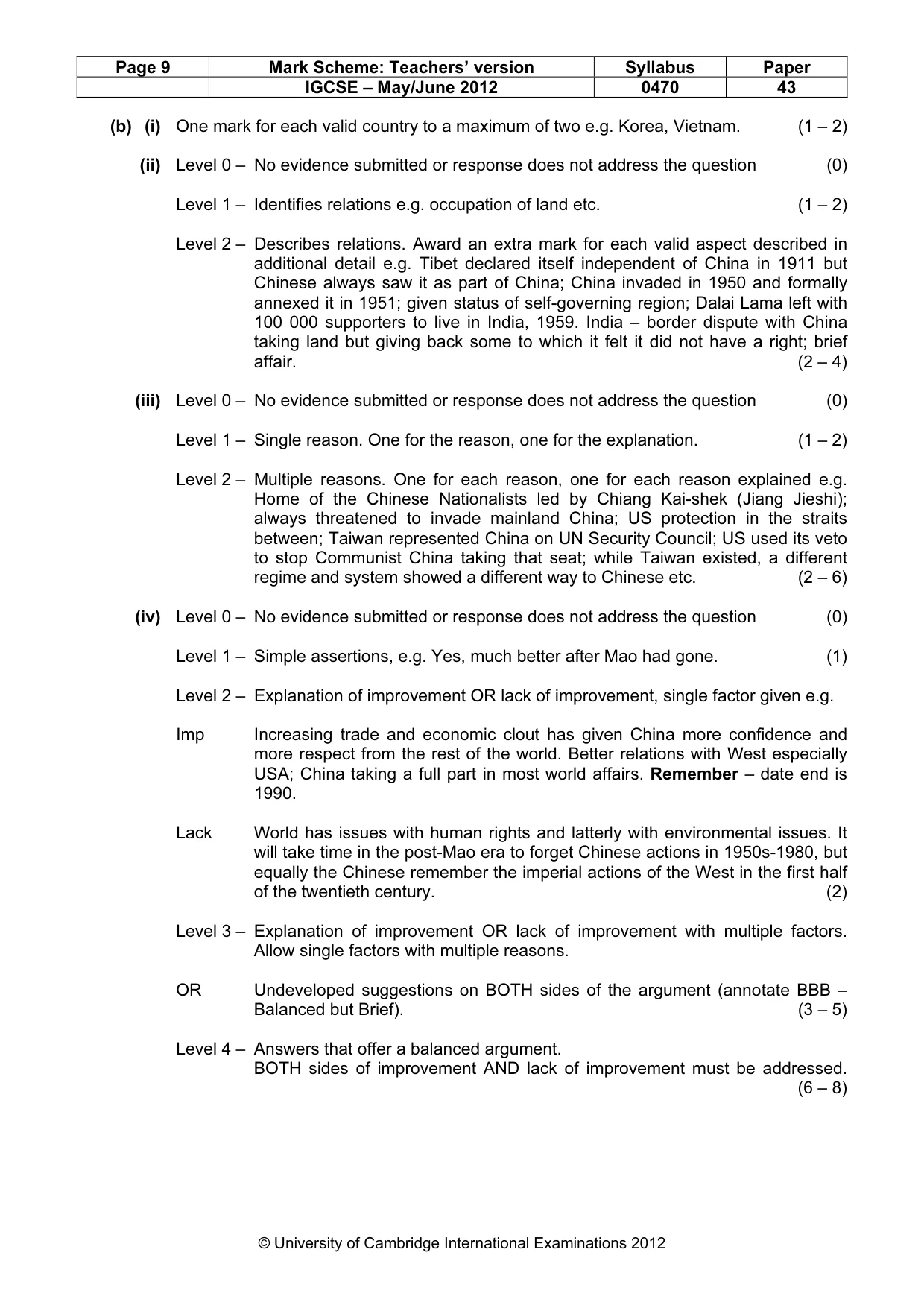
Page 9 Mark Scheme: Teachers’ version Syllabus Paper IGCSE – May/June 2012 0470 43 © University of Cambridge International Examinations 2012 (b) (i) One mark for each valid country to a maximum of two e.g. Korea, Vietnam. (1 – 2) (ii) Level 0 – No evidence submitted or response does not address the question (0) Level 1 – Identifies relations e.g. occupation of land etc. (1 – 2) Level 2 – Describes relations. Award an extra mark for each valid aspect described in additional detail e.g. Tibet declared itself independent of China in 1911 but Chinese always saw it as part of China; China invaded in 1950 and formally annexed it in 1951; given status of self-governing region; Dalai Lama left with 100 000 supporters to live in India, 1959. India – border dispute with China taking land but giving back some to which it felt it did not have a right; brief affair. (2 – 4) (iii) Level 0 – No evidence submitted or response does not address the question (0) Level 1 – Single reason. One for the reason, one for the explanation. (1 – 2) Level 2 – Multiple reasons. One for each reason, one for each reason explained e.g. Home of the Chinese Nationalists led by Chiang Kai-shek (Jiang Jieshi); always threatened to invade mainland China; US protection in the straits between; Taiwan represented China on UN Security Council; US used its veto to stop Communist China taking that seat; while Taiwan existed, a different regime and system showed a different way to Chinese etc. (2 – 6) (iv) Level 0 – No evidence submitted or response does not address the question (0) Level 1 – Simple assertions, e.g. Yes, much better after Mao had gone. (1) Level 2 – Explanation of improvement OR lack of improvement, single factor given e.g. Imp Increasing trade and economic clout has given China more confidence and more respect from the rest of the world. Better relations with West especially USA; China taking a full part in most world affairs. Remember – date end is 1990. Lack World has issues with human rights and latterly with environmental issues. It will take time in the post-Mao era to forget Chinese actions in 1950s-1980, but equally the Chinese remember the imperial actions of the West in the first half of the twentieth century. (2) Level 3 – Explanation of improvement OR lack of improvement with multiple factors. Allow single factors with multiple reasons. OR Undeveloped suggestions on BOTH sides of the argument (annotate BBB – Balanced but Brief). (3 – 5) Level 4 – Answers that offer a balanced argument. BOTH sides of improvement AND lack of improvement must be addressed. (6 – 8)
Mark scheme, page 10
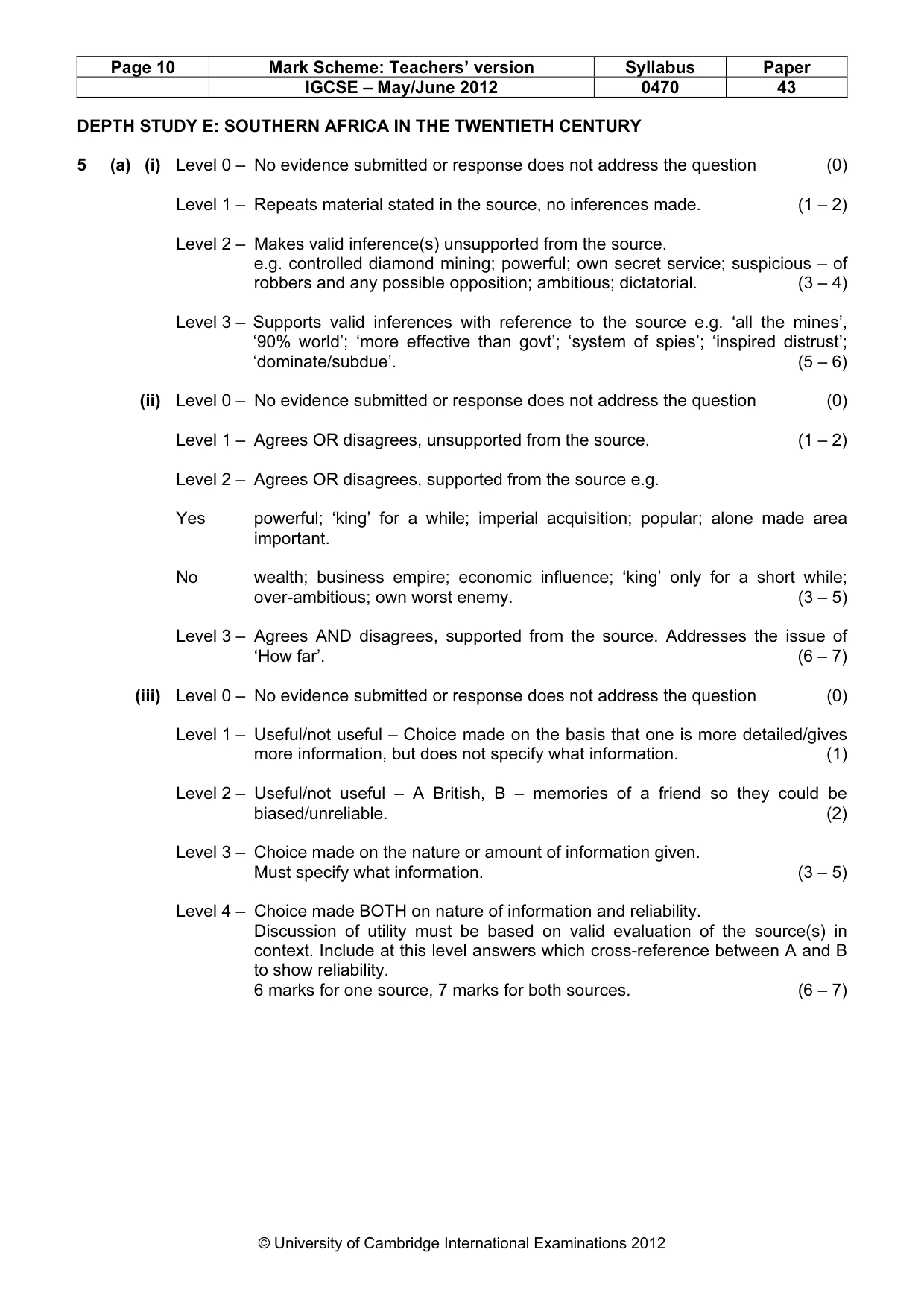
Page 10 Mark Scheme: Teachers’ version Syllabus Paper IGCSE – May/June 2012 0470 43 © University of Cambridge International Examinations 2012 DEPTH STUDY E: SOUTHERN AFRICA IN THE TWENTIETH CENTURY 5 (a) (i) Level 0 – No evidence submitted or response does not address the question (0) Level 1 – Repeats material stated in the source, no inferences made. (1 – 2) Level 2 – Makes valid inference(s) unsupported from the source. e.g. controlled diamond mining; powerful; own secret service; suspicious – of robbers and any possible opposition; ambitious; dictatorial. (3 – 4) Level 3 – Supports valid inferences with reference to the source e.g. ‘all the mines’, ‘90% world’; ‘more effective than govt’; ‘system of spies’; ‘inspired distrust’; ‘dominate/subdue’. (5 – 6) (ii) Level 0 – No evidence submitted or response does not address the question (0) Level 1 – Agrees OR disagrees, unsupported from the source. (1 – 2) Level 2 – Agrees OR disagrees, supported from the source e.g. Yes powerful; ‘king’ for a while; imperial acquisition; popular; alone made area important. No wealth; business empire; economic influence; ‘king’ only for a short while; over-ambitious; own worst enemy. (3 – 5) Level 3 – Agrees AND disagrees, supported from the source. Addresses the issue of ‘How far’. (6 – 7) (iii) Level 0 – No evidence submitted or response does not address the question (0) Level 1 – Useful/not useful – Choice made on the basis that one is more detailed/gives more information, but does not specify what information. (1) Level 2 – Useful/not useful – A British, B – memories of a friend so they could be biased/unreliable. (2) Level 3 – Choice made on the nature or amount of information given. Must specify what information. (3 – 5) Level 4 – Choice made BOTH on nature of information and reliability. Discussion of utility must be based on valid evaluation of the source(s) in context. Include at this level answers which cross-reference between A and B to show reliability. 6 marks for one source, 7 marks for both sources. (6 – 7)
Mark scheme, page 11
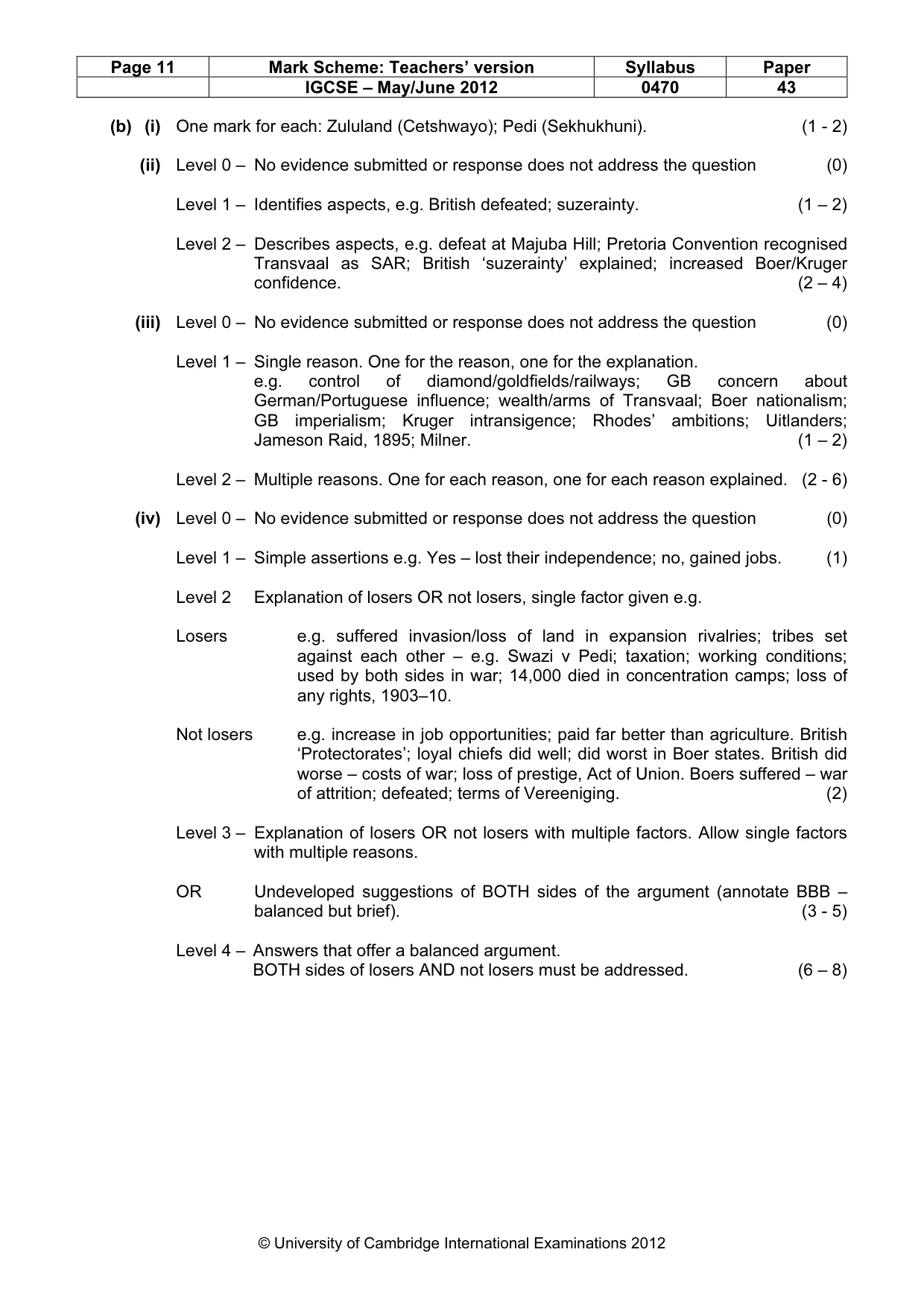
Page 11 Mark Scheme: Teachers’ version Syllabus Paper IGCSE – May/June 2012 0470 43 © University of Cambridge International Examinations 2012 (b) (i) One mark for each: Zululand (Cetshwayo); Pedi (Sekhukhuni). (1 - 2) (ii) Level 0 – No evidence submitted or response does not address the question (0) Level 1 – Identifies aspects, e.g. British defeated; suzerainty. (1 – 2) Level 2 – Describes aspects, e.g. defeat at Majuba Hill; Pretoria Convention recognised Transvaal as SAR; British ‘suzerainty’ explained; increased Boer/Kruger confidence. (2 – 4) (iii) Level 0 – No evidence submitted or response does not address the question (0) Level 1 – Single reason. One for the reason, one for the explanation. e.g. control of diamond/goldfields/railways; GB concern about German/Portuguese influence; wealth/arms of Transvaal; Boer nationalism; GB imperialism; Kruger intransigence; Rhodes’ ambitions; Uitlanders; Jameson Raid, 1895; Milner. (1 – 2) Level 2 – Multiple reasons. One for each reason, one for each reason explained. (2 - 6) (iv) Level 0 – No evidence submitted or response does not address the question (0) Level 1 – Simple assertions e.g. Yes – lost their independence; no, gained jobs. (1) Level 2 Explanation of losers OR not losers, single factor given e.g. Losers e.g. suffered invasion/loss of land in expansion rivalries; tribes set against each other – e.g. Swazi v Pedi; taxation; working conditions; used by both sides in war; 14,000 died in concentration camps; loss of any rights, 1903–10. Not losers e.g. increase in job opportunities; paid far better than agriculture. British ‘Protectorates’; loyal chiefs did well; did worst in Boer states. British did worse – costs of war; loss of prestige, Act of Union. Boers suffered – war of attrition; defeated; terms of Vereeniging. (2) Level 3 – Explanation of losers OR not losers with multiple factors. Allow single factors with multiple reasons. OR Undeveloped suggestions of BOTH sides of the argument (annotate BBB – balanced but brief). (3 - 5) Level 4 – Answers that offer a balanced argument. BOTH sides of losers AND not losers must be addressed. (6 – 8)
Mark scheme, page 12
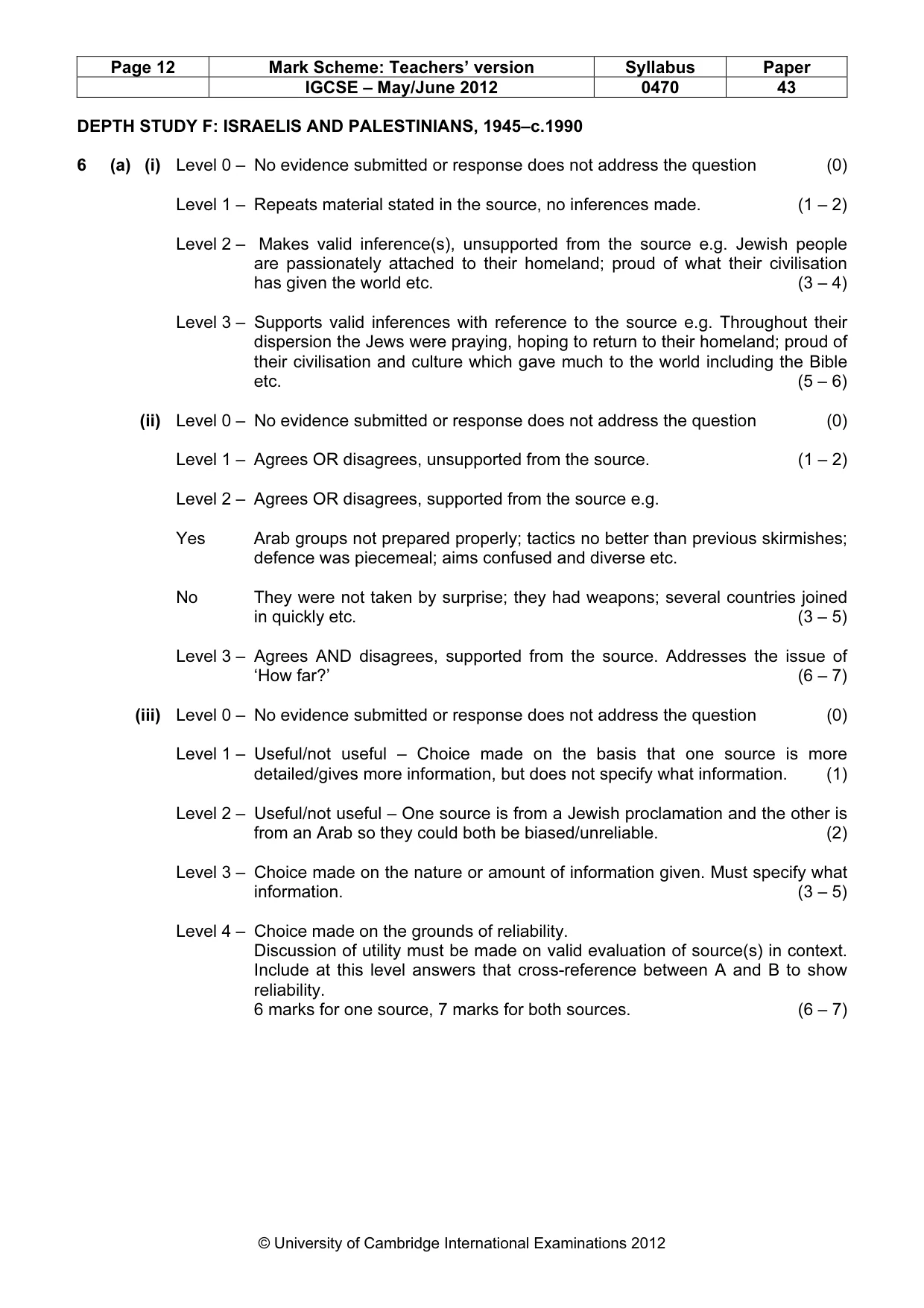
Page 12 Mark Scheme: Teachers’ version Syllabus Paper IGCSE – May/June 2012 0470 43 © University of Cambridge International Examinations 2012 DEPTH STUDY F: ISRAELIS AND PALESTINIANS, 1945–c.1990 6 (a) (i) Level 0 – No evidence submitted or response does not address the question (0) Level 1 – Repeats material stated in the source, no inferences made. (1 – 2) Level 2 – Makes valid inference(s), unsupported from the source e.g. Jewish people are passionately attached to their homeland; proud of what their civilisation has given the world etc. (3 – 4) Level 3 – Supports valid inferences with reference to the source e.g. Throughout their dispersion the Jews were praying, hoping to return to their homeland; proud of their civilisation and culture which gave much to the world including the Bible etc. (5 – 6) (ii) Level 0 – No evidence submitted or response does not address the question (0) Level 1 – Agrees OR disagrees, unsupported from the source. (1 – 2) Level 2 – Agrees OR disagrees, supported from the source e.g. Yes Arab groups not prepared properly; tactics no better than previous skirmishes; defence was piecemeal; aims confused and diverse etc. No They were not taken by surprise; they had weapons; several countries joined in quickly etc. (3 – 5) Level 3 – Agrees AND disagrees, supported from the source. Addresses the issue of ‘How far?’ (6 – 7) (iii) Level 0 – No evidence submitted or response does not address the question (0) Level 1 – Useful/not useful – Choice made on the basis that one source is more detailed/gives more information, but does not specify what information. (1) Level 2 – Useful/not useful – One source is from a Jewish proclamation and the other is from an Arab so they could both be biased/unreliable. (2) Level 3 – Choice made on the nature or amount of information given. Must specify what information. (3 – 5) Level 4 – Choice made on the grounds of reliability. Discussion of utility must be made on valid evaluation of source(s) in context. Include at this level answers that cross-reference between A and B to show reliability. 6 marks for one source, 7 marks for both sources. (6 – 7)
Mark scheme, page 13
Page 13 Mark Scheme: Teachers’ version Syllabus Paper IGCSE – May/June 2012 0470 43 © University of Cambridge International Examinations 2012 (b) (i) One mark for each valid aspect to a maximum of two e.g. term given to modern movement founded by Herzl aiming to establish a Jewish homeland in Palestine as the only way of escaping centuries of persecution and discrimination. (1 – 2) (ii) Level 0 – No evidence submitted or response does not address the question (0) Level 1 – Identifies terms e.g. to be responsible for the development of Palestine. (1 – 2) Level 2 – Describes terms. Award an extra mark for each valid term described in additional detail e.g. League of Nations Mandate awarded in 1920 and confirmed by L of N in 1922; to be responsible for the political, economic and administrative control; to be responsible for the training and development of the population; to foster good relations with both Arabs and Jews; to encourage the immigration and settlement of Jews; protect the civil and religious right of all citizens etc. (2 – 4) (iii) Level 0 – No evidence submitted or response does not address the question (0) Level 1 – Single reason. One for the reason, one for the explanation. (1 – 2) Level 2 – Multiple reasons. One for each reason, one for each reason explained e.g. Britain was exhausted financially; short of men; too expensive; at the time trying to set up welfare state; Palestine had always been difficult with increasing immigration by Jews and the religious and cultural clashes; because GB could walk away as the new UNO could pick up the pieces etc. (2 – 6) (iv) Level 0 – No evidence submitted or response does not address the question (0) Level 1 – Simple assertions, e.g. no, the fighting was in Palestine. (1) Level 2 – Explanation of events in Palestine OR outside influences, single factor given e.g. Outside e.g. demand for more and more Jews to be allowed to move from Europe etc; impact and sympathy for Jews from Holocaust revelations; views of President Truman, Jewish lobby and funding from US Jews; the world felt guilty etc. Pal e.g. increasing number of Jews brought social and religious tensions and violence; terror gangs on both sides. Jews felt a need to establish their homeland; British could not control and in the end could not get the two sides to join talks; Palestine would be the place for decisive fighting etc. (2) Level 3 – Explanation of outside influences OR events in Palestine with multiple factors. Allow single factors with multiple reasons. OR Undeveloped suggestions on BOTH sides of the argument (annotate BBB – Balanced but Brief). (3 – 5) Level 4 – Answers that offer a balanced argument. BOTH sides of events in Palestine AND outside influences must be addressed. (6 – 8)
Mark scheme, page 14
Page 14 Mark Scheme: Teachers’ version Syllabus Paper IGCSE – May/June 2012 0470 43 © University of Cambridge International Examinations 2012 DEPTH STUDY G: THE CREATION OF MODERN INDUSTRIAL SOCIETY 7 (a) (i) Level 0 – No evidence submitted or response does not address the question (0) Level 1 – Repeats material stated in the source, no inference made. (1 – 2) Level 2 – Makes valid inference(s) unsupported from the source e.g. seen as useful, within limits; influence on Parliament; range of demands excessive; threatening. (3 – 4) Level 3 – Supports valid inferences with reference to the source e.g. ‘maintaining rights of labouring classes’; PM ‘no opponent of TUs’; ‘agree amongst themselves not to work’, ‘prevent or intimidate’. (5 – 6) (ii) Level 0 – No evidence submitted or response does not address the question (0) Level 1 – Agrees OR disagrees, unsupported from the source. (1 – 2) Level 2 – Agrees OR disagrees, supported from the source e.g. Yes legislation strengthened their position/status; increased membership strengthened influence; founded TUC; optimistic. No only ‘seemed’ to improve; concessions only because of 1867 Reform Act; over-optimistic. (3 – 5) Level 3 – Agrees AND disagrees, supported from the source. Addresses the issue of ‘How far?’ (6 – 7) (iii) Level 0 – No evidence submitted or response does not address the question (0) Level 1 – Useful/not useful – Choice made on the basis that one source is more detailed/gives more information, but does not specify what information. (1) Level 2 – Useful/not useful – One source is from the PM and the other is from an American so they could both be biased/unreliable. (2) Level 3 – Choice made on the nature or amount of information given. Must specify what information. (3 – 5) Level 4 – Choice made on the grounds of reliability. Discussion of utility must be made on valid evaluation of source(s) in context. Include at this level answers that cross-reference between A and B to show reliability. 6 marks for one source, 7 marks for both. (6 – 7)
Mark scheme, page 15
Page 15 Mark Scheme: Teachers’ version Syllabus Paper IGCSE – May/June 2012 0470 43 © University of Cambridge International Examinations 2012 (b) (i) One mark for each valid aspect to a maximum of two e.g. action of a minority to force ‘blacklegs’ to join TU; result of rivalry between different cutlers’ unions; some violence including dropping gunpowder down a workman’s chimney; factor in bringing about Royal Commission to enquire into TU movement. (1 – 2) (ii) Level 0 – No evidence submitted or response does not address the question (0) Level 1 – Identifies terms e.g. TU Act protection union funds; CLAA forbade picketing OR considers only one Act. (1 – 2) Level 2 – Describes terms. Award an extra mark for each valid term described in additional detail e.g. TU Act combinations not unlawful; full legal protection of funds for the first time; CLAA weakened picketing by forbidding ‘molestation’ and ‘intimidation’; Jail sentences. (2 – 4) (iii) Level 0 – No evidence submitted or response does not address the question (0) Level 1 – Single reason. One for the reason, one for the explanation. (1 – 2) Level 2 – Multiple reasons. One for each reason, one for each reason explained e.g. 1867 & 1884 extensions of franchise gave working men some political influence on elections; activities of TUC and socialists; Match Girls’ Strike; formation of unskilled unions; Dock Strike. (2 – 6) (iv) Level 0 – No evidence submitted or response does not address the question (0) Level 1 – Simple assertions, e.g. Yes, they were better organised. (1) Level 2 – Explanation of trade unionists influence OR other factors, single factor given e.g. TUs New Model Unions; TUC; New Unionism; agricultural workers. Other growing social conscience; politicians – Disraeli, Gladstone; Socialists – Webbs, Shaw, Hardie etc; some employers came to see benefits of negotiation/happier workforce. Can argue little genuine progress. (2) Level 3 – Explanation of own efforts OR other influences with multiple factors. Allow single factors with multiple reasons. OR Undeveloped suggestions on BOTH sides of the argument (annotate BBB – Balanced but Brief). (3 – 5) Level 4 – Answers that offer a balanced argument. BOTH sides of events in Palestine AND outside influences must be addressed. (6 – 8)
Mark scheme, page 16
Page 16 Mark Scheme: Teachers’ version Syllabus Paper IGCSE – May/June 2012 0470 43 © University of Cambridge International Examinations 2012 DEPTH STUDY H: THE IMPACT OF WESTERN IMPERIALISM IN THE NINETEENTH CENTURY 8 (a) (i) Level 0 – No evidence submitted or response does not address the question (0) Level 1 – Repeats material stated in the source, no inferences made. (1 – 2) Level 2 – Makes valid inference(s) unsupported from the source e.g. disinterested; apathetic; cruel; one concerned. (3 – 4) Level 3 – Supports valid inferences with reference to the source e.g. ‘we do not care’; no effort over ‘lingering deaths’ famine; ‘could so easily remove’; Florence attacks government. (5 – 6) (ii) Level 0 – No evidence submitted or response does not address the question (0) Level 1 – Agrees OR disagrees, unsupported from the source. (1 – 2) Level 2 – Agrees OR disagrees, supported from the source e.g. Yes protected lives; reduced famine; Civil Service worked hard; gave credit to Indians. No worked to death; took all the blame for problems; ‘may’ become self-sufficient. (3 – 5) Level 3 – Agrees AND disagrees, supported from the source. Addresses the issue of ‘How far?’ (6 – 7) (iii) Level 0 – No evidence submitted or response does not address the question (0) Level 1 – Useful/not useful – Choice made on the basis that one source is more detailed/gives more information, but does not specify what information. (1) Level 2 – Useful/not useful – One source is from a British campaigner and the other from an imperialist so they could both be biased/unreliable. (2) Level 3 – Choice made on the nature or amount of information given. Must specify what information. (3 – 5) Level 4 – Choice made on the grounds of reliability. Discussion of utility must be made on valid evaluation of source(s) in context. Include at this level answers that cross-reference between A and B to show reliability. 6 marks for one source, 7 marks for both sources. (6 – 7)
Mark scheme, page 17
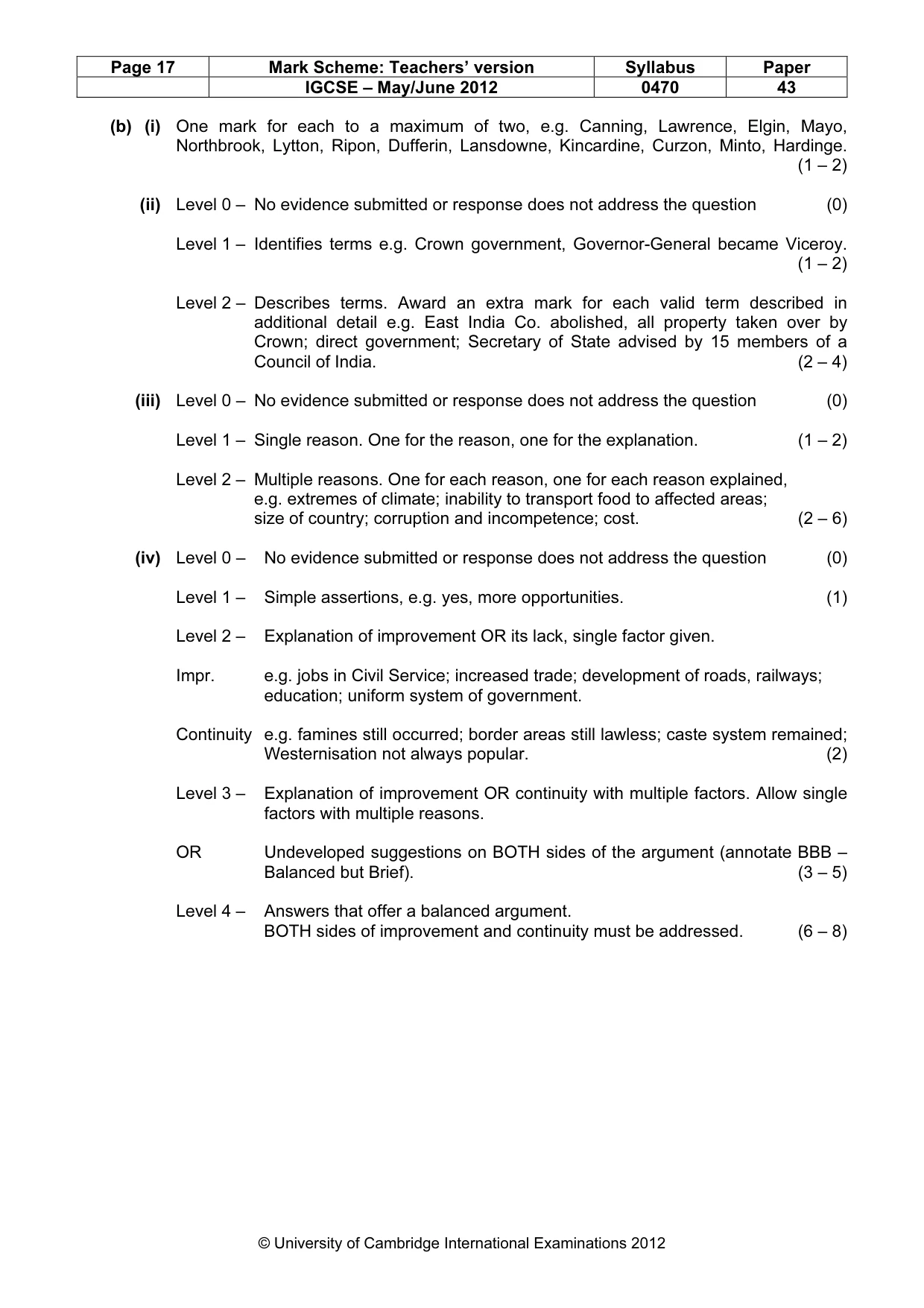
Page 17 Mark Scheme: Teachers’ version Syllabus Paper IGCSE – May/June 2012 0470 43 © University of Cambridge International Examinations 2012 (b) (i) One mark for each to a maximum of two, e.g. Canning, Lawrence, Elgin, Mayo, Northbrook, Lytton, Ripon, Dufferin, Lansdowne, Kincardine, Curzon, Minto, Hardinge. (1 – 2) (ii) Level 0 – No evidence submitted or response does not address the question (0) Level 1 – Identifies terms e.g. Crown government, Governor-General became Viceroy. (1 – 2) Level 2 – Describes terms. Award an extra mark for each valid term described in additional detail e.g. East India Co. abolished, all property taken over by Crown; direct government; Secretary of State advised by 15 members of a Council of India. (2 – 4) (iii) Level 0 – No evidence submitted or response does not address the question (0) Level 1 – Single reason. One for the reason, one for the explanation. (1 – 2) Level 2 – Multiple reasons. One for each reason, one for each reason explained, e.g. extremes of climate; inability to transport food to affected areas; size of country; corruption and incompetence; cost. (2 – 6) (iv) Level 0 – No evidence submitted or response does not address the question (0) Level 1 – Simple assertions, e.g. yes, more opportunities. (1) Level 2 – Explanation of improvement OR its lack, single factor given. Impr. e.g. jobs in Civil Service; increased trade; development of roads, railways; education; uniform system of government. Continuity e.g. famines still occurred; border areas still lawless; caste system remained; Westernisation not always popular. (2) Level 3 – Explanation of improvement OR continuity with multiple factors. Allow single factors with multiple reasons. OR Undeveloped suggestions on BOTH sides of the argument (annotate BBB – Balanced but Brief). (3 – 5) Level 4 – Answers that offer a balanced argument. BOTH sides of improvement and continuity must be addressed. (6 – 8)
What you needed in this session
Cambridge’s own grade thresholds for 2012 May/June, Paper 4 · Variant 3. A higher threshold means an easier paper — the bar moves with how the cohort did.