Cambridge IGCSE History 0470 — 2012 May/June Paper 4 · Variant 2
0470/42/M/J/12 · 40 marks · ≈45 min
The question paper and its mark scheme, free to read here and free to download. This is Cambridge’s own paper, exactly as it was sat.
Question paper12 pages

Mark scheme17 pages
Answers below. Sit the paper first if you are practising.
Paper as text
Question paper, page 1
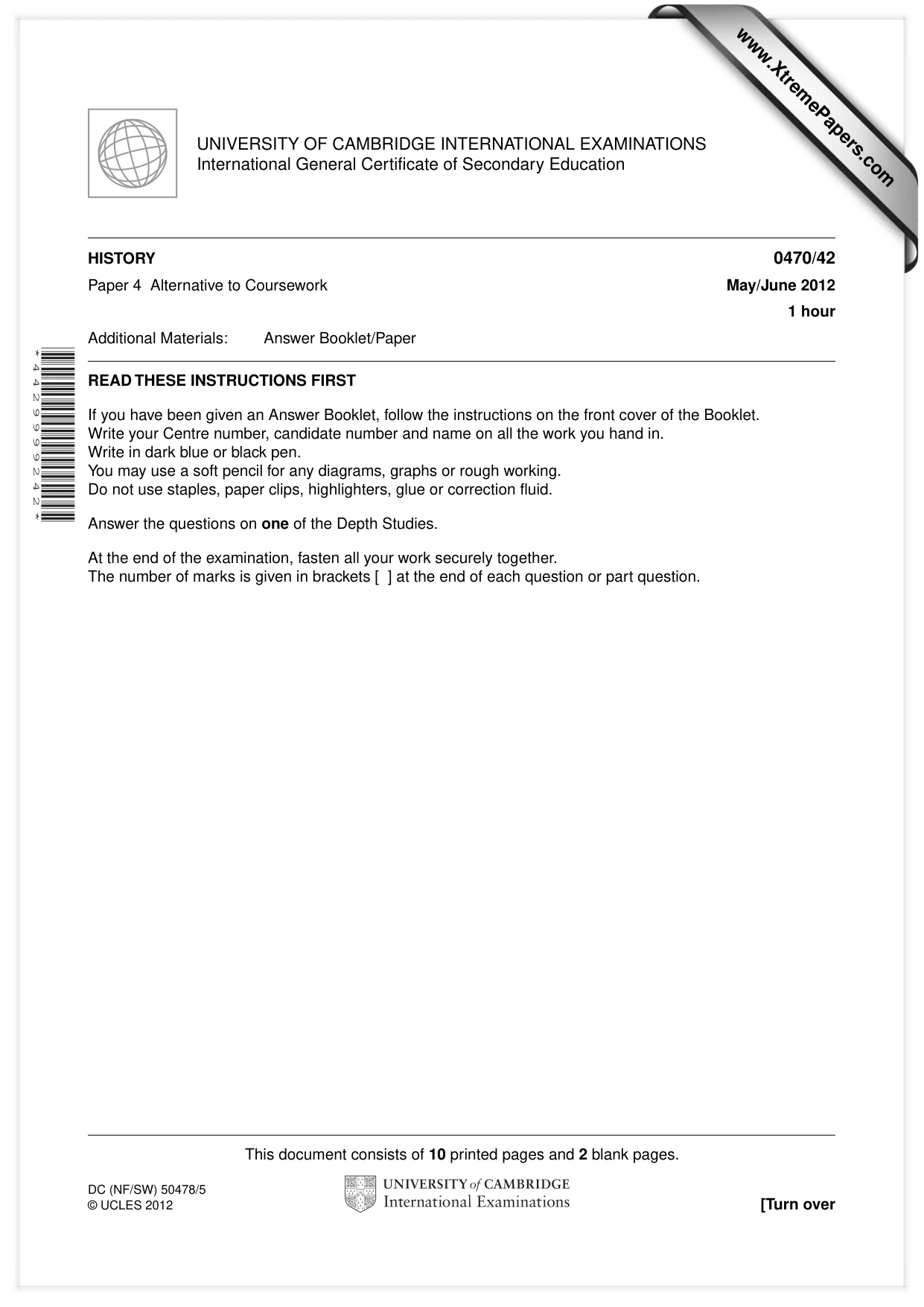
This document consists of 10 printed pages and 2 blank pages. DC (NF/SW) 50478/5 © UCLES 2012 [Turn over UNIVERSITY OF CAMBRIDGE INTERNATIONAL EXAMINATIONS International General Certificate of Secondary Education * 4 4 2 9 9 9 9 2 4 2 * HISTORY 0470/42 Paper 4 Alternative to Coursework May/June 2012 1 hour Additional Materials: Answer Booklet/Paper READ THESE INSTRUCTIONS FIRST If you have been given an Answer Booklet, follow the instructions on the front cover of the Booklet. Write your Centre number, candidate number and name on all the work you hand in. Write in dark blue or black pen. You may use a soft pencil for any diagrams, graphs or rough working. Do not use staples, paper clips, highlighters, glue or correction fluid. Answer the questions on one of the Depth Studies. At the end of the examination, fasten all your work securely together. The number of marks is given in brackets [ ] at the end of each question or part question. www.XtremePapers.com
Question paper, page 2
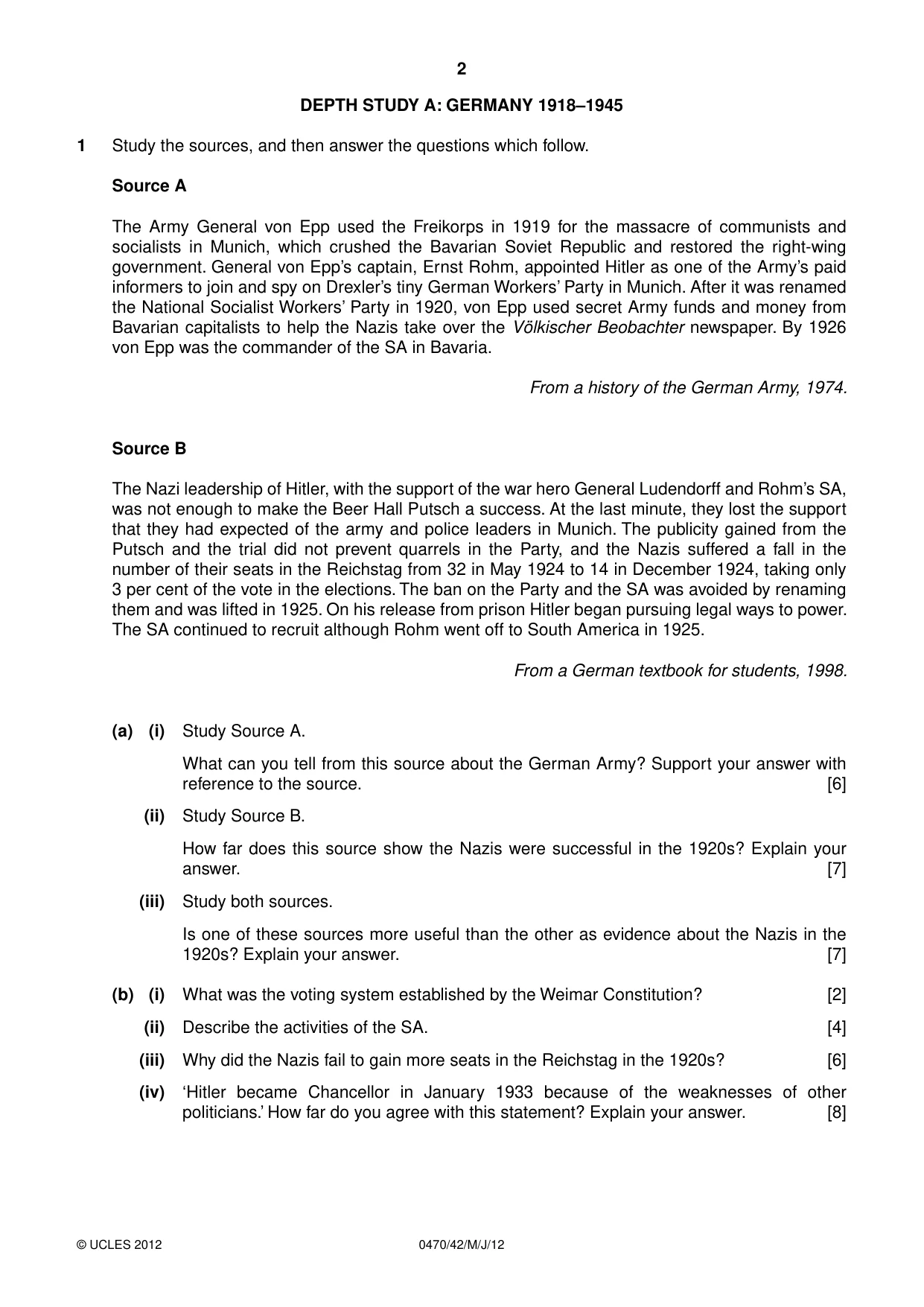
2 0470/42/M/J/12 © UCLES 2012 DEPTH STUDY A: GERMANY 1918–1945 1 Study the sources, and then answer the questions which follow. Source A The Army General von Epp used the Freikorps in 1919 for the massacre of communists and socialists in Munich, which crushed the Bavarian Soviet Republic and restored the right-wing government. General von Epp’s captain, Ernst Rohm, appointed Hitler as one of the Army’s paid informers to join and spy on Drexler’s tiny German Workers’ Party in Munich. After it was renamed the National Socialist Workers’ Party in 1920, von Epp used secret Army funds and money from Bavarian capitalists to help the Nazis take over the Völkischer Beobachter newspaper. By 1926 von Epp was the commander of the SA in Bavaria. From a history of the German Army, 1974. Source B The Nazi leadership of Hitler, with the support of the war hero General Ludendorff and Rohm’s SA, was not enough to make the Beer Hall Putsch a success. At the last minute, they lost the support that they had expected of the army and police leaders in Munich. The publicity gained from the Putsch and the trial did not prevent quarrels in the Party, and the Nazis suffered a fall in the number of their seats in the Reichstag from 32 in May 1924 to 14 in December 1924, taking only 3 per cent of the vote in the elections. The ban on the Party and the SA was avoided by renaming them and was lifted in 1925. On his release from prison Hitler began pursuing legal ways to power. The SA continued to recruit although Rohm went off to South America in 1925. From a German textbook for students, 1998. (a) (i) Study Source A. What can you tell from this source about the German Army? Support your answer with reference to the source. [6] (ii) Study Source B. How far does this source show the Nazis were successful in the 1920s? Explain your answer. [7] (iii) Study both sources. Is one of these sources more useful than the other as evidence about the Nazis in the 1920s? Explain your answer. [7] (b) (i) What was the voting system established by the Weimar Constitution? [2] (ii) Describe the activities of the SA. [4] (iii) Why did the Nazis fail to gain more seats in the Reichstag in the 1920s? [6] (iv) ‘Hitler became Chancellor in January 1933 because of the weaknesses of other politicians.’ How far do you agree with this statement? Explain your answer. [8]
Question paper, page 3
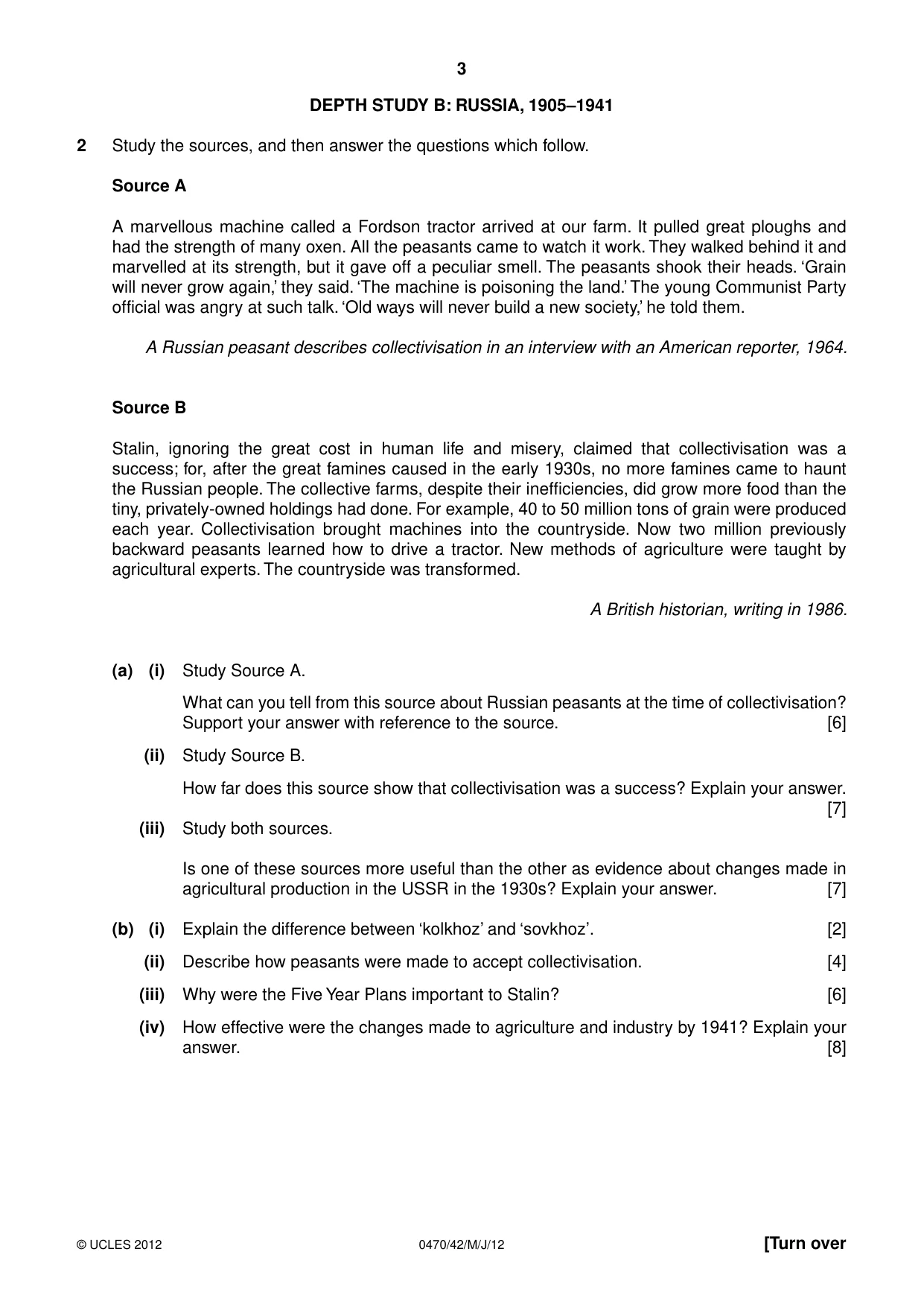
3 0470/42/M/J/12 © UCLES 2012 [Turn over DEPTH STUDY B: RUSSIA, 1905–1941 2 Study the sources, and then answer the questions which follow. Source A A marvellous machine called a Fordson tractor arrived at our farm. It pulled great ploughs and had the strength of many oxen. All the peasants came to watch it work. They walked behind it and marvelled at its strength, but it gave off a peculiar smell. The peasants shook their heads. ‘Grain will never grow again,’ they said. ‘The machine is poisoning the land.’ The young Communist Party official was angry at such talk. ‘Old ways will never build a new society,’ he told them. A Russian peasant describes collectivisation in an interview with an American reporter, 1964. Source B Stalin, ignoring the great cost in human life and misery, claimed that collectivisation was a success; for, after the great famines caused in the early 1930s, no more famines came to haunt the Russian people. The collective farms, despite their inefficiencies, did grow more food than the tiny, privately-owned holdings had done. For example, 40 to 50 million tons of grain were produced each year. Collectivisation brought machines into the countryside. Now two million previously backward peasants learned how to drive a tractor. New methods of agriculture were taught by agricultural experts. The countryside was transformed. A British historian, writing in 1986. (a) (i) Study Source A. What can you tell from this source about Russian peasants at the time of collectivisation? Support your answer with reference to the source. [6] (ii) Study Source B. How far does this source show that collectivisation was a success? Explain your answer. [7] (iii) Study both sources. Is one of these sources more useful than the other as evidence about changes made in agricultural production in the USSR in the 1930s? Explain your answer. [7] (b) (i) Explain the difference between ‘kolkhoz’ and ‘sovkhoz’. [2] (ii) Describe how peasants were made to accept collectivisation. [4] (iii) Why were the Five Year Plans important to Stalin? [6] (iv) How effective were the changes made to agriculture and industry by 1941? Explain your answer. [8]
Question paper, page 4
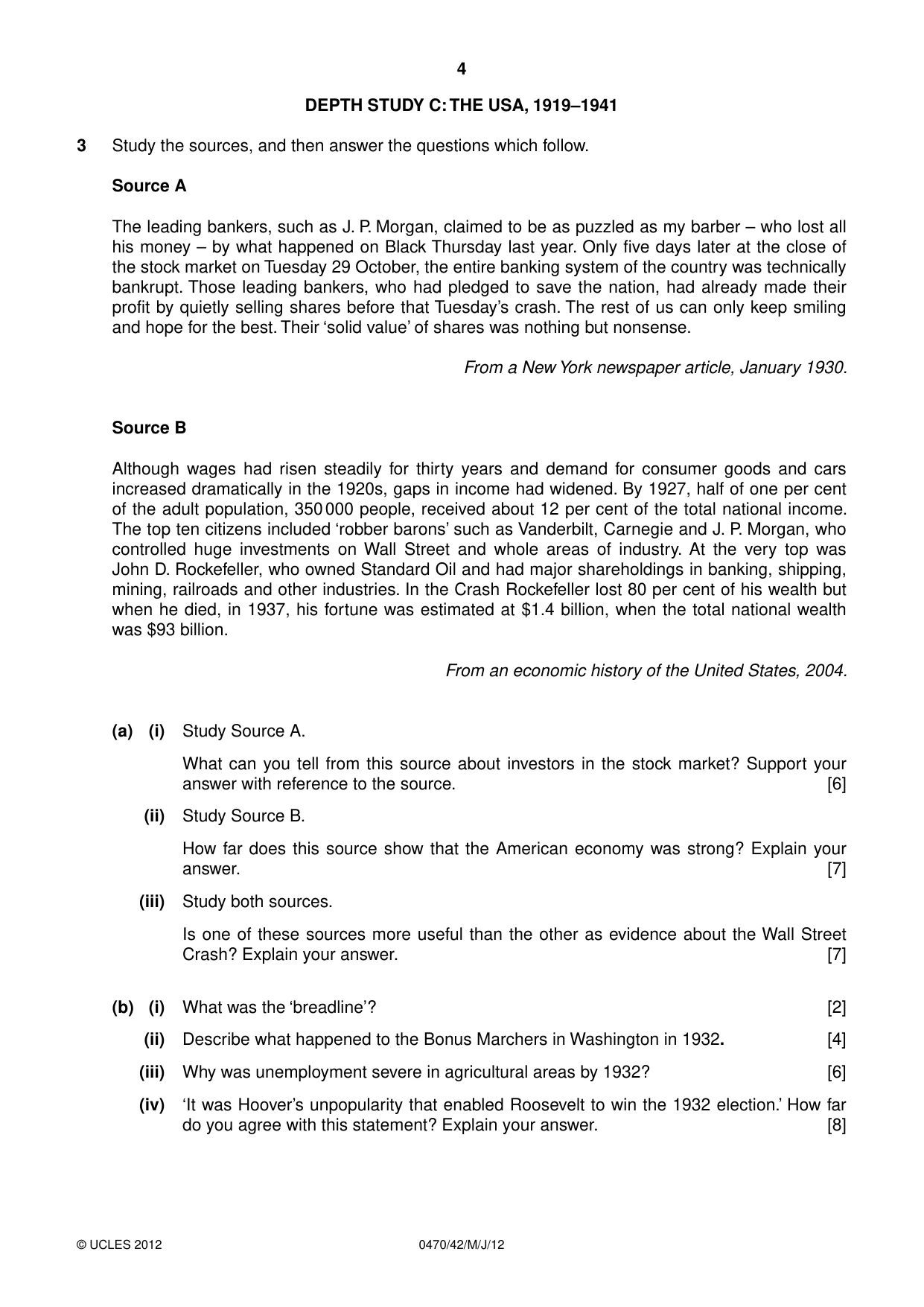
4 0470/42/M/J/12 © UCLES 2012 DEPTH STUDY C: THE USA, 1919–1941 3 Study the sources, and then answer the questions which follow. Source A The leading bankers, such as J. P. Morgan, claimed to be as puzzled as my barber – who lost all his money – by what happened on Black Thursday last year. Only five days later at the close of the stock market on Tuesday 29 October, the entire banking system of the country was technically bankrupt. Those leading bankers, who had pledged to save the nation, had already made their profit by quietly selling shares before that Tuesday’s crash. The rest of us can only keep smiling and hope for the best. Their ‘solid value’ of shares was nothing but nonsense. From a New York newspaper article, January 1930. Source B Although wages had risen steadily for thirty years and demand for consumer goods and cars increased dramatically in the 1920s, gaps in income had widened. By 1927, half of one per cent of the adult population, 350 000 people, received about 12 per cent of the total national income. The top ten citizens included ‘robber barons’ such as Vanderbilt, Carnegie and J. P. Morgan, who controlled huge investments on Wall Street and whole areas of industry. At the very top was John D. Rockefeller, who owned Standard Oil and had major shareholdings in banking, shipping, mining, railroads and other industries. In the Crash Rockefeller lost 80 per cent of his wealth but when he died, in 1937, his fortune was estimated at $1.4 billion, when the total national wealth was $93 billion. From an economic history of the United States, 2004. (a) (i) Study Source A. What can you tell from this source about investors in the stock market? Support your answer with reference to the source. [6] (ii) Study Source B. How far does this source show that the American economy was strong? Explain your answer. [7] (iii) Study both sources. Is one of these sources more useful than the other as evidence about the Wall Street Crash? Explain your answer. [7] (b) (i) What was the ‘breadline’? [2] (ii) Describe what happened to the Bonus Marchers in Washington in 1932. [4] (iii) Why was unemployment severe in agricultural areas by 1932? [6] (iv) ‘It was Hoover’s unpopularity that enabled Roosevelt to win the 1932 election.’ How far do you agree with this statement? Explain your answer. [8]
Question paper, page 5
5 0470/42/M/J/12 © UCLES 2012 [Turn over DEPTH STUDY D: CHINA, 1945–c.1990 4 Study the sources, and then answer the questions which follow. Source A By the mid-1980s, modernisation, and what Deng called the move to ‘market socialism’, were having unfortunate side effects. Although exports increased by 10 per cent during 1984, imports had increased by 38 per cent, leaving a record trade deficit of $US 1100 million, causing a sharp fall in China’s foreign exchange reserves. The government tried, with some success, to control imports by placing heavy duties on all imported goods except vital raw materials and microchip equipment (80 per cent on cars and 70 per cent on TVs and videos). Another unwelcome development was that the annual rate of inflation began to rise, reaching 22 per cent in 1986. A British historian, writing in 1997. Source B Today’s modern China could not have happened without the revolution. Mao’s mass murders are condemned but he is seen as part of the process that included some good, notably a dramatic rise in literacy and the shattering of the imperial system which held China back for 150 years. Deng Xiaoping, China’s great pro-market reformer, did not build contemporary China out of nothing; he built on foundations left by Mao that aimed to preserve the dominance of the Communist Party. A British journalist, writing in 2007. (a) (i) Study Source A. What can you tell from this source about the Chinese economy in the 1980s? Support your answer with reference to the source. [6] (ii) Study Source B. How far does this source show that Mao’s rule benefited China? Explain your answer. [7] (iii) Study both sources. Is one of these sources more useful than the other as evidence about China after the death of Mao in 1976? Explain your answer. [7] (b) (i) Name two areas, claimed by China, that were still under the control of imperial powers in 1990. [2] (ii) Describe the power struggle in the Chinese Communist Party after Mao’s death. [4] (iii) Why were there demonstrations in Tiananmen Square between April and June 1989? [6] (iv) How far did economic development after the death of Mao bring social and political change to China by 1990? Explain your answer. [8]
Question paper, page 6
6 0470/42/M/J/12 © UCLES 2012 DEPTH STUDY E: SOUTHERN AFRICA IN THE TWENTIETH CENTURY 5 Study the sources, and then answer the questions which follow. Source A The Population Registration Act has been in force for six years but here in the Cape the politics of apartheid clash with reality. The population of Cape Town has been mixing for three hundred years. It is not unusual for a family to be made up of a rainbow of colours: a dark brother with tightly curled hair, a sister with pale skin and blue eyes, another with the sharp features of a Malay. How is it possible to classify their race? The Prohibition of Mixed Marriages Act of 1949 should, in time, make this an easier task, at least in theory. From a liberal Afrikaner journalist, writing in 1956. Source B The Prime Minister from 1958 until 1966, Verwoerd, was more popular with Afrikaners even than Kruger. Verwoerd believed completely in his mission to design the future through his policy of separate development. This meant, in his words, that ‘Every nation, without any regard to race, colour or stage of development has the right to exist and to protect itself to carry out God’s plan.’ He urged blacks to ‘Build your own future! Seize hold of your destiny!’ Verwoerd promised to help each group that wanted its full independence to achieve it. When it was decided they were ready, of course. At the same time he declared openly that the urban areas were the white man’s territory, where blacks could only be visitors. From a communist history of apartheid, 1992. (a) (i) Study Source A. What can you tell from this source about apartheid laws? Support your answer with reference to the source. [6] (ii) Study Source B. How far does this source show that separate development was for the benefit of South Africans? Explain your answer. [7] (iii) Study both sources. Is one of these sources more useful than the other as evidence about the impact of apartheid on the peoples of South Africa? Explain your answer. [7] (b) (i) What was a banning order? [2] (ii) Describe the Treason Trials of 1956 to 1961. [4] (iii) Why were Bantustans not a success? [6] (iv) How far did the policy of apartheid rely on repression by the security forces? Explain your answer. [8]
Question paper, page 7
7 0470/42/M/J/12 © UCLES 2012 [Turn over DEPTH STUDY F: ISRAELIS AND PALESTINIANS, 1945–c.1994 6 Study the sources, and then answer the questions which follow. Source A After the Suez War, Egyptian military intelligence had predicted that Israel would aim to open the next war with a devastating blow to the air force. General Mahmoud, head of the Egyptian air force, had put in a multi-million pound request to build hardened shelters for his war planes, but money had been cut from the budget. Surely, he argued, Egypt should mount its own first strike. Nasser was not used to being challenged this forcefully. ‘Who gives the orders here?’ he asked. From a book on the Six Day War, written by a British journalist in 2003. Source B In Israel in the late spring of 1967, there was no sense of urgency. Indeed, in a press interview, the Chief of Staff of the Israeli Defence Forces forecasted a long period of quiet for Israel. Israel’s nineteenth Independence Day on 15 May was celebrated with a comfortable feeling that the Chief of Staff’s predictions were correct. Two days later, in a well-publicised mass demonstration, Nasser proceeded to move large forces through Cairo en route to the Sinai. By 20 May, 100 000 troops organised in seven divisions (with over 1 000 tanks) had been concentrated along Israel’s south-western border. Hysteria seized the Arab world. From a book written by a former President of Israel. (a) (i) Study Source A. What can you tell from this source about Egypt’s preparations for war? Support your answer with reference to the source. [6] (ii) Study Source B. How far does this source show that war was expected in the Middle East in 1967? Explain your answer. [7] (iii) Study both sources. Is one of these sources more useful than the other as evidence about the Six Day War? Explain your answer. [7] (b) (i) What was al-Fatah? [2] (ii) Describe the part played by Cairo Radio in Israeli/Egyptian relations. [4] (iii) Why did Israel win the Six Day War? [6] (iv) ‘The Six Day War resulted in total victory for Israel.’ How far do you agree with this statement? Explain your answer. [8]
Question paper, page 8
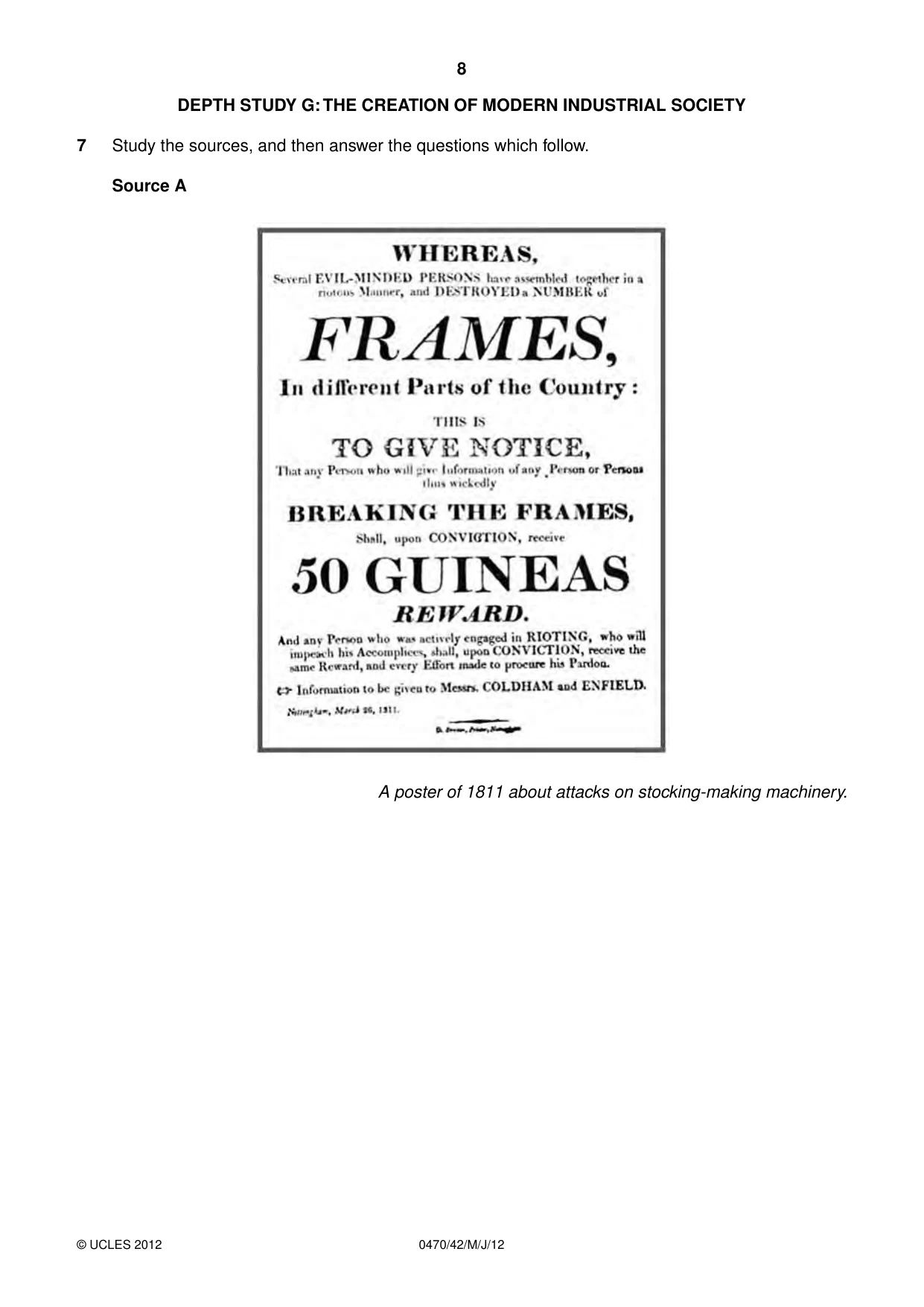
8 0470/42/M/J/12 © UCLES 2012 DEPTH STUDY G: THE CREATION OF MODERN INDUSTRIAL SOCIETY 7 Study the sources, and then answer the questions which follow. Source A A poster of 1811 about attacks on stocking-making machinery.
Question paper, page 9
9 0470/42/M/J/12 © UCLES 2012 [Turn over Source B A cartoon of a trade union meeting in about 1830. (The speaker’s bubble reads, ‘Yes, gentlemen, these is my principles: no King, no Lords, no Parsons, no Police, no Taxes…) (a) (i) Study Source A. What can you tell from this source about the impact of the industrial revolution on workers? Support your answer with reference to the source. [6] (ii) Study Source B. How far does this source show that trade unions were popular among workers? Explain your answer. [7] (iii) Study both sources. Is one of these sources more useful than the other as evidence about industrial workers in the early-nineteenth century? Explain your answer. [7] (b) (i) Give two features of the Luddite movement. [2] (ii) Describe the problems faced by workers in the new factory system. [4] (iii) Why were the Combination Acts of 1799/1800 repealed in 1825? [6] (iv) ‘Employers were selfish and brutal to their workers.’ How far do you agree with this statement? Explain your answer. [8]
Question paper, page 10
10 0470/42/M/J/12 © UCLES 2012 DEPTH STUDY H: THE IMPACT OF WESTERN IMPERIALISM IN THE NINETEENTH CENTURY 8 Study the sources, and then answer the questions which follow. Source A The British rule has been: morally, a great blessing; politically, peace and order on one hand, blunders on the other; materially, impoverishment has been relieved by railways and loans. The natives call the British system ‘the knife of sugar’. That is to say, there is no oppression, it is all smooth and sweet, but it is a knife nevertheless. Our great misfortune is that the British do not know what we want. When you understand us I have no doubt that you will do us justice. The aim of the British is fair play and justice. From a book by an Indian in 1871. Source B Indian society changed more rapidly in the second half of the nineteenth century than it had done in the first. The British had much to offer Indians. Imports of Western technology had been limited before the 1850s. Thereafter the great railway system was constructed – 28 000 miles of track being laid before 1904 – and major canal schemes were introduced that more than doubled the area under irrigation in the last 20 years of the century. The railways, the vastly increased capacity of steamships, and the opening of the Suez Canal linked Indian farmers with world markets. A small minority of them could profit from opportunities to sell surplus crops and acquire additional land. Some industries developed, notably textiles in western India. The horrific scale of the famines in the 1880s and 1890s showed how limited any economic growth had been, but the stagnation of the early-nineteenth century had been broken. A view of India by a British history professor, written in the 1980s. (a) (i) Study Source A. What can you tell from this source about British rule in India in the nineteenth century? Support your answer with reference to the source. [6] (ii) Study Source B. How far does this source show that British rule was beneficial to the people of India? Explain your answer. [7] (iii) Study both sources. Is one of these sources more useful than the other as evidence about the westernisation of India in the nineteenth century? Explain your answer. [7] (b) (i) What was the Royal Titles Act, 1876? [2] (ii) What were the main problems affecting India in the second half of the nineteenth century? [4] (iii) Why was the way that Britain ruled India changed in 1858? [6] (iv) How far was British rule in India welcomed by the people of India? Explain your answer. [8]
Question paper, page 11
11 0470/42/M/J/12 © UCLES 2012 BLANK PAGE
Question paper, page 12
12 0470/42/M/J/12 © UCLES 2012 BLANK PAGE Copyright Acknowledgements: Depth Study A Source A © http://www.militaryimages.net/photopost/showphoto.php/photo/178 Depth Study B Source A © Bryn O’Callaghan; A History of the Twentieth Century; Longman; 1987. Depth Study B Source B © Ben Walsh; GCSE Modern World History; Hodder Education; 1996. Depth Study D Source A © Norman Lowe; Mastering Modern World History; Macmillan Press; 1997. Depth Study D Source B © Will Hutton; The Writing On The Wall; Little, Brown Book Group; 2007. Depth Study E Source A © Marq De Villiers; White Tribe Dreaming; Penguin Books; 1990. Depth Study F Source A © Jeremy Bowen; Six Days; Simon & Schuster; 2002. Depth Study F Source B © Chaim Hertzog; The Arab-Israeli Wars; Greenhill Books; 2005. Depth Study G Source A © http://www.learnhistory.org.uk/cpp/luddites1.jpg Depth Study G Source C © Philip Sauvain; British Economic and Social History; Stanley Thornes; 1987. Depth Study H Source A © http://www.fordham.edu/halsall/mod/1871britishrule Depth Study H Source B © http://www.bbc.co.uk/history/british/victorians/indian_rebellion_01 Permission to reproduce items where third-party owned material protected by copyright is included has been sought and cleared where possible. Every reasonable effort has been made by the publisher (UCLES) to trace copyright holders, but if any items requiring clearance have unwittingly been included, the publisher will be pleased to make amends at the earliest possible opportunity. University of Cambridge International Examinations is part of the Cambridge Assessment Group. Cambridge Assessment is the brand name of University of Cambridge Local Examinations Syndicate (UCLES), which is itself a department of the University of Cambridge.
Mark scheme, page 1
UNIVERSITY OF CAMBRIDGE INTERNATIONAL EXAMINATIONS International General Certificate of Secondary Education MARK SCHEME for the May/June 2012 question paper for the guidance of teachers 0470 HISTORY 0470/42 Paper 4 (Alternative to Coursework), maximum raw mark 40 This mark scheme is published as an aid to teachers and candidates, to indicate the requirements of the examination. It shows the basis on which Examiners were instructed to award marks. It does not indicate the details of the discussions that took place at an Examiners’ meeting before marking began, which would have considered the acceptability of alternative answers. Mark schemes must be read in conjunction with the question papers and the report on the examination. • Cambridge will not enter into discussions or correspondence in connection with these mark schemes. Cambridge is publishing the mark schemes for the May/June 2012 question papers for most IGCSE, GCE Advanced Level and Advanced Subsidiary Level syllabuses and some Ordinary Level syllabuses. www.XtremePapers.com
Mark scheme, page 2
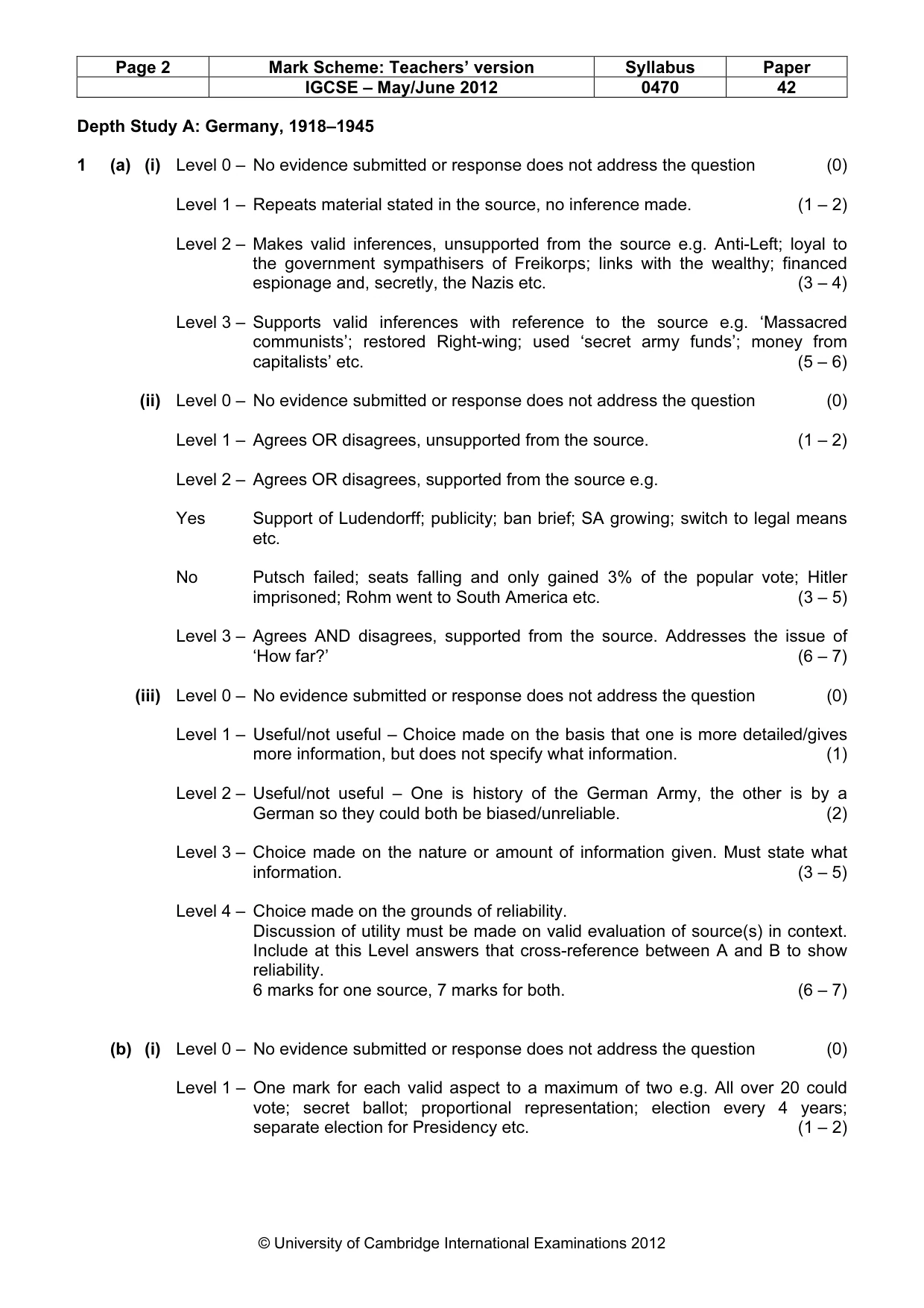
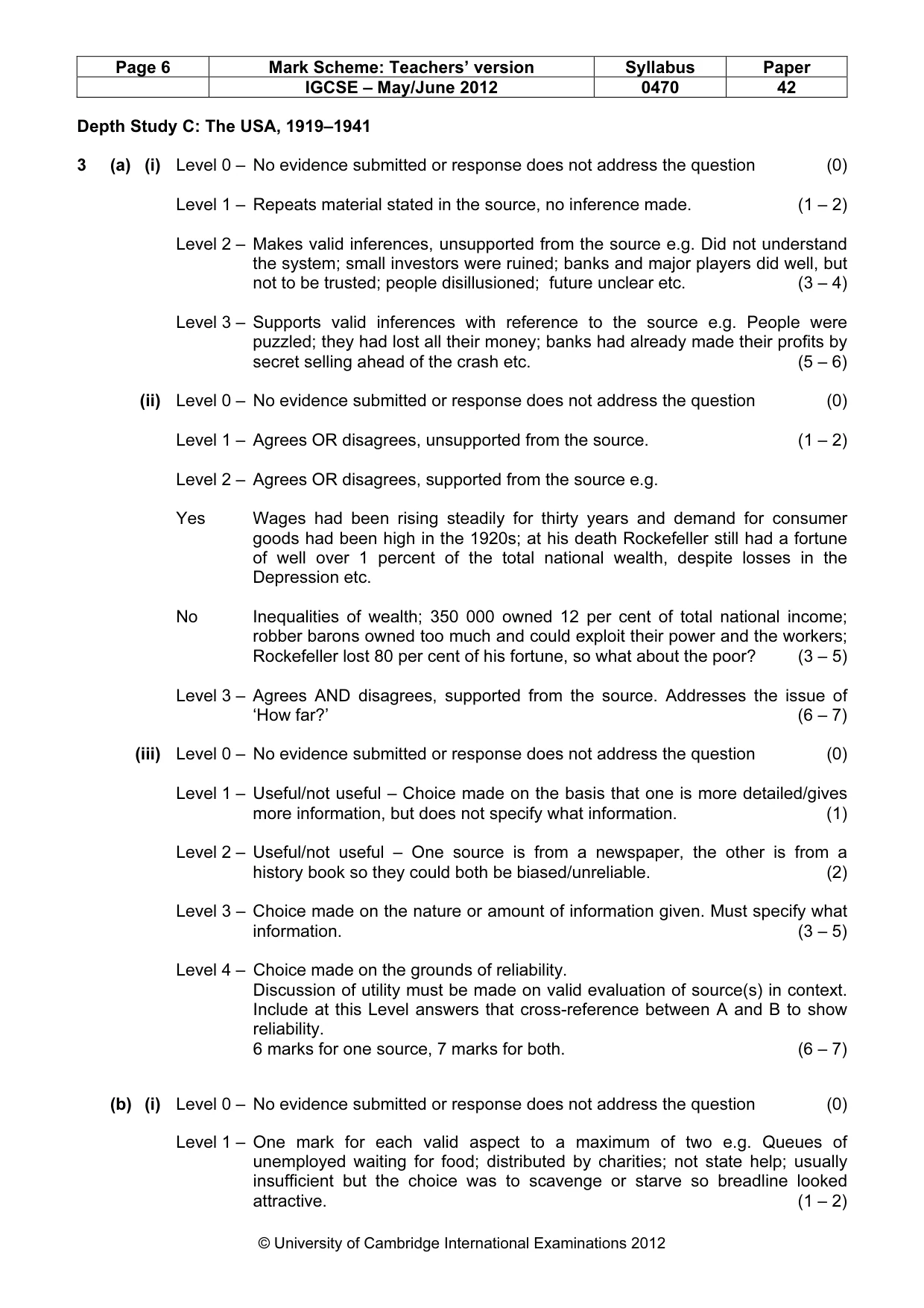
Page 2 Mark Scheme: Teachers’ version Syllabus Paper IGCSE – May/June 2012 0470 42 © University of Cambridge International Examinations 2012 Depth Study A: Germany, 1918–1945 1 (a) (i) Level 0 – No evidence submitted or response does not address the question (0) Level 1 – Repeats material stated in the source, no inference made. (1 – 2) Level 2 – Makes valid inferences, unsupported from the source e.g. Anti-Left; loyal to the government sympathisers of Freikorps; links with the wealthy; financed espionage and, secretly, the Nazis etc. (3 – 4) Level 3 – Supports valid inferences with reference to the source e.g. ‘Massacred communists’; restored Right-wing; used ‘secret army funds’; money from capitalists’ etc. (5 – 6) (ii) Level 0 – No evidence submitted or response does not address the question (0) Level 1 – Agrees OR disagrees, unsupported from the source. (1 – 2) Level 2 – Agrees OR disagrees, supported from the source e.g. Yes Support of Ludendorff; publicity; ban brief; SA growing; switch to legal means etc. No Putsch failed; seats falling and only gained 3% of the popular vote; Hitler imprisoned; Rohm went to South America etc. (3 – 5) Level 3 – Agrees AND disagrees, supported from the source. Addresses the issue of ‘How far?’ (6 – 7) (iii) Level 0 – No evidence submitted or response does not address the question (0) Level 1 – Useful/not useful – Choice made on the basis that one is more detailed/gives more information, but does not specify what information. (1) Level 2 – Useful/not useful – One is history of the German Army, the other is by a German so they could both be biased/unreliable. (2) Level 3 – Choice made on the nature or amount of information given. Must state what information. (3 – 5) Level 4 – Choice made on the grounds of reliability. Discussion of utility must be made on valid evaluation of source(s) in context. Include at this Level answers that cross-reference between A and B to show reliability. 6 marks for one source, 7 marks for both. (6 – 7) (b) (i) Level 0 – No evidence submitted or response does not address the question (0) Level 1 – One mark for each valid aspect to a maximum of two e.g. All over 20 could vote; secret ballot; proportional representation; election every 4 years; separate election for Presidency etc. (1 – 2)
Mark scheme, page 3
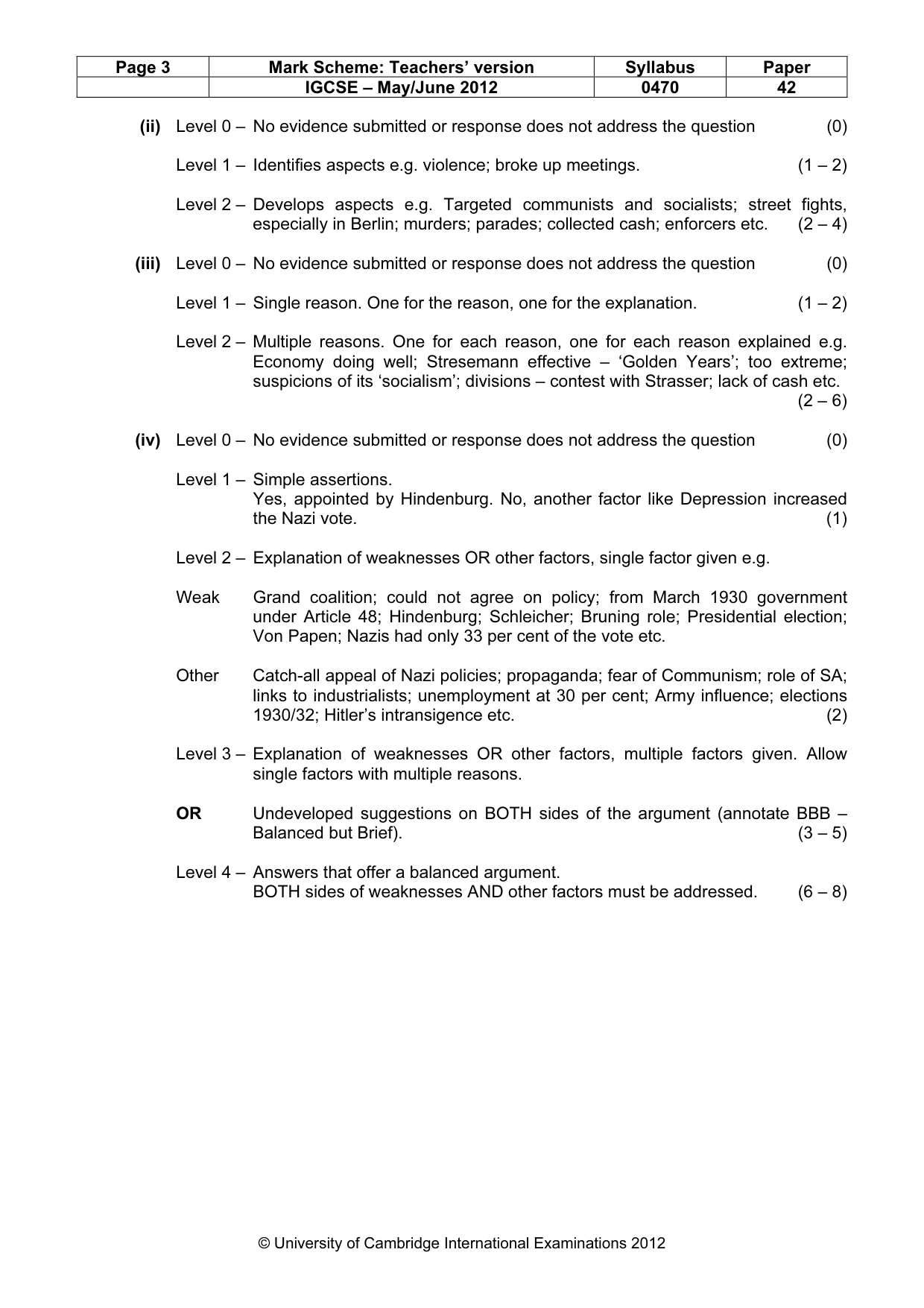
Page 3 Mark Scheme: Teachers’ version Syllabus Paper IGCSE – May/June 2012 0470 42 © University of Cambridge International Examinations 2012 (ii) Level 0 – No evidence submitted or response does not address the question (0) Level 1 – Identifies aspects e.g. violence; broke up meetings. (1 – 2) Level 2 – Develops aspects e.g. Targeted communists and socialists; street fights, especially in Berlin; murders; parades; collected cash; enforcers etc. (2 – 4) (iii) Level 0 – No evidence submitted or response does not address the question (0) Level 1 – Single reason. One for the reason, one for the explanation. (1 – 2) Level 2 – Multiple reasons. One for each reason, one for each reason explained e.g. Economy doing well; Stresemann effective – ‘Golden Years’; too extreme; suspicions of its ‘socialism’; divisions – contest with Strasser; lack of cash etc. (2 – 6) (iv) Level 0 – No evidence submitted or response does not address the question (0) Level 1 – Simple assertions. Yes, appointed by Hindenburg. No, another factor like Depression increased the Nazi vote. (1) Level 2 – Explanation of weaknesses OR other factors, single factor given e.g. Weak Grand coalition; could not agree on policy; from March 1930 government under Article 48; Hindenburg; Schleicher; Bruning role; Presidential election; Von Papen; Nazis had only 33 per cent of the vote etc. Other Catch-all appeal of Nazi policies; propaganda; fear of Communism; role of SA; links to industrialists; unemployment at 30 per cent; Army influence; elections 1930/32; Hitler’s intransigence etc. (2) Level 3 – Explanation of weaknesses OR other factors, multiple factors given. Allow single factors with multiple reasons. OR Undeveloped suggestions on BOTH sides of the argument (annotate BBB – Balanced but Brief). (3 – 5) Level 4 – Answers that offer a balanced argument. BOTH sides of weaknesses AND other factors must be addressed. (6 – 8)
Mark scheme, page 4
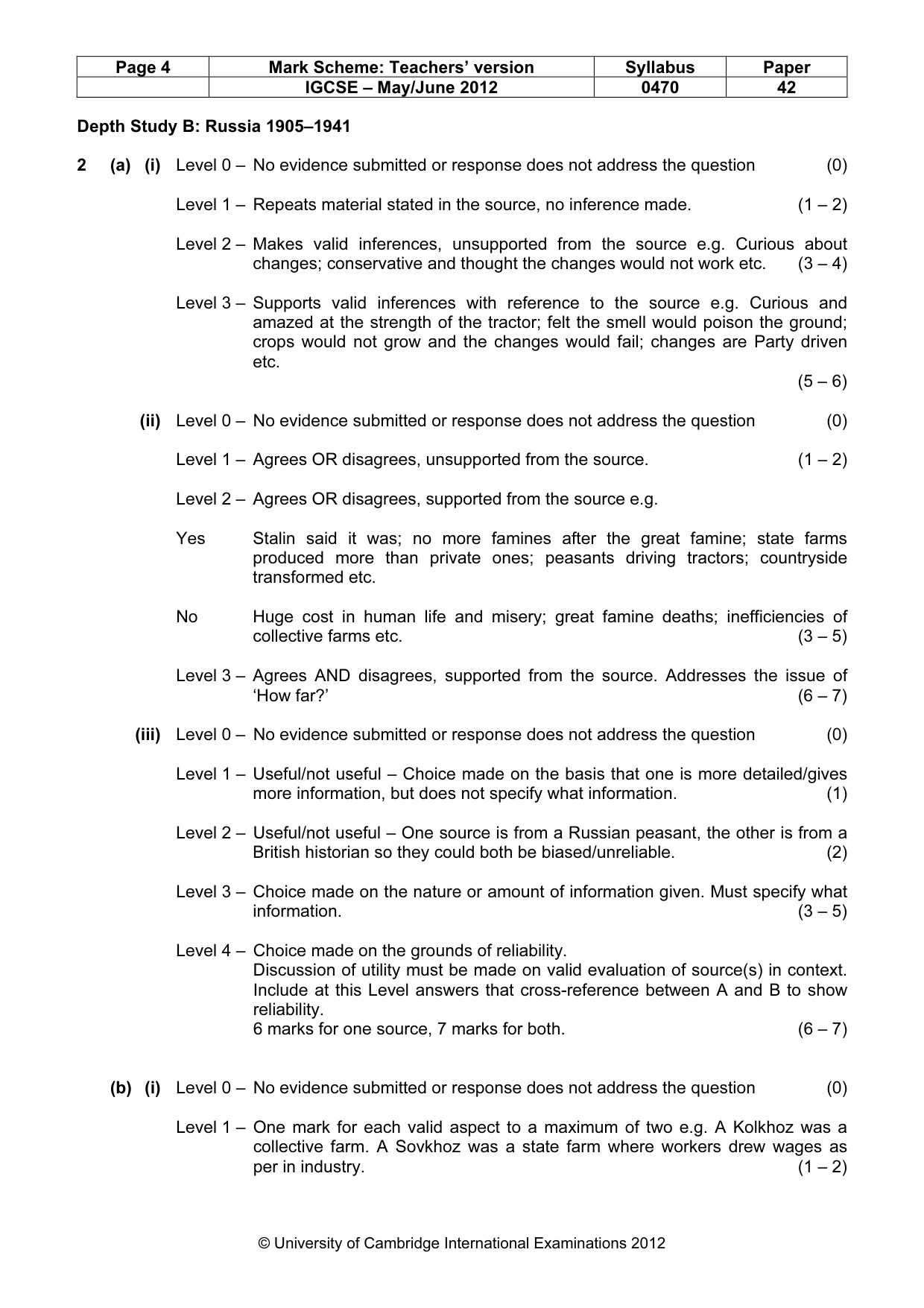
Page 4 Mark Scheme: Teachers’ version Syllabus Paper IGCSE – May/June 2012 0470 42 © University of Cambridge International Examinations 2012 Depth Study B: Russia 1905–1941 2 (a) (i) Level 0 – No evidence submitted or response does not address the question (0) Level 1 – Repeats material stated in the source, no inference made. (1 – 2) Level 2 – Makes valid inferences, unsupported from the source e.g. Curious about changes; conservative and thought the changes would not work etc. (3 – 4) Level 3 – Supports valid inferences with reference to the source e.g. Curious and amazed at the strength of the tractor; felt the smell would poison the ground; crops would not grow and the changes would fail; changes are Party driven etc. (5 – 6) (ii) Level 0 – No evidence submitted or response does not address the question (0) Level 1 – Agrees OR disagrees, unsupported from the source. (1 – 2) Level 2 – Agrees OR disagrees, supported from the source e.g. Yes Stalin said it was; no more famines after the great famine; state farms produced more than private ones; peasants driving tractors; countryside transformed etc. No Huge cost in human life and misery; great famine deaths; inefficiencies of collective farms etc. (3 – 5) Level 3 – Agrees AND disagrees, supported from the source. Addresses the issue of ‘How far?’ (6 – 7) (iii) Level 0 – No evidence submitted or response does not address the question (0) Level 1 – Useful/not useful – Choice made on the basis that one is more detailed/gives more information, but does not specify what information. (1) Level 2 – Useful/not useful – One source is from a Russian peasant, the other is from a British historian so they could both be biased/unreliable. (2) Level 3 – Choice made on the nature or amount of information given. Must specify what information. (3 – 5) Level 4 – Choice made on the grounds of reliability. Discussion of utility must be made on valid evaluation of source(s) in context. Include at this Level answers that cross-reference between A and B to show reliability. 6 marks for one source, 7 marks for both. (6 – 7) (b) (i) Level 0 – No evidence submitted or response does not address the question (0) Level 1 – One mark for each valid aspect to a maximum of two e.g. A Kolkhoz was a collective farm. A Sovkhoz was a state farm where workers drew wages as per in industry. (1 – 2)
Mark scheme, page 5
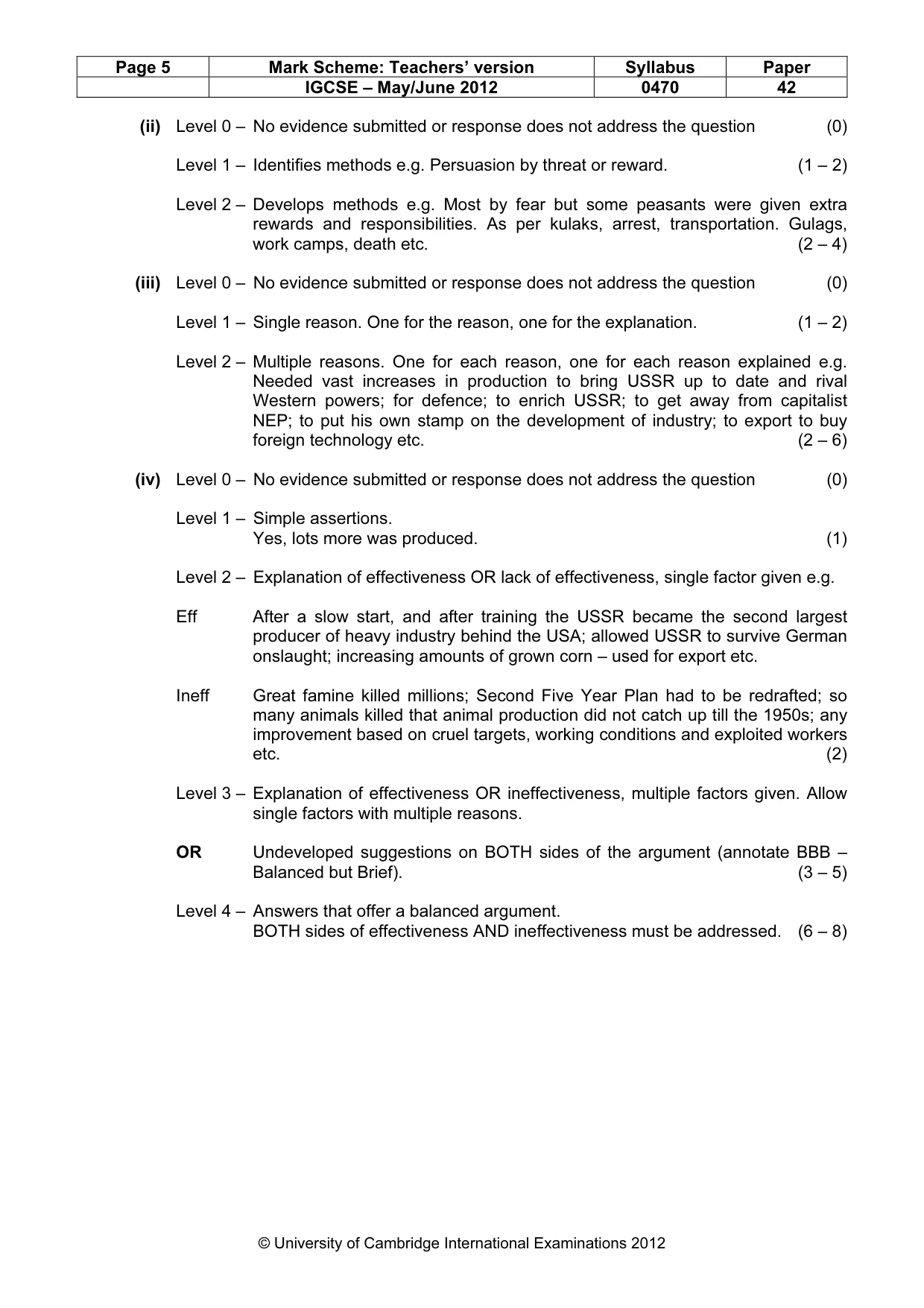
Page 5 Mark Scheme: Teachers’ version Syllabus Paper IGCSE – May/June 2012 0470 42 © University of Cambridge International Examinations 2012 (ii) Level 0 – No evidence submitted or response does not address the question (0) Level 1 – Identifies methods e.g. Persuasion by threat or reward. (1 – 2) Level 2 – Develops methods e.g. Most by fear but some peasants were given extra rewards and responsibilities. As per kulaks, arrest, transportation. Gulags, work camps, death etc. (2 – 4) (iii) Level 0 – No evidence submitted or response does not address the question (0) Level 1 – Single reason. One for the reason, one for the explanation. (1 – 2) Level 2 – Multiple reasons. One for each reason, one for each reason explained e.g. Needed vast increases in production to bring USSR up to date and rival Western powers; for defence; to enrich USSR; to get away from capitalist NEP; to put his own stamp on the development of industry; to export to buy foreign technology etc. (2 – 6) (iv) Level 0 – No evidence submitted or response does not address the question (0) Level 1 – Simple assertions. Yes, lots more was produced. (1) Level 2 – Explanation of effectiveness OR lack of effectiveness, single factor given e.g. Eff After a slow start, and after training the USSR became the second largest producer of heavy industry behind the USA; allowed USSR to survive German onslaught; increasing amounts of grown corn – used for export etc. Ineff Great famine killed millions; Second Five Year Plan had to be redrafted; so many animals killed that animal production did not catch up till the 1950s; any improvement based on cruel targets, working conditions and exploited workers etc. (2) Level 3 – Explanation of effectiveness OR ineffectiveness, multiple factors given. Allow single factors with multiple reasons. OR Undeveloped suggestions on BOTH sides of the argument (annotate BBB – Balanced but Brief). (3 – 5) Level 4 – Answers that offer a balanced argument. BOTH sides of effectiveness AND ineffectiveness must be addressed. (6 – 8)
Mark scheme, page 6
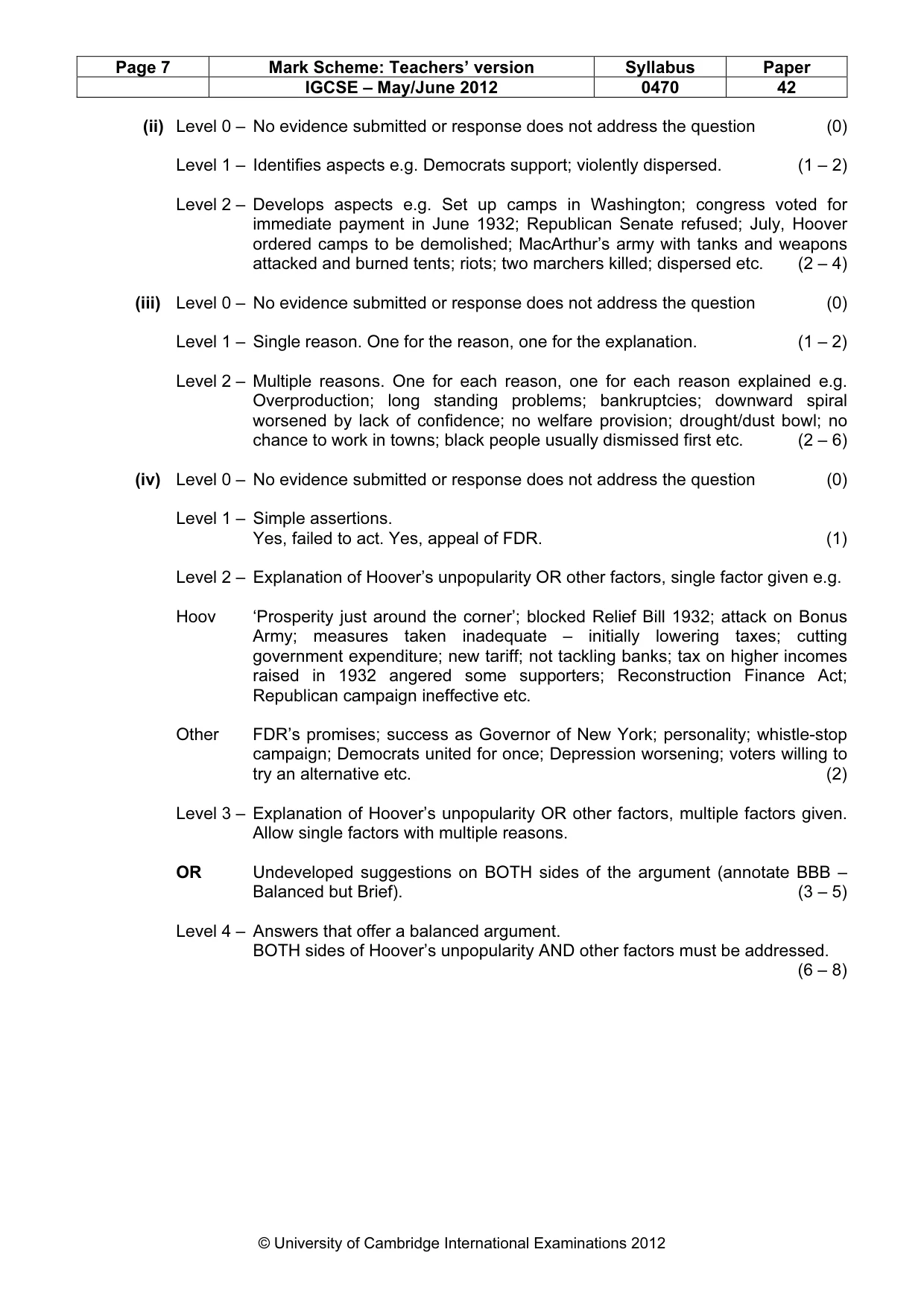
Page 6 Mark Scheme: Teachers’ version Syllabus Paper IGCSE – May/June 2012 0470 42 © University of Cambridge International Examinations 2012 Depth Study C: The USA, 1919–1941 3 (a) (i) Level 0 – No evidence submitted or response does not address the question (0) Level 1 – Repeats material stated in the source, no inference made. (1 – 2) Level 2 – Makes valid inferences, unsupported from the source e.g. Did not understand the system; small investors were ruined; banks and major players did well, but not to be trusted; people disillusioned; future unclear etc. (3 – 4) Level 3 – Supports valid inferences with reference to the source e.g. People were puzzled; they had lost all their money; banks had already made their profits by secret selling ahead of the crash etc. (5 – 6) (ii) Level 0 – No evidence submitted or response does not address the question (0) Level 1 – Agrees OR disagrees, unsupported from the source. (1 – 2) Level 2 – Agrees OR disagrees, supported from the source e.g. Yes Wages had been rising steadily for thirty years and demand for consumer goods had been high in the 1920s; at his death Rockefeller still had a fortune of well over 1 percent of the total national wealth, despite losses in the Depression etc. No Inequalities of wealth; 350 000 owned 12 per cent of total national income; robber barons owned too much and could exploit their power and the workers; Rockefeller lost 80 per cent of his fortune, so what about the poor? (3 – 5) Level 3 – Agrees AND disagrees, supported from the source. Addresses the issue of ‘How far?’ (6 – 7) (iii) Level 0 – No evidence submitted or response does not address the question (0) Level 1 – Useful/not useful – Choice made on the basis that one is more detailed/gives more information, but does not specify what information. (1) Level 2 – Useful/not useful – One source is from a newspaper, the other is from a history book so they could both be biased/unreliable. (2) Level 3 – Choice made on the nature or amount of information given. Must specify what information. (3 – 5) Level 4 – Choice made on the grounds of reliability. Discussion of utility must be made on valid evaluation of source(s) in context. Include at this Level answers that cross-reference between A and B to show reliability. 6 marks for one source, 7 marks for both. (6 – 7) (b) (i) Level 0 – No evidence submitted or response does not address the question (0) Level 1 – One mark for each valid aspect to a maximum of two e.g. Queues of unemployed waiting for food; distributed by charities; not state help; usually insufficient but the choice was to scavenge or starve so breadline looked attractive. (1 – 2)
Mark scheme, page 7
Page 7 Mark Scheme: Teachers’ version Syllabus Paper IGCSE – May/June 2012 0470 42 © University of Cambridge International Examinations 2012 (ii) Level 0 – No evidence submitted or response does not address the question (0) Level 1 – Identifies aspects e.g. Democrats support; violently dispersed. (1 – 2) Level 2 – Develops aspects e.g. Set up camps in Washington; congress voted for immediate payment in June 1932; Republican Senate refused; July, Hoover ordered camps to be demolished; MacArthur’s army with tanks and weapons attacked and burned tents; riots; two marchers killed; dispersed etc. (2 – 4) (iii) Level 0 – No evidence submitted or response does not address the question (0) Level 1 – Single reason. One for the reason, one for the explanation. (1 – 2) Level 2 – Multiple reasons. One for each reason, one for each reason explained e.g. Overproduction; long standing problems; bankruptcies; downward spiral worsened by lack of confidence; no welfare provision; drought/dust bowl; no chance to work in towns; black people usually dismissed first etc. (2 – 6) (iv) Level 0 – No evidence submitted or response does not address the question (0) Level 1 – Simple assertions. Yes, failed to act. Yes, appeal of FDR. (1) Level 2 – Explanation of Hoover’s unpopularity OR other factors, single factor given e.g. Hoov ‘Prosperity just around the corner’; blocked Relief Bill 1932; attack on Bonus Army; measures taken inadequate – initially lowering taxes; cutting government expenditure; new tariff; not tackling banks; tax on higher incomes raised in 1932 angered some supporters; Reconstruction Finance Act; Republican campaign ineffective etc. Other FDR’s promises; success as Governor of New York; personality; whistle-stop campaign; Democrats united for once; Depression worsening; voters willing to try an alternative etc. (2) Level 3 – Explanation of Hoover’s unpopularity OR other factors, multiple factors given. Allow single factors with multiple reasons. OR Undeveloped suggestions on BOTH sides of the argument (annotate BBB – Balanced but Brief). (3 – 5) Level 4 – Answers that offer a balanced argument. BOTH sides of Hoover’s unpopularity AND other factors must be addressed. (6 – 8)
Mark scheme, page 8
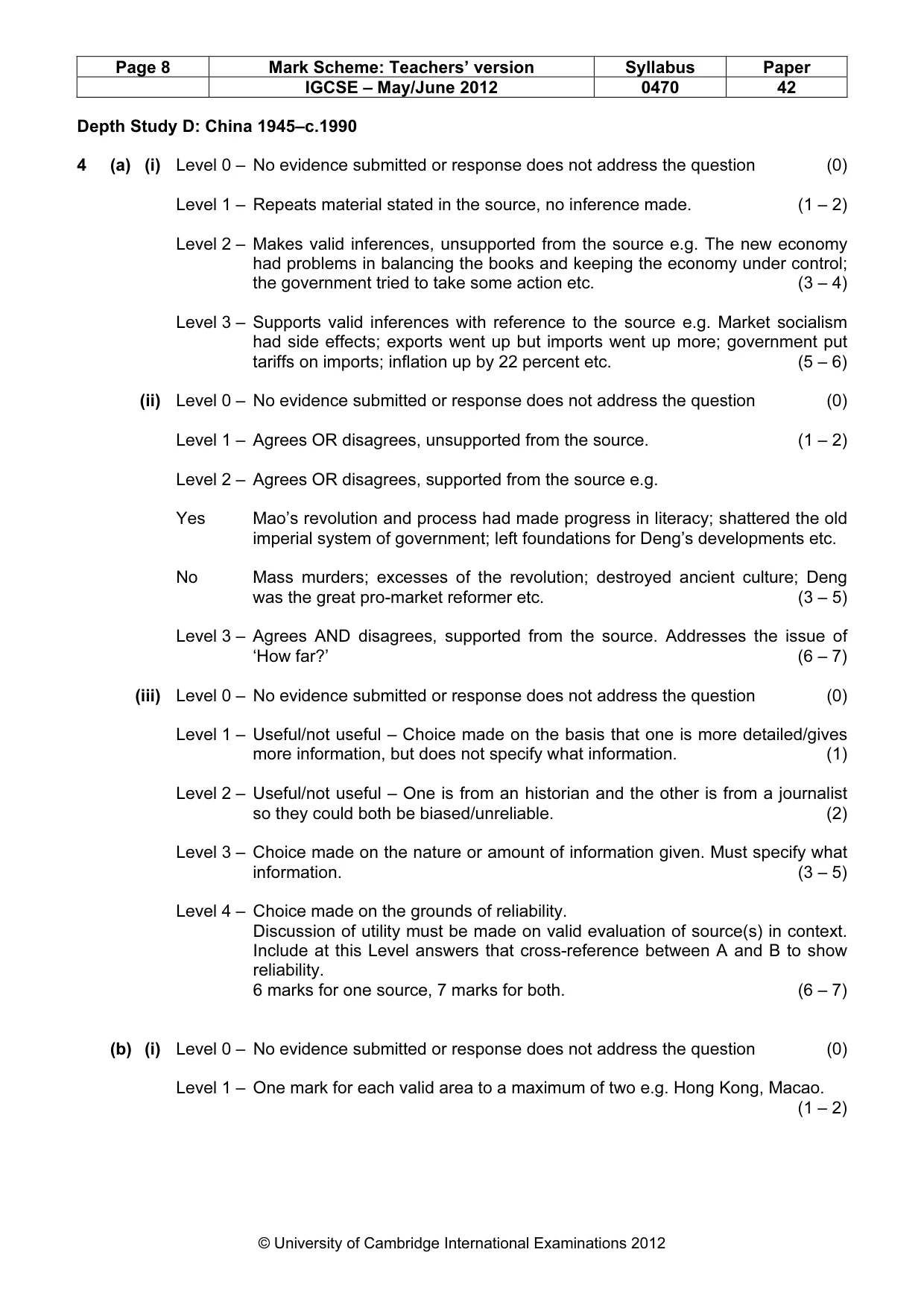
Page 8 Mark Scheme: Teachers’ version Syllabus Paper IGCSE – May/June 2012 0470 42 © University of Cambridge International Examinations 2012 Depth Study D: China 1945–c.1990 4 (a) (i) Level 0 – No evidence submitted or response does not address the question (0) Level 1 – Repeats material stated in the source, no inference made. (1 – 2) Level 2 – Makes valid inferences, unsupported from the source e.g. The new economy had problems in balancing the books and keeping the economy under control; the government tried to take some action etc. (3 – 4) Level 3 – Supports valid inferences with reference to the source e.g. Market socialism had side effects; exports went up but imports went up more; government put tariffs on imports; inflation up by 22 percent etc. (5 – 6) (ii) Level 0 – No evidence submitted or response does not address the question (0) Level 1 – Agrees OR disagrees, unsupported from the source. (1 – 2) Level 2 – Agrees OR disagrees, supported from the source e.g. Yes Mao’s revolution and process had made progress in literacy; shattered the old imperial system of government; left foundations for Deng’s developments etc. No Mass murders; excesses of the revolution; destroyed ancient culture; Deng was the great pro-market reformer etc. (3 – 5) Level 3 – Agrees AND disagrees, supported from the source. Addresses the issue of ‘How far?’ (6 – 7) (iii) Level 0 – No evidence submitted or response does not address the question (0) Level 1 – Useful/not useful – Choice made on the basis that one is more detailed/gives more information, but does not specify what information. (1) Level 2 – Useful/not useful – One is from an historian and the other is from a journalist so they could both be biased/unreliable. (2) Level 3 – Choice made on the nature or amount of information given. Must specify what information. (3 – 5) Level 4 – Choice made on the grounds of reliability. Discussion of utility must be made on valid evaluation of source(s) in context. Include at this Level answers that cross-reference between A and B to show reliability. 6 marks for one source, 7 marks for both. (6 – 7) (b) (i) Level 0 – No evidence submitted or response does not address the question (0) Level 1 – One mark for each valid area to a maximum of two e.g. Hong Kong, Macao. (1 – 2)
Mark scheme, page 9
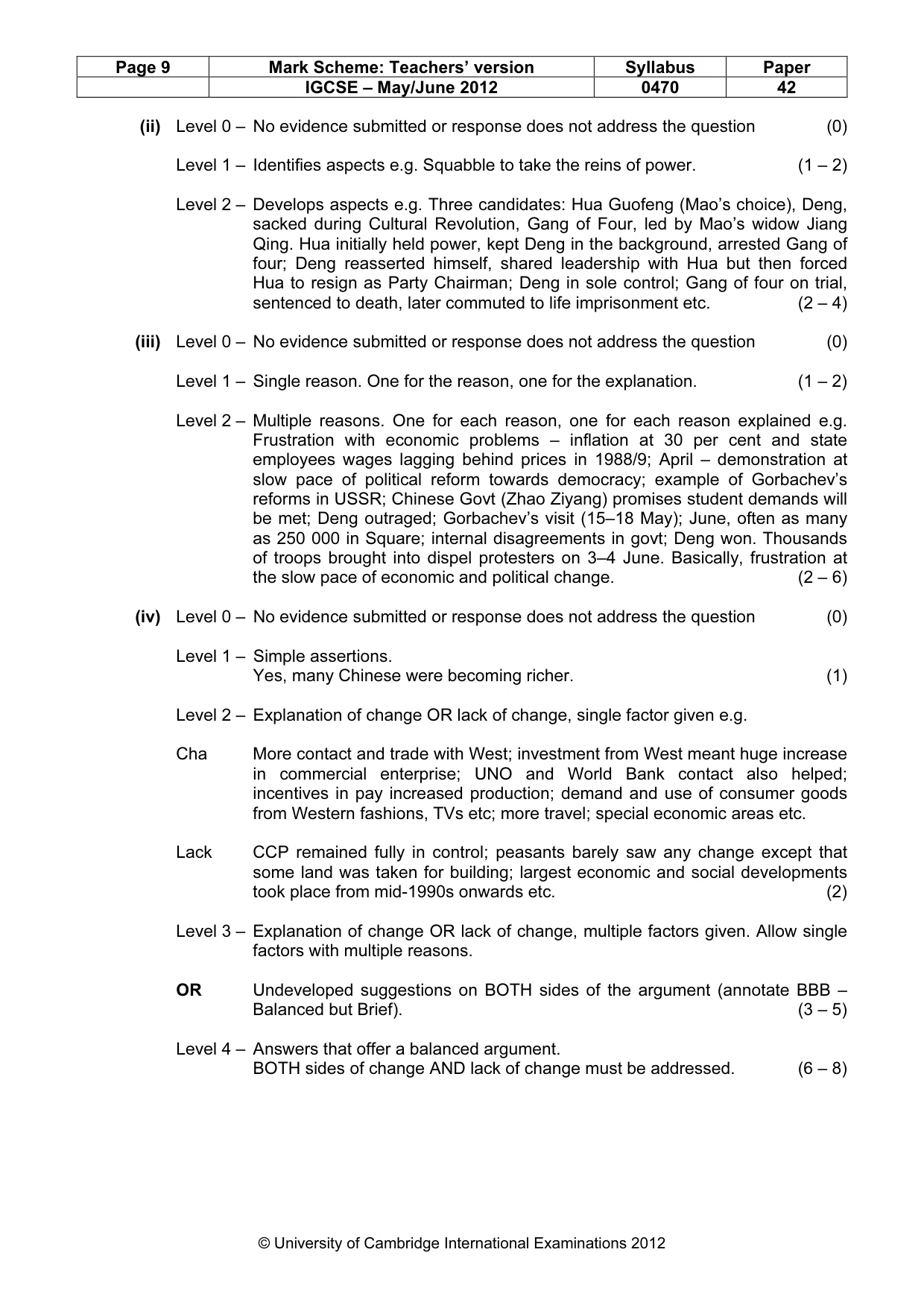
Page 9 Mark Scheme: Teachers’ version Syllabus Paper IGCSE – May/June 2012 0470 42 © University of Cambridge International Examinations 2012 (ii) Level 0 – No evidence submitted or response does not address the question (0) Level 1 – Identifies aspects e.g. Squabble to take the reins of power. (1 – 2) Level 2 – Develops aspects e.g. Three candidates: Hua Guofeng (Mao’s choice), Deng, sacked during Cultural Revolution, Gang of Four, led by Mao’s widow Jiang Qing. Hua initially held power, kept Deng in the background, arrested Gang of four; Deng reasserted himself, shared leadership with Hua but then forced Hua to resign as Party Chairman; Deng in sole control; Gang of four on trial, sentenced to death, later commuted to life imprisonment etc. (2 – 4) (iii) Level 0 – No evidence submitted or response does not address the question (0) Level 1 – Single reason. One for the reason, one for the explanation. (1 – 2) Level 2 – Multiple reasons. One for each reason, one for each reason explained e.g. Frustration with economic problems – inflation at 30 per cent and state employees wages lagging behind prices in 1988/9; April – demonstration at slow pace of political reform towards democracy; example of Gorbachev’s reforms in USSR; Chinese Govt (Zhao Ziyang) promises student demands will be met; Deng outraged; Gorbachev’s visit (15–18 May); June, often as many as 250 000 in Square; internal disagreements in govt; Deng won. Thousands of troops brought into dispel protesters on 3–4 June. Basically, frustration at the slow pace of economic and political change. (2 – 6) (iv) Level 0 – No evidence submitted or response does not address the question (0) Level 1 – Simple assertions. Yes, many Chinese were becoming richer. (1) Level 2 – Explanation of change OR lack of change, single factor given e.g. Cha More contact and trade with West; investment from West meant huge increase in commercial enterprise; UNO and World Bank contact also helped; incentives in pay increased production; demand and use of consumer goods from Western fashions, TVs etc; more travel; special economic areas etc. Lack CCP remained fully in control; peasants barely saw any change except that some land was taken for building; largest economic and social developments took place from mid-1990s onwards etc. (2) Level 3 – Explanation of change OR lack of change, multiple factors given. Allow single factors with multiple reasons. OR Undeveloped suggestions on BOTH sides of the argument (annotate BBB – Balanced but Brief). (3 – 5) Level 4 – Answers that offer a balanced argument. BOTH sides of change AND lack of change must be addressed. (6 – 8)
Mark scheme, page 10
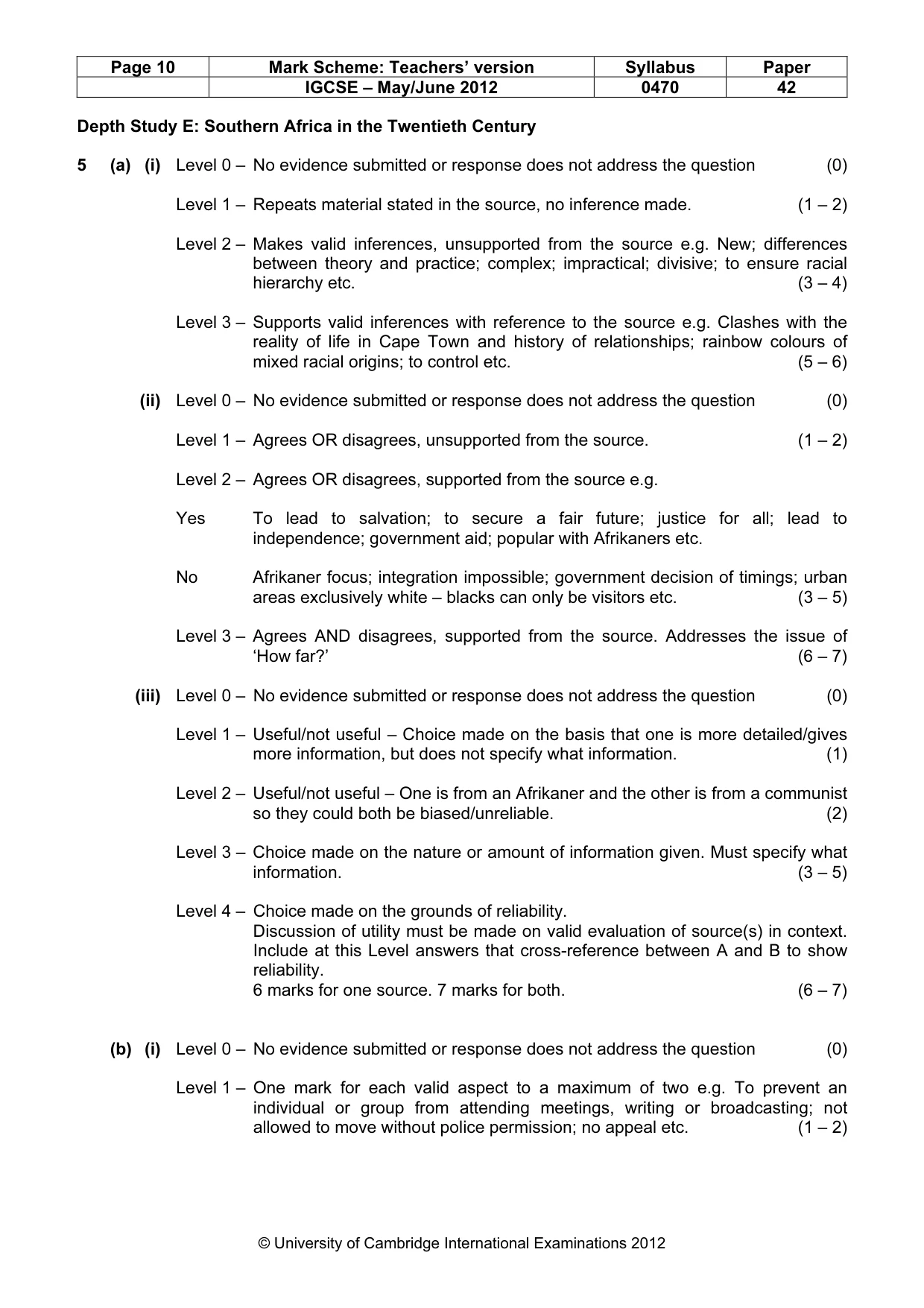
Page 10 Mark Scheme: Teachers’ version Syllabus Paper IGCSE – May/June 2012 0470 42 © University of Cambridge International Examinations 2012 Depth Study E: Southern Africa in the Twentieth Century 5 (a) (i) Level 0 – No evidence submitted or response does not address the question (0) Level 1 – Repeats material stated in the source, no inference made. (1 – 2) Level 2 – Makes valid inferences, unsupported from the source e.g. New; differences between theory and practice; complex; impractical; divisive; to ensure racial hierarchy etc. (3 – 4) Level 3 – Supports valid inferences with reference to the source e.g. Clashes with the reality of life in Cape Town and history of relationships; rainbow colours of mixed racial origins; to control etc. (5 – 6) (ii) Level 0 – No evidence submitted or response does not address the question (0) Level 1 – Agrees OR disagrees, unsupported from the source. (1 – 2) Level 2 – Agrees OR disagrees, supported from the source e.g. Yes To lead to salvation; to secure a fair future; justice for all; lead to independence; government aid; popular with Afrikaners etc. No Afrikaner focus; integration impossible; government decision of timings; urban areas exclusively white – blacks can only be visitors etc. (3 – 5) Level 3 – Agrees AND disagrees, supported from the source. Addresses the issue of ‘How far?’ (6 – 7) (iii) Level 0 – No evidence submitted or response does not address the question (0) Level 1 – Useful/not useful – Choice made on the basis that one is more detailed/gives more information, but does not specify what information. (1) Level 2 – Useful/not useful – One is from an Afrikaner and the other is from a communist so they could both be biased/unreliable. (2) Level 3 – Choice made on the nature or amount of information given. Must specify what information. (3 – 5) Level 4 – Choice made on the grounds of reliability. Discussion of utility must be made on valid evaluation of source(s) in context. Include at this Level answers that cross-reference between A and B to show reliability. 6 marks for one source. 7 marks for both. (6 – 7) (b) (i) Level 0 – No evidence submitted or response does not address the question (0) Level 1 – One mark for each valid aspect to a maximum of two e.g. To prevent an individual or group from attending meetings, writing or broadcasting; not allowed to move without police permission; no appeal etc. (1 – 2)
Mark scheme, page 11
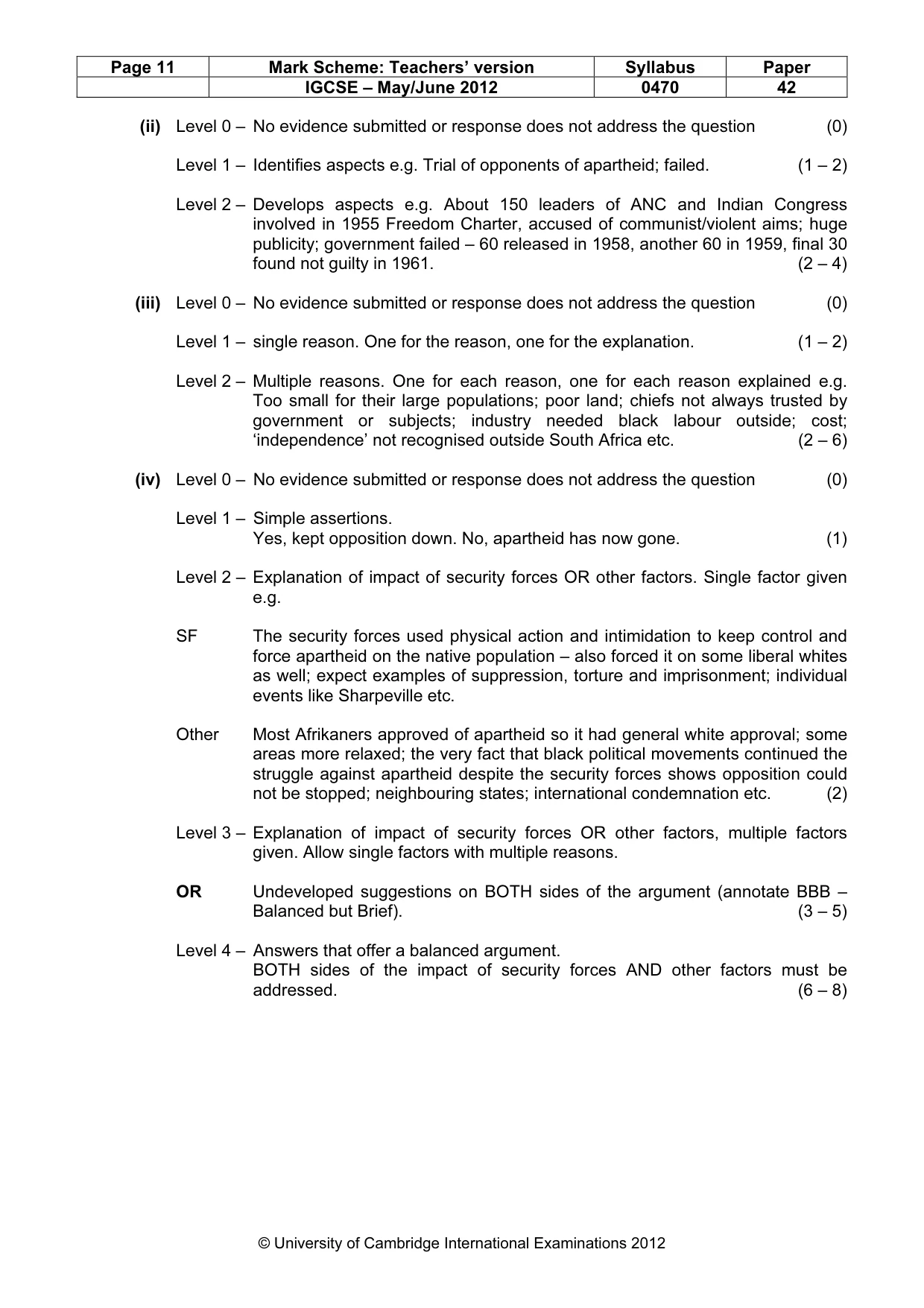
Page 11 Mark Scheme: Teachers’ version Syllabus Paper IGCSE – May/June 2012 0470 42 © University of Cambridge International Examinations 2012 (ii) Level 0 – No evidence submitted or response does not address the question (0) Level 1 – Identifies aspects e.g. Trial of opponents of apartheid; failed. (1 – 2) Level 2 – Develops aspects e.g. About 150 leaders of ANC and Indian Congress involved in 1955 Freedom Charter, accused of communist/violent aims; huge publicity; government failed – 60 released in 1958, another 60 in 1959, final 30 found not guilty in 1961. (2 – 4) (iii) Level 0 – No evidence submitted or response does not address the question (0) Level 1 – single reason. One for the reason, one for the explanation. (1 – 2) Level 2 – Multiple reasons. One for each reason, one for each reason explained e.g. Too small for their large populations; poor land; chiefs not always trusted by government or subjects; industry needed black labour outside; cost; ‘independence’ not recognised outside South Africa etc. (2 – 6) (iv) Level 0 – No evidence submitted or response does not address the question (0) Level 1 – Simple assertions. Yes, kept opposition down. No, apartheid has now gone. (1) Level 2 – Explanation of impact of security forces OR other factors. Single factor given e.g. SF The security forces used physical action and intimidation to keep control and force apartheid on the native population – also forced it on some liberal whites as well; expect examples of suppression, torture and imprisonment; individual events like Sharpeville etc. Other Most Afrikaners approved of apartheid so it had general white approval; some areas more relaxed; the very fact that black political movements continued the struggle against apartheid despite the security forces shows opposition could not be stopped; neighbouring states; international condemnation etc. (2) Level 3 – Explanation of impact of security forces OR other factors, multiple factors given. Allow single factors with multiple reasons. OR Undeveloped suggestions on BOTH sides of the argument (annotate BBB – Balanced but Brief). (3 – 5) Level 4 – Answers that offer a balanced argument. BOTH sides of the impact of security forces AND other factors must be addressed. (6 – 8)
Mark scheme, page 12
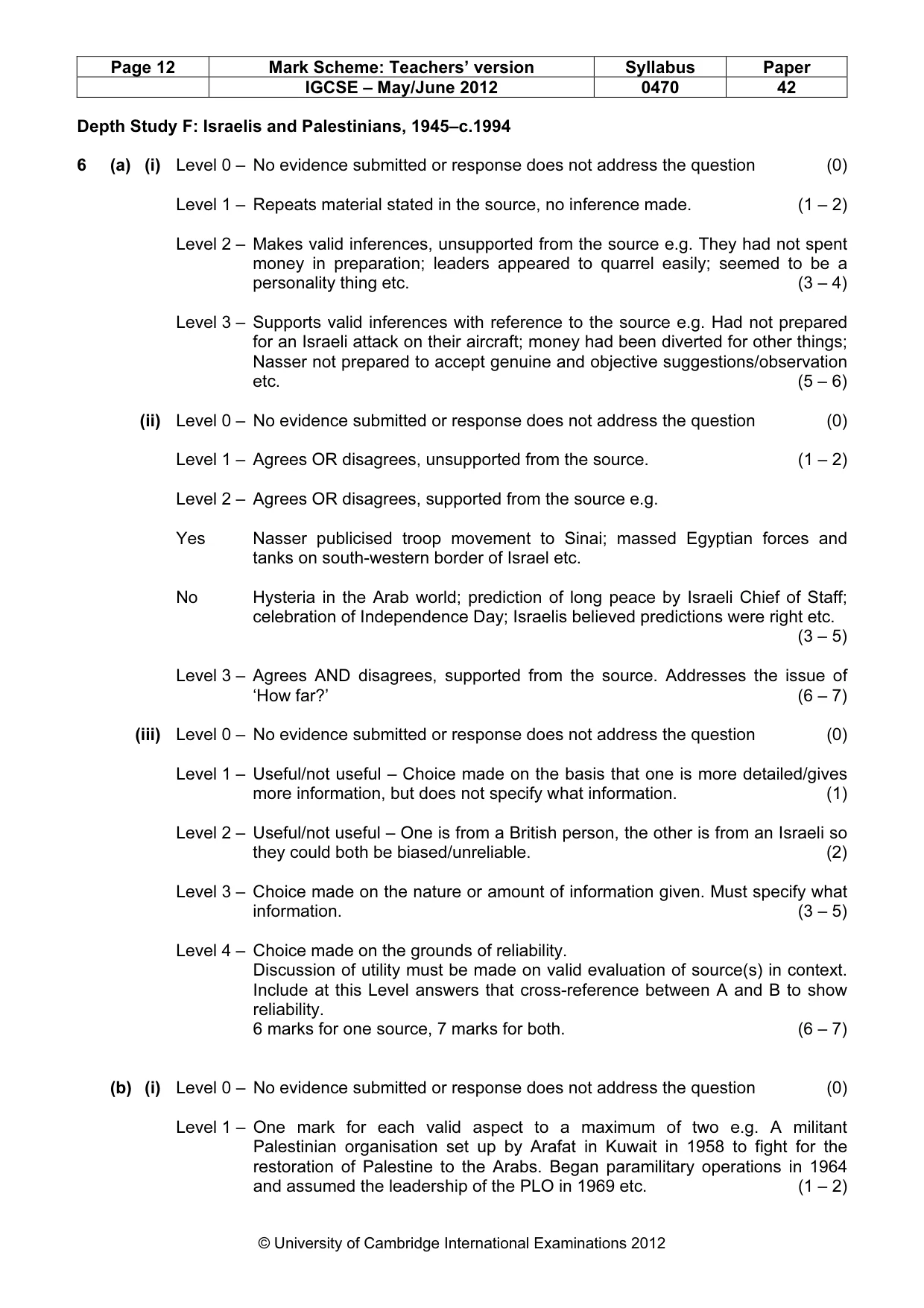
Page 12 Mark Scheme: Teachers’ version Syllabus Paper IGCSE – May/June 2012 0470 42 © University of Cambridge International Examinations 2012 Depth Study F: Israelis and Palestinians, 1945–c.1994 6 (a) (i) Level 0 – No evidence submitted or response does not address the question (0) Level 1 – Repeats material stated in the source, no inference made. (1 – 2) Level 2 – Makes valid inferences, unsupported from the source e.g. They had not spent money in preparation; leaders appeared to quarrel easily; seemed to be a personality thing etc. (3 – 4) Level 3 – Supports valid inferences with reference to the source e.g. Had not prepared for an Israeli attack on their aircraft; money had been diverted for other things; Nasser not prepared to accept genuine and objective suggestions/observation etc. (5 – 6) (ii) Level 0 – No evidence submitted or response does not address the question (0) Level 1 – Agrees OR disagrees, unsupported from the source. (1 – 2) Level 2 – Agrees OR disagrees, supported from the source e.g. Yes Nasser publicised troop movement to Sinai; massed Egyptian forces and tanks on south-western border of Israel etc. No Hysteria in the Arab world; prediction of long peace by Israeli Chief of Staff; celebration of Independence Day; Israelis believed predictions were right etc. (3 – 5) Level 3 – Agrees AND disagrees, supported from the source. Addresses the issue of ‘How far?’ (6 – 7) (iii) Level 0 – No evidence submitted or response does not address the question (0) Level 1 – Useful/not useful – Choice made on the basis that one is more detailed/gives more information, but does not specify what information. (1) Level 2 – Useful/not useful – One is from a British person, the other is from an Israeli so they could both be biased/unreliable. (2) Level 3 – Choice made on the nature or amount of information given. Must specify what information. (3 – 5) Level 4 – Choice made on the grounds of reliability. Discussion of utility must be made on valid evaluation of source(s) in context. Include at this Level answers that cross-reference between A and B to show reliability. 6 marks for one source, 7 marks for both. (6 – 7) (b) (i) Level 0 – No evidence submitted or response does not address the question (0) Level 1 – One mark for each valid aspect to a maximum of two e.g. A militant Palestinian organisation set up by Arafat in Kuwait in 1958 to fight for the restoration of Palestine to the Arabs. Began paramilitary operations in 1964 and assumed the leadership of the PLO in 1969 etc. (1 – 2)
Mark scheme, page 13
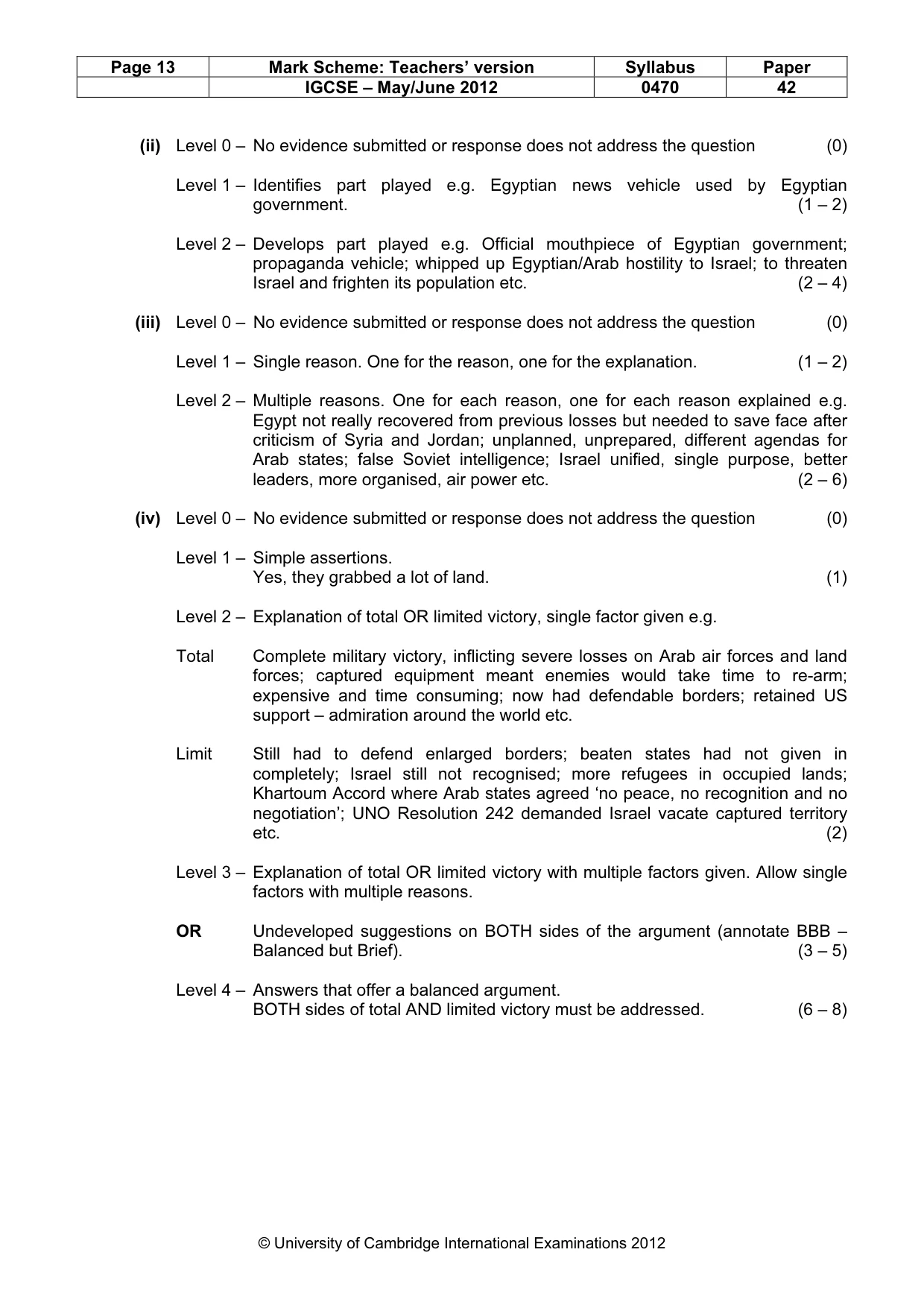
Page 13 Mark Scheme: Teachers’ version Syllabus Paper IGCSE – May/June 2012 0470 42 © University of Cambridge International Examinations 2012 (ii) Level 0 – No evidence submitted or response does not address the question (0) Level 1 – Identifies part played e.g. Egyptian news vehicle used by Egyptian government. (1 – 2) Level 2 – Develops part played e.g. Official mouthpiece of Egyptian government; propaganda vehicle; whipped up Egyptian/Arab hostility to Israel; to threaten Israel and frighten its population etc. (2 – 4) (iii) Level 0 – No evidence submitted or response does not address the question (0) Level 1 – Single reason. One for the reason, one for the explanation. (1 – 2) Level 2 – Multiple reasons. One for each reason, one for each reason explained e.g. Egypt not really recovered from previous losses but needed to save face after criticism of Syria and Jordan; unplanned, unprepared, different agendas for Arab states; false Soviet intelligence; Israel unified, single purpose, better leaders, more organised, air power etc. (2 – 6) (iv) Level 0 – No evidence submitted or response does not address the question (0) Level 1 – Simple assertions. Yes, they grabbed a lot of land. (1) Level 2 – Explanation of total OR limited victory, single factor given e.g. Total Complete military victory, inflicting severe losses on Arab air forces and land forces; captured equipment meant enemies would take time to re-arm; expensive and time consuming; now had defendable borders; retained US support – admiration around the world etc. Limit Still had to defend enlarged borders; beaten states had not given in completely; Israel still not recognised; more refugees in occupied lands; Khartoum Accord where Arab states agreed ‘no peace, no recognition and no negotiation’; UNO Resolution 242 demanded Israel vacate captured territory etc. (2) Level 3 – Explanation of total OR limited victory with multiple factors given. Allow single factors with multiple reasons. OR Undeveloped suggestions on BOTH sides of the argument (annotate BBB – Balanced but Brief). (3 – 5) Level 4 – Answers that offer a balanced argument. BOTH sides of total AND limited victory must be addressed. (6 – 8)
Mark scheme, page 14
Page 14 Mark Scheme: Teachers’ version Syllabus Paper IGCSE – May/June 2012 0470 42 © University of Cambridge International Examinations 2012 Depth Study G: The Creation of Modern Industrial Society 7 (a) (i) Level 0 – No evidence submitted or response does not address the question (0) Level 1 – Repeats material seen in the source, no inference made. (1 – 2) Level 2 – Makes valid inferences unsupported from the source e.g. Serious trouble in the stocking industry; things have been damaged; a lot of money is being offered to get a conviction etc (3 – 4) Level 3 – Supports valid inferences with reference to the source e.g. Stocking making machinery has been damaged and the owners are offering the huge sum of 50 Guineas to secure a conviction; asking conspirators to turn on one another with information and attempts to get a pardon etc. (5 – 6) (ii) Level 0 – No evidence submitted or response does not address the question (0) Level 1 – Agrees OR disagrees, unsupported from the source. (1 – 2) Level 2 – Agrees OR disagrees, supported from the source e.g. Yes There is a large crowd present and they appear to be listening to the speaker; the very fact it is recognisable and fun is being poked at it, must mean evidence of popularity and someone feels threatened etc. No Not all the audience is concentrating; a fine hotchpotch of strange characters; the poor English and outrageous principles make the tone of the cartoon mocking etc. (3 – 5) Level 3 – Agrees AND disagrees, supported from the source. Addresses the issue of ‘How far?’ (6 – 7) (iii) Level 0 – No evidence submitted or response does not address the question (0) Level 1 – Useful/not useful – Choice made on the basis that one is more detailed/gives more information, but does not specify what information. (1) Level 2 – Useful/not useful – One is a Reward poster, and the other is a cartoon so they could both be biased/unreliable. (2) Level 3 – Choice made on the nature and amount of information given. Must specify what information. (3 – 5) Level 4 – Choice made on the grounds of reliability. Discussion of utility must be made on valid evaluation of source(s) in context. Include at this Level answers that cross-reference between A and B to show reliability. 6 marks for one source, 7 marks for both. (6 – 7) (b) (i) Level 0 – No evidence submitted or response does not address the question (0) Level 1 – One mark for each valid aspect to a maximum of two e.g. Machine breakers led by the mythical Ned Ludd. Originally stocking frame workers but term became applied to anyone who opposed ‘progress’ etc. (1 – 2)
Mark scheme, page 15
Page 15 Mark Scheme: Teachers’ version Syllabus Paper IGCSE – May/June 2012 0470 42 © University of Cambridge International Examinations 2012 (ii) Level 0 – No evidence submitted or response does not address the question (0) Level 1 – Identifies problems e.g. Danger and insecurity. (1 – 2) Level 2 – Develops problems e.g. Dangerous machinery; long hours; harsh overseers; fines for wrongdoing/lateness; could face instant dismissal; unemployment if orders fell etc. (2 – 4) (iii) Level 0 – No evidence submitted or response does not address the question (0) Level 1 – Single reason. One for the reason, one for the explanation. (1 – 2) Level 2 – One for each reason, one for each reason explained e.g. They had never been properly enforced; they were a wartime measure to control population/armed forces; pressure from many quarters to repeal, especially from Francis Place; they served little purpose; the development of workers’ associations needed better legislation and proper consideration etc. (2 – 6) (iv) Level 0 – No evidence submitted or response does not address the question (0) Level 1 – Simple assertions. Yes, they were well-known to be harsh and heartless. (1) Level 2 – Explanation of brutality OR kindness, single factor given e.g. Brut Selfish in many cases as their main concern was profit, not the workers; brutal in the sense that there was no concern for the welfare of the workers; physical brutality was more the concern of the overseers, but they were still the agents of the owners; child and female exploitation etc Kind Instances of more enlightened factory owners with Robert Owen and New Lanark factory; legislation softens the employers approach; attitudes and the beginnings of a caring culture; effects more easily seen in the second half of the century etc. (2) Level 3 – Explanation of brutality OR kindness, with multiple factors. Allow single factors with multiple reasons. OR Undeveloped suggestions on BOTH sides of the argument (annotate BBB – Balanced but Brief). (3 – 5) Level 4 – Answers that offer a balanced argument. BOTH sides of brutality AND kindness must be addressed. (6 – 8)
Mark scheme, page 16
Page 16 Mark Scheme: Teachers’ version Syllabus Paper IGCSE – May/June 2012 0470 42 © University of Cambridge International Examinations 2012 Depth Study H: The Impact of Western Imperialism in the Nineteenth Century 8 (a) (i) Level 0 – No evidence submitted or response does not address the question (0) Level 1 – Repeats material stated in the source, no inference made. (1 – 2) Level 2 – Makes valid inferences, unsupported from the source e.g. It has been a great help even if somewhat patronising; the British had little idea of what Indians need; they do not appear to understand Indians; but have their heart in the right place etc. (3 – 4) Level 3 – Supports valid inferences with reference to the source e.g. The British have been of great service morally; have a mixed performance politically have introduced new technology with benefit to Indians; they do not really understand Indians and their needs; but have a firm belief in fair play and justice etc. (5 – 6) (ii) Level 0 – No evidence submitted or response does not address the question (0) Level 1 – Agrees OR disagrees, unsupported from the source. (1 – 2) Level 2 – Agrees OR disagrees, supported from the source e.g. Yes Imports of Western technology – trains, canals, steamships; irrigation and food production; world markets; textiles in Western India; stagnation of the early nineteenth century had been overcome etc. No Only a small minority benefited; famines of the 1880s and 1890s showed that economic growth was limited and the British could not overcome all problems etc. (3 – 5) Level 3 – Agrees AND disagrees, supported from the source. Addresses the issue of ‘How far?’ (6 – 7) (iii) Level 0 – No evidence submitted or response does not address the question (0) Level 1 – Useful/not useful – Choice made on the basis that one is more detailed/gives more information, but does not specify what information. (1) Level 2 – Useful/not useful – One is from an Indian and the other is from a Briton so they could both be biased/unreliable. (2) Level 3 – Choice made on the nature or amount of information given. Must specify what information. (3 – 5) Level 4 – Choice made on the grounds of reliability. Discussion of utility must be made on valid evaluation of source(s) in context. Include at this Level answers that cross-reference between A and B to show reliability. 6 marks for one source, 7 marks for both. (6 – 7)
Mark scheme, page 17
Page 17 Mark Scheme: Teachers’ version Syllabus Paper IGCSE – May/June 2012 0470 42 © University of Cambridge International Examinations 2012 (b) (i) Level 0 – No evidence submitted or response does not address the question (0) Level 1 – One mark for each valid aspect to a maximum of two e.g. This was the Act of Parliament that conferred the title of Empress of India on Queen Victoria. (1 – 2) (ii) Level 0 – No evidence submitted or response does not address the question (0) Level 1 – Identifies problems e.g. Hunger and insecurity. (1 – 2) Level 2 – Develops problems e.g. Famine as per 1880s and 1890s; Lack of opportunity; growing political disaffection leading to Mutiny and with the 1858 legislation; slowly growing economy; wars; British notion of their natural superiority etc. (2 – 4) (iii) Level 0 – No evidence submitted or response does not address the question (0) Level 1 – Single reason. One for the reason, one for the explanation. (1 – 2) Level 2 – Multiple reasons. One for each reason, one for each reason explained e.g. Because the Mutiny revealed mistakes and deficiencies under the rule of the East India company; political concern in Britain at possible loss of the ‘jewel in the crown’ if India was lost; need to re-establish control in a fairer system and to convey to Indians that they were important; to begin to give Indians more of a stake in the ‘partnership etc. (2 – 6) (iv) Level 0 – No evidence submitted or response does not address the question (0) Level 1 – Simple assertions. Most resented British interference. (1) Level 2 – Explanation of welcome OR unwelcome, single factor given e.g. Wel Provided increased opportunities; improved communications by rail, telegraph and shipping; investment in agriculture and industry; system of justice; law and order; fairness etc. Unw British sense of superiority; racial distinctions and treatment; lack of respect for Hindu and Muslim customs and religious sensitivities; India was the servant of the Mother country etc. (2) Level 3 – Explanation of welcome OR unwelcome with multiple factors. Allow single factors with multiple reasons. OR Undeveloped suggestions on BOTH sides of the argument (annotate BBB – Balanced but Brief). (3 – 5) Level 4 – Answers that offer a balanced argument. BOTH sides of welcome AND unwelcome must be addressed. (6 – 8)
What you needed in this session
Cambridge’s own grade thresholds for 2012 May/June, Paper 4 · Variant 2. A higher threshold means an easier paper — the bar moves with how the cohort did.