Cambridge IGCSE History 0470 — 2012 May/June Paper 4 · Variant 1
0470/41/M/J/12 · 40 marks · ≈45 min
The question paper and its mark scheme, free to read here and free to download. This is Cambridge’s own paper, exactly as it was sat.
Question paper12 pages

Mark scheme17 pages
Answers below. Sit the paper first if you are practising.
Paper as text
Question paper, page 1
This document consists of 10 printed pages and 2 blank pages. DC (SJF/CGW) 51115/3 © UCLES 2012 [Turn over UNIVERSITY OF CAMBRIDGE INTERNATIONAL EXAMINATIONS International General Certificate of Secondary Education READ THESE INSTRUCTIONS FIRST If you have been given an Answer Booklet, follow the instructions on the front cover of the Booklet. Write your Centre number, candidate number and name on all the work you hand in. Write in dark blue or black pen. You may use a soft pencil for any diagrams, graphs or rough working. Do not use staples, paper clips, highlighters, glue or correction fluid. Answer the questions on one of the Depth Studies. At the end of the examination, fasten all your work securely together. The number of marks is given in brackets [ ] at the end of each question or part question. * 7 1 9 8 6 5 6 8 5 2 * HISTORY 0470/41 Paper 4 Alternative to Coursework May/June 2012 1 hour Additional Materials: Answer Booklet/Paper www.XtremePapers.com
Question paper, page 2
2 0470/41/M/J/12 © UCLES 2012 DEPTH STUDY A: GERMANY, 1918–1945 1 Study the sources, and then answer the questions which follow. Source A I hope if many, like our boys, go into the Party, perhaps they can do something to improve it. My husband knows some of the people who are in control of the Hitler Youth and says that behind all the enthusiasm there is much that is dark and ugly. Any movement that degrades standards in learning, mocks the Christian religion and denies the right to free speech must end in disaster. We should try in every way to let our children know that we stand for positive values, although we run the risk of being reported to the Gestapo. A German woman in an interview with a British writer in 1936. Source B By 1935 there were almost four million members, aged 10 to 18, in the various levels of the Hitler Youth, and in 1939 membership became compulsory. The organisation encouraged self- confidence in young people and near-worship of Hitler. In 1934 the Hitler Youth was given equal status with schools in education, and members wore their uniform in school to advertise their main loyalty. Adolescent rebelliousness was being channelled against traditional authorities such as school, Church and parents. The emphasis on indoctrination, discipline and military training had mixed effects on the young. Increasing numbers failed to attend meetings and parades, and those already in work resented the loss of their limited free time. So long as they paid their subscription, they could not be expelled. From a British history of the Third Reich, 2005. (a) (i) Study Source A. What can you tell from this source about the Hitler Youth movement? Support your answer with reference to the source. [6] (ii) Study Source B. How far does this source show that the Hitler Youth movement was successful? Explain your answer. [7] (iii) Study both sources. Is one of these sources more useful than the other as evidence about Nazi methods of control? Explain your answer. [7] (b) (i) Who were the Edelweiss Pirates? [2] (ii) Describe how some Protestants attempted to resist Nazi state interference and what happened to them. [4] (iii) Why was Nazi propaganda successful? [6] (iv) ‘The Nazis stayed in power because they were popular.’ How far do you agree with this statement? Explain your answer. [8]
Question paper, page 3
3 0470/41/M/J/12 © UCLES 2012 [Turn over DEPTH STUDY B: RUSSIA, 1905–1941 2 Study the sources, and then answer the questions which follow. Source A I asked for a meeting and was received by the Tsar on 8 March. ‘I must tell Your Majesty that this cannot continue much longer. No one opens your eyes to the true role this man [Rasputin] is playing. His presence at your Majesty’s court undermines confidence in your supreme power and may have an evil effect on the fate of the dynasty and turn the hearts of the people from their Emperor.’ My report did some good. On 11 March an order was issued sending Rasputin away but a few days later, at the demand of the Empress, this order was cancelled. The President of the Duma, writing in March 1916. Source B The high cost of living and the shortage of foodstuffs, from which the soldiers’ wives are the first to suffer, have been made known to the army by soldiers returning from leave. The rumours of famine in Petrograd which circulate at the front are exaggerated and have already soared into the realms of pure imagination. Soldiers now believe that in the capital meat is sold only to the nobles and landlords, and that a new cemetery has been opened for those who have died of starvation. The anxiety of the soldiers is perfectly understandable but it grows from day to day and offers fertile ground for the spreading of revolutionary propaganda. From a police report sent to the Tsar’s government in October 1916. (a) (i) Study Source A. What can you tell from this source about Rasputin? Support your answer with reference to the source. [6] (ii) Study Source B. How far does this source show that the troops’ anxiety about their families at home was justified? Explain your answer. [7] (iii) Study both sources. Is one of these sources more useful than the other as evidence about Russia in 1916? Explain your answer. [7] (b) (i) Who were the Mensheviks? [2] (ii) Describe the activities of the Okhrana. [4] (iii) Why was the Russian army beaten in the First World War? [6] (iv) How far was Tsar Nicholas II responsible for his own downfall in 1917? Explain your answer. [8]
Question paper, page 4
4 0470/41/M/J/12 © UCLES 2012 DEPTH STUDY C: THE USA, 1919–1941 3 Study the sources, and then answer the questions which follow. Source A A few miles outside the typical little Californian town of Brawley over three hundred dust-bowl migrant families were huddled together in a dry river bed. The town’s good citizens did nothing, although a few, only half-humorously, suggested that the ‘Okies’ be lined up and shot. In 1937, representatives of the Farm Security Administration (FSA) purchased a small plot of land at the edge of town and made plans for tent platforms, a tool shed, a nursery and medical unit, three toilets and showers for the migrants. The town’s Parent–Teacher organisation demanded, ‘Are you going to make it possible for more of these hobo brats to go to school with our children?’ From ‘Common Sense’, written by an FSA worker in 1939. Source B Output, employment and income were down by a quarter in 1933. This was severe and millions were desperate. Yet most private businesses were still functioning and needed to expand, which they could – if there were low taxes and free enterprise. Roosevelt aimed to eliminate unemployment and create many jobs in government agencies. Jobs, not simply handouts, were meant to make the recipients feel better about themselves, and taxpayers less resentful as the New Deal tripled taxes. New Deal programs destroyed other jobs: for example, the Agricultural Adjustment Act (1933) cut back farm production and forced Americans to pay more for their food. The Tennessee Valley Authority’s dams flooded an estimated 750 000 acres, taking the land and homes of fifteen thousand people. Black sharecroppers, who didn’t own property, got no compensation. From a Republican economist, 2003. (a) (i) Study Source A. What can you tell from this source about migrant families in the 1930s? Support your answer with reference to the source. [6] (ii) Study Source B. How far does this source show that the New Deal was beneficial? Explain your answer. [7] (iii) Study both sources. Is one of these sources more useful than the other as evidence about the New Deal? Explain your answer. [7] (b) (i) What was the dust-bowl? [2] (ii) Describe the work of the Civilian Conservation Corps. [4] (iii) Why was there a second New Deal in 1935? [6] (iv) How far do you agree that workers in industry gained most from the New Deal? Explain your answer. [8]
Question paper, page 5
5 0470/41/M/J/12 © UCLES 2012 [Turn over DEPTH STUDY D: CHINA, 1945–c. 1990 4 Study the sources, and then answer the questions which follow. Source A Mao showed indifference to human life. He was a callous, selfish, immoral human being who treated his wives and children with contempt, did not even walk the Long March (he was carried on a bamboo litter), owned more than fifty personal estates and thought nothing of having fresh fish carried more than six hundred miles to satisfy his craving. He, and the system which bred him and still does not apologise for what was done, are beyond understanding. From a British journalist, writing in 2007. Source B By 1966, most of the Party officials were fed up with persecutions, and wanted to get on with improving living standards and building a normal life. But they did not openly oppose Mao, and went on promoting Mao’s personality cult. The few who watched this with apprehension knew there was nothing they could do to stop it: Mao had such power and prestige that his cult was irresistible. The most they could do was engage in some kind of passive resistance. Mao interpreted the reaction from Party officials to his call for a purge as an indication that their loyalty to him was weakening and that their hearts were with the policies of President Liu and Deng. His suspicion was confirmed when Party newspapers refused to publish an article he had authorised. From a Chinese author who lived in China during the Cultural Revolution. (a) (i) Study Source A. What can you tell from this source about Mao? Support your answer with reference to the source. [6] (ii) Study Source B. How far does this source show that Mao was secure in his leadership? Explain your answer. [7] (iii) Study both sources. Is one of these sources more useful than the other as evidence about Communism in China in the 1960s? Explain your answer. [7] (b) (i) Who were the ‘revisionists’ (Rightists)? [2] (ii) Describe the activities of the Red Guards during the Cultural Revolution. [4] (iii) Why did Mao launch the Cultural Revolution? [6] (iv) How far did the social and cultural life of the Chinese people change as a result of Communist Party rule between 1949 and 1976? Explain your answer. [8]
Question paper, page 6
6 0470/41/M/J/12 © UCLES 2012 DEPTH STUDY E: SOUTHERN AFRICA IN THE TWENTIETH CENTURY 5 Study the sources, and then answer the questions which follow. Source A After disease killed most of our cattle in 1933, my father had to work in the mines and only came home at weekends, so my mother was left in charge of the farm and us eight children. We had to walk three miles to school each day, often barefooted as we could not afford shoes. My father was very strict; if any of the black workers did wrong they were whipped – but so were we, once, because we had gone swimming in the river on a Sunday. Father was a preacher in our Church and was highly respected by the blacks, and we were brought up to respect them. From the memories of an Afrikaner, written in 1982. Source B In the 1920s and 1930s white farmers were encouraged to modernise agriculture through government subsidies and grants, tax relief and marketing boards. Africans were allowed only individual allotments in the Reserves, which were controlled by chiefs and supervised by magistrates. African farmers could not extend allotments effectively and so the development of commercial African agriculture was prevented. The aim was that African people would be able to produce enough food in the Reserves to sustain the family, but not sufficient food to deter them from seeking employment. In this way, the cheap labour system was supported on the backs of the women and children left behind in the Reserves. From a South African history website for students, 2008. (a) (i) Study Source A. What can you tell from this source about farming in South Africa in the 1930s? Support your answer with reference to the source. [6] (ii) Study Source B. How far does this source show there were improvements in agriculture in the 1920s and 1930s? Explain your answer. [7] (iii) Study both sources. Is one of these sources more useful than the other as evidence about black workers? Explain your answer. [7] (b) (i) What was the Rand Rebellion of 1922? [2] (ii) Describe the effects of the 1913 Land Act. [4] (iii) Why was there little improvement in industrial working conditions before 1940? [6] (iv) ‘The Gold Boom was the most important reason for the success of the South African economy between 1930 and 1948.’ How far do you agree with this statement? Explain your answer. [8]
Question paper, page 7
7 0470/41/M/J/12 © UCLES 2012 [Turn over BLANK PAGE PLEASE TURN OVER FOR DEPTH STUDY F
Question paper, page 8
8 0470/41/M/J/12 © UCLES 2012 DEPTH STUDY F: ISRAELIS AND PALESTINIANS, 1945–c.1994 6 Study the sources, and then answer the questions which follow. Source A Jews and Arabs demonstrate outside an Israeli Embassy, December 1973. Source B By 1947, revelations about Nazi extermination camps helped generate widespread sympathy for the demand that Jewish survivors should be freely admitted to Palestine. A campaign of violence was waged by Jewish terrorist groups to force the British Government to remove immigration restrictions. A full-scale guerrilla war developed between the British army and Zionist forces, as well as periodic violence between Arab and Jew. The British Government made a final attempt to secure Arab-Jewish agreement by direct talks. This time both the Zionists and the Palestinian Arabs refused to attend. From a British history textbook, 1977.
Question paper, page 9
9 0470/41/M/J/12 © UCLES 2012 [Turn over (a) (i) Study Source A. What does this source tell you about the relations between Palestinians and Jews? Support your answer with reference to the source. [6] (ii) Study Source B. How far does this source show that the British Government had lost control of Palestine by 1947? Explain your answer. [7] (iii) Study both sources. Is one of these sources more useful than the other as evidence about developments in Palestine? Explain your answer. [7] (b) (i) Name two of the states that invaded Israel in May 1948. [2] (ii) Describe the activities of Irgun and the Stern Gang. [4] (iii) Why did Israel emerge victorious from the 1948–9 war? [6] (iv) How far was it events in Palestine that enabled the Jews to create the state of Israel? Explain your answer. [8]
Question paper, page 10
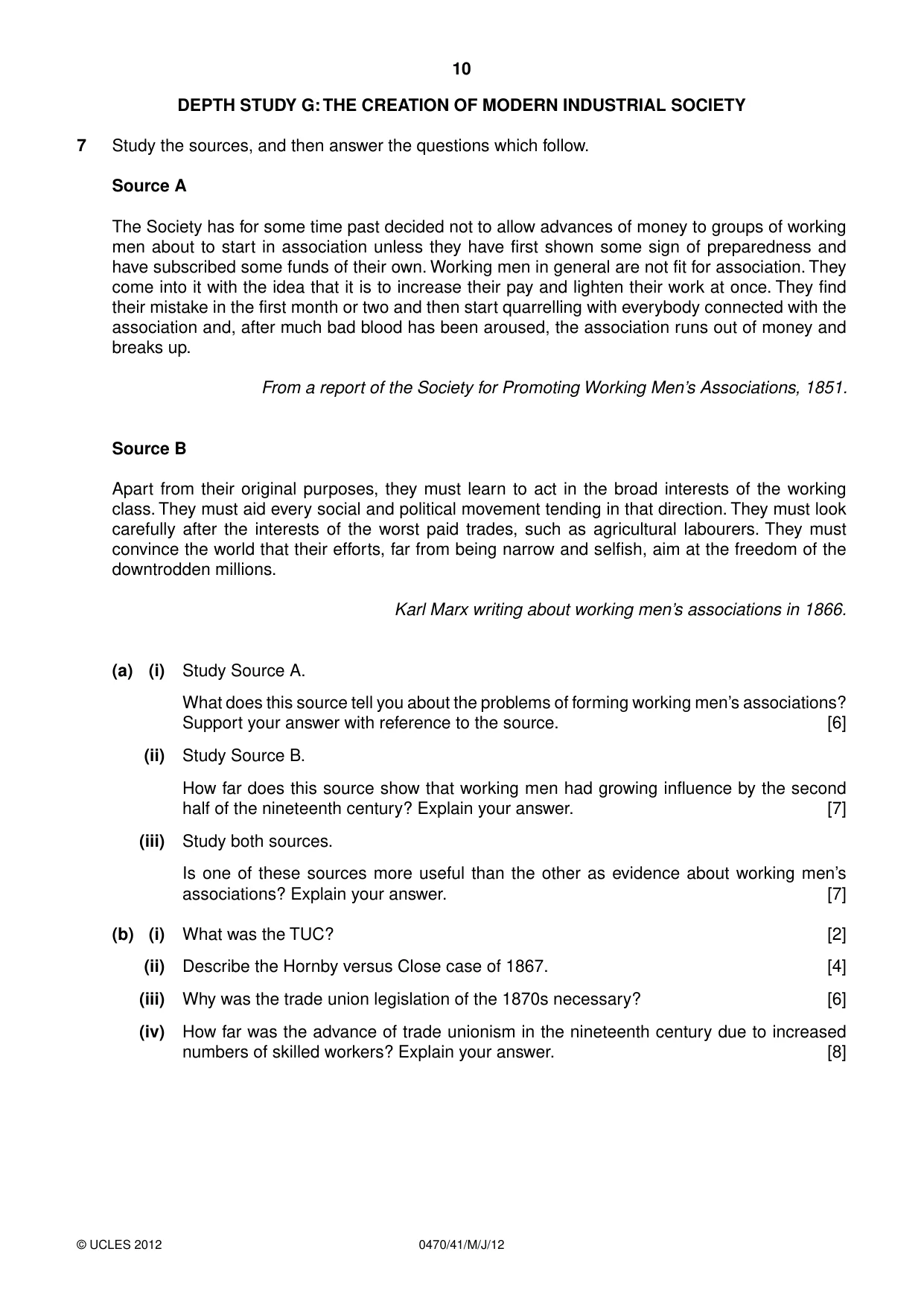
10 0470/41/M/J/12 © UCLES 2012 DEPTH STUDY G: THE CREATION OF MODERN INDUSTRIAL SOCIETY 7 Study the sources, and then answer the questions which follow. Source A The Society has for some time past decided not to allow advances of money to groups of working men about to start in association unless they have first shown some sign of preparedness and have subscribed some funds of their own. Working men in general are not fit for association. They come into it with the idea that it is to increase their pay and lighten their work at once. They find their mistake in the first month or two and then start quarrelling with everybody connected with the association and, after much bad blood has been aroused, the association runs out of money and breaks up. From a report of the Society for Promoting Working Men’s Associations, 1851. Source B Apart from their original purposes, they must learn to act in the broad interests of the working class. They must aid every social and political movement tending in that direction. They must look carefully after the interests of the worst paid trades, such as agricultural labourers. They must convince the world that their efforts, far from being narrow and selfish, aim at the freedom of the downtrodden millions. Karl Marx writing about working men’s associations in 1866. (a) (i) Study Source A. What does this source tell you about the problems of forming working men’s associations? Support your answer with reference to the source. [6] (ii) Study Source B. How far does this source show that working men had growing influence by the second half of the nineteenth century? Explain your answer. [7] (iii) Study both sources. Is one of these sources more useful than the other as evidence about working men’s associations? Explain your answer. [7] (b) (i) What was the TUC? [2] (ii) Describe the Hornby versus Close case of 1867. [4] (iii) Why was the trade union legislation of the 1870s necessary? [6] (iv) How far was the advance of trade unionism in the nineteenth century due to increased numbers of skilled workers? Explain your answer. [8]
Question paper, page 11
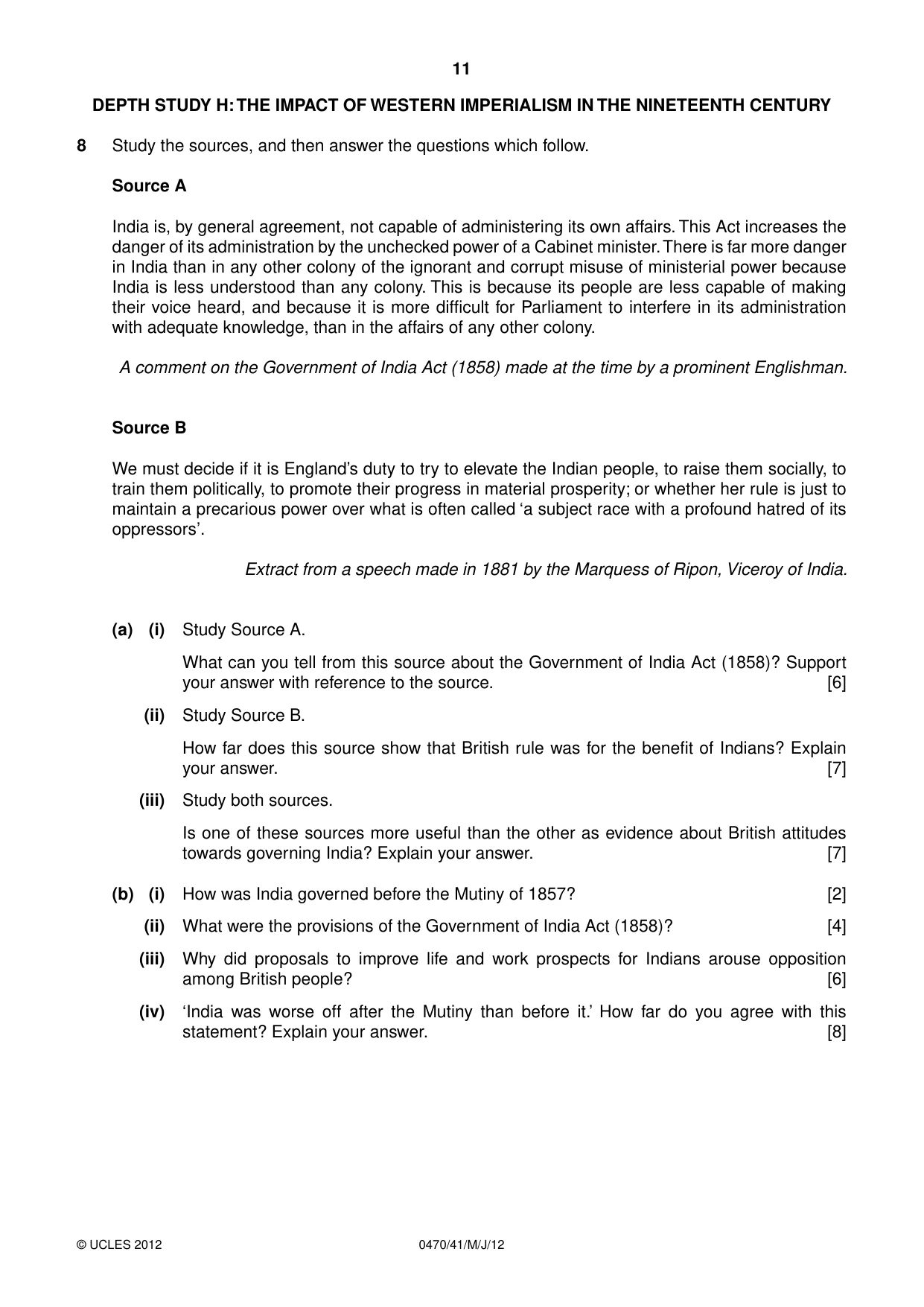
11 0470/41/M/J/12 © UCLES 2012 DEPTH STUDY H: THE IMPACT OF WESTERN IMPERIALISM IN THE NINETEENTH CENTURY 8 Study the sources, and then answer the questions which follow. Source A India is, by general agreement, not capable of administering its own affairs. This Act increases the danger of its administration by the unchecked power of a Cabinet minister. There is far more danger in India than in any other colony of the ignorant and corrupt misuse of ministerial power because India is less understood than any colony. This is because its people are less capable of making their voice heard, and because it is more difficult for Parliament to interfere in its administration with adequate knowledge, than in the affairs of any other colony. A comment on the Government of India Act (1858) made at the time by a prominent Englishman. Source B We must decide if it is England’s duty to try to elevate the Indian people, to raise them socially, to train them politically, to promote their progress in material prosperity; or whether her rule is just to maintain a precarious power over what is often called ‘a subject race with a profound hatred of its oppressors’. Extract from a speech made in 1881 by the Marquess of Ripon, Viceroy of India. (a) (i) Study Source A. What can you tell from this source about the Government of India Act (1858)? Support your answer with reference to the source. [6] (ii) Study Source B. How far does this source show that British rule was for the benefit of Indians? Explain your answer. [7] (iii) Study both sources. Is one of these sources more useful than the other as evidence about British attitudes towards governing India? Explain your answer. [7] (b) (i) How was India governed before the Mutiny of 1857? [2] (ii) What were the provisions of the Government of India Act (1858)? [4] (iii) Why did proposals to improve life and work prospects for Indians arouse opposition among British people? [6] (iv) ‘India was worse off after the Mutiny than before it.’ How far do you agree with this statement? Explain your answer. [8]
Question paper, page 12
12 0470/41/M/J/12 © UCLES 2012 BLANK PAGE Copyright Acknowledgements: Depth Study A Source B © R J Evans; The Third Reich In Power; Allen Lane; 2005. Depth Study B Source A © Ben Walsh; GCSE Modern World History; Hodder Education; 1996. Depth Study B Source B © Bryn O’Callaghan; A History of the Twentieth Century; Longman; 1987. Depth Study C Source A © http://frontiers.loc.gov/ammem/ndlpedu/features/timeline/depwwii/dustbowl/vintage.html Depth Study C Source B © http://www.cato.org/pub_display.php?pub_id=3357 Depth Study D Source A © Will Hutton; The Writing On The Wall; Little, Brown Book Group; 2007. Depth Study D Source B © Jung Chang; Wild Swans; Flamingo; 1991. Depth Study E Source B © http://www.sahistory.org.za/pages/governence-projects/liberation-struggle/legislation_1930s.html Depth Study F Sources A & B © Schools Council History 13-16 Project; Arab-Israeli Conflict; Holmes McDougal; 1977. Depth Study G Source A © L F Hobley; Working Class and Democratic Movements; Blackie; 1970. Depth Study G Source B © http://www.marxists.org/history/international/iwma/documents/1866/instructions Depth Study H Source A © http://www.victorianweb.org/philosophy/mill/constitution.html Depth Study H Source B © N Ferguson; Empire; Allen Lane; 2003. Permission to reproduce items where third-party owned material protected by copyright is included has been sought and cleared where possible. Every reasonable effort has been made by the publisher (UCLES) to trace copyright holders, but if any items requiring clearance have unwittingly been included, the publisher will be pleased to make amends at the earliest possible opportunity. University of Cambridge International Examinations is part of the Cambridge Assessment Group. Cambridge Assessment is the brand name of University of Cambridge Local Examinations Syndicate (UCLES), which is itself a department of the University of Cambridge.
Mark scheme, page 1
UNIVERSITY OF CAMBRIDGE INTERNATIONAL EXAMINATIONS International General Certificate of Secondary Education MARK SCHEME for the May/June 2012 question paper for the guidance of teachers 0470 HISTORY 0470/41 Paper 4 (Alternative to Coursework), maximum raw mark 40 This mark scheme is published as an aid to teachers and candidates, to indicate the requirements of the examination. It shows the basis on which Examiners were instructed to award marks. It does not indicate the details of the discussions that took place at an Examiners’ meeting before marking began, which would have considered the acceptability of alternative answers. Mark schemes must be read in conjunction with the question papers and the report on the examination. • Cambridge will not enter into discussions or correspondence in connection with these mark schemes. Cambridge is publishing the mark schemes for the May/June 2012 question papers for most IGCSE, GCE Advanced Level and Advanced Subsidiary Level syllabuses and some Ordinary Level syllabuses. www.XtremePapers.com
Mark scheme, page 2
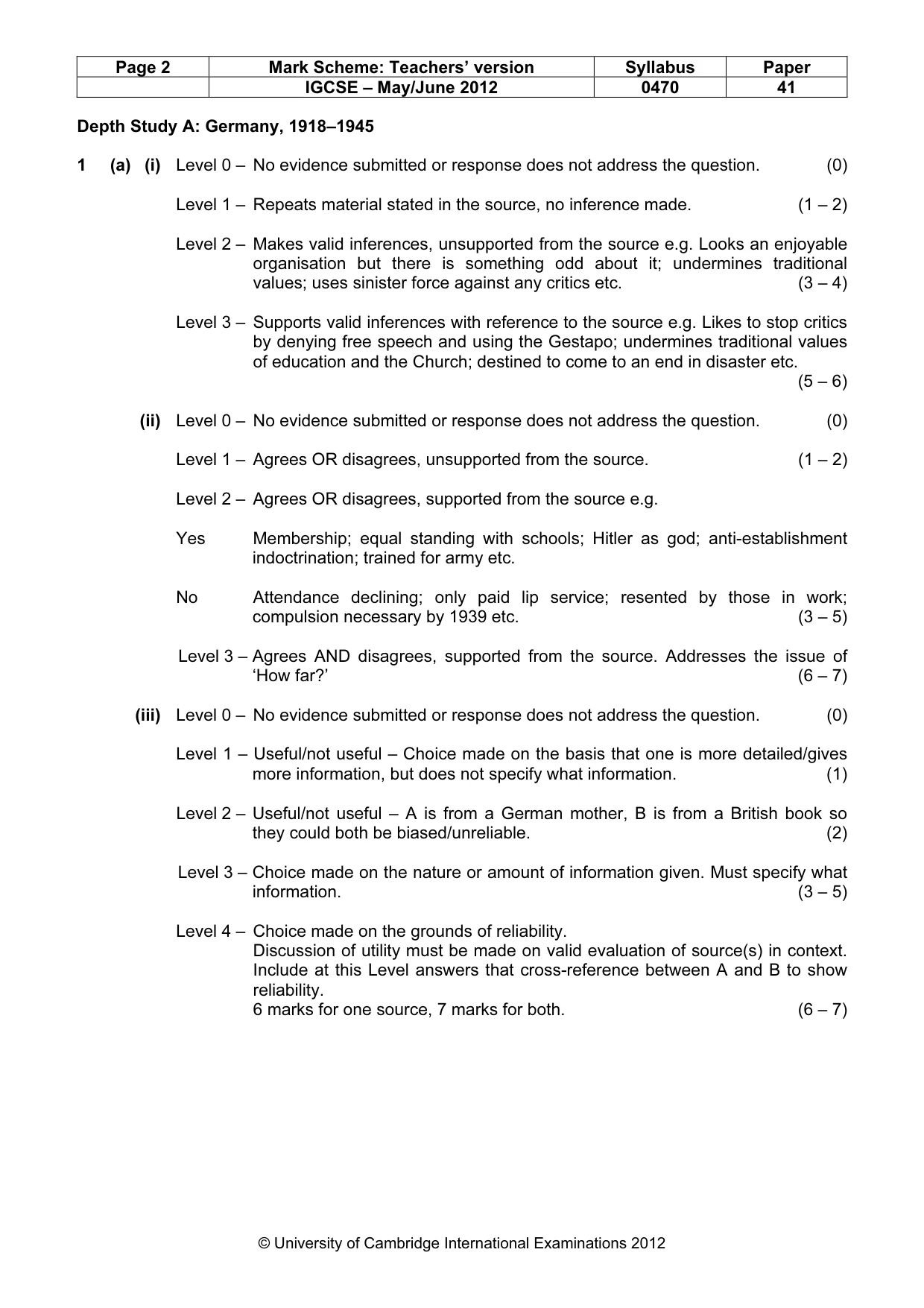
Page 2 Mark Scheme: Teachers’ version Syllabus Paper IGCSE – May/June 2012 0470 41 © University of Cambridge International Examinations 2012 Depth Study A: Germany, 1918–1945 1 (a) (i) Level 0 – No evidence submitted or response does not address the question. (0) Level 1 – Repeats material stated in the source, no inference made. (1 – 2) Level 2 – Makes valid inferences, unsupported from the source e.g. Looks an enjoyable organisation but there is something odd about it; undermines traditional values; uses sinister force against any critics etc. (3 – 4) Level 3 – Supports valid inferences with reference to the source e.g. Likes to stop critics by denying free speech and using the Gestapo; undermines traditional values of education and the Church; destined to come to an end in disaster etc. (5 – 6) (ii) Level 0 – No evidence submitted or response does not address the question. (0) Level 1 – Agrees OR disagrees, unsupported from the source. (1 – 2) Level 2 – Agrees OR disagrees, supported from the source e.g. Yes Membership; equal standing with schools; Hitler as god; anti-establishment indoctrination; trained for army etc. No Attendance declining; only paid lip service; resented by those in work; compulsion necessary by 1939 etc. (3 – 5) Level 3 – Agrees AND disagrees, supported from the source. Addresses the issue of ‘How far?’ (6 – 7) (iii) Level 0 – No evidence submitted or response does not address the question. (0) Level 1 – Useful/not useful – Choice made on the basis that one is more detailed/gives more information, but does not specify what information. (1) Level 2 – Useful/not useful – A is from a German mother, B is from a British book so they could both be biased/unreliable. (2) Level 3 – Choice made on the nature or amount of information given. Must specify what information. (3 – 5) Level 4 – Choice made on the grounds of reliability. Discussion of utility must be made on valid evaluation of source(s) in context. Include at this Level answers that cross-reference between A and B to show reliability. 6 marks for one source, 7 marks for both. (6 – 7)
Mark scheme, page 3
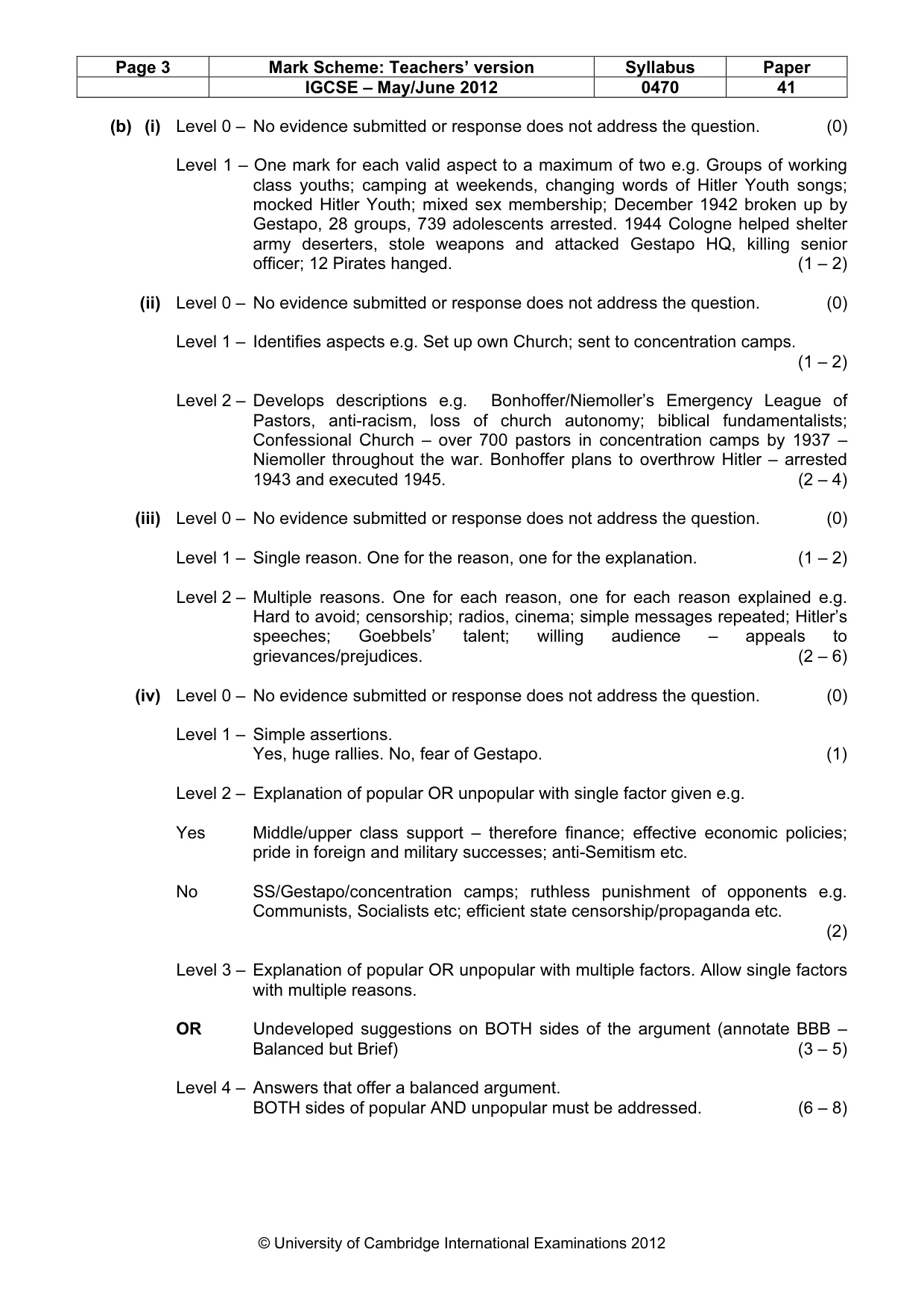
Page 3 Mark Scheme: Teachers’ version Syllabus Paper IGCSE – May/June 2012 0470 41 © University of Cambridge International Examinations 2012 (b) (i) Level 0 – No evidence submitted or response does not address the question. (0) Level 1 – One mark for each valid aspect to a maximum of two e.g. Groups of working class youths; camping at weekends, changing words of Hitler Youth songs; mocked Hitler Youth; mixed sex membership; December 1942 broken up by Gestapo, 28 groups, 739 adolescents arrested. 1944 Cologne helped shelter army deserters, stole weapons and attacked Gestapo HQ, killing senior officer; 12 Pirates hanged. (1 – 2) (ii) Level 0 – No evidence submitted or response does not address the question. (0) Level 1 – Identifies aspects e.g. Set up own Church; sent to concentration camps. (1 – 2) Level 2 – Develops descriptions e.g. Bonhoffer/Niemoller’s Emergency League of Pastors, anti-racism, loss of church autonomy; biblical fundamentalists; Confessional Church – over 700 pastors in concentration camps by 1937 – Niemoller throughout the war. Bonhoffer plans to overthrow Hitler – arrested 1943 and executed 1945. (2 – 4) (iii) Level 0 – No evidence submitted or response does not address the question. (0) Level 1 – Single reason. One for the reason, one for the explanation. (1 – 2) Level 2 – Multiple reasons. One for each reason, one for each reason explained e.g. Hard to avoid; censorship; radios, cinema; simple messages repeated; Hitler’s speeches; Goebbels’ talent; willing audience – appeals to grievances/prejudices. (2 – 6) (iv) Level 0 – No evidence submitted or response does not address the question. (0) Level 1 – Simple assertions. Yes, huge rallies. No, fear of Gestapo. (1) Level 2 – Explanation of popular OR unpopular with single factor given e.g. Yes Middle/upper class support – therefore finance; effective economic policies; pride in foreign and military successes; anti-Semitism etc. No SS/Gestapo/concentration camps; ruthless punishment of opponents e.g. Communists, Socialists etc; efficient state censorship/propaganda etc. (2) Level 3 – Explanation of popular OR unpopular with multiple factors. Allow single factors with multiple reasons. OR Undeveloped suggestions on BOTH sides of the argument (annotate BBB – Balanced but Brief) (3 – 5) Level 4 – Answers that offer a balanced argument. BOTH sides of popular AND unpopular must be addressed. (6 – 8)
Mark scheme, page 4
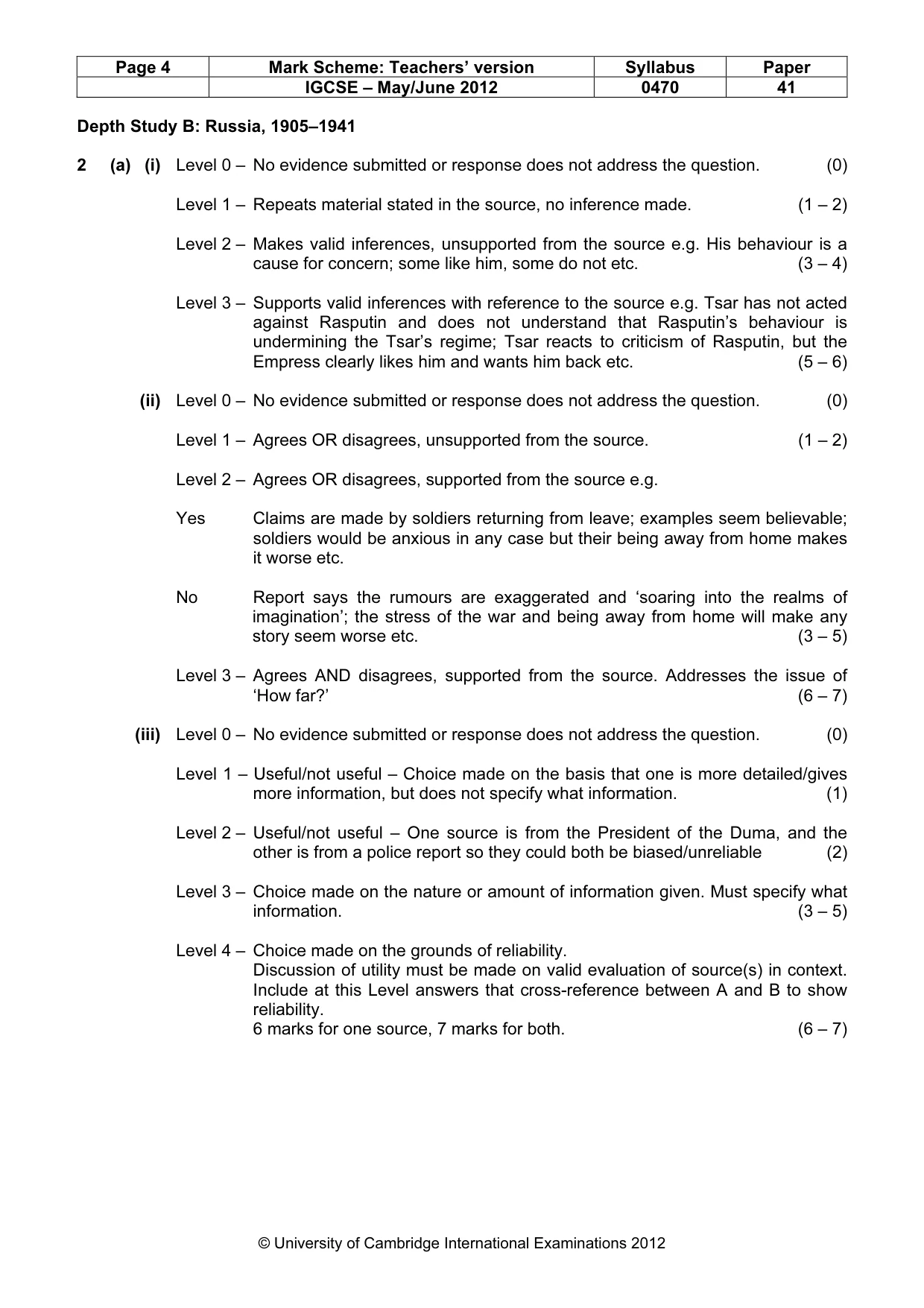
Page 4 Mark Scheme: Teachers’ version Syllabus Paper IGCSE – May/June 2012 0470 41 © University of Cambridge International Examinations 2012 Depth Study B: Russia, 1905–1941 2 (a) (i) Level 0 – No evidence submitted or response does not address the question. (0) Level 1 – Repeats material stated in the source, no inference made. (1 – 2) Level 2 – Makes valid inferences, unsupported from the source e.g. His behaviour is a cause for concern; some like him, some do not etc. (3 – 4) Level 3 – Supports valid inferences with reference to the source e.g. Tsar has not acted against Rasputin and does not understand that Rasputin’s behaviour is undermining the Tsar’s regime; Tsar reacts to criticism of Rasputin, but the Empress clearly likes him and wants him back etc. (5 – 6) (ii) Level 0 – No evidence submitted or response does not address the question. (0) Level 1 – Agrees OR disagrees, unsupported from the source. (1 – 2) Level 2 – Agrees OR disagrees, supported from the source e.g. Yes Claims are made by soldiers returning from leave; examples seem believable; soldiers would be anxious in any case but their being away from home makes it worse etc. No Report says the rumours are exaggerated and ‘soaring into the realms of imagination’; the stress of the war and being away from home will make any story seem worse etc. (3 – 5) Level 3 – Agrees AND disagrees, supported from the source. Addresses the issue of ‘How far?’ (6 – 7) (iii) Level 0 – No evidence submitted or response does not address the question. (0) Level 1 – Useful/not useful – Choice made on the basis that one is more detailed/gives more information, but does not specify what information. (1) Level 2 – Useful/not useful – One source is from the President of the Duma, and the other is from a police report so they could both be biased/unreliable (2) Level 3 – Choice made on the nature or amount of information given. Must specify what information. (3 – 5) Level 4 – Choice made on the grounds of reliability. Discussion of utility must be made on valid evaluation of source(s) in context. Include at this Level answers that cross-reference between A and B to show reliability. 6 marks for one source, 7 marks for both. (6 – 7)
Mark scheme, page 5
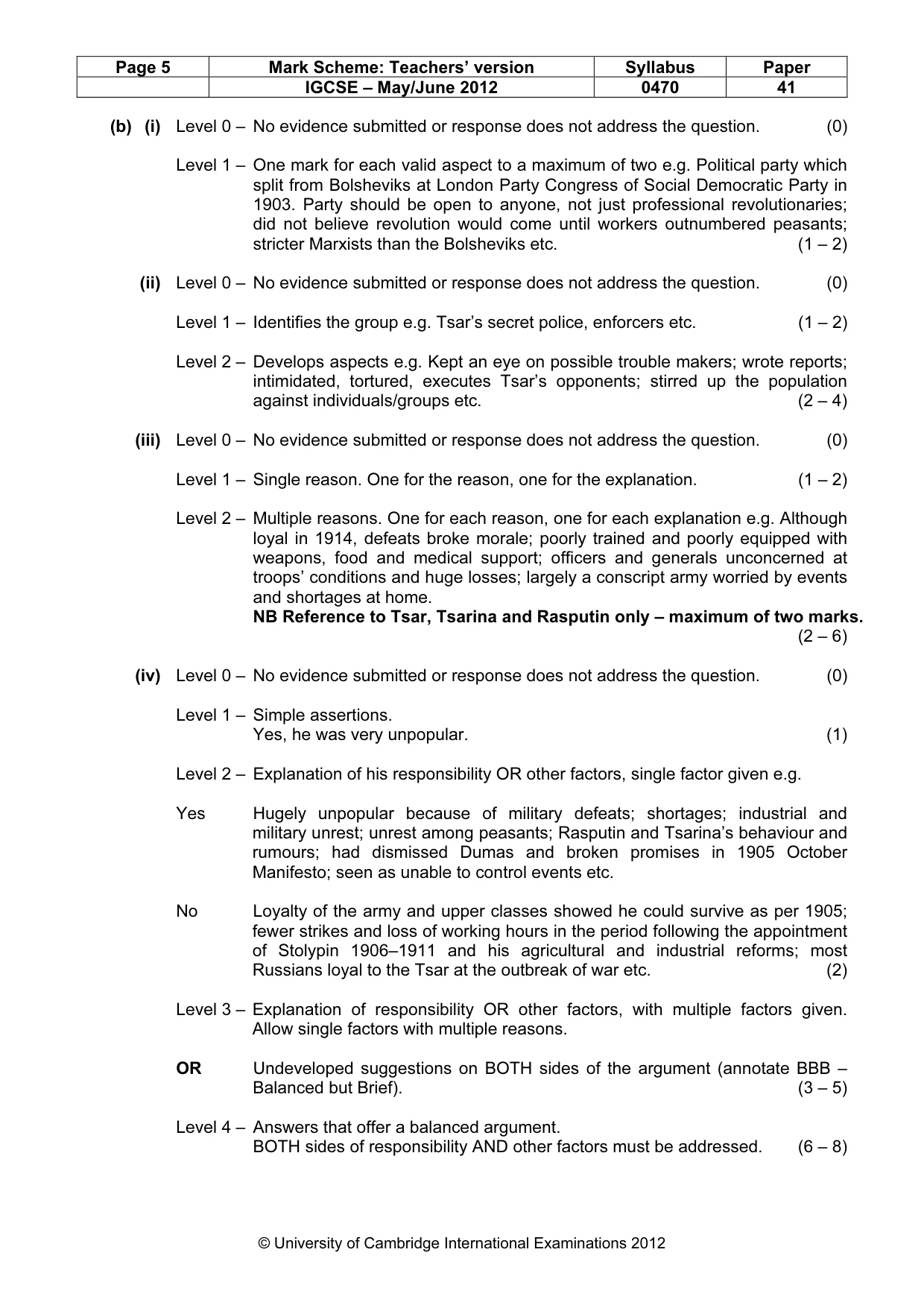
Page 5 Mark Scheme: Teachers’ version Syllabus Paper IGCSE – May/June 2012 0470 41 © University of Cambridge International Examinations 2012 (b) (i) Level 0 – No evidence submitted or response does not address the question. (0) Level 1 – One mark for each valid aspect to a maximum of two e.g. Political party which split from Bolsheviks at London Party Congress of Social Democratic Party in 1903. Party should be open to anyone, not just professional revolutionaries; did not believe revolution would come until workers outnumbered peasants; stricter Marxists than the Bolsheviks etc. (1 – 2) (ii) Level 0 – No evidence submitted or response does not address the question. (0) Level 1 – Identifies the group e.g. Tsar’s secret police, enforcers etc. (1 – 2) Level 2 – Develops aspects e.g. Kept an eye on possible trouble makers; wrote reports; intimidated, tortured, executes Tsar’s opponents; stirred up the population against individuals/groups etc. (2 – 4) (iii) Level 0 – No evidence submitted or response does not address the question. (0) Level 1 – Single reason. One for the reason, one for the explanation. (1 – 2) Level 2 – Multiple reasons. One for each reason, one for each explanation e.g. Although loyal in 1914, defeats broke morale; poorly trained and poorly equipped with weapons, food and medical support; officers and generals unconcerned at troops’ conditions and huge losses; largely a conscript army worried by events and shortages at home. NB Reference to Tsar, Tsarina and Rasputin only – maximum of two marks. (2 – 6) (iv) Level 0 – No evidence submitted or response does not address the question. (0) Level 1 – Simple assertions. Yes, he was very unpopular. (1) Level 2 – Explanation of his responsibility OR other factors, single factor given e.g. Yes Hugely unpopular because of military defeats; shortages; industrial and military unrest; unrest among peasants; Rasputin and Tsarina’s behaviour and rumours; had dismissed Dumas and broken promises in 1905 October Manifesto; seen as unable to control events etc. No Loyalty of the army and upper classes showed he could survive as per 1905; fewer strikes and loss of working hours in the period following the appointment of Stolypin 1906–1911 and his agricultural and industrial reforms; most Russians loyal to the Tsar at the outbreak of war etc. (2) Level 3 – Explanation of responsibility OR other factors, with multiple factors given. Allow single factors with multiple reasons. OR Undeveloped suggestions on BOTH sides of the argument (annotate BBB – Balanced but Brief). (3 – 5) Level 4 – Answers that offer a balanced argument. BOTH sides of responsibility AND other factors must be addressed. (6 – 8)
Mark scheme, page 6
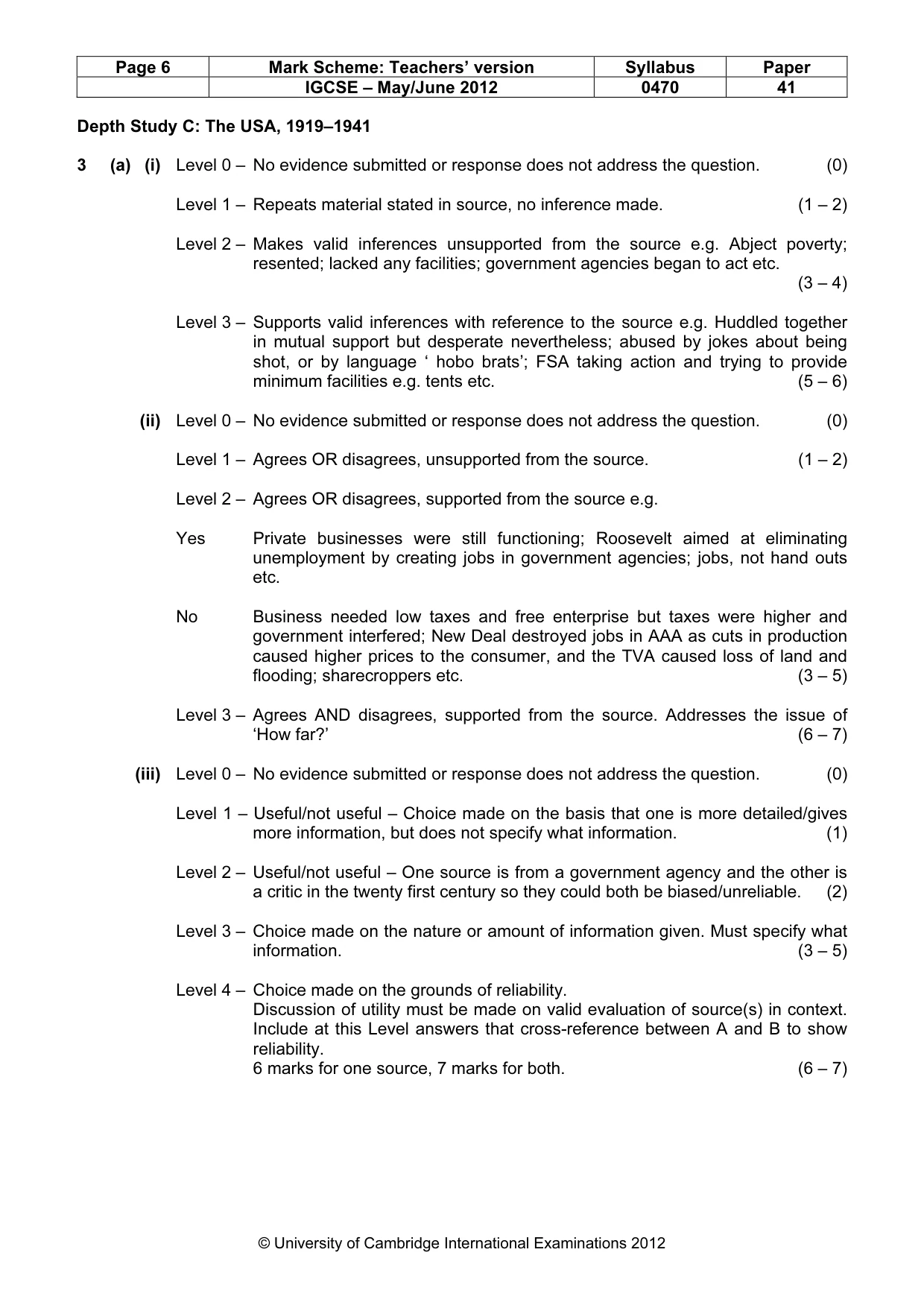
Page 6 Mark Scheme: Teachers’ version Syllabus Paper IGCSE – May/June 2012 0470 41 © University of Cambridge International Examinations 2012 Depth Study C: The USA, 1919–1941 3 (a) (i) Level 0 – No evidence submitted or response does not address the question. (0) Level 1 – Repeats material stated in source, no inference made. (1 – 2) Level 2 – Makes valid inferences unsupported from the source e.g. Abject poverty; resented; lacked any facilities; government agencies began to act etc. (3 – 4) Level 3 – Supports valid inferences with reference to the source e.g. Huddled together in mutual support but desperate nevertheless; abused by jokes about being shot, or by language ‘ hobo brats’; FSA taking action and trying to provide minimum facilities e.g. tents etc. (5 – 6) (ii) Level 0 – No evidence submitted or response does not address the question. (0) Level 1 – Agrees OR disagrees, unsupported from the source. (1 – 2) Level 2 – Agrees OR disagrees, supported from the source e.g. Yes Private businesses were still functioning; Roosevelt aimed at eliminating unemployment by creating jobs in government agencies; jobs, not hand outs etc. No Business needed low taxes and free enterprise but taxes were higher and government interfered; New Deal destroyed jobs in AAA as cuts in production caused higher prices to the consumer, and the TVA caused loss of land and flooding; sharecroppers etc. (3 – 5) Level 3 – Agrees AND disagrees, supported from the source. Addresses the issue of ‘How far?’ (6 – 7) (iii) Level 0 – No evidence submitted or response does not address the question. (0) Level 1 – Useful/not useful – Choice made on the basis that one is more detailed/gives more information, but does not specify what information. (1) Level 2 – Useful/not useful – One source is from a government agency and the other is a critic in the twenty first century so they could both be biased/unreliable. (2) Level 3 – Choice made on the nature or amount of information given. Must specify what information. (3 – 5) Level 4 – Choice made on the grounds of reliability. Discussion of utility must be made on valid evaluation of source(s) in context. Include at this Level answers that cross-reference between A and B to show reliability. 6 marks for one source, 7 marks for both. (6 – 7)
Mark scheme, page 7
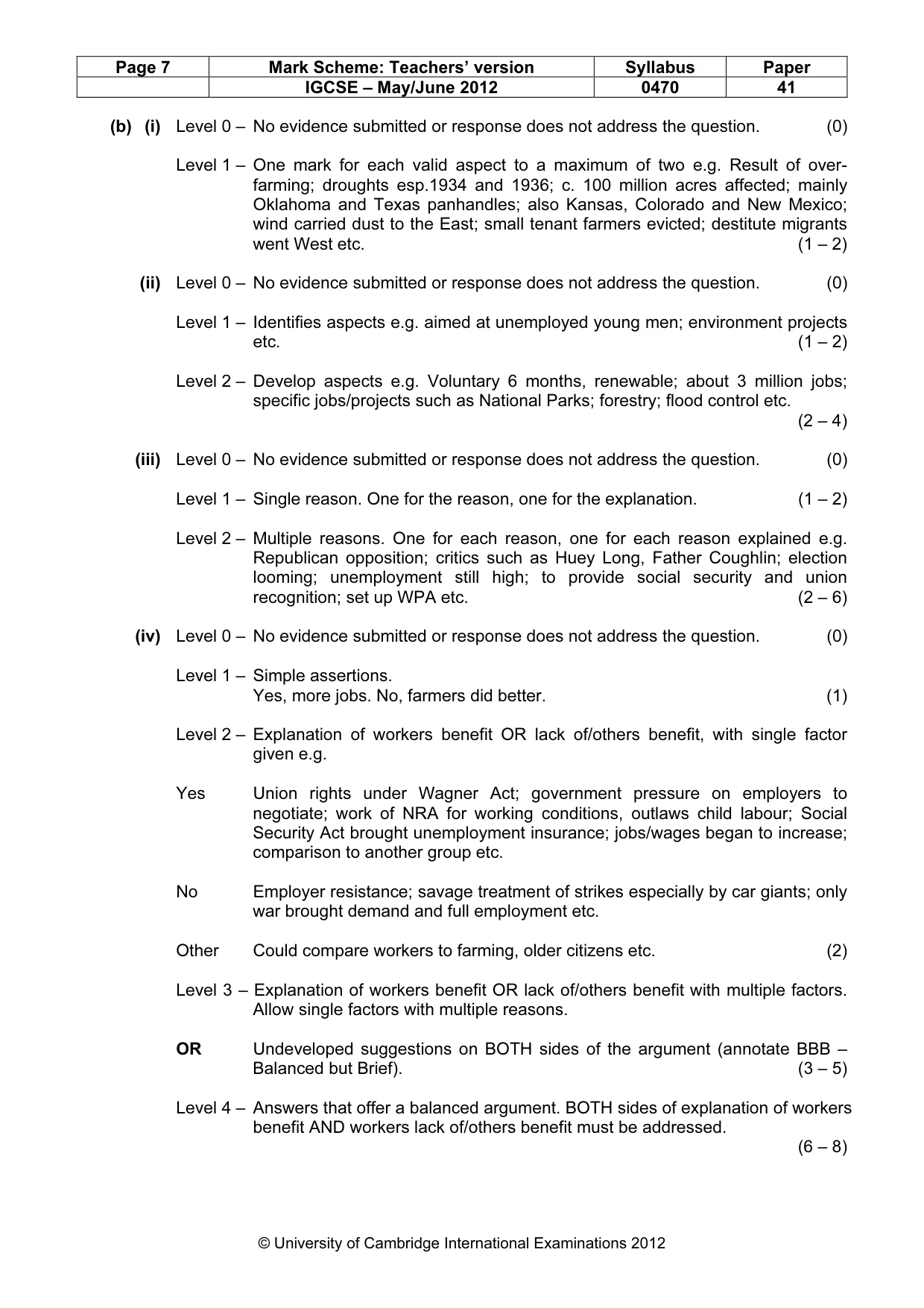
Page 7 Mark Scheme: Teachers’ version Syllabus Paper IGCSE – May/June 2012 0470 41 © University of Cambridge International Examinations 2012 (b) (i) Level 0 – No evidence submitted or response does not address the question. (0) Level 1 – One mark for each valid aspect to a maximum of two e.g. Result of over- farming; droughts esp.1934 and 1936; c. 100 million acres affected; mainly Oklahoma and Texas panhandles; also Kansas, Colorado and New Mexico; wind carried dust to the East; small tenant farmers evicted; destitute migrants went West etc. (1 – 2) (ii) Level 0 – No evidence submitted or response does not address the question. (0) Level 1 – Identifies aspects e.g. aimed at unemployed young men; environment projects etc. (1 – 2) Level 2 – Develop aspects e.g. Voluntary 6 months, renewable; about 3 million jobs; specific jobs/projects such as National Parks; forestry; flood control etc. (2 – 4) (iii) Level 0 – No evidence submitted or response does not address the question. (0) Level 1 – Single reason. One for the reason, one for the explanation. (1 – 2) Level 2 – Multiple reasons. One for each reason, one for each reason explained e.g. Republican opposition; critics such as Huey Long, Father Coughlin; election looming; unemployment still high; to provide social security and union recognition; set up WPA etc. (2 – 6) (iv) Level 0 – No evidence submitted or response does not address the question. (0) Level 1 – Simple assertions. Yes, more jobs. No, farmers did better. (1) Level 2 – Explanation of workers benefit OR lack of/others benefit, with single factor given e.g. Yes Union rights under Wagner Act; government pressure on employers to negotiate; work of NRA for working conditions, outlaws child labour; Social Security Act brought unemployment insurance; jobs/wages began to increase; comparison to another group etc. No Employer resistance; savage treatment of strikes especially by car giants; only war brought demand and full employment etc. Other Could compare workers to farming, older citizens etc. (2) Level 3 – Explanation of workers benefit OR lack of/others benefit with multiple factors. Allow single factors with multiple reasons. OR Undeveloped suggestions on BOTH sides of the argument (annotate BBB – Balanced but Brief). (3 – 5) Level 4 – Answers that offer a balanced argument. BOTH sides of explanation of workers benefit AND workers lack of/others benefit must be addressed. (6 – 8)
Mark scheme, page 8
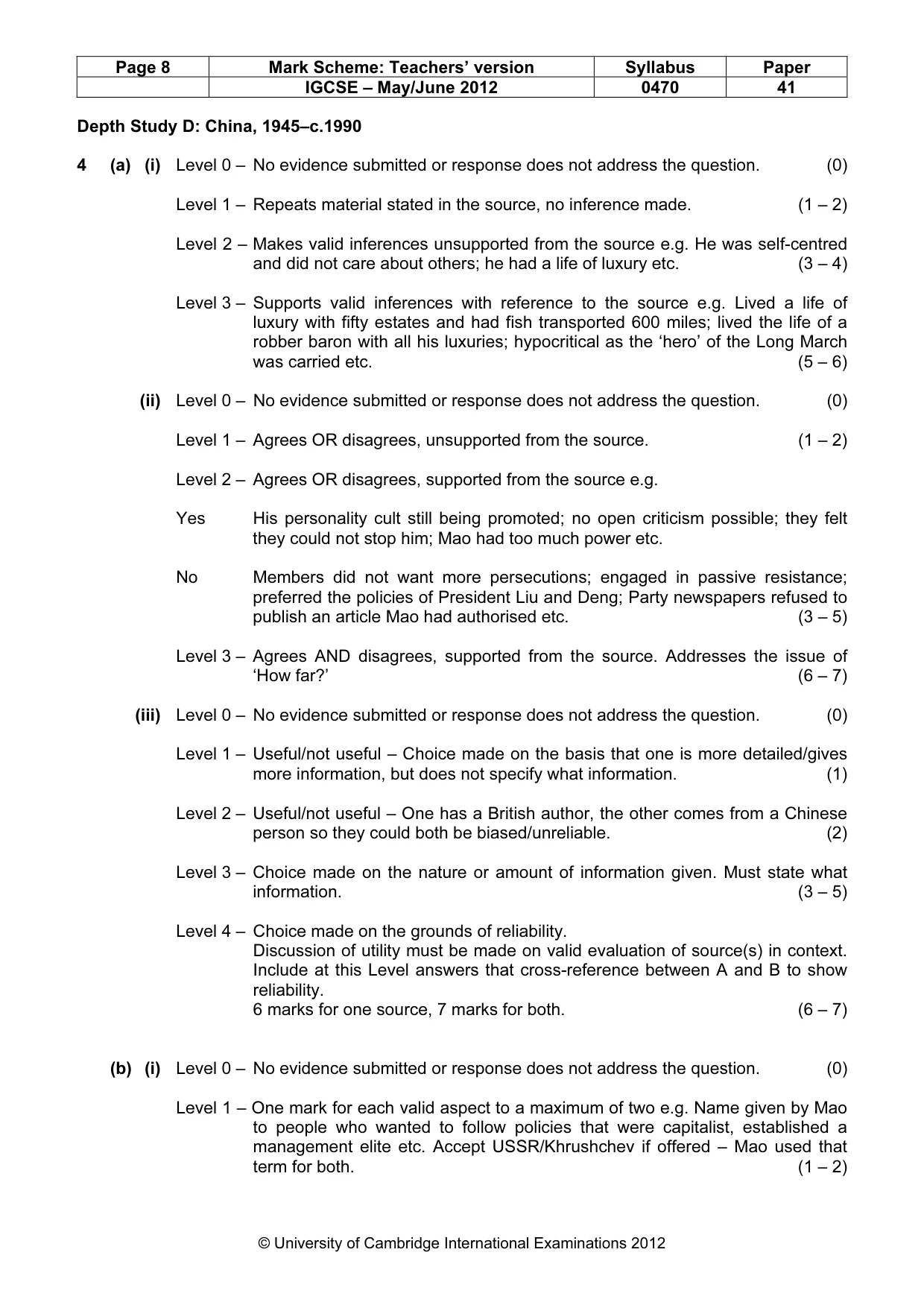
Page 8 Mark Scheme: Teachers’ version Syllabus Paper IGCSE – May/June 2012 0470 41 © University of Cambridge International Examinations 2012 Depth Study D: China, 1945–c.1990 4 (a) (i) Level 0 – No evidence submitted or response does not address the question. (0) Level 1 – Repeats material stated in the source, no inference made. (1 – 2) Level 2 – Makes valid inferences unsupported from the source e.g. He was self-centred and did not care about others; he had a life of luxury etc. (3 – 4) Level 3 – Supports valid inferences with reference to the source e.g. Lived a life of luxury with fifty estates and had fish transported 600 miles; lived the life of a robber baron with all his luxuries; hypocritical as the ‘hero’ of the Long March was carried etc. (5 – 6) (ii) Level 0 – No evidence submitted or response does not address the question. (0) Level 1 – Agrees OR disagrees, unsupported from the source. (1 – 2) Level 2 – Agrees OR disagrees, supported from the source e.g. Yes His personality cult still being promoted; no open criticism possible; they felt they could not stop him; Mao had too much power etc. No Members did not want more persecutions; engaged in passive resistance; preferred the policies of President Liu and Deng; Party newspapers refused to publish an article Mao had authorised etc. (3 – 5) Level 3 – Agrees AND disagrees, supported from the source. Addresses the issue of ‘How far?’ (6 – 7) (iii) Level 0 – No evidence submitted or response does not address the question. (0) Level 1 – Useful/not useful – Choice made on the basis that one is more detailed/gives more information, but does not specify what information. (1) Level 2 – Useful/not useful – One has a British author, the other comes from a Chinese person so they could both be biased/unreliable. (2) Level 3 – Choice made on the nature or amount of information given. Must state what information. (3 – 5) Level 4 – Choice made on the grounds of reliability. Discussion of utility must be made on valid evaluation of source(s) in context. Include at this Level answers that cross-reference between A and B to show reliability. 6 marks for one source, 7 marks for both. (6 – 7) (b) (i) Level 0 – No evidence submitted or response does not address the question. (0) Level 1 – One mark for each valid aspect to a maximum of two e.g. Name given by Mao to people who wanted to follow policies that were capitalist, established a management elite etc. Accept USSR/Khrushchev if offered – Mao used that term for both. (1 – 2)
Mark scheme, page 9
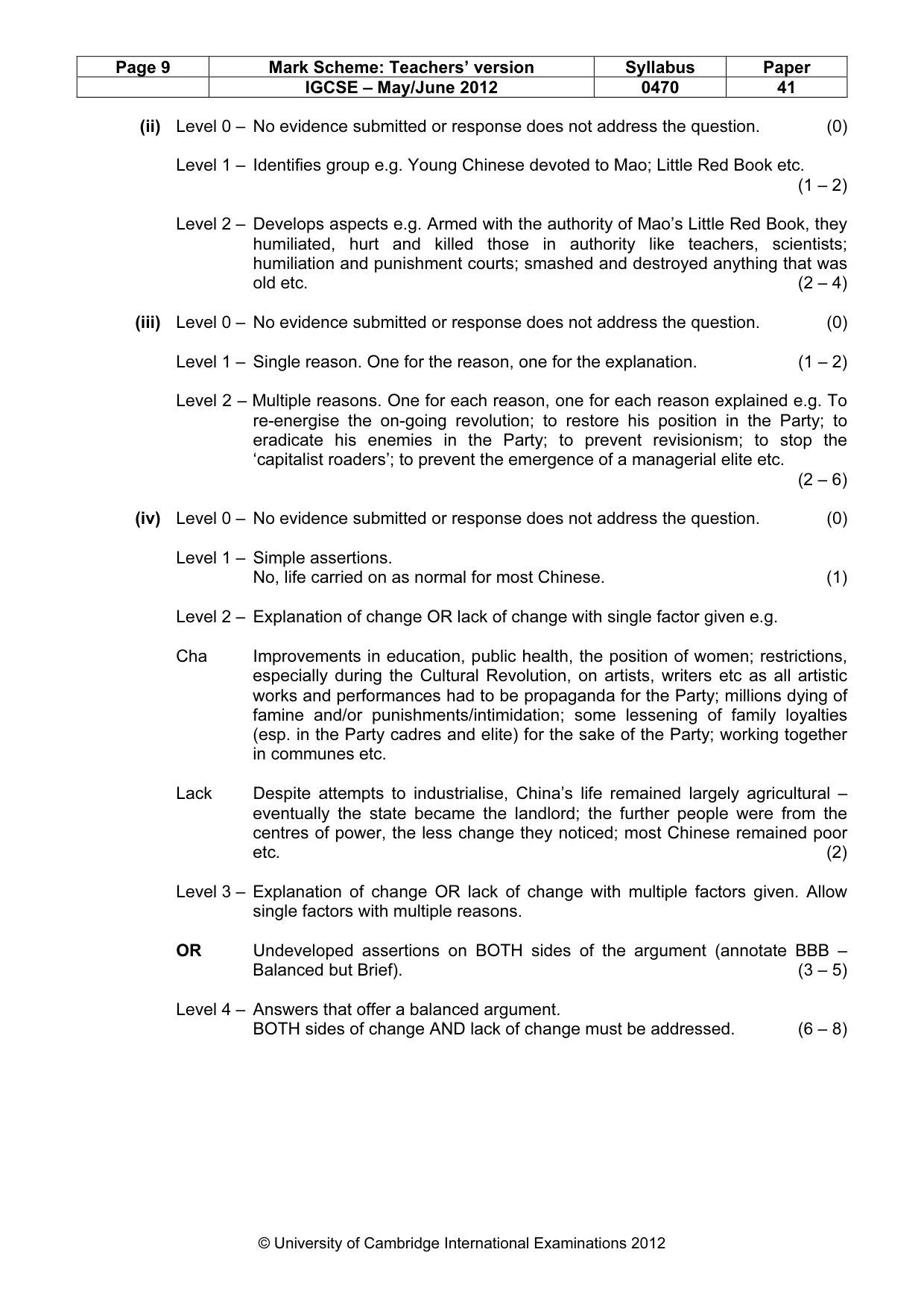
Page 9 Mark Scheme: Teachers’ version Syllabus Paper IGCSE – May/June 2012 0470 41 © University of Cambridge International Examinations 2012 (ii) Level 0 – No evidence submitted or response does not address the question. (0) Level 1 – Identifies group e.g. Young Chinese devoted to Mao; Little Red Book etc. (1 – 2) Level 2 – Develops aspects e.g. Armed with the authority of Mao’s Little Red Book, they humiliated, hurt and killed those in authority like teachers, scientists; humiliation and punishment courts; smashed and destroyed anything that was old etc. (2 – 4) (iii) Level 0 – No evidence submitted or response does not address the question. (0) Level 1 – Single reason. One for the reason, one for the explanation. (1 – 2) Level 2 – Multiple reasons. One for each reason, one for each reason explained e.g. To re-energise the on-going revolution; to restore his position in the Party; to eradicate his enemies in the Party; to prevent revisionism; to stop the ‘capitalist roaders’; to prevent the emergence of a managerial elite etc. (2 – 6) (iv) Level 0 – No evidence submitted or response does not address the question. (0) Level 1 – Simple assertions. No, life carried on as normal for most Chinese. (1) Level 2 – Explanation of change OR lack of change with single factor given e.g. Cha Improvements in education, public health, the position of women; restrictions, especially during the Cultural Revolution, on artists, writers etc as all artistic works and performances had to be propaganda for the Party; millions dying of famine and/or punishments/intimidation; some lessening of family loyalties (esp. in the Party cadres and elite) for the sake of the Party; working together in communes etc. Lack Despite attempts to industrialise, China’s life remained largely agricultural – eventually the state became the landlord; the further people were from the centres of power, the less change they noticed; most Chinese remained poor etc. (2) Level 3 – Explanation of change OR lack of change with multiple factors given. Allow single factors with multiple reasons. OR Undeveloped assertions on BOTH sides of the argument (annotate BBB – Balanced but Brief). (3 – 5) Level 4 – Answers that offer a balanced argument. BOTH sides of change AND lack of change must be addressed. (6 – 8)
Mark scheme, page 10
Page 10 Mark Scheme: Teachers’ version Syllabus Paper IGCSE – May/June 2012 0470 41 © University of Cambridge International Examinations 2012 Depth Study E: Southern Africa in the Twentieth Century 5 (a) (i) Level 0 – No evidence submitted or response does not address the question. (0) Level 1 – Repeats material stated in the source, no inference made. (1 – 2) Level 2 – Makes valid inferences, unsupported from the source. e.g. Easy to lose livestock through illness; farmer unable to support family; poverty; black labour farm; conservative etc. (3 – 4) Level 3 – Supports valid inferences with reference to the source e.g. Disease killed the cattle; could not support family so compelled to work in mines; hard time as children without shoes; harsh discipline – whipping; respected as a leader in the community etc. (5 – 6) (ii) Level 0 – No evidence submitted or response does not address the question. (0) Level 1 – Agrees OR disagrees, unsupported from the source. (1 – 2) Level 2 – Agrees OR disagrees, supported from the source e.g. Yes Government involved in a range of policies to modernise; more land available for whites; commercialism to meet black needs etc. No Black farming increasingly restricted; inadequate land; no choice but to become migrant labourers; women and children left to farm; self-sufficiency impossible etc. (3 – 5) Level 3 – Agrees AND disagrees, supported from the source. Addresses the issue of ‘How far?’ (6 – 7) (iii) Level 0 – No evidence submitted or response does not address the question. (0) Level 1 – Useful/not useful – Choice made on the basis that one is more detailed/gives more information, but does not specify what information. (1) Level 2 – Useful/not useful – One is recollection and the other is from a history website so they could both be biased/unreliable. (2) Level 3 – Choice made on the nature or amount of information given. Must specify what information. (3 – 5) Level 4 – Choice made on the grounds of reliability. Discussion of utility must be made on valid evaluation of source(s) in context. Include at this Level answers that cross-reference between A and B to show reliability. 6 marks for one source, 7 marks for both. (6 – 7)
Mark scheme, page 11
Page 11 Mark Scheme: Teachers’ version Syllabus Paper IGCSE – May/June 2012 0470 41 © University of Cambridge International Examinations 2012 (b) (i) Level 0 – No evidence submitted or response does not address the question. (0) Level 1 – One mark for each valid aspect to a maximum of two e.g. White gold miners’ strike; against the Charter of mines trying to reduce wages and white in favour of black labour; miners demanded colour bar be retained; failed; government backed mine owners, sent in army; by end of strike 200 miners dead, 500 wounded, 5000 arrested; 4 leaders hung for treason. (1 – 2) (ii) Level 0 – No evidence submitted or response does not address the question. (0) Level 1 – Identifies aspects e.g. End of independent black farming except in Reserves; created cheap labour for whites. (1 – 2) Level 2 – Develops aspects e.g. Blacks no longer able to buy land from whites; share- cropping forbidden; could only live on farms as full-time labourers or servants; Reserves only 7% of land for 70% of population; more land/profit for whites etc. (2 – 4) (iii) Level 0 – No evidence submitted or response does not address the question. (0) Level 1 – Single reason. One for the reason, one for the explanation. (1 – 2) Level 2 – Multiple reasons. One for each reason, one for each reason explained e.g. Power of employers; weaknesses of trade unions – both white and black; disintegration of the black ICU in late 1920s; government action – Riotous Assemblies Act 1930; availability of migrant/immigrant labour; no political voice etc. (2 – 6) (iv) Level 0 – No evidence submitted or response does not address the question. (0) Level 1 – Simple assertions. Yes, increased exports. No, government aid. (1) Level 2 – Explanation of successful gold Boom OR other reasons, single factor given e.g. Gold Worldwide demand for Gold increased the price; mining expanded rapidly; value increased from £47 million in 1932 to £118 million in 1940; foreign capital poured in; stimulated subsidiary industries; taxing gold profits – provided about 25% of government income; by far the richest country in Africa etc. Other Gold did badly in early 1930s because of worldwide Depression; government action – 1932 dropped gold standard; tariffs; financed railway development; ESCOM; ISCOR; farming subsidies; 1940 IDC to promote basic industries to end imports; armaments. Cheap labour; population increase/demand; other industries – copper, manganese, iron ore, coal etc. (2) Level 3 – Explanation of successful Gold Boom OR other reasons, with multiple factors. Allow single factors with multiple reasons. OR Undeveloped suggestions on BOTH sides of the argument (annotate BBB – Balanced but Brief). (3 – 5) Level 4 – Answers that offer a balanced argument. BOTH sides of successful Gold Boom AND other reasons must be addressed. (6 – 8)
Mark scheme, page 12
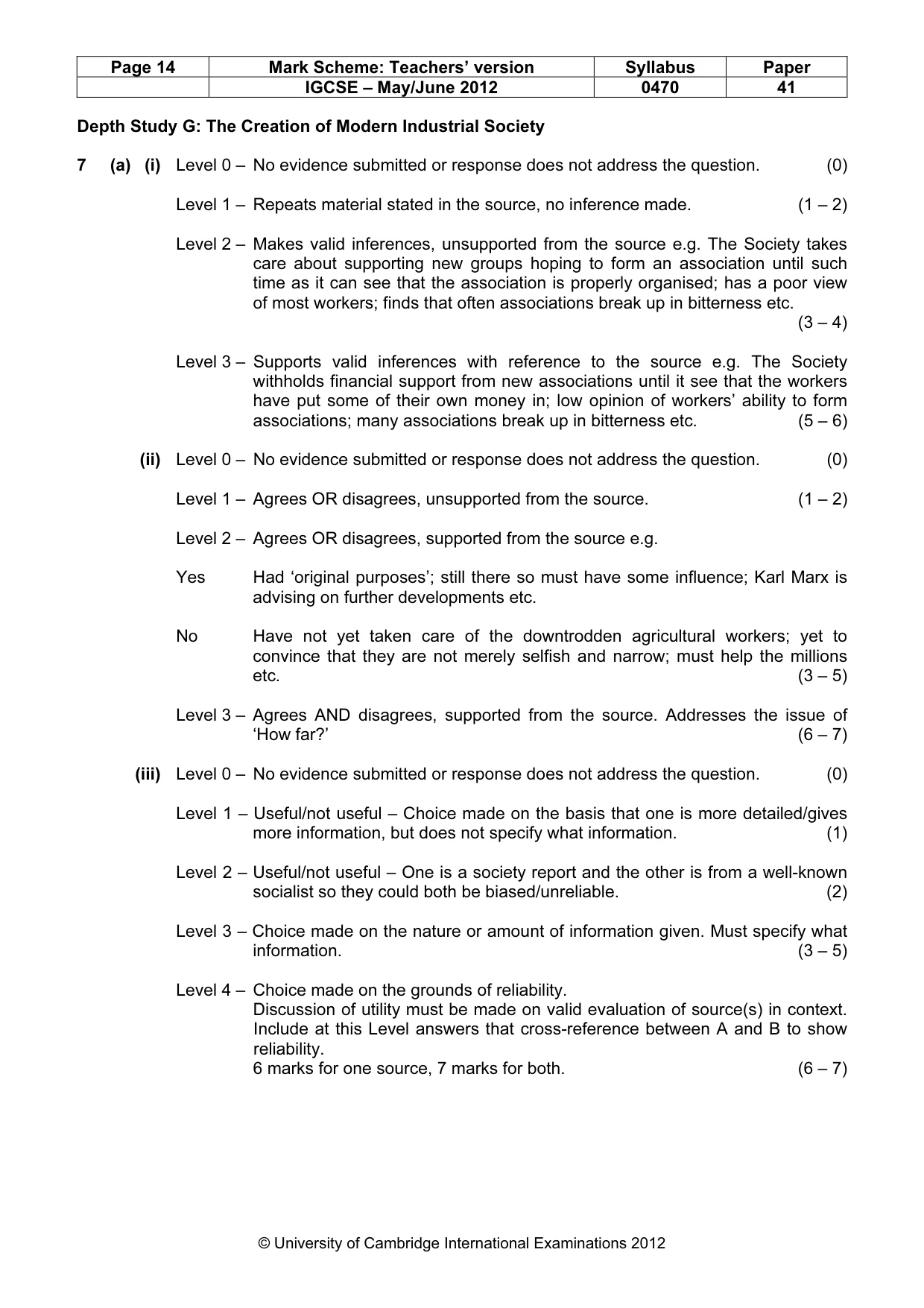
Page 12 Mark Scheme: Teachers’ version Syllabus Paper IGCSE – May/June 2012 0470 41 © University of Cambridge International Examinations 2012 Depth Study F: Israelis and Palestinians, 1945–c.1994 6 (a) (i) Level 0 – No evidence submitted or response does not address the question. (0) Level 1 – Repeats material stated in the source, no inference made. (1 – 2) Level 2 – Makes valid inferences, unsupported from the source e.g. Ordinary Jews and Arabs can work together; the situation has thrown up strange anomalies etc. ` (3 – 4) Level 3 – Supports valid inferences with reference to the source e.g. Jews and Arabs are protesting together and understanding their anomalous statuses; the messages on the protest boards are co-ordinated, showing that they disapprove of individual countries stances; some see that there are winners and losers etc. (5 – 6) (ii) Level 0 – No evidence submitted or response does not address the question. (0) Level 1 – Agrees OR disagrees, unsupported from the source. (1 – 2) Level 2 – Agrees OR disagrees, supported from the source e.g. Yes Campaign of terror by Zionist groups; violence between Arabs and Jews; Zionists and Arabs refuse to attend talks etc. No British troops are fighting to re-establish order; attempting to arrange peace talks in an effort to maintain order and the British mandate in Palestine etc. (3 – 5) Level 3 – Agrees AND disagrees, supported from the source. Addresses the issue of ‘How far?’ (6 – 7) (iii) Level 0 – No evidence submitted or response does not address the question. (0) Level 1 – Useful/not useful – Choice made on the basis that one is more detailed/gives more information, but does not specify what information. (1) Level 2 – Useful/not useful – One source is a photo, and the other is from a British history book so they could both be biased/unreliable. (2) Level 3 – Choice made on the nature or amount of information given. Must specify what information. (3 – 5) Level 4 – Choice made on the grounds of reliability. Discussion of utility must be made on valid evaluation of source(s) in context. Include at this Level answers that cross-reference between A and B to show reliability. 6 marks for one source, 7 for both. (6 – 7) (b) (i) Level 0 – No evidence submitted or response does not address the question. (0) Level 1 – One mark for each valid country to a maximum of two e.g. Egypt, Lebanon, Iraq, Transjordan (accept Jordan), and Syria. (1 – 2)
Mark scheme, page 13
Page 13 Mark Scheme: Teachers’ version Syllabus Paper IGCSE – May/June 2012 0470 41 © University of Cambridge International Examinations 2012 (ii) Level 0 – No evidence submitted or response does not address the question. (0) Level 1 – Identifies activities e.g. Both were Zionist terror groups. (1 – 2) Level 2 – Develops activities e.g. Terrorist groups that fought both the British army and Arab fighters; determined to protect the interests of the Jews in Palestine; Irgun blew up British military HQ in the King David hotel killing 88 people on 22 July 1946 etc. (2 – 4) (iii) Level 0 – No evidence submitted or response does not address the question. (0) Level 1 – Single reason. One for the reason, one for the explanation. (1 – 2) Level 2 – Multiple reasons. One for each reason, one for each reason explained e.g. Absolute determination of the Jews to establish their homeland; disunity among Arab states; all had different agendas; worldwide sympathy for the Jews after revelations of the holocaust; Jews were better led; immediate recognition of the state of Israel by President Truman; financial aid from abroad etc. (2 – 6) (iv) Level 0 – No evidence submitted or response does not address the question. (0) Level 1 – Simple assertions. Yes, the Jews fought to stay. (1) Level 2 – Explanation of events in Palestine OR events elsewhere, single factor given e.g. Pal Immigration over years had established a Jewish population which was now determined to establish and fight for a homeland after 2000 years of displacement; the Palestinian Arabs and Arab armies not united in focus, aims or strategy; leadership of the Israeli forces superior etc. Else Huge sympathy in the world after Holocaust revelations; world embarrassment on this issue; support for the state from USA; President Truman and the US Jewish lobby; financial and military exhaustion of Britain to maintain its mandate etc. (2) Level 3 – Explanation of events in Palestine OR events elsewhere with multiple factors. Allow single factors with multiple reasons. OR Undeveloped assertions on BOTH sides of the argument (annotate BBB – Balanced but Brief). (3 – 5) Level 4 – Answers that offer a balanced argument. BOTH sides of events in Palestine AND events elsewhere must be addressed. (6 – 8)
Mark scheme, page 14
Page 14 Mark Scheme: Teachers’ version Syllabus Paper IGCSE – May/June 2012 0470 41 © University of Cambridge International Examinations 2012 Depth Study G: The Creation of Modern Industrial Society 7 (a) (i) Level 0 – No evidence submitted or response does not address the question. (0) Level 1 – Repeats material stated in the source, no inference made. (1 – 2) Level 2 – Makes valid inferences, unsupported from the source e.g. The Society takes care about supporting new groups hoping to form an association until such time as it can see that the association is properly organised; has a poor view of most workers; finds that often associations break up in bitterness etc. (3 – 4) Level 3 – Supports valid inferences with reference to the source e.g. The Society withholds financial support from new associations until it see that the workers have put some of their own money in; low opinion of workers’ ability to form associations; many associations break up in bitterness etc. (5 – 6) (ii) Level 0 – No evidence submitted or response does not address the question. (0) Level 1 – Agrees OR disagrees, unsupported from the source. (1 – 2) Level 2 – Agrees OR disagrees, supported from the source e.g. Yes Had ‘original purposes’; still there so must have some influence; Karl Marx is advising on further developments etc. No Have not yet taken care of the downtrodden agricultural workers; yet to convince that they are not merely selfish and narrow; must help the millions etc. (3 – 5) Level 3 – Agrees AND disagrees, supported from the source. Addresses the issue of ‘How far?’ (6 – 7) (iii) Level 0 – No evidence submitted or response does not address the question. (0) Level 1 – Useful/not useful – Choice made on the basis that one is more detailed/gives more information, but does not specify what information. (1) Level 2 – Useful/not useful – One is a society report and the other is from a well-known socialist so they could both be biased/unreliable. (2) Level 3 – Choice made on the nature or amount of information given. Must specify what information. (3 – 5) Level 4 – Choice made on the grounds of reliability. Discussion of utility must be made on valid evaluation of source(s) in context. Include at this Level answers that cross-reference between A and B to show reliability. 6 marks for one source, 7 marks for both. (6 – 7)
Mark scheme, page 15
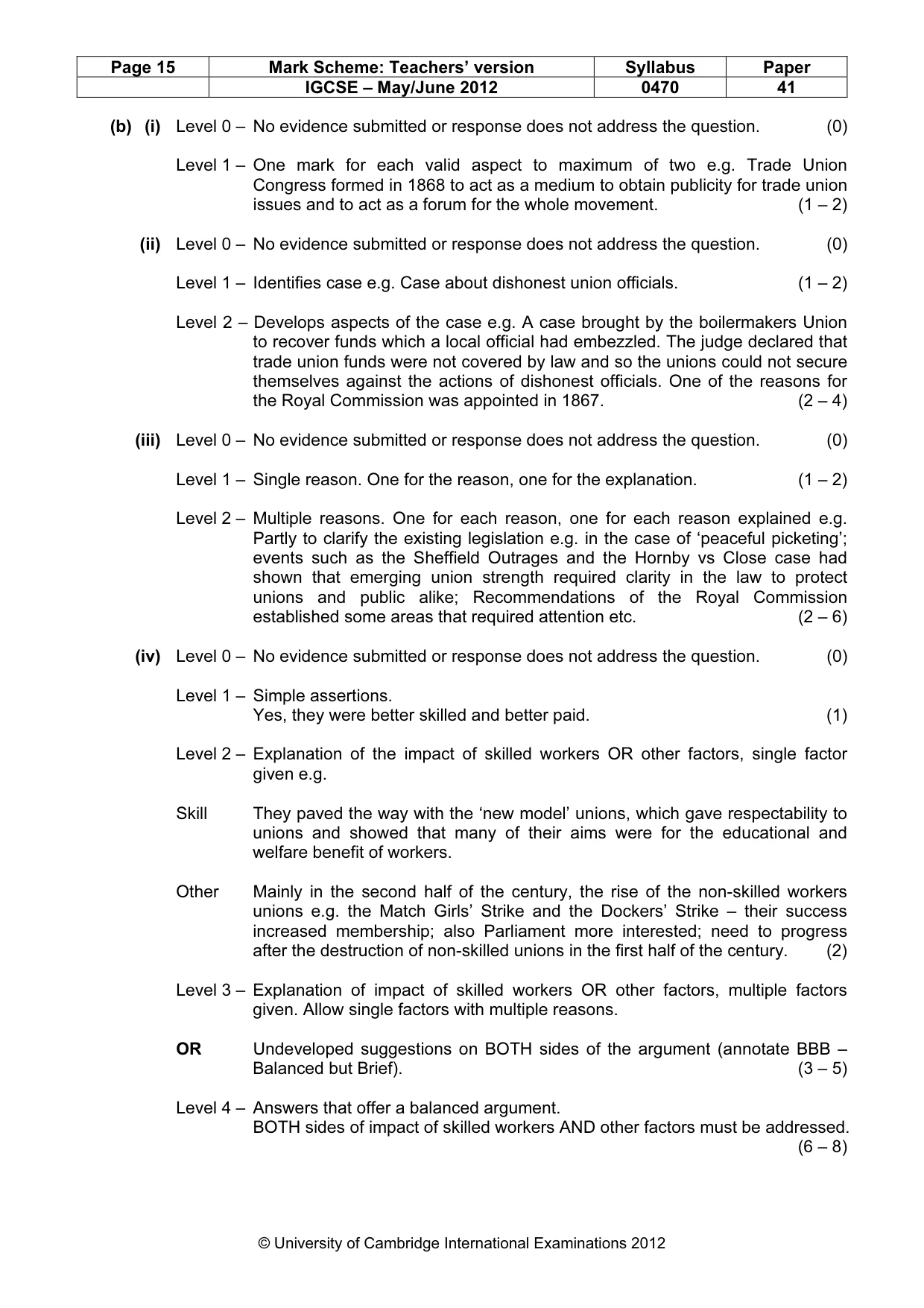
Page 15 Mark Scheme: Teachers’ version Syllabus Paper IGCSE – May/June 2012 0470 41 © University of Cambridge International Examinations 2012 (b) (i) Level 0 – No evidence submitted or response does not address the question. (0) Level 1 – One mark for each valid aspect to maximum of two e.g. Trade Union Congress formed in 1868 to act as a medium to obtain publicity for trade union issues and to act as a forum for the whole movement. (1 – 2) (ii) Level 0 – No evidence submitted or response does not address the question. (0) Level 1 – Identifies case e.g. Case about dishonest union officials. (1 – 2) Level 2 – Develops aspects of the case e.g. A case brought by the boilermakers Union to recover funds which a local official had embezzled. The judge declared that trade union funds were not covered by law and so the unions could not secure themselves against the actions of dishonest officials. One of the reasons for the Royal Commission was appointed in 1867. (2 – 4) (iii) Level 0 – No evidence submitted or response does not address the question. (0) Level 1 – Single reason. One for the reason, one for the explanation. (1 – 2) Level 2 – Multiple reasons. One for each reason, one for each reason explained e.g. Partly to clarify the existing legislation e.g. in the case of ‘peaceful picketing’; events such as the Sheffield Outrages and the Hornby vs Close case had shown that emerging union strength required clarity in the law to protect unions and public alike; Recommendations of the Royal Commission established some areas that required attention etc. (2 – 6) (iv) Level 0 – No evidence submitted or response does not address the question. (0) Level 1 – Simple assertions. Yes, they were better skilled and better paid. (1) Level 2 – Explanation of the impact of skilled workers OR other factors, single factor given e.g. Skill They paved the way with the ‘new model’ unions, which gave respectability to unions and showed that many of their aims were for the educational and welfare benefit of workers. Other Mainly in the second half of the century, the rise of the non-skilled workers unions e.g. the Match Girls’ Strike and the Dockers’ Strike – their success increased membership; also Parliament more interested; need to progress after the destruction of non-skilled unions in the first half of the century. (2) Level 3 – Explanation of impact of skilled workers OR other factors, multiple factors given. Allow single factors with multiple reasons. OR Undeveloped suggestions on BOTH sides of the argument (annotate BBB – Balanced but Brief). (3 – 5) Level 4 – Answers that offer a balanced argument. BOTH sides of impact of skilled workers AND other factors must be addressed. (6 – 8)
Mark scheme, page 16
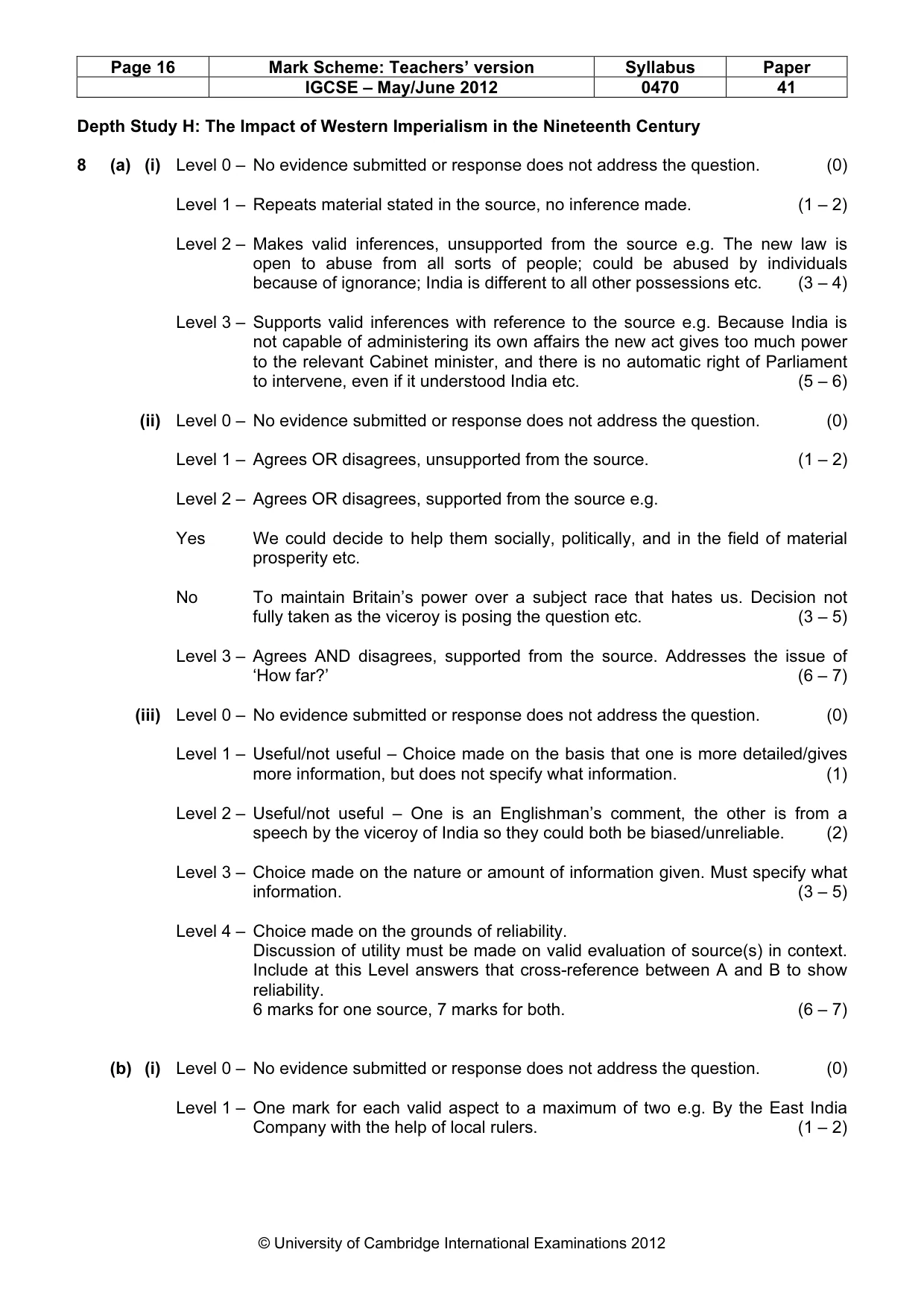
Page 16 Mark Scheme: Teachers’ version Syllabus Paper IGCSE – May/June 2012 0470 41 © University of Cambridge International Examinations 2012 Depth Study H: The Impact of Western Imperialism in the Nineteenth Century 8 (a) (i) Level 0 – No evidence submitted or response does not address the question. (0) Level 1 – Repeats material stated in the source, no inference made. (1 – 2) Level 2 – Makes valid inferences, unsupported from the source e.g. The new law is open to abuse from all sorts of people; could be abused by individuals because of ignorance; India is different to all other possessions etc. (3 – 4) Level 3 – Supports valid inferences with reference to the source e.g. Because India is not capable of administering its own affairs the new act gives too much power to the relevant Cabinet minister, and there is no automatic right of Parliament to intervene, even if it understood India etc. (5 – 6) (ii) Level 0 – No evidence submitted or response does not address the question. (0) Level 1 – Agrees OR disagrees, unsupported from the source. (1 – 2) Level 2 – Agrees OR disagrees, supported from the source e.g. Yes We could decide to help them socially, politically, and in the field of material prosperity etc. No To maintain Britain’s power over a subject race that hates us. Decision not fully taken as the viceroy is posing the question etc. (3 – 5) Level 3 – Agrees AND disagrees, supported from the source. Addresses the issue of ‘How far?’ (6 – 7) (iii) Level 0 – No evidence submitted or response does not address the question. (0) Level 1 – Useful/not useful – Choice made on the basis that one is more detailed/gives more information, but does not specify what information. (1) Level 2 – Useful/not useful – One is an Englishman’s comment, the other is from a speech by the viceroy of India so they could both be biased/unreliable. (2) Level 3 – Choice made on the nature or amount of information given. Must specify what information. (3 – 5) Level 4 – Choice made on the grounds of reliability. Discussion of utility must be made on valid evaluation of source(s) in context. Include at this Level answers that cross-reference between A and B to show reliability. 6 marks for one source, 7 marks for both. (6 – 7) (b) (i) Level 0 – No evidence submitted or response does not address the question. (0) Level 1 – One mark for each valid aspect to a maximum of two e.g. By the East India Company with the help of local rulers. (1 – 2)
Mark scheme, page 17
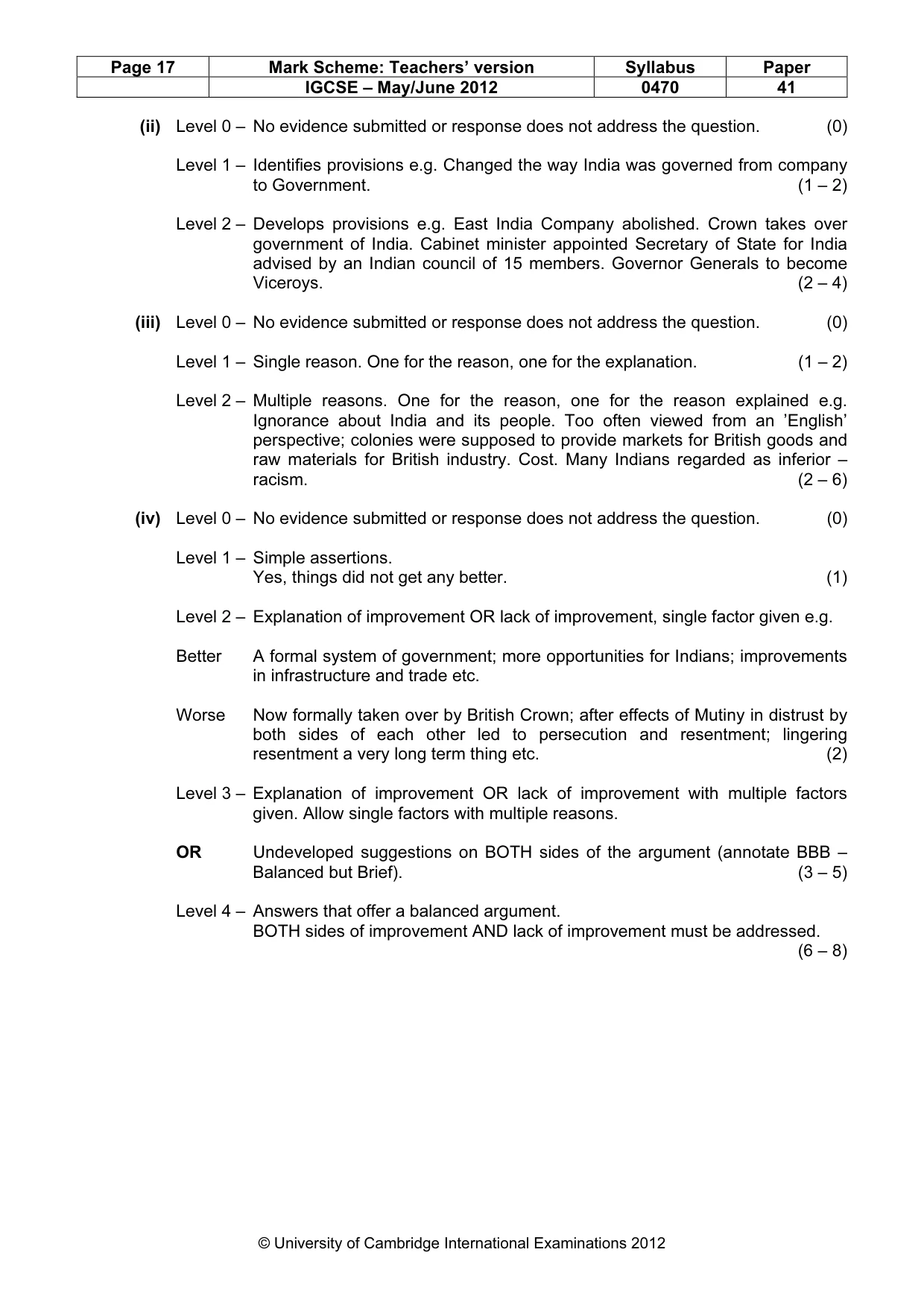
Page 17 Mark Scheme: Teachers’ version Syllabus Paper IGCSE – May/June 2012 0470 41 © University of Cambridge International Examinations 2012 (ii) Level 0 – No evidence submitted or response does not address the question. (0) Level 1 – Identifies provisions e.g. Changed the way India was governed from company to Government. (1 – 2) Level 2 – Develops provisions e.g. East India Company abolished. Crown takes over government of India. Cabinet minister appointed Secretary of State for India advised by an Indian council of 15 members. Governor Generals to become Viceroys. (2 – 4) (iii) Level 0 – No evidence submitted or response does not address the question. (0) Level 1 – Single reason. One for the reason, one for the explanation. (1 – 2) Level 2 – Multiple reasons. One for the reason, one for the reason explained e.g. Ignorance about India and its people. Too often viewed from an ’English’ perspective; colonies were supposed to provide markets for British goods and raw materials for British industry. Cost. Many Indians regarded as inferior – racism. (2 – 6) (iv) Level 0 – No evidence submitted or response does not address the question. (0) Level 1 – Simple assertions. Yes, things did not get any better. (1) Level 2 – Explanation of improvement OR lack of improvement, single factor given e.g. Better A formal system of government; more opportunities for Indians; improvements in infrastructure and trade etc. Worse Now formally taken over by British Crown; after effects of Mutiny in distrust by both sides of each other led to persecution and resentment; lingering resentment a very long term thing etc. (2) Level 3 – Explanation of improvement OR lack of improvement with multiple factors given. Allow single factors with multiple reasons. OR Undeveloped suggestions on BOTH sides of the argument (annotate BBB – Balanced but Brief). (3 – 5) Level 4 – Answers that offer a balanced argument. BOTH sides of improvement AND lack of improvement must be addressed. (6 – 8)
What you needed in this session
Cambridge’s own grade thresholds for 2012 May/June, Paper 4 · Variant 1. A higher threshold means an easier paper — the bar moves with how the cohort did.