Cambridge IGCSE History 0470 — 2011 Oct/Nov Paper 4 · Variant 3
0470/43/O/N/11 · 40 marks · ≈45 min
The question paper and its mark scheme, free to read here and free to download. This is Cambridge’s own paper, exactly as it was sat.
Question paper12 pages
Mark scheme19 pages
Answers below. Sit the paper first if you are practising.
Paper as text
Question paper, page 1
This document consists of 11 printed pages and 1 blank page. DC (SM/DJ) 31898/6 © UCLES 2011 [Turn over UNIVERSITY OF CAMBRIDGE INTERNATIONAL EXAMINATIONS International General Certificate of Secondary Education * 7 4 2 0 3 6 2 0 3 3 * HISTORY 0470/43 Paper 4 Alternative to Coursework October/November 2011 1 hour Additional Materials: Answer Booklet/Paper READ THESE INSTRUCTIONS FIRST If you have been given an Answer Booklet, follow the instructions on the front cover of the Booklet. Write your Centre number, candidate number and name on all the work you hand in. Write in dark blue or black pen. You may use a soft pencil for any diagrams, graphs or rough working. Do not use staples, paper clips, highlighters, glue or correction fluid. Answer the questions on one of the Depth Studies. At the end of the examination, fasten all your work securely together. The number of marks is given in brackets [ ] at the end of each question or part question. www.XtremePapers.com
Question paper, page 2
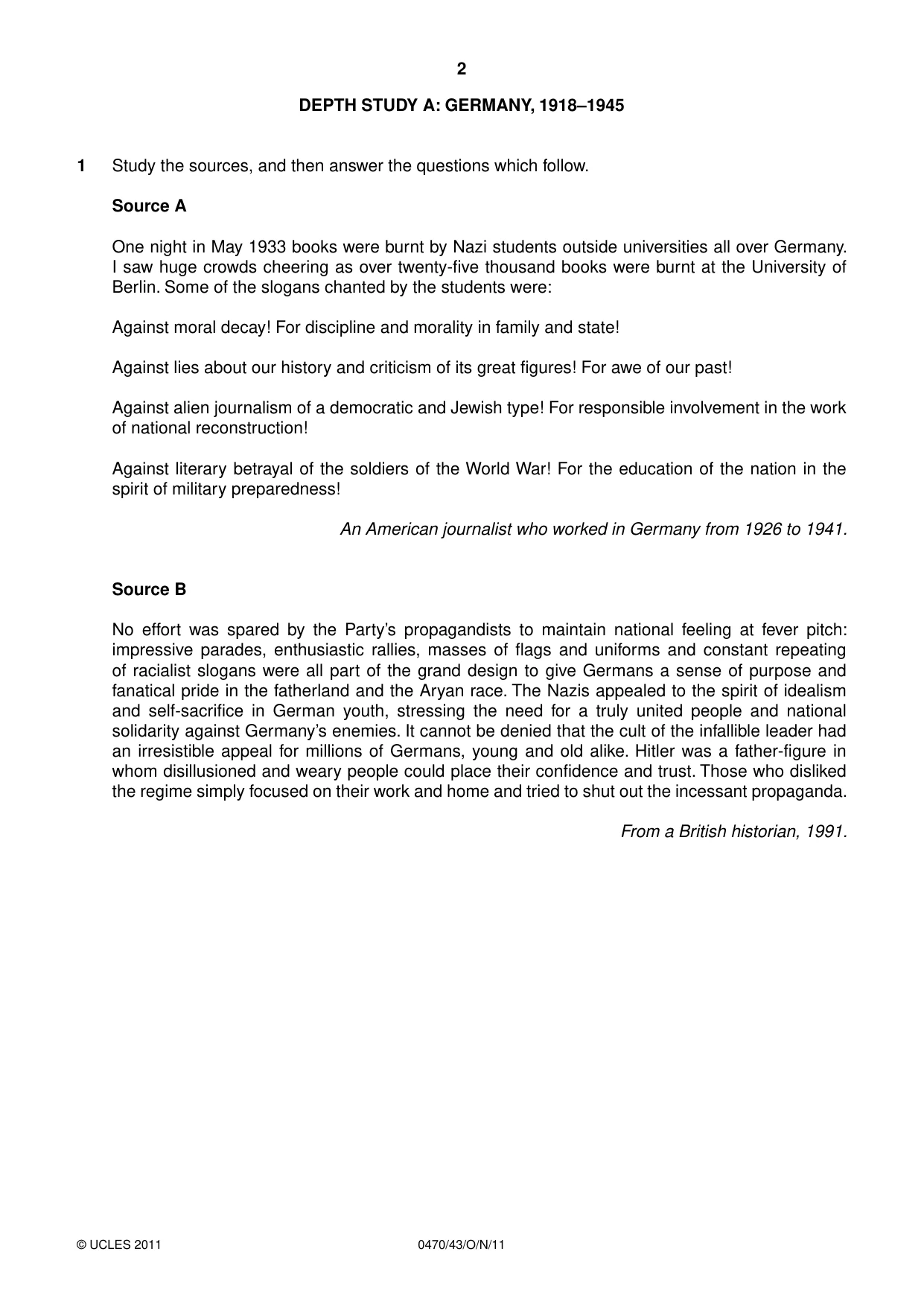
2 0470/43/O/N/11 © UCLES 2011 DEPTH STUDY A: GERMANY, 1918–1945 1 Study the sources, and then answer the questions which follow. Source A One night in May 1933 books were burnt by Nazi students outside universities all over Germany. I saw huge crowds cheering as over twenty-five thousand books were burnt at the University of Berlin. Some of the slogans chanted by the students were: Against moral decay! For discipline and morality in family and state! Against lies about our history and criticism of its great figures! For awe of our past! Against alien journalism of a democratic and Jewish type! For responsible involvement in the work of national reconstruction! Against literary betrayal of the soldiers of the World War! For the education of the nation in the spirit of military preparedness! An American journalist who worked in Germany from 1926 to 1941. Source B No effort was spared by the Party’s propagandists to maintain national feeling at fever pitch: impressive parades, enthusiastic rallies, masses of flags and uniforms and constant repeating of racialist slogans were all part of the grand design to give Germans a sense of purpose and fanatical pride in the fatherland and the Aryan race. The Nazis appealed to the spirit of idealism and self-sacrifice in German youth, stressing the need for a truly united people and national solidarity against Germany’s enemies. It cannot be denied that the cult of the infallible leader had an irresistible appeal for millions of Germans, young and old alike. Hitler was a father-figure in whom disillusioned and weary people could place their confidence and trust. Those who disliked the regime simply focused on their work and home and tried to shut out the incessant propaganda. From a British historian, 1991.
Question paper, page 3
3 0470/43/O/N/11 © UCLES 2011 [Turn over (a) (i) Study Source A. What does this source tell you about Nazi supporters? Support your answer with reference to the source. [6] (ii) Study Source B. How far does this source show that the popularity of the Nazis was created by propaganda? Explain your answer. [7] (iii) Study both sources. Is one of these sources more useful than the other as evidence about the aims of National Socialism? Explain your answer. [7] (b) (i) Name two groups of young people who criticised Nazi Germany. [2] (ii) Describe how the Churches were affected by the Nazi government. [4] (iii) Why did unemployment fall rapidly after 1933? [6] (iv) ‘Goebbels was the most successful Nazi leader between 1933 and 1945.’ How far do you agree with this statement? Explain your answer. [8]
Question paper, page 4
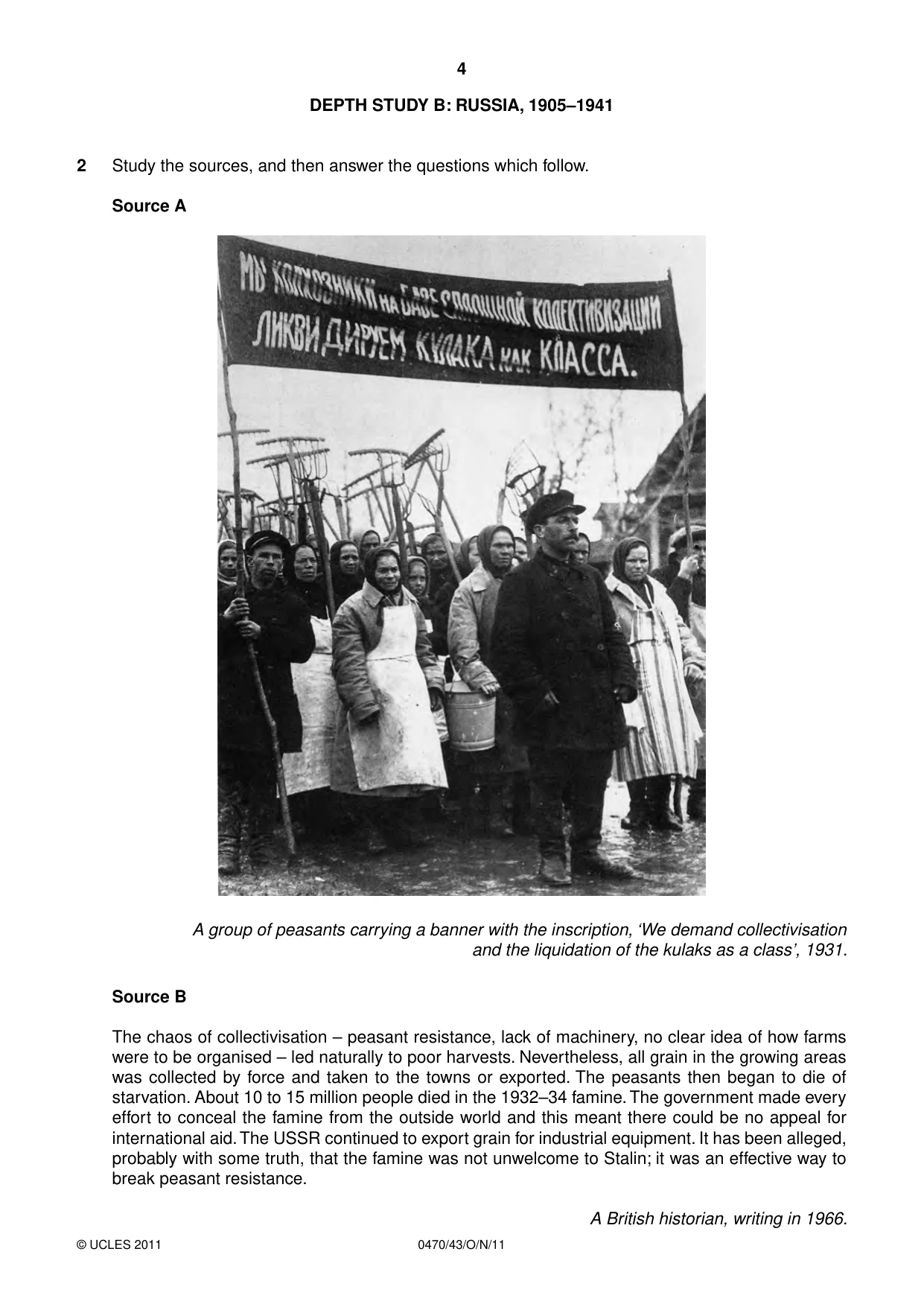
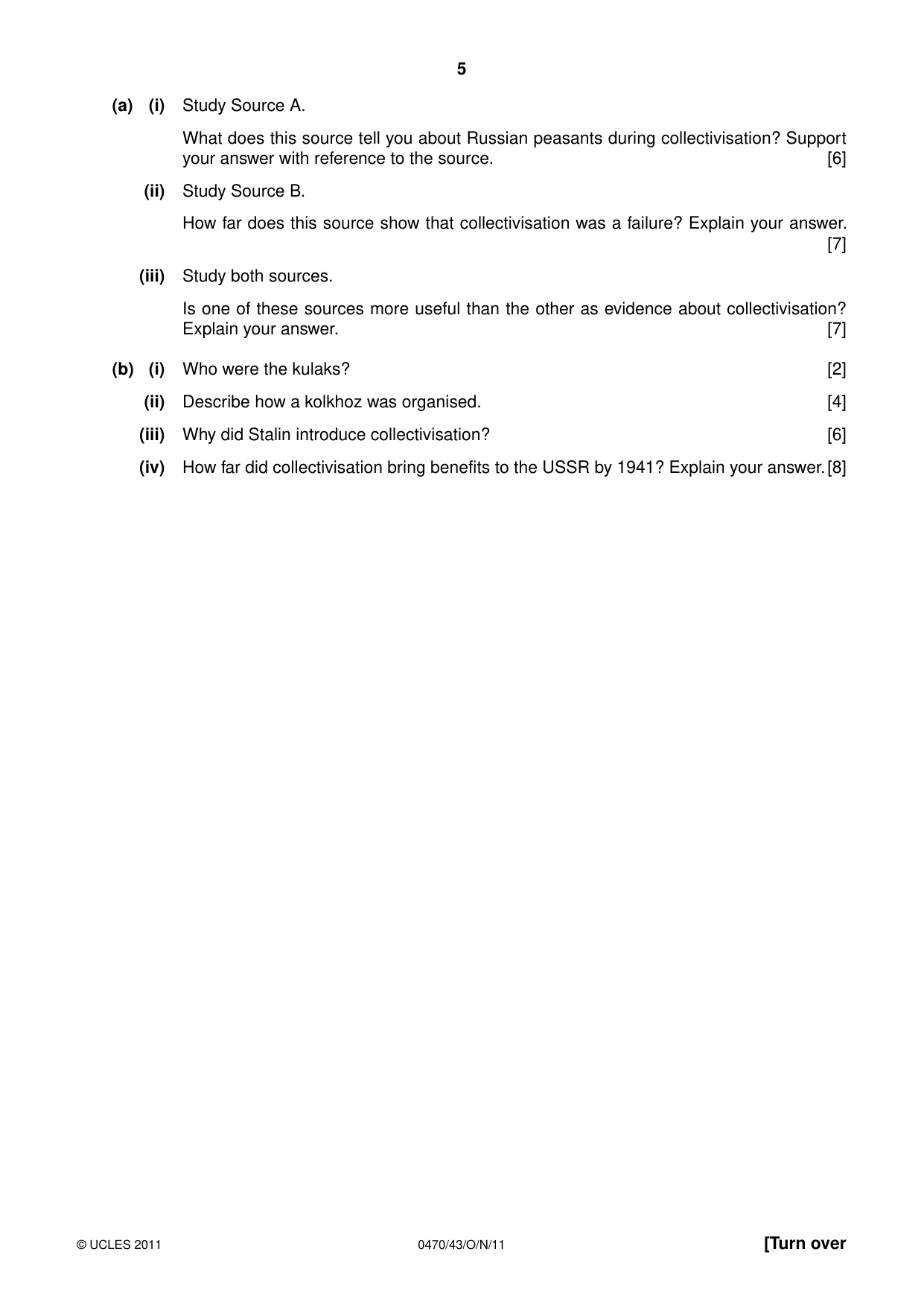
4 0470/43/O/N/11 © UCLES 2011 DEPTH STUDY B: RUSSIA, 1905–1941 2 Study the sources, and then answer the questions which follow. Source A A group of peasants carrying a banner with the inscription, ‘We demand collectivisation and the liquidation of the kulaks as a class’, 1931. Source B The chaos of collectivisation – peasant resistance, lack of machinery, no clear idea of how farms were to be organised – led naturally to poor harvests. Nevertheless, all grain in the growing areas was collected by force and taken to the towns or exported. The peasants then began to die of starvation. About 10 to 15 million people died in the 1932–34 famine. The government made every effort to conceal the famine from the outside world and this meant there could be no appeal for international aid. The USSR continued to export grain for industrial equipment. It has been alleged, probably with some truth, that the famine was not unwelcome to Stalin; it was an effective way to break peasant resistance. A British historian, writing in 1966.
Question paper, page 5
5 0470/43/O/N/11 © UCLES 2011 [Turn over (a) (i) Study Source A. What does this source tell you about Russian peasants during collectivisation? Support your answer with reference to the source. [6] (ii) Study Source B. How far does this source show that collectivisation was a failure? Explain your answer. [7] (iii) Study both sources. Is one of these sources more useful than the other as evidence about collectivisation? Explain your answer. [7] (b) (i) Who were the kulaks? [2] (ii) Describe how a kolkhoz was organised. [4] (iii) Why did Stalin introduce collectivisation? [6] (iv) How far did collectivisation bring benefits to the USSR by 1941? Explain your answer. [8]
Question paper, page 6
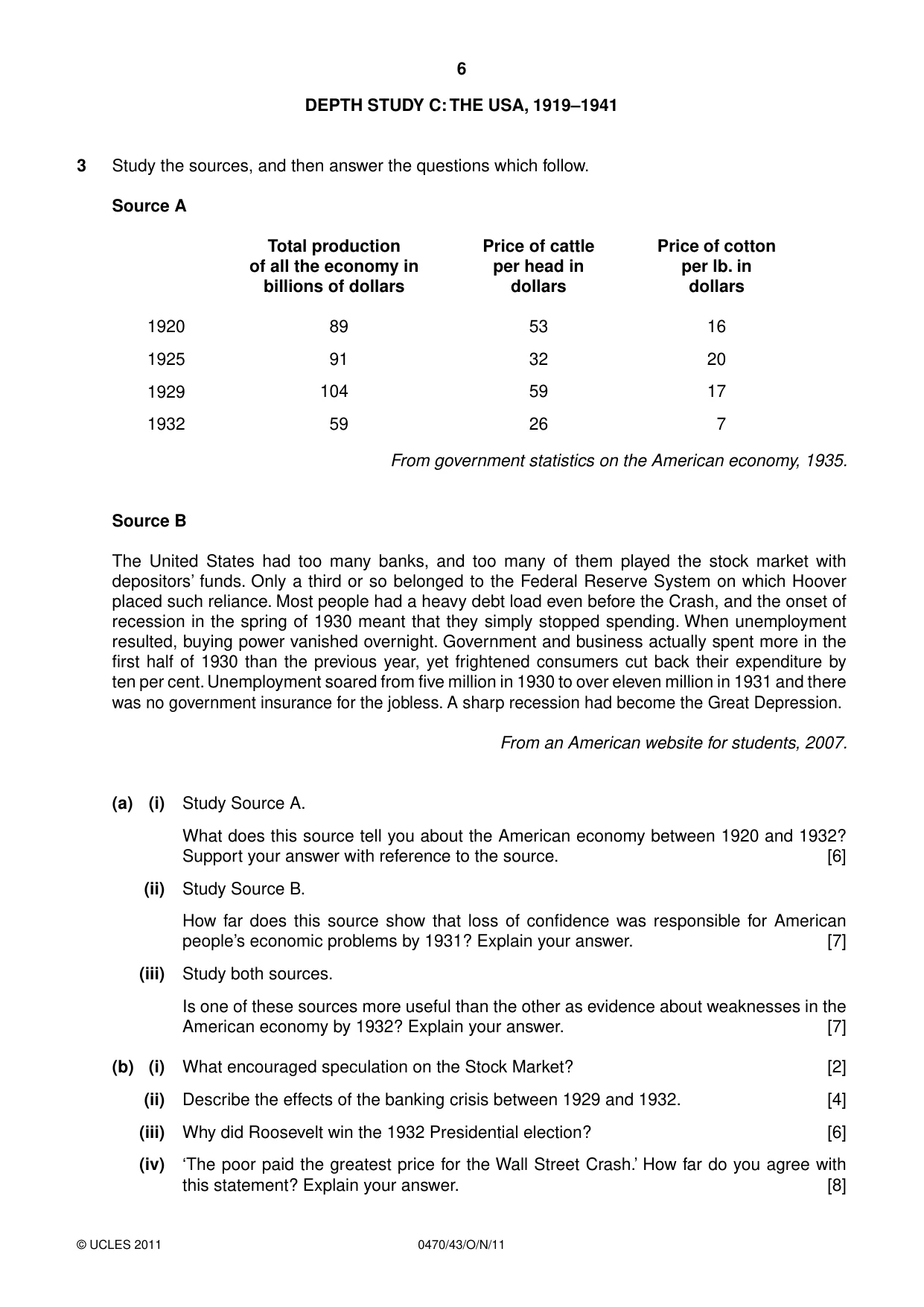
6 0470/43/O/N/11 © UCLES 2011 DEPTH STUDY C: THE USA, 1919–1941 3 Study the sources, and then answer the questions which follow. Source A 1920 1925 1929 1932 Total production of all the economy in billions of dollars 89 91 104 59 Price of cattle per head in dollars 53 32 59 26 Price of cotton per lb. in dollars 16 20 17 7 From government statistics on the American economy, 1935. Source B The United States had too many banks, and too many of them played the stock market with depositors’ funds. Only a third or so belonged to the Federal Reserve System on which Hoover placed such reliance. Most people had a heavy debt load even before the Crash, and the onset of recession in the spring of 1930 meant that they simply stopped spending. When unemployment resulted, buying power vanished overnight. Government and business actually spent more in the first half of 1930 than the previous year, yet frightened consumers cut back their expenditure by ten per cent. Unemployment soared from five million in 1930 to over eleven million in 1931 and there was no government insurance for the jobless. A sharp recession had become the Great Depression. From an American website for students, 2007. (a) (i) Study Source A. What does this source tell you about the American economy between 1920 and 1932? Support your answer with reference to the source. [6] (ii) Study Source B. How far does this source show that loss of confidence was responsible for American people’s economic problems by 1931? Explain your answer. [7] (iii) Study both sources. Is one of these sources more useful than the other as evidence about weaknesses in the American economy by 1932? Explain your answer. [7] (b) (i) What encouraged speculation on the Stock Market? [2] (ii) Describe the effects of the banking crisis between 1929 and 1932. [4] (iii) Why did Roosevelt win the 1932 Presidential election? [6] (iv) ‘The poor paid the greatest price for the Wall Street Crash.’ How far do you agree with this statement? Explain your answer. [8]
Question paper, page 7
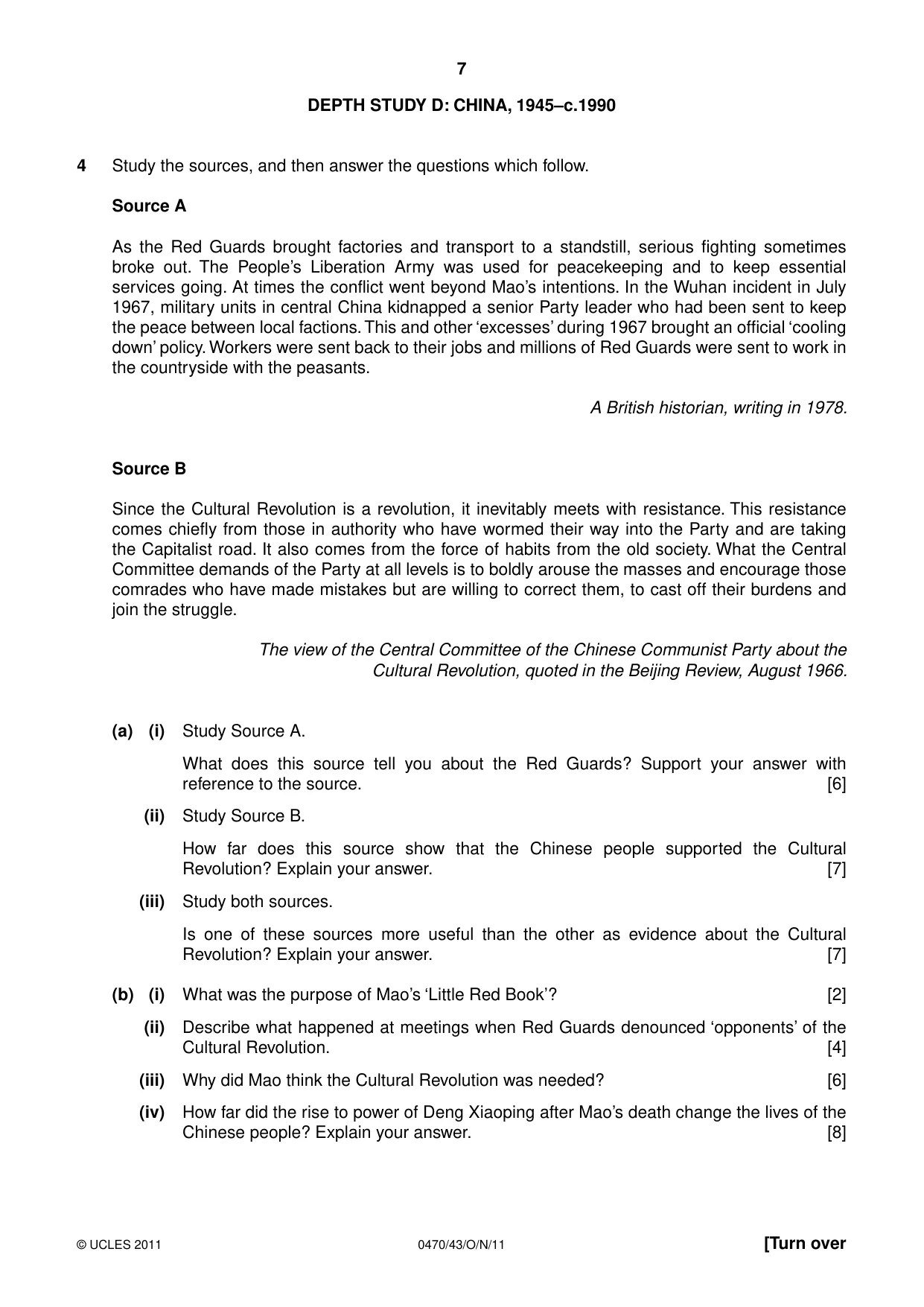
7 0470/43/O/N/11 © UCLES 2011 [Turn over DEPTH STUDY D: CHINA, 1945–c.1990 4 Study the sources, and then answer the questions which follow. Source A As the Red Guards brought factories and transport to a standstill, serious fighting sometimes broke out. The People’s Liberation Army was used for peacekeeping and to keep essential services going. At times the conflict went beyond Mao’s intentions. In the Wuhan incident in July 1967, military units in central China kidnapped a senior Party leader who had been sent to keep the peace between local factions. This and other ‘excesses’ during 1967 brought an official ‘cooling down’ policy. Workers were sent back to their jobs and millions of Red Guards were sent to work in the countryside with the peasants. A British historian, writing in 1978. Source B Since the Cultural Revolution is a revolution, it inevitably meets with resistance. This resistance comes chiefly from those in authority who have wormed their way into the Party and are taking the Capitalist road. It also comes from the force of habits from the old society. What the Central Committee demands of the Party at all levels is to boldly arouse the masses and encourage those comrades who have made mistakes but are willing to correct them, to cast off their burdens and join the struggle. The view of the Central Committee of the Chinese Communist Party about the Cultural Revolution, quoted in the Beijing Review, August 1966. (a) (i) Study Source A. What does this source tell you about the Red Guards? Support your answer with reference to the source. [6] (ii) Study Source B. How far does this source show that the Chinese people supported the Cultural Revolution? Explain your answer. [7] (iii) Study both sources. Is one of these sources more useful than the other as evidence about the Cultural Revolution? Explain your answer. [7] (b) (i) What was the purpose of Mao’s ‘Little Red Book’? [2] (ii) Describe what happened at meetings when Red Guards denounced ‘opponents’ of the Cultural Revolution. [4] (iii) Why did Mao think the Cultural Revolution was needed? [6] (iv) How far did the rise to power of Deng Xiaoping after Mao’s death change the lives of the Chinese people? Explain your answer. [8]
Question paper, page 8
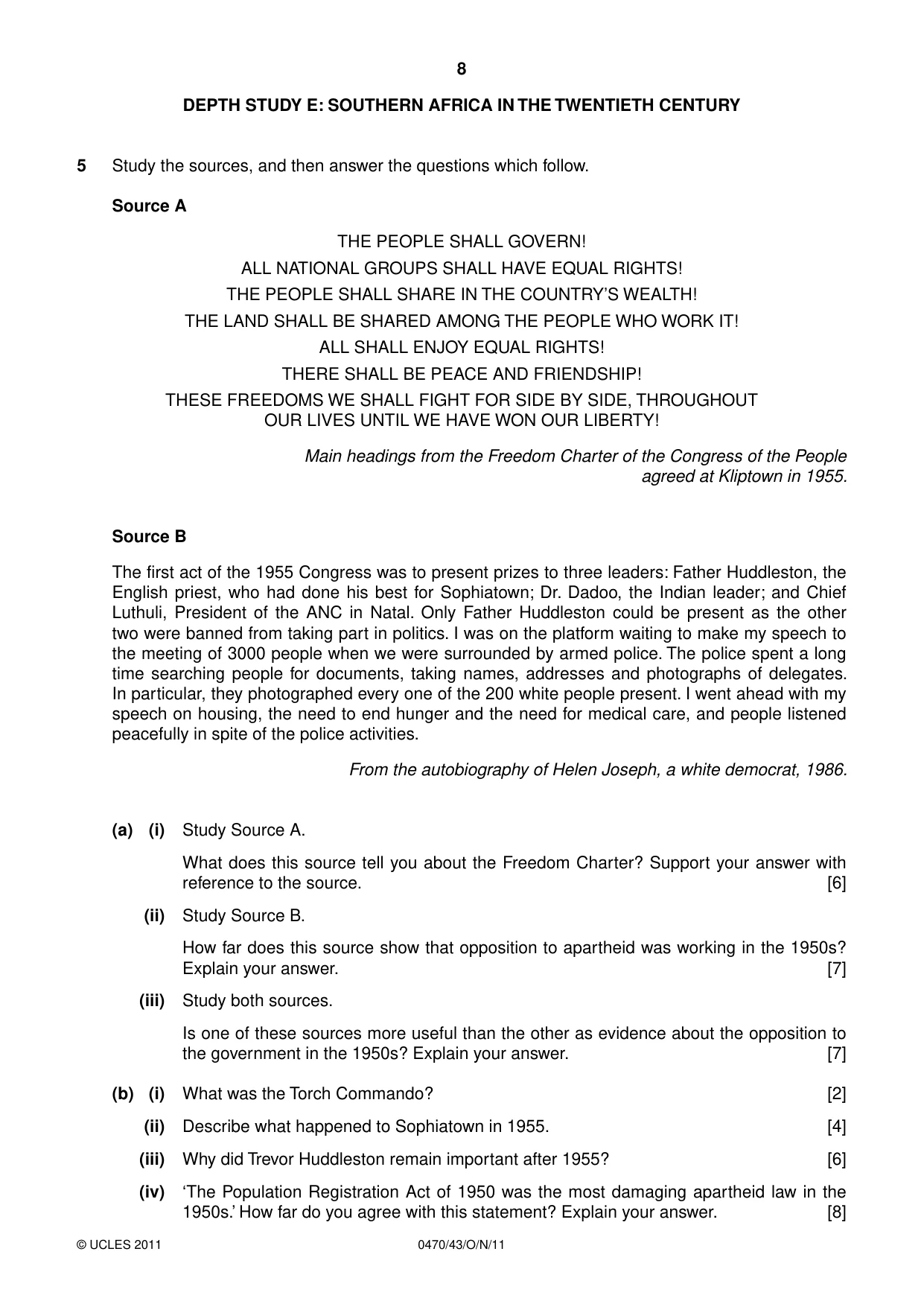
8 0470/43/O/N/11 © UCLES 2011 DEPTH STUDY E: SOUTHERN AFRICA IN THE TWENTIETH CENTURY 5 Study the sources, and then answer the questions which follow. Source A THE PEOPLE SHALL GOVERN! ALL NATIONAL GROUPS SHALL HAVE EQUAL RIGHTS! THE PEOPLE SHALL SHARE IN THE COUNTRY’S WEALTH! THE LAND SHALL BE SHARED AMONG THE PEOPLE WHO WORK IT! ALL SHALL ENJOY EQUAL RIGHTS! THERE SHALL BE PEACE AND FRIENDSHIP! THESE FREEDOMS WE SHALL FIGHT FOR SIDE BY SIDE, THROUGHOUT OUR LIVES UNTIL WE HAVE WON OUR LIBERTY! Main headings from the Freedom Charter of the Congress of the People agreed at Kliptown in 1955. Source B The first act of the 1955 Congress was to present prizes to three leaders: Father Huddleston, the English priest, who had done his best for Sophiatown; Dr. Dadoo, the Indian leader; and Chief Luthuli, President of the ANC in Natal. Only Father Huddleston could be present as the other two were banned from taking part in politics. I was on the platform waiting to make my speech to the meeting of 3000 people when we were surrounded by armed police. The police spent a long time searching people for documents, taking names, addresses and photographs of delegates. In particular, they photographed every one of the 200 white people present. I went ahead with my speech on housing, the need to end hunger and the need for medical care, and people listened peacefully in spite of the police activities. From the autobiography of Helen Joseph, a white democrat, 1986. (a) (i) Study Source A. What does this source tell you about the Freedom Charter? Support your answer with reference to the source. [6] (ii) Study Source B. How far does this source show that opposition to apartheid was working in the 1950s? Explain your answer. [7] (iii) Study both sources. Is one of these sources more useful than the other as evidence about the opposition to the government in the 1950s? Explain your answer. [7] (b) (i) What was the Torch Commando? [2] (ii) Describe what happened to Sophiatown in 1955. [4] (iii) Why did Trevor Huddleston remain important after 1955? [6] (iv) ‘The Population Registration Act of 1950 was the most damaging apartheid law in the 1950s.’ How far do you agree with this statement? Explain your answer. [8]
Question paper, page 9
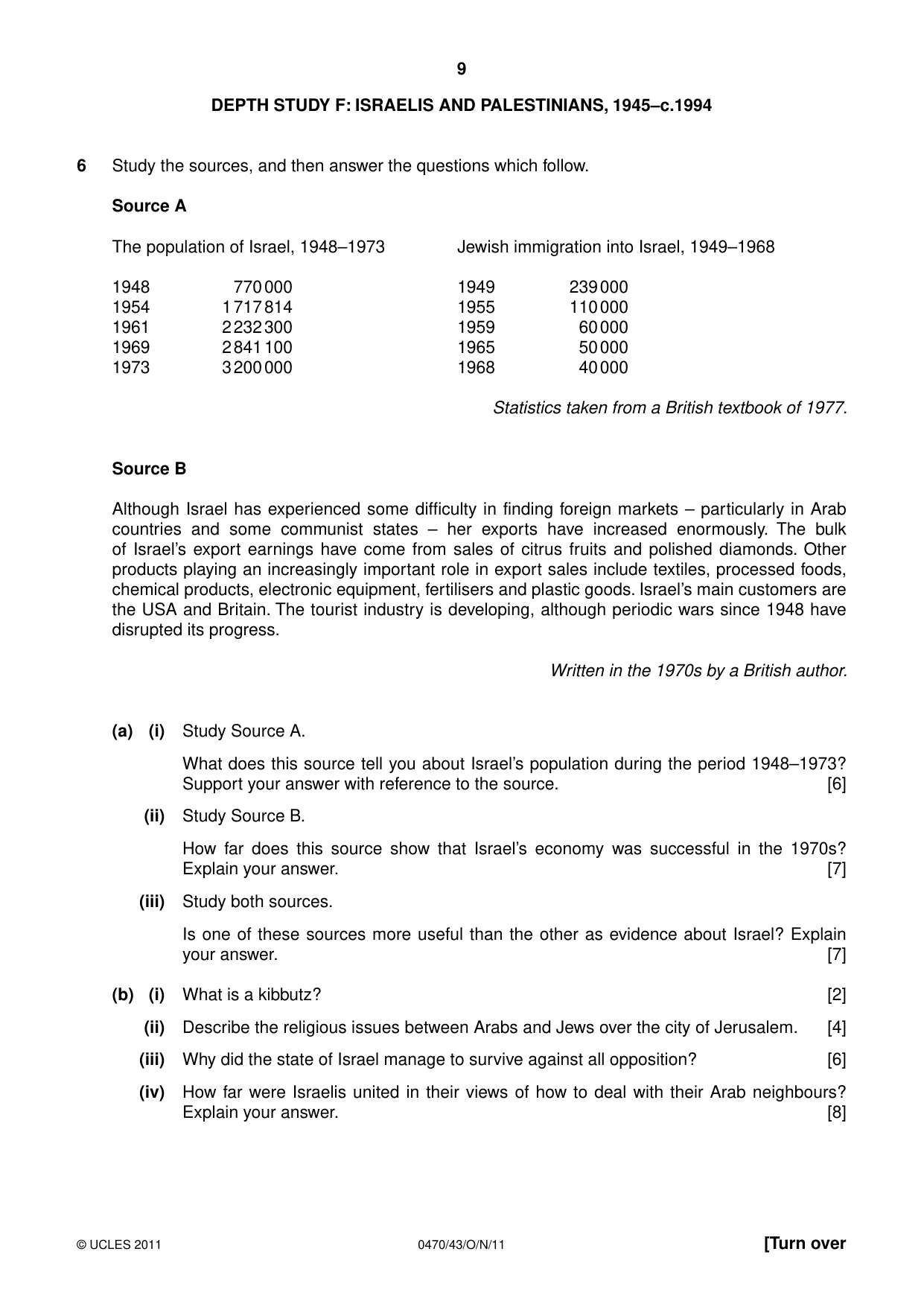
9 0470/43/O/N/11 © UCLES 2011 [Turn over DEPTH STUDY F: ISRAELIS AND PALESTINIANS, 1945–c.1994 6 Study the sources, and then answer the questions which follow. Source A The population of Israel, 1948–1973 Jewish immigration into Israel, 1949–1968 1948 770 000 1949 239 000 1954 1 717 814 1955 110 000 1961 2 232 300 1959 60 000 1969 2 841 100 1965 50 000 1973 3 200 000 1968 40 000 Statistics taken from a British textbook of 1977. Source B Although Israel has experienced some difficulty in finding foreign markets – particularly in Arab countries and some communist states – her exports have increased enormously. The bulk of Israel’s export earnings have come from sales of citrus fruits and polished diamonds. Other products playing an increasingly important role in export sales include textiles, processed foods, chemical products, electronic equipment, fertilisers and plastic goods. Israel’s main customers are the USA and Britain. The tourist industry is developing, although periodic wars since 1948 have disrupted its progress. Written in the 1970s by a British author. (a) (i) Study Source A. What does this source tell you about Israel’s population during the period 1948–1973? Support your answer with reference to the source. [6] (ii) Study Source B. How far does this source show that Israel’s economy was successful in the 1970s? Explain your answer. [7] (iii) Study both sources. Is one of these sources more useful than the other as evidence about Israel? Explain your answer. [7] (b) (i) What is a kibbutz? [2] (ii) Describe the religious issues between Arabs and Jews over the city of Jerusalem. [4] (iii) Why did the state of Israel manage to survive against all opposition? [6] (iv) How far were Israelis united in their views of how to deal with their Arab neighbours? Explain your answer. [8]
Question paper, page 10
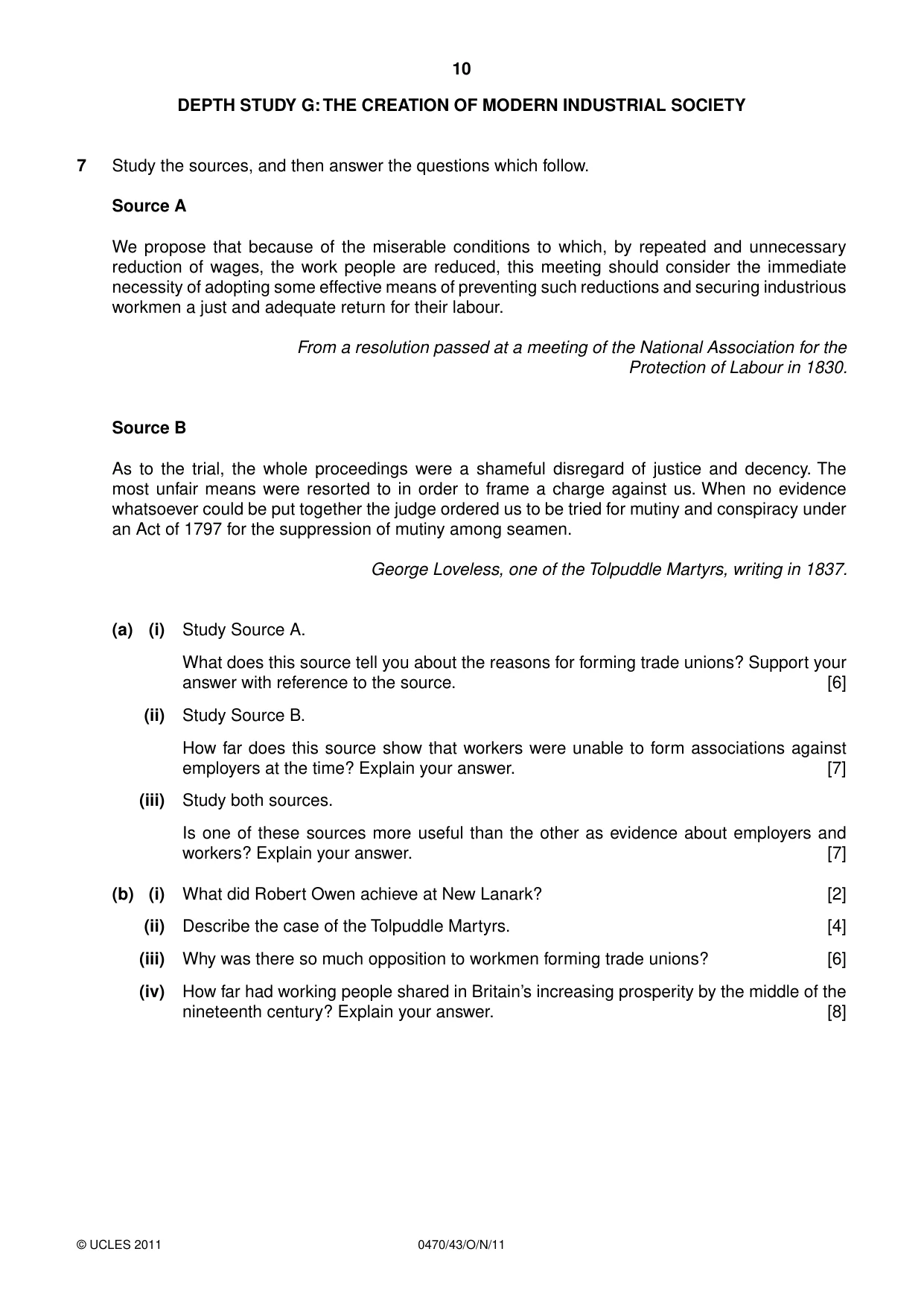
10 0470/43/O/N/11 © UCLES 2011 DEPTH STUDY G: THE CREATION OF MODERN INDUSTRIAL SOCIETY 7 Study the sources, and then answer the questions which follow. Source A We propose that because of the miserable conditions to which, by repeated and unnecessary reduction of wages, the work people are reduced, this meeting should consider the immediate necessity of adopting some effective means of preventing such reductions and securing industrious workmen a just and adequate return for their labour. From a resolution passed at a meeting of the National Association for the Protection of Labour in 1830. Source B As to the trial, the whole proceedings were a shameful disregard of justice and decency. The most unfair means were resorted to in order to frame a charge against us. When no evidence whatsoever could be put together the judge ordered us to be tried for mutiny and conspiracy under an Act of 1797 for the suppression of mutiny among seamen. George Loveless, one of the Tolpuddle Martyrs, writing in 1837. (a) (i) Study Source A. What does this source tell you about the reasons for forming trade unions? Support your answer with reference to the source. [6] (ii) Study Source B. How far does this source show that workers were unable to form associations against employers at the time? Explain your answer. [7] (iii) Study both sources. Is one of these sources more useful than the other as evidence about employers and workers? Explain your answer. [7] (b) (i) What did Robert Owen achieve at New Lanark? [2] (ii) Describe the case of the Tolpuddle Martyrs. [4] (iii) Why was there so much opposition to workmen forming trade unions? [6] (iv) How far had working people shared in Britain’s increasing prosperity by the middle of the nineteenth century? Explain your answer. [8]
Question paper, page 11
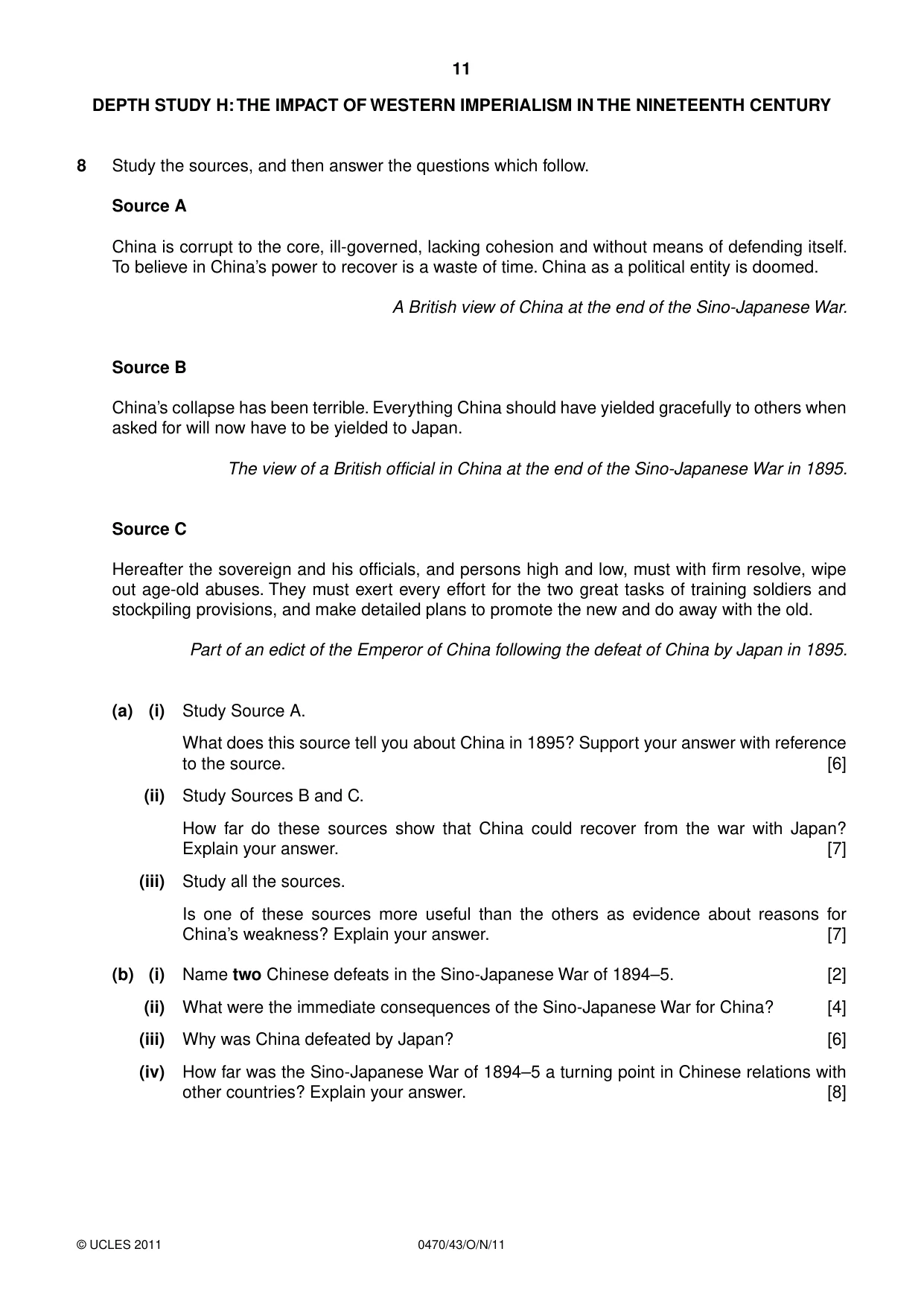
11 0470/43/O/N/11 © UCLES 2011 DEPTH STUDY H: THE IMPACT OF WESTERN IMPERIALISM IN THE NINETEENTH CENTURY 8 Study the sources, and then answer the questions which follow. Source A China is corrupt to the core, ill-governed, lacking cohesion and without means of defending itself. To believe in China’s power to recover is a waste of time. China as a political entity is doomed. A British view of China at the end of the Sino-Japanese War. Source B China’s collapse has been terrible. Everything China should have yielded gracefully to others when asked for will now have to be yielded to Japan. The view of a British official in China at the end of the Sino-Japanese War in 1895. Source C Hereafter the sovereign and his officials, and persons high and low, must with firm resolve, wipe out age-old abuses. They must exert every effort for the two great tasks of training soldiers and stockpiling provisions, and make detailed plans to promote the new and do away with the old. Part of an edict of the Emperor of China following the defeat of China by Japan in 1895. (a) (i) Study Source A. What does this source tell you about China in 1895? Support your answer with reference to the source. [6] (ii) Study Sources B and C. How far do these sources show that China could recover from the war with Japan? Explain your answer. [7] (iii) Study all the sources. Is one of these sources more useful than the others as evidence about reasons for China’s weakness? Explain your answer. [7] (b) (i) Name two Chinese defeats in the Sino-Japanese War of 1894–5. [2] (ii) What were the immediate consequences of the Sino-Japanese War for China? [4] (iii) Why was China defeated by Japan? [6] (iv) How far was the Sino-Japanese War of 1894–5 a turning point in Chinese relations with other countries? Explain your answer. [8]
Question paper, page 12
12 0470/43/O/N/11 © UCLES 2011 BLANK PAGE Copyright Acknowledgements: Depth Study A Source B © William Carr; A History of Germany 1815–1985 ; Edward Arnold, division of Hodder and Stoughton; 1991. Depth Study B Source A © Clare Baker; Russia 1917–1945 ; Heinemann Educational; 1990. Depth Study B Source B © Harriet Ward; World Powers in The Twentieth Century ; Heinemann Educational; 1978. Depth Study D Source A © Harriet Ward; World Powers in The Twentieth Century ; Heinemann Educational; 1978. Depth Study D Source B © Norman Lowe; Mastering Modern World History ; Macmillan Press Ltd; 1982. Depth Study E Source B © Helen Joseph; Side by Side ; Zed Books Ltd; 1986. Depth Study F Sources A & B © Schools Council History 13–16 Project; Arab-Israeli Conflict ; Holmes McDougall; 1977. Depth Study G Sources A & B © J L and B Hammond; The Town Labourer ; Longmans, Green & Co Ltd; 1966. Depth Study H Source A © www.src-h.slav.hokudai.ac.JP/eng/news/. Depth Study H Sources B & C © J Fenby; History & Modern China ; Penguin; 2008. Permission to reproduce items where third-party owned material protected by copyright is included has been sought and cleared where possible. Every reasonable effort has been made by the publisher (UCLES) to trace copyright holders, but if any items requiring clearance have unwittingly been included, the publisher will be pleased to make amends at the earliest possible opportunity. University of Cambridge International Examinations is part of the Cambridge Assessment Group. Cambridge Assessment is the brand name of University of Cambridge Local Examinations Syndicate (UCLES), which is itself a department of the University of Cambridge.
Mark scheme, page 1
UNIVERSITY OF CAMBRIDGE INTERNATIONAL EXAMINATIONS International General Certificate of Secondary Education MARK SCHEME for the October/November 2011 question paper for the guidance of teachers 0470 HISTORY 0470/43 Paper 4 (Alternative to Coursework), maximum raw mark 40 This mark scheme is published as an aid to teachers and candidates, to indicate the requirements of the examination. It shows the basis on which Examiners were instructed to award marks. It does not indicate the details of the discussions that took place at an Examiners’ meeting before marking began, which would have considered the acceptability of alternative answers. Mark schemes must be read in conjunction with the question papers and the report on the examination. • Cambridge will not enter into discussions or correspondence in connection with these mark schemes. Cambridge is publishing the mark schemes for the October/November 2011 question papers for most IGCSE, GCE Advanced Level and Advanced Subsidiary Level syllabuses and some Ordinary Level syllabuses. www.XtremePapers.com
Mark scheme, page 2
Page 2 Mark Scheme: Teachers’ version Syllabus Paper IGCSE – October/November 2011 0470 43 © University of Cambridge International Examinations 2011 Depth Study A: Germany, 1918–1945 1 (a) (i) Level 0 – No evidence submitted or response does not address the question. [0] Level 1 – Repeats material stated in the source, no inference made. [1–2] Level 2 – Makes valid inference(s), unsupported from the source e.g. Want an obedient, pro-government society; want a non-judgemental, nationalist society prepared for military action etc. [3–4] Level 3 – Supports valid inferences with reference to the source e.g. Demands an end to Weimar decadence with reference to moral decay in family and society; wants non-critical state with an end to academic freedom, democratic and Jewish interpretations etc. [5–6] (ii) Level 0 – No evidence submitted or response does not address the question. [0] Level 1 – Agrees OR disagrees, unsupported from the source. [1–2] Level 2 – Agrees OR disagrees, supported from the source e.g. Yes All-pervasive; constant events and slogans; tailored to suit the audience, especially the young; opposition could only try to avoid etc. No Did not convince all people; population already susceptible to Nazi appeal; seeking positive leader and policies etc. [3–5] Level 3 – Agrees AND disagrees, supported from the source. Addresses the issue of ‘How far?’ [6–7] (iii) Level 0 – No evidence submitted or response does not address the question. [0] Level 1 – Useful/not useful – Choice made on the basis that one source is more detailed/gives more information, but does not specify what information. [1] Level 2 – Useful/not useful – One source is American and the other is British so they could both be biased/unreliable. [2] Level 3 – Choice made on the nature or amount of information given. Must specify what information. [3–5] Level 4 – Choice made on the grounds of reliability. Discussion of utility must be made on valid evaluation of source(s) in context. Include at this Level answers that cross-reference between A and B to show reliability. 6 marks for one source, 7 marks for both. [6–7]
Mark scheme, page 3
Page 3 Mark Scheme: Teachers’ version Syllabus Paper IGCSE – October/November 2011 0470 43 © University of Cambridge International Examinations 2011 (b) (i) Level 0 – No evidence submitted or response does not address the question. [0] Level 1 – One mark for each valid group to a maximum of two e.g. Edelweiss Pirates, White Rose, Meuten in Leipzig, Baum Group in Berlin, Swing movement. [1–2] (ii) Level 0 – No evidence submitted or response does not address the question. [0] Level 1 – Identifies aspects e.g. Attempts to control faith. Tense situation. [1–2] Level 2 – Describes aspects. Award an extra mark for each valid aspect described in additional detail e.g. Early acceptance, later persecution of some; Muller Reich Bishop to 1935, then Kerrl Ministry; Protestant split – 1934 Confessional Church, hundreds of clergy to concentration camps e.g. Niemoller, Bonhoffer (executed 1941); Concordat with Catholic Church, but later interference with schools and youth movement; Bishop Galen 1941 protest over euthanasia etc. [2–4] (iii) Level 0 – No evidence submitted or response does not address the question. [0] Level 1 – Single reason. One for the reason, one for the explanation. [1–2] Level 2 – Multiple reasons. One for each reason, one for each reason explained e.g. Job creation – state funded projects on infrastructure – Autobahns etc.; Labour Service, compulsory for young from 1935; rearmament; Four-Year Plan; conscription; removing women from labour market etc. [2–6] (iv) Level 0 – No evidence submitted or response does not address the question. [0] Level 1 – Simple assertions. Yes, propaganda most important; No, Hitler the overall driving force. [1] Level 2 – Explanation of Goebbels OR another leader, single factor given e.g. Goebb Propaganda via newspapers, radio, film, art, censorship, rallies; impact on a whole people etc. Other Unable to disguise problems from 1941 onwards; Hitler more popular – speech maker and foreign successes; Himmler more efficient – SS, Gestapo, police etc.; Goering – air force, SA, economy; Ley – DAF; von Schirach – Hitler Youth; Heydrich – Final Solution; von Ribbentrop – foreign policy, influence on Hitler etc. [2] Level 3 – Explanation of Goebbels OR another leader with multiple factors. Accept single factors with multiple reasons. OR Undeveloped suggestions on BOTH sides of the argument (annotate BBB – Balanced but Brief). [3–5] Level 4 – Answers that offer a balanced argument. BOTH sides of Goebbels AND another leader must be addressed. [6–8]
Mark scheme, page 4
Page 4 Mark Scheme: Teachers’ version Syllabus Paper IGCSE – October/November 2011 0470 43 © University of Cambridge International Examinations 2011 Depth Study B: Russia, 1905–1941 2 (a) (i) Level 0 – No evidence submitted or response does not address the question. [0] Level 1 – Repeats material seen in the source, no inference made. [1–2] Level 2 – Makes valid inference(s), unsupported from the source e.g. They are poor and shabby etc. [3–4] Level 3 – Supports valid inferences with reference to the source e.g. They appear to be protesting for collectivisation and against the kulaks; they look regimented and emotionless; propaganda photo? etc. [5–6] (ii) Level 0 – No evidence submitted or response does not address the question. [0] Level 1 – Agrees OR disagrees, unsupported from the source. [1–2] Level 2 – Agrees OR disagrees, supported from the source e.g. Yes Chaos; unplanned; no machinery; famine and death numbers; concealed so no international aid could be claimed or delivered etc. No Grain still being collected; towns fed; exported grain brought industrial plant; Stalin happy as famine broke peasant resistance etc. [3–5] Level 3 – Agrees AND disagrees, supported from the source. Addresses the issue of ‘How far?’ [6–7] (iii) Level 0 – No evidence submitted or response does not address the question. [0] Level 1 – Useful/not useful – Choice made on the basis that one source is more detailed/gives more information, but does not specify what information. [1] Level 2 – Useful/not useful – One source is a photo and the other is British so they could both be biased/unreliable. [2] Level 3 – Choice made on the nature or amount of information given. Must specify what information. [3–5] Level 4 – Choice made on the grounds of reliability. Discussion of utility must be made on valid evaluation of source(s) in context. Include at this Level answers that cross-reference between A and B to show reliability. 6 marks for one source, 7 marks for both. [6–7]
Mark scheme, page 5
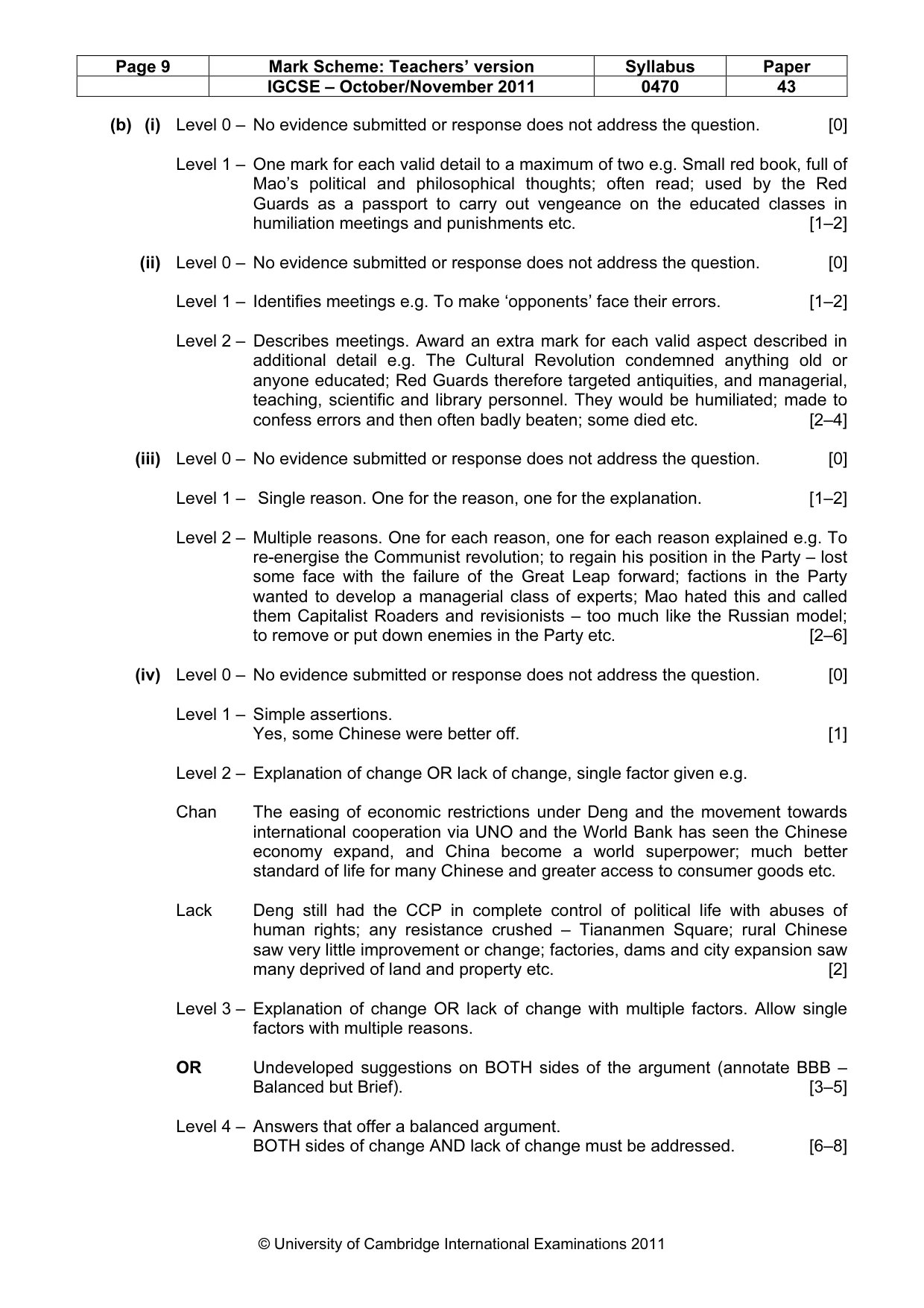
Page 5 Mark Scheme: Teachers’ version Syllabus Paper IGCSE – October/November 2011 0470 43 © University of Cambridge International Examinations 2011 (b) (i) Level 0 – No evidence submitted or response does not address the question. [0] Level 1 – One mark for each valid aspect to a maximum of two e.g. Richer peasants who owned land, employed poorer peasants and controlled most village Mirs. Largely grew out of Stolypin’s agricultural reforms etc. [1–2] (ii) Level 0 – No evidence submitted or response does not address the question. [0] Level 1 – Identifies organisation. A collective system of farming. [1–2] Level 2 – Describes organisation. Award an extra mark for each aspect described in additional detail e.g. Collective farms or ‘kolkhozy’; peasant farmers did not cultivate their own land but farmed all the land available in cooperation with their neighbours. In theory, they then shared the profits; in practice, they became state agricultural workers. [2–4] (iii) Level 0 – No evidence submitted or response does not address the question. [0] Level 1 – Single reason. One for the reason, one for the explanation. [1–2] Level 2 – Multiple reasons. One for each reason, one for each reason explained e.g. Insufficient grain being produced by the old system to feed cities and new industrial workers; to expand land under cultivation; to use machinery like tractors; to eradicate the kulaks; to sell grain abroad to buy technology and experts etc. [2–6] (iv) Level 0 – No evidence submitted or response does not address the question. [0] Level 1 – Simple assertions. No, a lot died. [1] Level 2 – Explanation of benefit OR lack of benefit, single reason given e.g. Ben Long term gains in food production with regard to grain and animals; kulaks eradicated; fed the cities and bought foreign technology; made the peasants cooperate; in spite of occasional poor harvests, the Russians were better fed etc. Lack Short term famines; millions died; on hold early on as officials were ‘dizzy with success’; force used; propaganda and scapegoated kulaks; very few human rights respected; still poor harvests in the long term; experiments as far ahead as Khrushchev’s Virgin Lands scheme 1954 failed etc. [2] Level 3 – Explanation of benefit OR lack of benefit with multiple factors. Allow single factors with multiple reasons. OR Undeveloped suggestions on BOTH sides of the argument (annotate BBB – Balanced but Brief). [3–5] Level 4 – Answers that offer a balanced argument. BOTH sides of benefit AND lack of benefit must be addressed. [6–8]
Mark scheme, page 6
Page 6 Mark Scheme: Teachers’ version Syllabus Paper IGCSE – October/November 2011 0470 43 © University of Cambridge International Examinations 2011 Depth Study C: The USA, 1919–1941 3 (a) (i) Level 0 – No evidence submitted or response does not address the question. [0] Level 1 – Repeats material stated in the source, no inference made. [1–2] Level 2 – Makes valid inference(s), unsupported from the source e.g. Overall doing well but agriculture variable etc. [3–4] Level 3 – Supports valid inferences with reference to the source e.g. The value of the economy increases to 1929, after which there is a dramatic fall; the value of cattle is variable but reaches its peak in 1929, while the peak prices for cotton are in 1925 etc. [5–6] (ii) Level 0 – No evidence submitted or response does not address the question. [0] Level 1 – Agrees OR disagrees, unsupported from the source. [1–2] Level 2 – Agrees OR disagrees, supported from the source e.g. Yes Loss of job security; no trust in banks; curtailed spending; not reassured by government action etc. No Bank irresponsibility; most already in debt; concrete reasons for fearing unemployment etc. [3–5] Level 3 – Agrees AND disagrees, supported from the source. Addresses the issue of ‘How far?’ [6–7] (iii) Level 0 – No evidence submitted or response does not address the question. [0] Level 1 – Useful/not useful – Choice made on the basis that one source is more detailed/gives more information, but does not specify what information. [1] Level 2 – Useful/not useful – One source is statistics, the other is a website so they could both be biased/unreliable. [2] Level 3 – Choice made on the nature or amount of information given. Must specify what information. [3–5] Level 4 – Choice made on the grounds of reliability. Discussion of utility must be made on valid evaluation of source(s) in context. Include at this Level answers that cross-reference between A and B to show reliability. 6 marks for one source, 7 marks for both. [6–7]
Mark scheme, page 7
Page 7 Mark Scheme: Teachers’ version Syllabus Paper IGCSE – October/November 2011 0470 43 © University of Cambridge International Examinations 2011 (b) (i) Level 0 – No evidence submitted or response does not address the question. [0] Level 1 – One mark for each valid aspect to a maximum of two e.g. Buying shares in expectation of a quick profit; buying on the margin; cheap loans; lack of regulation; prices rising throughout the 1920s; encouraged by the example of those making a killing etc. [1–2] (ii) Level 0 – No evidence submitted or response does not address the question. [0] Level 1 – Identifies effects e.g. Went bankrupt; helped FDR win election. [1–2] Level 2 – Describes effects. Award an extra mark for each valid effect described in additional detail e.g. 659 banks went bankrupt in 1929. 1930 – 1352, 1931 – 2294; largest was the Bank of the United States in New York; businesses cut production; wage cuts; job losses. US loans to Europe called in; undermined Hoover, benefited FDR etc. [2–4] (iii) Level 0 – No evidence submitted or response does not address the question. [0] Level 1 – Single reason. One for the reason, one for the explanation. [1–2] Level 2 – Multiple reasons. One for each reason, one for each reason explained e.g. Hoover seen as a ‘do nothing’ President; Republican principles made Hoover a prisoner of his party; treatment of the Bonus Army; FDR and his whistle-stop tours; success as Governor of New York; Democrats united for once; promises of action (vague). [2–6] (iv) Level 0 – No evidence submitted or response does not address the question. [0] Level 1 – Simple assertions. Yes, they lost their jobs; No the middle classes lost all their savings. [1] Level 2 – Explanation of the poor’s losses OR benefit/other groups’ losses, single factor given e.g. Loss Unemployment – 14 million by 1933; 1939 still 9 million; wage reductions; loss of homes; starvation; migration etc. Ben Poor eventually benefited; Social Security Act; trade union reform; job creation via Alphabet Agencies; intolerance pre-dated the Wall Street Crash but remained. Other Bankers/Wall Street losses; regulation; businessmen’s loss of markets; savers; politicians etc. [2] Level 3 – Explanation of poor’s losses OR benefit/other groups’ losses with multiple factors. Allow single factors with multiple reasons. OR Undeveloped suggestions on BOTH sides of the argument (annotate BBB – Balanced but Brief). [3–5] Level 4 – Answers that offer a balanced argument. BOTH sides of the poor’s losses AND benefits/other groups’ losses must be addressed. [6–8]
Mark scheme, page 8
Page 8 Mark Scheme: Teachers’ version Syllabus Paper IGCSE – October/November 2011 0470 43 © University of Cambridge International Examinations 2011 Depth Study D: China, 1945–c.1990 4 (a) (i) Level 0 – No evidence submitted or response does not address the question. [0] Level 1 – Repeats material stated in the source, no inference made. [1–2] Level 2 – Makes valid inference(s), unsupported from the source e.g. All was frenetic and violent; needed some kind of discipline to diffuse anger etc. [3–4] Level 3 – Supports valid inferences with reference to the source e.g. All was frenetic with groups fighting one another; the PLA was used as a mediator but even their representative was kidnapped; needed a cooling off period with Red Guards sent to the countryside etc. [5–6] (ii) Level 0 – No evidence submitted or response does not address the question. [0] Level 1 – Agrees OR disagrees, unsupported from the source. [1–2] Level 2 – Agrees OR disagrees, supported from the source e.g. Yes Ruling Central Committee leading the demand for unity; appeals to party committees to seek out the dissenters and convert them; get rid of the burdensome past and join the rest in the struggle etc. No States that the Cultural Revolution is a revolution which will meet resistance; blames dissent on Capitalist Roaders and old lifestyle; admits there are comrades who have made mistakes etc. [3–5] Level 3 – Agrees AND disagrees, supported from the source. Addresses the issue of ‘How far?’ [6–7] (iii) Level 0 – No evidence submitted or response does not address the question. [0] Level 1 – Useful/not useful – Choice made on the basis that one source is more detailed/gives more information, but does not specify what information. [1] Level 2 – Useful/not useful – One source is British, the other is from the Chinese Communist Party so they could both be biased/unreliable. [2] Level 3 – Choice made on the nature or amount of information given. Must specify what information. [3–5] Level 4 – Choice made on the grounds of reliability. Discussion of utility must be made on valid evaluation of source(s) in context. Include at this Level answers that cross-reference between A and B to show reliability. 6 marks for one source, 7 marks for both. [6–7]
Mark scheme, page 9
Page 9 Mark Scheme: Teachers’ version Syllabus Paper IGCSE – October/November 2011 0470 43 © University of Cambridge International Examinations 2011 (b) (i) Level 0 – No evidence submitted or response does not address the question. [0] Level 1 – One mark for each valid detail to a maximum of two e.g. Small red book, full of Mao’s political and philosophical thoughts; often read; used by the Red Guards as a passport to carry out vengeance on the educated classes in humiliation meetings and punishments etc. [1–2] (ii) Level 0 – No evidence submitted or response does not address the question. [0] Level 1 – Identifies meetings e.g. To make ‘opponents’ face their errors. [1–2] Level 2 – Describes meetings. Award an extra mark for each valid aspect described in additional detail e.g. The Cultural Revolution condemned anything old or anyone educated; Red Guards therefore targeted antiquities, and managerial, teaching, scientific and library personnel. They would be humiliated; made to confess errors and then often badly beaten; some died etc. [2–4] (iii) Level 0 – No evidence submitted or response does not address the question. [0] Level 1 – Single reason. One for the reason, one for the explanation. [1–2] Level 2 – Multiple reasons. One for each reason, one for each reason explained e.g. To re-energise the Communist revolution; to regain his position in the Party – lost some face with the failure of the Great Leap forward; factions in the Party wanted to develop a managerial class of experts; Mao hated this and called them Capitalist Roaders and revisionists – too much like the Russian model; to remove or put down enemies in the Party etc. [2–6] (iv) Level 0 – No evidence submitted or response does not address the question. [0] Level 1 – Simple assertions. Yes, some Chinese were better off. [1] Level 2 – Explanation of change OR lack of change, single factor given e.g. Chan The easing of economic restrictions under Deng and the movement towards international cooperation via UNO and the World Bank has seen the Chinese economy expand, and China become a world superpower; much better standard of life for many Chinese and greater access to consumer goods etc. Lack Deng still had the CCP in complete control of political life with abuses of human rights; any resistance crushed – Tiananmen Square; rural Chinese saw very little improvement or change; factories, dams and city expansion saw many deprived of land and property etc. [2] Level 3 – Explanation of change OR lack of change with multiple factors. Allow single factors with multiple reasons. OR Undeveloped suggestions on BOTH sides of the argument (annotate BBB – Balanced but Brief). [3–5] Level 4 – Answers that offer a balanced argument. BOTH sides of change AND lack of change must be addressed. [6–8]
Mark scheme, page 10
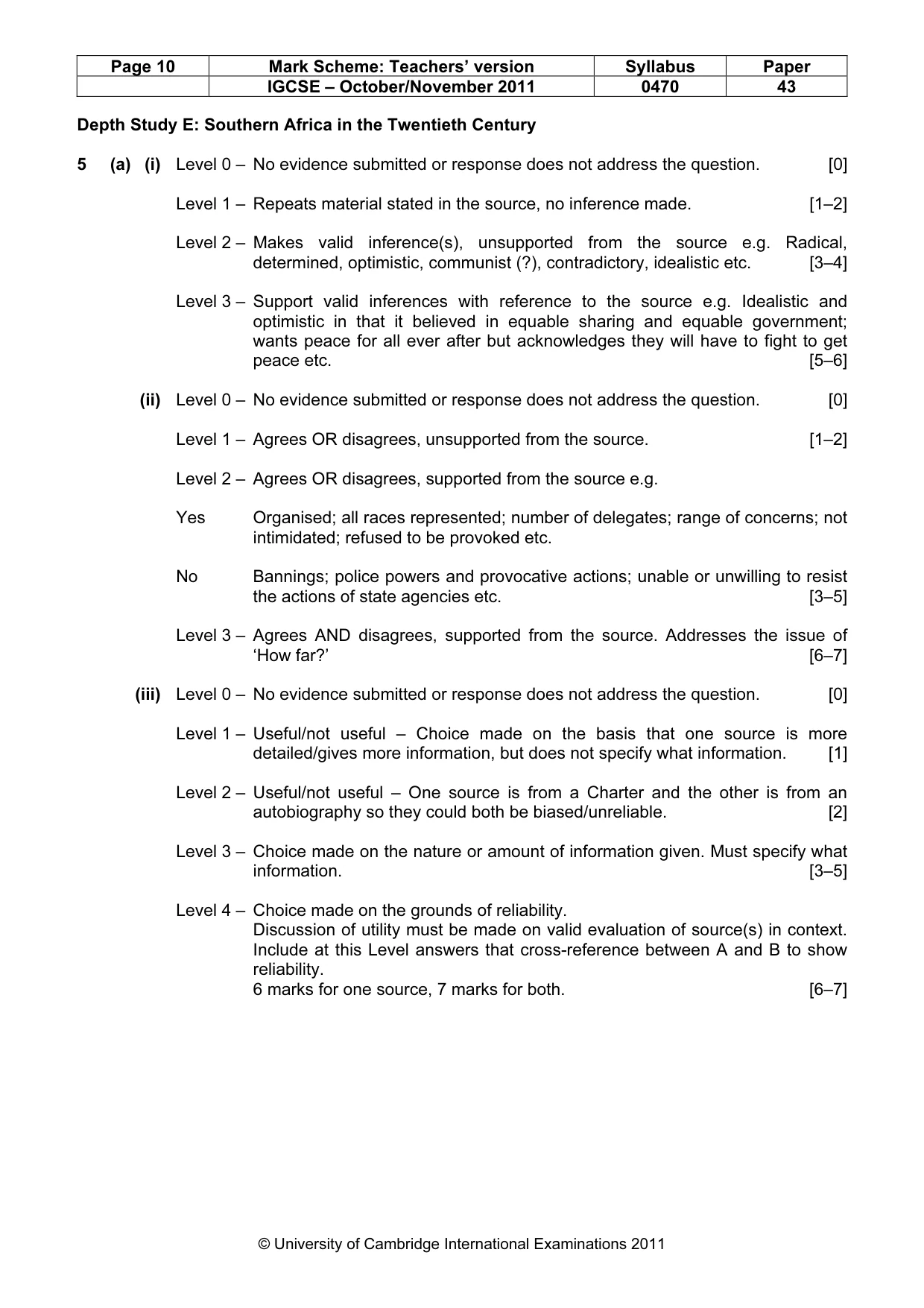
Page 10 Mark Scheme: Teachers’ version Syllabus Paper IGCSE – October/November 2011 0470 43 © University of Cambridge International Examinations 2011 Depth Study E: Southern Africa in the Twentieth Century 5 (a) (i) Level 0 – No evidence submitted or response does not address the question. [0] Level 1 – Repeats material stated in the source, no inference made. [1–2] Level 2 – Makes valid inference(s), unsupported from the source e.g. Radical, determined, optimistic, communist (?), contradictory, idealistic etc. [3–4] Level 3 – Support valid inferences with reference to the source e.g. Idealistic and optimistic in that it believed in equable sharing and equable government; wants peace for all ever after but acknowledges they will have to fight to get peace etc. [5–6] (ii) Level 0 – No evidence submitted or response does not address the question. [0] Level 1 – Agrees OR disagrees, unsupported from the source. [1–2] Level 2 – Agrees OR disagrees, supported from the source e.g. Yes Organised; all races represented; number of delegates; range of concerns; not intimidated; refused to be provoked etc. No Bannings; police powers and provocative actions; unable or unwilling to resist the actions of state agencies etc. [3–5] Level 3 – Agrees AND disagrees, supported from the source. Addresses the issue of ‘How far?’ [6–7] (iii) Level 0 – No evidence submitted or response does not address the question. [0] Level 1 – Useful/not useful – Choice made on the basis that one source is more detailed/gives more information, but does not specify what information. [1] Level 2 – Useful/not useful – One source is from a Charter and the other is from an autobiography so they could both be biased/unreliable. [2] Level 3 – Choice made on the nature or amount of information given. Must specify what information. [3–5] Level 4 – Choice made on the grounds of reliability. Discussion of utility must be made on valid evaluation of source(s) in context. Include at this Level answers that cross-reference between A and B to show reliability. 6 marks for one source, 7 marks for both. [6–7]
Mark scheme, page 11
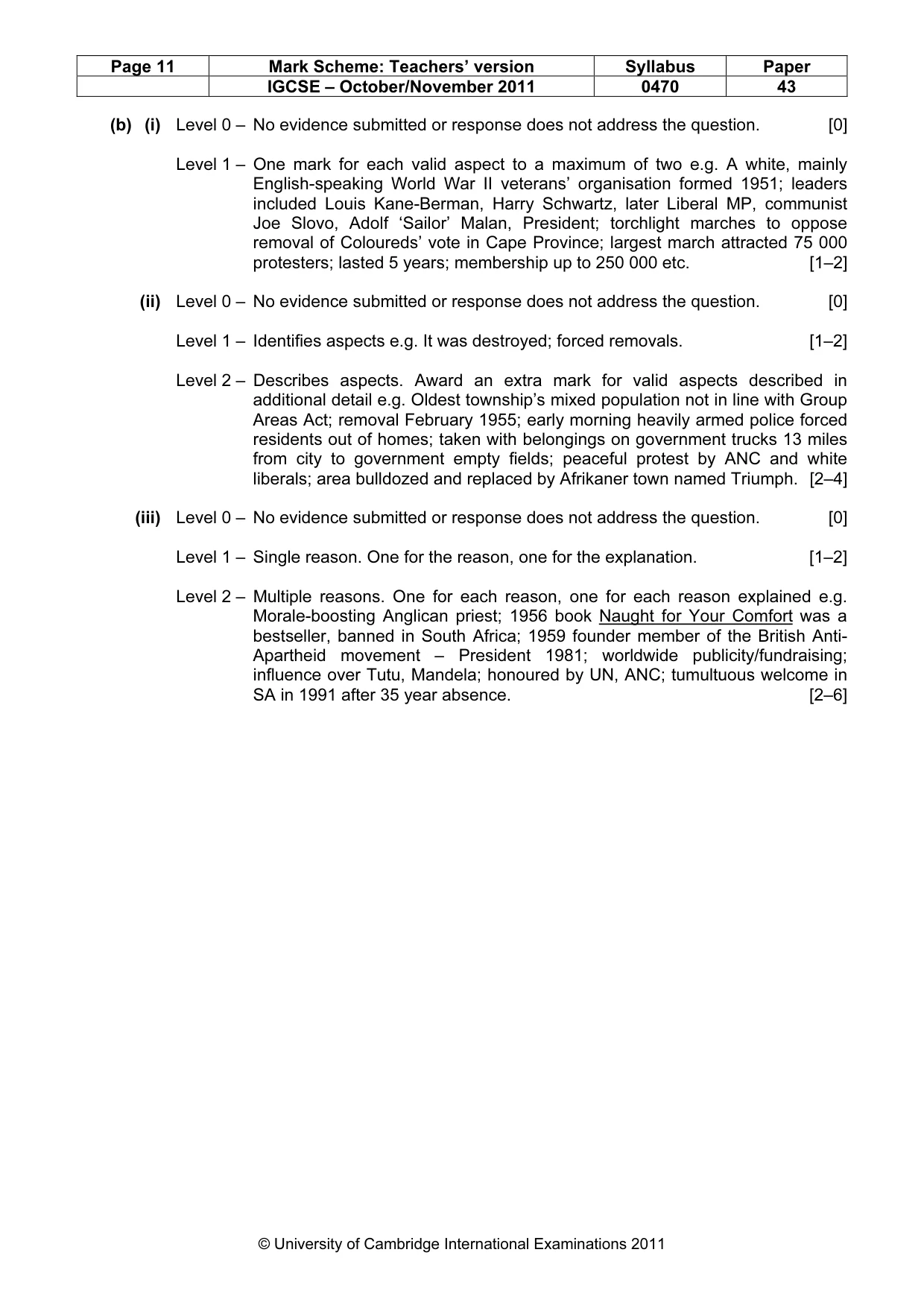
Page 11 Mark Scheme: Teachers’ version Syllabus Paper IGCSE – October/November 2011 0470 43 © University of Cambridge International Examinations 2011 (b) (i) Level 0 – No evidence submitted or response does not address the question. [0] Level 1 – One mark for each valid aspect to a maximum of two e.g. A white, mainly English-speaking World War II veterans’ organisation formed 1951; leaders included Louis Kane-Berman, Harry Schwartz, later Liberal MP, communist Joe Slovo, Adolf ‘Sailor’ Malan, President; torchlight marches to oppose removal of Coloureds’ vote in Cape Province; largest march attracted 75 000 protesters; lasted 5 years; membership up to 250 000 etc. [1–2] (ii) Level 0 – No evidence submitted or response does not address the question. [0] Level 1 – Identifies aspects e.g. It was destroyed; forced removals. [1–2] Level 2 – Describes aspects. Award an extra mark for valid aspects described in additional detail e.g. Oldest township’s mixed population not in line with Group Areas Act; removal February 1955; early morning heavily armed police forced residents out of homes; taken with belongings on government trucks 13 miles from city to government empty fields; peaceful protest by ANC and white liberals; area bulldozed and replaced by Afrikaner town named Triumph. [2–4] (iii) Level 0 – No evidence submitted or response does not address the question. [0] Level 1 – Single reason. One for the reason, one for the explanation. [1–2] Level 2 – Multiple reasons. One for each reason, one for each reason explained e.g. Morale-boosting Anglican priest; 1956 book Naught for Your Comfort was a bestseller, banned in South Africa; 1959 founder member of the British Anti- Apartheid movement – President 1981; worldwide publicity/fundraising; influence over Tutu, Mandela; honoured by UN, ANC; tumultuous welcome in SA in 1991 after 35 year absence. [2–6]
Mark scheme, page 12
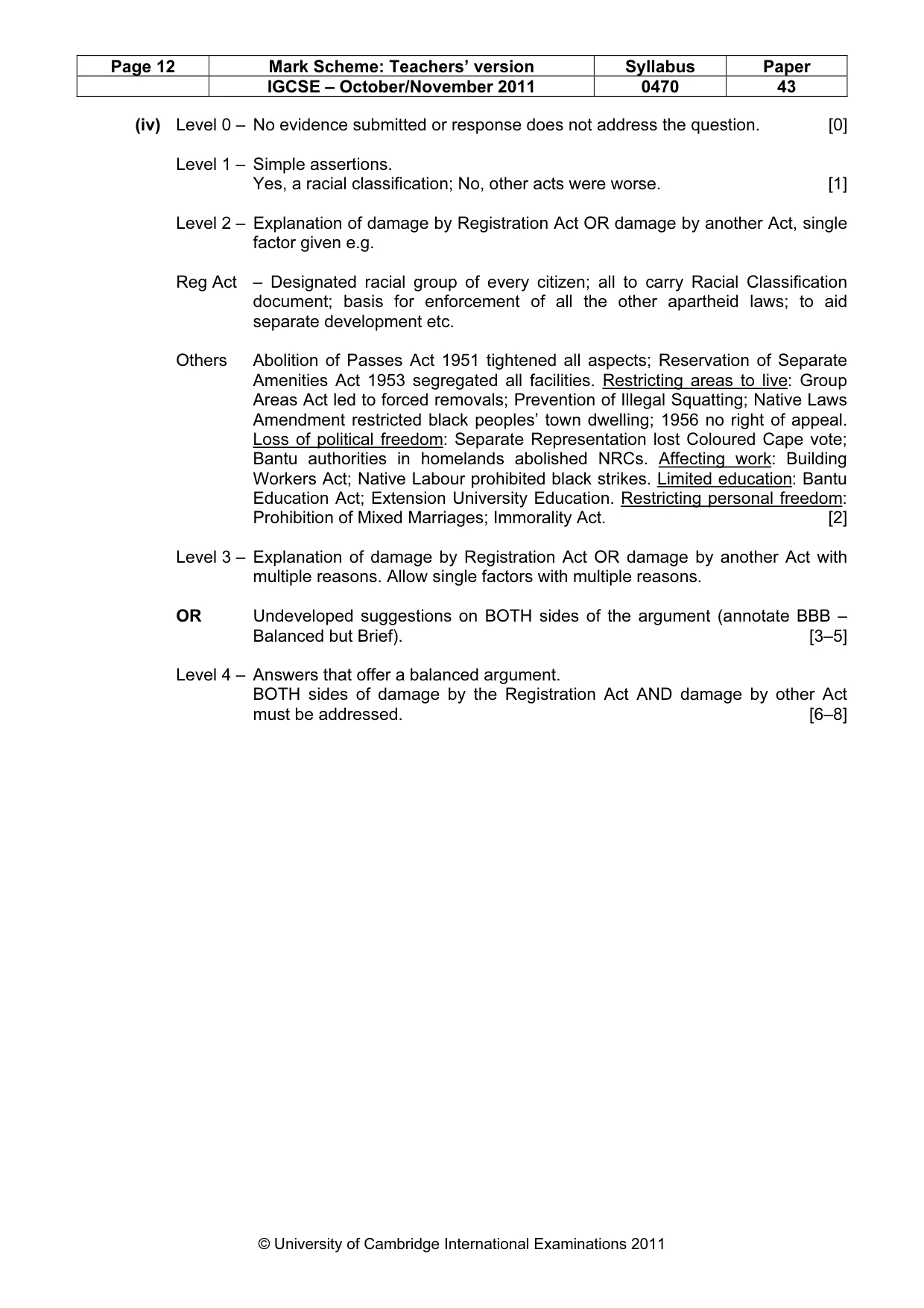
Page 12 Mark Scheme: Teachers’ version Syllabus Paper IGCSE – October/November 2011 0470 43 © University of Cambridge International Examinations 2011 (iv) Level 0 – No evidence submitted or response does not address the question. [0] Level 1 – Simple assertions. Yes, a racial classification; No, other acts were worse. [1] Level 2 – Explanation of damage by Registration Act OR damage by another Act, single factor given e.g. Reg Act – Designated racial group of every citizen; all to carry Racial Classification document; basis for enforcement of all the other apartheid laws; to aid separate development etc. Others Abolition of Passes Act 1951 tightened all aspects; Reservation of Separate Amenities Act 1953 segregated all facilities. Restricting areas to live: Group Areas Act led to forced removals; Prevention of Illegal Squatting; Native Laws Amendment restricted black peoples’ town dwelling; 1956 no right of appeal. Loss of political freedom: Separate Representation lost Coloured Cape vote; Bantu authorities in homelands abolished NRCs. Affecting work: Building Workers Act; Native Labour prohibited black strikes. Limited education: Bantu Education Act; Extension University Education. Restricting personal freedom: Prohibition of Mixed Marriages; Immorality Act. [2] Level 3 – Explanation of damage by Registration Act OR damage by another Act with multiple reasons. Allow single factors with multiple reasons. OR Undeveloped suggestions on BOTH sides of the argument (annotate BBB – Balanced but Brief). [3–5] Level 4 – Answers that offer a balanced argument. BOTH sides of damage by the Registration Act AND damage by other Act must be addressed. [6–8]
Mark scheme, page 13
Page 13 Mark Scheme: Teachers’ version Syllabus Paper IGCSE – October/November 2011 0470 43 © University of Cambridge International Examinations 2011 Depth Study F: Israelis and Palestinians, 1945–c.1994 6 (a) (i) Level 0 – No evidence submitted or response does not address the question. [0] Level 1 – Repeats material stated in the source, no inference made. [1–2] Level 2 – Makes valid inference(s), unsupported from the source e.g. The population appears to grow bigger; immigration seems to reduce etc. [3–4] Level 3 – Supports valid inferences with reference to the source e.g. The population grew steadily from 1948 and multiplied by a factor of four, while immigration has reduced by 1968 to one sixth of the 1949 rate. This would appear to suggest that population rise now depends more on natural birth rate rather than immigration. Reduction in immigration would appear to show that many of the Jews who wished to settle in Israel have already done so. [5–6] (ii) Level 0 – No evidence submitted or response does not address the question. [0] Level 1– Agrees OR disagrees, unsupported from the source. [1–2] Level 2 – Agrees OR disagrees, supported from the source e.g. Yes Enormous increase in exports from citrus fruits to plastics etc.; main customers USA and Britain. Has a tourist industry etc. No Experiences difficulties in finding foreign markets, especially among Arab and communist states. Tourist industry disrupted by war etc. [3–5] Level 3 – Agrees AND disagrees, supported from the source. Addresses the issue of ‘How far?’ [6–7] (iii) Level 0 – No evidence submitted or response does not address the question. [0] Level 1 – Useful/not useful – Choice made on the basis that one source is more detailed/gives more information, but does not specify what information. [1] Level 2 – Useful/not useful – One source is statistics and the other is by a British writer so they could both be biased/unreliable. [2] Level 3 – Choice made on the nature or amount of information given. Must specify what information. [3–5] Level 4 – Choice made on the grounds of reliability. Discussion of utility must be made on valid evaluation of source(s) in context. Include at this Level answers that cross-reference between A and B to show reliability. 6 marks for one source, 7 marks for both. [6–7]
Mark scheme, page 14
Page 14 Mark Scheme: Teachers’ version Syllabus Paper IGCSE – October/November 2011 0470 43 © University of Cambridge International Examinations 2011 (b) (i) Level 0 – No evidence submitted or response does not address the question. [0] Level 1 – One mark for each valid element to a maximum of two e.g. Collective agricultural settlements (first in 1909). Often sited in unpromising areas to regain land from arid areas, and to increase food production etc. [1–2] (ii) Level 0 – No evidence submitted or response does not address the question. [0] Level 1 – Identifies issues e.g. Both claim the city as having central religious importance. [1–2] Level 2 – Describes issues. Award an extra mark for each valid issue which is described in additional detail e.g. After Mecca and Medina, the Al-Aqsa mosque is the third most holy site for Islam. Since Jerusalem was the capital of King David’s kingdom (c. 1000 BC), it has been the epicentre of Jewish cultural, social, religious consciousness. UNO wanted the city to have international status (1947), but after the war 1948/9, the western half fell under Israeli control, and the eastern half, including the Wailing Wall, came under Jordan. After the Six Day War Israel occupied the whole area. Bone of great contention in any peace negotiations. [2–4] (iii) Level 0 – No evidence submitted or response does not address the question. [0] Level 1 – Single reason. One for the reason, one for the explanation. [1–2] Level 2 – Multiple reasons. One for each reason, one for each reason explained e.g. Early promises e.g. Balfour Declaration, and developing Zionism, appeared to make the Jews feel they had a right to a homeland. After WWII, sympathy and the Jewish lobby in the USA meant that a Jewish state could exist in Palestine. GB opted out of its mandate and UNO plans were heavily ‘influenced’ by USA. The unity and determination of the Jews to resist all attempts to eradicate Israel: the disunity among Arab states – some totally against Israel like Iran and Syria, while others like Jordan and Egypt have reached an accommodation of sorts. Support of USA. [2–6]
Mark scheme, page 15
Page 15 Mark Scheme: Teachers’ version Syllabus Paper IGCSE – October/November 2011 0470 43 © University of Cambridge International Examinations 2011 (iv) Level 0 – No evidence submitted or response does not address the question. [0] Level 1 – Simple assertions. Yes, they always stick together. [1] Level 2 – Explanation of unity OR lack of unity, single factor given e.g. Unity Once the state was established, it would appear that one thing all Israelis agreed upon was the defence and maintenance of the state. The Israelis have resisted assaults and defended ‘their’ territory vigorously and efficiently throughout the period 1945–1994 against Arab states and from a variety of Palestinian and foreign sponsored terrorist groups. Lack With evidence from both religious and political groups in Israel, it would appear that the right wing religious parties hold the Likud Party in check. They wish to make no compromise with Arabs/Palestinians. More radical and centre groups e.g. Labour Party have attempted to make deals and accommodations. There are exceptions e.g. Begin at Camp David. A very complicated question. [2] Level 3 – Explanation of unity OR lack of unity with multiple factors. Allow single factors with multiple reasons. OR Undeveloped suggestions on BOTH sides of the argument (annotate BBB – Balanced but Brief). [3–5] Level 4 – Answers that offer a balanced argument. BOTH sides of unity AND lack of unity must be addressed. [6–8]
Mark scheme, page 16
Page 16 Mark Scheme: Teachers’ version Syllabus Paper IGCSE – October/November 2011 0470 43 © University of Cambridge International Examinations 2011 Depth Study G: The Creation of Modern Industrial Society 7 (a) (i) Level 0 – No evidence submitted or response does not address the question. [0] Level 1 – Repeats material stated in the source, no inference made. [1–2] Level 2 – Makes valid inference(s) unsupported from the source e.g. To try and improve their conditions and improve their lives etc. [3–4] Level 3 – Supports valid inferences with reference to the source e.g. To improve their conditions which are constantly eroded by wage reductions; to achieve a fair day’s pay for a fair day’s work etc. [5–6] (ii) Level 0 – No evidence submitted or response does not address the question. [0] Level 1 – Agrees OR disagrees, unsupported from the source. [1–2] Level 2 – Agrees OR disagrees, supported from the source e.g. Yes The authorities were determined to prevent association, trumped up charges from inappropriate laws to seal conviction and punishment as a warning to others etc. No Case showed that there were no appropriate laws against association, so authorities are attempting to intimidate; this intimidation does not appear to be working as Loveless is writing about it and exposing the conduct of the trial just 3 years later. [3–5] Level 3 – Agrees AND disagrees, supported from the source. Addresses the issue of ‘How far?’ [6–7] (iii) Level 0 – No evidence submitted or response does not address the question. [0] Level 1 – Useful/not useful – Choice made on the basis that one source is more detailed/gives more information, but does not specify what information. [1] Level 2 – Useful/not useful – One source is from a resolution, the other is from an individual so they could both be biased/unreliable. [2] Level 3 – Choice made on the nature or amount of information given. Must specify what information. [3–5] Level 4 – Choice made on the grounds of reliability. Discussion of utility must be made on valid evaluation of source(s) in context. Include at this Level answers that cross-reference between A and B to show reliability. 6 marks for one source, 7 marks for both. [6–7]
Mark scheme, page 17
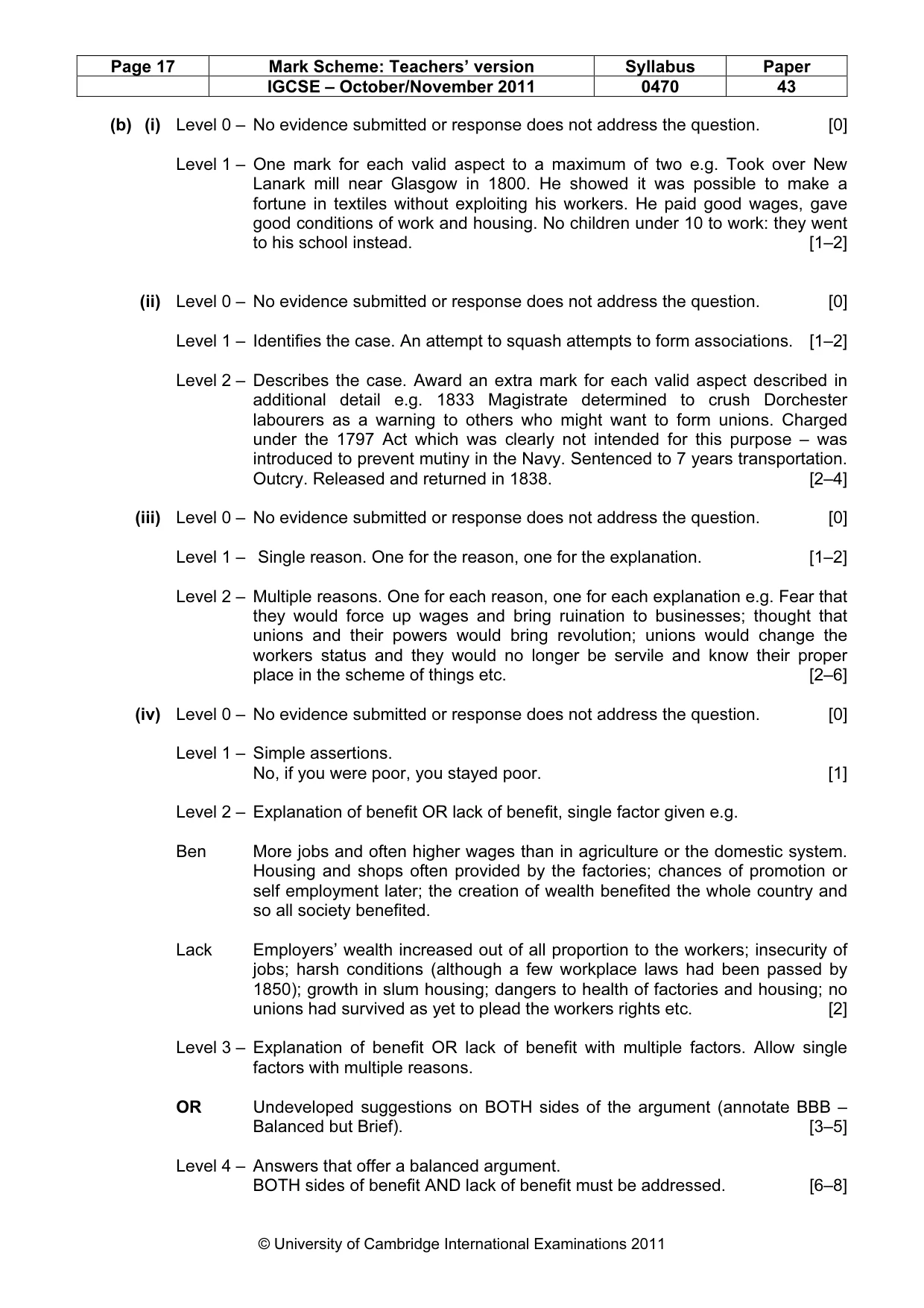
Page 17 Mark Scheme: Teachers’ version Syllabus Paper IGCSE – October/November 2011 0470 43 © University of Cambridge International Examinations 2011 (b) (i) Level 0 – No evidence submitted or response does not address the question. [0] Level 1 – One mark for each valid aspect to a maximum of two e.g. Took over New Lanark mill near Glasgow in 1800. He showed it was possible to make a fortune in textiles without exploiting his workers. He paid good wages, gave good conditions of work and housing. No children under 10 to work: they went to his school instead. [1–2] (ii) Level 0 – No evidence submitted or response does not address the question. [0] Level 1 – Identifies the case. An attempt to squash attempts to form associations. [1–2] Level 2 – Describes the case. Award an extra mark for each valid aspect described in additional detail e.g. 1833 Magistrate determined to crush Dorchester labourers as a warning to others who might want to form unions. Charged under the 1797 Act which was clearly not intended for this purpose – was introduced to prevent mutiny in the Navy. Sentenced to 7 years transportation. Outcry. Released and returned in 1838. [2–4] (iii) Level 0 – No evidence submitted or response does not address the question. [0] Level 1 – Single reason. One for the reason, one for the explanation. [1–2] Level 2 – Multiple reasons. One for each reason, one for each explanation e.g. Fear that they would force up wages and bring ruination to businesses; thought that unions and their powers would bring revolution; unions would change the workers status and they would no longer be servile and know their proper place in the scheme of things etc. [2–6] (iv) Level 0 – No evidence submitted or response does not address the question. [0] Level 1 – Simple assertions. No, if you were poor, you stayed poor. [1] Level 2 – Explanation of benefit OR lack of benefit, single factor given e.g. Ben More jobs and often higher wages than in agriculture or the domestic system. Housing and shops often provided by the factories; chances of promotion or self employment later; the creation of wealth benefited the whole country and so all society benefited. Lack Employers’ wealth increased out of all proportion to the workers; insecurity of jobs; harsh conditions (although a few workplace laws had been passed by 1850); growth in slum housing; dangers to health of factories and housing; no unions had survived as yet to plead the workers rights etc. [2] Level 3 – Explanation of benefit OR lack of benefit with multiple factors. Allow single factors with multiple reasons. OR Undeveloped suggestions on BOTH sides of the argument (annotate BBB – Balanced but Brief). [3–5] Level 4 – Answers that offer a balanced argument. BOTH sides of benefit AND lack of benefit must be addressed. [6–8]
Mark scheme, page 18
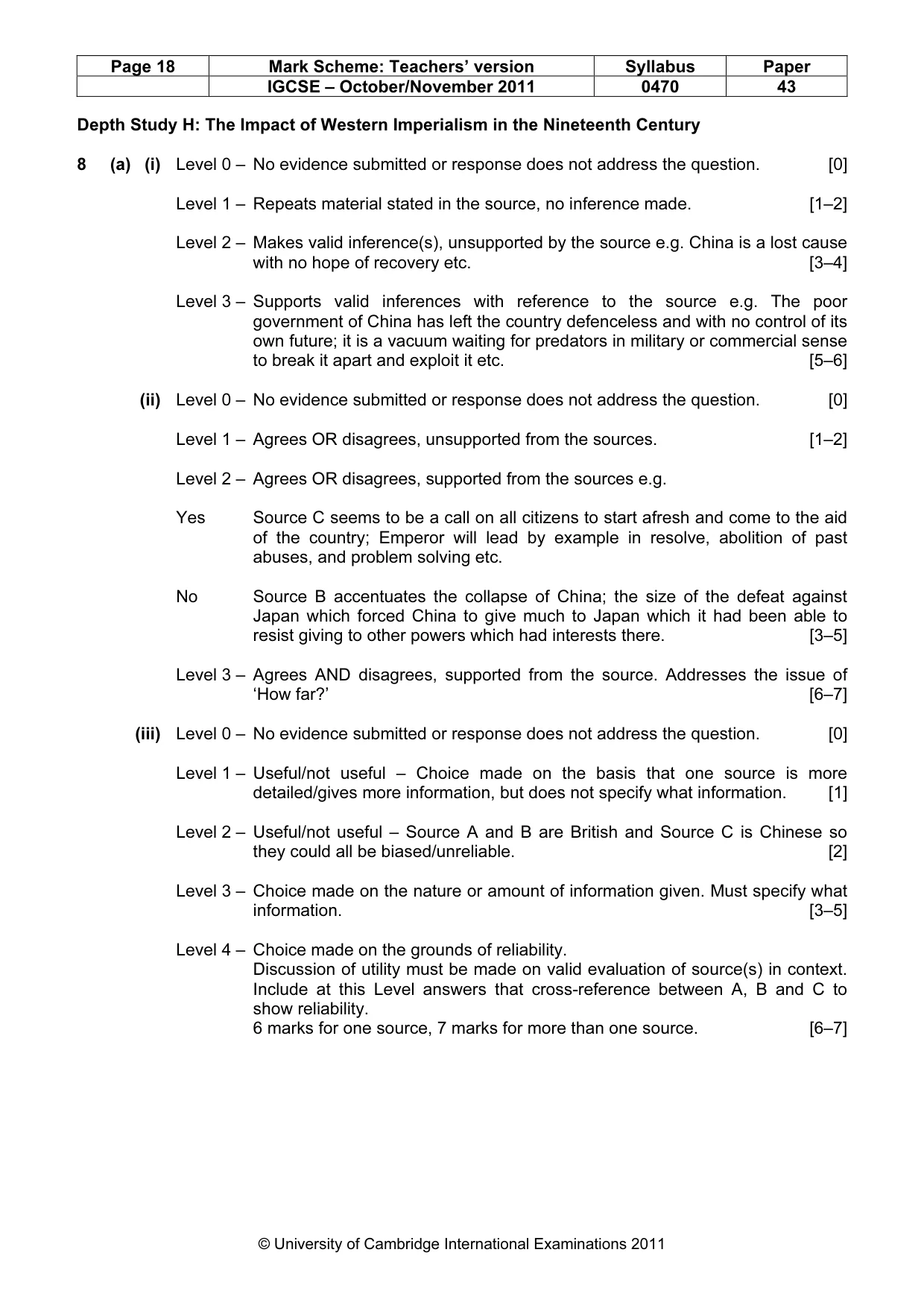
Page 18 Mark Scheme: Teachers’ version Syllabus Paper IGCSE – October/November 2011 0470 43 © University of Cambridge International Examinations 2011 Depth Study H: The Impact of Western Imperialism in the Nineteenth Century 8 (a) (i) Level 0 – No evidence submitted or response does not address the question. [0] Level 1 – Repeats material stated in the source, no inference made. [1–2] Level 2 – Makes valid inference(s), unsupported by the source e.g. China is a lost cause with no hope of recovery etc. [3–4] Level 3 – Supports valid inferences with reference to the source e.g. The poor government of China has left the country defenceless and with no control of its own future; it is a vacuum waiting for predators in military or commercial sense to break it apart and exploit it etc. [5–6] (ii) Level 0 – No evidence submitted or response does not address the question. [0] Level 1 – Agrees OR disagrees, unsupported from the sources. [1–2] Level 2 – Agrees OR disagrees, supported from the sources e.g. Yes Source C seems to be a call on all citizens to start afresh and come to the aid of the country; Emperor will lead by example in resolve, abolition of past abuses, and problem solving etc. No Source B accentuates the collapse of China; the size of the defeat against Japan which forced China to give much to Japan which it had been able to resist giving to other powers which had interests there. [3–5] Level 3 – Agrees AND disagrees, supported from the source. Addresses the issue of ‘How far?’ [6–7] (iii) Level 0 – No evidence submitted or response does not address the question. [0] Level 1 – Useful/not useful – Choice made on the basis that one source is more detailed/gives more information, but does not specify what information. [1] Level 2 – Useful/not useful – Source A and B are British and Source C is Chinese so they could all be biased/unreliable. [2] Level 3 – Choice made on the nature or amount of information given. Must specify what information. [3–5] Level 4 – Choice made on the grounds of reliability. Discussion of utility must be made on valid evaluation of source(s) in context. Include at this Level answers that cross-reference between A, B and C to show reliability. 6 marks for one source, 7 marks for more than one source. [6–7]
Mark scheme, page 19
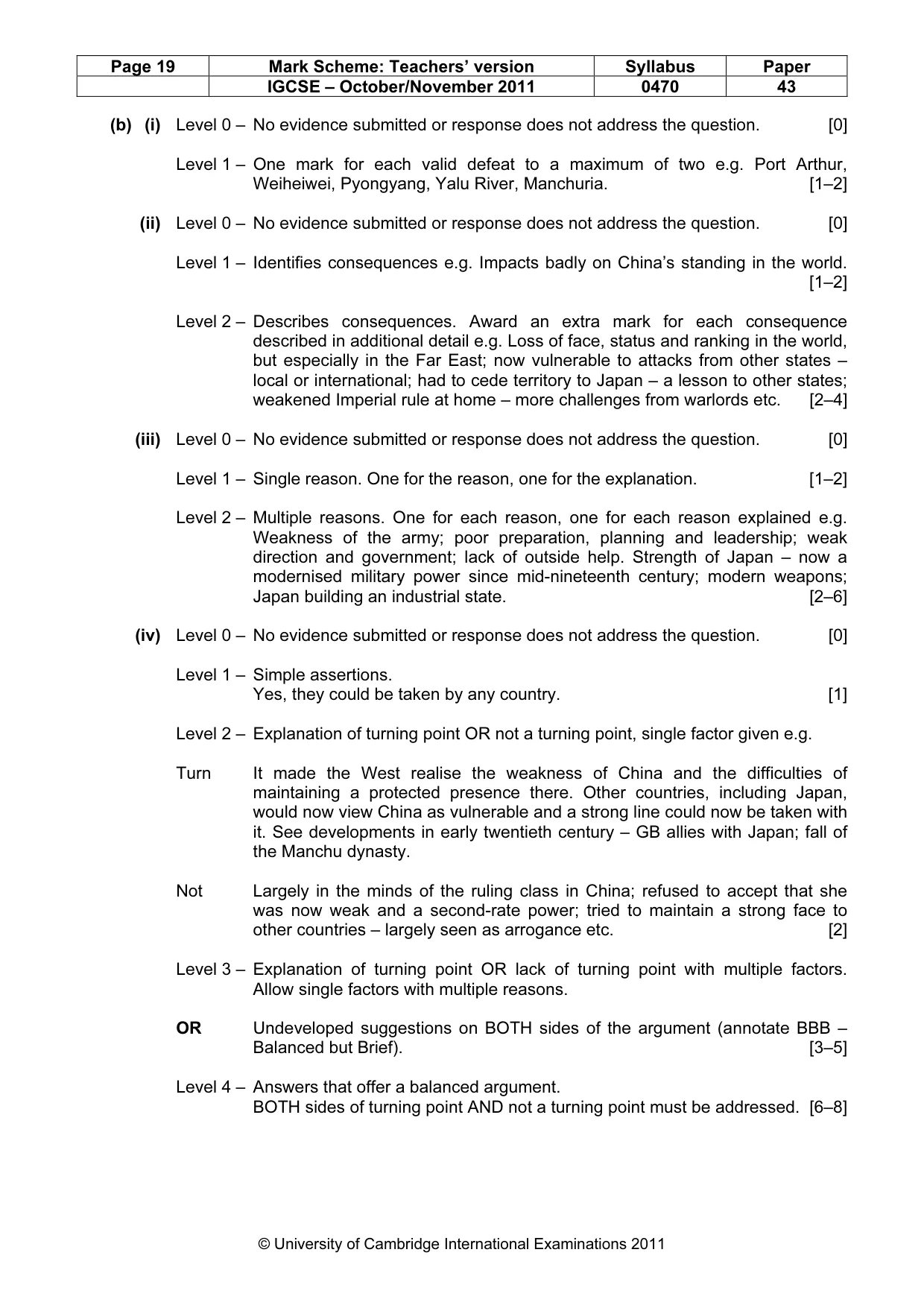
Page 19 Mark Scheme: Teachers’ version Syllabus Paper IGCSE – October/November 2011 0470 43 © University of Cambridge International Examinations 2011 (b) (i) Level 0 – No evidence submitted or response does not address the question. [0] Level 1 – One mark for each valid defeat to a maximum of two e.g. Port Arthur, Weiheiwei, Pyongyang, Yalu River, Manchuria. [1–2] (ii) Level 0 – No evidence submitted or response does not address the question. [0] Level 1 – Identifies consequences e.g. Impacts badly on China’s standing in the world. [1–2] Level 2 – Describes consequences. Award an extra mark for each consequence described in additional detail e.g. Loss of face, status and ranking in the world, but especially in the Far East; now vulnerable to attacks from other states – local or international; had to cede territory to Japan – a lesson to other states; weakened Imperial rule at home – more challenges from warlords etc. [2–4] (iii) Level 0 – No evidence submitted or response does not address the question. [0] Level 1 – Single reason. One for the reason, one for the explanation. [1–2] Level 2 – Multiple reasons. One for each reason, one for each reason explained e.g. Weakness of the army; poor preparation, planning and leadership; weak direction and government; lack of outside help. Strength of Japan – now a modernised military power since mid-nineteenth century; modern weapons; Japan building an industrial state. [2–6] (iv) Level 0 – No evidence submitted or response does not address the question. [0] Level 1 – Simple assertions. Yes, they could be taken by any country. [1] Level 2 – Explanation of turning point OR not a turning point, single factor given e.g. Turn It made the West realise the weakness of China and the difficulties of maintaining a protected presence there. Other countries, including Japan, would now view China as vulnerable and a strong line could now be taken with it. See developments in early twentieth century – GB allies with Japan; fall of the Manchu dynasty. Not Largely in the minds of the ruling class in China; refused to accept that she was now weak and a second-rate power; tried to maintain a strong face to other countries – largely seen as arrogance etc. [2] Level 3 – Explanation of turning point OR lack of turning point with multiple factors. Allow single factors with multiple reasons. OR Undeveloped suggestions on BOTH sides of the argument (annotate BBB – Balanced but Brief). [3–5] Level 4 – Answers that offer a balanced argument. BOTH sides of turning point AND not a turning point must be addressed. [6–8]
What you needed in this session
Cambridge’s own grade thresholds for 2011 Oct/Nov, Paper 4 · Variant 3. A higher threshold means an easier paper — the bar moves with how the cohort did.